
Kenneth Blanchard & Spenser Johnson – THE ONE MINUTE MANAGER
1
Read a Story
That Will
Change Your Life!
The One Minute Manager
is an easily read story which quickly shows you three
very practical management techniques. As the story unfolds, you will discover several
studies in medicine and the behavioral sciences which help you to understand why these
apparently simple methods work so well with so many people. By the book’s end you
will also know how to apply them to your own situation.
The book is brief, the language is simple, and best of all ... it works!
That’s why
The One Minute Manager
has become America’s national sensation,
featured in People magazine, and on The Today Show, The Merv Griffin Show, and
other network television programs.

Kenneth Blanchard & Spenser Johnson – THE ONE MINUTE MANAGER
2
Books by Kenneth H. Blanchard, Ph.D.
MANAGEMENT OF ORGANIZATIONAL BEHAVIOR: UTILIZING HUMAN RESOURCES
(with Paul Hersey).
ORGANIZATIONAL CHANGE THROUGH EFFECTIVE LEADERSHIP (with Robert H. Guest and
Paul Hersey).
THE FAMILY GAME: A SITUATIONAL APPROACH TO EFFECTIVE PARENTING (with Paul
Hersey).
PUTTING THE ONE MINUTE MANAGER TO WORK (with Robert Lorber, Ph.D.).
Books by Spencer Johnson, M.D.
THE ONE MINUTE FATHER
THE ONE MINUTE MOTHER
THE PRECIOUS PRESENT: THE GIFT THAT MAKES A PERSON HAPPY FOREVER
THE VALUETALE SERIES:
THE VALUE OF BELIEVING IN YOURSELF, The Story of Louts Pasteur
THE VALUE OF PATIENCE, The Story of the Wright Brothers
THE VALUE OF KINDNESS, The Story of Elizabeth Fry
THE VALUE OF HUMOR, The Story of Will Rogers
THE VALUE OF COURAGE, The Story of Jackie Robinson
THE VALUE OF CURIOSITY, The Story of Christopher Columbus
THE VALUE OF IMAGINATION, The Story of Charles Dickens
THE VALUE OF SAVING, The Story of Benjamin Franklin
THE VALUE OF SHARING, The Story of the Mayo Brothers
THE VALUE OF HONESTY, The Story of Confucius
THE VALUE OF UNDERSTANDING, The Story of Margaret Mead
THE VALUE OF FANTASY, The Story of Hans Christian Anderson
Most Berkley books are available at special quantity discounts for bulk purchases or sales promotions,
premiums, fund raising, or educational use. Special books or book excerpts can also be created to fit
specific needs.
For details, write or telephone Special Markets, The Berkley Publishing Group, 200 Madison Avenue, New
York, New York 10016; (212) 951-8800.

Kenneth Blanchard & Spenser Johnson – THE ONE MINUTE MANAGER
3
“All managers and executives can easily use The One Minute Manager to build a more
efficient organization. Those who have tried it, like it.”
—ROY ANDERSON, Chairman of the
Board & Chief Executive Officer,
Lockheed Corp.
“Not since Up the Organization have I read such a straightforward, innovative book as
The One Minute Manager. Should be command reading for every restauranteur and
hotelier in the country.”
—DONALD I. SMITH, Director,
School of Hotel, Restaurant and
Institutional Management,
College of Business,
Michigan State University
“Quite simply, The One Minute Manager can help any manager to assist his people to
become peak performers. I include it in all my work with American corporations seeking
to improve productivity, profitability and performance.”
—CHARLES A. GARFIELD, Ph.D.,
President, PEAK Performance Center;
Clinical Professor,
University of California, Berkeley
“In government, criticizing performance has become the dominant management
technique. The One Minute Manager’s approach of catching someone doing something
right would be far more effective.”
—DAVID C. JONES, General,
U.S.A.E, Retired,
Former Chairman,
The Joint Chiefs of Staff
“The best management book I’ve read. I couldn’t put it down. I’ve bought copies for all
my key managers, and now they are doing the same for their people.”
—JERE W. THOMPSON, President
The Southland Corporation
7-Eleven Convenience Stores
“Finally there is a short, readable, practical guide to effective management! We have
more than a thousand copies of The One Minute Manager available to our managers.”
—ERNEST E. RENAUD, President
& Chief Executive Officer,
Jerrico, Inc.
“I believe The One Minute Manager should be made ‘standard issue’ at all management
development training programs from new managers’ school to advanced management

Kenneth Blanchard & Spenser Johnson – THE ONE MINUTE MANAGER
4
training. It embodies (in an easy-to-read form) the fundamental principles of people
management we are trying to instill in our management team. I have made it required
reading for all our managers.”
—DAVID HANNA, President
GRiD Systems Corporation
“Buying copies of The One Minute Manager is one of the best investments I’ve made in
myself and in our managers.”
—LOUIS P. NEEB, President
Fast Food Division, W. R. Grace & Co.
(formerly Chairman of the Board,
Burger King Corp.)
“Should you apply one-minute management? Yes!”
—WORKING WOMAN
“The One Minute Manager ... don’t miss it!”
—MERV GRIFFIN
“Our managers are using The One Minute Manager’s practical method in our ‘Yellow
Pages’ operation all over the world. There is no doubt about it—it works!”
—R. W. BUTLER, President,
GTE Directories Corporation
“Our whole management has profited from reading The One Minute Manager.”
—MICHAEL D. ROSE, President
& Chief Executive Officer,
Holiday Inn, Inc.
“I gave copies to my boss, my subordinates, other refinery managers, and even to my
wife, our close friends and our clergy. It has that kind of broad appeal and it’s that good!”
—ROBERT W. DAVIS, President
Chevron Chemical Company
“This book shows us how to manage our encounters with people in such a way that
everyone benefits! Very enlightening!”
—EARL NIGHTINGALE
Radio commentator,
OUR CHANGING WORLD

Kenneth Blanchard & Spenser Johnson – THE ONE MINUTE MANAGER
5
This Berkley book contains the complete
text of the original hardcover edition.
THE ONE MINUTE MANAGER
A Berkley Book / published by arrangement with
William Morrow and Company, Inc.
PRINTING HISTORY
William Morrow and Company edition published 1982
Berkley trade paperback edition / October 1983
All rights reserved.
Copyright © 1981, 1982 by Blanchard Family Partnership
and Candle Communications Corporation.
This book may not be reproduced in whole or in part,
by mimeograph or any other means, without permission.
For information address: William Morrow and Company, Inc.
105 Madison Avenue, New York, New York 10016.
ISBN: 0-425-09847-8
A BERKLEY BOOK ® TM 757,375
Berkley Books are published by The Berkley Publishing Group,
200 Madison Avenue, New York, New York 10016.
The name “BERKLEY” and the “B” logo
are trademarks belonging to Berkley Publishing Corporation.
PRINTED IN THE UNITED STATES OF AMERICA
50 49 48

Kenneth Blanchard & Spenser Johnson – THE ONE MINUTE MANAGER
6
The
One
Minute
Manager
Kenneth Blanchard, Ph.D.
Spencer Johnson, M.D.
BERKLEY BOOKS, NEW YORK

Kenneth Blanchard & Spenser Johnson – THE ONE MINUTE MANAGER
7
Contents
The Search
The One Minute Manager
The First Secret: One Minute Goals
One Minute Goals: Summary
The Second Secret: One Minute Praisings
One Minute Praisings: Summary
The Appraisal
The Third Secret: One Minute Reprimands
One Minute Reprimands: Summary
The One Minute Manager Explains
Why One Minute Goals Work
Why One Minute Praisings Work
Why One Minute Reprimands Work
The New One Minute Manager
A Gift to Yourself
A Gift to Others
Acknowledgments
About the Authors

Kenneth Blanchard & Spenser Johnson – THE ONE MINUTE MANAGER
8
The Symbol
The One Minute Manager’s symbol—a one minute readout
from the face of a modern digital watch—is intended to
remind each of us to take a minute out of our day to look
into the faces of the people we manage. And to realize that
they are our most important resources.

Kenneth Blanchard & Spenser Johnson – THE ONE MINUTE MANAGER
9
Introduction
In this brief story, we present you with a great deal of what we have learned from our
studies in medicine and in the behavioral sciences about how people work best with other
people.
By “best,” we mean how people produce valuable results, and feel good about
themselves, the organization and the other people with whom they work.
This allegory, The One Minute Manager, is a simple compilation of what many wise
people have taught us and what we have learned ourselves. We recognize the importance
of these sources of wisdom. We also realize that the people who work with you as their
manager will look to you as one of their sources of wisdom.
We trust, therefore, that you will take the practical knowledge you gain from this book
and use it in your daily management. For as the ancient sage, Confucius, advises each of
us: “The essence of knowledge is, having it, to use it.”
We hope you enjoy using what you learn from The One Minute Manager and that, as a
result, you and the people you work with will enjoy healthier, happier and more
productive lives.
Kenneth Blanchard, Ph.D.
Spencer Johnson, M.D.

Kenneth Blanchard & Spenser Johnson – THE ONE MINUTE MANAGER
10
The Search
ONCE there was a bright young man who was looking for an effective manager.
He wanted to work for one. He wanted to become one.
His search had taken him over many years to the far corners of the world.
He had been in small towns and in the capitals of powerful nations.
He had spoken with many managers: with government administrators and military
officers, construction superintendents and corporate executives, university presidents and
shop foremen, utility supervisors and foundation directors, with the managers of shops
and stores, of restaurants, banks and hotels, with men and women—young and old.
He had gone into every kind of office, large and small, luxurious and sparse, with
windows and without.
He was beginning to see the full spectrum of how people manage people.
But he wasn’t always pleased with what he saw.
He had seen many “tough” managers whose organizations seemed to win while their
people lost.
Some of their superiors thought they were good managers.
Many of their subordinates thought otherwise.
As the man sat in each of these “tough people’s” offices, he asked, “What kind of a
manager would you say you are?”
Their answers varied only slightly.
“I’m an autocratic manager—I keep on top of the situation,” he was told. “A bottom-
line manager.” “Hard-nosed.” “Realistic.” “Profit-minded.”
He heard the pride in their voices and their interest in results.
The man also met many “nice” managers whose people seemed to win while their
organizations lost.
Some of the people who reported to them thought they were good managers.
Those to whom they reported had their doubts.
As the man sat and listened to these “nice” people answer the same question, he heard,
“I’m a democratic manager.” “Participative.” “Supportive.” “Considerate.”
“Humanistic.”
He heard the pride in their voices and their interest in people.
But he was disturbed.
It was as though most managers in the world were primarily interested either in results
or in people.
The managers who were interested in results often seemed to be labeled “autocratic,”
while the managers interested in people were often labeled “democratic.”
The young man thought each of these managers—the “tough” autocrat and the “nice”
democrat—were only partially effective. “It’s like being half a manager,” he thought.
He returned home tired and discouraged.
He might have given up his search long ago, but he had one great advantage. He knew
exactly what he was looking for.
“Effective managers,” he thought, “manage themselves and the people they work with
so that both the organization and the people profit from their presence.”

Kenneth Blanchard & Spenser Johnson – THE ONE MINUTE MANAGER
11
The young man had looked everywhere for an effective manager but had found only a
few. The few he did find would not share their secrets with him. He began to think maybe
he would never find out what really made an effective manager tick.
Then he began hearing marvelous stories about a special manager who lived,
ironically, in a nearby town. He heard that people liked to work for this man and that they
produced great results together. The young man wondered if the stories were really true
and, if so, whether this manager would be willing to share his secrets with him.
Curious, he telephoned the special manager’s secretary for an appointment. The
secretary put him through immediately.
The young man asked this special manager when he could see him. He heard, “Any
time this week is fine, except Wednesday morning. You pick the time.”
The young man quietly chuckled because this supposedly marvelous manager sounded
like a “kook” to him. What kind of manager had that kind of time available? But the
young man was fascinated. He went to see him.

Kenneth Blanchard & Spenser Johnson – THE ONE MINUTE MANAGER
12
The One Minute Manager
WHEN the young man arrived at the manager’s office, he found him standing and
looking out of the window. When the young man coughed, the manager turned and
smiled. He invited the young man to sit down and asked, “What can I do for you?”
The young man said, “I’d like to ask you some questions about how you manage
people.”
The manager willingly said, “Fire away.”
“Well, to begin with, do you hold regularly scheduled meetings with your
subordinates?”
“Yes, I do—once a week on Wednesdays from 9:00 to 11:00. That’s why I couldn’t
see you then,” responded the manager.
“What do you do at those meetings?” probed the young man.
“I listen while my people review and analyze what they accomplished last week, the
problems they had, and what still needs to be accomplished. Then we develop plans and
strategies for the next week.”
“Are the decisions made at those meetings binding on both you and your people?”
questioned the young man.
“Of course they are,” insisted the manager. “What would be the point of having the
meeting if they weren’t?”
“Then you are a participative manager, aren’t you?” asked the young man.
“On the contrary,” insisted the manager, “I don’t believe in participating in any of my
people’s decision-making.”
“Then what is the purpose of your meetings?”
“I already told you that,” he said. “Please, young man, do not ask me to repeat myself.
It is a waste of my time and yours.
“We’re here to get results,” the manager continued. “The purpose of this organization
is efficiency. By being organized we are a great deal more productive.”
“Oh, so you’re aware of the need for productivity. Then you’re more results-oriented
than people-oriented,” the young man suggested.
“No!” the manager resounded, startling his visitor. “I hear that all too often.” He got to
his feet and began to walk about. “How on earth can I get results if it’s not through
people? I care about people and results. They go hand in hand.
“Here, young man, look at this.” The manager handed his visitor a plaque. “I keep it
on my desk to remind me of a practical truth.”

Kenneth Blanchard & Spenser Johnson – THE ONE MINUTE MANAGER
13
ê
People Who Feel
Good About
Themselves
Produce
Good Results
ê

Kenneth Blanchard & Spenser Johnson – THE ONE MINUTE MANAGER
14
As the young man looked at the plaque, the manager said, “Think about yourself.
When do you work best? Is it when you feel good about yourself? Or when you don’t?”
The young man nodded as he began to see the obvious. “I get more done when I’m
feeling good about myself,” he responded.
“Of course you do,” the manager agreed. “And so does everyone else.”
The young man raised his index finger with new-found insight. “So,” he said, “helping
people to feel good about themselves is a key to getting more done.”
“Yes,” the manager agreed. “However, remember productivity is more than just the
quantity of work done. It is also the quality.” He walked over to the window and said,
“Come over here, young man.”
He pointed to the traffic below and asked, “Do you see how many foreign cars there
are on the road?”
The young man looked out at the real world, and said, “I see more of them every day.
And I guess that’s because they’re more economical and they last longer.”
The manager nodded reluctantly and said “Exactly. So why do you think people are
buying foreign cars? Because American manufacturers did not make enough cars? Or,”
the manager said without interrupting, “because they did not make the quality car the
American public really wanted?
“Now that I think of it,” the young man answered, “it’s a question of quality and
quantity.”
“Of course,” the manager added. “Quality is simply giving people the product or
service they really want and need.”
The older man stood at the window lost in his thoughts. He could remember, not so
long ago, when his country provided the technology that helped to rebuild Europe and
Asia. It still amazed him that America had fallen so far behind in productivity.
The young man broke the manager’s concentration. “I’m reminded of an ad I saw on
television,” the visitor volunteered. “It showed the name of the foreign car, and over it
came the words If you’re going to take out a long-term car loan, don’t buy a short-term
car.”
The manager turned and said quietly, “I’m afraid that’s a rather good summary. And
that’s the whole point. Productivity is both quantity and quality.”
The manager and his visitor began to walk back towards the couch. “And frankly, the
best way to achieve both of these results is through people.”
The young man’s interest increased. As he sat down, he asked, “Well, you’ve already
said that you’re not a participative manager. Just how would you describe yourself?”
“That’s easy,” he responded without hesitation. “I’m a One Minute Manager.”
The young man’s face showed surprise. He’d never heard of a One Minute Manager.
“You’re a what?”
The manager laughed and said, “I’m a One Minute Manager. I call myself that
because it takes very little time for me to get very big results from people.”
Although the young man had spoken with many managers, he had never heard one
talk like this. It was hard to believe. A One Minute Manager—someone who gets good
results without taking much time.
Seeing the doubt on his face the manager said, “You don’t believe me, do you? You
don’t believe that I’m a One Minute Manager.”
“I must admit it’s hard for me even to imagine,” the young man responded.

Kenneth Blanchard & Spenser Johnson – THE ONE MINUTE MANAGER
15
The manager laughed and said, “Listen, you’d better talk to my people if you really
want to know what kind of manager I am.”
The manager leaned over and spoke into the office intercom. His secretary, Ms.
Metcalfe, came in moments later and handed the young man a sheet of paper.
“Those are the names, positions and phone numbers of the six people who report to
me,” the One Minute Manager explained.
“Which ones should I talk to?” the young man asked.
“That’s your decision,” the manager responded. “Pick any name. Talk to any one of
them or all of them.”
“Well, I mean who should I start with?”
“I already told you, I don’t make decisions for other people,” the manager said firmly.
“Make that decision yourself.” He stood up and walked his visitor towards the door.
“You have asked me, not once, but twice, to make a simple decision for you. Frankly,
young man, I find that annoying. Do not ask me to repeat myself. Either pick a name and
get started, or take your search for effective management elsewhere.”
The visitor was stunned. He was uncomfortable, very uncomfortable. A moment of
embarrassed silence seemed like an eternity.
Then the One Minute Manager looked the young man in the eye and said, “You want
to know about managing people, and I admire that.” He shook his visitor’s hand.
“If you have any questions after talking to some of my people,” he said warmly,
“come back and see me. I appreciate your interest and desire to learn how to manage. I
would, in fact, like to give you the concept of the One Minute Manager as a gift.
Someone gave it to me once and it’s made all the difference to me. I want you to
understand it fully. If you like it, you may want to become a One Minute Manager
yourself someday.”
“Thank you,” the young man managed.
He left the manager’s office somewhat dumbfounded. As he passed the secretary she
said understandingly, “I can see from your dazed look that you’ve already experienced
our One Minute Manager.”
The young man said very slowly, still trying to figure things out, “I guess I have.”
“Maybe I can help you,” Ms. Metcalfe said. “I’ve phoned the six people who report to
him. Five of them are here and they have each agreed to see you. You may be better able
to understand our ‘One Minute Manager’ after you’ve spoken with them.”
The young man thanked her, looked over the list and decided to talk to three of them:
Mr. Trenell, Mr. Levy and Ms. Brown.

Kenneth Blanchard & Spenser Johnson – THE ONE MINUTE MANAGER
16
The First Secret: One Minute Goals
WHEN the young man arrived at Trenell’s office, he found a middle-aged man smiling at
him. “Well, you’ve been to see the ‘ole man.’ He’s quite a guy, isn’t he?”
“He seems that way,” the young man responded.
“Did he tell you about being a One Minute Manager?”
“He sure did. It’s not true, is it?” asked the young man.
“You’d better believe it is. I hardly ever see him.”
“You mean you never get any help from him?” puzzled the young man.
“Essentially very little, although he does spend some time with me at the beginning of
a new task or responsibility. That’s when he does One Minute Goal Setting.”
“One Minute Goal Setting. What’s that?” said the young man. “He told me he was a
One Minute Manager, but he didn’t say anything about One Minute Goal Setting.”
“That’s the first of the three secrets to One Minute Management,” Trenell answered.
“Three secrets?” the young man asked, wanting to know more.
“Yes,” said Trenell. “One Minute Goal Setting is the first one and the foundation for
One Minute Management. You see, in most organizations when you ask people what they
do and then ask their boss, all too often you get two different lists. In fact, in some
organizations I’ve worked in, any relationship between what I thought my job
responsibilities were and what my boss thought they were, was purely coincidental. And
then I would get in trouble for not doing something I didn’t even think was my job.”
“Does that ever happen here?” asked the young man.
“No!” Trenell said. “It never happens here. The One Minute Manager always makes it
clear what our responsibilities are and what we are being held accountable for.”
“Just how does he do that?” the young man wanted to know.
“Efficiently,” Trenell said with a smile.
Trenell began to explain. “Once he has told me what needs to be done or we have
agreed on what needs to be done, then each goal is recorded on no more than a single
page. The One Minute Manager feels that a goal, and its performance standard, should
take no more than 250 words to express. He insists that anyone be able to read it within a
minute. He keeps a copy and I keep a copy so everything is clear and so we can both
periodically check the progress.
“Do you have these one-page statements for every goal?”
“Yes,” answered Trenell.
“Well, wouldn’t there be a lot of these one-page statements for each person?”
“No, there really aren’t,” Trenell insisted. “The old man believes in the 80-20 goal-
setting rule. That is, 80% of your really important results will come from 20% of your
goals. So we only do One Minute Goal Setting on that 20%, that is, our key areas of
responsibility—maybe three to six goals in all. Of course, in the event a special project
comes up, we set special One Minute Goals.”
“Interesting,” the young man commented. “I think I understand the importance of One
Minute Goal Setting. It sounds like a philosophy of ‘no surprises’—everyone knows what
is expected from the beginning.”
“Exactly,” Trenell nodded.

Kenneth Blanchard & Spenser Johnson – THE ONE MINUTE MANAGER
17
“So is One Minute Goal Setting just understanding what your responsibilities are?” the
young man asked.
“No. Once we know what our job is, the manager always makes sure we know what
good performance is. In other words, performance standards are clear. He shows us what
he expects.”
“How does he do that—show you what he expects?” asked the young man.
“Let me give you an example,” Trenell suggested.
“One of my One Minute Goals was this: Identify performance problems and come up
with solutions which, when implemented, will turn the situation around.
“When I first came to work here I spotted a problem that needed to be solved, but I
didn’t know what to do. So I called the One Minute Manager. When he answered the
phone, I said, Sir, I have a problem. Before I could get another word out, he said, Good!
That’s what you’ve been hired to solve. Then there was a dead silence on the other end of
the phone.
“I didn’t know what to do. The silence was deafening. I eventually stuttered out, But,
but, Sir, I don’t know how to solve this problem.
“Trenell, he said, one of your goals for the future is for you to identify and solve your
own problems. But since you are new, come on up and we’ll talk.
“When I got up there, he said, Tell me, Trenell, what your problem is—but put it in
behavioral terms.
“Behavioral terms? I echoed. What do you mean by behavioral terms?
“I mean, the manager explained to me, that I do not want to hear about only attitudes
or feelings. Tell me what is happening in observable, measurable terms.
“I described the problem the best I could.
“He said, That’s good, Trenell! Now tell me what you would like to be happening in
behavioral terms.
“I don’t know, I said.
“Then don’t waste my time, he snapped.
“I just froze in amazement for a few seconds. I didn’t know what to do. He mercifully
broke the dead silence.
“If you can’t tell me what you’d like to be happening, he said, you don’t have a
problem yet. You’re just complaining. A problem only exists if there is a difference
between what is actually happening and what you desire to be happening.
“Being a quick learner, I suddenly realized I knew what I wanted to be happening.
After I told him, he asked me to talk about what may have caused the discrepancy
between the actual and the desired.
“After that the One Minute Manager said, Well, what are you going to do about it?”
“Well, I could do A, I said.
“If you did A, would what you want to happen actually happen? he asked.
“No, I said.
“Then you have a lousy solution. What else could you do? he asked.
“I could do B, I said.
“But if you do B, will what you want to happen really happen? he countered again.
“No, I realized.
“Then, that’s also a bad solution, he said. What else can you do?

Kenneth Blanchard & Spenser Johnson – THE ONE MINUTE MANAGER
18
“I thought about it for a couple of minutes and said, I could do C. But if I do C, what I
want to happen won’t happen, so that is a bad solution, isn’t it?
“Right. You’re starting to come around, the manager then said, with a smile on his
face. Is there anything else you could do? he asked.
“Maybe I could combine some of these solutions, I said.
“That sounds worth trying, he reacted.
“In fact, if I do A this week, B next week and C in two weeks, I’ll have it solved. That’s
fantastic. Thanks so much. You solved my problem for me.
“He got very annoyed. I did not, he interrupted, you solved it yourself. I just asked you
questions—questions you are able to ask yourself. Now get out of here and start solving
your own problems on your time, not mine.
“I knew what he had done, of course. He’d shown me how to solve problems so that I
could do it on my own in the future.
“Then he stood, looked me straight in the eye and said, You’re good, Trenell.
Remember that the next time you have a problem.
“I remember smiling as I left his office.”
Trenell leaned back in his chair and looked as if he were reliving his first encounter
with the One Minute Manager.
“So,” the young man began, reflecting on what he had just heard. ...

Kenneth Blanchard & Spenser Johnson – THE ONE MINUTE MANAGER
19
One Minute Goals: Summary
One Minute Goal Setting is simply:
1. Agree on your goals.
2. See what good behavior looks like.
3. Write out each of your goals on a single sheet of paper using less than 250 words.
4. Read and re-read each goal, which requires only a minute or so each time
you do it.
5. Take a minute every once in a while out of your day to look at your performance,
and
6. See whether or not your behavior matches your goal.

Kenneth Blanchard & Spenser Johnson – THE ONE MINUTE MANAGER
20
“That’s it,” Trenell exclaimed, “you’re a fast learner.”
“Thank you,” the young man said, feeling good about himself. “But let me just jot that
down,” he said, “I want to remember that.”
After the young man wrote briefly in the small blue notebook he carried with him, he
leaned forward and asked, “If One Minute Goal Setting is the first secret to becoming a
One Minute Manager, what are the other two?”
Trenell smiled, looked at his watch and said, “Why don’t you ask Levy that? You are
scheduled to see him this morning too, aren’t you?”
The young man was amazed. How did Trenell know that? “Yes,” the young man said
as he rose to shake Trenell’s hand. “Thanks so much for your time, sir.”
“You’re welcome,” Trenell answered. “Time is one thing I have a lot more of now. As
you can probably tell, I’m becoming a One Minute Manager myself.”

Kenneth Blanchard & Spenser Johnson – THE ONE MINUTE MANAGER
21
The Second Secret: One Minute Praisings
As the young man left Trenell’s office, he was struck by the simplicity of what he had
heard. He thought, “It certainly makes sense. After all, how can you be an effective
manager unless you and your people are sure of what they are being asked to do. And
what an efficient way to do it.”
The young man walked the length of the building and took the elevator to the second
floor. When he got to Mr. Levy’s office, he was surprised to meet so young a man. Levy
was probably in his late 20’s or early 30’s. “Well, you’ve been to see the ‘ole man.’ He’s
quite a guy, isn’t he?”
He was already getting used to the One Minute Manager being called “quite a guy.”
“I guess he is,” responded the young man.
“Did he tell you about being a One Minute Manager?” asked Levy.
“He sure did. It’s not true, is it?” asked the young man, wondering if he’d get a
different answer from Trenell’s.
“You’d better believe it’s true. I hardly ever see him.”
“You mean you never get any help from him?” pursued the young man.
“Essentially very little, although he does spend a fair amount of time with me at the
beginning of a new task or responsibility.”
“Yes, I know about One Minute Goal Setting,” interrupted the young man.
“Actually I wasn’t thinking so much about One Minute Goal Setting. I was referring to
One Minute Praisings.”
“One Minute Praisings?” echoed the young man. “Are they the second secret to
becoming a One Minute Manager?”
“Yes, they are,” Levy revealed. “In fact, when I first started to work here, the One
Minute Manager made it very clear to me what he was going to do.”
“What was that?” the visitor asked.
“He said that he knew that it would be a lot easier for me to do well, if I got crystal-
clear feedback from him on how I was doing.
“He said he wanted me to succeed. He wanted me to be a big help to the organization,
and to enjoy my work.
“He told me that he would try, therefore, to let me know in no uncertain terms when I
was doing well, and when I was doing poorly.
“And then he cautioned me that it might not be very comfortable at first for either of
us.”
“Why?” the visitor asked.
“Because, as he pointed out to me then, most managers don’t manage that way and
people aren’t used to it. Then he assured me that such feedback would be a big help to
me.”
“Can you give me an example of what you are talking about?” the young man
requested.
“Sure,” Levy complied. “Shortly after I started to work, I noticed that, after my
manager had done One Minute Goal Setting with me, he would stay in close contact.”
“What do you mean by ‘close contact’?” asked the young man.

Kenneth Blanchard & Spenser Johnson – THE ONE MINUTE MANAGER
22
“There were two ways that he did it,” explained Levy. “First of all, he observed my
activities very closely. He never seemed to be very far away. Secondly, he made me keep
detailed records of my progress which he insisted I send to him.”
“That’s interesting,” said the young man. “Why does he do that?”
“At first I thought he was spying and didn’t trust me. That is, until I found out from
some of the other people who report to him what he was really doing.”
“What was that?” the young man wanted to know.
“He was trying to catch me doing something right,” Levy said.
“Catch you doing something right?” echoed the young man.
“Yes,” responded Levy. “We have a motto around here that says:

Kenneth Blanchard & Spenser Johnson – THE ONE MINUTE MANAGER
23
ê
Help People
Reach Their
Full Potential
Catch Them
Doing Something
Right
ê

Kenneth Blanchard & Spenser Johnson – THE ONE MINUTE MANAGER
24
Levy continued, “In most organizations the managers spend most of their time
catching people doing what?” he asked the young man.
The young man smiled and said knowingly, “Doing something wrong.”
“Right!” said Levy, “Here we put the accent on the positive. We catch people doing
something right.”
The young man made a few notes in his notebook and then asked, “What happens, Mr.
Levy, when the One Minute Manager catches you doing something right?”
“That’s when he gives you a One Minute Praising,” Levy said with some delight.
“What does that mean?” the young man wanted to know.
“Well, when he has seen that you have done something right, he comes over and
makes contact with you. That often includes putting his hand on your shoulder or briefly
touching you in a friendly way.”
“Doesn’t that bother you,” the young man wondered, “when he touches you?”
“No!” Levy insisted. “On the contrary, it helps. I know he really cares about me and
he wants me to prosper. As he says, The more consistently successful your people are, the
higher you rise in the organization.’
“When he makes contact, it’s brief, but it lets me know once again that we’re really on
the same side.
“Anyway, after that,” Levy continued, “he looks you straight in the eye and tells you
precisely what you did right. Then he shares with you how good he feels about what you
did.”
“I don’t think I’ve ever heard of a manager doing that,” the young man broke in. “That
must make you feel pretty good.”
“It certainly does,” Levy confirmed, “for several reasons. First of all, I get a praising
as soon as I’ve done something right.” He smiled and leaned towards his visitor. Then he
laughed and said, “I don’t have to wait for an annual performance review, if you know
what I mean.” Both men smiled.
“Second, since he specifies exactly what I did right, I know he’s sincere and familiar
with what I am doing. Third, he is consistent.”
“Consistent?” echoed the young man, wanting to know more.
“Yes,” insisted Levy. “He will praise me if I am performing well and deserve it even if
things are not going well for him elsewhere. I know he may be annoyed about other
things. But he responds to where I am, not just to where he is at the time. And I really
appreciate that.”
“Doesn’t all this praising have to take up a lot of the manager’s time?” the young man
asked.
“Not really,” said Levy. “Remember you don’t have to praise someone for very long
for them to know you noticed and you care. It usually takes less than a minute.”
“And that’s why it’s called a One Minute Praising,” the visitor said, as he wrote down
what he was learning.
“Right,” Levy said.
“Is he always trying to catch you doing something right?” the young man asked.
“No, of course not,” Levy answered. “Just when you first start work here or when you
begin a new project or responsibility, then he does. After you get to know the ropes, he
doesn’t seem to be around much.”
“Why?” the young man wondered.

Kenneth Blanchard & Spenser Johnson – THE ONE MINUTE MANAGER
25
“Because you and he have other ways of knowing when your job performance is
‘praiseworthy.’ You both can review the data in the information system—the sales
figures, expenditures, production schedules, and so on. And then,” Levy added, “after
awhile you begin to catch yourself doing things right and you start praising yourself.
Also, you’re always wondering when he might praise you again and that seems to keep
you going even when he’s not around. It’s uncanny. I’ve never worked so hard at a job in
my life.”
“That’s really interesting,” commented the young man. “So One Minute Praising is a
secret to becoming a One Minute Manager.”
“It is, indeed,” Levy said with a gleam in his eye. He enjoyed watching someone learn
the secrets of One Minute Management.
As the visitor looked at his notes, he quickly reviewed what he had learned about the
One Minute Praising.

Kenneth Blanchard & Spenser Johnson – THE ONE MINUTE MANAGER
26
One Minute Praisings: Summary
The One Minute Praising works well when you:
1. Tell people up front that you are going to let them know how they are doing.
2. Praise people immediately.
3. Tell people what they did right—be specific.
4. Tell people how good you feel about what they did right, and how it helps the
organization and the other people who work there.
5. Stop for a moment of silence to let them “feel” how good you feel.
6. Encourage them to do more of the same.
7. Shake hands or touch people in a way that makes it clear that you support their
success in the organization.

Kenneth Blanchard & Spenser Johnson – THE ONE MINUTE MANAGER
27
“What’s the third secret?” the young man asked anxiously.
Levy laughed at the visitor’s enthusiasm, rose from his chair and said, “Why don’t you
ask Ms. Brown? I understand you’re planning to talk to her, too.”
“Yes, I am,” admitted the young man. “Well, thanks so much for your time.”
“That’s OK,” insisted Levy. “Time is one thing I have plenty of—you see I’m a One
Minute Manager myself now.”
The visitor smiled. He’d heard that somewhere before.
He wanted to reflect on what he was learning. He left the building and took a walk
among the trees nearby. He was struck again by the simplicity and common sense of what
he had heard. “How can you argue with the effectiveness of catching people doing
something right,” the young man thought, “especially after they know what they are to do
and what good performance looks like.
“But do One Minute Praisings really work?” he wondered. “Does all this One Minute
Management stuff really get results—bottom-line results?”
As he walked along his curiosity about results increased. So he returned to the One
Minute Manager’s secretary and asked Ms. Metcalfe to reschedule his appointment with
Ms. Brown for some time the next morning.
“Tomorrow morning is fine,” the secretary said as she hung up the phone. “Ms. Brown
said to tell you to come any time except Wednesday morning.”
Then she called downtown and made the new appointment he requested. He was to see
Ms. Gomez, an official in the headquarters office. “They have information there about all
the different plants and locations in the total company,” Ms. Metcalfe said in a very
knowing way. “I’m sure you’ll find whatever you’re looking for.” He thanked her and
left.

Kenneth Blanchard & Spenser Johnson – THE ONE MINUTE MANAGER
28
The Appraisal
AFTER lunch the young man went downtown. He met with Ms. Gomez, a competent
looking woman in her early 40’s. Getting down to business, the young man asked,
“Could you please tell me what is the most efficient and effective of all your operations
in the country? I want to compare it with the so-called ‘One Minute Manager’s.’ ”
A moment later, he laughed, as he heard Ms. Gomez say, “Well, you won’t have to
look very far, because it is the One Minute Manager’s. He’s quite a guy, isn’t he? His
operation is the most efficient and effective of all of our plants.”
“That’s unbelievable,” said the young man. “Does he have the best equipment?’.’
“No,” said Ms. Gomez. “In fact, he’s got some of the oldest.”
“Well, there’s got to be something wrong out there,” said the young man, still puzzled
by the old man’s management style. “Tell me, does he lose a lot of his people? Does he
have a lot of turnover?”
“Come to think of it,” Ms. Gomez said, “he does have a lot of turnover.”
“Aha,” the young man said, thinking he was on to something.
“What happens to those folks when they leave the One Minute Manager?” the young
man wanted to know.
“We give them their own operation,” Ms. Gomez quickly responded. “After two years
with him, they say, ‘Who needs a manager?’ He’s our best trainer of people. Whenever
we have an opening and need a good manager, we call him. He always has somebody
who is ready.”
Amazed, the young man thanked Ms. Gomez for her time—but this time he got a
different response.
“I was glad I could fit you in today,” she said. “The rest of my week is really jammed.
I wish I knew what the One Minute Manager’s secrets were. I’ve been meaning to go
over there and see him, but I just haven’t had time.”
Smiling, the young man said, “I’ll give you those secrets as a gift when I find them out
myself. Just like he’s giving them to me.”
“That would be a precious present,” Ms. Gomez said with a smile. She looked around
her cluttered office and said, “I could use whatever help I can get.”
The young man left Ms. Gomez’s office and walked out onto the street, shaking his
head. The One Minute Manager was absolutely fascinating to him.
That night the young man had a very restless sleep. He found himself excited about
the next day—about learning the third secret to becoming a One Minute Manager.

Kenneth Blanchard & Spenser Johnson – THE ONE MINUTE MANAGER
29
The Third Secret: One Minute Reprimands
THE next morning he arrived at Ms. Brown’s office at the stroke of nine. A very smartly
dressed woman in her late 50’s greeted him. He got the usual, “He’s quite a guy, isn’t
he?” routine, but by now the young man was getting to the point where he could sincerely
say, “Yes, he is!”
“Did he tell you about being a One Minute Manager?” asked Ms. Brown.
“That’s all I’ve been hearing about,” the young man said laughing. “It’s not true, is
it?” he asked, still wondering if he’d get a different answer.
“You’d better believe it is. I hardly ever see him.”
“You mean you don’t have much contact with him,” pursued the young man, “outside
your regular weekly meeting?”
“Essentially very little. Except of course, when I do something wrong,” said Ms.
Brown.
Shocked, the young man said, “You mean the only time you see the One Minute
Manager is when you do something wrong?”
“Yes. Well, not quite,” said Ms. Brown, “but almost.”
“But I thought a key motto around here was catching people doing things right.”
“It is,” insisted Brown. “But you have to know some things about me.”
“What?” asked the young man.
“I’ve been working here for quite a few years. I know this operation inside and out. As
a result, the One Minute Manager doesn’t have to spend much time with me, if any, on
goal setting. In fact, I usually write out my goals and send them over to him.”
“Is each goal on a separate sheet of paper?” asked the young man.
“You bet. No longer than 250 words and each one takes me or the One Minute
Manager only a minute to read.
“Another thing about me that’s important is that I just love my work. As a result, I do
most of my own One Minute Praisings. In fact, I believe if you’re not for yourself, who
is? A friend of mine told me a motto I’ll always remember: ‘If you don’t blow your own
horn, someone else will use it as a spittoon.’ ”
The young man smiled. He liked her sense of humor. “Does your manager ever praise
you?” he asked.
“Sometimes he does, but he doesn’t have to do it very often because I beat him to the
punch,” answered Ms. Brown. “When I do something especially good, I might even ask
the One Minute Manager for a praising.”
“How would you ever have the nerve to do that?” asked the young man.
“It’s easy. Just like making a bet where I either win or I break even. If he gives me the
praising, I win.”
“But if he doesn’t?” the young man broke in.
“Then I break even,” responded Ms. Brown. “I didn’t have it before I asked.”
The young man smiled as he took note of Ms. Brown’s philosophy, and then
continued.
“You said he spends time with you when you do something wrong. What do you
mean?” asked the young man.

Kenneth Blanchard & Spenser Johnson – THE ONE MINUTE MANAGER
30
“If I make a significant mistake, that’s when I invariably get a One Minute
Reprimand,” Ms. Brown said.
“A what?” the startled young man asked.
“A One Minute Reprimand,” Ms. Brown repeated. “That’s the third secret to
becoming a One Minute Manager.”
“How does it work?” wondered the young man out loud.
“It’s simple,” said Ms. Brown.
“I figured you’d say that,” said the young man.
Ms. Brown joined his laugh and explained, “If you have been doing a job for some
time and you know how to do it well, and you make a mistake, the One Minute Manager
is quick to respond.”
“What does he do?” asked the young man.
“As soon as he has learned about the mistake he comes to see me. First he confirms
the facts. Then he might put his hand on my shoulder or maybe just come around to my
side of the desk.”
“Doesn’t that bother you?” asked the young man.
“Sure, it does, because you know what’s coming, especially since he doesn’t have a
smile on his face.
“He looks me straight in the eye,” she continued, “and tells me precisely what I did
wrong. Then he shares with me how he feels about it—he’s angry, annoyed, frustrated or
whatever he is feeling.”
“How long does that take?” asked the young man.
“Only about 30 seconds but sometimes it seems forever to me,” confided Ms. Brown.
The visitor couldn’t help but remember the feelings he had when the One Minute
Manager told him “in no uncertain terms” how annoyed he was with his indecision.
“And then what happens?” the young man asked as he moved to the edge of his chair.
“He lets what he said sink in with a few seconds of silence—boy, does it sink in!”
“Then what?” the young man asked.
“He looks me squarely in the eye and lets me know how competent he thinks I usually
am. He makes sure I understand that the only reason he is angry with me is that he has so
much respect for me. He says he knows this is so unlike me. He says how much he looks
forward to seeing me some other time, as long as I understand that he does not welcome
that same mistake again.”
The young man broke in. “It must make you think twice.”
“It certainly does,” Ms. Brown nodded vigorously.
The young man knew what Ms. Brown was talking about. He was taking notes now as
fast as he could. He sensed that it wasn’t going to take this woman long to cover several
important points.
“First of all,” Ms. Brown said, “he usually gives me the reprimand as soon as I’ve
done something wrong. Second, since he specifies exactly what I did wrong, I know he is
‘on top of things’ and that I’m not going to get away with sloppiness. Third, since he
doesn’t attack me as a person—only my behavior—it’s easier for me not to become
defensive. I don’t try to rationalize away my mistake by fixing blame on him or
somebody else. I know he is being fair. And fourth, he is consistent.”
“Does that mean he will reprimand you for doing something wrong, even if things are
going well for him elsewhere?”

Kenneth Blanchard & Spenser Johnson – THE ONE MINUTE MANAGER
31
“Yes,” she answered.
“Does the whole process really take only a minute?” the young man asked.
“Usually,” she said. “And when it’s over, it’s over. A One Minute Reprimand doesn’t
last long but I can guarantee you, you don’t forget it—and you don’t usually make the
same mistake twice.”
“I think I know what you’re talking about,” the young man said. “I’m afraid I asked
him ...”
“I hope,” she interrupted, “you didn’t ask him to repeat himself.”
The young man was embarrassed. “I did,” he confessed.
“Then you know what it’s like to be on the receiving end of a One Minute
Reprimand,” she said. “Although I expect, as a visitor, you got a rather mild one.”
“I don’t know if you’d call it mild,” he said, “but I don’t think I’ll ask him to repeat
himself very often. That was a mistake.
“I wonder,” the visitor said out loud, “if the One Minute Manager ever makes a
mistake. He seems almost too perfect.”
Ms. Brown began to laugh. “Hardly,” she said. “But he does have a good sense of
humor. So when he does make a mistake, like forgetting to do the last half of the One
Minute Reprimand, we point it out to him and kid him about it.
“After we’ve had time to recover from the Reprimand, that is. We might, for example,
phone him later and tell him we know we were wrong. Then we might laugh and ask for
the praising half of the Reprimand, because we’re not feeling too good.”
“And what does he do then?” the young man asked.
“He usually laughs and says he’s sorry he forgot to remind me that I am an OK
Person.”
“You can laugh about praisings and reprimands?” the young man asked.
“Sure,” Ms. Brown said. “You see, the One Minute Manager has taught us the value of
being able to laugh at ourselves when we make a mistake. It helps us get on with our
work.”
“That’s terrific,” the young man enthused. “How did you learn to do that?”
“Simply,” Ms. Brown answered, “by watching the boss do it himself.”
“You mean your boss can laugh at himself when he makes a mistake?” the astonished
young man asked.
“Well, not always,” Ms. Brown admitted. “He’s like most of us. Sometimes it’s tough.
But he often can. And when he does laugh at himself, it has a positive effect on everyone
around him.”
“He must be pretty secure,” the young man suggested.
“He is,” Ms. Brown answered.
The young man was impressed. He was beginning to see how valuable such a manager
was to an organization.
“Why do you think the One Minute Manager’s reprimands are so effective?” he asked.
“I’ll let you ask the One Minute Manager,” she said, as she rose from behind the desk
and walked the young man to the door.
When he thanked her for her time, Ms. Brown smiled and said, “You know what the
response to that is going to be.” They both laughed. He was beginning to feel like an
“insider” rather than a visitor, and that felt good.

Kenneth Blanchard & Spenser Johnson – THE ONE MINUTE MANAGER
32
As soon as he was in the hall, he realized how little time he’d spent with her and how
much information she had given him.
He reflected on what she had said. It sounded so simple. He reviewed in his own mind
what you should do when you catch an experienced person doing something wrong.

Kenneth Blanchard & Spenser Johnson – THE ONE MINUTE MANAGER
33
One Minute Reprimands: Summary
The One Minute Reprimand works well when you:
1. Tell people beforehand that you are going to let them know how they are doing and
in no uncertain terms.
the first half of the reprimand:
2. Reprimand people immediately.
3. Tell people what they did wrong—be specific.
4. Tell people how you feel about what they did wrong—and in no uncertain terms.
5. Stop for a few seconds of uncomfortable silence to let them feel how you feel.
the second half of the reprimand:
6. Shake hands, or touch them in a way that lets them know you are honestly on their
side.
7. Remind them how much you value them.
8. Reaffirm that you think well of them but not of their performance in this situation.
9. Realize that when the reprimand is over, it’s over.

Kenneth Blanchard & Spenser Johnson – THE ONE MINUTE MANAGER
34
The young man may not have believed in the effectiveness of the One Minute
Reprimand if he hadn’t personally experienced its effect. There was no doubt that he felt
uncomfortable. And he did not want to experience it again.
However, he knew that everyone made mistakes now and then, and that he might very
well receive another reprimand some day. But he knew if it came from the One Minute
Manager, that it would be fair; that it would be a comment on his behavior and not on his
worth as a person.
As he headed toward the One Minute Manager’s office, he kept thinking about the
simplicity of One Minute Management.
All three of the secrets made sense—One Minute Goals, One Minute Praisings, and
One Minute Reprimands. “But why do they work?” he wondered. “Why is the One
Minute Manager the most productive manager in the company?”

Kenneth Blanchard & Spenser Johnson – THE ONE MINUTE MANAGER
35
The One Minute Manager Explains
WHEN he got to the One Minute Manager’s, his secretary said, “You can go right in.
He’s been wondering when you’d be back to see him.”
As the young man entered the office, he noticed again how clear and uncluttered it
was. He was greeted by a warm smile from the One Minute Manager.
“Well, what did you find out in your travels?” he asked.
“A lot!” the young man said enthusiastically.
“Tell me what you learned,” the manager encouraged.
“I found out why you call yourself a One Minute Manager. You set One Minute Goals
with your people to make sure they know what they are being held accountable for and
what good performance looks like. You then try to catch them doing something right so
you can give them a One Minute Praising. And then, finally, if they have all the skills to
do something right and they don’t, you give them a One Minute Reprimand.”
“What do you think about all that?” asked the One Minute Manager.
“I’m amazed at how simple it is,” said the young man, “and yet it works—you get
results. I’m convinced that it certainly works for you.”
“And it will for you too, if you’re willing to do it,” the manager insisted.
“Perhaps,” said the young man, “but I would be more likely to do it if I could
understand more about why it works.”
“That’s true of everyone, young man. The more you understand why it works, the
more apt you are to use it. I’d be happy, therefore, to tell you what I know. Where do you
want to start?”
“Well, first of all, when you talk about One Minute Management, do you really mean
it takes a minute to do all the kinds of things you need to do as a manager?”
“No, not always. It just is a way to say that being a manager is not as complicated as
people would have you believe. And also managing people doesn’t take as long as you’d
think. So when I say One Minute Management, it might take more than a minute for each
of the key elements like goal setting, but it’s just a symbolic term. And very often it does
take only a minute.
“Let me show you one of the notes I keep on my desk.”
When he looked, the young man saw:

Kenneth Blanchard & Spenser Johnson – THE ONE MINUTE MANAGER
36
ê
The Best
Minute
I Spend
Is The One
I Invest
In People
ê

Kenneth Blanchard & Spenser Johnson – THE ONE MINUTE MANAGER
37
“It’s ironic,” the manager said. “Most companies spend 50% to 70% of their money on
people’s salaries. And yet they spend less than 1% of their budget to train their people.
Most companies, in fact, spend more time and money on maintaining their buildings and
equipment than they do on maintaining and developing people.”
“I never thought of that,” the young man admitted. “But if people get results, then it
certainly makes good sense to invest in people.”
“Exactly,” the manager said. “I wish I had had someone invest in me sooner when I
first went to work.”
“What do you mean?” the young man asked.
“Well, in most of the organizations I worked in before, I often didn’t know what I was
supposed to be doing. No one bothered to tell me. If you asked me whether I was doing a
good job, I would say either ‘I don’t know’ or ‘I think so.’ If you asked why I thought so,
I would reply, ‘I haven’t been chewed out by my boss lately’ or ‘no news is good news.’
It was almost as if my main motivation was to avoid punishment.”
“That’s interesting,” the young man admitted. “But I’m not sure I understand it.”
Then he added anxiously, “In fact, if it’s all right with you, maybe I could understand
things better if I could get to some of my ‘why’ questions. Let’s start with One Minute
Goal Setting. Why does it work so well?”

Kenneth Blanchard & Spenser Johnson – THE ONE MINUTE MANAGER
38
Why One Minute Goals Work
“YOU want to know why One Minute Goals work,” the manager said. “Fine.” He got up
and began to pace slowly around the room.
“Let me give you an analogy that might help. I’ve seen a lot of unmotivated people at
work in the various organizations I’ve been employed in over the years. But I’ve never
seen an unmotivated person after work. Everyone seems to be motivated to do something.
“One night, for example, I was bowling and I saw some of the ‘problem employees’ at
work from my last organization. One of the real problem people, who I remembered all
too well, took the bowling ball and approached the line and rolled the ball. Then he
started to scream and yell and jump around. Why do you think he was so happy?”
“Because he got a strike. He had knocked down all the pins.”
“Exactly. Why don’t you think he and other people are that excited at work?”
“Because he doesn’t know where the pins are,” smiled the young man. “I get it. How
long would he want to bowl if there were no pins?”
“Right,” said the One Minute Manager. “Now you can see what happens in most
organizations. I believe that most managers know what they want their people to do.
They just don’t bother to tell their people in a way they would understand. They assume
they should know. I never assume anything when it comes to goal setting.
“When you assume that people know what’s expected of them, you are creating an
ineffective form of bowling. You put the pins up but when the bowler goes to roll the
ball, he notices there is a sheet across the pins. So when he rolls the ball, and it slips
under the sheet, he hears a crack but doesn’t know how many pins he knocked down.
When you ask him how he did, he says, I don’t know. But it felt good.
“It’s like playing golf at night. A lot of my friends have given up golf and when I
asked them why, they said, ‘Because the courses are too crowded.’ When I suggested that
they play at night, they laughed because who would ever play golf without being able to
see the pins?
“It’s the same with watching football. How many people in this country would sit in
front of their TV’s on a Sunday afternoon or Monday night and watch two teams run up
and down the field if there were no goals to shoot at or any way to score?”
“Yeah! Why is that?” asked the young man.
“It’s all because clearly the number one motivator of people is feedback on results. In
fact, we have another saying here that’s worth noting: ‘Feedback is the Breakfast of
Champions.’ Feedback keeps us going. Unfortunately, however, when most managers
realize that feedback on results is the number one motivator of people, they usually set up
a third form of bowling.
“When the bowler goes to the line to roll the ball, the pins are still up and the sheet is
in place but now there is another ingredient in the game—a supervisor standing behind
the sheet. When the bowler rolls the ball, he hears the crash of the falling pins, and the
supervisor holds up two fingers to signify you knocked down two pins. Actually, do most
managers say you got two?”
“No,” the young man smiled. “They usually say you missed eight.”

Kenneth Blanchard & Spenser Johnson – THE ONE MINUTE MANAGER
39
“Right on!” said the One Minute Manager. “The question I always used to ask was
why doesn’t the manager ‘lift the sheet up’ so both he and his subordinate can see the
pins. Why? Because he has the great American tradition—Performance Review—coming
up.”
“Because he has Performance Review coming up?” wondered the young man.
“Right. I used to call that ‘NIHYSOB’ which stands for ‘Now I have you—you SOB.’
Such managers don’t tell their people what they expect of them; they just leave them
alone and then ‘zap’ them when they don’t perform at the desired level.”
“Why do you suppose they would do that?” the young man inquired, being very
familiar with the truth in the manager’s comments.
“So they can look good,” said the manager.
“What do you mean, so they can look good?” asked the young man.
“How do you think you would be viewed by your boss if you rated everyone that
reported to you at the highest level on your performance review scale?”
“As a ‘soft touch,’ as someone who could not discriminate between good performance
and poor performance.”
“Precisely,” said the manager. “In order to look good as a manager in most
organizations, you have to catch some of your people doing things wrong. You have to
have a few winners, a few losers, and everyone else somewhere in the middle. You see,
in this country we have a normal-distribution-curve mentality. I remember one time when
visiting my son’s school, I observed a fifth-grade teacher giving a state capitals test to her
class. When I asked her why she didn’t put atlases around the room and let the kids use
them during the test, she said, ‘I couldn’t do that because all the kids would get 100
percent.’ As though it would be bad for everyone to do well.
“I remember once reading that when someone asked Einstein what his phone number
was, he went to the phone book to look it up.”
The young man laughed. “You’re kidding.”
“No, I’m not kidding. He said he never cluttered his mind with information he could
find somewhere else.
“Now, if you didn’t know better,” the manager continued, “what would you think of
someone who went to the phone book to look up his own number? Would you think he
was a winner or a loser?”
The young man grinned and said, “A real loser.”
“Sure,” the manager responded. “I would, too, but we’d be wrong, wouldn’t we?”
The young man nodded his agreement.
“It’s easy for any of us to make this mistake,” the manager said. Then he showed his
visitor the plaque he had made for himself. “Look at this:”

Kenneth Blanchard & Spenser Johnson – THE ONE MINUTE MANAGER
40
ê
Everyone
Is A Potential Winner
Some People
Are Disguised
As Losers,
Don’t Let
Their Appearances
Fool You.
ê

Kenneth Blanchard & Spenser Johnson – THE ONE MINUTE MANAGER
41
“You see,” the manager said, “you really have three choices as a manager. First, you
can hire winners. They are hard to find and they cost money. Or, second, if you can’t find
a winner, you can hire someone with the potential to be a winner. Then you
systematically train that person to become a winner. If you are not willing to do either of
the first two (and I am continually amazed at the number of managers who won’t spend
the money to hire a winner or take the time to train someone to become a winner), then
there is only the third choice left—prayer.”
That stopped the young man cold. He put down his notebook and pen and said,
“Prayer?”
The manager laughed quietly. “That’s just my attempt at humor, young man. But
when you think about it, there are many managers who are saying their prayers daily—‘I
hope this person works out.’ ”
“Oh,” the young man said seriously. “Well, let’s take the first choice. If you hire a
winner, it’s really easy to be a One Minute Manager, isn’t it?”
“It sure is,” said the manager with a smile. He was amazed at how serious the young
man was now—as though being more serious made a person a better manager. “All you
have to do with a winner is do One Minute Goal Setting and let them run with the ball.”
“I understand from Ms. Brown, sometimes you don’t even have to do that with her,”
said the young man.
“She’s absolutely right,” said the manager. “She’s forgotten more than most people
know around here. But with everyone, winner or potential winner, One Minute Goal
Setting is a basic tool for productive behavior.”
“Is it true that no matter who initiates the One Minute Goal Setting,” the young man
asked, “each goal always has to be written down on a single sheet of paper?”
“Absolutely,” insisted the One Minute Manager.
“Why is that so important?”
“So people can review their goals frequently and then check their performance against
those goals.”
“I understand you have them write down only their major goals and responsibilities
and not every aspect of their job,” the young man said.
“Yes. That’s because I don’t want this to be a paper mill. I don’t want a lot of pieces
of paper filed away somewhere and looked at only once a year when it’s time for next
year’s goal setting or performance review, or some such thing.
“As you probably saw, everyone who works for me has a plaque near them that looks
like this.” He showed his visitor his copy of the plaque.

Kenneth Blanchard & Spenser Johnson – THE ONE MINUTE MANAGER
42
ê
Take A Minute:
Look At Your Goals
Look At
Your Performance
See If Your Behavior
Matches Your Goals
ê

Kenneth Blanchard & Spenser Johnson – THE ONE MINUTE MANAGER
43
The young man was amazed. He’d missed this in his brief visit. “I never saw this,” he
said. “It’s terrific. Could I get one of these plaques?”
“Sure,” the manager said. “I’ll arrange it.”
As he was writing down some of what he was learning, the aspiring manager said,
without lifting up his head, “You know, it’s difficult to learn everything there is to learn
about One Minute Management in such a short time. There’s certainly more I’d like to
learn about One Minute Goals, for instance, but maybe I could do that later.
“Could we move to One Minute Praisings now?” asked the young man, as he looked
up from his notebook.
“Sure,” said the One Minute Manager. “You’re probably wondering why that works,
too.”
“I certainly am,” the visitor responded.

Kenneth Blanchard & Spenser Johnson – THE ONE MINUTE MANAGER
44
Why One Minute Praisings Work
LET’S look at a few examples,” the One Minute Manager said. “Maybe then it will be
clear to you why One Minute Praisings work so well.”
“I’d like that,” said the young man.
“I’ll start with a pigeon example and then move on to people,” said the manager. “Just
remember young man, people are not pigeons. People are more complicated. They are
aware, they think for themselves and they certainly don’t want to be manipulated by
another person. Remember that and respect that. It is a key to good management.
“With that in mind, let us look at several simple examples which show us that we all
seek what feels good to us and we avoid what feels bad to us.
“Suppose you have an untrained pigeon that you want to enter a box in the lower left-
hand corner and run across the box to the upper right-hand corner and push a lever with
his right foot. Suppose that not too far from the entry point we have a pellet machine—
that is, a machine that can release pellets of food to reward and reinforce the pigeon.
What do you think is going to happen if we put the pigeon in the box and wait until the
pigeon runs over to the upper right-hand corner and pushes the lever with his right foot
before we give him any food?” asked the One Minute Manager.
“He would starve to death,” responded the young man.
“You’re right. We’re going to lose a lot of pigeons. The pigeon is going to starve to
death because he doesn’t have any idea what he is supposed to do.
“Now it’s actually not too hard to train a pigeon to do this task. All you have to do is
to draw a line not too far from where the pigeon enters the box. If the pigeon enters the
box and crosses the line—bang—the pellet machine goes off and the pigeon gets fed.
Pretty soon you have the pigeon running to that spot, but you don’t want the pigeon there.
Where do you want the pigeon?”
“In the upper right-hand corner of the box,” said the young man.
“Right!” the One Minute Manager confirmed. “Therefore, after a while you stop
rewarding the pigeon for running to that spot and draw another line which isn’t too far
from the last line, but is in the direction of the goal—the upper right-hand corner of the
box. Now the pigeon starts running around his old spot and doesn’t get fed. Pretty soon
though, the pigeon makes it across the new line and—bang—the machine goes off again
and the pigeon gets fed.
“Then you draw another line. Again this line has to be in the direction of the goal, but
not too far away that the pigeon can’t make it again. We keep setting up these lines closer
and closer to the upper right-hand corner of the box until we won’t feed the pigeon unless
he hits the lever and then finally only when he hits the lever with his right foot.”
“Why do you set up all these little goals?” wondered the young man.
“By setting up these series of lines, we are establishing goals that the pigeon can
achieve. So the key to training someone to do a new task is, in the beginning, to catch
them doing something approximately right until they can eventually learn to do it exactly
right.
“We use this concept all the time with kids and animals, but we somehow forget it
when we are dealing with big people—adults. For example, at some of these Sea

Kenneth Blanchard & Spenser Johnson – THE ONE MINUTE MANAGER
45
Aquariums you see ‘round the country, they usually end the show by having a huge
whale jump over a rope which is high above the water. When the whale comes down he
drenches the first ten rows.
“The people leave that show mumbling to themselves, That’s unbelievable. How do
they teach that whale to do that?’
“Do you think they go out in the ocean in a boat,” the manager asked, “and put a rope
out over the water and yell, ‘Up, up!’ until a whale jumps out of the water over the rope?
And then say, ‘Hey, let’s hire him. He’s a real winner.’ ”
“No,” laughed the young man, “but that really would be hiring a winner.”
The two men enjoyed the laugh they shared.
“You’re right,” the manager said. “When they captured the whale, he knew nothing
about jumping over ropes. So when they began to train him in the large pool, where do
you think they started the rope?”
“At the bottom of the pool,” answered the young man.
“Of course!” responded the manager. “Every time the whale swam over the rope—
which was every time he swam past—he got fed. Soon, they raised the rope a little.
“If the whale swam under the rope, he didn’t get fed during training. Whenever he
swam over the rope, he got fed. So after a while the whale started swimming over the
rope all of the time. Then they started raising the rope a little higher.”
“Why do they raise the rope?” asked the young man.
“First,” the manager began, “because they were clear on the goal: to have the whale
jump high out of the water and over the rope.
“And second,” the One Minute Manager pointed out, “it’s not a very exciting show for
a trainer to say, ‘Folks, the whale did it again.’ Everybody may be looking in the water
but they can’t see anything. Over a period of time they keep on raising the rope until they
finally get it to the surface of the water. Now the great whale knows that in order to get
fed, he has to jump partially out of the water and over the rope. As soon as that goal is
reached, they can start raising the rope higher and higher out of the water.”
“So that’s how they do it,” the young man said. “Well, I can understand now how
using that method works with animals, but isn’t it a bit much to use it with people?”
“No, it’s very natural in fact,” the manager said. “We all do essentially the same thing
with the children we care for. How do you think you teach them to walk? Can you
imagine standing a child up and saying ‘Walk,’ and when he falls down you pick him up
and spank him and say, ‘I told you to walk.’ No, you stand the child up and the first day
he wobbles a little bit, and you get all excited and say, ‘He stood, he stood,’ and you hug
and kiss the child. The next day he stands for a moment and maybe wobbles a step and
you are all over him with kisses and hugs.
“Finally the child, realizing that this is a pretty good deal, starts to wobble his legs
more and more until he eventually walks.
“The same thing goes for teaching a child to speak. Suppose you wanted a child to
say, ‘Give me a glass of water, please.’ If you waited until the child said the whole
sentence before you gave her any water, the child would die of thirst. So you start off by
saying ‘Water, water.’ All of a sudden one day the child says, ‘Waller.’ You jump all
over the place, hug and kiss the child, get grandmother on the phone so the child can say
‘Waller, waller.’ That wasn’t ‘water,’ but it was close.

Kenneth Blanchard & Spenser Johnson – THE ONE MINUTE MANAGER
46
“Now you don’t want a kid going into a restaurant at the age of twenty-one asking for
a glass of ‘waller’ so after a while you only accept the word ‘water’ and then you begin
on ‘please.’
“These examples illustrate that the most important thing in training somebody to
become a winner is to catch them doing something right—in the beginning approximately
right and gradually moving them towards the desired behavior. With a winner you don’t
have to catch them doing things right very often, because good performers catch
themselves doing things right and are able to be self-reinforcing.”
“Is that why you observe new people a lot in the beginning,” asked the young man, “or
when your more experienced people are starting a new project?”
“Yes,” the One Minute Manager said. “Most managers wait until their people do
something exactly right before they praise them. As a result, many people never get to
become high performers because their managers concentrate on catching them doing
things wrong—that is, anything that falls short of the final desired performance. In our
pigeon example, it would be like putting the pigeon in the box and not only waiting until
he hits the lever to give him any food but putting some electric grills around the box to
punish him periodically just to keep him motivated.”
“That doesn’t sound like it would be very effective,” the young man suggested.
“Well, it isn’t,” agreed the One Minute Manager. “After getting punished for a while
and not knowing what acceptable behavior is (that is, hitting the lever), the pigeon would
go into the corner of the box and not move. To the pigeon it is a hostile environment and
not worth taking any risks in.
“That is what we often do with new, inexperienced people. We welcome them aboard,
take them around to meet everybody, and then we leave them alone. Not only do we not
catch them doing anything approximately right, but periodically we zap them just to keep
them moving. This is the most popular leadership style of all. We call it the ‘leave alone-
zap’ style. You leave a person alone, expecting good performance from them, and when
you don’t get it, you zap them.”
“What happens to these people?” asked the young man.
“If you’ve been in any organization, and I understand you’ve visited several,” the
manager said, “you know, because you’ve seen them. They do as little as possible.
“And that’s what’s wrong with most businesses today. Their people really do not
produce—either quantity or quality.
“And much of the reason for this poor business performance is simply because the
people are managed so poorly.”
The young man put his notebook down. He thought about what he just heard. He was
beginning to see One Minute Management for what it is—a practical business tool.
It was amazing to him how well something as simple as the One Minute Praising
worked—whether it was inside or outside the business world.
“That reminds me of some friends of mine,” the young man said. “They called me and
said that they’d gotten a new dog. They asked me what I thought of their planned method
of training the dog.”
The manager was almost afraid to ask, “How were they going to do it?”
“They said if the dog had an accident on the rug, they were going to take the dog,
shove his nose in it, pound him on the butt with a newspaper and then throw the dog out

Kenneth Blanchard & Spenser Johnson – THE ONE MINUTE MANAGER
47
this little window in the kitchen into the back yard—where the dog was supposed to do
his job.
“Then, they asked me what I thought would happen with this method. I laughed
because I knew what would happen. After about three days the dog would poop on the
floor and jump out the window. The dog didn’t know what to do, but he knew he had
better clear the area.”
The manager roared his approval.
“That’s a great story,” he said. “You see, that’s what punishment does when you use it
with somebody who lacks confidence or is insecure because of lack of experience. If
inexperienced people don’t perform (that is, do what you want them to do), then rather
than punish them we need to go back to One Minute Goal Setting and make sure they
understand what is expected of them, and that they have seen what good performance
looks like.”
“Well, then, after you have done One Minute Goal Setting again,” the young man
asked, “do you try to catch them doing something approximately right again?”
“Precisely so,” the One Minute Manager agreed. “You’re always trying to create
situations in the beginning where you can give a One Minute Praising.” Then, looking the
young man straight in the eyes, the manager said, “You are a very enthusiastic and
receptive learner. That makes me feel good about sharing the secrets of One Minute
Management with you.” They both smiled. They knew a One Minute Praising when they
heard one.
“I sure enjoy a praising more than a reprimand,” the young man laughed.
“I think I understand now why One Minute Goals and One Minute Praisings work.
They really do make good sense to me.”
“Good,” said the One Minute Manager.
“But I can’t imagine why the One Minute Reprimand works,” the young man
wondered out loud.
“Let me tell you a few things about it,” said the One Minute Manager.

Kenneth Blanchard & Spenser Johnson – THE ONE MINUTE MANAGER
48
Why One Minute Reprimands Work
“THERE are several reasons why the One Minute Reprimand works so well.
“To begin with,” the manager explained, “the feedback in the One Minute Reprimand
is immediate. That is, you get to the individual as soon as you observe the ‘misbehavior’
or your data information system tips you off. It is not appropriate to gunnysack or save up
negative feelings about someone’s poor performance.
“The fact that the feedback is so immediate is an important lesson in why the One
Minute Reprimand works so well. Unless discipline occurs as close to the misbehavior as
possible, it tends not to be as helpful in influencing future behavior. Most managers are
‘gunnysack’ discipliners. That is, they store up observations of poor behavior and then
some day when performance review comes or they are angry in general because the ‘sack
is so full,’ they charge in and ‘dump everything on the table.’ They tell people all the
things they have done wrong for the last few weeks or months or more.”
The young man breathed a deep sigh and said, “So true.”
“And then,” the One Minute Manager went on, “the manager and subordinate usually
end up yelling at each other about the facts or simply keeping quiet and resenting each
other. The person receiving the feedback doesn’t really hear what he or she has done
wrong. This is a version of the ‘leave alone-zap’ form of discipline that I’ve spoken about
earlier.”
“I remember it well,” responded the young man. “That is certainly something I want to
avoid.”
“Absolutely,” agreed the manager. “If managers would only intervene early, they
could deal with one behavior at a time and the person receiving the discipline would not
be overwhelmed. They could hear the feedback. That’s why I think performance review
is an ongoing process, not something you do only once a year.”
“So, one reason that the One Minute Reprimand works is that the person receiving the
reprimand can ‘hear’ the feedback, because when the manager deals with one behavior at
a time, it seems more fair and clear,” the young man summarized.
“Yes,” the manager said. “And secondly, when I give a One Minute Reprimand, I
never attack a person’s worth or value as a person. Since their OK-ness as a person is not
‘up for grabs,’ they don’t feel they have to defend themselves. I reprimand the behavior
only. Thus, my feedback and their own reaction to it is about the specific behavior and
not their feelings about themselves as human beings.
“So often, when disciplining people, managers persecute the individual. My purpose
in a One Minute Reprimand is to eliminate the behavior and keep the person.”
“So that’s why you make the second half of the reprimand a praising,” the young man
said. “Their behavior is not OK. They are OK.”
“Yes,” agreed the One Minute Manager.
“Why wouldn’t you give the praising first and then the reprimand?” suggested the
young man.
“For some reason, it just doesn’t work,” insisted the manager. “Some people, now that
I think of it, say that I am Nice ’n’ Tough as a manager. But to be more accurate, I’m
really Tough ’n’ Nice.”

Kenneth Blanchard & Spenser Johnson – THE ONE MINUTE MANAGER
49
“Tough ’n’ Nice,” echoed the young man.
“Yes,” insisted the One Minute Manager. “This is an old philosophy that has worked
well for literally thousands of years.
“There is, in fact, a story in ancient China that illustrates this. Once upon a time, an
emperor appointed a second in command. He called this prime minister in and, in effect,
said to him, Why don’t we divide up the tasks? Why don’t you do all the punishing and
I’ll do all the rewarding? The prime minister said, Fine. I’ll do all the punishing and you
do all the rewarding.”
“I think I’m going to like this story,” the young man said.
“You will, you will,” the One Minute Manager replied with a knowing smile.
“Now this emperor,” the manager continued, “soon noticed that whenever he asked
someone to do something, they might do it or they might not do it. However, when the
prime minister spoke, people moved. So the emperor called the prime minister back in
and said, Why don’t we divide the tasks again? You have been doing all the punishing
here for quite a while. Now let me do the punishing and you do the rewarding. So the
prime minister and the emperor switched roles again.
“And, within a month the prime minister was emperor. The emperor had been a nice
person, rewarding and being kind to everyone; then he started to punish people. People
said, What’s wrong with that old codger? and they threw him out on his ear. When they
came to look for a replacement, they said, You know who’s really starting to come
around now—the prime minister. So, they put him right into office.”
“Is that a true story?” the young man asked.
“Who cares?” said the One Minute Manager, laughing. “Seriously,” he added, “I do
know this. If you are first tough on the behavior, and then supportive of the person, it
works.”
“Do you have any modern-day examples of where the One Minute Reprimand has
worked other than in management?” the young man asked the wise manager.
“Yes certainly,” the manager said, “Let me mention two: one with severe adult
behavior problems and another in disciplining children.”
“What do you mean when you say ‘severe adult behavior problems’?” the young man
asked.
“I’m talking about alcoholics in particular,” the manager answered. “About thirty
years ago an observant clergyman discovered a technique which is now called ‘crisis
intervention.’ He made the discovery when he was helping a physician’s wife. She was in
a Minnesota hospital in critical condition and slowly dying from cirrhosis of the liver.
But she was still denying that she had a drinking problem. When all her family had
gathered at her bedside, the clergyman asked each of them to describe specific drinking
incidents they had observed. That’s an important part of the One Minute Reprimand.
Before giving a reprimand you have to see the behavior yourself—you can’t depend on
what someone else saw. You never give a reprimand based on ‘hearsay.’ ”
“Interesting,” the young man broke in.
“Let me finish. After the family described specific behaviors, the clergyman asked
each of the family members to tell the woman how they felt about those incidents.
Gathered closely around her, one by one they told her first what she did, and second, how
they felt about it. They were angry, frustrated, embarrassed. And then they told her how

Kenneth Blanchard & Spenser Johnson – THE ONE MINUTE MANAGER
50
much they loved her, and they instinctively touched her and gently said how they wanted
her to live and to enjoy life once again. That was why they were so angry with her.”
“That sounds so simple,” said the young man, “especially with something as
complicated as a drinking problem. Did it work?”
“Amazingly so,” the One Minute Manager insisted. “And now there are crisis
intervention centers all over the country. It’s not as simple as I’ve summarized it, of
course. But these three basic ingredients—telling people what they did wrong; telling
people how you feel about it; and reminding people that they are valuable and
worthwhile—lead to significant improvements in people’s behavior.”
“That’s nothing short of incredible,” the young man said.
“I know it is,” the manager agreed.
“You said you’d give me two examples of how other people successfully use methods
like the One Minute Reprimand,” the young man said.
“Yes, of course. In the early 1970’s, a family psychiatrist in California also made the
same amazing discovery with children. He had read a lot about bonding—the emotional
ties people have to people. He knew what people needed. People need to be in contact
with people who care about them—to be accepted as valuable just because they are
people.
“The doctor also knew that people need to have a spade called a spade—to be pulled
up short by people who care when they are not behaving well.”
“How does that translate,” the young man wanted to know, “into practical action?”
“Each parent is taught to physically touch their child by putting their hand on the
child’s shoulder, touching his arm, or if he is young actually sitting the child in their lap.
Then the parent tells the child exactly what he did wrong and how the parent feels about
it—and in no uncertain terms. (You can see that this is very like what the family
members did for the sick woman.) Finally, the parent takes a deep breath, and allows for
a few seconds of silence—so the child can feel whatever the parent is feeling. Then the
parent tells the youngster how valuable and important the child is to the parent.
“You see, it is very important when you are managing people to remember that
behavior and worth are not the same things. What is really worthwhile is the person
managing their own behavior. This is as true of each of us as managers as it is of each of
the people we are managing.
“In fact, if you know this,” the manager said, as he pointed to one of his favorite
plaques, “you will know the key to a really successful reprimand.

Kenneth Blanchard & Spenser Johnson – THE ONE MINUTE MANAGER
51
ê
We Are Not
Just
Our Behavior
We Are
The Person
Managing
Our Behavior
ê

Kenneth Blanchard & Spenser Johnson – THE ONE MINUTE MANAGER
52
“If you realize that you are managing people, and not just their recent behavior,” the
manager concluded, “you will do well.”
“It sounds like there’s a lot of caring and respect behind such a reprimand,” the young
man said.
“I’m glad you noticed that, young man. You will be successful with the One Minute
Reprimand when you really care about the welfare of the person you are reprimanding.”
“That reminds me,” the young man injected, “Mr. Levy told me that you pat him on
the shoulder, or shake hands, or in some other way make contact with him during a
praising. And now I notice that the parents are encouraged to touch their children during
the scolding. Is touching an important part of the One Minute Praisings and
Reprimands?”
“Yes and no,” the manager answered with a smile. “Yes, if you know the person well
and are clearly interested in helping the person to succeed in his or her work. And no, if
you or the other person has any doubts about that.
“Touch is a very powerful message,” the manager pointed out. “People have strong
feelings about being touched, and that needs to be respected. Would you, for instance,
like someone whose motives you weren’t sure of, to touch you during a praising or a
reprimand?”
“No,” the young man answered clearly. “I really wouldn’t!”
“You see what I mean,” the manager explained. “Touch is very honest. People know
immediately when you touch them whether you care about them, or whether you are just
trying to find a new way to manipulate them.
“There is a very simple rule about touching,” the manager continued. “When you
touch, don’t take. Touch the people you manage only when you are giving them
something—reassurance, support, encouragement, whatever.”
“So you should refrain from touching someone,” the young man said, “until you know
them and they know you are interested in their success—that you are clearly on their side.
I can see that.
“But,” the young man said hesitantly, “while the One Minute Praisings and the One
Minute Reprimands look simple enough, aren’t they really just powerful ways for you to
get people to do what you want them to do? And isn’t that manipulative?”
“You are right about One Minute Management being a powerful way to get people to
do what you want them to do,” the manager confirmed.
“However manipulation is getting people to do something they are either not aware of
or don’t agree to. That is why it is so important to let each person know up front what
you are doing and why.
“It’s like anything else in life,” the manager explained. “There are things that work,
and things that don’t work. Being honest with people eventually works. On the other
hand, as you have probably learned in your own life, being dishonest eventually leads to
failing with people. It’s just that simple.”
“I can see now,” the young man said, “where the power of your management style
comes from—you care about people.”
“Yes,” the manager said simply, “I guess I do.”
The young man remembered how gruff he thought this special manager was when he
first met him.

Kenneth Blanchard & Spenser Johnson – THE ONE MINUTE MANAGER
53
It was as though the manager could read his mind.
“Sometimes,” the One Minute Manager said, “you have to care enough to be tough.
And I am. I am very tough on the poor performance—but only on the performance. I am
never tough on the person.”
The young man liked the One Minute Manager. He knew now why people liked to
work with him.
“Maybe you would find this interesting, Sir,” the younger man said, as he pointed to
his notebook. “It is a plaque I’ve created to remind me of how goals—the One Minute
Goals—and consequences—the Praisings and the Reprimands—affect people’s
behavior.”

Kenneth Blanchard & Spenser Johnson – THE ONE MINUTE MANAGER
54
ê
Goals
Begin
Behaviors
Consequences
Maintain
Behaviors
ê

Kenneth Blanchard & Spenser Johnson – THE ONE MINUTE MANAGER
55
“That’s very good!” the manager exclaimed.
“Do you think so?” the young man asked, wanting to hear the compliment once again.
“Young man,” the manager said very slowly for emphasis, “it is not my role in life to
be a human tape recorder. I do not have time to continually repeat myself.”
Just when he thought he would be praised, the young man felt he was in for another
One Minute Reprimand, something he wanted to avoid.
The bright young man kept a straight face and said simply, “What?”
They looked at each other only for a moment and then they both burst into laughter.
“I like you, young man,” the manager said. “How would you like to go to work here?”
The young man put down his notebook and stared in amazement. “You mean go to
work for you?” he asked enthusiastically.
“No. I mean go to work for yourself like the other people in my department. Nobody
ever really works for anybody else. I just help people work better and in the process they
benefit our organization.”
This was, of course, what the young man had been looking for all along.
“I’d love to work here,” he said.
And so he did—for some time.
The time the special manager had invested in him paid off. Because eventually, the
inevitable happened.

Kenneth Blanchard & Spenser Johnson – THE ONE MINUTE MANAGER
56
ê
HE
became a
One Minute
Manager.
ê
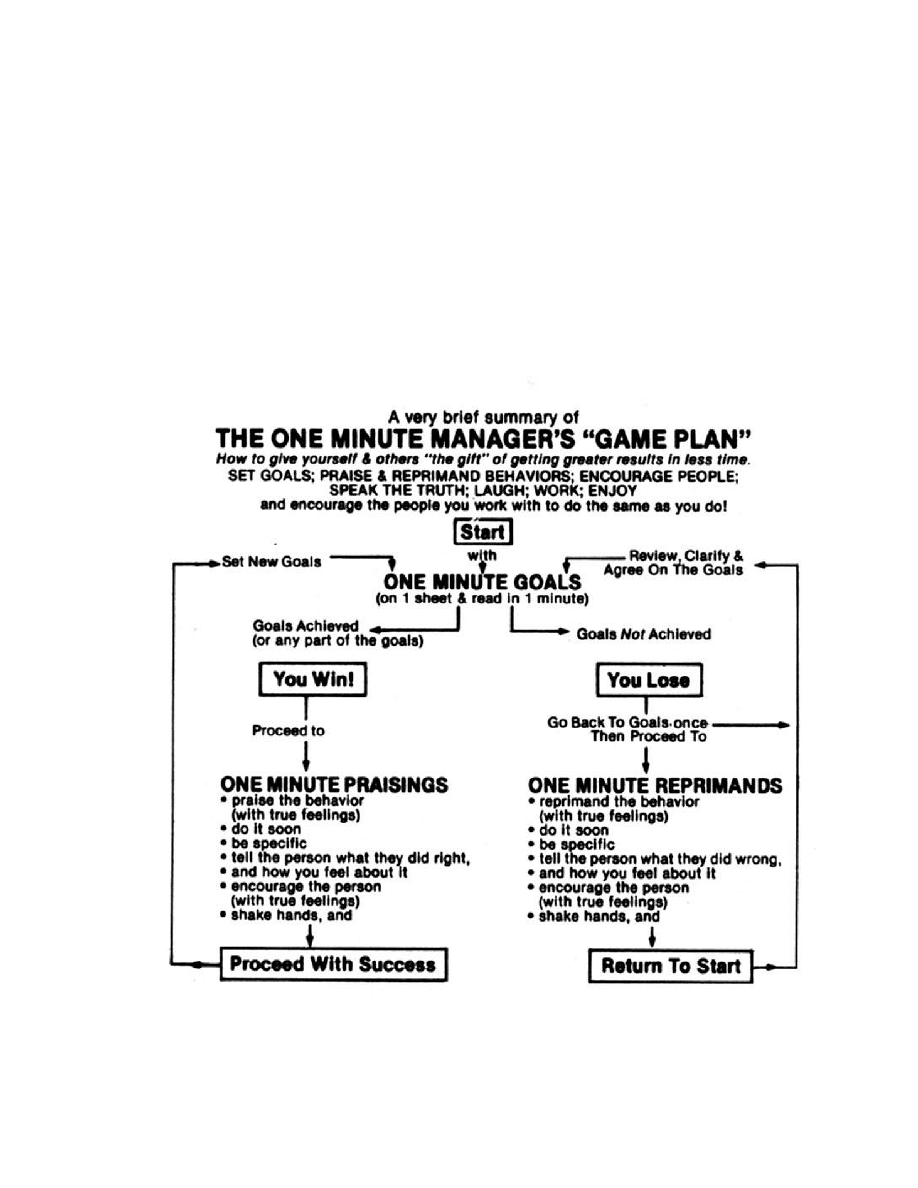
Kenneth Blanchard & Spenser Johnson – THE ONE MINUTE MANAGER
57
He became a One Minute Manager not because he thought like one, or talked like one,
but because he behaved like one.
He set One Minute Goals.
He gave One Minute Praisings.
He gave One Minute Reprimands.
He asked brief, important questions; spoke the simple truth; laughed, worked, and
enjoyed.
And, perhaps most important of all, he encouraged the people he worked with to do
the same.
He had even created a pocket size “Game Plan” to make it easier for the people around
him to become One Minute Managers. He had given it as a useful gift to each person who
reported to him.

Kenneth Blanchard & Spenser Johnson – THE ONE MINUTE MANAGER
58
A Gift To Yourself
MANY years later, the man looked back on the time when he first heard of the
principles of One Minute Management. It seemed like a long time ago. He was glad he
had written down what he learned from the One Minute Manager.
He had put his notes into a book, and had given copies to many people.
He remembered Ms. Gomez’s telephoning to say, “I can’t thank you enough. It’s
made a big difference in my work.” That pleased him.
As he thought back on the past, he smiled. He remembered how much he had learned
from the original One Minute Manager, and he was grateful.
The new manager was also happy that he could take the knowledge one step further.
By giving copies to many other people in the organization, he had solved several
practical problems.
Everyone who worked with him felt secure. No one felt manipulated or threatened
because everyone knew “up front” what he was doing and why.
They could also see why the seemingly simple One Minute Management techniques—
Goals, Praising and Reprimands—worked so well with people.
Every person who had their own copy of the text could read and re-read it at their own
pace until they could understand it and put it to good use themselves. The manager knew
full well the very practical advantage of repetition in learning anything new.
Sharing the knowledge in this simple and honest way had, of course, saved him a good
deal of time. And it had certainly made his job easier.
Many of the people reporting to him had become One Minute Managers themselves.
And they, in turn, had done the same for many of the people who reported to them.
The entire organization had become more effective.
As he sat at his desk thinking, the new One Minute Manager realized what a fortunate
individual he was. He had given himself the gift of getting greater results in less time.
He had time to think and to plan—to give his organization the kind of help it needed.
He had time to exercise and stay healthy.
He knew he did not experience the daily emotional and physical stress other managers
subjected themselves to.
And he knew that many of the other people who worked with him enjoyed the same
benefits.
His department had fewer costly personnel turnovers, less personal illness, and less
absenteeism. The benefits were significant.
As he looked back, he was glad he had not waited to use One Minute Management
until he thought he could do it just right.
After his staff had read about this management system, he had asked each person who
reported to him if they would like to be managed by a One Minute Manager.
He was amused to learn that there was something that people really wanted even more
than learning how to become a One Minute Manager themselves. And that was to have
one for a boss!
Once he knew this, it was a lot easier for him to clearly tell his staff that he wasn’t
sure that he could do it just exactly the way he was “supposed to.”

Kenneth Blanchard & Spenser Johnson – THE ONE MINUTE MANAGER
59
“I’m not accustomed to telling people how good they are or how I feel about things,”
he had said. “And I’m not sure I can remember to calm down after I’ve given someone a
reprimand and reminded them of how good they are as a person.”
The typical answer from his associates had caused him to smile. “Well, you could at
least give it a try!”
By simply asking if his staff wanted to be managed by a One Minute Manager and by
admitting that he may not always be able to do it right, he had accomplished something
very important.
The people he worked with felt that he was honestly on their side from the very
beginning. And that made all the difference.
Then the new One Minute Manager got up from his desk and began to walk about his
uncluttered office. He was deep in thought.
He felt good about himself—as a person and as a manager.
His caring about people had paid off handsomely. He had risen in the organization,
gaining more responsibilities and more rewards.
And he knew he had become an effective manager, because both his organization and
the people in it had clearly benefited from his presence.

Kenneth Blanchard & Spenser Johnson – THE ONE MINUTE MANAGER
60
A Gift For Others
SUDDENLY the intercom buzzed and startled the man. “Excuse me, sir, for interrupting
you,” he heard his secretary say, “but there is a young woman on the phone. She wants to
know if she can come and talk to you about the way we manage people here.”
The new One Minute Manager was pleased. He knew more women were entering the
business world. And he was glad that some of them were as keen to learn about good
management as he had been.
The manager’s department was now running smoothly. As you might expect, it was
one of the best operations of its kind in the world. His people were productive and happy.
And he was happy too. It felt good to be in his position.
“Come any time,” he heard himself telling the caller.
And soon he found himself talking to a bright young person. “I’m glad to share my
management secrets with you,” the new One Minute Manager said, as he showed the
visitor to his couch. “I will only make one request of you.”
“What is that,” the visitor asked.
“Simply,” the manager began, “that you ...”

Kenneth Blanchard & Spenser Johnson – THE ONE MINUTE MANAGER
61
ê
Share It With Others
ê

Kenneth Blanchard & Spenser Johnson – THE ONE MINUTE MANAGER
62
Acknowledgments
Over the years we have learned from, and been influenced by, many individuals. We
would like to acknowledge and give a public praising to the following people:
A Special Praising to:
*Dr. Gerald Nelson, the originator of The One Minute Scolding, an amazingly
effective method of parental discipline. We have adapted his method into “The One
Minute Reprimand,” an equally effective method of managerial discipline.
and to:
Dr. Elliott Carlisle for what he taught us about productive managers who have time to
think and plan.
Dr. Thomas Connellan for what he taught us about making behavioral concepts and
theories clear and understandable to all.
Dr. Paul Hersey for what he taught us about weaving the various applied behavioral
sciences into a useful fabric.
Dr. Vernon Johnson for what he taught us about the Crisis Intervention Method of
treatment for alcoholics.
Dr. Dorothy Jongeward, Jay Shelov, and Abe Wagner for what they taught us about
communication and the OK-ness of people.
Dr. Robert Lorber for what he taught us about the application and use of behavioral
concepts in business and industry.
Dr. Kenneth Majer for what he taught us about goal-setting and performance.
Dr. Charles McCormick for what he taught us about touching and professionalism.
Dr. Carl Rogers for what he taught us about personal honesty and openness.
Louis Tice for what he taught us about unlocking human potential.

Kenneth Blanchard & Spenser Johnson – THE ONE MINUTE MANAGER
63
About the Authors
Dr. Kenneth Blanchard, Chairman of Blanchard Training and Development, Inc.
(BTD), is an internationally known author, educator and consultant/trainer. He is the co-
author of the highly acclaimed and most widely used text on leadership and organization
behavior, Management of Organization Behavior: Utilizing Human Resources, which is
in its fourth edition and has been translated into numerous languages.
Dr. Blanchard received his B. A. from Cornell University in Government and
Philosophy, an M.A. from Colgate University in Sociology and Counseling and a Ph.D.
from Cornell in Administration and Management. He presently serves as a professor of
Leadership and Organizational Behavior at University of Massachusetts, Amherst. In
addition, he is a member of the National Training Laboratories (NTL).
Dr. Blanchard has advised such distinguished corporations and agencies as Chevron,
Lockheed, AT&T, Holiday Inns, Young Presidents’ Organization (YPO), the United
States Armed Forces, and UNESCO. The Hersey/Blanchard Situational Leadership
approach to management has been incorporated into the training and development
programs of Mobil Oil, Caterpillar, Union 76, IBM, Xerox, The Southland Corporation,
and numerous fast growing entrepreneurial companies. In his role as management
consultant, Dr. Blanchard teaches seminars across the country.

Kenneth Blanchard & Spenser Johnson – THE ONE MINUTE MANAGER
64
Dr. Spencer Johnson is the Chairman of Candle Communications Corporation, and an
active author, publisher, lecturer and communications consultant. He has written more
than a dozen books dealing with medicine and psychology, and has over three million
copies of his books in print.
Dr. Johnson’s education includes a degree in psychology from the University of
Southern California, an M.D. degree from the Royal College of Surgeons in Ireland, and
medical clerkships at Harvard Medical School and the Mayo Clinic.
He has been Medical Director of Communications for Medtronic, a pioneering
manufacturer of cardiac pacemakers, and Research Physician for the Institute For
Interdisciplinary Studies, a medical-social think-tank in Minneapolis. He has also served
as a consultant in communications for the Center for the Study of the Person, Human
Dimensions in Medicine Program; and to the Office of Continuing Education at the
School of Medicine, University of California in La Jolla, California.
One of his recent books, The Precious Present, has been praised by the eminent
psychologist Dr. Carl Rogers, and by Dr. Norman Vincent Peale, who states, “What a
change might take place if everyone would read this book and apply the principles it
teaches.”
The One Minute Manager, like all the other books Dr. Johnson has written, reflects his
continuing interest in helping people to experience less stress and better health through
better communications. Dr. Johnson and Dr. Blanchard have also produced, in
conjunction with CBS-Fox-Video, The One Minute Manager videotape.
Wyszukiwarka
Podobne podstrony:
Blanchard K Johnson S The One Minute Manager
Self Leadership and the One Minute Manager Increasing Effectiveness Through Situational Self Leaders
Self Leadership and the One Minute Manager Increasing Effectiveness Through Situational Self Leaders
THE ONE MINUTE GUIDE To Prosperity and Enlightenment Sri Siva
THE ONE MINUTE GUIDE To Prosperity and Enlightenment Sri Siva
The One Minute Cure The Secret to Healing Virtually All Diseases Decrypted
Katy Perry The One That Got Away
being the one who?res
Linux The One Page Manual
Tu chodzi o Ciebie You are the One (1)
The One I Love, Slayers fanfiction, Oneshot
You`re the one
SW Rozważania przy mieczu świetlnym Jerzy The One Babarowski
Stephen R Donaldson Covenant 5 The One Tree
26 Nawyki skutecznych muzykantów październik 2010 The one type of habit of highly effective players
The One
One Minute Number closing [PL]
więcej podobnych podstron