
Studies in Second Language Acquisition, 2010 , 32 , 47– 77 .
doi:10.1017/S0272263109990258
© Cambridge University Press, 2010 0272-2631/10 $15.00
47
ON THE (UN)-AMBIGUITY OF
ADJECTIVAL MODIFICATION IN
SPANISH DETERMINER PHRASES
Informing Debates on the Mental
Representations of L2 Syntax
Jason Rothman and Tiffany Judy
University of Iowa
Pedro Guijarro-Fuentes
University of Plymouth
Acrisio Pires
University of Michigan , Ann Arbor
We wish to thank many people who contributed in no small part to this study and to the
writing and revising of this article. First and foremost, we thank Bruce Anderson, Alison
Gabriele, Julia Herschensohn, Roger Hawkins, and Roumyana Slabakova for taking time
from their busy schedules to read various versions of this article and for offering very
detailed and helpful feedback. We also thank the fi ve anonymous SSLA reviewers for their
constructive comments and suggestions. Research related to this article has been presented
at various conferences, including Boston University Conference on Language Development
(BUCLD) 33, Generative Approaches to Language Acquisition North America (GALANA) 3,
Generative Approaches to Second Language Acquisition (GASLA) 10, and Second Language
Research Forum (SLRF) 2007, and so we thank colleagues at these meetings for comments.
We are grateful for discussions with Joyce Bruhn de Garavito and Elena Valenzuela with
respect to their work on related domains and connections related to ours. Revisions to
this article were done during an in-residence grant period at the Obermann Center for
Advanced Studies for Jason Rothman and Pedro Guijarro-Fuentes, for which they are
grateful. Any and all errors and oversights remain entirely our own.
Address correspondence to: Jason Rothman, 111 Phillips Hall, University of Iowa, Iowa
City, IA 52242; e-mail: jason-rothman@uiowa.edu .

Jason Rothman, Tiffany Judy, Pedro Guijarro-Fuentes, and Acrisio Pires
48
This study contributes to a central debate within contemporary gen-
erative second language (L2) theorizing: the extent to which adult
learners are (un)able to acquire new functional features that result
in a L2 grammar that is mentally structured like the native target
(see White, 2003 ). The adult acquisition of L2 nominal phi-features is
explored, with focus on the syntactic and semantic refl exes in the
related domain of adjective placement in two experimental groups:
English-speaking intermediate ( n = 21) and advanced ( n = 24)
learners of Spanish, as compared to a native-speaker control group
( n = 15). Results show that, on some of the tasks, the intermediate L2
learners appear to have acquired the syntactic properties of the
Spanish determiner phrase but, on other tasks, to show some delay
with the semantic refl exes of prenominal and postnominal adjectives.
Crucially, however, our data demonstrate full convergence by all
advanced learners and thus provide evidence in contra the predictions
of representational defi cit accounts (e.g., Hawkins & Chan, 1997 ;
Hawkins & Franceschina, 2004 ; Hawkins & Hattori, 2006 ).
There is little doubt that adult SLA is different from typical child fi rst
language (L1) acquisition on many levels; however, there is no con-
sensus as to what underlies observable dissimilarities in ultimate at-
tainment and the path that leads to it. Focusing on the cognitive side
of SLA—in the sense of the mental constitution of nonnative gram-
mars—it is relevant to explore why adult SLA, as opposed to child L1
acquisition, is characterized by optionality and various degrees of
fossilization, even at highly advanced profi ciency levels (see, e.g.,
Lardiere, 2007 , 2009 ; White, in press ). This frequently observed phe-
nomenon has prompted many acquisitionists from various cognitive
traditions to argue that the processes of L1 and second language (L2)
acquisition are maturationally conditioned to be different in the sense
that the mechanisms that result in implicit acquisition for child language
acquirers are no longer available to postcritical period adult learners
(e.g., Bley-Vroman, 1990 , 2009 ; DeKeyser, 2000 ; Long, 2005 ; Paradis,
2004 ; Ullman, 2001 ). On the other hand, empirical studies have dem-
onstrated that L2 grammars provide robust evidence of incidental
(i.e., nonexplicit) acquisition of target L2 properties, even despite
poverty of the stimulus for their instantiation (see Rothman, 2008 ;
Slabakova, 2008 ). As Schwartz and Sprouse ( 2000 ) argued, L2 compe-
tence for such properties constitutes robust evidence that adult SLA
is guided by the same inborn linguistic properties as child L1 acqui-
sition, which are taken to be Universal Grammar (UG).
One consequence of the claim that adults continue to have access to
UG is the need to accompany this position with tenable explanations

Adjectival Modifi cation in Spanish Determiner Phrases
49
for the observable differences between L1 and L2 acquisition in
developmental path and ultimate attainment. To explain the persis-
tence and seeming pervasiveness of optionality in adult SLA, several
contemporary generative L2 proposals, collapsed here under the
label representational defi cit accounts (RDAs),
1
have modernized the
essence of earlier proposals of UG inaccessibility (e.g., Bley-Vroman,
1990 ; Tsimpli & Roussou, 1991 ), claiming that many L1-L2 differences
are representational within the L2 narrow syntax (e.g., Beck, 1998 ;
Franceschina, 2001 ; Hawkins & Chan, 1997 ; Hawkins & Franceschina,
2004 ; Hawkins & Hattori, 2006 ; Hawkins & Liszka, 2003 ; Tsimpli &
Dimitrakopoulou, 2007 ).
According to current Minimalist Program assumptions (see Chomsky,
2001, 2007 ), crosslinguistic differences in terms of which functional cate-
gories and features are instantiated in particular language grammars are
driven by the acquisition of the lexicon within the primary linguistic data
of the target language. Because UG is purported to provide a universal
superset of formal features and functional categories, each particular
grammar is, in a sense, a dialect of UG, in that it embodies a subset of its
available features. Under such a view, the learning task of the child is
relatively straightforward: To be able to parse and produce target input
or output, upon exposure to primary linguistic data, the child selects
from UG’s inventory which categories and features to instantiate, based
on the particular grammar lexicon that best fi ts his or her interpretation
or parse of the environmental input. The learning task for L2 adults is not
a priori different from that of the child, which is not to ignore the fact that
the process in adulthood is as much aided as it is complicated by inter-
vening factors, such as the need to overcome learnability constraints
arising from previous linguistic knowledge, more developed cognitive
skills, differences in ability to process input, and so on. In addition to these
factors, RDAs essentially claim that UG’s superset inventory of features is
no longer available to the adult learner. Depending on the particular RDA
proposal, only features instantiated within the L1 and, at most, new in-
terpretable features—those relevant to the semantic component—are
assumed to remain available.
2
This assumption amounts to an adult
inability to reset the mental representations of syntactic properties in
the L2, at least when they are contingent on the acquisition of new unin-
terpretable features. Essentially, RDAs maintain that the underlying syn-
tax of L2 grammars is destined to remain like the L1 grammar, with only
surface adjustments (e.g., in the acquisition of the L2 lexicon). RDAs
assume that adult L2 learners can and do map L1 features onto newly
acquired L2 morphophonological forms (but see Beck, 1998 ). However,
apparent L2 success that cannot be explained via L1 transfer and feature
remapping is attributed to domain-general learning, which, in turn, is
taken to account for ubiquitous L2 optionality, precisely because the
underlying L2 grammatical representations are nontargetlike.
3

Jason Rothman, Tiffany Judy, Pedro Guijarro-Fuentes, and Acrisio Pires
50
Despite the observable differences between L1 and L2 develop-
ment and ultimate attainment, another position that has been argued
to be empirically tenable is that of full accessibility to UG in adult-
hood (see, e.g., White, 2003 ). Such a position does not diminish the
signifi cance of observable L1 and L2 differences but rather suggests
that inaccessibility to UG is not the source of these problems. Insofar
as the logical problem of primary language acquisition—inevitable
L1 convergence on grammatical knowledge not exemplifi ed in avail-
able input—is accounted for via UG, which fi lls the apparent gap
between input and L1 end-state grammatical competence, full UG
accessibility for adult L2 learners is supported by the apparent log-
ical problem of SLA (see Schwartz, 1998 ; Schwartz & Sprouse, 1996 ,
2000 ). A signifi cant and growing number of studies demonstrate true
L2 knowledge of poverty-of-the-stimulus properties (see Rothman,
2008 ). On the one hand, because poverty-of-the-stimulus knowledge
is taken to be prima facie evidence for UG in the fi rst place (see
Thomas, 2002 ), poverty-of-the-stimulus effects in SLA provide direct
evidence that new (morpho)syntactic features (beyond those found
in the L1) are available to adult L2 learners in the absence of suffi -
cient or unambiguous evidence for their acquisition or learning in
the L2 input. On the other hand, full-accessibility (FA) approaches
have long pointed to L1 transfer as a possible source of L1-L2 differ-
ences in developmental sequence and ultimate attainment and main-
tain that L1 transfer alters signifi cantly (and variably, depending
on the L1-L2 pairing) the L2 learning task (but see Epstein, Flynn, &
Martohardjono, 1996 ; Platzack, 1996 ). It has been argued within FA
approaches that transfer can impose insurmountable learning obstacles,
which result in representational differences despite full accessibility to
UG (see Schwartz).
However, it has been taken as uncontroversial that L1 transfer alone
cannot account for all the observed L1-L2 differences. A theory that
claims adult access to UG’s full feature inventory without any further
specifi cations thus appears to be in a weaker position than RDAs to
explain why adult L2 (performance) outcomes are decisively different
than in the case of child L1. Understanding the need to provide accounts
of L1-L2 differences that are empirically verifi able and falsifi able, con-
temporary FA approaches maintain that L2 optionality does not neces-
sarily result from defi cits within the narrow syntax but instead may
emerge from external learnability constraints and interface vulnerabil-
ities (see White, in press ). For example, the syntax-morphology-phonology
interface has been shown to be especially vulnerable in adult SLA. Adult
L2 acquirers, irrespective of their L1 and of the target L2, typically
demonstrate target-deviant use of L2 functional morphology, dif-
fering from native adults and child L1 learners in their use of correct
functional morphology (e.g., nominal agreement, verbal agreement,

Adjectival Modifi cation in Spanish Determiner Phrases
51
verbal tense, aspect, modal morphology) in discourse performance.
Although incorrect L2 morphological production often decreases over
time with an increase in profi ciency levels, L2 morphological use rarely
indistinguishably matches that of native speakers, even at the highest
of L2 profi ciency levels (see, e.g., Franceschina, 2005 ; Lardiere, 2007 ).
4
However, there is disagreement as to what these observations mean for
the debate on adult access to UG. RDAs maintain that morphological
optionality obtains precisely because the mental syntactic representa-
tion of the overt morphology is target-deviant (e.g., Franceschina, 2001 ,
2005 ; Hawkins & Franceschina, 2004 ; Hawkins & Liszka, 2003 ). This po-
sition is consistent with the fact that problems in target morphological
suppliance decrease over time as learners have a greater chance to
apply rules based on pattern or frequency learning. FA accounts, on the
other hand, appeal to the partial disassociation between morphological
use and underlying syntactic representation (see, e.g., Lardiere 2007,
2009; Prévost & White, 2000 ) and point out that if morphological
optionality were to indicate actual syntactic defi cits, as claimed by
RDAs, then syntactic and semantic refl exes that fall out from the L2
feature representation would be expected to demonstrate indetermi-
nacy as well.
To investigate this possibility of indeterminacy, the current study
tests English learners of L2 Spanish on the use of nominal morphology
(gender and number). The syntactic and semantic refl exes of new
nominal phi-feature acquisition in L2 Spanish are examined, focusing on
properties that are directly related to noun-raising, an operation that is
obligatory in Spanish to check nominal phi-features (number, person)
but that English lacks. If RDAs are correct, then the L2 learners should
demonstrate more than mere nominal morphological optionality and
also show incomplete knowledge (as compared to native speaker
controls) of the relationship between the syntactic position of adjec-
tives in Spanish and the semantic restrictions on adjectival interpreta-
tion. However, if L2 learners demonstrate knowledge of the syntactic
and semantic reflexes of adjective placement in line with native
speakers, FA accounts will be supported and RDAs will not. The data
from two tasks, related to the semantic interpretations of adjectives
restricted by the syntactic structure and feature specifi cation in
Spanish, indicate that RDAs cannot account for the present L2 Spanish
knowledge.
SYNTAX AND SEMANTICS OF THE SPANISH
DETERMINER PHRASE
The relevant similarities and differences between Spanish and English
regarding syntactic and semantic properties of different elements

Jason Rothman, Tiffany Judy, Pedro Guijarro-Fuentes, and Acrisio Pires
52
within the determiner phrase (DP) are discussed here. The DP is a
functional projection instantiated in both languages that encompasses
the elements that form the nominal structure, including determiners
(e.g., defi nite and indefi nite articles), adjectives, and nouns, among
others. The relevant DP properties are grammatical features (e.g.,
gender and number) and the syntactic structure that relates nouns
and adjectives in connection with their semantic interpretation.
The Syntax of Gender, Number, and the Resulting
Word Order Within the DP
In addition to subject-verb agreement, Spanish shows overt agreement
internal to the DP. Differently from English, adjectives and determiners
must morphologically agree with the noun they modify in both gender
and number, as illustrated in (1).
(1) La mujer americana
baila.
The-
FEM
-
SING
woman-
FEM
-
SING
American-
FEM
-
SING
dance-
PRES
-3
SG
“The American woman dances.”
Spanish has masculine and feminine morphological genders.
5
Most
masculine nouns are marked by the suffi x – o , whereas most feminine
nouns are marked by the suffi x –a . Exceptions for both genders end
mainly in –e or a restricted number of consonants.
6
Spanish nouns are
also infl ected for plural number with the suffi x – s .
Within the DP, English marks plural number morphology on nouns
(represented in regular cases by the suffix –s ). However, it lacks
morphosyntactic gender features that trigger gender agreement within
the DP (between the noun head and determiners or adjectives).
7
Additionally, English determiners are largely devoid of morphosyntac-
tic number agreement (although demonstratives like this and these
are infl ected for number), and no English adjectives are infl ected
for number.
In the DP across languages, the determiner is the head of the nom-
inal projection and selects a noun phrase (NP) as its complement.
Depending on the language, additional projections are required within
the DP in addition to the NP. The current analysis, based on aspects
of Bernstein ( 1993 , 2001 ) and others, assumes that the functional
categories number (Num) and word marker (WM) sit between DP and
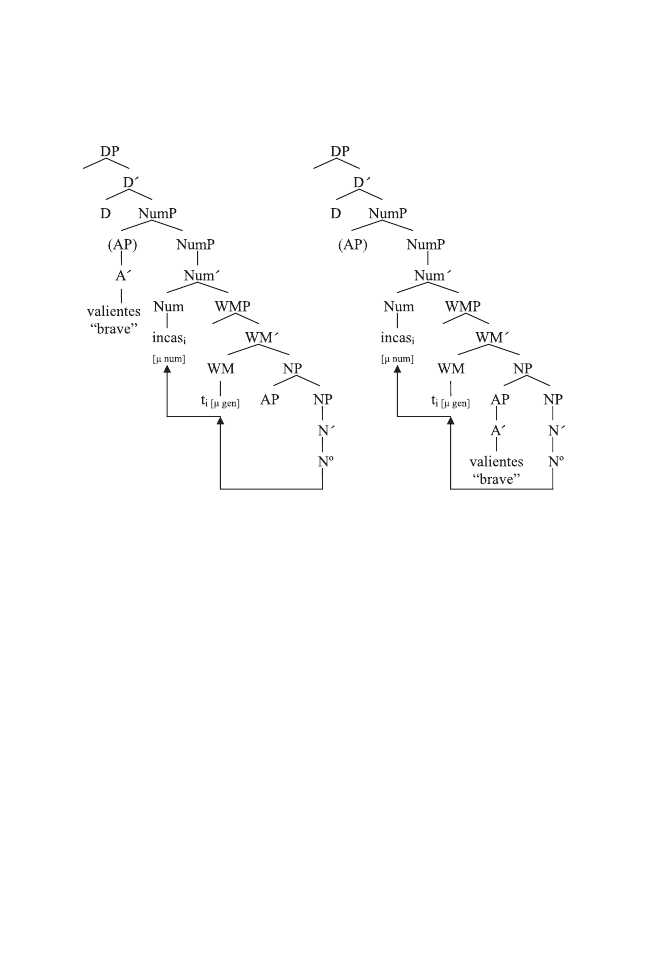
NP, heading their own phrases ([DP D [ NumP Num [ WMP WM [NP N]]]])
and checking and valuing number and gender features, respectively.
8
The examples in (2) schematize the structure for Spanish DPs assumed
herein.
9
Adjectival Modifi cation in Spanish Determiner Phrases
53
(2) a. valientes incas “brave Incas”
b. incas valientes “brave Incas”
Romance (Spanish) DPs instantiate the functional categories WM and
Num, and gender and number feature checking within these categories
requires overt raising of the noun head, as shown in (2). Under a minimalist
approach, following Bernstein ( 1993 ; see, e.g., Cinque, 1994 ; Picallo, 1991 ;
Zagona, 2002 ), the head noun obligatorily raises from N to the head of
WMP and then to the head of NumP. Overt noun-raising in Spanish can be
triggered by an uninterpretable feature (e.g., a N feature) in the heads WM
and Num. Crucially, Germanic (English) DPs, however, only have NumP,
and number features are checked only via Agree, without overt raising of
the noun.
10
, 11
This parametric difference results in partially distinctive
word orders for adjectives and nouns in both types of languages.
Because nouns must raise in Spanish, if an adjective is merged in an
adjunct position to NP, noun movement to the head of WMP (and then
to the head of NumP) results in the noun-raising past the adjective, pro-
ducing the canonical noun-adjective (N-Adj) word order of Spanish (2b).
However, because noun-raising is obligatory in Spanish, the noun must
have moved to a higher position than the NP even when a surface Adj-N
order obtains. In such cases, which correspond to the word order in
(2a), the adjective phrase (AP) must adjoin to the specifi er (Spec) of
NumP, which results in a structure that on the surface appears to have
English word order; however, the noun has actually moved to the head

Jason Rothman, Tiffany Judy, Pedro Guijarro-Fuentes, and Acrisio Pires
54
position of NumP. In English, this noun movement operation does not
take place within the DP because there is no feature associated with
either WM or Num that forces overt noun movement, which results in the
only possible word order (Adj-N) at the surface in English.
Semantic Effects of Adjective Placement
There are thus two distinct groups of languages regarding the canonical
position of adjectives: languages with prenominal adjectives (e.g.,
Germanic) and languages with postnominal adjectives (e.g., Romance).
In Spanish, there are a few kinds of attributive adjectives that can only
appear prenominally or postnominally (3a–3d). However, for a large set
of (but not all) attributive adjectives, the position in which an adjective
is ultimately realized (prenominal or postnominal) depends on the nature
of the adjective’s semantic interpretation.
(3) a. La mera necesidad
“The mere necessity”
b. * La necesidad mera
“The mere necessity”
c. Las cortinas italianas
“The Italian curtains”
d. * Las italianas cortinas
“The Italian curtains”
Many adjectives can alternate between a prenominal and a postnomi-
nal position. Although these adjectives can keep a single lexical meaning,
they display additional interpretive properties depending on whether
they appear prenominally or postnominally. As can be seen by comparing
(4a) and (4b), focus or emphasis can force adjectives to appear prenomi-
nally (see Demonte, 2008 , for an analysis of this interpretive possibility).
(4) a. Unos libros interesantes
“Some interesting books”
b. Unos interesantes libros (focus interpretation, intonational stress not
needed)
“Some interesting books”
Such possibilities introduce signifi cant complexities in the syntax-
semantics properties of adjectives that learners are expected to master.
Crucially, learners need to master an additional twofold distinction in
the interpretation of adjectives that alternate between prenominal and
postnominal positions in Spanish, a distinction that is the focus of the

Adjectival Modifi cation in Spanish Determiner Phrases
55
experiments presented here. First, the adjective can restrict the set to
which the NP refers, such that it delimits a subset of all possible members
of this set. This interpretation, which will be referred to as set-denoting,
matches the postnominal position of the adjective, as in (5b). Alterna-
tively, the adjective must be interpreted as applying to all possible
members of the set referred to by the noun. This interpretation, referred
to as kind-denoting, matches the prenominal order of the adjective, as
in (5a). The set-denoting interpretation of the adjective results from the
adjunction of the AP to the NP projection, whereas the kind-denoting
interpretation results from adjunction of the AP to the NumP. Crucially,
in English, which does not display overt noun-raising within the DP, both
interpretations map to the same prenominal placement of the adjective.
12
(5) a. Los valientes incas (kind-denoting)
b. Los incas valientes (set-denoting)
“The brave Incas”
The current study focuses on the syntactic and semantic properties—
which correspond to the set- versus kind-denoting interpretation—of
adjectives in L2 Spanish and adopts the basic aspects of a syntactic
analysis that includes Num and WM in order to represent this distinction.
The Task for the English Learner of L2 Spanish
The syntactic and semantic properties that correspond to the set- ver-
sus kind-denoting interpretation of adjectives that must be mastered by
English learners of L2 Spanish are highlighted here. Regarding the syn-
tax, both languages exhibit the order Adj-N. However, differently from
English, Spanish favors a N-Adj order, which obtains after noun-raising
across the AP base position within the NP. The order Adj-N, which appears
to be similar on the surface to English but is underlyingly distinct in
Spanish, obtains after the AP adjoins to a higher position (NumP) as the
result of noun-raising.
Crucially, for a large class of adjectives in Spanish, English L1 speakers
need to learn that each of the two distinctive semantic interpretations
is captured by a distinct syntactic word order (prenominal vs. postnom-
inal adjectives). When these adjectives are realized prenominally in the
position in NumP, they are interpreted as kind-denoting. When they are
adjoined lower to the NP, they yield postnominal order after noun-rais-
ing and carry a set-denoting interpretation. English and Spanish are
thus different in that prenominal adjectives can be unambiguous for a
kind-denoting interpretation only in Spanish because each of the two
available interpretations maps to a distinct linear order in Spanish.
In English, adjectival interpretation is inherently ambiguous precisely

Jason Rothman, Tiffany Judy, Pedro Guijarro-Fuentes, and Acrisio Pires
56
because adjectives underlyingly link to either a high or a low position in
the DP without varying in their linear or surface position with respect to
the noun (because the noun does not raise, yielding the order Adj-N).
The parametric difference implicated here is whether the language
requires overt noun-raising (which is a refl ex of particular DP features
that Spanish has and English lacks). Because Spanish requires nouns to
raise, adjectives that are able to occupy more than one syntactic posi-
tion can yield a distinct semantic interpretation (set- or kind-denoting)
for each order. For the English learner of L2 Spanish, given the interac-
tion of adjectives and nouns in the Spanish DP, its functional categories
and features yield a learning task different from that involved in learning
English L1 properties. Crucially, converging on the target syntax and
semantics of Spanish adjectives involves the acquisition of the prop-
erties that require obligatory noun-raising, which English lacks. Fur-
thermore, English L2 learners of Spanish are required to map each of
the two distinct syntactic structures (N-Adj, Adj-N) to one of the two
available semantic interpretations. However, in Spanish and other Ro-
mance languages, some types of adjectives can display mutually exclu-
sive word order possibilities based on the subclass to which they
belong. Spanish input does not provide L2 learners unambiguous input
on adjectival syntax (i.e., from a frequency or linear learning point of
view). Because it is not the case that all adjectives in Spanish are able to
alternate their position, there does not seem to be suffi cient unambig-
uous evidence of the type that one would need for English learners to
straightforwardly induce via frequency alone the distinct syntactic
structures and corresponding semantic interpretations of different ad-
jectives in Spanish. Following Anderson ( 2007a ), there are three criteria
that must be satisfi ed for learners to gain target knowledge of adjectival
distribution from available input or instruction: (a) Input or instruction
must robustly represent all possible contexts of use, (b) input or in-
struction must provide evidence such that learners notice that a certain
(morphosyntactic) structure is possible in one (semantic) context but
not another, and (c) it must be ensured that interference or noise does
not prevent the emergence of this knowledge.
Tutored instruction does not faithfully or suffi ciently account for the
distribution of adjective placement and their entailed meaning alterna-
tions in native language corpora (see Anderson,
2007b ).
13
Tutored
learners are instructed that adjectives most naturally appear to the
right of Spanish nouns and that some exceptions exist but that they
correspond to referential, meaning-changing adjectives (e.g.,
pobre
hombre “unfortunate man” vs. hombre pobre “materially poor man”).
Crucially, L2 learners are not taught about the set- versus kind-denoting
readings—the fact that these interpretations map to distinct syntactic
orders—nor which adjectives (or adjective classes) allow this twofold
syntax-semantics distinction.

Adjectival Modifi cation in Spanish Determiner Phrases
57
Instruction, when available, thus does not provide or cover all
contexts that one would need for attaining nativelike knowledge of the
syntax of adjectives and nouns in the DP and their interpretations in
Spanish. Moreover, it is not guaranteed that the semantic nuances of
adjectival and noun placement explored here can be intuited unambig-
uously from the type of input provided in classrooms, based on
frequency and contexts (see also Anderson, 2007b ). Given this diffi culty,
the fact that the advanced learners of this study are able to interpret
adjective position in a way equivalent to monolingual native speakers
provides strong evidence against RDAs in adult SLA.
PREVIOUS STUDIES
The SLA of the features associated with the DP in several languages has
been examined in previous studies, some of which have direct implica-
tions for the present study. Parodi, Schwartz, and Clahsen ( 1997 ) dem-
onstrated that SLA within the DP is relatively unproblematic when
relevant L1 and L2 features are the same. However, this does not mean
that if the L1 and the L2 share the same DP features, no developmental
delays should be expected. For example, Bruhn de Garavito and White
( 2002 ) showed that French learners of L2 Spanish experience develop-
mental target-deviant performance that might seem surprising, given
that French has the same formal nominal features as Spanish.
In the case that the L1 and the L2 have different feature compositions,
expected and possible outcomes for L2 convergence are less clear.
Several researchers have investigated the acquisition of L2 DP syntax,
motivated by the hypothesis that functional features not instantiated in
the L1 become unavailable past the critical period (e.g., Franceschina,
2001 , 2005 ; Granfeldt, 2000 ; Hawkins, 1998 ; Hawkins & Franceschina,
2004 ). Citing considerable variability with gender assignment on deter-
miners and adjectives, these studies have posited that the mental rep-
resentation of grammatical gender for English adult learners of Spanish
and French is inevitably different; that is, differences in morphophono-
logical suppliance were taken to indicate L2 inaccessibility to particular
representational resources after the critical period.
Other research, however, argues that the problem is likely one of
performance; that is, it is not a representational problem within the
narrow syntax (Bruhn de Garavito & White, 2002 ; Cabrelli, Iverson, Judy, &
Rothman, 2008 ; Gess & Herschensohn, 2001 ; Judy, Guijarro-Fuentes, &
Rothman, 2008 ; White, Valenzuela, Kozlowska-MacGregor, & Leung,
2004 ). If the position that L2 learners in general have problems with
target L2 morphological suppliance is on the right track, then some
level of production problems should be expected for all learners of a
given L2—not only for those whose L1s do not have the syntactic features

Jason Rothman, Tiffany Judy, Pedro Guijarro-Fuentes, and Acrisio Pires
58
the morphology represents. Bruhn de Garavito and White demonstrated
that despite the fact that French has grammatical gender, French learners
of L2 Spanish also have problems with gender assignment similar to the
pattern of diffi culties noted for English learners of L2 Spanish (see
Fernández, 1999 ; Judy et al.). Although this fi nding could support Beck’s
( 1998 ) version of the RDA (because she claims that features are transferred
but remain permanently inert), this possibility is nullifi ed by the data
from advanced French learners in Bruhn de Garavito and White, who
overcame the purported morphological problem. More recent research by
White et al. and Cabrelli et al. has shown for L2 and L3, respectively, that
syntactic refl exes of acquiring new Romance DP features—namely, nom-
inal ellipsis (N-drop)—is accomplished early on by English adult learners.
In contrast, little or no research has been done on the partially re-
lated domain of acquisition of the syntactic and semantic properties of
adjectival placement in L2 Spanish. Closely related to the current study,
a series of recent articles on the acquisition of adjectival placement in
L2 French have direct implications for similar research in L2 Spanish.
Anderson ( 2001 , 2007a , 2007b , 2008 ) investigated issues related to learn-
ability (i.e., the effect of explicit teaching in the classroom) and para-
metric change (i.e., the effect of UG constraints in parameter resetting)
in the nominal DP system in L2 French. Anderson’s studies examined,
on the one hand, the differentiation between result and process nomi-
nals in the licensing of postnominal genitives and, on the other hand,
the distinction between prenominal and postnominal adjectives in the
two different contexts (i.e., unique vs. nonunique noun referents).
Anderson’s ( 2001 , 2007b , 2008 ) studies overall show that whereas
parametric (i.e., representational) change is possible in what he contends
is a poverty-of-the-stimulus context, as related especially to adjectival
position and its semantic correlates, such change is not immediate,
straightforward, or perfectly refl ected in aggregate group data based on
academic course levels. The cross-sectional data presented here are in
line with what Anderson found for L2 French and support his conclu-
sions as well as provide new and unique insight.
THE CURRENT STUDY
Participants
Three groups of participants took part in the current study: an interme-
diate adult L2 learner (IS) group, an advanced adult L2 learner (AS) group,
and a native Spanish-speaking control (NS) group.
14
Each participant
took a standardized written Spanish profi ciency test with a maximum
total possible score of 50, the results of which are summarized in Table 1 .
15
The test consisted of a cloze section and a vocabulary section. Based

Adjectival Modifi cation in Spanish Determiner Phrases
59
on this test, the L2 learners were placed into two profi ciency levels:
40–50 was the range used for the advanced level and 30–39 was the
score range used to place individuals into the intermediate level. Any
participant scoring less than 30 overall was deemed not to have achieved
the minimum profi ciency level necessary for the meaningful assessment
of the theoretical approaches under investigation and was thus excluded
from the study.
The NS group consisted of 15 participants from various Spanish-
speaking countries whose ages ranged from 22 to 39 years. The AS group
consisted of 24 participants with an age range of 23–32 years, all of
whom were, at some point, instructed learners of Spanish but none of
whom were currently enrolled in Spanish language courses. The IS
group consisted of 21 participants whose ages ranged from 19 to 28 years,
all of whom were taking university-level Spanish courses at the time of
testing. Each participant completed a background questionnaire that
sought information concerning, for example, their country of origin
(all L2 participants were from the United States), the languages spoken
in their home and the frequency with which each language is or was
spoken (childhood bilinguals of Romance languages were eliminated,
leaving only one German-English bilingual), the type and age of fi rst ex-
posure to Spanish, any courses the participant had taken in the Spanish
language, and any other connection to the Spanish language that would
provide the learner with extra input. To qualify as a L2 participant in
this study, the fi rst signifi cant exposure to Spanish needed to have come
via formal instruction and after the age of 14. At the moment of testing,
the average time since fi rst signifi cant exposure to Spanish for the IS
group was 4.9 years, with a range of 3–7 years. For the AS group, this
average time was 8.46 years, with a range of 6–10 years.
Methodology
The current study provides a comprehensive and detailed analysis of
two experimental tasks on the adjectival distinction between set- and
Table 1. Profi ciency scores by group
Group
N
M
SD
Range
IS
21
34.00
2.21
31–38
AS
24
45.58
2.04
41–50
NS
15
49.00
1.134
47–50

Jason Rothman, Tiffany Judy, Pedro Guijarro-Fuentes, and Acrisio Pires
60
kind-denoting interpretations, which are related to distinct syntactic
features of the Spanish DP (including, in particular, uninterpretable
features that trigger noun-raising in Spanish). In both tasks, following
Anderson ( 2007a , 2007b , 2008 ), the use of adjectives taught to L2
learners as so-called meaning-changing adjectives based on syntactic
position (such as pobre , which can mean “materially poor” or “unfortunate,
pathetic” depending on its placement relative to the head noun) was
purposefully avoided.
Only adjectives that clearly maintain the same referential meaning
irrespective of whether they appear prenominally or postnominally
were selected. Alternating the syntactic position of such adjectives only
affects the set to which the DP refers—that is, whether the adjective
must be interpreted as pertaining to all possible members of the nom-
inal set (a kind-denoting reading) or only to a subset of these members
(a set-denoting reading). Only adjectives that allow a distinct target
interpretation for each position, prenominal or postnominal, were se-
lected, avoiding adjectives often taught to L2 learners as being lexically
specifi ed to appear in only one position. Therefore, these 20 adjectives,
all of which meet the selection criteria, were used for both tasks:
apasionado “impassioned,” aventurero “adventurous,” barato “cheap,”
bonito “pretty,” cariñoso “caring,” caro “expensive,” deshonesto “dishonest,”
enojado “angry,” estudioso “studious,” estúpido “stupid,” fuerte “strong,”
honesto “honest,”
importante “important,”
inteligente “intelligent,”
infl uyente “infl uential,” orgulloso “proud,” patético “pathetic,” valiente
“brave,” simpático “nice,” and talentoso “talented.” Each adjective was
used only once in each of the two tasks. For example, the adjective cariñoso
“caring” was provided postnominally in a token for the fi rst task (with a
set-denoting reading). However, in the second task, cariñoso “caring”
was provided with a context only felicitous with a kind-denoting reading
and therefore should have been placed prenominally. If a L2 learner per-
formed in line with natives across both tasks, then this learner was able
to select the proper meaning or syntactic position (as required in the
fi rst and second experimental tasks, respectively) for each and every
adjective, based on the syntactic position in which the adjective was
provided in the test sentence (task 1) or on the meaning given in the
context (task 2).
For statistical analyses in both tasks, the number of the L2 learners’
correct responses was assessed against the average number of answers
provided by the NS group (which showed agreement of 93% or higher
for each exemplar, consistent with the distinctive placement for nouns
in the kind- and set-denoting readings in Spanish). Any deviation from
the average native control answers was counted as incorrect, for ex-
ample, if a participant (native or L2) indicated that both interpretations
or syntactic positions were possible, chose the wrong answer, or
claimed to not know such an answer.

Adjectival Modifi cation in Spanish Determiner Phrases
61
Task 1: Semantic Interpretation Task
The fi rst of the two tasks was a semantic interpretation task, designed
to test the participants’ interpretation of both prenominal and post-
nominal adjectives. Participants were instructed to read a sentence that
contained either a prenominal or postnominal adjective and to circle
the correct interpretation of the underlined DP, out of two possible
interpretations. To avoid the risk of favoring a certain interpretation
beyond the syntactic structure of the DP, no additional discourse con-
text for the test sentence was provided. It is important to note that the
participants were instructed to circle both interpretations if they be-
lieved both answers to be possible (which English readily allows with
its canonical Adj-N order) or to circle neither if they had no intuition.
Because participants were not forced to choose one answer over the
other, this task is considered to be a valid and reliable measure of im-
plicit interpretation. There were 20 target sentences, 1 for each of the 20
adjectives; the 10 prenominal-adjective and 10 postnominal-adjective
sentences served as counterbalances to each other. Examples with
postnominal, set-denoting adjectives and prenominal, kind-denoting
interpretations are shown in (6) and (7), respectively. Fillers ( n = 20)
such as (8) presented two nouns with different genders and a clitic that
could only refer to one of the nouns, which required the learners to
choose an interpretation for the clitic that matched the correct noun.
Participants were not given a time limit and were permitted to ask the
researcher about any vocabulary they did not understand. Bold boxes
contain the correct interpretations.
(6) Set-denoting
A Juan le gustan las mujeres fuertes .
“Juan likes strong women.”
He likes women who have the
characteristic of being strong.
He likes women in general because
all women are by defi nition strong.
(7) Kind-denoting
Los valientes incas resistieron a los conquistadores.
“The brave Incas held off the invaders.”
Only the brave Incas (i.e., not the
cowardly ones) resisted the conquerors.
The Incas, who are all brave,
resisted the conquerors.
(8) Filler
¿Esa falda o ese vestido? Ya he decidido, voy a comprar la ahora mismo.
“That skirt or that dress? Okay I’ve decided; I am going to buy it right now.”
I bought the dress after all.
I bought the skirt after all.

Jason Rothman, Tiffany Judy, Pedro Guijarro-Fuentes, and Acrisio Pires
62
Task 2: Context-Based Collocation Task
The second task was a context-based collocation task. Its purpose was
to determine if the L2 participant groups could accurately produce
prenominal and postnominal adjectives that would correctly match a
description of either a set-denoting or a kind-denoting interpretation of
the adjective-noun pair. If learners produce targetlike word order, this
would indicate that noun-raising is obligatory in their Spanish grammar
to account for the postnominal placement of the adjective with a set-
denoting reading and that the adjective also needs to attach to a higher
node (NumP) to allow its prenominal placement with a kind-denoting
reading. In the task, participants were presented with a short context in
Spanish describing only one possible semantic interpretation and were
instructed to write the adjective provided in bold at the end of the sen-
tence, in either a prenominal or postnominal blank. As in the fi rst task,
the instructions indicated that participants were permitted to write the
adjective in both spaces if they believed both choices were equally pos-
sible or to leave both spaces blank if they had no relevant intuitions.
There were 20 target sentences, 10 of which called for a prenominal
adjective and 10 of which called for a postnominal adjective (using the
same adjectives from task 1 and alternating the set- vs. kind-denoting
interpretation across the list of adjectives). As in task 1, the target sen-
tences served to counterbalance each other. Tokens of each type are
shown in (9) and (10). The supporting context that introduced each test
item matched only a set-denoting or a kind-denoting interpretation. If
participants chose only the prenominal or only the postnominal place-
ment for the adjective to match each context, this was a signifi cant indi-
cator that they unambiguously matched that placement with the
provided interpretation.
16
Fillers for this task also employed clitics. The
participants were asked to place the provided clitic in either a prever-
bal or postverbal position, alternating between fi nite clauses (which
only allow proclisis) and nonfi nite clauses (infi nitives and gerunds,
which allow both proclisis and enclisis).
(9) Prenominal adjective (kind-reading)
No hay super-héroe que no sea conocido por su coraje y fuerza; es decir ser
super-héroe es tener mucho poder. Los __________ super-héroes __________
nunca tienen miedo de nada. ( valiente )
“There is no super-hero that is not known for his or her courage and
strength; that is, being a super-hero is having a lot of power. The brave
superheroes are never afraid of anything.”
(10) Postnominal adjective (set-reading)
Entre los alumnos, siempre hay un equilibrio de inteligencia y estupidez en una
escuela. Los __________ estudiantes __________ siempre están en las clases
de ‘honor.’ ( estudioso )
Adjectival Modifi cation in Spanish Determiner Phrases
63
“There is always a balance of intelligence and stupidity in every school.
The studious students are always in the honor classes.”
RESULTS
The statistical analyses presented here compare the performance of the
three participant groups using a mixed-model ANOVA. Bonferroni post hoc
tests were conducted when necessary and all analyses used a signifi cance
level of
α = .05.
Empirical Results of the Semantic Interpretation Task
The purpose of the fi rst task was to test for accurate semantic inter-
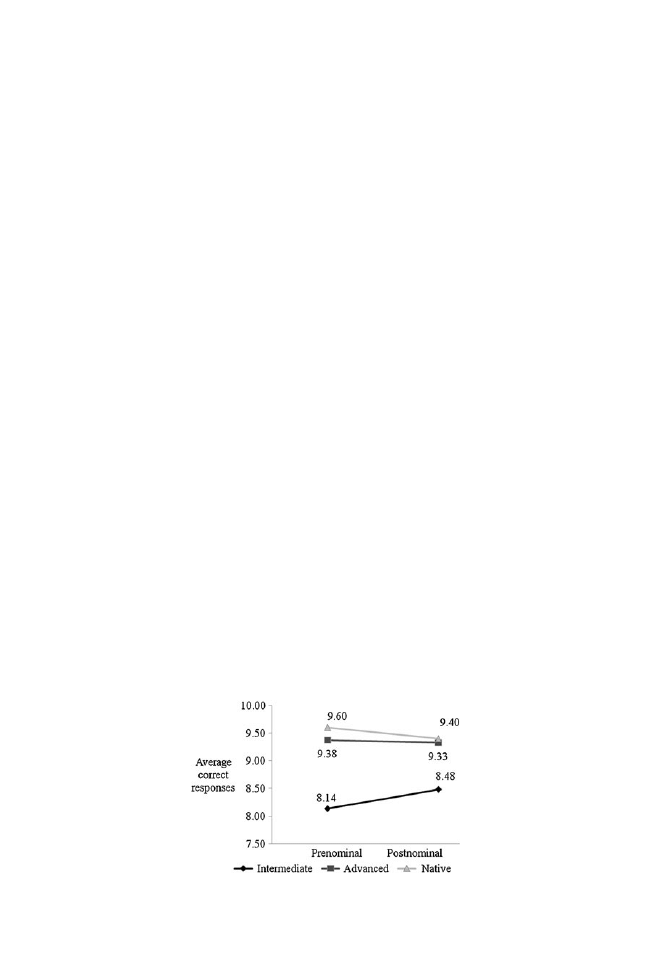
pretations of prenominal and postnominal adjectives. The average
number of correct responses (out of a total of 10) for each group can
be seen in Figure 1 . As Figure 1 shows, the AS group’s average number
of correct responses for prenominal adjectives is very similar to that
of the NS group (9.38 and 9.60, respectively). The IS group’s average
correct responses (8.14) is below both the NS and the AS groups’
averages. Regarding the average number of correct responses for the
postnominal adjectives, the AS group is nearly identical to the NS
group (9.33 and 9.40, respectively). The IS group’s average correct
responses (8.48) is again below the NS group and the AS group’s av-
erage correct responses for the postnominal adjectives. A mixed-
model ANOVA revealed a main effect for profi ciency level, F (2, 57) =
9.94, p < .001. There was no main effect found for adjectival position,
F (1, 57) = 0.051, p = .822. Finally, no interaction between profi ciency
level and adjectival position was found, F (2, 57) = 1.341, p = .270. Bon-
ferroni post hoc tests revealed no signifi cant difference between the
NS and the AS groups ( p = 1.00); however, signifi cant differences were
Figure 1. Results for task 1 (semantic interpretation).

Jason Rothman, Tiffany Judy, Pedro Guijarro-Fuentes, and Acrisio Pires
64
found between the NS and the IS groups ( p < .01) as well as between
the AS and the IS groups ( p < .01).
The results of the semantic interpretation task indicate that the AS
group interpreted both prenominal and postnominal adjectives as the NS
group did. In contrast, signifi cant differences were found between the IS
group’s interpretation of adjectival position and that of both the NS and
AS groups. The signifi cance of these fi ndings is that in intermediate stages
of linguistic development, L2 learners did not consistently interpret the
semantic nuances of adjectival positioning as the NS group did. However,
with around 85% accuracy, the IS group performed well above chance
and made the proper contrast in interpretation, albeit less precisely than
the AS and the NS groups. Furthermore, the results indicate that the com-
paratively nonnativelike IS group’s trend is not permanent, as seen in the
AS group, which demonstrates that, with continued exposure to Spanish,
accurate semantic interpretations (set-denoting or kind-denoting) can be
assigned to each adjective placement without signifi cant optionality.
These fi ndings are noteworthy in that, unlike the possible syntactic posi-
tioning of the adjectives (tutored learners are explicitly told that most
adjectives follow the noun in Spanish), the interpretations of the two
positions are not explicitly taught in the way that one would need to
acquire the full native distribution. At best, some adjectives are taught as
being able to take a canonical and noncanonical syntactic position, but
crucially no L2 instruction is provided that matches either placement
with the set- versus kind-denoting entailment of the DP interpretation.
Additionally, the proper interpretation that corresponds to each syntac-
tic placement is not unambiguously evident from the input (especially
considering that the position of each adjective may block or favor other
interpretive options beyond the set- vs. kind-denoting contrast).
Empirical Results of the Context-Based Collocation Task
The purpose of the second task was to test for the accurate production
(via collocation) of prenominal and postnominal adjectives. For each of
the three participant groups, the average number of correct collocations
(out of a total of 10) in the two contexts is shown in Figure 2 . It is apparent
that the AS group average is similar to that of the NS group for prenomi-
nal adjectives (9.79 and 9.47, respectively) as well as for postnominal
adjectives (9.42 and 9.33, respectively). In contrast, the IS group’s average
number of correct collocations is below that of the NS group for pre-
nominal adjectives (8.05 and 9.47, respectively) and for postnominal
adjectives (8.43 and 9.33, respectively). To establish with greater accu-
racy if the L2 participant groups performed like the NS group, two further
analyses were completed. The fi rst, a mixed-model ANOVA, revealed that
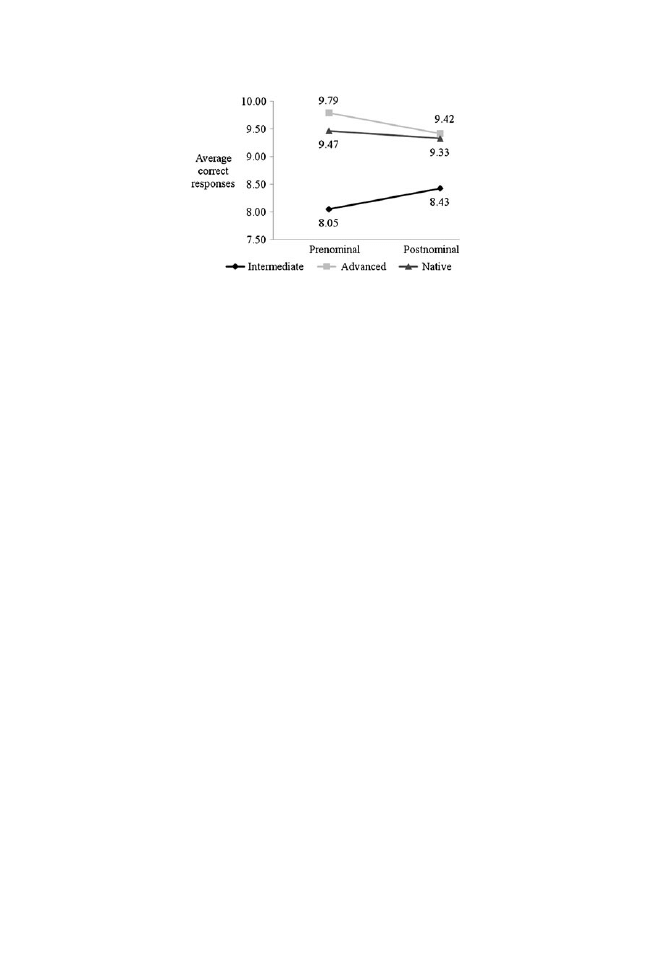
Adjectival Modifi cation in Spanish Determiner Phrases
65
there was a main effect for profi ciency level, F (2, 57) = 8.158, p < .01. No
main effect for the position of the adjective was found, F (1, 57) = 0.040,
p = .842. There was no interaction between adjectival position and profi -
ciency level, F (2, 50) = 1.257, p = .292. Bonferroni post hoc analyses
revealed no signifi cant difference between the NS and the AS group ( p =
1.000). Nevertheless, signifi cant differences were found between both the
NS and the IS groups ( p < .016) and the AS and the IS groups ( p < .01).
The results of the context-based collocation task revealed that the AS
group placed both prenominal and postnominal adjectives as the NS
group did, thus indicating that they could accurately interpret and,
more importantly, produce both prenominal and postnominal adjec-
tives based on the semantic interpretation favored by the context.
17
The fi ndings from this task are signifi cant in that they show that L2
learners (in this case, the AS group) are not only able to access the dis-
tinct semantic interpretations like natives but also to map such inter-
pretations to the correct syntactic structure like natives. The most
probable explanation for the AS group’s performance is that these
learners have in fact acquired a nativelike underlying structure of
the Spanish DP regarding the relevant syntactic-semantic properties.
In contrast, the IS group performed with optionality in recognizing the
semantic interpretations that result from the two syntactic positions.
However, as was the case in task 1, the IS group made proper distinc-
tions at a rate well above chance (above 80% correct), which could indi-
cate that, for at least some learners, the L2 syntax is correctly set as
early as the intermediate level of overall profi ciency.
DISCUSSION
One privilege for an empirically based fi eld is that it produces its own
evidence to test between competing proposals. New empirical evidence
in SLA, such as that provided in the current study, thus allows for the
Figure 2. Results for task 2 (context-based collocation).

Jason Rothman, Tiffany Judy, Pedro Guijarro-Fuentes, and Acrisio Pires
66
epistemological testing and effective assessment of different theories.
Other things being equal, all theories worthy of serious consideration
must strive to account for available data. Considering the present data,
the position that adults have partial or no access to UG and thus have
no other recourse but to acquire a L2 via domain-general learning is a
radical one. Examining L2 knowledge of semantic refl exes of functional
morphology (e.g., resulting from feature checking) has proven important
in testing RDA predictions. Previous work (see Slabakova, 2006 , 2008 )
has demonstrated that L2 learners come to acquire very subtle seman-
tic nuances that fall out from the checking of new L2 functional features.
Examining this type of L2 knowledge is pivotal because it can allow re-
searchers to substantiate claims that available input (L1 and L2 alike)
either entirely lacks necessary evidence for a given property or pro-
vides impoverished or ambiguous evidence that, based on frequency alone,
could not yield profi cient acquisition of target interpretive properties.
The empirical results of the current study add to the latter type of
research, providing further evidence against the predictions of RDAs. The
results of a third task, not discussed in detail here, show that these inter-
mediate and advanced learners of L2 Spanish are sensitive to gender mor-
phology concord, the morphophonological representation of the features
that bring about adjectival position alternations in Spanish. All partici-
pants completed a grammaticality judgment task (GJT) with correction,
which tested L2 knowledge of good and poor morphological agreement
(gender and number) in determiner-noun (Det-N) and N-Adj combinations
(see the Appendix for a summary of the data).
18
The fi llers for the GJT
involved acceptability judgments and correction of prenominal and post-
nominal adjective placement, specifi cally of those that can only be pre-
nominal or postnominal as part of their lexical properties (e.g., nationalities,
which can only be postnominal in Spanish). The GJT results confi rm the
performance patterns revealed in previous studies that focused on DP
morphology and tested comparable experimental groups (Bruhn de
Garavito & White, 2002 ; Fernández, 1999 ; Judy et al., 2008 ; White et al., 2004 ).
However, it could be argued that L2 knowledge of overt morphological
gender concord and postnominal adjective placement of the type tested
here is merely consistent with the possibility of new feature acquisition
but in no way constitutes unassailable evidence for new feature acquisition.
In this case, morphological agreement and postnominal adjective place-
ment are (a) abundantly frequent in the input and thus inductable from
frequency patterns, (b) explicitly taught to learners, and (c) in the case
of placement, could derive from surface reordering (e.g., rightward
movement, which is UG-compatible but could be transferred from the L1).
This would be suffi cient to account for plausible sources in the L1 or in
instruction for the knowledge that L2 learners demonstrate in such a task.
Therefore, results of the GJT alone would make it impossible, a posteriori,
to differentiate between domain-general and domain-specifi c learning.

Adjectival Modifi cation in Spanish Determiner Phrases
67
However, although RDAs could account for the data from the GJT task
via domain-general learning, they cannot explain the results of the tasks
presented in detail in the present article, given the clear predictions
these results make for L2 knowledge of semantic refl exes that fall out
from the checking of new L2 features. RDAs would instead predict op-
tionality regarding the assignment of distinct semantic interpretations
that match the syntactic structure corresponding to each placement of
Spanish adjectives within the DP. First, recall that not all Spanish adjec-
tives are able to appear both prenominally and postnominally; there-
fore, available L2 input is not devoid of the noise that needs to be
eliminated to allow unambiguous evidence for frequency accounts (in
the sense of Anderson, 2007a ). Second, although some (not all) tutored
learners receive explicit instruction that adjectives can appear in
both syntactic positions, they are presented with incomplete lists that
are lexically based and contain only the most common or salient ones.
These adjectives are often treated by instructors as a restricted
group of special cases, despite the fact that a large number of adjec-
tives in Spanish can appear in either position. Third, even when
instruction makes reference to possible meaning distinctions that corre-
spond to the choice in adjective placement, the alternative placement is
attributed to changes in the lexical interpretation of the adjective,
as between hombre pobre “materially poor man” and pobre hombre
“unfortunate man.”
In a comprehensive corpus-based study, Anderson ( 2007b ) demon-
strated that pedagogical accounts do not faithfully refl ect the actual
distribution of adjectives and their semantic context in certain Romance
languages. Despite this noise, which can actually complicate target con-
vergence, Anderson demonstrated that English learners of L2 French
overcome both the inherent learnability problem (as children do) and
the added noise of pedagogical oversimplifi cation (Anderson,
2001 ,
2007a , 2007b , 2008 ). A similar scenario also applies to the L2 Spanish
population tested in the current study. However, unlike Anderson, the
present study tested syntax-semantics interface properties within the
DP that do not involve change in the individual lexical meaning of
the adjective but rather involve a more subtle set- versus kind-denoting
distinction in the interpretation of adjective-noun pairs. Given the fact
that this semantic distinction is less likely to be unambiguously acces-
sible in the input or to be made explicit in the course of instruction, our
results provide a new source of empirical evidence for the learnability
challenge involved in assuming that L2 grammatical properties can
be readily acquired only on the basis of classroom input or explicit
instruction.
At the advanced level, L1 English learners of L2 Spanish demonstrated
nativelike performance across both tasks. The fact that the advanced L2
learners reliably (to a nativelike level) intuited and produced set- versus

Jason Rothman, Tiffany Judy, Pedro Guijarro-Fuentes, and Acrisio Pires
68
kind-denoting interpretations of adjective-noun pairs in Spanish cru-
cially demonstrates that they have acquired new DP-internal syntactic
features. Therefore, this fi nding falsifi es the predictions of RDAs; that is,
the advanced learners clearly raised Spanish nouns, from which the
syntactically restricted interpretations available for prenominal and
postnominal adjectives obtain. It is important to note that noun-raising
in Spanish has been argued to be triggered by the existence of an
uninterpretable feature that must be checked or valued after noun
movement (e.g., a N feature or an EPP feature, under different minimalist
approaches to formal syntax). The English DP crucially lacks the gen-
eral kind of noun-raising that would be indicative of the existence and
specifi cation of this uninterpretable feature. However, the current study
provides evidence that English L2 learners of Spanish master noun-
raising, which indicates that they can acquire the new (uninterpret-
able) feature specifi cation of Spanish. Such noun-raising then yields the
distinction between prenominal and postnominal adjectives, also re-
sulting from the fact that adjectives can be linked (merged) to a higher
or lower syntactic position within the DP.
19
The picture that emerges from the intermediate learners is less clear,
at least at the group level. However, given the SLA theories under inves-
tigation here, explaining the variability in the intermediate data is less
relevant, given that the predictions for ultimate attainment are the most
important aspect to determining the explanatory adequacy of FA
accounts versus RDAs to adult SLA. The AS group results are very clear
in that only the FA set of accounts is supported; that is, it would be suf-
fi cient to claim that intermediate learners simply have not fully acquired
the syntax of the Spanish DP at this point in interlanguage development,
even if such a conclusion were not entirely supported by all individual
data. Because testing an advanced group would have been suffi cient to
compare the competing theories considered here, the original motiva-
tion for testing an intermediate group as well was to try to determine the
point in interlanguage development at which learners acquire DP-syntax
properties of their L2. After all, if new feature acquisition is possible at
all in adulthood, then it seems reasonable that grammatical restructuring
and resetting in the L2 can occur before the most advanced level of
profi ciency is attained, especially for certain properties. Therefore, it is
somewhat expected that evidence of this restructuring should not be
exclusively found in advanced learners.
The intermediate learners as a group differ signifi cantly on both tasks
from the native controls and the advanced learners; however, they
crucially show nativelike tendencies, performing with 80% accuracy or
higher on both tasks. Although the group shows target-deviant option-
ality, it is interesting to consider a few things with respect to the overall
native tendency of this group, asking whether the roughly 80% accuracy
closely represents the individual performances of the group. In fact, a
Adjectival Modifi cation in Spanish Determiner Phrases
69
closer look at individual performances reveals that signifi cant differences
obtain in both tasks, as can be appreciated by comparing the standard
deviations of the IS and AS groups: task 1, prenominal = 1.878 (IS), 0.647
(AS); task 1, postnominal = 1.303 (IS), 0.717 (AS); task 2, prenominal =
1.746 (IS), 0.711(AS); task 2, postnominal = 1.599 (IS), 0.711 (AS). These
larger standard deviations indicate that the IS group’s 80–85% accuracy
on both tasks is the result of averaging together two types of individual
performance: Some intermediate learners hover close to chance and
others perform more like the advanced learners and native speakers
do. It is important to note that individual performances across both
tasks correlate, such that if an individual (intermediate, advanced, or
native) performed with native accuracy on one task, they also did on
the other. If they did not perform like natives on one task, they also failed
to do so on the other task. It seems, then, that although the overall
profi ciency of some IS individuals does not fall within the AS range,
several IS individuals have already properly reset properties of their
DP syntax toward the target.
To further support this observation, the IS group was divided into
two subgroups based on whether their performance was nativelike or
not: ISA ( n = 13) and ISB ( n = 8). Statistical analyses that compare these
learners with the NS group revealed that the two IS subgroups showed
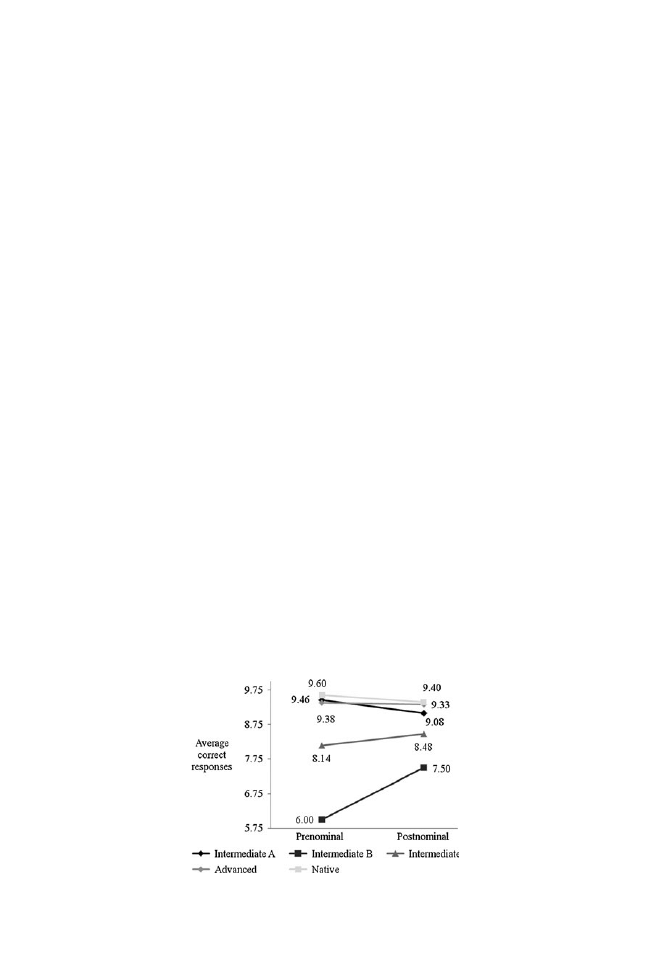
very different results from the original IS group. Figure 3 shows the average
number of correct responses (out of 10) for the three original groups
(IS, AS, and NS) along with the two IS subgroups (ISA and ISB) for task 1.
As shown in Figure 3 , the ISA group’s average number of correct responses
for prenominal adjectives is very similar to the NS and AS groups’ aver-
ages (9.46, 9.60, and 9.38, respectively). However, the ISB group’s average
(6.00) is substantially lower than that of all other groups. The ISA group’s
average for the postnominal adjectives (9.08) is very similar to that of the
NS group (9.40) and of the AS group (9.33). The ISB group’s average
Figure 3. Results for task 1 with subgroups.
Jason Rothman, Tiffany Judy, Pedro Guijarro-Fuentes, and Acrisio Pires
70
number of correct responses (7.50), however, was quite lower than that
of the other groups. A mixed-model ANOVA was run to determine if the
differences among the groups were signifi cant. The results of this
analysis revealed a main effect for profi ciency level, F (3, 56) = 54.33, p < .01.
There was no main effect found for adjectival position, F (1, 56) = 3.247,
p = .077. Finally, an interaction between profi ciency level and adjectival
position was found, F (3, 56) = 8.98, p < .01. Bonferroni post hoc tests
revealed that adjectival position was only signifi cant for the ISB group,
which not only performed differently (worse) than all other groups for both
adjectival positions ( p < .001 for all comparisons) but also performed
signifi cantly worse with prenominal adjectives as compared to postnominal
adjectives ( p < .001). This last effect might seem unexpected; given that
adjectives can only appear prenominally in English, why would these
learners perform worse with prenominal adjectives? However, consid-
ering the fact that these are tutored learners and that pedagogical
oversimplifi cation results in learners being drilled on the postnominal
position of adjectives, then the interaction revealed is not entirely
unanticipated.
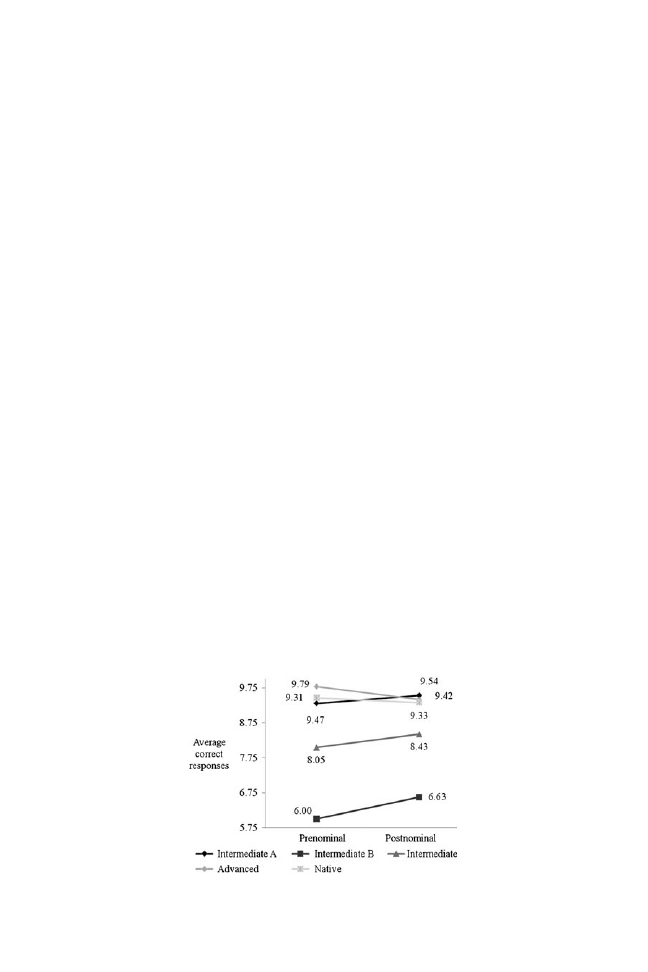
Figure 4 provides the average number of correct responses (out of 10)
on task 2 for each of the three original groups (NS, AS, and IS) and the
two IS subgroups (ISA and ISB). Figure 4 shows that the ISA group’s
average number of correct answers for prenominal adjectives is very
similar to that of the NS and AS groups (9.31, 9.47, and 9.79, respectively).
The ISB group’s average for prenominal adjectives (6.00), on the other
hand, is substantially lower than that of all other groups. The ISA group’s
average number of correct responses for the postnominal adjectives
(9.54) is again very similar to that of the NS group (9.33) and of the
AS group (9.42). The ISB group’s average (6.63) is quite a bit lower
than that of the other groups. The same statistical analyses as those
Figure 4. Results for task 2 with subgroups.

Adjectival Modifi cation in Spanish Determiner Phrases
71
performed with the original groups were conducted to determine if these
differences were signifi cant. The mixed-model ANOVA revealed that there
was a main effect for profi ciency level, F (3, 56) = 40.76, p < .001. No main
effect for the position of the adjective was found, F (1, 56) = 0.148, p = .702.
There was no interaction between adjectival position and profi ciency
level, F (3, 56) = 0.952, p = .435. Bonferroni post hoc analyses revealed no
signifi cant difference between the ISA group and the NS group ( p = 1.000)
or the AS group ( p = 1.000). However, signifi cant differences were found
by comparing the ISB group to each one of the other groups—that is, the
NS group ( p < .001), the AS group ( p < .001), and the ISA group ( p < .001).
It is clear that the ISA group performs just like the native controls and
that the ISB group is much more target-deviant than the overall IS group.
This deeper analysis of the intermediate learners enables us to determine
a more precise time in interlanguage development when the DP syntax
of English learners of L2 Spanish is reset. Based on what the individual
intermediate data reveal, it seems clear that relevant parameter resetting
occurs during the intermediate level of profi ciency. Those individuals
who do not demonstrate such knowledge will likely do so soon, with
continued exposure to Spanish input.
CONCLUSIONS
The current study explored L2 Spanish learners’ knowledge of adjec-
tival semantic entailments that fall out from obligatory noun move-
ment within the Spanish DP, in order to check and value functional
features lacking in these learners’ L1. The results of two tasks demon-
strated that advanced learners and some intermediate learners have
acquired new functional features and apply the corresponding overt
movement, consistently matching the semantic interpretation and cor-
responding feature specifi cation associated with adjectives and nouns
within the DP. In line with previous research that investigates knowl-
edge of complex semantics stemming from the acquisition of specifi c
aspects of the syntax (see, e.g., Slabakova, 2008 ), the data presented
here are argued to provide counterevidence to RDAs of adult SLA. Fu-
ture research that examines corpora of language to which typical L2
Spanish students are exposed can further disprove the alternative view
that the L2 behavior reported here could be attained exclusively via
domain-general learning. Although Anderson ( 2007b ) already dem-
onstrated, based on a corpus study for L2 French, that domain-gen-
eral learning is not a plausible explanation
for the observed behavior
of learners, a similar study for L2 Spanish would further confi rm
whether the arguments provided here are warranted.
(Received 15 June 2009)

Jason Rothman, Tiffany Judy, Pedro Guijarro-Fuentes, and Acrisio Pires
72
NOTES
1. There are, of course, important differences between the theories confl ated under
the singular label RDAs, including the predictions in L2 behavior they make.
2. New uninterpretable features—features that yield nonconvergence of a linguistic ex-
pression if they are not eliminated within the syntactic component—are argued to no longer
be available to adults (see Hawkins & Hattori, 2006 ; Tsimpli & Dimitrakopoulou, 2007 ).
3. For example, it has been argued that although Chinese learners of L2 English form
questions with apparent wh -movement, the syntactic representation of such questions
does not involve a displaced wh -element into the left periphery as it does in native English
(e.g., Hawkins & Hattori, 2006 ). Supporting evidence for this position should come from
persistent variability in production and (mis)judgments of subjacency violations, but
such evidence is not clear (cf. Lardiere, 2007 ).
4. There is also a difference based on the modality investigated at all levels of L2
profi ciency. For example, morphological errors are often less common in written as opposed
to oral speech production.
5. Spanish also shows neuter gender, but this gender is mostly restricted to some
pronouns.
6. For the current study, it does not seem crucial whether –o and –a are gender mor-
phemes or, in Harris’s ( 1991 ) terms, one of seven class morphemes (in the same sense as
declensions) that mark a “derivationally and infl ectionally complete word” (p. 30).
7. Lexically marked gender, such as that seen in steward versus stewardess , is not an
exception, insofar as it does not trigger overt gender agreement elsewhere within the
English DP. Additionally, gender agreement between distinct DPs (e.g., Frank likes himself )
does not have agreement counterparts within each DP.
8. The WMP can also be treated as a Classifi er Phrase (ClassP), although either
projection is suitable to account for syntactic gender features.
9. Other analyses also link the placement of adjectives to the existence of additional
functional projections; for example, Demonte ( 2008 ) postulated the existence of a little n
phrase (nP) projection to allow the prenominal (higher) position for the adjective, instead
of the NumP. However, the semantic properties of adjectives that Demonte focused on are
partially distinct from the properties that are the focus of this study.
10. WMP can be taken to be either absent or syntactically inactive in English. Either
alternative is compatible with our study.
11. Current minimalist assumptions allow uninterpretable features to be valued with-
out movement, via the operation Agree (e.g., Chomsky, 2001 ). However, under a feature-
driven approach to movement that invokes Agree, if overt movement of the noun occurs,
such as in Spanish, it is necessary to assume an additional feature to force this movement,
such as an extended projection principle (EPP)-type feature.
12. The set- versus kind-denoting can also be related to a restrictive versus nonre-
strictive interpretation (see, e.g., Demonte, 2008 ; Jackendoff, 1990 ), although this is not
crucial for this study. Additionally, a contrast between an intersective and a nonintersec-
tive interpretation might also be invoked, although it is avoided here to eliminate confu-
sion with this independent, although partially related, interpretive distinction explored in
the literature. As one anonymous SSLA reviewer pointed out following Demonte, a few
attributive adjectives have a standard nonintersective reading in prenominal position, as
(ia), if Irina is interpreted as attractive as a dancer. On the other hand, atractiva in the
postnominal position can have only an intersective interpretation (Irina is a dancer and
she is attractive as a person), although this interpretation is not blocked for (ia). Despite
a partial overlap in interpretations and the increased complexity learners have to sort out
in learning the target syntax-semantics of the DP in Spanish, the intersective versus non-
intersective distinction is distinct from the set- versus kind-denoting distinction that is
the object of the current study.
(i) a. Irina es una atractiva bailarina.
“Irina is an attractive dancer.” (nonintersective preferred: attractive as a dancer)
b. Irina es una bailarina atractiva.
“Irina is an attractive dancer.” (only intersective: attractive person)

Adjectival Modifi cation in Spanish Determiner Phrases
73
13. For example, Anderson ( 2007b ) showed that 170 of the 205 most frequently used
Romance adjectives in texts (83%) have been attested in a position that would not be
predicted by pedagogical rules.
14. A cross-sectional as opposed to a longitudinal study was chosen in light of the
predictions of the generative SLA models under investigation, which are best tested in
learners with higher levels of profi ciency. Although these models could have been tested
only with advanced L2 learners, data from intermediate L2 learners could provide insight
as to the approximate time by which learner convergence on the target L2 syntactic prop-
erties takes place.
15. We thank Joyce Bruhn de Garavito for sharing this profi ciency test with us. Since
its development at McGill University, this profi ciency measure has been used success-
fully by Bruhn de Garavito and White ( 2002 ) and many other researchers in Hispanic
SLA.
16. Recall that the tasks presented here tested adjectives that clearly allow the
alternation in syntactic position and semantic interpretation. Even though adjectives
that may not favor either position were not tested, the results show that even if their
input varies signifi cantly, advanced learners master the relevant alternations and the
distinct syntactic-semantic feature specifi cation of the L2, beyond just those adjec-
tives that are clearly prenominal with kind-denoting interpretation or postnominal
with set-denoting interpretation. We leave for future research the question as to
whether advanced learners also show nativelike behavior regarding independent lex-
ical distinctions for specifi c adjectives that may further restrict their interpretation
and placement.
17. Both tasks sought to tap L2 implicit intuitions through translation of sorts—
from L2 to L1 for the semantic interpretation task and from L1 to L2 for the context-
based collocation task. Therefore, it could be argued that they are somehow not
valid measures of implicit intuition in the sense that there is a priming translation
effect (resulting in greater L1-like behavior) or reliance upon explicit rules (espe-
cially given that there was no time limit). However, neither potential effect bears out
from the experimental results, especially in the case of the advanced L2 learners.
Even if such effects can in part explain the less targetlike performance of the interme-
diate group, this does not come to bear on the arguments provided here against
RDAs.
18. The GJT data are not presented in much detail here because (a) the focus is on
the semantic properties of adjectives, in connection with their syntactic placement,
and (b) it was important to discuss the results from the semantic interpretation and
the context-based collocation tasks together because of the manner in which these
tasks were designed (i.e., presenting each adjective in only one of its possible positions
in each task). Additionally, keeping the focus on these two tasks enables us to demon-
strate convergence on the same properties across two tasks with the same popula-
tions. Because an anonymous
SSLA reviewer pointed out that the correlation and
contingency between correct gender and number agreement from the GJT and correct
interpretation of adjective placement for each individual participant should be shown,
a summary of the data is provided in the Appendix, from which it is clear that such a
correlation exists. However, if the missing surface infl ection hypothesis (Prévost &
White, 2000) is assumed to be correct, then this correlation between agreement and
interpretation of adjective placement is not necessarily expected and does not need to
be demonstrated. Because the GJT tested for knowledge of gender at the level of recog-
nition of surface morphology matches and mismatches, it was possible for the partici-
pants to have nativelike underlying representations for gender but to still make
mistakes on this test, as learners have been shown to do in oral performance. The
correlation should be between purely syntactic and semantic refl exes not subject to
problems at the syntax-morphology-phonology interface, which can be examined with
a task that tests for knowledge of adjectival interpretations in connection with their
distinct syntactic structure.
19. Although the adjective linking in English can also occur underlyingly to either a
higher or lower position within the DP, this linking occurs without any surface change in
the linear order Adj-N, given the absence of underlying noun-raising within the corre-
sponding DPs in English.

Jason Rothman, Tiffany Judy, Pedro Guijarro-Fuentes, and Acrisio Pires
74
REFERENCES
Anderson , B . ( 2001 ). Adjective position and interpretation in L2 French . In J. Camps &
C. R.
Wiltshire (Eds.),
Romance syntax, semantics and L2 acquisition (pp.
27 – 42 ).
Amsterdam : Benjamins .
Anderson , B . ( 2007 a). Learnability and parametric change in the nominal system of L2
French . Language Acquisition , 14 , 165 – 214 .
Anderson , B . ( 2007 b). Pedagogical rules and their relationship to frequency in the
input: Observational and empirical data from L2 French . Applied Linguistics , 28 ,
286 – 308 .
Anderson , B . ( 2008 ). Forms of evidence and grammatical development in the acquisi-
tion of adjective position in L2 French . Studies in Second Language Acquisition , 30 ,
1 – 29 .
Beck ,
M. L
. (
1998 ).
L2 acquisition and obligatory head movement: English speaking
learners of German and the local impairment hypothesis . Studies in Second Language
Acquisition , 20 , 311 – 348 .
Bernstein , J . ( 1993 ). Topics in the syntax of nominal structure across Romance . Unpublished
doctoral dissertation, Graduate Center , City University of New York .
Bernstein , J . ( 2001 ). The DP hypothesis: Identifying clausal properties in the nominal do-
main . In M. Baltin & C. Collins (Eds.), The handbook of contemporary syntactic theory
(pp. 536 – 561 ). Oxford : Blackwell .
Bley-Vroman ,
R . (
1990 ).
The logical problem of foreign language learning
.
Linguistic
Analysis , 20 , 3 – 49 .
Bley-Vroman , R . ( 2009 ). The evolving context of the fundamental difference hypothesis .
Studies in Second Language Acquisition , 31 , 175 – 198 .
Bruhn de Garavito , J. , & White , L . ( 2002 ). The L2 acquisition of Spanish DPs: The status of
grammatical features . In A. T. Pérez-Leroux & J. Liceras (Eds.), The acquisition of Span-
ish morphosyntax: The L1/L2 connection (pp. 151 – 176 ). Dordrecht : Kluwer .
Cabrelli , J. , Iverson , M. , Judy , T. , & Rothman , J . ( 2008 ). What the start of L3 tells us about
the end of L2: N-drop in L2 and L3 Portuguese . In H. Chan , E. Kapia , & H. Jacob (Eds.),
A supplement to the proceedings of the 32nd Boston University Conference on Language
Development : Retrieved February 28, 2008, from http :// 128 . 197 . 86 . 186 / posters / 32 .
Chomsky , N . ( 2001 ). Derivation by phase . In M. Kenstowicz (Ed.), Ken Hale: A life in
language (pp. 1 – 52 ). Cambridge, MA : MIT Press .
Chomsky , N . ( 2007 ). Of minds and language . Biolinguistics , 1 , 9 – 27 .
Cinque ,
G . (
1994 ).
On the evidence for partial N movement in the Romance DP
. In
G. Cinque , J. Koster , J.-Y. Pollock , L. Rizzi , & R. Zanuttini (Eds.), Paths towards Universal
Grammar (pp. 85 – 110 ). Washington, DC : Georgetown University Press .
DeKeyser , R . ( 2000 ). The robustness of critical period effects in second language acquisi-
tion . Studies in Second Language Acquisition , 22 , 499 – 534 .
Demonte ,
V . (
2008 ).
Meaning-form correlations and adjective position in Spanish
. In
C. Kennedy & L. McNally (Eds.), The semantics of adjectives and adverbs (pp. 71 – 100 ).
Oxford : Oxford University Press .
Epstein , S. , Flynn , S. , & Martohardjono , G . ( 1996 ). Second language acquisition: Theoret-
ical and experimental issues in contemporary research . Brain and Behavioral Sci-
ences , 19 , 677 – 714 .
Fernández , M . ( 1999 ). Patterns in gender agreement in the speech of second language
learners . In J. Gutiérrez-Rexach & F. Martínex-Gil (Eds.), Advances in Hispanic linguis-
tics (pp. 3 – 15 ). Somerville, MA : Cascadilla Press .
Franceschina , F . ( 2001 ). Morphological or syntactic defi cit in near-native speakers? An
assessment of some current proposals . Second Language Research , 17 , 213 – 247 .
Franceschina , F . ( 2005 ). Fossilized second language grammars: The acquisition of grammat-
ical gender . Amsterdam : Benjamins .
Gess , R. , & Herschensohn , J . ( 2001 ). Shifting the DP parameter: A study of anglophone
French L2ers . In J. Camps & C. R. Wiltshire (Eds.), Romance syntax, semantics and L2
acquisition (pp. 105 – 125 ). Amsterdam : Benjamins .
Granfeldt , J . ( 2000 ). The acquisition of the determiner phrase in bilingual and second
language French . Bilingualism: Language and Cognition , 3 , 263 – 280 .

Adjectival Modifi cation in Spanish Determiner Phrases
75
Harris , J . ( 1991 ). The exponence of gender in Spanish . Linguistic Inquiry , 22 , 27 – 67 .
Hawkins , R . ( 1998 , September). Explaining the diffi culty of gender attribution for speakers of
English . Paper presented at the European Second Language Association Conference
(EUROSLA), Paris .
Hawkins , R. , & Chan , C . ( 1997 ). The partial accessibility of Universal Grammar in second
language acquisition: The failed functional features hypothesis
.
Second Language
Research , 13 , 187 – 226 .
Hawkins , R. , & Franceschina , F . ( 2004 ). Explaining the acquisition and non-acquisition of
determiner-noun concord in French and Spanish . In P. Prévost & J. Paradis (Eds.), The
acquisition of French in different contexts: Focus on functional categories (pp. 175 – 205 ).
Amsterdam : Benjamins .
Hawkins ,
R. , &
Hattori ,
H . (
2006 ).
Interpretation of English multiple
wh
-questions by
Japanese speakers: A missing uninterpretable feature account . Second Language Re-
search , 22 , 269 – 301 .
Hawkins , R. , & Liszka , S . ( 2003 ). Locating the source of defective past tense marking in
advanced L2 English speakers . In R. van Hout , A. Hulk , F. Kuiken , & R. Towell (Eds.),
The lexicon-syntax interface in second language acquisition (pp. 21 – 44 ). Amsterdam :
Benjamins .
Jackendoff , R . ( 1990 ). Semantic structures . Cambridge, MA : MIT Press .
Judy , T. , Guijarro-Fuentes , P. , & Rothman , J . ( 2008 ). Adult accessibility to L2 representa-
tional features: Evidence from the Spanish DP . In M. Bowles , R. Foote , S. Perpiñán , &
R. Bhatt (Eds.), Selected Proceedings of Second Language Research Forum 2007 (pp.
1 – 21 ). Somerville, MA : Cascadilla Press .
Lardiere , D . ( 2007 ). Ultimate attainment in second language acquisition: A case study . Mahwah,
NJ : Erlbaum .
Lardiere , D . ( 2009 ). Some thoughts on the contrastive analysis of features in second
language acquisition . Second Language Research , 25 , 173 – 227 .
Long , M. H . ( 2005 ). Problems with supposed counter-evidence to the critical period hypo-
thesis . International Review of Applied Linguistics , 43 , 287 – 317 .
Paradis , M . ( 2004 ). A neurolinguistic theory of bilingualism . Amsterdam : Benjamins .
Parodi , T. , Schwartz , B. D. , & Clahsen , H . ( 1997 ). On the L2 acquisition of the morphosyn-
tax of German nominals . Essex Research Reports in Linguistics , 15 , 1 – 43 .
Picallo , M. C . ( 1991 ). Nominals and nominalization in Catalan . Probus , 3 , 279 – 316 .
Platzack , C . ( 1996 ). The initial hypothesis of syntax: A minimalist perspective on language
acquisition and attrition . In H. Clahsen (Ed.), Generative perspectives on language ac-
quisition (pp. 369 – 414 ). Amsterdam : Benjamins .
Prévost , P. , & White , L . ( 2000 ). Missing surface infl ection or impairment in second language
acquisition? Second Language Research , 16 , 103 – 133 .
Rothman , J . ( 2008 ). Why not all counter-evidence to the critical period hypothesis is equal
or problematic: Implications for SLA . Language and Linguistics Compass , 2 , 1063 –
1088 .
Schwartz , B. D . ( 1998 ). The second language instinct . Lingua , 106 , 133 – 160 .
Schwartz , B. D. , & Sprouse , R. A . ( 1996 ). L2 cognitive states and the full transfer/full access
model . Second Language Research , 12 , 40 – 72 .
Schwartz , B. D. , & Sprouse , R. A . ( 2000 ). When syntactic theories evolve . In J. Archibald
(Ed.), Second language acquisition and linguistic theory (pp. 156 – 186 ). Oxford : Black-
well .
Slabakova , R . ( 2006 ). Is there a critical period for semantics? Second Language Research ,
22 , 302 – 338 .
Slabakova , R . ( 2008 ). Meaning in the second language . Berlin : Mouton DeGruyter .
Thomas , M . ( 2002 ). Development of the concept of the poverty of the stimulus . The Linguistic
Review , 19 , 51 – 71 .
Tsimpli , I. M. , & Dimitrakopoulou , M . ( 2007 ). The interpretability hypothesis: Evidence
from wh -interrogatives in second language acquisition . Second Language Research ,
23 , 215 – 242 .
Tsimpli , I. M. , & Roussou , A . ( 1991 ). Parameter-resetting in L2? UCL Working Papers in
Linguistics , 3 , 149 – 170 .
Ullman , M . ( 2001 ). The neural basis of lexicon and grammar in fi rst and second language:
The declarative/procedural model . Bilingualism: Language and Cognition , 4 , 105 – 122 .

Jason Rothman, Tiffany Judy, Pedro Guijarro-Fuentes, and Acrisio Pires
76
White , L . ( 2003 ). Second language acquisition and Universal Grammar . New York : Cambridge
University Press .
White , L . (in press). Grammatical Theory: Interfaces and L2 knowledge . In W. Ritchie & T.
K. Bhatia (Eds.), Handbook of second language acquisition .
White , L. , Valenzuela , E. , Kozlowska-MacGregor , M. , & Leung , Y. I . ( 2004 ). Gender agreement
in nonnative Spanish: Evidence against failed features . Applied Psycholinguistics , 25 ,
105 – 133 .
Zagona , K . ( 2002 ). The syntax of Spanish . New York : Cambridge University Press .
APPENDIX
SUMMARY OF THE GRAMMATICALITY JUDGMENT TASK
Sample Tokens
(1) Grammatical N-Adj
La tiza de esta sala es amarilla.
“The chalk in the room is yellow.”
(2) Ungrammatical N-Adj
Mis tíos de Los Ángeles son famosas. (should be famosos )
“My uncles from Los Angeles are famous.”
(3) Grammatical Det-N
La banda es muy popular aquí.
“The band is very popular here.”
(4) Ungrammatical Det-N
La familia Muñoz vive en la campo. (should be el campo )
“The Muñoz family lives in the country.”
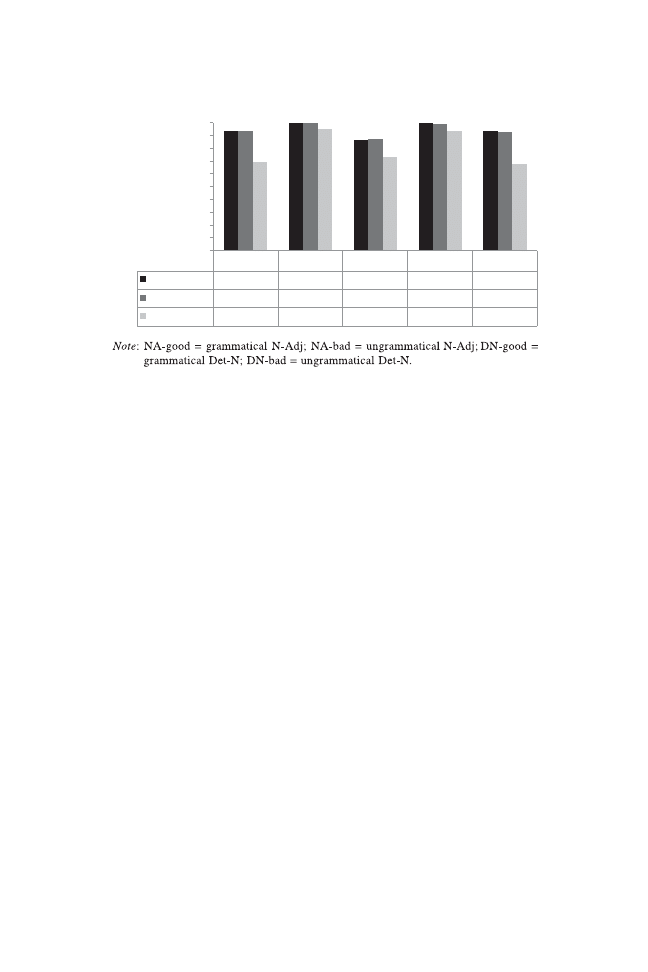
Adjectival Modifi cation in Spanish Determiner Phrases
77
Overview of Results
NA-good
NA-bad
DN-good
DN-bad
Fillers
Native
93.3
100.0
86.7
100.0
93.4
Advanced
93.3
99.6
87.1
99.2
92.9
Intermediate
69.1
95.2
73.3
93.3
67.9
0.0
10.0
20.0
30.0
40.0
50.0
60.0
70.0
80.0
90.0
100.0
Percentage
of correct
responses
Wyszukiwarka
Podobne podstrony:
In the Flesh The Cultural Politics of Body Modification
Chromatopelma cyaneopubescens First detailed breeding in captivity with notes on the species Journal
In the Flesh The Cultural Politics of Body Modification
5 49 62 The Influence of Tramp Elements on The Spalling Resistance of 1 2343
ebook occult The Psychedelic Experience A manual based on the Tibetan Book of the Dead
Oscar Wilde, The Picture of Dorian Gray, and the (Un)Death of the Author
On the Wrong Side of Globalization Joseph Stiglitz
On the sunny side of the streer accordion
Krupa Ławrynowicz , Aleksandra The Taste Remembered On the Extraordinary Testimony of the Women fro
Located on the east side of Rome beyond Termini Station
Baudrillard ON THE MURDEROUS CAPACITY OF IMAGES 1993
A Commentary on the Chymical Wedding of Christian Rosenkreutzt
On the sunny side of the street C
Notes on the Alchemical Transformation of Mecury
Microwave drying characteristics of potato and the effect of different microwave powers on the dried
An experimental study on the drying kinetics of quince
On the functional validity of the worm killing worm
więcej podobnych podstron