
XII-Biotech-C-Opiate Chemistry-1
OPIATE CHEMISTRY AND METABOLISM
Opiates are any chemicals derived from morphine and codeine, and morphine and codeine
themselves. They all have the generalised structure shown below, where X represents
either -H, -CH
3
or -COCH
3
.
O
XO
XO
NCH
3
These chemicals are all pain killers and they all produce drowsiness. Some also produce
feelings of euphoria, and they are all to some extent dependence-inducing. For these
reasons they are used both medically and illicitly.
To determine whether or not one of these drugs has been taken it is important to
understand their respective metabolic pathways (the chain of reactions that they undergo
in the body) to know which chemicals are indicative of the use of any opiate and which are
indicative of the use of an illicit opiate such as heroin. Once this is known then urine
samples can be analysed for these chemicals and a positive identification of the starting
drug made.
Of additional interest to the police is the homebake production of morphine. In New
Zealand this is commonly done by a method that results in high 3-monoacetyl morphine
levels, whereas South-East Asian laboratories commonly produce heroin with high 6-
monoacetyl morphine levels. Thus an analysis of the homebake morphine being used
gives information as to where the drug originated.
INTRODUCTION
The term “opiates” is used for substances, such as morphine and codeine, which are derived
from opium, as well as their chemical derivatives. The best known opiates are heroin,
morphine and codeine, the structures of which are given in Figure 1. They are all potent
narcotic analgesics, i.e. they produce drowsiness and relieve pain.
History
The separation of morphine from opium was first described in 1806. This was a major step
forward in understanding the action of natural products that were used at that time in
medicine, and stimulated work which led to the isolation of other pure drugs.
From late last century, attempts have been made to chemically alter the structure of morphine
to modify its effects and, in particular, to develop a less dependence-inducing drug. Heroin
was one of the first such derivatives, prepared by the relatively simple process of acetylation.

XII-Biotech-C-Opiate Chemistry-2
O
HO
HO
NCH
3
O
HO
CH
3
O
NCH
3
O
O
O
NCH
3
C
O
CH
3
C
O
CH
3
Figure 1 - the structural relationship between heroin, morphine and codeine
A fuller chemical name for heroin is 3,6-diacetylmorphine or diamorphine. Figure 1 shows
the relationship between heroin, morphine and codeine. Initial hopes of reduced dependence
liability were soon dashed, but it was found that heroin was a more potent analgesic.
The uses and abuses of opiates
Morphine is an analgesic used for relief of moderate to severe pain, especially that associated
with neoplastic disease (tumours), myocardial infarction (heart muscle death) and surgery. In
addition to relieving pain, morphine also alleviates the anxiety associated with severe pain.
Although newer analgesics have been introduced into medicine in recent years and may be
superior for particular applications, morphine is still one of the most important drugs in
medicine.
Heroin has also been used in medicine. Heroin salts are more soluble than the corresponding
morphine salts, allowing smaller volumes to be given by injection, an advantage when used
for the relief of severe pain, especially in terminal illness. Use of heroin may be
accompanied by a sense of well-being, a reduction in anxiety, and feelings of euphoria. Such
feelings enhance the dependence-inducing potential of the drug. While the abuse of opiate
drugs is not as large a problem in New Zealand as it is in some countries, the social impact is
significant. As well as the physiological effects of opiate dependence, there are hazards
associated with a lifestyle involving illegal drug use, including an increased risk of exposure
to hepatitis and HIV infection, and the association of drug abuse with crime.
METABOLISM
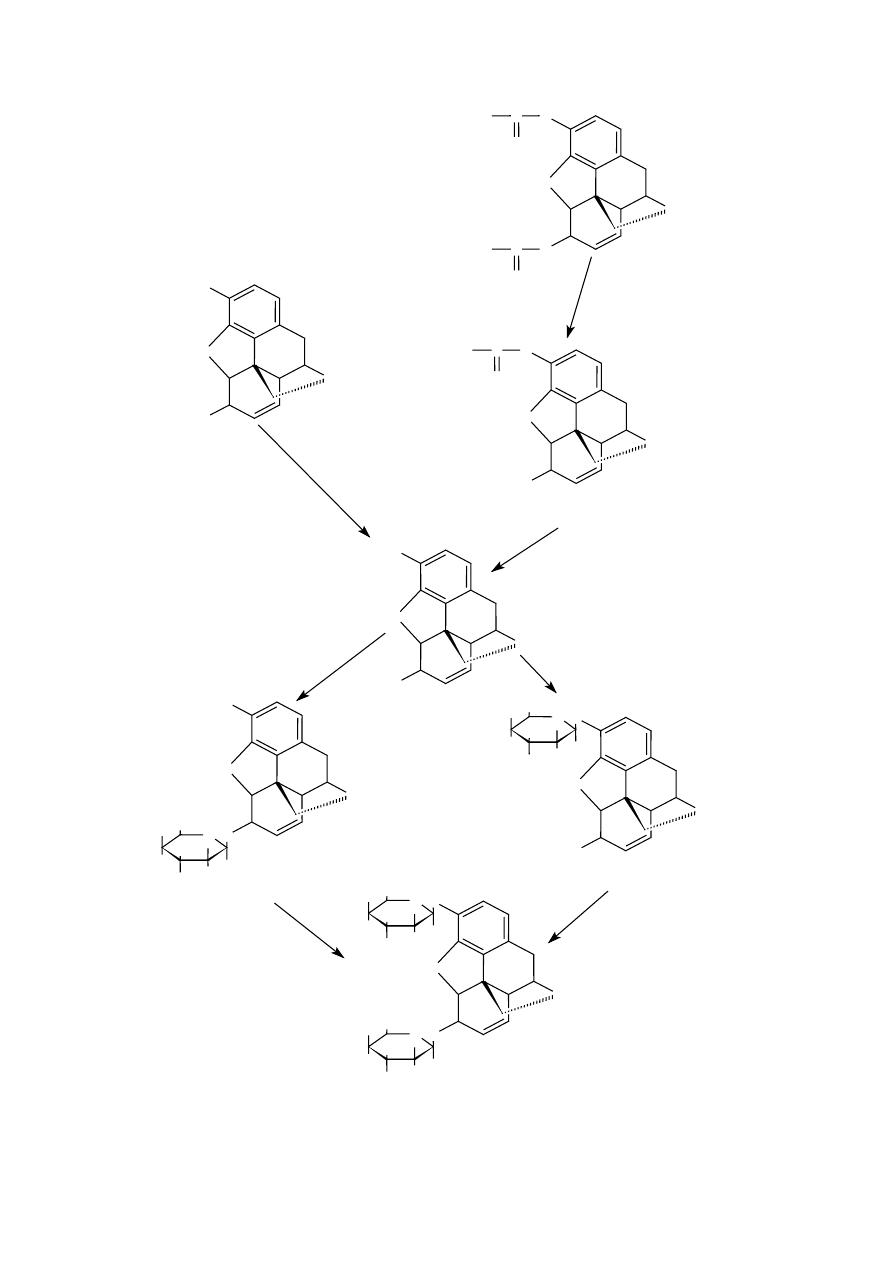
In the body, all of the opiates are ultimately converted to morphine, and morphine is
converted to morphine-3,6-diglucuronide (Figure 2). The metabolic pathways of heroin and
codeine are briefly described below.
Heroin
Heroin is rapidly metabolised in the body to morphine via 6-monoacetylmorphine. In a death
following intravenous injection, neither heroin nor 6-monoacetylmorphine can be detected in
post-mortem tissues if the survival time is prolonged. If even traces of 6-
monoacetylmorphine are detected in a post-mortem sample of blood, this indicates
intravenous use of heroin in the recent past. The presence of 6-monoacetylmorphine also
disproves the “poppy seed defence”.
XII-Biotech-C-Opiate Chemistry-3
O
HO
O
N
C
H
3
C
O
CH
3
O
HO
HO
NCH
3
O
O
H
O
N
C
H
3
C
H
2
O
H
O
H
O
H
O
H
O
O
HO
O
N
C
H
3
O
OH
OH
OH
CH
2
OH
O
O
O
NCH
3
O
OH
OH
OH
CH
2
OH
CH
2
OH
OH
OH
OH
O
6-monoacetyl morphine
O
H
O
C
H
3
O
N
C
H
3
codeine
O
O
O
N
C
H
3
C
O
CH
3
C
O
CH
3
heroin
morphine
morphine-6-glucuronide
morphine-3-glucuronide
morphine-3,6-diglucuronide
Figure 2 - The metabolic pathway of the opiates

XII-Biotech-C-Opiate Chemistry-4
The "poppy seed defence"
Ingestion of products containing opium poppy seeds can result in urine specimens screening
positive for opiates because of the presence of traces of morphine or codeine. This has been
used as an explanation for a positive urine analysis result. The identification of traces of 6-
monoacetylmorphine renders this defence untenable, as this is not part of the metabolic
pathway of opium. In toxicology cases, laboratory analysis for opiates therefore includes
sensitive checks for the presence of 6-monoacetylmorphine.
Codeine
Codeine is widely used in medicine as an analgesic (although it is less potent than morphine)
and as a cough suppressant. In therapeutic doses, codeine is much less liable than morphine
to produce adverse effects. The metabolism of codeine includes the formation of a small
proportion of morphine. It has been reported that 30 hours after codeine administration, only
morphine (which persists longer in the body) may be detectable in the urine by most
analytical methods. This has important implications for drug abuse screening programmes
when interpreting the significance of low levels of morphine found in a urine sample. Drug
abuse screening programmes are widely used overseas, particularly in the USA, in an attempt
to identify employees who may represent a safety risk in the workplace. An understanding of
the details of opiate metabolism would avoid mistaking a consequence of the medical use of
codeine for the more sinister signs of morphine or heroin abuse.
General comments
In post-mortem cases the interpretation of the significance of morphine levels is complicated
by the degree of tolerance acquired by addicts who may be able to survive ten times the
normal lethal dose. Comparison of drug concentrations in various body samples can help
explain the cause of death. For example, if a fatality occurs shortly after ingestion of a drug,
the liver levels are likely to be low. On the other hand, relatively high urine to blood or bile
to blood concentration ratios in association with low total blood concentrations are indicative
of prolonged survival.
The examples given above illustrate why an understanding of opiate chemistry and
metabolism is critical to the contribution of illicit drug analysis and toxicology to forensic
science.
TESTING FOR OPIATES
Analysis of the samples of opiates for Police and Customs prosecutions under the Misuse of
Drugs Act involves the use of some or all of the following techniques: gas chromatography
(GC), gas chromatography - mass spectrometry (GC-MS) and high performance liquid
chromatography (HPLC). The ratios of various impurities in an opiate sample may be
determined to obtain a “profile” of that sample. This can be used to investigate a suspected
connection between samples which may have a common origin, and may provide information
on the drug distribution network.
As noted above, the presence of 6-monoacetyl morphine is conclusive evidence of the usage
of heroin, while the presence of morphine itself can be indicative of the usage of any of the
opiates or the eating of poppy seeds. The same applies to the morphine glucuronides.

XII-Biotech-C-Opiate Chemistry-5
THE NEW ZEALAND SITUATION
In New Zealand in particular, but also to a limited extent in parts of Australia, shortages of
imported heroin have led to the production of “homebake” morphine from pharmaceutical
products containing codeine. The “homebake” process involves use of the reagent pyridine
hydrochloride to convert the codeine to morphine by removing the methyl- group. The
brown morphine powder produced by this process is in the form of crude morphine base.
This is generally reacted with acetic anhydride to give a brown or black tarry residue which
contains a mixture of heroin, 3- and 6-monoacetylmorphines, morphine and other impurities.
heroin
deacetylation
6-monoacetylmorphin
hydrolysis
morphine
acetylation
3-monoacetylmorphine
acetylation
Figure 3 - The relationship between morphine, heroin and the two monoacetyl
morphines
New Zealand homebake is unusual in that it contains high levels of 3-monoacetylmorphine,
present because of incomplete acetylation of morphine (see Figure 3). This is in marked
contrast to the usual situation with illicit heroin powder produced, for example, in illicit
laboratories in South East Asia, in which the 6-monoacetylmorphine level is higher than that
of 3-monoacetylmorphine. Thus the origin of seized drugs can be determined. 3-mono-
acetylmorphine is relatively unstable with respect to deacetylation, and even heroin itself
decomposes (hydrolses) in the presence of heat and/or moisture.
Written by Dr. Keith Bedford with extensive editing by Heather Wansbrough with reference
to:
Thompson, Paul Ivan; Pharmacology of morphine and the active metabolite
morphine-6-glucuronide; University of Auckland; 1991
Wyszukiwarka
Podobne podstrony:
Lewkowski, Jarosław Synthesis, Chemistry and Applications of 5 Hydroxymethyl furfural And Its Deriv
Xylitol Affects the Intestinal Microbiota and Metabolism of Daidzein in Adult Male Mice
CHEMISTRY AND TECHNOLOGY OF POLYURETHANES
atmospheric chemistry and chemical mechanisms
Carl Bosch and Carl Krauch; Chemistry and the Political Economy of Germany, 1925 1945
ENGLISH Toxic and metabolic encephalopathies
[30]Dietary flavonoids effects on xenobiotic and carcinogen metabolism
Chemistry for Environmental Engineering and Science
Enzyme Systems that Metabolise Drugs and Other Xenobiotics Current Toxicology
Density and viscosity of several pure and water saturated ionic liquids Green Chemistry
Metabolic Engineering T Scheper and Jens Nielsen
Industrial Organic Chemistry by Klaus Weissermel and Hans Jurgen Arpe
ENHANCEMENT OF HIV 1 REPLICATION BY OPIATES AND COCAINE THE CYTOKINE CONNECIOION
[30]Dietary flavonoids effects on xenobiotic and carcinogen metabolism
(autyzm) Autismo Gray And White Matter Brain Chemistry In Young Children With Autism
Chemistry for Environmental Engineering and Science
Clinical and neuropsychological correlates of proton magnetic resonance spectroscopy detected metabo
więcej podobnych podstron