
The Laryngeal Nerve of the Giraffe:
Does it Prove Evolution?
Wolf-Ekkehard Lönnig*
6 and 7 September 2010, last update 19 October 2010
Supplement to the paper:
The Evolution of the Long-Necked Giraffe
(Giraffa camelopardalis L.) –
What Do We Really Know?
(Part 1)
http://www.weloennig.de/Giraffe.pdf
As for Part 2 of the article of 2007 see
http://www.weloennig.de/GiraffaSecondPartEnglish.pdf
The recurrent laryngeal nerve:
Much ado has been made in recent years by
evolutionsts like Richard Dawkins, Jerry Coyne, Neil Shubin, Matt Ridley and many
others about the Nervus laryngeus recurrens as a "proof" or at least indisputable
evidence of the giraffe's evolution from fish (in a gradualist scenario over millions of
links, of course). Markus Rammerstorfer has written a (scientifically detailed and
convincing) synoptic critique on this old and, in fact, already long disproved
evolutionary interpretation of the course of this nerve in 2004 (see Rammerstorfer
http://members.liwest.at/rammerstorfer/NLrecurrens.pdf
There are some main points which I would like to
mention here:
As to the evolutionary scientists just mentioned: A totally nonsensical and relictual
misdesign would be a severe contradiction in their own neo-Darwinian (or synthetic
evolutionary) world view. Biologist and Nobel laureate Francois Jacob described this
view on the genetic level as follows: "The genetic message, the programme of the
present-day organism ... resembles a text without an author, that a proof-reader has
been correcting for more than two billion years,
continually improving, refining and
completing it, gradually eliminating all imperfections
." The result in the Giraffe?
Jerry Coyne: "One of nature’s
worst designs
is shown by the recurrent laryngeal
nerve of mammals. Running from the brain to the larynx, this nerve helps us to speak
_______________
*For the last 32 years the author (67) has been working on mutation genetics at the University of Bonn and the Max-Planck-Institute für
Züchtungsforschung in Cologne (Bonn 7 years, Cologne 25 years) - the last two years as a guest scientist (you have to retire in Germany at the age of
65). The present article represents his personal opinion on the topic and does not reflect the opinion of his former employers. - The author obtained
his PhD in genetics at the University of Bonn.

2
and swallow. The curious thing is that
it is much longer than it needs to be
" (quoted
according to Paul Nelson 2009). And: "…it extends down the neck to the chest…and
then runs back up the neck to the larynx. In a giraffe, that means a 20-foot length of
nerve where 1 foot would have done" (Jim Holt in the New York Times, 20 February
2005:
http://www.nytimes.com/2005/02/20/magazine/20WWLN.html
“Obviously a ridiculous detour! No
engineer would ever make a mistake like that!” – Dawkins 2010 (see below) (All
italics above mine.)
Apart from the facts that the nerve neither runs from the brain to the larynx nor
extends down from the neck to the chest
("On the right side it arises from the vagus
nerve in front of the first part of the subclavian artery;..." "On the left side, it arises
from the vagus nerve on the left of the arch of the aorta..." – Gray's Anatomy 1980, p.
1080; further details (also) in the editions of 2005, pp. 448, 644, and of 2008, pp. 459,
588/589), the question arises:
why did natural selection not get rid of this "worst
design" and improve it during the millions of generations and mutations from fish
to the giraffe onwards?
Would such mutations really be impossible?
2. The fact is that even in humans in 0.3 to 1% of the population the right recurrent
laryngeal nerve is indeed shortened and the route abbreviated in connection with a
retromorphosis of the forth aortic arch. (“An unusual anomaly … is the so-called
‘non-recurrent’ laryngeal nerve. In this condition, which has a frequency of between
0.3 – 1%, only the right side is affected and it is always associated with an abnormal
growth of the right subclavian artery from the aortic arch on the left side” – Gray’s
Anatomy 2005, p. 644.; see also Uludag et al. 2009
http://casereports.bmj.com/content/2009/bcr.10.2008.1107.full
; the
extremely rare cases (0.004% to 0.04%) on the left side appear to be always associated with situs inversus, thus still “the right side”).
Nevertheless, even in this condition its branches still innervate the upper esophagus
and trachea (but to a limited extent?). Although this variation generally seems to be
without severe health problems, it can have catastrophic consequences for the
persons so affected: problems in deglutition (difficulties in swallowing) and
respiratory difficulties (troubles in breathing) (see Rammerstorfer 2004; moreover
“
dysphagia
(if the
pharyngeal and oesophageal branches
of nonrecurrent or
recurrent inferior laryngeal nerve are injured)” – Yang et al, 2009:
http://journals.cambridge.org/action/displayAbstract?fromPage=online&aid=5868576
).
If mutations for such a short cut are possible and regularly appearing even in
humans (not to mention some other non-shorter-route variations), – according to the
law of recurrent variation (see Lönnig 2005:
http://www.weloennig.de/Loennig-Long-Version-of-Law-of-Recurrent-
,
2006:
http://www.weloennig.de/ShortVersionofMutationsLawof_2006.pdf
),
they must have occurred already
millions of times in all mammal species and other vertebrates taken together from the
Silurian (or Jurassic respectively) onwards.
And this must also be true for any other
(at least residually)
functionally possible shorter variations of the right as well as of
the left recurrent laryngeal nerve
. Inference:
All these ‘short-cut mutations’ were
regularly counter-selected due to at least some disadvantageous and
unfavourable effects on the phenotype of the so affected individuals
(including
any such mutants in the giraffes). Hence, they never had a chance to permeate and
dominate a population except for the above mentioned very small minority of the
(right) ‘non-recurrent’ laryngeal nerve, which is perhaps already accounted for by the
genetic load
(
“The embryological nature of such a nervous anatomical variation results originally from a vascular
disorder, named
arteria lusoria
in which the fourth right aortic arch is abnormally absorbed, being therefore unable to

3
drag the right recurrent laryngeal nerve down when the heart descends and the neck elongates during embryonic
development.” Defechereux et al. 2000:
http://www.ncbi.nlm.nih.gov/pubmed/10925715
Thus, even from a
neo-Darwinian point of view, important additional functions of the Nervus laryngeus
recurrens should be postulated and looked for, not to mention the topic of
embryological functions and constraints.
3. However, just to refer to one possible substantial function of the Nervus
laryngeus recurrens sinister during embryogenesis: "The vagus nerve in the stage 16
embryo is very large in relation to the aortic arch system. The recurrent laryngeal
nerve has a greater proportion of connective tissue than other nerves, making it more
resistant to stretch. It has been suggested that
tension applied by the left recurrent
laryngeal nerve as it wraps around the ductus arteriosus could provide a means of
support that would permit the ductus to develop as a muscular artery
, rather than an
elastic artery" – Gray’s Anatomy, 39
th
edition 2005, p. 1053.
4. Yet, implicit in the ideas and often also in the outright statements of many
modern evolutionists like the ones mentioned above is the assumption that the only
function of the Nervus laryngeus recurrens sinister (and dexter) is innervating the
larynx and nothing else. Well, is it asked too much to state that they should really
know better? In my copy of the 36th edition of Gray's Anatomy we read (1980, p.
1081, similarly also in the 40
th
edition of 2008, pp. 459, 588/589):
"As the recurrent laryngial nerve curves around the subclavian artery or the arch of aorta, it gives
several
cardiac filaments to the deep part of the cardiac plexus
. As it ascends in the neck
it gives off branches
, more
numerous on the left than on the right side,
to the mucous membrane and muscular coat of the oesophagus
;
branches to the mucous membrane and muscular fibers of the trachea
and some filaments to the inferior
constrictor [Constrictor pharyngis inferior]."
Likewise Rauber/Kopsch 1988, Vol. IV, p. 179, Anatomie des Menschen: "Äste des
N. laryngeus recurrens ziehen zum
Plexus cardiacus
und zu
Nachbarorganen
[adjacent organs]
.
" On p. 178 the authors of this Anatomy also mention in Fig. 2.88:
"
Rr.
[Rami, branches]
tracheales und oesophagei des
[of the]
N. laryngeus
recurrens
." – The mean value of the number of the branches of Nervus laryngeus
recurrens sinister
innervating the trachea und esophagus
is
17,7
und for the Nervus
laryngeus recurrens dexter is
10,5
("Zweige des N. recurrens ziehen als Rr. cardiaci aus dem
Recurrensbogen abwärts zum Plexus cardiacus – als Rr. tracheales und esophagei zu oberen Abschnitten von Luft- und
Speiseröhre, als N. laryngeus inferior durch den Unterrand des M. constrictor pharyngis inferior in den Pharynx. An der
linken Seite gehen 17,7 (4-29) Rr. tracheales et esophagei ab, an der rechten 10,5 (3-16)" – Lang 1985, p. 503; italics by
the author(s). "Er [der N. laryngeus recurrens] benutzt als Weg die Rinne zwischen Luft- und Speiseröhre,
wobei beide
Organe Äste von ihm erhalten
“ – Benninghoff und Drenckhahn 2004, p. 563).
I have also checked several other detailed textbooks on human anatomy like Sobotta
– Atlas der Anatomie des Menschen: they are all in agreement. Some also show clear
figures on the topic. Pschyrembel – Germany’s most widely circulated and consulted
medical dictionary (262 editions) – additionally mentions “Rr. … bronchiales”.
To innervate the
esophagus and trachea
of the giraffe
and also reach its heart
,
the
recurrent laryngeal nerve needs to be, indeed, very long.
So, today's evolutionary
explanations (as is also true for many other so-called rudimentary routes and organs)
are not only often in contradiction to their own premises but also tend to stop looking
for (and thus hinder scientific research concerning) further important morphological
and physiological functions yet to be discovered. In contrast, the theory of intelligent
4
design regularly predicts further functions (also) in these cases and thus is
scientifically much more fruitful and fertile than the neo-Darwinian exegesis (i.e. the
interpretations by the synthetic theory).
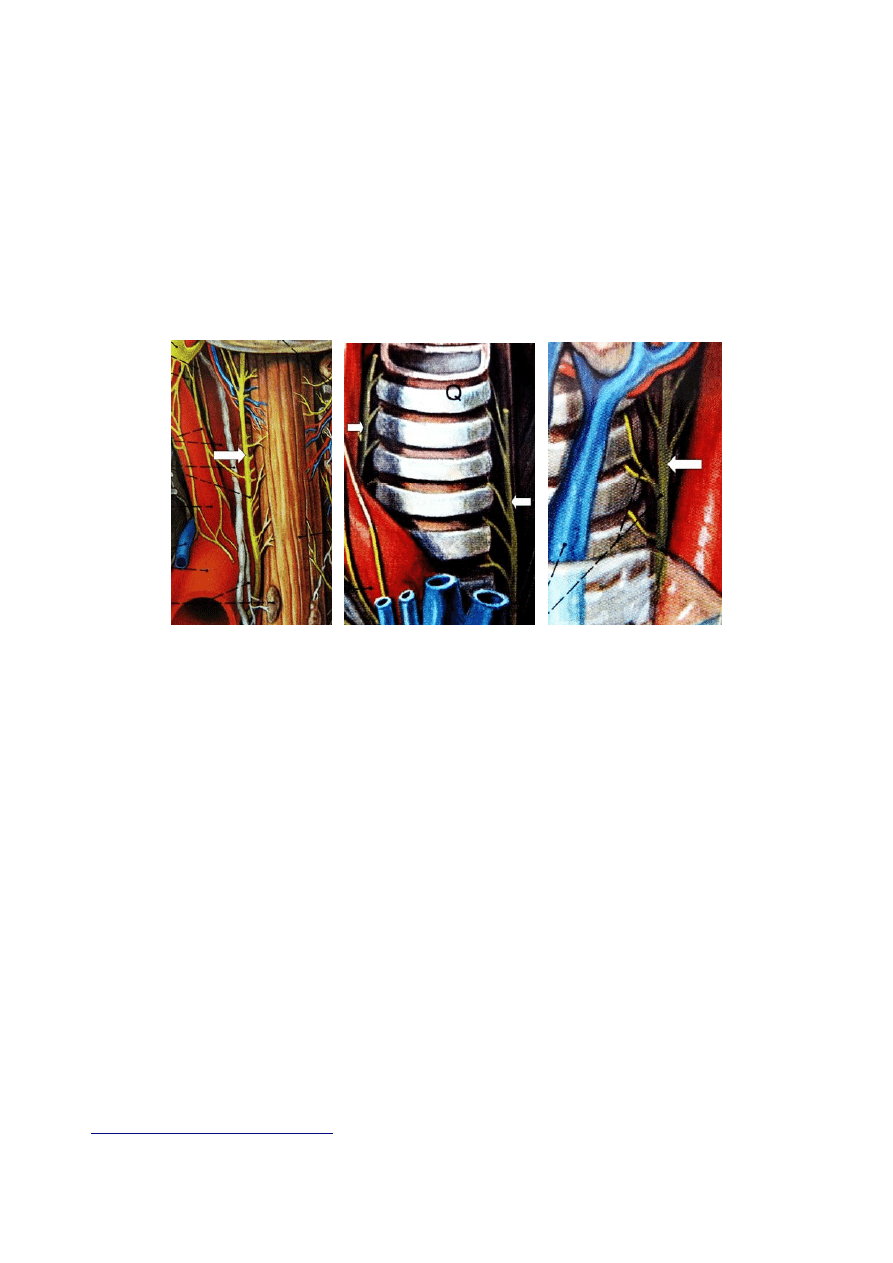
To sum up: The Nervus laryngeus recurrens innervates not only the larynx, but also
the esophagus and the trachea and moreover “gives several cardiac filaments to the
deep part of the cardiac plexus” etc. (the latter not shown below, but see quotations
above). It need not be stressed here that all mammals – in spite of substantial
synorganized genera-specific differences – basically share the same Bauplan (“this
infinite diversity in unity” – Agassiz) proving the same ingenious mind behind it all.
Left
: Detail from a figure ed. by W. Platzer (enlarged, contrast reinforced, arrow added): In
yellow beside the esophagus (see arrow): Nervus laryngeus recurrens sinister running parallel to
the esophagus on left hand side with many branches innervating it (dorsal view).
(1)
Middle
: Detail from a figure ed. by W. Platzer (enlarged, contrast reinforced, arrows added):
Now on the right because of front view: Nervus laryngeus recurrens sinister and on the left Nervus
yngeus recurrens dexter (arrows) sending branches to the trachea.
(2)
lar
Right
: Detail from a figure ed. by W. Platzer (enlarged, contrast reinforced, arrow added): Again
on the right (arrow) because of front view: Nervus laryngeus recurrens sinister (as in the middle
Figure, but more strongly enlarged), sending branches to the trachea.
(3)
Fig. (1), (2) and (3): All three figures (details) from Werner Platzer (editor) (1987): Pernkopf Anatomie, Atlas der topographischen and
angewandten Anatomie des Menschen. Herausgegeben von W. Platzer. 3., neubearbeitete und erweiterte Auflage. Copyright Urban & Schwarzenberg,
München – Wien – Baltimore. Fig. (1): Detail from Das Mediastinum von dorsal, 2. Band. Brust, Bauch und Extremitäten, p. 83, Abb. 79. – Fig. 2:
Detail from Die prae- und paravertebralen Gebilde nach Entfernung des Eingeweidetraktes in der Ansicht von vorne, 1. Band. Kopf und Hals, p. 344,
Abb. 396, drawn by K. Endtresser 1951. – Fig. (3): Detail from Topic der Pleuralkuppeln und des Halseingeweidetraktes in der Ansicht von vorne, 1.
Band. Kopf und Hals, p. 333, Abb. 388, drawn by F. Batke 1951.
As to the giraffe, direct evidence for more functions of the laryngeal nerve than just
innervating the larynx and nothing (or hardly anything) else, was quite
unintentionally provided by Richard Dawkins and Joy S. Reidenberg on YouTube (
17
March 2010, but the more inclusive film on the giraffe was first shown at its full length of 48 Mins on British TV,
Channel 4, in 2009
) in their contribution Laryngeal Nerve of the Giraffe Proves Evolution
(
http://www.youtube.com/watch?v=0cH2bkZfHw4
)
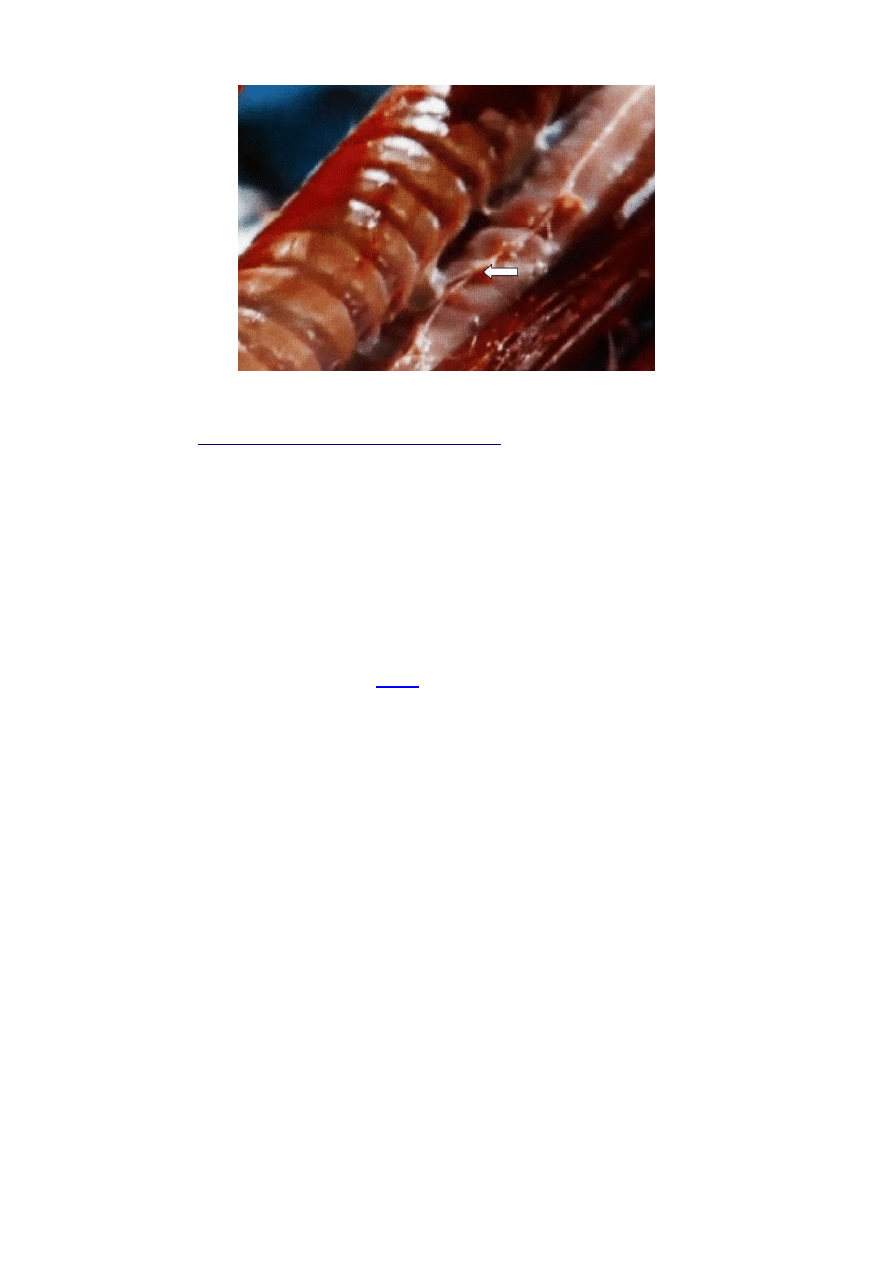
showing directly some of the branches of the N.
laryngeus recurrens innervating the esophagus and the trachea (see 2:09):
5
The Nervus laryngeus recurrens obviously displaying some of its branches innervating the esophagus and trachea in
Giraffa camelopardalis. Photo of detail from the YouTube video of Dawkins (2010) Laryngeal Nerve of the Giraffe
Proves Evolution:
http://www.youtube.com/watch?v=0cH2bkZfHw4
: 2:07/2:09 (arrow added; study, please, especially
arefully the sequence of the pictures from 2:07 to 2:11).
c
Note, please, how Dawkins at 0:28 and later the anatomist Joy S. Reidenberg are unwarrantedly
equating the vagus nerve with the laryngeal nerve
in the video
.
Dr. Reidenberg in her explanations
starting at 1:17 first says correctly about the N. laryngeus recurrens: “…It actually
starts out not as
a separate nerve, but as a branch coming off of a bigger nerve called the vagus nerve
and this
[the vagus] is going to keep running all the way down the body, so you can see it again over here all
the way down the neck, on both sides. … And this [the vagus] is going to wrap around the great
vessels coming out of the heart. …
So here is the vagus going down and here is the vagus
continuing
. And
right over here
, there is a
branch
, right there [namely
the N. laryngeus
recurrens
very near the great vessels coming out of the heart]. So it’s looping and coming back,
doing a U-turn all the way down here [at that point she seems to start equating the laryngeal with
the vagus nerve]. So it [actually the
vagus
, not the laryngeal nerve] has travelled that entire
distance to make a U-turn [and now concerning
its new branch
, the laryngeal nerve:] to go all the
way back again.* And so we can follow it back up again. So we follow this branch. And if we look
we see it again over here. Here it is. Like that [2:07; see above]. And here you see it going up, this
is the voice box, the larynx. …also coordinating breathing and swallowing in this area [yet, not only
in this area!]. So this is a very important nerve. Interestingly, where it [the laryngeal nerve] ends is
pretty close to where it started” [wrong; it really started
near the vessels coming out of the heart
–
see above]. Reidenberg continues: “It started here coming out of the brain [totally wrong; this is
where the
vagus nerve
started]. It really needs to go about two inches. But it [the vagus nerve
really] went all the way down and it [the laryngeal nerve] came all the way back.” Dawkins: “It is a
beautiful example of historical legacy as opposed to design.” And then Joy Reidenberg again: “This
is not an intelligent design. An intelligent design would be to go from here to here.”
Following that, an intelligent point was raised by Mark Evans, the veterinary surgeon and
presenter of the film Inside Nature's Giants: The Giraffe, which was first shown at full length
(48Mins) on Monday 9pm, 20 July 2009, on Channel 4 (a UK public-service television
broadcaster): “It does kind of beg the question, even in an animal that might have been many
millions of years ago with its head down here: why the route ‘round the blood vessels,
unless
there’s a reason they were there to enervate something else
.” This implicit question (“to enervate
something else”) was unjustifiably denied by Dawkins answering: “Well that was in earlier
ancestors, then it was the most direct route. In fish.” Etc. – followed by the typically inconsistent
neo-Darwinian explanation (evolution 'continually improving, refining and completing the genetic
message, eliminating all imperfections' (see above), yet stretching the laryngeal nerve for absolutely
no functional reasons almost endlessly instead of ever finding a short cut etc.).
*To repeat: the vagus and not the laryngeal nerve has travelled all the distance and it is
its entirely new branch, the laryngeal nerve
(not the
vagus) that goes all “the way back” innervating with many branches the heart, the laryx and the esopahgus on its way]. [Comments in brackets and
footnote added by W-EL].

6
So is the recurrent laryngeal nerve really an “Obviously a ridiculous detour” etc. as
Dawkins stated in the TV show 2009 and YouTube video 2010?
Wilhelm Ellenberger and Herrmann Baum sum up the multiple functions of that
nerve in their Handbook of Comparative Anatomy of Domestic Animals as follows
(only in German 1974/1991, p. 954, italics by the authors):
“Der N. recurrens führt die Hauptmasse der Vagusfasern für das Herz (H
IRT
1934) und gibt
sie vor Austritt aus der Brusthöhle an den Plexus cardiacus (s. unten und Abb. 1409). Er gibt
außerdem Zweige an den in der präkardialen Mittelfellspalte zwischen Trachea und den großen
Blutgefäßen gelegenen Plexus trachealis caud. Und steht mit dem Ggl. cervicale caud. des N.
sympathicus in Verbindung. Nach seinem Austritt aus der Brusthöhle gibt der N. recurrens im
Halsbereiche jederseits Zweige ab, die einen Plexus trachealis cran. bilden und Rami
oesophagici und Rami tracheales an Muskulatur und Schleimhaut von Speise- und Luftröhre
schicken. Im Kehlkopfbereich verbinden sich dünne Zweige von ihm mit solchen des N.
laryngicus cran. (siehe dort).“
For me, personally, it is really impressive, how evolutionists like Dawkins, Coyne,
Reidenberg and other 'intellectually fulfilled atheists' inform the public on such
scientific questions in contrast to the facts cited above.
May I suggest that a scientifically unbiased anatomical examination of the
laryngeal nerve of the giraffe would have – as far as posssible – included attention to
and dissection of all the branches of the nerve, including the queries for the “several
cardiac filaments to the deep part of the cardiac plexus”, the many “branches, more
numerous on the left than on the right side, to the mucous membrane and muscular
coat of the oesophagus” as well as the “branches to the mucous membrane and
muscular fibers of the trachea” and perhaps even the “Rr. bronchiales”. So, when the
oppurtunity arises, let’s do such a more comprehensive dissection of that nerve all
over again – and add, perhaps, the research question on an irreducibly complex core
system concerning the route and function of that nerve.
This seems to be all the more important since some of the observations by Sir
Richard Owen made on the dissection of three young giraffes – two of them 3 years
old and one about 4 years of age (one had died in the gardens of Regent’s Park and
two at the Surrey Zoological Gardens) – seem to deviate from those of Dr.
Reidenberg. Although the great anatomist Owen also made some mistakes in his
work on other organisms (mistakes, which especially Thomas H. Huxley liked to
stress), Owen’s findings on the giraffe should not be dismissed too easily. He writes
(1841, pp. 231/232;
italics his, bold in blue added as also the comment in brackets
):
“From the remarkable length of the neck of the Giraffe the condition of the recurrent
nerves became naturally a subject of interest: these nerves are readily distinguishable at
the superior third of the trachea, but when sought for at their origin
it is not easy to
detect them or to obtain satisfactory proof of their existence
[this comment seems to be in
disagreement with what Dr. Reidenberg demonstrated by her dissection – she had no problems to detect it/them from the very
beginning; also Owen’s following observations seem to disagree with those of Reidenberg’s to a certain extent].
Each nerve
is not due, as in the short-necked Mammalia, to a single branch given off from the nervus
vagus, which winds round the great vessels, and is continued of uniform diameter
throughout their recurrent course, but it is formed by the reunion of
several small filaments
derived from the nervus vagus at different parts of its course
.

7
The following is
the result of a careful dissection of the left recurrent nerve
. The
nervus vagus as it passes down in front of the arch of the aorta sends off
four small
branches
, which bend round the arch of the aorta on the left side of the ductus arteriosus; the
two small branches
on the left side pass to the oesophagus and are lost in the oesophageal
plexus;
the remaining two branches
continue their recurrent course, and ascend upon the
side of the trachea,
giving off filaments which communicate with branches from the
neighbouring oesophageal nerves
: these recurrent filaments also receive twigs from the
oesophageal nerves, and thus increase in size, and
ultimately coalesce into a single nerve
of a flattened form
, which enters the larynx above the cricoid cartilage and behind the
margin of the thyroid cartilage.” – (Similar comments by Owen in 1868, p. 160.)
Nevertheless, Owen’s observations of filaments, which are given off by the
recurrent nerve(s) are obviously in agreement with what Joy S. Reidenberg found, yet
failed to mention and draw attention to explicitly (see above).
I have to admit that – the more deeply I am delving into the harmonious complexity
of biological systems – the more elegant and functionally relevant the entire systems
appear to me, even down to 'pernickety detail' (to use one of Dawkins' expressions),
including the Nervus laryngeus recurrens sinister and the Nervus laryngeus
recurrens dexter with their many branches and functions also in the giraffe and their
correspondingly appropriate lengths.
Incidentally, Graham Mitchell’s slip of the tongue or perhaps better his formulation
from his innermost feelings in connection with his investigations of the giraffe’s
lungs and mechanism of respiration appears to be rather revealing (even if meant only
figuratively): “It couldn’t have been more beautifully designed … [
after a little pause
] …
evolved” [
laughter
]. See this captivating dissection and investigation of the giraffe’s
lung here:
http://channel.nationalgeographic.com/episode/inside-the-giraffe-4308/Photos#tab-Videos/07902_00
“Design should not be overlooked simply because it's so obvious” – Michael J.
Behe 2005. May I repeat in this context that even from a neo-Darwinian perspective
it would be very strange to assume that only the laryngeal nerve(s) could be “more
beautifully designed” in contrast to all the rest which already is (see Francois Jacob
above).
As to further discussions, including the quotation above of Jerry Coyne according
to Nelson, see Paul Nelson (2009):
Jerry, PZ, Ron, faitheism, Templeton,
Bloggingheads, and all that — some follow-up comments
.
Notes added in Proof
(29 September 2010 and 19 October 2010)
a) The recurrent laryngeal nerves and most probably also some of their many
branches usually missed/overlooked by leading neo-Darwinian biologists today,
have been known for more than 1800 years now. See, for instance, E. L. Kaplan,
G. I. Salti, M. Roncella, N. Fulton, and M. Kadowaki (2009): History of the
Recurrent Laryngeal Nerve: From Galen to Lahey
http://www.springerlink.com/content/13340521q5723532/fulltext.pdf
“…it was Galen [ca. 129 to about 217 A. D.] who first described the recurrent
laryngeal nerves in detail in the second century A. D.” “He dissected these nerves in
many animals – even swans, cranes, and ostriches because of their long necks…”

8
“Because of Galens fame and the spread of his teachings, the recurrent laryngeal
nerve was discussed by many surgeons and anatomists thereafter.” – Kaplan et al.
2009, pp. 387, 389, 390.
The keen observer Claudius Galenos [Galen] – having discovered,
concentrating on and meticulously dissecting the recurrent laryngeal nerves of
many different species of mammals and birds
– must necessarily also have seen
at least some of the their branches leading to other organs as well. Yet, in
agreement with Lord Acton’s verdict that “The worst use of theory is to make
men insensible to fact”, not only many of today’s neo-Darwinians but also Galen
himself missed the altogether some thirty branches of the RLNs due to his own
peculiar ‘pulley-theory’ (see again
http://www.springerlink.com/content/13340521q5723532/fulltext.pdf
Margaret Tallmadge May comments in her translation of Galen on the
Usefulness of Parts of the Body (1968, p. 371, footnote 62) on his assertion that
“both [recurrent] nerves pass upward to the head of the rough artery [the trachea]
without giving off even the smallest branch to any muscle…”:
“As Daremberg (in Galen [1854], I, 508]) intimates,
Galen is being ridden by his
own theory here
. The recurrent nerve does, of course, give off various branches as it
ascends.”
However, accepting the fact of the many branches given off by the recurrent
laryngeal nerves innervating several other organs as well would have completely
disproved Galen’s own ‘pulley-theory’
as it currently refutes the “ridiculous
detour”-hypothesis of Dawkins and many other neo-Darwinians.
1 See some points written by Galen in the English translation of On Anatomical Procedures, The later Books,
Translated by Duckworth (1962) under
http://books.google.de/books?hl=de&lr=&id=P508AAAAIAAJ&oi,
pp. 81-
87 and especially pp. 203 ff.
2 There are, however, several hints that he saw more then his theory allowed: “And when it [the Nervus laryngeus
recurrens dexter] is extending upward after the turn, Nature stretches out to it from the sixth pair
the handlike
outgrowth
which binds it to the large nerve and makes both its turn and its ascend safe. The portions of the nerve on
the two sides of the turn are supported on both the right and left
by the outgrowths
[rami cardiaci inferiores?
Comment by M. T. May] of the sixth pair which it makes to the parts of that region” (May: Galen on the Usefulness
of Parts of the Body 1968, II, p. 694). “When immediately the after the turn these [recurrent] nerves are mounting
straight upward,
the large nerve extends to them an outgrowth
, as if reaching out a hand, and by means of this it
draws and pulls them up” (May I, pp. 370/371). Margaret T. May comments in her footnote 61 to The Seventh Book
of Galen (I, pp. 370/371):
“The large nerve mentioned here is certainly the vagus itself; for in chapter 4 of Book XVI he mentions this helping hand extending to the
recurrent nerve again and says that it comes from the "sixth" pair. Since no mention is made of it in De nervorum dissectione and
no further light is ever shed on it either here or in De anat. admin., XIV (Galen [1906, II, 189; 1962, 207]), where it is described once
more, I have been unable to determine what may have misled Galen. Neither Daremberg (in Galen [1854, I, 507]) nor Simon (in
Galen [1906, II, 344]) has a satisfactory explanation. The former suggests "the superior cardiac nerves, or perhaps the anastomotic
branch"; the latter says that it may be "
certain connecting twigs
which Galen had seen at the point of reflection, going from the
recurrent to the vagus." I cannot find these connecting twigs described elsewhere. Dr. Charles
GOSS
,
however, tells me that "the vagus
in the neck of a pig in a recent atlas is labelled vagosympathetic trunk. This gives ample opportunity for communicating fibers." Cf.
Ellenberger and Baum (1926, 874).”
So, whatever Galen meant in detail by the “the handlike outgrowth which binds it to the large nerve” etc. – he must
have seen “
certain connecting twigs
” going out from and to the recurrent nerves. But perhaps also a word of
caution: Of the extant codices of the work of Galen, the codex Urbinas “dating from the tenth or eleventh century, is
the oldest and also the best of the lot” – May 1968, I, p. 8. Nevertheless on p. 362 she argues as follows:
“The following description of the discovery of the recurrent laryngeal nerves and their function is a classic. In his splendid article,
"Galen's Discovery and Promulgation of the Function of the Recurrent Laryngeal Nerve," Walsh (1926, 183) says that he has no
doubt that it embodies the actual lecture given by Galen and taken down stenographically on the occasion when he demonstrated
publicly the structure of the larynx, the muscles moving it, and their innervation. As for the importance of the discovery, Walsh (ibid.,
7751) says, "This discovery established for all time that the brain is the organ of thought, and represented one of the most important
additions to anatomy and physiology, being probably as great as the discovery of the circulation of the blood.””
9
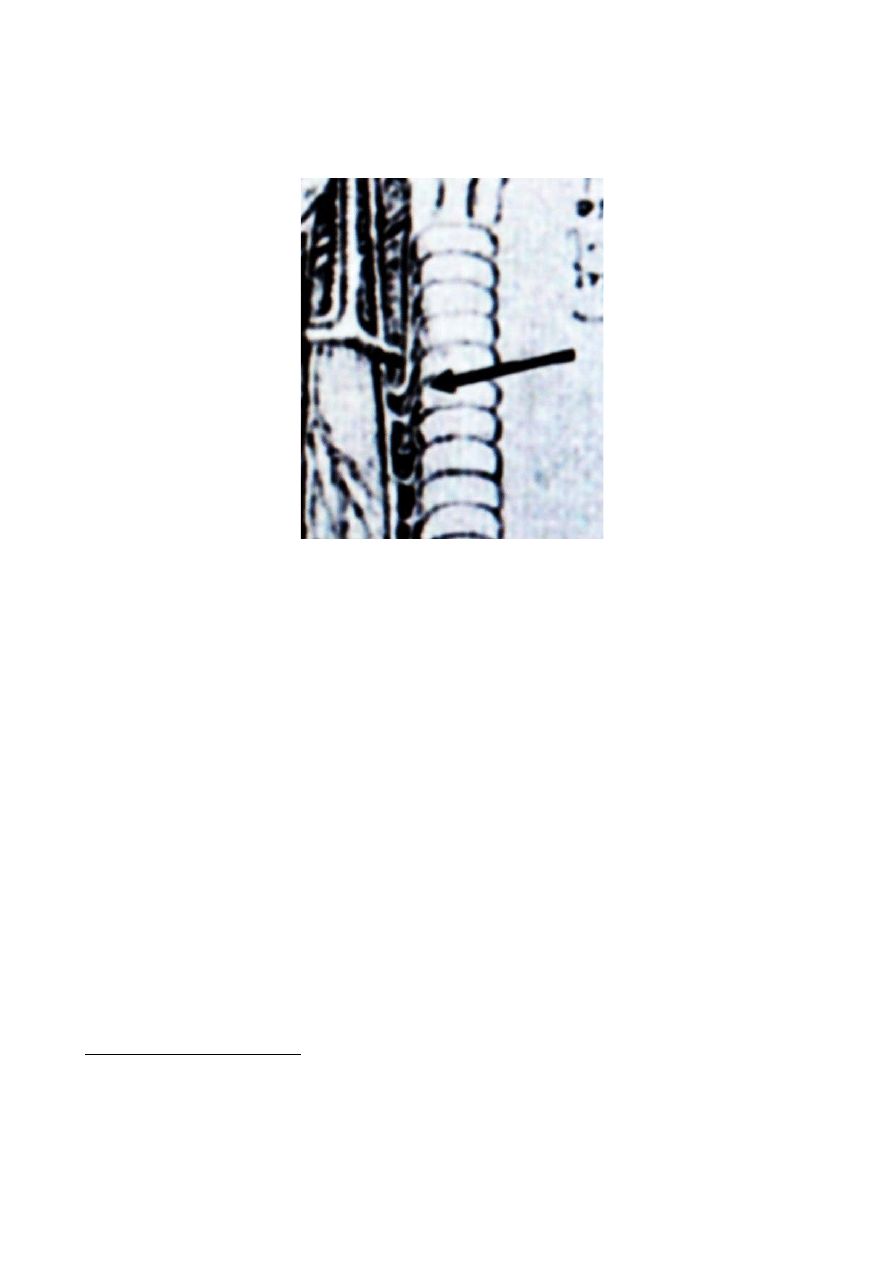
Interestingly, additional branches of the right recurrent laryngeal nerve to the
trachea were indeed noted and drawn by
Leonardo Da Vinci in 1503
, see the
following detail from Fig. 3 of Kaplan et al. 2009, p. 388:
b) According to Dietrich Starck – one of the leading German evolutionary
anatomists of the 20
th
century – the recurrent laryngeal nerves are missing in the
suborder Tylopoda (family Camelidae with camels, lamas and vicugnas), see
Starck 1978, p. 237. However, Hans Joachim Müller, who published the results
of his careful dissections on Camelus bactrianus and Lama huanacus [guanicoe]
in 1962
, found that – although in fact, the innerveration of the larynx by the
Nervus laryngeus inferior is exceptional
in these animals – there still is a
ramus
recurrens sinister
, which arises from the vagus nerve near the heart and ‘curves
around the arch of aorta’ in order
to ascend
at the latero-dorsal (and during
further development at the more dorsal) part of the trachea, but does not
innervate the larynx. Müller writes (p. 161):
“Beim Überkreuzen der Aorta verlassen mehrere Äste den Nervus vagus und ziehen zum Herzen und zum
Lungenhilus. Einer der Äste („
Ramus recurrens sinister
“) umschlingt den Aortenbogen und
steigt rückläufig
am latero-dorsalen Rand der Trachea auf
. Im weiteren Verlauf liegt er mehr auf der Dorsalseite der
Trachea, verbindet sich
mit entsprechend rückläufigen Ästen des rechten Nervus vagus
zu einem
Nervenkomplex und anastomosiert schließlich mit dem absteigenden Ramus descendens n. vagi.”
The fact that the ramus recurrens sinister does not innervate the larynx in the
Camelidae, but still takes the ascendent course of the normal recurrent laryngeal
nerve of all the other mammal families (so much so that J. J. Willemse thought
he had even found a normal Nervus recurrens in a young camel
), yet to
eventually anastomose with corresponding recurrent branches of the right vagus
3
Beobachtungen an Nerven und Muskeln des Halses der Tylopden; Zeitschrift für Anatomie und Entwicklungsgeschichte 123: 155-173
4 „Seit etwa 60 Jahren [in the interim more than 100 years] ist bekannt, daß der Nervus laryngeus inferior [the part of the recurrent laryngeal nerve
near the larynx] beim Lama (v. Schumacher 1902) und beim Kamel (Lesbre 1903) einen eigentümlichen Verlauf nimmt. Seine Fasern gelangen
auf direktem Wege über einen absteigenden Ast des Nervus vagus zu den inneren Kehlkopfmuskeln.“ Außerdem fehlt bei dem Tylopoden der
periphere Nervus accessorius.
5 “[I]n the young camel we dissected a very normal n. recurrens was present“ – Willemse 1958, p. 534. „Die Feststellung von Willemse (1958),
daß bei einem jungen Kamel ein normaler Nervus recurrens vorhanden war, dürfte wohl nur im Hinblick auf die topographischen Beziehungen
dieses Nerven getroffen worden sein.“ – Müller 1962, p. 167.

10
to take part in the formation of a special network of nerves, also implies
important and indispensible functions of that route
. As for similar observations
on the ramus recurrens dexter, see footnote below
.
To discover or deepen our
understanding of these necessary and probably further vital functions will be a
task of future research
c)
I have now checked two additional (and again several further) research papers,
which clearly imply that the last dissections of the giraffe
did not take place in
1838
(as stated by Mark Evans on public TV in England; see the link above), but
were performed shortly before 1916, 1932, and 1958 and also between at least
1981 and 2001.
(
It could, perhaps, be a special task for historians of biology to find out whether further
dissections and anatomical studies of the giraffe have taken place between 1838 and 2009, and especially to what
extent such studies were relevant for the routes and functions of the RLNs.
)
H. A. Vermeulen (1916)
: The vagus area in camelopardalis giraffe. Proc.
Kon. Ned. Akad. Wet. 18: 647-670. (Proceedings of the Koninklijke
Nederlandse Akademie van Wetenschappen.)
He introduces his work on the giraffe as follows (1916, p. 647): “I […] found several remarkable relations,
particularly of vagus and accessorius nuclei of Camelidae which roused in me the desire to examine what the
circumstances might be in the giraffe. I was able to to examine one part only of the central nervous system of
this class of animal, and was enabled to do so by the courtesy of Dr. C. U. ARIENS KAPPERS, Director of the
Central Institute of Brain Research, at Amsterdam, who kindly placed
part of the material at my disposal.
This consisted of the brain stem and a piece of the first cervical segment of one specimen, and the first
and second segment of another specimen
. In the latter preparation the nervi accessorii Willisii could be seen
perfectly intact in their usual course between the roots of the two first cervical nerves, so that in this respect the
giraffe differs here at least, from the Camelida.” However, Vermeulen could not dissect and investigate the
laryngeal nerve itself of the giraffe. He only writes on p. 665: “…one might conclude, judging from the strong
development of the nucleus at this place [the nucleus ambiguus spinally from the calamus] in the giraffe, that
the nervus recurrens, even in this animal in spite of its long neck, well deserves its name,
in which case
the highly exceptional conditions of this nerve in Camelidae have wrongly been connected by LESBRE with
the unusually long neck of these animals.”
J. J. Willemse (1958)
: The innervation of the muscles of the trapezius-complex
in Giraffe, Okapi, Camel and Llama. Arch. Néerl. Zool. 12: 532-536.
(Archives Néerlandaises de Zoologie.)
Willemse 1958, p. 533 and p. 535: “ZUCKERMAN and KISS (1932) made an attempt to obtain certainty
about the spinal accessory nerve of the giraffe. […]
The dissection of two giraffes, carried out by
6
As to the Ramus recurrens dexter, Müller notes p. 162: „Der rechte Nervus vagus gelangt nach Trennung vom Truncus sympaticus ventral der
Arteria subclavia in den Thorax, wo er die Trachea zum Lungenhilus begleitet (Abb. 7). Noch vor Passieren der Arteria subclavia verläßt ihn ein
kleiner Ast, der, neben ihm verlaufend, ventral die Arteria subclavia kreuzt, um dann auf der Rückseite
rückläufig zum Truncus sympathicus
aufzusteigen
.
Caudal der Arteria subclavia
gehen mehrere Nervenzweige vom Nervus vagus ab und beteiligen sich an der Bildung des
beschriebenen Nervenplexus auf der Dorsalseite der Trachea. Es läßt sich ein etwas stärkerer Strang durch das Geflecht verfolgen, der sich in den
Ramus descendens n. vagi der rechten Seite fortsetzt (=
Ramus recurrens dexter
) (Abb. 7).“
7 I earnestly hope without doing harm or being cruel to the respective animals. There are now many alternatives to animal experiments:
http://www.vivisectioninfo.org/humane_research.html
(I do not, of course, subscribe to everything these people say or do). We must, nevertheless, for many scientific
and further reasons assign different values to humans and animals, but definitely without being incompassionate to either of them.
Concerning dissections: If an animal – like a mammal or bird – has died, but was not killed for studying its anatomy, it appears to be fully okay
to me. On the other hand, I remember well the Zoologische Praktika, where we, i. e. the students, had the task to dissect fish, frogs and rats and
that we were admonished to do our best especially because the animals had to die for these studies. My impression was that the lecturers
(understandably) were not all too happy about killing these creatures. Although being fascinated by anatomical studies (
I even taught [theoretical]
human anatomy for nurses for a while
), I later focussed on plant genetics for my further research to avoid killing or doing harm to sensitive animals
myself (but there were also additional reasons for this choice). For a more differentiated comment on animal pain, including insects, for which
several authors doubt that they are able to feel pain, see
http://www.weloennig.de/JoachimVetter.pdf
.
A word on Galen’s vivisections: I am of the opinion that they were cruel. In this context one may also raise the question: What about Darwin
and vivisection? Rod Preece has stated (2003): “In the first major ethical issue that arose after the publication of Darwin's The Descent of Man –
legislation to restrict vivisection – Darwin and Huxley stood on the side of more or less unrestricted vivisection while many major explicitly
Christian voices from Cardinal Manning to Lord Chief Justice Coleridge to the Earl of Shaftesbury – demanded the most severe restrictions, in
many cases abolition.”
http://muse.jhu.edu/login?uri=/journals/journal_of_the_history_of_ideas/v064/64.3preece.pdf
http://darwin-online.org.uk/EditorialIntroductions/Freeman_LetteronVivisection.html
and
http://darwin-online.org.uk/pdf/1881_Vivisection_F1793_001.pdf
(as to the latter link: It seems that Darwin could also be very compassionate to animals as shown by
the quotation of T. W. Moffett). However, in the second edition (1874 and 1882), Darwin added “…unless the operation was fully justified by an
increase of our knowledge, …”

11
Zuckerman and Kiss themselves
, indicate that the muscles of the trapezius-complex were supplied, as in
other Ungulates, by branches from the spinal accessory and from cervical nerves.
The dissection of a giraffe at out own laboratory
gave results which resembled those of ZUCKERMAN
and KISS very much. […] Some twenty years ago anatomists showed that in the giraffe a n. accessorius is
present, but the nerve is lacking in camels and llamas. Recent investigations are in accordance with these
facts.” – However, unfortunately no new information on the laryngeal nerves of the giraffe is given in this
paper.
For some further dissections and anatomical studies of the giraffe, see the
papers by Kimani and his co-workers (1981, 1983, 1987, 1991), Solounias 1999,
and Sasaki et al. (2001) in the references in Part 2 for the present paper
http://www.weloennig.de/GiraffaSecondPartEnglish.pdf
d) The verdict of Nobel laureate Francois Jacob quoted above that natural selection
has been correcting the genetic message "for more than two billion years,
continually improving, refining and completing it, gradually eliminating all
imperfections" is not an isolated case but describes, in principle, an important
and constitutive part of the general state of mind of neo-Darwinian biologists,
which can be traced back to Darwin himself. The latter states – just to quote a
few examples:
“As natural selection acts solely by the preservation of profitable modifications, each new form will tend in a
fully-stocked country to take the place of, and finally to
exterminate, its own less improved parent-form and
o
voured forms with which it comes into competition
. Thus extinction and natural selection go hand
in hand.”
ther less-fa
Or:
"…old forms will be supplanted by new and improved forms." And on the evolution of the
eye that natural selection is:
"intently watching each slight alteration” … "carefully preserving each which…in any way or in any degree
tends
d
to produce a distincter image." And “We must suppose each new state of the instrument to be multiplie
by the million; each to be preserved until a better one is produced, and then the old ones to be all destroyed."
And:
"In living bodies, variation will cause the slight alterations, generation will multiply them almost
nfinitely, and
natural selection will pick out with unerring skill each improvement
."
i
In the same manner and context of eye-evolution (including necessarily the
entire innervation and corresponding parts of the brain in complex animals),
Salvini-Plawen and Mayr regularly speak of "evolutive improvement" (p. 247),
"eye perfection", "gradually improved types of eyes", "grades in eye perfection",
"the principle of gradual perfectioning from very simple beginnings", "regular
series of ever more perfect eyes" (1977, pp. 248 – 255; see please
http://www.weloennig.de/AuIINeAb.html
).
Applying this kind of reasoning to the recurrent laryngeal nerve leads us
directly into the contradiction in the neo-Darwinian world view pointed out
above, to wit, that the “
unerring skill
” of natural selection – that exterminates
every “less improved parent-form and other less-favoured forms”, which picks
out and preserves “each improvement…”, which should also produce ‘regular
series of ever more perfect nerves’ and which is, above all, “gradually eliminating
all imperfections” – results in “one of nature’s worst designs”, the “ridiculous
detour” etc., of the recurrent laryngeal nerve.
If I understand anything at all, the testable scientific theory of an intelligent
origin of life in all its basic and often also irreducibly specialized forms is the
superior explanation.

12
For further aspects on the laryngeal nerves, see Casey Luskins’ post (15 Oct.
2010) Direct Innervation of the Larynx Demanded by Intelligent Design Critics
Does exist (
http://www.evolutionnews.org/2010/10/direct_innervation_of_the_lary039211.html#more
), explicating the
role of the superior laryngeal nerves (
SLN
s) innervating the larynx directly from
the brain, especially their cooperation with and complementation of the recurrent
laryngeal nerves (
RLN
s). In his post of October 16, 2010 on the topic of Medical
Considerations for the Intelligent Design of the Recurrent Laryngeal Nerve
(
http://www.evolutionnews.org/2010/10/medical_considerations_for_the039221.html#more
), he sums the former point
up as follows:
“There is dual-innervation of the larynx from the SLN and RLN, and in fact the SLN innervates the larynx
directly from the brain. The direct innervation of the larynx via the superior laryngeal SLN shows the laryngeal
innervations in fact follows the very design demanded by ID critics like Jerry Coyne and Richard Dawkins.
Various medical conditions encountered when either the SLN or RLN are damaged point to special functions for
each nerve, indicating that the RLN has a specific laryngeal function when everything is functioning properly.
This segregation may be necessary to achieve this function, and the redundancy seems to preserve some level of
functionality if one nerve gets damaged. This dual-innervation seems like rational design principle.”
http://www.valdosta.edu/~stthompson/
To your question: "Why should there not be some species, even if humans are not one of them (or giraffes
another), in which a direct path did not prove best? Common descent can explain this:..."
Well, there are some species. See Lönnig's Notes added in Proof: "b) According to Dietrich Starck – one
of the leading German evolutionary anatomists of the 20th century – the recurrent laryngeal nerves are
missing in the suborder Tylopoda (family Camelidae with camels, lamas and vicugnas), see Starck 1978,
p. 237. However, Hans Joachim Müller, who published the results of his careful dissections on Camelus
bactrianus and Lama huanacus [guanicoe] in 1962 , found that – although in fact, the innerveration of the
larynx by the Nervus laryngeus inferior [the part of the RLN proximal to the Larynx] is exceptional in
these animals – there still is a ramus recurrens sinister, which arises from the vagus nerve near the heart
and ‘curves around the arch of aorta’ in order to ascend at the latero-dorsal (and during further
development at the more dorsal) part of the trachea, but does not innervate the larynx. Müller writes (p.
161):
“Beim Überkreuzen der Aorta verlassen mehrere Äste den Nervus vagus und ziehen zum Herzen und zum
Lungenhilus. Einer der Äste („Ramus recurrens sinister“) umschlingt den Aortenbogen und steigt
rückläufig am latero-dorsalen Rand der Trachea auf. Im weiteren Verlauf liegt er mehr auf der Dorsalseite
der Trachea, verbindet sich mit entsprechend rückläufigen Ästen des rechten Nervus vagus zu einem
Nervenkomplex und anastomosiert schließlich mit dem absteigenden Ramus descendens n. vagi.”
The fact that the ramus recurrens sinister does not innervate the larynx in the Camelidae, but still takes
the ascendent course of the normal recurrent laryngeal nerve of all the other mammal families (so much so
that J. J. Willemse thought he had even found a normal Nervus recurrens in a young camel ), yet to
eventually anastomose with corresponding recurrent branches of the right vagus to take part in the
formation of a special network of nerves, also implies important and indispensible functions of that route.
As for similar observations on the ramus recurrens dexter, see footnote below . To discover or deepen our
understanding of these necessary and probably further vital functions will be a task of future research."
said...
„Lönnig offers no actual evidence that variations in the path of the recurrent laryngeal nerve are mutations
rather than developmental aberrations“
Doing my own research on the RLN I indeed think that it is most likely a developmental aberration, not
heritable (at least in humans the direct route can also cause problems so we don't want to inherit it....), not
(directly?) caused by any mutation. That of course does not refute Lönnig's point or as you put it: „it
seems very likely that some mutations could affect the path of the nerve“ - therefore evolution *could*

13
have changed the path of the nerve as those variations illustrate.
The variations of the RLN also give a hint towards something more important for the discussion here: The
route of certain nerves do not follow an exactly specified blueprint. In this regard it's not comparable to
the wiring human constructions. Nerve growth follows a certain logic, it seems to be a very flexible and
adaptive process. Consider possible requirements in development as well: Could a organ like the larynx
develop properly if not innervated by a nerve at the right time? Unless there is a good understanding on
such questions – ultimatly on the ontogenetic development of complex animals - how could we ever judge
on the quality of the route that a specific nerve or vessel takes?
And is the similar route of the RLN in so many diverse animals really a surprise considering that they
share the same basic vertebrate body plan? Should the route of the RLN be interpeted as a special case of
an evolutionary relic (suboptimal on top) that could not be changed over the course of millions of years
(save some possible exceptions)? Or isn't it just a consequence of the same basic body plan, the same logic
of nerve growth and a few developmental constraints in complex animals ('an organ must be innervated by
it's nerve early in development in order to develop successfully')? In this case it would just be another
feature showing similarities between species.
Granted: If someone thinks that the exact route of each and every nerve and vessel in our body is specified
in a blueprint and executed in a manner that is similar to wiring a car than the standard route of the RLN
(and certain vessels) must seem pretty odd (unless he finds a certain functional advantage of the route).
But thats not what we are dealing with here and that seems to me the real message of those variations of
the RLN (as well as of many other variations in the anatomy of organisms). Calling certain features 'odd'
or 'stupid' might serve the need for quick ammunition against creation but it does not inspire biological
research.
For
the
References, see Part 2.
See, please
for Part 1 of the entire paper:
The Evolution of the Long-Necked Giraffe
(Giraffa camelopardalis L.) –
What Do We Really Know?
http://www.weloennig.de/Giraffe.pdf
As for Part 2 see
http://www.weloennig.de/GiraffaSecondPartEnglish.pdf
Internet address of this document:
© 2010 by Wolf-Ekkehard Lönnig -
Wyszukiwarka
Podobne podstrony:
Sosnowska, Joanna Adaptation to the institution of a kindergarten – does it concern only a child (2
PENGUIN READERS Level 4 Tears of the Giraffe (Key)
The Lord of the Rings May It Be
PENGUIN READERS Level 4 Tears of the Giraffe (Worksheets)
The Belief in Allah What Does it Mean
The Evolution of the Long Necked Giraffe wolf ekkehard lonnig
PENGUIN READERS Level 4 Tears of the Giraffe (Teacher s Notes)
In pursuit of happiness research Is it reliable What does it imply for policy
This is the US army tank the m1a2 with it
THE BOY DOES NOTHING
Heres The Pencil Make It
Sherwood The Summer Sends It s Love tekst tłumaczenie
17 The Doors Take It As It Comes
Abba The Winner Takes It All Sheet Music (Piano)
Abba The winner takes it all(2)
Abba The winner takes it all
eReport WINE 101 What the Heck Does Oaky Mean
Abba The Winner Takes It All
The Beatles Let it be tekst piosenki i akordy na gitare, guitar chords and lyrics
więcej podobnych podstron