45
Chapter 6
MONEY MANAGEMENT
There are some common mistakes I’ve seen traders make in the area
of money management. First, let’s understand what money
management is all about.
Money management overlaps with risk, trade, business, and personal
management, yet it has many aspects that make it unique, distinctly
different from all of the other areas of management. In this chapter
we want to examine some areas of money management that seem to
involve mental quirks leading to costly mistakes.
LISTENING TO OPINION
Kim has entered a long
position in crude oil after
carefully studying as many
factors as she could
reasonably include while
making her decision to
trade. She has entered the
trade because her study of
the underlying fundamentals
has her convinced that
crude oil prices must soon
begin to rise. Then Kim
turns on her television set
and begins to watch one of
the financial news stations.
An “expert” in crude oil is being interviewed. He begins to talk about
how crude oil inventories are almost certain to drop this year because
oil companies are not doing as much exploration as they have in
previous years. Kim listens intently to what he has to say and then
begins to doubt her decision about the trade she has entered. The
more she thinks about it, the more panicky she becomes. She
considers abandoning her position even though she will end up with a
Kim can't make up her mind.
46
loss. The fact that an “expert” has decided something else completely
shakes her confidence. She exits the trade intraday and takes a
$400 loss. Prices have not come near her protective stop, which was
$700 away from her entry. The market never moves sufficiently far to
have taken out her stop. By the end of the day, her crude oil futures
have made a new high, and in the following days explodes into a
genuine bull market. Instead of a magnificent win, Kim has a loss.
The loss is more than money, she has lost confidence in herself.
What should be done?
You should set your own trading guidelines and trade what you see.
Forget about opinion, your own and especially that of others. Unless
you are one of a very rare breed whose opinions are sufficiently good
for trading, do not trade on them.
Make an evaluation based on the facts you have and then go with the
trade. Just be sure you have a strategy for extricating yourself before
losses become big. Had Kim stayed with her original strategy and
stop placement, she would have ended up a happy winner instead of
a regretful loser.
TAKING TOO BIG A BITE
Biting off more than can be chewed is a weakness of many traders.
This form of over trading derives from greed and failing to have
clearly defined trading
objectives. Trading only to
“make money” is not
sufficient.
Pete has sold short T-Bonds
and is now ahead by a full
point. He notes that he is
making money on his trade.
Feeling very confident and
thinking it would be smart to
be diversified, he enters a
long position in silver
futures, and also sells short
Will Pete end up like this guy?

47
Call options of wheat which he is sure is headed down. Almost as
soon he is in the market, wheat prices explode upward and his Calls
are in trouble. Pete buys back the losing short Calls and sells
additional Calls on a two-for-one basis at a higher strike price. At the
end of the day he looks at other positions. Silver had an intraday
reversal leaving a spiked bottom as they close at the high of the day.
The T-Bonds have made an inside day, but to Pete they suddenly
look weak, he is down a few ticks. At the end of the day, he finds that
most of the money he had made on his short T-Bonds was used to
buy back the short wheat Call options. He covered those and now
has additional premium in his account, but he also has additional risk,
and is short Calls in a rising market – not an enviable position.
Moreover, he is now worried about his long silver futures based on
the fact that silver closed at its highs on what seems to be a genuine
reversal. To further aggravate the situation, he has lost confidence in
himself. What was once a happy, simple, winning silver short, has
now become an ugly, confusing mess, and Pete has a good chance
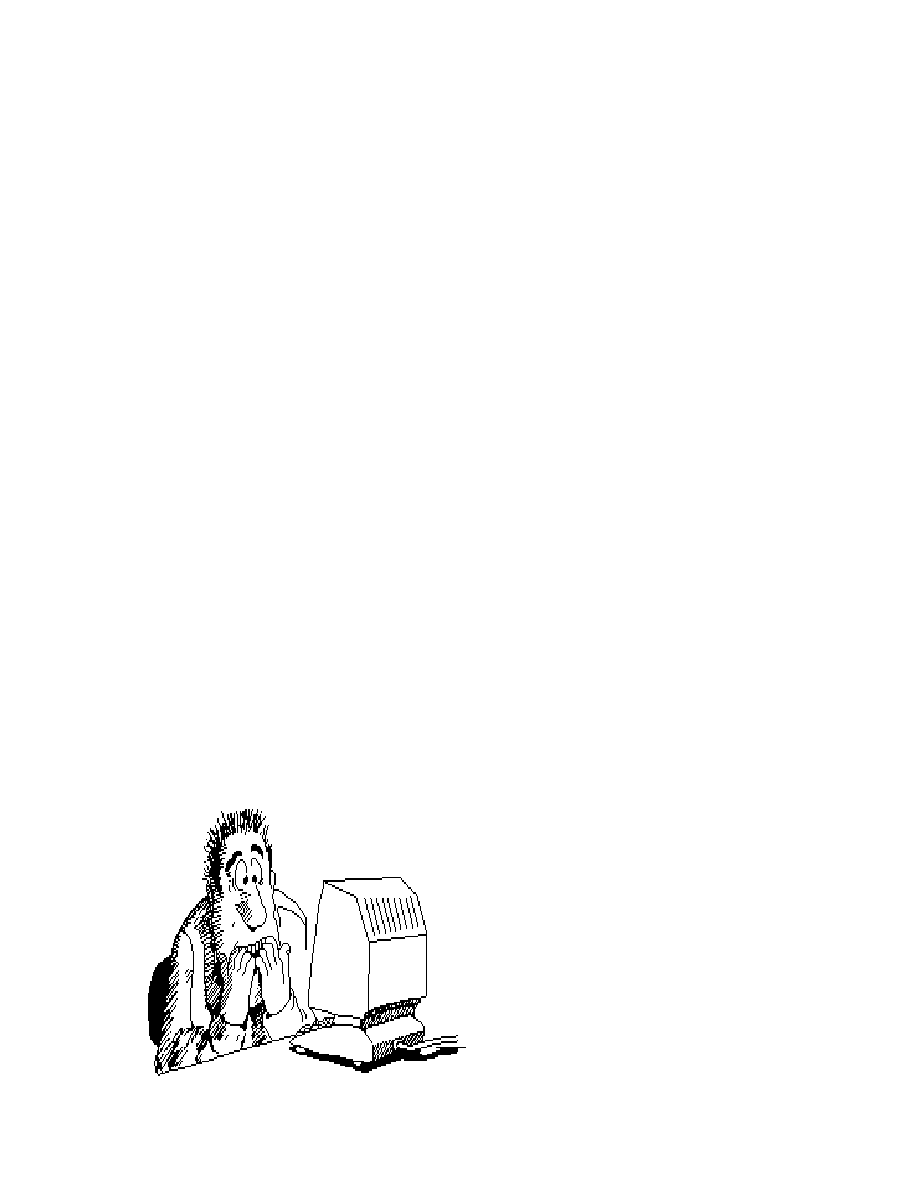
of ending up a loser on all three trades. If Pete keeps over-trading in
this fashion, he could end up like the poor fellow in the picture.
What should be done?
Break every trade into definitive goals. Make sure you achieve those
goals before adding other positions. Even with a single short sale of
the T-Bonds, Pete could have set himself a goal for the trade. One or
two full points might have been all he needed to satisfactorily retire
that trade as a winner. Then he could have made his trading decision
for an additional position. There are very few traders who can
successfully manage multiple positions in a variety of markets.
OVERCONFIDENCE
Overconfidence is a particular kind of trap that springs shut when
people have or think they have special information or personal
experience, no matter how limited. That's why small traders get hurt
trading on no more information than “hot-tips.”
Tim is a farmer. He raises hogs and purchases huge amounts of
feed to provide for his hogs. Tim has a large farming operation which
is quite profitable. He takes 250 hogs a week to market. Because of
48
a steady flow of hogs from his operation to the market, Tim has no
need to hedge his hog business because he is able to dollar average
the prices he gets for them. But Tim does want to indirectly reduce
the cost of the feed he has to buy, so he purchases soy meal futures.
Tim listens to weather and farm reports all day long. He attends
meetings of other farmers, and tries to gather all the information he
can that might help him be more profitable. But Tim has a major
problem, called tunnel vision. When he looks out at the grain fields in
the area where he lives, whatever he sees there he extrapolates to
the whole world.
In other words, if Tim sees that the surrounding fields are dry, he
suspects that all fields everywhere must also be dry. One year Tim
witnessed a local drought. He checked with all the local farmers and
they said they were truly experiencing drought conditions. He looked
at the news on his data feed, and sure enough it said that there was a
drought in his area. In fact, the entire state where Tim raises his
hogs was undergoing drought.
Tim wasn’t too concerned about
his own feed bins. He had plenty
of it in his silos from previous
bumper crop years. Tim decided
to be piggish and speculate on
what he considered to be inside
information. He called his broker
and bought heavily into soy meal
futures. Tim was confident. He
was sure that soy meal prices
would explode upward some time
soon, and that he was going to
make himself a small fortune. Tim's greed may have turned him into
a hog. However, the futures he purchased started moving down and
the value of his investment began to shrink markedly. What Tim
failed to do was to have a broader perspective. Everywhere else that
grains were grown, farmers were experiencing rain in due season.
The drought was localized almost entirely within the state in which
Tim did his hog raising. Tim lost because he was confident in the
limited knowledge he had.
Is this Tim or one of his herd?
49
Seeing what they want to see is a common
problem among traders. When that
happens, they usually hear only what they
want to hear!
What should be done?
We all need to broaden our horizons. We need a humble attitude
relative to the markets. We can never afford to wallow in
overconfidence in what we perceive as special knowledge. A trader
can never afford to let his guard down. Tim thought he knew
something that others hadn’t yet caught onto. In so doing, Tim made
another mistake as well. He heard only what he wanted to hear.
HEARING WHAT YOU WANT TO HEAR – SEEING WHAT YOU
WANT TO SEE
Marketers call this preferential bias. Preferential bias exists among
traders. Once they
develop a preference for
a trade, they often distort
additional information to
support their view. This
is why an otherwise
conscientious trader may
choose to ignore what
the market is really
doing. We've seen
traders convince
themselves that a market
was going up when, in fact,
it was in an established
downtrend. We’ve seen
traders poll their friends
and brokers until they
obtained an opinion that agreed with their own, and then enter a trade
based upon that opinion.
A student of ours, Fran and her husband, John, decided they wanted
to go to live in the Missouri Ozarks. Everyone told them that there
was no way for them to make a living there.
Everyone they asked
advised them not to do it.
50
Finally, a minister in the Church they proposed to attend told them
that they were to serve there. Out of twenty or thirty people they
asked, that minister was the only one who told them to come. Of
course, it was exactly what they wanted to hear. They sold their home
and most of their possessions accumulated over a lifetime. They
moved to the Ozarks and went broke within a year. They had to
leave and begin all over again. John, who had been semi-retired,
now had to find a job. So did Fran. She had to give up a promising
start as a trader to go out to put food on the table.
What should be done?
Look at each trade objectively. Do not allow yourself to become
married to your opinion. Learn to recognize the difference between
what you see, what you feel, and what you think. Then, throw out
what you think. Lock out the input of others once you have made up
your mind. Don't let your broker tell you what you want to hear.
Never ask your broker, your friends, or your relatives for an opinion.
Turn off your TV or radio, you don't need to see or hear what they
have to say. Take all indicators off your chart and just look at the
price bars. If you still see a trade there, then go for it.
FEARING LOSSES
There is a huge difference between being risk averse and fearing
losses. You must hate to lose. In fact, you can program your brain to
find ways to not lose. But not losing is a logical thought-out process,
rather than an emotion-based reaction.
Two human-based tendencies
come into play. The first is the
sunk-cost fallacy and the
second is the exaggerated-loss
syndrome.
Sunk-cost fallacy: You are in
a trade that begins to go
against you. You reason that
you have already spent a
commission, so you have costs

51
to make up for. Moreover, you have spent time and effort
researching and planning this trade. You reckon that time and effort
as cost. You have waited for just such an opportunity and you are
afraid that now that it has come you will have to miss this trade. The
time spent waiting for opportunity is something you also count as
cost. You don't want to waste all these costs, so you decide to give
the trade a little more room. By the time you realize what you’ve
done, the pain is almost overwhelming. Finally, you have to take your
loss which is now much larger than it might have been. The size of
the loss adds to your fear of ever losing again. The end result is
brain lock and inability to pull the trigger on a trade.
Exaggerated-loss syndrome: You give the importance of losing on
a trade two to three times the weight of winning on a trade. In your
mind, losses have greater significance than wins. In reality, neither is
more or less important than the other. In fact, wins do not have to be
as numerous as losses as long as the wins are significantly larger in
size than the losses. Of course, best is to have more wins than
losses with the wins greater in size than the losses.
What should be done?
Evaluate your trades solely on their potential for future loss or gain.
Ask yourself, “what do I stand to gain from this trade, and what do I
stand to lose from this trade?” Think the matter through. “What is the
worst thing that can happen to me if I take this trade, and do I have a
plan and a strategy for extricating myself long before it happens?” “If
I begin to lose, is there a way I can turn things around and come out
a winner?” Learn to look at the costs of a trade as part of your
business overhead. Try to have a mind set that you will not throw
good money after bad. When you give a trade more
room, you are doing just that – often throwing away
money.
VALUING INVESTED MONEY MORE THAN
WON MONEY
Traders have a tendency to be more careless
with money they’ve won than with money
they’ve invested. Just because you won

52
money on good trades doesn’t mean you should gamble with that
money. People are more willing to take chances with money they
perceive as winnings as though it were found money. They forget
that money is money. Valuing money depending on where it comes
from can lead to unfortunate consequences for a trader. The
tendency to take greater risk with money made from trades than with
money invested as capital makes no sense. Yet traders will take
risks with money won in the markets that they would never dream
about with money from their savings account.
What should be done?
Wait awhile before placing at risk money won on trades. Keep your
trading account at a constant level. Strip your winnings from your
account and put them in a safe conservative place. The longer you
hold on to money, the more likely you are to consider it your own.
FORGETTING ABOUT MARGIN INFLATION
Before the crash of 1987, S&P 500 stock index futures carried an
exchange minimum margin of about $12,000 . Immediately after the
crash, margins required by some brokers rose to $36,000 and higher.
A trader we know, called Willie, figured that if prices on an index he
was short went down, he would continually add to his position
whenever prices first pulled back and then broke out to new lows.
The index he was trading became very volatile, and his broker raised
margins to by 1/3
rd
. Willie was trading a small account, and when he
tried to sell short additional contracts onto his already short position,
his broker would not allow him to do so. Willie complained bitterly,
but the broker was adamant in his refusal. The broker would not
allow Willie to use unrealized paper profits to cover the additional
margin required for adding on. He explained to Willie that to do so
would in effect allow Willie to build a pyramid position and that was
not going to be allowed by the broker's firm.
The mistake Willie was making was what some call the “money
illusion.” Willie assumed that because his position was moving in his
favor that he had more selling power and more margin. His broker
quickly brought Willie face to face with reality. While some brokers

53
may allow it, unrealized paper profits do not truly constitute additional
funds that may be used for margin. Willie’s dream of fabulous profits
from this trade were just that, a dream. Willie should be thankful that
his broker did not allow him to get in trouble. Pyramiding with
unearned paper profits is not the way to succeed as a futures trader.
What should be done?
You should realize that each so-called “add-on” to an open position is
really a whole new position. Each add-on carries all new risk, and
each add-on brings you closer to the add-on trade which will fail and
become a loser. When planning a trade, be aware that if the market
becomes volatile, margin requirements may go up, thereby defeating
any strategy for adding on to your position. There is nothing wrong
with building a position one leg at time as prices ascend or descend,
but when volatility dictates an increase in margin requirements,
beware of trying to add on and be aware that you may not be able to
add on.
Option sellers can quickly get into similarly difficult positions. As they
roll out to new strikes to defend a threatened short options position,
they can find themselves not only facing the need for a larger
position, but also facing increased margins in creating that larger
position. They may discover that they no longer have sufficient
margin to defend a particular position and thus have to eat a sizable
loss.
MORE KEY MISTAKES
Throughout our courses we mention some key mistakes commonly
made by traders. Here are a few more:
Error: Confusing trading with investing. Many traders justify
taking trades because they think they have to keep their money
working. While this may be true of money with which you invest, it is
not at all true concerning money with which you speculate. Unless
you own the underlying commodity, for instance, selling short is
speculation, and speculation is not investment. Although it is
possible, you generally do not invest in futures. A trader does not
have to be concerned with making his money work for him. A trader’s

54
concern is making a wise and timely speculation, keeping his losses
small by being quick to get out, and maximizing profits by not staying
in too long, i.e., to a point where he is giving back more than a small
percent of what he has already gained.
Error: Copying other people’s trading strategies. A floor trader I
know tells about the time he tried to copy the actions of one of the
bigger, more experienced floor traders. While the floor trader won,
my friend lost. Trading copycats rarely come out ahead. You may
have a different set of goals than the person you are copying. You
may not be able to mentally or emotionally tolerate the losses his
strategy will encounter. You may not have the depth of trading capital
the person you are copying has. This is why following a futures
trading (not investing) advisory while at the same time not using your
own good judgment seldom works in the long run. Some of the best
traders have had advisories, but their subscribers usually fail. Trading
futures is so personalized that it is almost impossible for two people
to trade the same way.
Error: Ignoring the downside of a trade. Most traders, when
entering a trade, look only at the money they think they will make by
taking the trade. They rarely consider that the trade may go against
them and that they could lose. The reality is that whenever someone
buys a futures contract, someone else is selling that same futures
contract. The buyer is convinced that the market will go up. The
seller is convinced that the market has finished going up. If you look
at your trades that way, you will become a more conservative and
realistic trader.
Error: Expecting each trade to be the one that will make you
rich. When we tell people that trading is speculative, they argue that
they must trade because the next trade they take may be the one that
will make them a ton of money. What people forget is that to be a
winner, you can't wait for the big trade that comes along every now
and then to make you rich. Even when it does come along, there is
no guarantee that you will be in that particular trade. You will earn
more and be able to keep more if you trade with objectives and are
satisfied with regular small to medium size wins. A trader makes his
money by getting his share of the day-to-day price action of the
markets. That doesn't mean you have to trade every day. It means

55
that when you do trade, be quick to get out if the trade doesn’t go
your way within a period of time that you set beforehand. If the trade
does go your way, protect it with a stop and hang on for the ride.
Error: Having profit expectations that are too high. The greatest
disappointments come when expectations are unrealistically high.
Many traders get into trouble by anticipating greater than reasonable
profits from their trading. They will often get into a trade and, when it
goes their way and they are winning, they will mentally start spending
their winnings, and may even borrow against their anticipated
winnings to take on additional risk. Reality is that you seldom make
all of the money available in a trade. I cannot count the times that I
had for the taking hundreds or thousands of dollars in unrealized
paper profits only to see most of those profits melt away before I was
able to or had the good sense to get out. One trader I know had
$700 per contract profits in a short eurodollar trade. The next day his
position literally imploded on news of a 50 basis point cut in interest
rates. He was lucky to get out with $350 per contract. The money
from trading often doesn’t come in as fast or as plentifully as you
have expected or been led to believe, but the overhead costs of
trading arrive right on schedule. False profit expectations have
caused aspiring traders to leave their job before they were really
successful. The same false hope causes them to lose the money of
friends and family. False hope causes them to borrow against their
home and other fixed assets. Too high expectations are dangerous
to the well-being of every trader and those around him.
Error: Not reviewing your financial goals. Before you make a
position trading decision, or before you begin a day of day trading,
review your motives and your goals.
• Why are you trading today?
• Why are you taking this trade?
• How will it move your closer to your goals and objectives?
Error: Taking a trade because it seems like the right thing to do
now. Some of the saddest calls we get come from traders who do not
know how to manage a trade. By the time they call, they are deep in

56
trouble. They have entered a trade because, in their opinion or
someone else’s opinion, it was the right thing to do. They thought that
following the dictates of opinion was shrewd. They haven’t planned
the trade, and worse, they haven’t planned their actions in the event
the trade went against them. Just because a market is hot and
making a major move is no reason for you to enter a trade.
Sometimes, when you don’t fully understand what is happening, the
wisest choice is to do nothing at all. There will always be another
trading opportunity. You do not have to trade.
Error: Taking too much risk. With all the warnings about risk
contained in the forms with which you open your account, and with all
the required warnings in books, magazines, and many other forms of
literature you receive as a trader, why is it so hard to believe that
trading carries with it a tremendous amount of risk? It’s as though
you know on an intellectual basis that trading futures is risky, but you
don’t really take it to heart and live it until you find yourself caught up
in the sheer terror of a major losing trade. Greed drives traders to
accept too much risk. They get into too many trades. They put their
stop too far away. They trade with too little capital. We’re not advising
you to avoid trading futures. What we’re saying is that you should
embark on a sound, disciplined trading plan based on knowledge of
the futures markets in which you trade, coupled with good common
sense.
Wyszukiwarka
Podobne podstrony:
Polski system polityczny, 45-56, początek roku 1945
11 27 45 56 69 81 bujak a5
akumulator do honda jazz aa 45 12 55 12 56 12
24(45)RUP
8(45) Diagramy klas cz2
biochemia krwi 45
45 sekundowa prezentacja w 4 ro Nieznany (2)
plik (45)
45 49 (2)
Dz U 09 56 461 Warunki Techniczne zmiany
I CSK 45 09 1
BTI AWAX 26 27 45
abc 56 58 Frezarki
Conan 56 Conan zwyciązca
Logistyka i Zarządzanie Łańcuchem dostaw Wykłady str 56
Logistyka i Zarządzanie Łańcuchem dostaw Wykłady str 45
02 1995 56 58
56
12 (45)
więcej podobnych podstron