
Asian Journal of Humanities and Social Studies (ISSN: 2321 – 2799)
Volume 03 – Issue 02, April 2015
Asian Online Journals (
www.ajouronline.com
)
208
Functional Potential of the Novosibirsk Urban Region in Russian
Federation
Paulina Tobiasz-Lis
*
, Marcin Wójcik
University of Lodz
Faculty of Geographical Sciences
Department of Regional and Human Geography
Kopcińskiego 31 92-143 Lodz, Poland
*
Corresponding author’s email: ptobiasz [AT] geo.uni.lodz.pl
_________________________________________________________________________________
ABSTRACT— The research presented in this article focuses on the urban region of Novosibirsk, which is one of the
most industrialized part of Siberia and the Asian part of Russian Federation. The research was based on two methods
of determining the functions of cities in the national settlement system: a research programme concerning the genesis
of functional development and a research programme of specialized functions, the purpose of which is to determine
the economic base of territorial units.
To show relationships between the core of the region and its peripheral area there was provided a case study
analyzing the territorial units forming the southern settlement belt along the Novosibirsk-Cherepanovo regional
railway line over a distance of approx. 100 km. The presented results have shown the general tendencies in the
transformations of the Novosibirsk urban region both in long-term perspective and in contemporary circumstances.
Keywords—industrialized urban region, economic base, functional structure
_________________________________________________________________________________
1.
INTRODUCTION
Each region is a territorial social system which, due to various external and internal factors, changes over time in
economic, social and spatial terms [1]. In addition to the demographic, social and economic aspects, these
transformations are also spatial. From the standpoint of economic geography, changes in the spatial structure of
respective settlement systems are important. These structures are most often identified and interpreted in the context of
various imbalances in spatial planning, which refers primarily to the assessment of changes in the functional and
morphological areas.
This paper focuses primarily on functional and spatial transformations of the urban region of Novosibirsk, as a
settlement subsystem, in which strict (direct) relationships between the city as the core of the region and its peripheral
area (area of influence of the core) can be seen. The formation of an urban region is an effect of functional specialization
(specialized areas) on a regional scale [4, 6]. The concept of “urban region” (“functional region”) refers to the
observation of the daily movements of the population, with the relationships within the regional public transport system.
The functional analyses in this paper concern the whole core of the urban region, i.e. the city of Novosibirsk and its
direct vicinity (Novosibirskiy District)
1
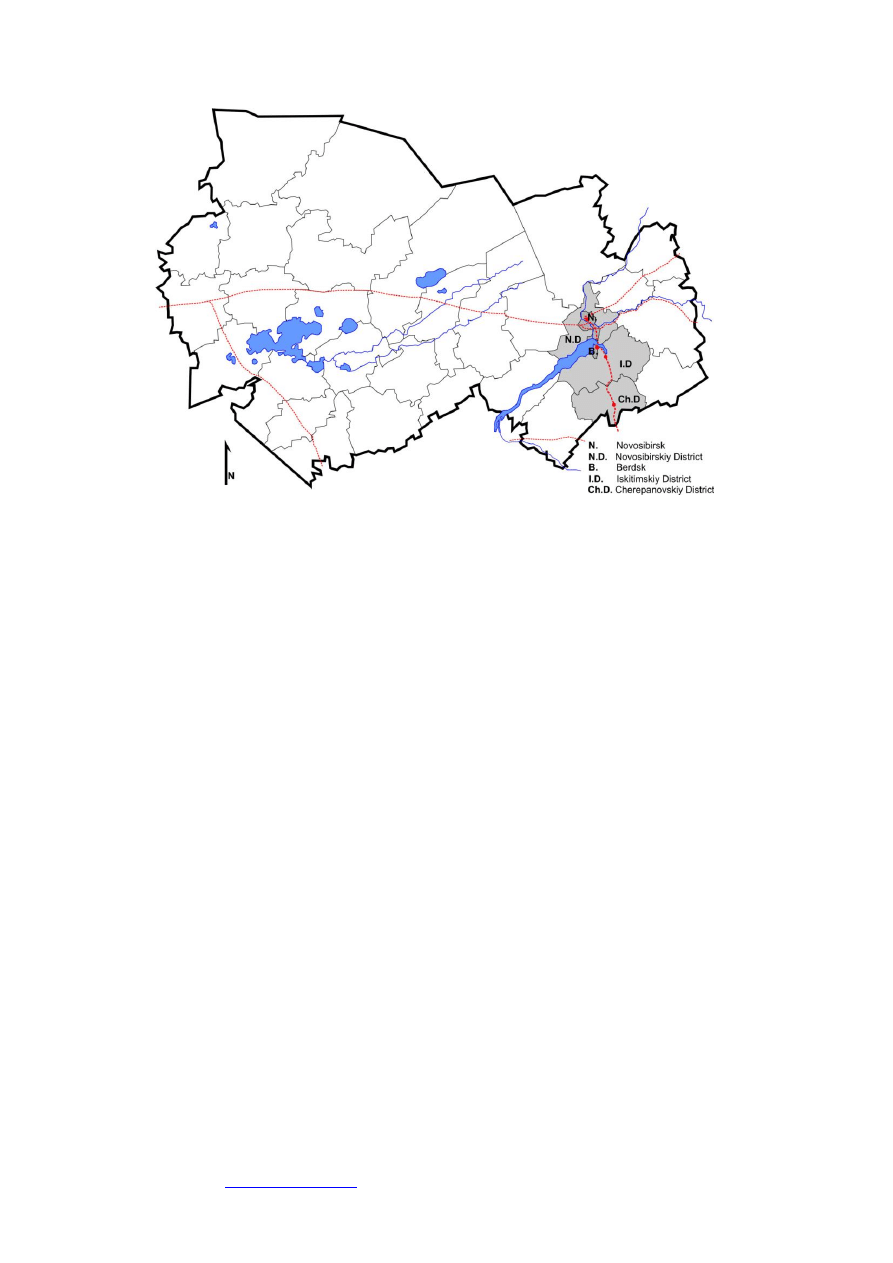
. In the peripheral area of the urban region a case study was conducted (fig. 1).
The case study analyses the territorial (administrative) units forming the southern settlement belt along the Novosibirsk-
Cherepanovo railway (the terminal station of regional railway) over a distance of approx. 100 km. This belt was chosen
not only because of the continuity of the settlement, but also due to the presence of different functional types of edge
towns, from Berdsk, tightly connected to the core, through Iskitim, intensely industrialized during the Soviet era to
Cherepanovo - a peripheral local center. The adopted system, from the core to the area of weakening direct links to
Novosibirsk, helped to define the directional profile of the urban region as relating to the economic characteristics. In the
Introduction section, present clearly and briefly the problem investigated, with relevant references. The main results
should be enunciated.
1
The Novosibirsk urban (functional) region includes the south-eastern part of the administrative region.
Asian Journal of Humanities and Social Studies (ISSN: 2321 – 2799)
Volume 03 – Issue 02, April 2015
Asian Online Journals (
www.ajouronline.com
)
209
Figure 1: The territorial units selected for the study against the administrative division of Novosibirskiy Region into
districts
Research methodology refers to the functional concept that has been developed in economic geography since the
1940s [2, 3, 9]. In this case, we focused on two methods of determining the roles (functions) of cities in the national
settlement system, namely
- a research programme concerning the genesis of functional development, which focuses on the evolution of the
functional development of cities (urban regions), viewed as a historical process. Research in this area relies on a specific
“reading” of the history of the city, in which certain stages can be distinguished in relation to functional factors, the
processes of functional transformations and their effects in the form of respective functions (functional structure) and the
institutions responsible for their existence;
- a research programme of specialised functions, the purpose of which is to determine the economic base (exogenous
functions) of territorial units. The economic base is the sector of activity in a given city, which is responsible for the
creation of relationships with its surrounding, and thus the formation of the settlement system of the country [8, 9].
2. THE GENESIS OF THE DEVELOPMENT OF FUNCTIONS
IN NOVOSIBIRSK URBAN REGION
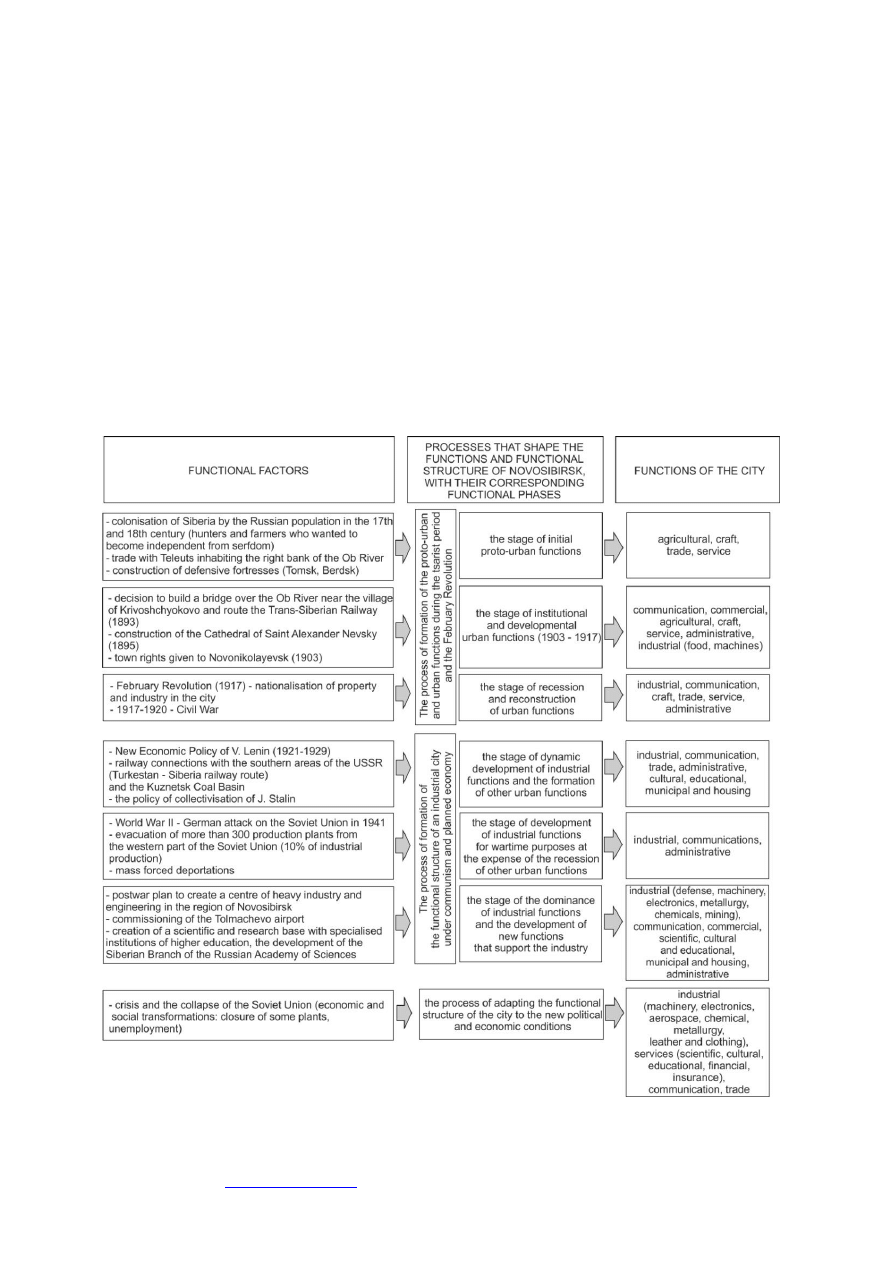
The functional history of Novosibirsk is discussed by distinguishing four processes that form the functional structure
of the city and six stages that generalize the character and behavior of the most important functions (fig. 3). A
characteristic feature of this case is that functional changes mostly depend on external factors, which usually result in
strong dynamism of functional processes. The history of Novosibirsk shows how the sequence of decisions taken by the
central government led to the creation of the strongest urban region of the Asian part of Russia within the Siberian taiga.
The first stage is associated with the colonization of Siberia by the Russians, which took place in the seventeenth and
eighteenth centuries. Back then, the area now occupied by Novosibirsk was a series of settlements with agricultural, craft
and trade functions. At the end of the nineteenth century, Tsar Alexander III issued a decision to route the main line of
the Trans-Siberian railway through the area (Ob station). Owing to the extremely favorable geographical location at the
intersection of important routes, the Trans-Siberian railway line (linking Siberia and the European part of Russia) and
near the navigable river Ob connecting the north and south of Siberia, Novonikolayevsk (later Novosibirsk - a settlement
on the right bank of the river), was quickly developing and received municipal rights in 1903. The railway bridge over
the river Ob marked the main compositional axis of the city - Novonikolayevskiy Prospect (Krasnyi Prospect today),
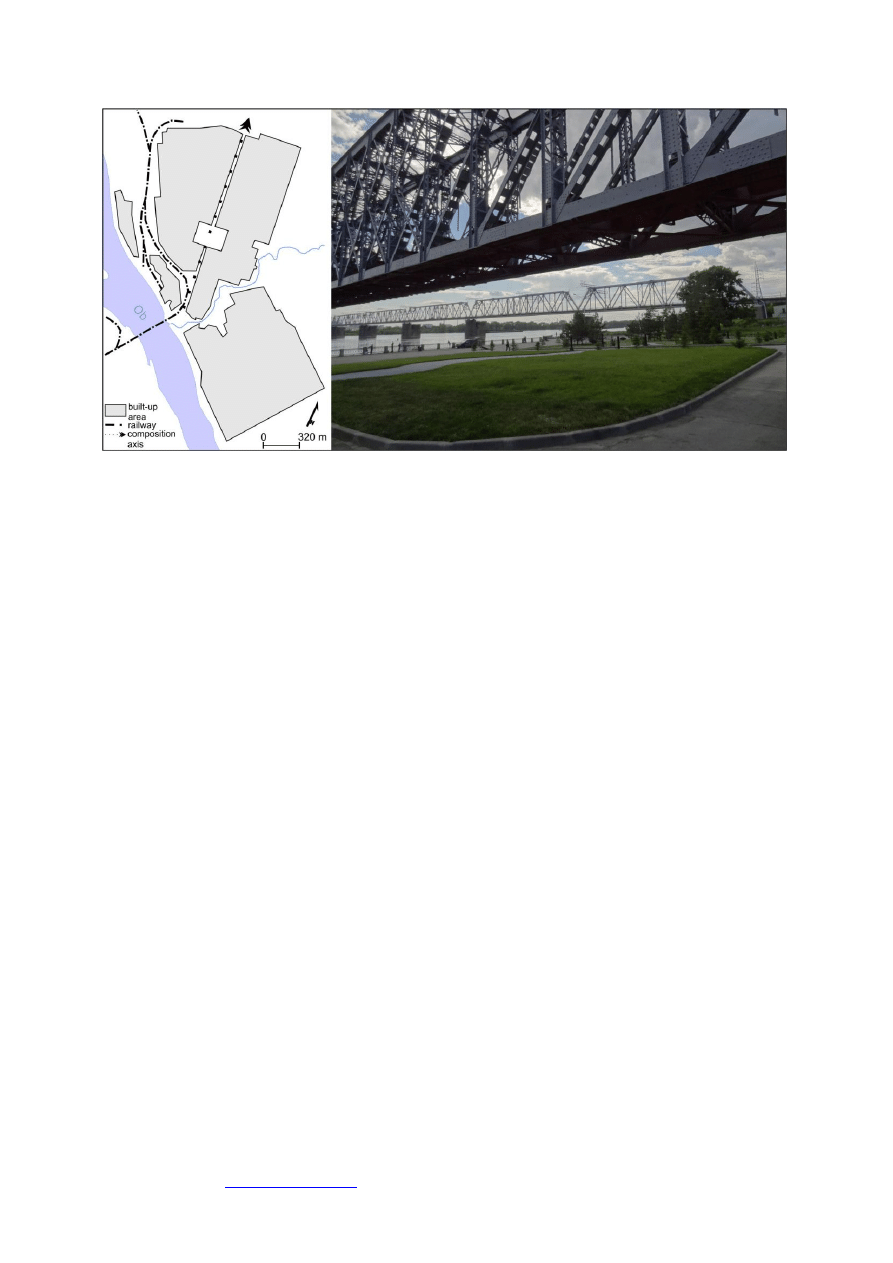
along which the marketplace and development plots were plotted [5] (fig. 2). The Trans-Siberian Railway which required
continuous expansion was a very important factor in the development of industry in the city. Agricultural machinery and
food processing plants were created.
Asian Journal of Humanities and Social Studies (ISSN: 2321 – 2799)
Volume 03 – Issue 02, April 2015
Asian Online Journals (
www.ajouronline.com
)
210
Figure 2: The spatial structure of Novosibirsk in 1906 and the railway bridge on the river Ob.
In the foreground a span of the bridge from 1893
After a period of political and economic instability caused by revolutions and civil war in Russia in 1917-1920, a
phase of dynamic development of the city followed, which was associated with the New Economic Policy by V. Lenin
and the rule of J. Stalin. There were investments in railway infrastructure (new connections between the city and the
south of the country, as well as the Kuznetsk Basin) and the industry, including the construction of a new port. At the
same time, public buildings were created and the construction of the first tram line in the city was started. Rapid
population growth necessitated massive investments in housing. Authorities invested in education. The city extended in
the style of slowly emerging socialist realism. Broad tracts and spacious squares meant as meeting places for the
inhabitants dominated. Newly constructed buildings used numerous decorative elements such as attics, colonnades,
pilasters, high ground floors, which gave them monumental character [5]. During this period, along with the expansion of
regional railway connections, town rights were given to rural settlements around Novosibirsk such as: Cherepanovo
(1925), Berdsk (1929), Iskitim (1938), with dominant industrial functions (extraction of raw rock, mineral industry,
construction, food industry), forming the seeds of industrialized urban region.
The second stage of the dynamic development of Novosibirsk under the centrally planned (communist) economy,
were the years 1941-1945, when over 300 industrial plants from the western part of the USSR were evacuated to the city.
The production profile changed from light industry to heavy industry (mainly armaments). Most of the plants functioning
during the war were provisional, often occupying public buildings such as schools or churches. The dynamic
development of industrial functions took place at the expense of a recession in other municipal functions - especially
residential, cultural and educational.
After World War II, during the Cold War and the arms race, the plans of the central authorities of the USSR assumed
the further development of Novosibirsk as a major heavy industry and process engineering centre [7]. To this end,
modernisation of existing plants and the construction of new ones started, with both mostly associated with defence
industry. The city became an important centre for the machinery, electronics, chemical industries, as well as metallurgy
and mining. The accumulation of large industrial plants required the creation of scientific and research base. In addition
to the Siberian Branch of the Academy of Sciences of the USSR, several specialised higher education institutions were
created. In 1957, the Council of Ministers of the USSR approved plans to establish the Akademgorodok research centre,
which consisted of more than 40 research institutes, State University, as well as housing facilities for researchers and
students and a rich social infrastructure. This led to a rapid development of scientific, housing and educational functions
of the city, while significantly expanding its spatial range southwards [5]. The same year, a new Tolmachevo airport was
opened, which further strengthened the strategic (in terms of communication) location of the city. The 1960s and 70s saw
intensive development of residential areas based on the prefabrication technology, as well as the technical and social
infrastructure of Novosibirsk and other cities in its agglomeration. Parks, greeneries and recreational areas were created.
Works on a subway system were also started. The 1980s were characterised by economic slowdown and the end of large
investments.
The political and economic transformations of the 1990s caused by the dissolution of the USSR and the transfer to
market economy led to the closure of numerous plants and factories, as well as to the previously unknown level of
Asian Journal of Humanities and Social Studies (ISSN: 2321 – 2799)
Volume 03 – Issue 02, April 2015
Asian Online Journals (
www.ajouronline.com
)
211
unemployment. Currently, Novosibirsk is rebuilding its former importance. The city is the administrative centre of the
Novosibirsk Region and the Siberian Federal District. In addition to powerful industrial plants, the city has a rapidly
growing service sector providing primarily services for manufacturers and businesses, as well as commerce. The process
of adapting the functional structure of the city to the new political and economic conditions can also be seen in the micro
scale, in the Akademgorodok scientific and research centre, which is expanding due to the inflow of foreign capital and
new investments associated with the high-tech industry. In 2006, at the initiative of the Siberian Branch of the Russian
Academy of Sciences, as well as the authorities of the city and the region, a technological park was created to support
innovative enterprises.
Transformations of the functional structure of Novosibirsk in new political and economic conditions after 1991 were
directly reflected in the spatial structure of the whole urban region. When subjected to the laws of the market, space
transforms in both quantitative and qualitative dimension. New forms of development emerged such as shopping centres,
banks, office buildings, mainly related to the influx of foreign capital, often contrasting with the existing 19th and 20th-
century building in city centres. There is also a concurrent development of housing areas, which reflects both new
regulations in the free property market and the growing demand for higher-standard housing, as well as the need to
isolate from the surrounding. As a result, housing estates built in the 1970s from prefabricated concrete that served as a
symbol of the policy of egalitarianism undergo gradual decapitalisation, while new, fenced-off housing estates are
created in the suburbs. New forms of buildings in the urban areas of Novosibirsk contribute to the increase in their
mosaic nature, while closing the gap between them and western European cities in terms of appearance and function.
Figure 3: The model of transformation processes in the functions of the functional structure of Novosibirsk

Asian Journal of Humanities and Social Studies (ISSN: 2321 – 2799)
Volume 03 – Issue 02, April 2015
Asian Online Journals (
www.ajouronline.com
)
212
3. ECONOMIC FUNCTIONS IN NOVOSIBIRSK URBAN REGION
First, the share of the core of the Novosibirsk urban region in the employment in the main sectors of the economy in
the overall employment in Russia
2
was determined (tab. 1). According to the initial assumption, the core means
Novosibirsk city and the surrounding Novosibirsk Municipal District. The surrounding area can be equated with the
suburban zone of Novosibirsk, which is an area with the closest functional links with the region's capital.
Table 1: The share of employment of the core of the urban region in the total employment of the Russian Federation
sector of the economy
Novosibirsk
City and
Novosibirsk
Municipal
District
The Russian
Federation
share (%) of
Novosibirsk City
and Novosibirsk
Municipal District
in the Russian
Federation
A - agriculture, hunting and forestry
3441
6428000
0,05
B - fishing
79
142000
0,06
C - mining and quarrying
338
1068000
0,03
D - manufacturing
76599
10230000
0,75
E - electricity, gas and water supply
19402
1960000
0,99
F - construction
14508
5581000
0,26
G - wholesale and retail trade; repair of motor vehicles,
motorcycles and personal and household goods
44650
12400000
0,36
H - hotels and restaurants
3888
1250000
0,31
I - transport and communications
40537
5381000
0,75
J - financial intermediation
18909
1215000
1,56
K - real estate, renting and business activities
54153
5657000
0,96
L - public administration and defence, compulsory
social security
44618
3760000
1,19
M - education
56934
5711000
1,00
N - health and social work
49662
4597000
1,08
O - other community, social and personal service
activities
16107
2532000
0,64
total employment
443825
67912000
0,65
In 2012, the part with most investment, i.e. the core of the Novosibirsk urban region, employed approx. 444 thousand
people. The share of the area surrounding Novosibirsk (Novosibirsk Municipal District) in the total employment of the
core was only about 5% (with a population share of approx. 8%). Indirectly, this indicates the presence of other functions
in the direct suburban area, whose identification requires a different type of information (residential, recreational,
suburban farming areas, etc.). The share of employment of the core of the urban region in the total employment of the
Russian Federation was 0.65%. Taking into account the different economic sectors of the core of the urban region, we
can see significant disproportions in that regard (tab. 1). The core of the urban region plays a significant role in the case
of sectors, whose share exceeds the overall share of this region in the national economy (over 0.65%). A preliminary
assessment of the role of different sectors of the economy shows an important role played by Novosibirsk as a centre
with important social functions, such as public administration and defence, compulsory social security, health and social
work and education, as well as those that determined the city's path dependency in developing functional processes (city-
forming functions), such as manufacturing, electricity, gas and water supply and transport. The contemporary role of
Novosibirsk is mainly shaped by employment in financial intermediation (the highest share among all branches) and real
estate, renting and business activities.
2
Source of data: www.gks.ru. The study focuses on the most recent available data (2012). A comparison of available
data for the years 2010-2012 revealed no significant differences in the overall level and structure of employment nor, as a
consequence of the adopted research procedures, in the exogenous employment structure. Identification of the economic
base (exogenous functions) in selected areas is based on the 2012 data.
Asian Journal of Humanities and Social Studies (ISSN: 2321 – 2799)
Volume 03 – Issue 02, April 2015
Asian Online Journals (
www.ajouronline.com
)
213
We can clearly see functional dominants in the structure of employment determined by the number of employees in
different sectors of economy. The main conclusion is the dominance of two large groups of employment. The first one is
related to the activities of the institutions connected with the functioning of the state, region and local structures of
authority, as well as financial sectors from public finances that meet the community's needs. Activities in education,
health and social work, public administration and defence, compulsory social security in 2012 accounted for
approximately 34% of the total number of persons employed in the core of the urban region (444 thousand employees).
Sectors that determined the development of Novosibirsk, i.e. industrial manufacturing (including energy production and
supply and construction) accounted for approx. 25% of employees. We also have to include approx. 9% working in
transport and communications. Dynamic service functions of the transformation period accounted in 2012 for approx.
20% of employees, mainly in wholesale and retail trade; repair of motor vehicles, motorcycles and personal and
household goods, financial intermediation.
Given the data concerning employment in administrative units located along the Novosibirsk - Cherepanovo railway
(i.e. Berdsk, Iskitim and Cherepanovo), we should primarily point out their small social and economic potential as
compared to the core of the urban region. In total, these three units employ around 51 thousand people (Berdsk City -
about 15 thousand., Iskitim Municipal District and Iskitim City - about 26 thousand., Cherepanovo Municipal District -
9.8 thousand).
The main difference compared to the employment structure in the core of the urban region presented above is the
more important role of employment in production sectors, mainly processing and excavation. In this respect, public
sectors (funded by the state), such as administration, defence, education and healthcare are also more significant. In view
of the dominance of these two groups, employment in commercial services such as commerce, repairs, financial and
business activities is less prominent.
The level of development of exogenous functions (economic base) of Novosibirsk was estimated at 105 thousand
employees (approximately 110 thousand including close suburban zone). Compared to the capital of the region, other
administrative units in the study (Berdsk City, Iskitim Municipal District and Iskitim City, Cherepanovo Municipal
District) were not significant in this regard in 2012 (total of approx. 17 thousand employees), similarly to the analysis of
employment structure.
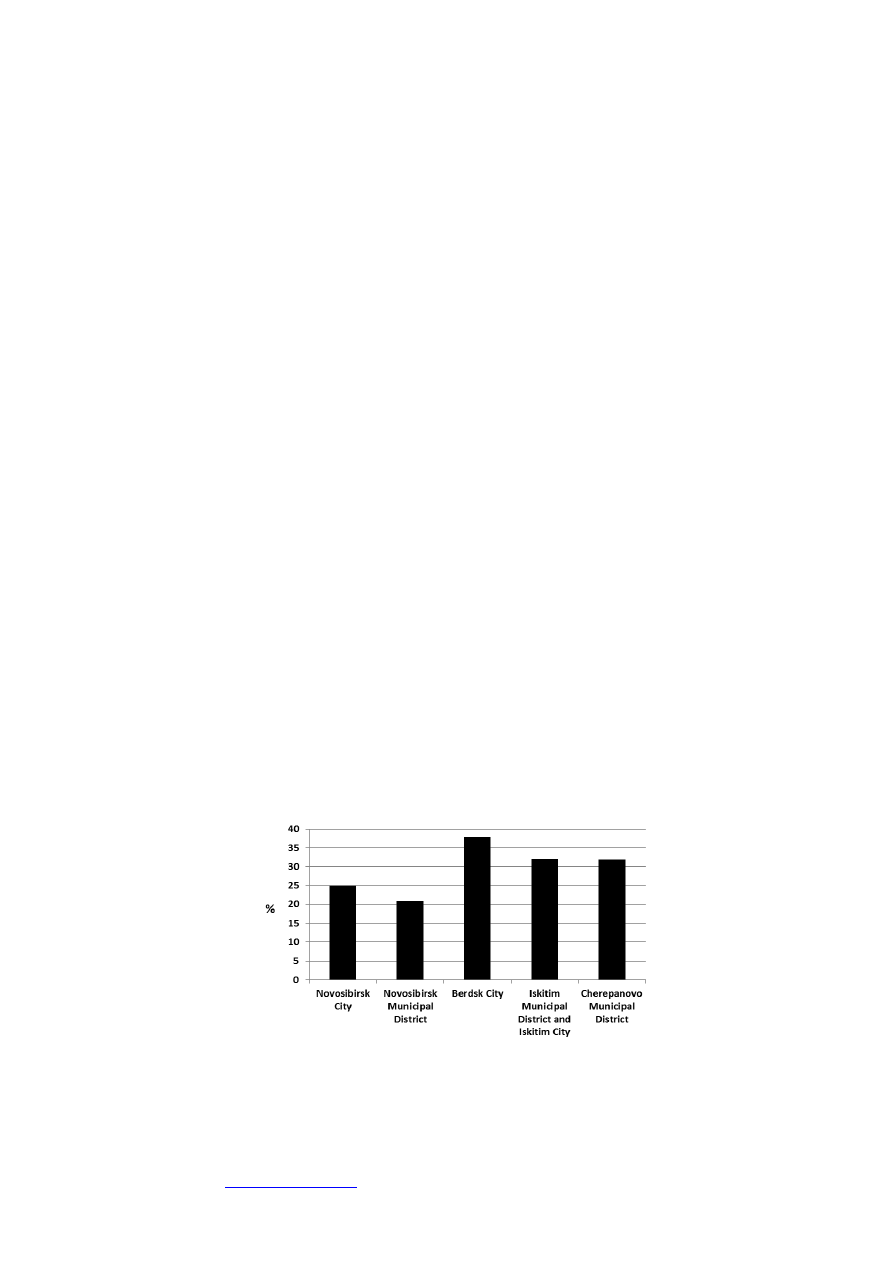
Taking into account the share of exogenous employment (economic base) in the overall employment, the openness of
the economy of a given territory can be assessed (fig. 4). It was noted that lower values of this coefficient are
characteristic for the core of the urban region (Novosibirsk and its suburban area), i.e. approximately 25%. This is
primarily due to the development of a huge endogenous sector that provides a great concentration of population with
basic and specialised commerce, transport, industry (e.g. food and textiles), energy production, educational and cultural
services, as well as an increasingly important sector of professional services (banking, insurance, business services), that
are especially important in shaping such centres.
Areas in the peripheral zone have higher economy openness indexes (approximately 30-35%). This is due primarily
to the poor economic diversification of economies with relatively small overall potential dominated by large workplaces,
industrial workplaces or workplaces founded by the state (public administration, defence, compulsory education, health
and social work). The share of commercial activities is relatively small. These areas are served by Novosibirsk and
numerous specialised businesses concentrated there (very high spatial concentration).
Figure 4: The level of openness of economies in selected administrative units in 2012
in the Novosibirsk urban region
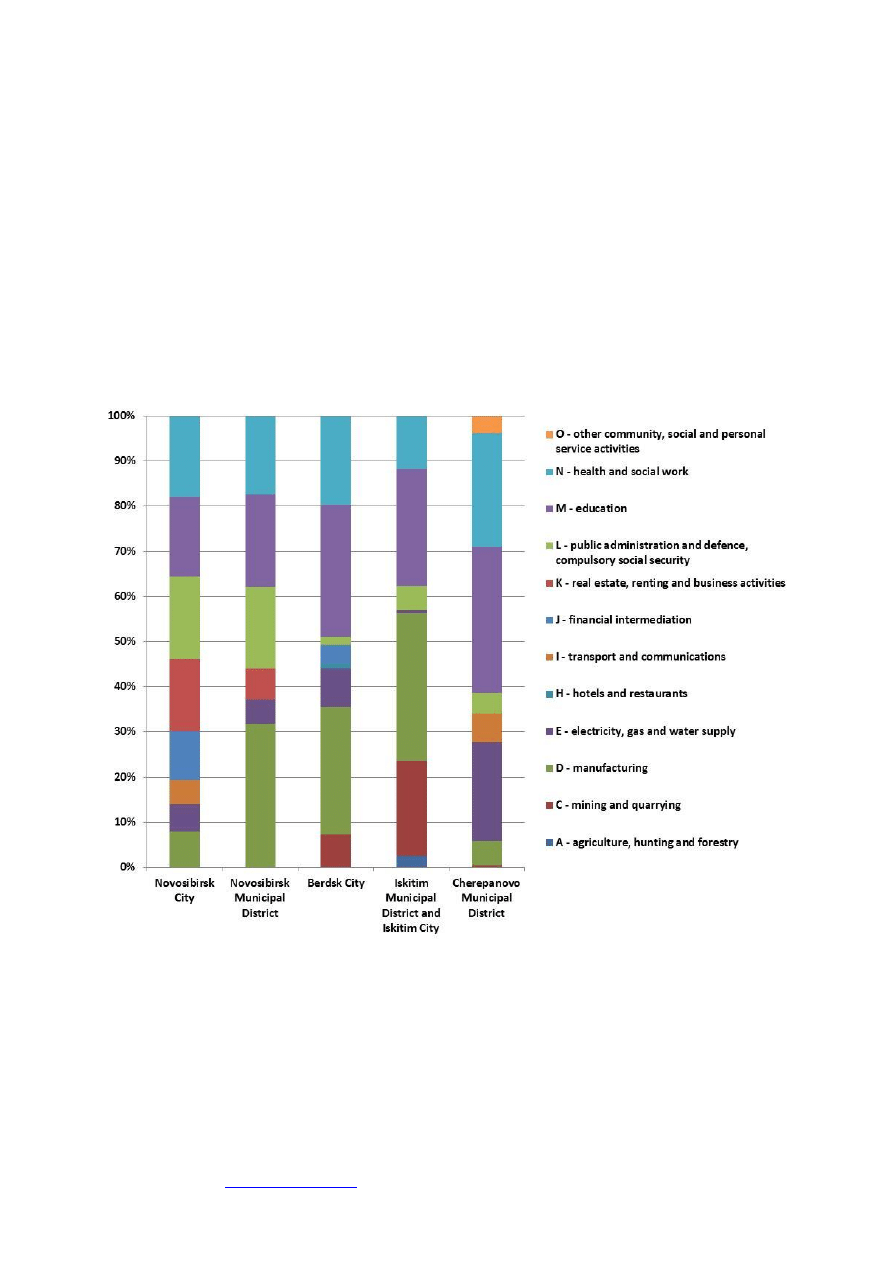
Considering the above, the results of measurements of economic bases of territorial units in relation to the functional
structure (fig. 5) are interesting, as they are crucial for this part of the study.
Asian Journal of Humanities and Social Studies (ISSN: 2321 – 2799)
Volume 03 – Issue 02, April 2015
Asian Online Journals (
www.ajouronline.com
)
214
The functional structure is most diverse (8 exogenous functions) in the core of the urban region (the city of
Novosibirsk). The most important components of the economic base are the functions directly controlled by the state, i.e.
public administration, compulsory (the most important function), education, health and social work. Together they form
around 55% of the economic base of the city. When we include transport, also largely dependent on the state, in this
group, this share grows to 60%. The formation of metropolitan functions is significantly influenced by two groups of
economic activity related to professional and commercial services, i.e. real estate, renting, business activities and
financial intermediation (25% of the economic base). Functions that were of key importance for the formation of
economic base of such centres in communist times are currently less influential in forming the settlement system of
Russia. Manufacturing activity currently (2012) comprise approximately 15% of the economic base.
The economic base of the outer zone of the urban region consists of a smaller number of functions (7). In Berdsk
City, Iskitim Municipal District and Iskitim City we can see a balance between manufacturing sectors (approx. 40-50%)
and communal services. In contrast to the core of the urban region, the economic base lacks commercial services
(Iskitim) or they are marginalised (Berdsk). On the other hand, the peripheries of the urban region (Cherepanovo), where
the direct influence of the big city (Novosibirsk) is diminishing, the vast majority of the economic base consists of
employment in state institutions, i.e. various types of schools, hospitals and healthcare institutions, offices and transport
services. This economic base based on public service is complemented by the industry.
Figure 5: The size of the economic base of selected administrative units in 2012 in the Novosibirsk urban region
4. FINAL CONCLUSIONS
Research of the economic potential of the Novosibirsk urban region using directional profile method has shown
systematically the general tendencies in the transformations of its spatial structure, both in long-term perspective and in
contemporary circumstances related to the economic transformation of Russia. The main conclusions of the analysis

Asian Journal of Humanities and Social Studies (ISSN: 2321 – 2799)
Volume 03 – Issue 02, April 2015
Asian Online Journals (
www.ajouronline.com
)
215
relate to the following processes of structures that shape the urban region of Novosibirsk:
1) the development of city-forming functions of Novosibirsk and the settlements connected to it (urban region) was
the effect of political decisions, i.e. the construction of Trans-Siberian railway (Russian colonisation of Siberia and the
Far East), as well as the location of industry within the zone not directly threatened by wartime activities (World War II),
then the creation of other functions to support this industry, primarily scientific and higher education institutions;
2) Novosibirsk and the area in its direct vicinity became the biggest urban region in Siberia with strong industrial
functions, high concentration of population and a well-developed sector of public services to serve the population
(educational, scientific, healthcare, cultural and administrative functions);
3) In the first decade of the twenty-first century, Novosibirsk's economy experienced some growth and functional
restructuring, especially related to the development of commercial and public services.
4) The economic base in the Novosibirsk urban region has a very high concentration of exogenous functions in the
core, which creates considerable spatial disproportions in socio-economic development caused by extensive development
of most of the Novosibirsk Region. The structure of the settlement network was formed based on the locations of
specialised centres, especially in industrial activities. Contemporary functional weakness of local centres especially in
multifunctional development, along with recession or relative stabilisation of industrial functions, leads to increasing
disproportions in regional scale, which can in turn result to a crisis in the economic base of smaller towns and
settlements.
5) The current structure of the economic base of the Novosibirsk urban region is a result of the functional
reconstruction focused on the core (Novosibirsk city). This transformation is most characteristically evident in the
decreasing significance of exogenous industrial functions (even though they are still relevant in the employment
structure) accompanied by the growing importance of metropolitan functions, i.e. specialised services and stabilisation of
state's financial activities at a high level.
6) The high share of government functions in the economic base, especially in the core of the urban region, is an
expression of the impact of centralised state management policy. One interesting feature is the low importance of
commerce in the employment structure and the lack thereof in the structure of the economic base, which may be evidence
of commercial activity outside of the official circulation.
7) The identified structure of the economic base is not very beneficial to the formation of balanced urban functions
and may be susceptible to various external influences in the future. The economic base of the Novosibirsk urban region
depends to a large extent on the condition of the state budget, as a considerable portion of exogenous activities (forming
the settlement system) is financed by the authorities (hierarchical dependence). A large share of industrial functions,
including mining, in the structure of employment and economic base (especially in the peripheries of the region) of
towns and settlements can cause adverse trends in the development in the case of larger crises, especially in the raw
material market (decline in raw material prices). Given that the income from the sale of raw materials (especially energy-
related) is one of the major incomes in the state budget, this can have a negative impact on public spending and on social
functions.
5. REFERENCES
[1] Chojnicki Z., “Koncepcja terytorialnego systemu społecznego”, Przegląd Geograficzny, 60, 4, pp. 491-510, 1988.
[2] Dziewoński K., “Baza ekonomiczna i struktura funkcjonalna miast”, Prace Geograficzne IG PAN, 87, 1971.
[3] Jerczyński M., “Zagadnienia specjalizacji bazy ekonomicznej większych miast w Polsce. Studia nad strukturą
funkcjonalną miast”, Prace Geograficzne IG PAN, 97, 1973.
[4] Korcelli P., “Regiony miejskie w systemie osadniczym Polski”, In Studia nad migracjami i przemianami systemu
osadniczego w Polsce, Prace Geograficzne IGiPZ PAN, 140, pp. 189-212, 1983.
[5] Nevzgodin I., Architecture of Novosibirsk, Siberian Branch, Russian Academy of Sciences, Novosibirsk, 2005.
[6] Rykiel Z., “Koncepcje i delimitacje wielkomiejskich form osadniczych w Polsce”, In Jażdżewska I. (ed.),
Współczesne formy osadnictwa miejskiego i ich przemiany, XV Konwersatorium Wiedzy o Mieście, Wydawnictwo
Uniwersytetu Łódzkiego, Łódź, pp. 9-19, 2002.
[7] Seth A., “Cold War Frontier: Building the Defense Complex in Novosibirsk”, In Engel J. A. (ed.), Local
Consequences of the Global Cold War, Stanford, 2007
[8] Suliborski A., Funkcje i struktura funkcjonalna miast. Studia empiryczno-teoretyczne, Wydawnictwo Uniwersytetu
Łódzkiego, Łódź, 2001.
[9] Suliborski A., Funkcjonalizm w polskiej geografii miast, Wydawnictwo Uniwersytetu Łódzkiego, Łódź, 2010.
Wyszukiwarka
Podobne podstrony:
Kinesio® Taping in Stroke Improving Functional Use of the Upper Extremity in Hemiplegia
functional anatomy of the horse foot
On the functional validity of the worm killing worm
Kinesio® Taping in Stroke Improving Functional Use of the Upper Extremity in Hemiplegia
Barwiński, Marek The Influence of Contemporary Geopolitical Changes on the Military Potential of th
The History of the USA 6 Importand Document in the Hisory of the USA (unit 8)
Existence of the detonation cellular structure in two phase hybrid mixtures
Dangerous Journeys Mythus Map of the Western Russ Region
fitopatologia, Microarrays are one of the new emerging methods in plant virology currently being dev
Mossbauer study of the retained austenitic phase in
Lord of the Flies Character Changes in the Story
Contrastic Rhetoric and Converging Security Interests of the EU and China in Africa
Mossbauer study of the retained austenitic phase in
Knights of the Round Table inet in C
School of the Americas Urban Guerrilla Manual
25 Because of the Angels – Angelic Intervention in Human Lives
Knights of the Round Table inst in B
więcej podobnych podstron