
© ChessZone Magazine #6, 2008
http://www.chesszone.org
Table of contents:
# 6, 2008
Our supporters:............................................................................................................ 3
News............................................................................................................................ 4
Games ......................................................................................................................... 8
(01) Cheparinov,Ivan (2695) - Bu,Xiangzhi (2708) [B90] ......................................... 8
(02) Dzagnidze,N (2443) - Schlosser,P (2563) [E35] ............................................... 9
(03) Bu,Xiangzhi (2708) - Cheparinov,Ivan (2695) [D45] ....................................... 11
(04) Socko,Bartosz (2644) - Macak,Stefan (2342) [E15]........................................ 13
(05) Ivanchuk,Vassily (2740) - Bu,Xiangzhi (2708) [A11] ....................................... 15
(06) Kramnik,Vladimir (2788) - Navara,David (2672) [E04] .................................... 16
(07) Navara,David (2672) - Kramnik,Vladimir (2788) [C43].................................... 17
(08) Kramnik,Vladimir (2788) - Navara,David (2672) [A37] .................................... 18
(09) Navara,David (2672) - Kramnik,Vladimir (2788) [E46] .................................... 19
(10) Negi,Parimarjan (2514) - Stefansson,Hannes (2583) [C91]............................ 21
Make Every Play for a Reason .................................................................................. 29
Editorial staff: ............................................................................................................. 33
2

© ChessZone Magazine #6, 2008
http://www.chesszone.org
Our supporters:
Dear readers!
ChessZone Magazine is open for your advertising materials.
We have various ad packages at affordable rates!
We’re also interested in cooperation with advertising agencies,
and could offer great commissions for anyone
who could bring an advertisers to us.
Please contact us for details
3
© ChessZone Magazine #6, 2008
http://www.chesszone.org
News
M-Tel Masters 2008
M-Tel Masters took place 7th-18th May 2008 in the
Central Military Club in the Bulgarian capital Sofia. The event
was a 10 round double round robin with a 5 hour time
control.
Ivanchuk secured first place with a massive 8/10
score. He started with 5/5 in the first half. He slowed down
with four draws in the second half before destroying
Cheparinov with the black pieces in the final round. Topalov
also scored a fine 6.5/10 to finish a point and a half behind.
Teimour Radjabov was a further point behind. World number 6 Levon Aronian had a catastro-
phic 3/10 score in finishing joint last with Bu Xiangzhi. Cheparinov only lost a few points in
finishing with 4/10.
*4th M-Tel Masters Sofia* (BUL), 8-18 v 2008 cat. XX (2738)
1 2 3 4 5 6
1. Ivanchuk, Vassily g UKR 2740 * * 1 = 1 = 1 1 1 = 1 = 8 2977
2. Topalov, Veselin g BUL 2767 0 = * * = = 1 1 1 0 1 1 6,5 2841
3. Radjabov, Teimour g AZE 2751 0 = = = * * = = = 1 = 1 5,5 2770
4. Cheparinov, Ivan g BUL 2696 0 0 0 0 = = * * 1 1 = = 4 2673
5. Bu Xiangzhi g CHN 2708 0 = 0 1 = 0 0 0 * * = = 3 2594
6. Aronian, Levon g ARM 2763 0 = 0 0 = 0 = = = = * * 3 2583
FIDE GP Baku AZE 2008
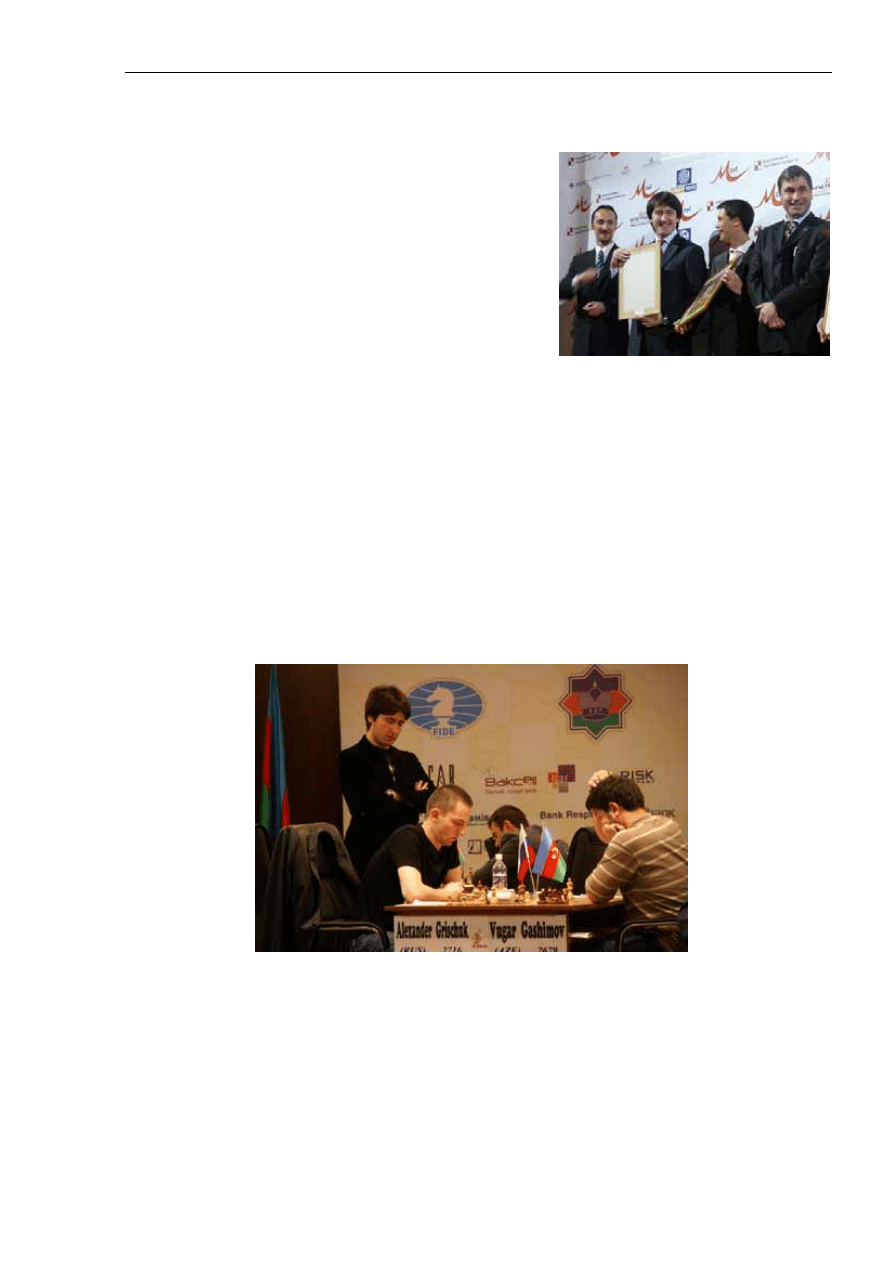
The 1st FIDE Grand Prix took place in Baku, Azerbaijan 20th April - 6th May 2008. Vugar
Gashimov, Wang Yue and Magnus Carlsen shared first place on 8/11.
4
© ChessZone Magazine #6, 2008
http://www.chesszone.org
1 2 3 4 5 6 7 8 9 0 1 2 3 4
1 Gashimov,V 2679 +122 * ½ ½ ½ 1 ½ 1 ½ 1 ½ ½ ½ ½ ½ 8.0/13 51.50
2 Wang Yue 2689 +112 ½ * ½ ½ ½ ½ 1 ½ ½ 1 1 ½ ½ ½ 8.0/13 50.50
3 Carlsen,M 2765 +30 ½ ½ * 0 ½ 1 ½ 1 ½ ½ ½ ½ 1 1 8.0/13 49.00
4 Mamedyarov,S 2752 +16 ½ ½ 1 * ½ ½ ½ ½ ½ 1 0 1 1 0 7.5/13 48.75
5 Grischuk,A 2716 +55 0 ½ ½ ½ * ½ ½ ½ ½ ½ 1 1 ½ 1 7.5/13 45.75
6 Adams,Mi 2729 -12 ½ ½ 0 ½ ½ * 1 ½ 0 0 1 1 ½ ½ 6.5/13 41.00
7 Svidler,P 2746 -30 0 0 ½ ½ ½ 0 * ½ 1 1 ½ ½ ½ 1 6.5/13 39.50
8 Radjabov,T 2751 -63 ½ ½ 0 ½ ½ ½ ½ * 1 ½ 0 0 1 ½ 6.0/13 38.50
9 Kamsky,G 2726 -36 0 ½ ½ ½ ½ 1 0 0 * ½ ½ ½ ½ 1 6.0/13 38.00
10 Karjakin,Sergey 2732 -42 ½ 0 ½ 0 ½ 1 0 ½ ½ * ½ ½ ½ 1 6.0/13 37.25
11 Cheparinov,I 2696 -30 ½ 0 ½ 1 0 0 ½ 1 ½ ½ * 0 0 1 5.5/13 35.75
12 Navara,D 2672 -5 ½ ½ ½ 0 0 0 ½ 1 ½ ½ 1 * ½ 0 5.5/13 35.25
13 Bacrot,E 2705 -68 ½ ½ 0 0 ½ ½ ½ 0 ½ ½ 1 ½ * 0 5.0/13 32.50
14 Inarkiev,E 2684 -45 ½ ½ 0 1 0 ½ 0 ½ 0 0 0 1 1 * 5.0/13 32.25
Cez Chess Trophy
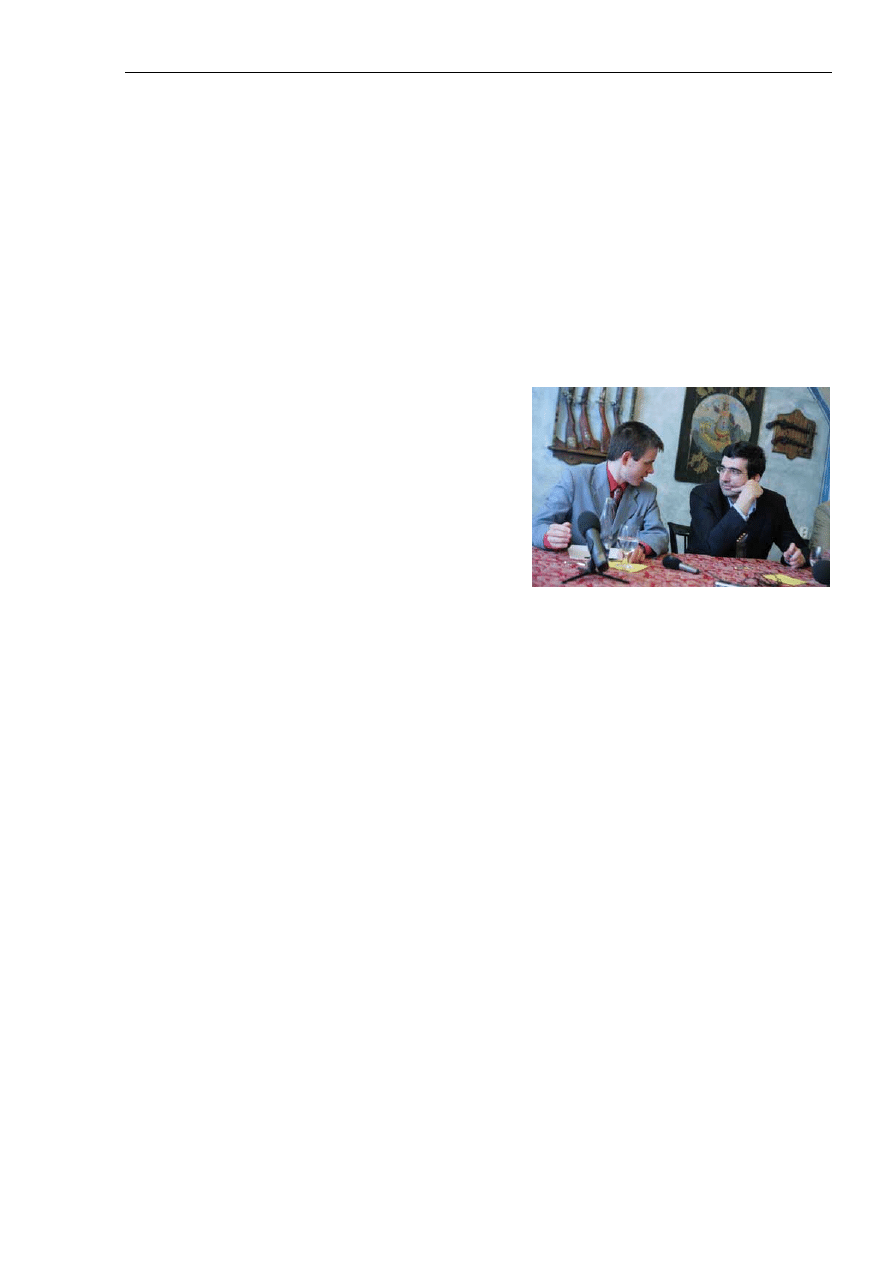
Vladimir Kramnik beat David Navara 5.5-2.5 to win
the Cez Chess Trophy. The match of 8 games in rapid
chess was the main event of the festival CEZ CHESS
TROPHY 2008 and will take place in the Czech Republic
in Prague 14th-18
th
May 2008.
III President's Cup, Baku
The III President's Cup takes place 11th-21st May
2008 in Baku, Azerbaijan dedicated to the memory of
Haydar Aliyev has a prize fund of $85000.
*III President's Cup Baku* (AZE), 11-21 v 2008
Leading Round 7 Standings
1 9 GM Najer Evgeniy 2627 RUS 6,5 31,0 28,0 24,5 6
2 28 GM Abbasov Farid 2528 AZE 6,0 31,0 28,0 24,0 5
3 32 GM Guliev Sarhan 2487 AZE 6,0 27,0 24,5 21,5 5
4 1 GM Milov Vadim 2690 SUI 5,5 33,5 30,0 26,0 5
5 10 GM Guseinov Gadir 2625 AZE 5,5 33,5 29,5 25,5 5
6 19 GM Aleksandrov Aleksej 2582 BLR 5,5 33,0 29,0 24,5 4
7 12 GM Gelashvili Tamaz 2622 GEO 5,5 32,5 29,5 25,5 4
8 5 GM Jobava Baadur 2658 GEO 5,5 32,5 28,5 24,5 4
9 13 GM Lastin Alexander 2622 RUS 5,5 31,5 28,5 25,5 4
10 18 GM Korchnoi Viktor 2598 SUI 5,5 30,5 27,5 24,0 5
11 16 GM Mamedov Rauf 2617 AZE 5,5 30,5 27,0 23,5 4
12 21 GM Timman Jan H 2565 NED 5,5 30,0 27,0 23,5 4
13 14 GM Malakhatko Vadim 2621 BEL 5,5 29,5 27,5 24,0 4
etc.
Capablanca Memorial 2008, La Habana
The 43rd Torneo Capablanca In Memoriam took place in La Habana (Cuba) 8th - 17th
May 2008, category 15 average 2602. Top seed Lenier Dominguez Perez took clear first with
6/9.
5

© ChessZone Magazine #6, 2008
http://www.chesszone.org
*43rd Capablanca Memorial Havana CUB* (CUB), cat. XV
8-17 v 2008 (2605)
1 2 3 4 5 6 7 8 9 0
1. Dominguez Perez, g CUB 2695 * = = = = 1 1 = 1 = 6 2719
Lenier
2. Amonatov, Farrukh g TJK 2649 = * = = = = 1 = 1 = 5,5 2680
3. Khenkin, Igor g GER 2609 = = * = = = = 1 1 = 5,5 2684
4. Hernandez g CUB 2568 = = = * = = = 1 0 1 5 2652
Carmenates, Holden
5. Tiviakov, Sergei g NED 2635 = = = = * = = = = = 4,5 2601
6. Wojtaszek, Radoslaw g POL 2625 0 = = = = * = = = 1 4,5 2602
7. Nogueiras Santiago, g CUB 2559 0 0 = = = = * = = 1 4 2567
Jesus
8. Quezada Perez, g CUB 2567 = = 0 0 = = = * = = 3,5 2529
Yuniesky
9. Arencibia Rodriguez, g CUB 2534 0 0 0 1 = = = = * = 3,5 2532
Walter
10. Bruzon Batista, g CUB 2608 = = = 0 = 0 0 = = * 3 2479
Lazaro
Moscow Championship
The Final tournament of the Moscow Chess Championship took place 12
th
-18
th
May
2008. Boris Savchenko took clear first with 5/7.
*ch-Moscow Moscow RUS* (RUS), 12-18 v 2008 cat. XI (2516)
1 2 3 4 5 6 7 8
1. Savchenko, Boris g RUS 2569 * = 0 = 1 1 1 1 5 2665
2. Vorobiov, Evgeny E g RUS 2536 = * 1 = 0 = 1 1 4,5 2614
3. Gabrielian, Artur m RUS 2494 1 0 * = = = = 1 4 2568
4. Rustemov, Alexander g RUS 2552 = = = * = = = 1 4 2560
5. Deviatkin, Andrei m RUS 2568 0 1 = = * = = 1 4 2558
6. Rychagov, Andrey g RUS 2565 0 = = = = * = 1 3,5 2508
7. Konovalov, Nikolay m RUS 2426 0 0 = = = = * 1 3 2478
8. Gorbatov, Alexej m RUS 2414 0 0 0 0 0 0 0 * 0
Bosnia Sarajevo
The traditional Bosnia Sarajevo tournament took place 23rd May - 2nd June 2008. Alex-
ander Morozevich finished clear first with 7.5/10.
*GMA Sarajevo BIH* (BIH), 23 v-2 vi 2008 cat. XVIII (2695)
1 2 3 4 5 6
1. Morozevich, g RUS 2774 * * = = 1 = 1 = 1 1 = 1 7,5 2872
Alexander
2. Dominguez Perez, g CUB 2695 = = * * = = = 1 1 = = = 6 2766
Lenier
3. Movsesian, Sergei g SVK 2695 0 = = = * * = = = = = 1 5 2694
4. Timofeev, Artyom g RUS 2664 0 = = 0 = = * * = = = 1 4,5 2665
5. Predojevic, Borki g BIH 2651 0 0 0 = = = = = * * = 1 4 2631
6. Sokolov, Ivan NED g NED 2690 = 0 = = = 0 = 0 = 0 * * 3 2546
Leko - Carlsen Match
There was an 8 game rapid match between Peter Leko and Magnus Carlsen 28
th
May -
1st June 2008 in Miskolc, Hungary. Magnus Carlsen won the match 5-3.
Magistral Ciudad de Leon
The 21
st
edition of the "Magistral Ciudad de Leon" took place May 29
th
- June 2nd 2008 in
Leon, Spain. Vassily Ivanchuk won the final 2.5-1.5.
6

© ChessZone Magazine #6, 2008
http://www.chesszone.org
4th Pivdenny Bank Chess Cup
The 4th Pivdenny Bank Chess Cup took place in Odessa 30
th
May - 2
nd
June 2008. There
was a four way tie on 9/14 with Pavel Tregubov taking first on tie-break from Yuri Drozdovskij,
Boris Gelfand and Ruslan Ponomariov. They were half a point clear of Anatoly Karpov.
*4th Pivdenny Bank Cup Odessa* cat. XV
(UKR), 30 v-1 vi 2008 (2613)
1 2 3 4 5 6 7 8
1. Tregubov, g RUS 2629 * * = 1 0 = = 1 1 = = = 1 1 1 0 9 2712
Pavel V
2. Drozdovskij, g UKR 2581 = 0 * * 1 = = 1 = = 1 = 1 = = 1 9 2719
Yuri
3. Gelfand, Boris g ISR 2723 1 = 0 = * * = 0 1 = 1 = = 1 1 1 9 2699
4. Ponomariov, g UKR 2719 = 0 = 0 = 1 * * = 0 1 1 1 1 1 1 9 2699
Ruslan
5. Karpov, g RUS 2655 0 = = = 0 = = 1 * * 1 = 1 1 = 1 8,5 2686
Anatoly
6. Korchnoi, g SUI 2598 = = 0 = 0 = 0 0 0 = * * 0 = 1 0 4 2456
Viktor
7. Beim, Valery g AUT 2523 0 0 0 = = 0 0 0 0 0 1 = * * = 1 4 2467
8. Golubev, g UKR 2474 0 1 = 0 0 0 0 0 = 0 0 1 = 0 * * 3,5 2439
Mikhail
King's Tournament 2008
The King's Tournament took place in Bazna, Romania 24
th
May - 4
th
June 2008. Nigel
Short finished clear first with 7/10.
1 2 3 4 5 6 7 8 9 0 1
1 Short,N 2660 +51 * ½ 1 ½ ½ ½ ½ 1 1 1 ½ 7.0/10
2 Portisch,L 2523 +89 ½ * 0 ½ ½ ½ ½ 1 ½ ½ 1 5.5/10 26.50
3 Andersson,U 2537 +74 0 1 * ½ ½ ½ ½ ½ ½ ½ 1 5.5/10 26.00
4 Suba,M 2487 +94 ½ ½ ½ * 1 ½ ½ ½ 0 ½ ½ 5.0/10 25.50
5 Beliavsky,A 2641 -74 ½ ½ ½ 0 * ½ 1 ½ ½ ½ ½ 5.0/10 25.00
6 Khalifman,A 2628 -60 ½ ½ ½ ½ ½ * ½ ½ ½ ½ ½ 5.0/10 25.00
7 Mecking,H 2565 +8 ½ ½ ½ ½ 0 ½ * 0 1 ½ 1 5.0/10 24.00
8 Murariu,A 2483 +98 0 0 ½ ½ ½ ½ 1 * ½ ½ 1 5.0/10 23.25
9 Vaganian,R 2617 -118 0 ½ ½ 1 ½ ½ 0 ½ * ½ 0 4.0/10 20.00
10 Sokolov,And1 2596 -95 0 ½ ½ ½ ½ ½ ½ ½ ½ * 0 4.0/10 20.00
11 Timman,J 2565 -61 ½ 0 0 ½ ½ ½ 0 0 1 1 * 4.0/10 19.00
Sources:
1)
2) The Week In Chess
http://www.chesscenter.com/twic/twic.html
3) ChessPro.ru
4) CrestBook.com
5) Chessbase.com
7
© ChessZone Magazine #6, 2008
http://www.chesszone.org
Games
(01) Cheparinov,Ivan (2695) -
Bu,Xiangzhi (2708) [B90]
4th M-Tel Masters Sofia BUL, 08.05.2008
[Khustnutdinov, Rustam]
1.e4 c5 2.Nf3 d6 3.d4 cxd4 4.Nxd4 Nf6 5.Nc3
a6 6.Be3 English attack is the most popular
weapon against Naydorf's variant 6...e5
[That's a quite different game with 6...e6]
7.Nb3 [more positional way is 7.Nf3] 7...Be7
8.f3 Be6 9.Qd2 0–0 recently this move is more
popular than [9...Nbd7 but it turn out a just a
transposition] 10.0–0–0 a5 it is very aggres-
sive alternative than ¥bd7, which is used by
top GM's sometimes [10...Nbd7 there is the
latest example 11.g4 b5 12.g5 b4 13.Ne2 Ne8
14.f4 a5 15.f5 Bxb3 16.cxb3 a4 17.bxa4 Rxa4
18.Kb1 Qa8 19.Qd5 Rxa2 20.Qxa8 Rxa8
21.Ng3 Bd8 22.Bc4© ½–½ Nijboer,F (2558)-
Volokitin,A (2684)/Plovdiv BUL 2008/The
Week in Chess 704 (58)] 11.Qe1 Bu has al-
raedy played this position against Ukrainian
GM Sergey Karjakin it being known that it was
successfully [11.Bb5 is the most popular
move 11...Na6 12.Qe2 a4 13.Bxa4 Qb8 14.g4
Rc8 15.g5 Nh5 16.Bb5 Nc7 17.Kb1 Nxb5
18.Qxb5 Bc4 19.Qd7 Rc7 20.Qg4 Nf4 21.Bxf4
Be6 22.Qg1 Rxc3 23.bxc3 exf4 24.h4 b5
25.h5 Qb7 26.h6 Qa6 27.Nc1 Bf8 28.Qd4
Qa3 29.Qb4 Bxa2+ 30.Nxa2 Qxa2+ 31.Kc1 d5
32.Qd4 Ra4 33.Qe5 d4 34.Kd2 Qb2 35.Ke2
Qxc2+ 36.Rd2 d3+ 0–1 Karjakin,S (2732)-Bu
Xiangzhi (2708)/Dagomys RUS 2008/The
Week in Chess 700] 11...Qc7 [RR 11...Qc8
12.a3 (RR 12.a4 RR 12...Nc6
12...Na6
13.Kb1 Nc7 14.g4 Rd8 15.Bb6 Nd7 16.Be3
N 6 17.Bb6 Nd7 18.Bf2 b6 19.Bd3 Qb7
20.Qe2 Nc5 21.Nxc5 bxc5 22.Nb5 Rdb8
23 c4²
1–0 Svidler,P (2750)-Bu Xiangzhi
(2671)/ Germany 2007/CBM 118 (47)
23...Bd7 24.h4 Ne6 25.g5 Rf8 26.Be3 Nd4
27.Bxd4 cxd4 28.f4 f5 29.Rhe1 Rac8 30 xe5
Bxb5 31.cxb5 f4 32.exd6 Bxd6 33.e5 f3
34.Qe4 Qxe4 35.Rxe4 Bc5 36.e6 f2 37 e7
Rfe8 38.Rc1 Kf7 39.b6 Bxe7 40.Rf1 Bd6
41 Rx 2+ Kg8 42.b7 Rb8 43 Rxe8+ Rxe8
44.Rf5 Rb8 45.Be4 Bb4 46.Kc2 g6 47.Rb5
1–
0 Svidler,P (2750)-Bu Xiangzhi (2671)/ Ger-
many 2007/CBM 118
)
13.g4 Nb4 14.g5 Nh5
15.Kb1 f5 16.gxf6 Nxf6 17.Bg5 Qe8 18.h4
Qf7 19.Nc1 b5 20.Bxb5 Rfc8 21.N1e2 Rc5
22.Rc1 Rac8 23.Qd2 Kh8 24.Be3 R5c7
25.Bb6 d5 26.Bxc7 Rxc7 27.exd5 Koepke,C
(2296)-Berczes,D (2453)/Plovdiv BUL 2008/
The Week in Chess 703/0–1 (41)) 12...a4
13.Nd2 Nbd7
(
RR
13...d5 14.exd5 Nxd5
15.Nxd5 Bxd5 16.Bd3 Qc7 17 Ne4 Nc6)
14.Kb1
(
RR
14.g4 d5 15.exd5 Nxd5 16.Nde4
N7b6;
RR
14.Bb5 Nc5 15.Kb1 Rd8)
14...Rd8
(
RR
14 ..d5 15.exd5 Nxd5 16.Nxd5 Bxd5
17 Ne4 Bxe4 18. xe4 Nf6 19.Bd3 Bc5
15.Bb5
(
RR
15.g4 d5 16.g5 d4)
15...d5
16.exd5
(
RR
16.Nxa4 d4 17.Bg5 Qc7 18.Nb3
Rac8)
16...Nxd5 17.Nxd5 (RR 17.Nxa4 Ra5
18.c4 Rxb5 (RR 18...Nxe3 19.Qxe3 Qc7
20.b4
(
RR
20.Nb3 Rxb5 21.cxb5 Qc4
20...Rxb5 21.cxb5 Ra8 22.Qc3 Qxc3 23.Nxc3
Rxa3 24.Nde4) 19.cxb5 Qa8 20.b3 Qa5
21.Qe2
(
RR
21 Nc4 Qxb5)
21...Qxa4 22.bxa4
Nc3+ 23.Kb2 Nxe2) 17...Bxd5 18.Qe2 (RR
18.Ne4 Bc4 (RR 18...Be6 19.Qc3 (RR 19.Qg3
Qc7 20.Bh6 g6 21.Bg5 Rac8 22.Bxa4 f6
23.Rxd7 Rxd7
(
RR
23...Bxd7 24 Bb3+ Kg7
25.Nxf6 Bxf6 26.Bxf6+ Kxf6 27.Qh4+ Kg7
28.Qe7+)
24.Bxd7 Qxc2+ 25.Ka1 Bxd7
26.Nxf6+ Bxf6 27.Bxf6 Be6 28.Qe1 Qxg2)
19...Qb8 20.Ng5) 19.Bxc4 Qxc4 20.Qc3 Qb5
21.Qd3) 18...Qc7 19.Ne4 Be6 20.Nc3 a) RR
20.h4 h6 21.g4 Nb6; b) RR 20.Ng5 Bxg5
21.Bxg5 f6 22.Be3; c) RR 20.Rd3 Nf6
(
RR
20...Nb6 21.Rc3)
21.Rxd8+ Qxd8; 20...Nb6
(
RR
20...Nf6 21.Qf2 Nd5 22.Nxd5 Rxd5
23.Rxd5 Bxd5 24.Rd1)
21.Rxd8+
(
RR
21.Q 2
Nc4;
RR
21.Bxb6 Qxb6 22.Nxa4 Qc7
21...Rxd8 22.Nxa4 a) RR 22.Rd1 Rxd1+
23.Nxd1 g6; b) RR 22.Bxb6 Qxb6 23.Qxe5
Bf6 24.Nxa4 Qa5 25.b4 Qa7
(
RR
25...Bxe5
26 bxa5 Rd5 27.Bc4 Rxa5 28.Bxe6 fxe6
29.Re1 Bxh2)
26.Qc5 Qb8; 22...Nc4
(
RR
22...Nxa4 23.Bxa4 Bc4 24.Qf2 Qa5 25.Bb3
Bxb3 26.cxb3 Qb5 27 Qc2 Rd3 28 Rd1 Rxe3
29.Qc8+ B 8 30.Rd8)
23.Bxc4
(
RR
23.Bc1
Rc8 24.Rd1 Qa5)
23...Bxc4 24.Qf2 (RR
24.Bb6 Qxb6
(
RR
24...Qc6 25.Qxe5 Re8
26.Qa5)
25.Qxc4 Qf2 26.Qf1 Qd2
(
RR
26...Qxf1+ 27.Rxf1 Rd2)
27.Nb6 Bg5)
24...Qc6 25.Nb6
(
RR
25.Nc3 Be6;
RR
25.Bc5
Bg5 26.Nc3 Rd2 27.Qg1)
25...Be6 26.Qe2
Leko,P (2749)-Svidler,P (2728)/Morelia/
Linares 2007/CBM 117/[Marin,M]/0–1 (37)
(
RR
26.Rc1 f5)
RR 26...e4 (RR 26...Rd4 27.c3
(
RR
27.Bxd4 exd4 28.Na8 Qd5 29.b3 Qa5
27...Rd8) 27.fxe4 Qxe4 28.Qf3 Qe5; RR
(
f
.
.f
.
. f
.
.
.
.
f
)
)
.
.
f
)
.
.
.
f
)
8
© ChessZone Magazine #6, 2008
http://www.chesszone.org
11...a4 12.Nc5] 12.Bb5 by now the threat a5-
a4 was quite feasible. [it's dangerous to take
pawn 12.Nb5 Qc6 13.Nxa5 Qc8 14.Qb4 Nc6
15.Nxc6 bxc6 16.Nc3 Qd7 17.a4 Rfb8 18.Qa3
d5 19.Bc5 Bxc5 20.Qxc5 d4 21.b3 Qb7
22.Qxe5 dxc3 23.Qxc3 Qe7 24.Rd4 Qa3+
25.Qb2 Qxb2+ 26.Kxb2 c5 27.Rd6 Rxa4
28.Bb5 Rb4 29.Bc6 c4 30.e5 Ne8 31.Bxe8
Rxe8 32.Kc3 Rb5 33.b4 Rxe5 0–1 Andreev,E
(2459)-Iskusnyh,S (2520)/Saratov 2006/EXT
2008] 12...Nbd7 13.Qf2 impeding the maneu-
ver ¥b6-c4 13...Rfc8N [RR 13...Bc4 14.Bxc4
Qxc4 15.Qf1 Qc6 16.a4 Nb6 17.Bxb6 Qxb6
18.Qb5 Qc7 19.Kb1 Rfc8 20.Rd2 Bf8
21.Rhd1 Qc6 22.Rd3 Nd7 23.Rd5 Nb6
24.Qxc6 bxc6 25.Rxa5 Nc4 26.Rxa8 Rxa8
27.Nc1 Rb8 28.b3 Karjakin,S (2599)-
Wojtaszek,R (2553)/Moscow 2005/CBM
106/1–0 (44)] 14.Kb1 Bc4 it will be difficult to
play without that move because white bishop
paralizes the black's game on queen's side,
however exchange of bishops weakens light
squares in the black's camp 15.g4 Bxb5
16.Nxb5 Qc6 [after "active" 16...Qc4 17.Nxd6
Bxd6 18.Rxd6 a4 19.g5! Rc6 20.Rxc6 Qxc6
21.Nc1 Ne8 22.a3± there are no compensa-
tion for a pawn] 17.a4 Ne8?! [17...Qc4!?
would be more interesting 18.Nc3
(18.Nxd6
Bxd6 19.Rxd6 b5„
18...b5 19.Nxb5 Qxa4
20.Nxd6 Bxd6 21.Rxd6 Qc4©] 18.Rd3! it is
very forcefull multipurpose move. On the one
hand white wants to move ¦d3-c3 on the
other extremely defends c3-square from a
possible sacrifice (when knight will returns to
this square) Also it will be possible to be dou-
ble rooks on line "d" in perspective. 18...Qc4
19.Nc3 Nc7 [now against 19...b5 there is a
powerful answer 20.Nd2! Qc7 21.axb5±]
20.Bb6 Nxb6?! It's the first step to dawnfall
[should have been 20...Ne6 to keep up an ef-
fort] 21.Qxb6 Qb4? Diagram
)
f
XABCDEFGHY
8r+r+-+k+(
7+psn-vlpzpp'
6-wQ-zp-+-+&
5zp-+-zp-+-%
4Pwq-+P+P+$
3+NsNR+P+-#
2-zPP+-+-zP"
1+K+-+-+R!
xabcdefghy
is also a second, more serious step there
[21...Qc6 22.Qxc6
(22.Q 2 b5)
22...bxc6
23.Nd2²] 22.Qxb4! computer will be never
understand this decision 22...axb4 23.Nd5
Nxd5 24.Rxd5 Rxa4 25.Rb5! and now we have
classical endgame with bad bishop against
good knight 25...Ra7 Bu preferred to give it
immediately [after 25...Rc7 26.Nc1 the pawn
will be lost too] 26.Rxb4 [for 26.Nc1 there is
planned move 26...Rc5 27.Rxb4 d5] 26...g6
[it's important that for 26...d5 there is 27.Rb5!
and already white has extra pawn] 27.Rd1 it is
necessary to observe permanently d5-square
27...f5 the passive game is a reason of failure.
Little by little white will lead ¥ to d5 and ex-
change both pair of rooks to force through to
queen side 28.gxf5 gxf5 29.Rd5± [Of course,
don't give a chance to black for contra game
after 29.exf5? Rf8] 29...fxe4 30.fxe4 Kf7 31.c3
[31.Na5 Rca8] 31...h5 32.Na5 Rc7 33.Nc4
Ke6 34.Ne3 Black's position is very difficult
because rooks and bishop are passive and
pawns d6 and b7 are weak in spite of very op-
timistic estimate (0.25) given by computer
34...Bd8 35.Nf5 Rd7 36.c4 black are almost in
the stalls 36...b6 [36...Bg5? 37.c5+-] 37.Rb3!
there is one more reasonable move 37...Ra4
38.Rbd3 Be7 39.b3 Ra8 40.Rg3 Bf8 41.Kb2 it
is just the right time to include a king for fight-
ing - he moves to b4-square and on occasion
to run to b6-pawn 41...h4 hastens the way to
the death, thought is insufferably to endure
more. 42.Rg6+ Kf7 43.Rg4 Rda7 44.Rxh4+-
There are another pawn and winning position.
Further effect is to crush the enemy 44...Ra1
45.Rh7+ Ke6 46.Rh8 [or more exactly 46.Rb7]
46...Re1 47.Ng3 Kf7 48.Rh7+ Ke6 49.Rb7
Rea1 50.Nf5 R8a2+ 51.Kc3 Rc1+ 52.Kb4 Rb2
53.Rb8 Rcb1 [it is hopless completely
53...Kf7 54.Nxd6+ Bxd6+ 55.Rxd6 Rcb1
56.Rd3+-] 54.Rd3 Kf7 55.Rf3 Good job by
Cheparinov 1–0
(02) Dzagnidze,N (2443) -
Schlosser,P (2563) [E35]
Kaupthing Open Differdange LUX (2),
11.05.2008
[Khustnutdinov, Rustam]
1.d4 Nf6 2.c4 e6 3.Nc3 Bb4 4.Qc2 d5 It's one
from three main moves [Another two are
4...0–0 5.a3 Bxc3+ 6.Qxc3 b6 7.Bg5 Bb7
8.e3 d6 9.Ne2 Nbd7 10.Qc2 c5 11.Rd1 Qe7
12.Nc3 cxd4 13.Rxd4 Rac8 14.Nb5 Rc5
15.Bh4 Rh5 16.Qd1 e5 17.Qxh5 exd4
9
© ChessZone Magazine #6, 2008
http://www.chesszone.org
18.Nxd4 Rc8 19.Bd3 Be4 20.Qd1 d5 21.0–0
Bxd3 22.Qxd3 dxc4 23.Qd1 c3 24.Qb3 cxb2
25.Qxb2 Qc5 26.a4= ½–½ Lysyj,I (2593)-Le
Quang Liem (2540)/Moscow RUS 2008/The
Week in Chess 693 (64); 4...c5 5.dxc5 0–0
6.a3 Bxc5 7.Nf3 Nc6 8.Bg5 b6 9.e3 Bb7
10.Be2 Be7 11.0–0 h6 12.Bh4 Nh5 13.Bxe7
Qxe7 14.Rfd1 Nf6 15.b4 Rfd8 16.Qb3 d6
17.h3 Nd7 18.Nd2 Nf6 19.Nf3 Nd7 20.Ra2
Nce5 21.Ne1 Nf6= 0–1 Bocharov,D (2614)-
Ivanchuk,V (2729)/Sochi 2007/CBM 118
(79)] 5.cxd5 [lead to more complicated posi-
tion 5.a3 Bxc3+ 6.Qxc3 for instance 6...Ne4
7.Qc2 c5 8.dxc5 Nc6 9.cxd5 exd5 10.e3
Qa5+ 11.b4 Nxb4 12.axb4 Qxa1 13.Bb5+ Kf8
14.Ne2 a6 15.Bd3 Bd7 16.f3 Ba4 17.Qb2
Qxb2 18.Bxb2© 1–0 Carlsen,M (2765)-
Adams,M (2729)/Baku AZE 2008/The Week in
Chess 704 (56)] 5...exd5 6.Bg5 h6 7.Bh4 The
most aggressive [reliable 7.Bxf6 Qxf6 8.Nf3
doesn't promise a lot - position became too
simpler 8...0–0 9.a3 Bf5 10.Qb3 Bxc3+
11.Qxc3 Nd7 12.e3 Rfc8 13.Bd3 Bxd3
14.Qxd3 c5 15.Qb5 Qd6 16.dxc5 Rxc5
17.Qe2 Rac8 18.0–0 Rc2 19.Qb5 a6 20.Qb3
Qb6 21.Qxb6 Nxb6 22.b3 Nd7 23.Nd4 R2c3
24.Rfd1 Nc5 25.Rab1= ½–½ Rychagov,A
(2571)-Jobava,B (2658)/Sochi 2007/CBM
118 (31)] 7...c5 [it is used very seldom, how-
ever with not bad results 7...g5 8.Bg3 Ne4
9.e3 h5 10.Bd3
10 Bb5+ Bd7 11 Bxd7+ Nxd7
12.f3 Bxc3+ 13.bxc3 Nxg3 14 hxg3 Qe7
15.Kf2 0–0–0 16.Re1 Rh6µ
0–1 Kobalia,M
(2654)-Najer,E (2653)/Sochi 2006/CBM 111
ext (57)
)
10...h4 11.Be5 f6 12.Bxe4 dxe4
13.d5 Na6 14.a3 Bxc3+ 15.Bxc3 Qxd5
16.Bxf6 0–0 17.Rd1 Qf5 18.Be7 Re8 19.Bb4
c5 20.Bc3 Be6ƒ 0–1 Kotanjian,T (2560)-
Sutovsky,E (2637)/Dresden 2007/CBM 118
(41)] 8.dxc5 [After classical game the move
8.0–0–0 has gone out of fashion abruptly due
to 8...Bxc3 9.Qxc3 g5 10.Bg3 cxd4 11.Qxd4
Nc6 12.Qa4 Bf5 13.e3 Rc8 14.Bd3 Qd7
15.Kb1 Bxd3+ 16.Rxd3 Qf5 17.e4 Nxe4
18.Ka1 0–0 19.Rd1 b5 20.Qxb5 Nd4 21.Qd3
Nc2+ 22.Kb1 Nb4 0–1 Keres,P-
Botvinnik,M/Leningrad/Moscow 1941/HCL]
8...g5 [8...Nc6 is the transposition only] 9.Bg3
Ne4 10.e3 [10.Bxb8 Bxc3+ 11.bxc3 Rxb8
12.e3 Qf6 13.Bb5+ Kf8 14.Nf3 Qxc3+
15.Qxc3 Nxc3 16.Bd3 Ke7 17.Kd2 Na4
18.Rhc1 Be6 19.Nd4 Bd7 20.c6 bxc6
21.Nxc6+ Bxc6 22.Rxc6 Rb2+ 23.Rc2 Rhb8=
½–½ Drozdovskij,Y (2552)-Rodshtein,M
(2494)/playchess.com INT 2006/CBM 114
ext (36)] 10...Qf6 is very rare move [Main way
of fight is 10...Qa5 11.Be5 0–0 12.Bd3 Nc6
13.Bxe4 Nxe5 14.Bxd5
(
RR
14.Bh7+ Kg7
15.Bd3 d4 16.exd4 Nxd3+ 17 Qxd3 Re8+
18.Nge2 b6)
14...Bg4 15.Nf3 Bxf3 16.Bxf3
(
RR
16.gxf3 Rac8)
16...Nxf3+ 17.gxf3 Rac8
18.0–0 ½–½ Kasparov,G (2805)-Short,N
(2655)/London 1993/CBM 036/[Ftacnik] RR
18...Rxc5 19.Qe4 Bxc3 20.bxc3 b6 21.f4
Qxc3; RR 10...Nc6 11.Nf3 Qa5 (RR 11...Qf6
12.Bb5 Nxc3
(12...0–0 13 0–0 Bxc3 14.bxc3
Nxc5 15.Nd4 Bd7 16.Nxc6 Bxc6 17.c4 Bxb5
18.cxb5 Rac8=
0–1 Lahlum,H (2214)-
Gashimov,V (2655)/Tromsoe 2007/CBM 119
ext (47)
)
13.Bxc6+ bxc6 14.a3) 12.Nd2 Nxc3
13.bxc3 Bxc3 14.Rb1 Qxc5 15.Rb5 Qa3
16.Rb3 Bxd2+ 17.Qxd2 Qa5] 11.Rc1N inter-
esting new development is overprotection of
problem point c3 [it's used before 11.Bb5+
Nc6
(
RR
11...Bd7 12.Bxd7+ Nxd7 13.Nge2
Bxc3+ 14.bxc3 0–0 15 Rd1 Qe6 16.h4 g4)
12.Nge2 a6 13.Bd3 Nxc5 14.a3 Be6 15.0–0
Rc8 16.Na4 Nxa4 17.Qxa4 Be7 18.b4 h5
19.f3 Kf8 20.Rac1 Ne5 21.Rxc8+ Bxc8
22.Qb3 h4 23.Bxe5 Qxe5 24.Qc3 Qxc3
25.Nxc3 Be6 Falchetta,G (2235)-Magalotti,A
(2205)/Forli 1991/EXT 1997/½–½ (36); RR
11.a3 Bxc3+ 12.bxc3 Bf5 13.Bd3 Nd7 14.f3
Nxg3 15.hxg3 Bxd3 16.Qxd3 Rc8 17.Qd4
Rxc5 ½–½ Gonda,L (2507)-Saric,A
(2438)/Nova Gorica SLO 2008/The Week in
Chess 691] 11...Nc6 the most logical for
black is to continue to develop pieces [de-
served attention the 11...Bf5!? with approxi-
mate version 12.Bd3 Bxc3+ 13.bxc3 Nd7
14.Bd6
14.Ne2? Ndxc5?µ)
14...Bg6 15.Nf3
g4
(15...Ndxc5 16.Be5)
16.Nd4 Ndxc5
17.Bb5+ Kd8 18.Bxc5 Nxc5 19.Qb2²;
11...Nd7 12.Nge2! Ndxc5 13.a3 Bxc3+
14.Nxc3 Be6 15.b4 Nxc3 16.Qxc3 Qxc3+
17.Rxc3±] 12.Bd3 [for 12.Nf3 it is possible to
be so beautiful variant there like 12...Bf5
13.Bd3 Nxc3!? 14.bxc3 Qxc3+ 15.Qxc3 Bxd3!
Diagram
( .
.
.
.
.
.
(
10
© ChessZone Magazine #6, 2008
http://www.chesszone.org
XABCDEFGHY
8r+-+k+-tr(
7zpp+-+p+-'
6-+n+-+-zp&
5+-zPp+-zp-%
4-vl-+-+-+$
3+-wQlzPNvL-#
2P+-+-zPPzP"
1+-tR-mK-+R!
xabcdefghy
16.Nd4 Bxc3+ 17.Rxc3 Ba6 18.Nf5µ]
12...Nxc5?! not right move [at first should
have been started with 12...Bxc3+ compelling
to take by pawn 13.bxc3 Nxc5µ with accept-
able position] 13.Nge2² [for 13.Nf3 it's un-
pleasant with 13...Bg4] 13...Nxd3+ 14.Qxd3
Bf5?! is an invitation to complications however
they provided to be advantageous for white
[carefully 14...Qf5] 15.Qb5! not being afraid
dangers! [certainly not 15.Qxd5 Rd8ƒ]
15...a6? black decided to drain the cup...
however it would be more stubborn [15...Qe7
16.0–0 a6 17.Qxd5 Be6 18.Qf3 keep on fight-
ing without pawn] 16.Qxb7 Ra7 [quite bad
16...0–0 17.0–0+-] 17.Qb6 again the most
powerful [outwardly effective is mistaken
17.Be5?! in view of the fact that single-acting
like 17...Qe6 18.Qxa7 Nxa7 19.Bxh8 Bd3µ]
17...Ba5 18.Qb3+- Bd3 "there are no pawn,
rears are weak but I'm attacking" [despon-
dently 18...Rd7 19.0–0 Ne7] 19.0–0! make no
account of black's threatening 19...Bxc3 it's
hard to discuss this move even through
[19...Qe6 20.Rfd1 Bc4 21.Qa4 black must be
dead little by little] 20.Nxc3 Bxf1 21.Nxd5‚
well mobilized white's pieces are ready to
break to pieces the position of black 21...Qg6
22.Rxc6! Diagram
XABCDEFGHY
8-+-+k+-tr(
7tr-+-+p+-'
6p+R+-+qzp&
5+-+N+-zp-%
4-+-+-+-+$
3+Q+-zP-vL-#
2PzP-+-zPPzP"
1+-+-+lmK-!
xabcdefghy
it's K.O. 22...Qxc6 23.Qb8+ Kd7 24.Qxa7+
Ke6 25.e4 The guillotine threatens black king
on e7-square 25...Re8 [alternative was only
25...Qxd5] 26.Qd4 terrible defeat! 1–0
(03) Bu,Xiangzhi (2708) -
Cheparinov,Ivan (2695) [D45]
4th M-Tel Masters Sofia BUL (6), 14.05.2008
[Khustnutdinov, Rustam]
1.c4 e6 2.Nc3 d5 3.d4 c6 4.e3 [it would be a
move of principle 4.e4 however long forced
variations aren't Bu's style.] 4...Nf6 5.b3 Artur
Jussupow's move 5...Nbd7 [probably Ivan
didn't want to repeat the variant 5...Bb4 in
view of the next game 6.Bd2 0–0 7.Nf3 Qe7
8.Bd3 Nbd7 9.0–0 Re8 10.Re1 dxc4 11.Bxc4
e5 12.e4 b5 13.Bd3 Ng4 14.Ne2 exd4
15.Bxb4 Qxb4 16.Nexd4 Bb7 17.Qc2 Nge5
Although the black has achieved a good posi-
tion Bu succeeded in winning in the sequel 1–
0 Bu Xiangzhi (2637)-Dreev,A (2694)/ Ste-
panakert 2005/CBM 110 (53)] 6.Bb2 Bd6
7.Nf3 0–0 8.Be2 Ne4 [RR 8...b6 9.0–0 ½–½
Malaniuk,V (2590)-Zvjaginsev,V (2650)/
Samara 1998/CBM 067; RR 8...Qe7 9.0–0
Ne4 10.Nxe4 dxe4 11.Ne5 Nf6 12.c5 Bc7
13.Nc4 Nd5 14.Nd6 Bd7 15.a4 f6 16.Qd2 f5
17.f3 exf3 18.Bxf3 Rab8 19.Ba3 a6 20.Nc4
Rbd8 21.Rae1 Be8 22.Nd6 Bg6 23.Rf2 b5
24.axb5 axb5 25.Ref1 Ra8 26.Bxd5 exd5
27.Bb4 Qe6 28.Rf3 ½–½ Tomashevsky,E
(2641)-Ovetchkin,R (2554)/Sochi 2007/CBM
118] 9.Nd2N Diagram
XABCDEFGHY
8r+lwq-trk+(
7zpp+n+pzpp'
6-+pvlp+-+&
5+-+p+-+-%
4-+PzPn+-+$
3+PsN-zP-+-#
2PvL-sNLzPPzP"
1tR-+QmK-+R!
xabcdefghy
[RR 9.0–0 Nxc3 10.Bxc3 f5 11.Qc2 Qf6
12.Rac1 g5 13.Nd2 Qh6 14.g3 g4 15.b4 Nf6
16.c5 Bc7 17.b5 Bd7 18.Qa4 cxb5 19.Bxb5
Qg7 20.c6 bxc6 21.Bxc6 Bxc6 22.Qxc6 Qf7
23.Bb4 Rfc8 Siepmann,M-Ries,B/ Bergneus-
tadt 2000/EXT 2001/1–0 (70); RR 9.Nxe4
11
© ChessZone Magazine #6, 2008
http://www.chesszone.org
dxe4 10.Ne5 Nxe5 11.dxe5 Qa5+ 12.Kf1 Bxe5
13.Qc2 Bxb2 14.Qxb2 e5 15.Qc2 f5 16.Rd1 f4
17.Kg1 Bf5 18.h3 f3 19.Bf1 Rad8 20.Rxd8
Rxd8 21.c5 Qd2 22.Qc4+ Kh8 23.g4 Bg6
Csiszar,C (2385)-Korneev,O (2613)/
Zalakaros 2003/EXT 2004/0–1] 9...f5
[9...Nxc3 is not logical 10.Bxc3] 10.0–0 Qh4
11.f4 [against provocative 11.g3 it will be
strong 11...Qh3! (it's less suggesting itself
11...Nxg3 12.fxg3 Bxg3 13.Nf3 Qh3 14.Kh1!±
(
but not
14.hxg3 Qxg3+ 15.Kh1 Rf6 16.Nh2
Rh6 17.Bh5 Nf6©))
] 11...Nxd2 is nontrivial
decition [it was quite possible to move just
right away 11...Ndf6] 12.Qxd2 Nf6 13.a4 Rf7
14.a5 [now in answer to 14.Ba3 will be
14...Bc7] 14...g5!? Diagram
XABCDEFGHY
8r+l+-+k+(
7zpp+-+r+p'
6-+pvlpsn-+&
5zP-+p+pzp-%
4-+PzP-zP-wq$
3+PsN-zP-+-#
2-vL-wQL+PzP"
1tR-+-+RmK-!
xabcdefghy
It is very abrupt move showing the fighting
mood of Ivan and now fight is going for 3 re-
sults! [may be 14...Bd7 was stronger objec-
tively] 15.g3 Qh3 16.Bf3 maximum durability
move [deserved with great attention 16.fxg5
Ng4 (16...Rg7!? 17.Bf3 Ng4
(17...Rxg5?
18.e4 )
18.cxd5 exd5 19.a6²) 17.Bxg4 Qxg4
18.Ne2] 16...gxf4 17.exf4 [17.gxf4?! gave an
initiative to black 17...Ng4 18.Bxg4 Rg7³]
17...Bd7 attack is attack but the development
shouldn't be neglected 18.Na4 Bu reinforces
the position own chessman by degrees [im-
mediate attack didn't pay dividends 18.c5
Be7 19.a6 Rb8 20.axb7 Rxb7 and the game of
white is getting to be at a deadlock] 18...Ne4
19.Bxe4 fxe4 [of course self-killing was
19...dxe4? 20.d5] 20.Nc5 Be8 21.Ba3 Qf5
22.a6 in my opinion only reasonable plan of
"moving ahead" at queen flank was 22...b6
23.Nb7 Bxa3 [23...Bc7 it's unpleasant
24.Bd6] 24.Rxa3 Rg7 25.Nd6 Qf6 26.f5 Dia-
gram
!
.
(
.
;
XABCDEFGHY
8r+-+l+k+(
7zp-+-+-trp'
6PzppsNpwq-+&
5+-+p+P+-%
4-+PzPp+-+$
3tRP+-+-zP-#
2-+-wQ-+-zP"
1+-+-+RmK-!
xabcdefghy
be under time pressure Bu decided to in-
crease the pace of the advance [calm 26.b4
Bh5 27.c5² gave to white a little bit better
prospects] 26...Bh5 black carry out the trans-
fer of bishop logically [conterblow 26...e5
could lead to fantastical difficult game
27.dxe5 Qxe5 28.Qh6
(
нету
28.f6 Qxd6)
28...Bg6!?
(28...Rd8 29.Nxe8 Rxe8 30.Qxc6
Rxg3+ 31 hxg3 Qxg3+ 32.Kh1 Qh3+=)
29.f6
Rd7 30.f7+ Bxf7 31.Nxf7 Rxf7 32.Rxf7 Kxf7
33.Ra2! e3 34.Qxh7+ Qg7 35.Qf5+ Qf6
36.Qd7+ Kf8 37.cxd5 Re8 and passed pawn
of black is very dangerous] 27.fxe6 Bf3 Black
bishop came to fighting position - there is a
smell of sarcifices around white king
[27...Qxe6!? transfer cannot be allowed
28.Nf5 Rg6µ] 28.cxd5 cxd5 29.Nf7! white
knight strives for magnificent square in the
center 29...h5! Ivan is in a hurry to make the
threat at g3 and he is right! [at 29...Qxe6
there is no time evidently 30.Ne5 Bg4 31.b4±
it is better at white statically] 30.Ne5 h4
31.Nxf3 [31.g4!? it could forced lead to no
one's by two ways at that 31...Qe7
31...h3
32.b4 Qxe6 33.Raxf3 exf3 34.Rxf3 Rf8
35.Rxh3 Qf5 36.Rf3 Rxg4+ 37 Nxg4 Qxf3
38.Qg5+= 31...Qxe6? 32.h3±)
32.Raa1 Bxg4
33.Rf7 Bxe6+ 34.Rxg7+ Qxg7+ 35.Kh1 Kh7
36.Rg1 Qf6 37.Rg6 Qf1+ 38.Rg1 Qf6=]
31...hxg3™ [primitive 31...exf3? after 32.b4!
condemn a white to unfortunate defence
32...hxg3 33.Rfxf3 gxh2+ 34.Kxh2 Qxe6
35.Rg3‚] 32.b4™ involvement the castle
which was dozing up to now is just one but
enough for balance a chance 32...Rf8! Excla-
mation point to Ivan for combativity. He con-
tinue to force [32...gxh2+ got to result in a
peace 33.Kh1 exf3 34.Rfxf3 Qxe6 35.Rg3
Qe4+ 36.Kxh2 Rc8 37.Rac3 Rxc3 38.Qxc3
Qh4+ 39.Kg2 Qe4+ 40.Kh2 Qh4+] 33.h3 it is
most efficient way to equalization 33...g2 [af-
12
© ChessZone Magazine #6, 2008
http://www.chesszone.org
ter 33...exf3 34.Rfxf3 Qxf3 35.Rxf3 Rxf3
36.Qe2 Rf8 37.e7 Re8 38.Qe6+ Kh8 39.Qxd5
Rexe7 40.Qh5+ Kg8 41.Kg2 by now black is
fighting for no one's successfully at that
41...Ref7! 42.Qd5 Kh7 43.Qh5+ Kg8=]
34.Re1?? Diagram
XABCDEFGHY
8-+-+-trk+(
7zp-+-+-tr-'
6Pzp-+Pwq-+&
5+-+p+-+-%
4-zP-zPp+-+$
3tR-+-+N+P#
2-+-wQ-+p+"
1+-+-tR-mK-!
xabcdefghy
there is a crude oversight a step away from
the cherished purpose. It seems that the
Ivan's persistence tired Bu and he lost a con-
centration at the moment [34.Rf2™ exf3
35.e7 Rxe7
(35...Qxe7 36 Rfxf3 Rxf3
37.Rxf3=)
36.Raxf3 Qxf3 37.Rxf3 Rxf3
38.Kxg2 Ree3 39.Qd1=] 34...exf3 35.Qf2
Qf5–+ after this elegant hit the game is over.
36.Kh2 Qf4+ 37.Kg1 Qf5 38.Kh2 move's repe-
tition iis just for saving of time 38...Qf4+
39.Kg1 Rg3! poor pawn h3... 40.e7 Rxh3?! in
chase of beauty black run into unobvious de-
fence [instantly can finish off just with
40...Re8 for example, 41.Qc2 f2+ 42.Qxf2
Qxf2+ 43.Kxf2 Rxa3–+] 41.exf8Q+ Kxf8
42.Rxf3 Rxf3 43.Re2!! it's very witty but alas
not enough 43...Kf7 44.b5 unfortunately for
white the pawn end is lost [44.Qxf3 Qxf3
45.Rf2 Qxf2+ 46.Kxf2 Kf6 47.Kxg2 Kf5 48.Kf3
b5–+; 44.Qxg2 Qxd4+ 45.Kh1 Qh4+ 46.Kg1
Rg3–+] 44...Kf6 0–1
.
(
(04) Socko,Bartosz (2644) -
Macak,Stefan (2342) [E15]
Kaupthing Open Differdange LUX (1),
10.05.2008
[Khustnutdinov, Rustam]
1.d4 Nf6 2.c4 e6 3.Nf3 b6 4.g3 Ba6 5.Qa4
[much more popular is 5.b3 whose was play-
ing for many times at Top's level 5...Bb4+
Here is a fresh game from Amber tourney in
Nice 6.Bd2 Be7 7.Bg2 c6 8.Bc3 d5 9.Ne5
Nfd7 10.Nxd7 Nxd7 11.Nd2 0–0 12.0–0 f5
13.Rc1 Nf6 14.Bb2 Bd6 15.Nf3 Qe7 16.Ne5
Rac8 17.Nd3 Rfd8 18.Re1 Qe8 19.e3 g5
20.Rc2 g4 21.Qc1 Qe7 22.Rd1 Ne4 23.c5
bxc5 24.dxc5 Bb8 25.Ne5 Ng5 26.Qa1 Nf7
27.Nxf7 Kxf7 28.a4 h5 29.b4 h4 30.b5 Bb7
31.Rdc1 Kg6 32.Be5 Bxe5 33.Qxe5 Qf6
34.Qd4 e5 35.Qb4 hxg3 36.hxg3 Rd7 37.Qa5
Rh8 38.Qxa7 f4 39.exf4 exf4 40.gxf4 Rdh7
41.Qb6 Qxf4 42.bxc6 Qf3!! 43.cxb7+ Kf5 0–1
Kramnik,V (2799)-Anand,V (2799)/Nice FRA
2008/The Week in Chess 697] 5...Bb7 now
the bishop goes to his own place 6.Bg2 c5 us-
ing the defects of white's queen location at a4
- White can't move d4-d5 now 7.dxc5
[Nicolic's move 7.0–0 doesn't promise much,
because dark-coloured bishops excgange
makes black's task easier 7...cxd4 8.Nxd4
Bxg2 9.Kxg2 Qc7 10.Rd1 a6 11.f3 Ra7
12.Nc3 Be7 13.Bg5 h6 14.Bxf6 Bxf6 15.Ne4
Be7 16.Rac1 0–0 17.b4µ ½–½ Nikolic,P
(2646)-Chuchelov,V (2544)/Germany 2007/
EXT 2008 (62)] 7...Bxc5 [is possible too
7...bxc5 8.0–0 Be7 9.Nc3 0–0 10.Rd1 d6
11.Bf4 Qb6 12.Qb3 Rd8 13.Qxb6 axb6
14.Nb5 Ne8= ½–½ Vallejo Pons,F (2686)-
Anand,V (2786)/Linares 2005/CBM 106 (41)]
8.0–0 0–0 9.Nc3 last moves was so logical so
they needn't to explain 9...Na6 only the trans-
position [9...Be7 10.Rd1 d6 11.Bf4 a6 12.Qa3
Ne8 13.b4 Nd7 14.Qb3 Qb8 15.Rd2 h6
16.Rad1 Qa7 17.Qa4 Ndf6 18.Nd4 Rc8
19.Nc6 Bxc6 20.Bxc6 Ng4 21.Nb5!± 1–0
Mamedyarov,S (2752)-Karjakin,S (2732)/
Baku AZE 2008/The Week in Chess 704 (66)]
10.Bf4 Be7 11.Rfd1 and again we are on the
main line 11...Nc5 12.Qc2 Qc8 13.Rd4 multi-
purpose move - rook tales control over 4th
line(include impotant squares §c4 and e4)
and with idea to double on "d" line [The sim-
ple 13.Rac1 promises no advantage
13...Nce4 14.Nd4 Nxc3 15.Qxc3 a6 16.b3
Ra7 17.Qd3 Bxg2 18.Kxg2 Qb7+ 19.Qf3 Rc8
½–½ Gelfand,B (2696)-Anand,V (2786)/
Monte Carlo 2005/CBM 105 ext] 13...d5
Black is in a hurry to get rid of potencial
weakness 14.cxd5 [14.Rc1 Nce4 15.Nxe4
dxe4 16.Ne5 h6 17.Qc3 Rd8 18.Rcd1 Rxd4
19.Rxd4 Qe8 20.h3 ½–½ Khalifman,A (2688)-
Leko,P (2713)/Wijk aan Zee 2002/CBM 087]
14...Nxd5 [14...exd5 15.Rdd1 Nce4 16.Rac1
Bc5 17.Nd4 Re8 18.e3 Nxc3 19.Qxc3 Ne4
20.Qe1µ ½–½ Almasi,Z (2676)-Leko,P
(2736)/Monte Carlo 2003/CBM 093 ext (70)]
15.Nxd5 [15.Bg5 Nf6
15...Bxg5 16.Nxg5 Nf6
13
© ChessZone Magazine #6, 2008
http://www.chesszone.org
17.Bxb7 Nxb7 18.Rad1 Rd8 19 Nge4 Nxe4
20.Rxd8+ Nxd8 21.Qxe4 h6 22.Nb5 a6
23.Nd6 Qc6 24.Qxc6 Nxc6 25.Rc1 Nd4
26.Rc7 Nb5 27.Rc8+ Rxc8 28.Nxc8 Nd4
29.Nxb6 Nxe2+ 30.Kf1 Nc1 31.a4 Kf8 32.Ke1!
1–0 Mamedyarov,S (2674)-Gashimov,V
(2608)/Istanbul 2005/CBM 109 ext (52)
)
16.Rc1 h6 17.Bf4 Rd8 18.Rxd8+ Qxd8
19.Ne5 Bxg2 20.Kxg2 Rc8 21.Qd1 Qc7 22.b4
Qb7+ 23.f3 Ncd7 24.Nxd7 Nxd7 25.a3 b5
26.Ne4 Rxc1 ½–½ Mamedyarov,S (2709)-
Anand,V (2792)/Wijk aan Zee 2006/CBM 111]
15...Bxd5 16.Ng5 [16.Rc1 Qb7 17.b4 Ne4
18.Qc7 Qxc7 19.Rxc7 Bd6 20.Bxd6 ½–½ Gel-
fand,B (2709)-Leko,P (2722)/Monte Carlo
2004/CBM 099 ext] 16...Bxg5 17.Bxg5 This
variation happended in Bartosz's practise not
at first time, so I can think that this is not acci-
dentally. Here White can't lose but chance on
win is small [17.Bxd5 exd5 18.Bxg5 Ne6
19.Qxc8 Raxc8 20.Rxd5 Nxg5 21.Rxg5 Rc2=]
17...Bxg2 18.Kxg2 e5 [18...Qb7+ 19.Kg1 e5
20.Rc4 Ne6 21.Be3 Rfd8 22.Rc1 Rd7 23.Qe4
Qxe4 24.Rxe4 f6 25.Ra4 Rb8 26.Kg2 Kf7
27.g4 g6 28.Rc6 Ke7 29.b3 f5 30.f3 Kf7
31.gxf5 gxf5 32.Rh4 Rg8+ 33.Kf2 Kf6 34.Bc1
f4 35.Bb2 Kf5 36.Bc3 Rg5 37.Rh6 Rg6
38.Rh5+ Rg5 39.Rh6 Rg6 40.Rh5+ Rg5 ½–½
Kuzmin,A (2568)-Ravi,T (2357)/Calcutta
2002/CBM 088] 19.Rc4 Qb7+ 20.f3 e4 [игра-
ли и 20...Ne6 21.Be3 Rad8 22.Rc1 Rfe8
23.Qe4 Qxe4 24.Rxe4 f6 25.Kf2 Kf7 26.a4
Rc8 27.Rec4 Rxc4 28.Rxc4 Re7 29.Rc8 Re8
30.Rc4 Re7 ½–½ Socko,B (2635)-Moranda,W
(2533)/Lublin POL 2008/The Week in Chess
696] 21.Be3 That bishop is Big white's hope
21...exf3+ 22.exf3 Ne6 23.a4 Rac8 24.Rc1
Rxc4 25.Qxc4 Rd8 [RR 25...h6 26.b4 Ng5
27.Qg4 Re8 28.Bf2 Ne6 29.Qc4 Rd8 30.Rc2
Qd7 31.a5 bxa5 32.bxa5 Ng5 33.g4 Qd1
34.Qe2 Qd5 35.Rc5 Qd7 36.Re5 Ne6 37.Qe3
a6 38.Qb6 Nf4+ 39.Kg3 Nd3 40.Re4 Socko,B
(2630)-Macieja,B (2622)/Germany 2007/
CBM 118/½–½ (45)] 26.b4 Kf8 [RR 26...h6
27.h4 h5 28.Rc2 Qd7 29.a5 bxa5 30.bxa5
Qd5 31.Qxd5 Rxd5 32.Ra2 a6 33.Bb6 Nc5
34.Rc2 Nb3 35.Rc8+ ½–½ Dlugy,M (2531)-
Stein,A (2415)/San Diego 2006/CBM 112
(35)] 27.b5! Rd7 28.Kf2 Rc7 29.Qb4+ Ke8
30.Qd6 Rxc1 31.Bxc1 Qc7? Diagram
.
!
.
(
XABCDEFGHY
8-+-+k+-+(
7zp-wq-+pzpp'
6-zp-wQn+-+&
5+P+-+-+-%
4P+-+-+-+$
3+-+-+PzP-#
2-+-+-mK-zP"
1+-vL-+-+-!
xabcdefghy
[31...Qc8! was given cherished draw immedi-
ately 32.Ba3
(32.Be3? Qc2+ 33 Kg1 Qxa4)
32...Qc2+ 33.Kg1 (33.Ke3 Qc3+ 34.Ke4
Qc4+ 35.Ke3
35.Kf5?? Nd4+–+))
33...Qb1+
34.Kg2 Qc2+ 35.Kh3 Qf5+=] 32.Qxc7 Nxc7
33.Ke2² and now White have not large but
stable advantage because of good bishop
and weakness of pawns on Queen side
33...Ne6? a big mistake...Black didn't under-
stand the danger of their position [alas, on
33...a6?? there was 34.bxa6 Nxa6 35.Be3+-
winning; it was nesssesary to play more active
33...Nd5! 34.Bb2 f6! 35.Kd3 Kd7 36.Kc4
Ke6=] 34.Be3 Kd7 35.Kd3 Black already has
some difficalts - white ¢ goes to d5 and ¤
goes to b8 35...Nc7 36.Kc4 Black have to do
long defensive work now, but still the draw is
objetive result [36.Bf4 is early 36...Ne6
37.Bb8? Nc5+] 36...Ne8? black obvious don't
see white's idea [the only way was to return -
36...Ne6] 37.Bf4! Ke6 [after 37...f6 white
anyway reaches the goal 38.g4
(38.Kd5 g5
39.Bb8 Kc8 40.Bd6 Kd7=)]
38.Bb8 Nd6+
39.Kd4 Nc8 40.g4± Diagram
XABCDEFGHY
8-vLn+-+-+(
7zp-+-+pzpp'
6-zp-+k+-+&
5+P+-+-+-%
4P+-mK-+P+$
3+-+-+P+-#
2-+-+-+-zP"
1+-+-+-+-!
xabcdefghy
Suddenly black have big troubles 40...g5
[40...g6? 41.g5!+-; Still I think black should
stay king's side pawn's on basic position -
14
© ChessZone Magazine #6, 2008
http://www.chesszone.org
40...Kd7 41.f4 Nd6 42.f5 Nc8 trying to hold
the last fortress, but anyway white has good
chances here] 41.Ke4 Nd6+ 42.Kd3 Nc8
43.Kd4 The triangle 43...f6 44.Ke4 The first
cugcvang - black must let white have d5-
square 44...Ke7 45.Kd4 White uses one of the
classical endgame principles - "don't hurry"
45...Ke6 46.Kc4 Ke7 47.Kd5 Kd7 48.Bg3
Ne7+ 49.Kc4 Ke6 50.h3 Nc8 51.Bb8 Ke7
52.Kd5 Kd7 53.f4 White have understood that
they haven't get any sucess without pawn ap-
proach 53...h6? The final mistake - Black cre-
ates the second weakness in their lair [it is not
clear that black can rescue after 53...gxf4
54.Bxf4 Ne7+ 55.Ke4 Ke6 56.Bb8 Kd7
57.h4± but of course it was the best way for
Black] 54.Kd4 Ke6 55.f5+ Kd7 56.Kc4 Whtite
successfully continues to use "don't hurry"
principle 56...Nd6+ 57.Kd5 Nc8 58.Kd4 Kd8
59.Bg3 Ne7 [59...Kd7 60.Be1 Nd6 61.Bb4
Nf7 62.Kd5+-] 60.Bd6! [equivalent was
60.Be1!] 60...Kd7 61.Bb4 Ke8 62.Ke4 Kd7
63.Bc3 Ng8 64.Bb2+- Diagram
XABCDEFGHY
8-+-+-+n+(
7zp-+k+-+-'
6-zp-+-zp-zp&
5+P+-+Pzp-%
4P+-+K+P+$
3+-+-+-+P#
2-vL-+-+-+"
1+-+-+-+-!
xabcdefghy
The second cugcvang 64...Kd8 65.Kd5 Kd7
66.Ba3 The trird and final cugcvang 66...h5
The despair 67.gxh5 Nh6 68.Bf8 An exercise
endgame. Very elaborate work of polish GM
deserve the highest mark! 1–0
(05) Ivanchuk,Vassily (2740) -
Bu,Xiangzhi (2708) [A11]
4th M-Tel Masters Sofia BUL (3.3),
10.05.2008
[Khustnutdinov, Rustam]
1.Nf3 Nf6 2.c4 c6 3.Nc3 d5 4.e3 the line with
temporary delay of move d2-d4 is a feature
weapon of young Russian Grandmaster
Eugeni Tomashevsky, however it is used by
many famous chess players at different times.
White's idea is to save temp and to reserve
diagonal for own dark-square bishop 4...a6
[much more popular 4...e6 5.b3
(5.d4
leads
to main lines
)
5...Bd6 6.Bb2 0–0 7.Be2 dxc4
8.bxc4 e5 9.d4 exd4 10.exd4 Bg4 11.0–0
Nbd7 12.h3 Bh5 13.Nh4 Bxe2 14.Nxe2 Re8
15.Nf5 Bf8 16.Neg3 Qa5 17.Qc1 Ne4 18.d5
Qd2 19.Qxd2 Nxd2 20.dxc6 bxc6 21.Rfd1
Nxc4 22.Bxg7 Bxg7 23.Nxg7 Kxg7 24.Rxd7
Nb6 25.Rb7 Reb8 26.Rxb8 Rxb8 27.Rc1± 1–
0 Tomashevsky,E (2641)-Motylev,A (2642)/
Sochi 2007/CBM 118 (45)] 5.Qc2 [Another
way is - 5.b3 Bg4 6.Be2 e6 7.Bb2 Nbd7 8.h3
Bxf3 9.Bxf3 Bb4 10.Qc2 0–0 11.0–0 Qe7
12.Rad1 Rac8 13.g3 Ne5 14.Bg2 Rfd8µ 0–1
Morozevich,A (2762)-Sokolov,I (2655)/ Sara-
jevo 2007/CBM 118 (67)] 5...b5?! The first
questionable move - Black have worse devel-
opment and so brave pawns game may be
reason of their problems in future. [it's not
best way how Black have played 5...g6 6.d4
Bg7 7.Bd3 0–0 8.0–0 Bg4 9.Ne5 Be6 10.Bd2
Nbd7 11.Nxd7 Qxd7 12.cxd5 cxd5 13.Na4
Rac8 14.Nc5 Qc7 15.Qb3 Bf5 16.Bxf5 gxf5
17.Rfc1± Although they were success to save
yourself in the sequel.½–½ Ivanchuk,V
(2751)-Van Wely,L (2681)/Wijk aan Zee NED
2008/The Week in Chess 690 (35); com-
pletely reliably 5...e6 6.d4
(6.b3 c5 7.Bb2 Nc6
8 cxd5 exd5 9 a3 Be6 10.Na4 Nd7 11.d4
cxd4 12.Nxd4 Rc8 13.Rc1 Nf6=
½–½
Kachar,V (2317)-Vysochin,S (2555)/ Vo-
ronezh 2006/CBM 112 ext (53)
)
6...c5 7.cxd5
(7 dxc5 Bxc5 8.a3 dxc4 9.Bxc4 b5 10.Bd3
Nbd7 11.Ne4 Be7 12.Nxf6+ Nxf6 13.e4 Bb7
14.0–0 Nd7 15.Qe2 Qb8 16.Bd2 0–0 17.Rac1
Bd6 18.Bc3 Ne5 19.Nxe5 Bxe5 20.Qh5 Bxc3
21.Rxc3 Rc8 22.Rxc8+
½–½ Tomashevsky,E
(2654)-Ni Hua (2681)/Nizhniy Novgorod
2007/CBM 120
)
7...exd5 8.Be2 cxd4 9.exd4
Nc6 10.0–0 Be7 11.Ne5 Bd7 12.Be3 0–0
13.Rad1 Rc8 14.Qb1 ½–½ Tomashevsky,E
(2654)-Wang Yue (2696)/Nizhniy Novgorod
2007/CBM 120] 6.b3 [6.c5 is not so clearly
6...Bg4 7.Ne5 Nbd7 8.Nxc6 Qc7 9.Nb4 Qxc5
10.Ncxd5 Nxd5 11.Qxc5 Nxc5 12.Nxd5 0–0–
0 13.Nc3 e5 14.b4 Nd3+ 15.Bxd3 Rxd3 16.a3
Be7© ½–½ Anastasian,A (2587)-Minasian,A
(2457)/Yerevan 2007/CBM 116 ext (30)]
6...Bg4?! Surprisingly that Black of my
MegaBase have chosen the "defiant" move in
every four games. Obvious minuses - Black
invite a knight to important central square fo
free, where it controls a lot of important
.
.
.
15
© ChessZone Magazine #6, 2008
http://www.chesszone.org
squares and can strike any complicated blow
[in my mind, deserve attention 6...g6!?;
6...Bb7!?; 6...e6] 7.Ne5 Bh5?? [should have
been 7...Be6 8.Bb2 Qc7 9.cxd5 cxd5 10.Rc1
Nbd7 11.Nxd7 (11.Bxb5?! axb5 12.Nxb5
Qxc2 13.Rxc2 Nxe5 14.Nc7+ Kd8 15.Nxa8
Nd3+
(15...B 5!)
16.Ke2 Nxb2 17.Rxb2 Bc8
18.b4 Bb7 19.Nb6 e5 20.a4 Nd7 21.Nxd7
Kxd7 22.a5 Komarov,D (2540)-Prie,E
(2516)/France 2007/CBM 116 ext/0–1 (48))
11...Qxd7 12.a4ƒ; 7...d4 8.Ne4!±
(8 Nxg4 ?
Nxg4 9 Ne4 e5 10 Be2 Nf6 11.0–0 Be7
12.Bf3 0–0 13.exd4 exd4 14.d3±
1–0 Pazi-
ficDreams-Volkov,S (2630)/playchess.com
INT 2004/EXT 2005 (50)
)]
8.cxb5 cxb5? it is
decisive mistake in the difficult position
f
.
!
.
.
XABCDEFGHY
8rsn-wqkvl-tr(
7+-+-zppzpp'
6p+-+-sn-+&
5+p+psN-+l%
4-+-+-+-+$
3+PsN-zP-+-#
2P+QzP-zPPzP"
1tR-vL-mKL+R!
xabcdefghy
[even so 8...Qc7 9.Nxc6 Nxc6 10.bxc6 Qxc6
11.b4! there is no compensation at Black for
lost pawn 11...e5 12.b5 Qe6 13.bxa6 Bd6
14.Qa4+ Nd7 15.Bb5 Rc8 16.Qb3 0–0
17.Qxd5 Qg6 18.Ne4 Nf6 19.Qxd6 Qxe4
20.0–0 Bf3 21.gxf3 Qxf3 22.Qxe5 Rfe8
23.Qg3 Agamaliev,G (2516)-Khaghani,M
(2289)/Teheran 2005/CBM 104 ext/1–0]
9.Bxb5+! It is obvious sufficiently but it's ef-
fective blow at the same time. Black incurs
losses 9...axb5 10.Nxb5+- e6 11.Nc7+ Ke7
12.Nxa8 Nfd7 It is quite understandable Chi-
nese Grandmaster doesn't will to appear in
every manual of mistakes at the opening,
however the only correct decision is to give up
immediately ☺ 13.Ba3+ Kf6 14.Bb2 [or rather
14.Nxd7+ Nxd7 15.Bxf8] 14...Nxe5 15.f4 but
it is quiet enough too 15...Nbd7 16.Nc7 Bg6
17.Bxe5+ Nxe5 18.fxe5+ Kxe5 brave king is in
ahead of all army, Alas! this courageous
doesn't make progress 19.Qc3+ Kf5 20.0–0+
[20.e4+ crushing immediately 20...Kg4
21.Qf3+ Kh4 22.g3+ Kh3 23.g4+ Kh4
24.Qg3+ Kg5 25.Rf1! computer estimated
+17.38] 20...Kg5 21.a4 this pawn will be
queen 21...Kh6 22.Rf3 For all that Vasily has-
decided to give the checkmate 22...Bf5
23.Raf1 Bd6 24.Nb5 Bb8 25.Nd4 Be4 26.Rh3+
Kg6 27.d3 Bf5 28.Rhf3 Be5 29.Qe1 Bxd4
30.Rg3+ Kh6 31.exd4 g6 32.Rgf3 Qh4 the final
- move a-la Bacrot. It is surprising game for
such tournament. I hope, that Chinese
Grandmaster will never makes us happy with
such game 1–0
(06) Kramnik,Vladimir (2788) -
Navara,David (2672) [E04]
Kramnik vs Navara match Prague (1),
14.05.2008
[Polivanov, Anatoly]
1.Nf3 Nf6 2.c4 e6 3.g3 d5 4.d4 dxc4 5.Bg2
Bb4+ 6.Bd2 [6.Nbd2 c3 7.bxc3 Bxc3 8.Rb1
0–0] 6...a5 7.0–0 [7.Qc2 Bxd2+ 8.Qxd2 c6
9.a4 b5 10.axb5 cxb5 11.Qg5 0–0 12.Qxb5
Ba6µ] 7...0–0 [7...b5? 8.a4 c6 9.axb5 Bxd2
10.Qxd2 cxb5 11.Qg5±] 8.Bg5!? b5 [8...h6
9.Bxf6 Qxf6 10.Nbd2
(10.Ne5 Rd8!³)
10...b5
11.a3 Be7?! 12.Nh4!] 9.Ne5 Diagram
XABCDEFGHY
8rsnlwq-trk+(
7+-zp-+pzpp'
6-+-+psn-+&
5zpp+-sN-vL-%
4-vlpzP-+-+$
3+-+-+-zP-#
2PzP-+PzPLzP"
1tRN+Q+RmK-!
xabcdefghy
[9.a4 c6 10.Ne5] 9...Ra6N [9...c6 10.a4
(10.Nxc6?! Nxc6 11.Bxc6 Rb8³)
10...Ra6
11.Nc3 h6!? 12.Bxf6 gxf6 13.Ng4 e5! 14.e3
Kg7µ, Buhmann-Bartel, Rubinstein mem
2007; 9...Ra7!? 10.a4 bxa4 11.Nxc4 Ba6]
10.a4 bxa4? [10...c6] 11.Nxc4 Nbd7 12.Nc3
c5 13.Nxa4 h6 14.Bd2!? Qc7? Diagram
16
© ChessZone Magazine #6, 2008
http://www.chesszone.org
XABCDEFGHY
8-+l+-trk+(
7+-wqn+pzp-'
6r+-+psn-zp&
5zp-zp-+-+-%
4NvlNzP-+-+$
3+-+-+-
.
zP-#
2-zP-vLPzPLzP"
1tR-+Q+RmK-!
xabcdefghy
[14...cxd4 15.Bxb4 axb4 16.Qxd4] 15.Bf4!
Qa7 16.Nd6 Nd5 [16...cxd4 17.Nb5+-]
17.Nb5 Qb7 18.Nc7 Diagram
XABCDEFGHY
8-+l+-trk+(
7+qsNn+pzp-'
6r+-+p+-zp&
5zp-zpn+-+-%
4Nvl-zP-vL-+$
3+-+-+-zP-#
2-zP-+PzPLzP"
1tR-+Q+RmK-!
xabcdefghy
18...Ra7? [18...cxd4 19.Qxd4
(19 Nxa6 Qxa6)
19...Nxf4 20.Qxf4 Rc6! 21.Rac1
(21.Bxc6
Qxc6©)
21...Rxc1 22.Bxb7 Rxf1+ 23.Kxf1
Bxb7±] 19.Nxd5 exd5 20.Bd6 Re8 21.dxc5+-
Nf6 22.Nb6 Bg4 23.Qd4! [23.Nxd5] 23...Bxe2
24.Rfc1 Bb5 25.Be5 Rxe5 26.Qxe5 Bxc5
27.Rxc5 Qxb6 28.Rc8+ Kh7 29.Rb8 Qc6
30.Qf5+ [30.Bxd5! Nxd5 31.Qe4+ g6 32.Qd4]
30...g6 31.Qe5 Bc4 32.b3 Bd3 33.Bxd5 1–0
(07) Navara,David (2672) -
Kramnik,Vladimir (2788) [C43]
Kramnik vs Navara match Prague (2),
14.05.2008
[Polivanov, Anatoly]
1.e4 e5 2.Nf3 Nf6 3.d4 Nxe4 4.Bd3 d5 5.dxe5
[5.Nxe5 Nd7 6.Nxd7 Bxd7 7.0–0 Bd6] 5...Nc5
6.Nc3 c6 7.Nd4 Be7 8.0–0N [8.Bf5 g6
(8...Ne6? 9.Bxe6 fxe6 10.Qg4)
9.Bxc8 Qxc8
10.0–0 Ne6 11.f4 Nxd4 12.Qxd4 Qe6
13.Be3²] 8...0–0 9.f4 [9.Bf5 Ne6] 9...Nxd3
10.Qxd3 f5! Diagram
XABCDEFGHY
8rsnlwq-trk+(
7zpp+-vl-zpp'
6-+p+-+-+&
5+-+pzPp+-%
4-+-sN-zP-+$
3+-sNQ+-+-#
2PzPP+-+PzP"
1tR-vL-+RmK-!
xabcdefghy
Killing radically White's hypothetical attack on
a king side.11.Nb3 [I'm more like the block-
ade: 11.a3 Na6 12.b4!?] 11...Na6 12.Be3 Nc7
It seems that a knight goes to e6, but...
13.Ne2 b6!³ Now clear, that after an opening
Black stand better. 14.Nbd4 Ba6 15.Qd2 Qe8
16.c3 c5 Kramnik drives away enemy pieces,
and placed own army to the best positions.
17.Nf3 Rd8 18.Rfd1 Ne6 19.a4! The only rea-
sonable counterplay, which can be here.
19...h6 [In such type positions, a transfer
19...Bb7 may be useful: 20.a5 b5] 20.a5 Qb5
21.Ng3 bxa5 [As Bronstein have advised, in
middlegame it's need to advance the central
pawn (if you have such opportunity): 21...d4!?
22.cxd4 cxd4 23.Bf2 d3µ] 22.Qc2 g6 23.Qa4
Qxa4 24.Rxa4 Diagram
XABCDEFGHY
8-+-tr-trk+(
7zp-+-vl-+-'
6l+-+n+pzp&
5zp-zppzPp+-%
4R+-+-zP-+$
3+-zP-vLNsN-#
2-zP-+-+PzP"
1+-+R+-mK-!
xabcdefghy
24...d4!? Not quite clear, whether there was a
necessity for such tactics. [24...Bc4 25.Rxa5
a6µ] 25.cxd4 cxd4 26.Nxd4 [26.Bxd4 Bb4!–+]
26...Bc5 27.Rxa5 Nxd4 28.Rxa6 Nf3+
[28...Ne2+ 29.Kf2 Nxg3 30.Kxg3 Bxe3
31.Rxd8 Rxd8 32.Rxg6+ Kh7 33.Rf6 - game
drawn is most likely outcome there.] 29.Kf2
Bxe3+ 30.Kxf3 Rxd1 31.Kxe3 Diagram
17
© ChessZone Magazine #6, 2008
http://www.chesszone.org
XABCDEFGHY
8-+-+-trk+(
7zp-+-+-+-'
6R+-+-+pzp&
5+-+-zPp+-%
4-+-+-zP-+$
3+-+-mK-sN-#
2-zP-+-+PzP"
1+-+r+-+-!
xabcdefghy
31...Rfd8?! Alike, that Vladimir gave wrong
pawn - the fact is that after pawn g6 is falling,
pawn f5 will become very weak. [31...Kg7!?]
32.Rxg6+ Kh7 33.Ra6 R8d3+ 34.Kf2 R1d2+
35.Ne2 [35.Ke1 Rd1+ 36.Ke2=] 35...Rd7
36.e6!? Fearless Navara plays only to win. It's
understandable - in fact that is required by a
match situation. [36.Ke3 R2d3+ 37.Kf2=]
36...Rb7 37.Ke3 Rdxb2 [37...Rbxb2 38.Rxa7+
Kg6 39.Nd4 Rxg2 40.Ra8 Ra2 41.Rg8+ Kf6
42.Rf8+ Ke7 43.Rxf5±] 38.Nd4 R2b6! Re-
mains only to be surprised, how Vladimir on
such short time control has precisely calcu-
lated endgame's consequences. 39.Rxb6
Rxb6 40.e7 Rb8 41.Nxf5 a5 Diagram
XABCDEFGHY
8-tr-+-+-+(
7+-+-zP-+k'
6-+-+-+-zp&
5zp-+-+N+-%
4-+-+-zP-+$
3+-+-mK-+-#
2-+-+-+PzP"
1+-+-+-+-!
xabcdefghy
Do you remember the thesis - "Kramnik's
passers always becoming the queens"?
42.Nd4? David aspires to suspend a pawn "a"
with king and to support the pawn "e" with
knight... But it was necessary quite the con-
trary! [42.Nd6 a4 43.e8Q Rxe8+ 44.Nxe8 a3–
+; 42.Kd4! a4 43.Ke5 a3 44.Nd4 a2 45.Nc2
Kg7 46.Ke6 Rc8 47.Kd7 Rxc2 48.e8Q a1Q
49.Qe7+ Kg8! 50.Qe8+=] 42...a4 43.Nc6 Re8
44.Kd4 Kg7 45.Kc4 Kf7 46.Kb4 Ra8 47.Ka3
Ra6! Black forced exchange of pawns, after
which they intend to eat the entire White's
king flank. 48.Nb4 Rd6 49.Kxa4 Kxe7 50.Kb5
Rd2 51.g4 Rxh2 52.Kc5 Ke6 53.Kd4? [The
pawn g4 could be protected, and still it's not
clear, whether can black win: 53.Nd3 Rg2
54.Ne5] 53...Rh4 54.f5+ Kf7 55.Ke5 Rxg4
56.Nd5 Ra4 57.Nc3 Rb4 58.Ne4 h5 That's all.
59.Ng5+ Kg8 60.f6 h4 61.Kf5 Rb5+ 62.Kg6
Rxg5+ [62...Rxg5+ 63.Kxg5 h3–+ - Kramnik's
passers always becoming the
queens...Summary of the 2nd game: Czech
grandmaster plays again without any special
opening claims (8.0–0), and with energetic
play (13...b6) Kramnik received an edge.
Then Russian grandmaster plunged into the
ocean depth of complications (24...d4), that
allowed Navara to equalize a situation. David
wanted from position more than draw
(36.Ke3), but Vladimir calculated ending more
precisely than opponent (38...R2b6). The
square d4 became fatal for Navara - if 42.Kd4
could bring the deserved draw, 53.Kd4 finally
inclined the bowl of weights on the Black's
side... 2–0 in Kramnik's favour.] 0–1
(08) Kramnik,Vladimir (2788) -
Navara,David (2672) [A37]
Kramnik vs Navara match Prague (3),
15.05.2008
[Polivanov, Anatoly]
You are welcome by ChessZone telechannel!
As we expected, the second game had been
given out far more interesting and dramatic,
than first. Today, we can expect a continua-
tion of banquet - Navara certainly will try to
correct own errors from the pilot episode.
From words to the action! 1.Nf3 c5 It is cor-
rect. No more any Catalan. 2.c4 Nc6 3.Nc3 e5
4.g3 g6 5.Bg2 Bg7 6.0–0 d6 7.a3 a5 [Navara
avoids variation 7...Nge7 8.b4!? e4
8...cxb4
9.axb4 Nxb4 10.Ba3©)
9.Ne1 f5 10.Bb2 -
there is no need to give the opponent extra
opportunities.] 8.Ne1 Be6 9.d3 Nge7 10.Nc2
d5 At the proper time. [10...0–0 11.Ne3 Rb8
12.Rb1 Qd7 13.Ned5²] 11.cxd5 Nxd5 12.Ne3
Nde7 13.Nc4 0–0 14.Bg5 f6 [14...h6
15.Bxc6!±] 15.Be3 b6 16.Qa4 Rc8!N Previ-
ously it was thought that this move is bad in
view of pawn's b6 vulnerability. [A game usu-
ally developed something like that: 16...Qc7
17.Rfc1 Rab8 18.Rab1 Rfc8 19.Nb5 Qd7
20.Ncd6 Rf8 21.b4!?ƒ] 17.Qb5 Bxc4?! Incon-
sistently. [In spirit of position was 17...Nd4!
18.Qxb6 Qxb6 19.Nxb6 Rb8 20.Nba4
(20 Nc4
Bxc4 21.dxc4 Rxb2=)
20...Rfc8©, and white
(
.
18
© ChessZone Magazine #6, 2008
http://www.chesszone.org
pieces stand poorly.] 18.Qxc4+?! [I prefer
taking by pawn: 18.dxc4! Nd4 19.Qa4² - now
square d5 is won forever, rook a1 receives the
"d"-file, and the knight d4 can be expelled by
pawn "e".] 18...Kh8 19.Qb5 f5 20.Bg5 [20.f4
Nd4 21.Qa4 b5!ƒ] 20...Nd4! 21.Bxe7 Qxe7
[Endgame after 21...Nxb5 22.Bxd8 Nxc3
23.Bxb6 Nxe2+ 24.Kh1² didn't convenient
Czech grandmaster. Presumably, he is right -
two bishops determine White's advantage.]
22.Qxb6 Rb8 23.Qa6 [23.Qxa5 Nb3]
23...Rxb2 24.e3 Nb3 25.Rab1 [I think that
Kramnik had underestimated the idea by
Navara, otherwise he would be selected in-
termediate 25.Nd5!, forcing down a queen
from a diagonal a3-f8.] 25...Rxb1 26.Rxb1 c4!
27.dxc4 Qxa3„ 28.Nb5 Qa2 29.Rd1 Qc2
30.Qd6 Nd4! Prevention in action. [After
30...Qxc4 31.Nc7 Nc5 32.Qe7‚ white pieces
could develop activity.] 31.Re1 Ne2+ 32.Kh1
Qxc4 33.Nc7 Qc3!? [There was the idea of
immediate queen's change, but it only led to a
nice draw: 33...Rc8 34.Ne6 Qb4! 35.Qxb4
axb4 36.Rxe2 Rc1+ 37.Bf1 Rxf1+ 38.Kg2 Rc1
39.Ra2 Rc8 40.Ra7 Rb8! 41.Nxg7 b3 42.Ne8!
Rxe8
(42...b2? 43 Nf6+-)
43.Rb7=] 34.Rd1
Qb4 35.Ne6 It's astonishing - being without a
pawn, Kramnik does not object to endgame.
35...Qxd6 36.Rxd6 Rb8 37.Bf1 Nc3 38.Ra6
Becomes clear, what Vladimir hopes on - for
activity of the own pieces. And for the pawn's
a5 weakness too. 38...a4 39.Kg1!? Very inter-
esting - Kramnik actually refuses from a draw.
This is a praiseworthy decision, if taking into
account a current score 2–0. [39.Nc5=]
39...Rc8 40.Ra7 Bf6 41.Ba6 Rb8 [Navara
missed a chance to put the bishop to e7, that
would give an opportunity for pawn a4 to pass
hardly further: 41...Re8!? 42.Bc4 Be7] 42.Bc4
e4 43.h4! Nd1 [43...Rc8 44.Ba6 Re8 45.Bc4
Be7] 44.Kg2! And again Vladimir demon-
strates his agressive intentions. [44.Rf7 Be5
45.Ng5 Bg7 46.Rd7 Nc3 47.Nf7+ Kg8
48.Ng5+=] 44...Nb2 45.Bd5 Rc8 The David's
desire to cling to passer is clear, but perhaps
it was that case when it needed to be sacri-
ficed for activization of a knight. [45...Nd3!
46.h5
46 Rxa4 Ne1+ 47.Kh3 Nf3)
46...Ne1+
47.Kh3 Nf3=] 46.h5! gxh5 [46...g5 47.Rf7+-]
47.Nf4 h4? Pawn f5 now remains without pro-
tection, and after it - pawn e4 too. [It was
necessary to build a fortress: 47...Be5
48.Nxh5 Rf8] 48.Be6 Rf8 49.Bxf5 Bg7
50.Bxe4 hxg3 51.Kxg3+- Be5 It's hard to offer
something another. 52.Rxh7+ Kg8 53.Ra7
Bxf4+ 54.exf4 Rd8 55.f5 Kf8 56.f3! Kramnik
realizes a preponderance in his best tradi-
tions. Pawn f2 is led away from under possible
check Nd3+. 56...Rd1 57.Kf4 Nd3+ 58.Kg5
Nc5 59.Ra5 [59.f6 was good too, but Kramnik
actes more accurately.] 59...Rc1 60.Ra8+
Ke7 [Now, for the 60...Kf7 61.Bd5+ is possi-
ble - that's why rook d1 was derivated.] 61.f6+
Kd6 62.f7 Nxe4+ 63.fxe4 Rg1+ As any move,
except 64.Kf4, leads to a goal, Navara de-
cided to surrender. Kramnik imperceptible
overplayed his opponent...Summary of the
3rd game: Navara at last has decided to re-
fuse from Kramnik's crown variants therefore
the English opening has been played. Vladimir
has received more pleasant position, but
David by decisive actions (20...Nd4, 26...c4,
30...Nd4), it would seem, already "overbal-
anced a blanket" to the own side... But in
White's position there were an enormous hid-
den resources, and by his draw refusal
(39.Kg1) Kramnik confirmed this fact. In fur-
ther, Kramnik out of the blue surpassed David
(46.h5) - even difficult to significantly improve
somewhere the play of Black, unless 47...
Be5. Summing up - White demonstrated
amazing skill. 3–0 in Kramnik's favour. 1–0
.
( .
(09) Navara,David (2672) -
Kramnik,Vladimir (2788) [E46]
Kramnik vs Navara match Prague (4),
15.05.2008
[Polivanov, Anatoly]
And we again on the air! The third episode has
not deceived expectations - Kramnik was on
the ball. Well, it is excellent school for the
young Czech grandmaster. We hope, that in
the fourth game he will manage to take the
points... 1.d4 Nf6 2.c4 e6 3.Nc3 Bb4 4.e3 0–0
5.Nge2 d5 6.a3 Be7 7.cxd5 exd5 8.b4 [8.g3
a5!?] 8...c6 9.Ng3 Re8 10.Bd3 Nbd7 [10...a5
11.b5 c5 12.0–0 Nbd7µ] 11.0–0 Nb6 12.Rb1
Diagram
19
© ChessZone Magazine #6, 2008
http://www.chesszone.org
XABCDEFGHY
8r+lwqr+k+(
7zpp+-vlpzpp'
6-snp+-sn-+&
5+-+p+-+-%
4-zP-zP-+-+$
3zP-sNLzP-sN-#
2-+-+-zPPzP"
1+RvLQ+RmK-!
xabcdefghy
[12.b5 c5 13.dxc5 Bxc5 14.Na4 Nxa4
15.Qxa4 d4] 12...a6!?N [12...Bd6 13.b5 c5
14.dxc5 Bxc5 15.Na4] 13.a4 Be6 14.a5
[14.b5?! cxb5 15.axb5 a5³] 14...Nc8
[14...Nc4!?] 15.Na4 Nd6 16.Nc5 Bc8 17.Bb2
Bf8 18.Re1 g6?! [18...Nfe4 19.Qc2
(19.f3?
Nxg3 20.hxg3 Qg5µ)
19...f5] 19.f3 Nb5 Dia-
gram
XABCDEFGHY
8r+lwqrvlk+(
7+p+-+p+p'
6p+p+-snp+&
5zPnsNp+-+-%
4-zP-zP-+-+$
3+-+LzPPsN-#
2-vL-+-+PzP"
1+R+QtR-mK-!
xabcdefghy
20.Bxb5 [20.e4! Bg7
(20...dxe4 21. xe4±
Nxd4? 22.Bc4+-
21.e5 Nd7 22.f4ƒ] 20...axb5
21.e4 Bg7 22.e5 Nd7 23.Nd3 [23.e6 Nxc5
24.exf7+ Kxf7 25.dxc5 Rxe1+ 26.Qxe1 Bxb2
27.Rxb2 Qf6 28.Re2 Bd7] 23...Nf8 24.Bc1 h5!
25.Be3 h4 26.Nh1 Bf5 27.Rc1 f6 28.f4 Bxd3!
29.Qxd3 f5= Diagram
XABCDEFGHY
8r+-wqrsnk+(
7+p+-+-vl-'
6-+p+-+p+&
5zPp+pzPp+-%
4-zP-zP-zP-zp$
3+-+QvL-+-#
2-+-+-+PzP"
1+-tR-tR-mKN!
xabcdefghy
30.g4! hxg3 [30...fxg4 31.f5 gxf5 32.Qxf5 Qd7
33.Qh5±] 31.hxg3 Ne6 32.Re2 Rf8 33.Rf1
Qe7 34.Bd2 Kf7!? 35.g4 Ke8 [35...fxg4?
36.Rg2+-] 36.Rh2 Kd7 37.Ng3 Qf7 38.Kg2
fxg4 Diagram
XABCDEFGHY
8r+-+-tr-+(
7+p+k+qvl-'
6-+p+n+p+&
5zPp+pzP-+-%
4-zP-zP-zPp+$
3+-+Q+-sN-#
2-+-vL-+KtR"
1+-+-+R+-!
xabcdefghy
39.Be3? [39.Rh4 Rg8 40.Rxg4 Bf8=] 39...Rh8
40.Rxh8 Rxh8 41.Qe2 Bf8! 42.Qxg4 Bxb4
43.f5™ gxf5 44.Rxf5 Qg8! [44...Qh7?!
45.Rf6µ] 45.Rg5 Qh7 46.Nh5 Qc2+ [46...Be7
47.Rg6 Qxh5 48.Qxe6+ Kd8 49.Rg8+ Rxg8+
50.Qxg8+ Kc7 51.e6„] 47.Bf2 [¹47.Kg1]
47...Qe4+ [47...Be7!? 48.Rf5 Qe4+ 49.Qxe4
dxe4 50.Nf6+ Bxf6 51.exf6 Rh5!!–+] 48.Qxe4
dxe4 49.Nf6+ Kc8 50.Rf5? [¹50.Rg4]
50...Rf8!–+ 51.Be3 Bxa5 52.Rh5 [52.Nxe4
Rxf5 53.Nd6+ Kd7 54.Nxf5 b4–+] 52...Bb6
[52...Bc3! 53.d5 Ng7 54.Rh7 Rxf6! 55.exf6
Bxf6–+] 53.d5! cxd5 54.Bxb6 Nf4+ 55.Kg3
Nxh5+ 56.Nxh5 Kd7 [56...Rf5 57.Nf6 b4
(57...Rxe5 58.Kf4)
58.Bd4 e3! 59.Bxe3 Rxe5
60.Bd4 Re1 61.Nxd5 b3 62.Bb2 Re2
63.Nb6+! Kc7 64.Nc4 b5 65.Kf3! Rc2
66.Be5+ Kc6 67.Nb2 Kd5 68.Kf4] 57.Ng7 Rg8
58.e6+ Diagram
f
)
20
© ChessZone Magazine #6, 2008
http://www.chesszone.org
XABCDEFGHY
8-+-+-+r+(
7+p+k+-sN-'
6-vL-+P+-+&
5+p+p+-+-%
4-+-+p+-+$
3+-+-+-mK-#
2-+-+-+-+"
1+-+-+-+-!
xabcdefghy
58...Ke7? [58...Kd6 59.Bd4 b4 60.Kf4 Rxg7!
61.Bxg7 Kxe6–+ 62.Ke3
(62.Bd4 Kd6 63.Kf5
b3–+)
62...Kd6 63.Kd4 Kc6 64.Bf8 Kb5
65.Bd6 Ka4 66.Bf4 b3 67.Bc1 Kb4 68.Bb2
b5‡ 69.Bc1
69.Ke3 Kc4 70.Bd4 b2! 71.Bxb2
Kb3–+)
69...e3!–+] 59.Bc5+ [59.Bd4? Kf8–+]
59...Kf6 60.Bd4+ Kg6 [60...Ke7 61.Bc5+=]
61.e7 Kf7 62.e8Q+ Rxe8 63.Nxe8 Kxe8 64.Bc5
b6 [64...b4!? 65.Bxb4 Kd7 66.Kf4 Kc6
67.Be1™=
(67 Bd2? Kc5 68.Be3+ d4!–+)
67...Kc5 68.Bf2+ Kc4 69.Bb6!=] 65.Bb4 Kd7
66.Kg4 d4 [66...Ke6 67.Kf4 Kf6 68.Bc3+=]
67.Kf4 e3 68.Ke4 Ke6 Summary of the 4th
game: White put on an opening solidly, and by
move 20.e4 could take initiative - unfortu-
nately, it did not happen. Kramnik drove back
the figures of opponent (24...h5), and took up
the line of resistance (28...Bxd3, 29...f5).
Navara began to shake loose foundations of
Black (30.g4, 35.g4), but overdid it after
39.Be3. Vladimir obtained the won position by
the few strong moves (41...Bf8, 47...Qe4),
but in deciding moment he put king not there
(58...Ke7), and David saved a game. 3.5–0.5
in Kramnik's favour. Well, the fourth episode
became, perhaps, the most thrilling - and it
becomes the last. The reason is simple -
many spectators send us responses in which
it is spoken about the following: serial "Kram-
nik vs Navara" is interesting, but the ending is
obvious enough... ". Therefore last four series
will be shooting, but will not be shown on our
telechannel. Thank you for watching us! ½–½
(
.
(10) Negi,Parimarjan (2514) -
Stefansson,Hannes (2583) [C91]
Kaupthing Open Differdange/LUX (6),
14.05.2008
[Polivanov, Anatoly]
1.e4 e5 2.Nf3 Nc6 3.Bb5 a6 4.Ba4 Nf6 5.0–0
Be7 6.Re1 b5 7.Bb3 d6 8.c3 0–0 9.d4 [Really -
why to waste a tempo for 9.h3, when you can
move d2-d4 immediately?] 9...Bg4 10.d5
[Continuing a fight is also possible with open
center: 10.Be3 exd4 11.cxd4 Na5 12.Bc2 -
this is a matter of taste.] 10...Na5 11.Bc2 c6
12.h3 Diagram
XABCDEFGHY
8r+-wq-trk+(
7+-+-vlpzpp'
6p+pzp-sn-+&
5snp+Pzp-+-%
4-+-+P+l+$
3+-zP-+N+P#
2PzPL+-zPP+"
1tRNvLQtR-mK-!
xabcdefghy
[12.dxc6 is less precise: 12...Qc7 13.h3 Bxf3!
14.Qxf3 Nxc6=] 12...Bc8 [Previously, the
main continuation was 12...Bxf3 13.Qxf3 cxd5
14.exd5 Nc4 15.Nd2 Nb6 but since Oleg Ro-
manishin unveiled his idea 16.Nf1!, this posi-
tion began to be evaluated in White's favour.]
13.dxc6 Qc7 14.Nbd2 Qxc6 15.a4 Negi begins
an action against the pawn b5. 15...Bb7
[15...Be6 16.Ng5 Bd7 17.Nf1] 16.Nf1 Nc4
17.Ng3 g6 18.Bd3 Rfc8N Recommended by
Vedberg. [18...Nb6?! 19.Bh6 Rfd8 20.axb5
axb5 21.Qe2±, Yudasin-Tatai, Reggio-Emilia
1998.] 19.Qe2 bxa4™ 20.Bg5 Diagram
XABCDEFGHY
8r+r+-+k+(
7+l+-vlp+p'
6p+qzp-snp+&
5+-+-zp-vL-%
4p+n+P+-+$
3+-zPL+NsNP#
2-zP-+QzPP+"
1tR-+-tR-mK-!
xabcdefghy
[20.Nh4?! d5!] 20...Nb6? As a child I heard
such rule that the pieces don't go back... Ice-
landic grandmaster loses a lot of time by this
maneuver. [I think that it was better to organ-
ize a counterplay against pawn b2:
20...Rab8!? 21.Nh4 d5! 22.exd5
(22.Nhf5
21
© ChessZone Magazine #6, 2008
http://www.chesszone.org
gxf5 23.Nxf5 Bc5–+)
22...Nxd5 23.Bxe7 Nxe7
24.Bxc4 Qxc4 25.Qxe5 Qxh4 26.Qxe7 Qxe7
27.Rxe7 Bc6 - White have to show an accu-
racy for a draw achievement.] 21.Nh4 Kf8?!
Only assists White's attack. [21...d5 22.exd5
Nbxd5 23.Nf3± - here knight's c4 departure
told upon!] 22.Nhf5! Standard blow, but no
less strong. 22...gxf5 23.Nxf5 Bd8 24.Qf3! Di-
rection of attack is chosen right. [24.Qe3
would be an error: 24...Ke8 25.Bxf6 Bxf6
26.Qh6 Be7 27.Qxh7 Bf8µ] 24...Nbd7
25.Bc2! [If Negi desired, he could force a
draw: 25.Bh6+ Ke8 26.Ng7+ Ke7 27.Nf5+= -
but youngster, of course, thirsts for a fight.]
25...Nc5 26.Bh6+ Ke8 Diagram
XABCDEFGHY
8r+rvlk+-+(
7+l+-+p+p'
6p+qzp-sn-vL&
5+-sn-zpN+-%
4p+-+P+-+$
3+-zP-+Q+P#
2-zPL+-zPP+"
1tR-+-tR-mK-!
xabcdefghy
27.Rad1? [Negi could beat a direct-fire:
27.Ng7+ Kd7
(27...Ke7 28.Bg5+-)
28.Bg5 d5
29.exd5 Qd6 30.c4+- - White eaten a couple
of pawns and will attack with material superi-
ority.] 27...Be7 Stefansson manages to re-
group. 28.Bg5 [28.Nxd6+ Bxd6 29.Qxf6
Bf8!µ] 28...Ncd7 29.Qg3 [29.Ra1 Qb6
30.Bxa4 Bc6!] 29...a3!? Black are snarling.
30.Bh4 Bf8! It's impossible to allow a queen in
the own camp. [30...axb2 31.Qg7 Bf8
32.Qh8+-] 31.bxa3 [31.Ng7+ Kd8! - Black
can themselves desist from repetition.]
31...Qxc3 32.Bd3 Rc6? Diagram
XABCDEFGHY
8r+-+kvl-+(
7+l+n+p+p'
6p+rzp-sn-+&
5+-+-zpN+-%
4-+-+P+-vL$
3zP-wqL+-wQP#
2-+-+-zPP+"
1+-+RtR-mK-!
xabcdefghy
The Stefansson's idea is understandable...[...
but it can also make other, more greedy way:
32...Qxa3; here queen also can be useful in
diagonal a3-f8 or c1 square.] 33.Re3! Excel-
lent tempo transfer. 33...Qa5 [33...Qb2
34.Rf3 Rc1 35.Rxc1 Qxc1+ 36.Kh2+-] 34.Rf3
Knight f6 again feels uncomfortably. 34...d5
[34...Kd8 35.Bxf6+ Nxf6 36.Qg5 d5 37.exd5
Rb6 38.d6+-] 35.exd5 Qxd5 It is hardly
worthwhile to take the pawn. [It was neces-
sary to be satisfied with that a rook protects a
sixth line now: 35...Rb6!? 36.Ne3 Bxd5
37.Bxf6 Nxf6 38.Rf5 Rd8 39.Bc4µ - wild posi-
tion!] 36.Bc2 Rxc2 Time to tell "good-bye" to
the queen. [36...Qc5 37.Ba4; 36...Nh5!?
37.Ng7+! Bxg7 38.Qg5 Qc5 39.Rxd7 Kxd7
40.Rxf7+‚ - Black will get a mate here.]
37.Rxd5 Nxd5?? A gross error, but it logically
ensues from all of a game. [37...Bxd5 38.Bxf6
Rc6!
38...Nxf6 39.Qxe5+ Kd7 40.Rd3+-;
38...Bxf3 39.Qxf3 Rac8 40.Bh4±
39.Bxe5
Bxf3 40.Qxf3 Nxe5 41.Qe4 Rd8
41...f6 42 4
42.Qxe5+ Re6] 38.Nd6+ [38.Nd6+ Bxd6
39.Qg8+ Bf8 40.Qxf7#] 1–0
(
)
(
.f )
(11) Polivanov,Anatoliy (2363) - Der-
jabin,Ilja (2369) [B29]
Alushta UKR ch sf (4), 14.05.2008
[Polivanov, Anatoly]
Alushta (Crimea), semifinal of Ukrainian
championship. 4th round, 1st board. Name-
boards says: "im Polivanov,A - im Derjabin,I".
1.e4 c5 Ilja from time to time nostalgies for
French defence, joys by Scandinavian some-
times, but in common he plays the Sicilian.
2.Nf3 Nc6 And we have the first surprise -
cause I expected for a Najdorf... Thinking a
little bit, I remembered, that I saw one game
by Derjabin in Sveshnikov's variation. "Nope,
today I am not ready for such discussion"...
22
© ChessZone Magazine #6, 2008
http://www.chesszone.org
3.Nc3 Nf6 Well well well! [Usually I collide with
3...e5. Boooring... 3... Nf6 - it's a kind of insis-
tent demand for a principal systems.] 4.e5 [If
to take into account all meaning of this game,
most reasonably was 4.d4. But all the point,
that I was analysed 4.e5 few years ago, and I
was prepared something like "opening
bomb". Of course, that unequal for Bulgarian
12.Nxf7, but anyway!] 4...Ng4 5.Qe2 Qc7 For
this moment, I was brokenly straining my
memory, trying to extract some old variations
from it. [To me, move 5...f6!? - is quite un-
pleasant for White. I think, it deserves a lot of
attention. By the way, it was playing by
Paulsen, 128 years ago!] 6.Nb5 Qb8 Diagram
XABCDEFGHY
8rwql+kvl-tr(
7zpp+pzppzpp'
6-+n+-+-+&
5+Nzp-zP-+-%
4-+-+-+n+$
3+-+-+N+-#
2PzPPzPQzPPzP"
1tR-vL-mKL+R!
xabcdefghy
7.b4!N Thrillers can develop by two direc-
tions. In first - tension increases by droning
and easy way, and achieves own culmination
in the ending. In second direction - viewers
are drowning immediately into the whirlpool of
emotions and complications. This second di-
rection - here it is! [Before played only 7.d4.]
7...Nxb4 All analysis storaged in a text docu-
ment. If I'm not mistake, I want to erase it one
time - simply I did not believe in any possibility
of practical application. When I came back, I
found that file - date of creation was
30.07.2004. So, bomb's age - almost four
years old... I will give full analysis without any
change: [7...Ngxe5 8.Nxe5 Nxe5 9.bxc5 a6
10.Bb2±; 7...cxb4 8.Bb2 a6
(8...f6 9.exf6
Nxf6 10.Ng5 ‚)
9.h3 Ngxe5
(9 ..Nxf2
10.Qxf2 axb5 11.Bxb5©)
10.Nxe5 axb5
11.Qxb5©; 7...a6 8.Nd6+ exd6 9.exd6+ Kd8
10.bxc5 Bxd6
(10...b6 11.Rb1)
11.Ng5 Nh6
(11...Bxc5 12.Nxf7+ Kc7 13.Qxg4 Re8+
14.Kd1 d6 15.Qg3)
12.cxd6 Re8 13.Ne4 Nd4
(13...f5 14 d3!+-)
14.Qd3 f5
14...Qxd6
15.Bb2
… 0–0–0
)
15.Kd1! Rxe4 16.f3 Qxd6
17.fxe4 Ng4 18.Ke1!±] 8.h3?! I was manage
almost all variations for Black's objections -
except one, that Derjabin have chosen...
Thus, I was have to "create" unassistently
from 8th move already. Strange bomb. By the
way, as we know - bombs are the essential
part of thrillers! 00:05, 00:04, 00:03, 00:02,
neutralized. [Text file contained the right path:
8.d4! a6
(8...cxd4 9 h3 Nh6 10.Bxh6 gxh6
11.Nd6+ exd6 12.exd6+ Kd8 13.Ne5±)
9.Nd6+
(9.c3!?
9...exd6 10.exd6+ Kd8
11.dxc5 Bxd6 12.Ng5 Bxc5 13.Nxf7+ Kc7
14.Nxh8 Nxf2
(14...Bxf2+ 15.Kd1 d6 16.B 4)
15.a3 - 8.h3 doesn't spoils much, but Black
now will have an extra-opportunity.] 8...Nh6
[Worth a try 8...Nxc2+ 9.Kd1 Nxa1
(9 ..Nxf2+
10.Qxf2 Nxa1 11.Qxc5±)
10.hxg4 e6! 11.Bb2
a6µ] 9.d4 e6 [In case 9...cxd4 would arise an
above-mention position.] 10.c3 [I spent a lot
of time, trying to find a difference between
this move and 10.a3 - in the end, I came to
conclusion, that move, which I made, is more
exact - cause of control of square d4.]
10...Nc6 [10...Nd5 will fall under the tempos:
11.c4 Nc7 12.Nd6+ Bxd6 13.exd6+-] 11.d5
This move is follows from the White's main
idea (Nd6+ and unsealing of "e"-file). So,
there is no need in exclamation mark.
11...exd5 12.Bf4 Diagram
!
.
.
(
.
)
f
.
XABCDEFGHY
8rwql+kvl-tr(
7zpp+p+pzpp'
6-+n+-+-sn&
5+NzppzP-+-%
4-+-+-vL-+$
3+-zP-+N+P#
2P+-+QzPP+"
1tR-+-mKL+R!
xabcdefghy
Here I thought, that my position is won com-
pletely. Perhaps, this is true. [12.Nd6+?! Bxd6
13.exd6+ Kd8 14.Bxh6 gxh6 15.Ne5? Nxe5–
+; 12.Bg5 looks interesting, I refused of it in
view, that in line 12...Be7 13.Nd6+ Kf8 I must
to spent one move for bishop's g5 retreat.]
12...Nd8! After a long thinking Ilja found a
good defence with some provocation context.
[12...Be7 13.Nd6+ Kf8 14.0–0–0+-] 13.Nd6+
[I had very like to perform 13.e6, but after
13...Qxf4 14.exd7+ Kxd7 15.Ne5+ Ke6 I can't
find any more, than perpetual check: 16.Nc7+
23
© ChessZone Magazine #6, 2008
http://www.chesszone.org
(16.Ng6+ Qe4 17.Qxe4+ dxe4 18.Nxh8 Kf6µ
could be auspicious for Black
)
16...Kd6
17.Ne8+ Ke6=; but this idea can be adjust by
more precise way: 13.c4! Ne6
(13...dxc4
14 e6+-
- no saving Qe4 anymore
)
14.Bxh6+-
] 13...Bxd6 14.exd6+ Ne6 15.Bxh6 gxh6
[15...0–0 16.Qe5!] 16.Qe5 Rf8 Diagram
!
.
(
.
!
XABCDEFGHY
8rwql+ktr-+(
7zpp+p+p+p'
6-+-zPn+-zp&
5+-zppwQ-+-%
4-+-+-+-+$
3+-zP-+N+P#
2P+-+-zPP+"
1tR-+-mKL+R!
xabcdefghy
[16...0–0 17.Bd3‚; 16...Rg8 17.0–0–0 -
pawn d6 will feel rook's support soon.]
17.Nh4! Good idea. Knight is going to f5 - that
would be an ideal position for it. 17...f6
18.Qh5+ Kd8 19.Nf5+- b6 Draw offer. Of
course, I refused. [It would seem, that
19...b5!? is more unpleasant - Black are plan-
ning Qb6, Ba6, Kc8-b7, maybe b5-b4 some-
where.] 20.Qxh6 Bb7 21.Be2 d4!? Frankly
speaking, this move should be lose, but any-
way - white-square bishop gaines a liberty,
and dig d4-d4 can be dangerous in some
situations. 22.Qxh7 Re8 [Queen on e7 - it's a
death: 22...Bxg2 23.Qe7+ Kc8 24.Ng7+-]
23.Qf7 d3 24.Qxf6+ Kc8 Diagram
XABCDEFGHY
8rwqk+r+-+(
7zpl+p+-+-'
6-zp-zPnwQ-+&
5+-zp-+N+-%
4-+-+-+-+$
3+-zPp+-+P#
2P+-+LzPP+"
1tR-+-mK-+R!
xabcdefghy
25.Bh5? Reminds a cliche of American block-
busters: "before to shoot a bullet into enemy,
main hero should read him a notation, so as
enemy was invent any trick for the avoidance
of inevitable death". [I clearly saw a winning:
25.Ne7+ Rxe7
25...Kd8 26.Nc6+ Kc8
27.Nxb8 dxe2 28.Nxd7!+-)
26.dxe7
(26 Qh8+
Re8 )
26...Kc7 27.Bxd3+-] 25...Bxg2! Here
Derjabin did feel, that he has any mutual
chances. In contrast to me... 26.Bxe8 [26.Rg1
Rf8! - no "etouffe" anymore - king can escape
to b7.] 26...Bxh1 27.Kd2 [First I was depend-
ing on 27.Bxd7+ Kxd7 28.Qe7+ Kc6 29.Qxe6,
but Black could to make 29...Qe8!] 27...Qb7
28.Qh8?? Time-trouble error. [It was to be
chosen 28.Ne7+ Kb8 29.Re1!+-. Rook has
two functions: Qe4 prevention and knight e6
pressure.] 28...Qe4! 29.Ne3 Kb7 Black time-
troubled also... [... otherwise he found
29...Qf4! 30.Rxh1 Qxf2+ 31.Kxd3 c4+!–+]
30.Rxh1! The only move, actually. 30...Qxh1
31.Qh7 Nf8 32.Qf7 Qe4 [32...Qc6! 33.Qxf8
Qe4µ was more artful.] 33.Bxd7 Nxd7
34.Qxd7+ Ka6 35.Qe7! The strongest move
again! 35...Qf3 [35...Qxe7 36.dxe7 Re8
37.Nf5!+-] 36.Kxd3 c4+ 37.Kd4? Seconds
fade away. [37.Kxc4 Rc8+ 38.Kd3!+-]
37...Qxf2? Why to waste own precious time for
poor pawn f2? [37...Qf4+ 38.Kd5 Rc8! - White
in trouble.] 38.d7 Qf4+ 39.Kd5 Qc7 [39...Rh8!
40.d8Q Rxd8+ 41.Qxd8 Qxe3 42.Kxc4 Qxh3=]
40.Nxc4 Rh8! Diagram
XABCDEFGHY
8-+-+-+-tr(
7zp-wqPwQ-+-'
6kzp-+-+-+&
5+-+K+-+-%
4-+N+-+-+$
3+-zP-+-+P#
2P+-+-+-+"
1+-+-+-+-!
xabcdefghy
A best chance - Black are going to check
white king through "h"-file. Here I was made
41.Qd6, turned over my sheet for writing it -
and suddenly I felt myself like a full idiot. The
point is that I forgot about time control: 90
minutes / 40 moves + 30 minutes until the
end! I can no hurried with my 41 move...
41...Qb7+ 42.Ke5 Rh5+? King escapes from
checks unexpectedly. [He can force a draw
by 42...Qf3! 43.d8Q Qe2+!= 44.Kd4? Rxd8
45.Qxd8 Qd1+–+] 43.Kf4 [43.Kd4! Rh4+
44.Kd3 Qe4+ 45.Kd2 Qg2+ 46.Kc1 Qg5+
24
© ChessZone Magazine #6, 2008
http://www.chesszone.org
47.Nd2!] 43...Rh4+ Draw offer again. [For this
purpose, 43...Qg2 could suit better: 44.Qa3+
Kb7 45.Nd6+ Kc6 46.d8N+!? Kd7 47.Qxa7+
Kxd6 48.Nf7+ Ke6 49.Nd8+=] 44.Kg3 Rxc4
45.Qa3+ [Too early for queen: 45.d8Q?!
Rxc3+ 46.Qd3+™] 45...Kb5 Here some kind
man brings a second queen to me. I had re-
call one arbiter, who maintains (as a joke? as
a serious?) in discussion of similar case: "I
would adjudge a defeat immediately! This is a
prompt! Who knows, what is he going to pro-
mote - queen, rook, knight?" Yeah, that man
is the most principle arbiter in Ukraine...
Therefore, he is the best arbiter! 46.Qb3+
Kc5! [46...Ka5? 47.Qxc4 Qxd7 48.a4!+-]
47.Qa3+ Kb5 [47...Kc6? 48.d8N++-] 48.Qb2+
Ka5 49.d8Q Finally. 49...Qg7+ 50.Kh2
[50.Kf3? Rxc3+] 50...Qe5+ 51.Kg1 [¹51.Kh1
Qe1+ 52.Kg2] 51...Qe1+ [Pin wasn't danger-
ous: 51...Rxc3! 52.Qdd2 Qg3+=] 52.Kh2
Qe5+ 53.Kg2 Qe4+ Diagram
XABCDEFGHY
8-+-wQ-+-+(
7zp-+-+-+-'
6-zp-+-+-+&
5mk-+-+-+-%
4-+r+q+-+$
3+-zP-+-+P#
2PwQ-+-+K+"
1+-+-+-+-!
xabcdefghy
And here I heard again: "Draw?". Angry by
these circumstances, I have replied to my op-
ponent: "You have proposed a draw three
time in a row", and Ilja answered: "But posi-
tion is drawish!". In revenge, I decided to
move my king sideways... 54.Kf2... and it
turned out that checks are gone! 54...Qf4+
55.Kg1 Qe3+ [55...Qg3+ 56.Qg2 Qe1+
57.Kh2 Qe5+ 58.Qg3 Qe2+ 59.Kg1+-] 56.Qf2
Qxh3 57.Qd5+ By this moment I was very tired
- here I didn't see the only reply for Black.
57...Rc5 58.Qdd2 Qh5 59.Qg2 Qe5 60.Qde2
Qf4 [After a game Derjabin told me, that end-
game 60...Qxc3!? 61.Qd2 Qxd2 62.Qxd2+
Ka6 is drawn. Apparently, he is right.]
61.Qeg4 Qc1+ 62.Kh2 Qxc3 63.Q2e2 Re5
Diagram
XABCDEFGHY
8-+-+-+-+(
7zp-+-+-+-'
6-zp-+-+-+&
5mk-+-tr-+-%
4-+-+-+Q+$
3+-wq-+-+-#
2P+-+Q+-mK"
1+-+-+-+-!
xabcdefghy
[63...Qc2!] 64.Qec4? Awful. [64.Qd1! Qb2+
65.Kg1 Qxa2
(65...Qb4 66.Qxb4+ Kxb4
67.Qd4++-)
66.Qg7+-] 64...Qd2+ 65.Qg2?
Awful in a square. [65.Kg3 Qe3+ 66.Kg2™
Qd2+=] 65...Rh5+ 66.Kg1 Rg5µ Unpleasant.
And time-trouble had sneaking again...
67.Qxg5+ Qxg5+ 68.Kh2 [68.Kf2 Qc5+
69.Qxc5+ bxc5–+, "triangle" will decide a
case in Black's favour.] 68...Qe5+ 69.Kg2 b5
70.Qb3 Kb6 71.Kf2 a5 Diagram
XABCDEFGHY
8-+-+-+-+(
7+-+-+-+-'
6-mk-+-+-+&
5zpp+-wq-+-%
4-+-+-+-+$
3+Q+-+-+-#
2P+-+-mK-+"
1+-+-+-+-!
xabcdefghy
Carelessness. [71...Qd4+!] 72.Qe3+ Some
viewers, who gather round a board, begin to
whisper - "ahhhh!", which can be interpretate:
"What is he doing, this is a suicide!".
72...Qxe3+ 73.Kxe3 Kc5 74.Kd3 Kb4 75.Kc2
Kc4 [If line 75...Ka3 76.Kb1 a4 77.Ka1 b4
78.Kb1 b3 79.axb3 axb3 80.Ka1= is drawn,
than whole endgame is drawn too.] 76.Kb2
Kd3 77.Kb3 Kd2 78.Kb2 a4 79.Kb1™ Kc3
80.Kc1 Kd3 81.Kd1 b4 82.a3! Final chord.
82...Kc3 [82...b3 83.Kc1 Kc3 84.Kb1=]
83.Kc1 [83.axb4? a3–+] 83...Kb3 84.axb4 a3
85.Kb1 Kxb4, and we handshaked. ½–½
25
© ChessZone Magazine #6, 2008
http://www.chesszone.org
The Marshall Chess Club
N
EW
Y
ORK
I
NTERNATIONAL
June 21–25, 2008
200 Grand Prix Points (enhanced)!!
9-round Swiss-System, 40/120, SD/60
open to all players rated 2200 and
above (USCF or FIDE) and special invitees
May be limited to first 50 registrants
$10,000 GUARANTEED
$5000—2500—1500—1000
Plus special Brilliancy Prize
Awards ceremony to follow round 9. Every player will receive a special prize.
ENTRY FEE:
GMs, foreign IMs, and foreign WGMs ...................................... $100, returned on completion
................................................................... of tournament; no money deducted from prize
fund
USA IMs, USA WGMs, and Foreign FIDE-rated players ................$150 in advance / $200 at
site
USA players with FIDE ratings over 2200 ........................................$200 in advance / $250 at
site
Players with USCF ratings over 2200 and FIDE rating U2200.........$250 in advance / $300 at site
Players with USCF ratings over 2200 with no FIDE rating ..............$300 in advance / $350 at
site
All except first category:...............................................$25 less for Marshall Chess Club members
Enter:
In advance: ... By mail (checks only, made payable to The Marshall Chess Club) postmarked by 6/14
..................... By phone (credit cards only) thru 6/18 ..................... In person (cash, credit card, or check)
thru 6/18 ..................... On our website (credit cards only) thru 6/18
At site ........... No later 30 minutes before your first game (cash, credit card, or check)
Playing Schedule:
Round one: Saturday, June 21, 12:00 Noon
Round six:
Monday, June 23, 7:00 PM
Round two: Saturday, June 21, 7:00 PM
Round seven: Tuesday, June 24, 12:00 Noon
Round
three:
Sunday, June 22, 12:00 Noon
Round eight:
Tuesday, June 24, 7:00 PM
Round four: Sunday, June 22, 7:00 PM
Round nine:
Wednesday, June 25, 12:00
Noon
Round five: Monday, June 23, 12:00 Noon
Byes: Must commit by rd. 3; limit 2; limit 1 bye rounds 8–9 Players taking byes cannot make
norms
26

© ChessZone Magazine #6, 2008
http://www.chesszone.org
USCF and FIDE-Rated. IM/GM Norms may be possible.
Tournament director: Steve Immitt Dr. Frank Brady, International Arbiter
Marshall Chess Club 23 West 10th Street For information on lodgings,
New York, NY 10011 Phone 2124773716 Fax 2129959281
contact the Marshall Chess Club
27
© ChessZone Magazine #6, 2008
http://www.chesszone.org
Individual competitions in four groups:
CENTRAL CHESS CLUB TROPHY
INTERNATIONAL OPEN CHESS TOURNAMENT
CAP AURORA, 20 - 29 June 2008
Open “A”
– for youth under 8 (boys and girls) 9 rounds;
Open “B”
– for children under 10 (boys and girls) 9 rounds;
Open “C”
– for children under 12 (boys and girls) 9 rounds;
Open “D”
– for FIDE rating (no age limit), 9 rounds
Tournament is arranged by Central Chess Club Bucharest, Romania
Venue
: Hotel DELTA, at Cap Aurora, Mangalia, Romania.
Accomodation and board
are provided at the Hotel DELTA 3 *, which is situated on the Blach
Sea Coast with beach, pool and sport field. Two beds, bathroom, toilet and balcony belong
to each room.Refrigerator and TV satelit.The hotel also offers buffet and car parking.
Accessible
: Road Constanta – Mangalia left to Neptun Resort. If you travel by train and your
arrivel is noticed, we will wait for you at the station. ( Mangalia station).
System of the tournament
:
In all three groups it is the Swiss system by F.I.D.E. rules with a quick play finish.
Prizes:
Open “A” Loc I = 500 lei, Loc II = 350 lei, Loc III = 250 lei, Loc IV = 150 lei, Loc V = 80 lei
Girls: Loc I = 250 lei, Loc II = 150 lei, Loc III = 100 lei. SPECIAL PRIZES: Trainers : Loc I =
250 lei, Loc II = 150 lei, Loc III = 100 lei; Cups and medals;
Open “B” Loc I = 500 lei, Loc II = 350 lei, Loc III = 250 lei, Loc IV = 150 lei, Loc V = 80 lei
Girls: Loc I = 250 lei, Loc II = 150 lei, Loc III = 100 lei. SPECIAL PRIZES: Trainers : Loc I =
250 lei, Loc II = 150 lei, Loc III = 100 lei; Cups and medals;
Open “C” Loc I = 500 lei, Loc II = 300 lei, Loc III = 250 lei, Loc IV = 100 lei, Loc V 50 lei;
Girls: Loc I = 300 lei, Loc II = 200 lei, Loc III = 150 lei, Loc IV = 50 lei SPECIAL PRIZES:
Trainers : Loc I = 200 lei, Loc II = 100 lei, Loc III = 100 lei; Cups and medals;
Open “A” Loc I = 1.500 lei, Loc II = 800 lei, Loc III = 600 lei, Loc IV = 300 lei, Loc V =
200 lei, Loc VI = 100 lei, Loc VII = 70 lei. Best women:Loc I = 500 lei, Loc II = 350 lei, Loc III
= 100 lei; Best juniors: Loc I = 400 lei Loc II = 250 lei, Loc III = 200 lei, locul IV = 150 lei;
Best player without ELO: Loc I = 150 lei, Loc II = 100 lei
Entry fee:
A
35 lei
B
35 lei
C
45 lei D
Seniori: 70 lei; juniors: 50 lei
There is no entry fee for the G.M. and IM.
Accomodation
: 12 Euro/pers/day in Hotel DELTA 3* 1 Euro ~ 3,6 lei
Payment:
Is possible to pay total amount on arrival.
Information
: Mrs.Mariana Ionita, Clubul Central de Sah-Bucuresti, str.Otetari nr.2
Tel/fax + 4021- 314.68.13 or tel. + 4 0723.574.212
E-mail: ionitamar@yahoo.com
28

© ChessZone Magazine #6, 2008
http://www.chesszone.org
Make Every Play for a Reason
By Daniel Skolovy
Sponsored article by
So many players make plays just for the sake of making them. Don't let this be
you. With every play you make, you should have a clear view of what it is you
want to accomplish.
The key to making good decisions is to have an outcome in mind. You should make
every play for a reason. So ask yourself what you're accomplishing before you make
your play.
I have a friend who "plays" poker; sometimes I rail him. Whenever I see him make a
questionable move I ask him, "Why did you do that?"
Often I'm met with replies like, "I don't know" or "Didn't really think about it" or "Just be-
cause."
This is not the way to play poker. Just guessing at things and betting or checking for the
sake of doing it is not playing poker. Each decision you make could lead to winning or
losing your stack. So you have to be sure to give each decision your full attention.
Whenever you act, you should have a goal. Are you trying to make the your opponent
fold? Are you making a value bet? You must clearly conceptualize the purpose of each
action before you perform it.
Let's look at a couple of examples.
Example 1
Game: $1/$2 No-Limit six-max
Effective stacks: $200. You have A -J in the big blind. It's folded to the button, who
raises to $8. The player on the button is a tight-aggressive player, stats-wise something
like 19/16/3.
The small blind folds and you.... Take some time to think about the situation.
Your options are three-betting, calling and folding, all of which are decent choices.
Some of course are better than others.
Because the button is raising a fairly wide range you decide you're not going to fold your
A-J. Against a tight opponent, raising from EP and then folding is an easy play.
But the raiser from the button will be raising a huge range. Since you're way ahead of
the bulk of his range, you're torn between three-betting and smooth-calling. Let's look at
both carefully.
29

© ChessZone Magazine #6, 2008
http://www.chesszone.org
Three-Betting
If you three-bet, he will fold out the worst of his range and will continue with A-K, A-Q,
K-Qs, AA-88, and some suited connectors. Some of these will be four-bet, some of
them will not.
If he folds, which is one of the better scenarios, you win a small 4xBB pot. If he calls
you'll be playing out of position with a growing pot against a range that largely domi-
nates you. You beat his button-raising range, but his three-bet calling range is better
than your hand.
Most of the time the flop is not going to help you; you'll be playing out of position against
a decent TAG on a flop that didn't improve your hand against a range that largely domi-
nates you.
The one positive aspect to three-betting is that you will win a number of pots before the
flop and when you do see the flop you'll have the initiative. However, the initiative is sel-
dom enough to overcome playing out of position against another good player whose
range beats you.
Thus, when you three-bet your goal is to get your opponent to fold.
Calling
Now let's look at the flat-call. There are several plus sides to smooth-calling. The main
drawback of course is that you let your opponent take the lead in the hand.
On the plus side, you keep the pot small with a potentially dominated hand. Also your
opponent will continue with the bulk of his range. If his button-raising range is something
like AA-22, A-Ks, 4-5s, A-Ko-6-7o, Axs, A-To-A-6o, K-Jo-T-8o, Q-9s-9-7s (most TAG's
button ranges are similar), you're actually ahead of his range.
By smooth-calling you allow him to continue with his entire range, as opposed to three-
betting, which lets him define his range to one that beats you.
Another positive of calling is if the flop comes ace-high he'll continue his aggression with
many worse aces than yours, whereas if you three-bet and he calls and the board
comes ace-high you will often find yourself out-kicked at showdown!
So by flat-calling you get your opponent to continue with worse hands than he would if
you were to three-bet him, and you get to keep the pot small for when you're behind.
What you give up is your initiative in the hand.
In the end the EV of calling versus three-betting is fairly close. What you give up in post-
flop EV by three-betting is made up all the times you win the hand before the flop. What
you give up in EV by not three-betting pre-flop is made up each time you flop a better
hand than him and see a showdown.
Each side has its positives and negatives, with neither one showing a great advantage
over the other. What I'm trying to get you to do is fully contemplate each decision and
know what you are going to accomplish before you act.
30
© ChessZone Magazine #6, 2008
http://www.chesszone.org
Example 2
Game: $1/$2 No-Limit six-max
Effective stacks: $200. You have K -Q on the button. It's folded to you and you make
it $8. The small blind folds and the big blind calls. The big blind is your average fishy
player. He calls too much pre-flop and calls too many streets with dominated hands.
In PokerTracker terms, he plays around 32/8/1. The board comes 3 -4 -T .
Your opponent checks and you... ?
Well, this is an easy bet. After taking the lead pre-flop and flopping the second nut flush
draw and two overcards, you have a strong hand. This bet is a continuation bet/strong
semi-bluff.
Your bet has a split goal - either way is good. If you bet and he folds, you win. If you bet
and he calls, you have a strong hand and are building a pot should you hit. So you bet
$14 and he calls.
The turn brings the 9 . Your opponent once again checks. You... ?
Now you have the option of checking or betting. You did pick up three more outs with
the 9 . Now any jack also gives you a straight.
Checking
By checking, you gain a free shot at your 12 outs to a near nut hand as well as six more
outs to top pair. However, if you check and the river blanks, you have a very small
chance of winning the pot. So what checking accomplishes is a free shot at your many
outs.
Betting
Now the betting argument. Against a ten you have 18 outs. Your equity in this hand is
very strong.
Your opponent could also be calling with a wide range of hands on the flop. He could
have a mid pocket pair as well as a ten or maybe even overcards. He probably does not
have an overpair.
This means you have 18 clear outs. You can also win this pot with a bet on the turn. If
your opponent was calling the flop really light, he'll likely fold to the turn bet. Your goal in
betting the turn is the exact same as when you bet the flop. You don't mind if he calls
because of your outs and you really don't mind if he folds.
You bet $35 and once again your opponent calls. The river drops down the Q . There's
$115 in the pot. Your opponent again checks.
Should you bet or check through?
31

© ChessZone Magazine #6, 2008
http://www.chesszone.org
Well, to make a properly informed decision you must look at what our opponent's range
consists of. You know our opponent is fairly bad. His flop call could mean anything. His
turn call defines his range a little better.
He most likely has some kind of ten (AT-JT), JJ, a flush draw or Q-J for a straight draw.
Now you know what a check would accomplish. It will let you show down your hand and
see if it is best.
Now, if you bet, you have to decide whether you're betting to make a better hand fold
(not likely) or to make a worse hand call. Obviously your bet will not make any better
hand fold. So you have to decide if a worse hand will call.
Since you've determined your opponent is a bit of a calling station, you surmise he'll call
with a worse hand. Your goal, therefore, is betting for value.
You bet $50 and your opponent calls with Q -J .
Success.
Conclusion
As you can see there's a lot beneath the surface of your average poker hand. You must
always be evaluating and reevaluating what your goals are in your hand. It may start out
as a bluff and by the end turn into a value bet.
So do yourself a favor. Stop just acting instinctually, and start giving each decision the
attention it deserves. Ask yourself why, and ask yourself what you hope to accomplish
before you act. It will help your game immensely.
32

© ChessZone Magazine #6, 2008
http://www.chesszone.org
Editorial staff:
IM Anatoliy Polivanov (ELO 2391)
IM Rustam Khusnutdinov (ELO 2452)
Dmitry Posokhov (ELO 2298)
Chief editor Roman Viliavin (ELO 2239)
email:
33
Document Outline
- Our supporters:
- News
- Games
- (01) Cheparinov,Ivan (2695) - Bu,Xiangzhi (2708) [B90]
- (02) Dzagnidze,N (2443) - Schlosser,P (2563) [E35]
- (03) Bu,Xiangzhi (2708) - Cheparinov,Ivan (2695) [D45]
- (04) Socko,Bartosz (2644) - Macak,Stefan (2342) [E15]
- (05) Ivanchuk,Vassily (2740) - Bu,Xiangzhi (2708) [A11]
- (06) Kramnik,Vladimir (2788) - Navara,David (2672) [E04]
- (07) Navara,David (2672) - Kramnik,Vladimir (2788) [C43]
- (08) Kramnik,Vladimir (2788) - Navara,David (2672) [A37]
- (09) Navara,David (2672) - Kramnik,Vladimir (2788) [E46]
- (10) Negi,Parimarjan (2514) - Stefansson,Hannes (2583) [C91]
- Make Every Play for a Reason
- Editorial staff:
Wyszukiwarka
Podobne podstrony:
ChessZone Magazine ENG, 2 (2008)
ChessZone Magazine ENG, 4 (2008)
ChessZone Magazine ENG, 7 (2008)
ChessZone Magazine ENG, 9 (2008)
ChessZone Magazine ENG, 3 (2008)
ChessZone Magazine ENG, 8 (2008)
ChessZone Magazine ENG, 5 (2008)
ChessZone Magazine ENG, 12 (2008)
ChessZone Magazine ENG, 11 (2008)
ChessZone Magazine ENG, 10 (2008)
ChessZone Magazine ENG, 01 (2009)
ChessZone Magazine ENG, 02 (2009)
ChessZone Magazine ENG, 03 (2009)
AlphaMale Magazine Luty 2008
Magazin Orgatec 2008 2009
chess magazine eng 10 2011
ChessZone Magazine, 11 (2006)
chess magazine eng 08 2011
chess magazine eng 09 2011
więcej podobnych podstron