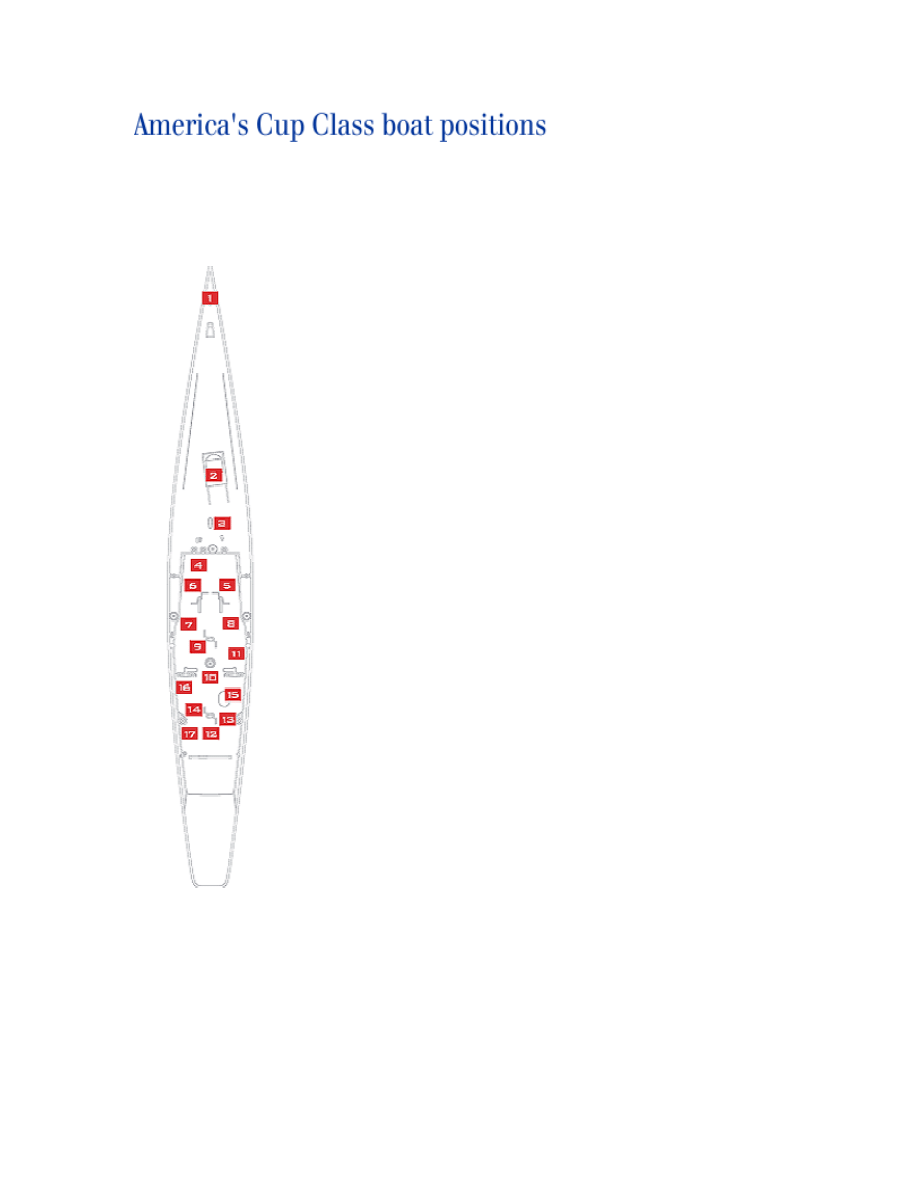
Since the introduction of the America's Cup Class in 1992 there have been 16 active crewmen
aboard during racing. Many of the crewmen, however, perform more than one job, assisting in other
areas when possible. For the next America's Cup in 2007 an extra crewman has been added to the
list, bringing the total to 17. Rather than creating a new position, the extra person has been added
simply for an extra set of hands.
Bowman (1): Works the "pointy" end of the boat; is responsible for calling the
distance to the start line during starting maneuvers; for working the point during
sail changes and mark roundings
Sewer (2): spends most of his day below decks packing sails that have been
used; often is soaked to the bone after racing because he is in the direct line of
all the water sloshing through the foredeck hatch
Mastman (3): jumps the halyards at the mast in a hand-over-hand fashion to
assist hoisting the sails; also helps gather the genoa after the spinnaker is raised
and also helps with grinding on occasion
Pitman (4): is responsible for tailing and releasing the halyards during mark
roundings; is a critical component helping control the spinnaker pole during jibes;
can be seen assisting the grinders sometimes during pre-starts
Grinders (5,6,9,12): the most physically demanding position on the boat, there
are usually four crewmen dedicated to grinding; the grinders spin the handles
that drive the gears that spin the winches that control the sails; the key is to keep
grinding, even when you're out of breath and your muscles burn like a four-alarm
fire
Headsail trimmers (7,8): two people split the responsibility for trimming the
genoa (upwind) and the spinnaker (downwind); the off-trimmer assists with tailing
the genoa sheet during tacks upwind, and trimming the afterguy (which controls
the angle of the spinnaker pole) downwind; they must be in constant contact with
the helmsman regarding the different speed modes
Mainsail trimmer (10): one of the most critical positions on the boat, as the
mainsail is the gas pedal; is in constant contact with the helmsman regarding the
different speed modes; will offer some tactical input when possible
Mainsail traveler/wind spotter (11): works closely with the mainsail trimmer
when adjusting the traveler, which controls the amount of wind pressure in the
mainsail; also looks outside the boat calling wind puffs and shifts as an extra set
of eyes for the tactician
Runners (13): the running backstays are connected to the mast and are the
primary device used to bend the mast, which changes the shape of the genoa
and the mainsail; the position is critical on America's Cup boats; failure to do this
job results in catastrophe, like a broken mast
Helmsman/skipper (16): the man holding the wheel is ultimately responsible for the performance of the
boat; has to know when to go into a speed build mode or a high-pointing mode (depending on where they
are on the racecourse and in relation to their competitor); also has input on tactical decisions
Tactician (14): is in constant contact with the helmsman, telling him where to go on the racecourse; is
always looking outside the boat, judging the windshifts and his boat's position relative to the competition

Navigator (15): plots the racecourse on the chart and is responsible for keeping tabs on the current and any
changes to the course that might occur during a race as a result of a windshift
17th Man (17): A non-active role onboard; position created along with the class to give an opportunity for
sponsors to ride aboard the race boat and feel the action up close and personal
Wyszukiwarka
Podobne podstrony:
overview sirius position switches 2007 en
The Position of the?rican American Population
the position of the?rican american population 4ZF7CIEXBZMSZRF5XAEU3MKQYJZBNLSV3ZNBZMI
Mark Steyen America Alone, The End of the World As We Know It (2007)
Nathan Glazer From a Cause to a Style, Modernist Architecture s Encounter with the American City (2
Naomi Wolf The End of America Letter of Warning to a Young Patriot (2007)
American English 09 2007
PDOP 2007
Prezentacja KST 2007 new
Podstawy MN 2007
Prezentacja JMichalska PSP w obliczu zagrozen cywilizacyjn 10 2007
więcej podobnych podstron