1
Paulo Coelho
Stories for Parents, Children
and Grandchildren
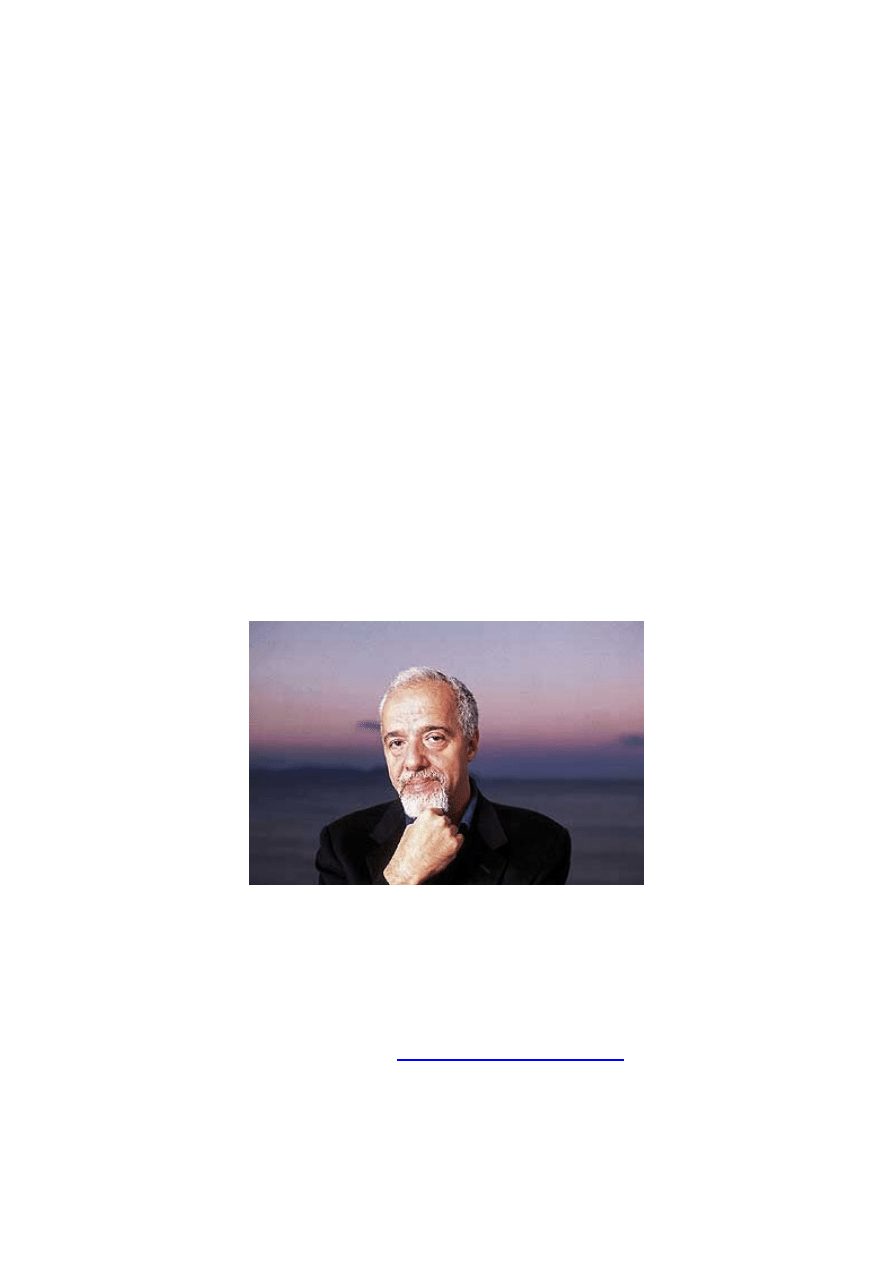
Foto: cortesia Istoé Gente
Special gift of

2
Paulo Coelho
Stories for Parents,
Children and
Grandchildren
Translated from the Portuguese by Margaret Jull Costa

3
True skill
The yogi Raman was a true master of the art of archery. One morning, he
invited his favourite disciple to watch a display of his skill. The disciple had seen this
more than a hundred times before, but he nevertheless obeyed his teacher.
They went into the wood beside the monastery and when they reached a
magnificent oak tree, Raman took a flower which he had tucked in his collar and
placed it on one of the branches.
He then opened his bag and took out three objects: his splendid bow made of
precious wood, an arrow and a white handkerchief embroidered with lilacs.
The yogi positioned himself one hundred paces from the spot where he had
placed the flower. Facing his target, he asked his disciple to blindfold him with the
embroidered handkerchief.
The disciple did as his teacher requested.
'How often have you seen me practise the noble and ancient sport of archery?'
Raman asked him.
'Every day,' replied his disciple. 'And you have always managed to hit the rose
from three hundred paces away.'
With his eyes covered by the handkerchief, the yogi Raman placed his feet
firmly on the ground, drew back the bowstring with all his might - aiming at the rose
placed on one of the branches of the oak tree - and then released the arrow.
The arrow whistled through the air, but it did not even hit the tree, missing the
target by an embarrassingly wide margin.
'Did I hit it?' said Raman, removing the handkerchief from his eyes.
'No, you missed completely,' replied the disciple. 'I thought you were going to
demonstrate to me the power of thought and your ability to perform magic.'
'I have just taught you the most important lesson about the power of thought,'
replied Raman. 'When you want something, concentrate only on that: no one will ever
hit a target they cannot see.'

4
How to be remembered
In the monastery of Sceta, Abbot Lucas gathered the brothers together for a
sermon.
'May you all be forgotten,' he said.
'But why?' one of the brothers asked. 'Does that mean that our example can
never serve to help someone in need?'
'In the days when everyone was just, no one paid any attention to people who
behaved in an exemplary manner,' replied the abbot. 'Everyone did their best, never
thinking that by behaving thus they were doing their duty by their brother. They loved
their neighbour because they understood that this was part of life and they were
merely obeying a law of nature. They shared their possessions in order not to
accumulate more than they could carry, for journeys lasted a whole lifetime. They
lived together in freedom, giving and receiving, making no demands on others and
blaming no one. That is why their deeds were never spoken of and that is why they
left no stories. If only we could achieve the same thing now: to make goodness such
an ordinary thing that there would be no need to praise those who practise it.

5
Rebuilding the world
A father was trying to read the newspaper, but his little son kept pestering him.
Finally, the father grew tired of this and, tearing a page from the newspaper - one that
bore a map of the world - he cut it into several pieces and handed them to his son.
'Right, now you've got something to do. I've given you a map of the world and
I want to see if you can put it back together correctly.'
He resumed his reading, knowing that the task would keep the child occupied
for the rest of the day. However, a quarter of an hour later, the boy returned with the
map.
'Has your mother been teaching you geography?' asked his father in
astonishment.
'I don't even know what that is,' replied the boy. 'But there was a photo of a
man on the other side of the page, so I put the man back together and found I'd put the
world back together too.'
Thinking about death
Zilu said to Confucius (a Chinese philosopher, who lived in the sixth century
B.C.):
'May I ask what you think about death?'
'You may ask,' replied Confucius, 'but if you still don't understand life, why do
you want to know about death. Leave thinking about death for when life is over.'

6
Paying the right price
Nixivan had invited his friends to supper and was cooking a succulent piece of
meat for them. Suddenly, he realised that he had run out of salt.
So Nixivan called to his son.
'Go to the village and buy some salt, but pay a fair price for it: neither too
much nor too little.'
His son was surprised.
'I can understand why I shouldn’t pay too much for it, Father, but if I can
bargain them down, why not save a bit of money?'
'That would be the sensible thing to do in a big city, but it could destroy a
small village like ours.'
When Nixivan's guests, who had overheard their conversation, wanted to
know why they should not buy salt more cheaply if they could, Nixivan replied:
'The only reason a man would sell salt more cheaply than usual would be
because he was desperate for money. And anyone who took advantage of that
situation would be showing a lack of respect for the sweat and struggle of the man
who laboured to produce it.'
'But such a small thing couldn't possibly destroy a village.'
'In the beginning, there was only a small amount of injustice abroad in the
world, but everyone who came afterwards added their portion, always thinking that it
was only very small and unimportant, and look where we have ended up today.'
The missing brick
Once, when I and my wife were travelling, I received a fax from my secretary.
'There's one glass brick missing for the work on the kitchen renovation,' she
said. 'I'm sending you the original plan as well as the plan the builder has come up
with to compensate for it.'
On the one hand was the design my wife had made: harmonious lines of bricks
with an opening for ventilation. On the other hand was the plan drawn up to resolve
the problem of the missing brick: a real jigsaw puzzle in which the glass squares were
arranged in a higgledy-piggledy fashion that defied aesthetics.
'Just buy another brick,' wrote my wife. And so they did and thus stuck to the
original design.
That afternoon, I thought for a long time about what had happened; how often,
for the lack of one brick, we completely distort the original plan of our lives.

7
Epictetus reflects on meetings
Epictetus (55 A.D.-135 A.D.) was born a slave and became one of the great
philosophers of Rome. He was expelled from the city in 94 A.D. and it was while in
exile that he came up with a way of teaching his followers. Here is an extract from his
Art of Living.
'Two things may happen when we meet someone: either we become friends or
we try to convince that person to accept our beliefs. The same thing happens when a
hot coal meets another piece of coal: it either shares its fire with it or is overwhelmed
by the other's size and is extinguished.
But, since, generally speaking, we feel insecure when we first meet someone,
we are more likely to affect indifference, arrogance or excessive humility. The result
is that we cease being who we are, and matters move into a strange world that does
not belong to us.
In order to avoid this happening, make your good feelings immediately
apparent. Arrogance may only be a banal mask for cowardice, but it prevents
important things from flourishing in your life.'
A story by Kahlil Gibran
I was strolling in the gardens of an insane asylum when I met a young man
who was reading a philosophy book.
His behaviour and his evident good health made him stand out from the other
inmates.
I sat down beside him and asked:
'What are you doing here?'
He looked at me, surprised. But seeing that I was not one of the doctors, he
replied:
'It's very simple. My father, a brilliant lawyer, wanted me to be like him. My
uncle, who owns a large emporium, hoped I would follow his example. My mother
wanted me to be the image of her beloved father. My sister always set her husband
before me as an example of the successful man. My brother tried to train me up to be
a fine athlete like himself.
And the same thing happened at school, with the piano teacher and the English
teacher - they were all convinced and determined that they were the best possible
example to follow. None of them looked at me as one should look at a man, but as if
they were looking in a mirror.
So I decided to enter this asylum. At least here I can be myself.'

8
Meeting the king
A Persian king asked Saadi of Shiraz:
'On your wanderings through the cities of my kingdom, do you think of me
and of my works?'
'Your Majesty, I think of you whenever I forget to think of God,' was the wise
man's answer.
The one guilty man
Wise King Weng asked to visit the palace prison. And he began listening to
the prisoners' complaints.
'I'm innocent,' said a man accused of murder. 'I'm here simply because I
wanted to give my wife a fright, but I accidentally killed her.'
'I was accused of taking a bribe,' said another, 'but all I did was accept a gift.'
All the prisoners declared their innocence to King Weng, until one of them, a
young man of only twenty or so, said:
'I'm guilty. I wounded my brother in a fight and I deserve to be punished. This
place has made me reflect on the pain I caused.'
'Remove this criminal from the prison immediately!' cried King Weng. 'He'll
end up corrupting all these entirely innocent men.'

9
How to help the country
Zizhang searched for Confucius throughout China. The country was going
through a time of great social upheaval, and he feared there could be bloodshed.
He found the master sitting beneath a fig tree, meditating.
'Master, we urgently need your presence in the government,' said Zizhang. 'We
are on the brink of chaos.'
Confucius continued to meditate.
'Master, you taught us that we must not stand idly by,' Zizhang went on. 'You
said that we were responsible for the world.'
'I am praying for the country,' replied Confucius. 'Later, I will go and help the
man who lives round the corner. By doing what is within our reach, we benefit
everyone. By merely coming up with ideas about how to save the world, we do not
even help ourselves. There are a thousand ways of getting involved in politics; there is
no need for me to be part of the government.'
Where the monkey puts his hand
I said to a friend:
'It's odd that proverb, "An old monkey never puts his hand in the pot".'
'Yes, but it has its own logic,' he replied. 'In India, hunters make a small hole
in a coconut, put a banana inside and bury the whole thing. A monkey finds the
coconut, puts his hand in the hole to grab the banana, but then can't get it out because
his closed hand is too big for the hole. Instead of letting go of the banana, the monkey
stays there wrestling with the impossible and gets caught.'
The same thing happens in our own lives. The need to have a particular thing -
often something small and useless - ends up making us prisoners of that need.

10
Choosing one's fate
Many years ago, there lived a man who was capable of loving and forgiving
everyone he came across. Because of this, God sent an angel to talk to him.
'God asked me to come and visit you and tell you that he wishes to reward you
for your goodness,' said the angel. 'You may have any gift you wish for. Would you
like the gift of healing?'
'Certainly not,' said the man. 'I would prefer God to choose those who should
be healed.'
'And what about leading sinners back to the path of Truth?'
'That's a job for angels like you. I don't want to be venerated by anyone or to
serve as a permanent example.'
'Look, I can't go back to Heaven without having given you a miracle. If you
don't choose, I'll have to choose one for you.'
The man thought for a moment and then said:
'All right, I would like good to be done through me, but without anyone
noticing, not even me, in case I should commit the sin of vanity.'
So the angel arranged for the man's shadow to have the power of healing, but
only when the sun was shining on the man's face. In this way, wherever he went, the
sick were healed, the earth grew fertile again, and sad people rediscovered happiness.
The man travelled the Earth for many years, oblivious of the miracles he was
working because when he was facing the sun, his shadow was always behind him. In
this way, he was able to live and die unaware of his own holiness.
A search frustrated
The mystic Ramakrishna began his dedication to the spiritual life when he was
sixteen. At first, he used to weep bitterly because, despite his devotion to the work at
the temple, he seemed to be getting nowhere.
Later, when he was famous, a friend asked him about that period of his life.
Ramakrishna replied:
'If a thief were to spend the night in a room with only a thin wall separating
him from another room full of gold, do you think he would be able to sleep? He
would lie awake all night, scheming. When I was young, I desired God as ardently as
a thief would desire that gold, and it took me a long time to learn that the greatest
virtue in the spiritual search is patience.'

11
Krishna will hear your prayer
A widow from a poor village in Bengal did not have enough money to pay for
her son's bus fare, and so when the boy started going to school, he would have to walk
through the forest all on his own. In order to reassure him, she said:
'Don't be afraid of the forest, my son. Ask your God Krishna to go with you.
He will hear your prayer.'
The boy followed his mother's suggestion, and Krishna duly appeared and
from then on accompanied him to school every day.
When it was his teacher's birthday, the boy asked his mother for some money
in order to buy him a present.
'We haven't any money, son. Ask your brother Krishna to get you a present.'
The following day, the boy explained his problem to Krishna, who gave him a
jug of milk.
The boy proudly handed the milk to the teacher, but the other boys' presents
were far superior and the teacher didn't even notice his.
'Take that jug of milk to the kitchen,' said the teacher to an assistant.
The assistant did as he was told. However, when he tried to empty the jug, he
found that it immediately filled up again of its own accord. He immediately informed
the teacher, who was amazed and asked the boy:
'Where did you get that jug and how does it manage to stay full all the time?'
'Krishna, the God of the forest, gave it to me.'
The teacher, the students and the assistant all burst out laughing.
'There are no gods in the forest, that's pure superstition,' said the teacher. 'If he
exists, let's all go and see him.'
The whole group set off. The boy started calling for Krishna, but he did not
appear. The boy made one last desperate appeal.
'Brother Krishna, my teacher wants to see you. Please show yourself!'
At that moment, a voice emerged from the forest and echoed through the city
and was heard by everyone.
'How can he possibly want to see me, my son? He doesn't even believe I exist!'

12
The art of listening
The wise man, Saadi of Shiraz, was walking along a road with his disciple
when he saw a man trying to get his mule to move. When the animal refused to
budge, the man began calling him the worst names he could think of.
'Don't be silly,' said Saadi. 'The mule will never learn your language. You
would do better to calm down and learn his language.'
And as he walked away, he remarked to his disciple:
'Before you get into an argument with a mule, remember the scene you have
just witnessed.'
The bugle that drove away tigers
A man arrived in a village carrying a mysterious bugle decorated with red and
yellow rags, glass beads and animal bones.
'This bugle can drive away tigers,' said the man. 'From this day forth, for a
modest daily fee, I will play the bugle every morning and you will never be eaten by
those terrible animals.'
Terrified by the threat of attack by a wild animal, the inhabitants of the village
agreed to pay what the newcomer asked.
Many years passed, the owner of the bugle grew rich and built himself a
magnificent castle. One morning, a boy who was passing through the village, asked
who the owner of the castle was. When he heard the story, he decided to go and talk
to the man.
'I was told that you have a bugle that can drive away tigers,' said the boy. 'But
there are no tigers in this country.'
The man immediately called together all the villagers and asked the boy to
repeat what he had said.
'Did you hear that?' cried the man as soon as the boy had finished speaking.
'There you have irrefutable proof of the power of my bugle!'

13
The silence of the night
A Sufi master and his disciple were walking across a desert in Africa. When
night fell, they pitched their tent and lay down to rest.
'How silent it is!' said the disciple.
'Never say "how silent it is",' replied the teacher. 'Say rather: "I cannot hear
nature".
Matisse and Renoir meet
As a young man, the painter Henri Matisse used to pay a weekly visit to the
great Renoir in his studio. When Renoir was afflicted by arthritis, Matisse began to
visit him daily, taking him food, brushes, paints, but always trying to persuade the
master that he was working too hard and needed to rest a little.
One day, noticing that each brushstroke made Renoir cry out with pain,
Matisse could contain himself no longer:
'Master, you have already created a vast and important body of work, why
continue torturing yourself in this way?'
'Very simple,' Renoir replied. 'Beauty remains, but pain passes.'

14
The piece of bread that fell wrong side up
We all have a tendency to believe that everything we do will turn out wrong,
because we think we do not deserve to be blessed. Here is an interesting story about
precisely that feeling.
A man was quietly eating his breakfast. Suddenly, the piece of bread which he
had just spread with butter fell to the ground.
Imagine his surprise when he looked down and saw that it had landed buttered
side up! The man thought he had witnessed a miracle. Excited, he went to tell his
friends what had happened, and they were all amazed because when a piece of bread
falls on the floor, it always lands buttered side down, making a mess of everything.
'Perhaps you're a saint,' one friend said. 'And this is a sign from God.'
Soon the whole village knew, and they all started animatedly discussing the
incident: how was it that, against all expectations, that man's slice of bread had fallen
on the floor buttered side up? Since no one could come up with a credible answer,
they went to see a Teacher who lived nearby and told him the story.
The Teacher demanded one night to pray, reflect and ask for Divine
inspiration. The following day, they all returned, eager for an answer.
'It's quite simple really,' said the Teacher. 'The fact is that the piece of bread
fell exactly as it should have fallen, but the butter had been spread on the wrong side.'
The slayer of dragons
Zhuangzi, the famous Chinese writer, tells the story of Zhu Pingman, who
went in search of a teacher in order to learn the best way to slay dragons.
The teacher trained Pingman for ten whole years, until he had honed to
perfection the most sophisticated dragon-slaying techniques.
Pingman spent the rest of his life looking for dragons in order show off his
skills: to his great disappointment, he never found a single dragon.
The writer of the story comments: 'We all prepare ourselves to slay dragons,
but end up instead being devoured by the ants of the details that we never bothered to
look at.'

15
About masters and teachers
In one of his Family Conversations, Confucius sets down an interesting
dialogue on the subject of learning.
Confucius sat down to rest, and his students immediately started asking him
questions. On that day, he was in a good mood and so decided to answer. Someone
asked him:
'You are capable of explaining everything you feel. Why don't you go to the
Emperor and talk to him?'
'The Emperor himself makes beautiful speeches,' said Confucius, 'but beautiful
speeches are merely a question of technique, they do not of themselves contain
Virtue.'
'Well, send him your book of poems, then.'
'Those three hundred poems could be summed up in two words: think
correctly. That is the secret.'
'What does thinking correctly involve?'
'It's knowing how to use mind and heart, discipline and emotion. When we
want something, life will guide us there, but by unexpected paths. We often feel
confused because we are surprised by those paths and think we must be going in the
wrong direction. That is why I said, allow yourself to be carried away by emotion, but
have enough discipline to follow it through.'
'Is that what you do?'
'When I was fifteen, I began to learn. When I was thirty, I knew what I
wanted. When I was forty, my doubts resurfaced. When I was fifty, I discovered that
Heaven has a plan for me and for each man on the face of the Earth. When I was
sixty, I understood that plan and found the serenity to follow it. Now that I'm seventy,
I can listen to my heart, but without letting it distract me from the path.'
'So what makes you different from other men who have also accepted the will
of Heaven?'
'I try to share it with you. And anyone wanting to discuss an ancient truth with
a new generation has to use his capacity to teach. That is my one quality, being a good
teacher.'
'And what is a good teacher?'
'Someone who questions everything he teaches. Old ideas cannot enslave a
man, because they change and take on new forms. So let us use the philosophical
riches of the past, but without forgetting the challenges that the present world sets
before us.'
'And what is a good student?'
'Someone who listens to what I say, but adapts my teachings to his life and
never follows them blindly. Someone who looks not just for employment, but for a
job that brings him dignity. Someone who does not seek to be noticed, but to do
something notable.'

16
The bridge and the plank
After many years of work and meditation on the best way to cross the river
that ran past his house, a man created a kind of footbridge out of planks. The
villagers, however, rarely used it because it seemed so precarious.
One day, an engineer appeared. With the help of the inhabitants, he built a
proper bridge, which infuriated the maker of the footbridge. He would tell anyone
who would listen that the engineer had failed to show due respect for his work.
'The footbridge is still there!' replied the other villagers. 'It's a monument to
your years of effort and thought.'
'Yes, but no one uses it,' the man would reply tetchily.
'You are a highly respected citizen and we all like you, it's just that we find the
new bridge more beautiful and more useful than your plank footbridge.'
'But it's crossing my river.'
'Now, however much we may respect your work, we have to say that the river
is not yours. We could wade, swim or row across it, but if people prefer to use the
bridge, why not respect their wishes? Besides, how can we trust someone who,
instead of trying to improve his own bridge, spends all his time criticising someone
else's?'
(Based on a story by Silvio Paulo Albino)

17
On my way to a book fair
I was flying from New York to Chicago to attend the book fair held by the
American Booksellers Association. Suddenly, a young man stood up in the aisle of
the plane and announced:
'I need twelve volunteers each willing to carry a single rose when we get off
the plane.'
Several people raised their hands. I did too, but I wasn't chosen.
Even so, I decided to follow the group. We landed and the young man
indicated a young woman in the arrivals hall at O'Hare airport. One by one, the
passengers presented their roses to her. At last, in front of everyone, the young man
asked her to marry him, and she accepted.
An air steward said to me:
'I've been working here for years, and that's the most romantic thing that has
ever happened in this airport.'
The essence of forgiveness
One of Napoleon's soldiers committed a crime - the story does not explain
what exactly - and he was condemned to death.
On the evening before he was due to be shot, the soldier's mother came to
plead for her son's life to be spared.
'Madam, your son's action does not deserve clemency.'
'I know,' said the mother. 'If it did, that would not be true forgiveness. To
forgive is the ability to go beyond vengeance or justice.'
When he heard those words, Napoleon commuted the death sentence to exile.

18
The middle path
The monk Lucas, accompanied by a disciple, was walking through a village.
An old man asked the monk:
'Holy man, how do I become closer to God?'
'Enjoy yourself more, and praise the Creator with your joy,' came the reply.
The two men were about to walk on when a young man approached them. He
asked:
'What should I do in order to become closer to God?'
'Spend less time merely enjoying yourself,' said Lucas.
When the young man left, the disciple remarked:
'You don't seem very sure whether we should enjoy ourselves or not.'
'The spiritual search is a bridge with no handrail built across an abyss,' replied
Lucas. 'If someone is walking very close to the right side, I say: "To the left!" If they
go too close to the left side, I say: "To the right!" It is the extremes that divert us from
the Path.'
Pleasure and the tongue
A Zen master was resting with one of his disciples. At one point, he took a
melon out of his bag and cut it in two so that both could eat it.
While they were eating, the disciple said:
'Wise master, since everything you do has a meaning, perhaps your sharing
this melon with me is a sign that you have something to teach me.'
The master continued eating in silence.
'Your silence obviously conceals a question,' the disciple insisted, 'and it must
be this: does the pleasure I am experiencing in eating this delicious fruit reside in the
melon or in my tongue?'
The master said nothing. The disciple went on excitedly:
'And since everything in life has meaning, I think I am close to finding the
answer to that question: the pleasure is an act of love and interdependence between
us, because without the melon there would be no object of pleasure and without my
tongue…'
'That's enough!' said the master. 'The real fools are those who think themselves
terribly intelligent and spend all their time trying to interpret everything. The melon is
delicious, and that's enough, now let me eat in peace!'

19
El Greco and light
One pleasant spring afternoon, a friend went to visit the painter El Greco. To
his surprise, he found him in his studio with all the curtains closed.
El Greco was working on a painting which had as its central theme the Virgin
Mary, and he was using only a single candle to light the room. His bemused friend
commented:
'I had always been told that painters need sunlight in order to select the right
colours. Why don't you draw the curtains?'
'Not now,' said El Greco. 'That would disturb the brilliant fire of inspiration
inflaming my soul and filling everything around me with light.'
How to level out the world
Once when Confucius was travelling with his disciples, he heard tell of a very
intelligent boy living in a particular village. Confucius went to see and talk to him and
he jokingly asked:
'How would you like to help me do away with all the irregularities and
inequalities in the world?'
'But why?' asked the boy. 'If we flattened the mountains, the birds would have
no shelter. If we filled up the deep rivers and the sea, the fish would die. If the head of
the village had as much authority as the madman, no one would know where they
were. The world is vast enough to cope with differences.'
The disciples left feeling greatly impressed by the boy's wisdom, and as they
journeyed towards the next town, one of them commented that all children should be
like that. Confucius said:
'I've known many children who, instead of playing and doing the things
appropriate to their age, were busy trying to understand the world. Not one of those
precocious children did anything of any great significance later in life because they
had never experienced the innocence and healthy irresponsibility of childhood.'

20
The importance of knowing names
Zilu asked Confucius:
'If King Wen were to ask you to govern the country, what would your first
action be?'
'I would learn the names of my advisers.'
'What nonsense! That is hardly a matter of great concern to a prime minister.'
'A man cannot hope to receive help from what he does not know,' replied
Confucius. 'If he does not understand Nature, he will not understand God. In just the
same way, if he does not know who is at his side, he will have no friends. Without
friends, he will be unable to draw up a plan. Without a plan, he cannot direct anyone's
actions. Without direction, the country will plunge into darkness, and even dancers
will not know which foot to put down next. So an apparently banal action - learning
the name of the person at your side - can make an enormous difference. The besetting
sin of our time is that everyone wants to put things right immediately, and they forget
that in order to do so you need a lot of people.'
The city and the army
According to legend, when Joan of Arc was marching towards Poitiers with
her army, she came across a boy playing in the middle of the road with some earth
and twigs.
'What are you doing?' asked Joan of Arc.
'Can't you see?' replied the boy. 'This is a city.'
'Excellent,' she said, 'now if you will please leave the road, my men and I need
to get past.'
The boy got angrily to his feet and stood before her.
'A city does not move. An army might destroy it, but the city itself stays where
it is.'
Smiling at the boy's determination, Joan of Arc ordered her army to leave the
road and go around the 'city'.

21
Not an example
The Rabbi Elimelekh had delivered a wonderful sermon and now he was
returning to his native land. To honour him and to show their gratitude, the faithful
decided to follow Elimelekh's carriage out of the city.
At one point, the Rabbi stopped the carriage and asked the driver to go ahead
without him while he joined the people.
'A fine example of humility,' said one of the men beside him.
'Humility has nothing to do with it, just a little intelligence,' replied Elimelekh.
'You're all out here having a walk, singing, drinking wine, chatting with each other,
making new friends, and all because of an old Rabbi who came to talk to you about
the art of living. So let's leave my theories in the carriage, I want to enjoy the party.'
Praying for everyone
A farm labourer with a sick wife, asked a Buddhist monk to say a series of
prayers. The priest began to pray, asking God to cure all those who were ill.
'Just a moment,' said the farm labourer. 'I asked you to pray for my wife and
there you are praying for everyone who's ill.'
'I'm praying for her too.'
'Yes, but you're praying for everyone. You might end up helping my
neighbour, who's also ill, and I don't even like him.'
'You understand nothing about healing,' said the monk, moving off. 'By
praying for everyone, I am adding my prayers to those of the millions of people who
are also praying for their sick. Added together, those voices reach God and benefit
everyone. Separately, they lose their strength and go nowhere.'

22
Saadi of Shiraz and prayer
Saadi of Shiraz used to tell the following story:
'When I was a child, I used to pray with my father, my uncles and my cousins.
Every night we would gather together to listen to a passage from the Koran.
On one such night, while my uncle was reading a passage out loud, I noticed
that most of the people were asleep. I said to my father: "Not one of these dozy people
is listening to the words of the Prophet. They'll never reach God."
And my father replied: "My dear son, look for your own path with faith and let
others take care of themselves. Who knows, perhaps they are talking to God in their
dreams. Believe me, I would much prefer you to be sleeping alongside them than to
hear your harsh words of judgement and condemnation."'
The sorrowing father
Rabbi Abraham had lived an exemplary life. When he died, he went straight to
Paradise, and the angels welcomed him with songs of praise.
Yet Abraham sat alone, head in hands, deeply distressed, refusing all
consolation. Finally, he was brought before the Almighty and he heard an infinitely
tender voice ask him:
'My beloved servant, what sorrow do you bear in your breast?'
'I am unworthy of the honours being heaped upon me,' replied the Rabbi. 'I
was considered an example to my people, but I must have done something very
wrong. My one son, on whom I lavished my finest teaching, became a Christian!'
'Oh, don't worry about that,' said the voice of the Almighty. 'I had an only son
too and he did exactly the same thing!'

23
The sorrowing mother
Roberto Shiniashiky tells of a Jewish mother who tried to bring her son up in
the most traditional way possible. The boy, however, had a forceful personality and
would only do what his heart told him to do.
The mother, just like Rabbi Abraham in the preceding story, went straight to
Paradise when she died, for she had been a shining example of devotion here on
Earth. When she got there, she told the other mothers about the agonies her son had
put her through, and she learned that not one of them was satisfied with the paths their
children had followed.
After days of conversation, during which they voiced their regrets that they
had not been strong enough to control their children, the group of women saw Our
Lady passing by.
'Now she managed to bring her son up properly,' said one of the mothers.
And they all crowded round Our Lady, praising her son Jesus's career.
'He was a wise man,' they said. 'He accomplished all that he was destined to
accomplish, he walked the path of truth, never deviating for one moment, and he is
still a source of pride to his family.'
'Yes, you're quite right,' said Our Lady, 'but to be perfectly honest, I wanted
him to be a doctor.'
Where God lives
When the great Rabbi Yitzhak Meir was studying the traditions of his people,
one of his friends said to him jokingly:
'I'll give you a florin if you can tell me where God lives.'
'I'll give you two florins if you can tell me where he doesn't live,' replied Meir.

24
The moment of dawn
A Rabbi gathered together his students and asked them:
'How do we know the exact moment when night ends and day begins?'
'It's when, standing some way away, you can tell a sheep from a dog,' said one
boy.
The Rabbi was not content with the answer. Another student said:
'No, it's when, standing some way away, you can tell an olive tree from a fig
tree.'
'No, that's not a good definition either.'
'Well, what's the right answer?' asked the boys.
And the Rabbi said:
'When a stranger approaches, and we think he is our brother, that is the
moment when night ends and day begins.'
It's raining up ahead
Struggling against certain things which will pass in time anyway is a waste of
energy. This very brief Chinese story illustrates this very well.
In the middle of the countryside, it began to rain. Everyone scurried off to seek
shelter, except for one man, who continued to walk slowly along.
'Why aren't you running for shelter?' someone asked.
'Because it's raining up ahead too,' came the answer.

25
Nasrudin always makes the wrong choice
Every day Nasrudin went to beg for alms in the market, and people used to
make fun of him by playing the following trick: they would show him two coins, one
worth ten times more than the other, and Nasrudin would always choose the smaller
coin.
The story went round the whole province. Day after day, groups of men and
women would show him the two coins, and Nasrudin would always choose the
smaller one.
Then one day, a generous man, tired of seeing Nasrudin ridiculed in this
fashion, beckoned him over to a corner of the square and said:
'When they offer you two coins, you should choose the larger one. That way
you would earn more money and people wouldn't consider you an idiot.'
'That sounds like good advice,' replied Nasrudin, 'but if I chose the larger coin,
people would stop offering me money, because they like to believe that I am even
more stupid than they are. You've no idea how much money I've earned using this
trick. There's nothing wrong with looking like a fool if, in fact, you're being really
clever.'
The one who cared most
The writer Leo Buscaglia was once invited to be on the jury of a school
competition to find 'the child who cared most for others'.
The winner was a boy whose neighbour, a gentleman of over eighty, had just
been widowed. When he saw the old man sitting in his garden crying, the boy jumped
over the fence, sat on the man's lap and stayed there for a long time.
When he went back home, his mother asked him what he had said to the poor
man.
'Nothing,' said the boy. 'He's lost his wife and that must have really hurt. I just
went over to help him to cry.'

26
The answer
Once a man asked Rabbi Joshua ben Karechah:
'Why did God choose to speak to Moses out of a thorn bush?'
The Rabbi replied:
'If he had chosen an olive tree or a bramble bush, you would have asked the
same question. But I cannot leave you without an answer, so I will say that God chose
a wretched little thorn bush in order to teach us that there is nowhere on Earth where
He is not present.'
The window and the mirror
A very rich young man went to see a Rabbi in order to ask his advice about
what he should do with his life. The Rabbi led him over to the window and asked him:
'What can you see through the glass?'
'I can see men coming and going and a blind man begging for alms in the
street.'
Then the Rabbi showed him a large mirror and said to him:
'Look in this mirror and tell me what you see.'
'I can see myself.'
'And you can't see the others. Notice that the window and the mirror are both
made of the same basic material, glass; but in the mirror, because the glass is coated
with a fine layer of silver, all you can see is yourself. You should compare yourself to
these two kinds of glass. Poor, you saw other people and felt compassion for them.
Rich - covered in silver - you see yourself. You will only be worth anything when you
have the courage to tear away the coating of silver covering your eyes in order to be
able to see again and love your fellow man.'

27
A man lying on the ground
On 1 July, at five past one in the afternoon, there was a man of about fifty
lying on the sea front in Copacabana. I glanced down at him as I walked by, then
continued on to the stall where I usually go for a drink of coconut water.
As a resident of Rio de Janeiro, I must have passed by such men, women or
children hundreds or even thousands of times. As someone who has travelled widely,
I have seen the same scene in almost every country I have visited, from wealthy
Sweden to impoverished Romania. I have seen people lying on the ground in all
weathers: in the icy winters of Madrid or Paris or New York, where they stay close to
the hot air vents outside the subway stations; in the scalding Libyan sun, amongst the
rubble of buildings destroyed by years of war. People lying on the ground - drunk,
homeless, tired - are not a new sight to anyone.
I drank my coconut water. I needed to get home quickly because I had an
interview with Juan Arias from the Spanish newspaper El País. On the way back, I
noticed that the man was still there, lying in the sun, and everyone who passed did
exactly the same as I had: glanced at him and then moved on.
Although I didn't know it, my soul was weary of seeing the same scene over
and over. When I passed the man again, something stronger than myself made me
kneel down and try to lift him up.
He did not respond. I turned his head and noticed blood on his temple. What
now? Was it a bad wound? I dabbed at his skin with my T-shirt; it didn't look like
anything serious.
At that moment, the man began muttering something about 'make them stop
hitting me'. So he was alive; now what I needed to do was to get him out of the sun
and to call the police.
I stopped the first man who passed and asked him to help me drag the injured
man over to the shade between the sea front and the beach. He was wearing a suit and
carrying a briefcase and various packages, but he put these down to help me - his soul
was weary of seeing that same scene too.
Once we had placed the man in the shade, I headed off to my house. I knew
there was a Military Police post nearby where I could ask for help. But before I got
there, I met two policemen.
'There's a man who's been beaten up opposite number so-and-so,' I said. 'I've
laid him down on the sand. It would be a good idea to call an ambulance.'
The two policemen said they would take steps. Right, I had done my duty. A
boy scout is always prepared. My good deed for the day. The problem was in other
hands now; it was up to them to deal with it. And the Spanish journalist would be
arriving at my house at any moment.
I had not gone ten steps, when a stranger stopped me. In garbled Portuguese he
said:
'I've already told the police about the man. They said that since he's not a thief,
he's not their problem.'
I did not let the man finish. I walked back to where the policemen were
standing, convinced that they would know who I was, that I wrote for the newspapers,
that I appeared on television. I did so under the false impression that sometimes
success can help to resolve matters.
'Are you some kind of official?' one of them asked when I became more
insistent in my request for help.
They had no idea who I was.

28
'No, but we're going to resolve this problem right now.'
There I was all sweaty and dressed in a blood-stained T-shirt and a pair of
Bermuda shorts made from some old cut-down jeans. I was just an ordinary,
anonymous man with no authority apart from my own weariness with all those years
of seeing people lying on the ground and never doing anything about it.
And that changed everything. There are moments when you are suddenly free
from any inhibitions or fears. There are moments when your eyes have a different
light and people know that you are absolutely serious. The policemen went with me
and called an ambulance.
On my way back home, I went over the three lessons I had learned from that
walk: (a) Anyone can abandon an action when it's purely at the stage of romanticism.
(b) There is always someone to tell you: 'Now that you've started, finish.' And (c)
everyone has the authority of an official when he or she is absolutely convinced of
what he or she is doing.

29
Nhá Chica of Baependi
What is a miracle?
There is a definition for every kind of miracle: it may be something that goes
against the laws of nature, an act of divine intervention at a moment of great crisis,
something which is considered scientifically impossible, etc.
I have my own definition: a miracle is something that fills the soul with peace.
Sometimes it manifests itself in the form of a cure or a wish granted, it doesn't matter
- the end result is that, when the miracle occurs, we feel a profound reverence for the
grace God has granted us.
Twenty or more years ago, when I was going through my hippie phase, my
sister asked me to be godfather to her first daughter. I was thrilled and I was
especially pleased that she did not ask me to cut my hair (at the time, it was down to
my waist), nor demand an expensive christening present (I didn't have any money to
buy one).
The baby was born, a year went by and no christening. I thought perhaps my
sister had changed her mind and so I went to ask her what had happened. She replied:
'You're still the godfather, it's just that I made a promise to Nhá Chica and I want to
have her christened in Baependi because she granted my wish.'
I didn't know where Baependi was and I had never even heard of Nhá Chica.
My hippie phase passed, and I became an executive working for a record company,
my sister had another child and still no christening. Finally, in 1978, a decision was
taken, and the two families, hers and that of her ex-husband, went to Baependi. There
I learned that Nhá Chica, who did not have enough money to keep herself, had spent
the last thirty years building a church and helping the poor.
I was going through a very turbulent period in my life and I no longer believed
in God, or, rather, I no longer believed that the spiritual world was very important.
What mattered were the things of this world and what you could achieve here. I had
abandoned the mad dreams of my youth - amongst them was that of becoming a
writer - and I had no intention of going back to that dream-world. I was in that church
merely to fulfil a social duty. While I was waiting for the christening to begin, I
started wandering around outside and I ended up going into Nhá Chica's humble little
house next to the church. Two rooms, a small altar with a few images of saints, and a
vase containing two red roses and one white rose.
On an impulse, quite out of keeping with my thinking at the time, I made a
promise: If, one day, I manage to become the writer I would like to be, I will come
back here when I'm fifty years old and I will bring two red roses and one white rose.
I bought a picture of Nhá Chica, purely as a souvenir of the christening. On
the way back to Rio, there was an accident: the bus in front of me suddenly braked
and, with split-second timing, I somehow managed to swerve out of the way, as did
my brother-in-law, but the car behind us ran straight into the bus, there was an
explosion and several people were killed. We parked at the roadside, not knowing
what to do. I reached into my pocket for a cigarette and there was the picture of Nhá
Chica with her silent message of protection.
My journey back to dreams, to the spiritual search and to literature began right
there, and one day, I found myself back fighting the Good Fight, the fight you
undertake with your heart full of peace, because it is the result of a miracle. I never
forgot the three roses. Finally, my fiftieth birthday - which had seemed so far off at
the time - arrived.

30
And it almost passed by. During the World Cup, though, I went to Baependi to
fulfil my promise. Someone saw me arriving in Caxambú (where I spent the night),
and a journalist came to interview me. When I told him what I was doing, he said:
'Would you like to talk about Nhá Chica. Her body was exhumed this week
and the beatification process is with the Vatican now. People should be giving their
accounts of their experiences with her.'
'No,' I said. 'It's too personal. I'll only talk about it if I receive a sign.'
And I thought to myself: 'What sign would that be? The only possible sign
would be someone speaking on her behalf!'
The next day, I bought the flowers, got into my car and went to Baependi. I
stopped some way from the church, remembering the record company executive who
had gone there all those years before and the many things that had brought me back
again. As I was going into the house, a young woman came out of a dress shop and
said:
'I noticed that your book Maktub is dedicated to Nhá Chica. I bet she was
really pleased.'
And she said nothing else. But that was the sign I was waiting for. And this is
the public statement I needed to make.

31
Reading the signs
An acquaintance of mine ended up in serious financial difficulties because he
could never manage to bring together dream and reality. Worse, he dragged others
down with him, harming people he had no wish to hurt.
Unable to repay the debts he had accumulated, he even considered suicide.
Then one afternoon, as he was walking down a street, he saw a house in ruins. 'That
building is me,' he thought, and at that precise moment, he felt an immense desire to
rebuild the house.
He found out who the owner was and offered to carry out the necessary work;
the owner agreed, although he could not understand what my friend stood to gain.
Together they managed to get hold of roof tiles, wood, sand and cement. My friend
put his whole heart into the work, though without knowing why or for whom. But as
the renovation work progressed, he felt his personal life improving.
By the end of the year, the house was ready. And all his personal problems
had been solved.
Mahatma Gandhi goes shopping
After he had won independence for India, Mahatma Gandhi visited England.
He was walking through the streets of London with some other people when his
attention was drawn to the shop window of a famous jeweller's.
Gandhi stood there studying the precious stones and the exquisitely made
jewellery. The owner of the shop recognised him at once and came out into the street
to greet him.
'I am greatly honoured by your presence here, looking at our work. We have
many objects of immense value, beauty and artistry and we would like to give you
something.'
'Yes, I'm amazed by all these marvellous things,' replied Gandhi. 'And I'm
even more surprised at myself, for, even knowing that I could receive a valuable
present, I nevertheless can manage to live and be respected without the need of
jewels.'

32
Teaching the horse to fly
Let us divide the word 'preoccupation' into two parts - pre-occupation,
that is, occupying your mind with something before it actually happens. This is what
worrying is: trying to resolve problems that have not even had time to appear;
imagining that things, when they do happen, will always turn out for the worst.
Naturally there are exceptions. One of them is the hero of this little story.
An old king of India condemned a man to the gallows. When the king had
finished reading the sentence, the condemned man said:
'You are a wise man, Your Majesty, and curious about everything that your
subjects do. You respect gurus, sages, snake-charmers and fakirs. Well, when I was a
child, my grandfather taught me how to make a white horse fly. Since there is no one
else in the whole kingdom who knows how to do this, my life should be spared.'
The king immediately ordered a white horse to be brought.
'I need to spend two years with this animal,' said the condemned man.
'All right, you will have two years,' replied the king, already somewhat
suspicious. 'But if this horse does not learn to fly, you will be hanged.'
Overjoyed, the man left with the horse. When he reached his house, he found
his whole family in tears.
'Are you mad?' they all cried. 'Since when has anyone in this house known
how to make a horse fly?'
'Don't worry,' he said. 'First of all, no one has ever tried to teach a horse to fly,
and the horse might well learn. Secondly, the king is already very old and he might
die in the next two years. Thirdly, the horse might die and then I'll be given another
two years to teach the new horse - not to mention the possibility of revolutions, coups
d'état and general amnesties. And even if everything remains exactly as it is, I will
still have gained two years of life with which I can do anything I like. Does that seem
little to you?'
How to keep Hell full
According to a traditional story, at the moment when the Son of God expired
on the cross, He went straight to Hell in order to save sinners.
The Devil was most put out.
'I have no other function in the universe,' he said. 'From now on, all the
delinquents who broke the rules, committed adultery and infringed the religious laws
will be sent straight to Heaven!'
Jesus looked at him and smiled:
'Don't worry,' he said to the poor Devil. 'All those who judge themselves to be
full of virtue and therefore spend their lives condemning those who follow my word,
they will come here. Just wait a few hundred years and you'll find that Hell is fuller
than ever!'

33
The monastery might close
The monastery was having a difficult time. According to the latest fashionable
idea, God was just a superstition, and young men no longer wanted to become
novices. Some went to study sociology, others read treatises on historical materialism,
and gradually the small community that remained realised that they would have to
close the monastery.
The old monks were dying. When one of them was about to deliver up his soul
to God, he summoned to his death bed the few novices who were left.
'I have received a revelation,' he said. 'This monastery was chosen for
something very important.'
'What a shame,' said one novice. 'There are only five of us left and we can
barely cope with the ordinary tasks, let alone something important.'
'It is indeed a great shame. Because an angel appeared to me here on my death
bed and told me that one of you five young men was destined to become a saint.'
And with that, he died.
During the funeral, the young men kept looking at each other in some alarm.
Who would be the chosen one? The one who had given most help to the villagers?
The one who always prayed with particular devotion? The one who preached with
such fervour that he reduced the others to tears?
Moved by the thought that there was a saint amongst them, the novices
resolved to postpone the closure of the monastery for a while and they began working
hard, preaching enthusiastically, repairing the crumbling walls and practising charity
and love.
One day, a young man came to the monastery door. He was impressed by the
work of the five novices and wanted to help them. Only a week later, another young
man did the same. Little by little, the novices' reputation spread throughout the region.
'Their eyes shine,' said a son to his father, when asking to be given permission
to enter the monastery.
'They do things with such love,' remarked one father to his son. 'Look, the
monastery is more beautiful than ever.'
Ten years later, there were more than eighty novices. No one ever found out if
the old monk's prediction was true, or if he had merely found a way of using
enthusiasm to restore to the monastery its lost dignity.

34
The importance of prayer
One day, a man received a visit from some friends.
'We would very much like it if you could teach us what you have learned over
the years,' said one of them.
'I'm old,' said the man.
'Old and wise,' said another of his friends. 'All these years, we have watched
you praying. What do you talk to God about? What are the important things we
should be praying for?'
The man smiled.
'In the beginning, I had the fervour of youth, which believes in the impossible.
In those days, I used to kneel before God and ask him to give me the strength to
change humankind. Gradually, I came to see that the task was beyond me. Then I
started praying to God to help me change the world around me.'
'Well, we can certainly vouch for the fact that part of your wish was granted,'
said one of his friends. 'For you have helped many people by your example.'
'Yes, I have helped many people by my example, and yet I knew that I had not
yet found the perfect prayer. Only now, at the end of my life, have I come to
understand what I should have been praying for from the start.'
'And what is that?'
'To be given the ability to change myself.'

35
The prayer that I forgot
I was out walking one day in São Paulo, when a friend - Edinho -
handed me a pamphlet entitled Sacred Moment. Printed in four colours, on excellent
paper, with no mention of any particular church or religion, this pamphlet bore only a
prayer on its reverse side.
Imagine my surprise when I saw the name of the author of this prayer - ME! It
had been published in the early eighties on the inside cover of a book of poetry. I did
not think it would stand the test of time, nor that it would return to my hands in such a
mysterious way; but when I re-read it, I did not feel ashamed of what I had written.
Because it appeared in that pamphlet and because I believe in signs, I felt it
only right to reproduce it here. I hope it encourages every reader to write a prayer of
their own, asking for themselves and for others the things that they judge to be most
important. That way we place a positive vibration in our heart which touches
everything around us.
Here is the prayer:
Lord, protect our doubts, because Doubt is a way of praying. It is Doubt that
makes us grow because it forces us to look fearlessly at the many answers that exist to
one question. And in order for this to be possible…
Lord, protect our decisions, because making Decisions is a way of praying.
Give us the courage, after our doubts, to be able to choose between one road and
another. May our YES always be a YES and our NO always be a NO. Once we have
chosen our road, may we never look back nor allow our soul to be eaten away by
remorse. And in order for this to be possible…
Lord, protect our actions, because Action is a way of praying. May our daily
bread be the result of the very best that we carry within us. May we, through work
and Action, share a little of the love we receive. And in order for this to be possible…
Lord, protect our dreams, because to Dream is a way of praying. Make sure
that, regardless of our age or our circumstances, we are capable of keeping alight in
our heart the sacred flame of hope and perseverance. And in order for this to be
possible…
Lord, give us enthusiasm, because Enthusiasm is a way of praying. It is what
binds us to the Heavens and to Earth, to grown-ups and to children, it is what tells us
that our desires are important and deserve our best efforts. It is Enthusiasm that
reaffirms to us that everything is possible, as long as we are totally committed to what
we are doing. And in order for this to be possible…
Lord, protect us, because Life is the only way we have of making manifest
Your miracle. May the earth continue to transform seeds into wheat, may we continue
to transmute wheat into bread. And this is only possible if we have Love; therefore,
do not leave us in solitude. Always give us Your company, and the company of men
and women who have doubts, who act and dream and feel enthusiasm, and who live
each day as if it were totally dedicated to Your glory.
Amen

36
The elephant and the rope
This is the procedure adopted by circus trainers to ensure that elephants never
rebel - and I suspect that it is also what happens with a lot of people.
When still a baby, the elephant is tethered by a very thick rope to a stake
firmly hammered into the ground. The elephant tries several times to get free, but it
lacks the strength to do so.
After a year, the stake and the rope are still strong enough to keep a small
elephant tethered, although it continues to try, unsuccessfully, to get free. At this
point, the animal realises that the rope will always be too strong and so it gives up.
When it reaches adulthood, the elephant can still remember how, for a long
time, it had wasted its energies trying to escape captivity. At this stage, the trainer can
tether the elephant with a slender thread tied to a broom handle, and the elephant will
make no attempt to escape to freedom.
The mother giraffe makes her child suffer
The giraffe gives birth standing up, so the first thing that happens to a new-
born giraffe is a fall of about two metres.
Still dazed, the baby tries to stand up on its four legs, but its mother behaves
very strangely: she gives the baby giraffe a gentle kick which sends it sprawling. It
tries to get up and is again knocked down.
This process is repeated several times, until the new-born giraffe is too
exhausted to stand. At that point, the mother kicks it again, forcing it to get to its feet.
After that, she does not push the baby giraffe over again.
The explanation is simple: in order to survive predators, the first lesson a
giraffe must learn is to get to its feet quickly. The mother's apparent cruelty finds
support in an Arabic proverb: 'Sometimes, in order to teach something good, you have
to be a little rough.'

37
The carp learns to grow
The Japanese carp or koi has the natural ability to grow according to
the size of its environment. Thus, in a small tank, it usually grows to no more than
five to seven centimetres, but if placed in a lake, it can grow to three times that size.
In the same way, people tend to grow according to their environment, although
we are not talking here about physical characteristics, but about emotional, spiritual
and intellectual development.
While the carp is obliged, for its own well-being, to accept the limits of its
world, we are free to set the boundaries of our own dreams. If we are a bigger fish
than the tank in which we were bred, instead of adapting to it, we should go in search
of the ocean, even if the initial adaptation period proves uncomfortable and painful.
Getting rid of ghosts
For years, Hitoshi tried in vain to awaken the love of the woman he
believed to be the love of his life. But fate is ironic: on the very day that she finally
accepted him as her future husband, she learned that she had an incurable disease and
would not live for very much longer.
Six months later, when she was about to die, she said to him:
'Promise me one thing: never fall in love with anyone else. If you do, I will
come every night to haunt you.'
And then she closed her eyes for ever. For many months, Hitoshi avoided
other women, but fate continued to be ironic, and he discovered a new love. When he
was preparing to remarry, the ghost of his ex-beloved kept her promise and appeared
to him.
'You are betraying me,' the ghost said.
'For years, I offered you my heart and you rejected me,' replied Hitoshi. 'Don't
you think I deserve a second chance of happiness?'
But the ghost of his ex-beloved was not interested in excuses and came every
night to frighten him. It described in detail what had happened during the day, the
words of love that he had spoken to his fiancée, the kisses and embraces they had
exchanged.
Hitoshi could no longer sleep and so he went to consult the Zen master Basho.
'It's certainly a very intelligent ghost,' said Basho.
'It knows everything down to the last detail! And now it's ruining my
relationship because I can't sleep and during intimate moments with my fiancée, I feel
somehow constrained.'
'Don't worry, we'll get rid of the ghost,' said Basho.
That night, when the ghost returned, Hitoshi spoke first, before the ghost could
say a word.
'You're such a clever ghost, I'd like to make a deal with you. Since you watch
me all the time, I'm going to ask you about something I did today. If you answer
correctly, I will give up my fiancée and never take another wife. If you answer
wrongly, you must promise never to appear again, or else be condemned by the gods
to wander for ever in the darkness.'
'Agreed,' replied the ghost confidently.

38
'This afternoon, when I was in the grocer's shop, at one point, I picked up a
handful of grain from a sack.'
'Yes, I saw you,' said the ghost.
'My question is the following: how many grains of wheat did I have in my
hand?'
The ghost realised that it would never be able to answer that question and, in
order to avoid being pursued by the gods into eternal darkness, it decided to disappear
for ever.
Two days later, Hitoshi went to Basho's house.
'I came to thank you.'
'Be sure to learn the lessons your experience has taught you,' said Basho.
'First: the spirit kept coming back because you were afraid. If you want to rid yourself
of a curse, simply ignore it. Second: the ghost took advantage of your feelings of
guilt. Whenever we feel guilty, we always unconsciously long to be punished. And
finally, no one who truly loved you, would force you to make such a promise. If you
want to understand love, first learn about freedom.'

39
The two angels
In the year 1476, two men are standing in a medieval church, talking. They
pause for a few moments before a painting showing two angels, hand in hand,
walking towards a city.
'We are living through the horrors of the bubonic plague,' says one of the men.
'People are dying. I don't want to see images of angels.'
'This painting is about the Plague,' says the other man. 'It is a representation of
the Golden Legend. The angel dressed in red is Lucifer, the Evil One. Notice that
attached to his belt he has a small bag; inside that bag is the epidemic that has
devastated our lives and those of our families.'
The man studies the painting carefully. Lucifer really is carrying a small bag;
however, the angel leading him along looks serene, peace-loving and enlightened.
'If Lucifer is bringing the Plague, who is the other angel leading him by the
hand?'
'He is the angel of the Lord, the messenger of Good. Without his permission,
the Evil One would be unable to reveal himself.'
'What is he doing, then?'
'He is showing him the place where men are to be purified by a tragedy.'
The fact
Edmund Hillary was the first man to climb Everest, the highest
mountain in the world. His success coincided with the coronation of Queen Elizabeth
II, to whom he dedicated the conquest and from whom he received a knighthood.
Hillary had made another attempt the year before, but had failed completely.
Nevertheless, the English had recognised his efforts and invited him to speak to a
packed audience.
Hillary began by describing his difficulties and, despite the applause, said that
he felt frustrated and inept. At one point, however, he moved away from the
microphone, went over to the enormous drawing illustrating his route and shouted
out:
'You may have beaten me this time, Mount Everest, but I'll conquer you next
year for the simple reason that you've got as tall as you're going to get, but I'm still
growing!'

40
The perfect woman
Nasrudin was talking to a friend, who asked him:
'Have you never considered getting married, Mullah?'
'I have,' replied Nasrudin. 'In my youth, I resolved to find the perfect
woman. I crossed the desert and reached Damascus, and I met a lovely, very spiritual
woman, but she knew nothing of the world. I continued my journey and went to
Isfahan; there I met a woman who knew both the spiritual and the material world, but
she was not pretty. Then I decided to go to Cairo, where I dined in the house of a
beautiful woman, who was both religious and a connoisseur of material reality.'
'Why didn't you marry her, then?'
'Alas, my friend, she was looking for the perfect man.'
The duck and the cat
'How did you enter the spiritual life?' asked a disciple of the Sufi
master Shams Tabrizi.
'My mother said that I wasn't mad enough for the madhouse or holy enough
for the monastery,' replied Tabrizi. 'So I decided to devote myself to Sufism, in which
we learn through free meditation.'
'And how did you explain that to your mother?'
'By telling her the following fable: someone placed a duckling in the care of a
female cat. He followed his adoptive mother everywhere; then, one day, they came to
the edge of a lake. The duck immediately plunged into the water, while the cat called
out from the shore:
'Come out of there at once, you'll drown!'
And the duckling replied:
'No, I won't, Mama, I've discovered what is good for me and I know that I'm in
my element. And I'm going to stay here even though you don't understand what a lake
is for.'

41
The fish who saved my life
Nasrudin is walking past a cave when he sees a yogi, deep in
meditation, and he asks the yogi what he is searching for. The yogi says:
'I study the animals and have learned many lessons from them that can
transform a man's life.'
'A fish once saved my life,' Nasrudin replies. 'If you teach me everything you
know, I will tell you how it happened.'
The Yogi is astonished; only a holy man could be saved by a fish. And he
decides to teach Nasrudin everything he knows.
When he has finished, he says to Nasrudin:
'Now that I have taught you everything, I would be proud to know how a fish
saved your life.'
'Very simple,' says Nasrudin, 'I was almost dying of hunger when I caught it
and, thanks to that fish, I had enough food for three days.'
The desire must be strong
A teacher took his disciple to a lake.
'Today, I'm going to show you what true devotion means,' he said.
He asked his disciple to wade with him into the lake, then he grasped the boy's
head and held it under the water.
The first minute passed. In the middle of the second minute, the boy was
struggling as hard as he could to free himself from his teacher's hands and return to
the surface.
At the end of the second minute, the teacher released him. The boy stood up,
heart pounding, gasping for breath.
'You tried to kill me!' he screamed.
The teacher waited for him to calm down and said:
'I wasn't trying to kill you; if I had been, you wouldn't be here now. I just
wanted to find out what you felt when you were under the water.'
'I felt as if I was dying! All I wanted was to be able to breathe a little air.'
'Exactly. True devotion only appears when we have only one desire and we
will die if we cannot achieve it.'

42
The road that leads to heaven
When Father Antonio was asked if the road of sacrifice led to heaven, he
replied:
'There are two roads of sacrifice. The first is that taken by the man who
mortifies his flesh and does penance because he believes that we are all damned. This
man feels guilty and judges himself unworthy to be happy. He will get nowhere,
because God does not live in guilt. The second is that taken by the man who, knowing
that the world is not as perfect as we would all like, nevertheless prays, does penance
and gives his time and labour to improving his surroundings. He understands that the
word "sacrifice" comes from "sacro oficio" - holy work or service. The Divine
Presence helps him all the time and he will be rewarded in Heaven.'
Virtue that offends
Abbot Pastor was out walking with a monk from Sceta when they were invited
to a meal. The owner of the house, honoured by the monks' presence, ordered that only
the very best of everything should be served.
However, the monk was in the middle of a period of fasting, and when the
food arrived, he took a single pea and chewed it very slowly. He ate only that one pea
during the whole of supper.
As they were leaving, the Abbot said to him:
'Brother, when you go to visit someone, do not make of your sanctity an insult.
The next time you are fasting simply decline any invitations to supper.'
The monk understood what the Abbot meant. From then on, whenever he was
with other people, he did as they did.

43
The problem and its cause
One of the monks of Sceta said to Abbot Mateus:
'My tongue is always causing me problems. When I am amongst the faithful, I
just can't control myself and I end up condemning their wrong actions.'
The old abbot said to the distraught monk:
'If you really don't think you are capable of controlling yourself, then leave
teaching and go back to the desert. But don't delude yourself: choosing solitude as an
escape from a problem is always a proof of weakness.'
'What should I do then?'
'Admit that you have some faults in order to avoid any pernicious feelings of
superiority. And do your best to get things right when you can.'
How to please the Lord
A novice once went to Abbot Macario to ask his advice on how best to please
the Lord.
'Go to the cemetery and insult the dead,' said Macario.
The brother did as he was told. The following day, he went back to Macario.
'Did they respond?' asked the Abbot.
'No,' said the novice.
'Then go and praise them instead.'
The novice obeyed. That same afternoon, he went back to the Abbot, who
again asked if the dead had responded.
'No, they didn't,' said the novice.
'In order to please the Lord, do exactly as they did,' Macario told him. 'Take no
notice of men's scorn or of their praise; in that way, you will be able to build your
own path.'

44
Mogo always wants something better
Many years ago, there lived in China a young man called Mogo, who earned
his living breaking stones. Although he was strong and healthy, he was not contented
with his lot and complained about it day and night. He so blasphemed against God
that, in the end, his guardian angel appeared to him.
'You're healthy and you have your whole life before you,' said the angel. 'All
young men start off doing the same sort of job as you. Why are you always
complaining?'
'God has treated me unfairly and has not given me the chance to grow,' replied
Mogo.
Concerned, the angel went to ask the Lord for his help in ensuring that his
protégé did not end up losing his soul.
'Do as you wish,' said the Lord. 'Everything that Mogo wants will be granted
to him.'
The following day, Mogo was, as usual, breaking stones when he saw a
carriage pass by bearing a nobleman laden with jewels. Wiping the sweat from his
dirty face, Mogo said bitterly:
'Why can't I be a nobleman too? That is my destiny!'
'So be it!' murmured his angel, delighted.
And Mogo was transformed into the owner of a sumptuous palace with a vast
estate, with many servants and horses. He used to go out every day with his
impressive train of followers and enjoyed seeing his former companions lined up at
the roadside, gazing respectfully up at him.
On one such afternoon, the heat was unbearable; even under his golden
parasol, Mogo was sweating as much as he used to in his days as a breaker of stones.
He realised then that he wasn't really that important: above him were princes and
emperors, but higher than them all was the sun, who obeyed no one - the sun was the
true king.
'Dear angel, why can't I be the sun? That must be my destiny!' whined Mogo.
'So be it!' exclaimed the angel, concealing his sadness at such vaulting
ambition.
And Mogo became the sun, as he had wanted.
While he was shining in the sky, admired for his immense power to ripen the
grain or scorch it as he wished, a black spot started moving towards him. The dark
stain grew larger and larger, and Mogo realised that it was a cloud spreading all
around him, so that he could not longer see the Earth.
'Angel!' cried Mogo. 'The cloud is stronger than the sun! My destiny is to be a
cloud!'
'So be it!' replied the angel.
Mogo was transformed into a cloud and he thought he had finally realised his
dream.
'I'm so powerful!' he yelled as he obscured the sun.
'I'm invincible!' he thundered as he chased the waves.
But on the deserted ocean shore stood a vast granite rock, as old as the world
itself. Mogo thought that the rock was defying him and unleashed a storm such as the
world had never seen. Vast, furious waves lashed the rock, trying to wrench it from
the earth and hurl it into the depths of the sea.
Firm and impassive, the rock remained where it was.

45
'Angel,' sobbed Mogo, 'the rock is stronger than the cloud! My destiny is to be
a rock!'
And Mogo was transformed into that rock.
'Who can vanquish me now?' he wondered. 'I am the most powerful thing in
the world!'
And so several years passed, until, one morning, Mogo felt something
stabbing into his stone entrails, this was followed by intense pain, as if part of his
granite body was being broken into pieces. Then he heard dull, insistent thuds and felt
again that terrible pain.
Mad with fear, he cried:
'Angel, someone is trying to kill me! He has more power than I do, I want to
be like him!'
'So be it!' exclaimed the angel, weeping.
And that was how Mogo went back to breaking stones.
(A story sent by Shirlei Massapust)

46
Sometimes confrontation is best
This is to be my main appearance at the Writers' Festival in Melbourne,
Australia. It is ten o'clock in the morning and there is a packed audience. I am to be
interviewed by a local writer, John Felton.
I step onto the platform with my usual feelings of apprehension. Felton
introduces me and starts asking me questions. Before I can finish what I'm saying, he
interrupts me and asks me another question. When I reply, he says something like 'that
wasn't a very clear answer'. Five minutes later, there is a feeling of unease amongst
the audience; everyone can sense that something is wrong. I remember Confucius and
take the only possible action.
'Do you like what I write?' I ask.
'That's irrelevant,' Felton replies. 'I'm here to interview you, not the other way
round.'
'But it is relevant. You won't let me finish my thought. Confucius says:
"Whenever possible, be clear." Let's follow that advice and make things absolutely
clear: Do you like what I write?'
'No, I don't. I've read two of your books and I hated both of them.'
'Fine, now we can continue.'
The lines of battle have been drawn. The audience relaxes and the atmosphere
becomes electric, the interview becomes a real debate, and everyone - including
Felton - is pleased with the result.

47
Kerry Lee and the writer
After delivering a lecture in Brisbane, Australia, I am leaving the auditorium
in order to go and sign copies of my books. It is late afternoon, but the weather is so
warm that the organisers have placed the table for the book-signing outside the library
building.
People come over and chat and, even though I am far from home, I do not feel
like a stranger: my books precede me and show my feelings and emotions.
Suddenly a twenty-two-year-old woman approaches, pushes her way through
the line of people and faces me.
'I was too late for the lecture,' she says, 'but I have a few important things I
would like to say to you.'
'I'm afraid that won't be possible,' I reply. 'I'll be signing books for another
hour and then I have a supper to go to.'
'Oh, it will be perfectly possible,' she says. 'My name is Kerry Lee Olditch. I
can tell you what I have to say right here and now, while you're signing books.'
And before I can say or do anything, she gets a violin out of her rucksack and
begins to play.
I continue signing books for more than an hour, to the sound of Kerry Lee's
music. The people do not leave, they stay behind for this unexpected concert,
watching the sun go down and understanding what it was she needed to tell me and
which she is now telling me.
When I have finished, she stops playing. There is no applause, nothing, only
an almost palpable silence.
'Thank you,' I say.
'Everything in this life is a matter of sharing souls,' says Kerry Lee.
And just as she came, she leaves.

48
The hunter's apprentice
An old hunter of foxes, considered to be the best in the region, decided finally
to retire. He gathered together his belongings and resolved to set off for the south of
the country, where the climate was milder.
However, before he could finish packing up his things, he received a visit
from a young man.
'I would like to learn your techniques,' said the newcomer. 'In exchange, I will
buy your shop, your hunting license, and I will also pay you for all your secrets.'
The old man agreed, they signed a contract and he taught the young man all
the secrets of fox-hunting. With the money he received, he bought a beautiful house in
the south, where the climate was so mild that not once during the whole winter did he
have to worry about gathering wood for the fire.
In the spring, though, he felt nostalgic for his own village and decided to go
back and see his friends.
When he arrived, he bumped into the young man who, some months before,
had paid him a fortune for his secrets.
'So,' the old hunter said, 'how was the hunting season?'
'I didn't catch a single fox.'
The old man was surprised and confused.
'Didn't you follow my advice?'
With eyes downcast, the young man replied:
'Well, to be honest, no, I didn't. I thought your methods were out of date and I
ended up discovering for myself a better way of hunting foxes.'
Be sure to keep the box
The old man had worked all his life. When he retired, he bought a farm for his
son to manage and decided to spend the rest of his days sitting on the verandah of the
big house.
His son worked for three years. Then he began to grow resentful.
'My father doesn't do a thing,' he said to his friends. 'He spends all his time
staring out at the garden, while I slave away in order to feed him.'
One day, he resolved to put an end to this unfair situation. He built a large
wooden box, went over to the verandah and said:
'Pa, would you mind getting into this box?'
His father obeyed. His son placed the box in the back of his truck and drove to
the edge of a precipice. Just as he was preparing to push the box over, his heard his
father say:
'Son, throw me over the edge if you must, but be sure to keep the box. You're
setting an example here, and your children will doubtless need the box for you.'

49
The blackbird comes to a decision
An old blackbird found a piece of bread and flew off with it. When they saw
this, the younger birds pursued him in order to attack.
Confronted by imminent battle, the blackbird dropped the piece of bread into
the mouth of a snake, thinking to himself:
'When you're old, you see things differently. I lost a meal, it's true, but I can
always find another piece of bread tomorrow. However, if I had hung on to it, I would
have started a war in the skies; the winner would become the object of envy, the
others would gang up on him, hatred would fill the hearts of birds and it could all go
on for years. That is the wisdom of old age: knowing how to exchange immediate
victories for lasting conquests.'

50
The importance of the cat in meditation
A great Zen master, in charge of the monastery of Mayu Kagi, owned a cat,
who was the real love of his life. During meditation classes, he always kept the cat by
his side, in order to enjoy its company as much as possible.
One morning, the master, who was already quite old, was found dead. The
oldest disciple took his place.
'What shall we do with the cat?' asked the other monks.
In homage to the memory of his former teacher, the new master decided to
allow the cat to continue attending the classes on Zen Buddhism.
Some disciples from neighbouring monasteries, who travelled widely in the
region, discovered that, in one of the most famous temples in the area, a cat took part
in the meditations. The story began to spread.
Many years passed. The cat died, but the students at the monastery were so
used to its presence that they acquired another cat. Meanwhile, the other temples
began introducing cats into their meditation classes; they believed that the cat was the
one actually responsible for Mayu Kagi's fame and for the quality of his teaching,
forgetting what an excellent teacher the former master had been.
A generation passed, and technical treatises on the importance of the cat in
Zen meditation began to be published. A university professor developed a thesis,
accepted by the academic community, that the cat had the ability to increase human
concentration and to eliminate negative energy.
And thus, for a century, the cat was considered to be an essential part of the
study of Zen Buddhism in that region.
Then a master arrived who was allergic to cat hair, and he decided to remove
the cat from his daily practices with the students.
Everyone protested, but the master insisted. Since he was a gifted teacher, the
students continued to make progress, despite the cat's absence.
Gradually, monasteries - always in search of new ideas and weary of having to
feed so many cats - began to remove cats from the classroom. Over the next twenty
years, revolutionary new theses were written, bearing persuasive titles like 'The
importance of meditating without a cat' or 'Balancing the Zen universe by the power
of one's mind alone and without the aid of animals'.
Another century passed, and the cat vanished completely from the Zen
meditation ritual in that region. But it took two hundred years for everything to return
to normal, and all because, during that time, no one thought to ask why the cat was
there.
A writer who learned of this story centuries later, wrote in his diary:
'And how many of us, in our own lives, ever dare to ask: why do I behave in
such and such a way? In what we do, how far are we too using futile 'cats' that we do
not have the courage to get rid of because we were told that the 'cats' were important
in keeping everything running smoothly?'

51
The impatient disciple
After an exhausting morning session of prayer in the monastery of Piedra, the
novice asked the abbot:
'Do all these prayers that you teach us make God move closer to us?'
'I'm going to reply with another question,' said the abbot. 'Will all the prayers
you say make the sun rise tomorrow?'
'Of course not! The sun rises in obedience to a universal law.'
'Well, there's the answer to your question. God is close to us regardless of how
much we pray.'
The novice was shocked.
'Are you saying that our prayers are useless?'
'Absolutely not. If you don't wake up early enough, you will never get to see
the sunrise. And although God is always close, if you don't pray, you will never
manage to feel His presence.'
I want to find God
A man arrived, exhausted, at a monastery.
'I have been looking for God for a long time,' he said. 'Perhaps you can teach
me the right way to find Him.'
'Come in and see our monastery,' said the monk, taking his hand and leading
him into the chapel. 'Here you can see some of the finest works of art of the sixteenth
century, portraying the life of the Lord and His glory amongst men.'
The man waited while the monk explained each of the beautiful paintings and
sculptures adorning the chapel. Afterwards, he asked again:
'Everything I have seen is very beautiful, but I would like to learn the right
way to find God.'
'Ah, God!' exclaimed the monk. 'You're quite right, yes, God!'
And he led the man into the refectory, where the monks' supper was being
prepared.
'Look around you. Supper will be served shortly, and you are invited to join
us. You can listen to the reading of the Scriptures while you satisfy your hunger.'
'But I'm not hungry and I have read all the Scriptures,' insisted the man. 'I want
to learn. I came here to find God.'
The monk again took the stranger by the hand and they began strolling around
the cloisters surrounding a lovely garden.
'I ask my monks to keep the lawn well trimmed and to remove any dead leaves
from the water in that fountain you can see in the middle. I think this is probably the
cleanest monastery in the whole region.'
The stranger walked on a little way with the monk, then he excused himself,
saying that he had to leave.
'Aren't you staying for supper?' asked the monk.
While he was getting back on his horse, the stranger said:
'Congratulations on your lovely chapel, your welcoming refectory and your
impeccably clean courtyard. However, I have travelled many leagues in order to learn
how to find God, not to be dazzled by efficiency, comfort and discipline.'
A lightning bolt fell from the sky, the horse neighed loudly, and the earth
shook. Suddenly, the stranger tore off his disguise, and the monk found himself
standing before Jesus.

52
'God is wherever you allow Him to enter in,' said Jesus. 'But you closed the
door of this monastery to him by using rules, pride, wealth and ostentation. The next
time a stranger comes wanting to find God, do not show him what you have achieved
in His name; listen to the question and try to answer it with love, charity and
simplicity.'
And with that, he disappeared.
The pool and Narcissus
Almost everyone knows the original Greek story about Narcissus: a beautiful
boy who would go every day to contemplate his own face in the waters of a pool. He
was so fascinated by himself that, one morning, when he was trying to get still closer
to his reflection, he fell into the water and was drowned. In that place a flower sprang
up, and we call that flower narcissus.
The writer Oscar Wilde, however, gives the story a rather different ending.
He says that when Narcissus died, the Oreads, who were goddesses of the
woods, came and saw that the sweet waters of the pool had changed into salt tears.
'Why are you crying?' asked the Oreads.
'I'm weeping for Narcissus.'
'We do not wonder that you should mourn for Narcissus in this way,' they said.
'After all, we could only run after him through the forest, but you could gaze on his
beauty from close to.'
'But was Narcissus beautiful?' asked the pool.
'Who better than you to know?' the Oreads replied, somewhat taken aback. 'It
was, after all, on your banks that he would lie each day.'
The pool was still for a moment. Then it said:
'I weep for Narcissus, but I never noticed that he was beautiful. I weep for him
because whenever he lay on my banks and looked into my waters, I could see my own
beauty reflected in his eyes.'

53
Our Lady's juggler
According to a medieval legend, Our Lady, with the Baby Jesus in her arms,
decided to come down to Earth to visit a monastery.
Feeling very proud, the monks formed a long line and each stood in turn
before the Virgin, wanting to pay tribute to mother and son. One read out some
beautiful poems, others showed the illuminations they had made for the Bible, a third
recited the names of all the saints. And so it went on, with monk after monk
displaying his talent and his devotion.
Bringing up the rear was the most humble monk in the monastery, who had
never read the learned texts of the age. His parents had been simple folk who had
worked in a local circus, and the only thing they had taught him was to do a few
juggling tricks with balls.
When it came to his turn, the other monks wanted to bring the tributes to a
close because the former juggler had nothing important to say and might spoil the
monastery's image. However, deep in his heart, he too felt a great need to give
something of himself to Jesus and to the Virgin.
Greatly embarrassed and feeling his brothers' disapproving eyes on him, he
took a few oranges out of his pocket and began juggling with them, since it was the
only thing he knew how to do.
It was then that the Baby Jesus smiled and began to clap his hands, as he sat in
Our Lady's lap. And it was to this monk that the Virgin held out her arms and allowed
him to hold the child for a moment.

54
Too much renunciation
I met the painter Miie Tamaki during a seminar on Female Energy. I asked
what her religion was.
'I don't have a religion any more,' she said.
Noticing my look of surprise, she added:
'I was brought up as a Buddhist. The monks taught me that the spiritual road
was one of constant renunciation: we must overcome our feelings of envy and hatred,
any doubts about our faith and any desires. I managed to free myself from all of that
until one day my heart was empty; my sins had all disappeared, but so had my human
nature. At first, I was very pleased, but I came to realise that I no longer shared the
joys and passions of the people around me. That was when I abandoned religion. Now
I have my conflicts, my moments of rage and despair, but I know that I am once more
close to other people and, therefore, close to God.'
Understanding cobwebs
When I was travelling the road to Rome, one of the four sacred roads in my
magical tradition, I realised, after almost twenty days spent entirely alone, that I was
in a much worse state than when I had started. In my solitude, I began to have mean,
nasty, ignoble feelings.
I sought out my guide to the road and told her about this. I said that when I
had set out on that pilgrimage, I had thought I would grow closer to God, but that,
after three weeks, I was feeling a great deal worse.
'You are getting better, don't worry,' she said. 'The fact is that when we turn on
our inner light, the first thing we see are the cobwebs and the dust, our weak points.
They were there already, it's just that you couldn't see them in the darkness. Now it
will be much easier for you to clean out your soul.'

55
How to temper steel
Lynell Waterman tells the story of the blacksmith who decided to give up his
youthful excesses and consecrate his soul to God. For many years, he worked hard
and performed many acts of charity; yet despite all his devotion, nothing seemed to go
right in his life. On the contrary, problems and debts merely seemed to mount up.
One afternoon, a friend was visiting him and, taking pity on the blacksmith's
sorry situation, he said:
'It really is very strange that as soon as you decided to become a God-fearing
man, your life should immediately have taken such a turn for the worse. I wouldn't
want to weaken your faith, but, despite your firm belief in the spiritual world, nothing
in your life has improved.'
The blacksmith did not reply at once; he had often thought the same thing
himself, unable to understand what was happening in his life.
He wanted to give his friend an answer, however, and so he began to talk and
ended up finding the explanation he was seeking. This is what the blacksmith said:
'The unworked steel arrives in my workshop and I have to make swords out of
it. Do you know how that is done? First, I heat the metal until it is red-hot, then I beat
it mercilessly with my heaviest hammer until the metal takes on the form I need. Then
I plunge it into a bucket of cold water and the whole workshop is filled with the roar
of steam, while the metal sizzles and crackles in response to the sudden change in
temperature. I have to keep repeating that process until the sword is perfect: once is
not enough.'
The blacksmith paused for a long time, lit a cigarette, then went on:
'Sometimes the steel I get simply can't withstand such treatment. The heat, the
hammer blows, the cold water cause it to crack. And I know that I will never be able
to make it into a good sword blade. Then I throw it on the pile of scrap metal that you
saw at the entrance to the workshop.'
Another long pause, then the blacksmith concluded:
'I know that God is putting me through the fire of afflictions. I have accepted
the blows that life deals out to me, and sometimes I feel as cold and indifferent as the
water that inflicts such pain on the steel. But my one prayer is this: Please, God, do
not give up until I have taken on the shape that You wish for me. Do this by whatever
means You think best, for as long as You like, but never ever throw me on the scrap
heap of souls.'

56
Satan holds a clearance sale
Conscious of the need to move with the times, Satan decided to sell off a large
part of his stock of temptations. He placed an advertisement in the newspaper and
spent the whole of the next day attending to customers in his workshop.
There were some amazing items for sale: stones on which the virtuous could
stumble, mirrors that increased one's own sense of importance and spectacles that
diminished other people's importance. Hanging on the wall were a few other prize
objects: a dagger with a curved blade for stabbing people in the back and tape
recorders that recorded only gossip and lies.
'Don't worry about the price!' cried old Satan to any potential customers. 'Take
it away with you today and pay me when you can!'
One visitor noticed two much-used tools that had been relegated to a corner.
They didn't look anything special, but they were very expensive. Curious, he asked
the reason for this apparent discrepancy.
'They're both very worn because they're the tools I use most,' said Satan,
laughing. 'I wouldn't want them to be too noticeable because then people would know
how to protect themselves against them. But they're both worth the asking price: one
is Doubt and the other is a Sense of Inferiority. When all other temptations fail, those
two always work.'
Keeping the communication channels open
Rabbi Iaakov's wife was considered by all his friends to be an extremely
difficult woman; she would start an argument on the slightest pretext.
Iaakov, however, never rose to these provocations.
Then, at his son Ishmael's wedding, when the hundreds of guests were happily
celebrating, the Rabbi began insulting his wife, but in such a way that everyone at the
party noticed.
'What's wrong?' asked a friend, when things had calmed down. 'What
happened to your policy of never rising to her provocations?'
'See how much happier she looks,' whispered the Rabbi.
His wife did indeed appear to be enjoying the party.
'But you had an argument in public! I don't understand your reaction or hers!'
insisted his friend.
'A few days ago, I realised that what most bothered my wife was my silence.
By responding to her with silence, I seemed to be ignoring her and distancing myself
from her with virtuous feelings, thus making her feel mean and inferior. I love her
very much, and so I decided to blow my top at her in front of everyone. She saw then
that I understood how she sometimes feels, that I was just the same as her, and that I
still want to keep the channels of communication open.'

57
The male monkey and the female monkey have an argument
The male monkey and the female monkey were sitting on the branch of a tree
watching the sunset. At one point, she said:
'What makes the sky change colour when the sun reaches the horizon?'
'If we tried to explain everything, we wouldn't be able to live,' replied the male
monkey. 'Just sit quietly and let this romantic sunset fill our hearts with gladness.'
The female monkey grew angry.
'You're so primitive and superstitious. You're not interested in logic any more,
you just want to enjoy life.'
At that moment, a centipede happened to be walking past.
'Centipede!' called the male monkey. 'How do you manage to move all those
legs of yours in such perfect harmony?'
'I've never really thought about it,' came the reply.
'Well, think about it! My wife would like an explanation!'
The centipede looked at its legs and began:
'Well…first I move this muscle, no, no I don't, first, I have to sway my body in
this direction…'
The centipede spent half an hour trying to explain how it moved its legs, and
the harder it tried, the more confused it became. Wanting to continue on its way, it
found it could no longer walk.
'See what you've done?' it cried out in despair. 'In my eagerness to explain
how I work, I've forgotten how to move.'
'Now do you see what happens when someone tries to explain everything?'
said the male monkey, turning to enjoy the sunset in silence.
True importance
Jean was out walking with his grandfather in Paris. At one point, they saw a
shoemaker being insulted by a customer who claimed that there was something wrong
with his shoes. The shoemaker calmly listened to his complaints, apologised and
promised to make good the mistake.
Jean and his grandfather stopped to have a coffee. At the next table, the waiter
asked a man if he would mind moving his chair slightly so that he could get by. The
man erupted in a torrent of abuse and refused to move.
'Never forget what you have seen,' said Jean's grandfather. 'The shoemaker
accepted the customer's complaint, while this man next to us did not want to move.
Men who perform some useful task are not bothered if they are treated as if they were
useless, but men who do no useful work at all always think themselves very important
and hide their incompetence behind their authority.'

58
The gift of insults
Near Tokyo, there lived a very great Samurai who, now an old man, devoted
himself to teaching Zen Buddhism to the young. Despite his great age, it was said that
he could defeat any adversary.
One afternoon, he was visited by a warrior who was known to be entirely
without scruples. This warrior was also famous for his technique of provocation; he
would wait for his adversary to make the first move and then, using his exceptional
intelligence to assess any errors made, he would launch a lightning counter-attack.
The impatient young warrior had never once lost a contest. He knew the
Samurai's reputation and had gone there in order to defeat him and thus enhance his
own reputation.
Despite his students' protests, the old Samurai accepted the warrior's
challenge.
Everyone gathered in the city's main square, and the young man began
insulting the old teacher. He threw a few stones at him, spat in his face, heaped every
known insult both on him and on his ancestors. For hours, he did everything he could
to provoke the Samurai, but the old man remained utterly impassive. By the end of the
afternoon, the fiery warrior withdrew, exhausted and humiliated.
Disappointed that their teacher had failed to respond to these insults and
provocations, his students asked:
'How could you put up with such indignities? Why, even though you risked
losing the fight, did you not use your sword, rather than reveal yourself to us as a
coward?'
'If someone comes to you with a gift, and you do not accept it, to whom does
that gift belong?' asked the Samurai.
'To the person who tried to give it,' replied his disciples.
'The same applies to envy, anger and insults,' said the teacher. 'If they are not
accepted, they remain the property of the person who carries them within himself.'

59
Where is the umbrella?
After ten years of study, Zenno believed that he was ready to be made a Zen
master. One rainy day, he went to visit the famous teacher Nan-in.
When Zenno went into the house, Nan-in asked:
'Did you leave your umbrella and your shoes outside?'
'Of course, I did,' replied Zenno. 'It's only polite. I would do the same thing
anywhere.'
'Then tell me this: did you place your umbrella to the right or to the left of
your shoes?'
'I haven't the slightest idea, master.'
'Zen Buddhism is the art of being totally aware of one's every action,' said
Nan-in. 'Lack of attention to apparently minor details can completely destroy a man's
life. A father hurrying out of his house must never leave a dagger within reach of his
small son. A Samurai who does not polish his sword every day will find that when
most he needs it, the sword has grown rusty. A young man who forgets to give
flowers to his beloved will end up losing her.'
And Zenno understood that, although he had a good knowledge of Zen
techniques when applied to the spiritual world, he had forgotten to apply them to the
world of men.
Memory and salt
I arrive in Madrid at eight o'clock in the morning. I will only be here a few
hours, so it's not worth phoning friends and arranging to see them. I decide to go for a
walk alone in my favourite places, and I end up sitting smoking a cigarette on a bench
in the Retiro Park.
'You look miles away,' says an old man, joining me on the bench.
'Oh, I'm here,' I say, 'but I'm sitting on this same bench with a painter friend of
mine, Anastasio Ranchal, twelve years ago in 1986. We are both watching my wife,
Christina, who has had a bit too much to drink and is trying to dance the flamenco.'
'Enjoy your memories,' says the old man. 'But don't forget that memory is like
salt: the right amount brings out the flavour in food, too much ruins it. If you live in
the past all the time, you'll find yourself with no present to remember.'

60
What would you save?
A journalist went to interview Jean Cocteau, whose house was a jumble of
ornaments, paintings, drawings by famous artists and books. Cocteau kept absolutely
everything and felt a deep affection for every object. It was then, in the middle of the
interview, that the journalist decided to ask Cocteau: 'If this house were to catch fire
right now and you could take only one thing with you, what would you choose?'
'And what did he reply?' asks Álvaro Teixeira, a fellow guest at the castle
where we were staying and himself an expert on Cocteau's life.
'Cocteau said: "I would take the fire."'
And there we all sat in silence, applauding in our hearts that brilliant response.
My friend writes a story
A friend of mine, Bruno Saint-Cast, works on various high-tech projects in
Europe. One night, he woke up in the early hours and could not get back to sleep; he
felt impelled to write about an old friend from his adolescence, whom he had met in
Tahiti.
Even though he knew that he would have to work the next day, Bruno began
writing a strange story in which his friend, John Salmon, was making a long voyage
from Patagonia to Australia. While he was writing, he felt a sense of enormous
freedom, as if inspiration were welling up inside him unimpeded.
As soon as he had finished writing the story, he received a telephone call from
his mother. She had just heard that John Salmon had died.

61
The rabbi and forgiveness
This story is attributed to the great Rabbi Bal Shen Tov. It is said that he was
standing on top of a hill with a group of students when he saw a band of Cossacks
attack the city below and begin massacring the people.
Seeing many of his friends dying and begging for mercy, the Rabbi cried out:
'Oh, if only I were God!'
A shocked student turned to him and said:
'Master, how can you utter such a blasphemy? Do you mean that if you were
God you would act differently? Do you mean that you think that God often does the
wrong thing?'
The Rabbi looked the student in the eye and said:
'God is always right. But if I were God, I would be able to understand why this
is happening.'
The law and the fruit
Fruit was very scarce in the desert. God summoned one of his prophets and
said:
'Each person should be allowed to eat only one piece of fruit a day.'
The custom was obeyed for generations, and the ecology of the area was
preserved. Since the uneaten fruit bore seeds, other trees grew up. Soon that whole
region became very fertile, the envy of other cities.
However, faithful to the order an ancient prophet had passed on to their
ancestors, the people continued to eat only one piece of fruit a day. Moreover, they
would not allow the inhabitants of other towns to enjoy each year's abundant crop of
fruit. The result: the fruit rotted on the ground.
God summoned a new prophet and said:
'Let them eat as much fruit as they like, and ask them to share out the surplus
with their neighbours.'
The prophet arrived in the city with this new message, but so deeply rooted
was the custom in their hearts and minds, that the city's inhabitants stoned him.
As time passed, the young people began to question this barbarous custom, but
since the traditions of the elders were untouchable, they decided instead to abandon
their religion. That way they could eat as much fruit as they liked and give the rest to
those who needed it.
The only people who continued to attend the local church believed themselves
to be most holy. In fact, they were merely incapable of seeing that the world changes
and that we must change with it.

62
Without so much as blinking
During the civil war in Korea, a certain general and his troops were advancing
implacably, taking province after province, destroying everything in their path. The
people in one city, hearing that the general was approaching and knowing his cruel
reputation, fled to a nearby mountain.
The troops found the houses empty. After much searching, though, they found
one Zen monk who had stayed behind. The general ordered that he be brought before
him, but the monk refused to go.
Furious, the general went to him instead.
'You obviously don't know who I am!' he bawled. 'I am capable of stabbing
you in the chest with my sword without so much as blinking.'
The Zen master turned and replied calmly:
'You obviously don't know who I am either. I am capable of letting myself be
stabbed in the chest by a sword without so much as blinking.'
On hearing this, the general bowed low and left.
It's just a question of time
An orthodox Jew approached Rabbi Wolf and said:
'The bars are full to bursting and the people sit there into the small hours
enjoying themselves!'
The Rabbi said nothing
'The bars are full to bursting, people spend all night playing cards, and you say
nothing?'
'It's a good thing that the bars are full,' said Wolf. 'Everyone, since the
beginning of Creation, has always wanted to serve God. The problem is that not
everyone knows the best way to do so. Try to think of what you judge to be a sin as a
virtue. These people who spend the night awake are learning alertness and
persistence. When they have perfected these qualities, then all they will have to do is
turn their eyes to God. And what excellent servants they will make!'
'You're obviously an optimist,' said the man.
'It has nothing to do with optimism,' replied Wolf. 'It is merely a matter of
understanding that whatever we do, however absurd it might seem, can lead us to the
Path. It's all just a question of time.'

63
The suspicion that can transform a human being
There is a German folk tale about a man who woke up to find that his axe had
disappeared. Furious and convinced that his neighbour had stolen it, he spent the rest
of the day observing him.
He saw that he acted like a thief, that he had a thief's furtive way of walking
and that he spoke in whispers like a thief trying to conceal his crime. He was so sure
that his suspicions were correct that he decided to go back into the house, change his
clothes and go straight down to the police station.
As soon as he went indoors, however, he found his axe, which his wife had
moved from its usual place. The man went outside again and again studied his
neighbour, and he saw that he walked, spoke and behaved just like any other honest
man.
The grove of cedar trees
In 1939, the Japanese diplomat Chiune Sugihara was working in the Japanese
embassy in Lithuania during one of the most terrible periods humanity has known,
and he saved thousands of Polish Jews from the Nazi threat by issuing them with exit
visas.
His act of heroism, in defying his own government for many years, was just an
obscure footnote in the history of the War until the people whom Sugihara had saved
broke their silence and decided to tell his story. Then everyone celebrated his great
courage; the media joined in and authors were inspired to write books describing him
as a 'Japanese Schindler'.
Meanwhile, the Israeli government was collating the names of all such
saviours in order to reward them for their efforts. One of the ways in which the Jewish
state tried to acknowledge their debt to these heroes was to plant trees in their honour.
When Sugihara's bravery became known, the Israeli authorities planned, as was the
custom, to plant a grove of trees in his memory, cherry trees - Japan's traditional tree.
Suddenly, the unusual decision was taken to revoke the order. They decided
that cherry trees were not an adequate symbol of Sugihara's courage. They chose
instead to plant a grove of cedar trees because the cedar is a much more vigorous tree
and one with sacred connotations, having been used in the construction of the first
Temple.
Only when the trees had already been planted did the authorities learn that in
Japanese 'sugihara' means…a grove of cedar trees.

64
In Buddha and in the Virgin Mary
The Vietnamese monk, Thich Nhat Hanh, is one of the most respected
teachers of Buddhism in the West.
When he was travelling in Sri Lanka, he met six barefoot children. 'They were
not children from a shanty town, but children from the country, and looking at them, I
saw that they formed part of the nature which surrounded them.'
He was alone on the beach and they all ran towards him. Since Thich Nhat
Hanh did not speak their language, he simply hugged them and they hugged him back.
At one point, however, he suddenly remembered an ancient Buddhist prayer: 'I
take refuge in Buddha'. He began singing it, and four of the children joined in. Thich
Nhat Hanh made a sign to the other two children who were not singing. They smiled,
put their hands together and said in Pali: 'I take refuge in the Virgin Mary.'
The sound of the prayer was the same. On that beach, on that afternoon, Thich
Nhat Nanh says that he found a harmony and serenity he had rarely experienced
before.
The priest and his son
For many years, a Brahmin priest had looked after a chapel. When he had to
go away, he asked his son to carry out his daily duties until he returned. One of these
tasks was to place the offering of food before the Divinity and to see if the food was
eaten.
The boy set off cheerily to the temple where his father worked. He placed the
food before the Divinity and sat waiting for the image to move.
He remained there all day. And the statue did not move. However, the boy,
faithful to his father's instructions, was sure that the Divinity would descend from the
altar to receive his offering.
After a long wait, he said pleadingly:
'Lord, come and eat! It's very late and I cannot wait any longer.'
Nothing happened. The boy spoke more loudly:
'Lord, my father told me I must be here when You come down to accept the
offering. Why do You not do so? Will You only take the offering from my father's
hands? What did I do wrong?'
And he wept long and hard. When he looked up and wiped away his tears, he
got a tremendous fright, for there was the Divinity eating the food he had placed
there.
The child ran joyfully back home. Imagine his surprise when one of his
relatives said to him.
'The service is over. Where is the food?'
'The Lord ate it,' the child replied, taken aback.
Everyone was amazed.
'What are you talking about. What did you just say? We didn't quite hear.'
The child innocently repeated his words:
'The Lord ate all the food I gave Him.'
'That's impossible,' said an uncle. 'Your father only told you to see if the food
was eaten. We all know that the offering is merely a symbolic act. You must have
stolen the food.'

65
The child, however, refused to change his story, even when threatened with a
beating.
Still suspicious, his relatives went to the temple and found the Divinity sitting,
smiling.
'A fisherman threw his net into the sea and got a good catch,' said the Divinity.
'Some fish lay utterly still, making no effort to get out. Others thrashed about
desperately, but were unable to escape. Only a few fortunate ones were successful and
managed to get away.
Just like those fish, three kinds of men came here to bring me offerings: some
did not want to speak to me, believing I would not respond. Others tried, but soon
gave up, for fear of disappointment. This small boy, on the other hand, did not give
up, and so I, who play with men's patience and perseverance, finally revealed myself.'

66
The small farm and the cow
A philosopher was strolling through the forest with a disciple, discussing the
importance of unexpected encounters. According to the philosopher, everything
around us provides us with an opportunity to learn or to teach.
At that moment, they passed the gate of a small farm which, although well
situated, appeared to be extremely run down.
'Just look at this place,' said the disciple. 'You're quite right. What I learn from
this is that many people live in Paradise, but are not even aware that they do and
continue to live in the most miserable conditions.'
'I said learn and teach,' retorted the philosopher. 'It is never enough simply to
notice what is going on, you must also find out the causes, because we can only
understand the world when we understand the causes.'
They knocked on the door and were received by the inhabitants: a couple and
their three children, all dressed in ragged, dirty clothes.
'You live in the middle of the forest with no shops anywhere around,' said the
philosopher to the father of the family. 'How do you survive here?'
The man very calmly replied:
'My friend, we have a cow who gives us several litres of milk every day. Some
of this we sell or exchange in the neighbouring town for other food, and with the
remainder we make cheese, yoghurt and butter for ourselves. And that is how we
survive.'
The philosopher thanked him for this information, looked at the place for a
few moments and then left. As they walked away, he said to his disciple:
'Take the cow, lead it to that precipice and push it over.'
'But the cow is the family's only means of support.'
The philosopher said nothing. Having no alternative, the young man did as he
was told, and the cow fell to its death.
The scene remained engraved on his memory. Many years later, when he
himself was a successful businessman, he resolved to return to that place, to tell the
family everything, to ask their forgiveness and to help them financially.
Imagine his surprise when he found the place transformed into a beautiful
farm with flowering trees, a car in the garage and children playing in the garden. He
was gripped by despair, thinking that the humble family must have been forced to sell
the farm in order to survive. He hurried on and was greeted by a friendly servant.
'What happened to the family who used to live here ten years ago?' he asked.
'They still own the place,' came the reply.
Astonished, he ran into the house, and the owner recognised him. He asked
after the philosopher, but the young man was too anxious to find out how the man had
managed to improve the farm and to raise his standard of living so dramatically.
'Well, we used to have a cow, but it fell over the precipice and died,' said the
man. 'Then, in order to support my family, I had to plant herbs and vegetables. The
plants took a while to grow, and so I started cutting down trees to sell the wood. Then,
of course, I had to buy saplings to replace the trees. When I was buying the saplings, I
thought about my children's clothes, and it occurred to me that I could perhaps try
growing my own cotton. I had a difficult first year, but by the time harvest came
around, I was already selling vegetables, cotton and aromatic herbs. I had never
realised how much potential the farm had. It was a bit of luck really that cow dying!'
(A story circulating on the Internet in 1999, author unknown.)

67
The old man who spoiled everything
G. I. Gurdjeff was one the twentieth century's most intriguing characters.
Although a familiar name in occult circles, his work as a student of human
psychology remains unknown.
The following events took place when he was living in Paris, having just set
up his famous Institute for Human Development.
The classes were always packed, but amongst the students was a very bad-
tempered old man, who was constantly criticising the Institute's teachings. He said
that Gurdjeff was a charlatan, that his methods had no scientific basis, and that his
reputation as a 'magus' bore no relation to reality. The other students were bothered by
the presence of this old man, but Gurdjeff did not seem to mind.
One day, the old man left the group. Everyone felt relieved, thinking that from
then on the classes would be quieter and more productive. To their surprise, Gurdjeff
went to the man's house and asked him to return to the Institute.
The old man refused at first and only accepted when he was offered a salary to
attend the classes.
The story soon spread. The students were disgusted and wanted to know why a
teacher should reward someone who had learned nothing.
'Actually, I'm paying him to continue teaching,' came the reply.
'What?!' said the students. 'Everything he does goes completely against what
you are teaching us.'
'Exactly,' said Gurdjeff. 'Without him around, you would find it hard to
understand what rage, intolerance, impatience and lack of compassion really mean.
However, with this old man as a living example, showing just how such feelings can
turn community life into a hell, you will learn much more quickly. You pay me to
learn how to live in harmony, and I hired this man to help me teach you that lesson,
only the other way round.'

68
How to achieve immortality
When he was still a young man, Beethoven decided to compose a few
improvisations on music by Pergolesi. He devoted months to this task and finally had
the courage to publish it.
A critic wrote a whole-page review in a German newspaper in which he
launched a ferocious attack on the music.
Beethoven, however, was quite unshaken by his comments. When his friends
pressed him to respond to the critic, he merely said:
'All I need to do is to carry on with my work. If the music I compose is as
good as I think it is, then it will survive that journalist. If it has the depth I hope it has,
it will survive the newspaper too. Should that ferocious attack on what I do ever be
remembered in the future, it will only serve as an example of the imbecility of critics.'
Beethoven was absolutely right. Over a hundred years later, that same review
was mentioned in a radio programme in São Paulo.

69
The porcelain vase and the rose
Alessandra Marin tells the following story: the Grand Master and the Guardian
shared the administration of a Zen monastery. One day, the Guardian died and a
replacement had to be found.
The Grand Master gathered together all the disciples in order to decide who
would have the honour of working at his side.
'I am going to set you a problem,' said the Grand Master. 'And the first one to
solve that problem will be the new Guardian of the temple.'
Once this briefest of speeches was over, he placed a small stool in the middle
of the room. On it stood a priceless porcelain vase containing a red rose.
'There is the problem,' said the Grand Master.
The disciples looked in some perplexity at what was there before them: the
rare, sophisticated designs on the porcelain vase and the elegance of the flower. What
did it represent? What should they do? What did this enigma mean?
After a few moments, one of the disciples got to his feet and looked at the
master and at his fellow students. Then he walked resolutely over to the vase and
threw it to the ground, shattering it.
'You are the new Guardian,' the Grand Master said to the student.
And as soon as the student had returned to his place, he explained.
'I made myself perfectly clear. I said that there was a problem to be solved.
Now it does not matter how beautiful or fascinating a problem might be, it has to be
eliminated.
A problem is a problem. It could be a very rare porcelain vase, a delightful
love affair that no longer makes any sense, or a course of action that we should
abandon, but which we insist on continuing because it brings us comfort.
There is only one way to deal with a problem: attack it head on. At such
moments, one cannot feel pity, nor be diverted by the fascination inherent in any
conflict.'

70
Hunting two foxes
A student of martial arts said to his teacher:
'I would like to be a great aikido fighter,' he said. 'But I think I should also
devote myself to judo, so that I am familiar with many different styles of fighting.
That is the only way I can become the best.'
His teacher replied: 'If a man goes into a field and starts running after two
foxes at the same time, there will come a moment when the foxes will go their
separate ways, and the man will be left not knowing which one to pursue. While he is
pondering the problem, the foxes will be far away and he will have wasted both his
time and his energy.
Anyone who wants to become a master must choose just ONE thing in which
to become an expert. All else is mere cant.'
Teacher and disciple confront the river
A disciple had such faith in the powers of the guru Sanjai that he once asked to
meet him beside the river.
'Master, everything I have learned from you has changed my life. I was able to
save my marriage, sort out the family business and help my neighbours. Everything I
ever asked for in your name and in good faith I have received.'
Sanjai looked at his disciple, and his heart swelled with pride.
The disciple walked down to the edge of the river.
'Such is my faith in your teachings and in your divinity that I have only to say
your name and I will be able to walk on the waters.'
Before the teacher could say anything, his disciple had entered the river,
crying:
'All praise to Sanjai! All praise to Sanjai!'
He took one step.Then another.
And a third step. His body began to levitate and the young man managed to
reach the other side of the river without even getting his feet wet.
Sanjai looked in surprise at the disciple, who was standing on the other shore
waving at him and smiling.
'Perhaps I am more enlightened than I thought I was. I could have the most
famous monastery in the region! I could rise to the same heights as the great saints
and gurus!'
Determined to repeat his disciple's success, he too walked down to the shore
and, as he stepped into the river, he began to cry:
'All praise to Sanjai! All praise to Sanjai!'
He took one step and a second step, but by the third he was already being
swept away by the current. Since he did not know how to swim, his disciple had to
dive into the water to save him from certain death.
When both men reached the shore, exhausted, Sanjai remained silent for a
long time. Finally, he said:
'I hope you can draw a wise lesson from what happened today. All that I
taught you were the scriptures and the correct way to behave. However, none of that
would have been enough if you had not added what was missing: the faith that such
teachings could improve your life.
I taught you because my teachers taught me. But while I thought and studied,
you put into practice what you had learned. Thank you for helping me to understand
that one does not always believe in what one wants others to believe.'

71
The three books
The monk Tetsugen had a dream: to publish a book in Japanese, containing all
the sacred verses. Determined to transform this dream into reality, he began to travel
the country in order to raise the necessary money.
However, just as he had managed to get together enough money to begin work
on the project, the river Uji flooded, provoking a catastrophe of gigantic proportions.
When he saw the victims of the flood, Tetsugen resolved to spend all the money he
had collected on relieving the sufferings of the people.
Afterwards, he resumed his struggle to make his dream come true: he went
from door to door, he visited the various islands of Japan, and once more he managed
to raise the money he needed. When he returned, exultant, to Edo, a cholera epidemic
was sweeping the country. Again, the monk used the money to treat the sick and to
help the families of the dead.
Undeterred, he returned to his original project. He set off again and, nearly
twenty years later, he published seven thousand copies of the sacred verses.
They say that Tetsugen actually published three separate editions of the sacred
texts, but the first two are invisible.
Another name
A man said to a friend:
'You talk about God as if you knew him personally, down to the colour of his
eyes. Why do you need to create something to believe in? Can't you live without that?'
His friend replied:
'Do you have any idea how the Universe was created? Can you explain the
miracle of life?'
'Everything around us is the result of chance. Things just happen.'
'Exactly. Well, "Things just happen" is merely another name for God.'

72
Respect my wishes
On his deathbed, Jacob summoned his wife, Sarah, to his side.
'Dear Sarah, I want to make my will. To my first-born, Abraham, I am going
to leave half of my estate. He is, after all, a man of faith.'
'Oh, don't do that, Jacob! Abraham doesn't need all that money, he's got his
own business; besides, he has faith in our religion. Leave it to Isaac, who is in such
turmoil about whether or not God exists, and who has still not found his way in the
world.'
'All right, I'll leave it to Isaac. And Abraham can have my shares.'
'Like I said, dear Jacob, Abraham doesn't need anything. I'll have the shares
and I can always help out the children as and when.'
'You're quite right, Sarah. Now about the land we own in Israel. I think I'll
leave it to Deborah.'
'To Deborah! Are you mad, Jacob? She's already got land in Israel. Do you
want to make her into a businesswoman and ruin her marriage? I think our daughter
Michele is much more in need of help.'
Mustering his last ounce of strength, Jacob sat up indignantly.
'My dear Sarah, you have been an excellent wife, an excellent mother, and I
know you want the best for each of your children, but, please show some respect for
my opinion. After all, who's dying here, you or me?'
Joy and love
A believer approached Rabbi Moche of Kobryn and asked:
'How should I best use my days so that God will be contented with my
actions?'
'There is only one possible option: to live with love,' replied the Rabbi.
Minutes later, another follower approached him and asked the same question.
'There is only one possible option: try to live with joy.'
The first follower was taken aback.
'But the advice you gave me was different!'
'Not at all,' said the rabbi. 'It was exactly the same.'

73
Certainty and doubt
Buddha was gathered together with his disciples one morning, when a man
came up to him.
'Does God exist?' he asked.
'He does,' replied Buddha.
After lunch, another man came up to him.
'Does God exist?' he asked.
'No, he doesn't,' said Buddha.
Later that afternoon, a third man asked the same question: 'Does God exist?'
'That's for you to decide,' replied Buddha.
As soon as the man had gone, one of his disciples remarked angrily:
'But that's absurd, Master! How can you possibly give such different answers
to the same question?'
'Because they are all different people, and each one of them will reach God by
his own path. The first man will believe what I say. The second will do everything he
can to prove me wrong. The third will only believe in what he is allowed to choose for
himself.'
The screwdriver
Shortly before he died, my father-in-law summoned his family.
'I know that death is only a passageway into the next world. When I have gone
through it, I will send you a sign that it really is worthwhile helping others in this life.'
He wanted to be cremated and for his ashes to be scattered over Arpoador Beach
while a tape recorder played his favourite music.
He died two days later. A friend arranged the cremation in São Paulo and -
once back in Rio - we went straight to the beach armed with a tape recorder, tapes and
the package containing the cremation urn. When we reached the sea, we got a
surprise. The lid of the urn was firmly screwed down. We couldn't open it.
The only person around was a beggar, and he came over to us and asked:
'What's the problem?'
My brother-in-law said:
'We need a screwdriver so that we can get at my father's ashes inside this urn.'
'Well, he must have been a very good man, because I've just found this,' said
the beggar.
And he held out a screwdriver.

74
Saving one's energies
Two rabbis are doing all they can to bring spiritual comfort to the Jews in Nazi
Germany. Though in mortal fear of their lives, they nevertheless manage to fool the
Gestapo - Hitler's fearsome police - and perform religious ceremonies in various
communities.
They are finally discovered and imprisoned. One of the rabbis, terrified at the
thought of what might happen next, spends all his time praying. The other rabbi,
however, spends the whole day sleeping.
'How can you do that?' asks the first rabbi in alarm.
'I'm saving my energies because I know I'm going to need them.'
'But aren't you afraid? Don't you know what might happen to us?'
'Until we were imprisoned, I was scared to death, but now that I'm here in this
cell, what's the point of being afraid of something that has already happened. The time
for fear is past; now the time for hope has begun.'
We don't need You any more
One afternoon, the novices at the monastery of Sceta witnessed a monk
insulting another monk. The superior, Abbot Sisois, asked the monk who had been
insulted to forgive his aggressor.
'Certainly not,' came the reply. 'He did wrong and he'll have to pay.'
At that moment, Abbot Sisois raised his arms to heaven and began to pray:
'Jesus, we do not need You any more. We are perfectly capable of making
aggressors pay for their offences. We can take vengeance into our own hands and deal
with Good and Evil too. Therefore, O Lord, You need not worry about us any more.'
Ashamed, the monk who had been insulted immediately forgave his brother.
Thinking about future generations
When he was a young man, Abin-Alsar overheard a conversation his father
had with a dervish.
'Be careful how you act,' said the dervish. 'Think about how your actions
might affect future generations.'
'What have I got do with future generations?' said his father. 'I won't ever meet
them. When I die, that will be that, and I don't care what my descendants say about
me.'
Abin-Alsar never forgot this conversation. All his life, he tried to do good, to
help people and to carry out his work with enthusiasm.
He became known as a man who cared about others. When he died, he left
behind him a large number of charitable projects which considerably improved the
standard of living in his city.
He had ordered the following epitaph to be engraved on his tomb:
'A life that ends with death is a life not worth living.'

75
The monk and the prostitute
A monk lived near the temple of Shiva. In the house opposite lived a
prostitute. Noticing the large number of men who visited her, the monk decided to
speak to her.
'You are a great sinner,' he said sternly. 'You reveal your lack of respect for
God every day and every night. Do you never stop to think about what will happen to
you after your death?'
The poor woman was very shaken by what the monk said. She prayed to God
out of genuine repentance, begging His forgiveness. She also asked the Almighty to
help her to find another means of earning her living.
But she could find no other work and, after going hungry for a week, she
returned to prostitution.
But each time she gave her body to a stranger, she would pray to the Lord for
forgiveness.
Annoyed that his advice had had no effect, the monk thought to himself:
'From now on, I'm going to keep a count of the number of men who go into
that house, until the day the sinner dies.'
And from that moment on, he did nothing but watch the comings and goings at
the prostitute's house, and for each man who went in, he added a stone to a pile of
stones by his side.
After some time, the monk again spoke to the prostitute and said:
'You see that pile of stones? Each stone represents a mortal sin committed by
you, despite all my warnings. I say to you once more: do not sin again!'
Seeing how her sins accumulated, the woman began to tremble. Returning
home, she wept tears of real repentance and prayed to God:
'O Lord, when will Your mercy free me from this wretched life?'
Her prayer was heard. That same day, the angel of death came to her house
and carried her off. On God's orders, the angel crossed the street and took the monk
with him too.
The prostitute's soul went straight up to Heaven, while the devils bore the
monk down into Hell. They passed each other on the way, and when the monk saw
what was happening, he cried out:
'Is this Your justice, O Lord? I spent my whole life in devotion and poverty
and now I am carried off into Hell, while that prostitute, who lived all her life steeped
in sin, is borne aloft up to Heaven!'
Hearing this, one of the angels replied:
'God's purposes are always just. You thought that God's love meant judging
the behaviour of your neighbour. While you filled your heart with the impurity of
another's sin, this woman prayed fervently day and night. Her soul is so light after all
the tears she has shed that we can easily bear her up to Paradise. Your soul is so
weighed down with stones it is too heavy to lift.'

76
The older sister's question
When her brother was born, Sa-chi Gabriel begged her parents to leave her
alone with the baby. They refused, fearing that, as with many four-year-olds, she was
jealous and wanted to mistreat him.
But Sa-chi showed no signs of jealousy. And since she was always extremely
affectionate towards her little brother, her parents decided to carry out an experiment.
They left Sa-chi alone with their new-born baby, but kept the bedroom door ajar so
that they could watch what she did.
Delighted to have her wish granted, little Sa-chi tiptoed over to the cradle,
leaned over the baby and said:
'Tell me what God is like. I'm beginning to forget.'
Shelley and the drunk
After an exhausting morning spent talking to children, I go and have lunch
with my lawyer friend, Shelley Mitchel. In the restaurant, we are given a table next to
one occupied by a drunk, who insists on talking to us. He speaks of his pain when his
wife left him, tells us how sad he is and asks us what he should do.
At one point, Shelley asks the drunk to be quiet, but he says:
'Why? I spoke of love as a sober man never would. I revealed my joys and my
sorrows. I tried to make contact with two strangers. What's wrong with that?'
'It's not the right moment,' she says.
'Do you mean that there is a right moment to suffer for love?'
At these words, we invite the drunk to join us.

77
The reflection in the physical body
In the days when I practised Zen meditation, there always came a moment
when the teacher would go over to one corner of the dojo (the room where the
students gathered) and return carrying a bamboo cane. Any student who had failed to
concentrate properly was asked to put up his or her hand; the teacher would then
come over and strike each one three times on each shoulder.
On the first day, that seemed to me absurd and medieval. Later, I understood
that it is often necessary to place spiritual suffering on a physical plane in order for us
to see the evil that it causes. On the road to Santiago, I learned an exercise which
consisted of digging the nail of my index finger into my thumb whenever I had any
harmful thoughts.
We only see the terrible consequences of negative thoughts much later, but by
making them manifest on the physical plane - through pain - we soon come to realise
the evil they cause and end up avoiding them.
In the queue at the shopping market
A priest from the Church of the Resurrection in Copacabana was patiently
waiting his turn to buy some meat at the supermarket when a woman tried to jump the
queue.
A stream of verbal insults burst forth from the other customers, and the
woman responded with equal vehemence. Just as the situation was beginning to get
out of hand, someone called out: 'Hey, lady, God loves you!'
'It was amazing,' the priest told me. 'At a moment when everyone was thinking
about hate, someone spoke of love. All the ferment disappeared as if by magic. The
woman walked back to her rightful place in the queue, and the other customers
apologised for having reacted so aggressively.'

78
How to see the All in everything
When Ketu was twelve, he was sent to a teacher, with whom he studied until
he was twenty-four. When he had finished his apprenticeship, he returned home,
feeling very proud.
His father said to him:
'How can we know something that we cannot see? How can we know that
God, the Almighty, is everywhere?'
The young man began reciting the scriptures, but his father interrupted him:
'That's far too complicated. Isn't there a simpler way of learning about the
existence of God?'
'Not that I know of, father. I'm an educated man now and I have to apply the
education I was given in order to explain the mysteries of divine knowledge.'
'I wasted my money sending you to that monastery,' cried his father.
And grabbing Ketu by the hand, he dragged him into the kitchen. There, he
filled a basin with water and added a little salt. Then they went out for a walk around
the town.
When they got home, his father said to Ketu:
'Bring me the salt that I put in the basin of water.'
Ketu looked for the salt, but couldn't find it because it had already dissolved in
the water.
'So, you can't see the salt any more?' asked his father.
'No. The salt has become invisible.'
'Taste a bit of the water on the surface of the basin. What's it like?'
'Salty.'
'Taste a bit of the water from the middle. What's that like?'
'As salty as the water on the surface.'
'Now try the water at the bottom of the basin and tell me what that tastes like.'
Ketu tried it and it tasted exactly the same.
'You studied for all those years and yet you cannot explain in simple terms
how the Invisible God can be everywhere at once,' said his father. 'By using a basin of
water and calling God "salt", I could make even a peasant understand. My son, forget
the kind of knowledge that separates us from men and go in search of the kind of
inspiration that brings us closer.'

79
The thieving student
A student of the Zen master Bankei was caught stealing during a class. The
other students demanded his expulsion, but Bankei decided to take no further action.
Days later, the student stole again, and the master still said nothing. Enraged,
the other students demanded that the thief be punished, since such behaviour could
not be tolerated.
'How wise you are!' said Bankei. 'You have learned how to tell right from
wrong and can go and study anywhere. But this poor brother does not know right
from wrong and only has me to teach him.'
The students never again doubted Bankei's wisdom and generosity, and the
thief never stole again.
Life's rhythms
The Greek writer Nikos Kazantzakis tells how, as a child, he found a cocoon
attached to a tree and saw that the butterfly inside the cocoon was just preparing to
emerge. He waited for some time, but because the process seemed so long drawn out,
he decided to speed things up. He began to warm the cocoon with his breath.
However, when the butterfly did finally emerge, its wings were still stuck together,
and it died a short time afterwards.
'What it required was patient ripening by the sun, and I could not wait,' says
Kazantzakis. 'Even now, that small corpse is one of the greatest weights I have on my
conscience. But it taught me what is truly a mortal sin: to force the great laws of the
universe. We must be patient and wait for the right moment and gladly follow the
rhythm God has chosen for our life.'

80
Value and money
Ciccone German tells the story of a man who, thanks to his enormous wealth
and infinite ambition, decided to buy everything he possibly could. Once he had filled
his many houses with clothes, furniture, cars and jewels, the man decided to buy still
more things.
He bought ethics and morality, and thus was born corruption.
He bought solidarity and generosity, and indifference came into being.
He bought justice and its laws, bringing impunity into the world.
He bought love and feelings, and the result was pain and remorse.
The most powerful man in the world bought all the material goods he wanted
to possess and all the values he wanted to master. Then one day, drunk on so much
power, he decided to buy himself.
Despite all his money, he could not do it. At that precise moment, there was
born in the consciousness of the Earth the only thing on which no one can put a price -
self-worth.
Always running
The monk Shuan was always telling his students about the importance of
studying ancient philosophy. One student, known for his iron will, made a note of all
Shuan's teachings and spent the rest of the day reflecting on the ancient thinkers.
After a year spent studying, the student fell ill, but continued to attend the
classes.
'I'm going to carry on studying even though I am ill. I'm on the trail of wisdom
and there's no time to lose,' he said to his teacher.
Shuan replied:
'How do you know that wisdom is ahead of you and that you must run after it?
Perhaps it's walking along behind you, trying to catch up, and you, in some way, are
not allowing it to do so. Just relax and let your thoughts flow, for that too is a way of
achieving wisdom.'

81
Encounter on 5
th
Avenue
I was just leaving St Patrick's Church in New York when a young Brazilian
came over to me.
'It's great to see you,' he said, smiling. 'There's something I wanted to tell you.'
I was equally pleased at this encounter with a stranger. I invited him for a
coffee, told him about my awful trip to Denver, and suggested that he go to Harlem on
Sunday to attend a religious service there.
The young man, who was in his twenties, listened to me without saying a
word.
I talked on. I said that I had just read a novel about a terrorist group that
launches an attack on St Patrick's Church, and that the author had described the scene
in such detail that I had noticed many things I had never seen on previous visits. That
was why I had decided to go to the church that morning.
We spent nearly an hour together, drank two coffees, and I dominated the
entire conversation. Afterwards, we said goodbye, and I wished him a good trip.
'Thanks,' he said, moving off.
That was when I noticed the sad look in his eyes; something was wrong and I
didn't know what. Only after walking a few blocks did I realise what it was: the young
man had come over to me saying that there was something he needed to talk to me
about.
During the whole time we spent together, I had been in control of the situation.
At no point had I asked him what he wanted to tell me; in my desire to be friendly, I
had filled up all the spaces, I hadn't allowed one moment of silence when the young
man could have transformed a monologue into a dialogue.
He may have had something really important to share with me. Perhaps if I
had been truly open to life at that moment, I too would have had something to give to
him. Perhaps both my life and his would have changed radically after that encounter. I
will never know and I am not going to torture myself with the fact that I failed to take
advantage of a potentially magical moment: mistakes happen.
But ever since then, I have tried to keep alive in my memory that farewell
scene and the sad look in the boy's eyes. I was incapable of receiving what was
destined for me and so was equally incapable of giving what I wanted to give,
however hard I tried.

82
Encounter in Posto Seis
Father José Roberto from the Church of the Resurrection in Rio de Janeiro,
was setting off early one morning when his car was stopped by three adolescents.
'We've been up all night, Father,' said one of them defiantly. 'Guess where
we've been.'
Like any other normal human being, José Roberto chose to say nothing. He
could imagine what being up all night at their age was likely to involve and he
shuddered at the risks the boys must have taken and thought how worried their parents
would be.
The boy who had initiated the conversation finally answered his own question.
'We were at the Church of Our Lady in Copacabana, praying to the Virgin. We
left there on such a high that we walked all the way here [about 3 kilometres], singing,
laughing and talking to everyone we met. At least one person said to us: "Aren't you
ashamed, boys of your age being drunk at this hour in the morning?"'
Father José Roberto started his car and set off for his appointment. On the
way, he said to himself over and over: 'I let myself be taken in by appearances and I
committed an injustice in my heart. When will we ever fully understand Jesus' words:
"Judge not, that you be not judged. For with what judgment you judge, you shall be
judged, and with what measure you mete, it shall be measured unto you"?'

83
The right stone
A man once heard tell that, in a nearby desert, a certain alchemist had lost the
result of years of work: the famous philosopher's stone, which could transform into
gold any metal that it touched.
Driven by the desire to find it and to become rich, the man went to that desert.
Since he did not know quite what the philosopher's stone looked like, he began
picking up every stone he came across; he would then hold it to his belt buckle to see
what happened.
A year passed, and then another, and still nothing. The man, however, clung
obstinately to his desire to find the magical stone. Mechanically, he walked every
valley and mountain in the desert, rubbing one pebble after another against his belt
buckle.
One night, just before going to sleep, he noticed that his buckle had been
changed into gold!
But which stone had it been? Had the miracle occurred during the morning or
the evening? How long had it been, in fact, since he had bothered to check the results
of all his efforts? What had started out as a search with a clear objective had become a
mechanical, joyless exercise with no real goal. What had started out as an adventure
had become dull duty.
Now he had no way of finding the right stone, because his belt buckle was
already gold and no other transformation could possibly take place. He had followed
the right road, but had failed to notice the miracle awaiting him.
The largest stones
The teacher placed a large glass jar on the table.
Then out of a bag he took ten stones, each the size of an orange, and began
placing them, one by one, in the jar.
When the jar was filled to the brim with stones, he asked his students:
'Is it full?'
They all agreed that it was. The teacher, however, took some gravel from
another bag and by jiggling the large stones around inside the jar, managed to fit in
quite a lot of gravel.
'Is it full now?'
The students said, yes, this time it was definitely full. At that point, the teacher
opened a third bag, this time full of fine sand, and he began to pour it into the jar. The
sand filled up any empty spaces between the large stones and the gravel, right up to
the top.
'Right,' said the teacher. 'Now the jar is full. What do you think I've been
trying to demonstrate to you?'
'That it doesn't matter how busy you are, there's always room to fit in
something else,' said one student.
'Not at all. What this little demonstration shows us is that we have to put the
large stones in first because, afterwards, they won't fit.
Now what are the important things in our lives? What are the plans we
postpone, the adventures we never have, the loves we fail to fight for? Ask which are
the large, solid stones that keep God's flame alive in you and put them into your jar of
decisions now, because very soon there will be no room for them.'

84
The problem tree
The carpenter finished another day's work. As it was the weekend, he decided
to invite a friend to come back home with him for a drink.
When he got to his house and before they went in, the carpenter stood for a
few moments in silence before a tree growing in his garden. Then he touched its
branches with both hands.
The expression on his face changed completely. He went into the house,
smiling; he was greeted by his wife and children; he told them stories; and then he
went out onto the verandah with his friend for a drink.
They could see the tree from there. Curiosity got the better of his friend and he
asked the carpenter to explain his earlier behaviour.
'Oh, that's my problem tree,' said the carpenter. 'I know that I'm bound to have
problems at work, but those problems are mine, not my wife's or my children's. So,
when I get home, I hang all my problems on that tree. The next day, before leaving for
work, I pick them up again. The oddest thing is, though, that when I come out in the
morning to get them, some of them have gone, while others seem much heavier than
they were the previous night.'
Who is the teacher?
A disciple asked Nasrudin:
'How did you become a spiritual teacher?'
'We all know what we should do with our lives, but we always reject it,'
replied Nasrudin. 'In order to understand that truth, I had to go through a rather
strange experience.
One day, I was sitting by the roadside wondering what to do, when a man
came over and stood in front of me. To get rid of him, I made a gesture, and he copied
me. That amused me, so I made another gesture, which he again imitated, but this
time adding another.
Then we started to sing and to do all kinds of exercises. I felt better and better
and I came to really love my new companion. A few weeks passed and one day I
asked him:
'Tell me, Teacher, what should I do next?'
And the man replied: 'But I thought you were the teacher!'

85
A saint in the wrong place
'Why is it that some people can resolve the most complicated problems really
easily, whilst others agonise over every tiny crisis and end up drowning in a glass of
water?' I asked.
Ramesh replied by telling the following story:
'Once upon a time, there was a man who had been the soul of kindness all his
life. When he died, everyone assumed that he would go straight to Heaven, for the
only possible place for a good man like him was Paradise. The man wasn't
particularly bothered about going to Heaven, but that was where he went.
Now in those days, service in heaven was not all that it might be. The
reception desk was extremely inefficient, and the girl who received him gave only a
cursory glance through the index cards before her and when she couldn't find the
man's name, she sent him straight to Hell.
And in Hell no one asks to check your badge or your invitation, for anyone
who turns up is invited in. The man entered and stayed…
Some days later, Lucifer stormed up to the gates of Heaven to demand an
explanation from St Peter.
"What you're doing is pure terrorism!" he said.
St Peter asked why Lucifer was so angry, and an enraged Lucifer replied:
"You sent that man down into Hell, and he's completely undermining me!
Right from the start, there he was listening to people, looking them in the eye, talking
to them. And now everyone's sharing their feelings and hugging and kissing. That's
not the sort of thing I want in Hell! Please, let him into Heaven!'
When Ramesh had finished telling the story, he looked at me fondly and said:
'Live your life with so much love in your heart that if, by mistake, you were
sent to Hell, the Devil himself would deliver you up to Paradise.'

86
I can't get in
Near Olite, in Spain, there is a ruined castle. I decide to visit the place and as I
am standing there before it, a man at the door says:
'You can't come in.'
My intuition tells me that he is saying this for the pure pleasure of saying 'No'.
I explain that I've come a long way, I try offering him a tip, I try being nice, I point
out that this is, after all, a ruined castle…suddenly, going into that castle has become
very important to me.
'You can't come in,' the man says again.
There is only one alternative: to carry on and see if he will physically prevent
me from going in. I walk towards the door. He looks at me, but does nothing.
As I am leaving, two other tourists arrive and they too walk in. The old man
does not try to stop them. I feel as if, thanks to my resistance, the old man has decided
to stop inventing ridiculous rules. Sometimes the world asks us to fight for things we
do not understand and whose significance we will never discover.
Wings and roots
'Blessed is he who gives his children wings and roots,' says a proverb.
We need roots. There is a place in the world where we are born, where we
learn a language, where we discover how our ancestors overcame their problems. At a
given point, we become responsible for that place.
We need wings. They show us the endless horizons of the imagination, they
carry us towards our dreams, they lead us to distant places. They are the wings that
allow us to know the roots of our fellow human beings and to learn from them.
Blessed is he who has wings and roots, and wretched is he who only has one
of the two.

87
Just passing through
An American tourist went to Cairo to visit the famous Polish rabbi Hafez
Ayim. The tourist was surprised to see that the rabbi lived in a simple, book-lined
room, in which the only pieces of furniture were a table and a bench.
'Rabbi, where's all your furniture?' asked the tourist.
'Why, where's yours?' retorted Hafez.
'Mine? But I'm just passing through.'
'So am I,' said the rabbi.
Convincing other people
A prophet went to a town in order to convert its inhabitants.
At first, the people were enthusiastic about what he told them, but, gradually,
the day-to-day routine of spiritual life proved so difficult that men and women drifted
away until there was not a single person left to listen to him.
A traveller, seeing the prophet preaching to no one, asked:
'Why do you continue exalting virtue and condemning vice when no one is
there to listen to you?'
'At first, I hoped to change other people,' said the prophet. 'But now I continue
preaching in order to stop those other people from changing me.'

88
After death
The emperor summoned the Zen master Gudo to his presence.
'Gudo, I have heard it said that you are a man who understands everything,'
said the emperor. 'I would like to know what happens to both the enlightened man and
the sinner when they die?'
'How should I know?' asked Gudo.
'Well, you're an enlightened teacher, aren't you?'
'Yes, but I'm not a dead teacher!'
I am part of the land
The wars between the conquerors of the American West and the Indians grew
ever more violent. Shortly before he died, the father of Chief Joseph (1840-1904)
called him to his side.
'My son, my body will soon return to Mother Earth,' he said. 'When I leave,
this land is your inheritance. I am not leaving money or wealth, and the power you
receive from me is not a motive for pride, but a responsibility. I leave in your hands
our people and the ground that you walk on; I hope you will prove worthy of the task.
Soon the white men will have us completely surrounded and they will try to buy our
Mother. Remember that my body lies there and that I am part of Her.'
Joseph took his father's hand, pressed it to his breast and promised never to
sell the land.
The white men tried to buy the land, and the chief refused to sell. The conflict
grew ever bloodier, and Joseph led his army into battle against the American soldiers.
When he was captured, he was asked why he was fighting to defend a lost cause.
'A man does not sell his father's bones,' he said.

89
A death foretold
In the mid 1970s, when he was about to complete his doctorate in physics, the
scientist Stephen Hawking - who was already carrying the disease that would
gradually paralyse all his movements - heard a doctor say of him that he had only two
more years to live.
'Right then,' he thought to himself. 'now that I don't need to worry about things
like pensions or paying the bills, I can concentrate on trying to understand the
Universe.'
Since the disease was progressing rapidly, he was forced to come up with
ways of explaining his ideas as simply and as briefly as possible.
Two and a half years went by, twenty years went by, and Hawking is still
alive. He can communicate his highly abstract ideas through a tiny computer hooked
up to his wheelchair and which has a vocabulary of only 500 words. He wrote his
classic A Brief History of Time and was responsible for creating an entirely new vision
of modern physics.
Rather than leading him into a life of complete disability, the illness forced
him to discover a new way of thinking.
Don't forget the bad men
The following prayer was found amongst the personal belongings of a Jew
who died in a concentration camp:
Lord, when you come in Your glory, do not remember only the men of good,
but remember too the men of evil.
And on the Day of Judgement, do not remember only the acts of cruelty,
inhumanity and violence that they carried out, but remember too the fruits that they
produced in us because of what they did to us. Remember the patience, courage,
brotherly love, humility, generosity of spirit and faithfulness that our executioners
awoke in our souls.
And then, Lord, may those fruits be used to save the souls of those men of evil.

90
True respect
During the evangelisation of Japan, a missionary was taken prisoner by
samurai warriors.
'If you want to remain alive, tomorrow, in front of everyone, you will trample
on the image of Christ,' said the samurai.
The missionary went to bed with not a doubt in his heart: he would never
commit such a sacrilege, and he prepared himself for martyrdom.
He woke in the middle of the night and, when he got out of bed, he tripped
over a man asleep on the floor. He almost fell back in astonishment: it was Jesus
Christ in person!
'Now that you have trampled on me, go outside and trample on my image,'
said Jesus. 'Fighting for an ideal is far more important than making a futile sacrifice.'
Destroying and rebuilding
I am invited to go to Guncan-Gima, the site of a Zen Buddhist temple. When I
get there, I am surprised to see that the extraordinarily beautiful building, which is
situated in the middle of a vast forest, is right next to a huge piece of waste ground.
I ask what the waste ground is for and the man in charge explains:
'That is where we will build the next temple. Every twenty years, we destroy
the temple you see before you now and rebuild it again on the site next to it. This
means that the monks who have trained as carpenters, stonemasons and architects are
always using their practical skills and passing them on to their apprentices. It also
shows them that nothing in this life is eternal and that even temples are in need of
constant improvement.'

91
Measuring love
'I've always wanted to know if I was capable of loving my wife as much as
you love yours,' said the journalist Keichiro to my publisher Satoshi Gungi over
supper one night.
'There is nothing else but love,' came the reply. 'It is love that keeps the world
turning and the stars in their spheres.'
'I know. But how can I know if my love is big enough?'
'Ask yourself if you give yourself fully or if you flee from your emotions, but
do not ask yourself if your love is big enough, because love is neither big nor small, it
is simply love. You cannot measure a feeling the way you measure a road. If you do
that, you will start comparing your love with what others tell you of theirs or with
your own expectations of love. That way, you will always be listening to some story,
rather than following your own path.'
The eternal malcontent
Shanti was travelling from town to town, preaching the Divine word, when a
man came to him hoping that he would cure his ills.
'Work, eat and praise God,' Shanti told him.
'When I work, my back hurts. When I eat, I get indigestion. When I drink, my
throat burns. When I pray, I don't feel that God is listening to me.'
'Then find another teacher.'
The man left in disgust. Shanti remarked to those who had heard the
conversation:
'He had two possible ways of looking at things and he always chose the worst
one. When he dies, he'll probably complain about how cold it is in his grave.'

92
Choosing the best road
When Abbot Antonio was asked if the road of sacrifice led to Heaven, he
replied:
'There are two such roads. The first is that of the man who mortifies his flesh
and does penance because he believes that we are all damned. This man feels guilty
and unworthy to live a happy life. He will never get anywhere because God does not
inhabit guilt.
The second road is that of the man who knows that the world is not as perfect
as we would all like it to be, but who nevertheless prays, does penance and puts time
and effort into improving the world around him. In this case, the Divine Presence
helps him all the time, and he will find Heaven.'
Stay in the desert
'Why do you live in the desert?' asked the gentleman.
'Because I cannot be what I want to be.'
'No one can, but we all have to try,' said the gentleman.
'It's impossible. When I start to be myself, people treat me with false
reverence. When I am true to my faith, they begin to doubt me. They all believe that
they are more saintly than I am, but they pretend to be sinners for fear of mocking my
solitude. They are constantly trying to show me that they consider me a saint, and thus
they become transformed into emissaries of the Devil, tempting me with pride.'
'Your problem lies not in trying to be who you are, but in not accepting how
other people are. And if you carry on like that, you had best stay in the desert,' said
the gentleman, and with that he left.

93
I'm dying of hunger
The traveller arrived at the monastery in the middle of a snowstorm.
'I'm dying of cold and hunger and have no way of earning my livelihood, but I
need to eat.'
It so happened that, on that very day, the storm had prevented the monks from
restocking the pantry, and they had absolutely nothing to eat or drink. Touched by the
man's plight, the Abbot opened the tabernacle and removed from it the consecrated
hosts and the chalice of wine and offered them to the man to eat.
The other monks were horrified.
'That's sacrilege!'
'Why?' replied the Abbot. 'You have heard how David ate the bread from the
tabernacle when he was hungry, and, when necessary, Christ healed people on the
Sabbath. I am merely putting the spirit of Jesus into action: love and mercy can now
do their work.'
The city on the other side
A hermit from the monastery of Sceta approached Abbot Theodore:
'I know exactly what the purpose of life is. I know what God asks of man and I
know the best way to serve Him. And yet, even so, I am incapable of doing everything
I should be doing in order to serve the Lord.'
The Abbot remained silent for a long time. Then he said:
'You know that there is a city on the other side of the ocean, but you have not
yet found the ship or placed your baggage on board and crossed the sea. Why then
bother talking about it or about how we should walk its streets?
It is not enough to know what life is for or to know the best way to serve God.
Put your ideas into practice and the road will reveal itself to you.'
Do as others do
Abbot Pastor was out walking with a monk from Sceta when they were invited
to a meal. The owner of the house, honoured by the monks' presence, ordered that only
the very best of everything should be served.
However, the monk was in the middle of a period of fasting, and when the
food arrived, he took a pea and chewed it very slowly. He ate only that one pea during
the whole of supper.
On the way out, the Abbot called him over:
'Brother, when you go to visit someone, do not make an insult of your sanctity.
The next time you are fasting simply decline any invitations to supper.'
The monk understood what the Abbot meant. From then on, whenever he was
with other people, he did as they did.

94
Work in the fields
A boy crossed the desert and finally arrived at the monastery of Sceta, near
Alexandria. There he asked and was given permission to attend one of the abbot's
talks.
That afternoon, the abbot spoke of the importance of their work in the fields.
At the end of the talk, the boy said to one of the monks:
'I was really shocked. I expected to hear an enlightened sermon on sin and
virtue, but the abbot talked only about tomatoes and irrigation and things like that.
Where I come from we all believe that God is mercy and that all we have to do is pray.'
The monk smiled and said:
'Here we believe that God has done His part and now it is up to us to continue
the process.'
Judging my brother
One of the monks at Sceta committed a grave fault, and the wisest hermit was
summoned to judge him.
The hermit refused, but when the other monks insisted, he answered their call.
He arrived carrying on his back a bucket with a hole in it, out of which sand was
spilling.
'I came to judge my brother,' said the hermit to the monastery superior. 'My
sins are spilling out behind me like the sand from this bucket, but since I don't look
back and don't notice my own sins, I was summoned to judge my brother!'
The monks immediately gave up any idea of punishment.
Asking for alms
Part of the training of a Zen Buddhist monk is a practice known as takuhatsu -
the begging pilgrimage. As well as helping the monasteries, which depend for their
existence on donations, and teaching the student humility, this practice has another
purpose too, that of purifying the town in which the monk lives.
This is because, according to Zen philosophy, the giver, the beggar and the
alms money itself all form part of an important chain of equilibrium.
The person doing the begging does so because he is needy, but the person
doing the giving also does so out of need.
The alms money serves as a link between these two needs, and the atmosphere
in the town improves, since everyone is able to act in a way in which he or she needed
to act.

95
Moses parts the waters
'Sometimes people get so used to what they see in films that they end up
forgetting the real story,' says a friend, as we stand together looking out over Miami
harbour. 'Do you remember The Ten Commandments?'
Of course I do. At one point, Moses - Charlton Heston - lifts up his rod, the
waters part and the children of Israel cross over.
'In the Bible it's different,' says my friend. 'There, God says to Moses: "Speak
unto the children of Israel, that they go forward." And only afterwards does he tell
Moses to lift up his rod, and then the Red Sea parts.
It is only courage on the path itself that makes the path appear.'
Acting on impulse
Father Zeca, from the Church of the Resurrection in Copacabana, tells of how,
when he was travelling on a bus, he suddenly heard a voice telling him to get up and
preach the word of Christ right there and then.
Zeca started talking to the voice: 'They'll think I'm ridiculous, this isn't the
place for a sermon,' he said. But something inside him insisted that he speak. 'I'm too
shy, please don't ask me to do this,' he begged.
The inner impulse insisted.
Then he remembered his promise - to surrender himself to all Christ's
purposes. He got up - dying of embarrassment - and began to talk about the Gospel.
Everyone listened in silence. He looked at each passenger in turn and very few looked
away. He said everything that was in his heart, ended his sermon and sat down again.
He still does not know what task he fulfilled that day, but he is absolutely
certain that he did fulfil a task.
Enjoying God's gifts
I must enjoy all the gifts that God gives me today. These gifts cannot be saved
up. There is no bank in which we can place the gifts we receive from God in order to
use them when we wish. If I do not make use of these blessings, I will lose them for
ever.
God knows that we are all artists of life. One day, he gives us a chisel to make
a sculpture, the next, brushes and a canvas, another day, he gives us a pen to write
with. But we cannot use a chisel to paint a canvas or a pen to make a sculpture. Each
day has its own miracle. I must accept today's blessings in order to create what I have;
if I do this with detachment and without guilt, tomorrow I will receive more.

96
Mojud and the inexplicable life
Mojud was a civil servant in a government department in a small town in the
interior. He had no prospect of ever getting a better job, the country was going
through a major economic crisis, and he had resigned himself to spending the rest of
his life working eight hours a day and trying to enjoy himself in the evenings and at
weekends, watching television.
One afternoon, Mojud saw two cockerels fighting. Feeling sorry for the
creatures, he strode into the middle of the square to separate them, not realising that
he was interrupting a cockfight. The angry spectators attacked Mojud. One of them
threatened to kill him because his cockerel had looked set to win, and he would have
won a fortune in stake money.
Mojud was afraid and decided to leave town. People were surprised when he
did not turn up for work, but since there were several other candidates for the post,
they soon forgot all about the former civil servant.
After travelling for three days, Mojud met a fisherman.
'Where are you going?' asked the fisherman.
'I don't know.'
Touched by Mojud's situation, the fisherman took him home with him. After a
night of talking, he discovered that Mojud knew how to read and so he proposed a
deal: he would teach the new arrival to fish in exchange for lessons in reading and
writing.
Mojud learned how to fish. With the money he earned by selling the fish, he
bought books with which to teach the fisherman to read. By reading, Mojud learned
things he had never known.
For example, one of the books was about joinery, and Mojud decided to set up
a small workshop.
He and the fisherman bought tools and went on to make tables, chairs, shelves
and fishing tackle.
Many years passed. The two men continued to fish and they spent their time
on the river observing nature. They both continued to study, and the many books they
read revealed to them the human soul. They both continued to work in the joinery,
and the physical work made them healthy and strong.
Mojud loved talking to the customers. Since he was now a wise, cultivated,
healthy man, people came to him for advice. The whole town began to make progress
because everyone saw in Mojud someone who could find effective solutions to the
region's problems.
The young men in the town formed a study group with Mojud and the
fisherman, and then told everyone that they were the disciples of two wise men. One
day, one of the young men asked Mojud:
'Did you give up everything in order to devote yourself to the search for
knowledge?'
'No,' said Mojud, 'I ran away from the town where I lived because I was afraid
of being murdered.'
Nevertheless, the disciples learned important things and passed them on to
others. A famous biographer was summoned to write the lives of the Two Wise Men,
as they were now known. Mojud and the fisherman told him the facts.
'But none of that reflects your wisdom,' said the biographer.
'No, you're right,' replied Mojud, 'but the fact is that nothing very special
happened in our lives.'

97
The biographer wrote for five months. When the book was published, it
became a huge best-seller. It was the marvellous and exciting story of two men who
go in search of knowledge, give up everything they are doing, do battle against
adversity and encounter obscure and secret teachers.
'That's not what it was like at all,' said Mojud, when he read the biography.
'Saints must lead exciting lives,' replied the biographer. 'A story must teach
something, and reality never teaches anything.'
Mojud gave up trying to argue with him. He knew that reality teaches a man
everything he needs to know, but there was no point in trying to explain.
'Let the fools live with their fantasies,' he said to the fisherman.
And they continued to read, write and fish, to work in the joinery, to teach
their disciples and to do good. They both promised, however, never to read any more
lives of saints, because the people who write such books do not understand one very
simple truth: everything that an ordinary man does in his life brings him closer to
God.
(Inspired
by
a
Sufi
story.)

98
Forgiving one's enemies
An abbot met his favourite student and enquired after his spiritual progress.
The student replied that he was managing to devote every moment of his day to God.
'Now all you need to do is to forgive your enemies.'
The young man was shocked:
'But I don't need to! I'm not angry with my enemies!'
'Do you think God is angry with you?'
'Of course not!'
'And yet you still ask Him for His forgiveness, don't you? Do the same with
your enemies, even if you don't hate them. By forgiving someone, you are washing
and perfuming your own soul.'
The undesirable visitors
'We have no doors in our monastery,' Shanti said to the visitor.
'And what do you do about thieves?'
'We have nothing of value inside. If we had, we would have given it to those
in need.'
'And what about troublesome people who come to disturb your peace?'
'We ignore them, and eventually they go away,' said Shanti.
'Is that all? And does it work?'
Shanti did not reply. The visitor repeated his question a few times, but seeing
that he got no response, he decided to leave.
'You see how well it works,' said Shanti to himself, smiling.
The drunken disciple
A Zen master had hundreds of disciples. They all prayed when they were
supposed to pray, except for one, who spent all his time drunk.
The master grew older. Some of the more virtuous students began talking
about who would be the new leader of the group, the one to whom the important
secrets of the Tradition would be passed on.
On the eve of his death, however, the master summoned the drunken student
and passed on the secrets to him.
The other disciples were in uproar.
'It's shameful!' they proclaimed loudly in the streets. 'We have been sacrificing
ourselves for the wrong master, one who has failed to see our qualities.'
Hearing the hubbub outside, the dying master remarked:
'I needed to pass on those secrets to a man I knew well. All my students are
terribly virtuous and only show their good qualities. That is dangerous, for virtue
often serves to hide vanity, pride and intolerance. That is why I chose the one student
I knew really well, the one whose faults I could see most clearly.'

99
The toad and the hot water
Various biological studies have shown that if a toad is placed in a container
along with water from his own pond, he will remain there, utterly still, while the water
is heated, even when the water reaches boiling point. The toad does not react to the
gradual increase in temperature and dies when the water boils.
Fat and happy.
On the other hand, if a toad is thrown into that container when the water is
already boiling, he will jump straight out again, scalded, but alive!
Sometimes we behave like the boiled toads. We do not notice changes. We
think that everything is fine and that anything bad in our lives will simply go away -
that it's just a matter of time. We are close to death, but still we sit, unchanging and
apathetic, while the water around us gets hotter by the minute. We end up dying, fat
and happy, without having noticed the changes going on around us.
Boiled toads do not understand that, as well as being efficient (doing things
right), they need to be effective (doing the right things). And for this to happen, there
must be continual growth, with room for dialogue and clear communication, room to
share and to plan and to build an adult relationship. The biggest challenge lies in
having the humility to respect someone else's views.
There are, however, boiled toads who still believe that the most important
thing is obedience, not competence: those who can, lead, but those with any sense,
obey. And where does this leave real life? It is far better to emerge from a situation
slightly scalded, but still alive and ready to act.

100
The Lesson of the Butterfly
A man spent hours watching a butterfly struggling to emerge from its cocoon.
It managed to make a small hole, but its body was too large to get through it. After a
long struggle, it appeared to be exhausted and remained absolutely still.
The man decided to help the butterfly and, with a pair of scissors, he cut open
the cocoon, thus releasing the butterfly. However, the butterfly's body was very small
and wrinkled and its wings were all crumpled.
The man continued to watch, hoping that, at any moment, the butterfly would
open its wings and fly away. Nothing happened; in fact, the butterfly spent the rest of
its brief life dragging around its shrunken body and shrivelled wings, incapable of
flight.
What the man - out of kindness and his eagerness to help - had failed to
understand was that the tight cocoon and the efforts that the butterfly had to make in
order to squeeze out of that tiny hole were Nature's way of training the butterfly and
of strengthening its wings.
Sometimes, a little extra effort is precisely what prepares us for the next
obstacle to be faced. Anyone who refuses to make that effort, or gets the wrong sort of
help, is left unprepared to fight the next battle and never manages to fly off to their
destiny.
(Adapted from a story sent in by Sonaira D'Avila)
Reflecting on what one has learned
Rabbi Elisha ben Abuyah used to say:
'Those who are open to life's lessons and who do not live on a diet of
prejudices are like a blank sheet of paper on which God writes his words in divine
ink.
Those who view the world through cynical, prejudiced eyes are like a sheet of
paper that has already been filled and on which there is no room for any new words.
Do not concern yourself with what you know or what you do not know. Do
not think about the past or the future, merely allow God's hands to write the surprises
of the present on each new day.'

101
The bicycle race
Life is a great bicycle race, whose goal is the fulfilment of one's
Personal Legend.
We all set off together, sharing our friendship and enthusiasm. But as the race
progresses, that initial happiness fades before some very real challenges: tiredness,
boredom, doubts about our own abilities.
We notice that a few friends have given up - they are still cycling, but only
because they cannot stop in the middle of the road; there are a lot of them, pedalling
dutifully along beside the support vehicle, talking amongst themselves.
We finally leave them behind, and then we come face to face with loneliness,
unfamiliar bends in the road, mechanical problems with the bike. And after a while,
we start to ask ourselves if it's really worth all the effort.
Yes, it is. It's just a question of not giving up.
St Augustine and logic
God speaks to us through signs. It is a highly individual language which
requires us to have faith and discipline if we are fully to absorb it.
This is how St Augustine was converted. He had spent years searching in
various philosophies for an answer to the meaning of life. One evening, in the garden
of his house in Milan, he was reflecting on the utter failure of his search when he
heard the sing-song voice of a child saying: 'Pick it up and read it! Pick it up and read
it!'
Although he had always been ruled by logic, he decided, on an impulse, to
open the first book that came to hand. It was the Bible, and he read part of an epistle
by St Paul, which contained all the answers he was looking for.
From then on, Augustine's logic made room for faith, and he became one of
the Church's greatest theologians.

102
The four forces
Father Alan Jones says that in order to build our soul we need the Four
Invisible Forces: love, death, power and time.
We must love because we are loved by God. We must have an awareness of
death in order to understand life fully.
We must struggle in order to grow, but without becoming entrapped by the
power that is gained through that struggle, because we know that power is worthless.
Finally, we must accept that our soul, although eternal, is at this moment
caught in the web of time, with all its opportunities and limitations. We must therefore
behave as if time existed and do everything we can to value each second.
These Four Forces cannot be treated as problems to be solved because they are
beyond our control. We must accept them and let them teach us what we need to
learn.
Blaming others
We have all at one time or another heard our mother say of us: 'My child did
this or that on some impulse, but, deep down, he's a very good person.'
It is one thing to live one's life blaming ourselves for thoughtless actions that
led us astray; guilt doesn't get us anywhere and it can even remove any stimulus to
improve. It is quite another thing, however, to forgive ourselves for everything; that
way we will never be able to set ourselves on the right path again.
There is also common sense, and we should judge the results of our actions
and not the intentions behind them. Deep down, everyone is good, but that's
irrelevant.
Jesus said: 'By their fruits ye shall know them.'
An old Arab proverb says: 'God judges a tree by its fruits, not by its roots.'

103
How to do what I want
When he died, Juan found himself in an exquisite place, surrounded by all the
comfort and beauty he had always dreamed of. A man dressed in white spoke to him:
'You can have anything you want, any food, any pleasure, any diversion,' he
said.
Delighted, Juan did everything he had dreamed of doing while alive. Then,
after many years of pleasure, he again searched out the man in white.
'I've done everything I wanted to do. Now I need a job, so that I can feel
useful,' he said.
'I'm sorry,' replied the man in white. 'But that is the one thing I can't give you;
there is no work here.'
'How awful!' said Juan angrily. 'That means I'll spend all eternity bored to
death! I wish I was in Hell!'
The man in white came over to him and said softly:
'And where exactly do you think you are, sir?'
The meaning of the crowns
When Moses ascended into the heavens to write one particular part of the
Bible, the Almighty asked him to draw little crowns above certain letters of the Torah.
Moses said:
'Creator of the Universe, why do you want me to add those crowns?'
'Because in a hundred generations' time, a man named Akiva will reveal the
true meaning of those drawings.'
'Show me this man's interpretation,' Moses asked.
The Lord carried Moses into the future and placed him in one of Rabbi Akiva's
classes. A student said:
'Rabbi, why are there crowns drawn above some of the letters?'
'I don't know,' replied Akiva. 'And I do not think that Moses knew either. But
since he was the greatest of all the prophets, he did this merely to teach us that, even
though we may not understand everything that the Lord does, we must nevertheless
do as he asks.'
And Moses begged the Lord's forgiveness.

104
Being the devil isn't easy
The devil said to Buddha:
'Being the devil isn't easy. I always have to speak in riddles so that people
won't notice that I'm tempting them. I always have to appear bright and intelligent to
gain their admiration. I have to put a lot of energy into trying to persuade my disciples
that Hell is more interesting than Heaven. I am old now and I would like to pass my
students on to you.'
Buddha knew that this was a trap: if he accepted the proposal, he himself
would become the devil, and the devil would become Buddha.
'You think it's fun being Buddha,' he replied. 'But as well as doing everything
that you have to do, I also have to put up with the things my students do to me! They
place words in my mouth that I never spoke, they earn money from my teachings and
expect me to be wise all the time! You would never be able to stand such a life!'
This argument convinced the devil that changing roles really wasn't such a
good idea, and Buddha escaped temptation.
The power of the word
Of all the powerful weapons of destruction that man has invented, the most
terrible - and the most cowardly - is the word.
Knives and firearms leave traces of blood. Bombs shake whole buildings and
streets. Poisons can always be detected.
But a destructive word can provoke Evil without leaving behind it a single
clue. Children are subject to years of conditioning by their parents, artists are
mercilessly pilloried, women are systematically undermined by remarks made by their
husbands, the faithful are kept apart from religion by those who judge themselves
capable of interpreting the voice of God.
Check to see if you yourself are using this weapon. Check to see if someone is
using this weapon on you. And put a stop to both.
Apollo and Daphne
The god Apollo pursues the nymph Daphne into the woods. He is in love with
her, but Daphne - who is always being courted by everyone - can no longer bear her
own splendour and calls on the gods to help her, saying:
'Destroy this beauty that never allows me any peace.'
The gods hear Daphne's plea and transform her into a tree. Apollo cannot find
her, for she is now merely part of the vegetation.
Daphne behaved in a way that is familiar to us all: we often destroy our own
talents because we do not know what to do with them.
The mediocrity of being 'just another person' is more comfortable than the
struggle to reveal everything we are capable of, using the gifts that God gave us.

105
No two paths are the same
In one of his rare writings, the Sufi sage Hafik says of the spiritual search:
'Accept with wisdom the fact that the Path is full of contradictions. The Path
often hides itself in order to stimulate the traveller to discover what lies beyond the
next bend.
If two travelling companions are following the same path, then one of them is
clearly following a false trail. For there are no formulae for finding the truth of the
Path, and each person needs to run the risks incurred by his own steps.
Only the ignorant try to imitate the behaviour of others. Intelligent men do not
waste their time like that; they develop their own abilities; they know that in a forest
of a hundred thousand trees, no two leaves are the same, just as no two journeys along
the same Path are the same.'
Miss Cockroach and the coin
An old children's story tells of Miss Cockroach, who found a coin as she was
sweeping out her house. After a long time spent at her window, choosing the right
mate to accommodate all her fears and anxieties, she ended up marrying John Shrew.
And as everyone knows, John Shrew fell in the stew.
Often in our lives, we find a coin that has been given to us by fate, and we
believe it to be the one treasure of our lives. We end up placing so much value on that
one thing that fate - the same fate that gave us the coin - decides to take it back.
Those who are afraid of making a choice, always choose wrongly.
Copying the teacher
A disciple who loved and admired his teacher decided to observe his
behaviour minutely, believing that if he did everything that his teacher did, then he
would also acquire his teacher's wisdom.
The teacher always wore white, and so his disciple did the same.
The teacher was a vegetarian, and so his disciple stopped eating meat and
replaced it with a diet of vegetables and herbs.
The teacher was an austere man, and so the disciple decided to devote himself
to self-sacrifice and started sleeping on a straw mattress.
After some time, the teacher noticed these changes in his disciple's behaviour
and asked him why.
'I am climbing the steps of initiation,' came the reply. 'The white of my clothes
shows the simplicity of my search, the vegetarian food purifies my body, and the lack
of comfort makes me think only of spiritual things.'
Smiling, the teacher took him to a field where a horse was grazing.
'You have spent all this time looking outside yourself, which is what matters
least,' he said. 'Do you see that creature there? He has white skin, eats only grass and
sleeps in a stable on a straw bed. Do you think he has the face of a saint or will one
day become a real teacher?'

106
Why God left man until the sixth day
A group of wise men met together in a castle in Akbar to discuss God's works;
they wanted to know why he had left creating man until the sixth day.
'He wanted to get the Universe sorted out first so that we could have all its
marvels at our disposal,' said one.
'He wanted to experiment with animals first so that he wouldn't make the same
mistakes when he created us,' argued another.
A wise Jew turned up at the meeting. He was told the subject of discussion: 'In
your opinion why did God create man only on the final day?'
'Very simple,' said the wise man. 'So that whenever we were afflicted by pride,
we could reflect that, in the Divine scheme, even a mere mosquito had priority over
us.'
The exorcism
A man called in a priest to perform an exorcism in his house. He then went to
stay in a hotel and left the priest to his work.
The priest spent a few days sleeping in the haunted house. He sprinkled holy
water in all the rooms, said prayers, and, when he judged his task to be done, he
summoned the owner, saying that the results had been fantastic.
'How many demons did you exorcise?' the owner asked.
'None.'
'And how many did you see in my house?'
'None.'
'Then how can you say that the results were fantastic?'
'When one is fighting the forces of evil, then none is more than enough.'

107
Charity under threat
Some time ago, my wife went to the aid of a Swiss tourist in Ipanema, who
claimed that he had been robbed by some street children. Speaking appalling
Portuguese in a thick foreign accent, he said that he had been left without his passport,
without any money and with nowhere to sleep.
My wife bought him lunch, gave him enough cash to pay for a hotel room for
the night while he got in touch with his embassy, and then left. Days later, a Rio
newspaper reported that this 'Swiss tourist' was, in fact, an inventive con-artist who
put on an accent and abused the good faith of those of us who love Rio and want to
undo the negative image - justified or not - which has become our postcard.
When she read the article, my wife simply said: 'Well, that's not going to stop
me helping anyone.'
Her remark reminded me of the story of a wise man who moved to the city of
Akbar. No one took much notice of him, and his teachings were not taken up by the
populace. After a time, he became the object of their mockery and their ironic
comments.
One day, while he was walking down the main street in Akbar, a group of men
and women began insulting him. Instead of pretending that he had not noticed, the
wise man turned to them and blessed them.
One of the men said:
'Are you deaf too? We called you the foulest of names and yet you respond
with sweet words!'
'We can each of us only offer what we have,' came the wise man's reply.

108
Negative desires
A disciple said to his teacher:
'I have spent a large part of my day thinking things I should not think, desiring
things I should not desire, and making plans I should not make.'
The teacher invited his disciple to go for a walk with him in a forest near his
house. On the way, he pointed to a plant and asked if the disciple knew what it was.
'It's deadly nightshade,' said the disciple. 'The leaves can kill you if you eat
them.'
'But they cannot kill you if you merely look at them. In exactly the same way,
negative desires are entirely harmless unless you give in to them.'
Does the teacher suffer if he has bad disciples?
A disciple said to Firoz:
'The mere presence of a teacher inevitably attracts all kinds of inquisitive
people, eager to discover something to their own advantage. Could that prove
prejudicial to the teacher or a negative influence? Could that not turn the teacher from
his path or cause him to suffer because he failed to teach what he intended to teach?'
Firoz, the Sufi master, replied:
'The sight of a pineapple tree laden with fruit awakens the appetite of everyone
who passes by. If someone chooses to eat more than his fill, he will end up consuming
too many pineapples and will suffer the consequences. The owner of the tree doesn't
get indigestion though. It is the same thing with the Search. The path must be open to
all, but God determines what limits to place on each individual.'
Beyond one's own limits
An archer was out walking near a Hindu monastery known for the austerity of
its teachings when he saw the monks in the garden, drinking and having fun.
'How cynical you seekers after God's path are,' he said out loud. 'You claim to
place great importance on discipline and then get drunk on the quiet.'
'If you were to shoot a hundred arrows one after the other, what would happen
to your bow?' asked the oldest of the monks.
'My bow would break,' replied the archer.
'If someone forces himself to go beyond his own limits, then he will break his
will,' said the monk. 'If you do not balance work with rest, you will lose your
enthusiasm, drain yourself of energy and not achieve very much at all.'

109
There's still something missing
The yogi Paltrul Rinpoche heard about a hermit who was reputed to be a saint
and who lived in the mountains. He went to meet him.
'Where have you come from?' asked the hermit.
'I come from where my back is pointing and I am going towards where my
face is turned,' replied Rinpoche. 'A wise man should know that.'
'What a foolish, pseudo-philosophical answer,' muttered the hermit.
'And what do you do, sir?'
'I have been meditating for the last twenty years on perfecting patience. I am
close to being considered a saint.'
'People already think you are a saint,' remarked Rinpoche. 'You've managed to
deceive them all!'
The hermit leaped angrily to his feet.
'How dare you come here bothering a man in search of sainthood?' he cried.
'You've got a long way to go yet,' said Rinpoche. 'If a silly joke can make you
lose the patience for which you've been searching for so long, then the last twenty
years have been a complete waste of time!'

110
An Arab creation myth
In The Book of the Ghost, Alejandro Dolina links the history of sand with one
of the creation myths of the Arab people.
According to this myth, as soon as the world had been made, one of the angels
pointed out to the Almighty that he had forgotten to put any sand on Earth, a grave
omission, given that human beings would be deprived for ever of being able to walk
along the seashore, massaging their weary feet and being in direct contact with the
ground.
Worse, river beds would always be rough and rocky, architects would be
unable to make use of this indispensable material, and the footprints of lovers would
be invisible. Eager to remedy this oversight, God despatched the Archangel Gabriel
with a huge bag of sand so that he could spread it wherever it was needed.
Gabriel created the beaches and the riverbeds, then made his way back to
Heaven, carrying with him the surplus sand, but the Enemy - always watchful, always
keen to spoil the Almighty's work - made a hole in the bag, which burst, spilling all its
contents. This happened in a place now known as Arabia, and nearly the whole region
was transformed into a vast desert.
Distraught, Gabriel went to ask the Lord's forgiveness for having allowed the
Enemy to creep up on him unawares. And God, in His infinite wisdom, decided to
recompense the Arab people for his messenger's unwitting mistake.
He created for them a heaven full of stars, such as exists nowhere else in the
world, so that they would always be gazing skywards.
He created the turban which, beneath the desert sun, is of far more value than
a crown.
He created the tent, so that people could move from place to place and thus
always have new landscapes around them, without any of the irritating duties
involved in the upkeep of a palace.
He taught the people to forge the best steel for swords. He created the camel.
He developed the finest breed of horses.
And he gave them something more precious than all these things together, he
gave them the word, the true gold of the Arabs. While other peoples were shaping
metals and gemstones, the Arab people were learning to shape the word.
There the poet became priest, judge, doctor and chief of the Bedouin. His
verses have the power to provoke joy, sadness, yearning. They can unleash vengeance
and war, bring together lovers or reproduce the songs of the birds.
And Alejandro Dolina concludes:
'God's mistakes, like those of great artists or of true lovers, unleash so many
happy compensations that sometimes it is almost worth wishing they would happen.'

111
The game of chess
A young man said to the abbot of a monastery:
'I would really like to become a monk, but I have learned nothing of
importance in my life. My father only taught me how to play chess, and that does not
lead to enlightenment. And besides, I was told that all games are sinful.'
'They can be sinful, but they can also be a diversion, and perhaps this
monastery needs a little of both,' came the reply.
The abbot called for a chessboard and summoned a monk to play with the
young man. However, before the game began, he added:
'We may need diversion, but we cannot have everyone playing chess all the
time. We will have only the best players here. If our monk loses, he will leave the
monastery, thus creating an opening for you.'
The abbot was deadly serious. The young man played an aggressive game, but
then he noticed the saintly look in the monk's eyes, and from then on, he began to play
deliberately badly. He decided that he would rather lose because he felt that the monk
could prove far more useful to the world than him.
Suddenly, the abbot overturned the chessboard onto the floor.
'You learned far more than you were taught,' he said. 'You have the powers of
concentration necessary to win and you are capable of fighting for what you want, but
you also have compassion and the ability to sacrifice yourself for a noble cause. You
have shown yourself capable of balancing discipline and mercy; welcome to our
monastery!'
Isaac dies
A certain rabbi was adored by everyone in his community, who were all
enchanted with everything he said.
Apart from Isaac, that is, who never missed an opportunity to contradict the
rabbi's interpretations and point out errors in his teaching. The others were disgusted
by Isaac's behaviour, but could do nothing about it.
One day, Isaac died. During the funeral, the community noticed that the rabbi
was looking very sad.
'Why so sad?' asked someone. 'He found fault with everything you did!'
'I'm not sad for my friend, who is now in heaven,' replied the rabbi. 'I am sad
for myself. While you all revered me, he challenged me, and so I was forced to
improve. Now that he's gone, I'm afraid I might stop growing.'

112
The price of the question
A rabbi spent his whole life teaching that all the answers to our questions are
in ourselves, but his congregation insisted on consulting him about everything they
did.
One day, the rabbi had an idea. He placed a notice on the door of his house,
saying:
'A
NSWERS TO QUESTIONS
- 100
MOEDAS PER ANSWER
.'
A shopkeeper decided to pay the one hundred moedas. He gave the rabbi the
money and said:
'Don't you think that's rather a lot to charge for a question?'
'Yes, I do,' said the rabbi. 'And I have just answered your question. If you want
to know anything else, you'll have to pay another one hundred moedas, or else look
for the answer inside yourself, which is far cheaper and much more efficient.'
From then on, no one bothered him.
Forgiving in the same spirit
Rabbi Nahum of Chernobyl was the object of constant insults from a
shopkeeper. One day, the man's business began to go downhill.
'It must be the rabbi, asking for vengeance from God,' he thought. And he
went to apologise to the rabbi.
'I forgive you in the same spirit in which you forgive me,' replied the rabbi.
Yet the man continued to lose money hand over fist until, finally, he was
reduced to abject poverty. Nahum's disciples were horrified and went to ask the rabbi
what had happened.
'I forgave him, but deep down in his heart, he still hated me,' said the rabbi.
'His hatred contaminated everything he did, and so God's punishment proved even
more severe.'

113
A traditional Sufi story
Many years ago, in a poor Chinese village, there lived a farmer and his son.
His only material possession, apart from the land and a small hut, was a horse he had
inherited from his father.
One day, the horse ran away, leaving the man with no animal with which to
work the land. His neighbours, who respected him for his honesty and diligence, went
to his house to say how much they regretted his loss. He thanked them for their visit,
but asked:
'How do you know that what happened was a misfortune in my life?'
Someone muttered to a friend: 'He obviously doesn't want to face facts, but let
him think what he likes, after all, it's better than being sad about it.'
And the neighbours went away again, pretending to agree with what he had
said.
A week later, the horse returned to its stable, but it was not alone; it brought
with it a beautiful mare for company. The inhabitants of the village were thrilled
when they heard the news, for only then did they understand the reply the man had
given them, and they went back to the farmer's house to congratulate him on his good
fortune.
'Instead of one horse, you've got two. Congratulations!' they said.
'Many thanks for your visit and for your solidarity,' replied the farmer. 'But
how do you know that what happened was a blessing in my life?'
The neighbours were rather put out and decided that the man must be going
mad, and, as they left, they said: 'Doesn't the man realise that the horse is a gift from
God?'
A month later, the farmer's son decided to break the mare in. However, the
animal bucked wildly and threw the boy off; the boy fell awkwardly and broke his
leg.
The neighbours returned to the farmer's house, bringing presents for the
injured boy. The mayor of the village solemnly presented his condolences to the
father, saying how sad they all were about what had occurred.
The man thanked them for their visit and for their kindness, but he asked:
'How do you know that what happened was a misfortune in my life?'
These words left everyone dumbstruck, because they were all quite sure that
the son's accident was a real tragedy. As they left the farmer's house, they said to each
other: 'Now he really has gone mad; his only son could be left permanently crippled,
and he's not sure whether the accident was a misfortune or not!'
A few months went by, and Japan declared war on China. The emperor's
emissaries scoured the country for healthy young men to be sent to the front. When
they reached the village, they recruited all the young men, except the farmer's son,
whose leg had not yet mended.
None of the young men came back alive. The son recovered, and the two
horses produced foals that were all sold for a good price. The farmer went to visit his
neighbours to console and to help them, since they had always shown him such
solidarity. Whenever any of them complained, the farmer would say: 'How do you
know that what happened was a misfortune?' If someone was overjoyed about
something, he would ask: 'How do you know that what happened was a blessing?'
And the people of the village came to understand that life has other meanings that go
beyond mere appearance.

114
Trees and towns
In the Mojave desert, one often comes across those famous ghost towns that
were built around the gold mines. They were abandoned when all the gold had been
mined out. They had served their purpose and there was no reason for anyone to go on
living there.
When we walk through a forest, we see trees which, once they have served
their purpose, have fallen. However, unlike ghost towns, their fall has opened up
space for light to penetrate, they have enriched the soil and their trunks are covered in
new vegetation.
Our old age will depend on the way we have lived. We can either end up like a
ghost town or like a generous tree, which continues to be important even after its fall.
On rhythm and the road
'There was something you didn't mention in your talk about the Road to
Santiago,' said a pilgrim as we were leaving the Casa de Galicia, in Madrid, where I
had given a lecture only minutes before.
I'm sure there were many things I didn't mention, since my intention had been
merely to share something of my own experience. Nevertheless, I invited her for a cup
of coffee, intrigued to know what this important omission was.
And Begoña - for that is her name - said:
'I've noticed that most pilgrims, whether on the Road to Santiago or on any of
life's paths, always try to follow the rhythm set by others.
At the start of my pilgrimage, I tried to keep up with my group, but I got tired.
I was demanding too much of my body. I was tense all the time and I ended up
straining the tendons in my left foot. I couldn't walk for two days, and I realised that I
would only reach Santiago if I obeyed my own rhythm.
I took longer than the others to get there, and for long stretches I often had to
walk alone, but it was only by respecting my own rhythm that I managed to complete
the journey. Ever since then, I have applied this to everything I do in life: I follow my
own rhythm.'

115
Everything will come to dust
The fiestas in the Spanish city of Valencia involve a curious ritual, which has
its origins in the ancient community of carpenters there.
During the year, artisans and artists make gigantic wooden sculptures. In the
week of the fiesta, these sculptures are placed in the middle of the main square.
People look, pass comment, and feel amazed and moved at such creativity. Then on St
Joseph's day, all these works of art - apart from one - are burned on a huge bonfire,
before thousands of onlookers.
'All that work for nothing!' said an Englishwoman at my side, while the vast
flames rose up to the skies.
'You too will come to an end one day,' replied a Spanish woman. 'Just imagine
if an angel were to say to God then: "All that work for nothing."'
The cracked pitcher
An Indian legend tells of a man who used to carry water every day to his
village, using two large pitchers tied on either end of a piece of wood, which he
placed across his shoulders.
One of the pitchers was older than the other and was full of small cracks;
every time the man came back along the path to his house, half of the water was lost.
For two years, the man made the same journey. The younger pitcher was
always very proud of the way it did its work and was sure that it was up to the task for
which it had been created, while the other pitcher was mortally ashamed that it could
carry out only half its task, even though it knew that the cracks were the result of long
years of work.
So ashamed was the old pitcher that, one day, while the man was preparing to
fill it up with water from the well, it decided to speak to him.
'I wish to apologise because, due to my age, you only manage to take home
half the water you fill me with, and thus quench only half the thirst awaiting you in
your house.'
The man smiled and said:
'When we go back, be sure to take a careful look at the path.'
The pitcher did as the man asked and noticed many flowers and plants
growing along one side of the path.
'Do you see how much more beautiful nature is on your side of the road?' the
man remarked. 'I knew you had cracks, but I decided to take advantage of them. I
sowed vegetables and flowers there, and you always watered them. I've picked dozens
of roses to decorate my house, and my children have had lettuce, cabbage and onions
to eat. If you were not the way you are, I could never have done this. We all, at some
point, grow old and acquire other qualities which can always be turned to good
advantage.'

116
How the path was made
In issue 106 of Jornalinho (Portugal), I found a story that has a lot to teach us
about the unthinking choices we make.
One day, a calf needed to cross an area of virgin forest in order to return to its
field. Being an irrational animal, it forged a tortuous, curving path, going up hill and
down dale.
The following day, a dog passed that way and used the same path to cross the
forest. Then it was the turn of a ram, the leader of a flock, who, seeing the path
already opened, led his companions along it.
Later, men began to use the path too: they came and went, turning to right and
left, having to crouch down and to avoid obstacles, all the while complaining and
cursing - and quite rightly too. But they did nothing about creating an alternative.
After all this intensive use, the path became a small road along which laboured
poor, heavily-laden animals, obliged to spend three hours covering a distance which,
had they not followed the path forged by the calf, could easily have been covered in
thirty minutes.
Many years passed, and the little road became the main street of a small town,
and later the principal avenue of a city. Everyone complained about the traffic,
because the road followed the worst possible route.
Throughout all this, the wise old forest laughed to see how blindly men follow
the path already made, never asking themselves if that is indeed the best choice.

117
Travelling differently
I realised very early on that, for me, travelling was the best way of learning. I
still have a pilgrim soul, and I thought that I would use this column to pass on some of
the lessons I have learned, in the hope that they might prove useful to other pilgrims
like me.
1.
Avoid museums. This might seem to be absurd advice, but let's just
think about it a little: if you are in a foreign city, isn't it far more
interesting to go in search of the present than of the past? It's just that
people feel obliged to go to museums because they learned as children
that travelling was about seeking out that kind of culture. Obviously
museums are important, but they require time and objectivity - you
need to know what you want to see there, otherwise you will leave
with a sense of having seen a few really fundamental things, except
that you can't remember what they were.
2.
Hang out in bars. Bars are the places where life in the city reveals
itself, not in museums. By bars I don't mean nightclubs, but the places
where ordinary people go, have a drink, ponder the weather, and are
always ready for a chat. Buy a newspaper and enjoy the ebb and flow
of people. If someone strikes up a conversation, however silly, join in:
you cannot judge the beauty of a particular path just by looking at the
gate.
3.
Be open. The best tour guide is someone who lives in the place, knows
everything about it, is proud of his or her city, but does not work for
any agency. Go out into the street, choose the person you want to talk
to, and ask them something (Where is the cathedral? Where is the post
office?). If nothing comes of it, try someone else - I guarantee that at
the end of the day you will have found yourself an excellent
companion.
4.
Try to travel alone or - if you are married - with your spouse. It
will be harder work, no one will be there taking care of you, but only
in this way can you truly leave your own country behind. Travelling
with a group is a way of being in a foreign country while speaking
your mother tongue, doing whatever the leader of the flock tells you to
do, and taking more interest in group gossip than in the place you are
visiting.
5.
Don't compare. Don't compare anything - prices, standards of
hygiene, quality of life, means of transport, nothing! You are not
travelling in order to prove that you have a better life than other people
- your aim is to find out how other people live, what they can teach
you, how they deal with reality and with the extraordinary.
6.
Understand that everyone understands you. Even if you don't speak
the language, don't be afraid: I've been in lots of places where I could
not communicate with words at all, and I always found support,
guidance, useful advice, and even girlfriends. Some people think that if
they travel alone, they will set off down the street and be lost for ever.
Just make sure you have the hotel card in your pocket and - if the worst
comes to the worst - flag down a taxi and show the card to the driver.
7.
Don't buy too much. Spend your money on things you won't need to
carry: tickets to a good play, restaurants, trips. Nowadays, with the

118
global economy and the Internet, you can buy anything you want
without having to pay excess baggage.
8.
Don't try to see the world in a month. It is far better to stay in a city
for four or five days than to visit five cities in a week. A city is like a
capricious woman: she takes time to be seduced and to reveal herself
completely.
9.
A journey is an adventure. Henry Miller used to say that it is far
more important to discover a church that no one else has ever heard of
than to go to Rome and feel obliged to visit the Sistine Chapel with
two hundred thousand other tourists bellowing in your ear. By all
means go to the Sistine Chapel, but wander the streets too, explore
alleyways, experience the freedom of looking for something - quite
what you don't know - but which, if you find it, will - you can be sure -
change your life.

119
The missing stone
One of the great monuments in the city of Kyoto is a Zen garden consisting of
an area of sand and fifteen rocks.
The original garden had sixteen rocks. The story goes that as soon as the
gardener had finished his work, he called the emperor to see it.
'Magnificent,' said the emperor. 'It is the loveliest garden in Japan. And this is
the most beautiful rock in the garden.'
The gardener immediately removed the rock that the emperor had so admired
and threw it away.
'Now the garden is perfect,' he said to the emperor. 'There is nothing in
particular that stands out, and it can be seen now in all its harmony. A garden, like
life, needs to be seen in its totality. If we linger over the beauty of one detail, the rest
will seem ugly.'
Heaven and hell
A violent samurai warrior with a reputation for provoking fights for no reason
arrived at the gates of a Zen monastery and asked to speak to the master.
Without hesitating, Ryokan went to meet him.
'They say that intelligence is more powerful than brute force,' said the samurai.
'Can you explain to me what heaven and hell are?'
Ryokan said nothing.
'You see?' bellowed the samurai. 'I could explain quite easily: to show
someone what hell is, you just have to punch them. To show them what heaven is,
you just have threaten them with terrible violence and then let them go.'
'I don't talk to stupid people like you,' said the Zen master.
The blood rushed to the samurai's head. His brain became thick with hatred.
'That is hell,' said Ryokan, smiling. 'Allowing yourself to be upset by silly
remarks.'
Taken aback by the monk's courage, the samurai warrior softened.
'And that is heaven,' said Ryokan, inviting him in. 'Not reacting to foolish
provocations.'

120
The kingdom of this world
An old hermit was once invited to go to the court of the most powerful king of
the age.
'I envy a holy man like you, who contents himself with so little,' remarked the
king.
'I envy Your Majesty, who contents himself with even less than me,' replied
the hermit.
'How can you say that when the whole of this country belongs to me?' said the
king, offended.
'For precisely that reason. I have the music of the celestial spheres, I have the
rivers and the mountains of the entire world, I have the moon and the sun, because I
have God in my heart. All Your Majesty has, on the other hand, is this kingdom.'
Ancestral bones
There was once a king of Spain who was very proud of his ancestors, and who
was known for his cruelty towards those weaker than himself.
One day, he was travelling with his entourage through a field in Aragon
where, years before, his father had died in battle; there he met a holy man rummaging
around in a huge pile of bones.
'What are you doing?' asked the king.
'All honour to Your Majesty!' said the holy man. 'When I learned that the king
of Spain was coming here, I decided to collect together the bones of your late father
and give them to you. But however hard I look, I cannot find them, for they are
exactly the same as the bones of peasants, poor men, beggars and slaves.'
Call another kind of doctor
A powerful monarch summoned a holy father - who was said by everyone to
have healing powers - to help him with the pains in his back.
'God will help us,' said the holy man. 'But first let us understand the reasons
for these pains. I would suggest that Your Majesty make your confession now, for
confession forces a man to confront his problems and frees him from many feelings of
guilt.'
Annoyed at being asked to think about his problems, the king said:
'I don't want to talk about such things; I need someone who can cure me
without asking so many questions.'
The priest left and returned half an hour later with another man.
'I believe that words can relieve pain and help me discover the correct path to
a cure,' he said. 'Since you do not wish to talk, however, I cannot help you. But I have
here just the man you need: my friend is a veterinary surgeon and is accustomed to
not talking to his patients.'

121
The most dangerous part
A king gathered together a group of wise men to decide which was the most
important part of the body. The endocrinologist declared that it was the glands
because they regulated all the bodily functions; the neurologist said it was the heart
because, without it, the glands would not work. The nutritionists assured him it was
the stomach because, without food, the heart would not have the strength to beat.
The wisest of all the wise men listened in silence. Since they could not reach
an agreement, they asked his opinion.
'All those parts are essential for life,' he said. 'If one of them is lacking, then
the body dies. But the most important part does not actually exist: that is the
imaginary channel that links the ear and the tongue. If there are any problems with
this channel, the man starts saying things he did not hear and then, not only the body
dies, but the soul is condemned for ever.'
A fairy tale
In ancient China, around the year 250 B.C., a certain prince of the region of
Thing-Zda was about to be crowned emperor; however, according to the law, he first
had to get married.
Since this meant choosing the future empress, the prince needed to find a
young woman whom he could trust absolutely. On the advice of a wise man, he
decided to summon all the young women of the region in order to find the most
worthy candidate.
An old lady, who had served in the palace for many years, heard about the
preparations for this gathering and felt very sad, for her daughter nurtured a secret
love for the prince.
When the old lady got home, she told her daughter and was horrified to learn
that her daughter intended going to the palace.
The old lady was desperate.
'But, daughter, what on earth will you do there? All the richest and most
beautiful girls from the court will be present. It's a ridiculous idea! I know you must
be suffering, but don't turn that suffering into madness.'
And the daughter replied:
'My dear mother, I am not suffering and I certainly haven't gone mad. I know
that I won't be chosen, but it's my one chance to spend at least a few moments close to
the prince, and that makes me happy, even though I know that a quite different fate
awaits me.'
That night, when the young woman reached the palace, all the most beautiful
girls were indeed there, wearing the most beautiful clothes and the most beautiful
jewellery, and prepared to do anything to seize the opportunity on offer.
Surrounded by the members of his court, the prince announced a challenge.
'I will give each of you a seed. In six months' time, the young woman who
brings me the loveliest flower will be the future empress of China.'
The girl took her seed and planted it in a pot, and since she was not very
skilled in the art of gardening, she prepared the soil with great patience and
tenderness, for she believed that if the flowers grew as large as her love, then she need
not worry about the results.
Three months passed and no shoots had appeared. The young woman tried
everything; she consulted farmers and peasants, who showed her the most varied

122
methods of cultivation, but all to no avail. Each day she felt that her dream had moved
farther off, although her love was as alive as ever.
At last, the six months were up, and still nothing had grown in her pot. Even
though she had nothing to show, she knew how much effort and dedication she had
put in during that time, and so she told her mother that she would go back to the
palace on the agreed date and at the agreed hour. Inside she knew that this would be
her last meeting with her true love and she would not have missed it for the world.
The day of the audience arrived. The girl appeared with her plantless pot, and
saw that all the other candidates had achieved wonderful results: each girl bore a
flower lovelier than the last, in the most varied forms and colours.
Finally, the longed-for moment came. The prince entered and he studied each
of the candidates with great care and attention. Having inspected them all, he
announced the result and chose the servant's daughter as his new wife.
All the other girls present began to protest, saying that he had chosen the only
one of them who had not managed to grow anything at all.
Then the prince calmly explained the reasoning behind the challenge:
'This young woman was the only one who cultivated the flower that made her
worthy of becoming the empress: the flower of honesty. All the seeds I handed out
were sterile, and nothing could ever have grown from them.'
(Adapted from a story sent in by Maria Emilia Voss)

123
The smiling couple (London, 1977)
I was married to Cecília MacDowell and - at a period in my life when I had
decided to give up everything for which I no longer felt any enthusiasm - we went to
live in London. We stayed in a small, second-floor flat in Palace Street and we were
having great difficulty making new friends. However, every night, a young couple
would leave the pub next door and walk past our window waving and calling to us to
come down.
I was extremely worried about bothering the neighbours, and so I never went
down, pretending, instead, that it had nothing to do with me. But the couple kept
calling up to us, even when there was no one at the window.
One night, I did go down to complain about the noise. Their laughter
immediately turned to sadness; they apologised and went away. That night, I realised
that, although we very much wanted to make new friends, I was far more concerned
about 'what the neighbours would say'.
I decided that the next time, I would invite the couple up to have a drink with
us. I waited all week at the window, at the time they usually passed, but they never
came back. I started going to the pub in the hope of seeing them, but the owner of the
pub claimed not to know them.
I placed a notice in the window saying: 'Call again'. All this achieved was that,
one night, a group of drunks began hurling every swearword under the sun at our
window, and our neighbour - the one I had been so worried about - ended up
complaining to the landlord.
I never saw the couple again.
The search to be different
Do you know exactly where you are now? You are in a city, along with a lot
of other people, and it is highly likely that, at this very moment, various people are
sheltering in their hearts the same hopes and anxieties that you are sheltering in yours.
Let us go further: you are a microscopic speck on the surface of a ball. This
ball spins around another ball, which, in turn, is located in one tiny corner of a galaxy
along with millions of other similar balls.
This galaxy forms part of something called the Universe, full of vast star
clusters. No one knows exactly where this Universe begins and ends.
This does not mean that you are not of vital importance; you struggle, you
strive, you try to improve, you have dreams, you are made happy or sad by love. If
you were not alive, something would be missing.
Here are some stories about our right to be unique.

124
The giant tree
A carpenter and his apprentices were travelling through the province of Qi in
search of building materials. They saw a giant tree; five men all holding hands could
not encompass its girth, and its crown reached almost to the clouds.
'Let's not waste our time with this tree,' said the master carpenter. 'It would
take us for ever to cut it down. If we wanted to make a ship out of that heavy trunk,
the ship would sink. If we tried to use it to build a roof, the walls would have to be
specially reinforced.'
The group continued on its way. One of the apprentices remarked:
'Such a big tree and no use to anyone!'
'That's where you're wrong,' said the master carpenter. 'The tree was true to its
own destiny. If it had been like all the others, we would have cut it down. But because
it had the courage to be different, it will remain alive and strong for a long time yet.'
I want to be an angel
Abbot João Pequeno thought: 'I'm tired of being a mere man, I should be like
the angels who do nothing but contemplate the glory of God.' That night, he left the
monastery of Sceta and set off into the desert.
A week later, he came back to the monastery. Brother Gatekeeper heard him
knocking and asked who it was.
'It's Abbot João,' he replied. 'I'm hungry.'
'That's not possible,' said Brother Gatekeeper. 'Abbot João is in the desert,
transforming himself into an angel. He no longer feels hunger and has no need to
work for his food.'
'Forgive my arrogance,' replied Abbot João. 'The angels help humanity, that is
their job; that is why they do not need to eat, but merely to contemplate. But I am a
man, and the only way in which I can contemplate that same glory is by doing what
the angels do and help my fellow human beings. Fasting won't get me anywhere.'
Hearing this humble explanation, Brother Gatekeeper opened the gate of the
monastery.

125
Which is the best example to follow?
Dov Beer of Mezeritch was asked:
'Which is the best example to follow? That of the pious man who dedicates his
life to God without ever asking why, or that of the erudite man, who tries to
understand the will of the Almighty?'
'The best example to follow is that of the child,' replied Dov Beer.
'But a child knows nothing. It doesn't even understand what reality is!' was the
general response.
'There you are much mistaken, because the child has four qualities that we
should never forget. A child is always happy for no reason. A child is always busy.
When a child wants something, he or she shows great persistence and determination
in demanding that thing. Lastly, a child is always very quick to stop crying.'
The importance of the forest
'All the teachers say that spiritual treasure is something one finds alone. So
why are we all here together?' asked a disciple of the Sufi master Nasrudin.
'You are all here together because a forest is always stronger than a lone tree,'
replied Nasrudin. 'The forest maintains the humidity in the air, it resists the hurricane,
and it helps to make the soil fertile. But what makes a tree strong is its root, and the
root of one plant cannot help another plant to grow. Working together towards the
same end and allowing each one to grow in his own way, that is the path for those
who wish to commune with God.'
The divine melody
Zaki heard Xa asking his friends what was the most beautiful sound on Earth.
'The sound of the flute,' said one.
'Birdsong,' said another.
'A woman's voice,' said a third.
They continued the discussion late into the night, without reaching any
conclusion.
Days later, Zaki invited Xa and his friends to supper. In the room next door,
the best orchestra in the world was playing lovely music, but there was no food on the
table. Around midnight, by which time his guests were all starving hungry, Zaki
finally served up an exquisite banquet.
'After hours without eating, isn't the clatter of cutlery on plates a divine
sound?' remarked Xa.
'I am simply answering your question about what is the most beautiful sound
on Earth,' replied Zaki. 'It could be the voice of the woman we love, the singing of
birds, the clatter of plates, the breathing beside us in bed of someone dear to us, but it
will always be the sound that our heart needs to hear at that precise moment.'

126
How one of the most important books in the world came to be written
In the twenty-third year of the reign of Zhao, Lao Tzu realised that the war
would ultimately destroy the place where he lived. Since he had spent years
meditating on the essence of life, he knew that there are times when one has to be
practical. He made the simplest possible decision: to move.
He took his few belongings and set off for Han Keou. As he was leaving the
city, he met a gatekeeper.
'Where is an eminent sage like you going?' asked the gatekeeper.
'Somewhere far from the war.'
'You can't just leave like that. I would like to know what you have learned
after all these years of meditation. I will only let you leave, if you share what you
know with me.'
Simply in order to get rid of the man, Lao Tzu wrote a slender volume right
there and then, and gave that one copy to the gatekeeper. Then he went on his way,
and was never heard of again.
Further copies of Lao Tzu's book were made, it crossed centuries, it crossed
millennia, and reached our time. It is called Tao te ching and is, quite simply,
essential reading. Here are a few examples from its pages:
He who knows others is wise.
He who knows himself is enlightened.
He who conquers others is strong.
He who conquers himself is powerful.
He who knows joy is rich.
He who keeps to his path has will.
Be humble and you will remain whole.
Bow down and you will remain erect.
Empty yourself and you will remain full.
Wear yourself out and you will remain new.
The wise man does not show himself, and that is why he shines.
He does not attract attention to himself, and that is why he is noticed.
He does not praise himself, and that is why he has merit.
And because he is not competing, no one in the world can compete with him.

127
Between faith and prayer
'Is there anything more important than prayer?' a disciple asked his teacher.
The teacher told the disciple to go to a nearby tree and cut off a branch. The
disciple obeyed.
'Is the tree still alive?' asked the teacher.
'As alive as it was before.'
'Then go over there and slice through its roots.'
'If I do that, the tree will die.'
'Prayers are the branches of a tree whose roots are called Faith,' said the
teacher. 'Faith can exist without prayer, but prayer cannot exist without faith.'
Do not accept minor misdeeds
The teacher asked his disciples to go and find something to eat. They were
travelling and could find no proper food.
The disciples came back later that afternoon. Each brought with him the little
he had gleaned from other people's charity: rotten fruit, stale bread, sour wine.
However, one of the disciples returned with a bag of ripe apples.
'I will always do all I can to help my teacher and my brothers,' he said, sharing
out the apples with the others.
'Where did you get them from?' asked his teacher.
'I had to steal them. People only wanted to give me leftovers, even though they
know that we preach the word of God.'
'Leave us this minute and take your apples with you, and never come back,'
said the teacher. 'The ends never justify the means, however noble those ends might
be. If you steal for me today, tomorrow you might end up stealing from me.'

128
The way of the tiger
A man was walking through a forest when he saw a crippled fox. 'I wonder
how it manages to feed itself,' he thought. At that moment, a tiger approached,
carrying its prey in its mouth. The tiger ate its fill and left what remained for the fox.
'If God helps the fox, he will help me too,' the man thought. He went back
home, shut himself up in his house and waited for the Heavens to bring him food.
Nothing happened. Just when he was becoming too weak to go out and work,
an angel appeared.
'Why did you decide to imitate the crippled fox?' asked the angel. 'Get out of
bed, pick up your tools and follow the way of the tiger!'
Absolute control
Each person knows how best to be at peace with life; some need at least some
degree of security, others launch themselves fearlessly into danger. There are no
formulae for living out one's dream: each of us, by listening to our own heart, will
know how best to act.
The American writer Sherwood Anderson was always extremely undisciplined
and only managed to write when fuelled by his own rebelliousness. His first
publishers, concerned about the abject poverty in which Anderson lived, decided to
send him a weekly cheque as an advance on his next novel.
After a month, they received a visit from the writer, who returned all the
cheques.
'I haven't been able to write a line in weeks,' said Anderson. 'I just can't write
with financial security staring at me across the desk.'

129
Believing without seeing
An emperor said to the Rabbi Yeoschoua ben Hanania:
'I would very much like to see your God.'
'That is impossible,' said the Rabbi.
'Impossible? Then how can I entrust my life to someone whom I cannot see?'
'Show me the pocket in which you have placed the love of your wife, and let
me weigh it in order to see how large her love is.'
'Don't be silly; no one can keep someone's love in their pocket.'
'The sun is only one of the works which the Lord placed in the universe and
yet you cannot look at it directly. You cannot see love either, but you know you are
capable of falling in love with a woman and entrusting your life to her. Is it not clear
then that there are certain things in which we trust even though we cannot see them?'
The hidden face
Nasrudin went to the house of a rich man to ask for money for charity.
A page opened the door.
'Tell the Mullah that Nasrudin is here and needs money to help others,' said the
wise man.
The page went back inside and returned a few minutes later.
'My master is not at home.'
'Allow me then to give him a piece of advice, even though he has not
contributed to any charitable works. The next time he is away from home, tell him not
to leave his face at the window, otherwise people might think he is lying.'

130
Seeing yourself
'When you look at your companions, try to see yourself,' said the Japanese
teacher Okakura Kakuso.
'But isn't that an awfully selfish attitude?' asked a disciple. 'If we are always
concerned about ourselves, we will never see the good things that others have to
offer.'
'If only we did always see the good things in others,' replied Kakuso. 'But the
truth is that when we look at another person, we are only looking for defects. We try
to discover his wicked side because we want him to be worse than us. We never
forgive him when he hurts us because we do not believe that we would ever be
forgiven. We manage to wound him with harsh words, declaring that we are telling
the truth, when all we are doing is trying to hide it from ourselves. We pretend that we
are important so that no one else will see how fragile we are. That is why whenever
you judge your brother, be aware that you are the one who is on trial.'
In a bar in Buenos Aires
I am with the Venezuelan writer Dulce Rojas, drinking coffee in Buenos
Aires; we are discussing the idea of peace and how removed it has become from the
human heart. Dulce then tells me the following story.
A king offered a large prize to the artist who could best represent the idea of
peace. A lot of painters sent their works to the palace, depicting woods at dusk, quiet
rivers, children playing on the sand, rainbows in the sky, drops of dew on a rose petal.
The king examined everything that was sent to him, but ended up choosing
only two works.
The first showed a tranquil lake that perfectly mirrored the imposing
mountains surrounding it and the blue sky above. The sky was dotted with small
white clouds and, if you looked closely, in the left-hand corner of the lake there stood
a small house with one window open and smoke rising from the chimney - the sign
that a frugal but tasty supper was being prepared.
The second painting was also of mountains, but these were bleak and stony
with sharp, sheer peaks. Above the mountains, the sky was implacably dark, and from
the heavy clouds fell lightning, hail and torrential rain.
The painting was totally out of harmony with the other submissions. However,
a closer look revealed a bird's nest lodged in a crack in one of those inhospitable
rocks. In the midst of the violent roaring of the storm, a swallow was calmly sitting on
its nest.
When he gathered his court together, the king chose the second picture as the
one that best expressed the idea of peace. He explained:
'Peace is not what we find in a place that is free of noise, problems and hard
work; peace is what allows us to preserve the calm in our hearts, even in the most
adverse situations. That is its true and only meaning.'
Wyszukiwarka
Podobne podstrony:
(Parenting) Rules For Raising Children 2
(Parenting) Anger and Aggression in Children Teaching Self Control
2 grammar and vocabulary for cambridge advanced and proficiency QBWN766O56WP232YJRJWVCMXBEH2RFEASQ2H
Flash on English for Mechanics, Electronics and Technical Assistance
06 User Guide for Artlantis Studio and Artlantis Render Export Add ons
BRAUN recipes for your baby and toddler
Chemistry for Environmental Engineering and Science
general settings for user authentication and accounting
Perfect Phrases in Spanish for Household Maintenance and Child Care
A Guide for Counsellors Psychotherapists and Counselling
Check Your Vocabulary for Phrasal Verbs and Idioms
Blade sections for wind turbine and tidal current turbine applications—current status and future cha
116286 PET for Schools Reading and Writing Overviewid 13000
33 437 452 Primary Carbides in Spincast HSS for Hot Rolls and Effect on Oxidation
English for CE EE and water id Nieznany
Homeopathy for Colds, flu and coughs
4 39 48 New Hot Work Steel for High Temp and High Stress Service Conditions
Flash on English for Cooking, Catering and Reception keys
więcej podobnych podstron