
Space, Time, and Mind
Charles T. Tart
[Presidential Address, 1977, 20th annual meeting, Parapsychological Association. This was published under this title
in W. Roll (Ed.), "Research in Parapsychology 1977." Metuchen, NJ: 1978: Scarecrow Press, pp. 197-250. ]
Article
In recent years I have discovered something which has undoubtedly been discovered by many others before me, but its
full significance only becomes clear when you personally make this discovery for yourself. This discovery is that the
most exciting ideas often occur when you start taking closer looks at things that are apparently obvious to everyone,
things that are so accepted that they become largely implicit habits of thought. I have called my talk this evening,
"Space, Time, and Mind" because these are three things that we all take for granted almost all of the time. If you want
to know what space is, you look around: if you want to be more precise about it, you take out a ruler and measure it. If
you want to know what time is, you can simply feel time passing by, or you can use a clock and measure it more
precisely. In almost all cases we don't wonder what space and time are, we simply use our rulers and clocks without
thinking. It is a similar case with the mind: we very seldom ask ourselves questions about what the mind is, but we use
our minds (hopefully!) in almost every action of our life.
Our field of parapsychology is an excellent one for providing the opportunity to think more deeply about space, time,
and mind. Every time that we deal with real time psi, such as telepathy or clairvoyance, we are confronted with
instances of something that seems paradoxical in terms of our ordinary, physical concepts of space: we arrange
conditions so there is too much space or too many barriers in space for information to get from one point to another, yet
sometimes it gets there. Whenever we set up a precognition experiment and obtain significant results, both our
"common sense" and most physicists' notions about the nature of time are paradoxically violated. These apparent
"violations" of our accepted conceptual framework about space and time should serve as a constant reminder that the
most generally accepted scientific concept of the mind, that it is totally equivalent to brain and nervous system
processes, is too limited: whatever the mind is, it does not seem to be fully understandable within the ordinary
conceptual framework of space and time.
What I want to share with you this evening are the results of almost two years of analyses and struggle with the
implications of some data of mine about time, and some of its implications about mind. This has been the most exciting
work of my parapsychological career! The data also has implications about space, but I will not stress these
implications because, in many ways, they are familiar to this very select group: regardless of how profound the
implications of psi phenomena seeming to violate our general concepts about physical space are, we are quite familiar
with the violations, and seldom get excited. I stress the time implications because personally they have been exciting,
puzzling, and frustrating to me. Perhaps the most important personal discovery that I made from the work I shall be
describing to you is that while I believed, as a result of the parapsychological data on it, in precognition, I did not
believe in precognition at all! I discovered that while I had studied the experimental and spontaneous case evidence for
precognition for many years, and had lectured extensively on the reality of precognition, that belief existed in isolation
on a purely intellectual level. On a deeper level, I found that I did not believe in precognition at all: the idea of a future
that somehow existed and affected the present was just so ridiculous that it had no reality at all for the rest of my
psyche. When I found that extremely significant precognitive effects had, as it were, snuck into my own laboratory
while I wasn't looking, considerable intellectual conflict resulted, but I think the long term results have been very
profitable. Let me begin getting more specific now.
I believe most of us here accept the existence of several basic psi phenomena: we have studied reams of experimental
evidence, collected under very good conditions, and we know something is happening that requires explanation. We

also know that the implications of the existence of psi are very important for our understanding of space, time, and
mind. Unfortunately, our efforts to understand the nature of psi, even though they are still in the beginning state, are
progressing very slowly. Some of the major problems that inhibit the efficient study of the nature of psi are its
unreliability, its overall level of manifestation, and the prevalence of decline effects.
A decade ago, a survey that Burke Smith and I carried out (Tart & Smith, 1967; Tart, 1973) suggested that about one in
three experiments carried out by members of this Association showed statistically significant evidence for psi. While
that is far more than one would expect if there were no such thing as psi, it is not a terribly good track record.
Second, even when we do get psi, that usually means we have results significant at, say, the .05 or .01 level: the vast
majority of the time, the percipients are simply guessing, with a little flash of psi once in a great while. In engineering
terms, we have a very poor signal-to-noise ratio, which makes study of the characteristics of psi, the signal, very
difficult.
Further, even when we find a good percipient, he seldom can keep his ability. As J. B. Rhine put it so pointedly in
1947:
”As a rule a subject spoils as he continues long at the same test... nothing could be more calculated to make the
experimenter wring his hands in despair than to watch a good performer go bad, as so many have done with time. ...all
of the high scoring subjects who have kept on very long have declined, whether or not any incident occurred. ...it is a
baffling field of research. We destroy the phenomena in the very act of trying to demonstrate them. Evidently the tests
themselves get in the way of the abilities they are designed to measure. ...obviously it cannot be brought under reliable
control, either for experimental study or for practical utility as long as this is the case....." (Rhine, 1947, Pp. 189-190).
Sometimes I think it is rather heroic of us to continue working on trying to understand the nature of psi under these
difficult conditions. Heroic as it is, though, I don't expect very rapid progress in understanding to be made under these
circumstances. Thus I have thought for a long time that one of our major concerns should be finding some way of
greatly increasing the reliability and level of psi in our experiments. Toward this end, I theorized some ten years ago
(Tart, 1966) that some important aspects of the problems I've just noted resulted from a lack of immediate feedback to
percipients, so they could not learn to distinguish the subtle characteristics of mental events that indicated they were
actually using psi from mere guessing processes. I have elaborated the theory of how to teach people more reliable psi
performance via immediate feedback at considerable length, and I shall present a paper on it tomorrow morning (Tart,
1977a; 1977b). The data I want to report tonight come from my and my colleagues' (John Palmer and Dana Redington)
two studies attempting to teach more reliable psi performance with immediate feedback training, and so I shall review
briefly the experimental procedures used there, but not the results of the effects of feedback on learning. Rather I shall
present results dealing with unexpected precognition effects. The data on learning per se, as well as more details of the
experimental procedures, can be found elsewhere (Palmer, Tart, & Redington, 1976; Tart, 1975a, 1976a; Tart, Palmer,
& Redington, submitted for publication).
General Experimental Procedures
Figure 1
gives an overview of the general procedure of my first and second studies of feedback training.
[Note1]
Since my
learning theory (Tart, 1966) predicted that experimental percipients needed to have some demonstrable ESP to begin
with if the feedback training was to have much effect, we needed relatively talented percipients, rather than unselected
ones. As percipients who can demonstrate individually significant ESP in a short period of testing are generally
considered to be relatively rare, a two-stage selection procedure preceded the formal Training Study in each case. In the
first stage, teams of student experimenters, trained by me in my Experimental Psychology class at UC Davis, gave
quick ESP card-guessing tests to large classes of UC Davis students.
Selection
Study
Screen large groups of individuals and
some individuals with 2 quick card
Informal judgment by experimenters
that individual possess ESP ability.

guessing tests, score for each
individual. Invite for Confirmation
Study if subject hits at .05 level or
better or, by experi- menter's
judgment, subject shows special
promise in spite of low score.
Confirmation
Study
Give each individual 2 runs on
Aquarius, 2 runs on TCT, 2 more runs
on trainer of subject's choice, to verify
ESP ability. Invite to Training Study if
subject continues to hit at .05 level or
better or, by experimenter's judgment,
shows special promise.
Training
study
Each subject does 20 runs of 25 trials,
each with immediate feedback, using
the one training machine of his/her
choice.
Evaluate Results
FIGURE 1
Students who showed individually significant ESP hitting in this initial Selection Study stage were invited to the
second stage, the Confirmation Study.
As we know, screening hundreds of percipients is bound to produce some who score high by chance alone, so this
second
[Note 2]
Confirmation Study where each student was individually tested was necessary to weed out most of the
false positive scores. Students who scored well in both the Selection and Confirmation Studies were invited to enter the
Training Study. This procedure might have let a few non-talented percipients through into the Training Study, but the
bulk of those who reached the final stage should have had some ESP talent. I stress this point, as it raises an interesting
question later for some percipients who stopped showing individually significant ESP in the Training Studies: were
they false positives who slipped through, or was their psi ability suppressed or displaced under the psychological
conditions of the Training Study?
A few students, who were known to individual experimenters, who thought they might have some psychic ability, went
directly into the Confirmation Study without going through the Selection Study.
In the Confirmation Study, each student percipient was tested individually on both the 4-choice Aquarius Model 1000
ESP Trainer, and a 10-choice trainer, the TCT (Ten-Choice Trainer) in the first Training Study or ADEPT (Advanced
Decimal Extrasensory Perception Trainer) in the second Training Study. Since individual trial target and response data,
from which precognition could be scored later, was recorded only for the 10-choice machines
[Note 3]
I shall not further
describe the Aquarius machine here.
The Ten-Choice Trainer
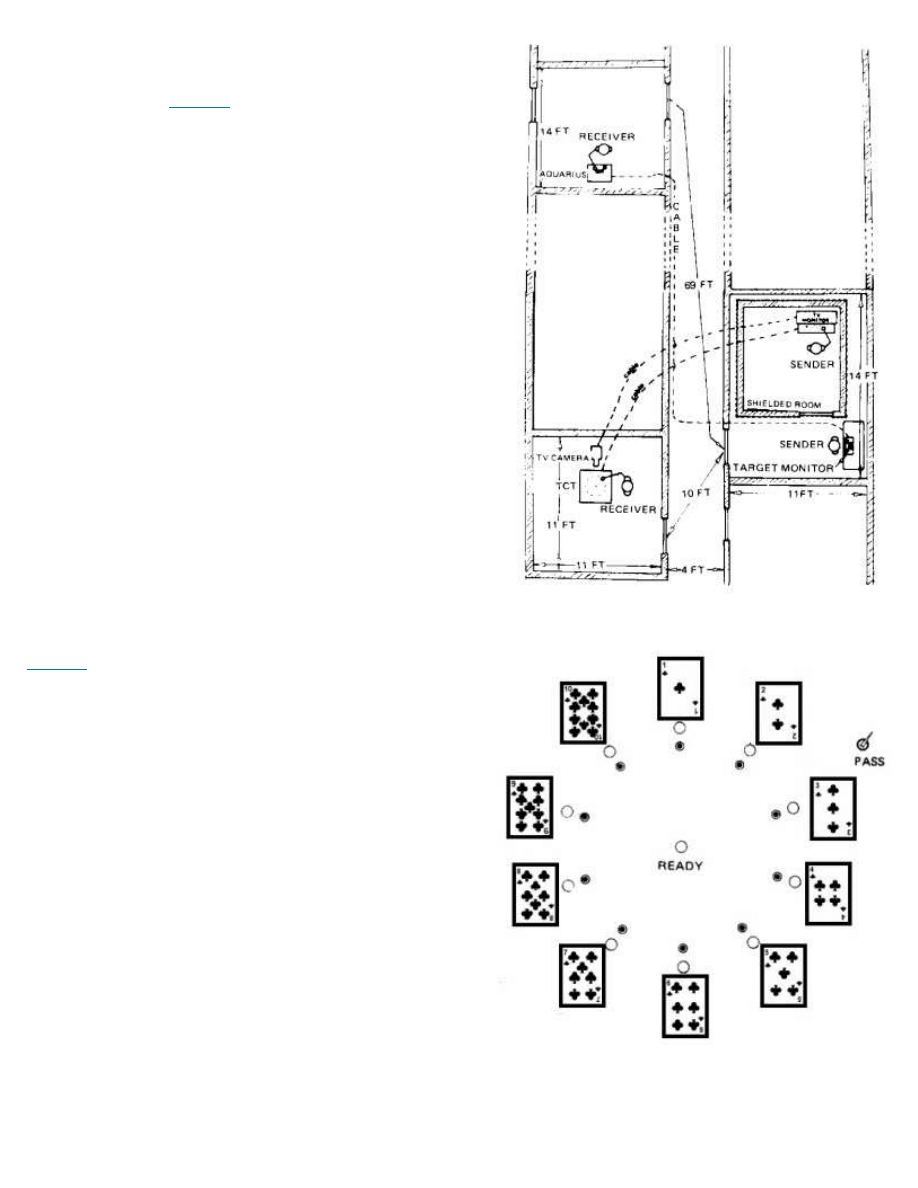
The TCT consists of a percipient's and experimenter's console.
The experimenter also acts as agent. The two consoles were
located in separate rooms: the laboratory arrangement is shown
in the lower part of
Figure 2
. The percipient was alone in his
laboratory room (shown in the lower left hand corner of the
figure) sitting in front of his console. A closed circuit TV camera
was focused on this console. The experimenter/sender was inside
a Faraday cage, constructed of thin copper sheets soldered
together over an otherwise ordinarily constructed room, which
was mounted on rubber tires for vibration isolation. This Faraday
cage was inside another room, across the hall from the
percipient's room. The shielding of the Faraday cage was not
intact, however, due to power and apparatus connecting cables,
so it should be considered as being functional only for some
sound attenuation.
.
.
.
.
.
.
.
Figure 3
shows the arrangement of the percipient's console.
There are ten unlit target lamps, arranged in a circle about 15
inches in diameter, with a miniature playing card glued beside
each lamp to numerically identify it. A response push button is
located beside each lamp. When the ready lamp in the center of
the console came on, this signaled the percipient that the
experimenter/sender had selected one of the ten lamps to be the
target in accordance with the output of an electronic random
number generator (RNG), and was trying to telepathically send
the target identity to him.
The percipient could respond quickly or take as much time as
he wished to make his decision. This time ranged from a few
seconds to several minutes. When the percipient decided on
which target he thought was the correct choice, he pushed the
response button beside it: electrical circuitry immediately
scored his response as hit or miss, recorded hit or miss data on
an electrical counter, and lighted the correct target lamp on the
percipient's console to give him immediate feedback on
whether he was right or wrong. When he was right a chime
also rang inside his console, as well as the correct target lamp coming on.
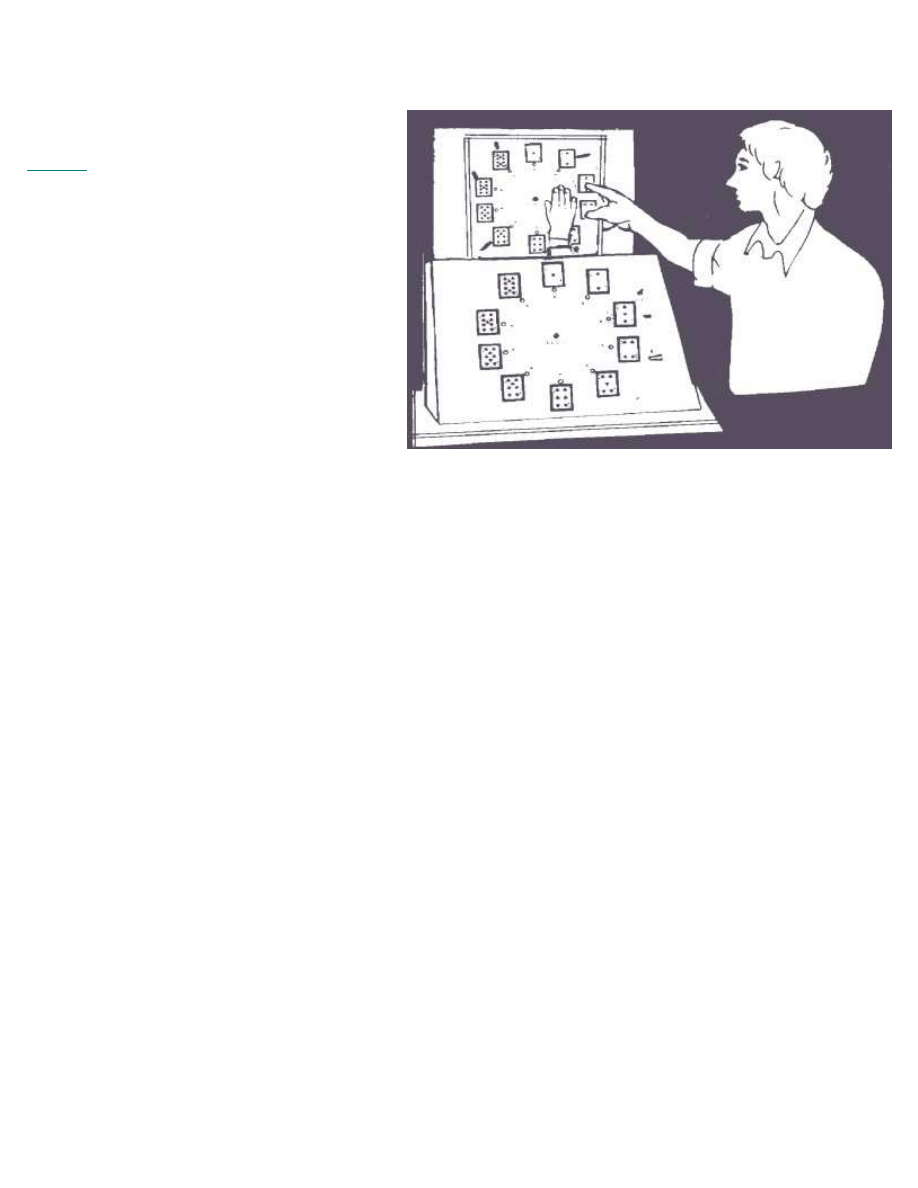
If a percipient thought he had no idea what the target was on a given trial, he could push the Pass switch, signaling to
the experimenter/sender that he did not wish to respond and wanted a new target. A pass was not counted as a trial, and
no feedback on correct target identity was given.
Percipients did not use the pass option very
frequently.
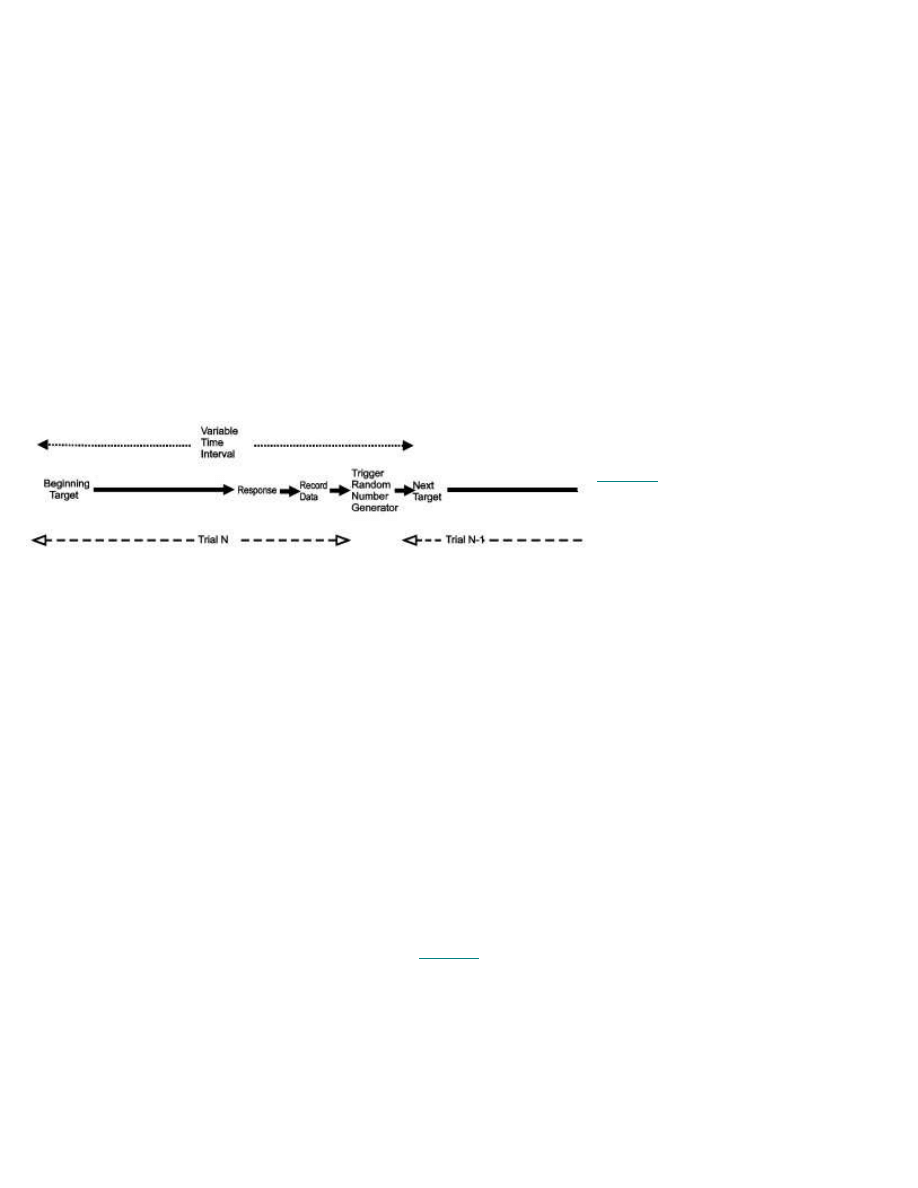
Figure 4
shows the experimenter/sender's console
with the TV monitor mounted above it. Except for
additional operating controls, this console is laid
out identically to the percipient's console. The TV
monitor is very important: in pilot work with the
TCT, my students and I found that many
percipients would slowly move their hand around
the circle of unlit target lamps, trying to get some
kind of "feel" as to when they were over the
correct lamp. The TCT was designed so that no
electrical or physical differences of any sort
existed on the front of the percipient's console, so
this was totally irrelevant behavior in terms of a
null hypothesis of no ESP, but psychologically it
was very relevant behavior because of the TV
feedback to the experimenter/sender. The experimenter/sender could not only send the abstract identity of the correct
target, but also such things as "warmer!", "colder!", or "stop, push it, this is it!". Although I have not attempted to
separately evaluate this factor, at a minimum it keeps the experimenter/ sender highly involved psychologically in the
experiment. It is my and my experimenters' impression that it is also quite effective at times, and we are going to try to
evaluate this factor objectively in later research. In terms of feedback training then, we were attempting to train the
team of percipient and experimenter/sender, as both were receiving feedback on how effective their performances were.
Electrical counters on the TCT automatically recorded the number of trials and the number of hits. Runs were
standardized at 25 trials each. If, as rarely happened, the pass option was used, the experimenter generally added
additional trials to bring the total up to 25. Occasionally he forgot to do this, so a run might consist of 24 or 23 trials.
On a few occasions an experimenter/sender ran a few more trials than 25, but, according to an a priori decision, no
more than the first 25 trials were ever counted in the analyses.
Random Number Generator
Target selection in the first Training Study was controlled by an electronic RNG. This generator was of the "electronic
roulette wheel" type. An oscillator or clock was producing more than a million output pulses per second. When the
experimenter/sender depressed a push button, this drove a one to ten counter over and over again. The length of time,
and so the number the generator ultimately selected, was controlled by how long the experimenter/sender held down
the push button. Since controllable human reaction time is, at its very best, measured in hundredths of and usually
tenths of a second, this was so much slower than the clock speed that the particular output selected was totally beyond
the experimenter's control, and so random.
As part of a pre-experimental plan, in the first Training Study we sampled 1000 numbers from the RNG before the
experiment and 1000 numbers after it, and tested them for randomicity, using a chi-square analysis for equal incidence
of individual targets and equal incidence of all 100 possible target doublets. The results were satisfactorily random. We
did not test for possible higher level sequential effects, such as triplets, as there is no theoretical reason to expect these
kinds of sequential effects of this style of random number generator. The small size of the sample used for testing
randomicity has been severely criticized by Rex Stanford (1977), on the grounds that there might be subtle departures
from randomicity that could aid percipients in scoring by some kind of mathematical inference. I have argued
elsewhere (Tart, 1977c; in press) that this was not likely, but since it is an important question with respect to the
precognition effects I shall be reporting. I shall return to the question of departures from randomicity in more detail a
little later.
In our second Training Study, done two years after the first Training Study, with an entirely new student percipient
population, we used a more sophisticated model of the TCT, ADEPT, designed and constructed by Dana Redington.
This was basically similar to the TCT except for the fact that the individual trial target and response data were generally
recorded automatically by teletypewriter, and the random number generator was internal to the machine, rather than
external. Randomicity was satisfactory in the planned pre- and post-experimental samples. With the TCT the individual
trial data were recorded by hand, although total hits and trials were recorded automatically. The teletypewriter
occasionally developed a malfunction in the second Training Study. It was always clear that the teletypewriter was
malfunctioning and individual trial target response data were then recorded by hand, but the bulk were automatically
recorded.
Psychological Focus on Real Time Targets
In the first Training Study, neither I, my experimenters, nor (to my knowledge) the percipients had any formal interest
in precognition. Our conception of the experiment was that we were trying to train real time ESP, whether it was
clairvoyance or telepathy. The same focus on real time hits existed for the second Training Study: although I
discovered significant precognitive effects in a retrospective analysis of the first Training Study data while we were
midway through the second Training Study, I deliberately refrained from saying anything about it to the experimenters
and percipients until the study was over,
in order not to shift this psychological
focus.
Figure 5
, showing the temporal
sequence of target generations, further
defines this focus. Given that a target
has already been generated and the TCT
or ADEPT activated (Ready light comes
on on the percipient's console) for trial N, the percipient would take a variable period of time, from a few seconds to
several minutes, to decide on what he thought the target was. Then he would push a response button, giving himself
immediate feedback as well as giving the experimenter/sender immediate feedback on what the percipient's response
had been. The experimenter/sender recorded the response on his record sheet in the first Training Study (the target had
already been noted), turned off the TCT, and then pushed a button on the RNG to select the next target. When a
selection had been made, in a second or so, he switched on the selected target lamp for trial N+1. The time sequence of
responses was basically the same for ADEPT in the second Training Study.
During the time the percipient was trying to use ESP to determine what the current, real time target was, the target for
the next trial had not yet come into existence, nor could it be inferred from any knowledge of current events, given the
nature of the RNG. All of the experimenter/sender's attention was focused on the real time target. Any significant
effects relating responses to future targets, then, would be attributable to precognition.
Scoring Responses
For evaluating the presence of ESP and its relation to the learning hypothesis, I was interested in real time hits, and all
initial scoring was done for such hits. The top third of
Figure 6
shows a sample of actual data from a run by one of the
percipients in the first Training Study, E1S5. The top row shows the 25 targets that were sequentially generated, the
second row the percipient's responses to each one. Real time hits are circled: there were 6 of them for this particular
run. This happened to be an individually significant run, as the one-tailed binomial probability of 6 or more hits in 25
trials is three in 100.

Figure 6
E1S5, Run #3
Targets
3 7
5
2
7
9
6 0 7 8 3 7 4 8
5
1
4
9 0
7
9 4 3 8 5
Responses
4 8
5
2
4
9
7 5 1 7 2 8 3 9
5
7
4
5 6
7
2 5 0 6 4
Register shift for +1 Temporal Displacement. Number of Trials = 24
Targets
3 7 5 2 7 9 6 0 7 8 3 7 4 8 5 1 4 9 0 7 9 4 3 8 5
Responses
4 8 5 2 4 9 7 5 1 7 2 8 3 9 5 7 4 5 6 7 2 5 0 6 4
Register shift for -1 Temporal Displacement. Number of Trials = 24
Targets
3 7 5 2 7 9 6 0 7 8 3 7 4 8 5 1 4 9 0 7 9 4 3 8 5
Responses
4 8 5 2 4 9 7 5 1 7 2 8 3 9 5 7 4 5 6 7 2 5 0 6 4
I mentioned earlier that while intellectually I accepted the reality of precognition, on a deeper level I did not believe in
it at all. Although I knew that it was common to look for immediate precognitive effects in parapsychological studies,
and while I had said that I was going to do it, I had not done it at the time the initial publication of results, the
Parapsychological Foundation monograph, The Application of Learning Theory to ESP Performance, (Tart, 1975a) was
on the verge of appearing. I do not honestly know whether I would have even gotten around to looking for
precognition, or simply kept myself busy with other work. About that time, however, a colleague from the Genetics
Department at UC Davis, Lila Gatlin, asked for copies of my raw data so she could try out various information
theoretic approaches on them. The analyses she carried out did not take into account real time factors in the data, such
as intervals between runs, but they did suggest that in addition to highly positive hitting on the real time target, there
was highly significant missing on the +1 precognitive target, so I was inspired to systematically analyze my data for
temporal displacement effects. This register displacement technique for scoring such effects is illustrated in the middle
and lower thirds of
Figure 6
.
ESP Missing in the First Training Study
The ten percipients who completed the first Training Study showed exceptionally significant results in terms of real
time hitting. For their total of 5000 trials,
[Note 4]
we would expect 500 hits by chance, but 722 were observed. The two-
tailed probability of such an occurrence, using the normal approximation to the binomial, is 2x10^-25. For the group as
a whole, this corresponded to an average of about 3.61 hits per run of 25, rather than the chance expected average of
2.50.
There is considerable individual variation in scoring, of course, with five of these 10 percipients apparently having their
overt manifestation of ESP suppressed under the change of psychological conditions of the Training Study, at least in
terms of real time hitting: their scores did not reach significance. The other five percipients all showed exceptionally
significant individual scoring. The least significant of these five averaged 3.90 hits per run, with an associated
probability of 4x10^-5, two-tailed, and the most significant percipient averaged 6.20 hits
In scoring for hits on the +1 future trial (after subtracting a few trials that were lost when an experimenter inadvertently
only gave 24 trials in a run, as well as the routine loss of one trial per run on the displacement analysis), there were
4790 trials where hits could have occurred. By chance we would expect approximately 479 hits. Only 318 occurred:
this has an associated, two-tailed probability of 8x10^-15. Thus some part of the percipients' minds were occasionally
using precognition to know what the +1 future target was and then affecting the conscious calling of the real time target
to be sure it was not what the +1 target would be. All other possible future displacements over the run (+2, +3, ....+24)
were checked, but were not of obvious significance, and so they will not be reported on further in this paper.
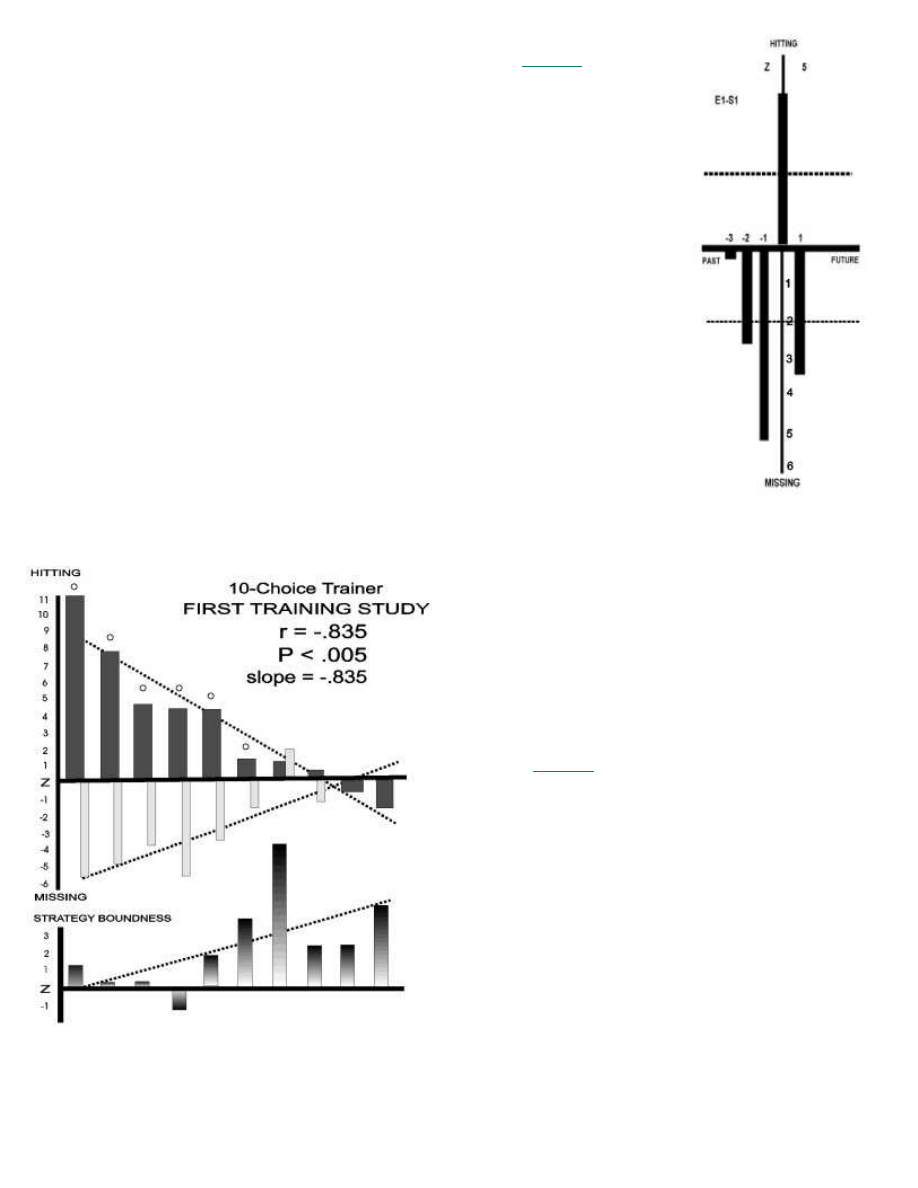
Past temporal displacements were also checked, and a rather regular pattern was found
for the -1 (immediately past) and -2 (two trials back) displacements.
Figure 7
is a bar
graph of this for one percipient, E1S1, whose pattern is representative of that of many
other percipients. This particular percipient made 78 real time hits, when 50 would be
expected by chance, with an associated probability of 4x10^-5, two-tailed. On the +1
future scoring, he made only 25 hits when 47 would be expected, another highly
significant, with a probability of 6x10^-4, two-tailed. For the -2 displacement he made
only 29 hits when 46 would be expected, significant avoidance of the -2 target. On the
-3 displacement he made 42 hits when 44 would be expected, a negligible departure
from chance. As I said, this is a typical pattern for the past displacements: significant
avoidance of the immediately past target, significant, but not as great avoidance of the
second past target, falling off to generally chance variations by about the third target
and further back. The mean CRs (Critical Ratios, Z-scores) for the -1, -2, and -3
displacements for the 10 percipients in the first Training Study are -4.93, -2.67, and
+.13.
At first glance this pattern seems to be in accordance with what we know about most
people's psychological guessing habits, namely that they underestimate the probability
of a target XX doublet, and so rarely call what the immediately past target has been.
This avoidance apparently carries over to a lesser extent for two trials past the target
and then is pretty much inoperative.
.
Real Time Hitting and Precognitive Missing
Although discovering such extremely strong precognitive
missing was important to me personally in making me
struggle with the concept of precognition, precognitive
missing per se is probably not an exciting finding to most of
you. What became more exciting as I examined the data was
the discovery that the precognitive avoidance of the +1 future
target was not an isolated event, haphazardly scattered
throughout the data, but was quite strongly and negatively
related to the degree of real time hitting shown by various
percipients.
Figure 8
plots the magnitude of real time hitting
and +1 missing (hitting in one case) for each individual
percipient. The vertical axis is the CR of the hitting or
missing. I deliberately ordered the real time hitting scores
from the highest on the left (a CR of 11.03) down to the
greatest degree of missing on the real time target to the right.
The consequent good ordering of +1 missing scores that then
results is an indication of the strength of the relationship
between these two measures. If hitting in real time and
missing on the +1 future target had nothing to do to each
other, these scores should be independent of each other. But
the correlation here is -.84, which has a two-tailed probability
of less than .005. A rank order correlation coefficient, which
makes fewer assumptions about the characteristics of the
numerical scaling, gives a correlation of -.89, a negligible change.
As a further check on the solidity of this relationship, I added in the data from three more percipients who had, in
accordance with a pre-data analysis decision, been excluded from formal data analyses because they did not complete
the first Training Study. These three percipients had 11, 10, and 6 runs respectively. One of them was scoring quite
significantly when he decided he could not take the time to continue the experiment (CR = 2,11), the others were near
chance expectation for real time hits. When their data was added in, the correlation changed from -.84 to -.82, a
negligible change.
The small squares beside each individual percipient's data in
Figure 8
indicate significant results from a t-test, applied
post hoc to each individual's data, comparing the hitting on the real time targets with the missing on the +1 future
targets applied over each percipient's 20 runs. Six of the 10 percipients show such significant differences, including one
percipient whose real time hitting was not individually significant. As I will comment later, I think this latter finding
suggests an interesting answer to the question of why did some of these carefully selected percipients apparently stop
showing ESP in the Training Study.
Replication of Effects in the Second Training Study
In terms of the magnitude of real time ESP shown, the
second Training Study, which will be reported on in a
future publication (Tart, Palmer, & Redington, submitted
for publication), was much less successful for the 10-
choice machine data than the first Training Study was. Our
second Selection Study and Confirmation Study procedure
(described fully in Palmer, Tart, & Redington, 1976)
simply did not give us individual percipients with as high
ESP scores as we had in the first Training Study. The
group of percipients who completed the first Training
Study had Confirmation Study scores ranging form 2.50-
6.00 hits per run of 25 (chance is 2.50), with a mean group
score of 4.78, while the corresponding range was 2.75-
4.50, with a group mean of 3.61 hits per run, for the
percipients who completed the second Training Study.
Using a t-test, the difference in ESP talent levels of the
percipients going into the two studies was significantly
different (P<.05, two-tailed).
Ideally, we should have run more students through our
Selection and Confirmation Study procedures until we
picked up enough highly talented percipients to make the
ESP talent level comparable to that of the first Training Study, but a lack of time, money, and manpower prohibited
this. Thus we used the percipients we had, but predicted, before the second Training Study, that our overall yield of
ESP would be smaller than it had been in the first Training Study. Regretfully, this prediction was confirmed! It is not,
of course, the most powerful prediction one could make, as it is a fairly general finding that second studies of a
problem do not give as strong results as the first studies.
Seven percipients completed the second Training Study. The overall group mean (2.61) did not differ significantly from
chance expectation, although two of the seven percipients showed individually significant results. One of them showed
individually significant real time hitting (average of 3.20 hits per run, P<.05, two-tailed), but the other showed
individually significant real time missing (average of 1.85 hits per run, P<.05, two-tailed), so they effectively canceled
each other out in the total.
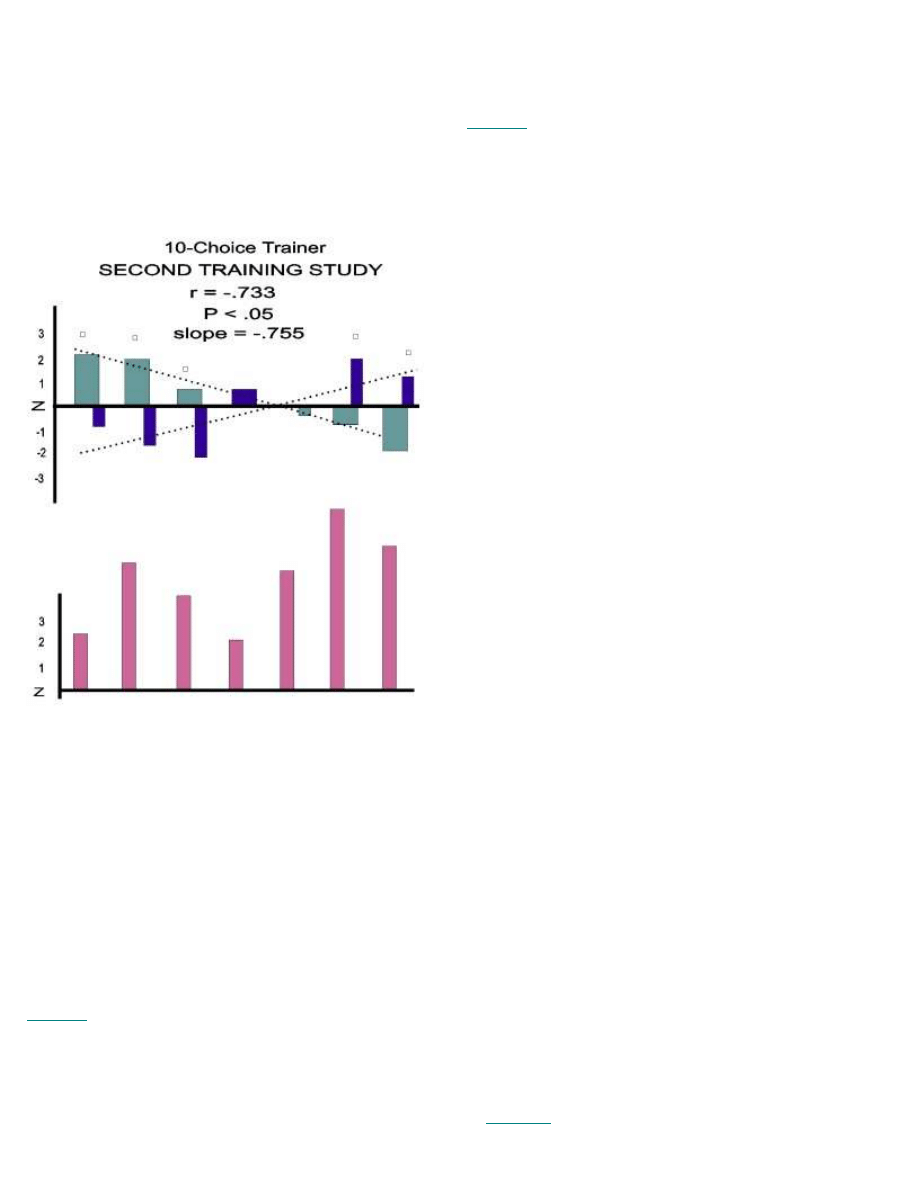
Figure 9
shows the individual percipient results for real time hitting and +1 precognitive scoring, plotted in the same
manner as Figure 8. The prediction I made on the basis of the first Training Study's finding, that there would be a
strong relationship between real time hitting and +1 missing, was confirmed. The correlation coefficient between
hitting in the two time registers was -.73, P<.05, one-tailed. The more conservative rank order correlation coefficient
was -.79, a slight increase. As predicted, five of the seven percipients showed individually significant t-test difference
between their real time scores and their +1 precognitive scores.
Figure 9
suggests that there might be some
curvilinearity in the relationship, but I tend to doubt that this is so, although it should be kept in mind for future studies.
The significant replication of the negative relationship between real time and +1 future scoring, even when the overall
yield of psi in the second Training Study was so much less than in the first Training Study, convinced me that the
relationship is both real and strong, strong enough to be of practical significance as well as statistical significance.
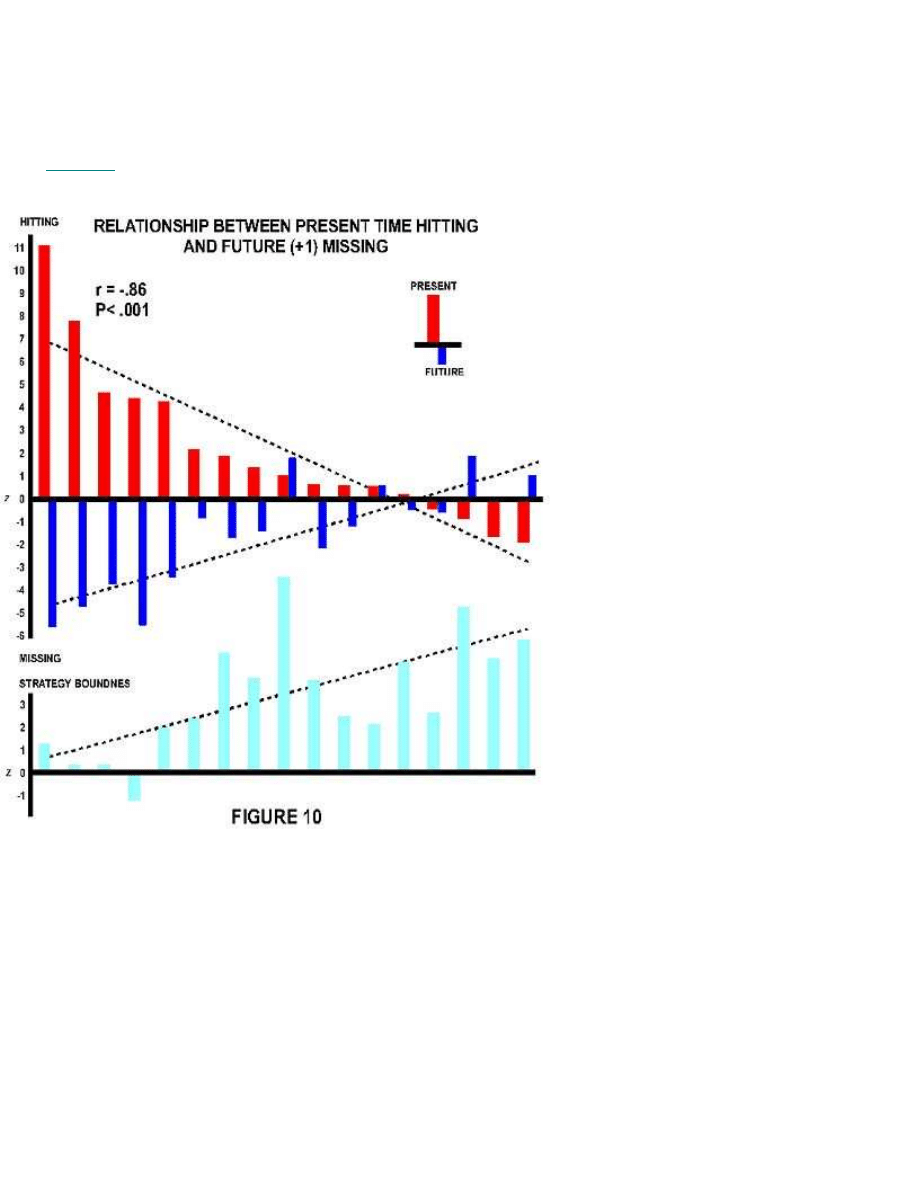
In terms of real time hits, the percipients from the second Training Study amounted to a sampling of the lower end of
the distribution sampled in the first Training Study, so I combined the results of these two Training Studies, as shown
in
Figure 10
. Here the strong negative relationship between real time hitting and +1 hitting stands out very clearly. The
correlation is -.85, P<.001, two-tailed. The more conservative rank order correlation is also -.85. The highly successful
ESP percipients strongly suppressed hitting
on the immediately future target, while the
ones who, perhaps because of the increased
psychological pressure of the Training Study,
tended to switch toward ESP missing on real
time targets, an incorrect focusing of their
ESP, showed a suggestive tendency to switch
to hitting on the immediate future target. This
switching toward hitting on the immediate
future target is quite interesting, and I shall
comment on it later.
A significant negative relationship between
real time hitting and +1 precognitive hitting
has not, to my knowledge, previously been
reported in the literature. This may be due, at
least partially, to the fact that it has not been
looked for: insofar as this is true, I hope that
those of you with relevant data will examine
it for this sort of relationship. I suspect that it
may also be unreported because of a
procedural difference in my two Training
Studies from most parapsychological studies,
namely that in my studies there was a
sequential generation of targets "on line."
That is, no future target came into existence
until a call had been made on the present
target. In most parapsychological studies of
precognition, especially those using shuffled
decks of cards for targets, the entire sequence
of future targets is generated simultaneously
during the shuffling procedure, rather than
being generated one by one.
Control Procedures
When I first discovered this relationship, and in the almost two years I have worked with it, I have been nagged by the
question of whether the relationship might have been artifactually generated by some sort of peculiar non-randomicity
in the target sequences, or some other sort of statistical artifact. Given the novelty of this relationship and its potential
importance, I think it appropriate to be concerned with any possible artifacts here, so I shall take a few minutes to
describe the kinds of control analyses I have carried out that have satisfied me that the relationship is not artifactual.
I mentioned earlier that I made an a priori decision to test the randomicity of the electronic RNGs used with the TCT
and with ADEPT before and after each Training Study, but not during it. This was because numerous studies (Andre,
1972; Braud et al., 1976; Honorton & Barksdale, 1972; Matas & Pantas, 1971; Miller & Broughton, 1976; Schmidt,
1970; 1973; 1975; 1976; Schmidt & Pantas, 1972; Stanford & Fox, 1975; Stanford et al., 1975) have shown that human

agents can influence the output of electronic RNGs simply by wishing for some output to come up more frequently.
While I conceived of these Training Studies as training ESP, and wanted the percipients to use ESP, their task, both as
defined to them and in terms of what they were rewarded for, was to push a button that corresponded to the current
time target. While utilizing some kind of ESP is the obvious way to do this, unconsciously utilizing some kind of PK to
influence the electronic RNG to match the percipient's response preferences would also produce hits. Thus I anticipated
that there might be unusual numerical patterns appearing in the target data collected, and so made the decision to check
the RNG for satisfactory operation before and after each study, but not during the studies. I do believe there was some
PK influence on the RNG in the first Training Study, although I have not yet devised a satisfactory way of separating
this from ESP effects, which I believe were predominant.
As I began to carry out analyses of various internal effects in the data, it became important to conduct classical
randomicity tests on the target sequences actually used in order to allow for any effects resulting from possible lack of
randomicity. In examining the data of the first Training Study, I found that two of the high scoring percipients had
statistically significant departures from randomicity at the singlet and doublet levels in their target sequences, using
chi-square at the singlet and generalized serial test (Davis & Akers, 1974) at the doublet levels.
[Note 5]
The magnitude of
these departures from randomicity seemed to be rather small in comparison with the magnitude of the ESP effects, but,
to be on the safe side, I recalculated the relationship between real time hitting and +1 future hitting after deleting the
data of these two percipients. This changes the correlation coefficient from -.84 to -.81. The change is negligible, and
the latter figure is still significant at the .02 level, two-tailed.
In testing the target sequences of the seven percipients of the second Training Study by chi-square tests, one
percipient's target showed significant departure from randomicity, although he was a percipient whose real time hitting
score was at chance. Conservatively deleting his data from those of the other seven percipients in the second Training
Study, the correlation changes from -.73 to -.74, a negligible change, and the latter correlation is still independently
significant (P<.05, one-tailed). If the data of all three of the percipients are deleted from the combined correlation
across the two studies, the correlation negligibly changes from -.84 to -.82.
The next control analysis resulted from detecting a systematic kind of non-randomicity in almost all of the target
sequences of the first Training Study, namely a great lack of XX doublets. That is, there were not enough one ones, two
twos, etc. in the target sequences: there were only 193, when there should have been 500.
This is a striking discrepancy, and one which is of practical significance, for these particular XX doublets are not
simply any target doublet but, given common human qualities, ones which are psychologically significant to people.
My first question was how could this have happened? There was no such problem in the formal randomicity testing
sequences before and after the study.
Through using the electronic RNG used in the first Training Study and questioning one of the experimenters, I think I
now understand the lack of XX doublets. In order to select a new target on the RNG, a push button on its panel was
depressed, held down for a second or two, and let up. This push button was not of the type that made a tactically
discernible click when it was depressed, but simply one that got harder to push as you pushed it further in. Thus it was
not sensorily obvious if you had indeed pushed the button in far enough to activate the generator. What apparently
happened is that an experimenter would sometimes push and release the button to get the next target, look at the RNG
and see that the same number was still in the readout, and so assume that he had not pushed the button in sufficiently to
activate the generator. So he would push it again to get a new target. This would lead to a systematic depletion of XX
doublets.
[Note 6]
How serious is this effect? Since it is generally known that people tend to avoid calling the previous target, whose
identity they know through feedback, due to their fallacious belief that XX doublets are rare in a true random number
generator, we now have an interesting case where XX doublets were actually rare from this particular generator, so
their habit of not calling XX doublets should increase their scores. Indeed, it will, but a simple approximation shows
that the effect is quite small. Assume the worse case, where we have no XX doublets at all. This means that there are
only nine alternative targets on each trial (barring the very first trial of each run), and so the probability of a hit on any
trial is one-ninth rather than one-tenth. For the experiment as a whole, then, with 5000 trials we would expect 556 real
time hits by chance rather than 500 hits.

There were 722 hits, and, with the one-ninth hit probability figure put in, this yields a CR of 7.49. The probability of
such a result by chance is less than 10^-13, two-tailed. Applying the same correction in a somewhat more sophisticated
fashion (allowing for passes and occasional missing data due to ambiguous handwriting, as well as a systematic
depletion of end trials) to +1 hits, we expect 454 +1 hits by chance alone, but there were only 301, yielding a CR of
7.62, with an associated probability of less than 10^-13, two-tailed. Even generously allowing for lack of XX doublets
then, we still have exceptionally significant real time hitting and exceptionally significant +1 precognitive missing.
I have not been able to figure out any kind of way in which the lack of XX doublets per se would create a correlation
between real time hitting and +1 missing. As an empirical control, there was no lack of XX doublets in the second
Training Study target sequences, yet the relationship is there just about as strongly as in the first Training Study, so I do
not believe the lack of XX doublets in the first Training Study is of any real relevance to the relationship reported here.
Third, the possibility has been suggested that there are higher order biases or sequential dependencies between the
targets in my first Training Study data (Gatlin, in press; Stanford, 1977). This has led Gatlin to hypothesize, if I
understand her correctly, that percipients, by keeping track of previous targets through the immediate feedback, may
have gradually estimated what these biases were and then used them as a basis for a (non-conscious) strategy of
mathematical inference that would increase their scores above chance expectation, in addition to, or perhaps without
even any need to invoke ESP. I am not convinced there are any significant sequential dependencies of the third order
and higher that are of any consequence, but I felt that this kind of hypothesis needed to be tested, not only in terms of
its importance to the data of the first Training Study that was already in, but because many studies are now employing
immediate feedback, so this is a question of general interest.
The hypothesis of scoring high by mathematical inference as a result of figuring out target biases needs to be cast in a
specific and testable form to be viable, and mathematical inference is the sort of thing that allows precise expression. A
colleague in the Computer Sciences Department of the University of California at Berkeley, Eugene Dronek, and I have
now completed what we believe is a very powerful test of this hypothesis, and we shall be preparing the results for
publication in the near future. We set ourselves the task of devising a computer-assisted inferential calling strategy that
would have enormously more power than what we could reasonably attribute to human percipients. We gave our
program powers such as an absolutely perfect memory for all previous targets to date, all previous target doublets, etc.,
up to all previous target sextuplets, as well as perfectly accurate and well nigh instantaneous (in terms of human time)
computing capacity to assess possible biases. To get an overview of what the program does, assume that the 101st trial
is coming up. To make its call, our inference program looks at all hundred previous targets which have come up on
previous trials. It has already sorted them into a singlet file, a doublet file, and so on through a sextuplet file. It looks at
the singlet file, asks what has been the most frequent singlet to date, and, given 100 trials, what is the exact binomial
probability that a singlet should have come up with such an observed frequency compared to the null hypothesis that all
singlets have an equal probability of one-tenth? This binomial probability is computed and stored. The program then
asks if there is relevant information in its doublet file: that is, say the 100th target was a 7. Does the doublet file have
any information on what 7s have been followed by in the previous 100 trials? If not, it will guess on the basis of the
most improbable (compared to the null hypothesis) target to date in the singlet file, but if the doublet file does have
relevant information, it will again compute the exact binomial probability of that many or more doublets having
occurred in the 100 trials to date, compared to the null hypothesis of equal probability for all possible doublets. This
binomial probability will then be compared to the binomial probability of the highest singlet to date: if the highest
doublet to date is less probable, i.e., represents more of a departure from the model of sequential independence than the
highest singlet to date, the program will use that doublet information as the basis of its guessing strategy. Similarly if
there is a relevant triplet, quadruplet, quintuplet, or sextuplet, the most radical departure from the model of equal
probability and sequential independence will be used as a basis for the guessing strategy. On the 102nd trial, all
computations will be re-done because there is now a data base of 101 trials instead of 100, etc., so the program
constantly updates itself in order to get the maximum information from all the material to date. Because of this
updating, it is quite sensitive to locally shifting biases, as well as general biases.
Figure 11
is a comparison of what our inferential strategy program, with all of its advantages, can do on the target
sequences, compared to the scores of the actual percipients of the first Training Study. As you can see, the inferential
strategy program manages to reach statistical significance on only two of the ten target sequences, and it is generally
scoring well below the actual percipients' scores. In two cases of percipients who did not show individually significant
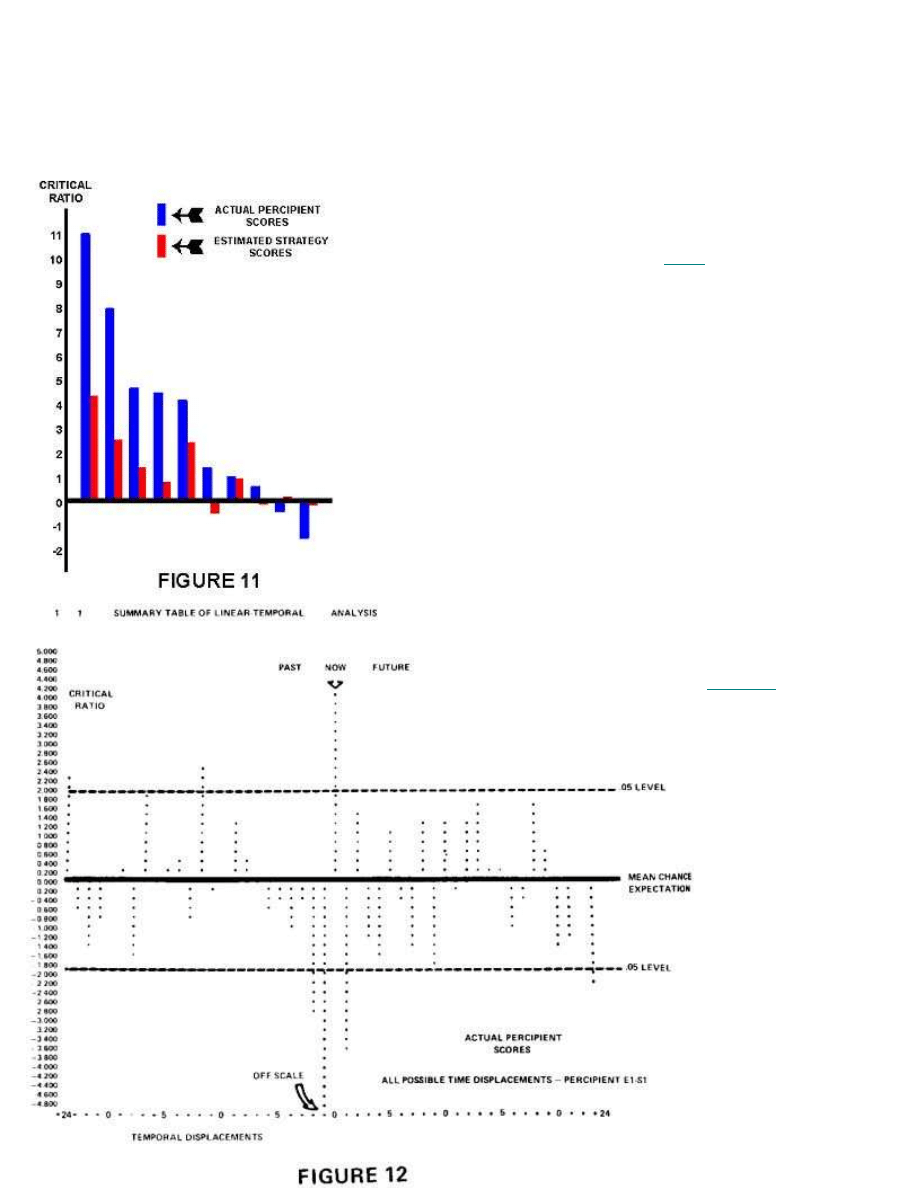
ESP scores, the inferential strategy program did better, although it did not reach statistical significance. In general, the
inferential strategy program can only get about 30% as many hits above mean chance expectation as the actual
percipients achieved. Further, the strategy program shows patterns in its calling output that do not look anything like
those used by the actual percipients. I doubt very much that the percipients were doing much of the kind of estimation
that the calling program was. Thus, given this very powerful test of how much biases can be capitalized on, the bulk of
the data is still attributable to ESP.
Our main concern in this kind of control, given our focus this evening,
however, is might some kind of deliberate estimation strategy create the
relationship found between real time hitting and +1 precognitive missing?
The answer is no. I had the inferential strategy program's calls. working
with a memory span up to the triplet level,
[Note 7]
punched on IBM cards
in the same format as the percipients' calls. The resulting correlations do
not look at all like those obtained with the actual percipients. The
relationship between real time hitting and +1 hitting for the inferential
strategy program, for example, is highly positive, rather than negative.
Indeed, there are extremely significant positive correlations across almost
all temporal displacement register scorings, because the estimator
program is constantly adjusting itself to fit the characteristics of the target
distribution to date.
.
.
.
.
To give you an example
of the flavor of this,
Figure 12
shows a
computer printed graph
of the temporal
displacement scoring
over all possible registers
(-24 to +24) for one of
the significantly scoring
percipients (E1S1) of the
first Training Study.
Notice the crowding of
effects around the origin
(real time), the strong
negative scores on +1, -
1, and -2 registers, and
the approximately equal
number of positive and
negative CRs computed.
.
.
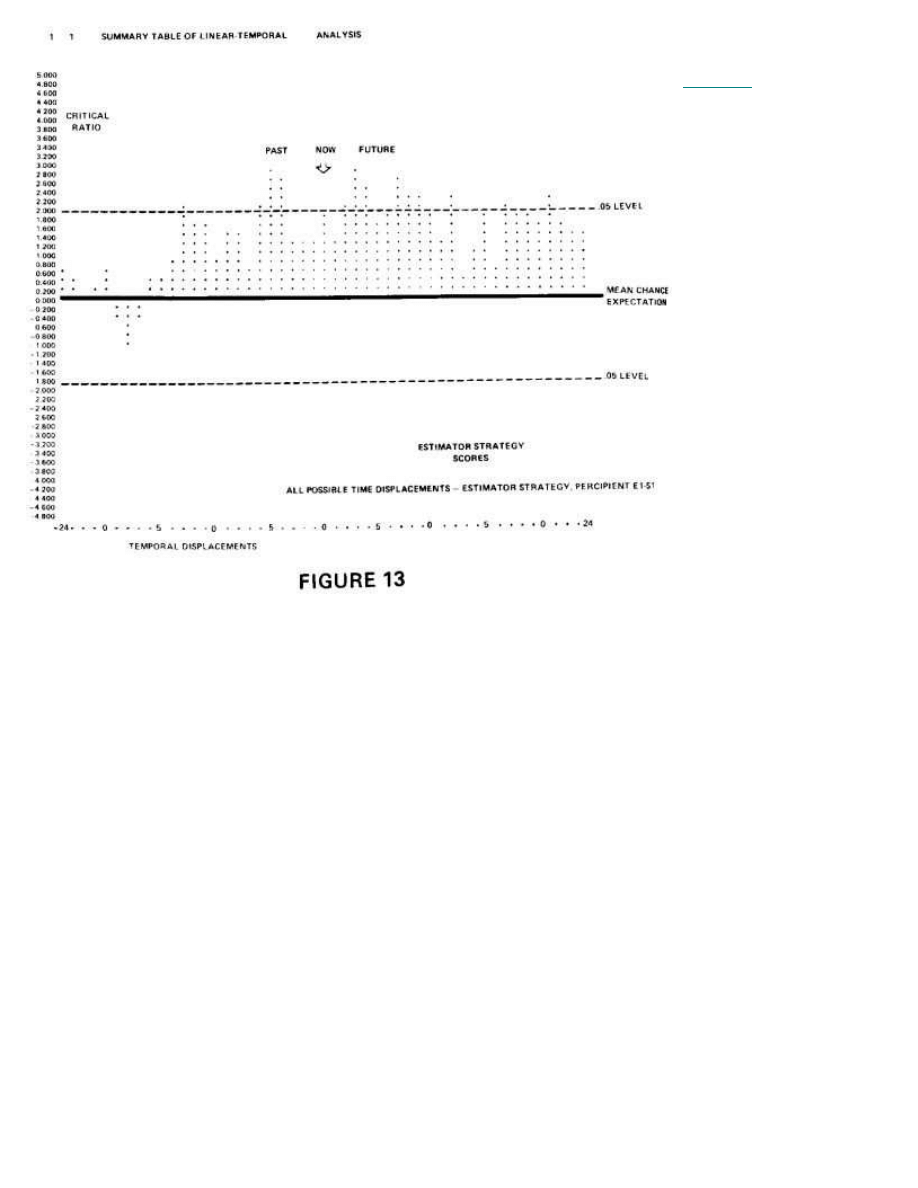
Figure 13
shows the same
kind of analysis done on the
inferential strategy output
for the target sequence of
the same percipient. Notice
the massive block of
positive displacements in
the past direction, and the
tremendous preponderance
of positive correlations in
the future direction. Clearly,
whatever percipients are
doing does not look at all
like a powerful estimation
strategy.
Let me make it clear that
Dronek and I are not
claiming that we have
devised the most powerful
inferential strategy for
taking advantage of possible
biases that might exist in
target sequences: we are
claiming that we have
devised a very powerful
one. We would like our inferential strategy to stand as a challenge to other investigators to see if they can devise a more
powerful strategy, actually model it, and demonstrate empirically that it is more powerful. Given our results to date,
however, I am convinced that the strong relationship between real time hitting that +1 missing found in my Training
Studies is not due to any kind of statistical artifact.
We have a novel finding: what might it mean? I shall now present a theory I have devised to explain this phenomenon,
which will bring us back to concepts of space, time, and the mind. I should note that I am deeply indebted to Enoch
Callaway, a colleague at the Langley Porter Neuropsychiatric Institute, who, after seeing a preliminary analysis of this
data, suggested that the effects resembled a neural inhibitory surround, and started the train of thought in me that led to
the following theory.
The Duration of the Present
There are two general senses in which the concept of the "now" or the "present" is used. One refers to our immediate
psychological experience: there is a certain small duration of time that I think of and experience as the present. There is
also the mathematical concept of the present, namely a temporal point of zero width, zero duration, sandwiched
between past and future. The mathematical concept is a useful abstraction for a large variety of applications, but is a
poor representation of the psychological present: we simply don't experience our present as having no duration!
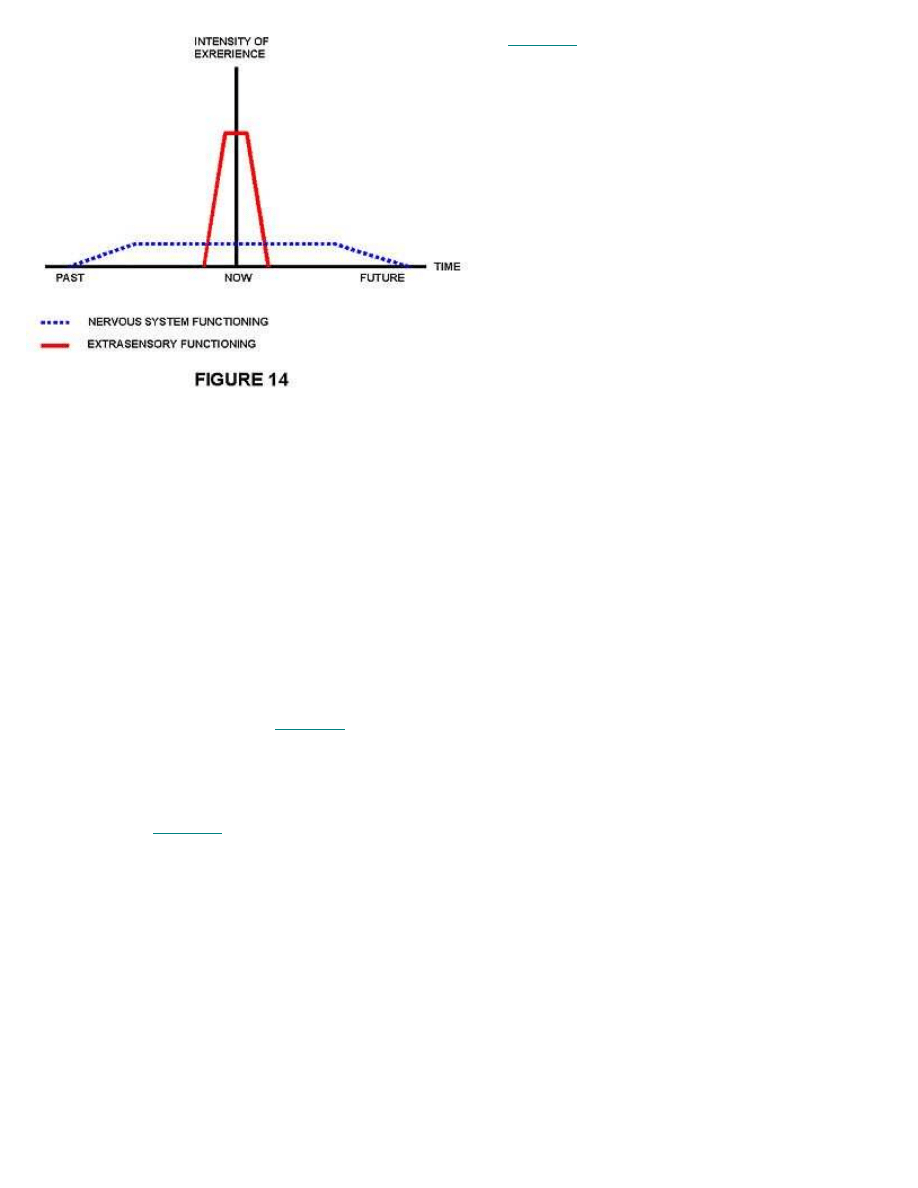
In
Figure 14
I have sketched a model of the
experienced present. The vertical axis represents the
intensity of experience, the horizontal axis is time in a
conventional sense, with the now at the center of it.
The heavy lines show a band width for the experienced
present, probably on the order of one-or two-tenths of a
second. That is where all of our ordinary experience is
concentrated, and it is obviously intense: we perceive
it. The band width of this experienced present is
slightly variable: meditative techniques or other
psychological changes can sometimes make the present
seem shorter or more fleeting, or bigger and wider.
For those of you who are familiar with electrical filters,
the experienced present is like a high gain, narrow band
width filter. The experienced present is its pass band.
Everything within that narrow pass band comes
through very strongly, but as soon as signals fall
outside that pass band they come through very weakly
or not at all. The one- or two-tenths of a second band width of the experienced present is probably a function of the
neural circuitry that underlies immediate memory: sensory input and other kinds of psychological processes are, in a
sense, literally held or stretched out for one- or two-tenths of a second. Dynamically, we could picture this pass band of
the experienced present as ordinarily moving along horizontally from past to future on our physical concept of time.
Whether experience within this pass band of the experienced present is actually continuous, or consists of discrete
frames, with awareness of the frame intervals suppressed, is an interesting question we shall leave for the future.
There is an older psychological term for the experienced present, the "specious present," a term which I shall not use, as
it implies a theoretical commitment to the mathematical abstraction of the present as having no duration, as being more
real than what we experience! Keep in mind that the mathematical concept of time is an abstraction, even if extremely
useful, and we should not casually deny our own experience in favor of abstractions.
Precognition and the Experienced Present
The model of the theory shown in
Figure 14
postulates that there is some other temporal dimension of mental
functioning, an extended temporal dimension different from our ordinary one. We may talk about time "flowing at a
different rate" compared to ordinary time, or some such analogy, but the important property of some aspect of the mind
existing in an extended dimension of time is that the experienced present of that part of the mind has, compared to
ordinary time, a greater duration for its now, a wider pass band than our ordinarily experienced present. This wider pass
band is shown in
Figure 14
by the light, dotted line. I have no idea what the exact shape or duration of the pass band of
this second temporal dimension of the mind is, so I have simply shown it tapering off at some temporal distance in the
past and future, without attempting to represent anything exactly.
I am proposing that this extended aspect of the mind, which is activated on those occasions when psi abilities are used,
has two properties different from our ordinary consciousness. Our ordinary consciousness seems both spatially and
temporally localized with respect to ordinary spatial and temporal constraints on physical brain and nervous system
processes. It operates in what we call "real time." The first property of this extended dimension of the mind is that it is
not so spatially localized as the ordinary one, and so somehow can pick up information at spatial locations outside the
sensory range of the body/brain/nervous system. The second property of this extended dimension of the mind is that the
center point of its experienced present can be located at a different temporal location than the center point of the
experienced present of ordinary consciousness. That is, it may be centered around a time that, by ordinary standards, is
past or future, although it is probably usually centered on the same temporal location as ordinary consciousness.
Further, the size of this extended dimension of the mind's experienced present, its pass band, is wider than the pass
band of our ordinarily experienced present. Even if the experienced present of this extended dimension of the mind is
centered on the ordinary present, what is now in this extended dimension of the mind may include portions of time that,
from our ordinary point of view, are past and future, as well as present. Similarly in a spatial way, what is here to this
extended dimension of the mind may include aspects of physical reality that are there or elsewhere to our ordinary
consciousness.
Since our ordinary consciousness is ordinarily fully identified with and preoccupied with body/brain/nervous system
functioning, very little basic awareness, if any, is left over to be aware of activity in this extended dimension of the
mind. Thus its experienced intensity is ordinarily quite low, usually below conscious threshold, and so it is accordingly
drawn as quite low in
Figure 14
. To put this more precisely, in my systems approach to consciousness (Tart, 1974;
1975b; 1975c; 1976b; 1977d; 1977e), I postulate basic awareness as something different from consciousness:
consciousness is a combination of the more basic awareness we have with the properties of the physical
brain/body/nervous system. It is a gestalt, an interactive creation. Because awareness is ordinarily fully identified with,
influenced by and influencing body/brain/nervous system processes, we commonly, but mistakenly, equate the two. In
the theory I am presenting here tonight, basic awareness can sometimes be withdrawn from its total identification with
ordinary body/brain/nervous system processes and then takes in the activity of this extended dimension of the mind.
When a percipient is asked to us ESP, his first task is to disregard incoming sensory input: after all, we set up
conditions so that no sensory input that reaches the percipient contains any relevant information about the ESP target.
Second, he must disregard or inhibit his ongoing fantasies and any guessing strategies he has that attempt to figure out
the RNG, since we design random number generators to be equiprobable and sequentially independent.
[Note 8]
Third, he
must try to contact or tune in to that aspect of his mind which exists in or is capable of existing in and using this
extended spatial and temporal dimension of the mind.
Considering the temporal aspects of ESP, we have a problem: if the percipient's desire is to obtain real time, concurrent
information by ESP (the state of the apparatus or the mental processes of the experimenter/sender in another laboratory
room), then simply tapping into the wider experiential present of this extended dimension of the mind is not sufficient.
This wider experiential present includes information about past and future events, as well as present events. since the
percipient desires to get present time information, this past and future information is noise, which may interfere with
the detection of the desired target.
Recall now that the primary psychological set of the experimenters and percipients in my Training Studies was on
getting the real time target information via ESP. Occasionally experimenters or percipients might have had a temporary
interest in precognitive events, but while I cannot assess this precisely, the constant focus on real time targets in our
strategy sessions and the like definitely made the real
time target focus of most attention. By focusing on the
real time target, this implicitly defined the temporal
boundaries of that real time information as the
immediately past (-1) target and the immediately future
(+1) target. What the percipient wanted was now, not
past or future. Spatially, the experimenters' and
percipients' attention was fixed on a particular location
for the desired target information, namely the
experimental apparatus and/or the
experimenter/sender's mind. The target information
was not sensorially here to the percipient, but at a
specific there, out of many possible elsewheres.
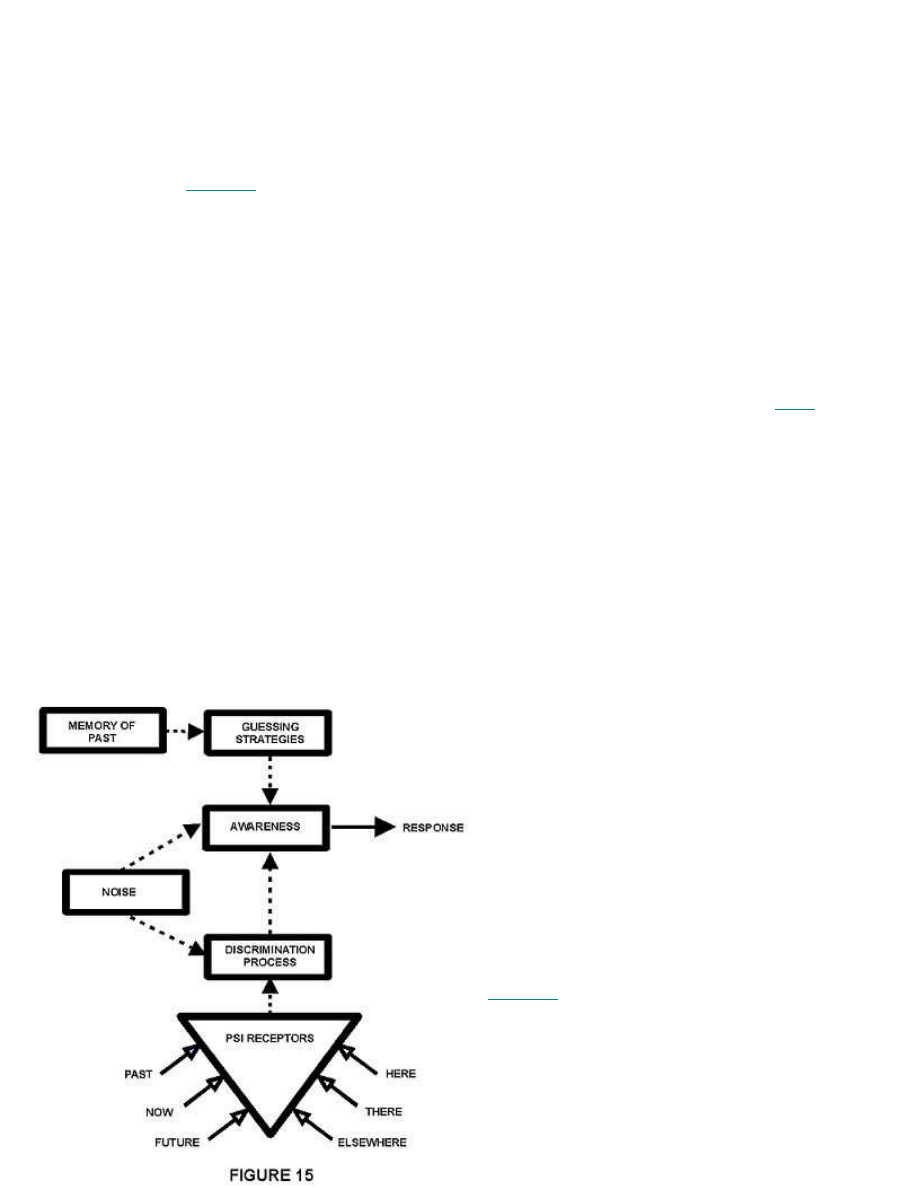
Figure 15
models the psychological processes a
percipient must carry out, consciously or
unconsciously, in order to use ESP successfully for
getting real time information. His basic awareness or
consciousness is receiving a variety of irrelevant
sensory information and irrelevant internal process
information that must be ignored or inhibited. A
particularly important source of irrelevant information

here is his memory of what recent past targets have been, combined with that common human tendency to try to
outguess the random number generator, leading to a guessing strategy. Note that I want to carefully distinguish here
call strategies, which produce the final response, and guessing strategies, which are only a subset of call strategies. A
guessing strategy is, by definition, irrelevant with a random target source, but the call strategies may include
psychological processes which are relevant. Some of those kinds of calling strategies will be discussed in my paper on
the expanded learning theory model of tomorrow (Tart, 1977a).
In addition to disregarding irrelevant information then, he must, at least occasionally tap into that extended dimension
of the mind that can use ESP, but since that aspect of the mind is getting, as an integral part of its experienced present,
information about past and future (and possible targets that are spatially elsewhere, as well as the desired ones) as well
as real time, present information, he must further carry out some kind of discrimination process. This discrimination
process must clearly identify the past, present, and future aspects of the ESP information being gathered, and then
actively suppress the past and future aspects of the ESP information in order to enhance the detectability of the desired
real time ESP information. That is, a kind of contrast sharpening must be employed.
The output of the discrimination process then, consists of a mixture of information, some of it designed to positively
influence the percipient to call the identity of the present time target, and some of it consisting of negative, inhibitory
tendencies to not call the target numbers belonging to the immediately past targets. This combination of tendencies
probabilistically increases the chances of a correct call. These nonconscious Psi Receptor and discrimination processes
obviously work intermittently and imperfectly, although they might be capable of much better functioning, are
influenced by factors we cannot yet specify, and are probably affected by both systematic and random noise. Perhaps
the positive and inhibiting components of this process work semi-independently. Systematic and random noise may
occur at all stages of this discrimination and calling process.
In spatial terms, the discrimination process must further identify targets that are at the correct location there, and
discriminate them from target identity information that is here to ordinary consciousness, i.e., irrelevant information in
the percipient's sensory environment, and elsewhere, target identity information from the wrong targets than the desired
ones.
Trans-Temporal Inhibition
What I am postulating, then, is an active inhibition of precognitively and postcognitively acquired information about
the immediately future and the immediately past targets, which serves to enhance the detectability of ESP information
with respect to the desired real time target. As the inhibition extends over time, I have named this phenomenon
transtemporal inhibition.
Except for the unusual (in terms of our ordinary concepts) feature of extending over time rather than space, trans-
temporal inhibition is like a widely used information processing strategy in our nervous systems called lateral inhibition
(Von Bekesy, 1967). This is a general phenomenon, found in all sensory systems, whereby a highly stimulated neuron
sends out inhibitory impulses to neurons and receptor endings which are laterally/spatially adjacent to it, thus
suppressing their initially weaker output unless they are also strongly stimulated. Lateral inhibition is illustrated for
touch receptors in the skin in Figure 16.
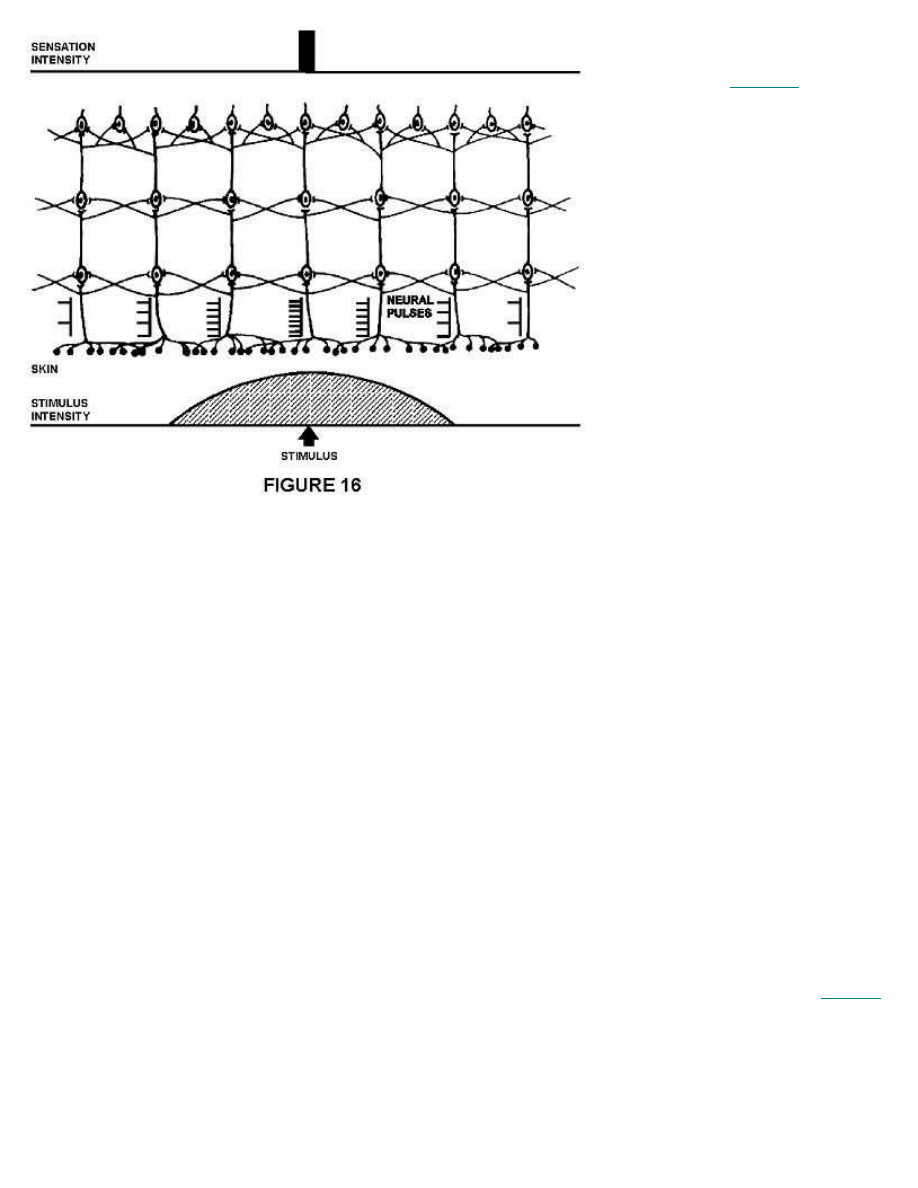
If you press on your skin with a sharply
pointed object, say under the middle
receptor shown in
Figure 16
, not only is
the touch receptor immediately under
that point strongly stimulated but,
because of the mechanical deformation
of the skin also shown in the figure,
receptors laterally adjacent to the
stimulation point are also stimulated,
although not as intensely. The neural
impulses from the receptors at this first
stage of detection, then, would show
rapid firing (the neural code for high
intensity) immediately under the
stimulated point, but also fairly rapid
firing on each side of it, gradually
tapering off with distance, so that you
have a neural signal pattern suggesting
that you were stimulated by a blunt,
rounded object, rather than by a point.
The stimulated receptor under the point,
however, sends out lateral inhibitory
impulses which suppress the weaker,
less frequent impulse trains from the laterally adjacent receptors, so by the time you are several steps up in the neural
chain, you have recovered a pattern indicating point stimulation. In engineering, this kind of contrast enhancement
effect is referred to as edge detection: it was used on the signals transmitted back from the Viking landers on Mars, for
example, to produce crisp, clear pictures, even though the actual signal received was rather noisy. The phenomenon of
trans-temporal inhibition, then, suggests that a generally useful information processing procedure also operates for
ESP.
Although I have not yet fully worked out the implications, I suspect that we will find a similar phenomenon for the
spatial dimensions of targets. This is, when ESP works well detecting a spatially distant target that is surrounded by
other targets, there will be an increased missing or inhibition on the immediately surrounding targets. Such a
phenomenon could be called trans-spatial inhibition. As well be discussed later, possible widening of the band width of
the extended dimension of mind needs also to be taken into account in empirically looking for this.
All right. We started with an unexpected finding of extremely significant precognitive missing, missing which was
highly correlated with real time ESP hitting. The relationship was solidly confirmed in a second study. This
relationship, plus the inspiration of Enoch Callaway's remark about neural inhibitory surrounds, plus my personal
struggle to think about precognition in spite of my prejudices, led to a theory about an extended dimension of the mind
and the consequent necessity of trans-temporal inhibition in order for ESP to work effectively. A good theory should
make more and more sense out of the data. Let's look at some applications of the theory to the data from my two
Training Studies.
Strategy Boundness
In showing the +1 displacement, real time hits, and -1 past displacements score patterns of percipient E1S1 in
Figure 7
,
I indicated that the highly significant degree of missing on the immediately past target seemed to be caused, at first
glance, by maladaptive guessing habits on the percipient's part, namely a mechanical avoidance of calling whatever the
previous target had been. Ideally, the RNG is so constructed that there are no sequential dependencies between targets,
so this strategy, while common among people, is maladaptive. Even considering the experimenter error which led to a
deficiency of target doublets in the First Training Study, mindless and automatic avoidance of the immediately past
target is a poor strategy for using ESP: there are some XX doublets, and ESP could allow hits on them.
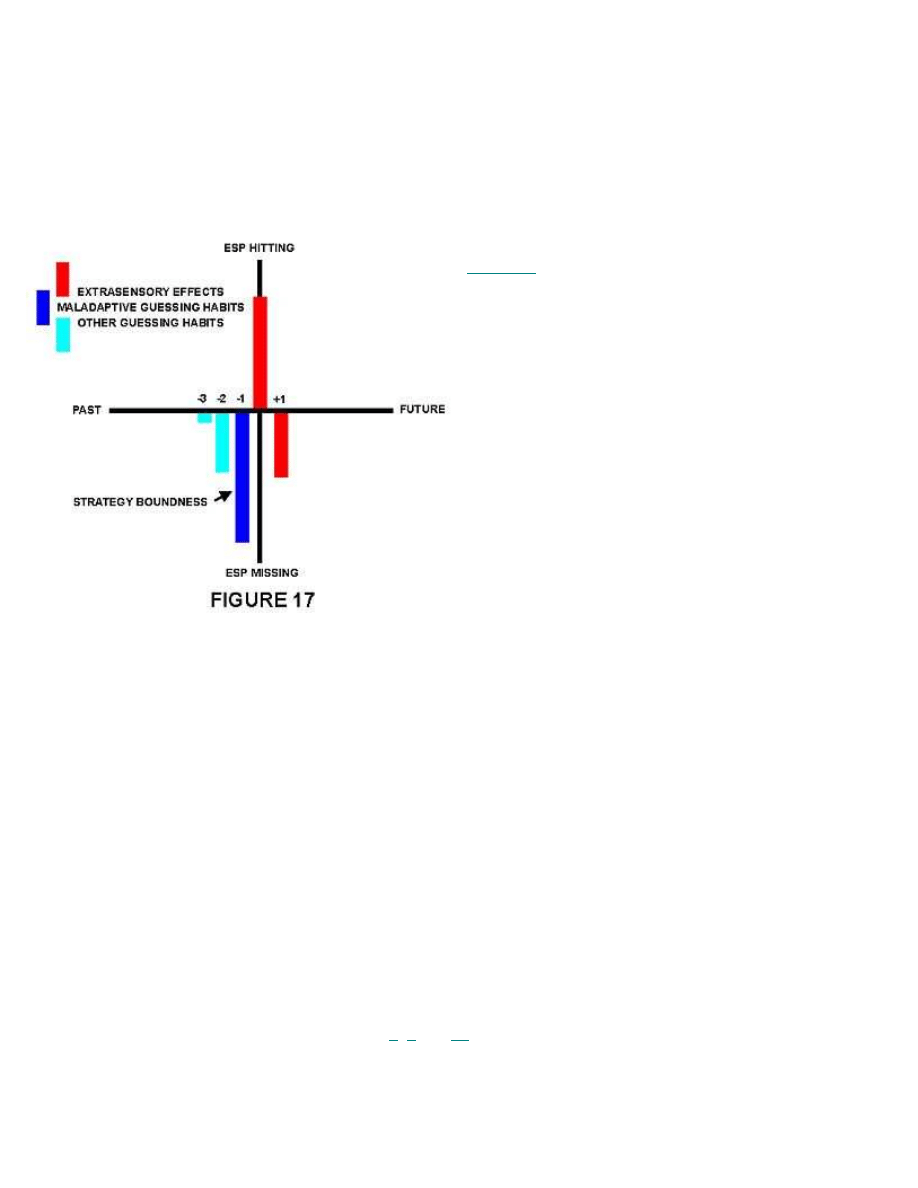
In postulating the existence of trans-temporal inhibitor, I also postulate that the effect is roughly symmetrical in time, as
symmetry seems to be a basic principle in the world. In principle, then, there is probably an extrasensory postcognitive
inhibition against calling the immediately past target, mixed in with not calling it due to mechanical avoidance of the
target, given knowledge of it because of the feedback. Although I have no independent measure of the degree of such
postcognitive avoidance, I decided to assume that the magnitude of the extrasensory postcognitive -1 avoidance for
each percipient would be equal in magnitude to that of his +1 precognitive avoidance. I could then subtract the
magnitude of the +1 precognitive avoidance from the magnitude of the -1 avoidance, and the remainder left over would
be a component I have named maladaptive strategy boundness. Strategy boundness is thus a measure of mechanical
avoidance of the previous target via ordinary
psychological processes.
Figure 17
shows this kind of partialing out applied to the
data of percipient E1S1. On the assumption that
extrasensory postcognitive avoidance is equal to
extrasensory precognitive avoidance, you can see how I
have split the magnitude of the -1 score, and gotten a
strategy boundness measure for this particular percipient.
A similar procedure was carried out individually for all
other percipients in both Training Studies.
My understanding of the optimal way to try to use ESP is
that any sort of calculation processes are irrelevant. This
includes any kind of guessing strategy which involves
keeping track of what the past targets have been and then
trying to outguess the random number generator. This is
not only a waste of time, given sequential independence of
the random number generator, but, as I mentioned earlier,
since there is only a limited amount of awareness
available, this kind of maladaptive guessing strategy uses
up some awareness which might otherwise be used to
activate relevant mental processes for actually using ESP.
On theoretical grounds, then, we would expect that the more maladaptive strategy boundness a percipient showed, the
less real time ESP he would show. Since trans-temporal inhibition of the future (and, by assumption, of the past) is also
adaptive for enhancing real time ESP, we would also expect that with more strategy boundness there would be less
missing on the +1 target, that is, the contrast between real time hitting and +1 missing would be less with increased
strategy boundness. The data seem to bear this out quite strongly.
Because the signs for the arithmetical computations of missing, strategy boundness, etc. require a good deal of attention
to follow in terms of their relationships, I have taken the value of strategy boundness resulting from the above
computations and made it positive to make the following discussion clearer.
In originally computing the correlations between real time hitting, +1 future hitting, -1 past hitting for percipients in the
combined two Training Studies, I found that +1 future hitting correlated significantly negatively with real time hitting
(r = -.85, P<.001, two-tailed), but the magnitude of -1 past hitting did not correlate significantly with either the
magnitude of real time hitting (r = -.24) or with the magnitude of +1 future missing (r = +.14). When strategy
boundness is factored out as described above, however, it is significantly correlated with the other two measures.
Strategy boundness correlates r = -.64, P<.01, two-tailed with present time hitting, and r = +.83, P<.001, two-tailed
with +1 future missing. Referring back to Figures
8
,
9
and
10
, the magnitude of each individual percipient's strategy
boundness score is plotted in the lower part of the graph, and the strength of the relationship is quite clear.
Applying the symmetry assumption to trans-temporal inhibition then, takes some meaningless data, the absolute
magnitude of the -1 past deviations, and partials it into highly meaningful data. There is only one problem: although I
checked with three mathematicians about the validity of this partial correlation procedure, and they all thought it would

not artifactually lead to a high correlation if none actually existed, this has turned out to be wrong! Recently Eugene
Dronek set up a computer program to empirically check this procedure. It took the actual CR values for real time
hitting and +1 missing for each of the 17 percipients in the combined Training Studies, and then drew a sample of 17
digits from the computer's random number generator program. If that particular sample of 17 digits showed a very low
correlation (less than - .2) with both the real time hitting and the +1 missing scores, thus duplicating the original data
pattern, a strategy boundness score was then computed on these random numbers as if they were the -1 deviation score,
and the correlation of this strategy boundness figure computed with both real time hitting and +1 missing. One
thousand correlations were generated in this way. Unfortunately, it turns out that the procedure does artifactually
generate quite high correlations! Thus I am not at all sure that the maladaptive strategy boundness measure I have just
described to you is really valid. Obviously we need independent measures of postcognitive avoidance and strategy
boundness. Nevertheless, I intuitively feel this strategy boundness measure is reflecting something quite important, and
I've presented it to you for its stimulus value.
Persistence of Inhibition
Recall now that the theory of trans-temporal inhibition says that if the Psi Receptor and appropriate discrimination
processes are working on trial N, not only does this positively influence you to call a digit that corresponds to the actual
identity of the target at that time, but it inhibits or prejudices you against calling the digit which is the identity of the
target on trial N+1 in the immediate future. Now, human psychological processes generally have some degree of
"inertia," i.e., our immediate past is constantly having some influence on the present. It follows then that after making a
call on trial N, on trial N+1 a problem exists: the percipient is likely to still be carrying some inhibitory bias against
calling the digit which corresponds to the identity of the target on trial N+1. Thus the operation of trans-temporal
inhibition is likely to produce a kind of "stuttering" of ESP, a break in its continuity. If you hit by using ESP, you are
more likely to miss on the next trial than if you hadn't hit, an effect we might call psi stuttering. In terms of the data
available for analysis, we should expect to see fewer hit doublets, two hits in a row, than would be expected if every
trial were independent of the previous one.
The appropriate test for this is to use the actually obtained proportion of real time hits to recalculate the probability of a
hit: then the probability of a real time hit followed by a real time hit, is simply the square of this empirically obtained
proportion, given the assumption that real time hits are temporally independent of one another. Calculating this, I found
that in the first Training Study there was a deficiency of real time hits following real time hits, only 86 when about 106
would be expected. This has a CR of -2.07, P = .02, one-tailed. More importantly, the degree of lack of real time hit
doublets is strongly and negatively correlated with the degree of real time hitting: r = -.71, P<.025, one-tailed. That is,
the more a percipient showed real time hitting, the more this hitting tended to be broken up and not occur sequentially,
as we would expect from the trans-temporal inhibition theory.
This same relationship was found in the data of the second Training Study (r = -.40), but while it is in the right
direction the correlation does not reach significance with the smaller number of percipients and a much more restricted
range of ESP. Such a lowering of the range of ESP would automatically lower the estimate of the true population
correlation coefficient. If the data from the two Training Studies are combined, r = -.60 between real time hits and real
time hit doublets, with an associated P<.01, one-tailed.
We would also expect that the degree of lack of real time hit doublets would correlate with our direct measure of trans-
temporal inhibition, the degree of missing on the +1 precognitive target. It does, although not quite so outstandingly. In
the first Training Study, r = +.48, which does not quite reach the .05 level of significance; in the second Training Study,
r = +.47, also below the level of statistical significance. When the two Training Studies are combined to produce a
larger sample size, r = +.47, with an associated probability of P<.05, one-tailed.
Thus this persistence of inhibition aspect of the theory of trans-temporal inhibition has received good support.
Shifting the Focus: A Case Study with Ingo Swann
As I mentioned earlier, percipients and experimenters in both my Training Studies were usually focused on getting real
time hits and trying to learn to do better on real time hits. This implicitly defined the immediate boundaries of the now
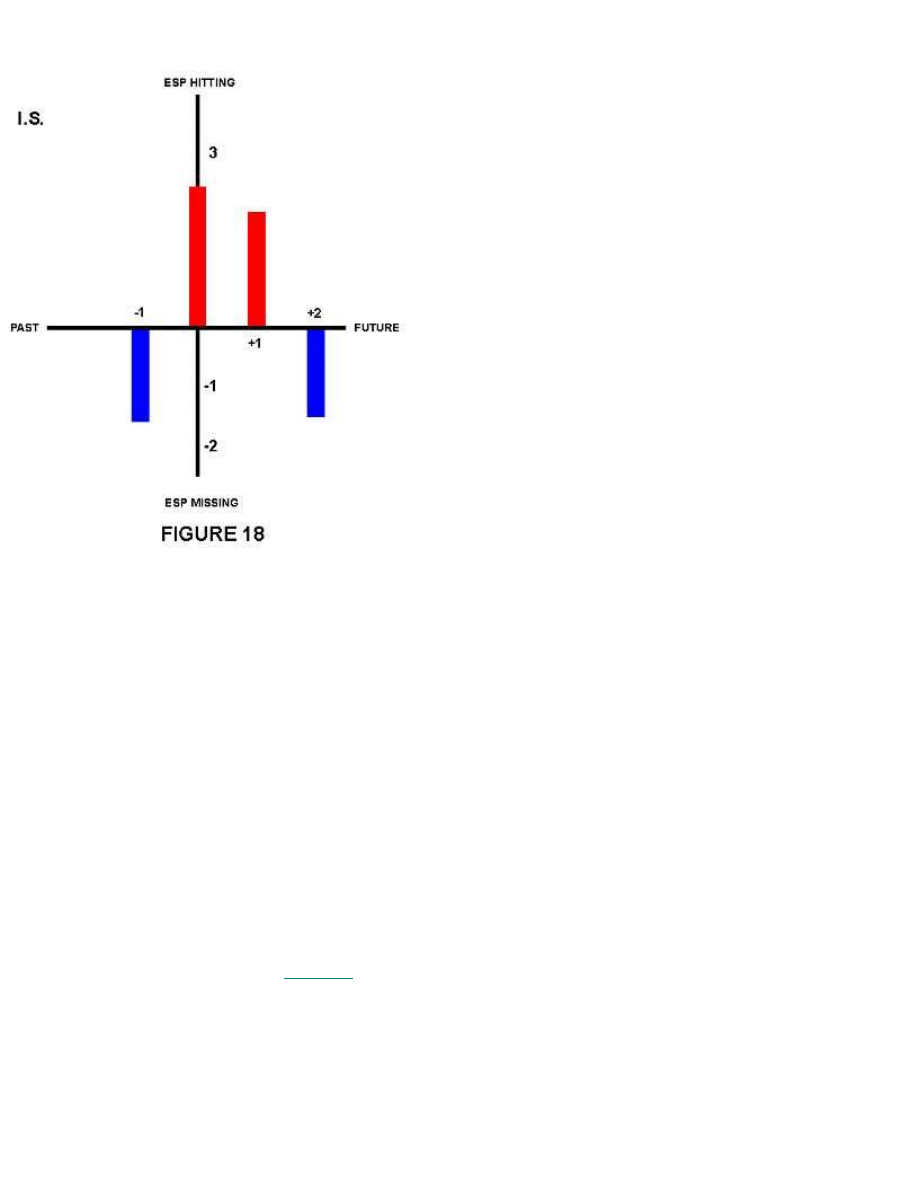
as the +1 and -1, future and past, target events. The trans-temporal inhibition theory, however, is not restricted to this
particular focus.
We have many studies of precognition which have shown
successful calling of events which are much further ahead in the
future than the minute or two of one trial. The trans-temporal
inhibition theory would predict in general that inhibition missing
of targets would immediately surround the future target focused
on, in terms of its immediate past and immediate future,
regardless of how far ahead that target event is in the future. If
percipients were trying to guess the targets 20 trials ahead, for
example, we would expect to see missing on the 19th and 21st
trials ahead.
In actual situations the predictions might be somewhat more
complicated if the percipient's focus included more than one
trial, say that he was trying to get the target on the 20th trial, but
was also thinking about the 21st trial ahead. Then we might
expect the inhibition to be on the 19th and 22nd trials. I have not
yet worked out whether there should be a definite relationship
between the width of the focus of interest of the percipient's
attention (the pass band of the experienced present of the
extended dimension of the mind) and the size of the inhibition,
but there are some interesting future possibilities there. To use
our filter analogy, we should be able to shift the center point
and/or the band width of the filter that is used in psi.
An interesting opportunity to test this prediction occurred spontaneously when the noted artist and psychic, Ingo
Swann, attended a small meeting of parapsychological researchers at my home in October, 1976. I spent the evening
presenting much of the above data (minus the material on the lack of pairs of hits) and the basic theory about trans-
temporal inhibition, although I did not say much about the possibility of shifting the center point of the experienced
now of this extended dimension of the mind. Swann was quite intrigued by my data, especially in terms of learning to
use ESP better and precognition, and made a number of useful comments on the studies. This included his own
observation that what I was calling maladaptive strategy boundness was conceptually similar to a concept that he and
the Stanford Research Institute researchers, Russell Targ and Harold Puthoff, had worked out, "analytical overlay."
Swann wanted to try my ADEPT training device, and a few days later was able to briefly visit my laboratory.
I looked forward to his visit with great interest, for he would be the first percipient who, because he had heard about
trans-temporal inhibition, would knowingly (to me) be psychologically set to have some concern with the immediate,
+1 future target, as well as the real time target. I predicted that he would probably show hitting on the +1 future target
rather than missing as well as real time hitting, but missing on the +2 future target because of trans-temporal inhibition.
I did not, of course, inform Swann of this prediction, as that might have altered his psychological focus.
Swann did five runs on ADEPT in the course of a little over an hour, all of the time available for him to work with the
training machine on this visit. In one run he inadvertently did 29 trials instead of the usual 25, so we had a total of 129
trials. His performance is shown in
Figure 18
. He made 21 real time hits in the 5 runs, where only 12.9 would be
expected by chance, so P = 9x10^-3, one-tailed. He showed a lack of pairs of real time hits in a row, as would be
predicted from the persistence of inhibition aspect of the theory, although with such a small number of trials the effect
did not reach statistical significance (CR = -.77).
On the +1 future target, he made 19 hits when only 12.4 were expected by chance, P = .03, one-tailed, as predicted. On
his +2 precognition hits, he scored only 7 hits when 11.9 would be expected by chance, P = .07, one-tailed. This is not
quite independently significant (CR = -1.50, P = .07, one-tailed) but using a t-test comparison between +1 hitting and
+2 hitting, as it was used to compare real time and +1 hitting for percipients in the Training Studies, and difference is

statistically significant (t = 2.59, 4 df, P<.05, one-tailed.* This is pushing the assumptions of the t-test somewhat, but
[Note 9]
the main point is that the scores are quite strongly in the theoretically expected direction.
It is also interesting to note, from the Figure, Swann's performance on the -1 past displacement: it is only slightly larger
than the +2 missing displacement, indicating a very low degree of maladaptive strategy boundness. This is precisely
what we would expect for someone with high ESP abilities.
The Generalized Trans-temporal Inhibition Test
Given the existence of a trans-temporal inhibition, I now believe that a more sensitive test for the presence of ESP, in
the data of percipients run under conditions comparable to those of the present studies (where targets are generated one
by one) is to look at the contrast, the difference between hitting on the target on which ESP is focused and missing on
the immediately adjacent (in our case, +1 precognition) targets. If we could always assume that our instructions to a
percipient to focus on the real time target were completely effective, the particular measures to test the difference
between would always be real time hits versus +1 precognitive hits (and/or -1 postcognitive hits in non-feedback
studies). As Ingo Swann's data demonstrated, however, the focus of ESP hitting and the consequent inhibition may be
shifted to other than the real time and +1 targets. Indeed, I had suspected such shifts had occurred for at least one of the
percipients of the first Training Study and at least one of those of the second Training Study, but for a long while I had
not seen how to objectively test this rather than doing a purely post hoc analysis. I have now devised a more general
test for trans-temporal inhibition which allows for the fact that a percipient might focus somewhat off from the real
time target and/or have a somewhat wider pass band than just the designated target. I suspect this may be partially post
hoc because of the influence of looking at my data at great length, but it does follow from the theory. The ultimate test
will be others' application of it. The test works as follows.
If psi is operating and trans-temporal inhibition is present to some degree, but the focus of a percipient's ESP is not
necessarily on the real time target, it is nevertheless more likely to be focused close to the real time target than distantly
from it. Thus I took as a contrast measure the first four data registers, the real time, +1, +2, and +3 precognitive
registers. Within these four registers, I created a contrast score for each percipient by taking the absolute magnitude of
the difference between the highest (usually a hitting) score and the lowest (usually a missing) score. For most
percipients this meant the difference between real time hits and +1 misses, but for a few this was the +1 precognitive
hits minus the -2 precognitive misses, etc. As a control for each percipient, I randomly selected (using my Texas
Instrument SR-52 calculator's random number program) four other precognitive registers from the remaining +4 to +24
precognitive registers of that percipient, and computed a contrast score between the highest and lowest of these four
registers. If ESP and trans-temporal inhibition effects are concentrated on or near real time, the designated focus of
attention, then the control contrast scores we compute from the registers further away from real time should, in general,
be less. The results support this prediction.
In the first Training Study the mean contrast score, in CR units (unit normal deviation) was 6.90 around the real time
focus, while the control contrast score had a mean of only 1.96. This difference is highly significant: t = 3.13, P<.01,
one-tailed. The significance comes from both the high scores per se (t = 2.80, P<.025, one-tailed, and the low scores
per se (t = 3.09, P<.01, one-tailed). In the second Training Study, the contrast scores are again significant, with a mean
contrast score of 2.76 in real time and adjacent registers, compared to a mean contrast score of 1.76 in the control
registers: t = 3.37, P<.01, one-tailed. The significance here is contributed primarily by the high scores in the
experimental versus control registers.
We have an interesting result then. The data of the second Training Study were not independently significant for real
time hitting (CR = +.85) because the data of a strong psi misser balance out the data of a strong psi hitter. This study
was statistically significant when evaluated by contrast scores. The real time psi misser who wiped out the significance
on overall real time hits was a percipient who may very well have been inadvertently focused on the +1 future target:
the difference between +1 hits and +2 misses is independently significant by a post hoc t-test for him. I hope then that
this contrast measure may serve to find evidence of ESP in many experiments that were initially considered failures in
terms of overall hitting. Insofar as trans-spatial inhibition is real, similar relationships between hitting and missing
contrasts should be looked for in existing data: studies using playing cards in the DT mode, e.g., call for the strong sort
of spatial discrimination that might call for trans-spatial inhibition.

Which Leads Us To...
It is traditional for scientific papers to end with a call for further research, and I shall do that, not simply out of respect
for tradition, but because I am quite excited about the implications of the findings I have reported to you, and where
they might lead. A number of early obvious research possibilities have been suggested as we went along, but let me just
mention some here.
First and foremost, I would be most happy to see this strong relationship between hitting on real time target and
missing on +1 future target replicated by others. First attempts should use carefully screened percipients who have
some psi ability and on line target generation, as in my Training Studies, but if the effect can be found with other
experimental procedures, so much the better. I particularly would like to see further tests on using the contrast effect as
a more sensitive measure for the presence of ESP than the conventional number of real time hits, as well as its
application in the generalized trans-temporal inhibition test. Along that line, I strongly hope that others who have data
where spatial discrimination was required, which means most ESP experiments, will look for the sorts of relationships
that might provide empirical evidence for the concept of trans-spatial inhibition. I have no time tonight to even begin
talking about the extension of this theory into PK.
There are a number of important questions that need to be asked about trans-temporal inhibition. For example, my
measures have not been in seconds or minutes of clock time, but the psychological units of one trial to the next.
Although I have some response time data from the percipients in the second Training Study, I have not had a chance to
look at it yet. Is trans-temporal inhibition necessary only in terms of psychologically adjacent targets, as from one trial
to the next, or is it more closely related to clock time? If trials were a long distance apart in clock time, say many
minutes, would trans-temporal inhibition be unnecessary, because the "strength of the signal" from the future event
would be diminished sufficiently by temporal distance so that it wouldn't need to be inhibited? Does this mean that
trans-temporal inhibition is even more necessary with rapid calling? Might a reason for the poor success rate that often
accompanies rapid fire, massed trials be that the signals from future or spatially adjacent events are so strong that the
trans-temporal inhibition discrimination strategy can't deal with them very well?
Along a similar line, our most striking ESP results often come with free response targets, where we usually have trials
separated by very long periods of time. This might cut the need for trans-temporal inhibition because interference from
the future may be greatly reduced. Further, in a free response situation, subsequent targets usually have very little
resemblance to each other, so there may be even less need to discriminate among similar targets, further reducing
interference so ESP can manifest more strongly. Perhaps the much higher psi quotients I have gotten from percipients
on my 10-choice training machines are due to the fact that they represent an approach toward the free response
situation, more so than the 4-choice Aquarius machine, although this finding may be mixed up with the fact that
percipients usually responded much faster on the Aquarius machine, thus putting subsequent targets much closer to one
another and possibly adding more confusion this way.
The concept of maladaptive strategy boundness needs further investigation with measures that are independent of the
ESP data per se. I should imagine that various existing psychological tests of cognitive functions which measure
rigidity of function, as well as special purpose tests we might devise, could enable us to categorize percipients as to
how much they could be, as it were, in the "here and now" on each trial, which I believe is optimal for making ESP
function, versus how much their awareness is being taken up by strategies that maladaptively bind them to the past.
For a long time I have thought that the statistical measures we commonly use in parapsychological research are valid,
but really not very sensitive. Already we have learned that variance tests sometimes show significant evidence of psi
operating in data that looks otherwise insignificant. I wonder how many other ESP experiments that we think were
insignificant have more subtle indications of ESP in them, such as might be revealed by the generalized trans-spatial
inhibition test?
I began my talk this evening by mentioning how exciting it can be to question our generally accepted concepts of
space, time, and mind. I have used up quite a bit of ordinary time by now! The work I have talked about this evening
has been the most exciting research in my entire professional career: I hope I have conveyed some of that excitement
and promise to you, and that we will all help each other to learn more about space, time, and mind.

Thank you.
Charles T. Tart
Footnotes
[1] In the second Training Study we did record individual trial target and response data, but as only three percipients
worked with the Aquarius in the second Training Study, this was too little data to look for the sort of relationships
described later.
[2] I would like to thank the "est" Foundation, The Institute for the Study of Human Knowledge, and the
Parapsychology Foundation for financial and administrative support on these studies, as well as my many colleagues
and assistants.
[3] As you can see from Figure 1, ten percipients completed the first Training Study. "Completed" means doing 20 runs
of 25 trials on either of the 10-choice machines, usually at the rate of 1 to 3 runs per hour session.
[4] In the original publications of these ESP learning results (Tart, 1975a; 1976a), I worked with total run scores and
did not realize that the total number of trials was slightly less than 5000, namely 4994. The current total analysis here
retains the convention of 5000 trials to be consistent with the original publication, as it is a conservative error: the data
are slightly more significant than the results here calculated. per run, with a probability of 4x10^-28, two-tailed.
[5] I wish to thank Lila Gatlin for carrying out these tests.
[6] Part of the lack of XX target doublets might also have been caused by unconscious PK by the percipients and/or by
the experimenters. Given the common human underestimation of the frequency of target XX doublets, unknowingly
PKing the RNG to reduce the frequency of such doublets would make it appear that the RNG was working "correctly."
I see no way of objectively testing this hypothesis, however, and mention it only to provoke thought.
[7] I used the triplet level (no memory categorizations at higher levels) because the inferential strategy program scores
as high as it ever will by the triplet level (and often the doublet or singlet level) on this target data, which empirically
argues that there are no relevant higher order biases that percipients might have used in an inferential estimation
strategy.
[8] Note the slight lack of randomicity of some of the target sequences in the first Training Study is not really relevant
to the points made here.
[9] In comparing run scores between real time, +1, and +2 hits, we deal with a shortened run length in each case (25,
24, 23), so the chance expected number of hits is slightly lower (2.5, 2.4, 2.3) with each further displacement. This was
compensated for in doing t-tests by testing the null hypotheses [real time hits] = [(+1 hits) + (.1)] and [(+1 hits) + (.1)]
= [(+2 hits) + (.2)].
References
Andre, E., Confirmation of PK action on electronic equipment. J. Parapsychol., 1972, 36, 283-293.
Braud, W., Smith, G., Andrew, K., & Willis, S., Psychokinetic influences on random number generators during
evocation of "analytic" vs. "nonanalytic" modes of information processing. In Morris, J., Roll, W., & Morris, R. (Eds.),
Research in Parapsychology 1975. Metuchen, N. J.: Scarecrow Press, 1976. Pp. 85-88.

Davis, J., & Akers, C., Randomization and tests for randomness. J. Parapsychol., 1974, 38, 393-407.
Gatlin, L., Comments on the exchange between Dr. Stanford and Dr. Tart. J. Amer. Soc. Psych. Res., 1977, 71, - .
Honorton, C., & Barksdale, W., PK performance with waking suggestions for muscle tension versus relaxation. J.
Amer. Soc. Psych. Res., 1972, 66, 208-214.
Matas, F., & Pantas, L., A PK experiment comparing meditating versus non-mediating subjects. Proc. Parapsychol.
Assn., 1971, No. 8, 12-13.
Millar, B., & Broughton, R., A preliminary PK experiment with a novel computer-linked high speed random number
generator. In Morris, J., Roll, W., & Morris, R. (Eds.), Research in Parapsychology 1975. Metuchen, N. J.: Scarecrow
Press, 1976. Pp. 83-84.
Palmer, J., Tart, C., & Redington, D., A large sample classroom ESP card-guessing experiment. European J.
Parapsychol., 1976, 1, No. 3, 40-56.
Rhine, J. B., The Reach of the Mind. New York: Wm. Sloane, 1947, Pp. 189-190.
Schmidt, H., A PK test with electronic equipment. J. Parapsychol., 1970, 34, 175-181.
Schmidt, H., PK tests with a high speed random generator. J. Parapsychol., 1973, 37, 105-118.
Schmidt, H., Observation of subconscious PK effects with and without time displacement. In Morris, J., Roll, W., &
Morris, R. (Eds.), Research in Parapsychology 1974. Metuchen, N. J.: Scarecrow Press, 1975, Pp. 116-121.
Schmidt, H., PK experiment with repeated time displaced feedback. In Morris, J., Roll, W., & Morris, R. (Eds).,
Research in Parapsychology 1975. Metuchen, N. J.: Scarecrow Press, 1976, Pp. 107-109.
Schmidt, H., & Pantas, L., Psi tests with internally different machines. J. Parapsychol., 1072, 36, 222-232.
Stanford, R., The application of learning theory to ESP performance: A review of Dr. C. T. Tart's monograph. J. Amer.
Soc. Psych. Res., 1977, 71, 55-80.
Stanford, R., & Fox, C., An effect of release of effort in a psychokinetic task. In Morris, J., Roll, W., & Morris, R.
(Eds.), Research in Parapsychology 1974. Metuchen, N. J.: Scarecrow Press, 1975. Pp. 61-63.
Stanford, R., Zenhausern, R., Taylor, A., & Dwyer, M., Psychokinesis as psi-mediated instrumental response. J. Amer.
Soc. Psych. Res., 1975, 69, 127-134.
Tart, C., Card guessing tests: learning paradigm or extinction paradigm? J. Amer. Soc. Psych. Res., 1966, 60, 46-55.
Tart, C., Parapsychology. Science, 1973, 182, 222.
Tart, C., On the nature of altered states of consciousness, with special reference to parapsychological phenomena. In
Roll, W., Morris, R., & Morris, J. (Eds.), Research in Parapsychology 1973. Metuchen, N. J.: Scarecrow Press, 1974,
Pp. 163-218.
Tart, C., The Application of Learning Theory to ESP Performance. New York: Parapsychology Foundation, 1975. (a)
Tart, C., States of Consciousness. New York: Dutton, 1975. (b)
Tart, C., Discrete states of consciousness. In Lee, P., Ornstein, R., Galin, D., Deikman, A., & Tart, C., Symposium on
Consciousness. New York: Viking, 1975, Pp. 89-175. (c)

Tart, C., Learning to Use Extrasensory Perception. Chicago: University of Chicago Press, 1976. (a)
Tart, C., The basic nature of altered states of consciousness: a systems approach. J. Transpersonal Psychol., 1976, 8,
No.1, 45-64. (b)
Tart, C., Consideration of internal processes in using immediate feedback to teach ESP ability. In Research in
Parapsychology 1977. Metuchen, N. J.: Scarecrow Press, 1978. Pp. - . (a)
Tart, C., Toward conscious control of psi through immediate feedback training: some considerations of internal
processes. J. Amer. Soc. Psych. Res., 1977, 71, - . (b)
Tart, C., Towards humanistic experimentation in parapsychology: A reply to Dr. Stanford's review. J. Amer. Soc.
Psych. Res., 1977, 71, 81-102. (c)
Tart, C., Drug-induced states of consciousness. In Wolman, B., et.al. (Eds.). Handbook of Parapsychology. New York:
Van Nostrand/Rheinhold, 1977, in press. (d)
Tart, C., Putting the pieces together: A conceptual framework for understanding discrete states of consciousness. In
Zinberg, N. (Ed.), Alternate States of Consciousness. New York: Free Press, 1977, Pp. 158-219. (e)
Tart, C., Palmer, J., & Redington, D., Effects of immediate feedback on ESP performance: A second study. Submitted
for publication.
Tart, C., & Smith, B., Research activity by members of the Parapsychological Association over the past decade. Paper,
1967 annual meeting of the Parapsychological Association, New York.
von Bekesy, G., Sensory Inhibition. Princeton: Princeton University Press, 1967.
Copyright Notice
You may forward this document to anyone you think might be interested. The only limitations are:
1.
You must copy this document in its entirety, without modifications, including this copyright notice.
2.
You do not have permission to change the contents or make extracts.
3.
You do not have permission to copy this document for commercial purposes.
==>> The contents of this document are Copyright © 1978 by the Parapsychological Association.
Wyszukiwarka
Podobne podstrony:
(Ebook) Charles Tart Sex, Drugs And Altered States Of Consciousness
Isaac Asimov Of Time and Space and Other Things
Jose Wudka Space Time, Relativity and Cosmology Ch5 The Clouds Gather
Bearden GRAVITATIONAL AND EM ENERGY FROM CURVED SPACE TIME
Space time representation and analytics
Asimov, Isaac Of Time and Space and Other Things(1)
Asimov, Isaac Of Time and Space and Other Things
Sam Max Beyond Time and Space poradnik do gry
ebook Martial Arts The History and Philosophy of Wing Chun Kung Fu
Effect of caffeine on fecundity egg laying capacity development time and longevity in Drosophila
Pragmatics, Modularity and Mind reading
encyclopedia of herbs and mind enhancing substances 2000 group
how music and mind control work
Eleanor Cameron Mushroom Planet 06 Time and Mr Bass
więcej podobnych podstron