
A Feature Selection and Evaluation Scheme for Computer Virus Detection
Olivier Henchiri
Nathalie Japkowicz
olivier@alumni.uottawa.ca nat@site.uottawa.ca
School of Information Technology and Engineering
University of Ottawa
Ottawa, Ontario, Canada
Abstract
Anti-virus systems traditionally use signatures to
detect malicious executables, but signatures are over-
fitted features that are of little use in machine learning.
Other more heuristic methods seek to utilize more general
features, with some degree of success. In this paper, we
present a data mining approach that conducts an
exhaustive feature search on a set of computer viruses
and strives to obviate over-fitting. We also evaluate the
predictive power of a classifier by taking into account
dependence relationships that exist between viruses, and
we show that our classifier yields high detection rates and
can be expected to perform as well in real-world
conditions.
1. Introduction
Traditional anti-virus systems are signatures-based, in
that they use case-specific features extracted from viruses
in order to detect those same instances in the future.
While this method yields excellent detection rates for
existing and previously encountered viruses, it lacks the
capacity to efficiently detect new unseen instances or
variants [9]. As new viruses appear virtually every day, a
detection method that is responsive, rather than proactive,
is bound to be broken.
Modern viruses employ advanced strategies such as
polymorphism and metamorphism [7], through which
parts of the virus or its very structure change in a
sometimes random and unpredictable way each time it
replicates. Virus writers, who have access to
commercially available anti-virus software, can direct
their efforts toward outwitting the scanners, by writing or
modifying their code so that it passes undetected. This can
be accomplished by strategically modifying the virus such
that the characteristics that comprise the virus signature
be changed.
Heuristic scanners attempt to compensate for this
lacuna by using more general features from viral code,
such as structural or behavioral patterns [3]. However,
this process still requires human intervention and the
resulting models fall short of yielding both good detection
rates for new unseen viruses and low false positive rates.
In this paper, we are interested in applying machine
learning methods to virus detection, and in particular to
the problem of feature selection. We propose a method by
which an exhaustive search is conducted on a dataset of
viruses, yielding a large number of short generic features.
Then we elect those that are most representative of viral
properties. We also introduce a cross-validation scheme
that tests our classifier using an evaluation method
simulating real-world conditions of new virus outbreaks,
and we offer evidence that our classifier has high
predictive power.
2. Background
Current research applying data mining to virus
detection strives to automate the search for features used
in classification. This process has been tackled from two
different angles: extracting optimal signatures from a
dataset of viruses, and discovering more general features
for use in a complex classification scheme.
Extracting virus signatures is not a new problem.
Kephart et al. [4] developed a popular extraction method
for virus signatures, by infecting a large number of files
with a given virus and then harvesting for constant
regions of 12 to 36 bytes. Then, from the considerable
number of signatures collected, the ones with lowest
predicted false positive rates were selected. While this
method make it possible to extract signatures quickly and
without the help of an expert, the authors concede that the
algorithm fails for viruses that are moderately
polymorphic.
Some detection methods utilize a variety of features,
such as Win32 dll file calls, ASCII strings and byte
sequences contained in the binary files. In an early
heuristic approach [5], features such as duplicated UNIX
system calls and files targeted by the program for writing
purposes were used to detect malicious executables. In a
machine learning method developed by Matthew Schultz
et al. [6], ASCII strings and bytes sequences yielded good
results. However, despite the byte sequences having a
fixed length of 16, the feature space was very large, such
that their dataset had to be split into partitions and
different classifiers trained separately on each of them.
Proceedings of the Sixth International Conference on Data Mining (ICDM'06)
0-7695-2701-9/06 $20.00 © 2006
Research in non signature-based heuristics has shown
that sequences as short as 4 bytes can be used to detect
unseen virus instances successfully [1]. However, as was
found in [8], the list of candidate features extracted from a
small dataset can contain tens of thousands of sequences.
Finally, many viruses are considered to belong to
common virus families, based on the similarities in
structure, code or method of infection that they share [2].
This classification is crucial to properly evaluating the
effectiveness of a virus detection system. The first
occurrence of a new kind of virus is typically the most
devastating, as virus scanners are often incapable of
detecting it. Then a host of variants typically emerge soon
after the initial outbreak, albeit with less damaging
consequences. Our method uses a priori knowledge of
virus families, and evaluates the ability of our classifier to
detect instances of a family without having been trained
on any other instance from that same family.
3. Non-Specific Feature Search
We propose an exhaustive search for n-grams, short
sequences of n bytes, where n-grams beginning at every
byte of the files’ machine code are recorded. The search
process is comparable to a scanning window moving
across the binary code and examining all sequences of a
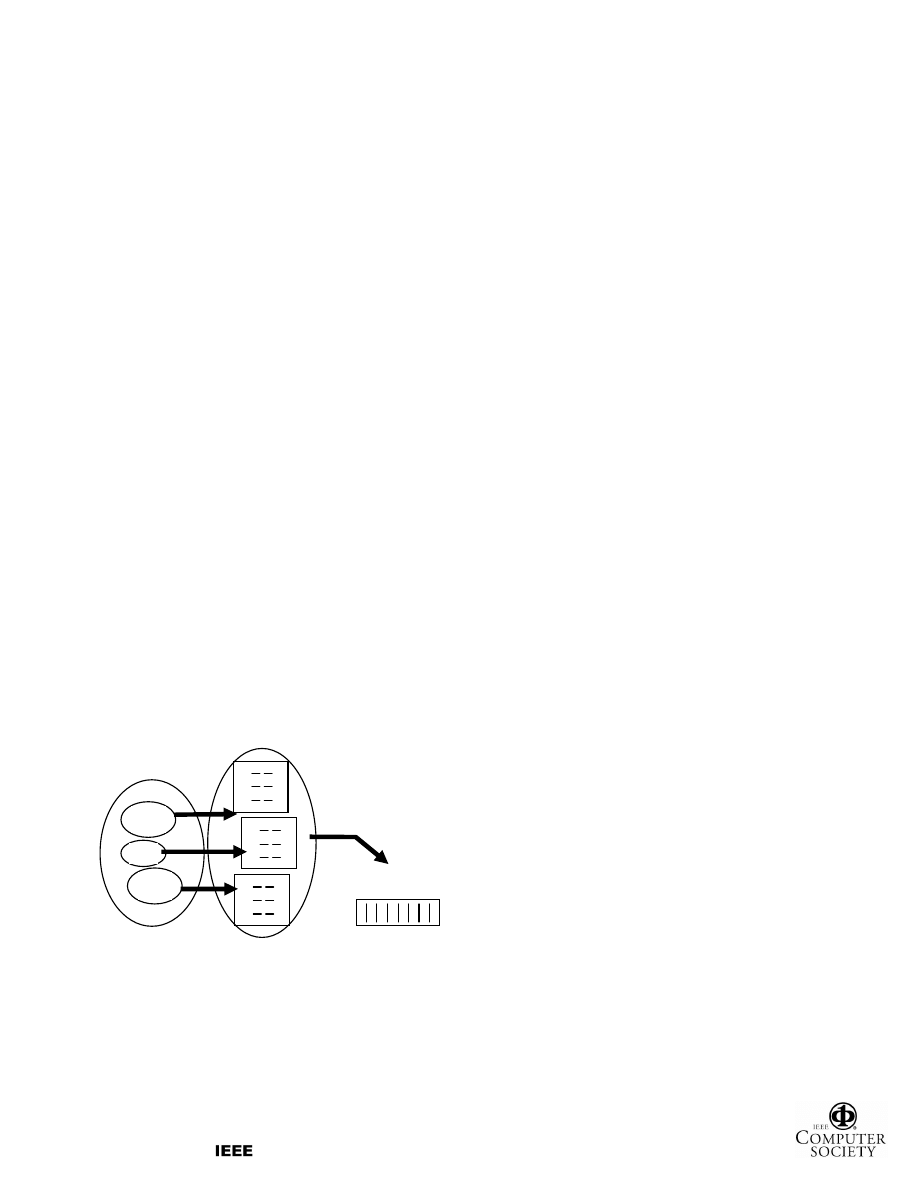
specified length. Our feature selection, shown in Figure 1,
involves a selection step followed by an elimination step.
In the fist step, we scan sequences, record their
frequencies within each virus family, and construct lists
of all the features that meet a given support threshold
within each family. In the second step, we consolidate
these lists and retain the features that meet a given support
threshold
among the feature lists.
Figure 1: Hierarchical feature selection process.
The FEATURE_SEARCH algorithm, shown below,
sets how general the features are, and how rigorous the
feature elimination, by adjusting the following
parameters:
Sequence Length: The sequence length can be
specified. The shorter the length, the more likely the
feature is to have general relevance in the dataset. But a
short length will yield a larger number of features in each
virus family. The length of the sequence is specified as a
number of bytes.
Intra-Family Support: In the feature selection step,
the intra-family support threshold of features within each
virus family can be specified. Sequences occurring at or
above a specified frequency are retained as candidate
features. This puts a constraint on the number of
sequences obtained for each virus family. Because there
are a variable number of instances in each virus family,
the intra-family support is specified as a percentage. In
addition, a maximum number of features per virus family
can be specified. If the feature selection yields an amount
of features that exceeds this limit, then the intra-family
support is increased by one instance, and the feature list is
rebuilt.
Inter-Family Support: In the feature elimination step,
the inter-family support threshold of features within the
general corpus of viruses can be set to a desired value.
This ensures that only those features that appear with a
high enough inter-family support, as specified, are
retained. This step discards unwanted features that occur
frequently in one virus family but that are exclusive to
that family. This parameter is specified as a number of
virus families.
-----------------------------------------------------------------------
FEATURE_SEARCH (S, len, intraSup, intraLim, interSup)
-----------------------------------------------------------------------
Input: A non-empty set of viruses, S, classified in virus
families.
Input: A non-zero sequence length, len.
Input: The intra-family support, intraSup, as a percentage.
Input: The intra-family limit, intraLim, as a number of
features.
Input: The inter-family support, interSup, as a number of
virus families.
Output: A set features, F, representing common
characteristics of the viruses in S.
1: for (each virus family S
i
in S) do
2: for (each virus V
ij
in family S
i
) do
3:
record all sequences of length len found in
V
ij
(without repeats)
4: compute minimum incidence intraMin
i
= intraSup x
number of viruses in S
i
5: build the list L
i
of M
i
sequences with support of at
least intraMin
i
in S
i
6: if (M
i
> intraLim)
7:
increment intraMin
i
and go to 4:
8: build the set of features F of sequences with support of
at least interSup in S
9: return F
-----------------------------------------------------------------------
FEATURE
ELIMINATION
FEATURE
SELECTION
Set of Features
Feature Lists
~
Family
Family
Family
Virus Set
Proceedings of the Sixth International Conference on Data Mining (ICDM'06)
0-7695-2701-9/06 $20.00 © 2006
This method conducts the feature selection in a
hierarchical fashion and is scalable to large datasets.
Sequence scanning is done only once, and the first feature
selection is conducted on small family subsets, while a
second selection is conducted on shorter feature lists. The
method also ensures that all retained features represent
viral properties that are common to many types of viruses,
as opposed to idiosyncrasies specific to one family.
4. Evaluation Method
The evaluation of heuristics is often biased when
variants of known viruses or members of the same family
are used in testing. To evaluate how well our classifier
could classify new unseen viruses, we must use test cases
from a family group that was neither used in feature
extraction nor in training. For this purpose, we propose a
cross-validation scheme that takes into account the
correlation between viruses belonging to the same family.
Given a set of viruses categorized into N families, we
partition the dataset into k sets of virus families, each
consisting of N / k families. These sets of families are
labeled S1 , S2 , S3 , … , Sk.
Prior to conducting the experiments, virus families and
benign programs were selected at random and added to
each family set. Experiments are then carried out on the
dataset using a k-fold cross-validation scheme in the
following way:
1. For each sets Si (i = 1 to k) scan all viruses and
record to a separate file all byte sequences occurring
with a frequency that meets a given threshold.
2. For ( j = 1 to k ) do:
a. Consolidate feature lists for set Strain = { Si | i
≠
j }
keeping only those meeting a given inter-family
support threshold
b. Train classifier on set Strain = { Si | i
≠
j }
c. Validate classifier on test set Stest = Sj
This cross-validation scheme simulates an
environment where a virus detection system is faced with
the outbreak of a new unseen type of virus. This test
evaluates its performance in more stringent conditions,
and therefore offers a better measure of its predictive
power.
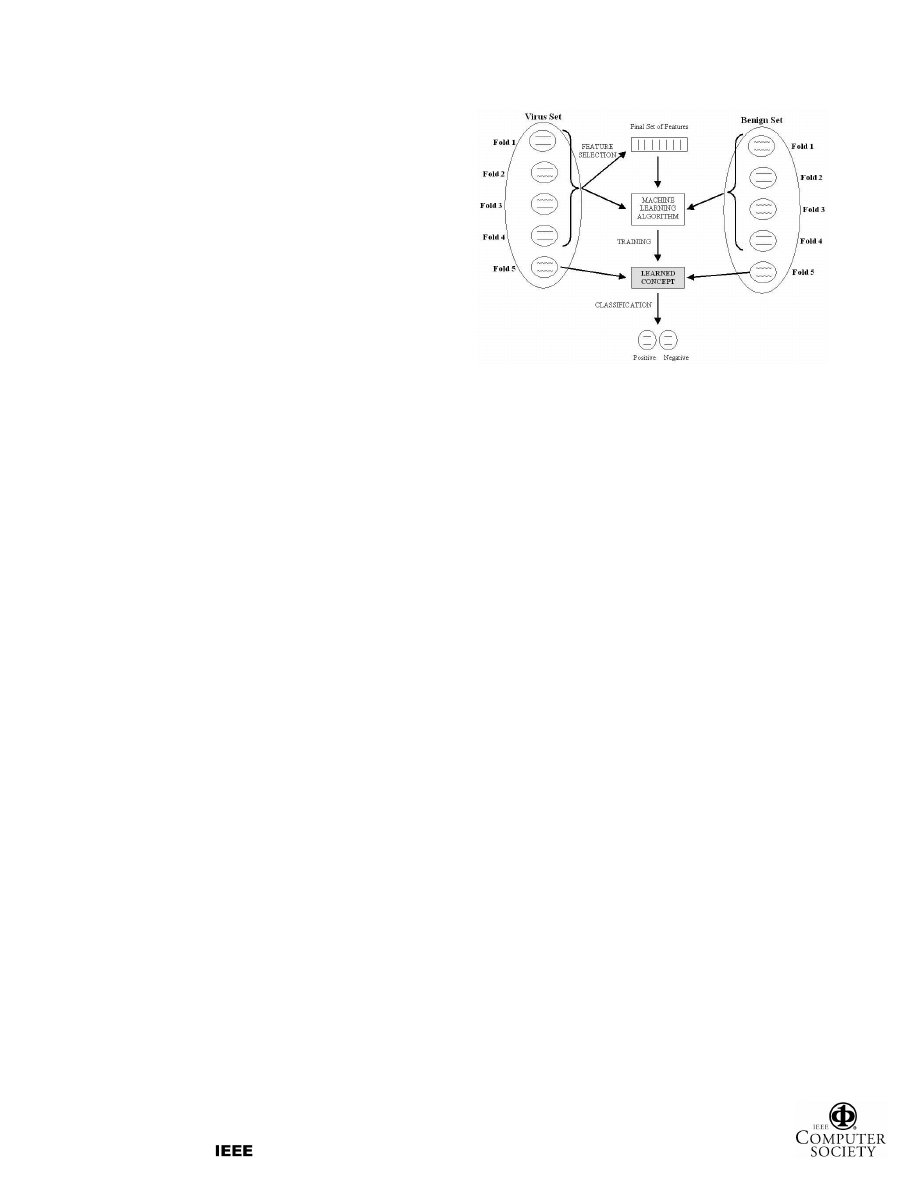
Figure 2 gives an overview of our system using a 5-
fold cross-validation scheme. Each fold uses family-
independent sets, on which feature selection can be
performed as described in Section 3. Feature selection is
repeated on the set of viruses in the training subsamples
for each cross-validation fold.
Figure 2: Feature selection, classifier training
and evaluation using 5-fold cross-validation
(using fold 5 as test set).
Critics of traditional testing methods argue that “only
completely new worms cause global outbreaks” [10], and
stress that standard random selection of test sets does not
provide a reliable assessment of the proactive abilities of
virus scanners. Our testing methodology evaluates the
performance of our classifier in conditions similar to a
real world environment. By separating all virus families,
it provides a more accurate measure of its proactive
abilities and, in particular, its capacity to detect
completely new instances. In the next section, we report
the results of a number of experiments intended to
demonstrate the advantages of our feature selection model
and the validity of our testing methodology.
5. Experimental Results
Our experiments were carried out on a dataset of 3000
examples consisting of 1512 previously labeled viruses
and 1488 small benign executables, collected from
desktop computers using various versions of the Windows
operating system. The viruses were taken from the
collection used in previous research [6] and were
classified into 110 families, based on their filenames.
5.1. Comparison Against a Benchmark Model
We compared our method with a model used in
previous research [6]. We examined each consecutive 16-
byte sequence in every virus in the training set, and
retained those appearing with a support of at least 1%.
However, cross-validation was done in the same way as in
our hierarchical selection scheme, where the classifier
was evaluated on test sets of new unseen families.
We used 5-fold cross validation, where each fold
consists of a viral set of 22 virus families and 297 benign
Proceedings of the Sixth International Conference on Data Mining (ICDM'06)
0-7695-2701-9/06 $20.00 © 2006
executables. For each fold, a separate set of features was
generated from the training set.
For our hierarchical model, we chose a sequence
length of 8, which represents half that of the traditional
method. We set the intra-family support threshold to 40%
with an intra-family limit of 500, and the inter-family
support threshold to 3 (out of 110 families). The
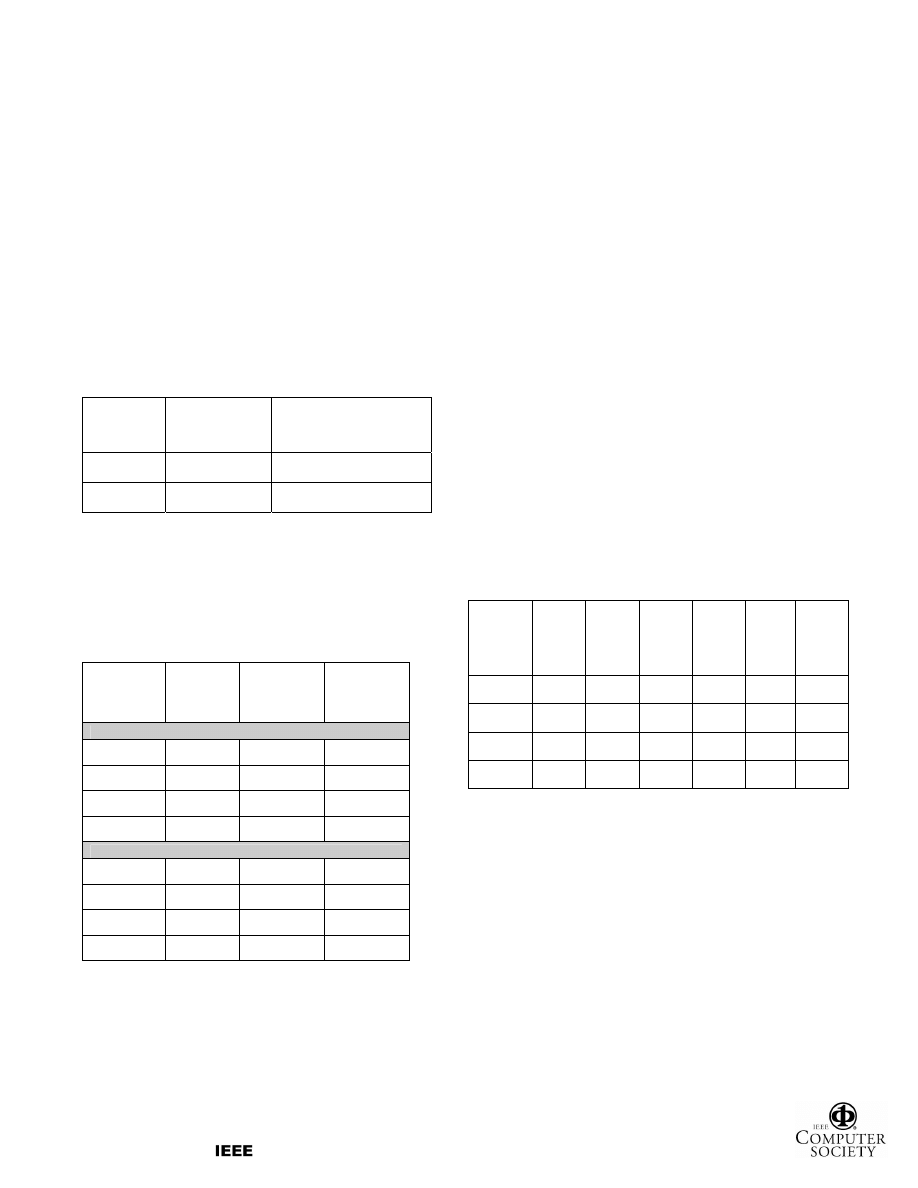
minimum overall support of the features can be estimated
to be the product of these two parameters. Table 1 shows
that out final set of features is of comparable size and
overall support as that of our benchmark test, thus
providing a reliable comparison of the usefulness of each
set of features for classifying new unseen viruses
Table 1. Number and support of features for the
hierarchical and traditional models
Once the final feature set was obtained, we represented
our positive and negative data in the feature space by
using, for each feature, “1” or “0” to indicate whether or
not the feature is present a given executable file.
Table 2. Experimental results using the
hierarchical and traditional search methods.
In our experiments, we used WEKA’s implementation of
the ID3 and J48 decision trees, Naïve Bayes and the SMO
algorithm, with the default settings. The results, displayed
in Table 2, indicate that a virus classifier can be made
more accurate by using features representative of general
viral properties, as generated by our feature search
method. With up to 93.65% overall accuracy, our system
outperforms sub-50% rates of traditional detection
methods and achieves better results than some of the
leading research in the field [6], which only performs at
63.52% when tested under our more stringent evaluation
method.
5.2. Optimal Feature Selection Criteria
In this section, we use a wrapper approach to search
through a wide range of search parameters in an attempt
to optimize our feature selection. We decrease the
sequence length from 8 to 3 bytes, while limiting the
number of candidate features per virus family to a
maximum of 500. To achieve this, our initial intra-family
support threshold of 40% is automatically incremented
until a reasonably small number of features are generated,
as we described in Section 3. We also investigate different
inter-family thresholds, as they directly affect the
generality and final number of features. We explore a
range of threshold values from 3 to 6. We report the
results of the ID3 classifier in Table 3. Experiments using
the three other classifiers shown in Table 2 yielded
consistent results.
Table 3. Virus detection accuracy (top) and false
positive rates (bottom), using ID3 (values are %)
Sequence
length
Inter-
family
support
8 7 6 5 4 3
3
90.31
4.16
93.92
2.55
94.69
1.68
96.11
0.81
95.85
1.41
99.77
0.34
4
84.28
4.77
92.71
4.50
93.86
3.50
96.44
1.68
94.45
1.14
94.58
1.28
5
80.47
5.98
92.40
6.45
93.54
3.63
93.85
2.22
94.73
1.68
92.26
1.21
6
64.42
4.03
92.28
6.45
94.88
4.62
94.61
2.76
94.51
1.48
95.12
1.41
The results show that the classifier achieves better
overall performance with shorter sequences. At length 5,
performance reaches a peak, as the results at lengths 3 and
4 remain comparable. The inter-family support generally
yields better results when low. This is especially true for
longer sequences, where we observe a more rapid drop in
accuracy as the support threshold decreases. This
deterioration is likely due to the dwindling number of
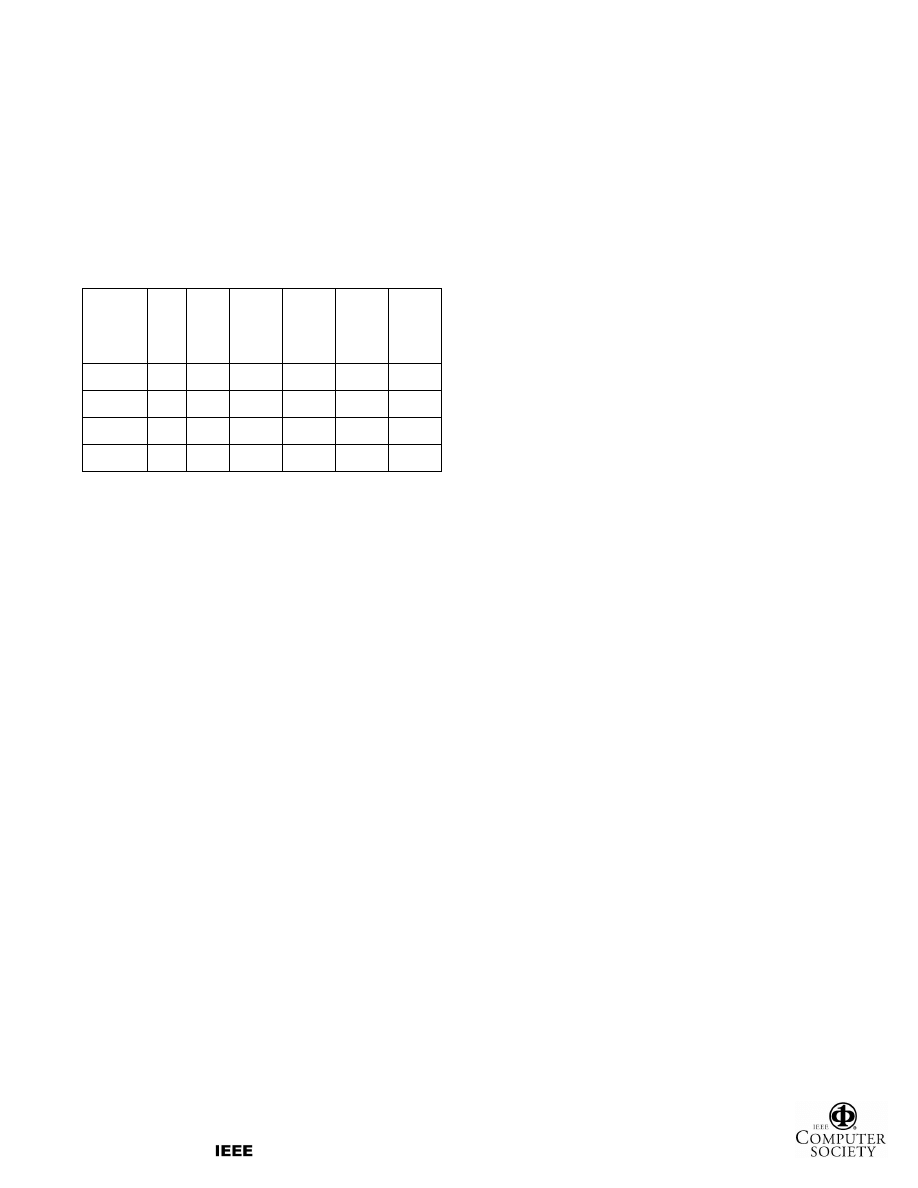
features. Table 4 shows that, at low support thresholds,
the searches for sequences of lengths 6, 7 and 8 generate
sets of less than 100 features, and as low as 16. In the case
of shorter sequences, the performance remains very good,
thanks to an abundance of features. However, we notice
that performance is hindered when the classifier is
working with a set smaller than 200 features. Our
Model
Average Number
of Features
Minimum Expected
Overall Support
Hierarchical
428
0.4 x (3 / 110) = 1.09%
Traditional
377 1%
Classifier
Overall
Accuracy
False
Positive Rate
Detection
Accuracy
Hierarchical Feature Search
ID3
93.29% 4.16% 90.56%
J48
93.65% 5.24% 92.56%
Naïve Bayes
69.51% 0.13% 37.17%
SMO
93.39% 5.71% 92.26%
Traditional Feature Search
ID3
63.52% 14.02% 47.83%
J48
64.69% 13.18% 46.72%
Naïve Bayes
60.69% 0.16% 18.66%
SMO
65.04% 13.36% 47.52%
Proceedings of the Sixth International Conference on Data Mining (ICDM'06)
0-7695-2701-9/06 $20.00 © 2006
classifier performs generally better with a larger set of
features, but some sets yield better accuracy than similar
sets equal or bigger in size. The sets diagonally adjacent –
down and to the right – to feature sets of lengths 6 to 8,
are most often significantly smaller than the latter, and yet
most often lead to a better performance.
Table 4. Number of features, averaged over the 5
cross-validation folds, in relation to different
feature selection parameters
Sequence
length
Inter-
family
support
8
7 6 5 4 3
3
427 531 690.4 879
1150 1633.6
4
108 166 247.4 365.8 531.6 956.4
5
35.2 65.8 111
186.6 333.6 654
6
16.6 33 59.2
111.6 223.6 479
For short sequences of length 7 and 8, as the inter-
family support and the number of features decrease, the
classifier’s performance drops to the lowest recorded
levels, while longer features of lengths 3 to 6 generally
maintain a performance in the mid-90’s. This
demonstrates that these feature sets, while decreasing in
size, contain general enough features that are capable of
covering the majority of training and test examples.
6. Conclusion and Future Work
We presented a feature search method that focuses on
selecting generic features that are applicable to different
families of viruses. This ensured that our classifier is
genuinely heuristic and does not rely on signatures. In
experiments testing our method against that of leading
research, our method achieved better performance. In
both models the features selected and used by the
classifier had comparable overall support within the
dataset. This indicates that our feature search method
produced features that were more useful in detecting new
unseen viruses.
We also introduced an evaluation method for virus
classifiers that tests more convincingly its ability to detect
new viruses. Our method does not allow classifiers to use
examples in training that are variants of viruses present in
the test set. This denies them an unfair advantage that
they would not have in real world conditions. Our results
show that our system, which uses family non-specific
features, performs very well, while existing techniques for
detecting previously unseen viruses perform significantly
more poorly under our evaluation method.
In future work we propose focusing on reducing the
false positive rate, by using a larger number of benign
files, or by training our classifier using a cost matrix and
setting a higher cost to misclassifying negative examples.
We would also like to explore retrospective testing.
Retrospective testing is a recent evaluation methodology
for virus detection systems [11]. This would involve using
a set of older viruses in the training set and a set of more
recent ones in the test set.
7. Acknowledgments
Our thanks to Schultz et al. [6] for graciously sharing
their virus dataset with us.
8. References
[1] Arnold, W. and Tesauro, G. Automatically Generated
Win32 Heuristic Virus Detection. Proceedings of the
2000 International Virus Bulletin Conference, 2000.
[2] Bontchev, B. Analysis and Maintenance of a Clean
Virus Library, in 3rd Int. Virus Bull. Conf, 1993.
[3] Gryaznov, D. Scanners of the Year 2000: Heuristics.
Proceedings of the 5th International Virus Bulletin, 1999.
[4] Kephart, J.O. and Arnold, W. C. Automatic Extraction
of Computer Virus Signatures. 4th Virus Bulletin
International Conference, pp. 178-184, 1994
[5] Kerchen, P., Lo, R., Crossley, J., Elkinbard, G., and
Olsson, R. Static Analysis Virus Detection Tools for Unix
Systems. 13th National Computer Security Conference,
1990.
[6] Schultz, M. G., Eskin, E., Zadok, E., and Stolfo, S. J.
Data Mining Methods for Detection of New Malicious
Executables. IEEE Symposium on Security and Privacy
2001.
[7] Ször, P., and Ferrie, P. Hunting for Metamorphic.
Virus Bulletin Conference September 2001, pp. 123-144.
[8] Tesauro, G., Kephart, J. O., and Sorkin, G. B. Neural
Networks for Computer Virus Recognition. IEEE Expert,
11(4):5–6. IEEE Computer Society, August, 1996.
[9] White, S. R. Open Problems in Computer Virus
Research. Virus Bulletin Conference, 1998.
[10] Muttik, I. Comparing the Comparatives, Virus
Bulletin Conference, September 2001, pp. 45-56.
[11] Marx, A. Retrospective testing – how good heuristics
really work, Proceedings of the 2002 Virus Bulletin
Conference, New Orleans, LA, USA, Sept. 2002.
Proceedings of the Sixth International Conference on Data Mining (ICDM'06)
0-7695-2701-9/06 $20.00 © 2006
Wyszukiwarka
Podobne podstrony:
Adequacy of Checksum Algorithms for Computer Virus Detection
N gram analysis for computer virus detection
Classification of Packed Executables for Accurate Computer Virus Detection
System Dynamic Model for Computer Virus Prevalance
Unknown Computer Virus Detection Inspired by Immunity
Resolution based metamorphic computer virus detection using redundancy control strategy
Prosecuting Computer Virus Authors The Need for an Adequate and Immediate International Solution
Testing and evaluating virus detectors for handheld devices
A framework for modelling trojans and computer virus infection
C for Computer Science and Engineering 4e Solutions Manual; Vic Broquard (Broquard, 2006)
SmartSiren Virus Detection and Alert for Smartphones
Computer Viruses The Disease, the Detection, and the Prescription for Protection Testimony
Computer Virus Operation and New Directions
Advanced Code Evolution Techniques and Computer Virus Generator Kits
Some human dimensions of computer virus creation and infection
Immune System for Virus Detection and Elimination
CHECK YOUR ENGLISH VOCABULARY FOR COMPUTERS AND INFORMATION TECHNOLOGY
Taming Lakatos Monster Computer Virus Epidemics and Internet Security Policy
Real world anti virus product reviews and evaluations the current state of affairs
więcej podobnych podstron