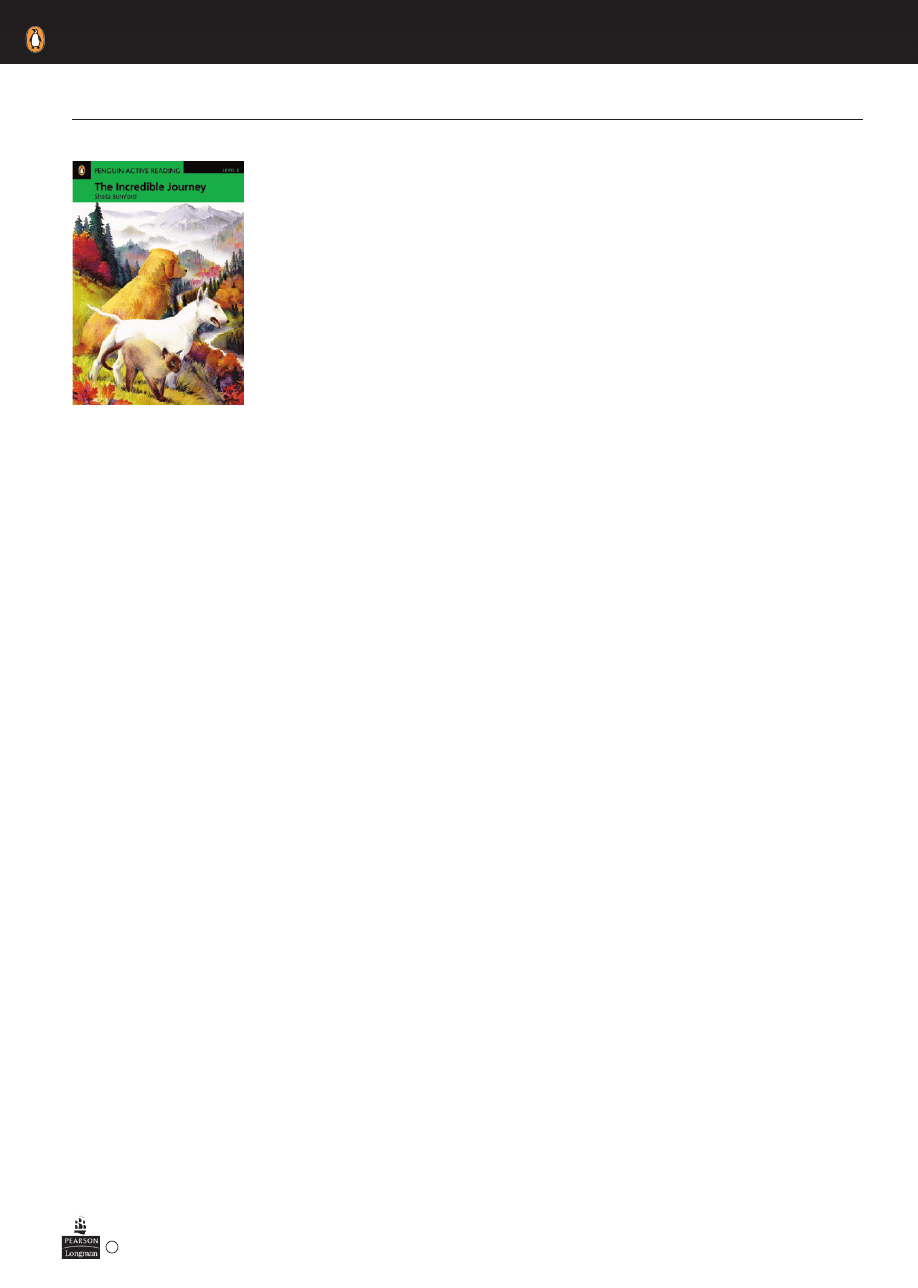
The Incredible Journey
c Pearson Education Limited 2008
The Incredible Journey - Teacher’s notes of 3
PENGUIN ACTIVE READING
Teacher Support Programme
Teacher’s notes
LEVEL 3
About the author and the movie
Sheila Burnford was born in Scotland in 1918 and
emigrated to Canada in the 1950s. When her children
were young the family had three animals that were loved
and treated as part of the family. This prompted her
to write a book about the loyalty of family pets and so
appeared The Incredible Journey, published in 1961. The
book achieved moderate success at first, but it was not
until 1963, when Disney made a movie of the book, that
it gained worldwide recognition. The black and white
movie is now considered a classic, combining stunning
shots of the Canadian landscape with a heart rendering
tale of the love and dedication of the animals. It is an
adventure story that is popular with both children and
adults today. In 1993, Disney made a remake of the movie
called Homeward Bound: The Incredible Journey. The
film changes the story in some ways but retains the heart
warming qualities of the original.
Summary
The Incredible Journey tells the story of three courageous
animals and their journey across the wild countryside of
northwest Ontario, Canada. The story begins at the house
of John Longridge, who is looking after three animals for
his friend, Jim Hunter, who is working in England. The
animals are Luath, a young Labrador, Tao, a Siamese cat,
and Bodger, an old Bull Terrier. Longridge decides to go
on a hunting and fishing trip and leaves a note instructing
his housekeeper, Mrs. Oakes, to look after the animals.
The animals, however, decide to try and find their
owner’s family and begin a journey of over four hundred
kilometers. Early on, a young bear attacks Bodger but Tao
fights off the bear and its mother. Bodger is injured and
Tao helps him to recover by catching food for him. The
animals continue their journey, occasionally meeting kind,
strange or unfriendly people along the way. Later, Tao is
nearly drowned in a river flood and is separated from his
friends. He is found by a kind family and looked after
but instead of staying with them, decides to look for his
friends. He then escapes from a lynx attack and is finally
reunited with the two dogs. Towards the end of the book,
the Hunter family returns from England. Longridge has
realized that the animals are missing and a search to find
them begins. With the help of the police and local people,
Longridge and Hunter begin to realize the extent of the
journey the animals are making. They both decide that
the animals must surely be dead. A few weeks later, the
Hunter family and Longridge decide to go on a trip to a
lake. It is here that Jim’s daughter, Elizabeth, hears Luath
bark. Then the cat appears from the forest followed by
the two dogs. The animals are weak, tired and hungry but
reunited with their joyful owners.
Chapter 1: John Longridge lives alone in the wild
countryside of northwest Ontario, Canada. There are
lakes, woods and rivers and for half the year the area
is covered in snow. Very few people live there. He is
looking after three animals for the Hunter family. Luath,
the Labrador belongs to Jim Hunter. Bodger, the Bull
Terrier is his son’s, and Tao, the Siamese cat belongs to
Jim’s daughter, Elizabeth. When Longridge decides to
go on a trip to Heron Lake, three hundred kilometers
away, he leaves a note, written on two pieces of paper,
for Mrs. Oakes, his housekeeper, instructing her to look
after the animals. However, a crucial half of the note gets
accidentally burned in the fireplace.
Chapters 2–3: The next day, Longridge sets off on his
trip. He says goodbye to the animals, telling them that
Mrs. Oakes will look after them. Then, Luath decides
to set off on his own journey and the other two animals
follow. Mrs. Oakes finds the first part of Longridge’s
note and assumes he has taken the animals with him.
The animals continue westwards, but Bodger is getting
increasingly more tired and weak. He is then attacked by
a young bear. Tao fights off the bear and its mother, but
Bodger has been injured. Tao catches a bird and gives it to
Bodger and he recovers some of his strength.
Chapters 4–5: Bodger is now able to carry on and the
animals walk to a small lake, where they see a group of
Indians camped around the shore. Bodger enters the camp
and is befriended by the Indians. Then, the cat comes
in and takes some of the food the Indians have offered.
Sheila Burnford

The Incredible Journey
c Pearson Education Limited 2008
The Incredible Journey - Teacher’s notes 2 of 3
PENGUIN ACTIVE READING
Teacher Support Programme
Teacher’s notes
LEVEL 3
Luath, however, stays on the hillside and later barks to
the other animals as a signal to move on. The animals
continue their journey and meet a strange old man. He
invites them to dinner, but they don’t eat anything because
he puts their food on plates on a table, as if they were
human friends invited to dinner.
Chapters 6–7: The animals arrive at a river that they
have to cross. The two dogs manage to do this, but Tao is
swept away in a sudden flood. Luath tries unsuccessfully
to rescue him, and giving him up as lost, the two dogs
resume their journey. A Finnish family, the Nurmis, live in
a cabin near the river. Their daughter, Helvi, finds the half
drowned cat, and the family nurses him back to health.
When he has fully recovered, Tao leaves the Nurmi’s cabin
and begins his search for his lost friends.
Chapters 8–9: The two dogs continue their sad journey
without their friend. One day they arrive at a farm and
Luath is attacked by the farmer’s dog. Bodger comes to
the rescue and they escape. Meanwhile, Tao is about to
be attacked by a lynx but hides in a hole. The lynx is shot
dead by a boy who is on a hunting trip with his father.
Tao is reunited with his friends. The animals meet some
unfriendly people and then they are looked after by the
kind Mackenzie couple. They are given food and shelter
but they have to start their journey again. They have
already covered three hundred kilometers.
Chapters 10–11: Longridge returns home and discovers
that the animals are missing. He guesses that the animals
are traveling west to find their owners and phones the
police to organize a search. They receive information from
the people the animals have met on their journey, but he is
not hopeful that they are alive. The Hunter family returns
home and receive the sad news. Weeks later, Longridge
and the Hunters go on vacation to Lake Windigo. It is
here that the Hunter’s daughter hears Luath’s bark coming
from the trees. Then Tao appears, followed by Luath and
finally old Bodger. After an incredible journey, the pets
and their owners are reunited.
Background and themes
Mankind’s relationship with the natural world:
Northwest Ontario is a wild and lonely place where day
to day survival is difficult and humans must learn to live
in harmony with the natural world. The Nurmi family,
for example, live a very simple life, eating the vegetables
they grow, catching fish from the streams and cutting
wood from the forests to sell. The Indians live in tents and
eat simple food cooked on wood fires. Even though their
lives seem hard, the characters are all content because they
understand and respect the environment they live in.
The loyalty and friendship of animals: The book
uses animals to show the qualities that are admirable in
humans. Tao looks after his friends by catching food for
them and fighting off aggressive animals. Luath is very
determined and his encouragement keeps the animals
moving forward, and Bodger’s affectionate personality
ensures the animals are nearly always well received by
the humans they meet. Also, the fact that the animals
undertook such a long and hazardous journey to be
reunited with their owners displays the love they have
for them.
Animals in literature and movies: The use of animals
to tell a story about relationships has a very long history.
Aesop’s famous animal stories were written over 2,500
years ago. Chaucer and the Grimm brothers used them
in the fourteenth and seventeenth centuries respectively.
Animals have been portrayed in works of biting satire to
make an important political point as in George Orwell’s
Animal Farm (1945) and they have been used regularly
by newspaper cartoonists to ridicule political figures.
The invention of the animated cartoon movie created
opportunities to portray animals in all kinds of situations
and to give them human voices and human emotions. The
animals used in these cartoons, such as Mickey Mouse,
Bugs Bunny, and Tom and Jerry, are now household
names.
Discussion activities
Before reading
1 Discuss: Ask the students to think of all the animals
that people keep as pets. These can be the usual
animals and the more exotic and unlikely ones. Write
their suggestions on the board. Then put the students
into small groups. Each group chooses a different
animal and discusses the following points:
What does the animal look like? What does it eat?
Where do people keep it? Why do people have this type of
animal? What problems can the animal cause? Would
you want this animal as a pet? Do you know anyone who
has this animal as a pet?
2 Research: Tell the students that the story takes place
in Ontario, Canada. The students then have to use
the Internet to find information on this part of the
world.

The Incredible Journey
c Pearson Education Limited 2008
The Incredible Journey - Teacher’s notes 3 of 3
PENGUIN ACTIVE READING
Teacher Support Programme
Teacher’s notes
LEVEL 3
Chapter 1
After reading
3 Pair work: Write the following words on the board:
note, phone, history, England, lake. Have the students
talk and write in pairs to say how these words were
used in Chapter 1.
Chapters 2–3
Before reading
4 Pair work: Put the students in pairs and ask them to
think about an animal story, a movie or book, that
they are familiar with. Each pair then prepares a short
talk for the rest of the class.
After reading
5 Write and guess: Put students in pairs and ask them
to choose a short paragraph from Chapters 2–3. Tell
them to write it again, making five changes to words
in the text. Students then read out their paragraphs to
the other students, who have to identify the mistakes.
Chapters 4–5
While reading
(end of p. 28)
6 Group work: Put students in small groups and ask
them to think of what they know about the Indians
of the North American continent.
What do you know of their history? Do you think they
have been treated badly in the past? What type of houses
did they live in? What type of clothes did they wear?
What kind of food did they eat? Did they have a
religion?
After reading
7 Write and guess: Divide the class into small groups
of four. Tell each student to look at a different
illustration from Chapters 4–5 (pp. 26–27, p. 29,
pp. 30–31, p. 33). Tell them that they have to write a
description of the illustration (what they can see and
what is happening), but make five deliberate mistakes.
Then, they read out their descriptions to the rest of
the group who have to look at the illustration and
spot the mistakes.
Chapters 6–7
While reading
(p. 39, after “They worked hard and
had a good simple life.”)
8 Write: Ask the students to write down all the
advantages and disadvantages of living in the
countryside, as the Nurmis do, and living in a big
city.
Is life harder or easier? Why? Is it healthier? Is it cheaper?
Is it boring? What are the dangers and problems of each
place?
Get feedback from the whole class and write the lists
of advantages and disadvantages of each place on the
board. The class then votes on where they would
choose to live.
After reading
9 Write, ask and answer: Write Why was Tao deaf for a
while? on the board and elicit the answer (Because he
was in the water for a long time). Now tell students to
write similar questions about Chapters 6–7. Students
then mingle with each other, asking and answering
each other’s questions.
Chapters 8–9
While reading
(p. 51, after “it hit the ground and lay
there, dead.”)
10 Pair work: Ask students to discuss the following
questions in pairs and then get feedback from the
whole class.
What type of animals do people hunt? Why do people go
hunting? Is hunting a popular activity in your country?
Do you think it’s all right to hunt wild animals? Do you
know anyone who goes hunting?
After reading
11 Research: Divide the class into four groups. Remind
the students that the lynx is an endangered species,
and that in certain countries it is protected. Ask the
students to think of any other animals that they know
that are in danger of dying out. Put the suggestions
on the board. Each group chooses one animal and
students use the Internet to find information on the
animal.
Where does it live? What does it eat? Why is it in danger?
Do people hunt it to eat it or to take something from it
to sell? What are people doing to protect it?
Chapters 10–11
While reading
(p. 62, after “He read a letter from
Elizabeth again.”)
12 Write: Tell the students to imagine they are
Longridge and they have to write a reply to Elizabeth’s
letter.
Explain the problem with the note you left for Mrs.
Oakes. Say what you are doing to find the animals.
Say how you feel about the fact that they are missing.
After reading
13 Write: Ask students to think of new chapter headings
for the book. They should choose short clear titles
that describe the most important point of each of the
chapters. Then choose some examples from the class
and write them on the board. Students then have to
guess which titles should be at the start of which
chapters.
Vocabulary activities
For the Word list and vocabulary activities, go to
www.penguinreaders.com.
Wyszukiwarka
Podobne podstrony:
PENGUIN ACTIVE READING Level 3 The Incredible Journey (Worksheets)
PENGUIN ACTIVE READING Level 3 The Incredible Journey (Answer keys)
PENGUIN ACTIVE READING Level 1 The Barcelona Game (Teacher s Notes)
PENGUIN ACTIVE READING Level 1 The Wrong Man (Teacher s Notes)
PENGUIN ACTIVE READING Level 1 The Wrong Man (Worksheet)
PENGUIN ACTIVE READING Level 1 The Barcelona Game (Worksheet)
PENGUIN ACTIVE READING Level 1 The Wrong Man (Answer Keys)
PENGUIN ACTIVE READING Level 4 The Dream and other stories (Worksheets)
PENGUIN ACTIVE READING Level 4 The ABC Murders (Worksheets)
PENGUIN ACTIVE READING Level 4 The ABC Murders (Answer keys)
PENGUIN ACTIVE READING Level 2 Wonders of the World (Teacher s Notes)
PENGUIN ACTIVE READING Level 2 Wonders of the World (Worksheets)
PENGUIN ACTIVE READING Easystarts The Cup In The Forest (Teacher s Notes)
PENGUIN ACTIVE READING Level 1 Amazon Rally (Teacher s Notes)
PENGUIN ACTIVE READERS Level 2 The Nightmare Before Christmas (Teacher s Notes)
PENGUIN ACTIVE READING Level 1 Amazon Rally (Activity worksheet)
PENGUIN READERS Level 6 The Double Helix (Teacher s notes)
PENGUIN ACTIVE READING Easystarts The Cup In The Forest (Worksheet)
PENGUIN ACTIVE READERS Level 2 The Nightmare Before Christmas (Worksheets)
więcej podobnych podstron