Chapter 3 Kinematics - The Study of Motion 3
-
1
Chapter 3 Kinematics - The Study of Motion
My purpose is to set forth a very new science dealing with a very ancient subject. There is, in nature, perhaps
nothing older than motion, concerning which the books written by Philosophers are neither few nor small;
nevertheless I have discovered by experiment some properties of it which are worth knowing and which have not
hitherto been either observed or demonstrated … and what I consider more important, there has been opened up
to this vast and most excellent science, of which my work is merely the beginning, ways and means by which other
minds more acute than mine will explore its remote corners.
Galileo Galilei
Dialogues
Concerning
Two
New
Sciences
3.1 Introduction
Kinematics is defined as that branch of mechanics that studies the
motion of a body without regard to the cause of that motion. In our
everyday life we constantly observe objects in motion. For example, an
object falls from the table, a car moves along the highway, or a plane
flies through the air. In this process of motion, we observe that at one
time the object is located at one position in space and then at a later
time it has been displaced to some new position. Motion thus entails a
movement from one position to another position. Therefore, to
describe the motion of a body logically, we need to start by defining
the position of a body. To do this we need a reference system. Thus,
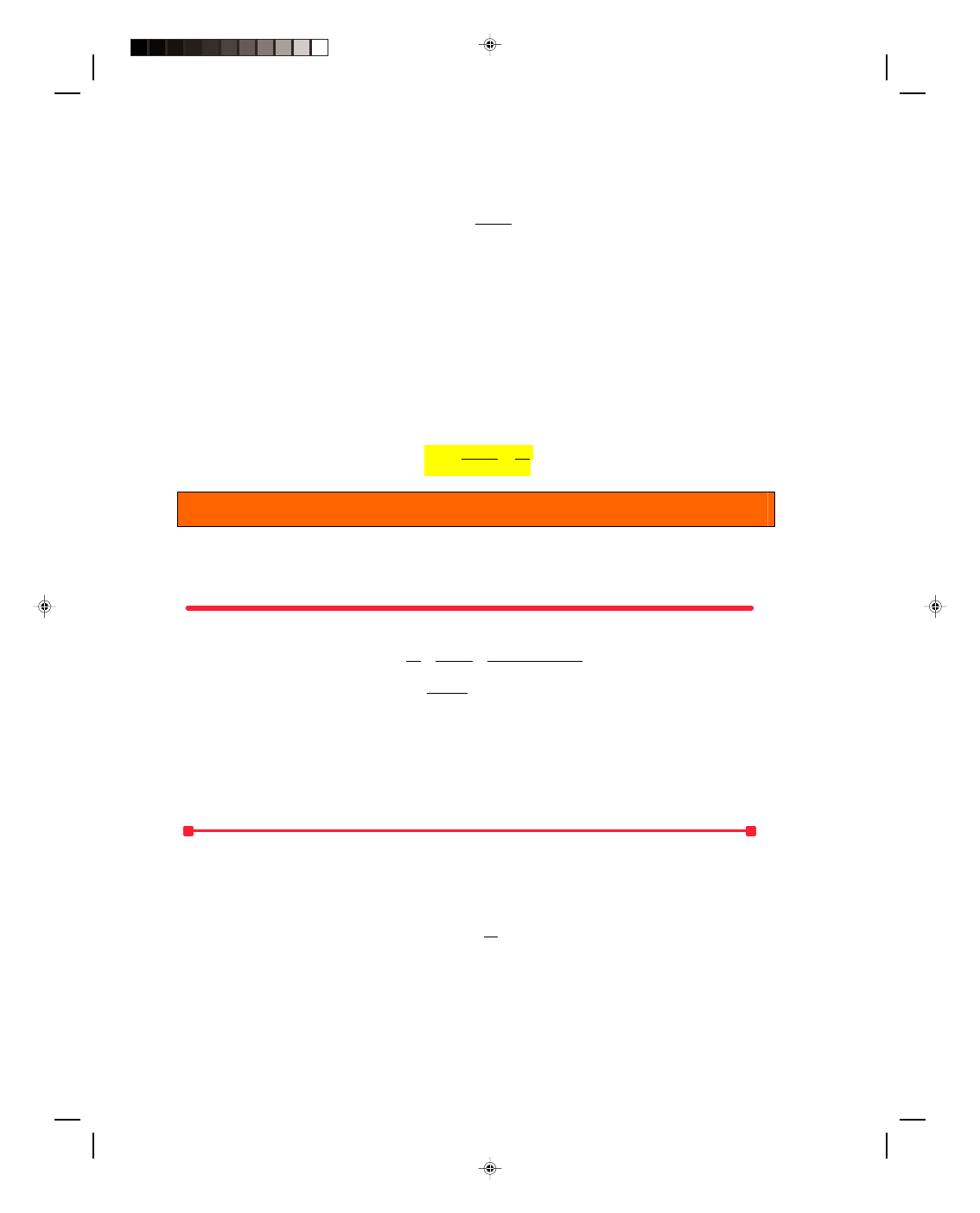
we introduce a coordinate system, as shown in figure 3.2. The body is
located at the point 0 at the time t = 0. The point 0, the origin of the
coordinate system, is the reference position. We measure the
displacement of the moving body from there. After an elapse of time t
1
Figure 3.1
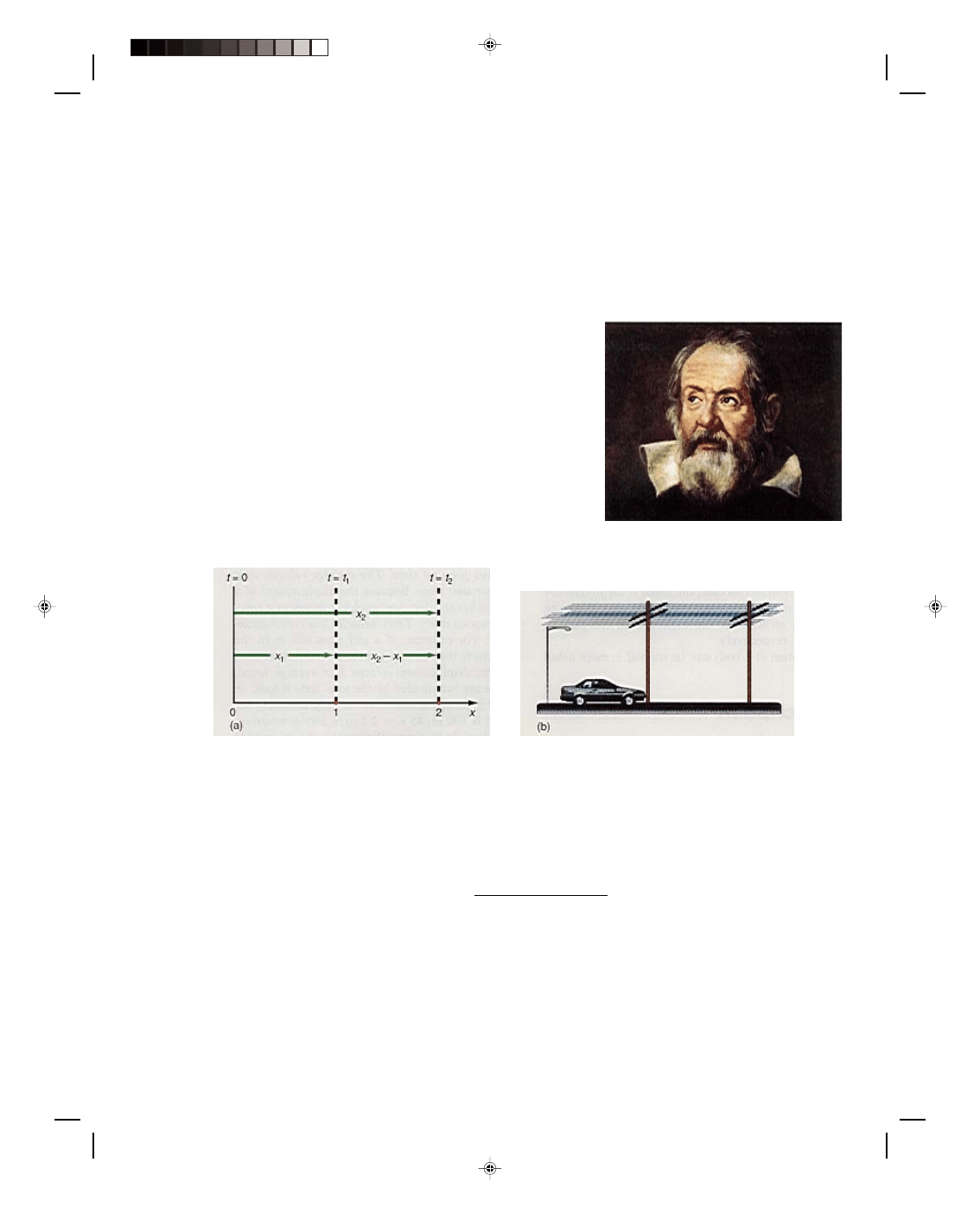
Galileo Galilei
Figure 3.2
The position of an object at two different times.
the object will have moved from 0 and will be found along the x-axis at position 1, a distance x
1
away from 0. A
little later in time, at t = t
2
, the object will be located at point 2, a distance x
2
away from 0. (As an example, the
moving body might be a car on the street. The reference point 0 might be a lamp post on the street, while points 1
and 2 might be telephone poles.) Let us now consider the motion between points 1 and 2.
The average velocity of the body in motion between the points 1 and 2 is defined as the displacement of
the moving body divided by the time it takes for that displacement. That is,
v
avg
= displacement (3.1)
time for displacement
where v
avg
is the notation used for the average velocity. For this description of one-dimensional motion, it is not
necessary to use boldface vector notation. However, positive value of x implies a displacement in the positive x-
direction, while a negative value of x implies a displacement in the negative x-direction. A positive value of y
implies a displacement in the positive y-direction, while a negative value of y implies a displacement in the
negative y-direction. A positive value of v implies a velocity in the positive x- or y-direction, while a negative value
of v implies a velocity in the negative x- or y-direction. Hence, for one-dimensional motion, the direction associated
Pearson Custom Publishing
53
3-2 Mechanics
with a vector quantity is taken into account by the + or
− sign on the quantity. The more general case, the velocity
of a moving body in two dimensions, where we have to use the full vector notation, is treated in section 3.10.
From figure 3.2, we can see that during the time interval t
2
− t
1
, the displacement or change in position of
the body is simply x
2
− x
1
. Therefore, the average velocity of the body in motion between points 1 and 2 is
v
avg
= x
2
− x
1
(3.2)
t
2
− t
1
Note here that in the example of the car and the telephone poles, t
1
is the time on a clock when the car passes the
first telephone pole, position 1, and t
2
is the time on the same clock when the car passes the second telephone pole,
position 2.
A convenient notation to describe this change in position with the change in time is the delta notation.
Delta (the Greek letter
∆) is used as a symbolic way of writing “change in,” that is,
∆x = (change in x) = x
2
− x
1
(3.3)
and
∆t = (change in t) = t
2
− t
1
(3.4)
Using this delta notation we can write the average velocity as
v
avg
= x
2
− x
1
=
∆x (3.5)
t
2
− t
1
∆t
Example 3.1
Finding the average velocity using the
∆ notation. A car passes telephone pole number 1, located 20.0 m down the
street from the corner lamp post, at a time t
1
= 8.00 s. It then passes telephone pole number 2, located 80.0 m from
the lamp post, at a time of t
2
= 16.0 s. What was the average velocity of the car between the positions 1 and 2?
Solution
The average velocity of the car, found from equation 3.5, is
v
avg
=
∆x = x
2
− x
1
= 80.0 m
− 20.0 m
∆t t
2
− t
1
16.0 s
− 8.00 s
= 60.0 m = 7.50 m/s
8.00 s
(Note that according to the convention that we have adopted, the 7.50 m/s represents a velocity because the
magnitude of the velocity is 7.50 m/s and the direction of the velocity vector is in the positive x-direction. If the
answer were
−7.50 m/s the direction would have been in the negative x-direction.)
To go to this interactive example click on this sentence.
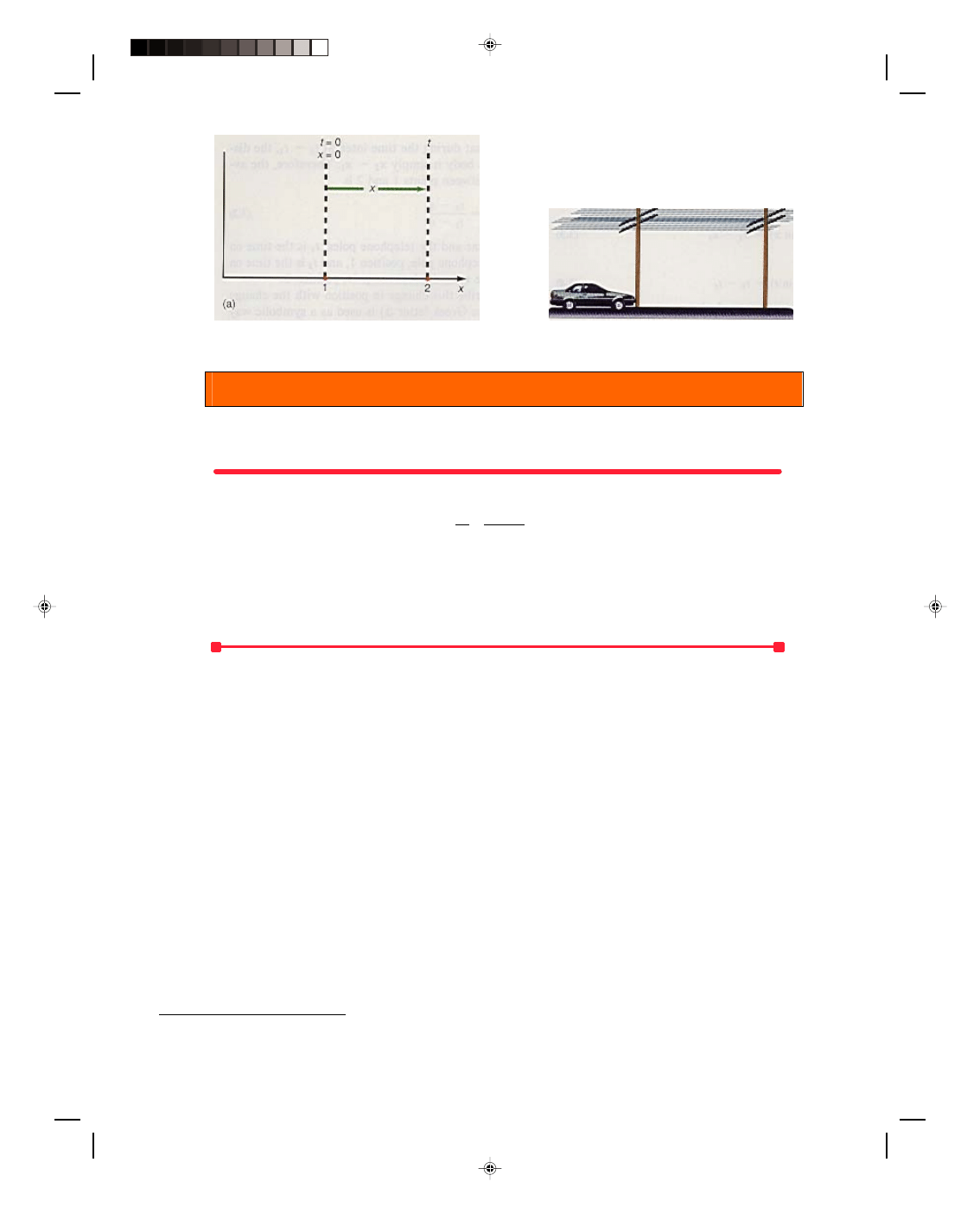
For convenience, the reference position 0 that is used to describe the motion is occasionally moved to
position 1, then x
1
= 0, and the displacement is denoted by x, as shown in figure 3.3. The clock is started at this
new reference position 1, so t
1
= 0 there. We now express the elapsed time for the displacement as t. In this
simplified coordinate system the average velocity is
v
avg
= x (3.6)
t
Remember, the average velocity is the same physically in both equations 3.5 and 3.6; the numerator is still the
displacement of the moving body, and the denominator is still the elapsed time for this displacement. Because the
reference point has been changed, the notation appears differently. We use both notations in the description of
motion. The particular notation we use depends on the problem.
Pearson Custom Publishing
54
Chapter 3 Kinematics - The Study of Motion 3-3
(a) (b)
Figure 3.3
The position of an object determined from a new reference system.
Example 3.2
Changing the reference position. A car passes telephone pole number 1 at t = 0 on a watch. It passes a second
telephone pole 60.0 m down the block 8.00 seconds later. What is the car’s average velocity?
Solution
The average velocity, found from equation 3.6, is
v
avg
= x = 60.0 m = 7.50 m/s
t 8.00 s
Also note that this is the same problem solved in example 3.1; only the reference position for the measurement of
the motion has been changed.
To go to this interactive example click on this sentence.
Before we leave this section, we should make a distinction between the average velocity of a body and the
average speed of a body. The average speed of a body is the distance that a body moves per unit time. The average
velocity of a body is the displacement of a body per unit time. Because the displacement of a body is a vector
quantity, that is, it specifies the distance an object moves in a specified direction, its velocity is also a vector
quantity. Thus, velocity is a vector quantity while speed is a scalar quantity. For example, if a girl runs 100 m in
the x-direction and turns around and returns to the starting point in a total time of 90 s, her average velocity is
zero because her displacement is zero. Her average speed, on the other hand, is the total distance she ran divided
by the total time it took, or 200 m/90 s = 2.2 m/s. If she ran 100 m in 45 s in one direction only, let us say the
positive x-direction, her average speed is 100 m/45 s = 2.2 m/s. Her average velocity is 2.2 m/s in the positive x-
direction. In this case, the speed is the magnitude of the velocity vector. Speed is always a positive quantity,
whereas velocity can be either positive or negative depending on whether the motion is in the positive x-direction
or the negative x-direction, respectively.
Section 3.2 shows how the motion of a body can be studied in more detail in the laboratory.
3.2 Experimental Description of a Moving Body
Following Galileo’s advice that motion should be studied by experiment, let us go into the laboratory and describe
the motion of a moving body on an air track
1
. An air track is a hollow aluminum track. Air is forced into the air
track by a blower and flows out the sides of the track through many small holes. When a glider is placed on the
track, the air escaping from the holes in the track provides a cushion of air for the glider to move on, thereby
1
For a more detailed description of such an experiment in kinematics on an air track see, “Experiments in Physics” 2ed by Nolan and Bigliani.
Pearson Custom Publishing
55
3-4 Mechanics
substantially reducing the retarding force of
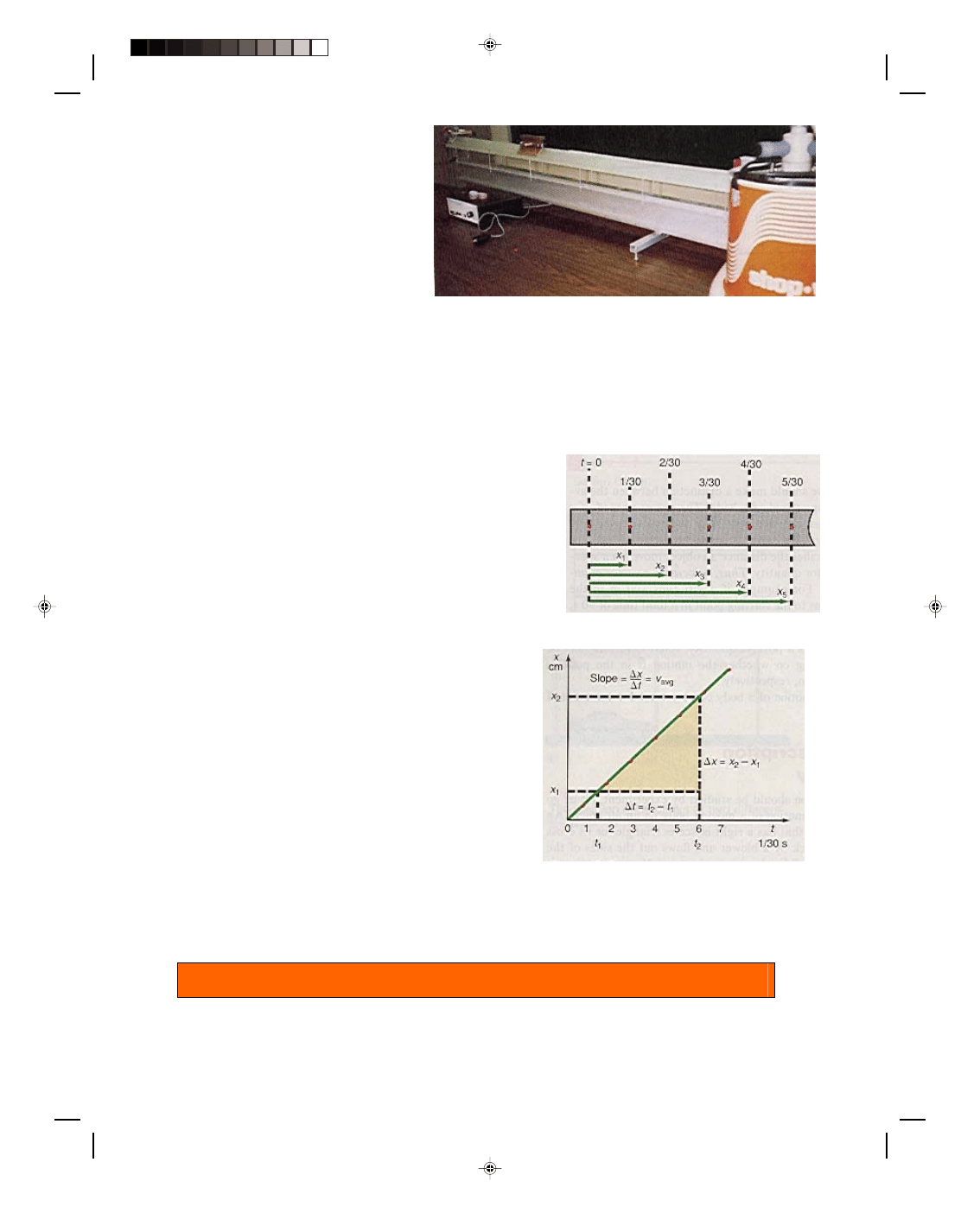
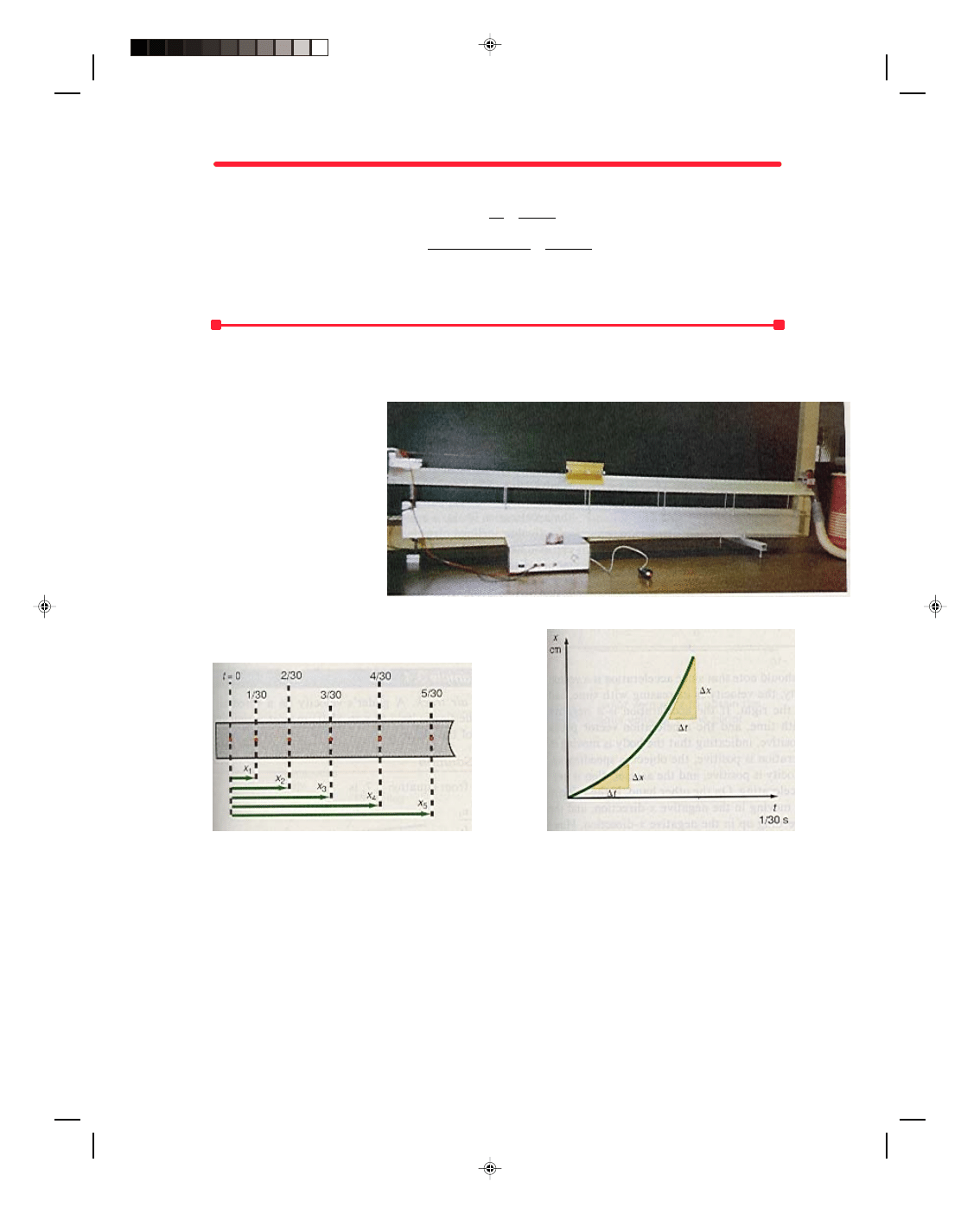
friction on the glider. The setup of an air track
in the laboratory is shown in figure 3.4.
We connect a spark timer, a device
that emits electrical pulses at certain
prescribed times, to a wire on the air track. A
piece of spark-timer tape is attached to the air
track to act as a permanent record of the
position of the moving glider as a function of
time. A spark from the timer jumps across an
Figure 3.4
Setup of an airtrack.
air gap between the glider wire and the air track, and in so doing it burns a hole in the timer tape. This burned
hole on the tape, which appears as a dot, is a record of the position of the glider at that instant of time. Thus, the
combination of a glider, an air track, and a spark timer gives us a record of the position of a moving body at any
instant of time. Let us now look at an experiment with a glider moving at constant velocity along the air track.
3.3 A Body Moving at Constant Velocity
To study a body moving at constant velocity we place a glider on a
level air track and give it a slight push to initiate its motion along
the track. The spark timer is turned on, leaving a permanent record
of this motion on a piece of spark-timer tape. The distance traveled
by the glider as a function of time is recorded on the spark-timer
paper, and appears as in figure 3.5. The spark timer is set to give a
spark every 1/30 of a second. The first dot occurs at the time t = 0,
and each succeeding dot occurs at a time interval of 1/30 of a second
later. We label the first dot as dot 0, the reference position, and then
measure the total distance x from the first dot to each succeeding
dot with a meter stick.
Figure 3.5
Spark-timer paper showing constant velocity.
The measured data for the total distance traveled by the
glider as a function of time are plotted in figure 3.6. Note that
the plot is a straight line. If you measure the slope of this line
you will observe that it is
∆x/∆t, which is the average velocity
defined in equation 3.5. Since all the points generate a straight
line, which has a constant slope, the velocity of the glider is a
constant equal to the slope of this graph. Whenever a body moves
in such a way that it always travels equal distances in equal
times, that body is said to be moving with a constant velocity.
This can also be observed in figure 3.5 by noting that the dots
are equally spaced.
The SI unit for velocity is m/s. The units cm/s and km/hr
are also used. Note that on a graph of the displacement of a
moving body versus time, the slope
∆x/∆t always represents a
Figure 3.6
Graph of distance versus time
for constant velocity.
velocity. If the slope is positive, the velocity is positive and the direction of the moving body is toward the right. If
the slope is negative, the velocity is negative and the direction of the moving body is toward the left.
Example 3.3
The velocity of a glider on an air track. A glider goes from a position of 20.4 cm at a time of t = 10/30 s to a position
of 103 cm at a time of t = 50/30 s. Find the average velocity of the glider during this interval.
Pearson Custom Publishing
56
Chapter 3 Kinematics - The Study of Motion 3-5
Solution
The average velocity of the glider, found from equation 3.5, is
v
avg
=
∆x = x
2
− x
1
∆t t
2
− t
1
= 103 cm
− 20.4 cm = 82.6 cm
50/30 s
− 10/30 s 4/3 s
= 62.0 cm/s
To go to this interactive example click on this sentence.
3.4 A Body Moving at Constant Acceleration
If we tilt the air track at one end
it effectively becomes a
frictionless inclined plane. We
place a glider at the top of the
track and then release it from
rest. Figure 3.7 is a picture of the
glider in its motion on the
inclined air track.
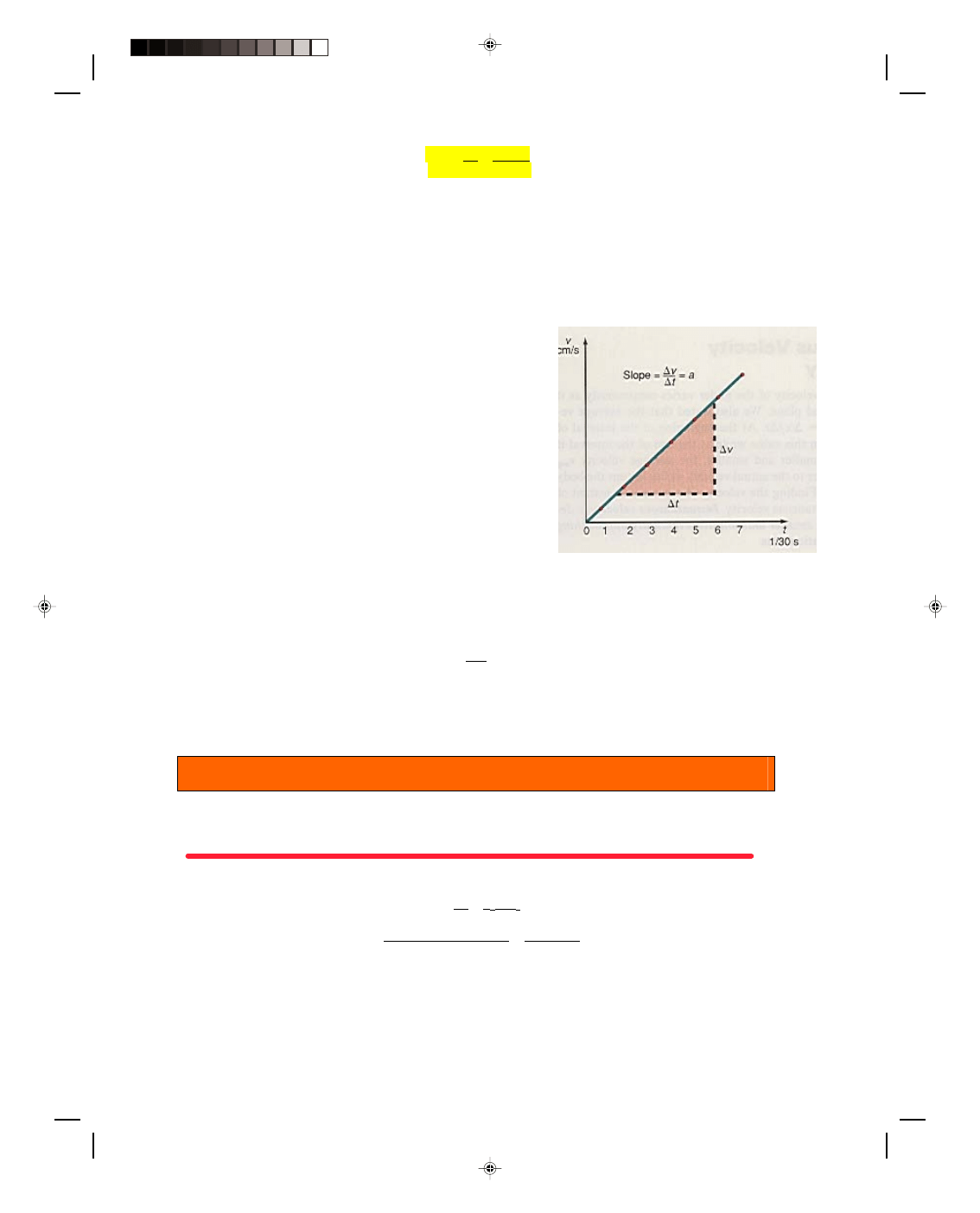
The spark timer is turned
on, giving a record of the position
of the moving glider as a function
of time, as illustrated in figure
3.8. The most important feature
to immediately note on this
Figure 3.7
The tilted air track.
Figure 3.8
Spark-timer tape for accelerated motion.
Figure 3.9
Graph of x versus t for constant acceleration.
record of the motion, is that the dots, representing the positions of the glider, are no longer equally spaced as they
were for motion at constant speed, but rather become farther and farther apart as the time increases. The total
distance x that the glider moves is again measured as a function of time. If we plot this measured distance x
against the time t, we obtain the graph shown in figure 3.9.
The first thing to note in this figure is that the graph of x versus t is not a straight line. However, as you
may recall from section 3.3, the slope of the distance versus time graph,
∆x/∆t, represents the velocity of the
moving body. But in figure 3.9 there are many different slopes to this curve because it is continuously changing
with time. Since the slope at any point represents the velocity at that point, we observe that the velocity of the
moving body is changing with time. The change of velocity with time is defined as the acceleration of the moving
Pearson Custom Publishing
57
3-6 Mechanics
body, and the average acceleration is written as
a
avg
=
∆v = v
2
− v
1
(3.7)
∆t t
2
− t
1
Since the velocity is a vector quantity, acceleration, which is equal to the change in velocity with time, is also a
vector quantity. More will be said about this shortly.
Because the velocity is changing continuously, the average velocity for every time interval can be
computed from equation 3.5. Thus, subtracting each value of x from the next value of x gives us
∆x, the distance
the glider moves during one time interval. The average velocity during that interval can then be computed from
v
avg
=
∆x/∆t. At the beginning of this interval the actual velocity is less than this value while at the end of the
interval it is greater. Later we will see that for constant acceleration, the velocity at the center of the time interval is
equal to the average velocity for the entire time interval.
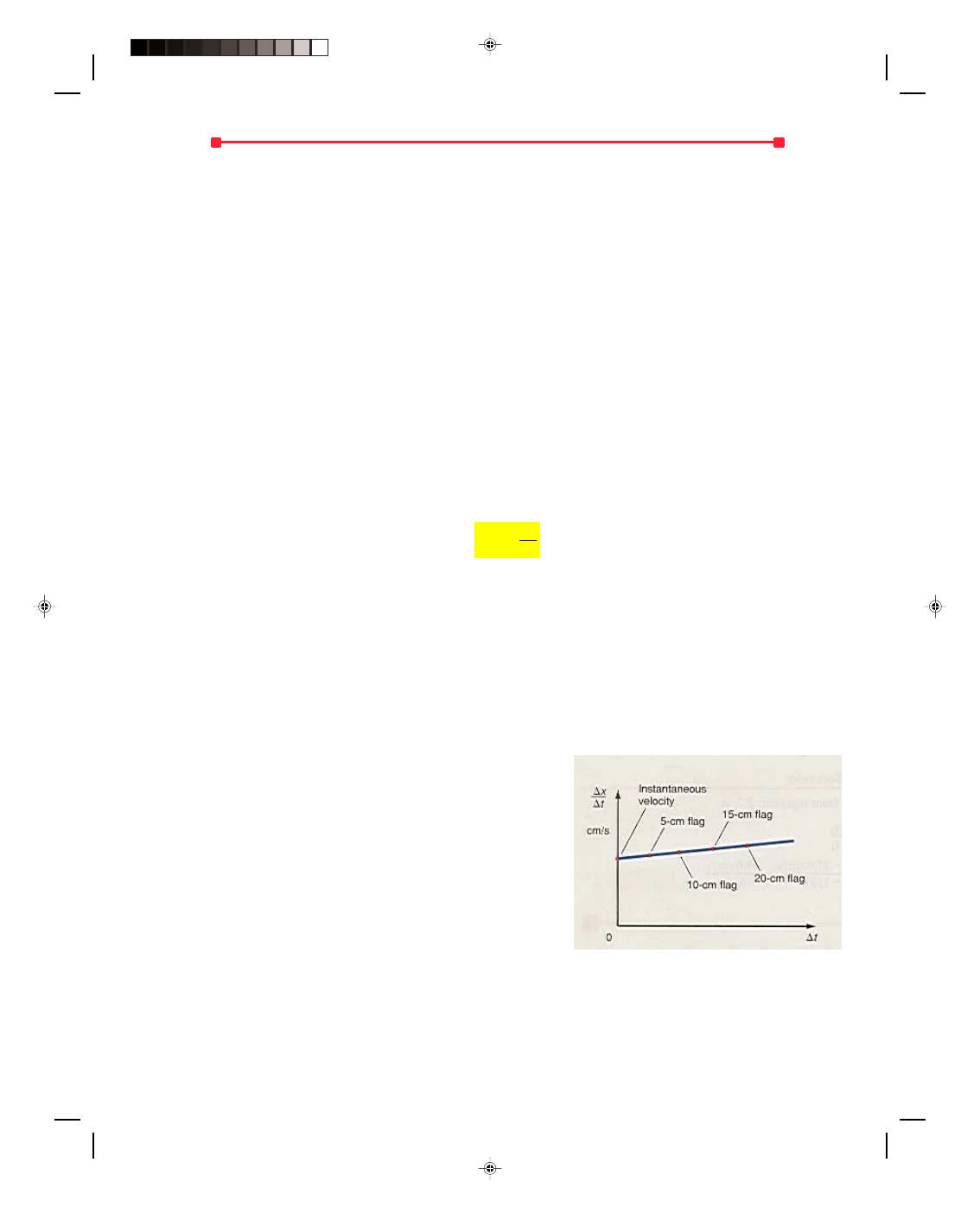
If we plot the velocity at the center of the interval against
the time, we obtain the graph in figure 3.10. We can immediately
observe that the graph is a straight line. The slope of this line,
∆v/∆t, is the experimental acceleration of the glider. Since this
graph is a straight line, the slope is a constant; this implies that
the acceleration is also a constant. Hence, the acceleration of a
body moving down a frictionless inclined plane is a constant. In the
case of more general motion, a body can also have its acceleration
changing with time. However, most of the accelerated motion
discussed in this book is at constant acceleration. The most notable
exception is for simple harmonic motion, which we discuss in
chapter 11. Because in constantly accelerated motion the average
acceleration is the same as the constant acceleration, the subscript
avg will be deleted from the acceleration in all the equations
dealing with this type of motion.
Figure 3.10
Graph of v versus t for constant
acceleration.
Since acceleration is a change in velocity per unit time, the units for acceleration are velocity divided by
the time. In SI units, the acceleration is
m/s
s
For convenience, this is usually written in the equivalent algebraic form as m/s
2
. But we must not forget the
physical meaning of a change in velocity of so many m/s every second. Other units used to express acceleration are
cm/s
2
, and (km/hr)/s.
Example 3.4
The acceleration of a glider on an air track. A glider’s velocity on a tilted air track increases from 3.83 cm/s at the
time t = 10/30 s to 42.3 cm/s at a time of t = 70/30 s. What is the acceleration of the glider?
Solution
The acceleration of the glider, found from equation 3.7, is
a =
∆v = v
2
− v
1
∆t t
2
− t
1
= 42.3 cm/s
− 3.83 cm/s = 38.5 cm/s
70/30 s
− 10/30 s 6/3 s
= 19.2 cm/s
2
To go to this interactive example click on this sentence.
Pearson Custom Publishing
58
Chapter 3 Kinematics - The Study of Motion 3-7
Before leaving this section we should note that since acceleration is a vector, if the acceleration is a
positive quantity, the velocity is increasing with time, and the acceleration vector points toward the right. If the
acceleration is a negative quantity, the velocity is decreasing with time, and the acceleration vector points toward
the left. When the velocity is positive, indicating that the body is moving in the positive x-direction, and the
acceleration is positive, the object is speeding up, or accelerating. However, when the velocity is positive, and the
acceleration is negative, the object is slowing down, or decelerating. On the other hand, if the velocity is negative,
indicating that the body is moving in the negative x-direction, and the acceleration is negative, the body is
speeding up in the negative x-direction. However, when the velocity is negative and the acceleration is positive,
the body is slowing down in the negative x-direction. If the acceleration lasts long enough, the body will eventually
come to a stop and will then start moving in the positive x-direction. The velocity will then be positive and the
body will be speeding up in the positive x-direction.
3.5 The Instantaneous Velocity of a Moving Body
In section 3.4 we observed that the velocity of the glider varies continuously as it “slides” down the frictionless
inclined plane. We also stated that the average velocity could be computed from v
avg
=
∆x/∆t. At the beginning of
the interval of motion the actual velocity is less than this value while at the end of the interval it is greater. If the
interval is made smaller and smaller, the average velocity v
avg
throughout the interval becomes closer to the
actual velocity at the instant the body is at the center of the time interval. Finding the velocity at a particular
instant of time leads us to the concept of instantaneous velocity. Instantaneous velocity is defined as the limit of
∆x/∆t as ∆t gets smaller and smaller, eventually approaching zero. We write this concept mathematically as
0
lim
t
x
v
t
∆ →
∆
=
∆
(3.8)
As in the case of average velocity in one-dimensional motion, if the limit of
∆x/∆t is a positive quantity, the velocity
vector points toward the right. If the limit of
∆x/∆t is a negative quantity, the velocity vector points toward the left.
The concept of instantaneous velocity can be easily understood by performing the following experiment on
an air track. First, we tilt the air track to again give an effectively frictionless inclined plane. Then we place a 20-
cm length of metal, called a flag, at the top of the glider. A photocell gate, which is a device that can be used to
automatically turn a clock on and off, is attached to a clock timer and is placed on the air track. We then allow the
glider to slide down the track. When the flag of the glider interrupts the light beam to the photocell, the clock is
turned on. When the flag has completely passed through the light beam, the photocell gate turns off the clock. The
clock thus records the time for the 20-cm flag to pass through the photocell gate. We find the average velocity of
the flag as it moves through the gate from equation 3.5 as v =
∆x/∆t. The 20-cm length of the flag is ∆x, and ∆t is
the time interval, as read from the clock.
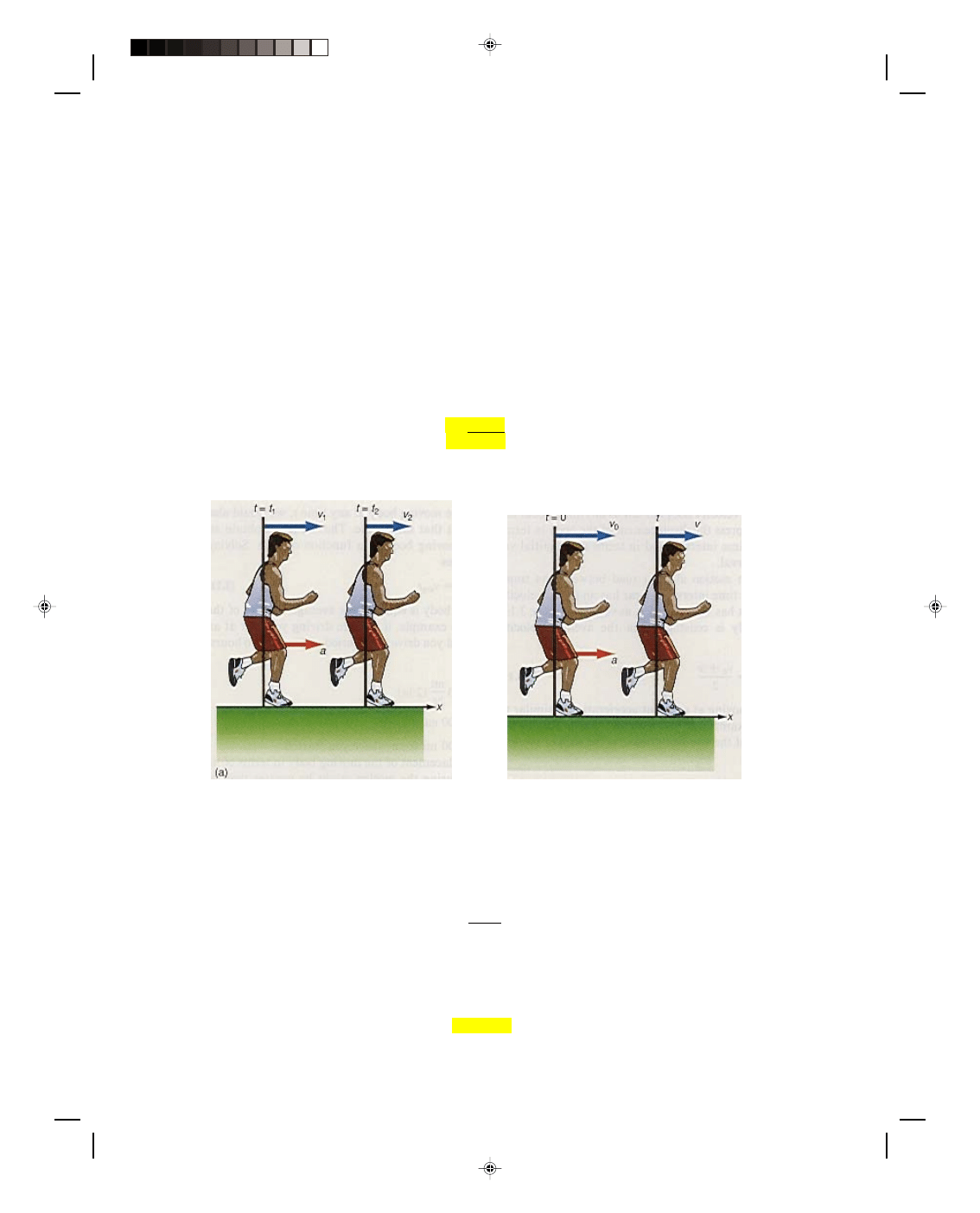
We repeat the process for a 15-cm, 10-cm, and a 5-cm
flag. For each case we measure the time
∆t that it takes for the
flag to move through the gate. The first thing that we observe is
that the time for the flag to move through the gate,
∆t, gets
smaller for each smaller flag. You might first expect that if
∆t
approaches 0, the ratio of
∆x/∆t should approach infinity.
However, since
∆x, the length of the flag, is also getting smaller,
the ratio of
∆x/∆t remains finite. If we plot ∆x/∆t as a function of
∆t for each flag, we obtain the graph in figure 3.11.
Notice that as
∆t approaches 0, (∆t→0), the plotted line
intersects the
∆x/∆t axis. At this point, the distance interval ∆x
has been reduced from 20 cm to effectively 0 cm. The value of
∆t
has become progressively smaller so this point represents the
limiting value of
∆x/∆t as ∆t approaches 0. But this limit is the
Figure 3.11
Graph of
∆x/∆t versus ∆t to obtain
the instantaneous velocity of the glider.
Pearson Custom Publishing
59
3-8 Mechanics
definition of the instantaneous velocity. Hence, the point where the line intersects the
∆x/∆t axis gives the value of
the velocity of the glider at the instant of time that the glider is located at the position of the photocell gate. This
limiting process allows us to describe the motion of a moving body in terms of the velocity of the body at any
instant of time rather than in terms of the body’s average velocity.
Usually we will be more interested in the instantaneous velocity of a moving body than its average
velocity. The speedometer of a moving car is a physical example of instantaneous velocity. Whether the car’s
velocity is constant or changing with time, the instant that the speedometer is observed, the speedometer indicates
the speed of the car at that particular instant of time. The instantaneous velocity of the car is that observed value
of the speed in the direction that the car is traveling.
3.6 The Kinematic Equations in One Dimension
Because the previous experiments were based on motion at constant acceleration, we can only apply the results of
those experiments to motion at a constant acceleration. Let us now compile those results into a set of equations,
called the kinematic equations of linear motion, that will describe the motion of a moving body. For motion at
constant acceleration, the average acceleration is equal to the constant acceleration. Hence, the subscript avg can
be deleted from equation 3.7 and that equation now gives the constant acceleration of the moving body as
a = v
2
− v
1
(3.7)
t
2
− t
1
Equation 3.7 indicates that at the time t
1
the body is moving at the velocity v
1
, while at the time t
2
the body is
moving at the velocity v
2
. This motion is represented in figure 3.12(a) for a runner.
Figure 3.12
Change in reference system.
Let us change the reference system by starting the clock at the time t
1
= 0, as shown in figure 3.12(b). We
will now designate the velocity of the moving body at the time 0 as v
0
instead of the v
1
in the previous reference
system of figure 3.12(a). Similarly, the time t
2
will correspond to any time t and the velocity v
2
will be denoted by v,
the velocity at that time t. Thus, the velocity of the moving body will be v
0
when the time is equal to 0, and v when
the time is equal to t. This change of reference system allows us to rewrite equation 3.7 as
a = v
− v
0
(3.9)
t
Equation 3.9 is similar to equation 3.7 in that it gives the same definition for acceleration, namely a
change in velocity with time, but in a slightly different but equivalent notation. Solving equation 3.9 for v gives the
first of the very important kinematic equations, namely,
v = v
0
+ at (3.10)
Pearson Custom Publishing
60
Chapter 3 Kinematics - The Study of Motion 3-9
Equation 3.10 says that the velocity v of the moving object can be found at any instant of time t once the
acceleration a and the initial velocity v
0
of the moving body are known.
Example 3.5
Using the kinematic equation for the velocity as a function of time. A car passes a green traffic light while moving
at a velocity of 6.00 m/s. It then accelerates at 0.300 m/s
2
for 15.0 s. What is the car’s velocity at 15.0 s?
Solution
The velocity, found from equation 3.10, is
v = v
0
+ at
(
)
2
m
m
6.00 0.300
15.0
s
s
s
=
+
= 10.5 m/s
The velocity of the car is 10.5 m/s. This means that the car is moving at a speed of 10.5 m/s in the positive x-
direction.
To go to this interactive example click on this sentence.
In addition to the velocity of the moving body at any time t, we would also like to know the location of the
body at that same time. That is, let us obtain an equation for the displacement of the moving body as a function of
time. Solving equation 3.6 for the displacement x gives
x = v
avg
t (3.11)
Hence, the displacement of the moving body is equal to the average velocity of the body times the time it is in
motion. For example, if you are driving your car at an average velocity of 50 km/hr, and you drive for a period of
time of two hours, then your displacement is
x = 50 km (2 hr)
hr
= 100 km
You have traveled a total distance of 100 km from where you started.
Equation 3.11 gives us the displacement of the moving body in terms of its average velocity. The actual
velocity during the motion might be greater than or less than the average value. The average velocity does not tell
us anything about the body’s acceleration. We would like to express the displacement of the body in terms of its
acceleration during a particular time interval, and in terms of its initial velocity at the beginning of that time
interval.
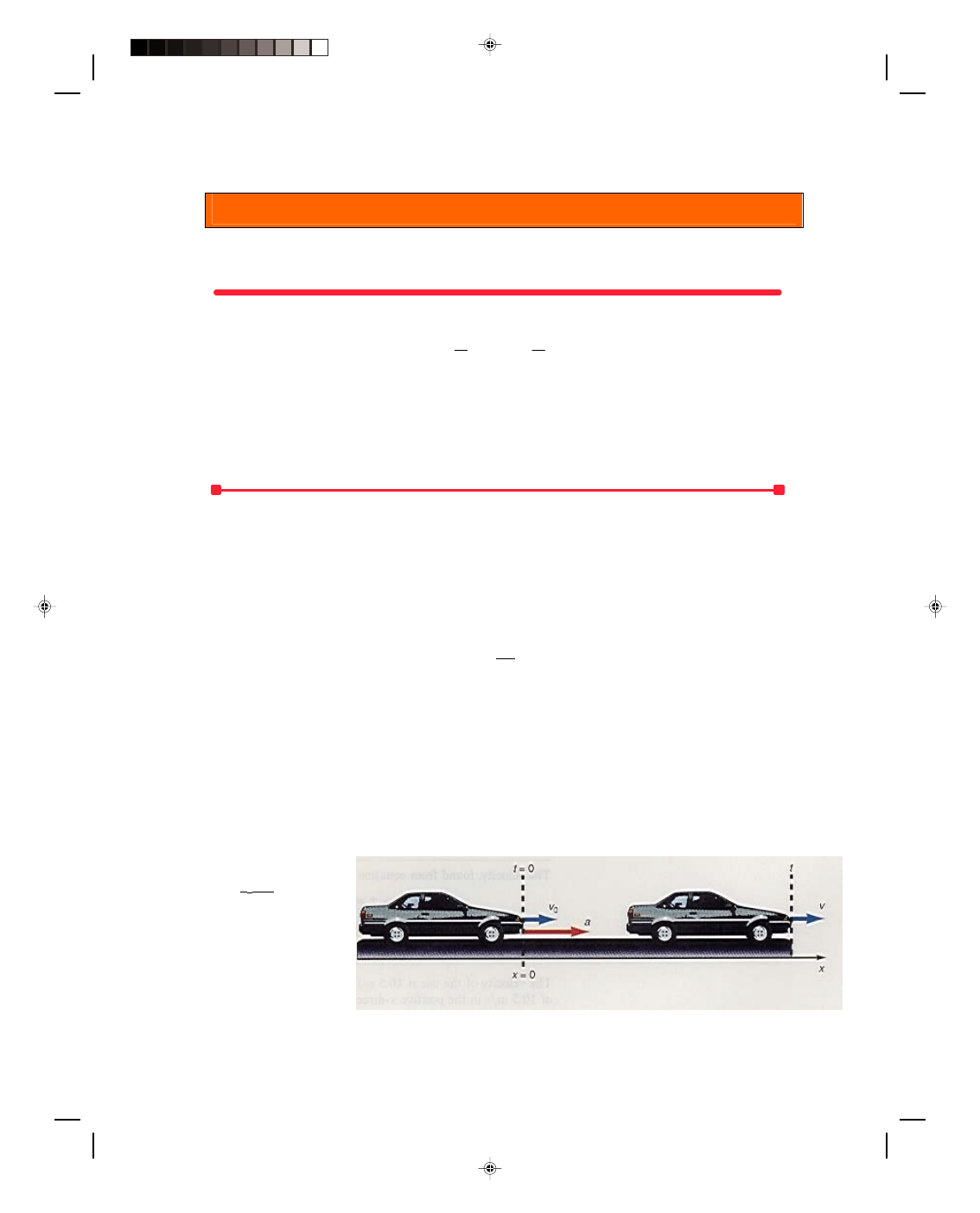
For example, consider a car in motion along a road between the times t = 0 and t = t. At the beginning of
the time interval the car has an initial velocity v
0
, while at the end of the time interval it has the velocity v, as
shown in figure 3.13. If the acceleration of the moving body is constant, then the average velocity throughout the
entire time interval is
v
avg
= v
0
+ v (3.12)
2
This averaging of velocities
for bodies moving at
constant acceleration is
similar to determining a
grade in a course. For
example, if you have two
Figure 3.13
A car moving on a road.
Pearson Custom Publishing
61

3-10 Mechanics
test grades in the course, your course grade, the average of the two test grades, is the sum of the test grades
divided by 2,
Avg. Grade = 100 + 90 = 95
2
If we substitute this value of the average velocity into equation 3.11, the displacement becomes
t
v
v
t
v
x
avg
+
=
=
2
0
(3.13)
Note that v represents the final value of the velocity at the time t, the end of the time interval. But there already
exists an equation for the value of v at the time t, namely equation 3.10. Therefore, substituting equation 3.10 into
equation 3.13 gives
(
)
0
0
2
v
v
at
x
t
+
+
=
Simplifying, we get
0
2
2
v
at
x
t
+
=
= 2v
0
t + 1 at
2
2 2
2
1
0
2
x v t
at
=
+
(3.14)
Equation 3.14, the second of the kinematic equations, represents the displacement x of the moving body at
any instant of time t. In other words, if the original velocity and the constant acceleration of the moving object are
known, then we can determine the location of the moving object at any time t. Notice that the first term represents
the distance that the moving body would travel if there were no acceleration and the body just moved at the
constant velocity v
0
for the time t. The second term shows how far the body moves because there is an acceleration.
If there were no initial velocity, that is v
0
= 0, this is the distance that the body will move because of the
acceleration. In general, however, there is both an initial velocity and an acceleration, and the total displacement x
is the total distance that the body moves because of the two effects. This rather simple equation contains a
tremendous amount of information.
Example 3.6
Using the kinematic equation for the displacement as a function of time. A car, initially traveling at 30.0 km/hr,
accelerates at the constant rate of 1.50 m/s
2
. How far will the car travel in 15.0 s?
Solution
To express the result in the proper units, km/hr is converted to m/s as
0
km
1 hr
1000 m
30.0
8.33 m/s
hr 3600 s
1 km
v
=
=
The displacement of the car, found from equation 3.14, is
x = v
0
t + 1 at
2
2
(
)
(
)
2
2
m
1
m
8.33
15.0 s
1.50
15.0 s
s
2
s
=
+
= 125 m + 169 m
= 294 m
Pearson Custom Publishing
62
Chapter 3 Kinematics - The Study of Motion 3-11
The first term in the answer, 125 m, represents the distance that the car would travel if there were no
acceleration and the car continued to move at the velocity 8.33 m/s for 15.0 s. But there is an acceleration, and the
second term shows how much farther the car moves because of that acceleration, namely 169 m. The total
displacement of 294 m is the total distance that the car travels because of the two effects.
To go to this interactive example click on this sentence.
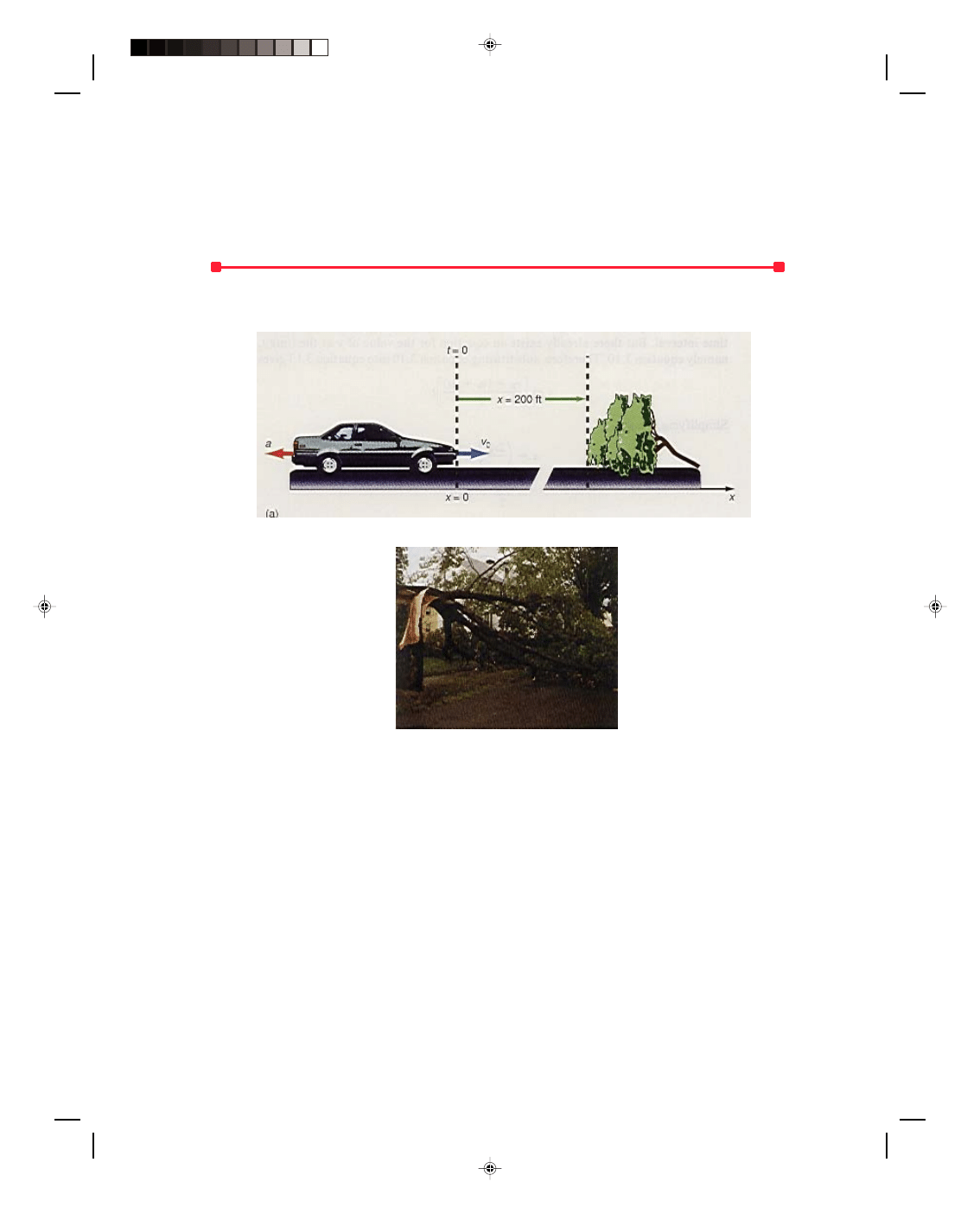
As a further example of the kinematics of a moving body, consider the car moving along a road at an initial
velocity of 95.0 km/hr = 26.4 m/s, as shown in figure 3.14. The driver sees a tree fall into the middle of the road
(b)
Figure 3.14
A tree falls on the road.
60.0 m away. The driver immediately steps on the brakes, and the car starts to decelerate at the constant rate of a
=
−5.50 m/s
2
. (As mentioned previously, in one-dimensional motion a negative acceleration means that the
acceleration vector is toward the left, in the opposite direction of the motion. If the velocity is positive, a negative
value for the acceleration means that the body is slowing down or decelerating.) Will the car come to a stop before
hitting the tree?
What we need for the solution of this problem is the actual distance the car travels before it can come to a
stop while decelerating at the rate of 5.50 m/s
2
. Before we can find that distance, however, we must know the time
it takes for the car to come to a stop. Then we substitute this stopping time into equation 3.14, and the equation
tells us how far the car will travel before coming to a stop. (Note that most of the questions that might be asked
about the motion of the car can be answered using the kinematic equations 3.10 and 3.14.)
Equation 3.10 tells us the velocity of the car at any instant of time. But when the car comes to rest its
velocity is zero. Thus, at the time when the car comes to a stop t
stop
, the velocity v will be equal to zero. Therefore,
equation 3.10 becomes
0 = v
0
+ at
stop
Solving for the time for the car to come to a stop, we have
Pearson Custom Publishing
63

3-12 Mechanics
t
stop
=
− v
0
(3.15)
a
the time interval from the moment the brakes are applied until the car comes to a complete stop. Substituting the
values of the initial velocity v
0
and the constant acceleration a into equation 3.15, we have
t
stop
=
− v
0
=
−26.4 m/s = 4.80 s
a
−5.50 m/s
2
It will take 4.80 s for the car to come to a stop if nothing gets in its way to change its rate of deceleration. Note how
the units cancel in the equation until the final unit becomes seconds, that is,
v
0
= m/s = 1/s = 1 1 = 1 = s
a m/s
2
1/s
2
s 1/s
2
1/s
Thus, (m/s)/(m/s
2
), comes out to have the unit seconds, which it must since it represents the time for the car to
come to a stop.
Now that we know the time for the car to come to a stop, we can substitute that value back into equation
3.14 and find the distance the car will travel in the 4.80 s:
x = v
0
t + 1 at
2
2
(
)
(
)
2
2
m
1
m
26.4
4.80 s
5.50
4.80 s
s
2
s
=
+
−
= 127 m
− 63.4 m
= 63.6 m
The car will come to a stop in 63.6 m. Since the tree is only 60.0 m in front of the car, it cannot come to a stop in
time and will hit the tree.
In addition to the velocity and position of a moving body at any instant of time, we sometimes need to
know the velocity of the moving body at a particular displacement x. In the example of the car hitting the tree, we
might want to know the velocity of the car when it hits the tree. That is, what is the velocity of the car when the
displacement x of the car is equal to 60.0 m?
To find the velocity as a function of displacement x, we must eliminate time from our kinematic equations.
To do this, we start with equation 3.13 for the displacement of the moving body in terms of the average velocity,
t
v
v
t
v
x
avg
+
=
=
2
0
(3.13)
But v is the velocity of the moving body at any time t, given by
v = v
0
+ at (3.10)
Solving for t gives
t = v
− v
0
a
Substituting this value into equation 3.13 gives
0
0
0
2
2
v
v
v
v
v v
x
t
a
+
+
−
=
=
(
)
0
0
2
v
v
v v
a
+
=
−
2ax = v
0
v + v
2
− v
0
v
− v
02
= v
2
− v
02
Pearson Custom Publishing
64
Chapter 3 Kinematics - The Study of Motion 3-13
Solving for v
2
, we obtain the third kinematic equation,
v
2
= v
02
+ 2ax (3.16)
which is used to determine the velocity v of the moving body at any displacement x.
Let us now go back to the problem of the car moving down the road, with a tree lying in the road 60.0 m in
front of the car. We already know that the car will hit the tree, but at what velocity will it be going when it hits the
tree? That is, what is the velocity of the car at the displacement of 60.0 m? Using equation 3.16 with x = 60.0 m, v
0
= 26.4 m/s, and a =
−5.50 m/s
2
, and solving for v gives
v
2
= v
02
+ 2ax
= (26.4 m/s)
2
+ 2(
−5.50 m/s
2
)(60 m)
= 697 m
2
/s
2
− 660 m
2
/s
2
= 37.0 m
2
/s
2
m 3.60 km/hr
6.08
s
1 m/s
v
=
and finally,
v = 21.9 km/hr
When the car hits the tree it will be moving at 21.9 km/hr, so the car may need a new bumper or fender.
Equation 3.16 allows us to determine the velocity of the moving body at any displacement x.
A problem similar to that of the car and the tree involves the maximum velocity that a car can move and
still have adequate time to stop before hitting something the driver sees on the road in front of the car. Let us
again assume that the car decelerates at the same constant rate as before, a =
−5.50 m/s
2
, and that the low beam
headlights of the car are capable of illuminating a 60.0 m distance of the road. Using equation 3.16, which gives
the velocity of the car as a function of displacement, let us find the maximum value of v
0
such that v is equal to
zero when the car has the displacement x. That is,
v
2
= v
02
+ 2ax
0 = v
02
+ 2ax
0
2
v
ax
= −
(
)
(
)
2
2 5.50 m/s
60.0 m
= − −
2
2
660 m /s
=
m 3.60 km/hr
25.7
s
1 m/s
v
=
= 92.5 km/hr
If the car decelerates at the constant rate of 5.50 m/s
2
and the low beam headlights are only capable of
illuminating a distance of 60.0 m, then the maximum safe velocity of the car at night without hitting something is
92.5 km/hr. For velocities faster than this, the distance it takes to bring the car to a stop is greater than the
distance the driver can see with low beam headlights. If you see it, you’ll hit it! Of course these results are based
on the assumption that the car decelerates at 5.50 m/s
2
. This number depends on the condition of the brakes and
tires and road conditions, and will be different for each car. To increase the maximum safe velocity of the car at
night without hitting something, your car has high beam “bright” lights that illuminates a greater distance of the
road. But even with these brighter beams, there is still another maximum safe driving speed, and if you drive
faster than that, if you see it, you’ll hit it.
In summary, the three kinematic equations,
x = v
0
t + 1 at
2
(3.14)
2
v = v
0
+ at (3.10)
v
2
= v
02
+ 2ax (3.16)
are used to describe the motion of an object undergoing constant acceleration. The first equation gives the
displacement of the object at any instant of time. The second equation gives the body’s velocity at any instant of
time. The third equation gives the velocity of the body at any displacement x.
Pearson Custom Publishing
65
3-14 Mechanics
These equations are used for either positive or negative accelerations. Remember the three kinematic
equations hold only for constant acceleration. If the acceleration varies with time then more advanced techniques
must be used to determine the position and velocity of the moving object.
3.7 The Freely Falling Body
Another example of the motion of a body in one dimension is the freely falling body. A freely falling body is
defined as a body that is moving freely under the influence of gravity, where it is assumed that the effect of air
resistance is negligible. The body can have an upward, downward, or even zero initial velocity. The simplest of the
freely falling bodies we discuss is the body dropped in the vicinity of the surface of the earth. That is, the first case
to be considered is the one with zero initial velocity, v
0
= 0. The motion of a body in the vicinity of the surface of the
earth with either an upward or downward initial velocity will be considered in section 3.9.
In chapter 4 on Newton’s second law of motion, we will see that whenever an unbalanced force F acts on an
object of mass m, it gives that object an acceleration, a. The gravitational force that the earth exerts on an object
causes that object to have an acceleration. This acceleration is called the acceleration due to gravity and is
denoted by the letter g. Therefore, any time a body is dropped near the surface of the earth, that body, ignoring air
friction, experiences an acceleration g. From experiments in the laboratory we know that the value of g near the
surface of the earth is constant and is given by
g = 9.80 m/s
2
= 980 cm/s
2
Any body that falls with the acceleration due to gravity, g, is called a freely falling body.
Originally Aristotle said that a heavier body falls faster than a lighter body and on his authority this
statement was accepted as truth for 1800 years. It was not disproved until the end of the sixteenth century when
Simon Stevin (Stevinus) of Bruges (1548-1620) dropped balls of very different weights and found that they all fell
at the same rate. That is, the balls were all dropped from the same height at the same time and all landed at the
ground simultaneously. The argument still persisted that a ball certainly drops faster than a feather, but Galileo
Galilei (1564-1642) explained the difference in the motion by saying that it is the air’s resistance that slows up the
feather. If the air were not present the ball and the feather would accelerate at the same rate.
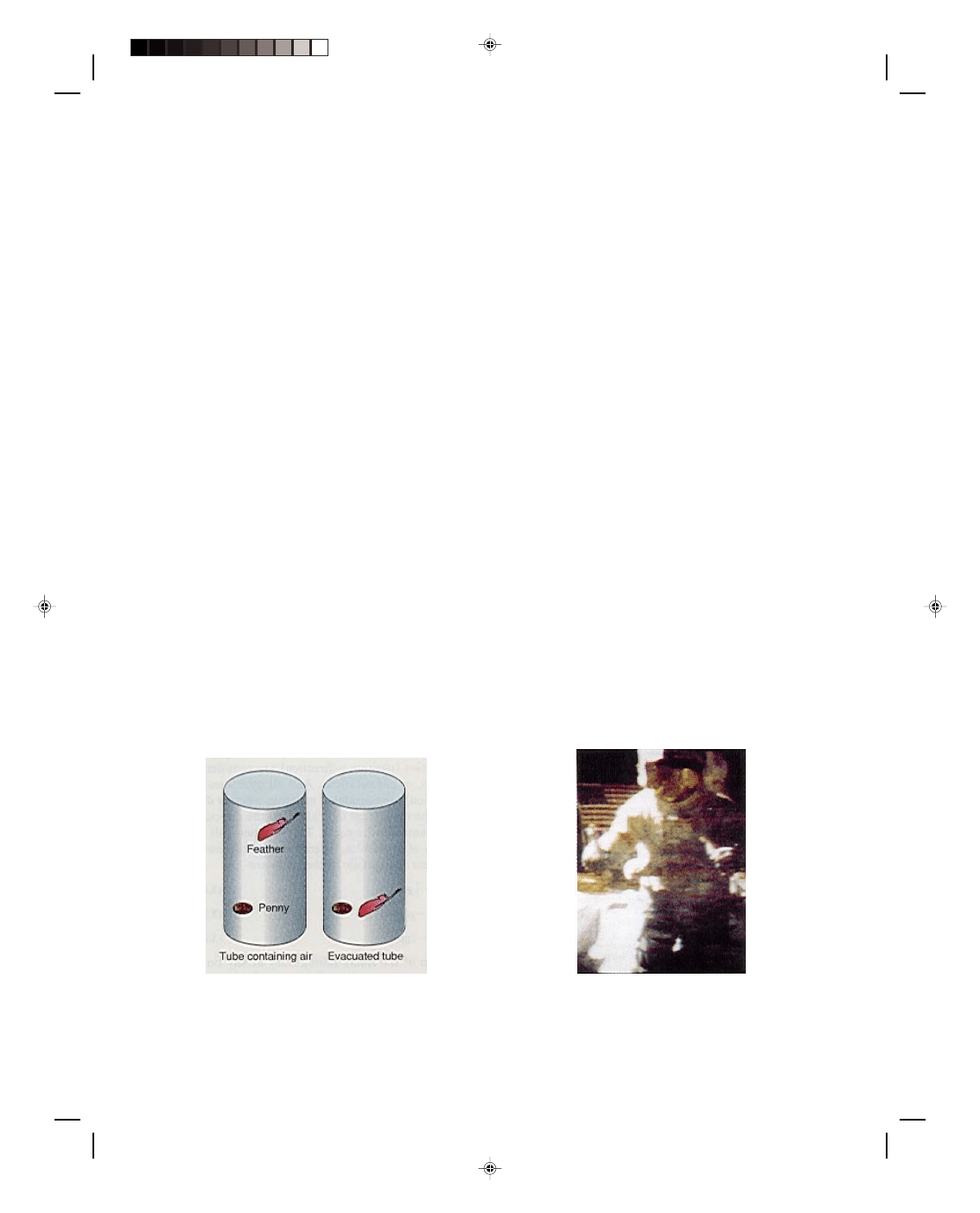
A standard demonstration of the rate of fall is the penny and the feather demonstration. A long tube
containing a penny and a feather is used, as shown in figure 3.15. If we turn the tube upside down, first we
observe that the penny falls to the bottom of the tube before the feather. Then we connect the tube to a vacuum
pump and evacuate most of the air from the tube. Again we turn the tube upside down, and now the penny and
feather do indeed fall at the same rate and reach the bottom of the tube at the same time. Thus, it is the air
friction that causes the feather to fall at the slower rate.
Another demonstration of a freely falling body, performed by the Apollo astronauts on the surface of the
moon, was seen by millions of people on television. One of the astronauts dropped a feather and a hammer
simultaneously and millions saw them fall at the same rate, figure 3.16. Remember, there is no atmosphere on the
moon.
Figure 3.15
Free-fall of the penny and
Figure 3.16
Astronaut David R. Scott holds a geological
the feather. hammer in his right hand and a feather in his left. The hammer
and feather dropped to the lunar surface at the same instant.
Pearson Custom Publishing
66
Chapter 3 Kinematics - The Study of Motion 3-15
Therefore, neglecting air friction, all freely falling bodies accelerate downward at the same rate regardless
of their mass. Recall that the acceleration of a body was defined as the change in its velocity with respect to time,
that is,
a =
∆v (3.7)
∆t
Hence, a body that undergoes an acceleration due to gravity of 9.80 m/s
2
, has its velocity changing by 9.80 m/s
every second. If we neglect the effects of air friction, every body near the surface of the earth accelerates
downward at that rate, whether the body is very large or very small. For all the problems considered in this book,
we neglect the effects of air resistance.
Since the acceleration due to gravity is constant near the surface of the earth, we can determine the
position and velocity of the freely falling body by using the kinematic equations 3.10, 3.14, and 3.16. However,
because the motion is vertical, we designate the displacement by y in the kinematic equations:
v = v
0
+ at (3.10)
y = v
0
t + 1 at
2
(3.14)
2
v
2
= v
02
+ 2ay (3.16)
Since the first case we consider is a body that is dropped, we will set the initial velocity v
0
equal to zero in the
kinematic equations. Also the acceleration of the moving body is now the acceleration due to gravity, therefore we
write the acceleration as
a =
−g (3.17)
The minus sign in equation 3.17 is consistent with our previous convention for one-dimensional motion.
Motion in the direction of the positive axis is considered positive, while motion in the direction of the negative axis
is considered negative. Hence, all quantities in the upward direction (positive y-direction) are considered positive,
whether displacements, velocities, or accelerations. And all quantities in the downward direction (negative y-
direction) are considered negative, whether displacements, velocities, or accelerations. The minus sign indicates
that the direction of the acceleration is down, toward the center of the earth. This notation will be very useful later
in describing the motion of projectiles. Therefore, the kinematic equations for a body dropped from rest near the
surface of the earth are
y =
− 1 gt
2
(3.18)
2
v =
− gt (3.19)
v
2
=
−2gy (3.20)
Equation 3.18 gives the height or location of the freely falling body at any time, equation 3.19 gives its velocity at
any time, and equation 3.20 gives the velocity of the freely falling body at any height y. This sign convention gives
a negative value for the displacement y, which means that the zero position of the body is the position from which
the body is dropped, and the body’s location at any time t will always be below that point. The minus sign on the
velocity indicates that the direction of the velocity is downward.
Equations 3.18, 3.19, and
3.20 completely describe the motion
of the freely falling body that is
dropped from rest. As an example,
let us calculate the distance fallen
and velocity of a freely falling body
as a function of time for the first 5 s
of its fall. The results of the
computations are written in figure
3.17. At t = 0 the body is located at y
= 0, (top of figure 3.17) and its
velocity is zero. We then release the
body. Where is it at t = 1 s?
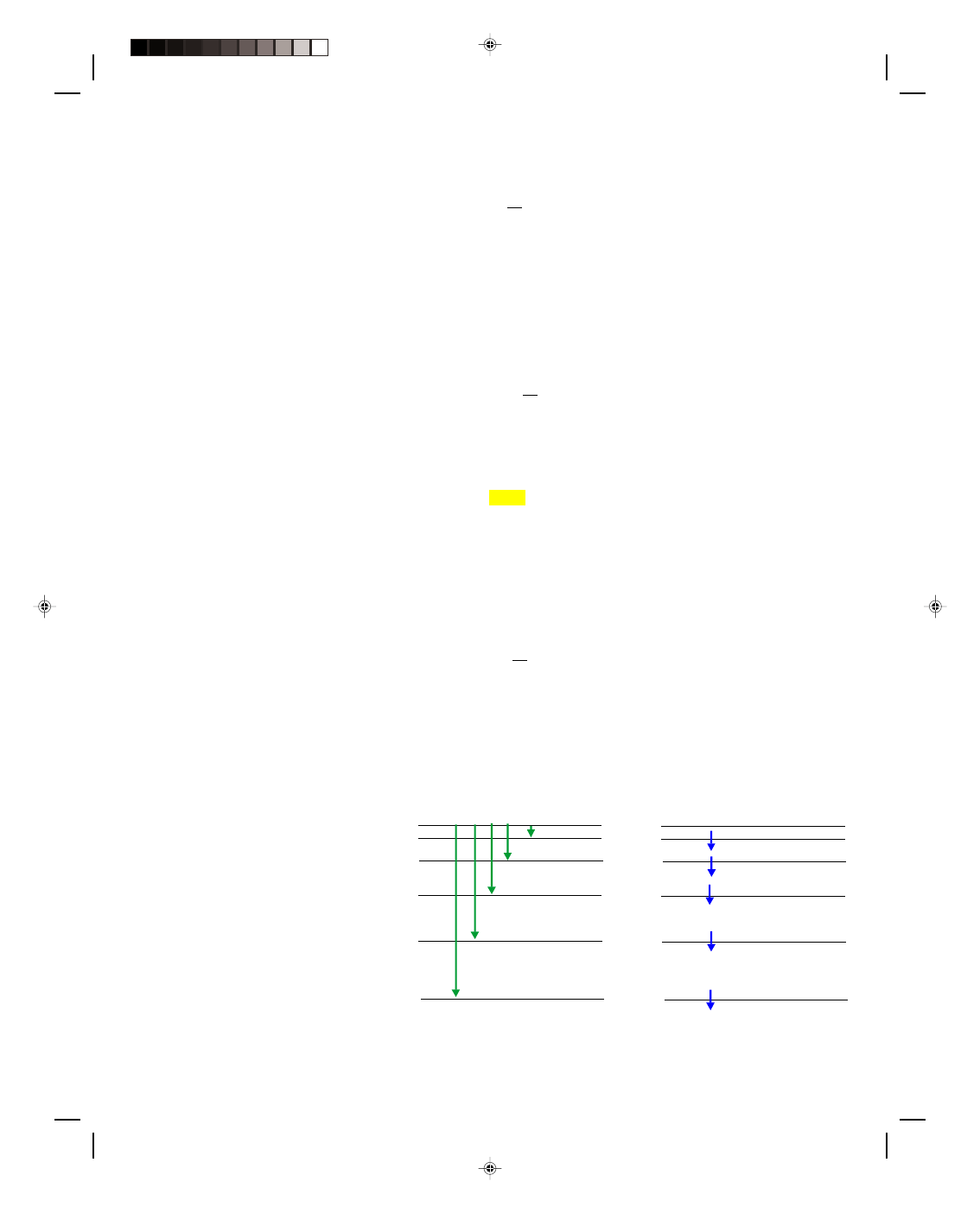
Figure 3.17
The distance and velocity for a freely falling body.
t = 0
t = 1 s
t = 2 s
t = 3 s
t = 5 s
t = 4 s
t = 0
t = 1 s
t = 2 s
t = 3 s
t = 5 s
t = 4 s
y = 0
v = 0
= 4.9 m
−
y
1
= 9.8 m/s
−
v
1
= 19.6 m/s
−
v
2
= 49.0 m/s
−
v
5
= 39.2 m/s
−
v
4
= 29.4 m/s
−
v
3
= 123 m
−
y
5
= 44.1 m
−
y
3
= 78.4 m
−
y
4
= 19.6 m
−
y
2
Pearson Custom Publishing
67

3-16 Mechanics
Using equation 3.18, y
1
is the displacement of the body (distance fallen) at the end of 1 s:
y
1
=
− 1 gt
2
=
− 1 (9.80 m/s
2
)(1 s)
2
=
−4.90 m
2 2
The minus sign indicates that the body is 4.90 m below the starting point. To find the velocity at the end of 1 s, we
use equation 3.19:
v
1
=
−gt = (−9.80 m/s
2
)(1 s) =
−9.80 m/s
The velocity is 9.80 m/s downward at the end of 1 s. The position and velocity at the end of 1 s are shown in figure
3.17. For t = 2 s, the displacement and velocity are
y
2
=
− 1 gt
2
=
− 1 (9.80 m/s
2
)(2 s)
2
=
−19.6 m
2 2
v
2
=
−gt = (−9.80 m/s
2
)(2 s) =
−19.6 m/s
At the end of 2 s the body has dropped a total distance downward of 19.6 m and is moving at a velocity of 19.6 m/s
downward. For t = 3 s we obtain
y
3
=
− 1 gt
2
=
− 1 (9.80 m/s
2
)(3 s)
2
=
−44.1 m
2 2
v
3
=
−gt = (−9.80 m/s
2
)(3 s) =
−29.4 m/s
At the end of 3 s the body has fallen a distance of 44.1 m and is moving downward at a velocity of 29.4 m/s.
The distance and velocity for t = 4 s and t = 5 s are found similarly and are shown in figure 3.17. One of the
first things to observe in figure 3.17 is that an object falls a relatively large distance in only a few seconds of time.
Also note that the object does not fall equal distances in equal times, but rather the distance interval becomes
greater for the same time interval as time increases. This is, of course, the result of the t
2
in equation 3.18 and is a
characteristic of accelerated motion. Also note that the change in the velocity in any 1-s time interval is 9.80 m/s,
which is exactly what we meant by saying the acceleration due to gravity is 9.80 m/s
2
.
We stated previously that the average velocity during a time interval is exactly equal to the instantaneous
value of the velocity at the exact center of that time interval. We can see that this is the case by inspecting figure
3.17. For example, if we take the time interval as between t = 3 s and t = 5 s, then the average velocity between the
third and fifth second is
v
35avg
= v
5
+ v
3
=
−49.0 m/s + (−29.4 m/s)
2 2
=
−78.4 m/s
2
=
−39.2 m/s = v
4
The average velocity between the time interval of 3 and 5 s, v
35avg
, is exactly equal to v
4
, the instantaneous velocity
at t equals 4 seconds, which is the exact center of the 3-5 time interval, as we can see in figure 3.17. The figure also
shows the characteristic of an average velocity. At the beginning of the time interval the actual velocity is less
than the average value, while at the end of the time interval the actual velocity is greater than the average value,
but right at the center of the time interval the actual velocity is equal to the average velocity. Note that the
average velocity occurs at the center of the time interval and not the center of the space interval.
In summary, we can see the enormous power inherent in the kinematic equations. An object was dropped
from rest and the kinematic equations completely described the position and velocity of that object at any instant
of time. All that information was contained in those equations.
Example 3.7
Using the kinematic equation for free fall. A student’s book falls out the window of the physics laboratory. How
long does it take to fall to the ground 20.0 m below? With what velocity does the book hit the ground?
Solution
Pearson Custom Publishing
68
Chapter 3 Kinematics - The Study of Motion 3-17
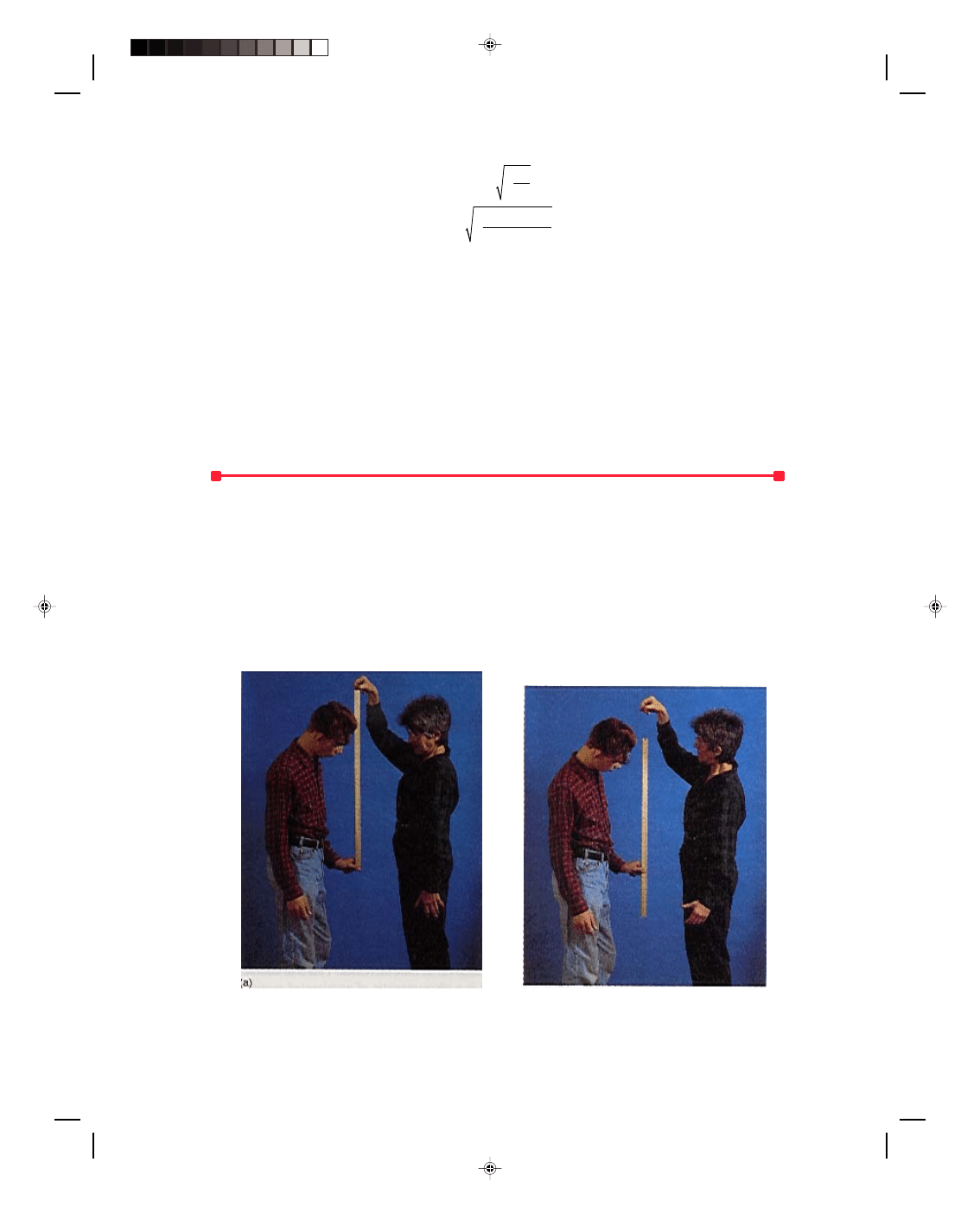
To find the time for the book to fall to the ground we solve equation 3.18 for the time t as
2y
t
g
= −
(
)
2
2 20.0 m
9.80 m/s
−
= −
= 2.02 s
Notice that the distance of 20.0 m is written as a negative number because the ground is 20.0 m below the point
from which the book starts to fall. That is, the ground is on the negative y-axis at y =
− 20.0 m.
The velocity of the book as it hits the ground is found from equation 3.19 as
v =
− gt
=
− (9.80 m/s
2
)(2.02 s)
=
− 19.8 m/s
Notice that the answer is negative, indicating that the velocity is in the negative y-direction.
To go to this interactive example click on this sentence.
3.8 Determination of Your Reaction Time by a Freely Falling Body
How long a period of time does it take for you to react to something? How can you measure this reaction time? It
would be very difficult to use a clock to measure reaction time because it will take some reaction time to turn the
clock on and off. However, a freely falling body can be used to measure reaction time. To see how this is
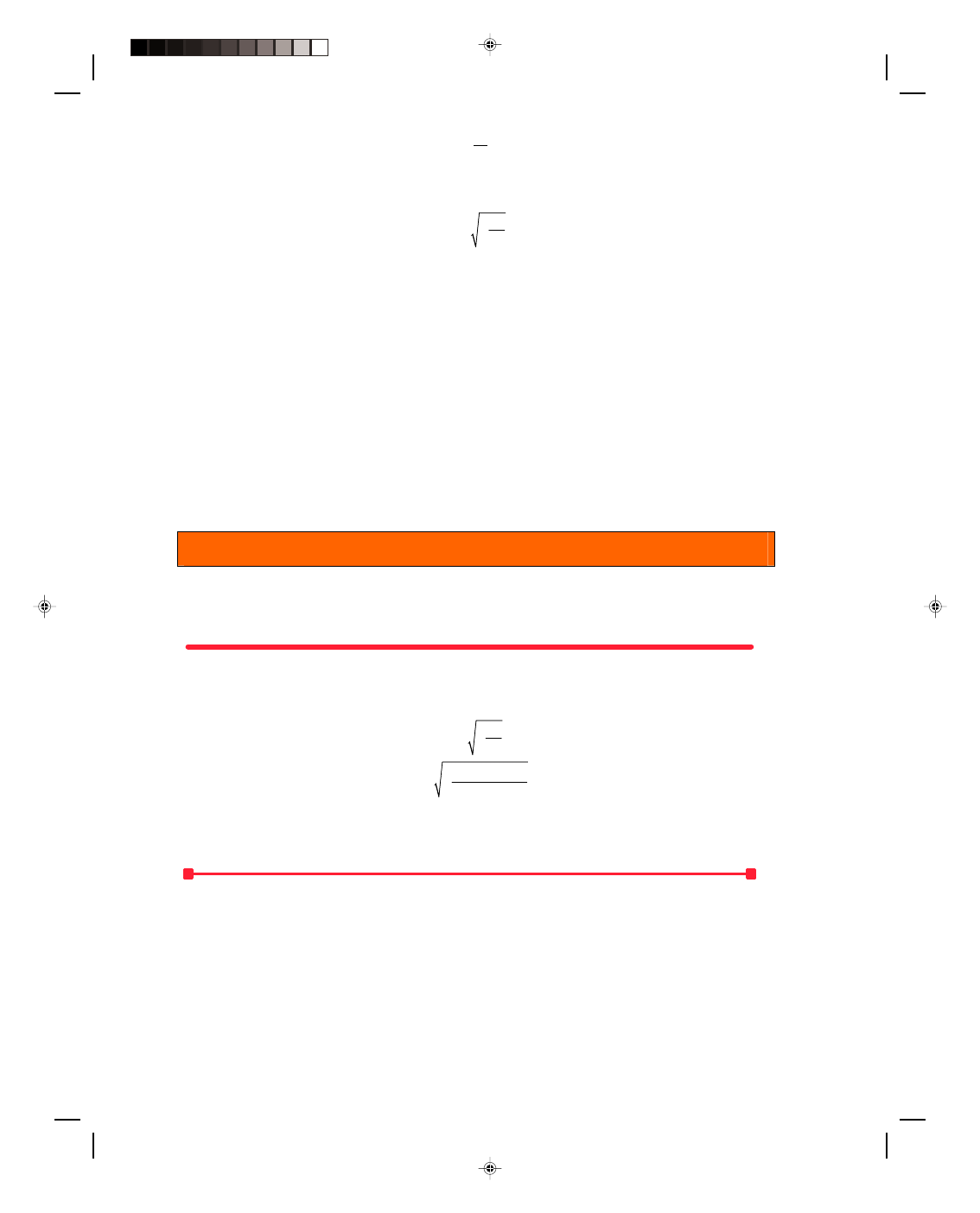
accomplished, have one student hold a vertical meter stick near the top, as shown in figure 3.18(a). The second
student then places his or her hand at the zero of the meter stick (the bottom of the stick) with thumb and
forefinger extended. The thumb and forefinger should be open about 3 to 5 cm. When the first student drops the
meter stick, the second student catches it with the thumb and finger [figure 3.18(b)].
As the meter stick is released, it becomes a freely falling body and hence falls a distance y in a time t:
Figure 3.18
Measurement of reaction time.
Pearson Custom Publishing
69
3-18 Mechanics
y =
− 1 gt
2
2
The location of the fingers on the meter stick, where the meter stick was caught, represents the distance y that the
meter stick has fallen. Solving for the time t we get
2y
t
g
= −
(3.21)
Since we have measured y, the distance the meter stick has fallen, and we know the acceleration due to gravity g,
we can do the simple calculation in equation 3.21 and determine your reaction time. (Remember that the value of y
placed into equation 3.21 will be a negative number and hence we will take the square root of a positive quantity
since the square root of a negative number is not defined.)
If you practice catching the meter stick, you will be able to catch it in less time. But eventually you reach a
time that, no matter how much you practice, you cannot make smaller. This time is your minimum reaction time
— the time it takes for your eye to first see the stick drop and then communicate this message to your brain. Your
brain then communicates this information through nerves and muscles to your fingers and then you catch the
stick. Your normal reaction time is most probably the time that you first caught the stick. A normal reaction time
to catch the meter stick is about 0.2 to 0.3 seconds.
Note that this is not quite the same reaction time it would take to react to a red light while driving a car,
because in that case, part of the communication from the brain would entail lifting your leg from the accelerator,
placing it on the brake pedal, and then pressing. The motion of more muscles and mass would consequently take a
longer period of time. A normal reaction time in a car is approximately 0.5 s. To obtain a more accurate value of
the stopping distance for a car we also need to include the distance that the car moves while the driver reacts to
the red light.
Example 3.8
Measuring your reaction time. One student holds a vertical meter stick near the top and then drops it. The second
student then catches it after the stick has fallen 23.5 cm. Using the kinematic equation for free fall, determine the
reaction time of the second student.
Solution
The reaction time of the student is the time it takes him to react to something. For the falling meterstick,
it is the time from the moment he sees the meterstick drop, to the time he catches it. His reaction time is thus the
time it takes for the meterstick to fall. We solve equation 3.21 for this reaction time t as
2y
t
g
= −
(
)
2
2 0.235 m
9.80 m/s
−
= −
= 0.219 s
To go to this interactive example click on this sentence.
3.9 Projectile Motion in One Dimension
A case one step more general than the freely falling body dropped from rest, is the motion of a body that is thrown
up or down with an initial velocity v
0
near the surface of the earth. This type of motion is called projectile
motion
in one dimension. Remember, however, that this type of motion still falls into the category of a freely
falling body because the object experiences the acceleration g downward throughout its motion. The kinematic
equations for projectile motion are
Pearson Custom Publishing
70
Chapter 3 Kinematics - The Study of Motion 3-19
2
1
2
o
y v t
gt
=
−
(3.22)
v = v
0
− gt (3.23)
v
2
= v
02
− 2gy (3.24)
These three equations completely describe the motion of a projectile in one dimension. Note that these
equations are more general than those for the body dropped from rest because they contain the initial velocity v
0
.
In fact, if v
0
is set equal to zero these equations reduce to the ones studied for the body dropped from rest.
In the previous cases of motion, we were concerned only with motion in one direction. Here there are two
possible directions, up and down. According to our convention the upward direction is positive and the downward
direction is negative. Hence, if the projectile is initially thrown upward, v
0
is positive; if the projectile is initially
thrown downward, v
0
is negative. Also note that whether the projectile is thrown up or down, the acceleration due
to gravity always points downward. If it did not, then a ball thrown upward would continue to rise forever and
would leave the earth, a result that is contrary to observation.
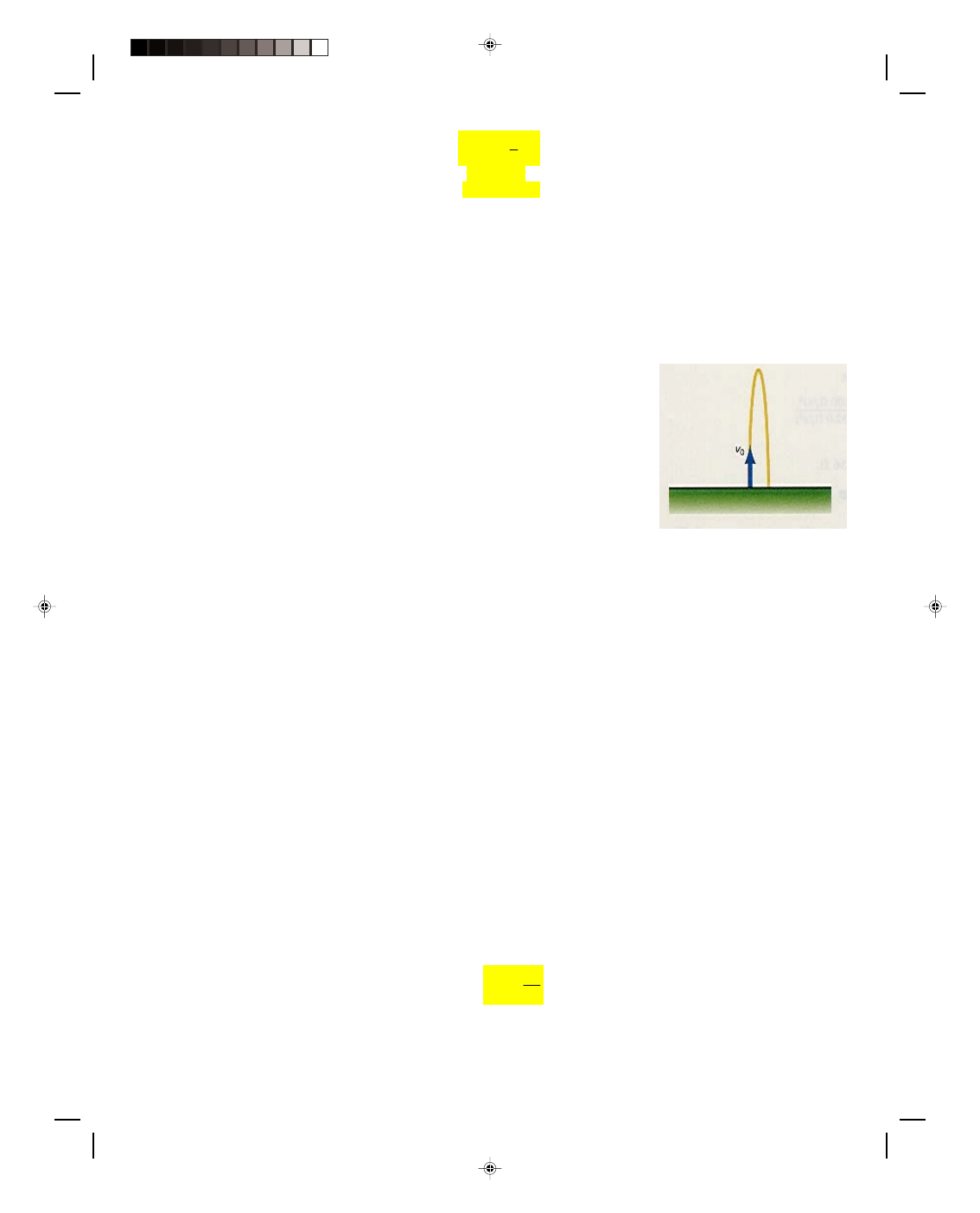
Let us now consider the motion of a projectile thrown upward. Figure
3.19 shows its path through space, which is called a trajectory. The projectile
goes straight up, and
then straight down. The downward portion of the motion
is slightly displaced from the upward portion to clearly show the two different
parts of the motion. For example, suppose the projectile is a baseball thrown
straight upward with an initial velocity v
0
= 30.0 m/s. We want to determine
1. The maximum height of the ball.
2. The time it takes for the ball to rise to the top of its trajectory.
3. The total time that the ball is in the air.
4. The velocity of the ball as it strikes the ground.
5. The position and velocity of the ball at any time t, for example,
for t = 4.00 s.
Figure 3.19
Trajectory of a projectile
in one dimension.
We are asking for a great deal of information, especially considering that the only data given is the initial
position and velocity of the ball. Yet all this information can be obtained using the three kinematic equations 3.22,
3.23, and 3.24. In fact, any time we try to solve any kinematic problem, the first thing is to write down the
kinematic equations, because somehow, somewhere, the answers are in those equations. It is just a matter of
manipulating them into the right form to obtain the information we want about the motion of the projectile.
Let us now solve the problem of projectile motion in one dimension.
Find the Maximum Height of the Ball
Equation 3.22 tells us the height of the ball at any instant of time. We could find the maximum height if we knew
the time for the projectile to rise to the top of its trajectory. But at this point that time is unknown. (In fact, that is
question 2.) Equation 3.24 tells us the velocity of the moving body at any height y. The velocity of the ball is
positive on the way up, and negative on the way down, so therefore it must have gone through zero somewhere. In
fact, the velocity of the ball is zero when the ball is at the very top of its trajectory. If it were greater than zero the
ball would continue to rise, if it were less than zero the ball would be on its way down. Therefore, at the top of the
trajectory, the position of maximum height, v = 0, and equation 3.24,
v
2
= v
02
− 2gy
becomes
0 = v
02
− 2gy
max
where y
max
is the maximum height of the projectile. For any other height y, the velocity is either positive
indicating that the ball is on its way up, or negative indicating that it is on the way down. Solving for y
max
, the
maximum height of the ball is
2gy
max
= v
02
2
max
2
o
v
y
g
=
(3.25)
Inserting numbers into equation 3.25, we get
Pearson Custom Publishing
71

3-20 Mechanics
y
max
= v
02
2g
= (30.0 m/s)
2
2(9.80 m/s
2
)
= 45.9 m
The ball will rise to a maximum height of 45.9 m.
Find the Time for the Ball to Rise to the Top of the Trajectory
We have seen that when the projectile is at the top of its trajectory, v = 0. Therefore, equation 3.23,
v = v
0
− gt
becomes
0 = v
0
− gt
r
where t
r
is the time for the projectile to rise to the top of its path. Only at this value of time does the velocity equal
zero. At any other time the velocity is either positive or negative, depending on whether the ball is on its way up or
down. Solving for t
r
we get
o
r
v
t
g
=
(3.26)
the time for the ball to rise to the top of its trajectory. Inserting numbers into equation 3.26 we obtain
t
r
= v
0
= 30.0 m/s
g
9.80 m/s
2
= 3.06 s
It takes 3.06 s for the ball to rise to the top of the trajectory. Notice that the ball has the acceleration
−g at the top
of the trajectory even though the velocity is zero at that instant. That is, in any kind of motion, we can have a
nonzero acceleration even though the velocity is zero. The important thing for an acceleration is the change in
velocity,
not the velocity itself. At the top, the change in velocity is not zero, because the velocity is changing from
positive values on the way up, to negative values on the way down.
The time t
r
could also have been found using equation 3.22,
y
= v
0
t
− 1 gt
2
2
by substituting the maximum height of 45.9 m for y. Even though this also gives the correct solution, the algebra
and arithmetic are slightly more difficult because a quadratic equation for t would have to be solved.
Find the Total Time that the Object Is in the Air
When t is equal to the total time t
t
, that the projectile is in the air, y is equal to zero. That is, during the time from
t
= 0 to t = t
t
, the projectile goes from the ground to its maximum height and then falls back to the ground. Using
equation 3.22, the height of the projectile at any time t,
y = v
0
t
− 1 gt
2
2
with t = t
t
and y = 0, we get
0 = v
0
t
t
− 1 gt
t2
(3.27)
2
Solving for t
t
we obtain
2
o
t
v
t
g
=
(3.28)
the total time that the projectile is in the air. Recall from equation 3.26 that the time for the ball to rise to the top
of its trajectory is t
r
= v
0
/g. And the total time, equation 3.28, is just twice that value. Therefore, the total time that
the projectile is in the air becomes
Pearson Custom Publishing
72

Chapter 3 Kinematics - The Study of Motion 3-21
2
2
o
t
r
v
t
t
g
=
=
(3.29)
The total time that the projectile is in the air is twice the time it takes the projectile to rise to the top of its
trajectory. Stated in another way, the time for the ball to go up to the top of the trajectory is equal to the time for
the ball to come down to the ground.
For this particular problem,
t
t
= 2t
r
= 2(3.06 s) = 6.12 s
The projectile will be in the air for a total of 6.12 s. Also note that equation 3.27 is really a quadratic equation with
two roots. One of which we can see by inspection is t = 0, which is just the initial moment that the ball is launched.
Find the Velocity of the Ball as It Strikes the Ground
There are two ways to find the velocity of the ball at the ground. The simplest is to use equation 3.24,
v
2
= v
02
− 2gy
noting that the height is equal to zero (y = 0) when the ball is back on the ground. Therefore,
v
g2
= v
02
and
v
g
= ±v
0
(3.30)
The two roots represent the velocity at the two times that y = 0, namely, when the ball is first thrown up (t = 0),
with an initial velocity +v
0
, and when the ball lands (t = t
t
) with a final velocity of
−v
0
(the minus sign indicates
that the ball is on its way down).
Another way to find the velocity at the ground is to use equation 3.23,
v = v
0
− gt
which represents the velocity of the projectile at any instant of time. If we let t be the total time that the projectile
is in the air (i.e., t = t
t
), then v = v
g
, the velocity of the ball at the ground. Thus,
v
g
= v
0
− gt
t
(3.31)
But we have already seen that
t
t
= 2v
0
(3.28)
g
Substituting equation 3.28 into equation 3.31 gives
v
g
= v
0
− g(2v
0
)
g
Hence,
v
g
=
−v
0
The velocity of the ball as it strikes the ground is equal to the negative of the original velocity with which the ball
was thrown upward, that is,
v
g
=
−v
0
=
−30.0 m/s
Find the Position and Velocity of the Ball at t = 4.00 s
The position of the ball at any time t is given by equation 3.22 as
y = v
0
t
− 1 gt
2
2
Substituting in the values for t = 4.00 s gives
y
4
= (30.0 m/s)(4.00 s)
− 1 (9.80 m/s
2
)(4.00 s)
2
2
Pearson Custom Publishing
73
3-22 Mechanics
= 120 m
− 78.4 m
= 41.6 m
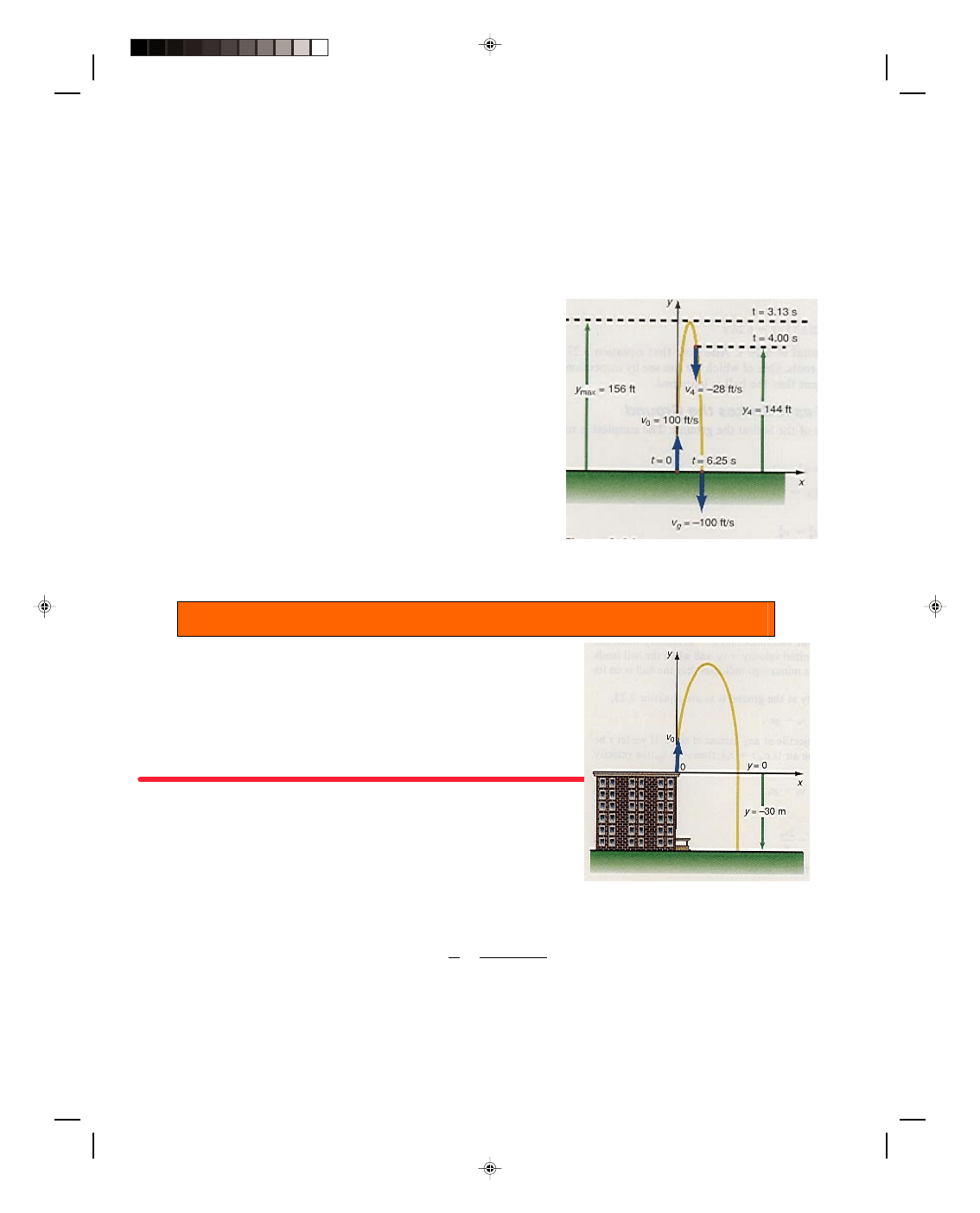
At t = 4.00 s the ball is 41.6 m above the ground.
The velocity of the ball at any time is given by equation 3.23 as
v = v
0
− gt
For t = 4.00 s, the velocity becomes
v
4
= 30.0 m/s
− (9.80 m/s
2
)(4.00 s)
= 30.0 m/s
− 39.2 m/s
=
−9.2 m/s
At the end of 4 s the velocity of the ball is
−9.2 m/s, where the
negative sign indicates that the ball is on its way down. We could
have used equation 3.22 for every value of time and plotted the
entire trajectory, as shown in figure 3.20.
There is great beauty and power in these few simple
equations, because with them we can completely predict the motion
of the projectile for any time, simply by knowing its initial position
and velocity. This is a characteristic of the field of physics. First we
observe how nature works. Then we make a mathematical model of
nature in terms of certain equations. We manipulate these
equations until we can make a prediction, and this prediction yields
information that we usually have no other way of knowing.
For example, how could you know that the velocity of the
ball after 4.00 s would be
−9.2 m/s. In general, there is no way of
knowing that. Yet we have actually captured a small piece of nature
in our model and have seen how it works.
Figure 3.20
Results of projectile motion
in one dimension.
Example 3.9
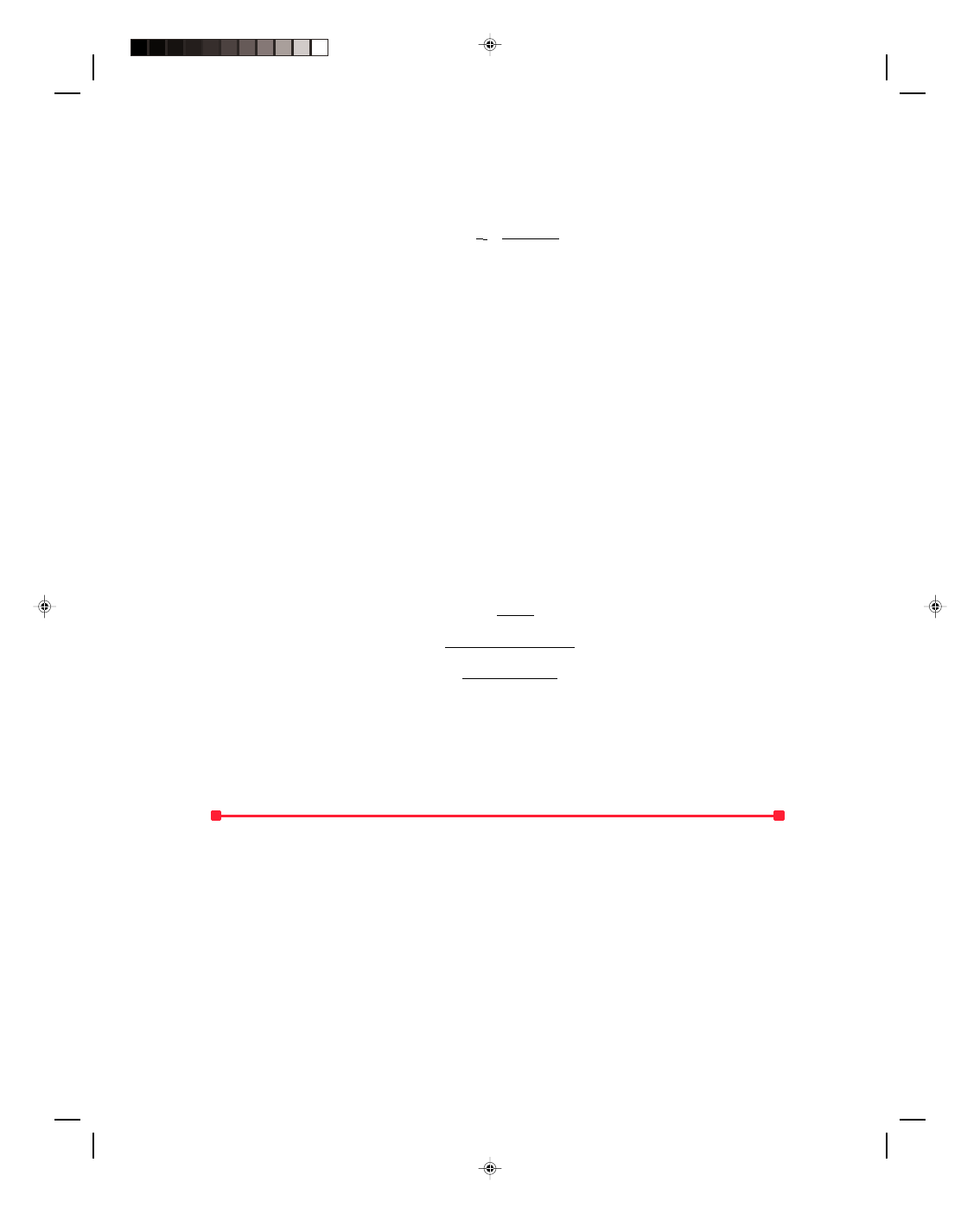
A projectile is fired straight up from the top of a building. A projectile is
fired from the top of a building at an initial velocity of 35.0 m/s upward.
The top of the building is 30.0 m above the ground. The motion is
shown in figure 3.21. Find (a) the maximum height of the projectile,
(b) the time for the projectile to reach its maximum height, (c) the
velocity of the projectile as it strikes the ground, and (d) the total time
that the projectile is in the air.
Solution
We will solve this problem using the techniques just developed.
a
. To find the maximum height of the projectile we again note that at
the top of the trajectory v = 0. Using equation 3.24,
v
2
= v
02
− 2gy
and setting v = 0 we obtain
0 = v
02
− 2gy
max
Figure 3.21
A projectile is fired
vertically from the top of a building.
Solving for the maximum height,
y
max
= v
02
= (35.0 m/s)
2
2g 2(9.80 m/s
2
)
= 62.5 m
The projectile’s maximum height is 62.5 m above the roof of the building, or 92.5 m above the ground.
Pearson Custom Publishing
74
Chapter 3 Kinematics - The Study of Motion 3-23
b
. To find the time for the projectile to reach its maximum height we again note that at the maximum height v = 0.
Substituting v = 0 into equation 3.23, we get
0 = v
0
− gt
r
Solving for the time to rise to the top of the trajectory, we get
t
r
= v
0
= 35.0 m/s
g 9.80 m/s
2
= 3.57 s
It takes 3.57 s for the ball to rise from the top of the roof to the top of its trajectory.
c
. To find the velocity of the projectile when it strikes the ground, we use equation 3.24. When y =
−30.0 m the
projectile will be on the ground, and its velocity as it strikes the ground is
v
2
= v
02
− 2gy
(v
g
)
2
= (35.0 m/s)
2
− 2(9.80 m/s
2
)(
− 30.0 m)
= 1225 m
2
/s
2
+ 588 m
2
/s
2
= 1813 m
2
/s
2
v
g
=
−42.6 m/s
The projectile hits the ground at a velocity of
−42.6 m/s. Note that this value is greater than the initial velocity v
0
,
because the projectile does not hit the roof on its way down, but rather hits the ground 30.0 m below the level of
the roof. The acceleration has acted for a longer time, thereby imparting a greater velocity to the projectile.
d.
To find the total time that the projectile is in the air we use equation 3.23,
v = v
0
− gt
But when t is equal to the total time that the projectile is in the air, the velocity is equal to the velocity at the
ground (i.e., v = v
g
). Therefore,
v
g
= v
0
− gt
t
Solving for the total time, we get
t
t
= v
0
− v
g
g
= 35.0 m/s
− (−42.6 m/s)
9.80 m/s
2
= (35.0 + 42.6)m/s
9.80 m/s
2
= 7.92 s
The total time that the projectile is in the air is 7.92 s. Note that it is not twice the time for the projectile to rise
because the projectile did not return to the level where it started from, but rather to 30.0 m below that level.
To go to this interactive example click on this sentence.
3.10 The Kinematic Equations in Vector Form
Up to now we have discussed motion in one dimension only. And although the displacement, velocity, and
acceleration of a body are vector quantities, we did not write them in the traditional boldface type, characteristic of
vectors. We took into account their vector character by noting that when the displacement, velocity, and
acceleration were in the positive x- or y-direction, we considered the quantities positive. When the displacement,
velocity, and acceleration were in the negative x- or y-direction, we considered those quantities negative. For two-
dimensional motion we must be more general and write the displacement, velocity, and acceleration in boldface
type to show their full vector character. Let us now define the kinematic equations in terms of their vector
characteristics.
Pearson Custom Publishing
75
3-24 Mechanics
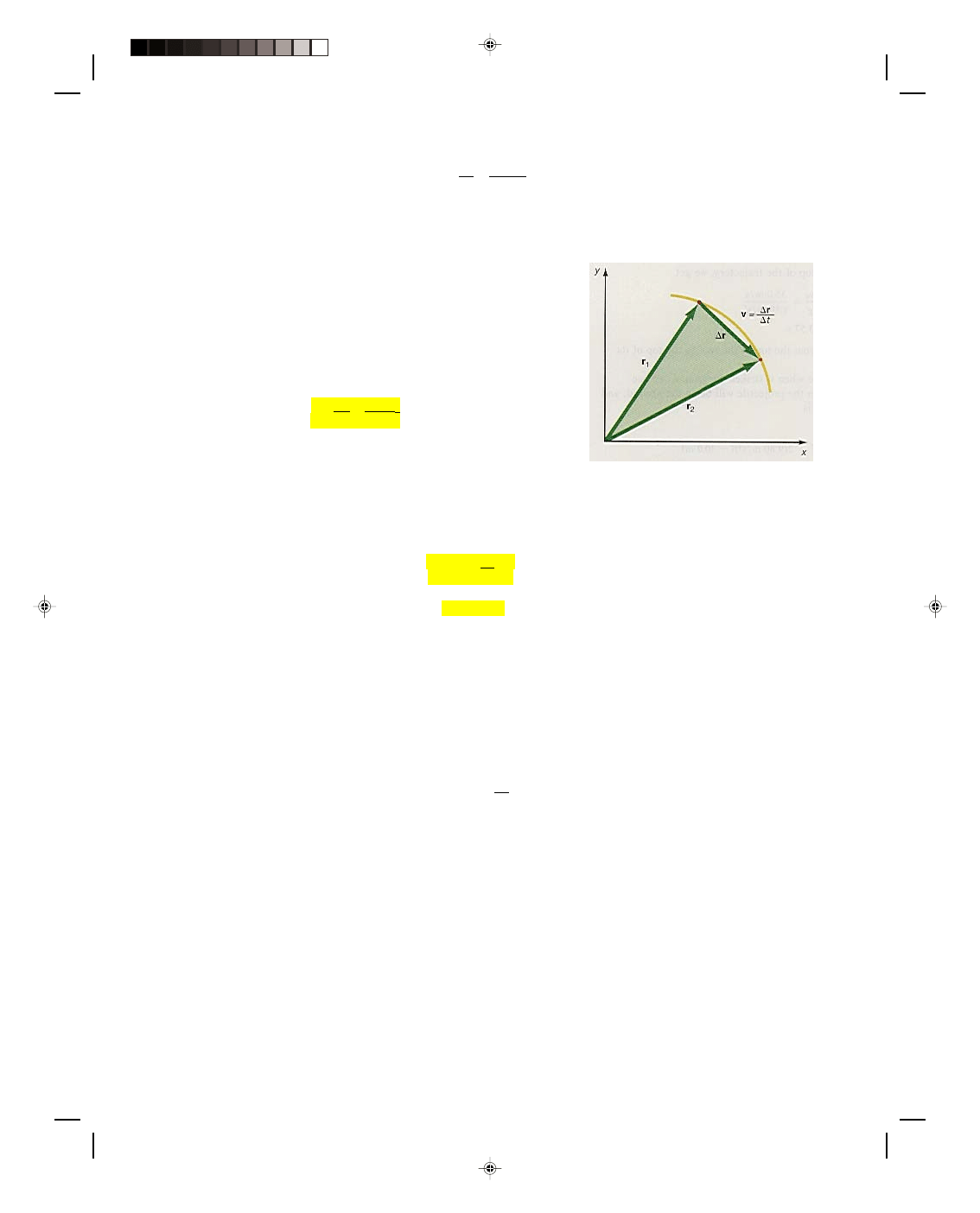
The average velocity of a body is defined as the rate at which the displacement vector changes with time.
That is,
v
avg
=
∆r = r
2
− r
1
(3.32)
∆t t
2
− t
1
where the letter r is the displacement vector. The displacement vector r
1
locates the position of the body at the
time t
1
, while the displacement vector r
2
locates the position of the body at the time t
2
. The displacement between
the times t
1
and t
2
is just the difference between these vectors, r
2
− r
1
, or
∆r, and is shown in figure 3.22.
We find the instantaneous velocity by taking the limit in
equation 3.32 as
∆t approaches zero, just as we did in equation 3.8. The
magnitude of the instantaneous velocity vector is the instantaneous
speed of the body, while the direction of the velocity vector is the
direction that the body is moving, which is tangent to the trajectory at
that point.
The average acceleration vector is defined as the rate at which
the velocity vector changes with time:
a
=
∆v = v − v
0
(3.33)
∆t t
Since the only cases that we will consider concern motion at constant
acceleration, we will not use the subscript avg on a. We find the
Figure 3.22
The change in the displacement
vector.
kinematic equation for the displacement and velocity of the body at any instant of time as in section 3.6, only we
write every term except t as a vector:
r
= v
0
t + 1 at
2
(3.34)
2
and
v
= v
0
+ at (3.35)
Equation 3.34 represents the vector displacement of the moving body at any time t, while equation 3.35 represents
the velocity of the moving body at any time. These vector equations are used to describe the motion of a moving
body in two or three directions.
3.11 Projectile Motion in Two Dimensions
In the study of kinematics we found that the displacement and velocity of a moving body can be determined if the
original velocity v
0
of the body and the acceleration a acting on it are known. The displacement of the body was
given by
r
= v
0
t + 1 at
2
(3.34)
2
while its velocity was given by
v
= v
0
+ at (3.35)
These two equations completely describe the resulting motion of the body. As an example of two-dimensional
kinematics let us study the motion of a projectile in two dimensions. A projectile is thrown from the point 0 in
figure 3.23 with an initial velocity v
0
. The trajectory of the projectile is shown in the figure. The initial velocity v
0
has two components: v
0x
, the x-component of the initial velocity, and v
0y
, the y-component.
The location of the projectile at any instant of time is given by equation 3.34 and is shown as the
displacement vector r in figure 3.23. We resolve the displacement vector r into two components: the distance the
projectile has moved in the x-direction, we designate as x; the distance (or height) the projectile has moved in the
y-direction we designate as y. We can now write the one vector equation 3.34 as two component equations, namely,
Pearson Custom Publishing
76
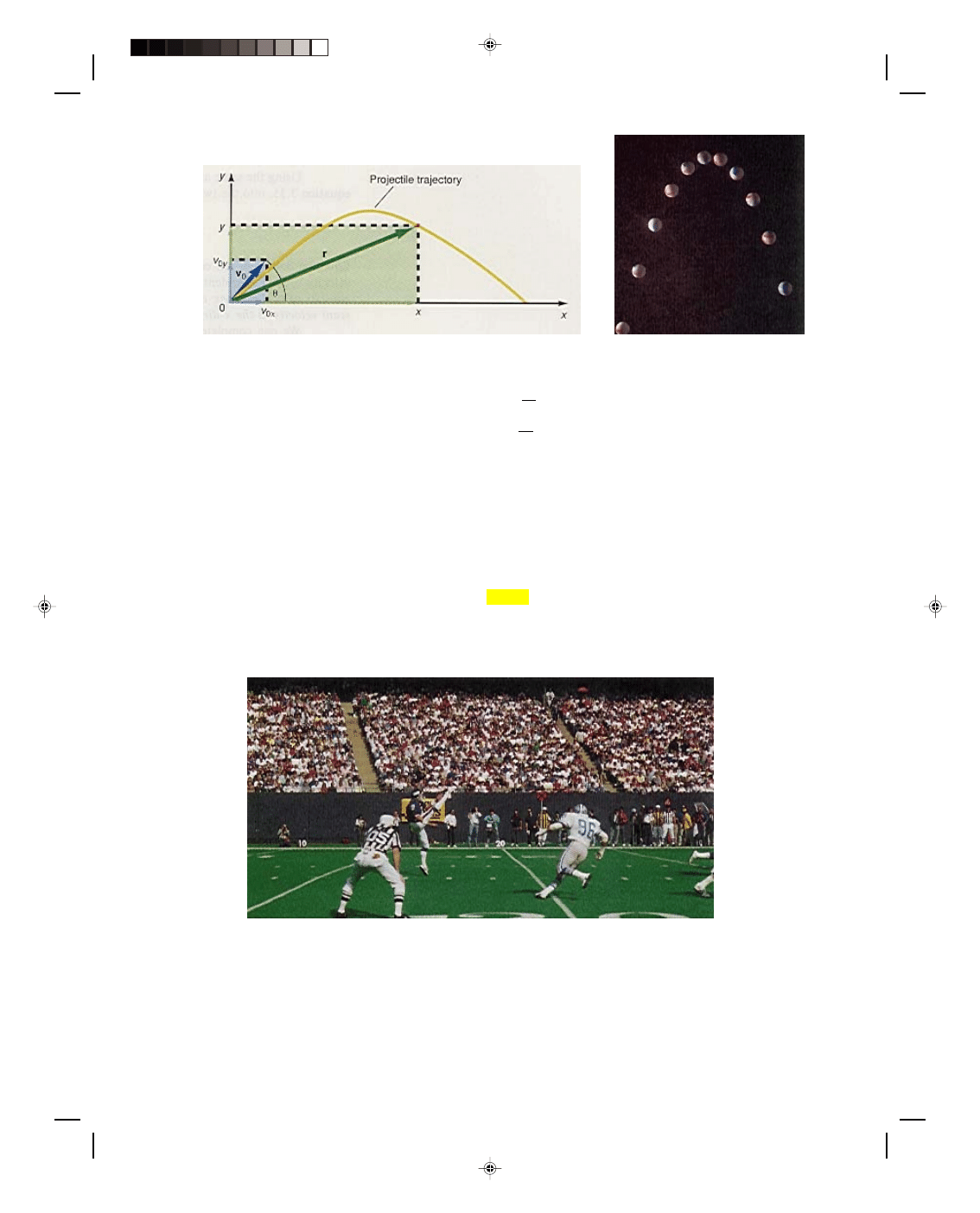
Chapter 3 Kinematics - The Study of Motion 3-25
(a) (b)
Figure 3.23
The trajectory of a projectile in two dimensions.
x = v
0x
t + 1 a
x
t
2
(3.36)
2
y = v
0y
t + 1 a
y
t
2
(3.37)
2
Figure 3.23 shows that v
0x
is the x-component of the original velocity, given by v
0x
= v
0
cos
θ, while v
0y
is the y-
component of the original velocity, v
0y
= v
0
sin
θ. We have resolved the vector acceleration a into two components a
x
and a
y
.
In chapter 4 on Newton’s laws of motion, we will see that whenever an unbalanced force F acts on a body of
mass m, it gives that mass an acceleration a. Because there is no force acting on the projectile in the horizontal x-
direction, the acceleration in the x-direction must be zero, that is, a
x
= 0. Therefore, the x-component of the
displacement r of the projectile, equation 3.36, takes the simple form
x = v
0x
t (3.38)
There is, however, a force acting on the projectile in the y-direction, the force of gravity that the earth exerts on
any object, directed toward the center of the earth. We define the direction of this gravitational force to be in the
Figure 3.24
A punted football is an example of a projectile in two dimensions.
negative y-direction. This gravitational force produces a constant acceleration called the acceleration due to
gravity g. Hence, the y-component of the acceleration of the projectile is given by
−g, that is, a
y
=
−g. The y-
component of the displacement of the projectile therefore becomes
Pearson Custom Publishing
77

3-26 Mechanics
y = v
0y
t
− 1 gt
2
(3.39)
2
Using the same arguments, we resolve the velocity v at any instant of time, equation 3.35, into the two
scalar equations:
v
x
= v
0x
(3.40)
v
y
= v
0y
− gt (3.41)
Equation 3.40 does not contain the time t, and therefore the x-component of the velocity v
x
is independent of time
and is a constant. Hence, the projectile motion consists of two motions: accelerated motion in the y-direction and
motion at constant velocity in the x-direction.
We can completely describe the motion of the projectile using the four equations, namely,
x = v
0x
t (3.38)
y = v
0y
t
− 1 gt
2
(3.39)
2
v
x
= v
0x
(3.40)
v
y
= v
0y
− gt (3.41)
Now let us apply these equations to the projectile motion shown in figure 3.23. We essentially look for the
same information that we found for projectile motion in one dimension. Because two-dimensional motion is a
superposition of accelerated motion in the y-direction coupled to motion in the x-direction at constant velocity, we
can use many of the techniques and much of the information we found in the one-dimensional case.
Let us find (1) the time for the projectile to rise to its maximum height, (2) the total time that the projectile
is in the air, (3) the range (or maximum distance in the x-direction) of the projectile, (4) the maximum height of the
projectile, (5) the velocity of the projectile as it strikes the ground, and (6) the location and velocity of the projectile
at any time t.
To determine this information we use the kinematic equations 3.38 through 3.41.
The Time for the Projectile to Rise to Its Maximum Height
To determine the maximum height of the projectile we use the same reasoning used for the one-dimensional case.
As the projectile is moving upward it has some positive vertical velocity v
y
. When it is coming down it has some
negative vertical velocity
−v
y
. At the very top of the trajectory, v
y
= 0.
Therefore, at the top of the trajectory, equation 3.41 becomes
0 = v
0y
− gt
r
(3.42)
Note that this is very similar to the equation for the one-dimensional case, except for the subscript y on v
0
. This is
an important distinction between the two motions, because the initial velocity upward v
0y
is now less than the
initial velocity upward v
0
in the one-dimensional case. Solving equation 3.42 for the time to rise to the top of the
trajectory t
r
, we get
t
r
= v
0y
(3.43)
g
Since we know v
0
and hence v
0y
, and because g is a constant, we can immediately compute t
r
.
The Total Time the Projectile Is in the Air
To find the total time that the projectile is in the air, we use equation 3.39. When t is the total time t
t
, the
projectile is back on the ground and the height of the
projectile is zero, y = 0. Therefore,
0 = v
0y
t
t
− 1 gt
t2
2
Solving for the total time that the projectile is in the air, we get
t
t
= 2v
0y
(3.44)
g
Pearson Custom Publishing
78

Chapter 3 Kinematics - The Study of Motion 3-27
But using equation 3.43 for the time to rise, t
r
= v
0y
/g, the total time that the projectile is in the air is exactly
double this value,
t
t
= 2v
0y
= 2t
r
(3.45)
g
which is the same as the one-dimensional case, as expected.
The Range of the Projectile
The range of a projectile is defined as the horizontal distance from the point where the projectile is launched to
the point where it returns to its launch height. In this case, the range is the maximum distance that the projectile
moves in the x-direction before it hits the ground. Because the maximum horizontal distance is the product of the
horizontal velocity, which is a constant, and the total time of flight, the range, becomes
range = R = x
max
= v
0x
t
t
(3.46)
Sometimes it is convenient to express the range in another way. Since v
0x
= v
0
cos
θ, and the total time in the air is
t
t
= 2v
0y
= 2v
0
sin
θ
g g
we substitute these values into equation 3.46 to obtain
R = (v
0
cos
θ)(2v
0
sin
θ) = v
02
2 sin
θ cos θ
g g
However, using the well-known trigonometric identity,
2 sin
θ cos θ = sin 2θ
the range of the projectile becomes
R = v
02
sin 2
θ (3.47)
g
We derived equation 3.47 based on the assumption that the initial and final elevations are the same, and we can
use it only in problems where this assumption holds. This formulation of the range is particularly useful when we
want to know at what angle a projectile should be fired in order to get the maximum possible range. From
equation 3.47 we can see that for a given initial velocity v
0
, the maximum range depends on the sine function.
Because the sine function varies between
−1 and +1, the maximum value occurs when sin 2θ = 1. But this happens
when 2
θ = 90
0
, hence the maximum range occurs when
θ = 45
0
. We obtain the maximum range of a projectile by
firing it at an angle of 45
0
.
The Maximum Height of the Projectile
We can find the maximum height of the projectile by substituting the time t
r
into equation 3.39 and solving for the
maximum height. However, since it is useful to have an equation for vertical velocity as a function of the height,
we will use an alternate solution. Equation 3.39 represents the y-component of the displacement of the projectile
at any instant of time and equation 3.41 is the y-component of the velocity at any instant of time. If the time is
eliminated between these two equations (exactly as it was in section 3.6, for equation 3.16), we obtain the
kinematic equation
v
y2
= v
0y2
− 2gy (3.48)
which gives the y-component of the velocity of the moving body at any height y.
When the projectile has reached its maximum height, v
y
= 0. Therefore, equation 3.48 becomes
0 = v
0y2
− 2gy
max
Solving for y
max
we obtain
y
max
= v
0y2
(3.49)
2g
Pearson Custom Publishing
79
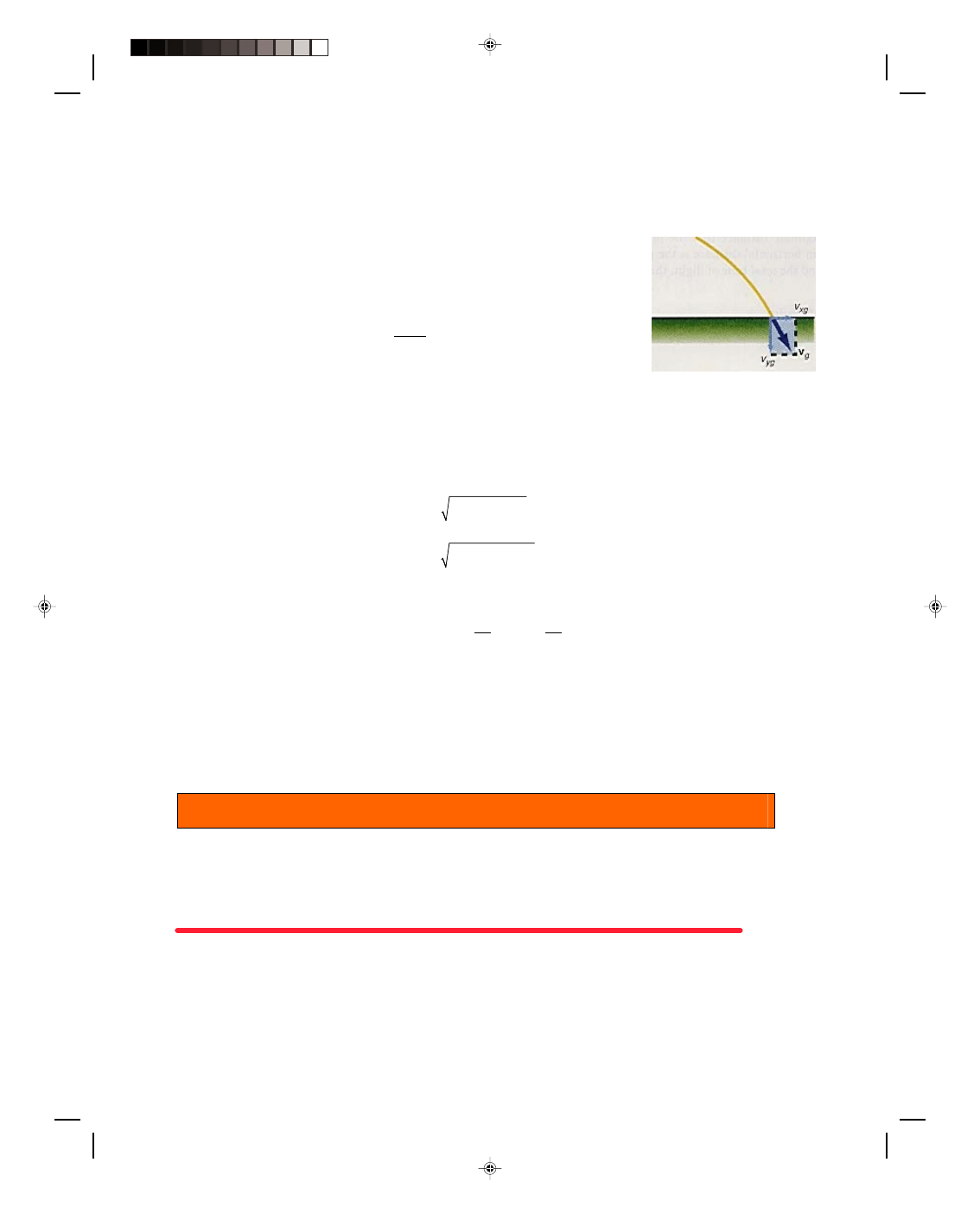
3-28 Mechanics
Solution
the maximum height of the projectile.
The Velocity of the Projectile as It Strikes the Ground
The velocity of the projectile as it hits the ground v
g
can be described in terms of its components, as shown in
figure 3.25. The x-component of the velocity at the ground, found from equation 3.40, is
v
xg
= v
x
= v
0x
(3.50)
The y-component of the velocity at the ground, found from equation 3.41 with t = t
t
is
v
yg
= v
0y
− gt
t
= v
0y
− g(2v
0y
) (3.51)
g
v
yg
=
−v
0y
(3.52)
Figure 3.25
The velocity of the
projectile at the ground.
The y-component of the velocity of the projectile at the ground is equal to the negative of the y-component of the
original velocity. The minus sign just indicates that the projectile is coming down. But this is exactly what we
expected from the study of one-dimensional motion. The magnitude of the actual velocity at the ground, found
from its two components, is
( ) ( )
2
2
g
xg
yg
v
v
v
=
+
(3.53)
and using equations 3.50 and 3.52, becomes
( )
(
)
2
2
g
0
0
0
x
y
v
v
v
v
=
+ −
=
(3.54)
The speed of the projectile as it strikes the ground is equal to the original speed of the projectile. The direction that
the velocity vector makes with the ground is
θ = tan
−1
v
yg
= tan
−1
−v
0y
=
−θ
v
xg
v
0x
The angle that the velocity vector makes as it hits the ground is the negative of the original angle. That is, if the
projectile was fired at an original angle of 30
0
above the positive x-axis, it will make an angle of 30
0
below the
positive x-axis when it hits the ground.
The Location and Velocity of the Projectile at Any Time t
We find the position and velocity of the projectile at any time t by substituting that value of t into equations 3.38,
3.39, 3.40, and 3.41. Let us look at some examples of projectile motion.
Example 3.10
Projectile motion in two dimensions. A ball is thrown with an initial velocity of 30.0 m/s at an angle of 60.0
0
above
the horizontal, as shown in figure 3.26. Find (a) the maximum height of the ball, (b) the time to rise to the top of
the trajectory, (c) the total time the ball is in the air, (d) the range of the ball, (e) the velocity of the ball as it
strikes the ground, and (f) the position and velocity of the ball at t = 4 s.
The x-component of the initial velocity is
v
0x
= v
0
cos
θ = (30.0 m/s) cos 60
0
= 15.0 m/s
The y-component of the initial velocity is
Pearson Custom Publishing
80
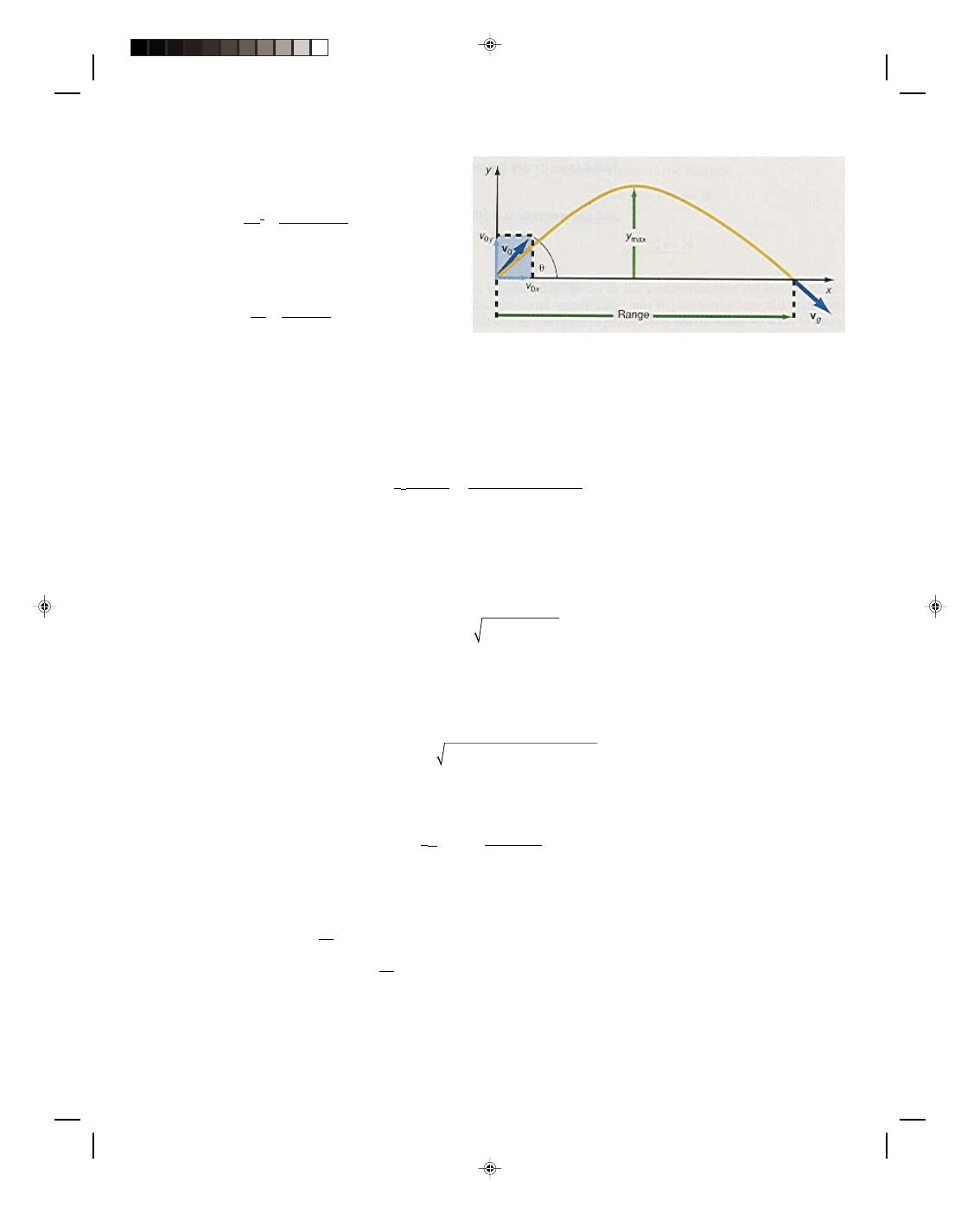
Chapter 3 Kinematics - The Study of Motion 3-29
v
0y
= v
0
sin
θ = (30.0 m/s) sin 60.0
0
= 26.0 m/s
a.
The maximum height of the ball, found from
equation 3.49, is
y
max
= v
0y2
= (26.0 m/s)
2
= 34.5 m
2g 2(9.80 m/s
2
)
b.
To find the time to rise to the top of the
trajectory, we use equation 3.43,
t
r
= v
0y
= 26.0 m/s = 2.65 s
g 9.80 m/s
2
Figure 3.26
Trajectory of a thrown ball.
c.
To find the total time that the ball is in the air, we use equation 3.45,
t
t
= 2t
r
= 2(2.65 s) = 5.30 s
d.
The range of the ball, found from equation 3.47, is
R = v
02
sin 2
θ = (30.0 m/s)
2
sin 120
0
= 79.5 m
g 9.80 m/s
2
As a check, we can use equation 3.46 to get
R = x
max
= v
0x
t
t
= (15.0 m/s)(5.30 s) = 79.5 m
e.
To find the magnitude of the velocity of the ball at the ground, we use equation 3.53,
( ) ( )
2
2
g
xg
yg
v
v
v
=
+
where
v
xg
= v
0x
= 15.0 m/s
and
v
yg
= v
0y
− gt
t
= 26.0 m/s
− (9.80 m/s
2
)(5.30 s)
= 26.0 m/s
− 51.9 m/s = −25.9 m/s
Hence,
(
) (
)
2
2
15.0 m/s
25.9 m/s
g
v
=
+ −
= 29.9 m/s
≅ 30.0 m/s because of round off errors
The direction that the velocity vector makes with the ground is
θ = tan
−1
v
yg
= tan
−1
−25.9 m/s = −59.9
0
≅ 60.0
0
v
xg
15.0 m/s
f.
To find the position and velocity of the ball at t = 4 s we use the kinematic equations 3.38 through 3.41.
1.
x = v
0x
t = (15.0 m/s)(4 s) = 60.0 m
2.
y = v
0y
t
− 1 gt
2
2
= (26.0 m/s)(4 s)
− 1 (9.80 m/s
2
)(4 s)
2
2
= 25.6 m
The ball is 60.0 m down range and is 25.6 m high.
Pearson Custom Publishing
81
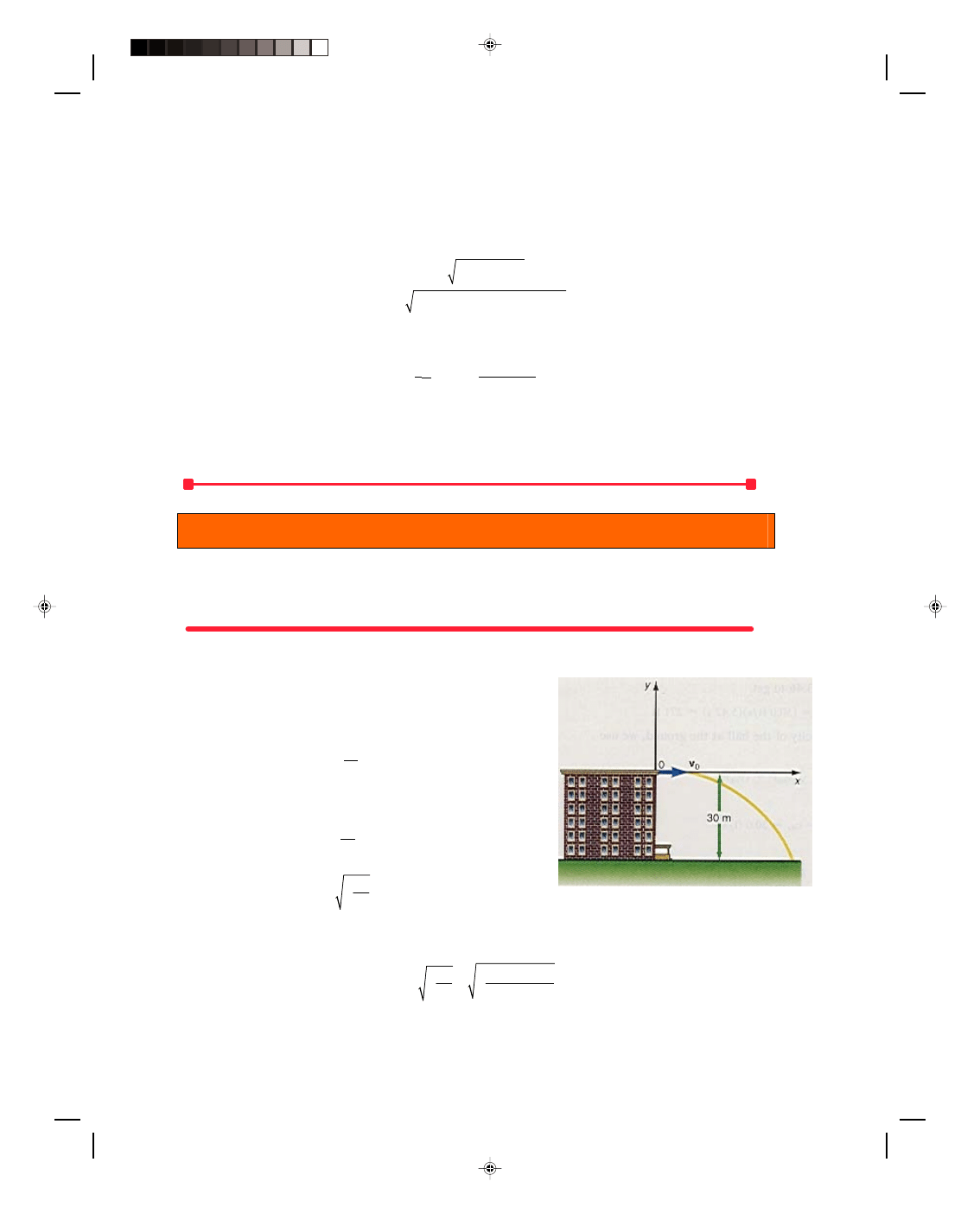
3-30 Mechanics
The components of the velocity at 4 s are
3.
v
x
= v
0x
= 15.0 m/s
4.
v
y
= v
0y
− gt
= 26.0 m/s
− (9.80 m/s
2
)(4 s)
=
−13.2 m/s
At the end of 4 s the x-component of the velocity is 15.0 m/s and the y-component is
−13.2 m/s. To determine the
magnitude of the velocity vector at 4 s we have
( )
( )
2
2
x
y
v
v
v
=
+
(
) (
)
2
2
15.0 m/s
13.2 m/s
v
=
+ −
= 20.0 m/s
The direction of the velocity vector at 4 s is
θ = tan
−1
v
yg
= tan
−1
−13.2 m/s = −41.3
0
v
xg
15.0 m/s
The velocity vector makes an angle of 41.3
0
below the horizontal at 4 s.
To go to this interactive example click on this sentence.
Example 3.11
A projectile is fired horizontally from the roof of a building. A projectile is fired horizontally from the roof of a
building 30.0 m high at an initial velocity of 20.0 m/s, as shown in figure 3.27. Find (a) the total time the projectile
is in the air, (b) where the projectile will hit the ground, and (c) the velocity of the projectile as it hits the ground.
Solution
The x- and y-components of the velocity are
v
0x
= v
0
= 20.0 m/s
v
0y
= 0
a.
To find the total time that the projectile is in the air, we use
equation 3.39,
y = v
0y
t
− 1 gt
2
2
However, the initial conditions are that v
0y
= 0. Therefore,
y =
− 1 gt
2
2
Solving for t,
2y
t
g
= −
Figure 3.27
Trajectory of projectile thrown horizontally.
However, when t = t
t
, y =
−30.0 m. Hence,
(
)
2
2 30.0 m
2
9.80 m/s
t
y
t
g
−
= −
= −
= 2.47 s
Pearson Custom Publishing
82
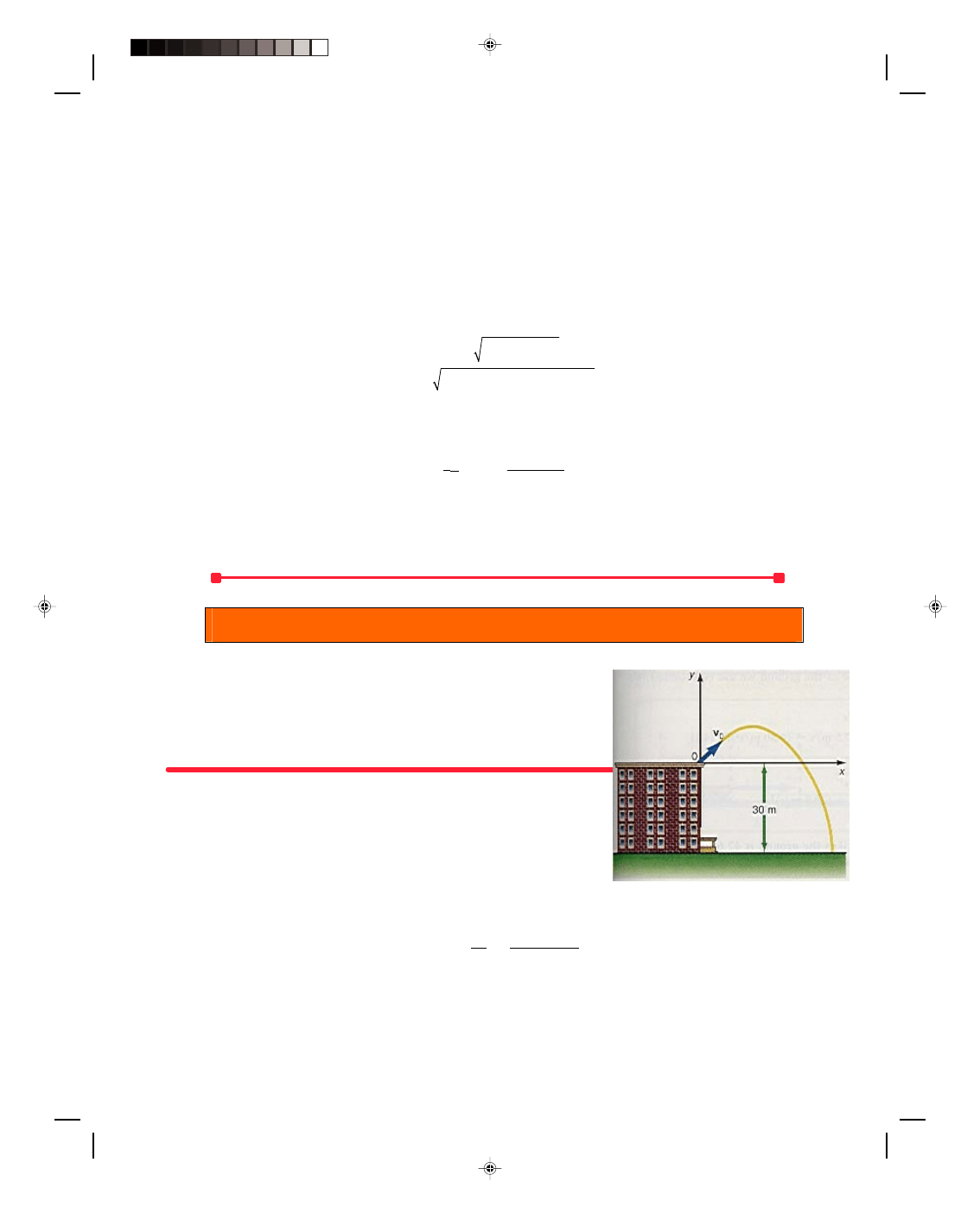
Chapter 3 Kinematics - The Study of Motion 3-31
b.
To find where the projectile hits the ground, we use equation 3.38,
x = v
0x
t
Now the projectile hits the ground when t = t
t
, therefore,
x = v
0x
t
t
= (20.0 m/s)(2.47 s) = 49.4 m
The projectile hits the ground at the location y =
−30.0 m and x = 49.4 m.
c.
To find the velocity of the projectile at the ground we use equations 3.50, 3.51, and 3.53:
v
xg
= v
0x
= v
0
= 20.0 m/s
v
yg
= v
0y
− gt
t
= 0
− (9.80 m/s
2
)(2.47 s) =
−24.2 m/s
( ) ( )
2
2
g
xg
yg
v
v
v
=
+
(
) (
)
2
2
20.0 m/s
24.2 m/s
v
=
+ −
= 31.4 m/s
The direction that the velocity vector makes with the ground is
θ = tan
−1
v
yg
= tan
−1
−24.2 m/s = −50.4
0
v
xg
20.0 m/s
The velocity vector makes an angle of 50.4
0
below the horizontal when the projectile hits the ground.
To go to this interactive example click on this sentence.
Example 3.12
A projectile is fired at an angle from the roof of a building. A projectile is fired at an initial velocity of 35.0 m/s at
an angle of 30.0
0
above the horizontal from the roof of a building 30.0 m
high, as shown in figure 3.28. Find (a) the maximum height of the
projectile, (b) the time to rise to the top of the trajectory, (c) the total
time that the projectile is in the air, (d) the velocity of the projectile at
the ground, and (e) the range of the projectile.
Solution
The x- and y-components of the original velocity are
v
0x
= v
0
cos
θ = (35.0 m/s) cos 30
0
= 30.3 m/s
v
0y
= v
0
sin
θ = (35.0 m/s) sin 30
0
= 17.5 m/s
a.
To find the maximum height we use equation 3.49:
Figure 3.28
Trajectory of a projectile fired
from the roof of a building.
y
max
= v
0y2
= (17.5 m/s)
2
2g 2(9.80 m/s
2
)
= 15.6 m
above the building. Since the building is 30 m high, the maximum height with respect to the ground is 45.6 m.
b.
To find the time to rise to the top of the trajectory we use equation 3.43:
Pearson Custom Publishing
83
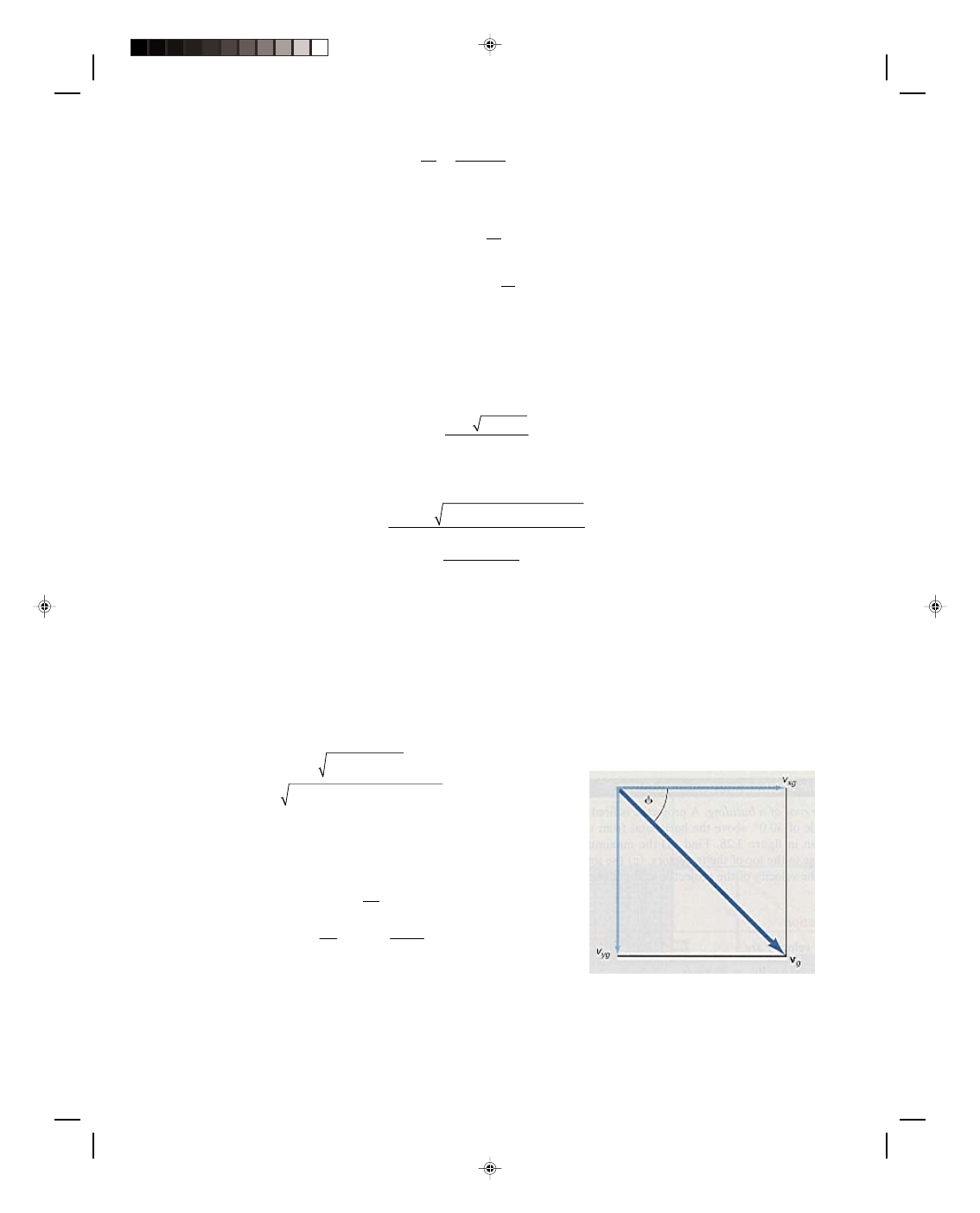
3-32 Mechanics
t
r
= v
0y
= 17.5 m/s = 1.79 s
g 9.80 m/s
2
c.
To find the total time the projectile is in the air we use equation 3.39:
y = v
0y
t
− 1 gt
2
2
When t = t
t
, y =
−30.0 m. Therefore,
−30.0 m = (17.5 m/s)t
t
− 1 (9.80 m/s
2
)t
t2
2
Rearranging the equation, we get
4.90 t
t2
− 17.5 t
t
− 30.0 = 0
The units have been temporarily left out of the equation to simplify the following calculations. This is a quadratic
equation of the form
ax
2
+ bx + c = 0
with the solution
2
4
2
b
b
ac
x
a
− ±
−
=
In this problem, x = t
t
, a = 4.90, b =
−17.5, and c = −30.0. Therefore,
(
)
(
)(
)
2
17.5
17.5
4 4.90
30.0
2(4.90)
t
t
+
±
−
−
=
= +17.5 ± 29.9
9.80
= 4.84 s
The total time that the projectile is in the air is 4.84 s. If we had solved the equation for the negative root, we
would have found a time of
−1.27 s. This corresponds to a time when the height is −30.0 meters but it is a time
before the projectile was thrown. If the projectile had been thrown from the ground it would have taken 1.27
seconds to reach the roof.
d.
To find the velocity of the projectile at the ground we use equations 3.50, 3.51, and 3.53:
v
xg
= v
0x
= 30.3 m/s
v
yg
= v
0y
− gt
t
= 17.5 m/s
− (9.80 m/s
2
)(4.84 s)
=
−29.9 m/s
( ) ( )
2
2
g
xg
yg
v
v
v
=
+
(
) (
)
2
2
30.3 m/s
29.9 m/s
g
v
=
+ −
= 42.6 m/s
The speed of the projectile as it strikes the ground is 42.6 m/s. The angle
that the velocity vector makes with the ground, found from figure 3.29,
is
tan
φ = v
yg
v
xg
1
1
29.9
tan
tan
30.3
yg
xg
v
v
ϕ
−
−
−
=
=
=
−44.6
0
Figure 3.29
Angle of velocity vector as it
strikes the ground.
Pearson Custom Publishing
84

Chapter 3 Kinematics - The Study of Motion 3-33
The velocity vector makes an angle of 44.6
0
below the horizontal when the projectile hits the ground.
e.
To find the range of the projectile we use equation 3.46:
x
max
= v
0x
t
t
= (30.3 m/s)(4.84 s)
= 147 m
To go to this interactive example click on this sentence.
Have You Ever Wondered . . . ?
An Essay on the Application of Physics
Kinematics and Traffic Congestion
Have you ever wondered, while sitting in heavy traffic
on the expressway, as shown in figure 1, why there is
so much traffic congestion? The local radio station
tells you there are no accidents on the road, the traffic
is heavy because of volume. What does that mean?
Why can’t cars move freely on the expressway? Why
call it an expressway, if you have to move so slowly?
Let us apply some physics to the problem to
help understand it. In particular, we will make a
simplified model to help analyze the traffic congestion.
In this model, we assume that the total length of the
expressway L is 10,000 ft
2
(approximately two miles),
Figure 1
Does your highway look like this?
the length of the car x
c
is 10 ft, and the speed of the car v
0
is 55 mph. How many cars of this size can safely fit on
this expressway if they are all moving at 55 mph?
First, we need to determine the safe distance required for each car. If the car is moving at 55 mph (80.7
ft/s), and the car is capable of decelerating at
−18.0 ft/s
2
, the distance required to stop the car is found from
equation 3.16,
v
2
= v
02
+ 2ax
by noting that v = 0 when the car comes to a stop. Solving for the distance x
d
that the car moves while decelerating
to a stop we get
x
d
=
−v
02
=
−(80.7 ft/s)
2
= 181 ft
2a 2(
−18 ft/s
2
)
Before the actual deceleration, the car will move, during the reaction time, a distance x
R
given by
x
R
= v
0
t
R
= (80.7 ft/s)(0.500 s) = 40.4 ft
where we assume that it takes the driver 0.500 s to react. The total distance
∆L needed for each car on the
expressway to safely come to rest is equal to the sum of the distance taken up by the car itself x
c
, the distance the
car moves during the drivers reaction time x
R
, and the distance the car moves while it is decelerating x
d
. That is
∆L = x
c
+ x
R
+ x
d
= 10 ft + 40.4 ft + 181 ft = 231 ft
2
We will depart from our custom of using only SI units here because most students will have a better feel for this discussion if it is done in the
British engineering system of units.
Pearson Custom Publishing
85
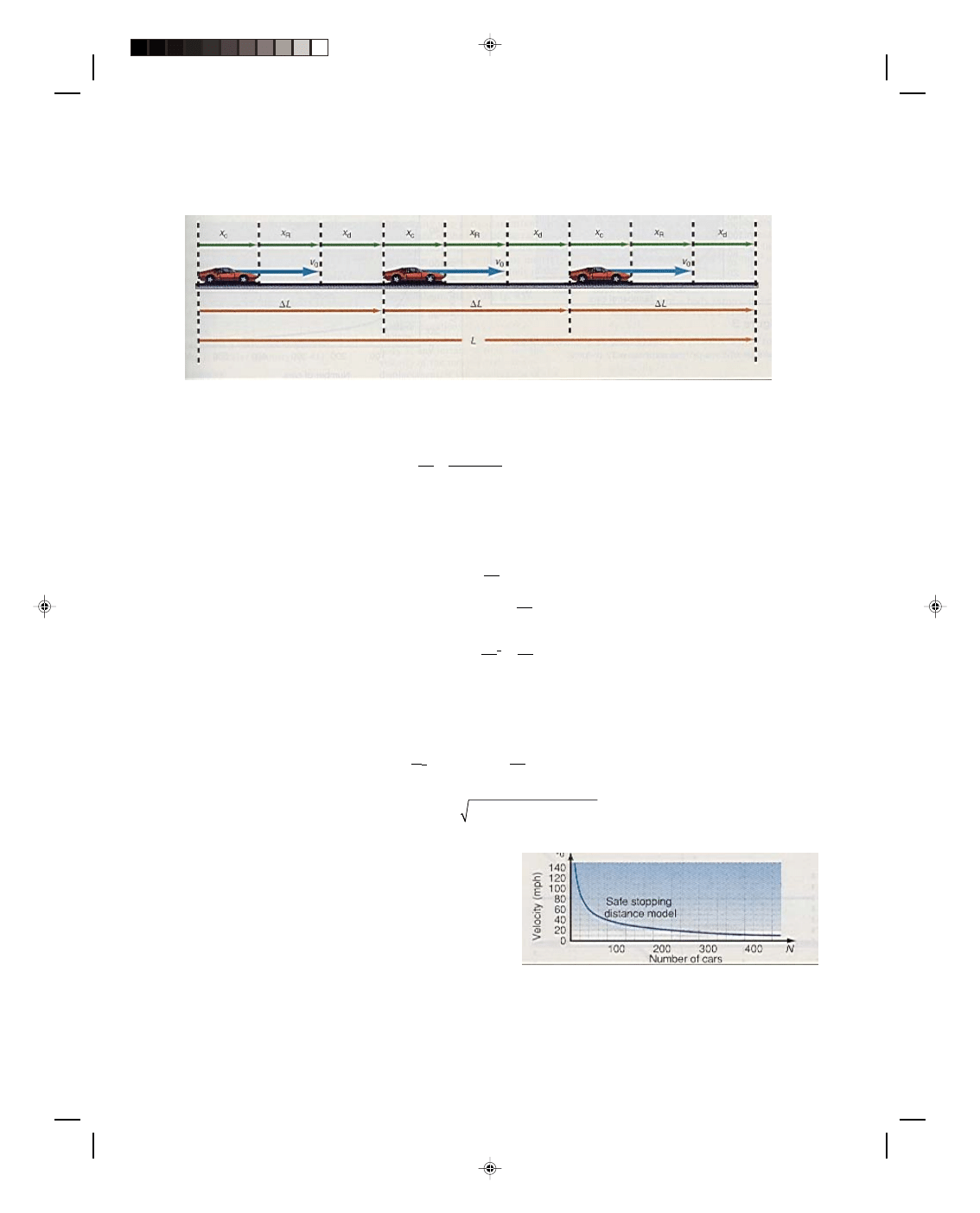
3-34 Mechanics
Because it takes a safe distance
∆L for one car to come to rest, N cars will take a distance of N∆L. The total
length of the road L can then hold N cars, each requiring a distance
∆L to stop, as seen in figure 2. Stated
mathematically this is
L = N
∆L (H3.1)
Figure 2
The number of cars on an expressway.
Therefore, the number of cars N that can safely fit on this road is
N = L = 10,000 ft = 43 cars
∆L 231 ft
Thus for a road 10,000 ft long, only 43 cars can fit safely on it when each is moving at 55 mph. If the
number of cars on the road doubles, then the safe distance per car
∆L must be halved because the product of N and
∆L must equal L the total length of the road, which is a constant. Rewriting equation H3.1 in the form
∆L = L
N
= x
c
+ x
R
+ x
d
= L
N
x
c
+ v
0
t
R
− v
02
= L (H3.2)
2a N
Notice in equation H3.2 that if the number of cars N increases, the only thing that can change on this fixed length
road is the initial velocity v
0
of each car. That is, by increasing the number of cars on the road, the velocity of each
car must decrease, in order for each car to move safely. Equation H3.2 can be written in the quadratic form
− v
02
+ v
0
t
R
+ x
c
− L = 0
2a N
which can be solved quadratically to yield
( )
(
)
2
0
2
/
R
R
c
v
at
at
a x
L N
=
+
−
m
(H3.3)
Equation H3.3 gives the maximum velocity that N cars can
safely travel on a road L ft long. (Don’t forget that a is a
negative number.) Using the same numerical values of a, t
R
,
x
c
, and L as above, equation H3.3 is plotted in figure 3 to
show the safe velocity (in miles per hour) for cars on an
expressway as a function of the number of cars on that
expressway. Notice from the form of the curve that as the
number of cars increases, the safe velocity decreases. As the
graph shows, increasing the number of cars on the road to
Figure 3
Plot of the velocity of cars (y-axis) as function
of the number of cars on the expressway (x-axis).
Pearson Custom Publishing
86
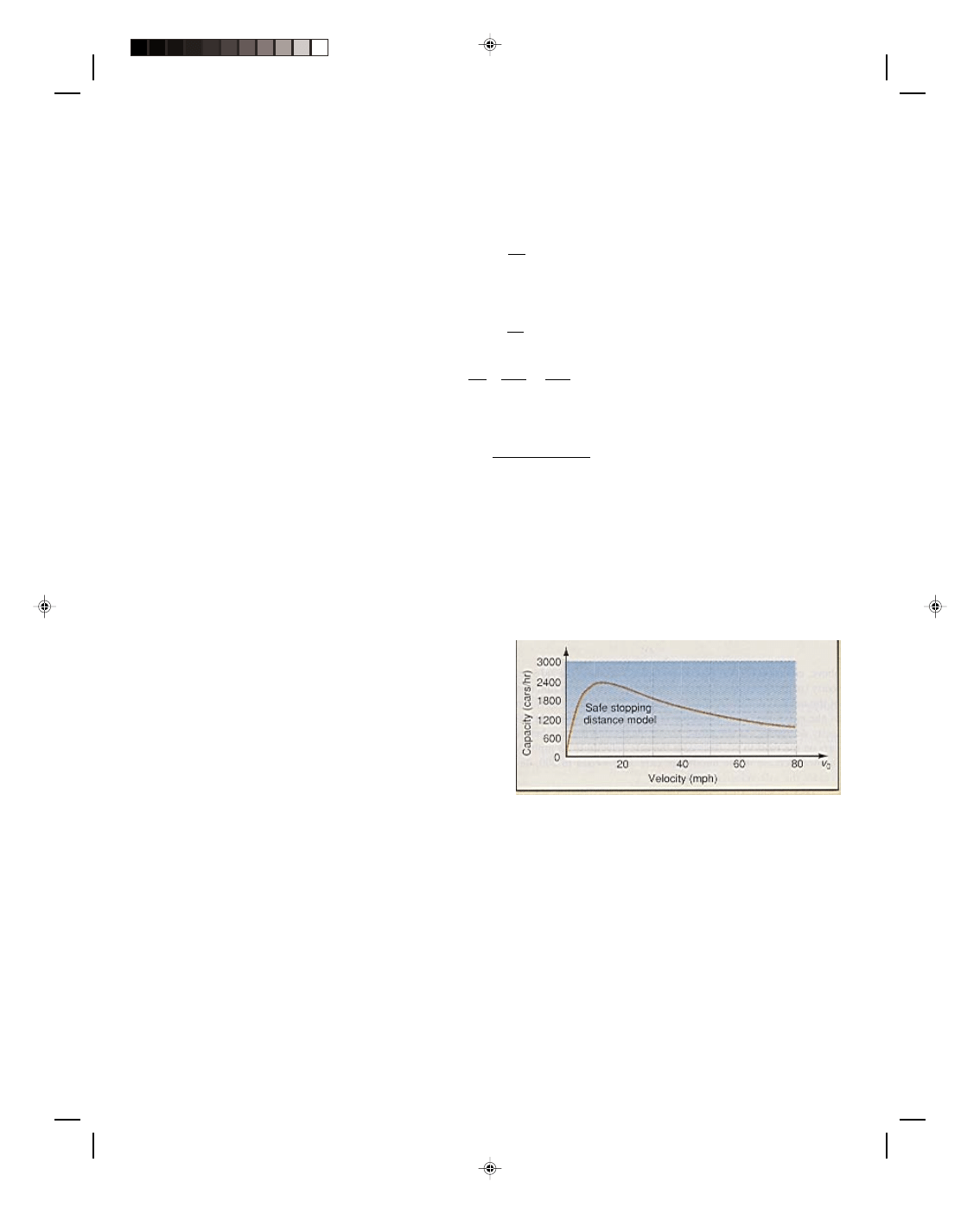
Chapter 3 Kinematics - The Study of Motion 3-35
80, decreases the safe velocity to 38 mph. A further increase in the number of cars on the road to 200, decreases
the safe velocity to 20 mph.
Hence, when that radio announcer says, “There is no accident on the road, the heavy traffic comes from
volume,” he means that by increasing the number of cars on the road, the safe velocity of each car must decrease.
You might wonder if there is some optimum number of cars that a road can handle safely. We can define
the capacity C of a road as the number of cars that pass a particular place per unit time. Stated mathematically,
this is
C = N (H3.4)
t
From the definition of velocity, the time for N cars to pass through a distance L, when moving at the velocity v
0
, is
t = L
v
0
Substituting this into equation H3.4 gives
C = N = N = v
0
t L/v
0
L/N
Substituting from equation H3.2 for L/N, the capacity of the road is
C = v
0
(H3.5)
x
c
+ v
0
t
R
− v
02
/2a
Using the same values for x
c
, t
R
, and a as before, equation H3.5 is plotted in figure 4. The number of cars per hour
that the road can hold is on the y-axis, and the speed of the cars in miles per hour is on the x-axis. Notice that at a
speed of 60 mph, the road can handle 1200 cars per hour. By decreasing the speed of the cars, the number of cars
per hour that the road can handle increases. As shown in the figure, if the speed decreases to 40 mph the road can
handle about 1600 cars per hour. Notice that the curve peaks at a speed of about 13 mph, allowing about 2300
cars/hour to flow on the expressway. Thus, according to this model, the optimum speed to pass the greatest
number of cars per hour is only 13 mph. Hence, even though the road may be called an expressway, if the volume
of cars increases significantly, the cars are not going to travel very rapidly. The solution to the problem is to build
more lanes to handle the increased volume.
It should also be emphasized that this model is
based on safe driving intervals between cars. If an
object were to drop from the back of a truck you are
following, you would need the safe distance to stop in
time to avoid hitting the object. On the other hand, if
the car in front of you, also traveling at 55 mph, has to
stop, and if both drivers have the same reaction time
and both cars decelerate at the same rate, then both
cars will need 231 ft to come to a stop. Hence, when
both cars come to a stop they will still be separated by
the distance of 231 ft. For this reason, in areas of very
Figure 4
The capacity of the road as a function of the
velocity of cars.
heavy traffic, many people do not leave the safe distance between them and the car in front. Instead, they get
closer and closer to the car in front of them until they are only separated by the reaction distance x
R
. I call this the
kamikaze model, for obvious reasons. The kamikaze model allows more cars to travel at a greater velocity than are
allowed by the safe stopping distance model. The velocity of the cars as a function of the number of cars is found by
solving equation H3.2 with the v
02
term, which is the term associated with the deceleration distance x
d
set equal to
zero. The result is shown in figure 5, which compares the safe stopping distance model with the kamikaze model.
Notice that many more cars can now fit on the road. For example, in the safe stopping model, only 40 cars, each
traveling at 60 mph, can fit safely on this road. In the kamikaze model about 185 cars can fit on this road, but
certainly not safely. There will be only 44 ft between each car, and if you have a slower reaction time than that of
the car in front of you, you will almost certainly hit him when he steps on the brakes. This is the reason why there
are so many rear-end collisions on expressways. The number of cars on a real expressway falls somewhere
Pearson Custom Publishing
87
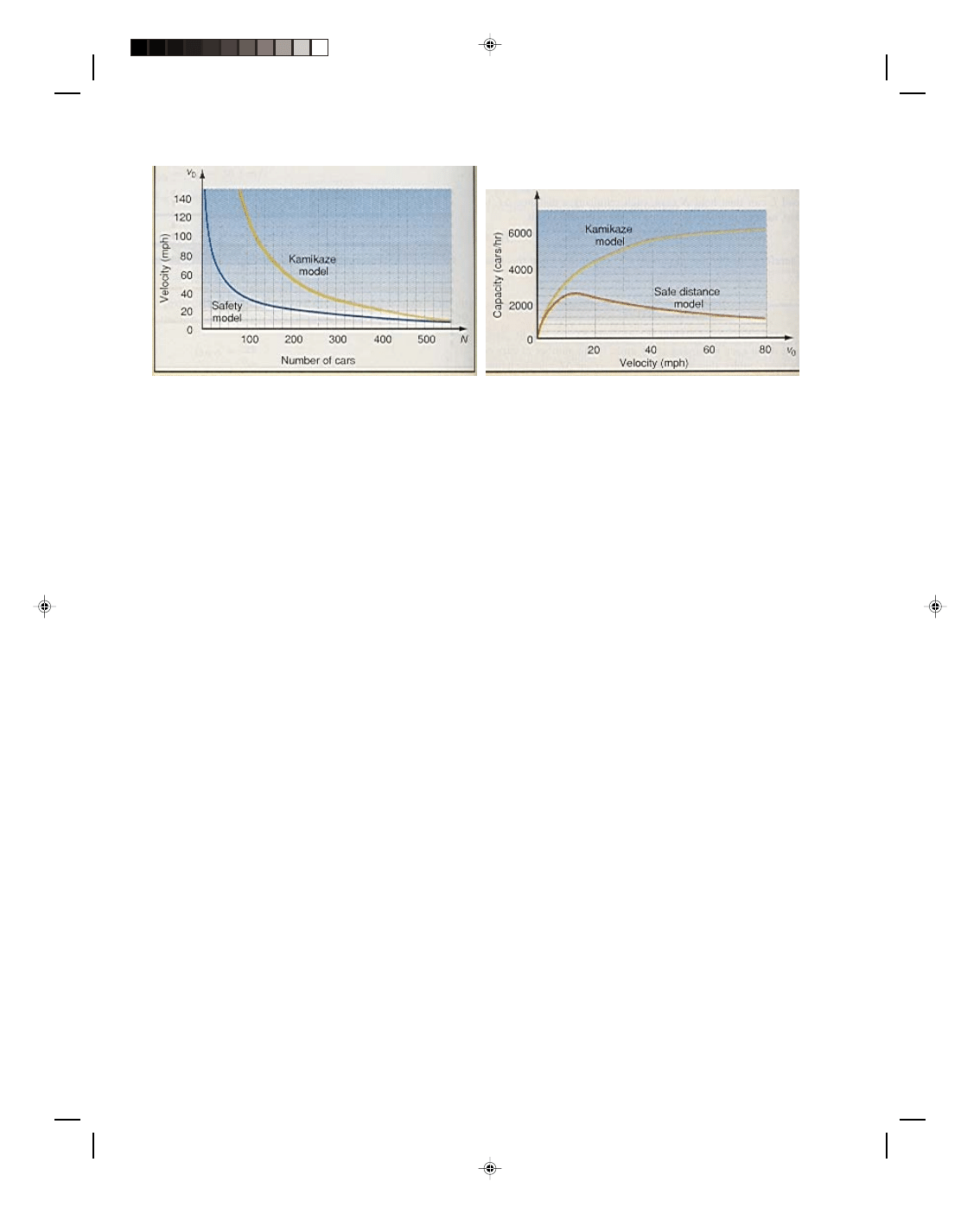
3-36 Mechanics
between the extremes of these two models. Note that even in the kamikaze model, the velocity of the cars must
decrease with volume.
Figure 5
Comparison of traffic with the safe stopping
Figure 6
Comparison of the capacity versus velocity
distance model and the kamikaze model. for the safe stopping distance model and
the kamikaze model.
The capacity of the expressway for the kamikaze model is found by setting the v
02
term in equation H3.5 to
zero. The result is shown in figure 6. Notice that in the kamikaze model the capacity increases with velocity, and
there is no optimum speed for the maximum car flow. In practice, the actual capacity of an expressway lies
somewhere between these two extremes.
In conclusion, if your expressway is not much of an expressway, it is time to petition your legislators to
allocate more money for the widening of the expressway, or maybe it is time to move to a less populated part of the
country.
The Language of Physics
Kinematics
The branch of mechanics that
describes the motion of a body
without regard to the cause of that
motion (p. ).
Average velocity
The average rate at which the
displacement vector changes with
time. Since a displacement is a
vector, the velocity is also a vector
(p. ).
Average speed
The distance that a body moves per
unit time. Speed is a scalar
quantity (p. ).
Constant velocity
A body moving in one direction in
such a way that it always travels
equal distances in equal times (p. ).
Acceleration
The rate at which the velocity of a
moving body changes with time
(p. ).
Instantaneous velocity
The velocity at a particular instant
of time. It is defined as the limit of
the ratio of the change in the
displacement of the body to the
change in time, as the time interval
approaches zero. The magnitude of
the instantaneous velocity is the
instantaneous speed of the moving
body (p. ).
Kinematic equations of linear
motion
A set of equations that gives the
displacement and velocity of the
moving body at
any instant of time, and the velocity
of the moving body at any
displacement, if the acceleration of
the body is a constant (p. ).
Freely falling body
Any body that is moving under the
influence of gravity only. Hence,
any body that is dropped or thrown
on the surface of the earth is a
freely falling body (p. ).
Acceleration due to gravity
If air friction is ignored, all objects
that are dropped near the surface of
the earth, are accelerated toward
the center of the earth with an
acceleration of 9.80 m/s
2
.
Projectile motion
The motion of a body thrown or
fired with an initial velocity v
0
in a
gravitational field (p. ).
Trajectory
The path through space followed by
a projectile (p. ).
Range of a projectile
The horizontal distance from the
point where the projectile is
launched to the point where it
returns to its launch height (p. ).
Pearson Custom Publishing
88

Chapter 3 Kinematics - The Study of Motion 3
-
37
Summary of Important Equations
Average velocity
v
avg
=
∆r = r
2
− r
1
(3.32)
∆t t
2
− t
1
Acceleration
a =
∆v = v − v
0
(3.33)
∆t t
Instantaneous velocity in two or
more directions, which is a
generalization of the instantaneous
velocity in one dimension
0
lim
t
t
∆ →
∆
=
∆
r
v
(3.8)
0
lim
t
x
v
t
∆ →
∆
=
∆
Velocity at any time
v = v
0
+ at (3.35)
Displacement at any time
r = v
0
t + 1 at
2
(3.34)
2
Velocity at any displacement in the
x-direction
v
2
= v
02
+ 2ax (3.16)
Velocity at any displacement in the
y-direction
v
2
= v
02
+ 2ay (3.16)
For Projectile Motion
x-displacement
x = v
0x
t (3.38)
y-displacement
y = v
0y
t
− 1 gt
2
(3.39)
2
x-component of velocity
v
x
= v
0x
(3.40)
y-component of velocity
v
y
= v
0y
− gt (3.41)
y-component of velocity at any
height y
v
y2
= v
0y2
− 2gy (3.48)
Range
R = v
02
sin 2
θ (3.47)
g
Questions for Chapter 3
1. Discuss the difference
between distance and displacement.
2. Discuss the difference
between speed and velocity.
3. Discuss the difference
between average speed and
instantaneous speed.
*4. Although speed is the
magnitude of the instantaneous
velocity, is the average speed equal
to the magnitude of the average
velocity?
5. Why can the kinematic
equations be used only for motion
at constant acceleration?
6. In dealing with average
velocities discuss the statement,
“Straight line motion at 60 km/hr
for 1 hr followed by motion in the
same direction at 30 km/hr for 2 hr
does not give an average of 45
km/hr but rather 40 km/hr.”
7. What effect would air
resistance have on the velocity of a
body that is dropped near the
surface of the earth?
8. What is the acceleration of a
projectile when its instantaneous
vertical velocity is zero at the top of
its trajectory?
9. Can an object have zero
velocity at the same time that it has
an acceleration? Explain and give
some examples.
10. Can the velocity of an object
be in a different direction than the
acceleration? Give some examples.
11. Can you devise a means of
using two clocks to measure your
reaction time?
*12. A person on a moving train
throws a ball straight upward.
Describe the motion as seen by a
person on the train and by a person
on the station platform.
13. You are in free fall, and you
let go of your watch. What is the
relative velocity of the watch with
respect to you?
*14. What kind of motion is
indicated by a graph of
displacement versus time, if the
slope of the curve is (a) horizontal,
(b) sloping upward to the right, and
(c) sloping downward?
*15. What kind of motion is
indicated by a graph of velocity
versus time, if the slope of the curve
is (a) horizontal, (b) sloping upward
at a constant value, (c)
sloping
upward at a changing rate,
(d) sloping downward at a constant
value, and (e) sloping downward at
a changing rate?
Hints for Problem Solving
To be successful in a physics
course it is necessary to be able to
solve problems. The following
procedure should prove helpful in
solving the physics problems
assigned. First, as a preliminary
step, read the appropriate topic in
the textbook. Do not attempt to
solve the problems before doing
this. Look at the appropriate
illustrative problems to see how
they are solved. With this
background, now read the assigned
problem. Now continue with the
following procedure.
Pearson Custom Publishing
89
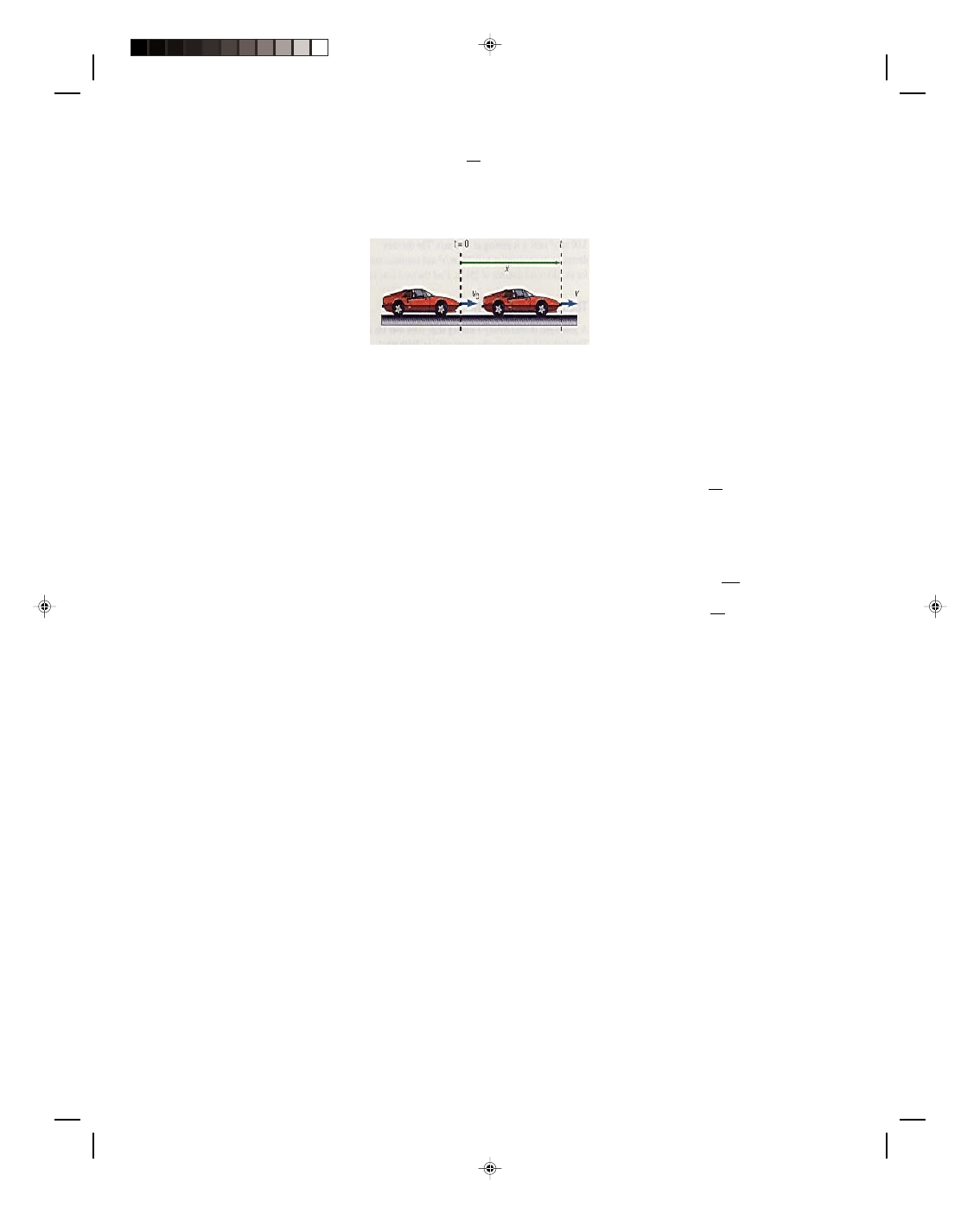
3-38 Mechanics
1. Draw a small picture showing
the details of the problem. This is
very useful so that you do not lose
sight of the problem that you are
trying to solve.
2. List all the information that
you are given.
3. List all the answers you are
expected to find.
4. From the summary of
important equations or the text
proper, list the equations that are
appropriate to this topic.
5. Pick the equation that relates
the variables that you are given.
6. Place a check mark (8) over
each variable that is given and a
question mark (?) over each
variable that you are looking for.
7. Solve the equation for the
unknown variable.
8. When the answer is obtained
check to see if the answer is
reasonable.
Let us apply this technique to
the following example.
A car is traveling at 10.0 m/s
when it starts to accelerate at 3.00
m/s
2
. Find (a)
the velocity and
(b) the displacement of the car at
the end of 5 s.
1. Draw a picture of the
problem.
2. Given: v
0
= 10.0 m/s
a = 3.00 m/s
2
t = 5 s
3. Find: v = ?
x = ?
4. The problem is one in
kinematics and the kinematic
equations apply. That is,
(1)
x = v
0
t + 1 at
2
2
(2) v = v
0
+ at
(3) v
2
= v
02
+ 2ax
5. Part a of the problem. To
solve for the velocity v, we need an
equation containing v. Equation 1
does not contain a velocity term v,
and hence can not be used to solve
for the velocity. Equations 2 and 3,
on the other hand, both contain v.
Thus, we can use one or possibly
both of these equations to solve for
the velocity.
6. Write down the equation and
place a check mark over the known
terms and a question mark over the
unknown terms:
? 8 88
(2) v = v
0
+ at
The only unknown in equation
2 is the velocity v and we can now
solve for it.
7. The velocity after 5 s, found
from equation 2 is
v = v
0
+ at
= 10.0 m/s + (3.00 m/s
2
)(5 s)
= 10.0 m/s + 15.0 m/s
= 25.0 m/s
Notice what would happen if we
tried to use equation 3 at this time:
? 8 88?
(2) v
2
= v
02
+ 2ax
We can not solve for the velocity
v from equation 3 because there are
two unknowns, both v and x.
However, if we had solved part b of
the problem for x first, then we
could have used this equation.
5. Part b of the problem. To
solve for the displacement x, we
need an equation containing x.
Notice that equation 2 does not
contain x, so we can not use it.
Equations 1 and 3, on the other
hand, do contain x, and we can use
either to solve for x.
6. Looking at equation 1, we
have
? 88 8 88
(1)
x = v
0
t + 1 at
2
2
7. Solving for the only unknown
in equation 1, x, we get
x = v
0
t + 1 at
2
2
= (10.0 m/s)(5 s) + 1 (3.00 m/s
2
)(5 s)
2
2
= 50 m + 37.5 m
= 87.5 m
Note that at this point we could
also have used equation 3 to
determine x, because we already
found the velocity v in part a of the
problem.
Problems for Chapter 3
3.1 Introduction
1. A driver travels 500 km in 5
hr and 25 min. What is his average
speed in (a) km/hr, and (b) m/s?
2. A car travels at 65.0 km/hr
for 2 hr and 100 km/hr for 3 hr.
What is its average speed?
3. A man hears the sound of
thunder 5 s after he sees the
lightning flash. If the speed of
sound in air is 343 m/s, how far
away is the lightning? Assume that
the speed of light is so large that
the lightning was seen essentially
at the same time that it was
created.
4. The earth-moon distance is
3.84 × 10
8
m. If it takes 3 days to
get to the moon, what is the
average speed?
5. Electronic transmission is
broadcast at the speed of light,
which is 3.00 × 10
8
m/s. How long
would it take for a radio
transmission from earth to an
astronaut orbiting the planet Mars?
Assume that at the time of
transmission the distance from
earth to Mars is 7.80 × 10
7
km.
6. In the game of baseball, some
excellent fast-ball pitchers have
managed to pitch a ball at
approximately 160 km/hr. If the
Pearson Custom Publishing
90
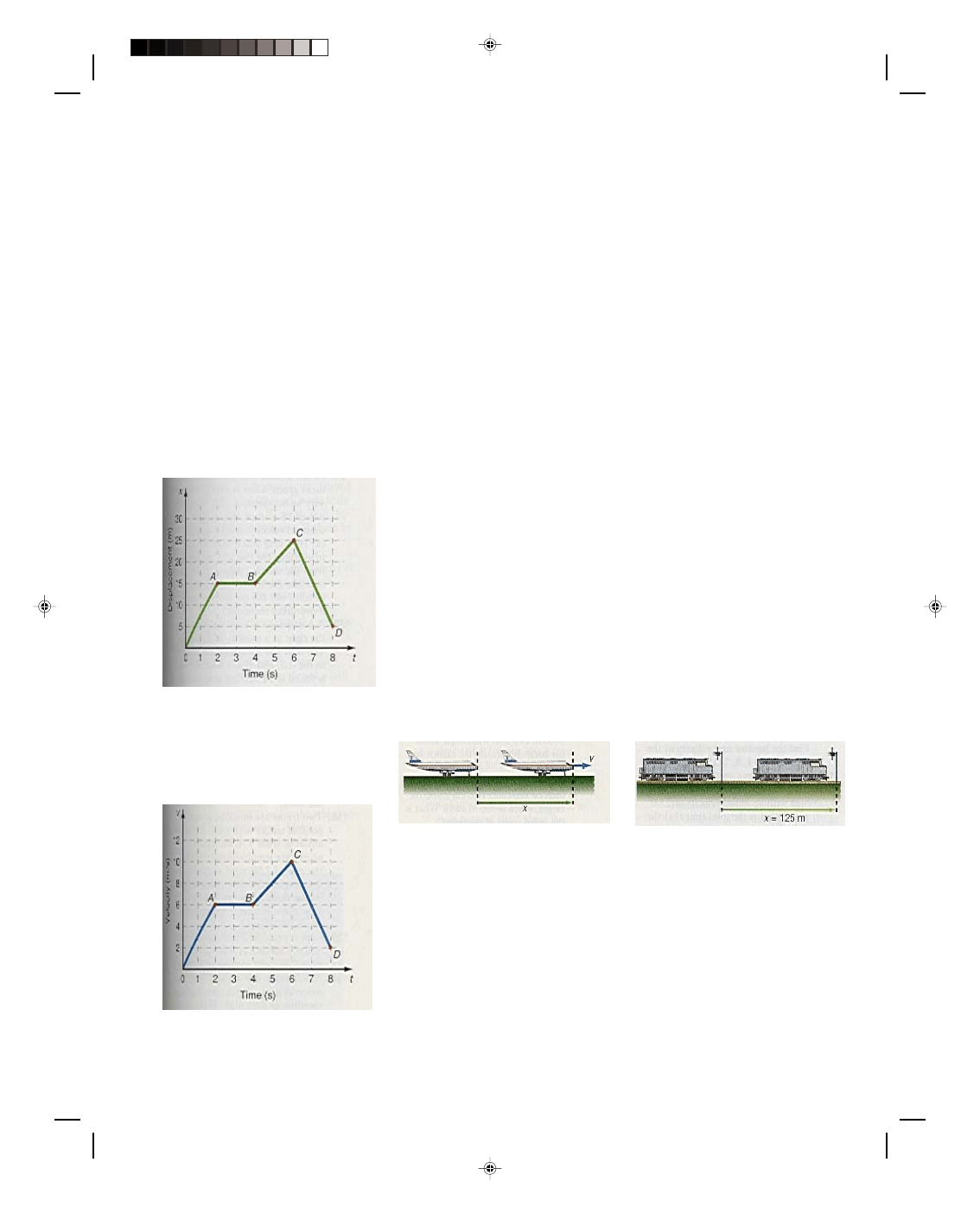
Chapter 3 Kinematics - The Study of Motion 3-39
pitcher’s mound is 18.5 m from
home plate, how long does it take
the ball to get to home plate? If the
pitcher then throws a change-of-
pace ball (a slow ball) at 95.0 km/hr,
how long will it now take the ball to
get to the plate?
7. Two students are having a
race on a circular track. Student 1
is on the inside track, which has a
radius of curvature r
1
= 250 m, and
is moving at the speed v
1
= 4.50 m/s.
With what speed must student 2
run to keep up with student 1 if
student 2 is on the outside track of
radius of curvature r
2
= 255 m?
8. A plot of the displacement of
a car (in m) as a function of time is
shown in the diagram. Find the
velocity of the car along the paths
(a) O-A, (b) A-B, (c) B-C, and (d) C-
D.
Diagram for problem 8.
9. A plot of the velocity of a car
(in m/s) as a function of time is
shown in the diagram. Find the
acceleration of the car along the
paths (a) O-A, (b) A-B, (c) B-C, and
(d) C-D.
Diagram for problem 9.
10. If an airplane is traveling at
110 knots, what is its velocity in
(a) km/hr, and (b) m/s? A knot is a
nautical mile per hour, and a
nautical mile is equal to 1.852 km.
3.6 The Kinematic Equations in
One Dimension
11. A girl who is initially
running at 1.00 m/s increases her
velocity to 2.50 m/s in 5.00 s. Find
her acceleration.
12. A car is traveling at 95.0
km/hr. The driver steps on the
brakes and the car comes to a stop
in 60.0 m. What is the car’s
deceleration?
13. A train accelerates from an
initial velocity of 25.0 km/hr to a
final velocity of 65.0 km/hr in 8.50
s. Find its acceleration and the
distance the train travels during
this time.
14. An airplane travels 450 m at
a constant acceleration while taking
off. If it starts from rest, and takes
off in 15.0 s, what is its takeoff
velocity?
15. A car starts from rest and
acquires a velocity of 30.0 km/hr in
10.0 s. Where is the car located and
what is its velocity at 10.0, 15.0,
20.0, and 25.0 s?
16. A jet airplane goes from rest
to a velocity of 75.0 m/s in a
distance of 725 m. What is the
airplane’s average acceleration in
m/s
2
?
Diagram for problem 16.
17. An electron in a vacuum
tube acquires a velocity of 5.3 × 10
8
cm/s in a distance of 0.25 cm. Find
the acceleration of the electron.
18. A driver traveling at 100
km/hr tries to stop the car and finds
that the brakes have failed. The
emergency brake is then pulled and
the car comes to a stop in 130 m.
Find the car’s deceleration.
19. An airplane has a
touchdown velocity of 140 km/hr
and comes to rest in 120 m. What is
the airplane’s average deceleration?
How long does it take the plane to
stop?
20. A pitcher gives a baseball a
horizontal velocity of 30.0 m/s by
moving his arm through a distance
of approximately 2.50 m. What is
the average acceleration of the ball
during this throwing process?
21. The speedometer of a car
reads 95.0 km/hr when the brakes
are applied. The car comes to rest in
4.55 s. How far does the car travel
before coming to rest?
*22. A body with unknown
initial velocity moves with constant
acceleration. At the end of 8.00 s, it
is moving at a velocity of 50.0 m/s
and it is 200 m from where it
started. Find the body’s
acceleration and its initial velocity.
*23. A driver traveling at 30.0
km/hr sees the light turn red at the
intersection. If his reaction time is
0.600 s, and the car can decelerate
at 4.50 m/s
2
, find the stopping
distance of the car. What would the
stopping distance be if the car were
moving at 90.0 km/hr?
*24. A uniformly accelerating
train passes a green light signal at
25.0 km/hr. It passes a second light
125 m farther down the track, 12.0
s later. What is the train’s
acceleration? What is the train’s
velocity at the second light?
Diagram for problem 24.
25. A car accelerates from 80.0
km/hr to 130 km/hr in 26.9 s. Find
its acceleration and the distance the
car travels in this time.
*26. A motorcycle starts from
rest and accelerates at 4.00 m/s
2
for
5.00 s. It then moves at constant
velocity for 25.0 s, and then
decelerates at 2.00 m/s
2
until it
stops. Find the total distance that
the motorcycle has moved.
Pearson Custom Publishing
91
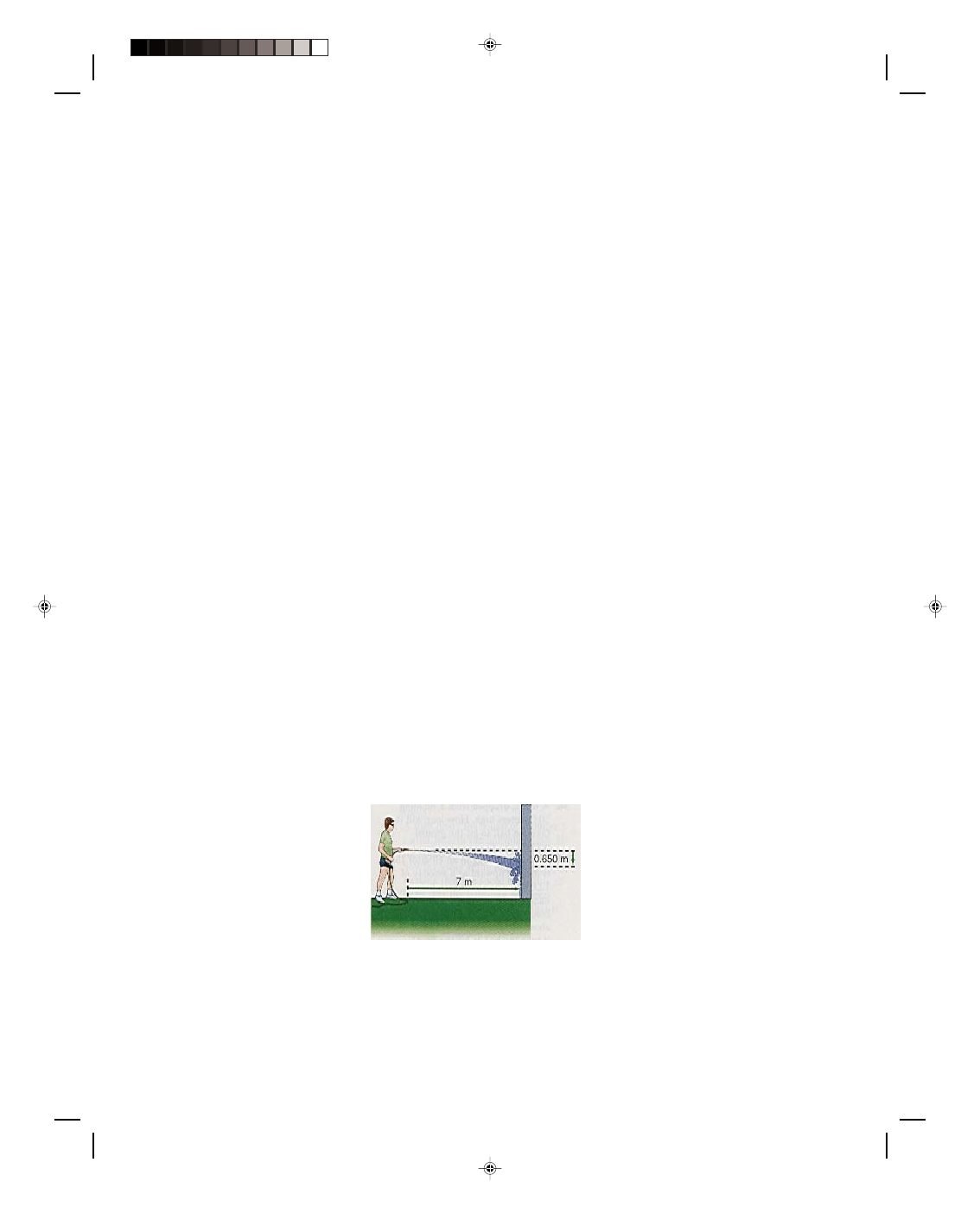
3-40 Mechanics
*27. A car starts from rest and
accelerates at a constant rate of
3.00 m/s
2
until it is moving at 18.0
m/s. The car then decreases its
acceleration to 0.500 m/s
2
and
continues moving for an additional
distance of 250 m. Find the total
time taken.
3.7 The Freely Falling Body
28. A passenger, in abandoning
a sinking ship, steps over the side.
The deck is 15.0 m above the water
surface. With what velocity does the
passenger hit the water?
29. How long does it take for a
stone to fall from a bridge to the
water 30.0 m below? With what
velocity does the stone hit the
water?
30. An automobile traveling at
95.0 km/hr hits a stone wall. From
what height would the car have to
fall to acquire the same velocity?
31. A rock is dropped from the
top of a building and hits the
ground 8.00 s later. How high is the
building?
32. A ball is dropped from a
building 50.0 meters high. How
long will it take the ball to hit the
ground below?
*33. A girl is standing in an
elevator that is moving upward at a
velocity of 3.75 m/s when she drops
her handbag. If she was originally
holding the bag at a height of 1.25
m above the elevator floor, how long
will it take the bag to hit the floor?
3.9 Projectile Motion in One
Dimension
34. A ball is thrown vertically
upward with an initial velocity of
40.0 m/s. Find its position and
velocity at the end of 2, 4, 6, and 8 s
and sketch these positions and
velocities on a piece of graph paper.
35. A projectile is fired
vertically upward with an initial
velocity of 40.0 m/s. Find the
position and velocity of the
projectile at 1, 3, 5, and 7 s.
*36. A ball is thrown vertically
upward from the top of a building
40.0 m high with an initial velocity
of 25.0 m/s. What is the total time
that the ball is in the air?
37. A stone is thrown vertically
upward from a bridge 30.0 m high
at an initial velocity of 15.0 m/s.
How long will it take for the stone
to hit the water below?
*38. A stone is thrown vertically
downward from a bridge 30.0 m
high at an initial velocity of
−15.0
m/s. How long will it take for the
stone to hit the water below?
39. A rock is thrown vertically
downward from a building 40.0 m
high at an initial velocity of
−15.0
m/s. (a) What is the rock’s velocity
as it strikes the ground? (b) How
long does it take for the rock to hit
the ground?
40. A baseball batter fouls a ball
vertically upward. The ball is
caught right behind home plate at
the same height that it was hit.
How long was the baseball in flight
if it rose a distance of 30.0 m? What
was the initial velocity of the
baseball?
3.11 Projectile Motion in Two
Dimensions
41. A projectile is thrown from
the top of a building with a
horizontal velocity of 15.0 m/s. The
projectile lands on the street 85.0 m
from the base of the building. How
high is the building?
42. To find the velocity of water
issuing from the nozzle of a garden
hose, the nozzle is held horizontally
and the stream is directed against a
vertical wall. If the wall is 7.00 m
from the nozzle and the water
strikes the wall 0.650 m below the
horizontal, what is the velocity of
the water?
Diagram for problem 42.
43. A bomb is dropped from an
airplane in level flight at a velocity
of 970 km/hr. The altitude of the
aircraft is 2000 m. At what
horizontal distance from the initial
position of the aircraft will the
bomb land?
*44. A cannon is placed on a hill
20.0 m above level ground. A shell
is fired horizontally at a muzzle
velocity of 300 m/s. At what
horizontal distance from the cannon
will the shell land? How long will
this take? What will be the shell’s
velocity as it strikes its target?
45. A shell is fired from a
cannon at a velocity of 300 m/s to
hit a target 3000 m away. At what
angle above the horizontal should
the cannon be aimed?
46. In order to hit a target, a
marksman finds he must aim 1.00
m above the target, which is 300 m
away. What is the initial speed of
the bullet?
47. A golf ball is hit with an
initial velocity of 50.0 m/s at an
angle of 55.0
0
above the horizontal.
(a)
How high will the ball go?
(b) What is the total time the ball is
in the air? (c) How far will the ball
travel horizontally before it hits the
ground?
48. A projectile is thrown from
the ground with an initial velocity
of 20.0 m/s at an angle of 40.0
0
above the horizontal. Find (a) the
projectile’s maximum height, (b) the
time required to reach its maximum
height, (c) its velocity at the top of
the trajectory, (d) the range of the
projectile, and (e) the total time of
flight.
Additional Problems
49. A missile has a velocity of
16,000 km/hr at “burn-out,” which
occurs 2 min after ignition. Find the
average acceleration in (a) m/s
2
, and
(b) in terms of g, the acceleration
due to gravity at the surface of the
earth.
50. A block slides down a
smooth inclined plane that makes
an angle of 25.0
0
with the
horizontal. Find the acceleration of
the block. If the plane is 10.0
meters long and the block starts
from rest, what is its velocity at the
bottom of the plane? How long does
Pearson Custom Publishing
92
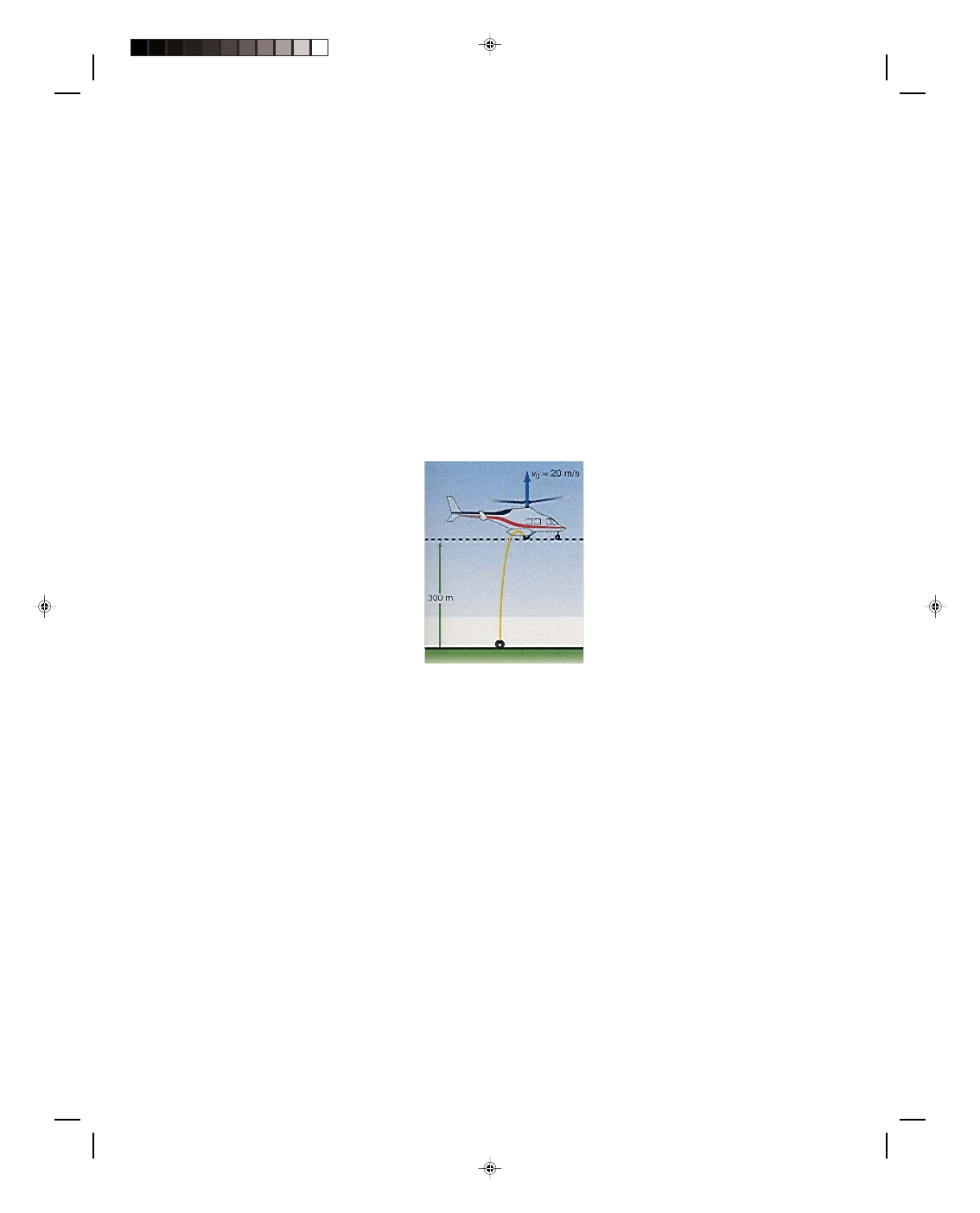
Chapter 3 Kinematics - The Study of Motion 3-41
it take for the block to get to the
bottom?
*51. At the instant that the
traffic light turns green, a car
starting from rest with an
acceleration of 2.50 m/s
2
is passed
by a truck moving at a constant
velocity of 60.0 km/hr. (a) How long
will it take for the car to overtake
the truck? (b) How far from the
starting point will the car overtake
the truck? (c) At what velocity will
the car be moving when it overtakes
the truck?
*52. A boat passes a buoy while
moving to the right at a velocity of
8.00 m/s. The boat has a constant
acceleration to the left, and 10.0 s
later the boat is found to be moving
at a velocity of
−3.00 m/s. Find
(a)
the acceleration of the boat,
(b) the distance from the buoy when
the boat reversed direction, (c) the
time for the boat to return to the
buoy, and (d) the velocity of the
boat when it returns to the buoy.
*53. Two trains are initially at
rest on parallel tracks with train 1
50.0 m ahead of train 2. Both trains
accelerate simultaneously, train 1
at the rate of 2.00 m/s
2
and train 2
at the rate of 2.50 m/s
2
. How long
will it take train 2 to overtake train
1? How far will train 2 travel before
it overtakes train 1?
*54. Repeat problem 53 but
with train 1 initially moving at 5.00
m/s and train 2 initially moving at
7.00 m/s.
*55. A policewoman driving at
80.0 km/hr observes a car 50.0 m
ahead of her speeding at 120 km/hr.
If the county line is 400 m away
from the police car, what must the
acceleration of the police car be in
order to catch the speeder before he
leaves the county?
*56. Two trains are approaching
each other along a straight and
level track. The first train is
heading south at 125 km/hr, while
the second train is heading north at
80.0 km/hr. When they are 2.00 km
apart, they see each other and start
to decelerate. Train 1 decelerates at
2.00 m/s
2
, while train 2 decelerates
at 1.50 m/s
2
. Will the trains be able
to stop or will there be a collision?
*57. A boy in an elevator, which
is descending at the constant
velocity of
−5.00 m/s, jumps to a
height of 0.500 m above the elevator
floor. How far will the elevator
descend before the boy returns to
the elevator floor?
58. The acceleration due to
gravity on the moon is 1.62 m/s
2
. If
an astronaut on the moon throws a
ball straight upward, with an initial
velocity of 25.0 m/s, how high will
the ball rise?
*59. A helicopter, at an altitude
of 300 m, is rising vertically at 20.0
m/s when a wheel falls off. How
high will the wheel go with respect
to the ground? How long will it take
for the wheel to hit the ground
below? At what velocity will the
wheel hit the ground?
Diagram for problem 59.
*60. A ball is dropped from the
roof of a building 40.0 m high.
Simultaneously, another ball is
thrown upward from the ground
and collides with the first ball at
half the distance to the roof. What
was the initial velocity of the ball
that was thrown upward?
*61. A ball is dropped from the
top of a 40.0-m high building. At
what initial velocity must a second
ball be thrown from the top of the
building 2.00 s later, such that both
balls arrive at the ground at the
same time?
*62. Show that the range of a
projectile is the same for either a
projection angle of 45.0
0
+
θ or an
angle of 45.0
0
−θ.
63. A projectile hits a target
1.50 km away 10.5 s after it was
fired. Find (a) the elevation angle of
the gun and (b) the initial velocity
of the projectile.
64. A football is kicked with an
initial velocity of 20.0 m/s at an
angle of 65.0
0
above the horizontal.
Find (a) how long the ball is in the
air, (b) how far down field the ball
lands, (c) how high the ball rises,
and (d) the velocity of the ball when
it strikes the ground.
*65. A baseball is hit at an
initial velocity of 35.0 m/s at an
angle of 45.0
0
above the horizontal.
Will the ball clear a 3.00 m fence
92.0 m from home plate for a home
run? If so, by how much will it clear
the fence?
*66. A ball is thrown from a
bridge 100 m high at an initial
velocity of 30.0 m/s at an angle of
50.0
0
above the horizontal. Find
(a) how high the ball goes, (b) the
total time the ball is in the air,
(c) the
maximum
horizontal
distance that the ball travels, and
(d) the velocity of the ball as it
strikes the ground.
67. A ball is thrown at an angle
of 35.5
0
below the horizontal at a
speed of 22.5 m/s from a building
20.0 m high. (a) How long will it
take for the ball to hit the ground
below? (b)
How far from the
building will the ball land?
*68. Using the kinematic
equations for the x- and y-
components of the displacement,
find the equation of the trajectory
for two-dimensional projectile
motion. Compare this equation with
the equation for a parabola
expressed in its standard form.
*69. Using the kinematic
equations, prove that if two balls
are released simultaneously from a
table, one with zero velocity and the
other with a horizontal velocity v
0x
,
they will both reach the ground at
the same time.
Interactive Tutorials
70. A train accelerates from an
initial velocity of 20.0 m/s to a final
velocity of 35.0 m/s in 11.8 s. Find
its acceleration and the distance the
train travels in this time.
Pearson Custom Publishing
93

3-42 Mechanics
71. A ball is dropped from a
building 50.0 m high. How long will
it take the ball to hit the ground
below and with what final velocity?
Plot the displacement and the
velocity of the falling ball.
72. A golf ball is hit with an
initial velocity v
0
= 53.0 m/s at an
angle
θ = 50.0
0
above the horizontal.
(a)
How high will the ball go?
(b) What is the total time the ball is
in the air? (c) How far will the ball
travel horizontally before it hits the
ground?
73. Instantaneous velocity. If
the equation for the displacement x
of a body is known, the average
velocity throughout an interval can
be computed by the formula
v
avg
= (
∆x)/(∆t)
The instantaneous velocity is
defined as the limit of the average
velocity as
∆t approaches zero. That
is,
0
lim
t
x
v
t
∆ →
∆
=
∆
For an acceleration with a
displacement given by x = 0.5 at
2
,
use different values of
∆t to see how
the average velocity approaches the
instantaneous velocity. Compare
this to the velocity determined by
the equation v = at, and determine
the percentage error. Plot the
average velocity, (
∆x)/(∆t), versus
∆t.
74. Free-fall and generalized
one-dimensional projectile motion.
A projectile is fired from a height y
0
above the ground with an initial
velocity v
0
in a vertical direction.
Find (a) the time t
r
for the projectile
to rise to its maximum height,
(b) the total time t
t
the ball is in the
air, (c) the maximum height y
max
of
the projectile, (d) the velocity v
g
of
the projectile as it strikes the
ground, and (e) the location and
velocity of the projectile at any time
t. (f) Plot a picture of the motion as
a function of time.
75.
Generalized two-
dimensional projectile motion. A
projectile is fired from a height y
0
above the horizontal with an initial
velocity v
0
at an angle
θ. Find
(a) the time t
r
for the projectile to
rise to its maximum height; (b) the
total time t
t
the ball is in the air;
(c) the maximum distance the ball
travels in the x-direction, x
max
before it hits the ground; (d) the
maximum height y
max
of the
projectile; (e) the velocity v
g
of the
projectile as it strikes the ground;
and (f) the location and velocity of
the projectile at any time t. (g) Plot
a picture of the trajectory.
tutorials click on this sentence.
To go to another chapter, return to the table of contents by clicking on this sentence.
Pearson Custom Publishing
94
Wyszukiwarka
Podobne podstrony:
więcej podobnych podstron