A Monthly Newsletter for Teachers of English
March 2009
© Pearson Longman 2009 PHOTOCOPIABLE
- 1 -
S
TARTING OFF
We often hear people described as ‘great’. What makes a person great? Which people who are alive today, or who died
recently, would you describe as great?
Take a look at the list below. Do you agree with these examples?
Politics:
Nelson Mandela, Mikhail Gorbachev
Music:
John Lennon, Bono, The Rolling Stones, Madonna, Luciano Pavarotti
Film:
Steven Spielberg, Marlon Brando, Robert de Niro,
Business:
Bill Gates, Karl Benz, Akio Morita
Sport:
Roger Federer, Muhammad Ali, Haile Gebre Selassie, Cristiano Ronaldo
Which names would you add to each list?
B
EFORE YOU READ
When people talk about greatness, Leonardo da Vinci is often described as the greatest person who has ever lived.
But how much do you know about Leonardo? Work in a small group and brainstorm all you know. Think about:
where and when he lived
what Leonardo thought
what Leonardo did
F
IRST READING
Read the first part of the text quickly to check your ideas.

A C T I V I T I E S S H E E T
March 2009
© Pearson Longman 2009 PHOTOCOPIABLE
- 2 -
V
OCABULARY
1
Find words or phrases in the text to match the definitions below. You will need to look at both the first part and the second
part of the text for this, finding the words for your text. The definitions are in the same order as the words in the text.
FIRST SECTION
1. Someone who works for somebody for a time in order to learn a particular skill or job. (NOUN)
2. Behaving in a way that is unusual and different from most people. (ADJECTIVE)
3. Something that you do regularly or usually, often without thinking about it. (NOUN)
4. A structure made of wires or bars in which birds or animals can be kept. (NOUN)
5. To let someone or something go free, after having kept them somewhere. (VERB)
6. Great skill at doing something. (NOUN)
DA VINCI THE ARTIST
7. Someone or something which is so famous that it represents an important idea or time. (ADJECTIVE)
8. To continue to exist after a long time. (VERB)
9. Likely to change suddenly and become worse or disappear. (ADJECTIVE)
10. How large, important, or serious something is. (NOUN)
DA VINCI THE SCIENTIST
11. Someone who produces large numbers of things. (ADJECTIVE)
12. During all of a particular period, from the beginning to the end. (PREPOSITION)
13. Used to show that it does not matter which one is true. (DETERMINER)
14. A subject that people talk or write about. (NOUN)
DA VINCI THE INVENTOR
15. A large heavy powerful gun that was used in the past to fire heavy metal balls. (NOUN)
16. When you talk about something or someone that is part of a larger group you have just mentioned.
(PREPOSITION)
17. Special equipment which you use to help you stay underwater for a long time. (NOUN)
18. Have no limits (PHRASE)
S
ECOND READING
Read the second part of the text again, underlining any especially interesting information. Read carefully - in a moment
your friends will be asking you some questions about it!

A C T I V I T I E S S H E E T
March 2009
© Pearson Longman 2009 PHOTOCOPIABLE
- 3 -
Q
UESTION FORMATION
Below are three jumbled questions for each part of the text. Make the questions for the sections you do not have.
DA VINCI THE ARTIST
1. PAINTINGS / MANY / LEONARDO’S / HAVE / HOW / SURVIVED / OF ?
2. BEEN / HAVE / PAINTINGS / WHY / MANY / LOST / SO ?
3. LEONARDO / JUST / HAVE / ANYTHING / DO / FROM / OR / ELSE / PAINTINGS / WE ?
DA VINCI THE SCIENTIST
1. OF / PAGES / MANY / LEONARDO / NOTES / DID / HOW / MAKE ?
2. TO / THEY / HARD / WHY / READ / ARE ?
3. WHY / THIS / WRITE / WAY / DID / LEONARDO ?
DA VINCI THE INVENTOR
1. THEORETICAL / LEONARDO / DID / ONLY / PLANS / CREATE ?
2. BUILT / DESIGNS / HIS / WERE / LIFETIME / LEONARDO’S / IN ?
3. MOST / THING / WHAT / AMAZING / LEONARDO / WAS / THE / DESIGNED ?
S
PEAKING
Work in groups of three or more, so you have at least one person who read each text. Ask and answer your questions.
V
OCABULARY
2
Work in the same groups and complete the sentences below using one of the items from Vocabulary 1.
1. When you think of Paris,
you think of the Eiffel Tower. It truly is a(n) ………………………… sight.
2.
He was a very ………………………… man in his dress. People would laugh when they saw him walking down the
street.
3.
That’s a very interesting …………………………, in fact, but we don’t have time to discuss it right now.
4.
His arrogance …………………………! Really, it just gets worse and worse.
5.
He lived in London ………………………… his life, though he did travel from time to time.
6.
Nelson Mandela was finally ………………………… from prison after 27 years.
7.
………………………… kind of coffee you like, we have it. This is the best cafe in town.
8.
I have several pets, ………………………… a snake and a tortoise.
9.
The ………………………… of the financial crisis is still not clear.
10.
Marco van Basten was one of the most ………………………… strikers who ever played. He scored hundreds of
goals.
11.
To ………………………… in the desert you need plenty of water and suitable clothes.
12.
His ………………………… as a writer is not questioned. Everyone recognises his genius.
S
PEAKING
Discuss the questions below with your friends:
Which people outside of your family and friends have had the greatest influence on your life and who you are
today?
Is it good to use other people’s example as a model for your own life?
Is there anybody who you see as an example for you? Is there anyone who inspires you in your life?
Which people have had the greatest influence, for better or worse, on your city and your country?
A C T I V I T I E S S H E E T
March 2009
© Pearson Longman 2009 PHOTOCOPIABLE
- 4 -
Leonardo di ser Piero
da Vinci
was born in Vinci, a
small town near Florence, Italy,
in April 1452. Not a great deal
is known of his early life, but
we do know that his artistic
talent was recognised very early: he was sent as an
apprentice to one of the greatest painters of the day,
Verrocchio when he was fourteen years old.
Leonardo worked in Florence, Rome, Bolonga and
Venice, as well as living abroad in France later in
his life. He was a man of eccentric habits and
appeared to love animals: he was a vegetarian,
which was unusual for the time, and he had a habit
of buying birds in cages and then releasing them.
So what makes Leonardo so special? Was it his
skill at painting? His scientific prowess? Perhaps
his imagination as an inventor? Rather, it is all of
these things and more. What makes Leonardo
special is the fact that he was recognised as a genius
in so many different fields: as an artist, as a scientist
and as an inventor, to name but three...
da Vinci the artist
da Vinci the scientist
da Vinci the inventor
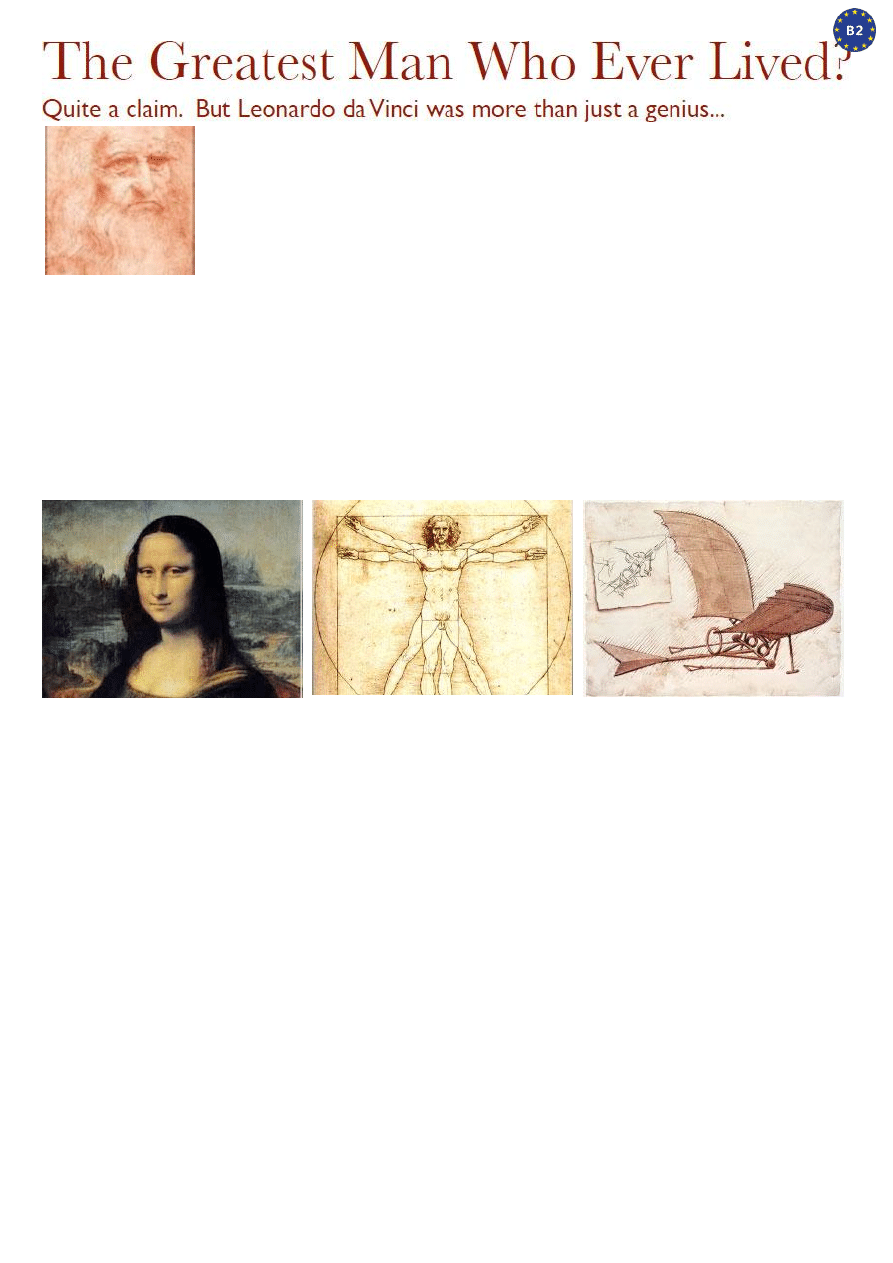
Leonardo produced some of the
world’s most famous and iconic
pieces of art, including two of the
world’s most famous paintings,
the Mona Lisa (above) and The
Last Supper. Surprisingly for
such a famous artist, only some
fifteen of his paintings survive.
This is partly Leonardo’s fault:
ever the experimenter, Leonardo
was forever trying out new
techniques and new technologies,
including new kinds of paint.
Many of these were unstable and
the paintings were lost as a result.
Fortunately, many of Leonardo’s
notebooks, sketches and essays
have survived to show the extent
of his genius as an artist.
A C T I V I T I E S S H E E T
March 2009
© Pearson Longman 2009 PHOTOCOPIABLE
- 5 -
Leonardo di ser Piero
da Vinci
was born in Vinci, a
small town near Florence, Italy,
in April 1452. Not a great deal
is known of his early life, but
we do know that his artistic
talent was recognised very early: he was sent as an
apprentice to one of the greatest painters of the day,
Verrocchio when he was fourteen years old.
Leonardo worked in Florence, Rome, Bolonga and
Venice, as well as living abroad in France later in
his life. He was a man of eccentric habits and
appeared to love animals: he was a vegetarian,
which was unusual for the time, and he had a habit
of buying birds in cages and then releasing them.
So what makes Leonardo so special? Was it his
skill at painting? His scientific prowess? Perhaps
his imagination as an inventor? Rather, it is all of
these things and more. What makes Leonardo
special is the fact that he was recognised as a genius
in so many different fields: as an artist, as a scientist
and as an inventor, to name but three...
da Vinci the artist
da Vinci the scientist
da Vinci the inventor
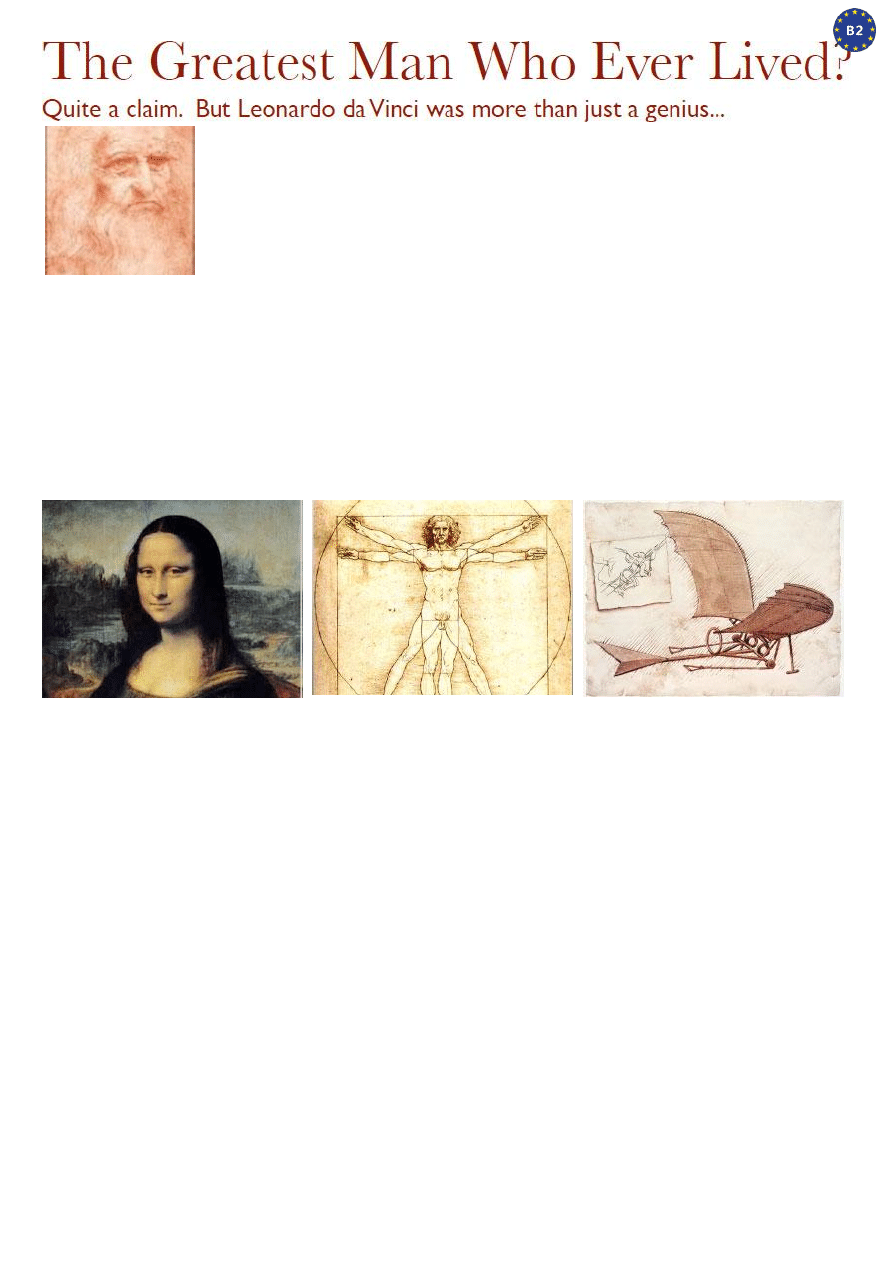
Leonardo was a prolific writer,
producing more than 13,000
pages of drawings, descriptions,
observations and notes
throughout his life. The notes are
not easy to read as Leonardo
wrote backwards, from right to
left. Perhaps Leonardo wanted
his notes kept secret or perhaps it
was simply easier for him to
write this way, being left-handed.
Whatever the reason, Leonardo’s
notebooks are a treasure and it is
hard to believe that one man
could write so much, so
originally, on so many topics -
from engineering to medicine,
from mathematics to art, from
astronomy to chemistry.
A C T I V I T I E S S H E E T
March 2009
© Pearson Longman 2009 PHOTOCOPIABLE
- 6 -
Leonardo di ser Piero
da Vinci
was born in Vinci, a
small town near Florence, Italy,
in April 1452. Not a great deal
is known of his early life, but
we do know that his artistic
talent was recognised very early: he was sent as an
apprentice to one of the greatest painters of the day,
Verrocchio when he was fourteen years old.
Leonardo worked in Florence, Rome, Bolonga and
Venice, as well as living abroad in France later in
his life. He was a man of eccentric habits and
appeared to love animals: he was a vegetarian,
which was unusual for the time, and he had a habit
of buying birds in cages and then releasing them.
So what makes Leonardo so special? Was it his
skill at painting? His scientific prowess? Perhaps
his imagination as an inventor? Rather, it is all of
these things and more. What makes Leonardo
special is the fact that he was recognised as a genius
in so many different fields: as an artist, as a scientist
and as an inventor, to name but three...
da Vinci the artist
da Vinci the scientist
da Vinci the inventor
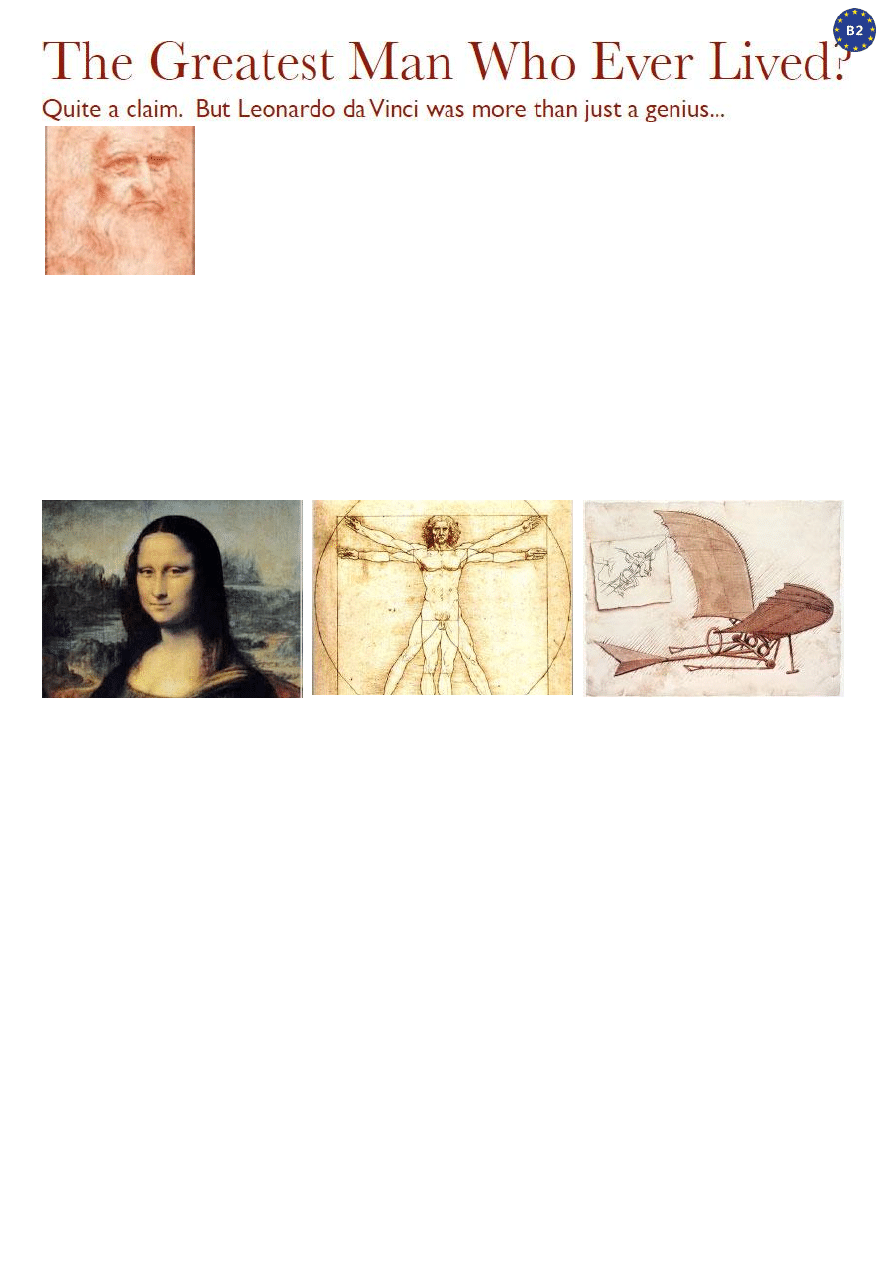
Leonardo designed many
practical inventions: new kinds of
bridges, lifting machines,
machines, cannons, to name but a
few. He also designed many
completely original inventions,
including some that would not be
built for centuries. Indeed, many
of Leonardo’s ideas were
astonishingly far ahead of his
time. In a world without engines,
electricity or steam power, he
designed helicopters, airplanes,
parachutes, diving suits,
submarines and even a tank!
Some of these designs have been
constructed in modern times
successfully. Truly, Leonardo’s
genius knew no bounds.
Wyszukiwarka
Podobne podstrony:
więcej podobnych podstron