
Acta Agrophysica, 2008, 11(1), 71-80
DRYING KINETICS, WATER ACTIVITY, SHRINKAGE
AND TEXTURE OF WALNUT KERNELS
Adam
Figiel
1
, Agnieszka
Kita
2
1
Institute of Agricultural Engineering, Wrocław University of Environmental and Life Sciences
ul. Chełmońskiego 37/41, 51-630 Wrocław
e-mail: figiel@imr.ar.wroc.pl
2
Department of Food Storage and Technology,
Wrocław University of Environmental and Life Sciences
ul. Norwida 25, 53-375 Wrocław
A b s t r a c t . Walnut kernels were dehydrated using two drying methods: convective and vacuum-
microwave. In the convective method air velocity was 2 m s
-1
and temperature 55
°
C. Vacuum-microwave
dehydration was performed under pressure changing from 4 to 6 kPa at microwave power of 480W. The
decrease in moisture content of walnut kernels dehydrated in convection was described by a two term
exponential function, while in vacuum-microwave method by linear function in the first drying period and
by an exponential function in the second period. The relationship between the moisture content and water
activity for walnut kernels was described using an exponential equation. The study revealed that shrinkage
was changing until the moisture content of walnut kernels reached 0.3 kg kg
-1
db. It was found that de-
creasing moisture content of walnut kernels till 0.46 kg kg
-1
db resulted in considerable increase in the
breaking force and breaking extension estimated at bending strength test. Further lowering of moisture
content caused a decrease in breaking force while the value of breaking extension remained constant. The
significant decrease in breaking extension occurred when exceeding 0.14 kg kg
-1
db.
K e y w o r d s : walnuts, drying kinetics, water activity, shrinkage, texture
INTRODUCTION
Walnuts (Juglans regia L.) are highly nutritious food due to their high oil content
composed of unsaturated fatty acids, such as linoleic acid (59%), α-linolenic acid
(13%) and oleic acid (18%) (Torres at al. 2005). They are rich in valuable minerals
like phosphorus, potassium, sodium, magnesium and zinc (Lavedrine et al. 2000).
The health benefits of walnuts include lowering of cholesterol, reducing inflamma-
tion, and improving arterial function (Nash and Westpfal 2005, Patel 2005). Regular

A. FIGIEL, A.
KITA
72
consumption of walnuts has been reported to decrease the risk of heart disease
(Lavedrine et al. 1999, Cortes et al. 2006).
Walnut kernels can be eaten as freshly picked fruits or after dehydration
which enables longer storage at room conditions thanks to lowering of moisture
content and water activity. Appropriate moisture content and compression load
position in nuts facilitates cracking and separation of the kernel from the broken
shell (Koyuncu et al. 2004, Asoegwu 1995). Nuts, usually with high moisture
content before cracking, are subjected to a drying process. Usually nuts are sub-
jected to convective dehydration (Kashaninejad et al. 2007), however microwave
(Silva et al. 2006) or vacuum-microwave drying method (Delwiche et al. 1986)
may be applied as well.
No attempts have been made so far to dry extracted walnut kernels and to es-
timate shrinkage as well as the relationship between the moisture content and
water activity which is very important to the quality and stability of food (Maltini
et al. 2003). The texture of walnut fruit is usually evaluated in sensory tests (Sine-
sio and Moneta 1996) and the instrumental method is limited to a narrow range of
walnut moisture content values (Kita and Figiel 2007).
Therefore, the aim of the presented studies was to determine the drying kinet-
ics of extracted walnut kernels dehydrated by convection and vacuum-micro-
waves. The aim was also to estimate the effect of water content on water activity,
shrinkage, and bending strength of walnut kernels.
MATERIALS AND METHODS
Fresh walnuts of Jacek cultivar were used in the study. Extracted kernels with
average moisture content of 0.52 kg kg
-1
db were vacuum-packed and stored in a
refrigerator at 5
°
C. Just before dehydration, samples were taken out from the re-
frigerator to obtain ambient temperature.
200 g of walnut kernels were subjected to convective dehydration using drying
equipment designed and made at the Agricultural Engineering Institute of Wroclaw.
The air velocity and temperature were 2 m s
-1
and 55
°
C. Vacuum-microwave drying
process of walnuts samples was performed in a VM 200 dryer (Plazmatronika, Wro-
claw) that had two magnetrons of 1200W combined power and a revolving drum. The
pressure in the drum was from 4 to 6 kPa. The microwave power was set at 480 W,
a value that would provide a power density of 4.8 W g
-1
when initial sample weight
was 100 g. The drying kinetics was determined on the basis of mass losses of samples
with previously estimated moisture content. Walnut samples were dehydrated using
both methods to a similar moisture content (Mc) amounting to 0.045 g water g
-1
dry
matter. However, in the convective method, with successive portions of fresh mate-
rial much longer drying times were applied to obtain several samples differing in

DRYING KINETICS, WATER ACTIVITY, SHRINKAGE OF WALNUT KERNELS
73
moisture content, whereas in the vacuum-microwave method only one control
sample was obtained for the additional tests.
Shrinkage (S) represented by relative volume of the dried material was deter-
mined by calculating the ratio of kernels volume after drying (V) to kernels vol-
ume before drying (V
0
). The volume of fresh and dried kernels was determined
using the liquid displacement method. This method consisted in using a graduated
cylinder filled with toluene (C
7
H
8
). Toluene was used because it is absorbed by
biological material at low amount.
Water activity of walnut kernels (a
w
) was measured at 25
°
C with apparatus
made by Cobrabit (Poznań).
Bending strength of walnuts was determined with an Instron 5566 strength testing
machine fitted with a strain gauge of the range up to 1 kN. Single walnut halves were
bent in a three point support system at the speed of 5 mm min
-1
(Kita and Figiel 2006).
The test lasted until the examined sample was destroyed and this way enabled deter-
mination of maximum bending force (Fb
max
) and the maximum bending extension
(Lb
max
). Each measurement was conducted on 15 nut kernels.
The results obtained in the bending test were evaluated by statistical analysis
with the use of the Statistica v. 7.1. Homogeneous groups were determined with
the multiplicative comparison test of Duncan (at significance level
α
= 0.05). In
order to find out if the differences in the mean values estimated were statistically
significant, one-way analysis of variance was applied.
RESULTS AND DISCUSSION
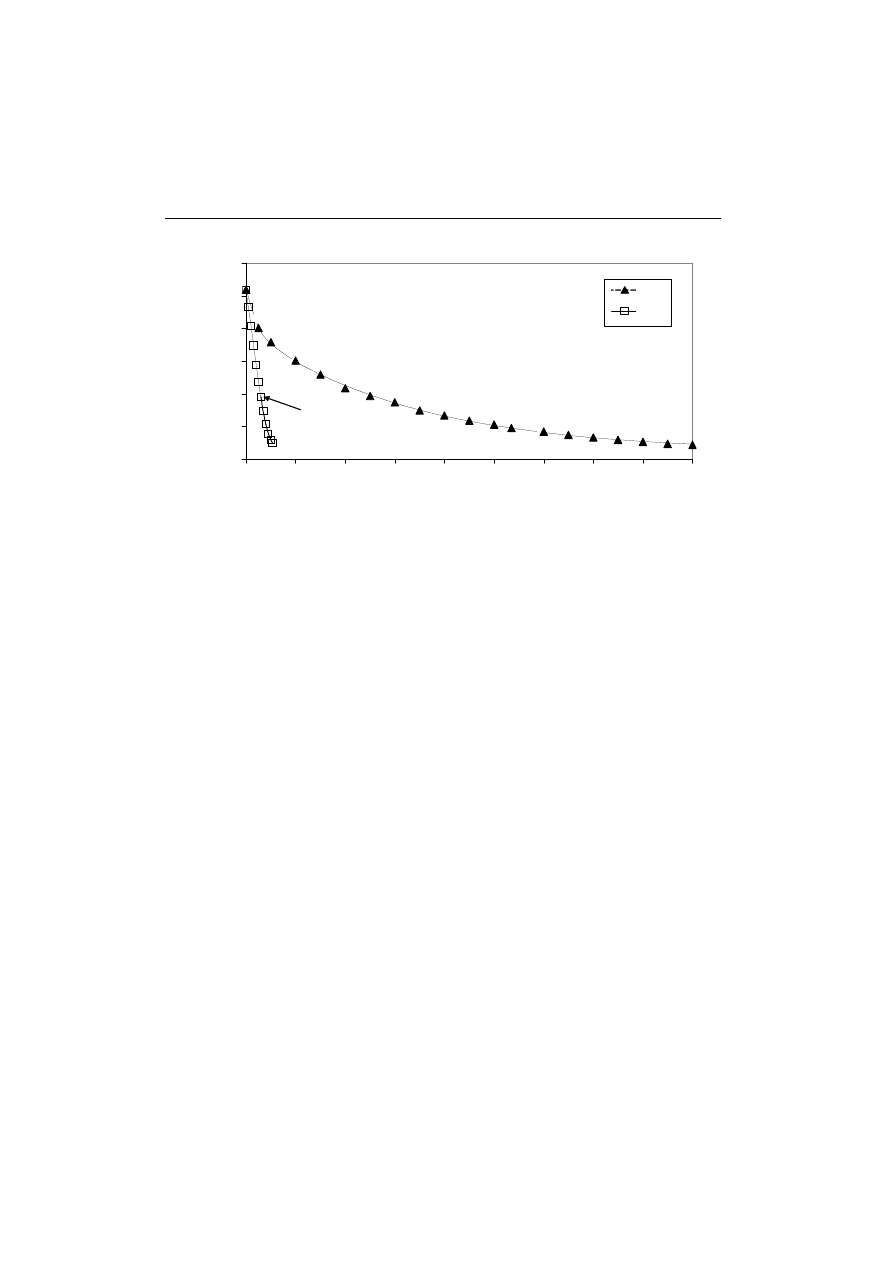
Based on the measurement points obtained from drying experiments (Fig. 1)
it was found that the decrease in moisture content (Mc) of walnut kernels during
drying by the convective method can be described by a two term exponential
equation (Henderson 1974):
021
.
0
3757
.
0
1213
.
0
52
.
65
4
+
⋅
+
⋅
=
−
−
t
t
e
e
Mc
(1)
On the other hand the process of walnut kernels drying with the vacuum-micro-
wave method, can be divided into two periods separated by the critical point K
(Pabis and Jaros 2002). The decrease in (Mc) in the first drying period, between
starting point and K, was described by a linear function (2) and in the second pe-
riod, between K and final point – by an exponential function (3)
t
Mc
⋅
−
=
0568
.
0
518
.
0
(2)
39
.
3
123
.
1
t
e
Mc
−
⋅
=
(3)
A. FIGIEL, A.
KITA
74
0
0.1
0.2
0.3
0.4
0.5
0.6
0
20
40
60
80
100
120
140
160
180
Time t (min)
M
o
is
tu
re
c
o
n
te
n
t
M
c
(
k
g
k
g
-1
d
b
)
K
VM
C
R
2
=0.99
Fig. 1. Drying kinetics of walnut kernels for convective (C) and vacuum–microwave (VM) method,
R
2
– coefficient of determination
A decrease in moisture content from 0.52 to 0.045 kg kg
-1
db lasted about 180
minutes with the conventional method and only 10 minutes with the vacuum-
microwave method. Numerous studies on different biological materials prove that
drying with the vacuum-microwave method is much faster compared to the con-
vective method (Durance and Wang 2002, Lin et al. 1998, Sunjka et al. 2004). In
the vacuum-microwave method microwaves penetrate to the interior of the food
causing water to boil within the food at low temperature. This creates a large va-
pour pressure in the centre of the product, allowing rapid transport of moisture out
of the product (Sham et al. 2001).
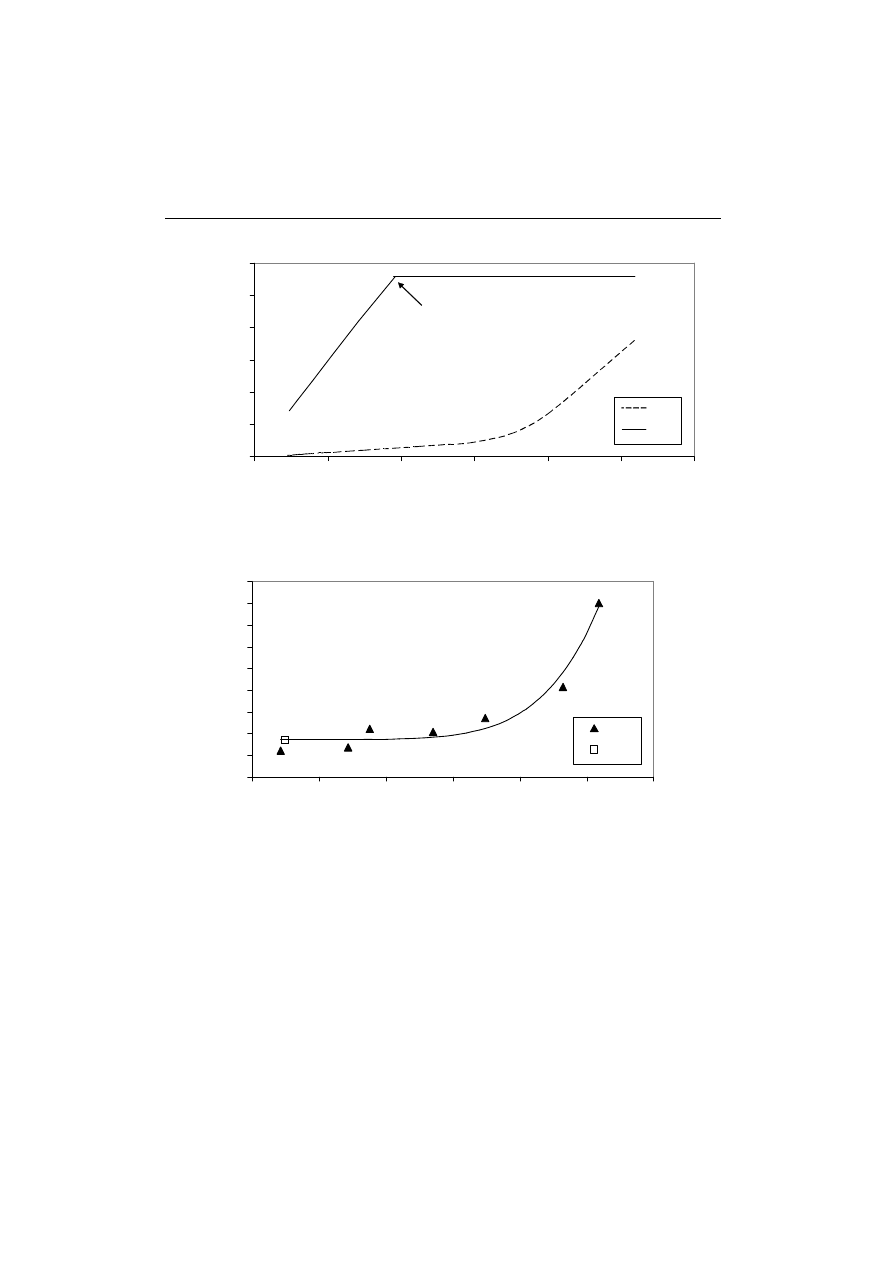
Absolute values of derivatives of the functions describing walnut kernels drying al-
lowed determination of the drying rate, which is represented by the plots in Figure 2.
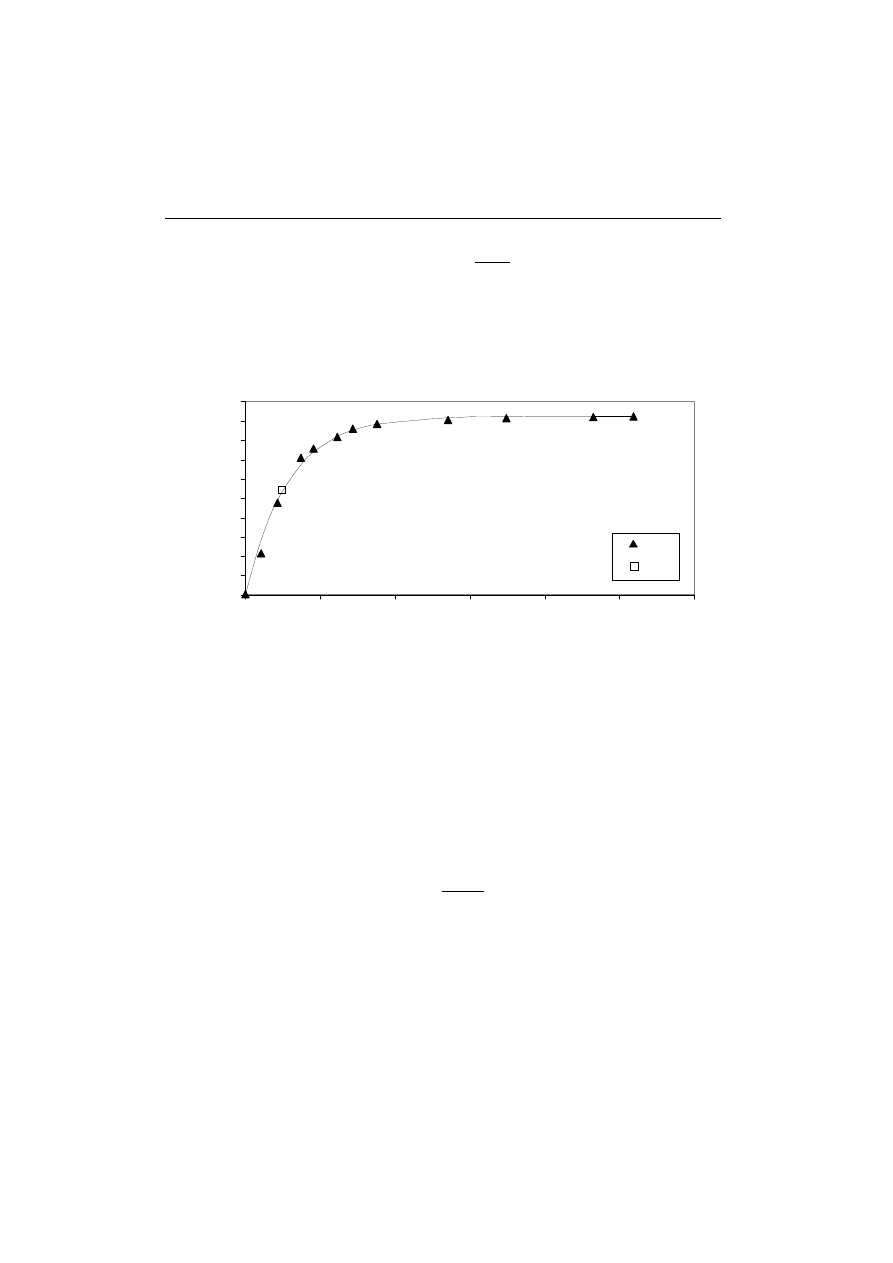
Decreasing moisture content till about 0.3 kg kg
-1
db was accompanied by
changing shrinkage (S) of the dried material. On exceeding this value no further
change in the volume of the walnut kernels was observed (Fig. 3). The relative
volume of the sample dried with the vacuum-microwave method differed only
slightly from the samples dehydrated in convection. This indicates that walnut
kernels are not susceptible to puffing under vacuum-microwaves unlike other
biological materials (Figiel 2006, Sham et al. 2001). The change of shrinkage S of
walnut kernels was described with a power function:
686
.
0
56
.
18
25
.
6
+
⋅
=
Mc
S
(4)
DRYING KINETICS, WATER ACTIVITY, SHRINKAGE OF WALNUT KERNELS
75
0
0.01
0.02
0.03
0.04
0.05
0.06
0
0.1
0.2
0.3
0.4
0.5
0.6
Moisture content Mc (kg kg
-1
db)
D
ry
in
g
r
a
te
D
(
k
g
k
g
-1
m
in
-1
)
K
VM
C
Fig. 2. Drying rate during dehydration of walnut kernels using convective (C) and vacuum–
microwave (VM) method
0.6
0.65
0.7
0.75
0.8
0.85
0.9
0.95
1
1.05
0
0.1
0.2
0.3
0.4
0.5
0.6
Moisture content Mc (kg kg
-1
db)
S
h
ri
n
k
a
g
e
S
(
m
3
m
-3
)
VM
C
R
2
=0.97
Fig. 3. Shrinkage of walnut kernels during dehydration using convective (C) and vacuum–microwave
(VM) method, R
2
– coefficient of determination
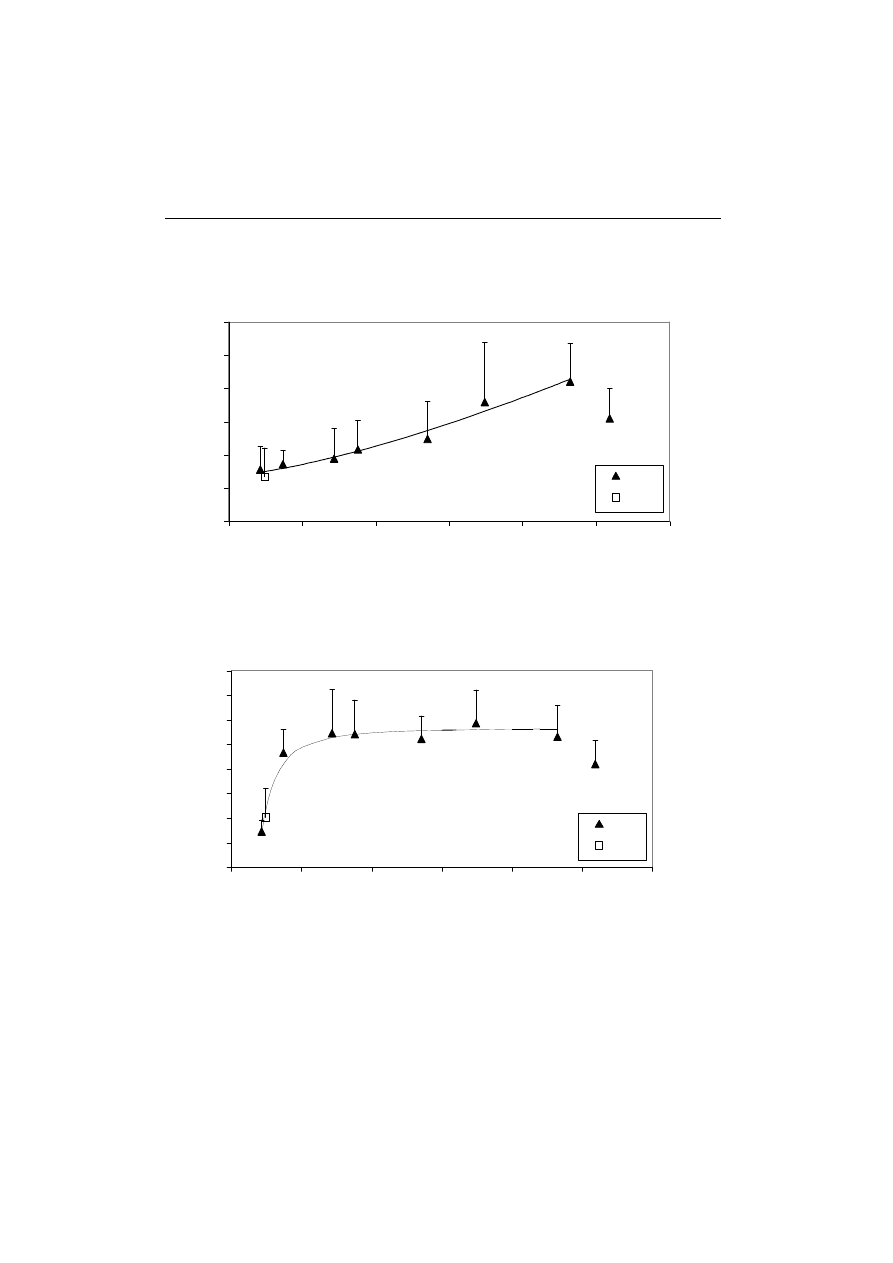
The relationship between the moisture content (Mc) and water activity (a
w
)
for walnut kernels is shown in Figure 4. Two additional points with (Mc) below
0.045 kg kg
-1
db represent the extra dehydrated samples. The extra dehydration was
necessary to increase the range of walnut kernels water activity towards lower values
and in this way to improve mathematical modelling. An exponential equation (5) was
proposed to describe the effect of moisture content on water activity:
A. FIGIEL, A.
KITA
76
)
1
(
925
.
0
057
.
0
Mc
w
e
a
−
−
⋅
=
(5)
High water activities were associated with relatively low moisture contents of
walnut kernels. Similar relationship was confirmed by studies made on other nut
fruits like pistachio (Maskan and Gogus 1997, Yazdani et al. 2006) or macadamia
(Dominguez et al. 2007).
0
0.1
0.2
0.3
0.4
0.5
0.6
0.7
0.8
0.9
1
0
0.1
0.2
0.3
0.4
0.5
0.6
Moisture content Mc (kg kg
-1
db)
W
a
te
r
a
c
ti
v
it
y
a
w
R
2
=0.99
VM
C
Fig. 4. Relationship between the moisture content and water activity of walnut kernels dried by
convective (C) and vacuum–microwave (VM) method, R
2
– coefficient of determination
Based on the results of bending strength tests on walnut kernels (Fig. 5 and
6), it was found that lowering of moisture content to 0.46 kg kg
-1
db caused con-
siderable increase in the breaking force (Fb
max
)
and breaking extension (Lb
max
).
Further lowering of moisture content below 0.46 kg kg
-1
db caused a decrease in
(Fb
max
)
according to exponential function (6) and change of (Lb
max
) described by
equation (7).
89
.
6
6
.
42
41
.
1
max
+
⋅
=
Mc
Fb
(6)
2
max
008
.
0
67
.
5
Mc
Lb
−
=
(7)
It is worth noting that (Lb
max
) maintained a similar value of 5.5 mm in the
range of (Mc) from 0.46 to 0.14 kg kg
-1
db. The decrease in breaking strength
when decreasing moisture content of roasted walnut kernels in the range from
0.007 to 0.03 kg kg
-1
db was reported in previous studies (Kita and Figiel 2006).
The results of this study suggest that when increasing moisture content of walnuts
DRYING KINETICS, WATER ACTIVITY, SHRINKAGE OF WALNUT KERNELS
77
beyond 0.46 kg kg
-1
db a change in the relationship between the bending strength
and moisture content may be expected. This implication enhances the necessity of
further studies on the texture of fresh walnut kernels with high moisture content.
0
5
10
15
20
25
30
0
0.1
0.2
0.3
0.4
0.5
0.6
Moisture content Mc (kg kg
-1
db)
B
re
a
k
in
g
f
o
rc
e
F
b
m
a
x
(
N
)
VM
C
de
f
ef
cd
b,c
abc
abc
ab
a
R
2
=0.97
Fig. 5. Effect of moisture content on breaking force for walnut kernels dried by convective (C) and
vacuum-microwave (VM) method, R
2
– coefficient of determination, similar letters (a, b, c, d, e, f)
are indicative of no significant difference between the mean values
0
1
2
3
4
5
6
7
8
0
0.1
0.2
0.3
0.4
0.5
0.6
Moisture content Mc (kg kg
-1
db)
B
re
a
k
in
g
e
x
te
n
s
io
n
L
b
m
a
x
(
m
m
)
VM
C
d
a,b
b
a,b
a,b
a,b
a,d
c
c
R
2
=0.97
Fig. 6. Effect of moisture content on breaking extension for walnut kernels dried by convective (C)
and vacuum-microwave (VM) method, R
2
– coefficient of determination, similar letters (a, b, c, d)
are indicative of no significant difference between the mean values

A. FIGIEL, A.
KITA
78
CONCLUSIONS
1.
The decrease in moisture content of walnut kernels dried in convection
can be described by a two term exponential function, whereas in vacuum-
microwave method by linear function in the first drying period and by an expo-
nential function in the second period.
2.
Shrinkage of walnut kernels changes while the moisture content decreases
till about 0.3 kg kg
-1
db. On exceeding this value no further change in the volume
of walnut kernels is observed.
3.
The relationship between the moisture content and water activity for wal-
nut kernels can be described using an exponential equation.
4.
Decreasing moisture content of walnut kernels till 0.46 kg kg
-1
db results
in a considerable increase in the breaking force and breaking extension. Further
lowering of moisture content causes a decrease in breaking force while the value
of breaking extension remains constant. The decrease in breaking extension oc-
curs when exceeding 0.14 kg kg
-1
db.
REFERENCES
Asoegwu S.N., 1995. Some physical properties and cracking energy of conophor nuts at different
moisture content. Int. Agrophysics, 9, 131-142.
Cortes B., Nunez I., Cofan M., Gilabert R., Perez-Heraz A., Casals E., Deulofeu R., Ros E., 2006.
Acute effects of high-fat meals enriched with walnuts or olive oil on postprandial endothelial
function. Journal of the American College of Cardiology, 48(8), 1666-1671.
Delwiche S.R., Pearson J.L., Sanders T.H., Wilson D.M., Shupe W.L., 1986. Microwave vacuum
drying effect on peanut quality. Peanut Science, 13(1), 21-27.
Dominguez I.L., Azuara E., Vernon-Carter E.J., Beristain C.I., 2007. Thermodynamic analysis of
the effect of water activity on the stability of macadamia nut. Journal of Food Engineering, 81,
566-571.
Durance T.D., Wang J.H., 2002. Energy consumption, density, and rehydration rate of vac-
uum-microwave and hot-air convection-dehydrated tomatoes. Journal of Food Science, 67
(6), 2212-2216.
Figiel A. 2006. Drying kinetics and drying shrinkage of garlic subjected to vacuum–microwave
dehydration. Acta Agrophysica, 7(1), 49-58.
Henderson, S.M., 1974. Progress in developing the thin layer drying equation. Transactions of the
ASAE, 17, 1167-1172.
Kashaninejad M., Mortazavi A., Safekordi A., Tabil L.G., 2007. Thin-layer drying characteristics
and modeling of pistachio nuts. Journal of Food Engineering, 78, 98-108.
Kita A., Figiel A., 2006. The effect of roasting on mechanical properties of walnuts. Acta Agrophisica,
7(1), 89-97.
Kita A., Figiel A., 2007. The effect of storage time on texture and selected properties of walnuts.
Acta Agrophysica. Properties of Water in Foods, 9(1), 69-78.
Koyuncu M.A., Ekinci K., Savran E., 2004. Cracking characteristics of walnut. Biosystems Engi-
neering, 87(3), 305-311.

DRYING KINETICS, WATER ACTIVITY, SHRINKAGE OF WALNUT KERNELS
79
Laverdine F., Zmirou D., Ravel A., Balducci F., Alary J., 1999. Blood cholesterol and walnut consump-
tion: a cross-sectional survey in France. Preventive Medicine, 28, 333-339.
Laverdine F., Ravel A., Villet A., Ducros V. Alary J., 2000. Mineral composition of two walnut cultivars
originating in France and California. Food Chemistry, 68, 347-351.
Lin T.M., Durance T.D., Scaman C.H., 1998. Characterization of vacuum microwave, air and freeze
dried carrot slices. Food Research International, 31(2), 111-117.
Maltini E., Torreggiani E., Venir E., Bertolo G., 2003. Water activity and the preservation of plant
foods. Food Chemistry, 82, 79-86.
Maskan M., Gogus F., 1997. The fitting of various models to water sorption isotherms of pistachio
nut paste. Journal of Food Engineering, 33, 227-237.
Nash S.D., Westpfal M., 2005. Cardiovascular benefits of nuts. The American Journal of Cardiol-
ogy, 95(15), 963-965.
Pabis S., Jaros M., 2002. The first period convection drying of vegetables and the effect of shape–
dependent shrinkage. Biosystems Engineering, 81(2), 201-211.
Patel G., 2005. Essential fats in walnuts are good for the heart and diabetes. Journal of the American
Dietetic Association, 105(7), 1096-1097.
Sham P.W.Y., Scaman C.H., Durance T.D., 2001. Texture of vacuum microwave dehydrated apple chips
as affected by calcium pretreatment, vacuum level, and apple variety. Journal of Food Science,
66(9), 1341-1347.
Silva F.A., Marsaioli Jr.A., Maximo G.J., Silva M.A.A.P., Goncalves L.A.G., 2006. Microwave assisted
drying of macadamia nuts. Journal of Food Engineering, 77, 550-558.
Sinesio F., Moneta E., 1997. Sensory evaluation of walnut fruit. Food Quality and Preference, 8(1), 35-43.
Sunjka P.S., Rennie T.J., Beaudry C., Raghavan G.S.V., 2004. Microwave–convective and microwave–
vacuum drying of cranberries: a comparative study. Drying Technology, 22(5), 1217-1231.
Torres M.M., Martinez M.L., Maestri D.M., 2005. A multivariate study of the relationship between
fatty acids and volatile flavor components in olive and walnut oils. Journal of American Oil
Chem. Society, 82(2), 105-109.
Yazdani M., Sazandehchi P., Azizi M., Ghobadi P., 2006. Moisture sorption isotherms and isosteric
heat for pistachio. European Food Research and Technology, 223, 577-584.
KINETYKA SUSZENIA, AKTYWNOŚĆ WODY, SKURCZ
ORAZ TEKSTURA ORZECHÓW WŁOSKICH
Adam Figiel
1
, Agnieszka Kita
2
1
Instytut Inżynierii Rolniczej, Uniwersytet Przyrodniczy we Wrocławiu
ul. Chełmońskiego 37/41, 51-630 Wrocław
e-mail: figiel@imr.ar.wroc.pl
2
Katedra Technologii Rolnej i Przechowalnictwa, Uniwersytet Przyrodniczy we Wrocławiu
ul. Norwida 25, 50-375 Wrocław
S t r e s z c z e n i e . Orzechy włoskie wysuszono przy użyciu dwóch metod: konwekcyjnej i mi-
krofalowo – próżniowej. W metodzie konwekcyjnej prędkość powietrza wynosiła 2 m·s
-1
a tempera-
tura 55
°
C. Suszenie metodą mikrofalowo – próżniową przeprowadzono przy ciśnieniu zmieniają-
cym się od 4 do 6 kPa przy mocy mikrofal 480W. Obniżenie wilgotności orzechów suszonych
konwekcyjnie opisano przy użyciu funkcji złożonej z dwóch składników wykładniczych, a suszo-

A. FIGIEL, A.
KITA
80
nych metodą mikrofalowo – próżniową przy użyciu funkcji liniowej w pierwszym okresie suszarni-
czym i funkcji wykładniczej w okresie drugim. Na podstawie wyników badań okazało się, że skurcz
suszarniczy ulegał zmianie aż do osiągnięcia przez orzechy zawartości wody 0,3 kg wody·kg
-1
suchej masy. Zależność między zawartością wody a aktywnością wody orzechów opisano przy
użyciu funkcji wykładniczej. Stwierdzono, że obniżenie wilgotności orzechów do 0,46 kg wody·kg
-1
suchej masy powodował znaczny wzrost siły niszczącej i odkształcenia niszczącego w teście wy-
trzymałości na zginanie. Dalsze zmniejszanie wilgotności powodowało zmniejszenie siły niszczącej,
podczas gdy odkształcenie niszczące pozostawało bez zmian. Znaczne zmniejszenie odkształcenia
niszczącego nastąpiło po przekroczeniu 0,14 kg wody·kg
-1
suchej masy.
S ł o w a k l u c z o w e : orzechy, kinetyka suszenia, aktywność wody, skurcz, tekstura
Wyszukiwarka
Podobne podstrony:
activity-animals-and-parts-of-the-body, Filologia angielska, Praktyki
Drying kinetics and drying shrinkage of garlic subjected to vacuum microwave dehydration (Figiel)
Drying kinetics and drying shrinkage of garlic subjected to vacuum microwave dehydration (Figiel)
Drying, shrinkage and rehydration characteristics of kiwifruits during hot air and microwave drying
Drying kinetics and quality of vacuum microwave dehydrated garlic cloves and slices
Drying kinetics and rehydration characteristics of microwave vacuum and convective hot air dried mus
Drying kinetics and quality of beetroots dehydrated by combination of convective and vacuum microwav
Use of exponential, Page’s and diffusional models to simulate the drying kinetics of kiwi fruit
Drying kinetics and quality of potato chips undergoing different drying techniques
Effect of various drying methods on texture and color of tomato halves (Gholam Reza Askari, Zahra Em
Desorption isotherm and heat pump drying kinetics of peas
Density and viscosity of several pure and water saturated ionic liquids Green Chemistry
Microwave–vacuum drying kinetics of carrot slices (Zheng Wei Cui, Shi Ying Xu, Da Wen Sun)
Experimental study of drying kinetics by forced convection of aromatic plants
An experimental study on the drying kinetics of quince
więcej podobnych podstron