
MARKSCHEME
May 2001
FURTHER MATHEMATICS
Standard Level
Paper 2
15 pages
M01/540/S(2)M
INTERNATIONAL BACCALAUREATE
BACCALAURÉAT INTERNATIONAL
BACHILLERATO INTERNACIONAL

(A1)
1.
(i)
(a)
( )
1
e
e
n
n
x
n
x
nx
−
′
=
(M1)(AG)
3
2
3
2
2
( ) e
e
( )
3 e
2 e
x
x
x
x
f x
f x
x
x
−
−
−
−
′
=
−
⇒
= −
+
[2 marks]
(b)
The function will have a maximum where
. From the graph of the
( ) 0
f x
′
=
function this happens at a positive point near zero,
2
3
2
( ) 0
2 e
3 e
0
x
x
f x
x
x
−
−
′
= ⇒
−
=
(C1)
(
)
2
3
2e
3 e
0
x
x
x
x
−
−
⇒
−
=
(R1)
Since x must be different from zero,
(M1)
2
3
3
2
2e
3 e
0
3 e
2e
x
x
x
x
x
x
−
−
−
−
⇒
−
= ⇒
=
2
3
2
3
2e
2
e
3
3e
x
x
x
x
x
−
−
−
⇒ =
=
So, we set up the iteration as
(A1)
3
2
1
2
e
3
n
n
x
x
n
x
−
−
=
Start with
,
0
0.5
x
=
1
0.588
x
=
…
2
0.578
x
=
…
(A1)
With
, hence the point is (0.579, 0.108)
4
0.579
x
=
[5 marks]
(c)
The two points that bound the region are 0 and 1 since
if and only if
( ) 0
f x
=
(M1)
which can only be true when
,
2
3
e
e
x
x
−
−
=
3
2
x
x
=
(A1)
i.e.
0 or
1
x
x
=
=
(C1)
(
)
1 0
(0) 2 ( (0.2)
(0.4)
(0.6)
(0.8)
(1)
2 5
T
f
f
f
f
f
f
−
=
+
+
+
+
+
×
(
)
3
2
3
2
3
2
3
2
0.2
0.2
0.4
0.4
0.6
0.6
0.8
0.8
0.1 0 2 e
e
e
e
e
e
e
e
0
T
−
−
−
−
−
−
−
−
=
+
−
+
−
+
−
+
−
+
(A1)
0.0594
T
=
OR
(G2)
0.0594
T
=
[4 marks]
continued...
– 7 –
M01/540/S(2)M
Question 1 continued
(ii)
Use the absolute ratio test to get
(M1)(R1)
1
1
3
3
2
lim
lim
2
1
2
1
3
n
n
n
n
n
n
x
x
n
n
n
n
x
+
+
→∞
→∞
−
−
×
=
×
+
+
−
(A1)
3
2
x
−
=
Hence the series converges when
(M1)
3
1
3
2
1
5
2
x
x
x
−
< ⇔ − < ⇔ < <
(C1)
so the series converges in the open interval
.
]1, 5[
Now we must check the endpoints:
(M1)(A1)
For
the series becomes
which converges by
1
x
=
1
1
1
(1 3)
( 2)
( 1)
2
2
n
n
n
n
n
n
n
n
n
n
n
∞
∞
∞
=
=
=
−
−
−
=
=
∑
∑
∑
the alternating series test since the terms decrease to zero in magnitude.
(R1)
For
, the series becomes
which diverges since
5
x
=
1
1
1
(5 3)
(2)
1
2
2
n
n
n
n
n
n
n
n
n
n
∞
∞
∞
=
=
=
−
=
=
∑
∑
∑
it is a p-series with
.
1
1
2
p
= <
(A1)
So the interval of convergence is
.
[1, 5[
[9 marks]
Total [20 marks]
– 8 –
M01/540/S(2)M
(M1)(C1)
2.
(a)
Closure
2
2
2
2
x x
y y
xy
xy
G
x x
y y
xy
xy
=
∈
(C1)
Associativity is assumed under matrix multiplication.
(M1)
x x a a
x x
x x a a
x x
=
(M1)
2ax x
⇒
=
1
2
a
⇒ =
(A1)
is the identity element
1
1
2
2
1
1
2
2
⇒
(M1)
The inverse
1
1
2
2
1
1
2
2
x x b b
x x b b
=
(M1)
1
1
2
2
4
bx
b
x
⇒
= ⇒ =
(A1)
is the inverse.
1
1
4
4
1
1
4
4
x
x
x
x
⇒
(R1)
2
2
2
2
x x
y y
xy
xy
y y
x x
x x
y y
xy
xy
y y
x x
=
=
(AG)
Therefore, the set is an Abelian group.
[10 marks]
(b)
This we prove by mathematical induction
(C1)
For
1
1
1
1, (
)
n
a ba
a ba
−
−
=
=
(C1)
Assume relation true for
1
1
, i.e., (
)
k
k
n k
a ba
a b a
−
−
=
=
Prove true for
:
1
n k
= +
1
1
(
)
k
a ba
−
+
1
1
(
) (
)
k
a ba
a ba
−
−
=
(M1)
by
assumption
1
1
(
)(
)
k
a b a a ba
−
−
=
associative
property
1
1
(
)(
)( )
k
a b
aa
ba
−
−
=
identity
property
1
(
) ( )
k
a b e ba
−
=
(M1)
associative
property
1
(
)
k
a b b a
−
=
(A1)
1
1
k
a b a
−
+
=
Hence the relation is true by mathematical induction.
[5 marks]
(M1)(R1)
(c)
Let
, then
( )
and
( )
x
y A
g f x
x
g f y
y
≠ ∈
=
=
"
"
(R1)
suppose
since
g is a function
(
) (
)
( )
( ), then
( )
( )
f x
f y
g f x
g f y
=
=
(M1)
hence
by definition, which is a contradiction,
x y
=
(R1)
therefore
, and
is injective.
( )
( )
f x
f y
≠
( )
f x
[5 marks]
Total [20 marks]
– 9 –
M01/540/S(2)M
(R1)
3.
(i)
(a)
Since ,
deg ( ) (
1) deg ( )
G
G
v
n
v
′
= − −
(M1)(A1)
and since
, so the degree sequence
is created by using:
14
n
=
G
′
13 deg( )
v
−
for each vertex in the opposite order
, etc...
13 5
−
(A1)
8, 8, 9, 9, 9, 10, 10, 10, 11, 11, 11, 12, 12, 12.
[4 marks]
(b)
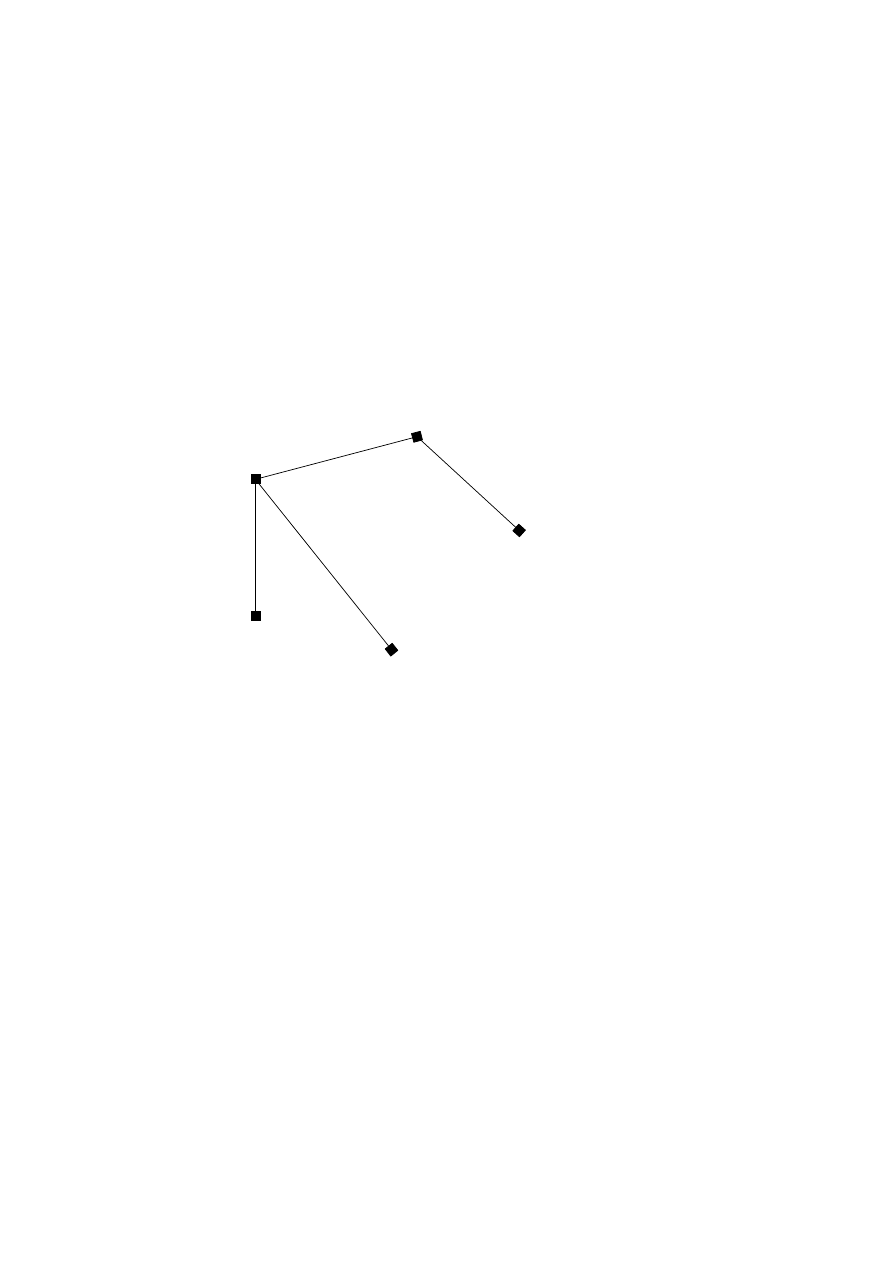
Kruskal algorithm
The algorithm is:
(R1)
“For a graph with n nodes keep adding the shortest (least cost) link – avoiding
the creation of circuits – until
links have been added.”
(
1)
n
−
Note here that the Kruskal algorithm only applies to graphs in which all the
links are undirected. For the graph shown above, applying Kruskal algorithm
and starting with the shortest (least cost) link, we have:
(A1)
A
B
C
E
2
3
3
6
D
Link
Cost
Decision
A–E
2
add to tree
A–B
3
add to tree
A–D
3
add to tree
E–D
4
reject as forms circuit 1–5 –4 –1
E –B
5
reject as forms circuit 1–5 –2 –1
B–C
6
add to tree
(M2)
Stop as 4 links have been added and these are all we need
(A1)
So, Minimum cost is 14.
[5 marks]
continued...
– 10 –
M01/540/S(2)M

Question 3 continued
(M1)
(ii)
(a)
Either
(for either a or b).
3 or 3
a
a
x
P
(M1)
(R1)
In the second case either
(and the same for b), and in
1mod3 or 2mod3
a
a
≡
≡
both cases it follows that
, hence
2
2
1mod3 and 1mod3
a
b
≡
≡
2
2
1mod3
a
b
+
≡
(C1)(R1)
(when one of them is divisible by 3) or
which contradicts the
2
2
2mod3
a
b
+
≡
hypothesis. Therefore the result follows.
[5 marks]
(R2)
(b)
If
and since
2
then
p a
p a
2
2
2
2
2
then
(
)
p a
b
p a
b
a
+
+ −
(R1)
So,
. Since p is prime, p must divide b.
2
p b
[3 marks]
(M1)
(c)
If
there are two integers s and r such that:
,
( , ) 1,
a b
= ⇒
1
ra sb
+
=
(M1)
If
there are two integers p and q such that:
,
( , )
,
a c
d
=
⇒
pa qc d
+
=
(M1)(R1)
Then
, and hence
and hence the
(
)
pa qc ra sb
d
+
+
=
(
)
( )( )
p qcr a
qs bc
d
+
+
=
result follows.
[4 marks]
Total [21 marks]
– 11 –
M01/540/S(2)M
(M1)
4.
(a)
The mean grade is
( ) 1 10
7 6
581
158
158
( )
xf x
f x
× +
×
=
=
∑
∑
…
(A1)
3.68
=
[2 marks]
(A2)
(b)
(i)
2.6
13.2
37.1
52.3
37.1
13.2
2.6
Expected number of candidates
7
6
5
4
3
2
1
Grade
(C1)
(ii)
To check whether the data is normal or not, we must run a
goodness of fit test.
2
χ
: Data is normal with mean 4 and standard deviation 1.17.
0
H
(C1)
: Data is not normal with the same mean and standard deviation.
1
H
(C1)
The first two and last two classes must be combined since the expected
number is less than 5.
2
2
2
2
2
2
(35 15.8)
(38 37.1)
(42 52.3)
(25 37.1)
(18 15.8)
15.8
37.1
52.3
37.1
15.8
calc
χ
−
−
−
−
−
=
+
+
+
+
(A1)
29.6
=
(C1)
The number of degrees of freedom is then
, hence the critical
1 5 1 4
n
− = − =
number is
.
2
9.49
c
χ =
(R1)
Since
we reject
and conclude that the data is not
2
2
29.6
9.49
calc
c
χ
χ
=
>
=
0
H
normal with a mean of 4 and standard deviation of 1.17.
[8 marks]
(c)
To test the hypothesis, we do a Z-test:
0
H :
4
µ =
(C1)
1
H :
4
µ <
This is a lower tail test, with
1.645
c
z
= −
(M1)(A1)
which lies in the rejection region.
3.677 4
3.47
1.17
158
t
z
−
=
= −
(R1)
We reject
and conclude that there is enough evidence to say that Utopia’s
0
H
performance is below that of the population.
(Students may use a p-value of 0.0003 and draw the same conclusion. Accept the
argument)
[4 marks]
continued...
– 12 –
M01/540/S(2)M
Question 4 continued
(d)
Mathematics and Physics grades are independent.
0
H :
Mathematics and Physics grades are dependent.
1
H :
This is a
contingency table analysis of independence with
2
χ
(4 1)(4 1) 9
−
− =
degrees of freedom.
(R1)(C1)
The expected frequencies are calculated by multiplying the row total by the column
total and dividing by the number of observations in the sample. The expected matrix
is shown below.
832
117
298
243
174
Totals
40.08
102.08
83.24
59.60
285
45
100
80
60
4 & below
21.94
55.88
45.56
32.63
156
24
52
48
32
5
31.64
80.59
65.72
47.06
225
28
90
65
42
6
23.34
59.46
48.48
34.72
166
20
56
50
40
7
Total
4 & below
5
6
7
2
2
over all cells
(
)
0.804 0.047 0.201 0.479 0.543 0.008
o
e
calc
e
f
f
f
χ
−
=
=
+
+
+
+
+
∑
(M1)
1.099 0.419 0.012 0.130 0.269 0.194
+
+
+
+
+
+
0.003 0.126 0.042 0.604
+
+
+
+
(A1)
4.981
=
(R1)
, we do not have enough evidence to reject
,
2
2
4.981
16.919
calc
c
χ
χ
=
<
=
0
H
(C1)
i.e. we do not have enough evidence to conclude that there is any statistical
dependence between the students’ grades in physics and mathematics.
[6 marks]
Total [20 marks]
– 13 –
M01/540/S(2)M

(R1)
5.
(i)
(a)
In triangle ABC, [AF], [CE], and [BD] are concurrent at G. Hence, by Ceva’s
theorem
(M1)
CD AE BF
3 3 BF
1
1
DA EB FC
2 2 FC
×
×
= ⇒ × ×
=
(A1)
BF
4
FC
9
⇒
=
Also, [DH] intersects the three sides of this triangle, so, by Menelaus’ theorem
(M1)
CD AE BH
1
DA EB HC
×
×
=
(A1)
BH
4
HC
9
⇒
=
[5 marks]
(b)
In triangle AFC, [DB] intersects the three sides, and by Menelaus’ theorem
(M1)
CD AG FB
1
DA GF BC
×
×
=
(A1)
3 AG FB
1
2 GF BC
⇒ ×
×
=
(M1)
However,
BF
4
FC
9
⇒
=
(A1)
BF
4 AG 13
,
BC 13 GF
6
⇒
=
=
[4 marks]
continued...
– 14 –
M01/540/S(2)M

Question 5 continued
(C1)
(R1)
(A3)
(ii)
PQ
PQ
QR
QR
3
3
=
⇒
=
2
2
[QR] has a fixed length
[PQ] also has a fixed length.
⇒
The locus of P is a circle where centre is Q and radius QR
3
2
Alternative solution if candidates took the ratio as PQ : PR
(R1)(A1)
By Apollonius’ theorem, the locus of points P is a circle.
To find that circle, we consider two points, M and N on side [QR] such that
(M1)
, the points are also fixed.
QM
QN
3
MR
NR
2
= −
=
(R1)(R1)
By the bisector theorem, [PM] and [PN] are the internal and external bisectors of
angle P. Hence angle MPN is a right angle, and the locus of points P is the circle
with [MN] as diameter.
[5 marks]
(iii) With A and
as vertices, we have
A
′
(M1)
AF
AE
c
e
a
= = ⇒
(A1)
AE
AF
(
)
a
a
c a
c
c
= ×
=
−
(M1)
MF
MF
MH
MH
e
e
= ⇒
= ×
(M1)
MF MF
(MH MH )
HH
(2 AE AA )
e
e
e
′
′
′
′
+
=
+
= ×
=
×
+
(M1)
2
(
) 2
2
2
2
c
a
a c
a
a
c
c
a
c
=
×
− +
=
−
+
(AG)
2a
=
[5 marks]
Total [19 marks]
– 15 –
M01/540/S(2)M
Wyszukiwarka
Podobne podstrony:
FURTHER MAY 01 P1
FURTHER MAY 01 P1
FURTHER NOV 01 P1 MARK
FURTHER MAY 00 p1 MARK
FURTHER MAY 03 P1 MARK
FURTHER MAY 02 P2 MARK
FURTHER MAY 03 P2 MARK
FURTHER MAY 00 P2 MARK
FURTHER MAY 02 P1 MARK
FURTHER NOV 01 P1
FURTHER MAY 03 P1
FURTHER MAY 03 P2
Further May 00 paper 2
FURTHER NOV 01 P2
FURTHER MAY 00 p1
FURTHER MAY 02 P2
FURTHER NOV 01 P1
Math HL May 98 p2 MARK
więcej podobnych podstron