
AMERICAN BASIC DOG HOUSE
Planning
I designed this dog house for Lana and Mavis, who are full grown females of
the Rottweiler/Australian Shepherd breed combination. I built my dog house at
my old house, and moved it to my new house, six miles away. I mention this as
a reminder to keep in mind that it maybe a lot easier to build the dog house in
one place (where there is good electricity, lighting, roof, whatever) and move it
to another, where it is more appropriately situated. My dog house weighed
probably 250 to 300 pounds but was relatively easily moved using a small
pickup truck and was hoisted over a four foot fence by four men who will most
likely not compete in any of this year's premier bodybuilding competitions.
Function
Get out a tape measure and measure your dog. Measure her standing straight
up, sitting on her haunches, and above all measure the full dimensions of your
dog when she is in the most comfortable, relaxed, and stretched out position
that she can assume. You should build a doghouse where this position can be
easily attained by the dog. The dog should be able to look out the front entrance
while standing up and sitting. The entrance way should be high enough that she
will not have to significantly lower her front shoulders or scrape belly to get in. It
should also be wide enough to accommodate the width of your dog. Stand
above the dog and measure the width of the widest point of the dogs’
shoulders. Add at least four inches to this measure and don’t forget to consider
future pregnancies or the adult girth of that roly-poly mastiff puppy you are
adopting. Remember that the roof of the dog house should overhang a few
inches for water runoff. Draw a sketch of your dog with the dimensions
indicated to help with planning. Click here to view the sketch.
Form
Must be dictated by function (see above). I could (and will at some future time)
go off on a tangent about residential architecture theory, but for now just make
sure the dog can get in and out safely and be protected from the elements while
inside. Never compromise functionality for the sake of style.
Once you satisfy the functional demands, you are free to design the house in
style you want. You probably already have an idea of what style you want, or
you might just want the classic snoopy style, which is the route I went. My goal
was to have the doghouse look like it belonged on the grounds of my home, not
to make a miniature version of my house (that could be cool though, as long as
functionality was job one). I used a similar roofline, the same shingles, and
painted the dog house the same colour as the human house.
Site Considerations
Again, functionality is the main consideration. Do not put the dog house in a
poorly drained area where rain frequently accumulates. Do not put it near a

river or stream bed area where it (and Fido) might be swept away during flood
stage. Do not put it on an unstable ledge where erosional or seismic effects
might cause trouble. If you have a large dog that can jump, keep in mind the
dog may climb the roof in order to leap across a fence to freedom. Do think
about site placement as it relates to your aesthetic concerns: do you want it to
be prominently viewed or cleverly concealed? What does your dog need to be
able to see out of the door (or window). What might she want to see? Having
the door facing towards a prevailing wind is not very smart (or nice). Likewise, a
bright light shining in at night will jacklight the dog and reduce her surveillance
proficiency to zip-diddly-squat.
Drawing the Plans
After you have:
1) determined your dogs shelter needs
2) considered the site where the house will be situated
3) thought about the style and appearance of the new dog house
you are then able to sit down and draw out the plan for the project with exact
measurements. Do yourself a favour and plan on building materials that are
readily available close to home. Visit the place where you buy building
materials. See what is available, measure boards with a tape measure, see
what kind of brackets, nails, etc. are available. Make notes and go back to the
drawing board, remember the thickness of the wood figures in when you make
the drawing. Use graph paper. Don't get real fancy on roof plans. Unless you
are confident that you have the skills to plan, cut, and build that double-hipped,
mansard, or Victorian-style roof, I recommend the simple gable or shed styles.
A Note on Planning Extra Features
Legend has it that a now defunct televangelist once counted an air-conditioned
dog house with a wet bar among his worldly possessions. I have heard
apocryphal tales of various heating, cooling, electrical, and plumbing scenarios
for dog houses, and I decree that my dog house and my website are not about
that.
I designed and built my dog house to be a place where my hounds can seek
shelter from the rain and wind, not as a permanent residence. I like to think of it
as a pavilion or gazebo. When it gets below freezing or particularly inclement,
the dogs come in for the night.
Dogs, especially younger ones, get off on chewing and scratching. Even little
dogs can destroy amazing volumes of stuff in short order with their needle-like
teeth. That is why I would be really nervous about introducing insulation, live
wires, or a beer tap into their midst.
When this doghouse was built, my dogs and I lived in North Georgia, with very
mild winters and insignificant snowfall. I welcome folks from every place in the
world to let me know how environmental factors have influenced their approach
to dog house design and construction.
Phases of Construction
Floor Structure and Decking
The 48" by 48" frame has two joists spaced at sixteen inch intervals. I used 2X4
pressure treated lumber. Since this wood will be close to the ground and
unsurfaced, pressure treated wood is mandatory. It is the only wood that will
resist rotting and infestation. Pay the extra money for this part of the
construction materials. Just like with any construction, the sixteen inch
structural support spacing seems to work fine. The decking was half inch
plywood. Since my dogs weigh as much as people do, so I used the thicker
plywood for the floor, and the thinner (three/eighths inch) wood for the sides.
Side and Back Walls Construction
Examining the dog houses at the competition led me to the conclusion that 2X2
lumber was suitable for sidewalls. One of the houses was over eight feet tall
with interior balconies, windows, and a beautifully crafted cedar shake roof. I
was surprised to see 2X2 construction throughout, but it was sturdy and larger
than 999 out of 1000 dog houses will ever be.
The two sides and back of my dog house were almost identical, the sides
measuring a bit shorter to allow for the width of the back. The height was 36
inches, which in retrospect was excessively high, but better too much than too
little. All four sections were assembled separately, using galvanized L-brackets
with wood screws and a few nails.
Front Entrance Wall Construction
The front piece resembled a Japanese gateway shrine. The height of the lintel
was determined by my largest dog's standing height.
Fastening Walls to Floor Structure
The pre-assembled sections were then fastened to the decked base with wood
screws and nails. Additional screws, nails, and L-brackets were used to tie the
four sections to each other.
Roof Construction
To me, this was the trickiest part. The greatest help I had was a steel 30-60-90
triangle and my jug head buddy, Pendejo, who (because he was struck in the
base of the skull by a small meteorite at age ten) is good at geometry. I knew
that a 30 degree roof pitch would be adequate for runoff, and looking at my own
house's roof showed me the technique of notching the joist so that it rests atop
the wall structure. Finesse is involved at this stage, my measurements on the
plan did not exactly match the reality of what I needed so adjusted the measure
so that it would work. We made one accurate prototype "V" joist out of 2x4
lumber and used it as a template for the other two. Remember please to allow
the roof to overhang by a few inches for decent runoff. The three roof joists on
my project were fastened to the frame with nails and spaced at 24 inch intervals
The joists were then reinforced with a 2x2 spine. I urge you to have someone
help you out during the entire framing process but especially during the roof
part because it is complicated and can be physically impossible for one person
to do, depending on the size of the dog house.
Siding and Roof Decking
I am a big proponent of plywood. I say this because I do not like the way that
particle or chip board warps and puffs under the influence of moisture. Even if
you live in a desert climate, your dog might knock over water or inadvertently
whiz in or near her structure. So that being said, measure and cut the sheet
wood carefully, it is the most expensive material in the project and the easiest to
mess up. A lot of places that sell plywood will cut it for you, but you might have
to pay a fee for each cut. I would recommend this if you can afford it. Be
absolutely dead sure about your measurements. Even though having a pro cut
your sheets will save you major coniptions, they probably wont cut those weird
triangle or trapezoid pieces that comprise the gable or roof of even the most
basic structure. If you do not understand the fundamentals of how to use a
circular saw, log off the internet now and learn how to or get a skilled individual
to do the cutting for you. No part of this project is potentially more dangerous
than this.
Just be careful.
Oh, yeah. Nail the siding to the frame. When you finish this phase you can look
inside the house and see how it looks enclosed. If you have built one as big as
mine, you can actually get inside and check it out.
Roofing
Asphalt shingles were my material. I picked ones that were the same colour
and texture as the roof of my house. If you use some other kind of roofing
material you are on your own to discover it's worth. If you use shingles wear
heavy gloves or you will grate your skin down raw. The way to shingle the
roof crest is by folding or cutting the shingle into three pieces and using them
folded across the crest. The last one will inevitably need to be glued down, so
use roof cement (tar), liquid nails or something of that ilk to stick it down.
Finish Trim and Paint
Finish trim is used to cover gaps in the plywood. If you need some ideas for
how to do it or what kind of materials to use, look at your house or the closest
building to where the dog house will be situated. I say, let the site dictate the
final appearance of your dog house. If you love your house and yard, make
your dog house an integral part of your grounds (think Kennedy Compound or
that computer guy's house, only on a smaller scale.)
I used white paint because our new house was painted white, and because I
happened to have some white paint on hand. When I paint the human house
with a new colour or get a new roof I will, of course, make these changes
manifest on the dog house.
Foundation
Use bricks, cap blocks, concrete blocks, stone blocks or a similar masonry
material to raise the house up above the soil line. Having a level comes in
handy here. It is probably a good idea to leave a ventilation crack or two on at
least two sides.
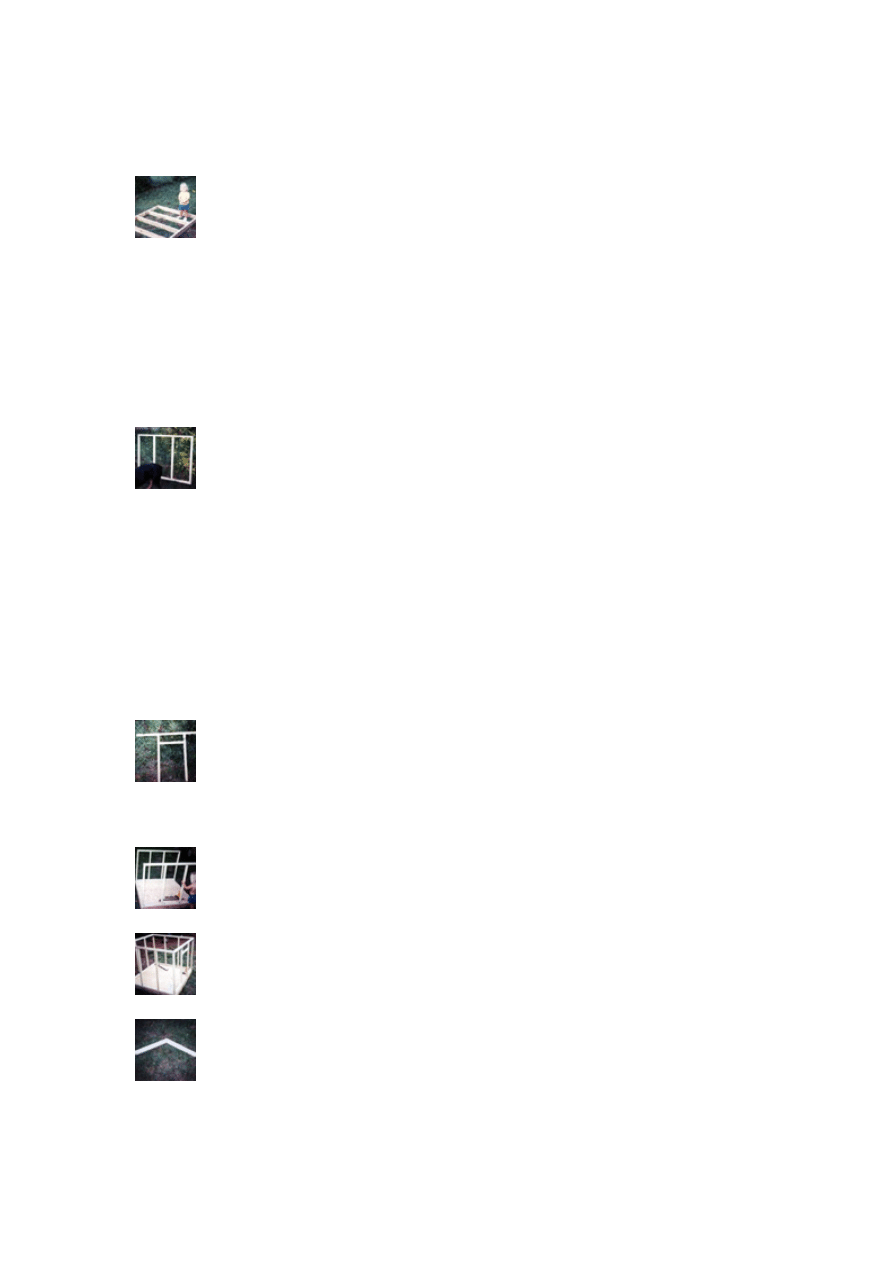
Floor Structure. Structure is a 48 inch square constructed of 2x4 pressure
treated wood with joists at sixteen inch intervals. The lovely blonde model is
about 34 inches tall.
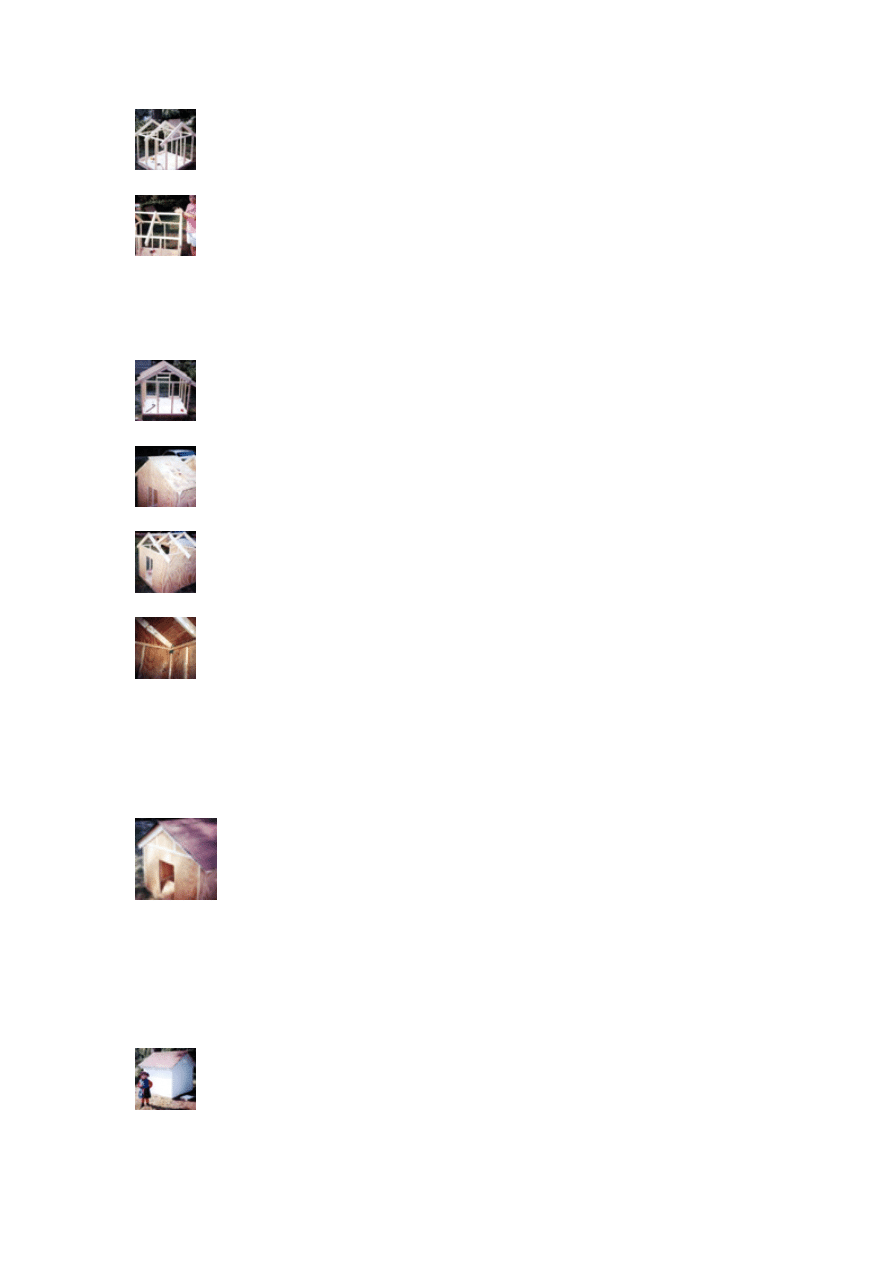
Side Wall Structure. Structure is a 48 x 36 inch rectangle constructed of 2x2
lumber with studs at sixteen inch intervals. As a bonus, you also see Mavis, a
genuine blue-eyed Rottweiler, and the buttocks of Lana, her camera-shy
mom.
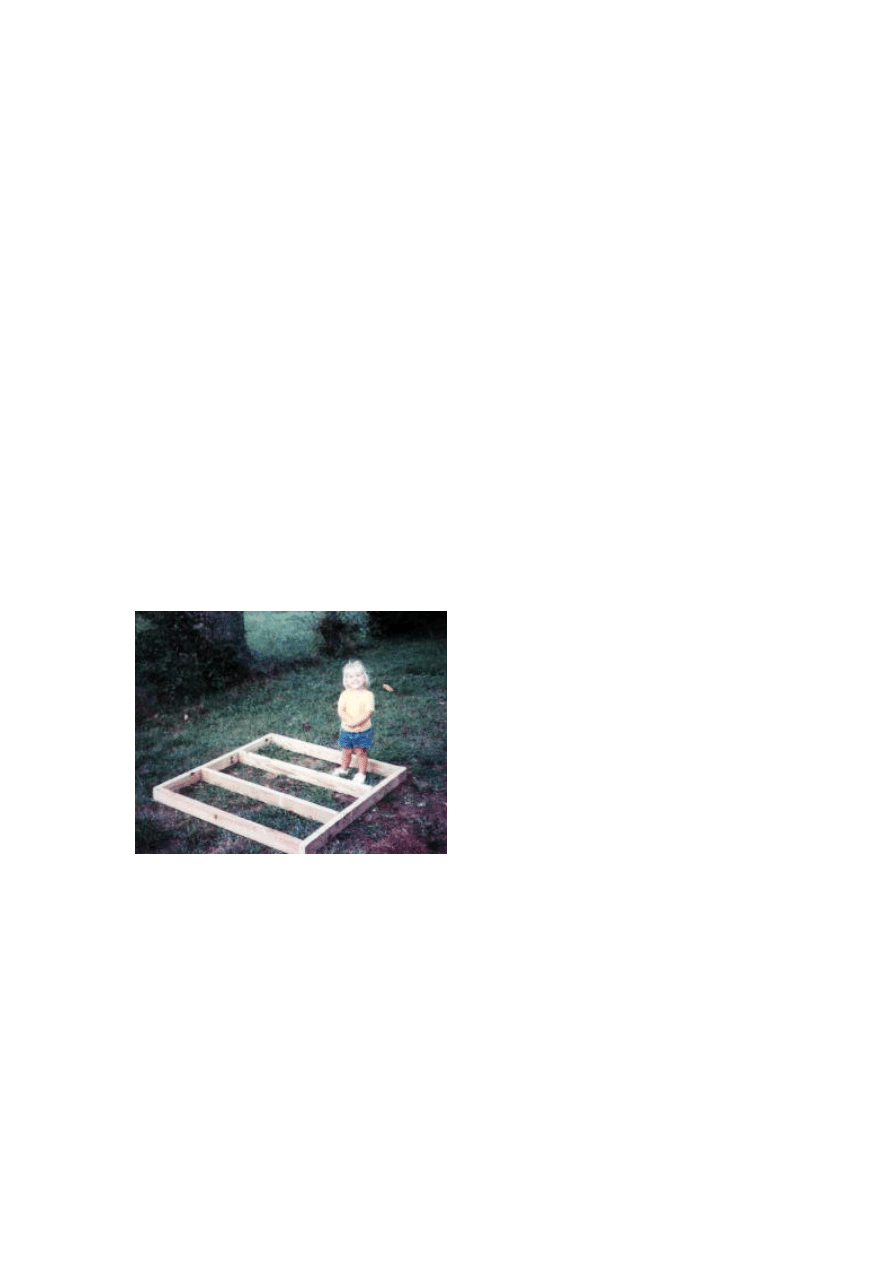
Side walls being attached to floor structure. Structure is constructed of 2x2
lumber with studs at sixteen inch intervals. Decking of floor is half-inch
plywood. No children were harmed in the construction of this dog house.
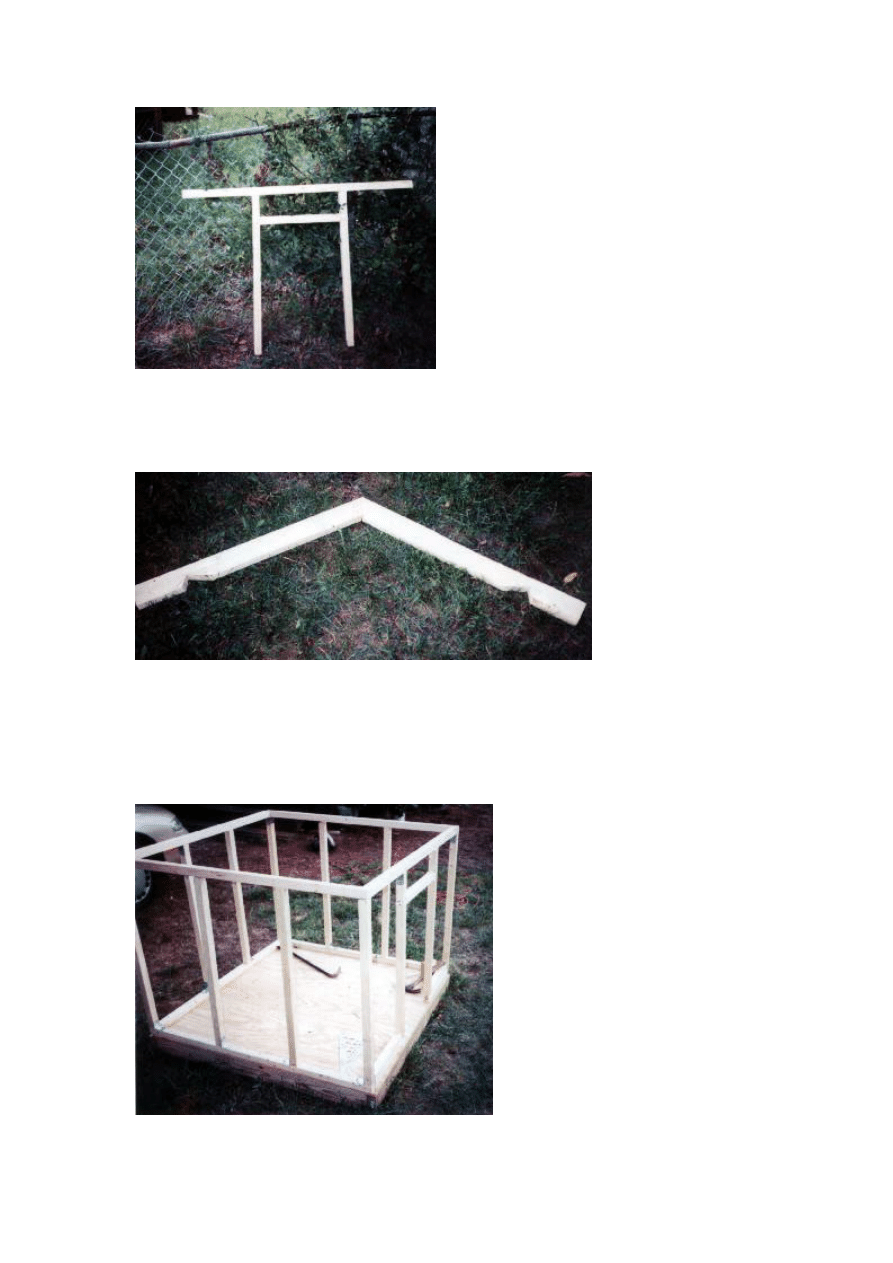
The total assembly of walls and floor. Note the use of "L" brackets at the
corners for greater stability. If you are doing the job right at this point, the
structure will become less flimsy as you attach one section to another.
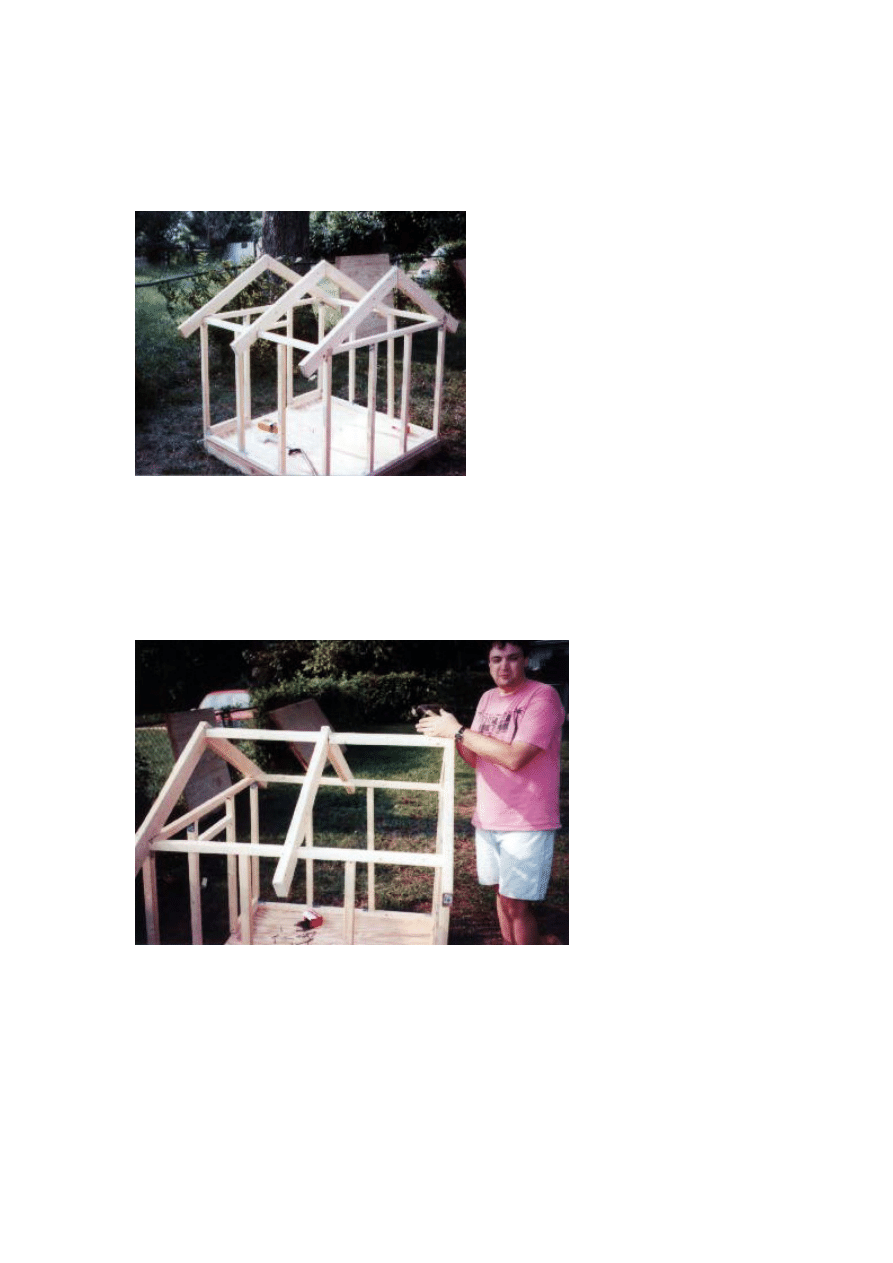
Roof "V" joist. Consists of 2x4 lumber with notches cut so that this form can
rest atop the side walls of the structure. A tape measure revealed the notch
corners to be exactly 48 inches apart, a perfect fit! Note that the apex of the
inverted "V" was accomplished by careful "toe nailing" of the boards using at
least six nails.
The total assembly of walls and floor. Note the use of "L" brackets at the
corners for greater stability. If you are doing the job right at this point, the
structure will become less flimsy as you attach one section to another.
Fastening roof joists to frame. The 24 inch spacing of joists is nowadays bad
juju in residential construction, but this is after all, a dog house with sixteen
square feet of living area and a load of less than 100 pounds. I do not
recommend going over the 24 inch spacing (take heed Irish Wolfhound
aficionados).
The roof spine. Ironically also captured in this view is the spineless hell-spawn
living zygote without which this project would not have been possible. Kudos
to Pendejo Jones, lets all hope "they" don't discover the interstellar iron chunk
lodged in his medulla oblongata the next time "they" go to replace the
microchip in his ferret-like brain pan. 2x2 lumber was used, nailing in the
second middle connection was difficult but do-able.
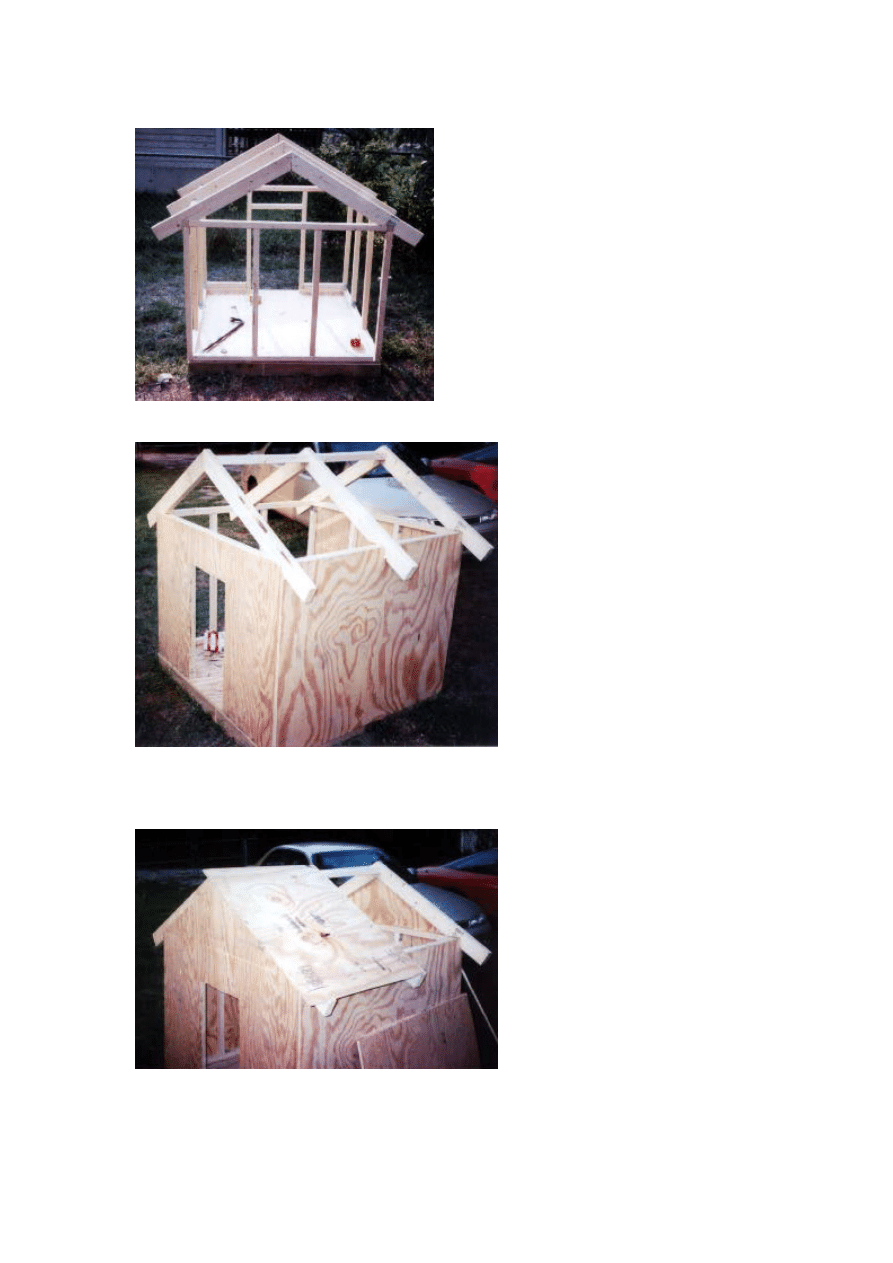
Complete framing before the application of plywood. Note crowbar.
Complete framing before the application of plywood. Note crowbar.
Roof decking being applied. Again with the plywood (three-eighths inch
thickness). I would like to tell you that I used four sections of plywood because
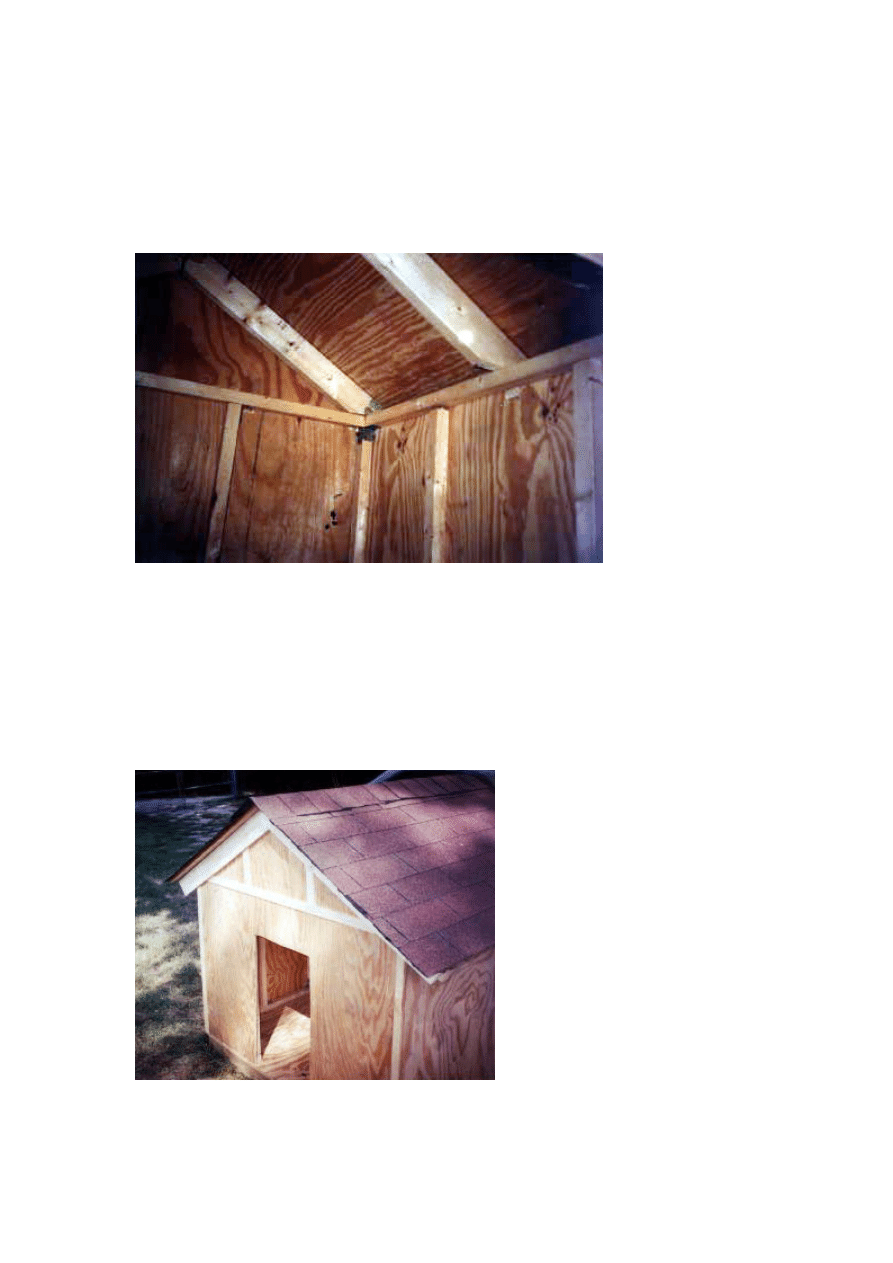
it is structurally superior, but it's really because temporary dementia caused
me to make a goofball miscalc on plywood measurement and I was running
out of sheets. For your information, most sheets of plywood are 96 (not 84)
inches long.
I do not recommend the use of particle board for the roof decking.
Interior shot of completed dog house. This picture reminds me of the slight
gap that was left where the roof overhangs the side walls. I would be proud to
tell you that it was a brilliant innovation designed from the very outset to
provide adequate ventilation, but that would be a tissue of lies. It is indeed an
innovation that provides ventilation, but it was the result of a jug head
oversight. Thank you.
Shot showing dog house completed except for paint. Gable fascia board is
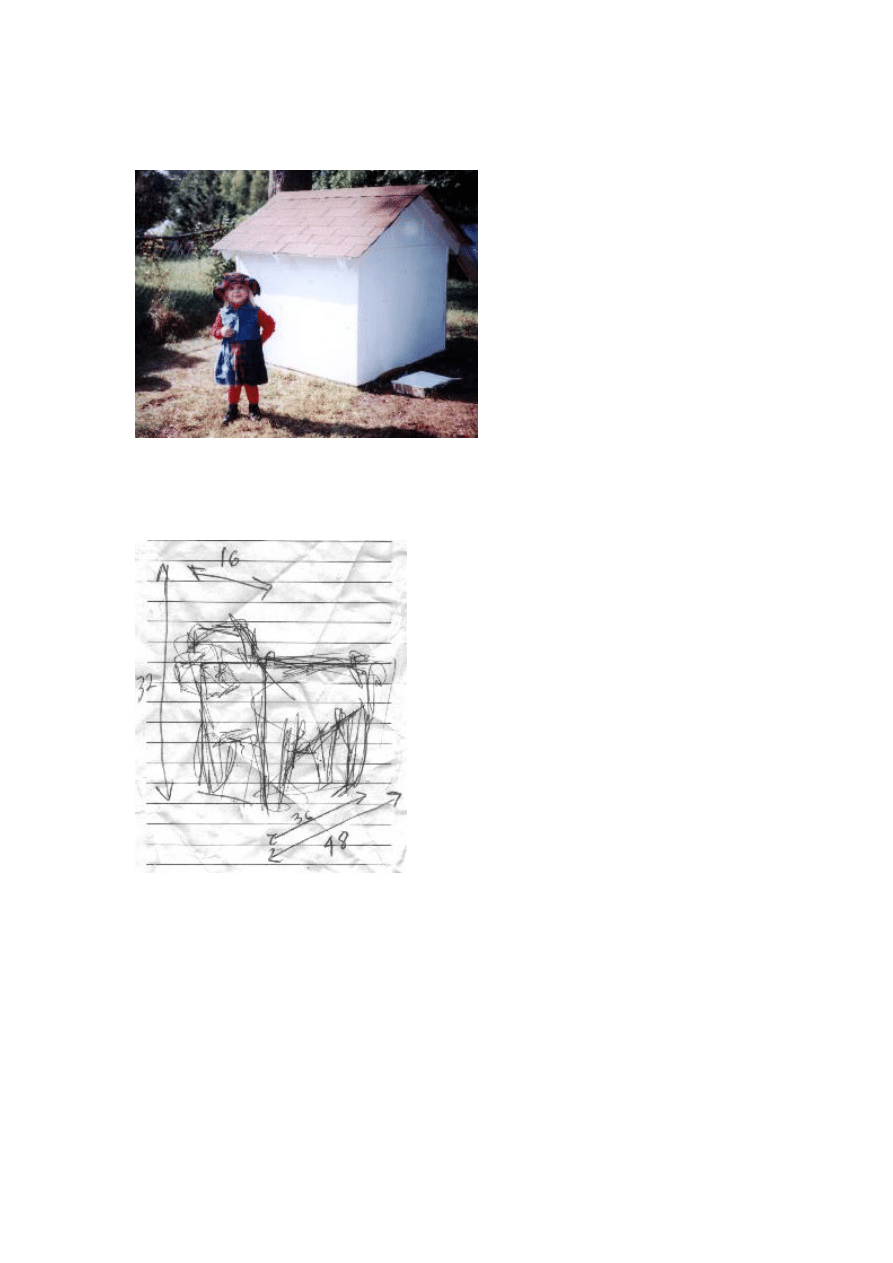
1X4. Lattice used on front and back is one and a half inch width. Corner trim
was most expensive lumber used, approximately 75 cents per linear foot.
Shot showing finished dog house complete with paint and construction
detritus. My daughter/supermodel steals the scene in a stunning ensemble of
her own creation
Rough sketch of the larger dog. Dimensions indicated are maximums with
extra inches thrown in for greater canine comfort. In revisiting this page I
realize that my dog does not resemble the Mack Truck hood ornament, I just
need art lessons.
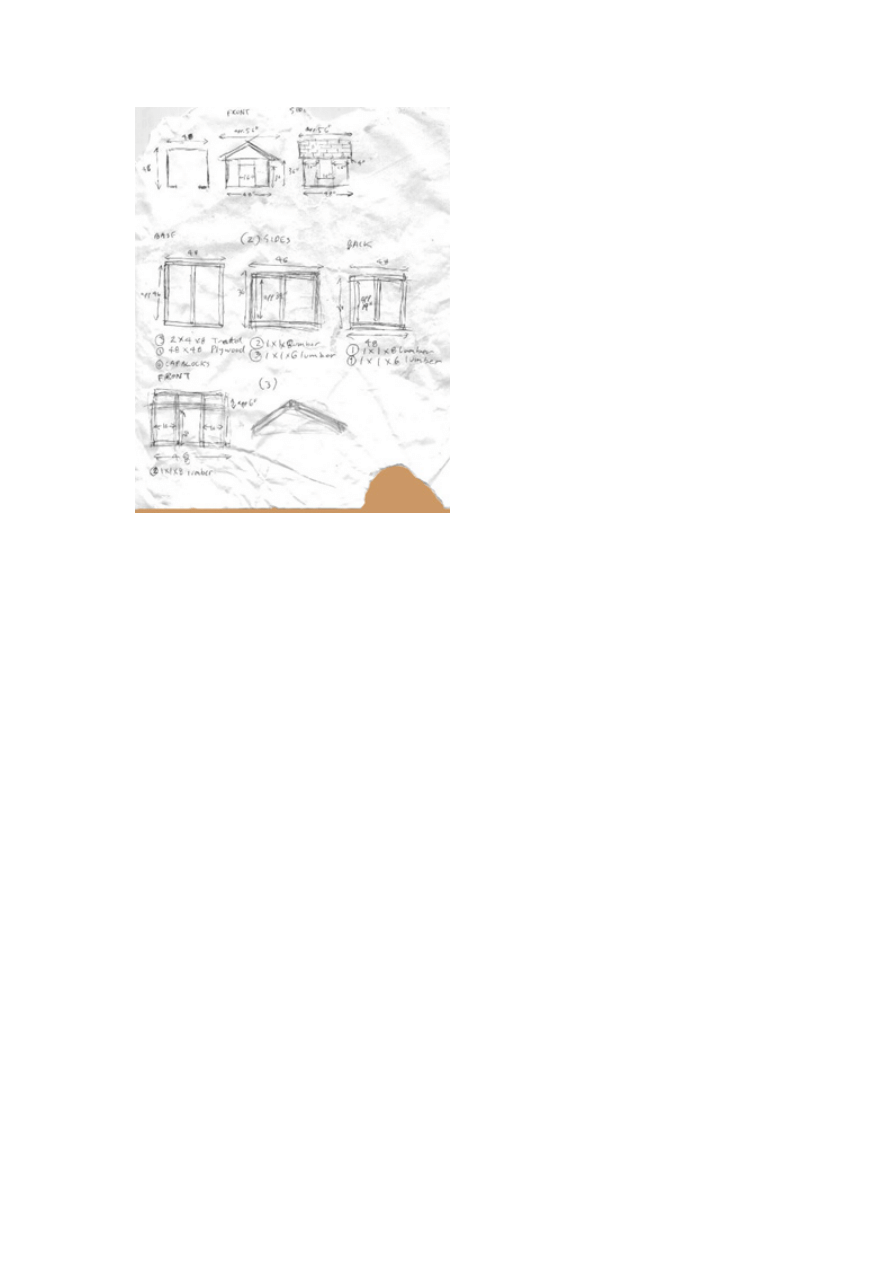
Rough plans for the dog house. Note that beneath each small drawing I have
made a list of materials to be used in that section. Please note the semi-
circular chunk taken out of the lower right hand corner. I swear to you that my
dog Mavis started eating the plan when I turned my back for a minute. Oddly
enough, I was ten years out of college before my dog actually did (try to) eat
my homework. Oh, well.
Materials and Tools
Materials
Materials needed for the project can be directly assessed from the plan you
drew. Buy more materials than you absolutely need because, you are
destined to at some point, make a brain numbing miscalc. If you live forty
miles from a building supply place or only have that pickup truck for one
afternoon, be smart and overbuy on materials. You will use the stuff
eventually for something anyway.
In general the materials I used are outlined specifically in the text of the
picture captions but are listed here generally as:
1) treated lumber 2x4 or 2x6
2) plywood
3) 2x2 lumber
4) 2x4 lumber
5) shingles or other roof material
6) assorted trim boards

7) "L" brackets, nails, and screws
8) paint, caulk and roof cement
9) bricks or cap blocks
Cost of Materials
My employer generously donated the plywood, which probably would have set
me back forty to fifty bucks (there's my raise). I also had the paint and a few
nails and what-not. Otherwise the cost of materials was about seventy dollars.
Most of this came from a large building materials superstore in the metro
Atlanta area. Your actual cost may vary because your actual dog may vary.
Don't let my cost factors scare you off this project, I have two, big dogs.
Tools
Tools I used were:
1) tape measure
2) saws (circular and jig)
3) hammers (claw and finishing)
4) crowbar
5) level
6) 30-60-90 metal triangle
7) caulk gun
8) screwdrivers (a power driver is great), but a big old flathead driver comes in
handy, so have one available as well as at least one Philips head hand driver.
9) Paint brush or roller, paint trays,
Document Outline
- Function
- Form
- Site Considerations
- Drawing the Plans
- A Note on Planning Extra Features
- Floor Structure and Decking
- Side and Back Walls Construction
- Front Entrance Wall Construction
- Fastening Walls to Floor Structure
- Roof Construction
- Siding and Roof Decking
- Roofing
- Finish Trim and Paint
- Foundation
Wyszukiwarka
Podobne podstrony:
AMERICAN BASIC DOG HOUSE
Dogs Trust Basic dog training
Dog House Dog House with Coverd Porch
Dog House Project Plan
Dog House A Frame Shelter
Jacqueline Pearce Dog House Blues (retail) (pdf)
14 Early American Literature Basic characteristic of colonial writing Puritanism
Bat House Plan and Basic Bat info
The American Society for the Prevention of Cruelty
American government presidential elections
3 ABAP 4 6 Basic Functions
Amadeus Basic Podręcznik szkoleniowy
Basic Shed
BASIC MALTESE GRAMMAR AND DIC (G Falzon)
50 Common Birds An Illistrated Guide to 50 of the Most Common North American Birds
więcej podobnych podstron