
Out of Many, One?: the voice(s) in the crusade ideology
of Las Navas de Tolosa
Edward Lawrence Holt
A thesis submitted to the Department of History for honors
Duke University
Durham, NC
April 2010

1
Table of Contents
Acknowledgments…………………………………………………………….....……..2
Introduction: Setting the Stage: Context for Las Navas de Tolosa…………….………3
Chapter 1: Building the Body of Christ: the crusade ideology of unity
in Innocent III’s 1212 procession..........……………………………......……...18
Chapter 2: Contesting Papal Hegemony: the monarchical promotion
of a national Catholicism…………………...........………………..…………...39
Chapter 3: Penance, Crusade Indulgences and Las Navas de Tolosa…….……………59
Chapter 4: Idealized Responses: The Crusade Song and the Christian Voice
of the Troubadour ………………………………............……………………..71
Conclusion......................................................................................................................87
Works Cited ………………………………………………...………………………....91
Appendices .…………………………………………………………………………...95
Figure 1. Spain in 1212......................................................................................95
Figure 2. Map of Rome at end of Twelfth Century.....................................…...96
Latin text of Mansilla letter # 473 with English translation...............................96
Figure 3.Eleventh-century mosaic of Christ. Hagia Sophia...............................98
Figure 4.Twelfth-century mosaic of Christ. Hagia Sophia.................................99

2
Acknowledgments
First and foremost, I am indebted to my advisor, Dr. Katharine Dubois. Her vast
knowledge in the medieval meant that no matter how obscure my question, she only had to reach
into her bookshelf to give me an avenue for exploration. Her unfailing enthusiasm and
commitment on behalf of my thesis made it a joy each time we met.
Next, I would like to thank my thesis seminar leader, Dr. Malachi Hacohen. Throughout
the year, his constant insistence that I write a captivating narrative meant many long hours of
revision. Yet, his encouragement that the work had a wider relevance than I realized provided the
means to keep going. As a result, my thesis is in a different but far better place.
Finally, I would like to thank my fellow thesis seminar students. Especially Andrew
Zonderman, my chief critic, with whom I would spend many hours discussing various
approaches and refining ideas. Also, my fellow medievalist Bethany Hill and last, Mike Meers,
who stuck with the medievalists and provided insight into what we could not take for granted.
One final note, although this paper has been subject to close readings and suggestions
from all the individuals above, ultimately any error found within is my own.

3
Setting the Stage:
Context for Las Navas de Tolosa
1
July 16, 1212. Poised on the plains near the city of Las Navas de Tolosa, two armies
prepared to engage in battle. On one side stood three kings of Spain, one prince, two
archbishops, monks from the four crusading orders and between 6,000 to 10,000 soldiers.
2
Armed not just physically, but spiritually with the indulgences of crusade granted by Pope
Innocent III, they faced Muhammed al-Nasir (Miramolin, according to the Christian sources),
caliph of the Almohad Empire, and his army. Just a year earlier, al-Nasir had swept into the
Iberian Peninsula with his army and taken the Christian stronghold of Salvatierra. Furthermore,
as Cesarius of Hesterbach asserted, he coupled this act with the challenge that he would “seize
all of Europe, transform the porch of St. Peters into a stable for his horses and establish his
banner in the top.”
3
This threat struck at the core of Christendom, for as St. Jerome penned in the
early fifth century “If Rome can perish, what can be safe.”
4
As a result, in October 1211, the kings of the Spanish peninsula’s two most powerful
kingdoms, Alfonso VIII of Castile and Pedro II of Aragon, agreed to fight this threat, meeting in
Toledo on May 20, 1212.
5
During this interim, emissaries enlisted help from neighboring
kingdoms, signed truces and reaffirmed papal support. All was going according to plan for the
Christian crusaders until they encountered the Muslim army, who had the advantageous position
and blocked all the known passes. That night, chroniclers record the miraculous arrival of a
shepherd who revealed a passage through the mountains unknown to all that “had often crossed
1
Unless otherwise noted, all English translations are my own.
2
Ambrosia Huici Miranda, Estudio sobre la campaña de las navas de tolosa (Valencia: Anales del Instituto General
y Tecnico De Valencia, 1916), 50-51. ; Francisco García Fitz, Las navas de tolosa, Ariel grandes batallas (
Barcelona: Ariel, 2005), 48.
3
Martin Alvira Cabrer, “El desafio del miramamolin,” Al-Qantara, 18, (1997): 468.
4
Peter Brown, Augustine of Hippo: a biography (Los Angeles: U of California P, 2000), 288.
5
Manuel G. López Payer and María Dolores Rosado Llamas, La batalla de las navas de tolosa (Madrid: Alemena
Ediciones, 2002).

4
through those places.”
6
On the day of the battle, July 16, 1212, buoyed by this advantage, the
Christians “triumphantly won, by God alone and through God alone.”
7
This victory shattered
Almohad power and removed the threat of a Muslim attack of Europe through Spain.
This sequence of events comes from the point of view of those active on the ground of
Las Navas de Tolosa. It reads a little differently in the narrative of the papacy. Since Pope Urban
II’s first proclamation of crusade to the Holy Land in 1095, the papacy had expanded the scope
of the venture beyond the eastern Mediterranean. Although Pope Urban II forced desirous
Spanish participants to fight the enemy at home, many historians do not correlate this fact with
multiple theaters of crusade.
8
One of the first instances of this extension of the call to crusade
away from the east was Pope Calixtus II’s 1123 decree during the First Lateran Council that all
who fought persistently in the current expedition in Spain received the same remission of sins
given to the defenders of the Eastern Church.
9
Throughout the first decade of the 1200’s, Pope
Innocent III furthered this expansion of papal crusade interest into Spain by issuing letters
promising indulgences to individuals who undertook similar crusades in the peninsula. However,
it was not until news of Miramolin reached the throne of St. Peter in late 1211 that Innocent
successfully orchestrated a crusade. First, the pope harnessed the spiritual powers of the church
through the granting of indulgences and the organization of a procession to pray for the
expedition’s success. Then, he utilized the church network to spread the news and solicit aid for
the Iberian Peninsula. Thus, the papacy played a key leadership role in Las Navas de Tolosa that
destroyed the largest threat to Western Christendom since the Vikings.
6
The Latin Chronicle of the Kings of Castile, Medieval and Renaissance Texts and Studies, Translated by Joseph
O'Callaghan, Vol. 236 (Arizona Center for Medieval and Renaissance Studies: Tempe, 2002), 47. ( english
translation provided by O’Callaghan)
7
Alfonso VIII, “Letter to innocent III,” De Re Militari,
http://www.deremilitari.org/RESOURCES/SOURCES/tolosa.htm; Internet; accessed 4 Sept. 2009. ( english
translation provided by website)
8
Jonathan Riley-Smith , The crusades: A history (London: Continuum, 2005), 8.
9
Joseph O'Callaghan, Reconquest and crusade in medieval Spain (Philadelphia: U of Pennsylvania P, 2003), 38

5
The record of Las Navas de Tolosa offers two competing narratives: one papal and the
other monarchical. Both possessed claims to leadership; but which one actually led in this case?
My thesis will explore the ways in which the monarchy of Castile under Alfonso VIII and the
papacy under Innocent III transformed crusade ideology through the incorporation of
institutional ambitions into crusade records. Through the rhetoric and careful definition of unity,
pilgrimage and penance, these two institutions presented different claims on the leadership of
Las Navas de Tolosa and more importantly their identity as a power in medieval Europe. The
medieval church was the dominant institution of the Middle Ages and Pope Innocent III was
arguably its most powerful ruler. During Las Navas de Tolosa, Innocent III furthered the
temporal reach of the see of St. Peter by promoting the papacy as the leader of crusade against all
foes. King Alfonso VIII of Castile recognized the encroachment on his powers and contested the
ideology with crusade ideology of his own. Not only did he combat the papal threat but also he
elevated Castile as the principal kingdom of Spain. One final note: I will use the name Las Navas
de Tolosa to stand for the battle itself, the process of assembling troops, and the political
interactions between kings, ecclesiastics and pope.
Literature of Las Navas de Tolosa
10
While historians debate details such as combatant attendance or al-Nasir's challenge, they
separately agree upon the uniqueness of Las Navas de Tolosa to Spanish history. Peter Linehan
states that “the victory at Las Navas came at the end of a five year period during which the
Christian rulers of the peninsula had been urged as never before to combine against the common
enemy.”
11
Prior to 1212, truces between the faiths were not uncommon for every rival kingdom
was a potential ally against the aggression of neighbors. For instance, the main reason for
10
Not intended to be exhaustive but rather to demonstrate a prevailing trend in scholarship.
11
Peter Linehan, History and historians of medieval Spain (Oxford: Clarendon P, 1993), 318.

6
delayed revenge after the disaster at Alarcos in 1195 was a ten-year truce signed in 1199 between
the kingdom of Castile and the Almohad Empire. Typical of the period was that only one or two
kingdoms joined against the Muslims; in addition, it was not unusual for a kingdom to find
mutual benefit by joining with the Muslims against their neighbor. In 1198, Castile and Aragon
invaded the kingdom of Navarre, with the intention of amalgamating it within their own land
holdings. Faced with such a threat, Sancho VII of Navarre solicited help from the Almohad
Empire.
12
However in 1212, this was not the case. King Alfonso VIII of Castile, King Sancho
VII of Navarre, and King Pedro II of Aragon were present at the battle; King Ferdinand II of
Leon sent the Infante Sancho Fernandez with a contingent to fight in his stead; the remaining
monarch, King Afonso II of Portugal, agreed to leave his neighbors alone. This solidarity of Las
Navas de Tolosa is unique in Spanish history to this point. King Alfonso VIII consequently
capitalized on these sentiments to begin the creation of Spain; by virtue of his leadership during
the campaign, he forwarded his name as the choice for the king of the new polity of Spain.
Las Navas de Tolosa was also unique in the stark deviation from normative medieval
military theory. According to Vegetius in De re militari
13
the common tactic was a series of
maneuvers in order to gain the upper hand and force an advantageous treaty, this expedition
chose to fight. Even more surprising about Las Navas de Tolosa was the enormous risk of loss,
not only plausible through attack from opportunistic enemies but the participants on campaign
faced uncertain profitability and poor opportunity for territorial expansion. At other times in
Spanish history, such as in 1199, this would have warranted signing a truce or delay; yet this
battle was unique in that despite the odds, they pressed forward in order to attack.
14
12
Joseph O'Callaghan, Reconquest and crusade in medieval Spain, 64.
13
A fourth century treatise on Roman warfare that was the main military guide for the Middle Ages.
14
Fitz, 83.

7
Martin Alvira Cabrer, in his illuminating work on the religious dimensions of the battle,
suggests yet another cause for the distinctiveness of Las Navas de Tolosa: the conception of
time. El tiempo de la guerra was the standard of the Iberian Peninsula during the Middle Ages as
there was always a Muslim threat. The work of the Reconquista mentally prepared the
inhabitants of Spain for war. However, a battle was just an option and usually the least preferred
one. On the other hand, el tiempo de la batalla offered a radically different view of war. Rather
than one of several possibilities, the battle was the choice with the purpose of coercing the
enemy to participate.
15
Since the loss of the Iberian Peninsula in 711 A.D., the Reconquista had
been concerned with the former, a defensive war against aggression, while steadily conquering
back territory and avoiding set piece battles. The campaign of Las Navas de Tolosa from the
outset was concerned with victory over al-Nasir and avenging the affront to Christendom
suffered at Salvatierra. As such, when one understands it through this construction of time, while
still integral to the Reconquista, Las Navas de Tolosa assumes more the ideology of crusade.
Ultimately, the reconfiguration of war style and participation of Spanish kingdoms transformed
the Muslim foe. They no longer had a rival territorial neighbor; the enemy of Las Navas de
Tolosa became an enemy of the faith. The Christian people forefronted the Muslim identity
marker in order to solidify their own position.
Finally, the battle of Las Navas de Tolosa was unique in reaching beyond the Pyrenees
for help. With the exception of crusaders stopping in Lisbon on their way to the Second Crusade
(1147-1149), typically only the inhabitants of the Spain undertook warfare against the Saracen
menace in Spain. This placed the enthusiasm for combat within the framework of Reconquista.
15
Martin Alvira Cabrer, “Dimensiones religiosas y liturgia de la batalla plenomedieval: Las navas de tolosa,” XX
Siglos, 19 (1994): 35.

8
However, in 1212, Alfonso VIII sent a letter of a different tone to Philip Augustus of France
requesting his help in the upcoming fight:
While you all may believe the wall to soundness as usual and the defenses to be
made to fall over, we extend a request of your serenity with sobbing in so far as
from your reign to our assistance send over expeditions and knights armed,
nothing wavering because if one responds to blood in Christian conflict with our
blood, truly we can be reckoned martyrs.
16
The imagery of martyrdom in response to the suffering of Christ fits the language of crusade
ideology. Alfonso VIII decided on this different approach in order to garner outside help. In
order to have Castile act on par with other kingdoms of Western Christendom, it needed to adopt
a similar language. This different style meant that he rejected the isolation of Reconquista in
favor of a message of crusade unity. While ultimately, King Philip did not contribute to the
endeavor
17
, nonetheless, Alfonso VIII’s military passion was very different from the past.
This did not mean that French knights entirely eschewed Las Navas de Tolosa. Inspired
to rouse support amongst his native Frenchmen, a troubadour named Gavaudan lamented:
Lords, for our sins
grows the strength of the Saracens:
Saladin has taken Jerusalem,
which still has not been recovered.
For this, the king of Morocco sends to tell
that he will combat all the kings of Christianity
with his mendacious Andalusians and Arabs,
armed against the faith of Christ.
18
16
Cum igitur murum integritati solitum debeatis et vallum fiei procidere, serenitati vestrae preces porrigimus cum
singultu quatenus de regno vestro veraculos expeditos et armatos milites ad nostrum coadjutorium transmittatis,
nihil dubitantes quia, si sanguis noster in conflictu Christi respondet sanguini, vere poterimus inter martyres
computari. Julio González, El reino de castilla en la época de Alfonso VIII (Madrid: Consejo Superior de
Investigaciones Científicas, Escuela de Estudios Medievales, 1960), 558.
17
For a larger explanation see below, pg. 69.
18
Senhors, per los nostres peccatz/ Creys la fosa dels Sarrasis;/Jherusalem pres Saladìs,/ Et encaras non es
cobratz;/ Per que manda ‘l reys de Maro/ QU’aab totz los reys de Crestiás/ Se combatrá ab sos trfás/ Andoloziz et
Arabito,/ Contra la fe de Crist garnitz (original Occitan) Manuel Milá and Fontanals, De los trovadores en España :
Estudio de poesía y lengua provenzal (Barcelona: Librería de Alvaro Verdaguer, 1889), 122; Señores por nuestros
pecados crece la fuerza de los sarracenos: Saladito ha tomado a Jerusalén que todavía no se ha recobrado. Por
esto envía a decir el rey de Marruecos que combatirá a todos los reyes los reyes de los cristianos con sus mendaces
andaluces y árabes, armados contra la fe de Cristo ( Spanish) Mila and Fontanels, 121.

9
Pope Innocent III issued letters to the prelates of France to hasten to the aid of their brothers to
the south.
19
In the letter to the Archbishop of Sens and his suffragans, the Pope urged the
crusaders toward the loyal work of expelling the “Saracens this year entering Spain in oppressive
multitudes,” and in return granted “the remission of all sins.”
20
Consequently, Archbishop Arnold Almaric of Narbonne, the archbishop of Bordeaux, the
bishop of Nantes and the noble Theoblad of Blazon led a contingent of ultramontanos that
contemporaries estimated as 60,000 strong. To contextualize this number (typically hyperbolic,
in medieval fashion), one has to look at the estimates for Spanish participants. The letter by
Alfonso VIII listed this as 185,000, which made the proportion of foreigners approximately one
in three.
21
Therefore, not only the supplication for outside aid but also the response of this
contingent of fighters in the Iberian Peninsula with foreigner status makes exceptional Las Navas
de Tolosa within Spain history.
In this thesis, I will argue that Las Navas de Tolosa was unique. It was unique to crusade
history because against the thirteenth-century trend of crusade failure culminating in the fall of
Acre in 1291, crusaders at Las Navas de Tolosa victoriously routed the Muslim foe. It was
unique to papal history because it remade the policy of interaction with the Spanish peninsula.
Pope Innocent III throughout his reign expanded the temporal authority of the church and Las
Navas de Tolosa crystallizes a case study of how this was accomplished. Finally, it was unique to
Spanish history. Previously separated from Christendom through the language of Reconquista,
the transition to crusade created interactions that resonated through the rest of the Middle Ages.
The fact that the endeavor was a success enabled the king of Castile to solidify his status as the
19
Demetrio Mansilla, ed, La documentación Pontificia Hasta Inocencio III, 965-1216. (Roma: Instituto Español de
Estudios Eclesiásticos, 1955), letter #470.
20
Mansilla, letter #468:Sarraceni hoc anno intrantes Yspaniam in multitudine gravi… in remissionem omnium
peccatorum.
21
Fitz 483.

10
primary king in the Iberian peninsula. In retrospect, Las Navas de Tolosa was a moment where
Castile launched itself toward becoming the modern polity of Spain.
Las Navas de Tolosa and Crusade Ideology
Papal and Spanish histories wielded crusade ideology to show the crucial role Las Navas
de Tolosa played to crusade in this period. In doing so, they defined Las Navas de Tolosa as a
crusade. Crusade ideology originated with Pope Urban II and will be explained more fully later.
Historians have argued that Las Navas de Tolosa falls outside the tradition of crusade and
therefore cannot be analyzed within the typical crusade rubric. Before continuing further, I wish
to clarify how historians have defined medieval crusade and Las Navas de Tolosa in fact does fit
within this definition. Before the late twentieth century, historians unquestioningly followed the
view of Jean Flori who described crusade as an “ideological fusion of holy war and pilgrimage”
justified by the desire to win and hold the Holy Sepulcher.
22
Moreover, the multi-volume works
of Steven Runciman and Kenneth Setton for the most part neglect military activity that did not
occur in the Levant. Until the last fifty years, the traditional view has been to omit European
activity from discussion concerning crusade ideology, with a few notable exceptions
23
Consequently, historians have for the large part left the 1212 campaign entirely out of the
discussion of crusade.
Moreover, the few historians who do include some discourse on the endeavor have
relegated the 1212 campaign as a holy war or part of the Reconquista. Spanish historians, more
focused on creating a national agenda that identified the Spanish past as different and uniquely
theirs, have largely neglected broader contextualization. More recently, Derek Lomax eschewed
nationalist rhetoric but continued the conception that the term Reconquista developed after the
22
Norman Housley, Contesting the crusades (Oxford: Blackwell, 2006), 3.
23
For instance, Joseph Strayer, The Albigensian Crusades (Ann Arbor: U of Michigan P, 2007).

11
Muslim conquest of Spain in 711A.D. This term dominated peninsular thought by the ninth
century.
24
Therefore, in his opinion, Spanish historians have correctly delineated Reconquista as
the term for the military endeavors in Spain because it not only predated crusades but also
precluded the need for them. Finally, the foremost skeptic of Las Navas de Tolosa as an example
of thirteenth-century crusade is Christopher Tyerman. In his works on the crusade, he too has
developed an extremely narrow definition that only allows certain situations to be considered
crusade; the rest are holy war. Among his requirements are indulgences and support from the
papacy as well as a commitment to the liberation of the Holy Land. According to these
historians, the battle of Las Navas de Tolosa has no importance to crusade ideology.
I maintain that the term Reconquista limits the impact of Las Navas de Tolosa. The influx
of foreign support and the severity of the threat brought the matter outside of Spain and into the
medieval West. The papacy deployed crusade ideology to extend its influence as a temporal
power into the previously secluded region of Spain. In reaction to this, the kingdom of Castile
used equally essential crusade ideology in order to contest the papacy and create its own place as
a dominant power in the wake of victory.
Some historians have made nods towards recognizing this. Jonathan Riley-Smith
expanded the definition of the crusade in his 1977 work What were the Crusades? He and his
students argued a pluralist view that what mattered was not the theatre of war but rather the
response “to an appeal to take action… promulgated by the pope and preached by the Church.
25
”
While he has included in other works brief mentions of the battle of Las Navas de Tolosa,
Jonathan Riley-Smith has not devoted significant time to contextualizing this battle in rejection
of his peers’ assertions that it is simply a holy war.
24
O’Callaghan, Reconquest and crusade in medieval Spain, 3.
25
Housley, 4.

12
Jose Gaztambide first questioned the tendency of historians to isolate Spain was first
accomplished in his work Historia de la bula de la cruzada en España in 1958. Although
Gaztambide’s groundbreaking work provides a broad description of the entire crusading effort in
Spain, it relies too heavily on institutional history and papal documents and neglects the plethora
of sources that could be used to bolster his argument and reinterpret a definition of crusade in the
thirteenth century. Martin Alvira Cabrer has published numerous articles on facets of Las Navas
de Tolosa, including its religious significance, the path from Alarcos to Las Navas, and the
similarities of Almohad sources to their Abbasid counterparts in the east. Despite this, he has
never written a more comprehensive history of the period. By incorporating a broader body of
sources and intertwining all of the components, I hope to correct these omissions and offer a
portrait of crusade ideology in Spain in the beginning of the thirteenth century.
In order to understand fully the crusade ideology as it existed in 1212, one should first
understand how it came to be through the transformation from its original conception in 1095 to
its 1212 incarnation. Although war had been fought against religious enemies almost since the
inception of Christianity, the first event that can positively be called crusade occurred in 1098
with an attempt to recover the holy land from Muslim foes. Pope Urban II articulated the rhetoric
that underpinned this event at the Council of Clermont in 1095. While no verbatim account of his
speech exists, several extant sources report the main ideas of what was to become the crusade.
Foremost, crusade responded to attacks by people “alienated from God” that usually
involved desecration of churches and the Christian people.
26
Yet those who went to fight were
not just warriors but rather pilgrims. It was their avowed purpose to emulate the command that
26
Paul Halsall, ed. “Urban II Speech at council of Clermont, 1095, five versions of the speech.” Internet Medieval
Sourcebook, 1997 http://www.fordham.edu/halsall/source/urban2-5vers.html;Internet; accessed Mar. 2010.

13
“he that taketh not his cross and followeth after me, is not worthy of me.”
27
As such, knights
undertook a holy pilgrimage, taking vows and wearing the sign of the cross to show how they
had given themselves as a living sacrifice. In return for these acts, the crusader received the full
remission of the debt of sins and in death “the assurance of the imperishable glory of the
kingdom of heaven.” Furthermore, in order to guarantee attendance, Pope Urban II reminded
listeners of the truce of God. Those signed by the cross and their enemies should “let your
quarrels end, let wars cease and let all dissensions and controversies slumber.” Thus Urban
facilitated the crusaders ability to “enter upon the road to the Holy Sepulcher,” Jerusalem,
considered the center of the world and for the first crusade the crusade’s only goal. However,
Urban II did give allowance to those fighting in Spain to remain since it was reckless to go to the
Holy Land yet leave dangerous enemies unchecked at home. Gaztambide argues that Urban II
believed knights in Spain were engaged in the same defense of Christianity against Muslim
tyranny as in Asia: to “die in the Spanish war for the love of God was as meritorious as in the
expedition overseas.”
28
Finally, only those fit for battle were allowed to participate; the infirm,
women and poor were advised to remain at home and leave the battle to the nobility,
ecclesiastical, and warrior classes.
These precepts for crusade remained largely stable through the ensuing two centuries.
Essential for an analysis of Las Navas de Tolosa, slight permutations allowed Innocent III to
enlist crusade ideology in defense of the Christian west from Muslim aggression. For instance,
going to Jerusalem was no longer a requirement. Louis VII of France on the Second Crusade
would not consider any other plans until he had completed his pilgrimage to Jerusalem.
29
Yet in
the Third Crusade, Richard the Lionhearted strongly believed the best means of attack was to go
27
Matthew 10:38
28
Jose Gaztambide, Historia de la bula de la cruzada en España. (Vitoria: Editorial del Seminario, 1958), 50.
29
Jonathan Riley-Smith , The crusades: A history, 129.

14
to Ascalon, Egypt, in order to secure the Christian position and keep Saladin from receiving
reinforcements.
30
Furthermore, by the thirteenth century, it was not even necessary to go to Asia
at all. With the Albigensian crusade, starting in 1209, it was possible to crusade against
Christendom’s enemies at home. This dispersion of the focus on Jerusalem made it possible for
Innocent III to respond to the threat of al-Nasir by utilizing the ideology of crusade.
Another alteration was in who could participate. Previously limited to those who could
afford the journey and those fit to fight, by the early thirteenth century, these standards had
altered. In 1209, Innocent III permitted the commuting of the crusading vow by a monetary gift
of alms. This measure drastically increased the number of Christians able to participate, and
provided financial support for such endeavors. Finally, in 1212, Innocent III admonished regular
Christians to do penitential processions and pray for the success of military ventures on behalf of
Christendom, claiming that in doing so, they were now fully integrated into crusade.
In discussing crusade, historians have been too focused on delineating what exactly
constituted crusade. In reality, while there were some fixed tenets, often crusade in the late
twelfth and early thirteenth centuries was much more fluid. This project will concentrate on the
manner in which kings and popes utilized this fluidity in order to promote their personal agendas
in the midst of a campaign against an enemy of the faith. Secondly, it will examine Las Navas de
Tolosa through the lens of crusade ideology in order to see how the event was molded by and in
turn shaped crusade. Using the term Reconquista limits the scope of the moment to just within
Spain. The ideology of Las Navas de Tolosa transcended the limitation, for the remade crusade
ideology reflected the new realities of the monarchical state and papal powers in Europe during
the later half of the Middle Ages.
***
30
Riley-Smith, 145

15
This thesis examines how papal and monarchical voices utilized crusade ideology not
only to fight a religious foe but also to advance their respective institution’s agendas. By voice, I
mean not just the pope or king but rather the group of individuals that weigh in on that side of the
argument. For the pope, this includes ecclesiastics such as Arnaud Amalric. The monarchical
voice includes not just Alfonso VII but rather the three chronicling bishops. Chapter one will
explore the first voice, that of the papacy. Pope Innocent III, through his procession called on
May 20, 1212, provided a credible physical commitment to his rhetoric of crusade leadership, a
spectacle to remind his suffragans in Rome of his dominance, and a ritual precedent that
expressed the papacy’s hopes for Christendom to unite around crusade. Innocent III believed
himself to take his rightful place at the head of the united body of Christ. I will first look at the
processional event in Rome and its significance to the papal crusade ideology of unity. Next, the
chapter will examine an emulation of this procession in the diocese of Chartres. The final part of
the chapter will analyze how this procession bolstered the notion of pan-Christian unity that
Innocent hoped to convey in urging crusade through inspecting the link of Innocent III’s
procession with the 1213 papal bull Quia Maior as well as a procession later called by Honorius
III in 1217.
In chapter two, I will introduce the second voice, that of the monarch. King Alfonso VIII
of Castile, aware of the papacy’s encroaching influence, contested Innocent’s claim to crusade
leadership. In its place, he promoted himself as a local defender of the faith, one that did not
need guidance from Rome. Court commissioned chroniclers crystallized this position through an
appropriation of the language of imitatio Christi, minimizing the regulatory framework of
pilgrimage and maximizing the individual’s choice of following Christ. Just as a donor window
in a cathedral recorded acts of patronage and pilgrimage, the chronicles acted as the means for

16
the kings to record and memorialize their pious actions. This chapter examines three chronicles:
Latin Chronicle of the Kings of Castile, Chronicon Mundi, and Historia de rebus Hispanie. In
doing so, I will demonstrate how the courts of Castile contested the papal vision of crusade and
promoted the monarchical. Finally, not only chronicles represented the tension between Christian
powers. Correspondence did as well. I will inspect how King Alfonso VIII, in a letter telling of
the victory of Las Navas de Tolosa, constructed his own vision of imitatio Christi in order to
promote his claim to primary defender of the faith. Innocent III then retaliated, not only stressing
the need for humility but also asserting his own position of authority.
Chapter three will explore how the two separate visions of monarch at one extreme and
pope at the other were reconciled toward the same goal of fighting the enemy of the cross. The
contemporary theology of penance, including the crusade indulgence, forced cooperation.
Innocent III offered spiritual incentives for participation but did not have a presence fighting in
the field. Meanwhile Alfonso VIII had the leadership in Spain as well as troops; however due to
the size of the threat, he did not have enough troops nor any incentives to bring support from
abroad. The two sides needed each other. This chapter will trace the chronology of the two years
before Las Navas de Tolosa through letters issued by Innocent III and Alfonso VIII. In doing so,
I will demonstrate how each ruler utilized the other in order to defeat Miramolin together,
although each still preserved his own personal agenda.
One problem of exploring the tension between the pope and king is that it tends to
background the more physical threat of Miramolin. To correct this, chapter four will present a
third voice, that of the troubadour. Troubadour crusade songs offered a call to arms. In the ideal
vision they presented, the crusade was simply a matter of faith. With Christ as the head of the
venture, claims of the pope and the monarch do not matter. By writing in a century-long

17
tradition, the troubadours rejected the new positions of the monarchy and papacy. They asserted
a vision in which their native Occitania still held an integral role in the construction of crusade.
This chapter will identify the common themes in the construction of the medieval troubadour
crusade lyric. It then explores the two songs of Las Navas de Tolosa: Hueimas no y conosc razo
and Senhors, per los nostres peccatz. In doing so, I will show that crusade ideology was not just
a reflection of new ideas of power dynamics in medieval Europe but also a means through which
to preserve past values.

18
Building the Body of Christ:
the crusade ideology of unity in Innocent III’s 1212 procession
Fundamental to crusade ideology and found in almost any crusading text was the theme
of unity. Chroniclers of the First Crusade admonished Stephen of Blois for abandoning the effort
at Antioch by cowardly fleeing in the middle of the night. This disruption of unity caused his
family such shame that his wife forced him to join another venture. Furthermore, at a tournament
before the Fourth Crusade
31
, Thibald of Champagne and Louis of Blois knelt and pledged to
accept the cross, followed symbolically by all other knights and lords present.
32
Pivotal to many
texts was the attaching of a cloth cross to an outer garment, which signified a pilgrimage badge
that united the participants in a single act. However, all of these events focus solely on the
crusaders themselves. Within crusade ideology, there was no discussion about the possible
inclusion of those left behind whether they were infirm, indigent or women. One needs to look
no further than the success of Peter the Hermit
33
to see that these groups wished to participate.
Yet crusade ideology until the thirteenth century only included important clerics, nobles and
those who fought. The rest of Christendom remained behind, excluded from joining this
pilgrimage for Christ.
Pope Innocent III, through a 1212 procession held in Rome in support of Las Navas de
Tolosa, hoped to rectify this bifurcation of the Christian people. Crusaders had used penitential
processions as early as the First Crusade defending the city of Antioch against the anticipated
aggression of Kerbogha. The procession was an event with a crusade context that the papacy
could perform with the same intent, but closer to home. Faced with the anxiety of lay usurpation
of papal crusade primacy by King Alfonso VIII of Castile, similar to what had happened in the
31
1199 November 28
32
Jonathan Riley-Smith, The Crusades: A History, 152.
33
A charismatic priest rumored to have collected 40,000 peasant supporters for the first wave of the First Crusade.

19
lay dominated Fourth Crusade (1202-1204), Innocent capitalized on this form of a credible
commitment to the cause. In their game of brinkmanship for supremacy, Innocent employed this
spectacle to make a tangible claim outside of typical written and liturgical means. Furthermore, it
helped to quell malcontents in Rome. In 1203, Innocent III fled the city in the wake of a popular
rebellion; he reconciled with the city a year later and they “received [him] with great honor.”
However, these sentiments did not last; a few years later, he once more had to evacuate due to
the pressure of the citizens of Rome, returning in 1208 with an adventus
34
to the Lateran.
35
By
proclaiming this procession, Innocent III not only provided a credible physical commitment to
his rhetoric of crusade leadership but also provided a spectacle to remind his suffragans in Rome
of his dominance.
While the 1212 procession worked to assuage these anxieties, it foremost acted to create
a ritual precedent that expressed the papacy’s hopes for Christendom to unite around crusade.
The purpose was in order to defend against the threats by the Muslim leader Miramolin “to seize
all of Europe, transform the porch of St. Peters into a stable for his horses and establish his
banner in the top.”
36
Non-fighting participants, through such ritual acts, fully engaged in crusade
in communion with their fighting counterparts in Spain. Furthermore, the procession acted to
bond the rest of the populi Christinorum by sparking copies. This chapter will first look at the
event in Rome and its significance to the crusade ideology of unity. Beyond the creation of a
common front, this ideology was rooted in the medieval ideas of order, especially revolving
around a hierarchy of which Innocent III was the apex. Next, it will examine one instance of
emulation in the diocese of Chartres. The final part of the chapter will assess the subsequent
34
Ritual similar to a Roman Triumph but drawing upon the theological significance of the entrance into Jerusalem
by Jesus.
35
Susan Twyman, Papal Ceremonial at Rome in the Twelfth Century (London: Boydell Press, 2002), 169.
36
As reported by Cesarius of Hesterbach in Martin Alvira Cabrer,"El Desafio Del Miramamolin," Al-Qantara 18
(1997): 468.

20
impact on crusade ideology of unity through inspecting the link of Innocent III’s processional
with one called by Honorius III in 1217 as well as the 1213 papal bull Quia maior.
***
Around May 16, 1212, Pope Innocent III issued a letter
37
ordering to “let happen a
general procession of men and also women
38
” not only “for universal peace”
39
but that “God
may be favorable to those in war, which is to be waged between them and the Saracens in
Spain.”
40
The letter then delineated precisely the sequence of events to be followed. At the break
of dawn, participants were to gather at three churches: women near S. Maria Maggiore, clerics
near the Basilica of the Twelve Apostles, and laity near S. Anastasia. Surging forward at the
sound of all the bells ringing together, they were to converge at the Lateran Basilica. At this
point, the Pope with his curia descended into the Basilica, reverently taking the relic of the Holy
Cross, and processed amongst the crowd to the Scala Sancta. Here the Pope encouragingly made
a sermon to all before the women processed to S. Croce. With the women at S. Croce and the rest
at the Lateran Basilica, both sites celebrated the mass. The Pope then led the clerics and laity to
S. Croce, where another sermon was given before all departed back to their respective homes.
Innocent ended with an admonition to fast, pray and give alms so that “the mercy of Christ might
assuage the Christian people.”
41
In his decree, Innocent III envisioned a unified Christendom,
ecclesiastics with the laity, and men with women, all pursuing a common goal to repulse the
enemy. At the same time, pervasive in the text was a specific conceptualization of unity that
depended on scriptural interpretation of the body of Christ.
42
And while the laity may be the
37
Complete Latin text of Mansilla, letter # 473and my translation can be found in the appendices.
38
Mansilla, letter #473: Fiat generalis procession virorum ac mulieram
39
Ibid:Pro pace universalis
40
Ibid:Deus propitious sit illis in bello quod inter ipsos et Sarracenos dicitur in Hyspania committendum
41
Ibid:misericordia Conditoris reddatur populo christiano placanta
42
1 Corinthians 12: 12 “The body is a unit, though it is made up of many parts; and though all its parts are many,
they form one body. So it is with Christ.”

21
hands and feet, the pope positioned himself as the head, in this instance within the framework of
crusade.
Integral in the display of unity was the day selected for the procession. In 1212, the
“fourth holy day during the octave of Pentecost”
43
was 20 May, the very same date planned for
the campaign to depart from Toledo.
44
Despite a separation of 1300 miles by land, the cities of
Rome and Toledo were connected by virtue of the former being mindful of and praying for the
protection of the latter. Moreover, the synchronous actions complemented each other. The
thirteenth-century papacy espoused the relationship between church and state through an analogy
of a government with two swords, the temporal and the spiritual.
45
In this instance, the crusaders
were the earthly sword defending Christendom, whereas those in Rome, through the medium of
devotional ritual, the spiritual sword fought the Saracens. Prior to 1212, the only individuals ever
allowed to combat the foes of Christendom were those specifically in the field. Now, people who
had previously been unable to help the crusaders (women, infirm, etc.) had a role. Through the
same date of commencement, all could be part of the same effort.
Beyond the date of the procession, the choice of ritual was a conscious means of
unification. Anthropologist Victor Turner states “ritual creates communities, a social unity
through the release of commonly felt emotion.”
46
Likewise, Innocents III’s conscious creation of
a specific ritual had an even more binding effect. By incorporating elements of penitential and
mass processions into a new liturgy for crusade procession, it worked not only to broaden those
able to participate but also to counteract the negative effects of sin on the campaign.
43
Quarta feria infra octavas Pentecosten
44
Payer, La Batalla De Las Navas De Tolosa, 174.
45
Based in part on the writings of Pope Gelasius I and the gospel of Luke 22:35-38- “the disciples said, ‘See, Lord,
here are two swords.’ ‘That is enough,’ he replied.”
46
Victor Turner, The ritual process: Structure and anti-structure (Chicago: Aldine Pub. Co., 1969) quoted in Susan
Twyman, Papal ceremonial at Rome in the twelfth century, Subsidia (henry bradshaw society), Vol. 4. (London:
Boydell Press, 2002), l 17.

22
Based upon the structure of the events described, Innocent III’s new ritual contained
elements similar to a rogation procession. Stemming from the Latin for “to ask,” this ceremony
was designed to invoke God’s mercy for the forgiveness of sins. Medieval liturgists believed the
procession to have been formulated by Pope Gregory the Great in response to the plague of 590
A.D.
47
Modern research dates penitential processions about 200 years earlier, with the earliest
written evidence consisting of Theodosius ordering processions as a plea for God’s help on his
imminent campaign. Other early processions are found in Rheims, 546; Limoges, 580; and
another in Rome, 603. In fact, they are so common that Justinian devoted a portion of his Corpus
Juris Civilis to its regulation.
48
Even though the early church’s styles of processional execution
had a wide variance, by the thirteenth century, the liturgy had become more institutionalized.
Intended as an act of supplication to God, the Roman rite prescribed rogation processions to
occur annually on the three days before Ascension Day.
49
The church adopted April 25
th
(St.
Marks Day) as an additional day for the major litany.
50
In 1212, Ascension Day fell on May 3
and St. Mark’s Day was still on April 25.
51
Therefore, Innocent’s ritual was not a rogation
procession, for it did not occur on one of the prescribed dates. By the time of May 20, these
events had already happened.
Instead, the procession called by Innocent III in 1212, desired to employ penitential
elements, in order to unite the whole community as a body in support of crusade. Innocent III
designed the ritual as a plea for God to “be favorable to those in war” and that “the mercy of
Christ might assuage the Christian people.” Furthermore, the procession was marked by “praying
47
Gary Dickson. "Genesis of Children's Crusade." in Religious Enthusiasm in the Medieval West: Revivals,
Crusades, Saints, Gary Dickson, ed. (Aldershot: Variorum, 2000), 39.
48
Terence Bailey, The Processions of Sarum and the Western Church. Vol. 21 (Toronto:
Pontifical Institute of Mediaeval Studies, 1971), 95-96.
49
Dickson, 41.
50
Bailey, 98.
51
Dickson, 41.

23
with devotion and also humility, in tears and groans, all with bare feet that are able.”
52
Lastly the
pope admonished all participants to “’be content with bread and water,” “drink watered down
good wine and of small expense, and “lay bare hands and hearts to the needy.”
53
The fact the
Innocent ordered the acts to continue until the crusaders achieved victory mirrored the multi-day
nature of the Easter penitential procession. Just as that event happened for three days from Good
Friday until the victory of Easter Sunday, this pattern of prayer, fasting and almsgiving was to
continue until the victory over the Saracens. However, the event was not just an act of prayer to
God, but also a ritualized attempt by the Pope to instill in Christendom a unity of purpose. No
longer was it solely the burden of the fighting crusaders to provide victory. Through this
ceremony, it became the responsibility of every individual.
54
As such, the penitential character
acted to frame the participants as pilgrims. Pilgrims performed similar penitential processions.
Moreover, by the transformation into pilgrims, they also grew more connected to the crusaders in
Spain, for, as evidenced by the frequent term in crusading texts of peregrinatio, a crusader was a
specific type of pilgrim. Finally, Innocent III believed in the need for a penitential procession of
non-fighting crusaders because only through a collective acknowledgment of sin and a universal
attempt at penance would the venture succeed.
The failure of the Second Crusade most visibly showed sin as an impediment to crusade
victory. Launched in response to the fall of Edessa, the campaign suffered due to a lack of trust
between crusade leaders, withdrawn Byzantine support and a more unified Muslim opponent.
Originally meant to support Edessa, the council at Acre decided to redirect the campaign against
Damascus. Strategic mistakes during the siege forced a humiliating withdrawal and effectively
52
Mansilla, letter 473:Orando cum devotione ac huiitate, in fletu et gemitu, nudis pedius omnes que possunt
53
Ibid:Pane pint et aqua content; bibant vinum bene limphatum et modice sumptum; aperiant manus et viscera
indigentibus
54
Ibid:unusquisque

24
ended the campaign. It did not take long before theologians narrowed in on the reason why. The
anonymous annalist of Würzburg pens the collective sentiment that “God allowed the Western
church, on account of its sins, to be cast down.”
55
Rather than fight solely against “enemies of
Christ’s Cross,” they choose to fight whomever “wherever opportunity appeared, in order to
relieve their poverty”.
56
Even St. Bernard of Clairvaux, principal supporter of the endeavor,
despite believing that man has no way to judge the wrath of God in His overall vision
nonetheless conceded that the Lord was “provoked by our sins.”
57
In short, universal sin caused
the colossal failure of the campaign. The next sixty years witnessed more failure to successfully
achieve objectives in the Third and Fourth Crusades. Therefore, Innocent III attempted to resolve
this dilemma through the liturgy of supplication. This pan-Christian procession at the same time
as the crusaders embarked from Toledo not only removed the sins of his flock but also better
provided for the success of his crusade venture.
Just as Innocent III employed elements of penance, he also utilized elements of a mass
procession. Typically, a ceremony that terminated with a mass had different liturgical
significance than one that was strictly penitential. It instead recognized a significant event, such
as the consecration of a bishop, the translation of a saint or in this instance the commencement of
the crusade. In the directions written by Innocent III, the congregants twice celebrated the mass.
The first was in the S. Croce, where a cardinal celebrated the mass employing the oratio “All
powerful, eternal God, in whose hands are all powers.”
58
A few lines later, in the Lateran
Basilica, once more the supplicants were found “venerably celebrating the mass.”
59
Through
55
James Brundage, The Crusades: A Documentary Survey (Milwaukee: Marquette UP, 1962), 121.
56
Ibid
57
Ibid 122
58
Mansilla, letter #473 Celebret eis missam dicendo illam orationem Omnipotens, semipiterne Deus, in cuius manu
sunt omniam potestes.
59
Mansilla, letter #473: Celebrat venerabiliter missa

25
these actions, Innocent III created a community drawn together in Christ through the sacraments.
Innocent explained this principle in his treatise entitled The Sacrament of the Altar. In it, he
stated that the Eucharist both “signifies and effects ecclesial unity.”
60
Mass was a common meal.
All ate together with a common focus of meditation upon the sacrifice of Christ. In the early
church, the Episcopal Eucharist could be attended by the whole Christian community; however,
over time the faithful grew too numerous and dispersed for this to be feasible. Thus, the stational
masses acted as a symbolic recognition of this fact and attempted in Rome to represent unity
throughout the population of Christendom.
61
The communions held at the Lateran Basilica and S.
Croce in Innocent III’s liturgy emulated this model. Multiple churches achieved unity not only
amongst those in Rome but also representatively with their brothers and sisters in Christ fighting
in Spain.
62
Moreover, for the medieval church, in the consecration of the host and chalice, the bread
and wine literally became the body and blood of Christ. However, ecclesiastics qualify the taking
of it with the scriptural admonition of Paul that “anyone who eats and drinks without recognizing
the body of the Lord eats and drinks judgment on himself.”
63
Accordingly, a pivotal condition
of this sacrament was that the supplicant must be spiritually clean in order to take it. Peter
Lombard’s twelfth century exegesis of this text claimed the Eucharist was an expiatory sacrifice
and the canon lawyer, Gratian, furthered this idea in that communion granted the remission of sin
to the faithful.
64
None but those whom had shown repentance through confession must partake in
60
Erwin Fahlbusch and et al, eds, The encyclopedia of Christianity, vol. 2. (Michigan: WM B Eerdmans Publishing
Co, 2001), 176.
61
Bailey 100
62
Christoph Maier discusses this spatial relocation through liturgy and the spiritual relocation in Christ centrism in
his “
Mass, the Eucharist and the Cross: Innocent III and the Relocation of the Crusade", in: Pope Innocent III
and His World, ed. J. C. Moore (Aldershot, 1999), 359.
63
1 Corinthians 11:29
64
Henry Charles Lea, A History of Auricular Confession and Indulgences in the Latin Church, 3 Vol. (Philadelphia:
Lea Bros., 1896) vol. 1, 76-78

26
the ceremony.
65
Thus through the mass, Innocent III not only was able to offer spiritual
absolution but also an absolution of political importance. The principal partakers in the 1212
ceremony were Romans, the very people who had twice before forced Innocent III to flee.
Therefore, the Pope reaffirmed his supporters by denying those fomenting rebellion against him
participation in the sacraments of the Church. For the medieval person, the material and spiritual
repercussions of being outside of the Church would motivate him or her to be in good favor.
Such a ritual that Innocent III offered served as a means of reconciliation; the penitential
procession acted to gather all at the Eucharistic table for confession and absolution. The
consecration of the Eucharist and the hearing of confession, reserved to priests, emphasized
Innocent’s sacred mission. From there the pope spiritually created a larger community of
individuals obedient to him, principally in Rome but echoed throughout western Christendom.
This resolution of secular anxieties made easier the removing of the impediment of sin railed
against by St. Bernard.
Lastly, the syntax of the letter itself inculcated the crusade ideology goal of unity. For
instance, the instructions were replete with variants of the word omnis: all were warned to come
to the procession; all were to have bare feet; and all were to fast. Moreover, Innocent III utilized
the terms “people of Christendom” and the “universal populace” whenever he desired to refer to
all participants. This choice reflected the attempt to connect the individual to the larger affinities
such as those in Spain with whom they were in communion, regardless of the physical
separation. Lastly, there is the phrase “with all the bells of the church ringing together.”
66
On the
surface, it indicated a directive for the procession and liturgically it was a call to worship.
However, the simultaneous ringing provided a clear vision by Innocent III for unity.
65
Ibid, 86
66
Mansilla, letter #473:Pulsates simul istarum ecclesiarum campanis

27
Symbolically, the bells throughout Rome mirrored bells throughout the Christian West. All rang
in order to encourage people to join the crusade effort. Thus through purposeful syntax, Innocent
III created a letter that continuously evoked an ideology of unity.
***
Thirteenth-century crusade ideology revolved around the conception of harmony, a single
vision for the recovery and defense of Christendom. Yet in this procession, Innocent III wanted
to achieve a specific type of unity, one in which he was the head. The Fourth Crusade had badly
damaged the idea that the pope was the head of a crusade. As a result of the 1204 sacking of
Constantinople was the sentiment that the “usurpation” by the Venetians transferred a desire to
revenge Christ’s suffering into a quest for earthly treasures. And despite employing his most
powerful tool –excommunication-- all Innocent III could do was to sit in Rome, helpless to affect
the course. Within the context of the campaign of 1212, Innocent III faced a similar challenge
from Alfonso VIII. The king of Castile had previously battled against the Saracens for strictly
political reasons and he could quickly subvert this new religious effort toward those goals if the
papacy was once more unable to position itself credibly at the head. Through this processional,
the pope purposefully and repeatedly placed himself at the forefront in order to inculcate the
tenet of crusade ideology that the Pope was not just the spiritual but also the literal leader of the
people of Christendom.
Foremost, Innocent III accomplished this through the forms of his address. The letter was
in essence a set of imperatives with the Pope as its author giving the commands. Moreover,
Innocent III was the only individual listed in the singular; there are many mulieres, laici and
even cardinalibus but only one Romanus pontifex. Logical from the standpoint that there truly
was only one Pope in comparison with his curia full of cardinals, the letter nonetheless explicitly

28
delineated this message. Rather than individual roles, all participants were amalgamated as one.
In this way, Innocent III situated himself among them but clearly from the vantage point of the
head.
Of course, the general participant did not receive such written notification. Instead,
Innocent III incorporated symbols of papal dominance within the liturgy of the procession. One
visualization of this was in the hierarchies created. In the procession, the order of arrival at the
Lateran was women, men, clerics. The latter was differentiated as Pope, bishops, cardinals and
chaplains. Innocent III could find similar precedent in a 1210 ordo by Prepositinas of Cremona,
which established a hierarchy of clerics, followed by men of laity, monks and then women.
67
While this was the reverse of Innocent’s order, this was because Innocent’s procession assigned
hierarchy based upon when participants arrived at the Lateran Basilica. The other text instead
listed decreasing importance as distance from the relic at the head of the procession increased. In
1212, the least important were to arrive and wait for the more important. Thus, when all the rest
were present, the pope entered in splendor with the relic of the holy cross and surrounded by his
curia.
More important than hierarchy was the role of the churches in portraying papal
dominance. One of the two principal churches mentioned in the text was the Lateran Basilica.
Rebuilt in 896, it measured 15.6 meters by 99.76 meters.
68
Besides this colossal size, it held a
connection to the emperor Constantine. In the fourth century, he ordered the construction of the
basilica as the cathedral for Rome. This combined with the necropolis of popes created a lineage,
which Innocent III appropriated in order to employ the Lateran Basilica as a symbol of
67
Dickson 40.
68
Richard Krautheimer, Corpus Basilicarum Christianarum Romae. the Early Christian Basilicas of Rome (IV-IX
Cent.), 5 Vol. (Città del Vaticano: Pontificio istituto di archeologia cristiana, 1937), vol 5, 66.

29
dominance.
69
The Constitatum Constantini echoed this sentiment, claiming the Lateran Basilica
as the “head and vertex of whole universal church in the world.”
70
The selection of the other churches likewise was a premeditated decision in order to
reflect papal supremacy. For instance, the first church mentioned, S. Anastasia, measuring 57
meters by 23 meters, was one of the larger churches in Rome.
71
Furthermore, Innocent had
connected this church with the papacy through various gifts of patronage, including a 1210
ambon as well as having his name inscribed on the pulpit.
72
The second church, S. Maria
Maggiore, logistically lay with the Via Merulana acting as a straight path to the Lateran Basilica
and the Via Carlo Alberto to S. Croce.
73
However, more relevant to the issue of dominance, it
sat on the summit of the Esquiline, with steep escarpments only sixty meters to the north and
west.
74
Similar to S. Anastasia, these features created a vision of dominance, which towered over
secular institutions. In terms of the crusade, Innocent III hoped to loom as large. Finally, the
participants moved from the Lateran Basilica to S. Croce, the old palace that once belonged to
Empress Helena.
75
As her former property, the basilica was an imperial remnant, which further
strengthened the imperial connection envisioned by Innocent III. Instead of simply a land
donation as with the Lateran Basilica, S. Croce was an imperial residence. Having established an
imperial presence, Innocent III evoked the specter of the Roman Empire, drawing together
Rome, Spain and Jerusalem, once more in a unity closer than they had been in nearly a thousand
years.
69
Twyman 116.
70
Ibid, caput et vertex omnium ecclesiarum in universo orbe terram
71
Krautheimer, vol 1, 44.
72
Ibid
73
Ibid, vol 3. 14.
74
Ibid vol 3, 11.
75
Ibid, vol 1, 194.

30
Yet even more crucial to the idea of unity was the fact that Helena brought back the relic
of the True Cross from Constantinople. Held in S. Croce, it was one of the most revered objects
of Western Christendom. Aware of this fact, Innocent III utilized not only the church but also the
relic for his procession. Upon entering the Lateran Basilica, the Pontiff took the relic of the
“wood of the life giving cross”
76
for veneration. One of the most common symbols of the
crusade was the cross: the pilgrims are often referred to as “those who are signed by the cross”
77
due to the cloth badges worn on outer garments; the main days for crusade sermons were the
feast days of the cross, feast of invention and exaltation of cross
78
; and lastly propaganda
revolved around images of the passion of Christ and his scriptural message that “he that taketh
not his cross, and followeth after me, is not worthy of me.”
79
The decision for Innocent III to
produce this relic was a purposeful decision to remind people of the way of Christ and then extol
them to follow in his footsteps as pilgrims in unity with this crusade.
Beyond the theme of unity, Innocent III’s newly created liturgy included several other
elements that incorporated the ideology of crusade. During the first mass, Innocent III ordered
the oratio “all powerful, eternal God, in whose hands are all powers”
80
to follow. This line alone
is a relatively innocuous oration with just this line; however, its origins were specifically against
pagans. The work continued with the verse “provide for the army of Christendom and may the
pagan people, who have trust in the right of their savageness, be obliterated by your powers.”
81
Part of a larger mass against pagans, here it has been appropriated for use against the Saracens in
Spain.
76
Mansilla, letter #473: Ligno vivifice crucis
77
crucesignati
78
Christoph. Maier, Preaching the Crusades: Mendicant Friars and the Cross in the Thirteenth Century (University
of London, 1994),112.
79
Matthew 10:38
80
Mansilla, letter #473: Omnipotens sempiterne deus in cuius manu sunt omnium potestates
81
Catholic Church, Missale ad usum ecclesie westmonasteriensis (London: Harrison and sons, 1891-1897):respice
in auxilium christianorum : et gentes paganorum qui in sua feritate confidunt dextere tue potencia conterantur.

31
Amnon Linder traced the origin of this liturgy to an adaptation of the Good Friday prayer
for the Emperor in the Gregorian Sacramental.
82
The date of Good Friday brings forth the
imagery of the cross, instrumental to the ideology of the crusader. Moreover, the church by 1212
had already linked the oratio with crusade. Roger of Howden recorded a program of continuous
prayers at Westminster Abbey in 1188 for the liberation of Jerusalem.
83
This Holy Land clamor
84
was anchored in the oratio Omnipotens, sempiterne Deus, in cuius manu. However, this was
distinct from the implementation of Innocent III. Howden chronicled an event that occurred
within the closed confines of the monastery; Innocent’s was available to all of Christendom.
Second, in Innocent III’s instructions for the Lateran Basilica, he ordered “sitting on steps
(scalis) let him encouragingly make a sermon to the general populace.”
85
The ritual direction of
steps rather than a pulpit yields a clue as to the sermons location. Within the Lateran complex
was a set of stairs favored by pilgrims known as the Scala Sancta or Scala Pilati in the Middle
Ages. Medieval legends recorded that these 28 marble steps constituted the staircase that Jesus
took to arrive at the praetorium of Pilate. Moreover, Empress Helena brought them to Rome in
326.
86
Therefore, sanctified by the feet of Christ, the steps were a relic. Significant for the
crusade, pilgrims utilized them since in this instance they could literally follow in the steps of
Christ. When allowed on Fridays and during lent, they would ascend the stairs on their knees.
Consequently, in 1212, these stairs provided a visual forum for Innocent III to unite his words to
the verbal image of the way of Christ.
82
Amnon Linder, Raising Arms: Liturgy in the Struggle to Liberate Jerusalem in the Late Middle Ages (Belgium:
Brepols, 2003), 115.
83
Ibid, 8-9.
84
“A complete rite inserted into a break in the routine celebration of the Eucharistic service. Its insertion so close to
the climax of the Eucharistic rite—after the Consecration and before the Fraction and the Communion –further
highlighted its extraordinary nature.” Linder , 98.
85
Mansilla, letter #473:sedens in scalis exhortatorium faciat sermonem ad populum universum.
86
Oliger, Livarius. "Scala Sancta (Holy Stairs)." The Catholic Encyclopedia. Vol. 13. New York: Robert Appleton
Company, 1912. 20 Sept. 2009 <http://www.newadvent.org/cathen/13505a.htm>.

32
Lastly, symbolically important to the crusade was the flow of the procession. The groups
at the original three churches moved in an eastwardly direction toward the Lateran. From there,
they progressed as one to S. Croce in Jerusalem. Thus, the effort once more emulated the path of
crusade. The stational churches represented the people of Christendom collecting from all points
on the continent; the Lateran, like Toledo was the point to join the papal endeavor; and finally,
they moved east toward the destination, a symbolic Jerusalem. Yet it is important to note they
were not moving toward Jerusalem itself but instead performing the act of pilgrimage following
the footsteps of Christ and taking up His cross.
In 1212, penitential and mass processions were nothing original; the novelty was the
enlistment of these liturgies within the context of crusade. Innocent III utilized them to create a
sense of unity; albeit one within which he was the clearly defined head. However, one must take
into account this event occurred in Rome. The letter, addressed to his suffragans, was only an
expectation from the papacy as to what should occur. In order for this expanded trope of unity
for the crusade to be evident throughout Christendom, one must look to a 1212 procession held
in Chartres for the transnational presence of unity with Las Navas de Tolosa outside of Rome.
***
Accounts of the 1212 Chartres procession occur chiefly within the context of the
Children’s Crusade. The Chronica monasterii Sancti Bertini gives the following account
87
:
Others departed to Spain and joining with the Spanish against Saracens, they
worked wonders… [notice of defeat and retreat of Saracens] and while by the
87
Gary Dickson, in his work on the genesis of the Children’s Crusade, provides evidence for the credibility of this
passage. Despite a date of compilation in the fourteenth century, by virtue of this event having no interest to the
monastery, it acted as a referential historical marker in the text. There existed very little reason to be skewed by the
biases of the monastery. Furthermore, the compiler Jean le Long (d. 1383) had a reputation as one who attempted to
be a very conscientious historian. Finally, the Mortemer Chronicle (Auctarioum Mortui Maris)(Cistercian monastery
of Mortemer located in duchy of Normandy) corroborated this event. Under a corrected year of 1212 (the chronicle
states 1213; however, this can be revised in light of the next statement of a Roman legate visit to the region. This has
verifiable proof to have occurred in 1212.), that account described a procession of a similar nature also as an impetus
for the venture subsequently known as the Children’s crusade.

33
grace of God acting against infidels, at that time happened processions through
France, a certain pastorello in the Chartres diocese comes to mind, such that he
was going to the procession and went.
88
Innocent III’s 1212 procession praying for the success of the fight against the Saracens in Spain
clearly inspired this later procession in the “dyochesi Carnotensi,” more than likely within his
diocese of Chartres. This diocese fell under the Archdiocese of Sens, whose archbishop and
suffragans were the recipients of the 1212 May letter of Innocent III. Consequently, their ritual
was in emulation of the liturgy created in Rome and sent out to the provinces. Moreover, the
phrase “while by the grace of God acting against infidels, at that time happened processions
through France (dum ad Dei graciam impetrandam contra infideles tunc processiones per
Franciam fierent)” should be emphasized. The presence of “while” (dum) indicates an act of
unity, for the concurrent activity stresses the work of not just the crusaders but also those who
were formerly left behind in conjunction against the enemy. Finally, according to this account, it
was not just a singular procession but instead several that occurred throughout France. Thus, the
area typically regarded as the greatest contributor of persons to Crusades
89
, even though
prevented by political tension with England
90
from physically fighting was nonetheless able to be
active in the Las Navas de Tolosa campaign. Furthermore, the procession expanded unity to a
degree that typical non-participants, including children, were so drawn into the effort that the
ventured forth to take part themselves.
***
The use of the new ritual in the subsequent Fifth Crusade demonstrated the impact
Innocent III’s new ritual had on crusade ideology. Firstly, it had direct influence on the 1213
88
Dickson, 43:Alii vero ad Hyspanias profecti et Hyspanis iuncti contra Sarracenos mirabilia sunt operati…[notice
of defeat and retreat of Saracens] et dum ad Dei graciam impetrandam contra infideles tunc processions per
Franciam fierent, cuidam pastorello in dyochesi Carnotensi venit in mentem, ut iret ad processionem et ivit.
89
To such a degree, the participants of the First Crusade are often called Franks in the sources and the most
employed record is the Gesta Francorum, deeds of the people of France.
90
Culminating in the battle of Bouvines just two years later in 1214.

34
liturgy attached to the end of Quia Maior, the encyclical calling that crusade. Furthermore,
Innocent’s renewed vision of unity resonated in the 1217 procession called by Honorius III for
the Fifth Crusade. The repetition of the papal procession signifies the lasting impact of the
notion of unity that Innocent’s attitude toward the campaign of Las Navas de Tolosa had upon
future crusades.
The encyclical Quia Maior of 1213 crystallized legal, liturgical and fiscal stipulations to
form the “basis and model for future crusades.”
91
Most pivotal to this paper was the liturgical
clamor and mass Deus qui admirabili that was attached at the bottom. Amnon Linder maintains
that the procession of 1212 was this new crusading texts largest influences.
92
Jonathan Riley-
Smith describes the relevant passage as “the penitential sections underlined the conviction that
crusading could only be successful if accompanied by a spiritual awakening of Christendom”
93
However, he stops short of attributing any precedent for this inclusion. Yet in Innocent’s mind,
with the success of Las Navas de Tolosa stemming in part from liturgical processions that
awakened the holiness of the Christian people, he hoped to recreate the success in other
endeavors. Quia Maior codified and promulgated the liturgical tradition created in 1212 to place
Innocent III securely at the head of a unified front against Saracen aggression.
Honorius III penned the letter on 24 November 1217 to the archbishop of Rheims and his
suffragans. It commenced with the exhortation to fight “against visible enemies and invisible
armies” as “instructed by the example of the ancients.”
94
He then mentioned a recent example of
this, a battle held against an infidel army in Spain. Because of the battle to be held, Honorius
foresaw a need for penitential ritual of lamentation and spreading of ashes upon the head. After a
91
Christopher Tyerman, God's War: A New History of the Crusades (London: Allen Lane, 2006), 487
92
Linder, 37
93
Riley-Smith, 174-175
94
Honorius III. Honorii iii... opera omnia quae exstant. Medii ævi bibl. patristica ser.1. Vol. 2, 1879.:Adversus
hostes visibiles invisibilubus armis… dimicare veteribus exemplis instruimur

35
brief digression to encourage the King of Hungary and his men to join the crusade, Honorius III
returned to the theme of struggle against the infidels. He explicitly mentioned the body of Christ
and that a participant should “enter the contest through faith in Christ,” since he should be
“despairing of his own strength.”
95
The following section argued that since the crusaders are
rightfully hopeless without Christ, the clerics would call “the people of the city into the basilica
of salvation,” so that through processing and prayer, they will gain not only the “approval of
Jesus Christ” but also “supernatural help for which we know that our merit did not suffice.”
96
Honorius then referred to scripture, citing the case of Nineveh, Amalechitas and Joshua, for
support of his plan. The letter then concluded with the desire that all the aforementioned should
happen in the hope that “those who have been fortified by the sign of the cross” might “deliver
the faithful.”
97
While there are many interesting elements to Honorius’ letter Adversus hostes visibiles,
the most important here was the connection to the ideology of unity as propagated by Innocent
III. For instance, the lines “which in our time also is discovered, when God delivered a multitude
infidel army in Spain with war into the hands of the loyal and glorious few”
98
referenced the
1212 event. The timeframe was an explicit contrast to the “example of the ancients,” and
occurred within living memory. Therefore, when combined with the regional identifier of Spain,
Honorius III described the battle of Las Navas de Tolosa.
The theme of unity first appeared in the references to the body of Christ. Implicit to the
understanding of Innocent’s letter, here Honorius III bluntly stated that “the church, of whose
95
Ibid: Profide Christi certamina ineat, suisque diffidens viribus
96
Ibid:Tam clerum quam populum Urbis convocacimus in basilica Salvatoris… Jesu Christi assensu… supernum
impetraremus auxilium, ad quod nostra non sufficare merita sciebamus.
97
Ibid:Qui muniti sunt cruces signaculocum…vos certiores reddamus
98
Ibid:Quae nostris quoque temporbus innovate, quando exercituum Deus infidelium multiudinem bello in Hispania
tradidit in manus paucorum fidelium et gloriam.

36
body Christ is the head, of whose body, we individuals are members.”
99
As a unified whole,
every Christian has a place in the Fifth Crusade.
But most importantly to our concerns here, what role do those left behind play? Honorius
III replied in the next paragraph with the answer of supplication. Furthermore, it was to be a
group ritual procession. Unfortunately, Honorius was not as loquacious as Innocent as to what
form the event would take, though he gave a few indications. First, it much more clearly drew on
the penitential procession. The pope still admonished participants to be bare foot and to present
supplication to Jesus and the Virgin Mary. As such, they would bring about the success of the
endeavor. Honorius cited three scriptural examples of this logic: Nineveh, who with humility of
hearts was recalled from wretchedness; Moses, who by preaching to the Almachites, refined
them in the fire; and Joshua, who through supplication and procession was able to destroy the
city of Jericho. Consequently, just as these events occurred throughout the realm, so too could
processions be held in support of the crusade in both “singular states and other places in which
there is a frequency of population.”
100
How closely does this letter conform in precedent to the liturgy of Innocent III? The
similarities existed in terms of the expansion of the crusade effort to those who were previously
not involved. Furthermore, there were heavy penitential tones that hoped to cause Jesus to
absolve their sins and allow them success in the venture. The most obvious difference was the
lack of emulation of the way of Christ. For instance, the relic no longer involved the cross but
instead the procession carried the heads of the apostles Peter and Paul. Furthermore, there was
no longer the verbal attempt for Honorius III to position himself at the head of crusade. This
could be in part a result of Innocent III’s success. By the end of his pontificate, he had so
99
Ibid:Ecclesia, corporis cujus est Christus caput, corporis cujus singuli cumus membra
100
Ibid:Propter hoc processions in singulis citatibus et aliis locis in quius est frequentia populorum.

37
strongly asserted the right that it became commonplace. Honorius III did not have to inculcate
the idea but rather only stated it using relics. Peter and Paul were the patrons of Rome and
through incorporating their heads, Honorius hoped to pacify local tensions by signifying the
potential wrath of their patrons should they not abide. Furthermore, Honorius desired to associate
himself with these head apostles charged with carrying on Christ’s work in order to lead all the
people of Christendom in this upcoming pilgrimage. Finally, it was a direct reference to the
Fifth Crusade, already launched in 1215 at the Fourth Lateran Council, which prayed for success
“trusting in the mercy of almighty God and in the authority of the blessed apostles Peter and
Paul.”
101
Another crucial facet to emphasize was the removal of the impediment of sin to the
crusade. All of the people of Christendom must then be unified in this work so that their brethren
will meet with success. The end of the letter Adversus hostes visibiles and in particular the
procession drew upon the influence of Las Navas de Tolosa. Within the first three lines,
Honorius III explicitly mentioned that the work of Las Navas de Tolosa should be an exemplar
for his time. Furthermore, the ritual of penitential supplication undertaken by all the people of
Christendom on behalf of the crusaders was a perpetual theme of Innocent III. This made an
impact on crusade ideology which resurfaced again at the next crusade this time called by
Honorius III.
In the thirteenth century, the crusading theme of unity undertook a dramatic shift. At the
beginning of the century, the only people unified where those who directly fought in the
campaigns. However, by the end of the century, all the people of Christendom were encouraged
101
Paul Halsall, ed., “Innocent III: summons to a crusade, 1215,” Internet Medieval Sourcebook, 1997,
http://www.fordham.edu/halsall/source/inn3-cdesummons.html; Internet; accessed Oct. 30, 2009.

38
to be involved. More than that, their acts of penitence were considered pivotal to the success or
failure of a campaign. But what was the catalyst for the change?
The answer was the reimagination of unity by Innocent III on the occasion of the battle of
Las Navas de Tolosa. Through his penitential procession of May 20, 1212, concurrent to the
departure of crusaders from Toledo, all members of the body of Christ were unified as one under
the direction of the papacy. This influence then spread to the provinces. One tangible example
was the processions in Chartres that caused previously quiet members of the body of Christ to
vocally express a desire to join in this matter of the faith, particularly evident in the subsequent
start of the Children’s crusade. Finally, the matter of unity as open to all was solidified by the
continuation of this processional tradition by Honorius III for the Fifth Crusade. Therefore, Las
Navas de Tolosa and particularly the procession in support of it created a new model for the idea
of unity, headed by the Pope, within the crusade movement.

39
Contesting Papal Hegemony: the monarchical promotion of a national Catholicism
Pope Innocent III, as spiritual head of the Catholic Church, also envisioned himself as a
temporal head in many of the affairs of the world. In no area was this desire more obvious than
in the crusade. As we have just seen, the Pope created liturgy, which worked to promote himself
as the head of the body of Christ in the efforts against religious enemies. However, that picture
became complicated in 1212 as Alfonso VIII, king of Castile, contested this papal dream. As the
primary leader in the field and the one who physically fought in the battle, this king promoted a
counter narrative. Alfonso’s claim challenged papal conceptions of power through the
crystallization of his own personal view as chief Defender of the faith. Historians of Spain have
seen these moves as part of a medieval trend against foreign encroachment. One historian, Peter
Linehan, advanced that argument further by coining the term “National Catholicism”
102
Having
examined the events of Alfonso VIII’s reign, Linehan utilized this phrase to underscore the fact
that this reign believed the work and defense of the church to be local endeavors. Or at least
headed by local kings and ecclesiastics. Thus Spain and the Lateran, while having many mutual
spiritual and temporal goals, nonetheless were set in opposition through the attempts to promote
one’s leadership and to minimize the other’s.
One arena in which this struggle was contested was in the appropriation of the term
imitatio Christi, the imitation of Christ. Depending on its context, the papacy gained primacy but
so could the monarch. Imitatio Christi took its scriptural precedent from the gospel of Matthew
“He that taketh not his cross and followeth after me, is not worthy of me.”
103
One of the most
literal interpretations of how to accomplish this was through the replication of the footsteps of
Christ. This ritual act of devotion evolved into the practice of pilgrimage. Deriving from the
102
Linehan, History and the Historians of Medieval Spain, 297.
103
Matthew 10:38

40
Latin term perigrinatio, it meant a stranger or one who, like Christ, was homeless in this world
and divorced from its sins.
104
Crusaders looked to the exemplar of early Christians for spiritual
justification of this act. For instance, Origen declared his purpose in Jerusalem was to “walk in
the footsteps of the Master.” Fellow church Father, Paulinus of Nola argued, “no other sentiment
draws men to Jerusalem than the desire to see and touch the places where Christ was physically
present and to be able to say from our very own exercises we have gone into his tabernacle and
adored in the very places where his feet have stood.”
105
Finally, Augustine, in the City of God,
tells how citizens of the City of God “sojourn as a stranger in the world” as members of “the
pilgrim city of King Christ.”
106
Thus in the first centuries of Christianity, Christians urged others
to emulate Christ and to undertake pilgrimage.
However, the average layperson often considered this religious fervor unachievable. In
the thirteenth century, Christians humanized Christ through cathedral’s mosaics, stained glass
windows and tympanums, which allowed for an easier participation in the acts of faith. For
instance, in Hagia Sophia a pair of mosaics reflects this process. An eleventh-century Christ in
Majesty in the neighboring twelfth-century panel removes Christ into the lap of the Virgin
Mary.
107
By bringing him down from the throne and into the innocent form of a child, it became
easier to follow His example. For at one time, we were all children. This transition bolstered
desire to undertake pilgrimage since now it was more feasible to envision oneself in relation to
aspects of Jesus’ life and to relate to Jesus’ trials and tribulations. For instance, the biographer of
Silvanus records the saint “stood on the mount of Calvary and although he could not see God
with his bodily eyes he could nevertheless see Him with his spiritual eyes standing in the very
104
James Brundage, Medieval canon law and the crusader (Madison: U of Wisconsin P, 1969), 5.
105
Jonathan Sumption, Pilgrimage: An image of medieval religion (London: Faber and Faber, 1975), 89
106
Brown, 288.
107
See the appendices for images of these two mosaics.

41
spot where he had saved humanity… by the shedding of His precious Blood.”
108
Thus by the 11
th
century, pilgrimage was a religious act of devotion undertaken by many to literally follow in the
footsteps of Christ.
The papacy, as the agent who granted the right to be a pilgrim, utilized this privilege to
gain command of the Crusade.
109
Urban II welded the language of devotion of the cross to the
destructive warrior ethos of the day to create peace and a new military order devoted to the
defense of the cross. The other major difference was that this group accepted not only spiritual
authority but also temporal authority from the papacy. Therefore, not unusual were accounts of
the crusades in which authors adopted the language of pilgrimage and referred to those on
expeditions as “pilgrims.”
110
However, sometimes the most interesting thing is not what chroniclers wrote but what
they omitted. In all of the monarchical literature concerning Las Navas de Tolosa, the term
pilgrim is absent. Therefore, does the historian understand this lacuna as a rejection of the
imitation of Christ? No, because the texts utilized alternative language in order to convey a
similar message. For the chroniclers of Iberian history, the term pilgrimage bestowed too much
agency on an encroaching papal hegemony. A wholly religious term, this was unacceptable for
histories of kings. Instead, the Spanish chroniclers incorporated a language that, while still
reflective of a Christ centric mission, made the kings in Spain agents of God’s will. Most
pivotally, the kings of Castile chiefly received this role. For it was under their patronage that
chroniclers wrote the majority of extant works. This alternate identity of a crusader minimized
the importance of the papacy in favor of a national Catholicism defended primarily by the
kingdom of Castile and its ruler, Alfonso VIII.
108
Sumption, 92
109
Brundage 11-12
110
perigrinatio

42
This chapter examines this contestation of power between Spain and the Lateran, firstly
looking at what was constructed by the, primarily French, crusade texts. From there, it will
explore the fluidity in terms that allowed the three Spanish chronicles of the early thirteenth
century (Latin Chronicle of the Kings of Castile, Chronicon Mundi, Historia de rebus Hispaniae)
to provide a different lens of authority. Since the struggle existed not just in the chronicles
written about the events, I will inspect this construction of crusade ideology as seen by the
records produced by King Alfonso VIII and Pope Innocent III during the aftermath of the battle
of Las Navas de Tolosa. King Alfonso VIII desired to be recognized as the primary defender of
the faith for his work in Spain. Innocent III rebuked this claim for he wished to extend the
influence of the papacy under a unified Christendom, which as explored in the previous chapter,
placed him at the head.
***
Crusade incorporated the act of pilgrimage into its ideology from the outset of the
movement. Urban II declared at the Council of Clermont, 1095, that “whoever, therefore, shall
determine upon this holy pilgrimage, and shall make his vow to God to that effect …shall wear
the sign of the cross of the Lord on his forehead or on his breast.”
111
Just as Jesus Christ
sacrificed himself for humankind, these people were to follow “with one accord the footsteps of
Christ”
112
in order to “enter upon the road to the Holy sepulcher [and] wrest that land from the
wicked race.”
113
These excerpts provided the basic tenets that the religious holy war was to
follow: veneration of the cross and imitation of Christ. Yet as opposed to simple pilgrimage, the
ultimate goal was to do these things in pursuit of the reclamation of lost land and the defeat of
111
Paul Halsall, ed. "Urban II: Speech at the Council of Clermont five versions of the speech ".
112
Paul Halsall, ed. ,“Gesta Francorum,” Internet Medieval Sourcebook, 1997,
http://www.fordham.edu/halsall/source/gesta-cde.html; Internet; accessed Mar. 2010, 2.
113
"Urban II: Speech at the Council of Clermont five versions of the speech”

43
enemies of the cross. Consequently, Urban II by uniting secular military conquest into the
religious pilgrimage asserted the papacy as the leader in the framework of pilgrimage as crusade.
This was the religious tone that resonated throughout the primary First Crusade text, the
Gesta Francorum. Written around 1101 by an anonymous monk, the narrative began with the
1095 council of Clermont and ended with a hope for a vision of peace after the reclamation of
the city of Jerusalem. Although the narrator had a positive bias towards the Norman crusader
Bohumond of Antioch, throughout the text, he referred to the expedition and its participants as
pilgrims. Peter, discoverer of the holy lance, was called “a certain pilgrim of our army.”
114
Upon
capturing the city of Jerusalem and opening the “gate at which the pilgrims had always been
accustomed to pay tribute,” through the same gate the crusaders as “pilgrims entered the city.”
115
Finally, they completed their pilgrimage through the arrival at “The Sepulcher of Jesus our
Savior to worship and pay their debt.”
116
Bohumond desired such an affiliation with the Western
Church because he still needed its support against the aggression of the Byzantines. Emperor
Alexius accused Bohumond of a conquest of Antioch without returning it as previously
agreed.
117
Rather than using the language of war, Bohumond needed a language that cloaked the
endeavor with an ecclesiastical backing. Under the authority of the Catholic Church, the crusader
state was justified and protected against the schismatic city of Constantinople and its Eastern
Orthodox patriarch.
The insecurity of the crusader states throughout the following decades enabled the
Roman pontiff to extend his authority over the region. Those sent in the support were
incorporated into a papal hegemony through the acceptance of spiritual authority that often
114
Gesta Francorum, 18
115
Ibid, 23
116
Ibid
117
Jonathan Riley-Smith. The Crusades: A History, 40.

44
translated into a temporal authority. The texts of the expeditions often reflected such control.
For example the record of King Richard I’s involvement in the Third Crusade was entitled
Itinerarium Perigrarum et Gesta Regis Ricardi, forefronting the role of pilgrimage over any
deeds of the king. Geoffrey of Villehardouin, organizer and principle chronicler of the Fourth
Crusade, described the preparations, as “thus did the pilgrims make ready in all lands.”
118
Furthermore, he reported the entry into Constantinople, as “the joy of the father and of the son
was very great… because by God’s help and that of the pilgrims they had passed from poverty
and ruin to such high places.”
119
One ruler who had the means to reject the authority of the Roman Pontiff was King Louis
IX; however, instead of disapproving of papal hegemony over temporal affairs, Joinville, the
king’s biographer intentionally utilized the language of the church. On one expedition, he wrote
of the “great hardships [the king] underwent in the pilgrimage of the cross.”
120
He then took the
message further, equating Louis death in 1270 while on crusade to Jesus’ own death on the
cross.
121
As a hagiographic text used in defense of sainthood, it benefited Joinville to adapt the
language of the church. French kings since Louis VII had taken up the cross. Tradition dictated
that the deed was almost hereditary for the king. Therefore, Joinville had the potential to bring
forward this monarchical genealogy. Yet it was more important, due to the king’s intense
religiosity, to favor the papal terminology as a sign of participation in a system of “practical
spirituality.” According to Christopher Tyerman, Louis desired religious crusade for it “acted as
118
Halsall, Paul, ed., “Geoffrey Villehardouin: Chronicle of the fourth crusade and the conquest of Constantinople,”
Internet Medieval Sourcebook, 1997, http://www.fordham.edu/halsall/basis/villehardouin.html; Internet, accessed
Mar. 2010, 12
119
Ibid, 47
120
Ethel Wedgwood, ed., The memoirs of the lord of joinville (New York: E. P. Dutton and Co., 1906)
http://etext.virginia.edu/toc/modeng/public/WedLord.html; Internet; accessed 2010 Jan 11, 3
121
Christopher Tyerman, The Invention of the Crusades (Toronto: U of Toronto P, 1998), 52

45
a sort of personal and spiritual emancipation.”
122
Consequently, while Alfonso VIII and Louis IX
were both secular leaders who organized crusade, they disseminated this fact in two different
manners. St Louis intended the action to be an obedient action toward God and the church at
Rome; meanwhile Alfonso VIII desired to negate this papal influence by performing local acts
that imitated Christ in the defense of Christendom.
In the majority of crusade literature, the term perigrinatio dominated the descriptions of
the people on crusade. According to a study of around 300 Latin documents that specifically
mentioned crusade activity, conducted by Christopher Tyerman, perigrinatio appeared sixty-six
times.
123
Despite the high proportion, this term was never adopted as the official title to describe
the activity. In fact, no precise and universally acceptable term (i.e. crusade) was coined until the
modern era. Most popular were words of journey: iter, expeditio, passagium, perigrinatio.
124
This terminology served, as a metaphor for following in the footsteps of Christ; however, this
imitation was never assigned a fixed phrase. The resulting ambiguity of language meant that
political institutions could manipulate the term. Courts patronized authors to employ alternate
words in order to give differently nuanced meanings. For the Spanish authors, this meant the
rejection of the religiously infused perigrinatio in favor of more monarchical terms such as
“army of God.”
125
This did not preclude instances of this language in gestae. In fact, the Gesta
Francorum had similar phrases in several instances. However, the phrase pilgrim dwarfed this
phrase in usage; for every three instances of pilgrim, there existed one instance of army of God.
Consequently, the efforts of Innocent III to extend papal power into temporal realms were
122
Ibid, 87
123
Tyerman, 50
124
Ibid, 49
125
Bellum dei

46
challenged by an alternative narrative of the strength of the Spanish Christian kings as defenders
of the faith.
***
After nearly seventy years in Spain without a Latin historical work
126
, within two
decades, three such chronicles were produced.
127
Something of this magnitude was not a
spontaneous coincidence. Peter Linehan argues the spark was a surge in confidence for the
future, one that a stable Castilian dynasty could provide.
128
Throughout the twelfth century,
intermittent warfare by neighboring states, including the Almohad Empire, provided serious
threats to security. The chroniclers had good reason to believe theirs would be an incomplete
text. The battle of Las Navas de Tolosa broke this Moorish threat of invasion. Although the
crusaders did not know this in 1212, by the 1230s the stability was evident for the newly
recombined nation of Leon-Castile. Optimism flowed from the court of Fernando III, most
obviously in the proliferation of works celebrating his royal lineage. For example, Lucas of Tuy,
author of the Chronicon Mundi, considered this era a golden age, where “Catholic faith was
honored, heresy was repressed… Christian kings battled for the faith… and the peasantry …
enjoyed peace and no one dispossessed them.”
129
The same attitude applied to the other two
authors, Archbishop Rodrigo and Bishop Juan, also under the patronage of the court.
130
These men captured this enthusiasm through the production of chronicles, drawing
inspiration from the scriptures to create histories of kings. A very different format from the
gestae employed to record the Mediterranean crusades, these works, in the words of Gloria
126
The events of the Almeric and Lisbon campaigns precipitated the last such instance. Linehan 246
127
Bernard F. Reily, “Bishop Lucas of Tuy and the Latin Chronicle Tradition in Iberia,” The Catholic Historical
Review, 93.4 (2007): Project Muse, 768.
128
Linehan, 247.
129
Reily, 777.
130
Linehan, 247.

47
Spiegel, rather than narrate “personal characteristics and deeds” provided their “history as the
collective action of royal lineages.”
131
As such, they had a different purpose, to show the
political strength and heritage of the kingdom of Castile. The papacy had no role for each section
revolved around the king ascending into the role of his ancestors. For Las Navas de Tolosa,
rather than an international effort, headed by Innocent III, it was a national source of pride for
Alfonso VIII. Rather than pilgrims, one finds an army of God. The western gestae asserted papal
authority, but in the Spanish chronicles of the early thirteenth century, there existed a different,
more nationalized Catholicism.
Alfonso VIII approved of this image and sought to exemplify it through his actions.
Castilians, prior to the thirteenth century, “by their exertion, had created an empire.”
132
Charters
utilized phrases such as imperator or Rex Hispaniarum and as recently as Alfonso VIII’s
grandfather
133
, the kings were crowned as emperors.
134
Upon reaching his majority, Alfonso VIII
changed this; charters began to refer to the king of Castile as a Christian king or defender of the
faith.
135
These words became actuality when he took charge of the defense of Christendom in an
international crusade against Miramolin, who spurned the cross and threatened St. Peter’s
basilica. Furthermore, Alfonso VIII perpetuated the idea that Spain alone defended the cross
while others fled. For both Alfonso VIII and chroniclers of the events surrounding the battle of
Las Navas de Tolosa, their aim was to record a narrative which provided a national Catholicism,
able to defend the faith without ceding any temporal authority to the papacy.
131
Gabrielle Spiegel, The past as text: The theory and practice of medieval historiography, Parallax, (Baltimore:
John Hopkins UP, 1997), 197
132
Linehan, 297
133
Alfonso VII in 1135
134
Linehan, 297; Reily, 772
135
Linehan, 297

48
The Latin Chronicle of the Kings of Castile, one of the primary Spanish texts of Las
Navas de Tolosa, reflected this alternative language. Although an anonymous work, many
historians credit its authorship to Bishop Juan of Osma, chancellor of Castile from 1217-1246.
136
Divided into three parts, the first chronicled the politics of Spain from 970 to 1158. The second
concentrated on the major events in the reign of Alfonso VIII and the final section recorded the
reign of Fernando III until 1236. Composed around 1226, the text consisted of just the first two
sections.
137
For examining the circumstances of Las Navas de Tolosa, I will focus on selections
from the section on Alfonso VIII.
Prior to 1212, the events recorded by the author centered on feudal society and the
language reflected such a relationship. Around 1193, the Archbishop of Toledo took a “host of
knights” on a raid in the neighboring Moorish kingdom, only to have a retaliatory strike launched
by the king of Morocco. As the threat was specific to Castile, Alfonso “commanded his vassals
to follow him with all speed.”
138
This contrasted with the threat of 1212 against the “enemies of
the cross of Christ.”
139
Here an “edict went forth from the glorious king through the whole
realm.”
140
It was not a feudal summons, unlike the one previously mentioned, but rather the
launching of a voluntary mission done in the defense of Christendom. When the Infante “burned
with a desire for war with the Saracens,” there was no mention of a religious vow. Instead, he
satiated the urge through chivalric means: “no other study could now please him except
knighthood and the use of arms.”
141
Thus, the early history of the reign of Alfonso VIII utilized a
136
The Latin Chronicle of the Kings of Castile. Tran. Joseph O'Callaghan, xxx
137
Joseph O’Callaghan believes the third to be a continuation completed around 1239.
138
Latin Chronicle, 25
139
Ibid, 28
140
Ibid, 40
141
Ibid, 36

49
secular language that treated the Almohad Empire as a troublesome neighbor rather than
religious foe.
After the capture of Salvatierra, the author transitioned to a more religious tone, which
inculcated the image of the cross and the imitation of Christ; however, this new style still placed
the king of Castile at the forefront of the enterprise. The author foreshadowed the upcoming
crusade by describing it as “the glorious battle that occurred in the following year at Las Navas
de Tolosa, in which through the power of the cross of Christ the king of Morocco was
conquered.”
142
Here, the participants were intimately linked with the ideal of imitatio Christi
because just as the fall of mankind was redeemed by Jesus, the “disgrace in the battle of Alarcos”
and “the capture of Salvatierra” was “erased that day by the power of Lord Jesus Christ” and the
“glorious king” of Castile. Another instance where the crusaders follow in the footsteps of Christ
was the introduction to the battle where “the dawn of the sun shone brightly announcing the most
brilliant and most felicitous day.”
143
The first seven words were an introit to an ancient Easter
hymn, when Christians assert Christ defeated death and rose from the dead.
144
This reference
was made explicit a few lines later when “the Christians arose after midnight, the hour at which
Christ… rose up victorious over death.”
145
In these cases, the chronicles made it clear that the
participants sought to emulate Christ.
In addition to the emulation of Christ, the importance of the cross was central to the
battle. The enemies “blasphemed with a foul mouth” “the most victorious cross” and “all who
adored the sign of the cross.”
146
As mentioned earlier, it was “through the power of Christ [that]
142
Latin Chronicle, 39
143
Ibid, 47
144
Ibid fn. 4
145
Ibid, 49
146
Ibid, 48

50
the king of Morocco was conquered.”
147
In addition, on the morning of the battle, after
performing the usual ritual of hearing mass and taking the Eucharist, they “fortified themselves
with the sign of the cross.”
148
This action was indicative of taking the vow that combined holy
war and pilgrimage.
149
Rather than explicitly stating pilgrims, a classification under the authority
of ecclesiastics, by infusing spiritual significance into the language of war, the agency remained
with the temporal leaders present at the battle.
By infusing a history of kings with religious terms, the chronicler granted authority for
the endeavor not to Innocent III but rather Alfonso VIII. This was mostly done by consistently
placing the king of Castile at the head of a “Christian army.”
150
He was the cause for the victory:
At one point, certain wretched Christians who were retreating and fleeing cried out that
the Christians were overcome. When the glorious and noble king of Castile, who was
prepared rather to die than to be conquered, heard that cry of doom... [He hastened]
quickly up the hill where the force of the battle was… When the Christians came up, the
Moors… fell back, overcome by the power of our Lord Jesus Christ.
151
In addition to giving responsibility to Alfonso VIII for rallying victory, the phrase “our Lord
Jesus Christ,” linked Alfonso and Jesus by virtue of an ambiguous subject not fully clarified until
after the word “Lord.” Finally, the phrase “prepared rather to die than to be conquered” bore
resemblance to St. Bernard of Clairvaux Liber de laude novae militiae: “rejoice, brave warrior, if
you live and you conquer in the Lord, but rejoice the more if you die and you join the Lord.”
152
This text written about the new crusading order of Knights Templar distinguished between the
virtues of proper use of the knightly class for spiritual gain and the evils of its employment for
temporal greed. By alluding to this text, the author provided a religious exhortation of fighting
for the Lord but by not being explicit, he maintained authority in a martial context. Lastly, the
147
Ibid, 39
148
Ibid, 49
149
Tyerman, Invention 79
150
Latin Chronicle: 45, 46, 47, 50
151
Ibid, 50
152
Ibid, 49

51
author clearly stated, “on the withdrawal of the ultramontanes, the glory of the victory in the
famous battle should be attributed to the Spaniard.”
153
Such a definitive commentary completely
removed any authority possibly ascribed to Innocent III by promoting Spain and its ruler Alfonso
VIII as the leaders in defense of the faith.
Finally, Bishop Juan of Osma included records of other crusading endeavors that
minimized the agency of Pope Innocent III and gave it to the respective secular leaders. The sole
mention of the papacy in an active role concerns the Third Crusade when after the fall of
Jerusalem, “the Roman pope sent his preachers to all the princes of the Christian people to invite
them to liberate the Holy Land.”
154
Yet even this action was diminished, because the line
reminded the reader of the earlier edict by Alfonso VIII “sent through the whole realm.”
155
A
few lines later, the chronicler described the events of the Fourth Crusade. Here, the papacy was
entirely redacted; the “counts of Flanders and the counts of Blois and other barons of the
kingdom of France” appeared to arrive at the idea to “serve the Lord Jesus Christ” of their own
accord.
156
The reality was that Innocent III had orchestrated this campaign a year earlier through
the general crusade letter Post miserabile, one which also clearly articulated his authority.
157
The third crusade mentioned in the Latin Chronicle was the Albigensian expedition of
1223-1226. Here the author chronicled the event like a conquest. King Louis VIII “invaded with
a great and very powerful army” to subjugate the land.
158
While he did receive the counsel of a
legate of the Roman Church, the fleeting mention acknowledged a papal contribution but gave
the ultimate power and capability to the monarch. As with the commentary on Alfonso VIII in
153
Latin Chronicle, 46
154
Latin Chronicle, 62
155
Ibid, 40
156
Ibid, 64-65
157
Riley-Smith, 149
158
Latin Chronicle, 103

52
his crusade culminating in the battle of Las Navas de Tolosa, Bishop Juan of Osma negated
attempts by the papacy to assert power by reporting the Third, Fourth and Albigensian crusades
with language that gave a dominant position to the warrior in charge at the battlefront.
In addition to the Latin Chronicle, the two other Spanish chronicles that minimize the
role of the papacy are the Chronicon Mundi and Historia de rebus Hispaniae. Lucas of Tuy, who
authored the Chronicon Mundi, was born in Leon, became a canon of St. Isidro in Seville and in
1239 was translated to the bishopric of Tuy.
159
Before his appointment, Queen Berungula
encouraged him to compile a history of the kingdom. Consequently, he had a bias in favor of
Leon-Castile. Similar to the Latin Chronicle, Lucas stated the battle was in “defense of the
Christian faith”
160
and conducted by “Christian knights.”
161
However, unlike that chronicle, this
one mentions that Innocent conceded the granting of the remission of sins and arming
participants with the sign of the cross.
162
This positively identified the participants as crusaders
but nonetheless Innocent III remained a remote figure to the prominence of Spain and its kings.
Archbishop Rodrigo Jimenez de Rada authored the Historia de rebus Hispaniae,
providing a history of Spain from the beginning to the conquest of Cordoba in 1236. Utilizing
the Chronicon Mundi heavily as inspiration, this text had the added benefit that the Archbishop
was a key participant in the events of Las Navas de Tolosa.
163
Elevated to the archbishopric in
1209, he was the natural choice to lead the expedition to beseech the papacy for aid in 1211.
164
Furthermore, he was present at the battle itself. Lucy Pick, in her monograph on the Archbishop,
argues that Rodrigo infused his texts with a theology of unity. All unity had a divine origin in
159
Lucas, Bishop of Tuy, Lucae tudensis opera omnia, Corpus Christinorum, ed. Emma Falque, Vol. 74 (Turnhout:
Brepols, 2003), VIII-X.
160
González. El Reino De Castilla En La época De Alfonso VIII, 179.
161
Ibid, 180.
162
Ibid, 179.
163
Reily, 769.
164
Rodrigo Jiménez de Rada. Historia de los hechos de España [Historia de rebus Hispanie]. trans. Juan Valverde.
(Madrid: Alianza Editorial, 1989), 19-20.

53
God and a Christian hegemony was its nearest earthly approximation.
165
His writings on Las
Navas de Tolosa conform to this theory. In a 1211 charter issued by Rodrigo enlisting crusade
support, he states:
If we do not, with God’s help, resist these men in their earliest assemblage... we
will open the way for them to bring carnage against all of us. On account of this, you will
have reflected on the fervor of our faith for the common good... we ask that you gird
yourselves... manfully to defend the Church of God against the enemies of the cross.
166
With phrases such as the “common good” and the implication that defeat will led to “carnage
against all of us,” Rodrigo argues for a unified Christendom under the direction of God.
Moreover, Rodrigo in his chronicle voiced that Alfonso “amongst acclamations of all, declared
he would rather prove the will of God than contemplate evils to homeland and the church.”
167
This comment evoked the speech at Clermont where Urban II was greeted by unified shouts of
Deus volt (God wills it). Moreover, on the day of the battle, Rodrigo recorded the miraculous
appearance of a cross that floated through the lines and remained until the crusaders prevailed.
168
Finally, in Christ-like imitation, “the three kings” were presented as religious symbols of the
triune nature of God.
169
Rodrigo made this reference explicit when during the march to
Salvatierra, the “triad of kings advanced in the name of the Holy Trinity.”
170
Consequently, in
Rodrigo’s writings on Las Navas de Tolosa, he promoted a sense of unity.
Yet despite all of these instances for a unified campaign against the Moors, Rodrigo
unabashedly proclaimed that the ultimate defense was done by Spain alone. Therefore, the unity,
like that exhibited by Innocent III, was of a specific kind. In his chronicle, initially, people
arrived from all the corners of Europe; however Rodrigo records they “abandoned the cross of
165
Lucy Pick, Conflict and Coexistence: Archbishop Rodrigo and the Muslims and Jews of Medieval Spain (Ann
Arbor: U of Michigan P, 2004), 79
166
Pick, 210 (Pick’s translation)
167
Rodrigo, 305.
168
Rodrigo, 322.
169
Cabrer, “Dimensiones religiosas y liturgia de la batalla plenomedieval: Las navas de tolosa,” 43
170
Rodrigo, 315.

54
God before the difficulties.”
171
Thus, it was the “Spanish alone, along with the few
ultramontanes who remained, [who] began to be hopeful of the road to the battle of the Lord.”
172
Finally, in a 1212 charter recounting the victory, it was “we especially who are from this
kingdom [who] ought to sing to Him and glorify and praise His name as blessed forever because
the victory was in our land and it was especially our cause.”
173
Through promoting Alfonso’s
claim for a national Catholicism, Rodrigo in turn presented himself as the ecclesiastical head. As
the primate of Spain, he represented the local spiritual power and a figure for Spanish sentiments
of nationalism to coalesce around.
174
Innocent III had recognized this threat, in a 1211 letter,
deferring the issue of the primacy of the archbishop of Toledo and telling him to wait for a more
opportune time.
175
In doing so, Innocent III promoted his own image as the spiritual leader.
Rodrigo, in his writings presented his own agenda of a religiously independent Spain, in
partnership with the national Catholicism promoted by Alfonso VIII.
176
Bishops Juan of Osma,
Lucas of Tuy and Archbishop Rodrigo created narratives that virtually repelled the encroaching
influence of the papacy to an almost nonexistent state. In its place, these authors forefronted the
importance and independence of Spain in the defense of Christendom.
***
Chroniclers were not the only individuals engaged in a propaganda campaign to assert
authority over temporal affairs. Alfonso VIII, in his report of the battle to Innocent III, similarly
promoted his nation’s involvement in the defense of Catholicism.
171
Ibid, 307, 315.
172
Ibid, 315
173
Pick 212
174
Pick 100
175
Mansilla, letter #455
176
A donation from the king to the archbishop for his service in securing the victory at Las Navas de Tolosa further
helped this mutual effort. Mansilla, letter #489.

55
The letter from Alfonso VIII began with a formulaic salutation to Innocent III; however,
Alfonso placed himself on equal footing by stating both to be in their place “by the grace of
God.”
177
The next lines acknowledged the help of the papacy in particular “the remission of sins
which you granted to those coming to join us.”
178
However, beyond this spiritual authority,
Alfonso granted no other role or authority. In fact, Alfonso recalled it was Spanish heralds sent
“with our letters to certain parts of France.” While the king sent messengers, this neglected the
multiple letters
179
issued by Innocent III in support of the mission.
Having collected the crusaders at Toledo, Alfonso next recounted the expedition, at all
junctures emphasizing the importance of the Spanish role. In this fashion, an odd juxtaposition
occurred. On the one hand, they were Christian defenders of the west undertaking a pilgrimage.
Yet at the same time, Alfonso underscored that, with a few exceptions, only Spanish nations
stayed for the entire expedition. Consequently, this interaction defined the ideal of national
Catholicism. For instance, the kingdom of Castile had to spend vast sums of “money and
clothing, for almost everybody, both knights and serving men, was in need.” Not just a logistical
necessity, the payments were also acts of devotion. The vast majority of pilgrims undertook their
trip in some semblance of poverty; for rich pilgrims, this often meant generous donations to the
poor.
180
The donations to crusaders served the same purpose, yet by utilizing money from the
coffers of the Castilian treasury and Spanish churches, it nationalized the pilgrimage by not
necessitating papal or any foreign support in order for the crusade to continue.
Moreover, when the “French… all together abandoned the Cross” and went home, it was
the Spanish who defended the Catholic faith. This quote, indicative of Alfonso VIII’s vision of
177
Alfonso VIII, “Letter to innocent III,” De Re Militari.
178
Ibid
179
Mansilla, La documentación Pontificia Hasta Inocencio III, 965-1216, see letters # 446, 447, 448, 452, 468, 470,
471, 473
180
Sumption, 169.

56
himself as a Christian king, was coupled with the desire to promote a campaign that followed in
imitation of Christ. This foremost was accomplished by being an “army of God”
181
or an “army
of the Lord” throughout the letter.
182
Yet the Spanish contingent received the highest praises for
devotion. For the Spanish not only “set out on the road God had chosen for us” but exhibited
Christ-like apostolic poverty by after the capture of Calatrava, giving the spoils to the French and
“no part of it being retained by our selves or our men.” Similar to the purely religious
pilgrimages, the Spanish practiced an element of self-denial. By rejecting material goods and
searching for greater spiritual prizes, they, in the words of St. Jerome concerning pilgrimage,
escaped “the damnation to which the rest of the world is destined.”
183
Finally, this infusion of Spanish nationalism into pilgrimage was present in the
description of the fighting. For the battle only was won after a Castilian cavalry charge was
initiated with “the Cross of the Lord going before and our banner with its image of the Holy
Virgin and her Son imposed upon our device.” By impaling the image of the Virgin Mary and
Jesus on the Castilian banner, the intermediary of the pope no longer was necessary.
Furthermore, the Virgin Mary was the patron of Toledo and Spain.
184
She in essence becomes a
symbol of Spain, which as a mother protects her son, Spain protects the Christian faith. The
banner therefore provides a direct connection, Christ and Castile, together without the Pope
defending the faith, further emphasized when Alfonso states the battle was won “by God alone
and through God alone” with the “victory of His cross.” Thus, the Pope was not necessary
because the victory was achieved without him. Overall, in his account to Innocent III of the
battle of Las Navas de Tolosa, Alfonso VIII provides the image of an expedition that while
181
Alfonso VIII: “The Saracens inside realizing that they would not be able to hold off this army of God…”
182
Ibid :“Once this was taken, the army of the Lord was ale to go on up to the mountain peaks in safety…”
183
Sumption, 94.
184
Rodrigo, 322.

57
taking the cross proceeded to maintain monarchical leadership in defense of Christendom
without the need to grant any authority to the papacy.
Innocent III retaliated with a letter dated October 26, 1212, stressing the importance of
humility. As the spiritual father for all Christians, he sought to correct possible unworthy motives
such as land acquisition, for the work of Las Navas de Tolosa. For these impure intentions placed
the laity in greater danger of damnation by encouraging them to engage in further acts of
sinning.
185
It was not Alfonso who was the defender of Christendom insisted Innocent, but
rather God, “protector of the faithful, without whom nothing is powerful.”
186
While Alfonso VIII
was the one that fought, Innocent doubted “that [the victory] exists not as a work of man, but of
divine. Yes indeed truly the God of man devoured the enemies of the cross.”
187
Innocent III then
argued the folly of proceeding in the footsteps of Christ, stating that the result was “feet of
arrogance.”
188
Instead, the proper action was to follow the instructions of the papacy. Innocent
underscored this point through a different biblical allusion for the Castilians: the tribe Moab.
Known for their excessive pride, they incurred the wrath of God and in the book of Isaiah, the
prophet warns against falling into their trap and receiving the “burden of Moab.”
189
Moreover,
this tribe was apart from the Israelites, thus not a chosen people. As the Vicar of Christ, the pope
asserted himself as favored by God and by linking Castile with Moab, Innocent warned
disobedience has the possible repercussion of being placed outside the church.
Innocent continued to assume a dominant position by giving instructions to pray and
confess with a humble heart. This requirement of confession further placed Innocent
185
Housley, 76.
186
Mansilla, Letter # 488 Protector in se sperantium, Deus, sine que nichil est validum
187
Ibid: procul dubio non humani operas extitit… immo verius Dei hominis inimicos cruces dominice devoravit
188
Ibid: pes superbie
189
Isaiah 15:1

58
hierarchically above Alfonso because only clergy were allowed to hear confession. Alfonso
would need to approach one of these members, all of whom fell under the authority of the Pope.
Finally, Innocent III reasserted his position in the hierarchy by referring to Alfonso not as an
equal but rather his “most caring son.”
190
Consequently, Innocent III in his reply to Alfonso VIII
performed the ecclesiastic’s role of cautioning against the mortal sin of pride. However, in the
process, he also reminded that God had control over all matters, even the temporal. Thus as the
representative of God, even through this admonition to Alfonso VIII, Innocent was mindful to
assert his position of authority.
By the thirteenth century, the papacy had integrated itself into positions of authority in
many temporal roles, including the crusades through immersing the endeavors in a language of
pilgrimage. For the nobles of Spain, this hegemonic encroachment, even in the matter of crusade,
proved unappealing. Chroniclers and kings contested the claims of the papacy through writings
that enmeshed Castilian actions with the ideas of the imitation of Christ. This new language
suggested a national Catholicism that posited the local king as the principle defender of the faith,
alone and without assistance, especially not from the papacy.
190
Mansilla , fili karissime

59
Penance, Crusade Indulgences and Las Navas de Tolosa
In 1212, both King Alfonso VIII of Castile and Pope Innocent III, desiring to vanquish
the looming threat of Miramolin, positioned themselves to lead the forthcoming venture.
Innocent III utilized his spiritual supremacy in these temporal matters whereas Alfonso VIII
constructed his kingdom as the true defender of the faith. Yet if both of these individuals were so
perfect to assume leadership, why even bother to include the other? Because both sides needed
each other. Pope Innocent III had been granting crusade indulgences for anyone willing to battle
the Muslim enemy in Spain since 1210; however, until the crusade of Las Navas de Tolosa, no
ruler accepted this inducement. Meanwhile Alfonso VIII desired to avenge the loss of
Salvatierra; yet against the strength of the Almohad Empire, he needed more than just his feudal
host to accomplish the task. Personal messengers to France returned unsuccessful because there
was no enticement to help. Only when Alfonso VIII, with his presence in Spain and military
knowledge, and Innocent III, provider of the indulgence incentive, cooperated did an alliance
form that proved able to overcome Miramolin at the battle of Las Navas de Tolosa.
This chapter will scrutinize the theory and practice of indulgence in the events of Las
Navas de Tolosa. First, I will examine indulgences within its larger framework of penance and
pilgrimage; next, the indulgence as it applies to crusading in general. Finally, the chapter will
look at all of these concepts as they apply to Las Navas de Tolosa. In doing so, I will
demonstrate how papal and monarchical concerns converged in the pursuit of a common enemy
while at the same time maintained their own personal agendas.
***
If, as explored in the last chapter, imitatio Christi was the means through which
pilgrimage was actualized, then the need for penance and the promise of indulgence was why

60
pilgrimage occurred. One common image in the Middle Ages was that of Christ the judge.
According to the gospelist Luke “[Jesus] commanded us to preach to the people and to testify
that he is the one whom God appointed as judge of the living and the dead.”
191
Thus, each
person one day had to account for his sins. Moreover, men often “were inclined to feel that their
lives were directed by irresistible forces.”
192
Due to this lack of control and the presence of
original sin, just not sinning was not enough. Instead, one had to search for a means of grace,
which according to Catholic doctrine, one achieved through faith (belief and supplicatory
prayers) and good works. Through these actions, penitents hoped to deflect that wrath of God.
One of the best forms of pious acts was to undertake a pilgrimage. “By re-enacting in
their own lives the sufferings of Christ they felt that they were performing an act of personal
redemption just as Christ, by His death, had made possible the salvation of all man.”
193
For
example, the papacy leveled threats of excommunication and interdict against Henry II in
response to his role in the murder of Archbishop Thomas Becket. Faced with the spiritual
penalties for uttering, “Will no one rid me of this turbulent priest,” he undertook pilgrimage to
Canterbury Cathedral. There a contemporary records the similarity, arguing that beaten with
scourges “Christ did this for the remission of our sins, whereas Henry did it for the remission of
his own.”
194
Although through pilgrimage it was possible to perform penance for some sins, it
was impossible to know if that was enough. Penitential books, while able to recommend duration
of penance, did not truly know how much would be enough to placate God. When combined
with the realization that new sins accumulated daily, it necessitated constant penance in order to
191
Acts 10:42
192
Sumption, 14.
193
Ibid, 93.
194
Ibid, 93.

61
have the hope of staying in God’s good graces. However, for those other than monks, this was
not feasible. Consequently, the papacy introduced the indulgence.
An indulgence was not the complete pardon of sin, but rather the replacement of the
temporal punishment (poena) prescribed after the guilt of the sin (culpa) was removed through
the sacrament of confession.
195
Since priests were the only members of society that could hear
confession, pilgrimage and penitence had to go through the church. Thus the church, centered in
Rome, established its supremacy through, in the Middle Ages, being the only means through
which salvation was possible. Beyond just hearing confession, they were the only body capable
of administering indulgences. For according to the schoolmen, indulgences were not a symbolic
replacement of the sin but rather “an absolute payment to God of an equivalent, the equivalent
being furnished to the sinner by the Church out of its inexhaustible treasure.”
196
Martyrs, who
deposited the remainder of their good works after covering their own sins, to be used by future
supplicants, had created this treasury of merit. Originally, the authority to administrate this
treasury and distribute indulgences rested with those who chiefly represented Christ: the bishops.
Gradually, this emphasis shifted to the chief bishop in Rome, the Pope. Albert Magnus believed
the power resided with the Pope because otherwise the dispensations would be unlimited.
Innocent III echoed this argument in the actions of the Fourth Lateran Council (1215). Here, the
pope “adopted measure to concentrate in papal hands as far as possible the business of issuing
indulgences.”
197
Since they were working so well to further papal agendas, he feared that “if
every bishop and every abbot in Christendom was authorized to issue them” it might destroy its
value.
198
By the end of the century, Thomas Aquinas silenced all further discussion by
195
Lea, vol. 3, 39.
196
Ibid, 27.
197
Ibid, 13.
198
Ibid

62
rationalizing that the “treasure required a guardian who would prevent its squandering, the pope
alone was its keeper.”
199
Furthermore, it was a matter of jurisdiction, not sacrament.
200
By
virtue of St. Peter, the first bishop of Rome, being given “the keys of the kingdom of heaven” so
that “whatever you bind on earth will be bound in heaven, and whatever you loose on earth will
be loosed in heaven,” it was only his successors that could assert the right to grant
indulgences.
201
For various acts, one received various amounts of indulgence. For instance,
starting in 1182, anyone who worshiped at the altar of St. Thomas on that saints feast day in the
church of St. Salvatore of Venice received an eight-day indulgence.
202
Similarly, those who
visited Westminster abbey on the feast of St. Edward the Confessor could receive an indulgence
of one year and forty days.
203
However, the pope reserved the greatest indulgence, for what he
called the remission of sin, for the crusade.
From the first proclamation at Clermont in 1095, the crusade indulgence “offered a route
to salvation, which eclipsed every other spiritual exercise.”
204
Robert the monk recorded Urban
II declaring, “undertake this journey for the remission of your sins, with the assurance of the
imperishable glory of the kingdom of heaven.”
205
In another account, Urban II went one-step
further: “All who die by the way, whether by land or by sea, or in battle against the pagans, shall
have immediate remission of sins. This I grant them through the power of God with which I am
invested.”
206
The power of God refers to the keys of St. Peter but much debate has arisen about
the true nature of the indulgence; whether it was a true replacement of penitential acts or a
199
Ibid, 37.
200
Ibid.
201
Matthew 16:19
202
Lea, 146.
203
Lea, 146-147.
204
Sumption ,137.
205
Robert the Monk, “Urban II Speech at council of Clermont, 1095, five versions of the speech.”
206
Fulcher of Chartes, “Urban II Speech at council of Clermont, 1095, five versions of the speech.”

63
penitential act so meritorious that it purged any penalty of sins incurred.
207
James Brundage,
historian of canon law, argues the impossibility of truly discerning the original meaning because
even the popes themselves did not have a true grasp on the meaning, for it was not until the
1270’s when the church clarified and crystallized the theology of indulgence.
208
Henry Lea,
historian of ecclesiastical history, argued for the development of an indulgence but “a plenary
indulgence, in contradistinction to the partial indulgences then slowly coming into vogue.”
209
While historians today debate the implications of the phrase remission of sin, medieval crusaders
had no questions about its meaning; to them it was a “complete quittance of all former sins.”
210
It
was the best bargain one could hope for in pursuit of reaching the kingdom of God. St Bernard
of Clairvaux believed this so strongly that while preaching the second crusade, he compared the
crusader with a prudent merchant, proclaiming that to “take the sign of the cross, if placed on a
devout shoulder, it is without doubt worth the Kingdom of God.”
211
Fifty years later,
Villehardouin writes of the popularity of this method “because this pardon was so great, it
greatly stirred the people’s hearts and many took the cross because the pardon was so great.”
212
Crusade indulgences granted in the thirteenth century had changed in several significant
ways from its eleventh-century iteration. For instance, it had gained new stipulations. Phrases
such as “truly sorry and confessed”
213
or “with contrite heart and with mouth confessed”
214
limited the indulgences granted to those who had been shriven of the guilt of their sins.
215
These
phrases reflected the increasing authority of the church and the mediating role the papacy had on
207
Housley, 51.
208
Brundage, Medieval Canon Law and the Crusader, 148.
209
Lea, 10.
210
Brundage, 151.
211
Brundage, 140.
212
Ibid.
213
Vere poenitentibus et confessis
214
Corde contritis et ore confessis
215
Lea, 60.

64
the individual’s life.
216
Furthermore, the plenary indulgence, previously only bestowed on those
people who crusaded in the Levant, began to be granted to Western campaigns.
217
Whereas, the
third Lateran Council (1179) had only rewarded two years remission of penance for service
against the Cathari of Languedoc, by 1208, Innocent III was “lavishing plenaries for forty days
service in the crusades against the Albigensians.”
218
This was in part due to the formality that
crusade brought to pilgrimage and indulgences. Rigid sets of rules replaced previously intense
spiritual devotion.
219
Originally, men such as Raymond of St. Gilles and Peter Bartholomew of
the First Crusade did not consider their pilgrimage complete until they had swum in the Jordan,
the place of Christ’s baptism.
220
The loss of Jerusalem in 1187 meant that other crusaders might
not be able to achieve the goal of their pilgrimages, to worship in the Holy Sepulcher. However,
rather than lose influence, the rules of indulgence loosened to a more feudal fixed obligation of
forty days of service.
221
Crusade as a penitential practice no longer was confined to the Holy
Land but instead translated to other theaters of action.
222
By 1212, the practice of indulgences had transformed radically from its original 1095
iteration. Yet it was still a moment of great fluidity. In every proclamation, the papacy and those
216
Housley, 51.
217
There has been some argument that Urban II issued the plenary indulgence in the matter of Spain. On pg. 31 of
Reconquista and Crusade in Medieval Spain, Joseph O’Callaghan cites a 1089 letter to the Catalan nobles
concerning Tarragona. It offered “that indulgence which they would gain if they had fulfilled the journey.”
O’Callaghan then states it was the same as the one offered in 1099 at the Council of Clermont. However,
chronologically, this offer came before the crusades so the pilgrims could simply be normal penitents to Jerusalem
and not proto-crusaders. This letter offered an indulgence and the accounts of Urban II only mention the remission
of sin. Therefore, while historians equate the two, Urban II uses two different forms of language. Furthermore,
O'Callaghan would argue the inseparability of Reconquista and Crusade. For instance, he records Alarcos as a
crusade. Therefore, he would ascribe more things as crusade than my more conservative definition permits. Finally,
in a published dissertation on Urban II and canon law, the only mention of plenary comes in relation to those going
on the first crusade. Francis Gossman, Pope Urban II and canon law, Canon law studies, Vol. 403, (Washington
D.C.: Catholic U of America P, 1960).
218
Lea, 152, 13.
219
Sumption, 137.
220
Sumption, 129.
221
Lea, 152.
222
See the Third Crusade in which Clement III guaranteed that Spanish Christians who took up arms against the
Muslims would gain the same remission of sin offered to crusaders going to Jerusalem. O’Callaghan, Reconquista,
57.

65
who accepted the indulgence renegotiated the terms. For Innocent III and Alfonso VIII, this
meant that even in this aspect of penance, there still existed a power struggle. However, the more
overriding conclusion was that the indulgence provided the means through which each side could
at least tolerate the other’s ambitions in order to cooperate against the larger threat of Miramolin
and his Muslim forces.
***
Pope Innocent III, as evident through his actions against Cathar France, employed the
indulgence in order not only to destroy heretics but also, through expanding the areas of conflict
from just the Holy Land, sought to extend his control over a respublica christiana of which he
was the head.
223
In 1212, the threat from Miramolin allowed this emphasis and the indulgence to
shift to Spain. However, this was not the first attempt by Innocent III to promote papal activity in
Spain. On February 16, 1210, Innocent issued a letter from the Lateran to the Archbishop of
Toledo and his suffragans urging them to enlist Alfonso VIII to “fight the perfidy of the
Saracens.”
224
The pope then provided two tactics in order to win over the king to his cause. The
first was shame for Peter II of Aragon, a rival ruler that Innocent lauded as the exemplar for
expelling enemies of the faith. Thus, the work of Alfonso VIII was “through the name of Christ,
to emulate as pious an act” and “to aspire with similar devotion toward his work of piety.”
225
The
second method was to concede to the effort an indulgence. Innocent granted “with our authority
to participants the remission of his sins.”
226
There was no further explanation about what was
meant by the phrase remission of sin. More than likely, it was a result of the ambiguity still
circulating in higher ecclesiastical circles about its true meaning.
223
Housley, 55.
224
Mansilla #416: perfidia sarracenorum impugna.
225
Ibid: ut et ipse pro Christi nomine tam pium propositum emulando, ad opus hiuus modi pietatis simili devotione
consurgat.
226
Ibid: exhortemimi, auctoritate nostra in remisionem eis peccaminum iniugentes

66
Subsequent letters clarified this confusion of meaning. The next letter, penned on
December 10, 1210, also urged a fight against the Saracens. Upon hearing that Fernando, the
Infante of Castile, desired to dedicate himself “toward exterminating enemies of Christ name,”
Innocent III wrote to all the archbishops and bishops of Spain, commending them to “urge from
the part of God… and in remission of all participants sins.”
227
This indulgence was more in line
with the conception that a crusade indulgence was to be plenary. In case the allusion was not
clear enough, the effort was “equal to the remission we grant to rejoice for pilgrims, who by their
own devotion from every direction will have processed faithfully toward accomplishing the same
work.”
228
In the eyes of the papacy, what the Infante wanted to do was no different from a
crusade. Innocent wanted to provide help not only as his obligation as head of the Christian
church but also due to his desire to have some means with which to expand authority in the area.
However, this all was simply rhetoric on the part of Innocent III for Castile did not accept this
offer. Instead, Fernando was more interested in pursuing the work of fighting his enemy in the
more traditional role that his ancestors had participated in, Spain alone against a neighboring
hostile state. Thus Innocent III, without invitation from the kings of Spain, had crusade
indulgences ready to mobilize support but none willing to take up the cause.
This was the status quo until the loss of Salvatierra in September 1211. As a result,
Alfonso VIII pledged, “that the construction of walls on which all were laboring should be
interrupted and all should appear with arms of war and prepare themselves for future battle.”
229
In order to accomplish this goal, he sent messengers to the king of France to solicit support.
Included with them was a letter of which the conclusion sums up its message:
227
Mansilla #442: ad exterminandos inimicos nominis christiani monentes ex parte Dei… et in remissionem eis
iniugentes omnium peccaminum.
228
Ibid: Pari quoque remissione guadere concedimus peregrinos, qui propria devoione undecumque porceesserint
ad idem opus fidliter exequendum.
229
Latin Chronicle, 40.

67
Therefore, while you all may believe the wall to soundness as usual and the
defenses to be made to fall over, we extend a request of your serenity with
sobbing in so far as from your reign to our assistance send over expeditions and
knights armed, nothing wavering because if one responds to blood in Christian
conflict with our blood, truly we can be reckoned martyrs.
230
Alfonso VIII’s request failed for two reasons. The primary one was that Philip Augustus was
embroiled in a struggle with England. Having successfully ousted King John Lackland from
Normandy in 1204, he was continuing to press his advantage, all of which culminated in his
victory at the battle of Bouvines in 1214. Second, there was no benefit to participation, since
Alfonso VIII was not able to grant indulgences. However, it was possible to crusade not for the
sake of indulgence. After all France had a proud tradition of taking up the cross. However, King
Philip Augustus had already done so in the Third Crusade and due to his departure and failure to
recapture Jerusalem, had lost serious prestige to the much-acclaimed King Richard the
Lionhearted. Consequently, he was not likely to aid in a similar venture and loath to offer troops
to help Alfonso’s cause.
Therefore, messengers also had to be sent to the papacy to ask for assistance in the
upcoming struggle. Alfonso had the means to fight but not necessarily the support needed to turn
back the size of the opposing force. Innocent, upon hearing this entreaty, now had the ability to
utilize his incentive of indulgences. First, on January 31, 1212, he sent a letter to the Archbishop
of Sens and his suffragans stating that he “had received letters full of distress and not free from
fear” concerning the “Saracens this year entering Spain in oppressive multitudes.”
231
Next
outlining the loss of the Cistercian fortress called Salvatierra
232
, he related the response of
Alfonso VIII to gather a group to destroy this menace. Innocent chooses to relate the fact of
230
See above pg. 3, fn. 10
231
Mansilla # 468: Recepimus litteras dolore plenas et timore non vacuas... quod Saraceni hoc anno intrantes
Yspanium in multitudine gravi.
232
Ibid: Quoddam castrum Cisterciensis ordinis fratru, quod Salvaterra vocatur.

68
which order controlled the fortress because the Cistercian order thrived in France and this
connection proved fruitful for the primary ultramontane was to be Arnaud Amalric.
233
As the
abbot of Grandselve, the mother abbey of Occitanian Cistercians
234
, and the recently elected
Archbishop of Narbonne,
235
he took up the cross and brought many in support of Alfonso VIII to
avenge their fallen brothers. It was his spiritual authority and holiness that according to Martin
Alvira Cabrer, a Spanish historian of Las Navas de Tolosa, provided an element of stability in
the ensuing campaign.
236
Furthermore, he provided the Cistercian general assembly with an
account of the battle, crediting the remission of sin that Innocent III granted as an impetus for his
participation.
237
Consequently, by connecting the work of Alfonso VIII to the Cistercian loss of
Salvatierra and the indulgence, Innocent III was able to gain support, which Alfonso VIII alone
could not get.
The letter to the Archbishop of Sens continued, approving of “[Alfonso’s] pious plan
toward the Lord” and as such ordered help to go “running to help his prescribed end in this
matter of urgency.”
238
Lastly, Innocent brought to bear his full power as bishop of Rome by
granting “the remission of all sins of truly penitent participants by the part of God and
ourselves.”
239
Not only was an incentive provided but caveated in such a way that the papacy
maintained importance. For example, the power to remit sin derived from not only God but also
the throne of St. Peter. By requiring the participants to be truly penitent, it required them to have
been confessed and absolved, which only a priest could do. Finally, in order to make explicit the
233
Most famous for his advice on how to distinguish Catholic friend from Cathar foe: “Kill them all, for the Lord
knows them that are his.”
234
Martin Alvira Cabrer, “El venerable Arnaldo Amalric: idea y realidad de un cisterciense” Hispania Sacra, 48,
1996, 572
235
Ibid, 577.
236
Ibid, 589.
237
Full text of the account in Recuil des historiens des Gaules et de la France Bouquet vol 19, pg 250-254.
238
Ibid: pium eius porpositum in Domino; ei prescripto termino in hoc necessitates articulo succurrentes.
239
Ibid: in remissionem omnium peccatorum ex parte Dei et nostra vere penitentibus iniungentes.

69
link between this indulgence and the authority of the church, Innocent wrote that the indulgence
was “equal to the remission we grant to rejoice for pilgrims, who by their own devotion from
every direction will have processed faithfully toward accomplishing the same work.”
240
By
linking this work to the work of pilgrims, Innocent emphasized this battle was the same as
crusade and other works that fell under the prerogative of the Church. Consequently, in the letter
soliciting help from France to aid Spain, Innocent invested, in a manner of cooperation and not
submission, in Alfonso VIII’s campaign through the granting of the Church’s spiritual privileges.
In a letter dated February 4, 1212, Innocent next wrote to Alfonso VIII in order to inform
him of his support. First, he sent legates to the archbishops and bishops of France and also
Provence. Second, since the issue concerned “enemies of the cross of Christ,” Innocent told
Alfonso that he granted “ the truly penitent participant, full remission of sin by the part of God
and ourselves.”
241
Finally, once more we see the connection of this endeavor to pilgrims.
Utilizing verbatim the phrase found in the second letter to Spain and the letter to Sens, Innocent
reminded Alfonso that he had previously offered this aid; however, then it was initiated on the
papacy’s own accord and not in response to a plea by Castile. Thus while recognizing the need
for Alfonso, Innocent nonetheless claimed primacy in matters concerning enemies of the faith.
This ability to use the spiritual powers of the Church appeared again in a subsequent letter of
April 5, 1212 to Archbishop Rodrigo authorizing the use of excommunication and interdict
against those who opposed this program of the Church.
242
Even in the midst of cooperation
through the theology and practice of penance, the overriding tension of power nonetheless
continued to enter the discussion between the papacy and Castile.
240
Ibid: Pari quoque remissione guadere concedimus peregrinos, qui propria devoione undecumque proceesserint
ad idem opus fidliter exequendum.
241
Manisilla #470: inimicis cruces Christi; in remissionem omnium peccatorum ex parte Dei et nostra vere
penitentibus iniungentes.
242
Mansilla # 471.

70
After the battle, the alliance proved not to be permanent but rather a moment of
opportunity. Alfonso finished the crusade in an unsuccessful siege of Ubeda and Baeza and then
retired for the winter. Alfonso, who had chosen to start the struggle, was not the one to decide its
end, for the following April, Innocent rescinded the Spanish crusade indulgence in favor of
Palestine.
243
This was much to the dismay of Spanish prelates, who begged at the Fourth Lateran
Council to restore the Spanish crusade indulgence. Innocent met their pleas with silence except
to instruct them to return and raise the triennial twentieth in support of the upcoming Egyptian
expedition.
244
Therefore, Alfonso VIII and Innocent III went their separate ways, each pursuing
different objectives after for a moment having reconciled their differences in the common pursuit
of the defeat of Miramolin.
Consequently, through the theology and practice of penance and indulgences, the people
of Christendom united for a moment against a common foe. There still existed separate agendas
of monarch and papacy. However, through the mutual recognition of King Alfonso VIII and
Pope Innocent III that they needed each other, those tensions found an area of cooperation that
did not necessitate the abandonment of institutional claims.
243
Gaztambide, 132.
244
Elizabeth Siberry, Criticism of crusading (Oxford: Clarendon P, 1983), 113.

71
Idealized Responses: The Crusade Song and the Christian Voice of the Troubadour
Lords, for our sins
grows the strength of the Saracens:
Saladin has taken Jerusalem,
which still has not been recovered.
For this, the king of Morocco sends to tell
that he will combat all the kings of Christianity
with his mendacious Andalusians and Arabs,
armed against the faith of Christ.
245
Gavaudan, Senhors, per los nostres peccatz
Issuing forth from the Occitanian courts, crusade lyrics were at the zenith of their
popularity in the twelfth and thirteenth centuries. Troubadours sang of love and tournaments, but
most importantly to Las Navas de Tolosa, they sang of crusades. The crusade lyric contained a
political message that served as a call to arms.
246
However, as opposed to such initiatives in
papal and monarchical letters written in Latin, the songs utilized the vernacular language of
Occitan. By writing in the native tongue, the troubadour reached the maximum number of
listeners in the region.
247
Moreover, crusade lyrics derived as a subset of an older tradition of
sirventes, etymologically named for two reasons.
248
The first was because the author placed the
voice of the narrative in the mouth of a servant or a soldier.
249
Secondly, existing tunes served
the poem by providing the melody. With a familiar tune, the audience focused on the topic rather
than spending time to understand the music.
250
Thus in all of these ways, the crusade lyric strove
to reach the maximum number of listeners in order to encourage them to participate in their
venture.
245
See above, pg. 8, fn. 18
246
Martin de Riquer, Los trovadores: Historia literaria y textos, vol. 1. (Barcelona: Editorial Planeta, 1975), 56.
247
Riquer, 54.
248
Cathrynke Dijkstra and Martin Gosman, “Poetic fiction and poetic reality: The case of the romance crusade
lyric,” Neophilologus, 79 (1995): 17; Riquer, 55.
249
Riquer, 55.
250
Robert Kehew, ed., Lark in the morning: the verses of the troubadours (Chicago: U of Chicago P, 2005), 7;
Riquer ,54.

72
As a source, crusade songs created an idealized world in which partisanship did not
matter. Instead, they crystallized the tension as not between pope and monarch but rather
Christian versus Muslim. In this sense, it was non-partisan. However, by intentionally writing a
piece that ignored the attempts at appropriating crusade ideology for personal goals, the
troubadours created an intensely political message. The songs of Las Navas de Tolosa (Hueimas
no y conosc razo and Senhors, per los nostres peccatz) incorporated the same themes of
historical relevance, imitatio Christi, church doctrine, and reputation present in crusade songs
since 1095. The troubadours, by reasserting this format, rejected the papal and monarchical
hegemonic positions. Instead, they proposed an agenda where the only fighting in crusade
centered on the universal enemies of Christ. This focus brought back into the discussion the
nobility of France. Regarded as principal proponents of crusade, papal and monarchical claims in
the newly formulated crusade ideology of Las Navas de Tolosa threatened to leave them out.
251
Consequently, the troubadours utilized the crusade lyric as a call to arms focused on Christ and
sung in Occitania in order to not only bring troops to the battlefield but also their name back into
relevance as leaders in the crusade movement.
This chapter will examine how troubadours during Las Navas de Tolosa utilized the
crusade lyric. After looking at several fundamental crusade lyric texts to suggest a model of a
typical call to arms, I show how the two songs of Las Navas de Tolosa –Hueimas no y conosc
razo and Senhors, per los nostres peccatz— fit in this mold. In doing so, I will demonstrate how
the troubadour presented a voice that favored neither the papacy nor the monarch. This voice
rejected their appropriation of crusade ideology and instead hoped to maintain a status quo.
251
After all the principle account of the First Crusade was the Gesta Francorum or History of the deeds of the
Franks (French).

73
However, this was not a neutral effort but rather one that allowed their native land of Southern
France to remain central to the idea of crusade.
A Tradition Unbroken: common themes in crusade lyrics
Troubadours writing the medieval crusade lyric created a distinct genre through
implementing common themes. The first was a sense of historical reference. Utilizing prolepsis,
the troubadour collapsed the past historical record and the present circumstances into a song that
focused on the future in a call to arms.
252
In the typical sirventes, the historical reference was
nonspecific. It offered a fictive historical event that necessitated a chivalric response. That fictive
event was usually war or love. For the crusade songs, the historical mentions of crusade were
real events. The relevance for this extra-textual historicity
253
was that through the mention of
crusader, the troubadour forced the interpretation of the song in the direction of listener
participation in the expedition.
254
For example in Jerusalem mirabilis
255
, composed anonymously
around 1095, the author offers the image of “wonderful Jerusalem, a city richer than others” and
told, “to that place we must go.”
256
In Pax in nomine Domini
257
, Marcabru proclaims that we
must “run to the washing-place.”
258
This sense of rushing to join the crusade was typical of all
crusade writings; for example, Fulcher of Chartes, in his chronicle of the first crusade, wrote,
“for it is necessary for you to run as quickly as you can to the aid of your brothers living on the
252
Jaye Puckett, “‘Reconmenciez novele estoire’: the troubadours and the rhetoric of the later crusades.” MLN, 116
(2001): 846.
253
By this I mean that the event portrayed in the text was also one that existed outside of the text.
254
Dijkstra, 14, 18.
255
Earliest extant crusade song, believed to have been sung on the First Crusade. It is a bit exceptional for the only
extant version was in Latin and collected into a 1139 manuscript from the Abbey of St. Martial de Limoges.
256
Bryan Gillingham, ed., Paris bibliotheque nationale, fonds latin 1139, Publications of mediaeval musical
manuscripts, vol. 14. (Ottawa: The Institute of Mediaeval Music, 1987),50-50v; “Jerusalem, surge, surge.”
http://www.logaisaber.com/Jerusalem.pdf; Internet; accessed Mar. 2010: Jerusalem mirabilis/ urbs beatior aliis ;
Illuc debemus pergere .
257
Written around 1139.
258
Simon Gaunt, Ruth Harvey, and Linda Paterson, Marcabru: A critical edition (Chicago: D.S. Brewer, 2000),
439:Correm al lavador (book’s translation)

74
eastern shore.
259
The injunction was biblical, stemming from Paul’s letter to the Philippians,
urging them to run toward the heavenly prize.
260
In Ara nos sia guitz
261
, Gaucelm Faidit laments
the historical loss of the pilgrimage roads due to Saladin and the arrival of the Antichrist through
the figure of Saif Heddinal-Adil, sultan of Egypt and brother of Saladin. He then exhorts the
listener “with hand together, bowing, pray for the power so that we may straighten the ports and
roads to Syria.”
262
Finally, Aimeric de Peguilhan writes, in Ara parra qual seran enveyos
263
, that
in response to the fact that “the Turks have done violence to Our Lord” all should “take up the
sacred sign of the cross and journey yonder [to Syria].”
264
Each troubadour recognized the
danger posed by the enemy and responded with a call to arms. The historical events in the
crusade lyrics individuated the universal enemy of the faith and journey symbolism into specific
campaigns. Yet each of the crusades still existed within the text and consequently, the
troubadour chose to garner wider support by not caring who was in charge but instead focusing
on the threat to all Christian people.
Another common theme in crusade lyrics was the presence of imitatio Christi. Each of
the lyrics presented aspects of Christ’s life, literarily paralleled by the crusaders in the
acceptance of the call to arms. This description of Christ, as opposed to the chronicles explored
earlier, did not promote monarchical interests but rather was a rhetorical device that created a
homology between the future participant’s actions and Christ’s. Jerusalem mirabilis provides the
most descriptive retelling, starting at the entry into Jerusalem and five strophes later ending with
259
Gaunt, 445.
260
Philipians 3:14
261
Authored in the last decade of the twelfth century.
262
Riquer vol. 2, 776: Pero mas joins, aclis/prec vas sa seignoria/ qe ls portz e ls chamis/ nos adreis vas Suria
(Occitan) ;Pero con las manos juntas, inclinado, ruego a su poder que nos enderece los puertos y los caminos hacia
Siria (Spanish, Riquer).
263
Composed around 1213.
264
Alan Press, ed., Anthology of troubadour lyric poetry, Edinburgh bilingual library (Austin: U of Texas P, 1971),
228-229: Que Turc aian forat Nostre Senhor; E de la crotz prendam lo sanh senhal/ E passem lai(book’s
translation).

75
the Resurrection. The final three strophes provide instructions to crusaders interwoven with
connections with the earlier narrative of Christ’s life. Like Jesus, the crusader is to go to
Jerusalem. To redeem the evil of Judas’ betrayal of Christ in exchange for “thirty coins”, the
troubadour encourages the crusader towards apostolic poverty by “selling [his] goods to acquire
the temple of God to destroy the Saracens.”
265
Finally, the martyrdom of crusading to Jerusalem,
the reception of “the good of heaven” and the ability to “remain with the saints” mirrors the
death and resurrection of Christ.
266
Similarly, Aimeric de Peguilhan describes the death of Jesus
“on the cross between two thieves” as an affront to all humankind for “his disinheritance we
shall deem a dishonor.”
267
Therefore, like Jesus, participants need to take the holy sign and
“follow Him yonder to Mount Tabor.”
268
Thus, the troubadour in the typical crusade lyric
utilized Christ’s life in order to promote emulation as well as a literary device to parallel the
work of Christ to adventure to which they called participants.
The crusade lyric to this intimately connected the “free interpretation of ecclesiastical
doctrine.”
269
Djikstra defines this as the mixture of “theological and poetical elements” that
provide a generous reading to church doctrine. The previous chapter pointed out the relative
fluidity of church doctrine on indulgences at the time.
270
Djikstra further argues that the
vagueness of the formula as well as the penchant for providing maximum benefit demarcate the
text as non-ecclesiastical.
271
The agency resides in the relationship between Christ and the
crusader, unmediated by the church. For example, Macabru’s Pax in nomine Domini presents the
265
Paris Biblioteque 50-50v; “Jerusalem, surge, surge” : Iudas illum prodiderat,/ triginta nummis venderat; nostros
honores vendere,/ templum Dei acquirere,/ Saracenos destruere.
266
Ibid: caeli bona receperit/ et cum sanctis permanserit.
267
Press, 228-229: Qu’en la crotz fo mes entre dos lairos,/ Quan, ses colpa, l’auciron li Juzeiu./ Quar si prezam
leialat ni valor,/ Son dezeret terem a dezonor .
268
Ibid, 230-231: Selh que.l segram lai vas Monti-Tabor.
269
Dijkstra 20.
270
See above, pgs.61-64
271
Dijsktra 21.

76
image of crusade in Spain as “a washing-place” which “the heavenly Lord in His loving-
kindness has created for us… such as never existed before.”
272
Throughout the text, the
implication is that the just work of fighting religious foes in imitation of Christ serves as all that
man needed for God to remove his sins. Jaye Puckett extends this theme to the majority of
troubadour crusade lyrics. For those who “are willing to make the ultimate sacrifice for God…
God will grant them the ultimate reward: eternity in Heaven.”
273
In Jerusalem mirabilis, the poet
tells that acquiring temporal fame will “give the inner soul to Hell with troubles.
274
” Instead, the
act of martyrdom is what will allow the sinner to “remain with the saints.”
275
Likewise, Ara nos
sia guitz explains the bargain even more explicitly:
Alas, ill-fated, bad apostates,
you have brought your own death!
Because of your riches,
you have lost paradise.
Who is so miserly and weak
that he could not have done one thing to please the Lord,
therefore God curses you.
276
In the troubadour theology, there was little mention of the Catholic Church. Due to the imagined
narrative world of crusade lyric, the theology was not the pure version found in ecclesiastical
circles. Instead, the troubadour provided his own interpretation that then became the new reality
in the text. For instance confession, the normal prerequisite for penitential practice, merits no
mention. The priest who, according to canon law, administered the sacrament does not need to be
present. Crusade is enough to expiate sin. Typically papal bulls granted indulgences in order to
272
Gaunt ,439: cum nos a fair per sa dousor/ lo seignorius celestiaus,/ probet de nos, un lavador/ c’anc for outramar
non fon taus.
273
Puckett ,854.
274
Paris Biblioteque 50-50v; “Jerusalem, surge, surge”: honores acquirentibus,/animam dare penitus/ Infernis
tribulantibus.
275
Paris Biblioteque 50-50v; “Jerusalem, surge, surge”: et cum sanctis permanseri.t
276
Riquer, 775-776: Ai, chaitiu, mal assis,/ vos eis vos etz aucis!/ c’avers e manetia/ vos tol paradis;/ q’avar etz e
ressi/ tan c’us far non poiri/ q’a Dieu abellis,/ per qu Dieus vos desfia; . ¡Ay, desdichados, mal aposentados, os
habeis muerto a vosotros mismos! Porque las riquezas y el poderío os quitan el paraíso , que sois tan avaros y
debiles que ni uno [de vosotros] podria hacer nada que agradara a Dios, por lo que Dio reniega de vosotros.

77
replace sin. Thus, the Roman Church interceded with God as the mediated way to earn grace. In
the troubadour lyric, God as part of the crusade bargain freely bestows grace. The only
troubadour crusade song that refers to the institutional church was Ara parra qual seran enveyos,
which merely mentions the guidance of Pope Innocent III.
277
Consequently, the vision promoted
by troubadours ignored the abundance of rules formulated by the church to control the crusade.
This fictional reality instead suggested that the crusade was a matter of faith, with a call to a
plural “you” or humankind to fight the religious foe. The troubadour’s articulation of religious
doctrine underscored the non-partisan nature of the crusade song for it was only the crusader’s
work for God that mattered.
Lastly, in the troubadour crusade lyric, the troubadour sang of the attainment of pretz or
reputation. However, crusaders merited pretz not “through their strength, courage and fighting
skill alone, but rather through the fact that they are employing these abilities in the service of
God.”
278
For instance, in Ara nos sia guitz “He who does not defraud God is honored and
rewarded, for God wants and puts to the test the noble and veteran.”
279
Likewise in Ara parra
qual seran enveyos, Aimeric de Peguilhan reminds the Marquis of Montferrat that “your
forebears had the merit and glory of Syria” and now with God “may you be willing to have it
too.”
280
Thus in these examples, the troubadours lauded God as the author of all glory for He is
the ultimate leader in any mission. Just as Innocent III reminded Alfonso VIII in his letter of
1212 October 26 that without God nothing is powerful,”
281
the troubadours incorporated the
277
Press 228-229: que.l ferms e.l conoissens/ Nos quizara, lo bos Pap’Innocens.
278
Puckett ,856.
279
Riquer, 775: Honratz es e grazitz/ cui Dieu non es faillitz,/ car Dieus vol et essaia/ los pros e ls arditz,;
Honrado y recompensado es aquel que no defrauda a Dios, pues Dios quire y pone a preba a los nobles y
aguerridos.
280
Press, 230-231: Marques de Monferrat, vostr’ansesso/ Agron lo pretz de Suri’e l’onor;/ E vos, senher, vulhatz
l’aver aital
281
Mansilla, Letter # 488: Deus, sine que nichil est validum.

78
same sentiment of God’s power in their vision of crusade. And it was the duty of the faithful to
repay God for his sacrifice.
282
Troubadour lyrics through their songs created an idealized world of crusade. Through
admiration of the traits of imitatio Christi and pretz as well as guaranteeing sacramental benefit
to the crusader, crusade songs acted as a call for crusade. Yet in all of them, the idealized world
focused not on the private aims of the monarch or pope. Instead, it provided a non-partisan image
of a Christian army sallying forth against a Muslim foe.
The Songs of Las Navas de Tolosa: Hueimas no y conosc razo
Two crusade songs, written around the time of Las Navas de Tolosa survive. Folquet de
Marseille composed the first, Hueimas no y conosc razo, in the years following the 1195 disaster
at Alarcos. Riquer identified Folquet as bishop Fulco of Toulouse, who served from 1205-1231.
This individual was in part responsible for the crusade against the Albigensians.
283
Antonio
Jimenez extrapolates that this later same sentiment of crusade fervor existed earlier in Folquet. In
fact, he argues this background encouraged Folquet to pen this crusade call lauding devotion to
the Lord.
284
While the true reason for authorship may not be as clear as Jimenez posits, what is
clear is that Folquet believed that Spain, by itself, failed in the defense of Christendom. Only a
Christian response, which included Southern France, could adequately defend the faith.
Consequently, Hueimas no y conosc razo reasserted traditional views that had no partisan favor
in the tension between papacy and monarch.
Hueimas no y conosc razo focuses on the merits of serving God. Folquet de Marseille
begins with the statement that “from now on, I do not know a pretext which dispenses us from
282
Siberry, 5.
283
Riquer, vol 1, 583.
284
Antonio Sanchez Jiminez, “Catalan and Occitan Troubadours at the Court of Alfonso VIII,” La Coronica, 32, no.
2 (Spring 2004): 106.

79
serving God.”
285
The troubadour implies that the disaster at Alarcos, in which Almohad caliph
Abu Yusuf Ya'qub al-Mansur routed the Castilian army, occurred because of the sinful disregard
of God’s will. Furthermore, the Levant had suffered similar misfortune for “already we lost the
Sepulcher,” Jerusalem.
286
Consequently, as foreshadowed by these historical events, man
destined for himself a “deep fall”
287
without God’s aid.
However, Folquet next writes that this does not have to be the case. In his interpretation
of church doctrine, he explains that God “erased our sins and replaced them with a debt of
gratitude.” Man is then left with a choice; he could “be crowned here [on earth] or up in
heaven.”
288
To do the first is a life of error for the “body cannot be sheltered from death by great
wealth.”
289
Instead, the crusader needs to listen to the “Think each to that in his heart” to learn
from God “to where he should go.”
290
To stress the point, Folquet also repeats this dichotomy in
simpler terms, “without God, all effort becomes nothing.”
291
On the other hand, with God, the
crusader can “achieve an honorable reputation (pretz).”
292
Consequently, in the song Hueimas no
y conosc razo, the troubadour created a crusade call that did not need the direction of
monarchical or papal authority.
293
Instead, this non-partisan vision stressed that a response under
the direction of God was sufficient to destroy the enemies that arose because of mankind’s sin.
285
Mila and Fontanels, 114-115 : Hueimais no y conosc razó/ Ab que nos poscam cobrir,/ Si ja Dieu volem servir ;
De hoy más no conozco pretexto que nos dispense de servir a Dios.
286
Ibid: Qu’ el sepulcre perdem premeiramen; Que ya primeramente perdimos el Sepulcro.
287
Ibid, 115-116: fortz caia; profunda caída.
288
Ibid: Qu ogan si-s vol n’er coronatz sa jos,/ O sus él cel; l’ us no ilh falh d’aquestz dos; será coronado aquí
abajo o arriba en el cielo: tiene asegurado una de las dos cosas.
289
Ibid: Auiatz en qual error so/ Las gens, ni que poiran dir,/ Qu’ el cors qu’ om no pot gandir/ De mor, per aver
que y do ; Oid en que error están los hombres y que es lo que podrán responder: el cuerpo que nadie pude guarecer
de las muerta por muchas riquezas que emplee.
290
Ibid: Pens queecz de cor s’ieudig vertat o no,/ E puys aurá d’ anar melhor talen; Píense cada cual en su corazón
si digo o no verdad, y luego tendrá mas deseo de ir adonde debe.
291
Ibid: Et autr’ esfortz ses Dieu torn a nien ; Todo escuerzo sin Dios se convierte en nada
292
Ibid: Sol que vas dieu no sia ergulhós,/ Mout er sos pretz onratz e cabalós; Con tal que no sea orgulloso para
con Dios, alcanzará prez(reputation) honrosa y cumplida.
293
I should note that song mentions the king of Aragon but clearly in a fashion second to God. The reference
establishes the wisdom of his following in imitation of the will of God. The troubadour then contrasts this image

80
The lessons of Alarcos, which existed in Hueimas no y conosc razo, served as a message
to the people of Spain about the right approach to fighting enemies. When Miramolin crossed
into Spain in 1212, in the eyes of the people of Christendom, he came not as a territorial rival but
rather a religious enemy. The troubadours recognized that crusaders would achieve victory only
through a unified Christian response that included participation from their homeland of Southern
France.
The Songs of Las Navas de Tolosa: Senhors, per los nostres peccatz
Gavaudan penned the other crusade song, Seignors, per los nostres peccatz, in 1212 on
the eve of the battle of Las Navas de Tolosa.
294
Since his work in its entirety so nicely
encapsulates crusade ideology in Las Navas de Tolosa, I will discuss it strophe-by-strophe. In
doing so, I will illuminate the continuities with the traditional crusade lyric. Gavaudan also
promoted an agenda that was non-partisan in the debate between monarch and pope.
Nonetheless, he had a political message that emphasized the importance of Southern France in
the production of crusade.
The first strophe of Gavaudan’s crusade song (at the head of this chapter) begins with an
invocation that tells the nobles of Southern France of a looming threat. Moreover, their sins
caused the magnitude of the Saracen presence. This echoes the literature of the Second Crusade
and most notably the rhetoric of St. Bernard of Clairvaux. Here crusaders’ sins led to the failure
of the expedition.
295
Gavaudan likewise implies that if the nobles do not now turn to God, they
will meet equally disastrous results.
with the king of Castille, implying his foolhardy actions not derived from God caused the failure at Alarcos. Thus it
is non-partisan in the sense of the monarchical and papal tensions explored throughout the rest of the thesis.
294
For the debate on the year of authorship, see L. E. Kastner, “Gavaudan's crusade song.” Modern Language
Review, 26, no. 2 (Apr, 1931): 142-150, http://www.jstor.org/stable/3715447;Internet; accessed 26 Feb. 2010).
295
See above, pgs. 22-23

81
This passage concludes with historical markers for the poem, overlying the typical
abstracted enemy of crusade songs. Firstly, the troubadour makes the threat more real through
an allusion to a threat as strong as the figure of Saladin. Contemporaries recognized this name
from the Third Crusade as the formidable enemy that neither the king of France, the king of
England nor the Holy Roman emperor could best. Gavaudan then further individuates the vague
threat into the concrete threat of 1212, the king of Morocco.
296
This Muslim foe proceeds to
challenge “all the kings of Christianity,” with the implied boast that he could conquer as well as
Saladin.
297
This statement echoes Miramolin’s threats circulating at the time in Western
Christendom.
298
Therefore, in the first strophe, Gavaudan sets the stage through the introduction
of not only the threat of Miramolin and its severity but also its cause in the Christian’s sins.
He has called to all his Almohad mayors,
Moors, godos and Berbers and will make a large not small army
that will be added to.
Like thick rain or like a horde of sheep they are descending on the plains of Spain,
devouring everything before them
so that neither shoot nor root remains where they have passed
299
So proud are those that he has chosen
That they believe that the world will submit to them
Marrakech and Almohad
will be installed in the mountains and in the middle of the plains
already they say to the Franks vaulting: make room for us;
Provence is ours and the county of Toulouse,
ours the whole country as far as Le Puy.
Never was heard fanfare so fierce
From the black dogs, cursed without faith
300
296
Known more commonly in western sources as Miramolin.
297
For more on the connection between Saladin and Miramolin, see Martin Alvira Cabrer, “Una misma
exclamación del sultán Salah al-Din y del Miramolín al-Nasir en las batallas de Hattin (583 H./ 1187 JC.) y al-
‘Iqab/Las Navas de Tolosa (609 J//1212JC.),” Anaquel de Estudios Arabes 13 (2002): 9-20.
298
For the actual language of the threat, see page 19.
299
Mila and Fontanels, 121-123: Totz los alcavis a mandatz:/ masmutz, maurs, goitz e barbaris,/ e no·y reman gras
ni mesquis/ que totz no·ls aya·n ajostatz:/ anc pus menut ayga non ploc/ cum elhs passon e prendo·ls plas;/ la
caraunhada dels milas/ geta·ls paysser, coma berbitz,/ e no·y reman brotz ni razitz.; Ha llamado a todos sus
alcaldes almohadas, moros godos y berberiscos y quedará uno grande ni pequeño que no se le agregue y no cae
mas espesa el agua de lo que ellos acuden y se apoderan de los llanos esta que ha de ser presa de milanos se da a
pacer a manera de las ovejas no dejando mata ni raíz (I am indebted in part to Kastner for the English translation).

82
Strophes two and three continue to emphasize the threat that Miramolin posed. The
force, estimated by Muslim sources to exceed 500,000 individuals, was to the author a plague
“devouring everything before them.”
301
Strophe three ends with the confident assertion by
Miramolin that “Provence is ours and the county of Toulouse, ours the whole country as far as
Le Puy.” Provence was far to the north over the Pyrenees Mountains, but the poet wanted the
people of Southern France to be afraid and feel Miramolin’s immanent threat just as strongly as
Aragonese knights did. Hearing their specific region threatened, Gavaudan hoped to rouse his
fellow Occitanians to the defense. Finally, Gavaudan foreshadows his prophetic conclusion.
Despite large numbers and ferocity, the Almohads, are sinfully arrogant. For without God, they
will fall to the Christian resistance.
Hear it Emperor,
King of France and his cousin,
the King of England, Count of Poitou
and all run to aid the king of Spain.
For never was so near offered
the occasion to serve God.
With him will be conquered
all the dogs and renegades and debased who mock us.
302
300
Ibid, 121-123 : Tant an d’erguelh selh qu’a triatz/ qu’els cujo·l mons lur si’aclis;/ Marroquenas, Marabetis/
pauzon a mons per mieg los pratz;/ mest lor gabon: «Franc, faiz nos loc!/ Nostr’es Proensa e Tolzas,/ entro al Puey
totz lo mejas!»/ Anc tan fers gaps no fon auzitz/ dels falses cas, ses ley, marritz.; Tan orgullosos están los que se
han reunido que creen tener va sujeto el mundo Marroquíes y marabutos se detienen formando grandes turbas por
en medio de los prados y dicen entere si con befa Francos, hacednos lugar nuestra es Provenza y nuestro el país de
Tolosa con todo el interior, hasta Puy. Jamás tan fieras burlas fueron oídas de los falsos perros sin ley y miserables
(I am indebted in part to Kastner for the English translation).
301
In his account to the pope, Alfonso VIII estimated to have killed 100,000 in the battle of Las Navas de Tolosa.
Fitz, Las Navas 482.
302
Mila and Fontanels, 121-123: Emperaire, vos o aujatz,/ e·l reys de Frans’e sos cozis,/ e·l reys engles, coms
peitavis:/ qu’al rey d’Espanha secorratz!/ Que anc mais negus mielhs no poc/a servir Dieu esser propdas:/ ab Luy
venseretz totz los cas/ cuy Bafometz a escarnitz/ e·ls renegatz outrasalhitz.; Emperador oídlos y el rey de Francia y
su primo el rey de Inglaterra, conde de Portu y correréis a auxiliar al rey de España pues jamás se ofreció mas
próxima ocasión de servir a Dios con el venceréis a todos los perros de quien se mofó Mahoma y a las renegados y
envilecidos.

83
Strophe four alludes to the envoys sent by Alfonso VIII to various kings soliciting help.
Gavaudan provides the idealized response that they are “running to aid the king.” Like in Pax in
nomine Domini, the potential crusaders desire to rush to the defense and aid of God. For the
occasion is to serve God by conquering the enemies of the faith. The troubadour gives God
primacy, and the fact that they run to help the king of Spain is only a historical marker for the
crusade lyric to indicate Las Navas de Tolosa.
Jesus Christ, who has given us warnings
so that there is a good end,
shows us that this is the good road.
Thus by means of repentance,
He will pardon us the sin which comes from Adam
and give us certainty and security,
if we believe, He will bring among us
blessings and will be our guide
against those false and reviled traitors.
303
Strophe five presents Gavaudan’s interpretation of imitatio Christi and church doctrine
on sin. Jesus, not the papacy, mediates the “good road” to “pardoning the sin which proceeds
from Adam.” The vagueness of this formula is typical of the crusade songs use of “non-
ecclesiastical propaganda.”
304
Normally the Church mediated the way to penance and,
increasingly throughout this period, heavily regulated and formalized it through canon law. But
Gavaudan suggests that pious participation alone removes sin. Finally, due to the fictional nature
of the story, Gavaudan does not need to give primacy to a temporal figure. For Jesus becomes
the head of the body of Christ in order to guide the crusaders to victory. In this crusade, Jesus
becomes the head of the poetic campaign. As a reward, Jesus eradicates the crusader’s sins.
303
Mila and Fontanels, 122-123: Jhezus Cristz, que·ns a prezicatz/ per que fos bona nostra fis,/ nos demostra qu’es
dregz camis:/ qu’ab penedens’er perdonatz/lo peccatz que d’Adam se moc./ E vol nos far ferms e certas,/ si·l
crezem, qu’ab los sobiras/nos metra, e sara·ns la guitz/sobre·ls fals fellos descauzitz; Jesé cristo que nos ha
amonestado para que fuese bueno nuestro fin, nos muestra que este es el buen camino, pues mediante el
arrepentimiento nos será perdonado el pecado que procede de Adán y nos da certeza y seguridad de que si le
creemos nos colocara entre los bienaventurados y de que será nuestra guía contra estos falso y vilipendiados
traidores.
304
Dijkstra, 21.

84
Furthermore, literarily, the arrival of Christ functions as the turning point of the crusade song.
Before it, the Christian populace faced destruction but with the arrival of Jesus, the foes will be
annihilated. Consequently, this strophe in particular provides the intent of the poem and the
sentiment of the crusader that through Christ even the most looming religious foe can be
vanquished.
Let not our legacy fall
to those black dogs from overseas.
Since we are supported in the great law.
Let us avert the danger before it reaches us.
Portuguese, Galicia, Castile,
Navarre, Aragon
opposed them by barrier
and they have been defeated and humiliated.
305
When the barons will cross,
the Germans, French, men of Cambrai,
English, Bretons, Angevins,
men of Bearns, Gascons, mixing with the Spanish
and moreover the men of Provence, all forming a body
that with swords and will split their heads and hands
until we have killed them and destroyed them
and then we will divide their treasure.
306
Having turned the crusade lyric in favor of the crusaders, Gavaudan utilizes strophes six
and seven to present a more concrete proposal of action. He alludes to the failure of Alarcos to
show that Spain needs the support of all of Christianity. However, through placing the “men of
305
Mila and Fontanels ,122-123: Non laissem nostras heretatz,/ pus qu’a la gran fe em assis,/ a cas negres
outramaris;/ q’usquecx ne sia perpessatz/enans que·l dampnatge nos toc!/ Portogals, Gallicx, Castellas,/ Navars,
Aragones, Serdas/lur avem en barra gequitz/qu’els an rahuzatz et aunitz; No dejemos nuestras heredada puesto
que estamos apoyados en la gran ley a estos negros perros ultramarinos conjuremos el peligro antes que nos
alcance. Portugueses, gallegos castellano navarros aragoneses les opusimos por barrera y ellos los han vencido y
humillado.
306
Mila and Fontanels,122-123: Quan veyran los baros crozatz,/ Alamans, Frances, Cambrezis,/ Engles, Bretos et
Angevis,/ Biarns, Gascos, ab nos mesclatz,/ e·ls Provensals, totz en un floc,/ saber podetz qu’ab los Espas/romprem
la preyss’e·l cap e·ls mas,/ tro·ls ajam mortz totz e delitz;/ pueys er mest nos totz l’aurs partitz.; Cuando verán a los
barones cruzado, alemanes, franceses cambresionso ingless bretones angeviesn bearneses gascones mezclados con
nosotrs y además los provenzales formando todos un cuerpo sabed que con las espadas hendiremos su
muchedumbre y cabezas y manos hasta que les hayamos muerto y aniquilado y entonces nos repartiremos su tesoro.

85
Provence” at the end the troubadour gives special precedence to his intended audience. L.E.
Kastner argues that that since Gavaudan referred to foreign crusaders “mixing with us,” he was
already in the ranks of the Castilian army at the time.
307
Thus, the song served as a call, issued
from the gathering troops sent to his homeland in order to gain additional support.
Don Gavaudan will be a prophet,
That which he said will be fact.
Death to the dogs!
and God will be honored and served
where Mahomet is now respected.
308
The final strophe further collapses narrative time. Already, the crusade lyric intertwined
the past biblical narrative of Jesus with the present of the response to Miramolin. To this
Gavaudan prophesizes a future in which Christ has triumphed. Partly an assertion of the second
coming of Christ, when “at the name of Jesus every knee should bow,”
309
the strophe also refers
to the immediate hope for the crusaders that their victory would be so complete that the religious
foe would vanish. Finally, Gavaudan indicates that the crusader goal should be to convert the
heathen rather than conquer them; worship of the Christian God would replace that of Mahomet.
Thus, the authority resides with God for it will be His will and not the papacy’s nor the
monarch’s that was done.
All troubadour crusade songs of the twelfth and thirteenth centuries acted to rouse people
towards the work of God. Through historical references, they individuated a common call for
support into a specific campaign. Furthermore, listening to the promises of reputation and
spiritual salvation offered by the troubadour in his verses on church theology, the crusader
307
Kastner, 145.
308
Mila and Fontanels, 122-123: Profeta sera·n Gavaudas/ que·l digz er faitz. E mortz als cas!/ E Dieus er honratz e
servitz/ on Bafometz era grazitz; Profeta será don Gavaudan pues lo dicho será hecho los perros morirán y Dios
será honrado y servido allí donde Mahoma era respetado.
309
See Philipians 2:8-10

86
gained incentive to participate. Most importantly, as a work of fiction, the crusade song created
an ideal world that crystallized God as the head of the venture. Therefore, in Las Navas de
Tolosa, the tension between the monarchical interests of Alfonso VIII and the papal ones of
Innocent III did not exist. Instead the songs Hueimas no y conosc razo and Senhors, per los
nostres peccatz provided in their calls a traditional image that rejected the hegemonic claims of
monarch and papacy. Instead, they promoted a Christian response, one that most importantly
included Southern France, against a mutual enemy of the faith.

87
Conclusion
In Las Navas de Tolosa, participants revitalized and remade crusade ideology. This
ideology derived from the tradition established in the century since Urban II called the First
Crusade at the Council of Clermont in 1095. Yet it was fluid. Due to the failures of crusade in
the late twelfth century, enthusiasm for crusade waned. Consequently, the papacy, under
Innocent III, and the Castilian monarchy, under Alfonso VIII, appropriated the movement in
order to promote their own agendas. Innocent III and his policies exemplified the height of the
medieval church in the aftermath of the Investiture Controversy of the late eleventh century. He
sought to crystallize this power in the crusade, where under the united banner of Christendom, all
Christians worked as one body to destroy enemies of the faith. In this model, the pope took his
place at the head. Thus, long recognized for spiritual supremacy, the new model of papal
hegemony claimed temporal domain as well. Cognizant of this encroachment, Alfonso VIII
countered with a more unified monarchical kingdom. The campaign and victory of Las Navas de
Tolosa enabled Alfonso VIII to promote an ideology that formed the beginnings of the modern
state. Not only did he reject foreign influence and replace it with a national Catholicism, but also
through the promotion of Spanish superiority, he neglected the diversity of polities in Spain and
amalgamated them as one, all of which were under the rule of Castile. Therefore, crusade
ideology in Las Navas de Tolosa reflected the new realities and tensions of the monarchical state
and papal powers, changes that resonated throughout the rest of the Middle Ages.
This thesis explored how these new realities worked in Las Navas de Tolosa in four parts.
It first explored the papal voice. Pope Innocent III, through a 1212 procession held in Rome,
promoted a wider vision of crusade unity that incorporated former non-participants. Pivotal to
this ideal was the conception of the body of Christ, all persons working to together as one entity.

88
One of those parts was the head, which Innocent III positioned himself as the metaphorical head
of the crusade throughout Las Navas de Tolosa. This promotion revealed beyond the aim of
thwarting the Muslim threat of invasion, a second papal agenda of dominance. As the Pope that
most clearly represented the height of power achieved after the Investiture Controversy, Innocent
III viewed Las Navas de Tolosa within a larger framework of papal advancement into temporal
affairs. Other historians have examined the other crusades in which Innocent III had a hand.
310
In
this thesis I add further evidence to the existing scholarship on this papal agenda but through a
new lens of Las Navas de Tolosa. The procession that Innocent held, in addition to praying for
the success of the venture, aspired to quell “invisible enemies.” These enemies included the
tumultuous citizens of Rome and the independent kings of Spain. Finally, this chapter examined
the role that this procession had on the ideology of unity, made concrete as an impetus for the
Children’s crusade, an additional procession by Pope Honorius III, and the famous later call to
crusade Quia Maior.
I then moved to the second voice, the monarchical. Foreshadowed in the previous
chapter, chapter two explored the situation from the vantage point of King Alfonso VIII of
Castile. The chronicles sanctioned by the crown produced a text aware of papal encroachment.
Moreover, they sought to combat its influence through the redaction of papal involvement and
maximization of their patron’s. Chronicles, such as Latin Chronicle of the Kings of Castile,
Chronicon Mundi, and Historia de rebus Hispanie, accomplished this with the ideology of
imitatio Christi. Rather than stressing the pilgrimage nature by utilizing terms such as
perigrinatio, they implemented imagery of the cross and the notion crusaders were warriors of
God. These actions connected crusaders to Christ, without mediation by the papal hierarchy.
Thus, participants no longer needed the papacy but could instead begin a more local faith. The
310
Albigensian, Fourth Crusade, Fifth Crusade

89
crown of Castile and, in particular, Alfonso VIII’s utilization of this nationalized Catholicism
marked the beginning of elevating Castile as the primary kingdom and in retrospect, the basis for
modern day Spain as a unified polity. The chapter finished by exploring the dialogue between
Alfonso VIII and Innocent III. Through correspondence between the individuals, the thesis
explored a more concrete example of the positioning for primacy. While framed in Las Navas de
Tolosa, the issue extended to a theory on what was to be the model for church/state relations in
the future.
These two chapters explored the competing agendas of Pope Innocent III and King
Alfonso VIII. However, why, if both sides had different agendas, did they in the end cooperate?
The answer rests in chapter three: they needed each other. Neither side could fully conquer
Miramolin on its own. Consequently, they found a common ground in the theology and practice
of indulgences. Originated in response to concerns of penance, indulgences were the why of
imitatio Christi. Through an examination of the correspondence that illuminated the creation of
the crusade force and the issuing of the indulgence, this chapter showed how only through both
leaders participation did all of Christendom unite. Consequently, the force that left Toledo on
May 20, 1212 truly represented the people of Christendom. Yet as a final point, neither the pope
nor the king had to fully sacrifice their agendas. They still existed within the framework of the
campaign but through the theology and practice of penance, the leaders prioritized Miramolin, an
enemy of the faith. Thus, crusade ideology reflected the new tension between the papal powers
and monarchical state. Both sides were in tension for neither could be fully independent nor were
they content to stay in the same relationship they had help for the last 400 years.
The last chapter explored one final voice on the Christian side: the troubadour. Too close
an examination of the papal and monarchical tensions ignore the larger, more physical threat of

90
the Muslim enemy. Troubadour crusade songs emphasized this threat. Moreover, in their lyrics,
they created a fictional society in which Christ was the leader of the army. This world did not
care about papal or monarchical agendas because the song crystallized a non-partisan vision.
Yet in doing so, songs presented an intensely political message. The chapter first examined the
common themes found in twelfth and early thirteenth century crusade songs. Then, it placed the
songs around the time of Las Navas de Tolosa (Hueimas no y conosc razo and Senhors, per los
nostres peccatz.) within this framework. By continuing the same literary themes of the last
hundred years, troubadours rejected these new agendas and reasserted the old views. In doing so,
they kept their homeland of Southern France as central to the implementation of crusade.
Furthermore, they asserted in these call to arms the centrality of focusing on a unified Christian
response (without the tensions of leadership) in order to thwart the enemy of the cross.
In Las Navas de Tolosa, papal and monarchical voices utilized crusade ideology to reflect
their new political realities. Innocent III’s position showed an expanded temporal church.
Meanwhile, Alfonso VIII contested this with a vision of a national Catholicism and one-monarch
Spain. Finally, the troubadour presented a call to arms that reaffirmed traditional roles. While
each had different visions of what the crusade entailed, all through crusade ideology had a
common way to frame their response. And, while each of the three voices had their own agenda,
they worked as one to form a Christian response to Miramolin, one of the largest threats to the
medieval west. Through their changes to crusade ideology, they altered the landscape of
monarchical and papal relations for the next three hundred years.

91
Works Cited
Primary Sources
Alfonso VIII. “Letter to innocent III.” De Re Militari.
http://www.deremilitari.org/RESOURCES/SOURCES/tolosa.htm (accessed 4 Sept. 2009).
Bouquet, Martin, ed. Recueil des historiens des gaules et de la france. Vol. 19. Paris: V. Palmé,
1833.
Catholic Church. Missale ad usum ecclesie westmonasteriensis. Londini: Harrison and sons,
1891-1897.
Gillingham, Bryan, ed. Paris bibliotheque nationale, fonds latin 1139. Publications of mediaeval
musical manuscripts. Vol. 14. Ottowa: The Institute of Mediaeval Music, 1987.
Halsall, Paul, ed. “Geoffrey Villehardouin: Chronicle of the fourth crusade and the conquest of
Constantinople.” Internet Medieval Sourcebook.
http://www.fordham.edu/halsall/basis/villehardouin.html (accessed Mar. 2010).
———. “Gesta Francorum.” Internet Medieval Sourcebook.
http://www.fordham.edu/halsall/source/gesta-cde.html (accessed Mar. 2010).
———. “Innocent III: summons to a crusade, 1215.” Internet Medieval Sourcebook.
http://www.fordham.edu/halsall/source/inn3-cdesummons.html (accessed Oct. 30, 2009).
———. “Urban II Speech at council of Clermont, 1095, five versions of the speech.” Internet
Medieval Sourcebook. http://www.fordham.edu/halsall/source/urban2-5vers.html (accessed
Mar. 2010).
Honorius III. Honorii iii... opera omnia quae exstant. Medii ævi bibl. patristica ser.1. Vol. 2,
1879.
“Jerusalem, surge, surge.” http://www.logaisaber.com/Jerusalem.pdf (accessed 2010).
Jimenez de Rada, Rodrigo. Historia de los hechos de espana [Historia de rebus Hispanie]. Trans.
Juan Valverde. Madrid: Alianza Editorial, 1989.
The Latin Chronicle of the Kings of Castile. Mediecal and Renaissance Texts and Studies.
Translated by Joseph O'Callaghan. Vol. 236. Arizona Center for Medieval and Renaissance
Studies: Tempe, 2002.
Lucas, Bishop of Tuy. Lucae tudensis opera omnia. Corpus christianorum. Ed. Emma Falque.
Vol. 74. Turnhout: Brepols, 2003.

92
Mansilla, D. (Ed.). (1955). La documentación Pontificia Hasta Inocencio III, 965-1216. Roma:
Instituto Español de Estudios Eclesiásticos.
Press, Alan, ed. Anthology of troubadour lyric poetry. Edinburgh bilingual library. Austin: U of
Texas P, 1971.
Wedgwood, Ethel, ed. The memoirs of the lord of joinville. New York: E. P. Dutton and Co.,
1906. http://etext.virginia.edu/toc/modeng/public/WedLord.html (accessed 11 Jan. 2010).
Secondary Sources
Bailey, Terence. The processions of sarum and the western church. Vol. 21. Toronto: Pontifical
Institute of Mediaeval Studies, 1971.
Brown, Peter. Augustine of Hippo: a biography. Los Angeles: U of California P, 2000.
Brundage, James. Medieval canon law and the crusader. Milwaukee: U of Wisconsin P, 1969.
———. The crusades: A documentary survey. Milwaukee: Marquette UP, 1962.
Cabrer, Martin Alvira. “El desafio del miramamolin.” Al-Qantara 18 (1997). : 463-490.
———. “El venerable arnaldo amalcrio: Ideo y realidad de un cisterciense.” Hispania Sacra 48
(1996). : 569-591.
———. “Dimensiones religiosas y liturgia de la batalla plenomedieval: Las navas de tolosa.” XX
Siglos 19 (1994). : 33-46.
———. “Una misma exclamación del sultán Salah al-Din y del Miramolín al-Nasir en las
batallas de Hattin (583 H./ 1187 JC.) y al-‘Iqab/Las Navas de Tolosa (609 J//1212JC.).”
Anaquel de Estudios Arabes 13 (2002).: 9-20.
de Riquer, Martin. Los trovadores: Historia literaria y textos. Vol. 1-2. Barcelona: Editorial
Planeta, 1975.
Dickson, Gary. Genesis of children's crusade. In Religious enthusiasm in the medieval west:
Revivals, crusades, saints, ed. Gary Dickson. Aldershot: Variorum, 2000.
Dijkstra, Cathrynke and Martin Gosman. “Poetic fiction and poetic reality: The case of the
romance crusade lyric.” Neophilologus 79 (1995). : 13-24.
Fahlbusch, Erwin and et al, eds. The encyclopedia of Christianity. vol. 2. Michigan: WM B
Eerdmans Publishing Co, 2001.

93
Fitz, Francisco García. Las navas de tolosa. Ariel grandes batallas. Barcelona: Ariel, 2005.
Gaunt, Simon, Ruth Harvey, and Linda Paterson. Marcabru: A critical edition. Chicago: D.S.
Brewer, 2000.
Gaztambide, Jose. Historia de la bula de la cruzada en España. Vitoria: Editorial del Seminario,
1958.
González, Julio. El reino de castilla en la época de alfonso VIII
. Madrid: Consejo Superior de Investigaciones Científicas, Escuela de Estudios Medievales,
1960.
Gossman, Francis. Pope urban II and canon law. Canon law studies. Vol. 403. Washington D.C.:
Catholic U of America P, 1960.
Housley, Norman. Contesting the crusades. Oxford: Blackwell, 2006.
Huici Miranda, Ambrosia. Estudio sobre la campan~a de las navas de tolosa. Valencia: Anales
del Instituto General y Tecnico De Valencia, 1916.
“Islamic Spain and the Reconquista.” Historical Atlas of the Mediterranean.
http://explorethemed.com/reconquista.asp?c=1 (accessed Mar. 2010).
Jiminez, Antonio Sanchez. “Catalan and Occitan Troubadours at the Court of Alfonso VIII.” La
Coronica, 32, no. 2 ( Spring 2004).: 101-120.
Kastner, L. E. “Gavaudan's crusade song.” Modern Language Review 26, no. 2 (Apr, 1931). :
142-150, http://www.jstor.org/stable/3715447 (accessed 2010 Feb. 26).
Kehew, Robert, ed. Lark in the morning: The verses of the troubadours. Chicago: U of Chicago
P, 2005.
Krautheimer, Richard. Corpus basilicarum christianarum romae. the early christian basilicas of
rome (IV-IX cent.). Vol. 5. Città del Vaticano: Pontificio instituto di archeologia cristiana,
1937.
Lea, Henry Charles. A history of auricular confession and indulgences in the latin church. Vol.
1-3. Philadelphia: Lea Bros., 1896.
Linder, Amnon. Raising arms: Liturgy in the struggle to liberate jerusalem in the late middle
ages. Belgium: Brepols, 2003.
Linehan, Peter. History and historians of medieval spain. Oxford: Clarendon P, 1993.
Maier, Christoph. “
Mass, the Eucharist and the Cross: Innocent III and the Relocation of the Crusade", in:
Pope Innocent III and His World, ed. J. C. Moore (Aldershot, 1999), 351-60.

94
———.Preaching the crusades: Mendicant friars and the cross in the thirteenth century.
University of London, 1994.
Milá, Manuel and Fontanals. De los trovadores en España : Estudio de poesía y lengua
provenzal. Barcelona: Librería de Alvaro Verdaguer, 1889.
O'Callaghan, Joseph. Reconquest and crusade in medieval spain. Philadelphia: U of
Pennsylvania P, 2003.
Oliger, Livarius. Scala sancta (holy stairs). In The catholic encyclopedia. Vol. 13. New York:
Robert Appleton Co, 1912. . http://www.newadvent.org/cathen/13505a.htm (accessed 20
Sept. 2009).
Payer, Manuel G. López and María Dolores Rosado Llamas. La batalla de las navas de tolosa.
Madrid: Alemena Ediciones, 2002.
Pick, Lucy. Conflict and Coexistence: Archbishop Rodrigo and the Muslims and Jews of
Medieval Spain. Ann Arbor: U of Michigan P, 2004.
Puckett, Jaye. “‘Reconmenciez novele estoire’: the troubadours and the rhetoric
of the later crusades.” MLN 116 (2001). : 884-889.
Reilly, Bernard. “Bishop lucas of tuy and the latin chronicle tradition in iberia.” The Catholic
Historical Review 93, no. 4, (2007). : 767-788.
Riley-Smith, Jonathan. The crusades: A history. London: Continuum, 2005.
Siberry, Elizabeth. Criticism of crusading. Oxford: Clarendon P, 1983.
Smith, Damien. “‘Soli hispani’ innocent III and las navas de tolosa : Proyección international de
la iglesia espana.” Hispania Sacra 51, no. 104(1999). : 487--513.
Spiegel, Gabrielle. The past as text: The theory and practice of medieval historiography.
Parallax. Baltimore: John Hopkins UP, 1997.
Strayer, Joseph. The Albigensian Crusades. Ann Arbor: U of Michigan P, 2007.
Sumption, Jonathan. Pilgrimage: An image of medieval religion. London: Faber and Faber,
1975.
Turner, Victor. The ritual process: Structure and anti-structure. Chicago: Aldine Pub. Co., 1969.
Twyman, Susan. Papal ceremonial at Rome in the twelfth century. Subsidia (henry bradshaw
society). Vol. 4. London: Boydell Press, 2002.
Tyerman, Christopher. God's war : A new history of the crusades. London: Allen Lane, 2006.
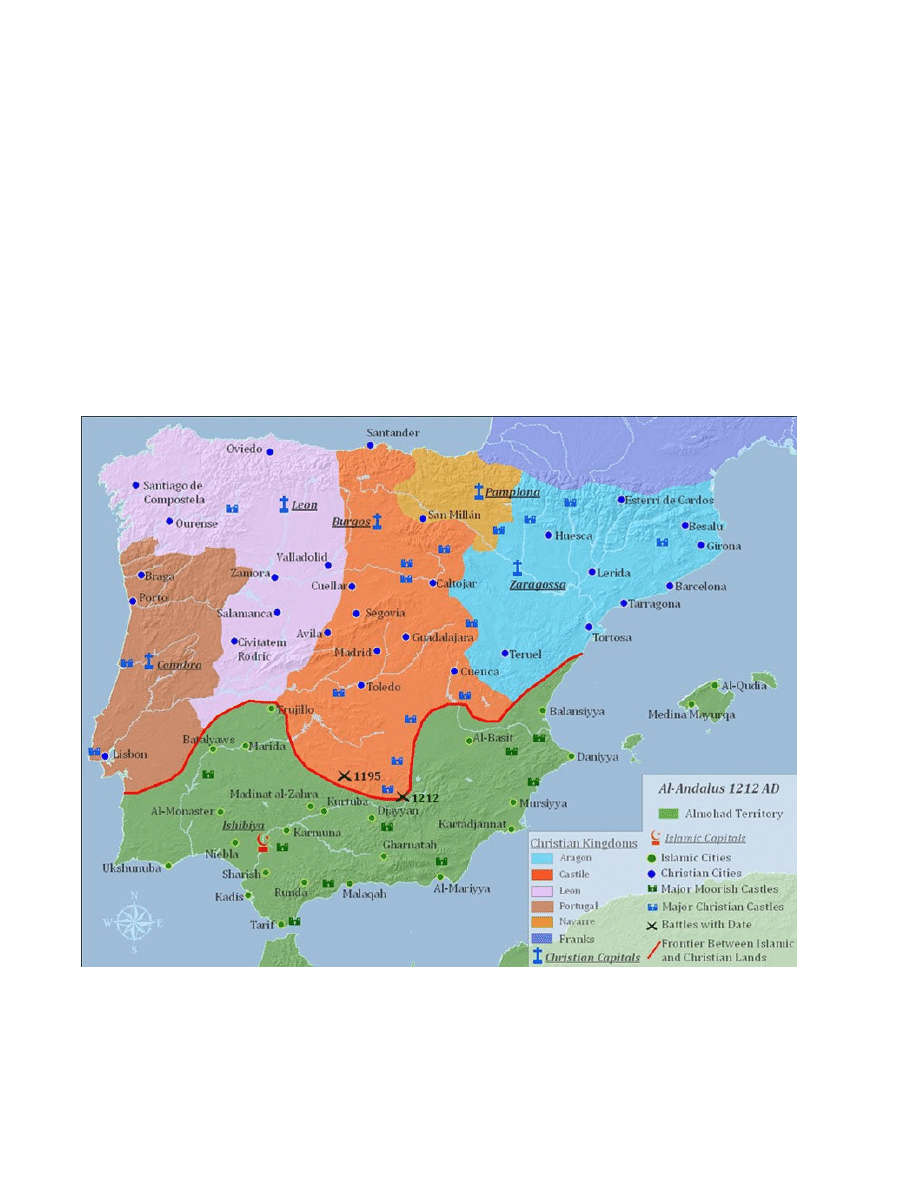
95
———. The invention of the crusades. U of Toronto P ed.Toronto, 1998.
Appendices
Figure 1. Spain in 1212 from “Islamic Spain and the Reconquista.” Historical Atlas of the
Mediterranean. http://explorethemed.com/reconquista.asp?c=1 (accessed Mar. 2010).
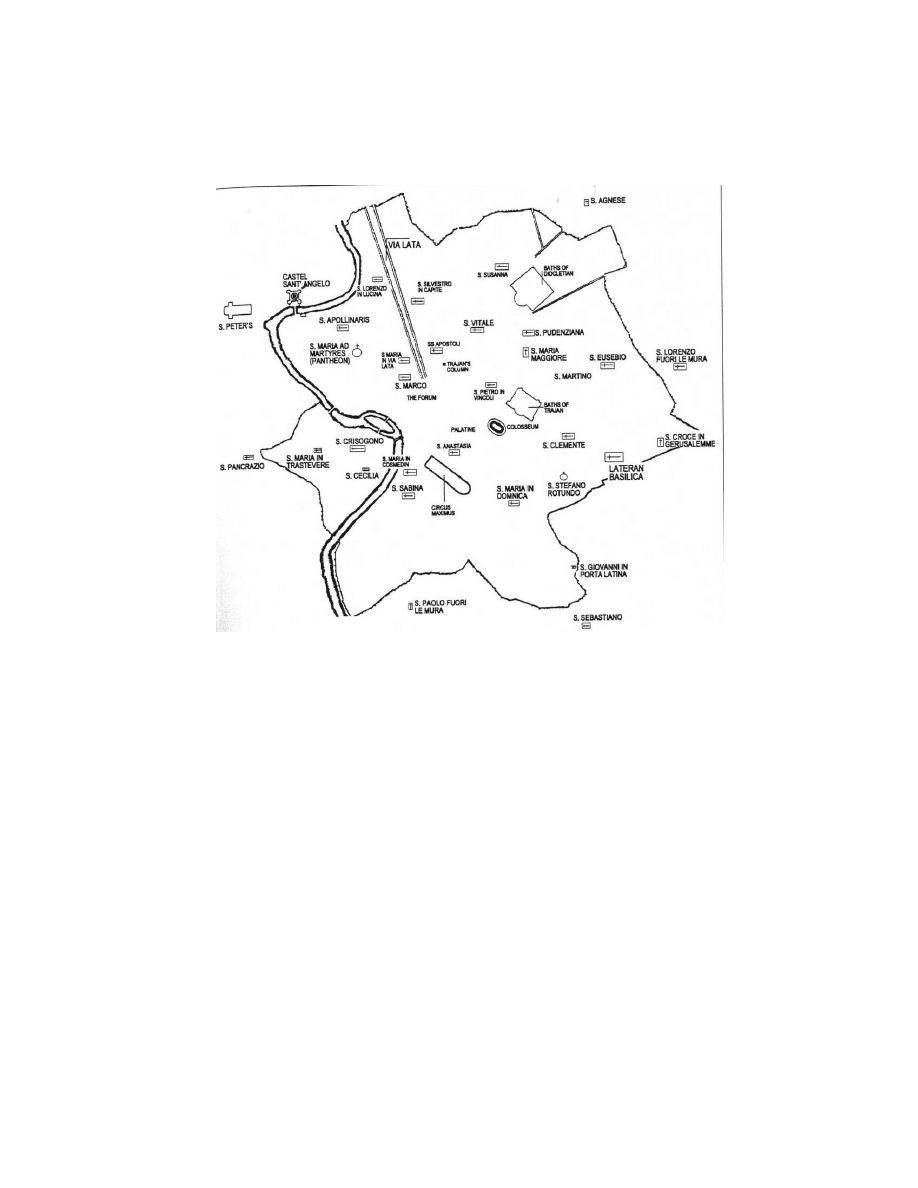
96
Figure 2. Map of Rome at end of Twelfth Century from Twyman, Susan. Papal Ceremonial
at Rome in the Twelfth Century. London: Boydell Press, 2002.
Latin text of Mansilla letter # 473 with my English translation
In nomine Patris et Filii et Spiritus Sancti amen.
Quarta feria infra octavas Pentecosten fiat generalis processio virorum ac mulierum pro
pace universalis ecclesie ac populi christiani, specialiter autem, ut Deus propitious sit illis in
bello, quod inter ipsos et sarracenos dicitur in Hyspania comittendum, ne det hereditatem suam
in opprobrium, ut dominentur eis nations. Et ad hanc processionem omnes omnino moneantur
venire, nec ab ea se quisquam excuset preter illo, qui habent inimicitias capitals. Summo itaque
mane convenient muliers apud s. mariam maiorem; clerici vero apud basilicam Duedecim
apostolorium, et laici apud s. Anastasiam; et post cllectas, pulsates simul istarum ecclesiarum
campanis, procedant omnes in campum Lateranensem hoc ordine: mulieres omnes et solas
precedat crux dominica s. Marie maioris; et in prima parte processionis sint sanctimoniales in
ultima vero relique mulieres, que sine auro et gemmis et seicis indumentis procedant, orando
cum devotione ac humilitate, in fletu et gemitu, nudis pedibus omnes que possunt; et per
Merulanum et ante s. Bartholomeaum veniant in campam Lateranensem et collocent se ante
Felloniam, in silentio permanents; clericos atutem crux fraternitatis precedat; et in prima
processionis parte sint monachi et canonici regulares; in ultima vero rectores et ceteri clerici
procedentes predicto modo, et per viam maiorem et arcum Basilii veniant ante palatium episcope
Albanensis, et ibi directe in medio campi se collecent; laicos autem precedat crux dominica s.

97
Petri, et post illam sequantur primi hospitalarii, et postremi ceteri laici, sicut prescriptum est,
incedentes, et per ss. Ioannem et Paulem et ante s. Nicholaum de Formis in campum veniant, et
collecent se ab altera parte.
Interim vero Romanus pontifex cum episcopis et cardinalibus et capellanis ingrediatur
basilicam, que dicitur Sancta Sanctorum; et inde reverenter assumpto lingo vivifice cruces,
processionaliter veniat ante palatium episcope Albanensis, et sedens in scalis exhortatorium
faciat sermonem ad populum universum. Quo finito, mulieres, sict processionaliter venerant, ita
procedeant ad Basilicam s. Crucis; et ivi presto sit presbiter cardinalis, qui celebret eis missam
dicendo illam orationem Omnipotens, semipiterne Desu, in cuius manu sunt omniam potestates,
etc. Et sic ipse mulieres in pace ad propria revertantur. Romus autem pontifex cum episcopis et
cardinalibus et capellanis per palatium descendat in Lateranensem basilicam, clerici vero per
porticum, et laici per burgum, infrediantur in illam; et celebrate venerabiliter missa, ipse cum
omnibus, nudis pedibus, procedat ad s. Crucem, ita quod eam precedent clerici, et laici
subsequantur, et facta oratione, unus quisque revertatur ad sua. Ieiunetur autem ab omnibus, ita
ut nemo, preter infirmo, comedat pisces aut quodcumque pulmentum; qui possunt, pane sint et
aqua content, qui vero non possunt, bibant vinum bene limphatum et modice sumptum, et
vescantur herbis et fructivus aut etiam leguminibus; omnesque aperiant manus et viscera
indigentibus ut per oracionem, ieiunium et helemosinam misericordia Conditoris reddatur populo
christiano placata.
In the name of the father and of the son and of the holy spirit amen.
The fourth holy day during the octave of the Pentecost let happen a general procession of
men and also women for universal peace of ecclesiastics and also of the people of Christendom,
however especially, so that God may be favorable to those in war which is to waged between
ourselves and the Saracens in Spain, so that God would not give his inheritance toward scandal,
so that his people may have dominion over. And to this procession all entirely are warned to
come, and not anyone may excuse himself from this besides those, who have mortal feuds. And
so with highest morning let the women come together near St. Mary Major; certainly the clerics
near the Basilica of the 12 apostles, and the laity near St. Anastasia; and after the collect, with all
the bells of the church ringing together, let all proceed toward the Lateran with this order: The
lord’s cross of S, May the Larger let it precede all women and alone; and in the first part of the
procession let there be nuns in the end the reaming women, that without gold and jewels and silk
wraps let them process, praying with devotion and also humility, in tears and groans, all with
bare feet that are able; and through Merulanus and before St. Bartholomew let them come into
Lateran and gather themselves before Fellonus in enduring silence; however, let the cross of
fraternity precede the clerics; and in the first part of the procession let there be the monks and
canon regulars; in the last part the priests and the reaming clerics proceeding with the prescribed
manner, and let them come through the larger street and the arch of the Basil before the
Albanenus Episcopal palace and there, directly in the middle of the campo, let them gather
themselves; however the cross of the Lord St. Peter proceeds the laity and after it continues first
the Hospitilars and in the rear the remaining of the laity, just as has been prescribed, walking and
through St. John and Paul and before S. Nicholas of Formis, let them come into the Campo and
gather themselves by another part.
Meanwhile, the Roman pontiff with bishops and cardinals and chaplains may enter the
Basilica, which is called the holy of holies and from there reverently, taking the wood of the life
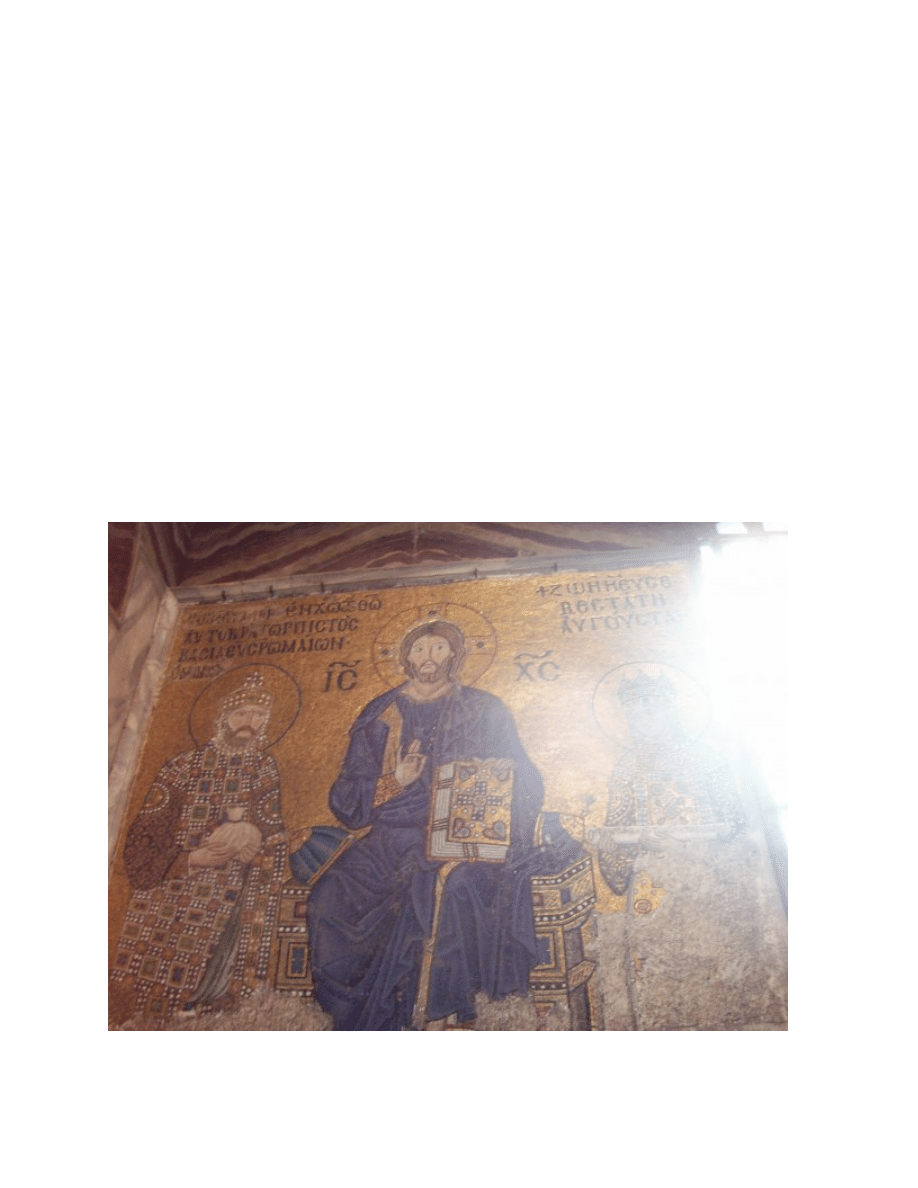
98
giving cross, in procession let him come before the palace of the Bishop of Albensus and sitting
on steps let him encouragingly make a sermon to the general populace. Which having finished,
the women, just as they had come in procession, thus let them proceed to the Basilica S. Cross,
and there it ma be performed by the presbyter of cardinals, who let him celebrate the mass saying
this oratio: All powerful, eternal God, in whose hands are all powers, etc. And thus let the same
women return in peace to their own. However, let the pope with bishops and cardinals and
chaplains descend through the palace into the Basilica Lateran; clerics through gallery and laity
through burgum, let them enter into this place; and venerably celebrating the mass, with all
themselves with nude feet, let them proceed to S. Cross, thus and let the clerics led them and let
the laity follow and having made a sermon, let every individual turn to his. However, let there be
fasting by all, so that no one, except the sick may eat fish or whatever food, but those who are
able to, let them be content with bread and water, those who are not able to , let them drink
watered down wine good and of small expense, and feed on herbs and fruits or also beans; and
let all lay bare hands and hearts to the need so that through prayer fasting and alms giving the
mercy of Christ might assuage the Christian people.
Figure 3. Eleventh-century mosaic of Christ. Hagia Sophia (photo taken by author)
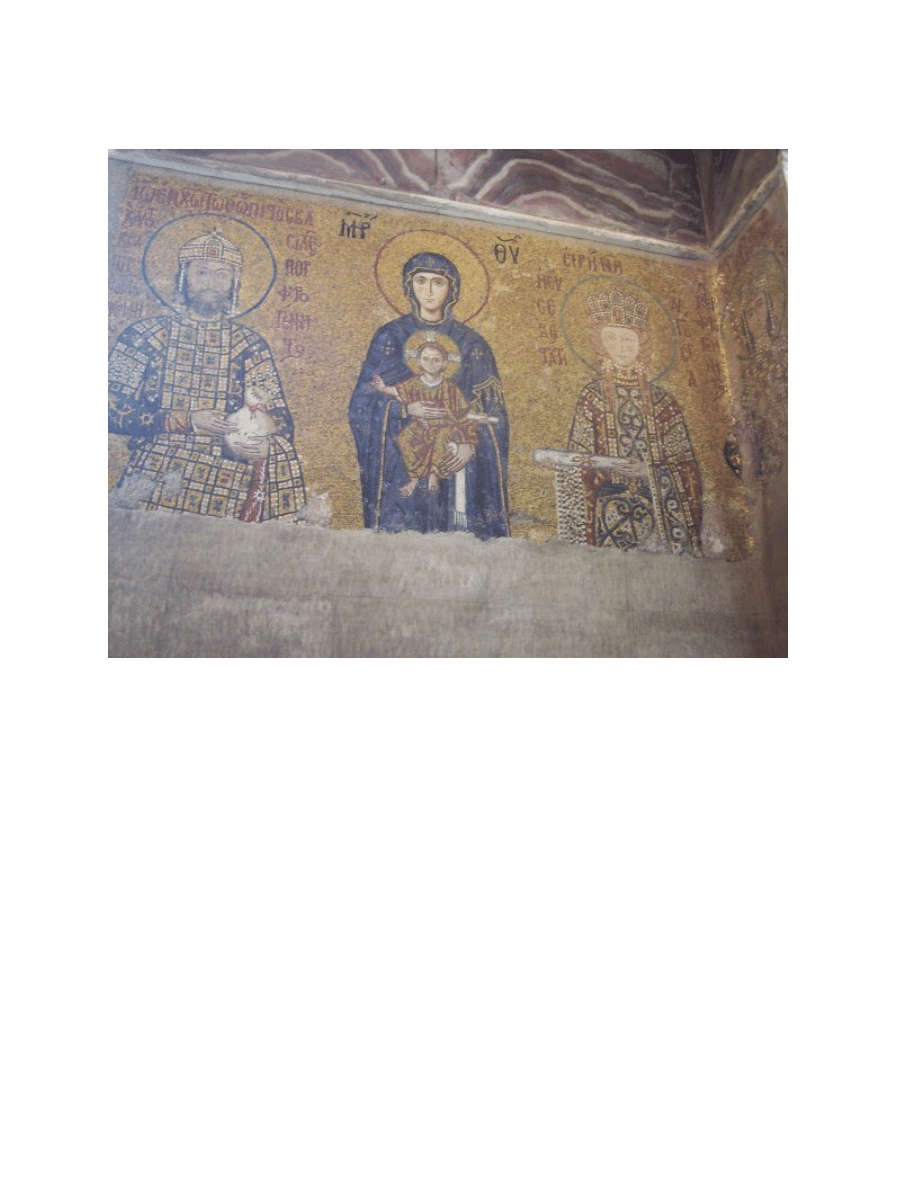
99
Figure 4. Twelfth-century mosaic of Christ. Hagia Sophia (photo taken by author)
Wyszukiwarka
Podobne podstrony:
Does the number of rescuers affect the survival rate from out-of-hospital cardiac arrests, MEDYCYNA,
Breaking out of the Balkans Ghetto Why IPA should be changed
Hospital?re?ter resuscitation from out of hospital?rdiac arrest The emperor's new clothes
Out of the Armchair and into the Field
How to Get the Most Out of Conversation Escalation
Journeys Out of the Body
Hospital care after resuscitation from out of hospital cardiac arrest The emperor's new clothes
HP BladeSystem Adaptive Infrastructure out of the box
RES , Out of hospital airway management in the United States
Does the number of rescuers affect the survival rate from out-of-hospital cardiac arrests, MEDYCYNA,
Breaking out of the Balkans Ghetto Why IPA should be changed
Dan Mills Sniper One The Blistering True Story of a British Battle Group Under Siege (rtf)
Out Of The Flames Leya, E M
Mary Janice Davidson Fred The Mermaid 03 Fish Out of Water
Brown Derren How to Get the Truth out of Anyone
lewis clive staples out of the silent planet
więcej podobnych podstron