
Writing an Essay
Key Concepts and Literary Terms
Macmillan Readers
This page has been downloaded from www.macmillanenglish.com. It is photocopiable, but all copies must be complete pages.
© Macmillan Publishers Limited 2008. Published by Macmillan Heinemann ELT.
Heinemann is a registered trademark of Harcourt Education, used under licence.
An Introduction to Key Concepts and Literary
Terms
The novel
Novels come in all shapes and sizes but all novels contain the same basic elements. And all novels can
be analysed and discussed with reference to these elements:
plot
2 characters
3 narrator
4 themes
5 style
The short texts below introduce the key literary terms which are used to talk about the above five
elements. All the key terms are highlighted in bold and explained in the glossary at the end of the
worksheet. The exercises that follow each text will help you use the terms.
1 Plot
The plot is the story of the novel. It usually follows the lives of one or more of the main characters and
describes the key events that affect these characters over a period of time.
The timeframe of the plot can be of any length. A novelist may choose to describe a year in the lives
of his characters (as in Middlemarch, Pride and Prejudice or Sense and Sensibility) or it may cover a
number of years (as in Oliver Twist or David Copperfield, where the novels describe the boys’ lives from
their births to adulthood). In some novels the action happens over 24 hours (for example James Joyce’s
Ulysses). In others the action happens over a number of generations. A novel which tells the story of
several generations of the same family is called a saga.
A plot may be linear. This means it describes events chronologically in the order they happened. For
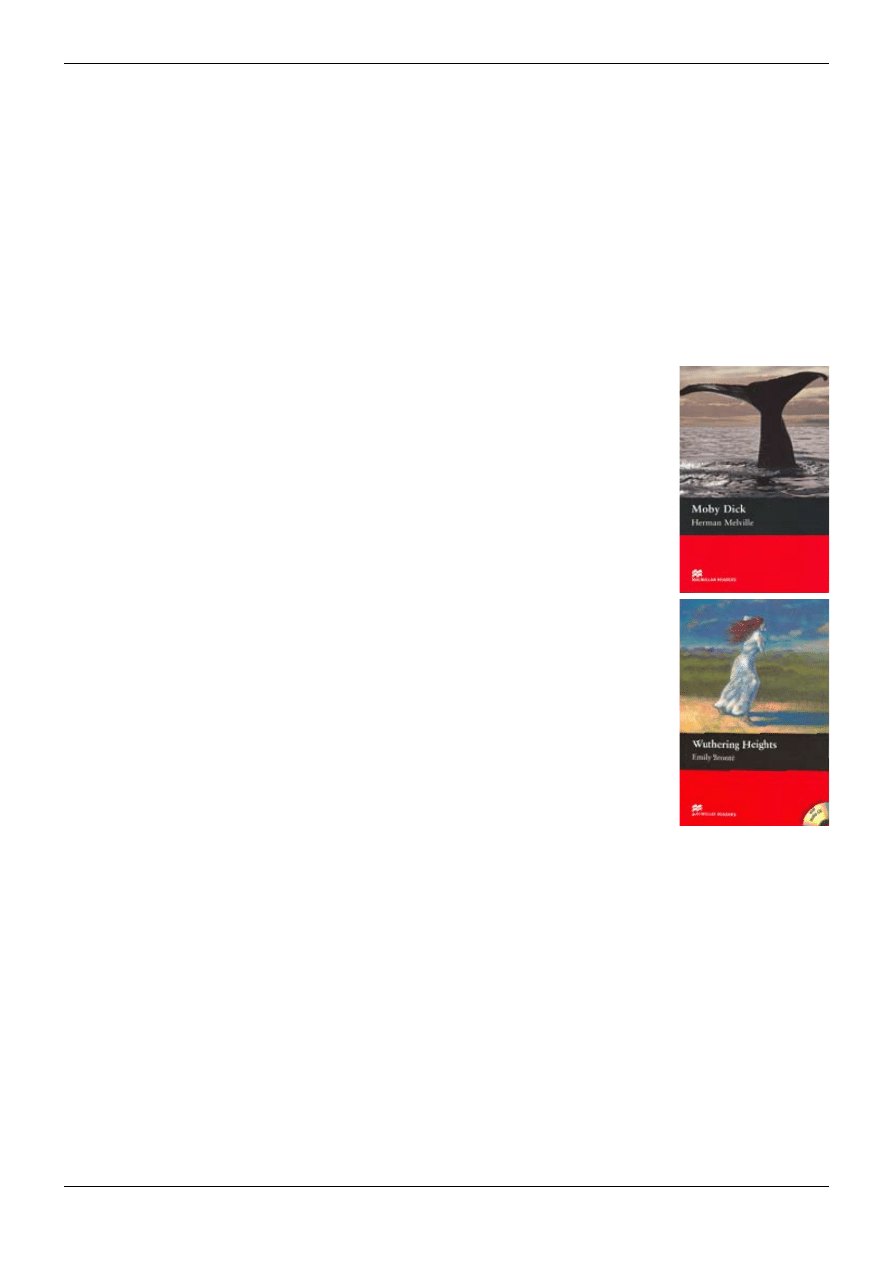
example, in Moby Dick the plot explains what happens on the Pequod’s voyage from the time the
narrator decides to go to sea until the ship’s last battle with the white whale. Or it may be complex.
It may jump from event to event, or from place to place as in Our Mutual Friend. It may have two (or
more) story lines, moving side by side, as in Vanity Fair.
It may have flashbacks (when the writer describes an event that happened before – as in Our Mutual
Friend when John Harmon remembers his childhood) or a flashforward (where the writer jumps
forward to describe an event in the future). For example, in the closing chapter of Middlemarch Eliot
moves ahead to see what happens to the main characters later in their lives.
A novel focuses on the story of one character, or one group of characters, or it may include sub plots
which happen at the same time as the main plot. The sub plots follow the lives of minor characters and
often help to explore the themes of the main plot. Vanity Fair is a good example of a novel which has
several plots and subplots.
The pace of the plot can change. It may slow down at times to study a scene or event in great detail,
and at others it may race ahead, jumping over years in its characters’ lives. For example, Thomas
Hardy’s The Mayor of Casterbridge jumps 20 years between the opening scene and the rest of the
action in the novel.
novel /nÅvl/ noun [C]: a long written story about imaginary or partly
imaginary characters and events
Writing an Essay
Key Concepts and Literary Terms
Macmillan Readers
2
This page has been downloaded from www.macmillanenglish.com. It is photocopiable, but all copies must be complete pages.
© Macmillan Publishers Limited 2008. Published by Macmillan Heinemann ELT.
Heinemann is a registered trademark of Harcourt Education, used under licence.
The action of the plot will often be connected to a conflict or problem and its final resolution. In Our
Mutual Friend, the problem is complex. John Harmon will receive a large fortune from his dead father
if he agrees to marry Bella Wilfer. But John wants to get to know Bella before he makes his decision.
So he decides to spy on his future wife. This decision leads to a number of other problems and conflicts
before a final resolution is achieved. In Moby Dick, the conflict is both external, the fight between
Ahab and the white whale, and internal, the captain’s fight with his own stubbornness and thirst for
revenge.
The novel focuses both on the action itself, describing the mechanics in detail (the whale hunting
industry in Moby Dick, the journey to the Count’s castle in Dracula) and the characters’ reactions and
attitudes to these actions.
Test Yourself
1
Complete the descriptions below using words in bold from the text above.
Moby Dick
The plot is () _______ and straightforward. It tells the tale of a sea voyage.
The events are described
(2) _______, starting with Ishmael’s decision to go to sea. The action
happens over a limited (3) _______, the few weeks of the Pequod’s last
voyage. As the voyage comes to an end, the (4) _______ of the novel speeds
up as it moves towards its final (5) _______: the sinking of the Pequod and
the deaths of almost all the men on board.
Wuthering Heights
The (6) _______ is long and ambitious, covering three generations of two
neighbouring families. The novel starts with the narrator arriving at the
home of one of the families and being attacked by a ghost in his sleep. The
rest of the novel is told as a (7) _______, jumping back more than 40 years in
time, and tracing the dramatic and tragic story of the ghost who visited the
narrator. There are several (8) _______, both internal and (9) _______, but
in the end a (0) _______ seems to have been found and some order and
peace is returned to the two families.
2
Write a short description of the plot of a novel you have read recently.
2 Characters
A novel will normally have a number of characters. These may be main characters, or minor characters.
Typically the novel gives us more information about its main characters and their feelings, reactions
and motivations are described in detail. The minor characters may be fairly two-dimensional, simple
devices to support the plot, or to highlight some feature of the protagonist’s personality.
The protagonist is the main character and there may often be an antagonist, someone who the
protagonist must fight against or who in some way blocks the protagonist’s way. In some novels it is
very clear who the protagonist (or main character) is. For example in Moby Dick there is no doubt that
the protagonist – the most interesting character in the story – is Captain Ahab and that his antagonist
is Moby Dick the white whale.
In other novels this is not so clear. In Vanity Fair, there are two protagonists, Becky Sharp and Amelia
Sedley. There is not really an antagonist, but there is a cast of minor characters.
Writing an Essay
Key Concepts and Literary Terms
Macmillan Readers
3
This page has been downloaded from www.macmillanenglish.com. It is photocopiable, but all copies must be complete pages.
© Macmillan Publishers Limited 2008. Published by Macmillan Heinemann ELT.
Heinemann is a registered trademark of Harcourt Education, used under licence.
In Pride and Prejudice, Elizabeth Bennett is the main character, the protagonist, the heroine of the
book, but her counterpart, and eventual husband, Darcy, is also a key character. He is not in fact an
antagonist, though he may appear to be so at the beginning, but a hero, a mirror to Elizabeth’s values.
Characterisation
The author presents and describes the characters in a novel in a number of ways: through direct
description, through the characters actions and reactions, through the words of others, through
dialogue and through the characters’ own words and thoughts.
Characters are often described briefly when they are first presented with information given about
their physical features and personality traits. Dickens does this, often describing one or two central
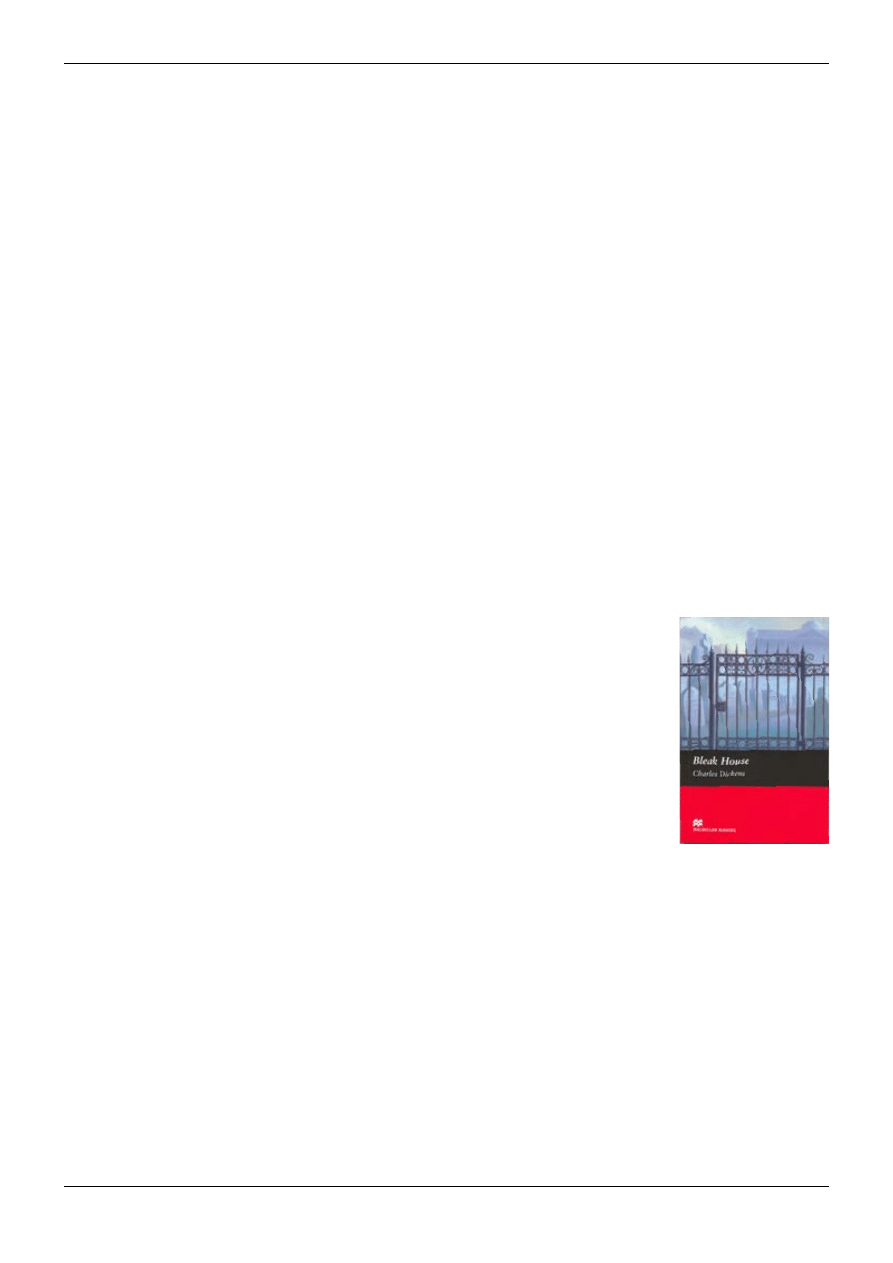
features which will be returned to time and again throughout the novel. For example in Bleak House
he introduces Esther as ‘a quiet girl with a calm face and smooth, dark hair, standing close to Ada.
This was Esther Sommerson.’ Her smooth dark hair will be important later in the novel as a clue to the
identity of her mother, and she will be seen as standing close to Ada throughout the story, offering her
support and friendship.
Characters may be introduced through the words of others. In Moby Dick we hear people talking
about the famous Captain Ahab long before he appears, so we already have an idea of the man before
we actually see him. Or sometimes characters are introduced through their own words. For example,
on the opening page of Pride and Prejudice Mrs Bennett’s words show her to be a silly woman who is
desperate to marry her daughters to the first rich man who comes along.
As the novel continues, the same devices are used to develop the characters. They continue to be
described – and judged – through their actions, words, reactions, thoughts and feelings.
Test Yourself
1
Complete the description of the characters in Bleak House using words
from the text above.
Esther Sommerson is the () h _____ in Bleak House. She, along with Ada
Clare, Richard Carstone and John Jarndyce are the (2) m________ c________.
But the novel is also filled with an enormous (3)
c______ of (4) m________ c_________, such as Mrs Flite, Krook the
shopkeeper and the mysterious Nemo. Some of these characters are quite
(5) t__ - d________, such as Mrs Jellyby, who doesn’t look after her children,
and is a contrast to Esther kindness and thoughtfulness. Others, such as
Mrs Dedlock or Jo the crossing sweeper are given more depth and their
characters (6) d______ as their roles become more important to the plot.
2
Think about a novel you have read recently and answer these questions. Who were the main
characters? How were they first introduced? What key features were first presented? How did their
characters develop? What devices did the author use to show these developments?
3 Narrator
The narrator is the person who tells the story and the story is told from his/her point of view.
Often the narrator is simply a voice that tells the story in the third person (someone we do not know
and who takes no part in the story). This type of narrator has no personality, but has the power to
know the minds and hearts of all the characters in the novel. A third person narrator like this knows
everything about the characters and events in the novel. They can follow characters into their homes
and into their thoughts, and they are present to describe all the events that take place. Sometimes the
narrator has the voice of the author and may comment on the action or characters. They may even
speak directly to the reader.

Writing an Essay
Key Concepts and Literary Terms
Macmillan Readers
4
This page has been downloaded from www.macmillanenglish.com. It is photocopiable, but all copies must be complete pages.
© Macmillan Publishers Limited 2008. Published by Macmillan Heinemann ELT.
Heinemann is a registered trademark of Harcourt Education, used under licence.
Sometimes the third person narrator will tell the story from the point of view of one of the characters.
For example, in Pride and Prejudice, the story is told from Lizzy’s point of view. Any scenes where Lizzy
is not present have to be described in a letter to Lizzy, or retold in a conversation. In this example the
narrator cannot see into the minds and hearts of the other characters. This kind of narrator is called a
limited third person narrator.
The narrator may also be a minor character in the plot, for example Lockwood in Wuthering Heights,
who retells a story that has already been told to him. Or Ishmael, in Moby Dick, who, although a
member of the crew, watches the madness and obsession of Captain Ahab from a distance. This kind
of narrator acts as a bridge between the world of the story and the more ‘normal’ world of the reader.
In this case the narrator is still a third person narrator, standing outside the events and looking on,
but he/she is filtering the events thought his/her personality. He or she took no part in the story and
only retells it. The narrator may narrate his/her meeting with the story-teller in the first person, but
then the narrative will change to the third person. Another classic example is that of Robert Walton in
Frankenstein, who acts as a filter for doctor Frankenstein’s incredible story.
Sometimes the main character of the novel narrates the story in the first person. For example, in Great
Expectations the young boy, Pip, tells his own story. The choice of a first person narrator allows the
novelist to look closely at the motivation and psychological development of the main character.
With both first person and limited third person narrators, there is often a question of how reliable the
narrator is. Can we trust the narrator to be telling us the whole truth? Or is the truth being coloured
by the narrator’s point of view? Are they an unreliable narrator?
Test Yourself
1
Match the descriptions (1 -3) with the terms (a-c).
The narrator can see into the minds and thought of all the characters.
2 The main character tells their own story in their own words.
3 The narrator tells the story through the eyes of the main character.
a) first person narrator
b) limited third person narrator
c) third person narrator
2
Think of a novel you have read which matches each description below.
A third person narrator who reports on all his main character’s thoughts and feelings as well as
their actions and reactions.
2 A novel which is narrated by the main character.
3 A story which is told by more than one narrator and from more than one point of view.
4 Themes
A theme is a topic or idea which is explored in a novel. The theme is usually about life, society or
human nature. For example the central themes in Moby Dick are obsession, madness and revenge. In
Austen’s novels there is a recurring theme of marriage and the social position of women in Austen’s
eighteenth-century world. These themes develop throughout her novels and are also common themes
in other novels of her time.
In Our Mutual Friend, Dickens explores the themes of money and happiness, and the relationship
between them. He suggests that money can change a person, and that happiness is more important.
However, he also admits that a little bit of material comfort is important for a happy life.

Writing an Essay
Key Concepts and Literary Terms
Macmillan Readers
5
This page has been downloaded from www.macmillanenglish.com. It is photocopiable, but all copies must be complete pages.
© Macmillan Publishers Limited 2008. Published by Macmillan Heinemann ELT.
Heinemann is a registered trademark of Harcourt Education, used under licence.
Test Yourself
1
Reorder the lines below.
a) used to manipulate and control people, but she also shows
_____
b) money. In this novel, George Eliot explores the
_____
c) theme in her novels. She suggests that money is often
_____
d) how money can be used to good ends.
_____
e) One of the central themes of Middlemarch is
___
1__
f) influence of money on people’s lives. It is a recurring
_____
2
Think of the last novel you read. What was the theme? What does the author (or the novel) say about
this theme?
5 Style
Different novelists use different styles. Some are more dramatic (Dickens or Melville), others more
realistic (Austen or Eliot). Some narrate events in a very factual, direct way, others prefer to use long,
detailed descriptions. The style of a novel will depend on both the genre and the author. And it may
change during the novel, using different styles to create different effects. A change in style can often
also mean a change in pace. (For a list of genres, see the end of this section.)
The style is created through the author’s use of language, symbolism and literary devices such as
similes, metaphor, satire and irony.
Symbolism
An object or a person in a novel can act as a symbol, representing a quality or an idea. For example,
in Moby Dick, the whale can symbolise the power of nature, and at the same time it can demonstrate
evil. In Middlemarch, the wills of both Casaubon and Featherstone show how the power and influence
of property and money can be so strong it continues after death.
In an allegory, both the characters and the setting represent something different than themselves. For
example in Animal Farm, the animals are people and the farm is a political state. In The Wizard of Oz,
the characters represent qualities (intelligence, bravery, sentimentality).
Test Yourself
1
Complete the text using the words in the box.
birds cat death free obsession prison prisoner symbolic
In Bleak House, Mrs Flite keeps a number of () _____ in cages in her room. She says that they are in
(2) ______ , but she refuses to set them free as she is afraid that they will get eaten by Krook’s (3) _____.
When she hears of Richard Carstone’s (4) _______ she sets them all free. This (5) ______ action shows
that Mrs Flite has learnt the lesson of Carstone’s (6) ______ with the Chancery. She does not want to be
a (7) _______ to this obsession any longer, and in setting her birds free she shows that she is also setting
herself (8) ______.
2
Think of three more symbols used in novels you’ve read recently. What were they symbolising? What
message was the author conveying through these symbols?

Writing an Essay
Key Concepts and Literary Terms
Macmillan Readers
6
This page has been downloaded from www.macmillanenglish.com. It is photocopiable, but all copies must be complete pages.
© Macmillan Publishers Limited 2008. Published by Macmillan Heinemann ELT.
Heinemann is a registered trademark of Harcourt Education, used under licence.
6 Imagery and figures of speech
Imagery is the use of the five senses in creating a vivid description of a place or a moment in time.
Dickens uses imagery to describe the cold, winter streets of Victorian London:
Metaphor
A metaphor is a direct comparison between two very different things. For example, Dickens compares
Jesse Hexam to a bird: ‘He had the greedy look of a cruel bird.’
He compares the strength of the desperate schoolmaster, Bradley Headstone as he pulls Riderman to
the river, to the strength of iron: ‘Bradley caught him round the body. Riderhood was in a grip of iron.’
(Our Mutual Friend)
Simile
Similes are similar to metaphors. They compare two very different things but the comparison is more
direct and is made using like or as. Melville often uses similes in his description of the whaling ship and
its mad captain in Moby Dick. For example, ‘Ahab jumped up and down on the deck like an excited
child’ and ‘Storms and strong winds started to blow the ship around like a toy on the ocean.’
Test Yourself
2
Dickens’ language is rich and descriptive. He often uses metaphors, similes and imagery. Look at the
five extracts below, which one shows:
a) a metaphor b) a simile c) use of imagery
The marshes beyond the graveyard were grey. The river beyond the marshes was a darker line of
grey. A bitter wind was blowing across the marshes from the sea. The graveyard was a dark and
frightening place. (Great Expectations)
2 The schoolmaster was a young man of twenty-six, but he did everything slowly and carefully, like a
much older man. He had worked hard to become a schoolmaster, learning facts like a machine.
(Our Mutual Friend)
3 Poor people crowded into Tom-All-Alone’s like rats into holes. (Bleak House)
4 ‘You never left me even when there was danger. You stayed near me when the dark clouds
gathered. This has been the best part of my life.’ (Magwitch in Great Expectations)
5 The wind moved the hair and the rain fell upon the dead, cold face. (Our Mutual Friend)
There was fog too. The fog was everywhere. It came up the river
and down the river. Fog covered the boats on the river and filled the
boatmen’s eyes. Street lamps sent a pale, yellow light through the thick,
foggy air.
Bleak House

Writing an Essay
Key Concepts and Literary Terms
Macmillan Readers
7
This page has been downloaded from www.macmillanenglish.com. It is photocopiable, but all copies must be complete pages.
© Macmillan Publishers Limited 2008. Published by Macmillan Heinemann ELT.
Heinemann is a registered trademark of Harcourt Education, used under licence.
Satire
Satire is the use of humour to criticise someone and make them look stupid or silly. Austen often uses
satire in her novels to criticise the values of the society she’s describing. She often satirises people
through their speech. Here Mrs Bennet is congratulating Lizzy on her engagement to Mr Darcy, a man
she had hated until that moment:
Here Austen is satirising Mrs Bennet’s shallow, materialistic attitude to marriage.
Irony
Irony shows the difference between appearance or intention and reality. Dickens often uses irony in
his novels. For example in Bleak House it is ironic that the gold coin that Lady Dedlock gives poor Jo
the crossing sweeper does not help him, as she had intended. Instead it gets him into trouble with
the police. Again in Bleak House it is ironic that Mr Krook, who runs the Rag and Bottle Shop, saves
mountains of papers in his shop, but he can’t read them. In both these cases the object of irony leads
indirectly to the deaths of both Jo and Richard Carstone.
In Our Mutual Friend the schoolmaster, Bradley Headstone, is in love with Lizzie Hexam and is madly
jealous of her friendship with the lawyer, Eugene Wrayburn. In order to keep the two apart, the
schoolmaster decides to kill Wrayburn, but he fails. Ironically, his failed murder attempt brings Lizzie
and Wrayburn closer to each other and they decide to get married.
7 Genres
These are some examples of fictional genres:
Adventure novels
Eg, Melville’s Moby Dick (upper)
Dumas’s The Treasure of Monte Cristo (pre-intermediate)
Novels that tell the story of an adventure, often a journey or a quest (a journey to find something that
has been lost).
Autobiographical novels
Eg, Dickens’ David Copperfield.
Novels which are based on the author’s life and experiences.
Coming of age novels
Eg, Dickens’ Great Expectations (upper).
Novels which describe how the main character changes and develops as they progress from childhood
to becoming an adult.
Lizzy! Mr Darcy? And is it really true? Oh, my sweetest Lizzy, how rich
and great you will be! Such a delightful man – so handsome, so tall!
Pride and Prejudice

Writing an Essay
Key Concepts and Literary Terms
Macmillan Readers
8
This page has been downloaded from www.macmillanenglish.com. It is photocopiable, but all copies must be complete pages.
© Macmillan Publishers Limited 2008. Published by Macmillan Heinemann ELT.
Heinemann is a registered trademark of Harcourt Education, used under licence.
Detective novels
Eg, Conan Doyle’s Sherlock Holmes stories, Dexter’s The Silent World of Anthony Quinn (intermediate).
Novels in which a detective, a policeman or an ordinary person solves a crime.
Fantasy novels
Eg, Tolkien’s Lord of the Rings, Baum’s The Wizard of Oz (pre-intermediate).
Novels which are set in imaginary worlds. These characters often include non human characters.
Gothic novels
Eg, Stoker’s Dracula (intermediate), Du Maurier’s Rebecca (upper).
Novels which describe supernatural forces and include scenes of terror. The setting is often a dark,
mysterious castle which is haunted by ghosts and evil spirits. These spirits have to be overcome by the
hero or heroine.
Historical novels
Eg, Dickens’ A Tale of Two Cities.
A novel based on real historical events. It may be a fictional story set against the background of a
factual historical moment. Or it can be a fictional account of the story, where the author enters into
the head of the historical character and imagines their thoughts and feelings.
Novel of manners
Eg, Austen’s Pride and Prejudice (intermediate), Thackeray’s Vanity Fair (upper)
A novel which describes a particular society, or social group, and the influence it has over the novel’s
characters (often limiting their choices and freedom, especially those of women).
Science fiction novels
Eg, Huxley’s Brave New World
A novel where imagined scientific or technological developments are important to the action in the
novel, and the world in which its characters live and interact. These novels are often set in the future.
Test Yourself
1
Read these descriptions of three classical novels. Which genre would you class them as?
a) This novel describes how a man discovers a way to make himself invisible.
b) It is 8
th
century England. A wealthy young woman is so busy arranging marriages for her friends
that she does not realise that she too is falling in love.
c) This novel describes a young boy’s journey from a poor orphanage to manhood, and all the
adventures he finds along the way.
2
Think of the last three novels you have read. What genre would you class them as? Why?

Writing an Essay
Key Concepts and Literary Terms
Macmillan Readers
9
This page has been downloaded from www.macmillanenglish.com. It is photocopiable, but all copies must be complete pages.
© Macmillan Publishers Limited 2008. Published by Macmillan Heinemann ELT.
Heinemann is a registered trademark of Harcourt Education, used under licence.
Glossary
action
the events in the novel
allegory
the use of events and
characters as symbols i.e. to
represent ideas and qualities
antagonist
a character who blocks the
progress of the main character
author
the person who wrote the
novel
cast
a cast is the group of people
who act together in a theatre
play. Cast is often used
to describe the group of
characters in a novel too.
central features
(see also physical features) the
most important details about a
person’s body or face
central theme
see theme
characters
the people in a novel
main/key characters the most important people in
the novel
minor characters characters who are not
described in detail
characterisation
how the novelist describes the
characters
chronologically
in the order they happened
colour (v)
to influence a description
common themes
see theme
complex
not following a simple, straight
line
conflict
a problem that faces the main
character/s
external conflict
a problem which involves the
character and someone or
something else
internal conflict
a problem that is a part of the
character’s personality
counterpart
a character who has a similar
and an equally impo rtant role
develop
used to describe progress in
the plot, in the description of a
character or in the exploration
of a theme.
device
a literary technique which is
used to create a certain effect
dramatic
exciting and impressive
explore
to describe and discuss
external conflict
see conflict
figures of speech
expressions which are used
to add detail to a description
through comparison (see simile
and metaphor)
filter (v)
to describe the facts from a
certain point of view.
first person
using the pronouns I and me
first person
see narrator
narrator
flashback
a device used to describe an
event that happened before
the main story
flashforward
a device used to describe an
event that will happen in the
future
genre
a particular style or type of
novel
heroine
a woman who is the most
important person in the novel
hero
a man who is the most
important person in the novel
imagery
the use of the five senses in
describing a scene
internal conflict
see conflict
irony
a device that shows the
contrast between reality and
appearance
key events
the most important events
limited third
see narrator
person narrator
linear
in a straight line, starting at
the beginning and working
through the events in
sequence
main plot
see plot

Writing an Essay
Key Concepts and Literary Terms
Macmillan Readers
0
This page has been downloaded from www.macmillanenglish.com. It is photocopiable, but all copies must be complete pages.
© Macmillan Publishers Limited 2008. Published by Macmillan Heinemann ELT.
Heinemann is a registered trademark of Harcourt Education, used under licence.
main characters
see characters
mechanics
the mechanics of the plot are
the small details of the events
and actions
metaphor
an expression which describes
one thing as if it was another
thing (i.e. he was a hungry
wolf) see also simile
minor characters
see characters
motivation
the reason why someone does
something
narrator
the person who tells the story
third person
a narrator who sees the story
narrator
from outside and who can see
into the minds and hearts of all
the characters, as well as see all
the action that takes place
first person narrator a narrator who tells the story
in the first person i.e. using I
and me not he or she, to talk
about the main character.
limited third
a narrator who uses the third
person narrator
person, he or she to talk about
the main character, but whose
view of the action and the
other people involved in the
plot is limited to the main
character.
third person
a narrator who speaks in the
narrator
third person using he or she
or they to talk about all the
characters.
pace
the speed at which the story is
told
personality traits
details about a person’s
personality eg, proud,
intelligent, silly, obsessed by
revenge.
physical features
details about a person’s body
and face, for example, dark
hair, blue eyes, a scar on his
face or a wooden leg.
plot
the story told by the novel
main plot
the most important story told
in the novel
sub plots
stories in the novel that are
told at the same time as the
main plot
point of view
the position from which a
story is told, the ‘eyes’ through
which we see and understand
the story
protagonist
see main character
psychological
the way a character’s
development
personality changes
race ahead
move forward very quickly.
realistic
describing things as they are in
real life
recurring themes
see theme
reliable
someone you can trust
resolution
the end of a conflict (see
conflict), often comes at the
end of the novel retell
to tell a story another person
has told you
reverse chronology starting at the end and going
backwards in time
saga
a story told about two or more
generations of the same family
satire
a style which criticises a person,
event or part of society by
making it look funny or stupid
shift (n)
a change in style or in pace
simile
an expression which describes
someone or something by
comparing it to someone or
something else using like or
as (eg, he was as hungry as a
wolf)
story-teller
a person who tells a story
style
the way the novel is written
sub plots
see plot
symbol
a person or an object that
represents a particular quality
or idea
symbolise
to be a symbol of something
symbolism
the use of symbols
theme
a topic that is discussed in
literature
central theme
the most important theme

Writing an Essay
Key Concepts and Literary Terms
Macmillan Readers
This page has been downloaded from www.macmillanenglish.com. It is photocopiable, but all copies must be complete pages.
© Macmillan Publishers Limited 2008. Published by Macmillan Heinemann ELT.
Heinemann is a registered trademark of Harcourt Education, used under licence.
common themes
themes that are often
discussed in literature
recurring themes
themes that are repeatedly
discussed by the same novelist
third person
see narrator
narrator
timeframe
the length of time the story
takes
two-dimensional
not described in detail
vivid
very clear and detailed
Wyszukiwarka
Podobne podstrony:
Writing an essay
an essay?out this and that 4N3M6QTFCETLGHNHFCD7NMYUIU5DWJRSCGSGEJY
An Essay on Mozambique
Writing a College Essay
Ferguson An Essay on the History of Civil Society
Shame, Guilt, and identity An Essay
writing an announcement 26 03 09
Transcript Researching an essay
Latin in Legal Writing An Inquiry into the Use of Latin in the M
Solipsism An Essay in Psychological Philosophy
An Essay on Morals A Science of Philoso Philip Wylie
Hanno Hardt Myths for the Masses, An Essay on Mass Communication (2004)
How to write an essay
Henri Bergson Time and Free Will An essay on the Immediate Data of Consciousness
Bennett (ed); An Essay Concerning Human Understanding by John Locke Book I Innate Notions
Edgar Cayce Auras, An Essay on the meaning of colors 2
więcej podobnych podstron