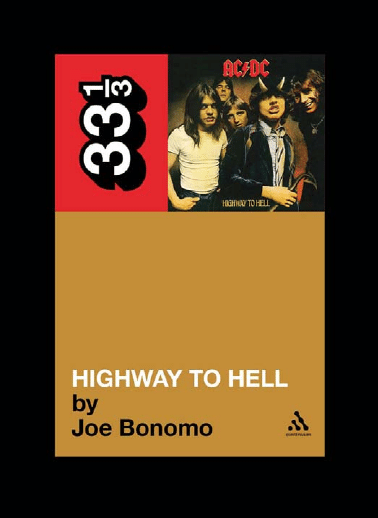

AC/DC’S HIGHWAY TO HELL
Praise for the series:
It was only a matter of time before a clever publisher realized
that there is an audience for whom Exile on Main Street or Electric
Ladyland are as signifi cant and worthy of study as The Catcher
in the Rye or Middlemarch . . . The series . . . is freewheeling and
eclectic, ranging from minute rock-geek analysis to idiosyncratic
personal celebration—The New York Times Book Review
Ideal for the rock geek who thinks liner notes
just aren’t enough—Rolling Stone
One of the coolest publishing imprints on the planet—Bookslut
These are for the insane collectors out there who appreciate
fantastic design, well-executed thinking, and things that
make your house look cool. Each volume in this series
takes a seminal album and breaks it down in startling
minutiae. We love these. We are huge nerds—Vice
A brilliant series . . . each one a work of real love—NME (UK)
Passionate, obsessive, and smart—Nylon
Religious tracts for the rock ‘n’ roll faithful—Boldtype
[A] consistently excellent series—Uncut (UK)

We . . . aren’t naive enough to think that we’re your only
source for reading about music (but if we had our way . . .
watch out). For those of you who really like to know everything
there is to know about an album, you’d do well to check
out Continuum’s “33 1/3” series of books—Pitchfork
For reviews of individual titles in the series,

AC/DC’s Highway to Hell
Joe Bonomo

2010
The Continuum International Publishing Group Inc
80 Maiden Lane, New York, NY 10038
The Continuum International Publishing Group Ltd
The Tower Building, 11 York Road, London SE1 7NX
Copyright © 2010 by Joe Bonomo
All rights reserved. No part of this book may be reproduced,
stored in a retrieval system, or transmitted, in any form or by
any means, electronic, mechanical, photocopying, recording, or
otherwise, without the written permission of the publishers.
Library of Congress Cataloging-in-Publication Data
Bonomo, Joe, 1966–
Highway to hell / Joe Bonomo.
p. cm. — (33 1/3)
Includes bibliographical references.
ISBN-13: 978-1-4411-9028-4 (pbk. : alk. paper)
ISBN-10: 1-4411-9028-7 (pbk. : alk. paper) 1. AC/DC (Musical
group) 2. Rock musicians—Australia—Biography. I. Title. II.
Series.
ML421.A28B66 2010
782.42166092’2—dc22
2009053555
ISBN: 978-1-4411-9028-4
Typeset by Pindar NZ, Auckland, New Zealand
Printed in the United States of America

Contents

For Amy

•
vii
•
Thanks to Richard E. Aaron, Betsy Alexander, Julie
Bateman at Sarm Studios, Paul Bonomo (AC/DC on the
jukebox at the Sly Fox!), Howard Bowler, Steve Connell
at Verse Chorus Press, Caroline Coon, Mark Dearnley,
Malcolm Dome, Arnaud Durieux, Dave Faulkner, Sarah
Field and Bill May at Bob Gruen Photo, Heidi Ellen
Robinson Fitzgerald, Robert Francos, Manuela Furci
and Kerry Oldfi eld Ellis at Rennie Ellis Photographic
Archive, Christina Gilleran, John Holmstrom, Patterson
Hood, Eddie Kramer, Jeff Krulik, Laura Levine, Saul
Levitz, Richard Manitoba, Ian McPherson at Time
Is On Our Side, Laura Micciche, Mark Opitz, Tony
Platt, Ron Pownall, Suzi Quatro, Marty Rogers, Andy
Schwartz, Kim Shattuck, Andy Shernoff, Ed Stasium,
Christine Stauder at Red Light Management, Earl
Steinbicker, Phil Sutcliffe, Ruyter Suys, Nadia Syed
at Roundhouse Studios, Jason Thome at Converse,
Clinton Walker, Rose Whipperr, and my fellow gradu-
ates of St. Andrew Apostle School.
I’m especially grateful to the knowledgeable archi-
vists and forum members at ac-dc.net, acdcrocks.com,
and acdc-bootlegs.com. At Northern Illinois University,

J O E B O N O M O
•
viii
•
I’m grateful to the hardworking staff at the Music
Library and at the Interlibrary Loan Information
Delivery Services at Founders Library.
At Continuum, special thanks to David Barker, who
oversaw this project with his characteristic assistance
and generosity, and to John Mark Boling and Claire
Heitlinger. Thanks to Sara-May Mallett, Kim Pillay,
and the hardworking folks at Pindar and Co.
At home, Amy dealt with Bon, Angus and mates on
a daily, loud basis. Thanks and love to her, as always.

•
ix
•
Photo by Robert Francos ©Robert Barry Francos/
Ffanzeen. All rights reserved.
Photos by Rennie Ellis ©Rennie Ellis Photographic
Archive. All rights reserved.
Photo by Ron Pownall ©RonPownall/RockRoll
Photo.com. All rights reserved.

Rock & roll is music for the neck downwards.
—Keith Richards
People say it’s juvenile music, but pardon me, I thought rock
& roll was supposed to be juvenile. You sing what you know.
What am I going to write about — Rembrandt?
—Angus Young

•
1
•
A5
A gray October late-morning. Wheaton, Maryland. On
the playground at St. Andrew Apostle School, Billy’s
holding forth before a rapt audience of thirteen year
olds. I’m one of them.
“Hey guys, my brother and I saw AC/DC,” he tells
us. “I met Bon Scott.”
We know that the band will come to town again soon
to rock Capital Centre, out in Largo. And we wonder:
since Billy’s already shaving once a week and has an
older brother who brings him along to rock concerts,
will a backstage pass to one of the great party bands
come next in the inevitable, lucky scheme of things?
In our freshly minted teenage naiveté we can virtually
inhale the sweat and the reefer as Billy talks to us. It feels
as if we’re in the presence of divine fortune here, on the
blacktop next to the dodge ball court and the basketball
hoops and the swing sets, just feet away from the rectory
where the priests live and write the sermons to which
we’ll mentally undress the girls. Will Billy get to hang
out in a smoky backstage, feel up the groupies, drink
beer with Bon Scott?

J O E B O N O M O
•
2
•
As the Seventies came to a close, AC/DC was not yet
a sonic institution fi ring oversized cannons from vast
stages into seas of millions. The band’s seams were
showing. They’d formed in Sydney, Australia, in late
1973, when twenty-year-old, Scottish-born guitarist
Malcolm Young aborted an earlier band and roped in
his kid brother Angus on lead guitar to round out a
new lineup featuring Colin Burgess on drums, Larry
Van Kriedt on bass, and singer Dave Evans. They
debuted on New Year’s Eve at the Chequers Club in
Sydney. Maneuvering among band defections, they
ducked into EMI Studios and recorded their debut
single “Can I Sit Next To You, Girl?,” and spent the
remainder of the year raising their profi le, gigging tire-
lessly, and enduring various rhythm section lineups with
feet fi rmly planted on a bedrock of Chuck Berry, the
Rolling Stones, and loud, electric blues. At older sister
Margaret’s cheeky suggestion, Angus donned a school-
boy uniform onstage in April of 1974, and in between
tours and one-off shows taking them from divey gay
bars and provincial dance halls to the Sydney Opera
House (where they opened for Australian legend Stevie
Wright), the band signed with Albert Productions,
benefi ting happily from record distribution through
the mammoth institution of EMI. Their first single
charted in Perth, in Western Australia. AC/DC
were hungry.
In August, a wiry, affable hood tattooed with a risky
past caught an AC/DC show in Adelaide in south-
ern Australia, and he dug what he saw. Ronald “Bon”
Belford Scott was like the Young brothers, a trans-
planted Scotsman, but a bit older and a little wilder, and
already a veteran singer in several bands (the Valentines,

A C / D C ’ S H I G H WAY T O H E L L
•
3
•
Fraternity). In the midst of a brief stint as a driver,
handyman, and general gofer for an old bandmate,
Scott was asked to audition to replace Evans, with whom
Malcolm and Angus had grown unhappy; he joined in
September. In November, after relocating southwest
to Melbourne, AC/DC swiftly cut their debut album,
High Voltage; their second, T.N.T., was recorded eight
months later. Melbourne local Phil Rudd stepped in as
drummer, and over the next several years the band com-
mitted themselves to a Herculean diet of gigs, drinking,
and writing and recording: Dirty Deeds Done Dirt Cheap
was released in 1976; Let There Be Rock in 1977. By 1978,
with English-born bassist Cliff Williams in the band and
the classic lineup intact, they were reaping the benefi ts
of their driven work ethic. Though essentially ignored
in America, AC/DC was hugely popular in Australia,
where their concerts had grown in size and intensity
as their albums went gold. They’d made exploratory
inroads throughout Europe and in England, and were
boozily, noisily heading west.
When they assembled in London in March of 1979
to commence recording what would be their sixth
album, AC/DC’s collective body bore signs of the long
road. They’d already jettisoned a producer and a batch
of hasty demos. For a band driven by unyielding self-
assurance and a clear sense of purpose, they were feeling
unusual anxiety. Disco, and soft, AOR pop dominated
the radio airwaves, angular New Wave songs threw
elbows in the mix, and in America pressure was on from
Atlantic Records to produce a radio hit and an album
that would move quickly and decisively from the stores.
The new AC/DC record had to be big.
So Malcolm and Angus did what they do best: they

J O E B O N O M O
•
4
•
shut the door, pulled up a couple of chairs, and went
simple.
Angus! Angus! Angus! . . .
I remember hearing a frenzied version of “Whole
Lotta Rosie,” borne aloft by this raucous chant, on
DC101-FM, in Washington D.C., where I grew up
in the suburbs. It must’ve been a personal favorite of
the staff because the single had stiffed on the charts,
unable even in its substantial wattage to overwhelm
Nick Gilder’s “Hot Child In The City” or Boston’s
“Don’t Look Back.” The song appeared on If You Want
Blood You’ve Got It, a live album recorded largely at the
Apollo Theater in Glasgow, Scotland, and that album,
too, had performed poorly in the United States, peaking
at 113 on Billboard. Powerage, a studio album released in
the Spring of 1978, had fared even worse in the U.S.,
topping out at 133 on the charts, barely touching the
shores before the wake imposed by Wings’ London Town,
Chuck Mangione’s Feels So Good, and the unfl agging
Saturday Night Fever soundtrack washed it unceremoni-
ously back to the world of wonder. In England, AC/DC
was doing a bit better: Powerage had nearly cracked the
Top 25 albums chart, and If You Want Blood made it as
high as 13.
But the band wanted to succeed in the U.S., the vast
hometown of blues and rock & roll, the mythic source
of their noisy, stomping sound. Though their records
weren’t doing much to pry open Yankee wallets, AC/DC
knew American geography pretty well by 1979, having
worked their way through big cities and small burgs
following several years of punishing Eastern European
and U.K. tours. Supporting Let There Be Rock, they

A C / D C ’ S H I G H WAY T O H E L L
•
5
•
made their fi rst appearance in the U.S. on July 27, 1977,
opening for Moxy in Austin, Texas. Over the next two
months, they wound their way through the steamy and
alien South, hitting Florida and a solid if small base
of fans, and up into the expansive Midwest, playing
Illinois and Ohio for the fi rst time. Angus remembers
nonstop highways in a cramped station wagon, sit-
ting shoulder-to-shoulder and sock-to-sock with his
mates, pulling up to venues as the opening band, their
gear dwarfed by REO Speedwagon’s or KISS’ mam-
moth equipment and their outsized, radio-delivered
mythologies.
“And here we were — fi ve migrants, little micro-
people,” Angus remembers. “It was tough to even get
into the show with that little station wagon.”
At WTAC-AM in Flint, Michigan, DJ Peter C.
Cavanaugh heard advance presses of AC/DC’s albums
sent to him by a friendly A&R man at Atlantic Records.
He loved the band’s raw, direct, basic sound — an ethos
that much of the Midwest historically found hospitable,
particularly grimy Detroit with its Mitch Ryder/Stooges
heritage. In December of 1977, as AC/DC were wind-
ing their way through the second leg of their initial
U.S. tour, Cavanaugh invited them to play the Capitol
Theatre in Flint. WTAC had been the first station
in the country to play AC/DC, and as a consequence
the band sold better in Michigan than in any other
region. Thinking shrewdly along the lines of a “best of
the old with the best of the new” promotional angle,
Cavanaugh contacted members of the locally infamous
and recently reunited MC5, who agreed to open up
the show.

J O E B O N O M O
•
6
•
Cavanaugh met AC/DC at the airport on December 5.
“No sooner had they all piled in my car, than someone
fi red-up something in the back seat,” Cavanaugh recalls.
Wrinkling his nose, expecting a heady waft of rock star
marijuana, Cavanaugh discovered that pot is not the
band’s vice of choice. Weed only slows things down for
the fellas: they were smoking harmless cigarettes, vora-
ciously. “These were boys from Australia,” Cavanaugh
says. “To them, an American cigarette was something to
be shared. I took a hit and passed it back.” Cavanaugh
drove the car through the increasingly snow-clogged
streets, the bitter weather and the group’s low-light sta-
tus ensuring a less-than-packed Capitol Theatre. “Who
cared? I knew the night would be historic,” Cavanaugh
says now. They arrived safely at the theater, and soon
after, the MC5 tore through a charged fifty-minute
set, vibing on their legacy and the native goodwill.
AC/DC watched from the wings with not a little
admiration, sensing kinship in the sonic mayhem of
Detroit’s sons.
After a break between sets, AC/DC walked onstage
and plugged in. The venue was thrown into darkness,
and Cliff Williams wrapped the rope tightly with
the ominous opening riff of “Live Wire,” the band’s
longstanding starter. Cavanaugh remembers: “Four
spotlights instantly fl ooded the stage, all focused on and
following a remarkably strange, rapidly moving, seem-
ingly possessed apparition. He wore knickers. He was
dressed as a proper English schoolboy with necktie and
knapsack. His head bounced as though about to become
disengaged. He ran back and forth in circles around the
other players, the intensity building and volume rising
with every stroke of the guitar. He was barely out of his

A C / D C ’ S H I G H WAY T O H E L L
•
7
•
teens.” Though some in the small crowd had rocked
to AC/DC on the radio, no one had seen the band in
person yet. And the sight of Angus Young, and of Bon
Scott — chest bared, jeans painted on, tattoos glaring,
his fi nger-pointing pseudo-menace both fun and scary
— was eye-popping.
After the deafening show, Cavanaugh paid the
exhausted band a thousand bucks cash for the night.
They thanked him, shrugged their collective shoulder,
glanced around for girls: they’d gone to work, that’s
all, and it was another triumphant night. “The group
was, and is, simply incredible,” Cavanaugh marvels
more than three decades later. “Absolutely perfect,
tight, hard, fast, furious rock & roll with unmatched,
unrestrained, pulsating purity.” He recalls an endearing
moment near the end of the long day. “They wanted to
try some Arby’s Roast Beef,” Cavanaugh smiles, “so we
stopped at the nearest location, still open despite hor-
rible weather. They bought packs of cigarettes by the
dozen and emptied-out several brands from a machine.
They loved the Arby’s sandwiches, both for food and
as projectiles. Since we were the only patrons and had
tipped heavily, there was no hassle. I dropped them off
at their hotel and extended sincere thanks.”
He adds, “They had enough American cigarettes for
weeks to come, no matter what.”
The pairing of the MC5 and AC/DC might have been
little more than a regional twining of coincidence and
opportunity, but the tandem makes sense. Although
Angus and company were always hesitant to sing directly
about counter-cultural politics, celebrating hedonism
rather than revolution, both AC/DC and the MC5 met

J O E B O N O M O
•
8
•
at a ground fl oor: raw-throated singing, humongous
guitar riffs, and rowdy noise.
AC/DC was a diffi cult band to categorize. Over the
decades, they’ve consistently bristled at the Heavy Metal
tag, Angus in particular assuring anyone who’ll listen
that the band is simply rechanneling Chuck Berry circa
1955, only a lot louder. Among the labels they’d come to
wear in the late Seventies was Punk. In the heady spring
and summer of 1976, AC/DC played London ven-
ues Red Cow, the Nashville, and the Marquee several
times, rocking out at Ground Zero of the Sex Pistols/
Clash U.K. transformation. And they were a good draw,
packing massive crowds into the Marquee, the heat so
overwhelming that sweat condensed on the ceiling and
dripped down on the roiled-up crowd in anointment.
Over the coming years, while generally disparaging the
violence and abrasive politics of the movement, they’d
remind critics that AC/DC was there, right at the start
of punk, dodging spitballs and sanctifying minimalism
with the best of them. They certainly had the snot,
attitude-wise, and literally, in the case of an overexcited
Angus whose runny nose onstage often required dry-
cleaning bills that the band could ill-afford.
AC/DC made it to New York City in 1977, opening
for the Dictators and the Michael Stanley Band on
August 24, at the Palladium, the original “Academy of
Music,” a converted movie house that provided tour-
ing and local bands with a venue-size between a small
club and a large arena. Located on East Fourteenth
Street in a neighborhood bordering scruffy, downtown
mania, the Palladium was an exciting place to play, and
a baptism by urban fi re for AC/DC. Two days after the
show, John Rockwell in The New York Times described

A C / D C ’ S H I G H WAY T O H E L L
•
9
•
the night as “a deliberate attempt to bring punk rock
to a major concert hall” before admitting that the bill
“wasn’t actually quite a punk night, after all.” AC/DC,
he noted, “was the closest thing to the punk norm”
even as they exhibited “showbiz pretension” — i.e. “Mr.
Young” prancing about the stage like a manic, drool-
ing child. Lamented Rockwell: “the band is tight but
the singer is undistinguished and the songs rarely ride
above the puerile-provocative.” One man’s infantilism
is another’s statement-of-purpose. AC/DC would com-
memorate this dynamic for their entire career.
Andy Shernoff, founder of the Dictators, remembers
the show and the Aussies well. “They were great, very
friendly,” Shernoff says. “They were not superstars
yet, they were easy to hang out with, no pretension, no
attitude.” He adds, laughing, “Angus is a midget! Bon
Scott was small, too. It’s amazing. How can short guys
make a sound like that? It’s almost technically impos-
sible.” Angus is fi ve-foot three, his band members only
a couple inches taller; watching from the wings, aware
that his own group wasn’t delivering onstage as they
could, or should, Shernoff was knocked out. “They
had killer live songs, better than on the studio albums.
People loved them. They were fantastic, no bullshit.”
Shernoff watched Angus fearlessly head out into the
sold-out crowd of 3,400, a tiny, guitar-shredding kid
riding the shoulders of a burly roadie, possessed and
obviously getting off on the air-punching excitement.
Following the show, AC/DC decided on their version
of an after-hours party: they toweled off, climbed into
the tour van, and headed downtown. Their destination
was a mile away, but felt mythically distanced from the
cultural boundary of Fourteenth Street. In the sticky

J O E B O N O M O
•
10
•
and steamy summer of 1977, New York City was a sim-
mering stew of social unease. David Berkowitz — aka
“Son of Sam” — had been arrested two weeks before
AC/DC arrived in Manhattan, the killer’s year-long
span of murders mercifully ended. The city was reckless,
loud, anxious, and brimming with a downtown-bred
music revolution, and on a dilapidated avenue a derelict
bar became the epicenter of no-frills, streetwise rock &
roll. CBGB had opened to little fanfare several years
earlier, but by the time AC/DC brashly pulled up to
the tattered awning in August, the club was national
news. Punk Rock had a name, and fervent disciples.
John Holmstrom and Legs McNeil co-founded PUNK
magazine in 1975; the magazine’s cartoons, maverick
writing, and sensibility was shaped during many late
hours on the Lower East Side, and became in large part
the movement’s standard bearer. Fresh from the co-bill
with the Dictators, a major-label band associated with
the punk movement, and curious about CBGB and its
risky vibe, AC/DC were eager to play for as many folks
as possible, whether they were raising fi sts in arenas or
threatening fi sts in dive bars.
An hour after the Palladium show, the guys surprised
CBGB management by showing up uninvited. (The
lead band on the bill that evening was Marbles.) AC/DC
plugged in and hastily played a handful of songs, includ-
ing “Live Wire” and “She’s Got Balls,” each clocking in
at over seven minutes with long guitar solos pushing the
limits of the edgy punk ethos. Bon Scott was wearing
his standard stage attire (he’d probably just wrung it out
after the Palladium show): crotch-choking jeans and a
sleeveless denim vest, soon removed to give his chest
hair and medallion more exposure. His hair was shaggy

A C / D C ’ S H I G H WAY T O H E L L
•
11
•
and shoulder-length. He was covered in ink. And the
band was loud.
“AC/DC were marketed as a punk band around
that time,” Holmstrom remembers. “CBS bought ads
for them in PUNK, we interviewed them for PUNK.”
Holmstrom’s riotous dialogue with Angus and Bon
Scott ranged in subjects from herpes, the band’s “favor-
ite disease,” to taste in literature. Bon’s most recently
devoured book was a collection of eighteenth-century
erotica, what Angus happily called “about the fi lthiest
book I ever read.” Characteristically, AC/DC shrugged
their collective shoulder at the punk tag. “We just call
ourselves a rock band,” Angus said at the time. “We
don’t like being classifi ed as a ‘punk rock’ band. Not
everyone can be punk rock. It’s great that there are new
bands, fresh faces and all that, but there are good bands
and bad bands within that punk rock.” He considered
for a moment, adding, “Actually the punk thing is pretty
cool in America. It’s not like England where it’s a very
political thing — a dole queue type thing. There’s too
much money over here to classify all the punk bands as
dole queues and dropouts. It’s just a young thing — a
new breed type thing.”
What Holmstrom remembers of AC/DC is the
band’s bone-simple, timeless approach. “They certainly
weren’t your traditional heavy metal band,” he notes.
“The heavy metal of the mid-70s was a ponderous,
bombastic, slow music. They were a high-energy rock &
roll band and, before the Sex Pistols changed the image
of punk rock from faster and louder to a more political
and anthemic music, AC/DC could be classified as
punk.” Holmstrom continues, “Then again, so were
the Bay City Rollers, Alice Cooper, the Stooges, the

J O E B O N O M O
•
12
•
New York Dolls, Eddie and the Hot Rods, and hundreds
more bands. AC/DC were a great rock & roll band,
and that’s basically what punk rock was before things
went nuts in 1977.” A few months after the Palladium
show, New York Rocker writer Howie Klein put it this
way: “AC/DC doesn’t use safety pins, never went to art
school, and they sure don’t limit themselves to 2 or 3
chords, but if new wave is a reaffi rmation of rock & roll’s
traditional values, this band is an important part of it.”
The detonation at CBGB, witnessed by a small
crowd on a muggy Wednesday night, has been widely
bootlegged, archivists digging the idea of AC/DC
playing an infamous club during an epochal year. (My
favorite moment: some unknown fan, between beers,
idly curious about this little band, is caught on-mike
asking, “Isn’t Angus the name of the monster in Lost in
Space?”) In the crowd at CBGB that night was Robert
Francos, who at the time was editing and publishing
the New York rock & roll zine Ffanzeen as he explored
the street-rock scene. Francos remembers the band’s
impromptu appearance: “As Marbles’ set was ending,
suddenly there was a commotion at the back of the club
and I fi gured, Oh, I bet some drunk was getting tossed.
Then I noticed part of the crowd moving toward the
stage, surrounding a cluster of people. That’s when they
announced the next band to play over the speaker, and
it was not one who was scheduled. One of the group of
people had long-hair, muscles and a grainy face; the one
behind him was diminutive, wearing short pants that
looked like part of a school uniform, and was carrying
a guitar case.
“At one point, Angus switched guitars that either
had a remote or a really long cord (I can’t remember

A C / D C ’ S H I G H WAY T O H E L L
•
13
•
which). He then made his way through the crowd, while
playing wild solo licks, and went outside. So, there was
little Angus, while still playing, talking to the transient
gents from the Palace Hotel milling outside CBGB.”
America, welcome to AC/DC.
Elvis Presley died one week and a day before AC/DC
arrived on the Bowery. The darkness left behind was
liberating to the scruffy, avant-garde artists toiling
within it, gloomy for those celebrating Presley as the
originator. Longtime music observer and critic Phil
Sutcliffe remembers the transitional pains that England
was suffering during the punk movement of ’76, which
had coincided with AC/DC’s arrival. Sutcliffe witnessed
a telling scene at Sounds magazine after his editors there
had thought to place a photo of the Moody Blues on the
cover. “We had the paper in the offi ce, and we looked
at the cover, and the editor said, ‘Fuckin’ hell, they’re a
bunch of hairdressers, aren’t they!’ And that was the end
of it, as far as we were concerned. ‘Sorry, wrong era.’ But
some bands still passed the cool test that goes on with
any era. And AC/DC did.”
As Sutcliffe sees it, many of the U.K. punks were
too young to discredit and demolish the sources fueling
AC/DC. “They didn’t look back that far,” he observes.
“They didn’t have Chuck Berry or Little Richard in
their lives to detest them. Bands like Pink Floyd, Yes,
Emerson, Lake, and Palmer were massive symbols of
what you should loathe.” U.K. journalist and DJ Steve
Taylor has considered AC/DC’s beginnings with three
decades’ worth of hindsight. “Malcolm Young had effec-
tively trained his band to play rock-punk; straight and
loose,” he observes in The A to X of Alternative Music,

J O E B O N O M O
•
14
•
adding, “The band themselves have never claimed to
be anything other than a rock band but then how many
punkers said that. That was always the problem with
punk. It was against categorization; real punks didn’t
want to be called punks. They identifi ed such pigeon-
holing as the first step to corporate mediocrity and
they were proved right in the long run. Listening back
now it’s clear that most ‘punk’ bands were pretty much
straight rock anyway.”
“It’s funny, when we fi rst came to England in ’76, the
record company wanted to market us as a punk band,”
said Malcolm, who’d roll his eyes at the label, even as
they did act out a like image on- and offstage. “We told
them to fuck off! You’d get these punks having a go
at us, and Bon would go, ‘You shut up or I’ll rip that
fucking safety pin out of your fucking nose!’” Sutcliffe
concurs: “Nobody could knock the guys in AC/DC,
obviously not to their faces, for one thing, because they
were as ferocious and far more tough than any punks,
because the punks, on the whole, were all mouth and no
trousers, as we like to say. And AC/DC — as short as they
were! — you just knew fi ne well that if anyone insulted
them from the audience they’d just jump down from
the crowd and punch them. And they’re Australians,
they’re just known as tough guys. The punks couldn’t
really knock that. And AC/DC were playing the raw,
souped-up rock & roll which was much closer to punk
than it was to heavy metal.”
Dave Faulkner of Australia’s Hoodoo Gurus relates
a story of Angus duck-walking on top of the bar during
a 1977 gig at Bondi Lifesavers, “kicking and knock-
ing everyone’s drinks over. And that’s what endeared
AC/DC to the English, they were a bar band with no

A C / D C ’ S H I G H WAY T O H E L L
•
15
•
pretensions, just primitive and raw, we don’t give a fuck!”
AC/DC stood with one foot in the Southern sources
of rock & roll, the other in a new current of stacked
amps, shredding guitars, and aggression, part of the
continuum and uniquely their own.
1978 was spent in typical fashion for the band: on the
road or in the studio. AC/DC played over a hundred
and thirty shows in the U.K., Europe, and the U.S. that
year, refi ning their primal sound during long, sweaty
shows that were even louder and fi ercer than before,
thanks to a new PA system. The Young brothers and
Scott were writing strong, confi dent, tight songs that
drew on adolescent smut, blues-chord changes, and
swaggering riffology, reveling in their growing if limited
success measured with equal parts lager, female adula-
tion, and antibiotic shots.
America was increasingly receptive to the band in
larger clubs and on certain FM stations spinning album
tracks, but it wasn’t sending AC/DC records to the top
of Billboard just yet. Let There Be Rock, released in the
summer of 1977, had done fairly well abroad, peaking at
17 in the U.K. and 29 in Sweden. Loaded with songs that
would become the group’s standard bearers (“Whole
Lotta Rosie,” “Hell Ain’t A Bad Place To Be,” “Bad Boy
Boogie,” “Problem Child”), the album was bone-raw
and sounded immortal, the Youngs’ snarling guitars so
sharply recorded that they all but drew blood, the band’s
energy tightly wrapped but played swinging and loose.
The production — by longtime Australian duo George
Young (Angus and Malcolm’s older brother) and Harry
Vanda — amplifi ed the fi nger-on-fret immediacy and
strutting recklessness of the songs.

J O E B O N O M O
•
16
•
Atlantic Records had hopefully distributed “The
U.S.A. Needs AC/DC: Let There Be Rock” buttons to
fans, radio stations, and record stores. But the promo-
tion had anemic results: Let There Be Rock stalled on
the charts at 154. Both the band and Atlantic were
becoming uneasy, worried privately that AC/DC might
simply remain Australia’s darlings. Releases in their own
country were performing very well — “Baby Please
Don’t Go,” the b-side of their second single in 1975,
had reached number 10 on the national charts; Let
There Be Rock had hit 17 on the album charts; High
Voltage reached 7; Dirty Deeds Done Dirt Cheap reached
4; T.N.T. had peaked at number 2. The band was now
regularly selling out large venues across Europe and
in England. But the U.S. was proving stubbornly
resistant.
In February of 1978, the guys headed with Young
and Vanda into familiar Albert Studios in Sydney, and
emerged with Powerage. “Rock ‘n’ Roll Damnation,”
“Riff Raff,” “Sin City,” and “Up To My Neck In You”
fairly bounded from vinyl to stage, more ammunition
in the band’s arsenal of grinning, grooving sound. Keith
Richards is often cited as having said that Powerage is
one of his favorite rock & roll albums, that he listens to
it regularly and has even mixed Rolling Stones records
to it, cocking an ear to its simple, enduring magic.
He’s gone on record more than once expressing his
admiration for AC/DC, a crowing achievement for any
band steeped in the amplifi ed retelling of white blues.
“I’ve always liked AC/DC and the fact that they’re not
pompous,” Richards said in 1988. “I like people that
know what direction they want to go in as opposed to

A C / D C ’ S H I G H WAY T O H E L L
•
17
•
what people might like. I can’t stand people trying to
second guess the public.”
Powerage was released on April 28 in the U.K.; May
25 in the States. There was no second-guessing this
album’s statement-of-purpose. The boys hit the road
the next month cocky and sure that the new batch of
songs would translate well in smoke-fi lled arenas and
teenagers’ basements. The sixty-two-date U.S. tour,
beginning in June and running through October, was
a grueling, booze-fueled panorama of small and large
venues and alternating headlining and supporting slots,
common to excess, tinnitus, and enthusiastic group-
ies. Among the bands that AC/DC ran with on this
lengthy tour: Molly Hatchet, Aerosmith, Foreigner,
Van Halen, Ted Nugent, Blue Oyster Cult, UFO, Thin
Lizzy — an indelible slice of late-Seventies, long-haired,
high-amp, open-air stadium-festival hard rock culture.
In and out of tour buses, hotel rooms, and backstages,
holding their noses around the cannabis while guzzling
down lagers and bourbon — with the notable exception,
of course, of the sober school kid, Angus — AC/DC
pounded their songs into the marrow of concertgoers,
blending humongous riffs with grins and humor. The
culture of AC/DC was beginning to take shape and
grow in America in 1978: Scott’s legendary partying
and self-mocking lechery, Angus’ boyish costume and
lengthy, insane soloing, and Malcolm’s clock-punching,
no-bullshit attitude.
Critics were mostly bored. And AC/DC mostly
shrugged off the critics. Katherine Gilday, reviewing
If You Want Blood You’ve Got It in The Globe and Mail,
writes that the album “forcefully conveys the emotional
complicity audiences have with AC/DC’s Neanderthal

J O E B O N O M O
•
18
•
rock,” adding “the subject matter celebrates the hoary
rockers’ concerns of sex, booze, and drugs and the music
is a crude, repetitive blend of loud guitar and pummel-
ing beat.” She concludes, somewhat charitably: “Sincere
simple-mindedness apparently has a huge market.”
There’s more bemusement in The Washington Post,
where Mike Joyce complains about a “dull and deafen-
ing” night spent with AC/DC, a band that “appear to
be lyrically bereft of ideas, depending rather on sheer
volume and overwrought guitar solos.” The band’s fans
appear to simply love the lack of subtlety, indeed to
court it, Joyce observes, and why the band is popular
will stay a mystery to him. He sniffs: “that they have
come this far is a credit to their management rather than
their musicianship.”
The power of Marshall stacks vaporizes most critical
derision. AC/DC were happy to hit the stages to thun-
derous, fi st-aloft cheers even if — especially if? — those
cheers induced exaggerated sighs from patronizing pop
music critics. What mattered was the onstage transla-
tion of beat, groove, and dirty jokes. By the close of the
1978 tour, AC/DC, loud and in control, was an absurdly
tight rock & roll unit.
On September 6, the band flew into Hollywood
for an appearance on NBC’s Midnight Special, Burt
Sugarman’s ninety-minute late-night concert show. Over
a popular eight-year run, hirsute host Wolfman Jack
introduced many diverse bands to America. AC/DC’s
one-song performance on the show is a classic, and goes
a long way toward describing why conventional critical
sniping of the band has always been irrelevant. They
set up on the middle of three soundstages, as Steven

A C / D C ’ S H I G H WAY T O H E L L
•
19
•
Tyler and Ted Nugent introduced them (both barely
able to keep grins off of their faces, likely fl ashing on-
road revelry from the summer tour). The mini drama
of “Sin City” captures everything fun, dangerous, and
potent about AC/DC. From the opening, crushing
three-chords heralded by Scott’s sleeveless sleaze, the
song is loud and on-point. Angus’ cap fl ies off within
seconds. His hair is shoulder-length, and the sweaty
mop’s manic in head-banging glory from beginning to
end, the guitarist prowling the stage with his favorite
Gibson SG guitar in a freak show: part Chuck Berry,
part hyperactive tweener, with a bit of Lon Chaney, Jr.
thrown in. He’s grimacing, and his skinny, wiry legs are
sticking out of his lad shorts, a book bag bouncing up
and down on his skinny butt. When he’s not prowling
during the verses, he’s relatively still, bopping back
and forth on his semi-planted feet in his soon-to-be-
identifi able groove.
Bon? He’s sporting an ugly mullet and uglier denim,
but his baseness and tight-jean arrogance is redeemed
entirely by his gum-chewing, half-grin, all-amused
countenance. This is pretty hilarious, innit? He’s likely
drunk, he certainly can’t dance — he looks like the
trashy bachelor uncle rocking out at your family picnic
— and his stage moves are limited to snaking the mic
cord suggestively and striking poses and pointing at the
crowd. But those grinning eyes make it all fun, and even
half-innocent. The crotch-level girls seem amused and
maybe interested behind feathered hair and stoner cool.
Malcolm, the foreman, is head-down, hard at work.
Rudd and Williams are stand-ins for the guys down in
the furnace, their hands wrapped tightly and sturdily
around their tools, game-faces on, making the whole

J O E B O N O M O
•
20
•
thing hum and groove and stay in one quaking piece.
During the breakdown, Angus is on his ass, then he’s
twirling on the fl oor like a crazed fourth Stooge, now
he’s up and (kind of) dancing as Williams and Rudd
quiet things down with a hypnotic, funky bass-and-
hi-hat line. Angus drapes his uniform tie around Bon’s
head, garlanding him, and, after Bon philosophizes a
fi nal time on the nature of sinning and gambling, and
takes a deep breath, the band comes crashing back in,
the song leaping in energy and power. By the end, it
feels like the inevitable runaway train barreling half-
way down the hill. God, it must’ve been deafening.
The crowd digs it, though they look stunned during
the whole thing, and that’s part of what Bon seems to
acknowledge: he’s part understanding, mostly gleeful at
what the band has just detonated. He’s sung about Las
Vegas and all of the promises and heartaches, booze and
powder, luck and destiny, ill-fortune and thrills made
manifest in that desert town.
Impossibly large noise coming out of these five
micro-people. Watch it with the sound down and your
ears still ring.
The next day, AC/DC flew across the country to
West Virginia to begin the last leg of the tour, which
wound down three weeks later at Fort Wayne, Indiana.
They rested for a week and a half, did some press for
the live album, then plugged in and cruised through
Germany, the Netherlands, France, Belgium, Sweden,
and the U.K. for thirty-two more ear-splitting shows,
highlighted by boisterous crowds. They played two
sold-out nights at the Hammersmith Odeon in London
in November and a wild gig at Essex University fi lmed

A C / D C ’ S H I G H WAY T O H E L L
•
21
•
for the Rock Goes to College television show, during which
Bon carried Angus on his shoulders through the sweaty,
knocked-out crowd as smoke poured from Angus’ book
bag.
They caught their breath and laid low at home
during the Christmas holiday, their thoughts turning
toward the fi nal year of the decade. They didn’t have
a hit song in America yet. Were they wondering what
was missing? Did they think back on a song like “Sin
City” that has everything rock & roll should have except
the indefi nable element that was keeping it out of the
worldwide, collective fantasies of boys and girls?
The name “Eddie Kramer” had a capital ring to it. An
engineer and producer from South Africa, Kramer had
made his name in the Sixties working with Jimi Hendrix.
In addition to helming the boards for Hendrix’s albums,
Kramer helped design and build Electric Ladyland
Studios in New York City. He worked levels and faders
for, among others, the Beatles, Led Zeppelin, the Rolling
Stones, and Peter Frampton, but his ascendance came
in the mid-Seventies with KISS, whose career-making
Alive! album he produced, creating a lasting pop-culture
artifact that helped to defi ne the era of FM radio and
arena-rock bombast. He stuck profitably with KISS
through Rock and Roll Over (1976), Alive II (1977), Love
Gun (1977), and Ace Frehley’s solo album (1978), the
latter an especially rocking record of tough, cannabis-
and-Cristal grooves that proved that Kramer could get
muscular, dangerous rock & roll onto American radio.
Atlantic Records executives loved what they heard,
and they wanted the money-making Kramer to produce
the follow-up to Powerage. The decision would prove to

J O E B O N O M O
•
22
•
be infamously vexing. AC/DC — a notably insular, tight-
knit outfi t — bristled at the ousting of their longtime
production team of Young and Vanda, not only because
Angus and Malcolm would be forced to cut loose their
older brother, but because the producers had provided
sound musical direction and a supreme level of trust,
a bunker mentality forged over a half-decade. Mark
Opitz, a successful Australian music producer (INXS,
the Divinyls, Hoodoo Gurus), engineered both Let
There Be Rock and Powerage, and he became friendly with
the fellas outside of the studio. He fondly remembers
he, Phil Rudd, and Malcolm Young renting a dinghy
with a small outboard engine to go fi shing in Sydney
harbor during morning peak hours after a night in the
studio. Opitz witnessed the working and close-fi tting
frontlines built by Young and Vanda at Albert Studios.
“It was quite a tight circle in the studio, with not many
outside visitors invited in,” Opitz acknowledges. “We
worked closely together for long hours, usually starting
late in the day and going through until the early hours,
so naturally everyone bonds together.”
The Young brothers eventually gave in to the bottom
line and to the promises it made. Michael Browning, the
band’s manager at the time, explained the situation: “As
much as I think Vanda and Young were totally crucial
in the role of creating the sound and developing the
music and bringing the best out of Malcolm and Angus
and Bon, as good producers as they were, they weren’t
switched on to what American radio was sounding like.
You had to be in America to really understand what
the mentality of the kids was, the listeners and their
programs.” He added, “We just reached the stage where
you can have all the attitude and all the vibe but you’ve

A C / D C ’ S H I G H WAY T O H E L L
•
23
•
got to disguise it as something slicker with a more full
production.” The move, Browning felt, simply had to
occur: “Atlantic were 100 percent right.”
A call was put in to Kramer. He agreed to fly in
January to Albert Studios in Sydney to record demos
with Angus and Malcolm. Five years earlier to the
month, AC/DC had recorded their first, hesitant
tracks in a Sydney studio, fi ltering ill-fi tting glam style
through Chuck Berry and the Stones, and working their
way toward a familiar sound. What a difference half a
decade would make.
“We did attempt some demos in Australia, and I don’t
think they were that good,” Kramer says fl atly. “I think
the problem was that from my perspective — and this is
with thirty-plus years of hindsight — the band resented
the fact that I was being asked to produce them. I don’t
think that I was the right person for them. Me being
foisted upon them was not a good idea, because they
pretty much had their own ideas and their own way of
doing things, they had their own particular sound that
they had in mind.” Kramer adds, “I think that the record
company pressure was enormous. And the fact that I had
a pretty good track record with the KISS guys and other
bands like that, Atlantic probably thought, Well, we can
make these Aussie guys into KISS-type popular heroes.”
Putting largely unvoiced concerns behind them,
Kramer and the band fl ew to Miami in February and
met at Criteria Studios for more formal recordings.
There, Kramer rehearsed Malcolm, Angus, and Bon’s
new songs and taped a handful of pre-production tracks
(some with Bon playing drums), but it quickly became
apparent that the arrangement was unhappy. Kramer

J O E B O N O M O
•
24
•
says, “I was just not the right guy for the gig. Sometimes
you meet a band and you think you might or might not
be. You learn over the years: You know, this band is not
for me. And I should have said that. I blame myself for
a little bit of it.”
Kramer had recently concluded an arduous produc-
tion session with another group, and discovered that
he wasn’t in the right frame of mind to start over with
a new band, let alone one who were indirectly send-
ing doubts his way. Kramer had diffi culty corralling a
posturing Bon Scott (“I had no clue as to how to deal
with an alcoholic singer,” he acknowledges, “though I
know how to deal with them now!”) and didn’t get from
the band the response that he was used to. A few song
ideas became keepers; one riff the guys made sure to get
back to the next day, because, as Malcolm decorously
explains, “it stuck out like dog’s balls.” But the sessions
sputtered. Allegedly, at one point Kramer suggested
that the band expand their musical horizons; “[Kramer]
tried to strong-arm them into recording a cover of
Spencer Davis Group’s ‘Gimme Some Lovin’,” writes
John Doran, “something Atlantic saw as a license to
print money.” For his part, Kramer has no recollection
of this.
After a few frustrating weeks, Kramer was let go. In
a bit of a panic, and turning an anxious eye to a possible
tour of Japan, Malcolm called Michael Browning, who
suggested Robert John Lange, a thirty-year-old pro-
ducer and client of manager Clive Calder, in whose New
York apartment Browning providentially was staying.
Lange agreed to step in and listen to the band’s demos.
He had a modest industry reputation, having turned
to music production after his own group, Hocus, had

A C / D C ’ S H I G H WAY T O H E L L
•
25
•
failed to ignite. He’d moved to England in the mid-
Seventies, and produced albums by Graham Parker and
the Rumour, XTC, Motors, and the Boomtown Rats,
among others — but there is little indication in those
records of the mammoth, tuneful clamor that Lange
would come to create with AC/DC.
The fellas needed to clear their head and refocus.
Confi dent if a bit gun-shy after the Kramer disappoint-
ment, they met with Lange at Roundhouse Studios, in
London. An epochal album, ascension on worldwide
radio, charts, and tours, and tragedy in the subsequent
ten months would forever alter AC/DC’s career and
legacy.
Little was foretold at the start. Production began on
March 24, 1979, a week before Angus turned twenty-
four. Lange entrusted recording and engineering duties,
respectively, to Mark Dearnley and Tony Platt, valued
studio tech men with solid track records. Dearnley, one
of Roundhouse’s house engineers, considered his task
clearly. “I regarded the engineer’s role as one of getting
the best sound possible onto tape,” he says. “This was
sometimes achieved in conjunction with the producer,
but often it was the engineer’s sole responsibility. In this
case, it was a joint effort and clearly something must
have gelled as Lange and I continued to work on other
projects over the years.” He adds, “Later on, I realized
that another aspect had to be added to the defi nition —
that was, ‘to do nothing that would get in the way of the
performance’.” Recording AC/DC, Dearnley quickly
discovered, became an intuitive balance of studio know-
how and hands-off recording. “I think I realized fairly
early on that the AC/DC sound was ‘in the fi ngers,’ and

J O E B O N O M O
•
26
•
my job was to keep out of the way and not to colorize
what they were doing.” To this day, Dearnley is asked
how he got the brutal yet clean guitar sound on these
sessions. His answer: “Put a few microphones in the
right position and then stay out of the way.”
Dearnley had worked at Lansdowne Studios in
London prior to coming to Roundhouse. At Lansdowne,
known primarily for its large-scale orchestral fi lm scor-
ing, he’d been taught the “correct” way of recording,
which was invaluable knowledge, he insists. “With the
move to the Roundhouse, we were much freer to cre-
atively explore the wrong way of recording — just ask
the tech who often had to repair abused equipment, all
for the sake of our alleged ‘art’.” The plan was to record
AC/DC live in Roundhouse’s single large room. Angus
has claimed that many Powerage tracks were recorded in
a single take; just listen to “Up To My Neck In You” on
which Angus doesn’t overdub his Berry-on-speed solo,
he just steps forward and lays right in from the rhythm
track. The hope was that Lange would help to capture
a similar spontaneity onto Roundhouse’s twenty-four
tracks, with overdubs limited to lead vocals and solos.
In hindsight, Dearnley recognizes that his con-
tribution came at a gut level. With the goal being to
capture the feel of a performance, high-tech doodling
be damned, this enduring approach helped to shape the
massive but warm tunes at these sessions, and to relieve
them of a vibe that could become dated. “I worked on
sounds until they sounded good to me,” he says. “I
have adopted this approach throughout my career. It
may be a little arrogant, but I have never found that
trying to copy styles was worthwhile. At best, you end
up with a great sound that is two years old.” Of Lange,

A C / D C ’ S H I G H WAY T O H E L L
•
27
•
Dearnley recalls, “Mutt clearly knew what he was up to.
I do know that he spent a lot of time listening to what
was happening in the U.S. and was consciously steering
things that way.”
Malcolm and Angus knew what they didn’t want:
audio fl awlessness as conventionally defi ned. Lucky for
them, Tony Platt’s recording philosophy is borne from a
similar attitude. “I’m not a technophobe by any stretch
of the imagination,” Platt says. “But I prefer to use the
technology to enhance the music rather than letting the
technology start to become the master. The problem
that has come about with the advance of technology is
that quite often people get a little bit too focused upon
the technology and what they can do, and they lose sight
of what they actually want to do.”
It helped that Platt was a fan of the band. A couple
of years earlier, on a buddy’s recommendation, he’d
listened to High Voltage and loved the album by the
“Australian punk band.” A mutual friend introduced
Platt to Lange, who wanted to capture the quintes-
sentially British sound of hard rock bands such as Free,
whose “All Right Now” was a classic of unadorned,
uncluttered rock & roll. Lange knew Platt and his mix-
ing work, and was aware of his history recording bands
at the seminal Island Studios, and fi gured he’d be right
for the blend. Lange had his team.
Says Platt now: “It’s absolutely, defi nitively the fact
that Mutt pulled together the attractiveness of AC/DC,
the commercial edge that it needed.” What Mutt Lange
heard when he listened to the tunes that the Young
brothers and Bon Scott brought to Roundhouse were
anthemic choruses, the timeless appeal of adolescent
uncouthness, and the giddy propulsion of eighth-notes.

J O E B O N O M O
•
28
•
What he and the band would create was Rock & Roll
Platonism.
Interviewer: “Do you know what you’re doing in musi-
cal terms?”
Angus Young: “I haven’t a clue.”
Three halting, growling chords issue menacingly from
the right channel. There’s faint reverb, the guitarist muf-
fl ing the strings with the edge of his picking hand. It’s a
deceptively simple progression that anyone can master,
witness the hundreds of tutorials from garages and teen-
age bedrooms to cover-band rehearsals and YouTube.
The sound, from a familiar solid-body Gibson SG, is
snarling but controlled, loose though coiled tightly. It’s
somehow both nasty and inviting. It’s all you hear for
the opening few moments, and it’s hard to place where
the downbeat will come, though your head’s rocking
already. Ten seconds in and the drum lands, centered
in the mix, and fat. Nothing fancy or virtuosic, just
steady, dragging slightly behind the riff. If you’ve been
following the band up to this point, you’ll notice that
the snare and hi-hat are much crisper, and mixed higher.
The snare virtually rings, and the kick drum, playing off
the silences left open in the chords, pounds straight into
your chest. You feel that you’re in the room and, man, it
sounds almost slick. Almost. Twenty seconds in and the
stupidly simple four-on-the-fl oor groove is offi cial and
irresistible. Now the singer enters. He sounds wasted,
he sounds like he’s drooling a bit, he sounds funny, he
sounds completely unique, and you know who it is.
He’s spitting out declarations of easy living and season
tickets on one-way rides. He doesn’t want to be asked

A C / D C ’ S H I G H WAY T O H E L L
•
29
•
anything or to be bothered by anyone, but he doesn’t
sound obnoxious or precious, he sounds, well, sincere.
And damn appealing. A half-grin crawls onto his face
and now onto yours, and it’s there for good.
Here’s the kicker: it’s party time, he’s going down,
and — as the guitar strikes a new chord and the rhythm
guitar and bass join in confi dently on the left and the
middle — his friends are gonna be there, too. You’re
gonna be there, too, if the singer has anything to do
with it.
Invitation in hand, surrendered to the simple over-
whelming groove, you anticipate the chorus before it
comes, but love the grinding, noisily ascending trip to
it anyway, and crash now you really hear something new
if you’ve been a fan of the band, hear what millions of
others around the world, some of whom had been only
casual fans of the band or of rock & roll, will hear: an
effortless, head-rocking, arms-elevated, smile-lifting
chorus so appealing and fun and full of fi lthy guarantees,
and so layered with harmonized, gang-bellowed vocals
that you feel surrounded at a smoky party. You’re yelling
along about riding the highway and maybe shaking
your head at the silliness of the words but beaming at
the huge, answering riffs, and before you know it the
thing coyly suspends for a moment before the second
verse kicks in with the same dynamics, only this time
you’ve rubbed your eyes and see where you are. And if
you’re worried — I shouldn’t be here, I feel kinda guilty
for being here, there’s a lot of open bottles and girls and I’m
gonna get in trouble but these are the guys who made the
pretty convincing argument that hell’s got a rocking band
while heaven is stuck with harps — that’s good, the song’s
promises are a little scary and the singer, even behind

J O E B O N O M O
•
30
•
his grin, is a little scary and he should be. But the beat
is so impossibly cool. You’re in. Just have fun.
The title track to Highway to Hell is not only an AC/DC
classic and in many ways their signature song, it’s about
as perfect as a rock & roll song gets. In three and a
half minutes, AC/DC manages to translate Dionysian
excess, the lure of naughty behavior, and the promises
made by twin-guitar riffi ng across all languages and
culture. The peak fever of the band’s combustible sum,
“Highway To Hell” has become a touchstone for many,
from besotted fans to worried evangelicals, dyed-in-
the-wool hard rockers to indie hipsters who can grin
and ironically head-bang their way through the song’s
fun inanity.
Not that Malcolm, Angus, Phil, Cliff, and Bon were
aware of this at the time — they were just going to work
under immense pressure, reviving that “dog’s balls” riff
from the sessions with Kramer. By the second verse,
those riffs, played by the Young brothers in big, trouble-
free, open chords, have become indelible. “It’s the sound
quality of open chords that’s the thing,” Angus explained
in Guitar World. “They’re big-sounding buggers, and
they ring for ages, if you want them to.” Sandwiched
between the final hollered choruses is Angus’ solo,
another great chapter in his churning, blues-based style
(quite possibly the best solo that Keith Richards never
played) — a grooving lick that makes the lift into the
fi nal chorus palpably inevitable.
And here, the band, maybe at Lange’s prompting,
does something interesting: in between the bars of the
chorus they halt their playing for a couple of seconds
as Angus runs his pick up and down the strings in a

A C / D C ’ S H I G H WAY T O H E L L
•
31
•
maniacal screech — a stop-time equivalent of the party’s
funniest, over-the-top moment, the one that we’ll all
laugh about tomorrow through our hangovers, though
we’ll barely remember it. Critic Steve Huey describes
this “wild freak-out pick-slide down the strings” as
“nothing so much as Bon Scott’s insanity being let loose
upon the world.” Mad and wild as Scott’s vocal is, he
manages to get it together in the closing moments, the
brothers sustaining their chords as Angus, the dervish in
the middle channel, picks impatiently. Scott slows down
and asserts passionately that he’s going all the way down
(did we doubt him?) as the band builds up the chord
in deafening volume and Rudd creates an ear-splitting
storm on his ride cymbals. And then it all slams shut.
His name derives from the Greek, diabolos: “accuser.”
He’s on your shoulder, in the dregs at the bottom
of your glass. At the dark end of the alleyways you
shouldn’t go down. Licking your ear, leading you to bed.
The scarlet fi gure who dances in your dreams loves rock
& roll, his accusations leveled at our hapless attempts to
stay good, his slanders on our pure name ringing in our
ears, tolling at the front doors of every establishment
we shouldn’t enter but want to.
“Bon Scott epitomized the role of a God-hating rebel
who abused drugs and indulged in sinful living,” David
J. Stewart declares confi dently on the Jesus Is Savior
website, before adding the backdoor lament that Bon’s
death “is just one of hundreds in the Rock ‘N’ Roll Hall
of Shame.” Since its release, “Highway To Hell” has
become fodder for those citing Satanic infl uences in
rock & roll, anxieties that have been with us since the
genre became popular with teenagers in the late Fifties,

J O E B O N O M O
•
32
•
and will likely be with us forever. AC/DC has always
rolled a collective eye at this, even as they’ve actively
courted devilish scandal throughout their career. When
onstage, Angus makes the “devil’s horn” sign with his
hand, when they write about rock & roll damnation
and urge that hell ain’t a bad place to be, and is, in fact,
the promised land, they’re having fun being honest
about life’s libidinous lures at the same time that they’re
being crassly, happily mercenary. Sin sells, and the band
knew this, and sensed it from the start. As early as 1976,
the guys found themselves solemnly denounced in the
Australian Parliament, officials concerned that the
band’s popularity was an ingredient in the corruption
of the country’s youth. “When we fi rst went to America
there were guys in bed sheets and placards with prayers
on, picketing the gig,” Angus remembered. “I said,
‘Who are they here for?’ And they said, ‘You!’.”
For their part, the guys have long claimed that the
lyrics to “Highway To Hell” originated in Angus’ weary
observation that riding around for years in a tour bus
with the singer’s reeking feet in your face is nothing
short of a highway to hell. Locker-room humor, no
evil spirits around. My favorite origin story is this: near
where Bon Scott was living, in Fremantle, Australia, was
a favorite pub of his, the Raffl es. To get there, he had
to take the Canning Highway. As the pub approaches,
the road dips into an infamously steep decline; allegedly,
scores of people died at the intersection near the bottom
of the hill, and its descent into mayhem became known
luridly as “the Highway to Hell.” Bon loved the joke and
the joint, and when the band was off of the long road
and out of the studio he fl ew down that hill to drink
and carouse at the Raffl es regularly with like-minded

A C / D C ’ S H I G H WAY T O H E L L
•
33
•
folk. He always managed to avoid tragedy, but what a
ride it must’ve been, drunk and high and zooming down
the Australian night. Duly inspired, likely shaking his
head at yet another near-miss, Bon channeled no stop
signs and no speed limit, the daring spin of the steering
wheel, the happy memory of his friends gathered at the
pub after he’d survived the journey. Virtually a night out
with AC/DC at your favorite bar, “Highway To Hell” is
also one of rock & roll’s great driving songs.
We rev up again quickly. “Girls Got Rhythm” follows
on the heels of the title track, and in its insistent four-
on-the-floor drive and awesome, hip-shaking riff it
feels as if the party’s headed in a different, no less risky
direction. And it’s still early.
An unbridled riff of a song, “Girls Got Rhythm” is
given ballsy swagger by an unhinged yet committed
vocal from the helium-voiced Scott, propelled excitedly
by the Youngs’ riffi ng and Williams’ eighth-notes. Two
songs in and you can hear the difference that Lange has
made: light virtually glints off of the shiny surface of this
performance, so tactile is the mid-range, so compactly
made and energetically focused is the performance.
An aspect of earlier records that Lange seems to have
vetoed is the recording of the room’s atmosphere, studio
details such as amp feedback, fi ngers on live strings,
count-ins. In doing so he might’ve lost a bit of the band’s
immediacy, but he compensated for it with an air-tight
but punchy — and radio-ready — album sound. I can
never think of “Girls Got Rhythm” without pairing
it with the opening track, and when the album was
released the two were usually played back-to-back on
DC101 where I lived, and on hundreds of FM stations

J O E B O N O M O
•
34
•
around the country. A perpetual motion machine, “Girls
Got Rhythm” was made equally for boomboxes at the
public pool and for pounding systems in the back of
cars transporting happily juiced-up guys downtown for
a Friday night out.
Lyrically, Scott was mining his favorite source of
inspiration. I thought that I knew who these girls
with the back-seat rhythm were, the ones who looked
through me at school, the ones who after three o’clock
would shed their regulation plaid skirt, white blouse,
and saddle shoes to paint on their makeup, feather their
Sun-In hair and, defying the laws of physics, stuff a
hairbrush down the ass pocket of their skin-tight Calvin
Kleins to hang out and smoke at the park in Kemp Mill
shopping center or the ice skating rink at Wheaton
Regional, fl irting with guys who were already shaving.
Or: those prohibited girls at E. Brook Lee, the public
school located over the hill feet away from St. Andrews,
but culturally a continent-sized distance. When Scott
sings about the girl moving like sin and then letting
him in, the colloquialisms worked well enough for us
boys, giddily tense as we were with the twin pulls of
head-down piety and up-skirt peeking. “It’s like liquid
love,” Bon squeals, barely suppressing the grin that
knows just how outrageous the line is.
The band is fantastically loud and tight by the end of
the song, Malcolm the foreman steering the smirking
riff as Williams and Rudd provide the solid chassis.
“Rock & roll rhythm!” the guys shout seconds from the
song’s end, and it’s that moment that I loved when I fi rst
heard the tune; these girls don’t just hang out in the
back seat, they’re silhouettes for everything that rock
& roll promises.

A C / D C ’ S H I G H WAY T O H E L L
•
35
•
To young guys, at least. Bon Scott’s lyrics catalog an epic
sweep through the triumvirate of men’s needs: pussy,
rock & roll, drink. There’s little room in his oeuvre
for fealty, or subtlety, or sensitivity to the nuances of
the male-female relationship dynamic, or for extended
refl ection on the tension between desire and conscience,
surrender and smarts. There shouldn’t be. He knows
what he wants, we know what he wants, she knows what
he wants. The music makes it irresistibly so.
But that doesn’t mean that, Catholic-trained, I didn’t
raise an eyebrow at some of Scott’s lyrics, even when as
a hopeless teenager the language I spoke was equal parts
English and Hormone. When Highway to Hell appeared
in the summer of 1979 I had sex on the brain. The
previous summer, the Rolling Stones had released Some
Girls, and “Miss You” was in heavy rotation on D.C. area
radio stations. Laying out at Wheaton Pool in the radi-
ant, suburban sunshine, off of school for a few months,
heady with the thump of “Miss You”’s fi lthy beat and the
surrounding tableau of girls moist with Coppertone, the
enduring, insistent tradition of rock & roll and sex was
working its lasting way through me, and I was happily
helpless in its grip. (That my sixteen-year-old sister was
among those innocently posing against the backdrop
only complicated the pleasures.) Buzzing in the air the
next few summers was the rumor that Joan Jett had
gone to Wheaton High School a few years earlier and
she comes to the pool sometimes! (She had indeed gone to
Wheaton High. I looked eagerly for her bad reputation
to strut onto the pool deck area in those years, but she
never materialized.) There was sex in the breezes and
the shimmering girl-curves, and though I hardly had
much of it figured out or even named, the throb of

J O E B O N O M O
•
36
•
“Miss You” (and of Exile’s “Kiss You All Over” and Nick
Gilder’s “Hot Child In The City” and Foreigner’s “Hot
Blooded”) pulsed in my chest as a girl walked by me on
her way to the snack stand and I rubbed my eyes, and
rising through the eyespots and glare was the mythic,
long-off promise of sex.
Bon Scott was writing out of a tradition that we
might charitably call the Penthouse School of Realism,
but he was also writing within the time-tested conven-
tions of Dirty Blues (no doubt with autobiographical
inspiration — witness “Whole Lotta Rosie,” “She’s Got
Balls,” “The Jack,” “Go Down,” etc.). He’s hardly the
fi rst or the last musician to mine the blues for lyrical
tropes as well as for chord changes, but his knowing
humor and knack for memorable turns-of-phrase made
him one of the best rock & roll lyricists of his era.
“People began singing about sex as soon as they began
singing,” writes rock & roll historian Jim Marshall.
“Dirty ballads, lewd couplets, poems, limericks, rhymes,
drinking songs, all ripe with sex, have always been an
important if shunned part of western culture, from the
first broadside balladeers to the most current heavy
metal acts.” He adds, “Blues in general is a lyrically
limited form — broads, booze and sex have a virtual
stranglehold on the primitive blues singers’ mind, give
or take a cameo appearance by the devil himself . . .
and fi lthy blues records make up a large portion of the
recorded body of work. Since that immortal day when
Blind Lemon Jefferson beheld his pecker and decided
it had the same leathery quality as a black snake, getting
the biggest hit record of his career out of it — ‘Black
Snake Moan’ (which he recorded several times) — sex
on blues discs sold.”

A C / D C ’ S H I G H WAY T O H E L L
•
37
•
What Marshall calls “the golden age of the double
entendre and the crude metaphor” never ended, of
course. From obscure 1950’s R&B singers to Seventies
hard rock to daring New Wave through last month’s
R&B and Hip Hop: popular music has always made
room for gutter thought, memorably expressed. A sliver
of history’s badly behaved: Barrel House Annie’s “If
It Don’t Fit (Don’t Force It)”; Lil Johnson’s “Sam —
The Hot Dog Man”; Art Fowler and his Ukulele’s
“No Wonder She’s A Blushing Bride”; Louise Bogan’s
infamous “Shave ’Em Dry”; Bo Diddley’s “Greatest
Lover In The World”; the Sonics’ “Dirty Old Man”;
the Vandals’ really racy mid-Sixties ode to a one-
night stand, “I Saw Her In A Mustang”; Grand Funk
Railroad’s paean to groupies, “We’re An American
Band”; Naughty by Nature’s catchy, acronymic “O.P.P.”
Et cetera, et cetera. Guilty even were the tidy Everly
Brothers, whose “Wake Up Little Susie,” duly sanitized
for Eisenhower’s America, nails the morning-after fears
of a teenage couple waking up where they shouldn’t be.
Common to these and other grinding songs are reli-
ance on witty metaphors and an understanding that the
listener’s in on the (dirty) joke. When Wynonie Harris
sings “Keep on churning until the butter comes” or Bon
howls about being “up to my neck in you,” you don’t
have to have a second pair of eyes in the back of your
head to see in two directions at once.
“There were always ways in which popular singers
could be suggestive of sexual desire by subtle emphasis
or inference,” blues historian Paul Oliver says. In the fall
of 1979, as Highway to Hell was laying the foundation
for its assault on the charts, the Knack were selling mil-
lions of copies of “My Sharona,” and later “Good Girls

J O E B O N O M O
•
38
•
Don’t,” teaching suburban kids everywhere burdened
with teenage madness and in between sadness the Top
40 code for oral sex. She really got the rhythm.
Writing in 1976 about AC/DC’s London debut, Caroline
Coon casts an incisive eye: “A more macho and less
sexually ambivalent lot” would be hard to fi nd, she sighs.
Blending a reporter’s unbiased eye with a general weari-
ness at sexual politics, she adds that the band’s songs “pay
homage to the myth that men have gotta be goddamn
tough to stand up to all the puritanical females who
reject them, plus being physical supermen to withstand
the gonorrhea-ravaging consequences of those women
who make a habit of accepting their advances.”
Notwithstanding the fact that Coon’s observations sit
on the same page as a review of Elvis Presley’s appear-
ance at the Long Beach Arena, the sentiments might
have been stated at any time in AC/DC’s career. Though
Bon Scott’s lyrics lacked the emotional complexity of
some of his hard rock contemporaries — Thin Lizzy’s
melodramatic sincerity, say, or Van Halen’s “Jamie’s
Crying,” with its notions of heartache and disappoint-
ments I could read on the complicated faces of some of
the girls sitting next to me at St. Andrews — AC/DC
did manage to create its own drama on Highway to Hell
in song arrangements, particularly on “Walk All Over
You” and “Touch Too Much.” The former offers the
listener a bit of a breather in its opening, isolated power
chords, before settling in as the fastest-paced tune so
far. This dynamic repeats when the band moves into a
quasi-menacing half-time for the chorus before revving
up again for the verses. The effect is unsettling — it
sounds like the deep breath you take to control your

A C / D C ’ S H I G H WAY T O H E L L
•
39
•
emotions — matched by the lyrics’ dubious back-and-
forth between domination and surrender: the singer
wants to walk all over his girl sexually, but also urges
her to do anything she wants to him.
Well. It was the Seventies. I’ve always looked for art
in art, not in rock & roll, but it’s hard to look past some
of AC/DC’s more brutal lyrics. That the sentiments are
delivered with a meaningful grin defl ates the misogyny
a bit and, after all, Scott is simply reaching in to the
well-worn bag of boys’ adolescent (wet)dreamscapes.
Testosterone muscles its way into the better inten-
tions of a lot of men, and maybe Bon’s working out
that tension here, to the degree that he employs much
therapy at all in the screeched words that are often
indistinguishable from the loud guitars. (“Gonna bend
you like a G-string,” he’ll drool a few songs later.)
Anyway, the band really works out on “Walk All Over
You,” the second-longest song on Highway to Hell. And
that’s what matters. Malcolm and Angus lock in with the
rhythm section, the song’s pumping, well-oiled engine
allowing me to rocket past the more questionable lyr-
ics. But the unease is there, and creates some of the
disquieting moods and tensions of the album. Listening
to the record when it was released, I heard both lust and
violence in “Walk All Over You,” guessing that in some
forlorn circumstances the two are more closely aligned
than I might wish.
Scott had a checkered past before joining AC/DC in
1974. Phil Sutcliffe relates in an early profi le of the band
that Bon made regular appearances in the scandal sheets:
“He made it when he was jailed after a fracas with a cop
in his late teens; when he was busted for dope; when
he was dragged through a garden full of rose bushes by

J O E B O N O M O
•
40
•
a father who found him in bed with his daughter, and
when his fl at was raided for ‘pornographic’ photos.”
After recounting the lyrical origins of “Whole Lotta
Rosie” (Scott had dutifully bedded a 270-pound woman
as much for the other guys’ kicks as for his own, and, to
be fair, she counted Bon as a conquest, too), Sutcliffe
writes, “They stand for everything I disagree with about
our chauvinist view of the women’s role and yet they’re
so totally honest, open and funny about it I got carried
away with liking them and became aware again how life,
for all the fi ne ideals we raise and cling to, insists on
turning out like a seaside cartoon postcard.” He adds: “A
belly laugh is often the sanest reaction and that’s what
AC/DC are into.”
Sutcliffe is sharp to emphasize the band’s humor.
Nervous record executives removed the hilariously
titled “Crabsody In Blue” from Let There Be Rock, and
Angus pretended to be a milk-gulping sixteen year old
throughout the band’s fi rst U.K. tour, when in fact he
was twenty-one, the more to crack up his audience via
his schoolboy get-up. When asked once by a winking
reporter whether he was the “AC” or the “DC,” Bon
famously replied, “I’m the lightning bolt down the
middle!” The band’s sometimes crude sense of humor
consistently pops the puffed-up bubble of their macho
posturing; they never took themselves all that seriously,
a prerequisite in my book for making great rock & roll.
If this all sounds a bit defensive, well: head-banging
doesn’t allow for much intellectual rigor.
Bon has a lot of lascivious fun on “Touch Too Much,” the
song that most refl ects the freshness of Lange’s produc-
tion style. The opening four bars march in assertively

A C / D C ’ S H I G H WAY T O H E L L
•
41
•
but don’t much sound like AC/DC; I remember thinking
that the guitars, so spiky and New Wave-ish, could’ve
been airlifted from the Cars’ Candy-O or Panorama
albums. Soon enough, Bon steps in to start the story, and
we know who we’re dealing with, the dude who once
described his voice as a “weasel on acid.” Six bars in, the
band changes chords and the song vividly changes mood.
The mid-paced performance is starkly different from
the rave-up of “Walk All Over You” and the land-speed
record that follows, and that gives the song a unique
place on the album. (The most pop-sounding thing that
AC/DC could yet manage, “Touch Too Much” would be
released as the third single in early 1980, following the
title track in August of 1979, and “Girls Got Rhythm”
in October.)
The Young brothers’ tensely executed staccato chords
emphasize the tensions the singer’s howling about: a
woman with the face of an angel who’s so wickedly tac-
tile in bed that she drives him insane. The slow, sleazy
chord ascension in the chorus creates the languorous
bedroom vibe, and a cool, extended breakdown near the
end allows Malcolm and Williams to knowingly answer
Bon’s punning complaint/adoration with the chanted
title line. Bon actually sings a semblance of a melody in
this song, a new trick allegedly tutored to him by Lange
who had to do hard work convincing Bon that breathing
exercises would help him as a singer in the long run.
The band’s performance is tight and controlled.
The fi nal song on the fi rst side, “Beating Around
The Bush” sounds as if the band took a quick glance at
the clock and discovered that they had little time to let
it rip. Fast, riff-driven, the song is an exercise in sweaty
delivery and fret dexterity as much as it is another sexual

J O E B O N O M O
•
42
•
lamentation from Bon, this time of cunnilingus gone
wrong with a girl who’s two-timing him. I think. The
incomprehensible lyrics are virtually drooled out, and
Bon must know that the words take a back seat to the
show-off performance between Malcolm and Angus,
reprising their twin-lead attack from Powerage’s “Riff
Raff.” A testimonial to the noise kicked up by a tight,
rockin’ band fi ring off one more before a well-deserved
intermission.
I’m staring at the keyboard looking for the right combi-
nation of letters, numbers, signs, or symbols that might
translate the sound let loose by Bon Scott at the end
of “Shot Down In Flames,” the kickoff to side two of
Highway to Hell. It’s tough enough fi nding language for
the cheerful howl eleven seconds in.
The funniest song on the album goes a long way
toward self-satirizing the band’s macho posturing. It
begins with a two-chord shoulder shrug of acceptance,
an off-mike whoa! from someone, then a phlegmy whoop
from Bon that sounds like a mental patient’s party invi-
tation. One two and we’re in, locked rock-solid inside
Angus’ and Malcolm’s simple riffing and Williams’
eighth-note bottom. The story’s simple enough: the
singer’s at his second home looking for love when he
sees a girl up against the jukebox looking “like she’s
something to sell.” He asks her rate. She tells him to go
to hell. Repeat self-mocking tale of a night striking out.
The band wisely leads off the second side with a tonal
shift that reminds us that the man who moments ago
was showing off his hard cock as a bedroom-wall shadow
will be the loser some nights. It’s hardly feminist stuff,
but it’s amusing and refreshing to hear a bemused Bon

A C / D C ’ S H I G H WAY T O H E L L
•
43
•
admitting to disgusted no’s rather than lustful yes’s. And
the song grooves and rocks, simply and powerfully, with
Rudd’s punch-line snare shots and a solo made insane by
Angus’ pick runs up and down the neck of his Gibson,
mocking Bon’s romantic nosedives and growing frustra-
tions. (“That’s nice!” approves Bon during the solo.)
After the band slams the song home, Bon lets loose
a blurt of mock-anguish, a cackle only he could come
up with, probably drunk and weaving in the sound
booth, getting off on the riotous story with which he’d
just implicated himself, cracking up his bandmates who
miraculously refrain from guffawing on-mike. It’s a
goofy moment of weird Bon Scott lightheartedness.
Much of that off-kilter joy would evaporate within the
year.
A tried-and-true Chuck Berry model refitted for
Seventies Camaro culture, “Get It Hot” serves its pur-
pose well. Bon describes a classic, and comical, scenario:
he’s riding in a car, a girl by his side, the night’s young,
and, most crucially, no one’s playing Barry Manilow or
soul music on the tape deck. Soul might’ve been code
for disco — a genre never visited by the band in their
recordings — but Bon doesn’t pull any punches with
Manilow, who in the late Seventies was traipsing along
the charts with such MOR classics as “Copacabana (At
The Copa),” “Looks Like We Made It,” and “Can’t
Smile Without You,” theatrical soft-rock that was the
antitheses of AC/DC. Now that we know who’s in
charge of the songs, the ride picks up speed (are we
headed to the Raffl es?) and the song cruises along nicely,
muscular and self-assured. At the time, I remember
feeling that “Get It Hot” sounded like a song that KISS

J O E B O N O M O
•
44
•
might’ve tossed onto side two of Rock and Roll Over,
and that wasn’t entirely a compliment. In retrospect
the tune, riff-driven and virtually transposed from the
band’s collective chromosomes, works well in keeping
up the party’s momentum.
Festivities take a darker turn in the fi nal quarter of the
album. A slammed chord and snare shot open “If You
Want Blood (You’ve Got It),” sounding at fi rst like the
close of “Get It Hot.” Malcolm’s exciting, ascending
riff that follows begets the most interesting song on
Highway to Hell.
Bon would occasionally visit social issues beyond
STDs: “Jailbreak,” “Ain’t No Fun (Waiting ’Round
To Be A Millionaire),” “Big Balls” (from Dirty Deeds
Done Dirt Cheap); “Dog Eat Dog” (Let There Be Rock);
and “Down Payment Blues” (Powerage) all explore the
resentment that the singer feels trapped in an economic
system that makes it diffi cult for the working class to
aspire and achieve. Bon often sang with a grin at the
chip on his shoulder: he’d dodged the law as a kid, had
issued a false name and address to the police, done time
in youth detention centers, and been placed into care
of the Child Welfare Department in Fremantle until he
turned eighteen. Hardwired in him was a skepticism that
conventional life could lead to riches and renown. As a
young man, he’d placed his belief fi rmly in rock & roll,
testifying to it, and with it, as a force that not only liber-
ated girls of their underwear but also Bon and his mates
from a lifetime of Sisyphean toiling at dreary day jobs.
By 1979, Bon may have felt that he’d relieved himself
of a good deal of this class resentment. He was wealthy,
famous, well liked. Perhaps it was his elevated social

A C / D C ’ S H I G H WAY T O H E L L
•
45
•
status, the worldwide traveling and numbing routine
of anonymous hotels rooms, the money, or perhaps it
was his increasing and dangerous intake of top-shelf
bourbon and lager — but by the Highway to Hell ses-
sions something seemed to have dulled Bon’s need to
create the incisive character sketches and details of daily,
working-class life that had enlivened many of his earlier
songs. His lyrics on Highway to Hell are more universal-
ized and less political, if no less personal — the telling
details often sacrifi ced for a broader tale of hedonistic
victory (and in the case of “Shot Down In Flames,” one
night of defeat).
All of which makes Bon’s howling in “If You Want
Blood (You’ve Got It)” about a “human zoo,” dealing
with “the shit that they toss to you,” getting “nothing
for nothing” and feeling like “a Christian locked in a
cage” all the more startling. Disgorged on top of one
of Malcolm and Angus’ most stirring riffs, and backed
with an exhilarating band performance, Bon’s words
feel urgent and necessary. The slightly slower demo
version of the song (released in 1997 on the Bonfi re box
set) is even more explicit in its defense of the rights of
the working man, who’s “doing everything he can” but
still shouting hoarsely into the wind. Perhaps Bon or
Malcolm, or Lange, felt that these lyrics were too politi-
cally overt, and they were replaced. Meanwhile: in the
spring of 1979, the Ramones were in sunny L.A. with
Phil Spector and an orchestra, and the Sex Pistols were
fi nished; within the year, the Damned were recording
material like the heavily riffi ng “Hit or Miss,” a song
that I could hear AC/DC playing. “If You Want Blood
(You’ve Got It)” sounds punk to me.

J O E B O N O M O
•
46
•
Common to many fans’ and critics’ discussions of
Highway to Hell is a dismissal of “Love Hungry Man”
as fi ller and a throwaway, or otherwise unrealized. The
song opens by stealing from “Walk All Over You,” and
doesn’t get a whole lot better. The lyric is clichéd, and
the sluggish playing never really lifts. The arrange-
ment tries to disguise the blandness — Williams drops
in some uncharacteristically fl uid, funky lines — but
relative to the grinning urgency of rest of the album,
the song and performance remain inert. Malcolm has
claimed that the demo was much rougher. “In the studio
it didn’t happen right,” he admits. “But we had to settle
for it. But it doesn’t mean the band have to like it or
listen to it.” It’s not on my iPod.
Six years after Highway to Hell was released, Richard
Ramirez was apprehended in Los Angeles. Between
June of 1984 and August of the following year, Ramirez
had murdered and raped sixteen people in the L.A.
area, often leaving behind a sick signature of scrawled
demonic ciphers, including a pentagram. Los Angeles
police stated that Ramirez was a self-described fan of
AC/DC, wore AC/DC t-shirts, and at the grisly scene
of one of his violent sprees left behind an AC/DC cap.
Allegedly, Ramirez’s favorite song was “Night Prowler,”
the fi nal track on Highway to Hell.
A haunting, haunted slow-blues, the six-and-a-half
minute “Night Prowler” is remarkable for a number of
reasons, not least of which is the controlled, vivid band
performance in which Angus reaches deep into his love
of blues-styled playing and offers affecting, evocative
playing. An eerie crawl in 6/8 with the guitars tuned a
half-step down, the closer colors in an unsettling way

A C / D C ’ S H I G H WAY T O H E L L
•
47
•
what comes before it. The tune begins with a sharp
intake of breath, three chords that outline the music’s
dark terrain, and then a tumble into the band perfor-
mance held aloft by a long, sustained note by Angus
that nearly perishes on the strings. Before Bon begins
singing, the mood has been established: foreboding,
fearful, and dark. Ten years earlier to the month (and
only a few miles away) the Rolling Stones had recorded
“Midnight Rambler,” a slow-blues similar to “Night
Prowler” in its menace and lurch. Some see the Stones’
classic as an infl uence on Bon and the Young brothers;
both songs begin and end in the source material of the
blues, Malcolm and Angus’ fi rst love. “Anyone can play
a blues tune,” Angus noted to Vic Garbarini, “but you
have to be able to play it well to make it come alive. And
the secret to that is the intensity and the feeling you put
into it.” He adds, “For me, the blues has always been the
foundation to build on.”
One of the few songs by other artists that AC/DC
would cover was Big Joe Williams’ standard “Baby,
Please Don’t Go,” issued as the fi rst song on their debut
album in 1975. The guys likely dug Big Joe’s biography:
he was a belligerent, itinerant bluesman who spent his
formative years in the Delta as a walking musician who
played work camps, jukes, store fronts, and streets and
alleys from the South through the Midwest. Williams
was a hard-working, highly unique and ramshackle
kind of player who favored a funky nine-string guitar
and a jerry-rigged, homemade amp. The brash and
confi dent punks in AC/DC certainly favored what his-
torian Robert Santelli describes as Williams’ “fi ercely
independent blues spirit.” The chugging “Baby, Please
Don’t Go” became a favorite for Sixties and Seventies

J O E B O N O M O
•
48
•
rock & roll bands to cover, extend, make their own.
Williams’ 1935 version is acoustic mania. Critic Bill
Janovitz notes that “the most likely link between the
Williams recordings and all the rock covers that came in
the 1960s and 1970s would be the Muddy Waters 1953
Chess side, which retains the same swinging phrasing as
the Williams takes, but the session musicians beef it up
with a steady driving rhythm section, electrifi ed instru-
ments, and Little Walter Jacobs wailing on blues harp.”
AC/DC loved it. Their take on Muddy’s take of Big
Joe’s lament was immortalized in a version broadcast
on ABC’s (Australian) Countdown in April of 1975. The
band seems to be having a blast with the galloping num-
ber, Angus and Malcolm running up and down their
frets with a delinquent’s glee, but the kicker — of course
— is Bon: he comes onstage dressed like a demented
Pippi Longstocking, complete with a short skirt, blonde
pig-tails, dark lipstick, and blue eye-shadow. During the
solo breakdown, he stands next to Angus and theatri-
cally lights a cigarette, and Pippi’s knee-sock innocent
turns into the whore dear to Bon’s heart. Watch Rudd in
the video: he can’t keep from laughing at the spectacle.
The blues in “Night Prowler” is slower, sexier, much
more sinister than Big Joe’s, and no less indebted to the
tradition within which the band has always worked. (I
would have loved to have heard John Lee Hooker moan
and turn it inside-out.) The tale of a shadowy stalking,
though packed with narrative details, wouldn’t have won
Bon a Pulitzer. The images in the fi rst verse are hoary,
well worn: the full moon; the clock striking midnight;
the dog barking in the distance; a rat running down the
alley. But Bon’s howling delivery — fully committed,
and trusting the time-honored appeal of a dark night’s

A C / D C ’ S H I G H WAY T O H E L L
•
49
•
eeriness — sends tremors throughout the song. Because
he believes this stuff, now so do we. The imagery in
the second verse is more intimate; we’re in the girl’s
bedroom now where she’s preoccupied and scared to
turn off the light, fearing noises outside the window and
shadows on the blind. Anticipating the second chorus,
the verse ends with the singer slipping into her room
as she lies nude, as if on a tomb. What’s going on here?
Autobiography, or a spec script for a slasher movie? A
little of both, likely, given Bon’s personal history and
juicy imagination. He sings in the end that he’ll make a
mess of her, and I always disliked the line; it adds explicit
violence to a scenario that at the fork of fantasy and
reality could’ve gone either way. Bon felt that it added
to the mise-en-scène, I guess, or he was honestly owning
up to hostile tendencies inside himself. Most likely, he
was giving his listeners vicarious thrills on the dark side,
what they wanted all along.
I didn’t want it. I hardly listened to “Night Prowler”
after I bought the album, though I liked the slow burn
of the band’s playing and how Angus’ soloing added a
voice to the song. The song scared me a little, and I
resented having to like a song that I disliked because
it’s on a great rock & roll album. Richard Ramirez
admitted to loving “Night Prowler” to the point of
heinous identifi cation, in part prompting L.A. media to
dub him the “Night Stalker,” a nickname that will last
in perpetuity. My friends and I rolled our eyes when we
heard Ramirez’s story; another nut job trying to use rock
& roll as an excuse, as a defense. I remembered years
earlier watching The Dukes of Hazzard on television
and marveling at the fi fty-foot jumps that Bo and Luke
would make in the General Lee in some hilly Georgian

J O E B O N O M O
•
50
•
county. The moment that I belted myself into a Chevy
Chevette in the high school parking lot for my fi rst
driver’s-ed lesson, I intuited Damn, this thing weighs a
ton, and the disconnect between fantasy and actual life
was made pretty clear. Ramirez didn’t or couldn’t make
such a distinction, and because of that, the closing song
on Highway to Hell will be forever linked to a homicidal
maniac who tragically took sixteen innocent lives in
brutal ways.
When news of Ramirez’s comments made its way
into the insular AC/DC camp, the band recoiled, claim-
ing that Ramirez wildly misunderstood the song: it’s
just about a horny guy sneaking into his girlfriend’s
bedroom at night, innocent, hormonal, high school
stuff. Yet Bon Scott’s more treacherous imagery pushes
the song into regrettably mean places. I’m not sure that
the band can have it both ways.
A typically winsome gift from Bon himself ultimately
rescues “Night Prowler.” In the closing moments, as the
chords wane, Bon utters under his breath a weird, nasal
phrase that I couldn’t fi gure out at the time. (What is
that, some bizarre Aussie mantra?) Eventually I learned
that he’d said, “Shazbot, Na-Nu, Na-Nu.” As AC/DC
were recording in the Spring of 1979, Mork and Mindy
was ranked third in American television Nielson ratings.
Robin Williams’ interstellar character from the planet
Ork was invading living rooms and rec rooms at a happy
rate, and Bon was watching. “Na-Nu, Na-Nu” was an
Orkan greeting; “Shazbot” an Orkan curse. Maybe
that’s what appealed to Bon: at the end of the band’s
best album he gets to say hello and swear at the same
time, channeling his inner alien. It’s testament to the

A C / D C ’ S H I G H WAY T O H E L L
•
51
•
band’s sense of humor that they kept the aside on the
album. It’s a perfect way to send up the danger and fear
lingering after “Night Prowler.”
The album ends with a joke, the fi nal words from by
Bon Scott on an AC/DC album. Shit! Hello! Perfectly
weird.
Recording for the album was fi nished on April 14, 1979.
Mixing and mastering took just over a week. Highway to
Hell was released worldwide in July.
Its secure place in the AC/DC pantheon was hardly
immediate. Like the band itself, Highway to Hell faced
a long way to the top. Billboard weighed in with a
review a week before the album’s release, an assess-
ment that did little to boost early sales. “Just as a tiger
can’t change its spots,” said the anonymous critic, “this
veteran Australian band can’t change the style it has
been playing since its inception. High energy, lowbrow
heavy metal is what this quintet plays and it is played
well. Outside of two blues fl avored tunes each cut is
up-tempo in a Foghat/Foreigner vein. Without the
visual stage antics of guitarist Angus Young, however,
the pulverizing instrumentation and sameness of subject
matter (girls) gets to be wearing.”
Highway to Hell debuted at 107 on the “Top LP &
Tape” chart. From this lowly position the band could
barely make out the Top 10 starred brightly at the top
by the Knack’s debut, followed by Supertramp (Breakfast
in America), the Cars (Candy-O), Donna Summer (Bad
Girls), Earth, Wind & Fire (I Am), Electric Light
Orchestra (Discovery), Charlie Daniels Band (Million
Mile Refl ections), the Who (The Kids Are Alright), Neil
Young (Rust Never Sleeps), and John Stewart (Bombs

J O E B O N O M O
•
52
•
Away Dream Babies). Not an impenetrable fortress
but not one enthusiastically welcoming of a raw, hard
rock & roll album made by pint-sized kids from Down
Under. The following week, as grade schools and high
schools were gearing-up across America and kids were
glumly buying pens and pencils, Highway to Hell hit
number 50, sandwiched between Billy Thorpe and
Elton John. The album leapt KISS’s Dynasty the next
week to 42, rested patiently there for a week, rose to 36
the following week (leaving behind the Who and Van
Halen II), and held down that spot for another week
while fi ghting off Cheap Trick’s Live at Budokan. On
November 10, its twelfth week on the charts, Highway to
Hell reached number 17, the highest spot that the album
would attain, destined forever to stare up the backsides
of, among others, Michael Jackson’s Off the Wall, Kenny
Rogers’ Kenny, Foreigner’s Head Games, and — in what
must’ve galled Bon Scott — Barry Manilow’s One Voice.
After four weeks, something funny happened: the
title track stalled briefl y on the “Hot 100” singles chart
at number 69. That likely gave the guys a dirty chuckle
and went a long way to diminishing the Manilow affront.
One of the great rock & roll songs of all time would
ultimately reach no higher in America than number 47.
AC/DC would play more than a hundred and fifty
shows in 1979. After finishing the album, the band
briefl y rested before fl ying to the U.S. and commenc-
ing a grueling fi fty-six-date tour three weeks before
Highway to Hell’s release, beginning May 8 at the Dane
County Coliseum in Madison, Wisconsin. They were
supporting UFO, Journey, Cheap Trick, Aerosmith,
Ted Nugent, and the Scorpions on different legs of this

A C / D C ’ S H I G H WAY T O H E L L
•
53
•
long circuit. Their brief, eight-song set usually featured
“Girls Got Rhythm,” “Shot Down In Flames,” “If You
Want Blood,” and “Highway To Hell,” though they were
sometimes dropped in favor of older crowd-pleasers.
Of the June 12 show at Massey Hall in Toronto, critic
Alan Niester, raving about Angus’ playing onstage (“If
ever a musician were in need of a full-time exorcist, Young
is the man”), virtually drops his jaw over the exhilarating
crumbling of the wall between band and fan. “The gim-
mick which had the audience, including this jaded old
observer, up and stomping,” he writes, “was one in which
Young, aided by a radio-miked guitar which allowed him
to roam the hall at will, rode the shoulders of a pair of
exhausted looking roadies around every nook and cranny
of the hall. After circling the ground fl oor, Young took
his act up to the fi rst balcony, then the second, giving
virtually every pair of eyes in the audience a close-up of
his contorted, emaciated and heavily sweating little body.
Despite the fact that AC/DC do absolutely nothing novel
musically, you can’t help but cheer for a band that puts
out 110 percent.” Niester ends his account presciently:
“In the end, when the largely male audience hit the
streets, it was not UFO, but the insane antics of Young
that provided the fodder for conversation.”
The guys had precious little time to enjoy any after-
party street jawing. On July 13, sandwiched between
gigs in Omaha, Nebraska and San Diego, California,
they flew 4,500 miles to Rijnhallen, Arnhem in the
Netherlands where they were fi lmed for the Veronica-
Countdown TV show. “Hey! You’re on TV now so I want
you all to smile!” Bon barks at the delirious crowd after
he bares his chest and for the thousandth time the fellas
behind him walk onstage with their gear, plug in to the

J O E B O N O M O
•
54
•
giant 350-watt amps, and go to work, dashing through
a blistering fi ve-song set. Afterward, they dried off and
drank up and got back to the U.S. in time to pick up
the course through small and large towns, including
an appearance at the mammoth “World Series of Rock
Festival” in Cleveland, Ohio, on July 28.
The tour wrapped up on August 5, following a show
at the Spectrum in Philadelphia. The guys fl ew home
but had little time for rest. A nine-show European tour
began in Belgium only twelve days later, highlighted by a
slot at massive Wembley Stadium in London supporting
the Who, on August 18. On an enormous stage in front
of 55,000, AC/DC played a wire-tight, nine-song set
culminating with “If You Want Blood (You’ve Got It).”
Writing a week later in Melody Maker, Harry Doherty,
likely still stunned with tinnitus, noted that the “instinc-
tive and positive audience reaction” to AC/DC was
“much more impressive and entertaining” that what the
Who received (and, for that matter, the Stranglers and
Nils Lofgren, also on the bill), “confi rming that good
hard rock owes much to hunger. The band were deter-
mined to leave their mark on what was their largest-ever
British audience, and they were aware that they could
fi nally establish their reputation here, deservedly so.” He
adds, “This could be just the break the band needed to
fi nally push their point home to Britain.”
Whirlwind gigging continued. On September 5,
with Highway to Hell now out but struggling on the
charts, the band fl ew back to the U.S. for a thirty-six-
date leg as a headlining act. In the Los Angeles Times,
Don Snowden wasn’t as impressed as his Melody Maker
counterpart: “AC/DC operates on the musical principle
that the best way to an audience’s heart is to hammer it

A C / D C ’ S H I G H WAY T O H E L L
•
55
•
into submission with a collection of hoary, heavy-rock
clichés,” he complains. “Concepts like subtlety, refi ne-
ment, and dynamics don’t exist in its musical dictionary,
and Monday the band never deviated from its bludgeon-
ing attack.” Though the show was ultimately “boring in
the extreme,” Snowden, too, was captivated by Angus,
who played to perfection “the twin roles of traditional
guitar hero and bratty problem-child.”
As always, AC/DC played to the crowd, not to the
commentators, who consistently misunderstood the
mission, as the band saw it. Observed Bon of a typical
show with two encores in front of a rowdy audience,
“I read the review next week and he puts his shit on
the crowd — ‘How could 2,000 mindless people like
this bunch of idiots?’ He didn’t see what we were
doing for the crowd and what they were doing for
us.” On October 25, the band headed back over the
Atlantic for the fi nal tour of the year, a fi fty-date swing
through England, Scotland, Belgium, the Netherlands,
Germany, and France. Throughout it all they drank and
whored and whooped it up and drew upon staggering
reserves of energy and wondered if this was fi nally it, if
the lengthy road was at last leading to them to moneyed
nirvana and the lifestyle that they dreamed about.
On December 9, AC/DC played two sold-out shows
at the Pavilion de Paris. The second set was fi lmed and
released theatrically in 1980 as the documentary Let
There Be Rock, intercut with interviews and clips of the
guys decadently drinking champagne, racing sports
cars, running around goofi ly on a football fi eld — an
indelible document of a punishing year now culminated,
and of a bruised and proud band of fi ve mates poised for
renown and infamy.

J O E B O N O M O
•
56
•
“Like the Ramones, AC/DC were never as dumb as
they seemed,” Joe S. Harrington writes in Sonic Cool:
The Life & Death of Rock ‘n’ Roll. “What they were was
a harmonically compressed engine that reached peak
performance around the time of Highway to Hell, which,
in America, accomplished what the Ramones and Sex
Pistols never could: mainly, it became the soundtrack for
social dropouts — i.e., literally, punks — everywhere.”
In the late Seventies, AC/DC was closer in form and
spirit to basic rock & roll than they were to heavy metal,
the latter a tag that was already being applied to the
band by 1979 — because of Angus’ long solos? — and
that would gain considerable traction throughout the
Eighties. “OK so there’s nothing advocating the twin
punk concerns of anarchy or nihilism,” Steve Taylor says
in The A to X of Alternative Music, “but ‘Problem Child’
— ‘what I want I stash, what I don’t I stash’ — offers a
similar sentiment.”
When asked the difference between AC/DC and
heavy metal bands, Angus was clear to journalist Vic
Garbarini: “Rhythm, basically. We always keep that in
mind. It’s still got to have that swing. Heavy metal can
sometimes seem very theatrical and pre-planned: ‘We
start here and race and I’ll see you at the fi nish!’ The
beat doesn’t swing — it’s almost become like German
oompah music sped up.” Earlier in the interview, Angus
had qualifi ed praise for guitar virtuoso Eddie Van Halen:
“He sounds like he practises. A lot of them do . . . They
could play what they’re doing on stage at home. It really
sounds like they’re practising scales. And that’s fi ne, but
then to me it sounds rehearsed.”
On the spectrum between straightforwardness and
virtuosity, AC/DC always turns toward simplicity.

A C / D C ’ S H I G H WAY T O H E L L
•
57
•
Advocating feel above technique, Angus argues, “If you
hear something that’s very complex you have the ability
to break it down into something very simple. Instead of
playing six chords or notes you play just one to get that
same feeling across — and maybe by simplifying it you
make it even better, more direct.”
It took a while for critics to catch up to the marriage
of loud noise and pleasure, but over the decades,
Highway to Hell has become a sonic touchstone for
directness and simplicity. “This is a veritable rogue’s
gallery of deviance, from cheerfully clumsy sex talk
and drinking anthems to general outlandish behavior,”
enthuses Stephen Thomas Erlewine at allmusic.com,
adding, “it wasn’t just Scott who reached a new peak
on Highway to Hell; so did the Young brothers, crafting
their monster riffs into full-fl edged, undeniable songs
. . . Filtered through Mutt’s mixing board, AC/DC has
never sounded so enormous, and they’ve never had such
great songs, and they had never delivered an album as
singularly bone-crunching or classic as this until now.”
Carlo Twist in Blender says the album makes “disaster
sound like the best fun in the world. AC/DC’s mes-
sage was simple: Get wasted, have sex with dangerous
women, repeat.” In Rolling Stone, Greg Kot summed up
the album and the band’s future well: “The boys gradu-
ate from the back of the bar to the front of the arena.”
Julian Marszalek, writing in The Quietus, sees the
album in even broader terms. “It was the arrival of
Robert John ‘Mutt’ Lange that sealed AC/DC’s disco
credentials,” he insists. “The resulting Highway To
Hell album is a dance monster of epic proportions.
The title track’s disco credentials are sealed thanks

J O E B O N O M O
•
58
•
to a dynamic that fi nds Phil Rudd taking centre stage
once more as Angus Young weaves in and out of those
infectious dance beats.” Marszalek describes AC/DC’s
1980 appearance on Top of the Pops promoting “Touch
Too Much” as “one of the most surreal TV appearances
ever, as their usual headbanging constituency is replaced
by teenage girls employing the same moves they’d use to
Odyssey’s ‘Native New Yorker’ at the youth club disco.”
I’m not sure what Bon would’ve made of this cultural
observation, but I’m sure he dug the girls’ efforts.
In 1979, Creem magazine’s Reader’s Poll placed AC/DC
number 20 out the 25 Top Groups, Highway to Hell the
sixteenth of the 25 Top Albums. Bon and Angus were
ignored among top singers and guitarists, an indication
of how far AC/DC had yet to travel in conquering
American audiences. (The “Top Fads” of this last year
of the decade? “Roller Disco, Disco, Drugs, Punk/New
Wave Rock, Anti-disco, the Knack, Sex, and Designer
jeans.” Creem readers: a discerning bunch.)
The fellas rounded out the year and the Christmas
holiday among friends and family. Sales for Highway to
Hell had peaked; the band and Atlantic had hoped for
better, but at last the relentless work promoting the
album was done, and the fellas could relax. The new
year found the Young brothers noodling around on
their Gretschs and Gibsons, sniffi ng the air, nabbing
hesitant riffs and musical ideas. On the long road, Angus
historically stuffs the pockets of his jackets with cassettes
onto which he captures nascent riffs, and by the end of
tours his pockets will be bulging with two hundred or
more tapes “full of little riffs and tunes, maybe just a
good guitar break or something a bit different.” Bon,

A C / D C ’ S H I G H WAY T O H E L L
•
59
•
too, was scribbling away in his notebook, following
racy impulses toward new fantasies. The band got
together for rehearsals and a week-long series of shows
in France from January 16th to the 23rd, then rested
for a couple of days before playing two rescheduled
gigs in Newcastle and Southampton in England. They
spent the following month songwriting, doing a bit of
promotional work, and generally recovering from the
lengthy year.
Casually crossing a parking lot during a moment
in Let There Be Rock, Bon is asked what he thinks his
bandmates mean when they call him “special.”
Without hesitating, and with a twinkle in his eye, he
responds, “I’m a special drunkard. I drink too much.”
On February 9, AC/DC fl ew to Madrid, Spain for an
appearance on Aplauso, a popular, Top of the Pops-style
television show. They were fi lmed in front of an enthu-
siastic, hilariously diverse audience of young and old,
lip-synching to “Beating Around The Bush,” “Girls
Got Rhythm,” and “Highway To Hell.” Director Hugo
Stuven remembers the event fondly: “They were very
kind with us, especially with me. I’m an old rocker,” he
laughs. “We were always joking.” Good humor aside,
the band looks iffy and not entirely committed to mim-
ing to pre-recorded tracks in front of a live audience.
But Bon looks great. Indeed, at the start of the 1980s,
Bon Scott had perfected his rock star style. He’d let his
hair grow evenly. Gone was the dire mullet with which
he’d battled willingly for most of the Seventies. Now his
long, dark hair fell fully to his shoulders, a soft but still
treacherous look contrasting with the muscled ink and
the wiry frame below.

J O E B O N O M O
•
60
•
Nine days after the Aplauso appearance, Bon and a mate,
Alistair Kinnear, went out to London’s Music Machine,
a sweaty, three-story Victorian theater-club renowned
for its seat-free, rowdy atmosphere and its roster of punk
bands. Bon hung at the bar, threw back double whiskeys
and enjoyed the women and the autograph-seeking fans
and a night free of industry pressures or obligations. At
the debauched end of the evening, Kinnear carefully
drove the two back to Ashby Court, where Bon was
living. Unable to waken Bon, who’d passed out on the
way home, Kinnear decided to leave him in the car to
sleep it off, to dream whatever dreams he was dreaming,
to awaken to the winter sun, cracked and in pain but
half-grinning and full of drive for an even bigger year.

•
61
•
D/F#
Sickly sweet incense. Vivid promises of black-light
posters and rolling paper. Kemp Mill Record Store in
Wheaton, Maryland, circa 1979. Five bad-ass guys are
glaring at me. They’re defi nitely older than I am, but
the guy on the left kinda looks like that kid at school, the
one who’s given me problems. He’s got shoulder-length,
greasy hair, a skin-tight, dingy white t-shirt on, and he’s
wearing hooded eyes that look like he’s really pissed-off
or really hungover, or both. He looks like a burnout,
one of the public school guys. But I know one or two of
them at St. Andrew’s. The guys with bared-chests and
skin-tight jeans who walk up and down the boardwalk
at Ocean City, Maryland, cutting through the night salt
air under the lights and past the kids on the rides, trying
out moustaches and carrying huge stuffed teddy bears so
that the girls will run up to them and go awww. The guys
cruising up and down Coastal Highway in Trans Ams?
He looks like one of those guys. Kinda scary, actually. I’d
never talk to them. The two guys in the back must be his
buddies. They look like they want to sell me something.
Or buy something.
The guy on the right’s laughing at me. What the hell

J O E B O N O M O
•
62
•
did I do? The three other dudes must’ve said something
to him. He’s got long hair, too, longer than I’d wear,
and a night-black shirt and, what’s that on his chain,
a pentagram? Dunno, it looks like one. He probably
thinks it’s cool. The little dude in the middle looks
kinda creepy. He’s got a suit jacket and a tie on but he’s
disheveled, like at school at the end of the day when you
can’t wait to get out of the uniform, dress shirt, tie, dress
shoes. (I wonder what’s in his book bag?) He’s wearing
a cap and only now do I notice that he’s got on devil’s
horns and he’s holding a devil’s tail like he’s beating off.
That’s pretty funny. He’s snarling, though. That other
guy’s laughing.
“I lit the photo for a dark and slightly scary look,” Earl
Steinbicker acknowledges, before adding, “We were led
to expect fi ve tough young Aussies, but they turned out
to be completely friendly and cooperative.”
The infamous image adorning the cover of Highway
to Hell dates from December of 1977, and was originally
intended for the Powerage album. Steinbicker and Jim
Houghton took the photo in New York City a couple of
days after AC/DC shared the bill with the MC5 in Flint,
Michigan. On December 7, they’d recorded an eight-
song promotional set for radio at Atlantic Recording
Studios, and on the 9th fl ew down for a gig in Memphis,
Tennessee; sometime in between they posed for a shot
that would become iconic. Steinbicker was in charge of
atmosphere. “I created just enough of a highlight on
the grey background to separate them from it and yet
retain a ‘dark’ feeling,” he says. “The horns on guitarist
Angus Young’s head, by the way, were later airbrushed
on, as was his devil’s tail.”

A C / D C ’ S H I G H WAY T O H E L L
•
63
•
Bon’s contentious pendant? The cultural history
of the pentagram is centuries-long, and predictably
complicated; from Christians and Jews to Wiccans and
Neopaganists, the fi ve-pointed star has been claimed
as a vivid symbol of spirituality or magic. (It has
stormy political and mathematical heritages, as well.)
Historically, Satanists have coveted the polygon for its
shapely conjuring of a Void. In conventional Satanist
use, the fi ve points are encircled, with two points fac-
ing up, the remaining three facing down, suggesting a
rejection of the Christian Holy Trinity. The pentagram
that Bon wears around his neck isn’t worn in this Satanic
manner, and was likely a cool trinket that he dug and
loved to wear, for any number of reasons. I’m fairly
certain that Bon got off on alarming anyone who pegged
him as a devil-worshiper — he had an image and a band
to sell, after all. Before the Richard Ramirez incident,
AC/DC’s reputation as Enemies of God was good,
laddish fun for the guys. They’d innocently protest in
interviews that their name had been suggested to them
by Malcolm’s and Angus’ older sister Margaret, who
noticed the insignia for alternating current (AC) or
direct current (DC) on the back of a vacuum cleaner. Or
was it a sewing machine? The origin story has changed
over the years; Murray Engleheart and Arnaud Durieux
in AC/DC: Maximum Rock & Roll suggest that George
Young’s wife was the source for the name. Whatever the
truth, the guys liked the notion of powerful electrical
surges, not what cultural critics later dubiously claimed
was an evocation of bi-sexuality or acronymic code for
“Anti Christ/Devil’s Child.”
Like all smart and famous pop culture fi gures with
an eye on the bottom line, the guys have long stayed

J O E B O N O M O
•
64
•
coy about their private lives, spiritual or otherwise.
True: Bon’s all-black attire on the cover of Highway to
Hell hardly suggests a preacher, posed as the singer is
inches from Angus’ horns and tail. But Bon’s toothy
grin relieves the cover of any heavy-handed Luciferian
testimony: he’s laughing at the whole damn thing. The
Australian cover of Highway to Hell was visually hotter,
as it were. The same photo is used, but the guys’ heads
are disembodied and surrounded by lurid fl ames, shot
through with a drawing of a guitar neck leading to a
vanishing point in the netherworld. The Void, indeed.
Engleheart and Durieux report that the original cover
art might’ve preemptively dashed any controversy: it
was “an illustration of good versus evil, with AC/DC
framed as the nice guys. The initial design bathed
the band in an angelic white light on a lonely road at
night, dead in the sights of a car driven by a demonic
creature.” The fellas rejected the idea as too “arty.”
Atlantic executives concerned at a Bible Belt uproar, be
damned — AC/DC wanted to have some devilish fun.
The back photo was taken with the Highway to
Hell album explicitly in mind, and “was much trickier,
and involved advance planning and arrangements,”
Steinbicker remembers. “This was to be shot at night
on a dark highway with the smoky fi res of Hell behind
them.” Baffl ed as to how to secure an abandoned artery
close to Manhattan, Loughton and Steinbicker were
happy to receive assistance from the Mayor’s Offi ce for
Film Production, which arranged for the use of a closed
section of road under construction in Staten Island. The
band rendezvoused in New York City, buzzing at the
renowned Big Apple sights, boarded a rented van with
the photographers and cruised across the Verrazano

A C / D C ’ S H I G H WAY T O H E L L
•
65
•
Narrows Bridge, arriving at the unfi nished West Shore
Expressway. There, the guys gamely posed in front of a
smoke machine for a series of shots.
“Looking back, I think that we should have used
more lights behind the smoke,” Steinbicker laments,
adding, “The backlit smoke would have been much
more effective in color. As it is, it looks like mist, not the
fi res of hell. I have never been happy with this photo.”
Relegated to the back of the album, it’s still a strong
image. Centered, hilariously of course, is Angus, dressed
as a schoolboy, leaning back open-mouthed, screeching
out something that’s making Rudd and Bon smile; even
Malcolm — who looks brutally hungover, again — is
amused. Bon’s pentagram is gone, and his hands rest
casually in his sport jacket; his face looks relaxed. Rudd’s
handsome, wearing black leather. On the whole, the scene
of urban camaraderie is a lot less menacing than what the
photographers had captured two years earlier, but no less
evocative of a close-knit bunch of guys poised between
hard knocks and the easy life.
The photos on Highway to Hell go a long way toward
dramatizing the stories and energy inside, group-shots
that emphasize the band’s solidarity and that play off the
threat and peril embodied in hard rock & roll.
Images of AC/DC onstage and on the road tell an
equally evocative story. “To me, photography is the
simultaneous recognition, in a fraction of a second,
of the signifi cance of an event,” says Henri Cartier-
Bresson, the French maître of candid photography.
He’s describing his art’s “decisive moment,” what he
elsewhere refers to as “the recognition of a rhythm
in the world of real things.” Among the reasons why

J O E B O N O M O
•
66
•
Cartier-Bresson is exemplary is his faith in the structural
happy-accident, the organic, instantaneous coming-
together of form and content. “Composition,” he
writes, “must have its own inevitability about it.” I
think of Cartier-Bresson when I look at great photos of
AC/DC, images that capture the band’s (loud) rhythm
in the world. “Rock & roll is an attitude, not a genre,”
curator Thomas Denenberg notes. “Rock is a perfor-
mance, onstage and off.” He adds: “The relationship
between rock & roll and the camera is intimate and
profound. The photographer encounters the musician
and something is born that lives both between and
beyond them.” Rock photography has a long history
and a rich tradition: what the best photographs capture
is the reckless excitement and seam-revealing wildness
of live, amplifi ed music, especially where and when the
wall between performer and audience is virtually scaled,
pulled down, or otherwise ignored.
Rock photographers have more recently lamented
the limitations placed upon picture-taking at shows,
in particular the so-called Three Song Rule; intended
to relieve bands and musicians of incessant fl ashbulb-
popping for the duration of a show, the edict is now
generally accepted and strictly enforced. Complains
music critic Mark Paytress, “Hampered by restricted
access, harassed by security guards, and handcuffed by
contracts — from both artists and magazine publish-
ers — photographers feel robbed of their own work.”
Michael Putland, ex-Sounds photographer and former
head of the estimable Retna photo agency, wonders if
“the role of a rock photographer even exists any more.”
But sometimes a moment is all that’s necessary.
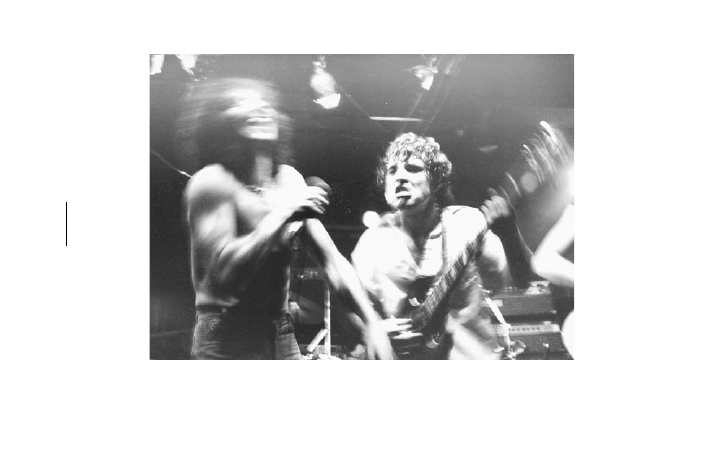
AC/DC’S HIGHW
A
Y TO HELL
•
67
•
A howl and a scowl. CBGB, August 24, 1977.

J O E B O N O M O
•
68
•
AC/DC showed up at the soon-to-be-legendary dive on
the Bowery for a spontaneous gig. Perhaps inspired by the
band they’d opened for that night at the Palladium, the
Dictators — who were described as “just a bunch of regular
guys” in Asylum Records advertisements — Bon and
company wanted to experience the no-frills, ground-level
rock & roll club where the New York band had played.
Robert Francos snapped this photo of Bon and Angus
doing their thing that night, their fi rst visit to New York
City. “The most important thing to note about the photos
of AC/DC playing at CBGB is their sheer velocity,”
Francos says, “and not just of their musicianship: the stage
was smaller at the time, yet Bon still managed to get to full
speed across it, and Angus was able to fi nd the room to
do his leggy strut at the same time.” What Francos fi nds
most interesting is that despite having just fi nished a long
set “at a relatively uptown gig at the Palladium, which
possesses a huge stage, AC/DC obviously were having
a hell of a fun time being in CB’s smaller space.” The
energy level? “Magical. Which is saying a lot considering
the bands that were spawned in that club.”
Howard Bowler recalls that his band Marbles was
scheduled as the headliner on this night. “Then a rumor
started that a famous band was to show up for a midnight
show. We didn’t know who it was to be but someone said
they were playing at the Palladium and would show up
after their set. Now, Marbles could pull in crowds, but the
crowd that night was ridiculous, so we knew it wasn’t us
creating all this interest.” After Marbles played, AC/DC
stormed the stage. “And they were amazing.”
And they possessed a certain sex appeal, apparently:
“Ooh, those legs!” a girl squealed when Angus climbed
on stage . . .
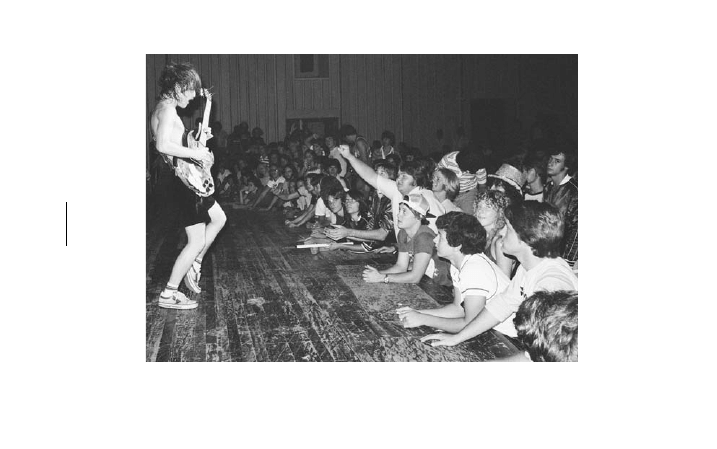
AC/DC’S HIGHW
A
Y TO HELL
•
69
•
Symphony Hall, Atlanta, August 11 1978.

J O E B O N O M O
•
70
•
We’ve got the basic thing the kids want. They want to rock
and that’s it. They want to be part of the band as a mass.
When you hit a guitar chord, a lot of the kids in the audience
are hitting it with you. They’re so much into the band, they’re
going through all the motions with you. If you can get the
mass to react as a whole, then that’s the ideal thing. That’s
what a lot of bands lack, and why the critics are wrong.
—Angus Young
He looks like a twelve year old playing his older brother’s
guitar in his bedroom, fantasizing about a crowd with
raised arms (having fi rst made certain that his door’s
locked). That might have been how it happened, actu-
ally. Part of the great appeal of Angus Young is his lack
of pretension and his utterly ordinary looks, pushed as
he was by older brother Malcolm into the image- and
history-making footlights. Asked about his stage pres-
ence in an interview in Let There Be Rock, Angus refl ected
on what the average fan must think when he sees the
guitarist onstage: “Who’s that ugly man up there?”
That he is only fi ve-feet three-inches and a hundred
and ten pounds will forever endear him to his acolytes,
who marvel at the spiraling energy and enormous sound
that he creates. He doesn’t look like a conventional rock
star onstage — he’s not pretty, he doesn’t come across
as preening or narcissistic, and any larger-than-life
attitude issues from his Gibson, not from a spotlight-
seeking personality. What I love about this photo, taken
by Rennie Ellis at Symphony Hall in Atlanta, Georgia
on August 11, 1978, is Angus’ virtual accessibility; he
looks like a little kid given his big chance, and who can’t
dig that? Except that he’s not a kid, of course, he’s the

A C / D C ’ S H I G H WAY T O H E L L
•
71
•
very talented lead guitarist in one of the world’s great
hard rock bands, and he looks as if there’s nothing
more important to him than playing and transmitting
that to others. Look at the faces in the crowd: they’re
enthralled, they’re psyched, they’re getting off. We
know that it must be late in the show because Angus is
practically naked — he’d stripped down during “Bad
Boy Boogie,” or otherwise shed layers of clothing as
the sweaty gig progressed — and his body looks like
the body of the average guy in the crowd who’s no more
handsome, articulate, or ripped than Angus, who’s spent
an adolescence embarrassed in front of his bathroom
mirror. Thus the identifi cation, the shared joke, the
unadulterated love and worship: He kinda looks like me
and he rocks!
But he’s onstage, and you’re not. As slim as the divi-
sion is between the sticky, nearly nude guitar player
in beat-up sneakers and the nearest rocking fan, the
division is there. From the runty looks of him, though,
quite the unlikely Guitar God.
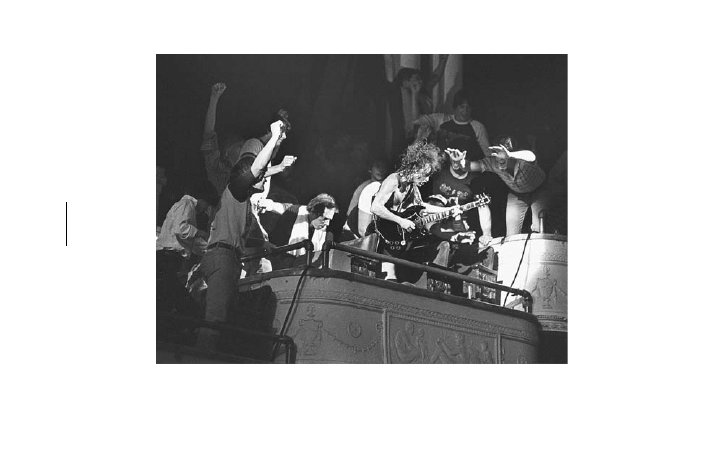
JOE BONOMO
•
72
•
All Hail the Conquering Migrant.

A C / D C ’ S H I G H WAY T O H E L L
•
73
•
Part of AC/DC’s great excitement live, early in their
career, was the interaction between musician and fan —
before the gargantuan success of the 1980s and 1990s
during which the stages got larger, adorned with giant
bells and cannons and blow-up Rosie dolls and videos
and telescreens, during which the distance between the
band and their crowds by necessity increased and Angus
was obligated to run miles a night instead of prowling
the edges of a small or theater-sized stage, sweating and
drooling on his audience.
This photo was taken by Ron Pownall at Boston’s
Orpheum Theater, the year after Highway to Hell was
released. The band was on the cusp of Arena Rock
Dominance, but Angus wasn’t distanced from the
crowd yet. Contrast the anxious look on the roadie’s
face behind Angus with the gleeful adoration of the
surrounding fans, stoked that Angus made his way up to
their box. The guffawing we’renotworthy we’renotworthy
bowing, the glinting Gibson, the headbanging splash
of hair — all of this loud and exhilarating rocking so
close to the fans that could literally grab hold of it if
they wanted to. If Caravaggio had been summoned
by the future to paint a classical representation of the
elation of twentieth-century popular music, he might
have rendered this image. And the sanctifying spotlight
that trailed Angus during the ascension was prescient.
AC/DC was on their way to the stratosphere, and their
days of playing 2,800-capacity theaters were numbered;
few in the future would be lucky enough to have Angus
show up in their seats.
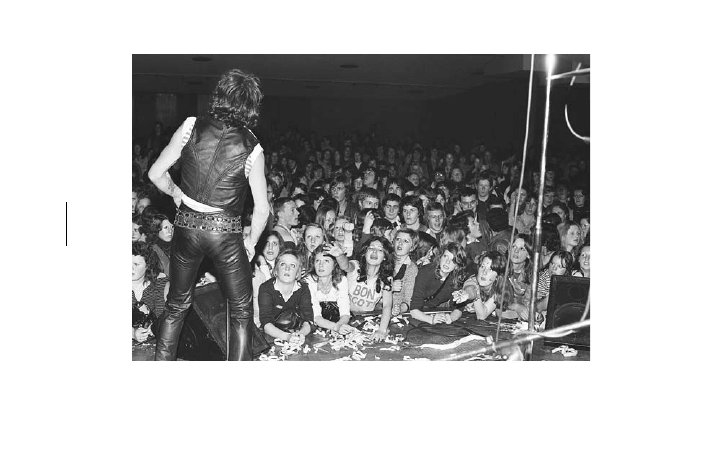
JOE BONOMO
•
74
•
1974, Moorabbin Town Hall, Melbourne, Australia. Photo by Rennie Ellis.

A C / D C ’ S H I G H WAY T O H E L L
•
75
•
Such is the charisma that Bon Scott possessed. I don’t
know where his right hand is going, but I know that
most of the girls’ eyes are fi xated on his face. For all of
the bad-boy, hard-drinking, women-bedding stories that
have been erected on top of the Bon Legacy — many
true, some embellished — a common thread that runs
through these stories is of Bon’s kindheartedness. Watch
him during interviews: his eyes fl ash between wild and
gentle, his hair is as long as his adolescent-fl avored voice
is soft, and there’s something curly and yielding about
his mouth that likely had as much to do with his sex
appeal as anything. Historically, rock & roll front men
are adored, of course, and Bon played it (and enjoyed it)
to the hilt, but macho posturing and boiler-plate double
entendre become tiresome after a while, even to the dim-
mest girl. Bon had a soft-spoken nature made irresistible
by his joie de vivre and a rough-and-tumble, wandering life.
Nikki Goff, in charge of Electric Outlaws, a U.K. AC/
DC fan club, once weighed in on Bon’s merits, noting that
in his blues singing style and his demeanor he appeared
to have had a tough upbringing, and an interesting life,
something that a dreamy girl might sympathize with:
“He was a real ‘seize the day’ kind of bloke. He was
shipped out to Australia at the age of four or fi ve and
that must have had a big effect on him.” He may have
been working through darker sides of his personality
in his lyrics and under stage lights, or he may have
been simply having fun with a rocking persona — the
truth is somewhere in between. Look at the girls in this
photo. That’s not only lust for a leather-pants-wearing
Rock Singer and dreams of exclusive backstage glamour
glinting in their eyes, there’s also great affection for the
hometown guy with the rough edges and the kind spirit.
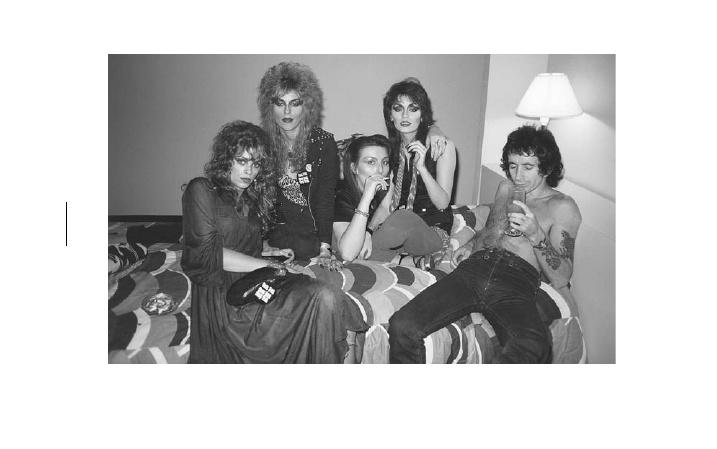
JOE BONOMO
•
76
•
Peachtree Plaza, Atlanta, August 1978.

A C / D C ’ S H I G H WAY T O H E L L
•
77
•
Not quite the tableau of hotel hedonism that I’d fanta-
sized about as a teenager. “[Sex on the road] was more
about bravado, really,” Malcolm said in 1990. “It hap-
pened more when we were young and inexperienced, of
course, but as far as lyrics are concerned we’ve always
used sex for inspiration. We never have a problem with
sex in the words. It doesn’t embarrass us. The reality is
that there were a few stories to tell back then, and now
they’re just good memories.”
This photo was taken by Rennie Ellis in Bon’s hotel
room at Atlanta’s Peachtree Plaza in August of 1978, as
AC/DC was thundering through the South promoting
Powerage. The girls lounging on the bed with Bon are
Rose Whipperr and the Heathen Girls, an all-girl punk
band from Atlanta, “four stunningly beautiful, heavily
made-up girls whose singing act at the local gay bars
could loosely be called ‘bizarre chic’,” as Ellis recalls.
(Rose is in the center, dragging on a cigarette; her left
arm is draped around Wanda Sylvain, New York Doll
guitarist Syl Sylvain’s wife, who happened to be visiting.)
Whipperr had become friendly with Cliff Williams on
the band’s earlier visit to Atlanta, and he’d called to invite
her over to the hotel. “So I brought my galpal back-up
singers along to hang out,” she recalls, before adding,
“Obviously an exciting prospect for all concerned.” Her
memories of the night and of the band are indelible, and
affectionate. “I found Bon to be convivial and sweet,”
she says. “A caring person, and much more gentle than
his stage persona would imply; the tough guy with the
tender heart! Angus was brilliant and charming, as well
as much better looking than all the guitarist mugging
and short pants would suggest.” And her friend, Cliff?
She laughs, “Cliff was ‘The Dreamboat’ in the game,

J O E B O N O M O
•
78
•
Mystery Date: The Hard Rock Edition.”
An acclaimed professional photographer with a long
career, Ellis had artistic and commercial considerations
(he was on the road with AC/DC documenting the
tour for an Australian Music to the World television spe-
cial) yet the photo conveys elements of the snapshot
esthetic, a seemingly candid but composed image, what
critic Colin Harding describes as a “naive document.”
There’s something loose and casual to the image in its
fortuitous marriage of structure and happenstance, and
it’s also a terrifi c time capsule. “Photography can only
represent the present,” Berenice Abbott has observed.
“Once photographed, the subject becomes part of the
past.” A wedding of late Seventies punk and New Wave
culture on the sixty-eighth fl oor of the second-tallest
hotel skyscraper in the Western Hemisphere, the image
captures rock stars and sex and promises stewing amidst
cocktails, ashtrays, and polyester-blend bedspreads.
Bon is what I love most about this photo. Slumped
against the wall, sipping his drink, he looks louche
and careless, certainly, but also bored — not with the
company of Whipperr and the girls, who by the looks
of them know how to amuse, but with the rock star
lifestyle writ small in yet another hotel room in yet
another city. (“Hotel, motel, make you wanna cry,” Bon
sings in “It’s A Long Way To The Top.”) A photograph
can simultaneously deceive and tell the truth: Bon’s
either brazenly uninterested, or he’s simply caught off-
guard, his eyelids drooping in the midst of an exuberant
after-hours party. He’s on a bed with four hot-looking,
glammed-up girls and two of them are already touching
and . . . these chicks look smart and tough, well aware of
hotel sport, yet what has all of the makings of nirvana

A C / D C ’ S H I G H WAY T O H E L L
•
79
•
is compromised by Bon’s distant posture. The only one
not looking into the camera, he’s saying, I’ve seen it all
before.
In 1999, Howard Johnson, an AC/DC fan from
Manchester, England, published Get Your Jumbo Jet Out
of My Airport, borrowing the title from a cleaned-up line
in “Ain’t No Fun (Waiting Round To Be A Millionaire),”
from Dirty Deeds Done Dirt Cheap. Johnson subtitled his
book Random Notes for AC/DC Obsessives, and that it is;
a good-humored, thorough, and ultimately thoughtful
culling together of his essays on the band, fan remi-
niscences, tour diaries, random interviews with band
members, various subjective “Best Of!” lists. I love
the book, because in many ways it’s the quintessential
AC/DC tome: by the fans for the fans about a band that,
though identifi able with a “common man” sensibility,
has become virtually inaccessible over the decades,
made distant by large stages and cocooning publicists.
Get Your Jumbo Jet Out of My Airport reminds us that
were it not for the fans, AC/DC might not have much
to face after the next decade passes and they decide to
record and tour again.
During the 1990s and 2000s the band’s enormous
following happily made the technological leap from
self-printed fanzines to fl ash-driven websites. AC/DC
has thriving fan clubs in nations around the world, and
fervent online groups devoted to compiling extensive
discographies, arcane FAQs, and catalogs of every con-
cert they’ve played since their inception. AC/DC fan
club presidents and online archivists act as unoffi cial,
unpaid middlemen between genuinely besotted, passion-
ate fans, and a band that, though celebrated as friendly

J O E B O N O M O
•
80
•
and approachable, is in many respects light-years away.
Online and in parking lots before a show, the excitable
communing maintains personal connections among
friends and strangers united worldwide by little else than
love for the band and the diversions and deliverances
from the daily that Angus, Brian, and Bon provide.
When I was ten, my sister Jane saw Wings at the Capital
Centre in Largo, Maryland. I was excited for her, and
jealous. The next morning, she confessed to me that
she was so keyed up while waiting in line before the
show started that she nearly tore her ticket to pieces. I
asked her what song Paul McCartney opened with —
I couldn’t wait to ask her — and she looked at me blankly.
“I don’t remember,” she said. “I was too excited.” I was
annoyed with her for forgetting, but I understood the
mind-erasing thrills that she must’ve experienced next
to her screaming girlfriends, seeing a Beatle emerge
from the darkness into spotlight.
Ten years after my sister stood trembling and expect-
ant at Capital Centre, a couple of guys with naive nerve
and a video camera roamed the exterior of that same
venue, talking with pumped-fans fans waiting to go in
to see Judas Priest. The resulting video, Heavy Metal
Parking Lot, has become a classic document of hard
rock fandom, dramatizing the innocent, alcohol-soaked
excitement coursing through fans tailgating in the tail-
ing sun at the cusp of paradise. Offi cially released in
2005 after a brief run on cable access television in the
mid-1980s and years of unauthorized and online distri-
bution, Heavy Metal Parking Lot is an hilarious record of
un-ironic, unadulterated, spaced-out enthusiasm, well
deserving of its cult-classic reputation.

A C / D C ’ S H I G H WAY T O H E L L
•
81
•
“Believe me, it was all purely by accident, not by
design,” admits co-director Jeff Krulik, who with part-
ner John Heyn lugged an oversized camera, cords, and
mic into the sprawling parking lot on a beautiful May
late-afternoon in 1986. Neither were metal fans nor
Judas Priest fans. “We just picked a nice spring Saturday
that happened to be when Judas Priest were in town. We
didn’t have a script, or a plan, except to protect the cam-
era gear borrowed from my public access TV studio.
Since videotape is cheap and plentiful, we just let the
camera roll.” He adds, “Some would call it vérité fi lm-
making. I would call it letting the electrons fall where
they may. We came, we saw, we taped. We left after two
hours. We didn’t even go inside to the concert.”
Krulik and Heyn wandered the lot and asked dozens
of shirtless guys and puffed-haired girls what they loved
about Judas Priest and the freedoms that come along
with that love. Edited among rolling shots of parked and
cruising vans and Camaros spilling over with drunks,
the answers are, depending on your perspective, either
moronic or incisive, but they are always genuine. The
fi lm celebrates inebriated attempts to defend, analyze,
and explain the majesty and release of hard rock. When
asked why his girlfriend doesn’t like Judas Priest, one
guy answers, “Because she’s dumb.” A couple of girls
drunkenly blurt out their desires to “fuck the shit” out
of the band members.
“It was a miraculous coalescence,” Krulik marvels.
“Everything went according to the non-plan — John
and I picked the right day, the right band, the right fans,
and were smart enough, or lucky enough depending on
how you look at it, to just let them be themselves on
camera. Most of the fans we recorded were pretty high,

J O E B O N O M O
•
82
•
but not necessarily on any substance. They were high on
the music, the camaraderie, the spirit, the gathering of
their tribe. And some alcohol and drugs. But somehow,
whatever they offered up on camera was a genuine
and sincere glimpse inside a metal fan’s psyche. There
wasn’t a phony note in the bunch, and we couldn’t have
scripted it.” And there’s the rub, Krulik continues: “As
passionate and note-perfect as these exaltations are, they
are also funny as hell, and perfect fodder for derision
and ridicule. But if you just simply treat them as a joke,
then you are missing something much deeper — I’ve
always said you were either at that concert, or you sat
next to someone in homeroom who was at that concert.
In other words, I’m looking at the man in the mirror,
we have met the enemy and they is us, I am me and you
are he and we are all together. Or something like that.”
One immortal dude, tripping on acid, shirtless, his
jeans painted on, swaying in place and looking like
Malcolm Young’s Yankee cousin, fantasizes rhapsodi-
cally about a joint so large that it would span the entire
country. There are mullets, much Budweiser consump-
tion, lots of raised devil-horn hands, crude behavior,
some Madonna trashing. One guy’s wearing an AC/DC
t-shirt. It’s immortal stuff.
Two decades later, Saul Levitz directed, produced, and
edited FanNation, a Columbia Records-commissioned
online documentary about AC/DC’s Black Ice warm-
up show in Wilkes-Barre, Pennsylvania, in 2008.
Nationwide, contest-winning “fan caravans” streamed
toward the fans-only gig, armed with video cameras
and resolve. An excursion into the lives of those who
good-humouredly straddle the line between enthusiasm

A C / D C ’ S H I G H WAY T O H E L L
•
83
•
and obsession, FanNation is part twenty-fi rst-century
Heavy Metal Parking Lot — teens and twenty-some-
things outflanked by middle-aged men and women
psyched to see their favorite hard rock band — part
corny and profound fan testifying, and part mythic
road-trip. Slickly and lovingly made, FanNation proves
that whether drunk and hoarse-voiced or sober and
refl ective, AC/DC’s fans are still a rabidly dedicated and
starry-eyed bunch.
“I thought of FanNation as a cross between Heavy
Metal Parking Lot and Detroit Rock City,” says Levitz, a
Los Angeles-based producer and director of branded
content, documentaries, and music videos. “I wanted
to capture that glee of traveling to a show, and having
that freedom.” He adds, “There’s a weird gap of fans
with AC/DC. There are the O.G. fans in their 40s, and
then a new breed which has come from Rock Band or
the Tony Hawk video games, with a lot of father-son and
father-daughter stuff being passed down. It was really
cool to see.”
Drawing from numerous geographic points, and
looking for memorable on-screen personalities, Levitz
selected caravan “route leaders” based on videos
submitted to the band’s website. The leaders met the
contest-winners at local Wal-Mart parking lots, and on
a fi rst-come/fi rst-served basis distributed passes to the
warm-up concert. All involved then drove to Wilkes-
Barre. One desperate kid whose car broke down enlisted
the help of Pennsylvania police; another cash-strapped
dude slept in his car for days. In Wilkes-Barre the crowd
gathered at a local park, where they drank, hugged,
drank, and compared AC/DC tattoos. “And they all had
stories,” Levitz marvels. “And a lot of dedication.” One

J O E B O N O M O
•
84
•
woman claims that AC/DC got her through the shatter-
ing grief of losing her husband; one man says that he quit
drinking after being inspired by Malcolm’s sobriety. The
one hundred and twenty contest-winners congregated
at Wachovia Arena the next afternoon, tailgated, shared
more stories for Levitz’s crew, and generally reveled
warmly and boozily in the communal embrace of AC/DC
parking lot fandom, awaiting the evening show. (Fans
were united in their love for the band, though certain
long-standing if friendly allegiances were borne out; of
the preferences for lead singer, Levitz says, “I would
say it was seventy-fi ve percent Bon, twenty-fi ve percent
Brian Johnson. Because the majority were older people
at the show, all of those people grew up with Bon, and
that’s why they got into it.”)
Levitz is fascinated by fan identifi cation with AC/DC,
even as the group has been rendered essentially untouch-
able by fame and success. “The fans respect the band’s
jeans-and-t-shirt, meat-and-potatoes approach, that
they come across like you and me,” he says. He cites an
early-morning moment that he witnessed in Chicago
during the Black Ice tour. After the show, a small pocket
of ravenous fans correctly identifi ed the beat-up tour van
that AC/DC employs to throw kids off of their track; thus
exposed, an exhausted Angus dutifully emerged from
the van to sign autographs. “He didn’t have to do that,”
Levitz notes. “There’s defi nitely respect for their fans.”
Patterson Hood of Drive-By Truckers understands
hard rock fandom and stadium culture well, and he
threads an honest, detail-rich empathy throughout his
band’s great 2001 narrative album, Southern Rock Opera.
Conceived originally as a screenplay, the two-CD album

A C / D C ’ S H I G H WAY T O H E L L
•
85
•
investigates the fallacies and folklore of contemporary
South using the gloomy story arc of Lynyrd Skynyrd.
The second disc leads off with “Let There Be Rock,”
not a cover of AC/DC’s statement-of-purpose from
1977, but, as Hood puts it, “A pretty damned auto-
biographical account of my teenaged years, and how
partying and going to arena rock shows kept me from
going off the deep end in High School.”
The song dramatizes a male’s adolescence tuned to
the twin attractions of drop-out drug use and hard rock
romance: now clear-eyed, the singer reminiscences
about dropping acid at a Blue Oyster Cult concert at age
fourteen, getting pulled over by cops with marijuana and
cheap beer in the car; nearly drowning at the end of the
night while vomiting into a toilet but for the benevolence
of a buddy’s older sister; rocking out in a cover band
playing Thin Lizzy. Set against these small details of an
ordinary teenager’s life are larger-than-life bands Lynyrd
Skynyrd, Molly Hatchet, and Ozzy Osbourne that enact
the seductive mythologies of rock transcendence.
Hood recalls this era fondly. “A lot of the arena rock
shows I saw in those years were of B-grade or lesser
bands, as I lived in a small town a couple of hours away
from some mid-level B-market towns, Birmingham and
Huntsville, Alabama, respectively,” he says. “We didn’t
get the Stones, Zeppelin, or the other top-level bands
very often, but we got Kansas and Foghat and those
kinds of bands every year, so it was basically as much
the experience of going, partying, and having my ears
blasted off as much as anything.” He adds, “A lot of the
bands I saw and often loved in those days made records
I really wouldn’t want to listen to now, or even then. I
was in love with the Clash and many of the punk bands,

J O E B O N O M O
•
86
•
but they didn’t come my way very often and I missed
seeing them. Still, I loved the concert experience and
went to every show I possibly could get to see.
“AC/DC was a big exception to all of this, because I did
get to see them, very early on, and they, of course, went
on to become an A+ level band.” Hood caught AC/DC
on Thanksgiving weekend in 1977, in Charleston, West
Virginia, during their fi rst American tour with UFO and
the Motors. “Tickets were three bucks, and I talked my
Grandmother into taking me to the run-down Charleston
Civic Center to see them. She waited in the parking lot
while I was inside.” He laughs, “My Grandmother was
the best!” He later read that AC/DC considered the
handful of shows that they played with UFO to be their
favorites of their fi rst tour, “since the two bands really
clicked and kinda egged each other on to higher heights.
“I probably smoked my fi rst pot in that show. It was
truly the fi rst great show I ever saw, and still one of my
all-time favorite rock show memories. It’s one of my
life’s best memories.”
In the song’s powerful and poignant refrain, Hood
laments never getting to see Lynyrd Skynyrd live,
though he did get to see AC/DC, “with Bon Scott
singing ‘Let There Be Rock’.” That line repeats as the
anthem concludes, a basic declaration of the immense
infl uence that Bon has had over teenagers worldwide:
in crudely grand fashion, Bon encouraged kids to live a
little recklessly, to explore the risky side, but to return
and crash into bottomless sleep having won a hard-
earned glimpse into the dangers and the pleasures of
the deep end. Then he urged them to wake up and do
it all over again.

•
87
•
G5
Bon Scott didn’t wake up. He died sometime during
the early hours of February 19, 1980. When Alistair
Kinnear returned to the car to check on Bon after their
night out drinking, he’d found Bon unresponsive. He
swiftly drove to Kings College Hospital in Denmark
Hill, where Bon was pronounced dead of acute alcohol
poisoning; the official description on the certificate
read “Death by Misadventure.” Stunned and shaken,
band and management gathered in London. Malcolm,
Angus, Cliff, and Phil fl ew back to Australia with Bon’s
casket beneath them in the plane’s storage. Bon was
cremated, his ashes interred by his family on March 1,
in Fremantle, Western Australia. He was thirty-three.
Of course, the End was in many ways the Beginning.
Within weeks, the Young brothers summarily decided
to continue with AC/DC. They felt that that’s what
Bon would’ve wanted, and really, what else could they
do after the grieving and the numbness lifted — return
to day jobs that they’d despised? Malcolm told Rolling
Stone, “I just rang up Angus and said, ‘Do you wanna
come back and rehearse?’” After several weeks of audi-
tioning singers, they selected Brian Johnson, late of

J O E B O N O M O
•
88
•
the English glam band Geordie and, at the time of his
anointing, a vinyl car roofi ng salesman in Northern
England. They rapidly banged into shape and rehearsed
the songs that Malcolm and Angus had been writing,
enlisted Johnson to write lyrics (though some accounts
suggest that the band also used lyrics penned by Bon
before he died), and in April began recording sessions,
again with Mutt Lange, at Compass Point Studios in
the Bahamas. By the end of the next month, they were
fi nished.
Sheathed in a stark, all-black, funereal cover, Back In
Black was released on July 25, 1980, a year to the month
after Highway to Hell. To date, the album has sold more
than forty-fi ve million copies worldwide, second only
to Michael Jackson’s Thriller.
When Bon Scott died, AC/DC not only lost a mate and
a frontman. They’d fi rst met Bon in 1974, when he was
the band’s grinning, hell-raising, part-time chauffeur;
from the moment he joined as singer, he drove AC/DC
in a much more profound way.
Australian music journalist and cultural writer Clinton
Walker has observed AC/DC for decades. In 1994, he
published Highway to Hell: The Life and Death of AC/DC
Legend Bon Scott. His perspective has been shaped in part
by the years that have passed since Bon died. “Certainly
in my long and arduous years in rock & roll, one thing
I’ve learned about bands is that they have to have a
charismatic front man,” Walker insists. “In a way, the
front man is where everything comes together, and now
that front man can be one of a number of types.” He
cites Mick Jagger. “He is what he is, globe-hopping,
glamorous, all that, or you have Lou Reed in front of the

A C / D C ’ S H I G H WAY T O H E L L
•
89
•
Velvets who was something different, and then you have
someone like Bon, and the great quality that Bon had was
maybe what you’d sometimes call the common touch.
He was not above his audience, but he had something
special, and the audience saw themselves in him but could
also admire that bit that made him special. Perhaps you’d
call that bit ‘talent.’ He was a great writer and showman
and singer.”
Walker has considered Bon carefully, but is still
unsure what it was that wholly drove the singer, apart
from that which drives all of us: “to try and do some-
thing with our lives that leaves a mark, or is it just to
do something that just makes sense to you on a daily
basis?” Bon never forgot his working-class origins,
and the unrewarding hard work that had characterized
his father’s life and which he had done himself in his
younger days. “He was always thankful for the life he
did create for himself,” Walker insists. “He also spent
some time in a juvenile correctional facility and I think
he was smart enough to realize that some of the qualities
or aspirations he might have shared with those errant
youth back then were actually pretty dumb and certainly
offered no future. He was surrounded by all that stuff,
and I think he was pretty clear that he wanted to avoid
that.”
He continues, “Bon saw the kids he grew up with
either go into the factories or jail, and I think that would
have killed him. But then rock & roll killed him anyway,
so maybe he was just too big a character to be contained
by life. I think one of the things about Bon was just
intelligence, he was no moron and so, I think, he just
tried to fi nd a way to do justice to his intelligence. And
so, of course, the only medium that meant anything

J O E B O N O M O
•
90
•
to him was music, and he just felt his way through a
career.”
When Bon joined AC/DC, Walker feels, the
singer pulled things together and gave the band focus.
“Malcolm and Angus have even paid the credit them-
selves. I mean, they were all very good at knocking a few
chords together into a killer riff but even that’s still not
enough, to me at least, and I think that’s demonstrated
in the quality of the songs the band’s produced since Bon
died. Obviously Bon was a great writer and that sort of
elevation he bought to the songwriting is precisely the
thing that lifts the other components in the music and
makes it greater than the sum of its parts.” Among Bon’s
contributions was his innate ability to broaden the band’s
appeal. “I do think Bon provided that sort of bridge
between the Youngs and the world. I could be wrong
since the band’s sold a lot more records since Bon died
than when he was in the band, but I think he opened up
the possibilities and gave a broader audience a possible
sense of purchase on it. After Bon died, AC/DC become
more of a closed shop with a limited appeal.
“Put it this way: AC/DC with Bon in the band was
capable of pop hit records, but after that, they were a
rock ghetto act, admittedly a huge ghetto but not one
that reached out the way Bon and his songs always did.”
Another Australian reached by Bon’s songs is Dave
Faulkner of Hoodoo Gurus. Born and raised in Perth,
he remembers watching AC/DC’s infamous appearance
on Countdown in April of 1975, wide-eyed at Bon in
his schoolgirl get-up. “I was a kid, I just thought it
was funny,” he says. “This was before cable TV and
all of that sort of thing, so it was compulsory viewing

A C / D C ’ S H I G H WAY T O H E L L
•
91
•
for nearly every household in Australia. Every Sunday
night, everyone had to watch Countdown. And then
things that were on there would invariably chart the fol-
lowing week.” Not too long after, Faulkner was happily
caught up in punk rock, making noise in a DIY band
and in self-imposed exile from popular album charts.
“I was really a punk rock true-believer at the time, and
I didn’t think AC/DC were in any way connected to that
scene.” In February of 1977, AC/DC played the Perth
Entertainment Centre. “For some reason, I decided to
buy a ticket,” Faulkner remembers, “though I wasn’t a
particularly huge fan at the time. It was just something
to do. I went to the concert, and they blew me away.”
What surprised him, he continues, “was how many
songs I knew. So many of their songs had been on the
radio, or on TV, or playing in a store when I was buying
jeans, whatever, that I hadn’t realized how many of their
songs I’d been living with. I respected the fact that they
were no-bullshit rock & roll. I’m still surprised that I
had the nous to buy a ticket. It remains one of the more
memorable concerts I’ve been too, and I’ve seen a lot
of great ones.”
The show was the only AC/DC gig that Faulkner
would see in the Bon era, and he noticed something
a few years later when he saw the band with Brian
Johnson out front. “It’s quite a different experience,”
he says. “Now, the focus of the show is Angus. He’s an
amazing entertainer, and obviously it was always true,
that’s what he’s done from day one. But back then,
Angus was actually the second banana! You came to see
Bon, and Angus was, like, icing on the cake. They were
like a two-headed monster, as far as crowd revving-up,
and pure stage presence. Bon had personality for days,

J O E B O N O M O
•
92
•
you couldn’t take your eyes off him.” Faulkner recalls
hearing that when Bon felt that the band was getting too
complacent or becoming too stock-standard, he’d put
a boot up Angus’ ass, “and kick him off the stage into
the audience! Just to shake things up a bit. That’s very
revealing about Bon.”
Having memorialized Bon in “Let There Be Rock,”
Patterson Hood considers the singer’s legacy. “Before
Bon’s death, he was probably almost as famous for his
partying as for his music,” he says. “For many years, his
artistry was probably overshadowed by all these things
and how much bigger than life he became. I think it has
been more recently, after having their music continue
to be loved generations later, that people have really
begun to realize what a great artist he was.” He adds,
“He was a great songwriter, performer, and above all a
great Rock Star. You could argue that in death he’s been
able to remain just as we all remembered him from our
youth, but honestly, the entire band, including Brian,
have basically been able to do that.” But Bon gets extra
points, Hood feels, “for writing really smart songs that
come off as stupid in the best sense of the term, in
that Stooges, New York Dolls, even Ramones kind-of
caveman kind-of way.”
Particularly interesting to me is Clinton Walker’s keen
sense of Bon’s Australian-ness, an attitude and way of
thinking that the transplanted roughneck came to intuit.
“I know that Bon and the Youngs alike were all Scots
born,” Walker says, “but even putting aside the fact that
Australia has always shared a great Celtic infl uence in a
way it certainly doesn’t an English one, the fact is that
they all grew up in Australia and certainly paid their

A C / D C ’ S H I G H WAY T O H E L L
•
93
•
musical dues in Australia, and we in Australia do see
the world a bit differently to the way Americans and
the English do.” He adds, “Whilst there was probably
never anything absolutely specifi c about that, there was
always an essence of attitude and tone about AC/DC,
especially when Bon was in the band, that I think set it
apart from so many other bands.”
Brian Johnson hails from Dunston, Gateshead, in
Northern England, and when he took over the reins of
AC/DC in early 1980, a certain Aussie panache born
of pocket-sized men intensely hungry in their youth to
play and conquer was diluted. Yet what the band would
do with Johnson was triumph over a world in a manner
that Bon had only dreamed about. In part due to its tacit
honor and mark of respect to Bon, in part to its incred-
ible sound and clutch of fantastic songs — “Shoot To
Thrill,” “Hells Bells,” “What Do You Do For Money
Honey,” the colossal, funky, stomping title track among
them — Back in Black was an enormous commercial hit
out of the box. Highway to Hell’s closer, the retrospec-
tively sorrowful and ominous “Night Prowler,” segued
almost too perfectly into “Hell’s Bells,” Back in Black’s
gloomy opener escorted by bells tolling in memoriam
before surrendering to Angus’ somber and intense riff.
The stage was set for an epochal, career-making album
event. Every bit the rocking classic as Highway to Hell,
Back in Black reached number 4 on the Billboard album
charts; the single “You Shook Me All Night Long”
reached 35. Telling of the band’s rising popularity was
the reappearance of their earlier material on the charts:
Dirty Deeds Done Dirt Cheap, fi rst released in Australia in
1976, was issued in America in April of 1981, it reached
number 3 on the Pop Albums chart. The title track

J O E B O N O M O
•
94
•
made it to 4 on the Mainstream Rock singles chart.
(Highway to Hell benefi ted too, of course: to date, the
album’s been certifi ed seven times platinum in sales in
the U.S. alone.)
Call it the “Dead Bon Factor,” it was certainly given
ascension on the gales issuing from Johnson’s remark-
able, cigarette-emboldened lungs. I remember in the
early 1980s people laughing that they couldn’t tell Brian’s
voice apart from Bon’s voice. I could. The differences
were subtle, but as the years have gone by and as AC/DC
has become an institution, those differences have been
cast in sharp relief. Johnson is a remarkable rock & roll
singer, but not nearly as unique a presence on the band’s
songs as Bon was. I certainly grin and laugh less listening
to the songs that Johnson sings, though the jokes and
double entendres are still there. (Bon never snarled the
word “bitch” quite like Johnson did, either.) Reviewing
Johnson’s fi rst tour with the band, Robert Palmer wrote
in The New York Times that the singer “looks and sings
something like a potential homicidal longshoreman,”
yet to me Johnson seemed closer to a central-casting bad
boy than Bon. Of course, most everyone seems orthodox
next to Bon’s personality. Malcolm and Angus certainly
chose well: Johnson’s a powerhouse singer and a hard-
playing mate, and he puffed up his chest, tugged down
his cap, bravely stepped into Bon’s lengthy shadow and
threw himself into the songs and the band’s mission. He
fi t in. Only: the odd, bizarre edges that Bon sported were
smoothed a bit as a consequence — especially as AC/DC
continued to grow in worldwide popularity.
The second album with Johnson, 1981’s For Those
About to Rock We Salute You, was the band’s glossiest yet,
Lange really buffi ng up things for the radio-friendly

A C / D C ’ S H I G H WAY T O H E L L
•
95
•
sheen that he and the band rightly felt was theirs in
which to glow. Hadn’t they earned it? Bombastic and
a bit dated, the album might’ve been rescued by top-
notch songs, but writing weariness was creeping in; the
good riffs — “Put The Finger On You,” “Let’s Get It
Up,” “C.O.D.,” the theatrical, arena-ready title track —
never quite transcend into the band’s patented eternal
groove. Rudd’s snare sounds like nothing in the natural
world, and the album’s contrived, studio-enhanced
sound dwarfs the songs. (Tony Platt, again the album’s
engineer, feels that Lange was striving for audio perfec-
tion rather than for gut feel, to the album’s detriment.)
And the lyrics were becoming embarrassing. Bon’s
words sometimes fell flat, but by 1981 Johnson was
regularly consulting the Book of Generic for inspira-
tion. “I don’t think anyone would argue that AC/DC’s
lyrics, after Bon, became and remain pretty much rote
cliché,” Clinton Walker argues. “Whereas with Bon,
the lyrics were absolutely something special and that fed
back into the whole and made it something much more
special.” Dave Faulkner agrees: “The only thing I think
AC/DC did lose with Bon was a remarkable lyricist, a
natural poet and humorist. His lyrics are hilarious. That
was another edge that Bon added that any band would
welcome. He was out of the box there, he had a natural,
raw talent.”
If the band was threatening to sound corporate,
fans didn’t care. For Those About to Rock We Salute You
was another enormous success, giving AC/DC their
coveted Billboard number 1 album as well as two Top
10 singles (the title track, and “Let’s Get It Up”). They
were everywhere on the radio in 1982.

J O E B O N O M O
•
96
•
And so, naturally, I turned off. The band’s worldwide
triumphs ultimately bored me and my contrarian’s ways.
My friends and I laughed scornfully at Johnson singing
“ga ga ga ga ooh” in “Let’s Get It Up,” and I winced at
the magazine photos of enormous stadiums and stages
and bells and cannons. It was all looking very trite and
corny to me, as I was generally turning my back on Top
40 and starting to embrace indie and under-the-radar
bands. By the time AC/DC released the strong, scaled-
back Flick of the Switch in August of 1983, I was paying
little attention (though enough to notice that the album
circulated pretty quickly back into the cut-out and used
bins in record stores). Others’ attention was dimming a
bit too, it seemed, at least in the U.S. Flick of the Switch
performed well in Australia and the U.K. but topped out
at 15 on Billboard; the title track single barely cracked
the Top 30. Decent sales, certainly, but relative to Back
in Black and For Those About to Rock, disappointing.
But still, AC/DC was — and remains — a worldwide
institution. As I was blithely ignoring them they were
fi lling stadiums and coliseums, splitting eardrums at
the Rock in Rio festival (where they played to half a
million fans) and at their several appearances with the
Monsters of Rock tours (most famously at Donnington
Park, the DVD of which has sold more than 800,000
copies as Sony’s highest-selling video). By the middle of
the 1980s, their sound, attitude, and modus operandi were
all fi rmly, unalterably in place. Malcolm and Angus’
business-fi rst philosophy steered AC/DC stubbornly
down the same John Lee Hooker/left-at-Chuck Berry/
right-at-Rolling Stones paths that they’d burned years
ago. “I’ve never felt like a pop star — this is a nine-to-
fi ve sort of gig,” Malcolm told David Fricke. “It comes

A C / D C ’ S H I G H WAY T O H E L L
•
97
•
from working in the factories, that world. You don’t
forget it.” Angus added: “I look at it this way — I got
this far. I didn’t have any great prospects for a career,
with the education I had. When I started doing this,
I thought, ‘You gotta give it 200 percent.’ Because it
was your survival. It was the job, what was going to put
food on the table.” Such dogged, committed pursuit
of an esthetic vision has served AC/DC absurdly well
— among the reasons that there are now many years
between albums is that the men are blessed with bot-
tomless bank accounts — and it’s allowed them, perhaps
unfortunately, to pay scant attention to contemporary
musical trends outside of their purview.
Watch the brothers whenever AC/DC plays
“Highway To Hell.” During the verses, Malcolm stands
with his right hand resting on his Gretsch, bobbing his
head lightly, tapping his right foot, the job foreman
who’s supervising Angus going down the manhole. It’s
a job.
And it’s a job with little employee turnover. Cliff
Williams has consistently held down the bottom end
since he joined the band in 1977. Phil Rudd left acri-
moniously in 1983, replaced by Simon Wright, who
was replaced by Chris Slade in 1989; as it turned out,
both men were simply holding the chair for Rudd’s
eventual return in 1994. The albums following Flick of
the Switch have been consistent in their mixed results
as well as their sound and arrangements. Fly on the
Wall (1985) was awful: lazily written, dated, and wholly
uninspired, with Johnson’s weakened voice buried deep
in the mix. Who Made Who (1986) and Blow Up Your
Video (1988) were a bit better: the former’s title track

J O E B O N O M O
•
98
•
is a slow, grinding, recursive song that doesn’t sound
like much in the band’s catalog; the latter reunited the
band with Harry Vanda and George Young and featured
“That’s The Way I Wanna Rock ‘n’ Roll,” lyrically
moronic, but the Young brothers’ coolest riff in years.
The slick The Razor’s Edge (1990) was a commercial
surprise in the form of the hit singles “Moneytalks”
(number 3 on Billboard Mainstream Rock singles chart)
and “Thunderstruck” (number 5, and now justifi ably a
standard in the band’s catalog), and the band supported
the album with a year-long world tour. Rudd returned
for Ballbreaker (1995), produced by Rick Rubin; unfor-
tunately the band didn’t bring top-shelf material to the
noted producer. AC/DC again teamed up with Vanda
and Young for the confi dent Stiff Upper Lip (2000), and
the title track and “Satellite Blues” were modest gems
that could’ve been rejected grooves from Let There Be
Rock or Powerage.
2008’s Black Ice was a huge commercial success,
debuting at number 1 on Billboard and prefacing yet
another successful world tour of enormous stages,
scaffolding, pyrotechnics, video accompaniment, an
ironclad set-list of well-worn classics, and jubilant,
graying, hairline-challenged men in the crowd raising
devil-horns, or in some cases, their own kids.
In the mid-1980s, I was a DJ at WMUC at the
University of Maryland. One afternoon, a twelve-inch
EP from Pontiac Brothers arrived at the station; I was a
fan of the band, and I laughed out loud when I saw that
they’d covered “Dirty Deeds Done Dirt Cheap.” It had
already become a gesture of semi-arch hipster irony to
cover AC/DC (unless you were in an earnest tribute

A C / D C ’ S H I G H WAY T O H E L L
•
99
•
band, a cottage industry that has thrived for decades).
Really, how could you cover a cartoony song about a
hitman delivered with a half-grin by Bon Scott unless
you were going to ham it up? When I listened to the
Pontiac Brothers rip through the song, having real fun
with it, it felt, suddenly, as if AC/DC were an old band.
Bored by their newer records, my buddy and I relied
on some silly drunken inspiration: I recorded a few
For Those About to Rock and Flick of the Switch tracks at
45 rpm, and we’d blast them top-volume in the dorms
and at parties, guffawing at the hyper, nasal sounds but
really digging them, too. It was an old trick I’d learned
as a kid: when a song — say, the Beatles’ “Please Please
Me” — had gotten samey-sounding after a few thousand
listens, just nudge the turntable’s pitch dial toward the
plus sign, and you’re hearing the song new again. “This
is what AC/DC should sound like!” we yelled, stupidly,
as “Let’s Get It Up” and “Flick Of The Switch” leapt
out of the boombox at breakneck speed.
Others in the Eighties and Nineties took more con-
certed efforts to revise and keep alive the classic AC/DC
sound. The Cult were an English band of hard rockers
that had shortened their name from the Death Cult
(and, earlier, from the Southern Death Cult) for fear of
being associated with Goth Rock; they wanted to revive
psychedelia and heavy riffi ng, with a special debt to
AC/DC. In 1987, as I was smirking along with Pontiac
Brothers, the Cult hired Rick Rubin, and the result was
Electric, a rocking and funny album that it was impos-
sible not to headbang and smile along with, even as
you rolled your eyes at the shameless appropriation.
“Wild Flower,” “King Contrary Man,” and “Outlaw”
feature Young Riffs
®
, propulsive eighth-notes, and Bon/

J O E B O N O M O
•
100
•
Brian-styled vocals married to anthemic choruses. Rubin
and the band obviously shared their love for the AC/DC
back catalog during these sessions, and achieved a kind
of perfection with the single “Love Removal Machine,”
which sounded as if Rubin had collected genetic samples
from Malcolm and Angus and imprinted them into the
song’s tablature. (The tune also borrows happily from
the Rolling Stones’ “Start Me Up.”) My buddies and I
loved it, and scorned it, and loved it all over again — and
all the while I wondered unconsciously, Where in the hell
are the progenitors?
A few years later, Rubin was at it again, this time
with the Four Horsemen, a Los Angeles-based band
formed by an ex-Cult member. Nobody Said It Was Easy,
released in 1991 as a renewed AC/DC were riding high
with The Razor’s Edge, was a great-sounding amalgam
of Southern-fried posture and Young licks, manifested
terrifi cally in “Rockin’ Is Ma’ Business,” a fi st-pumping
groove of mammoth guitar and ironic bad-ass outlook.
With “Love Removal Machine,” it’s among the best songs
that Young/Young never wrote, and there have been a
few contenders for that prize over the years, from bands
of young guys, and sometimes girls, who came of age
while listening to Highway to Hell, Back in Black, and For
Those About to Rock and who, like the Drive-By Truckers’
Patterson Hood, surrendered happily to the myths and
promises of stadium hymns and hard rock riffi ng.
Some of the infl uence is sifted subtly: I hear AC/DC
in the Supersuckers, the Hives, JET, the Datsuns, and the
Donnas, among others, and in songs such as the White
Stripes’ early “Hello Operator,” stomping, power-chord
blues that I bet Malcolm and Angus would love if they’d
only listen. The Hold Steady and the Flaming Lips have

A C / D C ’ S H I G H WAY T O H E L L
•
101
•
readily acknowledged and/or admitted the infl uence of
AC/DC on their songs, attitude, and tour vans’ mix-
tapes. On the tongue-fi rmly-in-cheek-side there’s the
Upper Crust, a Boston-based group of guys dressed
as and channeling eighteenth-century aristocracy with
Gibsons, Gretschs and powdered wigs (think of AC/DC
playing “Back In Black” as a castle’s house band).
Less ironically, there’s Nashville Pussy, a hardcore
rock & roll outfi t powered by Blaine Cartwright and
his wife Ruyter Suys, who plays a knock-off of Angus’
Gibson SG held high, and sports long, sweaty locks
and the headbanging to match. “Learning how to play
the SG got me to understand Angus’s playing style
more — they are pretty directly related, one follows the
other — and at one point in learning my craft I would
ask myself, W.W.A.D?,” says Suys. “He is a personal god
as far as inspiration.” Like others before her, she traced
the amplifi ed line from blues to Chuck Berry to Angus:
“I swear you could play half the AC/DC riffs and main
hooks on fucking church bells — they are that simple
and clear.” She adds, “It ain’t easy being that simple,
and they are able to take the same few chords and turn
them inside out and every way possible to drain every
last drop of rock out of them. Good old Pentatonic
scale.” A band of hard-drinking, committed, road-tested
rockers, Nashville Pussy fi lters their love of Bon-era
AC/DC though resolute Georgian attitude. Suys recalls
playing Melbourne, Australia, in the Little Annadale
Pub: “I pictured how Angus got his moves, and it has
something to do with dodging beer bottles on the stage!
Stick and move! And Rockin’ out helps too — more
rock equals less beers thrown and more beers merely
passed up to you!”

J O E B O N O M O
•
102
•
Nashville Pussy’s version of “Highway To Hell”
on the Free the West Memphis 3 compilation is notable
for its deference, however ear-busting; read grungy,
not begrudging. When I watch and listen to Nashville
Pussy in a small, sweaty club, I feel that it’s as close to
late-Seventies AC/DC as I’ll get.
Plenty of folk over the decades have called AC/DC to
task for their unwavering commitment to their sound
and approach. In a satiric column for Pitchfork, Brent
DiCrescenzo offers a faux-investigative piece about a
new AC/DC album, hanging out in the spirit of mock
journalism “in the back alley of the Hard Rock, digging
through hotel trash, sorting out the trademark gold
penthouse Hefty bags.” He breathlessly announces
that, though the band is holding their cards close to
their chest “as they explained in their 1985 b-side ‘Hold
Your Cards (Close to Your Chest)’,” he’s been able to
piece together what he can of the new album. “These
songs have been transcribed from doodles and poems
off toilet paper, the back of Chinese take-out menus,
hotel ‘Please Make Our Bed’ doorknob hangers, pool
bar coasters, a brochure for the Chicago Shakespeare
Theatre at Navy Pier, and a highlighted snooker
instruction manual.” Among the song titles “leaked” by
DiCrescenzo: “Makin’ the Bed”; “Downloadin’ (Ain’t
Got Nuthin’ To Do With an iPod)”; “You Can’t Spell
Rock ‘n’ Roll Without C-O-Apostrophe-K”; and “I’ll
Swell If the End’s Well.”
Hilarious, snarky, devastating stuff. It’s true that in
the post-Spinal Tap era, AC/DC has come perilously
close to self-parody with each release and worldwide
tour. Many feel that they solidly arrived there years

A C / D C ’ S H I G H WAY T O H E L L
•
103
•
ago. Any working rock & roll band courts this risk as
they hit the bittersweet wisdom and sagginess of middle
age. The risk might be treacherously high for a band
whose most visible member is a graying fi fty-something
wearing a lad’s outfi t.
Yet, there are just as many staunch defenders of AC/DC
in the twenty-fi rst century, among them critic Chris
Riemenschneider who says, plainly, “Anybody who says
Angus Young is too old to be prancing around in his
schoolboy uniform simply doesn’t get it. Not only do
they miss the point of AC/DC. They don’t understand
rock ‘n’ roll.” Yeah, he writes, Angus still wears “that
stupid, hokey, beautiful velvet-jacket, tie and shorts
ensemble, which is to rock ‘n’ roll what Dorothy’s ruby-
red shoes are to cinema or Superman’s cape is to comic
books.” Riemenschneider offers his reasons why AC/DC
is still relevant, including the band’s mind-boggling
ongoing catalog sales, second only to the Beatles, their
stubborn refusal to allow their songs to be sold on iTunes
(“Most acts would be shooting themselves in the foot
if they did this”), and the fact that Mutt Lange, Rubin,
and Brendan O’Brien (“three of rock’s biggest record
producers”) couldn’t leave their signature imprints on
AC/DC even as they tried, or wanted, to. The most
persuasive reasons for the band’s eternal coolness? The
near-impossibility of discovering a used copy of Back in
Black, so universally coveted is the album, and Malcolm
and Angus’ antipathy to the dreaded if radio-ready
power ballad.
Discussing Stiff Upper Lip in 2000, critic Stephen
Thomas Erlewine posed a simple but signifi cant rhe-
torical question: “If making music like this was really
that easy, why can’t anybody else do it this well?” The

J O E B O N O M O
•
104
•
diffi culty in answering that question goes a long way
to getting at the heart and mystery of AC/DC’s suc-
cess and of their steadfast justifi cation of the playbook.
Defending Powerage, Bon once said, “You progress, sure
you do, but you move forward in the same direction.
You do not shoot off on some tangent.”
In 1988, literary critic Sven Birkerts re-read Jack
Kerouac’s seminal novel On the Road; twenty years had
passed since Birkerts discovered Kerouac’s lyric prose
and the Beat Generation’s yay-saying quest for kicks
and beatifi c states of dirty grace. Revisiting the novel at
the tail end of the cynical 1980s left Birkerts cold and
disenchanted. “At some point I realized that I was not
so much reading a book as taking stock,” he confesses,
“of those times, of these times, of myself in both.” As
a highly impressionable teenager in the 1960s, Birkerts
had eaten it up — as had millions of kids worldwide
— embarking on ragged road trips in emulation of the
movement equals purpose philosophy, admitting later to
wincing when learning of Kerouac’s political conserva-
tism and skepticism of the counter-culture. Eyeing his
dog-eared copy of On the Road, Birkerts writes: “There
is simply no adequate protection against the ways we
grow and change.”
As I write this, thirty years have passed since Highway
to Hell was released in the summer of 1979, and I wonder
how and why the album can matter to me now. When
I listen, I experience the same grinning, headbanging
highs I fi rst did, leavened a bit with some Birkertsesque
misgivings. The sensations are different now, of course —
I’m not hearing the album for the fi rst time, I’m older
— but they’re still there. Few rock & roll albums in my

A C / D C ’ S H I G H WAY T O H E L L
•
105
•
collection have lasted as long with me and retained the
spark and spunk as has Highway to Hell.
The reasons have much to do with taste, probably.
I don’t pretend that everyone loves the album or will
get this far in a book devoted to it. But Highway to
Hell testifi es to a band at their peak and as an unin-
tended swansong for a romantically reckless leader,
and I’m convinced that AC/DC achieved Rock & Roll
Platonism with the album. “Highway to Hell,” “Girls
Got Rhythm,” “Touch Too Much,” “Shot Down In
Flames,” “If You Want Blood”: these are pure and bed-
rock tunes that translate the True Ideas, the — should
I say this? — “Rockness” of rock & roll. “For any set
of tables, there is a single Form,” Plato stated over
two thousand years ago, to which we might add in the
twenty-fi rst century, our ears ringing but our faculties
undimmed, for any set of rock & roll albums there is
Highway to Hell. (Plato: “For any set of tables, there is
a single Form, and it is in virtue of some relationship
to that Form that they are all made to be tables.” Look
in the mirror, hair-metal bands.) Little else explains
to me the continued freshness of these songs and per-
formances so many years later. Malcolm, Angus, and
Bon locked into something eternal in early 1979, the
Rock & Roll of rock & roll, and Mutt Lange was smart
and skillful enough to recognize and to help translate
that.
“The fi rst thing ‘Mutt’ did on Highway to Hell was
tune their guitars,” insists Ed Stasium, a renowned
veteran producer who since the mid-Seventies has engi-
neered and/or produced dozens of rock & roll albums
common to his trademark clean but muscular sound.
Notably, he was behind the board for the Ramones’

J O E B O N O M O
•
106
•
essential Leave Home, Rocket to Russia, and Road to Ruin
albums, and he’s also worked with Motörhead, Soul
Asylum, Living Colour, Joan Jett and the Blackhearts,
the Misfi ts, the Plasmatics, Reverend Horton Heat, and
many others. Over the years, Stasium, too, has weighed
the tangibles and intangibles of Highway to Hell’s time-
less sound. “You listen to AC/DC’s earlier records, and
the guitars weren’t quite in the pocket yet,” he says.
“I’m a huge fan of ‘tunedness’: in time, in tune, and
on tape, the Three T’s, that’s one of my philosophies.
And you can just hear the difference in the layering
of the guitars on Highway to Hell. Those guitars were
just so much tighter, and I’m sure that he worked with
Malcolm and Angus on that. That album’s as tight as the
Inca dry-stones at the walls of Machu Picchu. You can’t
put a cigarette paper in between there, or a leaf. It just
sounds so great, so crisp.
“On the earlier albums, there were notes hanging
over, little crud here and there. On Highway to Hell
Lange cleaned that up, but the power is still there.
The drums sound great, you can hear the kickdrum,
fi nally. Everything’s very distinctive.” He adds, “And the
background vocals — they were on the earlier records,
but on Highway to Hell Lange stacked those suckers and
spread them out in stereo. The band was there. ‘Mutt’
just brought clarity to everything.”
Three decades down the line, Stasium vividly
remembers driving into Manhattan from New Jersey,
listening to WNEW-FM as “Highway To Hell” came
over the airwaves for the fi rst time. “I said, ‘Oh my god,
what is this? It sounds killer!’ I knew that it was AC/DC.
But it sounded so great.”

A C / D C ’ S H I G H WAY T O H E L L
•
107
•
When I think about Bon’s lyrics on Highway to Hell, I’m
reminded of another American narrative. Jay Gatsby
was the Platonic conception of a young James Gatz,
and this discovery on Nick Carraway’s part is a deci-
sive moment in F. Scott Fitzgerald’s The Great Gatsby.
Disgusted with and embarrassed by his humble Midwest
origins, Gatz re-creates himself as “just the sort of
Jay Gatsby that a seventeen year old boy would be
likely to invent,” Carraway reports soberly, “and to this
conception he was faithful to the end.” The romance,
sport, and tragedy of the novel results from a teenager’s
fantasy — no wonder it ends with ruined dreams and
bitter disappointments. There’s some Carraway-like
disquiet for me when I rock out to Highway to Hell.
Gatsby’s fl aw is an adolescent vision of his world; is it
AC/DC’s as well?
When the band was writing and recording the album,
they were no longer seventeen year olds — they were
young men in their mid-twenties plus a geezer, with
years of hard work and the long road etched onto their
faces. Angus turned twenty-four during the Highway
to Hell sessions; Malcolm was twenty-six; Williams,
twenty-nine; Rudd, twenty-four; Bon, an ancient thirty-
two. The album may have been produced by men well
past their teen years, but clearly it springs from their
idealized notions of themselves as young kids, rocking
out to the Stones and the Yardbirds and electric blues,
getting off on the three-chord promise of drinks, joy,
and fucking, against an air of quasi-menace. Shouldn’t
such hormone-driven music and its clichés embarrass or
bore me a bit now? Is my Platonist argument more self-
defense than discovery? My wife Amy laughs when she
comes into my study and the music’s cranked and I’m

J O E B O N O M O
•
108
•
rocking out, devil-horns and lightning bolts adorning
the magazines strewn around me. She should, of course.
That’s part of the fun.
Bon intuitively recognized the need to exaggerate his
adolescent drive and devilish taint. Michael Barson and
Steven Heller write in Teenage Confi dential, “Good and
evil make themselves evident in real life not as absolutes,
but as gradations along a virtually infi nite continuum.
The American mass media, however, has always oper-
ated most comfortably when presenting clearly etched
polarities to its consumers. So it has always been with
the teenager in American pop culture. There are good
teenagers and bad teenagers, and being just a little bit
bad is rather like being just a little bit pregnant — in
America, you are either pure a newfallen snow or you
carry an indelible taint.” Highway to Hell runs along
that continuum: there’s something eternal about ado-
lescence, about its promises and its deceits; and about
the adolescent, blinking into light so bright that the
horizon is obliterated. A teenager is pulled in many
directions at once: between sensation and substance;
between impulse and responsibility; between innocence
and guilt; between shallowness and depth.
Highway to Hell and the panting scenarios therein are
sensational, impulsive, and shallow, and no less human
because of it. When I listen to the songs now, my brain
can go into sleep mode, and my body can listen and
move, and that’s a great pleasure — one of the great
pleasures that rock & roll gives us — and it’s a different
thing altogether from pining for lost youth or regretting
moves not made, girls not chased, drinks not downed.
That Bon Scott was thirty-two when he wrote the lyr-
ics suggests that he was an eternal adolescent, but the

A C / D C ’ S H I G H WAY T O H E L L
•
109
•
longer I live with the songs, the more I feel that he was
blessed by this state more often than he was burdened
by it. He allowed himself access to a youthful pulse that
beat into a future lifting with fun, not collapsing under
regret.
I won’t romanticize Bon Scott. I can’t forget that he
was a self-destructive alcoholic who drank himself to
death, but I can forgive that unhappy truth, and I listen
to the songs that dramatize that hazardous dance with
more than a little sympathy, and with rue at the human
mistakes he made, however fun they were. Living easy,
living free . . . asking nothing, leave me be . . .
So what was it like for other kids at the time? I wanted to
talk about some of this with the classmates who gradu-
ated with me from St. Andrew Apostle School when
Highway to Hell was released. Are these songs of any
value to them now as adults, likely with a family in tow
and a reliable burden of responsibilities? Do the songs
still matter to them? I hadn’t spoken with many of them
in decades, and when their names and faces fl oated back
to me I was put in mind, after Birkerts, of the ways we
grow and change. I needed to remind myself to listen in
their refl ections for adult voices, not for the hysterical,
hormone-pitched noise of our early teen years. Their
responses roam the fi elds of teen melodrama, real and
imagined, with Highway to Hell as soundtrack.
Drew Viland wrote to me, “Mid-8th grade at
St. Andrew’s my family moved to Holland where I
went to the American School of the Hague. New school,
foreign land was the backdrop for much teen angst . . .
When I heard the lyrics to ‘Highway to Hell,’ I was a bit
taken aback and did not want to like the song, but could

J O E B O N O M O
•
110
•
not help it. At the time, I did not care for the crowd that
was ‘forcing’ their music on us. The boom box was a
new novelty and this was their anthem.” He adds, “This
music brings mixed emotions when I recall the time it
came out. I have an 11-year-old son who found AC/DC
through Guitar Hero or Rock Band. This music has taken
on a whole new meaning for me since I associate it with
my son as opposed to my youth. So there are two sides
to this musical coin for me.” David Peake says, “Now
that I am older, I can appreciate how great AC/DC’s
music is/was (and yes, the ‘Best of AC/DC’ is on my
iPod). The songs will always have a strong emotional
attachment to them, as they reference a part of my life
that is gone. I guess we can call that nostalgia, right?”
Rob Thompson was one of the kids I remember as a
good-hearted juvee trouble-maker, a paragon to me of
cool rebellion. He spent one day in seventh or eighth
grade swigging clandestinely from a bottle of cough
syrup hidden beneath school books in his desk. He
happily corroborated my memories, even if his trans-
gressions were a bit more innocent than I’d imagined.
“I didn’t have enough money in 1979 to buy the album,
but my cousin had it,” he recalls. “She let me borrow it
and I never gave it back to her . . . I used to come home
from school about an hour before my parents. My dad
had a great stereo system for the time and speakers
with big heavy magnets. If he only knew how far I
turned that knob when I put Highway to Hell on. His
left speaker did eventually blow but he never fi gured
out how it happened!” Andy Hofer, too, was a bit of a
problem child who hung with the kind of crowd I was
warned against — he was the kid who to me looked like
Malcolm on the cover of Highway to Hell, which was the

A C / D C ’ S H I G H WAY T O H E L L
•
111
•
fi rst album that he bought. “I walked up to Kemp Mill
and then ran home to listen to it,” he said. “The songs
matter to me now to bring up visions of sitting in the
living room, parents not home, and blasting it as loud
as it would go. The memories are timeless.”
Bill Pino and his older brother met Bon Scott in 1979
and got his autograph as the singer was lounging out-
side of Capital Centre smoking a cigarette — such
was Bon’s graciousness, such was Bill’s charmed life.
A hero to those of us at St. Andrews who were far less
daring and far more burdened by adult supervision,
Bill’s the classmate whom I most associate with the
partying, decadent, romantic AC/DC of this period.
(His bedroom wall was papered with Farrah Fawcett
and Charlie’s Angels posters.) A few months after Bon’s
death, armed with nerve, Bill and a kid with whom he
was knocking about in a band caught AC/DC at Capital
Centre, and they took fandom to the next level. “I had
gone to a high school reunion of my mom’s in Lanham,
Maryland,” he remembers. “This long-haired kid lived
next door and was playing the guitar. I went over to see
how he played, and he asked if I play; I told him I played
bass, and he invited me to join the band. He lived 5
minutes from the Sheraton Hotel on Route 450, where
the musicians that play at the Capital Centre stayed.
So he knew how to sneak up in.” Recalling hiding out
on Cliff Williams’ fl oor, nervously waiting for the bass
player to emerge, Bill shakes his head now: “I remember
saying to myself, This is stupid!”
Bill dug the show (“the loudest I ever heard”), and
the next day he and his buddy, hoping for more kicks,
returned to the Sheraton where they met Brian Johnson,

J O E B O N O M O
•
112
•
who was outside talking to fans. “Very approachable,
and a hell of a nice guy. The only thing I remember
thinking to myself was this dude is so short, I mean
like Lilliputian short.” Bill’s buddy calmed his nerves,
puffed-out his chest, and started talking band stuff.
The kids were fl oored when Brian invited them up to
his room; on the way up, blinking in disbelief, they met
up with Angus and Malcolm. “I think I actually bought
Brian a pack of cigarettes, because he said his wallet was
up in the room. When we got up there he tried to pay
me back, but I refused. The rest of that night was a bit
foggy but we did some shots of Jim Beam, and before I
got too messed up we bid farewell.
“Something that struck me about all the AC/DC
crew was how incredibly approachable they were. I met
David Lee Roth after a show one year. The next day
I went to Joe’s Record Paradise and traded in my Van
Halen albums. I had never met a bigger dick in my life.
But Angus and Brian would not only sign anything, they
would actually stay and chat until everyone was gone.”
Bill says proudly, “They signed my Highway to Hell
album cover.”
The girls, too, have enduring memories. “The very fi rst
live concert I ever went to,” Jennifer Kathleen Garrett
remembers. “It was amazing. The music was incredible,
it is hard to put into words how it felt to be on my feet
for most of the show, singing along to every song. I had
listened to that album so many times I knew just about
every single word (as I am sure most kids our age did at
that time).” She adds a comical side note: “The stench
of marijuana was so thick in the air I got high by associa-
tion and fell asleep for the ending. I never was much of

A C / D C ’ S H I G H WAY T O H E L L
•
113
•
a drug person, thank God!” Echoing a generation of
kids lured by the promises in rock & roll, Jennifer says,
“Today, if an AC/DC song comes on, I can still go back
to that time. I will crank up the stereo in the Suburban
and still feel like the badass that I never was.”
Charla Ross graduated St. Andrew’s and then went to
a local public high school, so I lost touch with her, as I
did with so many kids. I remember her as a tough chick,
one of the girls whom I’d imagine would drift away
after school into a tableau of smoking and fl irting and
other feathered-hair, tight-jean misbehavior narrated
by my storehouse of Easyriders imagery. One after-
noon, a couple of years later, I happened to glance out
the front window of my parents’ house, and there was
Charla pushing a baby stroller down Amherst Avenue,
a complicated look on her face. She’d tripped the line
between adolescence and accountability much sooner
than the rest of us. I was eager to get in touch with her.
“My fi rst specifi c thought about ‘Highway to Hell’ is
I never have and never will listen to that song,” Charla
told me. Oddly, my sense of her was a bit different from
reality. “Maybe it was my Catholic upbringing, but even
as a young girl I knew I wanted to avoid hell. Now, that’s
not saying I was an angel by any means. I just was not
going to listen to or sing about it. I also don’t listen to
the Van Halen song ‘Running with the Devil’.” This
admission both amused and fl oored me, until I thought
for a moment about the lurid guarantees that Bon makes
in the song and how they might scare a thirteen-year-
old girl, however brazen she appeared to the public.
“As for the album, it was great. Does it conjure up any
memories. Hell yeah! It could have been the soundtrack
to some of my crazy teenage years. Beer drinking, pot

J O E B O N O M O
•
114
•
smoking, fi st fi ghts in some barroom where I had fake
ID. It reminds me of running out the back door at high
school to whatever badboy I was dating and jumping on
the back of his Harley.
“When I listen to it now mostly I shake my head and
laugh. It’s a wonder I’m still alive. Would I change those
memories? No — without all that I probably wouldn’t
be the person I am today. The songs remind me that I
have done a lot of crazy shit and that I’m not missing
out on anything. I have a couple AC/DC songs on my
iPod and they get me pumped-up when I’m working
out.” AC/DC was Charla’s fi rst concert, also, at Capital
Centre. “I was thirteen. They were freaking amazing!
They were not glamour rockers at all. They were in
your face all night. When Angus Young mooned the
crowd after one of his crazy guitar solos, you screamed
and pumped your fi st and yelled for more.
“The thing about Highway to Hell is it has staying
power. My kids know and like that album. My 21 year-
old daughter is a huge fan and listens all the time. So
even with my issues about the one song, I would have
to say that Highway to Hell rocks to this day.”
Recently, I came across this random posting on a
YouTube AC/DC video: “I’m a girl, so this might come
as a surprice [sic] . . . I LOVE AC/DC!!! ”
I guess I am a little surprised. I’ve always been inter-
ested in what feels like a disconnect between adoring
female fans of hard rock and the genre’s tendency toward
sexist, macho lyrics and boyish attitudes. Where does
irresistible sex appeal fit into that clumsy equation?
When I asked some women who are beyond their
impressionable teen years what it was about AC/DC that

A C / D C ’ S H I G H WAY T O H E L L
•
115
•
might have captivated them, their responses varied. “In
general, not many girls were really into them,” Christina
Gilleran admits. “But I don’t think misogynistic lyrics
were the problem. This is my opinion: the metal or
hard rock groups that garner a female following tend to
include a member or members who have a physical sexual
ambiguity — they aren’t sexually threatening but are still
provocative. Long hair, fl owing shirts, Robert Plant’s
mannerisms, things like that endear a band to women.”
AC/DC felt like a guy’s club to Christina. “We girls
know the words and like the songs alright, but they don’t
capture us. We liked the songs but did not worship the
band. I never saw an AC/DC poster on a girl’s bedroom
wall, but did see many others.” She adds, “And you also
have to take into consideration the poseur tendency of
teenage girls. There is no better way to get a bad boy
to notice you than to cultivate an interest in a band he
loves. The problem, in a nutshell: Bon Scot and Brian
Johnson looked too much like our dads and brothers.”
Charla agrees: “I don’t think there was a hot one in the
band at all.”
Betsy Alexander acknowledges the sexual potential of
AC/DC. “They’re very tongue in cheek, and a younger
Angus was a very approachable, almost cuddly, hard
rock guitar god.” She adds, “School boy look for us is
similar to the school girl look for guys.” She sounds as
if she’s in on the joke, and Laura Micciche picks up the
thread: “I think it’s all about sex. There’s something
dirty, nasty, and downright sexy about the band, in
a behind-the-garage-during-the-high-school-party
(I shouldn’t have done that, but I’m secretly glad I did)
kind of way. The music is made for drinking, smoking,
and fucking. I think women like it for the same reasons

J O E B O N O M O
•
116
•
men do, basically.” When she listened to AC/DC as a
teenager, Laura knew the lyrics and sang them just like
every other girl she knew, but she mostly responded to
the raunchy feel of the music: “Made me feel sexual and
exciting — like an object of desire. That’s a weird thing
to say, I know, but I think it’s true. I didn’t care about
the sexist stuff, for whatever reason; it was the music,
and the scene it seemed to create, that interested me.”
When we listen to rock & roll with our bodies and not
with our heads we can transcend the politics of gender.
Of course, this is both liberating and problematic. Kim
Shattuck of the Muffs (and before that the Pandoras, an
all-girl garage band) admits to having an initial physical
response to rock & roll songs generally, and to not
bothering to listen to lyrics until after she’s heard a
song many times. “I think when people listen to rock
lyrics they don’t usually think about what they mean so
much as how they sound with the music,” she says. “If it
were overtly sexist and it stuck out in the lyrics I would
be turned off probably. I think a lot of gals who follow
hard rock are a bit on the self-loathing side, anyway.
Check out Heavy Metal Parking Lot. Also, the groupie
phenomenon makes me think these girls have low self
esteem.”
Artist, writer, and activist Caroline Coon was a jour-
nalist for Melody Maker during the mid-Seventies U.K.
punk era. She argues that asking the question “What
do you think accounts for the popularity of AC/DC
among women, given the puerile nature of most of
their lyrics?” should lead logically to asking the same
question of male fans. “In fact, AC/DC are not popular
with many men,” she contends. “Perhaps those women

A C / D C ’ S H I G H WAY T O H E L L
•
117
•
who do like AC/DC are sexist? Women are just as likely
to be sexist, having learned their lesson well from men,
as men are likely to be feminist.” She adds, however,
“partaking in any dominant culture if you are one of
an oppressed group — in the West, say, Jewish, black,
female, homosexual — means a person has to acquire
an Offence Filter. We admire the style of a creative
work while rising above the offence. You can admire
the architecture of cathedrals without believing in God!
Many women fl inch at the misogyny of the Stranglers,
Sizzler, or Eminem while being fans of these musicians’
superb performance and style. And who are the rock
musicians who are not sexist?”
In the mid- and late Seventies, AC/DC’s music
sounded like orthodox rock to Coon, seemingly older at
the time than the Sex Pistols, the Clash or the Damned,
“good of its kind but nothing innovative, unlike the
Stranglers or the Police whose soundscape was ‘young’
because it included Afro-Caribbean world music
infl uences and electronics.” She adds, “Paradoxically,
nothing is more likely to make a man look ‘old’ than
wearing the clothes of a child and, to me, Angus Young
in his pervy school uniform has always seemed old and
old fashioned.”
A seasoned musician whose career began when she was
a teenager, Suzi Quatro has long witnessed the cultural
divide between men and women in rock & roll. On the
cover of her self-titled album from 1973 — the year
that AC/DC formed — she’s wearing black leather and
jeans and a defi ant countenance, looking pretty bad-ass,
foregrounded against three beer-swilling guys straight
out of Dirty and Loutish central casting. “I was well into

J O E B O N O M O
•
118
•
my career by the time AC/DC happened, and therefore
not infl uenced by them,” she says. “But I will say that
I consider them an out-and-out rock & roll band.” At
some point, Quatro was booked onto a German TV
show with AC/DC. “We ended up at a bowling alley
for a photo opportunity,” she recalls.
“Angus pinched my ass. He was lucky to be left with
any fi ngers.”
Three telling recent developments for a band that may
outlast us all:
Robert Levine in The New York Times reveals an inter-
esting disconnect. “Although AC/DC was criticized by
religious groups in the ’80s for songs like ‘Highway to
Hell’ (which is actually about the diffi culty of life on the
road),” he writes, “the band is so popular at Wal-Mart
that the chain was responsible for half the band’s sales
[in 2007], according to Columbia. The retailer is setting
up special areas devoted to AC/DC in each of its stores,
where it will sell the band’s albums, DVDs and Rock
Band game, as well as a selection of T-shirts and other
clothing.”
Joe Matera reports that on “On October 1, 2004 the
band’s old stomping ground of Melbourne — where
between 1974 and 1976 the band lived, worked, fought,
and partied — officially gave them their own street
name too. In the heart of Melbourne’s fi nancial and
commercial district, Corporation Lane was renamed
ACDC Lane.”
In June of 2009, Converse released a line of AC/DC
Chuck Taylor sneakers. From the Converse website:
“More than three decades into a career that shows
no signs of slowing down or letting up, AC/DC, like

A C / D C ’ S H I G H WAY T O H E L L
•
119
•
electricity itself, provides the world with an essential
source of power and energy.” The company hails the
sneakers as “the AC/DC-inspired Collection, from —
and for — those about to rock.” There are two designs,
one all black, and one emblazoned with that career-
making photograph from the cover of Highway to Hell.
I confess: I’m a fameist. I’m not always proud of
it, and sometimes I fight it, but it’s in my DNA: I
tend to grow irrationally indifferent to a band if they
get too well-known. Fame per se is not the problem,
of course; what disappoints me are the trappings of
celebrity that can weigh down a band, lure them into
lazy or bloated behavior, divert them from their better
instincts. Though I’m hardly alone in this attitude, it
feels silly and boyish of me to wish that AC/DC hadn’t
gotten so popular in the 1980s that they were forced
into stadiums and projected onto enormous screens.
When I watch videos of the Bon years, even of the later
shows on the larger stages, I’m enthralled and amped
up by an edginess and a sense of controlled anarchy that
are missing in the band’s later years. When I imagine
AC/DC sharing a bill with the MC5 or the Dictators,
or playing CBGB in 1977 and the smaller clubs and
theaters along their bumpy road to the charts, I see
and hear an ideal rock & roll band — rendered ideal,
in part, by the excitement generated by the sweatier
room, the closer crowd. Irresponsible and inaccurate,
perhaps, but when I listen to Highway to Hell and the
earlier albums, the room simply feels smaller, the party
more intense. As in all great historical rock & roll origin
stories, from the Beatles at the Cavern Club to Nirvana
at the Pyramid Club, the thrills of proximity of fan to
band are that much more palpable.

J O E B O N O M O
•
120
•
On August 28, 1979, AC/DC gathered on a sound
stage in Munich to fi lm fi ve Highway to Hell songs for
promotional videos. They were at the tail end of the
European tour, preparing to fl y to the U.S. in a week.
In many ways, these videos capture the band at its
peak. Though lip-synched, the performances are tight.
The guys look great. All pistons are pumping through
“Highway to Hell,” Touch Too Much,” Walk All Over
You,” “Shot Down In Flames,” and “If You Want Blood
(You’ve Got It).”
In hindsight, I can see just where this band was
poised. Their strongest album to date was out. Atlantic
Records was buoyed and solidly behind them. Their
tours were growing more successful, their songs were
climbing the charts, and there was a buzz about their
shows’ ferocity and good-spirits. Since their debut on
New Year’s Eve in 1973, the guys had worked their way
to their most advantageous position yet. Watch Bon’s
face in these videos: he’s tough, scary, lively, sarcastic,
and funny, sometimes all at the same moment, as when
he sings “We’ve got what you want, and you’ve got the
lust,” or pantomimes his sexual frustrations in “Shot
Down In Flames.”
Each move that AC/DC makes in these clips looks
perfect and iconic — Angus’ playing and manic strutting
now nearly balletic, fi ltered through the grief and the
years, Malcolm and Cliff’s well-rehearsed advance-and-
retreat on the microphones, Phil’s grooving synthesis
of four-on-the-fl oor and eighth-notes, Bon’s leering,
sleeveless confi dence. In retrospect, it’s easy but maybe
historically irresponsible and certainly clichéd to say
that a bright future was awaiting AC/DC in August of
1979. Watching them tear through these songs from

A C / D C ’ S H I G H WAY T O H E L L
•
121
•
Highway to Hell in a perfect blend of professionalism,
anarchy, and joie de vivre, I’ll say it anyway.
“I would just like to be around a few years,” Angus said
in the mid-1980s, “still banging away but not being
boring. I just want to go further — make more noise.”
“We have so many ideas for songs and so many good
riffs in them,” said Bon in 1978. “And the more we
work, the more we tour, we’re getting more ideas . . .
It’s gonna get better and better. I can’t see an end to it,
you know?
“It’s like infi nity rock & roll.”
I can’t know what would have happened to Bon Scott
had he survived that night with Alistair Kinnear, woken
up hungover, gotten back to channeling his inner prob-
lem child, cut another album with his mates, and toured
the world yet again. What we’re left with is the silly
and beautiful noise that got him to that precipice, and
from which perilously dangles in perpetuity one of the
great rock & roll albums and one of the great rock &
roll personalities.

This page intentionally left blank

•
123
•
Interviews and Correspondence
Alexander, Betsy. Email to the author. July 1, 2009
Bowler, Howard. Email to the author. February 8,
2010
Cavanaugh, Peter C. Email to the author. May 31,
2009
Coon, Caroline. Email to the author. July 1, 2009
Dearnley, Mark. Email to the author. May 22, 2009
——Email to the author. May 27, 1009
Dome, Malcolm. Email to the author. January 30,
2010
Durieux, Arnaud. Email to the author. January 30,
2010
Ellis, Kerry Oldfi eld. Email to the author. July 16,
2009
Faulkner, Dave. Interview with the author. August 24,
2009
——Email to the author. August 24, 2009
Francos, Robert. Email to the author. February 9, 2010
Garrett, Jennifer Kathleen. Email to the author. June
19, 2009

J O E B O N O M O
•
124
•
Gilleran, Christina. Email to the author. June 26,
2009
Hofer, Andy. Email to the author. June 30, 2009
Holmstrom, John. Email to the author. May 27, 2009
Hood, Patterson. Email to the author. August 27,
2009
——Email to the author. August 28, 2009
Kramer, Eddie. Interview with the author. May 25,
2009
Krulik, Jeff. Email to the author. September 16, 2009
Levitz, Saul. Interview with the author. August 28,
2009
Micciche, Laura. Email to the author. July 1, 2009
Opitz, Mark. Email to the author. July 21, 2009
Peake, David. Email to the author. May 13, 2009
Pino, Bill. Email to the author. August 20, 2009
Platt, Tony. Interview with the author. May 16, 2009
——Interview with the author. January 22, 2010
Quatro, Suzi. Email to the author. July 5, 2009
Ross, Charla. Email to the author. June 1, 2009
Shernoff, Andy. Interview with the author. June 2,
2009
Stasium, Ed. Interview with the author. June 3, 2009
Steinbicker, Earl. Email to the author. May 18, 2009
Stuven, Hugo. Email to the author. June 2, 2009
Sutcliffe, Phil. Interview with the author. June 23,
2009
Suys, Ruyter. Email to the author. February 22, 2010
Thompson, Rob. Email to the author. May 13, 2009
Viland, Drew. Email to the author. May 13, 2009
Walker, Clinton. Email to the author. June 18, 2009
——Email to the author. October 27, 2009
Whipperr, Rose. Email to the author. May 29, 2009

A C / D C ’ S H I G H WAY T O H E L L
•
125
•
——Email to the author. July 8, 2009
Regrettably, I could not track down Robert “Mutt”
Lange, and AC/DC management ignored my requests
for an interview.
Books and Articles
Aledort, Andy. “Inventing the Steel: How to Solo
Like Angus Young, Jimmy Page, and Tony Iommo.”
Guitar World. May 2007.
Anonymous. “How to Play ‘Highway to Hell’.” Guitar
World. May 2007.
——“Angus Young: Creem Profi les.” Creem. October
1981. Reprinted in Creem: America’s Only Rock ‘n’
Roll Magazine. (Collins, 2007)
Barson, Michael, and Steven Heller. Teenage
Confi dential: An Illustrated History of the American
Teen. (Chronicle, 1997)
Birkerts, Sven. American Energies: Essays on Fiction.
(Morrow and Co., 1992)
Cartier-Bresson, Henri. The Decisive Moment. (Simon
and Shuster/Éds. Verve of Paris, 1952)
Cavanaugh, Peter C. Local DJ: A Rock ‘n’ Roll History.
(Xlibris, 2001)
Clerk, Carol. “School of Rock.” Classic Rock. June
2009.
Coon, Caroline. “AC/DC: Nashville Rooms,
London.” Melody Maker. May 8, 1976.
Deevoy, Adrian. “Persona Non Grata.” Q. October
1988.
Denenberg, Thomas. “Rock & Roll and the Camera.”

J O E B O N O M O
•
126
•
Backstage Pass: Rock & Roll Photography. Thomas
Denenberg, ed. (Yale, in association with Portland
Museum of Art, Maine, 2008)
Doherty, Harry. “Distant Encounters of the Wembley
Kind: The Who/The Stranglers/AC/DC/Nils
Lofgren, Wembley Stadium.” Melody Maker. August
25, 1979.
Doran, John. “Hell Ride: Bon Scott’s Swansong.”
Metal Hammer: Metal Hammer and Classic Rock
Present AC/DC. (Collectors’ Edition, 2005)
Engleheart, Murray, with Arnaud Durieux. AC/DC:
Maximum Rock & Roll. (HarperEntertainment, 2006)
Fitzgerald, F. Scott. The Great Gatsby. (Scribners,
1925)
Fricke, David. “AC/DC: Wired for Success.” Circus
Weekly. January 16, 1979.
——“AC/DC and the Gospel of Rock & Roll.” Rolling
Stone. November 13, 2008.
Garbarini, Vic. “Interview with Angus Young.” Classic
Rock. June 2009.
Gilday, Katherine. “Inside the Sleeve: If You Want
Blood You’ve Got It.” The Globe and Mail. January 24,
1979.
Harding, Colin. The Oxford Companion to the
Photograph. Robin Lenman, ed. (Oxford, 2005)
Harrington, Joe S. Sonic Cool: The Life & Death of Rock
‘n’ Roll. (Hal Leonard, 2002)
Huxley, Martin. AC/DC: The World’s Heaviest Rock.
(St. Martin’s Griffi n, 1996)
Johnson, Howard. Get Your Jumbo Jet Out of My
Airport. (Black Book, 1999)
Joyce, Mike. “UFO and AC/DC.” The Washington
Post. June 9, 1979.

A C / D C ’ S H I G H WAY T O H E L L
•
127
•
Klein, Howie. “AC/DC Hit California.” New York
Rocker. November, 1977.
Konow, David. Bang Your Head: The Rise and Fall of
Heavy Metal. (Three Rivers, 2002)
Levine, Robert. “Ageless and Defi ant, AC/DC Stays
on Top Without Going Digital.” The New York
Times. October 10, 2008.
Matera, Joe. “Hometown Heroes.” Metal Hammer:
Metal Hammer and Classic Rock Present AC/DC.
(Collectors’ Edition, 2005)
Niester, Alan. “AC/DC, UFO Masters of Sonic
Overkill.” The Globe and Mail. June 13, 1979.
Nite, Norm N. Rock On Almanac: The First Four
Decades of Rock ‘n’ Roll. (Perennial Library, 1989)
Palmer, Robert. “Pop: AC/DC and Def Leppard.” The
New York Times. August 3, 1980.
Rockwell, John. “Rock: The Punk Circuit.” The New
York Times. August 26, 1977.
Santelli, Robert. “Big Joe Williams.” The Big Book of
Blues. (Penguin, 1993)
Snowden, Don. “AC/DC Plugs into Primitivism.” Los
Angeles Times. September 12, 1979.
Sutcliffe, Phil. “AC/DC: The Dirtiest Story Ever
Told.” Sounds. August 20, 1976.
Taylor, Steven. The A to Z of Alternative Music.
(Continuum, 2004)
Walker, Clinton. Highway to Hell: The Life and Death of
AC/DC Legend Bon Scott. Second revised edn. (Verse
Chorus, 2007)

J O E B O N O M O
•
128
•
Online
Anonymous. “AC/DC: Classic Interview.”
QTheMusic
microsite.bauermedia.co.uk/q4music/acdc/interview.
shtml
——“AC/DC Concert History.” ACDC-bootlegs
acdc-bootlegs.com/concerthistory
——AC/DC History
chrisnkaren.com/acdchistory.html
——AC/DC Rock N Roll FanNation
acdcfannation.com
——“BUY — AC/DC Collection.” Converse.
converse.com/#/products/collections/acdc
——Creem Magazine’s 1975 and 1979 Reader’s Polls.
superseventies.com/creem.html
——“Highway to Hell,” Billboard. August 18, 1979.
billboard.biz/bbbiz/search/article_display.
jsp?vnu_content_id=910260
——“The Music Machine.” Punk 77! Punk Rock In
The U.K.
punk77.co.uk/punkhistory/venues_music_machine.
htm
——Rock and Roll Hall of Fame. AC/DC. 2003
Inductees.
rockhall.com/inductee/ac-dc
Davidson, John. “Interview: The Flaming Lips.” The
Big Takeover.
bigtakeover.com/interviews/
interview-the-fl aming-lips-part-ii
——“Interview: The Hold Steady.” The Big Takeover.
bigtakeover.com/interviews/interview-the-hold-
steady-part-ii

A C / D C ’ S H I G H WAY T O H E L L
•
129
•
DiCrescenzo, Brent. “For Whom the Bell Ends.”
Pitchfork. October 2, 2005.
pitchfork.com/features/dicrescenzo/6156-
dicrescenzo-4
Doherty, Harry. “AC/DC: Marquee, London.” Melody
Maker. August 21, 1976. Archived at Rock’s Backpages
Library.
rocksbackpages.com/article.html?ArticleID=10980
Erlewine, Stephen Thomas. Highway to Hell. Allmusic.
allmusic.com/cg/amg.dll?p=amg&sql=Aomazefukhgf6
——Stiff Upper Lip. Allmusic.
allmusic.com/cg/amg.dll?p=amg&sql=10:kvfwxqrkldde
Francos, Robert Barry. “Rock ‘n’ Roll Attitude With
Integrity: AC/DC at CBGBs, 1977.” Ffanzeen.
ffanzeen.blogspot.com/2008/11/acdc-at-cbgbs-1977.
html
Holmstrom, John. “AC/DC Interview.” PUNK. V1,
N14. May/June 1978.
punkmagazine.com/vault/back_issues/14/acdc.html
Hood, Patterson. “Drive-By Truckers — Southern
Rock Opera — Writeup.” Drive-By Truckers.
drivebytruckers.com/writeup_sro.html
Huey, Steve. “Highway to Hell.” Allmusic.
allmusic.com/cg/amg.dll?p=amg&sql=33:hvfexxwsldke
Ihlein, Lucas. “I can’t see an end to it . . .” Bon Scott Blog.
bonscottblog.com/2008/09/29/i-cant-see-an-end-
to-it/
Janovitz, Bill. “Baby Please Don’t Go.” Allmusic.
allmusic.com/cg/amg.dll?p=amg&sql=33:0bfwxxejldhe
Kot, Greg. “Highway to Hell: AC/DC: Review.” Rolling
Stone.
rollingstone.com/reviews/album/317462/review/
6210435/highwaytohell

J O E B O N O M O
•
130
•
Marshall, James. “The Radio Hound Reveals the
Ins and Outs of Dirty Records.” Lowest Common
Denominator. 18. 1997.
wfmu.org/LCD/18/houndsdirty.html
Marszalek, Julian. “AC/DC: Disco Punk Funk Glam
Rock Brit Pop Superstars.” The Quietus. April 15,
2009.
thequietus.com/articles/01481-ac-dc-disco-punk-
funk-glam-rock-brit-pop-superstars
Miller, Marc. “Big Joe Blues.” Big Joe Williams, Blues
For Peace.
bluesforpeace.com/unsung-heroes/big-joe-williams.htm
Obrecht, Jas. “Angus Young: Seriously.” Guitar Player.
February 1984.
Archived at Crabsody in Blue.
crabsodyinblue.com/acdcguitarplayerfeb84.htm
Paytress, Mark. “Three Songs and Yer Out: The
Dying Art of Gig Photography.” Creative Review.
creativereview.co.uk/back-issues/creative-review
/2008/october-2008/rock-photography
Pearson, Barry Lee. “Big Joe Williams: Biography.”
afgen.com/joe_williams.html
Riemenschneider, Chris. “10 Reasons Why AC/DC
Never Grows Old.” PopMatters. November 21, 2008.
popmatters.com/pm/article/66013–10-reasons-why-
ac-dc-never-grows-old
Robertson, Glen. “AC/DC — The Tragic Death of
Ronald ‘Bon’ Belford Scott.” Crabsody in Blue.
crabsodyinblue.com/acdcbon190280.htm
Steinbicker, Earl. “Our Own Photo Studio, Part XII.”
Life’s Little Adventures.
lifeslittleadventures.typepad.com/lifes_little_
adventures/2007/05/our_own_photo_s.html

A C / D C ’ S H I G H WAY T O H E L L
•
131
•
Stewart, David J. “Highway to Hell.” Jesus Christ is the
ONLY Way to Heaven!
jesus-is-savior.com/Evils%20in%20America/Rock-n-
Roll/highway_to_hell.htm
Twist, Carlo. “Highway to Hell.” Blender.
blender.com/guide/back-catalogue/52637/highway-
to-hell.html
Liner Notes
Oliver, Paul. Raunchy Business: Hot Nuts & Lollypops.
(Columbia/Legacy, 1991)
Video
Family Jewels. (Leidseplein Presse B.V., 2005)
Heavy Metal Parking Lot. 20th Anniversary Edition.
(2005)
Highway to Hell: A Classic Album Under Review. (Sexy
Intellectual, 2007)
Let There Be Rock. (Warner Home Video, 1980)
Plug Me In. (Leidseplein Presse B.V., 2007)
Shazbot, Na-Nu, Na-Nu
Document Outline
Wyszukiwarka
Podobne podstrony:
AC DC Highway To Hell
It s a long way to the top AC DC
Welcome To Hell
braEI 073 ac
03 Skompensowany przemiennik czestotliwosci AC DC AC
Panasonic Tr 329B Ac Dc Portable Tv
JW Who Goes to Hell
09 Przetworniki AC DC i DC AC (2)
Przetworniki ac dc, Przetworniki cyfrowo / analogowe
scenariusz 15 wydawnictwo 33, szkolne, Język polski metodyka, To lubię, To lubię - scenariusze
Everybody goes to Hell, Slayers fanfiction, Oneshot
Przemiennik AC-DC, tab
road to hell
Przemiennik AC-DC, Wpływ parametrów układu regulacji na pracę napędu prądu stałego - pytania
Colonia Dignidad Welcome to hell
AC DC Big Gun
THE ROAD TO HELL
AC DC POWER [SILK]
Exile to Hell Mark Ellis(1)
więcej podobnych podstron