Lay a Laminate Floor
To complete this project, you'll need accurate measuring and
cutting skills.
Floormaster laminate floors are precision-made, making
them easy to work with.
Always wear a face mask and goggles when cutting laminate
flooring. Ensure children and animals are out of the way.
Laminate flooring can transform any room with its warmth
and beauty. Simply choose from our range of LOC or Tongue
and Groove laminate flooring and give your room a facelift
by following these step by step instructions
2
- How Much Will I Need?
How much underlay will I need?
To work out the amount of underlay needed for your floor,
measure the length and width of the room. Multiply the two
numbers together - this figure will tell you how many square
metres the underlay needs to cover.
For example: if your room is 4 metres long and 3
metres wide, 4 x 3 =12 square metres. You will need
to buy underlay to cover 12 square metres of flooring.
Never be tempted to buy less than you really need and allow
an extra 5% for cutting.
How much laminate flooring will I need?
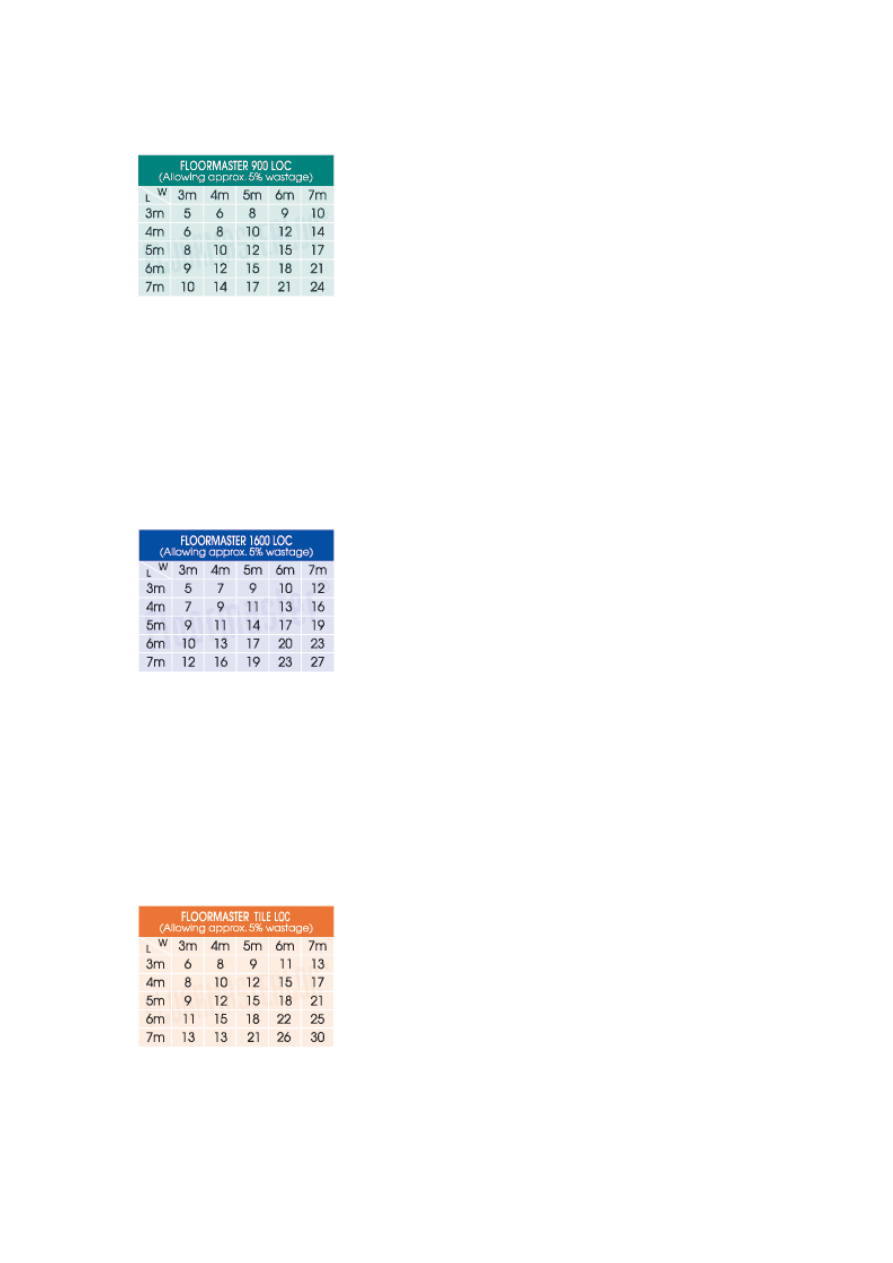
Remembering the length and width of your room, use the
tables below to calculate the number of packs of laminate
flooring you will need.
For example, if your room is 6 metres long and 5
metres wide and you have chosen to use Floormaster
900 LOC laminate flooring, you will need to buy 15
packs of flooring to cover the floor.
Floormaster 900 LOC
LOC laminate flooring
requiring no adhesive.
•
Can be fitted anywhere except bathrooms and
humid areas
•
Resistant against cigarette burns, fading, stains,
impact and scratching
•
Available in wood effects and coloured
Floormaster 1600 LOC
LOC laminate flooring
requiring no adhesive.
•
Water resistant, so can be fitted anywhere
including bathrooms
•
Resistant against cigarette burns, fading, stains,
impact and scratching
•
Available in wood effects and coloured
Floormaster Tile LOC
LOC laminate flooring
requiring no adhesive.
•
Water resistant, so can be fitted anywhere

including bathrooms
•
Resistant against cigarette burns, fading, stains,
impact and scratching
•
Ceramic tile effect, available in a range of colours
Extras
You should not fit your laminate floor right to the edge of the
room. You will need to allow a 10mm gap for it to contract
and expand with the room temperature. Use fitting wedges
(shaped pieces of plastic), included in the fitting kits, to
create this 10mm expansion gap. When the floor has been
laid, the wedges are removed and the gaps can be covered
with skirting or laminate flooring edging trim for a
professional looking finish.
Measure round the perimeter of the room (or add the length
and width measurements of your room together and multiply
by two) to find the length of beading needed to cover the
extension gap.
3
- Laminate Flooring Basics
Laminate flooring is laid as a loose, 'floating' floor. The
boards are not nailed to the floor but simply joined to each
other without the need for nails or screws. This means
laminate flooring can be laid on top of most surfaces,
including timber or concrete, as long as it's dry, clean, and
level.
Choose carefully
In bathrooms or other areas of high humidity, ensure you
select a suitable grade of flooring. The Floormaster 1600
LOC and Floormaster Tile LOC ranges are water resistant
and suitable for bathrooms where the flooring may get wet.
And remember, inappropriate floor covering is always a false
economy, especially where there is a lot of foot traffic or
other wear and tear.
Condition the laminate flooring
Before you lay your laminate flooring, it must be conditioned
to the room's atmosphere. If this is not done it could warp
(become twisted and bent out of shape).
To condition the flooring:
•
Make sure it's kept in its original packaging

•
Put it in the room where the floor will be laid (ideal
temperature of 18
o
C to 20
o
C)
•
Lie the pack horizontally
•
Leave the flooring in this position for at least 48
hours
4
- Sub-Floor Preparation
The floor you intend to lay the laminate flooring on top of
must be dry, firm and level. A floor is considered level if the
deviation in height is less than 1mm over a distance of 1
linear metre. Sheets of fibre-board can be used to level
minor deviations and they have additional acoustic and
thermal properties. Deviations above this must be levelled
out before laying the new floor. The following sections advise
how this should be done, depending on the type of sub-floor
you have.
Wooden sub-floor preparation
•
Remove any protruding nails or tacks to ensure you
have a smooth surface.
•
If you are laying your laminate flooring on an upper
floor, re-fix any loose boards using screws rather
than nails as hammering might damage the ceiling
plaster below.
•
Use a detector to identify if there is any underlying
pipework or electricity cables so that you can avoid
these areas when driving in nails or screws.
•
Smooth any high spots in the floor using a plane,
and fill hollow patches with levelling compound
(sometimes called screed) to make the floor level.
Concrete sub-floor preparation
Some concrete sub-floors have raised 'high' spots of
concrete that can be chipped away with a bolster, but the
easiest way to achieve a smooth surface is with levelling
compound (screed). Simply mix this in a bucket with water,
then pour and spread with a trowel. It will then set to a level
finish.
We recommend that newly laid concrete or screed be
allowed to dry at a rate of 1mm per day prior to fitting
laminate flooring, i.e. 50mm screed = 50 days.
Damp-proof membrane
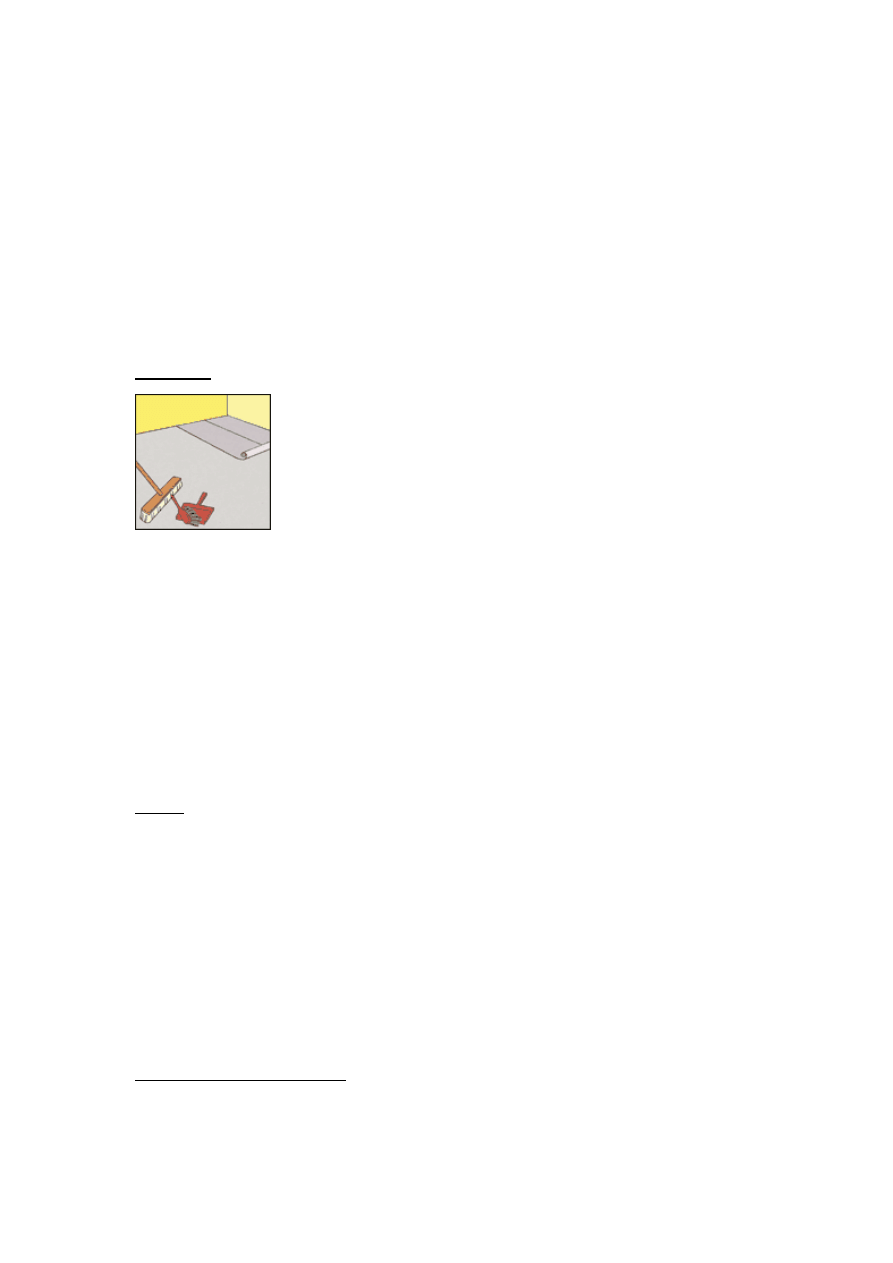
A damp-proof membrane should be fitted to stop any
moisture from damaging the new boards. This is in addition
to a damp course which may already be present in the sub-
floor. The following sub-floors require a damp proof
membrane of 0.2mm thick:
•
concrete
•
vinyl tiles
•
asphalt
•
quarry tiles
Underlay
Once you are sure the sub-floor is
clean, dry and level, you will need to
install underlay prior to laying your
laminate flooring. There are three
types of underlay available:
•
Floormaster Laminate Flooring Underlay - can be
used with all laminate floors
•
Wood Fibre Underlay - has extra acoustic and
thermal properties
•
Combilay - laminate floor underlay and damp
proofing all in one
Doors
Check that your doors will clear the new floor. Place a board
of the laminate flooring you have chosen to lay, together
with any underlay you are using, on top of your sub-floor
and mark off how much of the door (if any) needs to be
planed away.
While you have easy access to your sub-floor, carry
out any plumbing tasks or electrical installations you
have planned.
Cutting laminate flooring
You will need to cut your laminate flooring to fit the shape of
your room, remembering to leave space for items such as
pipework.
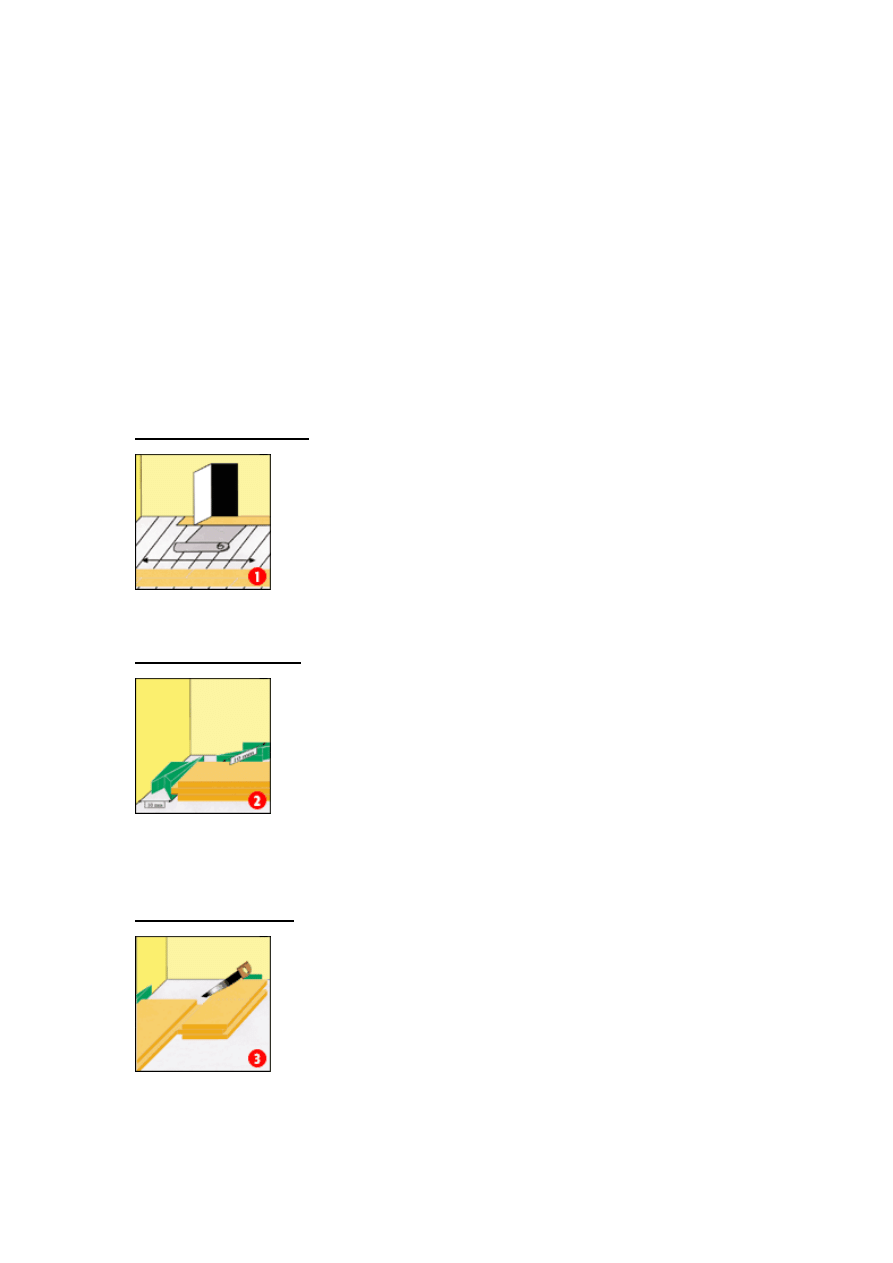
Use a power circular saw with a carbide toothed blade and
cut from the non-decorative underside of the boards to avoid
chipping. Alternatively, use a hand saw and cut from the top
of the boards. Ensure you cut the planks carefully - they are
strong and durable but may chip during cutting if care is not
taken.
5
- Laying a LOC laminate floor
LOC laminate flooring simply 'locs' together, so no adhesive
is required. It is quick and easy to install and can be re-laid
up to six times - but remember that care should always be
taken when doing this.
Choose the direction
Most manufacturers recommend
flooring is laid lengthways, along the
room, running the boards towards the
window if there is one. If you're laying
over floorboards, lay the laminate
boards at 90
o
(right angles) across
them to reinforce the joints (1).
Laying the first row
Lay the first board with the Groove o
small tongue against the wall. Two
spacers should be used to allow for
the 10mm expansion gap between t
boards and the wall (2).
Check alignment and squaring.
Lay the next board against the short
side and fix into place. Once fixed be
very careful if separating the joints a
this may result in damage.
r
he
s
The end of the row
To measure the correct length of
board to use at the end of a row
(allowing for the 10mm gap), place
the final board next to the existing
flooring with the tongues facing each
other. The groove end should be
pushed up to the spacers against the
wall (3).
Cut the required length and turn the
board so that the groove and tongue are together.
Fitting the boards
Fitting the boards
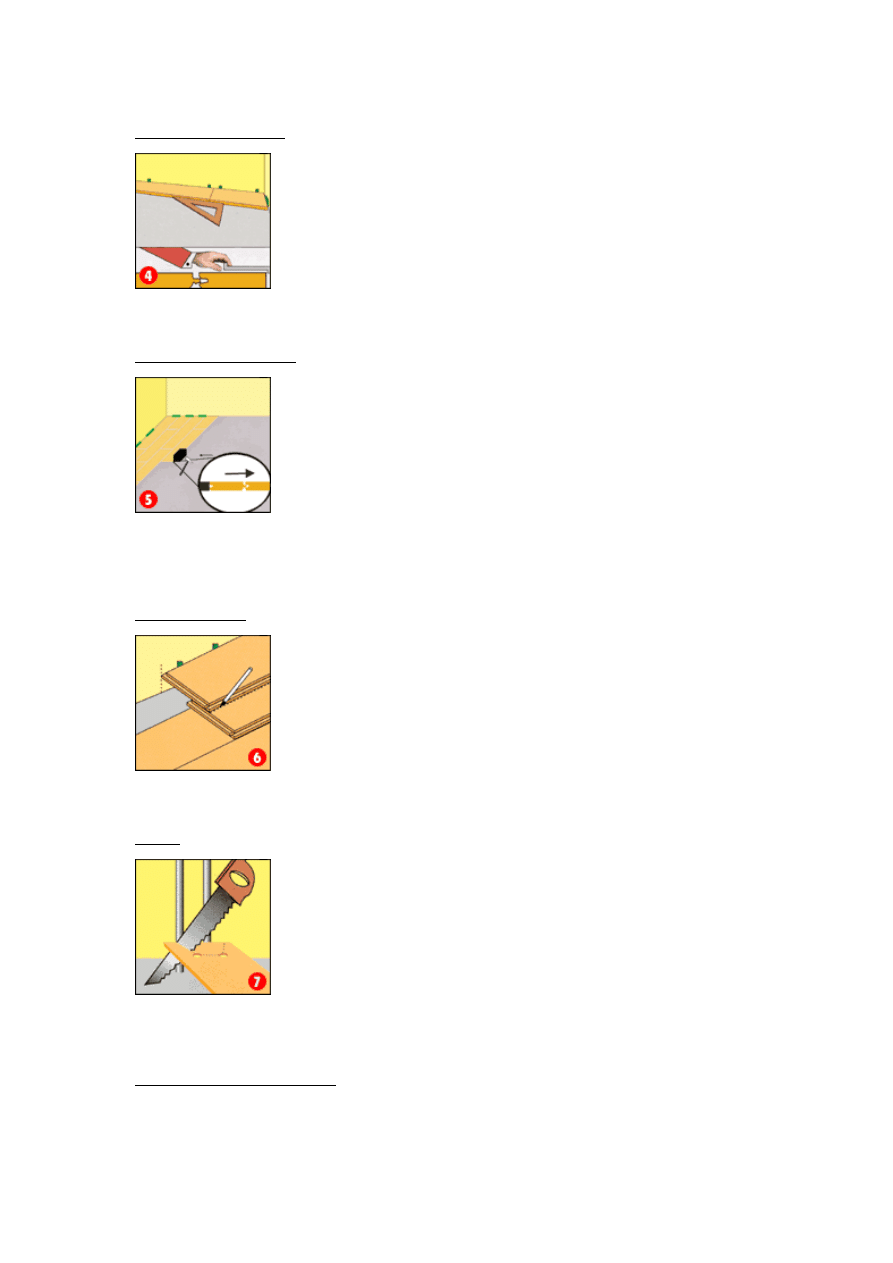
Check that the first row is positioned
correctly and the spacers are in the
right place.
Insert the tongue of the first board at
an angle to 'loc' the boards firmly
together (4).
Starting a new row
When starting to lay a new row of
flooring, make sure that the first
piece you are going to lay is at least
30cm in length.
Remember to stagger the joints
(creating a 'brick wall' effect) when
laying the boards (5) and tap them
together using a tapping block - the
long side first, followed by the short
side.
The final row
When you come to lay the last row,
place a loose board on top of the
previously laid row, then place
another board on top of this with the
tongue touching the wall.
Mark the board underneath so that it
shows the required width (6) and cut
along this line before fitting it.
Pipes
If you need to fit your flooring a
pipes, start by measuring the
diameter of the pipe then drill a hole,
20mm larger than the pipe diameter,
in the laminate board. Saw a section
out of the board which goes through
the hole (7) so that it can be laid
around the pipe and replace the sawn
out section and glue in to place.
round
Mouldings and skirtings

You may need to make minor
adjustments to door mouldings and
skirtings to ensure your new flooring
fits comfortably.
Place a piece of the flooring face d
on to any underlay you are using a
saw the moulding above this board a
the base (8).
Fit the floorboard under the m
remembering to leave a 10mm expansion gap.
own
nd
t
oulding,
Finishing
When you have laid your floor, remove the fitting wedges. If
you are using floor edging to hide the expansion gaps, pin or
glue it to the wall or skirting board (not the floor). Use a nail
punch to drive the pin heads below the surface. Cover holes
made for pipes with pipe covers and glue into place.
To restore your floor's shine, go over the surface with a
broom or vacuum cleaner (with the brushes down). To add
extra shine to your newly installed floor, use a laminate floor
cleaner.
Laminate flooring repair kits are available should your new
floor suffer any damage. Please refer to the product
instructions for advice on ongoing care and maintenance.
If you require additional advice on fitting a laminate floor,
please contact the Floormaster Helpdesk on 01276 410200.
Wyszukiwarka
Podobne podstrony:
skład chemia LAMINATE FLOOR LIQUID clean & care
Floor beam ver 1 Student id 178 Nieznany
Luftwaffe Hangar, hangar floor
Ceramic Floor Tile
Laminarna i turbulentna warstwa Nieznany
FreeNRG Notes from the edge of the dance floor
przepływ laminarny poprawa
Rozdklad predkosci laminarny
przeplyw laminarny
sprawko' Przepływ laminarny
wykład IV biologia molekularna najwazniejsze o laminach
ruch laminarny2, Księgozbiór, Studia, Mechanika Płynów i Dynamika Gazów
instrukcja ksero-laminator
77 Klasyczne doświadczenie Reynolsa Ruch laminarny i turbulentny
RUCH LAMINARNY I BURZLIWY W KANAŁACH
przepływ laminarny
więcej podobnych podstron