
Integrating Connected Vehicles in Internet of Things
Ecosystems: Challenges and Solutions
Soumya Kanti Datta, Rui Pedro Ferreira Da Costa, Jérôme Härri, Christian Bonnet
Communication Systems Department, EURECOM, Biot, France
Emails: {dattas, ferreira, haerri, bonnet}@eurecom.fr
Abstract—Vehicles are becoming the next frontiers for
Internet of Things (IoT) based platforms and services. Connected
vehicles, Intelligent Transportation Systems (ITS) together with
IoT technologies have the potential of unleashing efficient and
more sustainable transportation system which is fast becoming
an important societal challenge. This paper formulates several
main research and engineering challenges for integrating
connected vehicles into IoT ecosystems. The challenges include –
(i) a suitable alternative of cloud platform to support real time
connected vehicular scenarios, (ii) uniform description and data
collection mechanisms from vehicular sensors, (iii) integrating
smart devices into transport systems, (iv) uniform mechanism for
data fusion and analytics and (v) integrating all heterogeneous
elements into a standard IoT architecture for connected vehicles.
To mitigate these challenges, we propose a novel IoT framework.
The solutions, operational phases of the framework, software
elements & their implementations and advantages are described
in details. The building blocks of the framework are integrated
into an oneM2M standard architecture. Finally, the paper
concludes with best practice recommendations and lessons learnt
from the prototyping.
Keywords—Connected vehicle; Internet of Things; Intelligent
Transportation System; Named Data Networking; oneM2M
architecture; V2X communication; Web of Things.
I.
I
NTRODUCTION
With the ongoing wave of modernization of city
infrastructures, "always-connected" trend, strict emission
standards for vehicles, the necessity of improving efficiency
and safety of transport have made the development of more
sustainable transportation systems one of the fundamental
societal challenges. Intelligent transportation systems (ITS) and
connected vehicles together with the Internet of Things (IoT)
have the potential of providing a more efficient and sustainable
transportation systems that minimizes the impact on the
environment. To enable connected vehicles, it is of paramount
importance to - (i) design V2X communication systems
allowing relevant actors to exchange information in real time
and with high reliability, (ii) integrate sensing devices to
monitor the vehicular and their environmental conditions, (iii)
deploy middleware for local data processing, data
management, repository and (iv) seamless integration of
vehicular communication networks, mobile devices and
deployment platforms. However, these are not sufficient to
integrate connected vehicles into an IoT ecosystem. To
accomplish that, there must be additional ingredients including
– (i) data fusion platform that combines sensor data from
multiple domains, (ii) scopes of resource discovery to search
for intended sensors, actuators in the vehicles, (iii) data
representation and storage subsystems, (iv) network and low
power communication protocols and more. Towards that goal,
we consider the vehicles as a resource for the IoT ecosystems
to provide consumer centric services in connected vehicle
domain. We provide two use cases to for illustration in this
context. Consider a connected vehicle which is equipped with
sensors and an On Board Unit (OBU). A smart city application
(running in a cloud) procuring data to measure air and noise
pollutions in the city could discover if any connected vehicle
has such sensors and obtain data from them. This allows the
city to utilize the existing vehicular infrastructures to obtain
real time data for an IoT application without deploying new
infrastructure. As a result, the city can save resources. The city
dwellers can connect to the application to look into the noise
and air pollution level into different regions and modify their
route to destinations. This is a consumer centric IoT service
that benefits from connected vehicle resources. Similarly,
autonomous vehicles can also take advantage of IoT platforms.
If an IoT application deduces that there is fog in the
environment through which the autonomous vehicle is driving,
the application can send that information (fog) as a derived
intelligence to the vehicle (consumer in this context) and some
suggestions (reducing speed and turning on fog lamps). Such
computation must be deployed to a (edge computing) platform
located near to the vehicles since the autonomous vehicles need
to react to their environment in real time. These two use cases
clarify the integration of connected vehicles into the IoT
ecosystem and the related consumer centric services.
Bringing connected vehicles, ITS and IoT together cerates
several research challenges due to the mobility, nature of
communication technologies and many other factors. Seven
main challenges are identified and explained below.
• The Cloud based IoT platforms and services depend
heavily on RESTful web services and IP technologies
to provide interoperability and ease of development.
The automotive industry is currently examining the
potential of using IPv6 natively to connect vehicles
with any cloud platform [1]. But the cloud dependent
scenarios would be prone to higher latency and less
QoS and are not suitable for real time applications.
Given the nature of safety and highly autonomous
vehicular scenarios, it is important to evaluate edge
computing platforms [2].
• With the inclusion of many heterogeneous sensors and
actuators into vehicles, data collection using a uniform
mechanism is becoming another challenge. The data
collection is also coupled with data communication to
the network access points (Road Side Units in most
cases). Descriptions of the sensors as well as their
configurations are also necessary to investigate.
• Mobile (smart) device integration in vehicle and
transport systems can pave way for collecting the data
about the vehicular environment. Combining the
vehicular sensor data with environment data at a
computing platform is challenging since the data
formats and contents are different as well as there is no
standard mechanism for the data fusion.
• Collecting and communicating sensor data and maps
(for autonomous vehicles) are two basic pillars for
enabling data fusion and data analytics which can
derive high level intelligence. This in turn can be used
to send notifications to the highly autonomous vehicles
to react to the driving environment. This challenge
relates to data processing and actuation.
• Current cloud based IoT platforms utilize the
underlying IP infrastructure for dissemination of
derived the high level intelligence from raw data. But
IP communication was neither designed to support
mobility natively nor is data centric. Therefore,
Information Centric Networking (ICN) [8] should be
used.
• Seamless integration of vehicular network, mobile
devices, edge computing and storage platform pose
numerous challenges since all these building blocks are
heterogeneous in terms of their natures, capabilities,
dependencies on infrastructure and software elements.
This can be solved by focusing on IoT data centric
aspects rather than the infrastructure and
communication networks. This will decouple the
dependencies among the building blocks and promote
interoperability.
• Beside these, there is an engineering challenge in terms
of integrating the connected vehicle resources into a
standard IoT architecture. This is a challenge due to the
emergence of several competing IoT standards
(oneM2M, IEEE P2413) and ongoing efforts from
W3C Web of Things and Automotive Working Group.
This paper introduces a novel IoT framework that mitigates
the above challenges to integrate connected vehicles as a part
of IoT ecosystems. The main contributions of the paper are –
(i) designing an IoT framework that includes an edge
computing system for the connected vehicles to offer consumer
centric services, (ii) uniform mechanism for describing and
collecting data from vehicular sensors, (iii) integrating smart
devices as a part of the overall system, (iv) mechanism for
sensor data fusion from multiple domains leading to novel
applications, (v) integration of Named Data Networking
(NDN) for dissemination of high level intelligence to the
vehicles, (vi) seamless interoperation among building blocks of
the framework and (vii) integration of the IoT framework into
oneM2M architecture. Combining all these building blocks
connected vehicles can truly transform into a smart vehicle
within a much larger IoT ecosystem.
The rest of the paper is organized as follows. Section II
portrays the IoT framework, describes the novel approaches to
solve the mentioned challenges. Section III discusses its
prototype implementation and integration into oneM2M
standard architecture. Section IV concludes the lessons learnt
for the prototyping and best practice recommendations.
II. P
ROPOSED
I
O
T
F
RAMEWORK
I
NTEGRATING
C
ONNECTED
V
ECHICLES
This section concentrates on the proposed IoT framework
for connected vehicles, its building blocks, software elements,
their operation phases and benefits. The mechanisms employed
to mitigate the mentioned research and engineering challenges
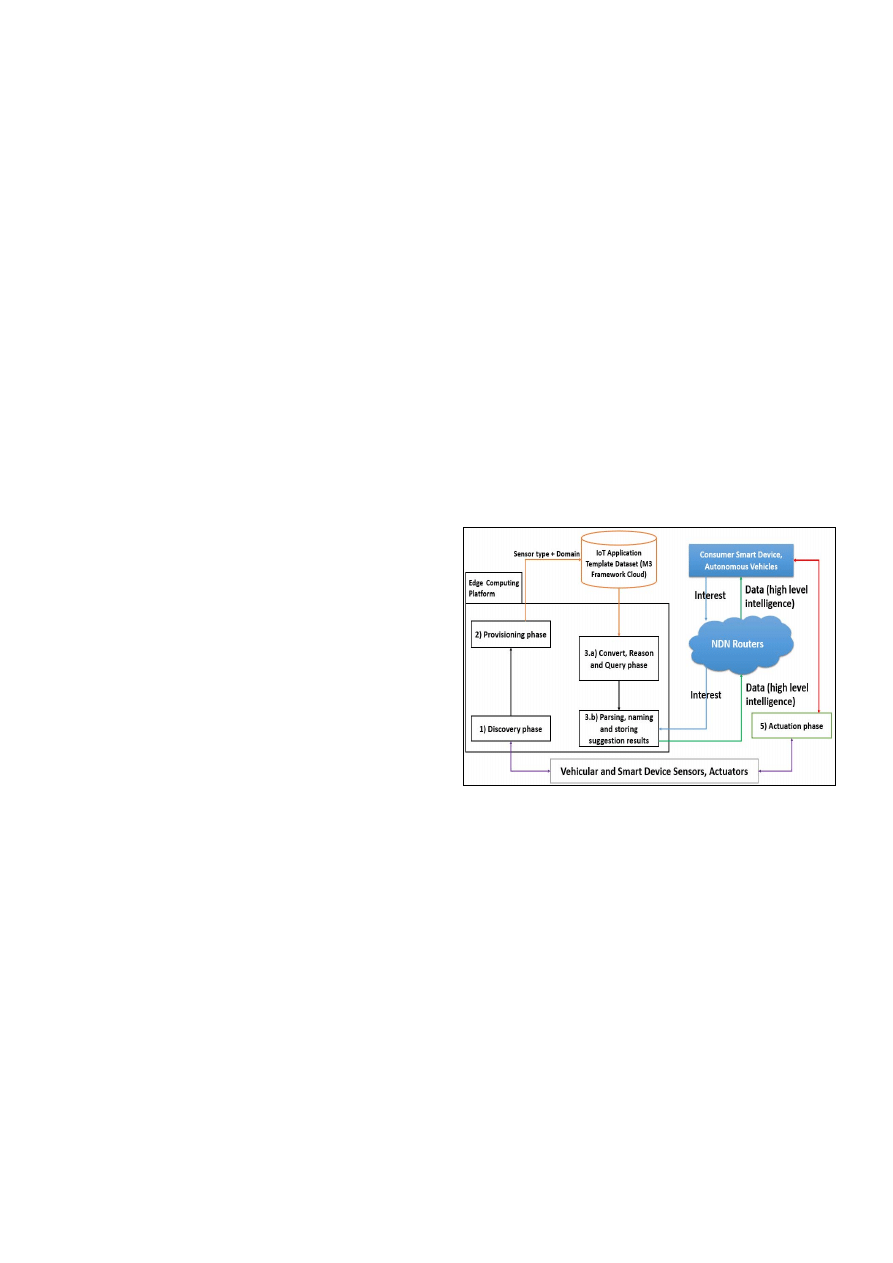
are also described in details. Figure 1 depicts the proposed
framework. It promotes a data driven approach and attempts to
be independent of the deployed infrastructure. The
performance and functional requirements have been presented
in [14].
The framework primarily utilizes an edge computing
platform to support network switching, resource discovery,
provisioning, local processing for data fusion and storage of the
high level intelligence for vehicular scenarios. The cloud
platform is used as a repository for ontologies, datasets and
SPARQL queries used in semantic web based data fusion [9] in
the edge server. Utilizing semantic web technologies provide
benefits in terms of interoperability in uniform descriptions of
vehicular and smart device sensors and actuators as well as
providing uniform treatment of data leading to data fusion. The
building blocks of the framework and their novelties are
described below.
Fig. 1. Novel IoT Framework to connected vehicles in IoT ecosystems.
A. Discovery phase
With Internet of Things advocating for an ecosystem that
operates with very less human involvement, discovery of
resources is becoming highly important. This phase allows
searching for vehicles, smart devices and associated things
(sensors and actuators). To facilitate discovery of these
resources, their capabilities and means to access them, the
configuration of the resources need to be described. But
uniform description of the heterogeneous sensors and actuators
with uniform vocabulary is a challenge. Semantic based
descriptions can address with providing additional benefit of
easing their use in semantic web based data fusion later. To
enable discovery, the vehicles must register themselves and
associated things into an edge computing platform. The sensors
and actuators are described in terms of events, properties and
actions and the descriptions can be created at the OBU or a
vehicular gateway. This allows the resource discovery element
to not only deduce thing type and domain of operation but also
allows to infer additional information based related to its
functionalities. Thus, a greater granularity is added to the
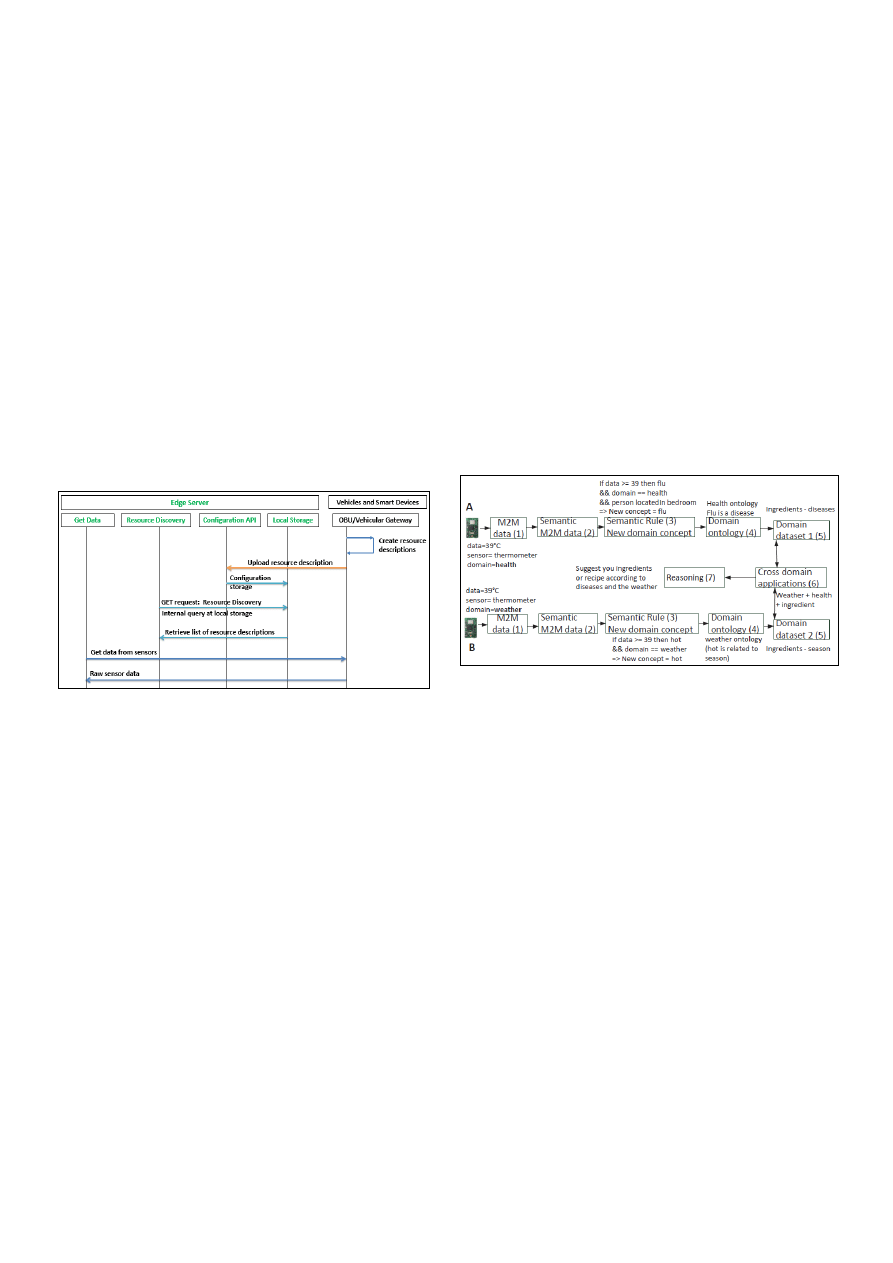
overall IoT framework. The operational steps used in this phase
are highlighted Figure 2. The OBU or vehicular gateway
produces resource descriptions which are communicated to the
edge server over a network access technology. The
“Configuration API” extracts the actual descriptions and
caches them locally. During the discovery phase, the API for
resource discovery triggers a mechanism that involves
searching in a local storage directory for required resources.
The response includes a list of descriptions from which means
to interact with the resources to get raw data can be obtained.
The sensors are multimodal as well as heterogeneous which
can be settled using Sensor Markup Language (SenML). It
allows encoding the measurement along with attributes like
unit, type, timestamp, software version, name and ID creating a
metadata. The discovery phase mitigates the challenges related
to uniform data collection and resource description. Also it
allows the smart device sensors to be included in the discovery
process setting the basis of smart device integration in
connected vehicle scenarios.
Fig. 2. Operational steps of discovery phase.
B. Provisioning phase
The provisioning phase prepares the edge server for
vehicular and other domains’ data fusion and analytics [13].
The discovery phase retrieves a set of available sensors to
provide raw metadata. This phase looks for resource type and
domain of operation (from SenML metadata and descriptions)
The provisioning information is communicated to a cloud
computing platform (shown in Figure 1) that houses a semantic
web framework called Machine-to-Machine Measurement
(M3) framework [3], [12]. It contains the necessary application
development templates (comprising of ontologies, datasets,
rules for semantic reasoning and SPARQL queries) for data
fusion and analytics. The appropriate template for the scenario
in question is downloaded into the edge computing platform in
real time.
C. Data fusion, analytics and storage phase
This phase tackles the research challenges related to
transforming raw data originating at vehicular and smart device
sensors into a high level intelligence. It can be perceived by
onboard passengers and autonomous vehicles. The intelligence
can also be used to send commands to actuators allowing the
connected vehicles to react to the environment. Toward this
objective, this paper utilizes semantic web technologies for
data fusion. This provides twofold advantages – (i) uniform
treatment of SenML metadata (M2M Data in Figure 3) into
high level intelligence providing interoperability at IoT data
level, (ii) making the overall process independent of the
underlying V2X communication network and infrastructure.
The downloaded template (in previous step) is capable
combining sensor metadata coming from different domains
through the steps shown in Figure 3 [3]. The received metadata
(at the edge server) must be converted into RDF (i.e. Semantic
M2M data) before semantic rules can be applied on them to
determine new domain concept. It is then classified according
to domain ontology and domain dataset is applied on that
setting the step for cross domain application. Following the
reasoning in the final step which completes the data fusion and
analytics, a high level intelligence is derived. It is locally
cached and indexed according to the named data networking
(NDN) naming convention. Apart from that, an interesting
engineering challenge in this phase is to develop a lightweight
version of the M3 framework suitable to run on an edge
computing platform. This has been accomplished and detailed
in the Section III.
Fig. 3. Steps towards sensor data fusion and analytics.
D. Data dissemination phase
The inherent challenge here is to address the mobility while
disseminating the derived intelligence. As mentioned before,
the IP technology that is used widely does not support mobility
natively. This is overcome using Named Data Networking
(NDN), a kind of ICN, for data dissemination. NDN does not
need host name resolution and provides scalability, usability,
data security by design and support for mobility. NDN
philosophy is based on two types of packets namely interest
and data. The interest packets correspond to the interest of
onboard passengers and/or the autonomous vehicles. For
example, if the fuel level sensor metadata indicates that the fuel
level is low, the connected vehicle can ask for nearest fuel
stations as interest. Each of such interests are represented using
an URI and is forwarded to a set of NDN routers which route
the interest packet towards the node with corresponding data
(for this example, the GPS co-ordinates of the nearest fuel
stations). Dissemination of the high level intelligence resulted
from the data fusion is done over NDN [11].
E. Actuation phase
During this phase, the smart mobile devices of passengers
and/or the autonomous vehicles can take decisions and send
commands to the vehicular actuators to react to the
environment or situation. If an autonomous vehicle receives an
indication that it is driving in a foggy environment, it can send
a command to its fog lamps to turn them on.
The software elements for resource discovery, provisioning,
data fusion, analytics and dissemination are deployed in mobile
edge computing platforms. Due to their geographical
distribution, closeness to the vehicles and lightweight
implementation, the framework operates in real time ensuring
consumer centric IoT services. All phases combined together
solves the main challenge and establishes edge computing
platforms as a suitable alternative of cloud platform for
connected vehicles. In essence, the proposed IoT framework
accomplishes – (i) integration of heterogeneous resources in
connected vehicles and consumer smart devices into an IoT
platform, (ii) provide uniform mechanisms to describe
resources and exchange their data, (iii) fusion of sensor data
originating at multiple domains and (iv) incorporate NDN for
data dissemination which is independent of mobility. These are
also the advantages of adopting this framework for
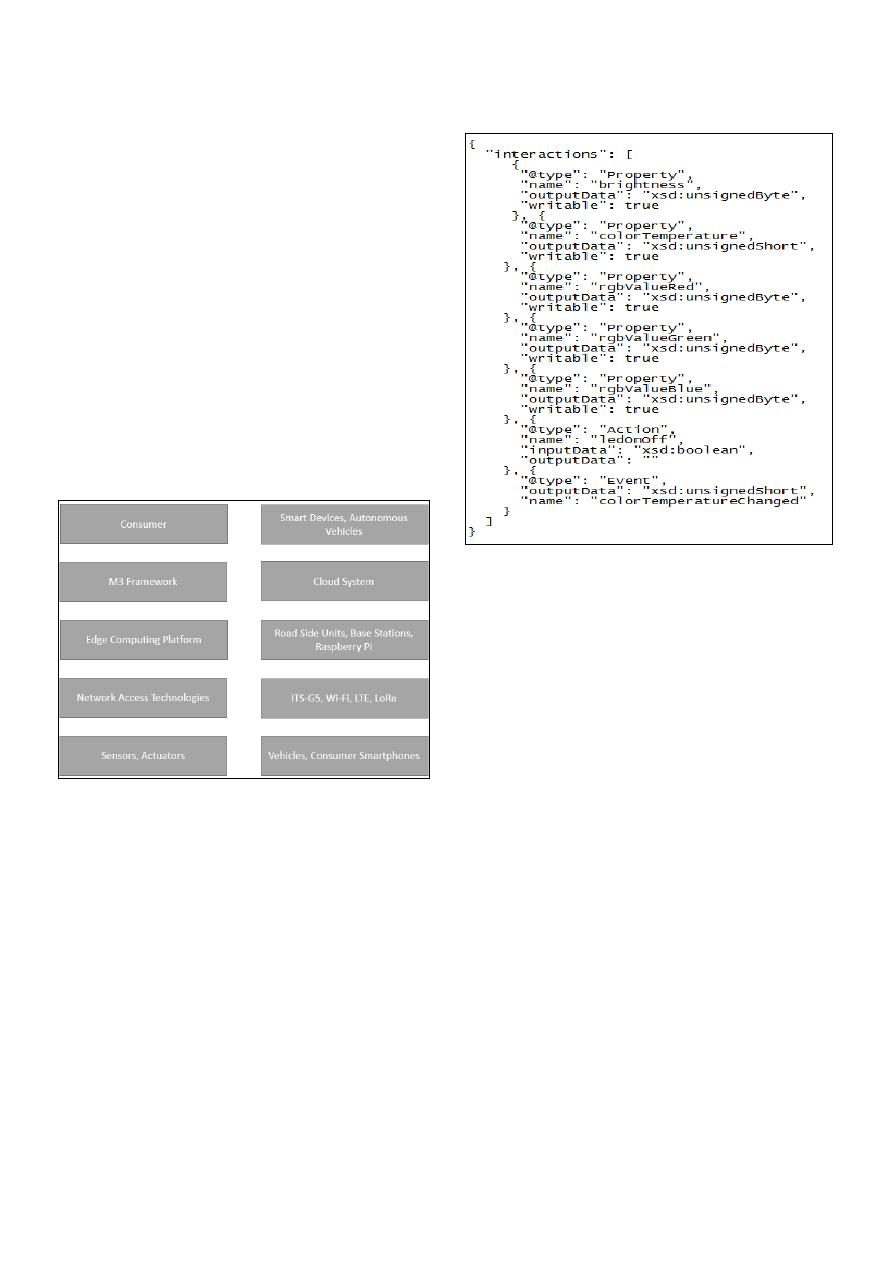
development. A mapping of the framework elements into
physical infrastructure is shown below. The left column shows
the high level elements from the proposed architecture and the
right column depicts their corresponding infrastructure.
Fig. 4. Mapping of framework elements with physical insfrastructure.
III. I
MPLEMENTATION AND
I
NTEGRATION INTO ONE
M2M
A
RCHITECTURE
This section focuses on prototyping details of the IoT
framework for connected vehicles and its integration into
oneM2M standard architecture. They address the challenges
related to lightweight implementation of the framework and its
integration into an IoT standard. Seamless interoperability
among the elements are also highlighted.
A. Uniform mechanism for resource description and data
exchange
JSON for Linked Data (JSON-LD) [10] is utilized for the
semantic based descriptions of vehicular and smartphone
resources (sensors, actuators). Figure 5 shows an example of
description (in terms of events, properties and actions) of a
LED of a connected vehicle.
Fig. 5. Example of a LED light description for an connected vehicle.
The uniform sensor data exchange has been carried out
using SenML. It is implemented using JSON and an example
is shown below.
{"e": [{"n": "Engine-Temp", "v": 30, "u": "Cel", "t":
"1380897199”, “ver”: “1.2”, “type”: “Temperature”,
“domain”: “automotive”}]
In the above example, the temperature sensor is called
“Engine-Temp” which is giving a value of thirty degrees
Celsius at the given time. The SenML software version is 1.2
and the domain of operation is automotive. The metadata
provides enough information to enable data fusion and
analytics at a later stage. Utilizing JSON eases development of
the software elements.
B. Resource discovery and provisioning
The resource discovery element is shown in Figure 6 [5]
and makes use of resource descriptions. The software
development of the element has been done using python and
Flask framework. The functionalities of resource discovery are
exposed through RESTful web services. making the IoT
framework compliant with Web of Things best practices [6].
The element includes a proxy layer to accommodate the
different communication technologies and protocols used by
the heterogeneous things. This allows a broad range of things
to be included in the overall IoT framework. The discovery
request is analyzed by a search engine which looks for
appropriate things in the configuration registry. The lifetime
attribute is analogous to a time duration during which a vehicle
remains discoverable by an edge server implementing the
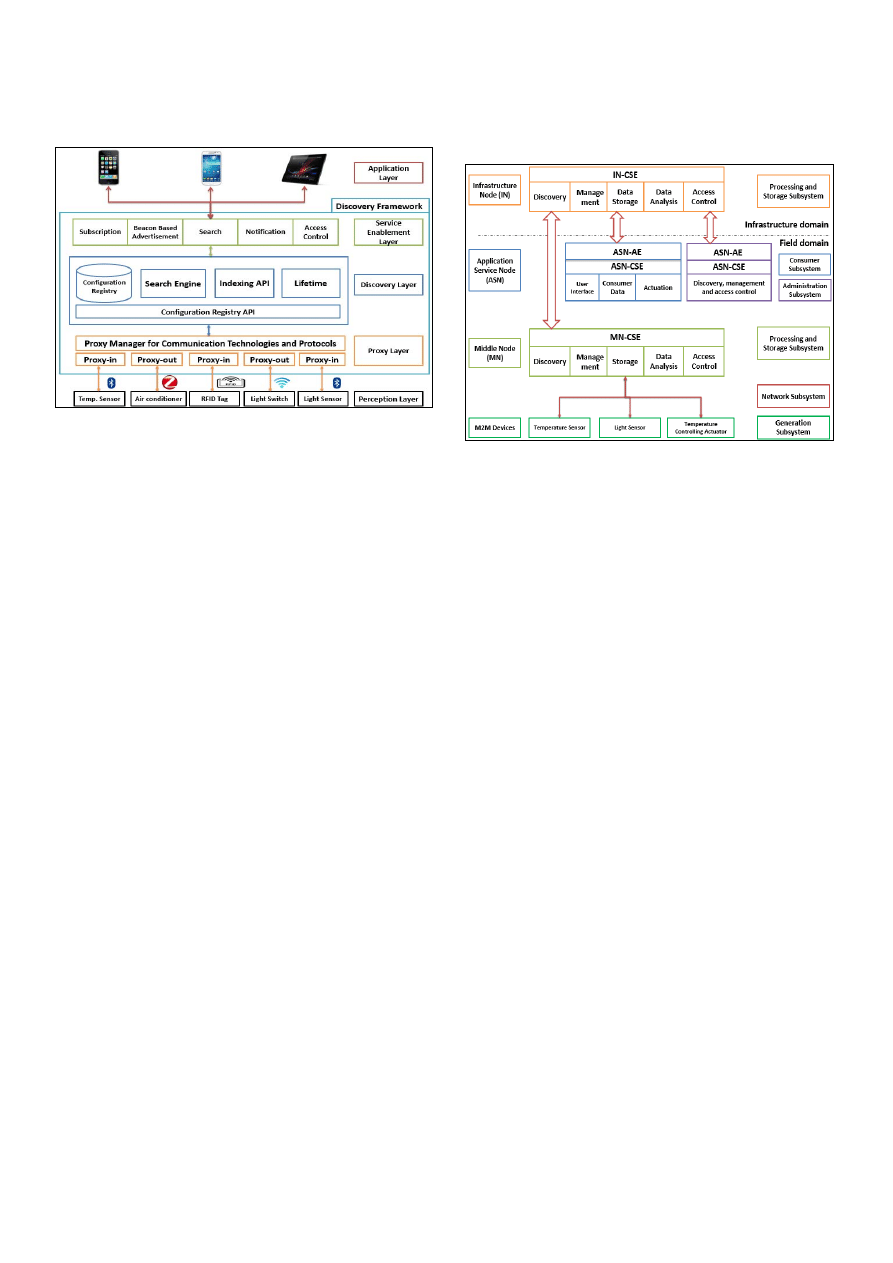
discovery aspect. Following the discovery, the provisioning of
sensor type and its domain is done by the edge computing
platform through its embedded intelligence.
Fig. 6. Resource discovery framework.
C. Data fusion using semantic web technologies
Based on provisioning, IoT application template for data
fusion is downloaded from a Google Cloud Platform housing
the M3 framework. It has been developed using Apache Jena
Framework. To support the semantic web treatment and data
fusion of the vehicle sensor data with environmental sensor
data at the edge computing platform, it is necessary that the
platform supports Jena Framework. For edge servers
supporting that, M3 capabilities could run directly. But to
create a lightweight implementation for the data fusion,
AndroJena is considered. It is a lightweight Jena Framework
library intended for Android powered devices. Our edge server
runs on an Android powered device.
D. Dissemination of derived intelligence and actuation
Thereafter, the NDN functionalities are integrated
following the CCNx implementation which can be found at [7].
The main code base for CCNx (provided by PARC) is written
in C language. Consumer systems create and propagate
interests which are forwarded by NDN routers [16] to a
“producer” that has data corresponding to the interests. The
data then follows the reverse path to the “consumer”.
Finally, the actuation is done using SenML extensions [4].
For seamless interoperation, the first all phases except the
dissemination are implemented using RESTful web interfaces.
No dependence on infrastructure also promotes interoperation.
E. Integration into oneM2M architecture
The entire building blocks, software elements of the IoT
framework are integrated into oneM2M standard architecture
(shown in Figure 7) to further promote interoperability with
similar frameworks. The M2M devices map into the vehicular
and smart device sensors and actuators. The middle node
houses the software elements for resource discovery,
management, storage, data fusion & analytics and access
control and is mapped to the edge server of the IoT framework.
The infrastructure node is analogous to the Google Cloud
Platform housing the entire M3 framework. The connected
vehicle based consumer centric application logic runs into
smart device or the vehicle itself. In most of the cases, this
logic is running onto the smart devices as an application. The
details of the taxonomy and oneM2M capabilities are discussed
in [13].
Fig. 7. oneM2M architecture integrating the IoT framework.
F. Prototype evaluation
Early evaluation of the software elements has been done in
terms of memory footprints. Both the JSON-LD based
descriptions and SenML sensor data typically consume 500 –
900 bytes. The python script implementing the web services
for discovery and provisioning require less than 10KB of
memory. The data fusion element is utilizing many semantic
web components for which its memory footprint is around
10MB. The overall CPU consumption in accomplishing the
operations of the framework amount to 6% (on an average).
Measuring the memory and CPU metrics, the developed
platform can be considered as lightweight and highly scalable.
This is another novel aspect of the paper.
IV. C
ONCLUSION
In a nutshell, the paper attempts to outline the challenges
and solutions for integrating connected vehicles into IoT
ecosystem. We present an IoT Framework to address the
challenges, describe the building blocks, operational phases
and practical implementations of the software elements. We
recommend open & RESTful web interfaces, JSON based
implementations and utilization of semantic web technologies
for seamless interoperation among the architectural building
blocks. An important aspect of the prototyping experience was
to create lightweight software paving way for scalability while
maintaining usability and reliability of the overall
functionalities. Integration of the entire IoT framework into
oneM2M and mapping of the elements are also mentioned. As
for future work, we are concentrating on expanding the
ecosystem bringing together components from ITS, IoT, edge
& cloud computing, big data and connected vehicles paving
way for the Internet of Vehicles (IoV) [15]. IoV could be
efficiently utilized in cooperative ITS and cooperative mobility
management. Towards that goal, we are also studying the
possibility of developing and deploying a test bed for IoV.

A
CKNOWLEDGMENT
This work has been performed within the frame of the
French research project DataTweet (ANR-13-INFR-0008) and
the HIGHTS project funded by the European Commission
(636537-H2020).
R
EFERENCES
[1] P. Matzakos, J. Härri, B. Villeforceix and C. Bonnet, "An IPv6
architecture for cloud-to-vehicle smart mobility services over
heterogeneous vehicular networks," Connected Vehicles and Expo
(ICCVE), 2014 International Conference on, Vienna, 2014, pp. 767-772.
[2] S. K. Datta, C. Bonnet and J. Haerri, "Fog Computing architecture to
enable consumer centric Internet of Things services," Consumer
Electronics (ISCE), 2015 IEEE International Symposium on, Madrid,
2015, pp. 1-2.
[3] A. Gyrard, S. K. Datta, C. Bonnet and K. Boudaoud, "Cross-Domain
Internet of Things Application Development: M3 Framework and
Evaluation," Future Internet of Things and Cloud (FiCloud), 2015 3rd
International Conference on, Rome, 2015, pp. 9-16.
[4] S. K. Datta, C. Bonnet and N. Nikaein, "An IoT gateway centric
architecture to provide novel M2M services," Internet of Things (WF-
IoT), 2014 IEEE World Forum on, Seoul, 2014, pp. 514-519.
[5] S. K. Datta, R. P. F. Da Costa and C. Bonnet, "Resource discovery in
Internet of Things: Current trends and future standardization aspects,"
Internet of Things (WF-IoT), 2015 IEEE 2nd World Forum on, Milan,
2015, pp. 542-547.
[6] S. S. Mathew, Y. Atif, Q. Z. Sheng and Z. Maamar, "Web of Things:
Description, Discovery and Integration," Internet of Things
(iThings/CPSCom), 2011 International Conference on and 4th
International Conference on Cyber, Physical and Social Computing,
Dalian, 2011, pp. 9-15.
[7] The CCNx project, http://blogs.parc.com/ccnx/.
[8] P. TalebiFard et al., "An Information Centric Networking approach
towards contextualized edge service," Consumer Communications and
Networking Conference (CCNC), 2015 12th Annual IEEE, Las Vegas,
NV, 2015, pp. 250-255.
[9] A. Gyrard, C. Bonnet and K. Boudaoud, "Enrich machine-to-machine
data with semantic web technologies for cross-domain applications,"
Internet of Things (WF-IoT), 2014 IEEE World Forum on, Seoul, 2014,
pp. 559-564.
[10] S. K. Datta, and C. Bonnet, "Describing Things in the Internet of
Things," Consumer Electronics-Taiwan (ICCE-TW), 2016 IEEE
International Conference on, Taiwan, 2016.
[11] S. K. Datta, and C. Bonnet, " Integrating Named Data Networking in
Internet of Things Architecture," Consumer Electronics-Taiwan (ICCE-
TW), 2016 IEEE International Conference on, Taiwan, 2016.
[12] A. Gyrard, S. K. Datta, C. Bonnet and K. Boudaoud, "Standardizing
generic cross-domain applications in Internet of Things," Globecom
Workshops (GC Wkshps), 2014, Austin, TX, 2014, pp. 589-594.
[13] S. K. Datta, A. Gyrard, C. Bonnet and K. Boudaoud, "oneM2M
Architecture Based User Centric IoT Application Development," Future
Internet of Things and Cloud (FiCloud), 2015 3rd International
Conference on, Rome, 2015, pp. 100-107.
[14] S. K. Datta, C. Bonnet, R. P. F. Da Costa and J. Haerri, “DataTweet: An
Architecture Enabling Data-Centric IoT Service”, Region Ten
Symposium, IEEE, Bali, 2016.
[15] F. Yang, S. Wang, J. Li, Z. Liu and Q. Sun, "An overview of Internet of
Vehicles," in China Communications, vol. 11, no. 10, pp. 1-15, Oct.
2014.
[16] H. Yuan, T. Song and P. Crowley, "Scalable NDN Forwarding:
Concepts, Issues and Principles," 2012 21st International Conference on
Computer Communications and Networks (ICCCN), Munich, 2012, pp.
1-9.
Wyszukiwarka
Podobne podstrony:
081124 NR 641 child injured by ISAF vehicle in Kama district doc
Rainbow Connection inst in B
Rainbow Connection inst in Es
Rainbow Connection inst in C
Mekton Instant Vehicle Plug In
HONDA in Vehicle Entertainment System
BMW OBD II vehicle diagnostic connector pinout
The energy consumption and economic costs of different vehicles used in transporting woodchips Włoch
zooming in and out connecting individuals and collectivities at the frontiers of organizational netw
Full Toroidal Variable Drive Transmission Systems in Mechanical Hybrid Systems From Formula 1 to Ro
A Change in Their Connections
A unified prediction of computer virus spread in connected networks
integration and radiality measuring the extent of an individuals connectedness and reachability in a
PROGRESS IN ESTABLISHING A CONNECTION BETWEEN THE ELECTROMAGNETIC ZERO POINT FIELD AND INERTIA
Viruses in France The French Connection II
Irish Scottish Connections in the First Millennium AD
Education in Poland
Participation in international trade
więcej podobnych podstron