Originally published in:
Collected Papers on Analytical Psychology
(1916)

In that wide field of psychopathic deficiency where Science has demarcated the
diseases of epilepsy, hysteria and neurasthenia, we meet scattered
observations concerning certain rare states of consciousness as to whose
meaning authors are not yet agreed. These observations spring up sporadically
in the literature on narcolepsy, lethargy, automatisme ambulatoire, periodic
amnesia, double consciousness, somnambulism, pathological dreamy states,
pathological lying, etc.
These states are sometimes attributed to epilepsy, sometimes to hysteria,
sometimes to exhaustion of the nervous system, or neurasthenia, sometimes
they are allowed all the dignity of a disease sui generis. Patients occasionally
work through a whole graduated scale of diagnoses, from epilepsy, through
hysteria, up to simulation. In practice, on the one hand, these conditions can
only be separated with great difficulty from the so-called neuroses, sometimes
even are indistinguishable from them; on the other, certain features in the
region of pathological deficiency present more than a mere analogical
relationship not only with phenomena of normal psychology, but also with the
psychology of the supernormal, of genius. Various as are the individual
phenomena in this region, there is certainly no case that cannot be connected
by some intermediate example with the other typical cases. This relationship in
the pictures presented by hysteria and epilepsy is very close. Recently the view
has even been maintained that there is no clean-cut frontier between epilepsy
and hysteria, and that a difference is only to be noted in extreme cases.
Steffens says, for example "We are forced to the conclusion that in essence
hysteria and epilepsy are not fundamentally different, but that the cause of the
disease is the same but is manifest in a diverse form, in different intensity and
permanence."
The demarcation of hysteria and certain borderline cases of epilepsy, from
congenital and acquired psychopathic mental deficiency, likewise presents the
greatest difficulties. The symptoms of one or other disease everywhere invade
the neighbouring realm, so violence is done to the facts when they are split off
and considered as belonging to one or other realm. The demarcation of

psychopathic mental deficiency from the normal is an absolutely impossible
task, the difference is everywhere only " more or less." The classification in the
region of mental deficiency itself is confronted by the same difficulty. At the
most, certain classes can be separated off which crystallise round some well-
marked nucleus through having peculiarly typical features. Turning away from
the two large groups of intellectual and emotional deficiency, there remain
those deficiencies coloured pre-eminently by hysteria or epilepsy (epileptoid)
or neurasthenia, which are not notably deficiency of the intellect or of feeling.
It is pre-eminently in this region, insusceptible of any absolute classification,
that the above-named conditions play their part. As is well known, they can
appear as part manifestations of a typical epilepsy or hysteria, or can exist
separately in the realm of psychopathic mental deficiency, where their
qualifications of epileptic or hysterical are often due to the non-essential
accessory features. It is thus the rule to count somnambulism among
hysterical diseases, because it is occasionally a phenomenon of severe
hysteria, or because mild so-called hysterical symptoms may accompany it.
Binet says: " Il n'y a pas une somnambulisme, etat nerveux toujours identique
a lui-meme, il y a des somnambulismes." As one of the manifestations of a
severe hysteria, somnambulism is not an unknown phenomenon, but as a
pathological entity, as a disease sui generis, it must be somewhat rare, to
judge by its infrequency in German literature on the subject. So-called
spontaneous somnambulism, resting upon a foundation of hysterically-tinged
psychopathic deficiency, is not a very common occurrence and it is worth while
to devote closer study to these cases, for they occasionally present a mass of
interesting observations.
Case of Miss Elise K ., aged 40, single ; book-keeper in a large business ; no
hereditary taint, except that it is alleged a brother became slightly nervous
after family misfortune and illness. Well educated, of a cheerful, joyous nature,
not of a saving disposition, she was always occupied with some big idea. She
was very kind-hearted and gentle, did a great deal both for her parents, who
were living in very modest circumstances, and for strangers. Nevertheless she
was not happy, because she thought she did not understand herself. She had

always enjoyed good health till a few years ago, when she is said to have been
treated for dilatation of the stomach and tapeworm. During this illness her hair
became rapidly white, later she had typhoid fever. An engagement was
terminated by the death of her fiance from paralysis. She had been very
nervous for a year and a half. In the summer of 1897 she went away for
change of air and treatment by hydropathy. She herself says that for about a
year she has had moments during work when her thoughts seem to stand still,
but she does not fall asleep. Nevertheless she makes no mistakes in the
accounts at such times. She has often been to the wrong street and then
suddenly noticed that she was not in the right place. She has had no giddiness
or attacks of fainting. Formerly menstruation occurred regularly every four
weeks, and without any pain, but since she has been nervous and overworked
it has come every fourteen days. For a long time she has suffered from
constant headache. As accountant and book-keeper in a large establishment,
the patient has had very strenuous work, which she performs well and
conscientiously. In addition to the strenuous character of her work, in the last
year she had various new worries. The brother was suddenly divorced.
In addition to her own work, she looked after his housekeeping, nursed him
and his child in a serious illness, and so on. To recuperate, she took a journey
on the 13th September to see a woman friend in South Germany. The great
joy at seeing her friend, from whom she had been long separated, and her
participation in some festivities, deprived her of her rest. On the 15th, she and
her friend drank half a bottle of claret. This was contrary to her usual habit.
They then went for a walk in a cemetery, where she began to tear up flowers
and to scratch at the graves. She remembered absolutely nothing of this
afterwards. On the 16th she remained with her friend without anything of
importance happening. On the 17th her friend brought her to Zurich. An
acquaintance came with her to the Asylum ; on the way she spoke quite
sensibly, but was very tired. Outside the Asylum they met three boys, whom
she described as the " three dead people she had dug up." She then wanted to
go to the neighbouring cemetery, but was persuaded to come to the Asylum.

She is small, delicately formed, slightly anaemic. The heart is slightly enlarged
to the left, there are no murmurs, but some reduplication of the sounds, the
mitral being markedly accentuated. The liver dulness reaches to the border of
the ribs. Patella-reflex is somewhat increased, but otherwise no tendon-
reflexes. There is neither anaesthesia, analgesia, nor paralysis. Rough
examination of the field of vision with the hands shows no contraction. The
patient's hair is a very light yellow- white colour; on the whole she looks her
years. She gives her history and tells recent events quite clearly, but has no
recollection of what took place in the cemetery at C. or outside the Asylum.
During the night of the 17th-18th she spoke to the attendant and declared she
saw the whole room full of dead people looking like skeletons. She was not at
all frightened, but was rather surprised that the attendant did not see them
too. Once she ran to the window, but was otherwise quiet. The next morning
while still in bed, she saw skeletons, but not in the afternoon. The following
night at four o'clock she awoke and heard the dead children in the
neighbouring cemetery cry out that they had been buried alive. She wanted to
go out to dig them up, but allowed herself to be restrained. Next morning at
seven o'clock she was still delirious, but recalled accurately the events in the
cemetery at C. and those on approaching the Asylum. She stated that at C.
she wanted to dig up the dead children who were calling her. She had only torn
up the flowers to free the graves and to be able to get at them. In this state
Professor Bleuler explained to her that later on, when in a normal state again,
she would remember everything. The patient slept in the morning, afterwards
was quite clear, and felt herself relatively well. She did indeed remember the
attacks, but maintained a remarkable indifference towards them. The following
nights, with the exception of those of the 22nd and the 25th September, she
again had slight attacks of delirium, when once more she had to deal with the
dead. The details of the attacks differed, however. Twice she saw the dead in
her bed, but she did not appear to be afraid of them, but she got out of bed
frequently because she did not want "to inconvenience the dead" ; several
times she wanted to leave the room.
After a few nights free from attacks, there was a slight one on the 30th Sept.,

when she called the dead from the window. During the day her mind was clear.
On the 3rd of October she saw a whole crowd of skeletons in the drawingroom,
as she afterwards related, during full consciousness. Although she doubted the
reality of the skeletons, she could not convince herself that it was a
hallucination. The following night, between twelve and one o'clock the earlier
attacks were usually about this time she was obsessed with the idea of dead
people for about ten minutes. She sat up in bed, stared at a corner and said:
"Well, come! but they're not all there. Come along! Why don't you come? The
room is big enough, there's room for all; when all are there, I'll come too."
Then she lay down with the words: "Now they're all there," and fell asleep
again. In the morning she had not the slightest recollection of any of these
attacks. Very short attacks occurred in the nights of the 4th, 6th, 9th, 13th and
15th of October, between twelve and one o'clock. The last three occurred
during the menstrual period. The attendant spoke to her several times, showed
her the lighted street-lamps, and trees; but she did not react to this
conversation. Since then the attacks have altogether ceased. The patient has
complained about a number of troubles which she had had all along. She
suffered much from headache the morning after the attacks. She said it was
unbearable. Five grains of Sacch. lactis promptly alleviated this ; then she
complained of pains in both forearms, which she described as if it were a teno-
synovitis. She regarded the bulging of the muscles in flexion as a swelling, and
asked to be massaged. Nothing could be seen objectively, and no attention
being paid to it, the trouble disappeared. She complained exceedingly and for a
long time about the thickening of a toenail, even after the thickened part had
been removed. Sleep was often disturbed. She would not give her consent to
be hypnotised for the nightattacks. Finally on account of headache and
disturbed sleep she agreed to hypnotic treatment. She proved a good subject,
and at the first sitting fell into deep sleep with analgesia and amnesia.
In November she was again asked whether she could now remember the
attack on the 19th September which it had been suggested that she would
recall. It gave her great trouble to recollect it, and in the end she could only
state the chief facts, she had forgotten the details.

It should be added that the patient was not superstitious, and in her healthy
days had never particularly interested herself in the supernatural. During the
whole course of treatment, which ended on the 14th November, great
indifference was evinced both to the illness and the cure. Next spring the
patient returned for out-patient treatment of the headache, which had come
back during the very hard work of these months. Apart from this symptom her
condition left nothing to be desired. It was demonstrated that she had no
remembrance of the attacks of the previous autumn, not even of those of the
19th September and earlier. On the other hand, in hypnosis she could recount
the proceedings in the cemetery and during the nightly disturbances.
By the peculiar hallucination and by its appearance our case recalls the
conditions which V. Kraft-Ebing has described as " protracted states of
hysterical delirium." He says : " Such conditions of delirium occur in the
slighter cases of hysteria. Protracted hysterical delirium is built upon a
foundation of temporary exhaustion. Excitement seems to determine an
outbreak, and it readily recurs. Most frequently there is persecution-delirium
with very violent anxiety, sometimes of a religious or erotic character.
Hallucinations of all the senses are not rare, but illusions of sight, smell and
feeling are the commonest, and most important. The visual hallucinations are
especially visions of animals, pictures of corpses, phantastic processions in
which dead persons, devils, and ghosts swarm. The illusions of hearing are
simply sounds (shrieks, bowlings, claps of thunder) or local hallucinations
frequently with a sexual content." This patient's visions of corpses occurring
almost always in attacks recall the states occasionally seen in hysteroepilepsy.
There likewise occur specific visions which, in contrast with protracted delirium,
are connected with single attacks.
(1) A lady 30 years of age with grande hysteric had twilight states in which as
a rule she was troubled by terrible hallucinations ; she saw her children carried
away from her, wild beasts eating them up, and so on. She has amnesia for the
content of the individual attacks.

(2) A girl of 17, likewise a semi-hysteric, saw in her attacks the corpse of her
dead mother approaching her to draw her to her. Patient has amnesia for the
attacks. These are cases of severe hysteria wherein consciousness rests upon a
profound stage of dreaming. The nature of the attack and the stability of the
hallucination alone show a certain kinship with our case, which in this respect
has numerous analogies with the corresponding states of hysteria. For
instance, with those cases where a psychical shock (rape, etc.) was the
occasion for the outbreak of hysterical attacks, and where at times the original
incident is lived over again, stereotyped in the hallucination. But our case gets
its specific mould from the identity of the consciousness in the different
attacks. It is an "Etat Second" with its own memory and separated from the
waking state by complete amnesia. This differentiates it from the above-
mentioned twilight states and links it to the so-called somnambulic conditions.
Charcot divides the somnambulic states into two chief classes:
1. Delirium with well-marked inco-ordination of representation and action.
2. Delirium with co-ordinated action. This approaches the waking state.
Our case belongs to the latter class.
If by somnambulism be understood a state of systematised partial waking, any
critical review of this affection must take account of those exceptional cases of
recurrent amnesias which have been observed now and again. These, apart
from nocturnal ambulism, are the simplest conditions of systematised partial
waking. Naefs case is certainly the most remarkable in the literature. It deals
with a gentleman of 32, with a very bad family history presenting numerous
signs of degeneration, partly functional, partly organic. In consequence of
over-work he had at the age of 17 a peculiar twilight state with delusions,
which lasted some days and was cured by a sudden recovery of memory. Later
he was subject to frequent attacks of giddiness and palpitation of the heart and

vomiting ; but these attacks were never attended by loss of consciousness. At
the termination of some feverish illness he suddenly travelled from Australia to
Zurich, where he lived for some weeks in careless cheerfulness, and only came
to himself when he read in the paper of his sudden disappearance from
Australia. He had a total and retrograde amnesia for the several months which
included the journey to Australia, his sojourn there and the return journey.
Azam has published a case of periodic amnesia. Albert X., 12 years old, of
hysterical disposition, was several times attacked in the course of a few years
by conditions of amnesia in which he forgot reading, writing and arithmetic,
even at times his own language, for several weeks at a stretch. The intervals
were normal.
Proust has published a case of Automatisme ambulatoire with pronounced
hysteria which differs from Naef's in the repeated occurrence of the attacks. An
educated man, 30 years old, exhibits all the signs of grande hysteric; he is
very suggestible, has from time to time, under the influence of excitement,
attacks of amnesia which last from two days to several weeks. During these
states he wanders about, visits relatives, destroys various objects, incurs
debts, and has even been convicted of " picking pockets."
Boileau describes a similar case of wandering-impulse. A widow of 22, highly
hysterical, became terrified at the prospect of a necessary operation for
salpingitis ; she left the hospital and fell into a state of somnambulism, from
which she awoke three days later with total amnesia. During these three days
she had travelled a distance of about 60 kilometres to fetch her child.
William James has described a case of an "ambulatory sort."
The Rev. Ansel Bourne, an itinerant preacher, 30 years of age, psychopathic,
had on a few occasions attacks of loss of consciousness lasting one hour. One
day (January 17, 1887) he suddenly disappeared from Greene, after having
taken 551 dollars out of the bank. He remained hidden for two months. During

this time he had taken a little shop under the name of H. J. Browne, in
Norriston, Pa., and had carefully attended to all purchases, although he had
never done the like before. On March 14, 1887, he suddenly awoke and went
back home, and had complete amnesia for the interval.
Mesnet publishes the following case:
F., 27 years old, sergeant in the African regiment, was wounded in the parietal
bone at Bazeilles. Suffered for a year from hemiplegia, which disappeared
when the wound healed. During the course of his illness the patient had
attacks of somnambulism, with marked limitation of consciousness ; all the
senses were paralysed, with the exception of taste and a small portion of the
visual sense. The movements were co-ordinated, but obstacles in the way of
their performance were overcome with difficulty. During the attacks he had an
absurd collecting-mania. By various manipulations one could demonstrate a
hallucinatory content in his consciousness ; for instance, when a stick was put
in his hand he would feel himself transported to a battle scene, he would feel
himself on guard, see the enemy approaching, etc.
Guinon and Sophie Waltke made the following experiments on hysterics:
A blue glass was held in front of the eyes of a female patient during a
hysterical attack; she regularly saw the picture of her mother in the blue sky. A
red glass showed her a bleeding wound, a yellow one an orange-seller or a
lady with a yellow dress.
Mesnet's case reminds one of the cases of occasional attacks of shrinkage of
memory.
MacNish communicates a similar case. An apparently healthy young lady
suddenly fell into an abnormally long and deep sleep it is said without
prodromal symptoms. On awaking she had forgotten the words for and the
knowledge of the simplest things. She had again to learn to read, write, and

count; her progress was rapid in this re-learning. After a second attack she
again woke in her normal state, but without recollection of the period when she
had forgotten things. These states alternated for more than four years, during
which consciousness showed continuity within the two states, but was
separated by an amnesia from the consciousness of the normal state.
These selected cases of various forms of changes of consciousness all throw a
certain light upon our case. Naef's case presents two hysteriform eclipses of
memory, one of which is marked by the appearance of delusions, and the other
by its long duration, contraction of the field of consciousness, and desire to
wander. The peculiar associated impulses are specially clear in the cases of
Proust and Mesnet. In our case the impulsive tearing up of the flowers, the
digging up of the graves, form a parallel. The continuity of consciousness which
the patient presents in the individual attacks recalls the behaviour of the
consciousness in MacNish's case; hence our case may be regarded as a
transient phenomenon of alternating consciousness. The dream-like
hallucinatory content of the limited consciousness in our case does not,
however, justify an unqualified assignment to this group of double
consciousness. The hallucinations in the second state show a certain
creativeness which seems to be conditioned by the auto-suggestibility of this
state. In Mesnet's case we noticed the appearance of hallucinatory processes
from simple stimulation of taste. The patient's subconsciousness employs
simple perceptions for the automatic construction of complicated scenes which
then take possession of the limited consciousness. A somewhat similar view
must be taken about our patient's hallucinations; at least the external
conditions which gave rise to the appearance of the hallucinations seem to
strengthen our supposition. The walk in the cemetery induced the vision of the
skeletons; the meeting with the three boys arouses the hallucination of
children buried alive whose voices the patient hears at night-time.
She arrived at the cemetery in a somnambulic state, which on this occasion
was specially intense in consequence of her having taken alcohol. She
performed actions almost instinctively about which her subconsciousness

nevertheless did receive certain impressions. (The part played here by alcohol
must not be under-estimated. We know from experience that it does not only
act adversely upon these conditions, but, like every other narcotic, it gives rise
to a certain increase of suggestibility.) The impressions received in
somnambulism subconsciously form independent growths, and finally reach
perception as hallucinations. Thus our case closely corresponds to those
somnambulic dream-states which have recently been subjected to a
penetrating study in England and France.
These lapses of memory, which at first seem without content, gain a content
by means of accidental auto-suggestion, and this content automatically builds
itself up to a certain extent. It achieves no further development, probably on
account of the improvement now beginning, and finally it disappears altogether
as recovery sets in. Binet and Fere have made numerous experiments on the
implanting of suggestions in states of partial sleep. They have shown, for
example, that when a pencil is put in the anaesthetic hand of a hysteric, letters
of great length are written automatically whose contents are unknown to the
patient's consciousness. Cutaneous stimuli in anaesthetic regions are
sometimes perceived as visual images, or at least as vivid associated visual
presentations. These independent transmutations of simple stimuli must be
regarded as primary phenomena in the formation of somnambulic dream-
pictures. Analogous manifestations occur in exceptional cases within the
sphere of waking consciousness. Goethe, for instance, states that when he sat
down, lowered his head and vividly conjured up the image of a flower, he saw
it undergoing changes of its own accord, as if entering into new combinations.
In half-waking states these manifestations are relatively frequent in the so-
called hypnagogic hallucinations. The automatisms which the Goethe example
illustrates, are differentiated from the truly somnambulic, inasmuch as the
primary presentation is a conscious one in this case ; the further development
of the automatism is maintained within the definite limits of the original
presentation, that is, within the purely motor or visual region.

If the primary presentation disappears, or if it is never conscious at all, and if
the automatic development overlaps neighbouring regions, we lose every
possibility of a demarcation between waking automatisms and those of the
somnambulic state; this will occur, for instance, if the presentation of a hand
plucking the flower gets joined to the perception of the flower or the
presentation of the smell of the flower. We can then only differentiate it by the
more or less. In one case we then speak of the "waking hallucinations of the
normal," in the other, of the dream-vision of the somnambulists. The
interpretation of our patient's attacks as hysterical becomes more certain by
the demonstration of a probably psychogenic origin of the hallucination. This is
confirmed by her troubles, headache and tenosynovitis, which have shown
themselves amenable to suggestive treatment. The aetiological factor alone is
not sufficient for the diagnosis of hysteria; it might really be expected a priori
that in the course of a disease which is so suitably treated by rest, as in the
treatment of an exhaustion-state, features would be observed here and there
which could be interpreted as manifestations of exhaustion. The question
arises whether the early lapses and later somnambulic attacks could not be
conceived as states of exhaustion, so-called "neurasthenic crises." We know
that in the realm of psychopathic mental deficiency, there can arise the most
diverse epileptoid accidents, whose classification under epilepsy or hysteria is
at least doubtful. To quote C. Westphal: "On the basis of numerous
observations, I maintain that the so-called epileptoid attacks form one of the
most universal and commonest symptoms in the group of diseases which we
reckon among the mental diseases and neuropathies ; the mere appearance of
one or more epileptic or epileptoid attacks is not decisive for its course and
prognosis. As mentioned, I have used the concept of epileptoid in the widest
sense for the attack itself."
The epileptoid moments of our case are not far to seek ; the objection can,
however, be raised that the colouring of the whole picture is hysterical in the
extreme. Against this, however, it must be stated that every somnambulism is
not eo ipso hysterical. Occasionally states occur in typical epilepsy which to
experts seem fully parallel with somnambulic states, or which can only be

distinguished by the existence of genuine convulsions.
As Diehl shows, in neurasthenic mental deficiency crises also occur which often
confuse the diagnosis. A definite presentation-content can even create a
stereotyped repetition in the individual crisis. Lately Morchen has published a
case of epileptoid neurasthenic twilight state.
I am indebted to Professor Bleuler for the report of the following case:
An educated gentleman of middle age without epileptic antecedents had
exhausted himself by many years of overstrenuous mental work. Without other
prodromal symptoms (such as depression, etc.) he attempted suicide during a
holiday; in a peculiar twilight state he suddenly threw himself into the water
from a bank, in sight of many persons. He was at once pulled out, and retained
but a fleeting remembrance of the occurrence.
Bearing these observations in mind, neurasthenia must be allowed to account
for a considerable share in the attacks of our patient, Miss E. The headaches
and the tenosynovitis point to the existence of a relatively mild hysteria,
generally latent, but becoming manifest under the influence of exhaustion. The
genesis of this peculiar illness explains the relationship which has been
described between epilepsy, hysteria and neurasthenia.
Summary. Miss Elise K. is a psychopathic defective with a tendency to hysteria.
Under the influence of nervous exhaustion she suffers from attacks of
epileptoid giddiness whose interpretation is uncertain at first sight. Under the
influence of an unusually large dose of alcohol the attacks develop into definite
somnambulism with hallucinations, which are limited in the same way as
dreams to accidental external perceptions. When the nervous exhaustion is
cured, the hysterical manifestations disappear.
In the region of psychopathic deficiency with hysterical colouring, we
encounter numerous phenomena which show, as in this case, symptoms of

diverse defined diseases, which cannot be attributed with certainty to any one
of them. These phenomena are partially recognised to be independent, for
instance, pathological lying, pathological reveries, etc. Many of these states,
however, still await thorough scientific investigation; at present they belong
more or less to the domain of scientific gossip. Persons with habitual
hallucinations, and also the inspired, exhibit these states ; now as poet or
artist, now as saviour, prophet or founder of a new sect, they draw the
attention of the crowd to themselves.
The genesis of the peculiar frame of mind of these persons is for the most part
lost in obscurity, for it is only very rarely that one of these remarkable
personalities can be subjected to exact observation. In view of the often great
historical importance of these persons, it is much to be wished that we had
some scientific material which would enable us to gain a closer insight into the
psychological development of their peculiarities. Apart from the now practically
useless productions of the pneumatological school at the beginning of the
nineteenth century, German scientific literature is very poor in this respect;
indeed, there seems to be real aversion from investigation in this field. For the
facts so far gathered we are indebted almost exclusively to the labours of
French and English workers. It seems at least desirable that our literature
should be enlarged in this respect. These considerations have induced me to
publish some observations which will perhaps help to further our knowledge
about the relationship of hysterical twilight states and enlarge the problems of
normal psychology.
CASE OF SOMNAMBULISM IN A PERSON WITH NEUROPATHIC
INHERITANCE (SPIRITUALISTIC MEDIUM)
The following case was under my observation in the years 1899 and 1900. As I
was not in medical attendance upon Miss S. W., a physical examination for
hysterical stigmata could unfortunately not be made. I kept a complete diary of
the seances, which I filled up after each sitting. The following report is a
condensed account from these sketches. Out of regard for Miss S. W. and her

family a few unimportant dates have been altered and a few details omitted
from the story, which for the most part is composed of very intimate matters.
Miss S. W., 15 and a half years old. Reformed Church. The paternal grandfather
was highly intelligent, a clergyman with frequent waking hallucinations
(generally visions, often whole dramatic scenes with dialogues, etc.). A brother
of the grandfather was an imbecile eccentric, who also saw visions. A sister of
the grandfather, a peculiar, odd character. The paternal grandmother after
some fever in her 20th year (typhoid?) had a trance which lasted three days,
and from which she did not awake until the crown of her head had been
burned by a red-hot iron. During stages of excitement she later on had fainting
fits which were nearly always followed by short somnambulism during which
she uttered prophesies. Her father was likewise a peculiar, original personality
with bizarre ideas. All three had waking hallucinations (second sight,
forebodings, etc.). A third brother was an eccentric, odd character, talented,
but one-sided. The mother has an inherited mental defect often bordering on
psychosis. The sister is a hysteric and visionary and a second sister suffers
from " nervous heart attacks."
Miss S. W. is slenderly built, skull somewhat rachitic, without pronounced
hydrocephalus, face rather pale, eyes dark with a peculiar penetrating look.
She has had no serious illnesses. At school she passed for average, showed
little interest, was inattentive. As a rule her behaviour was rather reserved,
sometimes giving place, however, to exuberant joy and exaltation. Of average
intelligence, without special gifts, neither musical nor fond of books, her
preference is for handwork and day dreaming. She was often absent-minded,
misread in a peculiar way when reading aloud, instead of the word Ziege
(goat), for instance, said Gais, instead of Treppe (stair), Stege; this occurred
so often that her brothers and sisters laughed at her. There were no other
abnormalities ; there were no serious hysterical manifestations. Her family
were artisans and business people with very limited interests. Books of
mystical content were never permitted in the family. Her education was faulty,
there were numerous brothers and sisters, and thus the education was given

indiscriminately, and in addition the children had to suffer a great deal from
the inconsequent and vulgar, indeed sometimes rough treatment of their
mother. The father, a very busy business man, could not pay much attention to
his children, and died when S. W. was not yet grown up. Under these
uncomfortable conditions it is no wonder that S. W. felt herself shut in and
unhappy. She was often afraid to go home, and preferred to be anywhere
rather than there. She was left a great deal with playmates and grew up in this
way without much polish. The level of her education is relatively low and her
interests correspondingly limited. Her knowledge of literature is also very
narrow. She knows the common school songs by heart, songs of Schiller and
Goethe and a few other poets, as well as fragments from a song book and the
psalms.
Newspaper stories represent her highest level in prose. Up to the time of her
somnambulism she had never read any books of a serious nature. At home and
from friends she heard about table-turning and began to take an interest in it.
She asked to be allowed to take part in such experiments, and her desire was
soon gratified. In July 1899, she took part a few times in table-turnings with
some friends and her brothers and sisters, but in joke. It was then discovered
that she was an excellent "medium." Some communications of a serious nature
arrived which were received with general astonishment. Their pastoral tone
was surprising. The spirit said he was the grandfather of the medium. As I was
acquainted with the family I was able to take part in these experiments. At the
beginning of August, 1899, the first attacks of somnambulism took place in my
presence. They took the following course: S. W. became very pale, slowly sank
to the ground, or into a chair, shut her eyes, became cataleptic, drew several
deep breaths, and began to speak. In this stage she was generally quite
relaxed, the reflexes of the lids remained, as did also tactile sensation. She
was sensitive to unexpected noises and full of fear, especially in the initial
stage.
She did not react when called by name. In somnambulic dialogues she copied
in a remarkably clever way her dead relations and acquaintances with all their

peculiarities, so that she made a lasting impression upon unprejudiced
persons. She also so closely imitated persons whom she only knew from
descriptions, that no one could deny her at least considerable talent as an
actress. Gradually gestures were added to the simple speech, which finally led
to " attitudes passionelles " and complete dramatic scenes. She took up
postures of prayer and rapture with staring eyes and spoke with impassionate
and glowing rhetoric. She then made use exclusively of a literary German
which she spoke with ease and assurance quite contrary to her usual uncertain
and embarrassed manner in the waking state. Her movements were free and
of a noble grace, describing most beautifully her varying emotions. Her attitude
during these stages was always changing and diverse in the different attacks.
Now she would lie for ten minutes to two hours on the sofa or the ground
motionless, with closed eyes; now she assumed a half-sitting posture and
spoke with changed tone and speech; now she would stand up, going through
every possible pantomimic gesture. Her speech was equally diversified and
without rule. Now she spoke in the first person, but never for long, generally to
prophesy her next attack; now she spoke of herself (and this was the most
usual) in the third person. She then acted as some other person, either some
dead acquaintance or some chance person, whose part she consistently carried
out according to the characteristics she herself conceived. At the end of the
ecstasy there usually followed a cataleptic state with flexibilitas cerea, which
gradually passed over into the waking state. The waxy anaemic pallor which
was an almost constant feature of the attacks made one really anxious ; it
sometimes occurred at the beginning of the attack, but often in the second half
only. The pulse was then small but regular and of normal frequency ; the
breathing gentle, shallow, or almost imperceptible.
As already stated, S. W. often predicted her attacks beforehand ; just before
the attacks she had strange sensations, became excited, rather anxious, and
occasionally expressed thoughts of death: "she will probably die in one of
these attacks; during the attack her soul only hangs to her body by a thread,
so that often the body could scarcely go on living." Once after the cataleptic
attack tachypnoea lasting two minutes was observed, with a respiration rate of

100 per minute. At first the attacks occurred spontaneously, afterwards S. W.
could provoke them by sitting in a dark corner and covering her face with her
hands. Frequently the experiment did not succeed. She had so-called "good"
and "bad" days. The question of amnesia after the attacks is unfortunately
very obscure. This much is certain, that after each attack she was quite
accurately orientated as to what she had gone through " during the rapture." It
is, however, uncertain how much she remembered of the conversations in
which she served as medium, and of changes in her surroundings during the
attack. It often seemed that she did have a fleeting recollection, for directly
after waking she would ask: "Who was here? Wasn't X or Y here ? What did he
say? " She also showed that she was superficially aware of the content of the
conversations. She thus often remarked that the spirits had communicated to
her before waking what they had said. But frequently this was not the case. If,
at her request, the contents of the trance speeches were repeated to her she
was often annoyed about them. She was then often sad and depressed for
hours together, especially when any unpleasant indiscretions had occurred. She
would then rail against the spirits and assert that next time she would beg her
guides to keep such spirits far away. Her indignation was not feigned, for in the
waking state she could but poorly control herself and her emotions, so that
every mood was at once mirrored in her face. At times she seemed but slightly
or not at all aware of the external proceedings during the attack. She seldom
noticed when any one left the room or came in. Once she forbade me to enter
the room when she was awaiting special communications which she wished to
keep secret from me. Nevertheless I went in, and sat down with the three
others present and listened to everything. Her eyes were open and she spoke
to those present without noticing me. She only noticed me when I began to
speak, which gave rise to a storm of indignation. She remembered better, but
still apparently only in indefinite outlines, the remarks of those taking part
which referred to the trance speeches or directly to herself. I could never
discover any definite rapport in this connection.
In addition to these great attacks which seemed to follow a certain law in their
course, S. W. produced a great number of other automatisms. Premonitions,

forebodings, unaccountable moods and rapidly changing fancies were all in the
day's work. I never observed simple states of sleep. On the other hand, I soon
noticed that in the middle of a lively conversation S. W. became quite confused
and spoke without meaning in a peculiar monotonous way, and looked in front
of her dreamily with half-closed eyes. These lapses usually lasted but a few
minutes. Then she would suddenly proceed: "Yes, what did you say ? " At first
she would not give any particulars about these lapses, she would reply off-
hand that she was a little giddy, had a headache, and so on. Later she simply
said: "they were there again/' meaning her spirits. She was subjected to the
lapses, much against her will ; she often tried to defend herself: "I do not want
to, not now, come some other time ; you seem to think I only exist for you."
She had these lapses in the streets, in business, in fact anywhere. If this
happened to her in the street, she leaned against a house and waited till the
attack was over. During these attacks, whose intensity was most variable, she
had visions; frequently also, especially during the attacks where she turned
extremely pale, she "wandered" ; or as she expressed it, lost her body, and got
away to distant places whither her spirits led her. Distant journeys during
ecstasy strained her exceedingly ; she was often exhausted for hours after, and
many times complained that the spirits had again deprived her of much power,
such overstrain was now too much for her; the spirits must get another
medium, etc. Once she was hysterically blind for half an hour after one of
these ecstasies. Her gait was hesitating, feeling her way ; she had to be led;
she did not see the candle which was on the table. The pupils reacted. Visions
occurred in great numbers without proper "lapses" (designating by this word
only the higher grade of distraction of attention). At first the visions only
occurred at the beginning of the sleep. Once after S. W. had gone to bed the
room became lighted up, and out of the general foggy light there appeared
white glittering figures. They were throughout concealed in white veil-like
robes, the women had a head-covering like a turban, and a girdle. Afterwards
(according to the statements of S. W.), "the spirits were already there" when
she went to bed. Finally she saw the figures also in bright daylight, but still
somewhat blurred and only for a short time, provided there were no proper
lapses, in which case the figures became solid enough to take hold of. But S.

W. always preferred darkness.
According to her account the content of the vision was for the most part of a
pleasant kind. Gazing at the beautiful figures she received a feeling of delicious
blessedness. More rarely there were terrible visions of a daemonic nature.
These were entirely confined to the night or to dark rooms. Occasionlly S. W.
saw black figures in the neighbouring streets or in her room; once out in the
dark courtyard she saw a terrible copper-red face which suddenly stared at her
and frightened her. I could not learn anything satisfactory about the first
occurrence of the vision. She states that once at night, in her fifth or sixth
year, she saw her "guide," her grandfather (whom she had never known). I
could not get any objective confirmation from her relatives of this early, vision.
Nothing of the kind is said to have happened until her first seance. With the
exception of the hypnagogic brightness and the flashes, there were no
rudimentary hallucinations, but from the beginning they were of a systematic
nature, involving all the sense-organs equally. So far as concerns the
intellectual reaction to these phenomena ifc is remarkable with what curious
sincerity she regarded her dreams. Her entire somnambulic development, the
innumerable puzzling events, seemed to her entirely natural. She looked at her
entire past in this light. Every striking event of earlier years stood to her in
necessary and clear relationship to her present condition. She was happy in
the consciousness of having found her real life task. Naturally she was
unswervingly convinced of the reality of her visions. I often tried to present her
with some sceptical explanation, but she invariably turned this aside ; in her
usual condition she did not clearly grasp a reasoned explanation, and in the
semi-somnambulic state she regarded it as senseless in view of the facts
staring her in the face. She once said: "I do not know if what the spirits say
and teach me is true, neither do I know if they are those by whose names they
call themselves, but that my spirits exist there is no question. I see them
before me, I can touch them, I speak to them about everything I wish as
loudly and naturally as I'm now talking. They must be real."
She absolutely would not listen to the idea that the manifestations were a kind
of illness. Doubts about her health or about the reality of her dream would

distress her deeply; she felt so hurt by my remarks that when I was present
she became reserved, and for a long time refused to experiment if I was
there ; hence I took care not to express my doubts and thoughts aloud. From
her immediate relatives and acquaintances she received undivided allegiance
and admiration they asked her advice about all kinds of things. In time she
obtained such an influence upon her followers that three of her brothers and
sisters likewise began to have hallucinations of a similar kind. Their
hallucinations generally began as night-dreams of a very vivid and dramatic
kind ; these gradually extended into the waking time, partly hypnagogic, partly
hypnopompic. A married sister had extraordinary vivid dreams which
developed from night to night, and these appeared in the waking
consciousness; at first as obscure illusions, next as real hallucinations, but they
never reached the plastic clearness of S. W.'s visions. For instance, she once
saw in a dream a black daemonic figure at her bedside in animated
conversation with a white, beautiful figure, which tried to restrain the black
one ; nevertheless the black one seized her and tried to choke her, then she
awoke. Bending over her she then saw a black shadow with a human contour,
and near by a white cloudy figure. The vision only disappeared when she
lighted a candle. Similar visions were repeated dozens of times. The visions of
the other two sisters were of a similar kind, but less intense. This particular
type of attack with the complete visions and ideas had developed in the course
of less than a month, but never afterwards exceeded these limits. What was
later added to these was but the extension of all those thoughts and cycles of
visions which to a certain extent were already indicated quite at the beginning.
As well as the "great" attacks and the lesser ones, there must also be noted a
third kind of state comparable to "lapse" states. These are the semi-
somnambulic states. They appeared at the beginning or at the end of the
"great" attacks, but also appeared without any connection with them. They
developed gradually in the course of the first month. It is not possible to give a
more precise account of the time of their appearance. In this state a fixed
gaze, brilliant eyes, and a certain dignity and stateliness of movement are
noticeable. In this phase S. W. is herself, her own somnambulic ego.

She is fully orientated to the external world, but seems to stand with one foot,
as it were, in her dream-world. She sees and hears her spirits, sees how they
walk about in the room among those who form the circle, and stand first by
one person, then by another. She is in possession of a clear remembrance of
her visions, her journeys and the instructions she receives. She speaks quietly,
clearly and firmly and is always in a serious, almost religious frame of mind.
Her bearing indicates a deeply religious mood, free from all pietistic flavour,
her speech is singularly uninfluenced by her guide's jargon compounded of
Bible and tract. Her solemn behaviour has a suffering, rather pitiful aspect. She
is painfully conscious of the great differences between her ideal world at night
and the rough reality of the day. This state stands in sharp contrast to her
waking existence ; there is here no trace of that unstable and inharmonious
creature, that extravagant nervous temperament which is so characteristic for
the rest of her relationships. Speaking with her, you get the impression of
speaking with a much older person who has attained through numerous
experiences to a sure harmonious footing. In this state she produced her best
results, whilst her romances correspond more closely to the conditions of her
waking interests. The semi-somnambulism usually appears spontaneously,
mostly during the table experiments, which sometimes announced by this
means that S. W. was beginning to know beforehand every automatic
communication from the table. She then usually stopped the table-turning and
after a short time went more or less suddenly into an ecstatic state. S. W.
showed herself to be very sensitive. She could divine and reply to simple
questions thought of by a member of the circle who was not a "medium," if
only the latter would lay a hand on the table or on her hand. Genuine thought-
transference without direct or indirect contact could never be achieved. In
juxtaposition with the obvious development of her whole personality the
continued existence of her earlier ordinary character was all the more startling.
She imparted with unconcealed pleasure all the little childish experiences, the
flirtations and love-secrets, all the rudeness and lack of education of her
parents and contemporaries. To every one who did not know her secret she
was a girl of fifteen and a half, in no respect unlike a thousand other such girls.
So much the greater was people's astonishment when they got to know her

from her other aspect. Her near relatives could not at first grasp this change:
to some extent they never altogether understood it, so there was often bitter
strife in the family, some of them taking sides for and others against S. W.,
either with enthusiastic over-valuation or with contemptuous censure of
"superstition." Thus did S. W., during the time I watched her closely, lead a
curious, contradictory life, a real "double life" with two personalities existing
side by side or closely following upon one another and contending for the
mastery. I now give some of the most interesting details of the sittings in
chronological order.
First and second sittings, August, 1899. S. W. at once undertook to lead the
"communications." The "psychograph," for which an upturned glass tumbler
was used, on which two fingers of the right hand were laid, moved quick as
lightning from letter to letter. (Slips of paper, marked with letter and numbers,
had been arranged in a circle round the glass.) It was communicated that the
"medium's" grandfather was present and would speak to us. There then
followed many communications in quick sequence, of a most religious, edifying
nature, in part in properly made words, partly in words with the letters
transposed, and partly in a series of reversed letters. The last words and
sentences were produced so quickly that it was not possible to follow without
first inverting the letters. The communications were once interrupted in abrupt
fashion by a new communication, which announced the presence of the writer's
grandfather. On this occasion the jesting observation was made: " Evidently
the two 'spirits' get on very badly together." During this attempt darkness
came on. Suddenly S. W. became very disturbed, sprang up in terror, fell on
her knees and cried "There, there, do you not see that light, that star there? "
and pointed to a dark corner of the room. She became more and more
disturbed, and called for a light in terror. She was pale, wept, " it was all so
strange she did not know in the least what was the matter with her." When a
candle was brought she became calm again. The experiments were now
stopped.
At the next sitting, which took place in the evening, two days later, similar

communications from S. W.'s grandfather were obtained. When darkness fell S.
W. suddenly leaned back on the sofa, grew pale, almost shut her eyes, and lay
there motionless. The eyeballs were turned upwards, the lid-reflex was present
as well as tactile sensation. The breathing was gentle, almost imperceptible.
The pulse small and weak. This attack lasted about half an hour, when S. W.
suddenly sighed and got up. The extreme pallor, which had lasted throughout
the whole attack, now gave place to her usual pale pink colour. She was
somewhat confused and distraught, indicated that she had seen all sorts of
things, but would tell nothing. Only after urgent questioning would she relate
that in an extraordinary waking condition she had seen her grandfather arm-
in-arm with the writer's grandfather. The two had gone rapidly by in an open
carriage, side by side.
III. In the third seance, which took place some days later, there was a similar
attack of more than half an hour's duration. S. W. afterwards told of many
white, transfigured forms who each gave her a flower of special symbolic
significance. Most of them were dead relatives. Concerning the exact content
of their talk she maintained an obstinate silence.
IV. After S. W. had entered into the somnambulic state she began to make
curious movements with her lips, and made swallowing gurgling noises. Then
she whispered very softly and unintelligibly. When this had lasted some
minutes she suddenly began to speak in an altered deep voice. She spoke of
herself in the third person. "She is not here, she has gone away." There
followed several communications of a religious kind. From the content and the
way of speaking it was easy to conclude that she was imitating her
grandfather, who had been a clergyman. The content of the talk did not rise
above the mental level of the "communications." The tone of the voice was
somewhat forced, and only became natural when, in the course of the talk, the
voice approximated to the medium's own.
(In later sittings the voice was only altered for a few moments when a new
spirit manifested itself.) Afterwards there was amnesia for the trance-

conversation. She gave hints about a sojourn in the other world, and she spoke
of an undreamed-of blessedness which she felt. It must be further observed
that her conversation in the attack followed quite spontaneously, and was not
in response to any suggestions.
Directly after this seance S. W. became acquainted with the book of Justinus
Kerner, "Die Seherin von Prevorst." She began thereupon to magnetise herself
towards the end of the attack, partly by means of regular passes, partly by
curious circles and figures of eight, which she described symmetrically with
both arms. She did this, she said, to disperse the severe headaches which
occurred after the attacks. In the August seances, not detailed here, there
were in addition to the grandfather numerous spirits of other relatives who did
not produce anything very remarkable. Each time when a new one came on
the scene the movement of the glass was changed in a striking way; it
generally ran along the rows of letters, touching one or other of them, but no
sense could be made of it. The orthography was very uncertain and arbitrary,
and the first sentences were frequently incomprehensible or broken up into a
meaningless medley of letters. Generally automatic writing suddenly began at
this point. Sometimes automatic writing was attempted during complete
darkness. The movements began with violent backward jerks of the whole
arm, so that the paper was pierced by the pencil. The first attempt at writing
consisted of numerous strokes and zigzag lines about 8 cm. high. In later
attempts there came first unreadable words, in large handwriting, which
gradually became smaller and clearer. It was not essentially different from the
medium's own. The grandfather was again the controlling spirit.
V. Somnambulic attacks in September, 1899. S. W. sits upon the sofa, leans
back, shuts her eyes, breathes lightly and regularly. She gradually became
cataleptic, the catalepsy disappeared after about two minutes, when S. W. lay
in an apparently quiet sleep with complete muscular relaxation. She suddenly
begins to speak in a subdued voice : " No ! you take the red, I'll take the
white, you can take the green, and you the blue. Are you ready ? We will go
now." (A pause of several minutes during which her face assumes a corpselike

pallor. Her hands feel cold and are very bloodless.) She suddenly calls out with
a loud, solemn voice : " Albert, Albert, Albert," then whispering: "Now you
speak," followed by a longer pause, when the pallor of the face attains the
highest possible degree. Again, in a loud solemn voice, " Albert, Albert, do you
not believe your father ? I tell you many errors are contained in N.'s teaching.
Think about it." Pause. The pallor of the face decreases. " He's very frightened.
He could not speak any more." (These words in her usual conversational tone.)
Pause. " He will certainly think about it." S. W. now speaks again in the same
tone, in a strange idiom which sounds like French or Italian, now recalling the
former, now the latter. She speaks fluently, rapidly, and with charm. It is
possible to understand a few words but not to remember the whole, because
the language is so strange. From time to time certain words recur, as wena,
wenes, wenai, wene, etc. The absolute naturalness of the proceedings is
bewildering. From time to time she pauses as if some one were answering her.
Suddenly she speaks in German, "Is time already up?" (In a troubled voice.)
"Must I go already? Goodbye, goodbye." With the last words there passes over
her face an indescribable expression of ecstatic blessedness. She raises her
arms, opens her eyes, hitherto closed, looks radiantly upwards. She remains a
moment thus, then her arms sink slackly, her eyes shut, the expression of her
face is tired and exhausted. After a short cataleptic stage she awakes with a
sigh. She looks around astonished: "I've slept again, haven't I? "She is told
she has been talking during the sleep, whereupon she becomes much annoyed,
and this increases when she learns she has spoken in a foreign tongue. "But
didn't I tell the spirits I don't want it? It mustn't be. It exhausts me too much."
Begins to cry. "Oh, God! Oh, God! must then everything, everything, come
back again like last time? Is nothing spared me?"
The next day at the same time there was another attack. When S. W. has
fallen asleep Ulrich von Gerbenstein suddenly announces himself. He is an
entertaining chatterer, speaks very fluently in high German with a North-
German accent. Asked what S. W. is now doing; after much circumlocution he
explains that she is far away, and he is meanwhile here to look after her body,
the circulation of the blood, the respiration, etc. He must take care that

meanwhile no black person takes possession of her and harms her. Upon
urgent questioning he relates that S. W. has gone with the others to Japan, to
appear to a distant relative and to restrain him from a stupid marriage. He
then announces in a whisper the exact moment when the manifestation takes
place. Forbidden any conversation for a few minutes, he points to the sudden
pallor occurring in S. W., remarking that materialisation at such a great
distance is at the cost of correspondingly great force. He then orders cold
bandages to the head to alleviate the severe headache which would occur
afterwards. As the colour of the face gradually becomes more natural the
conversation grows livelier. All kinds of childish jokes and trivialities are
uttered; suddenly U. von G. says, "I see them coming, but they are still very
far off; I see them there like a star." S. W. points to the North. We are naturally
astonished, and ask why they do not come from the East, whereto U. von G.
laughingly retorts: "Oh, but they come the direct way over the North Pole. I
am going now; farewell." Immediately after S. W. sighs, wakes up, is ill-
tempered, complains of extremely bad headache. She saw U. von G. standing
by her body; what had he told us? She gets angry about the "silly chatter"
from which he cannot refrain.
VI. Begins in the usual way. Extreme pallor; lies stretched out, scarcely
breathing. Speaks suddenly, with loud, solemn voice: "Yes, be frightened; I am
; I warn you against N.'s teaching. See, in hope is everything that belongs to
faith. You would like to know who I am. God gives where one least expects it.
Do you not know me? " Then unintelligible whispering; after a few minutes,
she awakes.
VII. S. W. soon falls asleep; lies stretched out on the sofa. Is very pale. Says
nothing, sighs deeply from time to time. Casts up her eyes, rises, sits on the
sofa, bends forward, speaks softly: "You have sinned grievously, have fallen
far." Bends forward still, as if speaking to some one who kneels before her. She
stands up, turns to the right, stretches out her hands, and points to the spot
over which she has been bending. " Will you forgive her? " she asks, loudly.
"Do not forgive men, but their spirits. Not she, but her human body has

sinned." Then she kneels down, remains quite still for about ten minutes in the
attitude of prayer. Then she gets up suddenly, looks to heaven with ecstatic
expression, and then throws herself again on her knees, with her face bowed
on her hands, whispering incomprehensible words. She remains rigid in this
position several minutes. Then she gets up, looks again upwards with a radiant
countenance, and lies down on the sofa; and soon after wakes.
DEVELOPMENT OF THE SOMNAMBULIC PERSONALITIES
At the beginning of many seances, the glass was allowed to move by itself,
when occasionally the advice followed in stereotyped fashion: "You must ask."
Since convinced spiritualists took part in the seances, all kinds of spiritualistic
wonders were of course demanded, and especially the "protecting spirits." In
reply, sometimes names of well-known dead people were produced, sometimes
unknown names, e.g. Berthe de Valours, Elizabeth von Thierfelsenburg, Ulrich
von Gerbenstein, etc. The controlling spirit was almost without exception the
medium's grandfather, who once explained: "he loved her more than any one
in this world because he had protected her from childhood up, and knew all her
thoughts." This personality produced a flood of Biblical maxims, edifying
observations, and songbook verses; the following is a specimen:
In true believing,
To faith in God cling ever nigh,
Thy heavenly comfort never leaving,
Which having, man can never die.
Refuge in God is peace for ever,
When earthly cares oppress the mind
Who from the heart can pray is never
Bowed down by fate, howe'er unkind
Numerous similar elaborations betrayed by their banal, unctuous contents their
origin in some tract or other. When S. W. had to speak in ecstasy, lively

dialogues developed between the circle-members and the somnambulic
personality. The content of the answers received is essentially just the same
commonplace edifying stuff as that of the psychographic communications. The
character of this personality is distinguished by its dry and tedious solemnity,
rigorous conventionality and pietistic virtue (which is not consistent with the
historic reality). The grandfather is the medium's guide and protector. During
the ecstatic state he gives ail kinds of advice, prophesies later attacks, and the
visions she will see on waking, etc. He orders cold bandages, gives directions
concerning the medium's lying down or the date of the seances. His
relationship to the medium is an extremely tender one. In liveliest contrast to
this heavy dreamperson stands a personality, appearing first sporadically, in
the psychographic communications of the first stance. It soon disclosed itself
as the dead brother of a Mr. E., who was then taking part in the seance. This
dead brother, Mr. P. R, was full of commonplaces about brotherly love towards
his living brother. He evaded particular questions in all manner of ways. But he
developed a quite astonishing eloquence towards the ladies of the circle and in
particular offered his allegiance to one whom Mr. P. E. had never known when
alive. He affirmed that he had already cared very much for her in his lifetime,
had often met her in the street without knowing who she was, and was now
uncommonly delighted to become acquainted with her in this unusual manner.
With such insipid compliments, scornful remarks to the men, harmless childish
jokes, etc., he took up a large part of the seance. Several of the members
found fault with the frivolity and banality of this "spirit," whereupon he
disappeared for one or two seances, but soon reappeared, at first well-
behaved, often indeed uttering Christian maxims, but soon dropped back into
the old tone. Besides these two sharply differentiated personalities, others
appeared who varied but little from the grandfather's type ; they were mostly
dead relatives of the medium. The general atmosphere of the first two months'
seances was accordingly solemnly edifying, disturbed only from time to time by
Mr. P. K.'s trivial chatter. Some weeks after the beginning of the seances, Mr. E.
left our circle, whereupon a remarkable change took place in Mr. P. E.'s
conversation. He became monosyllabic, came less often, and after a few
seances vanished altogether, and later on appeared with great infrequency,

and for the most part only when the medium was alone with the particular lady
mentioned. Then a new personality forced himself into the foreground; in
contrast to Mr. P. E., who always spoke the Swiss dialect, this gentleman
adopted an affected North-German way of speaking. In all else he was an
exact copy of Mr. P. E. His eloquence was somewhat remarkable, since S. W.
had only a very scanty knowledge of high German, whilst this new personality,
who called himself Ulrich von Gerbenstein, spoke an almost faultless German,
rich in charming phrases and compliments.
Ulrich von Gerbenstein is a witty chatterer, full of repartee, an idler, a great
admirer of the ladies, frivolous, and most superficial.
During the winter of 1899-1900 he gradually came to dominate the situation
more and more, and took over one by one all the above-mentioned functions
of the grandfather, so that under his influence the serious character of the
seances disappeared.
All suggestions to the contrary proved unavailing, and at last the seances had
on this account to be suspended for longer and longer intervals. There is a
peculiarity common to all these somnambulic personalities which must be
noted. They have access to the medium's memory, even to the unconscious
portion, they are also au courant with the visions which she has in the ecstatic
state, but they have only the most superficial knowledge of her phantasies
during the ecstasy. Of the somnambulic dreams they know only what they
occasionally pick up from the members of the circle. On doubtful points they
can give no information, or only such as contradicts the medium's
explanations. The stereotyped answer to these questions runs: "Ask Ivenes."
"Ivenes knows." From the examples given of different ecstatic moments it is
clear that the medium's consciousness is by no means idle during the trance,
but develops a striking and multiplex phantastic activity. For the reconstruction
of S. W.'s somnambulic self we have to depend altogether upon her several
statements ; for in the first place her spontaneous utterances connecting her
with the waking self are few, and often irrelevant, and in the second very many

of these ecstatic states go by without gesture, and without speech, so that no
conclusions as to the inner happenings can afterwards be drawn from the
external appearances. S. W. is almost totally amnesic for the automatic
phenomena during ecstasy as far as they come within the territory of the new
personalities of her ego. Of all the other phenomena, such as loud talking,
babbling, etc., which are directly connected with her own ego she usually has a
dear remembrance. But in every case there is complete amnesia only during
the first few minutes after the ecstasy. Within the first half-hour, during which
there usually prevails a kind of semi-somnambulism with a dream-like manner,
hallucinations, etc., the amnesia gradually disappears, whilst fragmentary
memories emerge of what has occurred, but in a quite irregular and arbitrary
fashion.
The later seances were usually begun by our hands being joined and laid on
the table, whereon the table at once began to move. Meanwhile S. W.
gradually became somnambulic, took her hands from the table, lay back on the
sofa, and fell into the ecstatic sleep. She sometimes related her experiences to
us afterwards, but showed herself very reticent if strangers were present. After
the very first ecstasy she indicated that she played a distinguished role among
the spirits. She had a special name, as had each of the spirits ; hers was
Ivenes; her grandfather looked after her with particular care. In the ecstasy
with the flower-vision we learnt her special secret, hidden till then beneath the
deepest silence. During the seances in which her spirit spoke, she made long
journeys, mostly to relatives, to whom she said she appeared, or she found
herself on the Other Side, in " That space between the stars which people think
is empty; but in which there are really very many spirit-worlds." In the semi-
somnambulic state which frequently followed her attacks, she once described,
in peculiar poetic fashion, a landscape on the Other Side, "a wondrous, moon-
lit valley, set aside for the races not yet born." She represented her
somnambulic ego as being almost completely released from the body. It is a
fully-grown but small blackhaired woman, of pronounced Jewish type, clothed
in white garments, her head covered with a turban. She understands and
speaks the language of the spirits, "for spirits still, from old human custom, do

speak to one another, although they do not really need to, since they mutually
understand one another's thoughts." She "does not really always talk with the
spirits, but just looks at them, and so understands their thoughts." She travels
in the company of four or five spirits, dead relatives, and visits her living
relatives and acquaintances in order to investigate their life and their way of
thinking; she further visits all places which lie within the radius of these
spectral inhabitants. From her acquaintanceship with Kerner's book, she
discovered and improved upon the ideas of the black spirits who are kept
enchanted in certain places, or exist partly beneath the earth's surface
(compare the "Seherin von Prevorst"). This activity caused her much trouble
and pain; in and after the ecstasy she complained of suffocating feelings,
violent headache, etc. But every fortnight, on Wednesdays, she could pass the
whole night in the garden on the Other Side in the company of holy spirits.
There she was taught everything concerning the forces of the world, the
endless complicated relationships and affinities of human beings, and all
besides about the laws of reincarnation, the inhabitants of the stars, etc.
Unfortunately only the system of the world forces and reincarnation achieved
any expression. As to the other matters she only let fall disconnected
observations. For example, once she returned from a railway journey in an
extremely disturbed state.
It was thought at first something unpleasant had happened, till she managed
to compose herself, and said, "A star-inhabitant had sat opposite to her in the
train." From the description which she gave of this being I recognised a well-
known elderly merchant I happened to know, who has a rather unsympathetic
face. In connection with this experience she related all kinds of peculiarities of
these star-dwellers; they have no god-like souls, as men have, they pursue no
science, no philosophy, but in technical arts they are far more advanced than
men. Thus on Mars a flying-machine has long been in existence; the whole of
Mars is covered with canals, these canals are cleverly excavated lakes and
serve for irrigation. The canals are quite superficial; the water in them is very
shallow. The excavating caused the inhabitants of Mars no particular trouble,
for the soil there is lighter than the earth's. The canals are nowhere bridged,

but that does not prevent communication, for everything travels by flying-
machine. Wars no longer occur on the stars, for no differences of opinion exist.
The star-dwellers have not human bodies, but the most laughable ones
possible, such as one would never imagine. Human spirits who are allowed to
travel on the Other Side may not set foot on the stars. Equally, wandering star-
dwellers may not come to the earth, but must remain at a distance of twenty-
five metres above the earth's surface. Should they transgress they remain in
the power of the earth, and must assume human bodies, and are only set free
again after their natural death. As men, they are cold, hard-hearted, cruel. S.
W. recognises them by a singular expression in which the "Spiritual" is lacking,
and by their hairless, eyebrowless, sharply-cut faces. Napoleon was a star-
dweller.
In her journeys she does not see the places through which she hastens. She
has a feeling of floating, and the spirits tell her when she is at the right spot.
Then, as a rule, she only sees the face and upper part of the person to whom
she is supposed to appear, or whom she wishes to see. She can seldom say in
what kind of surroundings she sees this person. Occasionally she saw me, but
only my head without any surroundings. She occupied herself much with the
enchanting of spirits, and for this purpose she wrote oracular sayings in a
foreign tongue, on slips of paper which she concealed in all sorts of queer
places. An Italian murderer, presumably living in my house, and whom she
called Conventi, was specially displeasing to her. She tried several times to cast
a spell upon him, and without my knowledge hid several papers about, on
which messages were written; these were later found by chance. One such,
written in red ink, was as follows:
Convent! Marche. 4 govi Ivenes.
Conventi, go orden, Astaf vent.
Gen palus, vent allis ton prost afta ben genallis.

Unfortunately, I never obtained any translation of this. S. W. was quite
inaccessible in this matter. Occasionally the somnambulic Ivenes speaks
directly to the public. She does so in dignified fashion, rather precociously ; but
she is not wearisomely unctuous and impossibly twaddling as are her two
guides; she is a serious, mature person, devout and pious, full of womanly
tenderness and great modesty, always yielding to the judgments of others.
This expression of plaintive emotion and melancholy resignation is peculiar to
her. She looks beyond this world, and unwillingly returns to reality; she
bemoans her hard lot, and her unsympathetic family surroundings. Associated
with this there is something elevated about her ; she commands her spirits,
despises the twaddling chatter of Gerbenstein, consoles others, directs those in
distress, warns and protects them from dangers to body and soul. She is the
intermediary for the entire intellectual output of all manifestations, but she
herself ascribes it to the direction of the spirits. It is Ivenes who entirely
controls S. W.'s semi-somnambulic state.
In semi-somnambulism S. W. gave some of those taking part in the seances
the opportunity to compare her with the "Seherin von Prevorst" (Prophetess of
Prevorst). This suggestion was not without results. S. W. gave hints of earlier
existences which she had already lived through, and after a few weeks she
disclosed suddenly a whole system of reincarnations, although she had never
before mentioned anything of the kind. Ivenes is a spiritual being who is
something more than the spirits of other human beings. Every human spirit
must incorporate himself twice in the course of the centuries. But Ivenes must
incorporate herself at least once every two hundred years; besides herself only
two other persons have participated in this fate, namely, Swedenborg and Miss
Florence Cook (Crookes's famous medium). S. W. calls these two personages
her brother and sister. She gave no information about their pre-existences. In
the beginning of the nineteenth century Ivenes was Frau Hauffe, the
Prophetess of Prevorst; at the end of the eighteenth century, a clergyman's
wife in central Germany (locality unknown). As the latter she was seduced by
Goethe and bore him a child. In the fifteenth century she was a Saxon
countess, and had the poetic name of Thierfelsenburg. Ulrich von Gerbenstein

is a relative from that line. The interval of 300 years, and her adventure with
Goethe, must be atoned for by the sorrows of the Prophetess of Prevorst. In
the thirteenth century she was a noblewoman of Southern France, called de
Valours, and was burnt as a witch. From the thirteenth century to the Christian
persecution under Nero there were numerous reincarnations of which S. W.
could give no detailed account. In the Christian persecution under Nero she
played a martyr's part. Then comes a period of obscurity till the time of David,
when Ivenes was an ordinary Jewess. After her death she received from Astaf,
an angel from a high heaven, the mandate for her future wonderful career.
In all her pre-existences she was a medium and an intermediary in the
intercourse between this side and the other. Her brothers and sisters are
equally old and have the like vocation. In her various pre-existences she was
sometimes married, and in this way gradually founded a whole system of
relationships with whose endless complicated inter-relations she occupied
herself in many ecstasies. Thus, for example, about the eighth century she was
the mother of her earthly father and, moreover, of her grandfather, and mine.
Hence the striking friendship of these two old gentlemen, otherwise strangers.
As Mme. de Valours she was the present writer's mother. When she was burnt
as a witch the writer took it much to heart, and went into a cloister at Rouen,
wore a grey habit, became Prior, wrote a work on Botany and died at over
eighty years of age. In the refectory of the cloister there hung a picture of
Mme. de Valours, in which she was depicted in a half-reclining position. (S. W.
in the semi-somnambulic state often took this position on the sofa. It
corresponds exactly to that of Mme. Recamier in David's wellknown picture.) A
gentleman who often took part in the seances, and had some slight
resemblance to the writer, was also one of her sons from that period. Around
this core of relationship there grouped themselves, more or less intimately
connected, all persons in any way related or known to her. One came from the
fifteenth century, another a cousin from the eighteenth century, and so on.
From the three great family stocks grew by far the greater part of the present
European peoples. She and her brothers and sisters are descended from Adam,

who arose by materialisation ; the other then-existing families, from whom
Cain took his wife, were descended from apes. S. W. produced from this circle
of relationship an extensive familygossip, a very flood of romantic stories,
piquant adventures, etc. Sometimes the target of her romances was a lady
acquaintance of the writer's who for some undiscoverable reason was
peculiarly antipathetic to her. She declared that this lady was the incarnation of
a celebrated Parisian poisoner, who had achieved great notoriety in the
eighteenth century. She maintained that this lady still continued her dangerous
work, but in a much more ingenious way than formerly; through the inspiration
of the wicked spirits who accompany her she had discovered a liquid which
when merely exposed to the air attracted tubercle bacilli and formed a splendid
developing medium for them. By means of this liquid, which she was wont to
mix with the food, the lady had brought about the death of her husband (who
had indeed died from tuberculosis); also one of her lovers, and her own
brother, for the sake of his inheritance. Her eldest son was an illegitimate child
by her lover. As a widow she had secretly borne to another lover an illegitimate
child, and finally she had had an unnatural relationship with her own brother
(who was later on poisoned). In this way S. W. spun innumerable stories, in
which she believed quite implicitly. The persons of these stories appeared in
the drama of her visions, as did the lady before referred to, going through the
pantomime of making confession and receiving absolution of sins. Everything
interesting occurring in her surroundings was incorporated in this system of
romances, and given an order in the network of relationships with a more or
less exact statement as to their pre-existences and the spirits influencing
them. It fared thus with all who made S. W.'s acquaintance : they were valued
at a second or first incarnation, according as they possessed a marked or
indefinite character. They were generally described as relatives, and always
exactly in the same definite way. Only subsequently, often several weeks later,
after an ecstasy, there would make its appearance a new complicated romance
which explained the striking relationship through pre-existences or through
illegitimate relations. Persons sympathetic to S. W. were usually very near
relatives. These family romances were all very carefully made up, with the
exception of those mentioned, so that to contradict them was impossible. They

were always carried out with quite bewildering certainty, and surprised one by
an extremely clever valuation of certain details which she had noticed or taken
from somewhere. For the most part the romances had a ghastly character,
murder by poison and dagger, "seduction and divorce, forgery of wills, played
the chief role.
Mystic Science. In reference to scientific questions S. W. put forward numerous
suggestions. Generally towards the end of the seances there was talk and
debate about various objects of scientific and spiritistic nature. S. W. never
took part in the discussion, but generally sat dreamily in a corner in a semi-
somnambulic state. She listened to one and another, taking hold of the talk in
a half-dream, but she could never relate anything connectedly; if asked about
it only partial explanations were given. .In the course of the winter hints
emerged in various seances: " The spirits taught her about the world-forces,
and the strange revelations from the other side, yet she could not tell anything
now." Once she tried to give a description, but only said: " On one side was the
light, on the other the power of attraction." Finally, in March, 1900, when for
some time nothing had been heard of these things at the stances, she
announced suddenly with a joyful face that she had now received everything
from the spirits. She drew out a long narrow strip of paper upon which were
numerous names. Although I asked for it she would not let it leave her hands,
but dictated the following scheme to me.
I can remember clearly that in the course of the winter of 1895 we spoke
several times in S. W.'s presence of the forces of attraction and repulsion in
connection with Kant's "Natural History of the Heavens"; we spoke also of the
"Law of the Conservation of Energy," of the different forces of energy, and of
the question whether the force of gravity was perhaps a form of movement.
From this talk S. W. had plainly created the foundation of her mystic system.
She gave the following explanation: The natural forces are arranged in seven
circles. Outside these circles are three more, in which unknown forces
intermediate between energy and matter are found. Matter is found in seven
circles which surround ten inner ones. In the centre stands the primary force,

which is the original cause of creation and is a spiritual force. The first circle
which surrounds the primary force is matter which is not really a force and
does not arise from the primary force, but it unites with the primary force and
from this union the first descendants are the spiritual forces; on the one hand
the Good or Light Powers, on the other the Dark Powers. The Power Magnesor
consists most of primary force; the Power Connesor, in which the dark might of
matter is greatest, contains the least. The further outwards the primary force
streams forth the weaker it becomes, but weaker too becomes the power of
matter, since its power is greatest where the collision with the primary power is
most violent, i.e. in the Power Connesor. Within the circles there are fresh
analogous forces of equal strength but making in the opposite direction. The
system can also be described in a single series beginning with primary force,
Magnesor, Cafor, etc., proceeding from left to right on the scheme and
ascending with Tusa, Endos, ending with Connesor; only then the survey of the
grade of intensity is made more difficult. Every force in the outer circle is
combined from the nearest adjacent forces of the inner circle.
1. The Magnesor Group. The so-called powers of Light descend in direct line
from Magnesor, but slightly influenced by the dark side. The powers Magnesor
and Cafor form together the so-called Life Force, which is no single power but
is differently combined in animals and plants. Between Magnesor and Cafor
there exists the Life Force of Man. Morally good men and those mediums which
bring about interviews of good spirits in the earth have most Magnesor.
Somewhere about the middle there stand the life forces of animals, and in
Cafor that of plants. Nothing is known about Hefa, or rather S. W. can give no
information. Persus is the fundamental power which comes to light in the
phenomenon of the forces of locomotion. Its recognisable forces are Warmth,
Light, Electricity, Magnetism, and two unknown forces, one of which only exists
in comets. Of the powers of the seventh circle S. W. could only point out north
and south magnetism and positive and negative electricity. Deka is unknown.
Smar is of peculiar significance, to be indicated below; it leads to
2. Hypnos Group. Hypnos and Hyfonismus are powers which only dwell within

certain beings, in those who are in a position to exert a magnetic influence
upon others. Aihialowi is the sexual instinct. Chemical affinity is directly
derived from it. In the ninth circle under it arises indolence (that is the line of
Smar). Svens and Kara are of unknown significance. Pusa corresponds to Smar
in the opposite sense.
3. The Connesor Group. Connesor is the opposite pole of Magnesor. It is the
dark and wicked power equal in intensity to the good power of light. While the
good power creates, this one turns into the opposite. Endos is an elemental
power of minerals. From these (significance unknown) gravitation proceeds,
which on its side is designated as the elemental force of the forces of
resistance that occur in phenomena (gravity, capillarity, adhesion and
cohesion). Nakus is the secret power of a rare stone which controls the effect
of snake poison. The two powers Smar and Pusa have a special importance.
According to S. W., Smar develops in the bodies of morally good men at the
moment of death. This power enables the soul to rise to the powers of light.
Pusa behaves in the opposite way, for it is the power which conducts morally
bad people to the dark side in the state of Connesor. In the sixth circle the
visible world begins, which only appears to be so sharply divided from the
other side in consequence of the fickleness of our organs of sense. In reality
the transition is a very gradual one, and there are people who live on a higher
stage of knowledge because their perceptions and sensations are more delicate
than those of others. Great seers are enabled to see manifestations of force
where ordinary people can perceive nothing. S. W. sees Magnesor as a white or
bluish vapour, which chiefly develops when good spirits are near. Connesor is a
dark vapour-like fluid, which, like Magnesor, develops on the appearance of
"black" spirits. For instance, the night before the beginning of great visions the
shiny vapour of Magnesor spreads in thick layers, out of which the good spirits
grow to visible white forces. It is just the same with Connessor. But these
powers have their dffierent mediums. S. W. is a Magnesor medium, as were
the Prophetess of Prevorst and Swedenborg. The materialisation mediums of
the spiritualists are mostly Connesor mediums, because materialisation takes
place much more easily through Connesor on account of its close connection
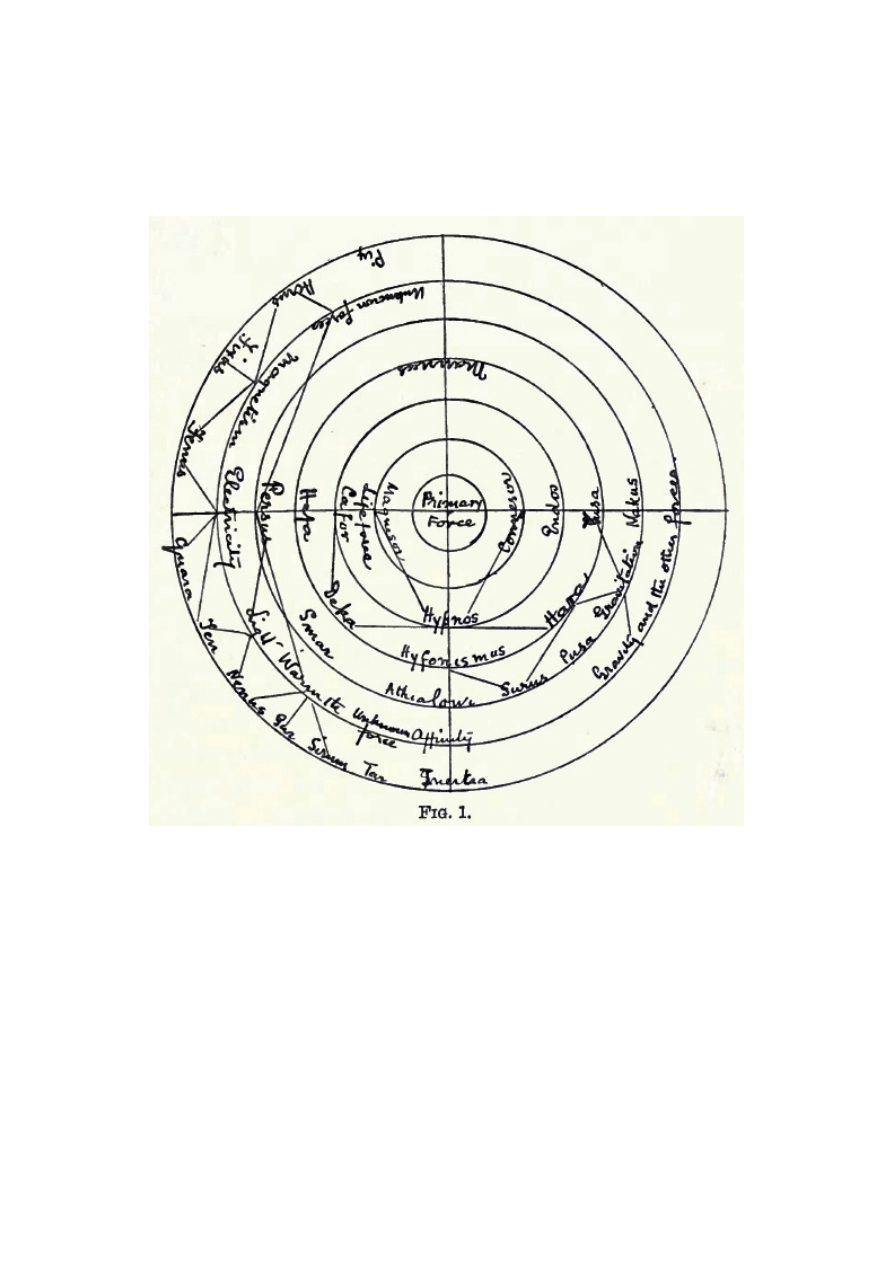
with the properties of matter. In the summer of 1900 S. W. tried several times
to produce the circles of matter, but she never arrived at other than vague and
incomprehensible hints and afterwards spoke no more about this.
Conclusion. The really interesting and valuable seances came to an end with
the production of the system of powers. Even before there was noticeable a
gradual decline in the vividness of the ecstasies. Ulrich von Gerbenstein came
increasingly to the front, and filled up the stances with his childish chatter. The
visions which S. W. had in the meantime likewise seem to have lost vividness
and plasticity of formation, for S. W. was afterwards only able to feel pleasant
sensations in the presence of good spirits, and disagreeableness in that of bad
spirits. Nothing new was produced. There was something of uncertainty in the
trance talks, as if feeling and seeking for the impression which she was making

upon the audience, together with an increasing staleness in the content. In the
outward behaviour of S. W. there arose also a marked shyness and uncertainty,
so that the impression of wilful deception became ever stronger. The writer
therefore soon withdrew from the seances. S. W. experimented afterwards in
other circles, and six months after my leaving was caught cheating in flagranti
delicto. She wanted to arouse again by spiritualistic experiments the lost belief
in her supernatural powers ; she concealed small objects in her dress,
throwing them up in the air during the dark seance. With this her part was
played out. Since this eighteen months have passed during which I have not
seen S. W. I have learnt from an observer who knew her from the earlier
times, she has now and again strange states of short duration during which
she is very pale and silent, and has a fixed glittering look. I did not hear any
more of visions. She is said not to take part any more in spiritualistic seances.
S. W. is now in a large business, and according to all accounts is an industrious
and responsible person who does her work eagerly and cleverly, giving entire
satisfaction. According to the account of trustworthy persons, her character
has much improved ; she has become quieter, more regular and sympathetic.
No other abnormalities have appeared in her. This case contains a mass of
psychological problems, in spite of its incompleteness, whose exposition goes
far beyond the limits of this little work. We must therefore be satisfied with a
mere sketch of the various striking manifestations. For a more lucid exposition
it seems better to review the various states separately.
1. The Waking State. Here the patient shows various peculiarities. As we have
seen, at school she was often distracted, lost herself in a peculiar way, was
moody ; her behaviour changes indefinitely, now quiet, shy, reserved, now
lively, noisy and talkative. She cannot be called unintelligent, but she strikes
one sometimes as narrow-minded, sometimes as having isolated intelligent
moments. Her memory is good on the whole, but owing to her distraction it is
much impaired. Thus, despite much discussion and reading of Kerner's
"Seherin von Prevorst," for many weeks, she does not know whether the
author's name is Koerner or Kerner, nor the name of the Prophetess, if directly
asked. All the same, when it occasionally comes up, the name Kerner is

correctly written in the automatic communications. In general it may be said
that her character has something extremely impulsive, incomprehensible,
protean. Deducting the want of balance due to puberty, there remains a
pathological residue which expresses itself in reactions which follow no rule
and a bizarre unaccountable character. This character may be called
desequilibre, or unstable. It receives a specific mould from features which can
certainly be regarded as hysterical. This is decidedly so in the conditions of
distraction. As Janet maintains, the foundation of hysterical anaesthesia is the
loss of attention. He was able to prove in youthful hysterics "a striking
indifference and distracted attention in the whole region of the emotional life."
Misreading is a notable instance, which illustrates hysterical dispersion of
attention most beautifully. The psychology of this process may perhaps be
viewed as follows: during reading aloud, attention becomes paralysed for this
act and is directed towards some other object. Meanwhile the reading is
continued mechanically, the sense impressions are received as before, but in
consequence of the dispersion the excitability of the perceptive centre is
lowered, so that the strength of the sense impression is no longer adequate to
fix the attention in such a way that perception as such is conducted along the
motor speech route; thus all the inflowing associations which at once unite
with any new sense impression are repressed. The further psychological
mechanism permits of only two possible explanations:
(1) The admission of the sense impression is received unconsciously (because
of the increase of threshold stimulus), in the perceptive centre just below the
threshold of consciousness, and consequently is not incorporated in the
attention and conducted back to the speech route. It only reaches verbal
expression through the intervention of the nearest associations, in this case
the dialect expression for this object.
(2) The sense impression is perceived consciously, but at the moment of its
entrance into the speech route it reaches a territory whose excitability is
diminished by the dispersion of attention. At this place the dialect word is
substituted by association for the motor speech image, and it is uttered as

such. In either case it is certain that it is the acoustic dispersed attention which
fails to correct the error. Which of the two explanations is correct cannot be
cleared up in this case; probably both approach the truth, for the dispersion of
attention seems to be general, and in each case concerns more than one of the
centres engaged in the act of reading aloud. In our case this phenomenon has
a special value, for we have here a quite elementary automatic phenomenon.
It may be called hysterical in so far as in this concrete case a state of
exhaustion and intoxication with its parallel manifestations can be excluded. A
healthy person only exceptionally allows himself to be so engaged by an object
that he fails to correct the errors of a dispersed attention those of the kind
described. The frequency of these occurrences in the patient, point to a
considerable limitation of the field of consciousness in so far as she can only
master a relative minimum of elementary sensations flowing in at the same
time. If we wish to describe more exactly the psychological state of the
"psychic shady side," we might call it either a sleeping or a dream-state,
according as passivity or activity predominated. There is, at all events, a
pathological dream state of very rudimentary extension and intensity ; its
genesis is spontaneous ; dream-states arising spontaneously with the
production of automatisms are generally regarded on the whole as hysterical.
It must be pointed out that these instances of misreading occurred frequently
in the patient, and that the term hysterical is employed in this sense ; so far as
we know, it is only on a foundation of hysterical constitution that spontaneous
states of partial sleep or dreams occur frequently.
Binet has studied experimentally the automatic substitution of some adjacent
association in his hysterics. If he pricked the anaesthetic hand of the patient
without his noticing the prick, he thought of "points"; if the anaesthetic finger
was moved, he thought of "sticks" or "columns." When the anaesthetic hand,
concealed from the patient's sight by a screen, writes " Salpetriere," the
patient sees in front of her the word " Salpetriere " in white writing on a black
ground. This recalls the experiments above referred to of Guinon and Sophie
Waltke.

We thus find in the patient, at a time when there was nothing to indicate the
later phenomena, rudimentary automatisms, fragments of dream
manifestations, which bear in themselves the possibility that some day more
than one association would creep in between the perception of the dispersed
attention and consciousness. The misreading shows us moreover a certain
automatic independence of the psychical elements. This occasionally expands
to a more or less fleeting dispersion of attention, although with very slight
results and never in any way striking or suspicious; this dispersedness
approximates to that of the physiological dream. The misreading can be thus
conceived as a prodromal symptom of the later events ; especially as its
psychology is prototypical for the mechanism of somnambulic dreams, which
are indeed nothing but a many-sided multiplication and manifold variation of
the elementary processes reviewed above. I never succeeded in demonstrating
during my observations similar rudimentary automatisms. It would seem that
in course of time, the states of dispersed attention, to a certain extent beneath
the surface of consciousness, at first of low degree, have grown into these
remarkable somnambulic attacks ; hence they disappeared during the waking
state, which was free from attacks. So far as concerns the development of the
patient's character beyond a certain not very extensive ripening, no
remarkable change could be demonstrated during the observations lasting
nearly two years. More remarkable is the fact that in the two years since the
cessation (complete?) of the somnambulic attacks, a considerable change in
character has taken place. We shall have occasion later on to speak of the
importance of this observation.
Semi-Somnambulism. In S. W.'s case the following condition was indicated by
the term semi-somnambulism. For some time after and before the actual
somnambulic attack the patient finds herself in a state whose most salient
feature can best be described as "preoccupation." She only lends half an ear to
the conversation around her, answers at random, often gets absorbed in all
manner of hallucinations ; her face is solemn, her look ecstatic, visionary,
ardent. Closer observation discloses a far-reaching alteration of the entire
character. She is now serious, dignified; when she speaks her subject is always

an extremely serious OLC. In this condition she can talk so seriously, forcibly
and convincingly, that one is tempted to ask oneself if this is really a girl of
fifteen and a half. One has the impression of a mature woman possessed of
considerable dramatic talent. The reason for this seriousness, this solemnity of
behaviour, is given in her explanation that at these times she stands at the
frontier of this world and the other, and associates just as truly with the spirits
of the dead as with living people. And, indeed, her conversation is usually
divided between answers to real objective questions and hallucinatory ones. I
call this state semi-somnambulism because it coincides with Bichet's own
definition. He says: "La conscience de cet individu persiste dans son integrite
apparente, toutefois des operations tres compliquees vont s'accomplir en
dehors de la conscience sans que le moi volontaire et conscient paraisse
ressentir une modification quelconque. Une autre personne sera en lui qui
agira, pensera, voudra, sans que la conscience, c'est a dire le moi reflechi
conscient, ait la moindre notion."
Binet says of this term: "Le terme indique la parente de cet etat avec le
somnambulisme veritable, et en suite il laisse comprendre que la vie
somnamblique qui se manifeste durant la veille est reduite, deprimee, par la
conscience normale qui la recouvre."
AUTOMATISMS
Semi-somnambulism is characterised by the continuity of consciousness with
that of the waking state and by the appearance of various automatisms which
give evidence of an activity of the subconscious self, independent of that of
consciousness. Our case shows the following automatic phenomena:
(1) Automatic movements of the table.
(2) Automatic writing.
(3) Hallucinations.
1. Automatic Movements of the Table. Before the patient came under my

observation she had been influenced by the suggestion of "table-turning" which
she had first come across as a game. As soon as she entered the circle there
appeared communications from members of her family which showed her to be
a medium. I could only find out that as soon as ever her hand was placed on
the table, the typical movements began. The resulting communications have
no interest for us. But the automatic character of the act itself deserves some
discussion, for we may, without more ado, set aside the imputation that there
was any question of intentional and voluntary pushing or pulling on the part of
the patient.
As we know from the investigations of Chevreul, Gley, Lehmann and others,
unconscious motor phenomena are not only of frequent occurrence among
hysterical persons, and those pathologically inclined in other directions, but
they are also relatively easily produced in normal persons who show no other
spontaneous automatisms. I have made many experiments on these lines, and
can confirm this observation. In the great majority of instances all that is
required is enough patience to put up with an hour of quiet waiting. In most
subjects motor automatisms will be obtained in a more or less high degree if
centra-suggestions do not intervene as obstacles. In a relatively small
percentage the phenomena arise spontaneously, i.e. directly under the
influence of verbal suggestion or of some earlier auto-suggestion. In this
instance the case is powerfully affected by suggestion. In general the particular
predisposition is subject to all those laws which also hold good for normal
hypnosis. Nevertheless certain special circumstances are to be taken into
account, conditioned by the peculiarity of the case. It is not a question of a
total hypnosis, but of a partial one, limited entirely to the motor area of the
arm, like the cerebral anaesthesia produced by "magnetic passes" for a painful
spot in the body. We touch the spot in question employing verbal suggestion or
making use of some existing auto-suggestion, and of the tactile stimulus which
we know acts suggestively, to bring about the desired partial hypnosis. In
accordance with this procedure refractory subjects can rather easily be brought
to an exhibition of automatism. The experimenter intentionally gives the table
a slight push, or, better, a series of rhythmic but very slight taps. After a short
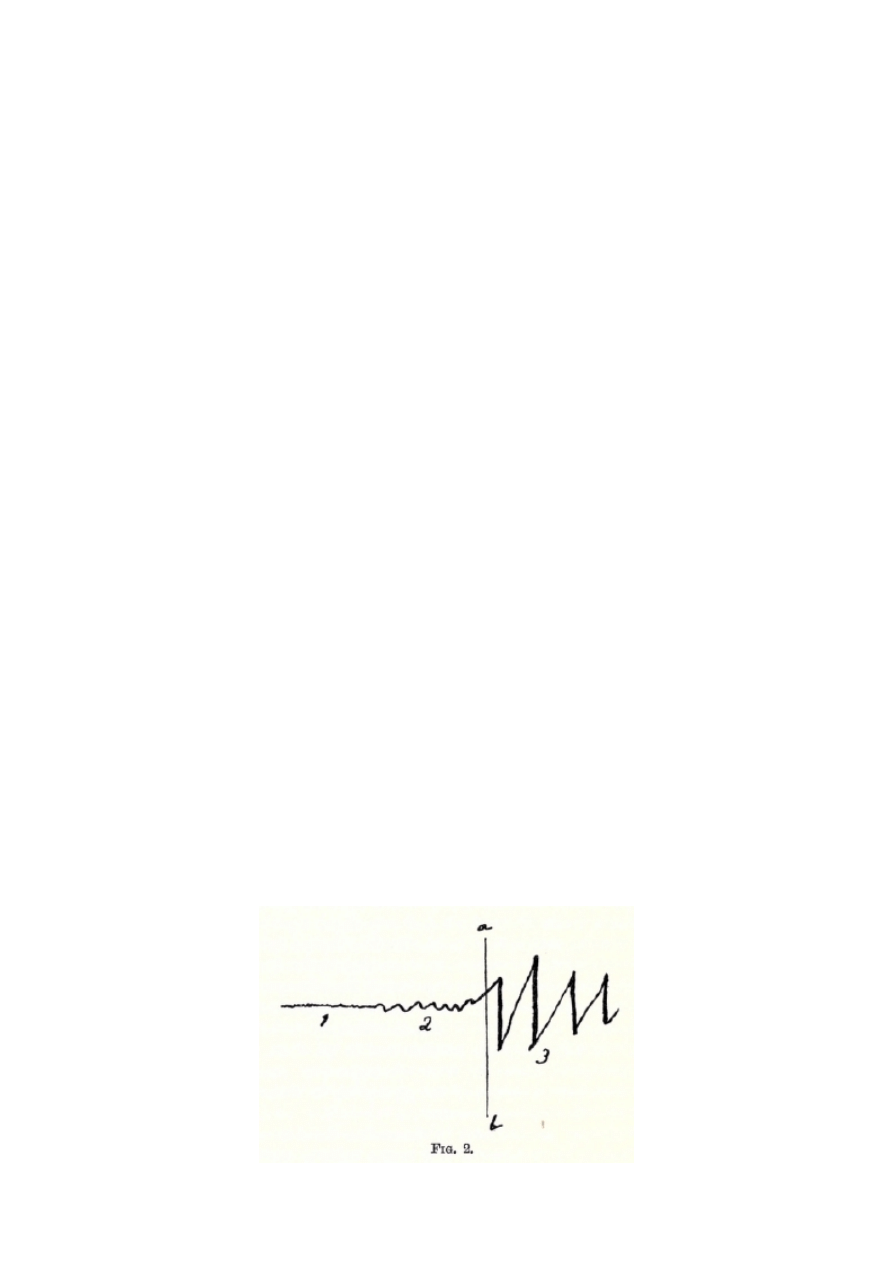
time he notices that the oscillations become stronger, that they continue
although he has interrupted his own intentional movements. The experiment
has succeeded, the subject has unsuspectingly taken up the suggestion. By
this procedure much more is obtained than by verbal suggestion. In very
receptive persons and in all those cases where movement seems to arise
spontaneously, the purposeful tremulous movements, not perceptible by the
subject, assume the role of agent provocateur.
In this way persons who by themselves have never obtained automatic
movements of a coarse calibre, sometimes assume the unconscious guidance
of the table-movements, provided that the tremors are strong and that the
medium understands their meaning. In this case the medium takes control of
the slight oscillations and returns them considerably strengthened; but rarely
at exactly the same instant, generally a few seconds later, in this way revealing
the agent's conscious or unconscious thought. By means of this simple
mechanism there may arise those cases of thought-reading so bewildering at
first sight. A very simple experiment, that succeeds in many cases even with
unpractised persons, will serve to illustrate this. The experimenter thinks, say,
of the number four, and then waits, his hands quietly resting on the table, until
he feels that the table makes the first inclination to announce the number
thought of. He lifts his hands off the table immediately, and the number four
will be correctly tilted out. It is advisable in this experiment to place the table
upon a soft thick carpet. By close attention the experimenter will occasionally
notice a movement of the table which is thus represented.

(1) Purposeful tremors too slight to be perceived by the subject.
(2) Several very small but perceptible oscillations of the table which indicate
that the subject is responding to them.
(3) The big movements (tilts) of the table, giving the number four that was
thought of.
(ab) Denotes the moment when the operator's hands are removed. This
experiment succeeds excellently with well-disposed but inexperienced subjects.
After a little practice the phenomenon indicated is wont to disappear, since by
practice the number is read and reproduced directly from the purposeful
movements.
In a responsive medium the purposeful tremors of the agent act here just as
the intentional taps in the experiment cited above; they are received,
strengthened and reproduced, although slightly wavering. Still they are
perceptible and hence act suggestively as slight tactile stimuli, and by the
increase of partial hypnosis give rise to great automatic movements. This
experiment illustrates in the clearest way the increase step by step of auto-
suggestion. Along the path of this auto-suggestion are developed all the
automatic phenomena of a motor nature. How the intellectual content
gradually mingles in with the purely motor need scarcely be elucidated after
this discussion. There is no need of a special suggestion for the evoking of
intellectual phenomena. From the outset it is a question of word-presentation,
at least from the side of the experimenter. After the first aimless motor
irrelevancies of the unpractised subject, some word products or the intentions
of the experimenter are soon reproduced. Objectively the occurrence of an
intellectual content must be understood as follows:
By the gradual increase of auto-suggestion the motorrange of the arm
becomes isolated from consciousness, that is to say, the perception of the
slight movement-impulse is concealed from consciousness.

By the knowledge gained from consciousness that some intellectual content is
possible, there results a collateral excitation in the speech-area as the means
immediately at hand for intellectual notification. The motor part of word
presentation is necessarily chiefly concerned with this aiming at notification. In
this way we understand the unconscious flowing over of speech-impulse to the
motor-area and conversely the gradual penetration of partial hypnosis into the
speech area. In numerous experiments with beginners, as a rule I have
observed at the beginning of intellectual phenomena a relatively large number
of completely meaningless words, also often a series of meaningless single
letters. Later on all kinds of absurdities are produced, e.g. words or entire
sentences with the letters irregularly misplaced or with the order of the letters
all reversed a kind of mirror-writing. The appearance of the letter or word
indicates a new suggestion; some sort of association is involuntarily joined to
it, which is then realised. Remarkably enough, these are not generally the
conscious associations, but quite unexpected ones, a circumstance showing
that a considerable part of the speech-area is already hypnotically isolated.
The recognition of this automatism again forms a fruitful suggestion, since
invariably at this moment the feeling of strangeness arises, if it is not already
present in the pure motor-automatism. The question, "Who is doing this?"
"Who is speaking ? " is the suggestion for the synthesis of the unconscious
personality which as a rule does not like being kept waiting too long. Any name
is introduced, generally one charged with emotion, and the automatic splitting
of the personality is accomplished. How accidental and how vacillating this
synthesis is at its beginning, the following reports from the literature show.
Myers communicates the following interesting observation on a Mr. A., a
member of the Society for Psychical Research who was making experiments on
himself in automatic writing.
THIRD DAY
Question: What is man?
Answer: TEFI H HASL ESBLE LIES.

Question: Is that an anagram? Yes.
How many words does it contain? Five.
What is the first word? SEE.
What is the second word? SEEEE.
See? Shall I interpret it myself? Try to.
Mr. A. found this solution:"Life is less able." He was astonished at this
intellectual information, which seemed to
him to prove the existence of an intelligence independent of his own. Therefore
he went on to ask:
Who are you? Clelia.
Are you a woman? Yes.
Have you ever lived upon the earth? No.
Will you come to life? Yes.
When? In six years.
Why are you conversing with me? E if Clelia el.
Mr. A. interpreted this answer as: I Clelia feel.
FOURTH DAY
Question : Am I the one who asks the questions? Yes.

Is Clelia there? No.
Who is here then? Nobody.
Does Clelia exist at all? No.
With whom then was I speaking yesterday? With no one.
Janet conducted the following conversation with the sub-consciousness of
Lucie, who, meanwhile, was engaged in conversation with another observer.
"M'entendez-vous?" asks Janet. Lucie answers by automatic writing, "Non"
"Mais pour repondre il faut entendre?" "Oui, absolument." "Alors comment
faites-vous?" "Je ne sais." "Il faut bien qu'il y ait quelqu'un qui m'entend?"
"Oui." "Qui cela! Autre que Lucie. Ah bien! Une autre personne. Voulez-vous
que nous lui donnions un nom?" "Non." "Si, ce sera plus commode." "Eh bien,
Adrienne!" "Alors, Adrienne, m'entendez-vous?" "Oui."
From these quotations it will be seen in what way the subconscious personality
is constructed. It owes its origin purely to suggestive questions meeting a
certain disposition of the medium. This explanation is the result of the
disintegration of the psychical complex ; the feeling of the strangeness of such
automatisms then comes in to help, as soon as conscious attention is directed
to the automatic act. Binet remarks on this experiment of Janet's: "Il faut bien
remarquer que si la personnalite d'Adrienne a pu se creer, c'est qu'elle a
rencontre une possibilite psychologique ; en d'autres termes, il y avait la des
phe'nomenes desagreges vivant separes de la conscience normale du sujet."
The individualisation of the sub-consciousness always denotes a considerable
further step of great suggestive influence upon the further formation of
automatisms. So, too, we must regard the origin of the unconscious
personalities in our case.
The objection that there is simulation in automatic tableturning may well be
given up, when one considers the phenomenon of thought-reading from the

purposeful tremors which the patient offered in such plenitude. Kapid,
conscious thought-reading demands at the least an extraordinary degree of
practice, which it has been shown the patient did not possess. By means of the
purposeful tremors whole conversations can be carried on, as in our case. In
the same way the suggestibility of the subconscious can be proved objectively
if, for instance, the experimenter with his hand on the table desires that the
hand of the medium should no longer be able to move the table or the glass;
contrary to all expectation and to the liveliest astonishment of the subject, the
table will immediately remain immovable. Naturally any other desired
suggestions can be realised, provided they do not overstep by their
innervations the region of partial hypnosis; this proves at the same time the
limited nature of the hypnosis. Suggestions for the legs and the other arm will
thus not be obeyed. Tableturning is not an automatism which belongs
exclusively to the patient's semi-somnambulism : on the contrary, it occurred
in the most pronounced form in the waking state, and in most cases then
passed over into semi-somnambulism, the appearance of this being generally
announced by hallucinations, as it was at the first sitting.
2. Automatic Writing. A second automatic phenomenon ; which at the outset
corresponds to a higher partial hypnosis, is automatic writing. It is, according
to my experience, much rarer and more difficult to produce than table-turning.
As in table-turning, it is again a matter of a primary suggestion, to the
conscious when sensibility is retained, to the unconscious when it is
obliterated. The suggestion is, however, not a simple one, for it already bears
in itself an intellectual element. " To write " means " to write something." This
special element of the suggestion which extends beyond the merely motor
often conditions a certain perplexity on the part of the subject, giving rise to
slight contrary suggestions which hinder the appearance of the automatisms. I
have observed in a few cases that the suggestion is realised, despite its
relative venturesomeness (it was directed towards the waking consciousness of
a so-called normal person). However, it takes place in a peculiar way ; it first
displaces the purely motor part of the central system concerned in hypnosis,
and the deeper hypnosis is then reached by auto-suggestion from the motor

phenomenon, analogous to the procedure in table-turning described above.
The subject, who has a pencil in his hand, is purposely engaged in
conversation whilst his attention is diverted from the writing. The hand begins
to make movements, beginning with many upward strokes and zigzag lines, or
a simple line is made. Occasionally it happens that the pencil does not touch
the paper, but writes in the air. These movements must be conceived as purely
motor phenomena, which correspond to the expression of the motor element
in the presentation "write." This phenomenon is somewhat rare; generally
single letters are first written, and what was said above of table-turning holds
true of their combination into words and sentences. True mirror-writing is also
observed here and there. In the majority of cases, and perhaps in all
experiments with beginners who are not under some very special suggestion,
the automatic writing is that of the subject. Occasionally its character may be
greatly changed, but this is secondary, and is always to be regarded as a
symptom of the intruding synthesis of a subconscious personality.
As stated, the patient's automatic writing never came to any very great
development. In these experiments, generally carried out in darkness, she
passed over into semi-somnambulism, or into ecstasy. The automatic writing
had thus the same effect as the preliminary table-turning.
3. The Hallucinations. The nature of the passing into somnambulism in the
second seance is of psychological importance. As stated, the automatic
phenomena were progressing favourably when darkness came on. The most
interesting event of this seance, so far, was the brusque interruption of the
communication from the grandfather, which was the starting-point of various
debates amongst the members of the circle. These two momentous
occurrences, the darkness and the striking event, seem to have been the
foundation for a rapid deepening of hypnosis, in consequence of which the
hallucinations could be developed. The psychological mechanism of this
process seems to be as follows:
The influence of darkness upon the suggestibility of the sense-organs is well

known. Binet states that it has a special influence on hysterics producing a
state of sleepiness. As is clear from the foregoing, the patient was in a state of
partial hypnosis and had constituted herself one with the unconscious
personality in closest relationship to her in the domain of speech. The
automatic expression of this personality is interrupted most unexpectedly by a
new person, of whose existence no one had any suspicion. Whence came this
cleavage ? Obviously the eager expectation of this first seance had very much
occupied the patient. Her reminiscences of me and my family had probably
grouped themselves around this expectation; hence these suddenly come to
light at the climax of the automatic expression. That it was just my grandfather
and no one else not, e.g., my deceased father, who, as she knew, was much
closer to me than the grandfather whom I had never known perhaps suggests
where the origin of this new person is to be sought.
It is probably a dissociation of the personality already present which seized
upon the material next at hand for its expression, namely, upon the
associations concerning myself. How far this is parallel to the experiences
revealed by dream investigation (Freud's) must remain undecided, for we have
no means of judging how far the effect mentioned can be considered a
"repressed" one. From the brusque interruption of the new personality we may
conclude that the presentations concerned were very vivid, with corresponding
intensity of expectation. This perhaps was an attempt to overcome a certain
maidenly shyness and embarrassment. This event reminds us vividly of the
manner in which the dream presents to consciousness, by a more or less
transparent symbolism, things one has never said to oneself clearly and
openly. We do not know when this dissociation of the new personality occurred,
whether it had been slowly prepared in the unconscious, or whether it first
occurred in the seance. In any case this event meant a considerable progress
in the extension of the unconscious sphere rendered accessible through the
hypnosis. At the same time this event must be regarded as powerfully
suggestive in regard to the impression which it made upon the waking
consciousness of the patient. For the perception of this unexpected
intervention of a new power must inevitably excite a feeling of the strangeness

of the automatisms, and would easily suggest the thought that an independent
spirit is here making itself known. Hence the intelligible association that she
would finally be able to see this spirit. The situation that ensued at the second
seance is to be explained by the coincidence of this energising suggestion with
the heightened suggestibility conditioned by the darkness. The hypnosis and
with it the series of dissociated presentations break through to the visual area,
and the expression of the unconscious, hitherto purely motor, is made
objective, according to the measure of the specific energy of the new system,
in the shape of visual images with the character of hallucinations, not as a
mere accompanying phenomenon of the word-automatism, but as a
substituted function.
The explanation of the situation that arose in the first seance, at that time
unexpected and inexplicable, is no longer presented in words, but as a
descriptive allegorical vision. The sentence "they do not hate one another, but
are friends," is expressed in a picture. We often encounter events of this kind
in somnambulism. The thinking of somnambulists is given in plastic images
which constantly break into this or that sense-sphere and are made objective
in hallucinations. The process of reflection sinks into the subconscious; only its
end-results arise to consciousness as presentations vividly tinged by the
senses, or directly as hallucinations. In our case the same thing occurred as in
the patient whose anaesthetic hand Binet pricked nine times, which made her
think of the figure 9; or as in Flournoy's Helen Smith, who, when asked during
business-hours about certain patterns, suddenly saw the number of days (18)
for which they had been lent, at a length of 20 mm. in front of her. The further
question arises, why does the automatism appear in the visual and not in the
acoustic sphere? There are several grounds for this choice of the visual sphere.
(1) The patient is not gifted acoustically; she is, for instance, very unmusical.
(2) There was no stillness corresponding to the darkness which might have
favoured the appearance of sounds ; there was a lively conversation.

(3) The increased conviction of the near presence of spirits, because the
automatism felt so strange, could easily have aroused the idea that a spirit
might be seen, thus causing a slight excitation of the visual sphere.
(4) The entoptic phenomena in darkness favoured the occurrence of
hallucinations.
The reasons (3) and (4) the entoptic phenomena in the darkness and the
probable excitation of the visual sphere are of decisive importance for the
appearance of hallucinations. The entoptic phenomena in this case play the
same role in the auto-suggestion, the production of the automatism, as the
slight tactile stimuli in hypnosis of the motor centre. As stated, flashes
preceded the first hallucinatory twilight-state. Obviously attention was already
at a high pitch, and directed to visual perceptions, so that the retina's own
light, usually very weak, was seen with great intensity. The part played by
entoptic perceptions of light in the origin of hallucinations deserves further
consideration. Schiile says: "The swarming of light and colour which stimulates
and animates the field of vision although in the dark, supplies the material for
phantastic figures in the air before falling asleep. As we know, absolute
darkness is never seen; a few particles of the dark field of vision are always
illumined; flecks of light move here and there, and combine into all kinds of
figures; it only needs a moderately active imagination to create out of them, as
one does out of clouds, certain known figures. The power of reasoning, fading
as one falls asleep, leaves phantasy free play to construct very vivid figures. In
the place of the light spots, haziness and changing colours of the dark visual
field, there arise definite outlines of objects."
In this way hypnagogic hallucinations arise. The chief role naturally belongs to
the imagination, hence imaginative people in particular are subject to
hypnagogic hallucinations. The hypnopompic hallucinations described by Myers
arise in the same way.
It is highly probable that hypnagogic pictures are identical with the dream-

pictures of normal sleep forming their visual foundation. Maury has proved
from self-observation that the pictures which hovered around him
hypnagogically were also the objects of the dreams that followed. G. Trumbull
Ladd has shown this even more convincingly. By practice he succeeded in
waking himself suddenly two to five minutes after falling asleep. He then
observed that the figures dancing before the retina at times represented the
same contours as the pictures just dreamed of. He even states that nearly
every visual dream is shaped by the retina's own light figures. In our case the
fantastic rendering of these pictures was favoured by the situation. We must
not underrate the influence of the over-excited expectation which allowed the
dull retina-light to appear with increased intensity. The further formation of the
retinal appearances follows in accordance with the predominating
presentations. That hallucinations appear in this way has been also observed in
other visionaries. Jeanne d'Arc first saw a cloud of light, and only after some
time there stepped forth St. Michael, St. Catherine and St. Margaret. For a
whole hour Swedenborg saw nothing but illuminated spheres and fiery flames.
He felt a mighty change in the brain, which seemed to him "release of light."
After the space of one hour he suddenly saw red figures which he regarded as
angels and spirits. The sun visions of Benvenuto Cellini in Engelsburg are
probably of the same nature. A student who frequently saw apparitions,
stated: "When these apparitions come, at first I only see single masses of light
and at the same time am conscious of a dull noise in the ears. Gradually these
contours become clear figures."
The appearance of hallucinations occurred in a quite classical way in Flournoy's
Helen Smith. I quote the cases in question from his article.
"18 Mars. Tentative d'experience dans 1'obscurite Mile. Smith voit un ballon
tantot luminieux, tantot s'obscurcissant.
"25 Mars. Mile. Smith commence a distinguer de vagues lueurs, de longs
rubans blancs, s'agitant du plancher au plafond, puis enfin une magnifique
etoile qui dans 1'obscurite s'est montree a elle seule pendant toute la seance.

"1 Avril. Mile. Smith se sent tres agitee, elle a des frissons, est partiellement
glacee. Elle est tres inquiete et voit tout a coup se balangant au-dessus de la
table une figure grimasante et tres laide avec de longs cheveux rouges. Elle
voit alors un magnifique bouquet de roses de nuances diverses ; tout a coup
elle voit sortir de dessous le bouquet un petit serpent, qui, rampant
doucement, vient sentir les fleurs, les regarde," etc.
Helen Smith says in regard to the origin of her vision of March:
"La lueur rouge persista autour de moi et je me suis trouvee entouree de fleurs
extraordinaires."
At all times the complex hallucinations of visionaries have occupied a peculiar
place in scientific criticism. Macario early separated these so-called intuition-
hallucinations from others, since he maintains that they occur in persons of an
eager mind, deep understanding and high nervous excitability. Hecker
expresses himself similarly but more enthusiastically.
His view is that their condition is " the congenital high development of the
spiritual organ which calls into active, free and mobile play the life of the
imagination, bringing it spontaneous activity." These hallucinations are
"precursors or signs of mighty spiritual power." The vision is "an increased
excitation which is harmoniously adapted to the most complete health of mind
and body." The complex hallucinations do not belong to the waking state, but
prefer as a rule a partial waking state. The visionary is buried in his vision even
to complete annihilation. Flournoy was also always able to prove in the visions
of H.S. "un certain degre d'obnubilation." In our case the vision is complicated
by a state of sleep whose peculiarities we shall review later.
THE CHANGE IN CHARACTER
The most striking characteristic of the second stage in our case is the change
in character. We meet many cases in the literature which have offered the

symptom of spontaneous character-change. The first case in a scientific
publication is Weir-Mitchell's case of Mary Keynolds.
It was the case of a young woman living in Pennsylvania in 1811. After a deep
sleep of about twenty hours she had totally forgotten her entire past and
everything she had learnt; even the words she spoke had lost their meaning.
She no longer knew her relatives. Slowly she re-learnt to read and write, but
her writing was from right to left. More striking still was the change in her
character. Instead of being melancholy she was now cheerful to the extreme.
Instead of being reserved she was buoyant and sociable. Formerly taciturn and
retiring, she was now merry and jocose. Her disposition was totally changed.
In this state she renounced her former retired life, and liked to undertake
adventurous excursions unarmed, through wood and mountain on foot and
horseback. In one of these excursions she encountered a large black bear,
which she took for a pig. The bear raised himself on his hind legs and gnashed
his teeth at her. As she could not drive her horse on any further, she took an
ordinary stick and hit the bear until it took to flight. Five weeks later, after a
deep sleep, she returned to her earlier state with amnesia for the interval.
These states alternated for about sixteen years. But her last twenty-Jive years
Mary Reynolds passed exclusively in her second state.
Schroeder von der Kalk reports on the following case: The patient became ill at
the age of sixteen with periodic amnesia, after a previous tedious illness of
three years. Sometimes in the morning after waking she passed through a
peculiar choreic state, during which she made rhythmical movements with her
arms. The whole day she would then exhibit a childish, silly behaviour and had
lost all her educated capabilities. (When normal she is very intelligent, well
read, speaks French well.) In the second state she begins to speak faulty
French. On the second day she is again at times normal. The two states are
completely separated by amnesia.
Hoefelt reports on a case of spontaneous somnambulism in a girl who in her

normal state was submissive and modest, but in somnambulism was
impertinent, rude and violent. Azam's Felida was, in her normal state,
depressed, inhibited, timid ; and in the second state lively, confident,
enterprising to recklessness. The second state gradually became the chief one,
andfinally so far suppressed the first state that the patient called her normal
states, lasting now but a short time, "crises." The amnesic attacks had begun
at 14 and a half. In time the second state became milder and there was a
certain approximation between the character of the two states. A very striking
example of change in character is that worked out by Camuset, Bibot, Legrand
du Saulle, Kicher, Voisin, and put together by Bourru and Burot. It is that of
Louis V., a severe male hysteric with amnesic alternating character. In the first
stage he is rude, cheeky, querulous, greedy, thievish, inconsiderate. In the
second state he is an agreeable, sympathetic character, industrious, docile and
obedient. This amnesic change of character has been used by Paul Lindau in
his drama "Der Andere" (The Other One).
Rieger reports on a case parallel to Lindau's criminal lawyer. The unconscious
personalities of Janet's Lucie and Leonie (Janet, l.c) and Morton Prince's may
also be regarded as parallel with our case. There are, however, therapeutic
artificial products whose importance lies in the domain of the dissociation of
consciousness and of memory. In the cases reported upon, the second state is
always separated from the first by an amnesic dissociation, and the change in
character is, at times, accompanied by a break in the continuity of
consciousness. In our case there is no amnesic disturbance; the passage from
the first to the second state follows quite gradually and the continuity of
consciousness remains. The patient carries out in her waking state everything
from the field of the unconscious that she has experienced during
hallucinations in the second stage otherwise unknown to her.
Periodic changes in personality without amnesic dissociation are found in the
region of folie circulaire, but are rarely seen in hysterics, as Renaudin's case
shows. A young man, whose behaviour had always been excellent, suddenly
began to display the worst tendencies. There were no symptoms of insanity,

but, on the other hand, the whole surface of the body was anaesthetic. This
state showed periodic intervals, and in the same way the patient's character
was subject to vacillations. As soon as the anaesthesia disappeared he was
manageable and friendly. When the anaesthesia returned he was overcome by
the worst instincts, which, it was observed, could even include the wish to
murder.
Remembering that our patient's age at the beginning of the disturbances was
14 and a half, that is, the age of puberty had just been reached, one must
suppose that there was some connection between the disturbances and the
physiological character-changes at puberty. " There appears in the
consciousness of the individual during this period of life a new group of
sensations, together with the feelings and ideas arising therefrom; this
continuous pressure of unaccustomed mental states makes itself constantly felt
because the cause is always at work; the states are co-ordinated because they
arise from one and the same source, and must little by little bring about deep-
seated changes in the ego." Vacillating moods are easily recognisable; the
confused new, strong feelings, the inclination towards idealism, to exalted
religiosity and mysticism, side by side with the falling back into childishness,
gives to adolescence its prevailing character. At this epoch, the human being
first makes clumsy attempts at independence in every direction ; for the first
time uses for his own purposes all that family and school have contributed
hitherto; he conceives ideals, constructs far-reaching plans for the future, lives
in dreams whose content is ambitious and egotistic. This is all physiological.
The puberty of a psychopathic is a crisis of more serious import. Not only do
the psychophysical changes run a stormy course, but features of a hereditary
degenerate character become fixed. In the child these do not appear at all, or
but sporadically. For the explanation of our case we are bound to consider a
specific disturbance of puberty. The reasons for this view will appear from a
further study of the second personality. (For the sake of brevity we shall call
the second personality IVENES as the patient baptised her higher ego).
Ivenes is the exact continuation of the everyday ego. She includes the whole of

her conscious content. In the semisomnambulic state her intercourse with the
real external world is analogous to that of the waking state, that is, she is
influenced by recurrent hallucinations, but no more than persons who are
subject to non-confusional psychotic hallucinations. The continuity of Ivenes
obviously extends to the hysterical attack with its dramatic scenes, visionary
events, etc. During the attack itself she is generally isolated from the external
world; she does not notice what is going on around her, does not know that
she is talking loudly, etc. But she has no amnesia for the dream-content of her
attack. Amnesia for her motor expressions and for the changes in her
surroundings is not always present. That this is dependent upon the degree of
intensity of her somnambulic state and that there is sometimes partial
paralysis of individual sense organs, is proved by the occasion when she did
not notice me; her eyes then were open, and most probably she saw the
others; although she only perceived me when I spoke to her. This is a case of
so-called systematized anaesthesia (negative hallucination) which is often
observed in hysterics. Flournoy, for instance, reports of Helen Smith that
during the seances she suddenly ceased to see those taking part, although she
still heard their voices and felt their touch ; sometimes she no longer heard,
although she saw the movements of the lips of the speakers, etc.
Ivenes is just the continuation of the waking self. She contains the entire
consciousness of S. W's waking state. Her remarkable behaviour tells decidedly
against any analogy with cases of double consciousness. The characteristics of
Ivenes contrast favourably with the patient's ordinary self. She is a calmer,
more composed personality ; her pleasing modesty and accuracy, her uniform
intelligence, her confident way of talking must be regarded as an improvement
of the whole being ; thus far there is analogy with Janet's Leonie. But this is
the extent of the similarity. Apart from the amnesia, they are divided by a
deep psychological difference. Leonie II. is the healthier, the more normal ; she
has regained her natural capabilities, she shows remarkable improvement upon
her chronic condition of hysteria. Ivenes rather gives the impression of a more
artificial product ; there is something thought out; despite all her excellences
she gives the impression of playing a part excellently; her worldsorrow, her

yearning for the other side of things, are not merely piety but the attributes of
saintliness. Ivenes is no mere human, but a mystic being who only partly
belongs to reality: The mournful features, the attachment to sorrow, her
mysterious fate, lead us to the historic prototype of Ivenes Justinus Kerner's
"Prophetess of Prevorst." Kerner's book must be taken as known, and therefore
I omit any references to these common traits. But Ivenes is no copy of the
prophetess; she lacks the resignation and the saintly piety of the latter. The
prophetess is merely used by her as a study for her own original conception.
The patient pours her own soul into the role of the prophetess, thus seeking to
create an ideal of virtue and perfection. She anticipates her future. She
incarnates in Ivenes what she wishes to be in twenty years the assured,
influential, wise, gracious, pious lady. It is in the construction of the second
person that there lies the far-reaching difference between Leonie II. and
Ivenes. Both are psychogenic. But Leonie I. receives in Leonie II. what really
belongs to her, while S. W. builds up a person beyond herself. It cannot be said
"she deceives herself" into, but that "she dreams herself" into the higher ideal
state.
The realisation of this dream recalls vividly the psychology of the pathological
cheat. Delbruck and Forel have indicated the importance of auto-suggestion in
the formation of pathological cheating and reverie. Pick regards intense
autosuggestibility as the first symptom of the hysterical dreamer, making
possible the realisation of the "day dreamer." One of Pick's patients dreamt
that she was in a morally dangerous situation, and finally carried out an
attempt at rape on herself ; she lay on the floor naked and fastened herself to
a table and chairs. Or some dramatic person will be created with whom the
patient enters into correspondence by letter, as in Bohn's case. The patient
dreamt herself into an engagement with a totally imaginary lawyer in Nice,
from whom she received letters which she had herself written in disguised
handwriting. This pathological dreaming, with auto-suggestive deceptions of
memory amounting to real delusions and hallucinations, is pre-eminently to be
found in the lives of many saints.

It is only a step from the dreamlike images strongly stamped by the senses to
the true complex hallucinations. In Pick's case, for instance, one sees that the
patient, who persuades herself that she is the Empress Elizabeth, gradually
loses herself in her dreams to such an extent that her condition must be
regarded as a true "twilight" state: Later it passes over into hysterical delirium,
when her dream phantasies become typical hallucinations. The pathological
liar, who becomes involved through his phantasies, behaves exactly like a child
who loses himself in his play, or like the actor who loses himself in his part.
There is here no fundamental distinction from somnambulic dissociation of
personality, but only a difference of degree, which rests upon the intensity of
the primary auto-suggestibility or disintegration of the psychic elements. The
more consciousness becomes dissociated, the greater becomes the plasticity of
the dream situation, the less becomes the amount of conscious lying, and of
consciousness in general. This being carried away by interest in the object is
what Freud calls hysterical identification. For instance, to Brier's acutely
hysterical patient there appeared hypnagogically little riders made of paper,
who so took possession of her imagination that she had the feeling of being
herself one of them. Similar phenomena normally occur to us in dreams in
general, in which we think like "hysterics."
The complete abandonment to the interesting image explains also the
wonderful naturalness of pseudological or somnambulic representation a
degree unattainable in conscious acting. The less waking consciousness
intervenes by reflection and reasoning, the more certain and convincing
becomes the objectivation of the dream, e.g. the roof-climbing of
somnambulists.
Our case has another analogy with pseudologia phantastica: The development
of the phantasies during the attacks. Many cases are known in the literature
where the pathological lying comes on in attacks and during serious hysterical
trouble.
Our patent develops her systems exclusively in the attack. In her normal state

she is quite incapable of giving any new ideas or explanations ; she must
either transpose herself into somnambulism or await its spontaneous
appearance. This exhausts the affinity to pseudologia phantastica and to
pathological dream states.
Our patient's state is even differentiated from pathological dreaming since it
could never be proved that her dreamweavings had at any time previously
been the objects of her interest during the day. Her dreams occur explosively,
break forth with bewildering completeness from the darkness of the
unconscious. Exactly the same was the case in Flournoy's Helen Smith. In
many cases (see below), however, links with the perceptions of the normal
states can be demonstrated : it seems therefore probable that the roots of
every dream were originally images with an emotional accentuation, which,
however, only occupied waking consciousness for a short time. We must allow
that in the origin of such dreams hysterical forgetfulness plays a part not to be
underestimated.
Many images are buried which would be sufficient to put the consciousness on
guard; associated classes of ideas are lost and go on spinning their web in the
unconscious, thanks to the psychic dissociation; this is a process which we
meet again in the genesis of our dreams.
"Our conscious reflection teaches us that when exercising attention we pursue
a definite course. But if that course leads us to an idea which does not meet
with our approval, we discontinue and cease to apply our attention. Now,
apparently, the chain of thought thus started and abandoned, may go on
without regaining attention unless it reaches a spot of especially marked
intensity, which compels renewed attention. An initial rejection, perhaps
consciously brought about by the judgment on the ground of incorrectness or
unfitness for the actual purpose of the mental act, may therefore account for
the fact that a mental process continues unnoticed by consciousness until the
onset of sleep."

In this way we may explain the apparently sudden and direct appearance of
dream states. The entire carrying over of the conscious personality into the
dream role involves indirectly the development of simultaneous automatisms.
"Une seconde condition peut amener la division de conscience; ce n'est pas
une alteration de la sensibilite', c'est une attitude particuliere de l'esprit, la
concentration de l'attention pour un point unique; il resulte de cet etat de
concentration que l'esprit devient distrait pour la reste et en quelque sorte
insensible, ce qui ouvre la carriere aux actions automatiques, et ces actions
peuvent prendre un caractere psychique et constituer des intelligences
parasites, vivant cote a cote avec la personnalite normale qui ne les connait
pas."
The patient's romances throw a most significant light on the subjective roots of
her dreams. They swarm with secret and open love affairs, with illegitimate
births and other sexual insinuations. The central point of all these ambiguous
stories is a lady whom she dislikes, who is gradually made to assume the form
of her polar opposite, and whilst Ivenes becomes the pinnacle of virtue, this
lady is a sink of iniquity. But her reincarnation doctrines, in which she appears
as the mother of countless thousands, arises in its naive nakedness from an
exuberant phantasy which is, of course, very characteristic of the period of
puberty. It is the woman's premonition of the sexual feeling, the dream of
fruitfulness, which the patient has turned into these monstrous ideas. We shall
not go wrong if we seek for the curious form of the disease in the teeming
sexuality of this too-rich soil Viewed from this standpoint, the whole creation of
Ivenes with her enormous family is nothing but a dream of sexual wish-
fulfilment, differentiated from the dream of a night only in that it persists for
months and years.
RELATION TO THE HYSTERICAL ATTACK
So far one point in S.W.'s history has remained unexplained, and that is her
attack. In the second seance she was suddenly seized with a sort of fainting fit,
from which she awoke with a recollection of various hallucinations. According

to her own statement, she had not lost consciousness for a moment. Judging
from the external symptoms and the course of the attack, one is inclined to
regard it as a narcolepsy, or rather a lethargy; such, for example, as
Loewenfeld has described, and the more readily as we know that previously
one member of her family (her grandmother) had an attack of lethargy. It is
possible to imagine that the lethargic disposition (Loewenfeld) had descended
to our patient. In spiritualistic seances it is not usual to see hysterical
convulsions. Our patient showed no sort of convulsive symptoms, but in their
place, perhaps, the peculiar sleeping states. .ZEtiologically at the outset two
moments must be taken into consideration:
1. The irruption of hypnosis.
2. The psychic stimulation.
1. Irruption of Partial Hypnosis. Janet observes that the sub-conscious
automatisms have a hypnotic influence and can bring about complete
somnambulism.
He made the following experiment: While the patient, who was in the
completely waking state, was engaged in conversation by a second observer,
Janet stationed himself behind her and by means of whispered suggestions
made her unconsciously move her hand and by written signs give an answer to
questions. Suddenly the patient broke off the conversation, turned round and
with her supraliminal consciousness continued the previously subconscious talk
with Janet. She had fallen into hypnotic somnambulism.
There is here a state of affairs similar to our patient's. But it must be noted
that, for certain reasons discussed later, the sleeping state is not to be
regarded as hypnotic. We therefore come to the question of:
2. The Psychic Stimulation. It is told of Bettina Brentano that the first time she
met Goethe she suddenly fell asleep on his knee.

This ecstatic sleep in the midst of extremest torture, the so-called "witch-
sleep," is well known in the history of trials for witchcraft.
With susceptible subjects relatively insignificant stimuli suffice to bring about
the somnambulic state. Thus a sensitive lady had to have a splinter cut out of
her finger. Without any kind of bodily change she suddenly saw herself sitting
by the side of a brook in a beautiful meadow, plucking flowers. This condition
lasted as long as the slight operation and then disappeared spontaneously.
Loewenfeld has noticed unintentional inducement of hysterical lethargy
through hypnosis.
Our case has certain resemblances to hysterical lethargy as described by
Loewenfeld, viz. the shallow breathing, the diminution of the pulse, the corpse-
like pallor of the face, and further the peculiar feeling of dying and the
thoughts of death.
The retention of one sense is not inconsistent with lethargy: thus in certain
cases of trance the sense of hearing remains.
In Bonamaison's case not only was the sense of touch retained, but the senses
of hearing and smell were quickened. The hallucinatory content and loud
speaking is also met with in persons with hallucinations in lethargy. Usually
there prevails total amnesia for the lethargic interval. Loewenfeld's case D.
had, however, a fleeting recollection; in Bonamaison's case there was no
amnesia. Lethargic patients do not prove susceptible to the usual waking
stimuli, but Loewenfeld succeeded with his patient St. in turning the lethargy
into hypnosis by means of mesmeric passes, thus combining it with the rest of
consciousness during the attack. Our patient showed herself absolutely
insusceptible in the beginning of the lethargy, but later on she began to speak
spontaneously, was incapable of giving any attention when her somnambulic
ego was speaking, but could attend when it was one of her automatic
personalities. In this last case it is probable that the hypnotic effect of the

automatisms succeeded in achieving a partial transformation of the lethargy
into hypnosis. When we consider that, according to Loewenfeld's view, the
lethargic disposition must not be " too readily identified with the peculiar
condition of the nervous apparatus in hysteria," then the idea of the family
heredity of this disposition in our case becomes not a little probable. The
disease is much complicated by these attacks.
So far we have seen that the patient's consciousness of her ego is identical in
all the states. We have discussed two secondary complexes of consciousness
and have followed them into the somnambulic attack, where they appear as
the patient's vision, whilst she had lost her motor activity during the attack.
During the next attacks she was impervious to any external incidents, but on
the other hand developed, within the twilight state, all the more intense
activity, in the form of visions. It seems that many secondary series of ideas
must have split off quite early from the primary unconscious personality, for
already, after the first two seances, "spirits" appeared by the dozen. The
names were inexhaustible in variety, but the differences between the
personalities were soon exhausted and it became apparent that they could all
be subsumed under two types, the serioreligious type and the gay-hilarious. So
far it was really only a matter of two different unconscious personalities, which
appeared under different names but had no essential differences. The older
type, the grandfather, who had initiated the automatisms, also first began to
make use of the twilight state. I am not able to remember any suggestion
which might have given rise to the automatic speaking. According to the
preceding view, the attack in such circumstances might be regarded as a
partial auto-hypnosis. The ego-consciousness which remains and, as a result of
its isolation from the external world, occupies itself entirely with its
hallucinations, is what is left over of the waking consciousness. Thus the
automatism has a wide field for its activity. The independence of the individual
central spheres which we have proved at the beginning to be present in the
patient, makes the automatic act of speaking appear intelligible. Just as the
dreamer on occasion speaks in his sleep, so, too, a man in his waking hours
may accompany intensive thought with an unconscious whisper. The peculiar

movements of the speech-musculature are to be noted. They have also been
observed in other somnambulists.
These clumsy attempts must be directly paralleled with the unintelligent and
clumsy movements of the table or glass, and most probably correspond to the
preliminary activity of the motor portion of the presentation; that is to say, a
stimulus limited to the motor-centre which has not previously been
subordinated to any higher system. Whether the like occurs in persons who
talk in their dreams, I do not know. But it has been observed in hypnotised
persons.
Since the convenient medium of speech was used as the means of
communication, the study of the subconscious personalities was considerably
lightened. Their intellectual compass is a relatively mediocre one. Their
knowledge is greater than that of the waking patient, including also a few
occasional details, such as the birthdays of dead strangers and the like. The
source of these is more or less obscure, since the patient does not know
whence in the ordinary way she could have procured the knowledge of these
facts. These are cases of so-called cryptomnesia, which are too unimportant to
deserve more extended notice. The intelligence of the two subconscious
persons is very slight; they produce banalities almost exclusively, but their
relation to the conscious ego of the patient when in the somnambulic state is
interesting. They are invariably aware of everything that takes place during
ecstasy and occasionally they render an exact report from minute to minute.
The subconscious persons only know the patient's phantastic changes of
thought very superficially; they do not understand these and cannot answer a
single question concerning the situation. Their stereotyped reference to Ivenes
is: "Ask Ivenes." This observation reveals a dualism in the character of the
subconscious personalities difficult to explain ; for the grandfather, who gives
information by automatic speech, also appears to Ivenes and, according to her
account, teaches her about the objects in question. How is it that, when the
grandfather speaks through the patient's mouth, he knows nothing of the very

things which he himself teaches her in the ecstasies?
We must again return to the discussion of the first appearance of the
hallucinations. We then picture the vision as an irruption of hypnosis into the
visual sphere. That irruption does not lead to a "normal " hypnosis, but to a
"hystero-hypnosis," that is, the simple hypnosis is complicated by a hysterical
attack.
It is not a rare occurrence in the domain of hypnotism for normal hypnosis to
be disturbed, or, rather, to be replaced by the unexpected appearance of
hysterical somnambulism; the hypnotist in many cases then loses rapport with
the patient. In our case the automatism arising in the motor area plays the
part of hypnotist; the suggestions proceeding from it (called objective auto-
suggestions) hypnotise the neighbouring areas in which a certain susceptibility
has arisen. At the moment when the hypnotism flows over into the visual
sphere, the hysterical attack occurs which, as remarked, effects a very deep-
reaching change in a large portion of the psychical region. We must now
suppose that the automatism stands in the same relationship to the attack as
the hypnotist to a pathological hypnosis; its influence upon the further
structure of the situation is lost; The hallucinatory appearance of the
hypnotised personality, or, rather, of the suggested idea, may be regarded as
the last effect upon the somnambulic personality. Thenceforward the hypnotist
becomes only a figure with whom the somnambulic personality occupies itself
independently: he can only state what is going on and is no longer the conditio
sine qua non of the content of the somnambulic attack. The independent ego-
complex of the attack, in our case Ivenes, has now the upper hand. She
groups her own mental products around the personality of the hypnotiser, that
is, of the grandfather, now degraded to a mere image. In this way we are
enabled to understand the dualism in the character of the grandfather. The
grandfather I. who speaks directly to those present, is a totally different
person and a mere spectator of his double, grandfather II., who appears as
Ivenes' teacher. Grandfather I. maintains energetically that both are one and
the same person, and that I. has all the knowledge which II. possesses, and is

only prevented from giving information by the difficulties of speech. (The
dissociation was of course not realized by the patient, who took both to be one
person.) Grandfather I., if closely examined, however, is not altogether wrong,
judging from one fact which seems to make for the identity of I. and II., viz.
that they are never both present together. When I. speaks automatically II. is
not present; Ivenes remarks on his absence. Similarly, during the ecstasy,
when she is with II, she cannot say where I. is, or she may learn only on
returning from an imaginary journey that meanwhile I. has been guarding her
body. Conversely I. never says that he is going on a journey with Ivenes and
never explains anything to her. This behaviour should be noted, for, if I. is
really separate from II., there seems no reason why he should not speak
automatically at the same time that II. appears, and also [no reason why he
should not] be present with II. in the ecstasy. Although this might have been
supposed possible, as a matter of fact it was never observed. How is this
dilemma to be resolved? At all events there exists an identity of I. and II., but
it does not lie in the region of the personality under discussion ; it lies in the
basis common to both ; that is, in the personality of the patient which in
deepest essence is one and indivisible. Here we come across the characteristic
of all hysterical dissociations of consciousness. They are disturbances which
only belong to the superficial, and none reaches so deep as to attack the
strong-knit foundation of the ego-complex.
In many such cases we find the bridge which, although often well-concealed,
spans the apparently impassable abyss. For instance, one of four cards is made
invisible to a hypnotised person by suggestion; he thereupon names the other
three. A pencil is placed in his hand with the instruction to write down all the
cards lying there ; he correctly adds the fourth one.
In the aura of his hystero-epileptic attacks a patient of Janet's invariably had a
vision of a conflagration, and whenever he saw an open fire he had an attack;
indeed, the sight of a lighted match was sufficient to bring about an attack.
The patient's visual field on the left side was limited to 30, the right eye was
shut. The left eye was fixed in the middle of a perimeter whilst a lighted match

was held at 80. The hystero-epileptic attack took place immediately. Despite
the extensive amnesia in many cases of double consciousness, the patients'
behaviour does not correspond to the degree of their ignorance, but it seems
rather as if a deeper instinct guided their actions in accordance with their
former knowledge. Not only this relatively slight amnesic dissociation, but the
severe amnesia of the epileptic twilight-state, formerly regarded as irreparabile
damnum, does not suffice to cut the inmost threads which bind the ego-
complex in the twilightstate to the normal ego. In one case the content of the
twilight- state could be grafted on to the waking ego-complex.
Making use of these experiments for our case, we obtain the helpful hypothesis
that the layers of the unconscious beyond reach of the dissociation endeavour
to present the unity of automatic personality. This endeavour is shattered in
the deeper-seated and more elemental disturbance of the hysterical attack,
which prevents a more complete synthesis by the tacking on of associations
which are to a certain extent the most original individual property of
supraliminal personality. As the Ivenes dream emerged it was fitted on to the
figures accidentally in the field of visiont and henceforth remains associated
with them.
RELATIONSHIP TO THE UNCONSCIOUS PERSONALITY
As we have seen, the numerous personalities become grouped round two
types, the grandfather and Ulrich von Gerbenstein. The first produces
exclusively sanctimonious religiosity and gives edifying moral precepts. The
latter is, in one word, a "flapper" in whom there is nothing male except the
name. We must here add from the anamnesis that at fifteen the patient was
confirmed by a very bigoted clergyman, and at home she is occasionally the
recipient of sanctimonious moral talks. The grandfather represents this side of
her past, Gerbenstein the other half; hence the curious contrast. Here we have
personified the chief characters of her past. On the one hand the
sanctimonious person with a narrow education, on the other the
boisterousness of a lively girl of fifteen who often overshot the mark. We find

both traits mixed in the patient in sharp contrast. At times she is anxious, shy,
and extremely reserved ; at others boisterous to a degree. She herself
perceives these contradictions often most painfully. This circumstance gives us
the key to the source of the two unconscious personalities. The patient is
obviously seeking a middle path between the two extremes ; she endeavours
to repress them and strains after some ideal condition. These strainings bring
her to the puberty dream of the ideal Ivenes, beside whose figure the
unacknowledged trends of her character recede into the background. They are
not lost, however, but as repressed ideas, analogous to the Ivenes idea, begin
an. independent existence as automatic personalities.
S. W.'s behaviour recalls vividly Freud's investigations into dreams which
disclose the independent growth of repressed thoughts. We can now
comprehend why the hallucinatory persons are separated from those who write
and speak automatically. The former teach Ivenes the secrets of the Other
Side, they relate all those phantastic tales about the extraordinariness of her
personality, they create scenes where Ivenes can appear dramatically with the
attributes of power, wisdom and virtue. These are nothing but dramatic
dissociations of her dream-self. The latter, the automatic persons, are the ones
to be overcome, they must have no part in Ivenes. With the spirit-companions
of Ivenes they have only the name in common. A priori it is not to be expected
that in a case like ours, where these divisions are never clearly defined, that
two such characteristic individualities should disappear entirely from a
somnambulic ego-complex having so close a relation with the waking
consciousness. And in fact, we do meet them in part in those ecstatic
penitential scenes and in part in the romances crammed with more or less
banal mischievous gossip.
COURSE
It only remains to say a few words about the course of this strange affection.
The process reached its maximum in four to eight weeks. The descriptions
given of Ivenes and of the unconscious personalities belong generally to this

period. Thenceforth a gradual decline was noticeable; the ecstasies grew
meaningless, and the influence of Gerbenstein became more powerful The
plasticity of the phenomena became increasingly featureless; gradually the
characters which were at first well demarcated became inextricably mixed. The
psychological contribution grew smaller and smaller until finally the whole story
assumed a marked effect of fabrication. Ivenes herself was much concerned
about this decline ; she became painfully uncertain, spoke carefully, feeling her
way, and allowed her character to appear undisguised. The somnambulic
attacks decreased in frequency and intensity. All degrees from somnambulism
to conscious lying were observable. Thus the curtain fell. The patient has since
gone abroad. We should not underestimate the importance of the fact that her
character has become pleasanter and more stable. Here we may recall the
cases cited in which the second state gradually replaced the first state. Perhaps
this is a similar phenomenon.
It is well known that somnambulic manifestations are commenced at puberty.
The attacks of somnambulism in Dyce's case began immediately before
puberty and lasted just till its termination. The somnambulism of H. Smith is
likewise closely connected with puberty.
Schroeder von der Kalk's patient was 16 years old at the time of her illness;
Felida 14 and a half, etc. We know also that at this period the future character
is formed and fixed. In the case of Felida and of Mary Keynolds we saw that
the character in state II. replaced that of state I. It is not therefore unthinkable
that these phenomena of double consciousness are nothing but character-
formations for the future personality, or their attempts to burst forth. In
consequence of special difficulties (unfavourable external conditions,
psychopathic disposition of the nervous system, etc.), these new formations,
or attempts thereat, become bound up with peculiar disturbances of
consciousness. Occasionally the somnambulism, in view of the difficulties that
oppose the future character, takes on a marked teleological meaning, for it
gives the individual, who might otherwise be defeated, the means of victory.
Here I am thinking first of all of Jeanne d'Arc, whose extraordinary courage

recalls the deeds of Mary Reynolds' II. This is perhaps the place to point out
the similar function of the "hallucination teleologique" of which the public reads
occasionally, although it has not yet been submitted to a scientific study.
THE UNCONSCIOUS ADDITIONAL CREATIVE WORK
We have now discussed all the essential manifestations offered by our case
which are of significance for its inner structure. Certain accompanying
manifestations may be briefly considered : the unconscious additional creative
work. Here we shall encounter a not altogether unjustifiable scepticism on the
part of the representative of science. Dessoir's conception of a second ego met
with much opposition, and was rejected as too enthusiastic in many directions.
As is known, occultism has proclaimed a preeminent right to this field and has
drawn premature conclusions from doubtful observations. We are indeed very
far from being in a position to state anything conclusive, since we have at
present only most inadequate material. Therefore if we touch on the field of
the unconscious additional creative work, it is only that we may do justice to
all sides of our case. By unconscious addition we understand that automatic
process whose result does not penetrate to the conscious psychic activity of
the individual. To this region above all belongs thought-reading through table
movements. I do not know whether there are people who can divine a whole
long train of thought by means of inductions from the intentional tremulous
movements. It is, however, certain that, assuming this to be possible, such
persons must be availing themselves of a routine achieved after endless
practice. But in our case long practice can be excluded without more ado, and
there is nothing left but to accept a primary susceptibility of the unconscious,
far exceeding that of the conscious.
This supposition is supported by numerous observations on somnambulists. I
will mention only Binet's experiments, where little letters or some such thing,
or little complicated figures in relief were laid on the anaesthetic skin of the
back of the hand or the neck, and the unconscious perceptions were then
recorded by means of signs. On the basis of these experiments he came to the

following conclusion: "D'apres les calculs que j'ai pu faire, la sensibilite
inconsciente d'une hysterique est a certains moments cinquante fois plus fine
que celle d'une personne normale." A second additional creation coming under
consideration in our case and in numerous other somnambulists, is that
condition which French investigators call "Cryptomnesia." By this term is meant
the becoming conscious of a memory-picture which cannot be regarded as in
itself primary, but at most is secondary, by means of subsequent recalling or
abstract reasoning. It is characteristic of cryptomnesia that the picture which
emerges does not bear the obvious mark of the memory-picture, is not, that is
to say, bound up with the idiosyncratic super-conscious ego-complex.
Three ways may be distinguished in which the cryptomnesic picture is brought
to consciousness.
1. The picture enters consciousness without any intervention of the sense-
spheres (intra-psychically). It is an inrushing idea whose causal sequence is
hidden within the individual. In so far cryptomnesia is quite an everyday
occurrence, concerned with the deepest normal psychic events. How often it
misleads the investigator, the author or the composer into believing his ideas
original, whilst the critic quite well recognises their source ! Generally the
individuality of the representation protects the author from the accusation of
plagiarism and proves his good faith; still, cases do occur of unconscious
verbal reproduction. Should the passage in question contain some remarkable
idea, the accusation of plagiarism, more or less conscious, is justified. After all
a valuable idea is linked by numerous associations with the ego-complex ; at
different times, in different situations, it has already been meditated upon and
thus leads by innumerable links in all directions. It can therefore never so
disappear from consciousness that its continuity could be entirely lost from the
sphere of conscious memory. We have, however, a criterion by which we can
always recognise objectively intra-psychic cryptomnesia. The cryptomnesic
presentation is linked to the ego-complex by the minimum of associations. The
reason for this lies in the relation of the individual to the particular object, in
the disproportion of interest to object. Two possibilities occur: (1) The object is

worthy of interest but the interest is slight in consequence of dispersion or
want of understanding; (2) The object is not worthy of interest, consequently
the interest is slight. In both cases an extremely labile connection with
consciousness arises which leads to a rapid forgetting. The slight bridge is soon
destroyed and the acquired presentation sinks into the unconscious, where it is
no longer accessible to consciousness. Should it enter consciousness by means
of cryptomnesia, the feeling of strangeness, of its being an original creation,
will cling to it because the path by which it entered the sub-conscious has
become undiscoverable. Strangeness and original creation are, moreover,
closely allied to one another if one recalls the numerous witnesses in belles-
lettres to the nature of genius ("possession" by genius).
Apart from certain striking cases of this kind, where it is doubtful whether it is
a cryptomnesia or an original creation, there are some cases in which a
passage of no essential content is reproduced, and that almost verbally, as in
the following example:
About that time when Zarathustra lived on the blissful islands, it came to pass
that a ship cast anchor at that island on which the smoking mountain standeth
and the sailors of that ship went ashore in order to shoot rabbits! But about
the hour of noon, when the captain and his men had mustered again, they
suddenly saw a man come through the air unto them, and a voice said
distinctly: "It is time ! It is high time! " But when that person was nighest unto
them (he passed by them flying quickly like a shadow, in the direction in which
the volcano was situated) they recognised with the greatest confusion that it
was Zarathustra. For all of them, except the captain, had seen him before, and
they loved him, as the folk love, blending love and awe in equal parts. "Lo!
there," said the old steersman, " Zarathustra goeth unto hell!"
An extract of awe-inspiring import from the log of the ship Sphinx in the year
1686, in the Mediterranean, Just. Kerner, "Blatter vol. IV., p. 57. The four
captains and a merchant, Mr. Bell, went ashore on the island of Mount
Stromboli to shoot rabbits. At three o'clock they called the crew together to go

aboard, when, to their inexpressible astonishment, they saw two men flying
rapidly over them through the air. One was dressed in black, the other in grey.
They approached them very closely, in the greatest haste ; to their greatest
dismay they descended amid the burning flames into the crater of the terrible
volcano, Mount Stromboli. They recognised the pair as acquaintances from
London.
As Frau E. Forster-Nietzsche, the poet's sister, told me, in reply to my inquiry,
Nietzsche took up Just. Kerner between the age of twelve and fifteen, when
stopping with his grandfather, Pastor Oehler, in Pobler, but certainly never
afterwards. It could never have been the poet's intention to commit a
plagiarism from a ship's log ; if this had been the case, he would certainly have
omitted the very prosaic "to shoot rabbits," which was, moreover, quite
unessential to the situation. In the poetical sketch of Zarathustra's journey into
Hell there was obviously interpolated, half or wholly unconsciously, that
forgotten impression from his youth.
This is an instance which shows all the peculiarities of cryptomnesia. A quite
unessential detail, which deserves nothing but speedy forgetting, is reproduced
with almost verbal fidelity, whilst the chief part of the narrative is, one cannot
say altered, but recreated quite distinctively. To the distinctive core, the idea of
the journey to Hell, there is added a detail, the old, forgotten impression of a
similar situation. The original is so absurd that the youth, who read everything,
probably skipped through it, and certainly had no deep interest in it. Here we
get the required minimum of associated links, for we cannot easily conceive a
greater jump, than from that old, absurd story to Nietzsche's consciousness in
the year 1883. If we picture to ourselves Nietzsche's mood at the time when "
Zarathustra " was composed, and think of the ecstasy that at more than one
point approached the pathological, we shall comprehend the abnormal
reminiscence. The second of the two possibilities mentioned, the acceptance of
some object, not itself uninteresting, in a state of dispersion or half interest
from lack of understanding, and its cryptomnesic reproduction we find chiefly
in somnambulists; it is also found in the literary chronicles dealing with dying

celebrities.
Amid the exhaustive selection of these phenomena we are chiefly concerned
with Talking in a foreign tongue, the socalled glossolalia. This phenomenon is
mentioned everywhere when it is a question of similar ecstatic conditions. In
the New Testament, in the A eta Sanctorum., in the Witchcraft Trials, more
recently in the Prophetess of Prevorst, in Judge Edmond's daughter Laura, in
Flournoy's Helen Smith. The last is unique from the point of view of
investigation ; it is found also in Bresler's case, which is probably identical with
Blumhardt's Gottlieben Dittus. As Flournoy shows, glossolalia is, so far as it
really is independent speech, a cryptomnesic phenomenon,. The reader should
consult Flournoy's most interesting exposition.
In our case glossolalia was only once observed, when the only understandable
words were the scattered variations on the word " vena." The source of this
word is clear. A few days previously the patient had dipped into an anatomical
atlas for the study of the veins of the face, which were given in Latin. She had
used the word "vena" in her dreams, as happens occasionally to normal
persons. The remaining words and sentences in a foreign language betray, at
the first glance, their derivation from French, in which the patient was
somewhat fluent. Unfortunately I am without the more accurate translations of
the various sentences, because the patient would not give them ; but we may
hold that it was a phenomenon similar to Helen Smith's Martian language.
Flournoy found that the Martian language was nothing but a childish translation
from French; the words were changed but the syntax remained the same. Even
more probable is the view that the patient simply ranged next to each other
meaningless words that rang strangely, without any true word formation; she
borrowed certain characteristic sounds from French and Italian and combined
them into a kind of language, just as Helen Smith completed the lacuna in the
real Sanscrit words by products of her own resembling that language. The
curious names of the mystical system can be reduced, for the most part, to
known roots.

The writer vividly recalls the botanical schemes found in every school atlas; the
internal resemblance of the relationship of the planets to the sun is also pretty
clear; we shall not be going astray if we see in the names reminiscences from
popular astronomy. Thus can be explained the names Persus, Fenus, Nenus,
Sirum, Sums, Fixus, and Pix, as the childlike distortions of Perseus, Venus,
Sirius and Fixed Star, analogous to the Vena variations. Magnesor vividly
recalls Magnetism, whose mystic significance the patient knew from the
Prophetess of Prevorst. In Connesor, the contrary to Magnesor, the prefix "con
"is probably the French " centre." Hypnos and Hyfonismus recall hypnosis and
hypnotism (German hypnotismus), about which there are the most
superstitious ideas circulating in lay circles. The most used suffixes in " us "
and " os " are the signs by which as a rule people decide the difference
between Latin and Greek. The other names probably spring from similar
accidents to which we have no clues. The rudimentary glossolalia of our case
has not any title to be a classical instance of cryptomnesia, for it only consisted
in the unconscious use of various impressions, partly optical, party acoustic,
and all very close at hand.
2. The cryptomnesic image arrives at consciousness through the senses (as a
hallucination). Helen Smith is the classic example of this kind. I refer to the
case mentioned on the date "18 Mars."
3. The image arrives at consciousness by motor automatism. H. Smith had lost
her valuable brooch, which she was anxiously looking for everywhere. Ten days
later her guide Leopold informed her by means of the table where the brooch
was. Thus informed, she found it at night-time in the open field, covered by
sand. Strictly speaking, in cryptomnesia there is not any additional creation in
the true sense of the word, since the conscious memory experiences no
increase of its function, but only an enrichment of its content. By the
automatism certain regions are merely made accessible to consciousness in an
indirect way, which were formerly sealed against it. But the unconscious does
not thereby accomplish any creation which exceeds the capacity of
consciousness qualitatively or quantitatively. Cryptomnesia is only an apparent

additional creation, in contrast to hypermnesia, which actually represents an
increase of function.
We have spoken above of a receptivity of the unconscious greater than that of
the consciousness, chiefly in regard to the simple attempts at thought-reading
of numbers. As mentioned, not only our somnambulist but a relatively large
number of normal persons are able to guess from the tremors lengthy thought-
sequences, if they are not too complicated. These experiments are, so to
speak, the prototype of those rarer and incomparably more astonishing cases
of intuitive knowledge displayed at times by somnambulists. Zschokke in his
"Introspection" has shown us that these phenomena do not belong only to the
domain of somnambulism, but occur among non-somnambulic persons. The
formation of such knowledge seems to be arrived at in various ways: first and
foremost there is the fineness, already noted, of unconscious perceptions; then
must be emphasised the importance of the enormous suggestibility of
somnambulists. The somnambulist not only incorporates every suggestive idea
to some extent, but actually lives in the suggestion, in the person of his doctor
or observer, with that abandonment characteristic of the suggestible hysteric.
The relation of Frau Hauffe to Kerner is a striking example of this. That in such
cases there is a high degree of association-concordance can cause no
astonishment; a condition which Bichet might have taken more account of in
his experiments in thought-transference. Finally there are cases of
somnambulic additional creative work which are not to be explained solely by
hyperaesthesia of the unconscious activity of the senses and
associationconcordance, but presuppose a highly developed intellectual activity
of the unconscious. The deciphering of the purposive tremors demand an
extreme sensitiveness and delicacy of feeling, both psychological and
physiological, to combine the individual perceptions into a complete unity of
thought, if it is at all permissible to make an analogy between the processes of
cognition in the realm of the unconscious and the conscious.
The possibility must always be considered that in the unconscious, feeling and
concept are not clearly separated, perhaps even are one. The intellectual

elevation which many somnambulists display in ecstasy, is certainly a rare
thing, but none the less one that has sometimes been observed. I would
designate the scheme composed by our patient as just one of those pieces of
creative work that exceed the normal intelligence. We have already seen
whence one portion of this scheme probably came. A second source is no
doubt the life-crisis of Frau Hauffe, portrayed in Kerner's book. The external
form seems to be determined by these adventitious facts. As already observed
in the presentation of the case, the idea of dualism arises from the
conversations picked up piecemeal by the patient during those dreamy states
occurring after her ecstasies. This exhausts my knowledge of the sources of S.
W.'s creations. Whence arose the root-idea the patient is unable to say. I
naturally examined occultistic literature pertinent to the subject, and
discovered a store of parallels from different centuries with our gnostic system,
but scattered through all kinds of work mostly quite inaccessible to the patient.
Moreover, at her youthful age, and with her surroundings, the possibility of any
such study is quite excluded. A brief survey of the system in the light of her
own explanations shows how much intelligence was used in its construction.
How highly the intellectual work is to be estimated is a matter of opinion. In
any case, considering her youth, her mentality must be regarded as most
extraordinary.
THE END

You can get hold of more classic psychology publications for free via the
following link.
http://www.all-about-psychology.com/psychology-journal-articles.html
Free and Comprehensive Educational Resources
Written and regularly updated by a lecturer in psychology, this website is
designed to help anybody looking for informed and detailed information on
psychology.
Definitions, history, topic areas, theory and practice, careers, debates, course
directories and study skills will all be covered in detail. The website also
highlights and explores the most fascinating and compelling psychology related
news and research.
I will be using Twitter to keep people up-to-date with all the latest
developments on the All About Psychology Website, including when new titles
are added to the psychology journal articles collection.

Interested In Forensic Psychology?
What is forensic psychology? Criminal profiling, the study and practice of
forensic psychology. These are just some of the many topics on offer at this
free and comprehensive website.
www.all-about-forensic-psychology.com
Interested In Forensic Science?
Very popular website that provides a free & comprehensive guide to the world
of forensic science.
Wyszukiwarka
Podobne podstrony:
Pachur, Hertwig On the Psychology of the Recognition Heuristic
Phillip G Zimbardo A Situationist Perspective On The Psychology Of Evil Understanding How Good Peo
5 49 62 The Influence of Tramp Elements on The Spalling Resistance of 1 2343
ebook occult The Psychedelic Experience A manual based on the Tibetan Book of the Dead
On the Wrong Side of Globalization Joseph Stiglitz
On the sunny side of the streer accordion
Krupa Ławrynowicz , Aleksandra The Taste Remembered On the Extraordinary Testimony of the Women fro
Located on the east side of Rome beyond Termini Station
Baudrillard ON THE MURDEROUS CAPACITY OF IMAGES 1993
A Commentary on the Chymical Wedding of Christian Rosenkreutzt
On the sunny side of the street C
Notes on the Russian Army of the 17th Century
Notes on the Alchemical Transformation of Mecury
Microwave drying characteristics of potato and the effect of different microwave powers on the dried
An experimental study on the drying kinetics of quince
On the functional validity of the worm killing worm
On the Time Complexity of Computer Viruses
więcej podobnych podstron