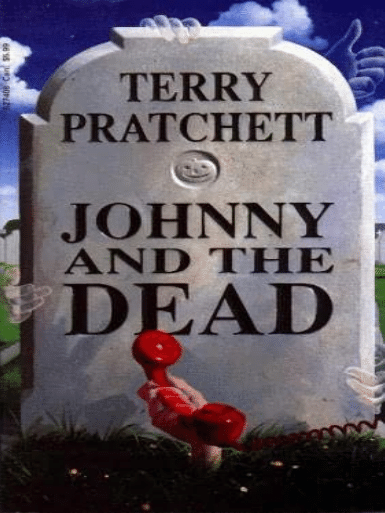

JOHNNY AND THE
DEAD
TERRY PRATCHETT





Contents
Author’s Note
Johnny never knew for certain
why he started seeing the…
Johnny raised the subject of the
cemetery after tea.
There was the Alderman, and
William Stickers, and an old…

It was later that morning.
Johnny went home. He didn’t
dare go back to the…
The Pals swung up the road,
keeping perfectly in step.
The Frank W. Arnold Civic
Center meeting room was about
half…

There is a night that never comes
to an end.…
“This fuss over the cemetery’s
certainly breathed a bit of…
Bigmac bounded over the
rubble, an enraged skinhead
skeleton.
As Tommy Atkins had once
said, things aren’t necessarily
over…

About the Author
Other Books by Terry Pratchett
Credits
Cover
Copyright
About the Publisher

AUTHOR’S NOTE
I’ve bent history a little bit. There really
were such things as Pals’ Battalions, just
as described here, and they really were a
horribly innocent device for wiping out a
whole generation of young men from one
particular area with one cannon shell. But
the practice died out by the summer of
1916, when the first Battle of the Somme
took place. Nineteen thousand British
soldiers died on the first day of the battle.
“Thomas Atkins” really was the name
used on documents in the British Army in
the way that people would now use
“A.N. Other,” and “Tommy Atkins” did
become a nickname for the British

soldier.
There were certainly a number of real
Tommy Atkinses in the war. This book is
dedicated to them—wherever they are.

ONE
J
ohnny never knew for certain why he
started seeing the dead.
The Alderman said it was probably
because he was too lazy not to.
Most people’s minds don’t let them see
things that might upset them, he said. The
Alderman said he should know if anyone
did, because he’d spent his whole life
(1822–1906) not seeing things.
Wobbler Johnson, who was technically
Johnny’s best friend, said it was because
he was nuts.
But Yo-less, who read medical books,

said it was probably because he couldn’t
focus his mind like normal people.
Normal people just ignored almost
everything that was going on around
them, so that they could concentrate on
important things like, well, getting up,
going to the lavatory, and getting on with
their lives. Whereas Johnny just opened
his eyes in the morning and the whole
universe hit him in the face.
Wobbler said this sounded like “nuts”
to him.
Whatever it was called, what it meant
was this: Johnny saw things other people
didn’t.
Like the dead people hanging around in
the cemetery.
The
Alderman—at
least
the old

Alderman—was a bit snobby about most
of the rest of the dead, even about Mr.
Vicenti, who had a huge black marble
grave with angels and a photograph of
Mr. Vicenti (1897–1958) looking not at
all dead behind a little window. The
Alderman said Mr. Vicenti had been a
Capo di Monte in the Mafia. Mr. Vicenti
told Johnny that, on the contrary, he had
spent his entire life being a wholesale
novelty salesman, amateur escapologist,
and children’s entertainer, which in a
number of important respects was as
exactly like not being in the Mafia as it
was possible to get.
But all this was later. After he’d gotten
to know the dead a lot better. After the
raising of the ghost of the Ford Capri.

Johnny really discovered the cemetery
after he’d started living at Granddad’s.
This was Phase Three of Trying Times,
after the shouting, which had been bad,
and the Being Sensible About Things
(which had been worse; people are better
at shouting). Now his dad was getting a
new job somewhere on the other side of
the country. There was a vague feeling
that it might all work out, now that people
had stopped trying to be sensible. On the
whole, he tried not to think about it.
He’d started using the path along the
canal instead of going home on the bus,
and had found that if you climbed over
the place where the wall had fallen
down, and then went around behind the

crematorium, you could cut off half the
journey.
The graves went right up to the canal’s
edge.
It was one of those old cemeteries you
got owls and foxes in and sometimes, in
the Sunday papers, people going on about
Our Victorian Heritage, although they
didn’t go on about this one because it
was the wrong kind of heritage, being too
far from London.
Wobbler said it was spooky and
sometimes went home the long way, but
Johnny was disappointed that it wasn’t
spookier. Once you sort of put out of your
mind what it was—once you forgot about
all the skeletons underground, grinning
away in the dark—it was quite friendly.

Birds sang. All the traffic sounded a long
way off. It was peaceful.
He’d had to check a few things, though.
Some of the older graves had big stone
boxes on top of them, and in the wilder
parts these had cracked and even fallen
open. He’d had a look inside, just in
case.
It had been sort of disappointing to find
nothing there.
And then there were the mausoleums.
These were much bigger and had doors in
them, like little houses. They looked a bit
like garden sheds with extra angels. The
angels were generally more lifelike than
you’d expect, especially one near the
entrance who looked as though he’d just
remembered that he should have gone to

the toilet before he left heaven.
The two boys walked through the
cemetery now, kicking up the drifts of
fallen leaves.
“It’s Halloween next week,” said
Wobbler. “I’m having a party. You have
to come as something horrible. Don’t
bother to find a disguise.”
“Thanks,” said Johnny.
“You notice how there’s a lot more
Halloween stuff in the shops these days?”
said Wobbler.
“It’s because of Bonfire Night,” said
Johnny. “Too many people were blowing
themselves up with fireworks, so they
invented Halloween, where you just wear
masks and stuff.”
“Mrs. Nugent says all that sort of thing

is tampering with the occult,” said
Wobbler. Mrs. Nugent was the Johnsons’
next-door neighbor, and known to be
unreasonable on subjects like Madonna
played at full volume at three
A.M.
“Probably it is,” said Johnny.
“She says witches are abroad on
Halloween,” said Wobbler.
“What?” Johnny’s forehead wrinkled.
“Like…Marjorca and places?”
“Suppose so,” said Wobbler.
“Makes…sense,
I
suppose.
They
probably
get
special
out-of-season
bargains, being old ladies,” said Johnny.
“My aunt can go anywhere on the buses
for almost nothing, and she’s not even a
witch.”
“Don’t see why Mrs. Nugent is

worried, then,” said Wobbler. “It ought
to be a lot safer around here, with all the
witches on vacation.”
They passed a very ornate mausoleum,
which even had little stained-glass
windows. It was hard to imagine who’d
want to see in, but then, it was even
harder to imagine who’d want to look
out.
“Shouldn’t like to be on the same plane
as ’em,” said Wobbler, who’d been
thinking hard. “Just think, p’raps you can
only afford to go on vacation in the
autumn, and you get on the plane, and
there’s all these old witches going
abroad.”
“Singing ‘Here we go, here we go, here
we go’?” said Johnny. “But I bet you’d

get really good service in the hotel.”
“Yeah.”
“Funny, really,” said Johnny.
“What?”
“I saw a thing in a book once,” said
Johnny, “about these people in Mexico or
somewhere, where they all go down to
the cemetery for a big fiesta at
Halloween every year. Like they don’t
see why people should be left out of
things just because they’re dead.”
“Yuck. A picnic? In the actual
cemetery?”
“Yes.”
“Reckon you’d get green glowing hands
pushing up through the earth and swiping
the sandwiches?”
“Don’t think so. Anyway…they don’t

eat sandwiches in Mexico. They eat
tort…something.”
“Tortoises.”
“Yeah?”
“I bet,” said Wobbler, looking around,
“I bet…I bet you wouldn’t dare knock on
one of those doors. I bet you’d hear dead
people lurchin’ about inside.”
“Why do they lurch?”
Wobbler thought about this.
“They always lurch,” he said. “Dunno
why. I’ve seen them in videos. And they
can push their way through walls.”
“Why?” said Johnny.
“Why what?”
“Why push their way through walls? I
mean…living people can’t do that. Why
should dead people do it?”

Wobbler’s mother was very easygoing
in the matter of videos. According to him,
he was allowed to watch ones that even
people aged a hundred had to watch with
their parents.
“Don’t know,” he said. “They’re
usually very angry about something.”
“Being dead, you mean?”
“Probably,” said Wobbler. “It can’t be
much of a life.”
Johnny thought about this that evening,
after meeting the Alderman. The only
dead people he had known had been Mr.
Page, who’d died in the hospital of
something, and his great-grandmother,
who’d been ninety-six and had just
generally died. Neither of them had been
particularly angry people. His great-

grandmother had been a bit confused
about things, but never angry. He’d
visited her in Sunshine Acres, where she
watched a lot of television and waited
for the next meal to turn up. And Mr.
Page had walked around quietly, the only
man on the street still at home in the
middle of the day.
They didn’t seem the sort of people
who would get up after being dead just to
dance with Michael Jackson like in that
old movie. And the only thing his great-
grand-mother would have pushed her
way through walls for would be a
television that she could watch without
having to fight fifteen other old ladies for
the remote control.
It seemed to Johnny that a lot of people

were getting things all wrong. He said
this to Wobbler. Wobbler disagreed.
“It’s prob’ly all different from a dead
point of view,” he said.
Now they were walking along West
Avenue. The cemetery was laid out like a
town, with streets. They weren’t named
very originally—North Drive and South
Walk joined West Avenue, for example,
at a little graveled area with seats in it. A
kind of city center. But the silence of the
big Victorian mausoleums made the place
look as though it was having the longest
early-closing day in the world.
“My dad says this is all going to be
built on,” said Wobbler. “He said the
Council sold it to some big company for
just fivepence because it was costing so

much to keep it going.”
“What, all of it?” said Johnny.
“That’s what he said,” said Wobbler.
Even he looked a bit uncertain. “He said
it was a scandal.”
“Even the bit with the poplar trees?”
“All of it,” said Wobbler. “It’s going to
be offices or something.”
Johnny looked at the cemetery. It was
the only open space for miles.
“I’d have given them at least a pound,”
he said.
“Yes, but you wouldn’t have been able
to build things on it,” said Wobbler.
“That’s the important thing.”
“I wouldn’t want to build anything on
it. I’d have given them a pound just to
leave it as it is.”

“Yes,” said Wobbler, the voice of
reason, “but people have got to work
somewhere. We Need Jobs.”
“I bet the people here won’t be very
happy about it,” said Johnny. “If they
knew.”
“I think they get moved somewhere
else,” said Wobbler. “It’s got to be
something like that. Otherwise you’d
never dare dig your garden.”
Johnny looked up at the nearest tomb. It
was one of the ones that looked like a
shed built of marble. Bronze lettering
over the door said:
ALDERMAN THOMAS BOWLER
1822–1906
PRO BONO PUBLICO

There was a stone carving of—
presumably—the
Alderman
himself,
looking seriously into the distance as if
he, too, was wondering what Pro Bono
Publico meant.
“I bet he’d be pretty angry,” said
Johnny.
He hesitated for a moment, then walked
up the couple of broken steps to the metal
door and knocked on it. He never did
know why he’d done that.
“Here, you mustn’t!” hissed Wobbler.
“Supposing he comes lurchin’ out!
Anyway,” he said, lowering his voice
even more, “it’s wrong to try to talk to
the dead. It can lead to satanic practices;
it said on television.”

“Don’t see why,” said Johnny.
He knocked again.
And the door opened.
Alderman Thomas Bowler blinked in
the sunlight and then glared at Johnny.
“Yes?” he said.
Johnny turned and ran for it.
Wobbler caught up to him halfway
along North Drive. Wobbler wasn’t
normally the athletic type, and his speed
would have surprised quite a lot of
people who knew him.
“What happened? What happened?” he
panted.
“Didn’t you see?” said Johnny.
“I didn’t see anything!”
“The door opened!”
“It never!”

“It did!”
Wobbler slowed down.
“No, it didn’t,” he muttered. “No one of
’em can open. I’ve looked at ’em.
They’ve all got padlocks on.”
“To keep people out or keep people
in?” asked Johnny.
A look of panic crossed Wobbler’s
face. Since he had a big face, this took
some time. He started to run again.
“You’re just trying to get a rise out of
me!” he yelled. “I’m not going to hang
around practicing being satanic! I’m
going home!”
He turned the corner into East Way and
sprinted toward the main gate.
Johnny slowed down.
He thought: padlocks.

It was true, actually. He’d noticed it in
the past.
All the mausoleums had locks on them,
to stop vandals from getting in.
And yet…and yet…
If he shut his eyes, he could see
Alderman Thomas Bowler. Not one of
the lurchin’ dead from out of Wobbler’s
videos, but a huge fat man in a fur-
trimmed robe and a gold chain and a hat
with corners.
He stopped running and then, slowly,
walked back the way he had come.
There was a padlock on the door of the
Alderman’s tomb. It had a rusty look.
It was the talking to Wobbler that did
it, Johnny decided. It had given him silly
ideas.

He knocked again, anyway.
“Yes?”
said
Alderman
Thomas
Bowler.
“Er…hah…sorry…”
“What do you want?”
“Are you dead?”
The Alderman raised his eyes to the
bronze letters over the door.
“See what it says up there?” he said.
“Er…”
“Nineteen hundred and six, it says. It
was a very good funeral, I understand. I
didn’t attend, myself.” The Alderman
gave this some thought. “Rather, I did, but
not in any position where I could observe
events. I believe the vicar gave a very
moving sermon. What was it you were
wanting?”

“Er…”
Johnny
looked
around
desperately. “What…er…what does Pro
Bono Publico mean?”
“For the Public Good,” said the
Alderman.
“Oh. Well…thank you.” Johnny backed
away. “Thank you very much.”
“Was that all?”
“Er…yes.”
The Alderman nodded sadly. “I didn’t
think it’d be anything important,” he said.
“I haven’t had a visitor since nineteen
twenty-three. And then they’d got the
name
wrong.
They
weren’t
even
relatives. And they were American. Oh,
well. Good-bye, then.”
Johnny hesitated. I could turn around
now, he thought, and go home.

And if I turn around, I’ll never find out
what happens next. I’ll go away and I’ll
never know why it happened now and
what would have happened next. I’ll go
away and grow up and get a job and get
married and have children and become a
granddad and retire and take up bowling
and go into Sunshine Acres and watch
daytime television until I die, and I’ll
never know.
And he thought: Perhaps I did. Perhaps
that all happened and then, just when I
was dying, some kind of angel turned up
and said would you like a wish? And I
said, yes, I’d like to know what would
have happened if I hadn’t run away, and
the angel said, Okay, you can go back.
And here I am, back again. I can’t let

myself down.
The world waited.
Johnny took a step forward.
“You’re dead, right?” he said slowly.
“Oh, yes. It’s one of those things one is
pretty certain about.”
“You
don’t look dead. I mean, I
thought…you
know…coffins
and
things…”
“Oh, there’s all that,” said the
Alderman airily, “and then there’s this,
too.”
“You’re a ghost?” Johnny was rather
relieved. He could come to terms with a
ghost.
“I should hope I’ve got more pride than
that,” said the Alderman.
“My friend Wobbler’ll be really

amazed to meet you,” said Johnny. A
thought crossed his mind. “You’re no
good at dancing, are you?” he said.
“I used to be able to waltz quite well,”
said the Alderman.
“I meant…sort of…like this,” said
Johnny. He gave the best impression he
could remember of Michael Jackson
dancing. “Sort of with your feet,” he said
apologetically.
“That looks grand,” said Alderman
Tom Bowler.
“Yes, and you have to have a glittery
glove on one hand—”
“That’s important, is it?”
“Yes, and you have to say ‘Ow!’”
“I should think anyone would, dancing
like that,” said the Alderman.

“No,
I
mean
like
‘Oooowwwwwwweeeeeah!’ with—”
Johnny stopped. He realized that he
was getting a bit carried away.
“But look,” he said, stopping at the end
of a groove in the gravel. “I don’t see
how you can be dead and walking and
talking at the same time….”
“That’s probably all because of
relativity,” said the Alderman. He
moonwalked stiffly across the path. “Like
this, was it? Ouch!”
“A bit,” said Johnny kindly. “Um. What
do you mean about relativity?”
“Einstein explains all that quite well,”
said the Alderman.
“What, Albert Einstein?” said Johnny.
“Who?”

“He was a famous scientist. He…
invented the speed of light and things.”
“Did he? I meant Solomon Einstein. He
was a famous taxidermist in Cable Street.
Stuffing dead animals, you know. I think
he invented some kind of machine for
making glass eyes. Got knocked down by
a motorcar in nineteen thirty-two. But a
very keen thinker, all the same.”
“I never knew that,” said Johnny. He
looked around.
It was getting darker.
“I think I’d better be getting home,” he
said, and began to back away.
“I think I’m getting the hang of this,”
said the Alderman, moonwalking back
across the path.
“I’ll…er…I’ll see you again. Perhaps,”

said Johnny.
“Drop by any time you like,” said the
Alderman, as Johnny walked away as
quickly yet politely as possible. “I’m
always in.
“Always in,” he added. “That’s
something you learn to be good at, when
you’re dead. Er. Eeeeeeyooooowh, was
it?”

TWO
J
ohnny raised the subject of the cemetery
after tea.
“It’s disgusting, what the Council are
doing,” said his grandfather.
“But the cemetery costs a lot to keep
up,” said his mother. “No one visits most
of the graves now, except old Mrs.
Tachyon, and she’s crazy.”
“Not visiting graves has nothing to do
with it, girl. Anyway, there’s history in
there.”
“Alderman Thomas Bowler,” said
Johnny.

“Never heard of him. I was referring,”
said his grandfather, “to William
Stickers. There was very nearly a
monument to him. There would have been
a monument to him. Everyone around
here donated money, only someone ran
off with it. And I’d given sixpence.”
“Was he famous?”
“Nearly
famous. Nearly
famous.
You’ve heard of Karl Marx?”
“He invented communism, didn’t he?”
said Johnny.
“Right. Well, William Stickers didn’t.
But he’d have been Karl Marx if Karl
Marx hadn’t beaten him to it. Tell you
what…tomorrow I’ll show you.”
It was tomorrow.

It was raining softly out of a dark-gray
sky.
Granddad and Johnny stood in front of
a large gravestone that read:
WILLIAM STICKERS
1897–1949
WORKERS OF THE WORLD UNIT
“A great man,” said Granddad. He had
taken his cap off.
“What was the World Unit?” said
Johnny.
“It should have been unite,” said
Granddad. “They ran out of money before
they did the ‘E.’ It was a scandal. He was
a hero of the working class. He would
have fought in the Spanish Civil War,
except he got on the wrong boat and

ended up in Liverpool.”
Johnny looked around.
“Um,” he said. “What sort of a man
was he?”
“A hero of the proletariat, like I said.”
“I mean, what did he look like?” said
Johnny. “Was he quite big with a huge
black
beard
and
gold-rimmed
spectacles?”
“That’s right. Seen pictures, have
you?”
“No,” said Johnny. “Not exactly.”
Granddad put his cap back on.
“I’m going down to the shops,” he said.
“Want to come?”
“No, thanks. Er…I’m going around to
Wobbler’s house.”
“Righto.”

Granddad wandered off toward the
main gate.
Johnny took a deep breath.
“Hello,” he said.
“It was a scandal, them not giving me
the ‘E,’” said William Stickers.
He
stopped
leaning
against
his
memorial.
“What’s your name, comrade?”
“John Maxwell,” said Johnny.
“I knew you could see me,” said
William Stickers. “I could see you
looking right at me while the old man
was talking.”
“I could tell you were you,” said
Johnny. “You look…um…thinner.”
He wanted to say: not thin like in thick.
Just…not all there. Transparent.

H e said, “Um.” And then he said, “I
don’t understand this. You are dead,
right? Some kind of…ghost?”
“Ghost?” said dead William Stickers
angrily.
“Well…spirit, then.”
“There’s no such thing. A relic of an
outmoded belief system.”
“Um, only…you’re talking to me…”
“It’s
a
perfectly
understandable
scientific phenomenon,” said William
Stickers. “Never let superstition get in
the way of rational thought, boy. It’s time
for Mankind to put old cultural
shibboleths aside and step into the bright
socialist dawn. What year is it?”
“Nineteen ninety-three,” said Johnny.
“Ah! And have the downtrodden

masses risen up to overthrow the
capitalist oppressors in the glorious name
of communism?”
“Um. Sorry?” Johnny hesitated, and
then a few vague memories slid into
place. “You mean like…Russia and
stuff? When they shot the tsar? There was
something on television about that.”
“Oh, I know that. That was just the
start. What’s been happening since
nineteen forty-nine? I expect the global
revolution is well established, yes? No
one tells us anything in here.”
“Well…there’s
been
a
lot
of
revolutions, I think,” said Johnny. “All
over the place…”
“Capital!”
“Um.” It occurred to Johnny that people

doing quite a lot of the more recent
revolutions
had
said
they
were
overthrowing communist oppressors, but
William Stickers looked so eager, he
didn’t quite know how to say this. “Tell
you what…can you read a newspaper if I
bring you one?”
“Of course. But it’s hard to turn the
pages.”
“Um. Are there a lot of you in here?”
“Hah! Most of them don’t bother. They
just aren’t prepared to make the effort.”
“Can you…you know…walk around?
You could get into things for free.”
William
Stickers
looked
slightly
panicky.
“It’s hard to go far,” he mumbled. “It’s
not really allowed.”

“I read in a book once that ghosts can’t
move much,” said Johnny.
“Ghost? I’m just…dead.” He waved a
transparent finger in the air. “Hah! But
they’re not getting me that way,” he
snapped. “Just because it turns out that
I’m still…here after I’m dead, doesn’t
mean I’m prepared to believe in the
whole stupid nonsense, you know. Oh,
no. Logical, rational thought, boy. And
don’t forget the newspaper.”
William Stickers faded away a bit at a
time. The last thing to go was the finger,
still demonstrating its total disbelief in
life after death.
Johnny waited around a bit, but no
other dead people seemed to be ready to
make an appearance.

He felt he was being watched in some
way that had nothing to do with eyes. It
wasn’t exactly creepy, but it was
uncomfortable. You didn’t dare scratch
your bottom or pick your nose.
For the first time, he really began to
notice the cemetery. It had a leftover
look, really.
Behind it there was the canal, which
wasn’t used anymore, except as a rubbish
dump; old prams and busted televisions
and erupting settees lined its banks like
monsters from the Garbage Age. Then on
one side there was the crematorium and
its Garden of Remembrance, which was
all right in a gravel-pathed, keep-off-the-
grass sort of way. In front was Cemetery
Road, which had once had houses on the

other side of it; now there was the back
wall of the Bonanza Carpet (Save
£££££!!) Warehouse. There was still an
old phone booth and a letter box, which
suggested that once upon a time this had
been a place that people thought of as
home. But now it was just a road you cut
through to get to the bypass from the
industrial estate.
On the fourth side was nothing much
except a waste-land of fallen brick and
one tall chimney—all that remained of
the Blackbury Rubber Boot Company.
(“If It’s a Boot, It’s a Blackbury” had
been one of the most famously stupid
slogans in the world.)
Johnny vaguely remembered there’d
been some thing in the papers. People

had been protesting about something—but
then, they always were. There was
always so much news going on, you
never had time to find out anything
important.
He walked round to the old factory site.
Bulldozers were parked around it now,
although they were all empty. There was
a wire fence that had been broken down
here and there despite the notices about
Guard Dogs on Patrol. Perhaps the guard
dogs had broken out.
And there was a big sign, showing the
office building that was going to be built
on the site. It was beautiful. There were
fountains in front of it, and quite old trees
carefully placed here and there, and neat
people standing chatting outside it. And

the sky above it was a glorious blue,
which was pretty unusual for Blackbury,
where most of the time the sky was that
odd, soapy color you’d get if you lived in
a Tupperware box.
Johnny stared at it for some time, while
the rain fell in the real world and the blue
sky glittered on the sign.
It was pretty obvious that the building
was going to take up more room than the
site of the old boot factory.
The words above the picture said, “An
Exciting
Development
for
United
Amalgamated Consolidated Holdings:
Forward to the Future!”
Johnny didn’t feel very excited, but he
did feel that “Forward to the Future” was
even dumber than “If It’s a Boot, It’s a

Blackbury.”
Before school the next day he swiped the
newspaper and tucked it out of sight
behind William Stickers’s grave.
He felt more silly than afraid. He
wished he could talk to someone about it.
He didn’t have anyone to talk to. But he
did have three people to talk with.
There were various gangs and alliances
in the school, such as the sporty group,
and the bright kids, and the Computer
Club Nerds.
And then there was Johnny, and
Wobbler, and Bigmac, who said he was
the last of the well hard skin-heads but
was actually a skinny kid with short hair
and flat feet and asthma who had

difficulty even walking in Doc Martens,
and there was Yo-less, who was
technically black.
But at least they listened, during break,
on the bit of wall between the school
kitchen and the library. It was where they
normally hung out—or at least, hung
around.
“Ghosts,” said Yo-less, when he’d
finished.
“No-oo,” said Johnny uncertainly.
“They don’t like being called ghosts. It
upsets them, for some reason. They’re
just…dead. I suppose it’s like not calling
people handicapped or backward.”
“Politically incorrect,” said Yo-less. “I
read about that.”
“You mean they want to be called”—

Wobbler paused for thought—“ post-
senior citizens.”
“Breathily challenged,” said Yo-less.
“Vertically
disadvantaged,”
said
Wobbler.
“What? You mean they’re short?” said
Yo-less.
“Buried,” said Wobbler.
“How about zombies?” said Bigmac.
“No, you’ve got to have a body to be a
zombie,” said Yo-less. “You’re not
really dead, you just get fed this secret
voodoo mixture of fish and roots and you
turn into a zombie.”
“Wow. What mixture?”
“I don’t know. How should I know?
Just some kind of fish and some kind of
root.”

“I bet it’s a real adventure getting fish
and chips in voodoo country,” said
Wobbler.
“Well, you ought to know about
voodoo,” said Bigmac.
“Why?” said Yo-less.
“’Cause you’re West Indian, right?”
“Do you know all about Druids?”
“No.”
“There you are, then.”
“I ’spect your mum knows about it,
though,” said Bigmac.
“Shouldn’t think so. My mum spends
more time in church than the pope,” said
Yo-less. “My mum spends more time in
church than God.”
“You’re not taking this seriously,” said
Johnny severely. “I really saw them.”

“It might be something wrong with your
eyes,” said Yo-less. “Perhaps there’s a
—”
“I saw this old film once, about a man
with X-ray eyes,” said Bigmac. “He
could use ’em to see right through
things.”
“Women’s clothes and stuff?” enquired
Wobbler.
“There wasn’t much of that,” said
Bigmac.
They discussed this waste of a useful
talent.
“I don’t see through anything,” said
Johnny eventually. “I just see people who
aren’t ther—I mean, people other people
don’t see.”
“My uncle used to see things other

people couldn’t see,” said Wobbler.
“Especially on a Saturday night.”
“Don’t be stupid. I’m trying to be
serious.”
“Yeah, but once you said you’d seen a
Loch Ness monster in your goldfish
pond,” said Bigmac.
“All right, but—”
“Probably just a plesiosaur,” said Yo-
less. “Just some old dinosaur that ought
to’ve been extinct seventy million years
ago. Nothing special at all.”
“Yes, but—”
“And then there was the Lost City of
the Incas,” said Wobbler.
“Well, I found it, didn’t I?”
“Yes, but it wasn’t that lost,” said Yo-
less. “Behind Tesco’s isn’t exactly lost.”

Bigmac sighed.
“You’re all weird,” he said.
“All right,” said Johnny. “You all come
down there after school, right?”
“Well—” Wobbler began, and shifted
uneasily.
“Not scared, are you?” said Johnny. He
knew that was unfair, but he was
annoyed. “You ran away before,” he
said, “when the Alderman came out.”
“I never saw no Alderman,” said
Wobbler. “Anyway, I wasn’t scared. I
ran away to get a rise out of you.”
“You certainly had me fooled,” said
Johnny.
“Me? Scared? I watched Night of the
Killer Zombies three times—with freeze
frame,” said Wobbler.

“All right, then. You come. All three of
you come. After school.”
“After Cobbers,” said Bigmac.
“Look, this is a lot more important than
—”
“Yes, but today Janine is going to tell
Mick that Doraleen took Ron’s surfboard
—”
Johnny hesitated.
“All right, then,” he said. “After
Cobbers.”
“And then I promised to help my
brother load up his van,” said Bigmac.
“Well, not exactly promised…he said
he’d rip my arms off if I didn’t.”
“And I’ve got to do some geography
homework,” said Yo-less.
“We haven’t got any,” said Johnny.

“No, but I thought if I did an extra essay
on rainforests, I could pull up my grade
average,” said Yo-less.
There was nothing odd about this, if
you were used to Yo-less. Yo-less wore
the school uniform. Except that it wasn’t
really the school uniform. Well, all right,
technically it was the school uniform,
because everyone got these bits of paper
at the start of every year saying what the
school uniform was, but no one ever
wore it much, except for Yo-less, and so
if hardly anyone else was wearing it,
Wobbler said, how could it be a
uniform? Whereas, said Wobbler, since
at any one time nearly everyone was
wearing jeans and a T-shirt, then really
jeans and a T-shirt were the real school

uniform and Yo-less should be sent home
for not wearing it.
“Tell you what,” said Johnny. “Let’s
meet up later, then. Six o’clock. We can
meet at Bigmac’s place. That’s right near
the cemetery, anyway.”
“But it’ll be getting dark,” said
Wobbler.
“Well?” said Johnny. “You’re not
scared, are you?”
“Me? Scared? Huh! Me? Scared? Me?
Scared?”
If you had to be somewhere frightening
when it got dark, Johnny thought, the
Joshua N’Clement block rated a lot
higher on the Aaargh scale than any
cemetery. At least the dead didn’t mug

you.
It was originally going to be the Sir
Alec Douglas-Home block, and then it
became the Harold Wilson block, and
then finally the new Council named it the
Joshua Che N’Clement block after a
famous freedom fighter, who then became
president of his country, and who was
now being an ex-freedom fighter and ex-
president somewhere in Switzerland
while some of his countrymen tried to
find him and ask him questions like: What
happened to the two hundred million
dollars we thought we had, and how
come your wife owned seven hundred
hats?
The block had been described in 1965
as “an overwhelming and dynamic

relationship of voids and solids, majestic
in its uncompromising simplicity.”
Often
the Blackbury Guardian had
pictures of people complaining about the
damp, or the cold, or the way the
windows fell out in high winds (it was
always windy around the block, even on
a calm day everywhere else), or the way
gangs roamed its dank passageways and
pushed shopping carts off the roof into
the Great Lost Shopping Cart Graveyard.
The elevators hadn’t worked properly
since 1966. They lurked in the basement,
too scared to go anywhere else.
The passages and walkways (“an
excitingly
brutal
brushed
concrete
finish”) had two smells, depending on
whether or not the Council’s ninja

caretaker had been around in his van. The
other one was disinfectant.
No one liked the Joshua N’Clement
block. There were two schools of thought
about what should be done with it. The
people who lived there thought everyone
should be taken out and then the block
should be blown up, and the people who
lived near the block just wanted it blown
up.
The odd thing was that although the
block was cramped and fourteen stories
high, it had been built in the middle of a
huge area of what was theoretically grass
(“environmental open space”), but which
was now the home of the Common Potato
Chip Packet and Hardy Perennial
Burned-Out Car.

“Horrible place,” said Wobbler.
“People’ve got to live somewhere,”
said Yo-less.
“Reckon the man who designed it lives
here?” said Johnny.
“Shouldn’t think so.”
“I’m not going too near Bigmac’s
brother,” said Wobbler. “He’s a nutter.
He’s got tattoos and everything. And
everyone knows he steals stuff. Videos
and things. Out of factories. And he killed
Bigmac’s hamster when he was little.
And he chucks his stuff out of the window
when he’s angry. And if Clint’s been let
out—”
Clint was Bigmac’s brother’s dog,
which had reputedly been banned from
the
Rottweiler/Pit
Bull
Terrier

Crossbreed Club for being too nasty.
“Poor old Bigmac,” said Johnny. “No
wonder he’s always sending off for
martial arts stuff.”
“I reckon he wants to join the army so’s
he can bring his gun home one weekend,”
said Yo-less.
Wobbler looked up apprehensively at
the huge towering bulk of the block.
“Huh! Bringing his tank home’d be
more like it,” he said.
Bigmac’s brother’s van was parked in
what had been designed as the washing-
drying area. Both of the doors and the
front fender were different colors. Clint
was in the front seat, chained to the
steering wheel. The van was the one
vehicle that could be left unlocked

anywhere near Joshua N’Clement.
“Weird, really,” said Johnny. “When
you think about it, I mean.”
“What is?” said Yo-less.
“Well, there’s a huge cemetery for
dead people, and all the living people are
crammed up in that thing,” said Johnny. “I
mean, it sounds like someone got
something wrong…”
Bigmac emerged from the block,
carrying a stack of cardboard boxes. He
nodded hopelessly at Johnny, and put the
boxes in the back of the van.
“Yo, duds,” he said.
“Where’s your brother?”
“He’s upstairs. Come on, let’s go.”
“Before he comes down, you mean,”
said Wobbler.

“Shut up.”
The breeze moved in the poplar trees,
and whispered around the antique urns
and broken stones.
“I don’t know as this is right,” said
Wobbler, when the four of them had
gathered by the gate.
“There’s crosses all over the place,”
said Yo-less.
“Yes, but I’m an atheist,” said
Wobbler.
“Then you shouldn’t believe in ghosts
—”
“Post-living
citizens,”
Bigmac
corrected him.
“Bigmac?” said Johnny.
“Yeah?”

“What’re you holding behind your
back?”
“Nothing.”
Wobbler craned to see.
“It’s a bit of sharpened wood,” he
reported. “And a hammer.”
“Bigmac!”
“Well, you never know—”
“Leave them here!”
“Oh, all right.”
“Anyway, it’s not stakes for ghosts.
That’s for vampires,” said Yo-less.
“Oh, thank you,” said Wobbler.
“Look, this is just the cemetery,” said
Johnny. “It’s got bylaws and things! It’s
not Transylvania! There’s just dead
people here! That doesn’t make it scary,
does it? Dead people are people who

were living once! You wouldn’t be so
worked up if there were living people
buried here, would you?”
They set off along North Drive.
It was amazing how sounds died away
in the cemetery. There was only a set of
overgrown iron railings and some
unpruned trees between them and the
road, but noises were suddenly cut right
down, as if they were being heard
through a blanket. Instead, silence
seemed to pour in—pour up, Johnny
thought—like breathable water. It hissed.
In the cemetery, silence made a noise.
The gravel crunched underfoot. Some
of the more recent graves had a raised
area in front of them that someone had
thought would be a good idea to cover

with little green stones. Now, tiny
rockery plants were flourishing.
A crow cawed in one of the trees,
unless it was a rook. It didn’t really
break the silence. It just underlined it.
“Peaceful, isn’t it,” said Yo-less.
“Quiet as the grave,” said Bigmac.
“Ha, ha.”
“A lot of people come for walks here,”
said Johnny. “I mean, the park’s miles
away, and all there is there is grass. But
this place has got tons of bushes and
plants and trees and, and—”
“Environment,” said Yo-less.
“And probably some ecology as well,”
said Johnny.
“Hey, look at this grave,” said
Wobbler.

They looked. It had a huge raised
archway made of carved black marble,
and a lot of angels wound around it, and a
Madonna, and a faded photograph in a
little glass window under the name:
Antonio Vicenti (1897–1958). It looked
like a kind of Rolls-Royce of a grave.
“Yeah.
Dead
impressive,”
said
Bigmac.
“Why bother with such a big stone
arch?” said Yo-less.
“It’s just showing off,” said Yo-less.
“There’s probably a sticker on the back
saying ‘My Other Grave Is a Porch.’”
“Yo-less!” said Johnny.
“Actually, I think that was very funny,”
said Mr. Vicenti. “He is a very funny
boy.”

Johnny turned, very slowly.
There was a man in black clothes
leaning on the grave. He had neat black
hair, plastered down, and a carnation in
his buttonhole, and a slightly gray look,
as if the light wasn’t quite right.
“Oh,” said Johnny. “Hello.”
“And what is the joke, exactly?” said
Mr. Vicenti, in a solemn voice. He stood
very politely with his hands clasped in
front of him, like an old-fashioned shop
assistant.
“Well, you can get these stickers for
cars, you see, and they say ‘My Other Car
Is a Porsche,’” said Johnny. “It’s not a
very good joke,” he added quickly.
“A Porsche is a kind of car?” said dead
Mr. Vicenti.

“Yes. Sorry. I didn’t think he should
joke about things like that.”
“Back in the old country I used to do
magical entertainment for kiddies,” said
Mr. Vicenti. “With doves and similar
items. On Saturdays. At parties. The
Great Vicenti and Ethel. I like to laugh.”
“The old country?” said Johnny.
“The alive country.”
The three boys were watching Johnny
carefully.
“You don’t fool us,” said Wobbler.
“There’s—there’s no one there.”
“And I did escapology, too,” said Mr.
Vicenti, absentmindedly pulling an egg
from Yo-less’s ear.
“You’re just talking to the air,” said
Yo-less.

“Escapology?” said Johnny. Here we
go again, he thought. The dead always
want to talk about themselves….
“What?” said Bigmac.
“Escaping from things.” Mr. Vicenti
cracked the egg. The ghost of a dove flew
away, and vanished as it reached the
trees. “Sacks and chains and handcuffs
and so on. Like the Great Houdini? Only
in a semiprofessional way, of course. My
greatest trick involved getting out of a
locked sack underwater while wearing
twenty feet of chain and three pairs of
handcuffs.”
“Gosh, how often did you do that?”
said Johnny.
“Nearly once,” said Mr. Vicenti.
“Come on,” said Wobbler. “Joke’s

over. No one’s taken in. Come on.
Time’s getting on.”
“Shut up—this is interesting,” said
Johnny.
He was aware of a rustling noise
around him, like someone walking very
slowly through dead leaves.
“And you’re John Maxwell,” said Mr.
Vicenti. “The Alderman told us about
you.”
“Us?”
The rustling grew louder.
Johnny turned.
“He’s not joking,” said Yo-less. “Look
at his face!”
I mustn’t be frightened, Johnny told
himself.
I mustn’t be frightened!

Why should I be frightened? These are
just…post-life citizens. A few years ago
they were mowing lawns and putting up
Christmas
decorations
and
being
grandparents and things. They’re nothing
to be frightened of.
The sun was well behind the poplar
trees. There was a bit of mist on the
ground.
And walking slowly toward him,
through its coils, were the dead.

THREE
T
here was the Alderman, and William
Stickers, and an old woman in a long
dress and a hat covered in fruit, and some
small children running on ahead, and
dozens, hundreds of others. They didn’t
lurch. They didn’t ooze any green. They
just looked gray, and very slightly out of
focus.
You
notice
things
when
you’re
terrified. Little details grow bigger.
He realized there were differences
among the dead. Mr. Vicenti had looked
almost…well, alive. William Stickers

was slightly more colorless. The
Alderman was definitely transparent
around the edges. But many of the others,
in Victorian clothes and odd assortments
of coats and breeches from earlier ages,
were almost completely without color
and almost without substance, so they
were little more than shaped air, but air
that walked.
It wasn’t that they had faded. It was just
that they were farther away, in some
strange direction that had nothing much to
do with the normal three.
Wobbler and the other two were still
staring at him.
“Johnny? You all right?” said Wobbler.
Johnny remembered a piece about
overpopulation in a school geography

book. For everyone who was alive today,
it said, there were twenty historical
people, all the way back to when people
had only just become people.
Or, to put it another way, behind every
living person were twenty dead ones.
Quite a lot of them were behind
Wobbler. Johnny didn’t feel it would be
a good idea to point this out, though.
“It’s gone all cold,” said Bigmac.
“We ought to be getting back,” said
Wobbler, his voice shaking. “I ought to
be doing my homework.”
Which showed he was frightened. It’d
take zombies to make Wobbler prefer to
do homework.
“You can’t see them, can you?” said
Johnny. “They’re all around us, but you

can’t see them.”
“The living can’t generally see the
dead,” said Mr. Vicenti. “It’s for their
own good, I expect.”
The three boys had drawn closer
together.
“Come on, stop mucking about,” said
Bigmac.
“Huh,” said Wobbler. “He’s just trying
to spook us. Huh. Like Dead Man’s Hand
at parties. Huh. Well, it’s not working.
I’m off home. Come on, you lot.”
He turned and walked a few steps.
“Hang on,” said Yo-less. “There’s
something odd—”
He looked around at the empty
cemetery. The rook had flown away,
unless it was a crow.

“Something odd,” he mumbled.
“Look,” said Johnny. “They’re here!
They’re all around us!”
“I’ll tell my mum on you!” said
Wobbler. “This is practicing bein’
satanic again!”
“John
Maxwell!”
boomed
the
Alderman. “We must talk to you!”
“That’s
right!”
shouted
William
Stickers. “This is important!”
“What about?” said Johnny. He was
balancing on his fear, and he felt oddly
calm. The funny thing was, when you
were on top of your fear, you were a
little bit taller.
“This!” said William Stickers, waving
the newspaper.
Wobbler gasped. There was a rolled-

up newspaper floating in the air.
“Poltergeist activity!” he said. He
waved a shaking finger at Johnny. “You
get that around adolescents! I read
something in a magazine! Saucepans
flying through the air and stuff! His
head’ll spin around in a minute!”
“What is the fat boy talking about?”
said the Alderman.
“And what is Dead Man’s Hand?” said
Mr. Vicenti.
“There’s
probably
a
scientific
explanation,” said Yo-less, as the
newspaper fluttered through the air.
“What?” said Bigmac.
“I’m trying to think of one!”
“It’s holding itself open!”
William Stickers opened the paper.

“It’s probably just a freak wind!” said
Yo-less, backing away.
“I can’t feel any wind!”
“That’s why it’s freaky!”
“What are you going to do about this?”
the Alderman demanded.
“Excuse me, but this Dead Man’s
Hand. What is it?”
“Will everyone SHUT UP?” said
Johnny.
Even the dead obeyed.
“Right,” he said, settling down a bit.
“Um. Look, um, you lot, these…people…
want to talk to us. Me, anyway—”
Yo-less, Wobbler, and Bigmac were
staring intently at the newspaper. It hung,
motionless, more than three feet above
the ground.

“Are
they…the
breath-impaired?”
asked Wobbler.
“Don’t be an idiot! That sounds like
asthma,” said Yo-less. “Come on. If you
mean it, say it. Come right out with it.
Are they…” He looked around at the
darkening landscape, and hesitated.
“Er…post-senior citizens?”
“Are they lurching?” asked Wobbler.
Now he and the other two were so close
that they looked like one very wide
person with six legs.
“You didn’t tell us about this,” said the
Alderman.
“This what?” said Johnny.
“In the newspaper. Well, it is called a
newspaper. But it has pictures of women
in the altogether! Which may well be

seen by respectable married women and
young children!”
William Stickers was, with great effort,
holding
the
paper
open
at
the
Entertainment Section. Johnny craned to
read it. There was a rather poor photo of
a couple of girls at Blackbury Swimming
Pool and Leisure Center.
“They’ve got swimsuits on,” he said.
“Swimsuits? But I can see almost all of
their legs!” the Alderman roared.
“Nothing wrong with that at all,”
snapped the elderly woman in the huge
fruity hat. “Healthy bodies enjoying
calisthenics in the God-given sunlight.
And very practical clothing, I may say.”
“Practical, madam? I dread to think for
what!”

Mr. Vicenti leaned toward Johnny.
“The lady in the hat is Mrs. Sylvia
Liberty,” he whispered. “Died nineteen
fourteen. Tireless suffragette.”
“Suffragette?” said Johnny.
“Don’t they teach you that sort of thing
now? They campaigned for votes for
women. They used to chain themselves to
railings and chuck eggs at policemen and
throw themselves under the Prince of
Wales’s horse on Derby days.”
“Wow.”
“But Mrs. Liberty got the instructions
wrong and threw herself under the Prince
of Wales.”
“What?”
“Killed outright,” said Mr. Vicenti. He
clicked his disapproval. “He was a very

heavy man, I believe.”
“When you two have ceased this
bourgeois arguing,” shouted William
Stickers, “perhaps we can get back to
important matters?” He rustled the paper.
Wobbler blinked.
“It says in this newspaper,” said
William Stickers, “that the cemetery is
going to be closed. Going to be built on.
Do you know about it?”
“Um. Yes. Yes. Um. Didn’t you
know?”
“Was anyone supposed to tell us?”
“What’re they saying?” said Bigmac.
“They’re annoyed about the cemetery
being sold. There’s a story in the paper.”
“Hurry up!” said William Stickers. “I
can’t hold it much longer….”

The newspaper sagged. Then it fell
through his hands and landed on the path.
“Not as alive as I was,” he said.
“Definitely a freak whirlwind,” said
Yo-less. “I’ve heard about them. Nothing
supernat—”
“This is our home,” boomed the
Alderman. “What will happen to us,
young man?”
“Just a minute,” said Johnny. “Hold on.
Yo-less?”
“Yes?”
“They want to know what happens to
people in graveyards if they get built on.”
“The…dead want to know that?”
“Yes,” said the Alderman and Johnny
at the same time.
“I bet Michael Jackson didn’t do this,”

said Bigmac. “He—”
“I saw this film,” gabbled Wobbler,
“where these houses were built on an old
graveyard and someone dug a swimming
pool and all these skeletons came out and
tried to strangle people—”
“Why?” said the Alderman.
“He wants to know why,” said Johnny.
“Search me,” said Wobbler.
“I think,” said Yo-less uncertainly,
“that the…coffins, and all that, get dug up
and put somewhere else. I think there’s
special places.”
“I’m not standing for that!” said dead
Mrs. Sylvia Liberty. “I paid five pounds,
seven shillings, and sixpence for my plot!
I remember the document Distinctly. Last
Resting Place, it said. It didn’t say After

Eighty Years You’ll Be Dug Up and
Moved just so the living can build…what
did it say?”
“Modern Purpose-Designed Offices,”
said William Stickers. “Whatever they
are.”
“I think it means they were designed on
purpose,” said Johnny.
“And how shameful to be sold for
fivepence!” said dead Mrs. Liberty.
“That’s the living for you,” said
William Stickers. “No thought for the
downtrodden masses.”
“Well,
you
see,”
said
Johnny
wretchedly, “the council says it costs too
much to keep up and the land was worth
—”
“And what’s this here about Blackbury

Municipal
Authority?”
said
the
Alderman. “What happened to Blackbury
City Council?”
“I don’t know,” said Johnny. “I’ve
never heard of it. Look, it’s not my fault. I
like this place, too. I told Wobbler I
didn’t like what’s happening.”
“So what are you going to do about it?”
asked the Alderman.
Johnny backed away but came up
against Mr. Vicenti’s Rolls-Royce of a
grave.
“Oh, no,” he said. “Not me. It’s not up
to me!”
“I don’t see why not,” said dead Mrs.
Sylvia Liberty. “After all, you can see
and hear us.”
“No one else takes any notice,” said

Mr. Vicenti.
“We’ve been trying all day,” said the
Alderman.
“People walking their dogs. Hah! They
just hurry away,” said William Stickers.
“Not even old Mrs. Tachyon,” said Mr.
Vicenti.
“And she’s mad,” said the Alderman.
“Poor soul.”
“So there’s only you,” said William
Stickers. “So you must go and tell this
Municipal whateveritis that we aren’t…
going…to…move!”
“They won’t listen to me! I’m twelve! I
can’t even vote!”
“Yes, but we can,” said the Alderman.
“Can we?” said Mr. Vicenti.
The dead clustered around him, like an

American football team.
“We’re still over twenty-one, aren’t
we? I mean, technically.”
“Yes, but we’re dead,” said Mr.
Vicenti, in a reasonable tone of voice.
“You can vote at eighteen now,” said
Johnny.
“No wonder people have no respect,”
said the Alderman. “I said the rot’d set in
if they gave the vote to women—”
Mrs. Liberty glared at him.
“Anyway, you can’t use a dead
person’s vote,” said William Stickers.
“It’s called Personation. I stood as
Revolutionary
Solidarity
Fraternal
Workers’ Party Candidate. I know about
this sort of thing.”
“I’m not proposing to let anyone use my

vote,” said the Alderman. “I want to use
it myself. No law against that.”
“Good point.”
“I served this city faithfully for more
than fifty years,” said the Alderman. “I do
not see why I should lose my vote just
because I’m dead. Democracy. That’s the
point.”
“People’s democracy,” said William
Stickers.
The dead fell silent.
“Well…” said Johnny miserably. “I’ll
see what I can do.”
“Good man,” said the Alderman. “And
we’d also like a paper delivered every
day.”
“No, no.” Mr. Vicenti shook his head.
“It’s so hard to turn the pages.”

“Well, we must know what is
happening,” said Mrs. Liberty. “There’s
no telling what the living are getting up to
out there while our backs are turned.”
“I’ll…think of something,” said Johnny.
“Something better than newspapers.”
“Right,” said William Stickers. “And
then you get along to these Council
people and tell them—”
“Tell them we’re not going to take this
lying down!” shouted the Alderman.
“Yes, right,” said Johnny.
And the dead faded. Again there was
the sensation of traveling, as if the dead
people were going back into a different
world….
“Have they gone?” said Wobbler.
“Not that they were here,” said Yo-

less, the scientific thinker.
“They were here, and they’ve gone,”
said Johnny.
“It definitely felt a bit weird,” said
Bigmac. “Very cold.”
“Let’s get out of here,” said Johnny. “I
need to think. They want me to stop this
place being built on.”
“How?”
Johnny led the way quickly toward the
gates.
“Huh! They’ve left it up to me.”
“We’ll help,” said Yo-less promptly.
“Will we?” said Wobbler. “I mean,
Johnny’s
okay,
but…I
mean…it’s
meddlin’ with the occult. And your
mum’ll go ballistic.”
“Yes, but if it’s true, then it’s helping

Christian souls,” said Yo-less. “That’s
all right. They are Christian souls, aren’t
they?”
“I think there’s a Jewish part of the
cemetery,” said Johnny.
“That’s all right. Jewish is the same as
Christian,” said Bigmac.
“Not exactly,” said Yo-less very
carefully. “But similar.”
“Yeah,
but…”
said
Wobbler
awkwardly. “I mean…dead people and
that…. I mean…he can see ’em, so it’s up
to him…I mean…”
“We all supported Bigmac when he
was in juvenile court, didn’t we?” said
Yo-less.
“You said he was going to get hung,”
said Wobbler. “And I spent all morning

doing that ‘Free the Blackbury One’
poster.”
“It was a political crime,” said
Bigmac.
“You stole the Minister of Education’s
car when he was opening the school,”
said Yo-less.
“It wasn’t stealing. I meant to give it
back,” said Bigmac.
“You drove it into a wall. You couldn’t
even give it back on a shovel.”
“Oh, so it was my fault the brakes were
faulty? I could have got badly hurt, right?
I notice no one worried about that. It was
basically his fault, leaving cars around
with crummy locks and bad brakes—”
“I bet he doesn’t have to repair his own
brakes.”

“It’s society’s fault, then—”
“Anyway,” said Yo-less, “we were
behind you that time, right?”
“Wouldn’t like to have been in front of
him,” said Wobbler.
“And we were right behind Wobbler
when he got into trouble for complaining
to the record shop about the messages
from God he heard when he played Pat
Boone records backward—”
“You said you heard it too,” said
Wobbler. “Hey, you said you heard it!”
“Only after you told me what it was,”
said Yo-less. “Before you told me what I
was listening for, it just sounded like
someone
going
ayip-ayeep-
mwerpayeep.”
“They shouldn’t do that sort of thing on

records,” said Wobbler defensively.
“Gettin’ at impressionable minds.”
“The point I’m making,” said Yo-less,
“is that you’ve got to help your friends,
right?” He turned to Johnny. “Now,
personally, I think you’re very nearly
totally disturbed and suffering from
psychosomatica and hearing voices and
seeing delusions,” he said, “and probably
ought to be locked up in one of those
white jackets with the stylish long
sleeves. But that doesn’t matter, ’cause
we’re friends.”
“I’m touched,” said Johnny.
“Probably,” said Wobbler, “but we
don’t care, do we, guys?”
His mother was out, at her second job.

Granddad was watching Video Whoopsy.
“Granddad?”
“Yes?”
“How famous was William Stickers?”
“Very famous. Very famous man,” said
the old man, without looking around.
“I can’t find him in the encyclopedia.”
“Very famous man, was William
Stickers. Haha! Look, the man’s just
fallen off his bicycle! Right into the
bush!”
Johnny took down the volume
L-MIN
and was silent for a few minutes.
Granddad had a complete set of huge
encyclopedias. No one really knew why.
Somewhere in 1950 or something,
Granddad had said to himself “Get
educated,” and had bought the massive

books on the installment plan. He’d never
opened them. He’d just built a bookcase
for them. Granddad was superstitious
about books. He thought that if you had
enough of them around, education leaked
out, like radioactivity.
“How about Mrs. Sylvia Liberty?”
“Who’s she?”
“She was a suffragette, I think. Votes
for women and things.”
“Never heard of her.”
“She’s not in here under ‘Liberty’ or
‘Suffragette.’”
“Never heard of her. Whoa, look here,
the cat’s fallen in the pond!”
“All right…how about Mr. Antonio
Vicenti?”
“What? Old Tony Vicenti? What’s he

up to now?”
“Was he famous for anything?”
For a moment, Granddad’s eyes left the
TV screen and focused on the past
instead.
“He ran a joke shop in Alma Street
where the multistory parking garage is
now. You could buy stink bombs and
itching powder. And he used to do
conjuring tricks at kids’ parties when
your mum was a girl.”
“Was he a famous man?”
“All the kids knew him. Only
children’s entertainer in these parts, see.
They all knew his tricks. They used to
shout out: ‘It’s in your pocket!’ And
things like that. Alma Street. And
Paradise Street, that was there, too. And

Balaclava Terrace. That’s where I was
born.
Number
Twelve,
Balaclava
Terrace. All under the garage now. Oh,
dear…he’s going to fall off that
building….”
“So he wasn’t really famous. Not like
really famous.”
“All the kids knew him. Prisoner of
war in Germany, he was. But he escaped.
And he married…Ethel Plover, that’s
right. Never had any kids. Used to do
conjuring tricks and escaping from things.
Always escaping from things, he was.”
“He wore a carnation pinned to his
coat,” said Johnny.
“That’s right! Every day. Never saw
him without one. Always very smart, he
was. He used to be a conjuror. Haven’t

seen him around for years.”
“Granddad?”
“It’s all changed around here now. I
hardly see anywhere I recognize when I
go into town these days. Someone told
me they’ve pulled down the old boot
factory.”
“You know that little transistor radio?”
said Johnny.
“What little transistor radio?”
“The one you’ve got.”
“What about it?”
“You said it’s too fiddly and not loud
enough?”
“That’s right.”
“Can I have it?”
“I thought you’d got one of those
ghettoblowers.”

“This is…for some friends.” Johnny
hesitated. He was by nature an honest
person, because apart from anything else,
lying was always too complicated.
“They’re quite old,” he added. “And a
bit shut in.”
“Oh, all right. You’ll have to put some
new batteries in—the old ones have gone
all wonky.”
“I’ve got some batteries.”
“You don’t get proper wireless
anymore. We used to get oscillation
when I was a boy. You never get it now.
Hehe! There he goes—look, right through
the ice!”
Johnny went down to the cemetery before
breakfast. The gates had been locked, but

since there were holes all along the
walls, this didn’t make a lot of
difference.
He’d bought a plastic bag for the radio
and had sorted out some new batteries,
after scraping out the chemical porridge
that was all that was left of the old ones.
The cemetery was deserted. There
wasn’t a soul there, living or dead. But
there was the silence, the big empty
silence. If ears could make a noise,
they’d sound like that silence.
Johnny tried to fill it.
“Um,” he said. “Anyone there?”
A fox leaped up from behind one of the
stones and scurried away into the
undergrowth.
“Hello? It’s me?”

The absence of the dead was scarier
than seeing them in the flesh—or at least,
not in the flesh.
“I brought this radio. It’s probably
easier for you than newspapers. Um. I
looked up radio in the encyclopedia and
most of you ought to know what it is. Um.
You twiddle the knobs and radio comes
out. Um. So I’ll just tuck it down behind
Mr. Vicenti’s slab, all right? Then you
can find out what’s going on.”
He coughed.
“I…I did some thinking last night,
and…and I thought maybe if people knew
about all the…famous…people here,
they’d be bound to leave it alone. I know
it’s not a very good idea,” he said
hopelessly, “but it’s the best I could

come up with. I’m going to make a list of
names. If you don’t mind?”
He’d hoped Mr. Vicenti would be
about. He quite liked him. Perhaps it was
because he hadn’t been dead as long as
the others. He seemed friendlier. Less
stiff.
Johnny walked from gravestone to
gravestone, noting down names. Some of
the older stones were quite ornate, with
fat cherubs on them. But one had a pair of
football boots carved on it. He made a
special note of the name:
STANLEY “WRONG WAY”
ROUNDWAY
1892–1936
THE LAST WHISTLE

He nearly missed the one under the
trees. It had a flat stone in the grass,
without even one of the ugly flower
vases, and all it declared was that this
was the last resting place of Eric Grimm
(1885–1927). No “Just Resting,” no
“Deeply Missed,” not even “Died,”
although probably he had. Johnny wrote
the name down, anyway.
Mr. Grimm waited until after Johnny
had gone before he emerged and glared
after him.

FOUR
I
t was later that morning.
There was a new library in the Civic
Center. It was so new, it didn’t even have
librarians. It had Assistant Information
Officers. And it had computers. Wobbler
was banned from the computers because
of an incident involving a library
terminal, the telephone connection to the
main computer, another telephone line to
the computer at East Slate Air Base ten
miles away, another telephone line to a
much bigger computer under a mountain
somewhere in America, and almost

World War Three.
At least that’s what Wobbler said. The
Assistant Information Officers said it was
because he got chocolate in the keyboard.
But he was allowed to use the
microfiche readers. They couldn’t think
of a good reason to stop him.
“What’re we looking for, anyway?”
said Bigmac.
“Nearly everyone who died here used
to get buried in that cemetery,” said
Johnny. “So if we can find someone
famous who lived here, and then we can
find them in the cemetery, then it’s a
famous place. There’s a cemetery in
London with Karl Marx in it. It’s famous
for him being dead in it.”
“Karl Marx?” said Bigmac. “What was

he famous for?”
“You’re ignorant, you are,” said
Wobbler. “He was the one who played
the harp.”
“No, Karl was the one who usedta
talka lika dis,” said Yo-less.
“Actually, he was the one with the
cigar,” said Wobbler.
“That’s a very old joke,” said Johnny
severely. “The Marx Brothers. Ha, ha.
Look, I’ve got the old newspaper files.
The Blackbury Guardian. They go back
nearly a hundred years. All we’ve got to
do is look at the front pages. That’s
where famous people’d be.”
“And the back pages,” said Bigmac.
“Why the back pages?”
“Sports. Famous footballers and that.”

“Yeah, right. Hadn’t thought of that. All
right, then. Let’s get started…”
“Yeah, but…” said Bigmac.
“What?” said Johnny.
“So this Karl Marx, then,” said
Bigmac. “What films was he in?”
Johnny sighed. “Listen, he wasn’t in
any films. He was…he led the Russian
Revolution.”
“No he didn’t,” said Wobbler. “He just
wrote a book called, oh, something like
It’s About Time There Was a Revolution,
and the Russians just followed the
instructions. The actual leaders were a
lot of people with names ending in ski.”
“Like Stalin,” said Yo-less.
“Right.”
“Stalin means Man of Steel,” said Yo-

less. “I read where he didn’t like his real
name, so he changed it. It’s Man of Steel
in English.”
“What was his real name?”
“His secret identity, you mean,” said
Yo-less.
“What are you talking about now?”
said Bigmac.
“No, I get it. Man of Steel? Yo-less
means he could leap Kremlins in a single
bound,” said Johnny.
“Don’t see why not,” said Wobbler. “I
always thought it was unfair, the way the
Americans got Superman. They’ve got all
the superheroes. I don’t see why we
couldn’t have had Superman around
here.”
They thought about it. Wobbler then

spoke for them all. “Mind you,” he said,
“around here he would have had trouble
even being Clark Kent.”
They disappeared under the hoods.
“What did you say the Alderman was
called?” asked Wobbler after a while.
“Alderman Thomas Bowler,” said
Johnny. “Why?”
“It says he got the Council to build a
memorial horse trough in the square in
nineteen
hundred
and
five,”
said
Wobbler. “It came in useful very quickly,
too, it says here.”
“Why?”
“Well…it says here, the next day the
first motorcar ever to arrive in Blackbury
crashed into it and caught fire. They used
the water to put the fire out. Says here the

Council praised Alderman Bowler for
his forward thinking.”
They looked at the microfilm viewer.
“What’s a horse trough?” said Bigmac.
“It’s that big stone trough thing that’s
outside Loggitt and Burnett’s Building
Society,” said Johnny. “The one that’s
been filled with soil for a tasteful display
of dead flowers and beer cans. They used
to put water in those things for coach
horses to drink out of.”
“But if cars were just coming in,” said
Bigmac slowly, “then building things for
horses to drink out of was a bit—”
“Yes,” said Johnny. “I know. Come on.
Let’s keep going.”
…WHEEEsssh…we built this city

on…ssshshhh…on
the
phone
right
now…wheeesshhh…that was at Number
Two…ssshwupwup…told a meeting in
Kiev…wsswssshsss…Prime
Minister…shsss…today…shhssss…
scaramouche, can you…shsssss…
The tuning knob of the little radio
behind Mr. Vicenti’s grave turned back
and forth very slowly, as if it was being
moved with great effort. Occasionally it
would stop on a program, then move
again.
…ssshhhwwwss…and
the
next
caller…shhwwsss…Babylon…
And around it, for quite some distance,
the air was cold.
In the library, the boys read on. Silence

surrounded
them.
The
Assistant
Information Officers grew worried, and
one of them went to find the cleaning
fluid and the bent paper clip for getting
chocolate out of keyboards.
“Let’s
face
it,”
said
Wobbler
eventually, “this is a town where famous
people don’t come from. It’s famous for
it.”
“It says here,” said Yo-less from his
viewer, “that Addison Vincent Fletcher
of Alma Terrace invented a form of
telephone in nineteen twenty-two.”
“Oh,
great,”
said
Wobbler.
“Telephones had been invented years
before that.”
“It says he said this one was better.”
“Oh, yes,” said Wobbler. He dialed an

imaginary number. “Hello, is that—Who
invented the real telephone, anyone?”
“Thomas Edison,” said Yo-less.
“Sir Humphrey Telephone,” said
Bigmac.
“Alexander Graham Bell,” said Johnny.
“Sir Humphrey Telephone?”
“Hello, Mr. Bell,” said Wobbler,
speaking into an imaginary mouthpiece.
“You know that telephone you invented
years ago? Well, mine’s better. And I’m
just off to discover America. Yes, I know
Christopher Columbus discovered it first,
but I’m discovering it better.”
“It makes sense,” said Bigmac. “If
you’re going to discover somewhere, you
might as well wait until there’s proper
hotels and stuff.”

“When
did
Columbus
discover
America, anyway?” said Wobbler.
“Fourteen ninety-two,” said Johnny.
“There’s a rhyme: In fourteen hundred
and ninety-two, Columbus sailed the
ocean blue.”
Wobbler and Bigmac looked at him.
“Actually, he could have got there in
fourteen ninety-one,” said Yo-less,
without looking up, “but he had to sail
around a bit because no one could think
up a rhyme for ‘one.’”
“ I t could have been Sir Humphrey
Telephone,” said Bigmac. “Stuff gets
named after inventors.”
“They didn’t name the telephone after
Bell,” said Wobbler.
“They named the bell after Bell,

though,” said Bigmac. “Telephone bells.
Proves my point.”
“Telephones haven’t had bells on for
years,” said Wobbler.
“That,” said Yo-less, “is due to the
famous invention by Fred Buzzer.”
“I think it’s impossible for anyone
famous to come from here,” said
Wobbler, “because everyone around here
is insane.”
“Got one,” said Bigmac, turning the
microfiche knob.
“Who? Which one?”
“The footballer. Stanley ‘Wrong Way’
Roundway. He played for the Blackbury
Wanderers. There’s his obituary here.
Amost half a page.”
“Any good?”

“Says he scored a record number of
goals.”
“Sounds good,” said Wobbler.
“Own goals.”
“What?”
“Greatest number of own goals in the
history of any sport, it says. It says he
kept getting overexcited and losing his
sense of direction.”
“Oh.”
“But he was a good footballer, it says.
Apart from that. Not exactly a Hall of
Fame, though—”
“Here, look at this,” said Yo-less.
They clustered around his viewer.
He’d found an ancient group photograph
of about thirty soldiers, all beaming at the
camera.

“Well?” said Wobbler.
“This is from nineteen sixteen,” said
Yo-less. “They’re all going off to war.”
“Which one?” said Wobbler.
“The first one, you nerd. World War
One.”
“I
always
wondered
why
they
numbered it,” said Bigmac. “Like they
expected to have a few more. You know.
Like Buy Two, Get One Free.”
“Says here,” Yo-less squinted—“it’s
the Blackbury Old Pals Battalion.
They’re just going off to fight. They all
joined up at the same time….”
Johnny stared. He could hear people’s
voices, and the background noises of the
library. But the picture looked as if it
was at the bottom of a dark, square

tunnel. And he was falling down it.
Things outside the picture were inky
and slow. The picture was the center of
the world.
Johnny looked at the grinning faces, the
terrible haircuts, the jug-handle ears, the
thumbs all up.
Even today nearly everyone in the
Blackbury Guardian had their photo
taken with their thumb up, unless they’d
won Super Bingo, in which case they
were shown doing what the photographer
thought was a high kick. The newspaper’s
one photographer was known as Jeremy
the Thumb.
The people in the picture didn’t look
much older than Bigmac. Well, a couple
of them did. There was a sergeant with a

mustache like a scrubbing brush, and an
officer in jodhpurs, but the rest of them
looked like a school photo.
And now he was coming back from
wherever he’d been. The picture dropped
away again, became just an oblong on a
page on a screen. He blinked.
There was a feeling, like—
—like on an airplane when it’s about to
land, and his ears went “pop.” But it was
happening with his brain, instead.
“Anyone know what the Somme is?”
said Yo-less.
“No.”
“That’s where they went, anyway.
Some place in France.”
“Any of them win any medals?” said
Johnny, struggling back into the real

world. “That’d be famous. If there’s
someone in the cemetery with a lot of
medals.”
Yo-less spun the wheels of the viewer.
“I’ll look ahead a few issues,” he said.
“There’s bound to be something if—
Hey…look at this….”
They all tried to get under the hood at
once. Silence came back as they realized
what he’d found.
I knew it was important, Johnny
thought. What’s happening to me?
“Wow,” said Wobbler. “I mean—all
those names…everyone killed in this big
battle…”
Without saying anything, Johnny ducked
into the other reader and wound it
backward until he found the cheery

photograph.
“Are they listed in alphabetical order?”
he said.
“Yes,” said Yo-less.
“I’ll read out the names under the
photo, then. Um…Armitage, K…Atkins,
T…”
“Yes…no…” said Yo-less.
“Sergeant Atterbury, F…”
“Yes.”
“Hey, there’s three from Canal Street,”
said Wobbler. “That’s where my gran
lives!”
“Blazer…Constantine…Fraser…
Frobisher…”
“Yes…yes…yes…yes…”
They went on to the end of the caption.
“They
all
died,”
said
Johnny

eventually. “Four weeks after the picture
was taken. All of them.”
“Except for Atkins, T.,” said Yo-less.
“It says here what a Pals’ Battalion was.
It says people all from one town or even
one street could all join the army together
if they wanted, and all get sent to…the
same place.”
“I wonder if they all got there?” said
Yo-less. “Eventually,” he added.
“That’s dreadful,” said Bigmac.
“It probably sounded like a good idea
at the time. Sort of…jolly.”
“Yes,
but…four
weeks…”
said
Bigmac. “I mean…”
“You’re always saying you can’t wait
to join the army,” said Wobbler. “ You
said you were sorry the Gulf War was

over. And all the legs of your bed are off
the ground because of all them copies of
Guns and Ammo underneath it.”
“Well…yeah…war,
yeah,”
said
Bigmac. “Proper fighting, with M16s and
stuff. Not just all going off grinning and
getting shot.”
“They all marched off together because
they were friends, and got killed,” said
Yo-less.
They stared at the little square of light
with the names on it, and the long, long
line of cheery thumbs.
“Except for Atkins, T.,” said Johnny. “I
wonder what happened to him.”
“It was nineteen sixteen,” said Yo-less.
“If he’s still alive, he’ll be dead.”
“Any of them on your list?” asked

Wobbler.
Johnny checked.
“No-oo,” he said, eventually. “There’s
one or two people with the same name
but the wrong initial. Everyone around
here used to get buried up there.”
“Perhaps he came back from the war
and moved away somewhere else,” said
Yo-less.
“It’d be a bit lonely around here, after
all,” said Bigmac.
They looked at him.
“Sorry,” he said.
“I’m fed up with this,” said Wobbler,
pushing his chair back. “It’s not real.
There’s no one special in there. “It’s just
people. And it’s creepy. Come on—let’s
go down to the mall.”

“I’ve found out what happens to dead
bodies when old graveyards are built
on,” said Yo-less, as they stepped out
into the Tupperware daylight. “My mum
knows. They get taken to some kind of
storage place called a necropolis. That’s
Latin for City of the Dead.”
“Yuck,” said Wobbler.
“Sounds like where Superman lives,”
said
Bigmac.
“Necropolis!”
said
Wobbler, zooming his hands through the
air. “By day, mild-mannered corpse—by
night…duh
duh
duhduh
DAH…
ZombieMan!”
Johnny remembered the grinning young
faces, not much older than Wobbler.
“Wobbler,” he said, “if you make
another joke like that—”

“What?”
“…well…just don’t. Right? I mean it.”
…ssshhhh…mean,
yo,
youknowhatI’msayin’?…sipsipsip…told
the government that…sswwwsss…fact the
whales
enjoy
being
hunted,
Bob,
and…whh–wwwhhhhh…
Click!
“So that’s wireless telegraphy, is it?
Hah! So much for Countess Alice
Radioni!”
“I was an Ovalteenie when I was a
little boy. That was during the war. The
one against the Germans. Did I ever tell
you? We used to sing along with the
people on the wireless: ‘We are the Ov
—’ WHAT? Who was Countess Alice

Radioni?”
“Which war against the Germans?”
“What? How many have we had?”
“Two so far.”
“Now, come ON! Radioni? It was
Marconi who invented the radio!”
“Hah! And do you know who he stole
the idea from?”
“Who cares who invented the wretched
thing? Will you listen to what the living
are doing?”
“Plotting to steal our cemetery, that is
what they are doing!”
“Yes, but…I didn’t know that all this
was going on, did you? All this music
and…the things they were talking about!
Who is Shakespeare’s Sister and why is
she singing on the wireless? What is a

Batman? And they said the last prime
minister was a woman! That can’t be
possible. Women can’t even vote.”
“Yes, they can.”
“Hurrah!”
“Well, they couldn’t in MY time!”
“There’s so much we don’t know!”
“So why don’t we find out?”
The dead fell silent—or rather, more
silent than usual.
“How?”
“The man on the wireless said you can
ring the wireless station on the telephone
to Discuss Problems That Affect Us All
Today. A Phone-Ing Program, he said.”
“Well?”
“There’s a phone booth out in the
street.”

“Yes, but…that’s…outside…”
“Not far outside.”
“Yes, but…”
“The little boy stood in front of us and
talked to us. And he was so frightened.
And we can’t walk six feet?”
The speaker was Mr. Vicenti. He
looked through the crumbling railings to
the street outside with the eye of a man
who’d spent much of his life escaping.
“But this is our PLACE! This is where
we BELONG!”
“It’s only a few steps….”
It wasn’t really much of a mall. But it
was all there was to hang out in.
Johnny had seen films of American
shopping malls. They must have different

sorts of people in America, he’d thought.
They all looked cool, all the girls were
beautiful, and the place wasn’t crowded
with little kamikaze grandmothers. Or
mothers
with
seven
children. Or
Blackbury United football fans walking
ten abreast singing the famous football
song, “URRRurrrUH!” (clap-clapclap).
You couldn’t hang out properly in a place
like that. All you could do was hang on.
The four of them hung on in the burger
bar. Yo-less carefully read the pamphlet
about how no rainforests were chopped
down to make beefburgers. Bigmac had
his favorite Megajumbo Fries with fifteen
packets of relish.
“Wonder if I could get a job here,” said
Wobbler.

“No chance,” said Bigmac. “The
manager’d take one look at you and see
where the profits would go.”
“You saying I’m fat?” said Wobbler.
“Gravitationally challenged,” said Yo-
less, without looking up.
“Enhanced,” said Bigmac.
Wobbler’s lips moved as he tried these
out. “I’d rather be fat,” he said. “Can I
finish up your onion rings?”
“Anyway, there’s loads of people who
want jobs here,” said Bigmac. “You have
to have a degree.”
“What, just to make burgers?”
“No other jobs around,” said Bigmac.
“They’re shutting all the factories around
here. Nothing to do. No one’s making
anything anymore.”

“Someone’s making something,” said
Wobbler. “What about all the stuff in the
shops?”
“That’s all made in Taiwanaland or
somewhere. Hah! What sort of future are
we going to have, eh? That’s right, eh?
Johnny?”
“What?”
“You’ve just been staring at nothing the
whole time, you know that?”
“Yeah,
what’s
happened?”
said
Wobbler. “Some dead people come in
for takeout?”
“No,” said Johnny.
“What’re you thinking about, then?”
“Thumbs,” said Johnny, still staring at
the wall.
“What?”

“What?” said Johnny, waking up.
“What about thumbs?”
“Oh…nothing.”
“My mother said last night that there’s
a lot of people angry about the cemetery
being sold,” said Yo-less. “Everyone’s
moaning about it. And Pastor William
says anyone who builds on there will be
cursed unto the seventh generation.”
“Yes, but he always says that kind of
thing,” said Wobbler. “Anyway, United
Amalgamated Consolidated Holdings
probably don’t worry about that sort of
thing. They’ve probably got a Vice-
President in Charge of Being Cursed.”
“And he probably gets his secretary to
deal with it,” said Bigmac.
“It won’t stop anything, anyway,” said

Yo-less. “There’s bulldozers just the
other side of the fence.”
“Anyone know what does United
Amalgamated Consolidated Holdings
do?” said Wobbler.
“It said in the paper that they’re a
multinational information-retrieval and
enhancement facility,” said Yo-less. “It
said on the news it’ll provide three
hundred jobs.”
“For all the people who used to work
at the old rubber boot factory?” said
Bigmac.
Yo-less shrugged. “That’s how it
goes,” he said. “You all right, Johnny?”
“What?”
“You okay? You’re staring at the
wall.”

“What? Oh. Yeah. I’m okay.”
“He’s upset about the dead soldiers,”
said Wobbler.
Yo-less leaned across the table.
“Look…that’s all in the past, right? It’s
just gone. It’s a shame they died but…
well…they’d be dead anyway, wouldn’t
they? It’s just history. It has nothing to do
with…well, with now.”
Mrs. Ivy Witherslade was talking to her
sister in the phone booth on Cemetery
Road when someone knocked impatiently
on the glass, and that was odd, because
there was no one there. But she felt very
cold and suddenly uneasy, as though she
was walking on someone’s grave. She
stopped telling her sister about her legs

and what the doctor said about them, and
went home quickly.
If Johnny had been there, he would
have heard what happened next. But he
wasn’t, so everyone else would have just
heard the wind, and perhaps, just
perhaps, the faintest of arguments:
“You should know, Mr. Fletcher. YOU
invented it.”
“Actually,
that
was
Alexander
Graham Bell, Mrs. Liberty. I just
improved upon it.”
“Well…make it work. Let me speak to
the man on the wireless machine.”
“Was it really Alexander Graham
Bell?”
“Yes, Alderman.”
“I thought it was Sir Humphrey

Telephone.”
The telephone stayed on its hook, but
there were a few electric crackles and
pops from somewhere in the machinery.
“I think I have mastered the
intricacies, Mrs. Liberty—”
“Let ME do the talking. The people’s
voice must be heard!”
Frost was forming on the inside of the
telephone booth.
“Certainly not. You are a Bolshevik!”
“What did Sir Humphrey Telephone
invent, then?”
“Mr. Fletcher! Be so good as to
expedite the electric communication!”
When there wasn’t the burger bar to hang
out in, and when they weren’t allowed in

J& J Software because of whatever
Wobbler’s latest crime was, there was
only the fountain area with the sad, dying
trees in it or the Groovy Sounds record
store, which was pretty much like any
record store would be if it was called
Groovy Sounds.
Anyway, Yo-less wanted to buy a tape
for his collection.
“Famous British Brass Bands,” said
Wobbler, looking over his shoulder.
“Yes, but this is a good one,” said Yo-
less. “It’s got the old Blackbury Rubber
Boot Factory Band playing ‘The Floral
Dance.’ Very famous piece.”
“You’re just basically not black, are
you?” said Wobbler. “I’m going to report
you to the Rastafarians.”

“You like reggae and blues,” said Yo-
less.
“That’s different.”
Johnny listlessly shuffled through the
tapes.
And froze.
There was a voice he recognized. It
was crackly with static, but it sounded a
lot like Mrs. Sylvia Liberty, and it was
coming over the radio.
The radio was on the counter, tuned to
Wonderful
Radio
Blackbury’s Mike
Mikes Radio Show, which was as
excellent and totally bodacious as two
hours of phone-ins and traffic reports
from the Blackbury bypass could be.
This time it was different. The phone-in
had been about the Council’s proposal to

knock down the old Fish Market, which
was going to happen no matter what
anyone said, but it was a good subject for
people to moan about.
“Well, what I say is Hello? Hello?
This is Mrs. Sylvia Liberty speaking on
the electric telephone! Hello? not to be
allowed, er, in my opinion, er, it is
totally Hello? (click…fizz…crackle) I
demand to be heard this INSTANT! The
Fish Market is of NO importance
whatsoever! er…er…and…”
In his little studio on top of the
Blackbury and Slate Insurance Society,
Mike Mikes stared at his engineer, who
stared at his switchboard. There was no
way of cutting off the intrusive voice. It
was coming in on all telephone lines at

once.
“Er, hi,” he said. “The caller on…er…
all the lines…”
“Here, someone’s You listen to me,
young man! And don’t cut me off to start
playing any more of your phonograph
cylinders! crossed line here, Mike, I Do
you realize that innocent citizens are
being
EVICTED
(click…garble…
whirr…fizz) many years of VALUED
service
to
the
community
( w heeeow w w w w h…cr ackl e) merely
because of an ACCIDENT of birth
(fizzle…whipwhip-whip…crackle) you
listen to young Johnn (snap…fizz…)
The People’s Shroud Is Deepest Black
( w h e e e y o o o w w w w … p o p ) We’re
Coming BACK…stop that this minute,

William, you are nothing but a
Bolshevik agit—”
But no one heard the rest of the
sentence because the engineer had pulled
all the plugs and hit the switchboard with
a hammer.
Johnny and his friends had gathered
around the radio.
“You get some real loonies on these
phone-ins,” said Wobbler. “You ever
listen
to Mad
Jim’s
Late-Night
Explosion?”
“He’s not mad,” said Yo-less. “He just
says he is. And all he does is play old
records
and
go
‘yeah!’
and
‘yowzahyowzah!’ a lot. That’s not mad.
That’s just pathetic.”
“Yes,” said Wobbler.

“Yes,” said Bigmac.
“Yes,” said Yo-less.
They all looked at Johnny. They all
looked like people with something on
their minds.
“Ahem,” said Wobbler.
“Er,” said Bigmac.
“That was them, was it?” said Yo-less.
“Yes,” said Johnny. “It was them.”
“It didn’t sound like normal radio.
How can they use the phone?”
“I don’t know. I suppose some of them
knew how to use the phone when they
were alive. And maybe being dead’s a
bit like…electricity or something.”
“They nearly said your name,” said
Wobbler.
“Yes.”

“Who was that one singing?”
“I think it was William Stickers. He’s a
bit of a communist.”
“I didn’t think there were any
communists left these days,” said Yo-
less.
“There aren’t. And he’s one of them.”
“You know, any minute now Rod
Serling is going to come walking in here
with a big book,” said Bigmac. “You
know. Like in The Twilight Zone.”
“How come they know what’s on the
radio?” said Yo-less.
“I lent them Granddad’s transistor.”
“You know what I think?” said Yo-
less. “I think you’ve started something.”
“That’s what I think, too.”
“Nah!” said Wobbler. “Come on!

Voices on the radio? I mean! That’s just
mucking about. Could be anything. Kids
ringing up and messing about. Oh, come
on! Ghosts don’t phone up radio
stations!”
“I saw this film once where they came
out of the telephone,” said Bigmac,
winner of the All-Blackbury Mr. Tactful
Championship.
“Just you shut up! I don’t believe you!”
It was very, very chilly inside the phone
box.
“I must say, electricity is very easy to
master when you’re dead.”
“What are you doing, Mr. Fletcher?”
“Very easy indeed. Who shall we talk
to next?”

“We must speak to the Town Hall!”
“But it is a Saturday, Mrs. Liberty.
There will be no one there.”
“Then try to find young Johnny. I don’t
know what he means about trying to find
famous people buried in the cemetery.
WE’RE here, after all.”
“I’ll keep trying. It’s amazingly easy to
understand.”
“Where’s Mr. Stickers gone?”
“He’s trying to listen to Radio
Moscow, whatever that is. On the
wireless telegraphy apparatus.”
“I say, this is rather invigorating, you
know. I’ve never been out of the
cemetery before.”
“Yes. It’s a new lease on life.”
“You
can
escape
from
almost

anything,” said Mr. Vicenti.
There was a faint cough. They looked
around. Mr. Grimm was watching them
through the railings.
The dead seemed to sober up. They
always became more serious in front of
Mr. Grimm.
They shuffled their spectral feet.
“You’re outside,” said Mr. Grimm.
“You know that’s wrong.”
“Only a little way, Eric,” said the
Alderman. “That can’t do any harm. It’s
for the good of the—”
“It’s WRONG.”
“We don’t have to listen to him,” said
Mr. Vicenti.
“You’ll get into terrible trouble,” said
Mr. Grimm.

“No we won’t,” said Mr. Vicenti.
“It’s dabbling with the Known,” said
Mr. Grimm. “You’ll get into dreadful
trouble and it won’t be my fault. You are
bad people.”
He turned, and walked back to his
grave.
“Dial the number,” said Mr. Vicenti.
The others seemed to wake up.
“You know,” said Mrs. Liberty, “he
may have a point—”
“Forget about Mr. Grimm,” said Mr.
Vicenti. He opened his hands. A white
dove shot out of his sleeve and perched
on the phone booth, blinking. “Dial the
number, Mr. Fletcher.”
“Hello, directory inquiries, what name

please?”
“He’s called Johnny Maxwell and he
lives in Blackbury.”
“I’m afraid that is not sufficient
information—”
“That’s all we—” (Listen, I can see
how it works, there’s a connection—)
(How many of us are there in here?)
(Can I try, please?) (This is a lot better
than those séances.)
The operator rubbed her headset. For
some reason, her ear had gone cold.
“Ow!”
She ripped the headset off.
The operator on her right leaned over.
“What’s up, Dawn?”
“It went—it felt—”
They looked at the switchboard. Lights

were coming on everywhere, and it was
beginning to be covered in frost.
The point is—
—that all through history there have
been people who couldn’t invent things
because the rest of the world wasn’t
ready. Leonardo da Vinci didn’t have the
motors or materials to make his
helicopter. Sir George Cayley invented
the internal combustion engine before
anyone else had invented gasoline.
And in his life Addison Vincent
Fletcher had spent long hours with
motors and relays and glowing valves
and bits of wire, pursuing a dream the
world didn’t even have a name for yet.
In his phone booth, dead Mr. Fletcher
laughed. It had a name now. He knew

exactly what a computer was when he
saw one.

FIVE
J
ohnny went home. He didn’t dare go
back to the cemetery.
It was Saturday evening. He’d forgotten
about the Visit.
“You’ve got to come,” said his mother.
“You know she likes to see you.”
“No she doesn’t,” said Johnny. “She
forgets who I am. She calls me Peter. I
mean, that’s my dad’s name. And the
place smells of old ladies. Anyway, why
doesn’t Granddad ever come? She’s his
wife.”
“He says he likes to remember her as

she was,” said his mother. “Besides, it’s
Markie and Mo’s Saturday Spectacular .
You know he doesn’t like to miss it.”
“Oh…all right.”
“We don’t have to stay long.”
About ten minutes after Johnny had gone,
the phone rang. Granddad dealt with it in
his normal way, which was to shout
“Phone!” while not taking his eyes off the
screen.
But
it
went
on
ringing.
Eventually, grumbling and losing the
remote control down the side of the
cushion, where it wouldn’t be found for
two days, he got up and shuffled out into
the hall.
“Yes? He’s not here. Gone out. Who?
Well, I’ll…is it? Never! Still doing the

conjuring tricks, are you? Haven’t seen
you about the town much lately. No.
Right. That’s right. I don’t get out much
myself these days. How are you,
yourself? Dead. I see. But you’ve got out
to use the telephone. It’s wonderful, what
they can do with science. You sound a
long way off. Right. You are a long way
off. I remember that trick you used to do
with the handcuffs and the chains and—
well, nearly did. Yes. Yes. Right. I’ll tell
him. Nice to hear from you. Good-bye.”
He went back and settled down in front
of the TV again.
After a few minutes a small worried
frown crossed his face. He got up and
went and glared at the telephone for a
while.

It wasn’t that Sunshine Acres was a bad
place. As far as Johnny could see, it was
clean enough and the staff seemed okay.
There were bright murals on the walls
and a big tank of goldfish in the TV room.
But it was more gloomy than the
cemetery. It was the way everyone
shuffled around quietly, and sat waiting at
the table for the next meal hours before it
was due, because there wasn’t anything
else to do. It was as if life had stopped
and being dead hadn’t started, so all there
was to do was hang around.
His grandmother spent a lot of time
watching TV in the main lounge, or
watching her begonias in her room. At
least, his grandmother’s body did.

He was never certain where her mind
was, except that it was often far away
and long ago.
After a while he got even more
depressed at the conversation between
his mother and his grandmother, which
was exactly the same as the one last week
and the week before that, and did what he
always did, which was wander out into
the corridor.
He mooched toward the door that led
out into the garden, staring vaguely at
nothing.
They never told you about this ghost
stuff at school. Sometimes the world was
so weird, you didn’t know where to start,
and social studies and general math
weren’t a lot of help.

Why didn’t this sort of thing happen to
anyone else? It wasn’t as if he went
looking for it. He just tried to keep his
head down, just tried to be someone at
the back of the crowd. But somehow
everything was more complicated than it
was for anyone else.
The thing was…
Mr. T. Atkins.
He probably wouldn’t have noticed it,
except that the name was in the back of
his mind.
It was written on a little curling piece
of paper stuck in a frame on one of the
doors.
He stared at it.
It filled the whole world, just for a
second or two.

Well,
there
could
be
lots
of
Atkinses….
He’d never find out unless he knocked,
though…would he?…
“Open the door, will you, love?
M’hands are full.”
There was a large black woman behind
him, her arms full of sheets. Johnny
nodded mutely and turned the handle.
The room was more or less bare. There
was certainly no one else there.
“I see you come up here every week to
see your gran,” said the nurse, dumping
the sheets on the bare bed. “You’re a
good boy to come see her.”
“Uh. Yes.”
“What was it you were wanting?”
“Uh. I thought I’d…you know…drop in

to have a chat with Mr. Atkins? Uh.”
Inspiration seized him. “I’m doing a
project at school. About the Blackbury
Pals.”
A project! You could get away with
anything if you said you were doing a
project.
“Who were they then, dear?”
“Oh…some soldiers. Mr. Atkins was
one of them, I think. Uh…where…?”
“Well, he passed away yesterday, dear.
Nearly ninety-seven, I think he was. Did
you know him?”
“Not…really.”
“He was here for years. He was a nice
old man. He used to say that when he
died, the war’d be over. It was his joke.
He used to show us his old army pay

book. ‘Tommy Atkins,’ he’d say. ‘I’m the
one, I’m the boy, when I’m gone it’s all
over.’ He used to laugh about that.”
“What did he mean?”
“Don’t know, dear. I just used to smile.
You know how it is.”
The nurse smoothed out the new sheets
and pulled a cardboard box from under
the bed.
“This was his stuff,” she said. She gave
him an odd look. “I expect it’s all right
for you to see. No one ever visited him,
except a man from the British Legion
regular as clockwork every Christmas,
God bless them. They’ve asked for his
medals, you know. But I expect it’s all
right for you to have a look. If it’s a
project.”

Johnny peered into the box while the
nurse bustled around the room.
There were a few odds and ends—a
pipe, a tobacco tin, a huge old penknife.
There was a scrapbook full of sepia
postcards of flowers and fields of
cabbages and simpering French ladies
dressed in what someone must once have
thought was a very daring way.
Yellowing newspaper cuttings were
stuck between the pages. And there was a
small wooden box lined with toilet paper
and containing several medals.
And there was a photograph of the
Blackbury Pals, just like the one in the
old newspaper.
Johnny lifted it out very carefully and
turned it over. It crackled.

Someone had written, in violet ink, a
long
time
ago,
the
words: Old
Comrades!!! We’re the Boys, Kaiser
Bill! If You Know a Better ’ole, Go to
IT!!
And there were thirty signatures
underneath.
Beside twenty-nine of the signatures, in
pencil, someone had made a small cross.
“They all signed it,” he said quietly.
“He must have got a copy from the paper,
and they all signed it.”
“What was that, dear?”
“This photo.”
“Oh, yes. He showed it to me once.
That was him in the war, you know.”
Johnny turned it over again and found
Atkins, T. He looked a bit like Bigmac,

with jug-handle ears and a secondhand
haircut. He was grinning. They all were.
All the same kind of grin.
“He used to talk about them a lot,” said
the nurse.
“Yes.”
“His funeral’s on Monday. At the crem.
One of us always goes, you know. Well,
you have to, don’t you? It’s only right.”
He dreamed, on Saturday night…
He dreamed of Rod Serling walking
along Blackbury High Street, but as he
was trying to speak impressively to the
camera, Bigmac, Yo-less, and Wobbler
started to peer over his shoulder and say
things like, “What’s this book about,
then?” and “Turn over the page, I’ve read

this bit….”
He dreamed of thumbs…
And woke up and stared at the ceiling.
He still hadn’t replaced the bits of string
that held up the plastic model of the
Space Shuttle. It was forever doing a
nosedive.
He was pretty sure other kids didn’t
have lives like this. It just kept on
happening. Just when he thought he’d got
a grip on the world, and saw how it all
worked, it sprang something new on him,
and what he thought was the whole thing,
ticking away nicely, turned out to be just
some kind of joke.
His granddad had mumbled a very odd
message when Johnny had arrived home.
As far as he could understand, Wobbler

or someone had been making odd phone
calls. His granddad had also muttered
something about conjuring tricks.
He looked at his clock radio. It said
2:45. There was no chance of going back
to sleep. He tried Radio Blackbury.
“—yowzahyowzahyowzah! And the
next caller on Uncle Mad Jim’s
bodaaacious Problem Corner iiisss—”
Johnny froze. He had a feeling…
“William Stickers, Mad Jim.”
“Hi, Bill. You sound a bit depressed,
to me.”
“It’s worse than that. I’m dead, Jim.”
“Wow! I can see that could be a real
downer, Bill. Care to tell us about it?”
“You sound very understanding,
comrade. Well…”

O f course he’s understanding, thought
Johnny as he struggled into his dressing
gown. Everyone phones up Mad Jim in
the middle of the night. Last week he
talked for twenty minutes to a lady who
thought she was a roll of wallpaper. You
sound totally sane compared to most of
them.
He snatched up his Walkman and
switched on its radio so that he could go
on listening as he ran down the stairs and
out into the night.
“—and now I just heard there isn’t
even ANY Soviet Union anymore. What
happened?”
“Seems to me you haven’t been keeping
up with current events, Bill.”
“I thought I explained about that”.

“Oh, sure. You said. You’ve been
dead. But you’re alive again, right?” Mad
Jim’s voice had that little chuckle in it
that it always got when he’d found a real
dingdong on the line and could picture all
his insomniac listeners turning up the
volume.
“No. Still dead. It’s not something you
get better from, Jim. Now—”
Johnny pattered around the corner and
sped along John Lennon Avenue.
Mad Jim was saying, in his special
dealing-withloonies velvet voice: “So
tell us all out here in the land of the
living, Bill—what’s it like, being dead?”
“Like? LIKE? It is extremely DULL.”
“I’m sure everyone out there would
like to know, Bill…are there angels?”

Johnny groaned as he turned the corner
into Eden Road.
“Angels? Certainly not!”
Johnny scurried past the silent houses
and dodged between the bollards into
Woodville Road.
“ O h , dear,” said Mad Jim in his
headset. “I hope there aren’t any naughty
men with pitchforks, then?”
“What on earth are you blathering
about, man? There’s just me and old
Tom Bowler and Sylvia Liberty and all
the rest of them—”
Johnny lost the thread of things when a
sticking-out piece of laurel hedge
knocked his earphones off. When he
managed to put them back on, it turned
out that William Stickers had been

invited to request a record.
“Don’t think I know ‘The Red Flag,’
Bill. Who’s it by?”
“It’s ‘The Internationale’! The song
of the downtrodden masses!”
“Doesn’t fire a neuron, Bill. But for
you and all the other dead people out
there everywhere, tonight”—the change
in Mad Jim’s tone suggested that William
Stickers had been cut off—“and we’re all
dead sooner or later, ain’t that the truth,
here’s one from the vaults by Michael
Jackson…‘Thriller.’”
The streetlamp by the phone booth was
alight.
And the little pool of light was all there
was to see, unless you were Johnny….
The dead had spilled out onto the road.

They’d managed to drag the radio with
them. Quite a few of them were watching
the Alderman.
“This is how you have to do it,
apparently,”
he
said, moonwalking
backward across the frosty street.
“Johnny showed me.”
“It is certainly a very interesting
syncopated rhythm,” said Mrs. Liberty.
“Like this, you say?”
The ghostly wax cherries on her hat
bounced up and down as she twirled.
“That’s right. And apparently you spin
around with your arms out and shout
‘Ow!’”
said
the
Alderman,
demonstrating.
Oh no, thought Johnny, hurrying toward
them. On top of everything else, Michael

Jackson’s going to sue me—
“Get down and—what was it the man
on the wireless said?” said the
Alderman.
“Boogey, I believe.”
They weren’t actually very good at it,
but they made up for being eighty years
behind the times by sheer enthusiasm.
In fact, it was a party.
Johnny stuck his hands on his hips.
“You shouldn’t be doing this!”
“Why not?” said a dancing dead.
“It’s the middle of the night!”
“Well? We don’t sleep!”
“I mean, what would your…your
descendants think if they could see you
acting like this?”
“Serve them right for not visiting us!”

“We’re making carpets!” shouted Mrs.
Liberty.
“Cutting a rung,” corrected one of the
dead.
“A rug,” said the Alderman, slowing
down a bit. “A rug. Cutting a rug. That’s
what Mr. Benbow, who died in nineteen
thirty-one, says it is called. Getting down
and boogeying.”
“It’s been like this all evening,” said
Mr. Vicenti. He was sitting on the
pavement. In fact, he was sitting about a
foot above the pavement. “We’ve found
some very interesting stations. What
exactly is a DJ?”
“A disk jockey,” said Johnny, giving up
and sitting down. “He plays the disks and
stuff.”

“Is it some kind of punishment?”
“Quite a lot of people like to do it.”
“How very strange. They are not
mentally ill, or anything?”
The song finished. The dancers stopped
twirling, but slowly and with great
reluctance.
Mrs. Liberty pushed her hat back. It had
tipped over her eyes.
“That was extremely enjoyable,” she
said. “Mr. Fletcher! Be so good as to
instruct the man on the wireless to play
something more!”
Interested despite himself, Johnny
padded over to the phone booth. Mr.
Fletcher was actually kneeling down with
his hands inside the telephone. A couple
of other dead people were watching him.

One of them was William Stickers, who
didn’t look very happy. The other was an
old man with a mass of white hair in that
dandelion-clock style known as Mad
Scientist Afro.
“Oh, it’s you,” said William Stickers.
“Call this a world, do you?”
“Me?” said Johnny. “I don’t call it
anything.”
“Was that man on the radio making fun
of me, do you think?”
“Oh, no,” said Johnny, crossing his
fingers.
“Mr. Sticker iz annoyed because he
telephoned Moscow,” said the white-
haired man. “They said they’ve had
enough revolutions to be going on viz, but
vould like some soap.”

“They’re nothing but dirty capitalists!”
said William Stickers.
“But at least they want to be clean
capitalists,” said Mr. Fletcher. “Where
shall we try next?”
“Don’t you have to put money in?” said
Johnny.
Mr. Fletcher laughed.
“I don’t sink ve’ve met,” said the
white-haired man, extending a slightly
transparent hand. “Solomon Einstein
(1861–1932).”
“Like Albert Einstein?” said Johnny.
“He vas my distant cousin,” said
Solomon Einstein.
“Relatively speaking. Ha ha.”
Johnny got the impression Mr. Einstein
had said that line a million times and still

wasn’t tired of it.
“Who’re you ringing up?” said Johnny.
“We’re just having a look at the
world,” said Mr. Fletcher. “What are
those things that go around and around in
the sky?”
“I don’t know. Frisbees?”
“Mr. Vicenti just remembers them.
They go around and around the world.”
“Oh. You mean satellites?”
“Whee!”
“But how do you know how to—”
“I can’t explain. Things are a lot
simpler, I think. I can see it all laid out.”
“All of what?”
“All
the
cables,
all
the…the
satellites…Not having a body makes
them a lot easier to use, too.”

“What do you mean?”
“For one thing, you don’t have to stay
in one place.”
“But I thought you—”
Mr. Fletcher vanished. He reappeared
a few seconds later.
“Amazing things,” he said. “My word,
but we shall have fun.”
“I don’t underst—”
“Johnny?”
It was Mr. Vicenti.
Someone living had managed to get
through to Mad Jim. The dead, with much
laughter, were trying to dance to a
country-and-western number.
“What’s going on?” said Johnny. “You
said you couldn’t leave the cemetery!”
“No one has explained this to you?

They do not teach you in schools?”
“Well, we don’t get lessons in dealing
with ghos—Sorry. Sorry. With dead
people, I mean.”
“We’re not ghosts, Johnny. A ghost is a
very sad thing. Oh, dear. It’s hard to
explain things to the living. I was alive
once, and I know what I’m talking about.”
Dead Mr. Vicenti looked at Johnny’s
blank face. “We’re…something else,” he
said. “But now that you see us and hear
us, you’re making us free. You’re giving
us what we don’t have.”
“What’s that?”
“I can’t explain. But while you’re
thinking of us, we’re free.”
“My head doesn’t have to spin around
and around, does it?”

“That sounds like a good trick. Can you
make it do that?”
“No.”
“Then it won’t.”
“Only I’m a bit worried I’m dabblin’
with the occult.”
It seemed silly to say it, to Mr. Vicenti
in his pin-stripe trousers and little black
tie and fresh ghostly carnation every day.
Or Mrs. Liberty. Or the big bearded
shape of William Stickers, who would
have been Karl Marx if Karl Marx hadn’t
been Karl Marx first.
“Dear me, I hope you’re not dabbling
with the occult,” said Mr. Vicenti.
“Father Kearny (1891–1949) wouldn’t
like that at all.”
“Who’s Father Kearny?”

“A few moments ago he was dancing
with Mrs. Liberty. Oh dear. We do mix
things up, don’t we?”
“Send him away.”
Johnny turned.
One of the dead was still in the
cemetery. He was standing right up
against the railings, clasping them like a
prisoner might hold the bars of his cell.
He didn’t look a lot different from Mr.
Vicenti, except that he had a pair of
glasses. It was amazing that they weren’t
melting; he had the strongest stare Johnny
had ever seen. He seemed to be glaring at
Johnny’s left ear.
“Who’s that?” he said.
“Mr. Grimm,” said Mr. Vicenti without
looking around.

“Oh, yes. I couldn’t find anything about
him in the paper.”
“I’m not surprised,” said Mr. Vicenti in
a low and level voice. “In those days,
there were things they didn’t put in.”
“You go away, boy. You’re meddling
with things you don’t understand,” said
Mr. Grimm. “You’re imperiling your
immortal soul. And theirs. You go away,
you bad boy.”
Johnny stared. Then he looked back at
the street, at the dancers and the scientists
around the telephone booth. A bit farther
along there was Stanley Roundway, in
shorts that came down to his knees,
showing a group of somewhat older dead
how to play football. He had “L” and “R”
stenciled on his football boots.

Mr. Vicenti was staring straight ahead.
“Um—” said Johnny.
“I can’t help you there,” said Mr.
Vicenti. “That sort of thing is up to you.”
He must have walked home. He didn’t
really remember. But he woke up in bed.
Johnny wondered what the dead did on
Sundays. Blackbury on Sundays went
through some sort of boredom barrier and
out the other side.
Most
people
did
what
people
traditionally do on Sundays, which was
dress up neatly and get in the car and go
for
family
worship
at
the
MegasuperSaver Garden Center, just
outside the town. There was a kind of
tide of potted plants that were brought

back to get killed off by the central
heating in time for next week’s visit.
And the mall was locked up. There
wasn’t even anywhere to hang around.
“The point about being dead in this
town,” said Wobbler, as they mooched
along the towpath, “is that it’s probably
hard to tell the difference.”
“Did anyone hear the radio last night?”
said Johnny.
No one had. He felt a bit relieved.
“When I grow up,” said Wobbler, “I’m
going to be out of here like a shot. Just
you watch. That’s what this place is. It’s
a place to come from. It’s not a place to
stay.”
“Where’re you going to go, then?” said
Johnny.

“There’s a huge big world out there!”
said Wobbler. “Mountains! America!
Australia! Tons of places!”
“You told me the other day you’d
probably get a job working at your
uncle’s place,” said Bigmac.
“Yes…well…I
mean,
all
those
places’ll be there, won’t they, for when I
get time to go,” said Wobbler.
“I thought you were going to be a big
man in computers,” said Yo-less.
“I could be. I could be. If I wanted.”
“If there’s a miracle and you pass math
and English, you mean,” said Bigmac.
“I’m just more practically gifted,” said
Wobbler.
“You mean you just press keys until
something happens.”

“Well? Often things do happen.”
“I’m going to join the army,” said
Bigmac. “The Marines.”
“Huh. The flat feet and the asthma will
be a big help there, then,” said Wobbler.
“I can just see they’ll want you to limp
out and wheeze on terrorists.”
“I’m pretty certain I want to get a law
degree and a medical degree,” said Yo-
less, to keep the peace.
“That’s good. That way they won’t be
able to sue you if you chop the wrong bits
off,” said Bigmac.
No one really lost their temper. This
was all part of hanging around.
“What about you?” said Wobbler.
“What do you want to be?”
“Dunno,” said Johnny.

“Didn’t you go to the careers evening
last week?”
Johnny nodded. It had been full of
Great Futures. There was a Great Future
in retail marketing. There was a Great
Future in wholesale distribution. There
was a Great Future in the armed forces, a
l t h o u g h probably not for Bigmac,
who’d been allowed to hold a machine
gun and had dropped it on his foot. But
Johnny couldn’t find a Great Future with
any future in it. “What I want to be,” he
said, “is something they haven’t got a
name for yet.”
“Oh, yeah?” said Wobbler. “Like, in
two years’ time someone’s going to
invent the Vurglesplat, and when they
start looking around for Vurglesplat

operators, you’re going to be first in line,
right?”
They went through the cemetery. The
others, without saying anything, bunched
up slightly. But there were no dead
people around.
“You can’t just hang around waiting for
Great Futures—that’s the point,” Johnny
murmured.
“Hey,” said Yo-less in a dismally jolly
voice, “my mum says why don’t you guys
come to church tonight?”
“It won’t work,” said Wobbler after a
while. “You say that every week.”
“She says it’d be good for you.
Especially Simon.”
“Simon?” said Wobbler.
“Me,” said Bigmac.

“She says you need looking after,” said
Yo-less.
“I didn’t know you were called
Simon,” said Wobbler.
Bigmac sighed. He had “Blackbury
Skins” on his T-shirt, a suede haircut,
great big boots, great big suspenders, and
LOVE and HAT in ink on his knuckles,
but for some reason Yo-less’s mum
thought he needed a proper home. Bigmac
lived in dread that Bazza and Skazz, the
only other Skins in Blackbury, would find
out
and
confiscate
his
official
suspenders.
“She said you’re all growing up
heathens,” said Yo-less.
“Well, I’m going to a funeral at the
crem tomorrow,” said Johnny. “That’s

almost church.”
“Anyone important?” said Wobbler.
“I’m not sure,” said Johnny.
Johnny was amazed that so many people
had come to Thomas Atkins’s funeral, but
that was because they’d really come to
the one before it. All there was for
Atkins’s was himself and a stiff-looking
old man in a blazer from the British
Legion and the nurse from Sunshine
Acres. And the vicar, who did his best
but had never met Tommy Atkins so had
to put together his sermon out of a sort of
kit of Proper Things to Say. And then
some recorded organ music. And that
was it.
The chapel smelled of new wood and

floor polish.
The three others kept looking at Johnny
in an embarrassed way, as if they felt he
shouldn’t be there but didn’t know
exactly how to put it.
He heard a faint sound behind him, just
as the recorded music started up.
He turned around, and there were the
dead, seated in rows. The Alderman had
taken his hat off and was sitting stiffly at
attention. Even William Stickers had
tried to look respectable. Solomon
Einstein’s hair stood out like a halo.
The nurse was talking to the man in the
blazer. Johnny leaned back so that he
could speak to Mr. Fletcher.
“Why are you here?” he whispered.
“It’s allowed,” said Mr. Fletcher. “We

used to go to all the funerals in the
cemetery. Help them settle in. Make them
welcome. It’s always a bit of a shock.”
“Oh.”
“And…seeing as you were here…we
thought we’d see if we could make it. Mr.
Vicenti said it was worth a try. We’re
getting better at it!”
The nurse handed Tommy Atkins’s box
to the British Legion man and walked out,
waving at Johnny uncertainly as she went
past. And then the vicar ushered the man
through another door, giving Johnny
another funny look.
Outside, the October sun was shining
weakly, but it was managing to shine.
Johnny went outside and waited.
Eventually the man came out, holding

two boxes this time.
“Uh,” said Johnny, standing up. “Um.”
“Yes, lad? The lady from the Home
said you’re doing a project for school.”
Doing a project. It was amazing. If
Saddam Hussein had said he was doing a
school project, he’d have found life a lot
easier….
“Um, yes. Uh. Can I ask you some
stuff?”
“Of course, yes.” The man sat down
heavily on one of the benches. He walked
with a limp and sat with one leg stretched
out straight in front of him. Johnny was
surprised to see that he was probably as
old as Granddad, but he had that dried-
out, suntanned look of a man who keeps
himself fit and is probably still going to

be captain of the bowling club when he’s
eighty.
“Well…when Mr. Atkins said…”
Johnny began. “I mean, he used to say that
he was ‘the one.’ I know about the
Blackbury Pals. I know they all got killed
except him. But I don’t think that’s what
he meant….”
“You know about the Pals, do you?
How?”
“Read it in an old newspaper.”
“Oh. But you don’t know about Tommy
Atkins?”
“Well, yes, he—”
“No, I mean Tommy Atkins . I meant,
why he was so proud of the name. What
the name meant?”
“I don’t understand that,” said Johnny.

“What do they teach you in school these
days?”
Johnny didn’t answer. He could tell it
wasn’t really a question.
“You see—in the Great War, the First
World War…when a new recruit joined
the army, he had to fill in his pay book,
yes? You know? Name and address and
that sort of thing? And to help them do it,
the army did a kind of guide to how to fill
it in, and on the guide, where it said
name, they put: Thomas Atkins. It was
just a name. Just to show them that’s
where their name should be. Like: John
Smith. But it…well, it became a sort of
joke. Tommy Atkins came to mean the
average soldier—”
“Like the man in the street?”

“Yes…very much like that. It was a
nickname for a soldier, I do know that.
Tommy Atkins—the British Tommy.”
“So…in a way…all soldiers were
Tommy Atkins?”
“Yes. I suppose you could put it like
that. Of course, that’s a rather fanciful
way of—”
“But he was a real person. He smoked
a pipe and everything.”
“Well, I suppose the army used it
because they thought it was a common
sort of name. So there was bound to be a
real Tommy Atkins somewhere. I know
he was very proud of his name. I do
know that.”
“Was he the last man alive who fought
in the war?”

“Oh, no. Good heavens, no. But he was
the last one from around here, that’s for
certain. The last of the Pals.”
Johnny felt a change in the air.
“He was a strange old boy. I used to go
and see him every year at—”
There was a noise that might be made if
a handful of silence was stretched thin
and then plucked, like a guitar string.
Johnny looked around. Now there were
three people sitting on the bench.
Tommy Atkins had his peaked hat on
his knees. The uniform didn’t really fit.
He was still an old man, so his skinny
neck stuck out of his collar like a
tortoise’s. He had an old-fashioned sort
of face—one designed to wear a cloth
cap and work in the rubber boot factory.

He saw Johnny staring at him, and
winked, and gave him the thumbs-up sign.
Then he went back to gazing intently at
the road leading into the parking lot.
Behind Johnny the dead filed quietly
out of the building, the older ones coming
through the wall, the younger ones still
using the door out of habit. They didn’t
say anything. They just stood and looked
expectantly toward the main road.
Where,
marching through the cars,
were the Blackbury Pals.

SIX
T
he Pals swung up the road, keeping
perfectly in step.
None of them were old. They all
looked like their photograph.
But then, Tommy Atkins didn’t look old
anymore. It was a young man who got to
his feet, marched out into the parking lot,
turned, and saluted Johnny and the dead.
Then, as the Pals strode past, he
stepped neatly into the gap they’d left for
him. All thirty men wheeled about and
marched away.
The dead streamed after them. They

appeared to walk slowly while at the
same time moving very fast, so that, in a
few seconds, the parking lot was empty
even of its ghosts.
“He’s going back to France,” said
Johnny. Suddenly he felt quite cheerful,
even though he could feel the tears
running down his face.
The British Legion man, who had been
talking, stopped.
“What?” he said.
“Tommy Atkins. He’s going back.”
“How did you know that?”
Johnny realized he’d been talking
aloud.
“Uh—”
The British Legion man relaxed.
“I expect the lady from the Home told

you, did she? He mentioned it in his will.
Would you like a handkerchief?”
“Uh. No. I’m all right,” said Johnny.
“Yes. She told me.”
“Yes, we’re taking him back this week.
He gave us a map reference. Very
precise, too.” The man patted the second
box he’d been given, which, Johnny
suddenly realized, probably contained all
that was left in this world of Atkins, T.,
apart from a few medals and some faded
photographs.
“What will you have to do?” he said.
“Just scatter his ashes. We’ll have a
little ceremony.”
“Where…the Pals died?”
“That’s right. He was always talking
about them, I do know that.”

“Sir?”
The man looked up.
“Yes?”
“My name’s John Maxwell. What’s
yours?”
“Atterbury. Ronald Atterbury.”
He extended a hand. They shook hands,
solemnly.
“Are you Arthur Maxwell’s grandson?
He used to work for me at the boot
factory.”
“Yes. Sir?”
“Yes?”
Johnny knew what the answer was
going to be. He could feel it looming
ahead of him. But you had to ask the
question, so that the answer could exist.
He took a deep breath.

“Are
you
related
to
Sergeant
Atterbury? He was one of the Pals.”
“He was my father.”
“Oh.”
“I never saw him. He married my
mother before he went off to the war.
There was a lot of that sort of thing.
There always is. Excuse me, young man,
but shouldn’t you be in school?”
“No,” said Johnny.
“Really?”
“I should be here. I’m absolutely sure
about that,” said Johnny. “But I’d better
be getting to school, anyway. Thanks for
talking to me.”
“I hope you haven’t missed any
important lessons.”
“History.”

“That’s very important.”
“Can I ask you one more question?”
“Yes?”
“Tommy Atkins’s medals. Were they
for anything special?”
“They were campaign medals. Soldiers
got them, really, for just staying alive.
And for being there. He went all the way
through the war, you know. Right to the
end. Didn’t even get wounded.”
Johnny walked back down the drive
barely noticing the world around him.
Something important had happened, and
he alone of all the living had seen it, and
it was right.
Getting medals for being there was
right, too. Sometimes being there was all
you could do.

He looked back when he reached the
road. Mr. Atterbury was still sitting on
the bench with the two boxes beside him,
staring at the trees as if he’d never seen
them before. Just staring, as if he could
see right through them, all the way to
France.
Johnny hesitated and then started back.
“No,” said Mr. Vicenti, right behind
him.
He’d been waiting by the bus shelter.
Haunting it, almost.
“I was only going to—”
“Yes, you were,” said Mr. Vicenti.
“And what would you say? That you’d
seen them? What good would that do?
Perhaps he’s seeing them too, inside his
head.”

“Well—”
“It wouldn’t work.”
“But if I—”
“If you did something like that a few
hundred years ago, you’d probably be
hanged for witchcraft. Last century they’d
have locked you up. I don’t know what
they’d do now.”
Johnny relaxed a little. The urge to run
back up the driveway had faded.
“Put me on television, I expect,” he
said, walking along the road.
“Well, we don’t want that,” said Mr.
Vicenti. He walked too, although his feet
didn’t always meet the ground.
“It’s just that if I could make people
see that—”
“Maybe,” said Mr. Vicenti. “But

making people see anything is a long,
hard job—excuse me….”
He jerked his shoulder a bit, like a man
trying to find a difficult itch, and then
pulled a pair of doves from inside his
jacket.
“They breed in there, I’m sure,” he
said, watching them fly away and
disappear. “What are you going to do
now?”
“School. And don’t say it’s very
important.”
“I said nothing.”
They reached the entrance to the
cemetery. Johnny could just see the big
sign on the old factory site next door, its
blue sky glowing against the dustier blue-
gray of the real sky.

“They’ll start taking us out the day after
tomorrow,” said Mr. Vicenti.
“I’m sorry. Like I said, I wish there
was something I could do.”
“You may have done it already.”
Johnny sighed.
“If I ask you what you mean, you’ll say
it’s hard to explain, right?”
“I think so. Come. You might enjoy
this.”
There wasn’t even a dead soul in the
cemetery. Even the rook had gone, unless
it was a crow.
But there was a lot of noise coming
from the canal.
The dead were swimming. Well, some of
them were. Mrs. Liberty was. She was

wearing a long swimming costume that
reached from neck to knees, but she still
kept her hat on.
The Alderman had stripped off his long
robe and chain, and was sitting on the
canal bank in his shirt-sleeves and some
suspenders that could have moored a
ship. Johnny wondered how the dead
changed clothes, or felt the heat, but he
supposed it was all habit. If you thought
your shirt was off, there it was…off.
As for swimming…there was no splash
when they dived, just the faintest of
shimmers, that spread out like ripples and
vanished very quickly. And when they
surfaced, they didn’t look wet. It dawned
on Johnny that when a ghost (he had to
use that word in his head) jumped into the

water, the ghost didn’t get wet, the water
got ghostly.
Not all of them were having fun,
though. At least not the usual sort. Mr.
Fletcher and Solomon Einstein and a few
others were clustered around one of the
dumped televisions.
“What are they doing?” said Johnny.
“Trying to make it work,” said Mr.
Vicenti.
Johnny laughed. The screen had been
smashed. Rain had dripped into the case
for years. There was even grass growing
out of it.
“That’ll never—” he began.
There was a crackle. A picture formed
in the air, on a screen that wasn’t there
anymore.

Mr. Fletcher stood up and solemnly
shook Solomon Einstein’s hand.
“Another
successful
marriage
of
advanced theoretics and practical know-
how, Mr. Einstein.”
“A shtep in the right direction, Mr.
Fletcher.”
Johnny stared at the flickering images.
The picture was in beautiful color.
Enlightenment dawned.
“It’s the ghost of the television?” he
said.
“Vot a clever boy!” said Solomon
Einstein.
“But with improvements,” said Mr.
Fletcher.
Johnny peered inside the case. It was
full of old leaves and stained, twisted

metal. But over the top of it, shimmering
gently, was the pearly outline of the ghost
of the machine, purring away without
electricity. At least, apparently without
electricity.
Who
knew
where
the
electricity went when the light was
switched off?
“Oh, wow.”
He stood up and pointed to the scummy
green surface of the canal.
“Somewhere down there there’s an old
Ford Capri,” he said. “Wobbler said he
saw some men dump it in there once.”
“I shall see to it directly,” said Mr.
Fletcher.
“The
internal
combustion
engine certainly could do with some
improvements.”
“But…look…machines aren’t alive, so

how can they have ghosts?”
“But
zey
have existence,” said
Einstein. “From moment to moment. Zo,
we find the right moment, yes?”
“Sounds a bit occult,” said Johnny.
“No! It is physics! It is beyond physics.
It is”—he waved both hands excitedly
—“meta physics. From the Greek meta,
meaning
‘beyond,’
and physika,
meaning…er…”
“Physics,” said Mr. Vicenti.
“Exactly!”
“Nothing ever finishes. Nothing’s ever
really over.”
It was Johnny who said that. He was
surprised at himself.
“Correct! Are you a physicist?”
“Me?” said Johnny. “I don’t know

anything about science!”
“Marvelous! Ideal qualification!” said
Einstein.
“What?”
“Ignorance is very important! It is an
absolutely essential step in the learning
process!”
Mr. Fletcher twiddled the ghost of a
tuning knob.
“Well, we’re all right now,” he said,
watching a program in what sounded like
Spanish. “Over here, everyone!”
“How very interesting,” said Mrs.
Liberty, dressing herself in the blink of an
eye. “Miniature cinematography?”
When Johnny left, they were all in front
of the busted television, arguing over
what to watch….

Except for Mr. Grimm. He stood a little
apart, hands folded obediently, watching
them.
“There will be trouble because of
this,” he said. “This is disobedience.
Meddling with the physical.”
He had a small mustache as well as
glasses, and in daylight Johnny saw that
the lenses were those thick ones that
seem to hide the person’s eyes.
“There’ll be trouble,” he said again.
“And it will be your fault, John Maxwell.
You’re getting them excited. Is this any
way for the dead to behave?”
Two invisible eyes followed him.
“Mr. Grimm?” said Johnny.
“Yes?”
“Who are you?”

“That’s none of your business.”
“No, but it’s just that everyone else
always talks about—”
“I happen to believe in decency. I
believe life should be taken seriously.
There is a proper way to conduct oneself.
I certainly don’t intend to indulge in this
foolish behavior.”
“I didn’t mean to—”
Mr. Grimm turned around and walked
stiffly to his little stone under the trees.
He sat down with his arms folded and
glared at Johnny.
“No good will come of it,” he said.
He said he’d been to see a specialist.
That was always a good one. Teachers
generally didn’t ask any more questions.

At break, Wobbler had News.
“My mum said there’s going to be a big
meeting about it in the Civic Center
tonight, with television there and
everything.”
“It won’t do any good,” said Yo-less.
“It’s been going on for ages. It’s too late.
There’s been all kinds of inquiries and
stuff.”
“I asked my mum about building things
on old graveyards, and she says they have
to get a vicar in to desecrate the site
first,” said Wobbler. “That should be
worth seeing.”
“ I t ’ s de-consecrate,” said Yo-less.
“Desecrate is all to do with sacrificing
goats and things.”
Wobbler looked wistful.

“I suppose there’s no chance—”
“None!”
“I’m going to go tonight,” said Johnny.
“And you lot ought to come.”
“It won’t do any good,” said Yo-less.
“Yes it will,” said Johnny.
“Look, the place has still been sold,”
said Yo-less. “I know you’re sort of
wound up about it, but it’s all over.”
“Going will still do some good.” He
knew it, in the same way he’d known the
Pals were important. Not for reasons.
Just because it was.
“Will there be any…freak winds?”
said Bigmac.
“How do I know? Shouldn’t think so.
They’re all watching television.”
The other three exchanged glances.

“The dead are watching television?”
said Wobbler.
“That’s right. And I know you’re all
trying to think of funny things to say. Just
don’t say them. They’re watching
television. They’ve made an old TV set
work.”
“Well, I suppose it passes the time,”
said Wobbler.
“I don’t think they experience time like
we do,” said Johnny.
Yo-less slid down off the wall.
“Talking of time,” he said, “I’m not
sure tomorrow would be a good time to
go hanging around cemeteries.”
“Why not?” said Bigmac.
“You know what day it is?”
“Tuesday,” said Johnny.

“Halloween,” said Wobbler. “You’re
all coming to my party, remember?”
“Whoops,” said Bigmac.
“The principle is astonishingly simple,”
said Mr. Fletcher. “A tiny point of light!
That’s all it is! Whizzing backward and
forward inside a glass bottle. Basically
it’s a thermionic valve. Much easier to
control than sound waves—”
“Excuse me,” said Mrs. Liberty. “When
you stand in front of the screen, you make
the picture go blurred.”
“Sorry.” Mr. Fletcher went back and
sat down. “What’s happening now?”
The dead were ranged in rows,
fascinated.
“Mr. McKenzie has told Dawn that

Janine can’t go to Doraleen’s party,” said
William Stickers, without taking his eyes
off the screen.
“I must say,” said the Alderman, “I
thought Australia was a bit different.
More kangaroos and fewer young women
in unsuitable clothing.”
“I’m quite happy with the young
women,” said William Stickers.
“Mr. Stickers! For shame! You’re
dead!”
“But I have a very good memory, Mrs.
Liberty.”
“Oh. Is it over?” said Solomon
Einstein, as the credits rolled up the
screen and the Cobbers theme music
rolled over the canal. “But there iss the
mystery of who took the money from

Mick’s coat!”
“The man in the television just said
there will be another performance
tomorrow,” said Mrs. Liberty. “We must
be sure not to miss it.”
“It is getting dark,” said Mr. Vicenti
from the back of the group. “Time we
were getting back.”
The dead looked across at the
cemetery.
“If we want to go, that is,” he added.
He was smiling faintly.
The dead were silent. Then the
Alderman said, “Well, I’m blowed if I’m
going back in there.”
“Thomas Bowler!” snapped Mrs.
Liberty.
“Well, if a man can’t swear when he’s

dead, it’s a poor state of affairs. Blowed,
blowed, blowed. And damn,” said the
Alderman. “I mean, look, will you?
There’s radio and television and all
sorts. There’s things going on! I don’t see
why we should go back in there. It’s dull.
No way.”
“No way?”
William Stickers nudged Mrs. Liberty.
“That’s Australian for ‘certainly not,’” he
whispered.
“But staying where we’re put is
proper,” said Mrs. Liberty. “We have to
stay where we’ve been put—”
“Ahem.”
It was Mr. Grimm. The dead looked at
their feet.
“I entirely agree,” he said.

“Oh. Hello, Eric,” said the Alderman
coldly.
Eric Grimm folded his hands on his
chest and beamed at them. This worried
even the dead. The thickness of his
glasses somehow made his eyes get lost,
so all that was on the other side of them
was pinkness.
“Will you listen to what you are
saying?” he said. “You’re dead. Act your
age. It’s over.” He waved a finger. “You
know what will happen if you leave. You
know what will happen if you’re too long
away. It’s dreadful to think about, isn’t
it? You’re letting this idiot child get you
all upset.”
The dead tried not to meet his gaze.
When you were dead, there were some

things that you knew, in the same way that
when you were alive you knew about
breathing. It was that a day would come.
And you had to be prepared. There’d be
a final sunrise, and you had to face it, and
be ready.
A final sunrise. The day of judgment. It
could be any day. You had to be ready.
“Not gallivanting off aping your
juniors,” said Mr. Grimm, who seemed to
read their thoughts. “We’re dead. So we
wait here, like decent people. Not go
dabbling in the Ordinary.”
The dead shuffled their feet.
“Well, I’ve waited eighty years,” said
the Alderman at last. “If it happens
tonight, it happens. I’m going to go and
have a look around. Anyone else

coming?”
“Yes. Me,” said William Stickers,
standing up.
“Anyone else?”
About half the dead stood up. A few
more looked around and decided to join
them. There was something about Mr.
Grimm that made you want to be on the
other side.
“You will get lost!” warned Mr.
Grimm. “Something will go wrong, you
know! And then you’ll be wandering
around forever, and you’ll…forget.”
“I’ve got descendants out there,” said
the Alderman.
“We’ve all got descendants,” said Mrs.
Liberty. “And we know what the rules
are. And so do you.” She looked

embarrassed.
There were rules. You were never told
them, any more than you were told that
things dropped when you let go of them.
They were just there.
But the Alderman was unbudgeable in a
sullen kind of way.
“At least I’m going to have a look
around. Check out my old haunts,” he
muttered.
“Haunts?” said William Stickers.
“Check out?” said Mrs. Liberty.
“That’s modern talk for—” William
Stickers began.
“I’m sure I don’t want to know!” Mrs.
Liberty stood up. “The very idea!”
“There’s a world out there, and we
helped to make it, and now I want to find

out what it’s like,” said the Alderman
sulkily.
“Besides,” said Mr. Vicenti, “if we
stick together, no one will forget who
they are, and we’ll all go farther.”
Mrs. Liberty shook her head.
“Well, if you insist on going, then I
suppose someone with some Sense
should accompany you,” she said.
The dead marched off in, as it were, a
body, down the canal path and toward the
town center. That left only Mr. Einstein
and Mr. Fletcher, still sitting happily
beside their television.
“What’s got into them?” said Mr.
Fletcher. “They’re acting almost alive.”
“It is disgusting,” said Mr. Grimm, but
somehow in a triumphant tone of voice,

as if seeing people acting badly was very
satisfying.
“Solomon here says that space is a
delusion,” said Mr. Fletcher. “Therefore,
it is impossible to go anywhere. Or to be
anywhere, either.”
Einstein spat on his hands and tried to
smooth down his hair.
“On ze other hand—” he said, “there
vas a nice little pub in Cable Street.”
“You wouldn’t get a drink, Solly,” said
Mr. Fletcher. “They don’t serve spirits.”
“I used to like it in there,” said Einstein
wistfully. “After a hard day stuffing
foxes, it vass nice to relax of an
evenink.”
“You did say space was a delusion,”
said Mr. Fletcher. “Anyway, I thought we

were going to do some more work on the
television. You said there was no
theoretical reason why we shouldn’t be
able to make—”
“I zink,” said Mr. Einstein carefully, “I
would like to fool myself a little.”
And then there was only Mr. Grimm.
He turned back, still smiling in a glassy
kind of way, and settled down and waited
for them to return.

SEVEN
T
he Frank W. Arnold Civic Center
meeting room was about half full.
It smelled of chlorine from the
swimming pool, and of dust, and floor
polish, and wooden chairs. Occasionally
people would wander in thinking the
meeting was the AGM of the bowling
club, and then try to wander out again,
pushing on the bar on the door marked
“Pull” and then glaring at it as if only an
idiot would put “Pull” on a door you
pulled. The speakers spent a lot of the
time asking people at the back if they

could hear, and then holding the
microphone
too
close
to
the
loudspeakers, and then someone tried to
make the PA system work properly, and
blew a fuse, and went to find the
caretaker, pushing on the door for a while
like a hamster trying to find the way out
of its treadmill.
In fact, it was like every other public
me e t i ng Johnny had ever attended.
Probably on Jupiter seven-legged aliens
had meetings in icy halls smelling of
chlorine,
he
thought,
with
the
microphones howling, and creatures
frantically
ing at doors clearly
marked
There were one or two of his teachers
in the audience. That was amazing. You

never really thought of them doing
anything after school. You never knew
about people, like you never knew how
deep a pond was because all you saw
was the top. And he recognized one or
two people he’d seen in the cemetery
walking their dogs or just sitting on the
seats. They looked out of place.
There were a couple of people from
United
Amalgamated
Consolidated
Holdings, and a man from the Council
planning office, and the chairman of
Blackbury Municipal Authority, who
looked a lot like Mrs. Liberty and turned
out to be a Miss Liberty. (Johnny
wondered if Mrs. Liberty was her great-
grandmother or something, but it would
be hard to ask; you couldn’t very well

say, “Hey, you look like this dead lady,
are you related?”)
They didn’t look out of place. They
looked as though they were used to
platforms.
Johnny found he couldn’t listen to them
properly. The pock-pock from the squash
court on the other side of the wall
punctuated the sentences like a rain of
periods, and the rattling of the door bar
was a semicolon.
“—better. Future. For the young;
people of our city—”
Most of the people in the audience
were middle-aged. They listened to all
the speakers very intently.
“—assure the good. People, of
Blackbury;
that.
We.
At
United

Amalgamated Consolidated; Holdings
value. Public. Opinion most highly; and
have no intention. Of—”
Words poured out. He could feel them
filling up the hall.
And afterward—he told himself, in the
privacy of his own head—afterward, the
day after tomorrow, the cemetery would
be shut, no matter what anyone said. It’d
vanish into the past just like the old boot
factory. And then the past would be
rolled up and tucked away in old
newspapers, just like the Pals. Unless
someone did something.
Life was difficult enough already. Let
someone else say something.
“—not
even
a particularly fine
example.
Of
Edwardian
funereal

sculpture. With—”
The words would fill up the hall until
they were higher than people’s heads.
They were smooth, soothing words. Soon
they’d close over the top of all the
trilbies and woolly hats, and everyone
would be sitting there like sea anemones.
They’d come here with things to say,
even if they didn’t know how to say them.
The thing was to keep your head down.
But if you did keep your head down,
you’d drown in other people’s words.
“—fully taken into. Account; at every
stage of the planning process—”
Johnny stood up, because it was that or
drowning. He felt his head break through
the tide of words, and he breathed in.
And then out.

“Excuse me, please?” he said.
The White Swan in Cable Street, known
for years as The Dirty Duck, was a
traditional English pub, with a Space
Invaders video machine that Shakespeare
himself might have played. It was
crowded, and noisy with electronic
explosions and the jukebox.
In one corner, wedged between the
video quiz game and the wall, in a black
felt hat, nursing half a pint of Guinness,
was mad old Mrs. Tachyon.
Mad is a word used about people
who’ve either got no senses or several
more than most other people.
Mrs. Tachyon was the only one who
noticed the drop in temperature. She

looked up and grinned a one-toothed grin.
The patch of chilly air drifted across
the
crowded room until it came up
against the jukebox. Frost steamed off it
for a second.
The tune changed.
“‘Roses are blooming in Picardy,’”
said Mrs. Tachyon happily. “Yes!”
She watched carefully as people
clustered around the machine and started
to thump it. Then they pulled the plug,
which made no difference.
The barmaid screamed and dropped a
tray of drinks when the game machine
exploded and caught fire.
Then the lights went out.
A minute or two later, Mrs. Tachyon
was left in the dark, listening to the

barman cursing somewhere in a back
room as fuses kept blowing.
It was quite pleasant, sitting in the
warm glow of the melted machinery.
From the wreckage on the floor, the
ghosts of two pints of beer detached
themselves and floated across to the
table.
“Cheers!” said Mrs. Tachyon.
The chairman of the Council looked over
her glasses.
“Questions at the end, please.”
Johnny wavered. But if he sat down,
the words would close over his head
again.
“When is the end, please?” he said.
Johnny felt everyone looking at him.

The chairman glanced at the other
speakers. She had a habit, Johnny
noticed, of closing her eyes when she
started a sentence and opening them
suddenly at the end, so that they’d leap
out and surprise you.
“When [close] we’ve fully. Discussed.
The situation. And then I will call for
[open!] questions.”
Johnny decided to swim for the shore.
“But I’ll have to leave before the end,”
he said. “I have to be in bed by ten.”
There was a general murmur of
approval from the audience. It was clear
that most of them approved of the idea of
anyone under thirty being in bed by ten. It
was almost true, anyway. He was
generally in his room around ten,

although there was no telling when the
lights actually went off.
“Let the lad ask his question,” said a
voice from near the front.
“He’s doing a project,” said another
voice. Johnny recognized Mr. Atterbury,
sitting bolt upright.
“Oh…very well. What was it, young
man?”
“Um.” Johnny felt them all looking at
him. “Well, the thing is…the thing I want
to know is…is there anything that anyone
can say here, tonight, that’s going to make
any difference?”
“ T h a t [close]
hardly
seems
an
appropriate sort of [open!] question,”
said the chairman severely.
“Seems damned good to me,” said Mr.

Atterbury. “Why doesn’t the man from
United
Amalgamated
Consolidated
Holdings answer the boy? Just a simple
answer would do.”
The United man gave Johnny a frank,
open smile.
“We shall, of course, take all views
very deeply into consideration,” he said.
“And—”
“But there’s a sign up saying that
you’re going to build anyway,” said
Johnny. “Only I don’t think many people
want the old cemetery built on. So you’ll
take the sign down, will you?”
“We have in fact bought the—”
“You paid fivepence,” said Johnny.
“I’ll give you a pound.”
People started to laugh.

“I’ve got a question too,” said Yo-less,
standing up.
The chairman, who had her mouth
open, hesitated. Yo-less was beaming at
her, defying her to tell him to sit down.
“We’ll take the question from the other
young man, the one in the shirt—no, not
you, the—” she began.
“The
black
one,”
said Yo-less
helpfully. “Why did the Council sell the
cemetery in the first place?”
The chairman brightened up at this one.
“ I [close] think we have covered that
very fully [open!],” she said. “The cost
of upkeep—”
Bigmac nudged Johnny, pointed at a
sheet of figures everyone had been given,
and whispered in his ear.

“But I don’t see how there’s much
upkeep in a cemetery,” said Yo-less.
“Sending someone in once or twice a
year to cut the brambles down doesn’t
sound like much of a cost to me.”
“We’d do it for nothing,” said Johnny.
“Would we?” whispered Wobbler,
who liked fresh air to be something that
happened to other people, preferably a
long way off.
People were turning around in their
seats.
The chairman gave a loud sigh, to make
it clear that Johnny was being just too
stupid but that she was putting up with
him nevertheless.
“ T h e fact, young man, as I have
explained time and again, is that it is

simply too expensive to maintain a
cemetery that is—”
As
he
listened,
red
with
embarrassment,
Johnny
remembered
about the chance to have another go. He
could just put up with it and shut up, and
forever after he’d wonder what would
have happened, and then when he died
that angel—although, as things were
going at the moment, angels were in short
supply even after you were dead—would
say, Hey, would you have liked to have
found out what happened? And he’d say
Yes, really, and the angel would send
him back and maybe this was—
He pulled himself together.
“No,” he said, “it isn’t simply too
expensive.”

The woman stopped in mid sentence.
“How dare you interrupt me!” she
snapped.
Johnny plowed on. “It says in your
papers here that the cemetery makes a
loss. But a cemetery can’t make a loss.
It’s not like a business or something. It
just is. My friend Bigmac here says what
you’re calling a loss is just the value of
the land for building offices. It’s the rates
and taxes you’d get from United
Amalgamated Consolidated Holdings.
But the dead can’t pay taxes, so they’re
not worth anything.”
The man from United Amalgamated
Consolidated Holdings opened his mouth
to say something, but the chairman
stopped him.

“A democratically elected Council—”
she began.
“I’d like to raise a few points
concerning that,” said Mr. Atterbury.
“There are certain things about this sale
that I should like to see more clearly
explained in a democratic way.”
“I’ve had a good look around the
cemetery,” said Johnny, plunging on.
“I’ve been…doing a project. I’ve walked
around it a lot. It’s full of stuff. It doesn’t
matter that no one in there is really
famous. They were famous here. They
lived and got on with things and died.
They w er e people. It’s wrong to think
that the past is something that’s just gone.
It’s still there. It’s just that you’ve gone
past. If you drive through a town, it’s still

there in the rearview mirror. Time is a
road, but it doesn’t roll up behind you.
Things aren’t over just because they’re
past. Do you see that?”
People told one another that it was
getting chilly for the time of year. Little
points of coldness drifted around the
town.
Screen K at the Blackbury Odeon was
showing a twenty-four-hour, nonstop
Halloween Special, but people kept
coming out. It was too cold in there, they
said. And it was creepy. Armpit, the
manager, who was one of Wobbler’s
mortal enemies, and who looked like two
men in one dinner jacket, said it was
supposed to be creepy. They said not

that creepy. There were voices that you
didn’t exactly hear, and they—well, you
kept getting the impression that people
were sitting right beh—Well, let’s go and
get a burger. Somewhere brightly lit.
Pretty soon there was hardly anyone in
there at all except Mrs. Tachyon, who’d
bought
a
ticket
because
it
was
somewhere in the warm, and spent most
of the time asleep.
“Elm Street? Elm Street? Wasn’t
there an Elm Street down by Beech
Lane?”
“I don’t think it was this one. I don’t
remember this sort of thing going on.”
She didn’t mind the voices at all.
“Freddie. Now that’s a NICE name.”
They were company, in a way.

“And that’s a nice sweater.”
And a lot of people had left popcorn
and things behind in their hurry to get out.
“But I don’t think THAT’S very nice.”
The next film was Ghostbusters, which
was followed by Wednesday of the
Living Dead.
It seemed to Mrs. Tachyon that the
voices, which didn’t exist anyway, had
gone very quiet.
Everyone was staring at Johnny now.
“And…and,” said Johnny, “…if we
forget about them, we’re just a lot of
people living in…in buildings. We need
them to tell us who we are. They built
this city. They did all the crazy human
things that turn a lot of buildings into a

place for people. It’s wrong to throw all
that away.”
The chairman shuffled the papers in
front of her.
“Nevertheless [close], we have to deal
with the [open!] present day,” she said
brusquely. “The dead are no longer here,
and I am afraid they do not vote.”
“You’re wrong. They are here and they
have got a vote,” said Johnny. “I’ve been
working it out. In my head. It’s called
tradition. And they outvote us twenty to
one.”
Everyone went quiet. Nearly as quiet
as the unseen audience in Screen K.
Then Mr. Atterbury started to clap.
Someone else joined in—Johnny saw it
was the nurse from Sunshine Acres.

Pretty soon everyone was clapping, in a
polite yet firm way.
Mr. Atterbury stood up again.
“Mr. Atterbury, sit down,” said the
chairman. “I am running this meeting, you
know.”
“I am afraid this does not appear to be
the case,” said Mr. Atterbury. “I’m
standing up and I’m going to speak. The
boy is right. Too much has been taken
away, I do know that. You dug up the
High Street. It had a lot of small shops.
People lived there. Now it’s all
walkways and plastic signs, and people
are afraid of it at night. Afraid of the
town where they live! I’d be ashamed of
that, if I was you. And we had a coat of
arms for the town, up on the Town Hall.

Now we’ve got some kind of plastic logo
thing. And you took the old allotment
gardens and built the Neil Armstrong
Shopping Mall, and all the little shops
went out of business. And they were
beautiful, those allotments.”
“They were a mess!”
“Oh, yes. A beautiful mess. Homemade
greenhouses made of old window frames
nailed together. Old men sitting out in
front of their sheds in old chairs.
Vegetables and dogs and children all
over the place. I don’t know where all
those people went—do you? And then
you knocked down a lot of houses and
built the big tower block where no one
wants to live and named it after a crook.”
“I didn’t even live here in those days,”

said
the
chairman.
“Besides,
it’s
generally
agreed
that
the
Joshua
N’Clement block was a…misplaced
idea.”
“A bad idea, you mean.”
“Yes, if you must put it like that.”
“So mistakes can be made, can they?”
“Nevertheless, the plain fact is that we
have to build for the future—”
“I’m very glad to hear you say that,
madam chairman, because I’m sure you’ll
agree that the most successful buildings
have got very deep foundations.”
There was another round of applause.
The people on the platform looked at one
another.
“I feel I have no alternative but to close
the meeting,” said the chairman stiffly.

“This was supposed to be an informative
occasion.”
“I think it has been,” said Mr.
Atterbury.
“But you can’t close the meeting,” said
Johnny.
“Indeed, I can!”
“You can’t,” said Johnny, “because this
is a public hall, and we’re all public, and
no one’s done anything wrong.”
“Then we shall leave, and there will
really be no point in the meeting!” said
the chairman. She swept up her papers
and stalked across the platform, down the
steps, and across the hall. The rest of the
platform party, with one or two helpless
glances at the audience, followed her.
She led the way to the door.

Johnny offered up a silent prayer.
Someone, somewhere, heard it.
She pushed when she should have
pulled. The rattling was the only noise,
and it grew frantic as she began to lose
her temper. Finally, one of the men from
United
Amalgamated
Consolidated
Holdings yanked the bar and the door
jolted open.
Johnny risked looking behind him. He
couldn’t see anyone who looked dead.
A week ago that would have sounded
really odd.
It didn’t sound much better now.
“I thought I felt a draft,” he said. “Just
now?”
“They’ve left the windows open at the
back,” said Yo-less.

They’re not here, Johnny thought. I’m
going to have to do this by myself. Oh,
well…
“Are we going to get into trouble?”
said Wobbler. “This was supposed to be
a public meeting.”
“Well, we’re public, aren’t we?” said
Johnny.
“Are we?”
“Why not?”
Everyone sat for a while looking at the
empty platform. Then Mr. Atterbury got
up and limped up the steps.
“Shall we have a meeting?” he said.
Cold air swirled out of the cinema.
“Well, THAT was an education.”
“Some of those tricks must have been

done with mirrors, if you want MY
opinion.”
“What shall we do now?”
“We should be getting back.”
“Back where?”
“Back to the cemetery, of course.”
“Madam, the night is young!”
“That’s right! We’ve only just started
enjoying ourselves.”
“Yes! Anyway, you’re a long time
dead, that’s what I always say.”
“I want to get out there and enjoy life.
I never enjoyed it much when I WAS
alive.”
“Thomas Bowler! That’s no way for a
respectable man to behave!”
The crowd lining up outside the burger
bar drew closer together as the chilly

wind drove past.
“Thomas Bowler? Do you know…I
never really
enjoyed being Thomas
Bowler.”
The audience in the Frank W. Arnold
Civic Center looked a bit sheepish, like a
class after the teacher has stormed out.
Democracy works very well only if
people are told how to do it.
Someone raised a hand.
“Can we actually stop it happening?”
she asked. “It all sounded very…
official.”
“Officially, I don’t think we can,” said
Mr. Atterbury. “There was a proper sale.
United
Amalgamated
Consolidated
Holdings could get unpleasant.”

“There’s plenty of other sites,” said
someone else. “There’s the old jam
works in Slate Road, and all that area
where the old railroad yard used to be.”
“And we could give them their money
back.”
“We could give them double their
money back,” said Johnny.
There was more laughter at this.
“It seems to me,” said Mr. Atterbury,
“that
a
company
like
United
Amalgamated Consolidated Holdings has
to take notice of people. The boot factory
never took any notice of people, I do
know that. It didn’t have to. It made
boots. That was all there was to it. But no
one’s quite certain about what UACH
does, so they have to be nice about it.”

He rubbed his chin. “Big companies like
that don’t like fuss. And they don’t like
being laughed at. If there was another
site…and if they thought we were
serious…and if we threaten to offer them,
yes, double their money back…”
“And then we ought to do something
about the High Street,” said someone.
“And get some decent playgrounds and
things again, instead of all these
Amenities all over the place.”
“And blow up Joshua N’Clement and
get some proper houses built—”
“Yo!” said Bigmac.
“Hear hear,” said Yo-less.
Mr. Atterbury waved his hands calmly.
“One thing at a time,” he said. “Let’s
rebuild Blackbury first. We can see about

Jerusalem tomorrow.”
“And we ought to find a name for
ourselves!”
“The Blackbury Preservation Society?”
“Sounds like something you put in a
jar.”
“All right, the Blackbury Conservation
Society.”
“Still sounds like jam to me.”
“The Blackbury Pals,” said Johnny.
Mr. Atterbury hesitated.
“It’s a good name,” he said eventually,
while lots of people in the hall started
asking one another who the Blackbury
Pals were. “But…no. Not now. But they
were officially the Blackbury Volunteers.
That’s a good name.”
“But that doesn’t say what we’re going

to do, does it?”
“If we start off not knowing what we’re
going to do, we could do anything,” said
Johnny. “Einstein said that,” he added
proudly.
“What, Albert Einstein?” said Yo-less.
“No, Solomon Einstein,” said Mr.
Atterbury. “Hah! Know about him too, do
you?”
“Er…yes.”
“I remember him. He used to keep a
taxidermist and fishing tackle shop in
Cable Street when I was a lad. He was
always saying that sort of thing. A bit of a
philosopher, was Solomon Einstein.”
“And all he did was stuff things?” said
Yo-less.
“And think,” said Johnny.

“Well, that kind of cogitation runs in
the family, you might say,” said Mr.
Atterbury. “Besides, you’ve got a lot of
time for abstract thought when you’ve got
your hand stuck up a dead badger.”
“Yes, you certainly wouldn’t want to
think about what you were doing,” said
Wobbler.
“Blackbury Volunteers it is, then,” said
Mr. Atterbury.
Frost formed on the receiver of the public
phone in The White Swan.
“Ready, Mr. Einstein?”
“Let’s go, Mr. Fletcher!”
The telephone clicked and was silent.
The air warmed up again.
Thirty seconds later the air grew cold

in the little wooden hut twenty miles
away that housed the controls of
Blackbury University’s radio telescope.
“It works!”
“Of course. Of all the forces in the
universe, the hardest to overcome is the
force of habit. Gravity is easy-peasy by
comparison.”
“When did you think of that?”
“It came to me ven I was working on a
particularly large trout.”
“Really? Well…let’s see what we can
do….”
Mr. Fletcher looked around the little
room. It was currently occupied only by
Adrian “Nozzer” Miller, who’d wanted
to be an astronomer because he thought it
was all to do with staying up late looking

through telescopes, and hadn’t bargained
on it being basically about adding
columns of figures in a little shed in the
middle of a windy field.
The
figures
the
telescope
was
producing were all that was left of an
exploding star twenty million years ago.
A billion small rubbery things on two
planets who had been getting on with life
in a quiet sort of way had been totally
destroyed, but they were certainly
helping Adrian get his Ph.D., and who
knows, they might have thought it all
worthwhile if anyone had asked them.
He looked up as the telescope motors
ground into action. Lights flickered on the
control panel.
He stared at the main switches and then

reached out for them. They were so cold
they hurt.
“Ow!”
The big dish turned toward the moon,
which was just over Blackbury.
There was a clattering from the printer
beside him, and the endless stream of
paper it was producing now read:
0101010010101010001000010000110011001010
HEREGOESNOTHINGGGG0000000011101111
WELLIMBACK000010001…
Mr. Fletcher had just bounced off the
moon.
“Vot was it like?”
“I didn’t have time to see much, but I

don’t think I’d like to live there. It
worked, though. The sky’s the limit, Mr.
Einstein!”
“Exactly, Mr. Fletcher! By the vay,
where did that young man go?”
“I think he had to rush off
somewhere.”
“Oh. Well…we should go and tell the
others, don’t you think?”
It was a quiet night in Blackbury’s central
police station. Sergeant Comely had time
to sit back and watch the little lights on
the radio.
He’d never really been happy about the
radio, even when he was younger. It was
the bane of his life. He suffered from
education, and he’d never been able to

remember all that “Foxtrot Tango Piper”
business—at least when he was, e.g.,
pelting down the street at 2
A.M.
in pursuit
of miscreants. He’d end up sending
messages about “Photograph Teapot
Psychological.” It had definitely blighted
his promotion chances.
He especially hated the radio on nights
like this, when he was in charge. He
hadn’t joined the police to be good at
technology.
Then the phones started to ring. There
was the manager of the Odeon. Sergeant
Comely couldn’t quite make out what he
was saying.
“Yes, yes, all right, Halloween
Spectacular,” he said. “What do you
mean, it’s all gone cold? What do you

want me to do? Arrest a theater for being
cold? I’m a police officer, not a central
heating specialist! I don’t repair video
machines, either!”
The phone rang again as soon as he put
it down, but this time one of the young
constables answered it.
“It’s someone from the university,” he
said,
putting
his
hand
over
the
mouthpiece. “He says a strange alien
force has invaded the radio telescope.
You know, that big satellite dish thing
over toward Slate?”
Sergeant Comely sighed. “Can you get
a description?” he said.
“I saw a film about this, Sarge,” said
another policeman. “These aliens landed
and replaced everyone in the town with

giant vegetables.”
“Really? Around here it’d be days
before anyone noticed,” said the sergeant.
The constable put the phone down.
“He just said it was like a strange alien
force,” he said. “Very cold, too.”
“Oh, a cold strange alien force,” said
Sergeant Comely.
“And it was invisible, too.”
“Right. Would he recognize it if he
didn’t see it again?”
The young policemen looked puzzled.
I’m too good for this, the sergeant
thought.
“All right,” he said. “So we know the
following. Strange invisible aliens have
invaded Blackbury. They dropped in at
The Dirty Duck, where they blew up the

Space Invaders machine, which makes
sense. And then they went to the pictures.
Well, that makes sense too. It’s probably
years before new films get as far as
Alfred Centuri…”
The phone rang again. The constable
answered it.
“And what, we ask ourselves, is their
next course of action?”
“It’s the manager of Pizza Surprise,
Sarge,” said the constable. “He says—”
“Right!” said the sergeant. “That’s
right! They drop in for a Number Three
with Extra Pepperoni! It probably looks
like a friend of theirs.”
“Wouldn’t do any harm to go and chat
with him,” said the constable. It had been
a long time since dinner. “You know, just

to show a bit of—”
“I’ll go,” said Sergeant Comely,
picking up his hat. “But if I come back as
a giant cucumber, there’s going to be
trouble.”
“No anchovies on mine, Sarge,” said
the constable, as Sergeant Comely
stepped out into the night.
There was something strange in the air.
Sergeant Comely had lived in Blackbury
all his life, and it had never felt like this.
There was an electrical tingle to things,
and the air tasted of tin.
It suddenly struck him.
What if it was real? Just because they
made silly films about aliens and things
didn’t actually mean, did it, that it
couldn’t ever happen? He watched them

on late-night television. They always
picked small towns to land near.
He shook his head. Nah…
William Stickers walked through him.
“You know, you really shouldn’t have
done that, William,” said the Alderman,
as Sergeant Comely hurried away.
“He’s nothing but a symbol of the
oppression of the proletariat,” said
William Stickers.
“You’ve got to have policemen,” said
Mrs. Liberty. “Otherwise people would
simply do as they liked.”
“Well, we can’t have that, can we?”
said Mr. Vicenti.
The Alderman looked around at the
brightly lit street as they strolled along it.

There weren’t many living people
around, but there were quite a lot of dead
ones, looking in shop windows or, in the
case of some of the older ones, looking at
shop windows and wondering what they
were.
“I certainly don’t remember all these
shopkeepers f r o m my time,” he said.
“They must have moved in recently. Mr.
Boots and Mr. Mothercare and Mr.
Spudjulicay.”
“Whom?” said Mrs. Liberty.
The Alderman pointed to the sign on
the other side of the street.
“Spud-u-like,”
said
Mr.
Vicenti.
“Hmm.”
“Is that how you pronounce it?” said
the Alderman. “I thought perhaps he was

French. My word. And electric light all
over the place. And no horse…manure in
the streets at all.”
“Really!”
snapped
Mrs.
Liberty.
“Please remember you are in company
with a Lady.”
“That’s why he said manure,” said
William Stickers happily.
“And the food!” said the Alderman.
“Hindoo and Chinese! Chicken from
Kentucky! And what did you say the stuff
was that the clothes are made of?”
“Plastic, I think,” said Mr. Vicenti.
“Very colorful and long-lasting,” said
Mrs. Liberty. “And many of the girls
wear bloomers, too. Extremely practical
and emancipated.”
“And many of them are extremely

handsome,” said William Stickers.
“And everyone’s taller and I haven’t
seen anyone on crutches,” said the
Alderman.
“It wasn’t always like this,” said Mr.
Vicenti. “The nineteen thirties were
rather gloomy.”
“Yes, but now…” The Alderman
spread his arms and turned around.
“Shops
full
of
cinematography
televisions! Bright colors everywhere!
Tall people with their own teeth! An age
of miracles and wonders!”
“The people don’t look very happy,”
said Mr. Vicenti.
“That’s just a trick of the light,” said
the Alderman.

It was almost midnight. The dead met in
the abandoned arcades of the shopping
mall. The grilles were up and locked, but
that doesn’t matter when you’re dead.
“Well, that was fun,” said the
Alderman.
“I have to agree,” said Mrs. Sylvia
Liberty. “I haven’t enjoyed myself so
much since I was alive. It’s a shame we
have to go back.”
The Alderman crossed his arms.
“Go back?” he said.
“Now, then, Thomas,” said Mrs.
Liberty, but in a rather softer voice than
she’d used earlier that evening, “I don’t
want to sound like Eric Grimm, but you
know the rules. We have to return. A day
will come.”

“I’m not going back. I’ve really
enjoyed myself. I’m not going back!”
“Me neither,” said William Stickers.
“Down with tyranny!”
“We must be ready for Judgment Day,”
said Mrs. Liberty. “You never can tell. It
could be tomorrow. Supposing it
happened, and we missed it?”
“Hah!” said William Stickers.
“More than eighty years I’ve been
sitting there,” said Alderman Bowler.
“You know, I wasn’t expecting that. I
thought things went dark for a moment
and then there was a man handing out
harps.”
“For shame!”
“Well, isn’t that what you expected?”
he demanded.

“Not me,” said William Stickers.
“Belief in the survival of what is
laughably called the soul after death is a
primitive superstition which has no place
in a dynamic socialist society!”
They looked at him.
“You don’t think,” said Solomon
Einstein carefully, “that it is worth
reconsidering your opinions in the light
of experiental evidence?”
“Don’t think you can get around me just
because you’re accidentally right! Just
because I happen to find myself still…
basically here,” said William Stickers,
“does not invalidate the general theory!”
Mrs. Liberty banged her phantom
umbrella on the floor.
“I won’t say it hasn’t been enjoyable,”

she said, “but the rules are that we must
be back in our places at dawn.
Supposing we stayed away too long
and forgot who we were? Supposing
tomorrow was Judgment Day?”
Thomas Bowler sighed.
“Well, supposing it is?” he said. “You
know what I’d say? I’d say: I did the best
I could for eighty-four years. And no one
ever told me that afterward I’d still be
this fat old man who gets out of breath.
Why do I get out of breath? I don’t
breathe. I passed away, and next thing I
knew I was sitting in a marble hut like a
man waiting an extremely long time for
an appointment with the doctor. For
nearly ninety years! I’d say: You call this
justice? Why are we waiting? A day will

come. We all…arrive knowing it, but no
one says when! Just when I was
beginning to enjoy life,” he said. “I wish
this night would never end.”
Mr. Fletcher nudged Solomon Einstein.
“Shall we tell them?” he said.
“Tell us what?” said William Stickers.
“Vell, you see—” Einstein began.
“Times have changed,” said Mr.
Fletcher. “All that stuff about being home
at dawn and not hearing the cock crow
and stuff like that. That was all very well
once upon a time, when people thought
the Earth was flat. But no one believes
that now—”
“Er—” One of the dead raised a hand.
“Oh, yes,” said Mr. Fletcher. “Thank
you, Mr. Ronald Newton (1878–1934),

former chairman of the Blackbury Flat
Earth Society. I know you have Views.
But the point I’m trying to make is—”
“—dawn is a place as well as a time,”
said Einstein, spreading his hands.
“What on earth do you mean?” said
Mrs. Liberty.
“On Earth, and around Earth,” said
Einstein, getting excited. “One night and
one day, forever chasing one another.”
“There is a night that never comes to an
end,” said Mr. Fletcher. “All you need is
speed…”
“Relatively speaking,” said Einstein.

EIGHT
T
here is a night that never comes to an
end….
The clock of the world turns under its
own shadow. Midnight is a moving
place, hurtling around the planet at a
thousand miles an hour like a dark knife,
cutting slices of daily bread off the
endless loaf of Time.
Time passes everywhere. But days and
nights are little local things that happen
only to people who stay in one place. If
you go fast enough, you can overtake the
clock….

“How many of us are in this phone
booth?” asked Mr. Fletcher.
“Seventy-three,” said the Alderman.
“Very well. Where shall we go?
Iceland? It’s not even midnight yet in
Iceland.”
“Can we have fun in Iceland?” asked
the Alderman.
“How do you feel about fish?”
“Can’t abide fish.”
“Not Iceland, then. I believe it’s very
hard to have fun in Iceland without fish
being involved in some way. Well,
now…it’ll be early evening in New
York.”
“America?” said Mrs. Liberty. “Won’t
we get scalped?”
“Good grief; no!” said William

Stickers, who was a bit more up to date
about the world.
“Probably not,” said Mr. Fletcher, who
had been watching the news lately and
was even more up to date than William
Stickers.
“Look,
we’re dead,”
said
the
Alderman. “What else have we got to
worry about?”
“Now, this may strike you as an
unusual means of travel,” said Mr.
Fletcher, as something in the telephone
began to click, “but all you have to do,
really, is follow me. Incidentally, is
Stanley Roundway here?”
The footballer raised his hand.
“We’re going west, Stanley. For once
in your death, try to get the directions

right. And now…”
One by one, they vanished.
Johnny lay in bed, watching the stricken
shuttle turning gently in the moonlight.
It had been quite busy after the meeting.
Someone from the Blackbury Guardian
had talked to him, and then Mid-
Midlands TV had filmed him, and people
had shaken his hand, and he hadn’t got
home until nearly eleven.
There hadn’t been any trouble over
that, at least. His mum hadn’t come in yet,
and Granddad was watching a program
about bicycle racing in Germany.
He kept thinking about the Pals. They’d
come all the way from France. Yet the
dead in the cemetery were so frightened

of moving. But they were all the same
type of people, really. There had to be a
reason for that.
The dead in the cemetery just hung
around. Why? The Pals had marched
from France because it was the right thing
to do. You didn’t have to stay where you
were put.
“New York, New York.”
“Why did they name it twice?”
“Well, they ARE Americans. I suppose
they wanted to be sure.”
“The lights are extremely plentiful.
What’s that?”
“The Statue of Liberty.”
“Looks a bit like you, Sylvia.”
“Saucy!”

“Is everyone keeping a look out for
those ghost breakers?”
“I think that was just cinematography,
William.”
“How long to morning?”
“Hours, yet! Follow me, everyone!
Let’s get a better view!”
No one ever did work out why all the
elevators in the Empire State Building
went up and down all by themselves for
almost an hour….
October the 31st dawned foggy. Johnny
wondered about having a one-day illness
in preparation for what he suspected was
going to be a busy evening, but decided
to go to school instead. They always felt
happier if you dropped in sometimes.

He went via the cemetery.
There wasn’t a living soul. He hated it
when it was like this. It was like the bits
in the film when you were waiting for the
aliens to jump out.
Somehow, they were always more
dreadful than the bits with the fangs in
them.
Then he found Mr. Grimm. Anyone else
walking along the towpath would have
just seen the busted set. But Johnny saw
the little man in his neat suit, watching the
ghost of the television.
“Ah, boy,” he said. “You have been
causing trouble, have you?” He pointed
to the screen.
Johnny gasped. There was Mr.
Atterbury, very calmly talking to a lady

on a sofa. There was also one of the
people
from
United
Amalgamated
Consolidated Holdings. And he was
having
some
difficulty,
was
the
Consolidated man. He’d come along with
some prepared things to say and he was
having problems getting his mind around
the idea that they weren’t working
anymore.
Mr. Grimm turned up the volume
control.
“—at every stage, fully sensitive to
public opinion in this matter, I can assure
you, but there is no doubt that we entered
into a proper and legal contract with the
relevant authority.”
“But the Blackbury Volunteers say too
much was decided behind closed doors,”

said the lady, who looked as though she
was enjoying herself. “They say things
were never fully discussed and that no
one listened to the local people.”
“Of course, this is not the fault of
United
Amalgamated
Consolidated
Holdings,” said Mr. Atterbury, smiling
benevolently. “They have an enviable
record of civic service and cooperation
with the public. I think what we have
here is a mistake rather than any near-
criminal activity, and we in the
Volunteers would be more than happy to
assist them in any constructive way and,
indeed, possibly even compensate them.”
Probably no one else but Johnny and
the
Consolidated man noticed Mr.
Atterbury take a tenpence piece out of his

pocket. He turned it over and over in his
fingers. The man from the company
watched it like a mouse might watch a
cat.
He’s going to offer him double his
money back, Johnny thought. Right there
on television.
He didn’t. He just kept turning the coin
over and over, so that the man could see
it.
“That seems a very diplomatic offer,”
said the interviewer. “Tell me, Mr—er
—”
“A spokesman,” said the Consolidated
man. He looked quite ill. There was a
glint as light flashed off the coin.
“Tell me, Mr. Spokesman…what is it
that United Amalgamated Consolidated

Holdings actually does?”
Mr. Atterbury would probably have
been a good man in the Spanish
Inquisition, Johnny told himself.
Mr. Grimm turned the sound down
again.
“Where’s everyone else?” said Johnny.
“Haven’t come back,” said Mr. Grimm,
with horrible satisfaction. “Their graves
haven’t been slept in. That’s what
happens when people don’t listen. And
do you know what’s going to happen to
them?”
“No.”
“They’re going to fade away. Oh, yes.
You’ve put ideas in their heads. They
think they can go gadding about. But
people who go gadding about and not

staying where they’re put…they don’t
come back. And that’s an end to it. It
could be Judgment Day tomorrow, and
they won’t be here. Hah! Serves them
right.”
There was something about Mr. Grimm
that made Johnny want to hit him, except
that it wouldn’t work anyway and,
besides, hitting him would be like hitting
mud. You’d get dirtier for doing it.
“I don’t know where they’ve gone,” he
said, “but I don’t think anything bad’s
happened to them.”
“Think what you like,” said Mr.
Grimm, turning back to the television.
“Did you know it’s Halloween?” said
Johnny.
“Is it?” said Mr. Grimm, watching an

ad for chocolate. “I shall have to be
careful tonight, then.”
When Johnny reached the bridge, he
looked back. Mr. Grimm was still there,
all alone.
The dead rode a radio signal over
Wyoming….
They were already changing. They
were still recognizable, but only when
they thought about it.
“You see, I told you it was possible,”
said the person who was occasionally
Mr. Fletcher. “We don’t need wires!”
They ran into an electric storm high
over the Rocky Mountains. That was fun.
And then they surfed down the radio
waves to California.

“What time is it?”
“Midnight!”
Johnny was a sort of hero in school. The
Blackbury Guardian had a front-page
story
headed:
COUNCIL
SLAMMED
IN
CEMETERY SALE RUMPUS
. The Guardian
often used words like ‘slammed’ and
‘rumpus’; you wondered how the editor
talked at home.
Johnny was in the story with his name
spelled wrong, and there was a quote that
ran: “War hero Arthur Atterbury,
president of the newly formed ‘Blackbury
Volunteers,’ told the Guardian: ‘There
are young people in this town with more
sense of history in their little fingers than
some adults have in their entire

committee-bound bodies.’ This is thought
to be a reference to Councilwoman Miss
Ethel Liberty, who was not available for
comment last night.”
Even one or two of the teachers
mentioned it; it was unusual for people
from the school to appear in the paper
except very close to headlines like
TWO
FINED AFTER JOYRIDE ESCAPADE
.
Even the history teacher asked him
about the Blackbury Pals. And then
Johnny found himself telling the class
about the Alderman and William Stickers
and Mrs. Sylvia Liberty, although he said
he’d got the information out of the
library. One of the girls said she was
definitely going to do a project on Mrs.
Liberty, Champion of Women’s Rights,

and Wobbler said, yes, champion of
women’s right to get things wrong, and
that started a good argument that lasted
until the end of the lesson.
Even the headmaster took an interest—
probably out of aforesaid relief that
Johnny wasn’t involved in one of those
YOUTH GANG FINED FOR SHOPLIFTING
stories. Johnny had to find his way to his
office. The recommended method was to
tie one end of a piece of string to
somewhere you knew and get your
friends to come and look for you if you
were away more than two days. He got a
short speech about “social awareness”
and was out again a minute later.
He met the other three in the lunch
break.

“Come on,” he said.
“Where to?”
“The cemetery. I think something’s
gone wrong.”
“I haven’t had my lunch yet,” said
Wobbler. “It’s very important for me to
have regular meals. Otherwise my
stomach acid plays up.”
“Oh, shut up.”
By the time they raced one another across
the heart of Australia, they didn’t even
need the radio.
The dawn dragged its slow way across
the Pacific after them, but they were
running free.
“Do we ever need to stop?”
“No!”

“I always wanted to see the world
before I died!”
“Well, then, it was just a matter of
timing.”
“What time is it?”
“Midnight!”
The cemetery wasn’t empty now. There
were a couple of photographers there, for
one thing, including one from a Sunday
newspaper. There was a film crew from
Mid-Midlands Television. And the dog-
walking people had been joined by
others, just walking around and looking.
In a neglected corner Mrs. Tachyon
was industriously polishing a gravestone.
“Never seen so many people here,”
said Johnny. He added, “At least, ones

who’re breathing.”
Yo-less wandered over from where
he’d been talking to a couple of
enthusiastic people in woolly bobble
hats, who were peering through the huge
thicket behind Mrs. Liberty’s grave.
“They say we’ve not only got
environment and ecology, but some
habitat as well,” he said. “They think
they’ve seen a rare Scandinavian thrush.”
“Yeah, full of life, this place,” said
Bigmac.
A Council truck had driven a little way
up
the
towpath.
Some
men
in
weatherproof jackets were harvesting the
old mattresses. The zombie television
had already gone. Mr. Grimm was
nowhere to be seen, even by Johnny.

And a police car was parked just
outside the gates. Sergeant Comely was
working on the general assumption that
where you got lots of people gathered
together, something illegal was bound to
happen sooner or later.
The cemetery was alive.
“They’ve gone,” said Johnny. “I can
feel them…not here.”
The other three found that, quite by
accident, they’d all moved closer
together.
A rare Scandinavian thrush, unless it
was a rook, cawed in the elms.
“Gone where?” said Wobbler.
“I don’t know!”
“I knew it! I knew it!” said Wobbler.
“His eyes’ll start to glow any minute, you

watch. You’ve let ’em out! There’ll be
lurchin’ goin’ on before this day’s over,
you wait and see!”
“Mr. Grimm said that if they’re away
too long, they…they forget who they
were…” said Johnny uncertainly.
“See? See?” said Wobbler. “You
laughed at me! Maybe they’re okay when
they’re remembering who they were, but
once they forget…”
“Night of the Killer Zombies?” said
Bigmac.
“We’ve been through all that,” said
Johnny. “They’re not zombies!”
“Yeah, but maybe they’ve been eating
voodoo fish and chips,” said Bigmac.
“They’re just not here.”
“Then where are they?”

“I don’t know!”
“And it’s Halloween, too,” moaned
Wobbler.
Johnny walked over to the fence around
the old boot works. There were quite a
few cars parked there. He could see the
tall, thin figure of Mr. Atterbury, talking
to a group of men in gray suits.
“I wanted to tell them,” he said. “I
mean, we might win. Now. People are
here. There’s TV and everything. Last
week it looked hopeless and now there’s
just a chance, and last night I wanted to
tell them and now they’ve gone! And this
was their home!”
“Perhaps all these people have
frightened them away,” said Yo-less.
“Day of the Living,” said Bigmac.

“I should have had my lunch!” said
Wobbler. “My stomach’s definitely
playing up!”
“They’re probably waiting under your
bed,” said Bigmac.
“I’m not scared,” said Wobbler. “I’ve
just got a stomach upset.”
“We ought to be getting back,” said
Yo-less. “I’ve got to do a project on
projects.”
“What?” said Johnny.
“It’s for math,” said Yo-less. “How
many people in the school are doing
projects. That kind of stuff. Statistics.”
“I’m going to look for them,” said
Johnny.
“You’ll get into trouble when they do
the roll.”

“I’ll say I’ve been doing something…
social. That’ll probably work. Anyone
coming with me?”
Wobbler looked at his feet, or where
his feet would be if Wobbler wasn’t in
the way.
“What about you, Bigmac? You’ve got
your Everlasting Note, haven’t you?”
“Yeah, but it’s going a bit yellow
now….”
No one knew when it had been written.
Rumor had it that it had been handed
down
through
the
generations
in
Bigmac’s family. It was in three pieces.
But it generally worked. Although
Bigmac kept tropical fish and generally
out of trouble, there was something about
the way he looked and the way he lived

in the Joshua N’Clement block that saw
to it no teacher ever questioned the Note,
which
excused
him
from
doing
everything.
“Anyway, they could be anywhere,” he
said. “Anyway, I can’t look for ’em, can
I? Anyway, they’re probably just inside
your head.”
“You heard them on the radio!”
“I heard voices. That’s what radio’s
for, innit?”
It occurred to Johnny, not for the first
time, that the human mind, of which each
of his friends was in possession of one
almost standard sample, was like a
compass. No matter how much you shook
it up, no matter what happened to it,
sooner or later it’d go on pointing the

same way. If nine-foot-tall green
Martians landed on the shopping mall,
bought some greeting cards and a bag of
sugar cookies, and then took off again,
within a day or two people would
believe it never happened.
“Not even Mr. Grimm’s here, and he’s
always here,” said Johnny.
He looked at Mr. Vicenti’s ornate
grave.
Some
people
were
taking
photographs of it.
“Always here,” he said.
“He’s
gone
weird
again,”
said
Wobbler.
“You all go back,” said Johnny quietly.
“I just thought of something.”
They all looked around. Their brains
don’t believe in the dead, Johnny thought,

but they keep getting outvoted by all the
rest of them.
“I’m okay,” said Johnny. “You go on
back. I’ll see you at Wobbler’s party
tonight, all right?”
“Remember not to bring any…you
know…friends,” said Wobbler, as the
three of them left.
Johnny wandered down North Drive.
He’d never tried to talk to the dead.
He’d said things when he knew they were
listening, and sometimes they’d been
clearly visible, but apart from that first
time, when he’d knocked on the door of
the Alderman’s mausoleum for a joke…
“Will you look at this?”
One of the people who’d been
examining the grave had picked up the

radio, which had been lodged behind a
tuft of grass.
“Honestly, people have no respect.”
“Does it work?”
It didn’t. A couple of days of damp
grass had done for the batteries.
“No.”
“Give it to the men dumping the rubbish
on the truck, then.”
“I’ll do it,” said Johnny.
He hurried off with it, keeping a
lookout, trying to find one dead person
among the living.
“Ah, Johnny.”
It was Mr. Atterbury, leaning over the
wall of the old boot works. “Exciting
day, isn’t it? You started something, eh?”
“Didn’t
mean
to,”
said
Johnny

automatically. Things were generally his
fault.
“It could go either way,” said Mr.
Atterbury. “The old railway site isn’t so
good, but…things look promising, I do
know that. People have woken up.”
“That’s true. A lot of people.”
“United Consolidated don’t like fuss.
The District Auditor is here, and a man
from the Development Commission. It
could go very well.”
“Good. Um.”
“Yes?”
“I saw you on television,” said Johnny.
“You called United Consolidated public
spirited and cooperative.”
“Well, they might be. If they’ve got no
choice. They’re a bit shifty, but we might

win through. It’s amazing what you can
do with a kind word.”
“Oh. Right. Well, then…I’ve got to go
and find someone, if you don’t mind….”
There was no sign of Mr. Grimm
anywhere. Or any of the others. Johnny
hung around for hours, with the
birdwatchers and the people from the
Blackbury Wildlife Trust, who’d found a
fox’s den behind William Stickers’s
memorial, and some Japanese tourists.
N o one quite knew why the Japanese
tourists were there, but Mrs. Liberty’s
grave
was
getting
very
well
photographed.
Eventually, though, even Japanese
tourists run out of film. They took one last
shot of themselves in front of William

Stickers’s monument and headed back
toward their bus.
The cemetery emptied. The sun began
to set over the carpet warehouse.
Mrs. Tachyon went past with her
loaded shopping cart to wherever it was
she spent her nights.
The cars left the old boot works, and
only the bulldozers were left, like
prehistoric monsters surprised by a
sudden cold snap.
Johnny sidled up to the forlorn little
stone under the trees.
“I know you’re here,” he whispered.
“You can’t leave like the others. You
have to stay. Because you’re a ghost. A
real ghost. You’re still here, Mr. Grimm.
You’re not just hanging around like the

rest of them. You’re haunting.”
There was no sound.
“What did you do? Were you a
murderer or something?”
There was still no sound. In fact, there
was even more silence than before.
“Sorry about the television,” said
Johnny nervously.
More silence, so heavy and deep, it
could have stuffed mattresses.
He walked away, as fast as he dared.

NINE
“T
his fuss over the cemetery’s certainly
breathed a bit of life into this town,” said
his mother. “Go and give your granddad
his tray, will you? And tell him about it.
You know he takes an interest.”
Granddad was watching the news in
Hindi. He didn’t want to. But the thingy
for controlling the set had got lost, and
everyone had forgotten how to change
channels without it.
“Brought you your tray, Granddad.”
“Right.”
“You know the old cemetery? Where

you showed me William Stickers’s
grave?”
“Right.”
“Well, maybe it won’t be built on now.
There was a meeting last night.”
“Right?”
“I spoke up at the meeting.”
“Right.”
“So it might be all right.”
“Right.”
Johnny sighed. He went back into the
kitchen.
“Can I have an old sheet, Mum?”
“What on earth for?”
“Wobbler’s Halloween party. I can’t
think of anything else.”
“There’s the one I used as a dust cover,
if you’re going to cut holes in it.”

“Thanks, Mum.”
“It’s pink.”
“Aaaaooow, Mum!”
“It’s practically washed out. No one’ll
notice.” It also, as it turned out, had the
remains of some flowers embroidered on
one end. Johnny did his best with a pair
of scissors.
He’d promised he’d go. But he went
the long way around, with the sheet in a
bag, just in case the dead had come back
and might see him. And there was Mr.
Grimm to think about now.
After he’d been gone a few minutes, the
TV started showing the news in English,
which looked less interesting than the
Hindi news.
Granddad watched it for a while and

then sat up. “Hey, girl, it says they’re
trying to save the old cemetery.”
“Yes, Dad.”
“It looked like our Johnny on the stage
there.”
“Yes, Dad.”
“No one tells me anything around here.
What’s this?”
“Chicken, Dad.”
“Right.”
They were somewhere in the high
plateaus of Asia, where once camel
trains had traded silk across five
thousand miles and now madmen with
guns shot one another in the various
names of God.
“How far to morning?”

“Nearly there….”
“What?”
The dead slowed down in a mountain
pass full of driving snow.
“We owe the boy something. He took
an interest. He remembered us.”
“Zat’s
absolutely
correct.
Conservation of energy. Besides, he’ll
be worrying.”
“Yes, but…if we go back now…we’ll
become like we were, won’t we? I can
feel the weight of that gravestone now.”
“Sylvia
Liberty!
You
said
we
shouldn’t leave!”
“I’ve changed my mind, William.”
“Yes. I spent half my life being
frightened of dying, and now that I’m
dead, I’m going to stop being

frightened,”
said
the
Alderman.
“Besides…I’m remembering things….”
There was a murmur from the rest of
the dead.
“I zink ve all are,” said Solomon
Einstein. “All ze zings ve forgot ven ve
vere alive…”
“That’s the trouble with life ,” said the
Alderman. “It takes up your whole time.
I mean, I won’t say it wasn’t fun. Bits of
it. Quite a lot of it, really. In its own
way. But it wasn’t what you’d call
living.…”
“We don’t have to be frightened of the
morning,” said Mr. Vicenti. “ We don’t
have to be frightened of anything.”
A skeleton opened the door.

“It’s me, Johnny.”
“It’s me, Bigmac. What’re you, a gay
ghost?”
“It’s not that pink.”
“The flowers are good.”
“Come on, let me in, it’s freezing out
here.”
“Can you float and mince at the same
time?”
“Bigmac!”
“Come on, then.”
Somehow, it looked as if Wobbler
hadn’t really put his heart into the
decorations. There were a few streamers
and some rubber spiders around the
place, and a bowl of the dreadful punch
you always get in these circumstances
(the one with the brownish bits of orange

in it) and bowls full of nibbles with
names like Curly-Wigglies. And a
zucchini that looked as though it had
walked into a combine harvester.
“It
was s’posed to be a jack-o’-
lantern,” Wobbler kept telling everyone,
“but I couldn’t find a pumpkin.”
“Met Hannibal Lecter in a dark alley,
did it?” said Yo-less.
“The plastic bats are good, aren’t
they?” said Wobbler. “They cost fifty
pence each. Have some more punch?”
There were other people there too,
although in the semidarkness it was hard
to make out who they thought they were.
There was someone with a lot of stitches
and a bolt through his neck, but that was
only Nodj, who looked like that anyway.

There were a bunch from Wobbler’s
computer group, who could get drunk on
non-alcoholic alcohol and would then
stagger around saying things like “I’m
totally mad!” There were a couple of
girls Wobbler vaguely knew. It was that
sort of party. You just knew someone
would put something in the punch, and
everyone would talk about school, and
one of the girls’ dads’d turn up at eleven
o’clock
and
hang
around looking
determined and put a damper on things,
as if they weren’t soaking wet already.
“We could play a game,” said Bigmac.
“Not
Dead
Man’s
Hand,”
said
Wobbler. “Not after last year. You’re
supposed to pass around grapes and stuff,
not just anything you find in the fridge.”

“It wasn’t what it was,” said one of the
girls. “It was what he said it was.”
“All right,” said Johnny to Yo-less,
“I’ve been trying to work it out. Who are
you?”
Yo-less had covered half his face with
white make-up. He wasn’t wearing a
shirt, just his ordinary undershirt, but
he’d found a piece of fake leopard-skin-
pattern material which he’d draped over
his shoulders. And he had a black hat.
“Baron Samedi, the voodoo god,” said
Yo-less. “I got the idea out of James
Bond.”
“That’s racial stereotyping,” someone
said.
“No, it’s not,” said Yo-less. “Not if
I’m doing it.”

“I’m pretty sure Baron Samedi didn’t
wear a bowler hat,” said Johnny. “I’m
pretty sure it was a top hat. A bowler hat
makes you look a bit like you’re going to
an office somewhere.”
“I can’t help it—it was all I could get.”
“Maybe he’s Baron Samedi, the
voodoo god of accountants,” said
Wobbler.
For a moment Johnny thought of Mr.
Grimm; his face was all one color, but he
looked like a voodoo god of accountants
if ever there was one.
“In the film he was all mixed up with
tarot cards and stuff,” said Bigmac.
“Not really,” said Johnny, waking up.
“Tarot cards are European occult.
Voodoo is African occult.”

“Don’t be stupid, it’s American,” said
Wobbler.
“No, American occult is Elvis Presley
not being dead and that sort of thing,”
said Yo-less. “Voodoo is basically West
African with a bit of Christian influence.
I looked it up.”
“I’ve got some ordinary cards ,” said
Wobbler.
“No messing around with cards,” said
Baron Yo-less severely. “My mum’d go
ballistic.”
“What about the thing with the letters
and glasses?”
“The postman?”
“You know what I mean.”
“No. That could lead to dark forces
taking over,” said Baron Yo-less. “It’s as

bad as Ouija boards.”
Someone put on a tape and started to
dance. Johnny stared into his glass of
horrible punch. There was an orange
seed floating in it.
Cards and boards, he thought. And the
dead. That’s not dark forces. Making a
fuss about cards and heavy metal and
going on about Dungeons and Dragons
stuff because it’s got demon gods in it is
like guarding the door when it is really
coming up through the floorboards. Real
dark forces…aren’t dark. They’re sort of
gray, like Mr. Grimm. They take all the
color out of life; they take a town like
Blackbury and turn it into frightened
streets and plastic signs and Bright New
Futures and towers where no one wants

to live and no one really does live. The
dead seem more alive than us. And
everyone becomes gray and turns into
numbers and then, somewhere, someone
starts to do arithmetic….
The Demon God Yoth-Ziggurat might
want to chop your soul up into little
pieces, but at least he doesn’t tell you that
you haven’t got one.
And at least you’ve got half a chance of
finding a magic sword.
He kept thinking about Mr. Grimm.
Even the dead kept away from him.
He woke up to hear Wobbler say, “We
could go trick-or-treating.”
“My mother says that’s no better than
begging,” said Yo-less.
“Hah, it’s worse than that around

Joshua N’Clement,” said Bigmac. “It’s
called, ‘Give us a buck or kiss your tires
night-night.’”
“We could do it around here,” said
Wobbler. “Or we could go down the
mall.”
“That’ll just be full of kids in costume
running around screaming.”
“A few more won’t hurt, then,” said
Johnny.
“All right, then, everybody,” Wobbler
said. “Come on….”
In fact Neil Armstrong Mall was full of
all the other people who’d run out of
ideas at Halloween parties. They
wandered around in groups looking at
one another’s clothes and talking, which

was pretty much what people did
normally in any case, except that tonight
the mall looked like Transylvania on
late-shopping night.
Zombies lurched under the sodium
lights. Witches walked around in groups
and giggled at the boys. Grinning
pumpkins bobbed on the escalators.
Vampires gibbered among the sad indoor
trees, and kept fumbling their false fangs
back in. Mrs. Tachyon rummaged for
cans in the litter bins.
Johnny’s pink ghost outfit caused a lot
of interest.
“Seen any dead around lately?” said
Baron Yo-less, when Wobbler and
Bigmac had gone off to buy some snacks.
“Hundreds,” said Johnny.

“You know what I mean.”
“No. Not them. I’m worried something
may have happened to them.”
“They’re dead. If they exist, that is,”
said Yo-less. “It’s not as though they
could get run over or something. If
you’ve saved their cemetery for them,
they probably just aren’t bothering to talk
to you anymore. That’s probably what it
is. I think—”
“Anyone want a raspberry snake?” said
Wobbler, rustling a large paper bag.
“The skulls are good, too.”
“I’m going home,” said Johnny.
“There’s something wrong, and I don’t
know what it is.”
A ten-year-old Bride of Dracula
flapped past.

“I’ve got to admit this isn’t big fun,”
said Wobbler. “Tell you what…there’s
Night of the Vampire Nerds on TV. We
could go and watch that.”
“What about everyone else?” said
Bigmac. The rest of the party had drifted
off.
“Oh, well, they know where I live,”
said Wobbler philosophically, as a
blood-streaked ghoul went by eating an
ice cream.
“I don’t believe in vampire nerds,”
said Bigmac, as they stepped into the
night air. It was a lot colder now, and the
mist was coming back.
“Oh, I dunno,” said Wobbler. “It’s the
sort we’d have around here.”
“They’d suck fruit juice,” said Yo-less.

“Their mum’d make them go to bed
late,” said Bigmac, but they had to think
about that.
“Why are we going this way?” said
Wobbler. “This isn’t the way back.”
“It’s foggy, too,” said Bigmac.
“It’s just the mist off the canal,” said
Johnny.
Wobbler stopped.
“Oh, no,” he said.
“It’s quicker this way,” said Johnny.
“Oh, yes. Quicker. Oh, yes. Because
I’m gonna run!”
“Don’t be stupid.”
“It’s Halloween!”
“So what? You’re dressed up as
Dracula—what’re you worried about!”
“I’m not going past there tonight!”

“It’s no different than going past during
the day.”
“All right, it’s the same, but I’m
different!”
“Scared?” said Bigmac.
“What? Me? Scared? Huh? Me? I’m
not scared.”
“Actually, it is a bit risky,” said Baron
Yo-less.
“Yes, risky,” said Wobbler hurriedly.
“I mean, you never know,” said Yo-
less.
“Never know,” Wobbler echoed.
“Look, it’s a street in our town. There’s
lights and a phone booth and everything,”
said Johnny. “I just…I won’t be happy
until I’ve checked, okay? Anyway,
there’s four of us, after all.”

“That just means something bad can
happen four times,” said Wobbler.
But they’d been walking as they talked;
now the little light in the phone booth
loomed in the fog like a blurred star.
The other three went quiet. The fog
hushed all sounds.
Johnny listened. There wasn’t even that
blotting-paper silence that the dead made.
“See?” he whispered. “I said—”
Someone coughed, a long way off. All
four boys suddenly tried to occupy the
same spot.
“Dead people don’t cough!” hissed
Johnny.
“Then someone’s in the cemetery!”
said Yo-less.
“Body snatchers!” said Wobbler.

“I’ve read about this in the papers!”
whispered Wobbler. “People digging up
graves for satanic rites!”
“Shut up!” said Johnny. They sagged.
“Sounded to me like it came from the old
boot factory,” he said.
“But it’s the middle of the night,” said
Yo-less.
They crept forward. There was a dim
shape pulled onto the pavement where the
streetlights barely shone.
“It’s a van,” said Johnny. “There.
Count Dracula never drove a van.”
Bigmac tried to grin. “Unless he was a
Vanpire—”
There was a metallic clink somewhere
in the fog.
“Wobbler?” said Johnny, in what he

hoped was a calm voice.
“Yes?”
“You said you were going to run. Go
around to Mr. Atterbury’s house right
now and tell him to come here.”
“What? By myself?”
“You’ll run faster if you’re by
yourself.”
“Right!”
Wobbler gave them a frightened look
and vanished.
“What, exactly, are we doing?” asked
Yo-less, as the other two peered into the
fog.
There was no mistaking the noise this
time. It was wrapped about with fog, but
it was definitely the sound of a big diesel
engine starting up.

“Someone’s swiping a bulldozer!” said
Bigmac.
“I wish that’s what they were doing,”
said Johnny, “but I don’t think they are.
Come on, will you?”
“Listen, if someone’s driving a
bulldozer without lights in the fog, I’m
not hanging around!” said Yo-less.
Lights came on, fifty yards away. They
didn’t show much. They just lit up two
cones of fog.
“Is that better?” said Johnny.
“No.”
The lights ground forward. The
machine was bumping toward the
cemetery railings. Old buddleia bushes
and dead stinging nettles smashed under
the treads, and there was a clang as the

blade hit the low wall.
Johnny ran alongside the machine and
shouted, “Oi!”
The engine stopped.
“Run away!” hissed Johnny to Yo-less.
“Go
on!
Tell
someone
what’s
happening!”
A man unfolded himself from the cab
and jumped down. He advanced toward
the boys, waving a finger.
“You kids,” he said, “are in real
trouble.”
Johnny backed away, and someone
grabbed his shoulders.
“You heard the man,” said a voice by
his ear. “It’s your fault, this. So you’d
better not have seen anything, right?
Because we know where you live—Oh,

no you don’t.” A hand shot out and
grabbed Yo-less as he tried to back
away.
“Know what I think?” said the man
who had been driving the bulldozer. “I
think it’s lucky we happened to be
passing and found ’em messing around,
eh? Shame they’d driven it right through
the place already, eh? Kids today, eh?”
A half brick sailed past Johnny’s face
and hit the man beside him on the
shoulder.
“What the—”
“I’ll smash your **** head in! I’ll
smash your **** head in!”
Bigmac emerged from the fog. He
looked terrifying. He reached beside him,
yanked a railing from the broken wall,

and started to whirl it round his head as
he advanced.
“You what? You what? You what? I’m
BONKERS, me!”
Then he started to run forward.
“Aaaaaaarrrrrr—”
And it dawned on all four people at
once that he wasn’t going to stop.

TEN
B
igmac bounded over the rubble, an
enraged skinhead skeleton.
“Get him!”
“You get him!”
The railing smacked into the side of the
bulldozer, and Bigmac leaped.
Even fighting mad, he was still Bigmac,
and the driver was a large man. But what
Bigmac had going for him was that he
was, just for a few seconds, unstoppable.
If the man had managed to get one good
punch in, that would have been it, but
there seemed to be too many arms and

legs in the way, and also Bigmac was
trying to bite his ear.
Even so—
But a pair of headlights appeared near
the gate and started to bounce up and
down in a way that suggested a car being
driven at high speed across rough ground.
The man holding Johnny let go and
vanished into the fog. The other one
thumped Bigmac hard in the stomach and
followed him.
The car skidded to a halt, and a fat
vampire leaped out, shouting “Make my
night, make my night!”
Mr. Atterbury unfolded himself a little
more sedately from the driver’s seat.
“It’s all right, they’re gone,” said
Johnny. “We’ll never find them in this

fog.”
There was the sound of an engine
starting somewhere in the distance, and
then wheels skidded out onto the unseen
road.
“But I got the number!” shouted
Wobbler, hopping from foot to foot. “I
din’t have a pen, so I huffed on the
window and wrote it in the huff!”
“They were going to drive the
bulldozer into the cemetery!” said Yo-
less.
“Right in the huff, look!”
“Dear me, I expect a bit more than this
of United Consolidated,” said Mr.
Atterbury. “Hadn’t we better see to your
friend?”
Bigmac was kneeling on the ground,

making small “oof, oof” noises.
“I’ll have to keep huffing on it to keep
them there, mind!”
“You all right, Bigmac?”
They knelt down beside him. He was
wheezing with his asthma.
“I…I really frightened him…yeah?” he
managed.
“Right, right,” said Johnny. “Come on,
we’ll give you a hand up….”
“I jus’ saw them there—”
“How do you feel?”
“Jus’ winded.”
“Hang on, I’ve got to go and huff on it
again—”
“Help him into the car.”
“’S all right—”
“I’ll drive him to the hospital, just in

case.”
“No!”
Bigmac pushed them away and rose
unsteadily to his feet.
“’M all right,” he said. “Tough as old
boots, me.”
Red and blue lights bloomed in the fog
and a police siren dee-dah ed once or
twice
and
then
stopped
out
of
embarrassment.
“Ah,” said Mr. Atterbury. “I rather
think my wife got a bit excited about
things and phoned the police. Er…
Bigmac, isn’t it? Would you recognize
those men if you saw them again?”
“Sure. One of ’em’s got teethmarks in
his ear.” Bigmac suddenly had the hunted
look of one who has never quite seen eye

to eye with the constabulary. “But I ain’t
going in any police station. No way.”
Mr. Atterbury straightened up as the
police car crunched to a halt.
“I think it might be a good idea if I do
most of the talking,” he said when
Sergeant Comely stepped out into the
night. “Ah, Ray,” he said. “Glad you
could drop by. Can I have a word?”
The boys stood in a huddle, watching
as the men walked over to the bulldozer
and then inspected the remains of the
wall.
“We’re going to be in trouble,” said
Bigmac. “Old Comely’s probably going
to do me for ear biting. Or stealing the
bulldozer. You wait.”
Wobbler
tapped
Johnny
on
the

shoulder.
“ Yo u knew something was going to
happen,” he said.
“Yes. Don’t know how.”
They watched the policemen peer into
Mr. Atterbury’s car for a moment.
“He’s reading my huff,” said Wobbler.
“That was lateral thinking, that was.”
Then Comely went back to the police
car. They heard him speaking into the
radio.
“No! I say again. That’s H for hirsute,
W for Wagner—Wagner! Wagner! No! W
as in Westphalia, A for aardvark—”
Mr. Atterbury appeared from the
direction of the bulldozer, waving a pair
of pliers.
“I don’t think it’s going to move again

tonight,” he said.
“What’s going to happen?” said
Johnny.
“Not sure. We can probably trace the
van. I think I’ve persuaded Sergeant
Comely that we ought to deal with this
quietly, for now. He’ll take statements
from you, though. That might be enough.”
“Were
they
from
United
Consolidated?”
The old man shrugged.
“Perhaps someone thought everything
might be a lot simpler if the cemetery
wasn’t worth saving,” he said. “Perhaps
a couple of likely lads were slipped a
handful of cash to do…er…a Halloween
prank—”
There was a burst of noise from the

police radio.
“We’ve stopped a van on the East Slate
Road,” the sergeant called out. “Sounds
like our lads.”
“Well Done, Said PC Plonk,” said Yo-
less, in a hollow voice. “You Have
Captured the Whole Gang! Good Work,
Fumbling Four! And They All Went
Home for Tea And Cakes.”
“It would help if you’d come along to
the police station, Bigmac,” said Mr.
Atterbury.
“No way!”
“I’ll come along with you. And one of
your friends could come, too.”
“It’d really help,” said Johnny.
“I’ll go with you,” said Yo-less.
“And then,” said Mr. Atterbury, “I’m

going to take considerable pleasure in
ringing up the chairman of United
Consolidated. Considerable pleasure.”
It was ten minutes later. Bigmac had gone
to the police station, accompanied by Yo-
less and Mr. Atterbury and an assurance
that he wasn’t going to be asked any
questions about certain other minor
matters relating to things like cars not
being where the owners had expected
them to be, and other things of that nature.
The sodium lights of Blackbury glowed
in the fog, which was thinning out a bit
now. They made the darkness beyond the
carpet warehouse a lot deeper and much
darker.
“Well, that’s it, then,” said Wobbler.

“Game over. Let’s go home.”
The fog was being torn apart by the
wind. It was even possible to see the
moon through the flying streamers.
“Come on,” he repeated.
“It’s still not right,” said Johnny. “It
can’t end like this.”
“Best ending,” said Wobbler. “Just like
Yo-less said. Nasty men foiled. Kids
save the day. Everyone gets a bun.”
The abandoned bulldozer seemed a lot
bigger in this pale light.
The air had a fizz to it.
“Something’s going to happen,” said
Johnny, running toward the cemetery.
“Now, look—”
“Come on!”
“No! Not in there!”

Johnny turned around.
“And you’re pretending to be a
vampire?”
“But—”
“Come on, the railings have been
knocked down.”
“But it’s nearly midnight! And there’s
dead people in there!”
“Well? We’re all dead, sooner or
later.”
“Yeah, but me, I’d like it to be later,
thank you!”
Johnny could feel it all around him—a
squashed feel to things, like the air gets
before a thunderstorm. It cracked off the
buckled gravestones and tingled on the
dusty shrubberies.
The fog was pouring away now, as if it

was trying to escape from something. The
moon shone out of a damp blue-black sky
casting darker shadows on the ground.
North Drive and East Way…they were
still there, but they didn’t look the same
now. They belonged somewhere else—
somewhere where people didn’t take the
roads of the dead and give them the
names of the streets of the living…
“Wobbler?” said Johnny, without
looking around.
“Yeah?”
“You there?”
“Yeah.”
“Thanks.”
He could feel something lifting off him,
like a heavy blanket. He was amazed his
feet still touched the ground.

He ran along North Drive, to the little
area where all the dead roads met.
There was someone already there.
She spun around with her arms out and
her eyes blissfully shut, the gravel
crunching under her feet, the moonlight
glinting off her ancient hat. All alone,
twirling and twirling, Mrs. Tachyon
danced in the night.
Not all alone…
The air sparkled. Glowing lines, blue
as electricity, thin as smoke, poured out
of the clear sky. Where they touched the
fingers of the dancing woman, they
stretched out and broke, then re-formed.
They crawled over the grass. They
whirred through the air. The whole
cemetery was alive with pale-blue

comets.
Alive…
Mrs. Tachyon’s feet were off the
ground.
Johnny looked at his own fingers.
There was a blue glow crackling over his
right hand, like Saint Elmo’s fire. It
sparkled as he waved it toward the stars
and felt his feet leave the gravel path.
“Ooowwwwwah!”
The lights spun him around and let him
drift gently back down.
“Who are you?”
A line of fire screamed across the night
and then exploded. Sparks flew out and
traced lines in the air, which took on, as
though it was outlined in neon, a familiar
shape.

“Well, until tonight,” it said, blue fire
sizzling in his beard, “I thought I was
William Stickers. Watch this!”
Blue
glows
arched
over
the
gravestones again and clustered around
the dark bulk of the bulldozer, flowing
across it so that it glowed.
The engine started.
There was a clash of gears.
It moved forward. The railings clanged
and cart-wheeled away. The brick wall
crumbled.
Lights orbited around the bulldozer as
it plowed onward.
“Hey! Stop!”
Metal groaned. The engine note
dropped to a dull, insistent throbbing.
The lights turned to look at Johnny. He

could feel their attention.
“What are you doing?”
A light burst into a glittering diagram of
the Alderman.
“Isn’t this what people wanted?” he
said. “We don’t need it anymore. So if
anyone’s going to do it, it should be us.
That’s only right.”
“But you said this was your place!”
said Johnny.
Mrs. Sylvia Liberty outlined herself in
the air.
“We have left Nothing there,” she said,
“of any Importance.”
“Force of habit,” said William
Stickers, “is what has subjugated the
working man for too long. I was right
about that, anyway.”

“The disgusting Bolshevik, although he
needs a shave, is Quite correct,” said
Mrs. Liberty. And then she laughed. “It
seems to me we’ve spent Far too long
moping around because of what we’re
not, without any Consideration of what
we might be.”
“Chronologically gifted,” said Mr.
Einstein, crackling into existence.
“Dimensionally advantaged,” said Mr.
Fletcher, sparkling like a flashbulb.
“Bodily unencumbered,” said the
Alderman.
“Into
Overtime,”
said
Stanley
Roundway.
“Enhanced,” said Mr. Vicenti.
“We had to find it out,” said Mr.
Fletcher. “You have to find it out. You

have to forget who you were. That’s the
first step. And stop being frightened of
old ghosts. Then you’ve got room to find
out what you are. What you can be.”
“So we’re off,” said the Alderman.
“Where to?”
“We don’t know. It is going to be very
interesting to find out,” said Solomon
Einstein.
“But…but…we’ve
saved
the
cemetery!” said Johnny. “We had a
meeting! And Bigmac…and I spoke up
and…there’s
been
things
on
the
television and people have really been
talking about this place! No one’s going
to build anything on it! There’s been
birdwatchers here and everything! Turn
the machine off! We’ve saved the

cemetery.”
“But we don’t need it anymore,” said
the Alderman.
“We do!”
The dead looked at him.
“We do,” Johnny repeated. “We…need
it to be there.”
The diesel engine chugged. The
machine vibrated. The dead, if that’s
what they still were, seemed to be
thinking.
Then Solomon Einstein nodded.
“This iss of course very true,” he said
in his excited squeaky voice. “It all
balances, you see. The living have to
remember, the dead have to forget.
Conservation of energy.”
The bulldozer’s engine stuttered into

silence.
Mr. Vicenti held up a hand. It glowed
like a firework.
“We came back to say good-bye. And
thank you,” he said.
“I hardly did anything.”
“You listened. You tried. You were
there. You can get medals just for being
there. People forget the people who were
just there.”
“Yes. I know.”
“But now…we must be somewhere
else.”
“No…don’t go yet,” said Johnny. “I
have to ask you—”
Mr. Vicenti turned.
“Yes?”
“Um…”

“Yes?”
“Are there…angels involved? You
know? Or…devils and things? A lot of
people would like to know.”
“Oh, no. I don’t think so. That sort of
thing…no. That’s for the living. No.”
The Alderman rubbed his spectral
hands. “I rather think it’s going to be a lot
more interesting than that.”
The dead were walking away, some of
them fading back into shining smoke as
they moved.
Some were heading for the canal.
There was a boat there. It looked vaguely
like a gondola. A dark figure stood at one
end, leaning on a pole that vanished into
the water.
“This is my lift,” said William

Stickers.
“It looks a bit…spooky. No offense
meant,” said Johnny.
“Well, I thought I’d give it a try. If I
don’t like it, I’ll go somewhere else,”
said William Stickers, stepping aboard.
“Off we go, comrade.”
RIGHT
, said the ferryman.
The boat moved away from the bank.
The canal was only a few yards wide, but
the boat seemed to be drifting off a long,
long way….
Voices came back over the waters.
“You know, an outboard motor on this
and it’d go like a bird.”
I LIKE IT THE WAY IT IS
,
MR
.
STICKERS
.
“What’s the pay like?”
SHOCKING
.

“I wouldn’t stand for it, if I was you—”
“I’m not sure where he’s going,” said
the Alderman, “but he’s certainly going to
reorganize things when he gets there. Bit
of a traditional thinker, our William.”
There was a click and hum from farther
along the bank. Einstein and Fletcher
were sitting proudly in some sort of—
well, it looked partly like an electronic
circuit diagram, and partly like a
machine, and partly like mathematics
would look if it was solid. It glowed and
fizzled.
“Good, isn’t it?” said Mr. Fletcher.
“You’ve heard of a train of thought?”
“This is a flight of the imagination,”
said Solomon Einstein.
“We’re going to have a good look at

some things.”
“That’s right. Starting with everything.”
Mr. Fletcher thumped the machine
happily.
“Right! The sky’s the limit, Mr.
Einstein!”
“Not even that, Mr. Fletcher!”
The lines grew bright, drew together,
became more like a diagram. And
vanished. Just before they vanished,
though, they seemed to be accelerating.
And then there were three.
“Did I see them waving?” said Mrs.
Liberty.
“And particling, I shouldn’t wonder,”
said the Alderman. “Come, Sylvia. I feel
a more down-to-earth mode of transport
would be suitable for us.”

He took her hand. They ignored Johnny
and stepped onto the black waters of the
canal.
And sank, slowly, leaving a pearly
sheen on the water that gradually faded
away.
Then there was the sound of a motor
starting up.
Out of the water, transparent as a
bubble, the spirit of the dead Ford Capri
rose gently toward the sky.
The Alderman wound down an
invisible window.
“Mrs. Liberty thinks we ought to tell
you something,” he said. “But…it’s hard
to explain, you know.”
“What is?” said Johnny.
“By the way, why are you wearing a

pink sheet?”
“Um—”
“I expect it’s not important.”
“Yes.”
“Well…” The car turned slowly;
Johnny could see the moon through it.
“You know those games where this ball
runs up and bounces around and ends up
in a slot at the bottom?”
“Pinball machines?”
“Is that what they’re called now?”
“I think so.”
“Oh. Right.” The Alderman nodded.
“Well…when you’re bouncing around
from pin to pin, it is probably very
difficult to know that outside the game
there’s a room and outside the room
there’s a town and outside the town

there’s a country and outside the country
there’s a world and outside the world
there’s a billion trillion stars and that’s
only the start of it…but it’s there, d’you
see? Once you know about it, you can
stop worrying about the slot at the
bottom. And you might bounce around a
good deal longer.”
“I’ll…try to remember it.”
“Good man. Well, we’d better be
going….”
Ghostly gears went crunch. The car
juddered.
“Drat the thing. Ah…Be seeing you…”
It rose gently, turned toward the east,
and sped away and up….
And then there was one.
“Well, I think I might as well be off,”

said Mr. Vicenti. He produced a top hat
and an old-fashioned walking cane out of
thin air.
“Why are you all leaving?” said
Johnny.
“Oh, yes. It’s Judgment Day,” said Mr.
Vicenti. “We decided.”
“I thought that was chariots and things.”
“I think you’ll have to use your own
judgment on that one. No point in waiting
for what you’ve already got. It’s different
for everybody, you see. Enjoy looking
after the cemetery. They’re places for the
living, after all.”
Mr. Vicenti pulled on a pair of white
gloves and pressed an invisible elevator
button. He began to rise. White feathers
cascaded out of his sleeves.

“Dear me,” he said, and opened his
jacket. “Go on, away with you! All of
you! Shoo!”
Half a dozen ghostly pigeons untangled
themselves and rocketed off into the
dawn.
“There. That proves it. You can escape
from anything, eventually,” he called
down. Johnny just managed to hear him
add, “…although I will admit that three
sets of manacles, twenty feet of chain,
and a canvas sack can present a
considerable amount of difficulty in
certain circumstances….”
The light glinted off his hat.
And then there was…one.
Johnny turned around.
Mr. Grimm was standing neatly in the

middle of the path, with his neat hands
neatly folded. Darkness surrounded him
like a fog. He was watching the sky.
Johnny had never seen such an
expression….
He remembered the time, many years
ago, when Bigmac had had a party and
hadn’t invited him. He’d said afterward,
“Well, of course not. I knew you’d come,
you didn’t have to be asked, you didn’t
need to be asked, you could just have
turned up.” But everyone else was going
to go, and was talking about going, and
he’d felt like a pit had opened up in his
life. That sort of thing was pretty awful
when you were seven.
It looked much, much worse when you
were dead.

Mr. Grimm saw Johnny staring at him.
“Huh,” he said, pulling himself
together. “They’ll be sorry.”
“I’m going to find out about you, Mr.
Grimm,” said Johnny.
“Nothing to find out,” snapped the
ghost.
Johnny walked through him. There was
a chilly moment, and then Mr. Grimm
was gone.
And then there were none.
Real night flowed back in. The sounds
of the town, the distant hum of the traffic,
filled the space taken up by the silence.
Johnny walked back along the gravel
path.
“Wobbler?”
he
whispered.
“Wobbler?”

He found him crouched behind a
gravestone with his eyes shut.
“Come on,” said Johnny.
“Look, I—”
“Everything’s okay.”
“It was fireworks, right?” said
Wobbler. His Count Dracula make-up
was streaked and smudged, and he’d lost
his fangs. “Someone was letting some
fireworks off, yes?”
“That’s right.”
“Of course, I wasn’t scared.”
“No.”
“But those things can be dangerous….”
“Oh, that’s right.”
They turned as a rattling sound started
up behind them. Mrs. Tachyon appeared,
pushing her shopping cart; the wheels

bounced and skidded on the gravel.
She ignored both of them. They stepped
aside hurriedly as the cart, one wheel
squeaking, vanished into the gloom.
Then they walked home through the
morning mists.

ELEVEN
A
s Tommy Atkins had once said, things
aren’t necessarily over just because
they’ve stopped.
There was Bigmac, for a start. Yo-less
had gone home with him, and Bigmac’s
brother had been waiting up and had
started on at him and Bigmac had looked
at him strangely for a few seconds and
then hit him so hard that he knocked him
out. Yo-less said, with awe in his voice,
that it’d been so hard that the word
“TAH” was printed in pen on the
brother’s chin. And then he’d growled at

Clint and the dog had hidden under the
sofa. So Yo-less had to get his mother out
of bed to bring her car around to carry
Bigmac’s suitcase, three tropical fish
tanks, and two hundred copies of Guns
and Ammo back to her spare room.
And there was the generous donation to
t h e Blackbury Volunteers by United
Amalgamated Consolidated Holdings. As
Mr. Atterbury said, it’s amazing what you
can do with a kind word, provided
you’ve also got a big stick.
The cemetery was already looking
more lived-in. There were endless
arguments among the Volunteers who
wanted it to be habitat and the ones who
wanted it to be ecology and a middle
group who just wanted it to be clean and

tidy, but at least it was wanted, which
seemed to Johnny to be the most
important thing.
It took Johnny a week to find what he
wanted, and when he found it, he took it
along to the cemetery after school, when
no one was about. There was frost on the
ground.
“Mr. Grimm?”
He found him by the canal, sitting
staring at the water.
“Mr. Grimm?”
“Go away. You’re dangerous.”
“I thought you’d be a bit…lonely. So I
bought you this.”
He opened the bag.
“Mr. Atterbury helped,” he said. “He
phoned around to some of his friends

who’ve got electrical shops. It’s been
repaired. It’ll work until the batteries die,
and then I thought maybe it’d work on
ghost batteries.”
“What is it?”
“A very small television,” said Johnny.
“I thought I could put it right in a bush or
somewhere and no one’ll know it’s there
except you.”
“What are you doing this for?” said Mr.
Grimm suspiciously.
“Because I looked you up in the
newspaper.
May
the
twenty-first,
nineteen twenty-seven. There wasn’t very
much. Just the bit about them finding…
you in the canal, and the coroner’s
inquest.”
“Oh? Poking around, eh? And what do

you think you know about anything?”
“Nothing.”
“I don’t have to explain.”
“Is that why you couldn’t leave with the
others?”
“What? I can leave whenever I like,”
said the ghost of Mr. Grimm very
quickly. “If I’m staying here, it’s because
I want to be here. I know my place. I
know how to do the right thing. I could
leave whenever I want. But I’ve got more
pride than that. People like you don’t
understand that. You don’t take life
seriously.”
It hadn’t been a long report in the
paper. Mr. Vicenti was right. In those
days, some things didn’t get a lot of
reporting. Mr. Grimm had been a

respectable citizen, keeping his head
down, a man at the back of the crowd,
and then his business had failed and
there’d
been
some
other
trouble
involving money, and then there’d been
the canal. Mr. Grimm had taken life very
seriously, starting with his own.
People didn’t talk much about that sort
of thing in those days. Suicide was
against the law. Johnny had wondered
why. It meant that if you missed, or the
gas ran out, or the rope broke, you could
get locked up in prison to show you that
life was really very jolly and thoroughly
worth living.
Mr. Grimm sat with his hands clasped
around his knees.
Johnny realized that he could think of

nothing to say, so he said nothing.
Instead, he wedged the little pocket
television deep in a bush, where no one,
not even the keenest bird-watcher, would
find it.
“Can you turn it on with your mind?” he
said.
“Who says I shall want to?”
The picture came on, and there was the
faint tinkly sound of the familiar signature
tune.
“Let’s see,” said Johnny. “You’ve
missed a week…. Mrs. Swede has just
found but Janine didn’t go to the party….
Mr. Hatt has fired Jason from the shop
because he thinks he took the money…
and…”
“I see.”

“So…I’ll be off, then, shall I?”
“Right.”
Johnny backed away.
“I’m sure the hours’ll just fly by.”
“Right.”
“So…cheerio, then.”
“Right.”
“Mr. Grimm?” Johnny wanted to say:
You can leave anytime you want. But
there seemed to be no point.
“Right.”
Johnny watched for a while, and then
turned and walked away. The other three
were waiting for him by the phone booth.
“Was he there?” said Yo-less.
“Yes.”
“What’s he doing now?”
“Watching television,” said Johnny.

“I expect ghosts do that a lot,” said
Wobbler.
“’Spect so.”
“You all right?”
“Just thinking about the difference
between heaven and hell.”
“That doesn’t sound like ‘all right’ to
me.”
Johnny blinked. And looked around at
the world. It was, not to put too fine a
point on it, wonderful. Which wasn’t the
same as nice. It wasn’t even the same as
good. But it was full of…stuff. You’d
never get to the end of it. It was always
springing new things on you….
“Yeah,” he said. “All right. What shall
we do now?”

TERRY PRATCHETT ’s novels have
been translated into more than two dozen
languages and have sold over 45 million
copies. In addition to his bestselling
series about the fantastical flat planet
Discworld, he has also written books for
young readers, including The Bromeliad
Trilogy:
TRUCKERS, DIGGERS,
and
WINGS
,
as well as two other books in the Johnny
Maxwell Trilogy:
ONLY YOU CAN SAVE
MANKIND
and
JOHNNY AND THE BOMB.
He
has also written three books about the
young witch Tiffany Aching:
THE WEE
FREE MEN, A HAT FULL OF SKY,
and
WINTERSMITH.

Mr. Pratchett received the Carnegie
Medal, Britain’s highest honor for a
children’s
novel,
for
THE
AMAZING
MAURICE AND HIS EDUCATED RODENTS.
He
lives in England.
You can visit Mr. Pratchett online at
www.terrypratchettbooks.com.
Visit
www.AuthorTracker.com
for
exclusive information on your favorite
HarperCollins author.

The Carpet People
The Dark Side of the Sun
Strata
T
HE
B
ROMELIAD
T
RILOGY
:
Truckers • Diggers • Wings
T
HE
J
OHNNY
M
AXWELL
T
RILOGY
:
Only You Can Save Mankind • Johnny
and the Dead
Johnny and the Bomb
The Unadulterated Cat

(illustrated by Gray Jollife)
Good Omens (with Neil Gaiman)

T
HE
D
ISCWORLD
S
ERIES
The Color of Magic
The Light Fantastic
Equal Rites • Mort • Sourcery
Wyrd Sisters • Pyramids • Guards!
Guards!
Eric • Moving Pictures • Reaper Man
Witches Abroad • Small Gods • Lords
and Ladies
Men at Arms • Soul Music • Feet of Clay
Interesting Times • Maskerade
Hogfather • Jingo • The Last Continent
Carpe Jugulum • The Fifth Elephant
The Truth • The Thief of Time • Night
Watch

The Amazing Maurice and His Educated
Rodents
The Wee Free Men • Monstrous
Regiment
A Hat Full of Sky • Going Postal • Thud!
Wintersmith • Making Money
The Last Hero: A Discworld Fable
(illustrated by Paul Kidby)
The Art of Discworld (illustrated by
Paul Kidby)
Where’s My Cow? (illustrated by
Melvyn Grant)


Copyright
JOHNNY AND THE DEAD
.
Copyright © 1993 by Terry and Lyn
Pratchett.
All rights reserved under International
and Pan-American Copyright
Conventions.
By payment of the required fees, you
have been granted the non-exclusive,
non-transferable right to access and read
the text of this e-book on-screen. No part
of this text may be reproduced,
transmitted, down-loaded, decompiled,
reverse engineered, or stored in or

introduced into any information storage
and retrieval system, in any form or by
any means, whether electronic or
mechanical, now known or hereinafter
invented, without the express written
permission of HarperCollins e-books.
Mobipocket Reader
March 2007
ISBN 978-0-06-137671-9
10 9 8 7 6 5 4 3 2 1

About the Publisher
Australia
HarperCollins Publishers (Australia) Pty.
Ltd.
25 Ryde Road (PO Box 321)
Pymble, NSW 2073, Australia
http://www.harpercollinsebooks.com.au
Canada
HarperCollins Publishers Ltd.
55 Avenue Road, Suite 2900
Toronto, ON, M5R, 3L2, Canada
http://www.harpercollinsebooks.ca

New Zealand
HarperCollinsPublishers (New Zealand)
Limited
P.O. Box 1
Auckland, New Zealand
http://www.harpercollinsebooks.co.nz
United Kingdom
HarperCollins Publishers Ltd.
77-85 Fulham Palace Road
London, W6 8JB, UK
http://www.uk.harpercollinsebooks.com
United States
HarperCollins Publishers Inc.

10 East 53rd Street
New York, NY 10022
http://www.harpercollinsebooks.com

*But according to Wobbler it was really:
“Hey, kids! Go to school and get a good
education! Listen to your parents! It’s
cool to go to church!”

*So he ran it on pellets of gunpowder.
Really. It was nearly the external
combustion engine.

*The “E” kept rubbing off.
Document Outline
- JOHNNY AND THE DEAD
- Contents
- AUTHOR’S NOTE
- ONE
- TWO
- THREE
- FOUR
- FIVE
- SIX
- SEVEN
- EIGHT
- NINE
- TEN
- ELEVEN
- About the Author
- Also by TERRY PRATCHETT
- Credits
- Copyright
- About the Publisher
Wyszukiwarka
Podobne podstrony:
Johnny Maxwell 03 Johnny And Th Pratchett, Terry
Johnny Maxwell 01 Only You Can Pratchett, Terry
Short Story The Sea And Little Pratchett, Terry
Pratchett Terry Johnny 02 Johnny i Bomba
Pratchett Terry Johnny 02 Johnny i Bomba
Pratchett Terry Johnny Maxwell 01 Tylko Ty możesz uratować ludzkość
Pratchett Terry Johnny i Bomba
Pratchett Terry Johnny i Zmarli
Pratchett Terry Johnny 01 Johnny i zmarli
Pratchett Terry Johnny 01 Johnny i zmarli
Pratchett Terry Johnny 03 Tylko Ty możesz uratować ludzkość
Pratchett Terry Świat Dysku 02 Blask fantastyczny
Short Story Death And What Come Pratchett, Terry
The Sea and Little Fishes Terry Pratchett
02 Modeling and Design of a Micromechanical Phase Shifting Gate Optical ModulatorW42 03
(2)GT 01&02 ideas and examplesid 941 ppt
Istnienie wystarcza, Pratchett Terry
Karta świąteczna z kopertą 20 pensów, Pratchett Terry
więcej podobnych podstron