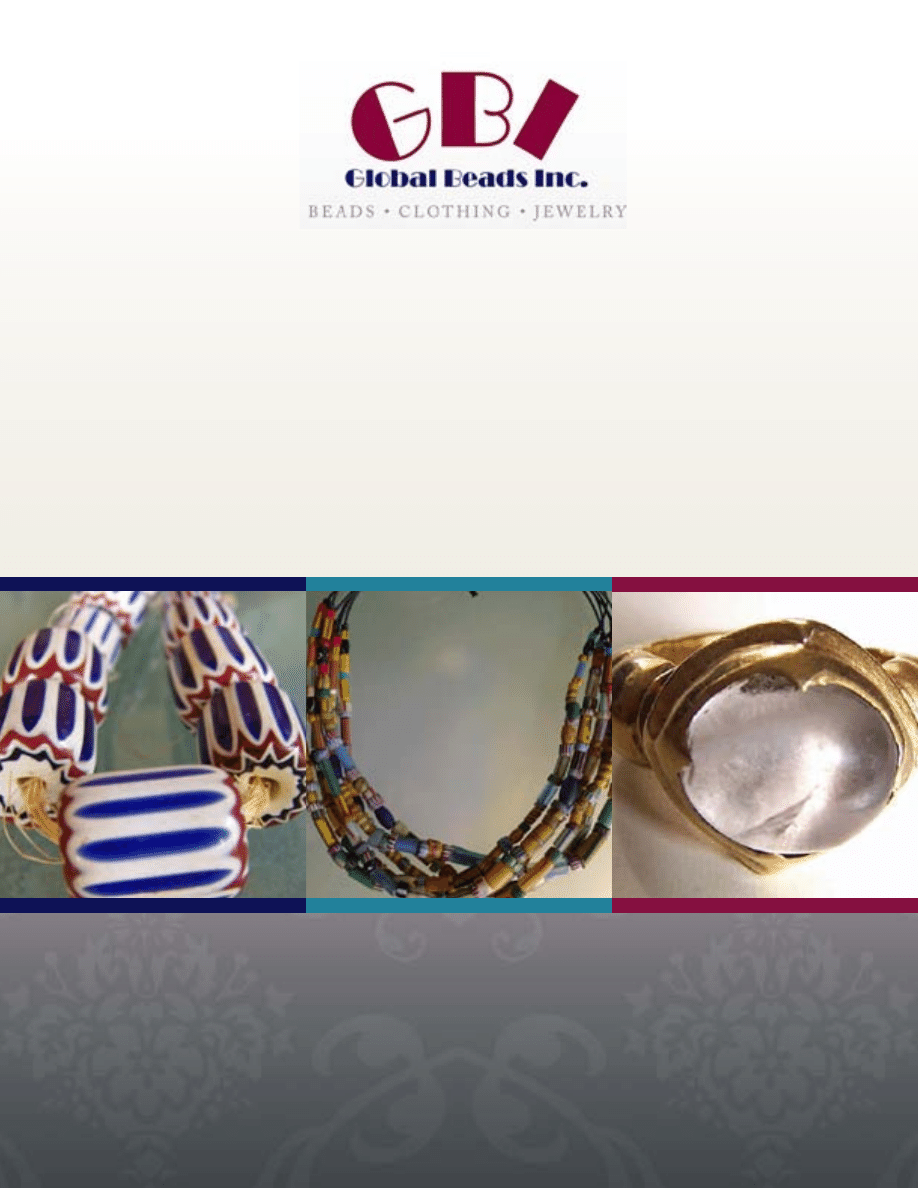
How Beads Are Made
GBI Knowledge Center

How Beads Are Made | Global Beads, Inc. | www.globalbeads.com | 2
Introduction
There are a number different ways of making beads from glass.
The three principle methods are described in this chapter. Beads
can be made
1. by winding molten glass to form a bead (Wound); or
2. by drawing molten glass to form a long thin tube, which can
then be cut into many beads, (Drawn); or
3. by placing glass in moulds and heating in a kiln until it fuses
together (Fused).
There are two variations on these techniques: first, with mould
pressed beads, the molten glass is forced into a mould to give
beads a certain shape, and to speed up the process of producing
beads; second, mosaic beads are made by fusing slices of drawn
canes to a wound or drax, n glass body. One can also blow molten
gJass to make beads, but such beads are fragile, and rarely survive
for archaeologists to find, so this method is not dealt with here.
The method of making beads in Ghana is described here in
the most detail, as this method is only to be found in Ghana
and Mauritania: in all other places beads are made by working
with molten glass. Contemporary methods of making beads are
described, with illustrations, and two historical accounts of bead
making are reprinted for comparison.
The method of making beads is also used as the primary criterion
for classifying beads, both by others (Beck 1928, Kidd and Kidd
1970, Karklins 1985) and in the classification developed for the
beads in the Museum of Archaeology.
Wound Beads
Wound beads are produced by winding a hot and molten rod of
glass or strand drawn from molten glass around a metal wire
called a mandrel. The bead maker sits in front of the heat source,
typically a flame, heating the glass and winding the bead.
Therefore these beads are also referred to as lamp wound beads.
While still soft, the beads might be decorated with any of a myriad
of inlays or appliqu6s, and the variety of decorations is infinite
(see Figures 2 and 26).

How Beads Are Made | Global Beads, Inc. | www.globalbeads.com | 3
The most elaborately decorated wound beads are known as fancy
beads. Sometimes wound beads may be pressed with metal paddles
or tongs to produce a uniform shape. In West Africa we most often
see squared or flattened wound beads. The surface of wound beads
usually exhibits swirl marks that encircle the axis, an imaginary
line passing through the centre of the perforation (see the top
two beads in Figure 26). Bubbles in the glass are either round or
elongated and oriented like the swirl marks.
Unlike drawn beads, wound beads are made individually, and
often not in a factory setting, but rather by piecework in people’s
houses. This was often women’s work, and as with other “cottage”
industries the pay was by completed bead. The amount of work
to make these beads is considerable, and such fancy wound beads
are not made in commercial quantifies any more. Yet, in the past,
many thousands were made, and the majority of European beads
in the museum collection are wound beads. Further information on
wound beads can be found in Karkfins (1985:96), Jargstoff (1995)
and Trivellato (1998). Beautiful pictures showing the amazing
variety of wound beads can be seen in Picard and Picard (1987).
Drawn Beads
In the manufacture of drawn beads, many identical beads can be
made at once. While the process is complex, and cannot be done
alone, it is a way of mass producing beads that was perfected by
the artisans centuries before mechanisation. In those days, a large
hollow globe of molten glass was created, and then drawn out into
a long thin tube up to 300 metres long.
One person manipulated the hollow globe, while the other took one
end of the globe and moved away drawing out a tube of glass as
one might draw out a thread of toffee. The globe may have been
1. composed of several different colored layers for layered beads;
2. adorned with rods or lumps of colored glass to form stripes;
3. marvered to create a specific shape, as for chevrons;
4. twisted during the drawing out process to produce spirals.
The tube was laid down to cool, and then broken into manageable
sections, sorted according to their diameter and subsequently cut
into bead lengths. The beads were either left unaltered with sharp
edges (known as gaggle beads) or their broken ends were rounded.

How Beads Are Made | Global Beads, Inc. | www.globalbeads.com | 4
Rounding was accomplished by a process known as tumbling: the
beads were placed in a n or drum with other materials and heated
as the mixture was stirred or tated. The heat and agitation rounded
the broken ends while the various materials kept the beads from
sticking together and prevented their perforations from collapsing.
The resultant beads ranged from being unaltered tube fragments
to almost perfect spheroids, depending the length of time they
were tumbled (Karklins 1985:88).
Drawn beads have certain characteristics due to their method of
manufacture. Bubbles in the glass and striations on the surface, if
present, oriented parallel to the axis. The perforation is parallel
sided and usually s a smooth surface. The decoration on a drawn
bead runs parallel to the section in which bead was drawn: a drawn
bead cannot have bands or knots unless they were applied after
the bead was initially made. The stripes uniform throughout the
bead, and the lines of very even thickness. This contrasts with the
fines in wound or powder glass beads.
There are different classifications of drawn beads depending on
the number and shape of the different layers of glass. Perhaps the
most precious drawn bead is the chevron bead, known as powa
in Krobo. This is a multi layered, drawn bead in which many of
the layers e star shaped, and the typical colors are white, red and
blue. Another drawn bead is the koli bead, and the parallel lines
can often be seen koli beads because they are reheated, and in that
process the air bubbles the glass burst (see bead glossary). Further
information about chevron beads can be found in Picard and Picard
(1986 and 1993).
Mould-Pressed Beads
Two basic methods were used to produce the majority of mould
pressed beads. In the first, the end of a glass rod was heated
over an oil Flame until it melted. A piece was then pinched from
it and pressed in a tong like two piece mould. As the glass was
compressed, any excess was forced out at the seam while a pin
pierced the glass to form the hole.
In the second method, two pieces of viscid glass, one in either half
of a two piece mould were pressed together to fuse them. This
permitted the production of beads with complex color pattern that
would have been destroyed or distorted in the previous method.

How Beads Are Made | Global Beads, Inc. | www.globalbeads.com | 5
The moveable pin that formed the perforation usually extended
from one half of the mould to the other, in the case of round and
oblate beads, and across the open face of the mould for flattened
and elongated specimens (from Karklins 1985:100).
Consequently, the beads in the former category have mould seams
around their equators, whereas the latter have seams along their
sides and ends (see Figure 28 second row). The seams cannot
always be seen clearly, as they were ground down. They may also
have seams in colored patterns, such as the beads in the third row
of Figure 10, and the middle bead in the fourth row. Most of the
mould pressed beads come from Bohemia, and Jargstoff (1993)
concentrates on Bohemian bead makers.
Fused Cane or Mosaic Beads
Are produced very quickly, and many Glass canes are sliced, and
these slices are heated and fused to a centre core, usually a black
drawn cylinder. Sometimes the entire surface is covered with cane
slices, and sometimes the cane slices are mixed with stripes or
bands of viscid wound glass. When the entire surface is covered
with chevron cane slices the bead is known as a millefiore bead.
The advantage of this method is that it allows highly patterned
beads to be identical beads to be produced by lamp¬workers. The
lamp workers are in effect being provided with pre fabricated bead
parts (the cane slices and core) and assembling them.
Although the technique is as ancient as glass making, it was
revived in Venice in the latter part of the nineteenth century,
as labor became more expensive. All of the mosaic beads in the
collection come from Venice, and all from the late nineteenth
century onwards. Not one mosaic bead was found in the Elmina
excavation, so it is unlikely that there were mosaic beads in Ghana
before 1876. Picard and Picard (1991) is devoted to Millefiore
beads. Coles and Budwig (1993:15) have a lovely illustration of the
method, and Allen (1991) discusses the method in some detail.
Fused Beads - Modern Methods
The following types of bead manufacture are specific to West
Africa, and especially to Ghana. Fused powder beads are also made
in Mauritania (the famous Kiffa Beads), but their range of colors
and shapes is much more limited.

How Beads Are Made | Global Beads, Inc. | www.globalbeads.com | 6
This method of manufacture is typified by very little being done
with the bead when it is hot: the bead is passively shaped by the
mould and the perforation is formed when the bead is still hot, but
the colors and designs are made either before or after firing.
Fused Powder Beads
Glass is powdered by a pestle, often at great risk to the pounder.
The powder may be mixed with ceramic dyes, and is then poured
into moulds using a guide, to make patterns as one would find
in sand paintings (Figure 32, step 4). A cassava stalk is used to
make the hole, and this burns during firing. The bead is shaped by
turning when just out of the oven, and the perforation checked.
Lastly, the bead is polished by hand with sand and water on a
grinding stone.
Some styles of old powder beads are very hard to distinguish from
wound or drawn counterparts, especially well made striped beads.
Powder bead stripes are often indented more deeply into the body
of the bead at one end than the other, because of the method of
pouring the different colored powder to make the stripe. With both
wound and powder beads the stripe may not be perfectly straight,
and it might not be present for the entire length of the bead,
whereas with drawn beads the stripes are perfect and repeated
exactly for the whole bead.
Fused Fragment Beads
Glass fragments are arranged in moulds and heated in the wood
fired oven, until the fragments are fused together. The perforation
is made with a mandrel when the bead comes out of the oven, and
the shape of the bead modified by turning the bead in the mould.
The beads are typically translucent.
Fused Beads - Historical Methods
From inquiries made it was gathered that the manufacturers
of these beads were people from Apollonia, the district which
borders the sea in the west of the Gold Coast, and who had come
inland in order to make and trade these beads at Dunkwa in the
Denkera country. No amount of questioning would induce these
Apollonians to disclose the source of their technique; their replies
being evasive as is usual with natives, especially in this case,
where they appeared apprehensive that their ‘patent’ might be
infringed and a ‘rival firm’ set up.

How Beads Are Made | Global Beads, Inc. | www.globalbeads.com | 7
However, it may be that they were the originators of this method,
as numerous inquiries either in the Gold Coast, Ashanti or England
have so far failed to trace the origin any further back. On the other
hand, there is a possibility that the process was introduced from
the neighboring Ivory Coast, as the western boundary of Apollonia
forms the frontier line between the Gold Coast and the Ivory Coast.
The moulds (see fig.36) are made from a good, local clay, which
possibly contains a high percentage of kaolin. They have no
definite shape, but are made roughly by hand into flat slabs from 1
inch to 11/2 inches in thickness.
Holes, more or less circular, at irregular intervals, are formed in
the clay; the diameters and depths are varied as required to suit
different sized beads. In the centre of each hole is a much smaller
hole going right down through the mould to its other side, and into
these smaller holes the midribs or leaf¬stalks of cassava (Manibot
spp.), about the length of a safety match. The cassava is first made
wet and smeared with clay, the effect of which is to cause the
cassava to carbonise and not burn away when firing whicks place.
In the illustration the moulds, circular holes, and the charred
cassava stick can easily be seen.
The next part of the process consists of powdering various
coloured tylasses, which is accomplished by grinding on the
common stone slab used for grinding corn. Different coloured
bottles and European glass beads are obtained and ground down
fairly finely to about a 60 mesh.
The powdered glass is then poured into the holes around the
cassava in layers, which are arranged according to the color and
thickness desired. The moulds which the writer procured would
permit of beads from half an inch to one inch in length being
produced.
When the filling of the holes with powdered glass is completed,
the moulds are put on a charcoal fire and covered all round with
charcoal, and the hole is then banked up with firewood. The writer,
when visiting the tactor, formed the opinion that the process of
firing was also conducted in the one of the beehive ovens used for
bread making.

How Beads Are Made | Global Beads, Inc. | www.globalbeads.com | 8
The cassava sticks carbonise when the firing takes place, thus
leaving a small tubular hole in the centre of the bead. From the
nature of the operation and from the known qualities of glass
when subjected to heat the writer concludes that there was
not complete fusion of the glass, but the heat was sufficient to
produce a Tritting’ or to reduce the glass to a state of being pasty
on the edges of the particles; thus causing the grains to adhere.
This opinion is borne out by the fact that the fired bead has a
granular appearance. The crude beads have then to be polished
and for this purpose they are rubbed on a flat stone for a long
time, both the barrel and the ends undergoing treatment.
The resultant bead has a streaky appearance which simulates the
highly prized ‘Aggrey’ beads of the Gold Coast, and therefore a
keen demand soon resulted.
The manufacturers did not employ either borax or salt, nor were
any chemicals used in order to obtain effects; they depended
entirely on colored glass. Needless to say, colored bottles, for the
time being, were in great demand in the neighbourhood, green,
yellow and brown being the colors usually preferred. Specimens
of the moulds and the beads have been deposited at the British
Museum, the Pitt Rivers Museum, Oxford, and University Museum
of Archaeology and Ethnography, Cambridge.
History of Trade Beads
Ghana has a long tradition of bead culture dating back over the
last 4000 years. Some Ghanaian ethnic groups, past and present
have a record of both bead production and use. For example, the
Akyem Abompe area, in the hills of the Kwahu Plateau, is noted for
its bauxite bead production and use. In this chapter, I will discuss
the main types of beads found in Ghana, and explain what the
archaeological record can tell us about these beads.
Stone and Shell Beads
The very earliest archaeological evidence of bead production
comes from stone beads found in the excavation of two rock
shelters in the Kwahu escarpment, that were used in the period
of the Late Stone Age hunter-gatherers, around 3000 2000B.C.
(Anquandah 1982:29). The earliest well¬ authenticated evidence of
production and use of beads in Ghana, however, is found in early
agricultural village settlements dated from 2000 500B.C.

How Beads Are Made | Global Beads, Inc. | www.globalbeads.com | 9
Archaeological digs have revealed numerous beads made from
such materials as quartz, porphyry, shells and bone (Stahl,
1993:267; Anquandah 1982:72). Recent research at Boyase hill,
near Kumasi, revealed an early agricultural village settlement
extending over eleven hectares. Test excavations conducted
alongside granite boulders with multiple, broad, artificial hollows
and grooves revealed rough outs, or unfinished stone beads, as
well as finished beads associated with pottery. Also found were
rough outs of stone axes and/or hoes, suggesting that the granite
boulders were workshop sites for production of stone industries,
including bracelets, beads, and milling equipment (Anquandah
1993a). Similarly, artifacts excavated from another early
agricultural settlement site at Daboya in the Gonja traditional area
dated by radio carbon method to around 2000B.C. included seven
white quartz beads (Shinnie and Kense 1989: 179¬180; fig.79) and
abundant evidence of locally manufactured stone and shell beads
covering the period 2000B.C. A.D. 1800.
Bauxite Bead
Most common stone beads found in Ghana today are bauxite beads.
e British archaeologist, Thurstan Shaw, collected ethnographic and
archeological data on the production, trade and use of beads in
Ghana.
Shaw became Curator of the Achimota College Museum of
Anthropology in 1937. In the 1940s, he carried out field studies
into the production of bauxite beads in Ghana. He surveyed
a number of villages in the Akyem¬Abompe area noted for
traditional bauxite mining and production of bauxite beads (Shaw
1945).
In 1942, Shaw excavated a large midden 8.3 metres in height at
Adukrom, in the Akuapem hills, and uncovered a large corpus
of beads made of stone, shell and glass. The excavation also
produced over 500,000 indigenous pottery sherds, some terracotta
figurines, moulds and crucibles for brass casting, various artifacts
of brass/copper and iron, ivory combs and bracelets, cowry shells,
spindle whorls, and smoking pipes. The site’s age was estimated to
between the sixteenth and seventeenth centuries, on the basis of
the distribution of smoking pipes.
Shaw noted that locally manufactured shell beads and local stone
beads including bauxite beads, quartz cylinders, schist discs, and
hornblende granite beads were found distributed throughout the
deposit.

How Beads Are Made | Global Beads, Inc. | www.globalbeads.com | 10
On the other hand, polychrome striped beads and Venetian mosaic
long cylinder ‘eye’ beads were confined to the middle levels, and
Venetian chevron barrel beads and perforated cowry shell beads
were confined to the upper levels (Shaw 1961). As the levels are
time related, this provides evidence for the continual attraction of
natural material beads, including bauxite.
In 1993 Bredwa Mensah undertook a survey of traditional bauxite
mining and bauxite bead manufacture in the Akyem Abompe
area, to build on Shaw’s work (Bredwa Mensah 1996a). Shaw
had recorded oral traditions in the 1940s at Akyem Abompe
demonstrating that the bauxite bead industry ‘was already
flourishing a century ago. The oldest people now living declare
that the oldest people who were engaged in the industry in their
youth found large digging pits already excavated and this suggests
a greater antiquity than a hundred years’ (Shaw 1945). Bredwa
Mensah recorded a large number of hand dug shafts used to dig
bauxite which is also evidence of centuries of bauxite mining.
From the ethno-archaeological standpoint perhaps the most
interesting aspect of Bredwa Mensah’s survey relates to data on
typology and functions of beads and market distribution. Present
day Akyem Abompe manufacturers produce a variety of bauxite
beads which are purchased for use by women not only for general
body ornamentation and beautification, but also to facilitate
participation in special functions such as rites and celebrations
related to child naming, attainment of puberty, marriage, funerals,
and local festivals. Akyem Abompe bead products are marketed
not only within Ghana, (particularly in the Central, Eastern,
Asante and Volta Regions), but also as far afield as Togo, C6te
d’Ivoire, Burkina Faso. In addition, the Akyem Abompe industry
has engendered minor to significant off shoot domestic industries
elsewhere in Ghana. Dealers and bead manufacturers in Accra and
the Krobo traditional area, for ample, purchase half finished or pre
formed beads at a cheaper rate from yem Abompe manufacturers,
and then send these beads to their own dustrial annexes’ for the
final stages of grinding and polishing (Bredwa¬ensah 1996a).
Bauxite beads have been found in urban sites near Shai Hills, at
Yawaso, the Great Accra Capital Site, and in the Fante traditional
area range in date from the fourteenth to the seventeenth
centuries.

How Beads Are Made | Global Beads, Inc. | www.globalbeads.com | 11
A fourteenth to fifteenth century Shal Hills site excavated in 1978
revealed reddish brown pottery with elegant, modeled animal
and human shrine attachments, associated with indigenous
bauxite beads, and bauxite ds were also found at the fourteenth
to fifteenth century level in the escavation of the old La site at
Ladoku.
Brass Beads
Brass beads come from one of three sources; either from the
Middle East or the trans Saharan trade route or from other West
African countries; or m Europe via the ocean and the coast; or from
Ghana itself. As one ht predict, inland archaeological sites such
as Daboya, Banda and ,ho have the greatest number of glass beads
from ‘ the trans Saharan de, whereas the coastal sites such as
Elmina, Shai and the Danish settlements in the Akuapem foothills,
contain more glass beads from the european trade. The earliest
evidence of local glass bead production es from the northern
trading city of Begho, but there is also evidence local bead
production from Elmina and the Danish sites. A description these
sites and their significance follows:
Daboya: excavations at Daboya in the northern part of Ghana
produced a collection of 63 imported glass beads, the majority of
which e from contexts with radio carbon dates between A.D.700
1800. Sixty per cent of these glass beads came from contexts that
also produced signgn painted ‘Silima Ware’, as well as local pottery
forms imitating stern Sudanic polymorphic ceramics commonly
found in medieval centres including Djenne, Gao, and Timbuktu,
suggesting links to trans Saharan trade network. The beads include
older, multi faceted, multi colored, and single colored, spherical,
barrel shaped, and gated forms made by the cane technique. Also
found were more cylindrical, unfaceted, short beads.
Trade Beads of Ghana
Beads are culturally, historically and archaeologically important in
Ghana. Beads can be made of many materials, but stone and glass
beads are particularly immune to destruction and thus survive
very well in the archaeological record. The bead collection of the
museum is made up primarily of glass beads. These glass beads
come from three main sources: glass beads traded over the Sahara,
from Egypt and other middle Eastern and Islamic sources; glass
beads traded over the sea, from Europe, particularly Venice in
Italy, Bohemia, and Holland; and glass beads made in West Africa,
mostly in Ghana.

How Beads Are Made | Global Beads, Inc. | www.globalbeads.com | 12
The popularity of glass and stone beads as a trading item may also
be attributed to their imperviousness to temperature, humidity
and insect predation. Beads have been used and traded all over
the world, for many hundreds of years. As Sleen so elegantly says,
‘The bowdrill is nearly as old as civilisation and ornamental stones
like agate could be pierced and strung before the pyramids were
built’ (Sleen 1967:17). In Cambay, India, people have been making
carnelian stone beads for the last 7,000 years (Sleen 1967:18).
West Africans were thus not alone in their love of beads, but
Ghanaian ethnic groups differed from others in two important
ways. First, beads here were valued in their own right, and not
merely for the patterns they could create en masse. In contrast to
bead use by the North American Indians, the southern Africans and
even the Yoruba (Dubin 1987: 266ff, 133ff, 138ff), Ghanaian ethnic
groups did not use many small beads to create patterns.
Beads in Ghana were and still are prized for their individuality,
and beads have specific names and meanings. Second, there has
been a flourishing, local, glass bead making industry for many
years. The origins of this industry are debated, because it is
unclear what the source of glass was prior to the large quantifies
of glass beads that were imported through the European trade.
It is clear, however, that certain types of imported beads were in
demand because they could be re used as components in local
glass bead making, rather than for immediate use. The Bohemian,
small, single colour beads were particularly important raw
materials for local beadmakers.
Ghanaian bead makers do not work with molten glass, but work
with powdered or fragmented glass, which they place in moulds
and then heat in a kiln. Almost everywhere else in the world glass
beads are made by blowing, or winding, or drawing out, or mould
pressing hot red molten glass. The only other place they work
with glass powder is in Mffa, Mauritania, and here the colours and
shapes are very constrained, and the industry is nowhere near as
vital as it is in Ghana. There have been changes in the bead making
industry in Ghana, however. The two main centres for glass bead
making today are in the Krobo and the Ashanti traditional areas.
¬But in the 1930s, one British anthropologist reported on glass
bead making near the C6te d’Ivoire border (Chapter 7); a second
anthropologist reported on the techniques used in glass bead
making in the Ashanti traditional area and they differ from those
used today. In this book we concentrate on bead making in the
Krobo area, but we hope to expand our coverage in the next edition
to include the Ashanti bead makers.

How Beads Are Made | Global Beads, Inc. | www.globalbeads.com | 13
The first question, then, is, what do people do with beads in
Ghana? In an attempt to answer this question we interviewed two
sorts of bead wearers: Krobo queen mothers and Krobo traditional
priests. Why this emphasis on the Krobo traditional area? We chose
to concentrate on the Krobo traditional area partly because of the
number of bead producers in Krobo, and partly because the Dipo
custom of the Krobo is one of the most well known bead wearing
occasions of any ethnic group in Ghana. Many other ethnic groups
have similar customs, and many other ethnic groups wear beads,
and have their own names and meanings for the beads, and we
hope to cover these in subsequent editions.
The second question is, how did the beads get to Ghana? To
address this question we interviewed bead traders and importers.
Traders travel all over West Africa buying and selling beads,
old and new, and are the modern day equivalents of the trans
Saharan traders of former times. Bead importers and wholesalers
on the other hand deal primarily in European beads. They lived
and worked in the cities, awaiting shipments from Europe.
This business flourished in colonial times, but suffered after
independence.
The third question is, how are beads made in Ghana? We
interviewed some of the Krobo bead makers, including the acting
queen mother of the Osu Panya division of the Manya Krobo, who
are the first bead makers in the Krobo traditional area.
West African trade in glass beads falls into distinct historical
categories, with Islamic bead production and trade, after A.D.800
The Islamic faith originated in Arabia in the seventh century and
spread to Africa, Asia, south east Europe and China. The Islamic
promotes a strong sense of brotherhood and so craftsmen were
able so move freely through Islam’s many countries: local crafts
from many tries were imbued with Islamic motifs. Glassmaking
centres were lished in Egypt, Syria and the Levant (Lebanon).
Between A.D. 900 and ao. Cairo became an important centre for
bead makers who imported and traded coral, pearls, cowry shells
and African ivory.
Glass beads appeared in West Africa from the eighth century
onwards, so Arab merchants crossed the Sahara with beads from
Cairo and India. The Arabs dominated long distance trade in the
region, trading glass beads, salt and copper ornaments for gold,
ivory and slaves.

How Beads Are Made | Global Beads, Inc. | www.globalbeads.com | 14
The lucrative monopoly the Arabs had on the West African trade
ended with the arrival of the European trading ships on the coast
of West Africa an the late 1400s. The Portuguese were the first
to arrive, followed by the Danes, Dutch, French, Belgians and
Germans. Explorers, discoverers and settlers brought glass beads
with them, first as presents and as items for barter. Beads were
used as payment for gold, ivory, slaves, wd salt. The beads traded
were nearly all Venetian beads, including chevrons, and most are
indistinguishable from the ones found in African archaeological
sites dating from the same period. The early venetian beads were
soon copied by other Europeans, notably the Dutch and the Eastern
European artisans.
The importance of the bead trade to Europeans in the early
centuries lay not in the numbers of beads traded per se, but in the
equality of the exchange which made the bead trade so profitable
Tmellato 1998: 65 71). And this was true throughout the inhabited
world: *In an emblematic act when conquering Mexico City in
1519, Cortez is told w, have offered Montezuma a necklace made
of small Venetian glass beads “A present in return for the red shell
necklace with eighteen golden scarabs he had received from the
Aztec king’. (Gasparetto 1958:185 quou in Trivellato 1998:65).
The inequality of exchange was well understood; in a French
commercial guide published in the 1720s, the author lists thirty
seven types of glass beads favored by the Senegalese, and most
useful in the slave trade, and goes on to inform readers that in
Angola, they could exchange 3,000 French pounds of seed beads
for 612 male slaves, provided 6 selected the beads carefully
(Trivellato 1998:65,70).
The quantity of beads sold into West Africa between the sixteenth
eighteenth centuries remained low partly because the use of
imported beads in West Africa was controlled by the chiefs
through sumptuary In and other means Uargstoff 1995:104f~.
Sumptuary laws dictated what sorts of beads and what sorts of
cloth people could wear, according rank. For example, in the old
kingdom of Benin (now in Nigeria), color beads were highly prized
and controlled. The number of coral beads by an official indicated
his rank, and those who wore such beads with” conferred privilege
would be executed. Seventeenth century records tell of the ‘coral
feast’ where the Oba, or king, would ride through old Ben and
personally confer upon his officials the ‘honour of beads’. Uargsta
1995:109)

How Beads Are Made | Global Beads, Inc. | www.globalbeads.com | 15
But by the nineteenth century, many of the use restrictions
vanished, the colonial governments wrested power from the chiefs
and emphasis commerce, seeking markets for their goods. The
production of beads became more industrialized, producing more
variety for less cost and East and West Africa were flooded with
Venetian, Bohemian, and Dutch glass beads. Dealers from all over
Europe were involved.
Between 1827 and 1841 the Gold Coast (present day southern
Ghana) imported phenomenal average of 74,952 pounds (34
metric tons) of glass beads P year. Exactly what happened to most
of these beads is unclear. The bead trade was also substantial
in money terms. For example, in 1846 the value of glass beads
represented 15.7 per cent of all the imports to the Gold Coast
(Francis 1993:8).
Most, if not all, of the glass beads made in Ghana today are
produced either by the Asante people, in villages just south and
west of Kumasi, or by the Krobo people, in villages in the Akuapem
hills and in the coastal Plains east of Accra.
The heart of a bead factory is a kiln, that is built from clay, earth
and sometimes old car parts for rigidity, and looks similar to a
clay pizza or bread oven. Glass pieces are placed in moulds and
put into the kiln, which have sufficient heat to fuse or sinter the
glass in the mould, but not to melt it completely. The size of a
factory is denoted by the number of kilns and by the number of
master craftsmen. The kilns are outside under shade structures of
varying sophistication. The factory then, is not a building, but a
series of work areas under shade trees and structures.
Beads in Ghana are produced by recycling glass. Not all the glass
used is old and broken: many small, single colored beads from
Bohemia in the Czech Republic are bought by bead makers in
Ghana to use as raw material in making new beads, for colors
unavailable through other means. Nowadays ceramic dyes are
available, and these are mixed with clear powdered glass to
produce a wider range of colored beads, though these are not
translucent.
While some bead factories are quite large, with a number of kilns
and a lot of workers, (for example Florence Martey, who employs
ten people), others have only a single kiln. In the past, most bead
manufacturing took place in the foothill villages, but some of
these producers have moved to the towns at the bottom of the
foothills.

How Beads Are Made | Global Beads, Inc. | www.globalbeads.com | 16
This is probably owing to the better roads in towns, and proximity
to Accra, providing easier transport for their goods, a good market
at Agomanya, and better access for traders u ho wish to come and
buy. But there are many producers still in Upper Nlanya.
Francis (1993) suggested there were as many as eleven Asante
villages making beads, with the village of Dabaa acknowledged
as the earliest bead¬making village. Asante beads, while made by
similar methods, look distinct from Krobo beads.
After production the beads are polished and threaded and sold
either in strings or in pairs of bracelets. There are two main
bead markets for the Krobo bead sellers: the Thursday market in
Koforidua, and the Wednesday and Saturday market in Agomanya.
In the early part of the twentieth century the market at Asesewa
was also very large, and described as one of the largest markets
in West Africa (Field 1943), but with the introduction of vehicles,
and the lack of roads in Upper Manya, it has lost its prominence.
In the market in Agomanya, there are approximately sixty ¬stalls
of bead sellers, and the new buyer is frequently at a loss as to
whom to buy from, since many sell similar if not identical beads.
The similarities come because some of the bigger bead factories
sell their beads to others to sell, and so a number of stalls may be
selling beads from the same manufacturer, but bead makers also
use the market to get ideas from their competitors. For example,
Florence Martey comments, ‘Sometimes when I design a new bead,
I take it to the market and sell it for a good price. Then somebody
will see it and make the same bead. On the next market day he will
sell it for a reduced price. I wish something could be done to stop
this. Some bead makers will not display a new bead in the market,
but will show it only to known buyers, so that the design will not
be copied so readily. Frequent buyers establish relationships with
one or two sellers, and if those sellers do not have what they want,
the sellers help them find it.
The busiest time of year for the bead producers and sellers is the
celebration of the Dipo custom, though all festivals increase the
demand for beads, as do large funerals. The stories of these bead
producers suggest it is possible to make a good living from bead
production, but it is not easy work.

How Beads Are Made | Global Beads, Inc. | www.globalbeads.com | 17
The term “Trade Beads” typically applies to beads made
predominately in Venice and Bohemia and other European
countries from the late 1400s through to the early 1900s and
traded in Africa and the Americas. Many of these beads have been
attributed to being made in Germany, France and the Netherlands
as well.
The heyday of this “trade” period was from the mid 1800s through
the early 1900s when millions of these beads were produced
and traded in Africa. The Venetians dominated this market and
produced the majority of the beads sold during this time. The J.F.
Sick and Co, based in Germany and Holland was one of the largest
bead brokers/importers during this period. Moses Lewin Levin was
a bead importer/exporter who operated out of London from 1830
to 1913. You can see 4 of the Levin trade bead sample cards from
1865 in The History of Beads (Dubin)
The popularity of these beads was revived in the late 1960s when
they began to be exported from Africa into the United States and
Europe. The term “Trade Beads” became very popular during this
time period and is still used for the same bead reference today.
The millefiori beads were also called “Love Beads” and used in
necklaces with peace symbols during the Hippie days.
As the popularity and availability of these old beads grew they
started getting “named”. We started hearing terms like “Russian
Blues”, “Dutch Donuts”, “King Beads”. Although some of these
folklore names are totally meaningless...ie....”Lewis and Clarke”
beads, they do describe a specific type of bead.
And today these beads are more popular and collectable than ever.
Thousands of these beads are in private collections around the
world. The African Traders are having to go deeper and deeper
into Africa to find more of these beads and many styles which
were readily available just 5 years ago are no longer seen today.
To learn more about “trade beads” please read, The History of
Beads (Dubin), Collectable Beads(Liu), Ornaments From the Past:
Bead Studies After Beck (Bead Study Trust), The Bead Is Constant
(Wilson), Arizona Highways (July1971), Africa Adorned (Fisher) and
the John and Ruth Picard series of books; Volume III - Fancy Beads
from the West African Trade, Volume IV - White Hearts, Feather and
Eye Beads from the West African Trade, VolumeV - Russian Blues,
Faceted and Fancy Beads from the West African Trade, Volume
VI - Millefiori Beads from the West African Trade and Volume VII -
Chevron and Nueva Cadiz Beads
Wyszukiwarka
Podobne podstrony:
How?ngerous are Drugs and What?n we do?out the drug pro
How the court made a federation of the EU
5)12 09 How old are you IIa
(ebook) How Psychic Are You
Simon Aronson Memories Are Made of This
carnations are made for love
Toys and Possessions How many are there Worksheet
8 1 YPC Quiz Concert How Musical Are You
Gladiator Hans Zimmer How we are free
2003 12 how unethical are you
How effective are energy efficiency and renewable energy in curbing CO2 emissions in the long run A
Giere 2004 How models are used
How old are you
Memories Are Made Of This
Hoppenbrouwers, Such Stuff as Peoples are Made on
McCreesh, How Pagan Are the Icelandic Family Sagas
how are you feeling match
więcej podobnych podstron