A farmer's guide to the planning system
Contents
Introduction....................................................................................................................3
Endnote ....................................................................................................................................4
Summary.........................................................................................................................5
Section 1: The Planning System....................................................................................7
National Planning Policies .......................................................................................................7
Regional Planning Guidance....................................................................................................7
Development Plans...................................................................................................................7
Supplementary Planning Guidance ..........................................................................................8
Special Planning Policies .........................................................................................................8
National Parks and Areas of Outstanding Natural Beauty .......................................................8
Sites of Special Scientific Interest (SSSI) ................................................................................8
Green Belts...............................................................................................................................8
Decisions on Planning Applications ........................................................................................9
Section 2: Do You Need Planning Permission? .........................................................10
...............................10
Where to Obtain Advice.........................................................................................................10
Obtaining a Lawful Development Certificate ........................................................................10
Diversification Projects..........................................................................................................11
The Definition of Development .............................................................................................12

The Definition of Agriculture ................................................................................................13
Permitted Development..........................................................................................................13
Environmental Impact Assessment ........................................................................................13
Agricultural Dwellings...........................................................................................................14
Outdoor Advertisements ........................................................................................................14
Section 3: Preparing the Ground Before You Apply................................................15
Consult Your Local Planning Authority ................................................................................15
Consider the Impact of Your Proposals .................................................................................16
Can You Get Any Other Help? ..............................................................................................16
Consulting Your Neighbours and Other Local Interests ........................................................17
Effects on the Community at Large .......................................................................................17
Always Consider These Points...............................................................................................17
Consultation with Other Bodies .............................................................................................18
Allow Sufficient Time............................................................................................................18
Section 4: Making Your Application..........................................................................19
Who Can Apply?....................................................................................................................19
Which Type of Application?..................................................................................................20
Plans and Illustrations ............................................................................................................20
Explain Your Reasons............................................................................................................20
Forms and Fees ......................................................................................................................21
Timing....................................................................................................................................21
Endnote ..................................................................................................................................21
Section 5: After the Application..................................................................................22
What Happens Next?..............................................................................................................22
Progress of Your Application.................................................................................................22
Time Taken to Reach a Decision ...........................................................................................23
Section 6: When Permission is Granted.....................................................................24
Conditional Permission ..........................................................................................................24
Planning Obligations..............................................................................................................24
Changing the Plans.................................................................................................................25
Other Consents .......................................................................................................................25
Section 7: Refusal and Right to Appeal .....................................................................27
Try Again? .............................................................................................................................27
Your Right to Appeal .............................................................................................................27
Getting Outside Help..............................................................................................................28
Cost ........................................................................................................................................28
The Appeal Decision..............................................................................................................28
Section 8: Breach of Planning Control and Enforcement Action............................30
What if You Have Gone Ahead Without the Required Planning Permission? ......................30
Enforcement Action ...............................................................................................................30
Right of Appeal ......................................................................................................................30

In Conclusion................................................................................................................31
Important Points to Remember ..............................................................................................31
Further Information................................................................................................................31
Appendix A: Planning Policy Guidance Notes ..........................................................32
PPG7: The Countryside - Environmental Quality and Economic and Social Development..32
PPG2: Green Belts .................................................................................................................34
PPG 13: Transport..................................................................................................................34
Appendix B: Permitted Development Rights ............................................................36
The'Determination Procedure'................................................................................................39
Appendix C: Diversification Projects: Some Examples of When Planning Permission is
Needed ...........................................................................................................................41
Conversion of Farm Buildings? .............................................................................................41
Holiday Accomadation?.........................................................................................................41
Stables for Horses?.................................................................................................................41
Caravan Sites?........................................................................................................................41
Farm Shops?...........................................................................................................................41
Food Processing? ...................................................................................................................41
Farm Visits, 'Pick-Your-Own', Farm Trails? .........................................................................42
Amenity Lakes? .....................................................................................................................42
Traffic Issues..........................................................................................................................42
Appendix D: Outdoor Advertisements ......................................................................43
Scope of The Advertisement Control System ........................................................................43
Who Controls Advertisements? .............................................................................................43
'Deemed Consent' Granted for Some Advertisiements ..........................................................43
Obtaining 'Express Consent' for Other Advertisements.........................................................44
Special Control in Some Rural Areas ....................................................................................44
Advance Signs and Directional Signs ....................................................................................44
Dangerous or Illegal Advertisements.....................................................................................44
Appendix E: Sources of Further Advice ....................................................................45
Endnotes.................................................................................................................................45

Introduction
Agriculture is experiencing considerable change and uncertainty. Economic factors, BSE and the
outbreak of foot and mouth disease have severely affected many sectors of the industry. Yet
farming remains an important industry. It supplies most of our food and helps shape the
countryside. The Government believes that it must emerge stronger from the present difficulties. A
sustainable, diverse, adaptable and competitive industry is needed. The industry is restructuring and
the trend towards bigger farms has accelerated.
An independent Policy Commission on the Future of Farming and Food was established by the
Government and reported in January 2002. The Government intends that the report will make a
substantial contribution towards a comprehensive and sustainable new strategy for food and
farming in England which is properly integrated with wider goals, including sustainable
development and rural policies. The strategy will be launched in early autumn 2002 and the
Government will be engaging with stakeholders in its development.
Against this background many more farmers need to start new, or expand existing, agricultural and
non-agricultural enterprises. Well planned and managed, these enterprises can benefit farmers, and
the communities in which they live. They can generate profitable alternative uses for land and
buildings and create and maintain new jobs and services in the countryside. In its Rural White
Paper, Our Countryside: the future, published in November 2000, the Government explained how it
would help farmers to diversify. This included measures to promote a flexible and consistent
planning system that is supportive of well-conceived farm diversification proposals, particularly
involving the re-use of existing buildings for business purposes.
If you are looking at opportunities to modernise, expand or diversify, it is important that you
understand how planning regulations may affect your proposals and, where relevant, how to
improve your chances of obtaining planning permission. If you are proposing a change of use of
land or buildings from agricultural use, you will need to apply for planning permission. Planning
permission, where required, is often also a prerequisite of obtaining grant funding for a project.
This Guide, which is also being made available through the web sites of the Office
of the Deputy Prime Minister (ODPM) (
) at www.odpm.gov.uk and
the Department for Environment, Food and Rural Affairs (DEFRA) at
www.defra.gov.uk, explains how the planning system works (as at the date of
publication (
). It will help you to decide whether you need to put in
a planning application for your project and how to go about it. It gives practical
advice about presenting your application, what you need to consider and what
you can do to make your case effectively. It updates information contained in the
1996 publication of this guide. However, it is not a definitive manual or an
authoritative statement of planning law or policy.
This Guide applies to England. In Wales the Welsh Assembly Government will issue a farmer's
guide to the planning system shortly. In Scotland, the Development Department of the
has published the booklet, A Guide to Farm Diversification and Planning Permission in
Scotland which can be obtained from: The Scottish Executive, Planning Division, Victoria Quay,
Edinburgh EH6 6QQ, or from the Executive web site at: www.scotland.gov.uk/planning.

Endnote
1 In May 2002, the Government announced that it was establishing a new Department to be known as the Office of the
Deputy Prime Minister which, amongst other responsibilities, would be responsible for land use planning.
2 On 12 December 2001 the Government published a Green Paper, setting out its proposals for reforming the planning
system. This is likely to lead to substantive changes to the system in due course, which will be reflected in any future
revision to this guide.

Summary
Do consider your ideas and options carefully, take time to prepare and plan
your development proposals properly, and allow sufficient time for the process
as a whole.
Do consider what effect your proposals might have on local amenity, the
landscape and the environment, and on local services such as roads.
Do talk to your local planning authority - usually your local council - about
your proposals; check whether you need planning permission and, if so, what
local planning policies might be relevant to your proposals.
Do consult any neighbours or others who may be affected by your proposals,
and your elected local councillor(s).
Do consider whether you might need professional advice and assistance (eg.,
from planning consultants, land agents, surveyors) to prepare your planning
application, particularly if your proposals involve large-scale or complex
building development.
Do find out whether you are eligible for free planning consultancy advice
under the Rural Enterprise Scheme administered by the Department for
Environment, Food and Rural Affairs (DEFRA).
Do take account of all the advice and comments you receive, be prepared to
amend your original ideas if necessary, and try to frame your proposals to bring
out the positive impact they will have (eg., improving the appearance of a run-
down building, providing new employment opportunities, or facilities for the
local community).
Do ensure that you present a clear and accurate planning application with
supporting plans, covering all the points likely to be of concern to the planning
authority.
Do respond positively and helpfully to any requests from the planning
authority for further information; be prepared to be flexible in adapting your
proposals to meet any concerns of the authority.
If your planning application is refused, do try to discuss the proposals with the
planning officer to see if the planning authority's concerns can be overcome,
before you consider whether to appeal.
Do read this guide and any guidance provided by your local planning authority.
Don't rush ahead with ill-considered and poorly prepared proposals.

Don't place too much weight on advice (eg., from family of friends) about how
to obtain planning permission unless it is confirmed by the planning authority
or professional sources.
Don't rely on hearsay or assumptions (eg., 'a neighbour has planning
permission for a similar development, therefore I should get permission for my
proposal').
Don't expect your local planning authority to tell you what sort of development
(eg., diversification) would be best for you - that is not their role - although you
can ask the authority what type of developments are more likely to be
acceptable in planning terms.
Don't assume that any indication of your chances of obtaining planning
permission that a planning officer might be prepared to give you prior to the
submission of an application, will automatically be reflected in the final
decision by the planning authority.
Don't expect an instant decision - you should allow at least eight weeks from
the submission of your planning application, unless the planning authority has
indicated otherwise.
Don't proceed with any development works without first checking with your
local authority about the need for planning permission (or for any other forms
of consent), and until any necessary permission and other consents have been
given.

Section 1: The Planning System
1.1 The planning system regulates the use of land and buildings in the public interest by ensuring
that the right kind of development occurs in the right place. It has an important role to play in
promoting sustainable development.
1.2 Applications for planning permission must be decided by the local planning authority - usually
the local council or National Park planning authority - in accordance with their local development
plan, unless material considerations indicate otherwise. In reaching its decision the planning
authority will also take account of:
•
national policy guidance prepared by central government;
•
other material considerations, such as size, layout, siting, design, external appearance of
buildings; the proposed means of access; landscaping; impact on the neighbourhood; effects
on roads, water and other services.
National Planning Policies
1.3 The Government's planning policies are mainly set out in Planning Policy Guidance notes -
known as PPGs. These guidance notes are principally aimed at local planning authorities and
influence how they regard planning applications. PPG7 provides policy guidance on the
countryside, including agricultural development and farm diversification, but other PPGs may also
be relevant - see Appendix A.
Regional Planning Guidance
1.4 Regional Planning Guidance (RPG) provides a regional strategy within which local authority
development plans (and local transport plans) can be prepared. RPG sets out a broad development
strategy for each region over a fifteen to twenty year period and identifies the scale and distribution
of provision for new housing and priorities for such matters as the environment, transport,
economic development, minerals and waste disposal, as well as agriculture.
Development Plans
1.5 Local authority development plans set out the land use policies and land allocations for the
authority's area. The plan provides the basis for rational and consistent planning decisions by
explaining what types of development are likely to be permitted and which will not, across or in
different parts of the plan area. If you are thinking of seeking planning permission, you should
check the development plan for your area to see which policies may be relevant to your
proposals. Your local planning authority will be able to advise you about this. Development plans
may be inspected at a local authority's planning department and at main libraries.
1.6 In formulating their planning policies, local planning authorities must have regard to any
regional planning guidance and to current national policies. But the plan-making process provides
full opportunities for public consultation. Planning authorities must consult widely on development
plan proposals and must take the views of interested parties into account. The public and businesses
are encouraged to become involved in preparing the plans so that they can have a say in how their
area is developed. Further information can be found in 'Local Plans and Unitary Development

Plans: A guide to procedures' published by the former Department for Environment, Transport and
the Regions - see Appendix E for advice on how to obtain this and other relevant publications.
Supplementary Planning Guidance
1.7 Many authorities prepare planning guidance which supplements the policies and proposals of
the development plan (for example, design guides for specified areas). Although it does not form
part of the plan itself, supplementary planning guidance may be taken into account as a material
consideration in decisions on planning applications.
Special Planning Policies
1.8 In some statutorily designated areas special planning policies apply. These are:
•
National Parks, The Broads and the New Forest
•
Areas of Outstanding Natural Beauty
•
Sites of Special Scientific Interest
•
Green Belts
National Parks and Areas of Outstanding Natural Beauty
1.9 Within National Parks, the Norfolk and Suffolk Broads, the New Forest Heritage Area and
Areas of Outstanding Natural Beauty, planning authorities pay particular attention to design,
appearance and location to ensure that developments are in harmony with their surroundings.
Sites of Special Scientific Interest (SSSI)
1.10 Where an application is for development in, or close to, and likely to affect an SSSI, the
planning authority will consult English Nature (see paragraph 6.10). You may find it helpful to talk
to this body first and discuss any concerns it may have about your proposals. English Nature has
local teams stationed around the country (check your local phone directory), and may also be
contacted at its national office on tel: 01733 455000 - see also Appendix E.
Green Belts
1.11 Green Belts have been established around major built-up areas in England to contain urban
sprawl. The boundaries are defined in development plans. The essential characteristic of a Green
Belt is its permanence. Development is normally restricted to agriculture, forestry, outdoor sport
and outdoor recreation and other uses of land which preserve the openness of Green Belt land. The
use of an existing building for alternative purposes may be possible, as the building is already there
and will not affect the openness of the area. Further guidance can be found in Planning Policy
Guidance Note 2 (PPG2) - see Appendix A.
1.12 Locally, too, there may be special planning policies to protect areas which are of particular
landscape or wildlife value. To find out if your project would be in an area with special planning
policies, ask your local planning authority, or look at the relevant development plan. Some farm
buildings have great heritage value, which the local planning authority would take into account
when considering a planning application. Listed building consent or conservation area consent may
also be necessary.

Decisions on Planning Applications
1.13 Decisions on planning applications are the responsibility of local planning authorities. If,
exceptionally, a case raises issues of more than local importance, the First Secretary of State at the
Office of the Deputy Prime Minister may intervene and 'call-in' the case for his own decision. If
your application is refused by the local planning authority, you have the right of appeal to the
Secretary of State - see Section 7 of this Guide.
Section 2: Do You Need Planning Permission?
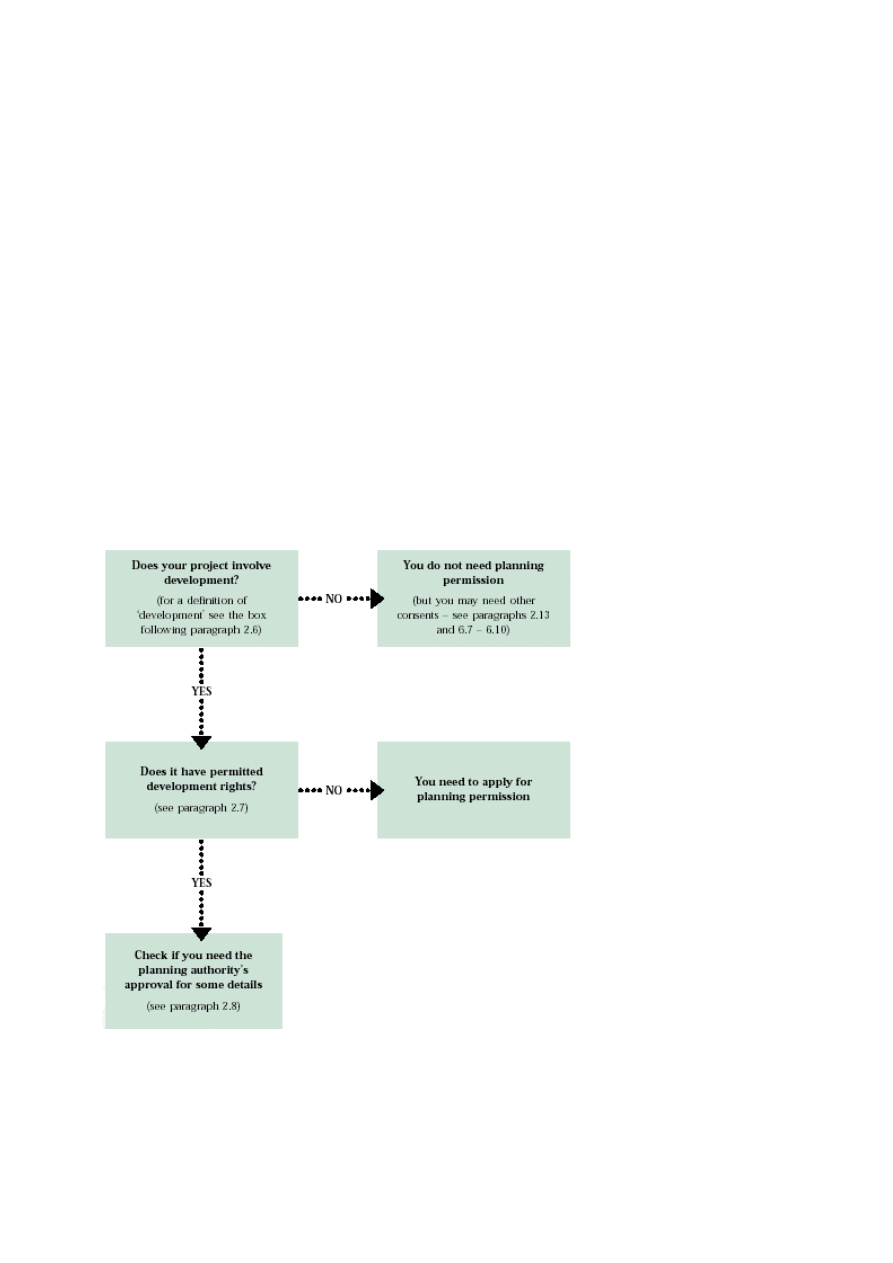
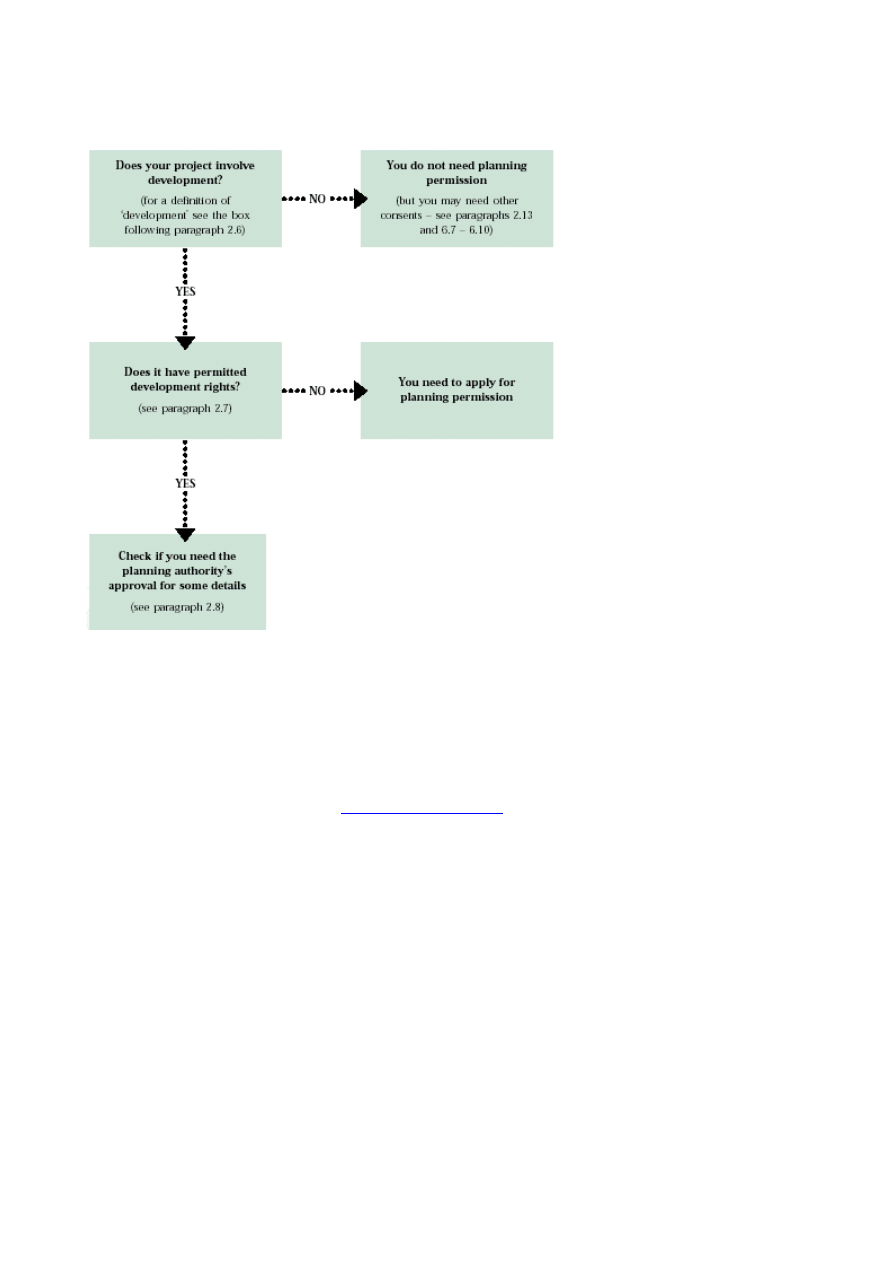
2.1 You do not always need planning permission. It is not required for agricultural operations,
or the use of existing buildings on agricultural land for agricultural purposes (see box below).
It is also not required, generally speaking, for changes to the inside of buildings, or for small
alterations to the outside (eg., the installation of an alarm box). Permitted development rights exist
for erecting (on holdings of 5 hectares or more), extending or altering a building, and for
excavations and engineering operations, which are reasonably necessary for the purposes of
agriculture within the unit - though you may still require the local planning authority's approval for
certain details of the development (
). For most other types of development
and change of use you will generally need to apply for planning permission.
Where to Obtain Advice
2.2 Your local planning authority can tell you whether you need planning permission and, if
you do, what is required. It is always sensible to check first, even if you think that your
proposed development does not need planning permission. If you went ahead without the necessary
planning permission the authority could take enforcement action against you, requiring you to cease
the new activities, or demolish the new buildings - see Section 8.
Obtaining a Lawful Development Certificate
2.3 Whilst you can check informally with the planning authority whether your proposed
development needs planning permission, on payment of a fee you can apply for a formal decision.
This is known as a lawful development certificate. If the authority refuses a certificate, you can
either apply for planning permission, or appeal to the First Secretary of State (at the Office of the

Deputy Prime Minister). A free booklet entitled 'Lawful Development Certificates - A User's Guide'
can be obtained from your planning authority.
Diversification Projects
2.4 If you are thinking about diversifying into non-agricultural activities, you may well need
planning permission for changing the use of land and buildings. You will also need planning
permission if your plans involve significant building works. Some examples of diversification
projects illustrating when planning permission might and might not be needed are given in
Appendix C.
2.5 In March 2001 national Planning Policy Guidance set out in PPG7 and PPG13 was updated to
make clear to local planning authorities that:
•
they should take a positive approach to well-conceived farm diversification proposals for
business purposes that are consistent in their scale with their rural location; and that,
•
farm diversification proposals should not be rejected where they would give rise to only modest
additional traffic and would not have significant impact on minor roads.
(See Appendix A for further details.) However, the updated guidance does not in anyway negate
the need for each planning application to be considered on its own merits.
2.6 Assistance with obtaining planning consultancy advice is available from the Department for
Environment, Food and Rural Affairs (DEFRA) for farmers with plans for a viable diversification
project under the Rural Enterprise Scheme, part of the England Rural Development Programme.
Details are available from DEFRA - see Appendix E.

The Definition of Development
Except where indicated otherwise in this guide, development requires planning
permission. Section 55 of the Town and Country Planning Act 1990 defines
'development' as:
•
'the carrying out of building, engineering, mining or other operations in,
on, over or under land, or the making of any material change in the use
of any buildings or other land' with the exception of (among other
things):
•
'the use of any land for the purposes of agriculture or forestry
(including afforestation) and the use for any of those purposes of any
building occupied together with land so used.'
Development includes not only building operations but also the use of land for
purposes other than agriculture and forestry. You will thus often need planning
permission to change the use of buildings or land, even if no building works or
structural changes are involved.
Planning permission is not usually needed for:
•
internal alterations if the use of the building remains unaltered and the
external appearance unaffected;
•
outside building works involving the repair or maintenance of a
building;
•
demolition of existing buildings, although prior approval may be
needed for the details of the proposed demolition of houses and
adjoining buildings and for the restoration of the site, unless the
demolition is part of an approved new development. (But check with
your local planning authority whether the building is listed as being of
special architectural or historic interest, or is in a conservation area, in
which case consent is needed. You also need consent to alter a listed
building.)

The Definition of Agriculture
Section 336 of the Town and Country Planning Act 1990 defines 'agriculture'
as including:
• 'horticulture, fruit growing, seed growing, dairy farming;
• the breeding and keeping of livestock (including any creature kept for the
production of food, wool, skins or fur, or for the purpose of its use in the
farming of land);
• the use of land as grazing land, meadow land, osier land, market gardens or
nursery grounds; and
• the use of land for woodlands where that use is ancillary to the farming of
land for other agricultural purposes.'
Permitted Development
2.7 The Town and Country Planning (General Permitted Development) Order 1995 (as amended) -
'the GPDO' - provides a general planning permission (known as 'permitted development rights') for
certain types of minor development. The types of permitted development most likely to be of
benefit to farmers include:
•
temporary uses of land;
•
agricultural buildings below a certain size;
•
forestry buildings and forestry roads;
•
caravan sites and related buildings in some circumstances.
Permitted development rights are not available for farm or forestry dwellings, or for livestock units
sited near residential and similar buildings.
2.8 Before making use of some agricultural permitted development rights, you should check if the
local planning authority require their prior approval for certain details of the proposed
development. In the case of an agricultural building this will cover its siting, design and external
appearance. Exceptionally, permitted development rights may have been withdrawn. In those
circumstances, a planning application may be necessary, although no fee will be payable. See
Appendix B for a fuller explanation of agricultural permitted development rights.
Environmental Impact Assessment
2.9 Environmental Impact Assessment (EIA) is a formal procedure under statutory regulations for
ensuring that the potential effects on the environment of certain new development and land use
change are fully considered before the development, or change, is allowed to go ahead. Under the
Town and Country Planning (Environmental Impact Assessment) (England and Wales) Regulations
1999, the local planning authority considers the environmental effects of a proposed development,
usually in reaching a decision on a planning application. EIA will not normally be required for
most smaller scale development. EIA is mandatory for certain developments, such as installations
for the intensive rearing of poultry (with more than 85,000 places for broilers or 60,000 places for

hens), or pigs (with more than 3,000 places for production pigs (over 30kg) or 900 places for sows).
Smaller intensive livestock installations and fish farming installations normally require EIA only if
they are likely to have significant environmental effects. The planning authority will advise you if
EIA is required.
2.10 Other EIA regulations which may be relevant include: The Environmental Impact Assessment
(Uncultivated Land and Semi-natural Areas) (England) Regulations 2001, and The Environmental
Impact Assessment (Forestry) (England and Wales) Regulations 1999. Further information on these
regulations can be obtained from DEFRA (see Appendix E) and the Forestry Commission
respectively.
Agricultural Dwellings
2.11 Planning permission is always required for dwellings. In the open countryside away from
existing settlements, or areas designated for development, planning permission is normally granted
only in exceptional circumstances, for example, if it is essential for a farm worker to live at or in
the immediate vicinity of the workplace in order to attend to livestock. If permission is granted in
such circumstances, it is usually conditional on the dwelling being kept available to meet that
agricultural need. Occupancy will therefore be restricted to people solely or mainly working, or last
working, in the locality in agriculture.
2.12 When granting planning permission for a new agricultural dwelling subject to an occupancy
condition, local planning authorities may also attach similar conditions to existing dwellings on the
holding which are under the control of the applicant, do not have occupancy conditions and need at
the time of the application to be used in connection with the farm. These conditions can be lifted if
circumstances change, but planning authorities need to be certain that there is no longer any
agricultural need in the locality.
Outdoor Advertisements
2.13 Many outdoor signs and advertisements need consent - see Appendix D
Section 3: Preparing the Ground Before You Apply
3.1 The time spent on preparatory work, planning your proposal and formulating your application is
an investment. The more you put into it, the better your chances of success. Always allow adequate
time for sound preparation and for the local authority to consider your planning application - they
cannot give an immediate decision.
Consult Your Local Planning Authority
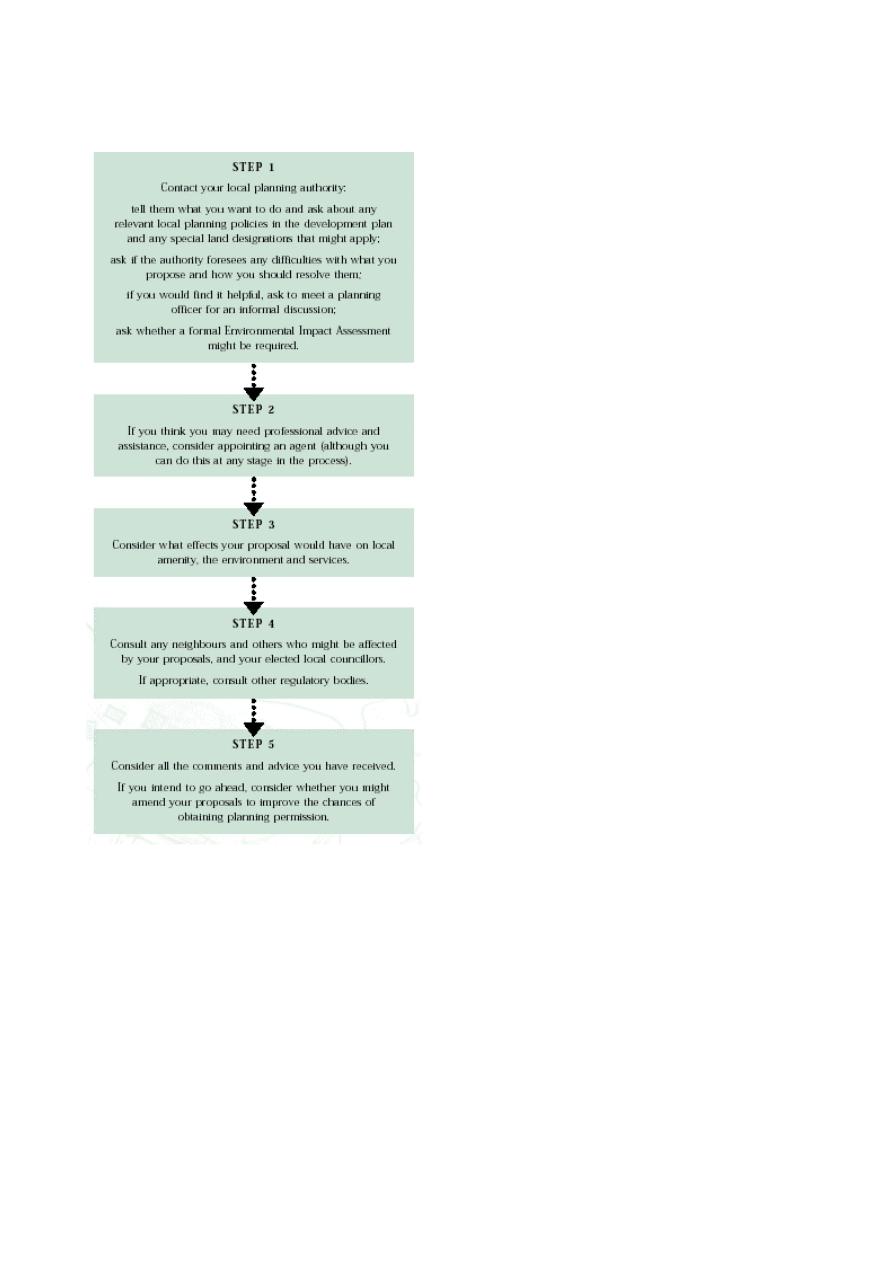
3.2 As part of your preparation you are strongly recommended to talk about your ideas at an
early stage with your local planning authority. As well as offering general advice, the authority
will be able to send you copies of the planning application form and any guidance notes, advise you
about the timetable for dealing with your application and explain the requirements for publicising
your application.

3.3 Be prepared to outline to the authority what you are proposing to do. You should ask about
relevant development plan policies and any special land designations that may apply to the
development site (see paragraphs 1.8 - 1.12). Ask if the authority foresees any difficulties with your
proposal. It can be useful to meet a planning officer for an informal discussion before you proceed.
In many cases this can save time and trouble later. If you are planning a large development, or one
of the types mentioned in paragraph 2.9, ask the authority whether a formal Environmental Impact
Assessment might be required.
3.4 If you meet a planning officer before submitting a planning application you might usefully:
•
describe your proposals and show the officer any plans you have made;
•
discuss its benefits and possible problems, and the extent to which the authority might
impose conditions on any permission;
•
ask if the officer can give an indication of the chances of obtaining planning permission
and, if they are poor, how you might improve your chances (but note paragraph 3.5 below);
•
ask what additional information may be required;
•
find out the likely timetable for deciding your application, including future planning
committee meetings at which you may be able to attend and speak;
•
check about the requirements for site notices and other publicity.
3.5 Remember however, that planning officers cannot pre-judge the decision on your
application. It is the local planning authority which will decide each application on its merits.
Once your proposal is finalised and submitted to the local planning authority the public, and certain
other bodies, can express views on it. These will be taken into account by the authority in reaching
its decision.
Consider the Impact of Your Proposals
3.6 Before discussing your proposal with a planning officer, or submitting a planning application,
consider what effects your proposal would have on:
•
your neighbours and local amenities;
•
the local economy and businesses;
•
the landscape, wildlife habitats, and historic features;
•
the quality of land for use in agriculture, forestry and other rural enterprises;
•
the need to protect other non-renewable resources such as minerals;
•
traffic, security, water supply, sewerage, noise and pollution.
Identifying and addressing any difficulties with these issues may be crucial in gaining planning
permission.
3.7 It is important to maintain and, where possible, enhance the environment. In particular, if the
land is part of a National Park, Area of Outstanding Natural Beauty, Site of Special Scientific
Interest, designated Green Belt or other special designation, think how your proposal would affect
the special interests of these areas (see paragraphs 1.8-1.12).
Can You Get Any Other Help?
3.8 In putting together and presenting your application it may also be worthwhile seeking help from
professional advisers such as planning or agricultural consultants, architects, surveyors, land agents

or solicitors, particularly if you are proposing a large-scale or potentially contentious development.
These professionals can assist you in liaising with the local planning authority and other agencies
(
), and in preparing and presenting your application. They will, of course, charge
a fee for their services, and they cannot guarantee you success. At an early stage you may wish to
check whether you are eligible for free planning consultancy advice under DEFRA's Rural
Enterprise Scheme - see Appendix E for further details about this and other potential sources of
help and advice.
Consulting Your Neighbours and Other Local Interests
3.9 It is advisable to consult any neighbours who might be affected by your proposals. Talk to them
about what you propose and try to see matters from their point of view if they have any concerns. It
makes sense to explain your plans and to take their opinions and possible objections on board
before you submit your application to the local planning authority - remember that they can express
their views as part of the planning process (see Section 5). It may also be helpful to consult the
local parish or town council. If you are proposing a large or potentially contentious scheme, you
may find it helpful to explain your proposals to your elected local councillor(s).
Effects on the Community at Large
3.10 Many projects, especially in the area of diversification or change of use, could bring benefits
to the community at large. Could yours? Greater numbers of visitors could help local businesses. A
leisure activity could also be popular with local people. A farm shop or 'pick-your-own' facility
might offer a greater choice of fresh food to a large number of people. Ask around to see how
generally acceptable your idea might be. Demonstrating benefits to the community can help your
application. But also be aware of any potential drawbacks, such as increased traffic.
Always Consider These Points
3.11 Demonstrating that you have addressed the following issues may help in obtaining permission:
•
Is the development of an attractive design using appropriate materials for the location?
•
Would landscaping suitable to the local area make the development more attractive or
acceptable?
•
Are you handling traffic issues well (eg., access, exits and parking)?
•
Are you improving the look of the area by renovating run-down buildings, or preserving
traditional ones?
•
Are you improving public access to the land with a leisure facility (eg., a nature, fitness or
horse-riding trail)?
•
Are you increasing or improving natural habitats (eg., making a pond, or planting
woodland)?
•
Are you creating new or alternative employment opportunities?
3.12 All this information is important background when you present your application. It is better
not to have to alter your plans once the application is made, so take everything into account from
the outset.

Consultation with Other Bodies
3.13 In some circumstances you may find it helpful to consult other regulatory bodies before
making the application:
•
if there are potential sewage, water or flooding problems (particularly if the development
site is on a flood plain), the regional office of the Environment Agency;
•
if there are road safety or traffic issues, the highway authority (usually the county council in
non-metropolitan areas, or the local council in metropolitan areas);
•
if your project is in, or likely to affect, a Site of Special Scientific Interest, the local office
of English Nature;
•
if potentially dangerous chemicals are to be used, the Health and Safety Executive.
Again, your local planning authority should be able to advise you.
Allow Sufficient Time
3.14 You should submit your planning application well in advance of the date you wish to start
your development. Although local planning authorities aim to decide most applications within eight
weeks, there is no guarantee that yours will be decided in this timescale, particularly if the proposed
development is complex or likely to be contentious, or that permission will necessarily be
forthcoming.
Section 4: Making Your Application
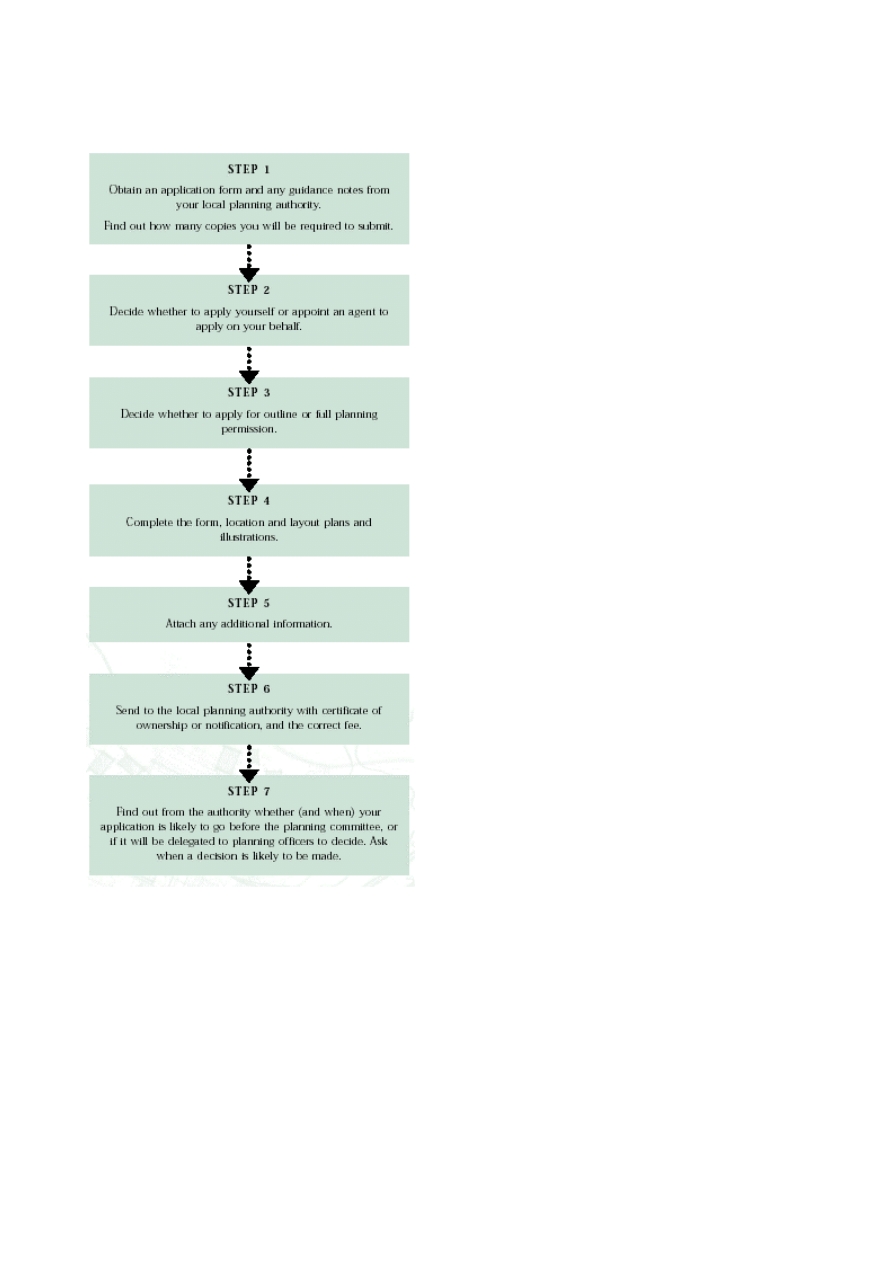
4.1 The better presented your planning application, the more chance there is of it being understood
and appreciated. There will be guidance notes with the application form you obtain from your local
planning authority which tell you what supporting material is required.
Who Can Apply?
4.2 Anyone can make an application, whether or not they own the property or land concerned. If
you are not the owner, or only have part ownership, you will have to inform the owner or those
who share ownership with you. Where land or buildings are rented from you, you will have to
inform any leaseholder whose lease still has seven or more years to run, or any agricultural tenant.
Tenants must inform landlords. It is not necessary to make the application yourself. You can

appoint an agent (for example, a town planner, an architect, a solicitor, a surveyor or a builder) to
apply on your behalf (see paragraph 3.8). Tenants are strongly recommended to seek expert
impartial professional advice.
Which Type of Application?
4.3 There are different types of planning application. You will need to decide which is appropriate
in your case. If in doubt ask a planning officer, or seek professional advice.
4.4 If your plans involve the erection of a building and you wish to establish that what you are
proposing is acceptable in principle, you can apply for outline planning permission. The more
information you give the better, but there is no need to submit detailed plans. If outline planning
permission is given, you will then have to apply for approval of the details, which are known as the
'reserved matters', before work can start. These comprise siting, design, external appearance, means
of access and landscaping. What you propose must be consistent with the outline permission, or
else you may need to reapply. This two-tier process takes longer than applying for full planning
permission at the outset and there are two sets of fees. It does, however, have the advantage that
time and money are not wasted on the detail of a proposal which is unlikely to be granted planning
permission.
4.5 Alternatively, you can apply for full planning permission, submitting the necessary details to
enable the planning authority to reach a decision. You will have to follow this course if you wish to
change the use of property, whether land or buildings, or if you have carried out development
without the necessary permission and want to make it lawful.(
)
4.6 Remember as well that if you are exercising permission already granted through permitted
development rights you may still need to inform the local planning authority before you commence
work (see paragraph 2.8).
Plans and Illustrations
4.7 You should include a site location plan that clearly pinpoints the site and shows its boundary,
together with any other land nearby that is owned or controlled by you. You should also include
layout plans showing existing buildings, trees, roads and access points; the location of the proposed
development on the site; and details of other features such as the external materials to be used. At
least three copies of plans are normally required - your planning authority will advise you about
this. If you are seeking outline planning permission only, any perspective or other sketches should
be clearly marked 'Draft - For Illustrative Purposes Only'. Otherwise they will be taken as part of
the application and cannot be modified without re-application.
Explain Your Reasons
4.8 You may find it useful to explain as concisely as possible on the application form, or on a
separate sheet of paper, your reasons for undertaking the project and the benefits that it is intended
to bring both to you personally and to the community (see paragraph 3.10). You could also
indicate, if appropriate, what consultations you have had with neighbours and other interested
parties and how far you have taken account of their opinions in your plans.

Forms and Fees
4.9 Planning application forms vary from authority to authority but their content is generally
similar. When you are sent the forms the planning authority should advise you about the fee
payable and if there are any exemptions that apply to your case. The fee is not refunded if planning
permission is refused, or if you subsequently withdraw your application. Some authorities are
experimenting with systems that can accept planning applications in electronic form. Where
relevant, they will explain how this works.
Timing
4.10 It may be useful to find out from the authority the dates of future planning committee
meetings. If your application is likely to go before the committee for decision, making your
application at the right time could gain you three or four weeks if your proposals get on to the
agenda of an earlier committee meeting.
Endnote
3 But if the present use of the land commenced more than ten years ago, or building operations were completed more
than four years ago, and no enforcement proceedings have been taken, you may alternatively consider applying for a
lawful development certificate - see Appendix E for details of how to obtain further information.
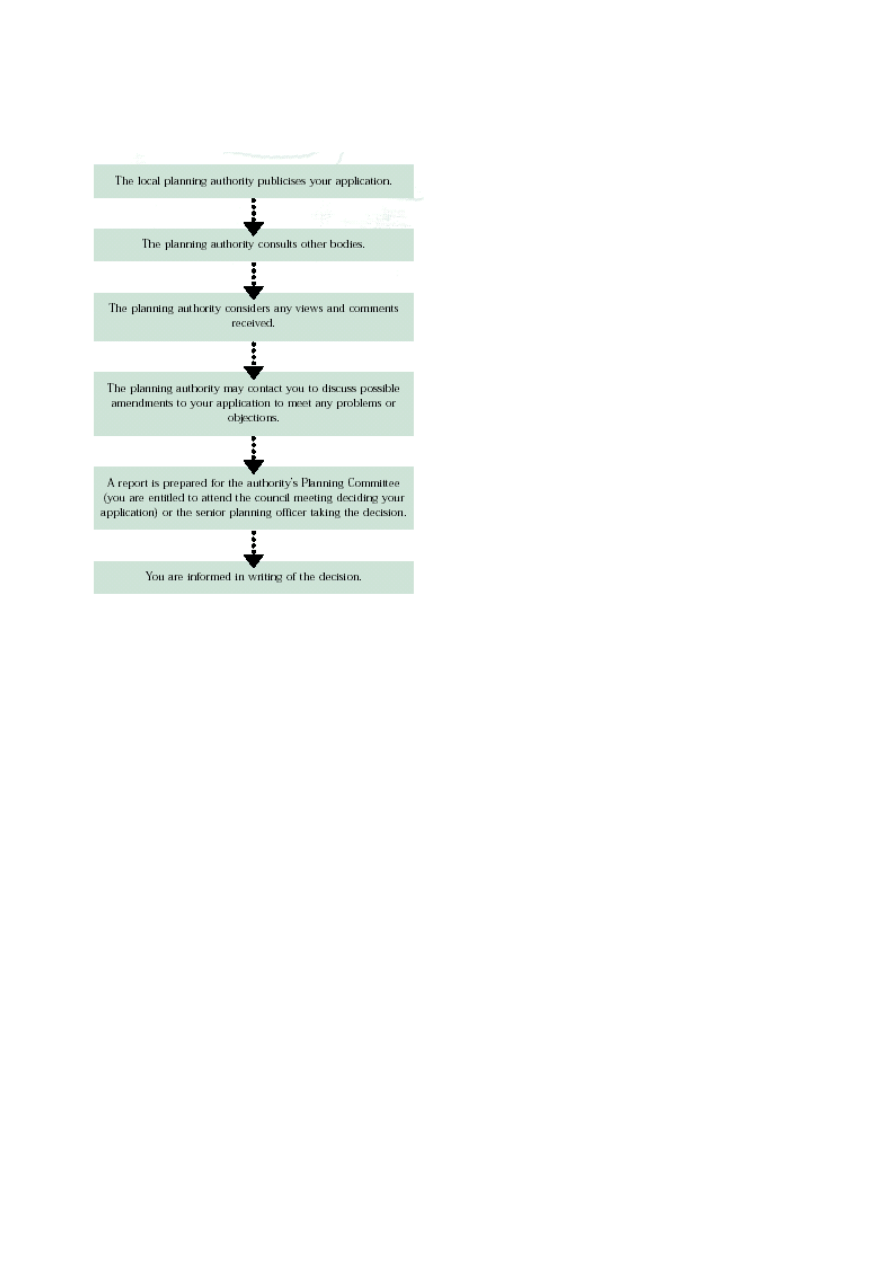
Section 5: After the Application
What Happens Next?
5.1 Once you have submitted your application and the correct fee, the local planning authority will
send you an acknowledgement. It will place a copy of the application in the Planning Register at
the council offices, where it is available for public inspection.
5.2 The authority will also publicise your application, so that members of the public can express
views. The authority may notify any of your neighbours by letter, or will fix a notice about your
application at or near the site, and may also place a notice in a local newspaper. The authority may
notify the relevant parish or town council, and may consult with other bodies, such as the county
council, the Office of the Deputy Prime Minister (which has overall responsibility for the planning
system), and the Environment Agency, depending on the nature or implications of your proposals.
5.3 Anyone has the right to express views on your application, either for or against. The local
planning authority will assess the relevance of comments received and whether any objections
relating to the use and development of land can be overcome. It may go back to objectors to discuss
ways of getting round any problems. It may also get in touch with you, suggesting minor
amendments to your application to resolve difficulties. Finally, all the information will be put
together and a report submitted to the planning committee (which is made up of elected
councillors), or to the senior officer in the planning department making the decision.
Progress of Your Application
5.4 If your application is to go to the planning committee for decision, staff at the local authority's
planning department will be able to tell you when your case is scheduled to be discussed. You have

the right to attend the council meeting deciding your application. Some planning authorities also
allow applicants to speak in support of their application at the meeting. Ask your authority if it will
permit you to speak and, if it does, what rules and arrangements apply. If you have not already
done so, you may wish to explain your proposals to your elected local councillor in advance of the
council meeting which will decide on your application. Even if your councillor is not a member of
the planning committee, they can put your points to those councillors who are.
5.5 Alternatively, your application may be decided by planning officers under powers delegated to
them by councillors. In that case you will not have to wait for a council meeting. This does not
prevent you making representations to elected councillors if you wish.
5.6 You are generally entitled to see and have a copy of any report submitted to a local government
committee. You are also entitled to see certain background papers used in the preparation of
reports. The background papers will generally include the comments (perhaps in summary form) of
those bodies that the planning authority has consulted, as well as those from any objectors and
supporters that are relevant to the determination of your application. Such material should normally
be made available at least three working days before the committee meeting.
Time Taken to Reach a Decision
5.7 If you feel the planning authority is being unduly slow in dealing with your application, you can
ask them when a decision is likely. If you are still not satisfied you can raise the matter with the
council's monitoring officer, or with your local councillor.
5.8 If you have not received a decision within eight weeks of submitting your application and have
not agreed (in writing) an extension with the local planning authority, you have the right of appeal
to the First Secretary of State at the Office of the Deputy Prime Minister. Your application will then
be out of the local authority's hands. An appeal will probably take longer to decide than persevering
with the authority (see section 7). Before deciding whether to appeal it is advisable to contact the
planning authority to find out the reasons for the delay, and how much longer you may have to wait
for a decision on your application.

Section 6: When Permission is Granted
6.1 The planning authority will notify you by letter of its decision on your application. If it has
granted outline permission, you can go ahead with your detailed application. If it is full permission,
you must read it carefully before you start any work because there may be conditions with which
you must comply. Do not risk enforcement action by doing something which your planning
permission does not cover or specifically prohibits. Usually, both full and outline planning
permission require you to start work within a certain period - typically five years. If you do not, the
permission will lapse, unless renewed.
6.2 Unless otherwise provided in the permission, planning permission runs with the land to which it
relates rather than being personal to the owner or occupier. So the question of who is to carry out
development, or occupy premises for which you have obtained permission, will normally be
irrelevant. This means that land or buildings can usually be sold or let with the benefit of planning
permission (but see paragraph 6.3).
Conditional Permission
6.3 As an alternative to outright refusal, the planning authority can grant permission subject to one
or more conditions. It must advise you of the specific reasons for imposing the conditions. An
example could be that a site has restricted access with only one entrance and the authority will only
allow the development if two are provided. Planning conditions sometimes limit the use or
occupation of land or premises to a named person or company. Before you sell or let a building, or
land which is subject to such conditional permission, you must make a further application to the
local planning authority to remove the condition. Similarly, if a building is subject to a 'local firm'
condition, that too would need to be removed if the purchaser is not a local firm.
In general, conditions must be:
•
necessary;
•
relevant to planning;
•
relevant to the development to be
permitted;
•
enforceable;
•
precise; and
•
reasonable in all other
respects.
6.4 Conditions are enforceable and you must not ignore them. If you think you cannot meet all of
them and the problem is not resolved after discussion with the planning officer, you have two
options:
•
to apply to the local planning authority to have the conditions lifted;
•
to appeal to the First Secretary of State against the conditions - see Section 7.
Planning Obligations
6.5 In appropriate circumstances, you may enter into a formal planning obligation under Section
106 of the Town and Country Planning Act 1990. Such obligations may restrict development or use
of land; require operations or activities to be carried out; require the land to be used in a specified
way; or require payments to be made to the local authority, either in a single sum or periodically.
They may be enforced against you or anyone purchasing the land from you. Planning obligations

are unlikely to be commonplace. They may, for example, be used to tie a farmhouse to adjacent
farm buildings, or to tie the dwelling to the land, so that they cannot be sold separately without
further application to the local planning authority. You should consult a lawyer before signing such
a document.
Changing the Plans
6.6 Your application was approved on the basis of the plans that you submitted. You must not
change them (unless an amendment to those plans was a condition of planning permission). It may
be possible to make minor variations as you proceed, but you should always consult the planning
authority first, to avoid any possibility of enforcement action. Major variations will require a fresh
planning application.
Other Consents
6.7 The grant of planning permission does not absolve you from obtaining any other consents that
might be necessary, for example, listed building consent; conservation area consent (for the
demolition of an unlisted building within a conservation area); Building Regulations approval; or
scheduled monuments consent. For further information on these consents you should contact your
local authority. You should, of course, also ensure that you have the necessary permission of any
other party with a legal or financial interest in the property (eg., a landlord).
6.8 Generally, full planning permission allows you to lop or fell trees, or remove countryside
hedgerows, without obtaining any separate consent from the local authority. You may, however,
need the local authority's separate consent if the tree or hedgerow work can be avoided when
implementing the planning permission, or if you only have outline planning permission. For further
information you should contact your local authority. You may also need a felling licence from the
Forestry Commission before trees are removed. There are some specific situations where tree
felling is permitted without such a licence (detailed planning consent for instance) and full
information is available from the Forestry Commission.
6.9 Development activity that affects wildlife may also require separate consents. For example, a
licence is needed from English Nature to permit interference with a badger sett in the course of
development. You will also require a licence from the Department for Environment, Food and
Rural Affairs to disturb protected species (animal and plant species listed in the European Union
Habitats Directive) in the course of development work. Disturbance of bats may need prior
notification from English Nature. Further information on these matters can be obtained from your
local authority or from English Nature.
6.10 A change in the type of agricultural use of land may require consent under the Wildlife and
Countryside Act 1981 (as amended by the Countryside and Rights of Way Act 2000) from English
Nature where it takes place on a Site of Special Scientific Interest (SSSI), or notification to the
National Park Authority when on any National Park land which consists of, or includes, moor or
heath. However, where a planning application has been made and planning permission granted for
development affecting an SSSI, the owner or occupier of the land is not required to obtain English
Nature's consent (in these cases, the planning authority will have consulted English Nature before
granting permission). The exercise of certain permitted development rights on a SSSI may require
the separate consent of English Nature where the operation is listed on the SSSI notification as
likely to damage the special interest features of the site. Further advice about SSSIs can be obtained

from English Nature (tel: 01733 455000 or visit their web site - see Appendix E). Queries about
notifications in National Parks should be made to the relevant National Park Authority.
6.11 The granting of planning permission will not give you the right to interfere with, obstruct or
move a path which provides a public right of way. Such a path cannot legally be diverted or closed
unless the relevant council (the highway authority) has made an order to do so to allow the
development to go ahead. You should speak to the council at an early stage if your proposals would
affect a public path in this way.
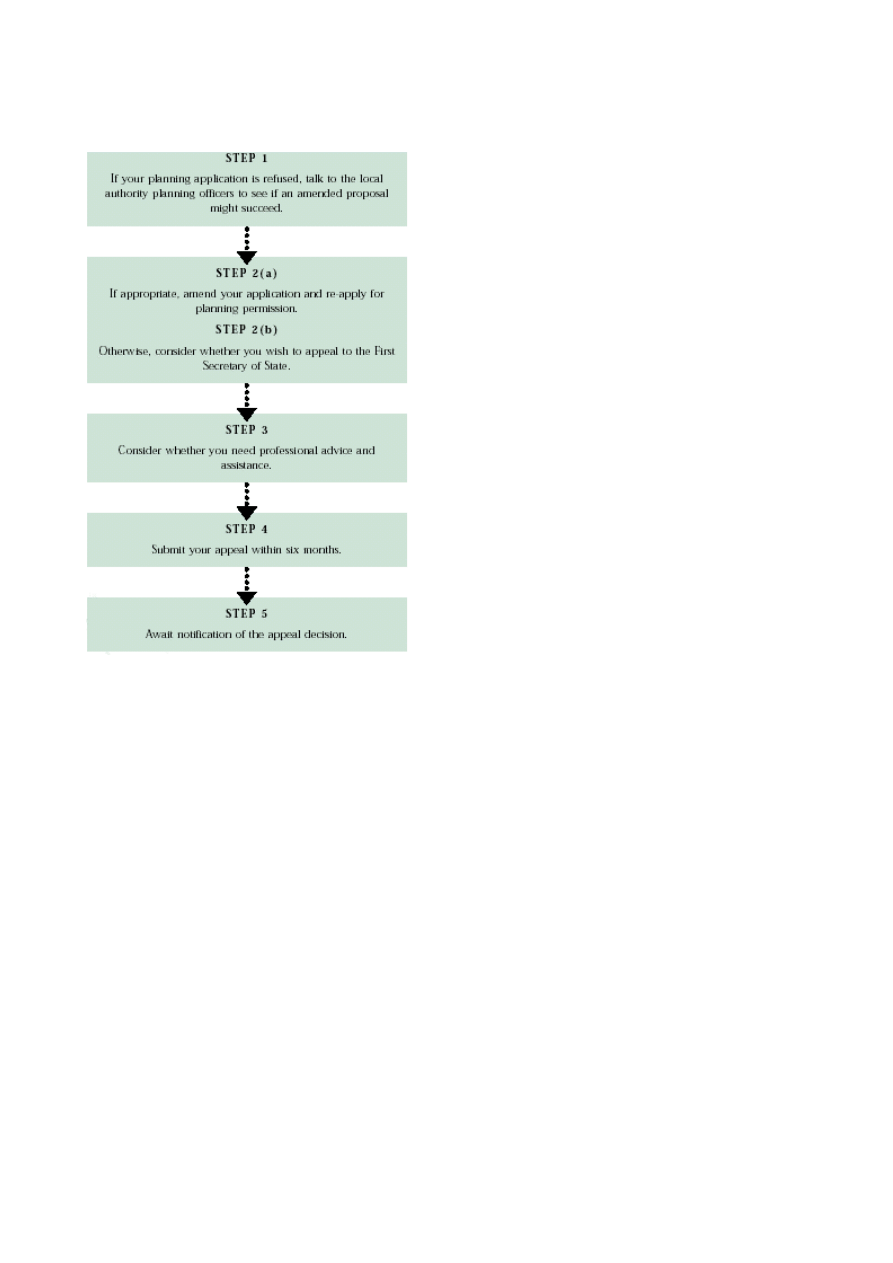
Section 7: Refusal and Right to Appeal
7.1 If your planning application is refused, you have two options for further action: you can refine
your proposal and try again with the local planning authority, or you can appeal against its decision.
Try Again?
7.2 The local planning authority must give written reasons for refusing planning permission. You
may wish to talk again to the planning officers to establish if an amended proposal might succeed.
There is normally no additional fee to pay if you reapply within 12 months of the decision with a
similar project which has been changed only marginally. Bear in mind that if a similar application
for the same site has been refused by the Secretary of State on appeal or following 'call-in', the
planning authority may decline to consider a fresh application in the following two years, unless
there has been a significant change in any material consideration.
Your Right to Appeal
7.3 You have the right to appeal to the First Secretary of State (at the Office of the Deputy Prime
Minister) if the planning authority:
•
refuse planning permission;
•
impose conditions you cannot or do not wish to accept;
•
fail to make a decision within eight weeks of receiving your application, or whatever
extended period you have agreed with them.

(While third parties can make known their views on your appeal, they have no right of appeal
against any decision to grant you planning permission).
7.4 You should regard the appeal system as a last resort. An appeal will enable your proposal to
be examined again, usually by an independent Planning Inspector appointed by the First Secretary
of State. (Note that if you appeal against one or more conditions, the Inspector will look afresh at
the whole permission -
). Appeals are decided on land use planning
considerations only (for example, whether or not the development is appropriate to a Green Belt),
and will be determined in accordance with the local development plan, unless material
considerations indicate otherwise.
7.5 If you want to appeal do not delay. You only have six months in which to appeal, either from
the date of the decision, or the date by which the planning authority should have made their
decision. But before you exercise that right, consider talking to the planning officers to see whether
the situation might be resolved by negotiation. This approach may provide a quicker solution.
7.6 Most appeals are handled in writing and take about 18 weeks to determine. Some are
determined by an informal hearing before a Planning Inspector; this type of appeal usually takes up
to 24 weeks. A few appeals are determined after a public inquiry, which often takes around 40
weeks. Further information is given in the booklet, 'Making your planning appeal' which can be
obtained from the Planning Inspectorate (see Appendix E), or possibly your local authority.
Getting Outside Help
7.7 Just as time spent preparing the original application is important, time spent preparing an appeal
is also critical. Professional advice is available for the preparation of planning appeals (see
paragraph 3.8 and Appendix E). A consultant's expertise and knowledge of the planning system
helps them see your application through the planning authority's eyes. They are working on your
behalf and will be able to advise on the chances of making a successful appeal, but they cannot
guarantee you success. There is no obligation to seek help in this way - you can, if you wish,
conduct the appeal yourself, even if it involves appearing at a local inquiry.
Cost
7.8 There is no fee for making an appeal, but you will inevitably incur some expenses in presenting
your case (for example, a consultant will charge for preparing and presenting your case if you
decide to employ one). The cost will depend on the procedure to be followed and on the complexity
of the case. Where there is an inquiry or hearing, costs may be awarded for unreasonable behaviour
by either party, for example, failure to submit documents or attend a meeting. It would, however,
have to be shown that unnecessary costs had been incurred as a result of this behaviour. An award
of appeal costs is not made on the basis of who 'wins' the appeal.
The Appeal Decision
7.9 The outcome of your appeal will depend only on the planning merits of your case. Just over a
third of all planning appeals are successful. The decision is final and can be challenged only on
legal grounds in the High Court. The High Court cannot decide your case; it can only uphold the
decision or quash it and require the Secretary of State to consider your case again. Appeals to the
High Court must be made within six weeks of the date on the letter giving the decision on your
appeal.

7.10 If you have appealed against conditions, the Inspector may decide to change or remove them,
change other conditions that you have not challenged, add further conditions, or even take away
your permission completely. However, in the latter case, or where it is proposed to add stricter
conditions, you will be given the opportunity to withdraw your appeal and keep the planning
authority's permission and its conditions.

Section 8: Breach of Planning Control and Enforcement Action
What if You Have Gone Ahead Without the Required Planning Permission?
8.1 If you have gone ahead with your development without the required planning permission the
planning authority may simply ask you to apply retrospectively. Much depends on the nature of the
development and its effect on neighbours. If the authority considers that the development involves
a breach of planning control, they may take remedial enforcement action.
Enforcement Action
8.2 This usually involves the planning authority issuing an enforcement notice setting out the
measures needed to remedy the breach, and the date by which these must be implemented. You
may be required to cease your activities involving the development, or demolish all or part of the
building.
8.3 If you have not complied with a condition imposed on the grant of planning permission, the
planning authority may issue a breach of condition notice requiring you to carry out work to
observe the terms of the condition.
Right of Appeal
8.4 There is a right of appeal to the First Secretary of State (at the Office of the Deputy Prime
Minister) against an enforcement notice. Further advice on this can be found in the booklet,
'Enforcement Notice Appeals - A Guide to Procedure', which you can obtain from the Planning
Inspectorate (see Appendix E) or your local planning authority. If an appeal (which must be made
before the enforcement notice takes effect) is dismissed and the notice becomes effective, it is an
offence not to comply with it and the local authority may decide to prosecute you in these
circumstances. There is no right of appeal against a breach of condition notice and you could be
prosecuted if you do not comply with it.

In Conclusion
Important Points to Remember
Think carefully about your ideas. What effect will they have on the
environment, your neighbours and the community? Are there elements you
might be prepared to change?
Find Out what your local planning authority is likely to approve by:
•
looking at the development plan(s) held at the council's offices or main
libraries;
•
talking to the local authority's planning officers.
Discuss your ideas with:
•
the local planning officers and your elected local councillors;
•
your neighbours and others likely to be affected by your proposals.
Take Advice where necessary:
•
consider seeking professional advice from a planning consultant, land
agent or surveyor;
•
consider whether you need, and are eligible for, free planning
consultancy advice offered by DEFRA under the Rural Enterprise
Scheme - see Appendix E.
Change or modify your original ideas if that makes them more likely to
succeed.
Present your plans and application with accurate and adequate information,
covering all the points likely to be of concern to the local planning authority.
Check that you have included everything, including the correct fee.
Find Out if you may need other consents in addition to planning permission.
Further Information
The Appendices that follow contain further information and other sources of advice on some of the
matters covered in this booklet.

Appendix A: Planning Policy Guidance Notes
A.1 The Government's national planning policies are set out in Planning Policy Guidance notes,
commonly known as 'PPGs', issued by the Office of the Deputy Prime Minister (ODPM), or its
predecessor Departments. PPGs have to be taken into account by local planning authorities in
preparing development plans, and may also be material to decisions on individual planning
applications and appeals. PPGs are available on the ODPM web site at
www.planning.odpm.gov.uk/ppg/index.htm
or from The Stationery Office Publications Centre, PO
Box 276, London SW8 5DT (Tel:0870 600 5522).
A.2 The PPG most relevant to farmers is:
PPG 7, The Countryside - Environmental Quality and Economic and Social Development,
revised February 1997, part up-dated March 2001 (ISBN 0-11-753370-X).
Other PPGs that may be relevant are:
•
PPG 1, General Policy and Principles, March 1992 (ISBN 0-11-752630-4);
•
PPG 2, Green Belts, January 1995 (ISBN 0-11-753037-9);
•
PPG 9, Nature Conservation, October 1994 (ISBN 0-11-752784-4);
•
PPG 11, Regional Planning, October 2000 (ISBN 0-11-753557-5);
•
PPG 13, Transport, March 2001 (ISBN 0-11-753558-3);
•
PPG 15, Planning and the Historic Environment, September 1994 (ISBN 0-11-752944-3);
•
PPG 16, Archaeology and Planning, November 1990 (ISBN 0-11-752353-4);
•
PPG 17, Sport and Recreation, September 1991 (ISBN 0-11-752520-0);
•
PPG 20, Coastal Planning, September 1992 (ISBN 0-11-752711-4);
•
PPG 21, Tourism, November 1992 (ISBN 0-11-752726-2);
•
PPG 22, Renewable Energy, February 1993 (ISBN 0-11-752756-4);
•
PPG 25, Development and Flood Risk, July 2001 (ISBN 0-11-753611-3).
NB: It is likely that a number of these PPGs will shortly be reviewed and revised.
A.3 Some statements from PPG 7, PPG 2 and PPG13 which are of particular interest to farmers are
reproduced below. For a fuller understanding each document needs to be read as a whole.
PPG7: The Countryside - Environmental Quality and Economic and Social Development
'This Planning Policy Guidance note gives guidance on how the Government's objectives for rural
areas should be reflected in land use planning. It is for local authorities through their development
plans to determine more specific policies that integrate these objectives in ways which reflect the
different types of countryside and the economic and social circumstances found in their areas.'
(PPG 7, paragraph 1.5)
'Food production and a competitive agricultural industry continue to be highly important, and
provide a basis for many other economic activities in rural areas. ... Farmers are increasingly
diversifying into other activities to supplement their incomes. Landowners need the flexibility to
consider a range of options for the economic use of their land, including non-food crops, planting
more woodland, recreation and leisure enterprises, the management of land to provide
environmental benefits, and the restoration of damaged landscapes and habitats.' (Paragraph 1.7)

'The guiding principle in the countryside is that development should both benefit economic activity
and maintain or enhance the environment. Rural areas can accommodate many forms of
development without detriment, if the location and design of development is handled with
sensitivity. New development should be sensitively related to existing settlement patterns and to
historic, wildlife and landscape resources... In areas statutorily designated for their landscape,
wildlife or historic qualities, policies give greater priority to restraint.' (Paragraph 2.3)
'Development of greenfield land, including the best and most versatile agricultural land (defined as
land in grades 1, 2, and 3a of the Agricultural Land Classification), should not be permitted unless
opportunities have been assessed for accommodating development on previously-developed sites
and on land within the boundaries of existing urban areas... Where development of agricultural
land is unavoidable, local planning authorities should seek to use areas of poorer quality land in
preference to that of a higher quality, except where other sustainability considerations suggest
otherwise. These might include, for example, its importance for biodiversity, the quality and
character of the landscape, its amenity value or heritage interest, accessibility to infrastructure,
workforce and markets, and the protection of natural resources, including soil quality.' (Paragraph
2.17, revised March 2001)
'Agricultural businesses need to adapt to new environmental, hygiene and welfare legislation and
to changing market requirements. Local planning authorities should take account of the need to
maintain an efficient and flexible agricultural industry in preparing their development plans, and
should include policies for considering planning applications for agricultural development,
including farm buildings and structures and agricultural dwellings.' (Paragraph 3.3).
'The Government's long term strategy for farming was set out in "A New Direction for Agriculture"
published in December 1999 and was taken a step further with the launch of the "Action Plan for
Farming" in March 2000. The England Rural Development Programme (ERDP) was launched in
October 2000. Together, these are providing opportunities to help the industry become more
competitive and diverse and to promote environmental aims. Farming continues to make a
significant contribution to the economy of rural areas but increasingly diversification into non-
agricultural activities is vital to the continuing viability of many farm businesses. Local planning
authorities should set out in their development plans the criteria to be applied to planning
applications for farm diversification projects. Local planning authorities should be supportive of
well-conceived farm diversification schemes for business purposes that are consistent in their scale
with their rural location.' (Paragraph 3.4A, inserted March 2001)
'The ERDP will, through the Rural Enterprise Scheme (RES) and the Processing and Marketing
Grant (PMG), provide support for selected diversification proposals, subject to competition.
Success in securing RES and PMG funding may depend upon obtaining prior planning permission
for diversification proposals, but the potential availability of any grant funding is not a material
consideration when determining a relevant planning application... It is usually preferable for farm
diversification schemes to re-use good quality existing buildings and put them to a new business
use, rather than build new buildings in the countryside. New buildings, either to replace existing
buildings or to accommodate expansion of enterprises, may also be acceptable provided that they
satisfy sustainable development objectives and are of a design and scale appropriate to their rural
surroundings.' (Paragraph 3.4B, March 2001)
'The re-use and adaptation of existing rural buildings has an important role in meeting the needs of
rural areas for commercial and industrial development, as well as for tourism, sport and
recreation'. (Paragraph 3.14)

'New house building and other new development in the open countryside, away from established
settlements or from areas allocated for development in development plans, should be strictly
controlled... Isolated new houses in the countryside require special justification - for example,
where they are essential to enable farm or forestry workers to live at or near their place of work....
Advice on the special considerations which may arise in relation to agricultural and forestry
dwellings is given in Annex I.' (Paragraph 3.21)
'Conservation of the natural beauty of the countryside, and of its wildlife and cultural heritage,
should be given great weight in planning policies and development control decisions in the
National Parks, the Broads and the New Forest Heritage Area. Due regard should also be had to
the economic and social well-being of local communities.' (Paragraph 4.5)
'In general, policies and development control decisions affecting AONBs [Areas of Outstanding
Natural Beauty] should favour conservation of the natural beauty of the landscape. In all cases the
environmental effects of new proposals will be a major consideration, though it will also be
appropriate to have regard to the economic and social well-being of the areas.' (Paragraph 4.8)
PPG2: Green Belts
'The general policies controlling development in the countryside apply with equal force in Green
Belts but there is, in addition, a general presumption against inappropriate development within
them.' (PPG 2, paragraph 3.1)
'The construction of new buildings inside a Green Belt is inappropriate unless it is for... agriculture
and forestry ... essential facilities for outdoor sport and outdoor recreation,... and for other uses of
land which preserve the openness of the Green Belt and which do not conflict with the purposes of
including land in it ....' (Paragraph 3.4)
'With suitable safeguards, the re-use of buildings should not prejudice the openness of Green Belts,
since the buildings are already there.' (Paragraph 3.7)
'The visual amenities of the Green Belt should not be injured by proposals ... which, although they
would not prejudice the purposes of including land in Green Belts, might be visually detrimental by
reason of their siting, materials or design.' (Paragraph 3.15)
PPG 13: Transport
'[In rural areas,] ... The objective should be to ensure (subject to paragraph 43), that jobs,
shopping, leisure facilities and services are primarily sited at the most accessible locations in the
local area ...' (PPG 13, paragraph 40)
'In remote locations well away from large urban areas, local authorities should focus most
development comprising jobs, shopping, leisure and services in or near to local service centres,
subject to paragraph 43, to help ensure it is served by public transport and provides some potential
for access by walking and cycling.' (Paragraph 41)
'... Diversification of agricultural businesses is increasingly likely to lead to proposals for
conversion or re-use of existing farm buildings for other business purposes, possibly in remote
locations. ... local authorities should encourage farm diversification proposals particularly, but not
exclusively, where this enables access by public transport, walking and cycling. They should be

realistic about the availability, or likely availability, of alternatives to access by car. Similarly, they
should not reject proposals where small-scale business development or its expansion would give
rise to only modest additional daily vehicle movements, in comparison to other uses that are
permitted on the site, and the impact on minor roads would not be significant.' (Paragraph 43)

Appendix B: Permitted Development Rights
B.1 The Town and Country Planning (General Permitted Development) Order 1995 ('the GPDO')
grants a general planning permission (known as 'permitted development rights') for certain types of
development. This means that a specific planning application is not needed if your project falls
within one of the categories set out in the GPDO and meets all the conditions laid down. However,
in some cases, as explained below, you must apply to the planning authority for a 'determination' as
to whether its prior approval is needed for details such as the siting, design and external appearance
of the proposed development.
B.2 This Appendix provides a summary of permitted development rights that may be of benefit to
farmers seeking to develop their existing agricultural businesses or diversify. It must not be relied
upon as a replacement for the full text of the GPDO which can be purchased from your local
Stationery Office stockist. The GPDO is frequently amended and you should therefore check that,
where appropriate, you obtain the up to date text for the relevant Part.
B.3 Specific planning permission is not needed for:
i) The use of land (but not any buildings) for any purpose (other than a caravan site) for not more
than twenty-eight days in a year. However, for motor cycle or car racing, and markets (including
car boot sales), only fourteen days a year are permitted. In Sites of Special Scientific Interest there
are no permitted development rights for temporary uses of land for war games, clay pigeon
shooting or any motor sports. (Part 4 of Schedule 2 to the GPDO refers).
ii) Building, excavation or engineering operations designed for agricultural purposes (including
those in connection with fish farming) on agricultural land in an agricultural unit of 5 hectares or
more which are reasonably necessary for the purposes of agriculture within the unit, provided that:
•
the development is not carried out on a separate parcel of land less than 1 hectare in area
forming part of the unit;
•
the ground area of any building, structure or works does not exceed 465 square metres (less
if it is within 90 metres of any other building, structure or works provided within the
preceding two years);
•
the building, structure or works is not higher than 12 metres, or 3 metres if within 3
kilometres of the perimeter of an aerodrome;
•
the development is more than 25 metres from a trunk or classified road;
•
the development does not involve the erection, extension or alteration of a dwelling;
•
if the building, structure or excavation is within 400 metres of the curtilage of a 'protected
building', it is not to be used for the accommodation of livestock (including farmed fish and
shellfish) or for the storage of slurry or sewage sludge. ('Protected building' means a
permanent building normally occupied by people, but does not include buildings within the
agricultural unit, or any dwelling or building in agricultural use on any other agricultural
unit);
•
if you are erecting a new building, forming a private way, carrying out excavations or
depositing waste material, or placing or assembling a tank in any waters, you have applied
to your local planning authority for a determination as to whether its prior approval will be
required for certain details (
);
•
if you are extending or altering a building:

- you have not previously made a 'significant' extension or alteration to it under
permitted development rights ('significant' means where the cubic content of the
original would be exceeded by more than 10%, or the height of the original building
would be increased);
- if it is located in a National Park or certain adjoining areas, you have applied to the
local planning authority for a determination as to whether its prior approval will be
required to the details (
);
- if it is located elsewhere, and the extension or alteration is 'significant', you have
applied to the local planning authority for a determination.
•
if the development involves the extraction of any mineral from the land, or the removal of
any mineral from any mineral-working deposit, the mineral is not moved off the unit;
•
it does not involve bringing waste materials on to the land from elsewhere for deposit,
except for use 'forthwith' in building works, or in the creation of a hard surface;
•
it does not involve excavation or engineering operations connected with fish farming in a
National Park or certain adjoining areas. (Class A of Part 6 of Schedule2 to the GPDO
refers).
(But where the use for agricultural purposes of buildings erected, significantly extended or
significantly altered under agricultural permitted development rights permanently ceases within
ten years of their substantial completion, and planning permission has not authorised
development for non-agricultural purposes within three years of this cessation (and there is no
outstanding appeal), the development must be removed unless the local planning authority have
otherwise agreed in writing. In these cases, the land must, so far as is practicable, be restored to its
former condition, unless you and the local planning authority have agreed otherwise in writing).
iii) Certain limited types of development on agricultural land in an agricultural unit of not less than
0.4 but less than 5 hectares (including the extension or alteration of an agricultural building;
installation of additional or replacement plant or machinery; provision, rearrangement or
replacement of a sewer, main pipe, cable or private way; creation of a hard surface; deposit of
waste; and certain repair and installation operations connected with fish farming) which are
reasonably necessary for the purposes of agriculture in that unit, provided that:
•
the development is not carried out on a separate parcel of land less than 0.4 hectare in area
forming part of the unit;
•
it does not materially affect the external appearance of the premises;
•
the development is not within 25 metres of a trunk or classified road;
•
in the case of the extension or alteration of an agricultural building (and the erection of a new
building within the curtilage of an existing building will be treated as an extension of the existing
building):
- no part of the new building is more than 30 metres from the existing building;
- the height of the building is not increased;
- the cubic content of the building is not increased by more than 10%;
- the work does not involve the extension, alteration or provision of a dwelling;

- the ground area of any building extended (or treated as extended) does not exceed
465 square metres;
- no part of the development is carried out within 5 metres of any boundary of the
unit.
•
if it involves the carrying out of works to a building or structure used, or to be used, for the
accommodation of livestock (including farmed fish and shellfish) or the storage of slurry or
sewage sludge, that building is not within 400 metres of the curtilage of a 'protected
building' (ie: a permanent building normally occupied by people, but not including
buildings within the agricultural unit, or any dwelling or building in agricultural use on any
other agricultural unit);
•
if it involves the extension or alteration of a building or the provision, rearrangement or
replacement of a private way located in a National Park or certain adjoining areas, you have
applied to the local planning authority for a determination as to whether its prior approval
will be required for certain details (
);
•
it does not relate to the placing or assembly of a fish farming tank on land or in any waters,
the construction of a fish pond, or an increase in the size of a tank or pond;
•
it does not involve bringing waste material on to the land from elsewhere for deposit, except
for use 'forthwith' in building works, the creation of a hard surface or private way;
•
the ground area of any hardstanding does not exceed 465 square metres (less if it is within
90 metres of any building, structure or works provided within the preceding two years);
•
no additional or replacement plant or machinery is higher than 12 metres (3 metres if within
3 kilometres of an aerodrome); no replacement plant or machinery is higher than that which
it replaces, and the ground area of any additional or replacement plant or machinery does
not exceed 465 square metres (less if it is within 90 metres of any building, structure or
works provided within the preceding two years). (Class B of Part 6 of Schedule 2 to the
GPDO refers).
(But where the use for agricultural purposes of buildings significantly extended or significantly
altered under agricultural permitted development rights permanently ceases within ten years of
their substantial completion, and planning permission has not authorised development for non-
agricultural purposes within three years of this cessation (and there is no outstanding appeal), the
development must be removed unless the local planning authority have otherwise agreed in writing.
In such cases, the land must, so far as is practicable, be restored to its former condition, unless you
and the local planning authority have otherwise agreed in writing).
iv) The winning and working on land held or occupied with land used for the purposes of
agriculture of any minerals reasonably necessary for agricultural purposes within the agricultural
unit of which it forms part, provided that:
•
the excavation is more than 25 metres from a trunk or classified road;
•
no extracted mineral is moved off the agricultural unit. (Class C of Part 6 of Schedule 2 to
the GPDO refers).
v) The use of land (but not a building) as a caravan site in certain circumstances. These include:
•
use for stationing a single touring caravan for no more than two consecutive nights and for
no more than twenty-eight days in a year;

•
use for stationing up to three caravans on a holding of at least 5 acres for no more than
twenty-eight nights in a year;
•
use as a caravan site of land occupied by an exempted organisation (eg. Caravan Club), or
use for not more than five caravans at a time of a site certified by an exempted organisation,
or use as a caravan site for not more than five nights for a meeting organised by an
exempted organisation for its members;
•
seasonal stationing of caravans as accommodation for agricultural or forestry workers, and;
•
a site licence under the Caravan Sites and Control of Development Act 1960 is not required
in any of these circumstances. (Part 5 of Schedule 2 to the GPDO refers).
vi) The erection, extension or alteration of buildings (except dwellings), or the formation, alteration
or maintenance of private ways, where reasonably necessary for forestry purposes, but so long
as the height of any buildings or works within 3 kilometres of an aerodrome does not exceed 3
metres, and so long as the development does not take place within 25 metres of a trunk or classified
road. These forestry permitted development rights are subject to the determination procedure
described in
. (Part 7 of Schedule 2 to the GPDO refers).
vii) The erection, construction, maintenance, improvement or alteration of a gate, fence, wall or
other means of enclosure, provided that the height does not exceed one metre where it is
constructed adjacent to a highway used for vehicular traffic, or two metres elsewhere, and the
setting of a listed building is not affected. (Class A of Part 2 of Schedule 2 to the GPDO refers).
viii) The recreational or instructional use of land, and the pitching of tents, by organisations such as
the Scouts, Guides, Boys Brigade, Church Lads Brigade, Salvation Army, Army Cadets, Caravan
Club and the Camping and Caravanning Club. (Part 27 of Schedule 2 to the GPDO refers).
The'Determination Procedure'
B.4 Under the 'determination procedure' set out in the GPDO, the local planning authority has 28
days to decide whether its prior approval will be required for:
•
the siting, design and external appearance of agricultural or forestry buildings;
•
the siting and means of construction of a private way;
•
the siting of excavations or waste deposits with an area exceeding 0.5 hectare; and
•
the siting and appearance of fish tanks.
B.5 Where this procedure applies, your local planning authority will be able to supply you with the
appropriate notification form. You should complete and return this form with a description of the
proposed development, including the materials to be used and a site plan. The local planning
authority has 28 days in which to decide whether or not its prior approval is required. If it tells you
that its prior approval is not required, you may go ahead in accordance with the details that you
submitted. If you have not been informed of the authority's decision within 28 days of the date of
the authority receiving the notification, you should contact the authority to confirm whether or not
it has taken a decision. If the authority confirms that it has not reached a decision within this period,
you may proceed with the development, as notified to the authority.
B.6 In those cases where you are informed that the local planning authority's prior approval is
required, you must, within one week of receiving notice from the local planning authority, put up a
site notice in the prescribed form on or near the land, which must stay up for at least three weeks.
Further details about site notices are given in paragraphs 9, 10, 31 and 32 of DOE Circular 15/92,

obtainable from The Stationery Office, Publications Centre, PO Box 276, London SW8 5DT (Tel:
0870 600 5522). The planning authority has eight weeks from the receipt of the submitted details to
issue its decision.
B.7 If approval is refused, or is granted subject to conditions with which you disagree, or if the
decision is not taken within eight weeks, you will have the right of appeal to the First Secretary of
State (at the Office of the Deputy Prime Minister). There is, however, no right of appeal against the
decision of a local planning authority to require approval of details.
B.8 Further details of this procedure are given in Annex E of PPG 7 (see Appendix A, paragraph
A.1, of this guide for advice on how to obtain a copy).
B.9 In operating these provisions, local planning authorities will have due regard to the operational
needs of agricultural businesses and the need to avoid imposing any unnecessary or excessively
costly requirements. However, they will also need to consider the effect of the development on the
landscape in terms of visual amenity and the desirability of preserving ancient monuments and their
settings, known archaeological sites, listed buildings and their settings, and sites of recognised
nature conservation value (ie. SSSIs and Local Nature Reserves). It is, therefore, essential that you
give careful consideration to these points in drawing up your proposals. Your local planning
authority may be able to provide you with guidelines on the principles it would wish to be taken
into account in preparing details of the siting, design and appearance of the proposed development.
B.10 You should be aware that permitted development rights provided under the GPDO do not
obviate the need to obtain other consents (eg., from English Nature) where appropriate (see
paragraphs 6.7 - 6.10 of this Guide).

Appendix C: Diversification Projects: Some Examples of When Planning
Permission is Needed
C.1 Government guidance encourages local planning authorities to be supportive of wellconceived
farm diversification schemes for business purposes that are consistent in their scale with their rural
location (PPG 7, paragraph 3.4A - see Appendix A to this Guide). The following examples
illustrate when planning permission might be needed. But remember that local circumstances
vary and it is best to check with your local planning authority, or take professional advice, before
going ahead. In some cases your development will also need other consents in addition to planning
(see paragraphs 6.7 - 6.10).
Conversion of Farm Buildings?
C.2 Yes. You will need planning permission for conversion to use other than for agriculture, even if
there are no structural alterations. The key considerations are acceptability of use for the particular
site, in particular, local impact, and the condition and nature of the buildings - they must be
reasonably capable of being converted to the proposed use.
Holiday Accomadation?
C.3 Generally Yes. You will need planning permission if you are converting old farm buildings or
erecting new buildings. The use of a farmhouse for Bed and Breakfast accommodation will only
need planning permission if the essentially residential nature of the property is changed - it is
generally a question of the scale of activity.
Stables for Horses?
C.4 Generally Yes. You will need planning permission for stables if they are for horses for riding or
breeding. However, working horses used for agriculture count as livestock and their stabling comes
under the provisions of the General Permitted Development Order (GPDO), in which case you
might not need permission (check with your local planning authority).
Caravan Sites?
C.5 Generally Yes- except in the circumstances set out in Appendix B. However, the GPDO grants
a general planning permission for toilet blocks that are required to be installed under the conditions
of your site licence. You are advised to consult the local planning authority for their views on
special design or environmental requirements in your area.
Farm Shops?
C.6 Sometimes. It is normally assumed that the use of a farm shop only for the sale of unprocessed
goods produced on that farm is a use which is ancillary to the use as a farm, and therefore does not
require specific planning permission. However, use as a farm shop selling a significant amount of
produce from elsewhere is a separate use and therefore requires planning permission.
Food Processing?
C.7 Sometimes. The size and nature of the processing is significant. For example, a small unit to
wash vegetables grown on the farm would be less likely to need planning permission than a larger

business which might bring in produce or raw materials from surrounding farms or suppliers. The
potential local impact of the particular development will be an important consideration. Again, you
should consult your local planning authority.
Farm Visits, 'Pick-Your-Own', Farm Trails?
C.8 Sometimes. Much depends on scale and the volume and type of traffic likely to be generated.
Amenity Lakes?
C.9 Generally Yes. Planning permission will be required unless the construction is for the purposes
of agriculture, for example, an agricultural irrigation reservoir. The construction of such a reservoir
could come under the provisions of the General Permitted Development Order (GPDO) - see
paragraphs 2.7-2.8 and Appendix B - in which case, you may not need specific planning
permission, but this depends on the size of the agricultural unit and the area of the excavations
(check with your local planning authority). Where mineral extraction is proposed to construct the
reservoir and the material is taken off the holding, planning permission will be required. With
larger schemes an Environmental Impact Assessment may be needed (see paragraph 2.9).
Traffic Issues
C.10 Traffic considerations are likely to apply to many of the above examples and are a factor that
the planning authority will bear in mind in deciding whether planning permission is needed, or in
considering a planning application. This might include ease of access and exit from your property,
and the type and design of parking facilities offered. National Planning Policy Guidance on
Transport (PPG13) advises local planning authorities not to reject farm diversification proposals
where small-scale business development, or its expansion, would give rise to only modest
additional daily vehicle movements, in comparison to other uses that are permitted on the site, and
the impact on minor roads would not be significant (see Appendix A).

Appendix D: Outdoor Advertisements
D.1 You may want to display an outdoor advertisement or sign, only to find that you are prevented
by the advertisement control system, because the planning authority refuse to give their consent.
This Appendix explains the advertisement control system and how you can use it to your
advantage. More detailed guidance can be found in the booklet, 'Outdoor Advertisements and
Signs: A Guide for Advertisers', which can be obtained from the Office of the Deputy Prime
Minister (ODPM) - see Appendix E.
Scope of The Advertisement Control System
D.2 Advertisement control is part of the planning control system. It is not concerned with what the
advertisement says. It is concerned with the advertisement's size, appearance and positioning,
including the site and the immediate surroundings. Control operates only for reasons of 'amenity'
and 'public safety'. An advertisement can only be displayed lawfully with the landowner's consent.
D.3 Many advertisements and signs are controlled including posters, notices and placards; boards
and hoardings; fascia and projecting signs; advertising models, devices and representations;
advance and directional signs; advertising flags (but not the national flags); price-markers and
displays.
Who Controls Advertisements?
D.4 Advertisement control is the local planning authority's responsibility.
'Deemed Consent' Granted for Some Advertisiements
D.5 Some advertisements may be displayed without the planning authority's prior consent. This is
known as 'deemed consent'.
D.6 To have deemed consent, an advertisement must meet certain conditions and limitations. The
following limitations usually apply (
but see also paragraph D.9 below
):
•
illumination is not permissible;
•
the maximum permitted height above ground level is 4.6 metres;
•
lettering must not exceed 0.75m in height;
•
and there are maximum limits to the area allowed.
D.7 'Deemed consent' advertisements which may be of particular interest to you are:
(a) Miscellaneous advertisements relating to the premises on which they are displayed:
Examples would include a farm name plate; a field-gate sign saying 'Please Shut the Gate'; or a 'B
& B' sign. These advertisements must not exceed 0.3 sq.m.
(b) Temporary advertisements relating to the land on which they are displayed: Examples are
an advertisement about the sale or letting of agricultural land or premises (limited to a single board
of not more than 2 sq.m, or two joined boards of not more than 2.3 sq.m); an announcement of the
sale of goods or livestock on the land where they are kept (limited to one advertisement not
exceeding 1.2 sq.m, and not displayed earlier than 28 days before the sale starts); advertisements

about any demonstration of agricultural methods or processes (limited to 1.2 sq.m total area, and
not displayed earlier than 28 days before the demonstration starts).
(c) Advertisements relating to Neighbourhood Watch, Farm Watch or other Watch schemes:
- if they have been set up with the police authority's approval (signs must not exceed 0.2 sq.m or
3.6m above ground-level).
(d) Advertisements remaining on display after expiry of the five-year period of the planning
authority's consent: This means that renewal of the previous consent need not be sought, if the
advertisement, or the use of the site, remains unchanged.
Obtaining 'Express Consent' for Other Advertisements
D.8 The planning authority may grant express consent for other advertisements that are acceptable
on grounds of amenity and public safety. If an application for consent is refused, there is a right of
appeal to the First Secretary of State (at the ODPM).
Special Control in Some Rural Areas
D.9 Planning authorities have an additional power to designate what is called an 'Area of Special
Control of Advertisements'. Many rural areas in England have been designated as Areas of Special
Control. In those areas deemed consent advertisements (
) are subject to a
maximum height limit of 3.6m and lettering is limited to 0.3m. Your local planning authority will
be able to tell you if these special controls apply.
Advance Signs and Directional Signs
D.10 It is usually illegal to display any advertisement on highway land, and in some cases on land
adjoining the highway, without the highway authority's prior consent. Only official traffic signs are
usually permitted on highway land.
D.11 Consent to display advance or directional signs may well be granted if they are well designed
and safely sited. It is vital that no sign be sited where it causes a hazard to traffic.
Dangerous or Illegal Advertisements
D.12 Local planning and highway authorities have statutory powers to remove dangerous
advertisements. They may also bring prosecution proceedings for illegal advertisements.

Appendix E: Sources of Further Advice
You can obtain further advice from a variety of sources including:
•
Your local planning authority - contact your local council offices
•
The Office of the Deputy Prime Minister {
}
•
The Department for Environment, Food and Rural Affairs {
}
•
The Countryside Agency {
}
•
English Nature {
}
•
The Forestry Commission {
}
•
The Small Business Service {
}
•
National Farmers' Union {
}
•
Country Land and Business Association
•
Your Regional Development Agency
•
National Association of Citizens Advice Bureaux or your local Citizens Advice Bureau
•
Planning or agricultural consultants, architects, surveyors etc. (See Yellow Pages, or contact
professional bodies such as the Royal Town Planning Institute, British Institute of
Agricultural Consultants, Royal Institute of British Architects, or the Royal Institution of
Chartered Surveyors).
The following free publications may be of assistance:
•
Planning Permission - A Guide for Businesses (
)
•
Planning: A Guide for Householders (
)
•
Outdoor Advertisements and Signs: A Guide for Advertisers (
)
•
Making your planning appeal (Planning Inspectorate) (
)
•
Enforcement Notice Appeals - A Guide to Procedure (Planning Inspectorate) (
•
Local Plans and Unitary Development Plans: A guide to procedures (
)
•
Lawful Development Certificates - A Users Guide (
)
•
Environmental Impact Assessment - a guide to procedures (ODPM web site) (
•
England Rural Development Programme - publicity (DEFRA) (
)
•
The Rural Enterprise Scheme (MAFF)4 (Also see RES Guidance Notes for Applicants Parts
1 and 2) (DEFRA) (
)
•
What you should know about Sites of Special Scientific Interest (English Nature) (
)
•
Protected Trees - A Guide to Tree Preservation Procedures (
)
Endnotes
Office of the Deputy Prime Minister Publications
2 See the Department's web site:
www.planning.odpm.gov.uk/index.htm
3 Available from The Planning Inspectorate, Temple Quay House, 2 The Square, Temple Quay, Bristol BS1 6PN. Tel:
0117 372 6372 Web site:
www.planning-inspectorate.gov.uk
4 Available from (MAFF)/DEFRA Publications, Admail 6000, London SW1A 2XX Tel: 08459 556000 - or DEFRA
local offices, or the DEFRA website:

5 Available from TwoTen Ltd., English Nature, PO Box 1995, Wetherby, West Yorkshire LS23 7XX Tel: 0870 1214
177 (e-mail:
english-nature@twoten.press.net
), or from the English Nature web site - see above.
Document Outline
- A farmer\'s guide to the planning system
- Introduction
- Summary
- Section 1: The Planning System
- Section 2: Do You Need Planning Permission?
- Section 3: Preparing the Ground Before You Apply
- Section 4: Making Your Application
- Section 5: After the Application
- Section 6: When Permission is Granted
- Section 7: Refusal and Right to Appeal
- Section 8: Breach of Planning Control and Enforcement Action
- In Conclusion
- PPG7: The Countryside - Environmental Quality and Economic and Social Development
Wyszukiwarka
Podobne podstrony:
House Plan Permission Guide
Bus Plan Permission Guide
Personal Development Plan Example Guide
Plan marketingowy 1
Plan pracy na 2011 pps
Damage Control Plan
Plan Balcerowicza
Wykład 7 Wieloletni Plan Finansowy
7 Plan sieciowy
guide camino aragones pl
plan wspier
2 1 I B 03 ark 02 zbiorczy plan kolizji
Herbs for Sports Performance, Energy and Recovery Guide to Optimal Sports Nutrition
Plan Tygodniowy lyoness weekly plan PL
Meezan Banks Guide to Islamic Banking
plan drogi7
PLAN MASA (2)
więcej podobnych podstron