INFORMATION
SECURITY
SEC Needs to
Improve Controls over
Financial Systems
and Data
Report to the Chair, U.S. Securities
and Exchange Commission
April 2014
GAO-14-419
United States Government Accountability Office
United States Government Accountability Office
Highlights of
, a report to the
Chair, U.S Securities and Exchange
Commission
April 2014
INFORMATION SECURITY
SEC Needs to Improve Controls over Financial
Systems and Data
Why GAO Did This Study
SEC is responsible for enforcing
securities laws, issuing rules and
regulations that protect investors, and
helping to ensure that securities
markets are fair and honest. In carrying
out its mission, the commission relies
extensively on computerized systems
that collect and process financial and
sensitive information. Accordingly, it is
essential that SEC have effective
information security controls in place to
protect this information from misuse,
fraudulent use, improper disclosure,
manipulation, or destruction.
As part of its audit of SEC’s fiscal
years 2013 and 2012 financial
statements, GAO assessed the
commission’s information security
controls. The objective was to
determine the effectiveness of
information security controls for
protecting the confidentiality, integrity,
and availability of SEC’s key financial
systems and information. To do this,
GAO assessed security controls in key
areas by reviewing SEC documents,
testing selected systems, and
interviewing relevant officials.
What GAO Recommends
GAO is recommending that SEC take
two actions to (1) more effectively
oversee contractors performing
security-related tasks and (2) improve
risk management. In a separate report
for limited distribution, GAO is
recommending that SEC take 49
specific actions to address
weaknesses in security controls. In
commenting on a draft of this report,
SEC generally agreed with GAO’s
recommendations and described steps
it is taking to address them.
What GAO Found
Although the Securities and Exchange Commission (SEC) had implemented and
made progress in strengthening information security controls, weaknesses
limited their effectiveness in protecting the confidentiality, integrity, and
availability of a key financial system. For this system’s network, servers,
applications, and databases, weaknesses in several controls were found, as the
following examples illustrate:
•
Access controls: SEC did not consistently protect its system boundary from
possible intrusions; identify and authenticate users; authorize access to
resources; encrypt sensitive data; audit and monitor actions taken on the
commission’s networks, systems, and databases; and restrict physical
access to sensitive assets.
•
Configuration and patch management: SEC did not securely configure the
system at its new data center according to its configuration baseline
requirements. In addition, it did not consistently apply software patches
intended to fix vulnerabilities to servers and databases in a timely manner.
•
Segregation of duties: SEC did not adequately segregate its development
and production computing environments. For example, development user
accounts were active on the system’s production servers.
•
Contingency and disaster recovery planning: Although SEC had
developed contingency and disaster recovery plans, it did not ensure
redundancy of a critical server.
The information security weaknesses existed, in part, because SEC did not
effectively oversee and manage the implementation of information security
controls during the migration of this key financial system to a new location.
Specifically, during the migration, SEC did not (1) consistently oversee the
information security-related work performed by the contractor and (2) effectively
manage risk.
Until SEC mitigates control deficiencies and strengthens the implementation of its
security program, its financial information and systems may be exposed to
unauthorized disclosure, modification, use, and disruption. These weaknesses,
considered collectively, contributed to GAO’s determination that SEC had a
significant deficiency in internal control over financial reporting for fiscal year
2013.
View
.For more information,
contact Gregory C. Wilshusen at (202) 512-
or Nabajyoti
Barkakati at (202) 512-4499 or
Page i
GAO-14-419 SEC 2013 Information Security
Letter
1
Information Security Weaknesses Placed SEC Financial Data at
Recommendations for Executive Action
Agency Comments and Our Evaluation
Objective, Scope, and Methodology
Comments from the Securities and Exchange Commission
GAO Contacts and Staff Acknowledgments
Abbreviations
CIO
chief information officer
FISCAM
Federal Information System Controls Audit Manual
FISMA
Federal Information Security Management Act
NIST
National Institute of Standards and Technology
SEC
Securities and Exchange Commission
SP
special publication
Contents
This is a work of the U.S. government and is not subject to copyright protection in the
United States. The published product may be reproduced and distributed in its entirety
without further permission from GAO. However, because this work may contain
copyrighted images or other material, permission from the copyright holder may be
necessary if you wish to reproduce this material separately.
Page 1
GAO-14-419 SEC 2013 Information Security
441 G St. N.W.
Washington, DC 20548
April 17, 2014
The Honorable Mary Jo White
Chair
U.S. Securities and Exchange Commission
Dear Ms. White:
As you are aware, the U.S. Securities and Exchange Commission (SEC)
is responsible for enforcing securities laws, issuing rules and regulations
that provide protection for investors, and helping to ensure that the
securities markets are fair and honest. To support its demanding financial
and mission-related responsibilities, the commission relies extensively on
computerized systems. In order to protect financial and sensitive
information—including personnel and regulatory information maintained
by SEC—from inadvertent or deliberate misuse, fraudulent use, improper
disclosure or manipulation, or destruction, it is essential that SEC have
effective information security controls in place.
On December 16, 2013, we issued our report on the audit of the SEC’s
fiscal years 2013 and 2012 financial statements.
identified, among other things, information security control weaknesses
that, considered collectively, represent a significant deficiency
1
Information security controls include security management, access controls, configuration
management, segregation of duties, and contingency planning. These controls are
designed to ensure that there is a continuous cycle of activity for assessing risk; logical
and physical access to sensitive computing resources and information is appropriately
restricted; only authorized changes to computer programs are made; one individual does
not control all critical stages of a process; and backup and recovery plans are adequate to
ensure the continuity of essential operations.
in SEC’s
internal control over financial reporting.
2
GAO, Financial Audit: Securities and Exchange Commission’s Financial Statements for
Fiscal Years 2013 and 2012,
(Washington, D.C.: Dec. 16. 2013).
3
A deficiency in internal control exists when the design or operation of a control does not
allow management or employees, in the normal course of performing their assigned
functions, to prevent, or detect and correct, misstatements of the entity’s financial
statements on a timely basis. While important enough to merit attention by those charged
with governance, a significant deficiency is less severe than a material weakness, which is
a deficiency in internal control such that there is a reasonable possibility that a material
misstatement will not be prevented, or detected and corrected on a timely basis.

Page 2
GAO-14-419 SEC 2013 Information Security
This report presents more detailed information and our recommendations
related to the specific information security control weaknesses that we
identified during our audit. Our objective was to determine the
effectiveness of information security controls for protecting the
confidentiality, integrity, and availability of SEC’s key financial systems
and information. To do this, we examined the commission’s information
security policies, plans, and procedures; tested controls over key financial
applications; interviewed key agency officials; and reviewed our prior
reports to identify previously reported weaknesses and assessed the
effectiveness of corrective actions taken.
We performed our work in accordance with U.S. generally accepted
government auditing standards. We believe that our audit provided a
reasonable basis for our conclusions in this report. See appendix I for
more details on our objective, scope, and methodology.
Information security is a critical consideration for any organization that
depends on information systems and computer networks to carry out its
mission or business and is especially important for government agencies,
where maintaining the public’s trust is essential. While the dramatic
expansion in computer interconnectivity and the rapid increase in the use
of the Internet have enabled agencies such as SEC to better accomplish
their missions and provide information to the public, agencies’ reliance on
this technology also exposes federal networks and systems to various
threats. This can include threats originating from foreign nation states,
domestic criminals, hackers, and disgruntled employees. Concerns about
these threats are well founded because of the dramatic increase in
reports of security incidents, the ease of obtaining and using hacking
tools, and advances in the sophistication and effectiveness of attack
technology, among other reasons. Without proper safeguards, systems
are vulnerable to individuals and groups with malicious intent who can
intrude and use their access to obtain or manipulate sensitive information,
commit fraud, disrupt operations, or launch attacks against other
computer systems and networks.
We and federal inspectors general have reported on persistent
information security weaknesses that place federal agencies at risk of
disruption, fraud, or inappropriate disclosure of sensitive information.
Accordingly, since 1997, we have designated information security as a
Background

Page 3
GAO-14-419 SEC 2013 Information Security
government-wide high-risk area, and we continued to do so in the most
recent update to our high-risk list.
The Federal Information Security Management Act (FISMA) of 2002 is
intended to provide a comprehensive framework for ensuring the
effectiveness of information security controls over information resources
that support federal operations and assets.
FISMA requires each agency
to develop, document, and implement an agency-wide security program
to provide security for the information and systems that support the
operations and assets of the agency, including information and
information systems provided or managed by another agency, contractor,
or other source. Additionally, FISMA assigns responsibility to the National
Institute of Standards and Technology (NIST) to provide standards and
guidelines to agencies on information security. NIST has issued related
standards and guidelines, including Recommended Security Controls for
Federal Information Systems and Organizations, NIST Special
Publication (NIST SP) 800-53,
and Contingency Planning Guide for
Federal Information Systems, NIST SP 800-34.
To support its financial operations and store the sensitive information it
collects, SEC relies extensively on computerized systems interconnected
by local and wide-area networks. For example, to process and track
financial transactions, such as filing fees paid by corporations or
disgorgements and penalties from enforcement activities, and for financial
reporting, SEC relies on numerous enterprise applications, including the
following:
4
See, GAO, High-Risk Series: Information Management and Technology,
(Washington, D.C.: February 1997) and most recently, GAO, High-Risk Series: An
Update,
(Washington, D.C.: February 2013).
5
FISMA was enacted as Title III, E-Government Act of 2002, Pub L. No 107-347, 116 Stat.
2946 (2002).
6
NIST, Recommended Security Controls for Federal Information Systems and
Organizations, Special Publication 800-53, revision 3 (Gaithersburg, Md.: August 2009). In
April 2013, NIST issued revision 4 of this publication; however, revision 3 was in effect for
SEC during our review.
7
NIST, Contingency Planning Guide for Federal Information Systems, Special Publication
800-34, revision 1 (Gaithersburg, Md.: May 2010).
SEC Relies on Information
Technology to Support
Operations and Financial
Reporting

Page 4
GAO-14-419 SEC 2013 Information Security
•
The Electronic Data Gathering, Analysis, and Retrieval (EDGAR)
system performs the automated collection, validation, indexing,
acceptance, and forwarding of submissions by companies and others
that are required to file certain information with SEC. Its purpose is to
accelerate the receipt, acceptance, dissemination, and analysis of
time-sensitive corporate information filed with the commission.
•
EDGAR/Fee Momentum, a subsystem of EDGAR, maintains
accounting information pertaining to fees received from registrants.
•
End User Computing Spreadsheets and/or User Developed
Applications are used by SEC to prepare, analyze, summarize, and
report on its financial data.
•
The Financial Reporting and Analysis Tool facilitates the compilation
of monthly, quarterly, and year-end financial reports. This tool also
helps perform data reconciliation and analysis of the principal financial
statements.
•
The ImageNow application is a workflow tool that tracks, reviews, and
approves documents related to disgorgements, penalties, and court
registry.
•
The general support system provides (1) business application
services to internal and external customers and (2) security services
necessary to support these applications.
Under FISMA, the SEC Chair has responsibility for, among other things,
(1) providing information security protections commensurate with the risk
and magnitude of harm resulting from unauthorized access, use,
disclosure, disruption, modification, or destruction of the agency’s
information systems and information; (2) ensuring that senior agency
officials provide information security for the information and information
systems that support the operations and assets under their control; and
(3) delegating to the agency chief information officer (CIO) the authority to
ensure compliance with the requirements imposed on the agency. FISMA
further requires the CIO to designate a senior agency information security
officer who will carry out the CIO’s information security responsibilities.
Although SEC had implemented and made progress in strengthening
information security controls, weaknesses limited their effectiveness in
protecting the confidentiality, integrity, and availability of a key financial
system. SEC did not consistently control access to this financial system’s
network, servers, applications, and databases; manage its configuration;
segregate duties; and plan for contingencies and disasters. These
weaknesses existed, in part, because SEC did not effectively oversee
and manage the migration of the key financial system to a new location.
Consequently, SEC’s financial information and systems were exposed to
Information Security
Weaknesses Placed
SEC Financial Data
at Risk

Page 5
GAO-14-419 SEC 2013 Information Security
increased risk of unauthorized access, disclosure, modification, and
disruption.
A basic management objective for any organization is to protect the
resources that support its critical operations and assets from
unauthorized access. Organizations accomplish this by designing and
implementing controls that are intended to prevent, limit, and detect
unauthorized access to computer resources (e.g., data, programs,
equipment, and facilities), thereby protecting them from unauthorized
disclosure, modification, and loss. Specific access controls include border
protection, identification and authentication of users, authorization
restrictions, cryptography, audit and monitoring procedures, incident
response procedures, and physical security. Without adequate access
controls, unauthorized individuals, including intruders and former
employees, can surreptitiously read and copy sensitive data and make
undetected changes or deletions for malicious purposes or for personal
gain. In addition, authorized users could intentionally or unintentionally
modify or delete data or execute changes that are outside of their
authority.
Although SEC had issued policies and implemented controls based on
those policies, it did not consistently protect its network boundary from
possible intrusions; identify and authenticate users; authorize access to
resources; ensure that sensitive data are encrypted; audit and monitor
actions taken on the commission’s systems and network; and restrict
physical access to sensitive assets.
Boundary protection controls logical connectivity into and out of networks
and controls connectivity to and from network-connected devices.
Implementing multiple layers of security to protect an information
system’s internal and external boundaries provides defense in depth. By
using a defense-in-depth strategy, entities can reduce the risk of a
successful cyber attack. For example, multiple firewalls could be
deployed to prevent both outsiders and trusted insiders from gaining
unauthorized access to systems. At the system level, any connections to
the Internet, or to other external and internal networks or information
systems, should occur through controlled interfaces (for example, proxies,
gateways, routers and switches, firewalls, and concentrators). At the host
or device level, logical boundaries can be controlled through inbound and
outbound filtering provided by access control lists and personal firewalls.
SEC Did Not Consistently
Control Access to a Key
Financial System
Although Control Mechanisms
Were Put in Place, SEC Did
Not Adequately Protect the
Boundaries of a Key Financial
System

Page 6
GAO-14-419 SEC 2013 Information Security
SEC deployed multiple firewalls that were intended to prevent
unauthorized access to its systems; however, it did not securely configure
access control lists on firewalls inside a key financial system’s
environment. For example, its network devices and firewall settings
inappropriately permitted users in the production environment to access
the system’s network management server. In addition, the system’s
production Internet firewalls were configured to allow systems in the
“demilitarized zone”
Information systems need to be managed to effectively control user
accounts and identify and authenticate users. Users and devices should
be appropriately identified and authenticated through the implementation
of adequate logical access controls. Users can be authenticated using
mechanisms such as a password and user ID combination. SEC policy
requires strong password controls for authentication, such as passwords
that are at least 8 eight alphanumeric characters in length and that expire
after a predetermined period of time.
to connect to each other. As a result of these
configurations, SEC introduced vulnerability to unnecessary and
potentially undetectable access at multiple points in the key financial
system’s network environment.
However, SEC did not consistently implement strong password controls
for identifying and authenticating users to certain servers, network
devices, and databases in the key financial system’s environment. For
example, password length on a network management device and a
server contained fewer characters than required. User account
passwords on another server were configured to never expire.
Additionally, two databases had a user password that had the same
name as the user account. As a result, SEC is at increased risk that
accounts could be compromised and used by unauthorized individuals to
access sensitive information.
8
The “demilitarized zone,” commonly referred to as the DMZ, is a perimeter network
segment that is logically between internal and external networks. Its purpose is to enforce
the internal network’s information assurance policy for external information exchange and
to provide external, untrusted sources with restricted access to releasable information
while shielding the internal networks from outside attacks.
SEC Did Not Consistently
Implement Controls for
Identifying and Authenticating
Users of a Key Financial
System

Page 7
GAO-14-419 SEC 2013 Information Security
Authorization encompasses access privileges granted to a user, program,
or process. It is used to allow or prevent actions by that user based on
predefined rules. Authorization includes the principles of legitimate use
and least privilege.
However, SEC did not always employ the principle of least privilege when
authorizing access permissions to a key financial system. Specifically, it
did not appropriately restrict access to security-related parameters and
users’ rights and privileges for several network devices, databases, and
servers supporting key financial applications. As a result, users had
excessive levels of access that were not required to perform their jobs.
This could lead to data being inappropriately modified, either inadvertently
or deliberately.
Operating systems have some built-in authorization
features such as user rights and privileges, groups of users, and
permissions for files and folders. Network devices, such as routers, may
have access control lists that can be used to authorize users who can
access and perform certain actions on the device. Access rights and
privileges are used to implement security policies that determine what a
user can do after being allowed into the system. Maintaining access
rights, permissions, and privileges is one of the most important aspects of
administering system security.
Cryptographic controls can be used to help protect the integrity and
confidentiality of data and computer programs by rendering data
unintelligible to unauthorized users and/or protecting the integrity of
transmitted or stored data. Cryptography involves the use of
mathematical functions called algorithms and strings of seemingly
random bits called keys to (1) encrypt a message or file so that it is
unintelligible to those who do not have the secret key needed to decrypt
it, thus keeping the contents of the message or file confidential; (2)
provide an electronic signature that can be used to determine if any
changes have been made to the related file, thus ensuring the file’s
integrity; or (3) link a message or document to a specific individual’s or
group’s key, thus ensuring that the “signer” of the file can be identified.
NIST guidance states that the use of encryption by organizations can
reduce the probability of unauthorized disclosure of information. NIST
also recommends that organizations employ cryptographic mechanisms
9
Users should have the least amount of privileges (access to services) necessary to
perform their duties.
SEC Did Not Always
Sufficiently Restrict Access to
a Key Financial System
SEC Did Not Effectively
Protect Sensitive Data While in
Transmission

Page 8
GAO-14-419 SEC 2013 Information Security
to prevent unauthorized disclosure of information during transmission,
encrypt passwords while being stored and transmitted, and establish a
trusted communications path between users and security functions of
information systems.
However, SEC did not configure settings of the logging and database
servers supporting key financial applications to use encryption when
transmitting data. As a result, increased risk exists that transmitted data
can be intercepted, viewed, and modified.
Audit and monitoring involves the regular collection, review, and analysis
of auditable events for indications of inappropriate or unusual activity, and
the appropriate investigation and reporting of such activity. Automated
mechanisms may be used to integrate audit monitoring, analysis, and
reporting into an overall process for investigation of and response to
suspicious activities. Audit and monitoring controls can help security
professionals routinely assess computer security, perform investigations
during and after an attack, and even recognize an ongoing attack. Audit
and monitoring technologies include network and host-based intrusion
detection systems, audit logging, security event correlation tools, and
computer forensics. Network-based intrusion detection systems capture
or “sniff” and analyze network traffic in various parts of a network. FISMA
requires that each federal agency implement an information security
program that includes procedures for detecting, reporting, and responding
to security incidents.
However, SEC had not consistently configured certain servers supporting
a key financial system to maintain audit trails for all security-relevant
events. For example, several of these network devices did not perform
“failed access control lists access violation” logging. Also, while SEC had
initiated deployment of tools to monitor its network infrastructure, critical
systems’ local logs were not sent to a centralized syslog server that logs
security events. In addition, the syslog server was offline for more than 1
month. As a result, increased risk exists that SEC will be unable to
determine (1) if certain malicious incidents have occurred and (2) who or
what caused them.
SEC Did Not Adequately
Maintain Audit Trails of
Security-Relevant Events

Page 9
GAO-14-419 SEC 2013 Information Security
Physical security controls restrict physical access to computer resources
and protect them from intentional or unintentional loss or impairment.
Adequate physical security controls over computer facilities and
resources should be established that are commensurate with the risks of
physical damage or access. Physical security controls over the overall
facility and areas housing sensitive information technology components
include, among other things, policies and practices for granting and
discontinuing access authorizations; controlling badges, ID cards,
smartcards, and other entry devices; controlling entry during and after
normal business hours; and controlling the entry and removal of computer
resources (such as equipment and storage media) from the facility.
Physical controls also include environmental controls, such as smoke
detectors, fire alarms, extinguishers, and uninterruptible power supplies.
While SEC improved physical security controls after relocating its primary
data center to a secure location, SEC did not sufficiently control physical
access to a key financial system’s administrator area in headquarters. For
example, system administrators’ workstations were located in an open
area that was accessible by all personnel with access to the SEC
headquarters building. The insufficient physical access control over the
system administrators’ workstations reduces SEC’s ability to protect the
system from unauthorized access.
Configuration management involves the identification and management of
security features for all hardware, software, and firmware components of
an information system at a given point and systematically controls
changes to that configuration during the system’s life cycle. FISMA
requires each federal agency to have policies and procedures that ensure
compliance with minimally acceptable system configuration requirements.
Systems with secure configurations have less vulnerability and are better
able to thwart network attacks. Effective configuration management
provides reasonable assurance that systems are configured and
operating securely and as intended. In addition to periodically looking for
software vulnerabilities and fixing them, security software should be kept
current by establishing effective programs for patch management, virus
protection, and other emerging threats. Also, software releases should be
adequately controlled to prevent the use of noncurrent software.
Although it had configuration management related policies, plans and
procedures in place, SEC did not configure a key financial system at its
new data center according to SEC’s secure configuration baseline. For
example, the system’s server ran multiple insecure services. In addition,
SEC Generally Protected
Access to Its Facilities but Did
Not Sufficiently Control
Physical Access to a Sensitive
Computing Area
SEC Did Not Always
Securely Configure or
Install Patches on a Key
Financial System

Page 10
GAO-14-419 SEC 2013 Information Security
while SEC had formed a patch vulnerability group to monitor
vulnerabilities and evaluate the results of vulnerability scan reports, it did
not routinely and consistently patch servers supporting key financial
applications in a timely manner. Moreover, SEC used outdated versions
of software and products that were no longer supported by their
respective vendors. Consequently, increased risk exists that the system
was exposed to vulnerabilities that could be exploited by attackers
seeking to gain unauthorized access.
To reduce the risk of error or fraud, duties and responsibilities for
authorizing, processing, recording, and reviewing transactions should be
separated to ensure that one individual does not control all critical stages
of a process. Effective segregation of duties starts with effective entity-
wide policies and procedures that are implemented at the system and
application levels. Often, segregation of incompatible duties is achieved
by dividing responsibilities among two or more organizational groups,
which diminishes the likelihood that errors and wrongful acts will go
undetected because the activities of one individual or group will serve as
a check on the activities of the other. Inadequate segregation of duties
increases the risk that erroneous or fraudulent transactions could be
processed, improper program changes implemented, and computer
resources damaged or destroyed. According to NIST SP 800-53, revision
3, to prevent collusive malevolent activity, organizations should separate
the duties of individuals as necessary and implement separation of duties
through assigned information system access authorizations.
During fiscal year 2013, SEC implemented segregation of duties controls
for key information technology processes. For example, SEC had
implemented segregation of duties for the administrative accounts tested.
In addition, based on our inquiries, SEC employees from the Office of
Information Technology Security, Office of Financial Management, and
system operations understood their duties and responsibilities.
However, production servers for the key financial system had active
development user accounts. As a result, increased risk exists that
unauthorized individuals from the development environment could pose a
threat to the system’s processes in the production environment.
Segregation of Duties Was
Generally in Place, but
Weaknesses Increase
Risk

Page 11
GAO-14-419 SEC 2013 Information Security
Losing the capability to process, retrieve, and protect electronically
maintained information can significantly affect an agency’s ability to
accomplish its mission. If contingency and disaster recovery plans are
inadequate, even relatively minor interruptions can result in lost or
incorrectly processed data, which can cause financial losses, expensive
recovery efforts, and inaccurate or incomplete information. Given these
severe implications, it is important that an entity have in place (1) up-to-
date procedures for protecting information resources and minimizing the
risk of unplanned interruptions, (2) a tested plan to recover critical
operations should interruptions occur, and (3) redundancy in critical
systems.
Although SEC had developed contingency and disaster recovery plans
and implemented controls for this planning, it did not (1) update its
contingency and disaster recovery plans to reflect its computing
environment, (2) test disaster recovery procedures to ascertain recovery
after the move to its newly built data center, and (3) ensure redundancy of
a critical server for the key financial system. Consequently, SEC had
limited assurance that financial information could be recovered and made
available to meet agency priorities and requirements in the event of a
failure at its primary data center.
The information security weaknesses existed in the key financial system,
in part, because SEC did not effectively oversee and manage the
implementation of information security controls during the migration of the
system to a new production environment. Specifically, SEC did not
consistently provide adequate contractor oversight and implement an
effective risk management process during the migration to the new
production environment at its data center in June 2013.
SEC relied on a contractor to migrate the key financial system to a new
production environment, which included the completion of critical security-
related tasks. The Office of Federal Procurement Policy’s Guide to Best
Practices for Contract Administration states that a good contract
administration program is essential to improving contractor performance
under federal contracts. It also states that those entrusted with the duty to
ensure that the government gets all that it has bargained for must be
competent in the practices of contract administration. In addition, NIST
guidance states that the head of an agency should establish appropriate
accountability for information security and provide active support and
oversight of monitoring and improvement for the information security
program. Moreover, SEC policy states that the agency is to monitor
SEC Did Not Fully Update
or Test Contingency and
Disaster Recovery Plans
SEC Did Not Effectively
Oversee and Manage the
Implementation of
Information Security
Controls during Migration
of a Key Financial System
SEC Did Not Consistently
Provide Adequate Contractor
Oversight

Page 12
GAO-14-419 SEC 2013 Information Security
project development throughout the life cycle to ensure that security
controls are incorporated and security project milestones are met.
However, SEC did not adequately oversee the contractor’s efforts related
to the migration of the system from SEC’s operation center to its data
center in a different location. Specifically, SEC did not assign information
security personnel to monitor and evaluate the contractor’s performance
in completing required security tasks. In addition, while the project plan
included security-related tasks and milestones, SEC officials did not
review the system’s security and project migration plans to verify that
security-related roles, resources, and responsibilities were identified.
Further, SEC did not confirm that the contractor completed the security-
related project tasks prior to the decision to go live, including (1)
implementing the baseline security configuration on the system’s servers,
(2) testing the security of its servers, (3) building a monitoring capability
inside its network environment, and (4) identifying and committing
resources to perform security configuration and testing after the server
build-out. SEC officials attributed this lack of rigorous oversight to their
reliance on the ability of the contractor to adequately complete the effort.
As a result, senior management officials were unaware that security-
related project tasks had not been completed when the agency approved
the system to go live.
According to NIST SP 800-37,
10
NIST, Guide for Applying the Risk Management Framework to Federal Information
Systems: A Security Life Cycle Approach, SP 800-37, revision 1 (Gaithersburg, Md.:
February 2010). The framework consists of a six-step process involving (1) security
categorization, (2) security control selection, (3) security control implementation, (4)
security control assessment, (5) information system authorization, and (6) security control
monitoring. It also provides a process that integrates information security and risk
management activities into the system development life cycle.
agencies are to identify and mitigate
risks and, prior to placing information systems into operation, ensure that
(1) information system-related security risks are being adequately
addressed on an ongoing basis and (2) the authorizing official explicitly
understands and accepts the risk to organizational operations and assets.
In addition, the key financial system’s security plan states that SEC is to
monitor changes to the system and conduct security impact analyses to
determine the effects of the changes. Prior to change implementation,
and as part of the change approval process, the organization is to
analyze changes to the system for potential security impacts. After the
system is changed (including upgrades and modifications), the
SEC Did Not Effectively
Manage Risk Associated with
the Migration of a Key
Financial System

Page 13
GAO-14-419 SEC 2013 Information Security
organization should check the security features to verify that the features
are still functioning properly.
To improve its information security risk management process, in February
2013 SEC established the Operational Risk Management Office to
proactively identify operational risks in all division offices. As part of the
agency’s risk management process, the heads of business lines are
responsible for identifying risks and controls. SEC also established a Risk
Committee with the purpose of formalizing the risk framing process and
creating an SEC-wide information security risk management strategy,
based on decisions and priorities set by the Risk Committee. The risk
decisions and risk priorities are to be used as guiding principles by
management officials in implementing daily and operational IT tasks.
However, SEC did not effectively manage risk associated with the
migration of a key financial system to a new location. Specifically, (1)
SEC’s Information Security Risk Committee did not identify and convey
risks related to the data center move (and to the system) to the agency’s
Operational Risk Management Program Office, which is responsible for
developing and overseeing SEC’s operational risk management and
internal control program and evaluating the results of internal control
reviews and information technology system reviews performed by the
internal control divisions and offices; (2) SEC did not perform a security
impact analysis after the system servers were rebuilt and major changes
were made to the systems; and (3) SEC did not act to mitigate security-
related risks identified and communicated in the system’s weekly status
reports by the contractor prior to the go-live date. Consequently, SEC did
not have timely awareness of potential security vulnerabilities, which
resulted in pervasive control weaknesses in the system when the new
production environment went live.
SEC resolved two of the seven previously reported information system
control deficiencies in the areas of access controls and audit and
monitoring.
For example, SEC disabled inactive administrator accounts
and enabled audit and monitoring capability on a server. However, five of
the seven previously reported weaknesses still exist. These five
remaining weaknesses encompassed SEC’s financial and general
SEC Made Limited
Progress Remediating
Previously Reported
Information Security
Control Weaknesses

Page 14
GAO-14-419 SEC 2013 Information Security
support systems. For example, SEC did not always configure its remote
host and network infrastructure devices to require the use of strong
passwords; effectively enforce logical access controls, including controls
in the user separation process across its IT systems at the network levels;
and consistently apply patches or perform necessary system updates.
SEC continues to make progress in improving information security
controls over its key financial systems. However, information security
control weaknesses in a key financial system’s production environment
may jeopardize the confidentiality, integrity, and availability of information
residing in and processed by the system. These included deficiencies in
SEC’s controls over access control, configuration management,
segregation of duties, and contingency and disaster recovery planning. In
addition, SEC did not consistently provide adequate contractor oversight
and implement an effective risk management process during the
migration of an important financial system to its new location.
Cumulatively, these weaknesses decreased assurance regarding the
reliability of the data processed by the key financial system and increased
the risk that unauthorized individuals could gain access to critical
hardware or software and intentionally or inadvertently access, alter, or
delete sensitive data or computer programs. Consequently, the
combination of the continuing and new information security weaknesses
existing as of September 30, 2013, considered collectively, represented a
significant deficiency in SEC’s internal control over financial reporting.
Until SEC mitigates its control deficiencies and strengthens oversight of
contractors performing security-related tasks as part of its information
security program, it will continue to be at risk of ongoing deficiencies in
the security controls over its financial and support systems and the
information they contain.
As part of fully implementing a comprehensive information security
program, we recommend that the Chair direct the Chief Information
Officer to take the following two actions:
1. Assign information security personnel to monitor and evaluate
contractor performance in implementing information security controls
in SEC’s information technology projects.
2. Implement a risk management process to ensure that similar contract
oversight weakness are not widespread that includes (1) identifying
Conclusions
Recommendations for
Executive Action

Page 15
GAO-14-419 SEC 2013 Information Security
and conveying risks, (2) performing security impact analyses, and (3)
mitigating identified risks as appropriate.
In a separate report with limited distribution, we are also making 49
detailed recommendations consisting of actions to be taken to correct
specific information security weaknesses related to access control,
configuration management, segregation of duties, and contingency and
disaster recovery plans.
We provided a draft of this report to SEC for its review and comment. In
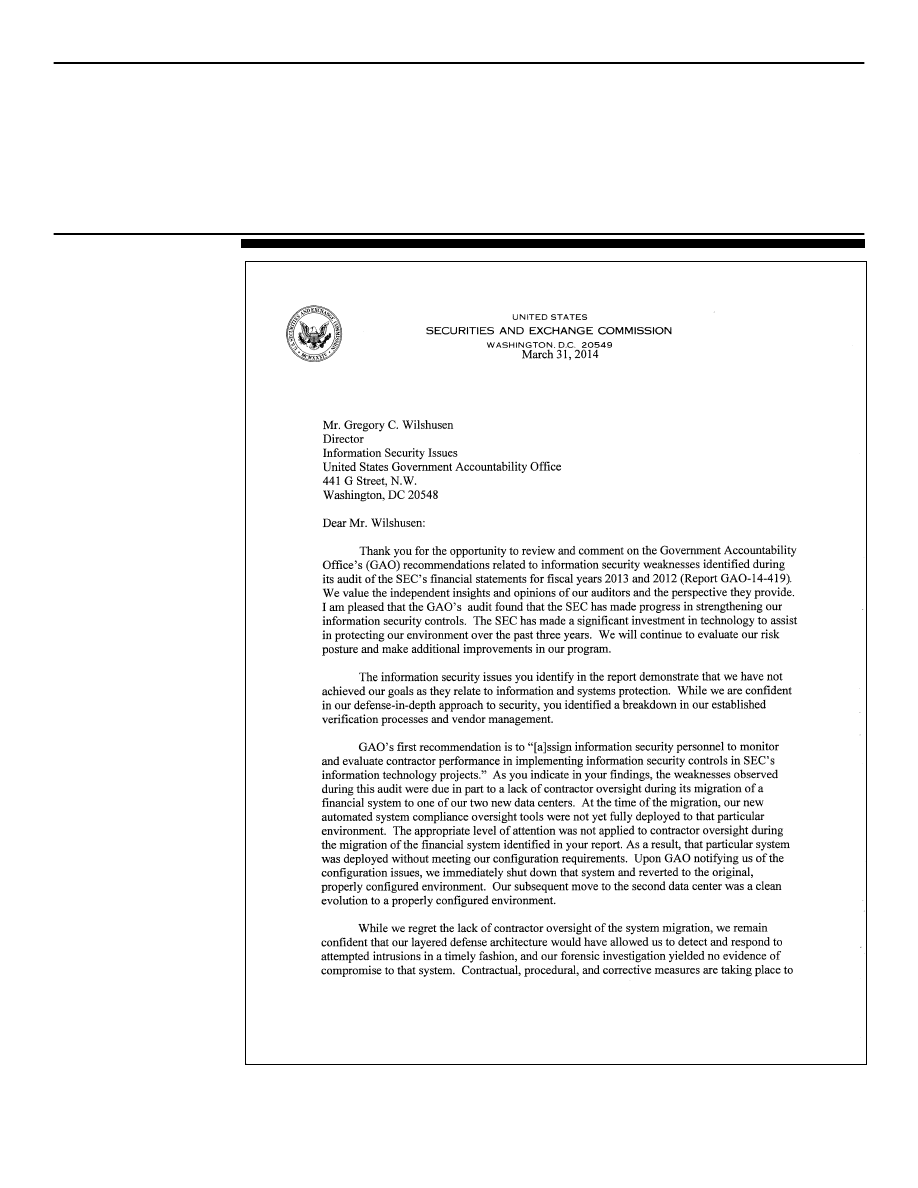
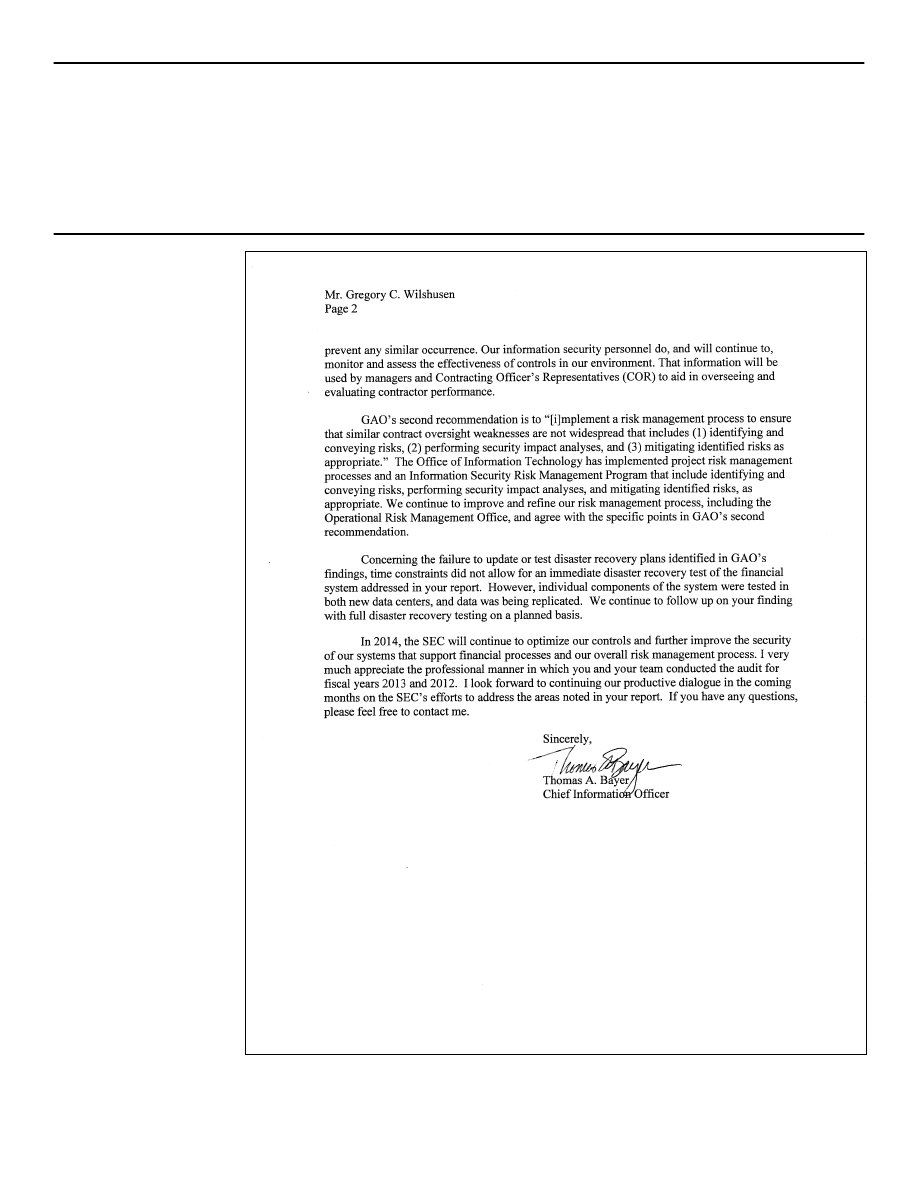
its written comments (reproduced in app. II), SEC generally agreed with
our recommendations. SEC acknowledged that the appropriate level of
attention was not applied to contractor oversight during the migration of
the financial system and stated that contractual, procedural, and
corrective measures are taking place to prevent similar occurrences. In
addition, SEC agreed with the specific points we made about the risk
management process and stated that this process continues to be
improved.
This report contains recommendations to you. The head of a federal
agency is required by 31 U.S.C. § 720 to submit a written statement on
the actions taken on the recommendations by the head of the agency.
The statement must be submitted to the Senate Committee on Homeland
Security and Governmental Affairs and the House Committee on
Oversight and Government Reform not later than 60 days from the date
of this report. A written statement must also be sent to the House and
Senate Committees on Appropriations with your agency’s first request for
appropriations made more than 60 days after the date of this report.
We are also sending copies of this report to interested congressional
parties. In addition, the report is available at no charge on the GAO
We acknowledge and appreciate the cooperation and assistance
provided by SEC management and staff during our audit. If you have any
questions about this report or need assistance in addressing these
issues, please contact Gregory C. Wilshusen at (202) 512-6244 or
or Nabajyoti Barkakati at (202) 512-4499 or
Agency Comments
and Our Evaluation
Page 16
GAO-14-419 SEC 2013 Information Security
. GAO staff who made significant contributions to this
report are listed in appendix III.
Sincerely yours,
Gregory C. Wilshusen
Director, Information Security Issues
Dr. Nabajyoti Barkakati
Director, Center for Technology and Engineering

Appendix I: Objective, Scope, and
Methodology
Page 17
GAO-14-419 SEC 2013 Information Security
As part of our audit of the Securities and Exchange Commission’s (SEC)
fiscal years 2012 and 2013 financial statements, we assessed the
commission’s information security controls. The objective was to
determine the effectiveness of SEC’s information security controls for
ensuring the confidentiality, integrity, and availability of its key financial
systems and information. To do this, we identified and reviewed SEC
information systems control policies and procedures, conducted tests of
controls, and held interviews with key security representatives and
management officials concerning whether information security controls
were in place, adequately designed, and operating effectively.
We evaluated controls based on our Federal Information System Controls
Audit Manual (FISCAM), which contains guidance for reviewing
information system controls that affect the confidentiality, integrity, and
availability of computerized information;
•
performing information system controls walkthroughs surrounding the
initiation, authorization, processing, recording, and reporting of
financial data (via interviews, inquiries, observations, and
inspections);
National Institute of Standards
and Technology standards and special publications; SEC’s plans,
policies, and standards; and the National Security Agency’s 60 Minute
Network Security Guide. We assessed the effectiveness of both general
and application controls by
•
reviewing systems security assessment and authorization documents;
•
reviewing SEC policies and procedures;
•
observing technical controls implemented on selected systems;
•
testing specific controls; and
•
scanning and manually assessing SEC systems including general
support systems and financial applications.
We also evaluated the Statement on Standards for Attestation
Engagements report
1
GAO, Federal Information System Controls Audit Manual (FISCAM),
and performed testing on key information
(Washington, D.C.: February 2009).
2
Statement on Standards for Attestation Engagements 16 reports are reports typically
prepared by an independent auditor based on a review of the controls relevant to user
entities’ internal control over financial reporting as discussed in the American Institute of
Certified Public Accountants’ Statement on Standards for Attestation Engagements No.
16, Reporting on Controls at a Service Organization. A service organization provides
services to the entity whose financial statements are being audited.
Appendix I: Objective, Scope, and
Methodology

Appendix I: Objective, Scope, and
Methodology
Page 18
GAO-14-419 SEC 2013 Information Security
technology controls on the following applications and systems: Delphi-
Prism, FedInvest, and Federal Personnel and Payroll System/Quicktime.
We selected which systems to evaluate based on a consideration of
financial systems and service providers integral to SEC’s financial
statements.
The evaluation and testing of SEC information system controls, including
the evaluation of the status of SEC’s corrective actions during fiscal year
2013 to address open recommendations from our prior years’ reports,
was performed jointly with the independent firm of Williams, Adley, &
Company-DC, LLP. We agreed on the scope of the audit work, monitored
the firm’s progress, and reviewed the related audit documentation to
determine that the firm’s findings were adequately supported.
To determine the status of SEC’s actions to correct or mitigate previously
reported information security weaknesses, we identified and reviewed its
information security policies, procedures, practices, and guidance. We
reviewed prior GAO reports to identify previously reported weaknesses
and examined the commission’s corrective action plans to determine
which weaknesses it had reported were corrected. For those instances
where SEC reported that it had completed corrective actions, we
assessed the effectiveness of those actions by reviewing appropriate
documents, including SEC-documented corrective actions, and
interviewing the appropriate staffs, including system administrators.
To assess the reliability of the data we analyzed, such as information
system control settings, security assessment and authorization
documents, and security policies and procedures, we corroborated them
by interviewing SEC officials, programmatic personnel, and system
administrators to determine whether the data obtained were consistent
with system configurations in place at the time of our review. Based on
this assessment, we determined the data were reliable for the purposes
of this report.
We performed our work in accordance with U.S. generally accepted
government auditing standards. We believe that our audit provided a
reasonable basis for our conclusions in this report.
Appendix II: Comments from the Securities
and Exchange Commission
Page 19
GAO-14-419 SEC 2013 Information Security
Appendix II: Comments from the Securities
and Exchange Commission
Appendix II: Comments from the Securities
and Exchange Commission
Page 20
GAO-14-419 SEC 2013 Information Security

Appendix III: GAO Contacts and Staff
Acknowledgments
Page 21
GAO-14-419 SEC 2013 Information Security
Gregory C. Wilshusen, (202) 512-6244 or
Nabajyoti Barkakati, (202) 512-4499 or
In addition to the contacts named above, GAO staff who made major
contributions to this report are Michael W. Gilmore and Duc Ngo
(Assistant Directors), Angela Bell, Lee McCracken, and Henry Sutanto.
Appendix III: GAO Contacts and Staff
Acknowledgments
GAO Contacts
Staff
Acknowledgments
(311313)

The Government Accountability Office, the audit, evaluation, and
investigative arm of Congress, exists to support Congress in meeting its
constitutional responsibilities and to help improve the performance and
accountability of the federal government for the American people. GAO
examines the use of public funds; evaluates federal programs and
policies; and provides analyses, recommendations, and other assistance
to help Congress make informed oversight, policy, and funding decisions.
GAO’s commitment to good government is reflected in its core values of
accountability, integrity, and reliability.
The fastest and easiest way to obtain copies of GAO documents at no
cost is through GAO’s website (
). Each weekday
afternoon, GAO posts on its website newly released reports, testimony,
and correspondence. To have GAO e-mail you a list of newly posted
products, go to
The price of each GAO publication reflects GAO’s actual cost of
production and distribution and depends on the number of pages in the
publication and whether the publication is printed in color or black and
white. Pricing and ordering information is posted on GAO’s website,
http://www.gao.gov/ordering.htm
Place orders by calling (202) 512-6000, toll free (866) 801-7077, or
TDD (202) 512-2537.
Orders may be paid for using American Express, Discover Card,
MasterCard, Visa, check, or money order. Call for additional information.
Connect with GAO on
, and
or
Listen to our
http://www.gao.gov/fraudnet/fraudnet.htm
Automated answering system: (800) 424-5454 or (202) 512-7470
Katherine Siggerud, Managing Director,
, (202) 512-
4400, U.S. Government Accountability Office, 441 G Street NW, Room
7125, Washington, DC 20548
Chuck Young, Managing Director,
, (202) 512-4800
U.S. Government Accountability Office, 441 G Street NW, Room 7149
Washington, DC 20548
GAO’s Mission
Obtaining Copies of
GAO Reports and
Testimony
Order by Phone
Connect with GAO
To Report Fraud,
Waste, and Abuse in
Federal Programs
Congressional
Relations
Public Affairs
Please Print on Recycled Paper.
Document Outline
- INFORMATION SECURITY
- SEC Needs to Improve Controls over Financial Systems and Data
- Contents
-
- Background
- Information Security Weaknesses Placed SEC Financial Data at Risk
- SEC Did Not Consistently Control Access to a Key Financial System
- Although Control Mechanisms Were Put in Place, SEC Did Not Adequately Protect the Boundaries of a Key Financial System
- SEC Did Not Consistently Implement Controls for Identifying and Authenticating Users of a Key Financial System
- SEC Did Not Always Sufficiently Restrict Access to a Key Financial System
- SEC Did Not Effectively Protect Sensitive Data While in Transmission
- SEC Did Not Adequately Maintain Audit Trails of Security-Relevant Events
- SEC Generally Protected Access to Its Facilities but Did Not Sufficiently Control Physical Access to a Sensitive Computing Area
- SEC Did Not Always Securely Configure or Install Patches on a Key Financial System
- Segregation of Duties Was Generally in Place, but Weaknesses Increase Risk
- SEC Did Not Fully Update or Test Contingency and Disaster Recovery Plans
- SEC Did Not Effectively Oversee and Manage the Implementation of Information Security Controls during Migration of a Key Financial System
- SEC Made Limited Progress Remediating Previously Reported Information Security Control Weaknesses
- SEC Did Not Consistently Control Access to a Key Financial System
- Conclusions
- Recommendations for Executive Action
- Agency Comments and Our Evaluation
- Appendix I: Objective, Scope, and Methodology
- Appendix II: Comments from the Securities and Exchange Commission
- Appendix III: GAO Contacts and Staff Acknowledgments
- d14419high.pdf
Wyszukiwarka
Podobne podstrony:
NIST Information Security Continuous Monitoring for Federal Information Systems and Organizations
HIPAA and Information Security Policies
NIST Technical Guide to Information Security Testing and Assessment SP800 115
AU Information Security Management Guidelines
Ashampoo Magical Security 2007 1, Technik Informatyk, egzamin praktyczny, Technik informatyk 2012 St
Improving virus protection with an efficient secure architecture with memory encryption, integrity a
Homeland Security and Geographic Information Systems
How to Dramatically Improve Corporate IT Security Without Spending Millions Praetorian
Initial Assessments of Safeguarding and Counterintelligence Postures for Classified National Securit
Informative Tweets on Tails Security
Using Malware to Improve Software Quality and Security
HONDA 2007 Fit Security System User s Information
techniki informacyjne
wykład 6 instrukcje i informacje zwrotne
Technologia informacji i komunikacji w nowoczesnej szkole
Państwa Ogólne informacje
Fizyka 0 wyklad organizacyjny Informatyka Wrzesien 30 2012
informacja w pracy biurowej 3
więcej podobnych podstron