
LEKCJA 17
DOKUMENTACJA MIĘDZYNARODOWA W SPEDYCJI
International trade documentation for freight forwarders
Documentation is a requirement in international trade and for moving
goods. Well-ordered and accurate documents are essential for a freight
forwarder and are required for a successful export order and receipt of
payment for delivery. Freight forwarders need to know exactly what
document is required and when.
When preparing to move goods, the freight forwarder must first
receive clear instructions from the importer or exporter - ideally well
in advance of the goods being moved. These should be in writing and
can be done via email or fax. However, the shipper will often hand the
paperwork over to the driver collecting the goods, which is standard
practice for air freight. If any instructions are taken over the telephone,
they should then be confirmed to the customer in writing to avoid any
later problems.
Other documents that are provided by the importer or exporter include
invoices, packing lists and licences. Responsibility for hazardous
goods declarations also lies with the shipper.
Each mode of transport will have its own document of carriage, such
as the:
air waybill - for air freight
bill of lading ( morski list przewozowy) - for sea freight
CMR consignment note - for road freight
The issuer of these documents may differ, but freight forwarders need
to be familiar with them and their individual procedures.
Freight forwarders should also understand documents that relate to
customs clearance at import and export.
Załączniki:
air waybill/ bill of lading

LEKCJA 18
Hazardous substances -
MATERIAŁY NIEBEZPIECZNE
Podział wszystkich produkowanych na świecie materiałów niebezpiecznych na
13 klas zagrożeń zawiera szczegółową klasyfikację tych materiałów w
poszczególnych klasach (wg międzynarodowej konwencji ADR )
PODZIAŁ NA KLASY SUBSTANCJI NIEBEZPIECZNYCH:
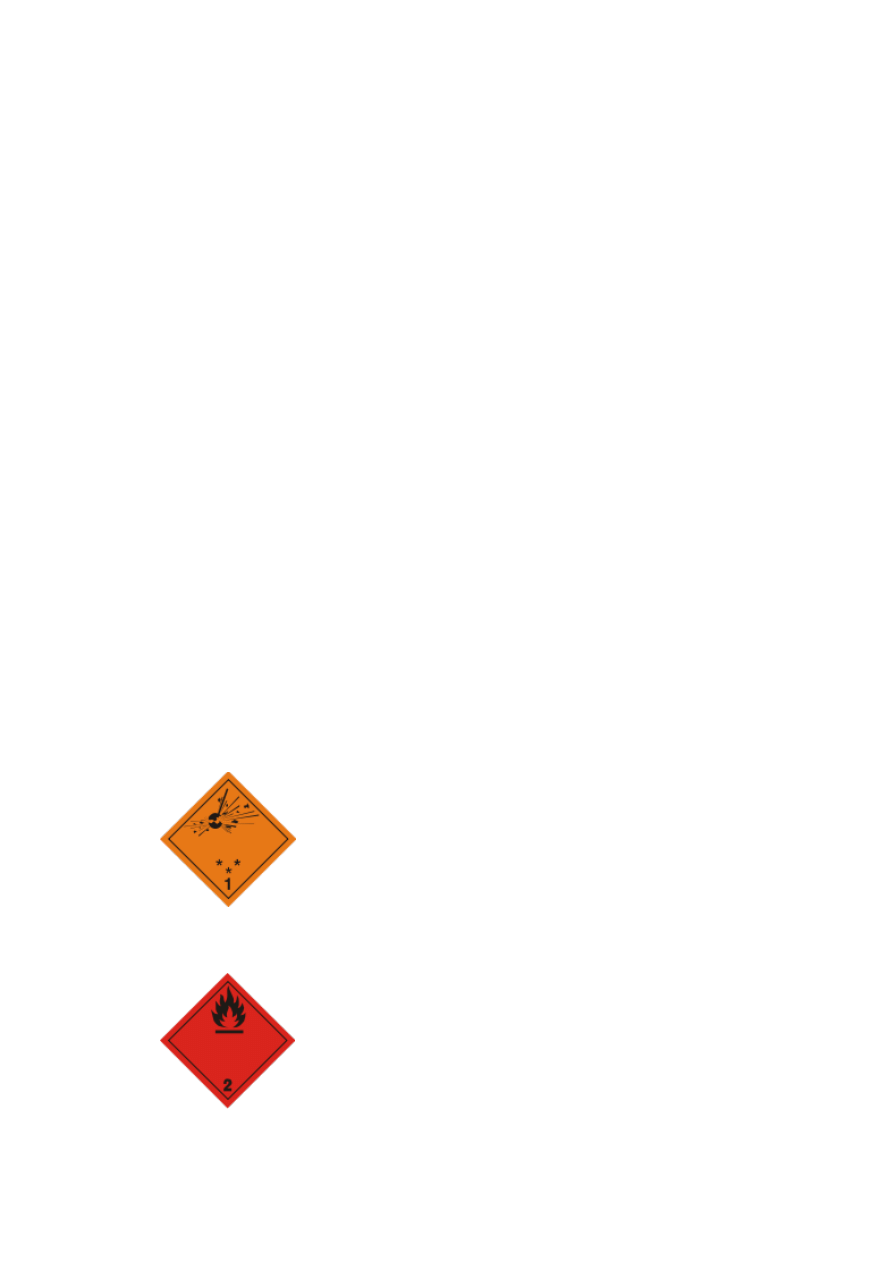
KLASA 1
-
Materiały i przedmioty wybuchowe -
Explosive
substances and articles.
KLASA 2 - Gazy -
Gases, including compressed, liquified and
dissolved under pressure gases and vapors
Flammable gases (e.g. butane, propane acetylene)
Non-flammable and non-toxic, likely to cause asphyxiation (e.g.
nitrogen, CO
2
) or oxidisers (e.g. oxygen)
Toxic (e.g. Chlorine, Phosgene)
KLASA 3 - Materiały ciekłe zapalne -
Flammable liquids
KLASA 4.1 - Materiały stałe zapalne, materiały samoreaktywne
oraz materiały wybuchowe stałe odczulone
Flammable solids, self-reactive substances and solid desensitized
explosives
KLASA 4.2 - Materiały samozapalne -
Substances liable to
spontaneous combustion
KLASA 4.3 Materiały wytwarzające w zetknięciu z wodą gazy
zapalne -
Substances which, in contact with water, emit flammable
gases
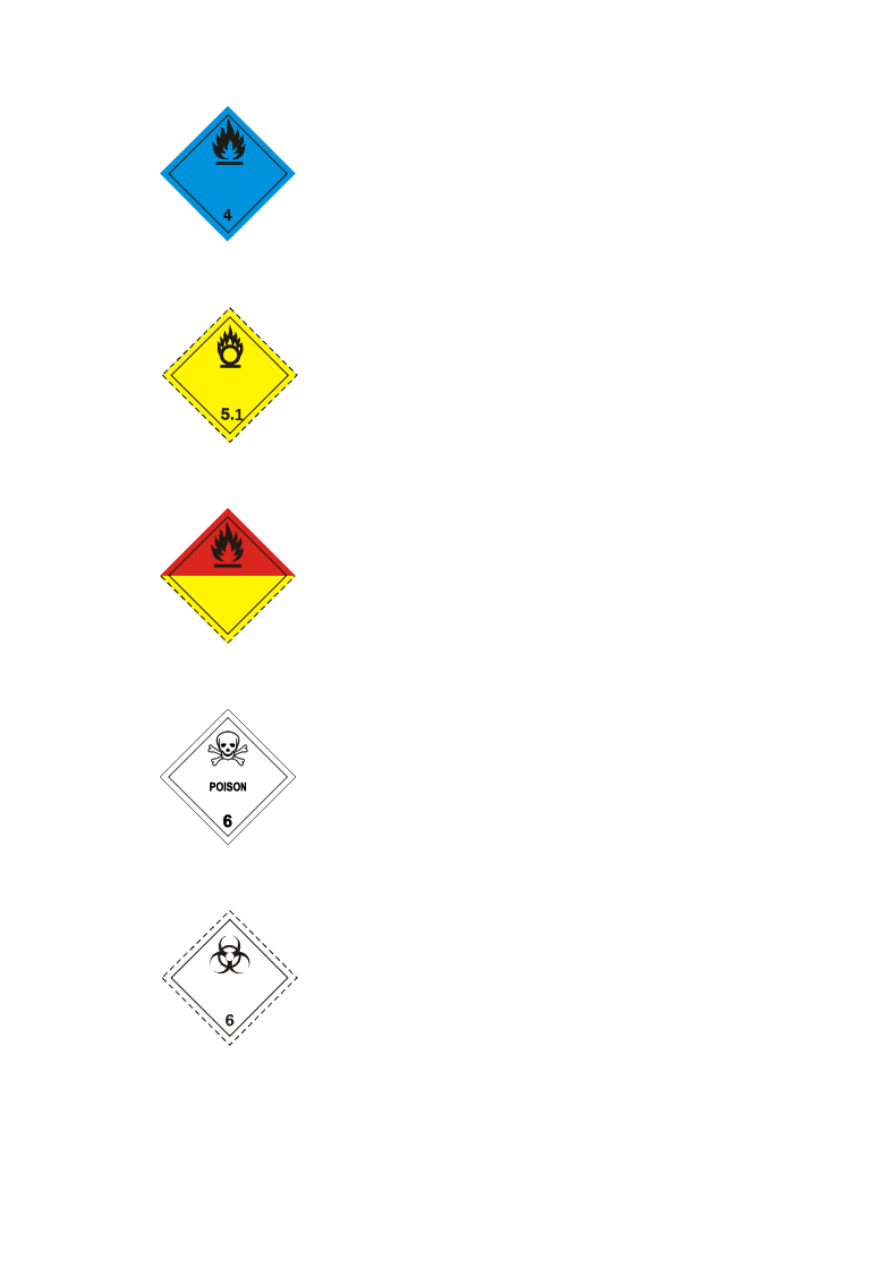
KLASA 5.1 - Materiały utleniające -
Oxidizing substances
KLASA 5.2 Nadtlenki organiczne -
Organic peroxides
KLASA 6.1 Materiały trujące -
Toxic substances
KLASA 6.2 Materiały zakaźne -
Infectious substances
KLASA 7 Materiały promieniotwórcze -
Radioactive material
KLASA 8 Materiały żrące -
Corrosive substances
KLASA 9 Różne materiały i przedmioty niebezpieczne -
Miscellaneous dangerous substances and articles
1-Explosives
2.1-Flammable gases

2.2-Non-toxic and non-flammable gases

2.3 Poison gases

3-Flammable liquids

4.1-Flammable solids
4.2-Spontaneously combustibles
4.3-Dangerous when wet

5.1-Oxidizers
5.2-Organic peroxides
6.1-Poison

6.2-Infectious substances


7-Radioactive
8-Corrosive
9-
Miscellaneous dangerous substances
KOLORY ETYKIET I NALEPEK
Orange:
Explosive
Red:
Flammable Gas and Liquid
White:
Poison
Black/White:
Corrosive
Yellow:
Oxidizer
Green:
Non-flammable gas
Yellow
/White:
Radio Active

ON ROADWAYS
– NA DROGACH
Hazardous materials transported on roadways must carry a Department of
Transportation (DOT) warning label on the package.
Vehicles transporting quantities of hazardous materials must have
DOT placards affixed to all sides of the vehicle.
Bulk shipments, such as in gasoline tanker trucks, will have a four digit numeric
code instead of the hazard class in the center of the placard.
This number can be referenced in the DOTs "Emergency Response Guide Book"
to determine the identity and the emergency handling for the chemical involved.
Jak uniknąć ryzyka i kontrolować niebezpieczne materiały?Oto
kilka wskazówek:
Simple steps to control the risks of hazardous substances include:
storing chemicals according to the manufacturer's instructions
on the safety data sheet
keeping the minimum quantity of hazardous substances
necessary
storing incompatible substances separately
preventing release or leaks
training employees to store and handle hazardous substances
properly
labelling storage containers properly
storing flammable substances in suitable containers away from
sources of ignition, such as boilers and heaters
placing stores of liquid above ground where they're unlikely to
be damaged, for example away from driveways
maintaining gauges, valves and pipework
having procedures for dealing with emergency leaks
using a secondary containment system such as a drip tray or
bund (a storage area designed to prevent liquids escaping)

monitoring oil use - unexpectedly high use may indicate a leak
SŁOWNICTWO :
Hazardous substance-substancja niebezpieczna
To store – przechowywać
Gauges, valves and pipework –
mierniki, rurociągi , zawory
Manufacturer – producent
Safety – bezpieczeństwo
To prevent – zapobiec
To leak –wyciekać
To label – oznakować
Flammable substances – substancje łatwopalne
To place – umieścić
Suitable containers – odpowiednie kontenery
sources of ignition – zrodła zapłonu
secondary containment system
- System powstrzymywania wtórnego
https://www.nibusinessinfo.co.uk/content/packing-goods-export-and-deciding-packing-
materials-be-used
Wyszukiwarka
Podobne podstrony:
Maria Niemirow Esperanto dla wszystkich Lekcja 17
Świąteczny świat, Dokumenty - różności dla dzieci
4 Pory Roku, Dokumenty i Obrazki, Dla Dzieci
Fantazja, ZHP - przydatne dokumenty, Piosenki dla zuchów
bryły obrotowe powtorzenie - lekcja otwarta w III g, Matematyka dla Szkoły Podstawowej, Gimnazjum
Cztery słonie, ZHP - przydatne dokumenty, Piosenki dla zuchów
Przy kominku, ZHP - przydatne dokumenty, Piosenki dla zuchów
Bajka o bardzo przywiązanej owieczce, Dokumenty - różności dla dzieci
Od łąk zielonych, ZHP - przydatne dokumenty, Piosenki dla zuchów
Wstaje dzień, ZHP - przydatne dokumenty, Piosenki dla zuchów
17 równanie Eulera dla plynu niescisliwegoid 17345
17 2LD, Uwaga dla użytkownika tekstu:
Człowiek zimy, ZHP - przydatne dokumenty, Piosenki dla zuchów
Bajka zuchowa, ZHP - przydatne dokumenty, Piosenki dla zuchów
Podstawowe dokumenty międzynarodowej ochrony praw człowieka
Dokumenty, wymagania dla prac dyplomowych
Pirat, ZHP - przydatne dokumenty, Piosenki dla zuchów
Zuch sobieradek, ZHP - przydatne dokumenty, Piosenki dla zuchów
więcej podobnych podstron