
The Santesson
Recipe Collection:
Swedish Cooking

2
These recipes first appeared on Anne
and Johan Santesson’s website at
URL
http://www.santesson.com/recept/,
the first ones being included in 1996.
A few of the recipes are perhaps not
quite typical “Swedish”, even if they
ought to be. These recipes do not
carry a Swedish flag.

3
Table of Contents
Starters – page 5
•
Gravlax and avocado mousse, the perfect way to use gravlax leftovers
•
Jansson's temptation, a mouth-watering Swedish anchovy gratin
•
Swedish herring salad, a must on the smörgåsbordet
Soups – page 8
•
Nettle soup, the Swedish way of preparing young stinging nettles
•
Pea soup, a traditional way of serving yellow split peas
•
Salmon soup in the Swedish way
Vegetables – page 11
•
Brown beans, the classical Swedish bean dish
•
Hasselback Potatoes, a Swedish form of oven-baked potatoes
•
Red cabbage, a traditional Swedish Christmas dish
Meat – page 14
•
Christmas ham in the traditional Swedish way
•
Hamburger à la Lindström, a Swedish form of hamburger with red beets
•
Potato dumplings, a Swedish dish enjoyed by many but not by us
•
Pyttipanna, the Swedish way of serving meat leftovers
•
Sailor's stew, meat and potato stewed in beer in the Swedish way
•
Swedish meatballs - enough said!
•
Veal meatballs, white meatballs in a white sauce
Fish and shellfish – page 21
•
Crayfish, spiced with dill
•
Gravlax, the Swedish way of marinating or curing salmon
Sauces and condiments – page 23
•
Stewed and mashed apples, a nice Swedish condiment for pork dishes
•
Mustard sauce, a must for gravlax but also shellfish
Desserts and sweets – page 25
•
Cheesecake, difficult to prepare but delicious
•
Cheese ice-cream, a special way to use the Swedish "Västerbotten" cheese
(substitutes are possible, though)
•
Fruit syrup sauce to be served together with Riz à la Malte

4
•
Lussekatter, Swedish saffron-flavoured Lucia buns to be eaten on 13 December
•
Rice with oranges and whipped cream (Riz à la Malte) a dessert Swedish kids love
•
Scanian apple cake, a delicious apple dessert from southern Sweden, sizzling with
calories
•
Semlor, Swedish stuffed buns to be served during Lent
•
Swedish punch and chocolate sweets, a traditional Christmas treat
•
Waffles in the Swedish mountain way
Beverages – page 34
•
Absolut Kurant in a home-made version
•
Fruit-syrup, a classical Swedish drink for the kids
•
Hot spicy wine, a Swedish after-ski drink
•
Wolf's paw, a Swedish vodka and lingonberry drink

5
Gravlax and Avocado Mousse
When you end up with leftovers of gravlax, this mousse
is a great way of using them. On a hot summer evening
serve it refrigerated, but on a cold winter day it can
even be served at room temperature.
Ingredients:
•
200 g gravlax
•
200 g avocado meat (scoop
out the meat of a medium
size ripe avocado)
•
2 tbsp dry sherry
•
2 tbsp fresh lemon juice
•
salt and pepper as desired
Proceed as follows:
1. Set aside 50-75 grams of the gravlax. Puree the
remainder in the food processor.
2. Add the avocado meat and continue pureeing.
3. Add the sherry, the lemon juice and pepper and
salt as desired and continue the pureeing until
you have a smooth mousse.
4. Spread the mousse on crackers or small pieces
of toast.
5. Cut the remaining gravlax into thin strips and
use these to adorn the mousse.
We have tried several ways of spicing the mousse (e.g.,
cognac and port wine) but dry sherry is by far the best
way. What remains to be tested is what a few dashes of
Tabasco® would do to the dish. If you try that before
we do, please let us know about the result.

6
Janssons frestelse - Jansson's Temptation
This dish is a modified form of the anchovy gratins
which were popular in Sweden during the 19th
century. In it's present composition it dates back to
around 1900. Earlier it was believed that the name
came from the Swedish opera singer Pelle Janzon,
however it now appears that the dish got its name
from the title of a 1928 movie.
Ingredients:
•
200 - 300 g anchovy filets
(Please note: Swedish anchovy
filets are prepared from sprat
(scientific name: Sprattus
sprattus) whereas US filets are
prepared from anchovy
(scientific name: Engraulis
encrasicholus). Sprat filets
should be used!)
•
6-8 large potatoes
•
2 large yellow onions
•
30 g butter
•
1/3 teaspoon black pepper
•
1/2 teaspoon salt
•
150 ml cream
•
2-3 tablespoons breadcrumbs
(dried and finely crushed white
bread)
Proceed as follows:
1. Peel and slice the potatoes, cut the slices in
thin strips (or use your food processor!).
Cover the potato strips with plenty of water.
2. Peel and chop the onions finely and fry for a
few minutes.
3. Heat the oven to 250
o
C, butter a dish.
4. Drain the potato strips, put a layer of potato
strips at the bottom of the dish, on top of this
a layer of anchovy filets and chopped
onions, then another layer of potato strips,
then another anchovy/onion layer, etc. The
uppermost layer should be potato strips.
5. Spread the dried breadcrumbs over the dish,
sprinkle with melted butter.
6. Place in the oven for 30 minutes, then add
the cream and continue baking for another
fifteen minutes. Serve hot!
A completely different origin of the dish has been
suggested by Suzanne Koski in an e-mail:
"According to Craig Claiborne, Pastor Jansson
brought his flock to Bishop Hill, Illinois in the mid-
19th century. He preached mightily against
succumbing to temptation, but he himself did so
when spying, and then tasting a potato and anchovy
dish on a parisher's table. The story goes that the
dish went back to Sweden with disillusioned
followers (perhaps the woman who originated the
dish)."

7
Sillsallad - Swedish Herring Salad
This is a typical Swedish Christmas dish to be included in
the traditional smörgåsbord served as dinner on Christmas
Eve.
Ingredients:
•
1 can (400-500 g) pickled
sliced beets
•
250 g boiled, peeled
potatoes
•
150 g marinated herring
filets
•
1 apple
•
1 small onion
•
100 ml dill pickle
Proceed as follows:
1. Drain the liquid from the pickled sliced beets,
reserving the liquid.
2. Drain the liquid from 3/4 cup (or one jar, 6-8 oz.
size) refrigerated, marinated, snack tidbits or wine-
flavoured herring filet pieces.
3. Cut (into 5-8 mm cubes) the beets, herring, one
medium sized tart apple (peeled), and potatoes
(boiled and peeled, hot or cold) and mix them all
together.
4. Blend in the finely chopped dill pickle, one small
(finely chopped) onion and the reserved beet liquid.
5. Put into a serving bowl or pack into a 1 litre mold.
Cover and chill, at least over night or for as long as
two days.

8
Nässelsoppa - Nettle Soup
The use of the stinging nettle as food appears to be most
common to Sweden. The only exception we have come
across on the Net is a Slovenian spring-soup recipe. The
nettles should be collected very young (use gloves!), the
leaves not longer than 2 - 3 cm.
Ingredients:
•
2 litre rinsed leaves of
stinging nettle
•
1.5 litre water
•
2 tbsp (30 g) butter
•
3 tbsp (50 ml) flour
•
25 - 50 g chives
•
2 beef bouillon cubes
•
salt, pepper
Proceed as follows:
1. Let the nettle leaves simmer until tender, usually 5 -
10 minutes is enough.
2. Strain and set the liquid aside.
3. Puree the nettles together with the chives in a food
processor. The result should be a creamy paste.
4. Melt the butter in a deep casserole, add the flour and
mix thoroughly at moderate heat.
5. Add the nettle water while stirring, then add the nettle
puree. Let simmer for a few minutes, then add salt
and pepper if required.
Nettle soup is traditionally served with halved hard-boiled
eggs, but the eggs can be whole or sliced as well.

9
Ärtsoppa - Pea Soup
During centuries, the pea soup prepared from yellow
split peas was served every Thursday. Only during the
second half of the 20th century has this tradition begun
to disappear. The pea soup is best when cooked on very
large scale; thus, the version served in the Army has a
well-deserved good reputation since it is normally
cooked in 200 litre batches. But you might want to try it
on a somewhat smaller scale...
Ingredients:
•
500 g yellow split peas
•
1.5 - 2 litre of water or
vegetable bouillon (can be
made from bouillon cubes!)
•
2 finely chopped onions
•
20 - 30 g of fresh, whole
ginger
•
5 - 10 g of marjoram or
thyme or both
•
optional: potatoes
•
optional: carrots
•
optional: 500 g of diced
bacon
Proceed as follows:
1. Soak the yellow split peas in water for at least 12
hours. Discard the water (even though some
insist you should use this water for the soup).
2. Boil the peas, bouillon, onion and ginger for at
least 90 minutes. Now and then, carefully skim
off the pea hulls as they float up to the surface.
When 15 - 30 minutes remain of the cooking
time, add the marjoram and/or thyme.
3. The optional ingredients should be added at a
late stage during the cooking. Potatoes and
carrots will require 20 - 25 minutes of cooking,
the bacon at least 30 minutes
4. Taste, add salt if required.
The pea soup is often served together with some
mustard. A very (old) Swedish tradition is also to serve
it together with hot punsch, an arrak-based, intensely
sweet liquor. However, beer will do fine as a substitute.

10
Laxsoppa - Salmon Soup
When you prepare the gravlax, you end up with a lot of
salmon trimmings, not the least the meaty tail part which
is usually cut off. Why not use these trimmings for a
traditional salmon soup?
Ingredients for the stock:
•
0.5 - 1 kg salmon
trimmings (head, skin, tail,
bones)
•
1 onion
•
1 leek (white part only)
•
1 large carrot
•
5 dill sprigs
•
5 parsley sprigs
•
whole peppers and Jamaica
peppers
The stock - proceed as follows:
1. Cut the salmon trimmings into small pieces, rinse
in cold water, place in a casserole, cover with
cold water and bring it to a boil.
2. Skim carefully, then add the vegetables and the
spices. Let it simmer for 45 min, then strain the
stock.
3. Remove and set aside any salmon meat adhering
to the head, tail or bones.
Ingredients for the soup:
•
1 tsp butter
•
1 tsp flour
•
1 l salmon stock
•
100 ml cream
•
2 egg yolks
•
50 g cooked and diced
carrots
•
50 g cooked baby peas
•
chopped dill and parsley
The soup - proceed as follows:
1. Melt the butter in a deep, heavy casserole over
low heat, add the flour while stirring, then add
the salmon stock. Bring to a boil and let simmer
for 15 min.
2. Whisk egg yolks and cream, add the mixture to
the soup, followed by salt and pepper (if
required).
3. Finally, add the vegetables and any salmon meat
that could be removed from the trimmings. Serve
sizzling hot!

11
Bruna bönor - Brown Beans
Brown beans is a classical Swedish dish, which has become
less popular during recent decades.
Ingredients:
•
400 ml dried brown
beans
•
2-3 tbsp syrup
(molasses)
•
2 tbsp vinegar
•
1/2-1 tbsp potato
flour
Proceed as follows:
1. Rinse the brown beans and soak them in cold water
overnight.
2. Let them simmer, well covered by water (add some
salt), until they are (very) soft. This normally takes
11/2 hours. Check now and then and add more water if
required.
3. Add the syrup and vinegar, then the potato flour
suspended in a small quantity of cold water as a
thickener.
4. Heat briefly.
Serve together with, e.g. fried pork, meatballs or sausages.

12
Hasselbackspotatis - Hasselback Potatoes
Hasselbacken is a still functional restaurant in Stockholm
where this delicious potato dish first was served.
Ingredients:
•
12 medium-sized
potatoes
•
3 tbsp butter or
margarine
•
3 tbsp grated cheese
•
1-2 tbsp dry bread
crumbs
•
salt
Proceed as follows:
1. Preheat the oven to 225
o
C.
2. Place the peeled potatoes in a wooden spoon and make
vertical slices, 2-3 mm apart, about 3/4 of the way
through the potatoes. The wooden spoon will protect
the final 1/4 of the potatoes.
3. With the cut-side up, place the potatoes in a buttered
baking dish.
4. Melt half of the butter and pour it over the potatoes,
then sprinkle with salt.
5. Bake for 30 minutes, now and then basting the potatoes
with molten butter.
6. After 30 minutes, sprinkle over bread crumbs and, if
desired, grated cheese.
7. Continue to bake for another 15 minutes.

13
Rödkål - Red Cabbage
Red cabbage is a traditional dish, together with the ham, on
Christmas Eve for many Swedish families. But it is also
often served outside the Christmas season, together with
ham, pork, spare ribs or similar types of meat. Canned
cooked red cabbage is commercially available, but does not
compare with the real stuff!
Ingredients:
•
1 red cabbage (about 1
kg), cored
•
1 yellow or red onion
•
4 sourish apples
•
2 tbsp margarine or
vegetable oil
•
8 cloves
•
5 Jamaica peppers
•
1-2 tbsp sugar
•
3 tbsp red wine vinegar
and/or lemon juice
•
salt to taste
Proceed as follows:
1. Cut the red cabbage into thin slices. Cut the apples
(without cores and peels) into pieces. Slice the
onion(s).
2. Melt the butter in a large pot over medium heat.
3. Add the cabbage, onion, apples, vinegar, spices and
salt.
4. Cook covered over low heat for one hour, stirring
occasionally.
5. Add more vinegar or lemon juice according to taste.
Serve hot.
If prepared during high season for red cabbage (autumn -
early winter), the dish can readily be deep frozen and be kept
for at least half a year.

14
Julskinka - Christmas Ham
The main dish served on Christmas Eve is the
"julskinka", the traditional Christmas ham. Usually, a
ham should last at least for a week and appear at almost
all meals between Christmas Eve and New Years Day.
Ingredients:
•
3 - 5 kg of salt-cured fresh
ham (do not use dried cured
ham)
•
1 egg
•
2 tbsp mustard
•
1 tbsp sugar
•
3 tbsp breadcrumbs
Proceed as follows:
1. Depending upon the method of salt curing it
might be necessary to leave the ham overnight
covered with water to desalt it.
2. Pre-heat the oven to 125
o
C. Insert an oven
thermometer in the thickest part of the ham.
Leave it in the oven until the temperature
reaches 75
o
C.
3. Remove the rind carefully and as much of the fat
as you like. (With less fat left it is healthier but
drier!)
4. Heat the oven to 225
o
C.
5. Mix egg, mustard and sugar.
6. Place the ham on a roasting-pan, cover it with
the mixture and sift the breadcrumbs over if.
They should stick to the egg-mustard mixture.
7. Bake the ham for 10 minutes in the oven. When
ready, it should have a golden colour with a few
deep brown but no black patches.
If you're not going to use it as the centrepiece on the
buffet table you can serve it together with potatoes, red
cabbages, mustard and stewed and mashed apples.

15
Hamburger à la Lindström
The origin of this dish is not entirely clear. Most believe that
it was introduced by Captain Henrik Lindström (1831-1910)
at Hotell Witt in Kalmar, Sweden, in the 1860s. Others
suggest that the originator was Maria Kristina Lindström,
who operated a delicatessen in Stockholm at about the same
time. Whoever the originator, it is now almost a national dish
in Sweden.
Ingredients:
•
500 g ground beef
•
2 egg yolks
•
100 ml cream
•
100 g finely chopped
onions
•
150 ml finely chopped
pickled red beets
•
50-100 ml liquid from
the pickled beets
•
2 tbsp finely chopped
capers
•
butter for frying
•
salt, pepper
Proceed as follows:
1. Mix ground beef, egg yolks, and cream in a bowl.
Add salt and pepper. Add enough liquid from pickled
beets to produce a dough-like mixture.
2. Sautee the chopped onion until translucent. It must
not, however, turn brownish. Add the onion to the
beef mixture.
3. Gently stir in pickled beets and capers. Some (but not
we!) even like to add 100-150 grams boiled and
mashed potatoes.
4. Shape into four round patties, about the same size as a
BigMac.
5. Melt some butter in a frying pan. Fry the beef patties
at moderate/low heat for 3-5 minutes. It is important
that they remain rosy inside, otherwise they will be
too dry.
Serve together with Hasselback potatoes and iceberg lettuce.

16
Kroppkakor - Potato Dumplings
There are many forms of potato dumplings in Sweden and we
strongly dislike them all. However, many have asked for
recipes. "Kroppkakor" is especially popular on "Öland", a
Baltic Sea island just outside the Swedish east coast.
Ingredients:
•
1 kg cooked potatoes
•
2 egg yolks
•
300 ml all purpose
flour
•
1 onion
•
100 g smoked ham
•
100 g bacon
•
salt, pepper
Proceed as follows:
1. Mash the potatoes. Put it on a breadboard and make a
small pit in the middle.
2. Put eggs, flour and salt in the pit and work the potato-
dough fast together. Too much kneading makes the
potato tough.
3. Chop finely the onion, cut the bacon and ham into small
pieces and fry it until it gets coloured. Flavour it with
white pepper.
4. Form the potato-dough to a thick roll. Cut it in thick
slices and put a pile of bacon mix in a pit in a slice, then
put another slice on top of it, press the edges together
and roll it to a ball.
5. Lower the balls in boiling salted water and boil them
approx. 10-12 minutes or until they float to the surface.
Pick them up with a perforated ladle and put them on a
hot serving plate. Don’t boil too many at a time, they
will then have some difficulty to float to the surface.
6. Serve hot with melted butter and red whortleberry
(lingonberry) jam or cranberry jam.
Serve together with clarified butter and lingonberry jam.

17
Pyttipanna - Hashed Leftovers
Pyttipanna" can be made in a variety of ways. Essentially,
it is a traditional Swedish way of using meat leftovers. The
three basic ingredients are finely diced potatoes, finely
chopped onion, and diced meat leftovers (e.g. sausages,
pork chops, tenderloin, almost anything will do; the better
the meat quality, the better the "pyttipanna").
Ingredients:
•
700 g (1 1/2 lb) finely
diced potatoes (raw or
cooked)
•
250 g (1/2 lb) finely
chopped onions
•
250-500 g (1/2-1 lb)
finely diced meat
leftovers
•
olive oil (for frying)
Proceed as follows:
1. Sautee the chopped onion in some olive oil until
golden.
2. Fry the potato dices in some olive oil until properly
cooked (or heat the dices made of cooked potatoes
briefly).
3. Fry the meat dices (or heat the already cooked meat
briefly).
4. Mix potato, onion and meat.
Serve with pickled red beets if available.

18
Sjömansbiff - Sailor's Stew
We have been unable to trace the origin of this dish.
There is no mentioning of it in our 19th century
cookbooks, but suddenly, at about the turn of the century,
it starts to appear.
Ingredients:
•
600 g of thick flank, cut in
thin slices
•
4 onions, cut into thin
slices
•
8-10 potatoes, peeled and
cut in rather thick slices
•
butter
•
bay leaf
•
thyme
•
salt and white pepper
•
500 ml water or bouillon,
mixed with beer, or just
beer
Proceed as follows:
1. Brown the onion slices and remove them from the
frying-pan.
2. In the same pan brown the meat slices briefly on
both sides. Season with salt and white pepper.
3. Add water, beer and/or bouillon, bay-leaf and
thyme, cover and let the meat cook for 10 minutes
in the frying-pan.
4. In a casserole put layers of meat, sliced potato and
onion, potatoes forming the bottom and uppermost
layer.
5. Cover with liquid and let the stew simmer in the
oven or on the stove for 45 - 60 minutes (cooking
time is not critical). Serve sizzling hot.
You can also prepare the stew in a pressure cooker
instead of a casserole. This will shorten the cooking time
to 15 minutes and, at the same time, less liquid can be
used, since in a pressure cooker it is not essential that the
stew be completely covered.

19
Köttbullar - Swedish Meatballs
There are almost as many recipes for Swedish meatballs as
there are Swedish amateur chefs. The three main types are: (1)
small, fried, served without sauce; (2) large, fried, served in
brown gravy; (3) medium size, boiled, served in sauce. The
present recipe is a very simple version of type-1 meatballs, a
children’s favourite.
Ingredients:
•
500 g ground beef
•
1 small onion
•
1 egg
•
50-75 ml dried bread
crumbs
•
vegetable oil (for
frying)
•
salt, pepper
Proceed as follows:
1. Finely grate or chop the onion.
2. Mix the ground beef, the onion, the egg and the bread
crumbs. Add some white pepper and salt to taste.
3. Form into 30 walnut-size meatballs.
4. Heat 2 tbsp of vegetable oil in a large nonstick skillet
over medium heat. Sauté the meatballs in two batches
until browned on all sides and cooked through
(approximately ten minutes).
The meatballs can be served alone as cocktail snacks or, as a meal, together with, e.g. mashed
potatoes and lingonberry jam.
For meatballs in a brown gravy, fry the meatballs in four batches. After each of the first three
batches add 3-4 tbsp of water to the skillet, stir and pour the water into a separate vessel. After
the fourth batch powder 1-2 tbsp all-purpose flour over the skillet, stir, add 3-4 tbsp cream,
stir, add the water from the first three batches, stir, add some Japanese soya sauce, stir and
bring to a slow boil, then add the fried meatballs and heat for a few minutes.

20
Kalvfrikadeller - Veal Meatballs
Normally, meatballs are brown and served in a brown sauce
(if any). But there are other possibilities. The first guestbook
entry asked for a recipe for Swedish meatballs in a white
sauce. Here it is! There are two possibilities: the easy way or
the traditional way.
Ingredients:
Easy way:
•
400 g minced veal
•
100 g mashed, cooked
potatoes
•
1 egg
•
1 can concentrated
mushroom soup
•
150 ml milk
•
100 ml cream
•
salt, pepper, parsley,
spices
Difficult way:
•
200 g minced veal
•
50 g veal suet
•
2 eggs
•
100 ml cream
•
10-20 grams mie de
pain
•
1 l bouillon
Proceed as follows:
Easy way:
1. Mix the minced veal with salt and pepper, add the
mashed potatoes and the milk, stir well
2. Add the egg and spices according to taste, stir until
you have a smooth paste.
3. Heat the concentrated mushroom soup, mixed with
the cream and some finely grated lemon peel in a
casserole.
4. Form meat balls (diameter 2.5 - 4 cm / 1 - 1.5 inch)
from the minced meat mixture and put the balls into
the simmering soup concentrate. Let simmer, covered,
for 5 - 6 minutes.
5. Serve as is in the sauce.
Difficult way:
1. Mix the minced veal, the suet and the mie de pain
(which should have been soaked in the cream).
2. Puree it in the food processor until you have a very
smooth mixture.
3. Add the eggs, the remaining part of the cream and salt
and pepper according to taste.
4. Form meatballs from the minced meat mixture
(diameter 2.5 - 4 cm / 1 - 1.5 inch).
5. Bring the bouillon to a boil, let the meatballs simmer
in the bouillon for at least 5 minutes.
6. Drain, serve together with a sauce velouté.

21
Kräftor - River Crayfish
Earlier crayfish was abundant in most Swedish fresh
waters. However, beginning in early 20th century a
severe fungus infection has diminished the crayfish
stock considerably. Most of the crayfish consumed in
Sweden today is imported from Turkey and the U.S.A.
Ingredients:
•
10 - 20 river crayfishes per
person (alive!)
•
plenty of dill (best is to use
the inflorescences, if not
available dill sprigs will do)
•
enough water to cover the
crayfishes
•
2 tablespoons of salt per liter
of water
Proceed as follows:
1. Bring the water, the salt and half of the dill to a
boil. Add the crayfishes, 10 at a time and let
the water come to a boil between the
successive additions.
2. Add the other half of the dill, cover and let boil
for 10 minutes.
3. Leave the crayfishes to cool overnight in the
refrigerator, submerged in the brine.
4. When ready to serve, pour off the brine and
remove the soggy dill. Arrange the crayfish on
a platter and garnish with dill inflorescences.
Serve together with buttered toast and "snaps"
(Swedish aquavit). At a crayfish party, it is mandatory
to sing each time you take a "snaps". Most meat is in
the tail. Simply twist off the tail section from the rest
of the body and split it open.

22
Gravlax - Salt and Sugar-Cured Salmon
Internationally, this might be the best known
Swedish dish. Several recipies have been posted on
the Net, but, of course, ours is the best! (We are a
little bit skeptical when people try to "improve" the
gravlax by using, e.g. whisky or gin in the
marinade.)
Ingredients:
•
2 pieces of centre-cut salmon
fillets, little more than 500 g
each, if possible of equal size,
and with skin left on.
•
slightly more than 125 ml sugar
•
slightly less than 125 ml coarse
salt (somewhat more sugar than
salt)
•
15 coarsely crushed white
peppercorns
•
1 very large bunch of dill (very
important) – it is not necessary
to chop the dill
Proceed as follows:
1. Remove any small bones from the fillets, it
is easily done with the use of a pair of
forceps.
2. Mix sugar, salt and pepper in a bowl.
3. Cover the bottom of a baking dish with dill.
4. Rub half of the sugar-salt mixture into the
first fillet, on both sides, and lay it skin side
down, on top of the dill. Cover with lots of
dill. Prepare the other salmon fillet in the
same way, and cover with the remaining
fillet., skin side up. with the remaining dill
on top.
5. Cover in plastic wrap, place a cutting board
with some heavy weights on top and
marinate in the refrigerator for 48 - 72
hours, turning the salmon upside down at
least once a day. (Personally, we favour 3
days in the refrigerator!)
6.
Scrape the marinade off and slice the fillets
very thinly. Serve with a mustard sauce

23
Äppelmos - Stewed and Mashed Apples
Especially during the late part of the 19th century and
the early days of the 20th, sugar was often used in
main dishes and sweet condiments were served as side
dishes. One of the few sweet condiments that goes well
with meat, especially pork, is äpplemos, stewed and
mashed apples.
Ingredients:
•
1 kg apples (not too ripe, not
too sweet)
•
50 - 100 ml water
•
200 g sugar
•
1 g ascorbic acid (vitamin C,
to prevent the apples from
darkening by air oxidation)
Proceed as follows:
1. The peeled and cored apples are cut into small
pieces which are left with a little water to
simmer at low heat until the pieces begin to
soften up. This should not take more than 10
minutes. It is not necessary that all pieces have
softened.
2. Add the sugar. The quantity can be adjusted
according to your preferences. Bring the
mixture to a boil and mix carefully, mashing
the apple pieces at the same time
3. Remove the stewed and mashed apples from
the heat and add the ascorbic acid. It is best
first to mix the ascorbic acid with a small
quantity of the apple sauce and then add this
mixture to the main part of the apple sauce.
It is best preserved deep frozen and will keep for at
least half a year. It is often served together with the
traditional Swedish Christmas ham or almost any other
pork dish.

24
Hovmästarsås - Mustard sauce
This is the standard sauce served together
with gravlax, salt and sugar-cured salmon.
It is also very good together with mussels,
crayfish or shrimps.
Ingredients:
•
2 tbsp of sweetened mustard, for
example Slottssenap, acquired from
"IKEA" (but do not hesitate to
substitute!)
•
1 tbsp Dijon mustard
•
1 tbsp sugar
•
1 tbsp vinegar
•
(1 egg-yolk)
•
salt and coarsely ground white pepper
•
125 ml vegetable oil
•
plenty of chopped fresh dill
Proceed as follows:
1. Mix the mustard, (egg yolk),
vinegar, sugar salt and pepper. The
egg yolk is not necessary, but will
make the sauce smoother and softer.
2. Whisk constantly and add slowly
the oil. Continue until the sauce is
creamy.
3. Add the chopped dill.

25
Ostkaka - Cheesecake
"Ostkaka", cheesecake, is a traditional dish from the province
of Småland in southern Sweden. Swedes normally do not
prepare the dish themselves but buy it ready-made. However,
"ostkaka" is not easily available outside Sweden; hence we
have included a recipe (which should serve 15-20 persons as a
dessert) for those who would like to try.
Ingredients:
•
12 l milk
•
0.3 l all-purpose
flour
•
1 tablespoon rennet
•
1 l cream
•
6 eggs
•
250 g granulated
sugar
•
200 g almonds
•
10 pieces bitter
almonds
Proceed as follows:
1. Heat the milk to 37
o
C. Add the all-purpose flour and
the rennet. Stir until the mixture thickens.
2. Let it stand until it separates into cheese and whey. Stir
a few times so that the cheese separates from the whey.
3. Strain the mixture and make certain virtually all of the
whey is removed.
4. Stir cream, granulated sugar, eggs and finely chopped
almonds and bitter almonds into the "cheese".
5. Pour the mixture into suitable buttered forms. Place the
forms in a water bath and bake them at low heat in the
oven (175
o
C) until the mixture solidifies and acquires a
light brown colour.
Serve together with, e.g. whipped cream or a cinnamon sauce.

26
Västerbottensglass - Cheese Ice Cream
"Västerbotten" is probably not only the best known but also
the best of all Swedish cheeses, The production is small and it
is difficult to find this cheese outside Sweden. A well-aged
Stilton cheese might be a possible substitute in the present
recipe, which we originally got from Maiken Karlsson. (When
we first heard about cheese ice cream, we were as hesitant as
you probably are, but give it a try!)
Ingredients:
•
60 g grated
Västerbotten cheese
•
3 egg yolks
•
60 g icing sugar
(powdered sugar)
•
300 ml whipping
cream
•
3 egg whites
Proceed as follows:
1. Mix the grated cheese with the sugar and the egg
yolks.
2. Whip the whipping cream. Add the whipped cream to
the cheese-egg yolks-sugar mixture.
3. Whip the egg whites into a firm foam. Add the foam
under a very gentle mixing to the cream-cheese-egg
yolks-sugar mixture.
4. Pour into a low mould; place it in the deep-freeze for a
few hours.
If possible, serve the Västerbotten cheese ice cream together with cloudberry jam.

27
Saftsås - Fruit Syrup Sauce
This is the standard sauce for "Ris à la Malta", rice with
oranges and whipped cream.
Ingredients:
•
200 ml fruit syrup, not too
sweet
•
250 ml water
•
1 ½ tbsp potato starch
(potato flour)
•
honey as required
Proceed as follows:
1. Mix the fruit syrup, water and potato starch and
bring it to a boil while stirring constantly.
2. Let it boil for 6 - 8 seconds and remove it from
the heat.
3. Taste and add honey as required.
4. Serve either cold or above room temperature
(but not hot).

28
Lussekatter - Saint Lucia Buns
On 13 December the Swedes celebrate the Italian Saint Lucia
with a remarkable enthusiasm, surpassing any Italian festivities
devoted to the same lady. One mandatory constituent in the
celebrations is a saffron-flavoured bun, in Swedish called a
lussekatt, a "Lucia cat". The shape of this bun might vary
somewhat, but is always based on bread designs dating back to
earlier Christmas celebrations in Sweden.
Ingredients:
•
300 ml milk
•
1 g saffron
•
50 g fresh baker's
yeast
•
150 g sugar
•
125 g butter or
margarine
•
700 g all purpose
flour
•
1 egg
•
salt, raisins
Proceed as follows:
1. Melt butter or margarine in a pan and add the milk and
the saffron. Warm the mixture to 37
o
C. Use a
thermometer, the correct temperature is important!
2. Pour the mixture over the finely divided yeast, then add
the remaining ingredients (except for the egg and the
raisins), which should have a temperature of 21-23
o
C.
Mix into a smooth dough.
3. Cover the dough with a piece of cloth and let it rise for
30 minutes.
4. Knead the dough, divide it into 25-30 pieces and form
each piece into a round bun. Let the buns rest for a few
minutes, covered by a piece of cloth..
5. Form each bun into a string, 15-20 cm long, then
arrange the string in a suitable shape, e.g. like an S or a
double S. Regardless of the shape, the ends of the string
should meet. Press a few raisins into the dough.
6. Cover the "Lucia cats" with a piece of cloth and let
them rise for 40 minutes.
7. Whip the egg together with a few grains of salt. and
paint the "Lucia cats" with the mixture.
8. Bake them for 5-10 minutes in the oven at 250
o
C until
golden brownish yellow.

29
Ris à la Malta - Rice with Oranges and
Whipped Cream
Strictly speaking, this is probably not a dish that
originated in Sweden. In a Swedish cookbook from 1879
the dish is called "Risgryn med apelsin" (literally "Rice
grains with orange") and the French name is given as "Riz
à la Malte". Whatever the origin, it is very popular in
Sweden (as well as in Denmark).
Ingredients:
•
400 ml cooked white rice,
cold and soft
•
200 ml whipped cream,
whipped to a volume of
400-500 ml
•
1 tbsp fresh lemon juice
•
1 tbsp sugar
•
1 orange, peeled and cut
in very small pieces
and/or
•
3 slices of pineapple, cut
in very small pieces
Proceed as follows:
1. Add the sugar to the cream and whip until
reasonably firm, then add the lemon juice and the
fruit pieces.
2. Mix carefully with the cooked rice.
3. Rinse a large bowl with water, then fill it with the
rice-cream mixture, press cautiously to remove any
trapped air, and leave it for at least one hour in the
refrigerator.
4. Remove the bowl from the refrigerator and turn
out the rice-cream mixture on to a round dish.
5. Garnish with thin slices of orange and/or
pineapple.
Many Swedes love to serve the Ris á la Malta with
"saftsås", fruit syrup sauce.

30
Skånsk äppelkaka - Scanian Apple Cake
The southernmost province of Sweden - Scania - is famous (at
least within Sweden) for its food. This Scanian apple cake is a
true calorie bomb but so delicious that it has to be eaten at
least once even if you will have to stick to a water-and-bread
diet for few days afterwards.
Ingredients:
•
16 large apples
•
500 g (1 lb)
granulated sugar
•
400 ml dried bread
crumbs
•
plenty of butter
Proceed as follows:
1. Peel the apples, remove the cores and cut them in thin
slices.
2. Butter a suitable form and cover the bottom with a thin
layer of sugar and bread crumbs.
3. Place half of the apple slices in the form and spread
half of the sugar and half of the bread crumbs on top of
the slices.
4. Add the remaining apple slices and cover them with the
remaining sugar and bread crumbs.
5. Slice ice-cold butter over the form, using a cheese
slicer, so that the contents of the form is covered by a
thin butter layer.
6. Bake in the oven at 175
o
C for 10 minutes.
7. Slice a new butter layer over the contents of the form.
8. Bake for another 10 minutes at 175
o
C.
9. Raise the oven temperature to 250
o
C and bake for a
further 20 minutes.
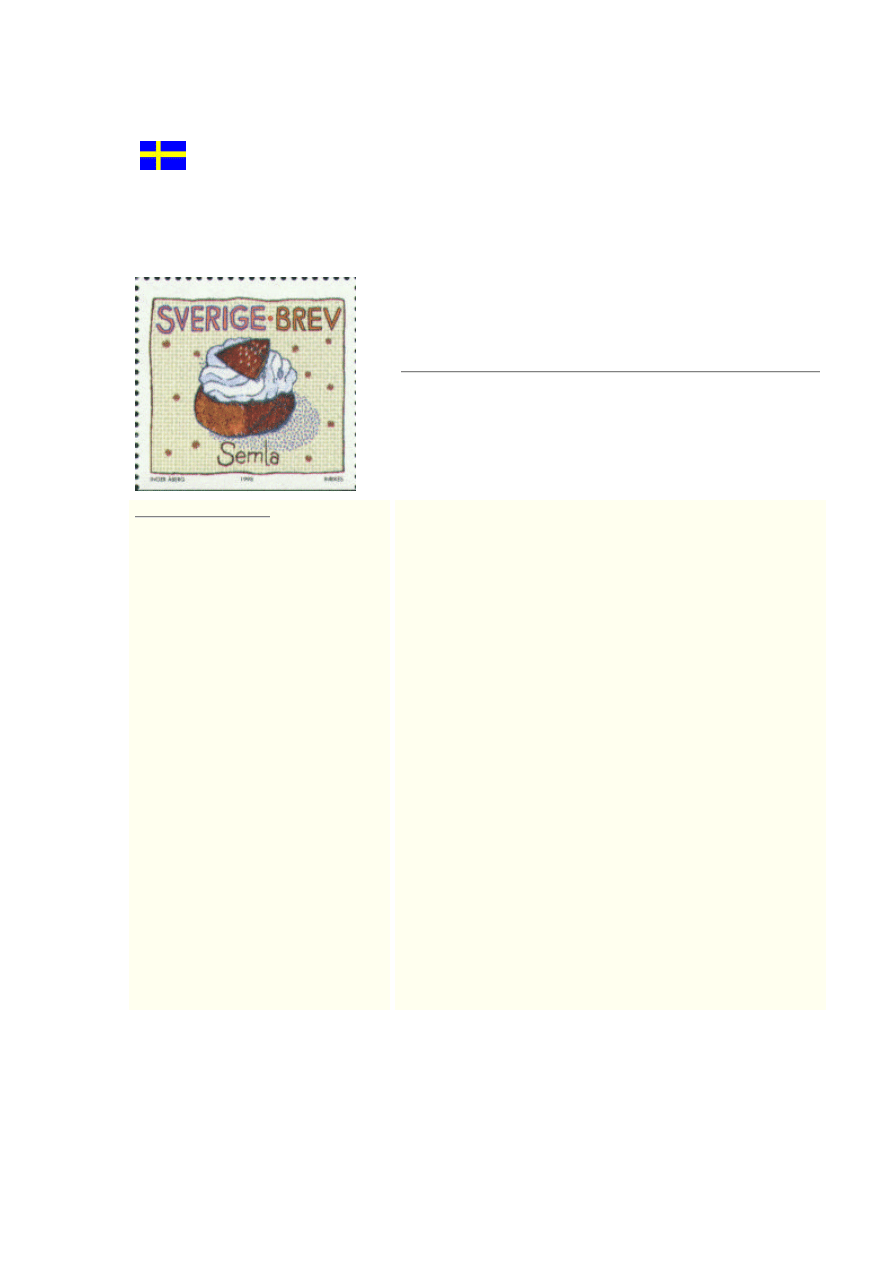
31
Semlor - Almond and Whipped Cream
Stuffed Buns
In their present shape semlor only dates back to the turn
of the century. Originally, the stuffed buns were boiled in
milk before serving on the Tuesday preceding the Lent.
Now they are eaten from January until Easter.
Ingredients:
For twelve buns:
o
50 g yeast
o
100 g butter
o
300 ml milk
o
75 g granulated
sugar
o
1 teaspoon salt
o
500-550 g all-
purpose wheat
flour
For the stuffing of six
buns:
o
100 g almond paste
o
75 ml milk
o
the crumbs from 6
buns
o
200 ml whipped
cream
Proceed as follows:
1. Melt the butter, add the milk and heat to 37
o
C,
add the finely divided yeast and stir.
2. Add sugar, salt and almost all of the flour. Mix
thoroughly and leave it in a warm place for 40
minutes to raise.
3. Kneed the dough and divide it into 12 parts. Form
round buns, kneed them a little and leave them for
30-40 on a baking tray to raise.
4. Bake them in the oven at 225-250
o
C for 5-10
minutes (watch carefully at the end to avoid
burning the buns).
5. Cut off the top of six buns as a lid. Scoop out the
crumbs and mix them with the almond paste, the
milk and half of the whipped cream until you have
a soft paste.
6. Fill the scooped out buns with the paste, cover
with whipped cream and, finally, with the lid. If
desired, sprinkle powdery sugar on top.

32
Swedish Punch and Chocolate Sweets
For many years these deliciously fattening sweets were served
at Christmas time in our family. Any dietist would scream blue
murder after reading the recipe, since they come loaded with
cholesterol-raising saturated fat. But they are sooooo delicious,
so once a year you should be permitted to indulge in them.
Ingredients:
•
300 ml granulated
sugar
•
2 eggs
•
300 g coconut butter
•
100 g cocoa powder
•
100 ml Swedish arrak
punch
Proceed as follows:
1. Beat the eggs into the sugar.
2. Melt the coconut butter, then let it cool until it almost
starts to re-solidify.
3. Pour the melted cocnut butter into the egg-and-sugar
batter, mix.
4. Add the cocoa powder and the punch, stir until you get
a homogenous mixture.
5. Pour the mixture onto a wide dish or baking-tin. This
should be so large that the resulting layer is not more
than 1 cm deep.
6. Leave it in the refrigerator to solidify. Afterwards, cut
it up into small pieces, which can be covered by
sprinkles or jimmies for easier handling.
The punch and chocolate sweets must be stored in a cool place.
The softening point for the coconut butter-punch mixture is
around room temperature.

33
Våfflor - Waffles
In Sweden waffles are traditionally eaten on 25 March,
Annunciation Day or, in Swedish, Vårfrudagen. They are also
very popular in Swedish mountain resorts, where they
generally are served together with whipped cream and
cloudberry jam.
Ingredients:
•
250 ml water (ice
cold!)
•
200 g all-purpose flour
(325 ml)
•
a pinch of salt
•
400 ml heavy or
whipping cream
•
melted butter
Proceed as follows:
1. In a large mixing bowl, toss together the flour, the
water and the salt until you have a smooth mixture.
2. Whip the cream until it is firm and mix it carefully
with the water-flour mixture.
3. Pre-heat a waffle iron (yes, unfortunately you do need
a special iron; we have not been able to find a good
substitute) and grease it lightly.
4. Pour 100 ml of the batter onto the waffle iron and
cook until crisp and golden (approximately 2
minutes).
Serve immediately together with whipped cream and a
suitable fruit or berry jam. Some even like to sweeten the
waffles with some granulated sugar.

34
Svartvinbärsbrännvin - Home-made
Absolut Kurant
"Absolut Kurant" is a very popular Swedish vodka, colourless
but with a strong taste of black currant. You can prepare a
similar (but stronger) beverage yourself, although it takes time.
(Normal Swedish "svartvinbärsbrännvin" has a deep dark violet
colour and is prepared by extraction of black currant berries.)
Ingredients:
•
1 l 96 % alcohol
•
1 kg black currants
Proceed as follows:
1. In a closed large glass jar place the 96 % alcohol at the
bottom.
2. Place 0.5-1 kilograms of black currants in a gauze bag
and suspend this bag over the alcohol. It is important that
the black currants are not in any way submerged in the
alcohol.
3. Leave the jar closed in a warm place for at least two
months. After that time most of the aroma will have
evaporated from the black currants and dissolved in the
alcohol, however the pigment still remain in the currants.

35
Saft - Fruit-syrup
In early autumn, berries are converted into fruit
syrup which will be happily consumed by the kids
during the long and dark winter, reminding them of
(weatherwise) happier days.
Ingredients:
•
1 kg (2 lbs) of berries, e.g. black
or red currants, cherries,
raspberries, strawberries, etc.
•
300 - 600 ml (1 - 2 cups) of water
•
300 - 600 ml (1 - 2 cups) of
granulated sugar
•
5 g of sodium benzoate to
preserve the "saft"
Proceed as follows:
1. Clean the berries. The pit can stay in
cherries; black and red currants can remain
as racemes.
2. Weight the berries and determine the water
quantity. Black and red currants require the
largest water quantity, strawberries,
cherries, and raspberries require less water.
3. Boil the berries in the water under cover for
10 minutes. Squeeze them now and then
with, e.g. a wooden spoon in order to make
certain they are crushed.
4. Now comes the tricky part: You have to
strain the "saft", using a straining-cloth. Do
not apply pressure, but let gravity do the
trick. This part of the preparation might
take up to an hour.
5. Measure the quantity of "saft", bring it to
the boil and add the sugar. If required,
carefully skim off any scum.
6. Add the sodium benzoate if desired (first
dissolve it in a small quantity of saft, then
add the solution to the rest of the "saft").
7. Fill the "saft" into hot, clean bottles and
seal the bottles immediately (e.g. using
cork). Before serving, mix the fruit-syrup
with water to desired strength.

36
Glögg - Spicy Hot Red Wine
Swedish glögg can usually be bought at IKEA furniture
super-stores all over the world (except, of course, in
Sweden!) But you can also make your own glögg. If you
want to know more about glögg, check our webpage on
Swedish Christmas Chemistry!
Ingredients:
•
one bottle cheap red
wine
•
100 ml (half a cup)
vodka
•
10 g whole cinnamon
•
1.5 grams cloves (about
20 pieces)
•
a small piece of ginger
•
2 g crushed cardamom
seeds
•
the (dried) peels of half
a bitter orange
•
300 g (slightly more
than a cup) sugar
•
1 tbsp vanilla sugar
•
almonds and raisins as
desired
Proceed as follows:
1. Crush the cardamom and cinnamon, put all spices in
a covered glass jar, add the vodka. Let stand for 24
hours.
2. Sieve the vodka, discard the spices.
3. Put the almonds in boiling water for 10 seconds,
rinse them with cold water and peel them.
4. Mix the red wine and the spicy vodka in a pan, add
vanilla, sugar, almonds and raisins.
5. Heat covered for a few minutes, but do not under any
circumstances let the mixture boil.
Serve sizzling hot but only when it's freezing cold outside!

37
Vargtass - Wolf's Paw
Hard liquor is very expensive in Sweden. This means that
some chemists turn to laboratory alcohol in order to their
expenses at a more reasonable level. Vargtass is one favourite
way of making use of the tax-free lab alcohol.
Ingredients:
•
60 ml vodka or
•
25 ml lab alcohol (96
%) and
•
35 ml water
•
60 ml lingonberry
juice
Proceed as follows:
1. Mix equal parts of vodka and lingonberry juice in a
shaker with plenty of ice. Shake and serve!
Even better is to mix without ice and leave the mixture in the
refrigerator for a few hours. Thus you avoid an unnecessary
dilution, but that requires careful planning.
Wyszukiwarka
Podobne podstrony:
cooking camping recipes ZI5VFQATXWDZSZ3AZ3BCLZIDAVLR3IIAHUCVX4Q
cooking generations of recipes decu2z62qwkhzrnkdxziawjwwaxcsaxx5nwtdzy DECU2Z62QWKHZRNKDXZIAWJWWAXC
cooking copycat recipes VHCS4JMA2HE5JZ7LQ4EBPYIEKYJUBMTHLMXMR6Y
cooking other indian recipes
(E Book)Cooking & Recipes Taste of Tofu(1)
Gluten free, Sugar free Cooking Over 200 Delicious Recipes to Help You Live a Healthier, Allergy Fre
cooking 200 recipes for italian dishes(2)
Cooking Pizza Recipes
(E Book)Cooking & Recipes Grains and Cereals
Cooking Korean Food Recipes 1
The best of Amish cooking traditional and contemporary recipes adapted from the kitchens and pantrie
(e book)cooking & recipes simple italian cookery
Mcdonald Cooking Recipe
energy3 recipe corner cooking vocab
(e book)cooking & recipes 30 minutes indian recipes
(E Book)Cooking & Recipes The New American Plate Meals for a Healthy Weigh
Wok Cooking Recipes, Secrets & Skills eBook
cooking vegetarian recipes
więcej podobnych podstron