
WINTER 2013
PSI CHI
JOURNAL OF
PSYCHOLOGICAL
RESEARCH
148
COPYRIGHT 2013 BY PSI CHI, THE INTERNATIONAL HONOR SOCIETY IN PSYCHOLOGY (VOL. 18, NO. 4/ISSN 2164-8204)
*Faculty mentor
C
reativity in problem solving is a major
area of study (Vosburg, 1998a). Every day
people are faced with problems they must
solve, and sometimes people have to be creative
when they need to solve a problem (George &
Zhou, 2002). It would be beneficial to know what
factors influence creativity in problem solving.
Two studies were conducted to investigate the
factors that influence creativity. In both studies,
mood and personality were examined as two
potential creativity influences. The goal of these
studies was to learn more about the interaction
between mood, personality type, and creativity
in problem solving. In both studies, creativity was
measured by four divergent problem solving tasks.
Divergent problem solving is a measure of fluency
and creativity where participants are asked to come
up with as many solutions or answers to a problem
as possible (Vosburg, 1998a). For example, one
divergent problem solving task given to participants
is, “a classmate is constantly talking during an
important lecture, and therefore you are unable
toconcentrate.Whatareallthedifferentsolutions
you can think of to solve this problem?” Showing
that there are multiple answers to a problem, not
just simply one solution, demonstrates creativity
(Vosburg, 1998a).
Creativity itself may be affected by mood.
Vosburg (1998b) tested the effects of positive and
negative mood on divergent thinking performance.
First, mood was assessed, and then participants
went on to complete four reallife divergent tasks.
Two of the tasks involved problem solving, where
participants were to produce as many solutions to
a problem as possible. The other two tasks tested
problem finding, where participants were asked
to come up with as many problems involved in the
question as possible. The tasks were graded simply
on ideational fluency, which is the number of items
produced for each task. Results showed a significant
positive relationship between positive mood and
task performance, meaning participants had a
higher fluency of responses to the task when they
were in a positive mood. There was also a significant
negative relationship between negative mood and
task performance, meaning that participants in a
ABSTRACT. Research generally supports the view that positive mood results
in higher creativity. The purpose of these two studies was to examine the
effect of mood and personality type on creativity in problem solving. Mood
was manipulated (positive versus negative) differently and personality type
was measured (extravert versus introvert) consistently in both studies using
a sample of undergraduate college men (n=16)andwomen(n = 57).
An interaction effect between mood and personality type was hypothesized.
Extraverts in a positive mood were predicted to have higher creativity scores,
but introverts in a negative mood were predicted to have higher creativity
scores. Results supported the hypothesis. Extraverts in a positive mood had
higher scores of creativity and introverts’ scores were higher when
in a negative mood for both Study 1 (p = .02) and Study 2 (p = .01). These
results are useful in understanding how mood and personality can influence
creativity.
The Role of Mood and Personality Type on Creativity
Paige D. Naylor, JongHan Kim, and Terry F. Pettijohn III
*
Coastal Carolina University

WINTER 2013
PSI CHI
JOURNAL OF
PSYCHOLOGICAL
RESEARCH
149
COPYRIGHT 2013 BY PSI CHI, THE INTERNATIONAL HONOR SOCIETY IN PSYCHOLOGY (VOL. 18, NO. 4/ISSN 2164-8204)
Naylor, Kim, and Pettijohn
|
Creativity in Problem Solving
negative mood had a lower fluency of responses to
the task when they were in a negative mood. The
researchers recommended replicating the study to
involve actual mood induction to strengthen the
validity (Vosburg, 1998b).
There is more to creative problem solving than
just coming up with multiple solutions to a task.
There is also the quality of the solutions. There
are two main positions concerning mood and
problem solving. The first is the general position:
positive mood results in a positive relationship
with creative problem solving across various tasks
consistently. The second is the qualified posi
tion: the relationship of the general position is
not always true; it varies according to the type of
task. Sometimes positive mood simply produces a
higher quantity of solutions, however not a higher
number of quality ideas (Vosburg, 1998a). Vosburg
(1998a) examined the difference between the two
positions. Mood was assessed and then participants
were asked to complete four divergent problem
solving tasks. The first two problems were problem
solving and problem finding (Okuda, Runco, &
Berger,1991).ThelasttwowerefromWallachand
Kogan’s(1965)batteryofcreativitytestswhere
participants were asked to come up with as many
uses for a shoe as possible, and to come up with as
many representations for an ambiguous figure as
possible. Vosburg (1998a) measured four factors.
The first was ideational fluency, or the number of
solutions. The second was ideational flexibility, or
the number of different categories of solutions.
These two are quantity measures. The next two are
quality measures. One is originality and the next
is usefulness, in other words functionality. Results
showed a significant relationship between positive
mood and the two quantity measures, fluency and
flexibility, however not for the two quality measures,
originality and usefulness. The results of this study
support the qualified position that a positive mood
does not always result in a positive relationship to
creative problem solving (Vosburg, 1998a).
There are important characteristics to suc
cessful problem solving that include the quantity,
the variety and utility, and the speed with which
potential solutions are generated. Kaufman and
Vosburg (2002) tested the effect of mood on early
and late idea production. Early idea production,
or coming up with the majority of solutions to a
task early in the task, is least constrained by the
solution. Late idea production, or coming up with
the majority of solutions to a task later in the task,
is most constrained by the solution. The hypothesis
was that people in positive moods would perform
better with early idea production tasks and that
people in negative moods would perform better
with late idea production tasks.
Participants were divided into three groups:
positive mood induction, negative mood induction,
and a control group. Mood induction was achieved
by showing participants clips of either positive or
negative images. There were four tasks and partici
pants had 4 min to work on each task. The first two
tasks were reallife divergent thinking tasks, one of
which was a problem solving task and the other a
problem finding task. The second two tasks were
againfromWallachandKogan’s(1965)batteryof
creativity tests. Results supported the hypothesis,
showing that positive mood led to the best perfor
mance in the 1 min idea production. Participants
in a positive mood were positively related to early
idea production and negatively related to late idea
production. This indicated that participants in a
positive mood had better performance under the
least constrained tasks, meaning participants in a
positive mood performed better early on in the
task when they knew that more time remained.
Participants in a negative mood showed better
performance on late idea production. This meant
that participants in a negative mood performed
best while under the most constrained tasks, later in
the task when their time was almost up. The reason
ing for the results is that people in a negative mood
prefer to carefully consider all solutions to come up
with the most qualitative solution because they are
concerned with quality over quantity (Kaufmann
& Vosburg, 2002).
Problem solving may occur in interaction with
others and be influenced by these interactions
(Brand & Opwis, 2007). For example, individuals
who are extraverted prefer to work in groups, but
individuals who are introverted prefer to work
alone (Freyd, 1924). Brand and Opwis (2007)
tested the effect of mood on problem solving
to know if learning in dyads, meaning groups of
two, affected performance. The researchers asked
two questions. First, they wanted to know if positive
mood impacted individual transfer performance
after participants learned in dyads. Researchers
wanted to see if a positive mood resulted in better
transfer of learned materials than a negative mood.
Second, researchers wanted to know how mood
influenced transfer performance, and if mood
made a difference in learning transfer tasks alone
or in dyads. They conducted two experiments to
test their hypotheses. They believed that positive

WINTER 2013
PSI CHI
JOURNAL OF
PSYCHOLOGICAL
RESEARCH
150
COPYRIGHT 2013 BY PSI CHI, THE INTERNATIONAL HONOR SOCIETY IN PSYCHOLOGY (VOL. 18, NO. 4/ISSN 2164-8204)
Creativity in Problem Solving
| Naylor, Kim, and Pettijohn
mood would lead to better transfer performance
regardless of dyad status. They also believed
that pairs of individuals who previously worked
in dyads would perform better than those who
only had individual experience with learning the
transfer tasks. All participants were paired into
dyads, learned the transfer tasks, and were split
into two manipulation groups with positive or
negative moods. Then participants completed a
problem solving task that required them to use
the transfer task knowledge they had previously
learned. Results showed that people with positive
moods needed significantly fewer attempts to solve
the tasks assigned. The second experiment tested
whether working in dyads was more beneficial
than working alone. This second experiment also
tested the effect positive and negative mood had
on participants’ transferring of learned tasks. The
participants were divided into two groups. Half
of them were put into dyad groups, the other
half worked individually to learn the transfer task
knowledge. Then dyad groups were either in the
positive or negative mood conditions as were the
individual groups. Next all individuals were placed
into dyad groups, and the previous dyad groups
performed their problem solving task that required
the learned transfer knowledge. Results showed
that people who had first worked in dyads and were
in positive moods performed the best. Individu
als who first worked alone and were in a positive
mood did the second best. Third best were people
who first worked in dyads and were in a negative
mood. Lastly were the individuals who first worked
alone and were in negative moods. Mood had an
effect on performance, regardless of whether the
learning was being done individually or in pairs.
Positive mood resulted in better performance in
individuals and in dyads. Also, when participants
learned in dyads they performed better in dyads.
The current study examined mood and creativity
in problem solving and problem finding. This
was beneficial to examine because it showed that
performance was better when individuals were in
a positive mood, regardless of whether they were
learning alone or in pairs. This study followed
the same pattern as previous literature that was
reviewed (Brand & Opwis, 2007).
Another relevant study had similar results. This
study was comprised of four different experiments
all yielding consistent results. Isen, Daubman,
and Nowicki (1987) tested to see if positive affect
resulted in higher creativity in problem solving.
Since positive affect correlates with positive mood
this study was relevant to examine for the current
studies. Throughout four experiments they found
that positive affect consistently resulted in higher
creativity in problem solving regardless of the type
of mood manipulation or measure of creativity.
Previous studies have revealed that positive
mood correlates positively with creativity. However,
one study found results that show negative mood
correlates positively with creativity (George &
Zhou, 2002). George and Zhou (2002) examined
the effect mood had on creativity in a workplace
environment. They hypothesized that employees
would be more creative when they were in a
negative mood and less creative when they were in
a positive mood if certain circumstances or condi
tions were present. The first condition was that the
employees’ creativity was valued and rewarded in
the workplace. This is achieved usually by promo
tions and pay raises for employees who contribute
to the workplace by using their creativity. Examples
include an employee coming up with new solutions
to problems, finding a better, more efficient way of
doing something, and so on. The second condition
was that the employee be aware of how they feel,
which is referred to as clarity of feelings.
In order for mood to be a factor in how cre
ative an employee is, the employee must be aware
of how they feel and the mood in which they are
experiencing. Individuals’ moods determine how
creative they will be in the workplace. Also the
opportunity for rewards and recognition will have
an effect on individuals’ creativity. If an individual
is in a negative mood they may try harder to come
up with new and useful ideas because they are more
critical of themselves. Negativity may also allow
these individuals to see that there are potential
improvements to problems. However, individuals
in a positive mood are not as critical of themselves.
Also because they are in positive moods they tend
to see things around them more positively. They
are not as active in seeing potential improvements
for problems in the workplace because to them
everything is already working fine. This study was
conducted in a workplace setting where creativ
ity was valued and necessary. Employees and
their employers provided information to test the
hypothesis that employees in negative moods were
more creative than employees in positive moods
when they felt their creativity would be rewarded
and valued, and they were aware of how they felt.
Results supported the hypothesis. Based on the
employees and the employers’ feedback about their
employees, results indicated that the employees in

WINTER 2013
PSI CHI
JOURNAL OF
PSYCHOLOGICAL
RESEARCH
151
COPYRIGHT 2013 BY PSI CHI, THE INTERNATIONAL HONOR SOCIETY IN PSYCHOLOGY (VOL. 18, NO. 4/ISSN 2164-8204)
Naylor, Kim, and Pettijohn
|
Creativity in Problem Solving
negative moods were more creative than those in
positive moods when they felt valued and rewarded
and aware of their feelings (George & Zhou, 2002).
It is clear that mood has a major impact on
problem solving as evidenced by the literature
reviewed above. However, is there some other factor
that may interact with mood to effect problem solv
ing? Personality type, such as whether an individual
is an introvert or an extravert, may also be a factor
that influences problem solving. Literature states
that extraverts tend to perform better on cognitive
tasks (Landa, Martos, & LópezZafra, 2010). Extra
verts also rely on positive stimuli around them to
keep them happy. Extraverts particularly seek to be
happy when completing effortful tasks. However,
introverts do not seek to be happy when trying to
complete effortful tasks (Tamir, 2009).
Tamir (2009) completed a study to examine
if individuals continually seek out happiness. The
hypothesis was that an extravert would seek out
happiness before an effortful task, such as giving a
speech or taking a test. Introverts were predicted
to not seek out happiness before an effortful task,
such as giving a speech or taking a test. Results
supported the hypothesis. Extraverts seek out
happiness before an effortful task, and introverts
do not (Tamir, 2009). The reasoning is that extra
verts need to be happy when performing tasks and
introverts prefer not to be happy when performing
tasks. Therefore, it makes sense to assume that
introverts in a negative mood will outperform intro
verts in a positive mood on problem solving tasks.
The Current Studies
Research has shown that positive mood is related
to greater fluency in divergent problem solving
and negative mood usually inhibits the number of
solutions to a problem (Vosburg, 1998b). However,
are there times when positive moods can hinder
creativity and negative moods can enhance creativ
ity? Does personality, specifically whether a person
is an introvert or an extravert, interact with mood
states to influence creativity? Research has shown
that extraverts tend to outperform their introverted
counterparts on cognitive tasks (Landa et al., 2010).
However, with introverts not seeking to be happy
when performing effortful tasks, while extraverts
do prefer to be happy (Tamir, 2009), it would seem
introverts may perform better in circumstances
when they are in a negative mood. This leads
to an interaction prediction: introverts will be
more creative when they are in a negative mood
and extraverts will be more creative when they are
in a positive mood.
Relevant literature reviewed mostly examines
how mood affects problem solving. The current
studies examined the relationship between mood
and problem solving, and also the relationship
between personality type and problem solving. Not
much research has been conducted investigating
the positive effects of having introverts in a negative
mood to enhance creative problem solving (Landa
et al., 2010). The current studies were designed to
show how mood and personality interact to influ
ence creativity in problem solving.
Study 1: A Pilot Test
Using previously established methods of inducing
mood and measuring personality and creativity, a
pilot test using a small sample of college students
was designed to test the current interaction
hypothesis. Extraverts induced into a positive
mood were hypothesized to be more creative in
problem solving than extraverts induced into a
negative mood. However, it was also hypothesized
that when introverts were induced into a negative
mood, they would be more creative in problem
solving than the introverts who were induced into
a positive mood. It would seem that not relying
on positive reinforcements would let introverts
be more creative while in a negative mood (Tamir,
2009).
Method
Participants. The sample size of participants was
determined by the professor who taught the research
course in which the current study was performed.
Participants consisted of eight introverts and eight
extraverts(10men,6women).Participantswere
enrolled in psychology courses at a public univer
sity in the southeastern United States and were
given course research credit for participating. The
median age of participants was 23. Information
regarding age and ethnicity were not gathered
from participants. All participants were treated
according to American Psychological Association
ethical guidelines (APA, 2002). IRB approval was
obtained before collecting data for this study, and
all participants signed informed consent forms.
Materials. In order to determine extraversion
and introversion, the Ten Item Personality Inven
tory was used (TIPI; Gosling, Rentfrow, & Swann,
2003). Gosling et al. (2003) discussed the conver
gence of the TIPI with other personality measures,
testretest reliability, and content validity in past
investigations.Questions1and6weretheonly

WINTER 2013
PSI CHI
JOURNAL OF
PSYCHOLOGICAL
RESEARCH
152
COPYRIGHT 2013 BY PSI CHI, THE INTERNATIONAL HONOR SOCIETY IN PSYCHOLOGY (VOL. 18, NO. 4/ISSN 2164-8204)
Creativity in Problem Solving
| Naylor, Kim, and Pettijohn
questions considered for introversion and extraver
sion classification. Question 1 asked the participant
to rate themselves on a Likerttype scale ranging
from 1 (disagree strongly) to 7 (agree strongly) on how
extraverted, enthusiastic participants described them
selves.Question6hadtheparticipantratehow
reserved, quiet they described themselves (Gosling
et al., 2003). The rest of the personality questions
were not necessary for determining introvert and
extravert categories. The scores for the introvert
and extravert questions were compared. If the
participant scored higher on the introvert question,
the participant was classified as an introvert. If the
participant scored higher on the extravert question,
the participant was classified as an extravert. If
participants scored identically on the two questions,
they were excluded from analyses. Two participants
met this criterion. Generally, participants showed a
strong difference between these personality areas.
A demographic survey was also used to obtain
information about participant age and sex.
In the current studies, positive mood was
defined as “happiness;” an activating positive
mood. Negative mood was defined as “sadness;”
a deactivating type of negative mood. In order to
manipulate mood, two slideshows were used. To
induce a positive mood, a slideshow with 14 posi
tive images, obtained from an Internet search, was
shown. Examples of these images included peaceful
landscapes, laughing children, and smiling faces.
To induce a negative mood, a slide show of 14
negative images, obtained from an Internet search,
was shown. Examples of these images included
pictures of animal torture, starving children, and
The Great Depression. Exposure to images was
assumed to alter the mood of participants, but we
did not include a manipulation check in this pilot
test. Each image was shown for 5 s, making each
slideshow last 70 s.
Four reallife divergent tasks were used from
previous studies examining creativity (Kaufmann
& Vosburg, 2002). The purpose of these tasks was
to present each problem and have participants
come up with as many responses as possible. The
first problem was: “Your friend Rolf sits next to
you in the classroom. Rolf likes to talk to you and
often interrupts you when you are taking notes.
Sometimes he distracts you so that you are missing
importantpartsoflecture.Whatareyougoingto
do? How are you going to solve this problem?”
Thesecondproblemwas:“Writedownproblems
you consider important to your studies. You can
mention problems related to the universitysite,
professors, politics, other students, or whatever you
can think of.” The third problem asked participants
to “list as many possible uses for a shoe you can
think of.” The fourth problem showed participants
an ambiguous figure and asked them to “please
list all the potential representations of this figure”
(Kaufmann & Vosburg, 2002). A stopwatch was
used to record the time for participants to complete
the various problems.
Procedure. The experiment was conducted
in a laboratory setting in individual sessions with
the experimenter. Participants first completed an
informed consent form. Next, participants com
pleted the TIPI questionnaire (Gosling et al., 2003)
and a demographic survey and turned it in to the
experimenter. The next step was mood manipula
tion. Based on random assignment, the participant
was either assigned to a negative or positive mood
condition. For the negative mood condition, par
ticipants viewed the slideshow containing negative
images. The positive mood participants viewed the
slideshow that contained positive images. The last
step in the experiment was to measure creativity
in problem solving. The participant had 4 min per
problem to come up with as many solutions to each
oftheproblemsasheorshecould.Whenthepar
ticipant finished the last problem, the experiment
was complete. The participant was then debriefed
and the real purpose of the study was revealed.
During debriefing, participants were invited to
contact the researcher to know the outcome of
the study and were asked not to discuss the study
with anyone else.
Results
The number of unique solutions to the four cre
ativity tasks were combined to produce a single
creativity score. In order to test the hypothesis
that there was an interaction effect, a 2 (mood)
x 2 (personality type) between subjects analysis of
variance (ANOVA) test was conducted for overall
creativity scores. A critical p value of .05 was used
to determine statistical significance. The interac
tion effect between mood and personality type was
statistically significant, F(1,14)=6.95,p = .02, η
p
2
=
.37. The main effect for mood was not significant,
F(1, 14) = 2.11, p = .17, η
p
2
= .15. The main effect
for personality type was also not significant, F(1,
14) = .53, p = .48, η
p
2
= .04. See Figure 1 for results.
Discussion
The main goal of the current study was to find an
interaction effect between the two independent
WINTER 2013
PSI CHI
JOURNAL OF
PSYCHOLOGICAL
RESEARCH
153
COPYRIGHT 2013 BY PSI CHI, THE INTERNATIONAL HONOR SOCIETY IN PSYCHOLOGY (VOL. 18, NO. 4/ISSN 2164-8204)
Naylor, Kim, and Pettijohn
|
Creativity in Problem Solving
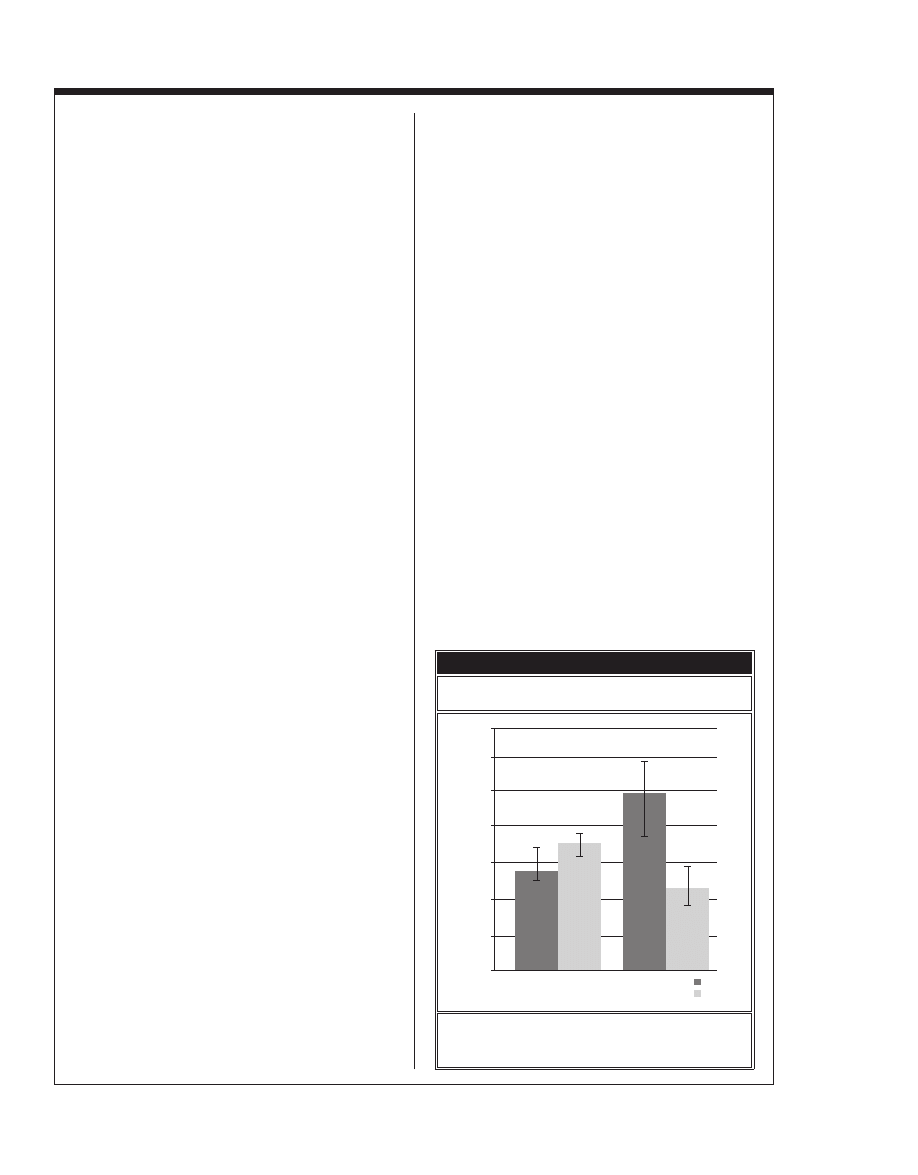
variables, mood and personality type. As stated
above,resultssupportedthehypothesis.When
extraverts were in a positive mood they were more
creative in problem solving. Extraverts in a negative
mood were less creative in problem solving.
One of the major limitations of Study 1 was the
small sample size. In addition, no mood manipula
tion check was employed. Therefore, Study 1 was
conceptually replicated in Study 2 to strengthen
the reliability of this current research. A different
mood manipulation was used for Study 2, in order
to determine if a different manipulation would
yield similar results.
Study 2
The same interaction effect was predicted for Study
2 as in Study 1. Extraverts in a positive mood were
expected to be more creative in problem solving
than those in a negative mood. Introverts were
expected to be more creative in a negative mood
compared to those in a positive mood. In Study 1,
there was no mood manipulation check. In Study
2, there was a mood manipulation check and
its effectiveness was assessed. In Study 1, a slide
show of positive and negative images was used to
manipulate mood. In Study 2, a writing prompt was
used to achieve positive and negative mood
manipulation. This different mood manipulation
was used to examine if similar results would be
achieved regardless of the type of mood manipula
tion. To address the low sample size concern from
Study 1, a larger and more diverse sample was
sought in Study 2 to provide sufficient power to
detect significant differences.
Method
Participants. Participants were 57 undergraduate stu
dents (43 women, 14 men) from a public university
in the southeastern United States. Participants
were given course research credits for participating
in the research, no additional compensation was
provided. Of the 57 participants, 34 were cat
egorized as extraverts and 23 were categorized
as introverts. The mean age of participants was
22.50 (SD=6.16).Forty-twoparticipantswere
European American and 15 were African American.
All participants were treated according to APA
(2002) ethical guidelines.
Materials. The TIPI (Gosling et al., 2003)
was again used to determine introversion and
extraversion. The demographic survey had basic
questions regarding participant race, age, and
sex. Two writing prompts were used to manipulate
mood. These prompts were to write about the best
(positive mood) or worst (negative mood) day of
the participant’s life for 4 min. The paper and
directions were provided for the writing exercise.
A mood manipulation check of two questions was
also used. The participants responded to the ques
tions on a Likerttype scale ranging from 1 (strongly
disagree) to 5 (strongly agree). The first question was,
“I feel sad,” and the second was “I feel happy.”
The number of unique solutions to the same
four problems were used in Study 2 as were used
in Study 1 to measure the dependent variable,
creativity in problem solving. A stopwatch was used
to record the time for participants to complete the
various problems.
Procedure. The same basic procedure was
used in Study 2 as in Study 1. An experimental lab
setting was used to conduct individual sessions.
All participants provided informed consent prior
to participation. Participants completed the TIPI
questionnaire (Gosling et al., 2003) and the demo
graphic survey before the mood manipulation.
Based on random assignment, each participant
was either assigned to a negative or positive mood
induced condition. For the negative mood condi
tion, participants (n = 27) were asked to write about
one of the worst days of their life. For the positive
mood condition, participants (n = 30) were asked
to write about one of the best days of their life.
FIGURE 1
Interaction Effect Between Mood and
Personality Type on Creativity Scores in Study 1
Extraverts had a higher number of solutions when in a positive mood (M = 49.25, SD = 21.42)
rather than in a negative mood (M = 22.50, SD = 12.29). Introverts had a higher number of
scores when they were in a negative mood (M = 35.00, SD = 3.92) rather than in a positive
mood (M = 27.25, SD = 7.76).
0
10
20
30
40
50
60
70
Mean Number of Solution
s
Personality Type
Introvert
Extravert
Positive
Negative
WINTER 2013
PSI CHI
JOURNAL OF
PSYCHOLOGICAL
RESEARCH
154
COPYRIGHT 2013 BY PSI CHI, THE INTERNATIONAL HONOR SOCIETY IN PSYCHOLOGY (VOL. 18, NO. 4/ISSN 2164-8204)
Creativity in Problem Solving
| Naylor, Kim, and Pettijohn
Participants had 4 min to write about the prompt.
A mood manipulation check was used to ensure
the mood manipulation worked.
The last step in the experiment was to measure
creativity in problem solving. The participant had 4
min per problem to come up with as many solutions
as possible to each of the problems. Participants
were timed with a stopwatch to see how long they
tooktorespondtoeachproblem.Whenthepar
ticipant finished the last problem, the experiment
was complete. The participant was then debriefed
and asked not to discuss the study with anyone else.
Results
To determine if the mood manipulation was suc
cessful, a 2tailed independent t test was conducted.
The test showed that participants in the negative
condition did indeed feel sadder than participants
in the positive mood condition, t(55) = 2.00, p =
.05, d = .54, Ms = 2.30 and 1.73, SDs = 1.14 and .98,
respectively. Participants in the positive mood con
dition felt happier than participants in the negative
mood condition, t(55) = 2.59, p = .01, d=.68,Ms =
3.77 and 3.19, SDs = .82 and .88, respectively.
Again, the number of unique solutions to the
four creativity tasks were combined to yield a single
creativity score. In order to test the hypothesis
that there was an interaction effect, a 2 (mood) x
2 (personality type) between subjects ANOVA was
conducted for overall creativity scores. The interac
tion effect between mood and personality type was
statistically significant, F(1,55)=6.81,p = .01, η
p
2
=
.11. The main effect for mood was not significant,
F(1, 55) = .70, p = .41, η
p
2
= .01. The main effect for
personality type approached significance, F(1, 55) =
3.37, p = .07, η
p
2
=.06;extravertsreportedmoresolu
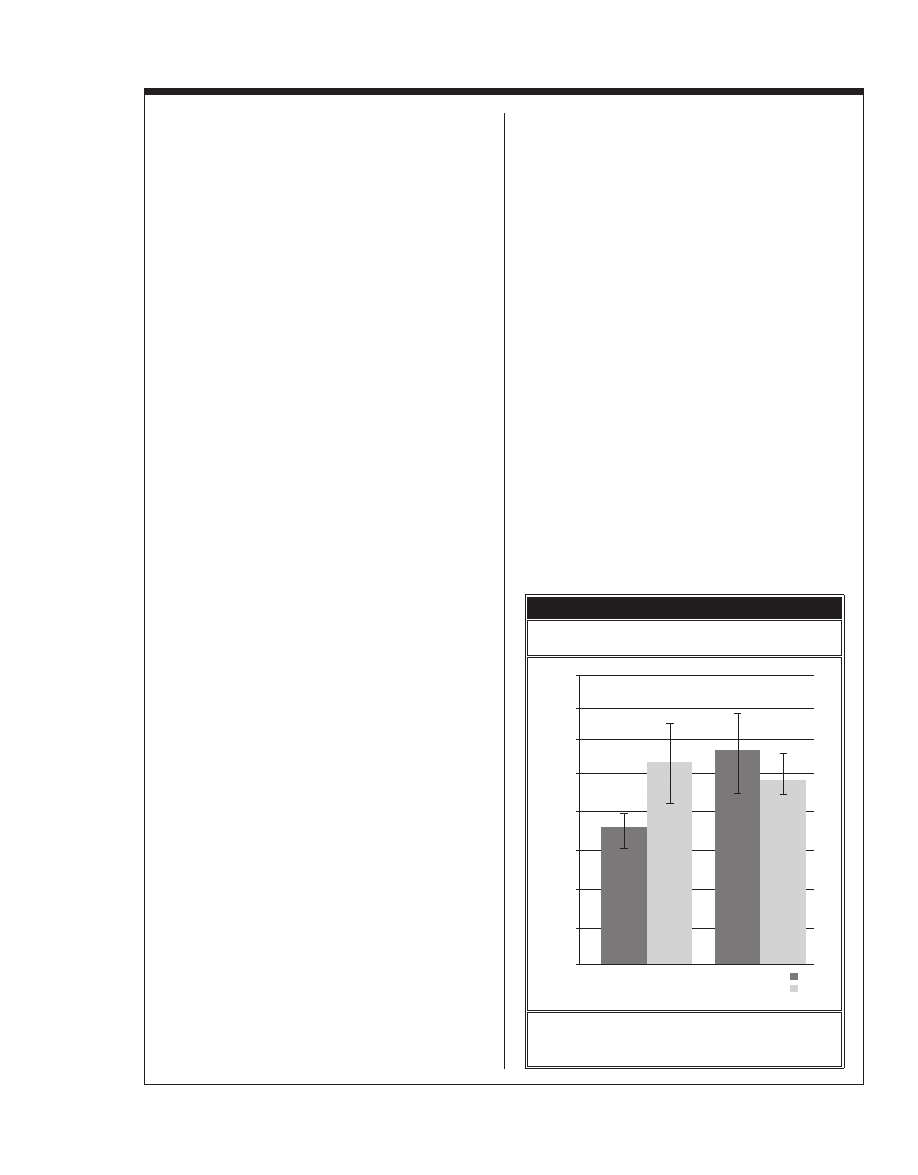
tions than introverts. See Figure 2 for full results.
Discussion
The main hypothesis of Study 2 was the same as
Study 1: an interaction effect between the two
independent variables of mood and personality
type. The results again support the hypothesis.
Extraverts were more creative in a positive mood
rather than in a negative mood and introverts were
more creative in a negative mood rather than in
a positive mood. Although there was not a main
effect for mood, there was a marginally significant
main effect for personality type. Overall, extraverts
had higher creativity scores than introverts.
General Discussion
The main purpose of these two studies was to
examine if there was an interaction effect between
the two independent variables of mood and per
sonality type. This was supported by the results;
when introverts were in a negative mood they
scored higher on creativity in problem solving
then when they were in a positive mood across
twostudies.Whenextravertswereinapositive
mood they scored higher on creativity in problem
solving than when they were in a negative mood
across two studies. The fact that the same interac
tion effect was observed in both studies, even with
different mood manipulations, is an important
way to show these results are replicable. In Study 1,
mood manipulation was accomplished by showing
a slideshow, and in Study 2, it was accomplished by
using writing prompts. In Study 1, the slideshow was
shown and participants just watched and went on to
complete the problems. However, in Study 2, par
ticipants were engaged in the mood manipulation
by being asked to write for 4 min about a certain
day in their lives. Then participants completed a
mood manipulation check survey before continu
ing on to the problems. Regardless of how mood
manipulation was accomplished, the results were
consistent. However, we do note that the effect size
when using the visual cues was greater than when
FIGURE 2
Interaction Effect Between Mood and
Personality Type on Creativity Scores in Study 2
Extraverts had a higher number of solutions when in a positive mood (M = 28.53, SD = 9.97)
rather than in a negative mood (M = 24.33, SD = 7.27). Introverts had a higher number of
scores when they were in a negative mood (M =26.17, SD = 11.08) rather than in a positive
mood (M = 18.0, SD = 4.17).
0
5
10
15
20
25
30
35
40
Mean Number of Solutions
Personality Type
Introvert
Extravert
Positive
Negative

WINTER 2013
PSI CHI
JOURNAL OF
PSYCHOLOGICAL
RESEARCH
155
COPYRIGHT 2013 BY PSI CHI, THE INTERNATIONAL HONOR SOCIETY IN PSYCHOLOGY (VOL. 18, NO. 4/ISSN 2164-8204)
Naylor, Kim, and Pettijohn
|
Creativity in Problem Solving
using the writing prompt. The writing prompt,
although effective, may have produced greater vari
ability in the strength of the mood manipulation
because it was nonstandardized like the photo in
the pilot test (i.e., everyone in the different mood
conditionssawthesamephotos).Writingabout
one participant’s worst or best day may not have
elicited the same absolute emotion as writing about
another participant’s worst day. Despite this differ
ence in effect size, the results of these two studies
were statistically significant and show how mood
and personality type interact to influence creativity.
Comparing the results of the current studies
to previous studies (i.e., Vosburg, 1998a, 1998b),
we do realize we did not find support for a main
effect for mood in either of our experiments.
Although we chose to focus on the interaction
between mood and personality, perhaps previous
samples have been comprised of a majority of
extraverts who would exhibit greater creativity in
a positive mood and lesser creativity in a negative
mood. Depending on recruitment methods, and
considering the possibility that college students
and volunteers for studies may be more outgoing
and sociable, this may be plausible. Further studies
should be conducted to address this concern and
identify when mood trumps personality in creativity
outcomes. It should also be noted that the majority
of the combined participants from Study 1 and
Study 2 were women. Further studies could ensure
a more equal sex participant ratio to see if results
remain consistent.
The current studies could be strengthened by
using a more thorough personality type inventory
to determine extraversion and introversion, as
opposed to measuring each with a single item.
Time and budget concerns led to the adoption
of the brief personality measure used in the
current studies. Also, future studies could examine
different types of positive and negative moods. In
the current studies, positive mood was defined as
“happiness;” an activating positive mood. Nega
tive mood was defined as “sadness;” a deactivating
type of negative mood. In future studies, it would
be interesting to look at the different types of
positive and negative moods. For positive mood, a
deactivating type of positive mood would be “calm
or relaxed.” An activating type of negative mood
would be “anger or fear” (Baas, De Dreu, & Nijstad,
2008). Expanding the subtypes of positive and
negative moods would be interesting to examine. In
addition to examining different types of moods, it
would also be beneficial to measure the dependent
variable creativity in problem solving differently.
An alternative measure of creativity insight is the
RemoteAssociatesTest(RAT;Mednick,1962).
The RAT presents three words that do not appear
to have any relationship and asks what these
items have in common. For example: golf, green,
and beans, would be provided and the common
element would be green (Baas, De Dreu, & Nijstad,
2011).
The new findings of this research are impor
tant because they add to the current literature.
The new findings may help individuals understand
how they may better influence their creativity in
problem solving based on the condition of mood
they experience. The new findings would benefit
students participating in classes that have project
assignments that allow for expression of creativity
versus strictly traditional tests. Most professors
incorporate “creativity” in their grading. Students
with an extraverted personality may want to
complete project assignments while in a positive
mood, but students with an introverted personality
may choose to complete their work in a negative
mood to result in the most creative outcomes. The
new research findings will help people in their
efforts to better understand themselves and what
makes them creative.
The current studies were successful in deter
mining that personality and mood can influence
creativity in problem solving. More specifically,
mood and personality type influence creativity
through an interaction. Personality type and mood
must be taken into account together in order to
influence creativity in problem solving. Extraverts
will be more creative when in a positive mood
than in a negative mood. Introverts will be more
creative when in a negative mood than in a positive
mood. The current study findings demonstrate the
importance of both personality and mood together
in determining creativity in problem solving.
References
American Psychological Association (2002). Ethical principles of
psychologists and code of conduct. American Psychologist, 57,
1060–1073. doi: 10.1037/0003-066X.57.12.1060
Baas, M., De Dreu, C. K. W., & Nijstad, B. A. (2008). A meta-analysis
of 25 years of mood-creativity research: Hedonic tone, activation,
or regulatory focus? Psychological Bulletin, 134, 779–806.
doi:10.1037/a0012815
Baas, M., De Dreu, C. K. W., & Nijstad, B. A. (2011). When prevention
promotes creativity: The role of mood, regulatory focus, and
regulatory closure. Journal of Personality and Social Psychology,
100, 794–809. doi:10.1037/a0022981
Brand, S., & Opwis, K. (2007). Effects of mood and problem solving
in dyads on transfer. Swiss Journal of Psychology, 66, 51–65.
doi:10.1024/1421-0185.66.1.51
Freyd, M. (1924). Introverts and extroverts. Psychological Review, 31,
WINTER 2013
PSI CHI
JOURNAL OF
PSYCHOLOGICAL
RESEARCH
156
COPYRIGHT 2013 BY PSI CHI, THE INTERNATIONAL HONOR SOCIETY IN PSYCHOLOGY (VOL. 18, NO. 4/ISSN 2164-8204)
Creativity in Problem Solving
| Naylor, Kim, and Pettijohn
74–87. doi:10.1037/h0075875
George, J. M., & Zhou, J. (2002). Understanding when bad moods
foster creativity and good ones don’t: The role of context and
clarity of feelings. Journal of Applied Psychology, 87, 687–697.
doi:10.1037/0021-9010.87.4.687
Gosling, S. D., Rentfrow, P. J., & Swann, W. B., Jr. (2003). A very brief
measure of the Big Five personality domains. Journal of Research
in Personality, 37, 504–528. doi: 10.1016/S0092-6566(03)00046-1
Isen, A. M., Daubman, K. A., & Nowicki, G. P. (1987). Positive affect
facilitates creative problem solving. Journal of Personality and Social
Psychology, 52, 1122–1131. doi:10.1037/0022-3514.52.6.1122
Kaufmann, G., & Vosburg, S. K. (2002). The effects of mood on early
and late idea production. Creativity Research Journal, 14, 317–330.
doi:10.1207/S15326934CRJ1434_3
Landa, J. M. A., Martos, M. P., & López-Zafra, E. (2010). Emotional intelligence
and personality traits as predictors of psychological well-being
in Spanish undergraduates. Social Behavior and Personality, 38,
783–794. doi:10.2224/sbp.2010.38.6.783
Mednick, S. A. (1962). The associative basis of the creative process.
Psychological Review, 69, 220–232. doi:10.1037/h0048850
Okuda, S. M., Runco, M. A., & Berger, D. E. (1991). Creativity and the finding
and solving of real-world problems. Journal of Psychoeducational
Assessment, 9, 45–53. doi:10.1177/073428299100900104
Tamir, M. (2009). Differential preferences for happiness: Extraversion
and trait-consistent emotion regulation. Journal of Personality, 77,
447–470. doi:10.1111/j.1467-6494.2008.00554.x
Vosburg, S. K. (1998a). Mood and the quantity and quality of ideas. Creativity
Research Journal, 11, 315–331. doi:10.1207/s15326934crj1104_5
Vosburg, S. K. (1998b). The effects of positive and negative mood on
divergent-thinking performance. Creativity Research Journal, 11,
165–172. doi:10.1207/s15326934crj1102_6
Wallach, M. A., & Kogan, N. (1965). Modes of thinking in young children.
New York, NY: Holt, Rinehart & Winston.
Author Note. Paige D. Naylor, JongHan Kim, Terry F. Pettijohn
II, Department of Psychology, Coastal Carolina University,
Conway,SouthCarolina,29528-6054,USA.
Portions of this research were presented at the 30th
International Congress of Psychology, Cape Town, South
Africa.
Send correspondence concerning this article or reprint
requests to Paige Naylor via email: pdnaylor@g.coastal.edu.

Copyright of Psi Chi Journal of Psychological Research is the property of Psi Chi Journal of
Undergraduate Research and its content may not be copied or emailed to multiple sites or
posted to a listserv without the copyright holder's express written permission. However, users
may print, download, or email articles for individual use.
Wyszukiwarka
Podobne podstrony:
Creativy and Personal Mastery
The Multiple Relations Between Creativity and Personality
The Relations of Gender and Personality Traits on Different Creativities
Creationism and?rwinism
1 ANSYS Command File Creation and Execution
Creativity and Convention
career counseling and personal counseling
Creativity and Human Evolution
Adjectives to describe character and personality
Character and personality
5 The importance of memory and personality on students' success
traditional roles and personnel in renaissance drama HBWPORTTPLITBBC5ZN3LHSORXEQWIV3IPO2HTNA
Ralph Abraham, Terence McKenna, Rupert Sheldrake Trialogues at the Edge of the West Chaos, Creativi
ClientQ&A about Business and Personal Coaching
music and personality konspekt lesson plan
The Supernatural Power of a Transformed Mind 40 Day Devotional and Personal Journal Bill Johnson
więcej podobnych podstron