Chaos in Numberland: The secret life of continued fractions
Chaos in Numberland: The secret life of
continued fractions
by John D. Barrow
Different ways of looking at numbers
There are all sorts of ways of writing numbers. We can use arithmetics with different bases, fractions,
decimals, logarithms, powers, or simply words. Each is more convenient for one purpose or another
and each will be familiar to anyone who has done some mathematics at school. But, surprisingly, one
of the most striking and powerful representations of numbers is completely ignored in the
mathematics that is taught in schools and it rarely makes an appearance in university courses, unless
you take a special option in number theory. Yet continued fractions are one of the most revealing
representations of numbers. Numbers whose decimal expansions look unremarkable and featureless
are revealed to have extraordinary symmetries and patterns embedded deep within them when
unfolded into a continued fraction. Continued fractions also provide us with a way of constructing
rational approximations to irrational numbers and discovering the most irrational numbers.
Every number has a continued fraction expansion but if we restrict our ambition only a little, to the
continued fraction expansions of 'almost every' number, then we shall find ourselves face to face with
a simple chaotic process that nonetheless possesses unexpected statistical patterns. Modern
mathematical manipulation programs like Mathematica have continued fraction expansions as built in
operations and provide a simple tool for exploring the remarkable properties of these master keys to
the secret life of numbers.
The Nicest Way of Looking at Numbers
Introducing continued fractions
Consider the quadratic equation
(1)
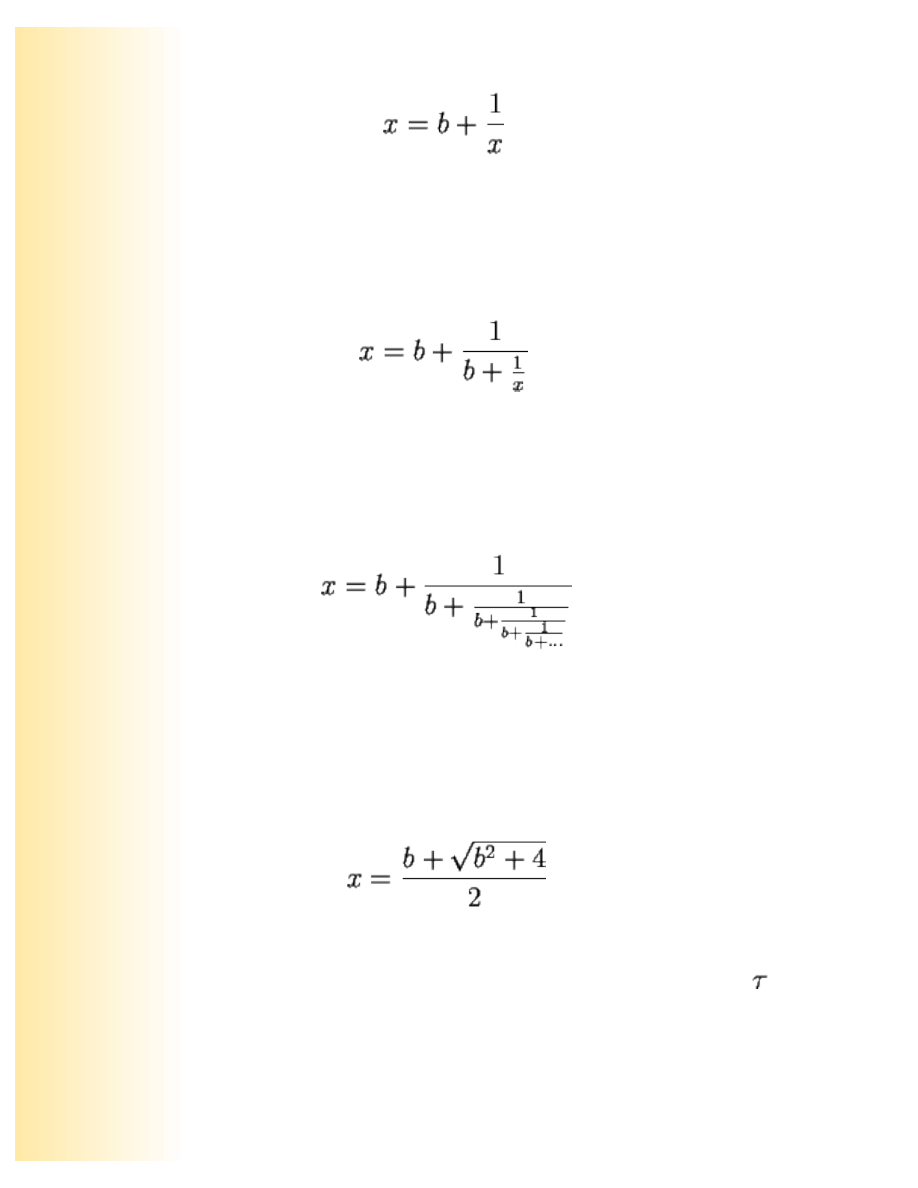
Dividing by x we can rewrite it as
file:///D|/John%20Barrow%20-%20Chaos%20In%20Numbeland/ChaosInNumberland.htm (1 of 20) [02.06.2007 18:25:36]
Chaos in Numberland: The secret life of continued fractions
(2)
Now substitute the expression for x given by the right-hand side of this equation for x in the
denominator on the right-hand side:
(3)
We can continue this incestuous procedure indefinitely, to produce a never-ending staircase of
fractions that is a type-setter's nightmare:
(4)
This staircase is an example of a continued fraction. If we return to equation 1 then we can simply
solve the quadratic equation to find the positive solution for x that is given by the continued fraction
expansion of equation 4; it is
(5)
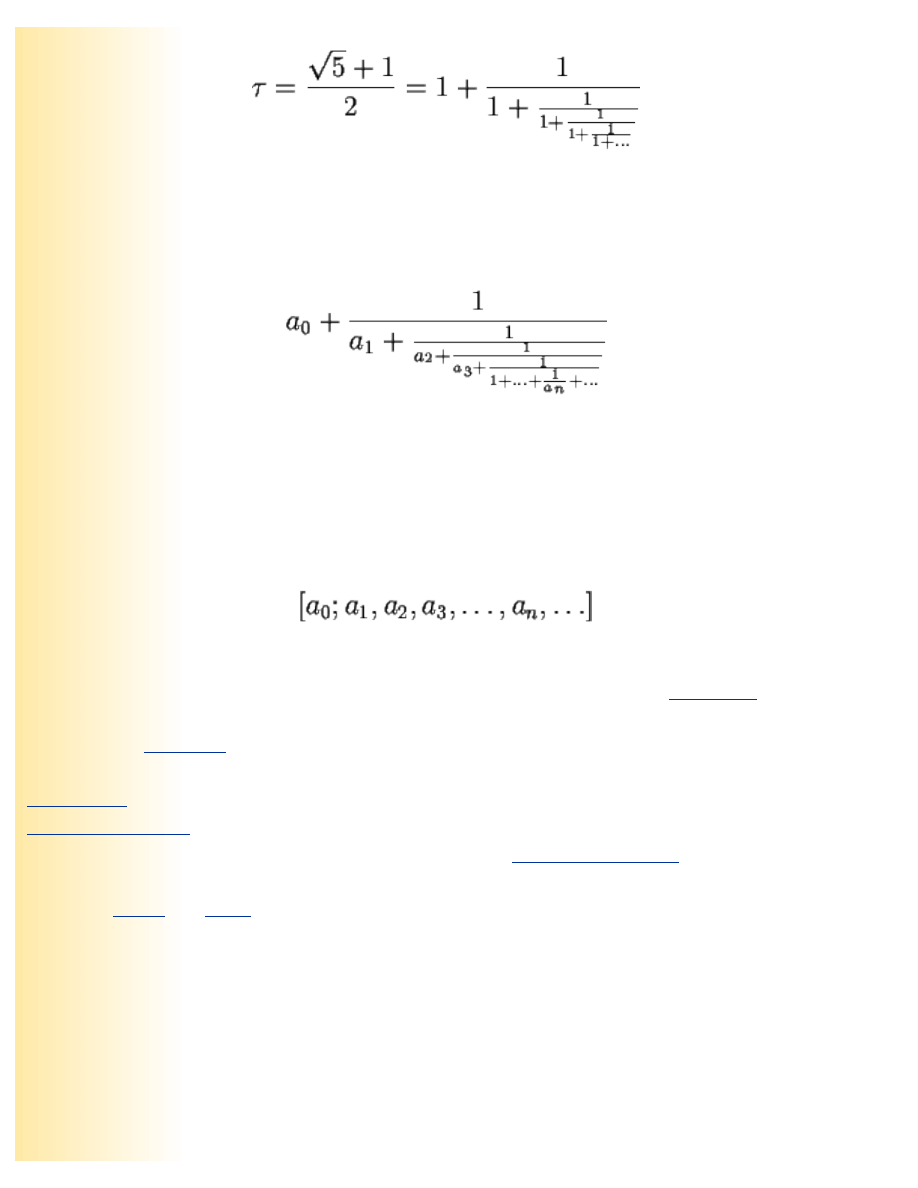
Picking b=1, we have generated the continued fraction expansion of the golden mean,
:
file:///D|/John%20Barrow%20-%20Chaos%20In%20Numbeland/ChaosInNumberland.htm (2 of 20) [02.06.2007 18:25:36]
Chaos in Numberland: The secret life of continued fractions
(6)
This form inspires us to define a general continued fraction of a number as
(7)
where the a
n
are n+1 positive integers, called the partial quotients of the continued fraction expansion
(cfe). To avoid the cumbersome notation we write an expansion of the form equation 7 as
(8)
Continued fractions first appeared in the works of the Indian mathematician
century. He used them to solve linear equations. They re-emerged in Europe in the 15th and 16th
centuries and
attempted to define them in a general way. The term 'continued fraction' first
appeared in 1653 in an edition of the book Arithmetica Infinitorum by the Oxford mathematician,
. Their properties were also much studied by one of Wallis's English contemporaries,
, who along with Wallis, was one of the founders of the Royal Society. At about
the same time, the famous Dutch mathematical physicist,
continued fractions in building scientific instruments. Later, in the eighteenth and early nineteenth
centuries,
explored many of their deep properties.
How long is a continued fraction?
Continued fractions can be finite in length or infinite, as in our example above. Finite cfes are unique
so long as we do not allow a quotient of 1in the final entry in the bracket (equation 8), so for example,
we should write 1/2 as [0;2] rather than as [0;1,1]. We can always eliminate a 1 from the last entry by
adding to the previous entry.
file:///D|/John%20Barrow%20-%20Chaos%20In%20Numbeland/ChaosInNumberland.htm (3 of 20) [02.06.2007 18:25:36]
Chaos in Numberland: The secret life of continued fractions
If cfes are finite in length then they can be evaluated level by level (starting at the bottom) and will
reduce always to a rational fraction; for example, the cfe [1,3,2,4]=40/31. However, cfes can be
infinite in length, as in equation 6 above. Infinite cfes produce representations of irrational numbers.
If we make some different choices for the constant bin equations 4 and 5 then we can generate some
other interesting expansions for numbers which are solutions of the quadratic equation. In fact, all
roots of quadratic equations with integer coefficients, like equation 5, have cfes which are eventually
periodic, like
or
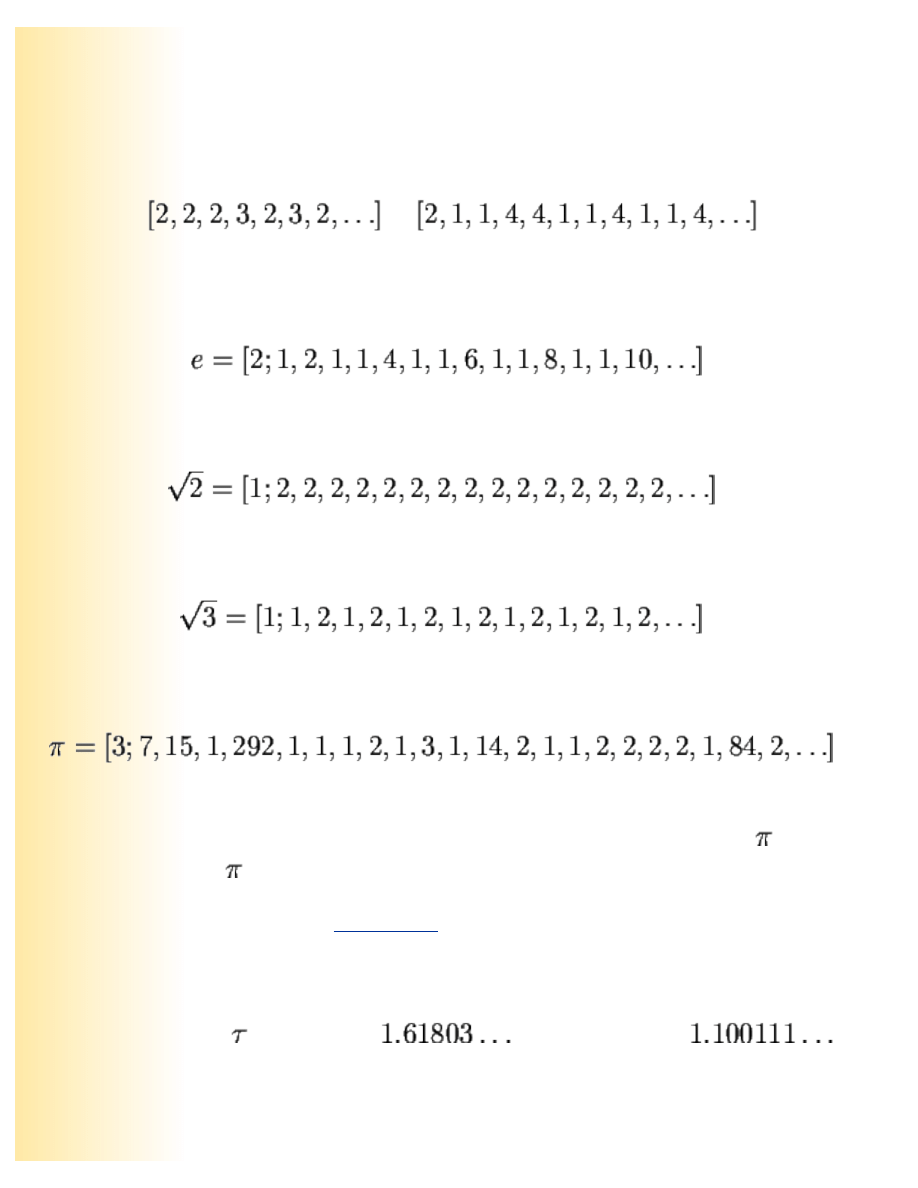
. Here are the
leading terms from a few notable examples of infinite cfes:
(9)
(10)
(11)
(12)
These examples reveal a number of possibilities. All of the expansions except that for
have simple
patterns whilst that for
, which was first calculated by John Wallis in 1685, has no obvious pattern
at all. There also seems to be a preference for the quotients to be small numbers in these examples.
The cfe for e was first calculated by
, the Plumian Professor of Experimental Philosophy
at Cambridge, in 1714.
Continued fractions allow us to probe an otherwise hidden order within the realm of numbers. If we
had written the number
as a decimal (
) or even in binary (
) then
it looks a pretty nondescript number. Only when it is written as a continued fraction does its unique
structure emerge.
file:///D|/John%20Barrow%20-%20Chaos%20In%20Numbeland/ChaosInNumberland.htm (4 of 20) [02.06.2007 18:25:36]
Chaos in Numberland: The secret life of continued fractions
Some Useful Applications
Approximating Pi
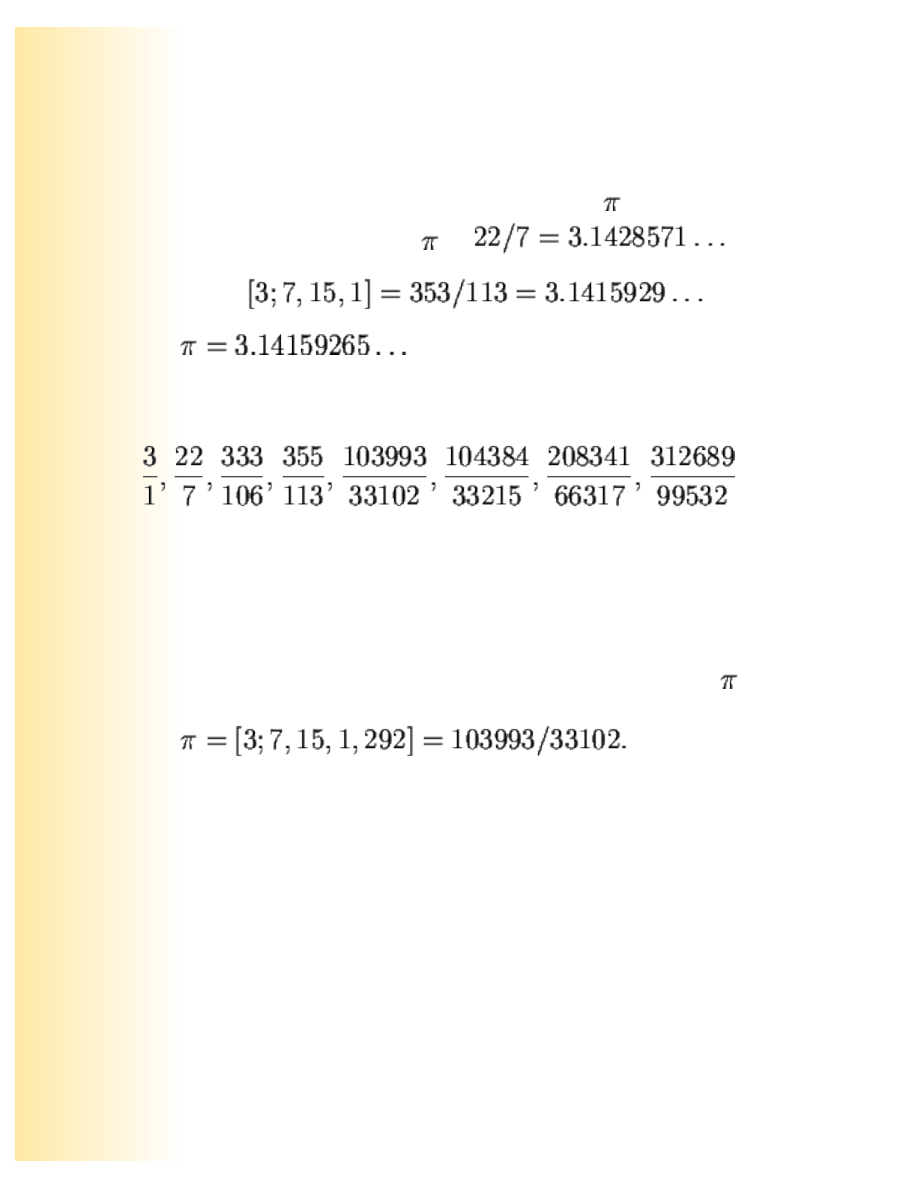
If we chop off an infinite cfe after a finite number of steps then we will create a rational
approximation to the original irrational. For example, in the case of
, if we chop off the cfe at [3;7]
we get the familiar rational approximation for
of
. If we keep two
more terms then we have
, an even better
approximation to
.This approximation was known to the early Chinese.
The first eight rational approximations are
(13)
The more terms we retain in the cfe, the better the rational approximation becomes. In fact, the cfe
provides the best possible rational approximations to a general irrational number. Notice also that if a
large number occurs in the expansion of quotients, then truncating the cfe after that will produce an
exceptionally good rational approximation. Later on we shall see that, in some sense, it is probable
that most cfe quotients are small numbers (1 or 2), so the appearance in the cfe of
of a number as
large as 292 so early in the expansion is rather unusual. It also leads to an extremely good rational
approximation to
Pythagorean musical scales
The ancient Pythagoreans discovered that the division of the string of a musical instrument by a ratio
determined by small integers resulted in an appealing relationship. For example, a half length gives a
frequency ratio of 2:1, the musical octave, and a third length gives a ratio of 3:2, the musical fifth, a
quarter length gives a frequency ratio 4:3, the musical fourth, a frequency ratio 5:4, the major third.
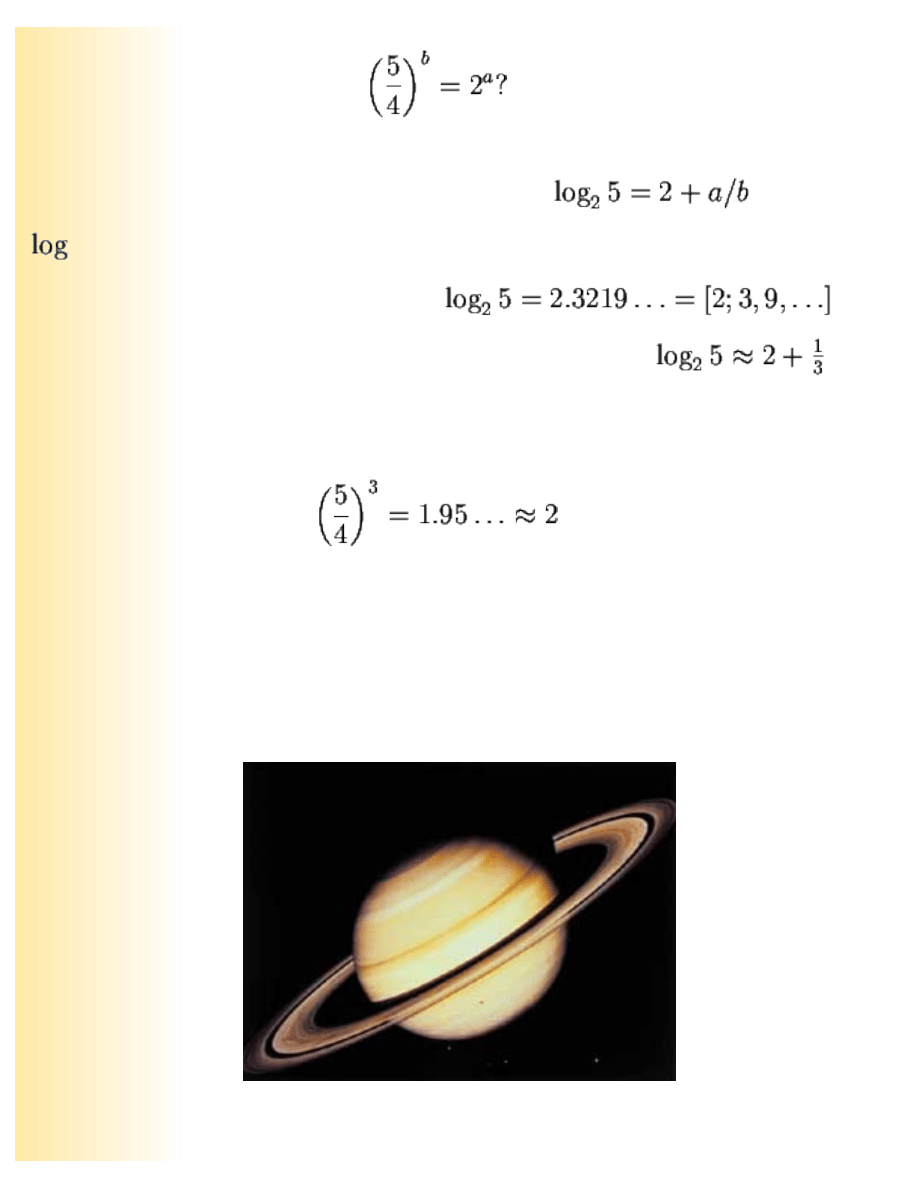
We can now ask how the Pythagorean scale fits together. For example, how many major thirds equal
an integral number of octaves; that is, when is
file:///D|/John%20Barrow%20-%20Chaos%20In%20Numbeland/ChaosInNumberland.htm (5 of 20) [02.06.2007 18:25:36]
Chaos in Numberland: The secret life of continued fractions
(14)
Taking logarithms to the base 2, we are looking for a solution
. Since the
is irrational there cannot be any exact solutions for integers a and b. But there are 'almost'
solutions. To find them we just look at the cfe of
.
Chopping it after the first fractional term gives the rational approximation
, so
the approximate solution to our problem is a=1, b=3, and
(15)
If we used the next cf approximant we would get a=9,b=28 which is rather awkward to handle.
Gears without tears
Saturn
file:///D|/John%20Barrow%20-%20Chaos%20In%20Numbeland/ChaosInNumberland.htm (6 of 20) [02.06.2007 18:25:36]
Chaos in Numberland: The secret life of continued fractions
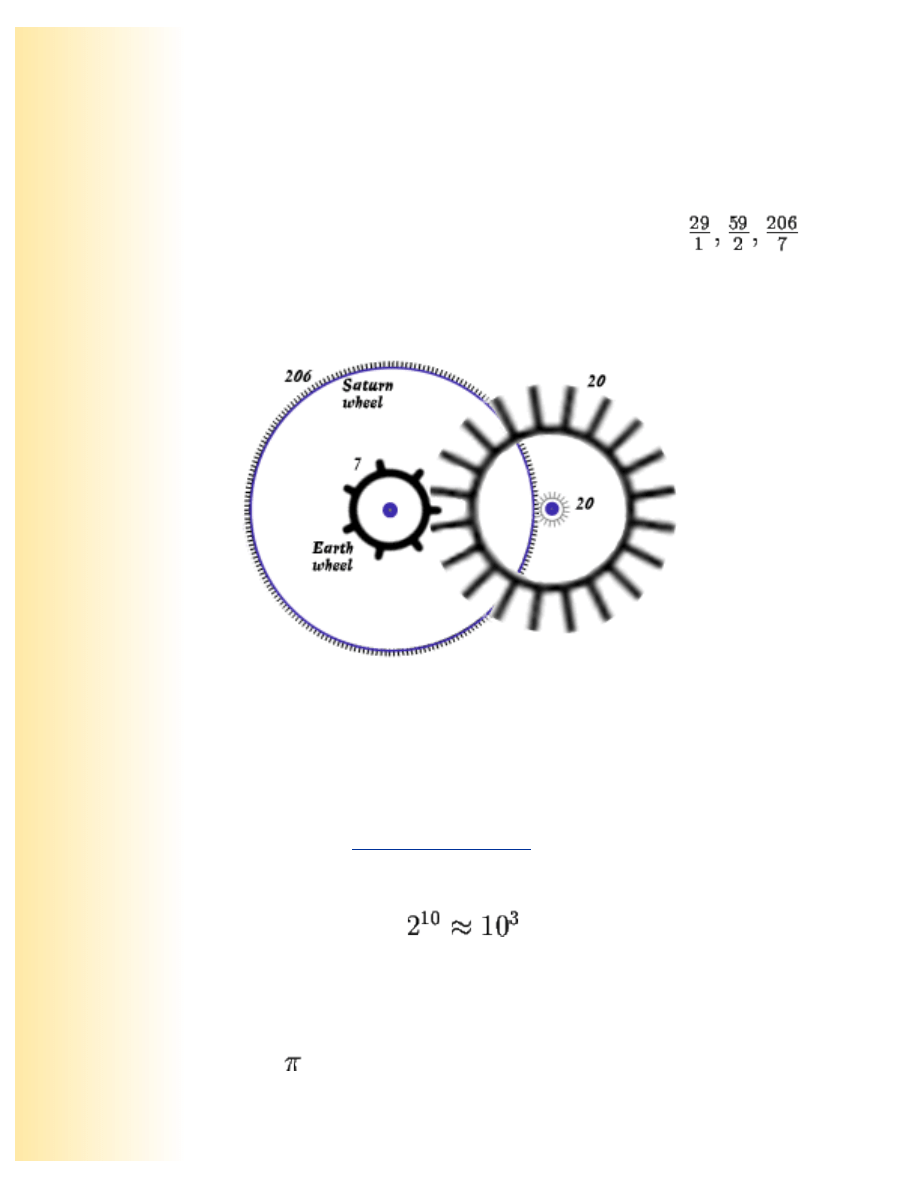
Huygens was building a mechanical model of the solar system and wanted to design the gear ratios to
produce a proper scaled version of the planetary orbits. So, for example, in Huygens' day it was
thought that the time required for the planet Saturn to orbit the Sun is 29.46 years (it is now known to
be 29.43 years). In order to model this motion correctly to scale, he needed to make two gears, one
with P teeth, the other with Q teeth, so that P/Q is approximately 29.46. Since it is hard to fashion
small gears with a huge number of teeth, Huygens looked for relatively small values of P and Q. He
calculated the cfe of 29.46 and read off the first few rational approximations:
. Thus, to
simulate accurately Saturn's motion with respect to that of the Earth's, Huygens made one gear with 7
teeth and the other with 206 teeth.
A schematic of Huygens' gear train
One of Ramanujan's tricks revealed
The remarkable Indian mathematician
(1887-1920) was famous for his uncanny
intuition about numbers and their inter-relationships. Like mathematicians of past centuries he was
fond of striking formulae and would delight in revealing (apparently from nowhere) extraordinarily
accurate approximations (can you show that
?). Ramanujan was especially fond of cfes
and had an intimate knowledge of their properties. Knowing this one can see how he arrived at some
of his unusual approximation formulae. He knew that when some irrational number produced a very
large quotient in the first few term of its cfe then it could be rationalised to produce an extremely
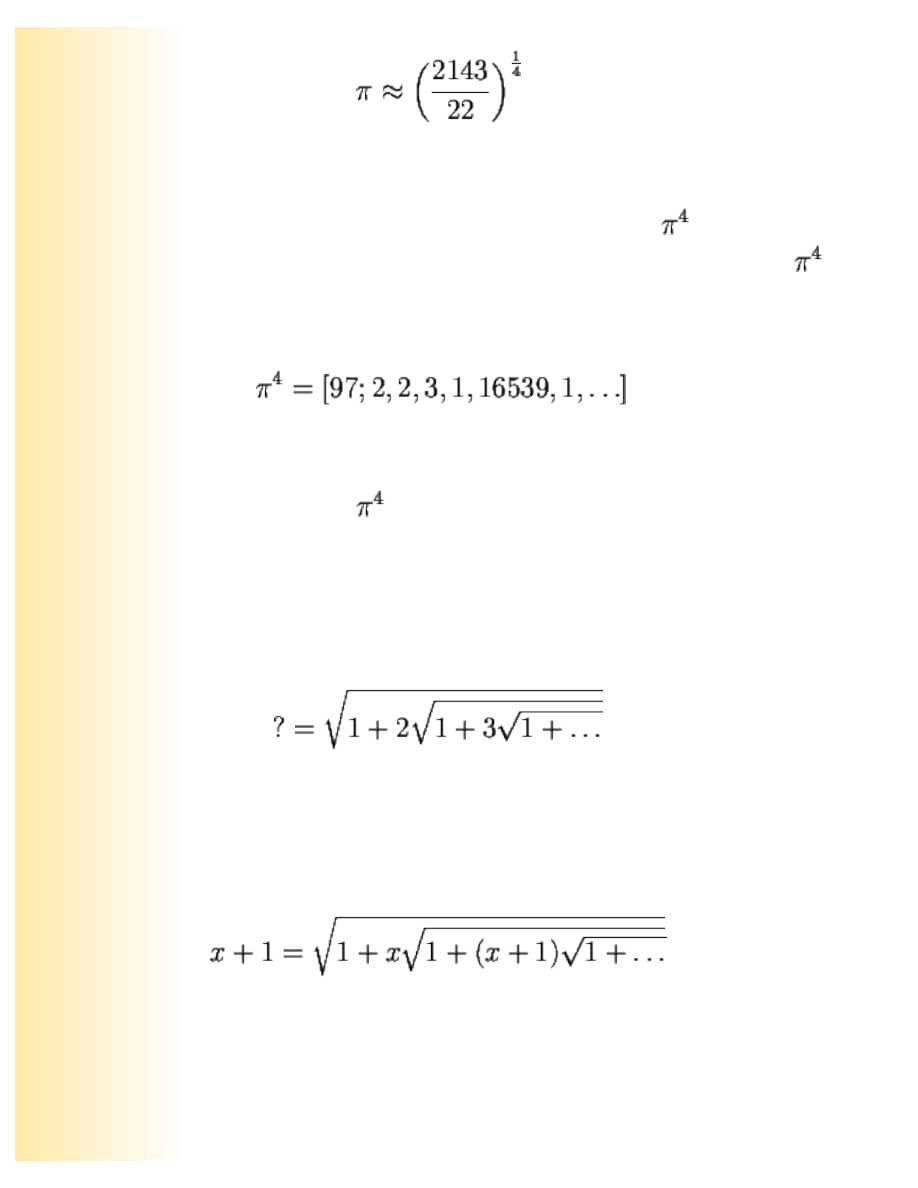
accurate approximation to some irrational. A nice example is provided by Ramanujan's
approximation to the value of
,
file:///D|/John%20Barrow%20-%20Chaos%20In%20Numbeland/ChaosInNumberland.htm (7 of 20) [02.06.2007 18:25:36]
Chaos in Numberland: The secret life of continued fractions
(16)
which is good to 3 parts in 10
4
. How did he arrive at this? Knowing of his fascination with continued
fractions we can guess that he knew something interesting about the cfe of
. Indeed, there is
something interesting to know: quotient number six in the continued fraction expansion of
is
huge:
(17)
By using the rational approximation that comes from truncating the cfe after 16539 you get a
remarkably accurate approximation to
; now just take its fourth root.
Ramanujan was also interested in other varieties of nested expansion. In 1911 he asked in an article in
the Journal of the Indian Mathematical Society what the value was of the following strange formula,
an infinite nested continued root:
(18)
A few months went by and no one could supply an answer. Ramanujan revealed that the answer is
simply 3 and proved a beautiful general formula for continued roots:
(19)
Applied mathematicians have found that by approximating functions by continued function
expansions, called Padé approximants, they often obtain far more accurate low-order approximations
than by using Taylor series expansions. By truncating them at some finite order, they end up with an
approximation that is represented by the ratio of two polynomials.
file:///D|/John%20Barrow%20-%20Chaos%20In%20Numbeland/ChaosInNumberland.htm (8 of 20) [02.06.2007 18:25:36]
Chaos in Numberland: The secret life of continued fractions
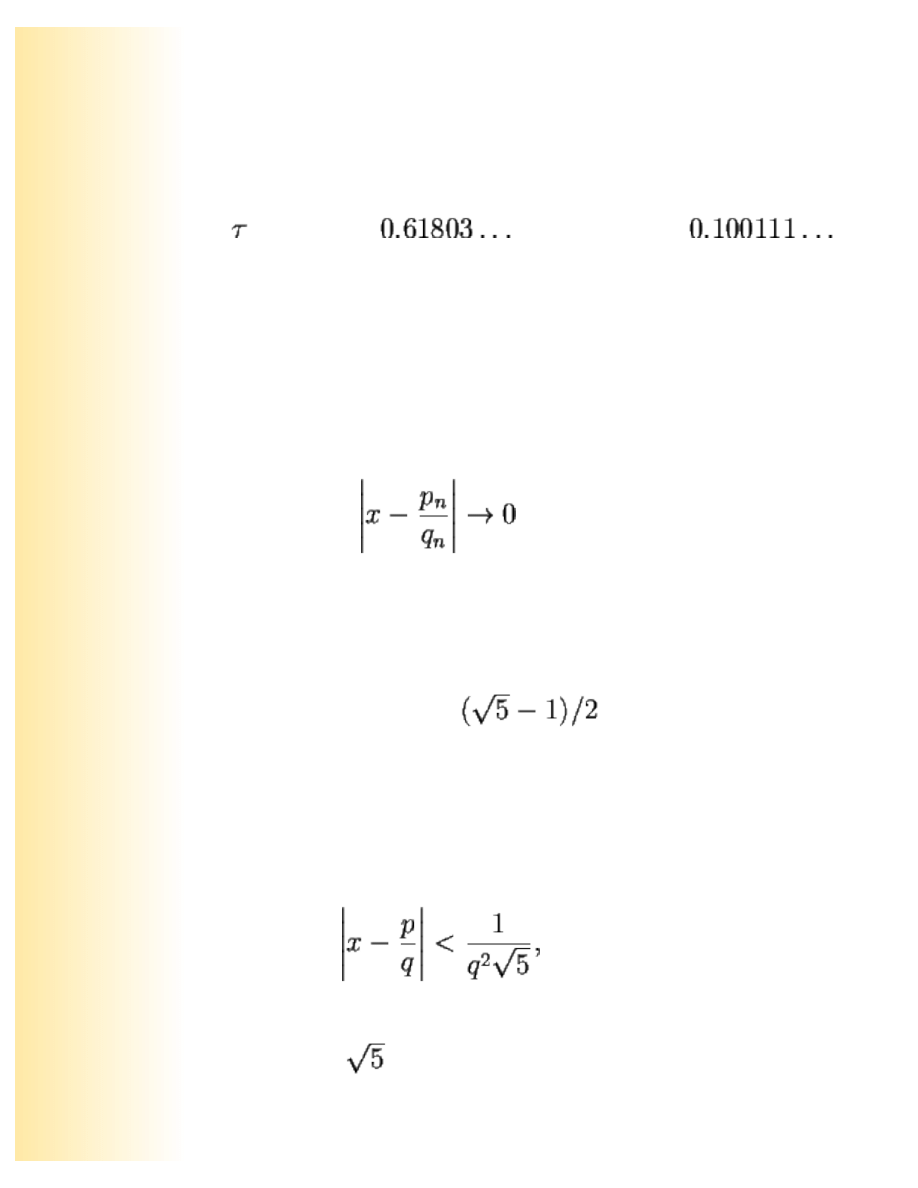
Rational approximations --how good can they get?
Minding your p's and q's
Continued fractions allow us to probe an otherwise hidden order within the realm of numbers. If we
had written the number
as a decimal (
) or even in binary (
) then
it looks a pretty nondescript number. Only when it is written as a continued fraction does its unique
status emerge.
The rational fractions which are obtained by chopping off a cfe at order nare called the convergents of
the cf. We denote them by p
n
/ q
n
. As n increases, the difference between an irrational x and its
convergent decreases
(20)
how quickly?
The cfe also allows us to gauge the simplicity of an irrational number, according to how easily it is
approximatable by a rational fraction. The number
is in this sense the most
'irrational of numbers', converging slowest of all to a rational fraction because all the a
i
are equal to 1,
the smallest possible value. In fact, Lagrange showed that for any irrational number x there are an
infinite number of rational approximations, p/q, satisfying
(21)
where the statement becomes false if
is replaced by a larger number. In the case of the rational
file:///D|/John%20Barrow%20-%20Chaos%20In%20Numbeland/ChaosInNumberland.htm (9 of 20) [02.06.2007 18:25:36]
Chaos in Numberland: The secret life of continued fractions
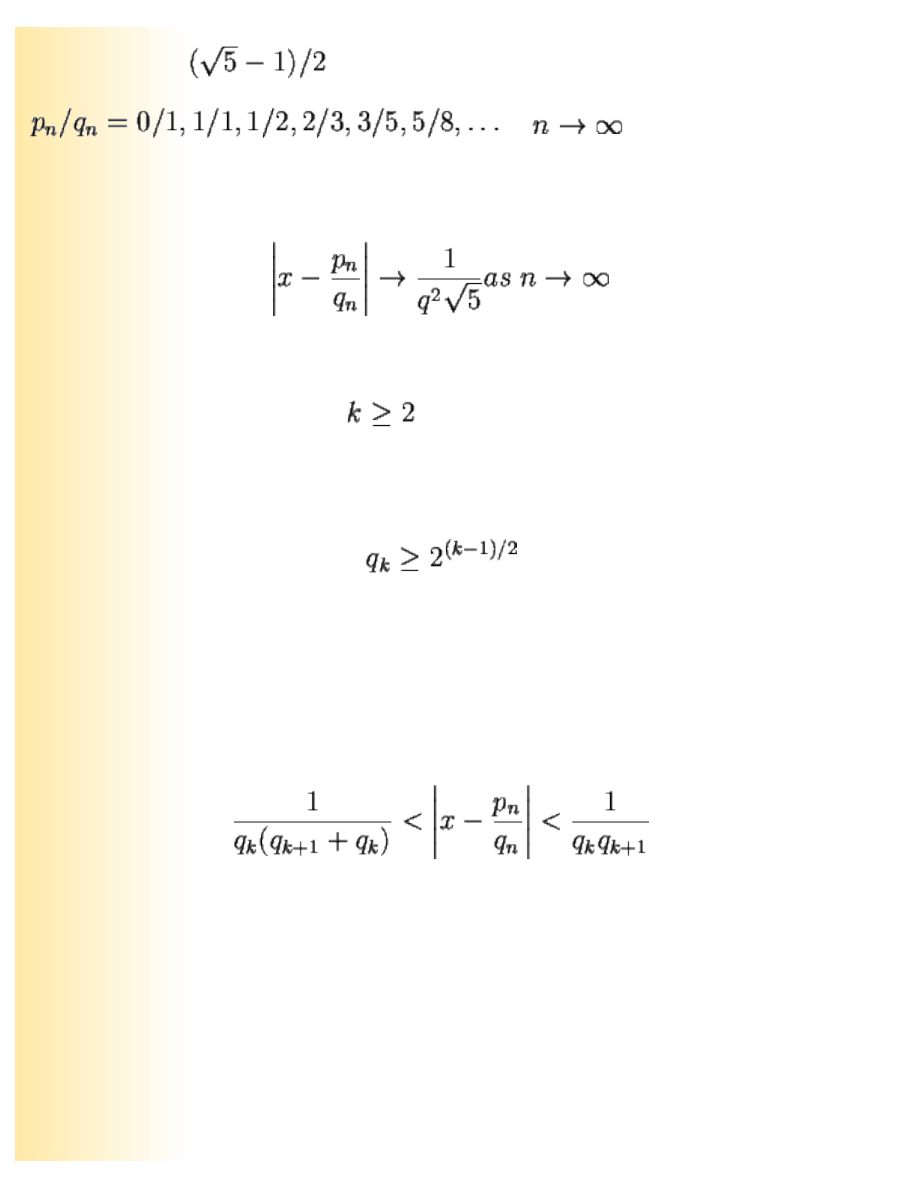
approximations to
provided by the cfe, they are
as
and they have the weakest
convergent rate allowed by equation 21 with
(22)
Thus the cfe shows that the golden mean stays farther away from the rational numbers than any other
irrational number. Moreover, for any
, the denominator to the rational approximation
produced by truncating the cfe of any number satisfies
(23)
If the cfe is finite then k will only extend up to the end of the expansion. In fact, it is possible to pin
down the accuracy of the rational approximation in terms of the denominators, q
i
, from both
directions by
(24)
There are many other interesting properties of cfes but one might have thought that there could not be
any very strong properties or patterns in the cfes of all numbers because they can behave in any way
that you wish. Pick any finite or infinite list of integers that you like any they will form the quotients
a
n
of one and only one number. Conversely, any real number you care to choose will have a unique
cfe into a finite or an infinite list of integers which form the quotients of its cfe. A search for general
properties thus seems hopeless. Pick a list (finite or infinite) of integers with any series of properties
that you care to name and it will form the cfe of some number. However, while this is true, if we
restrict our search to the properties of the cfes of almost any (a.e.) real number - so omitting a set of
file:///D|/John%20Barrow%20-%20Chaos%20In%20Numbeland/ChaosInNumberland.htm (10 of 20) [02.06.2007 18:25:36]
Chaos in Numberland: The secret life of continued fractions
'special numbers' which have a zero probability of being chosen at random from all the real numbers -
then there are remarkable general properties shared by all their cfes.
The Patterns Behind Almost Every Number
Gauss's other probability distribution
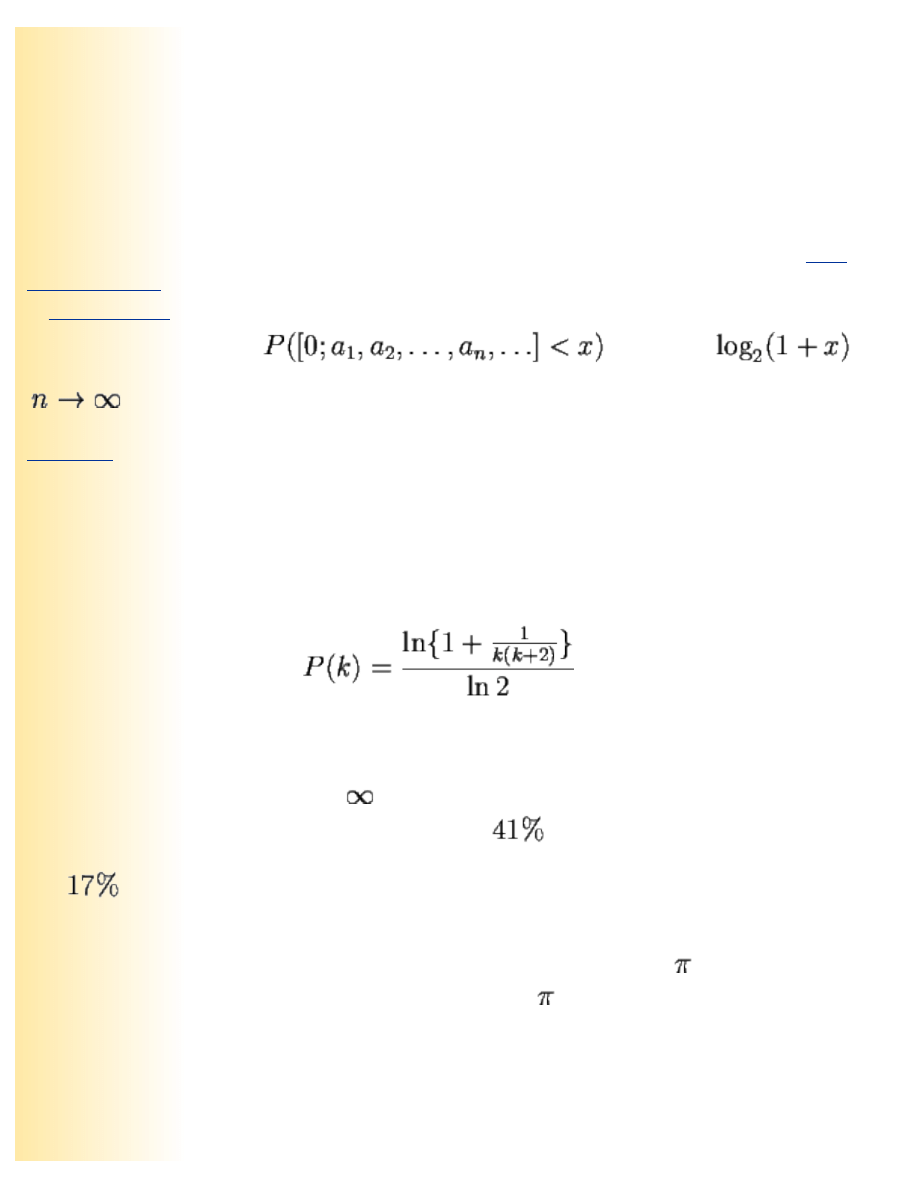
The general pattern of cfes was first discovered in 1812 by the great German mathematician
(1777-1855), but (typically) he didn't publish his findings. Instead, he merely wrote
to
in Paris telling him what he had found, that for typical continued fraction
expansions, the probability
approaches
as
. Only in 1928 was Gauss's proof reconstructed and generalised by the Russian
mathematician R.O. Kuzmin and (in a different way), also one year later by the French mathematician
If we consider the infinite cfe of a.e. real number then, in the limit that n grows large, the probability
that the quotient a
n
is equal to the integer k approaches
(25)
This has some important features. First, check that, because it is a probability distribution, if we take
the sum over all values of k from 1to
, the answer is 1. Second, we see that large values of kare
rare: in fact, evaluating P(1),P(2) etc shows that about
of the quotients are expected to be 1,
and
to be 2. As k increases the probability of larger values of k appearing in the quotients is
very small. If we look at our examples in equations 9-12 then we see that e is a member of the special
set of real numbers not included in the designation 'almost every'. However,
appears to be a
member. If we look back at Ramanujan's approximation for
, generated from equation 17, we see
that the probability of a quotient as large as 16539 is only about 5 parts in 10
9
.
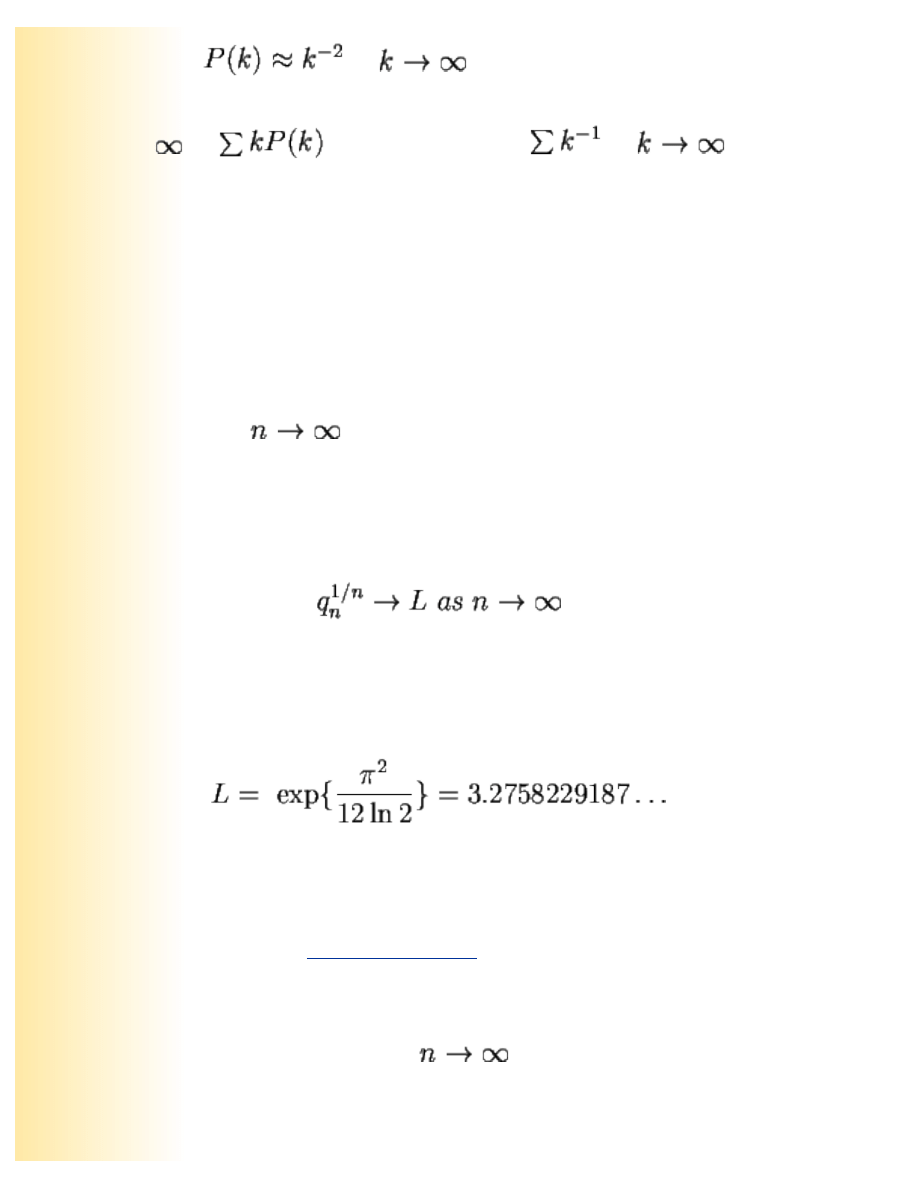
If we make k large enough to expand the numerator using the binomial theorem (so that k(k+2)
file:///D|/John%20Barrow%20-%20Chaos%20In%20Numbeland/ChaosInNumberland.htm (11 of 20) [02.06.2007 18:25:36]
Chaos in Numberland: The secret life of continued fractions
behaves as k
2
), then
as
. This means that if we try to find the average (or
arithmetic mean) value of k in the cfe of a.e. number we get an infinite answer. The average is the
sum from 1 to
of
which only falls off as
as
and this sum
diverges.
Lévy's constant
Paul Lévy showed that when we confine attention to almost every continued fraction expansion then
we can say something equally surprising and general about the rational convergents. We have already
seen in equations 21-24 that the rational approximations to real numbers improve as some constant
times q
n
-2
as n increases. It can be shown that, for a.e. number, its q
n
cannot grow exponentially fast
as n increases ( q
n
<e
An
as
for some positive A). Lévy isolated the actual growth rate to be
determined by a fundamental constant, so that for the denominators of the quotients in the cfe of
almost any real number
(26)
where the Lévy constant, L, is found to be
(27)
Khinchin's constant
Then the Russian mathematician
(1894-1959) proved the third striking result
about the quotients of almost any cfe. Although the arithmetic mean, or average, of the k
i
does not
have a finite value, the geometric mean does. Indeed, it has a finite value that is universal for the cfes
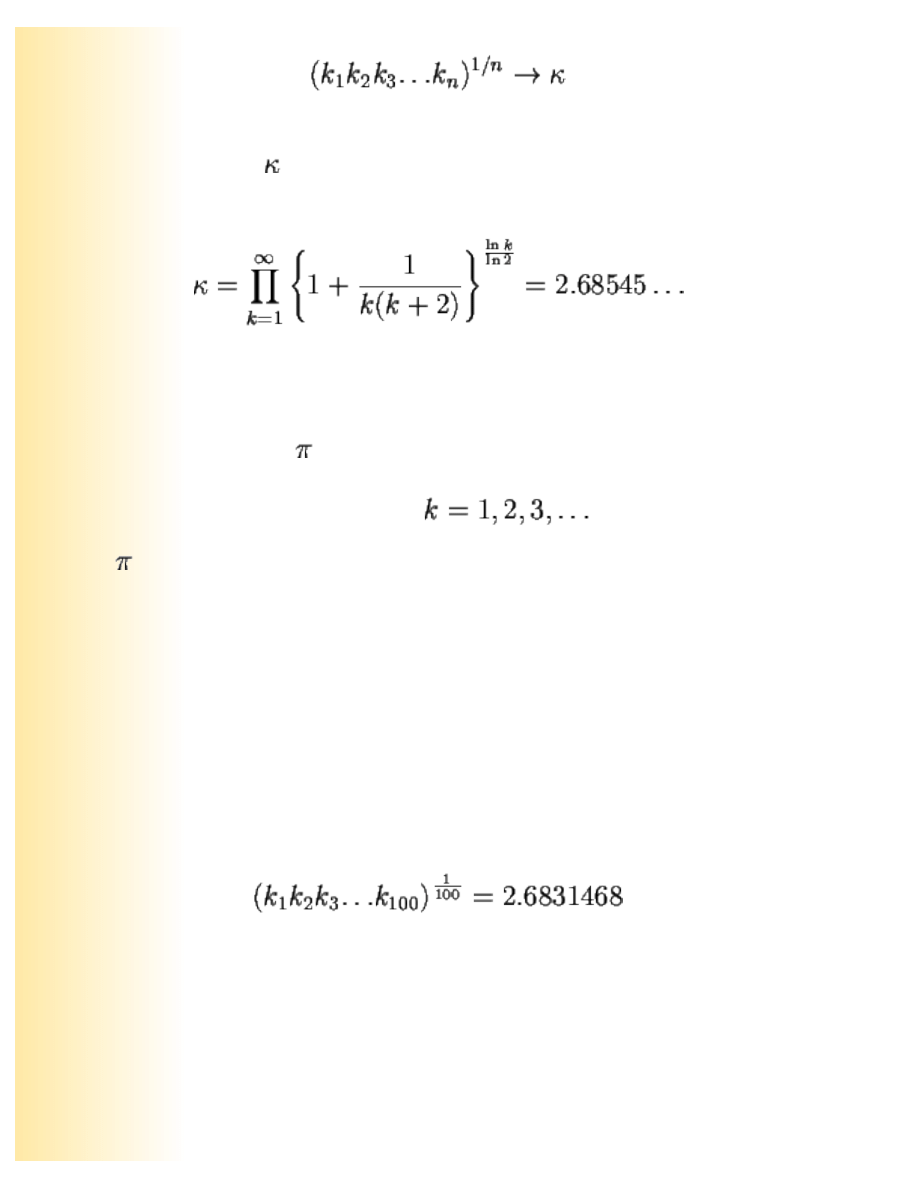
of almost all real numbers. He showed that as
file:///D|/John%20Barrow%20-%20Chaos%20In%20Numbeland/ChaosInNumberland.htm (12 of 20) [02.06.2007 18:25:36]
Chaos in Numberland: The secret life of continued fractions
(28)
where Khinchin's constant,
, is given by a slowly converging infinite product
(29)
Thus the geometric mean quotient value is about 2.68, reflecting the domination by small values that
we have seen in the probability distribution. Again, it is interesting to see how closely this value is
approached by the quotients of
.
If we list the appearance of different values of
etc amongst the first 100 terms in
the cfe of
, then the k values and their frequencies N(k) in decreasing order of appearance, are as
follows:
k
1
2 3 4 5 6 7 8 15 10 12 13 14 16 22 24 45 84 99 161 292
N(k) 41 22 7 4 2 5 3 2 2
1
1
1
1
1
1
1
1
1
1
1
1
We see that there is already quite good convergence to the predicted values of P(k) for the small
values of k. If we calculate the geometric mean, then we find even better convergence to Khinchin's
constant,
(30)
Remarkably, if you calculate the cfe of Khinchin's constant itself you will find that its terms also have
a geometric mean that approaches Khinchin's constant as their number approaches infinity.
A notable exception
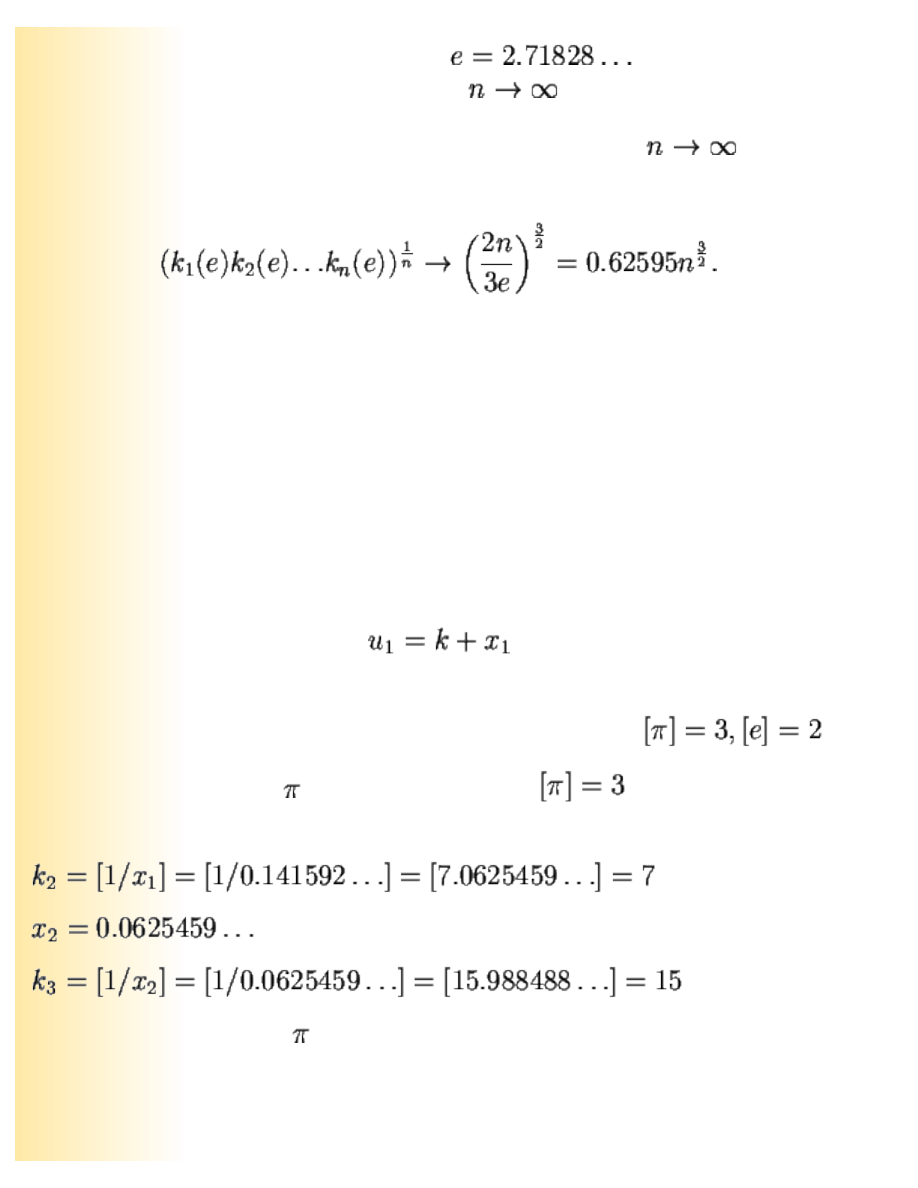
The most important number that is not a member of the club of 'almost every number' whose
file:///D|/John%20Barrow%20-%20Chaos%20In%20Numbeland/ChaosInNumberland.htm (13 of 20) [02.06.2007 18:25:36]
Chaos in Numberland: The secret life of continued fractions
geometric mean k value approaches Khinchin's is
. From equation 9, it is easy
to work out what happens to the geometric mean as
. All the 1's do nothing to the product
of the k's and what remains is just twice the product of successive numbers, which introduces n! and
so we can use a good approximation for it, like Stirling's, to show that as
(31)
Chaotic Numbers
Numbers as chaotic processes
The operation of generating the infinite list of cfe quotients from a.e. real number is a chaotic process.
Suppose the real number we wish to expand is u
1
and we split it into the sum of its integer part
(denoted k) and its fractional part (denoted x), so
(32)
Sometimes we write k=[u] to denote taking the integer part; for example
. Now
if we start with a number like
, the first quotient k
1
is just
, and the fractional part is
x
1
=0.141592. The next quotient is the integer part of the fractional part,
; the next fractional part is
, and so
. This simple procedure
gives the first few quotients of
, that we listed above in equation 12. The fractional parts (by
definition) are always real numbers between 0 and 1. They cannot be equal to 0 or 1 or the number u
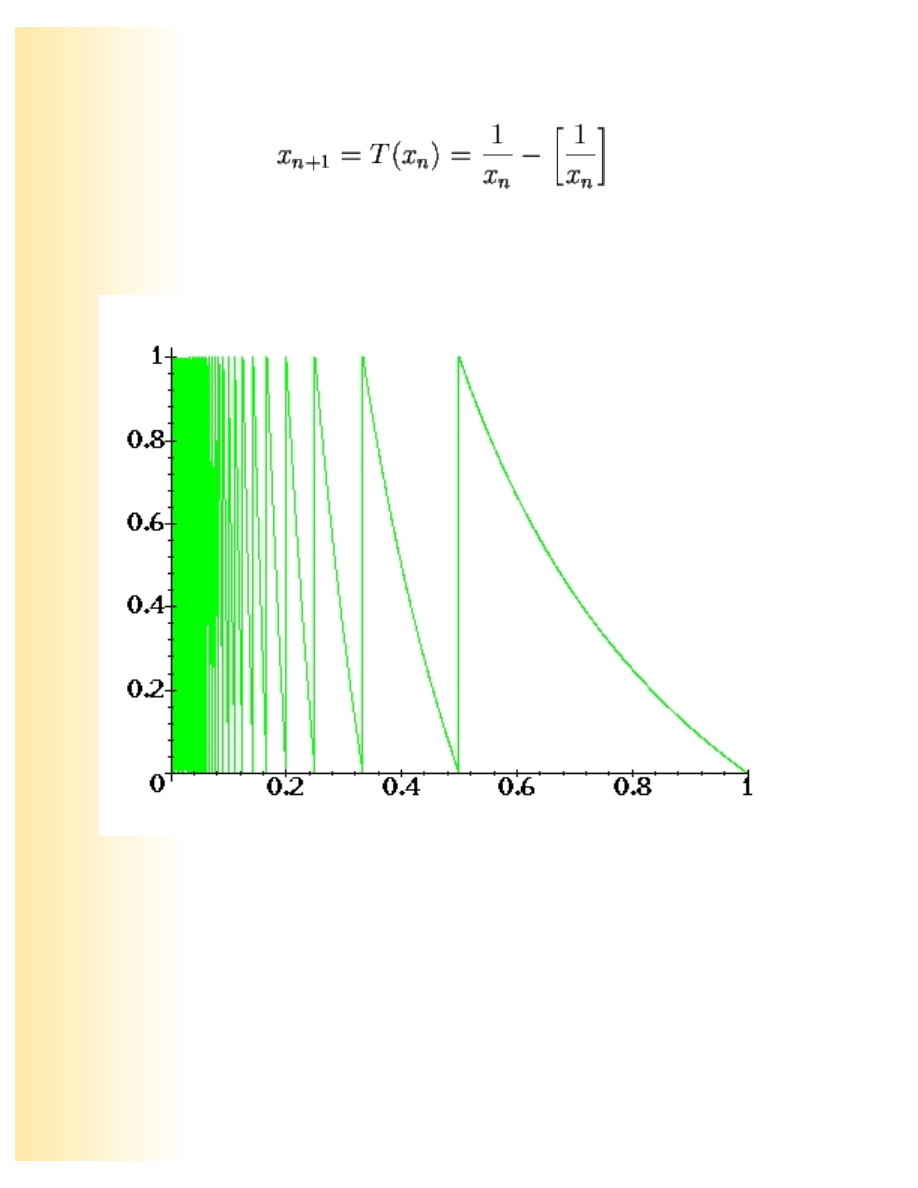
would be a rational fraction and the cfe would be finite. The process of generating successive
fractional parts is given by a non-linear difference equation which maps x into 1/x and then subtracts
file:///D|/John%20Barrow%20-%20Chaos%20In%20Numbeland/ChaosInNumberland.htm (14 of 20) [02.06.2007 18:25:36]
Chaos in Numberland: The secret life of continued fractions
the integer part:
(33)
The function T(x) is composed of an infinite number of hyperbolic branches.
Graph 1: The function T(x) (equation 33).
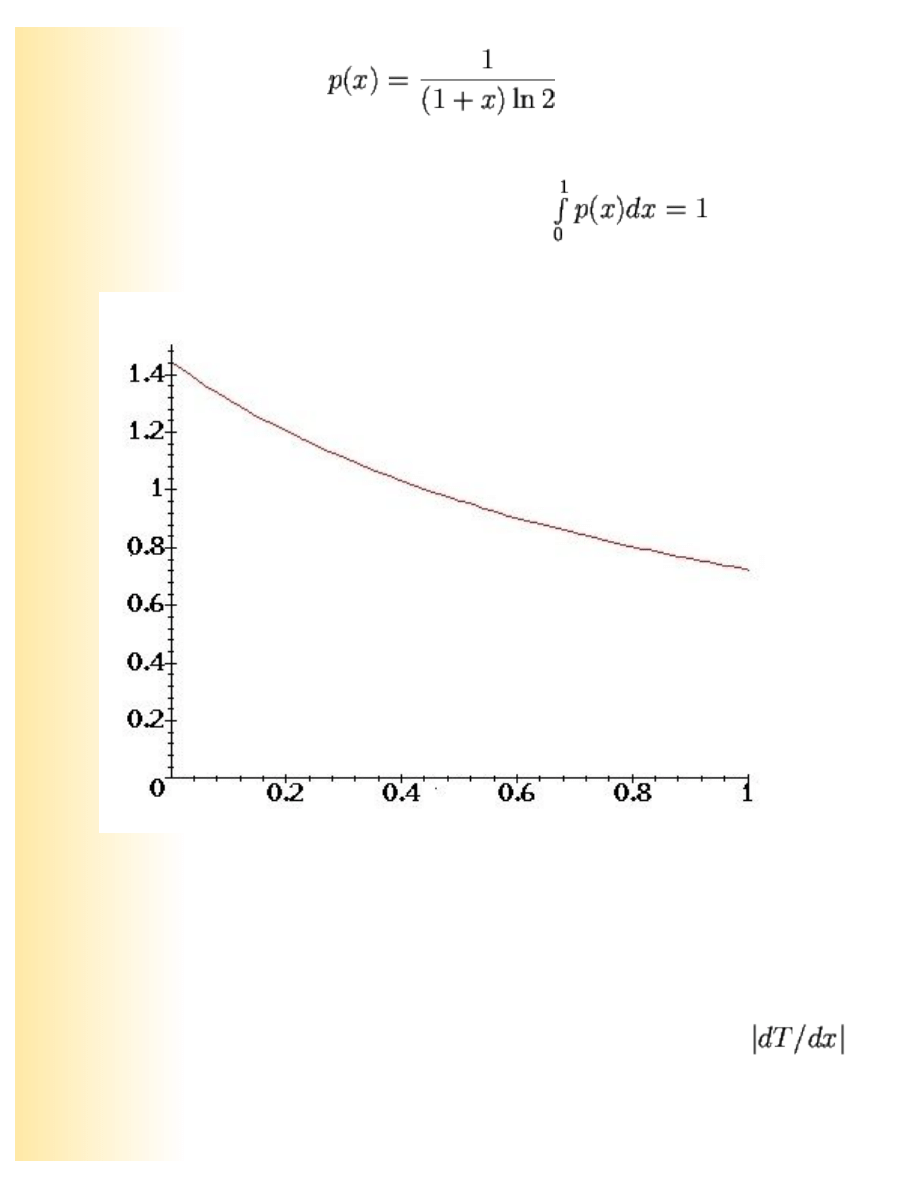
If we apply this mapping over and over again from almost any starting value given by a real number
with an infinite cfe, then the output of values of xapproaches a particular probability distribution, first
found by Gauss:
file:///D|/John%20Barrow%20-%20Chaos%20In%20Numbeland/ChaosInNumberland.htm (15 of 20) [02.06.2007 18:25:36]
Chaos in Numberland: The secret life of continued fractions
(34)
Again, as with any probability distribution, we can check that
.
Graph 2: The probability distribution p(x) (equation 34).
What is chaos?
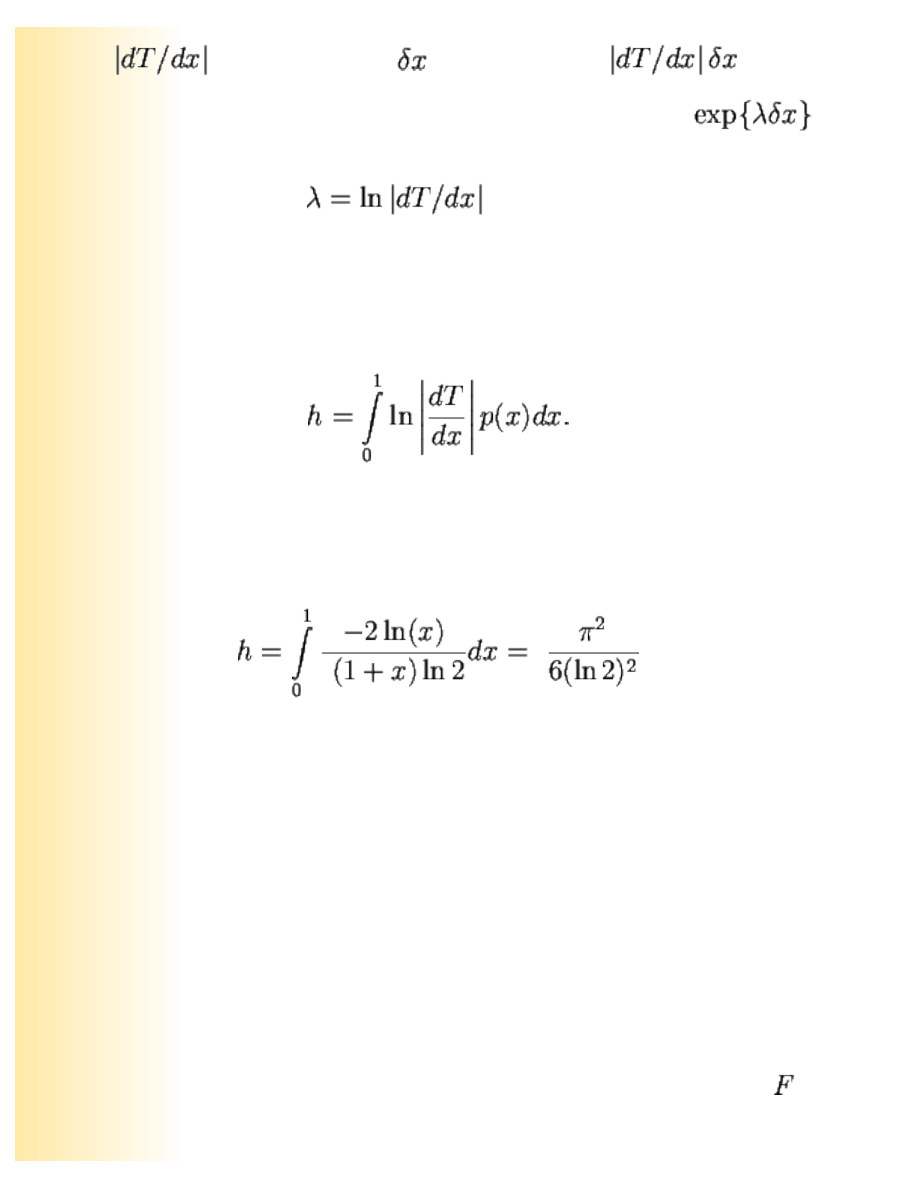
In order for a mapping like T to be chaotic it must amplify small differences in values of x when the
mapping is applied over and over again. This requires the magnitude of its derivative
to
be everywhere greater than 1. Since dT/dx=-1/x
2
and 0<x<1 this is clearly true. But this amplification
sensitivity clearly depends on the xvalue that is generated - the closer the value is to x=0 so the
file:///D|/John%20Barrow%20-%20Chaos%20In%20Numbeland/ChaosInNumberland.htm (16 of 20) [02.06.2007 18:25:36]
Chaos in Numberland: The secret life of continued fractions
greater is
. A small uncertainty
will be amplified to
by the action of
the map T. Chaotic sensitivity means that the growth is exponentially rapid, as
.
We shall take the mean value of
, the exponent of sensitivity, averaged with
respect to the probability distribution, equation 34, that governs the output of x values from the map
T. This mean sensitivity, denoted h, is sometimes called the Kolmogorov, or metric, entropy of the
mapping, and is therefore given by
(35)
For our mapping T, given by equation 33, its value is given by
(36)
If h is non-zero then a mapping is said to be chaotic: small uncertainties in its initial conditions will
be exponentially amplified as the mapping is iterated. In the case of a cfe we see that this means that
the cfes of two real numbers that are very close will ultimately diverge exponentially with n, the
number quotients generated.
Continued fractions provide one of the simplest exactly soluble chaotic mappings. Notice how the
probability distribution is very smooth and simple, even though the succession of outputs from
iterations of the map to generate successive x
i
appears purposeless. The mapping is deterministic but
any uncertainty in the initial conditions (because the value of x
0
is prescribed to only a finite number
of decimal places) will be rapidly amplified.
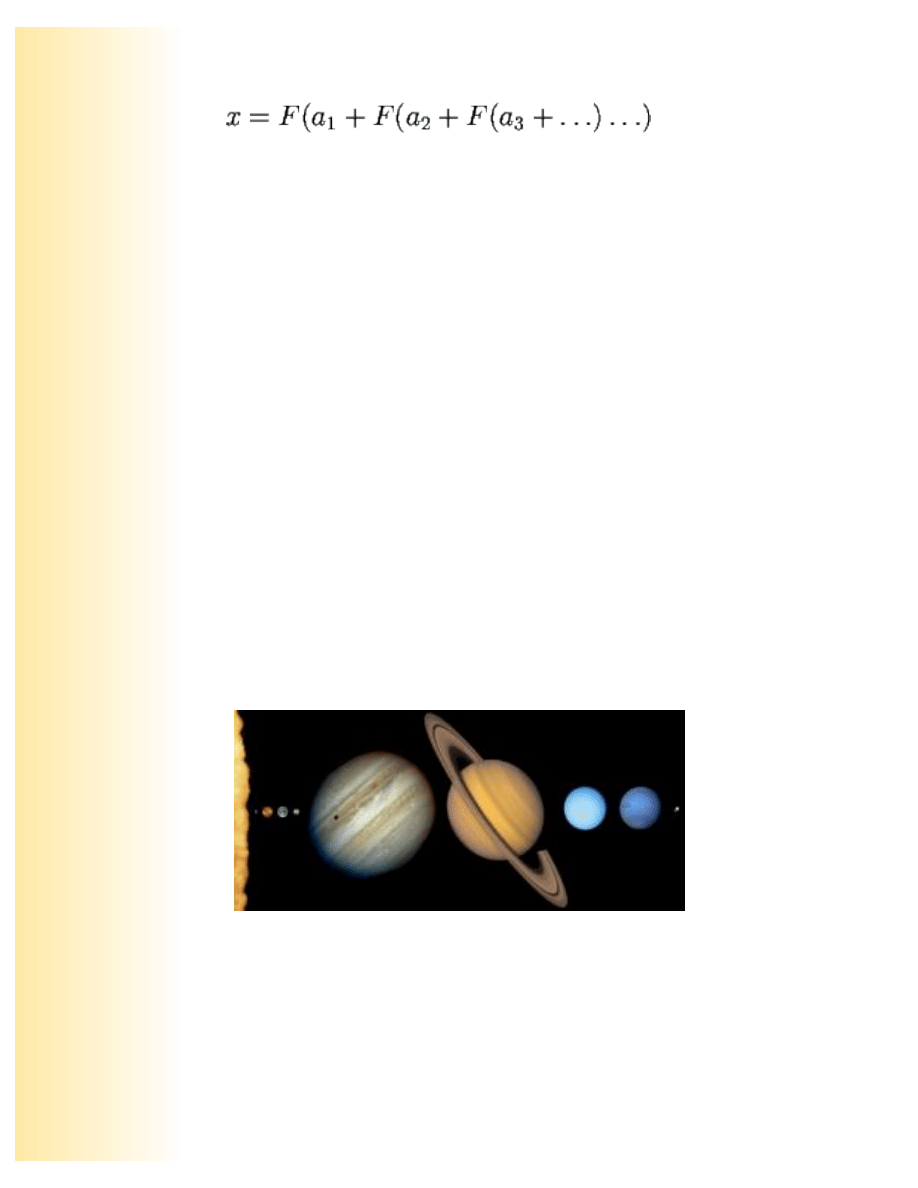
The cfe of a real number can be generalised in a natural way to create what is called the
-
expansion of a real number x (0<x<1), by writing
file:///D|/John%20Barrow%20-%20Chaos%20In%20Numbeland/ChaosInNumberland.htm (17 of 20) [02.06.2007 18:25:36]
Chaos in Numberland: The secret life of continued fractions
(37)
where F is a monotonically increasing or decreasing positive function. The a
i
(x) are non-negative
digits that specify the quotients of the F-expansion of x. The cfe is the particular case of F(x)=x
-1
.
Continued Fractions in the Universe
Continued fractions appear in the study of many chaotic systems. If a problem of dynamics reduces to
the motion of a point bouncing off the walls of a non-circular enclosure, of which the game of
billiards is a classic example, then continued fraction expansions of the numbers fixing the initial
conditions will describe many aspects of the dynamics as a sequence of collisions occurs. A striking
example of this sort has been discovered in the study of solutions in the general theory of relativity,
which describe the behaviour of possible universes as we follow them back to the start of their
expansion, or follow the behaviour of matter as it plummets into the central singularity of a black
hole. In each of these cases, a chaotic sequence of tidal oscillations occurs, whose statistics are
exactly described by the continued fraction expansion of numbers that specify their starting
conditions. Even though the individual trajectory of a particle falling into the black hole singularity is
chaotically unpredictable, it possesses statistical regularities that are determined by the general
properties of cfes. The constants of Khinchin and Lévy turn out to characterise the behaviour of these
problems of cosmology and black hole physics.
The Solar System
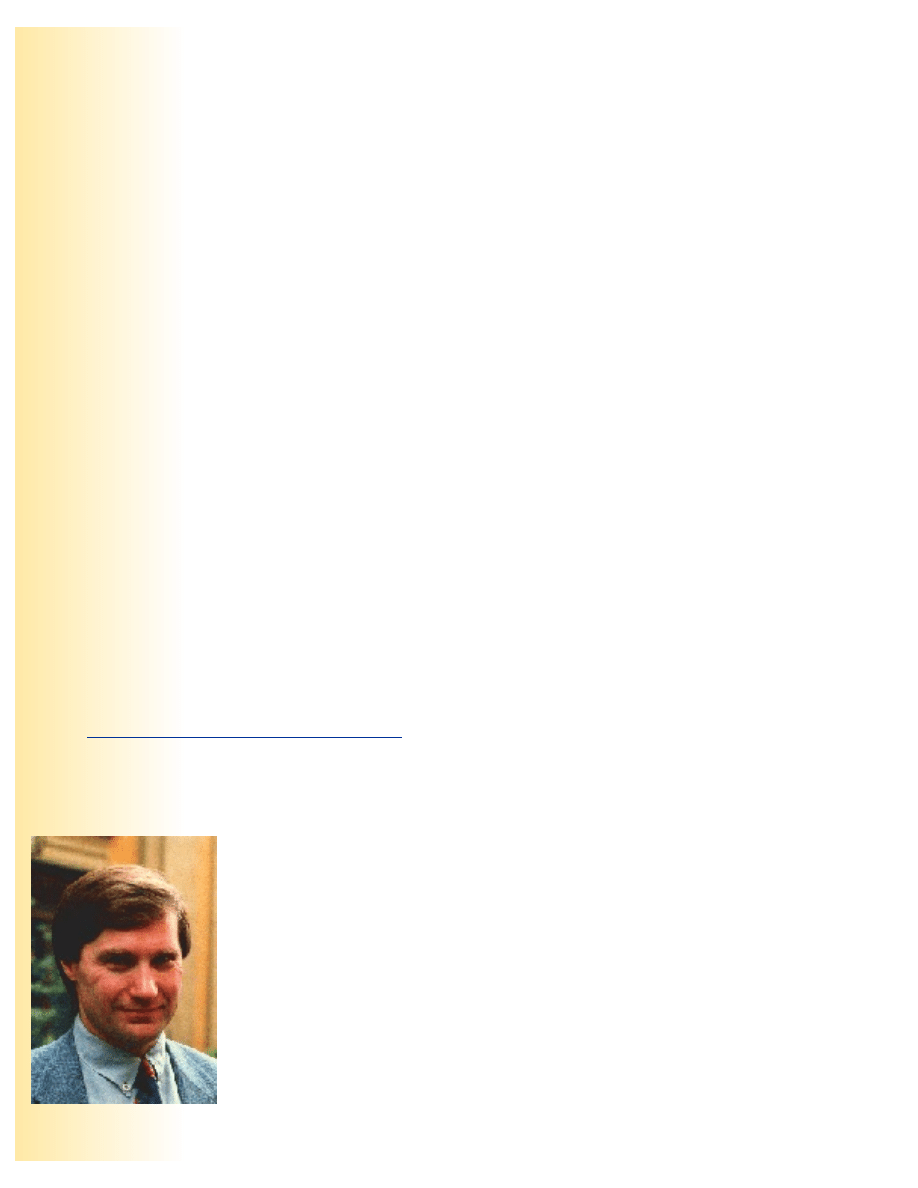
Continued fractions are also prominent in other chaotic orbit problems. Numbers whose cfes end in
an infinite string of 1s, like the golden mean, are called noble numbers. The golden mean is the
'noblest' of all because all of its quotients are 1s. As we have said earlier, this reflects the fact that it is
most poorly approximated by a rational number. Consequently, these numbers characterise the
frequencies of undulating motions which are least susceptible to being perturbed into chaotic
instability. Typically, a system which can oscillate in two ways, like a star that is orbiting around a
file:///D|/John%20Barrow%20-%20Chaos%20In%20Numbeland/ChaosInNumberland.htm (18 of 20) [02.06.2007 18:25:36]
Chaos in Numberland: The secret life of continued fractions
galaxy and also wobbling up and down through the plane of the galaxy, will have two frequencies
determining those different oscillations. If the ratio of those frequencies is a rational fraction then the
motion will ultimately be periodic, but if it is an irrational number then the motion will be non-
periodic, exploring all the possibilities compatible with the conservation of its energy and angular
momentum. If we perturb a system that has a rational frequency ratio, then it can easily be shifted into
a chaotic situation with irrational frequencies. The golden ratio is the most stable because it is farthest
away from one of these irrational ratios. In fact, the stability of our solar system over long periods of
time is contingent upon certain frequency ratios lying very close to noble numbers.
Continued fractions are a forgotten part of our mathematical education but their properties are vital
guides to approximation and important probes of the complexities of dynamical chaos. They appear
in a huge variety of physical problems. I hope that this article has given a taste of their unexpected
properties.
Further Reading:
●
J.D. Barrow, "Chaotic Behaviour in General Relativity", Physics Reports 85, 1 (1982).
●
G.H. Hardy and E.M. Wright, An Introduction to the Theory of Numbers, Oxford University
Presss, 4th ed. (1968).
●
A.Y. Khinchin, Continued Fractions, University of Chicago Press (1961).
●
C.D. Olds, Continued Fractions, Random House, NY (1963).
●
M. Schroeder, Number Theory in Science and Communication, 2nd edn., Springer (1986).
●
D. Shanks and J.W. Wrench, "Khinchin's Constant", American Mathematics Monthly 66, 276
(1959)
●
J.J. Tattersall, Elementary Number Theory in Nine Chapters, Cambridge University Press
(1999).
http://www.total.net/~haver/cfpi.html
About the author
file:///D|/John%20Barrow%20-%20Chaos%20In%20Numbeland/ChaosInNumberland.htm (19 of 20) [02.06.2007 18:25:36]

Chaos in Numberland: The secret life of continued fractions
Department of Applied Mathematics and Theoretical Physics
at
the
He is the Director of our own
Millennium Mathematics Project
.
file:///D|/John%20Barrow%20-%20Chaos%20In%20Numbeland/ChaosInNumberland.htm (20 of 20) [02.06.2007 18:25:36]
Document Outline
Wyszukiwarka
Podobne podstrony:
Pocket Universe Strength in Numbers
Darkness, Sign of Chaos in Macbeth
Chaos in der Elektronik
John Barth Lost in the Funhouse (ssc)
Rick R Reed The Ghost In Number 9
Mathematica package for anal and ctl of chaos in nonlin systems [jnl article] (1998) WW
John Brunner Traveler in Black
Jeanine Hoffman Strength in Numbers
Donald H Mills The Hero and the Sea, Patterns of Chaos in Ancient Myth (pdf)(1)
Business in numbers Czajkowski
John Barry Somewhere In Time
Barrow, John D Living in the Simulated Universe
1000 Most Common Words in English Numbers Vocabulary for ESL EFL TEFL TOEFL TESL
numbers in sport
1000 Most Common Words in English Numbers Vocabulary for ESL EFL TEFL TOEFL TESL English Learn 2
więcej podobnych podstron