
10
Professional English in Use Medicine
1
Asking about health
Health is the state of the body. When doctors want to know about a patient’s usual
health, they ask questions such as:
Health and illness
A
Sickness
Sickness has a similar meaning to illness. It is also used in the names of a few specific
diseases, for example sleeping sickness and travel sickness. Patients also talk about
sickness when they mean nausea and vomiting.
Patient says
Possible meanings
I was sick this morning.
I was ill this morning.
I felt unwell this morning.
I vomited this morning.
I feel sick.
I feel ill.
I feel unwell.
I am nauseous.
I feel the need to vomit.
The combination sickness and diarrhoea means vomiting and diarrhoea.
Recovery
When patients return to normal health after illness, they have recovered. We can also say:
The patient
made a
good
full
complete
recovery.
If a patient’s health is in the process of returning to normal, the patient is improving. The
opposite is deteriorating. We can also say that the patient’s condition improved or deteriorated.
In speech, we often use the verb get to talk about change:
get
over (an illness)
= to recover
better
= to improve
worse
= to deteriorate
How’s your health,
generally?
What is your general
health like?
B
not ill
healthy
fit
well
very well
in good health
ill
unhealthy
unwell
not well
not very well
in poor health
unfit
poorly
C
If a patient is better, but then gets
worse again, the patient has relapsed.
Another word for improvement,
especially in recurring conditions such
as cancer, is remission.
He got over the
illness very quickly.
Two years later she remains
in complete remission.
Asking about health
Health is the state of the body. When doctors want to know about a patient’s usual
health, they ask questions such as:
If you are in good health, you are well and have no illness (disease). If you are healthy
you are normally well and can resist illness. If you are fit, you are well and strong.
fit and
well
Cambridge University Press
978-0-521-68201-5 - Professional English in Use Medicine
Eric H. Glendinning and Ron Howard
Excerpt

11
Professional English in Use Medicine
Complete the table with words from A and B opposite. The first one has been done for you.
Noun
Adjective
fitness
fit
health
illness
sickness
Make word combinations using a word from each box. Look at B and C opposite to help you.
1.1
1.2
Complete the conversation. Look at B opposite to help you.
Doctor: How are you feeling today?
Patient: Not very (1)
.
Doctor: How long have you been feeling (2)
?
Patient: About a week.
Doctor: What is your (3)
like normally?
Patient: Very good. I’m usually quite (4)
and (5)
.
Doctor: What is the problem now?
Patient: It’s my stomach.
Doctor: Do you feel (6)
?
Patient: Yes.
Doctor: Have you actually been (7)
?
Patient: No.
Doctor: Have you had any serious (8)
in the past?
Patient: No, none at all.
Choose the correct word to complete each sentence. Look at B and C opposite to help you.
1 Her condition
(deteriorated/improved) and she died.
2 He
(relapsed/recovered) and was allowed to go home from hospital.
3 The cause of sleeping
(illness/sickness) was discovered in 1901.
4 The patient made a full
(remission/recovery).
5 I have been in
(poor/good) health for months and feel very fit.
6 It was a month before I
(got over / got better) the illness.
7 He seems to be rather
(unhealthy/unwell) – his diet is bad and he never
exercises.
complete
feel
get
poor
travel
sickness
health
remission
sick
over
1.3
1.4
El[hjeoek
What advice do you give people for keeping fit and well?
Cambridge University Press
978-0-521-68201-5 - Professional English in Use Medicine
Eric H. Glendinning and Ron Howard
Excerpt
12
Professional English in Use Medicine
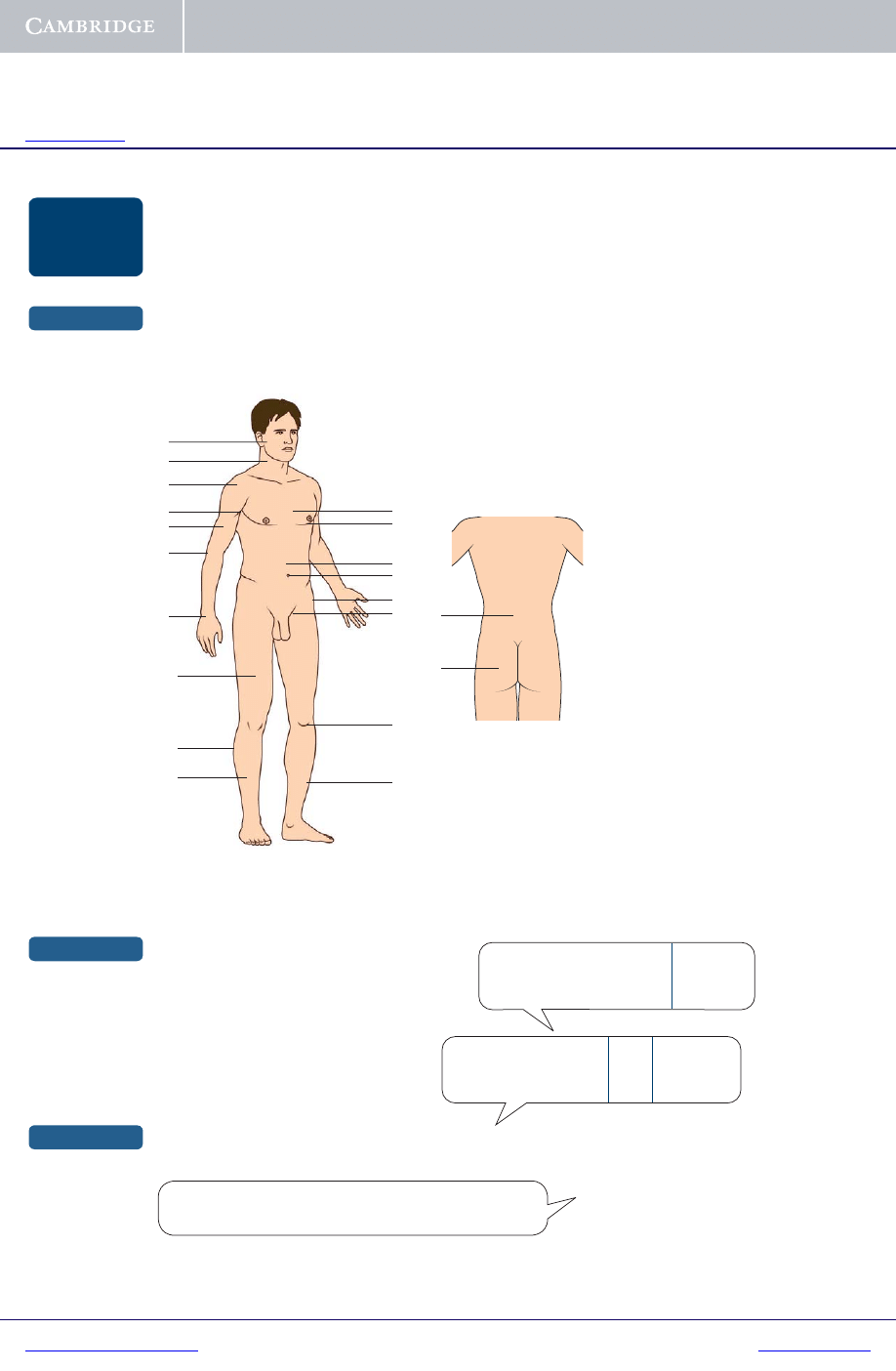
Limb means arm (upper limb) or leg (lower limb). The trunk is the body excluding the
head and limbs.
For a more detailed diagram showing parts of the body, see Appendix I on page 00.
Referring to parts of the body
When patients speak about their problem they
often refer to a part of the body:
The doctor often needs to ask about a part
of the body:
Parts of the body
Most external parts of the body have ordinary English names as well as anatomical names.
Doctors normally use the English names, even when talking to each other. There are a few
exceptions where doctors use the anatomical name; these are shown in brackets below.
2
Parts of the body 1
A
B
hip.
I’m having trouble with my
shoulder.
knee.
the
chest?
Do you get any pain in
your
stomach?
back?
Describing radiation of pain
A patient is telling the doctor about his back pain and the parts of the body it radiates to.
C
It starts in the back. Then it seems to go into the right
buttock and down the back of the right thigh to the knee.
1
2
3
4
5
6
7
8
9
13
10
11
12
14
15
16
17
18
19
20
1 jaw (mandible)
2 neck
3 shoulder
4 armpit (axilla)
5 upper arm
6 elbow
7 back
8 buttock
9 wrist
10 thigh
11 calf
12 leg
13 chest (thorax)
14 breast
15 stomach, tummy
(abdomen)
16 navel (umbilicus)
17 hip
18 groin
(inguinal
region)
19 knee
(patella
=
kneecap)
20 shin
Cambridge University Press
978-0-521-68201-5 - Professional English in Use Medicine
Eric H. Glendinning and Ron Howard
Excerpt

13
Professional English in Use Medicine
Write the ordinary English words for the corresponding anatomical terms in the table
using your medical knowledge. Look at A opposite to help you.
Anatomical term
Common word
abdomen
axilla
carpus
coxa
cubitus
mamma
nates
patella
Complete the sentences using ordinary English words. Look at A and C opposite to help you.
a A male patient describing angina pectoris:
2.1
2.2
It’s like a tightness across my (1)
, and it goes up
(2)
my (3)
and into my left
(4)
and (5)
the left (6)
.
b A male patient describing renal colic:
It starts (1)
the loin and goes into the
(2)
and (3)
into the testicle.
Complete the sentences. Look at A opposite to help you.
Anatomical term
Patient’s statement
1 inguinal swelling
I’ve got a lump in the
.
2 abdominal pain
My little boy’s got a
ache.
3 periumbilical rash
I’ve got some spots around my
.
4 thoracic pain
I’ve got a pain in the middle of the
.
5 enlarged axillary node
There’s a painful swelling in my
.
6 mandibular pain
I’ve got a pain in my
.
Complete the table with words from the box. The first one has been done for you.
2.3
El[hjeoek
Make a list of the words from A opposite that you find it hard to remember or that you
need most often. Try to learn at least one of them every day.
2.4
abdomen
elbow
loin
wrist
thigh
knee
chest
arm
leg
finger
Trunk
Upper limb
Lower limb
abdomen
Cambridge University Press
978-0-521-68201-5 - Professional English in Use Medicine
Eric H. Glendinning and Ron Howard
Excerpt
14
Professional English in Use Medicine
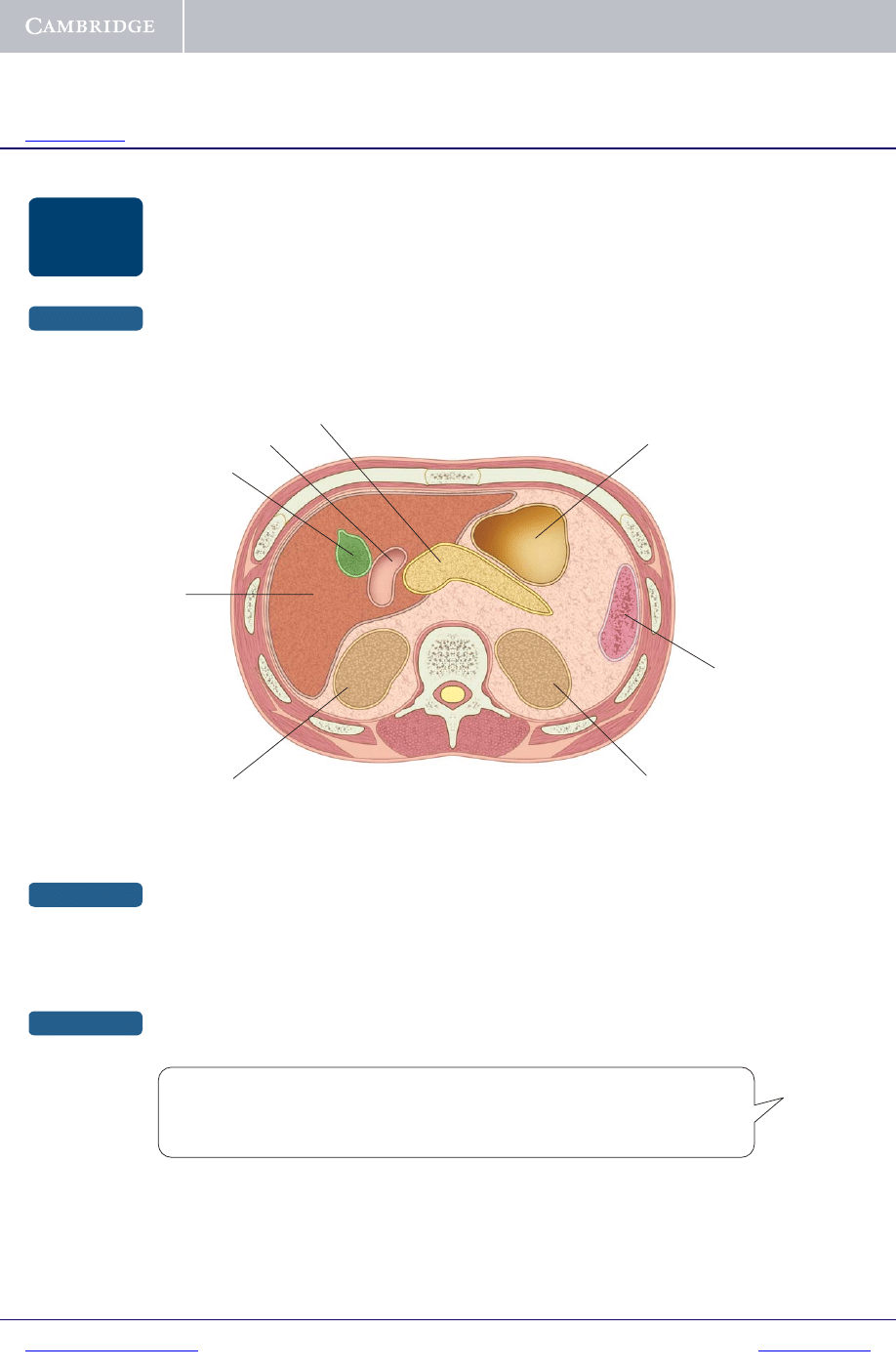
The abdomen
The main organs of the body have ordinary English names and doctors use these words.
But when an adjective is needed they often use an anatomical word. For example, we
can say disease of the liver or hepatic disease. Some abdominal organs, for example the
pancreas, have no ordinary name.
3
Parts of the body 2
A
When doctors talk about the main parts of the digestive system, they use the words bowel
or intestine: the small intestine or the small bowel, the large intestine or the large bowel.
When speaking to patients, doctors may refer to the anus and rectum as the back passage.
The chest
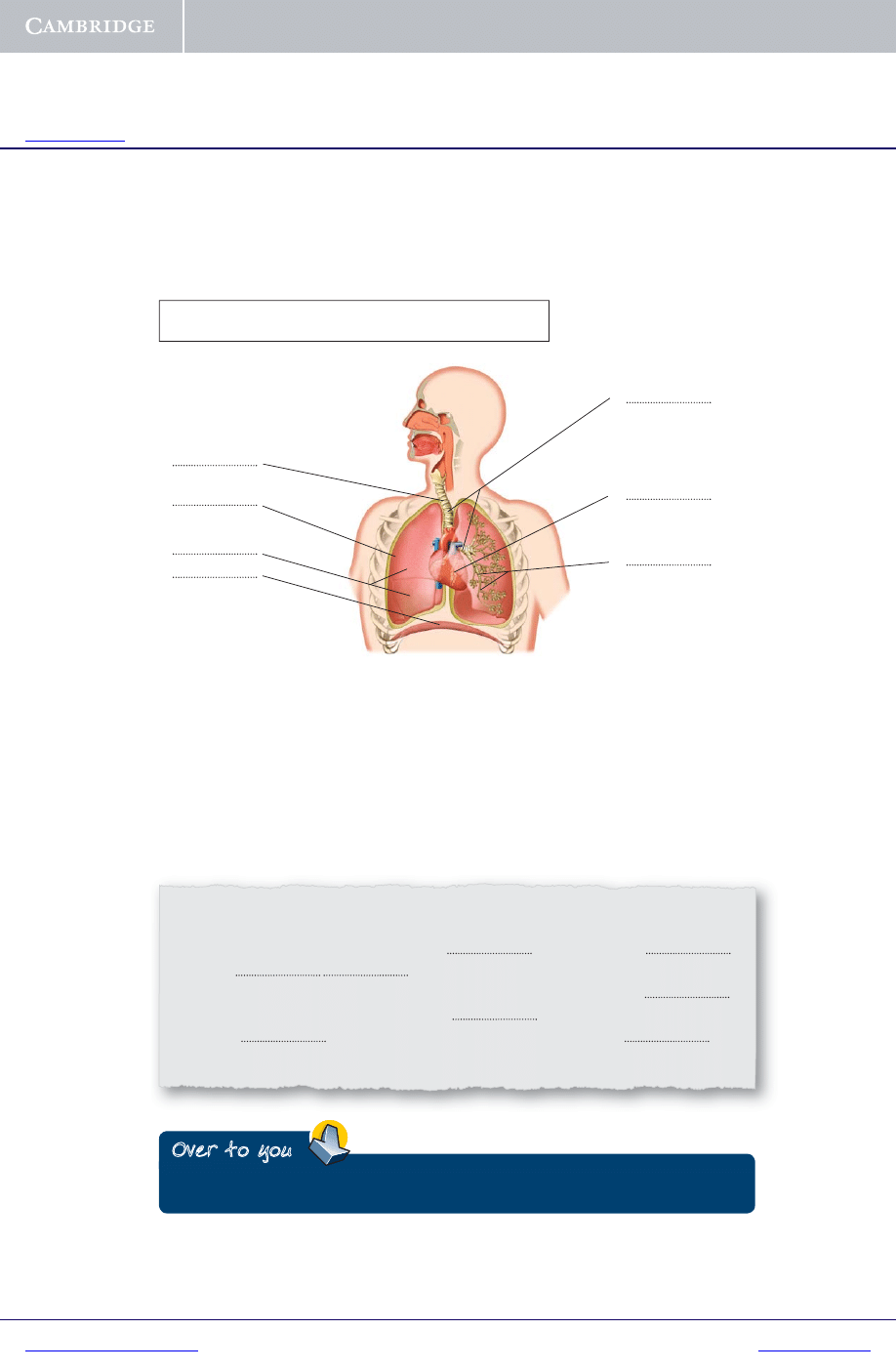
The chest (thorax) contains the organs of respiration and the heart. The main parts of the
respiratory system are the airways and the lungs. The left lung is divided into two lobes,
and the right into three. The airways consist of the larynx, the trachea (or windpipe), the
right and left bronchus, and the bronchioles. The chest is separated from the abdomen by
the diaphragm.
The pelvis
A doctor is explaining the function of the bladder to a patient.
B
C
The bladder is situated in the pelvis, as you know, and it is connected to each kidney by a
long tube called the ureter – one on each side. The ureters carry the urine from the kidneys
to the bladder, where it is stored until you decide to empty your bladder. When that
happens, the urine passes down another tube, called the urethra, to the outside.
liver
spleen
right kidney
left kidney
stomach
pancreas
duodenum
gall bladder
Cambridge University Press
978-0-521-68201-5 - Professional English in Use Medicine
Eric H. Glendinning and Ron Howard
Excerpt
15
Professional English in Use Medicine
Label the diagram using words from the box. Look at B opposite to help you.
3.1
Match the conditions (1–8) with the organs affected (a–h), using your medical knowledge.
1 hepatitis
a bladder
2 pneumonia
b gall bladder
3 nephritis
c heart
4 gastric ulcer
d kidney
5 cystitis
e liver
6 angina pectoris
f lung
7 cholecystitis
g stomach
8 ulcerative colitis
h large bowel
Complete the textbook extract. Look at A and C opposite to help you.
diaphragm lobes windpipe heart
lung airways
bronchioles
3.2
3.3
El[hjeoek
Many patients do not know the location or function of the spleen or the pancreas.
How would you explain them to a patient, in English?
Examination of the abdomen
To examine the patient for enlarged abdominal (1)
, fi rst feel for the (2)
and the (3)
on the right side. To do this, ask the patient to take a deep
breath, while pressing with the fi ngers upwards and inwards. Next, feel for the right (4)
and then cross over to the other side for the left (5)
. Still on the left side, palpate for an
enlarged (6)
. Finally, moving to the lower abdomen, feel for the (8)
,
which is only felt if it is full.
1
2
3
4
5
6
7
Cambridge University Press
978-0-521-68201-5 - Professional English in Use Medicine
Eric H. Glendinning and Ron Howard
Excerpt

16
Professional English in Use Medicine
Eating
4
Functions of the body
A
The fi ve senses
In addition to smell and taste, the
senses include sight (or vision),
hearing, and touch (also called
sensation or feeling). To ask about
the senses, doctors use the questions:
You’re hungry.
You’re in a
restaurant and
the waiter brings
your food.
You smell it. It
stimulates your
appetite – you
want to eat.
Your mouth
waters, fi lling
with saliva.
You take a bite
of the food. It
tastes good and
you chew it and
swallow it.
You eat more,
but then
suddenly you
taste something
unpleasant. You
feel nauseous.
You rush to the
toilet, and get there
just in time before
vomiting all the
food you’ve eaten.
Something has
disagreed with you.
B
To ask about the sense of touch, doctors talk about
numbness (loss of sensation):
Other functions
Function
Verb
Noun
speaking
speak
speech
walking
walk
gait
breathing
respiration
inhale / breathe in / take a breath in
exhale / breathe out
breath
urination
micturition
urinate
micturate
pass urine / pass water
urine
defecation
defecate
pass faeces / pass stools
faeces
stools
menstruation
menstruate
have a period
(menstrual) period
(monthly) period
When taking a history, doctors can ask:
What is your sight
like?
hearing
Is your
sense of smell
normal?
sense of taste
Have you noticed any numbness
(in your fi ngers or toes)?
C
trouble
walking?
diffi culty
breathing?
Do you have any
problems
passing
urine?
with your speech?
pain
when you breathe in?
When auscultating a patient’s
lungs, the doctor tells the patient:
Take a deep breath in, hold
your breath, then breathe
out completely.
Less common functions
There are some things we do less often. When we are hot, we sweat. When we are
nervous, we shake. When we are sad, we cry.
Doctors can ask:
sweat
Do you
shake
more than usual?
D
Cambridge University Press
978-0-521-68201-5 - Professional English in Use Medicine
Eric H. Glendinning and Ron Howard
Excerpt

17
Professional English in Use Medicine
Match the symptoms (1–5) to the questions (a–e), using your medical knowledge.
1 dysuria
a What is your breathing like?
2 dysphagia
b Do you have any pain when you pass water?
3 diplopia
c Do you have any difficulty with your speech?
4 dysphasia
d Do you have any trouble swallowing?
5 dyspnoea
e Is your vision normal?
Patients are describing symptoms of the conditions shown in brackets. Complete the
sentences. Look at C and D opposite to help you.
1 I’ve got pain and
in both feet. (peripheral neuropathy)
2 I’m having difficulty
solid food. (oesophageal stricture)
3 I have a lot of problems
. (prostatic hypertrophy)
4 I’ve been
more than usual, even when it’s not hot. (hyperthyroidism)
5 I’ve noticed that my hands
when I’m not using them. (Parkinsonism)
6 I have trouble
when I climb the stairs. (left heart failure)
Complete the sentences. Look at A, B, C and D opposite to help you.
1
4.1
4.2
4.3
When I eat solid food, I have to
(bite/chew) it
for a long time before I can
(swallow/eat) it.
I have no
(taste/appetite) and
I’ve lost five kilos in the last few weeks.
The garden is full of flowers, but my
(sense/sensation)
of smell has disappeared and I can’t enjoy the perfume.
When did you last
(have/pass) a period?
Take a deep
(breathe/breath) in.
2
4
3
5
6
El[hjeoek
You think a patient may have diabetes. Think of five questions you can ask the patient to
investigate further. Try to use the question types presented in this unit.
Do you have any pain when you
(pass/have) stools?
Cambridge University Press
978-0-521-68201-5 - Professional English in Use Medicine
Eric H. Glendinning and Ron Howard
Excerpt

18
Professional English in Use Medicine
Practitioners
In Britain, doctors, also known as medical practitioners, must be qualified: have a
university degree in medicine. They must also be registered – included in the General
Medical Council’s list, or register – in order to practise (see Unit 13). A doctor who treats
patients, as opposed to one who only does research, is called a clinician. A doctor who
provides primary care for patients is known as a general practitioner (GP), or family
doctor. GPs usually work in a group practice. Larger group practices work in a building
called a health centre.
Note:
In British English, the verb is spelt practise and the noun is spelt practice.
Specialties
Specialist doctors, for example paediatricians, generally work in hospitals. However, those
who work outside the NHS, providing private health care, may have consulting rooms
outside a hospital – for example in the famous Harley Street in London.
The two main branches of medicine are surgery and internal medicine, and the doctors
who practise these branches are called surgeons and physicians, respectively. In Britain,
male surgeons are addressed as Mr and females as Ms – so Dr Smith is a physician, and
Ms Smith is a surgeon.
A cardiologist
specializes in
is a specialist in
diseases of the heart and circulation, or cardiology.
A geriatrician
diseases of elderly patients, or geriatrics.
An anaesthetist
anaesthetics.
Note:
Names of specialties usually end in -ology; names of specialists usually end in -ologist.
If the name of a specialty ends in -ics, the name of the specialist ends in -ician. There are some
exceptions, e.g. anaesthetics and anaesthetist.
Choosing a specialty
Jill Mathews has just graduated from medical school and is talking about her future.
‘I haven’t decided what to specialize in yet. I need more
experience before I decide, but I’m quite attracted to
the idea of paediatrics because I like working with
children. I’d certainly prefer to work with children
than, say, elderly patients – so I don’t fancy geriatrics.
I was never very interested in detailed anatomy, so
the surgical specialties like neurosurgery don’t really
appeal. You have to be good with your hands, which
I don’t think is a problem for me – I’ve assisted at
operations several times, and I’ve even done some
minor ops by myself – but surgeons have to be able
to do the same thing again and again without getting
bored, like tying off cut arteries and so on. I don’t
think that would be a problem for me, but they need
to make decisions fast and I’m not too good at that.
I like to have time to think, which means surgery’s
probably not right for me.’
Note:
The collocation good with is followed by a noun –
He’s good with children. The collocation good at is followed
by the -ing form (gerund) of a verb, or by a noun – She’s
good at explaining procedures. She’s good at explanations.
5
Medical practitioners 1
A
B
C
Cambridge University Press
978-0-521-68201-5 - Professional English in Use Medicine
Eric H. Glendinning and Ron Howard
Excerpt

19
Professional English in Use Medicine
Write sentences to describe the work of the specialist in each branch of medicine. Look at B
opposite to help you.
1 dermatology
A dermatologist specializes in diseases of the skin.
2 rheumatology
3 traumatology
4 paediatrics
5 obstetrics
Complete the table with words from A, B and C opposite and related forms. Put a stress mark
in front of the stressed syllable in each word. The first one has been done for you.
Verb
Noun (person)
Noun (activity or thing)
'specialize
practise
consult
assist
graduate
qualify
Find prepositions in C opposite that can be used to make word combinations with the
words in the box. Then use the correct forms of the words to complete the sentences.
5.1
5.2
5.3
1 A pathologist
diagnosing disease through examining cells and tissue.
2 A paediatrician must enjoy
children.
3 An oncologist is
the diagnosis and treatment of cancer.
4 A psychiatrist must be
counselling.
5 A neurosurgeon must be
her hands.
Make word combinations using a word from each box. Two words can be used twice.
Look at A, B and C opposite to help you.
good
interested
specialize
work
5.4
El[hjeoek
Re-read what Dr Jill Mathews says about surgeons in Section C. Make a list of the qualities
she thinks are needed to be a good surgeon. Then make a similar list of qualities for
another specialty.
If you are a student, which branch of medicine do you think you have the qualities for? If
you have already completed your training, why did you choose your particular branch of
medicine?
consulting
general
group
health
internal
surgical
centre
practice
specialties
medicine
practitioner
rooms
Cambridge University Press
978-0-521-68201-5 - Professional English in Use Medicine
Eric H. Glendinning and Ron Howard
Excerpt
Wyszukiwarka
Podobne podstrony:
health and illness list, ANG
HEALTH AND ILLNESSES
Health problems and illnesses
19 Health and Diseases1
HEALTH AND SAFETY GLOSSARY c ms E
For Health and Strenght
HEALTH AND SAFETY GLOSSARY c ms E
Be Healthy and Drug Free
Millionaire Marketing Rolodex Health and Fitness
41 Lung health and fruit, vegetable consumption PL
19 health and diseases
19 Health and Diseases 1 (1)
Health Healthly and unhealthly lifestyle (tłumaczenie)
Health and meetings exercises
Health and meetings
sw health and medicine
DEPARTMENT OF HEALTH AND HUMAN SERVICES PROTECTION OF HUMAN SUBJECTS
Health Healthly and unhealthly lifestyle (32)
więcej podobnych podstron