T
T
h
h
e
e
O
O
r
r
i
i
g
g
i
i
n
n
s
s
o
o
f
f
t
t
h
h
e
e
S
S
p
p
a
a
c
c
e
e
G
G
o
o
d
d
s
s
J
J
a
a
s
s
o
o
n
n
C
C
o
o
l
l
a
a
v
v
i
i
t
t
o
o

The Origins of the Space Gods
Ancient Astronauts and the Cthulhu Mythos in Fiction and Fact
By Jason Colavito

A
LSO BY
J
ASON
C
OLAVITO
The Cult of Alien Gods: H. P. Lovecraft and Extraterrestrial Pop
Culture
(Prometheus, 2005)
Knowing Fear: Science, Knowledge, and the Development of the
Horror Genre
(McFarland, 2008)
“A Hideous Bit of Morbidity”: An Anthology of Horror Criticism from
the Enlightenment to World War I
(McFarland, 2009)
© 2011 Jason Colavito.
This work is licensed under the Creative Commons Attribution Non-Commercial No-
Derivatives License (http://creativecommons.org/licenses/by-nc-nd/3.0/)
You are free to copy, distribute, and transmit the work pursuant to the restriction that you
credit the work to Jason Colavito and link to the originating website,
http://www.JasonColavito.com. You may not alter the work or use it commercially
without the express written permission of the author.
This ebook contains some material that originally appeared in the article “Charioteer of
the Gods,”
Skeptic 10.4 (2004).
Cover image: View SW over Manzanar, dust storm, Manzanar Relocation Center by
Ansel Adams
(
Library of Congress).

Contents
I. Aliens in the Mythos
1
II. Ancient Astronauts before Lovecraft
7
III. Ancient Astronauts after Lovecraft
11
IV. The Evidence for Aliens
15
V. The Science
20
VI. Conclusions
24
Appendix
26

ORIGIN OF THE SPACE GODS ● 1
I. Aliens in the Mythos
NE OF THE MOST dramatic ideas found in the Cthulhu
Mythos is the suggestion that extraterrestrial beings arrived
on earth in the distant past, were responsible for ancient
works of monumental stone architecture, and inspired mankind’s earliest
mythologies and religions. In the 1970s, this basic premise was
resurrected as the “ancient astronaut theory,” a fringe hypothesis that
gained widespread popularity thanks to Swiss hotelier Erich von
Däniken’s book
Chariots of the Gods?
(1968) and its television
adaptation,
In Search of Ancient Astronauts
(1973), hosted by Rod
Serling, of
Twilight Zone
fame. According to research done by Kenneth
L. Feder, at the height of von Däniken’s popularity in the 1970s and
’80s one in four college students accepted the ancient astronaut theory,
but twenty years later less than ten percent did (78). Though
mainstream science does not recognize extraterrestrial intervention in
human history, the theory continues to receive exposure on cable
television documentaries, in magazines, and in a plethora of books.
O

2 ● JASON COLAVITO
Providence, Rhode Island author H.P. Lovecraft (1890-1937)
has been justly hailed as a master of the horror story, and his work
claims a place beside Edgar Allan Poe and Stephen King in the
pantheon of the genre. Born into a wealthy family in 1890, Lovecraft's
life was a series of reverses and declines as his family lost their fortune
and his parents succumbed to madness. He was a precocious and self-
taught scholar who read voraciously and devoured as much literature as
he could read. He read the novels of H.G. Wells, whose
War of the
Worlds
told of the coming of alien creatures to earth. He also read the
eighteenth-century Gothic masters of horror, and above all Edgar Allan
Poe. He also read works of pseudoscience and mysticism for inspiration.
When he set about writing his own works, he began to blend
the modern world of science fiction with his favorite tales of Gothic
gloom. Lovecraft tried to bring the Gothic tale into the twentieth
century, modernizing the trappings of ancient horror for a new century
of science. Lovecraft published his work in pulp fiction magazines,
notably
Weird Tales
, though many of his works were not published until
after his death in 1937. Throughout the 1940s and 1950s, science fiction
and horror magazines reprinted Lovecraft's tales numerous times, and
he became one of the most popular pulp authors.
Lovecraft's works banished the supernatural by recasting it in
materialist terms. He took the idea of a pantheon of ancient gods and
made them a group of aliens who descended to earth in the distant past.
Across his works, Lovecraft provided a number of different
explanations for the arrival ancient visitors on the primeval earth. In

ORIGIN OF THE SPACE GODS ● 3
“The Call of Cthulhu,” the Old Ones, including the tentacled, star-born
Cthulhu, are said to have come “to the young world out of the sky” and
to have raised mighty cities whose remains could be seen in the
cyclopean stones dotting Pacific islands. These Old Ones brought with
them images of themselves (thus inventing art) and hieroglyphs once
legible but now unknown (the origins of writing). They spoke to humans
in their dreams, and established a cult to worship them (the origins of
religion). They appeared as, and were treated like, monstrous living
gods, so great were their mystical powers.
In later stories, Lovecraft added new details and altered his
previous conception of the Old Ones to provide a richer and more
developed picture of alien intervention in earth life. In
At the Mountains
of Madness
, Lovecraft presents his most complete vision of the
extraterrestrial origins of human life. Here, the Old Ones were now a
separate species of alien creature at war with Great Cthulhu and his
spawn, who only arrived eons later. The Old Ones were “the originals of
the fiendish elder myths” of ancient mythology, and they raised great
cities under the oceans and on the primitive continents. These beings
arrived on earth after colonizing other planets, and they created life on
earth a source of food. These artificial primitive cells they allowed to
evolve naturally into the plants and animals of the modern world—
including primitive humanity, which they used as food or
entertainment.
4 ● JASON COLAVITO
Elsewhere, Lovecraft described his ancient visitors as
maintaining a presence on the modern earth, and like the Nephilim of
the Bible, they begat children with earth women in “The Dunwich
Horror,” “The Shadow Over Innsmouth,” and “Medusa’s Coil.” In
“The Horror in the Museum,” it is suggested that the monstrous
creatures once worshipped as gods were not all extraterrestrials, and that
-

ORIGIN OF THE SPACE GODS ● 5
some may have come from alternate dimensions. In
The Shadow Out of
Time
, the extraterrestrial Great Race is one of countless species spanning
the universe, and their mental powers let them project themselves
backward and forward in time, gathering intelligence and knowledge for
their library and, in places, imparting their own wisdom. Most to the
point, in his ghostwriting of William Lumley’s “The Diary of Alonzo
Typer” the title narrator learns from the pre-human
Book of Dzyan
that
aliens from Venus came to earth in spaceships to “civilize” the planet.
Human knowledge of these aliens is fragmentary and obscure.
Evidence exists in the form of anomalous ancient artifacts of pre-human
manufacture, garbled folklore and mythology, and written texts like the
Necronomicon
,
Nameless Cults
, and the
Book of Eibon
, which hint at
but do not fully disclose the extraterrestrials’ nature and habits.
Many critics of Lovecraft have noted that his vision for the
Mythos changed over time, as the godlike and semi-supernatural
Cthulhu of “The Call of Cthulhu” gradually gave way to the fully
material aliens of
At the Mountains of Madness
; in time faux mythology
gave way to faux science in the Mythos. Many Mythos writers,
beginning with August Derleth, were dismayed by the contradictions in
Lovecraft’s writing (e.g., Cthulhu is an Old One in “Cthulhu” but
merely “their cousin” in “The Dunwich Horror”; the Old Ones change
identity several times, too), and they have attempted to systematize the
Mythos. However, Lovecraft’s writings reflect the way real myths
develop, with changes and contradictions and anomalies. This is
compounded by the fact that Lovecraft did not write as an omniscient
6 ● JASON COLAVITO
narrator but rather presented his Mythos through the eyes of scholars
and writers who had only part of the story and therefore could not
present the whole truth. Even in the
Necronomicon
Abdul Alhazred (it
is implied) was privy only to hints and rumors and interpreted the
Mythos through the guise of the Near Eastern mythologies he knew. In
other words, Lovecraft’s Mythos tales show us a fragmented, shifting,
and uncertain view of the alien beings reflected through the biases and
prejudices and mental limits of those who encounter them.
-

ORIGIN OF THE SPACE GODS ● 7
II. Ancient Astronauts before Lovecraft
HE IDEA THAT LIFE could exist on other worlds was not
unique to Lovecraft, of course, and the concept had a long
history dating back to early Greek philosophers who
speculated on the nature of beings on other worlds. Anaxagoras (c. 500-
428 BCE) proposed that life began from “seeds” that littered the
universe; Anaxarchus (c. 340 BCE) thought there to be an infinity of
worlds, and Epicurus (c. 341-270 BCE) felt life existed on many planets
across the vastness of space. These philosophers, though, did not
propose the visitation of these aliens to the earth.
The most important early writer to propose extraterrestrial
visitation on earth was Madame Helena Blavatsky (1831-1891), the
founder of Theosophy, a Victorian-era amalgam of Spiritualism,
Eastern religions, and good old-fashioned hokum. In
The Secret
Doctrine
, Theosophy’s most important text, Blavatsky noted Greek
speculation about life on other worlds and asserted that the ancients had
first-hand knowledge of the fact of extraterrestrial existence. She
T
8 ● JASON COLAVITO
speculated that the beings on the innumerable inhabited worlds may
have “influence” or “control” over the earth. She also asserted that
spiritual beings originating on the moon contributed to the metaphysical
development of earth life, but for her any alien intervention is a sideline
to the epic history of evolutionary and spiritual developments of an
assortment of earth creatures who grew from primal ooze to Aryan
supremacy on the lost continents of Hyperborea, Lemuria, and Atlantis.
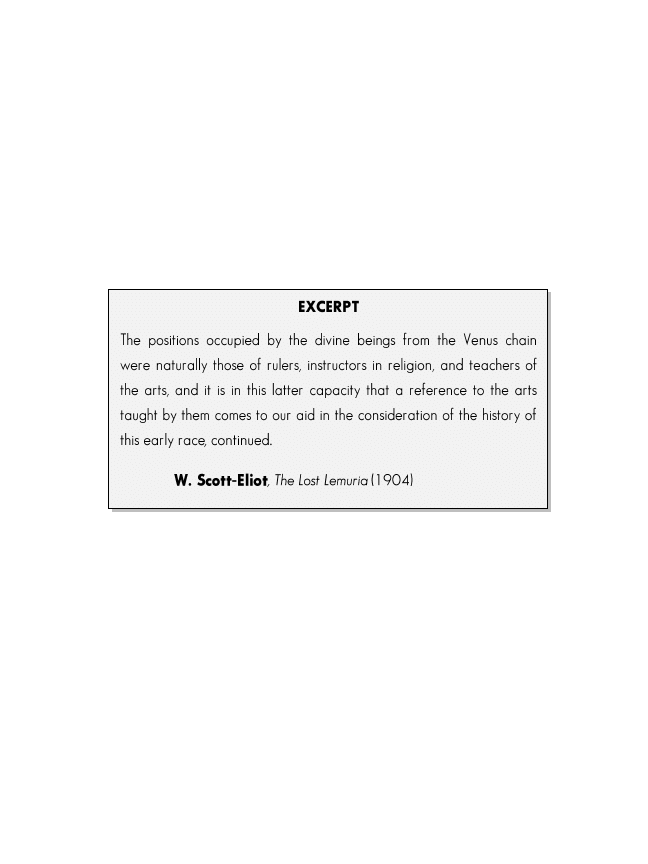
Blavatsky’s disciple W. Scott-Elliot expanded on hints in the
Theosophical cosmos by creating a race of divine beings inhabiting
Venus. In
The Lost Lemuria
(1904), Scott-Elliott claimed that beings
that evolved on Venus but had reached a spiritual or “divine” stage of
development came to earth and taught the inhabitants of Lemuria the
arts of civilization and gave them wheat and fire (34-44). A critical
difference between the lords of Venus, Blavatsky’s moon creatures, and
Mythos beings (and indeed modern ancient astronauts) is that the
-
ORIGIN OF THE SPACE GODS ● 9
Theosophical Venusians and lunarians are not envisioned as true
extraterrestrials (in the modern sense) from distant star systems but as
incarnations of spiritual beings who share a mystic connection to earth
creatures and feel a spiritual calling to aid their brethren on earth. Here,
the Venusians are inhabitants of Venus in the same sense that the angels
of God were once thought to inhabit Venus, Mars, and the other
crystalline spheres that surrounded the earth.
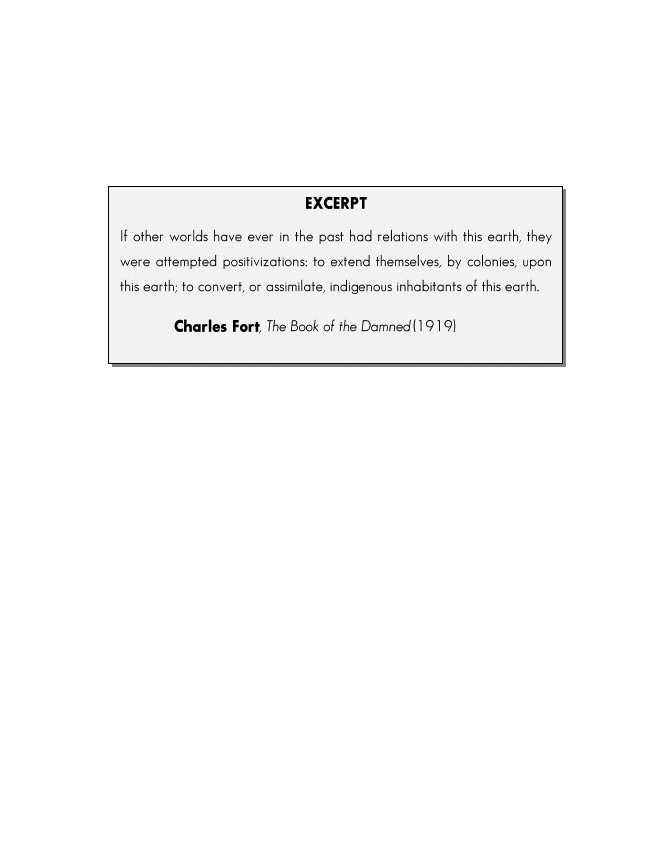
In 1919, the great collector of anomalous trivia, Charles Fort,
published the
Book of the Damned
, in which he speculated that old
stories of demons could be related to “undesirable visitors from other
worlds” (66), though he did not draw a firm connection between devils
and aliens. He also suggested that other worlds may have communicated
with ours in the distant past (118), left behind advanced technology
(124), or attempted to colonize the earth (164). However, Fort made no
claim that such things actually happened, only that they
may
have
happened, and at any rate there is no way to tell whether the creatures
-
10 ● JASON COLAVITO
were alien, trans-dimensional, spiritual, or even imaginary—perhaps the
result of telepathy, communications from the spirit realm, or from
myriad other sources.
H. P. Lovecraft read both
The Book of the Damned
and Scott-
Elliott, in the compilation volume
The Story of Atlantis and Lost
Lemuria
(1925), and from these fragmentary ideas about prehistoric
extraterrestrial visitation imagined (more-or-less) flesh-and-blood aliens
arriving on earth in the distant past and all that this implied.
-

ORIGIN OF THE SPACE GODS ● 11
III. Ancient Astronauts after Lovecraft
OVECRAFT’S MYTHOS BECAME one of the touchstones
of modern horror literature and a powerful theme in horror,
fantasy, and science fiction, where the idea of alien visitors in
the deep past continues to enjoy popularity in contemporary works like
Stargate
,
The X-Files
,
Doctor Who
,
Alien vs. Predator
, and hundreds of
other movies, books, and television shows. However, Lovecraft’s alien
gods also spawned the decidedly non-fiction (if not factual) ancient
astronaut theory, which continues to convert new adherents today.
The names of Lovecraft’s alien gods, like Cthulhu, Yog-
Sothoth, and Shub-Niggurath, began to crop up in other stories during
Lovecraft’s lifetime. Lovecraft himself started this practice by inserting
these names, or variants on them, into stories he ghostwrote or revised
for other authors. In his revision of Zelia Bishop’s “The Mound,” for
example, Lovecraft slipped his alien god Cthulhu into the story under
the variant name Tulu, giving magazine readers what they thought were
independent stories featuring references to the same ancient gods. By the
1960s, several dozen authors were using elements of what came to be
L

12 ● JASON COLAVITO
called “The Cthulhu Mythos” in stories they wrote for science fiction
and horror magazines.
Lovecraftian fiction became increasingly popular in Europe,
where the French embraced him as a bent genius, much as they
embraced Edgar Allan Poe. In France, the Russian expatriate Jacques
Bergier and the writer Louis Pauwels read Lovecraft and were inspired
by his cosmic vision. Bergier claimed to have corresponded with
Lovecraft in 1935, though no letters survive. He spent much of the
1950s promoting Lovecraft in the French media, including the
magazine he and Pauwels edited,
Planète
, and working to bring
Lovecraft’s work out in French editions. The
Planète
’s editors held
Lovecraft as their prophet, and their reprints of his stories helped to
popularize him and the Cthulhu Mythos in the French imagination.
Digging into Lovecraft’s Theosophical and Fortean source
material, Bergier and Pauwels wrote
Le Matin des magiciens
(1960)
(published in English as
The Morning of the Magicians
) and presented
the first fully-fledged modern ancient astronaut theory. In it, they
presented the themes found in Lovecraft as nonfiction, speculating
about such alternative history touchstones as the “true” origin of the
Egyptian pyramids, ancient maps that appear to have been drawn from
outer space, advanced technology incongruously placed in the ancient
past, and the other staples of later ancient astronaut theories. They note
that ancient mythologies are replete with gods who visit earth in fiery
chariots and return to the sky. These, they state, may have been alien
visitors in spaceships.
ORIGIN OF THE SPACE GODS ● 13
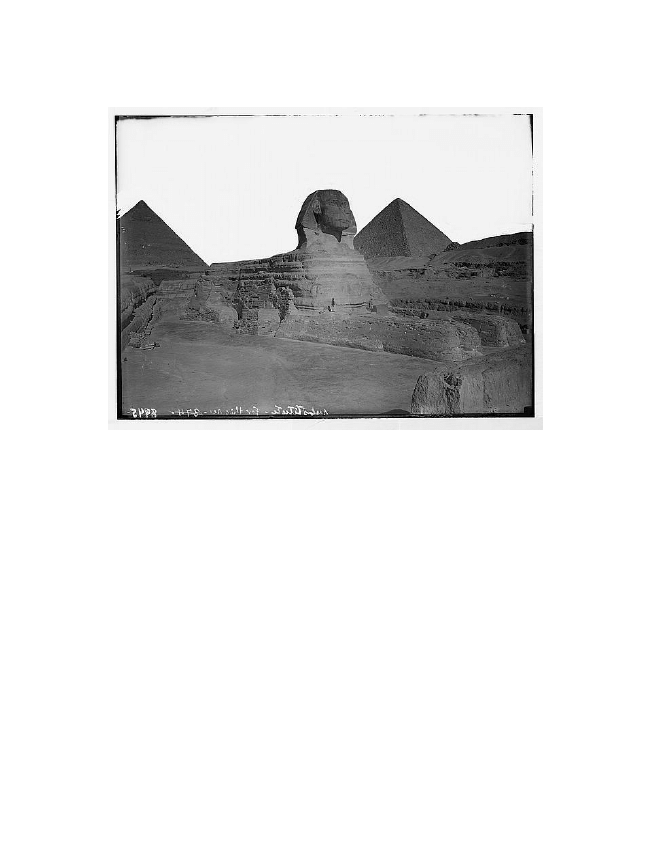
Figure 1: The Sphinx and Pyramids of Giza, frequently claimed evidence of
alien visitation. (Library of Congress)
Pauwels and Bergier drew on unrelated writings from a
number of French and other authors who wondered to a greater or
lesser extent that modern UFO sightings might have antecedents in
prehistory, but they combined this 1950s space-age speculation with a
Lovecraftian cosmic vision and a New Age sensibility that translated
Cthulhu into an ancient astronaut in a way that shiny atom-age
extraterrestrials in spacesuits never could.
Morning of the Magicians
became one of the most important
sources for Erich von Däniken, the Swiss writer whose
Chariots of the
Gods?
brought what had hitherto been a theory known only to

14 ● JASON COLAVITO
Theosophists, Lovecraft aficionados, and fringe theorists into the
cultural mainstream. Von Däniken did not mention Pauwels and
Bergier in his works, however, until a lawsuit forced him to disclose the
sources he closely paraphrased in
Chariots
. The bibliography of
Chariots
thereafter listed the French writers’ book in its 1962 German
translation,
Aufbruch ins dritte Jahrtausend.
Tens of millions of copies
of
Chariots
and its sequels sold, and the ancient astronaut theory became
a cultural phenomenon, appearing in movies, on Johnny Carson’s
Tonight Show
, in
Playboy
, and practically anywhere people were
talking about the past.
Other authors were inspired by von Däniken’s theories,
including Robert Temple (whose
Sirius Mystery
argued that
amphibious aliens from Sirius taught Sumerians civilization) and
Zecharia Sitchin (whose
Twelfth Planet
argued that aliens from a
“wandering” planet called Nibiru conquered ancient earth to steal its
gold and other precious metals). By the end of the 1970s, there was an
entire network of authors and promoters then known as the Ancient
Astronaut Society (now the Archaeology, Astronautics and SETI
Research Association, or AAS RA). As of this writing, the History
Channel broadcasts
Ancient Astronauts: The Series
, a weekly program
that explores the work of von Däniken and AAS RA. The program is
seen by more than two million viewers each week.
So what made so many believe aliens visited our ancestors?

ORIGIN OF THE SPACE GODS ● 15
IV. The Evidence for Aliens
HE ANCIENT ASTRONAUT THEORY, as it developed in
the hands of Pauwels and Bergier, von Däniken, and others,
uses
a
combination
of
suggestive
archaeological,
mythological, and artistic evidence. Though believers interpret nearly
every piece of ancient history as supporting the ancient astronaut theory,
in outline, the most important evidence is as follows:
Archaeological
Believers maintain that ancient cities and monuments the world
over display three important properties that speak to their non-human
origins. First, many are composed of stones that weigh so much that it
seems impossible for ordinary humans to have moved them. For
example, the blocks making up the Great Pyramid of Egypt weigh as
much as fifty tons each, and the stones of the Incan fortress of
Sacsayhuaman weigh as much as two hundred tons. Further, believers
hold that these ancient sites are laid out and constructed with a precision
that is unmatched by all but the most modern of contemporary
T
16 ● JASON COLAVITO
constructions. The Great Pyramid, for instance, is said to be placed on a
base within 0.049 inches of flat; its sides are oriented to the cardinal
directions within three minutes of arc, something unmatched in nearly
all modern constructions. Such engineering is said to be possible only
with alien help, either as the builders themselves or as teachers who
imparted the knowledge of such building techniques.
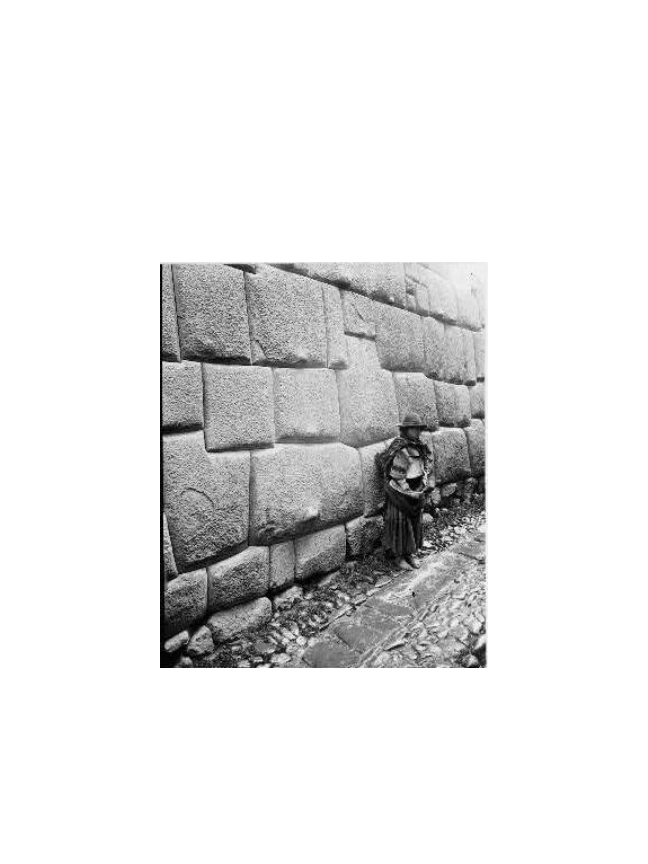
Figure 2: Inca masonry, which ancient astronaut theorists believe is too perfect
to be the sole work of human beings. (Library of Congress)

ORIGIN OF THE SPACE GODS ● 17
Second, believers argue that ancient sites and artifacts encode
scientific data that should be unknown to Stone Age peoples. The Great
Pyramid, to take a familiar example, is said to be an accurate scale
model of the northern hemisphere of the earth thousands of years before
Eratosthenes first estimated the planet’s circumference. It is also said to
be placed in the exact center of the earth’s land masses. The
monumental pyramids of the ancient Mexican city of Teotihuacan are
often said to be a scale model of the solar system.
Third, anomalous artifacts represent advanced technology of
possibly inhuman origin. The famous “Baghdad battery” is a small jar
that may have held electrodes that when exposed to vinegar could have
produced a small electrical charge. Small golden bees from Mexico may
be depictions of ancient airplanes. A sparkplug may have been found
inside a billion-year-old rock known as the Coso artifact.
Mythological
Ancient myths and legends record the arrival of the aliens and
their deeds upon the earth. Believers in the ancient astronaut theory are
united in their belief that myths and holy books are factual accounts of
events that happened in the real world. The apocryphal Book of Enoch
is a favorite, along with the legend of the Jewish prophet ascending to
heaven in a fiery chariot. The Biblical vision of Ezekiel, who saw a fiery
apparition of interlocking wheels, is said to represent an encounter with
a flying saucer. The destruction of Sodom and Gomorrah in fire and
brimstone is suggested to be an account of aliens dropping an atomic
18 ● JASON COLAVITO
bomb. Elsewhere, mythological appearances of savior gods such as
Oannes in Sumer, Osiris in Egypt, Quetzalcoatl in Mexico, and
Viracocha in Peru are thought to be factual accounts of
anthropomorphic aliens bringing civilization to benighted ancient tribes.
Hindu mythology is an especially rich source of proof because of its
descriptions of flying machines, ray guns, and explosions that resemble
atomic detonations.
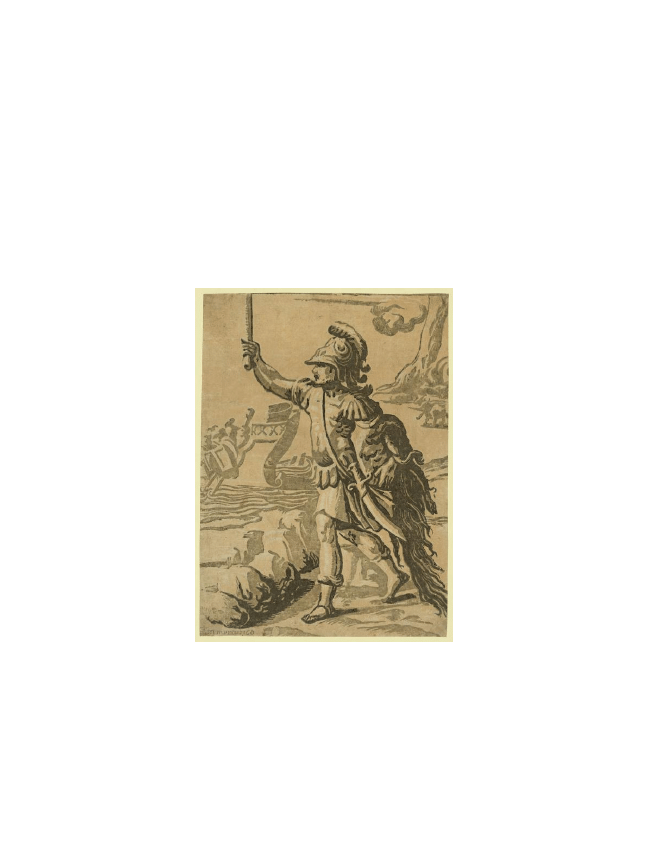
Figure 3:
Jason Returns with the Golden Fleece
by Ugo da Carpi, c. 1500. Von
Däniken believes Greek gods were aliens, the Golden Fleece was really an alien
helicopter, and Jason's ship, the
Argo
, was really an alien spacecraft. (Library of
Congress)

ORIGIN OF THE SPACE GODS ● 19
And of course, like the Old Ones in
At the Mountains of
Madness
, the gods who created humans and other earth life in myth and
religion are here interpreted as aliens that genetically engineered earth
life for their inscrutable purposes. They also manage earth life, like the
Old Ones who wipe out unfavorable races, by sending floods or
annihilating trouble spots with nuclear weapons.
Artistic
Ancient art shows images of the aliens and their advanced
technology, according to believers. Aboriginal cave art in Australia
depicts beings with circles around their heads, obviously the helmets of
space-faring aliens. Similarly, ancient Japanese statuary of rotund
monsters actually shows aliens in bulky spacesuits. Medieval paintings
are said to contain images of flying discs or aerodynamic chariots that
resemble flying saucers and rocket ships. The lid of the tomb of the
Mayan king Palenque does not show the king in the underworld but
rather depicts him at the controls of technological device, perhaps a
rocket ship. An image of a lotus blossom in the Egyptian temple of
Dendera is really a depiction of a light bulb, complete with power cord
and filament. Ancient maps are believed to show a) earth as depicted
from space, b) the world as it existed in the Ice Age before human
civilization, c) Antarctica centuries before its discovery in 1818.

20 ● JASON COLAVITO
V. The Science
RCHAEOLOGISTS, paleontologists, anthropologists, and
other scientific professionals were less than impressed by the
web of suggestion and interpretation that masqueraded as a
scientific hypothesis. Since the mid-1970s, skeptics have produced
articles, books, and documentaries aimed at debunking the ancient
astronaut theory and explaining its “evidence” as a series of
misinterpretations, misrepresentations, and ignorance of scientific
research. It would be impossible to thoroughly explore the scientific
arguments against the ancient astronaut theory in anything short of a
book (for which, see my 2005 book, the
The Cult of Alien Gods
), but
the general lines of argument run like this:
Archaeological
No evidence of extraterrestrial technology has ever been found
on earth, and no artifact can conclusively be tied to a planet other than
earth. Such claims are exaggerations, misinterpretations, or frauds. For
example, the alleged Coso artifact is not a billion-year-old bit of
advanced technology but a 1920s spark plug encrusted in solidified crud
A
ORIGIN OF THE SPACE GODS ● 21
mistaken for ancient rock. Ancient monuments show every sign of being
constructed by the ancient people who lived around them, as
demonstrated by the artifacts found in, around, on top of, and under
ancient sites. Construction of buildings—even highly precise and heavy
ones—can be accomplished with large numbers of people working
together.
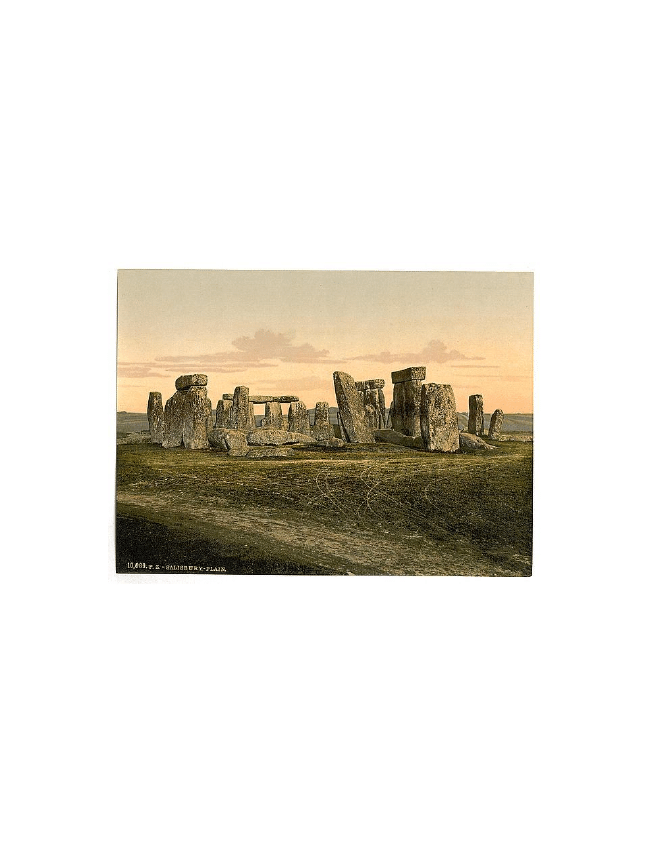
Figure 4: Stonehenge. Despite centuries of investigation, no alien artifacts have
ever been found in, around, or under Stonehenge. (Library of Congress)
Mythological
Ancient myths do not have a direct correlation with events in
the distant past. Instead, they are complex web of symbolism, religious
belief, historical events, and imagination. There may be some distorted

22 ● JASON COLAVITO
truth behind myths (as the discovery of Troy proved for Homer’s
Iliad
),
but they cannot be interpreted as literal accounts of historic happenings.
Nor are the myths themselves consistent across time. The myth of Jason
and the Golden Fleece, for example, shows significant changes to major
events between its earliest recorded forms and the best-known version,
written by Apollonius of Rhodes many centuries later. In the earliest
forms of the myth, it is unclear whether the Golden Fleece was even
present—a far cry from those like Robert Temple or Erich von Däniken
who assumed that one version of the myth stood for all, could be
considered definitive, and could be interpreted literally as evidence of
alien intervention. Mythology must be seen in its cultural context, and
any interpretation must account for changes, distortions, and mutations
that accrue over time as oral stories are retold, come into contact with
stories from other cultures and lands, and eventually take on a written
form. This is not unlike the contradictory variants of Mythos legends
found in Lovecraft’s own stories.
Artistic
Again, ancient art should not be taken as a literal recording of
events happening before the artists’ eyes. Many works of prehistoric art,
such as cave paintings, depict shamans engaged in rituals designed to
imbue them with the powers of the netherworld and their spirit animals.
These cannot be taken literally but must be seen in cultural context and
in terms of the visions of strange shapes and forms humans see when in
shamanic trance states. Other pieces of ancient art, like the Dendera

ORIGIN OF THE SPACE GODS ● 23
light bulb or Palenque’s coffin lid, must be viewed in light of other
artistic depictions from the period, not by itself, in order to understand
the symbolism and artistic conventions used in the work. Neither seems
so much like ancient depictions of technology when compared to other
Egyptian depictions of the lotus, or Mayan funerary art. No one piece
exists in isolation, and an interpretation based only on what something
“looks like” instead of its place in the broader cultural picture will lead
to mistaken correlations.

24 ● JASON COLAVITO
VI. Conclusions
ICHARD L. TIERNEY NOTED the potential correlations
between Lovecraft’s story “The Mound” (with Zealia
Bishop) and actual Mesoamerican and Native American
legends and traditions, and he identifies Yig, father of serpents, with the
Aztec god Quetzalcoatl, the feathered serpent. At Teotihuacan, the
Mexican city so old and mysterious that even the Aztecs themselves
knew it only as a ruin belonging to the gods who descended from the
sky, Tierney humorously identifies the sculptures of tentacled Tlaloc the
rain god and serpentine Quetzalcoatl on Quetzalcoatl’s temple as
representations of Cthulhu and Yig. Thus is the ancient astronaut
theorists’ evidence for aliens transformed again into proof of the
Mythos. This, of course, was meant in jest, but the same reasoning
transformed ancient achievements into alien interventions.
In 1982, Charles Garofalo and Robert M. Price wrote an
article for
Crypt of Cthulhu
noting the similarities between the Mythos
and Erich von Däniken’s ancient astronaut theories. They concluded
that despite the high degree of correlation between von Däniken’s
R

ORIGIN OF THE SPACE GODS ● 25
evidence and claims and Lovecraft’s fictional conceits, direct influence
was impossible because von Däniken denied ever having read or heard
of Lovecraft. As we have seen, though, the influence need not be direct.
The connections between those who propose ancient astronauts as fact
and those who write of them as (science) fiction are myriad, and the web
of influence runs in many directions. Perhaps someday the Great Race
will swap minds with some of us and tell the world how aliens once ruled
the past, but until that happens, Cthulhu will have to rest in his tomb
and the ancient astronauts will have to stay in their fictional chariots.

26 ● JASON COLAVITO
Appendix: More to Explore
Where to Go
Giza Plateau, Egypt. Home to the Great Pyramid, the Sphinx,
and other wonders of the age of the pharaohs, Giza is also a
hotbed of alternative theories, from ancient astronauts to
Atlantis to lost civilizations. Go to see for yourself the wonders
that inspired legends.
Teotihuacan, Mexico. An ancient abandoned city in the heart
of Mexico, Teotihuacan’s monumental pyramids rival those of
Giza and have inspired nearly as many outrageous theories.
The Aztecs believed the gods descended to earth here, and
ancient astronaut theorists wonder if those gods were aliens
who set up a scale model of the solar system in stone. (They
didn’t really, though, but it’s fun to pretend.)
Nan Madol, Micronesia. A ruined stone city made of large
basalt blocks crisscrossed by canals, Nan Madol on the remote
island of Pohnpei (Ponape) in the Pacific Ocean is known by
the suitably Lovecraftian name “the spaces between.” The city
has inspired many alien and lost civilization theories, despite its
late date (no earlier than the 12
th
century CE). Nan Madol is
thought to be the inspiration for Lovecraft’s sunken city of
R’lyeh, also in the Pacific Ocean, home to Great Cthulhu.

ORIGIN OF THE SPACE GODS ● 27
What to Read
Colavito, Jason.
The Cult of Alien Gods: H.P. Lovecraft and
Extraterrestrial Pop Culture.
Amherst, NY: Prometheus, 2005.
Print.
Däniken, Erich von.
Chariots of the Gods?
New York: Bantam,
1968. Print.
Fritze, Ronald H.
Invented Knowledge: False History, Fake
Science and Pseudo-religions.
Reaktion Books, 2009. Print.
Lovecraft, H. P.
The Fiction
. New York: Barnes & Noble,
2008. Print.
Pauwels, Louis and Jacques Bergier.
Morning of the Magicians
.
Trans. Rollo Myers. New York: Stein and Day, 1963. Print.
Wilson, Clifford.
Crash Go the Chariots! An Alternative to
Chariots of the Gods? Master Books, 1986. Print.

28 ● JASON COLAVITO
Works Cited
Fort, Charles.
The Book of the Damned
. New York: Boni and Liveright,
1919. Print.
Feder, Kenneth L. “Skeptics, Fence-Sitters, and True Believers: Student
Acceptance of an Improbable Prehistory.” In
Archaeological
Fantasies
. Ed. Garrett G. Fagan. New York: Routledge, 2006.
71-95. Print.
Lovecraft, H. P.
The Fiction
. New York: Barnes & Noble, 2008. Print.
Price, Robert M. and Charles Garofalo. “Chariots of the Old Ones?”
Black, Forbidden Things: Cryptical Secrets from the “Crypt of
Cthulhu.”
Ed. Robert M. Price. Mercer Island, WA: Starmont
House, 1992. 86-87. Print.
Scott-Elliot, W.
The Lost Lemuria
. London: Theosophical Publishing
Society, 1904. Print.
Tierney, Richard L. “Cthulhu in Mesoamerica.”
Crypt of Cthulhu
no. 9
(1981): 19. Print.

About the Author
Jason Colavito is an author and editor based in Albany, NY. His books
include
The Cult of Alien Gods: H.P. Lovecraft and Extraterrestrial Pop
Culture
(Prometheus Books, 2005);
Knowing Fear: Science,
Knowledge, and the Development of the Horror Genre
(McFarland,
2008); and more
.
His research on extraterrestrials and H. P. Lovecraft
has been featured on the History Channel. Colavito is internationally
recognized by scholars, literary theorists, and scientists for his pioneering
work exploring the connections between science, pseudoscience, and
speculative fiction. His investigations examine the way human beings
create and employ the supernatural to alter and understand our reality
and our world.
Visit his website at http://www.JasonColavito.com and follow him on
Twitter @JasonColavito.
Wyszukiwarka
Podobne podstrony:
Evolution in Brownian space a model for the origin of the bacterial flagellum N J Mtzke
Ogden T A new reading on the origins of object relations (2002)
Blacksmith The Origins Of Metallurgy Distinguishing Stone From Metal(1)
PDQ Temple of the Lost Gods
Does the problem of evil disprove Gods existence
1 The origins of language
1 The Origins of Fiber Optic Communications
The Origins of Parliament
Theories of The Origin of the Moon
Ogden T A new reading on the origins of object relations (2002)
2004 Haramein The Origin of Spin
Ronit Meroz The Middle Eastern Origins of the Kaballah
The Origins of Old English Morphology
The Intellectual Origins Of Modern Catholic Social Teaching On Economics
1953 Note on the Origin of the Asteroids Kuiper
Britain and the Origin of the Vietnam War UK Policy in Indo China, 1943 50
więcej podobnych podstron