
EVIDENCE
FROM
SCRIPTURE AND HISTORY
OF THE
SECOND COMING OF CHRIST,
ABOUT
THE YEAR 1843;
EXHIBITED
IN A COURSE OF LECTURES.
_________
B
Y
WILLIAM MILLER.
_________
BOSTON:
PUBLISHED BY JOSHUA V. HIMES,
14 Devonshire Street.
1842.

INTRODUCTION.
_________
I
N
presenting these Lectures to the public, the writer is only complying with the
solicitations of some of his friends, who have requested that his views on the Prophecies
of Daniel and John might be made public. The reader is therefore requested to give the
subject a careful and candid perusal, and compare every part with the standard of Divine
Truth; for if the explanation the writer has given to the scriptures under consideration
should prove correct, the reader will readily perceive that it concerns us all, and becomes
doubly important to us, because we live on the eve of one of the most important events
ever revealed to man by the wisdom of God--the judgment of the great day.
In order that the reader may have an understanding of my manner of studying the
Prophecies, by which I have come to the following result, I have thought proper to give
some of the rules of interpretation which I have adopted to understand prophecy.
Prophetical scripture is very much of it communicated to us by figures and highly
and richly adorned metaphors; by which I mean that figures such as beasts, birds, air or
wind, water, fire, candlesticks, lamps, mountains, islands, &c., are used to represent
things prophesied of--such as kingdoms, warriors, principles, people, judgments,
churches, word of God, large and smaller governments. It is metaphorical also, showing
some peculiar quality of the thing prophesied of, by the most prominent feature or quality
of the figure used, as beasts--if a lion, power and rule; if a leopard, celerity; if a bear,
voracious; an ox, submissive; a man, proud and independent. Fire denotes justice and
judgment in its figure; in the metaphor, denotes the purifying or consuming up the dross
or wickedness; as fire has a cleansing quality, so will the justice or judgments of God.
"For when thy judgments are in the earth, the inhabitants of the world will learn
righteousness." Therefore almost all the figures used in prophecy have their literal and
metaphorical meaning; as beasts denote, literally, a kingdom, so metaphorically good or
bad, as the case may be, to be understood by the subject in connection.
To understand the literal meaning of figures used in prophecy, I have pursued the
following method:--I find the word "beast" used in a figurative sense; I take my
concordance, trace the word, and in Daniel vii. 17, it is explained to mean "kings or
kingdoms." Again, I come across the words "bird or fowl," and in Isa. xlvi. 11, it is used
meaning a conqueror or warrior,--Cyrus. Also, in Ezekiel xxxix. 4-9, denotes armies or
conquerors. Again, the words "air or wind," as used in Rev. ix. 2, and 16, 17, to
understand which I turn to Eph. ii. 2, and 4-14, and there learn that it is used as a figure to
denote the theories of worldly men or vain philosophy. Again, "water or rivers" are used
as figures in Rev. xvii. 15, it is explained to mean "people or nations." "Rivers" of course
mean the nation or people living on the river mentioned, as in Rev., xvi. 12. "Fire" is
often used in a figurative sense; explained in Num. xxi. 27-28, Deut. xxxii. 22, Psal.
lxxviii. 21, Heb. xii. 29, to mean justice and judgment.
As prophecy is a language somewhat different from other parts of Scripture,

owing to its having been revealed in vision, and that highly figurative, yet God in his
wisdom has so interwoven the several prophecies, that the events foretold are not all told
by one prophet, and although they lived and prophesied in different ages of the world, yet
they tell us the same things; so you take away one, and a link will be wanting. There is a
general connection through the whole; like a well-regulated community they all move in
unison, speaking the same things, observing the same rules, so that a Bible reader may
almost with propriety suppose, let him read in what prophecy he may, that he is reading
the same prophet, the same author. This will appear evident to any one who will compare
scripture with scripture. For example, see Dan. xii. 1, Matt. xxiv. 21. Isa. xlvii. 8. Zeph.
ii. 15, Rev. xviii. 7. There never was a book written that has a better connection and
harmony than the Bible, and yet it has the appearance of a great store-house full of all the
precious commodities heart could desire, thrown in promiscuously; therefore, the biblical
student must select and bring together every part of the subject he wishes to investigate,
from every part of the Bible; then let every word have its own Scripture meaning, every
sentence its proper bearing, and have no contradiction, and your theory will and must of
necessity be correct. Truth is one undeviating path, that grows brighter and brighter the
more it is trodden; it needs no plausible arguments nor pompous dress to make it more
bright, for the more naked and simple the fact, the stronger the truth appears.
Let it be noticed that God has revealed to his prophets the same events in divers
figures and at different times, as he has to Daniel in the second, seventh, and eighth
chapters concerning the four kingdoms; or to Peter, (see Acts x. 16;) also Isaiah and John.
Then, to get the whole truth, all those visions or prophecies must be concentrated and
brought together, that have reference to the subject which we wish to investigate; and
when combined, let every word and sentence have its proper bearing and force in the
grand whole, and the theory or system, as I have before shown, must be correct. I have
likewise noticed that in those events, visions, and prophecies which have had their
fulfilment, every word and every particular has had an exact and literal accomplishment,
and that no two events have ever happened, that I can learn, which will exactly apply or
fulfil the same prophecy. Take, for instance, the prophecies concerning the birth, life,
and crucifixion of our Savior, and in his history we find a literal fulfilment; yet in the
birth, life, or death of any other individual it would be in vain to find a parallel. Again,
take the prophecies which have been admitted, by Protestants at least, to apply to Cyrus,
Alexander, Julius Cæsar, destruction of Jerusalem, and the church of Rome, and I have
never been able to trace even a resemblance to the prophecies in question in any
historical events except the true ones. If this is true, may we not suppose that the
unfulfilled prophecies in their accomplishments will be equally as evident and literal?
There are two important points to which all prophecy seems to centre, like a
cluster of grapes upon its stem--the first and second coming of Christ; the first coming to
proclaim the gospel, set up his kingdom, suffer for sinners, and bring in an everlasting
righteousness. His second coming, to which the ardent faith and pious hope of the tried
and tempted child of God centres, is for complete redemption from sin, for the
justification and glorification promised to all those who look for his appearing, the
destruction of the wicked and mystical Babylon, the abomination of the whole earth.
His first coming was as a man, his human nature being only visible. He comes
first, like the "first man of the earth, earthy;" his second coming is "the Lord from
heaven." His first coming was literally according to the prophecies. And so we may

safely infer will be his second appearance, according to the Scriptures. At his advent, his
forerunner was spoken of--"one crying in the wilderness;" the manner of his birth--"a
child born of a virgin;" the place where--"Bethlehem of Judea;" the time of his death--
"when seventy weeks should be fulfilled;" for what he should suffer--"to make an end of
sins, to make reconciliation for iniquity, and to bring in everlasting righteousness, to seal
up the vision and prophecy, and to anoint the Most Holy." The star that appeared, the
stripes he received, the miracles he performed, the tauntings of his foes--all were literally
fulfilled. Then, why not suppose that all the prophecies concerning his second coming
will be as literally accomplished as the former! Can any man show a single reason why it
will not? If this be true, we can obtain much light by reading the Scriptures. We are
there informed of the manner of his second coming--"suddenly, in the clouds, in like
manner as he ascended;" the majesty of his coming--"on a great white throne, with power
and great glory, and all his saints with him;" the object of his coming--"as the Ancient of
Days, to send his angels into the four winds of heaven gather his elect, raise the righteous
dead, change the righteous living, chain Satan, destroy anti-Christ, the wicked, and all
those who destroy the earth, judge, justify and glorify his people, cleanse his church,
present her to his Father, live and reign with her on the new heavens and new earth," the
form of the old having passed away.
The time when these things shall take place is also specified, by some of the
prophets, unto 2300 days, (meaning years;) then shall the sanctuary be cleansed, after the
anti-Christian beast has reigned her "time, times, and a half;" after the two witnesses have
prophesied "a thousand two hundred and threescore days, clothed in sackcloth;" after the
church captivity in the wilderness, "forty-two months," after the "gospel should be
preached in all the world for a witness, then shall the end come." The signs of the times
are also given, when we may know, he is near, even at the door. When there are many
"lo here's and lo there's;" when the way of truth is evil spoken of; when many seducers
are abroad in the land; when scoffers disbelieve in his coming, and say, "Where is the
promise of his coming;" when the wise and foolish virgins are called to trim their lamps,
and the voice of the friend of the bridegroom is, "Behold, he cometh;" when the city of
the nations is divided into three parts; when the power of the holy people is scattered, and
the kings of the east come up to battle; when there is a time of trouble, such as never was
before, and the church in her Laodicean state; when the seventh seal opens, the seventh
vial is poured out, the last woe pronounced by the angel flying through the midst of
heaven, and the seventh and last trumpet sounds;--then will the mystery of God be
finished, and the door of mercy be closed forever; then shall we be brought to the last
point, his second coming.
Again, prophecy is sometimes typical; that is, partly fulfilled in the type, but
completely only in the antitype. Such was the prophecy concerning Isaac, partly fulfilled
in him, wholly so in Christ; likewise concerning Israel, partly fulfilled in them as a
nation, but never fully accomplished until the final redemption of spiritual Israel.
Likewise the prophecies concerning the Jewish captivity in Babylon, and their return, are
only partly accomplished in the history of past events. The description of those things in
the prophets is so august and magnificent, that if only applicable to the literal captivity of
the Jews and their return, the exposition would be weak and barren; therefore I humbly
believe that the exact fulfilment can only be looked for in the captivity of the church in
the wilderness, under the anti-Christian beast, destruction of mystical Babylon, and

glorification of the saints in the New Jerusalem state.
There are also in the 24th chapter of Matthew many things prophesied of, which
were not fulfilled at the destruction of Jerusalem; such as the coming of the Son of Man
in the clouds, the gathering his elect from the four winds of heaven, his taking one and
leaving another. This shows a typical meaning in this prophecy, and that it will not all be
fulfilled until the end of the world. Also, the transfiguration of Christ on the mount,
prophesied of by himself eight days before, is noticed by Peter, 2d Epistle, i. 16-18, as
being a type or figure of his second coming.
Who, that has read the prophecies with any degree of attention, will not
acknowledge the great agreement between the Old Testament prophecies and the New?
Almost every prophecy given by Christ and his apostles may be found, in the Old
Testament prophets, represented by figures, which were familiar to the writers and
readers of those times. The foregoing rules are some of the principal ones which I have
observed in attempting to explain the prophecies of Daniel and John, and to give the time
when the mystery of God will be finished, as I humbly believe it is revealed to the
prophets.
If I have erred in my exposition of the prophecies, the time, being so near at hand,
will soon expose my folly; but if I have the truth on the subjects treated on in these pages,
how important the era in which we live! What vast and important events must soon be
realized! and how necessary that every individual be prepared that that day may not come
upon them unawares, while they are surfeited with the cares and riches of this life, and
the day overtake them as a thief! "But ye, brethren, are not in darkness, that that day
should overtake you as a thief," 1 Thess. v. 4. In studying these prophecies, I have
endeavored to divest myself of all prepossessed opinions, not warranted by the word of
God, and to weigh well all the objections that might be raised from the Scriptures; and
after fourteen years' study of the prophecies and other parts of the Bible, I have come to
the following conclusions, and do now commit myself into the hands of God as my
Judge, in giving publicity to the sentiments herein contained, conscientiously desiring
that this little book may be the means to incite others to study the Scriptures, and to see
whether these things be so, and that some minds may be led to believe in the word of
God, and find an interest in the offering and sacrifice of the Lamb of God, that their sins
might be forgiven them through the blood of the atonement, "when the refreshing shall
come from the presence of the Lord, and from the glory of his power," "when he comes
to be admired in all them that believe in that day."
And now, my dear readers, I beg of you to lay aside prejudice; examine this
subject candidly and carefully for yourselves. Your belief or unbelief will not affect the
truth. If it is so, whatever you may think or do will not alter the revealed purposes of
God. "Not one jot or tittle of his word will fail;" but you may, by your obedience in the
faith, secure you an interest in the first resurrection, and a glorious admittance into the
New Jerusalem, and an inheritance among the justified in glory, and you may sit down
with Abraham, Isaac, and Jacob in the kingdom of God. May this be your lot--is the
prayer of your servant,
WM. MILLER.
H
AMPTON,
Washington County, N. Y.

INDEX.
_____
Page.
I
NTRODUCTION
3
LECTURE
I.
T
HE
S
ECOND
A
PPEARING OF
C
HRIST.
Titus ii. 13.--Looking for that blessed hope,
and glorious appearing of the great God, and our Savior Jesus Christ.
11
LECTURE
II.
T
HE
F
IRST
R
ESURRECTION.
Rev. xx. 6.--Blessed and holy is he that hath part in the
first resurrection: on such the second death hath no power--shall reign with him
a thousand years.
28
LECTURE
III.
T
HE
T
WO
T
HOUSAND
T
HREE
H
UNDRED
D
AYS.
Dan. vii. 13, 14.--And he said unto
me, Unto two thousand three hundred days: then shall the sanctuary be cleansed. 39
LECTURE
IV.
Daniel ix. 24.--Seventy weeks are determined upon thy people, and upon thy holy
city, to finish the transgression, and to make an end of sins, and to make
reconciliation for iniquity, and to bring in everlasting righteousness, and to seal up
the vision and prophecy, and to anoint the Most Holy.
59
LECTURE
V.
P
AGAN
R
OME NUMBERED
Rev. xiii. 18.--And his number is six hundred
threescore and six.
76
LECTURE
VI.
D
ANIEL'S
V
ISION OF THE
L
ATTER
D
AYS; OR,
A
N
E
XPOSITION OF THE
E
LEVENTH
C
HAPTER OF
D
ANIEL.
Dan. x. 14.--Now I am come to make thee understand
what shall befall thy people in the latter days.
86
LECTURE
VII.
D
ANIEL'S
1260, 1290,
AND
1335
D
AYS EXPLAINED.
Daniel xii. 8.--And I heard, but
I understood not: then said I, O my Lord, what shall be the end of these things? 100
LECTURE
VIII.
T
HE
T
HREE
W
OE
T
RUMPETS.
Rev. viii. 13.--Woe, woe, woe, to the inhabitants of
the earth by reason of the other voices of the trumpet of the three angels which are
yet to sound.
115
LECTURE IX. and X.
T
HE
E
PISTLES TO THE
S
EVEN
C
HURCHES OF
A
SIA, CONSIDERED AS APPLYING TO
S
EVEN
P
ERIODS OF THE
G
OSPEL
C
HURCH.
Rev. i. 20.
127,
145

LECTURE
XI.
T
HE
N
EW
S
ONG.
Rev. v. 9.--And they sung a new song, saying, Thou art worthy to
take the book, and to open the seals thereof; for thou wast slain, and hast
redeemed us to God, &c.
161
LECTURE
XII.
T
HE
S
EVEN
S
EALS, AS REPRESENTING
E
VENTS TO THE
E
ND OF
T
IME.
Rev. v. 5.
--Behold, the Lion of the tribe of Judah hath prevailed to open the book, and to
loose the seven seals thereof.
176
LECTURE
XIII.
T
HE
T
WO
W
ITNESSES, AS HAVING BEEN SLAIN IN THE
F
RENCH
R
EVOLUTION.
Rev. xi. 3.--And I will give power unto my two witnesses, and they shall prophesy
1260 days, clothed in sackcloth.
190
LECTURE
XIV.
T
HE
W
OMAN IN THE
W
ILDERNESS.
Rev. xii. 6.--And the woman fled into the
wilderness, where she hath a place prepared of God, that they should feed her
there 1260 days.
204
LECTURE
XV.
T
HE
S
EVEN
L
AST
P
LAGUES, OR
S
EVEN
V
IALS.
Rev. xvi. 17.--And the seventh angel
poured out his vial into the air, and there came a great voice out of the temple of
heaven, from the throne, saying, It is done.
219
LECTURE
XVI.
T
HE
P
ARABLE OF THE
T
EN
V
IRGINS.
Matt. xxv. 1.--Then shall the kingdom of
heaven be likened unto ten virgins, which took their lamps, and went forth to
meet the bridegroom.
233
LECTURE
XVII.
O
N THE
P
UNISHMENT OF THE
P
EOPLE OF
G
OD
S
EVEN
T
IMES FOR THEIR
S
INS.
Lev. xxvi. 23, 24.
250
LECTURE
XVIII.
Solomon's Song, viii. 5.--Who is this that cometh up from the wilderness, leaning
upon her beloved?
264
LECTURE
XIX.
S
IGNS OF THE
P
RESENT
T
IMES.
Matt. xxvi. 3.--But can ye not discern the signs of
the times?
283

LECTURE I.
_________
TITUS ii. 13.
Looking for that blessed hope, and glorious appearing of the great God, and our Savior Jesus
Christ.
W
HEN
we take a view of the trials, pains, afflictions, persecutions, poverty, and
distress, which the people of God suffer in this world, we are almost led to exclaim with
the apostle, "If in this life only we have hope, we are of all men most miserable." But no;
we will not complain; for to suffer the short period of threescore years and ten, at most,
will only give a greater zest to the glory which shall follow at the appearing of our Lord
and Savior the great God and Jesus Christ. I know the world are taunting us with the
inquiry, "Where is the promise of his coming? for, since the fathers fell asleep, all things
remain as they were, even from the creation of the world;" for they will pretend to be
ignorant (as the apostle Peter expresses himself of the deluge) that the world that then
was, being overflowed with water, perished; and still more do they pretend to be
ignorant, that the same earth is in like manner to be destroyed by fire, "reserved unto fire
against the day of judgment and perdition of ungodly men." 2Peter iii. 7. Also, my
brethren, there are some even among us, who "are spots in your feasts of charity, feeding
themselves without fear; clouds without water, carried about of winds; trees whose fruit
withereth; twice dead, plucked up by the roots; raging waves of the sea, foaming out their
own shame; wandering stars, to whom is reserved the blackness of darkness forever. And
Enoch also, the seventh from Adam, prophesied of these, saying, Behold, the Lord
cometh with ten thousand of his saints, to execute judgment upon all; and to convince all
that are ungodly among them of all their ungodly deeds which they have ungodly
committed, and of all their hard speeches which they have spoken against him. These are
murmurers, complainers, walking after their own lusts; and their mouth speaking great
swelling words, having men's persons in admiration, because of advantage. But, beloved,
remember ye the words which were spoken before of the apostles of our Lord Jesus
Christ; how that they told you there should be mockers in the last time, who should walk
after their own ungodly lusts. These be they who separate themselves, sensual, having
not the Spirit. But ye, beloved, building up yourselves on your most holy faith, praying
in the Holy Ghost, keep yourselves in the love of God, looking for the mercy (or glorious
appearing) of our Lord Jesus Christ unto eternal life." Jude 12-21. Or, as Peter says,
2Pet. iii. 12, "Looking for and hasting unto the coming of the day of God." And again,
Paul says, in Heb. ix. 28, "And unto them that look for him shall he appear the second
time without sin unto salvation." And Paul further saith, to his Philippian brethren, "For
our conversation is in heaven; from whence also we look for the Savior, the Lord Jesus
Christ, who shall change our vile body, that it may be fashioned like unto his glorious
body."
Having thus proved that the apostles directed our hope to the coming of Christ for
the fulfilment of all our trials and persecution, and the completion of our faith, I shall
now take up our subject in the following order:--I. I shall endeavor to prove that it is yet
future; viz., the coming of Christ, spoken of in the text. II. The certainty of his coming.

III. The object of his coming.
I. We are, according to our design, to show that the appearing of the Lord Jesus
Christ, spoken of in the text, is yet future.
Some teach us that he came at the destruction of Jerusalem, and quote to the 24th
chapter of Matthew as proof. Let us examine their evidence. As Jesus went out of the
temple, his disciples came to him for to show him the buildings of the temple, where
Christ delivered his memorable prophecy, which was exactly fulfilled in little more than
thirty-six years afterwards, "There shall not be left here one stone upon another that shall
not be thrown down."
And it appears that, afterwards, as Jesus sat upon the Mount of Olives, the
disciples came to him privately, having, as may reasonably be supposed, been ruminating
in their minds, or conversing among themselves, on the prophecy, and had, perhaps,
supposed that no power on earth could destroy those strong buildings, and concluded
that, when this was accomplished, it would be the judgment-day. They therefore inquire
of him, "saying, Tell us, when shall these things be?" that is, what he had prophesied of;
"and what shall be the sign of thy coming, and of the end of the world?" They might not
have intended to ask more than one question; yet they did ask three, and Christ answered
them accordingly. He had before told them of the destruction of Jerusalem, 4th, 5th, and
6th verses; he cautions them against being deceived with false Christs, and not to be
troubled at wars and rumors of wars,--and yet Jerusalem was destroyed in the first war of
any note after this prophecy,--and then says plainly, "The end is not yet." Now, if this
end was the destruction of Jerusalem, then where are those wars, spoken of by Christ?
This cannot mean any thing less than the end of the world. From the 7th to the 14th
verse, inclusive, he gives a prophetic history of the trials, afflictions, and persecutions of
his people, and also of the success of the gospel immediately previous to the end, and
says, "Then shall the end come."
Now, it must be evident that this cannot mean the end of Jerusalem, because, if
so, he that endured unto the end was to be saved from all the troubles which Christ had
been speaking of; and it was not true that the disciples of Christ did not suffer afterwards
the same things which Christ said they would. From the 15th to the 28th verse, Christ
instructs his disciples into their duty during the siege of Jerusalem, and also down to the
coming of the Son of Man. This, you will see, must mean Christ in person; because
neither the Holy Spirit nor Father is any where called Son of Man. He likewise speaks of
the signs which should follow the destruction of Jerusalem. From the 29th to the 35th
verse, inclusive, Christ explains the signs in the heavens and on the earth immediately
after the tribulation of the people of God, which had been spoken of as the common lot of
all his followers, and which he had promised to shorten for the elect's sake, and of his
coming in the clouds with power and great glory; the gathering of his elect from the four
winds of heaven; gives his disciples the parable of the fig tree, as an illustration of the
end; and then says to his disciples, "Verily, I say unto you, This generation shall not pass
till all these things be fulfilled; heaven and earth shall pass away, but my words shall not
pass away."
Here is the great stumbling-block to many. Christ is talking about his elect, his
children, and his generation; and not, as some will have it, about the generations that then
lived on the earth; for they did undoubtedly pass off, a large share of them; for it was
about thirty-six years before the destruction of Jerusalem. But his kingdom has never

been taken from the earth. Although they have been hunted from one part of the earth to
another; although they have been driven into caves and dens of mountains; have been
slain, burnt, sawn asunder; have wandered as pilgrims and strangers on the earth;--yet the
"blood of the martyrs has been the seed of the church;" and Christ has had, and will have,
a people on the earth, until his second coming. 1 Peter ii. 9: "But ye are a chosen
generation, a royal priesthood, a holy nation, a peculiar people," &c. The Psalmist says,
"A seed shall serve him; it shall be accounted to the Lord for a generation." Psalm xxii.
30. I humbly believe that Christ has quoted the sentiment contained in the 102d Psalm,
25th to last verse: "Of old hast thou laid the foundation of the earth; and the heavens are
the work of thine hands. They shall perish, but thou shalt endure; yea, all of them shall
wax old like a garment; as a vesture shalt thou change them, and they shall be changed;
but thou art the same, and thy years shall have no end. The children of thy servants shall
continue, and their seed shall be established before thee."
Here we see the Psalmist has expressed the same sentiment that I understand
Christ to have given in these two verses, which I conclude is the proper explanation. And
then the parables which follow in the remainder of the 24th and 25th chapters, are easily
understood as having reference to the end of the world; and in that way will exactly
compare. See the 31st verse of the 25th chapter: "When the Son of Man shall come in his
glory, and all the holy angels with him, then shall he sit upon the throne of his glory; and
before him shall be gathered all nations," &c. This verse was not fulfilled at the
destruction of Jerusalem, for the "Son of Man" was not seen in the clouds with power and
great glory; and yet the words are, "every eye shall see him;" and as sudden and as visible
"as the lightning, that shineth from the east even unto the west, so shall the coming of the
Son of Man be." Can this have passed, and the history of the world have been silent?
No. Could all nations be gathered before him, and there be divided, the righteous from
the wicked, and the one part sent to everlasting punishment, while the other is received to
life eternal, and none know it? No. Were the elect gathered from the four winds of
heaven at the destruction of Jerusalem? No; they were commanded to flee to the
mountains; and history says they did leave that devoted city when the Romans
encompassed it with their armies. Then, could the prophecies contained in these chapters
have been fulfilled, and the world remain ignorant of some of the most important events?
I answer, No. Then the "Son of Man" did not come to the destruction of Jerusalem. If he
did, where is the evidence? None, none, not a particle. But if he did come to the
destruction of Jerusalem, then it must have been his second coming; for Paul says, Heb.
ix. 28, "And unto them that look for him shall he appear the second time without sin unto
salvation." Can this be true if he came to Jerusalem? The passage certainly implies that
his people would have no more sin, or afterwards would be "without sin." Experience
teaches us to the contrary. Again it is said, 1 Thes. iv. 16, 17, "For the Lord himself shall
descend from heaven with a shout, with the voice of the archangel, and with the trump of
God; and the dead in Christ shall arise first; then we, which are alive and remain, shall be
caught up together with them in the clouds to meet the Lord in the air; and so shall we
ever be with the Lord." Who saw this great transaction at Jerusalem? Were there no
witnesses? Yes, the apostle John lived many years after this, and wrote his Gospel, his
Epistles, and his Revelation, long after the destruction of Jerusalem. And what does he
testify? In his Gospel, 14th chapter, 3d verse, "And if I go and prepare a place for you, I
will come and receive you to myself, that where I am there ye may be also." Again, 28th

and 29th verses, "Ye have heard how I said unto you, I go away, and come again unto
you. If ye loved me, ye would rejoice, because I said, I go unto the Father; for my Father
is greater than I. And now I have told you before it come to pass, that when it is come to
pass, ye might believe." Again, 1 John ii. 28, "And now, little children, abide in him,
that, when he shall appear, we may have confidence, and not be ashamed before him at
his coming." And iii. 2, "Beloved, now are we the sons of God, and it doth not yet appear
what we shall be; but we know that when he shall appear, we shall be like him; for we
shall see him as he is." And, again, in Rev. i. 7, "Behold, he cometh with clouds, and
every eye shall see him; and they also which pierced him, and all kindreds of the earth,
shall wail because of him." Many more places might be mentioned in John's testimony,
but not one word that he had already come again, as some supposed. Let this, then,
suffice to prove, that the "glorious appearing," spoken of in our text, is still future.
And now we will examine some of the evidence of the certainty of his coming,
which is our second proposition.
II. The certainty of it:
1st. Because the ancient prophets all spake of it. Jude tells us that Enoch, the
seventh from Adam, prophesied, saying, Behold the Lord cometh, with ten thousands of
his saints, &c. Balaam was constrained to admit, "Out of Jacob shall come he that shall
have dominion, and shall destroy him that remaineth of the city," plainly referring to the
judgment-day; for he says, "Alas! who shall live when God doth this?" See Numbers
xxiv. 17-23. And Moses as plainly refers to this day in Deut. xxxii. 43, "Rejoice, O ye
nations, with his people, for he will avenge the blood of his servants, and will render
vengeance to his adversaries, and will be merciful to his land and to his people." David
says, Psalm l. 3, 4, "Our God shall come, and shall not keep silence; a fire shall devour
before him, and it shall be very tempestuous round about him; he shall call to the heavens
from above, and to the earth, (that he may judge his people.") And Isa. xl. 5, "And the
glory of the Lord shall be revealed, and all flesh shall see it together; for the mouth of the
Lord hath spoken it." In the 39th chapter of Ezekiel, you will see the same day of
judgment prophesied of in a clear and plain manner. In Dan. vii. 9, 10, "I beheld till the
thrones were cast down, and the Ancient of days did sit, whose garment was white as
snow, and the hair of his head like the pure wool: his throne was like the fiery flame, and
his wheels as burning fire. A fiery stream issued and came forth before him: thousand
thousands ministered unto him, and ten thousand times ten thousand stood before him:
the judgment was set, and the books were opened." Joel iii. 14, "Multitudes, multitudes
in the valley of decision, for the day of the Lord is near in the valley of decision." Zeph.
i. 14, "The great day of the Lord is near; it is near, and hasteth greatly, even the voice of
the day of the Lord; the mighty men shall cry there bitterly." Zech. xiv. 5, "And the Lord
thy God shall come, and all the saints with thee." Mal. iv. 2, "But unto you that fear my
name shall the Sun of Righteousness arise with healing in his wings, and ye shall go
forth, and grow up as calves in the stall." And Christ himself says, in Matt. xvi. 27, "For
the Son of Man shall come in the glory of his Father, with his angels; and then shall he
reward every man according to his works." The angels that stood by the disciples at the
time Jesus ascended up, and a cloud received him out of their sight, said, "Ye men of
Galilee, why stand ye gazing up into heaven? This same Jesus, which is taken up from
you into heaven, shall so come in like manner as ye have seen him go into heaven." Let
us take particular notice of the phrase this same Jesus, and compare with other parallel

passages, as, our God shall come, and it will prove to our satisfaction that Jesus Christ is
God, as well as man, and we may have strong consolation for our hope in his appearing,
for his promises can never fail. "Heaven and earth may pass away, but not one jot or
tittle of his word shall fail." Also take notice of the words "like manner," which agree
with the often expressed sentence, "He shall come in the clouds of heaven." We shall be
led to admire the general harmony of the Scriptures, and the agreement of the prophets in
their descriptions of future events. Again, Christ says to the church of Philadelphia, Rev.
iii. 11, "Behold, I come quickly: hold that fast thou hast, that no man take thy crown."
"For yet a little while and he that shall come will come, and will not tarry," Heb. x. 37.
And will not the evidence I have brought from the word of God be sufficient to prove the
certainty of his future coming? And if I should argue the tradition of nations that never
saw the word of God, the conviction on the mind of men generally, that there must be a
day of retribution; could I open the breast of the reader, and show the thundering of your
conscience; yes, could I see and expose the tremblings and failings of heart, which you
have had, while you have been looking with fear for those things that are coming on the
earth--of what use would it be? Would you believe it if I could raise a dead friend who
would tell you to prepare to meet your God? No. If they believe not Moses and the
prophets, neither would they though one rose from the dead. How foolish, then, would it
be for me to try to prove in any other manner what God has revealed or promised, than by
the means which God has appointed. By his word you will be judged; and if this
condemns you now, (unless you become reconciled,) it will condemn you hereafter.
III. The object of his coming.
1st. He comes to raise and gather his saints to him in the air. "As in Adam all die,
so in Christ shall all be made alive; but every man in his own order--Christ the first fruit,
afterwards they that are Christ's at his coming," 1 Cor. xv. 22, 23. Again, "For if we
believe that Jesus died and rose again, even so them also which sleep in Jesus will God
bring with him. For this we say unto you by the word of the Lord, that we which are
alive, and remain unto the coming of the Lord, shall not prevent them that are asleep. For
the Lord himself shall descend from heaven with a shout, with the voice of the archangel,
and with the trump of God, and the dead in Christ shall rise first. Then we, which are
alive and remain, shall be caught up together with them in the clouds to meet the Lord in
the air; and so shall we ever be with the Lord," 1 Thess. iv. 14-17. "Now we beseech
you, brethren, by the coming of our Lord Jesus Christ, and by our gathering together unto
him," 2 Thess. ii. 1. "Blessed and holy is he that hath part in the first resurrection: on
such the second death shall have no power," Rev. xx. 6. In Psalms we have the same
account of the gathering of his people. "Gather my saints together unto me, those who
have made a covenant with me by sacrifice," Psalm l. 5. Again, see Isaiah lxvi. 18, "It
shall come that I will gather all nations and tongues; and they shall come and see my
glory." "For thus saith the Lord God, Behold, I, even I, will both search my sheep and
seek them out. As a shepherd seeketh out his flock in the day that he is among his sheep
that are scattered; so will I seek out my sheep, and will deliver them out of all places
where they have been scattered in the cloudy and dark day," Ezekiel xxxiv. 11, 12.
And now I refer you to one more passage, and then pass on. "Behold, I show you
a mystery; we shall not all sleep, (that is, die,) but we shall all be changed, in a moment,
in the twinkling of an eye, at the last trump; for the trumpet shall sound, and the dead
shall be raised incorruptible, and we shall be changed. For this corruptible must put on

incorruption, and this mortal must put on immortality. So when this mortal shall put on
immortality, then shall be brought to pass the saying that is written, Death is swallowed
up in victory." These texts, to which I have called your attention, will apply only to the
people of God, or those who are in Christ Jesus. I have, therefore, only been proving to
you the object of Christ's coming, as it respects his people. And I think I have plainly
proved that when Christ shall appear in the clouds of heaven with power and great glory,
he will raise the righteous dead, change the righteous living, gather them from among all
nations, where they have been scattered during the ages of persecution and trial. "in the
dark and cloudy day," and receive them unto himself in the air, when they will ever be
with the Lord.--I will,
2dly, Show that the wicked will be destroyed from the earth by fire, and the world
cleansed from the curse of sin by the same means, and prepared for the reception of the
New Jerusalem state, or the glorious reign of Christ with his people. That the wicked will
be destroyed by fire, at his appearing, we prove by the following texts: Deut. xxxii. 22,
"For a fire is kindled in mine anger, and shall burn unto the lowest hell, and shall
consume the earth, with her increase, and set on fire the foundations of the mountains." 2
Samuel xxii. 9, 10, 13, "There went up a smoke out of his nostrils, and fire out of his
mouth devoured: coals were kindled by it. He bowed the heavens and came down, and
darkness was under his feet. Through the brightness before him were coals of fire
kindled." Psalm xcvii. 2, 3, "Clouds and darkness are round about him, righteousness
and judgment are the habitation of his throne. A fire goeth before him, and burneth up
his enemies round about." Isa. lxvi. 15, 16, "For, behold, the Lord will come with fire,
and with his chariots like a whirlwind, to render his anger with fury, and his rebuke with
flames of fire. For by fire and by his sword will the Lord plead with all flesh; and the
slain of the Lord shall be many." Dan. vii. 11, "I beheld then, because of the voice of the
great words which the horn spake; I beheld even till the beast was slain, and his body
destroyed, and given to the burning flame." Again, Nahum i. 5, "The mountains quake at
him, and the hills melt, and the earth is burnt at his presence; yea, the world and all that
dwell therein." Habakkuk iii. 3-5, "God came from Teman, (south) and the Holy One
from Mount Paran, (from glory.) Selah. His glory covered the heavens, and the earth
was full of his praise: and his brightness was as the light; he had horns coming out of his
hand; and there was the hiding of his power. Before him went the pestilence, and burning
coals went forth at his feet. He stood and measured the earth; he beheld and drove
asunder the nations, and the everlasting mountains were scattered, the perpetual hills did
bow: his ways are everlasting." Also, Malachi iv. 1, "For, behold, the day cometh that
shall burn as an oven; and all the proud, yea, and all that do wickedly, shall be stubble;
and the day that cometh shall burn them up, saith the Lord of Hosts, that it shall leave
them neither root nor branch." Matt. iii. 12, "Whose fan is in his hand, and he will
thoroughly purge his floor, and gather his wheat into the garner; but he will burn up the
chaff with unquenchable fire." Matt. xiii. 30, "Gather ye together first the tares, and bind
them in bundles to burn them; but gather the wheat into my barn." 40, "As therefore the
tares are gathered and burnt, so shall it be in the end of the world." 49th verse, "So shall
it be in the end of the world: the angels shall come forth, and sever the wicked from
among the just." Again, Paul to the church of the Thessalonians writes, "And to you who
are troubled, rest with us; when the Lord Jesus shall be revealed from heaven with his
mighty angels, in flaming fire, taking vengeance on them that know not God, and that

obey not the gospel of our Lord Jesus Christ; who shall be punished with everlasting
destruction from the presence of the Lord, and from the glory of his power." 2 Peter iii.
10, "But the day of the Lord will come as a thief in the night, in the which the heavens
shall pass away with a great noise, and the elements shall melt with fervent heat; the earth
also, and the works that are therein, shall be burned up." Rev. xviii. 8, "Therefore shall
her plagues come in one day--death, and mourning, and famine; and she shall be utterly
burned with fire; for strong is the Lord God who judgeth her." These passages are but a
part of the word of God which prove the destruction of the wicked--of the anti-Christian
beast--and the cleansing of the world by fire. Yet if Scripture proof can be sufficient,
surely I have brought enough; and where that can have no bearing on the mind of men,
how vain should I be to search the archives of natural philosophy to give you more
evidence! for He who hath all wisdom in heaven and in earth, and who knows what is in
the mind of man, hath used the best arguments, the most persuasive means (I had like to
have said) in the power of a God to use; and indeed he says, "What could I have done
more than I have done for my vineyard." He has taught us by his own word, by the
mouth of his prophets, and by examples: witness his word on Mount Sinai, where the
people heard his voice and saw the fire; witness all the declarations of the prophets which
I have read; witness Jesus Christ himself, in the parable of the tares and wheat, and the
harvest; witness, also, the destruction of the old world by water, and Sodom and
Gomorrah by fire; Jerusalem by famine, sword, and fire. These are all set forth as
samples to warn us of the approaching judgment. And yet who believes the report? Who
is willing to examine the evidences--to reason candidly and to reflect seriously on these
things? Who among us puts implicit confidence in the word of God, especially in that
which is unfulfilled? Any may believe in so much as has been accomplished; but where
is the virtue in such faith? Where is the blessedness of our hope in the glorious appearing
of Jesus Christ? If we are "looking for that blessed hope, and the glorious appearing of
the great God and our Savior Jesus Christ," we shall examine the word of God faithfully;
we shall compare scripture with scripture; we shall take notice of the signs which Christ
has given us of his coming. That the day may not overtake us as a thief, we should live
with a steady reference to that day, and rejoice more and more as we see the day
approaching.
3d. I will now give some of the evidences concerning the glorious reign which
must follow his coming. The earth, being cleansed by fire, will, like the phœnix, be
revived from its own ashes. The destruction of the wicked, the end of death, sin
banished, it will lighten the world of a load of crime which has made it reel to and fro like
a drunkard; the internal fires will have spent their force on all combustible matter, and
have gone out; volcanoes will cease; earthquakes, tornadoes, and whirlwinds can no more
be experienced or needed, for the cause is gone; the earth or the heavens can no more be
shaken, "that those things that cannot be shaken may remain. Wherefore we receiving a
kingdom which cannot be moved, let us have grace, whereby we may serve God
acceptably, with reverence and godly fear; for our God is a consuming fire," Heb. xii.
27-29. Then, when this earth shall become new, by being cleansed and purified, the New
Jerusalem will "come down from God out of heaven, prepared as a bride adorned for her
husband. And I heard a great voice out of heaven, saying, Behold, the tabernacle of God
is with men, and he will dwell with them, and they shall be his people, and God himself
shall be with them and be their God," Rev. xxi. 2, 3. "And he carried me away in the

spirit to a great and high mountain, and showed me that great city, the Holy Jerusalem,
descending out of heaven from God, having the glory of God," 10th verse. "And the city
had no need of the sun, neither of the moon, to shine in it, for the glory of God did lighten
it, and the Lamb is the light thereof." "And I saw thrones and they that sat upon them,
and judgment was given unto them; and I saw the souls of them that were beheaded for
the witness of Jesus, and for the word of God, and which had not worshipped the beast,
neither his image, neither had received his mark in their foreheads, or in their hands; and
they lived and reigned with Christ a thousand years; but the rest of the dead lived not
again until the thousand years were finished."
Much more evidence might be brought to prove the personal reign of Jesus Christ
with his people; but this is enough to prove the glorious and personal reign after the
resurrection; but few dispute it. But, say some, do you not believe in a spiritual reign of a
thousand years before the resurrection? I answer, I believe in a reign of grace, by the
influence of the divine Spirit, for more than 1800 years past; but when you speak of a
thousand years, I suppose you mean the same time that I call the glorious reign after the
resurrection of the righteous, and before the resurrection of the wicked. I know of no
spiritual reign, mentioned in the word of God, and especially of that duration. We argue
that there cannot be a reign of peace and glory until the world is cleansed from all
wickedness, Satan is chained, and righteousness fill our world; nor until "the glorious
appearing of the great God and our Savior Jesus Christ," even the anti-Christian beast
will not be destroyed, (according to the texts we have already quoted,) until they are
destroyed by "the brightness of his appearing." All those passages which speak of this
happy period of rest to the people of God, or which in any manner allude to it, describe it
as being after the resurrection of the saints, or after righteousness fills the earth, and after
the anti-Christian beast is destroyed. And even our text more than implies that we shall
not realize any great or glorious results from our hope, or collectively in a body the
church will not receive any important deliverance until the "glorious appearing of the
great God and our Savior Jesus Christ." Is this true? I say the passages of Scripture
already named fix it beyond a doubt. And any one who will examine the scripture for
himself, will find that the second coming of Christ is the point to which Jesus Christ, the
prophets, and the apostles directed their disciples, as the termination of their trials,
persecutions, and afflictions; and Jesus Christ says, "In the world ye shall have
tribulation." I say, I can find nothing in the word of God to warrant me to believe that we
ought to look for or expect a happier period than we now enjoy, until he who has
promised to come shall come the second time without sin unto salvation, and cleanse us,
the world, and make all things new. These things are abundantly proved in the unerring
word of God. And now, Christians, if these things are so, what manner of persons ought
we to be in all holy conversation and godliness, looking for and hasting unto the day of
God, "looking for that blessed hope and the glorious appearing of the great God and our
Savior Jesus Christ"? Then let our conversation be in heaven, from whence we expect
our Savior, and stir up each other's pure minds by way of remembrance of these things;
for the time of the promise draweth nigh, when he will come and receive us to himself,
that we may be with him. How necessary, my brethren, we should examine the word of
God diligently; see if it does not give some indications, some signs, by which we may
know the "Son of Man is near, even at the door," and our "blessed hope" is about to be
realized in the "glorious appearing of the great God and our Savior the Lord Jesus

Christ." If he comes and finds us, or some of us, in this lukewarm state, hardly having
looked into his word, and, making our want of talents an excuse, have neglected to trim
our lamps, and have been very spare in holy conversation, and are crying peace and
safety when sudden destruction cometh, and perhaps have sneeringly mocked and
laughingly ridiculed the idea of Christ being near at the door, and perhaps have joined the
infidel and unbeliever in their unholy remarks on this subject, and although we have
heard the midnight cry, "Behold, the bridegroom cometh," yet we treat it with neglect or
disdain, or some of us, perhaps, with reproach,--I ask, if the Lord of such servants come
and find us so doing, what will he do with us? He will come in an hour that we think not,
and cut us off, and appoint our portion among hypocrites and unbelievers, where shall be
weeping, wailing, and gnashing of teeth. But we will suppose that he will not come in so
short a time as your speaker believes; still what do I ask of you, my brethren? Nothing
but what Jesus Christ and the apostles required 1800 years ago. I ask you to compare
these views with the Bible. Is this wrong? No. I ask you for holy conversation. Is this
wrong? No. I ask you for heavenly-mindedness. Is this wrong? No, no. I ask you to stir
up each other's pure minds, to make improvement on your one talent if no more; to come
out of this cold and lukewarm state; to trim your lamps and be ready. Are these
requirements wrong? Certainly not; no, no. I ask you again to compare scripture with
scripture; to read the prophets; to stop your revilings; to take warning by the old world; to
flee from sin and the wrath which is to come; to hide yourselves in Christ, until the
indignation be over and past; to look "for that blessed hope and the glorious appearing of
the great God and our Savior Jesus Christ." Is this wrong? Then be the wrong on my
head.
And now, my impenitent friends, what say you? "We say, 'You know nothing
about it.'" Do you believe the old world was deluged? "Why, yes." What makes you
believe it? "Because our philosophers tell us there are a great many signs remaining of
the flood, and we can believe them." And are there no signs of the near approach of the
Judgment Day? What say the prophets, apostles, and Jesus Christ? Are they not equal to
your philosophers? Examine your Bibles, and see; weigh well the evidence; your eternal
happiness, the salvation of your immortal souls, may depend on your decision. But what
say you more? "We say, 'You were very unwise to fix on the year 1843, or sooner, for
this day to come; for it will not come; and then you will be ashamed." And I hope I may
be able, by the grace of God, to repent. But what if it does come? You cannot with any
propriety say positively it will not come, for you make no pretence to divination. But I
say, What if it does come? Where will you be? No space then for repentance. No, no--
too late, too late; the harvest is over and past, the summer is gone, the door is shut, and
your soul is not saved. Therefore it can do you no harm to hear, and believe, and do
those things which God requires of you, and which you think you would do, if you knew
he would appear. First, I ask you to repent of your sins. Would this be right? Yes.
Next, I ask you to believe in God. Is this right? Yes. And I ask you to be reconciled to
his will, love his law, forsake sin, love holiness, practise his precepts, obey his
commands. Would these things be right? Yes, yes. And last of all, and not least, I ask
you to "look for that blessed hope and the glorious appearing of the great God and our
Savior Jesus Christ." Amen.

LECTURE II.
_________
REV. xx. 6.
Blessed and holy is he that hath part in the first resurrection; on such the second death hath no
power; but they shall be priests of God and of Christ, and shall reign with him a thousand years.
T
HE
term "blessed and holy" is often used in scripture, and in many places is
applied to man; but in no place without giving some characteristic mark of his being born
of God, or inheriting the fruits of the divine Spirit; and very often the word blessed is
used standing in immediate connection with the resurrection and coming of Christ, either
expressed or implied, as in Isa. lxii. 11, 12, "Behold, the Lord hath proclaimed unto the
end of the world, Say ye to the daughter of Zion, Behold, they salvation cometh; behold,
his reward is with him, and his work before him. And they shall call them The holy
people, The redeemed of the Lord; and thou shalt be called, Sought out, A city not
forsaken." Isa. xxx. 18, "And therefore will the Lord wait, that he may be gracious unto
you, and therefore will he be exalted, that he may have mercy upon you; for the Lord is a
God of judgment. Blessed are all they that wait for him." Daniel says, xii. 12, "Blessed
is he that waiteth, and cometh to the 1335 days." John says, Rev. xiv. 13, "Blessed are
the dead which die in the Lord." "Write, Blessed are they which are called to the
marriage supper of the Lamb." "Behold, I come quickly; blessed is he that keepeth the
sayings of the prophecy of this book." "Blessed are they that do his commandments, that
they may have right to the tree of life, and may enter in through the gates into the city."
By these passages I show you that all the children of God are included in this blessing,
and not the martyrs only, as some will have it. The next thing which will claim our
attention will be to explain the resurrection spoken of in our text, called the first
resurrection. The word resurrection signifies to revive, or resuscitate, or bring to life
again, one now dead, who was once alive. It nowhere in the word of God conveys an
idea of a new creation, and the word is nowhere used in the Bible expressing any thing
less or more than a union of soul and body, and deliverance from natural death. The
word resurrection is nowhere used in a figurative sense; it in all places has its own simple
meaning, unless our text is an exception. And without the objector can show some rule
of interpretation by which we shall be warranted to understand the word in a different
sense, we must beg leave to attach to it the simple meaning, coming to life from the
grave. I know some have supposed that regeneration is resurrection; but I cannot believe
this unless they show some rule. I know some pretend to show us, in John v. 25, "Verily,
verily, I say unto you, The hour is coming, and now is, when the dead shall hear the voice
of the Son of God, and they that hear shall live," as a rule; but in order to make this a
rule, they must prove that Christ meant regeneration; until this is shown, we cannot admit
it as any proof.
We shall, therefore, consider the word resurrection as coming up out of the grave,
and pass to the word first. "The first resurrection." The resurrection of the saints is first
as it respects order and time. Wherever the word resurrection is used in connection with
life or damnation, the one unto life always comes first; as in Daniel xii. 2, "Some to
everlasting life, and some to shame and everlasting contempt;" John v. 29, "They that

have done good, unto the resurrection of life; and they that have done evil, unto the
resurrection of damnation." Here are two samples as it respects order. One or two as it
respects time: 1 Cor. xv. 23, "Christ the first fruits, then afterward they that are Christ's at
his coming. Then cometh the end." And again, 1 Thess. iv. 16, "For the Lord himself
shall descend from heaven with a shout, with the voice of the archangel and the trump of
God; and the dead in Christ shall rise first." And then our context and text shows that the
blessed and holy are raised a thousand years before the rest of the dead. If we are correct,
then, Christ will come before the millennium instead of afterwards, as some believe; and
the millennium is a state of personal, and glorious, and immortal reign on the new earth,
or this earth cleansed by fire, as it was once by water; and it will be a new dispensation,
new heavens, and new earth. This will be our next proposition to prove. And, first, we
will examine the 20th chapter of Revelation, 1st verse: "And I saw an angel come down
from heaven;"--this angel I consider no less a being than the Lord Jesus Christ; for it only
can be said of him;--"having the key of the bottomless pit and a great chain in his hand."
See Rev. i. 18: "I am he that liveth and was dead; and behold, I am alive for evermore,
amen, and have the keys of hell and of death." And Christ only has power to bind Satan.
"That he might destroy him that had the power of death, that is, the devil." Heb. ii. 14. 2d
verse: "And he laid hold on the dragon, that old serpent, which is the devil, and Satan,
and bound him a thousand years." I suppose this verse needs no explanation. It can only
be understood in a literal sense, for it explains itself in the figures used; as dragon and
serpent, often used as figures, are explained to mean the devil and Satan. If the thousand
years had been used, in this chapter, or any where else in the word of God, in a mystical
or figurative sense, it would have been somewhere explained; but, as it is not, I consider
we are to place upon it the most simple construction, and I shall therefore understand it
literally. 3d verse: "And cast him into the bottomless pit;"--by bottomless pit, I have
shown, by the proof on our first verse, that it is hell; see Rev. i. 18;--"and shut him up and
set a seal upon him, that he should deceive the nations no more, till the thousand years
should be fulfilled; and after that he must be loosed a little season." This passage must
be understood in its simple, plain meaning; no mystery in this. 4th verse: "And I saw
thrones, and they sat on them, and judgment was given unto them;"--here we have a
prophecy of the fulfilment of a promise that Christ made to his disciples, in Matt. xix. 28:
"And Jesus said unto them, Verily, I say unto you, that ye which have followed me in the
regeneration, when the Son of Man shall sit in the throne of his glory, ye also shall sit
upon twelve thrones, judging the twelve tribes of Israel;"--"and I saw the souls of them
that were beheaded for the witness of Jesus, and for the word of God, and which had not
worshipped the beast, neither his image, neither had received his mark upon their
foreheads, or in their hands; and they lived and reigned with Christ a thousand years."
In this description we have the whole family of the redeemed; for all that had not
worshipped the beast or his image, or received a mark, and, in one word, all that were not
the servants of Satan or sin, lived and reigned with Christ a thousand years. 5th verse:
"But the rest of the dead lived not again until the thousand years were finished. This is
the first resurrection." The rest of the dead means the wicked dead, who do not have part
in the first resurrection; lived not again, showing conclusively that it is a natural life and
death spoken of. The first resurrection is the resurrection of the saints at his coming.
Then comes in our text, which has and will be explained in the lecture. 7th verse: "And
when the thousand years are expired, Satan shall be loosed out of his prison." We may

reasonably expect that, when Satan is let loose, all the damned spirits are let loose with
him; and it has been strongly implied they were to live again in the body, at the end of the
thousand years. 8th verse: "And shall go out"--that is, Satan--"to deceive the nations
which are in the four quarters of the earth"--"ashes under the feet of the saints," as
Malachi tells us: "And ye shall tread down the wicked; for they shall be ashes under the
soles of your feet in the day that I shall do this, saith the Lord of hosts"--"Gog and
Magog"--the armies of the wicked that were slain at the commencing of the thousand
years, or coming of Christ, at the supper of the great God, and battle of Armageddon; see
Ezekiel xxxviii., xxxix.--"to gather them together to battle;"--this is their design, but
there is no battle, for God himself is with his people to defend them; and he destroys the
wicked host, "the number of whom is as the sand of the sea;" evidently including the
whole number of the wicked; for the figure, sand of the sea, is never used, only to express
the whole class of the people named; as, the children of Israel, the whole host of Jacob.
9th verse: "And they went up on the breadth of the earth;"--that is, this army of Gog and
Magog were raised up out of the surface of the earth, that only being the breadth of a
globular body;--"and compassed the camp of the saints about, and the beloved city;"--
plainly showing that the New Jerusalem, the beloved city, is on the earth during the
thousand years, or how could this wicked host encompass it about? they have not climbed
the celestial walls of heaven--no; for it says, "and fire came down from God out of heaven
and devoured them." This is the second death, represented under the figure of fire
coming down from God out of heaven; not the conflagration of the world,--for that was in
the commencing of the thousand years, when Christ came and cleansed the world from
all the wicked, and the works of wicked men,--but the justice of God, under the figure of
fire; "for our God is a consuming fire." Heb. xii. 29. 10th verse: "And the devil that
deceived them was cast into the lake of fire and brimstone, where the beast and false
prophet are, and shall be tormented day and night forever and ever." In this verse, the
final condemnation of the wicked, soul and body, is given; and the last that God has seen
fit to reveal concerning them to us is, that they are cast into everlasting torment. In the
next verse, John has another vision of the same things which he had before told us, only
in a different point of view, or some circumstance not before clearly described. And I
saw always implies a new view, or another vision. 11th verse: "And I saw a great white
throne, and him that sat on it, from whose face the heavens and earth fled away; and
there was no place found for them." This is the same throne that Daniel saw, vii. 9-14: "I
beheld till the thrones were cast down and the Ancient of days did sit, whose garment
was white as snow, and the hair of his head like the pure wool: his throne was like the
fiery flame, and his wheels as burning fire." 12th verse: "And I saw the dead, small and
great, stand before God; and the books were opened; and another book was opened,
which is the book of life; and the dead were judged out of those things which were written
in the books, according to their works." This is the same as Daniel saw, vii. 10: "A fiery
stream issued and came forth from before him; thousand thousands ministered unto him,
and ten thousand times ten thousand stood before him. The judgment was set, and the
books were opened." It is very evident that this is the beginning of the judgment, when
Christ comes in the clouds of heaven, with power and great glory, to raise and judge his
saints, and to reward every man as his work shall be. 1st, because it is when the
judgment first sets; 2d, because the book of life is there, and open; and, 3d, because it
was at the time or before antichrist was destroyed; and no one can believe that the

antichristian beast can be on the earth during or in the millennium. 13th verse: "And the
sea gave up the dead which were in it; and death and hell delivered up the dead which
were in them." I conclude the apostle, after he had seen the righteous dead raised, small
and great, and stand before God, and saw the book of life open to justify them, and saw
them judged and rewarded, he then glides down to the end of the thousand years, and
beheld the wicked dead given up by those elements and places wherein they had been
confined during the millennial period, to be judged in the flesh, every man according to
his works.
This only can reconcile some of those conflicting passages (or seemingly so to us)
concerning the resurrection; and I cannot see any impropriety in thus understanding these
prophecies; for it is the common manner of the prophets, a little here and a little there. In
all the descriptions of the resurrection of the righteous dead, they are represented as being
gathered by the angels of God, from the four winds of heaven, when the seventh or last
trump shall sound; and it is equally as evident that their works are brought into judgment.
Although they may not be justified by their works, but out of the book of life, yet the
apostle Paul says, speaking of his brethren, "We must all stand before the judgment seat
of Christ." Rom. xiv. 10. And again, 2 Cor. v. 10, "For we must all stand before the
judgment seat of Christ; that every one may receive the things done in his body,
according to that he hath done, whether it be good or bad." And, 1 Cor. iii. 13-15, "Every
man's work shall be made manifest; for the day shall declare it, because it shall be
revealed by fire; and the fire shall try every man's work, of what sort it is. If any man's
work abide which he hath built thereupon, he shall receive a reward. If any man's work
shall be burned, he shall suffer loss: yet he himself shall be saved, so as by fire." We see,
by these texts, that the books of every man's works will be open, as well as the book of
life, in the first resurrection; but, in the second resurrection, there is no book of life open
in that part of the judgment, neither are they gathered by the angels of God; but the sea,
death, and hell, delivered up the dead which were in them, and they were judged every
man according to their works; and Satan is the means of gathering them around the
beloved city, where they are judged in the flesh. By the sea, death, and hell, I understand
the sea, grave, and place of punishment. The sea and the grave would give up the
dissolved particles of the body, and hell (or Hades) would give up their departed spirits;
this would constitute the second resurrection. "And they were judged every man
according to their works." They had chosen, in this life, to stand on their works; they had
refused to believe in a Mediator; they had not followed his commands, neither had they
professed his name before men, or suffered persecution for the sake of his testimony.
They had treated his word with total neglect, or called his grace tyranny. They had said
he was a hard master, and buried their talent in the earth. They had placed their supreme
affections on the world, and made fine gold their trust. They had persecuted the children
of God in this world, and showed that they were the children of that wicked one who slew
his brother. They had prostituted their bodies to whoredom, and sacrificed to Bacchus
and Venus their first-fruits. They had professed damnable heresies, and filled the world
with their delusive schemes and sects. They had worshipped the creature, and neglected
prayer to the Creator. They had filled the world with their lies and abominations, and
gloried in their shame. 14th verse: "And death and hell were cast into the lake of fire.
This is the second death." By death and hell I understand the body and spirit. 15th verse:
"And whosoever was not found written in the Lamb's book of life, was cast into the lake

of fire." "But the fearful and unbelieving, and the abominable, and murderers, and
whoremongers, and sorcerers, and idolaters, and all liars, shall have their part in the lake
which burneth with fire and brimstone, which is the second death." Rev. xxi. 8. "Blessed
are they that do his commandments, that they may have right to the tree of life, and may
enter in through the gates into the city. For without are dogs, and sorcerers, and
whoremongers, and murderers, and idolaters, and whosoever loveth and maketh a lie,"
Rev. xxii. 14, 15. Then our text says, "Blessed and holy is he that hath part in the first
resurrection." This we have proved is the resurrection of the righteous dead, who died in
faith in Jesus Christ, and who should live with him at his coming; on them the second
death should have no power, "but they shall be priests of God and of Christ, and shall
reign with him a thousand years."
To be priests unto God and unto Christ, is to be holy; to be a kingdom of priests
of a peculiar people, that should show forth his praises by declaring to the universe that
out of nature's darkness they had been redeemed by his blood, called by his grace unto his
glorious, happy, and holy kingdom, and that they should dwell on the earth. See Rev. v.
9, 10, "And they sung a new song, saying, Thou art worthy to take the book and to open
the seals thereof; for thou wast slain, and hast redeemed us to God by thy blood, out of
every kindred, and tongue, and people, and nation; and hast made us unto our God kings
and priests, and we shall reign on the earth." See, also, Rev. i. 6, "And hath made us
kings and priests unto God, and his Father." Again, 1 Pet. ii. 5, 9, "Ye also, as lively
stones, are built up a spiritual house, a holy priesthood." "But ye are a chosen generation,
a royal priesthood, a holy nation, a peculiar people." The passages to which I have cited
your minds, prove, beyond a reasonable doubt, that the thousand years spoken of in the
text is between the two resurrections in a state of happiness, of glory, of holiness, and that
it shall be on the earth. It is a state of immortality, as abundant scriptures evidently
prove. Where, then, you may inquire, is the spiritual millennium which our theorists, in
the present age, are teaching us to expect? I answer, There is not a thousand years
spoken of in Scripture, except in 2 Pet., 3d chapter, and in which the judgment day is the
subject of discussion, and in the chapter of which our text is a part; and in neither of these
places is any thing said about spiritual reign; neither can we find any thing in the word of
God by which we could fairly draw the conclusion of such a reign; and as it is not proper
for me to show the negative, I call on all of you to show where we may find the evidence,
that is, all of you who believe in a spiritual reign. If there is such a reign, it must be
before the second coming of Christ; for when he comes, he will receive us to himself, that
where he is there we may be also; no more away from his people, for he says he will be
with them, and make his abode with them, and he will be their light, and will dwell with
them, and make his abode with them, and they shall dwell on the earth. Where, when, or
how the idea of a spiritual reign of a thousand years should or could obtain a place in our
faith, having the word of God as our evidence, I cannot tell. Some say that the prophets
speak often of times or things which have not been fulfilled in our day, or under the
present dispensation, and which would be too gross to be admitted into a state of
immortality. There may be such--yet I find no difficulty in understanding all those
passages which have been presented, or come under my consideration, to refer to the
gospel day. But how long do the prophets say that time shall be? Do they designate any
time? No; neither one, ten, one hundred, or one thousand years are mentioned in any of
those passages. Why then call it a millennium? Because Peter and John have mentioned

a thousand years. This cannot be admitted to mean any state this side of the state of
immortality; for Peter says plainly, "Yet, nevertheless, we look for a new heaven and a
new earth, wherein dwelleth righteousness." This would be a new state, surely--nothing
gross or vile in this kingdom, whoever may be king; and John expressly says, "They lived
and reigned with Christ a thousand years," and says, "This is the first resurrection." Now,
admit there is such a time, how or by what rule shall we call it a thousand years?
Again, where, in all the prophecies, can any one show me that the church will be
blessed and holy, or happy and righteous, as it may be rendered, until he comes, that is, at
Christ's second appearance? And where in the word are we to learn that the kingdoms of
this world are to be destroyed before the coming of the Ancient of days? Do we believe
that the anti-Christian beast, or mystical Babylon, will be on the earth during this
millennial reign? No, it cannot be; yet all must acknowledge that she is only destroyed
by the brightness of his coming. Who can read the 19th chapter of Revelation, without
being convinced that the marriage supper of the Lamb, the treading of the wine-press of
the fierceness and wrath of Almighty God, and the supper of the great God, are events
which must take place before the millennium? And if so, who can believe that after the
marriage of the Lamb to the bride; after she is arrayed in linen clean and white, which is
the righteousness of the saints; after they have received a crown of righteousness, which
the righteous Judge shall give to all them who love his appearing in that day,--Christ will
not be with her in person? None. But our text tells us he will live and reign with them,
and they shall be priests to God.
Again: while in this state of mortality and trial, we are called the servants and
ministers of Christ; but then, in the millennial blessedness, we shall be called priests of
God and of Christ. You may ask, "Why this distinction in the language?" I answer,
There is a great difference between the kingdom of Christ, as it was established when
Christ was here on earth, and the kingdom given up to God, even the Father. The
subjects of Christ's kingdom, in this state of things, may be, and in fact are, imperfect.
Hypocrites and false professors may and do obtain an entrance into it; for an enemy hath
sown tares. But the kingdom of God, no man, says Christ, can see, or enter, without
being born of God. Here they may deceive the sentinels which guard the kingdom of
Christ; but in the kingdom of God "there shall in no wise enter into it any thing that
defileth, neither whatsoever worketh abomination or maketh a lie; but they which are
written in the Lamb's book of life." Here the children of the kingdom are persecuted,
tormented, perplexed, cast down; but in the kingdom of God their enemies are all slain;
they are comforted, glorified, justified, exalted; and not a dog to move his tongue. Here
they weep, but there will rejoice: here they sin and repent; they there will be holy without
fault before his throne. "Blessed and holy is he that hath part in the first resurrection."
Amen.

LECTURE III.
_________
DANIEL viii. 13, 14.
"Then I heard one saint speaking, and another saint said unto that certain saint which spake, How
long shall be the vision concerning the daily sacrifice, and the transgression of desolation, to give
both the sanctuary and the host to be trodden under foot? And he said unto me, Unto two
thousand three hundred days: then shall the sanctuary be cleansed;" or justified, as it might have
been translated.
T
HE
hearer will, at the first view of our text, perceive that there is something very
important communicated in the question and answer given; or why are saints
commissioned (as we may reasonably suppose) from the courts of heaven, to ask and
answer the question contained in the text, in presence of the prophet? And that it
concerned Daniel, and us for whom the prophet wrote his prophecy, to understand, is
evident from the answer being given to Daniel--"and he said unto me"--instead of being
given to the "saint," who made the inquiry. Then we are not treading on forbidden
ground, my dear hearer, to search to understand the meaning and truth of our subject.
I shall then treat our subject in the following manner:
I. Explain some of the figures and expressions used in the text.
II. Show what the "daily sacrifice vision" is, and,
III. The time or length of the vision "unto two thousand three hundred days: then
shall the sanctuary be cleansed."
I. I am to explain some of the figures used in the text; and,
1st,
the
"daily sacrifice." This may be understood, by some, to mean the Jewish
rites and ceremonies; and by others, the Pagan rites and sacrifices. As both Jews and
Pagans had their rites and sacrifices both morning and evening, and their altars were kept
smoking with their victims of beasts, and their holy fire was preserved in their national
altars and temples devoted to their several deities or gods, we might be at a loss to know
which of these to apply this figurative expression to, did not our text and context explain
the meaning. It is very evident, when we carefully examine our text, that it is to be
understood as referring to Pagan and Papal rites, for it stands coupled with "the
abomination of desolation," and performs the same acts, such as are ascribed to the Papal
abomination, "to give both the sanctuary and host to be trodden under foot." See, also,
Rev. xi. 2, "But the court which is without the temple leave out, and measure it not; for it
is given unto the Gentiles; and the holy city shall they tread under foot forty and two
months." This last text only has reference to the Papal beast, which was the image of the
Pagan; but the text in consideration has reference to both Pagan and Papal. That is, How
long shall the Pagan transgression and the Papal transgression tread under foot the
sanctuary and host? This must be the true and literal meaning of our text; it could not
mean the anti-Christian abomination alone, for they never desolated the Jewish church;
neither could it mean Antiochus, the Syrian king; for he and his kingdom were made
desolate and destroyed before Christ; and it is evident that Christ had an allusion to this
very power, when he told his disciples, Matt. xxiv. 15, "When ye therefore shall see the

abomination of desolation, spoken of by Daniel the prophet, stand in the holy place." I
believe all commentators agree that Christ meant the Roman power--if so, then Daniel
has the same meaning; for this is the very passage to which Christ alluded. Then the
"daily sacrifice" means Pagan rites and sacrifices, and the transgression of desolation, the
Papal; and both together shall tread under foot the "sanctuary and host," which brings me
to show what may be understood by "sanctuary and host." By sanctuary, we must
understand the temple at Jerusalem, and those who worship therein, which was trodden
under foot by the Pagan kingdoms of the world, since the days of Daniel, the writer of
our text; then by the Chaldeans; afterwards by the Medes and Persians; next by the
Grecians; and lastly by the Romans, who destroyed the city and sanctuary, levelled the
temple with the ground, and caused the plough to pass over the place. The people of the
Jews, too, were led into captivity and persecuted by all these kingdoms successively, and
finally by the Romans were taken away and destroyed as a nation. And as the prophet
Isaiah, lxiii. 18, says, "The people of thy holiness have possessed it but a little while: our
adversaries have trodden down thy sanctuary." Jeremiah, also, in Lam. i. 10, "The
adversary hath spread out his hand upon all her pleasant things; for she hath seen that the
heathen entered into her sanctuary, whom thou didst command that they should not enter
into thy congregation." The word host is applied to the people who worship in the outer
court, and fitly represents the Christian church, who are said to be strangers and pilgrims
on the earth, having no continuing places, but looking for a city whose builder and maker
is God. Jeremiah, speaking of the gospel church, says, iii. 19, "But I said, How shall I put
thee among the children, and give thee a pleasant land, a goodly heritage of the host of
nations?" evidently meaning the church from the Gentiles. "Then shall the sanctuary be
cleansed or justified," means the true sanctuary which God has built of lively stones to
his own acceptance, through Christ, of which the temple at Jerusalem was but a type, the
shadows having long since fled away, and that temple and people now destroyed, and all
included in unbelief. So whosoever looks for the worldly sanctuary to be built again, will
find themselves as much mistaken as the unbelieving Jews were, when they looked for a
temporal prince in the Messiah. For there is not a word in the prophets or apostles, after
Zerubbabel built the second temple, that a third one would ever be built; except the one
which cometh down from heaven, which is a spiritual one, and which is the mother of us
all, (Jew and Gentile,) and which is free, and when that New Jerusalem is perfected, then
shall we be cleansed and justified; for Paul says to the Phillippians, iii. 20, 21, "For our
conversation is in heaven; from whence also we look for the Savior, the Lord Jesus
Christ, who shall change our vile body, that it may be fashioned like unto his glorious
body, according to the working whereby he is able to subdue all things to himself;" that
is, "they that are his at his coming." We see by these texts--and many more might be
quoted--that the spiritual sanctuary will not be cleansed until Christ's second coming; and
then all Israel shall be raised, judged, and justified in his sight.
II. We shall now try to understand what is meant by the "vision," in the text.
The vision, spoken of in the text, alludes to three separate times in which God
revealed unto Daniel all that may be considered a prophecy in the book of Daniel, which
vision was explained to Daniel by a heavenly messenger, called Gabriel, at three separate
times, the last of which closes the book of Daniel; which last instruction will be the
subject of a future lecture.
Daniel's first vision was the dream which Nebuchadnezzar had, and which

troubled him; but when he awoke, the dream was gone from him. He then called for the
magicians, astrologers, sorcerers, and wise men of Chaldea, to show him his dream, and
the interpretation thereof; but they could not. The king, being angry, commanded that all
the wise men of Babylon should be destroyed. Then Arioch, the captain of the king's
guard, went forth to execute the king's decree; and among the rest he sought for Daniel
and his three friends, young captive Jews, to execute the purpose of king Nebuchadnezzar
upon them also. Daniel then, for the first time, being made acquainted with the decree,
went in unto the king, and desired time, and promised that he would make known the
dream, and the interpretation thereof. Time being granted, he and his three Hebrew
friends held a prayer-meeting, (not a cold and formal one, as we may reasonably
suppose,) for their lives and the lives of their fellow-creatures were in danger. They cried
for mercies from the God of heaven. God heard and answered their prayers, and revealed
to Daniel the dream and interpretation. After rendering suitable thanksgiving, Daniel
went in unto the king and told the dream and visions of the king. "As for thee, O king,
thy thoughts came into thy mind upon thy bed, what should come to pass hereafter; and
he that revealeth secrets maketh known to thee what should come to pass; but as for me,
this secret is not revealed to me for any wisdom that I have more than any living, but for
the intent that the interpretation may be made known to the king, and that thou mightest
know the thoughts of thy heart. Thou, O king, sawest, and behold, a great image. This
great image, whose brightness was excellent, stood before thee, and the form thereof was
terrible. This image's head was of fine gold, his breast and his arms of silver, his belly
and his thighs of brass, his legs of iron, his feet part of iron and part of clay. Thou sawest
till that a stone was cut out without hands, which smote the image upon his feet that were
of iron and clay, and brake them to pieces. Then was the iron, the clay, the brass, the
silver, and the gold, broken to pieces together, and became like the chaff of the summer
threshing-floors, and the wind carried them away, that no place was found for them; and
the stone that smote the image became a great mountain, and filled the whole earth,"
Daniel ii. 29-35.
This was the dream, and the interpretation was clear as given by Daniel; and the
history of the world proves it to be true, a large share having already been fulfilled. All
that remains to be accomplished is for the stone to smite the image upon his feet, and to
become a great mountain, and fill the whole earth. "The head of gold" represented the
Chaldean kingdom; "the breast and arms of silver" represented the Medes and Persians;
"the belly and thighs of brass, which were to bear rule over all the earth," the Grecian.
Alexander, a Grecian king, conquered the world; the legs of iron, and the feet part of iron
and part of clay," fitly represent the Roman kingdom, which still exists, although in a
broken state, like iron and clay. This kingdom has been divided between pagan Rome,
the head wounded to death, and Papal Rome, the deadly wound healed, both "mixing
themselves with the seed of men," that is, uniting church and state, ecclesiastical and
civil, in the government. The stone denotes Christ, the God of heaven; and the mountain
the kingdom of God. His breaking the image to pieces, shows that all the kingdoms of
this world are to be utterly destroyed and carried away, so that no place can be found for
them. And the kingdom of God filling the whole earth teaches us that the beloved city,
the New Jerusalem, will fill the world, and God will dwell with his people on the earth.
Read Dan. ii. 37-45. This dream was in the second year of Nebuchadnezzar's reign, 603
B.C. Forty-eight years afterwards, in the first year of Belshazzar's reign and 555 B.C.,

Daniel had another dream, yet the same in substance. "Daniel spake and said, I saw in
my vision by night, and behold, the four winds of heaven strove upon the great sea, and
four great beasts came up from the sea, diverse one from another. The first was like a
lion, and had eagles' wings; I beheld till the wings thereof were plucked, and it was lifted
up from the earth, and made to stand upon the feet as a man, and a man's heart was given
to it. And behold, another beast, a second, like unto a bear, and it raised up itself on one
side, and it had three ribs in the mouth of it between the teeth of it; and they said thus
unto it, Arise, devour much flesh. After this I beheld, and lo, another like a leopard,
which had upon the back of it four wings of a fowl; the beast had also four heads, and
dominion was given to it. After this I saw in the night visions, and behold, a fourth beast,
dreadful, and terrible, and strong exceedingly, and it had great iron teeth: it devoured and
brake in pieces, and stamped the residue with the feet of it; and it was diverse from all the
beasts that were before it, and it had ten horns. I considered the horns, and behold, there
came up among them another little horn, before whom there were three of the first horns
plucked up by the roots; and behold, in this horn were eyes like the eyes of man, and a
mouth speaking great things. I beheld till the thrones were cast down, and the Ancient of
days did sit, whose garment was white as snow, and the hair of his head like the pure
wool; his throne was like the fiery flame, and his wheels as burning fire. A fiery stream
issued and came forth from before him; thousand thousands ministered unto him, and ten
thousand times ten thousand stood before him: the judgment was set, and the books were
opened. I beheld, then, because of the voice of the great words which the horn spake. I
beheld, even till the beast was slain, and his body destroyed and given to the burning
flame. As concerning the rest of the beasts, they had their dominion taken away, yet their
lives were prolonged for a season and time. I saw in the night visions, and behold, one
like the Son of Man came with the clouds of heaven, and came to the Ancient of days,
and they brought him near before him. And there was given him dominion and glory,
and a kingdom, that all people, nations, and languages should serve him; his dominion is
an everlasting dominion, which shall not pass away, and his kingdom that which shall not
be destroyed," Daniel vii. 1-14. This ends Daniel's night vision, except the instruction he
received from some one standing by. "So he told me, and made me know 'the truth of all
this,' or the interpretation of the things. These great beasts, which are four, are four kings
which shall arise out of the earth. But the saints of the most high shall take the kingdom,
and possess the kingdom forever, even forever and ever." We see in this instruction that
this vision and Nebuchadnezzar's dream agree in the most prominent parts; the four
beasts representing the four kingdoms, and the saints possessing the kingdom, the same
as the stone becoming a great mountain and filling the whole earth; "forever and ever"
shows us that it is an immortal state in everlasting life; "the saints" evidently includes all
saints, "for they shall live and reign with him on the earth," Revelation v. 10, 20. iv. 6.
"Then," Daniel says, vii. 19, 20, "I would know the truth of the fourth beast, which was
diverse from all the others, exceeding dreadful, whose teeth were of iron, and his nails of
brass, which devoured, brake in pieces, and stamped the residue with his feet; and of the
ten horns that were in his head, and of the other which came up, and before whom three
fell, even of that horn that had eyes, and a mouth that spake very great things, whose look
was more stout than his fellows."
In these verses we learn that the fourth beast would be diverse from the others.
This was true with Rome; that kingdom first rose from a small colony of adventurers

settled in Italy. Rome, also, had seven different forms of government, while the others
had but one. We learn that this kingdom would devour, break in pieces, harass and
perplex the people of God, whether Jew of Gentile; that it would be divided into ten
kingdoms, and afterwards there would arise another power which would swallow up
three of the ten kingdoms. This was all true with the Roman government. In A.D. 476,
the Western Empire fell, and was divided into ten kingdoms by the Goths, Huns, and
Vandals,--"France, Britain, Spain, Portugal, Naples, Tuscany, Austria, Lombardy, Rome,
and Ravenna. The three last were absorbed in the territory of Rome," (E. Irwin,) and
became the States of the Church, governed by the Papal chair, the little horn that had eyes
and a mouth that spake very great things, whose look was more stout than his fellows.
This description cannot apply to any other power but the church of Rome. "Had eyes,"
showing that they made pretence at least to be the household of faith; "eyes" meaning
faith, and "mouth that spake very great things," showing that the church would claim
infallibility; "whose look would be more stout than his fellows," showing that he would
claim authority over all other churches, or even the kings, the other horns. See Rev. xvii.
18: "And the woman which thou sawest is that great city which reigneth over the kings of
the earth." That the little horn is a part of the fourth kingdom is evident, for it was to
come up among the ten horns which were upon the head of the beast; and there cannot be
a shadow of a doubt, even in Scripture itself, but that Rome is meant by this fourth beast;
for what power but the Roman will answer the description here and elsewhere given in
Daniel? "I beheld, and the same horn made war with the saints, and prevailed against
them, until the Ancient of days came, and judgment was given to the saints of the Most
High; and the time came that the saints possessed the kingdom." Daniel vii. 21, 22. In
these verses we are taught clearly that anti-Christ will prevail over the church of Christ
until the first resurrection and the first judgment, when the saints are raised and judged,
which utterly destroys the modern idea of a temporal millennium, a thousand years before
the dead are raised and judged. This also agrees with the whole tenor of Scripture; as,
"judgment must first begin at the house of God," and "whom he shall destroy with the
brightness of his coming;" when the Ancient of days shall come in the clouds of heaven
with power and great glory, "to give reward to his servants, the prophets, and them that
fear his name, small and great, and destroy them who destroy the earth," described next
verse, 23. "Thus he said, The fourth beast shall be the fourth kingdom upon earth, which
shall be diverse from all kingdoms, and shall devour the whole earth, and shall tread it
down and break it in pieces. And the ten horns out of this kingdom are ten kings that
shall arise; and another shall arise after them, and he shall be diverse from the first, and
he shall subdue three kings. And he shall speak great words against the Most High, and
shall wear out the saints of the Most High, and think to change times and laws; and they
shall be given into his hand until a time and times, and the dividing of time. But the
judgment shall sit, and they shall take away his dominion to consume and to destroy it
unto the end," 24-26. In these verses we have the history of the fourth beast, or Roman
power, during 1260 years of the close of this kingdom, which I shall, in some future
lecture, show is the meaning of time, times, and a half. We have also another clear
description of the Papal power: "He shall speak great words," &c.--the blasphemies
against God, in the pretensions of the Roman clergy to divine power, working of
miracles, canonizing departed votaries, changing ordinances and laws of God's house,
worshipping saints and images, and performing rites and ceremonies too foolish and

ridiculous to be for a moment indulged in, and which any unprejudiced mind cannot for a
moment believe to be warranted by divine rule, or example of Christ or his apostles. And
we are again brought down to the time when the judgment shall sit: "And the kingdom,
and the dominion, and the greatness of the kingdom under the whole heaven, shall be
given to the people of the Most High, whose kingdom is an everlasting kingdom, (not
temporal, as some say, or a thousand years, but an immortal and eternal,) and all
dominions shall serve and obey him." It is very evident that this verse brings us down to
the time when the kingdom of Christ will be complete "in the greatness of the kingdom."
Every word in Scripture has a meaning, and its own proper meaning, unless used
figuratively, and then explained by Scripture itself. "Hitherto is the end of the matter. As
for me Daniel, my cogitations much troubled me, and my countenance changed in me;
but I kept the matter in my heart."
This ends Daniel's night vision. Two years afterwards, in the year 553 before
Christ, Daniel vii., he had another vision in the day-time, at the palace of Shushan, like
the one which we have just described, and Nebuchadnezzar's dream.
"Then I lifted up mine eyes and saw, and behold, there stood before the river a
ram which had two horns, and the two horns were high; but one was higher than the
other, and the higher came up last. I saw the ram pushing westward, and northward, and
southward, so that no beast might stand before him, neither was there any that could
deliver out of his hand; but he did according to his will, and became great." In the 20th
verse, the angel Gabriel explains to Daniel what kingdom was represented by the "ram
with two horns," and says, "The ram which thou sawest, having two horns, are the kings
of Media and Persia." We see by this that the Chaldean kingdom is left out, for the
reason that that kingdom was then crumbling to ruin, and the glory of the Babylonish
kingdom had faded; therefore he now begins his vision with the Mede and Persian
kingdom, and that, too, when at the height of their power and conquests. The higher horn
denoted the Persian line of kings, under and following the reign of Cyrus, the Persian,
son-in-law to Darius the Mede. "And as I was considering, behold, a he-goat came from
the west, on the face of the whole earth, and touched not the ground; and the goat had a
notable horn between his eyes." In the 21st verse the angel says, "And the rough goat is
the king of Grecia: and the great horn that is between his eyes is the first king." This king
was Alexander, that conquered the Persians. He was not the first king of Macedonia, but
the first that had all Grecia under his control, and that conquered the world. "And he
came to the ram that had two horns, which I had seen standing before the river, and ran
unto him in the fury of his power. And I saw him come close unto the ram, and he was
moved with choler against him, and smote the ram, and brake his two horns; and there
was no power in the ram to stand before him, but he cast him down to the ground, and
stamped upon him, and there was none that could deliver the ram out of his hand.
Therefore the he-goat waxed very great; and when he was strong, the great horn was
broken, and for it came up four notable ones, towards the four winds of heaven." We
have in these verses a plain description of Alexander's life, conquests, death, and division
of his kingdom into four parts, towards the four points of heaven--Persia in the east, Syria
in the north, Macedon and Europe in the west, Egypt and Africa in the south. And the
angel, when he gives Daniel instruction, says, 22d verse, "Now that being broken,
whereas four stood up for it, four kingdoms shall stand up out of the nation, but not in his
power." Then the vision seems to slide down to the little horn. "And out of one of them

(that is, out of Europe) came forth a little horn, which waxed exceeding great, toward the
south, and toward the east, and toward the pleasant land. And it waxed great even to the
host of heaven; and it cast down some of the host and of the stars to the ground, and
stamped upon them. Yea, he magnified himself even to the prince of the host, and by
him the daily sacrifice was taken away, and the place of his sanctuary was cast down, and
a host was given him against the daily sacrifice by reason of transgression, and it cast
down the truth to the ground, and it practised and prospered." Two or three things in the
above description clearly show that, by the little horn, in this passage, we are to
understand the Roman power, viz., Its conquering to the south, and east, and pleasant
lands, stamping on the host, magnifying himself against Christ, and destroying Jerusalem,
the place of his sanctuary, and his practising and prospering. All this description agrees
with the history of Rome, and cannot apply to Antiochus, as some writers have supposed.
But let us see what Gabriel says, 23: "And in the latter time of their kingdom, (that is, the
four kingdoms,) when the transgressors are come to the full, a king of fierce countenance,
and understanding dark sentences, shall stand up, and his power shall be mighty, but not
by his own power; and he shall destroy wonderfully, and shall prosper and practise, and
shall destroy the mighty and the holy people. And through his policy, also, he shall cause
craft to prosper in his hand; and he shall magnify himself in his heart, and by peace shall
destroy many; he shall also stand up against the Prince of princes; but he shall be broken
without hand. And the vision of the evening (in the first year of Belshazzar, Daniel vii.)
and the morning (in the third year of Belshazzar, Daniel viii.) which was told, is true;
wherefore shut thou up the vision, for it shall be for many days." How many days? Our
text answers, "Unto two thousand three hundred days; then shall the sanctuary be
cleansed. And it came to pass, when I, even I, Daniel, had seen the vision, and sought for
the meaning, then, behold, there stood before me as the appearance of a man. And I
heard a man's voice between the banks of Ulai, which called and said, Gabriel, make this
man to understand the vision. So he came near where I stood, and when he came, I was
afraid, and fell upon my face; but he said unto me, Understand, O son of man, for at the
time of the end shall be the vision. Now, as he was speaking with me, I was in a deep
sleep on my face toward the ground; but he touched me, and set me upright. And he said,
behold, I will make thee know what shall be in the last end of the indignation; for at the
time appointed the end shall be."
Then comes the instruction of Gabriel, which we have before given.
III.
The time or length of the vision--the 2,300 days.
What must we understand by days? In the prophecy of Daniel it is invariably to
be reckoned years; for God hath so ordered the prophets to reckon days. Numb. xiv. 34,
"After the number of days in which ye searched the land, even forty days, each day for a
year, shall you bear your iniquities, even forty years." Ezek. iv. 5, 6, "For I have laid
upon thee the years of their iniquity, according to the number of the days, three hundred
and ninety days; so shalt thou bear the iniquity of the house of Israel. And when thou
hast accomplished them, lie again on thy right side, and thou shalt bear the iniquity of the
house of Judah forty days; I have appointed thee each day for a year." In these passages
we prove the command of God. We will also show that it was so called in the days of
Jacob, when he served for Rachel, Gen. xxix. 27: "Fulfil her week (seven days) and we
will give thee this also, for the service which thou shalt serve with me yet other seven
years."

Nothing now remains to make it certain that our vision is to be so understood, but
to prove that Daniel has followed this rule. This we will do, if your patience will hold
out, and God permit.
Now turn your attention to the ninth chapter of Daniel, and you will there learn
that fifteen years after Daniel had his last vision, and sixty-five years after Daniel
explained Nebuchadnezzar's dream, and 538 years B.C., Daniel set his face unto the Lord
God by supplication and prayer; and by confession of his own sins, and the sins of the
people of Israel, he sought God for mercy, for himself and all Israel. And while he was
speaking and praying, as he tells us, Daniel ix. 21, "Yea, while I was speaking in prayer,
even the man Gabriel, whom I had seen in the vision at the beginning, Daniel viii. 16,17,
being caused to fly swiftly, touched me about the time of the evening oblation. And he
informed me and talked with me, and said, O Daniel, I am now come forth to give thee
skill and understanding. At the beginning of thy supplication the commandment came
forth, and I am come to show thee; for thou art greatly beloved; therefore understand the
matter, and consider the vision. Seventy weeks are determined upon thy people, and
upon thy holy city, to finish the transgression, and to make an end of sins, and to make
reconciliation for iniquity, and to bring in everlasting righteousness, and to seal up the
vision and prophecy, and to anoint the Most Holy. Know, therefore, and understand, that
from the going forth of the commandment to restore and build Jerusalem unto the
Messiah, the Prince, shall be seven weeks, and threescore and two weeks; the street shall
be built again, and the wall, even in troublous times. And after threescore and two weeks
shall Messiah be cut off, but not for himself; and the people of the Prince that shall come
shall destroy the city and the sanctuary; and the end thereof shall be with a flood, and
unto the end of the war desolations are determined. And he shall confirm the covenant
with many for one week; and in the midst of the week, (or last half, as it might have been
rendered,) he shall cause the sacrifice and the oblation to cease, and for the overspreading
of abomination, he shall make it desolate, even until the consummation, and that
determined shall be poured upon the desolate."
What do we learn from the above passage? We learn our duty in prayer, and
God's goodness in answering. We learn that the angel Gabriel was sent to instruct
Daniel, and make him understand the vision. You may inquire what vision? I answer,
The one Daniel had in the beginning, for he has had no other. We also learn that seventy
weeks, which is 490 days, (or years, as we shall show,) from the going forth of a certain
decree to build the streets and walls of Jerusalem in troublous times, to the crucifixion of
the Messiah should be accomplished. We also learn that this seventy weeks is divided
into three parts; seven weeks being employed in building the streets and walls in
troublous times, which is forty-nine years, sixty-two weeks, or four hundred and thirty-
four years to the preaching of John in the wilderness, which two, put together, make
sixty-nine weeks, or four hundred and eighty-three years, and one week the gospel was
preached; John three and a half years, and Christ three and a half years, which makes the
seventy weeks, or four hundred and ninety years; which, when accomplished, would seal
up the vision, and make the prophecy true. We also learn that, after the crucifixion of
Christ, the Romans would come and destroy the city and sanctuary, and that wars will not
cease until the consummation or end of the world. "All that may be true," says the
objector; "but where have you proved that the seventy weeks were four hundred and
ninety years?" I agree I have not yet proved it, but will now do it.

We shall again turn your attention to the Bible. Look at Ezra vii. 11-13: "Now
this is the copy of the letter that the king, Artaxerxes, gave unto Ezra, the priest, the
scribe, a scribe of the law of God: perfect peace, and at such a time. I make a decree that
all they of the people of Israel, and of his priests and Levites in my realm, which are
minded of their own free will to go up to Jerusalem, go with thee." This is the decree
given when the walls of Jerusalem were built in troublous times. See, also, Neh. iv. 17-
23. Ezra and Nehemiah being contemporary, see Neh. viii. 1. The decree to Ezra was
given in the seventh year of Artaxerxes' reign, Ezra vii. 7, and that to Nehemiah in the
twentieth year, Neh. ii. 1. Let any one examine the chronology, as given by Rollin or
Josephus, from the seventh year of Artaxerxes to the twenty-second year of Tiberius
Cæsar, which was the year our Lord was crucified, and he will find it was four hundred
and ninety years. The Bible chronology says that Ezra started to go up to Jerusalem on
the 12th day of the first month, (see Ezra viii. 31,) 457 years before the birth of Christ; he
being 33 when he died, added to 457, will make 490 years. Three of the evangelists tell
us he was betrayed two days before the feast of the passover, and of course was the same
day crucified. The passover was always kept on the 14th day of the first month forever,
and Christ being crucified two days before, would make it on the 12th day, 490 years
from the time Ezra left the river Ahava to go unto Jerusalem.
If this calculation is correct,--and I think no one can doubt it,--then the seventy
weeks was fulfilled to a day when our Savior suffered on the cross. Is not the seventy
weeks fairly proved to have been fulfilled by years? And does not this prove that our
vision and the 2300 days ought to be so reckoned? Yes, if these seventy weeks are a part
of the vision. Does not the angel say plainly, I have come to show thee; therefore
understand the matter, and consider the vision? Yes. Well, what can a man ask for more
than plain positive testimony, and a cloud of circumstances agreeing with it?
But one thing still remains to be proved. When did the 2300 years begin? Did it
begin with Nebuchadnezzar's dream? No. For if it had, it must have been fulfilled in the
year A.D. 1697. Well, then, did it begin when the angel Gabriel came to instruct Daniel
into the 70 weeks? No, for if then, it would have been finished in the year A.D. 1762.
Let us begin it where the angel told us, from the going forth of the decree to build the
walls of Jerusalem in troublous times, 457 years before Christ; take 457 from 2300, and it
will leave A.D. 1843; or take 70 weeks of years, being 490 years, from 2300 years, and it
will leave 1810 after Christ's death. Add his life, (because we begin to reckon our time at
his birth,) which is 33 years, and we come to the same A.D. 1843.
Now let us examine our subject, and see what we have learned by it thus far.
And,
I. We learn that there are two abominations spoken of by Daniel. The first is the
Pagan mode of worship, which was performed by the sacrificing of beasts upon altars,
similar to the Jewish rites, and by which means the nations around Jerusalem drew away
many of the Jews into idolatry, and brought down the heavy judgments of God upon
idolatrous Israel; and God permitted his people to be led into captivity, and persecuted by
the very nations that they, the Jews, had been so fond of copying after in their mode of
worship. Therefore were the sanctuary and place of worship at Jerusalem trodden down
by pagan worshippers; and the altars, erected by the command of God, and according to
the pattern and form which God had proscribed, were broken down and more fashionable
altars of the heathen erected in their room. Thus were the commands of God disobeyed,

his laws perverted, his people enslaved, the sanctuary trodden down, and the temple
polluted, until at last God took away the Jewish rites and ceremonies, instituted new
forms, new laws, and set up the gospel kingdom in the world.
This, for a season, was kept pure from the worldly sanctuaries and policy of
Satan. But Satan, an arch enemy, found his Pagan abominations could have but little or
no effect to draw the followers of Christ into idolatry, for they believed the bloody rites
and sacrifices had their fulfilment in Christ. Therefore, in order to carry the war into the
Christian camp, he suffers the daily sacrifice abomination to be taken out of the way, and
sets up Papacy, which is more congenial to the Christian mode of worship in its outside
forms and ceremonies, but retaining all the hateful qualities of the former. He persuades
them to erect images to some or all of the dear apostles; and even to Christ, and Mary, the
"Mother of God." He then flatters them that the church is infallible. (Here was a strong
cord by which he could punish all disputers.) He likewise gives them the keys of heaven,
(or Peter, as they call it.) This will secure all authority. He then clothes them with power
to make laws, and to dispense with those which God had made. This capped the climax.
In this he would fasten many thousands who might protest against some of his more vile
abominations; yet habit and custom might secure them to a willing obedience to his laws,
and to a total neglect of the laws of God. This was Satan's masterpiece; and, as Daniel
says, "he would think to change times and laws, and they should be given into his hand
for a time, times, and a half; but they shall take away his dominion to consume and
destroy it unto the end." Therefore, when this last abomination of desolation shall be
taken away, then shall the sanctuary be cleansed.
II. We learn that the vision which Daniel saw was revealed at three separate
times--1st. In Nebuchadnezzar's dream, which carried us down through four great
kingdoms, until they should all be swept away like the chaff of the summer threshing-
floor before the wind, and no place found for them, and the glorious and everlasting
kingdom of Christ fill the whole earth. The next vision Daniel saw was similar to this; he
saw four great beasts, representing four great kingdoms, as before, and he saw the fourth
beast to be diverse from all the others, dreadful and terrible, and exceedingly strong; he
had great iron teeth, and nails of brass, which devoured, brake in pieces, and stamped the
people of God and the whole earth under foot. This beast contained the two
abominations which we have before spoken of; the last, under the figure of a little horn,
he saw until all these thrones were cast down, till the little horn was destroyed, and his
body given to the burning flame. Daniel saw until the Ancient of days did sit. The Son
of Man came in the clouds of heaven, and came to the Ancient of days. He saw thousand
thousands ministering unto him, and ten thousand times ten thousand stood before him;
the judgment was set, and the books were opened. He saw the dominion, and glory, and
kingdom given to the Son of Man, and to the people of the saints of the Most High,
whose kingdom is an everlasting kingdom. In the third vision, which Daniel has coupled
with the former, by saying that it was after (or like) the one which appeared unto him at
the first, he saw the three last kingdoms; gave a particular description of the two first,
even naming them--the Medes and Persians, and the Grecian. He then gives a short
account of the little horn, (having given a more general view of the fourth kingdom in the
other vision,) how he would cast down the host of heaven, and the stars, and stamp upon
them; also that he would magnify himself against the Prince of the host, Jesus Christ, and
cast down the place of his sanctuary, and practise and prosper, but shall be broken

without hands, showing that the stone cut out without hand should break him to pieces.
Daniel, then, in the 26th verse, couples the two visions, the one in the evening, 7th
chapter, and the one in the morning, 8th chapter, and says, "The vision of the evening and
morning, which was told, is true."
III. We learn that this vision is two thousand three hundred days long; that days
are to be reckoned years--1st, By the command of God; 2d, By the example of Jacob; and
3d, By the fulfilment of the seventy weeks of this vision, at the crucifixion of the
Messiah. We learn by the instruction of Gabriel that the seventy weeks were a part of the
vision, and that Daniel was commanded to begin the seventy weeks at the going forth of
the decree, to build the streets and walls of Jerusalem in troublous times; that this decree,
given to Ezra, was exactly 490 years, to a day, before the crucifixion of Christ; and that
there is no account, by Bible or any historian, that there was ever any other decree to
build the streets or walls of Jerusalem. We think the proof is strong, that the vision of
Daniel begins 457 years before Christ; take which from 2300, leaves 1843, after Christ,
when the vision must be finished. But the objector may say, "Perhaps your vision does
not begin with the seventy weeks." Let me ask two or three questions. Does not the
angel say to Daniel, ix. 23, "Therefore understand the matter, and consider the vision"?
"Yes." Does not the angel then go on and give his instruction concerning the seventy
weeks? "Yes." Do you believe the Bible is true? "We do." Then if the Bible is true,
Daniel's 70 weeks are a part of the vision, and 490 years were accomplished when the
Mesiah was cut off, and not for himself. Then 1810 years afterwards the vision is
completed; and we now live about 1803 years after; of course it must have begun within
seven years of that date. But it is very reasonable to suppose it began with the seventy
weeks; for the angel said it would establish the vision, that is, make it sure; for if the 70
weeks were exactly fulfilled at the death of Christ, then would the remainder be in 1810
years after, which would be fulfilled A.D. 1843, as we have before shown.
And now, my dear hearer, are you prepared for this great and important event?
Are you ready for the judgment to set, and the books to be opened? Let this subject sink
deep into your hearts; let if follow you to your bed-chambers, to your fields, or your
shops. Not one jot or tittle of the word of God shall fail. If he has spoken, it will come,
however inconsistent it may look to us. Be admonished, then, and see to it that you are
prepared. Compare the vision with the history of the kingdom, and where can you find a
failure? Not one. Then, surely, here is evidence strong that the remainder will be
accomplished in its time, and that time but seven years. Think, sinner, how good God is
to give you notice, and prove it a thousand fold. Remember the old world; they thought
Noah was a maniac; but the flood came, and they were reserved in chains of darkness
unto the judgment of the great day. Remember the cities of the plain. Lot was unto them
like one that mocked; but the same day God rained fire and brimstone upon them, and
they are suffering the vengeance of eternal fire. Be warned, then; fly to the ark, Christ
Jesus, before the door is shut; escape to the mountain of the house of the Lord before the
Lord shall rise up to the prey, and you be driven away in your wickedness. Amen.

LECTURE IV.
_________
DANIEL ix. 24.
Seventy weeks are determined upon thy people, and upon thy holy city, to finish the
transgression, and to make an end of sins, and to make reconciliation for iniquity, and to bring in
everlasting righteousness, and to seal up the vision and prophecy, and to anoint the Most Holy.
O
UR
text is one of the many found in the word of God, which prove the
authenticity of the scriptures, gives us a powerful weapon against Judaizing teachers, and
meets the infidel on his own ground--the history of the world.
It sets a seal to prophecy that it is true, and shows that the prophets were inspired.
It gives incontestable evidence against the Jew, and proves that Jesus of Nazareth
was the true Messiah.
It unlocks the wonderful vision of Daniel's four kingdoms; also the vision of the
ram, the he-goat, and the little horn.
It brings to view the great blessings of the sacrifice of Jesus Christ, reveals the
exact time of its accomplishment, and shows the source of the gospel, proclaiming good
news to lost man, even in anticipation of that important era when the Gentiles should be
fellow-heirs with the Jews in faith.
It establishes the wavering, and gives hope and confidence to the tried and
tempted child of God, that he will fulfil all his promises, according to the letter and spirit
of his word.
This text furnished Simeon, Anna, Nathaniel, and others, with a strong faith that
they should see the consolation of Israel.
By this text the high priest convinced the council of the necessity of putting to
death Jesus. "Then gathered the chief priests and Pharisees a council, and said, What do
we? for this man doth many miracles. If we let him thus alone, all men will believe on
him; and the Romans will come, and take away both our place and nation."
"And one of them, named Caiaphas, being high priest that same year, said unto
them, Ye know nothing at all, nor consider that it is expedient for us that one man should
die for the people, and that the whole nation perish not. And this spake he not of himself,
(not his own prophecy;) but, being high priest that year, he prophesied (from Daniel's
seventy weeks; for there is not another prophecy in the Old Testament which shows what
year Christ should suffer) that Jesus should die for that nation; and not for that nation
only, but that, also, he should gather together in one the children of God, that were
scattered abroad," John xi. 47-53.
The high priest argues that Jesus must die for the people.
The seventy weeks shows that the Messiah must be cut off at the close of the last
week, and not for himself. Also Peter had occasion to say in his epistle, "Of which
salvation the prophets have inquired and searched diligently, who prophesied of the grace
that should come unto you, searching what, or what manner of time, the spirit of Christ,
which was in them, did signify, when it testified beforehand the sufferings of Christ and
the glory that should follow," 1 Peter i. 10, 11.

Where was the exact time of Christ's sufferings prophesied of but in Daniel's
seventy weeks? Again, to this Christ alludes when he says, "My time is not yet fully
come;" and, "Then they sought to take him, but no man laid hands on him, because his
hour was not yet come:" that is, the seventy weeks were not yet fulfilled, John vii. 8, 30.
Mark tells us, xiv. 41, "The hour is come; behold, the Son of Man is betrayed into the
hands of sinners."
The seventy weeks were now being fulfilled. And then, at last, when Jesus had
completed his work, when the fulness of time had come, he finished transgression, and
made an end of sin: he then cried, "It is finished, and gave up the ghost." The seventy
weeks ended, our text was fulfilled; Christ had now become the end of the law for
righteousness, to every one that believeth; he that knew no sin had become sin for us, and
Death had struck his last blow that he would ever be able to give the Son of God.
Daniel's vision is now made sure--the Messiah cut off, the time proved true, as given by
the prophet Daniel.
Now, ye infidels, can this be priestcraft? And, ye Judaizing teachers, is not this
the Christ? Why look ye for another?
I shall now take up the text in the following manner:
I. I shall show what is to be done in seventy weeks.
II. When the seventy weeks began, and when they ended.
I. The text tells us, "Seventy weeks are determined upon thy people and upon thy
holy city;" that is, upon the Jews, who then were the people of Daniel, and also in
Jerusalem, which then was called the "holy city." The first question which would
naturally arise on the mind, would be, What for to do? The text and its context must tell
us.
1st.
"To finish the transgression." When was transgression finished? I answer,
At the death of Christ. See Heb. ix. 15, "And for this cause he is the Mediator of the new
testament, that by means of death, for the redemption of the transgressions that were
under the first testament, they which are called might receive the promise of eternal
inheritance." Isaiah liii. 8, "For he was cut off out of the land of the living; for the
transgression of my people was he stricken."
2d.
"And to make an end of sins." This was also performed at his death. See Heb.
ix. 26, "But now once in the end of the world hath he appeared, to put away sin by the
sacrifice of himself." And 1 John iii. 5, "Ye know that he (Christ) was manifested to take
away our sins."
3d.
"And to make reconciliation for iniquity." Was this also performed at his
death? Yes. See Col. i. 20, "And having made peace through the blood of his cross, by
him to reconcile all things to himself." Heb. ii. 17, "Wherefore in all things it behooved
him to be made like unto his brethren; that he might be a merciful and faithful high priest
in things pertaining to God, to make reconciliation for the sins of the people."
4th.
"And to bring in everlasting righteousness." "This must be by Christ's
obedience," says the objector, "and cannot be at his death." Not so fast, dear sir; let us
hear the testimony. Romans v. 21, "That as sin hath reigned unto death, even so might
grace reign through righteousness unto eternal life, by Jesus Christ our Lord." And, "By
the obedience of one shall many be made righteous." Again, see Phil. ii. 8, "And being
found in fashion as a man, he humbled himself and became obedient unto death, even the
death of the cross." Paul says, "I do not frustrate the grace of God; for if righteousness

came by the law, then Christ is dead in vain;" evidently showing, that by Christ's
obedience unto death, he brought in everlasting righteousness.
5th.
"To seal up the vision and prophecy." What does "to seal up" mean? I
answer, It means to make sure, certain, unalterable. Consult Esther iii. 12, viii. 8.
Solomon says, "Set me as a seal upon thine heart, as a seal upon thine arm;" that is, make
me sure in thy love, and certain by thy power. John says, "He that hath received his
testimony hath set to his seal that God is true." John iii. 33. Paul to Rome, xv. 28,
"When I have performed this, and sealed to them this fruit;" that is, made sure the
contributions. Again, to Timothy, 2 Epistle, ii. 19, "Nevertheless, the foundation of God
standeth sure, having this seal, The Lord knoweth them that are his." Therefore the death
of Christ would make Daniel's vision sure; for if a part of the vision should be exactly
fulfilled, as to time and manner, then the remainder of the vision would be accomplished
in manner and time, as literally as the seventy weeks had been.
6th.
"And anoint the Most Holy." The Most Holy in this passage, must mean
Christ; for no human being can, or ought to claim this appellation, save him whom God
hath anointed to be a Savior in Israel, and a King in Zion. See Acts x. 38, "How God
anointed Jesus of Nazareth with the Holy Ghost and with power." Also, Acts iv. 27, "For
of a truth against thy holy child Jesus, whom thou hast anointed, both Herod and Pontius
Pilate, with the Gentiles, and the people of Israel, were gathered together, for to do
whatsoever thy hand and thy counsel determined before to be done." Heb. i. 9,
"Therefore God, even thy God, hath anointed thee with the oil of gladness above thy
fellows."
It will next be requisite to inquire, When was Christ anointed?
I answer, When the Holy Ghost descended upon him, and when he was endued
with power from on high to work miracles. See Isa. lxi. 1, "The Spirit of the Lord God is
upon me; because the Lord hath anointed me to preach good tidings unto the meek: he
hath sent me to bind up the broken-hearted, to proclaim liberty to the captives, and the
opening of the prison to them that are bound."
After Christ was baptized by John, and after being tempted of the devil forty days
in the wilderness, he went in the spirit into Galilee, and on the Sabbath day he went into
the synagogue, as his custom was, and he stood up to read. They gave him the book of
Isaiah. When he opened the book he found the passage which I have just quoted. After
reading it he shut up the book and sat down. He then began to say unto them, "This day
is this scripture fulfilled in your ears," Luke iv. 1-21. This passage plainly proves that
Christ was anointed on or before this day.
Other things were to be done in the seventy weeks, such as, The cutting off of the
Messiah, but not for himself. This can mean nothing less than the crucifixion of Christ.
See Luke xxiv. 26, 46, "Ought not Christ to have suffered these things, and to enter into
his glory?" "Thus it is written, and thus it behooved Christ to suffer, and to rise from the
dead the third day." Rom. v. 6, "For when we were without strength, in due time (or
according to the time of seventy weeks) Christ died for us."
"And he (Messiah) shall confirm the covenant with many for one week." What
covenant is this to be confirmed? I answer, It cannot be the Jewish covenant, for that was
confirmed by Moses many hundred years before Daniel lived. There being but two
covenants, it must of necessity be the new covenant of which Christ is the Mediator;
Moses having been the mediator of the old, and Christ afterwards of the new. If these

things are so, and the gospel covenant is meant by Daniel, then the time the gospel was
preached by John and Christ is here called a week; for Christ himself preached more than
seven days. Christ kept three passovers with the Jews after he began his ministry, and
before he nailed the ceremonial law to his cross. This is strong evidence that a week is
seven years, and that Daniel's 70 weeks are to be understood as meaning 490 years.
Again, "In the midst of the week he should cause the sacrifice and oblation to
cease," or, as all Hebrew scholars agree, "In the last half of the week," &c., is the more
proper translation; and it is evident that this translation would harmonize with the other
parts of the passage, "the sacrifice and oblation to cease."
What sacrifice and offering is this, which the Messiah was to cause to cease? I
answer, It must of course be that one offering and sacrifice for sin of which all other
offerings and sacrifices were but types. It could not be the Jewish sacrifices and
offerings, for two good reasons.
1st. This is but one sacrifice, and the Jews had many. It does not say sacrifices;
therefore it cannot mean Jewish sacrifices, nor offerings.
2d reason. The Jewish sacrifices and offerings did not cease in, nor even very
nigh, the last half of the week in which the Messiah confirmed the covenant with many;
and, even to the present day, they make oblations, if not sacrifices. It must mean that
sacrifice and oblation which the Messiah was to make to God for sin, once for all. It
must mean that sacrifice which is the antetype of all the legal sacrifices from the days of
Abel to the days of the Messiah. Let us hear what Paul says, Heb. vii. 27, "Who needeth
not daily, as those high priests, to offer up sacrifice, first for his own sins, and then for the
people's; for this he did once when he offered up himself."
See also Heb. x. 11, 12. "And every priest standeth daily ministering, and offering
oftentimes the same sacrifices, which can never take away sins; but this man, after he had
offered one sacrifice for sins, forever sat down on the right hand of God." Many more
passages might be brought to show that all sacrifices and oblations which could take
away sin, or in which God the Father could be well pleased, ceased in Christ's one
sacrifice and oblation. But I have given enough to satisfy every candid, unprejudiced
mind; therefore I shall,
II. Try to prove when the seventy weeks began, and when they ended.
The angel Gabriel tells Daniel, ix. 25, "Know, therefore, and understand, that,
from the going forth of the commandment to restore and to build Jerusalem, unto the
Messiah, the Prince, shall be seven weeks, and threescore and two weeks; the street shall
be built again, and the wall, even in troublous times."
In this passage we have a plain declaration when the seventy weeks began: "from
the going forth of the commandment." But what commandment? we may inquire. I
answer, A command that will finally restore the Jews from their captivity under which
they then were held in bondage; also to prepare the way for them to rebuild their city,
repeople the same, and raise up the decayed walls, settle the streets, and cleanse the city
of Jerusalem; and these things would be done in troublous times. So much is expressed
or implied in the declaration of Gabriel, which I have just quoted.
Who would give the command? is the next question. I answer, It must be a king
who had power over the Jews to release and restore them. It must of necessity be a king
over the Medes and Persians, or it would not be in agreement with the vision in the 8th
chapter of Daniel; for he is expressly told by Gabriel that the ram he saw, and which was

the first thing he did see in the vision, were the kings of Media and Persia. And now this
same angel Gabriel has come the second time, and tells Daniel, plainly and distinctly, that
he has come to make him "understand the vision." What vision? The one Daniel had in
the beginning, in the 8th chapter. See Daniel ix. 21-23.
Then Gabriel begins his instructions by giving him seventy weeks of the vision,
and then shows him, verse 24, when his seventy weeks begin; or, which is the same thing,
"the vision." To read and understand the matter thus far, infidelity itself must blush to
deny the premises.
Then, if we have settled this question, the next question would be, Which king of
Persia, and what commandment? I answer, It must be the fifth king of Persia noted in the
Scripture of truth; for the angel Gabriel, the third time he visited Daniel to give him skill
and understanding into "the vision," says, "But I will show thee that which is noted in the
scripture of truth," Dan. x. 21. This shows that he was instructing Daniel into a vision
which he before had seen, and written in the Scriptures. See Dan. vii. 1, "Then he wrote
the dream, and told the sum of the matters." Dan. x. 14, "Now I am come to make thee
understand what shall befall thy people in the latter days; for yet the vision is for many
days." What vision? The one noted in the Scripture of truth, says Gabriel. Then, in Dan.
xi. 2, he begins his instruction to him of the vision, which he was commanded by the
voice between the banks of Ulai to make him understand, by saying, "And now will I
show thee the truth. Behold, there shall stand up yet three kings in Persia; and the fourth
shall be far richer than they all." This fourth king was the ram pushing, and was the fifth
king of Persia, being the fourth from Cyrus, who was then standing up. See Dan. x. 1.
The kings, as Ezra has named them in his 4th chapter and 7th chapter, were, 1st,
Cyrus; 2d, Ahasuerus; 3d, Artaxerxes, (the first;) 4th, Darius; 5th, Artaxerxes
(Longimanus;) this last being the king who gave a commandment to Ezra to restore all
the captive Jews who were willing to go to Jerusalem.
What commandment? is our next question to answer. The decree given by Cyrus
(see Ezra i. 1-11) cannot be the decree meant by the angel, for the four following
reasons:--
1st. Cyrus was the first king of Persia, and of course cannot be the fifth king, as
we have already shown.
2d reason. The decree of Cyrus was two years before the angel gave his last
instruction to Daniel, and he would not have spoken of it as being future, if it had already
passed: "There shall yet stand up three kings," &c.
3d reason. Cyrus's decree was not given to build Jerusalem, but "the house of God
which was at Jerusalem;" neither were the walls built in troublous times, under the decree
by Cyrus.
4th reason. This decree by Cyrus was given 536 years before the birth of Christ,
or 569 years before his death. Therefore no rules of interpretation given in the Scriptures
could possibly show how those things were accomplished in seventy weeks, which
Gabriel has shown, in our text and context, were determined to be done. This, then,
cannot be the commandment, and harmonize with either Bible or facts.
Again: the decree given by Darius, Ezra vi. 1-14, cannot be the commandment to
which the angel alluded, for the same reasons we have shown that Cyrus's decree could
not be the one; for this was only a renewal of the former, and this decree was issued 552
years before Christ's death.

The next decree or command of any king of Persia we find in the seventh year of
Artaxerxes (Longimanus.) See Ezra vii. 6-28. In this decree we find the last command
of any king of Persia to restore the captive Jews. We learn that, in this decree, the king
furnished them with money and means to beautify and adorn the temple which had been
built by Darius's order a number of years before. We find that the interdict, Ezra iv. 21,
in which the Jews were commanded not to build Jerusalem, is now removed by its own
limitation, "until another commandment be given from me." This decree, therefore, took
off this command. We learn by Ezra's prayer, ix. 9, that Ezra understood that the decree
to which we allude did give them the privilege of building, in Judah and Jerusalem, the
wall which had been broken down. After Ezra had been high priest and governor in
Jerusalem thirteen years, Nehemiah was permitted to go up to assist Ezra in building
Jerusalem and repairing the walls; which was done in troublous times, under Nehemiah's
administration, which lasted in all 39 years. See Nehemiah, 4th to the 7th chapter; Ezra
and Nehemiah, both of them having served as governors 49 years.
Here, then, we find the fulfilment of what the angel told Daniel would be done
under the command that would begin the seventy weeks, and which is the same thing--
"the vision." This decree was given 457 years before Christ: the seventy weeks began,
and if they ended at the death of Christ, which we have proved did end them, then the
seventy weeks ended after Christ 33 years, making, in all, 490 years, which is 70 weeks
of years.
But it is evident that Gabriel has divided the seventy weeks into three parts, and I
think clearly explains the use of this division.
"Shall be seven weeks, and threescore and two weeks." Then, as if you should
inquire, What is seven weeks for? he explains, "The street shall be built again, and the
wall, even in troublous times." Ezra and Nehemiah were 49 years, or seven weeks of
years, performing these very things, which ended before Christ 408. See large edition of
Polyglot Bible. What is sixty-two weeks for? The angel has already told us, "Unto the
Messiah, the Prince;" that is, to the time Christ was anointed to preach, the meaning of
Messiah. Sixty-two weeks are 434 days; or weeks of years would be 434 years, which,
beginning where the seven weeks ended, 408, would end 26 years after Christ, the year
John began to preach as forerunner of Christ. Then "he shall confirm the covenant with
many for one week," making in all the seventy weeks. Thus the seven weeks ended with
the administration of Nehemiah, B.C. 408. Then the sixty-two weeks ended when John
began to preach the gospel, A.D. 26; and the one week was fulfilled in A.D. 33, when
Christ offered himself upon the cross, as an offering and sacrifice for sin; "by which
offering we are sanctified once for all." For he need not offer himself often, as the high
priest did, under the law. "But now, once in the end of the world, hath he appeared to put
away sin by the sacrifice of himself." Heb. ix. 26, Therefore, "he shall cause the sacrifice
and oblation to cease." That is the only and last sacrifice and oblation that will be ever
offered in our world, which can take away sin; "for there remaineth," says the apostle,
"no more sacrifice for sin." Then let me inquire, What is the sum of the instruction of the
angel to Daniel? I will sum it up in as few words as I can.
After Daniel had a certain vision, commonly called "the vision of the ram, the he-
goat, and the little horn," Daniel heard one saint inquire of another, how long that vision
should be. The answer was given Daniel, that it should be unto 2300 days, when the
sanctuary should be cleansed or justified. Daniel then heard a man's voice between the

banks of Ulai, which called and said, Gabriel, make this man to understand the vision.
Accordingly, Gabriel came to Daniel, and informed him that at the end of the world, or
time appointed of God, the vision should be fulfilled. He then tells him that the ram
represented the Mede and Persian kingdom; and that the rough goat represented the
Grecian kingdom; gives a short history of that kingdom, and its four divisions; then
shows, at the close of these kingdoms, that another king would arise, (meaning the
kingdom of the little horn, or Roman,) describing him exactly as Moses had described the
Romans many centuries before. See Deuteronomy xxviii. 49, 50. "The Lord shall bring
a nation against thee from far, from the end of the earth, as swift as the eagle flieth; a
nation whose tongue thou shalt not understand; a nation of fierce countenance." This, no
person will dispute, means the Romans. Then why not a similar description in Daniel,
viii. 23? "When the transgressors (meaning the Jews) are come to the full, a king of
fierce countenance, and understanding dark sentences, shall stand up, and his power shall
be mighty, but not by his own power; and he shall destroy wonderfully, and shall prosper
and practise, and shall destroy the mighty and the holy people."
I think the reader, divested of prejudice, cannot apply the description given in the
above quotation to any other nation but the Romans. "And through his policy, he shall
cause craft to prosper in his hand." This description agrees with Paul's man of sin, the
mystery of iniquity which worked in his day, and which would be destroyed by the
brightness of Christ's coming. See 2 Thess. ii. 3-8. "So that he, as God, sitteth in the
temple of God, showing himself that he is God." Gabriel says, "And he shall magnify
himself in his heart, and by peace shall destroy many; he shall also stand up against the
Prince of princes;" that is, against God; the very same character which Paul has
described. "But he shall be broken without hand," that is, "by the brightness of his
(Christ's) coming," as says Paul. But as Daniel has said, "By the stone cut out of the
mountain without hand;" or, as he says, Daniel vii. 21, 22, "I beheld, and the same horn
made war with the saints, and prevailed over them, until the Ancient of days came, and
judgment was given to the saints of the Most High; and the time came that the saints
possessed the kingdom."
After Gabriel had instructed Daniel thus far, he left him. Sixteen years
afterwards, Gabriel came again to Daniel, and informed him that he had come to instruct
him, and give him skill and understanding into the vision, of which we have been
speaking. He then gives him the seventy weeks, shows what would be accomplished in
that time, the cutting off of the Messiah, and the ceasing of the sacrifice and oblation. He
mentions the destruction of Jerusalem, and the war of the little horn; the desolation of the
people of God, and overspreading of abominations. He carries us to the consummation,
destruction of the little horn, called here the desolator. See marginal reading. Gabriel,
after giving the history of the seventy weeks, dwells not in detail on the remainder of the
vision, but reserves a more detailed account for the next visit, which is given unto us in
the 10th to the 12th chapter of Daniel inclusive.
But the seventy weeks, of which we are more particularly speaking, the angel
Gabriel has told us when it began: at the going forth of the commandment to restore and
build Jerusalem, &c. We have found no command that will apply in all its bearings, but
the one given to Ezra, which was given in the 457th year before the birth of Christ; and
33 years afterwards Christ was crucified; which two numbers, if added, make 490 years,
exactly seventy weeks of years. We learn that Gabriel, in order to make the vision

doubly sure, divides the seventy weeks into three parts, seven, sixty-two, and one,
making in all seventy. He then tells us plainly what would be accomplished in each part
separately.
1st. Seven weeks. "The street shall be built again, and the wall, even in troublous
times." No man can dispute but that this was accomplished under the administration of
Ezra and Nehemiah. And it is very evident that these two were governors over Jerusalem
49 years, which makes the seven weeks of years, and carries us down the stream of time
to the year 408 B.C.
2d. Sixty-two weeks. "Unto the Messiah, the Prince;" that is, unto the time that
Jesus was anointed with the Holy Spirit and power to preach the gospel, either in himself
or forerunner John. See Mark i. 1. Sixty-two weeks of years would be 434 years. This
would carry us down to twenty-six years after Christ's birth, and brings us to the very
year of "the beginning of the gospel of Jesus Christ, the son of God." Mark i. 1.
3d. One week. "He shall confirm the covenant with many for one week." One
week would, of course, be seven years, which, added to twenty-six, would make thirty-
three years after Christ. Here, too, we find an exact and literal accomplishment of the
angel's declaration. The gospel of Jesus Christ preached by John three and a half years,
and by Christ three and a half years, making seven years, called one week, and then
Messiah cut off, and not for himself, Christ crucified, ends the seventy weeks, proves
Daniel's prophecy true, establishes the vision, confounds the Jew, confutes the infidel,
and ought to establish the mind of every believer in the remainder of the vision.
Here, then, is a combination of facts and circumstances, together with dates and
times, which throws upon the mind such strong array of testimony, that it would seem no
rational being could withstand the proof. And methinks I hear some say, Why all this
argument? No one but a Jew ever disputed, but that the seventy weeks were fulfilled at
the death of Christ, and that a day in this prophecy was a figure of a year.
I should not have been thus particular, and have trespassed so much on your time
to prove a given point in Christendom, had I not recently met with more than one
Christian professor, and even teachers in Zion, who deny that the seventy weeks ended
with the death of Christ, or that a day in this prophecy means a year. Some have gone so
far in infidelity as to deny that "Most Holy," in our text, and "Messiah," in our context,
means Christ. This surely would make a Jew blush. I agree that I never anticipated that
any objection could be raised on those points, without a wilful perversion of language,
and a total disregard of the word of God.
But man, in his fallen state, is an unaccountable, strange being; if his favorite
notions are crossed, he will, to avoid conclusions, deny even his own senses. Therefore it
becomes necessary for me to prove, what has been considered by many, even of the
objectors themselves in previous time, given points in theology.
It is not more than four years since many of the clergy and D.D.'s in the city of
New York met a delegation of the Jewish patriarchs from the East, and in their
conference the clergy and doctors brought forward the seventy weeks in Daniel, as proof
positive of Jesus of Nazareth being the true Messiah. They explained the seventy weeks
in the same manner I have to you, and asked the Jews how they could avoid the
conclusion? and I understood they could get no answer. Now, suppose these same clergy
and D.D.'s should meet me on the question now pending; I should not be greatly
disappointed if they should deny my premises. "Why would they do thus?" say you. I

answer, For the same reason that the lawyer hesitated, when he learned that it was his bull
that gored the farmer's ox.
"But might we not understand the seventy weeks to be so many literal weeks, that
is, 490 common days?" say you. I answer, If so, then the command to build Jerusalem
must have been given only a year and a third before Christ's death; and it would have
been very improper for Gabriel to have said, "Unto the Messiah, the Prince, shall be
seven weeks, and threescore and two weeks," when he had already come, and had been
preaching more than two years before the weeks began. No, my friends; every
reasonable controversialist must acknowledge there is no possible way to get rid of our
conclusion but to deny that Most Holy, and Messiah, means Christ, in our text and
context. And I pity, and leave the man in the hands of him who knows all hearts, that is
forced on to ground so untenable as this.
If I have got a right understanding of the seventy weeks, that a day stands for a
year,--and I have never been able to find a Christian expositor who disagrees with me on
this point, either modern or ancient,--then the conclusion is, as far as I can see,
unavoidable, that the vision of Daniel is 2300 years long, and that the 490 years before
Christ's death is not only the key to unlock the commencing of the vision, but shows
conclusively how and when, and manner and time, the kingdoms of this world will be
broken to pieces and carried away, and no place found for them, by the stone which will
become a great mountain and fill the whole earth.
For the seventy weeks must seal up the vision and make the prophecy of Daniel
true. Then, if 2300 days is the length of the vision, and 490 days of that vision were
fulfilled in 490 years ending with Christ's death, so must 1810 days end the vision,
which, upon precisely the same rule, will be fulfilled in 1810 years after Christ's death, or
in 1843 after his birth, which is the same thing.
But, say some, "Daniel did not understand the vision nor end." Then the angel
Gabriel was not obedient to the heavenly command; for he was commanded to make
Daniel "understand the vision," and the vision and end are connected by the angel
himself. He says, "At the time of the end shall be the vision."
Again: if Daniel did not understand, the angel must have been disappointed; for
the angel says, "Behold, I will make thee know what shall be in the last end of the
indignation; for at the time appointed, (2300 days,) the end shall be."
Again: if Daniel did not understand the vision and time, then his own words
cannot be taken as evidence. "A thing was revealed unto Daniel, and the thing was true,
but the time appointed (2300 days) was long." This shows that Daniel understood the
time; for he says it was long. For no man would have called 2300 common days (not
quite seven years) a long time for so many great and important events, as are noticed in
the vision, to transpire in. "And he understood the thing, (that is, the time,) and had
understanding of the vision." Daniel x. 1.
Now, let the objector quarrel with Gabriel and Daniel if he pleases. I have their
testimony, and shall give them the preference. Some say, "God has not revealed the
time." I ask, then, Who revealed this vision to Daniel? By whose command was the
answer given, 2300 days? Who revealed the seventy weeks, the "time, times, and a
half"? How came Daniel by his 1290 and 1335 days? Who said to Daniel, "But go thou
thy way till the end be, for thou shalt rest and stand in thy lot at the end of the days"?
Read Daniel ii. 20, 23, and 28th verses, and let the objector lay his hands upon his mouth

and be silent. Has man become so bold in sin that he will contradict angels, defame the
prophets, deny the word of God, that we may cry peace and safety, when sudden
destruction cometh? "But if ye will not hear Moses and the prophets, neither would you
though one rose from the dead." Peter says, "There shall be scoffers in the last day,
saying, Where is the promise of his coming?" God has not revealed the time of the end,
say you; therefore it will be no harm for you to "say in your hearts, My Lord delayeth his
coming."
Who shall tell the friend of the bridegroom when to give the midnight cry,
"Behold, the bridegroom cometh"? For this must be before he comes--no time then to
cry; for it will be as sudden as the lightning, says the dear Savior.
Let the objectors look to it, that they do not reject the council of God against
themselves.
"But ye, brethren, are not in darkness, (ignorant of the revelation of God,) that
that day shall overtake you as a thief." Amen.
LECTURE V.
_________
REV. xiii. 18.
Here is wisdom. Let him that hath understanding count the number of the beast; for it is the
number of a man; and his number is six hundred threescore and six.
T
HIS
text has caused as much speculation as any text in the whole Bible; rivers of
ink have been shed to explain its meaning, brains have been addled in trying to find some
great mystery which the wisdom of this world, as was supposed, could only discover; and
in trying to be wise above what was written, men have lost their balance, and fell into
absurdities too ridiculous to mention. Some have searched through all the vocabulary of
Greek names, to find one whose numerical letters would make the number 666, and they
have been wonderfully blest, for they found a number; but here again there remained a
difficulty to surmount, which required as much ingenuity as the former; but to remedy the
evil, every Greek scholar chose the one his fancy dictated, wrote his book on the number
666, and then died, and his wonderful name died with him; for every wise Greek had his
own favorite name. Also, the Latin book-worms, not wishing to be outdone by their
Greek brethren, rummaged all the old goatskin parchments and musty books in the
cloisters of all the monks in Christendom; and behold, a much greater harvest was the
fruit of their labor; for now every Latinus had three or more names to his share; and in all
this wisdom, all other nations were left without any wisdom, except what they borrowed
from their neighbors, the learned Greeks and Latins. But I hope, my dear hearers, that
you have learned that if there is any mystery of God not explained by the Bible, it is not
for us to understand. Therefore, in treating upon this subject, I shall endeavor to present
the Scripture on the point, and then leave you to judge whether we have light or not.
I. Show what wisdom this is spoken of in the text.
II. Speak of the beast numbered, and show what beast.
III. The number, and what we may understand by it.

I. The wisdom spoken of in the text.
1st. Is it the wisdom of men, or of this world? I answer, No. For Paul says, 1
Cor. ii. 4, 13, "And my speech and my preaching was not with enticing words of man's
wisdom, but in demonstration of the spirit and of power; that your faith should not stand
in the wisdom of man, but in the power of God. Howbeit we speak wisdom among them
that are perfect; yet not the wisdom of this world, nor of the princes of this world, that
come to nought. But we speak the wisdom of God in a mystery, even the hidden wisdom
which God ordained before the world unto our glory." Now, if Paul would not preach the
wisdom of men or the world, surely the angel would not instruct John to use the wisdom
of man or of this world, "for the wisdom of this world is foolishness with God," 1 Cor. iii.
19. And if Paul said our faith should not stand in the wisdom of men, neither would John
have given any thing that depended on the wisdom of men for a foundation of our faith.
But Paul has taught us what true wisdom is, by saying, "Christ, the power of God, and the
wisdom of God;" "But God hath revealed them unto us by his Spirit, for the Spirit
searcheth all things, yea, the deep things of God." And Paul tells us how we may
exercise this wisdom, 1 Cor. ii. 13, "Which things also we speak, not in the words which
man's wisdom teacheth, but which the Holy Ghost teacheth; comparing spiritual things
with spiritual." Here, then, my dear hearer, is the great secret of wisdom, to compare
spiritual things with spiritual; and then we have the mind and will of the Spirit, and shall
not be very liable to err. Let us, then, follow this rule while we try to explain.
II. The beast numbered in the text. And,
1st. Let us inquire what beast it is. I answer, It is the first beast. See our context,
12th verse, "And he exerciseth all the power of the first beast before him;" that is, the
beast which John saw come up out of the sea, (the Roman government,) having seven
heads and ten horns, and upon his horns ten crowns, and upon his head the name of
blasphemy; and the beast which I saw was like unto a leopard, and his feet were as the
feet of a bear, and his mouth as the mouth of a lion; and the dragon gave him his power,
and his seat, and great authority." By this beast, I understand the same as Daniel's fourth
kingdom, the Roman government; by "names of blasphemy," I understand a mode of
worship which would be idolatrous or blasphemous; by the dragon, we must understand
the civil power of the same government giving its power to the ecclesiastical beast,
whether Pagan or Papal. 3d verse, "And I saw one of his heads, (of blasphemy, Pagan) as
it were, wounded to death; and his deadly wound was healed, (by the substitution of the
Papal blasphemous head;) and all the world wondered after the beast."
John then goes on to describe the civil power of this Roman government under
this last head, and shows the length of time they would exercise this last power--"forty-
two months"--which is the same as Daniel's time, times, and a half, or John's 1260 days,
mentioned Rev. xi. 3, xii. 6. His power to make war and overcome the saints is foretold.
In the tenth verse he shows us how this civil power should be destroyed, by captivity and
the sword; and this was fulfilled in 1798, when the pope was carried a captive into
France, and the states of Italy were conquered by the sword of the French army. In the
11th verse he gives us a discovery of the same beast in his ecclesiastical power; Pagan
Rome in the first beast, and Papacy in the image beast; and it will be evident to any one
who will examine the chapter carefully, that John was not commanded to number the
image beast--for the civil power of that beast was before numbered in the 5th verse,--but
the beast which existed before him, which the Papal ecclesiastical beast is an image of, or

Daniel's daily sacrifice abomination, (Dan. xii. 11,) the one which Paul said, "he who
now letteth will let, until he be taken out of the way."
In this passage it is evident the apostle alludes to the same power, although he
calls it the "working of Satan." John also gives a similar description in Rev. xii. 9, "And
the dragon was cast out, that old serpent, called the Devil, and Satan, which deceiveth the
whole world: he was cast out into the earth, and his angels were cast out with him." But I
have another evidence that the beast numbered was Pagan Rome, and I think it must be
conclusive testimony, in Rev. xvii. 3. In this chapter one of the seven angels that had the
seven vials came to instruct John, and to show him "the judgment of the great whore with
whom the kings of the earth had committed fornication, and the inhabitants of the earth
have been made drunk with the wine of her fornication." "So he carried me away in the
spirit into the wilderness, and I saw a woman sit upon a scarlet-colored beast, full of
names of blasphemy, having seven heads and ten horns."
Here the same idolatrous beast, having seven heads and ten horns, is described;
the woman sitting upon this beast is the same as Daniel's little horn which came up
among the ten horns, and shows plainly that it was that part of Roman power which was
prior to the woman, and was of course called the first beast. When John saw this woman
on the scarlet-colored beast, he wondered with great admiration, and says, Rev. xvii. 7,
"And the angel said unto me, Wherefore didst thou marvel? I will tell thee the mystery of
the woman and of the beast that carrieth her, which hath the seven heads and ten horns.
The beast that thou sawest was, and is not; and shall ascend out of the bottomless pit, and
go into perdition, and they that dwell on the earth shall wonder, whose names were not
written in the book of life from the foundation of the world, when they behold the beast
that was, and is not, and yet is." "That was," Pagan Rome before John saw his vision,
"and is not," yet in its last stage of Papal Rome, "and yet is," in the same spirit, for Papal
Rome is but an image of Paganism, as says the Apostle, 2 Thess. ii. 6, 7, "And now ye
know what withholdeth, that he may be revealed in his time, for the mystery of iniquity
doth already work." And, 1 John ii. 18, "Little children, it is the last time, and as ye have
heard that anti-Christ shall come, even now are there many anti-Christs, whereby we
know it is the last time." And again, Rev. xvii. 9, "And here is the mind which hath
wisdom;" evidently referring John right back to our text, "Here is wisdom; let him that
hath understanding," the same as mind in the above quotation. "The seven heads are
seven mountains on which the woman sitteth, and there are seven kings; five are fallen,
one is, and the other is not yet come; and when he cometh, he must continue a short
space, and the beast that was, and is not, even he is the eighth, and is of the seven, and
goeth into perdition." These texts explain the whole matter; for it is evident that the beast
here alluded to was the seven-headed monster who was then in existence when John
wrote, for five of its executive forms of government (of which kings and mountains are
figures) had fallen. Republican Rome had five different offices under that particular form
of government--her senatorial, tribunate, consular, decemvir, and triumvirate. These
were fallen. One is, (that was when John wrote his prophecy,) Imperial, and the other
had not yet come, Kingly, which is the same as the ten horns. For when the Western
Empire fell, Rome was divided into ten kingdoms, "And the ten horns which thou sawest
are ten kings, which have received no kingdom as yet; but receive power as kings one
hour with the beast." These have one mind, (that is, were all converted to the Catholic
faith,) and shall give their power and strength unto the beast, Papal Rome. "These shall

make war with the Lamb, and the Lamb shall overcome them; for he is Lord of lords and
King of kings; and they that are with him are called, and chosen, and faithful." And
although this beast, whatever form it may assume, whether Pagan or Papal, may for a
season tyrannize over and trample on the followers of Christ, through the agency of the
evil power of empires, kingdoms, states, or republics, yet He who rules over all, will, in
the end, destroy all these powers, and himself reign King of kings and Lord over all.
"And the ten horns which thou sawest upon the beast, these shall hate the whore, and
shall make her desolate and naked, and cut her flesh, and burn her with fire."
This text has been literally accomplished within a few years; and those kingdoms
which were of the ten, kingdoms which first gave power to the beast, have of late
persecuted and destroyed her, who is the abomination of the whole earth. Witness the
transactions of Great Britain, France, Spain, Portugal, Austria, Naples, and Tuscany, the
Seven Kingdoms which were not plucked up by the little horn; each of these nations have
in their turn resisted the power and pretensions of the Pope of Rome, until his civil
authority is reduced to a cipher in all these kingdoms. "For God hath put in their hearts to
fulfil his will, and to agree and give their kingdom unto the beast, until the words of God
shall be fulfilled." Then must the Papal beast, the image of Paganism, be numbered and
finished, and like a weighty mill-stone sunk in the deep, he must with the Pagan beast
sink forever and ever.
Thus we see the two beasts, although supported by the same power, "the great red
dragon or Roman kingdom," exercising the same authority over the bodies and souls of
men, partaking of the same spirit of Satan, made like each other, one being but an image
of the other, having the same names of blasphemy on their heads, and both having, at the
close of their times, the same ten horns, and both have, and are to have, their civil power
destroyed by the same ten horns. Yet we see them kept separate and distinct. Pagan
Rome must reign his time, and then the ten horns, or kings, would take away the "daily
sacrifice abomination," and place in his stead the "abomination that maketh desolate."
The last abomination was numbered in the same chapter where our text is found, "forty
and two months." And why not give us the number of the first beast? He has: "Let him
that hath understanding count the number of the beast; for it is the number of a man; and
his number is six hundred threescore and six." This brings us to our next proposition.
III. To show what we may understand by the numbering of the beast. And,
1st. What may we understand by numbering anything of this kind in Scripture?
For the Scripture must be our guide, as we have before said.
I answer, It is to count, to finish, or to destroy, when used in a figurative sense, or
in prophetic Scripture, as in Isa. xxii. 10, "And ye have numbered the houses of
Jerusalem, and the houses have ye broken down to fortify the wall." They were accused
by the prophet of destroying houses, by numbering them or counting them for
destruction. Also see Isa. lxv. 12, "Therefore will I number you to the sword, and ye
shall all bow down to the slaughter." Here again it is used in the same sense: I will
reckon or count you to the sword. Again, Dan. v. 25, 26, "And this is the hand-writing
that was written: M
ENE, MENE, TEKEL, UPHARSIN
. This is the interpretation of the thing:
MENE
, God hath numbered thy kingdom and hath finished it."
As, therefore, the idolatrous and blasphemous kingdom of Babylon was numbered
and finished by God, whose decree was conveyed by the hand-writing on the wall to the
knowledge of Daniel and others, so was John commanded, by the inspiration of the Holy

Spirit, to write in this last book of prophecy, the
MENE, TEKEL
, of this last idolatrous
Pagan beast. "Here is wisdom." Let a wise Daniel, or him that hath the wisdom of God
like a Daniel, or "let him that hath understanding" in the work of God, or him that will
compare scripture with scripture, "count the number of the beast," or the number of his
name.
Let us inquire what is the name of this beast. His name is blasphemy, because he
causes all, both high and low, rich and poor, bond and free, to worship stocks and stones,
idols of gold, and silver, and wood, that can neither see, hear, nor talk. See the 1st verse
of our context, "and upon his head the name of blasphemy," which teaches us what the
name of this beast is, and shows us that we are to count, or reckon, how long before the
blasphemies of this Pagan power will be finished; "for it is the number of a man." And
what, you may inquire, is the number of a man? I answer again, We must apply to God's
word "the number of a man."
Moses says, Exodus xxiii. 26, "The number of thy days I will fulfil." Job,
speaking of man, says, xiv. 5, "Seeing his days are determined, the number of his months
is with thee, thou hast appointed his bounds that he cannot pass." David says, Ps. xc. 12,
"So teach us to number our days, that we may apply our hearts unto wisdom." Therefore,
we may reasonably conclude that the "number of a man" is the number of his days; and
the Scriptures often speak of man in connection with his time of sojourn on the earth,
calling it days; as, "few and evil have been the days of my pilgrimage;" "died, being old
and full of days;" "length of days is in her right hand;" "all the days of thy life;" "I will
wait all the days of my appointed time until my change come." If this is the
understanding of this part of our text, which I cannot see any reason to doubt, then our
text has this plain meaning. Here is need of spiritual wisdom. Let him that hath
understanding count the number of his days; for his days are numbered as a man's; they
are six hundred threescore and six. This power (Rome Pagan) would be taken away
when his six hundred and sixty-six prophetic days should end; and this brings us to show
when those days began, and of course when they ended.
They must have begun when the Jewish rites and ceremonies were in being; for
this was the sole object of Paganism, to counteract the Jewish rituals and draw the Jewish
worshippers into idolatry, and to blend the heathen rites with theirs. They must have
begun before Christ was born, for the great red dragon having seven heads and ten horns
was to stand before the woman, (the Jewish Church,) ready to devour the man child as
soon as it was born. They could not have begun before they became connected with the
Jews, for the reason that no nation is prophesied of, or noticed in the prophecies, except
they are somehow connected with the people of God; and for the very reason that this
beast was to tread down the Jews, and finally, by cunning, deceit, and intrigue, destroy
the city and nation of the Jews, then I think the fairest conclusion is, that when they
became connected with the Jews by league, and when they had conquered Daniel's third
kingdom, the Grecian. Then, and not until then, had the Romans any part in this
prophecy. This agrees with the angel's statement, Dan. xi. 23, "After the league made
with him, (that is, Romans,) he shall work deceitfully, and become strong with a small
(republican) people." This league was made between the Romans and the Jews, ratified
and carried into effect when the Greeks under Bachides left besieging Jerusalem, upon
the command of the Romans, and, as Josephus and Maccabees tell us, never returned to
trouble them (the Jews) any more. This league, then, took effect when the third kingdom

in Daniel's vision ceased harassing the Jews, and the fourth kingdom began its rule over
the Jews and the world. This was in the year B.C. 158. Let those who wish to be
satisfied of the correctness of the foregoing statements read the 8th and 9th chapters of
the 1st Maccabees, and Josephus, B. XII. chapter x. sec. 6, of his Antiquities. Then, if
this be correct, that Pagan Rome began his power in the year B.C. 158, and was to
continue 666 years, when would Paganism fall in the Roman kingdom, and the "daily
sacrifice abomination" be taken out of the way to make room for the abomination of
desolation? I answer, Take 158 from 666 and you will have 508. Then in the year A.D.
508 Paganism ceased.
What is the history of that time? I answer, that about the year A.D. 476 the
Western Empire of Rome crumbled to pieces, and the Pagan nations of the north,
crossing the Rhine and the Danube, established ten kingdoms in what was considered the
Western Empire. France was the principal kingdom of the ten. These kingdoms were all
governed by Pagan kings; and history informs us that in the city of Rome and other
places in the empire these Pagan conquerors sacrificed men, women, and children to their
supposed deities; and that in the year 496 Clovis king of France was converted and
baptized into the Christian faith; and that the remainder of these kings embraced the
religion of Christ shortly after, the last of which was Christianized in the year 508, and of
course Paganism ceased, having lost its head by the power of the sword, or kings who
wield the sword. Here, then, was the accomplishment of two important prophecies--the
daily sacrifice abomination taken out of the way, and the Pagan beast receiving its deadly
wound by a sword; since which time we have no account of any Pagan rites or sacrifices
being offered within the bounds of ancient Rome. How exactly has the word of God
been accomplished! How just and true are all the ways of the God of heaven! And how
blind are mortals that they cannot see their own destiny in the rise and fall of others! I
am astonished sometimes when I reflect on the simple truths of the word of God, the
exact fulfilment of the prophecies, that more do not believe, repent, and turn to God.
LECTURE VI.
_________
DANIEL x. 14.
Now I am come to make thee understand what shall befall thy people in the latter days; for yet the
vision is for many days.
T
HIS
is the third time the angel Gabriel came to instruct Daniel. The first time
was when Daniel had the vision of the he-goat, Daniel viii. 16. This was 553 years
before Christ. The second time he came was when Daniel was praying for the
deliverance of his people from their Babylonish captivity, fifteen years after the first visit,
when he instructed him into the seventy weeks, and the crucifixion of the Messiah. Now
he has come in the third year of Cyrus the Persian, in the 534 B.C., 21 years after Daniel
had his vision of the four beasts, nineteen after the he-goat, and four years after the
seventy weeks' instruction.
After informing Daniel his purpose, as in our text, and making some preliminary

observations concerning the vision in the remainder of the tenth chapter, he begins his
teachings to Daniel, and through him to us, with the first of the 11th chapter. 1st verse,
he tells who he, the heavenly messenger, is--the same who confirmed Daniel in the
seventy weeks. See Daniel ix. 1, 21. And in the second verse he begins with the fifth
king of Persia, the very same king who issued the decree to Ezra to go up and build the
walls of Jerusalem, which began our seventy weeks, Daniel ix. 25; Ezra vii. 1-14. For the
first Persian king was then on the throne, Daniel x. 1, which was the third year of the
reign of Cyrus, king of Persia. This was the same Cyrus who was general and son-in-law
to Darius the Mede, that conquered Babylon. Besides whom "there should be yet three
kings," which three kings were Artaxerxes, Darius, and Ahasuerus, as they are named in
Scripture. See Ezra, iv. v. and vi. chapters. I am aware that history has named four
where Scripture has only named three. History names, 1, Cambyses; 2, Smerdis, same as
Artaxerxes above named in Scripture; 3, Darius, son of Hystaspes, same as above; 4,
Xerxes, same as Scripture calls Ahasuerus. Why the Scripture did not name Cambyses, if
there was such a king, I am not able to tell, unless his reign was so short (which all
historians agree in) that he had no hand in building or hindering the building of the
temple at Jerusalem, as the other three kings had, which Ezra has named. But as Gabriel
did not come to tell Daniel any thing which was not "noted in the Scripture of truth," (see
Daniel x. 21, "But I will show thee that which is noted in the Scripture of truth,")
therefore the language of our text now under examination will be this--"There shall stand
up yet three kings in Persia, (noted in the Scripture of truth,) and the fourth shall be far
richer than they all," &c. This fourth king was Artaxerxes Longimanus, and is the same
king noted in Ezra vii., and the first and only king of Persia "noted in the Scriptures,"
who ever gave a decree to rebuild the walls and streets of Jerusalem, especially in
troublous times. We may therefore reasonably and conclusively determine that the
messenger Gabriel begins his instruction with this king's reign, the 5th king noted in
Scripture. And if so, we have another strong and forcible evidence that Daniel's vision of
the ram and he-goat began with the seventy weeks, 457 years before the birth of Christ,
and 490 years, or 70 prophetic weeks, before his death, Dan. xi. 3, 4. We have the plain
history of Alexander, the conqueror of the world, his death, and division of the kingdom
into four great empires. Hear what Gabriel says of him more than 200 years before the
event happened, and learn, ye skeptics, the evidence that this prophecy is of divine origin.
"And a mighty king shall stand up that shall rule with great dominion, and do according
to his will. And when he shall stand up, his kingdom shall be broken, and shall be
divided toward the four winds of heaven, and not to his posterity, nor according to his
dominion which he ruled; for his kingdom shall be plucked up, even for others besides
those," (that is, his posterity.)
Need I, then, tell my hearers that history tells us that Alexander conquered the
then known world in about six years, and that he died 323 B.C. at Babylon; that his
kingdom was divided among his greatest generals, from which division arose four great
kingdoms, Egypt in the south, Persia in the east, Syria in the north, and Macedonia in the
west, which kingdoms lasted until conquered by the Romans? Between the years 190
and 30 B.C. nearly all these kingdoms became Roman provinces. From Daniel xi. 5, 13,
inclusive, we have a prophecy of the two principal kingdoms out of these four--Egypt and
Syria; and any one who may have the curiosity to see the exact agreement between the
prophecy and history, can read Rollin's Ancient History, where he has not only given us

the history, but applied this prophecy. And as I see no reason to disagree from him in his
application of these texts, I shall, therefore, for brevity's sake, pass over these texts, and
examine the text, Dan. xi. 14, "And in those times there shall many stand up against the
king of the south; also, the robbers of thy people shall exalt themselves to establish the
vision; but they shall fall." The king of the south, in this verse, without any doubt, means
king of Egypt; but what the robbers of thy people means remains yet a doubt perhaps to
some. That it cannot Antiochus, or any king of Syria, it is plain; for the angel had been
talking about that nation for a number of verses previous, and now says, "also the robbers
of thy people," &c., evidently implying some other nation. I will admit that Antiochus
did perhaps rob the Jews; but how could this "establish the vision," performing any act of
that kind; for he belonged to what is called the Grecian kingdom in the vision. Again, "to
establish the vision," must mean to make sure, complete, or fulfil the same. And if it
cannot be shown that the Grecian kingdom was to rob the people of God, I think it must
mean some other nation which would do these acts, to which every word will apply. And
to this we need not be at a loss; for at this very time of which the angel is speaking,
Rome, the least kingdom in Daniel's vision, did exalt itself, and this kingdom did have
the very marks in the vision, and in the events following. This kingdom was to have
great iron teeth; it was to break in pieces, and stamp the residue with the feet of it. The
vision also says, "He shall destroy wonderfully, and shall prosper and practise, and shall
destroy the mighty and holy people, and that he should magnify himself," &c., the same
as exalt himself, Daniel vii. 7, 23; viii. 10-12, 24, 25 verses. And it cannot be denied but
that the Jews have been robbed of their city and sanctuary by the Romans, and the
Christian church has been persecuted and robbed by this dreadful beast, the Roman
kingdom. It is evident too that when this kingdom falls, the vision will be completed,
fulfilled, established: "but they shall fall," says the angel in the verse under our present
examination; "they shall fall;" that is, the ten horns in this fourth kingdom, when the
vision is fulfilled or established, and when the stone cut out of the mountain without
hands shall grind them to powder. We will take the 15th, "So the king of the north"
(Rome is now the king of the north, because they had conquered the Macedonian
kingdom, and had become masters of the countries north and east before they attacked
Egypt) "shall come and cast up a mount, and take the most fenced cities; and the arms of
the south shall not withstand, neither his chosen people, neither shall there be any
strength to withstand." This was about fifty years before Christ, when Pompey, a Roman
general, conquered Egypt, and made that kingdom tributary to the Romans, and
afterwards entered Jerusalem, and made them subjects of the Roman government. See
verses 16 and 17, "But he that cometh against him" (Pompey coming against Egypt)
"shall do according to his own will, and none shall stand before him, and he shall stand in
the glorious land which by his hand shall be consumed. He shall also set his face to enter
with the strength of his whole kingdom, and upright ones with him," (or men of equal
conditions, as it might have been rendered.) The Roman army, of which Pompey had the
command, when he went into Egypt and Palestine, were composed of the sons of all the
principal citizens of Rome, who were, according to the laws of the republic, to serve ten
years in the service of their country before they were admitted to receive the high offices
which they might afterwards be candidates for. This accounts for the language just read
in the text--"upright ones with him." And "thus shall he do: he shall give him the
daughter of woman, corrupting her; but she shall not stand on his side nor be for him."

When Pompey went into Egypt, he found that country divided between Ptolemy and
Cleopatra. Pompey, after he had made them tributary to the Romans, compelled them to
settle their differences by marriage. Afterwards, when Julius Cæsar came against
Pompey with his western veterans, with whom he had conquered the west part of Europe,
and in the battle fought between these two contending rivals, Pompey and Julius Cæsar,
Cleopatra had the command of the Egyptian fleet on the side of Pompey; but in the midst
of the action she deserted over to Cæsar with her whole fleet, which turned the fortune of
the day in favor of Julius Cæsar. Pompey then fled into the Grecian isles, where he
compelled many of them to declare in his favor. But Cæsar soon followed him, and at
the battle of Pharsalia completely defeated Pompey, who was slain by a band of pirates or
robbers. This part we have in the 18th verse, "After this shall he (Pompey) turn his face
unto the isles, and shall take many; but a prince (Cæsar) for his own behalf shall cause
the reproach offered by him (Pompey) to cease; without his own (Cæsar) reproach he
shall cause it to turn upon him, (Pompey:) 19th verse, "Then he (Cæsar) shall turn his
face towards the fort of his own land; but he shall stumble and fall, and not be found."
This history of Cæsar's death is familiar to every school-boy. After he had conquered
Pompey, he returned to Rome, entered the city in triumph, and a few days after, when he
was about to be crowned Emperor, he was slain in the senate-house, before Pompey's
pillar, by his own friends; "he stumbled and fell, and was not found." 20th verse, "Then
shall stand up in his estate a raiser of taxes, in the glory of the kingdom; but within a few
days he shall be destroyed, neither in anger nor in battle." This verse describes Octavius
Cæsar, who first taxed the Roman provinces, Judea being taxed (see Luke ii. 1, 5) when
our Savior was born; but Octavius Cæsar, afterwards called Augustus Cæsar, was not
slain like his uncle Julius, nor like his successors; but died peaceably in his bed. 21st and
22d verses, "And in his estate shall stand up a vile person, to whom they shall not give
the honor of the kingdom; but he shall come in peaceably, and obtain the kingdom by
flatteries. And with the arms of a flood shall they be overthrown from before him, and
shall be broken; yea, also, the prince of the covenant." In these two verses we have the
history of Tiberius Cæsar, who was the successor of Octavius Cæsar in the Roman
empire; and was one of the most vile, profligate, bloody tyrants that ever sat upon the
Roman throne. History gives us the same account, that he obtained by flatteries the
kingdom, and afterwards ruled it by tyranny. He also assumed the name of Augustus. In
his reign Christ was crucified, "the Prince of the covenant was broken." Here ends the
history of the seventy weeks. This prophetic history being divided into four divisions, the
first part is the history of the seventy weeks, to which we have been attending, which
began in the seventh year of Artaxerxes' reign, and ended in the 22d year of Tiberius
Cæsar's, being four hundred and ninety years; the second part will be the history of Pagan
Rome, which begins with the first league made between the Romans and the Jews, and
will carry us down six hundred and sixty-six years. You will likewise observe that the
angel goes back and begins this history with the league. 22d verse, "And after the league
made with him he shall work deceitfully: he shall come up, and shall become strong with
a small people."
Let us in the first place inquire, Between whom is this league made? The Romans
must be one of the contracting parties, from the fact that the angel is talking about that
government before and afterwards, and that the fourth or Roman kingdom was to work
deceitfully, "and through his policy also he shall cause craft to prosper in his hand." See

Daniel viii. 25. And also from the circumstance of their being a small republican people
at first, Rome, too, was small in territory at this time, although many nations and
kingdoms were tributary unto them; but who was the other contracting party in this
league? I answer, It must have been some people whom the angel had in view; and he,
Daniel, had the same in view, or he would have given some mark by which Daniel or the
reader could have come to a just conclusion. Yes, this was the case; for he had told
Daniel in the very outset, "Now I am come to make thee understand what shall befall thy
people in the latter days." See our text. This, then, is the key that unlocks the whole
subject, and explains two important points in the vision. First, it teaches who are the
subjects of this vision; and, secondly, when and how the Roman kingdom became
connected with the vision. If I am thus far correct, then the angel has reference to the
league made with the Romans 158 years B.C., when the Grecian general Bachides
withdrew his army from before Jerusalem, and never returned to vex the Jews any more,
as says 1 Maccabees ix. 72. For the history of this league, you can read 1 Maccabees viii.
and Josephus B. XII. chap. x. sec. 6. This league was the first ever made between the
Romans and the Jews, according to Josephus. It took effect 158 years B.C., when the
Grecian kingdom, at the command of the Romans, ceased to trouble the Jews, and the
Romans began to work deceitfully. Then began the Pagan beast to exercise his influence
over the people of God. And now let us pursue his history as given by the angel Gabriel,
24th verse, "He shall enter peaceably, even upon the fattest places of the province; and he
shall do that which his fathers have not done, nor his fathers' fathers; he shall scatter
among them the prey, and spoil, and riches; yea, he shall forecast his devices against the
strong holds even for a time." This verse is a true history of the rise of the Roman power;
they did scatter the prey and spoil among the provinces, and conquered more nations by
their munificence and benevolence in the outset, than by their arms of battles. Rome
bought more nations by riches and intrigue than she conquered in war; and she compelled
the Jews to submit for about two centuries to that which no nation before had been able
ever to do, viz., to be ruled by kings, governors, and high priests, appointed by the
Romans, and not chosen by themselves. 25th verse, "And he shall stir up his power and
his courage against the king of the south with a great army; and the king of the south shall
be stirred up to battle with a very great and mighty army; but he shall not stand; for they
shall forecast devices against him." This is a description of the war in Egypt, under the
government of Mark Antony and Octavius Cæsar. "Yea, they that feed of the portion of
his meat shall destroy him, and his army shall overflow, and many shall fall down slain."
When Antony went into Egypt with a great army, Cleopatra, then queen of Egypt,
deserted her husband's standard, as she had before Pompey's, and went over to Mark
Antony with all the forces she could command, by which means Egypt became an easy
prey to the Romans; so that a part of the Egyptian army, that fed of the portion of the
king's meat, were the means of destroying the kingdom. "And both of these kings' hearts
shall be to do mischief, and they shall speak lies at one table; but it shall not prosper; for
yet the end shall be at the time appointed." These two kings are Antony and Octavius,
their characters agreeing with the description given in this passage; history agreeing that
they ruled over the Romans for a season jointly, and that they were both of them great
deceivers and liars. History also informs us that after Antony had conquered Egypt, he
and Octavius quarrelled; Octavius Cæsar declared war against Antony, marched an army
towards Egypt, and at the battle of Actium defeated Antony and Cleopatra's forces,

afterwards took Alexandria in Egypt, and Antony and Cleopatra put themselves to death,
and Egypt becomes a Roman province. This was thirty years before the birth of Christ.
28, "Then shall he return into his land with great riches; and his heart shall be against the
holy covenant; and he shall do exploits and return to his own land." Then Octavius
returned to Rome. And the next exploit that this fourth kingdom would do would be
against the holy covenant. They, by their authority, crucified our Savior, persecuted the
saints, and destroyed Jerusalem; and this fills up the acts of this Pagan history until
towards the close of the reign of the Pagan beast. 29, "At the time appointed, he shall
return, and come toward the south; but it shall not be as the former, or as the latter." The
time appointed must mean the length of the reign of this beast, whose history the angel is
now giving, which I have shown, in a former lecture, is 666 years. "He shall return, and
come towards the south," not as the former or latter. Not as the Romans going into
Egypt, the latter; not the Syrians going into Egypt, as the former; but Italy must now take
her turn to be overrun by the northern barbarians. Therefore the angel says, in the next
verse, see 30. ("For the ships of Chittim shall come against him;") the meaning of which
is, that the Huns, which lived on the north of the Adriatic Sea, the place where it was
anciently called Chittim, under their leader Attila, (surnamed the Scourge of God,) should
ravage the Roman empire. This was fulfilled 447 years after Christ. "Therefore he shall
be grieved and return, and have indignation against the holy covenant; so shall he do; he
shall return, and have intelligence with them that forsake the holy covenant."
About the time that Attila ravaged the Roman empire, Christians conceived it to
be a judgment of God upon the Romans for their idolatry and wickedness, refused to bear
arms in favor of the Roman emperors, which led to a bloody persecution of Christians,
and a renewal of Pagan rites and sacrifices, which had been partially suspended during
the reign of Constantine and succeeding emperors, except in the case of Julian the
Apostate. "And arms shall stand on his part," that is, the force of the empire would be on
the side of Paganism. "And they shall pollute the sanctuary of strength." They, in this
passage, mean the governments or kings, established on the fall of the Roman empire in
the west, by the Huns, Goths and Vandals of the north. "By the sanctuary of strength," is
meant Rome. And it is said that at the time that Rome was taken, men, women, and
children were sacrificed to their Pagan deities. "And shall take away the daily sacrifice."
The angel is giving us a history of what these kings would do, when Rome should be
divided into its ten toes, or when the ten horns should arise, which the angel has
heretofore explained to mean ten kings, Daniel vii. 24. This is evident by his using the
plural pronoun instead of the singular, as before, or as he will following, when the little
horn obtains the power. To "take away the daily sacrifice," means to destroy Paganism
out of the kingdom. This was done by those ten kings who now ruled the Roman empire,
and would for a little season, until they should give their power to the image beast. "And
they shall place the abomination that maketh desolate." They, meaning the ten kings,
shall place, shall put in the room or place of the daily sacrifice or Pagan beast which
would now receive its death wound by the sword, that is, by the civil power of this fourth
kingdom, under the reigning power of these ten kings; for John tells us, Rev. xvii. 12, 13,
"And the ten horns which thou sawest are ten kings, which have received no kingdom as
yet; but shall receive power as kings one hour with the beast; these have one mind, (being
all Pagans,) and shall give their power and strength unto the beast;" that is, to support
Paganism. Now, this was evidently fulfilled; for after the fall of the Western Empire,

A.D. 476, and before A.D. 490, ten kings had risen upon the ruins, and formed ten
separate kingdoms, the names of which I have before given; they all being Pagans, or
course they supported that form of worship, until they were converted to the Christian
faith, which happened within the space of twenty years, Clovis, the king of France,
having been converted and baptized in the year A.D. 496. By the year A.D. 508, the
remainder of the kings were brought over and embraced the Christian religion, which
closes the history of the Pagan beast, whose number was 666; which, beginning 158 years
B.C., would end the beast's reign A.D. 508, having reigned but a short time, (one hour,
says John,) with the ten kings. We have now gone through with the angel Gabriel's
second part of the history, as we promised.
I shall now go on with the illustration of the third part of his prophetic history,
which is the history of the image beast, the deadly wound healed, or what Daniel calls
"the abomination that maketh desolate." This beast would rule over the kings of the
earth, and tread the church of God under foot forty-two months, or time, times, and a
half, which is twelve hundred and sixty years, in common time, or, as the angel tells us in
Daniel xii. 11, from the taking away the daily abomination to set up the abomination that
maketh desolate, should be a thousand two hundred and ninety days, showing a
difference of thirty years from the statement of the actual reign of the image beast and the
other, which includes all the time from taking away down through the setting up or reign
of the image beast. Therefore, to reconcile these two statements, we must conclude there
were 30 years from A.D. 508, when Paganism ceased, before the image beast, or Papal
Rome, would begin her reign. If this is correct, then the 1290 began 508, and would end
us in 1798. But the reign of Papacy would not be set up until A.D. 538, and would end us
in the same year, A.D. 1798, being 1260. This, then, is the history the angel will give us
next. 32, "And such as do wickedly against the covenant shall be corrupted by flatterers;
but the people that do know their God shall be strong, and do exploits." The
ecclesiastical historians tell us that in the beginning of the sixth century, about A.D. 538,
a number of writers in that day undertook to prove that the Papal chair, together with
councils of his approval, were infallible, and their laws were binding on the whole
church. These writers were highly honored and flattered with promotion by the reigning
power; while on the other hand there were many who opposed this power of the Pope and
clergy, who were denounced as schismatics and Arians, and driven out of the kingdoms
under the control of the Romish church. 33, "And they that understand among the people
shall instruct many; yet they shall fall by the sword, and by flame, by captivity, and by
spoil many days." Those who instructed the common people, and opposed the
worshipping of images, the infallibility of the Pope and councils, the canonizing of
departed saints, were persecuted by the civil power, (the sword,) were burned by order of
the ecclesiastical courts established by the laws of Justinian, emperor of Constantinople,
whose code of laws, published about A.D. 534, gave unto the bishop of Rome power to
establish courts for this purpose, and many in the sixth century and subsequent down to a
late period, "many days," suffered death, imprisonment, and confiscation of goods, in
consequence of a difference of opinion in matters of religion, by the tyranny of this
abomination, "the bloody city which has reigned over the kings of the earth." 34, "Now,
when they shall fall, they shall be helped with a little help; but many shall cleave to them
with flatteries." This text agrees with one in Revelation xii. 16, "And the earth helped the
woman." "But many shall cleave to them;" that is, many men of the world would cleave

to them, and professedly would flatter the true people of God that they were friendly at
least to them, and by these means Satan carried on his wars against the children of God.
35, "And some of them of understanding shall fall, to try them, and to purge and to make
them white, even to the time of the end, because it is yet for a time appointed." This
verse shows us that even Christians would be led into some of the errors of Papacy, and
would be tried and purged, even to the end of this image beast's reign, which time is
appointed, as I have already shown, to be "time, times, and a half," 1260 years, ending
A.D. 1798. 36, "And the king shall do according to his will; and he shall exalt himself
and magnify himself above every god, and shall speak marvellous things against the God
of gods, and shall prosper till the indignation be accomplished, for that that is determined
shall be done." The king here spoken of is the same as Daniel's little horn, which came
up among the ten horns. It it the same that blasphemed the God of heaven. It is mystical
Babylon. Isa. xiv. 12-15; Rev. xiii. 5, 6. The same Paul has described in his Epistle, 2
Thess. ii. 1-9; the same image beast which we have been examining the history of; and
one thing is evident, that this beast will continue until the day that God pours out his
indignation upon a guilty world in some form or other. 37, "Neither shall he regard the
God of his fathers, nor the desire of women, nor regard any god; for he shall magnify
himself above all." In this passage we have a plain description of Papacy; they do not
worship the same gods the Pagans did--"their fathers." And their clergy are forbidden to
marry; the Pope calls himself the vicegerent of God, or God on earth, having the keys of
heaven, &c. 38, "But in his estate shall he honor the god of forces; and a god whom his
fathers knew not shall he honor with gold, and silver, and precious stones, and pleasant
things." It is true that the Pope, for ages past, has had large armies at his command, and
always a body-guard to attend him in his capital; also, that they adorn their pictures with
gold, and silver, and precious stones, and pleasant things, and that the gods they worship,
such as the images of Christ, apostles, and Virgin Mary, and canonized saints, were not
known to Pagan worshippers. 39, "Thus shall he do in the most strong holds with a
strange god whom he shall acknowledge and increase with glory; and he shall cause them
to rule over many, and shall divide the land for gain."
These patron saints, which the Pope divided among the several nations of the
earth, and in almost every family, each one having their patron saint to rule over them, by
the appointment of the Pope, were strange gods indeed; and rational beings might truly
wonder when they beheld the power of this last abomination over the minds and
judgments of mankind. And then, again, to see the number of kingdoms, provinces,
states, and territories, which the Pope has sold to enrich his coffers, without any more
right or title to them than we have to the land in the moon, must convince every one that
the description given must apply to the church of Rome or the Pope, who claims to
exercise this great authority by his crazy title to St. Peter's chair.
We have now arrived to the end of the third division of the angel's history; for the
next verse tells us, "and at the time of the end," meaning the end of his power, to tread on
the church by his civil authority, or reign over the kings of the earth, and to dispose of
lands for gain I have brought you down, my kind hearer, through a long prophetic history
of more than 2200 years, and landed you to the year A.D. 1798, when the Pope of Rome
lost his civil power. In the beginning of the year 1798, on the 15th of February, a French
general, Berthier, entered Rome with a French army without resistance, deposed the
Pope, abolished the Papal government, and erected the republic of Italy. The Pope, being

taken prisoner, was carried a prisoner by them first to Sienna in Tuscany, from thence to
Florence, afterwards to Grenoble, and then to Valence, in France, where he died on the
19th of August, 1799, since which time the Pope of Rome has exercised no more of his
former power over any of the kings in Europe, or the Protestant church. We shall now
close our lecture on this history for the present, reserving the remainder of Gabriel's
interesting history for another lecture.
LECTURE VII.
_________
DANIEL xii. 8.
And I heard, but I understood not: then said I, O my Lord, what shall be the end of these things?
P
REVIOUS
to Daniel's asking the question contained in our text, he had been
taught, as we have seen in our former lecture, not only the history of future events as they
would succeed each other down to the end of the world, but he had the regular order of
time specified in the duration of the little horn, "time, times, and a half," as in Daniel vii.
25, and xii. 7. But he had been informed of many events which should transpire after his
"time, times, and a half" should be finished, and not having the length of the Pagan beast,
or daily abomination, given to him at all, he could not tell or understand whereabouts in
his grand number of 2300 days, the end of the civil power of the little horn, or Papal
Rome, carried him: there was no rule given Daniel yet by which he could tell when or
how long after the crucifixion of the Messiah before the daily sacrifice abomination
would be taken out of the way, and the power of the little horn be established, and the
abomination of desolation set up. Be sure, Daniel had heard the whole history down to
the resurrection, and had the whole vision specified in his 2300 days. But as he saw there
were evidently three divisions of the time after the crucifixion or cutting off of the
Messiah at the fulfilment of his 490 years, or 70 weeks, down to the end of his 1810
years, which would be the remainder of his total number of 2300 years, after his 70
weeks should be fulfilled; and having only 1260 of those years accounted for by the reign
of his little horn, leaving five hundred and fifty years to be applied on the Pagan beast,
and for the events which we are to attend to after the Papal beast lost his civil power,--
therefore the propriety of Daniel's saying in our text, "Then I heard, but I understood
not." He understood not how this time was divided, and especially, how much time
would be taken up in the last division of the angel's history, beginning with the 40th verse
of the 11th chapter, where our last lecture ended, and finishing with the context of the
12th chapter, the verse previous to our text. That this is the plain and significant
meaning, is evident from what follows our text, viz., the angel's answer to Daniel's
question, "What shall be the end of these things?" And he said, Go thy way, Daniel; for
the words are closed up and sealed till the time of the end;" that is, my mission is closed,
the words are finished, and registered in the roll of God's word, they are sealed, that is,
made sure, unalterable, will stand until every word has its fulfilment, which in the end
shall be accomplished; not, as some suppose, that Daniel's prophecy is sealed, closed up,
out of sight, and cannot be understood. This is not the way of God's dealings with us; for

if this had been the angel's meaning, he would have said to Daniel as he did to John in
similar circumstances, Rev. x. 4, "Seal up those things, and write them not." But it is the
reverse; for he says in the next verse, 10, "Many shall be purified, and made white, and
tried; but the wicked shall do wickedly, and none of the wicked shall understand." None
of the wicked shall understand what? Why, the things before spoken of--Daniel's vision
and instruction. Very well, then the wicked do right for once. Certainly, if your
exposition of the former text is correct, that it is hid, and cannot be known, they are
obeying the command of the angel, close up and seal the words; and surely they will not
be condemned for obedience. "But the wise shall understand," says the angel. What
shall the wise understand? They shall understand the vision; or the words before spoken
by the angel at least. But say you, "Daniel was commanded to seal up and close the
words, so that they may never know them till the end, and the wise understand them.
How can these things be?" I answer, These texts explain each other. There is a close
connection in the word of God which must always be kept in view, and if our exposition
of one contradicts another of the same connection or of like import, we may know there
is a wrong in us. Now, one thing is certain,--"all Scripture is given by inspiration of God,
and is profitable for doctrine, for reproof, for correction, for instruction in righteousness,
that the man of God may be perfect, thoroughly furnished unto all good works." And
"secret things belong to God; but things revealed, to us and our children." And when I
see pretended servants of God, men of great pretence to piety and knowledge, disputing
long and sharp on some metaphysical point in theology which they nor their hearers can
never understand, and when they are asked to explain the plain declarations of God, put it
off, by saying, it is sealed up, and we ought not to try to understand it, it makes me think
of Æsop's fable of the dog in the manger; of Christ's reproof to the scribes and Pharisees,
"Woe unto you, scribes and Pharisees, hypocrites! for ye shut up the kingdom of heaven
against men; for ye neither go in yourselves, neither suffer ye them that are entering to go
in;" and this passage in Daniel, "The wicked shall do wickedly; and none of the wicked
shall understand; but the wise shall understand." You may depend upon one thing, when
you hear such declarations as the above from the pulpit, that the speaker does not love his
Bible as well as he loves his own popularity, and studies to support his faith, the popular
writers and standard authors of the day, more than the divine revelation of God. But God
is now trying his people; he is now giving them a great rule to know their love for his
word. If the word of God is to them foolishness, and they take more delight in the
popular writers of the day, they may depend upon it they are stumbling at that stumbling-
stone. But the angel tells us that many shall be purified and made white. This was good
news to Daniel, and ought to be so to us; for it is the declaration of God through the
medium of Gabriel, his messenger. "And from the time that the daily sacrifice shall be
taken away, and the abomination that maketh desolate set up, there shall be a thousand
two hundred and ninety days. Blessed is he that waiteth, and cometh to the thousand
three hundred and five and thirty days: but go thou thy way till the end be, for thou shalt
rest, and stand in thy lot at the end of the days." Now Daniel had all he could ask for;
now he could understand the time, and the length, and part of every division which the
angel had given him in his instruction, so far as to fill up his vision of 2300 years, (as we
shall call them, having proved in a former lecture that they ought to be so reckoned, and
have been so fulfilled.) He has now learned that, to begin and reckon back from the
resurrection, which he well knew would be 1810 years after Christ's crucifixion, he might

find out when the daily sacrifice abomination would be taken away. Therefore take 1335
years from 1810 years, would leave 475 years; and he could reckon from the end of the
70 weeks, or 490 years, to the end of Pagan Rome, would be 475, from thence to the time
he should stand in his lot, would be 1335 years. Then by adding
490
475
1335 would make the sum total of his whole vision
2300 years. And now, let us suppose he wished to know when the abomination of
desolation would end, and when it would begin. He has only to take his number, one
thousand two hundred and ninety, as given him by his angel, from his 1335, thus,--
1335
1290
45
and he finds that 45 years before the resurrection the little horn would lose his civil
power. Now, let him take his time, times, and a half, and add, say 1260 years to 45 years,
and he will find that the little horn began his reign 1305 years before the resurrection, and
30 years after the daily sacrifice abomination was taken away. And now he is prepared to
give his vision and the instruction of the angel all their proper bearings, and prove it
thus:--
1st. The seventy weeks or 490 years to the crucifixion of Christ,. . . . . . . . . . . . . . 490
From crucifixion to taking away daily abomination, . . . . . . . . . . . . . . . . . . . . . . . . 475
From taking away Pagan rites to the setting up abomination of desolation, . . . . . . .
30
From setting up Papal power (time, times, and a half) to the end of his civil reign, . .
1260
From the taking away the Papal civil rule to the resurrection, . . . . . . . . . . . . . . . . .
45
Now add these together, and you will have the whole
2300 years
of Daniel's vision. Do you not, kind hearer, see by this mode, and by these last numbers
given him, Daniel could learn every part and division of the whole history down to the
time when he should stand in his lot? But now, for his instruction, we will suppose
Daniel understood our mode of reckoning time; he might have given it to us in this way:--
"The 70 weeks, or 490 years, will be accomplished A.D. 33. The pagan abomination will
be taken away 475 years afterwards, which will be A.D. 508. The papal abomination will
be set up 30 years after, A.D. 538, and will continue 1260 years, A.D. 1798. After this 45
years, I shall stand in my lot, and all that come forth to this resurrection will be blessed,
A.D. 1843." "Blessed is he that waiteth and cometh to the thousand three hundred and
five and thirty days." Rev. xx. 6. "Blessed and holy is he that hath part in the first
resurrection."
We are now prepared to give you the remainder of the angel's instruction to
Daniel, beginning where we left off in our last lecture; and you will likewise now take
notice that it is the last division, and what we now shall read to you must all take place in
45 years, between the years 1798 and 1843. So that you may, almost all of you, judge
for yourselves, upon your own observations, whether these things are so or not.
We therefore begin at the 40th verse of the 11th chapter of Daniel, "and at the
time of the end" of the papal civil power. Now, another person has obtained this civil

power: this was Bonaparte, the ruler of the French nation. This year of which we are now
treating was the very year that the French destroyed the power of the pope, and Bonaparte
began his extraordinary career in conquest and authority; and it was evident, by his
success and fortune, that he was raised up by God himself for some great and special
purpose; and through him, as an instrument, and by means of the French revolution, the
shackles that had bound more than half of Europe in bigotry, superstition, and tyranny,
were burst asunder, and the inquisition and Papacy lost their power and terror over the
bodies and minds of men. At this time, then, our prophecy begins, and Bonaparte is the
person designated by the pronouns he and him in the prophecy: "And, at the time of the
end, shall the king of the south push at him; and the king of the north shall come against
him like a whirlwind, with chariots, and with horsemen, and with many ships." This is a
description of an alliance entered into by the king of Sardinia, Italy, and Spain, in the
south, and Great Britain, in the north, for six years. England engaged, in this treaty, to
pay the king of Sardinia 200,000l. per annum to furnish an army of horse and a large
fleet. The command of the fleet was given to Lord Nelson. Various was the success of
the allies in the south. Spain had to recede, and finally joined the French. The king of
Sardinia had to leave his territories on the continent, and shut himself up in the island of
Sardinia. The king of Naples fled to the island of Sicily, after making a vigorous push at
the French, in November, 1798, and getting possession of Rome, while Lord Nelson took
and destroyed the French fleet, near the mouth of the Nile, the same year. But the French
soon retook Italy; and this broke up this league, and the French remained masters of
almost all that belonged to the Western Empire of Rome, except Great Britain. "And he
shall enter into the countries, and shall overflow, and pass over," was literally
accomplished. "He shall enter also into the glorious land," (or land of delight, as it might
have been translated.) This, I have no doubt, means Italy. Bonaparte fought some of his
most brilliant battles in this delightsome country. The battle of Marengo was fought, if I
mistake not, in June, 1800, after crossing the Alps, an impassable barrier between France
and Italy, as it was supposed by his enemies "And many countries shall be overthrown."
It is said that Bonaparte conquered three kingdoms at the battle of Marengo. "But these
shall escape out of his hands, even Edom and Moab, and the chief of the children of
Ammon." Bonaparte, when he went into Egypt, calculated to march into the East Indies:
he advanced into Syria, where, after gaining some advantages, he received a decisive
check before St. John d'Acre, when he was obliged to raise the siege, and retreat back to
Egypt with the shattered remains of his army. So the country once inhabited by the
Edomites, Moabites, and Ammonites, "escaped out of his hands." 42, "He shall stretch
forth his hands also upon the countries; and the land of Egypt shall not escape." "Hands"
signifies power; and what country on the globe did not more or less feel the effects of
Bonaparte's power? Egypt, surely, did not escape; for all Lower Egypt was conquered by
his arms. 43, "But he shall have power over the treasures of gold, and of silver, and over
all the precious things of Egypt." Bonaparte, in his conquest of Egypt, levied
contributions upon the inhabitants of the country sufficient to support and pay his troops,
and brought away much with him. "And the Lybians and Ethiopians shall be at his
steps." When he first went into Egypt, he landed his army on the coast of what was
anciently called Lybia, and his last battle was fought in Upper Egypt--what the ancients
called Ethiopia. So both of these places were at his steps, although neither of them was
fairly conquered, as was Egypt. 44, "But tidings out of the east, and out of the north,

shall trouble him." This was what was at that time called the Holy Alliance. This was
composed of most of the kings on the north and east of France, which finally proved the
overthrow of the power of Bonaparte, and the restoration of the Bourbons on the throne
of France.
The news of this alliance caused him much trouble, and also his immediate return
to France. "Therefore he shall go forth with great fury to destroy and utterly to make
away many." This is a plain description of Bonaparte's campaign into Russia. He went
forth with an army of 400,000 men, with fury, in order to break up the Holy Alliance. He
did utterly destroy Moscow, and laid desolate the country through which he passed. He
made away with more than 200,000 of his own army, besides the destruction of his
enemies, say many thousands more. Such a destruction of life and property in one
campaign was never known since the days of the Persians and the Greeks. 45, "And he
shall plant the tabernacle of his palace between the seas in the glorious holy mountain,"
(or mountain of delight.) This was literally fulfilled, in May 26, 1805, when Bonaparte
was crowned king of Italy at Milan,--Italy lying between two seas. To "plant the
tabernacle of his palace" would be to establish him as king. "Yet he shall come to his
end, and none shall help him." This closes the history of one of the most powerful
monarchs--the most ambitious and fortunate of warriors, and a man of unbounded sway--
that modern times had ever produced. He had destroyed, perhaps, more than 3,000,000
lives; he had dethroned more than one half of the kings of Europe; he had disposed of
kingdoms at his will; all nations had been under the control of his decrees; he had
commanded more than two millions of veteran soldiers; the treasures of the four quarters
of the globe lay at his feet. "Yet he shall come to his end, and none shall help him."
How soon the tale of his end is told! A breath, and his end is come; a vapor, and he is
gone. O God! the breath of kings is in thy hand; thy word goeth forth, and it is done; thy
decree passeth, and it stands fast. "He shall come to his end, and none shall help him."
Where are those kings that courted his alliance? Where are the twenty millions of French
who idolized him as a god? Where are those two millions of veteran soldiers whose
bodies had been used as ramparts to mount him to glory? Where are his five brethren
who sat in the seat of kings by his power? Where is his mother, made a rich dowager by
his munificence? Where, O where is the empress Maria Louisa, and the young king of
Italy? "And none shall help him." Yes, Bonaparte was by the British, after he had
resigned himself into their hands, carried a prisoner to the island of St. Helena, in the
Atlantic Ocean, where he died in exile. "He shall come to his end, and none shall help
him."
By this history the kings of the earth may learn, that God can, with perfect ease,
when the set time shall come, break them and their kingdoms to pieces, so that the wind
may carry them away like chaff, that no place shall be found for them.
I shall now examine the remainder of Gabriel's message, contained in Daniel xii.
1, "And at that time shall Michael stand up, the great Prince which standeth for the
children of thy people." Michael, in this passage, must mean Christ; he is the great
Prince, and Prince of princes.
The time here spoken of is when Bonaparte shall come to his end, and none to
help him. This was in the latter part of the year A.D. 1815. There are two things for
which Christ stands up for his people to accomplish; one is their faith, and the other their
judgment. Jer. iii. 13. Now, it is evident he did not then stand up in judgment; therefore I

shall choose the former, that he stood up to plead the cause of his people, to restrain
backsliders, and to add to the church of God many who should be saved. And blessed be
his holy name, he accomplished his purpose; for in the years 1816, 17, 18, more people
were converted to the faith of Jesus than had been for thirty years before. Almost, and I
know not but every town in these states was visited with a shower of mercy, and
hundreds and thousands, yea, tens of thousands, were born into the invisible kingdom of
the dear Redeemer, and their names recorded among the members of the church of the
first born. This has lasted in a great measure for 20 years, and has spread over a large
share of the Christian world; even the islands of the sea have lifted up their voices to
God, and the wilderness has bloomed like the rose, and the heathen have seen of his
salvation. The grace of God has distilled upon us like the morning dew, and like showers
upon a thirsty soil. Surely this must be by the power of Michael, the great Prince of the
covenant. "And there shall be a time of trouble, such as there never was since there was a
nation, even to that same time." This time of trouble is yet in futurity; but is hanging, as
it were, over our heads, ready to break upon us in tenfold vengeance, when the angel of
the gospel, who is now flying through the midst of heaven, shall seal the last child of God
in their foreheads. And when the four angels, who are now holding the four winds, that it
blow not on the sea nor on the land, shall cease their holding; when the angel, standing on
the sea and land, shall lift his hand to heaven and swear by him that liveth forever and
ever, that time shall be no longer, or, as it might, and, perhaps, ought to have been
translated, "that there should be no longer delay;" that is, God would wait no longer for
repentance, no longer to be gracious; but his spirit would take its flight from the world,
and the grace of God would cease to restrain men. He that is filthy will be filthy still.
Mankind will, for a short season, give loose to all the corrupt passions of the human
heart. No laws, human or divine, will be regarded; all authority will be trampled under
foot; anarchy will be the order of governments, and confusion fill the world with horror
and despair. Murder, treason, and crime, will be common law, and division and disunion
the only bond of fellowship. Christians will be persecuted unto death, and dens and
caves of the earth will be their retreat. All things which are not eternal will be shaken to
pieces, that that which cannot be shaken may remain. And this, if I am right in my
calculations, will begin on or before A.D. 1839. "And at that time thy people shall be
delivered, every one that shall be found written in the book." Now is come salvation
indeed. The people of God are now to be delivered from outward foes and inbred lusts,
from the corruptions of the grave and the vileness of the flesh. Every one, the poor and
despised child of God, will then be delivered when he makes up his jewels. "And many
of them that sleep in the dust of the earth shall awake, some to everlasting life, and some
to shame and everlasting contempt." This verse brings us down to the resurrection of the
dead, when the dust will give up the bodies of the saints, and they shall awake to
everlasting life, when death shall be finally conquered, and the grave resign up her
captive saints to victory and glory. The angel also mentions the resurrection of the
wicked, and speaks of their shame and everlasting contempt. He dwells not in detail on
this second resurrection, as though it was too painful for thought, yet tells enough to let
the wicked unbeliever know his awful doom, and is silent. "And they that be wise shall
shine as the brightness of the firmament; and they that turn many to righteousness as the
stars forever and ever." This verse needs no comment; it is a beautiful figure of the
righteous in glory, and the durability of that happiness in the invisible and immortal

kingdom of God. " But thou, O Daniel, shut up the words, and seal the book, even to the
time of the end." Some have taken occasion, from these words, to say, that this prophecy
was to be shut up and sealed, that none might understand it until the end. If it was so,
why give it to Daniel at all? Why note it in the Scripture of truth? Why give to us the
same instruction which made Daniel understand what should befall the people of God in
the latter day? But the plain and obvious meaning of the first part of this verse is, But
thou, O Daniel, close up your prophecy, and set your seal to the truth of it, for at "the
time of the end many shall run to and fro;" that is, at the time of the end the means of
travel would be greatly extended, so that many would travel into all parts of the earth, and
would increase in knowledge of places, men, and things. "And knowledge shall be
increased." Can any prophecy be more literally fulfilled than this? The increase of
travel, and the means of conveyance, and the improvement in the arts and sciences at the
present day, have astonished the projectors themselves. But if it should mean holy
things, then look at the great number of missionaries sent into all parts of our world.
There are but few nations, civilized or barbarous, Christian or heathen, but what are
visited by the professed ministers of Christ, and knowledge of the word of God has
increased. And within thirty years, the Bible has been translated into one hundred and
fifty languages, more than three times the number of all languages that had received a
translation during 1800 years before. Millions of copies of the Bible have been circulated
within the thirty years past, where thousands only had been circulated before. "Then I,
Daniel, looked, and behold, there stood other two, the one on this side of the bank of the
river, and the other on that side of the bank of the river, and said to the man clothed in
linen, which was upon the waters of the river, How long shall it be to the end of these
wonders?" Here Daniel saw the two holy ones inquiring of the man clothed in linen,
which stood upon the waters of the river. This man is the same as Michael standing up
for the children of thy people. The reason I assign is, he is clothed in linen, which shows
he is the high priest for the people of God. It is the same angel that John describes, Rev.
x. 1-6. This angel is represented as being the messenger of the covenant, by having a
rainbow on his head. He was clothed with a cloud pure and white like linen. He, too,
had a little book open, showing what he should do, agreeing with our explanation,
spreading the gospel for the last time through the world, standing one foot on the sea, and
the other on the earth, to keep down the power of anti-Christ, who sits on many waters
Rev. xvii. 1, 15, and the power of the kings of the earth, until the whole elect should be
sealed. See Rev. vii. 1-3. And that this Angel is the Mediator is evident. And now he
closes up the mediatorial kingdom, when he says, Rev. x. 6, "That there should be time
no longer," or, as some translate it, that there should be no longer delay, which must of
course have one of two meanings--either God will no longer delay his judgment, or he
will no longer wait to be gracious. See next verse, and 2 Peter iii. 9. Take either one or
both positions, and it proves my object, that a part of the 45 years, the history of which
we are now considering, is taken up in spreading the gospel, and bringing the last
remnant into Christ's fold. "For this gospel of the kingdom shall be preached in all the
world as a witness unto all nations; and then shall the end come;" Matt. xxiv. 14. But the
question, How long to the end of these wonders? means to the end of the reign of the
beast, which the world wondered after. Rev. xiii. 3, 7th verse, "And I heard the man
clothed in linen, which was upon the waters of the river, when he held up his right hand
and his left hand unto heaven." This language shows us plainly, that it is the same angel

which John saw in Rev. x. i. 1-7. And the same time is indicated in Revelation as in
Daniel. Here in Daniel it is in the last 45 years, and in Revelation immediately preceding
the time when the mystery of God shall be finished, all that had been declared by his
servants, the prophets, the whole prophecies would be accomplished. "And sware by him
that liveth forever, that it shall be for a time, times, and a half." This is the same length
of time given in Daniel vii. 25, which is there given as the reign of the little horn. It is
also the same time which is given in Rev. xi. 2. Forty-two months, (three years and a
half,) to give the holy city to be trodden under foot. Again, the same time is given, Rev.
xi. 3, for the two witnesses to prophesy, clothed in sackcloth, 1260 days. Also, Rev. xii.
6, 14, for the church in the wilderness, and, again, in Rev. xiii. 5, where the anti-Christian
beast had his delegated power to continue forty-two months. All these times ended in
A.D. 1798, as we may hereafter show; when the 45 years began to accomplish the things
which I have been attending to in this lecture. "And when he shall have accomplished to
scatter the power of the holy people, all these things shall be finished."
This brings us down to our text, and gives us another important and conclusive
sign by which we may know we live on the eve of finishing the prophecies, and on the
threshold of the immortal and eternal state. Let us be wise, then, and secure an interest in
the inheritance among the just, that when we fail on earth, we may be received into
everlasting habitations prepared for those who love Christ.
But the last sign, "the scattering of the holy people;" a part of the perilous times.
How are they to be scattered? I answer, By the errors of the anti-Christian abomination,
and the lo heres and lo theres, by dividing the people of God into parties, divisions, and
subdivisions. And methinks I hear you say, "Surely these things are already
accomplished." Yes, you are right, in part, but not to its extent; the sects are all divided
now, but not crumbled to pieces; some are subdivided, but not scattered. The time is
soon coming when father will be against the son, and son against the father. Yea, the
sects are all divided now. Presbyterians are divided into Old and New School, and then
again into Perfectionists. Congregationalists are divided between Orthodox and
Unitarian, old and new measures, Unionists, &c. Methodists are divided between
Episcopal and Protestant. Baptists are divided between old and new measures,
Antimasons, Campbellites, open and close communion, &c. &c. Quakers are divided
between Orthodox and Hicksites; and thus might we go on and name the divisions and
subdivisions of all sects who have taken Christ for their captain.
And now let me sum up in short what we have proved to you in this discourse.
And first, I showed the length of time our history would take up, viz., 45 years. By the
numbers given in Daniel xii. 11-13, his 1290 days, beginning when the ten kings,
represented by the ten toes in Nebuchadnezzar's dream, and ten horns in Daniel's vision,
should be converted to the Christian faith, and the daily sacrifice abomination taken out
of the way, viz, A.D. 508, which would end us in 1798, when the Pope lost his power to
reign over the kings and trample on the holy people, and the abomination of desolation
ceased his civil reign, by being deprived of his civil power by Bonaparte. I then showed
you that the number 1335 days, beginning at the same time as the 1290 days, viz. A.D.
508, would end in 1843, at the resurrection, for Daniel would stand in his lot at the end of
these days. And you have undoubtedly noticed that this brought us to the same year that
Daniel's whole number, 2300, brought us, which is forty-five years, the difference
between the two numbers, 1290 and 1335. I then began at Daniel xi. 40, and gave you

the history of Bonaparte, his wonderful career of conquest and power, and his final end. I
then gave you the history of Michael standing up, and the reformation that followed in
the years 1815, 16, 17, even down to the present time. Then the unfulfilled prophecy
which must come soon upon us, the troublous times. Next we came to the time of the
deliverance of the people of God, every one that sleep in the dust of the earth, and the
resurrection. Then the angel gave us a few signs which would happen in the course of
this time, such as the running to and fro, the increase of knowledge, the nations being
restrained from preventing the gospel being preached, and scattering the power of the
holy people, all which you have many of you witnessed, and can judge for yourselves
whether these things are so.
I shall now leave you for the present; and may you reflect candidly and seriously
on the subject; for many of you who are now on the earth may live to witness this
fulfilment; and if unprepared then, with what regret will you look back on your present
opportunity, and wish you had improved these precious moments for the salvation of
your souls, and for the glory of God!
Be wise, O ye inhabitants of the earth, for the Lord will come and will not tarry,
and the day of vengeance will overtake you as a thief in the night; "but the wise shall
understand."
LECTURE VIII.
_________
REV. viii. 13.
And I beheld and heard an angel flying through the midst of heaven, saying, with a loud voice,
Woe, woe, woe, to the inhabitants of the earth, by reason of the other voices of the trumpet of the
three angels which are yet to sound.
I
N
prophetical scripture, the sounding of trumpets is always used to denote the
downfall of some empire, nation, or place, or some dreadful battle, which may decide the
fate of empires, nations, or places. At the fall of Jericho, the trumpet was the instrument,
in the hands of the priest of the mighty God of Jacob, which cast down her walls,
destroyed the city, and a curse pronounced against the man that should ever build up her
walls again. Again, the trumpet was the instrument by which Gideon put to flight the
armies of the aliens. And the prophet Amos says, "Shall a trumpet be blown in the city,
and the people not be afraid?" Therefore we may reasonably conclude that a trumpet is
the harbinger of destructive wars, and the dissolution of empires, states, or the earth, as
the case may be. The seven trumpets mentioned in Revelation, the three last of which are
mentioned in our text, indicate the final overthrow of the powers spoken of in the
prophecy. The four first had their accomplishment in the destruction of the Jews and
their dispersion, in the fall of imperial Rome, in the overthrow of the Asiatic kingdom,
and in the taking away of Pagan rites and ceremonies.
The last three trumpets will claim our attention in this discourse; the first four
having their accomplishment under Rome pagan; to the last three under Rome Papal.
These three trumpets and three woes are a description of the judgments that God has sent

and will send on this Papal beast, the abomination of the whole earth. Therefore we see
the propriety of the language of our text, "Woe, woe, woe, to the inhabitants of the earth,"
meaning the worshippers of this Papal beast, the followers of this abomination. The fifth
trumpet alludes to the rise of the Turkish empire under Ottoman, at the downfall of the
Saracens. Ottoman uniting under his government the four contending nations of
Mahometans, which had long contended for the power during the reign of the Saracen
empire, viz., the Saracens, Tartars, Arabs, and Turks. These, all being by profession
Mahometans, were ready to follow any daring leader to conquer and drive out from Asia
(and even make excursion into Europe) all who professed the Christian faith. They,
having embraced the errors of that fallen star, Mahomet, whose principles were
promulgated by conquest and the sword, became one and perhaps the only barrier to the
spread of the Papal doctrine and power in the eastern world. Here the Roman Church had
long held a powerful sway over the minds and consciences of the Christian or Greek
church in the east, by the aid of the eastern emperor at Constantinople. But the Turks or
Ottomans, whom the Lord suffered to rise up in Bithynia, on or near the head waters of
the Euphrates, as a scourge against this Papal abomination, now became a check to the
Roman power; and from this time we may reasonably date the declension of Papal
authority. Therefore on the sounding of the fifth trumpet, Rome Papal began to show a
weakness which in every succeeding age has been more and more manifested, until her
civil power has crumbled to ruin, and her ecclesiastical assumptions must sink, at the
sounding of the seventh trump, to rise no more forever.
In the description of these trumpets we shall be able to apply the prophecy, as the
writer believes, to those events designed by the vision which John saw.
Rev. ix. 1. "And the fifth angel sounded, and I saw a star fall from heaven unto
the earth; and to him was given the key of the bottomless pit." After the downfall of
Pagan Rome, and the rise of the anti-Christian abomination, Mahomet promulgated a
religion which evidently came from the bottomless pit; for it fostered all the wicked
passions of the human heart, such as war, murder, slavery, and lust.
2d verse, "And he opened the bottomless pit, and there arose a smoke out of the
pit as the smoke of a great furnace; and the sun and the air was darkened by reason of the
smoke of the pit." The figures used in this text are, the bottomless pit, which denote the
theories of men or devils, that have no foundation in the word of God. Smoke denotes the
errors from such doctrine, which serve to blind the eyes of men, that they cannot see the
truth. As the smoke of a great furnace shows the great extent or effect of this error over
the world. The sun denotes the gospel, which is the great luminary of the moral world.
The air denotes the moral influence on the mind, which is commonly called piety. As air
supports or gives to the lungs animation in the physical world, so does the piety of the
heart to the moral.
This, then, is the true sentiment of this passage. And by reason of the Mahometan
errors which would be believed or followed by a great multitude, the gospel and the pious
influence of the same would be in a great measure hid or lost to the world.
3d verse, "And there came out of the smoke locusts upon the earth; and unto them
was given power, as the scorpions of the earth have power." By these locusts I
understand armies. See Joel, 1st and 2d chapters. Therefore I should read this text thus:
And there came out from these Mahometan followers large armies, which should have
great power to execute the judgments of God on this anti-Christian beast, which had

filled the earth with her abominations.
4th verse, "And it was commanded them that they should not hurt the grass of the
earth, neither any green thing, neither any tree, but only those men which have not the
seal of God in their foreheads." By grass, green things, and trees, Ps. lxxii. 16, Hosea
xiv. 8, I understand the true church, or people of God. By those men having not the seal
of God, &c., I understand the anti-Christian church, or Papal Rome. Then this would be
the sense: And it was commanded them that they should not hurt the true church, or
people of God, but only the anti-Christian beast, or powers subject to her.
5th verse, "And to them it was given that they should not kill them, but that they
should be tormented five months; and their torment was as the torment of a scorpion,
when he striketh a man." To kill is to destroy. Five months is in prophecy 150 years. To
torment as a scorpion, &c., is to make sudden incursions and irruptions into the country
&c. Then this is the sentiment to me conveyed in the text: And the Turkish armies would
not have power to destroy the Papal powers for 150 years, but would make sudden and
quick incursions into their territories, and harass and perplex the nations under the Papal
control.
6th verse, "And in those days shall men seek death, and shall not find it; and shall
desire to die, and death shall flee from them." About this time the Greek church, in
Constantinople, was so harassed by the Papal authority, that it gave rise to a saying
among them, that they "had rather see the Turkish turban on the throne of the Eastern
Empire, than the Pope's tiara." And any one who has read the history of the 14th century,
will see that this text was literally accomplished.
7th verse, "And the shapes of the locusts were like unto horses prepared unto
battle; and on their heads were, as it were, crowns like gold, and their faces were as the
faces of men." In this verse we have a description of the Turkish armies. In the first
place they are represented as being all horsemen. This was true with the Turks, and no
other kingdom since Christ's time, that we have any knowledge of, whose armies were all
horsemen. They wore on their heads yellow turbans, which can only apply to the Turks,
looking like crowns of gold.
8th verse, "And they had hair as the hair of women, and their teeth were as the
teeth of lions." They wore long hair attached to their turbans, and they fought with
javelins like the teeth of lions.
9th verse, "And they had breastplates, as it were breastplates of iron; and the
sound of their wings was as the sound of chariots of many horses running to battle." By
their breastplates I understand shields, which the Turks carried in their battles; and
history tells us that when they charged an enemy, they made a noise upon them like the
noise of chariot wheels.
10th verse, "And they had tails like unto scorpions, and there were stings in their
tails; and their power was to hurt men five months." The Turkish horsemen had each a
cimeter which hung in a scabbard at their waist, that they used in close combat after they
had discharged their javelins, with which they were very expert, severing a man's or even
a horse's head at a blow. And from the time that the Ottoman power or Turkish empire
was first established in Bithynia, until the downfall of the Greek or Eastern Empire, when
the Turks took Constantinople, was five prophetic months, or one hundred and fifty
years.
11th verse, "And they had a king over them, which is the angel of the bottomless

pit, whose name in the Hebrew tongue is Abaddon, but in the Greek tongue hath his name
Apollyon." The Turkish government had a king when they began, as before mentioned,
and he was a follower of the Mahometan faith, and truly a servant or messenger of this
doctrine of the bottomless pit. The name of their first king, who is styled in history the
founder of the Turkish empire, was Othoman or Ottoman, from whom the empire took its
name, and has been called to this day the Ottoman empire. And great has been the
destruction which this government has executed upon the world; and well may this
empire be styled Destroyer, in prophecy the signification of Abaddon or Apollyon.
12th verse, "One woe is past; and behold, there come two woes more hereafter."
This closes the fifth trumpet and the first woe, commencing at the foundation of the
Turkish empire in Bithynia, in the year A.D. 1298, and lasting five prophetic months, or
150 years, which carries us down to the year A.D. 1448. When we take into view the
object and design of God in sending this judgment or scourge upon the men who have not
the seal of God on their foreheads; the anti-Christian beast, who profess to be Christians,
but are not; when we compare the history of those times with the prophecy--we have
been examining, and the events which have transpired concerning the Ottoman empire,
with the descriptive character given of them in this prophecy,--we cannot, I think, hesitate
for a moment to apply the fulfilment of this trumpet and woe, to these events, time, and
place; and must be led to admire the agreement between the prophecy and fulfilment, and
to believe this book of Revelation to be indited by the unerring wisdom of the Divine
Spirit; for no human forethought could have so exactly described these events, dress,
manners, customs, and mode of warfare 1200 years beforehand, except the wisdom of
God had assisted him. And if these things are revealed by God himself unto us, surely no
one will dare to say that it is non-essential whether we believe this part of the revealed
will of God or not. Shall God speak and man disregard it? Forbid it, O Father; and let us
have "ears to hear what the Spirit saith to the churches."
We shall now follow the revelation of God into the sixth trumpet and second woe;
and may we have the Spirit of God to assist us and lead our minds into the truth of these
things.
13th verse, "And the sixth angel sounded, and I heard a voice from the four horns
of the golden altar which is before God," 14th verse, "Saying to the sixth angel which had
the trumpet, Loose the four angels which are bound in the great river Euphrates." By the
sounding of the trumpet, I understand the commencing of those judgments which were to
be poured out upon the earth under this trumpet; and by the "voice from the four horns of
the golden altar," the agreement of all the powers of heaven and earth to execute the
design of God in this thing. By loosing the four angels which are bound in the great river
Euphrates, I understand that God was now about to suffer the four principal nations of
which the Ottoman empire was composed, which had in vain attempted to subdue the
Eastern Empire at Constantinople, and made but little progress in conquering Europe,
now to take Constantinople, and to overrun and subdue one third part of Europe, which
was the fact about the middle of the fifteenth century.
15th verse, "And the four angels were loosed, which were prepared for an hour,
and a day, and a month, and a year, to slay the third part of men." The four angels, we
may reasonably conclude, are a representation of the four nations that had embraced the
Mahometan religion, and were now under the control of the Ottoman, viz., Turks,
Tartars, Arabs, and Saracens. The time expressed in the last-mentioned verse is 391

years and 15 days. "To slay the third part of men," is to destroy and conquer one third
part of the governments or kingdoms of which the Papal beast had the control, which was
true in the end.
16th verse, "And the number of the army of the horsemen was two hundred
thousand thousand; and I heard the number of them." In this verse the precise number of
the army of horsemen is given, for John tells us "he heard the number of them." And if
we should understand the prophet to mean, as some suppose he does, 200,000 multiplied
by a 1000, then the sum total would be 200,000,000, which would be more men than
were ever on our earth at one time capable of bearing arms; therefore I believe this is not
the meaning of the prophet, neither do I think that it was a succession of armies during
the whole period of 391 years, making the sum total of 200,000,000, for this, too, would
be incredible; for allowing a standing army of 15,385,000 to be recruited every 30 years,
it would only make the two hundred millions; and this sum would be more than five
times the number of all the standing armies in the known world. And from these
considerations I have for myself given this construction, that the prophet John heard the
number of 200,000 repeated, or twice told, which would make an army of 400,000
horsemen; and this would not be incredible. And what is to me strong proof of the fact is,
that the history informs us that Mahomet II. came against Constantinople about the year
A.D. 1450, with an army of 400,000* horsemen, and after a long siege took the city in the
year 1453, and destroyed the Eastern Empire, which had stood more than ten centuries
from its foundation by Constantine.
17th verse: "And thus I saw the horses in the vision, and them that sat on them,
having breastplates of fire, and of jacinth and brimstone; and the heads of the horses were
as the heads of lions, and out of their mouths issued fire, and smoke, and brimstone."
18th verse, "By these three was the third part of men killed, by the fire, and by the smoke,
and by the brimstone, which issued out of their mouths." 19th verse, "For their power is
in their mouth, and in their tails; for their tails were like unto serpents, and had heads, and
with them they do hurt." In these verses which we have now read, we are plainly
informed that it was an army of horses, and men on them, which John saw in the vision.
And the implements and manner of fighting, such as the trapping of their horses, and the
instruments offensive and defensive, gunpowder and guns, are as exactly described as
any person could describe it without knowing the name by which we describe it at the
present day. Fire, smoke, and brimstone, would be the most visible component parts of
gunpowder. Fire and smoke we should see, and brimstone we should smell. And who
ever saw an army of horsemen engaged in an action but would think of John's
description, "out of their mouths issued fire, and smoke, and brimstone," and in the
breech of the guns were bullets, "like heads, and with these they do hurt"? Every part of
this description is exactly applicable to an army of horsemen with fire-arms; and what is
equally strong in the evidence is, that guns and fire-arms were invented but a short time
previous to this trump-sounding, and the Turks claimed the honor (if honor it can be
called) of inventing gunpowder and guns; and it is equally evident by the history that
guns were first used by the Turks at the taking of Constantinople, they having one single
cannon that took 70 yoke of oxen to draw it at the siege, as says Dr. Gill on this passage.
20th verse, "And the rest of the men which were not killed by these plagues yet
repented not of the works of their hands, that they should not worship devils, and idols of
gold, and silver, and brass, and stone, and of wood, which neither can see, nor hear, nor

walk." 21st verse, "Neither repented they of their murders, nor of their sorceries, nor of
their fornication, nor of their thefts." In these verses, we have the character of the
persons or government on whose account these plagues were sent. In the first place, they
are represented as idolaters, as worshipping devils, idols of gold, &c., full of murder,
sorceries, fornication, and theft. This exactly agrees with the description John has given
of the "woman sitting on the scarlet-colored beast, full of names of blasphemy, having
seven heads and ten horns. And the woman was arrayed in purple and scarlet color, and
decked with gold, and precious stones, and pearls, having a golden cup in her hand full of
abominations and filthiness of her fornication. And upon her forehead was a name
written, Mystery, Babylon the Great, the Mother of Harlots, and the abominations of the
earth." So we see that the fifth and sixth trumpets, and the two first woes, were sent as
the judgments of God upon this anti-Christian beast, and clearly shows the decline of the
power which she had exercised over the kings of the earth and the people of God for
more than eight centuries, to the commencing of the sixth trumpet, when the Turks were
let loose upon those kingdoms under the control of Papacy, conquered all Asia and about
one third part of Europe, and were in the end the means of opening the eyes of many of
the inhabitants of the world to see that the Pope's pretension of being the vice-gerent of
God was not well founded; for, if he could not foresee and resist the inroads of the
Turks,--that infidel nation,--surely he could not perform those great miracles which he
pretended to perform in order to support his ecclesiastical and civil power: and
individuals, and afterwards nations, began to disregard his authority, excommunications,
and bulls, until his power is now but a little more than a bishop of Rome.
Here we see the wonder-working ways of our God, who, in wisdom and
providence, suffers the corrupt and infidel nations of the earth to pull down each other,
and to bring about his purposes and designs, and will eventually destroy all the kingdoms
of the earth, by such means, and in such ways, as the prophets have foretold; and
whoever lives until the year 1839 will see the final dissolution of the Turkish empire, for
then the sixth trumpet will have finished its sounding, which, if I am correct, will be the
final overthrow of the Ottoman power. And then will the seventh trump and last woe
begin, under which the kingdoms of the earth and the anti-Christian beast will be
destroyed, the powers of darkness chained, the world cleansed, and the church purified.
See the 10th chapter of Revelation, 5th, 6th, and 7th verses, "And the angel which
I saw stand upon the sea and upon the earth lifted up his hand to heaven." This is the
angel of the covenant, the great Mediator. See the first verse, "And I saw another mighty
angel come down from heaven, clothed with a cloud." So is Christ to come in the clouds
with power and great glory. "And a rainbow was upon his head." This shows plainly
that it is Christ; for the rainbow is a token of the covenant. "And his face was as it were
the sun." The same as when he was transfigured, Matt. xvii. 2, "And his feet as pillars of
fire." See Rev. i. 15, "His feet like unto fine brass, as if they burned in a furnace." Surely
this must be Christ. "And he had in his hand a little book open." None could open the
book but the lion of the tribe of Judah--another strong proof that the angel in Rev. x. 5 is
Christ. And who but Christ could stand upon the sea and upon the earth, and lift "up his
hand to heaven, and swear by Him that liveth forever and ever, who created heaven and
the things that therein are, and the sea and the things which are therein, that there should
be time no longer"? that is, gospel or mediatorial time should cease. No more time for
mercy; no more Spirit to strive with you, sinner; no more means of grace; no more

repentance unto life; no more hopes of heaven; for Jesus has sworn by himself, because
he could swear by no greater, that your day of probation "should be no longer." For "he
that is filthy shall be filthy still." The Bridegroom has come, and shut to the door. I
know, sinner, you will then cry, Lord, Lord, open unto us; but he will say unto you,
Depart from me, ye workers of iniquity, for I know you not: when I called to you to open
the door of your hearts, that I might come in and sup with you, ye refused; when I
stretched out my arm all the long day of the gospel, ye regarded it not; I will now laugh at
your calamity, and mock when your fear cometh. Then will the angel, flying through the
midst of heaven, cry, with a loud voice, Woe, woe, woe to the inhabitants of the earth;
for, when the last woe is pronounced, and "in the days of the voice of the seventh angel,
when he shall begin to sound, the mystery of God should be finished, as he hath declared
to his servants the prophets." "The second woe is past, and behold the third woe cometh
quickly. And the seventh angel sounded; and there were great voices in heaven, saying,
The kingdoms of this world are become the kingdoms of our Lord and of his Christ, and
he shall reign forever and ever," Rev. xi. 14, 15. By these passages we learn that, when
the sixth trumpet has done sounding, when the second woe is past, then the third woe
comes quickly. The seventh trump begins to sound; the mystery of God is finished--all
that has been spoken by the prophets, that is, all that concerns the kingdom of Christ; for
then will be brought to pass the saying, Death is swallowed up in victory; for, when the
last trumpet shall sound, the dead in Christ shall be raised: "For as in Adam all died, even
so in Christ shall all be made alive." "But every man in his own order. Christ the first
fruits, afterwards they that are Christ's at his coming." "The first man is of the earth,
earthy; the second Man is the Lord from heaven." "As is the earthy, such are they also
that are earthy; and as is the heavenly, such are they also that are heavenly." "And as we
have borne the image of the earthy, we shall also bear the image of the heavenly. Now,
this I say, brethren, that flesh and blood cannot inherit the kingdom of God; neither doth
corruption inherit incorruption." "Behold, I show you a mystery: we shall not all sleep,
but we shall all be changed, in a moment, in the twinkling of an eye, at the last trump, for
the trumpet shall sound, and the dead shall be raised incorruptible, and we shall be
changed; for this corruptible must put on incorruption, and this mortal must put on
immortality." "Then will be brought to pass the saying that is written, Death is
swallowed up in victory," 1 Cor. xv. 22-54.
* Some authors say 300,000
LECTURE IX.
_________
REV. i. 20.
The mystery of the seven stars which thou sawest in my right hand, and the seven golden
candlesticks. The seven stars are the angels of the seven churches; and the seven candlesticks
which thou sawest are the seven churches.
I
T
has generally been believed that the seven churches to whom the angel
instructed John to write, were seven different and distinct churches in Asia, and by almost

all of our commentators at the present day are understood to mean seven literal churches.
But your speaker is forced, from the reasons which will hereafter be produced, to believe
that these seven churches of Asia are to be understood in a figurative sense, alluding to
seven periods of the church militant, during the Christian dispensation, down to the first
resurrection, and the commencing of the glorious reign of Christ on the earth, commonly
called The Millennium. If this view of the subject should prove to be the correct
exposition of the text, how important and interesting is the subject to us who live in the
last stage of the church! Then we who live at this day, are particularly, and solemnly and
awfully, admonished in what is said by Christ to the church of the Laodiceans, that
church corresponding with our stage of the church immediately previous to the
commencing of the millennial glory; and how necessary that we should know that these
admonitions do most deeply concern us!
This view of the subject will then claim our first attention. Were the seven
churches used as a figure of the whole Christian dispensation, or were they not? I
answer, In my humble opinion, they were. Because, first, the book of Revelation does
evidently contain a prophecy of things which did not concern those seven literal churches
in Asia; for those churches have long since passed away and become extinct; yet the book
of Revelation contains prophecies which are daily fulfilling, and have been for eighteen
centuries. It is also said to be a revelation of things which must shortly come to pass.
"The revelation of Jesus Christ which God gave unto him, to show unto his servants
things which must shortly come to pass." Not things that have been. Yet if Christ is only
giving admonitory advice to those seven literal churches, then he is only relating their
characters as they then were, and so far as these churches were concerned it would cease
to be a prophecy, and the very first verse in Revelation would be violated. Again, 3d
verse, "Blessed is he that readeth and they that hear the words of this prophecy, and keep
those things which are written therein; for the time is at hand." We see that it is called a
prophecy in this verse, and must allude to the whole book; but who will pretend that the
three chapters in the beginning of Revelation are a prophecy, if we understand them as
relating the character of seven literal churches in Asia only? None, none.
Again: the word seven is often used in the word of God as a mystical number,
meaning the whole, as seven spirits, seven stars, seven angels, seven candlesticks, seven
seals, seven trumpets, seven vials, seven thunders, seven plagues, seven mountains, seven
heads, seven eyes, seven horns, seven crowns, seven kings, and seven churches. All
these are used in Revelation and apply to or concerning the whole Gospel period. If,
then, the number seven is used so often in this book in a figurative sense, may we not
reasonably suppose that it is so used in the dedication of this book to the seven churches
in Asia, and the history of those seven churches be prophetic? for no scripture is given for
any private interpretation, and surely the instruction in the introduction of the book
carries us down to the coming of Christ in the clouds--"Behold, he cometh with clouds;
and every eye shall see him, and they also which pierced him; and all kindreds of the
earth shall wail because of him; even so, amen. I am Alpha and Omega, the beginning
and the ending, which is, and which was, and which is to come, the Almighty." And why
all this descriptive grandeur in the address to these seven churches, if they only were
meant? Surely there were other churches of equal importance at that day. Where were
the churches at Corinth, Cappadocia, Galatia, Thessalonica, Philippi, Collossee, Rome,
Jerusalem, Bithynia, &c.? Our text shows that the seven churches were to be understood

in a figurative or mystical sense. "The mystery of the seven stars which thou sawest in
my right hand, and the seven golden candlesticks. The seven stars are the angels of the
seven churches; and the seven candlesticks which thou sawest are the seven churches."
These seven churches are represented by "seven lamps." See Zach. iv. 2, "And said unto
me, What seest thou? And I said, I have looked, and behold a candlestick all of gold,
with a bowl upon the top of it, and his seven lamps thereon, and seven pipes to the seven
lamps which were upon the top thereof." These seven lamps are called "the eyes of the
Lord which run to and fro through the whole earth." See Zach. iv. 10. If this is true, then
it readily follows that the seven churches of Asia are only used as a figure representing
the church "through the whole earth." Again: the seven lamps, which are the seven
churches, are called the seven spirits of God. Rev. iv. 5, "And there were seven lamps of
fire burning before the throne, which are the seven spirits of God." I have clearly proved,
and I think it will be admitted by all, that the "seven eyes of the Lord," and "the seven
spirits of God," are the seven churches to whom John was directed to write or dedicate
his book, the Revelation of Jesus Christ.
And I will now show that these comprehended the whole church through the
whole earth. See Rev. v. 6, "And I beheld, and lo! in the midst of the throne and of the
four beasts, and in the midst of the elders, stood a lamb as it had been slain, having seven
horns, and seven eyes, which are the "seven spirits of God sent forth into all the earth."
Again: when we compare the several characteristic marks or events, upon opening the
seven seals, with those marks and instructions to the seven churches, we shall be led to
admire the beauty, harmony, and consistency of the Revelation of Jesus Christ to his
people. And I think the mind will rest satisfied that this view of the subject is the truth,
because it so exactly agrees with Christ's manner of teaching by parables when he was
with us in the flesh.
Some may inquire, "Why were those seven churches in Asia used as figures to
represent the church militant in her several conditions to the end of her militant state?" I
answer, )if we may be allowed to answer the whys or wherefores,) Because the
signification of the names of those seven churches describe the spirit and qualities of the
several periods of the Christian church, which they are brought forward to represent,
which we shall attempt to show in its proper place.
I shall now endeavor to take up the churches in the order in which they are laid
down to us in Revelation. (Read Rev. ii. 1-7, inclusive.) 1st. The word E
PHESUS
,
desirable chief. This is true concerning the first age of the church, in the apostles' days,
when the Holy Ghost was given the power to work miracles, and the power to distinguish
between good and evil spirits, and when all were of one heart and one mind, and the
canon of the Holy Scriptures were filling up, and the inspired apostles were setting things
in order, and establishing churches through the world. Yes, my brethren, these were
desirable times surely. But to proceed: This church is addressed by the character "that
holdeth the seven stars," the ministers and servants of him who holdeth them "in his right
hand," under his immediate care and control, "who walketh in the midst of the seven
golden candlesticks," and has said, where two or three are gathered together in his name,
there will he be in the midst of them, and has promised that whatsoever they should ask
in his name it should be granted unto them. He says, "I know thy works." In that day
they brought forth fruits meet for repentance, and they went every where preaching that
men should repent; and Paul said, when preaching at Athens, "But now commandeth all

men every where to repent." Yes, all, saint or sinner, high or low, rich or poor; all, all
must repent. And O! my brethren, how much we need these works at the present day!
"Remember, therefore, from whence thou art fallen, and repent and do thy first works."
Again he says, "I know thy labor." Did not the apostles labor night and day? 2 Thess. iii.
8, "Neither did we eat any man's bread for nought, but wrought with labor and travail
night and day, that we might not be chargeable to any of you." See 1 Thess. ii. 8,9, "So
being affectionately desirous of you, we were willing to have imparted unto you, not the
gospel of God only, but also our own souls, because ye were dear unto us. For ye
remember, brethren, our labor and travail; for laboring night and day, because we would
not be chargeable to any of you, we preached unto you the gospel of God." Again he
says, "And thy patience." This, too, will apply to the apostles' days. For Paul says, 2
Cor. vi. 4, "But in all things approving ourselves as the ministers of God, in much
patience, in afflictions, in necessities, in distresses." Also, xii. 12, "Truly the signs of an
apostle were wrought among you in all patience, in signs, and wonders, and mighty
deeds. And again the apostle says to Timothy, "But thou hast fully known my doctrine,
manner of life, purpose, faith, longsuffering, charity, patience." And who can read the
history of the first age of the church, but will admit that works, labor and patience, were
prominent features of that age, and virtues which adorned the Christian church in its
infancy, more than any age since? "And how thou canst not bear them which are evil."
Who can read Paul's instructions to his Corinthian brethren, in 1 Cor. v. 11, without
seeing this text fulfilled? "But now I have written unto you not to keep company, if any
man that is called a brother [as though such a one could not be a real brother, but only
called so] be a fornicator, or covetous, or an idolater, or a railer, or a drunkard, or an
extortioner; with such a one no not to eat." And had the servants of Christ at the present
day the power of the apostles to discern the spirits by which we are governed, how many
in this congregation would blush when "fornicator" is mentioned! How many "covetous"
would hide their faces! How many "idolaters" would bow their heads, or "railers" would
begin to murmur at the plainness of the speaker! How many "drunkards" would not have
staggered into this house! And how many "extortioners" would have staid at home! O
God, thou knowest. Or who can read the 2d chapter of the 2d epistle of Peter, and John's
first epistle, Jude, and others, and not be convinced that the apostles could not bear with
them that were evil? Again: "Thou hast tried them which say they are apostles, and are
not, and hast found them liars." This sentence was fulfilled in the apostles' days. Simon
Magus, after he was professedly a disciple of Christ, was found out by Peter to be in the
"gall of bitterness and bonds of iniquity." Hymeneus and Alexander, whom Paul
delivered to Satan, that they may learn not to blaspheme. 1 Tim. i. 20. Also Philetus,
Demas, and Alexander the coppersmith, were all found to be liars, and many others who
went out from them, as the apostle says, because they were not of them. And how many
are there now, my brethren, among us, who, when tribulation cometh, will be offended,
and go out from us! Lord, is it I? "And hast borne, and hast patience, and for my name's
sake hast labored, and hast not fainted." Yes, my brethren, it was for the name of Jesus,
that the primitive Christians bore the persecutions of their day. Acts xv. 25, 26, "It
seemed good unto us to send chosen men unto you, with our beloved Barnabas and Paul,
men that have hazarded their lives for the name of our Lord Jesus Christ." Acts ix. 16,
"For I will show him what great things he must suffer for my name's sake." Verse 41,
"And they departed from the presence of the council, rejoicing that they were counted

worthy to suffer shame for his name." And, may I not inquire, how many of us are
willing and would rejoice to suffer shame for the name of Christ? Perhaps none. We had
rather be called Rabbi, Rev., Dr., &c. We are contending for our names at the present
day; for Baptists, Congregationalists, Presbyterians, Methodists, Free-wills,
Campbellites, &c. If we do not contend earnestly for our sect, they will decrease, and we
shall come to nought. And I say, May God speed it; so that you all may fall on the word
of God, and rally again under the name of Jesus. But we will proceed with our subject.
4th verse, "Nevertheless I have somewhat against thee, because thou hast left thy first
love." Can this be true? Did the apostolic church, in its purity, so soon depart from the
first principles of the gospel? Yes, in Acts xv. 24, "Forasmuch as we have heard that
certain subverting your souls, saying, ye must be circumcised, and keep the whole law, to
whom we gave no such commandment." Gal. i. 6, "I marvel that ye are so soon removed
from him that called you into the grace of Christ unto another gospel." 1 Timothy, i. 19,
"Holding faith and a good conscience, which some having put away, concerning faith,
have made shipwreck." 2 Tim. i. 15, "This thou knowest, that all they which are in Asia
are turned away from me." And Paul further says, iv. 16, "At my first answer no man
stood with me, but all men forsook me. I pray God lay not this sin to their charge."
Many more evidences might be brought, to prove that many, in that early state of
the church, did fall away from the doctrine of grace, which Paul and the apostles taught.
And now, my brethren, how is it with us? Are we built on the truth? Have we a "Thus
saith the Lord," for all we believe and do? Are we built on "the prophets and apostles,
Jesus Christ himself being the chief corner-stone"? Look well to your foundation--the
day is coming that will try every man's works.
Verse 5, "Remember, therefore, from whence thou art fallen, and repent and do
the first works, or else I will come unto thee quickly, and will remove the candlestick out
of his place, except thou repent." In this verse the great Head of the church admonishes
the Christians of their former sins in neglecting the doctrine of grace, and falling into the
popular errors of the day, which I have before noticed, and warns them of their duty to
repent, which is the first and great command under the gospel. He also gives them
notice, that, except they repent, he will remove the "desirable" state of the church into the
next, which would be a state of trial, persecution, and poverty.
6th verse, "But this thou hast, that thou hatest the deeds of the Nicolaitans, which
I also hate." What the deeds of the Nicolaitans were, we are not able, from the word of
God, to determine; but from some things hinted at by some ancient authors, we have
good reason to believe that Nicolas, one of the seven deacons, departed from the doctrine
which the apostles taught, and preached a doctrine which was repugnant to the gospel of
Christ, viz., a community or plurality of wives, which led Paul in his instructions to say,
"Let the deacons be the husband of one wife," 1 Tim. iii. 12. "He that hath an ear, let him
hear what the Spirit saith to the churches." Here we have another evidence, that the
branch of the church at Ephesus was not the only church addressed in this epistle and
prophecy; for, if so, what propriety in using the word churches, in the plural, when only
one church in Asia was spoken of? No, it could not be proper, neither would it have
been, as it is so used in every epistle through the whole seven, had not Christ designed it
for all the churches in a certain age. There is also an admonition contained in these last-
quoted words, to read, hear, and observe the prophecy now given by the Spirit to John,
the inspired servant of Christ; and for all the churches of the age spoken of, to be careful

to apply to themselves the admonitions, designed by the Holy Spirit for their immediate
benefit. "To him that overcometh will I give to eat of the tree of life, which is in the
midst of the paradise of God." How precious is this promise to the faithful and tried soul,
who places all his hope, and strength, and dependence, on one who is mighty to save, and
on one who has promised to bring him off conqueror over all the enemies of grace, and
the powers of hell! Yes, and, more than all, he has overcome and entered within the veil,
as a forerunner for us who believe. May we all, by faith, have a right to this tree of life,
this paradise of God.
I will now examine the prophecy to the second church, which I understand to
commence about the close of the first century, and lasted about two hundred years, until
the days of Constantine, A.D. 312.
8th verse, "And unto the angel of the church in Smyrna, write." The signification
of the word Smyrna, is myrrh; denoting that the church in this age would be a sweet-
smelling savor to God, while she was passing through the fiery ordeal of persecution and
affliction, which always has served to weed out those obnoxious plants of pride,
popularity, self-dependence--the bane and poison of true faith, piety, and devotion. And
O, my brethren, could we learn wisdom, by what the church has already suffered in the
days of our forefathers, we should be more humble, the more worldly peace and
prosperity we enjoyed. For it is only in the midst of persecution and trial, that the church
manifest great purity of doctrine of life. How well, then, might this age of the church be
compared to myrrh, when she must have been separated from worldly honors, avarice,
pride, popularity, and hypocrisy, when the hypocrite and worldling had not motives to
unite with and destroy the union of the brotherhood, and when the hireling shepherd
could expect no fleece, that would suit his cupidity, to filch from the lambs of Christ!
"These things saith the first and the last, which was dead and is alive." In these words we
learn the character speaking to the church. It is no less than the mighty God, the
everlasting Father, the Prince of Peace. "I know thy works, and tribulation, and poverty."
Now, their works were about to be tried; although God knew them that were his, yet he
designed to manifest to a world who would be faithful even unto death, and to show that
pure and undefiled religion would burn with a brighter flame in tribulation and poverty,
and the richness of that faith, which would bring off the true Christian conqueror over the
powers of the world, the temptations of Satan, and corruptions of the flesh. "But thou art
rich." Yes, brethren, the true and genuine Christian is rich. For charity can suffer long in
tribulation, and the spirit of Christ will make us forsake all for his sake, and endure
poverty for the name of Jesus. "And I know," says Christ, "the blasphemy of them which
say they are Jews, (that is, people of God,) and are not, but are the synagogue of Satan."
Although Christ knew the hypocrites and false professors that had rushed into his visible
kingdom during a time of prosperity that the church had experienced in its Ephesian state,
or apostolic age, yet now the time had come, when that candlestick must be removed, and
the next age of the church or candlestick be set up; and the same means used by God to
purify the silver would purge out the dross, so that the kingdom would again be cleansed
of its worldly, hypocritical, and false professors.
10, "Fear none of those things which thou shalt suffer." The true child of God
need not fear to suffer for Christ's sake, for the sufferings of this present evil world will
work out for us a far more exceeding and eternal weight of glory. "Behold, the devil
shall cast some of you into prison, that ye may be tried, and ye shall have tribulation ten

days." The devil in this verse means Pagan Rome. See Rev. xii. 9, 17, "And the great
dragon was cast out, that old serpent, called the devil." "And the dragon was wroth with
the woman, and went to make war with the remnant of her seed, which keep the
commandments of God, and have the testimony of Jesus Christ." How exactly was this
prophecy fulfilled in the days of Nero, Domitian, and other Roman emperors, and how
faithful has history been to record the ten persecutions between the days of John's
prophecy and the emperor Constantine! In these ten persecutions of the Roman
government, in the text called ten days, we learn by the history of those days the church
suffered a great diminution in numbers by apostasy and fear; yet those that remained
steadfast made up in graces what they lost in numbers; and it was truly a time of trial, for
many were cast into prison, and many suffered torture and death, rather than to offer
sacrifices to their Pagan gods. "Be thou faithful unto death, and I will give thee a crown
of life." Yes, my brethren, if we can believe the history of those days, many of the dear
disciples of Christ were faithful unto death, and have long enjoyed the crown of life
promised in this prophecy.
11, "He that hath an ear, let him hear what the Spirit saith to the churches. He that
overcometh shall not be hurt of the second death." Here, then, we find some of those
characters who will have part in the first resurrection, the blessed martyrs who were slain
for the witness of Jesus. See Rev. xx. 4. And in this passage we are again commanded to
hear what the Spirit saith to the churches--all, all who have ears; not the branch in
Smyrna only, but all who have ears. We have long been in the habit of giving away
Scripture to others when it belongs to us and our children; let us therefore apply it home.
12, "And to the angel of the church in Pergamos write." Very earthy elevated is
the signification of the word Pergamos; and this church represents the age of
Constantine, which lasted more than two hundred years, until the rise of anti-Christ, from
A.D. 312 until A.D. 538. During this age the church became very earthy, having her
worldly policy, and, like the church in the present day, attending more to the outward
concerns, and the worldly part of religion, than to inward piety and graces of the spirit,
looking more for forms and ceremonies, than for the life, power, and spirit of the religion
of Jesus, spending much of their time in building elegant chapels, gorgeous temples, high
places to educate their ministry, and adorning them with pictures and pleasant things, and
filling the hearts of their worshippers with high, popular, and haughty notions. Yes, my
brethren, the age of trial was gone; the holy and secret aspirations of piety fled away, and,
now she had obtained an earthly emperor, her divine Master was forgotten. And here
was the falling away mentioned by Paul, 2 Thess. ii. 3, "Let no man deceive you by any
means; for that day shall not come except there come a falling away first, and that man of
sin be revealed, the son of perdition." This, then, was the age that prepared the church to
receive that monster, the man of sin, the son of perdition, into her bosom, which stung the
church with the poison of asps, and filled the temple of God with image worship, and the
church with idolatry, selfishness, avarice, and pride.
"These things saith he which hath the sharp sword with two edges." By the sharp
sword with two edges, we must understand the word of God, which denounces heavy
judgments on the wicked, and cuts off the corruptions and errors from the church. The
Psalmist says, cxlix. 5-7, "Let the saints be joyful in glory; let them sing aloud upon their
beds. Let the high praises of God be in their mouth, and a two-edged sword in their hand,
to execute vengeance upon the heathen, and punishments upon the people." Paul says,

Heb. iv. 12, "For the word of God is quick and powerful, sharper than any two-edged
sword, piercing even to the dividing asunder of soul and spirit, and of the joints and
marrow, and is a discerner of the thoughts and intents of the heart. And John saw, Rev. i.
16, "And he had in his right hand seven stars; and out of his mouth went a sharp two-
edged sword." Then this is the meaning of the passage under consideration, "These
things saith he," which hath the word of God, and showing us the importance of attending
to the subject following, by the importance of the speaker, "He that is Christ." And now,
while we read or hear, let us keep in memory that it is no less a personage speaking, than
Him of whom the prophets did write; who holdeth the stars in his right hand, and created
and preserves all things by the word of his power. Hear him.
"I know thy works, and where thou dwellest, even where Satan's seat is. Here,
again, we have an evidence that this church is mystical, "dwelling in Satan's seat," the
fourth kingdom, the great red dragon, imperial Rome, whereon the great mystical whore
of Babylon sitteth. The church, in this age, became immediately connected with this
power called Satan, which is the devil, Pagan Rome. "And thou holdest fast my name,
and hast not denied my faith." In this time of popular religion, and when many, from
political and worldly motives, united their names to the people of God, still there were
some who held to the doctrine of Christ, and did not deny the faith.
"Even in those days, wherein Antipas was my faithful martyr, who was slain
among you where Satan dwelleth." It is supposed that Antipas was not an individual, but
a class of men who opposed the power of the bishops or Popes in that day, being a
combination of two words, Anti, opposed, and Papas, father or Pope, and many of them
suffered martyrdom, at that time, in Constantinople and Rome, where the bishops and
Popes began to exercise the power which soon after brought into subjection the kings of
the earth, and trampled on the rights of the church of Christ. And, for myself, I see no
reason to reject this explanation of the word Antipas in this text, as the history of those
times are perfectly silent respecting such an individual as is here named. Yet many, who
opposed the worship of saints and pictures, and the infallibility of the bishop of Rome,
were excommunicated, persecuted, and finally driven out from among men, and in the
next age of the church had to flee into the wilderness. All this happened in the kingdom
of Rome, "where Satan dwelleth."
"But I have a few things against thee, because thou hast there them that hold the
doctrine of Balaam, who taught Balak to cast a stumbling-block before the children of
Israel, to eat things sacrificed unto idols, and to commit fornication." The world have
always been endeavoring to draw the church of Christ into fellowship with them, and to a
mixed communion of idolatry, as Balaam taught Balak to draw the children of Israel from
their God and his commands, by mixing with the Jews in their worship, and, at the same
time, by degrees, introduce their priests, their altars and idol worship into their camp. In
Constantine's day this mode of warfare was introduced with great success by Pagan
worshippers, so that in little more than two centuries the greater part of the professed
Christian church became the image of the beast of which we are now speaking, viz.,
Pagan Rome. Here, then, we see the rise of Papacy on the downfall of Pagan Rome.
Whosoever will take the pains of comparing the Pagan manner of worship, forms, and
ceremonies with Papacy, cannot help being forcibly struck with the similarity of the two.
One deified their departed heroes and poets, the other her departed saints and votaries.
The one consulted her oracles and priests for laws and instructions, the other her Popes

and cardinals. The one had her altars, images, and statues, the other her chapels, pictures,
and crosses. Both had them erected in every public place, for the multitude to fall before
and worship. Both had their holy fire, holy water, and both claimed to perform miracles;
the one by the response of her wooden oracles, and the other by her carnal priesthood.
Here, then, we see how the church, in the fourth and fifth century, was led over the
stumbling-block of Paganism, to eat things sacrificed to idols, and to commit fornication.
"So, also, hast thou them that hold the doctrine of the Nicolaitans, which thing I
hate." This doctrine was promulgated in the fourth century. See the church history, and
our former observations.
"Repent, or else I will come unto thee quickly, and will fight against them with
the sword of my mouth." Again the Lord calls for repentance, and threatens the
judgments of his word upon them that obey not. O! may we take warning, my brethren,
and tempt not the heavy judgments of God upon us, for our idolatry and fellowship of
that which is not the religion of Jesus.
"He that hath an ear, let him hear what the Spirit saith unto the churches. To him
that overcometh will I give to eat of the hidden manna, and will give him a white stone,
and in the stone a new name written, which no man knoweth saving he that receiveth it."
Again, all that have ears are commanded to hear, and those who remain faithful, that do
not fall away, receive a promise of spiritual food, and a name and righteousness which
none can know but they who receive it.
18, "And unto the angel of the church in Thyatira write." The signification of
Thyatira is, a "sweet savor of labor or sacrifice and contrition," and is a description of the
church, after she is driven into the wilderness by the anti-Christian beast. This church
lasted until about the tenth century; and little of her history is known to the world; but
some authors have pretended to trace her into the north-west part of Asia, and in the
north-east part of Europe, where they lived until about the tenth century, unknown unto
the rest of the world, or taking but little concern with the nations around them. Yet it is
said they retained religion in its purity, and held to the doctrines of the word of God. At
any rate this church is represented as being in a state of heavy trial, and subject to
seduction by some power represented by that woman Jezebel, of which I shall speak in its
place. "These things saith the Son of God, who hath his eyes like unto a flame of fire,
and his feet are like fine brass;" representing, as in all the other declarations to the
churches, that the character addressing them is no less than the mighty God, the
omniscient, omnipotent, and omnipresent Jehovah, who says, "I know thy works, and
charity, and service, and faith, and patience, and thy works; and the last to be more than
the first." When this church existed, which was when anti-Christ began her reign, there
was great need of the exercise of those graces of the spirit which in this passage are
enumerated. 1st. In works they had to, and without doubt did, combat the anti-Christian
doctrines which began in the sixth century to overwhelm the Christian world, such as
worshipping angels, departed saints, subject to councils and bishops, infallibility of the
Pope, &c. They, in charity, too, had many of their brethren to sustain while combatting
these errors against the power of this beast. They did much service in holding up the
hands of their pious teachers and pastors who were not led away by this wicked one.
How much faith, too, must they have been in possession of to have withstood the power
of their councils, the excommunications of the Pope, and a majority of their brethren who
had fell into Papal errors! how much "patience" to have remained unwavering amidst

persecution when driven from their homes, their country and friends, into the wilderness,
where God prepared a place for her! and how much more necessary were their last works
to support each other in exile, poverty, and distress, the natural consequence of being
driven from among men! But these things were so, according to the best account we can
obtain of those times.
20, "Nothwithstanding, I have a few things against thee, because thou sufferest
that woman Jezebel, which calleth herself a prophetess, to teach and to seduce my
servants to commit fornication, and to eat things sacrificed to idols." In this verse we
have strong testimony that the exposition we have given of the seven churches is correct;
for no character given the woman Jezebel will apply so exactly, as the woman sitting on
the scarlet-colored beast, full of names of blasphemy, "having a golden cup in her hand
full of abominations and filthiness of her fornication."
Jezebel is a figurative name, alluding to Ahab's wife, who slew the prophets of the
Lord, led her husband into idolatry, and fed the prophets of Baal at her own table. A
more striking figure could not have been used to describe the Papal abomination. See 1
Kings xviii. xix. xxi. chapters. It is very evident from history, as well as from this verse
in Revelation, that the church of Christ did suffer some of the Papal monks to preach and
teach among them. See the history of the Waldenses.
21, "And I gave her space to repent of her fornication, and she repented not." 22,
"Behold I will cast her into a bed, and them that commit adultery with her into great
tribulation, except they repent of their deeds." 23, "And I will kill her children with
death; and all the churches shall know that I am he which searcheth the reins and hearts,
and I will give unto every one of you according to your works." We cannot be mistaken
in the character given to this mystical Jezebel, when we compare the descriptions here
used, and the judgments threatened, with other passages of like import in Revelation,
where mystical Babylon is described and threatened. See Rev. ix. 20, 21, "And the rest
of the men which were not killed by these plagues, yet repented not of the works of their
hands, that they should not worship devils and idols of gold, and silver, and brass, and
stone, and of wood, which neither can see, nor hear, nor walk: neither repented they of
their murders, nor of their sorceries, nor of their fornication, nor of their thefts."
If these last texts mean anti-Christ, of which I believe none have any doubt, that
is, no commentator that I have been able to consult, then it is equally evident that this
woman, called Jezebel, in this prophecy of the church in Thyatira, means the same; and
the conclusion is strong the Thyatira church represents the churches in some age of anti-
Christ, and the prophecy contained in the verses we have already quoted are the
judgments God has and will pour out on that great city that rules over the kings of the
earth, and has for ages past trodden the church under foot, and contaminated the people
of God by her seductions, sorceries, and fornications.
24, "But unto you I say, and unto the rest in Thyatira, As many as have not this
doctrine, and which have not known the depths of Satan as they speak, I will put upon
you none other burden." 25, "But that which ye have already, hold fast till I come." In
these verses the church which have not fellowshipped the anti-Christian doctrine, and
have not followed the practices of the satanic blasphemies of their abominations, are here
promised to experience no other persecution except what they may experience from this
beast or woman Jezebel, which is another proof of this being anti-Christ; for the church in
Thyatira has long been extinct, if there ever was such a church, and was when the man of

sin was revealed; and yet they are promised to have none other burden until he come, as it
is more than implied; and this power is to stand until he comes. For Paul says, "Whom
he shall consume with the spirit of his mouth and destroy with the brightness of his
coming." This is Daniel's fourth kingdom, which was to be broken without hand, and to
be carried away like the chaff of the summer threshing-floor before the wind, that no
place be found for it.
26, "And he that overcometh and keepeth my works unto the end, to him will I
give power over the nations," 27, ("And he shall rule them with a rod of iron; as the
vessels of a potter shall they be broken to shivers,) even as I received of my Father. And
I will give him the morning star." 29, "He that hath an ear, let him hear what the Spirit
saith to the churches."
In closing the prophecies to the churches, our divine Instructor carries them down
to that day when he shall come to be admired in all them that believe, or to glorify his
saints, to crown them his in his kingdom of glory, to break in pieces all the kingdoms of
the earth as a potter's vessel is broken to shivers, as the last text says, which proves that
when Christ comes, he will bring all the saints with him, and this too when the kingdoms
of this world and anti-Christ will be destroyed. And this proves another important point
in which many good and pious people are greatly mistaken, viz., that there will not be a
thousand years' happy reign previous to Christ's coming the second time without sin unto
salvation. What happy reign can there be while the kingdoms of the earth stand as they
now do; while the anti-Christian beast has power to seduce and draw the servants of God
into idolatry, and lull to her serpentine folds thousands and tens of thousands human
beings yearly, and deceive the nations by her siren song of mother church; while by
means of her poison, subtle, secret, and deep, she is undermining and sapping the
foundation of every religious sect but her own; of every civil government but such as will
resign their power unto her control? And now, while I am speaking, she is exerting an
influence in this once favored land, by means of her Jesuits, that will set father against
son, and son against father, and drench our country in blood. Can this monster of murder,
iniquity, and blood, retain her life, her standing in society, and we have a happy reign?
No. She must and will sink like a millstone in the mighty deep, and God will avenge the
blood of his servants. Her flesh must be eaten by dogs; yea, the kings of the earth shall
eat her flesh, and God shall consume her with fire before the happy reign comes. "Come,
Lord Jesus, come quickly."
LECTURE X.
_________
REV. i. 20.
The mystery of the seven stars which thou sawest in my right hand, and the seven golden
candlesticks. The seven stars are the angels of the seven churches; and the seven candlesticks
which thou sawest are the seven churches.
I
N
my former lectures I have given my views of four of the churches spoken of in
the text. Three more remain, which will complete the prophetic history of the church

through all the ages of the New Testament times until the state of trial shall be fulfilled,
and the church shall enter her glorified kingdom in triumph. You have undoubtedly been
led, by the comparison of the churches with the history thus far, to admire the agreement
of the prophecy of the four churches with the history of the times; and truly this is one of
the greatest evidences we have of the truth of the divine inspiration of revelation, and this
evidence fixes the authenticity of the Scriptures beyond a reasonable doubt. I shall now
claim a few moments' indulgence while I attempt to show where and when the other three
churches have been or will be fulfilled. See Rev. iii.
1, "And unto the angel of the church in Sardis write." Song of joy, or that which
remains, is the signification of Sardis. The last signification is the one which the
heavenly Instructor has affixed himself to this church in the second verse, "Be watchful,
and strengthen the things which remain." The church preceding this had passed a long,
dark, and benighted age of the world, and every writer of these times calls them the dark
ages; and truly it was an age of superstition, bigotry, and ignorance; therefore we must
reasonably suppose that but few were the true worshippers of God, and those few
enjoying but a faint knowledge of divine things. But we will pursue our course. "These
things saith he that hath the seven spirits of God, and the seven stars, I know thy works,
that thou hast a name, that thou livest, and art dead." The same character that has
addressed the other churches, still gives himself a quality by which we may know that it
is he who is called God man, having the spirit of God, and as man governing his church
as the star of Bethlehem. This church began about the tenth century, and lasted until the
Reformation under Luther, Calvin, and others. They had a name, were called Waldenses,
Valdenses, &c., "and art dead;" that is, she was or would be of little use to the rest of the
world, hiding her influence within her own sphere, and of course did not manifest her
light to the world, was inactive, idle, not performing the work which God had
commanded them to perform, to set their light on the candlestand, that it might give light
to all. This was the case with the church in the valleys of Piedmont during the time of the
crusades to the Holy Land; and while the Pope had the command of all the armies of
Europe, the church lived in these valleys of the Pyrenees, nearly in the centre of Europe,
unknowing and unknown.
2d verse, "Be watchful, and strengthen the things which remain, that are ready to
die; for I have not found thy works perfect before God." Although the church in this age
retained some of the leading principles of the gospel, the ordinances were in part retained
among them, yet towards the close of this Sardis age, the Papal monks and priests were
sent in among them, and many of the Waldenses became corrupted by the Papal beast and
her doctrine. Therefore the admonition, "Be watchful, and strengthen the things which
remain."
3d verse, "Remember how thou hast received and heard, and hold fast and repent.
If, therefore, thou shalt not watch, I will come on thee as a thief, and thou shalt not know
what hour I will come upon thee." The judgment threatened in this verse, "I will come
upon thee," is undoubtedly a prophecy of the persecution of the Waldenses and Lollards,
by the Papal authority, and through the inquisition, as an instrument, about the close of
the fourteenth century, when, for their departure from the true doctrine of the gospel, and
the commands of God, they were persecuted and scattered among all nations, so that by
the judgments of God, for their transgressions, they were made instruments in the hands
of God of spreading the knowledge of the gospel among the nations, which they ought to

have done in obedience to his word, and for the love of souls. And these judgments
served the double purpose of punishment for sin, and opening a door for a more general
display of salvation.
4th verse, "Thou hast a few names even in Sardis which have not defiled their
garments, and they shall walk with me in white, for they are worthy." There were a few
even in this age of moral darkness who followed Christ in his laws and ordinances, and
they receive the promise of justification before God, "walk with me in white."
5th verse, "He that overcometh, the same shall be clothed in white raiment, and I
will not blot out his name out of the book of life; but I will confess his name before my
Father and before his angels." Whenever the phrase, "he that overcometh," is used, it
always implies, I think, in the Scriptures, that the persons addressed are, or will pass
through a time of persecution; and in this text the church in this age is shown that those
only who can endure tribulation and persecution will be acknowledged at the bar of God
as the children of faith. And then this church is again warned to hear and believe what
the Spirit saith to the churches.
6th verse, "He that hath an ear, let him hear what the Spirit saith to the churches."
I shall now attempt to show to what age we may calculate the Philadelphia church
should answer, and when this prophecy was fulfilled.
7th verse, "And to the angel of the church in Philadelphia write, These things
saith he that is holy, he that is true, he that hath the key of David, he that openeth and no
man shutteth, and shutteth and no man openeth." This verse is a description of the
character addressing the church and gives an account of his holiness, his veracity,
authority, and power, and leaves us without a doubt that it is Jesus the son of David, the
Holy One of Israel, the faithful and true witness, he that hath all power in heaven and in
earth. And he thus addresses them, 8th verse, "I know thy works: behold, I have set
before thee an open door, and no man can shut it, for thou hast a little strength, and hast
kept my word, and hast not denied my name." The signification of the name of this
church, Philadelphia, is brotherly love, and this age began about the time of the
Reformation; for then God opened an effectual door for the gospel to be spread which no
man or set of men has been able to shut. And the early reformers displayed a zeal and
fearlessness in their cause which astonished their friends and confounded their enemies.
At this time, too, Christian love and fellowship was evidently one of the strongest marks
of the day and manifested that the work was of God.
9th verse, "Behold, I will make them of the synagogue of Satan which say they
are Jews and are not, but do lie." The characters here spoken of are the same as those
who sit in Satan's seat, who profess to be Christians, but are anti-Christians; they are
worshippers of the Papal beast, professing to be the mother church, but are only that part
which are fallen away, as Paul has told us, "there should come a falling away first, and
then the man of sin should be revealed, who opposeth, (or is anti,) and exalteth himself
(calling themselves Jews, a figurative expression, or name for Christian) above all that is
called God." "Behold, I will make them to come and worship before thy feet, and to
know that I have loved thee." This sentence shows that anti-Christ would be humbled in
this age of the church and brought to take the back ground, or in some measure lose her
civil power over the Protestant church and be humbled at her feet. Has not this prophecy
been accomplished strictly according to the letter? Witness Great Britain, Germany, and
other nations. And to this day she has not been able to bring into subjection any of the

Protestant states, and is only permitted to dwell among them by toleration. And although
within a few years past she seems to be making an effort to regain her lost power and
authority, yet it is but a last struggle, a dying gasp; for soon she must and will fall, to rise
in civil power no more forever.
10th verse, "Because thou hast kept the word of my patience, I also will keep thee
from the hour of temptation which shall come upon all the world to try them that dwell
upon the earth." This part of the prophecy was fulfilled on or before the French
revolution, when Atheism and Deism made such rapid progress through Europe or the
Roman government, which in prophecy is called the earth. See Rev. xii. 9. And it is a
fact, that through this age of profligacy and corruption, the church retained her principles
as pure and with as little defection as any age in modern times; although men of the
world were led away by the plausible writings of Voltaire, Hume, Tom Paine, and others,
yet it had no effect on the Christian church: and the promise, "I will keep thee from the
hour of temptation," was fully and faithfully accomplished; and the very means that Satan
used to destroy the religion of Jesus Christ, or "the twelve fishermen," was the means of
bringing the church out of the wilderness. And those governments of the world which
had for more than twelve centuries persecuted the children of God, now granted free
toleration for all men to worship God according to the dictates of their own conscience.
And from this period we may see the "angel flying through the midst of heaven having
the everlasting gospel to preach to them that dwell on the earth." Now the church began
to awake to the subject of missions; and while the world was tempted and tried, the
kingdoms of the earth shaken to their centre, (yet not destroyed;) while the civil power of
the mother of harlots, the inquisition of Spain, and the horrible means of torture,
persecution, slavery, and cruelty, were all swept away in one revolution,--the church, by
the power of Him who had promised to "keep them," passed through the fiery ordeal
without the smell of fire on her garments.
11th verse, "Behold, I come quickly; hold that fast which thou hast, that no man
take thy crown." In this verse we have notice of his second coming, and that it would be
quickly; by which I understand that the age of the seventh church, which was yet to
come, would be short, and the second coming of him, who will overcome and subdue all
things, would be quickly. He likewise admonishes us to hold fast that which we have,
giving us, as I understand, warning that the next age of the church would be an age of
invention; of lo heres, of departure from the true faith, of denying the crown of the
church, the twelve stars, the apostles' doctrine. And amidst the confusion of the doctrines
and revelations of the present day, if any one should inquire of me what sentiment it
would be best for them to embrace, I would first point them to the Bible, and second,
back to the fathers and teachers of the last century, and say, Hold fast that they held; let
no man take thy crown. Let us then, my brethren, be watchful, and remember "him that
overcometh will I make a pillar in the temple of my God, and he shall go no more out;
and I will write upon him the name of my God, and the name of the city of my God,
which is New Jerusalem, which cometh down out of heaven from my God; and I will
write upon him my new name." The blessings promised in this text are to be realized
when the New Jerusalem comes down from God out of heaven; then shall the spiritual
born child of heaven be a pillar in the temple of God, in that building made without
hands; then, too, will he receive that rich inheritance that is laid up in heaven for those
that love God, and there obtain that eternal crown, that immortal life which is now hid

with Christ in God, and then and there realize that "blessed hope at the glorious appearing
of the great God and our Savior Jesus Christ." "And he shall go no more out" of that
glorious temple; no tempting devil there, for he will be chained; no persecuting kingdom,
for they will "all be destroyed and carried away like the chaff of the summer threshing-
floor." Then will he receive the new name, "The Lord our righteousness," for the Lord is
there. Then, too, a citizen of the glorified kingdom, the New Jerusalem, married to the
Lamb, and shall live and reign with him forever and forever. "He that hath an ear, let him
hear what the Spirit saith unto the churches." This closes the prophecy to the sixth
church; and now let us see to it that we do not lose the blessings promised by refusing to
hear what the Spirit saith to the churches. Hear, and your souls shall live; disobey, turn a
deaf ear, refuse the offered grace, and you will die; for the soul that sinneth shall die.
It now remains for me to show the age of the seventh or Laodicean church, and
the characteristic marks of that church or age. And if I am right in considering these
churches in a mystical sense, as our text more than implies, and our arguments and
references strongly prove, in my humble opinion, then, this part of our subject becomes
doubly interesting to us, who live in the very age of the fulfilment of this prophecy. Yes,
my brethren, we live at the very time when the great head of the church says,
14th verse, "And unto the angel of the church in Laodicea write, These things
saith the Amen, the faithful and true witness, the beginning of the creation of God."
Laodicea signifies the judging of the people, and may have reference to the church in its
last stage, when God would pour out his justice and judgment upon a guilty world, and
upon a haughty, proud, and self-exalted church, and spue them out of his mouth. This
idea may be warranted from the subject in connection. The address to this church begins
by showing that it is the closing up of this dispensation, by saying, "These things saith the
Amen." It also teaches us that it commences the judgment, or prepares for a judgment,
by bringing forward "the faithful and true witness." It also shows the universality of this
judgment by the knowledge of the witness being "the beginning of the creation of God."
15th verse, "I know thy works, that thou art neither cold nor hot: I would thou
wert cold or hot." To be neither cold nor hot in religious things implies a profession of
religion without a spiritual life, or the middle way between the world and Christ; taking
much pains after worldly things, to the neglect of spiritual things; endeavoring to move
between the doctrine of Christ and the doctrine of men; taking the middle ground, as I
have often heard it expressed.
16th verse, "So then, because thou art lukewarm, and neither cold nor hot, I will
spue thee out of my mouth." For this cause, that is, because they are engaged more for
show, honors, or profits of this world than for God, he would spue them out of his mouth.
The word spue is used in three places in Scripture, besides the one under consideration; in
Levit. xviii. 28, xx. 22, Jer. xxv. 27; and in all these places stands connected with the
judgments of God upon Israel, or the nations spoken of, and implies a shaking out or
driving from their present standing, either among nations or in the kingdom of Christ, as
the case may be. And this passage, I suppose, alludes to the time when God hath
promised, saying, "Yet once more I shake not the earth only, but also heaven," Heb. xii.
26. So we may expect a shaking of the church of Christ, if this is the age spoken of, that
those things which cannot be shaken may remain. This, too, is the age when the wise and
foolish virgins are sleeping and slumbering together.
17th verse, "Because thou sayest, I am rich, and increased with goods, and have

need of nothing, and knowest not that thou art wretched, and miserable, and poor, and
blind, and naked." Our heavenly Instructor has given us in this verse the reason why they
are lukewarm; "because thou sayest, I am rich." The church in this Laodicean state, like
the rich man, will be laying up goods, or making great calculations for the outward or
worldly concerns of the church for many years to come, building places for worship,
establishing colleges, high schools, academies, theological institutions, to raise up a
popular ministry, that the world may be pleased, the ministry well supported, and they
become the most popular sect of the day, "increased with goods." This, too, is the
church. What shall be called the goods of the church? It is those contributions which are
deposited for charitable and pious uses, such as Paul informed his brethren to lay by them
in store on the first day of the week. These will be increased to a great and astonishing
degree in this age of the church. Theological writings and publications, too, are the
goods of the church: there will be a great increase of these. "Come, see what great things
we are doing," will be the general language of the church, and the names of donors and
the sums they contribute will be published through the world. "And knowest not that
thou art wretched." The corruptions of the church will be kept out of sight; and pride,
popularity, self-righteousness, depravity, will be the besetting sins of the members and
great body of public professors, and few, very few of the ministers of the churches will be
valiant or bold enough to tell them the truth. "And miserable." Real piety will be very
little enjoyed; the hopes of a large body of professors will be but the hope of a hypocrite.
"And poor." Without a tried faith, suffering but little or no persecution, the church will
lack those riches which are more precious than fine gold, the trial of their faith. "And
blind," without faith, living by things seen more than on the promises of God. "And
naked," having on their own righteousness. "I counsel thee to buy of me gold tried in the
fire." That is, the Amen, the faithful and true witness, counsels the Laodicean church to
buy the gold tried in the fire, which may mean either that faith which will stand the fiery
trial of temptation and persecution, or that truth which is like "apples of gold in pictures
of silver;" "that thou mayest be rich;" rich in faith or in the knowledge of the truth; "and
white raiment that thou mayest be clothed," that raiment which John saw the saints in
heaven clothed with, which is the righteousness of the saints, the imputed righteousness
of Christ, "the Lord our righteousness." If it is not so, why counsel the church to buy of
him? Yes, my brethren, we are counselled to buy a raiment without spot or wrinkle, "and
that the shame of thy nakedness do not appear." Truly, when Christ comes, and we find
we have been trusting in self, although we have called ourselves by his name, we have
worn our own clothing, and eat our own bread, and instead of being clothed upon, we
shall find ourselves naked. Shall we not be ashamed before him at his coming, if we are
in this situation when he comes? O, what an awful thought! Therefore let us now receive
the further admonition, "And anoint thine eyes with eye-salve, that thou mayest see." To
anoint the eyes, in a figurative sense, is to examine the truth and evidences of Scripture,
that we may see clearly our state and standing as it respects our character towards God
and our hope in his future aid, promises, and blessings. It is to see our sins, and feel the
need of help, to know our weakness, and trust in his strength--in one word, it is to repent
and believe in the gospel of Jesus Christ. For he says, "As many as I love I rebuke and
chasten: be zealous therefore and repent." Here, then, is one comfortable promise to this
lukewarm church. If there is any tried, chastened, penitent soul in this church, this
Laodicean state or age of the church, they have the promise of his love, his everlasting

love, his unchangeable love; his loving kindness he will not take from him, although he
should "visit their transgressions with a rod, and their iniquity with stripes." Be zealous,
therefore, brethren, and repent.
20th verse, "Behold, I stand at the door and knock." He that is the "Amen" is now
at the door. In this Laodicean age of the church he comes; he knocks by his judgments,
by the fulfilment of the signs, by his word, by all the means of grace that God has ever
used to alarm the sleepy, slumbering virgins of his approach. He gives the cautionary
word, "Behold, I stand at the door and knock; if any man hear my voice and open the
door, I will come in to him, and will sup with him, and he with me." In this passage of
prophecy we are brought down to the marriage supper of the Lamb--another and a strong
testimony that the churches are to be considered in a mystical sense, and the language or
subject prophetical. For this is certainly the saying of Jesus, the faithful and true witness;
"for the testimony of Jesus is the spirit of prophecy." Rev. xix. 7-9, "Let us rejoice and
be glad, and give honor to him; for the marriage of the Lamb is come, and his wife hath
made herself ready. And to her was granted that she should be arrayed in fine linen,
clean and white; for the fine linen is the righteousness of saints. And he saith unto me,
Write, Blessed are they which are called to the marriage supper of the Lamb. And he
saith unto me, These are the true sayings of God." We see, my friends, by the similarity
of the sentiments given in the marriage supper, and those admonitions and prophecies to
the Laodicean church, that they must mean one and the same event. To hear the voice of
the bridegroom, and to open the door, and go out to meet him, is the way which the bride
makes herself ready; and his supping with them and they with him, shows that it is when
Christ shall come, and live, and reign with them.
"To him that overcometh will I grant to sit with me in my throne, even as I also
overcame, and am set down with my Father in his throne." Here is another expression
which proves we are brought down to the end of time, "to him that overcometh." What
can the faithful and true witness mean by this expression? He explains himself, "even as
I also overcame." How did Christ overcome when he sat down with his Father? I
answer, By bursting the bands of death, by conquering the grave, he arose a glorious
conqueror, and was seated at the right hand of God. Then this is the true meaning of the
text, to him, that hath part in the first resurrection, will I grant to sit with me in my
throne. "Blessed and holy is he that hath part in the first resurrection; on such the second
death hath no power; but they shall be kings and priests of God, and of Christ, and shall
reign with him." What light may we not receive from the word of God, when taken
together, when explained by its own language, when kept unbroken! "He that hath an
ear, let him hear what the Spirit saith unto the churches." This closes what I call, and
what Christ, I think, calls, a prophecy. "Blessed is he that readeth, and they that hear the
words of this prophecy, and keep those things which are written therein; for the time is at
hand."
This Laodicean church began about A.D. 1798, and will last the forty-five years.
When this dispensation will close, the judgment will set, and the books will be opened;
the hypocrites will be spued out of the church, and the sanctuary cleansed.
Will the situation of the church, the character of Christians, the doctrines taught,
and the signs of the times warrant us to believe that we live in the Laodicean age of the
church? Let us for a moment examine the evidence and see.
1st. The situation of the church, enjoying peace in and among the kingdoms of the

earth, enjoying all the privileges of citizens without persecution, making great and many
improvements in her worldly concerns, rich in this world's goods, having at her command
many millions of funds, and almost swaying the destinies of the world; great, learned and
rich men enlisting under her banners, controlling the fashions, customs, and laws of the
day, swaying a mighty influence over the education of our youth, and giving a general
tone to the literature of the world, increasing her demands for power, establishing
bishoprics, presbyteries, national and state conventions, conferences, councils,
associations, consociations, societies innumerable; and all these controlled almost
exclusively by her clergy. May we not say truly, "She is rich and increased in goods?"
But is this all? No. Look at her colleges, theological schools, academies, depositories,
public edifices, presses, theological writings and publications, in almost every nation,
kingdom, state, and territory, and in this country in almost every county and town; and all
this by contributions. Well may it be said, she has need of nothing. These things, too,
among all sects and denominations, one cannot outdo another apparently, yet each is
striving for the mastery.
2d.
The characters of Christians generally. In speaking of the character of our
brethren, it becomes the speaker to be very careful and unassuming, for God has not
made him a judge over his brethren. Therefore, to judge this one is right, and that one
wrong, we shall leave for the judgment seat of Christ. But on a general scale surely we
may be allowed to examine and compare ourselves with the prophecies. In all ages back,
Christians, when living godly, have been a poor, despised, persecuted people, pilgrims
and strangers in the world, plainly showing that this is not their continuing city, but that
they are seeking one to come. But is it so now? Have not professors generally, for more
than thirty years, been seeking for the riches of this life, for the honors of the world, and
following the fashions of the times as greedily as men of the world? Yes. And can we
distinguish a professor of religion in our public assemblies from a man of the world,
except we are informed? No. Where, then, do Christians plainly show they seek a better
country? Nowhere. May we not live in the same neighborhood with professors for years,
and not hear them recommend the religion they profess? Yes. But do we not hear the
same persons talk freely, flippantly, and zealously about the world, the politics and the
fashions of the day? Yes. Is it not a general complaint with all of our churches, of
coldness, of a want of spiritual life, and a great failure in active spiritual duties? Yes.
Has not a spirit of sloth and supineness seized upon professors generally? Do not many
think, if they have a hired servant to talk religion, and visit the widow and fatherless, and
keep themselves unspotted from the world, for them it is enough? Yes. And does not all
this, and much more which might with truth be said on this point, declare loudly that the
professors of Christianity, generally, are in a lukewarm state? Yes. We must respond,
Yes.
The doctrine taught. Here again your speaker feels a diffidence in speaking on
this subject, knowing that many great, learned, and good men differ on this point; but we
must all stand or fall to our own Master, and I must answer how I speak or shun to
declare the whole counsel of God. Your speaker believes that the depravity of the human
heart, our dependence on God, and indebtedness to grace, are abundantly taught in the
Scriptures. See Eph. ii. 4-13. But how stands this doctrine with our public proclaimers at
the present day? Some few may preach it, but there is more than ten to one who do not
preach it, or, if they do, they so cover it up by their plausible and specious reasoning, that

the force of the doctrine and the object of the inspired writers are wholly lost. We are
now taught that man can make himself a Christian as easily as he can turn about in the
highway; that obedience or baptism is regeneration; that works are the medium of
acceptance with God, and that the righteousness of Christ is not imputed. How can such
doctrine be more clearly pointed out than it is by the "faithful and true witness" to the
Laodicean church? "And knowest not that thou art wretched, and miserable, and poor,
and blind, and naked." That is, they know not their depravity. "I counsel thee to buy of
me (see here their dependence on God) gold tried in the fire, that thou mayest be rich; and
white raiment, that thou mayest be clothed, that the shame of thy nakedness do not
appear; and anoint thine eyes with eye-salve, that thou mayest see." Grace, grace, from
the foundation to the top stone. Surely, my dear friends, no candid observer of the
doctrine taught at the present day, but what must in his heart acknowledge that the
doctrine taught by many, among the different sects, is the same described by our divine
Master in the prophecy to the Laodicean church.
The signs of the times. In the close of Christ's instructions to the church under
consideration, he says, "Behold, I stand at the door and knock; if any man hear my
voice," &c. Daniel says, "At that time shall Michael stand up, the great Prince that
standeth up for the children of thy people." And Christ says, "For many shall come in my
name, saying, I am Christ, and shall deceive many." These were particular signs given by
Christ and the prophets. And how have these come to pass? Witness the great and many
reformations which for thirty years have progressed in our land, in Europe, and the
islands of the seas. See also the word of God published, in whole or in part, among all
nations. See the missionaries of the gospel running to and fro through the whole earth.
Do not these indicate that Christ stands at the door, and that his voice has gone out even
unto the ends of the world, and that Michael has stood up for the children of thy people?
Yes. Again: how many new sects have arisen, how many false Christs have come in this
blaze of gospel light, and are drawing away their hundreds and thousands after them! It
is almost incredible, when we take into view the light and knowledge under which we
live; but all go to prove that Christ is nigh, even at the door.
In reviewing our subject, we learn by the events of the Sardis church, and by the
admonitions given, our duty to guard against the introduction of errors into the church,
and to strengthen ourselves in the truth; and likewise of being active in all the duties of
religion, that we may not only have a name to live, but have the life and power of the
gospel, that we may resist all the temptations and fiery darts of the enemies of the church.
By the church of Philadelphia, we learn that if we keep the word of God and the
testimony of Jesus Christ, he will keep us from those trials and judgments which he sends
on an ungodly and rebellious people, and that God has opened a door for the spread of the
gospel, which no power on earth will be able to shut, until the angel standing on the sea
and on the land, shall swear that time shall be no longer. We also learn the importance of
having brotherly love and perseverance in holy things, that no man take from us the
crown which is laid up for those that love God, and which will be given to them who
remain steadfast in Christ Jesus at his coming, which is promised quickly to this church.
By the Laodicean church, we learn the important lesson that we cannot serve two
masters; we cannot love the present evil world, and at the same time be the servants of
God; that to be lukewarm in religion is to be cast out of his presence, and call down the
vengeance of God's final judgment upon our heads, and, while we may flatter ourselves

that we are righteous, find to our everlasting shame, that we are wretched, miserable,
poor, blind, and naked.
Think, O think, my dear friends, you that are trusting in your own goodness, when
that day of justice shall come, and the faithful and true witness shall stand against you,
when your goodness shall pass away like the morning cloud, and the righteous Judge
shall pronounce the dreadful sentence, Depart--what must be your feelings! The world,
which you here worshipped, is burning up; the friends with whom you here associated are
gone to meet the Lord in the air, or are sinking with you into endless and hopeless
misery. The Savior, whose name you are now ashamed to own, or whose righteousness
you think you need not, is now your Judge, seated on a great white throne, from whose
face the heavens and the earth shall flee away. Think, O sinner! where wilt thou be
found!
LECTURE XI.
_________
REV. v. 9, 10.
And they sung a new song, saying, Thou art worthy to take the book, and to open the seals
thereof; for thou wast slain, and hast redeemed us to God by thy blood out of every kindred, and
tongue,and people, and nation; and hast made us unto our God kings and priests; and we shall
reign on the earth.
T
HERE
is such harmony, beauty, and knowledge in every part of the word of God,
that the Bible student, whose heart is interested in the same, has often, while reading,
been led to stop and admire the order, wisdom, and light which burst upon his enraptured
vision, at the unfolding of the figures and truths which until that moment, perhaps, lay in
darkness, doubt, and obscurity, and seemed to be wrapped up in a mysterious veil that
almost makes the reader quail, and come to the conclusion that he is treading on
forbidden ground; but, perhaps, in an unexpected moment, the inspired penman,
seemingly having anticipated our ignorance or darkness, throws out a spark of that live
coal which had touched his lips, and our darkness is dispelled, ignorance vanishes before
the fulness of knowledge of the word of God, and we stand reproved and admonished for
our stupidity and ignorance in the figures and truths before explained. Our text is a
brilliant spark of that fire which is upon the altar between the cherubims, and gives us a
clear ray of light to discover the allusion of the figures contained in the fourth and fifth
chapters of this book. It is conveyed unto us by way of a chorus, like the angel's song at
the birth of our Savior in Bethlehem of Judea. It explains to us in a divine song what the
four beasts are, and gives a key to unlock the mystery of the twenty-four elders, and
clearly shows who opens the seals of the book. I shall, in illustrating this subject, inquire
I. Who they were that sung this new song;
II. Show the song, and the occasion of it; and,
III. Speak of the reign and the place where.
I. We are to inquire who are the singers in this grand chorus. The prophet calls
them "the four beasts," or, as it might have been more properly translated, four animate

beings; and the "four and twenty elders," he also calls them "saints," See the 8th verse,
"And when he had taken the book, the four beasts and four and twenty elders fell down
before the Lamb, having every one of them harps and golden vials full of odors, which
are the prayers of the saints." Then comes in our text, "And they sung a new song," &c.
The four beasts is a figurative representation of the whole New Testament church, not
only in character, but in chronology, representing the four different stages of trial through
which the church should pass in her pilgrimage in the wilderness of this world, before she
would enter the visible kingdom of her glorious Redeemer, the New Jerusalem, and reign
on the earth. And every individual Christian, who may live any length of time after his
conversion, passes through some or all of these states of trial. The four and twenty elders
are the twelve patriarchs, which are sometimes called prophets, and the twelve apostles
of the Lamb. For it is said, we are built on the prophets and apostles, Jesus Christ being
the chief corner-stone; and figuratively it may represent the faithful and true ministers of
Jesus Christ, the same as the twenty-four courses of the priesthood under the Jewish
economy. See 1 Chron. xxiv. 7-19. And the four beasts are typified by the four grand
divisions of the Jewish camp under Moses. The first, on the east, was to follow the
standard of Judah; that on the south side, and second in the march, was the standard of
Reuben; on the west side, Ephraim, and his, was the third standard in the march; on the
north side was Dan's standard and Dan brought up the rear in the march of the Jews
through the wilderness. What their several standards were, I cannot tell, except that of
Judah, which marched in front, immediately after the ark, which in all probability was a
lion. And our "first beast" under consideration was "like a lion, and the second beast like
a calf, and the third beast had a face as a man, and the fourth beast was like a flying
eagle." These represent the four grand divisions of the gospel church. The first
represents the church in the apostolic age, when the church went forth, bold as a lion,
preaching and proclaiming the gospel among all nations. The second state or division of
the church was the times of persecution and slaughter by the Roman emperors,
represented by the calf. The third state of the church was in Constantine's day, when the
church enjoyed privileges as a man, and became independent, and like a natural man,
proud, avaricious, and worldly. The fourth and last state of trial was when the anti-
Christian beast arose; and, under the scourge of this abomination, the church having two
wings given her, like the wings of an eagle, she flew into the wilderness, where, a place
being prepared for her, she is nourished from the face of the serpent a thousand two
hundred and threescore days, Rev. xii. 6, 14.
This of course would include the whole Christian church until Christ's second
coming, when anti-Christ will be destroyed, and the church delivered from all her foes,
and brought into her New Jerusalem state, where John now sees in his vision the whole
family of the redeemed, singing the grand chorus as in the verses following our text.
"And I beheld, and I heard the voice of many angels round about the throne, and the
beasts, and the elders; and the number of them was ten thousand times ten thousands and
thousands of thousands." In this vision John has the same view which Daniel had in his
vision. See Daniel vii. 10. Daniel saw the same throne, and the same numbers stood
before it; which proves, almost beyond a doubt that Daniel's vision carries us into the
eternal, immortal, and glorified state; for John, in the next verses, carries us into the
eternal state of the righteous.
12th verse, "Saying with a loud voice, Worthy is the Lamb that was slain to

receive power, and riches, and wisdom, and strength, and honor, and glory, and blessing.
And every creature which is in heaven, and on the earth, and under the earth, and such as
are in the sea, and all that are in them, heard I saying, Blessing, and honor, and glory, and
power, be unto him that sitteth upon the throne, and unto the Lamb forever and ever.
And the four beasts said, Amen. And the four and twenty elders fell down and
worshipped him that liveth forever and ever." Nothing can be more evident than that
John here saw the whole family of the redeemed, as they will be after the first
resurrection; for he gives the several situations of every part of the whole family as they
actually were, that is, in body, or the situation of their bodies at that very time when he
was writing, "every creature," that is, in person, in their bodies, as they will be after the
resurrection; not all mankind, as some vainly suppose, but those who are redeemed, or
who may hereafter be redeemed, "out of every kindred, and tongue, and people, and
nation." See our text. If it had been "all nations," &c., he would not have said, "out of"
&c. Therefore we must take the whole in connection. But John saw every creature
whose bodies then were some of them in heaven as Enoch and Elijah; every creature who
was then alive on the earth, like himself and brethren; every body of the saints that had
slept and been buried under ground, or in the sea, and all the saints who were yet in the
loins of their fathers. In one word, he saw the whole general assembly, and church of the
first born, whose names were written in the Lamb's book of life. These four beasts are
the same living creatures which Isaiah saw when he had a view of the glory of God. Isa.
vi. 1-3, "In the year that king Uzziah died, I saw also the Lord sitting upon a throne, high
and lifted up, and his train filled the temple. Above it stood the seraphims; each one had
six wings: with twain he covered his face, and with twain he covered his feet, and with
twain he did fly. And one cried unto another, and said, Holy, holy, holy is the Lord of
hosts; the whole earth is full of his glory." Ezekiel also saw the same living creatures that
Isaiah calls "seraphims," and John "four beasts." Ezekiel calls them "cherubims." See
Ezek. i. and x. chapters. John says, Rev. iv. 8, "And the four beasts had each of them six
wings about him," the same as Isaiah's "seraphims." These wings are the graces of the
Spirit, as is strongly implied by Ezekiel ii. 12, "And they went every one straight
forward; whither the spirit was to go, they went; and they turned not when they went."
"With two they covered their face"--humility and repentance; "with two they covered
their feet"--that is, they walked by two of the graces, faith and patience, faith in God and
patient in tribulation; "and with two they did fly"--hope and love. They "mount up with
wings as eagles; they shall run and not be weary, walk and not faint," says the prophet
Isaiah, xl. 31. And again John says, they were "full of eyes before and behind, and they
were full of eyes within;" showing that they would have just views of sin, of God, and his
word, and of themselves: they could look back and see their sins, and the pit from which
they had been delivered, and with gratitude remember their Redeemer. They could with
eyes of faith look forward and believe in the promises of God, and have a view of the
glory that shall be revealed at his second coming. With eyes within, they could look into
their own hearts, and see the remaining corruption and hidden depravity that lie lurking in
every corner of the soul, and by this means put off the old man with his deeds. They are
represented by John as being praying souls, "and golden vials full of odors, which are the
prayers of saints." Every one had these vials, says John. How then, I ask, can the
prayerless man or woman think to join this celestial throng? "Having every one of them
harps;" showing that all of them would have new hearts, be born of God; so they would

be enabled to sing in the New Jerusalem state the new song.
These are the characters and persons which John saw represented by the four and
twenty elders and the four beasts. I shall now,
II. Show what we may understand by the new song, and the occasion of it.
The prophet John had been led by the angel through seven different stages of the
church, by the vision of the mystery of the seven stars and seven golden candlesticks,
under the name of the seven churches of Asia, which ought to be understood
symbolically down to the time when the judge stands at the door ready to enter into the
supper of the great God, when all wicked flesh will be destroyed, and till the marriage
supper of the Lamb arrives, when all the righteous will be raised, enter into the glorified
state, and live and reign with him on earth. Then it is perfectly natural that after we had
read the history of the church through all her trials, persecutions, and imperfections, we
should be led to see her deliverance on the other side of the banks of Jordan, or beyond
the power of death, and to hear a part, at least, of that new song which no man can sing
unless he is redeemed from the earth.
In the second and third chapters of Revelation, we have the history of the church,
as I have endeavored to show in my lectures on the churches. In the fourth and fifth
chapters we have a view of the glorified state, and the characters given of those who will
enjoy the privilege of that state, the song which will employ the golden harps, and the
place where. The characters I have already given. The song is represented as a new
song. it is new because it is sung only in that state where all things are made new. See 2
Pet. iii. 13, "Nevertheless we, according to his promise, look for new heavens and a new
earth, wherein dwelleth righteousness." Rev. xxi. 5, "And he that sat upon the throne
said, Behold, I make all things new." Now John saw, in Rev. iv. 2, the same throne, and
him that sat upon it, and in the verse above quoted he speaks as though he had mentioned
before "him that sat upon the throne." And as he has not mentioned him in this language
in any other place, we may have strong reason to believe that the time and subject matter
is the same in the 4th chapter of Revelation as in the 21st chapter. Again: we are
expressly told that no man could learn the new song, but those who are redeemed from
the earth, Rev. xiv. 3. And redemption from the earth is no where spoken of until the
resurrection of the body. Christ says, in Luke xxi. 27, 28, "And then shall they see the
Son of Man coming in a cloud with power and great glory. And when these things begin
to come to pass, then look up, and lift up your heads, for your redemption draweth nigh."
And Paul says, Rom. viii. 23, "Even we ourselves groan within ourselves, waiting for the
adoption, to wit, the redemption of our bodies." In this state they can sing, "For thou
wast slain, and hast redeemed us to God by thy blood, out of every kindred, and tongue,
and people, and nation." It is also a holy song; for they cry, "and rest not day and night,
saying, Holy, holy, holy Lord God Almighty, which was, and is, and is to come." The
church in this state are not all holy; they have but a faint view of the holiness of God's
character, his law of government; neither could they endure the sight; for when God has
seen fit to reveal a small part of his holiness, men have fainted under it. Isaiah cried out,
"Woe is me." Ezekiel fell upon his face, Ezek. i. 28. Daniel's comeliness was turned into
corruption, so that he retained no strength, Dan. x. 8. Therefore it is evident that this holy
song can only be sung in a state of immortality, when we shall be holy, even as God is
holy. This new and holy song will not cease, for they rest not day and night, which
proves it to be in the eternal state. And the dress and crowns of the elders, "clothed in

white raiment," and they had on their heads "crowns of gold," and they "cast their crowns
before the throne, saying, Thou art worthy, O Lord, to receive glory, and honor, and
power"--all proves that the new song is sung after the second coming of our Lord Jesus
Christ; for Paul tells us, that a crown is laid up for him which the righteous Judge shall
give him at that day; and not only him, but to all them also that love his appearing. So
neither the elders nor the beasts can sing this new song until the New Jerusalem is
formed, their bodies redeemed from the earth, and they brought into the eternal state of
the righteous. It will not be sung until the last child is born into the kingdom--the last
enemy conquered--the elect gathered from the four winds of heaven, and the cap stone
brought forth, when the heavens will ring with this general chorus. "Holy, holy, holy is
the Lord God Almighty: blessing, and honor, and glory, and power, be unto him that
sitteth upon the throne, and unto the Lamb forever and ever; and the four beasts will say,
Amen."
III. I shall now show the reign spoken of in our text, and the place where.
There is much speculation at the present day on the reign of Christ on the earth,
which is promised in his word, and in the text. Some have supposed that it would be
purely spiritual, by the Holy Spirit's influence, when all, or a large share of mankind who
then should be on the earth, would be regenerated and become the subjects of his spiritual
kingdom; that there would be no tempting devil to deceive, nor any kingdoms on the
earth, but what would be subject to Christ's spiritual reign, and the church would enjoy a
long Sabbath of rest; and the long-desired period of some who profess to be the servants
of Christ would come; when church and state would be united, and war would cease to
the end of the world, and the world would increase in riches, arts, and science to an
amazing degree, beyond any thing we have yet conceived; thousands would inhabit the
earth where there are but tens now, and man would live to a good old age, and nations be
born in a day. This theory is the most rational one I have been able to discover, aside
from the glorious reign of Christ with his people in a state of immortality.
To the above theory I have many scriptural objections. Although the advocates of
this theory call it spiritual, yet a large share, if not all, are temporal blessings of this
kingdom, and are exactly the same that the Jews believed they should possess at Christ's
first coming. Again: they must suppose, if this be true, that the rulers of the world must
all be Christians, or professedly so. Then what must we say to Christ's words, "My
kingdom is not of this world"? and again, "In the world ye shall have tribulation"? The
world hate you, and if ye live godly, ye shall suffer persecution, and these (meaning the
whole family of the redeemed) have come out of much tribulation. How could those
millions who are born or live in this happy period, come out of great tribulation? But
where do the advocates of the above system prove their doctrine? Some pretend to bring
the same passages in the Old Testament that the Jews did, to prove their temporal
kingdom over the Gentiles, and do not see that much of the Old Testament prophecy was,
and has been fulfilled in its typical sense. And it is very easy to show that the passages
they pretend to bring in the Old Testament were all fulfilled 1800 years ago.
But, if they had believed in this theory, would not some of the New Testament
writers have mentioned this important period? I remember, when I was but a child, of
hearing an old minister of the gospel make a remark like this:--"All the Old Testament
prophecies," said he, "which were not fulfilled when Christ came in the flesh, are carried
into the New Testament, and further explained." I then thought there was reason and

propriety in the remark; I think so still, for the two witnesses must and will agree. And
where do the believers in this system bring us one word from Christ? Not one. But we
can show much to the contrary. The parable of the tares and the wheat carries us to the
end of the world; and he expressly says, "Let them grow together until the harvest." His
prophecy and parables in Matt. xxiv. and xxv. give us a prophecy until his second
coming, and not a word about a happy period previously, but much about lo heres, and lo
theres, and wicked servants beating and bruising their fellow-servants, and eating and
drinking with the drunken, saying in their hearts, My Lord delayeth his coming. Can this
be a millennium? No. Too much devil in such conduct as this. Where does Paul, a very
prominent writer, give us a hint of these important things? He must have understood the
Old Testament as well as some, if not all, of our modern divines. But he, too, has given
the reverse. In his epistle to the Thessalonians, he tells us plainly, "Then shall that
wicked be revealed, whom the Lord shall consume with the spirit of his mouth, and
destroy by the brightness of his coming," 2 Thess. ii. In his 2 Thess. i., he tells them of
the necessity of patience and faith in all their persecutions and tribulations; which, he
says, is a manifest token of the righteous judgment of God; and then goes on to show
Christ's coming, and destruction of an ungodly world; nothing that looks like a
millennium in this, or any part of Paul's writings, before Christ's second coming. Where,
then, shall we find it in the New Testament? Perhaps they may say in Rev. xx.; but this
chapter can never be given to them until they do away the first resurrection; for all in that
chapter is after the first resurrection, and, of course, is after the personal and second
coming of the Savior; and all the arguments to do away or destroy the word resurrection
are so futile and weak that it needs no argument to refute them; for what could do it in
that place might in every other case, and we should be Sadducees at once. James, Peter,
and Jude mention the last days in their epistles, and describe them as being very wicked,
yet make no mention of a day of the spread of the gospel in this wonderful manner.
James speaks of their heaping up treasures for the last days. "Behold, the hire of the
laborers who have reaped down your fields, which is of you kept back by fraud, crieth;
and the cries of them which have reaped are entered into the ears of the Lord of Sabaoth.
Ye have lived in pleasure on the earth, and been wanton: ye have nourished your hearts
as in a day of slaughter. Ye have condemned and killed the just; and he doth not resist
you. Be patient, therefore, brethren, unto the coming of the Lord, for the coming of the
Lord draweth nigh." Can this be the millennium? No! unless proud, earthly pleasure,
wantonness, and murder, are the spirit of their millennium. Yet, if it is temporal, this
would be the most likely fruits, if we judge of the future by the past; for the greater the
temporal blessings, the greater is man's rebellion. Read the second and third chapters of
2 Peter, where he expressly speaks of the last days. "Knowing this first, that there shall
come, in the last days, scoffers, walking after their own lusts, and saying, Where is the
promise of his coming?" &c., agreeing with what Christ said the wicked ministers would
be doing when he comes. They would say in their hearts, My Lord delayeth his coming.
Can there be this happy time described in the above theory? All must answer. No. Then
let this suffice as answer to the above theory, until our opponents prove their own
sentiments by the word. There are many more branches of the above system, but none
that I have seen but are liable to the same objections.
I shall now undertake to prove that this reign is in the immortal state, after the
resurrection; that Christ will be present with his people, and, of course, personally, and

that it will be on the earth.
I. Then I am to prove that it will be immortal after the resurrection.
The present reign is called, in Scripture, a reign of grace; "So might grace reign
through righteousness unto eternal life, by Jesus Christ our Lord." This reign has been
ever since Christ was in the world, for 1800 years past. We shall now show that this
reign must continue until after the resurrection of the dead. See 1 Cor. xv. 23-26; "But
every man in his own order; Christ the first fruits, (resurrection;) afterwards they that are
Christ's at his coming. Then cometh the end, when he shall have given up the kingdom to
God, even the Father; when he shall put down all rule, and all authority and power. For
he must reign till he hath put all enemies under his feet. The last enemy that shall be
destroyed is death." Here we have plain Scripture that the same reign of grace must
continue unto eternal life; and in the other text, until the resurrection of them that are
Christ's, and death, the last enemy to the church, is destroyed. Where, then, shall we get
in a spiritual or temporal reign? We see evidently there is no change of the reign of
Christ in the gospel or grace, from the apostles' days until the time comes when the saints
shall possess the kingdom in the immortal state. Paul says, Rom. v. 17, "For if by one
man's offence death reigned by one, much more they which receive abundance of grace
and of the gift of righteousness, shall reign in life by one, Jesus Christ." Here the saints
are promised to reign after the gift of righteousness, (which the righteous Judge shall give
all those who love his appearing at that day,) in life, that is, eternal life. See 21st verse. 1
Peter v. 4, "And when the chief Shepherd shall appear, ye shall receive a crown of glory
that fadeth not away." This must, of course, be in the immortal state, for it fadeth not
away.
II. That Christ will be present with his people in a state of immortality, can hardly
be doubted when we read such texts as these:--John xii. 24, "If any man serve me, let him
follow me; and where I am, there also shall my servant be." Again John xiv. 3, "And if I
go and prepare a place for you, I will come again and receive you to myself; that where I
am there ye may be also." So much for Christ's promise to his disciples. And now let us
read his prayer to his Father on this point, John xvii, 24, "Father, I will that they, also,
whom thou hast given me, be with me where I am, that they may behold my glory." Paul
says, 1 Thess. iv. 17, "And so shall we ever be with the Lord." "For it doth not yet appear
what we shall be; but we know that when he shall appear, we shall be like him; for we
shall see him as he is." Our text says, "And hast made us unto our God kings and
priests." Rev. xx. 4, 6, "And they lived and reigned with Christ." "And shall reign with
him." xxi. 3, "And I heard a great voice out of heaven, saying, Behold, the tabernacle of
God is with men, and he will dwell with them, and they shall be his people, and God
himself shall be with them, and be their God."
III. "And we shall reign on the earth," says our text. Not under its present
dispensation, but after it is cleansed by fire; after the wicked are destroyed by fire, as the
antediluvians were by water, after the resurrection of the saints, and when Christ's prayer,
taught to his disciples, shall be answered, "Thy will be done on earth, even as in heaven."
When the bride has made herself ready, and married to the bridegroom, he will then
move her into the New Jerusalem state, prepared as a bride adorned for her husband,
where we shall reign with him forever and ever on the new earth and in the new heavens;
"and God shall wipe away all tears from their eyes, and there shall be no more death,
neither sorrow nor crying, neither shall there be any more pain; for the former things are

passed away." Then the whole earth "shall be full of his glory;" and then, as says the
prophet Isaiah, liv. 5, "For thy Maker is thine husband; the Lord of Hosts is his name; and
thy Redeemer, the Holy One of Israel; the God of the whole earth shall he be called."
And then, my dear hearer, if you have had your heart broken off from sin; if you
have by faith been united in spirit to the Lamb of God; if you have patiently endured
tribulation and persecution for his name,--then you will live and reign with him on the
earth, and this earth will be regenerated by fire and the power of God, the cursed
destroyed, sin, pain, crying, sorrow, and death banished from the world, and mortality
clothed upon by immortality, death swallowed up in victory. You will rise up in that
general assembly, and clapping your hands with joy, cry, "Holy, holy, holy is the Lord
God Almighty, which was, and is, and is now come." Then you will be in a situation to
join the grand chorus, and sing the new song, saying, "Thou art worthy, for thou wast
slain, and hast redeemed us to God by thy blood, out of every kindred, and tongue, and
people, and nation, and hast made us unto our God kings and priests, and we shall reign
on the earth, saying, with a loud voice, Worthy is the Lamb that was slain to receive
power, and riches, and wisdom, and strength, and honor, and glory, and blessing." And
all who meet in that grand assembly will be then heard to shout, "Blessing, and honor,
and glory, and power be unto him that sitteth upon the throne, and unto the Lamb forever
and ever." And methinks I can now see every one who loves our Lord and Savior Jesus
Christ in this assembly, rising upon their feet, and in one united prayer of faith, crying,
"Come, Lord Jesus. O come quickly."
But you, O impenitent man or woman, where will you be then? When heaven
shall resound with the mighty song, and distant realms shall echo back the sound, where,
tell me, where will you be then? In hell! O think! In hell! a dreadful word! Once more
think! In hell! lifting up your eyes, being in torment. Stop, sinner; think! In hell! where
shall be weeping, wailing, and gnashing of teeth. Stop, sinner, stop; consider on your
latter end. In hell! "where the beast and false prophet are, and shall be tormented day and
night forever and ever." I entreat of you to think--in hell! I know you hate to hear the
word. It sounds too harsh. There is no music in it. You say it grates upon the ear. But
think, when it grates upon the soul, the conscience, and the ear, and not by sound only,
but a dread reality, when there can be no respite, no cessation, no deliverance, no hope!
You will then think, yes, of this warning, of a thousand others, perhaps of this hour, with
many more that are lost; yes, worse than lost, that have been squandered in earthly, vain,
and transitory mirth, have been abused; for there have been many hours the Spirit strove
with you, and you prayed to be excused. There was an hour when conscience spake; but
you stopped your ears and would not hear. There was a time when judgment and reason
whispered; but you soon drowned their cry by calling in some aid against your own soul.
To judgment and reason you have opposed will and wit, and said, "in hell," was only in
the grave. In this vain citadel, on this frail house of sand, you will build, until the last
seal is broken, the last trump will sound, the last woe be pronounced, and the last vial be
poured upon the earth. Then, impenitent man or woman, you will awake in everlasting
woe!
Be warned; repent; fly, fly for succor to the ark of God, to Jesus Christ, the Lamb
that once was slain, that you might live, for he is worthy to receive all honor, power, and
glory. Believe, and you shall live. Obey his word, his spirit, his calls, his invitations;
there is no time for delay; put it not off, I beg of you; no, not for a moment. Do you want

to join that heavenly choir and sing the new song? Then come in God's appointed way;
repent. Do you want a house not made with hands, eternal in the heavens? Then join in
heart and soul this happy people, whose God is the Lord. Do you want an interest in the
New Jerusalem, the beloved city? Then set your face as a flint Zion-ward; become a
pilgrim in the good old way. "Seek first the kingdom of heaven," says Christ, "and then
all these things shall be added unto you."
LECTURE XII.
_________
REV. v. 5.
And one of the elders saith unto me, Weep not: behold, the Lion of the tribe of Judah, the root of
David, hath prevailed to open the book and to loose the seven seals thereof.
T
HE
book of Revelation has been called by thousands a sealed book; and many a
dear saint, while in this imperfect state of vision and knowledge, has wept much, because
they could not read and understand the book. For it is very evident that the book of
Revelation is not only interesting in its symbolical and mystical descriptions, natural
scenery, and figurative language, but it is rich in truth, and the communication of events
then hid under the veil of futurity, and would only be unfolded to the natural visions of
men, many ages to come. John has written this book after the laws of nature; that is, he
has seemed to copy after some of the richest and most picturesque scenes in nature's
laws. He has, in revealing truths to our minds, followed the same steady course that
fountains of water do in their course to the sea. He begins as it were back upon the
mountains, where the head may be but a fountain, and there gives us a description of the
source. He then glides gently along through the vale below, winding between hills and
mountains, visiting in his course the hamlets of the peasant, the villages of men, the
populous towns and cities of commerce, until he lands us or leaves us in the ocean of
eternity. At first, he appears to be describing some bubbling fountain or gentle spring,
and swelling in importance as he proceeds, brings in and adds every important stream of
event, deepens and widens in his course, until he makes his prophetic history like a deep-
flowing river, bearing upon its bosom the gallant ships and galley with oars. At first, he
describes a pebbly brook murmuring along the hills, now and then bursting into view
with some gentle fall, then gliding softly away, until it meets some rugged head-land,
shifts its course, and almost seems to retrace its path; then, suddenly bursting from the
hills in cataracts of foam, bounding from rock to rock, leaping into the vale below, he
again seems to follow the alluvial flats and receives his tributary streams, winds on his
way, until it falls at its mouth by a tremendous leap into a gulf of waters, and is
swallowed up in the waves of the sea.
Four times the Revelation seems to bring us down in this manner, as though he
had begun on one mountain, and traced four different streams of history down to the great
ocean of eternity; like the river of Eden, which watered the garden, becoming four heads
of four great rivers, which watered and encompassed the whole land, taking different
points of the compass, but falling at last into the ocean, Gen. ii. 10-14; and all these

having seven tributary streams in their course. The seven churches of Asia is a history of
the church of Christ in her seven forms, in all her windings and turnings, in all her
prosperity and adversity, from the days of the apostles down to the end of the world. The
seven seals are a history of the transactions of the powers and kings of the earth over the
church, and God's protection of his people during the same time. The seven trumpets are
a history of seven peculiar and heavy judgments sent upon the earth, or Roman kingdom.
And the seven vials are the seven last plagues sent upon Papal Rome. Mixed with these
are many other events, woven in like tributary streams, and filling up the grand river of
prophecy, until the whole ends us in the ocean of eternity.
This, to me, is the plan of John's prophecy in the book of Revelation. And the
man who wishes to understand this book, must have a thorough knowledge of other parts
of the word of God. The figures and metaphors used in this prophecy, are not all
explained in the same, but must be found in other prophets, and explained in other
passages of Scripture. Therefore it is evident that God has designed the study of the
whole, even to obtain a clear knowledge of any part. I shall then pursue the following
method:--
I. Explain the book which was in the right hand of him who sat on the throne.
II. Give the history of the seven seals, and their opening.
I. I am to explain what is meant by the book.
The book is often spoken of in the word of God. Sometimes we hear it spoken of
as a little book, open, in the hands of the angel; and sometimes it is commanded to be
sealed up; and sometimes to be unloosed, as in our text. The question arises, What can
this book mean? It cannot mean the book of Revelation, for John was commanded not to
seal the sayings of this book, Rev. xxii. 10. Neither could it be the prophecies, for they
were commanded to be read every Sabbath day by the Jews, and were so read. Yet John
tells us, in our context, "That no man, neither in heaven, nor in earth, nor under the earth,
was able to open the book, neither to look thereon; and I wept much, because no man was
found worthy to open and to read the book, neither to look thereon." We see, plainly, that
it could not apply to the law, nor the prophets, to the Old or New Testaments, for these
were committed to the Jews, and also unto us Gentiles, and were to be read by all men;
but this book they could not open, read, nor look thereon. There is one more book which
answers to John's description, which no man, neither in heaven, nor on earth, nor under
the earth, has yet been able to look thereon, or open and read, as we have any account of;
and which, according to the whole tenor of the Scripture, will never be opened, read, or
looked upon, until the last seal is broken, and the judgment sits. "And I saw the dead,
small and great, stand before God; and the books were opened; and another book was
opened, which is the book of life; and the dead were judged out of those things which
were written in the books." In this book, which is called the book of life, the names of all
the redeemed in heaven, in earth, or under the earth, are written, which are not known to
any man, neither will be known, until the last seal is broken open; for the judgment will
declare who is on the Lord's side. For the apostle tells us, plainly, "Our lives are hid with
Christ in God; that, when he appears, then we shall appear with him in glory." And John
tells us, Rev. xxi. 26, 27, "And they shall bring the glory and honor of the nations into it,
and there shall in no wise enter into it any thing that defileth, neither whatsoever worketh
abomination, or maketh a lie; but they which are written in the Lamb's book of life."
"And whosoever was not found written in the book of life, was cast into the lake of fire."

Again: "And they whose names were not written in the book of life, from the foundation
of the world, shall wonder," &c. This book, although we are abundantly informed there
is one, in the right hand of him that sitteth upon the throne, no man, as we are any where
informed, has been able to look upon it, or open it, or to read its contents. This, then, is
the book, on account of which John wept to know its contents. And so it has been with
all Christians. They are anxious to know whether their names are written in the Lamb's
book of life. But you must first learn, my dear brother in Christ, to live by faith; and
faith, too, founded on the book in which you can look--of which you may read the
promises, the prophecies, and commands. But into the book of life you can never look,
until the Lamb of God shall open the seventh seal, and the righteous dead be raised, to
meet with the dear Savior in that world of glory, when the book will be opened in the
presence of the universe, and he will own you as his, and crown you with joy
unspeakable and full of glory.
II. I shall now give the history of the seven seals, with the time of their opening.
After the prophecy of the seven churches, in the 2d and 3d chapters of Revelation, John
has a view of the heavenly host, singing the grand song, and gives us a description of the
heavenly choir, and a part of the song. He likewise introduces the book, sealed with
seven seals, and shows who can open the book, in the fourth and fifth chapters. These we
have attended to, in a former lecture.
We shall now begin with the sixth chapter, 1st verse, "And I saw when the Lamb
opened one of the seals; and I heard, as it were the noise of thunder, one of the four
beasts, saying, Come and see. And I saw, and behold, a white horse, and he that sat on
him had a bow; and a crown was given unto him; and he went forth conquering and to
conquer." The "beast," in this passage, is the first, which was like a lion, representing the
church in its first state, in the days of the apostles, when the church went every where,
preaching the word, bold as a lion. The white horse, and him that sat upon him, represent
Jesus Christ going forth in the power of the gospel. This is proved by the passage, Rev.
xix. 11-13, "And I saw heaven opened, and behold, a white horse; and he that sat upon
him was called Faithful and True, and in righteousness he doth judge and make war. His
eyes were as a flame of fire, and on his head were many crowns; and he had a name
written that no man knew but he himself, and he was clothed in a vesture dipped in blood;
and his name is called The Word of God." This is the same personage as the other, and
both places represent the same thing, only the first description is representing the spread
of the gospel in the beginning of the gospel day, the other at the end of the gospel period,
under which we are now living. Therefore the first seal opens with the promulgation of
the gospel, as the last will be closed by the same. 3d and 4th verses, "And when he had
opened the second seal, I heard the second beast say, Come and see. And there went out
another horse, that was red; and power was given to him that sat thereon to take peace
from the earth, and that they should kill one another; and there was given unto him a
great sword." The red horse denotes blood and carnage, and has reference to the times of
persecution in the days of Nero and other Roman emperors, and answers to the same time
as the Smyrna church. "Given unto him a great sword," shows that the power would have
great authority. The second beast spoken of in this passage is the representation of the
church, which was like a calf, showing that the church would be given to the slaughter,
like a calf fatted for the market, during the period of the opening of this seal, which
period lasted until about A.D. 318, when Constantine put a period to the persecutions of

the Christians.
5th and 6th verses, "And when he had opened the third seal, I heard the third beast
say, Come and see. And I beheld, and lo, a black horse; and he that sat upon him had a
pair of balances in his hand. And I heard a voice in the midst of the four beasts say, A
measure of wheat for a penny, and three measures of barley for a penny, and see thou
hurt not the oil and the wine." The third beast, which represents the church, under this
seal, had a face as a man, and shows that the church would be like a natural man, proud,
haughty, independent, selfish, ambitious, covetous, and worldly. This seal was opened in
the days of Constantine, when religion became popular, and was a stepping-stone to
power; and this seal agrees with the Pergamos church, as to time and place. The black
horse denotes error and darkness; and when the church became connected with worldly
power and wisdom, she lost her purity of doctrine and practice, and adopted, in her creed,
maxims and principles congenial with the natural heart, and forms and ceremonies for
show and parade, rather than the humbling and cross-bearing life of the followers of
Jesus. The balances denoted that religion and civil power would be united in the person
who would administer the executive power in the government, and that he would claim
the judicial authority both in church and state. This was true among the Roman
emperors, from the days of Constantine until the reign of Justinian, when he gave the
same judicial power to the bishop of Rome. The measures of wheat and barley for a
penny denote that the members of the church would be eagerly engaged after worldly
goods, and the love of money would be the prevailing spirit of the times, for they would
dispose of any thing for money. The oil and wine denote the graces of the Spirit, faith
and love, and there was great danger of hurting these, under the influence of so much
worldly spirit. And it is well attested, by all historians, that the prosperity of the church
in this age produced the corruptions which finally terminated in the falling away, and
setting up the anti-Christian abominations.
7th and 8th verses, "And when he had opened the fourth seal, I heard the fourth
beast say, Come and see. And I looked, and behold, a pale horse, and his name that sat
on him was Death, and hell followed with him; and power was given unto them over the
fourth part of the earth, to kill with sword, and with hunger, and with death, and with
beasts of the earth." The fourth seal opened in the year A.D. 538, when anti-Christ first
arose, for the fourth beast was like a flying eagle. "And to the woman was given two
wings of an eagle, that she might fly into the wilderness, into her place, where she is
nourished for a time, times, and a half, from the face of the serpent." The pale horse is
named, in this passage, death. And hell followed, showing us plainly that it is the anti-
Christian power which would have the ascendency over one fourth part of the earth,
during the opening of this seal. "Power was given unto them," shows conclusively that it
is the same power mentioned in Rev. xiii. 2-5, "And the dragon gave him his power, and
his seat, and great authority." "And there was given him a mouth speaking great things
and blasphemies; and power was given unto him to continue forty and two months."
Again, 7th verse, "And it was given unto him to make war with the saints, and to
overcome them; and power was given him over all kindreds, and tongues, and nations."
In our text he says, "Power was given them to kill with the sword," that is, to make war,
which was fulfilled in Europe, when the papal power sent out large armies to exterminate
the heretics, as they were called, who would not worship the beast or his image. "And
with hunger;" this was fulfilled by the same power imprisoning and starving to death

many thousands of persons who were suspected of opposition to her ungodly pretensions.
"And with death;" inventing the most cruel and bloody means of torture that were ever
imposed upon our world; to inflict death, in every possible shape that men or devils could
invent thousands and tens of thousands suffered death under the most excruciating
torments that the Inquisition could devise. "And with the beasts of the earth;" after they
had glutted their thirst for blood in every possible shape that man could inflict, thousands
were thrown to ferocious beasts, to be destroyed by them. The time and place of the
opening of this seal we cannot be mistaken in. It must have been during the bloody and
persecuting reign of the papal church.
9th-11th verses, "And when he had opened the fifth seal, I saw under the altar the
souls of them that were slain for the word of God, and for the testimony which they held;
and they cried with a loud voice, saying, How long, O Lord, holy and true, dost thou not
judge and avenge our blood on them that dwell on the earth? And white robes were
given unto every one of them; and it was said unto them that they should rest yet for a
little season, until their fellow-servants also, and their brethren, that should be killed as
they were, should be fulfilled." On the opening of the fifth seal, there is no beast to say,
"Come and see," for this very good reason--the church has not changed her position, and
is yet in the wilderness, like the flying eagle. Therefore, under the fourth beast, the
church is likewise under the control of the same anti-Christian power as under the fourth
seal, but the difference appears to be only in one thing--the church appears to enjoy a
little respite from her persecuting enemy; and it would seem by the language of the souls
of the martyrs that they are now looking for a day of vengeance, which God hath
promised upon them who worshipped the beast or his image; and the inquiry is, How
long before this day of vengeance will come? The answer is given to these praying souls
to rest a little season, and they are informed there must be one more day or little season of
persecution, when their brethren must be killed in like manner with themselves; and when
that is accomplished, they would then experience the last promise of God, the
resurrection. This seal was opened about the beginning of the 18th century, A.D. 1700
when the bloody persecutions against Protestants ceased, and the nations of the world
began to enjoy religious freedom.
12th-17th verses, "And I beheld when he had opened the sixth seal, and lo, there
was a great earthquake." On the opening of this seal there is a great earthquake. This
earthquake is spoken of in other places in this book and alludes to the French revolution;
and of course this seal opened about A.D. 1790. "And the sun became black as sackcloth
of hair, and the moon became as blood." Sun sometimes denotes rulers or kings, as in the
case of Joseph's dream, when the sun, moon and stars made obeisance to him, meaning
his father, head over all Israel, his mother, and his brethren; for where the king is called
the sun, the queen is called the moon, and inferior rulers are called stars, as Christ is
called sun of righteousness, because he is king of Zion. The church is called the moon,
because she is the bride of Christ. Ministers are called stars because they are inferior
rulers in Christ's kingdom. Therefore I understand this to mean in that revolution when
the king lost his authority, and tried to disguise himself, and fled from his own subjects,
afterwards was beheaded. The queen, too, became blood, and all the nobility of France
fell to the earth. One decree levelled all titles and distinctions with the commonalty, like
a fig-tree casting her untimely figs. "And the stars of heaven fell unto the earth, even as a
fig-tree casteth her untimely figs when she is shaken of a mighty wind. And the heaven

departed as a scroll when it is rolled together." The heavens must mean that circle in
which the planets move; and if that is to be understood figuratively, so must this.
Heavens must then mean the laws and government of France. These were all swept
away, or rolled up and laid away like an old parchment out of date or use. "And every
mountain and island were moved out of their places." Mountains and islands are figures
of large and small governments, and in the French revolution every government was
removed from their legitimate sovereigns, except England, in the old Roman empire, and
given to kings of Bonaparte's creation. And certainly all the kingdoms in Europe were
changed from what they were before; so that when legitimacy was restored, the ancient
kings could not and have not found their kingdoms in the same situation they were in
before the revolution. "And the kings of the earth, and the great men, and the rich men,
and the chief captains, and the mighty men, and every bondman, and every freeman, hid
themselves in the dens, and in the rocks of the mountains, and said to the rocks and
mountains, Fall on us, and hide us from the face of him that sitteth on the throne, and
from the wrath of the Lamb."
It is a well-known fact to all who are conversant with the history of the French
revolution, that almost every king in Europe had to flee from his kingdom during the
space of about five and twenty years: the king of Portugal to Brazil; the king of Spain to
France; the king of France fled to England; the Pope died in exile; the king of Sardinia
left his kingdom and fled to the island of Sardinia; the king of Naples to the island of the
same name; the king of Austria left his capital; and the king of Prussia took shelter under
Russia; the emperor of all the Russias left Moscow to its fate; and Bonaparte himself fled
to the island of Elba, and died a prisoner on St. Helena. The great men and chief
captains, and all orders and degrees of men, had to flee from the land of their fathers, and
seek an asylum among strangers. So true was this passage of Scripture fulfilled that
many writers and divines actually supposed that it was the last great battle and supper of
the great God. "For the great day of his wrath is come, and who shall be able to stand?"
The sixth seal is not yet wholly opened; for it is evident that we are carried down to the
last day, the great day of wrath which will immediately follow the sealing time which he
gives us in the next chapter.
Rev. vii. 1, "And after these things I saw four angels standing on the four corners
of the earth, holding the four winds of the earth, that it should not blow on the earth, nor
on the sea, nor on any tree." Daniel tells us, vii. 2, "I saw in my vision by night, and
behold, the four winds of heaven strove upon the great sea." The four winds, then, means
the opposing elements, war and contention. These principal elements of war and
contention God would restrain for a little season, so they should not fan up the spirit of
war and strife, neither in the Roman government, (called earth,) nor on the great nations,
(called great sea,) nor on individuals or small societies of men, (called trees;) and this has
been remarkably fulfilled for twenty years past. Not a particle of opposition has been
experienced against the translation and spread of the Bible, or the missionary cause.
Kings have been nursing fathers, and queens nursing mothers, to help forward the cause
of God. The wind of Papacy has been kept down by the angel, so that all the opposition
they could raise has been weak and inefficient. The Mahometan wind has not blown a
blast for twenty years; the idolatrous and pagan nations of the East have, by some
invisible power, been kept in check; the infidel and deistical principles of the West have
been held in complete subjection by the same invisible hand, until the servants of God

should be sealed. Therefore, since the French revolution, none of these four winds of
opposition to Christ have been permitted to use any physical force, as formerly, to
suppress the spread of the gospel through the earth. "And I saw another angel ascending
from the east, having the seal of the living God; and he cried with a loud voice to the four
angels to whom it was given to hurt the earth and the sea." The angel here spoken of as
ascending from the east, is the angel standing on the land and on the sea, with a little
book open, and the same that is represented in another place as flying through the midst
of heaven having the everlasting gospel to preach to them who dwell on the earth.
Coming from the east, the place of light, and having the seal of the living God, shows
plainly that it is the angel of the gospel. The four angels are the four messengers of God,
who suppress those four opposition principles, until the sealing time shall be over,
"saying, Hurt not the earth, neither the sea, nor the trees, till we have sealed the servants
of God in their foreheads." The four angels are here commanded not to let these four
winds of opposition hurt the earth, sea, or trees, until the sealing time is past, which is the
same time spoken of, Daniel xii. 1, "Then shall Michael stand up, the great Prince which
standeth for the children of thy people." "And I heard the number of them which were
sealed; and there were sealed a hundred forty and four thousand of all the tribes of the
children of Israel." John first gives us an account of the number that were sealed in his
day, out of all the tribes of Israel. They were sealed, as he tells us when he wrote, it
being finished in the close of the Jewish dispensation. It being a complete number,
144,000, and therefore could be numbered; and as these were sealed at the close of that
dispensation, so John now saw in vision a great number, which no man could number,
sealed at the close of the Gentile dispensation, of which he has been prophesying; for
after he has gone through with numbering twelve thousand in every tribe, he then says,
Rev. vii. 9, "After this I beheld," that is, after this sealing, by which 144,000 had been
sealed among the Jews, he beheld, "and lo, a great multitude, which no man could
number, of all nations, and kindreds, and people, and tongues, stood before the throne
and before the Lamb, clothed with white robes, and palms in their hands." This evidently
refers to the last sealing time among all nations; for he again hears them singing the grand
chorus song, as at the close of the history of the seven churches, "And cried with a loud
voice, saying, Salvation to our God, which sitteth upon the throne, and unto the Lamb.
And all the angels stood round about the throne, and about the elders and the four beasts,
and fell before the throne on their faces, and worshipped God, saying, Amen: blessing,
and glory, and wisdom, and thanksgiving, and honor, and power, and might be unto our
God forever and ever, amen."
This shows us that we are again brought down the stream of time, to hear a part,
at least, of the song which no man can sing, but those whose bodies are redeemed from
the earth. "And one of the elders answered, saying unto me, What are these which are
arrayed in white robes? And whence came they? And I said unto him, Sir, thou knowest.
And he said unto me, These are they which come out of great tribulation, and have
washed their robes, and made them white in the blood of the Lamb." This passage shows
who those were that John saw, and how they obtained the honor and glory, which John
saw them possessing, through great tribulation, and the blood of the Lamb "Therefore are
they before the throne of God, and serve him day and night in his temple: and he that
sitteth on the throne shall dwell among them;" the same as in Rev. xx. 6, "And they lived
and reigned with him," in the New Jerusalem state; for he goes on to describe this state of

happiness, which John does in Rev. xxi. 1-5, compared with the two following, and there
can be no doubt on the mind that John is describing the same in one place as in the other.
"They shall hunger no more, neither thirst any more; neither shall the sun light on them,
nor any heat. For the Lamb, which is in the midst of the throne, shall feed them, and
shall lead them unto living fountains of waters; and God shall wipe away all tears from
their eyes." There can be no doubt left on the mind of any man, that John has, in these
passages, given us a view of the New Jerusalem in the immortal state. We have been
permitted to hear a part of the new song, and have received, in the passage just read, the
blessed promises contained in that beloved city. And now, we only wait for the last seal
to open. "And when he had opened the seventh seal, there was silence in heaven about
the space of half an hour." Zechariah says, ii. 13, "Be silent, O all flesh, before the Lord;
for he is raised up out of his holy habitation!" Habakkuk says, ii. 20, "But the Lord is in
his holy temple; let all the earth keep silence before him!" From these passages I should
infer, that when God arises up to the prey, when his great white throne is set in the
heavens, and when the Son of Man shall come in the clouds of heaven, with power and
great glory, then will all flesh be silent before him. And it is reasonable to suppose that
the whole universe of rational beings who may be permitted to witness that grand scene,
will be so filled with wonder and awe at the sight of the glory of God, that they will be
silent. Then, too, will the redeemed souls, while the great Judge is separating them from
the wicked, while they are rising to meet their Lord in the air, be silent. They will, like
the children of Israel, stand still, (be silent,) and see the salvation of God. And the
wicked world, who have scoffed at the idea of Christ's second coming, who have said,
"Where is the promise of his coming?" and laughed and ridiculed the servants of Christ,
who have cried to them, in their midnight revels, "Behold, the bridegroom cometh," will
be silent. Then will those servants who have "said in their hearts, My Lord delayeth his
coming," and "begin to beat and bruise their fellow-servants," who have proclaimed his
coming, "and to eat and drink with the drunken," be silent. Then, too, will all the false
prophets, who have cried Peace, peace, when there was no peace, be silent, when they see
the frowns of an angry judge whom they have disregarded. Then shall those who have
promised the wicked life, though he should not turn from his wickedness, be silent.
Then, every one found in that great assembly, when the Son of Man shall come in the
clouds, and all the holy angels with him, and all the saints who have slept, and all nations
then shall be gathered before him, and every eye shall see him; then, I say, will every one
found in this vast multitude, not having on the wedding garment, be silent; for the
Scripture says, "He was speechless."
And now, my dear friends, what say you? Have you wept much to know whether
your names are written in the Lamb's book of life? "Weep not," for "behold, the Lion of
the tribe of Judah hath prevailed to open the book." And he says, "He that overcometh,
the same shall be clothed in white raiment; and I will not blot his name out of the book of
life, but I will confess his name before my Father, and before his angels. Therefore,
"rejoice, because your names are written in heaven," says the dear Savior.
But you, my impenitent friends, who have never wept, nor confessed your sins to
God, who have been more anxious to have your names written in the book of fame, of
worldly honor, of the riches of this world, than in the book of life, remember, you too
will weep when all heaven is silent--when the last seal is broken--then you will see the
book, and your name blotted out. Then you will weep and say, "Once, my name was

there; I had a day of probation; life was proffered; but I hated instruction, I despised
reproof, and my part is taken from the book of life. Farewell, happiness farewell, hope!
Amen.
LECTURE XIII.
_________
REV. xi. 3.
And I will give power unto my two witnesses, and they shall prophesy a thousand two hundred
and threescore days, clothed in sackcloth.
T
HE
two witnesses in our text have caused as much speculation among the writers
on the New Testament, as any other passage in the word of God. Some have supposed
that it was a succession of orthodox divines, whom God had raised up to witness to the
truth, during the time specified, which all agree is twelve hundred and sixty years. And
those writers who have taken this side of the question, have endeavored to find some
favorite divines, among their sect, answering to the description given of the two
witnesses. Upon this construction every sect might claim the honor of giving to the
world the two witnesses. And were this explanation true, instead of two witnesses, we
should have more than eight hundred; for every sect must have a set, and I dare not give
preference to any. This would destroy the idea of two witnesses at once.
Other writers have fixed on the church as the two, clergy and laity; but here are
many difficulties to encounter, the same as above. Every sect must have their own
church and clergy, or admit at once that they are not the true church. But let us now
come to the word of God. And if the word of God does not explain the "two witnesses," I
shall despair of ever coming to the truth on this subject, for I am commanded by Christ
himself to call no man master. I shall, then,
I. Attempt to show what the Bible calls the two witnesses.
II. What we may understand by their being clothed in sackcloth.
III. Their history, prophecy, and time specified.
I. What is the Bible account of the two witnesses? And, first, What is a witness?
I answer, A witness is a person, or legal instrument, testifying to the truth, the whole
truth, and nothing but the truth, on matters of fact which are supposed to be known no
way but through testimony, either oral or written. Oral testimony is given by a person
who is sworn to tell the whole truth, as above, and relate what he actually knows, by the
medium of his own senses, and no more nor less. The apostles were such witnesses; for
they testified to the things which Christ did in public. And when Judas fell by
transgression, Peter informed his brethren that one must be chosen, "of these men which
have companied with us all the time that the Lord Jesus went in and out among us,
beginning at the baptism of John, unto the same day that he was taken up from us, must
one be ordained to be a witness with us of his resurrection." But these could not be the
"two witnesses;" for here were twelve. But we learn by this history what a witness must
be. He must go in and out; he must know by actual observation, or he could not testify
any thing concerning Christ. That was the manner of oral testimony in that day, and so it

is at the present. This, then, precludes the idea at once of any men, or set of men, being
Christ's witnesses at the present day, or since the days of the apostles. But, says the
objector, does not the word of God call all Christians witnesses for Christ? I do not know
of any scripture where Christians are called witnesses, except the prophets and apostles,
or inspired writers, that is, concerning Christ. They may witness a good profession, or
they may witness for themselves, that they believe in Christ or his word; but further they
cannot go. They are not witness either to the person of Christ, to his works, death,
miracles, or resurrection and ascension; and if there was no other testimony but oral, we
should be no better off than the darkest Hindoo or most ignorant Hottentot. But, thanks
be to God, he has not left us without a witness. There is a better testimony than all
Christendom, which is written; and it is this which I hold in my hand; it is the word of
God. It tells the truth; "for not one jot or tittle of this word shall fail." It tells the whole
truth, "that the man of God may be perfectly furnished to every good work." It tells
nothing but the truth; for it is the truth indited by him who cannot lie.
You are well aware, my friends, that written testimony is considered in all courts,
under all laws, to be stronger than any oral testimony whatever. For instance, take the
last will and testament of any man; if it was written or indited by himself, signed by his
own hand, sealed with his own seal, in presence of witnesses chosen by himself, and
ratified by his death, no oral testimony can be brought against it; unless the instrument
itself shows some contradiction or discrepancy, it cannot be destroyed. So it is with these
two testaments, revealed, indited, confirmed, witnessed, and ratified, by the death of the
testator, the Lord Jesus Christ. And although wicked men and devils have endeavored to
show some contradiction or discrepancy in its testimony, it has stood the shock of ages,
the wreck of kingdoms, and will stand when these heavens and this earth shall pass away
with a great noise and the elements melt with fervent heat; for by this word we must all
be judged; by these witnesses we shall be justified or condemned. Christ says, "Search
the Scriptures; for in them ye think ye have eternal life; and they are they which testify of
me." The angel tells John, in the next verse following our text, that the two witnesses
"are the two olive trees, and the two candlesticks standing before the God of the earth."
The angel, in his allusion to the two olive trees, quotes the prophet Zechariah, iv. 3, "And
two olive trees by it, one upon the right side of the bowl, and the other upon the left side
thereof." Here the olive trees are used in a figurative sense, and properly denote the
"sons of oil," or the two cherubims which stood over the ark, and spread their wings over
the mercy seat. The wings of the cherubims stretched from either side of the house to the
centre over the mercy seat, and their faces turned inwards down upon the mercy seat, and
the glory of the God of Israel was above the cherubims. These cherubims are a lively
type of the Old and New Testament. The signification of cherub is "fulness of
knowledge;" so is the word of God, "that the man of God may be thoroughly furnished,
perfect in every good work." They have the whole truth, all we can know about Jesus
Christ in this state. They stand on either hand of Christ, one before he came in the flesh,
pointing to a Messiah to come, by all its types and shadows; and like the cherub whose
wings touched the outer wall of the room and reached to the centre over the mercy seat,
so did the Old Testament reach from the creation of the world down to John's preaching
in the wilderness, and like the cherub looking down on the mercy seat, it testified of the
Messiah. The other cherubim's wings reached from the centre over the mercy seat, and
touched the other wall of the room, while his face was turned back upon the mercy seat.

So does the New Testament begin at the preaching of John, and reveals all that is
necessary for us to know, down to the end of the world. And all the ordinances of the
New Testament house look back to the sufferings, death, and resurrection of Jesus Christ,
and are to continue until his second coming and end of the world. These cherubims were
made of olive trees, and overlaid with pure gold, 1 Kings vi. 23-28. Again: the angel tells
Zechariah what the two olive trees are, Zech. iv. 4-6, "So I answered and spake to the
angel that talked with me, saying, What are these, my lord?" (the two olive trees.) "Then
the angel that talked with me answered and said unto me, Knowest thou not what these
be? And I said, No, my lord. Then he answered and spake unto me, saying, This is the
word of the Lord unto Zerubabel," &c. Here we are plainly told that the two olive trees
are the word of the Lord, and the angel tells John, Rev. xi. 4, that "the two witnesses are
the two olive trees and the two candlesticks." As candlesticks are the means of light, so
is the word of God. Candlesticks are used in Scripture in the same sense as lamps. And
David says, "Thy word is a lamp to my feet and a light to my path." Therefore I humbly
believe that I have fairly and conclusively proved that the two witnesses are the Old and
New Testament. And I will,
II. Show what we may understand by the two witnesses being clothed in
sackcloth.
Sackcloth denotes a state of darkness, as in Rev. vi. 12, "The sun became black as
sackcloth of hair;" that is, the sun became dark, invisible, and did not give its light. Just
so during the dark ages of papal rule, the word of God was darkened by monkish
superstition, bigotry, and ignorance in its sacred principles. It did not give its true light,
because the laws, doctrines, and ordinances were changed by the laws of the Latin
church; its doctrine was perverted by the introduction of the doctrine of devils and the
anti-Christian abominations: its ordinances were so altered as to suit the convenience of
carnal men; and it was obscured, because the common people were forbidden to read it,
or even to have it in their houses, by the Papal authority. It was hid from the world in a
great measure; for the Papal beast, the church of Rome, forbade its translation into any
language except the Greek and Latin, which languages ceased to be spoken in the Roman
government in the middle of the sixth century. Sackcloth denotes great calamities and
troubles, as in the days of Hezekiah, 2 Kings, xix. 1, 2, "When king Hezekiah heard (the
threatenings of the king of Assyria,) he rent his clothes, and covered himself with
sackcloth;" also, the Ninevites put on sackcloth at the preaching of Jonah, when their city
was threatened with a final overthrow. So with the two witnesses; while they were
clothed in sackcloth, it was a time of great calamity and trouble to the people of God;
persecution raged without any mitigation in some or all parts of the Roman government,
and the church of God, which was fed and nourished by the "two witnesses," during her
residence in the wilderness, was threatened with a final destruction by the Papal armies,
the inquisition, and every other means that could be devised by wicked men or devils.
But God has preserved his word, through all the persecutions of the Roman power. I
shall now,
III. Show their history, prophecy, and time specified in the text.
1st. Their history, contained in Rev. xi. 5-13, inclusive. Let me read and explain.
5th verse, "If any man will hurt them, fire proceedeth out of their mouth, and devoureth
their enemies, and if any man will hurt them, he must in this manner be killed." If any
man shall add or take away from the book or revelation of God, "God shall take away his

part out of the book of life, and out of the holy city;" and "God shall add unto him the
plagues that are written in this book." This verse has been verified in our day in the
history of deistical France. The rulers of France, in the revolution, proclaimed a war of
extermination against the fishermen's Bible, as they were pleased to term it; and within
six years they exterminated themselves, the republic, and almost their principles. The
kingdom was deluged in blood; anarchy was the law of the land; and the judgments
denounced by this word were literally accomplished, so that deists themselves stood
appalled at the horror and confusion their own principles had brought upon their heaven-
daring crimes.
6th verse, "These have power to shut heaven, that it rain not in the days of their
prophecy." Allusion is here had to "the three years and a half," in the days of Elijah,
when the heavens were shut up, Luke iv. 25, which is the same time the witnesses
prophesy clothed in sackcloth, 1260 days, forty-two months, thirty days to a month; that
being common time, and this prophetic. The Scriptures are the means which God has
made use of to convert sinners from error to truth, from sin to righteousness, and to
convey the knowledge of grace, (which in this verse is compared to rain,) to a lost and
perishing world. During the reign of anti-Christ, 1260 years, the church in the
wilderness, and the two witnesses clothed in sackcloth the same 1260 years, the doctrine
of grace in Jesus Christ was but partially taught. Much of the professedly Christian world
have been taught that doing penance, purchasing indulgences, obeying the holy Catholic
church, or performing some outward act for pardon, would answer them heaven and
happiness. But when the Scriptures began to be read and understood, and where the
doctrine of grace in Jesus Christ has been published by the translation and circulation of
the word of God, how different the scene! Now, we can hardly find a Roman Catholic
who will pretend that heaven is purchased by infliction of bodily torture, by doing
penance, or by a monastic seclusion from the world; neither do we see them selling
indulgences, and promising the holders pardon for the most abominable crimes. And but
rarely do we hear the infallibility of the mother, or holy Catholic church, advanced from
pulpit or press. Why this mighty change in public sentiment? Because the reign of grace
is not withheld; the two witnesses are no longer clothed in sackcloth; "Michael has stood
up, that standeth for the children of thy people." And the "angel is flying through the
midst of heaven, having the everlasting gospel to preach to them that dwell on the earth."
"And have power over the waters to turn them to blood." By waters, we understand
people; and by blood, wars. This text has been amply fulfilled in the wars of Europe,
fighting for religious tenets and ecclesiastical power, claiming their prerogatives from the
two witnesses, and wresting and perverting the word of God to their own destruction.
"And from thence come wars, tumults, fightings," because they understand not. "And to
smite the earth with all plagues, as often as they will." In Old Testament times, it was the
word of God, through Moses and Aaron, that smote Egypt with the ten plagues, and
through Joshua the Canaanites. So, in New Testament times, the seven last plagues, and
the three woes, are denounced against the anti-Christian beast, who dwells on and has
great power over the earth. "As often as they will," meaning as often as they have
prophesied of them, so often will the plagues be sent. Not one jot or tittle of the word of
God will fail.
7th verse, "And when they shall have finished their testimony," that is, when the
1260 years are about fulfilled, the "beast that ascendeth out of the bottomless pit;" this

beast is the same as the little horn, Papal Rome, and is said to ascend out of the
bottomless pit, because it is founded on error. The principles taught by this beast were
first Paganism, and ended in Deism, which are not built on the word of God; and,
therefore, have no foundation, and may truly be said to be "bottomless." "Shall make war
against them." The governments, under the authority of Papal Rome, shall endeavor to
exterminate the "two witnesses," the word of God. "And shall overcome them, and kill
them;" have power over them, pass laws or edicts against them, and, by this means,
destroy their usefulness, life, and activity. For where the Scriptures are not read, and
believed in, they become a dead letter; but when read, and believed, "they are spirit, they
are life," John vi. 63.
8th verse, "And their dead bodies shall lie in the streets of the great city, which
spiritually is called Sodom and Egypt, where also our Lord was crucified." This verse
teaches us, that the word of God would be made a dead letter, by the authority of one of
the principal kingdoms out of one of the ten into which the Roman government was
divided, and that they would be guilty of the same sins that Sodom and Egypt were guilty
of; and, also, of crucifying our Lord, that is, in a spiritual sense. This will apply to
France in particular. France, previous to, and in the French revolution, was guilty of
Sodomitish sins; she also had held in bondage, like Egypt, the people of God; and, in
France, Christ had been crucified afresh in his people, on St. Bartholomew's eve, A.D.
1572, when 50,000 Huguenots were murdered in one night. The people of God are called
Christ's spiritual body, 1 Peter ii. 5, Col. i. 24.
9th verse, "And they of the people, and kindreds, and tongues, shall see their dead
bodies three days and a half, and shall not suffer their dead bodies to be put in graves."
This decree, or edict, should be generally known among all nations; and although they
could not prevent the witnesses from lying in the streets of the great city three years and a
half, yet the nations about them would prevent the Scriptures from being buried, or put
out of sight.
10th verse, "And they that dwell upon the earth shall rejoice over them, and make
merry, and shall send gifts one to another, because these two prophets tormented them
that dwelt upon the earth." We learn by this text that the nation, who would suppress the
reading of the word of God, would make great rejoicings upon this occasion, and
congratulate each other upon the destruction of the Bible, as they would suppose, for this
reason, because the doctrine and precepts of the Bible would be hateful and disagreeable
to them.
11th verse, "And after three days and a half, [years,] the spirit of life from God
entered into them, and they stood upon their feet; and great fear fell upon them which
saw them." After the Bible would be dormant three years and a half, God would so order
in his providence, that they would again be permitted to be read and enjoyed as usual, and
the Bible would again stand upon its own foundation, or merits, and would again have
their bearing on the hopes and fears of mankind, and the governments of the world, and
their enemies would see it and tremble.
12th verse, "And they heard a great voice from heaven, saying unto them, Come
up hither; and they ascended up to heaven in a cloud, and their enemies beheld them."
This verse shows us that many voices would unite in calling for a general spread of the
Bible through the world, and that the Bible would be exalted among the nations, and
great multitudes of them circulated, and the enemies of the word of God could not

prevent it. Here we have a plain and distinct prophecy of the Bible societies.
13th verse, "And the same hour was there a great earthquake, and the tenth part of
the city fell, and in the earthquake were slain of men [names or titles] seven thousand,
and the remnant were affrighted, and gave glory to the God of heaven." At the same hour
the witnesses would be slain, there would be a great revolution, and one of the ten
kingdoms, which had given their power and support to the Papal beast, would fall; and
seven thousand names, or titles of nobility, in church and state, would be destroyed; and
this revolution would produce great fear among the nations, and some would
acknowledge that the word was fulfilling, and God was producing these wonderful
events. Here we again see exactly depicted the French revolution, and its effects; and we
cannot but see that the whole of this prophecy has been literally fulfilled.
In the beginning of the sixth century, about A.D. 538, Justinian, emperor of
Constantinople, in his controversy with the Arians, and other schismatics in the Greek
church, constituted the bishop of Rome head over all others, both in the western and
eastern churches, who, by his authority, suppressed the reading of the Bible by laymen,
pretending that they could not read and understand without the assistance of the clergy.
About this time, too, the Latin language ceased to be spoken in Italy, and the Greek and
Latin both became dead languages. The Bible at that time not being written or translated
into any other languages in Europe, it became an easy task for the bishop to obscure the
doctrine and discipline of the word of God, so far as suited his convenience, and to obtain
universal power over the minds and consciences of men, and clothe the Scriptures in
sackcloth. If, then, the Scriptures were first clothed in sackcloth in A.D. 538, and were to
prophesy 1260 years in this situation, their prophecy would end in 1798. About the close
of the eighteenth century, in consequence of the abominable corruptions of the church of
Rome being exposed to public view, the men of the world began to treat revelation as a
fiction, and religion as priestcraft; and instead of searching for the pillar and ground of
the truth, "their imaginations became vain, and their foolish minds were darkened." They
declared war against the Bible, the "two witnesses," which war became general all over
Europe and America. Some of the most eminent and principal writers in this controversy
were in France, the principal kingdom among the ten, into which Rome had been divided
at the close of the fifth century; and so successful were these writers, that almost the
whole nation of the French became Deists, or Atheists, in a short time. This nation had
long been guilty of the abominations of the anti-Christian beast, the sins of Sodom and
Egypt, and the persecution of those who protested against her national corruptions: the
slaying of the witnesses; their lying in a dead state three years and a half in the street of
the great city; the revolution spoken of in this prophecy--all happened in the French
revolution, between the years 1793 and 1798. A decree was passed by the council and
directory of France, prohibiting the Bible to be read in public, in any of the chapels in
France, and Bibles were gathered in heaps, and bonfires were made of them, and great
rejoicings were had all over the kingdom at the downfall of priestcraft, as they called it;
and particularly at Lyons, where the scriptures were publicly dragged through the streets,
with circumstances of the greatest contempt, and other things transacted in the exultation
of their triumph, which are too shocking to narrate. Let it suffice, then, to say, that after
three years and a half the Bible was again permitted to be read, and religion had free
toleration in France; and what is equally as remarkable, is, that the same year a few
individuals in London established what has since been styled the Bible society, which has

been instrumental in sending Bibles among all nations, and of translating them into more
than 150 languages since that period; and almost all the writers, who acknowledge the
Bible to be the two witnesses, do agree that the events, prophesied of in this passage,
were literally accomplished in the French revolution. Now, the Bible is more than
restored to its former state in society; it is exalted, and every person can have, and read,
and examine for themselves into its sacred truths. It is also a fact, that the progress of the
Bible society has exceeded the most sanguine expectations of its advocates; and the
Atheists and Deists of our day appear to be perfectly confounded at these events. Instead
now of declaring open war against the Bible, they make pretence at least of drawing their
rules of morality from this blessed book; and the man who should now undertake to write
down the word of God, would be considered either a madman, or a fool. One thing more:
In the French Revolution, the names or titles of men were abolished; and it is said by
some writers, that, in the long list of titled nobility, and the great catalogue of priestly
orders, there were seven thousand destroyed at once. Well might the remnant be
affrighted, and give glory to the God of heaven!
Let us now for a moment see what follows the history of the two witnesses.
14th verse, "The second woe is past, and behold, the third woe cometh quickly."
The second woe began by the civil wars in France and Germany, and ended in the French
revolution; and the third woe will come quickly. It is the last great woe denounced
against the woman sitting upon the scarlet-colored beast, and against the earth, which she
hath filled with her sorceries, and the kingdoms of this world, which must all be
destroyed under this woe.
15th verse, "And the seventh angel sounded, and there were great voices in
heaven saying, The kingdoms of this world are become the kingdoms of our Lord and his
Christ, and he shall reign forever and ever." The third woe and seventh trumpet are both
the same thing, (see Rev. viii. 13;) and the seventh trumpet is the last trump, when the
dead shall be raised. See 1 Cor. xv. 52. It is evident, also, that we are carried into the
eternal state forever and ever.
16th verse, "And the four and twenty elders, which sat before God on their seats,
fell on their faces and worshipped God." By the four and twenty elders, I understand the
true ministers of Christ, alluding to the twenty-four courses of the priesthood appointed
by David, 1 Chron. xxiv.
17th verse, "Saying, We give thee thanks, O Lord God Almighty, which art, and
wast, and art to come, because thou hast taken to thee thy great power, and hast reigned."
This is the language of every humble and devoted minister of Jesus Christ, who makes
the word of God his study, and believes in the overruling hand of God as accomplishing
the great designs therein revealed.
18th verse, "And the nations were angry, and thy wrath is come, and the time of
the dead, that they should be judged, and that thou shouldest give reward unto thy
servants the prophets, and to the saints, and them that fear thy name, small and great, and
shouldest destroy them which destroy the earth."
This verse shows us what takes place at the sounding of the seventh trumpet and
third woe, which the angel says will come quickly after the French revolution, if I am
right in my explanation of the two witnesses. It is morally certain that the word of God is
not now in an obscure state; it is not hid from the world, neither is clothed in sackcloth.
It is true that many voices have united in the Bible societies to spread the knowledge of

the word of God; and that it is translated into about all the known languages in the world.
It is almost absolutely certain that the French people are the nation that is compared to
Sodom and Egypt, in the passage we have been examining; and likewise the earthquake
spoken of is the French revolution. Then if the two witnesses are the Old and New
Testament, we are certain the third woe is coming quickly, and the seventh trump must
shortly begin to sound, as I have already proved in my lecture on the trumpets, in the year
1839. You have undoubtedly seen, my friends, that we are likewise brought down to the
judgment, when God will reward the righteous, and destroy the wicked, who have
persecuted the saints and trampled them under foot.
And once more let me inquire how it stands with you, my dear hearer. Are you
prepared for that great and solemn day? Are you ready to meet the judgment? The two
witnesses will appear for or against you. Their testimony will not fail. Do you believe
them? He that believeth shall be saved, and he that believeth not shall be damned. "The
word that I have spoken," says Christ, "the same shall judge you in the last day." Why
will you not be warned? If half the evidence that I have brought of our being on the end
of this dispensation, was brought to prove there was a great treasure hid in your field,
how soon would you search and how diligently would you seek until you found it!
In this book, of which we have now been speaking, are durable riches, gold tried
in the fire, seven times purified. "Search for it as for hidden treasures; seek and you shall
find." Can you tell me where the word of God, the Bible, has failed of being
accomplished literally, and in the time specified? Many events have been foretold, the
times given, and not one failed. How can you disbelieve? How can you shut your eyes
against so much light? Where will you have an excuse in the day of judgment? I have
repeatedly brought you down to this time, and shown, by Scripture proof, the judgment
must commence immediately. You are in your hearts convicted that what has been
declared concerning the two witnesses, in this discourse, is true. And if so, your reason
must teach you that what follows under the third woe must be equally as true. "And the
nations were angry, and thy wrath is come, and the time of the dead, that they should be
judged, and that thou shouldest give reward unto thy servants the prophets, and to the
saints, and them that fear thy name, small and great; and shouldest destroy them which
destroy the earth."
LECTURE XIV.
_________
REV. xii. 6.
And the woman fled into the wilderness, where she hath a place prepared of God, that they should
feed her there a thousand two hundred and threescore days.
T
HE
history of the church, in all ages of this present world, is but a history of
persecution and blood, when we follow her through all dispensations from Adam to
Moses, and from Moses to Christ; so likewise from Christ's first coming down to his
second appearance, the church have experienced, and according to the whole tenor of
Scripture, must expect to realize from the kingdoms and men of this world, this one

promise at least, "In the world ye shall have tribulation." These facts are so plain and
obvious, that it has given rise to a common saying among almost all writers, that "the
blood of martyrs is the seed of the church." Yet there is a bright side to her history; for
she has come out of all her persecutions more purified, more faithful, and with more
energy, to prosecute the work her divine Master has left her to perform. And one other
thing is certain--God has preserved her, whether in the wilderness or among the nations
of the earth, in an extraordinary and miraculous manner; even her enemies themselves
being her judges. Where has a kingdom stood when all the nations about them have
conspired their overthrow? Where is the Assyrian and populous Nineveh? Where is
Chaldea, the queen of nations? Where is the Grecian empire, once the colossus of the
world? Where is imperial Rome? Gone, gone, by the power of earthly foes. But behold
the church of Christ and of God, delivered first from Egyptian bondage by the mighty
arm of the God of Jacob, led by miracles through the wilderness forty years, brought into
the promised land, although all the nations of the earth were her enemies, preserved as a
nation through the rise and fall of mighty empires, and experiencing a reverse of fortune
only when she courted the aid of worldly kingdoms, or suffering diminution only when
she adopted the more popular worship of heathen idolatry. Yet in her lowest estate, God
told his servant the prophet, that "he had reserved seven thousand that had not bowed the
knee to Baal." And if men would reason on the subject of religion as they do on other
subjects, there could not be an infidel in the world. For nothing is or can be more
manifest than the miraculous interposition of Providence in the preservation of his people
through the most severe trials, heaviest afflictions, and deadliest hatred of all men, that
men or societies ever endured.
Our present discourse will show us the history of the church by prophecy, through
the darkest age the church has ever been permitted to experience since the days of
Abraham.
I. I shall show what we may understand by "the woman" in our text.
II. I shall show what we are to understand by the great red dragon and beast.
III. I shall give the history of the woman given in the chapters of our text.
IV. The time specified in the text, 1260 days, their beginning and end.
I. What may we understand by woman in our text?
I answer, We must understand the people of God, in all ages of the church,
whether among the Jew or Gentile: she is called a woman because she is the spouse of
Christ; she is likewise called a woman because of her dependence on Christ for all things.
As a man is the head of the woman, so is Christ the head over all things to the church,
says the apostle. As the woman depends on her husband for a name, for food, and for
raiment, so likewise the church on Christ, for a name--"And thou shalt be called by a new
name, which the mouth of the Lord shall name," Isa. lxii. 2-5. "And they were called
Christians first at Antioch." For food, our text says, "that they should feed her there,"
&c. The prophet Isaiah says, xl. 11, "He shall feed his flock as a shepherd." John vi. 53,
"Except ye eat the flesh of the son of Man, and drink his blood, ye have no life in you."
For raiment, the psalmist, speaking of the church, says, "She shall be brought to the king
in raiment of needlework; her clothing is wrought gold." The angel to the seven churches
says, "He that overcometh, the same shall be clothed in white raiment." And again, "I,
John, saw the holy city, New Jerusalem, coming down from God, out of heaven, prepared
as a bride adorned for her husband." This shows conclusively that the people of God are

compared to a woman. And now let me show,
II. What we may understand by the great red dragon and beast that persecuted the
church, or woman that fled into the wilderness.
The
red dragon is the same power as Daniel's fourth kingdom, the Roman, for the
description is the same, having ten horns; his character, too, is the same. Daniel says he
should break in pieces the whole earth, and stamp the residue with his feet; that he should
work deceitfully, &c. John says that the dragon drew a third part of the stars of heaven,
and did cast them to the earth, and that he deceiveth the whole world. The Roman
government, then, must be the apocalyptical red dragon beast, having seven heads and ten
horns. The Roman power is called red, either because of their persecuting and bloody
spirit, or on account of their emperors wearing purple robes, when dressed in state; either
might be sufficient to entitle them to the appellation "red." "Dragon" is undoubtedly
given the Roman government from the fact that the Romans changed their forms of
government so often, having seven different forms in about five hundred years, and from
their deceitful, cunning, intriguing manner by which they obtained power over the nations
around them, that they were properly a nondescript; and could not be described by Daniel
or John by any thing seen on earth; and therefore they took one of the inhabitants of the
bottomless pit, "the dragon," to describe to us by figure this dreadful, persecuting, and
bloody power. The red dragon is, therefore, used as a figure to denote Pagan Rome, and
the woman sitting on the scarlet-colored beast to denote the church of Rome, or Papal
Rome; and both together, civil and Papal, make the anti-Christian abomination, which
would drive the church of Christ into the wilderness, where she would be fed 1260 days,
or time, times, and half a time. I shall,
III. Give the history of the woman, as in the twelfth chapter of Revelation.
Verse 1, "And there appeared a great wonder in heaven,"--John saw this
wonderful sight as transpiring under the gospel day, or government of God, with his
people in the gospel, the circle in which the church moves, here called heaven,--"a
woman clothed with the sun," the church adorned with gospel light; as the natural sun
gives light to the world, so does the gospel the church,--"and the moon under her feet."
This shows us that John had a view of the church while it was in its Jewish state. For the
moon represents the ceremonial law, which was typical of the gospel, like the moon
shining in a borrowed light, and liable to change when the Shiloh should come. "Under
her feet," shows that she walked or stood on the ordinances of God's house, which, like
the moon, pointed to the sun both before and after Christ. "And upon her head a crown
of twelve stars,"--first the twelve patriarchs, afterwards the twelve apostles, Eph. ii. 20.
Like stars they are smaller lights in the government of God, and teachers under the law
and gospel.
Verse 2, "And she, being with child,"--having the promise that the seed of the
woman should bruise the serpent's head,--"cried travailing in birth,"--denoting prayer in
faith,--"and pained to be delivered,"--that is, an anxious and deep longing for the advent
of the promised Messiah, when she expected deliverance from bondage, sin, and all her
foes, Matt. xiii. 17.
Verse 3, "And there appeared another wonder in heaven,"--another sight or view
of God's government of the world in connection with the gospel,--"and behold, a great
red dragon"--a figurative representation of the Roman kingdom.
Verse 4, "And his tail drew a third part of the stars of heaven, and did cast them to

the earth." Judea became a Roman province before the Messiah's advent, which is
figured by the tail, and the Jews had for a number of years been governed by tetrarchs or
kings of the Romans' appointment. The Jews were governed by three different offices,
figuratively called stars--kings, high priest, and sanhedrim, or the seventy elders. When,
therefore, the Jews were deprived of their right to appoint their own kings, one third part
of their rulers fell to the Roman power, in this passage called "earth"--"And the dragon
stood before the woman which was ready to be delivered,"--Herod was then king of the
Jews, at the birth of Christ, a representative of the Romans, because he was supported by
their authority,--"for to devour her child as soon as it was born." Herod sought the young
child's life, to destroy him. See Matt. ii. 13.
Verse 5, "And she brought forth a man child,"--Jesus Christ, born of a virgin.
"For unto us a child is born, unto us a son is given," &c. Isa. ix. 6, 7, "Who was to rule
all nations with a rod of iron," denoting the power of Christ to break in pieces and subdue
all the kingdoms of the earth. Psalms ii. 9. Rev. xix. 15,--"and her child was caught up
to God and his throne." Christ has ascended up on high, and is seated at the right hand of
the Father until he makes his enemies his footstool." See John vi. 62. Eph. iv. 8-10.
Verse 6, "And the woman fled into the wilderness, where she hath a place
prepared of God." The church had grown weary of the protection of the Roman power,
for she found, by woful experience, that whenever she placed herself under the protection
of this red dragon, he destroyed some of her blessed privileges, and brought in a flood of
errors, which caused divisions and subdivisions in the church. The Jews had tried their
friendship and protection for more than two hundred years before and after Christ, and
the event proved the destruction of their nation and place. The Christians, too, had tried
the friendship of the same power, under Constantine and succeeding emperors, for little
more than two hundred years, beginning A.D. 313, and ending in A.D. 538, as we shall
show; which so corrupted the Romish church that she became the anti-Christian
abomination, and the true children of God were driven into the wilderness out from her
connection with the anti-Christian church, "the city of the nations," as she is called. But
God took care "that they should feed her there a thousand two hundred and threescore
days," which is 1260 years, from A.D. 538 until 1798, during which time a free toleration
of religious rights were not permitted in any of the kingdoms which formerly composed
the Roman empire; but God raised up teachers among them, who retained in a good
degree the doctrine and purity of the word of God, and practised the ordinances as they
were delivered to the saints in the apostles' days: yet but little is known of them for six or
seven hundred years.
Verse 7, "And there was war in heaven." After the prophet John had given us a
history of the church, as in the preceding verses, he now goes back to bring up the history
of the dragon, the Roman kingdom, and begins his history in the days of Christ and his
apostles. "Michael and his angels fought"--Christ and his apostles. See Matt. x. 34,
"Think not I am come to send peace on earth: I came not to send peace, but a sword"--
"against the dragon," against principalities and powers, and wickedness in high places.--
"And the dragon fought, and his angels," imperial Rome and worldly men.
Verse 8, "And prevailed not, neither was their place found any more in heaven."
Rome could not prevail against the kingdom of Christ or the gospel; for it differed
materially from the Jewish mode of worship; and although Rome in her Pagan state could
find easy access into the Jewish sanctuary, because of the similarity of their worship, yet

when Christ set up his gospel kingdom they were excluded, for none could enter this
kingdom without regeneration, faith, and repentance.
Verse 9, "And the great dragon was cast out,"--Rome Pagan was deprived from
having any authority in the gospel kingdom, as Christ says in John xii. 31, "Now shall the
prince of this world be cast out"--"that old serpent,"--Rome Pagan is compared to the old
serpent because he works deceitfully and deceives the church, (woman,) as the serpent
did Eve, the woman in the garden,--"called the devil," because they devour and persecute
with a devilish spirit,--"and Satan," because satan-like he claims power over all kingdoms
of the world--"which deceiveth the whole world."--This may be said of Rome, for she
conquered more nations by deceit and flattery than by fair warfare.--"He was cast out into
the earth, and his angels were cast out with him." This was literally fulfilled when Christ
cut off the Jews and all unbelievers; when he said, "My kingdom is not of this world;"
when he excluded the kingdoms of this earth from participating in the spiritual kingdom
which they claimed on account of their authority among men.
Verse 10, "And I heard a loud voice saying in heaven,"--many voices in the
church under the gospel dispensation,--"Now is come salvation, and strength, and the
kingdom of our God, and the power of his Christ."--This represents the grand chorus of
all the saints, when they discover the true principle on which the kingdom of God is built.
This was literally true at the day of Pentecost.--"for the accuser of our brethren is cast
down, which accused them before our God night and day." The Romans had, by drawing
the Jews into idolatry, caused them to sin against God in all their evening and morning
sacrifices. And by these means, they were accused before God, that is, God was angry
with them, and destroyed our brethren, the Jews.
Verse 11, "And they overcame him by the blood of the Lamb,"--by the blood of
atonement, all believers in Christ do finally overcome the powers of darkness and princes
of this world,--"and by the word of their testimony,"--preaching and testimony of the
apostles.--"And they loved not their lives unto the death"--suffered martyrdom. This was
fulfilled in the death of the apostles and others.
Verse 12, "Therefore rejoice ye heavens, and ye that dwell in them." It was a
matter of great joy among the primitive Christians, to be counted worthy to suffer
persecution for Christ's sake. "Woe to the inhabitants of the earth,"--those who live under
the Roman government,--"and of the sea,"--meaning the principal kingdom among the
ten kingdoms. France is generally meant by sea in this prophecy. "For the devil is come
down unto you, having great wrath, because he knoweth that he hath but a short time."
The devil means destroyer, and the three woes, and seven last plagues, were all to be sent
upon the earth and sea, which denote wars, revolutions, and changing of governments.
These things would prevail in the close of this Roman kingdom, and war would be the
closing up of the earthly scene of this fourth kingdom which Daniel saw and John has
been describing under the figure of the "great red dragon."
Verse 13, "And when the dragon saw that he was cast unto the earth,"--when the
Roman government saw they could have no control in the things of Christ's kingdom,
they hated the church and the doctrine that taught that Christ's kingdom was not of this
world, and they "persecuted the woman that brought forth the man child," which is the
church that had a Savior born unto her, Christ Jesus, the Lord of life and glory.
Verse 14, "And to the woman was given two wings of a great eagle,"--by which
wings I understand the means God used between the Arian and Papal controversy, at the

time of the division of the Greek or eastern church from the west or Roman church,
which happened in the reign of Justinian, emperor of the east, about A.D. 538, when the
controversy arose concerning the worshipping of departed saints, images, and the
infallibility of the church at Rome. In this controversy, many privately withdrew
themselves, and settled in the north-west part of Asia and in the north-east part of Europe,
and after a number of years colonies were sent by them into Piedmont and valleys of the
Alps, where it is supposed the true worship of God was retained during the dark ages of
Papal ignorance, bigotry, and superstition. (See Milner's Church History, and Benedict's
History of the Baptists.)--"that she might fly into the wilderness, into her place,"--a
separation from the world, as says the voice from heaven, "Come out of her, my people,
that ye be not partakers of her sins, and that ye receive not of her plagues," Rev. xviii. 4.--
"where she is nourished for a time, times, and half a time,"--fed and nourished by the
spirit and word of God 1260 years, "from the face of the serpent"--from the knowledge of
Papal Rome.
Verse 15, "And the serpent cast out of his mouth waters as a flood after the
woman,"--waters, in prophecy, means people, Rev. xvii. 15. Therefore I understand this
prophecy to have been fulfilled when the Pope, the head of Papal Rome, sent forth his
armies and inquisition to subdue the heretics, as he called them, who dwelt in the valleys
of the Alps, which was about the beginning of the thirteenth century,--"that he might
cause her to be carried away of the flood"--exterminated and destroyed by his armies and
inquisition.
Verse 16, "And the earth helped the woman, and the earth opened her mouth and
swallowed up the flood which the dragon cast out of his mouth." This verse was fulfilled
in the wars which followed the above-mentioned time of persecution, in which the
German princes helped their subjects against the armies of the Pope, and destroyed and
swallowed up many of the Papal armies, from the thirteenth to the fifteenth century. Or,
as some authors have supposed, the waters which the dragon cast out of his mouth was
the flood of errors which arose about the time of the French revolution, under the name of
Deism, which was calculated to destroy the doctrine of the gospel, as they vainly
supposed, backed up by the republican armies of France, and afterwards by the power of
Bonaparte, who was finally subdued by the combinations of the kings of the earth. But,
as this transaction seems to me to be too late to affect the woman in her exiled state, I
have inclined, in my humble opinion, to my first exposition of these texts.
Verse 17, "And the dragon was wroth with the woman,"--Papal Rome was angry
with the true church,--"and went to make war with the remnant of her seed." This war
has not yet come; for it is evident by the expression "remnant of her seed," that it means
the last of the church "who keep the commandments of God, and have the testimony of
Jesus Christ." This is the last struggle of this anti-Christian beast, and is described in
many places as the last great battle, or the supper of the great God. Such expressions as
"and went," as though this power would go to some place out of their own territory, and
"the kings of the east might be prepared," show that they will go west. I am, therefore,
constrained to believe that this battle of the dragon's last power will be in America; and if
so, it must be mainly in these United States. It will be a battle on political principles, as
we may learn by the passage in Rev. xvi. 13-16, "And I saw three unclean spirits like
frogs come out of the mouth of the dragon, and out of the mouth of the beast, and out of
the mouth of the false prophet;"--the "unclean spirits" shows that it is political principles;

and, like the frogs in Egypt, it will pervade all the departments of life--the social, civil,
and religious. By "dragon," we must understand the kings of the earth; by the "beast,"
Papal principles, or the church of Rome; by the "false prophet," Mahometan power;--"for
they are the spirit of devils, working miracles,"--that is, spirit of deceit, separating
friends, dividing kingdoms, states, societies, churches, and families, and crumbling every
man-made institution, and levelling to the dust all law, order, and bond of union, which
the wisdom of man may have invented,--"which go forth unto the kings of the earth and
of the whole world." This shows the universal spread of this fanatical spirit of
disorganization, and it will finally lead to "gather them to the battle of that great day of
God Almighty." "Behold, I am come as a thief. Blessed is he that watcheth and keepeth
his garments, lest he walk naked and they see his shame." We are here notified that his
coming will be like a thief to those who are engaged in this political warfare, and in those
popular and men-made societies of the day; and we are told that those will be blessed
who watch, that is, for his coming, and the signs of the times, and that keepeth his
garments unspotted from these worldly institutions, which engender strife and animosity
among brethren. Be warned, dear Christian, "enter into thy chamber, and hide thyself for
a little moment, until the indignation be over and past, that ye need not be ashamed
before him at his coming." It will also be a battle of religious principles, as is evident by
the following scripture, Rev. xix. 11-16, "And I saw heaven opened, and behold, a white
horse; and he that sat upon him was called Faithful and True, and in righteousness he
doth judge and make war. His eyes were as a flame of fire, and on his head were many
crowns; and he had a name written that no man knew but he himself, and he was clothed
with a vesture dipped in blood; and his name is called The Word of God. And the armies
which were in heaven followed him upon white horses, clothed in fine linen, white and
clean. And out of his mouth goeth a sharp sword, that with it he should smite the nations;
and he shall rule them with a rod of iron; and he treadeth the wine-press of the fierceness
and wrath of Almighty God." This passage proves that there will be at the close of this
dispensation, immediately preceding the marriage of the Lamb to his bride, a great and
last struggle between error and truth, between infidelity and the word of God. And you
may inquire, perhaps, and with propriety too, How shall we know on which side we are
engaged in this great war of principle? I answer, "In righteousness," he doth make war.
But, say you, we are so prone to follow tradition or prepossessed notions, and think we
are right, that, like Paul, we may be found at last fighting against God. You must see to
it, that you are "faithful and true," have faith in his name, "and his name is The Word of
God." This is your only rule--The Word of God. Be careful; lay yourselves on this word.
Try yourselves by this standard. If your life, faith, experience, and hope, are built on this
foundation, you can never fail; for he that is The Word of God, is "KING OF KINGS,
AND LORD OF LORDS." Again: it is to be a literal battle with the sword, for Christ
says, "He that taketh the sword shall die by the sword." And kings, Papal Rome, and the
Mahometans, have ruled the world by the sword, and their swords, during all the days of
their power, have been red with the blood of their subjects, and the innocent victims of
their hate. And in Rev. xix. 17-20, it is evident, by the "fowls" spoken of in the 17th
verse, is meant, warriors in favor of liberty who are to "eat (destroy) the flesh (strength or
power) of kings, and the flesh of captains, and the flesh of mighty men, and the flesh of
horses, and them that sit on them, (armies are undoubtedly meant in this passage,) and the
flesh of all men," who are engaged in favor of kings, papal Rome, or false prophet, "both

free and bond, both small and great." "And I saw the beast and the kings of the earth, and
their armies, gathered together to make war against him that sat on the horse, and against
his army." "And he gathered them together into a place called in the Hebrew tongue
Armageddon," (awake to the spoil,) Rev. xvi. 16-21.
These will be the means the dragon will use in his last great struggle to gain
ascendency over the minds, consciences, and bodies of men. He will fan up their
political animosities; he will stir up strife and division among religious communities; and,
last of all, and not least, he will encourage an intolerable thirst for blood. In which battle
Christ will come, chain the dragon, give his body to the burning flame, confine the spirits
of all who worship the dragon, beast or false prophet, in the pit of woe; raise the saints,
purify, cleanse, and glorify them with his own glory.
IV. We are to speak of the time the saints, or church, were to be in the wilderness,
"one thousand two hundred and threescore days." I believe all commentators agree that
these days are to be understood years; and, as I have proved this point in a former lecture,
I need not stop to argue this given principle at this time, but will proceed to give some
proof when this time began and when it ended. The time given in our text is the same
length of time as given by Daniel for the reign of the little horn. See Daniel vii. 25. It is,
also, the same time John has given for the image beast to have power "to continue forty
and two months." Thirty days to a month is 1260 days, Rev. xiii. 5. It is, also, the same
length of time that was given the Gentiles to tread the holy city under foot. See Rev. xi.
2. Also for the witnesses to prophesy, clothed in sackcloth. Rev. xi. 3. And there can
hardly be a shadow of a doubt but that all these times had their beginning and ending at
one and the same time. If so, then the arguments used heretofore may have their proper
bearing in this place.
But let us consider a few things in addition to our former reasons. 1st. What may
we understand by the woman "fleeing into the wilderness," and "from the face of the
serpent." We must consider it in a state of obscurity; this was true in the time we have
stated, A.D. 538. Historians tell us but little about any regular church but the Roman
church, and this has never been in an obscure state; of course the Roman is not the church
in the wilderness. But they do tell us that, in the days of Justinian, emperor of
Constantinople, there were many schismatics, as they were called, who opposed the
power of the bishop or pope of Rome, and doings of councils in the east and west, and a
large share of the latter part of Justinian's life was spent in religious broils and expelling
from his kingdom these schismatics; and the code of laws which he published about A.D.
533, forbade any Christians any rights or privileges as citizens in his empire who would
not acknowledge the bishop of Rome as head. And in these laws he gave the bishop
power to hold courts and try all matters of faith within his kingdom. These, and other
things of like import, drove all true followers of the word of God to seek a rest out of the
jurisdiction of the city of nations; and, of course, became outlaws to the Roman
government. Then, if we fix the beginning of the exile of the church at the same time of
setting up anti-Christ, A.D. 538, then the church was in its exiled state until A.D. 1798,
which would be the 1260 years. It is here worthy of remark, that the code of laws passed
by Justinian were in full force in the kingdoms belonging to, or under the control of, the
pope of Rome, respecting the rights and privileges of those who might differ from the
Catholic faith, until the French took Rome, in 1798, and declared Italy a republic; when
free toleration was given for any religious opinion or privilege whatsoever. Here, then,

the church, in whatever form she might appear, was permitted to enjoy the rights and
privileges of citizens, and to worship God as their conscience might dictate. This is the
first time, during the 1260 years, that free toleration of religion was granted in any
kingdom where the Catholic church had power; and, although Catholic princes and popes
have since had rule in Italy and France, yet they have never dared, as yet, to pursue the
former intolerant course of conduct towards Protestants. And it is very evident, my dear
friends, that the church is now out of the wilderness; that is, if she ever was; for there
never has been a time since the days of the apostles, no, nor even then, that the church, in
all its several branches, has enjoyed greater privileges than for nearly forty years past.
She has spread her wings over every land, and carried the news of salvation into every
language on the known world. Her reapers have followed the sowers of seed, and there is
handsfull of corn in the tops of all the mountains; but the harvest is short. The church has
had rest as long as she has ever had since Christ left her and ascended to his Father. The
dragon begins to show his anger; the trumpet begins to sound to the onset; the armies of
the beast begin to muster for the battle, they are furbishing their swords for the slaughter;
the kings of the earth are combining against the freedom of their subjects; the great men
and nobles are riveting closer the chains of their vassals; tyrants are braiding in firmer
knots their scorpion whips for their slaves; expediency has taken the room of moral law,
and anarchy has crowded order from his seat; mobs have taken the place of judges, and
law is popular will; the liberty of the press is but the nod of demagogues, and the freedom
of speech is called fanaticism. Division seems to be the order of the day, and our
valuable institutions are tottering to their base. Be warned, then, O my friends, to seek
safety under the banner of the gospel before the armies are filled up. "And the dragon
was wroth with the woman, and went to make war with the remnant of her seed which
keep the commandments of God, and have the testimony of Jesus Christ." "The spirit of
prophecy"
LECTURE XV.
_________
REV. xvi. 17.
And the seventh angel poured out his vial into the air; and there came a great voice out of the
temple of heaven, from the throne, saying, It is done.
T
HIS
text is the account we have in the word of God of the last plague that will
ever visit our world, or the inhabitants who hereafter will be permitted to dwell thereon.
That is evident, because it is the seventh of the last seven. For John says, Rev. xv. 1,
"And I saw another sign in heaven, great and marvellous, seven angels having the seven
last plagues; for in them is filled up the wrath of God." And the wrath of God is filled
up, that is, the cup of God's wrath of which he will make all nations drink; and he will
give unto Babylon "the cup of the wine of the fierceness of his wrath."
Then it cannot be uninteresting to those who wish or who may desire to learn
where and when the last plagues have been poured out, and how many yet remain for us
to experience. These seven last plagues have had their shadows in the plagues which

God sent on slave-holding Egypt, when he delivered his people, the Jews, from their
Egyptian bondage, the least of which plagues destroyed Pharaoh and his host, just in the
moment when Israel were shouting deliverance on the banks of the Red Sea. So likewise,
in the seven last plagues, they are poured out upon spiritual Egypt, slave-holding
Babylon, who has enslaved the people of God for centuries, and has trafficked in the
bodies and souls of men. She, like Egypt, has appointed task-masters over the church,
and has endeavored to strangle her children in the birth. She has commanded the kings
and rulers of the earth to destroy the children of the church, as did the Egyptians the
Hebrew midwives; but the church has found favor in the eyes of some of the kings and
princes of the earth, and the earth has helped the woman, and her children are not all
dead. And their cry has gone up to the Lord of Sabaoth, and he has come down in these
seven last plagues to deliver his people from the hand of the spoiler, and from the power
of the beast, the anti-Christian abomination; and when this last vial is poured into the air,
all the doctrines of men and devils, and all the theories of men and the wisdom of this
world will be confounded and brought to nought. The Lord will overwhelm with the red
and fiery wrath of his last judgment the kings of the earth, the beast or Catholic church of
abomination, the false prophet and all his followers, the great men of the earth, mighty
men and captains, tyrants, slave-holders, rich and poor, bond and free: all who have
worshipped the beast or his image, will, like the host of Pharaoh, be destroyed in the
general conflagration of the world, and the saints will shout deliverance in the New
Jerusalem state. I shall, therefore,
I. Give the history of the seven last plagues, or the seven vials of wrath.
II. Show what may be understood by "It is done."
I. Then we are to give the history of the seven vials or last plagues; and for this
purpose we must give a comment on the sixteenth chapter of Revelation. Verse 1, "And I
heard a great voice out of the temple, saying to the seven angels, Go your ways, and pour
out the vials of the wrath of God upon the earth." This verse shows us that these plagues
are poured upon the earth at the command of him who sits in the temple of God. Verse 2,
"And the first went, and poured out his vial upon the earth; and there fell a noisome and
grievous sore upon the men which had the mark of the beast, and upon them which
worshipped his image." This first vial was poured upon the earth, meaning the kingdom
of the beast or the Roman government. A noisome, a grievous sore, indicates the
dissolution of the body afflicted, and that the constitution is laboring under some inward
disease, or affected by contagion from without. It is therefore a fit emblem to represent
the exposure of the corruptions of the church of Rome, and breaking out of those
loathsome diseases of internal abominations which had been hid for ages from the world
by the cunning craftiness of this Papal beast. The men spoken of in this passage are those
who worship the beast, and who are the professed followers of this corrupt society, and
all who live under the influence and control of the idolatrous city of nations, and who
traffic in her indulgences and abominable practices. This vial then began to be poured
out when the Protestants first published to the world the corruptions and abominable
practices of the church of Rome, when the world began to see the noisome and grievous
sores that covered the men who pretended to preach or proclaim the doctrine, laws, or
commands of the beast. And of course this plague was sent on the Romish church about
the year A.D. 1529, under the preaching of Luther, Calvin, and others who opposed and
exposed the corruptions of the church of Rome.

Verse 3, "And the second angel poured out his vial upon the sea, and it became as
the blood of a dead man; and every living soul died in the sea." The sea, in prophetic
language, is the centre of some great nation, or society of men, as in a restless and
turbulent state; and the things living in the sea, are the persons living under the power or
control of this nation, or society. Living soul denotes those persons who have been born
of the Spirit, and are in possession of that living faith in God, and love for all men. "As
the blood of a dead man." There is something very striking in this figure--not an ordinary
figure of blood, which denotes war and mortal controversy, but cold, congealed blood;
the blood of a dead man denoting a massacre in cool blood, without any resistance on the
part of those murdered. This vial was, then, poured out in France, the principal kingdom
in the Roman ten horns, in the year A.D. 1572, at the massacre of the Huguenots on St.
Bartholomew's eve, when 50,000 were slain in one night, and the streets ran blood, as
Sully tells us, in some places ankle deep, in the city of Paris. This massacre was in cold
blood; for the same historian tells us, that the king stood in his balcony, and shot down
his naked and defenceless subjects as they were fleeing through the streets. This
happened in France, the stoutest of the Papal horns--the chief instrument in establishing,
building up, and supporting that cruel, murderous power of Papacy.
Verse 4, "And the third angel poured out his vial upon the rivers and fountains of
waters, and they became blood." By "rivers and fountains of water," I understand the
nations and states who live around the centre, or sea, as it was called in the preceding
vial. By "blood," I understand destructive war. "And I heard the angel of the waters say,
Thou art righteous O Lord, which art, and wast, and shalt be, because thou hast judged
thus. For they have shed the blood of saints and prophets, and thou hast given them
blood to drink, for they are worthy. And I heard another out of the altar say, Even so,
Lord God Almighty, true and righteous are thy judgments." In these verses we have the
reasons given, why they were visited with this scourge of war, because, in the preceding
vial, they had shed the blood of saints; which proves that the exposition of that vial,
which I have already given, is correct. This vial, then, was poured out upon the nations
that had given their strength and their power to the beast; and the governments were filled
with war and blood. This vial was poured out about A.D. 1630, and lasted nearly fifty
years. Spain and Portugal carried on a bloody and destructive war for more than thirty
years of this time. France was torn by civil and intestine wars during a long period. The
civil wars in England began under king Charles I., 1642, which lasted with but little
cessation, until king George I. ascended the throne, in 1714. Germany was filled with
blood, between the contentions of the Evangelical league and Catholic league, "which
gave rise to a ruinous war, which lasted thirty years." See Guthrie, vol. i., page 443. This
war was headed, on the part of the Protestants, by Gustavus Adolphus, king of Sweden,
who was killed at the battle of Lutzen, A.D. 1632, which war lasted until the peace of
Munster 1648. The other kingdoms of the ancient empire of Rome were more or less
drenched in blood, and civil wars, on account of their religious tenets, and contention of
their rulers and sovereign princes. These were the heavy judgments which God saw fit to
inflict upon the kingdoms and states of the church of Rome, for the innocent blood which
she had shed of the Protestants who had protested against her cruel and blasphemous
practices. "For they have shed the blood of saints and prophets, and thou hast given them
blood to drink, for they are worthy." "And the fourth angel poured out his vial upon the
sun, and power was given unto him to scorch men with fire. And men were scorched

with great heat, and blasphemed the name of God, which hath power over these plagues;
and they repented not to give him glory." The sun is the great source of light and heat,
and, in prophetic language, is an emblem of the gospel, as explained in the 19th Psalm, 4-
10. "Their line has gone out through all the earth, and their words to the end of the
world. In them hath he set a tabernacle for the sun," &c. To "scorch men" with fire,
signifies to make men angry; "great heat," uncommonly angry, vengeful, malicious. This
vial was poured out in the last century, when the gospel was proclaimed in these
kingdoms of the beast. Now, during the greater part of the last century, and in all the
kingdoms where the gospel was preached, there were manifested insidious attempts and a
systematic opposition against the gospel of Jesus Christ, or the Holy Scriptures. This
opposition was headed by Frederick, king of Prussia, and aided by all the wits, men of
genius and learning, as they boasted, of all Europe and America; and in their secret
assemblies, or clubs, they went so far as to calculate about what length of time it would
take for them to destroy and exterminate the religion of the "Galilean and his twelve
fishermen;" and no writers that ever wrote took such unwearied pains, showed so much
virulence and anger, blasphemed the name of God to such a degree, as these writers; and
none, either before or since, have ever dared to exhibit the like. "And they repented not
to give him the glory." I believe it is not known, that any of these principal deistical
writers were converted to the religion of Jesus Christ before their death, to give God the
glory. Yet I think we have some account of many of them dying in horror, at the frightful
view of the future, in consequence of their blasphemous lives against the majesty of the
King of kings. Therefore, in the history of the Deists in the eighteenth century, we have
the history of the plague of the fourth vial. "And the fifth angel poured out his vial upon
the seat of the beast; and his kingdom was full of darkness, and they gnawed their
tongues for pain, and blasphemed the God of heaven, because of their pains and their
sores, and repented not of their deeds." "The seat of the beast" must mean those ten
kingdoms on which the woman sitteth, which is ancient Rome. "Full of darkness" must
mean full of wickedness, confusion, and every evil work. "Gnawed their tongues for
pain" shows shame, disgrace, and disappointment. This vial was poured out in the
French revolution, about 1798. When Bonaparte began his extraordinary career, exalted
to the pinnacle of power, he dethrones the pope, (whose power and authority had made
kings and emperors quail at his feet, who had ruled over the nations with despotic sway
for more than 1200 years,) and makes Rome the second city of France; conquers the
ancient monarchies; deluges every country with blood; masters every king; gathers spoils
from every land, and humbles cities in the dust; changes the laws of kingdoms, and
destroys the most sacred constitutions of the Roman states. In this revolution among the
Roman kingdoms, and under this vial, the bastile was demolished, the inquisition
destroyed, torture suppressed, and the power of the Papal clergy restrained. Their
kingdoms were full of darkness; they were troubled, chafed, and grieved; a thousand
plots were laid; many times they confederated against him, the master spirit of the times;
but they prevailed not, until this vial had its accomplishment on the seat of the beast.
Yet, after all this wonderful display of God's judgments upon the beast and kingdoms of
ancient Rome, they repented not, but, Pharaoh-like, they blasphemed God, because of
their pains and their sores. "And the sixth angel poured out his vial upon the great river
Euphrates; and the water thereof was dried up, that the way of the kings of the east might
be prepared." The scene has now changed from Europe to Turkey. The "river

Euphrates" means, in prophecy, the people of that country bordering on the river, and, of
course, refers to the Turkish power, as I have formerly shown in my lecture on the fifth
and sixth trumpet. "Water thereof was dried up," is an emblem of the power and strength
of that kingdom being diminished, or taken away. This vial was poured out on Turkey,
by the loss of a great share of the empire; first, Russia on the north, in her last war with
the Turks, took away a number of provinces; then, by the revolt of Ali Pacha; then, by the
rising of the Greeks; since, by the Albanians and Georgians, and other distant parts of the
empire, becoming disaffected; which, all together, have so wasted the power of the
Turks, that, now, it is very doubtful whether she can maintain her power against her own
intestine enemies; and, to compare her now with her former greatness, would be like
comparing a fordable stream with the great river Euphrates; so that the way now appears
to be prepared for the kings to come up to the battle of the great day, in which the false
prophet is now to take his part, as we shall see in our next verse.
"And I saw three unclean spirits like frogs come out of the mouth of the dragon,
and out of the mouth of the beast, and out of the mouth of the false prophet; for they are
the spirits of devils working miracles, which go forth unto the kings of the earth and of
the whole world, to gather them to the battle of the great day of God Almighty." Now, if
we can decipher this passage, we can tell what are now and what will be the signs of the
times. "Three unclean spirits." By this we must understand three wicked principles.
"Frogs" I understand to show us that it is political. As frogs came over the land in the
judgment on Egypt, and pervaded every house, even the palace of the king, so do politics.
"Mouth" denotes orders or commands. The dragon is a figure of the kings of the earth.
The beast is used to represent Papacy. The false prophet evidently represents
Mahometanism. These have all the spirit of devils. The devil pretends to claim power
over all the kingdoms of the world, (see Rev. xii. 9,) there called the devil. Papacy is
said, in Rev. xiii. 2, to receive its power from the dragon, and to come out of the
bottomless pit, and shall go into perdition; of course, must belong to Satan's kingdom.
The false prophet, too, is to be "cast alive into a lake of fire burning with brimstone." All
these powers have pretended to work miracles, to establish their authority over the bodies
and souls of men. But what are the principles which each of these teach their political
followers? The dragon and his political party, in whatever nation they may appear, (as all
three of these political principles must pervade the whole earth,) will support tyranny,
slavery, and aggrandizement of the few at the expense of many. The beast and his
political party will be known only by their hypocrisy, bigotry, and superstition. Their
principal object will be to operate on the hopes and fears of men, and so gain an
ascendency over the minds of the individuals who may be so unfortunate as to be found
in their ranks. The false prophet will fill his party with notions of infidelity, lust, and
conquest. And the spirit of all these parties, working at one and the same time, in all
nations, and among all people, will produce an effect which only can be known to
mortals in experiencing the conflict. "Behold, I come as a thief. Blessed is he that
watcheth, and keepeth his garments, lest he walk naked, and they see his shame." This
verse gives us notice of the near approach of him who hath all power in heaven and earth.
"For when they say, Peace and safety, then sudden destruction cometh upon them, and
they shall not escape. But ye, brethren, are not in darkness, that that day shall overtake
you as a thief." Watch, therefore, for if ye have put on the Lord Jesus Christ, keep your
garment, and let none take your crown, that you may be found of him without spot and

blameless. "And he gathered them together into a place called, in the Hebrew tongue,
Armageddon;" that is, "Where the Lord will declare his precious fruit." This gathering is
the same spoken of in Matt. xxv. 32, "And before him shall be gathered all nations; and
he shall separate them one from another, as a shepherd divideth his sheep from the
goats." In the place Armageddon, the Lord will manifest who are his; he will separate the
chaff from the wheat, the wicked from the just. The wheat he will gather into his garner;
they will be caught up to meet the Lord in the air, while the chaff will be burnt with
unquenchable fire. His own right hand shall save us while his last plague shall be poured
out upon the head of his enemies. "And the seventh angel poured his vial into the air; and
there came a great voice out of the temple of heaven from the throne, saying, It is done."
The seventh and last vial of God's wrath will be poured into the air about the year 1840, if
my former calculations are correct, when this judgment will have a quick and rapid
circulation over the whole globe. Like the air, it will pervade every kingdom, circulate
into every nation, sow the seeds of anarchy in every society, and disorganize every bond
of union among men, except the gospel. "And there were voices, and thunders, and
lightnings, and a great earthquake, such as was not since men were upon the earth, so
mighty an earthquake, and so great." Voices, political strife. Thunders is an emblem of
divisions. Lightning is a representation of anger and war. Great earthquake denotes a
great revolution. And there will be, when this vial is poured out, political strife among all
nations, divisions among all sects, societies, and associations of men upon earth. Anger,
war, and bloodshed will fill the countries with horror and dismay; and a great revolution,
such as was not since men were upon earth, so mighty a revolution and so great. "And
the great city was divided into three parts, and the cities of the nations fell; and great
Babylon came in remembrance before God, to give unto her the cup of the wine of the
fierceness of his wrath." The great city is the woman which reigneth over the kings of
the earth, says the angel, Rev. xvii. 18. And the woman is Papacy. Papacy must also be
divided into three parties, to show her dissolution. And the cities of the nations fell. As
city denoted the papal power and religion, so does cities represent the power and religion
of all other nations. Therefore all the power, and all national religion, will fall in and
under this vial, and the anti-Christian power will be judged; all their sins, cruel
persecutions, and bloody deeds, will be brought into judgment into remembrance before
God, and he will fill to her the cup which she has made others drink, and she in her turn
must drink the dregs. "And every island fled away, and the mountains were not found."
Islands and mountains are figures of great and small kingdoms and governments. This
text alludes to the same time and circumstances which Nebuchadnezzar's dream does,
Daniel ii. 35, 45--when the stone cut out without hands shall smite the image upon his
feet, and all the kingdoms of the earth be carried away, that no place shall be found for
them. In this verse it is, the "mountains were not found." "And there fell upon men a
great hail out of heaven, every stone about the weight of a talent, and men blasphemed
God because of the plague of the hail; for the plague thereof was exceeding great." This
closes the history of the seven last plagues, and this storm of hail is the last part of the
seventh vial; it is the closing up of the judgments of God on an ungodly world. Whether
we are to understand this hail figuratively or literally, I am not able to say; but my
prevailing opinion is , that we are to understand it literally, for this reason--I have never
been able in the word of God to find any figurative explanation, although it is used in a
number of places with particular reference to the last day. Isa. xxviii. 17, "Judgment also

will I lay to the line, and righteousness to the plummet, and the hail shall sweep away the
refuge of lies, and the waters shall overflow the hiding-places." xxx. 30, "And the Lord
shall cause his glorious voice to be heard, and shall show the lighting down of his arm,
with the indignation of his anger, and with the flame of a devouring fire, with scattering,
and tempest, and hailstones." Exek. xiii. 11, 13, "Say unto them which daub it with
untempered mortar, that it shall fall; there shall be an overflowing shower; and ye, O
great hail-stones, shall fall; and a stormy wind shall rend it. Therefore, thus saith the
Lord God, I will even rend it with a stormy wind in my fury; and there shall be an
overflowing shower in mine anger, and great hail-stones in my fury, to consume it."
Ezek. xxxviii. 22, "And I will plead against him with pestilence and with blood; and I
will rain upon him, and upon his bands, and upon the many people that are with him, an
overflowing rain, and great hail-stones, fire and brimstone." Also, Rev. xi. 19, "And
there were lightnings, and voices, and thunderings, and an earthquake, and great hail."
By reading the connection of these texts, you cannot but be struck with the
agreement of the prophets in their descriptions of this last and dreadful judgment of God
upon the world. All of them evidently fix it on the last day; all call it apparently a rain of
great hail-stones, like those which fell upon Egypt in the days of Moses. Exodus ix. 23-
25, "And Moses stretched forth his rod toward heaven; and the Lord sent thunder and
hail, and the fire ran along upon the ground; and the Lord rained hail upon the land of
Egypt. So there was hail, and fire mingled with the hail, very grievous, such as there was
none like it in all the land of Egypt since it became a nation. And the hail smote
throughout all the land of Egypt, all that was in the field, both man and beast; and the hail
smote every herb of the field, and brake every tree of the field." This, it is evident, is the
type of the last part of the seventh plague.
And now, my friends, will you believe? Six of these plagues have been
accomplished in as literal a manner as we could expect, after a fair and scriptural
explanation of the figures and metaphors used. And again I ask, Do you believe? You
think, perhaps, you will wait until you see the hail come, and then you will believe. But
will you not recollect that our text says, "And they blasphemed God because of the
plague of the hail"? Will you thus tempt God through six successive judgments, and wait
for the last before you will believe? What hope or prospect have you that the seventh
will do what the six preceding could not do--that is, make you believe? Is there one
rational conviction that you will be then convinced? No, not one. Then will you not see
and learn wisdom by what is gone before? Pharaoh had no space for repentance under, or
even just before the last plague. And so it will be with you; the door will have been shut
before any part of the seventh vial will be poured out, for then will be heard a great voice
reverberating through the upper vault of heaven, and, sounding even to the dark cells of
the pit of woe, shaking the middle air with its deep-toned thunder, and, like the lightning,
darting its vivid flash of fire from east to west, will pierce the deafest ear, and make the
hardest heart to break, although a thousand fold more hard than the adamantine rock,
saying, "It is done." This brings me to show,
II. What we may understand by "It is done."
The first question which naturally arises on the mind is, What is done? When
Christ was about expiating for the sins of the world; when he was closing up the work
which his Father gave him to do on earth in the flesh; when the spirit was about leaving
the tenement of clay which it had inhabited through a life of thirty-three years of pain,

sufferings, deprivations, sorrows, groans, and tears, made more acute by temptations
trying as the arch-demon of hell could invent; suffering reproach from the haughty
Pharisee, and the more obstinate Sadducee, and contempt and ridicule from the base
rabble of his own people; persecuted even until death by the envy, malice, and hatred of
those who had received boons and blessings of life at this hands,--he had saved them
from disease, death, and the rage of demons; yet, in this moment of great need, he was
forsaken of all; they stood afar off; and when he was about giving up the ghost, he cried,
"It is finished!" and bowed his head, and died. The fratricide man could do no more; he
had followed him to death; beyond that the envy of his brother could not reach him. The
rabble, who a few days before had cried, Hosannas to the Son of David! this day were
crying, Crucify him! crucify him! now could cry no more, but with downcast looks,
returned into the city. The Pharisees and rulers could do no more; they had plotted his
death, and obtained their object; but into the dark recess of the tomb they dare not, they
would not, follow. The great red dragon (the Roman power) had sought his life when a
child, but the hour had not come. Herod sought his life when a man, but he could not
succeed until the last day of the seventy weeks should be accomplished. Then the powers
of earth, wicked men, and devils, could combine to take the life of the Lord of glory.
Then, while these powers had control, the heavens hid their face; nature stood back
aghast, and the material world shuddered with a groan. Then, at that awful, fitful period,
he who had been the object of all this malice, cried with a loud voice, "It is finished!"
The work on earth in the flesh is finished; the temptations of Satan are finished; the
persecution of his brethren are finished; envy, malice, and hatred towards the person of
Christ are finished; the power of earth, hell, and wicked men to do any thing with him, is
finished; death has no more terrors over him. It is finished.
Although Christ had finished his work, and had endured all the sufferings which
he was to finish; yet in his spiritual body, the church, the measure of his sufferings was to
be filled up. His people must pass through the same scenes in the world as their divine
Master had experienced from satanic temptations and the hatred of the world. "The
world will hate you and persecute you for my name's sake, even as they hated me before
they hated you," says our blessed Redeemer. Therefore the same manifestations of
cruelty, contempt, persecution, and death, were to be acted over again in the church until
the 2300 years should be accomplished, when Christ would come again, receive home his
weary, persecuted people, conquer death, and him that had the power of death, which is
the devil. "And there came a great voice out of the temple of heaven from the throne,
saying, It is done." The power of earth, hell, and wicked men over the dear people of
God, is done. Their temptation in the flesh is done; their trials, persecutions, sufferings,
darkness, fears, and death itself, are done. As the sufferings of the head was finished in
Christ, so will all the pains of the body be completed when the seventh and last vial shall
be poured into the air, and cleanse the atmosphere from all noxious vapors, pestilence,
and death. "Then shall the sanctuary be cleansed," and then will the great voice from the
throne say, It is done. These old heavens and this old earth will have passed away, and
the New Jerusalem come "down from God out of heaven, prepared as a bride adorned for
her husband," Rev. xxi. 3-6.
"And I heard a great voice out of heaven, saying, Behold, the tabernacle of God is
with men, and he will dwell with them, and they shall be his people, and God himself
shall be with them and be their God, and God shall wipe away all tears from their eyes;

and there shall be no more death, neither sorrow nor crying, neither shall there be any
more pain, for the former things are passed away. And he that sat upon the throne said,
Behold, I make all things new. And he said unto me, Write; for these words are true and
faithful. And he said unto me, It is done." Here we have the same expression as in our
text, having the same identical meaning, the same "great voice," in one as in the other; the
same throne, and the same voice speaking, alluding to the same period of time when the
old things are done away and the new heavens are finished, to the same point in
prophecy, "the end." Therefore, as we have passed the sixth vial, the seventh and last
hangs trembling in the air. The drops of this vial are already contaminating the minds of
men; already we see the unclean spirit going forth; the great city is being divided, and the
signs of the heavens denote a moral conflict, and on the earth a speedy revolution.
Then, my friends, let us be wise; let us make peace with Him who has power to
save or to destroy. For we learn by our subject that the world and worldly scenes are
passing away; every vestige of mortal grandeur, every form of carnal pride, every fashion
of human glory will soon be eclipsed by the grandeur of that great white throne from
whose face the heavens and earth will flee away, and the great voice from the throne will
sound the last requiem, "It is done."
"Yet when the sound shall tear the skies,
And lightning burn the globe below,
Saints, you may lift your joyful eyes;
There's a new heaven and earth for you."
LECTURE XVI.
_________
MATT. xxv. 1.
Then shall the kingdom of heaven be likened unto ten virgins which took their lamps and went
forth to meet the bridegroom.
P
ARABLES
are always given to illustrate some doctrine or subject which the
speaker wishes to communicate, and is an easy or familiar manner of making his hearers
or readers understand the subject, and receive a lasting impression. Nothing has so good
an effect on the mind as to teach by parables moral precepts or spiritual truths. In this
way we are taught by visible things, or familiar objects, to realize, in some measure, the
truths and subjects presented. This was the manner Christ taught his disciples and
followers, that their memories might the more easily retain, and be often refreshed, when
they beheld any scene like the representation of the parable; and in this way, they might
always keep in view the important truth that is likened to the parable. A parable, rightly
applied and clearly understood, gives good instruction, and is a lasting illustration of the
truth. But if we apply the parable wrong, if we put on a false construction, it will serve to
lead us into an error, and blind us, instead of producing light,--as Christ said of the
Pharisees, he spake to them in parables, that, "seeing, they might see and not perceive,
and hearing, they might hear and not understand." Men often explain parables by fancy,

to suit their own notions, without any evidence but their own ingenuity; and by this
means there will be as many different explanations as there are ingenious men. But I
dare not trifle thus with the word of God: if we cannot, by the word of God, explain, we
had better leave the same as we find it, and not attempt what must only result in guess-
work at last; but follow Scripture rule, and we cannot get far from the truth. Christ has
given us rules by which to explain parables, by explaining some himself. The
explanations given by Christ of the parable of the tares and the wheat, is a rule that will
bear in about all cases. That he has given rules, is very evident in his answer to his
disciples, when they asked him concerning his parables. Mark iv. 13, "And he said unto
them, Know ye not this parable? How, then, will ye know all parables?" That is, if ye
understand how I explain this parable, you will know how to explain all others; but if you
do not understand how I explain this, you cannot explain all others." This is the rule.
Christ made all the prominent parts of a parable figures; such as the sower, Son of man;
good seed, children of the kingdom; tares, children of the wicked one; harvest, end of the
world; reapers, the angels; "as, therefore, the tares are gathered and burned, so shall it be
in the end of the world," &c. Here is a sample; good seed, tares, harvest, and reapers, are
figures representing other things, as we have shown. "But how," say you, "shall we
always know what these figures represent?" I answer, By the explanation given in other
parts of the Bible. For the word of God is its own expositor, or it can be of no manner of
use to us; for if we have to apply to any other rule, to explain the Bible, then, the other
rule would be tantamount, and have a precedence, and the Bible must fall of course. But
it is not so. Then, to explain our subject, I shall,
I. Show what is meant by the figures used in the parable.
II. The time to which this parable is applicable, and,
III. Make an application of our subject.
I. I will explain the figures in the parable; and, 1st, "kingdom of heaven" means
the gospel day, or circle of God's government under the gospel dispensation. This I shall
prove by the word of God. Matt. iii. 1,2, "In those days came John the Baptist, preaching
in the wilderness of Judea, and saying, Repent ye, for the kingdom of heaven is at hand."
That is, the gospel day is come. Again: "Jesus came into Galilee preaching the gospel of
the kingdom of God, saying, The time is fulfilled, and the kingdom of God is at hand."
Luke xvi. 16, "The law and the prophets were until John; since that time the kingdom of
God is preached." That is, the gospel day commenced with John, since which time the
gospel is preached.
"Ten virgins" means mankind in general, in a probationary state, liable to be
wooed and betrothed to the Lord, under the gospel, and during the gospel day. See Isaiah
lxii. 1-5, "For as a young man marrieth a virgin, so shall thy sons marry thee; and as the
bridegroom rejoiceth over the bride, so shall thy God rejoice over thee." It is evident, by
the second verse, that Gentiles and Jews are both included in this prophecy.
"Five wise virgins" is a figure of believers in God, or the children of the kingdom.
Psalms xlv. 13, 14, "The king's daughter is all glorious within; her clothing is of wrought
gold. She shall be brought unto the king in raiment of needle-work; the virgins, her
companions that follow her, shall be brought unto thee." "That I might comfort thee, O
virgin daughter of Zion." Lam. ii. 13.
"Five foolish" represents the unbelieving class of mankind, while in this
probationary state, under the means of grace. This will be sufficiently proved by the

following passages--Isa. xlvii. 1, "Come down, and sit in the dust, O virgin daughter of
Babylon; sit on the ground; there is no throne, O daughter of the Chaldeans." Jer. xlvi.
11, "O virgin, the daughter of Egypt: in vain shalt thou use many medicines; for thou
shalt not be cured." These texts prove, beyond a doubt, that the wicked class of men are
called virgins by the Scriptures.
"Lamps" is a figure of the word of God; for that only can tell us about the New
Jerusalem; that only can inform us when Christ will come again to the marriage supper of
the Lamb. The word of God is the means of moral light, to light our steps through moral
darkness, up to the coming of the bridegroom to receive the bride unto himself. This I
shall prove by the cxix. Psalm, 105, "Thy word is a lamp to my feet, and a light to my
path." Also, Prov. vi. 23, "For the commandment is a lamp, and the law is light; and
reproofs of instruction are the way of life."
"Oil" is a representation or emblem of faith; as oil produces light by burning, so
does faith, in exercise by the fire of love, produce more light, and gives comfort in
adversity, hope in darkness, love for the coming bridegroom; and the light of faith assists
us to watch for his coming, and to know the time of night, and to go out to meet him:
such are called the children of light, because they are believers, children of faith, "sons of
oil." "Because of the savor of thy good ointments, thy name is as ointment poured forth;
therefore do the virgins love thee," Sol. Song, i. 2. "Faith works by love." See 1 John ii.
27, "But the anointing which ye have received of him, abideth in you; and ye need not
that any man teach you; but as the same anointing teacheth you of all things, and is truth,
and is no lie, and even as it hath taught you, ye shall abide in him." It is evident, that the
anointing here, and elsewhere spoken of, means faith, faith in his name, &c.
"Vessels" represent the persons or mind that believes or disbelieves in the word of
God, as in 1 Thess. iv. 4, "That every one of you should know how to possess his vessel
in sanctification and honor." Also, 2 Tim. ii. 21, "If any man, therefore, purge himself
from these, he shall be a vessel unto honor."
"Bridegroom" is the figurative name for Christ; as the prophet Isaiah says, "And
as a bridegroom rejoiceth over the bride, so shall thy God rejoice over thee." And Christ
says, "How can the children of the bride-chamber mourn, while the bridegroom is with
them?" alluding to himself. This proves that Christ means himself, in person, by the
bridegroom in the parable.
"The door was shut," implies the closing up of the mediatorial kingdom, and
finishing the gospel period. I shall prove this by Luke xiii. 25-28, "When once the master
of the house is risen up, and hath shut to the door, and ye begin to stand without, and to
knock at the door, saying, Lord, Lord, open unto us; and he shall answer and say unto
you, I know ye not whence ye are. Then shall ye begin to say, We have eaten and
drunken in thy presence, and thou hast taught in our streets. But he shall say, I tell you I
know you not whence ye are; depart from me, all ye workers of iniquity; there shall be
weeping and gnashing of teeth."
"Marriage" is the time when Christ shall come the second time without sin unto
salvation; gather his elect from the four winds of heaven, where they have been scattered
during the dark and cloudy day; when he comes to be glorified in his saints, and to be
admired in all them that believe; when the bride hath made herself ready, and the
marriage of the Lamb is come, then he will present her to his Father without spot or
wrinkle, and there marry the bride before his Father and the holy angels; removes her into

the New Jerusalem state, seats her upon the throne of his glory, where she will ever be
with the Lord. When this takes place, the whole body will be present; the whole church
must be there, not a member missing, not a finger out of joint. She will be perfect in
beauty, all over glorious. See Rev. xix. 7-9, "Let us rejoice and be glad, and give honor
to him, for the marriage of the Lamb is come, and his wife hath made herself ready. And
to her was granted that she should be arrayed in fine linen, clean and white, for the fine
linen is the righteousness of saints. And he said unto me, Write, Blessed are they which
are called to the marriage supper of the Lamb." Daniel says, "Blessed is he that waiteth
and cometh to the 1335 days." John says, "Blessed and holy is he that hath part in the
first resurrection." All these are at one and the same time; and how can we expect to be
free from sorrow, mourning, and tears, until the bridegroom comes and moves us into the
beloved city? Rev. xxi. 2-4, "And I John saw the holy city, New Jerusalem, coming down
from God out of heaven, prepared as a bride adorned for her husband. And I heard a
great voice out of heaven, saying, Behold, the tabernacle of God is with men, and he will
dwell with them," &c.
"Midnight cry" is the watchmen, or some of them, who by the word of God
discover the time as revealed, and immediately give the warning voice, "Behold, the
bridegroom cometh; go ye out to meet him." This has been fulfilled in a most remarkable
manner. One or two on every quarter of the globe have proclaimed the news, and agree
in the time--Wolf, of Asia; Irwin, late of England; Mason, of Scotland; Davis, of South
Carolina; and quite a number in this region are, or have been, giving the cry. And will
not you all, my brethren, examine and see if these things are so, and trim your lamps, and
be found ready?
"Trimming the lamps." You will recollect, my friends, that the word of God is the
lamp. To trim a lamp is to make it give light, more light, and clearer light. In the first
place, to translate the Bible would make it give light, in all languages into which it should
be translated. Then, to send to or give every family in the known world a Bible would
make the Bible give more light. And thirdly, to send out true servants of God who have
made the Bible their study, and true teachers, who would teach the holy precepts and
doctrines contained therein, and to employ many Sabbath school teachers, would in the
hands of God be the means of its giving clearer light. This would be trimming the lamp;
and so far as the foolish virgins assisted in translating the Scriptures, in sending them
among all nations, and employing missionaries and teachers to teach mankind its
principles, so far would they trim their lamp; but if they had no faith in it, their light
would be darkness, and the lamp to them would go out. If the friend of the bridegroom
should proclaim the approach of him whom they all expected, and should prove it ever so
plain by the lamp, but having no faith, the lamp would go out; they would not be ready to
enter in to the marriage supper, and the door would be shut. This is undoubtedly the
meaning which Christ intends to convey in this parable. I shall, therefore, show,
II. The time this parable is applicable to.
In the chapter previous our Savior had answered three questions which his
disciples had put to him on the mount of Olives, when they came to him privately,
"saying, Tell us, when shall these things be?" That is, when Jerusalem should be levelled
with the ground. "And what shall be the sign of thy coming?" That is, his second
coming in the clouds of heaven with power and great glory, as he had before informed
them, which is yet future. "And of the end of the world," or, as some translate it, "end of

the age," to which I am perfectly willing to agree; but what age? is the question. I
answer, The gospel age, or the kingdom of heaven. See 14th verse, "This gospel of the
kingdom shall be preached in all the world for a witness unto all nations; and then shall
the end come." "The law and the prophets were until John, since which time the kingdom
of heaven is preached." The Jewish economy is no where called the kingdom of heaven;
but this expression belongs exclusively to the gospel; and of course any age in which the
gospel or kingdom of heaven is preached can never be applied to the Jewish age. Any
novice in Scripture interpretation must readily admit this. These were the questions
proposed by the disciples to their divine Master, and were answered in the following
manner: From the 4th to the 14th verses inclusive of the 24th chapter of Matthew, Christ
informs his disciples of the troubles, trials, persecutions, and distress which they and his
followers should suffer, down to the end of the gospel age. He also informs them by
what means they must suffer--by false brethren, by deceit, by wars, rumors of wars,
clashing of nations, earthquakes, afflictions, death, hatred, offences, betrayals, false
prophets, coldness, iniquity, famines, and pestilence, and these to the end of the gospel
age. From the 15th to the 22d inclusive he alludes to the destruction of Jerusalem, and
particularly gives his followers warning of what they shall suffer, and informs them what
to do at that time; he tells them what to pray for, and how to escape from the siege, and
how to avoid certain consequences which must follow this great tribulation.
From the 23d to the 28th inclusive, he warns his disciples against the error that
false teachers would promulgate, that Christ did or would come at the destruction of
Jerusalem. He told them plainly to "believe it not," for his second coming would be as
visible as the lightning, and then every man would be gathered to his own company; so
there would be no room for deceit.
In the 29th verse he prophesies of the rise of anti-Christ, the darkness and fall of
many into superstition and error, and the persecution of the true church. 30th and 31st
verse, He gives a sign of his coming, the mourning of the tribes of the earth, and then
speaks of his coming and what he will do. 32, Is the parable of the fig tree. 33, He
enforces it by saying, "So likewise ye, when ye shall see all these things, know that it is
near, even at the door." 34th and 35th verses, He gives his disciples a comfortable
promise, which was to this amount, that his children should not be all destroyed from the
earth. But "this generation shall not pass till all these things be fulfilled." To prove the
word generation is so used, I will refer you to Psalm xxii. 30, "A seed shall serve him; it
shall be accounted to the Lord for a generation." 1 Peter ii. 9, "A chosen generation, a
royal priesthood, a holy nation." The word generation, in the Scriptures, when used in
the singular, I believe almost invariably means the children of one parent; as the
generation of Adam, children of Adam, chosen generation, children of God, generation
of vipers, children of the devil. So Christ, talking to his children, and instructing them
only, says, "This generation shall not pass till all these things be fulfilled. Heaven and
earth shall pass away, but my words shall not pass away." His kingdom shall not be
destroyed nor given to another people.
36th verse, He informs his disciples that the day and hour of his coming is known
only to God, has never been revealed, meaning day and hour only, whether at midnight,
at cock crowing, or in the morning.
Verses 37-44, inclusive, He informs them that his coming will be like the deluge;
unexpected to the wicked, as then. He tells them the manner; that he will separate the

righteous from the wicked; one shall be taken and another left. He then gives them a
charge to watch, and repeats, "they know not the hour." Christ illustrates his warning by
the figure of the good man of the house, and then charges them to be also ready, as the
good man would, if he knew in what watch the thief would come, showing us plainly that
all true believers will know near the time, as Paul says, "But ye, brethren, are not in
darkness, that that day shall overtake you as a thief."
From 45-47, he tell us of the faithful and wise servant who watches and gives
warning of his coming, and speaks of the blessings that servant shall inherit when he
comes and finds him so doing.
48-51, Christ gives us the marks of an evil servant: 1st mark, he will "say in his
heart, My Lord delayeth his coming." He may not preach or speak against Christ's
coming; no, he will only say it to himself. But he will not say he will never come; no, he
will only think in his heart, "My Lord delayeth his coming." When he hears the voice of
the faithful servant saying, "Behold, the bridegroom cometh," he will say nothing in
public against it; no, not so bad as that. Neither will he say any thing in favor of the cry;
but mutter in his heart, "My Lord delayeth his coming." The second mark, "And shall
begin to smite his fellow-servants." It does not say he will beat and bruise his fellow-
servants, or the faithful servant who watches and cries; but he shall begin to smite, &c.,
meaning he will begin the persecution, set others on, and himself he will keep back, in his
heart deceitful. 3d mark, "And to eat and drink with the drunken." To eat and drink with
the drunken--it does not say he gets drunk; no, it only says he eats and drinks with them
that are so. By this I understand he fellowships with them, and is engaged in, and
employs his time, his talents, his mind, to build up some popular and worldly object,
which men of the world would be pleased in promoting. He courts popular applause; he
seeks to please men more than God. "The Lord of that servant will come in a day when
he looketh not for him, and in an hour he is not aware of. And shall cut him asunder, and
appoint him his portion with the hypocrites; there shall be weeping and gnashing of
teeth."
Then shall the kingdom of heaven be likened unto ten virgins, which took their
lamps and went forth to meet the bridegroom." I think we cannot be mistaken in the
application of this parable. "Then," that is, at the time when the wise servants are looking
for and proclaiming his coming, and when the evil servant says in his heart, My Lord
delayeth his coming. Then, too, when he will come, and they that are ready go in to the
marriage, and the door is shut. This must mean the time when Christ comes to judgment,
for he cuts off the evil servant, and appoints him his portion, and shuts the door against
the foolish virgins; and when they knock, he opens not, but tells them, I know you not.
Where, then, is the millennium? say some. After the judgment sits, and not
before; after the bridegroom comes, and the beloved city is completed; when Christ shall
move his saints home, and live and reign with them on the new heavens and new earth,
wherein dwelleth righteousness. If there could have been a millennium before Christ
should come and gather his saints into one body, it must be a very imperfect one. A part
of the body in heaven, a part in the earth, and the remainder under the earth; separated,
divided, wounded, and torn by enemies and death, absent from our head. No, it cannot
be; if in this life only we have hope, we are of all men most miserable. If we are to have
a temporal millennium, why did not our Savior mention it on the mount of Olives, as
preceding his coming? He did not, neither has any of the apostles; but all speak of

troublous times, departure from the faith, iniquity abounding, and the love of many
waxing cold in the latter days. Our parable, to which we are now attending, says, at
midnight there was a cry made, Behold, the bridegroom cometh; go ye out to meet him.
"At midnight;" this teaches us that at the time of his coming there will be much apathy
and darkness on this subject; that is the coming of the bridegroom. The parable implies
the same. "For while the bridegroom tarried, they all slumbered and slept." Can we not
bear witness that this has been the true state of the church for a number of years past?
The writers on the word of God have adopted in their creeds, that there would be a
temporal millennium before Christ would come. I call it temporal, because they have all
of them taught that it would be in this state of things, not in an immortal state, neither in a
glorified state; and that Christians would have all kingdoms under their control; that is, in
a temporal sense; and that they would be married and given in marriage, until the coming
of Christ after this 1000 years, or, as some say, 360,000 years. This has been, and is yet,
the prevailing opinion among our standard writers and great men. No wonder, Christ
says, they will say in their hearts, My Lord delayeth his coming, and that the wise and
foolish are all sleeping and slumbering on this important subject. For while we look for a
temporal kingdom, behold, he cometh and destroys all that is perishable, all that is
temporal, and erects upon these a new heaven and a new earth, which is immortal, and
that fadeth not away, eternal in the heavens. I shall now,
III. Make an application of our subject. And,
1st. The time of the fulfilment of this parable is evidently come, in part at least.
The world for a number of years have been trimming their lamps, and the wise and
foolish have been engaged in translating the word of God into almost every language
known unto us upon the earth. Mr. Judson tells us that it has been translated into one
hundred and fifty languages within thirty years; that is, three times the number of all the
translations known to us before. Then fourfold light has been shed among the nations,
within the short period of the time above specified; and we are informed that a part if not
all of the word of God is now given to all nations in their own language. This, surely, is
setting the word of life in a conspicuous situation, that it may give light to all in the
world. This has not been done by the exertions of Christians or professors only, but by
the aid of all classes and societies of men. Kings have opened their coffers, and favored
those engaged in the work; nobles have used their influence and have cast into the
treasury of the treasury of the Lord of their abundance; rich men have bestowed of their
riches; and in many cases the miser has forgot his parsimony, the poor have replenished
the funds of the Lord's house, and the widow has cast in her mite. How easy to work the
work of the Lord when the hearts of men are made willing by his power! But shall we
forget those who have forsaken the land of their fathers, the home of their nativity, and
have spent lonesome years of toil among strangers, yes, worse than strangers, among
heathen idolaters, and the savage of the wilderness, in the cold regions of the north, and
under the scorching rays of a vertical sun, among the suffocating sands of the desert, or in
the pestilential atmosphere of India; who have risked their lives to learn a language, and
prepare themselves to trim a lamp for those who sit in darkness and the shadow of death?
No, we will not forget them; the prayers of thousands have ascended before the golden
altar, morning and evening, on their behalf, and Israel's God has been their protector.
Surely we may hope that these have oil in their lamps, who have sacrificed so much to
bestow a lamp upon others. But remember, my brethren, the Lord he is God, and let him

have all the glory. This is the time, and the same time that Gabriel informed Daniel,
"many should run to and fro, and knowledge should increase." This, too, is the same time
when the angel flying through the midst of heaven had the everlasting gospel to preach to
them who dwelt upon the earth. Here are Christ's words fulfilled, where he says, "And
the gospel of the kingdom shall be preached in all the world for a witness unto all
nations; and then shall the end come."
2dly. It is plain to any diligent observer of the signs of the times, that all the
societies for moral reform in our world at the present day are parts of the fulfilment of the
parable, giving more light. What of our Bible societies? Are not these trimming the
lamp for millions of human beings? Thirty years past, more than three fourths of the
families in what we call Christian lands were without the lamp of life, and now nearly all
supplied. Many of those who sat in heathenish darkness then, are now rejoicing in the
light of God's book. And much of this has been performed through the instrumentality of
Bible societies, and not only through the agency of the church, but political men, men of
the world, the great men, merchants of the earth and those who trade in ships, all who live
under the influence of the gospel, the "kingdom of heaven," have engaged in the work.
Will not the most skeptical acknowledge, that this society has succeeded beyond the most
sanguine expectation of its most ardent advocates? And is not this strong circumstantial
evidence that the Bridegroom is near, even at the door?
3d. The missionary societies of all sects and denominations, which have been
established within forty years, have as far exceeded all former exertions of this kind as
the overflowing Nile does the waters of the brook Kidron. See the missionary spirit
extending from east to west, and from north to south, warming the breast of the
philanthropist, giving life and vigor to the cold-hearted moralist, and animating and
enlivening the social circle of the pious devotee. Every nation, from India to Oregon,
from Kamtschatka to New Zealand, have been visited by these wise servants (as we
hope) of the cross, proclaiming "the acceptable year of the Lord, and the day of
vengeance of our God," carrying the lamp, the word of God in their hands, and oil, faith
in God, in their hearts. All classes of men are engaged in this cause, from the gray hairs
of old age down to the sprightly youth of ten years. Who, then, can doubt but that the
virgins in this sense have and are trimming their lamps, and the bride is making herself
ready? "Go ye out to meet him."
4th. The Sabbath schools and Bible classes are but a part of the fulfilment of the
parable, yet clearly an evidence that the virgins are now trimming their lamps. This
system of teaching the young and ignorant took its rise between forty and fifty years
since, at the very time that the Christian world were praying, and ardently praying, for the
coming of Christ, before that part of the Savior's prayer was forgotten, "Thy kingdom
come." From a little fountain this stream of water has become a great river, and
encompassed the whole land. Every quarter of the globe are drinking at this fountain or
stream of knowledge, and the youth are taught to trim their lamps. And when the
bridegroom shall come, may we not reasonably hope that the thousands of the young men
and young women who have assisted in giving light to others, may be found having oil in
their vessels, and their lamps trimmed and burning, and they looking and waiting for the
coming of their Master, that when he comes they may rise to meet him in the air, with ten
thousand of their pupils, who will sing the new song in the New Jerusalem forever and
ever? Search diligently, my young friends, and see to it that ye believe in this word,

"which is able to make you wise unto salvation."
5. Tract societies are of much use, and are an efficient means to help trim the
lamps; like snuffers that take away the preventives to the light, so are tracts. They take
away from the mind the prejudice that thousands have against reading the word of God.
They remove those rooted and groundless opinions which many have that they cannot
understand the Bible; they serve to excite the mind to this kind of reading; they enlighten
the understanding into some scriptural truths; they are pioneers, in many instances, to
conversion; they can be sent where the word of God cannot at first be received; in one
word, they are the harbingers of light, the forerunners of the Bible. And in this, too, all
men in this probationary state seem to be more or less engaged, from the king on the
throne down to the poor peasant in the cottage, writing, printing, folding, transporting,
paying, or reading, these silent little messengers of the virgins' lamp. "Then all those
virgins arose and trimmed their lamps." Has not God's hand been seen in all this? Yes,
glory be to him who hath disposed the hearts of men to work the work that God bids
them, and to fulfil the blessed word which he hath given them. This institution took its
rise about the same time with the Bible society.
6. Temperance societies. These serve one purpose in trimming the lamps and
preparing the way for the virgins to go out and meet the Bridegroom. Our world, twenty
years ago, might be called a world of fashionable drunkards; almost all men drank of the
intoxicating bowl, and thought it no harm. But when the lamp began to dart its rays
around our tabernacles, it was found by woful experience that those who drank of the
poisonous cup were totally and wholly unprepared to receive the warning voice, or hear
the midnight cry, "Behold, the bridegroom cometh." No, "they that were drunken, were
drunken in the night," says the apostle. "Therefore let us watch and be sober." And Peter
tells us, "But the end of all things is at hand; be ye therefore sober, and watch unto
prayer." How foolish would it have been for a drunken man to be set on a watch, or a
praying man to be found drunk! Therefore, in order that men might be in a suitable frame
of mind to receive instruction at the close of this dispensation, and be in a situation to
listen to the midnight cry, God ordered the virgins, and they arose and trimmed their
lamps; and in all human probability thousands who would have met a drunkard's grave if
this society had not arose, are now watching, with their lamps trimmed and burning,
ready to meet the Bridegroom at his coming. Perhaps this temperance society is the
virgins' last resort. The Judge stands at the door; go ye out to meet him. This society,
like the others before mentioned, is a general thing, and all sects, denominations, and
classes of men are engaged in it, and it has an important influence upon all men who are
in this probationary state, and who may be termed, as in our text, "virgins." This society
is of later origin than the others, and seems to be a rear guard to wake up a few stragglers
which the other societies could not reach. And now, drunkards, is your time; Wisdom
stands at the door and knocks; let go the intoxicating bowl, be sober, and hear the
midnight cry, "Behold, the bridegroom cometh." For your souls' sake drink not another
draught, lest he come and find you drunken, "and that day come upon you unawares, and
find you sleeping." O, be wise, ye intemperate men, for they only went in to the marriage
who were found ready, "and the door was shut." "Then came also the other virgins,
saying, Lord, Lord, open to us. But he answered and said, Verily, I say unto you, I know
you not. Watch, therefore, for ye know neither the day nor the hour wherein the Son of
Man cometh." "But the wise shall understand," says Daniel, xii. 10.

And now, my Christian friends, let me inquire, Are your lamps trimmed and
burning? And have you oil in your vessels? Are you prepared for the coming
Bridegroom? And are you awake to this important subject? What say you? If this
parable, to which I have directed your minds, has reference to the last day and the coming
of Christ; if the "virgins" has reference to all men in this probationary state, and dividing
them into two classes, wise and foolish; if the "lamp" is the word of God, and "oil" means
faith in his word, or grace in the heart, as some say,--then my conclusions are just, and
the evidence is strong that we live at the end of the gospel kingdom, and upon the
threshold of the glorified state of the righteous. Then examine your Bibles, and if you
can as fairly prove any other exposition of this parable, as I have this, then believe yours,
and time must settle the issue; but if you can find nothing in the Scriptures to controvert
plainly my explanation, then believe, and prepare to go out to meet the Bridegroom; for
behold he cometh. Awake, ye fathers and mothers in Zion; you have long looked and
prayed for this day. Behold the signs! He is near, even at the door. And, ye children of
God, lift up your heads and rejoice, for your redemption draweth nigh. For these things
have begun to come to pass. And ye, little lambs of the flock, remember Jesus has
promised to carry you in his arms, and that he will come and take you to himself, that
where he is there ye may be also. But remember, all of you, the wise had oil in their
lamps, and they were trimmed and burning. Search deep; examine yourselves closely, be
not deceived; and may the Spirit which searcheth all things, and knoweth what is in the
mind of man, assist you.
But, my impenitent friends, what shall I say to you? Shall I say, as the master in
the parable, "Behold, the bridegroom cometh: go ye out to meet him"? Prepare to meet
your Judge. Now he has given you a time for repentance; you have had a probationary
season, and possibly now the sceptre of mercy is held out to you. Repent, or it will soon
be said to you as Jeremiah said to the virgin, the daughter of Egypt, "In vain shalt thou
use many medicines; for thou shalt not be cured;" or as in the parable, "I know you not."
Have you no oil in your lamps? Delay not a moment; believe the gospel, and you will
live; believe in the word of God; receive the love of the Bridegroom, and make no delay;
for while they went to buy, the bridegroom came; and they that were ready went in with
him to the marriage, and the door was shut. O, think what must be the exercise of your
minds when these things shall be real; when you will stand without and knock, saying,
Lord, Lord, open unto us. Again I ask, Will you repent, believe, and be saved? Are you
determined to resist the truth until it is too late? Say, sinner, what think ye? "We will
risk the consequence. We do not believe in your day you tell us of. The world is the
same it always was; no change, nor ever will be; but if it should come, it will not this ten
thousand years; not in our day, certainly. You do not believe yourself. If you did, we
should call you a fool."
Are these your arguments, sinner? Yes. Well, if I had brought no more, no
stronger arguments than these, I would not blame you for not believing, for not one of
yours can you or have you supported with a particle of proof. They are mere assertions;
your believing or not believing will not alter the designs of God. The antediluvians
believed not. The citizens of the plain laughed at the folly of Lot. And where are they
now? Suffering the vengeance of eternal fire.

LECTURE XVII.
_________
LEVITICUS xxvi. 23, 24.
And if ye will not be reformed by me by these things, but will walk contrary unto me, then will I
also walk contrary unto you, and will punish you yet seven times for your sins.
W
E
are in the habit of reading the judgments and threatenings in the word of God,
as denunciations against some other people but ourselves. We are very fond of throwing
back upon the Jews what, upon the principle of equity and justice, would equally belong
to us Gentiles. By this mode of reasoning, wicked, unbelieving idolaters, murderers,
whoremongers, adulterers, and all liars, may and do resist the force of God's word, and
flatter themselves, in their lustful career, that the judgment is past, and that they may go
on in sin with impunity. But it is not only this abominable class of mankind who pervert
the word of God to their own condemnation, but many of those who profess to be pious,
and even teachers and expounders of the word, do take the same unholy ground, to limit
the Holy One in his justice and judgment. And by this means they not only wrest the
Scriptures to their own condemnation, but others, who follow their pernicious ways, are
led into the same errors, and the way of truth is evil spoken of.
This manner of expounding Scripture has been used as the last resort against my
appeals to the heart and consciences of sinners, to prepare to meet God in judgment. Let
me use what passage I please in the Scriptures, whether in the Old or New Testament,
these wicked, lustful flatterers of mankind, are ready, with a host of learned
commentaries, to show that it was applied to the Jews, and to them only; and then taunt
me with this witty saying--"What! you, an unlearned man, think to teach us, contrary to
our great and learned commentators!" This, my friends, is the only argument that has
ever been produced against my warnings, and proofs of God's near approach to judge the
world in righteousness. And here, too, I pledge myself to show that many, and perhaps
that, in many cases, a major part, of these commentators are on my side of the question. I
know that, in the subject now about to be presented, this argument will be used--"O! that
had reference to the Jews only;" and you will, like the wicked Jews, put far off the evil
day, until you are caught in the snare, and perish in the pit. The Jews in the days of the
prophets said, Ezek. xii. 27, "The vision that he seeth is for many days to come, and he
prophesieth of the times that are far off." You see, in this sample given us of the Jews,
that the same ungodly, wicked perverting, putting off on to others what belongs to us in
the visions and threatenings of God against sin, was manifestly the character of the Jews
in that day, as it is in ours. The difference is only circumstantial. They put it off a great
while to come; we, a great while back. They cast it forward on to the backs of the
Gentiles; we throw it back into the faces of the Jews. This is the wicked disposition of
man in his natural state--self-righteous and self-justificatory. Therefore, use this weapon
if you please; it will only discover to angels and men your true character, and God's
justice in your condemnation. "He that covereth his sins shall not prosper; but whoso
confesseth and forsaketh them shall have mercy," Prov. xxviii. 13. Yet we shall find
some things, at least, true,--that the law of God and punishment for sin are the same in all
ages, and will be the same in all eternity. If the sins of the old world brought the flood

and destruction upon the ungodly, so will the sins of the present world, if committed in
the same ungodly spirit, bring down similar judgments and destruction upon us. If
Sodom and Gomorrah, and the cities of the plain, were destroyed for their abuse of the
blessings which God had given them, so shall we be destroyed for our abuse of similar
ones. And if the Jews, for their pride, arrogance, self-sufficiency, idolatry, and departure
from the known commands of God's house, were punished with the sword, pestilence,
captivity and persecution; so, most assuredly, will the people of God, in every age,
whether under Jews or Gentiles, suffer the like or similar judgments. This can be proved
abundantly in all parts of the word of God, and in the history of the church in every age.
And did we not pervert the word of God to support our sectarian principles, and to gratify
our lustful appetites, we might foresee the consequence of apostasy from God, his laws
and commands; as we can foresee the effects of any or all the laws of nature, with which
we are so well acquainted. When leaves put forth we know that summer is nigh. When
the wind blows long from the south we know it will bring rain. Just so true are all the
moral laws of God. Sin will bring death, and pride must bring a fall. The laws of God's
house are equally as permanent as the laws of nature; and grace or mercy, call it which
you please, are founded upon the law of cause and effect as strong as the laws of
adhesion and repulsion. Go where you will,--climb up to heaven, or dig into the depths
of hell,--you will find an immovable, fixed, and an eternal law of cause and effect. Let a
man love his Maker, obey his laws, and he is happy. Let him love self only, and disobey
the laws and commands of God, and misery is the lot of his inheritance, although the
world was at his command. Here, then, is the great secret, that mankind must be
reformed, or they can never be happy; in one word, they must be born of the Spirit, or
they cannot enter the kingdom of God.
The text is a prophecy of God himself, given to Moses, and by him revealed to the
people; and is a part of those lively oracles which has been continued as binding upon us,
who live under the gospel light, as upon them who lived in the days of the typical
priesthood. It is a prophecy of what would happen to the people of God as a punishment
for conduct therein specified. I shall, therefore, in explanation of our subject, show,
I. For what the people of God are punished;
II. Show how they are punished; and,
III. The time they will be punished.
I. First, then, we are to examine the cause of their punishment. The text tells us
that it is because they "will not be reformed by me by these things, but will walk contrary
unto me;" that is, unto God.
1st. A perverse will. We should suppose that a man who has had his will subdued
by the love and Spirit of God, could not be in possession of a will so diametrically
opposed to the will of God. Yet history and facts show us plainly that it is so. David, a
man after God's own heart, did perform, by his own will, that which was strictly
forbidden in the law and commands of God. Peter, too, after his Lord told him he was
every whit clean, and after he boldly asserted that, if all men should forsake Christ, he
would not, immediately and willingly, as it is implied, cursed and swore, and said he
knew not the man. I am aware that the theory of the present day is contrary to the idea
that the Christian has two wills, carnal and spiritual; but, upon this theory, I cannot
account for the idea of Christians being punished at all, either on the principle of justice
or equity. Therefore I am constrained to believe that, in the heart of a Christian, there are

two wills. Sometimes he is in subjection to the will of God, and enjoys the sweets of
reconciliation; and again his own will governs and controls his acts, and he must feel the
chastising rod of his heavenly Father for his wilful disobedience or neglect of his
religious duty. It cannot be the will of God that his people "will not be reformed by him."
Here is another idea conveyed in our text, which shows that the heart of a Christian is not
wholly pure,--"will not be reformed by God;" showing the same independent spirit that
our primitive father and mother did in the fall, "to be as gods." We cannot bear the idea
of being dependent on God for our reformation. Let us have the power of doing it
ourselves, and we will not reject it; but to say we are wholly dependent on God is a hard
doctrine: we will not subscribe to such humiliating terms. How can we tell sinners to
reform, if they cannot do it? "Where is my guilt? If I cannot reform myself, surely God
would be unjust to condemn me for not doing what I cannot do." "And thus you argue,
throwing all the blame upon God, when all that God has required in the text, is, that you
should be willing that he should do the work of reformation for you. And surely God
must be the best workman of the two. God says he punishes us, for "ye will not be
reformed by me." This, my Christian friend, is our crime, for which the church has been
and will be punished seven times. "And if ye will not be reformed by me by these
things." What does God mean by "these things"? I answer, It is God does the work, and
he means his people shall give him the glory; and when they have passed through the
furnace of affliction, and when seven times has passed over them, as it did over
Nebuchadnezzar, then will the church, like that proud monarch, learn that God rules in
heaven and earth. But could we be willing to learn this lesson without this punishment,
"by these things," that is, by the word of God, by the preached gospel, by the mercies of
God, by blessings of heaven from above, by blessings of the earth beneath, by the love of
God, by the death of Christ, by the ministry of angels, by the strivings of the Holy Spirit;
in one word, by all the means of grace; if all these things could teach us that God was the
Author and Finisher of our faith, and make us willing to be reformed by him,--then,
indeed, he would not have punished us. But, alas! without chastisements we should be
"bastards, and not sons." Therefore the cause why the Christian must be punished,--to
subdue their proud, rebellious wills, to humble their haughty and selfish hearts. They
must suffer all that wicked men or devils can heap upon them, they must fill up the
measure of Christ's sufferings in his body, which is the church, in order to make them fit
for heaven or happiness. They must, like gold, be seven times purified. As I have before
said, all the mercies of God, and blessings of heaven and earth, could not save the church
without the curse and punishment denounced in the word of God. And these, too, must
be managed by that all-powerful Arm, the great Jehovah, who, by his wisdom and power,
by his grace and rod, will make all things work for the good of his church, and will
finally redound to his glory. And at last it will be said, "These have come through great
tribulation, having washed their robes and made them white in the blood of the Lamb.
II. I am to show how they are punished.
1st. They are punished by their own deeds. David went with broken bones to his
grave; and Peter, when his Lord looked upon him, went out and wept bitterly. Paul had a
thorn in his flesh lest he should be exalted above measure. The Jews courted an alliance
with Babylon, and by that means were led into bondage and captivity many years. They,
contrary to God's express command, afterwards made a league with the Romans, and by
them was their city and sanctuary destroyed, and their nation scattered to the four winds

of heaven. The church, after the Christian era, courted the popular favor of the kings of
the earth, and immediately suffered the ten persecutions. She afterwards sought for
secular power for her bishops, and by the same power was driven into the wilderness, and
passed through a thousand two hundred and sixty years of torture, darkness, and death.
The church, recently, has been courting popularity from the world, raising up a learned
ministry, worshipping at the shrine of ancient and modern philosophy; and already her
ranks are broken, her piety on the wane, her efforts paralyzed, and infidelity gaining
ground.
2d. By wicked and designing men. Let us remember how Balaam taught Balak to
cast stumbling-blocks before the children of Israel. Witness the false prophets in the days
of the kings of Israel; also the wicked and designing men in the days of Jeremiah and the
prophets; and, finally, the division and subdivision by wicked men at the final destruction
of Jerusalem. See some, also, in the apostles' days--"false apostles, deceitful workers,
transforming themselves into the apostles of Christ, 2 Cor. xi. 13; some, also, "who
subverted whole houses, teaching things they ought not for filthy lucre's sake," Titus i.
11; others, who crept into houses, leading captive silly women laden with divers lusts;
some, teaching the doctrines and commandments of men, bringing in damnable heresies,
and denying the Lord that bought them. And from that day unto this, in every age, and in
every church, division, wounds, and putrefying sores, have been experienced through
false, wicked, and designing professors.
3d. The church has been punished by the kings and rulers of this world. There
was a season, in the days of David and Solomon, and after her deliverance from Egyptian
bondage under Moses and Joshua, and so on down to the days of Manasseh, when the
church, the people of God, were governed by their own rulers and laws in a great
measure. But since the days of Manasseh not a moment has she enjoyed of respite, but
has been scattered among the kingdoms of the world, as Jeremiah the prophet has
prophesied she would. Jer. xv. 4, "And I will cause them to be removed into all
kingdoms of the earth, because of Manasseh, the son of Hezekiah, king of Judah, for that
which he did in Jerusalem." Here began the "scattering of the power of the holy people,"
and when seven times shall be accomplished, then all "these things" shall be finished;
that is, the church will then have passed the ordeal of trial and chastisement. "Manasseh
made Judah and the inhabitants of Jerusalem to err, and to do worse than the heathen."
"Wherefore the Lord brought upon them the captains of the host of the king of Assyria,
which took Manasseh among the thorns, and bound him with fetters, and carried him to
Babylon. And when he was in affliction, he besought the Lord his God, and humbled
himself greatly before the God of his fathers," 2 Chron. xxxiii. 9-12. We learn in this
passage the cause and effect. The cause of their captivity was their errors and wicked
conduct. The effect was their captivity to the kings of Babylon, and their humility in
their affliction. And although Manasseh was restored to his kingdom again after his
humiliation, yet the children of Judah and Jerusalem were never free from the Babylonish
yoke again while the kingdom of Babylon stood, but had to pay them tribute until the
Medes and Persians conquered Babylon, which was about one hundred and forty years
after the first captivity in Babylon of Judah and Jerusalem. Then the Medes and Persians
reigned over the Jews, and made them pay tribute, and put a yoke of bondage upon them,
until Alexander the Grecian conquered them, about two hundred and two years
afterwards; when the Grecians became the masters of Judea, and continued the yoke of

bondage, carrying away into captivity many of the principal citizens of Jerusalem, and
obliging them to pay tribute, and their young men to serve as soldiers in their armies;
destroying their riches defiling their sanctuary, and compelling them to worship their
gods, and sacrifice to their idols. This government lasted one hundred and seventy-seven
years, when the Romans made the Grecian general Bacchides withdraw his army from
Jerusalem, and never trouble the Jews any more, as Maccabees tells us in his first book,
viii. 31, 32; also, ix. 1, 72, 73. This was one hundred and fifty-eight years before Christ;
the Babylonians, Medes and Persians, and Grecians, having each in their turn ruled over
and led into captivity, robbed and spoiled the children of Judah and Jerusalem, and
scattered them among all the nations of the earth, as Moses and all the prophets had
foretold; in all, from the captivity of Manasseh, five hundred and nineteen years.
No man can read this prophecy, from which our text is taken, and the other
prophets who have spoken of these things, and understand them literally, and then read
the history of the world, and compare them together carefully, and let reason decide, and
be an infidel. It would be impossible. The devil knows this; and, therefore, he uses all
the art he is master of to prevent those whom he wishes to destroy from reading the
prophecies. He tells them they are dark and intricate. And if this argument succeeds it is
well; he is sure of his prey. But if they reason on the subject, and say, "If God has
revealed himself by the prophets, it must be for our good; and if God is wise, as all agree
he is, if there is a God, then it must be in the best possible manner for man to understand.
I will examine and see." He then tells them it is presumption to look into futurity. "If
you succeed in discovering the things to come, it will only make you miserable." Should
this temptation prevent you from reading and trying to understand, still he is sure of his
prey. You "will not be reformed by these things." But suppose you let reason work, and
think, "If God is speaking by his prophets to us, surely it would be sin not to hear; for he
has a legal right to our ears and attention; and only if our equal speaks to us, on any good
or interesting subject, it is a piece of ill manners not to listen. I will read and hear what
God says by the mouth of his servants." Then the devil will tell you that it is a sealed
book,--not to be understood until it is fulfilled. But reason will tell you, What God has
given for our faith and hope cannot be sealed in this sense; for it would all be lost labor in
the prophets of God, and perfect folly in the Giver; for the history itself would reveal it as
soon and as well as the prophecy could. And, in that case, says reason, faith and hope
would have no food; for, without prophecy, neither the one nor the other could be
exercised; for in what we know, how can it be said we have faith? or, in what is past, how
can it be said we hope for it? Then, if these temptations do not prevent you from reading
and trying to understand the prophecies, Satan has one more weapon, and it is his last
resort. "But," says the arch enemy, "if you are but prepared for happiness or heaven, it is
no matter whether you understand prophecy or not." This secures and chains down the
hypocrite and Pharisee forever; this is turning things upside down at once. For there
never were hypocrites or Pharisees but what vainly imagined that they were, of all men,
best prepared for heaven; and so they will neither try their faith, nor examine their hope,
if they follow this temptation, until they awake in eternity, forever too late. While, on the
other hand, there never were real children of God, but what considered themselves unfit
for heaven, the vilest of the vile; and if they should take up with this device of Satan, they
must finally end in despair; for they could gain no additional evidence of their faith or
hope, only by a diligent study of God's prophetic word. So that I can boldly say, that

reason itself would teach us that we ought to apply ourselves diligently and faithfully to
try our faith by every word of God, and examine our hope in every possible way in
searching deep into the revealed truths, whether promises or prophecies, that the day of
vengeance may not overtake us unawares.
But not only the church under the Jewish dispensation must pass through her
scenes of tribulation, but so, also, must the church under the gospel; for John saw not
only the elect Jews in his vision of the glorified state, but also a great number, which no
man could number, from among all nations and languages under heaven, "who had come
through great tribulation, and who had washed their robes and made them white in the
blood of the Lamb." And, again, it is also evident that, like the Jews, they must suffer
persecution from the kings and rulers of the earth, and from spiritual wickedness in high
places. For John "saw the beast, and the kings of the earth, and their armies, gathered
together to make war against him that sat on the horse, and against his army," Rev. xix.
19. And Daniel saw the same beast "make war with the saints, and prevailed over them
until the Ancient of days came, and judgment was given to the saints of the Most High;
and the time came that the saints' possessed the kingdom. Thus he said, "The fourth beast
is the fourth kingdom upon earth," Dan. vii. 21-23, meaning the Roman kingdom.
We must also notice that, like the Jews, they must be scattered among all the
nations of the earth; for here they are to have no continuing city, for they seek one which
is to come, whose Builder and Maker is God," Hebrews xi. 10; that is, the New
Jerusalem, which cometh down from God out of heaven. The proof I bring you that the
church among the Gentiles were like the Jews, you will find in the prophecy of the high
priest, when our Savior was crucified, John xi. 52, "And not for that nation only, (that is,
the Jews,) but that also he should gather together in one the children of God that were
scattered abroad." Also it is said, Mark xiv. 27, "smite the shepherd, and the sheep shall
be scattered." And when Christ comes to judge the saints, at the resurrection of the just,
he sends his angels into the uttermost part of heaven, and gathers together his elect, who
have been scattered by the kings and beasts of the earth during the dark and cloudy day of
persecution, from his crucifixion to his second coming.
And if, in view of all that Christ, the prophets, and apostles, have said in relation
to this subject, there is one doubt remaining on your mind as to the truth of these remarks,
I beg of you to read but the past history of the church, and you cannot but acknowledge,
that, thus far, it has been literally fulfilled. How soon after the Romans had crucified the
Lord of glory, did they attack his church; and for nearly three hundred years the apostles
and eminent servants of Christ suffered all the horrors of persecution by the authority of
the Roman emperors and kings of the earth. They suffered in all manner of ways which
the prophets had foretold they would--by the sword, by wild beasts, by flame, by
captivity, and by spoil. This was almost constantly until the days of Constantine, who for
a little season put a stop to these bloody scenes; but it was but short; for in the days of
Julian the Apostate, it was renewed, and continued until the barbarians of the north
overran Italy, and conquered the Roman empire. Then the church suffered the same trials
under her new masters, the ten kings, until they were converted to the Christian faith,
when she enjoyed another respite of about thirty years after the downfall of Paganism,
and before the rise of Papacy, between the years A.D. 508 and 538. But now arose the
little horn, (Papacy,) which was to make war against the saints, and prevail over them
until the Ancient of days should come, and the judgment should sit. This little horn was

to rule over the kings of the earth, a time, times, and a half, or 1260 years; all which has
been accomplished to the letter.
III. I shall now show what is meant by "seven times," in the text.
1st. "Seven times," in Nebuchadnezzar's dream, was fulfilled in seven years.
Nebuchadnezzar, for his pride and arrogancy against God, was driven among the beasts
of the field, and was made to eat grass as oxen, until seven times passed over him, and
until he learned that the Most High ruled in the kingdoms of men, and gave it to
whomsoever he would. This being a matter of history, and as an allegory or sample to
the people of God for their pride and arrogancy, in refusing to be reformed by God, and
claiming the power and will to do these things themselves,--they, too, like
Nebuchadnezzar, must be driven among the beasts of the field, (meaning the kingdoms of
the world,) until they learn the sovereignty of God, and that he dispenses his favors to
whomsoever he will. That, being a matter of history, and a sample only, was fulfilled in
seven years; but this, being a prophecy, will only be fulfilled in seven prophetic times,
which will be 7 times 360 years, which will make 2520 years; for one half of 7 times, that
is, 3 times and a half, is called, in Rev. xii. 6, 1260 days, (fulfilled in so many years.) See
also Rev. xii. 14. xiii. 5. Forty-two months is the one half of 2520, for twice 1260 is
2520. Therefore the sum and substance of the whole is, that the people of God would be
among the beasts, or kings of the earth, seven times, which is 2520 years, one half of
which time they would be under literal Babylon, which means the ruling kings of the
earth, viz. 1260 years; and the other half under mystical Babylon, the mother of harlots,
the abomination of the whole earth, 1260 years; making in all 2520 years. Therefore
seven times would the people of God be punished for their sins, to fill up the measure of
the sufferings of Christ, before they would be delivered from all their enemies, and come
into possession of the glorified kingdom which was prepared for them from the
foundation of the earth. And Ezekiel alludes to the same "seven times," Ezek. xxxix. 9,
10, "And they that dwell in the cities of Israel shall go forth, Jerem. xv. 1-3, and shall set
on fire and burn the weapons, Jer. v. 14, both the shields and the bucklers, the bows and
the arrows, and the handstaves and the spears, and they shall burn them with fire seven
years; so that they shall take no wood out of the field, nor cut down any out of the forests;
for they shall burn the weapons with fire; and they shall spoil those that spoiled them, and
rob those that robbed them, saith the Lord God." Ezekiel here gives us to understand
that, by means of the people of God being driven out of their cities, and by the word of
God, they would be enabled to destroy or be destroying their enemies, and to spoil those
who had been spoiling them, and rob those who had robbed them; and this, too, would
take seven years, or 2520 days; and, Ezekiel being commanded to reckon each day for a
year, iv. 4-6, then it would be 2520 years.
The proper question would now be, "When did those years begin?" I answer,
They must have begun with the first captivity of the tribe of Judah, the inhabitants of
Jerusalem, in Babylon; for all the prophets agree in this thing, that Babylon would be the
kingdom which would carry the Jews into captivity. See Jeremiah xv. 4. "And I will
cause them to be removed into all the kingdoms of the earth, because of Manasseh, the
son of Hezekiah king of Judah, for that which he did in Jerusalem." Also let those who
wish to read more on this subject, read Jeremiah, chapter 21st to the 29th, inclusive; and
the prophecy of Ezekiel, from the beginning of the 1st chapter to the end of the 39th
chapter; also the chapter in which is our text;--and we cannot for a moment doubt but that

Babylon is the nation which was to make desolate Judah and Jerusalem.
Then, if Babylon was the nation which was to scatter the people of God, and this,
too, in the days of Manasseh, I ask, When was this captivity? I answer, In the year 677
before Christ; see 2 Chron. xxxiii. 9-13; see also the Bible chronology of that event; this
being the first captivity of Judah in Babylon. Then take 677 years, which were before
Christ, from 2520 years, which includes the whole "seven times," or "seven years,"
prophetic, and the remainder will be 1843 after Christ; showing that the people of God
will be gathered from among all nations, and the kingdom and greatness of the kingdom
will be given to the saints of the Most High; mystical Babylon will be destroyed by the
brightness of his coming; and sin, and suffering for sin, will be finished to those who look
for his coming. "And this spake he not of himself: but being high priest that year, he
prophesied that Jesus should die for that nation; and not for that nation only, but that also
he should gather together in one the children of God that were scattered abroad," John xi.
51, 52.
Yes, dear hearer, to them that look for his appearing, Christ will come the second
time without sin unto salvation. "And can it be possible," says the dear child of God,
"that that day is so near as 1843? It is too good news for me to believe. Yet the evidence
is very strong; it seems clear. I really believe I shall watch for it with a good deal of
anxiety. And if it should not come, I shall, I feel now, be somewhat disappointed." Yes,
I am satisfied, this is the language of every Christian heart.
"But," says another, "it is all visionary. I do not believe it. And if I had any idea
that it would be so, I could not take another moment's comfort of my life. What, the
judgment day within seven years?* I cannot bear the thought? I will drive such thoughts
from my mind. To you, whoever you are, whether professor or non-professor, who in
your heart think such thoughts as these, I have one word to say. Your standing is
desperate indeed. I am bold to tell you, you love not Jesus. Every moment, then, you
delay coming to God through Jesus Christ may be big with eternal consequences, even as
the day of judgment, for aught you or I can tell. For instance, this may be the last
moment the Holy Spirit will ever strive; it may be the last moment of reason; it may be
the last moment of life; it may be the last moment of time; and you unprepared! O God,
reform these blinded souls, "who will not be reformed by thee, nor by these things," or
everlasting punishment will be their doom.
*These Lectures were first published in 1836.
LECTURE XVIII.
_________
SOLOMON'S SONG viii. 5.
Who is this that cometh up from the wilderness, leaning upon her beloved?
T
HE
text is a passage of divine inspiration, which strikes the mind of the hearer or
reader with more than ordinary power and force; and is propounded by way of question,
as though in the answer we might receive much instruction and useful knowledge. It is

truly so; and may the Spirit of God assist us to gather honey from this beautiful flower
from the wilderness. We find it in the Songs of Solomon, which are highly figurative and
allegorical, and were when composed presented in poems or songs; but by reason of the
translation they have come to us in prose.
Some have supposed, that when Solomon composed this Song, or Songs, they
were composed for dramatical performances, either as preludes, interludes, or epilogues.
But I am of opinion that it was composed for a prophetic song of Christ and his church.
But be that as it may, they certainly do represent, in rich and beautiful figures, the
character and love of Christ for his church; likewise, her character and love towards her
divine Master, her connection to him, and her dependence upon him in this state of trial.
That the church has been, and will be, in a state of trial as long as she remains imperfect,
cannot be doubted by any man of common reflection, perception, or knowledge.
She has enjoyed her seasons of prosperity; and has been strongly tried in scenes of
adversity. In tracing her history from the patriarch Abraham to the present day, we find
her variable as the wind, and changeable as the weather.
To-day, she is coming up out of the wilderness leaning on the arm of her beloved;
to-morrow, "like a young roe leaping upon the mountains, and skipping upon the hills."
Now she is seen among the trees of the woods; next in a palace of silver inclosed
in boards of cedar.
There we saw her in the clefts of the rock; here we behold her in the broad way, in
the streets of the great city.
Again we find her among the foxes of the desert; and anon we perceive her
seeking him whom her soul loveth.
She is asleep on her bed by night; and the same night the watch finds her in the
city.
Behold her Lord, knocking at the door for admittance, while she is too indolent to
arise and let him in. The next moment she is opening to her beloved; but he had
withdrawn himself. At one time the voice of her beloved sounding over the hills, and
echoing among the mountains like the roar of distant thunder, has no impression; next the
soft whisper of love gains all her attention.
Here blows the rough north wind and strong south wind upon her spices; yet they
put forth no fragrancy. And there the lightest breeze makes her roses blossom, and all the
air is perfume.
See her countenance to-day black as the tents of Kedar; and to-morrow comely as
the daughters of Jerusalem, and fair as the purple curtains of Solomon. To-day she is "a
garden barred, a spring shut up, a fountain sealed;" to-morrow "a garden open, a well of
living waters, and streams from Lebanon." Now she is weak as a babe; a single
watchman can "smite, wound, and take away her vail;" and then she is courageous and
valiant, "terrible as an army with banners." To-day she is made to keep another's
vineyard; to-morrow she is realizing a thousand pieces of silver from her own. She is
truly a changeable being, carried about by the slightest circumstances. This is the
description of the church, as given to us in this Song of Solomon's. I shall therefore show
in explanation of our subject,
I. What has been the general character of the church in the wilderness;
II. Her character when out of the wilderness; and, then,
III. Make an application of our subject, by showing in what state the church may

be considered at the present time.
I. The church in the wilderness.
It appears by the word of God, that for some wise purpose, God has called his
people into the wilderness state, time and again. 1st. Abraham was called to go out from
the land of his fathers "into a strange land, not knowing whither he went; and he obeyed
God, sojourning in the land of promise as in a strange country; dwelling in tabernacles
with Isaac and Jacob, the heirs with him of the same promise; for he looked for a city
which hath foundations, whose Builder and Maker is God." By this means, Abraham
obtained the name of the Father of all them that believe. We learn by the history of
Abraham, that the first seed of the church was called into the wilderness as a place of
promise; where God took special care of them, saying to the kings and princes of this
world, "Touch not mine anointed, and do my prophets no harm." We see them supported
and kept through all the trials of life; and, in the midst of idolatrous nations, among
whom they sojourned, not one of them lost their faith, or became impure in their worship;
but God was with them, preserving them in war, famine, and the heavy judgments of God
upon the nations with whom they sojourned.
The next account we have of the church being called into the wilderness was in
the days of Moses, when the children of Israel were delivered from Egyptian slavery, and
brought out by the mighty and powerful hand of God into the wilderness, where she was
fed, clothed, and shod by miracle, and preserved by manna from heaven, and flesh from
the desert; where the cloud of his presence overshadowed them by day, and the pillar of
fire by night. The angel of the covenant accompanied them through all the wilderness,
"gave them drink as out of the great depths. He brought streams also out of the rock, and
caused waters to run down like rivers." "He made his own people to go forth like sheep,
and guided them in the wilderness like a flock. He led them on safely, so they feared not;
but the sea overwhelmed their enemies. He brought them to the border of his sanctuary,
even to the mountain his right hand had purchased. He cast out the heathen also before
them, divided them an inheritance by line, and made the children of Israel to dwell in
tents." Thus sang the sweet psalmist of Israel. And what could God have done more than
he did for his people in the wilderness?
The next and last proof we have that God calls his people into the wilderness, you
will find in Rev. xii. 6, 14, "And the woman fled into the wilderness, where she hath a
place prepared of God, that they should feed her there a thousand two hundred and
threescore days."
"And to the woman were given two wings of an eagle, that she might fly into the
wilderness into her place, (take notice, the wilderness is here called "her place,") where
she is nourished for a time, and times, and half a time, from the face of the serpent;" that
is, away from the power of the Roman beast, or power which is here called the serpent.
The prophet Hosea, in his vision of the wilderness state of the church under the gospel
dispensation, says, "Therefore, behold, I will allure her and bring her into the wilderness,
and speak comfortably unto her; and I will give her her vineyards from thence, and the
valley of Achor for a door of hope, and she shall sing there as in the days of her youth, as
in the day when she came up out of the land of Egypt," Hosea ii. 14, &c. We might quote
you more of this prophecy, and show you how exactly every word has been literally
fulfilled in time and manner, as John has told us in Revelation; but I have sufficiently
proved that God has called his church into the wilderness, for purposes of good to the

churches. I will now, 2dly, show what object God had in view, so far as he has revealed
his object in his word, in calling his church into the wilderness. Moses says, Deut. viii.
16, 17, "Who fed thee in the wilderness with manna, which thy fathers knew not, that he
might humble thee, and that he might prove thee, to do thee good at thy latter end, lest
you should say in your hearts, My power, and the might of mine hand, hath gotten me
this wealth."
Surely, my brethren, if we would read this passage and apply it home, we must
see, unless we are wilfully blind, that if we are in the wilderness at this time, the object of
God is lost upon us. We are not humble enough to believe that God is the Author and
Finisher of our faith, or that salvation is of God. Are we not saying, not only in our
hearts, but also in doctrine, words, and action, that we can do great things; our might, our
wisdom, our hands, have gotten us this great wealth?
Do we not see our benevolence trumpeted forth in every publication of the present
day, and our contributions spread far and wide? For what? To feed the hungry and
clothe the naked? No, not literally, but mentally. Yes, and do we not see that instead of
feeding the public mind with wholesome food, with the sincere milk of the word, we
have almost surfeited them with our tarts and spices, until the public mind has become so
heated, nothing satisfies unless it has been highly spiced with some agitated question to
more inflame the public pulse. More than three quarters of all our contributions are used
to bloat each other up in self-righteousness and pride; or to pull each other down, with
our excited questions of right and wrong. The moral code which God gave to man for his
happiness here and hereafter is demolished; and Judge Lynch is the order of the day, as
well in morals as in our civil affairs. Where in the word of God are we commanded to
have our gifts for charitable purposes published, either before or behind us, by a public
gazette or a brazen-mouthed trumpet? Yet at the present day, we glory in our pride, and
excuse ourselves in the manner of doing it; for the end, say we, justifies the means. Why,
then, did not our Savior justify the Pharisees in the same means for the very same object--
to make proselytes?
The wilderness then, under existing circumstances, is calculated as the best place
to keep the church humble, teach her her dependence on God, and to give her a grateful
heart. For there she mixes not with the world, there she is not wholly engaged after the
riches, honors, wisdom, and fashions of this world. In the wilderness she depends more
on the manna of God's word for her daily food; but in the great city, she seeks for the
popular learning of the world, the vain philosophy of the ancients, or the wisdom of men.
There God feeds her with spiritual bread, living water, and sincere milk of the word; but
here she feeds on the old corn of the land; she mixes her wine with strong drink, until it
sparkles in the cup; she pours out her milk as a drink-offering to her idols, and mingles
the doctrine of God's word with the doctrines of devils. There she learns, by a rich
experience, her dependence on her divine Master; here she forgets all his mercies, and
ascribes all her blessings to her idol gods, or worship of her own hands.
There the daily presence of God prevents her worshipping the idols of the world,
or following after the gods which are no gods; but here the presence of worldly objects
draws her attention from the one living and true God; and she has lords many and gods
many.
In the wilderness, the teachers in the church are more pure; there is nothing to
tempt their cupidity, or foster their pride; they feed the flock of God instead of

themselves; the church is not rich in worldly things to tempt the wolf or the fox to enter
her folds. But among the citizens, she must expect, while man is wicked, that the false
and designing teachers will rush into her ministry, to subserve their own interest, and
draw off followers after them. In the wilderness, the church has but few temptations for
the honors and emoluments of the political world, for she is nourished away from the face
of this wily serpent, which has coiled his folds around the heart of many a professor of
Jesus Christ, and destroyed all that piety of heart and life, which, separate from political
strife, they once enjoyed.
Moses, speaking of the church in the wilderness, says, Deut. xxxii. 9-12, "For the
Lord's portion is his people; Jacob is the lot of his inheritance. He found him in a desert
land, and in the waste, howling wilderness he led him about, he instructed him, he kept
him as the apple of his eye. As an eagle stirreth up her nest, fluttereth over her young,
spreadeth abroad her wings, taketh them, beareth them on her wings, so the Lord alone
did lead him, and there was no strange god with him." If the above is a true description
of God's care and protection of his people in the wilderness, surely this must be a
desirable state for the church.
Isaiah, in his vision of the church in the wilderness, says, (xxxv. 1, 2,) "The
wilderness and the solitary place shall be glad for them, and the desert shall rejoice and
blossom as the rose. It shall blossom abundantly, and rejoice even with joy and singing;
the glory of Lebanon shall be given unto it, the excellency of Carmel and Sharon; they
shall see the glory of the Lord, and the excellency of our God." If the church had been in
the city, instead of beholding the glory of God, her eyes might have been dazzled with the
glory of the world, and excellency of her great men, or with the gods of the men of the
world; so that, while in this state of trial and temptation, while imperfection is found in
the church, the wilderness is a place of greater security from inbred lust and outward
foes.
Perhaps we have been in the habit of fixing in our minds quite a different idea of
the wilderness state of the church, from what ideas I have given, or from what might be
proved by the writings of the prophets and apostles. Examine for yourselves, and see.
II. We are to learn the character of the church when it may be said she is out of
the wilderness.
1st. What does the church enjoy when she is out of the wilderness? I answer, She
enjoys possessions, privileges, and laws among the kingdoms and political nations of the
earth; kings are her nursing fathers, and queens her nursing mothers, "They shall bow
down to thee, with their face to the earth, and lick up the dust of thy feet," says Isaiah,
xlix. 23. That is, the church, when in this situation, receives the courtly smiles of the
great, and the sycophantic cringing of the political demagogue. But let the church
remember, although kings, queens, and great men of the world may bow down, court, and
idolize her, and may descend to lick the dust from her feet, yet it is only to flatter and to
betray; for their "faces" are not Zion-ward, but to the "earth." Their motives are earthly,
devilish. It is a serpent still; they feed on the food of serpents, the dust of your feet.
"They eat the sins of my people as they eat bread." Some suppose it will be a goodly
time, when kings and queens will be fathers and mothers in Zion. But no, my brethren;
the true church have but one father, which is God; and but one mother, which is not of
this world, but she is the New Jerusalem, the mother of us all, which cometh down from
above. Christ himself says, "The prince of this world cometh, and hath nothing in me;"

as much as if he had said, By and by the kings and princes of this world will come and
court you; they will pretend to great friendship for you; they will offer to nurse, feed, and
clothe you; but remember they have nothing in me. You must, if you wish to win the
crown of glory, "contend against principalities, against powers, against the rulers of the
darkness of this world, against spiritual wickedness in high places; for he hath nothing in
me." Again, Daniel says, ii. 43, "They (the people of God) shall mingle themselves with
the seed of men, (kings and queens, for fathers and mothers,) but they shall not cleave
one to another, even as iron is not mixed with clay." Let this suffice to show that it is the
duty of the church of Christ to keep themselves unspotted from the world; to be separate,
and touch not the unclean thing. What is the unclean thing? I answer, It is the policy of
worldly governments; in one word, it is a political spirit; that spirit which is not
peaceable, pure, easy to be entreated. Who, I ask, ever saw a political partisan have these
fruits while prompted by that spirit? "First pure, then peaceable, easy to be entreated."
A political man, if he had any conscience, would blush with shame to claim these
appellations. And where, in all the history of the church, from the days of the apostles
until now, have kings, queens, or rulers of this world undertaken to nurse the church, and
lord it over God's heritage, but that they have proved, in the end, a curse instead of a
blessing? I am bold to say, Nowhere! And one thing more I am bold to say--That kind of
morality which requires the aid of the political world to enforce it, is a harlot in disguise,
and her path is the way to death; in her secret chambers you will find war, rapine, and
murder, and in her train will be seen revenge, hatred, envy, and division. These are the
temptations of the church when in the city of the nations.
2dly. What has been her character when in the city? Answer: When the Jews left
the wilderness, and entered into Canaan, their manna, with which they had been fed while
travelling in the wilderness, ceased, and they fed on the old corn of the land. This manna
was a type of the spiritual food given by God to his children, while under his immediate
control and care. See Rev. ii. 17. Old corn is a fit resemblance of the worldly rights,
privileges, and possessions among the nations of the earth. The Jews, almost
immediately after they took possession of the land of Canaan, began to mix themselves
with the inhabitants around them, and became men pleasers, and a nation of idolaters; and
the very things which Moses charged them against, became the common occurrences of
the day; and on account of which God suffered their enemies to bring them into bondage,
and, from a powerful people, that had made kings tremble even upon the report of them
while in the wilderness, now became a weak and degraded people, a tributary nation, a
band of slaves to their enemies; and the prophecy of Moses, Deuteronomy xxxii. 15-20,
was literally accomplished in about twenty years after they took possession of their
goodly land. "But Jeshurun waxed fat and kicked: thou art waxen fat, thou art grown
thick, thou art covered with fatness; then he forsook God which made him, and lightly
esteemed the Rock of his salvation. They provoked him to jealousy with strange gods;
with abominations provoked they him to anger. They sacrificed unto devils, not to God;
to gods whom they knew not, to new gods that came newly up, whom your fathers (while
in the wilderness) feared not. Of the Rock that begat thee thou art unmindful, and hast
forgotten God that formed thee." The word tells us, Judges ii. 11, 12, "The children of
Israel did evil in the sight of the Lord, and served Baalim; and forsook the Lord God of
their fathers, which brought them out of the land of Egypt, and followed other gods, of
the gods of the people that were round about them, and bowed themselves unto them, and

provoked the Lord to anger." They dwelt among the Canaanites, and, as it is said, Judges
iii. 6, "they took their daughters to be their wives, and gave their daughters to their sons,
and served their gods."
This was the character and practice of the Jews, God's ancient covenant people.
They ate, they drank, and rose up to play. They were proud, rebellious, and ungodly.
They obeyed not the commands of God, and heeded not the warning voice of the
Almighty. They regarded not the teaching of the true prophets, but followed in the train
of the popular prophets of Baal. They persecuted and drove into the wilderness the true
servants of Jehovah, while they fed, clothed, and schooled hundreds of the servants of
Baalim. They became a stiff-necked and hard-hearted people to their own God, and
bowed their necks, and were subservient to the nations and their gods around them. They
forsook or demolished the altars erected for the worship of the true God, and erected
under every green tree altars to Baalim and Ashtaroth. They waxed rich in corn, wine,
and oil, yet were poor and scanty in their first fruits to God. They multiplied in cattle,
silver, and gold, and forgot that it was God who gave them power to get wealth.
This, we must acknowledge, is the character of the Jews, as given unto us by the
sacred historians. These were the people whom God had chosen out of all the nations of
the earth, to be his peculiar people--a people who had seen and experienced the salvation
of God in a most miraculous manner; from Egyptian bondage, from drought and famine
in the wilderness, and from the power of the nations who sought to impede their progress,
or hinder their possessing the promised land. They had enjoyed the visible presence of
the angel of the covenant forty years in the wilderness. They had heard the audible voice
of Jehovah on the mountain; they saw his power and glory on Sinai. Yet the next
generation after Joshua, had become so deeply corrupted, by unbelief, ingratitude, and
rebellion, that they gave all the glory to works of their own hands, and worshipped idols
of stocks and stones.
This, you say, is a dark picture of man, and could not have applied to any other
people but the Jews. I will agree that no other nation were, at that time, placed in like
circumstances with them. But dark as the picture, and hideous as the detail, it is but a
shadow of our day, a type of the Christian church in the times in which we live.
"Who is this coming up from the wilderness, leaning upon her beloved?" The text
does not tell us she is out of the wilderness, but coming out; as though in the wilderness,
and while she is coming out, she leans upon her lord. Her affections were not yet
contaminated by a love for the world, nor her faith weakened by her vanity and self-
esteem. Thus was it with the Jews; and so has it been with the church in ages past. Then
let me,
III. Make an application of our subject, by showing what may be considered the
present state of the gospel church.
I believe all writers and commentators on the Apocalypse agree that the church of
Christ has been in the wilderness more than twelve centuries past. Some have fixed the
time of the church entering into her wilderness state as early as A.D. 534, when the great
controversy between the orthodox and Arians, which, in the days of Justinian, shook the
religious world into two great divisions, like the two "wings of an eagle," from the
convulsions of which many of the true servants of God, or all of them, disgusted with the
spirit shown by both of the contending parties, who both claimed and used the civil
authority to exterminate or conquer their heterodox brethren, fled into the north-east part

of Europe, away "from the face of the serpent,"--the emperors of the east, and the more
powerful bishops of Rome--where for numbers of centuries they lived unknowing and
unknown.
Other writers say that it was as late as A.D. 606, when the Pope, by the
concessions of Phocas, obtained civil and ecclesiastical power, and that he came out
publicly wearing two swords. Between these two points I believe all writers fix the time
of the church entering into her wilderness state, "a place prepared of God, that they
should feed her there 1260 days;" or, "to the woman were given two wings of a great
eagle, that she might fly into the wilderness, into her place, where she is nourished for a
time, and times, and half a time, from the face of the serpent," Rev. xii. 6th and 14th
verses, 1260 days being the same as time, times and a half--three years and a half, or
1260 prophetic days--which, according to my former proof, must mean 1260 years.
The question now remains to be settled, Where and when this wilderness state
began, in order for us to understand the present state of the church.
And first, let us inquire, What are the Scripture marks of the beginning of this
period? I answer, in the Apocalypse, xi. 2, "But the court which is without the temple
leave out, and measure it not, for it is given unto the Gentiles; and the holy city shall they
tread under foot forty-two months." This is the same time, three years and a half, or 1260
days, as before. Again, Rev. xiii. 4, 5, "And they worshipped the dragon, which gave
power unto the beast; and they worshipped the beast, saying, Who is like unto the beast?
Who is able to make war with him? And there was given him a mouth speaking great
things and blasphemies; and power was given him to continue forty and two months"--the
very same time mentioned again. And we learn, by this passage, that this beast, which
would persecute and drive into the wilderness the church, would receive his power from
the dragon,--the same as in Rev. xii. 4, "stood before the woman, which was ready to be
delivered, for to devour her child as soon as it was born,"--and must, of necessity, be the
Roman power. See Rev. xvii. 12, 13. "And the ten horns which thou sawest are ten
kings, which have received no kingdom as yet; but receive power, as kings, one hour with
the beast. These have one mind, and shall give their power and strength unto the beast."
This text plainly proves that the kings of the Roman power gave their power and
authority to this beast, which was to drive into the wilderness the church, "and tread her
under foot forty and two months."
We must look, then, for some law, passed by some Roman emperor, and
sanctioned by the ten kings, (for they, too, had the same mind to give "their power and
strength unto the beast," meaning, as I understand it, Rome Papal,) in order to find the
commencement of the church in the wilderness.
We find that Justinian, emperor of Constantinople, formed a code of laws about
A.D. 534, which were published and sanctioned, in the Western Empire at Rome, about
four years afterwards; on which code of laws, the Pope has claimed his authority to rule
over kings, and punish heretics with confiscation of their goods, imprisonment or torture
of body, and even death; which laws continued in force until 1260 years afterwards, in
the year 1798, when the French people, under General Bonaparte, abolished the laws, and
constituted Italy a republic.
Then, in the year 1798, the church began to come up out of the wilderness.
"What," says the objector, "has Bonaparte or the wars of France to do with the church
coming out of the wilderness?" I answer, Much; for the same power that gave the anti-

Christian beast his authority, must take it away. The political river Jordan must be parted
asunder; the law of outlawry against the church must be abolished, before she could
enjoy rights and privileges in the great city of nations. In this war, under the modern
dragon, the emperor of the French, the barriers were broken down. And now, the church
is permitted to exist in almost all kingdoms in the known world.
This is "coming up out of the wilderness," for she is now permitted to publish the
gospel of her beloved among all nations. She can now translate his word into every
language, and send his servants into every quarter of the globe. By this were the armies
of Christ to conquer his enemies by the "sharp sword which proceedeth out of his
mouth." And as the Jews overran and conquered a large share of the promised land, after
they came out of the wilderness, even so, in these days, the church is extending her
banners over a large share of the earth, the promised land of the Christian. See Psalm
xxxvii. 22, 28, 29, and 34. Prov. ii. 21, 22. x. 30. Matt. v. 5. For the apostle Paul tells
us, 1 Cor. x. 11, "Now all these things happened unto them for examples, (or types,) and
they are written for our admonition, upon whom the end of the world is come." It is very
evident that the apostle, in this passage, is speaking of the travel of the children of Israel
through the wilderness, and their entrance into the promised land, or their coming out of
the wilderness, as a type or resemblance of the Christian church in these last days.
Therefore, we are allowed by the inspired apostles to use their journey and acts, to
illustrate and show the present state of the church, if we can gain any instruction thereby.
The Jews had a promise that they should inherit the land of Canaan; the Christian,
that he shall inherit the earth--"For the meek shall inherit the earth;" and "The kingdom,
and greatness of the kingdom under the whole heaven, shall be given to the people of the
saints of the Most High." The Jews used carnal weapons in their wars with the
inhabitants; the church are commanded to use spiritual ones, to the pulling down of the
strong-holds, &c. They were led by their temporal Joshua; the church, by her spiritual
leader. The Jews conquered by sending out their chosen and expert men with the sword;
the church has sent forth her chosen missionaries, expert men with the sword of the
Spirit, which is the "word of God."
The Jews had great success in conquering their enemies when they first came out
of the wilderness; even so the church has had her unexpected success in her missionary
efforts. The Jews, within twenty years, became a proud, haughty, and an idolatrous
people, ascribing all their success to their own power; and mingling themselves with the
nations around them, they began to bow down to their gods, and worship Baalim, and
Ashtaroth; just so, and in about the same time, since the cause of missions began to
succeed, has the church become proud and haughty, publishing her donations upon the
house-top, mixing her moral questions with the political partizans of the day, and
courting the applause of men more than obeying the voice of God: she is preparing for a
sudden overthrow, a signal defeat.
The church is evidently worshipping her god Baalim; her teachers are seeking to
be called by great names, such as A. B., A. M., B. D., D. D., or Rev., &c; to lord it over
each other, and to be called master. See the meaning of the word Baalim, idols, masters,
false gods. It is equally as evident, that she is bowing herself to the god Ashtaroth,
flocks, the sheep, riches.
Where, in the history of the church, can we find a time that the people called
Christians were, apparently, engaged after the riches of this world as now? Then, the

agreement, in almost every thing, between the Jews, when they came out of the
wilderness, and the church at the present day, holds good, and proves clearly to me that
the church is now out of the wilderness. If it is not so, When, I ask, since the apostles'
days, has the church been out of the wilderness? Instead, then, of being in the wilderness
only 1260 years, she evidently has been 1800 years in the wilderness; and this prophecy
has failed, or has no meaning.
What greater privileges did the church ever enjoy than now? Were their
privileges among the nations of the earth greater, even in the days of the Roman
emperors, under the nursing care of Constantine and his sons? I answer, No. Then,
surely, the church is now out of the wilderness, and has been nearly or quite forty years.
If so, then the 1260 years of the reign of anti-Christ to give the court of the Gentiles to be
trodden under foot have ended.
Then, the two witnesses, prophesying, clothed in sackcloth, 1260 years have
ended. Then, also, has the civil power of the anti-Christian beast, to rule over the kings
of the earth forty-two months, been taken from the beast.
Then, also, has the "time, times and a half," mentioned in Daniel vii. 25, and xii.
7, had its fulfilment, "to the end of these wonders." And now, the anti-Christian beast
will no longer be able to deceive the nations with her false miracles, or make the kings of
the earth acknowledge her power as supreme. They have eaten her flesh; they have made
her drink her own blood; her great men have departed from her; they are casting dust on
their heads, crying, "Alas! alas! that great city Babylon, that mighty city! for in one hour
is thy judgment come." "And when she shall have accomplished to scatter the power of
the holy people, all these things shall be finished," Dan. xii. 7. This beast has but one
more work to perform--"to scatter the power of the holy people; to divide, that she may
conquer. It is the last gasp of the expiring monster; it is the dying struggle of the man of
sin. And, for a little moment, they will succeed. For the church must be humbled; she
has departed from her Lord, she has grown proud of her worldly connections, she has
become haughty, and lording it over the heritage of the Lord. She must be divided. She
is already. She must be scattered, shaken like grain in the winnowing-fan, that that which
cannot be shaken may remain. She will be delivered when her Lord returns to the
wedding, and sends forth his angels to gather his elect from the four winds of heaven,
where they have been scattered in the dark and cloudy day. Then will he destroy the man
of sin by the brightness of his coming. Then, too, will the little horn cease making war
with the saints, and no longer prevail against them. The Ancient of days will come, and
judgment will be given to the saints of the Most High; and the time will have come when
the saints, in union with their spiritual Joshua, will enter into that eternal Sabbath of rest
which remains for the people of God.
Nothing can be more clear, or self-evident, than that the church is combating the
great natural and moral evils, which men in this state of sin are prone to commit. What
shall we make of all these societies which the church have instituted since she came out
of the wilderness, but so many attacks upon the enemies of the land?
The Bible society, instituted since 1798. This has proved a powerful weapon to
expel the moral darkness from the mind of the unenlightened, to open the prison of the
votaries of superstition, and to knock off the shackles of bigotry. We have seen, in our
day, Deism humbled from a haughty tyrant to a cringing sycophant. We have seen
Romanism, from a monarch ruling over the souls and bodies of men with an absolute

sway, become a slave, a follower in the wake of Protestants, in publishing and circulating
the Scriptures. The Deists, a few years since, had the control of nine tenths of all Europe;
now, not a petty kingdom under their control: the Roman church, for centuries past the
mistress of most of the kings of Europe, now a poor dependant on the breath of kings.
Our missionary societies have carried the banners of the cross where hope never
smiled before, nor faith ever lighted the cheerless sky of the heathen's land. And we have
seen nations hearing the word of God, and islands converted to the faith of the gospel of
Christ.
Temperance societies. We have seen the attack upon intemperance, the Anakim
of our world, and we have heard the shout of triumph from every quarter of the globe.
Rapid, indeed, was the march to victory! Again, our moral reform societies, our Sabbath
schools, Bible classes, &c. &c., are all so many attacks on moral evil, which have
produced, in many cases, wonderful effects; so much so, that it has astonished even the
projectors themselves.
These aggravated sins are falling before the all-conquering weapon of God's
word, like the walls of Jericho before the blasts of the trumpets; and it will go on
conquering and to conquer, until tyranny, oppression, and slavery, in every form, shall be
destroyed. Perhaps nothing, at the present time, impedes the progress of these things so
much as the popular spirit, the pride, and arrogance of the church herself. She is, more or
less, courting the applause of the world. She is mingling her holy religion with the
opinions and principles of men. She is proud and self-sufficient, doting upon her own
works, and forgetting her dependence on God. If this should be the true state of the
church, God may suffer tyrants to remain as a scourge to the church, "as a rod for the
fool's back."
This was literally the case with the Jewish church, after she came out of the
wilderness; and every appearance seems to betoken the like spirit in the church at the
present day. O that we could be wise, and learn, by the example set us by the Jews, that
pride and self-sufficiency are always before a fall!
I know the objector will say, How can it be true, that the church is spreading her
banners over a large portion of the world, sending her missionaries and the Bible into
every nook and corner of the habitable globe, conquering and to conquer; and, at the
same time, growing more and more impure herself, becoming haughty, self-righteous,
and ungrateful, corrupt and lukewarm in her faith and practice, idolatrous in her worship,
and cold and indifferent to her first love? This, say they, is paradoxical.
I answer, Paradoxical as it may seem, it is no less true. Have I not shown that the
Jews were thus paradoxical, when they entered the promised land? Do not the
description Solomon hath given us of the church in his Songs, the Epistles of Paul to the
Corinthians and Galatians, and the history of the church in the days of Constantine, all go
to show, that when the church has been most prospered in her worldly standing with the
nations, with whom she may come in contact, she has the more deeply corrupted herself?
This does not argue that she ought not to spread her banners, send her
missionaries, translate and circulate Bibles, educate the rising generation, establish her
moral societies, and do all, and every work, which God in his word has commanded; but
it argues that the church is imperfect, and that, in times of prosperity, she ought to
consider,
1st. Her proneness to idolatry, her liability to self-righteousness, her excessive

love for the world, the temptations on every hand.
2dly. She ought to consider that adversity is set over against prosperity, that her
faith may be tried, her motives sifted, the body purified, and the sanctuary cleansed.
3d. She ought to consider that the designs of God will be accomplished, that the
work must be executed, that all power centres in him; and, although the church may be
proud, self-righteous, and deeply corrupted by unbelief and sin, yet God will eventually
be glorified, his kingdom established, his will done in earth as in heaven; and the time is
at hand, when the saints will possess the kingdom forever, even forever and ever.
Amen.
LECTURE XIX.
_________
MATT. xvii. 3.
But can ye not discern the signs of the times?
O
UR
text is a question proposed by Christ to the Pharisees and Sadducees, at a
time when they came to him, tempting him for a sign from heaven; and is a reproof upon
them for their unbelief in the signs already given by the Old Testament writers, which
they professed to believe, and which were actually fulfilling before their eyes, yet
disregarded. The Pharisees and Sadducees were two of the most learned and popular
sects among the Jews; many of them were scribes, lawyers, doctors, and teachers of the
law; yet so perfectly blinded, that they could not or would not apply the most simple rules
of interpretation to the law or prophets. They would apply the rules of common
observation and common sense to the weather, but neither the one nor the other were
used in understanding the Scriptures. They were well versed in the skill to tell the
weather for the morrow, but had no skill in the promises, prophecies, and word of God.
"When it is evening, ye say it will be fair weather, for the sky is red; and in the morning,
it will be foul weather to-day, for the sky is red and lowering. O ye hypocrites! ye can
discern the face of the sky, but can ye not (by the same simple rule) discern the signs of
the times?"
All the signs given in the word of God, concerning the first coming and person of
the Messiah, were fulfilling before their eyes; yet they were demanding more and greater
signs from heaven. Christ had, and was then performing miracles which no man on earth
could perform, and they ascribed it to the power of Beelzebub. No evidence had or could
be presented, which they were not ready to evade or deny; and yet they claimed all the
learning, all the wisdom, and all the piety of that day. This was the character of those
whom Christ calls hypocrites, and to whom he addresses the question, "But can ye not
discern the signs of the times?" And happy would it have been for us, who live in this
day of gospel light, when the gospel shines with greater effulgence than at any other
period of time since the world began, if hypocrisy had died with the Pharisees and
Sadducees; but it was not so. Any man, of common capacity of mind, who can divest
himself of prejudice, or who will try to see the character of man as developed at the

present day in matters of faith, will discover the same unbelief, the same disregard, the
same taunting, tempting spirit, concerning the second coming of the Messiah, as the
Pharisees and Sadducees manifested in their conduct and conversation with our blessed
Redeemer. And the question may with equal propriety, and I fear with tenfold force, be
put to us at this day, if Christ was here, as then. And I have much reason to fear, that
many may be found among our great, learned, and teachers of divine things, who would
receive from our divine Master the same reproof, were he as then a teacher among us.
"Let him that thinketh he standeth take heed, lest he fall." I shall, then, in treating on this
subject, use my text as a reproof to us.
I. I shall show a number of signs which the Jews had in that day, as evidences of
Jesus being the true Messiah.
II. Show the signs that Jesus Christ, the prophets, and apostles have given us of
his second coming, now fulfilling in this day in which we live.
Under my first head, the signs of Jesus being the true Messiah, were,
1. The universal peace at his birth. Of this Isaiah ii. 3, 4, had prophesied 760
years before, "And many people shall go and say, Come ye, and let us go up to the
mountain of the Lord, to the house of the God of Jacob; and he will teach us of his ways,
and we will walk in his paths; for out of Zion shall go forth the law, and the word of the
Lord from Jerusalem. And he shall judge among the nations, and shall rebuke many
people; and they shall beat their swords into plough-shares, and their spears into pruning-
hooks. Nation shall not lift up sword against nation, neither shall they learn war any
more." This prophecy was accomplished at his birth. For the temple of Janus was shut
the very year our Savior was born, which denoted universal peace; and this must have
been known to the Jewish rulers. Also the doctrines of Jesus Christ taught that they
should forgive and pray for their enemies, and learn war no more. "Peace on earth and
good will to men," was sung by the heavenly band when they announced the birth of the
Savior in the city of David.
2. The star that appeared and guided the wise men to the place of his nativity,
prophesied of by Balaam, Num. xxiv. 17. "There shall come a star out of Jacob," &c.
3. A root out of Jesse. Isa. xi. 10, "In that day there shall be a root out of Jesse,
which shall stand for an ensign of the people; to it shall the Gentiles seek," &c. That he
was a descendant of David was well known to the Jews, for they were very scrupulous in
their genealogies, and from the fact that he was born in the city of David when his parents
went up to be taxed where their names were enrolled.
4. Born of a virgin. Isa. vii. 14, "Therefore the Lord himself shall give you a sign.
Behold, a virgin shall conceive and bear a son, and shall call his name Immanuel." This
was evidently fulfilled.
5. At Bethlehem. Micah v. 2, "But thou, Bethlehem Ephratah, though thou be
little among the thousands of Judah, yet out of thee shall he come forth unto me that is to
be ruler in Israel, whose goings forth have been from of old, from everlasting." This was
fulfilled, according to their own showing, to the wise men from the east.
6. Herod slaying all the children in Bethlehem, from two years old and under,
prophesied of by Jeremiah, xxxi. 15, "A voice was heard in Ramah, lamentation and
bitter weeping, Rachael weeping for her children," &c. This must have been known in all
Judea.
7. Land forsaken of both of her kings. Isa. vii. 16, "For before the child shall

know to refuse the evil and choose the good, the land that thou abhorrest shall be
forsaken of both her kings." Herod and his successor both died before Jesus was of the
common age to refuse the evil and choose the good.
8. Called out of Egypt. Hosea xi. 1, "And called my son out of Egypt."
9. His forerunner John. Isa. xl. 3, "The voice of him that crieth in the wilderness,
Prepare ye the way of the Lord, make straight in the desert a highway for our God." All
Judea and Jerusalem went into the wilderness to John, and of course must have seen this
sign.
10. Coming suddenly to his temple. Mal. iii. 1, "And the Lord whom ye seek
shall suddenly come to his temple." For the fulfilment of this prophecy, read John vii.
11-14, "Then the Jews sought him at the feast, and said, Where is he? Now about the
midst of the feast, Jesus went up into the temple and taught."
11. The gospel preached. Isa. lxi. 1, "The spirit of the Lord God is upon me;
because the Lord hath anointed me to preach good tidings unto the meek, he hath sent me
to bind up the broken-hearted, to proclaim liberty to the captive, and the opening of the
prison to them that are bound."
12. The covenant confirmed one week or seven years. Daniel ix. 27, "And he
shall confirm the covenant with many for one week." John preached three years and a
half, and Christ three and a half.
13. The blind see. Isa. xlii. 7, "To open the blind eyes, to bring out the prisoners
from the prison, and them that sit in darkness out of the prison-house."
14. The lame walk. Isaiah. xxxv. 6, "Then shall the lame man leap as a hart, and
the tongue of the dumb sing."
15. The deaf hear. Isaiah xxxv. 5, "Then the eyes of the blind shall be opened,
and the ears of the deaf shall be unstopped."
16. The dead are raised. Isaiah xxvi. 19, "And the earth shall cast out the dead."
17. His humility when on trial. Isaiah liii. 7, "He was oppressed, and he was
afflicted; yet he opened not his mouth. He is brought as a lamb to the slaughter, and as a
sheep before her shearers is dumb, so he opened not his mouth."
18. The manner and circumstances of his death. Psalm xxii. 13-18, "They gaped
upon me with their mouths as a ravening and a roaring lion. I am poured out as water and
all my bones are out of joint: my heart is like wax; it is melted in the midst of my bowels.
My strength is dried up like a potsherd, and my tongue cleaveth to my jaws, and thou hast
brought me into the dust of death. For dogs have compassed me; the assembly of the
wicked have enclosed me: they pierced my hands and my feet; I may tell all my bones;
they look and stare upon me. They part my garments among them, and cast lots upon my
vesture." This Psalm was indited more than 1000 years before Christ's crucifixion, and
yet every word had an exact and literal accomplishment in that transaction, and the Jews
saw it.
19. His resurrection. Psalm xvi. 10, "For thou wilt not leave my soul in hell;
neither wilt thou suffer thine Holy One to see corruption."
20. The pouring out of the Holy Spirit on the day of pentecost. Joel ii. 28, "And it
shall come to pass afterward that I will pour out my spirit upon all flesh; and your sons
and your daughters shall prophesy; your old men shall dream dreams, your young men
shall see visions." The apostle told them that this scripture was fulfilled at the day of
pentecost, and this transaction was well known to the Jews.

21. The fulfilment of the seventy weeks spoken of by Daniel, ix. 24-27, which I
have shown in a former lecture, was accomplished to a day. And the Jews well
understood it; for Caiaphas, being high priest that year, said to the Jews, "Ye know
nothing at all, nor consider that it is expedient for us that one man should die for the
people, and that the whole nation perish not. And this spake he not of himself, but being
high priest that year he prophesied (or taught the prophecy in Daniel) that Jesus should
die for that nation, and not for that nation only, but that also he should gather together in
one the children of God that were scattered abroad." John xi. 49-52.
This evidence was well understood among the rulers of the Jews; yet
notwithstanding all this scripture was fulfilled before their faces, and all these signs were
actually accomplished in the short space of thirty-five years, and a cloud of witnesses
testifying to all these facts, and they themselves had to consent that notable miracles had
been done, they believed not. Well may you say, dear hearer, that they deserved wrath,
and God was just in destroying their nation and place. But how is it with us? Do we
believe in that word which we blame them for rejecting? Are we clear of the sin of
unbelief? The Jews were looking for a temporal king and kingdom. And are not we
looking for a temporal millennium--one in which the Christians will have the rule of the
world? Let us see to it that we do not stumble at the same stumbling-stone; possibly we
may have carnal notions as well as they. Therefore, let us inquire,
II. What signs are now fulfilling, which are given us by Christ, the prophets, or
apostles, of his second coming and glorious reign? And,
1, Christ tells us, Matt. xxiv. 14, "This gospel of the kingdom shall be preached in
all the world as a witness, and then shall the end come." Is not this sign already
accomplished? Bible translated into more than 200 different languages; missionaries sent
among all the nations known to us on the globe, and reformation succeeding reformation
in every town, nook or corner in this land. The gospel has now spread over the four
quarters of the globe. It began in Asia. In the apostles' days, that quarter was full of
light. From thence it went into Africa; and, for a number of centuries, Africa stretched
out her hands unto God. Europe, too, has had a long visitation of gospel blessings; and
now America, the last quarter of the globe, is reaping a harvest of souls for the last day.
The gospel, like the sun, arose in the east, and will set in the west.
2. The pouring out of the Holy Spirit, and last reign of grace. Daniel tells us, after
Bonaparte should come to his end, and none should help him, xii. 1, "And at that time
shall Michael stand up, the great prince which standeth for the children of thy people."
This I have shown, in a former lecture, is the same angel that stood upon the waters of the
river, clothed in linen, Daniel xii. 6; also the same angel that John saw, Rev. x. 1-6,
standing, his right foot upon the sea, and his left upon the earth, and in his hand a little
book open. This angel told John that he must "prophesy again before many people, and
nations, and tongues, and kings;" meaning that the gospel must again be published, as it
had been in the apostolic days. And then would this angel lift his hand to heaven, and
swear by him that liveth forever and ever, that time should be no longer. Again, James
says, v. 7, 8, "Be patient, therefore, brethren, unto the coming of the Lord. Behold, the
husbandman waiteth for the precious fruit of the earth, and hath long patience for it, until
he receive the early and latter rain. Be ye also patient; establish your hearts, for the
coming of the Lord draweth nigh." And now, can any man, who has any knowledge of
the present times, deny that God has poured out his spirit, in a remarkable manner, for

twenty years past? Has not the gospel been spread in as rapid and extensive a manner, as
in the apostolic day? Has not opposition and persecution of the kings of the earth, of the
woman that sitteth on many waters, the sea, been in a great measure kept in check and
powerless, by some invisible power, some mighty arm, until the servants of God should
be sealed, the latter rain of grace descend, and God's purposes completed concerning this
latter day? Here, then, we have a clear and visible sign, that the coming of the Lord
draweth nigh.
3. "Many running to and fro." This is another important and evident sign of the
end. Daniel xii. 4, "But thou, O Daniel, shut up the words and seal the book, even to the
time of the end. Many shall run to and fro." Whether the prophet means to be
understood, "many shall run to and fro" in a religious sense, or in a civil or temporal
sense, or whether he means in both, is perfectly immaterial for my purpose. All must
acknowledge, that this text is remarkably fulfilled in this day, in either point of view. If it
means missionaries of the cross, no man can dispute the fulfilment. See the heralds of
salvation crossing and re-crossing on every part of the habitable globe. If it means
common travellers, or the rapid means of travel, still our text holds good, and the
fulfilment obvious. No man, unless he is wilfully ignorant, can deny that this sign is not
actually and literally fulfilled.
4. The great increase of knowledge given in the same text as above. "Even to the
time of the end many shall run to and fro, and knowledge shall be increased." View this
in any point you please, whether theological or scientifical, it is literally true; in this day
of invention and improvement, knowledge increases. What of the fifty different moral
societies, which have become general in the Christian world? Is there no increase of
knowledge in our Bible societies, Sabbath schools, tract societies, temperance societies,
and a catalogue of others for moral reform? What can we say of all the inventions in the
arts? What of all the improvements in science? In all this, is it not very evident that this
sign is now fulfilling to the very letter?
5. The great increase of riches, and desire for laying up worldly treasures, as
described by James v. 1-3, "Go to, now, ye rich men, weep and howl for your miseries
that shall come upon you; your riches are corrupted, and your garments are moth-eaten;
your gold and your silver is cankered, and the rust of them shall be a witness against you,
and shall eat your flesh as it were fire. Ye have heaped treasure together for the last
days." When, since the writer of this epistle was on our earth, has there been such an
increase of gold and silver, and treasures of this life, as at this day? Our rich men are
laying up their gold, silver, and treasures in abundance. But, as though this individual
exertion for riches would not completely fulfil our text, they have entered into all manner
of companies and monopolies, to "heap treasure together." When, in the history of the
world, can there be shown so many banking institutions as now? When so much
insurance capital as is heaped together at this day? Are not our rich men perfectly
infatuated with stocks of all kinds? And monopoly is the order of the day; to grind down
the poor, and heap treasure together for the last days. Can any man, who has any
knowledge of these things, deny that this sign of the last days is not evidently
accomplished? Go to, ye rich men, weep and howl, for your miseries are come upon you.
6. The unwillingness of men to hear sound doctrine, taught us by Paul, 2 Tim. iv.
1-4, "I charge thee, therefore, before God and the Lord Jesus Christ, who shall judge the
quick and the dead at his appearing and his kingdom. For the time will come, when they

will not endure sound doctrine; but after their own lusts shall they heap to themselves
teachers, having itching ears; and they shall turn away their ears from the truth, and shall
be turned unto fables." My brethren, need I say one word on this passage? There is none
of you so blind, but you see that this passage does actually describe the most fashionable
preaching at the present day. How many thousand do run after that kind of preaching
which is only relating fables, and that doctrine which gives all power to man?
7. Scoffers, saying, "Where is the promise of his coming?" as Peter informs us in
his 2 Epistle, iii. 3, 4, "Knowing this first, that there shall come in the last days scoffers,
walking after their own lusts, and saying, Where is the promise of his coming? For, since
the fathers fell asleep, all things continue as they were from the beginning of the
creation." A right understanding of this text would show us, at once, that many of us,
who fancy we are in the highway to heaven, are belonging to this class of scoffers. First,
they walk after their own lusts; that is, after their own carnal notions concerning the
coming of Christ. They say all things will continue as they were from the creation; they
must have a temporal millennium; man must be married and given in marriage; the world
will not be burnt, and, My Lord delayeth his coming, some say a thousand years, and
some say 365,000 years, and all the moral change that takes place on our earth, will be
performed by the agency of man. Therefore, many scoff and ridicule the idea, that
Scripture tells us of the second coming of Christ, the manner, object, and time. And
many are willingly ignorant will not hear or read on this subject.
8. "Perilous times," as described in 2 Tim. iii. 1-7, "This know, also, that, in the
last days, perilous times shall come; for men shall be lovers of their own selves, covetous,
boasters, proud, blasphemers, disobedient to parents, unthankful, unholy, without natural
affection, truce-breakers, false accusers, incontinent, fierce, despisers of those that are
good, traitors, heady, high-minded, lovers of pleasure more than lovers of God, having
the form of godliness, but denying the power thereof; from such turn away. For of this
sort are they which creep into houses, and lead captive silly women laden with sins, led
away with divers lusts, ever learning, and never able to come to the knowledge of the
truth."
What better description of domestic and public society could we expect from the
most close observer of private characters, domestic circles, and public societies of our
times, than is here given? One would conclude, had he found this in any other book but
the Bible, that it was a modern writer, well acquainted with the human heart, and the
generations now on the earth.
9. "Departing from the faith, giving heed to seducing spirits, and doctrines of
devils, speaking lies in hypocrisy; having their conscience seared with a hot iron;
forbidding to marry, and commanding to abstain from meats." Thus Paul tells Timothy, 1
Epistle, iv. 1-3, "Now the spirit speaketh expressly, that in the latter times some shall
depart from the faith," &c. This, we must acknowledge, has been, and is now fulfilling.
The whole, almost, of the Christian world have departed, or changed their faith within
fifteen years; seducing spirits are evidently at work; hypocrites are multiplying among us;
Roman Catholics, Shakers, Pilgrims, Fanny Wright, Owen, and others forbid to marry.
Roman Catholics, and many others among us, are teaching to abstain from meats and
drinks, which God hath created to be received with thanksgiving of them which believe
and know the truth.
10. False teachers, making merchandise of the gospel. See 2 Peter ii. 1-3, "But

there were false prophets, also, among the people; even as there shall be false teachers
among you, who privily shall bring in damnable heresies, even denying the Lord that
bought them, and bring upon themselves swift destruction; and many shall follow their
pernicious ways, by reason of whom the way of truth shall be evil spoken of; and through
covetousness shall they, with feigned words, make merchandise of you, whose judgment
of a long time lingereth not, and their damnation slumbereth not." The apostle then goes
on to show, that, as it was in the days of Noah and Lot, so it would be in the days of these
false teachers; one generation would not pass off before the judgment would overtake
them, who make merchandise of the gospel, and like Balaam, who loved the wages of
unrighteousness.
11. Jude gives us a sign, 4 to 19 verses, inclusive, "How they told you there
should be mockers in the last time, who should walk after their own ungodly lusts; these
be they who separate themselves, sensual, having not the Spirit." Some preachers deny
the agency of the Spirit in regeneration.
12. Christ gives a sign in Luke xxi. 25-28, "And there shall be signs in the sun,
and in the moon, and in the stars; and, upon the earth, distress of nations, with perplexity;
the sea and the waves roaring; men's hearts failing them for fear, and for looking for
those things which are coming on the earth; for the powers of the heavens shall be
shaken; and then shall they see the Son of Man coming in a cloud with power and great
glory. And when these things begin to come to pass, then look up, and lift up your heads,
for your redemption draweth nigh.
13. Christ gives another sign in Matt. xxiv. 23, 24, "Then, if any man shall say
unto you, Lo, here is Christ, or there, believe it not; for there shall arise false Christs and
false prophets, and shall show great signs and wonders, insomuch that, if it were possible,
they shall deceive the very elect." There can be no doubt of this sign being fulfilled.
14. The fulfilment of the parable of the ten virgins--the midnight cry has gone
forth from every quarter of God's moral vineyard, "Behold, the bridegroom cometh." The
world has been, and are now, "trimming their lamps;" witness the Bible translated into all
languages; the Bible societies sending Bibles to every nation and family on the earth, the
Sabbath schools and Bible classes studying its sacred precepts.
15. The scattering of the holy people and division of sects, as prophesied of by
Daniel, xii. 7, "And when he shall have accomplished to scatter the power of the holy
people, all these things shall be finished." This prophecy is now fulfilling in a
remarkable manner. Not one sect, who profess holiness, but are divided and subdivided
into contending schisms, and that, too, within twenty years.
16. The division of the political world, as prophesied of by John, Rev. xvi. 12-16,
"And I saw three unclean spirits, like frogs, come out of the mouth of the dragon, and out
of the mouth of the beast, and out of the mouth of the false prophet, for they are the
spirits of devils, working miracles, which go forth unto the kings of the earth and of the
whole world, to gather them to the battle of the great day of God Almighty"--and 19th
verse, "And the great city was divided into three parts, and the cities of the nations fell."
That these spirits are political, is evident, from the fact that they come out of the mouth of
the dragon, (kings,) and beast, (Catholic,) false prophet, (Mahometan,) and unclean,
signifying they are not holy things. This prophecy is now accomplishing. What nation,
within our knowledge, is not already divided into three political parties? None, which is
in any way known to your speaker.

17. The church has fulfilled her 1260 years in the wilderness, spoken of in Rev.
xii. 6. 14, "And the woman fled into the wilderness, where she hath a place prepared of
God, that they should feed her there a thousand two hundred and threescore days." These
days were evidently accomplished in 1798, since which time the Protestant church has
enjoyed privileges even in the city of nations, the Roman empire; and, according to
Daniel, forty-five years will complete the whole plan of redemption.
18. The two witnesses prove that the 1260 years are ended; for it is evident that
the Old and New Testament are not now hid nor kept from the common people, but have
arisen from their dead state, and are now performing the office God designed they should,
conveying light to the world. They are not clothed in sackcloth, but, through the
missionaries of the cross, and Bible societies, are testifying to the world of Christ and his
second coming.
19. The civil power of anti-Christ is destroyed, and the 1260 years, in which she
was to rule over kings, and tread the church under foot, was completed in 1798, when the
French army took the Pope a prisoner, and erected Italy into a republic; since which time
the Pope has exercised but little or no power over kings, or the Protestant church, and she
is evidently sinking by the weight of her own corruptions.
20. It is very evident that the sixth trumpet has sounded, and the 391 years will be
completed in 1839, when the seventh trumpet will begin to sound, and the mystery of
God will be finished, all that he hath declared to his servants the prophets. If the fall of
the Eastern Empire at Constantinople was included in the sixth trumpet, which all the
principal commentators, whom I have consulted, agree in, and that trumpet was prepared
to sound an hour, a day, a month, and a year, which makes, according to the reckoning of
time in John's prophecy, 391 years and 15 days, then the sixth trumpet is almost finished.
The whole appearance strengthens this exposition of the text; for the power of the Turks
has diminished more rapidly within fifteen years, than any politician, however anxious he
could have been for the event, could have anticipated.
21. The opening of the sixth seal, revealed in the 6th and 7th chapters of
Revelation, was opened in the French revolution, and carries us through a sealing time
unto the opening of the seventh seal, which ushers us before the judgment seat of God.
No one can deny but that, since the revolution in France, a sealing time has passed; many
have been born into the spiritual kingdom of Christ, more than has ever been known, in
the same period of time, since the apostles' days. This seal, then, is evidently opened, and
is a strong evidence that the book of life will soon be opened, and the dead will be judged
out of the things written in the books.
22. The sixth vial was poured out about the year 1822, when the Ottoman power
began to be dried up. This is an important sign that we are on the brink of the judgment
day. Rev. xvii. 12, "And the sixth angel poured out his vial upon the great river
Euphrates; and the waters thereof were dried up, that the way of the kings of the east
might be prepared." This preparation is for the last great battle, which will take place at
the pouring out of the seventh vial, in the year 1839 or 40. At the pouring out of the
seventh vial, a voice from the throne will pronounce the word, It is done. The kingdoms
of the earth and governments of the world will be carried away, and their places not
found. Every writer, of any note, will and have applied this vial to the Turkish
government, and of course must acknowledge that this vial is poured out, for the power
of the Turkish government is but little more than a name, and the strength of the Ottoman

power dried up.
23. Another evidence is Daniel's resurrection at the end of the 1335 days. This
evidence is very plain and evident, for Daniel says, xii. 11-13, "And from the time that
the daily sacrifice shall be taken away, and the abomination that maketh desolate set up,
there shall be a thousand two hundred and ninety days." This cannot be the Jewish
sacrifice; for if so, then it must have been fulfilled about five hundred years past; and as
no event took place then which would warrant us in so understanding it, I can see no
rational objection to understand this daily sacrifice to mean Pagan rites and sacrifices,
which was the original beast of which the abomination of desolation was only an image,
and, as I have shown in a former lecture, was to continue six hundred and sixty-six years;
and as Paul tells us, that when he was taken out of the way, the man of sin would be
revealed, agreeing in language with Daniel. I think the proof is strong that from the
taking away of Pagan worship, A.D. 508, to the end of the Papal civil power, would be
1290 years, which would end in the year 1798, and thus agree with all of John's numbers
in Revelation. And then Daniel says, or the angel to Daniel, "Blessed is he that waiteth
and cometh to the thousand three hundred and five and thirty days." Thus add 1335 to
508, will bring us down to the year A.D. 1843. "But go thou thy way till the end be, for
thou shalt rest and stand in thy lot at the end of the days." And "Blessed and holy is he
that hath part in the first resurrection." Then Daniel will stand in his lot, and Job will
stand on the earth in the latter day.
24. Daniel's vision of 2300 days long. I have in some former lectures shown
clearly that Daniel's vision concerning the four great monarchies which were or were to
come, included the whole history of the world, so far as God saw fit to reveal it, down to
the judgment day, and the coming of the Son of Man in the clouds. I then showed that
the question was asked, how long should be this vision. The answer was given--2300
days. I then proved that days were to be counted years, by the command of God, by the
example of Jacob, and by the fulfilment of a part of the vision. I then showed you when
this vision began by the angel Gabriel's own declaration, who was commanded to instruct
Daniel into the vision. According to this instruction I showed you that 490 years were
accomplished of this vision, to a day, at the crucifixion of Christ, both events happening
on the 12th day of the first month, 490 years apart. And then I inquired, that if 490 years
of 2300 was fulfilled when our Savior was crucified, how much of the vision remained
after his death. I answered, 1810 years. I then inquired, what year after his birth that
would be; and the answer was, in the year 1843. I then begged the privilege, and do now,
for any person to show me any failure of proof on this point, or where, possibly,
according to Scripture, there may be a failure in the calculation I have made on this
vision. I have not yet, by seventeen years study, been able to discover where I might fail.
Lastly. Another sign of the last day you will find given by Paul, 1 Thess. v. 2, 3,
"For yourselves know perfectly, that the day of the Lord so cometh as a thief in the night.
For when they shall say, peace and safety, then sudden destruction cometh upon them, as
travail upon a woman with child; and they shall not escape." Compare 2 Pet. ii. 17-22.
The doctrine of peace and safety, and that there is no punishment in the future
state, had but few or no advocates until very recently. I am not certain but the first
preacher of this soul-destroying doctrine is now living; and they now boast of their
multitudes of followers and advocates. There have been, in past ages, a few who
preached the doctrine of the restoration of all men, after a suitable punishment in hell; but

to modern Universalists belongs the invention of preaching "peace and safety when
sudden destruction cometh." If this sign is not fulfilled in the preachers of this order at
this time, I ask, How can it be fulfilled? and what must the doctrine of those be who
preach "peace and safety"? Surely, no human being can invent a doctrine so full of
(promised) "peace and safety" to the wicked as this; and no other denomination on our
globe ever have opposed the doctrine of the coming of Christ, the judgment day, and
future punishments, but the modern Universalists; and if this is the doctrine that Paul had
reference to in our text, as, I am fully satisfied, every candid and religious mind must and
will allow, then we may reasonably suppose "sudden destruction cometh upon them, and
they shall not escape."
Therefore, my dear reader, I shall now, with a few closing remarks, leave you to
your own reflections.
The Jews had twenty-one signs in the Scriptures given them of the first coming
and person of Jesus Christ; yet many rejected him as an impostor. You say, if you had
lived in that day, you would have believed; and you in your hearts condemn them as a
hardened race of unbelievers; and notwithstanding their great pretence to piety, you say
they were justly denounced by our Savior as a generation of vipers and a band of
hypocrites. But, my hearers, be careful your own hearts do not condemn you for your
unbelief in the signs which the prophets, Christ, and the apostles have given you as
tokens of his second coming and the judgment day. I have brought from the word of God
twenty-five signs of his second coming, end of the world, and judgment day, and all
apparently fulfilled within the age of many present, or fulfilling now before your eyes.
And do you believe? Many of you profess to be pious; many of you say, Lord, Lord!
But do you believe his word? Are you willing to risk your life, your character, your all,
on his word? or are you fearful and unbelieving? Now is the time to try men's souls.
Now, if you wish to be sure, examine closely, and see whether your faith will stand in the
day of trial which is coming; yes, has already come, in a thousand ways, to draw you
from the gospel of Christ to another new gospel, which is not the gospel of God. "Can ye
not discern the signs of the times?" Let me give you one rule by which you may know a
false doctrine. They may have many good things in their creeds, they may be very
plausible in their arguments, and after all deceive you. But examine them closely, and
you will find they will deny, ridicule, or try to do away some prominent doctrine of the
Bible, such as the divinity of Christ, his second coming, office of the Holy Spirit, eternal
punishment, doctrine of grace, election, conviction for sin, regeneration, repentance, or
faith. And when you hear or see them make light or scoff at any thing of this kind in the
word of God, go not after them, nor bid them God speed. "Can ye not discern the signs
of the times?"
And to you, impenitent friend, God has at all times given you warning of his
approaching judgments. If you repent, believe his word, and break off your sins by
righteousness, he is faithful and just to forgive you your sins. Why not take warning by
the past? Is there no example for you? Look at the antediluvian world, Sodom and
Gomorrah, Nineveh, Babylon, Jerusalem, and the once enlightened Asia, now worse than
in heathenish darkness. Will God punish nations, and not individuals? This cannot be,
for nations are composed of individuals; and God is just, for he hath appointed a day in
which he will judge the world in righteousness. "Can ye not discern the signs of the
times?" Will God's word fail of being accomplished? Can you show a single instance?

Why not listen, then, to the warnings and admonitions, to the calls and invitations, to the
examples and precepts contained therein? "Can ye not discern the signs of the times?"
Will God cut off the unbelieving Pharisee for not discerning the signs of the times, and
let you, with twofold more light, go free? No: how can ye escape, if you neglect this
great salvation? Watch, then, "the signs of the times." I say, Watch.
___________________________________
NOTE.
The author wishes to state that Lecture VIII. in this work was written twelve years
since; and that the authorities he then consulted fixed the rise of the Turkish empire at
1298. He is now satisfied, by the examination of other authorities on the subject, that the
foundation of that empire was laid in 1299. Hence the things mentioned in Lecture VII.
(p. 109,) relative to persecutions, &c., and to the coming of the third woe, as mentioned
in Lecture XIII. (p. 202,) which he supposed would take place in 1839, according to the
first computation, will not be realized until the year 1840.
SUPPLEMENT.
_________
EXPOSITION OF MILLER'S CHART
OF THE
CHRONOLOGY OF THE WORLD, AND OF THE PROPHETIC
PERIODS.
)
See Chart, at the end of the book.
I.
T
HE SCALE
of the Chart represents 6000 years from the creation. Period
B.C.
A.D.
6000
4157
1843
II. The first space on the Chart represents the six millenniums,
Periods
From
Before
before the "Great Sabbath of rest." See "Miller's Views,"
between
the
the
page 157, Lecture on the Great Sabbath, where this subject
important
creation.
birth
of
is fully explained.
events.
Christ.
)
This space is also divided into different parts, showing the
chronology of the most important events in the history
of the world and the church.* Periods.

A.M.
B.C.
1. The flood, in the 600th year of Noah's age.
1656
1656
2501
2. From the flood to the Exode, 428 years.
428
2084
2073
3. The Israelites enter Canaan--470 years from the Exode.
470
2554
1603
4. Administration of Joshua, and the Judges began, A.M.
473
3027
1130
2554, and continued 473 years--ending
5. Beginning of the Temple by Solomon, being a period of
108
3135
1022
108 years from Samuel the prophet, or the end of the Judges.
6. The beginning of the four Monarchies represented in
345
3480
677
Nebuchadnezzar's dream, Dan. ii. 31-35, vii. 2-14. At this
period, the people of God became permanently subject to the
kingdoms of the world, as a punishment for their rebellion against
God. The Ten Tribes were carried into captivity by Esarhaddon,
king of Assyria, and were broken, scattered, and ceased to be a
nation; Manasseh, king of Judah, was carried to Babylon in fetters of
iron: making a period of 345 years from the foundation of the Temple.
7. The seventy years' captivity began under Jehoichim, in the third year
of his reign, by Nebuchadnezzar, king of Babylon. This included a
period of 70 years. Here the Jubilees of the Jewish institution ceased.
From the time of the keeping of the last Jubilee by the Jewish nation to
1843, is just 49 Jubilees, or 2450 years; which brings us to the
Grand Jubilee of Jubilees. 70
3350
607
8.
Seventy weeks of Dan. ix. 24-27, begin. The time of the going forth
of the decree of Artaxerxes (in the seventh year of his reign) to Ezra,
to restore the law and the captives; under the administration of Ezra
and Nehemiah, the walls and streets were built in troublous times.
At this date the vision of the Ram pushing--Persia against Grecia--
commences;--it being a period of 150 years from the great captivity.
150
3700
457
9. Beginning of the Roman government, or the period of its connexion
with the people of God, by the league formed. A period of 299
years, during the governments of Persia and Grecia.
299
3999
158
10. The birth of Christ, a period of 158 years from the league with the
Romans.
158
4157
11. The crucifixion--Death of the Messiah--a period of 33 years from
A.D.
his birth.
33

4190
33
12. The end of pagan Rome. The ten kings converted to the christian
faith, and become of "one mind." Here the daily sacrifice, or
Pagan Rome, was taken away.--Daniel's 1290 days, the
1335 days, both begin at this period. The 1335 days carry us down
to the time when Daniel will "stand in his lot," in the "first
resurrection." Dan. xii. 11-13.
475
4665
508
13. The reign of the ten kings "one hour," or 30 years, in the Roman
empire. Here the abomination that maketh desolate, or Papal
Rome, was set up. His power originated in the "Code of Laws" 30
4695
538
established by Justinian, the emperor of Rome, called the dragon;
who "gave him his power, and seat, and great authority;" and gave
him a mouth speaking great things, and blasphemies; and power was
given him to make war 42 months, or 1260 years. (Rev. xiii. 2-5.)
The ten kings at this period gave up their power and strength to the
Papal beast. (Rev. xvii. 13-17.) The blasphemous power of Papacy
begins and continues 42 months, or 1260 days, meaning years
(Dan. vii. 25, Rev. xiii. 5.) The two witnesses clothed in sackcloth
prophesying 1260 years. (Rev. xi. 3.) The church fled into the
wilderness, where she was fed 1260 years. (Rev. xii. 6-14.)
A period of 761 years.
761
5456
1299
14. Beginning of the Ottoman power, under the Fifth trumpet. In Rev.
ix. 5-10, we have the history of 150 years of the fifth Trumpet, in
which the four angels were bound in the river Euphrates one
hundred and fifty years.
150
5606
1449
15. Sixth Trumpet, which was to sound 391 years and 15 days.
(Rev. ix. 13-21.) Here the four angels were loosed, viz., the Turks,
Tartars, Arabs and Saracens. Mehemet II. attacked the Greek
empire, and in the year 1453 he took Constantinople, and
constituted it the capital of the Ottoman empire.
391
5997
1840
16. The Seventh Trumpet. Here the Ottoman power, or the great
River Euphrates, was dried up. (See Rev. xvi. 12.) And the
seventh trumpet begins to sound. (Rev. ix. 15-19).
3
6000
1843
* The critical student will readily observe the different periods in this Exposition, marked on the
twelve Spaces of the Chart, so that we have no need to make distinct reference to them in every
period described.
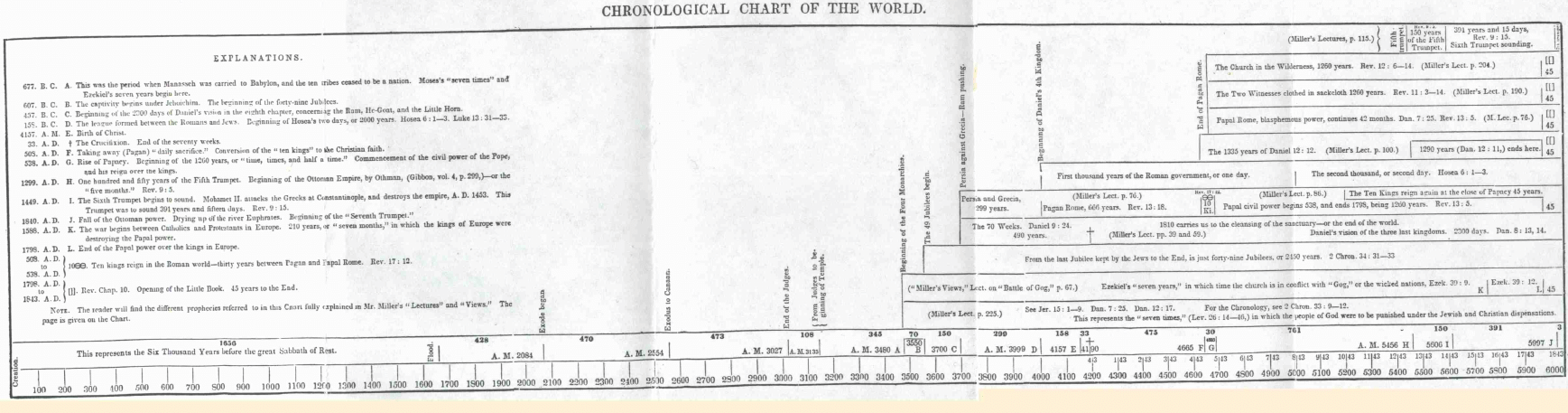
Wyszukiwarka
Podobne podstrony:
1842 William Miller Dissertations
Sustaining Language Diversity in Europe Evidence from the Euromosaic Project (G Williams)
Antioxidant activity of tea polyphenols in vivo evidence from animal studies
False belief understanding in 2and5 year olds Evidence from two novel verbal spontaneous response ta
The relationship between public relations and marketing in excellent organizations evidence from the
Chan, Chockalingam And Lai Overnight Information And Intraday Trading Behavior Evidence From Nyse C
False belief understanding in 2and5 year olds Evidence from violation of expectation change of locat
Fishea And Robeb The Impact Of Illegal Insider Trading In Dealer And Specialist Markets Evidence Fr
Frino, Mcinish And Toner The Liquidity Of Automated Exchanges New Evidence From German Bund Futures
Bank shareholding and lending complementarity or substitution Some evidence from a panel of large I
One part and two part models of nominal Case Evidence from case distribution
1841 William Miller Views of Prophecies
Povinelli, Daniel J Social Understanding in Chimpanzees New Evidence from a Longitudinal Approach (
Three from the Legion Jack Williamson
William Weber From miscellany to homogenity in Concert Programming
Is There Historical Evidence for the Resurrection of Jesus A Debate between William Lane Craig and B
Gramsci and Globalisation From Nation State to Transnational Hegemony Robinson, William I
więcej podobnych podstron