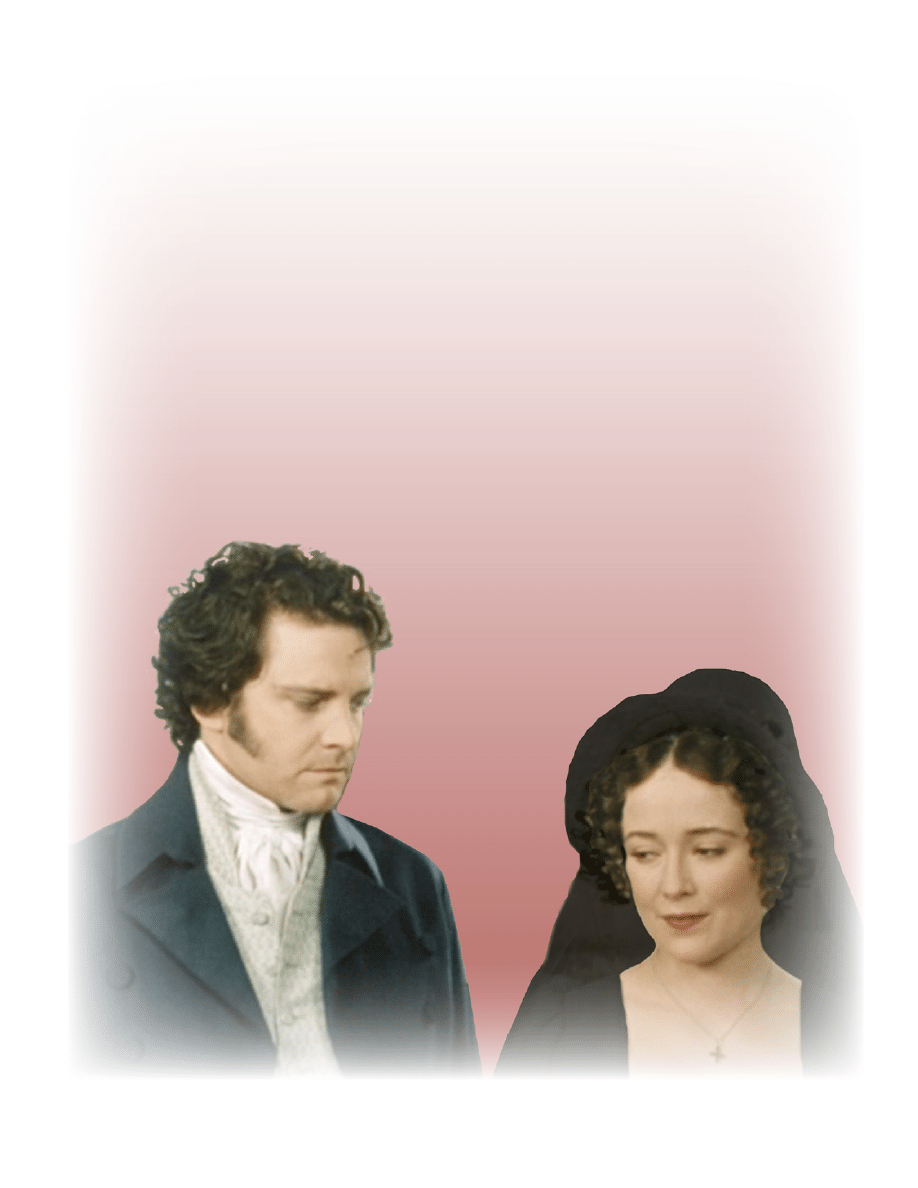
An Arranged
Marriage
by Jan H

Chapter 1
M
y Aunt Philips is a great quoter of
proverbs and she delights in re-
peating them on each and every
occasion she deems appropriate.
Actually, she delights in repeating almost everything she
hears whether it is appropriate or not, but that is neither
here nor there. As for proverbs, her favorite is, ‘Happy is the
bride that the sun shines on.’ She echoed it incessantly dur-
ing the seven days before my wedding (which happened to
be the entire length of my engagement) and on the morning
of said event, when the heavens erupted in a storm of such
magnitude the likes of which I cannot describe to this day,
she shook her head, rolled her eyes and tsk-tsked at such
length that Mamma finally threatened her with banish-
ment if she did not give over.
An explosion of thunder had awakened our household
at dawn with such force that I fully expected to witness
Napoleon’s cannon outside my window. If truth be told,
such a woe could not have been less welcome than the cer-
emony awaiting me. I stood at the window, looking out at
the stormy clouds unleashing their fury, and I judged the
day perfect for my wedding.
At the hour we were to walk the short distance to the
church, a hard, steady downpour caused Mamma to call for
the carriages instead. It was such a festive sight to see (I am
sure!)—a bevy of black umbrellas shielding our small bridal
party of relatives hurrying from Longbourn church to the
carriages and then back to our house for the wedding break-
fast. And shortly afterwards, if perchance any of the villagers
had ventured out of doors in such a storm or peeked out
their windows, they would have seen me step quickly to
avoid the puddles between the entrance to my childhood
home and my new husband’s carriage bound for London,
although every part of me yearned to splash through the
mud in the opposite direction and lock myself safe within
the house.
I now watched the raindrops trickle down the carriage
window while the cumbersome vehicle lurched back and
forth on the road to town and my new life. Obviously, the
mud was getting deeper; it felt as though we reeled from rut
to rut. The storm grew heavier the farther we traveled, as
though heaven, itself, could not refrain from weeping at the
travesty of such a union I entered into less than four hours
ago. The man sitting on the opposite seat averted his face,
choosing to pay as close attention to nature’s deluge outside
his window as I did.
We had said little to each other since the journey began;
indeed, what was there to say? Ill at ease with nothing in
common, thrust into an awkward situation, each one wary
of the other, we had ridden in silence the last 0 miles. I
smoothed the creases in my skirt, observing that the black
bombazine melted into the ebony of the fine leather seats.
Propriety deemed that I could have worn gray or at least a
mixture of black and white, perhaps a stripe, especially since
I was a bride, but I chose the same shade I have worn every
day since the funeral. Black shoes, gloves and cloak, as well
as a dark veil over my bonnet, which caused me to appear
as one in deep mourning, which, again, I considered quite
appropriate for the day.
I swept my eyes over the interior of the coach, noting
its richness and lustre. The upholstery gleamed almost as
much as my companion’s highly polished boots had shone
earlier in the day. Now flecks of mud spoiled the reflection.
My eyes traveled from his boots to the long grey coat that
he wore, evoking memories of the times I saw him wear it
before—at Netherfield in the earliest days of our acquain-
tance almost a year ago when my sister, Jane, had been taken
ill and convalesced there and most recently on the morn-
ing after I refused his first proposal of marriage. What were
those words with which I rejected him—I had not known
you a month before I knew that you were the last man I would
ever marry!
“Are you warm enough?” Darcy asked, jarring me back
to the present. “There is a rug available if you are chilled.”
“Perfectly, sir. I have no need of anything.”
He turned his face back to the window. “We should
reach town by sundown if this blasted storm does not delay
us.”
I said nothing, but closed my eyes in dread of the
thought, turning my countenance back to the rain soaked
landscape. This would be our wedding night and a more
reluctant bride did not exist. Of course, I had been assured
there would be no intimacy until I desired it, for that was a
spoken term of the marriage, if not a written one. I blushed
at the remembrance of Darcy’s words, “You need have no
fear that I shall demand my conjugal rights. The marriage
will not be consummated until you come to my bed will-
ingly.”
“It may well be a frigid day in July before I do!” I re-
plied.
“As you like,” he said, raising one eyebrow, piercing my
carefully preserved armor of indignity with his dark, brood-
ing stare, “but I do expect an heir, Miss Bennet. That is one
of the terms of this contract. Make sure you have a change
of heart before you are past child-bearing years.”
“Then you had better take back the word willingly, Mr.
Darcy.”
“I shall not. I have never forced my will on any woman
and I shall not begin with you. If you cannot foresee eventu-
ally having my child, then you must refuse this offer.”
“Have I not already? Did I not refuse you six months ago
at Hunsford, sir?”

“You did, but circumstances have changed, as you are
well aware.”
I blanched at his words, remembering how carefree I had
been in the spring while visiting Charlotte and Mr. Collins,
how I had dismissed Darcy’s first proposal with all my righ-
teous anger. And I had been correct in doing so. Never had
a man proposed in so insolent a manner. He assumed that
I would be on my knees thanking him for his great conde-
scension in stooping to marry one so socially inferior. Well,
I had put him in his place by refusing him with an equal
omission of civility and from the look on his face, I could
tell that my words had penetrated his arrogance.
Only three days later my light-hearted world had
crashed with the arrival of a post at midnight announc-
ing the death of my beloved father in a hunting accident.
His gun had discharged as he bent to retrieve a bird he had
just bagged. In April, when new life burst forth all around
us, my gentle, kind father had died a most violent death, a
death that should not have happened, a death that had such
far reaching consequences for, you see, my father’s estate was
entailed away upon his cousin, Mr. Collins, and he left only
the smallest of fortunes to provide for his widow and five
daughters. He had never been a man who looked ahead and
with a spendthrift wife who loved to dress her daughters as
well as herself in the latest finery, extra funds to tuck away
had evaporated.
Now, here in the carriage I sighed remembering how I
had boarded the early coach for Meryton the very next morn-
ing, not even taking time to take leave of Lady Catherine. I
had arrived home to find my sisters devastated and I was
struck at how suddenly small and lost my mother had ap-
peared at the time. Darcy looked up at the sound of my sigh,
but said nothing. We continued on our journey in silence,
a state that suited me utterly. He was such a taciturn man,
perhaps we would avoid conversation throughout this mar-
riage, saying as little as possible to each other. I had no desire
to talk to him and I knew he felt the same, for in the whole
of our acquaintance, he rarely carried on any conversation
with me, choosing, instead, these futile attempts to wither
me with his long, steady, disapproving looks. He was mis-
taken. I refused to wither.
Lightning flashed through the windows and a crash of
thunder shook the carriage. I heard the sound of additional
horses and voices and sat forward to look out, observing
that we had arrived in a small village. Our vehicle pulled to
a stop and I could hear men’s voices shouting outside. Darcy
immediately opened his door.
“The bridge is out up ahead, sir,” the driver said. The
locals say we can’t get through until the storm subsides.”
“Is there not an alternate route?”
“No, sir. This road be the only one passable in this kind
of weather, sir.”
“Blast!”
“There is an inn, sir. It’s not much, but at least it’s dry.”
Darcy nodded and closed the door, brushing the water
from his coat. “It seems we have no choice. We shall have to
spend the night in this God-forsaken place.”
“It matters little where I stay,” I replied.
He pressed his lips together, clenching his jaw.
The inn was small and rustic to say the least. Darcy’s
footman had gone ahead and per orders, informed the own-
er that his master was a gentleman and required the very
best suite of rooms. We walked in to overhear him inform
the man that it was our wedding night. The fat, balding
little man laughed coarsely and elbowed his wife in the ribs.
“Their wedding night? They will have no need of a suite,
then, will they, dearie? Just a great big bed! Which is a good
thing, as we got naught but one room left in the whole place.
See that other fancy carriage out there? A family of four got
here just a’fore you. We done let the other two rooms to
them.”
The footman argued repeatedly, offered more money,
and finally resorted to threats, but to no avail. There was
only one empty room and the owner could not conjure up
another. Darcy swore and attempted, himself, to persuade
the innkeeper to find more accommodations, but it was use-
less. I followed Darcy and the man up the stairs into the
available bedchamber, all the while conscious of his wife’s
stares and whispers to the barmaid. “I never seen no bride
dressed in black before.”
The room was small, but clean. Darcy stomped around,
inspecting it while the innkeeper lit the fire. An old chaise
that had seen better days sat on the left just inside the door,
two straight chairs and a small table were near the fireplace,
a narrow armoire rested against one wall with a dresser and
mirror opposite and, of course, in the most prominent posi-
tion in the room sat the bed.
“Supper will be ready in about an hour, sir, and my mis-
sus can assist your lady whenever she’s needed. Is there any-
thing else I can bring you, Mr. Darcy?”
“A bottle of brandy,” he said, his speech clipped and an-
gry.
“Yes, sir, right away, sir,” the innkeeper repeated several
times as he hurried from the room.
I walked to the fireplace, removing my bonnet and shak-
ing the raindrops from it. I stretched out my hands to the
warmth of the blaze and could not help but smile slightly at
the sight of Darcy pacing back and forth.
“It is not so bad,” I said at last.
He stopped and looked at me. “You think not? No, you
would not, for you at least have a bed, while I shall be forced
to sleep upright on a hard bench in the common room with
my servants.”
“If you do that, it will cause talk, you know.”
He gave me an inquiring look.
“Your servants are aware this is our wedding night and
it seems they have informed the innkeeper. If we spend the
night apart, they will know this marriage is a sham. I have

nothing to lose by such a revelation, but I would think you
wish to avoid such a disclosure this early in the game. I recall
that you said we were to act as though we are married in
every respect when in the company of others. Was that not
one of your requirements?”
Darcy said nothing at first. He simply looked at me,
as though measuring my intent in reminding him of such.
From head to toe and back again, he slowly surveyed my
form. I felt a flush creep up my face and when I spoke, I
was disconcerted that my voice came out somewhat higher
than usual. “I did not say that, sir, to invite you into my
bed. I have no objection, however, if you sleep on the chaise.
Perhaps you might request an additional blanket.”
Darcy looked from the lumpy old chaise, its springs sag-
ging with an obvious sway in the middle, to the bed and
back again. “Very well,” he said at last. “If you have no ob-
jection, Madam.”
“None, as long as you afford me the privacy to dress for
bed and retire while you are below stairs.”
“I would not have it any other way,” he said and stalked
out of the room.
For some reason his last words stung. Why, I did not
know, but it felt as though he rejected me physically, a feel-
ing I did not like. Six months earlier at Hunsford he had
declared that he loved and admired me, that almost from
the beginning of our acquaintance he had felt a passion-
ate regard for me. His second proposal contained no like
statements, but I assumed some slight feeling still existed on
his part, even though the subsequent offer was more like a
business arrangement than any semblance of a romantic ap-
plication. I drew near to a mirror on the far wall, smoothing
the slight frizz of my curls caused by the humidity outside.
Peering at my image, I noted the dark smudges under my
eyes and the pinched hollows in my cheeks. I was much
thinner than when at Hunsford, and I had slept little since
this whole marriage idea had been thrust upon me, but did
Darcy now find me unappealing? Had I lost the bloom that
attracted him in the first place? And if so, why should it
matter? I disliked the man exceedingly.
A knock at the door preceded the entrance of the inn-
keeper’s wife carrying a china pitcher and bowl, the barmaid
with towels over one arm and a well-worn quilt on the other,
and the innkeeper following them with a tray containing
two glasses and a bottle of brandy which he placed on the
small table near the fireplace. The maid spread the multi-
colored quilt over the foot of the bed, smoothed it out and
turned it back so that it might be easily pulled up in the
night.
“Here’s your husband’s brandy, Ma’am,” the man said,
“although from the number of drinks he’s had downstairs, I
doubt he’ll need much of it when he returns to you.” He
laughed and poked his wife in the ribs once again. Believe
me, if he were my husband, I would put a stop to those
pokes.
“Go on with you, now,” she said, shooing him out,
“while I help the lady with her toilette. You’ll be wanting to
dress for dinner, I suppose, Missus, although around these
parts it’s more of a cold supper.”
The maid laughed and poured water into the basin,
placing the towels on the dresser beside it.
“No,” I said, “I shall go as I am.”
“As you wish, Ma’am,” the woman said, but I caught her
raising her eyebrows at the maid. “Is there anything you be
needing then?”
I shook my head and the two women made their exit. I
could see no reason to dress for dinner in this place. Surely
Darcy would not expect me to, especially since I was wear-
ing my very best dress already, my very best mourning dress,
that is. Once again, I recalled the look of surprise on his
face when I appeared at the altar that morning dressed com-
pletely in black. My mother and I were the only ones to
be so attired. Even Jane had discontinued the deep mourn-
ing clothes and resorted to grey and black pinstripes some
months back. My younger sisters had discarded theirs much
sooner and now wore only dark ribbons on their bonnets,
Kitty sometimes neglecting even those. At times I felt that
all of them had forgotten our father, except for me. My
mother rarely cried any more, especially since she was no
longer to be thrown out of Longbourn. Was I the only one
who still felt his loss with such a piercing bite?
Well, whatever Darcy felt about my dress had been the
least of my concerns when I walked down the aisle. Getting
through the marriage vows was the task that had almost
caused me to run from the church.
“Wilt thou have this man to thy wedded husband, to
live together after God’s ordinance in the holy estate of
Matrimony? Wilt thou obey him, and serve him, love, hon-
our and keep him in sickness and in health…”
I heard the vicar reading the familiar words from the
Book of Common Prayer, but when he paused and looked
up to hear my assent, the lump in my throat ballooned to
such a size that it constricted my breathing. I had to swallow
twice before whispering, “I will.”
When he continued and I heard Darcy utter his vows
aloud, it sounded like a dull roar in my ears and I could not
have told you one word that he uttered. Then it was my turn
to repeat after the minister, but all I could hear was the same
voice in my head screaming over and over, “You are lying!
Lying! Lying!”
Swaying slightly, I closed my eyes and shook my head
with the tiniest of movements as though I might somehow
clear the voices from my mind.
“Miss Bennet?” the vicar said softly, indicating that it
was my turn to respond.
I opened my eyes and searched the old man’s kind-look-
ing face. He must have assumed I was simply suffering an at-
tack of nerves and so repeated the words for me to say. This
time I forced myself to listen and I responded in kind.

“I, Elizabeth, take thee, Fitzwilliam, to my wedded hus-
band, to have and to hold from this day forward, for better
for worse, for richer for poorer, in sickness and in health,
to…” here I faltered, wishing to beseech the vicar. Could he
not see the desperation in my eyes?
“To love, cherish and to obey, until death us do part…”
he prodded.
I took a deep breath. I could feel Darcy’s presence beside
me and I turned slightly toward him to see if he would per-
mit me to stand there and lie before God and these witness-
es, but his face was turned away from me, his gaze straight
ahead, the light in his eyes having turned deadly grey.
“To…to love,” there, I had said it. Now I could go on
and repeat the rest of the phrase, but my voice sounded
toneless and dead in my ears.
Darcy must have put a ring on my finger, for I felt it
now as I washed my hands and face with the water provided,
but I had no memory of his placing it there. I blocked out
the remainder of the entire ceremony, the short wedding
breakfast thereafter, the best wishes of the few guests in at-
tendance, my Aunt and Uncle Gardiner, the Philips, and
of course, Mamma and my sisters. Was there anyone from
Darcy’s family in attendance? I could not remember. Surely
someone had stood up with him, as Jane had done for me.
Oh yes, Colonel Fitzwilliam. I vaguely remembered him
press my hands before we left Longbourn and the sympa-
thetic look in his eyes as he bid me farewell. Why could not
he have been born heir to a fortune and asked for my hand?
I do not love him, but I do hold him in high regard. His
kindness and pleasing manner are in such contrast to that
of his cousin. Surely I could be a wife to him with ease and
affection.
Suddenly a great weariness washed over me and I sank
down upon the bed and closed my eyes for just a moment.
Some two hours later I vaguely sensed someone’s presence.
I opened my eyes to see Darcy standing close to the bed;
with a swift motion, he raised his hand to smooth his hair.
Had he been about to touch me? I immediately sat up and
looked around, observing the darkness outside the window.
“When you are ready, we can go down to supper,” Darcy
said, turning away to stoke the fire. The logs had burned
down somewhat; the ashes now threw sparks of blue and
orange in response to his prodding.
“I am ready,” I murmured, patting my hair and glancing
in the mirror. I swayed slightly as I stood and reached for the
dresser to steady myself.
“Are you ill?”
“No, I must have risen too quickly. That is all.”
“Then let us depart.” He strode to the door and I fol-
lowed him, conscious of the smell of alcohol about his per-
son as he held the door open.
The main dish at supper was cold mutton, the fat con-
gealed so heavily that I almost gagged at the sight of it. I
picked at the sweetbread pie, but I could not abide the meat.
Darcy drank more than he ate, bidding the barmaid fill his
glass over and over. I had never before eaten a meal with a
complete lack of conversation. I was conscious of the give
and take between the family members at the only other ta-
ble in the room. The girls teased each other, their mother
softly chastised them when they became too boisterous, and
a wave of loneliness for my sisters, especially Jane, swept
over me The noise of the men in the common room ad-
joining this small dining area, some of whom were Darcy’s
servants, seemed to call even more attention to the silence
at our own table.
At last, I gave up and, placing my knife and fork across
the plate, I sat back in my chair.
“Do you care for anything more?” Darcy asked and when
I shook my head, he raised one eyebrow. “You have hardly
touched your plate. Are you certain you are not ill?”
“I am perfectly well. I simply have no appetite.”
“With what we’ve been served, I can well understand.”
He stood and indicated we should leave.
“I can make my way alone, sir, if you prefer to remain
here,” I said.
“I shall see you to the room.”
“It is not necessary.”
“I shall see you to the room.” His words were hard and
insistent.
“Very well,” I said, my tone equally cold. I could feel his
eyes upon me as I climbed the stairs, knowing he was right
behind me. The wooden steps were worn to a dull shine, the
handrail likewise a burnished chocolate color, facts that had
no bearing upon me but that I can still see to this very day.
Inside the room Darcy poured himself a glass of brandy
and walked to the window. I dropped my shawl on the bed
and stood, waiting. He was silent, continued to nurse his
drink and peered out into the dark, wet night.
At last I spoke, “I shall require at least an hour alone
before retiring and I have no need of the maid. I can man-
age on my own.”
He turned and looked at me long and hard and then
placing his empty glass on the table, he proceeded to the
door.
“Mr. Darcy, I would caution you not to drink excessively.
The staircase is quite steep.”
He turned, his hand on the doorknob. “Your concern
is touching. But if I fall and break my neck, would that
not solve your problem? After all, you would then be a rich
widow.” He uttered a laugh short and mocking, closing the
door behind him with sudden force.
I took a deep breath and let it out slowly, feeling the
animosity in the room envelop me. How had my life come
to this? And how could I bear this future before me, a future
bereft of love or happiness? Slowly I unbuttoned my dress
and removed it. After washing myself, I slipped out of my
chemise and pulled on a long, white nightgown. Mamma
had packed it herself, but it was Jane, I knew, who tucked

the dried sprigs of lavender between the folds. They both
were such optimists, hoping to the end that I should grow
to care for my husband. My mother, indeed, could see no
reason why I should not be elated and thankful for a pro-
posal from such a wealthy man, but Jane, who knows my
heart and soul as no other, understood my despair and yet
still believed Darcy would turn out to be a good and loving
husband after all.
I sighed and closed my eyes, shaking my head slightly
at the folly of such hopes. I pulled the pins from my hair
and released my curls, reaching for the brush to smooth out
the tangles. How I wished Jane were there to brush it for
me as she had done so many nights of my life. No, what I
truly wished was to be home at Longbourn with Jane and
not there, trapped in that dismal little room with a man I
do not love.
After folding my chemise and placing it in my trunk, I
hung my dress in the armoire and placed my shoes there
along with my bonnet and cloak. I stirred the fire and
walked to the window one last time; the storm had not less-
ened. As I passed the table, the bottle of brandy stood there,
still containing enough for a glass full. I was not accustomed
to drink anything more than a glass of wine, but tonight I
felt the need of something warm and comforting. Perhaps
it would help me sleep. I walked around the room, blowing
out the candles as I sipped the sweet brandy. I left one burn-
ing on the mantle for Darcy’s use. Finally, there was nothing
left to do but crawl into bed. I settled down between the
sheets and then sighed and arose once more. Taking the ex-
tra quilt from the bottom of the bed and one of the pillows,
I tossed them onto the chaise.
A good wife would at least make up the couch for her
husband, would she not? No, a good wife would never have
banished him from her bed. But since when have I wanted
to be a good wife to Darcy? With a toss of my curls, I pursed
my lips and blew out the remaining candle. Let him find
his own way in the dark. I then gave myself up to the call of
the bed. Even though the sheets were cold, it turned out to
be a fairly comfortable mattress and it was not long before I
succumbed to the relief of sleep.
Sometime in the night, I was aware of a pleasant, cozy
warmth, as though someone cradled me in his arms. I strug-
gled to awaken, but the effects of the brandy and the ex-
hausting strain of the day kept me from conscious thought.
I told myself I must be dreaming and, if I was, I liked the
way it felt.
Chapter 2
T
he morning after my wedding, a slow, steady, thump-
ing sound awakened me—a continual rhythmic ca-
dence resonating in my ear, somehow soothing in its
perfect repetition. It skipped not a stroke. I felt the
pillow under my head slightly moving up and down with
each beat, in and out, in and out. A beat! That is what it
was—a heartbeat!
I slowly opened my eyes, struggling through the early
morning fog of sleep, attempting to focus on this strange
room in which I had spent the night. Oh yes, it was the inn.
Now, I remembered. But what was that sound and why was
my head going up and down in this slow, persistent man-
ner?
I raised up and that is when I saw him—Mr. Darcy! I
was lying with my head on his chest, my arm thrown across
him, and both of his arms around me, clasping my body
close to his. How could this have happened? He was sleep-
ing soundly, fully dressed except for his boots, and lying on
top of the covers. Most of me, fortunately, was under the
sheet and counterpane, although I know not how I came to
use his chest for a pillow.
I sat up immediately, calling forth his name—“Mr.
Darcy!”—with sufficient force that he jerked upward in
such haste that our heads collided. We both cried out at the
shock of such a blow and I shrank back, as he grabbed his
forehead.
“What? What is it?” he muttered, lost in confusion. A
stale smell of alcohol permeated his disheveled clothing, his
hair was in disarray, and dark stubble covered his chin.
“Get out!” I cried. “Get out of my bed!”
“Your bed?” he answered, blinking in the radiant sun-
shine that illuminated the room. “But how…how did I…
did you…”
“Get out! I do not know what you are about, Mr. Darcy,
but I expect you to keep your word!”
“I do keep my word,” he muttered, crawling off the bed.
When his feet touched the floor, he staggered and had to
grab the bedpost to steady himself. He moaned and reached
for his head again. “Will you not blow out that blasted can-
dle?”
“What candle? The light is from the sun and not even
you, sir, can order it blown out. Now, will you leave this
room?”
He blinked again, screwing up his eyes as though they
refused to focus, and lurched toward the door, but then
turned back once more. “My boots. I need my boots.”
They lay beside the bed as though thrown off in a hurry.
I crawled across the mattress, picked up first one, then the
other, and threw them at him, hitting his stomach with

one. He doubled over and glared at me, but did not cry
out. Grabbing the boots and hopping first on one foot and
then the other, he managed to pull them on. With one last
bewildered stare in my direction, he opened the door and
stumbled forth.
I was in such shock that all I could do was sink under
the sheet, suddenly aware that I had been grasping the quilt
up to my neck even though my nightgown was sufficiently
modest. As I slid back into the warmth of the bed, I felt the
heat on the sheets underneath the counterpane where he
had lain beside me. I was angry. More than that, I was furi-
ous. How dare he invade my bed! And yet, I had to admit
that I had slept more soundly that night than I could re-
member and I was quite disconcerted when I found myself
absently running my hand and arm up and down the sheet,
enjoying the warmth he had left behind. I ceased such ac-
tion immediately.
Had Darcy taken advantage of me in the night? I knew
little of such things, but surely he could not have done so
and remained fully clothed and outside the bedcovers. And
no matter how well I slept, I knew it would have been im-
possible to sleep through such an encounter with that man.
By noon, we were on our way to London. The river had
receded and although the road was still a muddy lot, our
horses were able to pull the carriage through the ruts. I had
not seen Darcy until he joined me in the carriage, having
kept to my room all morning. How he shaved and cleaned
up, I know not, but here he was looking the impeccable gen-
tleman, except for the tired look about his eyes. His clothes
were not rumpled nor even smelled of liquor, although I felt
certain they were the clothes he had slept in. He must have
an invaluable valet in service. I trust he paid him well if he
can work such a miracle.
We said nothing to each other. I did not even grant
him the courtesy of a greeting; instead, I turned my face to
the window. No, I turned my entire body to the window
and busied myself with intense perusal of the passing trees,
shrubs and farmland. We rode no little distance in this fash-
ion, when suddenly he cleared his throat and I jumped.
“I beg your pardon,” he said. “I did not mean to startle
you.” When I said nothing, he went on. “Miss Ben…that is,
Eliz…” He stopped and blinked as though he were in search
of something. “I do not seem to know how to address you.
You are no longer Miss Bennet and I fear you do not wish to
be called Mrs. Darcy. May I call you Elizabeth?”
I worked hard not to smile at his discomfiture. “It is
your choice, sir, as long as you do not take advantage of us-
ing such address as licence to act more familiar with me.”
He closed his eyes as though I had struck him. “I would
not think of it. But I must be allowed to apologize for my
behavior last evening.”
I nodded oh, so slightly.
“I do not remember last night. I confess I imbibed far
too generously of the innkeeper’s ale. How I came to be in
your bed, Elizabeth, I am sorry to say, is not possible for me
to recall.”
“Is this generous intake of alcohol a part of your general
nature, sir? If it is, you should have told me, for I have no
intention of living with an intemperate man.”
“Absolutely not!” He spoke forcefully and leaned for-
ward, a pained expression across his face, as he put his hand
to his forehead. “I promise you that I do not make a habit
of such behavior.”
We said no more for several miles. I returned my atten-
tion to the window, but from the corner of my eye, I could
see that his headache was severe. Again and again he closed
his eyes to the glare of the outdoors. I was glad to see him
suffer. His behavior deserved such punishment. I congratu-
lated myself on feeling no wifely sympathies until I remem-
bered the headache that frequently put me to bed. One did
not have to be a loving wife to feel compassion.
“Mr. Darcy, would you prefer the shades to be lowered,
to shield your eyes from the light?”
Surprise covered his countenance at my suggestion. “Do
you not wish to observe the scenery?”
“I do, but I am not suffering a headache.”
“Thank you,” he said, reaching up to release the dark
shade over his window. I did the same and was astonished
at the sudden feeling of closeness within the coach with the
absence of light. An intimacy enveloped us that made me
quite self-conscious. I wondered if he felt it, as well. Now
I had nowhere to look but at my lap or straight ahead, and
then it would appear that I was looking at him. Perhaps
compassion had been a mistake.
But had Mr. Darcy not shown compassion in marrying
me? Why did he marry me? I remained unsure of the rea-
son and feared that I should do so for some time. His first
proposal had been so uncivil and arrogant that I had heard
little argument for marriage and much against. He openly
acknowledged the unsuitability of my family and connec-
tions in comparison to his and yet he still asked for my hand.
I could see him standing in Mr. Collins’ parlor at Hunsford,
insulting in his manner and words. What had been his rea-
son for marriage? Something about “You must allow me to
tell you how ardently I admire and love you.”
I had dismissed his words of love as foolishness because
his rudeness had so infuriated me. How could he profess
love and treat me as he had?
And the second proposal six months later could hardly
be called that. Arrangement would be a better word. How
shocked I had been the day he entered my mother’s house
at Longbourn with my Aunt and Uncle Gardiner. I can still
hear my mother’s cry at seeing her brother.
“Oh, Edward, Edward! You are here at last. Whatever
are we to do?”
“There, there, Fanny,” he soothed. “Ease yourself, sister.
I come with good news.”

“Good news?” Mamma cried. “You have found hidden
funds belonging to Mr. Bennet? We are not to be turned out
from Longbourn next week?”
“Not hidden funds, but something better,” Mr. Gardiner
said, looking to Mr. Darcy. Mamma looked at him and
sniffed as she usually did in his presence. She had not even
acknowledged him prior to my uncle’s words for she dis-
liked him intensely since we had first met a year ago at an
assembly ball in Meryton. That is when the entire commu-
nity first became acquainted with his arrogant manners. He
slighted me when she practically invited him to dance with
me, and the one thing my mother would never forgive was
a man’s refusal to dance with one of her five daughters. Now,
she slowly led my aunt and uncle and Mr. Darcy into my
father’s study, closing the door behind them.
Jane and I were bewildered, as were Mary and Kitty.
What could Mr. Darcy have to do with our mother? And
could we trust her to keep a civil tongue in his presence?
How much better it would have been if Jane or I had been
allowed to be in on the meeting.
“Why is he here?” I asked, “And how did he come to
know our uncle?”
“They met this summer,” Jane replied, “when Mr. and
Mrs. Gardiner traveled to Derbyshire.”
“Oh, yes, the trip on which I was supposed to accom-
pany them.”
I had not gone, of course, because of Father’s death, for
I was now no longer free to go on pleasure trips. Mamma
was of no use to anyone, totally dependent upon Jane and
me and besides that, we were scrambling to find a means
by which to support our family. We knew that our mother’s
profligate ways would soon exhaust her small fortune and
although we would not be paupers, our manner of living
must be severely reduced. We both sent out inquiries for
governess positions and I spent May and June searching for
a reasonable cottage in which to move our family. I regret-
ted giving up that trip with the Gardiners. We were to tour
the Lakes and see some of the grand houses in the north
country.
“But how, Jane? How could they have come into Mr.
Darcy’s company?”
“His estate is in Derbyshire, Lizzy, surely you remem-
ber that. Aunt Gardiner wrote Mamma that they had come
upon him unexpectedly while touring his great house at
Pemberley. They had been told he was away from home, but
he returned earlier than expected. Our aunt wrote a very
pleasing account of his manners in her letter, much different
than what we experienced. She said that once he knew of
their connection to our family, he overwhelmed them with
invitations and civility.”
I snorted at the very idea. Jane admonished me, “Lizzy,
what a noise! You sound like Lydia!”
I blanched at the thought of being compared to my
youngest sister, my wild, irresponsible child of a sister who
had only added to our woes in the middle of the sum-
mer by running off with a blackguard in the militia, a Mr.
Wickham. I am embarrassed to say that when I first met
the man some seven or eight months earlier, I, too, thought
him an amiable, pleasing man. Instead, he turned out to be
a cad who preyed on young women of fortune, having even
tried his lot with Mr. Darcy’s -year-old sister, Georgiana.
Of course, I did not know the truth of his character until
after my meeting with Mr. Darcy at Hunsford. The morn-
ing after his first proposal, he gave me a letter outlining his
relationship with Mr. Wickham, a far different tale than the
one Mr. Wickham had painted. It seems that Mr. Darcy
had not cheated Mr. Wickham out of his inheritance, as the
latter had told far and wide, but rather that Mr. Wickham
had refused the living (a curacy in Kympton) in exchange
for the sum of ,000 pounds. He later attempted an unsuc-
cessful elopement with Georgiana, a fact that was shocking
to hear and I am certain painful for Mr. Darcy to relate.
How I regretted not having warned my own sister about
his character before she, too, fell prey to his charms. I fear
that if my Uncle Gardiner had not paid out vast sums to
Mr. Wickham, he would not have married her, but left her
a ruined woman deserted in London.
For that very reason, our uncle could be of little finan-
cial assistance to us, not after he had been so generous with
Lydia. We knew that he had given us more than we could
ever repay. Our mother, of course, expected him to rescue us,
but Jane and I accepted the fact that it was impossible and
we would not allow her to beg him for more. That is why
Jane had taken a governess position in August. I, too, sought
such a position, but someone had to stay at home and help
Mamma and my younger sisters move into new quarters. I
had at last found a cottage in Surrey and we were packing
to move before Michaelmas when this strange arrival of my
relatives and Mr. Darcy occurred without warning.
“Lizzy,” Jane said, “perhaps Mr. Darcy has heard of our
search for governess positions and he comes with an offer.”
“I think not,” I replied. “Mr. Darcy’s sister is well past
governess age. She now has a companion and will soon be
out in society.”
“Well, if he does want a governess, I shall go. I know
how much you dislike him and I do not feel as strongly.
Besides, since I failed so miserably at my first post, I should
try doubly hard if I am offered another chance.”
“Oh, Jane,” I cried, “do not talk so. You did not fail
and we all know it.” Kitty and Mary quickly agreed with
me. Our oldest sister had chosen the worst possible house
in Lancashire in which to be a governess. Even though the
master was an earl, he had a lecherous eye, and Jane had
not been in residence a week, before he invited her to sit
on his lap and help him with his figures. When she refused,
he persisted with greater advances. Only last week she had
returned home, her beautiful eyes filled with tears, ashamed
to admit she could not bear the situation. She even tortured

herself that somehow she might have caused the earl’s ag-
gression.
“Perhaps he thought I was flirting,” she said.
“Jane!” Mamma and I cried in unison. “Never! Not
you!”
I was so angry I wanted to throttle the man, but that
would have only cast me into prison and deprived my fam-
ily of what little I could earn. After I calmed down, Jane
and I once again submitted letters seeking positions and I
was determined this time to go with Jane and check out her
employer before I left her without recourse.
Now, neither we nor any of our sisters would be forced
to work. That had been the argument that finally convinced
me to enter into the arrangement I now found myself. About
an hour after Mamma and our guests had entered Papa’s
study, she opened the door and motioned for me to come
in. Her eyes were aglow and she positively beamed. I had
not seen her thus since before my father’s death. Actually, I
had seen that look before—the day my cousin, Mr. Collins,
proposed to me, a match she was highly in favour of and
which I refused.
I entered the room and saw Mr. Darcy standing by the
window, his tall stature outlined by the reflection of the light
behind him. He did not smile, only stared at me, his expres-
sion unreadable. My aunt and uncle did smile, as though
they were encouraging me to come in with an accepting
manner.
“Lizzy, your uncle has something to say to you,” Mamma
said, pushing me forward with a slight movement.
He cleared his throat and asked me to sit, but as every-
one else was standing, I declined. “Lizzy, Mr. Darcy came
to me two days ago with an arrangement that will help your
family exceedingly.”
“Oh, yes,” Mamma said, “most exceedingly.”
I glanced at him, but he was looking at the floor for a
change. “What is it?” I asked.
My uncle looked to Mr. Darcy. “Should you prefer to
ask my niece, sir?”
“No. It will probably have more chance of success com-
ing from you, sir.”
Well, I thought, that is the truest statement you have ever
made. It was evident he had not forgotten our last parting.
I had scarce thought of the man since I had last seen him
in Rosings Park. Oh, I had read his letter and at the time
found myself much chagrined at how I had misjudged him
by heeding Wickham’s false tales, but his letter did little to
curry my favour when I read his defense of participating
in the separation of Mr. Bingley from my sister, Jane. And
then my father’s death shortly thereafter had caused my life
to evolve into a downward spiral of duties and worry, and so
circumstances had caused me to dismiss any further consid-
eration of Mr. Darcy or his letter until this very day when
his presence filled my father’s library at Longbourn.
“Uncle, please tell me what it is.”
“Mr. Darcy comes to Longbourn, my dear, to ask for
your hand in marriage.”
That is when I sat down. Quickly. I felt as though I had
been struck. How could he possibly still wish to marry me?
I could not grasp the idea after all the harsh words that had
passed between us. The shock of such a request caused me
to temporarily block the remainder of my uncle’s statement.
I had to ask him to repeat it and that is when my mother
broke in with great impatience.
“Oh, Lizzy, are you not listening? Mr. Darcy wants to
marry you! Mr. Darcy! Just think of it. Our problems are
over! And he not only will marry you, but he has arranged
with Mr. Collins for our family to remain at Longbourn for
as long as we need to, for life!”
I turned in amazement to look at him again. “How can
you do that, sir? The estate is entailed upon my cousin.”
He did not have a chance to speak, because Mamma
took over once again. “A man of Mr. Darcy’s resources can
do anything. Mr. Collins is only too willing to forego posses-
sion of Longbourn for the remuneration offered, although
he does still technically own the estate, I guess. Is that not
correct, brother?”
My uncle nodded. “Yes, Mr. Collins has agreed to rent
Longbourn to your mother, Lizzy, and Mr. Darcy is willing
to pay the rental for as long as your family lives here. In
addition, he is willing to settle a very generous monthly sti-
pend on your mother and establish dowries for your sisters.”
Mamma then began to enthuse prodigiously on the
benefits of such a transaction, how she nor my sisters would
have to move to that horrible little cottage in Surry where
her daughters would have had absolutely no opportunity to
meet suitable young men of fortune (never mind the fact
that Lydia’s scandal had already prohibited such occurrence),
how she could keep her carriage, her servants, and her place
in Hertfordshire society. She went on and on while I sat
there, completely baffled.
At last, my aunt came and sat beside me. Taking my
hand, she said, “What say you, Lizzy? Are you up for this
marriage?”
I struggled to control my breathing and keep my lip
from trembling. “How can you ask me that, Aunt? And you,
Mamma? All of you? Am I nothing more to you than a bar-
gaining piece? Do I not have a say in all of this?”
“Of course you do, my dear,” my aunt replied.
“Lizzy, these kind of arrangements are made all the time,”
my uncle added. “This is a most fortunate offer, especially
since your father is gone.”
“If my father was here, he would not push me into such
an arrangement! Mr. Darcy is well aware that I do not wish
to marry him. He proposed to me six months ago and I
refused him then and I refuse him today.”
“Lizzy!” Mamma cried, sinking down on the chaise and
vigorously fanning herself with her handkerchief. “Do you
mean to say that you refused such a man at Hunsford? That

we could have been free of worry all these months except for
your selfish nature?”
“I do not think I am selfish, Mamma,” I pleaded. “I am
willing to work to support you. I have searched everywhere
for suitable housing that we can afford. I will do anything,
but do not ask me to marry where I have no desire to do
so.”
“I knew it!” Mamma screamed. “I knew she would not
do it. She has always been headstrong, stubborn—her father
coddled her, you know—I knew she would let me down
again! Mr. Darcy, I have three more daughters, the eldest
much prettier than Lizzy and she possesses a much more
compliant nature. Will you not take one of them?”
“Mamma!” I cried, unable to believe what I heard.
Mr. Darcy spoke then. “Mr. Gardiner, might I be af-
forded time alone with Miss Bennet?”
“Oh, yes, that is what you need,” Mamma cried, “time
to plead your case. Come, brother, come Madeline, let them
talk alone.”
“Mamma,” I said, “there is no need for you to leave. I
shall not change my mind.”
“You will stay and hear Mr. Darcy, Elizabeth! You can do
at least that much for me. I insist upon it!”
Seeing the look on my mother’s face, I knew argument
was futile. I watched the members of my family leave the
room, closing the door behind them.
A good five minutes passed wherein neither of us said a
word. I had stood when the others left the room; now I sat,
waiting. He turned and looked out the window for what
seemed like forever and then he walked behind my father’s
desk and picked up some papers and then put them back
down. The man was slower than waking Kitty in the morn-
ings! At last, I could stand it no longer.
“Mr. Darcy, do you have anything to say? If not, I shall
ask you to refrain from wasting my time.”
He looked up then and silenced me with that look. I
cannot describe it, but the certainty crossed my mind that
one could push this man so far and no farther. I closed my
mouth and waited. He took the papers, walked around the
desk and sat in the chair next to me.
“Miss Bennet, this marriage contract is the only way to
save your family from suffering a great disadvantage both
economically and socially. If you would look at the figures, I
think you will see that I am prepared to provide generously
for all three of your sisters, as well as your mother.”
“I do not need to look at numbers, sir. I need an answer.
Why are you doing this? Why do you want to marry me?”
“You have no other options. You and your sisters can
attract no men of fortune; your youngest sister’s unfortu-
nate escapade will essentially bar all of you from the best of
society.”
I groaned silently to think he knew of Lydia’s marriage.
I forgot how fast such news traveled. Mr. Collins must have
told Mr. Darcy’s aunt, Lady Catherine de Bourgh. What
great delight she would have experienced in relaying such
gossip, for she gloried in her superiority.
“I would think, sir, that Lydia’s marriage would certainly
bar you from the slightest consideration of making any con-
nection with our family. Do not forget that if you do, Mr.
Wickham shall be your brother-in-law.”
He winced at my words, but he did not back down.
“Mr. Wickham shall never, of course, be permitted to visit
Pemberley or my house in London, but your sister is wel-
come, as is the rest of your family.”
“You say I have no other options, but you are wrong, Mr.
Darcy. As soon as I see my mother and sisters settled in their
new place, I shall secure a position as governess, as will Jane.
We thank you for your offer, but we are quite able to provide
for ourselves and our family.”
“Are you? Come now, Miss Bennet. Governesses make
very little, hardly enough to keep themselves clothed. There
will be precious little to spare to send home to your family
and, knowing the habits of your mother, frugality is not in
her nature. Besides that, Miss Bennet is far too fine for the
governess trade…as are you.”
I could think of nothing to say for a few moments. I
had never had a head for numbers and I feared he was right
about governess salaries. Still, how could I enter into such
a marriage?
“Miss Bennet, as you know, I have a younger sister who
is in need of someone like you. Since the…mistreatment by
Wickham, which we never speak of and which I insist shall
not be mentioned to her, she is withdrawn and melancholy.
It has been more than a year and still she is timid and shy of
everything and everyone.”
“Could not Jane or I be employed as her companion,
then?” I asked.
“You could, although she has a fine companion in Mrs.
Annesley, but I want someone permanent in her life, some-
one full of wit and vitality, able to tease and enjoy life, as you
do. Georgiana needs a sister.”
“And so you would ask me to marry you just to give your
sister an outgoing companion? Really, Mr. Darcy, I find that
hard to believe. No one is that unselfish when it comes to
family members.”
He bristled at my remarks. I could see a cold anger de-
scend upon his countenance. “Perhaps you are not that un-
selfish, but I take my family responsibilities seriously.”
“So now you agree with my mother and say that I am
selfish because I shall not sell myself to you! Mr. Darcy, there
are many other women with wit and vitality and love of
life whom you could marry and who could assist your sister.
Why must it be me? Why do you want to marry me?”
He stood now and walked to the window and back. “I
have my reasons, Miss Bennet.”
“And they are?”
“My reasons.”

0
When he could see that I was not impressed with his
lack of candor, he went on to tell me expressly what he
would require: how I was to act as though we were perfectly
amiable in public, I was to serve as hostess and mistress of
his houses, but that he would not impose upon me privately
until I was ready. That is when I turned on him like a cat
and he answered with like anger (which conversation I have
related earlier), and I stood, ready to flee the room when he
stopped me.
Catching my hand, he said, “Miss Bennet, do not re-
fuse me today. You have much to think about. Consider it
overnight at least and give me your answer on the morrow.
If your answer remains in the negative, it will silence me on
this subject forever.”
My first thought was to cry, “No, a thousand times no!”
at him, but something about his eyes, the look in them, a
sort of softness I had never seen before, caused me to reluc-
tantly agree to sleep on my decision. The relief on his face at
my answer almost made me ashamed and when he released
my hand, I could still feel its warmth.
That night I was so weary I thought I might crumble
into a million tiny pieces. Mamma had lectured me for what
seemed like hours; my uncle and aunt both took me aside
privately to persuade me of how beneficial this match would
be to all concerned; and at length, even Jane entreated me to
consider its benefits. That was what broke me—the look in
Jane’s eyes. What she had endured during her brief sojourn
in Lancashire had scarred her. She truly was afraid for either
of us to go into service.
“Lizzy,” she said, “I wish I was the one Mr. Darcy want-
ed. I would go in your place if I could.”
“How can you say that, Jane, when in your heart you
know it is Mr. Bingley that you love? How could you give
yourself to another?”
She stopped plaiting her hair then, and looked away
for a moment. It was after midnight and we sat on my bed,
spending our last waking moments of the day sharing con-
fidences as we had done almost every night since childhood.
“Mr. Bingley does not love me, Lizzy. I have accepted that
and I have determined to be practical from now on. I shall
marry the first kind, respectable man who asks me. I am no
longer looking for a love match.”
“But, Jane! I know love is what you desire.”
Her eyes filled with tears. “Not with any other man,
Lizzy. I shall love Mr. Bingley the rest of my life.”
“Oh, Jane,” I cried, pulling her close and kissing her hair.
And that is what made me do it. I knew that Mr. Bingley
still loved Jane, in spite of his apparent disinterestedness. I
felt certain that he had ceased his attentions to her only be-
cause of the influence of his sisters and Mr. Darcy. I had
no power over Mr. Bingley’s sisters, but I could make it a
condition of marriage that Mr. Darcy right the wrong he
had committed upon my sister. At least one of us should be
happy in marriage.
The next morning my bed looked like the remains of a
wrestler’s match, but I was resigned to my fate. Mr. Darcy,
surprisingly, did not object to my regulation about Mr.
Bingley and even asked if I wanted it to be added to the mar-
riage contract. Although I believed that he would do it with-
out such, I asked for it in writing, perhaps because I wished
him to know with whom he was striking a bargain—not
some gullible twit of a girl, but a woman of understanding
who would not be taken advantage of.
So, one might say that I had married out of purely al-
truistic reasons, putting the welfare of my family before my
own pleasure. Way down deep within, though, and even
hidden at the time from my own acknowledgement, there
was another reason for this marriage, a reason I was not
yet able to put into words, to envision, or admit to myself.
Something in me wanted to know Mr. Darcy in his entirety,
to put to rest my curiosity excited by his intriguing mascu-
linity. I wanted to understand why my senses quickened in
his presence, why I felt every part of life more keenly around
him, and what it was that made him want to marry me.
2 2 2
“Elizabeth,” Darcy said, shocking me back to the reality
of our journey, “I do not want Georgiana to know the truth
of our physical arrangement. I trust that you will honour
our contract with discretion.”
“Mr. Darcy, if the truth of our physical arrangement
were the opposite, do you think that I would be so indiscreet
as to share such knowledge with your sister or any other
member of your family?” I replied, insulted that he should
think I needed such cautioning.
“I should hope not, but seeing that you have been reared
in circumstances quite different from mine, I shall from time
to time admonish you with these warnings just in case.”
Oh, the man was an absolute churl! Could he insult my
family to any greater degree? Did he think I was a child?
With a quick flick of my wrist, I reached over and jerked
up the shade on my window. May your head burst, Mr.
Darcy!

Chapter 3
W
e arrived at Mr. Darcy’s townhouse in
London by mid-afternoon. The city’s pa-
rade of sights and sounds entertained me
from the moment we first reached the out-
skirts. I had not been in town for some time and the inten-
sity of the noise, odors, confusion and general uproar were
a welcoming diversion to the silence that had ensued during
the past hour and a half of our carriage ride.
I was not surprised at the stately grandeur of the house,
for the Gardiners had described the richness of Mr. Darcy’s
estate in Derbyshire; I expected no less in London. I was
relieved to see, upon entering the house that it was taste-
fully furnished, quietly elegant, without need to impress.
Although I did not pretend to know him well, his house
reflected the man I thought him to be—a gentleman long
used to the best in life, with no posturing or affected man-
ner, a certain taking for granted that this was how life was to
be. I assumed it had always been that way for him and now
it was to be my way of life. That would take some getting
used to.
In the foyer the butler, Adams, and the housekeeper,
Mrs. James, met us. If they were surprised to see a new
mistress, their manners were circumspect and unrevealing.
Adams informed us that Miss Georgiana was entertaining
callers in the salon and I saw Darcy frown at this news.
“Did not Colonel Fitzwilliam fetch her last night and
take her to the Earl of Matlock’s residence?”
“No, sir, the colonel just arrived a short while ago and by
that time Mrs. Hurst and Miss Bingley attended Miss Darcy.
He has gone above stairs to freshen up before joining them,”
Adams answered, indicating the direction toward the salon.
Darcy groaned and I almost rolled my eyes at the thought of
visiting my least favorite people, but I restrained myself.
As he and his butler continued their conversation re-
garding general news of the household, I ventured a few
steps farther so that I might observe the inhabitants of the
salon without their seeing me. I wished to have a look at my
new sister-in-law before we were thrust upon each other.
I saw a young girl, slender and pale, the opposite in color
to her brother, sitting across from her guests. With what ap-
peared to be great caution and some trepidation, Georgiana
Darcy poured tea into china cups for her guests. She seemed
uneasy with the practice which surprised me, for I assumed
she had served as hostess for her brother numerous times in
the past, but the presence of Miss Bingley and Mrs. Hurst
could contribute to the discomfiture of even the most ac-
complished of hostesses. How well I knew that!
“You say that you expected your brother to return last
night, Miss Darcy?”
“Yes, Miss Bingley,” she answered, extending the cup
and saucer with a slightly shaky hand.
“Perhaps the storm caused the delay,” Mrs. Hurst offered.
“The lightning was quite severe at our townhouse.”
“Quite,” Caroline Bingley agreed. “The thunder dis-
turbed my slumber several times.”
“I feel certain that they spent the night on the road,”
Georgiana said. “At least I hope they did. I would not have
them caught in the rain somewhere without aid.”
Caroline laughed. “Oh, you need not worry, my dear.
Your brother is well able to take care of himself. He is so
strong and capable. I have not the least fear that he could
withstand last night’s storm with no harm whatsoever.”
“Yes, I am sure that Wills could make his way, but with
his bride, I…”
Caroline snorted and coughed, sloshing her tea into the
saucer and quickly placing it on the table. She grabbed fran-
tically for a napkin to mop up the liquid dribbling down her
chin. “What did you say, Miss Darcy? I must have misun-
derstood you!”
“Yes,” Mrs. Hurst interjected, casting a horrified glance
at her sister, “surely you did not say Mr. Darcy had a bride,
my dear, or…did you?”
Georgiana nodded. “Yes. My brother was married yes-
terday at Hertfordshire.”
Caroline appeared almost in a swoon, her eyes rolled
back in her head in a most unappealing manner. She turned
to her sister with a frantic look on her face, and Mrs. Hurst
took over the conversation. “He married at Hertfordshire,
you say? To…uh, anyone we might know?”
“I do not know whether you are acquainted with her. I
have never met her.”
“And…and her name, my dear? Would you happen to
know her name?”
“Yes. It is Elizabeth Bennet.”
Both of Mr. Bingley’s sisters now gasped in unison,
Caroline grabbing her chest as though she had been shot.
Georgiana’s eyes grew quite large as she observed their ob-
vious shock and disbelief. “Do either of you know Miss
Bennet?”
“Yes,” Mrs. Hurst answered, recovering somewhat, “a lit-
tle. We met her sister, Jane, when we were last at Netherfield.
Her family has a small estate nearby.”
“What is she like? My brother has told me little, other
than he feels certain I shall like her.”
“She is very different from us,” Caroline said, having
completed her mopping up. “I cannot believe Charles did
not tell us of the wedding.”
“I do not know if Wills told your brother. It all hap-
pened very fast.”
“It must have,” Mrs. Hurst said, “not to invite us. Mr.
Darcy is such an intimate friend of ours.” Here, Caroline
looked at her rather strangely and her sister explained, “That
is, of our brother, and, consequently, of us as well. I know

my husband thinks quite highly of him. I truly cannot un-
derstand why your brother would not have at least asked
Charles to accompany him.”
Caroline’s eyebrows shot up as though she had just be-
come privy to a shocking idea. “Surely there was no need
for a quick wedding, was there, Miss Darcy?” She and Mrs.
Hurst both leaned forward in anticipation.
“I…I do not know what you mean,” Georgiana an-
swered.
Just then Colonel Fitzwilliam walked into the salon from
an adjoining door on the far side of the room. Georgiana
rose to greet him as he swept into the room, the shine on his
boots less than sparkling, and his cloak heavy with moisture.
He kissed her hand and smiled, and it seemed to me that he
searched her eyes as though he might determine how she
was faring.
“Richard! I am so glad to see you!”
“My sweet Georgie. You must excuse my appearance.
I have been riding since dawn through mud thicker than
plum pudding. Ah, I see you have guests and here I am
intruding.”
“No, not at all,” Georgiana murmured. “You remember
Mrs. Hurst and Miss Bingley. They are Mr. Bingley’s sis-
ters.”
The colonel bowed to each of the ladies. “Yes, of course.
I believe we have met once before.”
“We did,” Mrs. Hurst agreed, “at Lord Dalrymple’s ball
last winter.”
“Yes, how could I forget? As I recall, your brother was
sick with love for some young thing and my cousin and the
two of you worked together all evening attempting to con-
vince him to forget her by introducing him to every eligible
young woman at the dance. What was it Darcy kept say-
ing? ‘There are some very strong objections against the lady,
Bingley. Surely, you can do much better.’ Yes, that was it. I
think he felt quite pleased with himself when he succeeded
in thwarting Mr. Bingley’s plans.”
I felt a flush creeping up my neck to my cheeks and I
had to bite my lip to keep from crying out, “You are talk-
ing about my sister!” Fortunately, I restrained myself and
looking back to see Darcy still in earnest discussion with the
servants, I moved a little closer to the room so that I might
have a better view.
Georgiana offered the colonel a cup of tea, which he
busied himself with, spending much time in adding sugar
and cream and stirring the cup with more effort than it
seemed to need. Caroline watched him intently. I suspected
that she was about to shower him with questions of my mar-
riage and I was soon proven correct.
“Colonel, we have just heard the most surprising news.
Miss Darcy has told us that her brother was married yester-
day and to Miss Elizabeth Bennet. Can this be true?”
“Ah, yes, most definitely. I, myself, stood up with Darcy
and he performed his vows most admirably.”
“But this is so sudden. We had not even heard that they
were engaged,” Mrs. Hurst said.
“I believe it was a very short betrothal, or at least a rather
private one. You may not have heard that Miss Bennet’s fa-
ther passed away some six months ago. That may be why
they elected to have a quiet wedding. There was no one in
attendance but family.”
Mrs. Hurst said nothing and continued to sip her tea.
Caroline sank back against the cushioned settee, her face
falling like a pillow robbed of its feathers. Conversation
lagged from then on until Georgiana asked that her cousin
provide them with more details of the event. There was not
that much to tell, he admitted. The wedding had been brief,
the wedding breakfast almost as much so, and the couple
had left in a heavy downpour. Darcy had requested that he
return to London immediately and take Georgiana to his
parents’ estate just outside of town. Fitzwilliam had been
delayed by the storm and had, at last, taken refuge in a small
inn, and then rose at daybreak to reach London before the
newly married couple. Since he had traveled by a different
route than Mr. and Mrs. Darcy, he assumed they had also
spent the night on the road and would arrive soon.
Just then Darcy startled me by clearing his throat. My
eavesdropping must have been apparent, but he did not
censure me for it, rather indicated the way to the salon and
we proceeded therein. Georgiana rose, a picture of surprise
on her countenance that turned to pleasure I assumed at the
recognition of her brother, for she rushed to his side.
“Mr. Darcy!” Miss Bingley crowed, her eyes alight at his
presence, but then narrowing at the sight of me.
“And Miss Bennet,” Mrs. Hurst cooed, “we have just
heard the news.”
We all spoke in acknowledgement and then Darcy in-
troduced me to Georgiana. We bowed to each other and I
searched for something credible to say. “I am very glad to
make your acquaintance.”
“And I, yours,” she replied. “I have heard much of you.”
That was another time I could have rolled my eyes, but
did not. “I hope you will not hold whatever information
you have heard against me, for I know your brother is my
severest critic.”
“Oh, no,” she said. “My brother has not spoken ill of
you, but rather praised you. He said you play and sing beau-
tifully.”
“I fear he has exaggerated, needless to say for some mis-
chievous reason known only to him.”
“My brother never exaggerates. He always tells the abso-
lute truth.” There was no mistaking the love and regard in
which she held him.
I did not know what to say, so I changed the subject. “I
understand that you love music and play very well.”
“She does,” Mrs. Hurst cut in. “My brother says he has
never heard anyone play with such spirit as Miss Darcy.
Perhaps we may all have opportunity to hear her during your

stay in town. But you must tell us of your wedding! Colonel
Fitzwilliam has just this very moment informed us of the
event.” She continued to utter silly, meaningless phrases that
I knew to be untrue and then said, “How delightful and yet
shocking, Mr. Darcy! When did this happen and how could
you have kept it from us? Does Charles know?”
Before he could reply, she went on, “And where did you
marry? Surely, you did not whisk her off to Gretna Green, sir!”
How could she ask that when I had just overheard Colonel
Fitzwilliam tell them we were married in Hertfordshire?
“Louisa!” Caroline cried. “How can you even suggest
such a thing? Mr. Darcy would never consent to an elope-
ment, even if Miss Bennet would.”
I was seething by that time. “We did not elope. Why
ever would you suggest that I should do so?”
“Well,” Caroline said, smiling but not really smiling as
only she could do, “we heard news of your youngest sis-
ter and Mr. Wickham. Did they not run off to Scotland to
marry this past summer?”
I felt Darcy stiffen—I did not even have to look at
him—and I heard Georgiana’s quick intake of breath.
What surprised me was the look of ferocity that descended
upon Colonel Fitzwilliam’s countenance. Darcy had told
me to look to the colonel for verification of his account of
Wickham’s misdeeds with Georgiana, but I had never dis-
cussed the matter with him. It was obvious that he shared
his cousin’s feelings in the matter and was aghast at the im-
pact of Miss Bingley’s words on this young girl. Did not
this woman have any idea how she was hurting this child?
Georgiana sat down on the sofa, her hands trembling. I
walked across the room and sat beside my new sister before
answering. “You are mistaken, Miss Bingley. Lydia married
in London two months ago.”
“My, my, how strange this must be for you, Mr. Darcy,”
Caroline went on.
He strode to his sister’s side and stood behind the couch,
placing one hand on her shoulder. “In what way?” he re-
plied, his tone deadly.
“Why, you are now brother to the son of your former
servant. Shall we look forward to seeing him at Pemberley?”
I could sense Darcy’s anger, but before he could speak,
Colonel Fitzwilliam came to his rescue. “As much as I would
love to continue this visit, I am much in need of returning
home, and I would suggest we give Mr. and Mrs. Darcy
some time to themselves. Georgiana, Mamma looks forward
to your visit. Shall I ask the servant to pack your bag?”
“No,” she said quickly, “I shall see to it. If you will excuse
me, Miss Bingley, Mrs. Hurst…Mrs. Darcy.”
“Georgiana,” Darcy said, but she escaped the room be-
fore he could continue.
Caroline and her sister then rose and made their fare-
wells; they could hardly do otherwise, since the person they
had come to visit had just fled from their presence. Mrs.
Hurst was effusive in her congratulations and offerings to
have us visit at her house in Grosvenor Square, but Caroline
did nothing more than nod curtly. Poor Miss Bingley. Her
worst nightmare had come true. The man at whom she had
literally thrown herself for years was now removed from the
marriage market. Little did she know I would have gladly
changed places with her.
As soon as the guests had left, Darcy took the stairs two
at a time, heading for his sister’s room, I presumed. That left
the colonel and me alone together. We had never been at a
disadvantage for conversation, but neither of us said much
of anything. We spoke of the weather again and of how te-
dious our journeys had been, but little else. I wondered if
Darcy had confided in his cousin, had told him of our mar-
riage arrangement, or whether he sensed innately that all
was not right between us. I remembered how he had looked
upon me at the wedding with an expression of sympathy.
I did not want his sympathy. The last thing I desired was
pity. I had made this decision to marry and for my own rea-
sons. I would not be the object of anyone’s commiseration.
Perhaps that is why I acted as I did when we heard Darcy
and Georgiana descend the stairs together. Fitzwilliam left
to join them but I lagged behind, remaining in the salon,
although I did move toward the door where I could see the
three of them talking together.
Georgiana had forgotten a favorite book and instead
of calling a servant, Darcy ran up the stairs to retrieve it. I
could just make out the conversation between Georgiana
and Colonel Fitzwilliam.
“No, Georgie,” he said, “It is Darcy’s wish that you stay
with my parents for at least two weeks and Mother is look-
ing forward to your visit. You have always been her favorite,
you know, even though I have no idea why.” The last words
were said in a teasing manner and it was obvious that he was
fond of her.
“But Richard, how will it look to Mrs. Darcy with me
running off like this? She will think I do not like her.”
“Little one, you are talking about a newly married cou-
ple. They are thinking of no one other than each other right
now. She will have plenty of time later to acquaint herself
with you. For now, let them have their honeymoon.”
Georgiana blushed and ducked her head. “Oh, Richard,
you must think me a silly goose.”
“No, just an innocent one.” He smiled and lifted her chin
with his forefinger. “Do not turn your head away from me,
little cousin. You are much too pretty to hide your face.”
“I pray you do not tease me. You know that I am not
innocent…just stupid.” She turned away from him and ap-
peared adamant in her refusal to face him, but he placed his
hands on her shoulders and turned her around.
“I do not want to ever hear you say that again, Georgiana.
Nothing could be farther from the truth.”
“But Richard, after what happened last year…”
“That is behind you now, my dear. Far, far behind you.”
He gathered her into his arms and cradled her head against

his chest, smoothing her blonde curls as he held her close.
“If only you could forget that it ever happened.”
“If only it had never happened,” she said.
He held her for some time and finally she lifted her face.
“Do not be concerned, Richard. Truly, I shall be all right.”
When she offered him a tentative smile, Fitzwilliam’s face
broke into a relieved grin and I felt almost embarrassed to
be privy to their conversation. There was an intimacy there I
knew nothing about and I wondered if Darcy did. For some
reason I felt almost envious. How pleasant it would be to
have a protector like Colonel Fitzwilliam, to have someone
who cared as much for me.
At the sound of Darcy descending the stairs, they looked
up; I decided to make my presence known and so I joined
them. I’m still not sure why I did it, but I tucked my hand
into Darcy’s arm as though we were married in all respects. I
felt him stiffen and imagined his surprise, but I did not even
glance in his direction; instead, I gave my warmest smile to
his sister.
“I look forward to your return, Georgiana. I hope we
shall become good friends.”
She curtseyed in reply, but did not echo my sentiment.
I could see the wary expression in her eyes and after she
and the colonel departed, I felt a great weariness descend
upon me. The situation was not going to be easy. This young
girl would not welcome me with any degree of warmth.
How could she after learning that I was sister-in-law to
Wickham?
“You may stop the pretense now, Elizabeth,” Darcy said,
straightening his arm.
I withdrew my hand with all haste, bristling at his cold
tone. Did my touch fill him with such distaste that he must
rid himself of it at the first chance? Fine. I had no desire to
ever touch him again. If he did not appreciate my efforts at
presenting the picture of domestic happiness, then I would
be all too glad to oblige him. “I am very tired, Mr. Darcy.
Will you call a servant to show me to my apartment?”
“There is no need. I shall take you there. I planned on
giving you a tour of the house, but we can defer that until
tomorrow.”
He indicated that I should climb the wide staircase and
I noted the rich gleam of the highly polished balustrade. It
was made of the finest mahogany and the intricately curved
spindles complemented the dark wine carpet on the stairs.
No wonder he had objected to the rough inn we had been
forced to stay in the night before. When a man was accus-
tomed to such splendor, it must be hard to adjust to less.
Upon reaching the second floor, he led me down the wide
hallway to the second door on the left. Inside was a beauti-
ful spacious bedroom, artfully decorated in blues and greens.
I was happy to see it contained four narrow, floor-to-ceil-
ing windows facing the east so that I would awaken to the
warmth of the sun. They opened upon a small, verdant gar-
den. The trees were turning red and gold and the hawthorn
shrubs sprouted the beginnings of red berries. This spot had
been designed to please the eye in all seasons with various
plantings of flowering bushes.
“This shall be your room,” Darcy said. “Your maid has
already unpacked for you, but if you desire anything fur-
ther, do not hesitate to ring for her. Dinner is usually served
around :0, so there should be time for you to rest before
then.” With a slight bow, he walked out the door, closing it
behind him.
I spent no little time exploring the room, peeking into
the armoires, for there were two, opening drawers, seeing
that they were already filled with my belongings and noting
how little space my nightgowns and underclothes occupied.
There was ample room for a much better dressed woman
than I to occupy these quarters. I sat on the sofa before the
fireplace and leaned against its cushy pillows. From there
I moved to the large four-poster bed and was pleased to
feel its comforting depth—neither too soft nor too hard,
but just right. Well, should I expect less from a man of Mr.
Darcy’s means?
On the north wall there was a small writing desk con-
taining two pots of ink, quills and a box of the finest sta-
tionery; beside it a door opened to a combination dressing
room/bath. I had never before enjoyed the luxury of my
own bath and I inspected it with great thoroughness, antici-
pating the pleasure of a long soak.
On the south wall, I fingered the small china dogs
nestled beneath a vase of autumn’s last roses sitting on the
bureau. Next to it I saw another large door hooded with
ornate cream-colored molding, which continued around
the room, crowned the walls and separated them from the
high ceiling. I wondered what further personal extravagance
awaited me on the other side and so I promptly turned the
brass doorknob.
What astonishment I felt at the sight before me! This
was another completely furnished chamber, as warm and
inviting as mine, but in a decidedly darker fashion. Rich
chocolate colors mixed with smoky greens covered the walls,
furniture, and linens. At first, I drew back, afraid that I had
stumbled into someone’s bedroom, but since there was an
adjoining door between mine and this one I dismissed that
idea, believing, instead, that perhaps this was a sort of study
or personal library for my use, for two walls were lined with
bookshelves filled to capacity. I saw another desk, larger than
the first and complete with even more writing materials. I
delighted in it, anticipating writing to Jane that very night.
The only strange thing about the room was that it contained
another bed, a great handsome bed made up with warmth
and taste.
“What need shall I have for two beds,” I wondered aloud,
and then thought how perfect it would be for Jane when she
came to visit, how we would enjoy the benefit of being next
to each other. Yes, that was it—this room must be a com-
bination study for me and guest chamber for my most inti-

mate friends. My, I thought, the very rich certainly do have
advantages I have never dreamed of. However, at that very
moment the door from that room to the hall opened…and
a completely unexpected answer to my question walked in.
“Madam?” Darcy said, one eyebrow raised in a sardonic
expression. “May I presume that you are looking for me,
seeing that you have invaded my bedroom?”
I was aghast! “Your bedroom? But…but it connects
with mine!”
“It does, indeed.” A faint smile crossed his counte-
nance—actually more of a smirk than smile.
I whirled around and marched back to my room, slam-
ming the door between us. I turned to reach for the lock,
when the door, itself, was snatched from my hands and
pulled open by Darcy.
“I am not accustomed to having doors slammed in my
face,” he said, advancing into the room as I backed away
from him.
“And I am not accustomed to such high-handed treat-
ment, sir.”
“I fail to comprehend your meaning.”
“Why does your room connect to mine? How dare you
put me in such a situation?”
“Such a situation? Mrs. Darcy, these two rooms be-
longed to my parents and after their deaths, I naturally took
my father’s chamber as master of this house. You are now
to preside as mistress; thus, I placed you in the very best
suite which, quite obviously, happens to adjoin mine.” He
enjoyed this; it was evident by the continued smirk on his
face.
“Well,” I sputtered, “well…I shall require a lock on this
door. It does possess one, does it not?”
With what appeared to be a deliberate, tedious turning
of his head, Darcy looked at the knob and then back at me.
“It does not.”
“Will you see that one is installed this very night?”
“I will not.”
“Mr. Darcy! I protest! You assured me according to the
terms of our arrangement that our marriage would be in
name only until I wished differently. Are you going back on
your word?”
“I am not. That is why you have no need for a lock. I do
not open doors where I am not wanted.”
“And how can I believe that after your behavior last
night? I want a lock.”
“My dear, I have apologized for my actions last night; I
shall not do so again. But do heed what I am about to say:
If you think a lock will keep me from your room, you are
mistaken. When I decide to enter, there is no lock made that
will keep me out.”
Before I could think of an answer, he turned and walked
out of the room, closing the door firmly behind him. Oh, I
could not think clearly for the shock of his statement! How
could he speak to me so? I gasped for air, pacing the floor
0 minutes or longer. Had his performance last night been
an indicator of what was to come? Need I fear a repeat of
it tonight? If so, I would leave this house, no matter the ar-
rangement to whichI had consented. I would not live in fear
of his coming through that door at any moment. I fumed
and muttered to myself; I even cried a little, but when my
emotions were spent and my anger subsided, I sank down
upon the sofa, clasping my arms together, hugging them
close to my body. But still, every time I looked at that door,
goosebumps ran up and down my arms. Gradually, I began
to realize that it was not fear or even anger causing that reac-
tion, but a sensation I was unable to name, a sensation that
made me extremely uncomfortable.
It welled up from somewhere deep within me, spurred
by the memory of awakening in Mr. Darcy’s arms and with
my head upon his chest.

Chapter 4
D
inner that evening was a strained affair. I was
surprised at the intimacy of the dining room
when first I entered until Mrs. James ex-
plained that since it was just the two of us, Mr.
Darcy had ordered our meal to be held in the smaller dining
room. Naturally! I should have known he had two dining
rooms—did he not have two or more of everything? I tried
not to look at him, but it was next to impossible when there
was little else on which to place my eyes. The food was deli-
cious, perfect in every detail. The crystal and china gleamed
in the candlelight (I know, for I tried mightily to keep my
eyes on both for some time) and if I had not been possessed
of such a headache, I would have eaten with more appetite.
I had thought to decline dinner, begging off with the excuse
of my ailment, but then I recalled how servants talk. Hmm,
I thought, if they know that Mr. Darcy has a headache and
then I complain of one, too, will not such ills so early in a mar-
riage surely alert them to the unhappiness of our arrangement?
They would know soon enough—how could they avoid the
fact that we slept in separate beds? I knew little of marital
intimacies, but it was a well-known fact that husbands and
wives shared a bed this early in their marriage.
After dinner Mr. Darcy escorted me into the music
room and asked me to play and sing for him. I started to
refuse, until he spoke again.
“My headache has not let up. Some soft music might do
the trick.”
“I shall play, sir, but do not ask me to sing. I am not in
the mood.”
“As you like,” he said and sat down on a sofa opposite
the pianoforte.
I chose to play a Beethoven sonata in F minor, feeling
his eyes upon me the entire time. Fortunately, the piece re-
quired that I watch the keys or music and not meet his look.
If I had done so, I felt sure he would have had a critical
expression thereon, as I fudged and slurred my way through
several of the somber chords. At the end of the song, I
looked up and saw that he had leaned his head against the
sofa back and closed his eyes. Assuming I had put him to
sleep, I rose and attempted to quietly slip out of the room
and escape to my bedchamber, but he spoke before I could
reach the door.
“Thank you, Elizabeth, that was lovely. Will you have
some wine?”
“I thank you, no,” I said, seating myself on a small chair.
“And I hope you do not intend to imbibe tonight, sir. You
said in the carriage that you were not in the habit of con-
suming much strong drink.”
He smiled slightly. “Do not fear a repeat of last evening.
Even if I wanted to drink, my headache prevents it.”
We sat quietly for some time, neither of us even at-
tempting to converse. I may as well get used to this silence, I
thought. At last he rose and walked to the window, pushed
aside the heavy drapery and looked out. “I see that the rain
has returned,” he said.
“Then I shall sleep well. The sound of raindrops against
the window has always soothed me.”
“Except for last night.”
“Yes,” I replied, somewhat disconcerted that he should
speak of it again. “But even with the storm, I did sleep
well.”
“Did you?” he asked, turning to look upon me with an
expression in his eyes that made me feel suddenly weak, al-
most trembling. I could do nothing but nod slightly and
avert my gaze. What was wrong with me? Why should his
gaze affect me so? He walked toward me and held out his
hand. “Shall we retire early tonight?”
I am sure the width of my eyes caused him to realize my
discomfort at such a proposal.
“I meant no untoward suggestion, Elizabeth. I have a
headache. I am tired. And I assume the day has been long
for you as well. Shall we proceed above stairs, you to your
chamber and I to mine?”
“Actually, sir, I would beg leave to select a book from
your library before I turn in.”
“Of course. I shall show you the way.”
“There is no need. I can summon a servant for instruc-
tions.”
The coolness of my tone must have succeeded in discour-
aging him, for he bowed slightly and with a simple, “Good-
night, then,” he strode up the stairs, after having summoned
the butler to lead me into the large, well-endowed library. I
took great delight in canvassing the room, as I explored the
volumes upon volumes of books. I took my time in doing so,
not merely for the pleasure it afforded me, but also to insure
that Mr. Darcy would be safely ensconced in his bedcham-
ber by the time I retired to mine.
At last I chose a new novel and hurried up the staircase.
Closing the door once I reached my room and holding my
breath, I leaned against it, listening for any sound of foot-
steps. When I heard none, I ventured into the room and
noted the warmth of the fire already laid and waiting for me.
I spread my hands before it and then, completely unbid-
den, my eyes could not help but travel to the door between
my suite and that of Mr. Darcy. I felt quite unnerved that
we should sleep with only a wall between us. Suddenly I
heard footsteps behind me and turned, covering my mouth
to stifle a gasp.
“Ma’am?” a young maid asked, walking through the
doorway from my dressing room. “I did not mean to startle
you. I am Fiona. Does Madam require a bath tonight?”

“Fiona,” I said, so relieved I had to sit down on the sofa.
“I would. I would, indeed. A bath would be the very thing to
wash away the weariness of the road.”
“I shall attend to it immediately, Ma’am,” she said, but
instead of returning to the dressing room, she opened the
door to the hallway.
“Fiona? Where are you going?”
She blushed and then stammered, “To inform Master
Darcy’s valet that you will require additional time before…
you are…ready.”
“Ready? I do not understand.”
“For the master’s visit, Ma’am,” she said softly, obviously
embarrassed to meet my eyes.
I closed mine, amazed at my stupidity. Of course, she
and Darcy’s servant expected us to spend the night together.
I must adjust to this. I was married and I must act as a
married woman at least until the servants realized we did
not sleep together. “There is no need,” I said. “Mr. Darcy
has…tasks awaiting him. There will be adequate time for
my bath before his…visit.”
She nodded and returned to the dressing room, ready-
ing the tub with steaming hot water. I proceeded to the
dressing table and began to unpin my hair. How luxurious
it felt to have her brush it and then pin it up loosely, just
enough to keep it from getting wet. She helped me to dis-
robe and I sighed with pleasure as I stepped into the warm
tub, slipped down into the hot water, and laid my head back
against the tub. Fiona had poured some sweet-smelling salts
into the water and the incense and heat combined to make
me feel at ease at last.
“Oh, I have forgotten the lotions, Ma’am,” she said, pull-
ing drawers open while she searched throughout the room.
“One moment, please. I shall return with great haste.”
“Do not hurry,” I said. “I shall soak for a while.”
I heard the click of her heels as she left the dressing
room and walked through my bedchamber and out into the
hall. I could not believe how much I had needed this respite.
The worries and cares of the last days seemed to slide off me
as I slipped my shoulders under the water. I closed my eyes
and, inhaling the pleasing scent, I wiggled my toes and then
pulled my leg up and stretched it toward the ceiling, run-
ning the washcloth down the calf.
I heard footsteps behind me again and realized that I
should allow the maid to wash me, as that was her job, and
so I sat up, but when the steps ceased and she did not appear,
I turned to look over my shoulder and almost screamed at
what I saw—there, just inside the doorway between the
dressing room and my bedchamber, stood Mr. Darcy! I was
too shocked to say or do anything other than sit there, my
mouth agape. He, likewise, appeared quite stunned, but he
did not turn and leave immediately as one would have ex-
pected. He stood there, silent and staring as though he were
transfixed. He opened his mouth as though he might say
something, but at last turned and vanished. I heard the door
to the hallway close firmly behind him.
I gasped for air, realizing suddenly that I had held my
breath the entire time we had stared at each other. What
was he doing in my room? Had he not promised to honour
my privacy? And to think that he had seen me in my bath! I
looked around, realizing that since the doorway was behind
me, he had seen nothing more than my exposed back and
shoulders, but still…we both knew that I was unclothed.
Oh, what mortification! How could I ever face him again?
Just then I heard the door to the hall open and I reached
for the towel draped across the front of the tub. The sound
of voices could be heard, one of them raised, which I rec-
ognized as Darcy’s. The door then closed and Fiona hurried
into the room, carrying the lotion.
“Pardon me, Ma’am,” she said, obviously flustered. “I
did not mean to be so long.”
“Is something wrong, Fiona?”
“Yes, ma’am, it is my little boy. He has a toothache and
he cries for me even though Betty tends him. Children al-
ways want their mothers when they are sick.”
“You have a son?”
“Yes, Ma’am. His name is William, but I call him
Willie.”
“But how can you be in service with a child to care for?”
“The master…he gave me special permission, Ma’am. I
know it is unusual, but the master is the kindest of men,
although he is quite unhappy with me just now.”
“The master? Was that his voice I heard raised in the
hall?”
“Yes, ma’am. He came in search of me when he was told
that the child was crying and he said I had left the door
to your chamber open, for which I beg your pardon most
heartily, Ma’am. I pray you do not hold it against me. We
are most fortunate that it was only the master who discov-
ered it, are we not?” She smiled and winked at me, as though
to say she understood the intimacies of marriage. Well, of
course she would; she had a child.
“Yes, quite,” I murmured. She then proceeded to wash
my back and helped me dry off and get dressed for bed. She
rubbed my arms, hands and neck with the lotion and un-
pinning my hair, she brushed it again, the steaming bath
having caused my curls to misbehave in their own wayward
manner.
“So, this Betty tends your son while you are working,
Fiona? Is that correct?”
“Yes, she is old now, but once she worked in the kitchen
at Pemberley as I did.”
“Oh, you work at Pemberley also?”
“Not any more. I worked there in the kitchen when I
was much younger until…until I had Willie. With his birth,
the master moved me to London and I trained to be an up-
stairs maid. The master is so good. He could have banished
me when I became with child, but instead, he moved me

here and he kept Betty on so that she could help me. Master
Darcy is truly the best of men.”
“And your husband? Does he work in the house also?”
She blushed and would not meet my eyes. “ ‘Tis shame-
ful to admit, Ma’am, but I have never been married.”
“I see.” Now I was embarrassed, but surprised at this
news. Why would Mr. Darcy, who prided himself upon his
propriety, show kindness to a fallen woman and keep her in
his employment—not only keep her employed, but elevate
her to ladies’ maid?
“I had Willie five years ago, Ma’am, when I was naught
but years old. The year before, I left Scotland to live with
my uncle and aunt who are in service at Pemberley, and
when it happened I had nowhere to go. They are all the
family I have left. The master was most understanding. He
could not have me remain at Pemberley because of Miss
Georgiana. She was so young at the time and he is very pro-
tective of her, but he found a place for me here in London.
I am most grateful.”
“I can see how you would be,” I said, rising. “Go back to
your child, now. I do not need anything else this evening.”
One last time she plumped the pillows on the bed she had
turned down, and then curtseyed and departed.
I was glad to be alone. Not only did I suffer a headache,
but now my thoughts reeled with what had happened ear-
lier. Mr. Darcy entered my room uninvited and invaded my
privacy once again. Was he a man I should fear? Would he
burst through the door adjoining our chambers in the mid-
dle of the night, demanding his conjugal rights? That im-
age was in complete opposition to the picture just painted
by the servant—that of a merciful, kind and compassionate
master. Who was the real Mr. Darcy?
A knock at the inner door caused me to jump! It could
be no one other than him, a fact I knew for certain. My first
thought was to barricade myself inside the dressing room,
an idea I quickly abandoned upon remembering his warn-
ing that a door would not bar him if he wanted in. I took
a deep breath and opened the door, although I must admit
that my hand shook as I reached for the doorknob.
There he stood, still completely dressed, which I took as
a reassuring sign. I realized that I was dressed for bed and
drew my robe a little closer. It was the one alteration to my
dark wardrobe that I had allowed—a beautiful champagne-
colored silk robe given to me by Mrs. Gardiner. I knew she
had envisioned me in it on my wedding night, wearing it
for my new husband. I could tell it flattered me by the way
Darcy looked me up and down, but I refused to look away
and met his eyes with a fierceness of my own.
“Sir?”
“May I come in, Elizabeth?”
“For what reason?”
“I brought you some books. I thought they might prove
interesting. And…to apologize.”
The look of contrition in his eyes seemed genuine and
so I stepped back, allowing him entrance. I returned to the
fireplace and he followed me, but maintained an acceptable
amount of distance from my person.
“Forgive me, Elizabeth, for barging in earlier. I had not
the least idea you were…bathing.”
I said nothing, giving him not the slightest assistance.
“My valet said Fee’s child was ill and when he could not
find her, I thought she must be preparing your room. With
the door left ajar, I assumed you were still in the library and
that she had not heard my knocking. I did knock.”
“I did not hear a knock.”
“But I did. You must believe me. I entered only to find
the maid.”
His apology sounded sincere, but I was not in a mood
to make things easier for him, so I made no reply and, in-
stead, settled myself upon the sofa.
“I know that you like to read, so I selected a couple of
books for you.” He handed them to me, a collection of
Dunne’s sonnets and a novel by Richard Graves.
“Thank you,” I murmured and flipped through the pag-
es.
“I hope you found something of interest below stairs,
but I picked these two from among my favorites, which I
keep on the shelves inside my room.”
“You have a great many favorites,” I said, recalling the
walls of bookshelves I had seen earlier.
He nodded and I could not keep myself from saying, “I
do like books, Mr. Darcy, and I shall endeavour most heart-
ily to improve my mind by extensive reading.”
He winced at my words, both of us aware that I made
reference to a sharp retort he had made last winter about a
refined woman needing to be an extensive reader if she was
to entertain his fancy of an accomplished woman. For some
reason, I had a brief glimmer of remorse at teasing him, for
it was plain to see that he knew not how to take it, and so I
changed the subject.
“Fiona told me of your kindness toward her.”
He did not answer, but frowned in response.
“How you allowed her to remain in your employ after
her unfortunate situation.”
“Aye, well, she had nowhere to go and I could not see
turning her out. She was very young and ignorant.”
“I assume the man could not be forced to take respon-
sibility.”
He shook his head. “I felt it was my responsibility.”
“Yours? But why? Do you know who the father is?”
“I do.” He turned and started for the door. “But that is
all I care to say about the matter. I bid you good-night.”
As he closed the door behind him, a suspicion began to
nag at my mind—an ugly, worrisome thought. Why had he
voiced his reply like that? His responsibility? Surely not! Oh,
surely not!

2 2 2
I awoke the next morning to blessed sunshine streaming
through the windows. Not even a hint of fog. How I re-
joiced at the sight, for I did not think I could abide another
dark, dreary day. If I were in charge of rain, I would have it
do so only at night, at the accustomed hour of slumber and
every day would be as beautiful as this morning promised.
It lightened my mood considerably and when I recalled the
distasteful thought with which I had ended the prior eve-
ning, I determined to dismiss it as possibly nothing more
than a foolish fancy on my part
From my earliest childhood I had been blessed with a
sanguine nature and although it had been sorely tried in
the last six months and the past two days in particular, I
resolved to think more positively, to try my best to be more
optimistic. A great longing to leave the house and walk in
the garden came over me and I planned to do so as soon as I
had breakfasted. I even resolved to hold my tongue with Mr.
Darcy; I would attempt to be more compliant, to overlook
his disagreeableness, and to enjoy this day.
My resolve lasted a good half hour.
We had just sat down to breakfast that included a steam-
ing cup of freshly brewed coffee, which I dearly loved and
was enjoying thoroughly, when Mr. Darcy announced that I
must have new gowns made as soon as possible.
“I do not mean to disparage your wardrobe in any way,”
he said. “It is perfectly suitable for the sphere in which you
were brought up, but you will be in need of more extensive
selections as my wife.”
His tone grated on me, perhaps because all that had
transpired the night before had not truly been put to rest in
spite of my efforts, and so with the greatest of ease my cheer-
ful resolve flew right up the chimney. “I have never been one
to put on airs, Mr. Darcy, in either my manners or dress.”
“I am well aware of that. I would not have you do so,
but you must see that we shall be attending concerts and
assemblies as well as balls during the upcoming season, and
I want you to feel at ease. You must take advantage of the
time we are in town to order new gowns. Having grown up
with a sister, I know how important clothes are to a woman.
And besides that, I think it is time that you soften the sever-
ity of your attire.”
Severity! What did he mean? When I raised my eye-
brows in reply, he went on. “Pray, do not think I am insensi-
tive to the loss of your father, Elizabeth, but it is now past six
months since his passing. One rarely sees anyone completely
garbed in black as you are for this length of time.”
“Perhaps that is because you have never seen anyone who
mourns the loss as deeply as I do, sir. How can you possibly
know the depth of my grief?”
His voice softened when next he spoke. “I, too, have
grieved for my parents. Although it occurred years ago, I
still feel their absence.”
His words shamed me; how could I have forgotten
that he had also suffered such a loss? Still, my shackles were
raised at the thought that he would tell me when to cease
my own observance.
“Shall you not visit the dressmakers and milliners later
in the week and at least select some fabrics and patterns or
whatever it is that women require in something other than
black? I shall allow you to choose the time you make the
change, itself.”
“That is generous of you, sir. At least I shall be permitted
the freedom to choose when I quit mourning!” I rose and
stormed out of the dining room. Just before I reached the
staircase, Darcy, having followed me, grabbed my hand.
“Elizabeth! Must you make a scene out of our every con-
versation?”
“A scene! I cannot see that I am making a scene. I sim-
ply expressed my opinion, sir, and if I am to refrain from
doing so, that should have been a clause in our marriage
contract!”
Two servants could be heard approaching the staircase
above stairs, and so he said nothing, but with a nod of his
head, indicated that I must return to the dining room. I
complied but only because I, too, did not care to air our dif-
ferences in front of the staff. Behind the doors that he closed
firmly, Darcy’s scowl deepened. He escorted me to the chair
on which I had previously sat and stood so close by that I
had no choice but to sit down.
“You and I must come to a truce, Elizabeth. You are be-
having as a child and I expect much more of you.”
“I am behaving as a child? And why not, when you per-
sist in treating me as one?”
He clenched his fist and put it to his mouth the way I
had seen him do before when he was angry. Pacing back and
forth before the fireplace, he said nothing for a full five min-
utes. At last, he seemed to have gained his composure. “If I
have treated you as less than you are, I apologize. You must
acknowledge that being a husband is as strange to me as the
role of wife is to you. I have been master in this house for
five years now and Georgiana has been my responsibility for
as long. I am accustomed to say what I will and it is done.”
“I shall acknowledge that, Mr. Darcy, if you will accept
that I am not a servant, a dependent child, or a younger sis-
ter. Whether we like it or not, you have made me your wife
and I intend to be treated with the honour and respect such
position merits. I will not be talked down to, scolded, nor
ordered. If you have not already discovered it, I hope you
soon do so— I am not your property!”
There must have been a fire in my eyes, for I was as
deadly earnest as I had been when he had insulted me at
Hunsford six months previous. When I saw a slight smile
flicker about his countenance, it did nothing to abate my

0
anger. “What statement have I made that you can possibly
deem humorous, sir?”
“Only that I marvel at how quickly you forget your mar-
riage vows.”
“I do not understand your meaning.”
“Did you not but two days ago in the presence of God
and witnesses promise to obey me?”
I closed my eyes in dismay. How could he bring up
that sham of a wedding ceremony and the words I had been
forced to utter?
“Or was your pledge of obedience as false as your vow
of love?”
There was no need for me to answer, for he knew the
truth as well as I did. This time Mr. Darcy was the one to
turn and stride out of the room. We did not speak of our
disagreement again; instead, we separated for much of the
day until late that afternoon he sent Fiona to my sitting
room with a request.
“If you would like to see a bit of the city, Ma’am, the
master says it is his particular wish that you meet him in
the front hall. He is going out and he desires that you ac-
company him.”
I wasted no time in readying myself and joined him
there. It was not an apology, per se, but it would do for
now. Besides, I had grown tired of being indoors all day and
longed to go out—at least, that is the excuse I gave myself.
The remainder of our so-called wedding week and the
next, as well, passed more rapidly than I anticipated. There
were no more intrusions on my privacy or events that
sparked controversy. On the contrary, Mr. Darcy could not
have been more of a gentleman. He assembled the entire
staff and introduced me. I was allowed sufficient time with
Mrs. James to go over the household accounts and acquaint
myself with everything involved in running the townhouse.
I felt quite certain that it could run itself with little input on
my part, but it gratified me to learn that Mr. Darcy publicly
acknowledged me as mistress of the house, no matter what
situation existed privately.
It was as though both of us were making a valiant at-
tempt to get along, and I must admit that Mr. Darcy proved
to be an interesting and stimulating companion. He knew
so much more than I about London and its society. In years
past I had visited my relatives in Cheapside, of course, but
we had rarely ventured far from the area in which they lived.
Mr. Darcy introduced me to a much grander side of town
and I did enjoy exploring a world I had never dreamed of
inhabiting.
He conducted me on a tour of the city, showing me the
best neighborhoods, shops, and parks. I saw St. James’ pal-
ace from the outside, at least, and learned that he frequented
it but little, as he found himself bored with the hangers-on
that populated royal society. Still, I must write to Mamma
and tell her that her son-in-law has been in the presence of
the king. Would not that be a feather in her cap! Now she
would have a rejoinder for Sir William Lucas’ many refer-
ences to such.
He pointed out St. George’s Cathedral, a grand stone
edifice, and then named many more churches we passed by.
We also drove along the Thames for some distance, but he
cautioned me not to stray past a particular bend of it, for
it was not a safe part of the city from thereon. Once the
rain, which had returned, let up in the middle of the week,
I particularly enjoyed our strolls through the park across
the street from his home. Among the trees and well-tended
lawns, at last I felt that I could breathe deeply. Even though
the noise of the city was still evident in the background, it
seemed more like Hertfordshire as we ambled through the
copper and gold fallen leaves and watched the children chase
their kites close to the pond and throw bread to the family
of ducks hovering on the bank, while parents or nannies
sitting nearby kept a watchful eye upon them. Mr. Darcy
introduced me to several couples we met there and invited
them to call.
It was in the park that we both seemed more at ease
with one another. We talked of books and music and I was
surprised to discover that our tastes were similar. In fact, his
favorite authors were those of my father’s, which pleased
me. I had thought Mr. Darcy a man who laughed rarely,
but here he was telling me that he enjoyed the sly wit of Dr.
Johnson. He asked my opinion of certain artists, but there
I had to plead ignorance, for I was woefully uneducated in
the world of art.
“We shall have to remedy that,” he announced. “A trip to
Montagu House in Bloomsbury seems to be in order. Shall
we go tomorrow?”
I readily agreed and we spent all of Friday surveying the
great works found therein. I learned much from him and
felt myself quite educated by the end of the day. It would
take many more tours before I would feel at ease discuss-
ing the Rosetta Stone and other Egyptian antiquities or Mr.
Townley’s collection of classical sculpture, but at least I now
had some inkling as to what Mr. Darcy spoke of. I marveled
at his knowledge about so much of the world and when
he imparted it—almost as a teacher with a student—we
enjoyed perfect amiability. It was only when the personal
intruded into our lives that our familiar masks once again
slipped back into place.
At the end of the second week, he announced that we
were invited to a ball at the Earl of Matlock’s mansion on
Saturday next. The invitation caused a mixture of anticipa-
tion and hesitation within me. I have always loved balls and
dancing, but there I would know hardly anyone and I re-
membered what a disaster our one and only dance had been
at Netherfield almost a year ago.
“Shall I know anyone in attendance other than Colonel
Fitzwilliam?” I asked.
“I feel certain Mr. Bingley and his sister will attend, as
well as Mr. and Mrs. Hurst.”

Since he had introduced the subject of Mr. Bingley, I
felt this as good a time as any to question him about our pre-
marital agreement. “I wonder, sir, have you had opportunity
yet to speak to Mr. Bingley about my sister, Jane?”
He frowned before speaking. “In what way?”
In what way! Was he purposefully forgetting our bargain?
“You promised to right the wrong you committed upon my
sister in regard to your influence upon Mr. Bingley.”
“Oh, that,” he said in a dismissive tone. “No, the time
has not yet been right.”
“And may I ask when it shall be right?”
We were sitting at the dinner table and it seemed to
me that he took more than adequate time in answering me,
choosing to carefully cut his roast beef, chew it thoroughly,
and slowly wash it down with a long swallow of wine. At
this rate, I thought, she shall die an old maid before you finish
this meal!
He wiped his mouth with his napkin and then rose and
started for the door. “Trust me on this, Elizabeth,” he said,
as he reached for the doorknob. “I shall speak to Bingley
when I deem the time is right.”
Oh, the man was so pompous! Why must everything be
done on his timetable? I threw down my napkin and stormed
from the room, unable to eat another bite. I was too angry
to search him out and confront him further, afraid of what I
might say; instead, I ran up the stairs to my chamber. Once
again I spent the evening regretting that I had ever entered
into this marriage. Where was his agreeable nature that I
had come to enjoy the last few days? Had he dropped it in
the carriage as carelessly as one leaves a forgotten umbrella?
And what had happened to our newly found but tenuous
cordiality? Had I merely imagined a slight crack in the shells
in which we both sought protection? Was I the only one
who had been fooled into thinking we might possibly tear
apart those shells? Well, no more—Mr. Darcy had sealed up
the crack with his own particular impenetrable paste.
Chapter 5
A
t the end of dinner on the following
Sunday evening, when we had been
married a total of days, Mr. Darcy
announced that Georgiana would re-
turn on the morrow from her stay at her uncle’s home. I
received the news with some alacrity and yet, a degree or
two of trepidation. During our brief time of marriage nei-
ther Mr. Darcy nor I had discussed his sister except in pass-
ing, but I had many questions on my mind, not the least of
which involved my maid.
“I wonder, sir, exactly why you chose to place Fiona in
my service?”
He looked up from his plate with a strange expression.
“What do you mean?”
“She informs me that you had removed her from
Pemberley because of Georgiana. Now, you station her
above stairs where she is sure to come in frequent contact
with your sister.”
“When I moved Fee to London five years ago, Georgiana
was very young, far too young to understand the circum-
stances of an unmarried girl giving birth to someone’s natu-
ral child.”
“And I take it you feel that she is mature enough now to
have that understanding.”
“I do.” He scowled and throwing down his napkin, he
rose from the table. “Georgiana is no longer a naïve school
girl, not after her experience with George Wickham.”
I could tell he did not want to discuss the subject, but
I persisted. “We must have some conversation about that
very fact, Mr. Darcy. I fail to understand why you did not
inform your sister before we married that Mr. Wickham is
my brother-in-law.”
“Frankly, I take no delight in relating that fact to anyone.
But as for Georgiana, the answer is simple. When I left her
to travel to Hertfordshire with the Gardiners, I did not even
know whether you would accept my proposal. I prepared
her with that truth—that I would seek your hand in mar-
riage, but that I was unsure whether it would come about.
In the event that you declined, I saw no reason to alarm her
as to your connections. If truth be told, I was somewhat
surprised that you did say yes.”
I looked up to meet his eyes, but he had turned away
with those words and walked to the fireplace. Had he asked
me to marry him, hoping that I would say no? I could
not believe that, for he had appeared far too persuasive at
Longbourn. Or had he? I remembered his stern, cold looks
when my uncle had first voiced the idea of such a marriage.
When he asked to see me alone, Mr. Darcy had never of-
fered any words of love, as he had done with his first pro-

posal. It had all seemed more of a business arrangement, but
why would he even make the offer if he did not want me?
I had nothing to offer him; he would not profit from such
a marriage. Suddenly I felt plain and undesirable, and the
feeling hurt, why I knew not. I did not desire this man, did
I? The very thought filled me with such turmoil, I resolved
not to think on it.
“I fear that your decision may be causing your sister great
distress. Pray, do enlighten me on your conversation with her
wherein she learned of my connection to Mr. Wickham.”
“She was troubled somewhat, but I assured her that we
will not see Mr. Wickham, that she has nothing to fear in
that regard. I trust that you will do all you can to reassure
her.”
“Certainly, but is it not possible that we shall see Lydia
sometime in the future? If not at either of your homes, per-
haps at Longbourn. You will allow me to visit my family,
will you not?”
“Of course. I shall not prevent your seeing any of your
sisters. I would think, however, that it shall be some time
before Mrs. Wickham travels from her new home, being as
great a distance as Newcastle is from either Longbourn or
Derbyshire.”
“Oh, I was not aware that you were privy to the site of
the Wickhams’ relocation.”
He averted his face then and walked toward the door
that led to the hall. “Yes,” he muttered, “I knew that they
moved there and that Mr. Wickham has gone into the regu-
lars. Please excuse me.”
He exited the room and I was left to wonder who had
told him of this news. Probably Mamma. She seemed as
proud of Lydia’s marriage as she was of mine and to a more
worthless man in England I am sure could not be found. I
sighed as I rose from the table. I had made no progress in
discussing Georgiana with her brother and my feelings were
hurt at the way he had dismissed my apprehension. Did he
think I was a miracle worker? That I could transform this
shy, young girl into a poised, lively woman when I knew
little about her? He could at least discuss her likes and dis-
likes with me.
And another thing—I was tired of his running off every
time he did not care to continue a conversation with me; I
resolved to question him further and quit the room in search
of him. I supposed him to be partaking of an after-dinner
drink, but when I did not find him in any of the public
rooms, I asked a servant of his whereabouts and he directed
me to a large room that I remembered on my tour of the
townhouse as the game room. Sure enough, when I entered
the doorway, Mr. Darcy was poised to make a shot at the
billiards table. Upon seeing me, he straightened and bowed
slightly. Our formality with each other seemed pretentious.
I wondered if we would ever be at ease with one another.
After all, we had been together every day for over two weeks
now, and we were married…and yet not married.
“Do not interrupt your game,” I said, advancing into the
room. “I shall sit quietly until you finish.”
“As you like,” he said, bending over the table once more
and making a shot that I assumed to be correct, as it hit
another ball into the side pocket. I knew little of the game
and watched with interest as he walked around the table,
positioned his cue stick with studied precision and evident-
ly executed perfect shots from the sound of balls smacking
into each other and then dropping into the pockets around
the table. He had removed his coat and I could not help
but notice his excellent form. He was handsome—there was
no denying it—and through his long-sleeved white shirt I
could see the broadness of his shoulders and the manner in
which his arms filled out his clothing. I wondered if such
a figure was God-given or how he had come to possess
such attributes. I also wondered what it would feel like to
touch those arms, to experience their strength. While I was
musing upon such idle thoughts, he stopped playing and
stood there watching me. Upon becoming aware of his gaze,
I started visibly. Could he read my mind? Of course not!
Then why did I feel so guilty, so exposed? I spoke quickly to
conceal my consternation.
“Do you enjoy other physical games, sir?”
“When in town, I engage in fencing at least twice a
week.”
I could think of nothing to say in reply and nodding, I
turned away from his gaze.
“Have you ever played billiards, Elizabeth?”
I raised my eyebrows at such a question. “Hardly, sir. It
is a gentleman’s game.”
“Would you like to try it?”
“Pardon?”
“We are quite alone. Are you not at all curious to try
your hand?”
I was intrigued by such a suggestion and yes, I did want
to do so. I rose and took the cue stick from his outstretched
hand. He took my right hand, placed the stick between my
fingers and then told me where to position my left hand.
“Now, place your hand upon the table and aim at the
white ball nearest the red one.”
I attempted to do so, but I felt quite awkward.
“You must bend over the table in order to do so. Here, let
me show you,” he said, taking the stick from me and dem-
onstrating the correct posture. We were standing quite close,
near enough that I could have reached out and touched him,
touched that arm that proved so attractive. Such distraction
limited my power of concentration so much so that when I
attempted to copy his position, he stopped me once again.
“No, no, you must bend over closer to the table in order
to make your aim.”
I leaned over further, suddenly cognizant that the neck-
line of my gown proved far too revealing. I was thankful
that Mr. Darcy stood behind me and not on the opposite
side of the table, but then I thought of how the shape of my

derriere must be exposed from the back. No wonder women
did not play this game!
“You still do not have it right. Let me help you,” he said,
and to my utter amazement, I felt him lean over me, his left
arm going around my shoulder as he clasped my left hand
and moved it further back, while his right arm surrounded
mine and he placed his hand over mine. I could feel the
heat from his body, his breath warm upon my cheek, and
the scent of his skin heady and pleasing, filling my senses
until I found it hard not to tremble. “Now, pull the cue stick
through your fingers like this,” he said, moving it back and
forth through our combined fingers, “keep your eyes on the
ball, and shoot.”
With a deft movement, we sent the white ball rolling
across the table, where it hit a red ball neatly into the corner
pocket.
“There! See how easy that was!” he said, as we both
straightened up together. Was he as aware as I was that his
arms were still around me?
“Yes,” I managed to say, “easy, indeed with your guid-
ance.” I turned my face towards him and there was not an
inch between his and mine. We gazed into each other’s eyes
for what seemed like minutes to me, but surely could not
have been more than an instant before he released me and
stepped aside. I knew my color was high and so I averted
my face, busying myself with replacing the cue stick in its
holder.
“Shall you not try it again?”
“No, sir, I believe I have tried enough for now. Perhaps
another night.”
“Yes, perhaps,” he said, keeping his gaze upon me. I
looked up, meeting his eyes and wondered if it was billiards
of which we spoke.
I excused myself and left the room, all too shaken by
the feelings that engulfed me. I found my way into a small
parlor where I had left some needlework; how grateful I was
to find something with which to occupy my hands, but then
how disconcerting it was to discover my fingers trembled
too much to make a straight stitch. I had never experienced
such feelings before, such attraction to any man, not even
to the young swains who had courted me in earlier times.
I liked dancing with handsome young men well enough,
even flirting with them at balls and assemblies, but not one
of them had ever affected me the way that Mr. Darcy had
just accomplished. In one way the sentiment filled me with
anticipation and in another with great dismay. Could such
sensations occur with someone I professed to dislike, with
someone I could not possibly love?
My thoughts were interrupted when he entered the
room. I applied myself to my embroidery with a renewed
focus while he poured himself a glass of Madeira. He offered
me one, but I declined. I needed nothing more to cause my
head to swim. I determined to discuss his sister with him
once again, not only because we needed such discussion,
rather because it was the safest subject I could think of.
“Sir, I would importune upon you to speak more about
Georgiana. You have instructed me not to talk with her
about Mr. Wickham, but I fear he is the object she most
needs to discuss with me.”
“I fail to comprehend your meaning.”
“Your sister was most heartily misused by my brother-
in-law. Can you possibly think that she does not hold that
against me?”
“Why should she? You had nothing to do with it. Your
sister married the scoundrel without your sanction, did she
not?”
“She did not, sir. By the time Lydia and Mr. Wickham
wed, I was all too relieved that he married her.”
“That is not what I meant. Let me rephrase my words.
You would never have desired your sister to elope with Mr.
Wickham, would you?”
“Of course not, but Georgiana is unaware of that.”
“But she is, for I told her that very truth on the day
she departed with Fitzwilliam. The entire subject is one that
causes her great pain and I do not want the issue even men-
tioned in her presence.”
“Are you sure that her feelings correspond with yours?
Could it be that she might benefit from talking of her fears
and anxieties about the matter?”
“Absolutely not. I see no wisdom in such an approach.
My wishes and directions remain as they were, Elizabeth.
Do not mention Mr. Wickham to Georgiana, other than to
assure her she need have no contact with him.”
I glared at him. How could he be so infuriating in his
demands, so insensible in his discernment? How did he
know what Georgiana needed to talk about? For that mat-
ter, how did I? Once again, I thought of the morrow with
diffidence.
2 2 2
The next day I arose late, my sleep having been disturbed
for much of the night by strange dreams. At times I was
chased by some unseen menace and at others, I turned will-
ingly to embrace that same fearful, faceless person. I had not
the slightest idea what it all meant and awoke exhausted.
Added to my fatigue was the fact that before I even
went to bed, I had spent nigh on to two hours rummaging
through my books and correspondence, searching out the
letter Mr. Darcy had given me last April in Rosings Park.
My efforts proved to be in vain. I longed to read the letter
again, to once again review the history between the writer
and Mr. Wickham. I am a great believer in reading between
the lines and I wondered if that letter might enlighten me
as to Mr. Darcy’s character, for I certainly needed no further

enlightenment as to Wickham’s nature. I recalled the anger
that had beset me upon reading it the first time—oh yes, I
had been ashamed that I had ever believed Mr. Wickham’s
lies—but I confess that Mr. Darcy’s further admittance that
he had willingly kept Bingley and Jane apart had so infuri-
ated me that I had thrown the letter aside after only one
reading. Instead of carefully weighing his words, I had dis-
carded them and evidently I had done an effective job of
discarding the letter, itself. I wondered if I had forgotten
it at Longbourn or even worse, left it at Hunsford parson-
age. I vowed to write Jane this very morning and ask her to
make a thorough inspection of my room and upon finding
the missive, dispatch it to me immediately. I should like to
do the same with Charlotte, but I feared she might read it
or even worse, it might fall into the hands of Mr. Collins. I
would begin with Jane, for I knew I could trust her to send
it unread.
As for the present, I was in great need of a cup of coffee
and so I descended the stairs to the sound of voices within
the breakfast room. I assumed that Darcy’s sister must have
already returned and what must she think of me still abed at
this hour? With a determined straightening of my shoulders
and a forced smile on my face, I raised my head and re-
solved to face my new responsibility—that of winning over
Georgiana.
I entered the room only to relax and beam at the wel-
come sight of Mr. Bingley. How relieved I was to see him
instead of my sister-in-law.
“Miss Bennet!” he exclaimed. “That is, I should say Mrs.
Darcy! How good it is to see you! Let me be the first to offer
you my best wishes on the occasion of your marriage to this
dull fellow here.”
“Thank you, sir,” I said. “I am very glad to see you as
well.”
“Only yesterday I returned to town and I could not be-
lieve the two of you married without letting me know. I
have upbraided Darcy for the past half hour. Tell me, were
all your sisters present at the wedding?”
“All but one, sir.”
“Ah,” he said, and I felt certain he was fishing for infor-
mation about Jane.
“My youngest sister is lately married, herself, Mr. Bingley,
and has moved to Newcastle with her husband. It was too
far a distance to travel for my wedding and, in fact, I have
not seen them since their marriage.”
The relief on his face shone through in his eyes and even
broader smile. “I see. And so all of your other sisters are well,
I trust, and still reside at Longbourn?”
“Yes,” I assured him. I shot a glance at Darcy, wondering
if he had yet deigned the time appropriate to inform Bingley
of his part in preventing him from seeing Jane when she
was in London last winter. From the easy camaraderie be-
tween them, it did not appear that he had, for I felt certain
Mr. Bingley would at least countenance some anger toward
his friend at such deceit. Oh, how I hoped that discussion
might occur between them today! But for now, I discovered
that they were making plans to attend a concert together on
Wednesday evening.
“Shall you not enjoy such an outing, Mrs. Darcy?” Mr.
Bingley asked.
“I do not know, sir. I have never been to a concert in
London, but I look forward to it.”
“Excellent,” he rejoined. Just then a commotion in the
hall signaled the return of Georgiana, accompanied by
Colonel Fitzwilliam. They were greeted and offered refresh-
ment, but it appeared that all had eaten except for me. I
decided to forego the meal and made do with coffee. Darcy
and Bingley made much of Miss Darcy and brother and
sister were engrossed in conversation. I observed Bingley to
see if his attentions to her were apropos of a man in love
(as Caroline had insisted that he was), but I could ascertain
no special attention other than that he paid to any other
woman. Certainly, there was no comparison to the interest
he had shown my sister when at Hertfordshire.
“And so, Mrs. Darcy,” Colonel Fitzwilliam said, join-
ing me in a cup of coffee, “how do you like married life by
now?”
I blushed at the question and tried to smile. “I am much
intrigued by London, sir. I have never been so excessively di-
verted. There is much to see and do. One is quite bewildered
by all the choices.”
He agreed with me, and I hoped that he did not wonder
why I had answered his question by changing the subject. If
so, thankfully he was too much of a gentleman to pursue it
and we passed no little time in casual conversation. Three-
quarters of an hour later, he arose and announced that he
must return to his unit.
“Come and walk me to the door, Georgie,” he said, hold-
ing out his hand to her.
“And why should I, Richard? Just so you can lecture me
once again?”
“Lecture?” Darcy asked. “Has she needed lecturing,
Fitzwilliam?”
“You would not believe how often, Darcy! I have spent
two weeks trying to make a lady out of her, but I fear the
task is impossible.”
“Richard!” she cried, while blushing a rosy pink. “You
will have Mrs. Darcy thinking I am a hoyden! Truly, I have
needed no lectures. He simply enjoys having someone to
harangue. I fear that he has been away from his troops far
too long and I have borne the brunt of their absence.”
“Go along with you, now, Missy,” the colonel said, laugh-
ing as he escorted her out of the breakfast room. We could
hear their gentle banter continue down the hall. Once again,
I found myself envy their easy spirit with one another.
It was not long after the colonel left the house that Mr.
Bingley and Darcy made plans to depart for their men’s club.

Out in the hall, Darcy kissed his sister’s cheek, telling her
how glad he was that she had returned.
“Then why are you leaving almost as soon as I arrive,
Wills?” she asked.
“Appointments, my dear. Besides, this will give you time
to acquaint yourself with Elizabeth.” As soon as the door
closed behind the men, however, she turned for the stairs
and I could see that she was poised to flee my presence.
“Georgiana, might you accompany me to the music
room? I found a fugue by Bach that I am unable to play.
Shall you take pity and assist me with the fingering?”
I could see the hesitation in her manner, but the entice-
ment of a piece of music proved to win her over. We sat
down at the pianoforte together and she demonstrated the
correct manner in which to play the selection.
“I fear I have not practiced near enough,” I said. “It is
evident that you have progressed much farther in your mas-
tery of the technique required for this difficult a piece. Pray,
tell me how many hours you devote to your art.”
“It depends upon the day,” she said. “When I am alone,
as is often the case, I seem to lose myself in the music. At
times half a day has gone by before I rise from this instru-
ment.”
I shook my head. “I am impressed, my dear. You are
even more dedicated than my sister.”
She stiffened at my remark and I wondered what I had
said to cause such a response. “Your sister who married re-
cently? Is that the one to whom you refer?”
“Lydia? Oh, no, Lydia has neither ear for music nor pa-
tience to practice. I refer to my sister, Mary. She is the one
who loves to play.”
“So you have two sisters then? I should have liked to
have a sister.”
“I have four sisters…and now, it appears that I have
five.”
When she looked at me with a question in her eyes, I
said, “You, Georgiana, are now my sister, are you not?”
“Oh,” she said softly. “I had not thought of that. I am
afraid I do not know how to act with a sister.”
“Well, it is not difficult, believe me,” I said with a smile.
“I hope that you and I shall be friends, as that is what the best
of sisters become.”
“I have never had many friends, Mrs. Darcy.”
“Oh? And why is that? I do not understand.”
“Most of the year I live at Pemberley with my compan-
ion, Mrs. Annesley. I have had a succession of companions,
but never very many friends my own age. I am rarely in
London, for my brother prefers that I stay in the country,
and when in town, I see only his friends who are all much
older than I.”
“That is abominable! The house should be filled with
young people your age. Why does not your brother see to
it?”
“Wills is very protective. I…I have been taken advantage
of in the past and he is very careful that it should not occur
again.”
“I can understand protection, but Georgiana, you must
not be forced to live a solitary life.”
“Oh, I am not complaining,” she said quickly, rising
from the piano stool and walking to a chair near the fire-
place. “I love my brother.”
“That is well and good,” I said, following her, “but he
cannot be your only companion.”
“My mother died shortly after I was born and I fear my
father did not know what to do with a daughter. He loved
me dearly, but I think he and Wills have always been afraid
something would happen to me, perhaps because of the loss
of my mother. Thus, I have seen little outside of our home
in Derbyshire and this house in London.”
“But with whom did you play when you were little?”
“As I said, I had a number of companions and govern-
esses, of course, all much older women who were more like
mothers than friends. About six years ago, however, I did
make friends with one of the servants. I know that sounds
strange, for such an attachment is not usually sanctioned,
but we had a common affliction, having both lost our moth-
ers when very young. She was a few years older than me and
for some reason, we took to each other immediately and I
loved her. When she could steal away from her duties, we
would run and play in the orchard at Pemberley. She taught
me to climb trees and wade in the shallow end of the pond,
things that scandalized my governess.”
I smiled with her at the memory, gratified that she would
confide such a story in me. “And is she still at Pemberley?”
I asked.
“No, she is here. In fact, Wills said he was giving her to
you as your personal maid.”
“Fiona?”
“Yes, does she satisfy you, for if not, I should be glad to
have Fee transferred to my service?”
“She is quite satisfactory,” I said, surprised at this turn
in the conversation. “Fee” seemed to be a favorite of both
brother and sister, it would seem.
“I hope that you do not object to the fact that she has a
child,” she said, blushing slightly and looking at her hands
in her lap.
“As long as it does not interfere with her duties, I can see
no reason to object.”
“She is not married, you know.” Georgiana pressed her
lips together and kept her face averted.
“Yes,” I said, “She informed me of that fact and your
brother confirmed it.”
“He did?” she said quickly, her eyes searching mine. “Did
he tell you who the father is?”
I shook my head. “Do you know, Georgiana?”
“No,” she answered, looking away, “although I have my
suspicions.”

Neither of us said anything more for a while and she
soon excused herself, retreating to her room. I pondered our
conversation no little time. My new sister did not appear to
be as innocent of the world as Mr. Darcy would have her be.
I wondered how far Mr. Wickham had gone in his betrayal
of her and then, although I did not wish it, my mind wan-
dered back to my questions about Fiona. Surely Georgiana
could not possibly suspect that the maid’s little William was
named for his father.
I did not care for that distasteful thought and how it
attempted to overtake me. In order to divert my attention, I
picked up a book and walked out into the garden. An abun-
dance of clouds hid the sun that day, but rain had not yet ar-
rived and so I relished the solitary time among the fragrant
shrubs and blooming plants. I wandered down the narrow
walk that wound in and around the greenery and coming
upon a stone bench hidden away in an alcove that backed
up to a hedge over eight feet tall, I seated myself and opened
my novel. It was light and entertaining and I anticipated
a good read; however, naught but a few moments passed
before my reverie was interrupted by what I presumed to
be servants on the other side of the giant, dense hedges be-
hind me. They were obviously digging and planting bulbs
in the flowerbeds below. I could not see the men nor could
they see me, for from their conversation it was evident they
thought they were alone.
I attempted to disregard their talk and even stood up in
search of a quieter nook until the nature of their conversa-
tion caught my complete attention. One man complained
repeatedly that he, a house servant, should not be relegated
to the duties of an under-gardener, while the other remind-
ed him that it was his own fault that had caused his descent
in position.
“How can you say that,” the first man replied, “when I
looked far more spiffy in my tails and wig than Duffy?”
“Ah, the only reason you be put in as footman in the
first place were because you and Duffy matched in size,” the
other man said. “You never were no great shakes at your job,
Johnny, my lad, and the master taken no account with your
looks. A few weeks doing grunt work inside and out and
maybe if your luck holds, Master Darcy will relent and put
you back in your fancy uniform.”
“The master—hah! He’s as unfair as they come and he
thinks himself so far above us. Well, I heard a thing or two
about him that brings him right back down even with me.”
“Careful, lad, you don’t go talking about the master too
loud. Someone might hear you other than me, and he’s
thought highly of by every other man about this place.”
“And every gal,” Johnny said, snickering.
“Aye, they all think he’s a looker, that’s for sure.”
“I can’t see that he’s a beauty, but some say he does a lot
more than look at the girls. That Scottish girly, the one with
the by-blow—I heard talk the child might be the master’s.
Why else would he bring her to London and bide the brat?
And what made her so swanky that warranted making a la-
dies’ maid out of her?”
“Ah, don’t be spreading your filthy talk around, Johnny.
Just because the girl won’t let you have your way with her
doesn’t mean you should talk so.”
“It’s not me that’s saying it. I swear I heard it from one
of the lads in the stable.”
“Well, if you did, you be mighty sorry to repeat it is all
I got to say. Now, get on with your work a’fore I calls the
steward.”
The man called Johnny muttered something under his
breath, but I heard nothing more. I sat there as though fro-
zen in place while they worked their way down the long
hedge. The suspicions I had been unable to even utter had
just been spoken aloud and in the vilest of terms. The man’s
ugly words harrowed up fears within me, fears that I had
refused to entertain. Until that moment I had not even rec-
ognized that such thoughts might possibly take root within
my heart and the awareness overwhelmed me with shame.
To listen to servants’ talk and give it credence was far below
me.
I will not have this! I almost said aloud. He may have his
faults, but Mr. Darcy cannot be this kind of man. I refuse to
believe it, absolutely, completely. I shall put it out of my mind
as though I never heard it! There, it is gone!
And with a valiant, intrepid determination, I rose from
the bench and marched into the house, absolutely resolved
at the time that I would never believe such rumors. No mat-
ter what my resolve, however, my heart was troubled, deeply
troubled, and that very night an affliction beset me, an af-
fliction I had suffered since childhood whenever I was pro-
foundly distressed. I began walking in my sleep and the next
morning I awakened to find myself…lying in Mr. Darcy’s
arms.

Chapter 6
T
he first thing I saw was his smile. I screwed up my
eyes, certain that I was still asleep and dreaming, but
then allowed myself to peep through my lashes, for
one does not inhale the pleasing scent of a man’s
skin in a dream, and Mr. Darcy’s scent not only filled my
senses, it seemed to permeate every pore in my whole body.
I opened my eyes wider. His fine lawn nightshirt was open
at the neck and there in the hollow, I could see the slight
shadow of his pulse beating. That was the moment I became
conscious that I was lying in his arms, those very arms that
only yesterday I had amused myself with possibly touching.
“Good morning, Elizabeth,” he said, his voice barely
more than a low whisper, deep and gravelly with early morn-
ing sleepiness.
I could not respond. In truth, I was in such shock that I
wondered if I could recall how to talk. I could not take it in,
his face so near to mine, my head lying on his shoulder, his
dark curls mussed and falling across his forehead in the most
provocative manner, the dark shadow of his beard outlining
his face—how had this happened?
Slowly, very, very slowly, I sat up, clutching the sheet to
my throat. I dared a frantic peek below the cover to assure
myself that I was still clothed and closed my eyes in relief to
see my nightgown. “Where…where am I?” I cried.
“In my bed,” he replied as though it were the most natu-
ral thing in the world.
I opened my mouth to speak, but he put his finger
against my lips. “Now, before you attack me with accusa-
tions, hear me out. Sometime in the night, I awoke and
found you right here, cuddled up against me. You came
willingly, Elizabeth,” he said, the smile continuing upon his
countenance. “I did not coerce you in any way.”
“But…how…what…why would I…did we? Help me! I
cannot remember anything!”
“My, my, you certainly know how to flatter a man. Share
his bed and not remember a bit of it!”
I searched his face, mine evidently reflecting horror, but
that same tantalizing smile continuing to grace his. Then
slowly I realized that he had made this last statement in jest.
Mr. Darcy was teasing me!
“Sir, I pray you, be serious and tell me what happened.”
He took pity on me then and began to explain my
nocturnal wandering. “I confess that I was as surprised to
find you in my bed last night as you are this morning. I at-
tempted to talk to you, but I soon discerned that you were
sound asleep. I had an uncle who was a somnambulist and
his physician cautioned us to never awaken him as it might
cause irreparable damage, so what else could I do other than
allow you to share my bed?” He reached over and patted my
hand. “Quit your fretting, Elizabeth, and be assured that
nothing untoward happened between us, for I am not a man
who takes advantage of an unconscious woman. Have you
ever walked in your sleep before?”
I nodded and then sighed with relief, a sigh so heavy
and obvious that I saw him struggle not to laugh. It was
humorous; even I could acknowledge it, and as I saw him
press his lips together to restrain his mirth, I began to giggle,
softly at first, and then when he joined me, we both erupted
in laughter. I had never seen him laugh before; in truth, I
had never allowed myself such unbridled liberty in his pres-
ence. We both laughed until I was almost crying. When our
amusement eventually slowed, I became all too aware of the
intimacy of our postures, for there we sat, still facing each
other right in the middle of Mr. Darcy’s bed.
Suddenly, I blushed anew and began to look around me,
searching for a way that I could escape his chamber without
exposing myself. He startled me by reaching out and gently
touching my face, turning it back toward him. “What is it,
Elizabeth? What do you need?”
“A graceful way out of this predicament, I confess. Will
you leave, sir, so that I might return to my room?”
“And expose myself in my nightshirt, Madam? Oh, I
think not. You are the invader; it is up to you to leave.”
“But…I am not dressed properly…”
“So I see,” he said, smiling once more as his eyes wan-
dered over me, lazily surveying my dishabille.
“Really, Mr. Darcy, you might take pity on me and act in
a gentleman-like manner,” I said.
He folded his arms across his chest and nodded. “Aye, I
might, and then again I might demand that you get out of
my bed immediately—were not those the very same words
in which you addressed me when I inadvertently wandered
into your bed in that wretched little inn where we spent our
wedding night?”
“But you, sir, were drunk!”
“Yes, I was and consequently unaware of my actions,
Elizabeth, just as you were last night. Shall we not forgive
each other these lapses and admit that neither of us is per-
fect?”
I was unsure whether he was serious or still teasing me,
but I took advantage of the offer and agreed with him. In
turn, he pulled the counterpane loose from the bottom of
the bed and suggested that I make use of it as a temporary
robe. I wasted no time in wrapping it around my shoulders,
slipped from the bed, and hurriedly walked through the
open door between our chambers. I did turn and catch one
last glimpse of him over my shoulder. He sat there, watch-
ing my retreat, that same beguiling smile playing about his
countenance.
Goodness, he was incredibly fine to look upon first
thing in the morning!

2 2 2
I stewed and fretted for some time about what I had
done. The last time I had walked in my sleep occurred dur-
ing the wee hours of the morning after my father’s burial.
That time I had actually awakened, lying on the ground
beside his new grave. From then on, Mamma ordered the
doors at Longbourn locked at night. What I wouldn’t give
now for a lock on the door between my chamber and that of
Mr. Darcy! But then the memory of waking up beside him
overwhelmed me with sensations so new and exciting, that
I found my heart beating faster and my pulse racing. Oh,
what a jumble my thoughts were in!
Later that day, my new gown arrived that had been
ordered for Lord Matlock’s ball. I welcomed the diversion
and opened the box at once. A pearl gray silk, it was finer
than any I had ever owned. I had prevailed and insisted that
it be trimmed in black lace, but even so, the ornamenta-
tion seemed to make it more festive rather than somber, as
I desired. When I tried it on, I gasped at my reflection in
the glass. I no longer appeared as one in mourning and the
change shocked even me. My maid was delighted and could
not contain her excitement.
“Oh, Ma’am, you are truly lovely in that dress! Won’t the
master be pleased!”
Again, my pulse beat faster as I wondered at his reac-
tion.
“And here, Ma’am, are the black feathers for your hair.
Aren’t they beautiful and with these silver combs, you will
be outstanding.”
“No feathers, Fiona,” I said.
“But, Ma’am, they come with the dress.”
“You heard me. I do not wear feathers.”
“Not even to a ball, Ma’am?”
I silenced her with a look and she quietly returned the
feathers to the box in which they had come. “Help me get
out of this,” I said. Realizing that I had spoken in irritation,
I softened my voice as she unfastened the back of the gown.
“I will use the silver combs.”
This seemed to satisfy her, for she added, “Yes, Ma’am,
and I will fix your hair in ringlets. Fancy up-dos are my spe-
cialty, you know. I used to practice on Miss Georgiana when
she was a child and I am quite skilled, if I do say so, myself,
Ma’am. The master would laugh so at our shows.”
“Your…shows?”
“Yes, Ma’am, back at Pemberley I’d spend hours fixing
up the little Miss’s hairdos and she had to run into the mas-
ter’s study for his approval of each one. She called it putting
on a “show,” but it weren’t, really. It were just her way of
getting his attention.”
Once again, I noted the tone of intimacy in the maid’s
voice as she spoke of Mr. Darcy and Georgiana. It was al-
most as though she were one of the family. And just last eve-
ning I had come upon the three of them laughing together
in the great hall. It ceased when I appeared and with a nod
from Darcy, Fiona had vanished to the back stairs; for some
reason I felt left out, excluded from their shared affinity. I
watched her now as she carefully hung my gown, smoothing
the creases from the skirt. We were the same age and she was
a pretty lass, red-haired with green eyes and fair, fair skin.
Bearing a child had done nothing to hurt her figure and I
could see how appealing she might be to any man. Suddenly,
the hateful gossip I had heard the servant utter about her
in the garden rushed up from where I do not know, almost
smothering me with its intensity. I thought that I had rid
my heart of the very idea of such ugliness, but now I felt an
urgent need to see her child. I wished to see for myself if he
had inherited his mother’s red hair.
After dressing in my familiar black bombazine, I told
Fiona she was free to go, but on second thought I decided
to follow her out of the room and toward the servant’s back
staircase. “Do you have other duties now, or are you return-
ing to your child, Fiona?”
“I was just going to check on him, Ma’am,” she said, un-
certainty evident in her voice. “Was there something you
needed?”
“Actually, I am curious to see your son. May I accom-
pany you?”
“Oh, no, Ma’am. That wouldn’t be proper and all, you
such a fine lady going to my quarters. But I will be glad to
show him to you, Ma’am. Just let me run fetch him.”
I nodded in agreement. “Bring him to the small parlor
on the second floor.”
I found a book I had left on the table near the fireplace
and settled myself to read, thinking it would be some time
before she brought the child. I had not long to wait, how-
ever, as I had scarce read two pages before she entered the
door, a sturdy little boy clasping her hand.
“Mrs. Darcy, this be my Willie,” she said. “Willie, do
your bow like I learned you.”
I smiled to see him pull his thumb out of his mouth
and putting his hand to his waist, make an exaggerated bow
before me.
“I am pleased to meet you, Willie,” I said. He immedi-
ately popped his thumb back into his pink little mouth al-
though his mother tried her best to keep him from it. As she
bent over him, a strand of light auburn hair escaped from
her bun and I saw it fall over his dark curls. He had beautiful
large eyes, but they were not green. They were as dark brown
as his hair, and Willie looked nothing like his mother. His
face struck me with its familiarity and yet to whom, I could
not bring myself to acknowledge.
“He is a fine boy, Fiona. Take him to the kitchen and
give him a treat and have Adams summon the carriage for
me. I have a call to make.”
I returned to my room, donned my bonnet and grabbed
my shawl. I had suddenly been taken by a great longing to

see my own family, to find comfort in the familiar world
from which I had been thrust. I instructed the driver to
take me to Gracechurch Street and as quickly as possible.
My aunt Gardiner met me at the door, for she was about
to go out. She canceled her excursion when she correctly
ascertained that I was in great need of her company. We em-
braced and sat together on the sofa for no little time as she
peppered me with questions about the weeks of marriage I
had endured so far.
We talked of my mother and sisters and I was gratified
when she shared a recent letter she had received from Jane. I
described Mr. Darcy’s townhouse in great detail and I talked
of Georgiana and how shy and reticent she was and what
inadequacy I felt in fulfilling Mr. Darcy’s wishes to be her
friend. I avoided any reference to the intimate side of my
union with Mr. Darcy; indeed, my aunt would never pre-
sume to intrude upon such private matters, but I could not
conceal my troubled mood from her, no matter how brave
my endeavors.
“Lizzy, tell me true, now,” she said, “is this marriage as
dreadful as you feared?”
“I am not mistreated, Aunt.”
“You are not happy, though, are you?”
“I did not expect to be, and there are moments…”
“Your mother had such hopes for you and I confess I en-
tertained them as well. You must know that your uncle and
I encouraged this union only because we thought it would
be best not only for your family, but for you.”
“I know that is what you wished for, Aunt, but I had
always hoped to marry for love.”
The maid brought in a tea tray just then, and my aunt
stopped to pour us both a cup, busily stirring in sugar cubes
until the servant had left us alone. “Many people marry
without love, Lizzy. I hope that you will eventually come
to have a high regard for Mr. Darcy. When we were in
Derbyshire, his behavior to us was pleasing in every respect,
as well as his understanding and opinions. He lacks nothing
but a little more liveliness and I hoped you might teach him
that. Believe me, your uncle would never have entertained
his proposal if he had not known him to be an honourable
man.”
“And how, may I ask, does my uncle know Mr. Darcy’s
character? Hospitality and pleasant ways do not always re-
flect the truth of a man. He is quite taciturn, you know, and
unrevealing, certainly not an easy person to grasp. What as-
surance does my uncle have that Mr. Darcy is an honour-
able man?”
The look on my aunt’s face told me that I had said more
than I should have. I had no intention of repeating idle gos-
sip about Mr. Darcy and my maid or allowing my own fears
to be spoken aloud. How could I have blurted out such a
doubt? Surely she would now question me about things I
must not speak of. Oh, why had I come here? I had allowed
my need for comforting familiarity to lead me to a place
where I could not afford to be candid, for I refused to accuse
Mr. Darcy of a deed I hoped most desperately to be untrue.
“Elizabeth, I want to tell you something. Mr. Darcy and
your uncle had an occasion to enter into an arrangement.
Has he never spoken to you about it?”
When I answered in the negative, she looked surprised
and somewhat troubled, but continued. “Then I am not at
liberty to speak of it, but be assured that Mr. Darcy acted ev-
ery bit the gentleman in all of his dealings with your uncle.
It was this very occurrence that elevated him to such esteem
in our eyes and provided the means by which we were recep-
tive to his marriage proposal to you.”
I was baffled by this news. “Pray, Aunt, tell me to what
you refer. What possible business could my uncle have with
Mr. Darcy?”
“I cannot, Lizzy,” she said, rising and placing her cup
and saucer on the table. She walked to the window that
looked down on the busy street outside, avoiding my in-
quiring stare. “I am sworn to secrecy, but my dearest, do
believe me. Mr. Darcy is a good man, no matter what vile
things Mr. Wickham said about him.”
I rolled my eyes. “Oh, I know very well about his deal-
ings with Mr. Wickham.”
“You do?” An expression of relief seemed to light up her
eyes.
“Yes, how wrong I was to believe Wickham’s lies about
Darcy. He explained all of that to me in a letter last spring
at Rosings Park and I have rued the day I ever believed my
future brother-in-law’s tale of woe. I know what a rogue he
truly is. We have discussed this before, Aunt. What I do not
understand is any further intercourse between Mr. Darcy
and my uncle and your need to keep it from me.”
That same worried look descended once more upon my
aunt’s countenance as I spoke and then she turned back to
the window. “Please do not ask me about it, my dear. If it
were up to me, I would tell you all that I know, but I am
bound by my oath. I will say this: I refuse to believe that Mr.
Darcy would do anything less than that which is admirable
and worthy.”
A moment later, two of my young cousins escaped their
nanny and descended upon us and we were prohibited from
any further serious conversation. I enjoyed the hilarity the
children provided and by the time I took my leave, my heart
was eased. Perhaps my aunt was right about Mr. Darcy and
my fears were senseless imagination. After all, I trusted Mr.
and Mrs. Gardiner and if they thought so highly of him,
then they must be correct in their assessment. I repeated
that idea over and over during the carriage ride, vowing to
believe it, and hoping that such repetition would cause it to
be true.
Upon entering the townhouse, a servant informed me
that Mr. Darcy wished for my presence in the garden. It was
almost dusk and so I kept on my coat, but discarded my
bonnet. The early November air was growing cooler with

0
each day, but fortunately, this evening the breeze had died
down. As I followed the servant out the side door that led
into the small yard directly below my bedchamber window,
I heard voices, that of Mr. Darcy and a child. We rounded
the shrubbery and there I saw Darcy and Willie engaged
in tossing a ball back and forth. The child delighted in this
attention and eagerly ran and retrieved the object each time
he missed a catch.
“Mrs. Darcy, sir,” the servant announced.
“Elizabeth,” Darcy said, looking me up and down as he
usually did. “Willie, stop and greet your mistress.” The child
attempted to obey, but he dropped the ball just as he tried
to bow, and naturally ran off after it instead of greeting me.
What child would not? I smiled and Darcy did, too, a pleas-
ant sight, indeed. He was a handsome man, there was no
denying it, but when he smiled, he was almost beautiful.
And to think, on that day I was graced with such bounty
not once, but twice.
“Fee, come and take Willie in, now,” Darcy said, and
from around a bend in the walk emerged Fiona, a pair of
shears in her hand and a basket of freshly cut blossoms on
her arm. She curtsied to Mr. Darcy and to me and hurried
her child inside.
Now why is he out here alone with Fiona and her son? I
wondered. She is collecting cuttings, that is obvious, and why
should Mr. Darcy not enjoy his garden? I silently chided my-
self at even the thought of any other conclusion.
Mr. Darcy stood there watching the little boy drop his
ball once more on his way into the house, and then he in-
vited me to take a turn about the garden with him. The late
fall roses were almost gone, having discarded much of their
red, pink, and white petals along the path. I inhaled deeply,
savoring the last delicious scent. The fall mums were in full
bloom nestled in a bed lining the clipped dark green hedges
and all of it provided a beautiful, serene respite from the
noise of the street heard in the background. If only I had
never walked this walk before and heard the hateful gossip
from the other side of the tall hedge. That memory would
have its way and insisted upon intruding into this present
idyll like a slithering snake, hissing with the threat of its
poisonous venom; try as I might, I could not restrain my
thoughts and, consequently, the turn of my conversation.
“You appear to take great delight in Fiona’s child,” I
heard myself say.
“He is a fine boy.”
“I have rarely seen a master so interested in a servant’s
child.”
“It is not that rare. My own father, as you know, cared
deeply for his steward’s son.”
“Like father, like son,” I murmured.
Darcy stopped walking and turned to me. “What are
you saying?”
“I only wonder if you intend to educate and provide a
living for Willie as your father did for Mr. Wickham?”
“He shall learn to read and write, yes, and I shall provide
him with a position in my service when he is of age, but no,
I shall not send him to Cambridge along with my son, as
my father did.”
“And why not?”
“For one reason, we can well see what little good that did
for Wickham. Elizabeth, I am not in the habit of sponsoring
all of my servants’ children, nor do I intend to begin doing
so.”
“But Fiona’s child is not like all of your servants’ chil-
dren, is he? Do you not show him particular favour as you
do his mother?”
“Perhaps I do, but only because I feel a…well, a partial-
ity toward Fee.”
“Partiality?” My agitation was growing.
“Georgiana has always loved her and it is hard not to ap-
preciate one who makes my sister happy. The two of them
together remind me of more pleasant times, days gone by
when George Wickham and I were boyhood friends. And
as for Willie, he certainly bears no responsibility for the cir-
cumstances of his birth. He is a fine boy.”
“Yes, you said that earlier.”
“Did I? Well, let us change the subject.” I did not trust
myself to say any more and so, we walked in silence for a
bit before he spoke again. “You went out this afternoon, did
you not?”
“I did.”
“You told no one where you were going. Why?”
“Who should I have told? I was unaware that I am re-
quired to report the destination of my outings before leav-
ing the house. I am a grown woman.”
“It is only common courtesy.”
“A courtesy you fail to perform.”
“I beg to differ. Either Adams or my valet is apprised of
my comings and goings, with rare exception.”
“And how should I have known that? You have often
left the house and I had no idea where you were. You might
have told me before now that you leave such information
with particular servants so that I would not be in need of
canvassing the entire household as to your whereabouts.
That, sir, would be common courtesy as I see it.”
He stopped and stared at me. Had I gone too far? Would
he now unleash his temper upon me? I might have feared
such, except that my own self-justification was in full mode,
fueled by an emotion I had not yet acknowledged. We stood
there, returning each other’s gaze without flinching and sud-
denly, right there on the garden walk I realized for the first
time what I was feeling—I was jealous of Fiona; when I
found her and Willie in the garden alone with Mr. Darcy, I
did not like it. I did not like it at all! The very thought so
alarmed me that I hurriedly retreated to a much more fa-
miliar sensibility. I could handle anger; anger felt good and
right and just and so I stood my ground. This time, however,

Mr. Darcy would not respond to my baiting; instead, I saw
a slight twitching about his mouth.
“Touché,” he said with just the tiniest hint of a smile. “I
shall attempt to mend my ways if you will mend yours.” I
opened my mouth to make a retort, but he silenced me
before I could speak. “And before you announce that you
have no need of mending, I shall call upon you to exercise
discretion. Since we have agreed to live under the same roof
for the rest of our lives and, I might add, even share the
same bed at times, shall we endeavor to practice the niceties
of polite society? Will it not make things more pleasant?”
I closed my eyes at the reminder of this morning’s mor-
tification, my head beginning to ache with the strain of ten-
sion. “Very well,” I said flatly, and let it go at that.
We walked on a bit farther and coming upon a bench
placed beneath a large deciduous tree that had already lost
most of its leaves, he indicated that we should sit. From
there, we could see the evening sky, the reds, oranges, and
blues of the setting sun streaking across it in magnificent
display. London’s houses were so close, I rarely caught a
glimpse of the sky, it seemed, and I missed the sunsets at
Hertfordshire. How pleasant it would be if we could just sit
here quietly for a while, but no, he would speak.
“Will you tell me where you went?” he asked again.
“To Gracechurch Street.”
“To visit the Gardiners? How are they?”
“Well,” I replied, looking at him more closely, surprised
that he should take any interest in my connections.
“Mr. and Mrs. Gardiner are fine people. We should in-
clude them when next we entertain.”
“And when might that be?”
“Sometime next week after the Earl’s ball. I think we
should host a small dinner party. Will you see to it?”
“Of course, but shall my aunt and uncle be the only
guests?”
“No, of course not. We shall invite Bingley and his sister,
the Hursts, and Lord and Lady Matlock and Fitzwilliam, as
well.”
I could not believe my ears. “You wish to include the
Gardiners in such a gathering?”
“Yes, I can see no reason not to.”
“Shall it not embarrass you, having such low connec-
tions? My uncle is in trade, you know.”
“The Gardiners should never embarrass you or me. I
shall be glad to have them in my house.”
I gave thanks that I was sitting when Mr. Darcy relayed
this bit of news. What had happened to the censure he
was sure to endure at the hands of society upon marrying
a woman with such lowly relatives? Had he not listed my
family’s improprieties last Easter when he proposed to me at
Hunsford, and clearly pointed out that I could not expect
him ‘to rejoice in the inferiority of relations whose condi-
tions in life were so decidedly beneath his own?’
“Mr. Darcy, my aunt told me that you had business with
my uncle in the recent past.”
He stood up abruptly, turned his back, and I could not
see his countenance. “What else did she tell you?”
“She refused to relate the particulars of your transaction
because she said it was of a confidential nature. It is only
natural that I am curious. Will you tell me of it?”
“No.” He turned and offered his hand, indicating that
we should go. “It was a private affair and not worth repeat-
ing.”
“She said it was because of that occurrence that my uncle
regards you as an honourable man.”
Darcy smiled slightly. “Does he now? An honourable
man, hmm. Well, I shall say the same in return. I esteem
your uncle an honourable man as well and one I shall be
ever glad to have present at my table and among my guests.
Now, shall we go in? The light is failing.”
I followed him inside, more confused than ever. The
man was an enigma—so many questions and precious few
answers.
That night after I had done with Fiona’s services and
before I climbed into bed, I pushed and pulled a large chair
across the room, stationing it squarely in front of the door
between Mr. Darcy’s chamber and mine. I then retired for
the night, quite tired, yet unable to sleep. I turned from side
to side; I plumped my pillows not once, but twice; I turned
back the top cover and then pulled it back up around me;
at last, I arose and tugged at the chair until I had returned it
to its rightful place.
After all, I could not be held responsible for where I
ended up when walking in my sleep.

Chapter 7
O
n Wednesday evening we attended a concert
at the assembly rooms in Drury Lane. A large
company attended, one of which was Lady
Jersey, whom Caroline Bingley pointedly in-
formed me was a Viscountess. She was granted, of course,
the choicest of seats while the rest of us filed in behind her
party. Caroline pushed her way forward so that she might sit
directly behind the Viscount’s wife, maneuvering Georgiana
along with her and insisting that she sit between her brother
and herself, fawning over the poor girl excessively. I could
see her suffering at such oppressive attentions, but Mr.
Darcy and I were situated in the row behind and I was at
a loss as to how to rescue her. Caroline remained frosty in
her attentions to me, except to enlighten me on rank and
privilege and to note how pale—“almost to the point of ill-
ness”—my complexion appeared contrasted with my black
gown. I doubted, however, that her feigned concern for my
health fooled anyone.
She flirted with Mr. Darcy before we went in and
again while the musicians tuned their instruments, turning
around in her seat to bestow adoring looks upon him as she
talked and laughed far too loudly. I saw Bingley give her
several pertinent frowns, as she persisted in calling attention
to herself, but he may as well have been gazing at the floor. I
thought of how she had sneered in disdain when Lydia had
acted up with some of the officers at the Netherfield ball,
and there she was exhibiting almost the same behavior.
Relief appeared with the beginning of the concert and
the quieting of the entire audience. I was much impressed
with the artistry of the soloist. Her Italian art songs and arias
were exquisite and I discovered that Mr. Darcy was so well
versed in the language that he offered to interpret the lyrics
for me while she sang and, naturally, I accepted for I knew
but little of the language. In order to do so, it was necessary
for him to lean his head quite close to mine so that his soft
words would not detract from the performance.
The woman sang in a clear, vibrant soprano, “Sento nel
core certo dolore, che la mia pace turbando va, splende una face
che l’alma accende, se non e amore, amor sara.”
I listened closely as Mr. Darcy whispered, “I feel in my
heart a certain sorrow, which goes on disturbing my peace;
there shines a torch which inflames my soul…if it is not
love, it will be love soon.”
I was unsettled at first by such intimacy, his breath warm
upon my ear, and the essence of his scent all about me, but I
did not object; indeed, I found myself almost bewitched by
the tender, romantic words of the songs, a meaning I would
have missed if not for his translation. His voice was as low
and resonant as the diva’s was high and clear and I thought
how lovely it would be to hear such words on his lips if we
truly cared for each other.
“Caro mio ben, credimi almen, senza di te languisce il
cor.”
“My dear beloved, believe me at least, without you my
heart languishes.”
With that last phrase, I turned and found him look-
ing directly into my eyes as he spoke. That proved to be far
too intense an encounter and I immediately refrained from
looking at him, feeling a flush sweep over my body, expos-
ing my consternation by my rosy countenance.
After the concert, we mingled with Mr. and Mrs. Hurst
and Mr. Bingley at the tables filled with punch and light
refreshments. While I was engrossed in conversation with
Mr. Bingley, Caroline returned to her pursuit of Mr. Darcy
by insisting that he and Georgiana meet Lady Jersey’s niece,
whom Caroline evidently knew slightly. She linked an arm
in each of theirs and actually pulled them away from our
party and across the great room to the throng surrounding
the nobility. It was a direct snub toward me evident to all
and I suppose I should have been angry, but in my opinion
it was of little consequence.
I almost felt sorry for Caroline. She had been out in
society for some time, I felt sure, and the threat of spinster-
hood loomed over her as it would for any woman her age.
Now that Mr. Darcy was no longer available, she needed to
broaden her vision and encourage other men who might
be induced by her fortune to seek her hand. What possible
motivation could she have in continuing her attentions to
Mr. Darcy? Did she envision my early death? I would have
experienced a chill at the very thought, except for the fact
that I was a healthy woman. And if she was hoping for the
event to happen in childbirth, how disappointed she would
be to know such possibility did not exist—for one must suf-
fer exposure before contracting the condition.
Mr. Darcy’s requirement that I eventually present him
with an heir intruded upon my thoughts and I felt myself
grow quite warm at the thought of what that would entail.
Three weeks ago the very idea would have alarmed me, but
now I felt the lock upon my heart slightly, oh so slightly,
loosened. I certainly would not welcome such an event, but
I no longer cringed at the thought. No, that is incorrect, for
I had never cringed at the thought; I had been far too occu-
pied being angry. And now with memories of his touch still
alive in my heart, and at times like this evening when his
head inclined close to mine and his warm, caressing voice
repeated words of love in my ear, I found it difficult to re-
member exactly why I ever disliked him.
2 2 2

Georgiana and I both slept late Friday morning, descend-
ing the stairs together around :00 o’clock for breakfast.
We had only taken two or three steps before the sound of
forceful argument stopped us. It came from the drawing
room below, one of the voices definitely belonging to Darcy
and the other filling me with familiar apprehension and
driving Georgiana to turn and flee in the opposite direction.
Lady Catherine de Bourgh’s imperious demanding tone was
unmistakable!
“Where are you going, Georgiana?” I cried.
“S-h-h! Do not let my aunt hear. I shall have Cook send
my breakfast to my room.” With an expression pleading for
my cooperation, she vanished down the hall.
I sighed and proceeded toward the lion’s den, or should
I say lioness, for from what I could hear, Lady Catherine
was already attempting to preside over this house just as she
did every house into which she entered. I stopped outside
the open door and listened, for neither of the parties had yet
seen me, although I had a clear picture of their confronta-
tion.
“It is insufferable!” she cried. “The son of my late sister
aligning himself with such an upstart is unbelievable! When
Mr. Collins told me of this arrangement, I imagined it a
scandalous falsehood and now you have the gall to tell me it
is true. You have actually married this girl?”
“I have,” Darcy said.
“How can you stand there and make such an announce-
ment without any sign of remorse? Surely, you were tricked
into such an agreement. Her arts and allurements may, in a
moment of infatuation, have made you forget what you owe
yourself and all your family. She must have drawn you in.”
“I assure you, Madam, that is not the case. There was no
trickery, no infatuation, no practicing of arts, as you put it.
And if there has been any allurement, it is only that of her
own good character and fitness to be my wife.” Darcy stood
at the fireplace, his hands behind him, but when he turned
I could see how tightly he clenched his fists.
Lady Catherine stood opposite him beside a small table
on which she tapped her forefinger as she continued to list
her objections to me. “But she has no family, connections
or fortune! Is this to be endured? It must not, it shall not be!
You must secure an annulment at once, Darcy! I absolutely
insist upon it!”
“And I respectfully insist that you discontinue giving
such orders in my house, Aunt. I am a man full-grown, be-
holden to no one, and I shall marry whomever I please. I
have already married and I shall not make any provision to
end the marriage. I must beg you, therefore, not to impor-
tune me any farther on the subject.” He then offered her his
arm as though he would escort her from the room.
“Not so hasty, if you please. I have by no means done. To
all the objections I have already urged, I have still another
to add. I am no stranger to the particulars of Miss Bennet’s
youngest sister’s infamous elopement. I know it all; that
the young man’s marrying her was a patched-up business,
at the expense of her uncle. And is such a girl to be your
sister? Is her husband, the son of your father’s servant, to be
your brother? Heaven and earth—of what are you thinking,
Nephew? Are the shades of Pemberley to be thus polluted?”
“You have said quite enough, Madam,” Darcy said, his
eyes black and narrowed. “I shall hear no more of this. I beg
your leave, Ma’am.” He started toward the door and saw
me standing there, knowing I had heard these terrible ac-
cusations. He opened his mouth to speak, but before he did,
Lady Catherine also became aware of my presence.
“Aha! So there she is! Eavesdropping at the door on a
private conversation.”
“It can hardly be considered private, Lady Catherine,
when the pitch and volume of your voice may be heard
throughout the house,” Darcy said. “We can have nothing
further to say to each other. Good day.”
He strode toward me and taking my arm, hastened
me from the room, but his aunt was not so easily deterred,
for she followed, pointing her umbrella in our direction as
though to physically stop us. “This will not do, Darcy! I
shall not have Georgiana brought up in that girl’s presence
and under her influence! I shall take steps to have her re-
moved to Rosings and my care. It is the least I can do for
your poor mother.”
Darcy halted and turned to face her once again. “And
just how do you propose to do that, Lady Catherine? I am
my sister’s legal guardian.”
“But you are not the sole guardian. My nephew
Fitzwilliam shares your responsibility and once I meet with
him, he and I shall journey to my solicitors and petition the
court to have you declared unfit.”
“Unfit?” Darcy was incredulous. “You would attempt
such an assignation of my character, Aunt?”
She blinked several times and modified her tone slightly,
causing it to be more placating. “Darcy, you know how dear
you are to me. Can you think this is my desire? Why, it was
the wish of your mother and me from your birth that you
would one day become my own son, wedded to my dear
Anne. But if you persist in this ill-judged alliance, I can-
not in good conscience allow Georgiana to remain in this
house, exposed to this unfeeling, selfish girl’s lack of charac-
ter. Duty and honour forbid it. And I am sure Fitzwilliam
will be in agreement with me, as well as the Earl and Lady
Matlock.”
“Then with all due respect, Madam, go to it,” Darcy said
evenly, indicating with an outstretched arm that she should
exit through the door in which she had entered. With an
obvious sniff at me, Lady Catherine raised her head and
turned for the door. Darcy, however, had one more thing to
say. “Be advised, however, that Colonel Fitzwilliam stood
up with me at our wedding, congratulating the both of us
on our union, and his parents have already called upon us

and given us their best wishes. In fact, they have invited us
to a ball to be held at Eden Park tomorrow evening.”
Lady Catherine’s eyes bulged and her mouth flew open,
but she could not speak. Truly, I feared for a moment that
she suffered from apoplexy, but only for a moment. “And
this is your final resolve, Darcy! Very well. I shall now know
how to act. Do not imagine, Miss Bennet, that your ambi-
tion will ever be gratified at Rosings. Neither you nor Darcy
will be welcome there again until my nephew recovers his
senses! I take no leave of either of you. You deserve no such
attention. I am seriously displeased.”
And with head high and nose even higher, she stalked
out the door.
Darcy was seething; I knew not what to say, and so, I
waited. He stood there, watching his aunt’s retreat and at
last said, “I apologize for the ill-treatment Lady Catherine
has rendered you, Elizabeth. I shall make it a point from this
time forward to refrain from criticism of your family. None
of them can even begin to exhibit such abominable behavior
as my aunt.”
He bowed stiffly and strode briskly up the staircase. A
flood of emotions fought their way through my being and
I neither knew whether to feel relief or anguish. I made my
way into the breakfast room and sank upon a chair, grateful
for the cup of coffee the servant placed before me. I sup-
posed Lady Catherine would be ill-pleased at the news of
Darcy’s marriage to me, but I never dreamed it would cause
her to break relations with him…or that in such a rift, he
would choose in my favour and defend me with such fervor.
It seems I had a champion!
2 2 2
The next day, Saturday morning, presented the first oc-
casion for Georgiana to truly warm toward me. It even re-
sulted in her discarding formality and addressing me by my
Christian name. All week she had, in her own gentle and
unassuming manner, pestered her brother for permission to
attend Lord Matlock’s ball, but Mr. Darcy refused, adamant
that she was far too young.
“But I am almost , Wills,” she said that morning at the
breakfast table for the umpteenth time. “My birthday is less
than two months away.”
“You have not yet come out, Georgiana, and I shall not
have you endure the scrutiny of the ton until you have.”
I was surprised that the young girl even wanted to at-
tend the dance, as she had proved far too reticent to enter
into any other social obligation with alacrity, but for some
reason she would not give over about this evening’s enter-
tainment.
“I shall be out after Easter,” she said. “You told me that
you and Lady Matlock have already settled upon the date I
am to be presented. That is scarce six or seven months from
now. What could it hurt for me to attend tonight’s ball?”
“I shall not have every fortune hunter in town eyeing
you before that time!” Mr. Darcy slammed down his cup
of coffee with such emphasis that it sloshed out upon the
tablecloth. “You are not going, Georgiana.”
“Even if I promise to dance with no one other than the
Earl or Richard?”
“Once you dance with anyone, you shall be fair game for
every young blade in the city.”
“I fear there will be a scarcity of young blades in atten-
dance tonight,” Colonel Fitzwilliam said, entering the din-
ing room at that very moment without waiting to be an-
nounced. “Good morning, Mrs. Darcy, Georgiana, and you,
my overwrought and highly agitated cousin.” He smiled
with this last remark, as I did. “I am not accustomed to see-
ing your color so high this early in the morning. Pray, tell
me what all the racket is about.”
“Come in, Fitzwilliam,” Darcy said, his tone less inviting
than his words.
“Will you not join us in some breakfast?” I offered.
“A cup of coffee will suffice, but someone take pity and
explain what has my cousins at each other’s throats. No, let
me guess: Georgie wants to attend my parents’ ball and you
do not want her to, Darcy. Am I correct?”
“You are,” I said, speaking quickly before either of the
other two resumed their carping.
“Wills is being somewhat stubborn, Richard. He says I
am too young to go and I am almost !”
“The fact is you are now , Georgiana,” Darcy said,
“and too young to attend a ball. That is all there is to it.”
But his sister would not let it rest. Her obstinacy truly
surprised me, for I had never seen this side of her. “I have
even promised to dance with no one other than the Earl or
you, Richard, and still he will not relent. Pray, talk to him.”
“Ah,” the colonel said, “and what makes you think I wish
to spend the evening dancing with the likes of you?”
Her only reply was to make a face at him and I could
not refrain from laughing. Darcy, however, did not.
“If she dances with anyone, she will be fair game for
any who ask,” he repeated. “You know that as well as I do,
Fitzwilliam.”
“Well, that may be, but I have it on very good authority
that tonight’s ball shall be quite intimate. The majority of
the ton have not yet returned to town what with this being
the season for grouse and pheasant as well as partridge; most
every young so-called blade remains in the country in search
of game they can shoot rather than dance with.”
“I fail to see why your parents are even hosting this ball
then,” Darcy said.
“Well, it happens to be in honour of your new wife.”
I was surprised to hear this and evidently so was Mr.
Darcy. We both looked at each other as though to ask why?
Fortunately, we remembered that we were a newly married

couple and so recovered in time to make the appropriate
responses of gratitude.
“My mother knows that Elizabeth will be unable to meet
the majority of our friends because of their absence, but after
all, she is a new bride and we must make her feel welcome.”
“Thank you, Colonel,” I said, “that is most kind.”
This provided even more impetus for Georgiana’s argu-
ment. “And if I stay at home, think what impression that
will give, Wills. People will say I do not welcome my sister-
in-law.”
“They will say nothing of the sort,” was his only reply.
He rose from the table and headed for the door and I could
see that he was not open to any more discussion.
“Mr. Darcy,” I said before he left the room, “might I of-
fer a compromise?” When his response was nothing more
than a frown, I ventured on. “If Georgiana agrees not to
dance at all, but to remain in my company, would you allow
her to attend?”
“But that would limit you,” he said. “Shall you give up
dancing the entire evening just so she can go?”
“I shall. I am not inclined to dance and as we both are
well acquainted with your abhorrence of the art, we may be
quite content remaining on the side with her.”
“Well,” Colonel Fitzwilliam said, “I trust the two of you
will concede and at least lead the first dance, as is the cus-
tom when you are the honorees. And if you do, I suppose
I might sacrifice myself and tend the child during your ab-
sence.” Once again, Georgiana screwed up her face at him,
but he only laughed.
“Very well,” Darcy said, “if you are sure about this,
Elizabeth, I shall go along with it.”
“I am sure,” I said, our eyes upon each other, transmit-
ting an unspoken understanding between us that united us
in our solicitude for Georgiana. He turned away at last and
departed the room with Colonel Fitzwilliam following.
“And now, young lady,” I said, turning to my sister-in-
law, “whatever shall you wear at this late date?”
She smiled the biggest smile I had yet seen on her pretty
face. “My aunt has already taken me shopping, Elizabeth.
I returned with a beautiful blue ball gown. Shall we go up
and see it?”
I agreed, of course, thrilled that she had called me by
name, and we spent the morning selecting gloves and shoes
and ribbons for her hair from the vast array she had brought
home from her visit with Lady Matlock. We actually giggled
at times during our visit and I felt my heart lighten almost
as it had when at home with my younger sisters.
That evening Fiona did her best with my unruly curls
and when she was through, I was surprised to see how well
she had succeeded in taming them into a pleasing array. The
silver combs provided just enough sheen in my dark hair to
suit me. When I stepped into the silver gray gown and she
fastened up the back, I caught my breath at my image in the
floor-length mirror. The touch of black lace inside the silk
neckline proved much more provocative than demure and
it appeared to me that the scoop neck was cut even lower
than I remembered. Lady Catherine’s angry accusation that
I had won her nephew by my ‘arts and allurements’ sud-
denly echoed in my ears. If Fiona had not been there, I think
I would have immediately changed the dress for my familiar
black. I longed for the safety of its dark concealment. But
the maid was all too excited and I could not think of an
excuse for such action.
“Oh, Ma’am, you will turn every head in the place to-
night, you will!”
I dismissed her remark and sent her into the dressing
room in search of my wrap, but only so that I might quell
the tremor I felt upon seeing my image in the mirror. Why
had I ever consented to leave off my mourning clothes? And
why did I feel so exposed having done so?
She had just returned with the shawl when we heard
a knock at the interior door between my room and Mr.
Darcy’s bedchamber.
“That be the master,” Fiona said, smiling, as she hur-
ried to turn the knob. Sure enough, when she opened the
door, there he stood dressed in formal evening clothes, more
handsome than ever. “Here she is, sir,” Fiona said. “All ready
for the ball.”
“Thank you, Fee,” he said, keeping his eyes on me. “That
will be all.”
I suppose that she curtseyed before departing, but in
truth, I could not tell you, for I was not conscious of anyone
other than Mr. Darcy. His presence filled the room until the
walls suddenly seemed much too close. He walked toward
me, his eyes sweeping up and down my form. I waited. Was
he displeased? I could not tell, for he did not smile or frown.
He just looked and looked and looked.
At last, I broke his gaze and lowered my head. I knew I
was blushing at his inspection and if he were to reprimand
me for my choice of gown, then let him do so at once so
that I might change back into my familiar dress and be done
with it. I closed my eyes in anticipation of his rebuke, but
they flew open when, instead, I felt his hands at the base of
my neck. He stood very close behind me and encircled my
neck with a delicate gold chain containing a perfect black
pearl quite large in size, encrusted with diamonds, one on
either side. I gasped at the beauty of the rare pearl that ap-
peared to match my gown in color, a luminous silver gray.
“I am glad I chose this trinket now that I see your choice
of gowns,” he said. “Perhaps our tastes are more in common
than we first thought.”
“It is a beautiful necklace,” I said, fingering the pearl as
it lay against my bosom. “Thank you.”
“You are welcome and thank you for wearing something
other than that blasted black.”
No compliment. No kind words about my appearance.
Not one solitary word of approval other than I was not wear-
ing black. Well, why should I have expected more? This is Mr.

Darcy, after all, I reminded myself. I gathered my shawl from
the bed and swept out the door he held open, my head up
and my teeth placed tightly together. Lord, give me strength
to get through this night without throttling him!
Georgiana chattered throughout the carriage ride to
Lord Matlock’s estate, an unusual amount of conversation
on her part, for which I was grateful. She talked because of
being nervous while I remained silent for fear I would say
more than I should. Darcy answered in one-word sentences
except when he reminded her more than once of her agree-
ment to remain on the sides of the room within my view at
all times. Even his dour mood could not dampen her excite-
ment, though, and I was glad to see that at least one of us
looked forward to this evening.
When Lord and Lady Matlock had called earlier in the
week, I was glad to learn that she was nothing like Lady
Catherine, and Darcy had said privately that her thoughtful
demeanor reminded him of his late mother. She was kind
and welcoming, although somewhat curious as to my back-
ground. The Earl seemed much like Colonel Fitzwilliam
with his genial manner and I soon felt at ease around him.
Their estate just outside London reflected their status in so-
ciety, for it was grand enough for any lord and lady. Tonight
it shone with candles and crystal, elaborate autumn floral
arrangements on each table, and a polished inlaid walnut
floor in the huge ballroom awaiting dancers made up from
the throng of richly dressed people surrounding the room.
If this was considered an intimate gathering, I wondered at
the size of a grand ball. Before the first dance began, I had
met more couples than I would ever be able to remember.
If Mamma could see me now, would she not be undone by
such fancy finery! It would take her a full two days just to
describe the lace on the ladies’ gowns to my Aunt Philips.
I rejoiced to see Mr. Bingley striding across the large
room, a smile stretching his countenance from ear to ear.
“Mrs. Darcy, I say you look exceptionally well tonight,”
he said, bowing to me. “And you, as well, Miss Georgiana,”
he added upon seeing her.
“Thank you, Mr. Bingley,” I replied. “Are your sisters
and Mr. Hurst not with you tonight?”
He looked around and nodded across the room at
Caroline whom I happened to know had seen me when
I first entered the room, but had not as yet, bothered to
speak. She could not escape now and so she and Mrs. Hurst
made their way through the throng and greeted us. Caroline
was in her usual feathers and orange satin and Mrs. Hurst’s
ample bosom almost fell out of her low-cut purple velvet
dress. Well, at least these people and their clothing were
familiar to me. I endured the sisters’ false compliments as
well as I could and when Caroline stood far too close to Mr.
Darcy than any single woman should, I simply turned my
head. Tonight I would have given him to her in a heartbeat.
Perhaps he preferred orange to gray.
“She is tolerable, I suppose, but not pretty enough to
tempt me.” Suddenly those words from a year ago reverber-
ated in my ears. Had he dared to utter that contemptuous
statement again? I turned to look at him out of the corner
of my eye, but he was deep in conversation with Colonel
Fitzwilliam. Was I now fancying voices?
Just then the musicians finished tuning their instru-
ments and the first dance of the evening began. The Earl
motioned for Mr. Darcy and me to lead the way and I took
a deep breath, as he held out his hand to me. We circled the
room and then lined up with the other couples following
us. As the sprightly tune began, we moved together in a
semi-embrace before parting to move back into position. I
held my breath when his arm encircled my waist, but for-
tunately, we had only to look into each other’s eyes but a
moment. The number was long and I held hands with many
men, making my way down the line opposite Mr. Darcy.
Each time I met my temporary partner’s smile with one of
my own, only to have it banish upon facing Darcy’s som-
ber countenance. Did the man never smile when dancing?
Could he not at least pretend some enjoyment of dancing
with his wife?
At the end of the number, we both let out relieved sighs.
Neither of us had said one word to the other during the en-
tire half hour of the dance. He returned me to Georgiana’s
side while he went in search of the punch bowl. I politely
begged off from dancing with several gentlemen who pre-
sented themselves before me, and guided Georgiana to the
far side of the room where we might sit for a moment. Mr.
Darcy soon found us with cups of punch and, naturally, his
presence brought more guests to engage us in conversation
We went into dinner at the appointed hour and Lady
Matlock’s table was laden with the season’s bounty. Turkey,
venison, and lamb along with white soup, of course, fall veg-
etables, and at least three different puddings. Iced cakes were
served for dessert, as well as platters heaped with squares of
marzipan.
Caroline Bingley managed to sit upon Mr. Darcy’s right
and she attempted to monopolize his attention throughout
the courses. I found myself at Lord Matlock’s left and was
fascinated at his knowledge of Hertfordshire. It seems he
had spent a great part of his youth there on hunting expedi-
tions and he was well acquainted with the countryside. We
spent no little time extolling its virtues.
“Hertfordshire may be a hunter’s delight,” Caroline
interrupted once, “but it cannot compare in beauty with
Derbyshire and Pemberley, in particular, is that not correct,
Mr. Darcy?”
“I am somewhat prejudiced,” Darcy said, “so it will not
do to ask my opinion.”
“And I suppose you will answer in the opposite,” Caroline
said, directing the supposition to me. “Or have you even
seen Pemberley as of yet?”

I knew she was fishing to know more of my history with
Darcy. “Not as yet, Miss Bingley,” I replied, “but some of
my family has and they assure me Mr. Darcy does not exag-
gerate its beauty.”
“Your family has visited Pemberley?” Caroline asked, a
doubtful look in her eyes. “Pray, let me guess which of all
your sisters has been so fortunate? Surely not the youngest.”
Before I could answer, Darcy did so. “My wife’s aunt
and uncle visited the estate last summer, Miss Bingley. Do
you not remember? You were there at the time.”
“No, I do not, sir.”
“Mr. and Mrs. Gardiner dined with us two, perhaps
three times, I believe.”
“Mr. and Mrs. Gardiner? The people who reside near
Cheapside were your guests at Pemberley?”
“They were. Oh, yes, now I remember. You and your
sister made a side trip to Ashbourne that week to visit your
aunt. Forgive me, you were not there after all, so how could
I expect you to remember? ‘Tis a shame, for they are delight-
ful people. You must meet them sometime.”
Caroline’s mouth remained agape much longer than it
should have before she was able to respond. “I have met
Mrs. Gardiner,” she finally said and returned to her plate.
She was noticeably quieter for the remainder of the meal.
The evening progressed with little more to report except
that I could not keep from noticing Georgiana’s toe tapping
in beat with each number. The child wished to dance ever
so much as my younger sisters and I thought it harsh of her
brother to forbid it. Toward the end of the evening he had
wandered from our presence and was in deep conversation
with several acquaintances. Colonel Fitzwilliam had joined
Georgiana and me, and he spent no little time teasing her
as to how popular she should be once she was out. He often
whispered in her ear and caused her to laugh and once again,
I found myself envying their gentle camaraderie.
“Elizabeth,” Georgiana said, “will you excuse me while
I freshen up?”
I nodded and turned my face back to the crowd, con-
versing with Lady Matlock and another of her friends she
wished me to meet. When I glanced around sometime later,
neither my sister-in-law nor the colonel could be seen. I knew
sufficient time had elapsed for her to return by now and so
I began searching the room for her blonde curls. It would
not do for Darcy to discover her absent from my company. I
made my way around the perimeter of the ballroom, but she
was nowhere to be found. At last I exited the room into the
large gallery outside where I stopped in surprise at the sight
before me, for there was Georgiana dancing with Colonel
Fitzwilliam, the two of them all alone. I could not help but
smile, for they made a pretty couple and the colonel was
quite adept at maneuvering the steps so that there was no
need to change partners as was the custom among the danc-
ers inside. Neither of them saw me and I slipped back inside
the doorway so that I would not spoil their fun.
When the music ended, Fitzwilliam bowed over her
hand and kissed it. She laughed gaily and I rejoiced to see
her pleasure.
“Oh, Richard,” she said, “what fun! May we do it
again?”
“As long as we are not found out, Sprout,” he replied,
looking up and down the hall. I pulled back even farther
so they would not see me, and when the next air began, he
embraced her and began the dance. I turned back to the in-
side room and prayed that Darcy might still be engrossed in
conversation, but it was not to be, for here he came striding
across the room straight toward me.
“Where is Georgiana?” he said immediately.
“She excused herself for the moment,” I said, moving to
stand between him and the entry to the hallway.
“Well, shall we take the opportunity and dance this
number? I believe it to be the last of the evening.”
I nodded quickly, and with an anxious glance over
my shoulder, I allowed him to lead me once more to the
floor. This time he appeared relaxed, perhaps because the
ball was almost over. He even smiled slightly and his touch
was gentle, almost caressing. I found myself caught up in
the beauty of the music, for I loved to dance, and however
much he disliked the art, he was quite skilled in his per-
formance. Suddenly, I wished this dance would never end.
Although we did not talk, there was no need for we seemed
in harmony, complementing the other perfectly, our bodies
in tune with both the music and each other.
Upon returning home, Georgiana kissed her brother’s
cheek and thanked him again for allowing her to attend
the ball. She then squeezed my hand and ran up the great
staircase to her bedchamber.
“Elizabeth, I am glad you persuaded me to change my
mind about Georgiana attending the ball,” Darcy said, as we
stood before the fireplace in the drawing room. “I have not
seen so much color in her complexion in months, nor such
sparkle in her eyes. One would think she had danced the
evening away instead of just watching from the side. I did
not know it took so little to make her happy.”
He poured glasses of wine for both of us and I accepted
mine without response. What could I say? That I had gone
against his wishes and allowed her to dance with Fitzwilliam?
Truly, there had been no allowance on my part; they had
simply done it, but I had not moved to halt its occurrence.
Why should I? It was innocent fun in my opinion, no matter
what Darcy thought, and yet I felt a twinge of conscience
at deceiving him. He turned and looked at me and I won-
dered if he could read my guilt; instead, I was surprised by
his remark.
“I was right about you,” he said. “You are good for
Georgiana.”
We stood close to each other, looking deeply into the
other’s eyes. I could see gratitude in his look and yet, some-
thing more, a sort of ease about his countenance that I had

not witnessed prior. I resolved not to tell him of Georgiana’s
dance, for I did not wish his good will or that look in his
eyes to vanish or for anything to break our gaze.
He took my hand in his. “I failed to tell you how beauti-
ful you are tonight, Elizabeth. Forgive me.” His eyes traveled
to my lips and to my eyes and then back again. I could not
say a word. I could not even think. He stood so close. I
felt mesmerized by his presence and yet intensely alive, con-
scious only of the intimacy of the moment. How long we
remained thus, I know not, but at last he spoke again.
“Will you not content yourself with mourning ribbons
from this day forward?”
I almost gasped, searching for breath with which to
speak. “I shall,” I said softly. “I shall.”
He smiled and kissed my hand before releasing it. We
retired for the night then, each to our separate rooms, and
I was even more aware than usual that we lay sleeping with
only a wall and an unlocked heart between us.
Did I say heart? I meant door. Truly, I did. Indeed, I
meant door.
2 2 2
1
Sento Nel Core by Allessandro Scarlatti (1659-1725)
2
Caro Mio Ben by Giordani (1750-1798)
Chapter 8
P
reparations for the dinner party we were host-
ing on the following Thursday night consumed
much of the coming days. I spent considerable
time with Cook in planning the menu; the
housekeeper was given a list of every room that needed to
be in pristine condition; I met with the gardener an entire
morning, examining and choosing the plants that were still
in bloom; and I ordered the best silver polished once again,
as well as a re-washing of the china. Mr. Darcy’s house was
kept in perfect order, but still I persisted in ordering extra
care and attention, as I found myself nervous and yet ex-
cited at the prospect of presiding over my first table. I truly
desired Mr. Darcy’s good opinion of me in this endeavor, a
desire I found surprising and uncomfortable and very dis-
quieting. I even went to him for approval of the seating plan
I had worked out.
“Shall Lady Matlock take offense at having Mr. Gardiner
seated so near? Shall I place my aunt and uncle in lower
positions at the table?”
“Hmm,” Mr. Darcy said, “I see nothing wrong with
your plan, other than the fact that Miss Bingley sits next
to Colonel Fitzwilliam. Now that may cause offense on his
part.”
He said these words with a smile and I joined him with
one of my own. I immediately moved Miss Bingley next to
Mr. Gardiner and we both burst out laughing at the thought
of her reaction to such a slight.
“No, no, Elizabeth, you must not inflict her on Mr.
Gardiner. I think too highly of the man. Here, move her
next to Mr. Hurst, for he is far too occupied with his plate
and drink to be aware of who sits next to him.”
We laughed again at the absurdity of it all and I felt an
ease in his presence I had never experienced before. This
newly found atmosphere persisted throughout the week and
it spilled over into every occasion upon which we were to-
gether. I discovered that Mr. Darcy could be quite charm-
ing when he wished to be. We spent at least two evenings
listening to Georgiana play and sing for us and on another
night Mr. Darcy entertained us with readings from his latest
acquisition, a copy of Coleridge’s lectures on literature and
philosophy. I was amazed that not a single word of dissen-
sion had passed between us since the night of Lord Matlock’s
ball. What had caused this transformation? Surely it could
not be just the absence of my mourning clothes, could it?
No, that would afford my appearance far too great a power;
however, I was surprised to find that when I donned lighter
colors, my entire mood lightened and I flattered myself that
perchance my outlook influenced his as well, at least a little.

I followed through on my resolve not to reveal
Georgiana’s transgression at the ball to her brother, for I did
not wish to cause any conflict between them or draw his
wrath upon me for concealing it. I did confess to my sister-
in-law, however, that I had seen her dancing with her cousin
in the great hall at Eden Park.
Her eyes grew large with fear at my words. “And have
you told Wills?” she asked.
I shook my head and could see the relief upon her coun-
tenance. “That does not mean that I condone your disobedi-
ence, Georgiana,” I added.
“I suppose it was terribly wrong of me to go against
Wills, but I so wanted to dance, and Colonel Fitzwilliam is
my guardian, also. I cannot see that I behaved so badly if he
approved.”
“You are very close to the colonel, are you not?” I said.
“I adore him,” she answered, her eyes aglow. “I always
have. He is such a gentleman and the kindest of men. Next
to Wills, I think I love him more than anyone else in the
world.”
“You are very fortunate.”
“Yes, I am, but you are as well, Elizabeth.”
“Oh? Do I enjoy Colonel Fitzwilliam’s favour?”
“Of course you do, but you mistake my meaning. You
are married to my brother and he is the very best of men. I
am sure you could not find a better husband in this land.”
“Ah, yes,” I murmured and turned away, busying myself
with rearranging a vase of already perfectly arranged flow-
ers.
But Georgiana persisted. “Tell me, what is it like to be
married? Is it so different from one’s solitary state?”
I felt myself blushing and kept my face averted. “I fear
that I do not understand your question.”
“I mean…do you feel differently?”
“Feel differently?” I echoed.
“Yes, once you are married, do you feel more sure of
yourself? Do you develop more confidence, or have you al-
ways possessed such nature?”
I let out a sigh, closing my eyes with relief that Georgiana
was not asking me the personal question I had presumed.
“Actually, my feelings are not that altered. I suppose I have
been cursed with too much confidence all my life. At least,
that is what my mother would tell you.”
“Oh, no, I should never call it cursed, but rather blessed.
I would give anything to be as self-assured as you are, never
to fear others’ judgment or censure, to know in myself that
I am correct in whatever I do.”
I turned then and walked to her side, seating myself
on the couch next to her. “Oh, my dear, believe me, I am
not that confidant. I, too, have fears and doubts about my
abilities.”
“But you never show them, Elizabeth. You always appear
so in control.”
“It is a very good act, Georgiana, one I have perfected.
Consider this dinner party I am planning. I am quite con-
cerned that I get it right, that I do not embarrass Mr. Darcy
in any way.”
“You could never do that, for he has the highest regard
for you.”
“Does he?” I looked into her eyes, searching for the as-
surance she felt.
“Oh, yes. Wills would never have married you if he did
not.”
I looked away then, reflecting on my sister-in-law’s
simple conclusion, her total ignorance of the facts. Had
she known the true nature of our arrangement, she would
not have spoken of his regard with such concreteness. She
would have wondered about the truth of his feelings for me,
but not nearly so much as I did.
On Wednesday, the day before the anticipated party, I
did not see Mr. Darcy at all. Adams informed me that he
had left the house before breakfast and would be at his solic-
itor’s office for much of the day. I thought nothing of it, as
Mr. Darcy did not discuss his business affairs with me, and
I had a long list of duties awaiting my attention. Georgiana
accompanied me on my morning calls; during the afternoon
while I checked with the steward on the wines to be served,
I heard her practicing the pianoforte, for she had agreed to
play for our guests after dinner. The day was full and I did
not notice Mr. Darcy’s absence until the hour arrived for
our evening meal and yet he still had not returned. That did
surprise me for it was quite unusual. Georgiana and I even-
tually sat down to eat without him and passed the evening
reading. We both looked up several times, anticipating his
arrival, but when the clock sounded 0 bells, we retired to
our chambers.
Fiona had just unpinned my hair and brushed through
the curls when he knocked on the door adjoining our rooms.
She opened the door and then vanished with the wave of
his hand. I watched him come into the room, my surprise
evident. He was still dressed in daytime garb, obviously just
arrived, having shed only his coat and hat.
“Elizabeth,” he said, as I stood in greeting, pulling my
robe close around my figure. “Forgive me for intruding so
late in the evening.”
“Of course,” I answered. “Will you not sit down?”
“No,” he said, striding across the room and continuing
to pace while he spoke. “I have a pressing task for you.”
“What is it?”
“You must cancel the dinner party for tomorrow night.
You will write to each of our invited guests this very eve-
ning and inform them of our regrets. Say that urgent busi-
ness calls us back to Pemberley. Then see that Fiona packs
your trunks so that you and Georgiana may leave by first
light. I have already directed my sister’s maid to prepare her
things.”
“But why?” I cried, “I do not understand.”

0
“I have no time for explanations. Just do as I say and
with all haste. Do you understand, Elizabeth? I demand that
you carry out my orders with strict compliance.”
I felt vexation rise in my throat. “And are you coming
with us?”
“No,” he said. Without further word or allowance of
questions, Mr. Darcy strode from the room, firmly closing
the door between us.
I was speechless! How dare he demand this of me, can-
cel all my carefully laid plans with a curt word of dismissal,
and not deem me worthy of an explanation! Was I not of
any more value in his eyes than a servant? With his evacua-
tion of my bedchamber, all of the recent goodwill between
us disappeared like a cup of water poured out on parched
ground. I paced the floor in the exact pattern he had done
so not five minutes before, my previous doubts and fears
descending upon me with a vengeance. How could he treat
me in such manner? He was as arrogant, as uncivil, as brash
in his conduct as he had ever been.
How long I persisted in my anger, I knew not, but it
was interrupted when Fiona returned, lightly tapping at the
door opening into the hallway. When I granted her entrance,
she quietly went about her duties, hauling out my trunks
and emptying the drawers and armoires of my belongings.
Obviously, Mr. Darcy had already informed her that we
were leaving. My first inclination was to question her and
ascertain whether she knew the reason for our banishment
from London, but I thought better of it, not wanting a ser-
vant to know how angry I was nor how humiliated I felt by
a man who professed to be my husband. I sat down and be-
gan to write the notes of regret to my aunt and uncle, Lord
and Lady Matlock, the Bingleys and Hursts, and Colonel
Fitzwilliam. I confess that I had to discard the first two notes
because tears of rage had soiled them. I balled them up and
threw them into the fire. Digging my fists into my eyes, I
willed myself to cease crying, for I did not want Fiona to
witness my distress.
All my work had been for nothing, all my plans a need-
less exercise. What could be so important that our departure
for Pemberley could not be delayed by at least one day? And
why could not Mr. Darcy confide such reason in me? No, I
was not his confidante. How could I ever have dreamed I
might be? In truth, I was not his wife, but only a figurehead,
playing a part, hostess when he desired it and banished non-
person when it struck his fancy. His tender words the night
of Lord Matlock’s ball must have been nothing more than
pretense, his affability this week a sham, for now he dis-
carded me with a single command, not even affording me
the courtesy of an explanation.
“Will there be anything more, Ma’am?” Fiona asked. I
turned from my writing and saw the trunks lined up against
the wall. “I have left your traveling clothes in the armoire,
Ma’am, and your toiletries I will pack in the morning after
you are dressed.”
“Very well,” I said. “That will be all for tonight, then.”
She curtsied and left the room and not five minutes
later I regretted having dismissed her. I should have sent the
notes with her to be left downstairs for delivery first thing
tomorrow. It was bad enough to cancel a dinner party, but
on the very day it was to be held must be a grievous breach
of manners. I finished up the last note and resolved to take
them downstairs myself. Perhaps I would slip into the li-
brary while there and find some dull book to help lull me,
for I knew in my present mood sleep would be difficult to
come by.
It was after midnight, so I felt safe in leaving my room
dressed in my gown and robe, for surely everyone had re-
tired by now. At the bottom of the great staircase, I placed
the notes on the silver salver where all outgoing messages
were laid, and walked across the gallery toward the library. I
was surprised to see a light coming from the room next to it,
the room I knew to be Mr. Darcy’s study. The door was open
and I wondered if the servant had failed to extinguish the
candles. I walked softly, my slippers barely making a sound.
I peered around the entry, and there saw Mr. Darcy sitting
with his elbows leaning on the desk, his head in his hands.
He had discarded his coat and neckcloth and I could see
both his waistcoat open and his shirt partially unbuttoned,
his hair mussed as though he had been raking his hands
through it over and over again. As I watched, he raised his
head and leaned against the high back of the chair, closing
his eyes and sighing. A deep frown knit his brows together
and I was astonished at the amount of pain I saw canvassing
his face.
I started to turn away and go about my first inclination
of searching the library shelves for a book, but the haunt-
ing look on his countenance drew me into the room like a
siren’s song. I cleared my throat and he looked up immedi-
ately, surprise evident in his eyes.
“Pardon me, sir, but you look very ill. Shall I not call a
servant to summon the doctor?”
“No, no,” he said.
“Truly, sir, you are not well. May I get you something for
your present distress? A glass of wine, perhaps?”
He shook his head and waved his hand in dismissal of
such. “I am not ill, Elizabeth. Do not concern yourself.”
I ventured closer and sat on the edge of a chair near the
desk. “Will you tell me what is troubling you? May I not be
of some assistance?”
“There is nothing you can do. Indeed, you must leave
me, for there is nothing anyone can do tonight.” He rose
from the desk and walked around it to stand before me,
but instead of assisting me to my feet, he chose to sit on
the chair next to me. I could see the worry and concern in
his eyes, the anguish so apparent on his countenance, and
I sensed that he really did not wish me to go, in spite of his
words to the contrary.

We sat quietly for a while, but at last I could not keep
from speaking. “Mr. Darcy, will you confide in me? Can you
not tell me what is causing you such discontent?”
“I would not burden you, Elizabeth.”
I did something quite daring then. I reached out and
took his hand in mine, holding it between my palms, and
forcing him to look into my eyes. “I am your wife, sir. I
know that we are not partners in the truest sense, but can we
not attempt a beginning? Will you trust me enough to share
whatever it is that disturbs you so?”
His eyes were deep pools of black, tortured with worry
and yet lightening somewhat at my boldness. He made no
reply at first, but just looked into my eyes for the longest
time.
“It is Georgiana,” he said at last. “She… I fear that she
may be in danger and must be taken from London imme-
diately.”
“Danger? From whom?”
He rose then and took a letter from his desk and held
it out to me. “This is a blackmail notice. From whom I do
not know, but the author knows our family and knows it
well. This blackguard threatens to tell Lady Catherine of
Wickham’s designs on Georgiana, how he almost succeeded
in seducing her and eloping to Scotland. You heard my aunt’s
threats last week. This will surely give her fuel for court ac-
tion to remove Georgiana from my guardianship. This will
provide fodder for the idea that I am unfit and remiss in my
duties toward my sister.”
I hastily read the note and was shocked at its contents.
How could anyone be so cruel, so hateful as to separate a
brother and sister who were devoted to each other? And yes,
I could well imagine Lady Catherine using such knowledge
to have her way in this matter. She did not take defeat with
grace and her venom would only be inflamed with such rev-
elation.
“Do you not have the slightest suspicion as to who might
have knowledge of this occurrence?”
“The only people who know are the parties involved,
along with Colonel Fitzwilliam, you and I, and, of course,
Mrs. Younge.”
“Could she have written the note?”
“She could, but why? She knows nothing of Lady
Catherine’s desire to take Georgiana from me. How could
she be privy to such intelligence?”
My heart went out to him. What a heavy burden he
bore. How foolish I had been to let my anger erupt when he
was so laden with worry. “What shall you do?” I asked.
“Remain here and search out the person or persons who
have made this threat. As you can see from the note, I am
to leave the funds they demand at the designated drop on
Saturday.”
“And shall you pay them, sir? I cannot fathom rewarding
such scoundrels!”
“I have little choice right now. I met with my barrister
most of the day, along with a trusted detective he recom-
mends. We have arranged to have the meeting place watched
and hope to discover the blackmailer. What I do not know
is how to find the informant. I suspect it may be someone
here in my own house, a suspicion I find most alarming.”
“In your own house? But why?”
“Because of the anger and pitch of her voice, Lady
Catherine’s threats were heard throughout the house last
week. I have not the slightest doubt that every servant in the
place knows of the situation. I must find out who it is that
would betray us.”
He began to pace again. I watched him for some time,
my own thoughts in a whirl. Who could it be? Mr. Darcy
treated his servants well. How could any one of them turn
against him in such a traitorous manner? And yet, through-
out history the lure of silver has corrupted many a man or
woman. My thoughts darted back and forth searching for
any means of discovering a malcontent among the house-
hold, when all of a sudden the recollection struck me, the
memory I had tried so hard to forget washed over me.
“Sir, I…I must tell you something.”
“What is it?”
“Some weeks ago, I overheard two of the servants talk-
ing, gossiping actually, and one of them exhibited anger to-
wards you. I do not want to accuse anyone unduly, but you
might begin your investigation with him.”
“Tell me exactly what you heard.”
I blanched at repeating the ugly words spoken against
him and turned my face away, chewing on my bottom lip.
“Elizabeth? It is vital that you tell what you remember.”
I nodded and, taking a deep breath, I repeated the under-
gardener’s scurrilous remarks about Mr. Darcy and Fiona.
He began to pace again, placing his hand at his mouth, knit-
ting his brows into an even fiercer scowl than before. Finally,
he stopped. “And do you know who the man was that said
these things?”
I shook my head. “No, sir, for I did not see him. All I
know is that the other servant called him Johnny.”
“Johnny? We have more than one servant by that name.
What about the stable hand who supposedly told Johnny in
the first place? Did you learn his name?”
“No,” I said, saddened to see how disappointed he was.
I watched him retrace his steps back and forth until I won-
dered if the carpet would be permanently indented from his
desperate walk. I finally rose and, placing my hand on Mr.
Darcy’s arm, I stopped him. “What else can I do to assist
you, sir? Is there not any way that I might help?”
“You can help me by doing as I ask, Elizabeth. Take
Georgiana to Pemberley where she will be safe. I have asked
Fitzwilliam to accompany you and I have not the slightest
doubt that he will protect her on the journey. I trust my staff
in the country implicitly, for they have been in my service
for years. I shall feel much relief to have my sister tucked

away in Derbyshire, rather than here in town. And pray, do
not tell her of this threat. I do not want her frightened.”
“But what reason have you given her for this sudden
trip?”
“I told her I had changed my mind and wanted the both
of you out of the city, what with winter coming on and
disease rampant during the cold weather, which is not an
untruth.”
“And she accepted this with no further explanation?”
“My sister is accustomed to obeying me.” He smiled
slightly. “You could learn from her example, and if you will
do so in this regard, I shall rest easier.”
I blushed, wondering if he had read my mind earlier.
Did he know how angry I had become when ordered about?
“I confess obedience does not come easily to me, sir, especial-
ly when I am given orders without a reason.” We stared at
each other and by the turn of his countenance, it appeared
that he understood my application, and so I did not allow
my earlier disappointment further reign.
“In this matter, however,” I said softly, “I shall do as you
say. I only regret that I cannot do more, for I do not like to
see your eyes so filled with anguish.”
He closed his eyes and turned away, but then returned
his gaze to me and when he spoke, his voice was tender and
low. “Your compassion does you credit. I am not in the habit
of being so cared for. I find I quite like it.”
We stood very close to each other and I suddenly re-
membered that I was in a state of undress when I saw his
eyes roam over my figure. He took my hand and my skin
burned at the warmth of his touch. This time he was the one
to enclose my hand within both of his and I found that I
liked the way his large hands completely covered mine, mak-
ing it feel small and protected. With his thumb, he began
to rub circles around and around my palm and I suddenly
found my breathing growing somewhat constricted.
“Elizabeth,” he said very softly, almost in a husky whis-
per.
“Yes,” I murmured, never taking my eyes from his.
“You should go to bed. It is late.”
“Yes, I suppose I should.”
“You must arise very early.”
“Yes,” I said, neither of us moving to act upon our words,
“very early.”
His gaze traveled from my eyes to my mouth and back
to my eyes, as they had done the night of the ball, and I
felt a longing well up deep within me with a force I had
never felt before, a quickening within the pit of my stomach
that only added fuel to that yearning. I wanted him to kiss
me—oh, how I wanted him to kiss me—and I wondered if
that was a similar desire I saw reflected in his dark eyes.
“Leave me,” he pleaded, his voice utterly ragged, but he
still neither moved nor released my hand.
“Yes,” I whispered and then without thought, I reached
up with my free hand and touched his face, feeling its
flushed heat, and drawing my fingers along his jaw. And
then I kissed his cheek. It was the most natural impulse I
had ever had. When I drew back, he searched my eyes, his
breath coming short and hard. And then he closed his lips
upon mine, slowly, softly searching his way until my lips
parted and I tasted heaven for the first time in my life.
I felt the room whirl around me, my whole body begin
to tremble as I clung to his hands. At last he gently released
my lips. Neither of us moved, our eyes gazing at each other,
both of us too filled with emotion to speak. I could not even
think, for my senses flooded my entire being. He still held
my hand, I knew that much for I could still feel the pressure
of his thumb tracing circles in that same maddening, prob-
ing pattern, and finally he looked down at it.
“Such a little hand,” he whispered, and placing it next to
his lips, he kissed it tenderly, while once again gazing into
my eyes. “Go,” he said softly, and released me.
I nodded and turned woodenly, somehow finding my
way to the door and up the stairs to my chamber.
If I said that I slept much that night, I would be lying,
for my thoughts, my feelings, my senses, every nerve in my
body was so intensely alive that I could find ease in neither
bed nor pillow. I could not fathom all that had happened
this very evening. My emotions had run the gamut from
fierce anger to…to what? Was this feeling of unbearable
excitement and joy actually love for Mr. Darcy? I did not
know, I truly did not know. I just knew that the last thing
I wanted was to be sent to Pemberley, to be out of his sight,
unable to see his face, hear his voice, and give him comfort.
Was that love?
And what about Georgiana? Who could wish to cause
her such harm? Who would want to cause Darcy such dis-
tress? Over and over again I went over the blackmail note in
my mind, searching for any clue that might stand out, that
might enable me to assist my husband in solving this terri-
fying riddle. My husband—I had actually come to think of
him as my husband for the very first time.
And then those delicious memories of his kiss flooded
my body once again and I found myself reliving the sensa-
tion, pondering how and why it had happened, and won-
dering when and if it ever would again. It was a very long
night.
2 2 2
Fiona awakened me before dawn by lighting a candle and
laying the fire. I shivered in the cold morning as I washed
my face with the water she poured into the china basin. She
helped me dress and as I sat down to do up my buttons, she
began to brush my hair and pin it up with the expertise she
possessed. Another knock at the door caused me to turn in
expectation, hoping against hope that it was Mr. Darcy, but

I was disappointed to see it was only another servant bearing
a tray containing my breakfast. She said the master had or-
dered a light meal for Georgiana and me to be served in our
rooms. I looked at her closely, wondering if this girl from
the kitchen perhaps might be the spy in our employ, the
one who had assisted Darcy’s blackmailer with news of Lady
Catherine’s threats. But she was a simple girl, dull of man-
ner and wit, and one I would never suspect clever enough to
do such a thing. I felt ashamed of my suspicions and spoke
kindly to her, thanking her for the meal.
After eating and gathering a few books Fiona had failed
to pack the night before, I was ready to don my coat and
bonnet.
“Here you go, Ma’am,” she said, holding out my coat
for me. “The master bid me have you ready to go by :00
o’clock and it be nigh onto it.”
“Yes, Fiona, call the footman and have him gather my
bags. Then you must hurry and get your things together so
that you and your child will not miss the deadline, either. I
am sure the servants’ coach will travel right behind that of
Miss Georgiana and myself.”
“I beg your pardon, Ma’am?” the maid said, looking at
me as though I was speaking French.
“Your bags, Fiona, yours and Willie’s. You cannot travel
to Derbyshire without your things. Come, hurry! Do not
wait for me. I can manage from here.”
“But Ma’am, I am not going to Derbyshire with you.”
I stopped tying the ribbons of my bonnet and turned
to look at her. “What? Are you not moving to Pemberley as
my maid?”
“Eventually, Ma’am, when it is the master’s wish. But for
now, he bid me stay here in London until he is ready to leave
the city. I will travel when the master does.”
The footman knocked at the door and she turned her
attention to assist him in carrying my trunks below stairs.
As they left the room, I found myself sinking onto the bed.
What possible reason could Mr. Darcy have to keep Fiona
here with him? She was my maid, after all. And then the old
fears crowded into my mind. I could see Willie’s dark eyes
and hair, the soft look about Darcy’s expression when he
played with him in the garden, and his refusal to reveal to
me the identity of the child’s father. I suddenly recalled that
when I had repeated the servant’s hateful gossip last night, it
had angered Mr. Darcy, but he had never denied it.
I felt sick to my stomach and it was all that I could do
not to lose the breakfast I had just eaten. What kind of man
had I married and what sort of game was he playing with
me? Sending me off with the memory of his tender kiss and
yet keeping his mistress and child here with him?
I walked down the stairs with a heart as heavy as the
trunks carried before me. Just outside the entry I saw Colonel
Fitzwilliam mounted on his horse, ready to ride escort and
Darcy assisting Georgiana into the carriage. I steeled myself
not to show any emotion, not to give him the satisfaction of
seeing how much he had hurt me.
“Elizabeth,” he said, holding out his hand to help me
into the carriage.
I refused to look at him and ignored his outstretched
hand. Instead, I reached for the side of the coach and climbed
the steps without assistance. “Good morning, Georgiana,” I
said, seating myself on the far side of the carriage and turn-
ing my face to the opposite window.
“Good-bye, Wills,” Georgiana cried. “Come soon.”
“Yes…yes, I will come as soon as possible,” he said. I
could hear the confusion in his voice, but I did nothing to
alleviate it. I gave him no greeting; I took no leave of him;
I refused to even glance his way as I heard him say to the
driver, “Walk on,” his voice possibly cracking somewhat. I
felt little sympathy for him, for I could feel my own heart
breaking, shattering into a million tiny pieces.

Chapter 9
F
ortunately, Georgiana slept through the first hours
of the journey. I was greatly relieved to be spared
the agony of making conversation when all I truly
wished to do was weep. This reprieve allowed me
to wallow in my misery, and wallow I did. How could I have
allowed myself to let down my guard, to permit Mr. Darcy
entrance into my heart when even yet I did not know the
depth of his character? I brooded over Fiona’s words, “I will
travel when the master does.”
What reason could he have to send me off and yet keep
her with him other than the vile, ugly thought now breaking
my heart? She was his mistress after all and Willie was his
child—I had to become reconciled to that truth no matter
how much I hated it. And yet it went against every single
thing I had learned about Mr. Darcy in the short time that
we had been married. Indeed, it was contrary to what I
knew of him even before our marriage. Had he not con-
demned Wickham for his dissolute ways and for attempting
to meddle with his own sister? Could he, in turn, be as false
and low? Was he nothing more than a hypocrite?
Once again, I thought back to the letter Mr. Darcy
had given me months ago in Rosings Park. Jane still had
not found it among my belongings at Longbourn, but she
had written that she would continue her search. I wanted
to re-read it, to consider it carefully as I had not taken the
time to do so before. I recalled the feelings of mortification I
had gone through when first reading it, for I had misjudged
Wickham’s character entirely. Was it possible that I was now
doing the same to Mr. Darcy? Or had I been fooled by him,
flattered by his attentions, and wooed by the memory of his
affection last evening?
That kiss! Just the memory of his lips upon mine washed
over me with such intensity that within an instant my senses
yearned for him in the same manner they had last night. I
closed my eyes and entered into it, feeling the heat warm my
entire body. And then I was stricken with the almost certain
probability that Darcy had bestowed that same favour on
my maid, and I suddenly felt such a chill that I gathered up
the rug lying on the seat and wrapped it around me.
You must gain control of yourself and be sensible, I thought.
In this world it would not be unusual for a man of eight and
twenty to have some experience with women before mar-
riage, and why should I expect Mr. Darcy to be any differ-
ent? But to take advantage of an unlearned girl of —no,
that was insufferable! A man who satisfied himself with his
servants was unthinkable. Why, he was no better than that
lecherous earl who had employed Jane!
Oh, I could not bear to think of it! I summoned all of
my strength and searched the byways outside the carriage
for distraction, hoping to see an errant rabbit, a flock of
sheep, or even farmers plowing their fields, anything at all
that might do the trick. When the vista provided no relief, I
summoned all of my determination and attempted to think
on Mr. Darcy’s good qualities—his generosity, his intelli-
gence and good breeding, his affection for his sister—but
like a hateful, slimy demon, fear would do its deed and
worm its way back into my head. Thus, around and around
my thoughts swirled until without conscious thought, I fi-
nally cried aloud, “Enough!”
My outburst awoke Georgiana, but fortunately she did
not comprehend what had disturbed her sleep and shortly
thereafter, we stopped at a village to change horses. I almost
bolted from the coach, so anxious was I to interrupt my
thoughts and place my attentions on anything else, anything
at all. We both were grateful to stretch our limbs and walked
around outside for some time before Colonel Fitzwilliam
bade us enter the inn for refreshment.
“We have made good time,” he said, as we stirred our
tea.
“Yes, we are half-way to Pemberley, are we not?”
Georgiana said.
When he nodded in agreement, she went on. “Even yet,
I wish that Wills had come with us. If he fears the contagion
of disease for us, should we not fear the same for him?”
“Do not worry about him, Sprout. You know Darcy’s
too fearsome to get sick. Why, there is not an illness in exis-
tence that would dare broach his presence.”
Georgiana protested his teasing description of her
brother; my reaction was somewhat different—I almost bit
my tongue in half to keep from adding my own thoughts to
the colonel’s depiction.
I was thankful that he was our escort, not only for pro-
tection, but because of his amiability with Georgiana. Their
good-natured repartee allowed me to remain still. Eventually,
I was able to excuse myself from their presence and escape
outdoors where I walked up and down in a small wilderness
area across from the inn. I reveled in nature and hoped that
these trees and grasses might offer me some respite from
the heartache bubbling right below the surface, choking me
with its intensity, threatening to erupt in untoward emotion
at any time. It was late autumn, however, and now that we
were traveling northward, many of the branches were almost
bare and the grass already turning light brown, anticipating
winter’s approach. Instead of lifting my spirits, the scene
only reinforced the surety that my own hopes and dreams
that had sprung to life just last night now belonged in the
grave.
2 2 2

In spite of my despair, I discovered Pemberley far more than
I had ever anticipated and it did much to distract me and
lift my mood. From my first glimpse of the house through
the windows of the carriage some distance away, I found
myself completely enchanted. I had never seen a place so
happily situated, and the woods and hills surrounding it
were breathtaking in their beauty. Although I was tired from
the journey, upon entering the place a new energy possessed
me. There was so much to see, so much to take in. Mrs.
Reynolds, the housekeeper, met us at the door and I liked
her immediately. An older woman and obviously efficient,
she seemed to genuinely care for my young sister-in-law and
was enthusiastic in her welcome to me and yet perfectly at-
tuned to her place in the household. I sensed that we would
work together with little adjustment, for she seemed quite
willing to have a new mistress about the place.
After serving us tea and at my request, Mrs. Reynolds
led me above stairs to my chamber. I was all too ready to
shed my traveling clothes and have some time to myself, as
well as the fact that I was curious as to what my room would
be like and where it might be placed. I followed her down
a long, vast gallery, magnificent in its design. All along the
walls huge portraits of what I assumed were generations of
Darcys stared down at me. Toward the end I stopped, my
eyes widened, my mouth unconsciously agape at the full-
length painting before me—it was him, Mr. Darcy, and
with such a smile over his face as I remembered to have
sometimes seen when he looked at me. He was beautiful.
There was no other word to describe him.
“Is it not a good likeness, Ma’am?” Mrs. Reynolds said.
I nodded, for I did not trust myself to speak. “I am sure I
know none so handsome as my master and none so kind. I
have never had a cross word from him in my life, and I have
known him ever since he was four years old.”
Indeed! I thought. Well, then, you must sit in on some of
my conversations with him.
This was praise most extraordinary and I listened with
increasing astonishment as the housekeeper added, “If I
were to go through the world, I could not meet with a better.
But I have always observed, that they who are good-natured
when children, are good-natured when they grow up; and
he was always the sweetest-tempered, most generous-heart-
ed boy in the world.”
I began to re-think my earlier impression of Mrs.
Reynolds. I wondered if perhaps with age, she might be slip-
ping into early dementia. I managed to squelch my thoughts,
however, and followed her down the hall, all the while lis-
tening to even more praise of this man I thought I knew.
“He is the best landlord and the best master that ever
lived; not like the wild young men nowadays, who think of
nothing but themselves. There is not one of his tenants or
servants but what will give him a good name. Some people
call him proud; but I am sure I never saw anything of it. To
my fancy, it is only because he does not rattle away like other
young men.”
She opened a door and stepped back so that I might
enter. “This shall be your room, Ma’am. I hope it meets with
your approval.”
If I had found my chamber in London charming, this
room could only be described as magnificent. I literally
could not speak at first, for want of taking it all in. From the
pale green and rose colors of the draperies and cushions to
the luxuriousness of the bedding, the gleam of the furniture,
even the paintings on the walls of hills and dales and nature’s
glory, all of it seemed far more than I could ever live in. As
in town, I had a separate dressing room/bath, but even more
spacious and equipped with every necessity a woman could
want. The entire suite was much larger than any bedcham-
ber into which I had entered and I endeavoured mightily
not to run from corner to corner, pulling open drawers and
inspecting closets. Such behavior would not do in front of
the housekeeper.
And then I saw the large inner door on the opposite side
of the room. Ah, yes, I thought, this time I know to where that
leads. I walked over to it and attempted to disguise my in-
spection of the doorknob. Sure enough, it did not contain a
lock. “Mrs. Reynolds,” I said, “Did the senior Mr. and Mrs.
Darcy occupy these same rooms at one time?”
“No, Ma’am,” she answered, “their suites were on the
other side of the house. Shortly after your marriage, young
Master Darcy wrote and instructed me to prepare these
rooms, instead, because there is a fine prospect of the lake
from the windows. He wrote to say that you were particular-
ly fond of nature and he personally selected the paintings on
these walls.” She smiled as though there was great affection
between Darcy and me and of course, I did not contradict
her. In truth, I was quite surprised at the thought that he
had taken into such account my preferences and even rear-
ranged our bedchambers so that I would be pleased. How
could he be that accommodating and thoughtful on one
hand and yet engage in such unforgivable behavior on the
other? No, it did not add up.
2 2 2
That night after Georgiana had entertained the colonel
and me for an hour on the pianoforte, she retired and he
and I were left alone in the drawing room. He had excused
himself several times during the evening and then returned
and I wondered if he had been checking on the surety of
our safety. When I asked him thus, he confirmed my sus-
picions.
“But do you think that Georgiana is in danger even
here?” I said.

“No, but I have been a military officer for too many
years not to make certain.”
“I still do not understand how anyone could benefit
from harming her.”
“Harming her would fail to benefit them for sure, but
holding her for ransom could prove very profitable.”
“Was there a threat of kidnapping, also? Mr. Darcy
showed me only the blackmail note.”
“No, not as of yet, but if one would attempt blackmail,
the thought of kidnapping would not be prohibitive.”
“No, of course not,” I murmured, suddenly ashamed
that I had spent the entire day mourning my own loss when
the possibility of such a threat hung over my sister-in-law.
“What can I do, Colonel Fitzwilliam, to assist you, to assure
Georgiana’s safety?”
“Just be with her,” he answered. “Act as though every-
thing is as it should be; give her no reason to be afraid, but
know where she is throughout the day. If she leaves the
house for any reason, go with her, even if it is nothing more
than a walk down to the lake.”
“How long shall you remain with us?”
“I have taken an indefinite leave from my post, as my
commander knows the situation and he has given me leave
to stay until the danger is dissipated. That is, of course, if the
Corsican does not expand his present hostilities.”
“I am relieved to hear that,” I said, rising and extending
my hand. “I shall be glad of your company and your protec-
tion. Good-night.”
He took my hand and kissed it lightly. “Do not be afraid,
Mrs. Darcy. Your husband has the best men on this case and
I think he will get to the bottom of it quickly enough and
soon be back by your side.”
I nodded and left the room. Well, that answered my
question about how much the colonel knew of my marriage
arrangement. It was evident that he believed Mr. Darcy and
I were happily married. I wondered if Mr. Darcy had con-
fided the truth in anyone? Did he long for a confidante as
much as I? Was he as lonely as I was in this strange marriage
we had concocted? And then a thought struck me and my
heart fell as deeply as an anchor sinks into the sea. He prob-
ably did have someone—Mr. Darcy most likely confided in
Fiona. If she were his mistress, would he not share the truth
of our marriage if only to keep her happy, to assure her that
she was the one he truly loved? And yet in my presence she
had never let on that she knew; she was very skilled at hid-
ing her thoughts, I presumed, with never a hint of jealousy.
Well, why should she be jealous? He loved her, did he not?
But did he love Fiona or did he use her? Mrs. Reynolds’
words echoed in my mind, “He is the best master that ever
lived.” The best master would not avail himself of an inno-
cent young maid in his employ. No, it must be love. Surely,
Mr. Darcy must love her, but then why had he professed
love to me all those months ago and why had he come back
after being refused and renew his attentions to me? He truly
must have married me only to provide solace for his sister
and to provide a legitimate heir for Pemberley.
I was miserable beyond description. If only I had some-
one in whom I could confide my fears, someone who would
advise me, sympathize with me, and tell me what the future
held. I thought of writing to Jane and resolved to do so that
very night so that she would at least know where I was, but
even to her I could not reveal my doubts as to Mr. Darcy’s
character. It would destroy her happiness to know that I was
so distraught. And I wished her to be happy; that was anoth-
er task I must attend to as soon as Mr. Darcy came. I must
make sure he had finally kept his word and told Mr. Bingley
of his part in keeping him from my sister. Mr. Bingley must
learn that Jane cared for him as much as I was sure he cared
for her. One of us deserved to be happily married.
My Aunt Gardiner! I would write to her for advice, for
she was the most sensible woman I knew! But then I re-
membered that I could not bring myself to confide in her
when last we met, so how could I do so now?
In my room, I allowed the maid to help me dress for
bed and brush out my hair, but after she left, I chose to sit
before the fire, staring into the flames until the logs burned
down to ashes, unaware of the passing hours until I began
to shiver, suddenly feeling the loss of the blaze. I neither
wrote to Jane nor my aunt. I had no one with whom I could
be completely truthful, for I could not bear the shame of
admitting that I had married such a man. I was alone, com-
pletely alone, and I could see nothing but years of such lone-
liness stretching out before me.
2 2 2
The next day I descended the stairs to find that Mrs.
Reynolds had lined up the entire household staff for my in-
troduction. The number was so great that it appeared much
like a small army and as I spoke to each one, I endeavoured
to find some way of remembering their names. There were
a number of Marys and several named Thomas, and I was
much relieved when it was over and Mrs. Reynolds gave me
a detailed list with their names and duties outlined. We then
went over the household accounts and menus for the week
and by mid-afternoon, I was quite gratified to realize that all
day I had not the time to even once dwell on my troubles.
Running Pemberley was like presiding over a small town, I
decided.
I took my cup of tea and settled myself in a small sit-
ting room overlooking the back park. It was not long before
the colonel, who had been entertaining Georgiana outdoors
whilst I was engaged with Mrs. Reynolds, walked toward the
window at which I sat, and waved. I returned his greeting
with a wave of my own and then smiled to see Georgiana
sneak up behind him and place a wildflower behind his ear.

She was far different with him than with anyone else. It was
as though they were more brother and sister than she and
Mr. Darcy. Perhaps she wished that he was her brother, but
no, Georgiana loved Darcy; that was evident. It was hard,
though, for her to mature in his mind. She was doing so and
before our very eyes, for her blossoming figure revealed her
coming maturity.
The colonel entered the sitting room then and I offered
him a cup of tea, which he readily took.
“Is not your young charge with you?” I asked.
“She has gone above stairs to change her shoes. I should
do the same with these boots, as we both wandered into
mud without looking.” He smiled and did not seem overly
concerned about the condition of his footwear. “And how
has your day gone, Mrs. Darcy? Are you now thoroughly
acquainted with all of Pemberley and its retinue of atten-
dants?”
“Goodness, no, Colonel. I fear it may be some time be-
fore I am brave enough to address anyone by name other
than Mrs. Reynolds. Right now I cannot even remember
what my upstairs maid is called.”
“Well, when Darcy returns, he will bring Fiona to re-
place her.”
“Yes,” I murmured, surprised that he knew her, much
less possessing the knowledge that she would be coming to
Pemberley when Mr. Darcy did. “I did not know that you
were aware of my maid’s name.”
He looked somewhat embarrassed. “Well, when all of
that happened…her predicament…Darcy came to me for
advice. I knew how fond Georgiana was of the girl and it
was a difficult situation to work out.”
“What was a difficult situation?” Georgiana asked, upon
entering the room.
“Why, the fact that Mrs. Darcy has so many names to re-
member here at Pemberley,” the Colonel said, covering our
conversation with surprising ease. “You shall have to assist
her, Sprout.”
“I shall be glad to, for I know every servant here. Most
of them have been in service since before I was born and if
they are now gone, their children work for us.”
I nodded and smiled. “Thank you, Georgiana, I am sure
that I shall have need to call upon you.”
She sat down near me and picked up some embroidery,
but then laid it aside without interest. “Richard, shall we not
take Elizabeth riding tomorrow?”
“Do you ride, Mrs. Darcy?” the colonel asked.
“A little,” I replied, “and ill, indeed, I am sure, compared
to the two of you. I had little opportunity or inclination to
do so at Longbourn.”
“We should take her to see the tenants, Richard. I need
to check on them since Wills is not here, to make sure none
of the babes or grandmothers are ill, and it will be ample
opportunity for Elizabeth to meet them.”
“Oh, dear,” I said, sighing, “do you mean there are even
more names I must learn?”
“Well, yes,” Georgiana said most seriously, “and you
have not yet been introduced to the stable hands or grooms,
the drivers, and gardeners.”
“As long as you are about it, Missy, I suggest that you de-
mand that she memorize the name of all the thoroughbreds
in the barn, as well,” the colonel said without the slightest
hint of a smile.
“Oh, Richard,” she said, “how you do tease me! Pay him
no mind, Elizabeth, for it only encourages him.”
We spent the remainder of the evening in good harmo-
ny and upon retiring for the night, we made plans to set out
the next day on our ride. I crawled into bed that night, feel-
ing slightly better for a change. I had thought of Mr. Darcy
very little and I truly liked Georgiana. Perhaps we might
even become close, as near to sisters as possible in such a
situation. I looked forward to the morrow with a somewhat
brighter outlook.
2 2 2
The horse Colonel Fitzwilliam selected for me was a
beautiful roan mare, her red coat sleek and shiny. He as-
sured me that she was gentle and so I allowed the groom to
assist me in mounting; sure enough, she responded easily to
my every command and my confidence grew as the three of
us set off on our tour. The countryside was glorious in au-
tumnal reds and golds mixed in and among the evergreens.
I inhaled the aroma of the rich earth in the fields that had
been plowed under since the harvest. Pemberley was a vast
estate, larger and grander than the Gardiners had described,
and greater than I had ever dreamed of.
We rode for most of the day with brief stops at vari-
ous houses wherein Georgiana amazed me with her ease in
greeting the folk, inquiring as to their needs, and gracious in
her introduction of me. It was apparent that she had done
this kind of thing all her life and that her father or brother
had trained her well. She genuinely cared for these people;
there was no pretense of compassion; indeed, I had never
seen the slightest pretense about the girl since we had first
met. More and more, my esteem for her blossomed.
We picnicked under a large chestnut tree in the middle
of the woods, Mrs. Reynolds having made sure that we car-
ried with us a basket of fruit and cheese, a freshly baked loaf
of bread, and a bottle of wine. I grew drowsy after eating and
without intent, soon fell asleep on the rug spread over the
grass. How long I slept, I know not, but I awakened upon
hearing voices. I sat up and saw the colonel and Georgiana
some distance away, apparently returning from a walk.
“But, Richard, we always have a harvest ball. How can
you think that we would not this year?”

“It is well past harvest.”
“I know, but we were not here at the right time. Just as
the crops were coming in, Wills had to leave so unexpect-
edly for London, and a month later, he sent for me. By the
close of September he traveled to Hertfordshire and then
there was the wedding in early October. We were never able
to return to Pemberley until now; thus, we must remedy the
situation and celebrate the harvest even though it is months
overdue. The tenants expect it. I think we should hasten our
plans before the first snow.”
“I only said not to count on it. Your brother may not
return from town until Christmas. You must not set your
heart on it, Georgiana.”
“It is not my heart that is set, but the hearts of our peo-
ple. We cannot disappoint them; it is not the Darcy way. I
shall write to Wills this very evening and urge him to return
immediately. Surely his business cannot keep him away that
long.”
“Georgiana,” Colonel Fitzwilliam began, but she marched
away from him, evidently determined not to entertain any
further discussion of such hopelessness. Once again, I was
amazed to see her resolute nature. She had displayed little
of this fire and spirit in the company of society, but here in
her own sphere, Georgiana was completely at home and in
charge of her opinions. I returned to the house that evening
with a new respect for my young sister.
A week later Colonel Fitzwilliam had cause to ride into
Lambton, the nearest town to the estate, but five miles
away. Before leaving, he cautioned me once again to keep
Georgiana within sight at all times while he was gone. We
spent the morning sewing; I wrote another short letter to
Jane and one to Mamma while she wrote to her brother.
“Shall you not write Wills also,” she asked me at the
completion of her task, “and we shall have them posted at
the same time?”
I rose from the desk at which I worked and walked to
the window overlooking the lake, as much to give myself
time to think of an excuse as to enjoy the prospect. “For
now, I fear my fingers are cramped from so much writing.
Let us go out and walk about the grounds, for I long for
some fresh air and the breeze appears to be gentle.”
She readily agreed and after donning our shawls, we
walked the lane that led down to the lake. I could see trout
jumping within and marveled at their antics. Stooping
down, I leaned over and trailed my fingers through the cold
water. “How beautiful!”
“ ‘Tis,” Georgiana agreed, “but far too cold in which to
swim.”
“Swim? Do you mean to say that you would even con-
sider bathing in this water?”
“Not here,” she said and then, looking over her shoulder
as though to make sure no one might hear, she whispered,
“but follow me. I shall show you a place where the water is
much more to my liking.”
My curiosity was alive, of course, and I hurriedly caught
up with her as we walked a distance through the trees, where
we came upon an enchanting small pond. Lily pads encir-
cled a part of it and a pair of frogs leaped into the water
upon noting our intrusion.
“The water here is much warmer,” Georgiana announced,
“and perfect for bathing in the middle of summer.”
I looked at her in amazement. “And so you have been
swimming here?”
She looked down, a blush covering her pretty counte-
nance. “I confess I have, many years ago when I was but a
child. Fee and I used to sneak down here on late summer
afternoons when it was far too hot to play or climb trees.”
I felt myself stiffen at the mention of Fiona’s name, but
I tried not to show it, remaining silent while she continued.
“It is quite deep out in the middle, but here beside the shore
one can wade for quite a distance and it only comes to your
waist.”
“I suppose you must have gone sea bathing at the
coast sometime, and that you have a bathing costume,” I
said, searching for something to say other than speaking of
Fiona.
She giggled then and leaned close to me, beginning to
whisper once again. “No, I have never gone sea bathing and
neither Fee nor I owned such a garment. We stripped down
to our chemises and swam in them.”
“Indeed!”
“Do you think me incorrigible?”
I smiled. “Of course not. You were a child.”
“Fee suggested it and back then I so longed for a friend,
I believe I would have followed her anywhere.”
“And were you successful in not being found out?”
“Almost,” she said, and then looked away and said noth-
ing more.
I did not know what to say. Had this triggered a memory
of a time when she was chastened or even punished? Surely,
all children had such memories, although I recalled very few,
as neither my mother nor father paid particular attention to
curbing their daughters.
Georgiana began to walk around the pond and so I fol-
lowed her, remaining silent, vowing to give her time if she
wanted to confide anything further. On the other side, under
a stand of birches, she sat down and began to pull up a wild-
flower, its bloom now spent. I sat beside her and watched
as she plucked each drooping petal, twirled it around in her
fingers and then dropped it into the pond.
“We have never spoken of Mr. Wickham, Elizabeth.”
I caught my breath, but said nothing, waiting and won-
dering what she would tell me.
“I know that he is your brother-in-law, but…he is a
wicked man.”
I nodded in agreement.
“He was not always that way. When I was a child, he
spent countless hours entertaining me.”

Her words echoed in my brain—Mr. Wickham had used
the very same phrase when speaking of her at Longbourn.
“And once, he came upon Fee and me right after we had
submerged ourselves in this pond. Instead of threatening to
tell on us, he promised to keep it a secret and then he did
the strangest thing. He discarded his jacket and vest and
even his neckcloth and outer shirt. Fee and I were shocked
and when he began to pull off his boots, I ducked my head
under the water, for I feared that he would do the same
thing with his trousers! But he did not; instead, he plunged
into the pond and dove and swam all around us. He was as
much at home in the water as a fish and he spent much time
that afternoon teaching me how to swim. Fee had already
taught me to float on my back, but I had never mastered
swimming until George showed me how easy it was.”
She stopped her recital then and looked at me. “Do you
think me quite awful, Elizabeth, confessing this to you?”
I immediately shook my head. “Of course not, my dear.
You were a child obviously enjoying yourself.”
“But it was not fitting…for us to be so unclothed in
George’s presence. If my governess or Wills had seen us, they
would have been angry. And George cautioned us not to tell,
for he feared that he might be horsewhipped if discovered!”
I nodded and chewed my lip. What could I say? She
was correct in her assessment of the situation, but it was
Mr. Wickham who was to blame. He was full-grown and
they were but children—well, Georgiana had been. I could
not remain quite so generous in my opinion of Fiona, for I
could not think of her with unbiased judgment. At last, I
took a deep breath and said, “And so, I take it, you were not
discovered.”
She shook her head and continued. “I was frightened,
though, and so we did it only once more, but that time
we waited until nightfall. George said there would be less
chance of being caught and Fee agreed with him. We came
very close, though. One of the grooms walked right over
there through those trees and all three of us stayed under
water until we thought our lungs might burst. I was too
afraid to dare attempt it again.”
She rose then and indicated that we should return to the
house, and I was more than willing, for I had much to think
over. I was more shocked than I had let on to Georgiana,
not at the childish escapade she had confided, but at the fact
that Mr. Wickham knew Fiona. I had always assumed that
he had left Pemberley before she arrived from Scotland, for I
knew that he and Mr. Darcy had both attended Cambridge
together and by that time Mr. Wickham’s dissolute habits
were well known to the son and heir. But now, Georgiana
had told me that in actuality he was there, cavorting in the
pond with Fiona. My mind was awhirl with new suspi-
cions and unanswered questions and the briefest glimmer
of hope.
Mrs. Reynolds met us shortly after we entered the house.
“The Colonel has just returned and is in the drawing room,
Ma’am, and the post has come. Here are letters for both of
you.”
Georgiana exclaimed with delight when she saw that
hers was from her brother, tearing it open at once. “Oh, I
hope that Wills is coming home and that he approves of the
Harvest Ball.” She scanned the letter quickly, her face falling
at its contents. “He is not coming, but wait…he says we are
to go ahead and make plans for the ball, that we are to hold
it whether he is here or not. I am glad of that, but I cannot
imagine a harvest ball without Wills.”
And I dare not imagine it with him, I thought.
“Who did you hear from, Elizabeth?” she asked. “Did
you receive a letter from Wills, too?”
I shook my head in response as I sifted through the mail
in my hand, recognizing Kitty’s scrawl and a thick parcel
addressed in Jane’s handwriting. I had not seen Mr. Darcy
for over two weeks, nor heard one word from him. Neither
had I written to him. Indeed, I was thankful I had not corre-
sponded when filled with so much anger, for today’s revela-
tion now confused me. I truly did not know what to think.
Could it be possible that all my suspicions were in error, that
Mr. Darcy was innocent?
Oh, dear Lord, let it be…let it be.
2 2 2
Author’s Note:
From what I have learned through limited research, the
harvest would have taken place in late summer or early
September with a harvest festival ensuing no later than the
end of September. I know it is a stretch for Pemberley to host
such a celebration in late November, but please allow me this
indulgence for the sake of the story.

0
Chapter 10
T
hat night I walked in my sleep again and it was no
wonder, for if I had ever been troubled before, it
could not compare with the condition of my heart
when I finally lay down my weary head.
As soon as possible after dinner, I had deserted Georgiana
and Colonel Fitzwilliam, pleading a headache and escaping
to my bedchamber. I curled up in a large wing-back chair
and tore open my parcel from Jane, for I could see that it
was more than a letter.
“Oh, well done, Jane!” I cried aloud when I recognized
Mr. Darcy’s torn seal on the back of the enclosed pages. My
sister had found his letter that I had lost after returning
home from Kent. I was anxious to read the words again—it
had been so long since I had received it from his hand—and
I had read it quickly at the time. I remembered very little
of what it contained; my father’s death three days later had
overtaken all other thoughts.
For now, though, I laid it aside, for surely my sisters’ let-
ters took precedence in importance. I turned my attention
to Jane’s correspondence, looking it over hurriedly, glad to
see that things were going well at Longbourn and that she
seemed in good spirits. I then attempted to read Kitty’s post,
but Meryton’s gossip paled considerably when all I truly
wished was to once again read Mr. Darcy’s letter that he had
given me on the morning after his first disastrous proposal.
I tossed Kitty’s news on top of Jane’s and picked up the
letter, a contrariety of emotion exciting me as I made my way
through it. I could easily recall how angry I had been when
first I received it and how hastily I had put it aside, protest-
ing that I would not regard it, that, in fact, I would never
look in it again. Now I wished to weigh with impartiality
every circumstance outlined therein and deliberate justly on
the probability of each statement. I began with the fact of
the senior Mr. Darcy’s high regard for Mr. Wickham.
He was his godson, a detail I had overlooked completely
the first time I read the letter, and a true marker of how
highly Mr. Darcy, Sr., thought of my brother-in-law; appar-
ently Mr. Wickham’s mother was extravagant, a trait she evi-
dently passed on to her son, and which consequently caused
her husband’s impoverishment; and the older Mr. Darcy’s
attachment to Mr. Wickham remained steady to the end
of his life.
And then this detail struck me: ‘My excellent father died
about five years ago…’
Five years…five years, that phrase had played in my head
when I first learned that Fiona had a child near that age, but
I could not recall where I had heard it before. Now it stood
out before me in black and white. I lay the letter down and
having moved from the chair to the sofa, I stared into the
fire.
Mr. Wickham was a favorite of the deceased; surely he
would have returned to Pemberley upon knowledge that he
was dying and he would have stayed for the funeral and the
reading of the will. I had no way of knowing how long Mr.
Darcy, Sr., had lingered before his demise, but I could well
imagine Fiona attempting to distract Georgiana from her
grief by engaging in a lark such as swimming in the pond.
And knowing Mr. Wickham’s false nature, it was not hard to
see him stealing away from the deathbed to entertain him-
self with a foolish young lass.
I returned to the letter and saw that it was six months
after the death of the late Mr. Darcy, when Mr. Wickham
wrote that he had resolved against taking orders to become
a clergyman and desired ,000 pounds in settlement. That
meant he must have left Pemberley sometime during the six
months after his benefactor had died. If Mr. Wickham had
dallied with Fiona and was then confronted with the result
of his misdeeds, would it not be consistent with his charac-
ter to desert her and flee Pemberley?
The letter stated further that Mr. Darcy ‘was perfectly
ready to accede to his proposal. I knew that Mr. Wickham
ought not to be a clergyman…all connection between us
seemed now dissolved.’ If Mr. Darcy knew that Wickham
was responsible for Fiona’s predicament, but refused to bear
the burden, that would have caused Mr. Darcy to be even
more ‘perfectly ready’ to spend ,000 pounds in order to get
rid of him. And in the meantime, he had moved Fiona to
London, thus removing both bad influences from his im-
pressionable young sister’s company.
Suddenly, I began to feel great oppression—astonish-
ment and apprehension flooded my mind. Never, in the
whole course of our acquaintance, had I actually seen any-
thing that betrayed Mr. Darcy to be unprincipled or un-
just—anything that spoke him of irreligious or immoral
habits. Could it be my own blind vanity that had allowed
me to suspect him of such a gross violation of everything
right? Among his own connections he was esteemed and
valued—even Wickham had allowed him merit as a broth-
er—and over and over I had seen his repeated concern and
protection for his sister. How could I have courted such pre-
possession and ignorance and driven reason away? Till that
moment I never knew myself.
Angry to discover that I might have been so wrong, I
laid the letter aside. Indeed, I resolved to forget all corre-
spondence and prepare myself for bed. So many and varied
thoughts swirled around my poor brain until it was a won-
der I could find my nightgown without aid from a servant. I
did not wish for anyone’s company that night, however, not
even that of a maid, and so made do alone. It felt good to
be free from the constraint of my corset; perhaps I would be
eased in mind as well as body with this change in clothing.

I had just shrugged on my robe when I heard a light knock
at the door. Now what!
I opened the door to find Georgiana, who appeared
somewhat surprised that I was already dressed for bed. “I
came to see how you are feeling,” she said. “I do hope I did
not awaken you.”
“No, of course not,” I said, ushering her into the room.
“My headache is a little better and I am certain it will be
gone by morning.”
When I could see that she did not intend to leave, I
invited her to the sofa in front of the fireplace. I scooped
up my pile of letters from the end table, intending to place
them on the desk, when she stopped me. “Is that Wills’
handwriting? I thought you said he had not written. And
what did he say? Did he give you a more exact date as to
when he might return to Pemberley?”
“No…uh, well, that is…” I said, fumbling with the pag-
es, as I attempted to conceal them. In so doing, I managed
to drop the outside page of Mr. Darcy’s letter that he had
given to me in Rosings Park. Georgiana quickly picked it
up, saw his opened seal and observed it addressed to Miss
Elizabeth Bennet. Her brows knit together as she handed it
to me.
“I do not understand. Why is Wills addressing you in
that manner? You are now married.”
I took the page from her and walked across the room,
pulled open a drawer and dropped the entire packet into
it before speaking. “There is a simple explanation. This is
an old letter your brother wrote to me some months ago. I
merely wished to re-read it.”
“I did not know that you and Wills had formed an at-
tachment months ago so that you were correspondents.”
I returned to the fire and sat down in the chair across
from the sofa, and then took a deep breath. “Georgiana, did
your brother tell you of his proposal to me when we were
both in Kent at Easter?”
“Why, no,” she said, smiling. “Do you mean you were
engaged all that time and I never knew it?”
I shook my head and looked down at my lap. “We were
not engaged. I turned him down the first time.”
Her eyes grew big and round. “I cannot believe it. Did
you dislike him so?”
“I confess my opinion of him was somewhat hampered
at the time, but it is all in the past and not worth remember-
ing. Surely you did not come in to question me about such
distant history. Tell me what I can do for you.”
She rose and walked to the fireplace, pressed her lips to-
gether several times, clasped and unclasped her hands, and
then turned to me. “Elizabeth, the things I told you this
afternoon…”
“Yes?”
“The things about Mr. Wickham and Fee and myself…
you will keep them in confidence, will you not?”
“Well, of course, if you wish it.”
“I do. I do wish it, especially from Wills. He…well, it is
just best that he not know.”
“Georgiana, I do not understand. Why must you hide
this from your brother? You were only a child; you did
nothing wrong. If anyone is to blame, it is Mr. Wickham…
or…”
“Or Fee?”
I looked away, struggling not to show my loss of com-
posure. “Exactly how old were you and Fiona when all of
that occurred?”
“I could not have been more than and I think Fee had
just turned the previous January.”
Five years ago! I almost said it aloud, but caught myself
just in time and said, “Well, then, yes, Fiona should have
been more responsible. She was older than you and surely
old enough to know it was not fitting to engage in such ac-
tivities with Mr. Wickham, but as I said before, he is the one
truly at blame. And why would you protect Mr. Wickham’s
name from Mr. Darcy? Surely you know that your brother
does not hold him in high regard.”
“It is not Mr. Wickham that I am protecting. It is Fee. I
do not want Wills to think less of her. She has had enough
to overcome and if he thought she had been a poor influ-
ence on me…”
“Georgiana, did not your father pass away five years
ago?” When she nodded, I continued, “And Mr. Wickham,
I assume, returned to Pemberley for his funeral.”
“Actually, I think he came earlier that year, about four
or five months before. He stayed until my father died in the
middle of summer. I can still remember how miserably hot
it was that July.”
I swallowed and summoned all of my courage. “And
how old is Fiona’s child? Is he not five years old?”
“He will be next month in December, but why are you
asking me all this?”
“Georgiana…” I took a deep breath before continuing,
“do you suspect that Mr. Wickham is Willie’s father?”
She blushed vividly and turned her face away, but nod-
ded in agreement. “I do now. At the time, of course, I was
so young that I did not even understand what had hap-
pened to Fee, but after…well…I shall just say that certain
things happened later that revealed to me the extent of
Mr. Wickham’s true character. I think it quite likely that
he could have taken advantage of Fee, but if Wills learns
that she had encouraged me to participate in any indiscreet
behavior with George, even as a child, he might remove her
from Pemberley altogether.”
“Well, as it is, he has not even brought her yet, has he?”
I said, distaste for the subject evident in the tone of my
voice.
Georgiana looked hard at me before speaking. “Has Fee
displeased you, Elizabeth? Do you not want her to come
here?”

I colored, aware that my prior suspicions and jealousy
had shown forth by my speech. “I have nothing of which to
accuse her, and your brother is the one who decides whether
she will serve him in London or Pemberley.”
“Serve him? Surely you mean serve you, do you not?”
“Yes, of course… I misspoke. Perhaps my headache is
worse than I thought.”
She rose and started for the door. “I am sorry that I
intruded. I…I hope you will rest well.”
After she closed the door, I sighed deeply, closed my
eyes and shuddered when I thought of the circle of secre-
cy and suspicion and fear that surrounded me. Why did
not all of us—Georgiana, Mr. Darcy and I—just bring ev-
erything out into the open and talk about it? Why must
Georgiana share confidences with me that I must keep from
her brother? Why should Mr. Darcy demand that I not dis-
cuss Wickham’s attempted elopement with Georgiana with
the girl, herself? Why did not Mr. Darcy explain things, im-
portant things such as why had he not yet corrected matters
between Mr. Bingley and Jane; who truly was Willie’s fa-
ther; what possible reason did he have for keeping Fiona in
London; and most importantly, why had he married me and
cast me in the middle of all this? For that much, why had I
not demanded answers? Why had I settled for the bits and
pieces of information both brother and sister dispensed in
such meager fashion? Where was my own courage and belief
that I was entitled to a thorough and complete knowledge of
the truth? What had happened to that independent, feisty
young woman from Longbourn who was able to quickly
form astute judgments and opinions of others?
I did not wish to think on the answer to that last ques-
tion, for I knew all too well what had transpired. I had fallen
in love with Mr. Darcy. It was plain and simple and no mat-
ter how greatly I wished it to be false, it was, indeed, quite
true. I now saw his compassion, his integrity, his affection
for his sister, indeed, even his kindness in offering marriage
to me, compose a man worthy of my love. Oh, he was ar-
rogant still, even prideful and sorely lacking in knowledge
of how to be a proper husband—yes, these were defects that
needed correcting—but in essentials, I had to admit that he
was as he had ever been…a good man.
I pored over the letter again and again, at last even per-
ceiving some truth in Mr. Darcy’s view of Jane. I could not
deny the justice of his description that her feelings, though
fervent, were little displayed, and perhaps he truly did not
believe her in love with Mr. Bingley. When I came to the
part of the letter in which my family’s actions at Netherfield
were alluded to, I was mortified and my sense of shame was
severe because I could recall that their actions did, indeed,
merit reproach. I read the compliment to Jane and myself,
that he thought we had ‘conducted yourselves so as to avoid
any share of the like censure’ and he thought such praise
honourable to the sense and disposition of us both, but it
soothed me very little, providing modest consolation for the
contempt which had been attracted by the rest of my fam-
ily. I was struck with the truth that Jane’s disappointment
had, in fact, been the work of her nearest relations, and not
merely the influence of Mr. Bingley’s family and friend.
By the time the clock chimed two bells, my depression
was acute. My head truly did ache now; I snuffed the candle
and reclined on the sofa pillows. I was too weary to even
crawl into bed. I thought I would never sleep, but I did…
and the next thing I knew I awakened upon the hardest
bed I had ever known. It was freezing and I was thoroughly
chilled. Blinking in the dim, early morning light, I raised
myself on one arm and became instantly aware that I was
neither in my bed nor on the sofa in my room. I was lying
on a cold, hard floor. Although covered with a beautiful rug,
the surface was still extremely unyielding and my back and
neck both ached as I sat up. Where was I?
And then I saw him. Looking up, I saw that I had been
sleeping in the great gallery, beneath the portrait of Mr.
Darcy.
2 2 2
Fortunately, I retreated to my bedchamber without
discovery by any of the servants, but later that morning,
Colonel Fitzwilliam questioned me as to the state of my
health. He was concerned that I did not look rested and
wondered if I was still afflicted with the same headache from
the evening before.
“I am not ill, Colonel,” I said, “although I thank you for
your concern.”
“Truly, Mrs. Darcy, you have shadows beneath your eyes.
Was your rest disturbed last night?”
“It was,” I admitted, glad to take advantage of the fact
that Georgiana was engaged in the music room and that
we were quite alone. “Georgiana said that Mr. Darcy must
remain in London. I do not understand why it is taking so
long to discover the identity of those engaged in this black-
mail scheme. Have you heard any particulars from him as
to the case?”
“Yes, and I can tell you that progress is being made.
Unfortunately, two or more servants resigned just prior to
this threat and Darce and his investigator are searching for
their whereabouts so that they may question them. London
is a labyrinth of hiding places, and so it will probably be
some time before they find the guilty party or parties, but
do not fear, they will be caught.”
“And is he sure that one or more of the servants is
guilty?”
“Well, Darcy has thoroughly questioned everyone still in
his service in London. So far, he has ruled out all of them.”
“Do you mean that he suspected every one of his ser-
vants? No one was exempt from his suspicion?”

“Mrs. Darcy, your husband takes his responsibilities very
seriously. If he thinks anyone might harm his sister or you,
for that matter, he will not rest until he has uncovered every
stone, examined every source. Did you not notice that when
we traveled to Pemberley, we used my father’s coach and
servants? None of Darcy’s employees accompanied us. You
have spoken the truth: not one of his servants in London is
exempt.”
Georgiana joined us then and we, naturally, spoke of
other things. Actually, I said very little, for once again I was
struck with how much in error I had been to suspect Mr.
Darcy of keeping Fiona in London for immoral purposes.
No matter how much Georgiana loved her, could it be that
Mr. Darcy still had not ruled out the possibility of the maid’s
participation in this scheme?
I escaped the house that afternoon and the company of
my companions, for I longed to be alone. I walked through
the woods of Pemberley for more than three hours, lost in
my thoughts, floundering in my regret. How I had wronged
Mr. Darcy! Overcome with shame and anguish, I stumbled
along the path, stopping only long enough to rest now and
then.
I now believed that there had been nothing between
Mr. Darcy and Fiona other than a master showing kindness
to an ignorant, unfortunate serving girl. My imagination
had conjured up the vile attachment that tormented me,
and heeding the servants’ gossip had only stoked the flame.
Jealousy had allowed it to catch hold in my heart. I was truly
wrong about this and if I was wrong in my appraisal of his
character in this manner, had I been wrong about so many
other aspects?
I cast back in my memory to my first association with
Mr. Darcy. A year ago, I had met him at an assembly ball in
Meryton. He had been haughty and rude—but perhaps it
was because he was shy; had he not said at Rosings that it was
not easy to recommend himself to strangers? No, that was a
poor excuse. My first impression had been correct. After all,
the man was not perfect, far from it. I recalled how he had
singled me out at the Netherfield Ball, asking me to dance
and then left it up to me to initiate conversation. How exas-
perated I had felt by the end of the dance, for he revealed so
little of himself that making conversation with him was as
arduous as climbing a mountain covered in prickly pear. In
truth, I disliked his taciturn disposition, but would I prefer
a young man who ‘rattled about,’ as Mrs. Reynolds so aptly
put it? No, I knew the answer to that question, for when he
did speak, Mr. Darcy’s words were worth listening to.
‘You must allow me to tell you how ardently I admire
and love you.’
I closed my eyes as that phrase resounded in my ears
and yet, as I thought back to that time when he first asked
me to marry him, I could still see the earnest expression of
tenderness about his countenance when he spoke. Was it
possible that he had truly been in love with me at that time?
And to think how I had answered that proposal, with what
angry manner I had condemned him—I could not bear to
think upon it without shame. Was it possible that I had em-
ployed far too much haste in dismissing his words of love?
Had my quick temper destroyed my ability to recognize the
prospect that he meant those words? True, his proposal had
been unfortunate, far too overconfident and arrogant, as
though he expected me to fall at his feet with thanksgiving
for his notice, but still, it did not warrant the hateful mode
of my response.
And yet, after all that I had said to him, six months later
Mr. Darcy had come to Longbourn unbidden, and offered
me marriage once again. He had literally saved my family
from ruin and provided the means by which I would have a
more than comfortable life as mistress of all this. Why had
he done so? Was it for love?
My thoughts turned to the brief time we had been mar-
ried. I had learned so much from him; he was a man of in-
telligence and breeding. True, he had been abrupt with me,
even demanding at times, and far too obstinate. But had I
not provoked him with my angry outbursts, my presump-
tion of how things stood, and my own stubborn questioning
of his every action?
And then I was struck with a thought I had failed to ever
consider previously. Mr. Darcy took me in marriage and yet,
allowed me the right to determine when our physical union
would be completed, well aware that I would not reach that
point any time soon. He had sacrificed his needs for my
well-being…and still he did so. I knew little of such things,
but I had heard enough talk between my mother and aunt
to know that a husband could be demanding in such areas,
and yet my husband had and continued to exercise patience
with me.
I thought of waking up next to him first in the inn the
morning after our wedding and then when I had walked in
my sleep and ended up in his bed. Both times I awakened
in his arms and even now I felt gooseflesh running up and
down my arms, as I recalled the pleasure it provoked. If I felt
such intoxicating sensations, what must our embrace have
done to Mr. Darcy?
I allowed my thoughts to wander then to each of the
times we had found ourselves in close proximity since our
marriage. I recalled how attractive I had found him in his
shirt sleeves at the billiards table and how warm I had grown
with his arms around me while he taught me the game; his
deep voice translating words of love in my ear at the concert;
how our bodies seemed to be perfectly tuned when dancing
together at Lord Matlock’s ball; and, of course, his lips upon
mine the last night I had seen him. That kiss…I shook my
head to awaken from such musings.
I rose and began to walk back toward the house, no
little distance, for I had wandered far. I thought that the task
of placing one foot in front of the other might distract me
from remembering how I had responded to my husband’s

kiss, but it did not. It only caused me to wonder anew at his
feelings for me. Could he possibly be in love with me? And
if so, why had he not said so again?
Well, I thought, would you risk once more declaring your
love to one who had shown every sign of trampling it under?
And with the manner of my departure from London, what
must he feel now? I walked along, staring at the ground,
watching a squirrel chatter at me from its high perch on the
tallest tree. “Yes,” I said aloud, “scold me, for I deserve it.”
Oh, I could not bear to think that he was alive in the
world and thinking ill of me!
2 2 2
That evening, I noticed a definite lack of conversation
upon the part of my companions at dinner. Neither Colonel
Fitzwilliam nor Georgiana initiated any subject for discus-
sion. They both responded to my remarks with equanimity,
but by the close of the meal, I realized that they had not
spoken one word to each other.
When the colonel excused himself afterwards to have
a drink, I examined my sister-in-law closely, seeking some
reason for her obvious lack of animation.
“Georgiana, are you well?” I asked.
“Perfectly,” she said, turning her face away from me.
“Shall you play for me, then?” I suggested, knowing that
music always provoked a favorable response in her demean-
or.
“Not tonight, Elizabeth. I am not in the mood.”
“Very well. Shall we set up the cards in preparation of a
game with the colonel when he joins us?”
“No. I am not in the mood for cards, either.”
“Is something wrong? I have rarely seen you this out of
sorts.”
She rose and walked to the window, but not quickly
enough to hide the tears I saw spring to her eyes. I followed
her and placed my hand on her shoulder. “Georgiana, what
is it? Has something happened?”
“Oh, Elizabeth,” she cried, turning and laying her head
on my shoulder, clinging to me like a child. “I have made
such a dreadful mistake!”
“What do you mean? Tell me, please.”
She cried for some time before she could talk, but af-
ter I led her to the sofa and gave her my handkerchief, she
calmed herself. “I should never have told Richard.”
“Told him what?”
“The incident I related to you earlier, about swimming
with Fee and Mr. Wickham when I was a child.”
I was surprised at her candor, but she soon explained. “I
thought I could tell him. I have always been able to tell him
things…things I would never reveal to Wills because he is
so particular. Richard’s general manner is much more at ease
and he rarely gets upset, but now he is furious! Did you see
how he was at dinner? He did not even speak to me!”
“But why, Georgiana? Why did you tell Colonel
Fitzwilliam of something that happened so long ago?”
“I do not know. I suppose it was because it has been
such a secret all these years. In this family, there are too
many things of which we never speak. When I was able to
confide in you and you did not censure me, I felt such relief
and I thought I might take the chance and receive the same
response from Richard. But I was so mistaken!” There, she
began to cry anew and I found myself holding her and pat-
ting her back, attempting to comfort her.
“Well, what did the colonel say? What were his exact
words?”
“Oh, I do not know. At first he did nothing more than
become deathly still, but I could see an anger descend upon
his countenance, an anger I had only seen once before.”
“And when was that?” I ventured to ask, although I
thought I knew well enough.
She looked at her hands in her lap and began to twist
my handkerchief around and around. “I am not supposed
to speak of it. It is one more subject that is forbidden utter-
ance in this house.”
“By whom?”
“Wills, of course! He demands that I do not ever talk of
what happened to me last year.”
“Do you mean what happened between you and Mr.
Wickham?”
Her eyes flew open, as well as her mouth. “Then you
know? You already know how stupid I was, what a blunder I
made?” I looked away, my heart full of anguish at her mor-
tification. “But why did you never speak of it, Elizabeth?” I
could not look at her, but kept my eyes downcast, and then
she said, “Oh, I see. Wills told you not to, naturally.” She
rose and walked to the fireplace, placing her hand upon the
mantel and leaning her head against it.
“It was for your benefit, Georgiana, I am sure. Your
brother loves you so much and he thought, whether cor-
rectly or not, that speaking of what happened would only
add to your distress.”
“Why does he persist in such blindness? Can he not see
that I need to talk about it, that I am tormented with the
shame of my mistake? How am I ever to achieve redemp-
tion? I am sick of going over this in my own mind and com-
ing up empty. I need to discuss it with someone who will
not tell me to just forget it!”
She began to cry anew and ran toward the door. I called
out to her, but as she ran into the hall, her only reply was,
“Let me be, Elizabeth. I must go to my room. I must be
alone.”
I had achieved only the barest semblance of calmness,
myself, when Colonel Fitzwilliam entered the room. His
first remark, naturally, pertained to the whereabouts of his

cousin. When I told him she had retired, he frowned slightly
and said, “So early?”
I took a deep breath and decided to be the first in this
family to begin speaking frankly. “Georgiana was quite dis-
traught, Colonel, and I am afraid that much of it had to do
with you.”
“What did she say?”
“She told me of your reaction when she confessed a
childish indiscretion. She said you were furious.”
He frowned even more. “Well, I am, but not at her.”
“She does not know that, sir.”
“But why? Why would Georgiana think I am angry with
her? She was, as you say, nothing but a child. It is Wickham
I could…” here he broke off, unwilling to voice his angry
desire. “Did she say anything else?”
“Indeed, she is angry with her brother because he forbids
her to speak of her unfortunate mistake with Mr. Wickham,
and she is very disappointed that you, as well, responded to
this afternoon’s revelation much as Mr. Darcy would.”
“And have you heard this latest story about Wickham?”
I nodded and he continued. “It pains me to speak ill of
your brother-in-law in your presence, but I sometimes be-
lieve that my cousin should have called him out last year. It
would have spared many from the damage he wreaks wher-
ever he goes.”
“I do not have a good opinion of Mr. Wickham, sir. You
may feel free to say what you will.”
“When I think of how many people whom he has
grieved, it makes me consider thoughts that are unworthy. I
feel my anger anew each time I am reminded of his lack of
character and poor Darcy—I thought surely he might kill
him when he found him holed up in that miserable room
with your young sister. And no one would have disputed his
right to do so, that I can assure you!”
I had been standing when the colonel made this last
statement and I felt the room suddenly begin to grow wavy
in appearance. What had he said? I sat down immediately
upon the closest chair and gripped its arms with both hands,
my knuckles soon growing white.
“I beg your pardon, sir,” I said, my voice quaking slightly,
“but did you say that it was Mr. Darcy who discovered the
whereabouts of my sister and Mr. Wickham?”
“Why, yes, has he never told you how it came about?”
When I shook my head, he said, “Well, he must have
forgotten to relate that part of the tale, for he played such
an important part in persuading Wickham to go to the altar,
that I suppose his days and nights spent hunting them down
through the seedier parts of London did not seem all that
important, although I will say he would not rest until he
had discovered them. And, once again, it was our old friend,
Mrs. Younge, who led him to them.”
“Indeed?” I murmured, although Mrs. Younge was the
least important part of this conversation to me at the time.
I attempted to proceed with my questions in the most in-
nocuous manner possible, for I did not want to hinder the
colonel’s narrative in any way. In fact, I was so curious that
I would have resorted to tricks and stratagems to find it out.
“You know, Colonel Fitzwilliam, my husband is quite modest
in relating his good deeds. Shall you not refresh my memory
and tell me what you know of the story, for sometimes I
think I have not heard all of it even to this day?”
He smiled at this and acknowledged that Darcy was, in
fact, often too reserved in relaying the details of his good
works, but the colonel did not suffer from that affliction,
especially when it came to praising the unselfishness of his
cousin. Evidently, Mr. Darcy had not felt it necessary to
bind the colonel to an oath of secrecy in this manner, for
he had no qualms in laying out the entire story of how my
husband had not only discovered Wickham and Lydia, he
had insisted upon bearing the entire expense of insuring
Wickham’s compliance by paying off not only his debts, but
purchasing him a commission in the regulars, and undoubt-
edly affording him a handsome bribe as well, all so that he
might make an honest woman of my youngest sister.
Before I went to bed that night, I spent no little time
moving furniture. I tugged and pushed until I had replaced
not one chair, but two—one at the door between my room
and that of Mr. Darcy, and the other at the door leading to
the hall.
If my malady had caused me to spend last night on the
cold, hard floor before Mr. Darcy’s portrait, I feared this new
revelation might cause me to walk all the way to London!

Chapter 11
T
he next day I wrote to Mrs. Gardiner before break-
fast. Now that Colonel Fitzwilliam had revealed
some of Mr. Darcy’s actions in regard to Lydia and
Mr. Wickham, it was impossible not to know every
detail, for to live in ignorance of any part of it was out of the
question. I explained to my aunt what the colonel had told
me and assured her that since the secret was now revealed,
she would not break any promise by telling me the details
as she knew them.
“You may readily comprehend,” I wrote, “what my curi-
osity must be to know how a person unconnected with any
of us at that time, and, comparatively speaking, a stranger
to our family, should have been amongst you at such a time.
Pray write instantly, and let me understand exactly how it
all came about.”
I had the satisfaction of receiving an answer to my letter
within a week. Indeed, my aunt appeared quite relieved to
unburden herself from the secrecy imposed upon her. She
wrote me the explicit story of how at Lambton, Mr. Darcy
had first learned from her of Lydia’s elopement. He had
come to call upon the Gardiners at the inn only a short
while after they had just read the letter from me, entreating
them to come to Longbourn and assist our family in locat-
ing the fleeing couple. My uncle had left the inn to secure
their passage on the first available coach, and Mr. Darcy had
discovered my aunt alone in a moment of emotion; he had
been so kind, so solicitous in his sympathy that she had
revealed the entire tale to him.
Unbeknownst to the Gardiners, Mr. Darcy had left for
London the very next day and scouted out the location of
Mr. Wickham and Lydia before first calling upon my uncle.
He insisted upon bearing the entire cost of Lydia’s marriage
settlement.
The motive professed was his conviction of its being owing to
himself that Wickham’s worthlessness had not been so well
known as to make it impossible for any young woman of
character to love or confide in him. He generously imputed the
whole to his mistaken pride, and confessed that he had before
thought it beneath him to lay his private actions open to the
world. His character was to speak for itself. He called it, there-
fore, his duty to step forward, and endeavour to remedy an
evil which had been brought on by himself. If he had another
motive, I am sure it would never disgrace him.
Mr. Darcy and your uncle battled it together for a long time,
but our visitor was very obstinate. I fancy, Lizzy, that obsti-
nacy is the real defect of his character after all.
“Oh yes, Aunt, fancy that, indeed!” I cried aloud, rolling
my eyes.
Nothing was to be done that he did not do himself, and at last
your uncle was forced to yield, and instead of being allowed to
be of use to his niece, was forced to put up with only having
the probable credit of it. In spite of all this, my dear Lizzy, you
may rest perfectly assured that your uncle would never have
yielded, if we had not given him credit for another interest
in the affair. I thought him very sly; he hardly ever mentioned
your name, but slyness seems the fashion.
Mrs. Gardiner then went on to say how pleased both
she and my uncle were that they no longer needed to keep
Mr. Darcy’s actions secret from me, but they cautioned me
not to tell my family without first asking him, as he had
been adamant that no one was to know.
The contents of this letter threw me into a flutter of spir-
its, in which it was difficult to determine whether pleasure
or pain bore the greatest share. I had not yet adjusted to the
shock of Mr. Darcy’s involvement in Lydia’s marriage before
I received my aunt’s correspondence, and, in truth, her fur-
ther revelations only deepened my utter surprise. Not only
had Mr. Darcy acted in an entirely noble, selfless manner,
but if my aunt and uncle’s suspicions were correct, he might
possibly have done so for not only my poor sister’s sake, but
for mine.
Could this be true? And if so, why had he not told me,
not used such fine example of his character to persuade me
to marry him?
“Elizabeth,” Georgiana said, “will you join Richard and
me in our inspection of Pemberley’s back hall?”
I was startled from my reverie by her question and pres-
ence before me. I had wandered to a small bench situated in
a copse not far from the path that led from Pemberley’s great
lawn to the woods. So intent had I been upon my reading
and my own thoughts, I had not even heard the couple’s
approach.
I nodded and rose, quickly folding the letter and slip-
ping it into my pocket. I was glad to see that the disagree-
ment between them had at last been resolved and I assumed
that Colonel Fitzwilliam had seen to it, for they both ap-
peared in good spirits, a definite change from their terse
remarks to each other during the past week.
“I presume this inspection has to do with the harvest
ball, am I correct?” I said.
“You are,” Georgiana answered. “At the rear of the house
is a huge open hall, quite adequate to house our tenants and
their families. We have always held the harvest ball there so
that our guests will not feel out of place. Years ago, my father
said they would be somewhat intimidated by Pemberley’s
grand ballroom. I have already assigned tasks to many of the
servants, as well as planning the decorations, but I wish for
your approval of my designs, Elizabeth.”

“I am sure whatever you choose will be fine, for you
know much more about harvest balls than I do. I confess I
have never attended one.”
“Did not your father host a celebration at Longbourn at
the end of the season?” she asked.
“My dear, Longbourn does not compare to Pemberley in
size or tenants. Our harvest was on a much reduced status,
although as a child, I do recall the workers throwing a party
outside around a huge bonfire. My father allowed Jane and
me to accompany him once or twice, but he only put in an
appearance and drank a tankard of mead with them before
returning to the house.”
“Then you shall have a novel experience, Mrs. Darcy,”
the colonel said, “for at Pemberley’s harvest ball, the master
and his family host the entire evening.”
“Oh, yes,” Georgiana added, “and there is dancing and
singing, more food than can be eaten, and greater amuse-
ment than any other night of the year!”
“Indeed!” I said, again baffled by the thought of Mr.
Darcy eating and dancing with his farm workers and their
families. Did he not find country society somewhat ‘con-
fined and unvarying?’ And these people would not even
qualify as society!
“This is where I learned to dance,” Georgiana an-
nounced.
“Now, Georgie,” the colonel said, “I happen to know
that you were instructed in the art by the finest dancing
master in London.”
“Yes, but that was much later. I had already learned
about dancing from the children of our tenants. When I
was a child, my father allowed me full reign at the Harvest
Balls to mingle and play and dance with the other children.
They were some of the happiest nights of my youth.”
The colonel and I exchanged smiles, before he spoke.
“Your youth is hardly spent.”
“Do wait until you come out this spring,” I added. “You
will dance at many a ball and enjoy numerous happy nights,
I trust.”
Georgiana shrugged. “Perhaps, but I doubt that any of
them will compare to the freedom and pleasure of Harvest
Balls.”
I was beginning to anticipate this ball just from listen-
ing to my sister-in-law. “But has your brother never forbid-
den your dancing, now that you are a young woman?”
She laughed before answering. “Wills shall be at peace.
There are no eligible young men for me at such a gathering,
Elizabeth. In truth, I rarely remember standing up with boy
or man, but rather, I joined the throng of children dancing
together at the back of the great hall, none of us truly having
partners. As I said, it was more play than real dancing.”
“Well, now I take offense because I happen to remember
dancing with you, myself,” Colonel Fitzwilliam said, “at the
last Harvest Ball.”
Georgiana stopped walking and looked up at him with
a frown. “We did not dance together, Richard, for I did not
attend last year’s ball. In fact, Wills put in an appearance
and then left, himself. It was not a time for dancing.”
A shadow covered the colonel’s eyes; he took her hand
and tucked it inside his arm, patting it as they continued
on their way. “Yes, now I remember. Forgive me for even
mentioning it, my dear.”
I followed them inside the house, saddened that our con-
versation had turned to an unhappy memory for Georgiana.
I had yet to visit this part of the mansion, for it was vast, in-
deed, and Mrs. Reynolds had not included it in my original
tour, possibly because of the sheer time it took to walk back
there. I listened as Georgiana began to tell me of its history,
glad to see her mood lighten as she talked.
“This was the original Pemberley, built almost 00 years
before the portion in which we now reside.”
Although grand enough in appearance, its age was ap-
parent, being much more rustic, indicative of a far earli-
er time. I could see that it would be perfect for a harvest
celebration. Indeed, my young sister had already ordered
decorations made from stalks of hay, bits of dried corn, and
deep, red berries; servants now stood on ladders, hanging
them on the walls and placing them in the cut-out alcoves
high above. Enormous long tables lined the perimeter of
the room, already covered with pristine white cloths. Several
maids were busy fashioning garlands of autumnal grasses
and dried flowers intertwined with ribbons, while others
looped them along the outside of the tables.
“Ah, it looks quite festive already,” I declared.
“Yes, it quite puts me in the mood. Shall we dance now,
Georgiana?” the colonel said with a laugh.
“Oh, Richard, without music? No, you shall just have
to wait until Friday night.” She then left us standing in the
middle of the hall while she joined the maids and corrected
the height of the loops.
“It is good to see her happy,” the colonel said.
I agreed with him, wishing I knew what had transpired
between them to restore their good humour, but I did not
ask, for I felt it would be intruding. Instead, I said, “Well,
I find myself looking forward to this ball, and I shall enjoy
seeing you dance with Georgiana again.”
He looked at me closely. “Again?”
“I saw you dancing together at Eden Park.”
“Indeed? And all this time I thought we had been suc-
cessful in our indiscretion.”
“As far as I know, you were, for I saw none other observe
you and I have not told anyone.”
“Meaning your husband, I assume. Ah, Mrs. Darcy,
keeping secrets from your lord and master already?”
I made a conscious effort not to roll my eyes at that
statement. The colonel had no idea! I chose to change the
subject. “Colonel Fitzwilliam, since we are now cousins, I
would prefer that you address me by my Christian name.

Mrs. Darcy sounds quite formal and distant. Will you not
call me Elizabeth?”
He smiled and said, “I shall be honoured to, Elizabeth,
if you, in turn, acknowledge that I am Richard. Shall we
shake hands on it?”
I laughed and readily agreed, waving to Georgiana when
she turned to see our exchange. “I must go and help her, if
we are to get this hall ready for dancing in less than a week.”
“Very well, I shall release you, for I do look forward to
dancing with you and with Georgiana once again.” There
was something wistful about the tone of his voice and so I
delayed my leave taking, surprised by his next statement. “It
shall most likely be the last time that I do so.”
“Why, whatever do you mean? There will be plenty of
opportunities for the two of you to dance together once she
comes out after Easter. Surely, it will be acceptable, for you
are not so closely related.”
He frowned. “Closely related? No, indeed, we are not,
but I shall be far from England by Easter.”
“Richard, where are you going?”
“I do not know at present, but I have put in for an as-
signment abroad. If Bonaparte continues his present actions
against us in Spain, I shall most likely join our forces there;
if not, I have asked for anywhere my commander chooses
just as long as I am not required to remain on these shores.”
“I confess I am surprised and I am afraid Georgiana will
be heartbroken.”
“I ask that you do not tell her now, Elizabeth. She will
recover well enough once the parties and balls begin.”
“Being one of her guardians, do you not deem it essen-
tial that you remain in attendance during that time?”
“I did once, but now that Darce has married such a ca-
pable woman, I am much assured that the both of you will
do all that is necessary to look after her.”
I wished that I felt the same assurance. I dreaded Mr.
Darcy’s reaction when Georgiana began attracting young
suitors. “I fear that your genial manner and outlook shall
be sorely missed at such a time, sir. As you know, Mr. Darcy
comes close to smothering his sister with protectiveness.”
I expected Richard to smile at my exaggeration, but he
did not; rather, a pensive, brooding cloud seemed to descend
upon his countenance. “You overestimate me, Elizabeth. In
actuality, Georgiana will enjoy her coming out much more
if I am not present.”
Just then the young girl called to me, entreating me to
join her in looking over the proposed menu for the festiv-
ity, and the colonel excused himself to check on the condi-
tion of his horse which had recently developed a limp. As
I walked across the wide floor, I glanced over my shoulder,
watching him depart. I had the strangest feeling that there
was a greater reason behind Richard’s future leave-taking, a
reason he was not yet ready to reveal.
2 2 2
That evening when I went to my chamber to dress for
dinner, I saw that the post had come and I had three letters
awaiting me. Mamma had written, as well as Jane, but it
was the third envelope that caught my attention. My pulse
quickened when I recognized the handwriting as that of Mr.
Darcy!
I sat down and attempted to calm the rapidity of my
heart. There was no need for my nerves to inflame, for it
was only a letter and did not appear more than a page, prob-
ably containing little more than a few sentences. I decided
to read my family’s correspondence first, beginning with
Jane’s letter. She seemed unusually happy, but I could not
concentrate on her words; I found myself having to re-read
the same sentences again and again. Instead, my attention
insisted upon wandering to the letter that I had lain beneath
Mamma’s, attempting to place it in the least order of impor-
tance. A lot of good that did—it may as well have been a
great big squawking rooster, calling out for my attention!—I
could not keep my eyes from it.
At last, I rose, took the letter and placed it inside a draw-
er in my desk. There! I thought, surely I can forget it long
enough to read my family’s correspondence. I applied myself
with diligence anew and made it through the first missive,
losing my way only once or twice. I then attempted to read
Mamma’s post, but her ramblings made little sense and I
soon gave it up. Returning to the desk, I opened the drawer
and retrieved the letter from London that attracted me like
an intoxicating nectar. It angered me that my fingers trem-
bled when attempting to break the seal.
“Stop it, Lizzy!” I said aloud, and then unfolded the
single sheet of fine cream-colored parchment.
Elizabeth,
Progress is occurring in the matter causing my delay. Our
detective successfully followed the man retrieving the black-
mail funds (who turned out to possibly be the same “Johnny”
you overheard in the garden), and he, in turn, led us along
the Thames to a house in the lower parts of London owned by
none other than Mrs. Younge. She, apparently, is his aunt and
both have been apprehended by the authorities. We are now
engaged in determining if any other servant in my service may
have aided them in this crime. Please know that your knowl-
edge of Johnny has been of invaluable assistance.
Unfortunately, it is highly unlikely that I will return to
Pemberley in time for the Harvest Ball. Please relay this mes-
sage to Georgiana.
And now to another matter, of which I hesitate to write, but
feel that I must, for I cannot account for the coldness of your

manner upon your departure, except to believe that my behav-
ior of the previous night must have been unwelcomed, and for
that lapse on my part, I offer my apologies. I would likewise
extend my regrets, but in all honesty, I cannot find any such
feelings in my heart.
FD
I read the letter through twice, and the last sentence
over and over. When I could no longer see it through the
mist of tears filling my eyes, I traced its outline with my fin-
gers. Did it mean what I thought it might, that Mr. Darcy
did not regret kissing me? “Oh!” I cried aloud and began
to sob. I had not known how much I needed to hear those
words, what release it caused within me to read that simple
phrase.
2 2 2
The day of the Harvest Ball arrived before we knew it. A
beautiful Friday in autumn, the weather crisp but not truly
cold, and with a full moon expected that night, the day
could not have been more perfect. The morning was filled
with last minute tasks for both Georgiana and me, but Mrs.
Reynolds suggested that both of us take time for a nap that
afternoon so that we would be refreshed in anticipation of
the evening ahead. I felt quite certain that Georgiana need-
ed little refreshing, for she was aglow with longing for the
ball’s beginning. However, we did heed our housekeeper’s
motherly admonition and retired to our bedchambers for a
couple of hours.
Slipping off my shoes, I lay upon the bed, pulling up
a quilt from the bottom to cover my bare feet. I plumped
my pillow and in so doing, saw Mr. Darcy’s letter beneath
it, where I had kept it since the day of its receipt. I took it
out once more, read it again, and then held it close to my
heart. I had not answered the letter, the reason why I am still
unsure of to this very day. What could I say? How could I
have made him understand all that was in my heart when
last I saw him? And, in truth, how could I bear to confess
my ugly suspicions about Fiona and him? No, I refused to
put all that in a letter, and so I did not write.
Sarah, my maid, tapped at the door some two hours
later and I bid her entrance, for I was awake. I had not slept
at all, but I had remained upon the bed, attempting to rest.
The remainder of the afternoon was spent in my bath, coiff-
ing my hair, and donning my dress, a lovely pale green silk.
The deeply scooped neckline flattered my bosom and I elect-
ed to wear only my garnet cross for enhancement. These
were simple folk and I felt no desire to impress them with
the black pearl Mr. Darcy had bestowed upon me.
At last, I was ready and I hurried below stairs to find
Georgiana and Richard in the drawing room. She was lovely
in a pale cream gown, tiny blooms scattered through her
golden hair, and a radiant glow upon her countenance.
“Elizabeth, look what Richard has just given me,” she
cried.
I saw the delicate chain of pearls nestled around her
slender throat. “They are beautiful, Georgiana,” I said. “Well
done, Richard.”
He beamed at her pleasure. “Pearls are for grown-up
ladies, Sprout. See that you remember that.”
“Oh, Richard, must you spoil my joy with another rep-
rimand?”
“In your brother’s absence, I feel compelled to offer the
admonition I feel certain he would tender.”
“I am no longer a child, you know.” She smiled as she
said these words and he bowed in response.
“So I see, my dear. You have grown up before my very
eyes.”
Through the window I could see numerous carts and
wagons approaching Pemberley’s rear park. I watched as en-
tire families descended: mothers attempting to curtail their
boisterous children, fathers straightening their neck cloths
and brushing off their coats, all of them apparently excited
about the evening awaiting them. The colonel suggested
that we make our way to the great hall and so we did.
The room was already filled with people and conversa-
tion, the musicians tuning their instruments, and servants
scurrying here and there with their huge platters of food
and pitchers of mead, ale and wine. Georgiana immediately
waded into the throng, welcoming each person, obviously
acquainted with them. Again, I was amazed with what ease
she served as princess over this kingdom. She was complete-
ly at home with Pemberley’s tenants. Colonel Fitzwilliam
led me to sit at the center of the head table where Georgiana
eventually joined us. A short while later, he stood and
tapped his fork against his glass of wine, an obvious signal
that quieted the crowd.
“Neighbors and tenants of Pemberley! On behalf of my
cousin, Mr. Darcy, I welcome you to this belated harvest
ball. He regrets most heartily that he is unable to join you
tonight, but he would have me stand in his place. Miss
Darcy and I ask you to raise your glasses in a toast to the
new mistress of Pemberley, Mrs. Elizabeth Darcy.”
“Hear, hear!” The clamor of the crowd was friendly and
approving and I smiled and nodded in response.
“Mr. Darcy bid me assure you that even though unfore-
seen events have caused his extended absence from Pemberley
for much of this year, all shall remain as it is. There will be
stability. There will be continuity. And you are to be com-
mended for your hard work in once again reaping a success-
ful harvest. I offer a toast to each of you.”
“Hear, hear!” the crowd rejoined again, “And to Mr.
Darcy.”

0
“Now, eat, drink and dance. Musicians, give us a song!”
There was much cheering and excitement as various
couples lined up for the first country dance. So many of the
tenants approached me in greeting that I bade Georgiana
take my place and begin the dance with Richard. It did my
heart good to see such happiness upon her face. Her eyes
sparkled and a smile graced her countenance for the entire
length of the reel, as well as the next, for the colonel led her
right back to the floor with the beginning of the following
number.
I spent no little time greeting guests and acknowledg-
ing their best wishes on my marriage. There were naught
but friendly faces among the entire throng as far as I could
see, and the only damper to my enjoyment was the thought
of how much more wonderful the evening might be if Mr.
Darcy stood by my side and if we were married in every
sense. I missed him more that night than I ever had before.
Richard asked me to dance the next, a number I thor-
oughly enjoyed. These dances were much more lively than
those conducted at Netherfield or Eden Park with their stiff
formality, for these were country folk, after all. I found my-
self comparing them to the assembly balls held at Meryton,
for they were much alike, and I experienced a slight yearn-
ing in my heart for those old days now past.
Halfway through the evening, the musicians rested
and the principal meal was served. People had nibbled and
drank throughout the night, but they now found seats at
the tables and partook of the generous bounty Pemberley
provided. Laughter and talk filled the room and I rejoiced
to see Georgiana’s continued smiles. Richard sat between us
at the head table and teased her persistently, which she bore
quite well.
It was just after dinner that he asked me to dance again.
I protested and suggested Georgiana take my place, but she
begged off, saying she wished to gather the children into a
circle up front near the door and play a game of “Drop the
Handkerchief.” And so I accepted the colonel’s invitation
and we led the next dance, which lasted a good half-hour.
By the time the final notes sounded, we found ourselves at
the bottom of the line of dancers. I was quite flushed from
the exercise, but beaming with the joy of it all. As Richard
escorted me from the floor, a commotion broke out across
the length of the great room, and a roar of cheering and ap-
plause erupted. There was such a company of people block-
ing my view that I was at a loss to explain its cause. And then
I heard Richard’s exclamation.
“Why, it’s Darcy! He is come after all.”
I stood at the end of the long table on a side of the room
closest to the servant’s entrance, and I was thankful for the
sturdiness of the furniture, for I felt an urgent need to lean
upon it for support.
Mr. Darcy!
The crowd parted and I could see him there. Surely, my
heart must have now suddenly leaped into my throat and
threatened to bar all future breathing. I gasped for air and
struggled to still my visibly heaving bosom.
Shrugging off his great coat and dropping it, along with
his hat into the hands of a nearby servant, he raised his head
and saw me. His gaze was severe, his eyes never wavering
from mine, as though we were somehow locked together for
all time. A mug of ale was thrust into his hands and he took
a brief swallow without even giving it a glance, wiped his
mouth with the back of his hand, never once taking his eyes
from me. Various men shook his hand and I saw him nod
without looking at them. Even when Georgiana ran to him
and kissed his cheek, he put his arm around her shoulder
in a brief embrace without ever breaking his gaze upon me.
And all the while he was walking toward me, narrowing the
distance between us with determined rapidity. I, unknow-
ingly, began to walk backward, until there was no longer a
table on which to hold, and I found myself at the doorway
that led from the hall to the kitchen outside. I clutched the
molding for support, my hands behind me, icy cold.
“Ah, the master sees his bride.”
“At last they are to be reunited.”
I heard those and similar remarks being made by the
crowd and from the corner of my eye, I could see some of
them elbow each other and laugh, not coarsely but rather in
an approving manner.
“Shall you and Mrs. Darcy not lead the next dance, sir?”
One of the men called forth, with added encouragement
from several others.
“Not yet,” Mr. Darcy said, advancing toward me all the
while, “not until I have greeted my wife in a proper manner.”
This produced laughter and knowing looks between the ten-
ants. Still, he walked steadfastly toward me, and I could see
the grimness about his mouth and fire in his eyes. As unob-
trusively as possible, I turned and walked through the door,
steeling myself to appear perfectly calm and dignified.
“Ah, she wants to greet him in private,” I heard someone
say. The moment I could no longer be seen by our guests,
however, I turned and fled. To this very day I cannot tell you
why I ran, only that I did. Sometimes I think I ran not only
from Mr. Darcy, but from myself.
I barely missed colliding with a serving girl carrying a
huge pitcher and another walking behind her with a tray of
goblets. I stepped to the side quickly and ran out into the
night. Frantically, I searched for some place to hide, some
provision of escape, when I heard Mr. Darcy’s voice call out,
“Elizabeth!”
I glanced over my shoulder and saw him gaining upon
me. I ran faster and faster until I found myself inside the
stable, recognizing my whereabouts only by the combined
odors of horses, oats and fresh hay. I darted along the stalls,
stumbling over a saddle and harness in the dark. Up ahead
I could see the back door of the shelter standing open and
so I ran toward it, hurrying out the other side where I once
more felt the coolness of the evening fan my face.

“Elizabeth!” he called my name again and I knew then
that I could not outrun him, for he was right behind me.
He reached out and caught my hand, turning me around,
and forcing me to face him. Bales of hay were stacked just
outside the stable, standing guard like silent sentinels and I
remember my knees giving way and sinking down upon a
mound of fresh hay not yet bound, and seeing Mr. Darcy all
about me in the moonlight.
He took my face in both his hands, a ferocity shining
from his eyes, as he stared into mine. It seemed as though
he peered so deeply that he could see all the way through my
heart, down into my inner most being. “Elizabeth,” he said
again, this time in a sort of groan, his breath coming short
and fast, “Why?”
And then his mouth was upon mine with a fervent ur-
gency and my lips parted and welcomed his kiss with all that
was within me. I felt his body hard against mine as he gath-
ered me into his arms, and when he deepened the kiss, my
hands were suddenly about his neck, his shoulders, clasping
him to me as a dying woman clings to life. I fell back against
the hay and he fell with me, his lips releasing mine and then
taking them again and, at last traveling hungrily over my
cheek, my ear, and down my neck, his hands moving about
my face, my shoulders, my arms and back, until at last, he
groaned my name again and broke away.
Our breathing came hard and fast and at first he said
nothing, just continued to stare into my eyes, but then he
put his hand to his mouth in that manner I knew so well as
a signal of his agitation, and shaking his head, he stood up.
“Why?” he cried out. “Why, Elizabeth? Tell me why!”
He walked away from me, turning his back, obviously striv-
ing for composure. “Not one word. Not one word from you
in four weeks!”
I made no utterance; indeed, I doubted that I possessed
enough sense to form a complete sentence at the time.
“Could you not take pity on me and at least advise me
that you had reached Derbyshire safely?”
I looked away, down at my hands and then back at him.
I opened my mouth to speak, but as I had feared, nothing
came forth. Finally, I managed to utter something about
Georgiana’s correspondence, but that would not satisfy
him.
“And so you leave your duties to my sister, do you? Well,
thank God, she has some compassion on me.”
“I…I knew that you and Richard also kept in touch,” I
said somewhat lamely.
He whirled around then as though I had struck him.
“Richard? You now call Fitzwilliam by his given name, do
you?”
I swallowed, feeling guilty but not knowing why. “We…
we are cousins, are we not?” I said in a very small voice.
“And what are we, Elizabeth?” he demanded, once more
leaning over me, his face so close that I had to shrink away
from him in order to focus my eyes. “Are we not husband
and wife, married these many weeks, and yet I am still no
more to you than ‘Mr. Darcy,’ while my cousin, it appears,
enjoys a closer familiarity with you than I do?”
“No,” I said softly, reaching up and placing my hand upon
his cheek. “No, he does not. I am your wife…William.”
With those words, I saw the strain in his face begin to
melt and once again I was in his arms and he began to kiss
me anew, our desire for each other impossible to contain.
Again and again, we sought each other’s mouth, my hands
unable to cease roaming from his face into his thick curls,
while I felt his arms encircle my waist, the strength of his
hands in the middle of my back, pulling me closer and clos-
er. We continued no little time in this manner until neither
of us could breathe. Parting was necessary, at least for a mo-
ment, or we would have collapsed for lack of air. At length,
he stood and taking my hands, pulled me to my feet.
“I have so many questions,” he said.
“As do I,” I whispered.
“This is not the time, however.”
“No, we should return. Are we not obliged to our
guests?”
When he sighed and then nodded, I ran my hand across
my mouth, hoping to erase any signs of our passion, and
smoothed my skirt before my husband took my hand and
led me back through the stable and to the rear entrance of
the great hall. He stopped just outside and turned me to-
ward him. I raised my head to see the full moon illuminate
part of his countenance, the other still in shadow.
“You cannot go in like this, Mrs. Darcy.”
“Sir?”
He smiled as he reached up and began to pluck bits of
hay from my curls. “If you enter the room like this, I fear
our guests will know exactly what we have been up to.” He
then turned me around and brushed off the hay from the
back of my gown, a task to which he seemed to apply him-
self with great relish and which caused my breathing to once
again become somewhat labored.
Inside, we were met with cheers and many more know-
ing winks and comments than I cared to acknowledge. It
did not bother me, though, for I was wildly happy as Mr.
Darcy escorted me to the head of the line and we led the
next dance and the next and the next.
“You have surprised me many times in the past, sir,” I
said when we finally sat down, “but never like this. I knew
you were proficient in a ballroom, but I had not the slightest
idea you were such a country dancer.”
“Any savage can dance,” he said, cocking one eyebrow
while his eyes rambled from my lips to my neck and below,
“even this one.”

Chapter 12
I
t was after two in the morning before the Harvest Ball
ended. It might as well have been noon on the day be-
fore, for I was not tired in the least. No, I was far too
exhilarated by the evening’s activities and, in truth, by
the sheer presence of Mr. Darcy. During the weeks we had
been apart, I had almost forgotten how great an effect his
appearance wrought upon my emotions. Tonight, however,
I had learned in the most fascinating manner that his com-
pany absolutely ruled my feelings.
At the close of the ball, Colonel Fitzwilliam and Mr.
Darcy escorted Georgiana and me to the foot of the great
staircase in the center of the house, whereupon Mr. Darcy
suggested that his sister retire.
“I shall never sleep, Wills,” she declared, kissing him on
the cheek, “for I am still aglow with excitement. And I am
so glad you are home and without a sign of London’s illness
that you feared would ravage Elizabeth and me.”
“I told you Darce was far too fierce for any sickness to
conquer him,” the colonel reiterated.
“Yes,” Mr. Darcy said, looking at me, “it takes some-
thing much more powerful to take me down. Now, go along,
Georgiana, it is late.” She bid each of us good night and then
reached out and hugged me, an unusual gesture on her part,
but one that I welcomed. I watched her climb the stairs,
marveling at how close we had grown in the last month. She
had truly become my sister and I loved her.
As soon as she was out of hearing range, Mr. Darcy in-
dicated that the colonel and I should join him in the draw-
ing room. Upon entering, Richard immediately asked him
about the situation in London and whether the crime had
been solved.
“Is Georgiana no longer in danger?” I added.
He said that I was correct, the former stable hand had
been discovered and he was in custody along with Mrs.
Younge and Johnny. Mr. Darcy’s original suspicions had
proved to be true. During a visit to Mrs. Younge by Johnny
and his friend from the stable, they had complained to her
of Mr. Darcy’s unfair treatment and received a sympathetic
ear. Johnny then told her of overhearing Lady Catherine’s
outburst the day she threatened Mr. Darcy, and all three of
them had rejoiced to see this break in his family. Neither of
the men had the brains to consider using such knowledge
for profit, but Mrs. Younge, being clever, had looked upon
that news as an ideal manner to exact her revenge. For the
first time, I learned that Mrs. Younge was aunt not only to
Johnny, but also to Mr. Wickham, being the younger sister
of his mother. She had never forgiven Mr. Darcy for foiling
Wickham’s plans to marry Georgiana. She wrote the black-
mail note, Johnny and the stable hand resigned from Mr.
Darcy’s service, and the plot was in place.
“I shudder to think what might have happened if you
had not overheard the servants gossiping, Elizabeth,” Mr.
Darcy said.
“Yes, that was a most fortunate occurrence,” Colonel
Fitzwilliam added.
“I am so relieved that it is over,” I said. “What will hap-
pen to them now?”
“An extended length of incarceration, I would venture,”
Richard said. “From what I know of judges, they do not
look kindly upon riff-raff attempting extortion upon gentle-
men. Shall we have a glass of brandy in celebration?”
I took that as my cue to depart and bade them good
night, but I confess my eyes lingered upon Mr. Darcy in
particular. I could feel his eyes upon me all the way to the
doorway, and glancing back over my shoulder, I was grati-
fied that it was not just my imagination producing those
feelings.
Above stairs I found that my maid had laid out my very
best gown and robe in obvious anticipation that I would
wish to wear them to bed now that my husband had re-
turned. I blushed at the thought, but allowed her to help me
undress and let down my hair, brushing out my curls.
“Shall I plait it, Ma’am?” she asked.
“No, just leave it loose tonight, Sarah,” I replied.
After she turned down the bed, I dismissed her and sat
waiting before the fireplace, a nervous fluttering in the pit
of my stomach. Would he come? And if he did, what should
I anticipate? I rose and stirred the fire, although there was
little need. I wandered to the mirror more than once, pulled
my hair up off my neck and posed from side to side, then
dropped it to curl about my shoulders. Yes, I mused, leav-
ing my hair down is more flattering. I examined the possible
beginnings of a blemish on my forehead, but determined
that it was nothing more than my imagination. At last, I
picked up a novel and attempted to read, but the author
seemed to have written utter nonsense, for I could not fol-
low it. Several long sighs escaped before I could stop them
and I walked back and forth to the inner door separating our
chambers more times than I cared to count. Where could he
be? Perhaps he would not come after all. I had just reached
the door once again and stood there staring at the handle
when I heard a knock. I almost cried aloud and I did visibly
jump, but willing myself to be calm, I took a deep breath
and forced myself to wait several moments before I reached
for the doorknob. It would not do to appear too eager.
There he stood, dressed in a dark, rich robe, his curls
damp from obviously having just bathed, and so handsome
I thought I could not bear it. I am sure my eyes must have
been as large and round as moonbeams when I recognized
the hungry expression about his eyes as they moved up and
down my form. I do not know how long we stood thus, but
to this day I can recall exactly how he looked and how every

nerve in my body was alive with longing and yet fear of the
unknown.
“May I come in, Elizabeth?” he said, smiling ever so
slightly in that enticing way of his.
I nodded and swallowed. He took my hand and led me
to the fireplace, whereupon he raised my fingers to his lips
and kissed them with such tenderness I wanted to weep and
laugh simultaneously.
“You are very beautiful with your curls loose and flow-
ing. Did you know that?”
“Yes,” I said and then realized what I had just agreed to.
“I mean no. I…I…oh, I do not know what I mean.”
He smiled and, taking my other hand, kissed it as well,
all the while gazing upon my flustered countenance. “I
think you spoke correctly the first time. You are well aware
that you are pretty and that the effect of your beauty is not
wasted on me.” He sighed then and released my hands, turn-
ing away from me. I felt the loss of his touch acutely, almost
painfully, and just in time stopped myself from reaching out
to him. He walked away, placing the sofa between us before
speaking again.
“And in that robe you are disturbingly hard to resist…
but I must.” Confusion must have shown in my eyes, for
he added, “It would be unfair of me to proceed any further
this night.”
“I…I do not understand, sir,” I managed to say.
“I want you, Elizabeth. That is obvious. And the manner
of your greeting tonight gave me hope that you may feel the
same. Am I correct or have I misinterpreted your response
once again?”
I blushed, not only at the fact that my desire for him
was so plain to see, but at the memory of how I had taken
leave of him in London. “You have not,” I murmured.
He swallowed and I could see how he struggled to main-
tain his composure. “There are things that exist between
us, however, that need to be made straight before we come
together as husband and wife—things of great importance,
matters I would not lay aside for the mere heat of passion,
only to have them separate us once passion is spent. Do you
understand me, Elizabeth?”
I nodded slightly.
“It is far too late to begin such a discussion tonight and
you can see that it is best for me to return to my chamber
and you to remain here, can you not?”
With great reluctance, I nodded again.
“And do you agree?”
“Yes…except…”
“Except?”
“Except there is no lock upon the door between us and
I…well, you know of my affliction.”
He smiled broadly then, his dimples winking at me in
the most exquisite manner. “And have you been affected by
such since you have come to Pemberley?”
“Once.”
“And did it cause you to climb into my bed?”
I shook my head.
“Then where?”
I blushed anew and cast my eyes upon the carpet, hat-
ing to confess to him the insupportable destination of my
last sleepwalking adventure.
“Elizabeth?” he said, having once more covered the dis-
tance between us and joined me at the fireplace. Placing
his hand upon my chin, he raised my face to meet his eyes.
“Tell me.”
“I awoke in the gallery, asleep on the floor…beneath
your portrait.”
The light in his eyes kindled anew and I saw him fight
to keep himself from taking me into his arms, for I knew
that what I had said pleased him and, in truth, did more
than please him. His voice came out deep and hoarse when
he spoke.
“You cannot know what that means to me.”
Taking my hands, he kissed the palm and inside of each
wrist and then with a determined air, walked toward the
door, where he turned one last time that night. “I must bid
you good-night, Elizabeth, for although normally I consider
myself a strong man, the hold you have over me tonight
leaves me utterly weak.”
Once the door closed behind him, I sighed deeply and
sank down into a chair, for my knees had grown uncom-
monly wobbly. Little doubt existed in my mind as to which
of us was the weakest. Was I relieved at his forbearance? Yes,
somewhat, and yet another part of me wished that he had
swept me off my feet and had his way with me, for I could
still taste his fervent kisses when he had greeted me with
unbridled emotion a few hours earlier. If kissing had thrilled
me so, what greater pleasure must lie in store?
2 2 2
I did not walk in my sleep that night. Unfortunately.
I awoke in my own bed, quite alone and fairly late in
the morning. I rang for Sarah and she aided me in putting
on a pale yellow morning dress. While she fixed my hair,
she mentioned that the servants’ coach from London was to
come that afternoon.
“Do you mean they did not arrive last night with Mr.
Darcy?”
“No, Ma’am, Mrs. Reynolds said the Master rode horse-
back the entire way.”
I did not know why that relieved me, but it did. Even
though I was quite certain there was nothing between Mr.
Darcy and Fiona, my own diffidence wanted to hear it from
his lips. That thought, naturally, led me to consider that he,
in turn, would most likely demand an explanation from me
as to why I had left him in such a cold manner in London.

What could I say? I knew that he would be angry if I con-
fessed my earlier suspicions and I was now quite ashamed
of them, but on the other hand, he must take some of the
blame. If he had been open with me and answered my ques-
tions about the maid and her child, I would never have giv-
en any credence to servants’ gossip nor would I have suffered
such anguish all these weeks. No, I resolved, he was as much
to blame as I.
I fled the room as soon as the last pin left Sarah’s hand
and secured my bun. At that moment, I cared not whether
my hair fell down around me. I wanted to see Mr. Darcy.
Upon reaching the breakfast room, however, I hesitated,
suddenly shy and wary of what I might encounter. I knew
there was someone present, for I heard the sounds of a tea-
cup being placed on a saucer. I closed my eyes and took a
deep breath, summoning my courage, before entering. My
fears were groundless, however, for there was no one to greet
me except Georgiana.
“Good morning, Elizabeth,” she said, smiling. “Did you
sleep well?”
I nodded and seated myself, accepting the cup of coffee
placed before me. I strove not to show my impatience or
burning curiosity and forced my voice and actions to appear
perfectly ordinary. “And where might the colonel and Mr.
Darcy be off to this fine morning?” I asked.
“Wills was holed up with his steward for some time, but
he has now joined Richard and they have gone shooting.”
“Shooting,” I murmured, as though it was the most nat-
ural thing in the world for my husband to do. Well, why
not? Why should he do what I expected him to do? This was
Mr. Darcy, after all. But how could he have greeted me with
such passion last evening, danced with such obvious aban-
don and joy, then appeared in my chamber clearly struggling
to control his desire, and now avoid my presence? What en-
abled him to go about this day as if nothing had happened
between us, while I was reduced to a puddle of confusion
and nerves, wanting nothing more than to see him?
Whatever it was, it served him well, for neither he nor
the colonel showed their faces until late in the afternoon. By
that time I had knotted my embroidery into a helpless tan-
gle, read the opening page of a new novel at least times,
paced the floor in the drawing room until I feared I would
wear out the rug, and even practiced the same sonata on the
pianoforte over and over, missing the exact chords each time
until Georgiana suggested that I rest my fingers (although I
think she actually wished to rest her ears).
“Shall we not go for a long walk?” I finally suggested, ris-
ing from the piano stool. “I have been indoors far too long.”
She readily agreed and donning our bonnets and button-
ing our spencers, we had just walked across the great lawn to
the path leading into the woods when we met Richard and
William returning with the servants and dogs.
“We are just off for a long walk,” Georgiana announced.
“A long walk?” Richard said. “Shall we join them,
Darce?”
“Why not?” was his only reply, and handing their guns
to the servants, they fell into step with us. Brother and sister
soon walked ahead and the colonel and I were left to con-
verse.
“Were you successful in your hunting?” I said.
“A little,” he replied, smiling. “And have you recovered
from last night’s festivities?”
“A little,” I said in return, a very little, if I were entirely
truthful.
We soon came to an opening in the trees and could see a
still somewhat verdant meadow up ahead, rare for that time
of year. Georgiana pointed toward it and she and her broth-
er had soon climbed the stile and were safely deposited upon
the other side. The colonel indicated that I should go before
him, but Darcy called out for him to come ahead, that he
would help me across. He took my hand as I climbed the
steps and I felt a quickening in the pit of my stomach when
his hands went up around my waist and he lifted me down.
He did not immediately release me even though I was then
safely standing on the ground. Instead, he gazed into my
eyes, his expression unreadable until I saw his eyes travel
downward to my lips and then back again.
“Thank you,” I murmured. We fell into step a short dis-
tance behind the others, but it was not long before they had
far outdistanced us, whether it was due to their speed in
walking or our lack of, I could not say.
We had said nothing to each other, walking in perfect
silence as though there were not at least fifty pertinent sub-
jects just waiting to be discussed between us. At last, I sum-
moned my courage and opened my mouth.
“Did you sleep well?”
He looked away, beginning to twist the ring he wore on
his smallest finger. “No. I slept very little, indeed.”
“I am sorry.”
“You should be.”
“Sir?”
“I find that I can no longer sleep with just a wall and an
unlocked door between us, Elizabeth. For now, I shall re-
move myself to another chamber farther away from yours.”
I frowned. “Is that truly necessary?”
“For your sake, it is. I no longer trust myself to sleep so
close to you, not until we have talked things out. I cannot
bear another night of lying awake, every part of my senses
listening in hopes that you will somehow find your way into
my bed whether conscious or unconscious, and if you do,
knowing that I shall be unable to restrain myself.”
That familiar quickening in the pit of my stomach
grabbed me, almost causing me to gasp aloud. I looked
away, unable to face him. We walked thus for some time,
each of us in silence with so much to say hanging heavily
between us. Reaching the shade of a huge, spreading oak
tree, he stopped and turned to me. “Elizabeth, I dare not

push too hard, tread too quickly, for I recall our leave taking
in London the morning after I first kissed you.”
I closed my eyes and sighed deeply, wishing I could have
taken back that awful morning and those terrible accusa-
tions I had imagined. “Oh, do not remind me of my actions
then. I cannot think of them without abhorrence.”
“I want an explanation, Elizabeth. I need to know why
you seemed so angry, why you never wrote to me. Had I of-
fended you so greatly the night before?”
“No,” I cried out immediately, “No, a thousand times
no, William.” I raised my hand to touch his cheek. “Your
kiss did not offend me. Believe me, it never will.”
I saw the light kindle in his eyes and relief significantly
ease his countenance, as he drew me to him. Slowly and de-
liberately, he untied the ribbons to my bonnet and tossed it
aside. With one hand upon my waist and the other holding
the back of my head, he bent down, his dear face coming
ever nearer and his mouth almost upon mine.
“Wills,” Georgiana interrupted us. “Clouds are gather-
ing and it looks like rain. Richard says we must return. Are
you coming with us?”
Immediately, we both drew apart and I looked away
as William attempted to answer her. The colonel, however
(bless his heart!), quickly said, “Come on, Sprout. Can you
not see that we are intruding?”
“Oh, Wills, Elizabeth, I am so sorry!” she cried.
We both said, “No, no, it is nothing,” or something
similarly inane, as they passed us by, heading back toward
the house.
“I will escort Georgiana home, Darcy,” the colonel said,
trying his best not to laugh. “Carry on.”
We watched their retreat until they could no longer be
seen, Georgiana turning around to look at us at least once
while Colonel Fitzwilliam physically took her by the shoul-
ders and turned her back toward their goal.
“Should we return with them?” I asked, noting the dark
clouds gathering.
Darcy shook his head. “First, we must talk and surely
this is far enough away to afford us privacy.” He took my
hands in his, but I pulled away and took several steps from
him.
“If we are truly to talk, William, then you must stand
there and I over here, for I cannot think clearly when you
are so near and…especially when you touch me.”
He smiled and nodded. “So beautiful and yet so wise.”
I blushed and felt my heart begin to beat erratically once
again. “And you must not say things like that.”
“Like what?”
“That I am beautiful.”
“Would you have me lie?” He cut his eyes at me in a way
that threatened to reduce me to a helpless muddle.
“No, of course not,” I said. “But you must not look at
me in that manner, either.”
“Shall I turn my back?”
“Perhaps,” I said, but then I acknowledged silently that
from either side, his presence was handsome enough to
tempt me. “Oh, I cannot set it right. I shall just not look
at you!”
Neither of us said anything for a few moments and even
though I did not face him, I could feel his eyes upon me,
almost as caressing as his hands. I wondered how I would
ever keep my wits about me when his mere presence filled
me with such longing. I began walking farther a field, but
he would not let me go alone. “Are we truly to go for a long
walk?” he asked.
“I think it is best to walk while we talk,” I said. How ut-
terly stupid! I thought. Now I am speaking in rhymes. At this
rate, I shall soon be reduced to spouting gibberish! Why does he
have such an effect on my senses?
We had reached the crest of a small hill by this time. It
overlooked a tenant farmer’s house below and I could see a
woman hurriedly collecting the wash from the clothesline,
the wind whipping the sheets about. A young boy carried
small stacks of firewood into the cottage and a babe toddled
in and out the doorway. Old, petrified tree stumps remained
directly at the spot where we stood, and I sat down to rest
upon one of them. Mr. Darcy broke off a dried reed and
swished it back and forth between the remaining stalks, an
action he appeared to engage in with absence of mind.
“Shall you tell me now, Elizabeth?”
“Sir?”
“Why you never wrote since we have been apart. Am I
correct to assume it has something to do with the manner of
your leave taking from London?”
I looked away, my pulse beginning to race, and a flush
covering my countenance. How could I reveal my hateful
suspicions and yet, I knew there was no escape. I took a deep
breath. “I did not write because I knew not how to say what
I must…and because I knew that it would cause you distress.
Before I walked downstairs that last morning, Fiona had just
told me that she was not to travel with us, that she was to
remain in London with you and go to Pemberley when you
did. This surprised me and, in truth, made me angry.”
“But why?”
I raised my hand to silence him. “Let me continue, for
if I do not say it all, I never shall. I thought…I feared that
the servants’ gossip might possibly be true, that you loved
her, that she was your mistress, and that Willie…might be
your child.”
He was deadly silent, the only sound being his sharp
intake of breath.
“The night before when you kissed me I had convinced
myself that I was wrong, that I should never have listened
to such ugly talk, but when you kept her with you, all those
old doubts swept over me and I allowed my jealousy to
cloud my thinking. I misjudged you as unworthy and Fiona
along with you. I know now that I was wrong, completely
wrong. I learned that during the weeks we were apart. I now

strongly suspect that Mr. Wickham is responsible for the
birth of Willie, but my return to sanity does nothing to
justify my prior thoughts.”
When I ceased talking and he said nothing, I ventured
to look at him. His face was dark, his breathing apparent,
the motion of his chest moving visibly, a clear indication of
how I had wounded him. When he turned to meet my gaze,
I almost gasped aloud to see the depth of anger in his eyes.
“You truly thought that, Elizabeth?” he said, his voice
low and hard. “You had no greater understanding of my
character than to think me capable of such despicable be-
havior?”
I barely nodded. “I did not wish to do so, sir. In truth, I
wonder that I ever really believed it in my heart, but at the
time I was angry, confused, and unable to see past the fact
that you were sending me off to Derbyshire while keeping
her there in London with you.”
“I kept her there to help me! Fiona knew which of the
menservants had made overtures to her. She was necessary
to help solve the case. I was ready even to use her as bait in
order to lure them out of their miserable holes, if needed. I
would have done anything to protect Georgiana.”
“I can see that now,” I said. “And I acknowledge that my
suspicions were groundless, but you must remember that
when I asked, you refused to tell me the name of Willie’s
father. You said it was ‘your responsibility.’ Why did you not
reveal that it was Mr. Wickham? What possible reason could
you have had not to inform me?”
“Mr. Wickham is now your brother-in-law. I did not
wish to paint him in any worse light. I knew that you regret-
ted your sister’s marriage and I only hoped to spare you any
greater pain on her behalf. I see that I was wrong to have
done so.”
“You were wrong. You should have answered my ques-
tion, William. You should…oh, what is the use of discussing
it. What is done is done and now we must bear the conse-
quences.”
“True,” he said, his speech clipped and abrupt. “We
should return to the house.”
He began walking with such speed that I almost had
to run to keep up with his long legs. He made no further
conversation and I could see that I had injured him with a
wound so deep I feared it might not heal. Oh, why could
I not have made up a silly story to account for my prior
behavior? Why had I been so brutally honest? I knew the an-
swer full well. I wished with all my heart that this marriage
would become one of trust and if it were to be, we could not
proceed on a bed of lies. We had to tell each other the truth
from this day forward.
The storm broke way before we reached the house, soak-
ing us with rain. Mr. Darcy removed his great coat and with-
out touching me, placed it about my shoulders. He did not
take my hand nor assist me in slogging through the mud.
The only time he offered his assistance occurred at the stile
when he briefly took my hand as I climbed over it. There
were no hands about my waist nor long looks in my eyes. It
seemed that not only had the storm broken, but our brief
happiness as well.
A hot bath helped me recover physically from that long
walk in the rain. Emotionally, I was devastated, my mind
replaying statements I had made and then hearing the angry
words Mr. Darcy had spoken, back and forth, over and over.
I soaked for no little time, oblivious to the aroma of the salts
added to the steaming water. Afterwards, Sarah dried my
hair before the fire and I lay down upon the bed while she
picked up towels and the remains of my wet clothing and
took them below stairs to the laundry. When she returned,
I asked that she have a tray sent up with supper and that
she inform Mr. Darcy that I would not join the family that
evening.
Less than a quarter of an hour later, a forceful knock
at the door caused me to sit up. When I called out to enter,
there he was, striding into my chamber, his curls still damp
from his own bath.
“Are you ill?” he asked immediately.
I shook my head, suddenly aware that he was fully
dressed, but that I wore only my robe.
“Then why have you not left your chamber?”
“I…I thought it best.”
“Best? In what way?”
“Perhaps we have seen enough of each other for today,
sir.”
He pressed his lips together and looked away, obviously
still angry. “Very well, if that is your wish,” he said at last,
and turned and stalked out of the room, closing the door
behind him.
Oh, William, it is not my wish, I wanted to cry aloud.
Why had I not spoken? Why did his presence reduce me to
a tongue-tied simpleton? I picked up a pillow and threw it
at the door and then buried my face in another, giving way
to sobs.
Sometime later when Sarah brought up my tray, I told
her to take it away, that I was not hungry. She frowned and I
knew that she could see the tear stains on my face, but I had
not the means to hide them. As she turned to leave, I heard
another sound in the hall, and hoping that it was Mr. Darcy,
I hastily wiped my eyes and rose from the bed. It was not
him. Instead, Fiona entered the room and curtseyed.
“Begging your pardon, Mistress, I just wanted you to
know that I have arrived.”
“Fiona,” I said, “come in. Was your journey unevent-
ful?”
“Yes, Ma’am, except that my Willie got sick once from
the jostling of the coach. He’s never ridden in one before.”
“I hope his illness will not be of long duration.”
“Oh, no, Ma’am. He is fine now that we’re here. If it
is all right with you, Ma’am, I’ll be up to serve you in the

morning. The master said I might take tonight off and get
Willie settled and all.”
So she has already seen the master, I thought. “Of
course,” I said. “Tomorrow will be fine.”
She thanked me, but did not move to vacate the room
and so I added, “Was there anything else?”
She smiled. “Just that it’s grand to see you again, Ma’am,
and to be back here at Pemberley.”
I nodded and with another curtsey, she left my chamber.
Why had I not been more welcoming? The girl had done
nothing to harm me and yet I still resented her, resented that
she had come between my husband and me. She had done
nothing of the sort, of course, but it was much easier to be
angry with her than with myself. I had made such a mess of
things and Mr. Darcy had done precious little to help me
out of it. I wondered if we would ever sort it all out.
Chapter 13
T
hat night I could not sleep at all. I tossed to and fro
until my sheets were in a hopeless tangle. Finally, I
arose and poked at the fire enough to cause it to
blaze up a little. The room having grown cold, I
donned my robe and slippers and sat before the fire, ponder-
ing upon what I should do. My first impulse was to flee. Yes,
I would escape to Longbourn, to Jane’s welcoming arms and
understanding heart. I would even endure Mamma’s endless
harangues to once again be where I was loved, for home was
a place where they would take me in, no matter what. Not
like Pemberley where the master of the house now looked
upon me with evident distaste. How could I endure living
there under those circumstances? For now, how would I en-
dure this night, wondering how much Mr. Darcy regretted
marrying me?
The small clock on the mantel chimed three times and
I sighed again, wondering what I should do. And then my
anger began anew. I was not the only one at fault here. Mr.
Darcy could have prevented all of my fears and distrust if he
had been more open, if he, in turn, had trusted me with the
truth. I became so angry I began to pace, and not long after
that I decided to confront him, even though it was but three
o’clock in the morning.
Very quietly, I tapped at the door separating us, and
when I heard no answer from within, I slowly turned the
knob and peered inside. The room was in total darkness, not
even the remains of a fire existed in the fireplace. I ventured
into the room, feeling my way along to his bed, and when
I bumped into the bedpost, I called out his name, but still
there was no answer. I felt along the bed and could tell that
it was made up, that he was not there. He had decided to
sleep elsewhere after all. Was it because of his ill temper or
might he still possibly consider me a temptation? I could
not rest until I knew the answer.
I returned to my room and, lighting a candle, I walked
out into the great hall. I knew the location of Georgiana’s
chamber and the colonel’s, as well. On this floor that left
only the two suites that had belonged to Mr. Darcy’s par-
ents and one William had used years before. I padded along
the carpet until I reached the end of the hall where I knew
the prior master suites to have been placed. I tapped lightly
at the door that Mrs. Reynolds had told me belonged to
Mr. Darcy’s father and that William, himself, had used since
becoming master. When I did not hear an answer I quietly
turned the knob and lifted the candle, but to my dismay,
saw that it was empty.
I then proceeded to look in Lady Anne’s former room
and not finding my husband there either, I considered giv-
ing over and returning to my own bed, deciding that my

husband had possibly removed himself to another wing.
He must really want to get away from me, I thought. The
only room remaining on that hall was the one William
had used as a young man long before becoming master of
Pemberley. It was situated at the farthest end of the hall
and Mrs. Reynolds had told me it was rarely even used as
a guest room, as it still contained numerous items William
had saved from childhood and others he had brought home
from his days at Cambridge. I knew that I would not rest if
I did not check it, too, so I softly pushed open the great door
and in the dim candlelight, I caught my breath when I saw
him sleeping in his old bed.
Closing the door behind me, I walked inside and cleared
my throat. It did little good, for he did not awaken. I held
the candle closer and could see him lying there, sleeping
soundly, his beautiful dark curls tousled, his face softened
by slumber, with neither a sign of anger nor anguish about
it. My heart melted at the sight. Upon impulse, I placed the
candle on the small table beside the bed, blew it out, and
crawled into his bed. He roused slightly and turned over.
Now quite chilled from my walk in the hall, I cuddled up
to his back and placed my arms around him, hugging his
body close to me to feel its familiar warmth. If I had to leave
tomorrow, I would at least have the memory of this night.
It was not long before I fell into a sound sleep.
2 2 2
I awoke to the sensation of someone lightly running a fin-
ger along my cheek and then across my bottom lip. Slowly,
I opened my eyes, shocked at the sight of Mr. Darcy’s face
so close to mine. Momentarily, I had forgotten how I had
come to lie in his bed, but then the knowledge of my daring
action flooded my consciousness.
“Good morning, Elizabeth,” he said.
“Good morning,” I managed to murmur.
“Do you know where you are?”
I nodded. He raised one eyebrow.
“It seems that you have been stricken by your affliction,
forcing you into my bed once again.”
Slowly, I shook my head.
He frowned and raised up on one elbow. “Then
how…”
“I came willingly,” I said softly.
His smile turned somewhat tenuous. “Indeed? But
why?”
“I needed to be with you one last time.”
“Last time? Of what are you speaking?”
A heavy sigh escaped before I could suppress it; then,
summoning all of my courage, I spoke quickly, not even
pausing to take a breath until I ran out of air. “I know, sir,
that my previous mistrust of you has destroyed your faith
in me and you told me some time ago that once your good
opinion is lost, it is lost forever so, yes, I think it best that I
leave Pemberley today, for I cannot see how we are to ever
make a marriage out of this jumble.”
“Well, we certainly cannot if you are to run off at the
first sign of trouble,” he said, lying back on the pillow.
“First sign?” I said, incredulous at his understatement.
“Sir, we have been in trouble since the beginning.”
“What do you mean?”
“Our marriage began as nothing more than a practical
arrangement and distrust on both our parts has been ram-
pant.”
He sat up once again and looked directly at me. “I can-
not speak for you, Elizabeth, but you speak in error as to my
feelings. I have never distrusted you. Never.”
“Then why have you not confided in me? Why have you
avoided telling me the truth whenever I have asked certain
questions?”
“I take offense at that!” he said, anger now evident in his
voice. “I abhor deceit and have never lied to you.”
“You have not lied, but you have refused to answer my
questions.”
“Only when I deemed it best.”
“Well, it is not best,” I said with as much force as pos-
sible. “Have you ever even slightly considered, sir, that you
might not always know what is best for others?”
For some reason he seemed to relax then and spoke al-
most lazily, with that tantalizing smile of his playing about
his mouth, “Hmm…you think that, do you? And so your
solution is to leave. Well, just where do you propose to go?”
“To Longbourn. And…and you may rest assured I shall
release you from your obligation.”
“Release me? And may I ask how you presume to do
that?”
“I do not know. Surely, your barrister can work out the
legalities whereby you may be free to marry again.”
He lay his head back upon the pillow and once again
began to run his finger along my cheek and across my lips.
“And if I do not wish to be free?”
“But you must. You were angry and hurt by my distrust.
I saw it in your eyes, William, and I heard it from your
lips.”
“True. But anger and distrust can be overcome.”
I was having the most difficult time thinking clearly
when he persisted in caressing my lips and now I became
aware that we lay very close together, in fact, we were lying
in each other’s arms.
“How?” I managed to whisper.
“Well, you have made a good beginning, Elizabeth by
coming to me. But if you run off now, I cannot see how that
will help sort things out at all. Much better to stay and face
the music.”
“I am afraid, sir, that I do not know the song.”
“Oh, but I do, my dear. I know it well.”

He then began to kiss me slowly, deliberately, caressing
my lips with his in such a delightfully tender manner that
I felt my whole body catch fire. I longed for him to deepen
our kiss, and when he persisted in only teasing me with the
barest of strokes, my arms tightened around him and pulled
him down, down, until his lips parted and they became
truly mine to possess.
Eventually, he pulled away, breathing heavily. “You are
irresistible in the morning. Did you know that? Completely
irresistible.” He began to kiss me again, our passion growing
with each caress. When I thought I would not…could not
deny him any part of myself, he released me and sat up in
the bed, rubbed his hand against his mouth, and shook his
head.
“This will not do, Elizabeth. It will not do.”
I did not know what to think or say. “Shall I…leave,
sir?”
He turned and looked at me over his shoulder, cutting
his eyes at me in the most intoxicating manner, the early
morning sleepiness still softening his expression, his night-
shirt standing open at the neck, revealing the beginnings of
his beautiful chest. “No, you shall not leave. Not now, not
ever. You shall stay at Pemberley and you shall stay in my
bed until we have talked this out.”
“That might take some time, sir.”
“I have nothing more important in my life, Elizabeth.
Do you?”
I shook my head, so thrilled that he did not want to
banish me that I could hardly think straight. We then began
to discuss our differences, a list of which would exhaust the
reader, but which we made a valiant attempt to assail. He
bade me tell him every reason why I had distrusted him and
dared to believe the ugly tale about Fiona. For his part, I
have to admit that he listened well and did not interrupt me
even when it was evident by the fire in his eyes, he would
like to have throttled me. When I had finished, I sat quietly,
waiting for the onslaught of his temper.
Instead, he asked a simple question. “And do you now
admit that you were in the wrong?”
“Utterly and completely,” I said. “And will you admit
that you should have been more open and forthcoming in
answer to my questions?”
“I will. And so this part of our misunderstanding is now
behind us, am I correct? You do believe that there is nothing
between your maid and myself.”
“Yes,” I replied.
“Then we must seal it with a kiss and never speak of it
again. Agreed?”
I am sure my eyes widened at his suggestion, but I was
quick to nod in agreement. I sat up as he took my hands
and pulled me to him. His lips closed upon mine and I can
only say that he kissed me quite thoroughly, so much so that
when he released me, I felt both the room and bed begin to
spin. He steadied me with his hands and then told me to
scoot up in the bed and lean against the headboard, while
he reclined against the foot of the bed.
“For we must now move on to the next item on your
agenda,” he said firmly. I wondered how he could kiss me
with such abandon and then move right on to thinking
sensibly when my head was in such a muddle, but I strove
mightily to think clearly and I determined that the next
words I spoke would be sensible.
“Sir, I must say this, for it is another good example of
how you keep things from me, although, on the other hand,
I must admit it is the most generous thing you could ever do,
so I suppose I am not actually complaining and yet I am in
a way because you should have told me so that I would have
known and afforded you the appreciation that you deserve
most…”
“Elizabeth, you are confusing me.”
“Well, I am somewhat confused, myself. I shall begin
anew by thanking you for your kindness to my poor sister,
Lydia. Ever since I have known it, I have been most anx-
ious to acknowledge to you how gratefully I feel it. Were it
known to the rest of my family, I should not have merely my
own gratitude to express.”
I looked up to see how he met my declaration and noted
the look of surprise on his face and then a forbidding frown
about his eyes. “I am sorry, exceedingly sorry that you have
ever been informed of what may, in a mistaken light, have
given you uneasiness. I did not think Mrs. Gardiner was so
little to be trusted.”
“You must not blame my aunt, for it was Richard…
Colonel Fitzwilliam who revealed it to me and, of course, I
could not rest until I knew the particulars. Let me thank you
again, in the name of my family, for that generous compas-
sion which induced you to take so much trouble and bear so
many mortifications for the sake of discovering them.”
“If you will thank me,” he replied, “let it be for your-
self alone. Your family owes me nothing. Much as I respect
them, I thought only of you.”
Not trusting myself to look directly at him, I stared at
the rumpled sheets and counterpane, thrilled at his words.
He had done it all for me and me, alone.
“But Fitzwilliam!” he said, an angry disbelief evident in
his voice. “I cannot believe that he told you.”
“Had you sworn him to secrecy in the matter?”
“I had not. I did not think it necessary, for at the time of
its occurrence I did not envision him ever crossing your path
again. And here, I have thrown you together daily these past
weeks. What else has my cousin revealed about me?”
“I can think of nothing, other than sharing bits of your
correspondence about that shabby business in London.”
When he made no further comment, I took a deep breath
and made a bold suggestion. “Now that mystery is out in
the open, shall we seal it with a kiss as well?”
He smiled, his eyes darkening. “Agreed.”

0
I scrambled into his arms before he could change his
mind and this time I kissed him with an utter lack of re-
straint until I could feel the muscles in his arms begin to
quiver. When I drew back slightly, his voice came out quite
roughly, as did his breathing. “And…the next item…might
be?”
I drew back, but I did not retreat to my former place
at the head of the bed. Slowly, we removed our hands from
each other’s arms and I began to play with the pleat in my
gown, rubbing it back and forth between my fingers to keep
my hands occupied and thus refrain from touching him.
“Have you kept your promise to me about Mr. Bingley
and Jane? From my sister’s correspondence, it does not ap-
pear that you have.”
He frowned, grabbed a pillow and punched it with such
force that I expected to see feathers flying, before placing it
at his back. “I have not.”
“And why not, may I ask? It was agreed upon before our
marriage.”
“That is correct, but at present I have serious doubts as
to the wisdom of such action.”
I straightened up, pulling my shoulders back, for I could
feel that familiar ire rising within me. In doing so, my gown
slipped off one shoulder, but I ignored it. Why should he
insist on being stubborn about this? What possible reason
could he have? I struggled to keep my voice even. “Then
you must tell me why. You certainly owe me that much, Mr.
Darcy.”
He looked directly at me. “We are back to ‘Mr. Darcy,’
are we? You sit in my bed clad only in your gown, which is
falling down in the most fetching manner, and yet address
me as Mr. Darcy.” I immediately replaced the errant part of
my gown, but he reached over and aided it in exposing my
bare shoulder once more. “I like it better like that,” he said,
his voice a low growl.
“Sir, you are avoiding the subject,” I said.
He smiled, which almost made me forget the subject,
myself, before he continued. “Very well. I have not spoken
to Bingley because I fail to see in him what you do. You
profess that he is in love with Miss Bennet and that her feel-
ings are the same. I will not argue with you as to her state of
mind. When in her presence, I saw no apparent proclivity in
her manner toward Bingley, but I shall accept the fact that
you possess a thorough knowledge of your sister’s wishes
and I bow to your thinking in that regard. However, I now
wonder if Bingley is truly in love with Miss Bennet.”
“How can you doubt it?” I demanded. “At Hertfordshire,
he showed every inclination of a man besotted. Why, the en-
tire county was talking of it. We all expected an announce-
ment of their betrothal by last Christmas until you and his
sisters persuaded him otherwise and whisked him off to
town.”
“And just exactly how did you come by that intelligence?
Who told you that Miss Bingley and Mrs. Hurst and I spoke
of such things with him? I have wondered that ever since
you accused me thus in the vicar’s parsonage last April.”
“Richard told me that very afternoon before you…vis-
ited me.”
“Fitzwilliam? What is he now, an old woman? I never
knew him to have such a loose tongue! Or do you possess a
particular talent in extracting information from him?”
I glared at him and then saw the smile playing about
his mouth. “Oh, no, William! You will not distract me by
changing the subject and ridiculing your cousin, no matter
how clever you are. I want an answer. How can you not
believe that Mr. Bingley was unduly influenced by you and
that your interference has kept him from declaring himself
to Jane?”
“That is precisely why I have reservations.”
“I do not understand.”
“If Bingley truly loved your sister enough to marry her,
neither his sisters nor I could have pressed him into rethink-
ing his decision.”
“But he thinks very highly of you, sir. It is evident that
he looks to you for guidance and you have caused him to
doubt her preference for him.”
“Elizabeth, if I loved a woman as you think Bingley loves
Miss Bennet, nothing—and I do mean nothing—could
keep me from her. Neither her impertinent remarks, nor
her teasing manner nor accusations of defects in my charac-
ter, not even her reluctance to dance with me would deter
me.” I suddenly realized that we were no longer speaking of
Mr. Bingley and Jane. He took my hands in his, then lifted
my chin, forcing me to meet his gaze. “Not even when I
proposed and she turned me down, declaring that I acted
in an ungentleman-like manner and that I was the last man
she would ever marry…not even that would keep me from
pursuing her, from doing everything in my power to make
her mine.”
“Pray,” I pleaded, attempting to turn my face from his,
“do not remind me of what I said then, of how terribly I
abused you.”
“What did you say of me that I did not deserve? For,
though your accusations were ill-founded, formed on mis-
taken premises, my behavior to you at the time merited
the severest reproof. It was unpardonable. My conduct, my
manners, my expressions during the whole of it is now, and
has been many months, inexpressibly painful to me, though
it was some time, I confess, before I was reasonable enough
to allow their justice.”
“I had not the smallest idea of their being ever felt in
such a way.”
“I can well believe it. I have been a selfish being all my
life. As a child, I was given good principles, but left to fol-
low them in pride and conceit. Such I was, from eight to
eight and twenty; and such I remain except for brief epi-
sodes. Episodes that will only reoccur and change me into a

more worthwhile person with your influence, dearest, love-
liest Elizabeth!”
Oh, I felt all the anger I had ever directed toward him
dissolving at the words coming from his mouth and the
look in his eyes. If I had taken the time to glance down, I
would not have been at all surprised to find myself reduced
to nothing less than a pool of mush.
“We both have many questions one for the other,” he
said. “That we have acknowledged, but truly, there is only
one that matters. At Hunsford cottage last Easter, I told you
that I greatly admired and loved you. I still do.”
My heart stood still. It simply refused to beat!
“I tried to conquer my desire for you—I tried most des-
perately—but it was a hopeless case,” he said. “At Longbourn
in October, you asked me why I wanted to marry you and I
refused to tell you, but I tell you now. The sole reason, the
only reason is that I love you more than life itself. I loved
you more on the day of my second proposal than I did at
Kent. I love you more today than I did yesterday, and I know
without a doubt that I shall love you even more tomorrow. I
will love you, Elizabeth, until I no longer draw breath, and
that is God’s truth.”
I reached up and took his face in my hands, slowly pull-
ing his mouth toward mine, while I felt his hands go around
my waist, gathering me into his arms. Our lips touched and
that exquisite taste of heaven washed over me once again,
drawing me in with its enticing flavour, setting every nerve
within me on fire. He deepened his kiss and I welcomed it,
surrendering to the joy of being loved. Sometime later, he
released my mouth and simply held me in his arms, taking
his hand and cradling my head against his strong shoulder,
binding me to him in the closest of embraces.
“You must answer this question, though,” he said.
“Oh, William, no more questions for now. I am spent.”
He cleared his throat. “I believe that I am the one who
has answered the most questions. You have escaped with
naught but one.”
“All right,” I said, “but you are merciless.”
He raised me so that he could look into my eyes. “May
I dare to hope that you are beginning to love me…perhaps
just a little?”
I could not help myself. I rolled my eyes. “A little? How
can you doubt it? Have I not behaved like a shameless hussy
each time you have kissed me, even crawling into your bed
this very night?”
He smiled. “Such description is false, Elizabeth. I would
say you have responded as a tender-hearted woman who
takes pity on a drowning man.”
“Ah, William, you mistake my motives. I have never pit-
ied you, not even once.”
“Then will you say the words?”
I gazed into his eyes, willing myself not to weep. “I love
you, William, from this day forward, for better or worse, for
richer or poorer, in sickness and in health. I will love, cher-
ish…and try to obey…till death us do part, according to
God’s holy ordinance, and thereto I plight thee my troth.”
My vision blurred as tears filled my eyes. Laying my
head against his chest, I slipped my arms around his waist.
His heart beat rapidly in my ear and his breathing grew
laboured. His voice was deep and ragged when he spoke.
“This time I believe you.”
“This time I spoke the truth.” I raised my face to his and
sought his lips. What began as a gentle caress soon deepened
into a long, intoxicating kiss that threatened to blaze into
a conflagration, as he stroked my back, holding me closer
and closer. It took a huge clap of thunder to bring us to our
senses. We both drew apart, looking at the windows as if to
ask What? Surely, God in heaven must have laughed just
then to see such surprise on the faces of two of his silliest
creatures.
“More rain,” William said, pulling me back against his
chest. “Did not you once say that you loved to be in bed
when it rains?”
“I believe I said I love to sleep when it is raining.”
“Hmm, well, I do not anticipate your sleeping any time
soon.”
I trembled at the thought of what he was suggesting, but
instead of proceeding to kiss me, he said, “Tell me, when
did you first love me?”
I laughed. “Oh, no, William, not more questions.”
“Why not? Tell me the answer. When did you first love
me?”
“I hardly know. It has been coming on so gradually, that
I hardly know when it began. I was in the middle before I
knew that I had begun.”
“I must know this, Elizabeth, and you must give me a
straight answer. Did you fall in love with me after Fitzwilliam
told you of my actions toward Wickham and your sister?”
I could hear the emotion in his voice and I knew that I
must not tease him any more. I shook my head. “No. I can-
not fix on the hour, or the spot, or the look, or the words
which laid the foundation, but I was already in love with
you long before I heard his revelation.”
He pulled me to him once again and held me tightly, so
tightly I could hear our hearts beating as one. “You know
not how much that means to me,” he said, his voice almost
hoarse.
“But why?” I said. “What is so important about when I
began loving you?”
“I would not have you love me out of gratitude.”
So that was why he had not told me, why he had sworn
the Gardiners to secrecy. He would not use that example of
his character to cause me to marry him. He would rather
force me into an arranged marriage, endure my anger and
hostility for months on end, possibly forever, without any
certainty that I would ever become an agreeable wife. Oh
William, I thought, do you not ever do things the easy way?

And then I discovered that at least one time he did just
that, for it was exceedingly easy for him to teach me how a
husband and wife please each other. I decided that he was
correct in his first statement after all: I loved being in bed
when it rained…as long as he was there, too.
2 2 2
By the time we awoke the second time, the storm had
passed and the sun was now shining way up in the heavens.
I sat up, wondering how late it was, but the only clock in
the room had not been set for some time, as no one had
occupied the room for several months. William stirred and
opening his eyes, he reached for me and pulled me back into
his arms.
“Where are you going, my pretty wife?” he said, caress-
ing my cheek with the back of his hand.
“Wherever you wish, my good sir,” I answered, smiling
and stroking the curls back off his forehead.
“Hmm, I can think of some interesting places.”
“Mr. Darcy!” I said, pretending to be shocked.
“No, no, my dearest, you can no longer play the inno-
cent with me, for I know the truth about you.” He began to
nuzzle my neck and I could not keep from giggling.
Just then we heard a noise out in the great hall. “What
was that?” I said.
He looked up briefly and shrugged. “Probably one of
the servants lighting the candles.”
“William, there is no need for candles. Look, the sun is
far above the house. It must be quite late in the morning.”
He sat up then and did, indeed, look around and acknowl-
edged that I was probably correct.
“It appears to be way past noon,” he said.
“Everyone must have risen hours ago. Should not we do
the same?”
He sighed as he smiled at me and then reached down
and kissed me. “Yes, but it does seem a shame to leave the
room where I have known the greatest happiness of my
life.”
My heart skipped a beat to hear those words, to know
that I was the cause of this great joy that shone forth from
his eyes. “Oh, William, I feel the same.”
“Do you, my darling? Have I made you happy? Truly
happy?”
“How can you doubt it?” I kissed him in return and we
were soon swept away by a new wave of passion when an
even louder noise from outside the door interrupted us.
“What in blazes…?” he said, raising his head. “Elizabeth,
I must see to this, as much as I hate to leave you.”
“Wait! If you open the door, whoever is there will see
that I am here in your room.”
He smiled. “Well, it is not as though you should not
be, my dear. You are my wife.” He rose from the bed and
grabbed his robe.
“Pray, William,” I cried, “let me put on my robe, first.”
“Very well.” He handed me the garment and I slipped
it on.
“William, does it show?”
“Does what show?”
“You know…what we were…well, you know.”
He began to struggle in earnest not to laugh openly.
“Only if I cannot cease grinning.” He reached over and kissed
the tip of my nose. “Do not worry, sweetest wife, it is not
written on your forehead. Our secret is concealed.”
Still, I quickly climbed out of the bed, wrapped my robe
securely about me, and tried to smooth my wayward curls
before he opened the door. Attempting the most serene and
dignified expression that I could muster, I stood beside the
bed. William opened the door to find not only his valet in
the hall, Fiona and Sarah along with Mrs. Reynolds, but
Colonel Fitzwilliam and Georgiana, as well. They were all in
earnest conversation, the servants out of breath, seemingly
having hurried down the hall.
“Wills!” Georgiana cried when he opened the door. She
immediately ran to him and embraced him. “We thought
something had happened to you. And where is Elizabeth?
She is not in her room and here it is early afternoon. Richard
has combed the grounds and he could not find her or you. I
am afraid something has hap…“ And then she saw me. “Oh,
there you are! Why, Wills, did you and Elizabeth sleep in
your old chamber last night?”
“Georgiana,” Colonel Fitzwilliam said, quickly moving
to her side and taking her arm. “Come with me.”
“But why?” she cried. “Wills, were you showing Elizabeth
some of your things from Cambridge?”
“Georgiana,” Richard said again.
“Richard, what is it?”
“Come along,” he said forcefully, “now!”
“But why?”
“Never you mind.” He raised his eyebrows at William
and I could see the nerve in his cheek quivering as he strug-
gled not to laugh. Taking Georgiana by the arm, he prodded
her down the hall to the stairs and then below. The servants
had all immediately scattered, averting their faces as they
were well trained to do. William turned to me and I could
see his efforts to repress his feelings reflected in his face.
I sighed and walked past him through the door that he
held open.
“So much for concealment,” I said under my breath.
We both stole a glance at each other from the corner of
our eyes, and although our shoulders shook as we walked
down that long hall to our separate chambers, I am proud
to say that we did maintain some manner of dignity and
successfully refrained from bursting out with laughter until
we were safely behind closed doors.

Chapter 14
T
hat evening at dinner, Colonel Fitzwilliam an-
nounced that he would be leaving the next morning
to return to his regiment in town. His words were
met with disappointment and regret from all of us,
especially Georgiana. She pleaded with him to stay until her
brother reminded her that their cousin did have responsi-
bilities other than entertaining her.
She sighed and pouted somewhat. “I have grown accus-
tomed to your being here all the time, Richard. Shall you not
resign your commission and buy a house in Derbyshire?”
“A very inviting suggestion, Sprout,” he replied, “but
hardly practical.”
“You will return and spend Christmas with us, will you
not?” I asked.
“Thank you, Elizabeth, I should love to, but seeing as
how the holiday is but a few weeks from now, I think not.
My duties will require my continued presence, I am sure,
since I have taken such an extended leave.”
“But Richard, no one works at Christmas. Surely, you
can slip away.”
“Georgiana,” William said, “let him be. Fitz knows what
he can and cannot do.”
She said nothing more for a while, but I could see that
her spirits had turned melancholy. William surprised me
with his next statement, although it was anything but un-
welcome.
“I suggest that we invite Mrs. Bennet and Elizabeth’s sis-
ters to come from Longbourn and join us for Christmas, as
well as the Gardiners.”
My face lit up at the very idea of seeing my family once
again. “Oh, William, that is generous of you.”
“I shall write to them this very evening,” he said. “And
what say you to extending the invitation to Mr. Bingley, as
well?”
I could have kissed him then and there if we had been
alone! At last, he would make good on his promise to cor-
rect things between Jane and Mr. Bingley. I nodded vigor-
ously and our eyes locked in loving agreement.
“I suppose that means you will invite his sisters, as well,”
Georgiana said somewhat half-heartedly.
William frowned and I struggled not to sigh, but I rose
to the occasion and summoned every gracious bone in my
body. “Of course we should ask them, should we not?”
William nodded before saying somewhat grimly, “If you
think best, my dear.”
“Who shall you spend Christmas Eve with, Richard?”
Georgiana asked.
“Most probably with my parents unless they have invited
Lady Catherine to visit them. If she is there, then I should
prefer the company of my junior officers on post. Surely we
lonely fellows can produce more holiday cheer among our-
selves than I would experience at Eden Park.”
We all smiled at this and nodded in agreement, al-
though Georgiana’s smile did not last long. “I cannot bear
the thought of you being alone at such a festive time of year,”
she said.
“Then you must provide me with a happy memory to
recall when I am far away, Georgie,” he replied. “How about
favouring me with some yuletide selections on the piano-
forte after dinner?”
She readily agreed and we spent the later portion of the
evening listening to her play. Mr. Darcy even prevailed upon
me to join her in a duet and we played and sang several old
tunes. At the end of our pleasant interlude, William walked
his sister to the stairs after she bid us good-night, leaving
Colonel Fitzwilliam and me alone in the music room. I took
advantage of our privacy to speak to him.
“Richard, will you call again at Pemberley before leaving
for your post abroad?” I asked.
The look on his face was pensive. “I am not sure exactly
when I shall leave, but I hope to.”
“Perhaps you might come for Georgiana’s birthday in
January,” I suggested. “I suppose you have told her of your
plans to leave England, have you not?”
“No, I shall remain silent in that regard as long as pos-
sible, for I cannot bear to see her unhappy, although I am
certain she will forget all about me before long. She is so
young and has much to look forward to.”
“She does,” I agreed, “but I cannot believe she will forget
you so easily.” I watched as he walked to the mantel and
stared at the flames. “Forgive my intrusion, but I cannot
help but feel it is because of Georgiana that you are making
plans to depart these shores. Am I wrong?”
He turned and looked directly at me and I was surprised
at the pain I saw reflected in his eyes. “I wish that you were,
Elizabeth,” he said.
“But why? Colonel, I know I should not ask this, but is
it possible that you are in love with Georgiana?”
He looked away then, but not before I saw the truth
wash over his countenance. “If I am, it is my cross to bear
and mine, alone.”
“Can you not tell her?”
He shook his head. “She is still a child and I am like
an older brother to her, a comfortable, old friend she has
loved since childhood. No, I cannot inflict such a burden
upon her. ‘Tis better to leave things as they are and for me
to remove myself from her life.”
“I do not agree,” I said forcefully.
“On what do you not agree?” Mr. Darcy said, entering
the room just then.
“On whether Mrs. Hurst is more tiresome than Miss
Bingley,” Richard said smoothly, but with a knowing look
in my direction. I marveled at how well he concealed his

strong emotions, as it was evident he did not wish to share
our conversation with his cousin.
Mr. Darcy laughed and said he thought it was prob-
ably a draw. “Sometimes I wonder if Charles Bingley is truly
their brother. Perhaps he is a foundling, for surely he is the
complete opposite in manner and disposition.”
“Siblings are not always alike,” I said. “Some of my sis-
ters are nothing akin to each other except in name.”
“Quite right, my dear,” William said, sitting in the chair
closest to me. “And you are completely different from all of
them, the very best of the lot I declare, would you not agree,
Fitzwilliam?”
“Absolutely,” Richard said with a smile. “You have won
the prize, Darce. There is no doubt about it. And now I shall
retire and leave the two of you, as I feel certain my absence
will not be missed.”
I blushed, remembering how we had exposed ourselves
more than once in front of the colonel since my husband had
returned to Pemberley. William did nothing more than raise
an eyebrow at him, however, as we bid him good-night.
After he had left the room, William said, “Come here,
my love.”
I rose and took a step toward him and then laughed
when he pulled me down onto his lap and began to kiss my
neck. “William! What if the servants come in?”
“They will leave immediately. Pemberley’s servants are
very discreet.”
He began to work his way around the neckline of my
dress, leaving a trail of kisses that interfered greatly with my
ability to breathe. When I could stand his teasing no longer,
I took his face in my hands and sought his mouth, kiss-
ing him until he, too, had difficulty drawing breath. “Do
you know how happy you have made me tonight?” I asked,
drawing away at last.
“Give me time and I can make you happier,” he said,
reaching for me to capture my lips once again.
I laughed softly, but held myself away. “No doubt,” I
said, “but I am referring to what you said at the table. Thank
you for asking both Jane and Mr. Bingley to Pemberley for
Christmas. I can only assume that you intend to make things
right between them.”
He sighed deeply. “I shall do what I can, Elizabeth, even
though I still have reservations that Bingley is worthy of
your sister.”
“She loves him, William. Is it not up to her to decide
whether he is worthy?”
“I suppose, although I would much rather see her with
someone who was more sure of himself, more settled and
mature. How about if we set her up with Fitzwilliam? Now,
there is a man who knows what he wants and if he spent
much time with Miss Bennet, is it not possible they might
fall in love?”
I rose from his lap then and turned away, not wanting
to reveal my real thoughts.
“Where are you going?” he demanded.
“Not far,” I said, looking back at him over my shoul-
der and smiling. “Just far enough to be able to think well
enough to make a sensible statement. And as to Colonel
Fitzwilliam, has he not made it clear that he must marry a
woman of fortune? Surely, Jane’s lack of such would hamper
any such connection.”
“Fitz is not poor by any means. He would provide for
Miss Jane very well and with the dowry I have set up for her,
they could live quite comfortably.”
“I have never seen any inclination for each other on the
part of either of them.”
“They have been in the same company but a short while.
Perhaps I can prevail upon Fitz to change his plans and join
us during the holiday after all.”
I walked back to him and knelt at his feet, taking his
hands in mine. “William, I do not think we should play
matchmaker in all of this.”
“Why not? You are perfectly willing for me to prod
Bingley towards your sister.”
“She loves him,” I said softly, laying my head upon his
knee. “Believe me, I know my sister’s heart and she does not
love Colonel Fitzwilliam. Jane will never care for anyone as
she does Mr. Bingley.”
“Very well, my dear,” he said, as he began to stroke my
curls. “It shall be as you wish. I cannot deny you anything.”
I raised my head and smiled as he leaned down to kiss
me. “Then shall we go above stairs?” I whispered.
“Gladly!”
We rose and exited the room, my hand tucked inside his
arm. As we climbed the great staircase, I asked, “Whose bed
shall we sleep in tonight, William?”
“Mine,” he announced without the slightest hesitation.
“And why not mine?” I said, unable to keep from teas-
ing him.
“Because I have dreamed of having you in my bed far
too many nights. You have to admit that I have been much
more than patient and now I demand my rights.”
“Perhaps I have dreamed the same dream, only in my
bed,” I persisted.
“Then to be fair, we shall have to look at it in this way.
Who has dreamt the longest? There is no question about it.
I win hands down, for I have loved you much, much longer
than you have loved me.”
I could do nothing more than smile then and lean my
head against his shoulder as we continued on our way, sa-
voring the pleasure I anticipated awaiting me. How de-
lightful to know that I should never have to sleep alone
again.
2 2 2

A light snow was falling when Colonel Fitzwilliam left
the next morning. It covered the grounds of Pemberley like
fairy dust, glistening each time the sun peeked through the
clouds and lit up the landscape. I hoped it might lighten
Georgiana’s mood, but it was not to be. She moped around
for most of the day and, in truth, her countenance did
not change much for the next 0 days until my sisters and
mother arrived from Longbourn and the Gardiners a day
later. They had, of course, accepted the invitation with alac-
rity. Jane had written the response and one line in her letter
had piqued my curiosity, as well as William’s.
‘I have something of great importance to tell you, Lizzy, but
I shall wait until we are face to face before doing so.’
I could not imagine what it was and my only fear was
that she might have accepted the proposal of some kind gen-
tleman from the county, as she had threatened to do when
I was last at Longbourn. Neither William nor I had written
her to expect Mr. Bingley’s attendance at Pemberley, as we
had not yet heard from him. William said that he was a poor
correspondent and that we would probably hear from his
sisters before he wrote and sure enough, Mr. Bingley was
quite late in sending his acceptance.
Miss Bingley and Mrs. Hurst wrote that neither of
them would be able to take advantage of our generous
hospitality. It seemed that Mr. Hurst’s brother had already
invited them to spend Christmas at his house in Surrey
and they were invited to a Christmas ball to be held at the
home of Lady Jersey’s nephew, who resided in the same
neighbourhood. You might imagine what severe disap-
pointment that caused our household, but we bore it as
best we could.
I had much to do to make sure Pemberley was prepared
for this onslaught of visitors and thus did not spend that
much time alone with my sister-in-law. William talked her
into accompanying him into the woods with a couple of
the servants to select the Yule log and holly bough, but even
that did little to lift her spirits. He complained to me about
her lack of holiday cheer and asked if I had any idea why her
mood was so low. I told him the truth, that Georgiana had
not confided any such reason to me, but in my heart I felt
guilty in keeping silent as to what I thought lay at the base
of it all. Whether she knew it or not, I thought Georgiana
was as much in love with Colonel Fitzwilliam as he was with
her. And yet, I feared that William would not want to hear
that.
So it was a great relief to have Mamma, Jane, Mary
and Kitty arrive and meet Georgiana. They provided a
noisy, welcome diversion and I was glad to see my family
claim much of my young sister-in-law’s attention. Mary
and Georgiana shared a delight in music and when at the
instrument, they were quite compatible. Kitty’s natural
exuberance could not help but aid Georgiana to emerge
from her natural reticence and I hoped my sister-in-law’s
decorum might, in turn, influence my sister. Of course,
Mamma was in awe of Pemberley—in truth, all of my sis-
ters were impressed—but she was quite speechless for the
first day of her visit, as I took her on an extensive tour of the
house. We took advantage of the muted respite and found
ourselves longing for it once her vocal abilities returned,
for she oohed and aahed throughout the entire establish-
ment, blessing Mr. Darcy again and again for marrying me
and then playing the coquette with him in the evenings
after tasting a glass of wine. He bore it all very well and I
tried my best to console him when we were alone in his
chamber at the end of each day, a tiresome duty but one
that I felt compelled to endure.
We were truly surprised by one of Mamma’s statements
which she bestowed upon us as soon as her ability to speak
returned.
“Lizzy!” she said, “Has Jane told you the news?”
“What news is that, Mamma?” I asked.
“Mr. Bingley has returned to Netherfield!”
I looked at Jane in amazement and observed her blush
and attempt to conceal her smile. “No, she did not tell me,”
I answered and then stole a glance at Mr. Darcy who ap-
peared as amazed as I was.
“Well, then let me tell you all about it. He came with a
company of gentlemen some two weeks ago. I had it from
Mrs. Long and then Mrs. Philips confirmed that it was a
shooting party and none of the ladies accompanied them.
But, oh, Lizzy, we were all in such a state, for Mr. Bingley
was three days in the neighbourhood and still he did not
call! Well, I said it was all your father’s fault. If he had not
gone and died, he would be there where he belonged and
could have called on Mr. Bingley. Yes, yes, it was all his fault.”
She paced back and forth in the drawing room waving her
kerchief around to punctuate her speech.
“Mamma!” Jane remonstrated, for all the good it accom-
plished. I just shook my head and with a meaningful look at
my sister, I attempted to return my mother to the point of
her conversation
“And so Mr. Bingley did not call upon any of you?”
“Oh, but he did, Lizzy,” she said. “On the fourth day of
his sojourn, Kitty looked out the window and what do you
think she saw? None other than Mr. Bingley riding up the
path to Longbourn on his dappled mare! Oh, he was mighty
pleased to see Jane again. It was all as plain as day. No one
could mistake his preference for her.”
“Mamma!” Jane said again with an imploring look in
her eyes.
I watched Mr. Darcy retreat to the window, that shell
of disapprobation descending upon his countenance. Why
could my mother not learn to curb her tongue?
The arrival of the Gardiners that afternoon provided not
only welcome guests, but distractions for both Mamma and
Mr. Darcy. He spent no little time once again showing my
uncle Pemberley’s grounds and if it had not been snowing, I
think they would have fished the lake dry just to be outdoors

and away from a house filled with women. It was the third
day of my family’s visit before Jane and I actually found
some time alone. That afternoon, Georgiana and Mary were
practicing a duet, Mamma was listing Mr. Darcy’s assets to
Mrs. Gardiner once again and planning Jane’s upcoming
nuptials even though she had not yet received a proposal,
and Kitty entertained the younger Gardiners out in the
snowy garden. I tucked Jane’s hand in my arm and whisked
her off to a parlor in the east wing. From the window we
could see my husband and uncle walking the path that led
to the pond.
“Oh, Lizzy, are you truly as happy as you appear?” Jane
asked.
My face was wreathed in smiles. “Truly,” I replied. “Jane,
it is just as you hoped. I have come to love Mr. Darcy and,
wondrous thought, he loves me in return.”
“Of course he does! I knew that he did the moment he
asked for your hand at Longbourn.”
“I confess that I did not,” I said, shaking my head. “And
I am afraid that I behaved badly and made him miserable
for quite some time.”
“You, Lizzy? I cannot believe that!”
“Come, Jane, you know what a reluctant bride I was.
Indeed, I was terrible to him for no little time. It is a wonder
he did not return to Longbourn and dump me on Mamma’s
doorstep with a list of complaints hung around my neck!”
“Lizzy!”
I could not help smiling again. “But he is too good,
Jane, absolutely too good a man to do such a thing. He has
borne my anger and suspicion and bad temper and won me
over. He is truly the best of men.”
“Oh, Lizzy, I am so happy for you,” she said, but I could
not mistake the wistful sound of her voice.
“And you?” I asked. “Your last letter has made me alive
with curiosity! What is this news you have to tell? Does it
have to do with Mr. Bingley?”
Jane blushed and looked down at her hands in her lap.
“He has not made a declaration to me, Lizzy, if that is what
you mean. But I am happier than I have been in a long
time.”
“Because?”
“Because even though we were separated close to a year,
when he did call upon us, it was like he had never gone away.
I still believe I have never met a more amiable man in my
entire life.”
“And is he yet at Netherfield?”
“No, he returned to London last week, but he promised
to come back to Hertfordshire with the new year.”
“Oh, Jane, I cannot wait any longer,” I cried. “I must
tell you this!”
“What is it?”
“Mr. Darcy has invited Mr. Bingley to spend Christmas
with us. He is coming to Pemberley tomorrow!”
The color drained from Jane’s face and her eyes grew
larger and even bluer than usual. “He is coming here?” she
repeated.
“Yes,” I said, taking her hands in mine. “You shall spend
the next fortnight in each other’s company every day.”
“Oh, Lizzy, do you think that best? What about
Mamma?”
I sighed and closed my eyes for a moment. “Jane, if Mr.
Bingley loves you, he will have to accept your family. Mr.
Darcy has learned that, and if he, of all men, can tolerate the
Bennets, surely Mr. Bingley can.”
We both laughed, and I was grateful I could laugh, for
three months ago I would never have believed such a deed
possible.
2 2 2
Mr. Bingley did arrive the next day along with a new
snowstorm. He walked into the great hall, his hat and
coat dusted white within the short distance from his car-
riage to the door. A bitter wind blew in with him, caus-
ing the candles to flare up. Mr. Darcy and I had just left
the breakfast room and were crossing the hall when the
door opened upon him. We were excited and exceedingly
pleased to see him and ushered him into the salon where
my family had gathered after eating. I thought Mamma
would suffer apoplexy upon first sight of Mr. Bingley; her
mouth hung agape a full five minutes. Neither Jane nor I
had warned her that he was coming for fear that it would
only encourage her inappropriate remarks in the presence
of Mr. Darcy.
I paid particular attention to the reaction of both Jane
and Mr. Bingley upon seeing each other and was most grati-
fied to see their eyes light up and witness the difficulty both
of them had in tearing their gaze from each other.
Unfortunately, Mamma recovered her voice all too soon.
“Mr. Bingley!” she cried. “You sly thing! Here you planned
to follow Jane all the way to Derbyshire and never a word of
it when last we visited.”
“Mamma!” Jane and I both said in unison.
“How nice to see you again, Mr. Bingley,” Mrs. Gardiner
interjected smoothly, drawing him into the room. Her hus-
band quickly stepped in, as well, and engaged him in a
discussion of the road conditions. From then on, it was as
though an unspoken agreement arose between my aunt and
uncle, Mr. Darcy, and Jane and I to spare Mr. Bingley from
further conversation with my mother, a task most arduous,
indeed.
With the inclement weather upon us, the men were
forced to spend most of the coming days indoors, where-
upon they made frequent use of Mr. Darcy’s library and
billiards room. Georgiana and I prevailed upon our female

guests to assist us in trimming the Yule log with greenery
in anticipation of its being lit on Christmas Eve, as well as
stringing apples, twigs, and ribbons to decorate the holly
bough so that it would be ready to hang from the ceiling
in the main drawing room. We spent no little time in the
stillroom selecting holly, ivy, bay and rosemary with which
to adorn the house, and soon the fragrant herbal aromas
permeated Pemberley in a most pleasing manner.
Mamma insisted upon adding mistletoe to the holly
bough even though it had been long considered a “kissing-
bough” without that accessory. “It will not hurt to provide
added encouragement to the holiday tradition,” she said,
winking and raising her eyebrows in Jane’s direction several
times. I simply closed my eyes and shook my head, embar-
rassed for Jane’s mortification, and yet helpless to control
my mother. We would be fortunate if we got through the
holidays without Mamma proposing to Mr. Bingley upon
Jane’s behalf!
Each evening in the privacy of our bedchambers, I asked
my husband if he had yet spoken to Mr. Bingley and each
evening he replied in the negative. After three days of this,
his recalcitrant manner had begun to grate on my nerves
and my nightly nagging did little to endear me to him.
“Elizabeth,” he said quite forcefully on the third night,
“do not ask me about this again. I shall speak to Bingley
when the time is right.”
“But when shall that be? You have put this off for months,
William, and now you have been in daily contact with him
and still you remain silent.” I had just climbed into his bed
and he was blowing out the candles before joining me.
“I promised you that I would do it. Will you now trust
me to keep my word?” The anger in his voice was unmis-
takable, his tone sharp; I knew that I needed to back down,
that I had pushed far enough. I said nothing, but the look
I gave him before he extinguished the final light was full
of fire. I lay down and turned on my side away from him,
biting my tongue when he lay beside me. I resolved to
remain silent. If he forbade me to speak on that subject
again, I would not speak at all. Righteous anger caused me
to swell up like a toad, and when I think back upon it now,
I am grateful we lay in darkness for I am certain I was not
a pretty sight.
We remained in silence for some time. I was far too
angry to go to sleep and I sensed that he was having simi-
lar difficulty. Pulling the cover over my shoulders, I tossed
around several times, attempting to find a comfortable po-
sition, and made certain my disgruntled sighs were quite
audible. He did not move, but his breathing revealed that
he was awake. After none of my obviously angry actions
provoked the desired apology from him, I scooted as close
to the edge of the bed as possible. I lay there miserable for
some time; finally I sat up, turned back the cover and threw
my legs over the side.
“Elizabeth? What are you doing?” he said, immediately
sitting up.
“Returning to my chamber,” I said evenly.
“Is there something you need from your room? Shall I
light a candle?”
“The only thing I need is my own bed.”
“Whatever for?”
“How can you ask that, sir? I shall never go to sleep in
this mood and neither shall you. I think it best that we sleep
apart tonight.”
“I do not agree. I wish for you to remain in my bed, and
I ask you to respect my wishes.”
Oh, how superior he sounds! I thought. I sat there, begin-
ning to fume and willing my voice not to betray my feelings.
“I suppose you consider this an excellent opportunity for me
to obey you.”
“You may choose to perceive it that way,” he said, “but I
see it as an opportunity for you to be gracious and indulge
my preference.”
“And am I to remain awake throughout the night just to
be deemed gracious and indulgent in your sight?”
“I said nothing about remaining awake, Elizabeth. I
want you to lie down and sleep beside me as you have done
ever since we truly became husband and wife.”
The reminder of our union was not lost on me, for I
had reveled in our oneness, thrilled that he loved me and
gave me such pleasure, for he was a patient, generous lov-
er. Tonight, however, it was not enough to erase the harsh
words that had passed between us earlier. “I fail to see how I
shall ever sleep tonight if I remain here.”
He rose from the bed and lit a candle on a nearby table.
“I always find that a good book helps me fall asleep and I
know that you have employed a similar habit in the past. Let
me read to you.”
Read to me? What is he thinking?
With great curiosity, I watched him walk across the
room and select a book from among the myriad assortment
on his shelves. When he returned to the bed, I was shocked
to see that he held a Bible in his hands.
Is it his intent to preach to me? Oh, happy thought, in-
deed!
William took his time finding the passage he sought and
then he laid it aside and looked into my eyes with a look
that no longer contained anger. I turned away from his gaze,
unwilling to let my wrath be so easily appeased.
“Elizabeth, have I ever told you of when my mother
died?”
This new subject took me completely by surprise. I said
nothing, shaking my head slightly.
“I was barely years old and Georgiana was very young.
My mother had been ill since my sister’s birth and enjoyed
scant days of good health from that time on. It was as
though she had been dying for more than two years. That
last week my father bade me go in to see her alone, at her

request. She told me that she loved me and how proud of
me she was, and then…” his voice almost broke there, “she
told me she would not be here to see me grow up and that
was one thing she regretted most about leaving this world.
She said she longed to see me as a bridegroom and meet the
woman who would be my wife. Then she had me retrieve
her Bible and she instructed me to turn to several passages
that she knew by heart. First, she warned me to look for a
good woman, for she impressed upon me that marriage is
for life and I would find myself miserable if I did not heed
the words of King Solomon.”
He handed me the book and pointed out two verses in
Proverbs. I read aloud:
“ ‘The contentions of a wife are a continual dropping…It is
better to dwell in a corner of the housetop, than with a brawl-
ing woman in a wide house.’ ”
I glared at him. “Perhaps you should have paid closer
attention to your mother’s admonition.”
Taking the Bible from me, he smiled and said, “No, I
listened well, for she told me to turn to the final chapter of
that same book. There she showed me the type of woman I
should seek and I found her:
‘Who can find a virtuous woman, for her price is far above
rubies? The heart of her husband doth safely trust in her, so that
he shall have no need of spoil.’
“My heart trusts in you, Elizabeth. Will you not allow
your heart to trust in me?”
I looked away, moved both by the passage he had just
read and the tenderness of his own declaration. Stubbornness
still reigned in my heart, however, and so I said in a some-
what flippant manner, “I did not know that you were a bib-
lical scholar, sir.”
He smiled. “Hardly, although I have read the book at
my mother’s insistence. I am no sermon-maker, Elizabeth,
just a simple man trying to learn how to be a husband to the
only woman in this world that I shall ever love.”
I caught my breath when I looked up and saw the look
in his eyes. “William, that is not fair.”
“What is not fair?” he said lazily, taking my hand in his.
“How can I remain angry when you say such words and
look at me in that way?”
He smiled again. “That is my intent, dearest little wife.”
I looked away and sighed, knowing that I would suc-
cumb to his charms like a moth to a flame. I resolved, how-
ever, to not make it easy for him and searched my brain for
something neutral upon which to speak, delaying his vic-
tory as long as possible. “I should have liked to have known
your mother.”
“She would have loved you.”
“She gave you quite dissimilar advice about marriage
than my mother gave me.”
“Oh? And what did your mother tell you, or do I want
to know?”
“She told me to do anything and everything you asked,
to never refuse you, to keep you happy, and that way I
would be sure to receive a generous amount of pin money
from you.”
He laughed aloud, his dimples gracing his countenance
in that boyish way that always made me smile. “I believe I
quite like your mother’s advice and it is not as dissimilar as
you might think, for she referenced the Bible, as well.”
“Now there you are mistaken, sir,” I said, laughing. “I
know for a fact that my mother knows but little of the book
and she has absorbed even less from the vicar’s sermons, for I
have watched her struggle in vain to stay awake each Sunday
morn.”
“But in her own way she quotes St. Paul,” William said,
taking the Bible from me and turning the pages. “Listen to
this from the Corinthian letter:
‘The wife hath not power of her own body, but the hus-
band…defraud ye not one the other.’
“Yes, I do like your mother’s advice.”
“Let me see that,” I demanded, reaching for the book.
He held it up out of my reach. “What? Are you saying
you do not trust me, good wife?”
I rose up on my knees and reached for it again, but his
arms were much longer than mine, and I fell against him
and into his lap. “William, let me read it, for I believe you
are making that up.”
He held me close to him with one arm and we tussled
together, now laughing until I was too weak to keep trying.
“Let me see it, I pray you,” I finally said, but in a much more
gentle voice.
He continued to hold it aloft. “Only if you take back
what you just said—you must say that you believe me, that
you will always believe your lord and master as befits an
obedient wife.”
I lunged for the book again, but he was faster and stron-
ger and it was to no avail. “Very well,” I cried, “I believe you.
Now will you let me see it?”
“What is the need? You said you believed me.”
“William! I wish to read it for myself.”
He smiled again and began to kiss my cheek, working
his way down to my ear and that spot on my neck just below
that he knew pleasured me greatly. In doing so, he lowered
his hand and I grabbed the Bible. Although it was terribly
difficult to concentrate when he continued to trail kisses up
and down my neck, I lay back on his pillow and held the
book close to the candle until I found the passage he had
read.
“Aha! Just as I thought, husband, you neglected to read
all of St. Paul’s sermon. Listen to this:
‘Let the husband render unto the wife due benevolence…
and likewise also the husband hath not power of his own body,
but the wife!’
“There, I knew there was more to it than you read. What
say you to that?”

“Far be it from me to quarrel with St. Paul,” he said, now
lying beside me, his voice soft and low. “I give you complete
power over my body and I shall be glad to render due be-
nevolence unto you, my dearest, darling wife.”
I closed the book then and placed it on the table. Who
was I to argue with a saint?
2 2 2
1
Proverbs 19, 13a; 25:24
2
Proverbs 31:10-11
3
I Corinthians 7:4-5
4
I Corinthians 7:3-4
Chapter 15
C
hristmas Eve arrived before we knew it. The day
was spent in a flurry of activities. The decorated
holly-bough was hung from the ceiling in the
main drawing room and that evening Mr. Darcy
and Mr. Bingley carried in the huge, gaily trimmed Yule
log as our guests and I applauded its arrival. The youngest
of the Gardiners’ sons ran and sat upon it before anyone
else could and so he was commended for his efforts by as-
surances of much good luck awaiting him in the coming
new year. Mr. Darcy gave him a gold coin to begin the cycle
and his brother and sisters crowded around him, exclaiming
over it. My husband then lit the new log with the saved end
of last year’s Yule log that he and Georgiana had burned at
Pemberley and our roaring Christmas fire blazed.
There was much merriment and joyous cries of “Happy
Christmas” all around. Georgiana carried in the Christmas
candle and, after lighting it, placed it upon the mantel. It
was an exceptionally large taper in order to burn all through
the night. The adults filled their glasses from the wassail
bowl and the children were provided with cups of hot cider.
When we had all been served, Mr. Darcy stood before the
fireplace and asked for our attention.
“My friends and family, I wish you all a Happy Christmas.
May the New Year bring each of us joy, prosperity and hap-
piness. I drink to your health.” He downed his glass and
then Mr. Gardiner said, “And to yours, Mr. Darcy,” where-
upon Mr. Bingley chimed in, “Hear, hear.”
As we sipped from our glasses, I rejoiced that we were
all together in this beautiful home at the dearest time of the
year. I also rejoiced to hear Mr. Bingley echo his support of
my husband, for I had noticed a definite coolness upon his
part the last two days. William had told me that he had at last
informed Mr. Bingley of his part in concealing Jane’s presence
in town last winter, and he apologized for ever attempting to
dissuade him from courting her. Mr. Bingley was quite angry
when he learned the truth and there had been little conversa-
tion between the two friends since their talk.
“In truth, my dear,” William said to me, “I know not
whether Bingley is angrier with me about my concealment
or because I took him to task regarding his lack of ardor
toward Miss Bennet. I told him that he needed to stand up
and be a man, that if he truly loved your sister, he should
not let anything his sisters or I said keep him from declaring
his intentions. He does not need my blessing.”
“And what did he say to that?” I asked.
“He became somewhat defensive and placed the blame
on my shoulders, for he said I had convinced him that Jane
Bennet did not care for him. I, in turn, told him he should
be strong enough to keep his own counsel and discover the

0
truth for himself. I believe he had already reached that con-
clusion before we spoke, for he did travel to Netherfield last
month without asking my opinion. Perhaps his feelings for
your sister will be the making of Bingley.”
By Christmas Eve all seemed to be mended, as Mr.
Bingley’s endearing amiability had returned. With respectful
forbearance, he endured Mamma’s pointed remarks when-
ever Jane strayed within five feet of the kissing bough and I
noted that he was rarely far from her side.
The Gardiners’ young daughters each stood below the
bough and were promptly bussed by their father, who then
lifted them up to retrieve a berry from the decorative holly.
This was met with laughter and much teasing by their broth-
ers that “no other man will ever kiss them.” Kitty caused them
to cease their torment by standing beneath the holly-bough,
herself, whereupon each of the little boys was goaded into
claiming a kiss, one on either of her cheeks. Mortification
reigned supreme upon their blushing young faces, but it
served its purpose as they no longer beleaguered their sisters.
We played games with the children and gave each of
them a small gift and the room was soon littered with tiny
scraps of gold paper. At last their nanny ushered them off
to bed, having fed them much earlier. That was the signal
for the adults to enter the dining room and sit down to our
Christmas Eve dinner, only the beginning of many feasts we
would partake of during the days of Christmastide. After
dinner, Mr. Darcy surprised me by asking Georgiana and
Mary to take turns playing for us so that we might dance.
The servants pushed back the chairs in the music room and
we soon began a rollicking reel. Each time we passed be-
neath the mistletoe, Mr. Darcy would steal a quick kiss from
me, to the delight of my younger sisters. I could not believe
with what ease he entered into the frivolity of the season.
Mr. Gardiner did the same with his wife and we were soon
laughing at how she blushed.
“Bingley, it is now your turn,” Mr. Darcy called as his
friend danced my oldest sister down the row. I caught my
breath, shocked at my husband’s newly-found audacity, and
wondered if Mr. Bingley would carry through on his sug-
gestion. He did! And I could not say who was pinker, Jane
or Mr. Bingley or my mother, for she was laughing and
cheering so much so that her countenance had turned posi-
tively rosy. Suddenly, I had the strongest yearning for my
father’s presence. Oh, he would have sat by the fire, shaking
his head at the “silliest young women in England,” but he
would smile that smile of his and I would see the light in
his eyes when he gazed upon my mother. Tonight I could
see what attracted him to her all those long years ago, for
she appeared as much of a girl as any of her daughters ever
had. I sensed that it had been her laughter and light-hearted
spirit that attracted the cynical nature of my father, adding a
dimension to his life he had never experienced before.
The next morning we rose early to attend Christmas
church services. The small sanctuary was filled with people I
had come to know since moving to Derbyshire, and we were
hailed with many smiles and greetings of “Happy Christmas”
by our neighbors. As I sat in the pew between my husband
and young sister-in-law and listened to the vicar read the
old familiar Christmas story, a stream of sunlight beamed
through the stained glass windows and bathed our family in
its warmth. I was extremely grateful for how good God had
been to me that year…a year in which I had known both
the greatest heartache and happiness in my life.
2 2 2
On Boxing Day Georgiana and I had just completed
wrapping the last of the servants’ boxes when I heard a shriek
echo from above stairs, a familiar sound I recognized as be-
longing to my mother. Georgiana’s eyes widened in wonder
and we both ran up the stairs.
“Mamma!” I cried, upon entering her sitting room.
“What is wrong?”
“Wrong? Oh, Lizzy, nothing is wrong! Everything is
right in this world!” she exclaimed. She was reclining upon
a chaise and Jane sat beside her, fanning her with a kerchief.
From the looks on their faces, I had little doubt of what had
happened.
“Jane?” I asked, stretching out her name.
She jumped up and embraced me. “Oh, Lizzy, he loves
me. Mr. Bingley loves me.”
“Well, of course he does!” I said.
“Oh, I cannot believe it! He wants to marry me! He has
gone to my uncle this very moment.”
By this time Mary, Kitty and Mrs. Gardiner had rushed
into the room and there was such a commotion of happiness
and joy that even some of the servants put in an appearance
to see what was the matter.
“When did he ask you?” Kitty asked.
“Did he kneel down?” Georgiana wanted to know.
“When is the wedding?” Mary added.
Jane tried her best to answer each of their questions, but
they were coming with such haste, that it was nigh to im-
possible. Mrs. Gardiner eventually managed to shush every-
one and allowed Jane to tell us the details.
“He asked me this morning, only a short time ago.”
“I knew it would happen!” Mamma interrupted. “I knew
you could not be so beautiful for nothing!”
“Where did it happen?” I asked.
“We took a stroll around your garden, Lizzy. Yesterday’s
sun has melted some of the snow and there was little wind,
so it was quite pleasant out of doors.”
“And that is possibly the only place you could be alone,
am I not correct?” I asked, laughing.
She smiled and nodded and continued. “He said he has
loved me ever since he first came to Netherfield. He did not

know that I was in London last winter, Aunt. That is why he
never called at Gracechurch Street. I do not understand why
Caroline or Mrs. Hurst did not tell him, but it is no matter
now. All is made right, for he wants us to be married as soon
as possible, Mamma.”
“Oh, yes, you must be married by a special licence, my
dear,” Mamma chimed in. “I am sure Mr. Bingley can see
to it, and we will hold the wedding in Longbourn Church.
How about in April when the first lilies begin to bloom?”
“How about in February before anything blooms?” I in-
terjected. “That way Jane will be the most beautiful flower
in the county.”
“February!” Mamma cried. “Oh, no! I cannot possibly
plan a wedding by February. We shall have to travel to town
for gowns, for that is where all the best warehouses are, and
with the inclement weather this time of year, we cannot de-
pend upon getting it all done that soon.”
“Why not meet in the middle,” Mrs. Gardiner suggested,
“and marry in March?”
Jane’s eyes lit up and Mamma was soon persuaded to
agree upon that month. The remainder of the morning was
spent in countless re-telling of the entire proposal scene and
my mother’s endless wedding plans.
2 2 2
That evening Georgiana and I joined Mr. Darcy in the
great old hall where we had held the Harvest Ball. All of the
servants were assembled and after enjoying a feast of venison
and turkey, we handed out their gifts. The majority of the
boxes held money, of course, the most prized contribution we
could give them, but I had selected a singular gift for Fiona.
Before our guests had arrived to spend Christmas with us, Mr.
Darcy and I had spent a day shopping in a neighboring town.
There I had chosen a small gift for Georgiana and some for my
sisters and mother when I came across a shawl trimmed with
a lovely piece of Irish lace. For some reason it made me think
of Fiona, delicate and pretty and yet serviceable, exactly as she
was. I resolved to purchase it for her then and there. We had
already prepared a box of money for her and Georgiana had
previously found a small toy for Willie, but I wanted to give
the maid something special, something just from me.
I now drew her aside in the great hall and offered her
the wrapped parcel.
“But Mistress, the Master has already given me my box,”
she said.
“I know,” I replied, “this one is just from me.”
Her eyes grew big with wonder as she undid the string and
opened the package. “Oh, Ma’am, it is beautiful, truly beauti-
ful!” she said, as she held the lace in her hands. “I have never
had anything so fine. Thank you, Ma’am, oh, thank you!”
“You are welcome, Fiona. I believe it was made for you.”
She reached out and took my hands in hers, squeezing
them, a bold move for a servant, but one I welcomed. I had
wronged this girl within my mind and even though this gift
certainly did not make right what I had done, it did give
her pleasure and I sincerely wanted her to have it. As she
curtseyed and walked away to join Betty and Willie and
show them her treasure, I looked up and caught Mr. Darcy
watching us. Our eyes met and although we did not speak, I
could feel the warmth of his approval.
We enjoyed mutual approval of each other and nary a
discordant word between us during the remaining days of
Christmastide, a marvelous feat I rejoiced in, seeing that we
endured a house full of company for close to three weeks.
Our festivities culminated with the celebration of Twelfth
Night. Our closest neighbors, the Darnleys and Ashtons,
joined our guests that evening. It was an evening for masks
and playacting, an event requiring that I use all of my powers
of persuasion on my dear husband to cause to come about.
“Elizabeth,” he said, “we have not observed Twelfth
Night in such a manner since I was a child.”
“All the more reason to do so this year,” I said. He did
not truly agree with my argument, protesting the masks in
particular but he allowed it, perhaps because of my gentle
persuasion. Slowly I was learning the man could be more
easily swayed by honey rather than vinegar.
Mamma was almost as excited as Kitty and Georgiana
about the thought of a masked evening and she questioned
Mr. Darcy thoroughly as to whether either of his neighbors
had eligible sons among their family. He thrilled her by
announcing that young Edward Darnley was an excellent
young man and his older brother, as well, and they would
be in attendance that evening. She was not quite so thrilled
to learn that Mr. Ashton had a pretty daughter whom young
Edward was courting.
“But you say there is an elder brother,” Mamma said,
pursing her lips. “Even better. We shall make what we can of
the opportunity.” She then went in search of Kitty and Mary
to oversee their gowns and masks for the evening. Even this
blatant vulgarity on my mother’s part did not dissuade Mr.
Darcy’s good mood, however, and I marveled each day as to
how tolerant he had grown of my family’s foibles.
I made several trips to the kitchen before the party, per-
sonally overseeing the décor of the Twelfth Night cake. I was
glad to see that Cook had not disappointed me. The sugar
frosting and gilded paper trimmings transformed it into a
sight to behold.
“And did you remember to include a bean and pea in it
before baking?” I asked.
“Yes, Ma’am,” Cook replied. “It is just as you ordered.”
The old custom had not been observed at Pemberley for
many years, but I wished to reinstate it and as I was now
mistress of the house, I made that decision on my own. The
beautiful cake was brought in and placed as the centerpiece
of the dining table. That night, after music and a clumsy

but hilarious theatrical of A Midsummer’s Night Dream play-
acted by the younger members of the family, we sat down to
a lavish dinner of boar’s head and turkey, plum pudding and
gingerbread. Then the cake was cut and everyone was served
a piece. It seemed quite fitting that Mr. Darcy found the
bean contained in his slice of cake and thus served as king
for the night; however, we were all in uproar when Mamma
discovered the pea in her serving and was proclaimed queen
for the evening. They took their “thrones” (chairs that
Georgiana and Kitty had decorated with garlands of white
paper flowers) in the smaller ballroom and from there we
were obliged to do any and everything they commanded.
I knew that Mr. Darcy was born for that role, but he had
his hands full when Mamma began ordering him around
along with everyone else. Her natural proclivity for being
in command, as well, only added to his dismay. She decreed
that Mary should play a jig and that Mr. Darcy and I should
lead the dance. She then began to pair up the remaining
unmarried couples, beginning with Jane and Mr. Bingley, of
course, and ending with Kitty and the Darnley’s older son.
A jig was not Mr. Darcy’s cup of tea and certainly not in
front of his neighbors, but he carried through nonetheless.
After it was over and we were flushed from the exercise, he
made his own law.
“I decree that the king shall not be commanded to dance
again this night!” he said, retiring to his throne and enjoying
a glass of wine that Georgiana brought him.
By the time our guests departed at the end of the eve-
ning and we retired to our chambers, my husband was only
too glad to be alone with me behind closed doors. I com-
mended him for his forbearance during the party and, in-
deed, throughout the extended visit from my family and
Mr. Bingley.
“Do not praise me too highly, Elizabeth,” he said, “for if
truth be known, I am looking forward to tomorrow when
they shall leave Pemberley and we shall have our house to
ourselves.”
I fingered the chain of perfect emeralds around my neck,
the Christmas gift he had given me, and thought of how tru-
ly generous a man I had married. Fiona had earlier helped
me change into my nightgown and robe and brushed out
my hair, but I told her to leave the necklace, that I would
take it off myself, for I knew that the color flattered my eyes.
Now, I joined him before the fireplace in his chamber and
slipped my arms around his neck.
“Praise does not exist that is high enough for you,
William,” I said. “You are truly the very best of men.”
He smiled and gazed into my eyes, taking me into his
arms and kissing me tenderly before speaking. “I am far
from that, my love, but I believe I do deserve some com-
mendation. This Christmastide has been, by far, the liveliest
either Pemberley or I have experienced. I truly am hoping
for a quieter time the remainder of January.”
“My poor darling,” I said, laying my head against his
chest. “I am afraid you shall rue the day you ever brought
me into your house.”
“Elizabeth! How can you say that?” he said, holding me
at arms’ length where we could face each other.
“Well, you must admit I have disrupted your life entirely.
And when you married me, you acquired a bag full of rela-
tives that I know have tried you sorely and shall continue
to do so.”
He shook his head. “You are wrong. My life was not one
of contentment before you came into it, but rather loneli-
ness and tedium. Oh, I had friends enough, my home, my
place in society, but none of it meant anything nor could it
ever mean anything to me again without you. And yes, your
family is interesting, but I now take them as they are and I
am grateful for them.”
“Grateful? Jane, perhaps, and Mr. and Mrs. Gardiner,
but surely you are not grateful for all of them.”
“I am,” he said, pulling me onto his lap as he sat on the
sofa before the fire. “For without them, there would be no
Elizabeth, no lovely, adorable Elizabeth. You are a part of
them and they of you, and I would not have it any other
way.”
I began to kiss him then, softly at first, tenderly caress-
ing his lips until our passions caught fire and soon blazed
brighter and higher than the flames before which we sat.
2 2 2
If I said that Mr. Darcy and I never had another cross
word between us, it would be false, for as married couples
throughout time have known, it is impossible to live with
someone and always agree. And seeing that we were of such
different temperaments, we still had much to overcome in
this relatively new marriage. The next such difficulty arrived
a short time after Georgiana’s th birthday.
She had been much cheered with a house full of guests
during the holidays, but since they had left, her spirits had
dampened. She spent many hours at the pianoforte or read-
ing. The only time I saw her countenance brighten was when
she or Mr. Darcy received a letter from Colonel Fitzwilliam.
Upon receipt of a personal letter to her, she would vanish to
read it in private, but when a missive arrived for her brother,
she would search for him throughout the house and urge
him to immediately read it aloud. I grew more and more
anxious as to her reaction when Richard revealed his plans
to leave the country.
My foreboding was not in vain.
The colonel arrived the day before Georgiana’s birthday,
January 0th, and he spent 0 days with us, days in which
the weather turned bitterly cold and forced us to keep to
the house the majority of the time. The day before he was

to return to his regiment, however, we were blessed with
an absolutely beautiful, sunny morning. The wind stilled,
the temperature rose, and the warmth of the sun felt like
heaven’s kiss shining upon my face. After breakfast, Mr.
Darcy suggested that he and the colonel go riding and when
Georgiana asked to be included, he agreed. I begged off, as
I had not been feeling well the past few days, and assured
my husband that I would be quite content to curl up by the
fire with a new novel he had recently brought me from the
bookstore in Lambton. They were gone for much of the day
and I found myself enjoying the unusual solitude. I slept
some and by the time they returned, I was feeling better, a
fortunate turn of events, for I needed all my resources to
deal with the tempest that blew into our house with the ar-
rival of my sister-in-law.
“Oh, Richard, I cannot believe this! I refuse to believe
it!” she cried.
“Georgie, pray listen to me,” he pleaded to no avail, for
she ran past the drawing room and up the staircase to her
room, her sobs evident for all to hear.
I rose from my chair before the fire and walked to the
doorway, frowning and worried. “Richard? What has hap-
pened? Is someone hurt?” I asked.
He started up the stairs, but stopped at my words and
the addition of Mr. Darcy, who had just walked in from
outside. I had never seen such worry upon the colonel’s ex-
pression before and feared that something terrible had hap-
pened. I was quite relieved to see that all three of them were
not injured as far as I could tell.
“Her behavior is insupportable!” William exclaimed.
“Why should she be so distressed?”
“Will someone tell me what is the matter?” I asked
again.
Both gentlemen walked with me into the drawing room
so that we would no longer discuss such matters in front of
the servants. William threw his gloves and hat on a small
table and began to pace back and forth. “I must go to her,”
he said. “I shall tell her she is acting like a child.”
“William, Richard, one of you must tell me what is
wrong with Georgiana?”
Colonel Fitzwilliam sighed and gave me a long look. “I
told her that I would be leaving for Spain next week.”
“Oh, Richard, that soon?” I said.
He nodded and William stopped pacing. “I fail to see
why this upsets my sister so? She knows you are an offi-
cer and the army is sent abroad from time to time. Does
she expect you to be exempt from such duties? Why, Fitz,
you were in France a few years ago and I do not remember
Georgiana having such a reaction.”
“Perhaps she was not old enough then to think of the
danger,” I said. “She now is aware that the colonel will be
facing the enemy when he goes to Spain.”
“There is little chance of my actually fighting,” Richard
said. “In my position I am usually with the commanding of-
ficers, overseeing things from a safe distance. Georgie need
have little worry for my safety.”
“Should you not go up and reassure her?” I suggested.
“No,” William announced. “I shall deal with Georgiana.
I will not have her behaving in this manner.” He began
walking toward the door.
“William,” I said quickly. “Why not let me go to her? A
woman’s touch may be what she really needs right now.”
He looked at me just long enough to listen, but shook
his head. “You may go after I am done, Elizabeth. For now,
I want to know what is at the bottom of all this.” With
that, he walked out the door and we could hear him rapidly
climbing the stairs.
“Oh, I do wish he had listened to me,” I said, sinking
down upon the sofa. “Colonel, must you truly go? Can you
not see that Georgiana will be lost without you?”
“I cannot stay,” he answered. “Once orders are given,
there is no going back, and besides, I still think it best that
I leave.”
“But why? I confess I do not truly understand your rea-
soning.”
“Elizabeth, I have thought about this for a long time,
dwelt upon it, in fact. I am years Georgiana’s senior. I
remember holding her as a babe; she was the most beauti-
ful child I had ever seen. That is all she was to me for the
longest time, my dearest little cousin, and then when her
father died and he named me guardian along with Darcy, I
felt even closer to her and I suppose more protective, if that
is possible. She has always been like a little bird, tiny and
fragile. Like Darce, I, too, longed to keep her locked up
somewhere…somewhere no one could ever hurt her. But
we failed. We both failed.” He walked to the window and
stared out through the trees at the sunlight now fading.
“Richard, you cannot hold yourself responsible for what
happened to Georgiana with Mr. Wickham. You and William
did all that you could to provide a safe environment for her. It
is neither your fault nor his that all of you were deceived.”
“I acknowledge the truth of your statement in my mind,
but somehow my heart refuses to accept it. All I know is that
when she was recovered and brought back, Georgiana was
no longer a child in my eyes. Oh, I still tease her; I think I
call her ‘Sprout’ to cover my own feelings, to try to convince
myself that she is still but a girl and not blossoming into a
young woman. I confess that I have seldom seen a face or
figure more pleasing to me than hers, but I am a partial old
friend. I love to look at her…indeed, I could look at her
forever for I have truly fallen in love with her.” He stood half
in shadow and yet the fading sunlight was just enough that I
could see the anguish upon his countenance.
I rose and joined him at the window. “And is it incon-
ceivable that she may love you as well?”
He pressed his lips together and shook his head. “Of
course she loves me. We have loved each other as cousins
all our lives, but no, she is not old enough to know what

mature love is, to return the measure of love that I feel. Do
you not see, Elizabeth, that I cannot place that burden upon
her? She needs time…her time in the sun and with you as her
sister, I know that she will have it. Oh, Darce will fight you
right and left, but you must be strong for her. Work your
charm on him and make him see that he must let her go.
When she comes out in the spring, he must not discourage
the young men who come calling, only make certain they
are worthy. I am not courageous enough for the task and
that is why I must leave. But you can, Elizabeth, and you
can make Darcy accept it. Let Georgiana have her chance.”
“Do you not fear the possibility that she may accept a
suitor and marry?”
He stared at the floor but not before I saw him wince. “I
do,” he said, his voice barely audible. “Perchance that would
be best. I want her to fall in love, to know the ecstasy and
misery such feelings cause, and yet I cannot bring myself to
witness it. You and Darcy must sustain her through this.”
I put my hand on his arm for but a moment, for I
longed to comfort him somehow. If my heart was breaking
to witness this sacrifice, what must he be feeling? “I shall do
what I can, Richard,” I said softly, but I did not feel that it
would be near enough.
William walked into the room just then. “Elizabeth, she
wants you.”
I nodded and left them, wondering what had transpired
between brother and sister. Upstairs I found a subdued,
chastened young girl with stains of tears still on her face. I
poured some water into a basin, moistened a cloth and gen-
tly wiped her cheeks. “Can I help you, Georgiana?”
She shook her head and sighed. “Wills says I am act-
ing like a spoilt child and I know that he is right. I do not
understand why I am so upset. Richard has gone away time
and again and he has always come back. He will return this
time, will he not?”
“Of course,” I said quickly, although I chewed my lip
afterwards. I did not want to bring up the chances a soldier
takes in war no matter how lightly Richard dismissed them,
and I hoped that she would not think of them.
“It is just that I am so afraid to face my debut in town
without him.”
“Your brother and I will be with you, Georgiana, as well
as Lord and Lady Matlock. You do not have to do it alone.”
“I know that, but Wills cannot dance with me. Richard
would and he is such a divine dancer.”
I turned away and closed my eyes, acknowledging then
that Richard was correct. In many ways Georgiana was still
so young, her greatest worry being whom she would dance
with. “There will be many young men who will dance with
you,” I said lightly.
“Will there? What if no one asks me?”
I smiled. “You worry in vain. I am sure you will be vast-
ly popular.”
“Oh, no, I do not wish to be popular. The very thought
of having to make conversation with all those strangers
frightens me exceedingly. With Richard there, I should al-
ways have someone at my side and I could dance with him
instead, if I was alarmed by one who asked for my hand.
Elizabeth, I do not know why I am saying all this or why his
leaving upsets me so. I feel very confused.”
“Welcome to growing up, my dear,” I said, patting her
hand.
“I thought confusion never plagued adults, that they al-
ways know what is best.”
“In truth? Hardly ever. That is a myth we tell children.
Now that I am grown, I know it only too well.”
The faint semblance of a smile played about her counte-
nance and I embraced her and patted her back. “All will be
well, Georgiana. I truly believe that.” She rose from the bed
then and, after washing her face, accompanied me to join
the men below stairs. The evening progressed without fur-
ther unpleasantness, although both Georgiana and the colo-
nel were unusually subdued. She agreed to play his favorite
selections on the pianoforte and I noticed the wistful, yearn-
ing expression in his eyes as he watched her performance.
Later that night in the drawing room, however, after
Richard and Georgiana had retired Mr. Darcy returned to
the earlier incident. “Elizabeth, did you learn what was be-
hind Georgiana’s ill pleasure this afternoon? She made little
sense to me.”
I closed my eyes and prayed for wisdom. I desired to be
honest with my husband and yet I did not want to betray
Richard’s confidence. “I think Georgiana is simply afraid
of the future, William. She expressed qualms regarding her
coming out in the spring and especially without Richard by
her side. She relies on him more than we know.”
“They have always enjoyed a close camaraderie, but surely
she understands that he cannot entirely shield her from soci-
ety’s perusal. And does she not consider me adequate protec-
tion against any roués or rakes who may come calling?”
“Oh, I am certain you will do all that is necessary in that
regard,” I said quickly. “Perhaps even more than is neces-
sary,” I added under my breath.
Unfortunately, he heard me. “Elizabeth. Do I detect a
complaint in that last remark?”
“Not a complaint, sir, just a statement of fact.”
“I do not understand.”
“William, you know that you are far too protective of
Georgiana. I fear that the coming season shall prove quite
difficult for you.”
“How can you say that? After what happened with
Wickham, how can I be too protective?”
“I was when that happened, Wills,” Georgiana said,
startling both of us by her return to the room.
“We thought you had retired, dear,” I said quickly.
“I came back for a book I left over there,” she replied,
crossing the room to the chair in which she had sat earlier.

“And Wills, I am no longer that same girl. Must I suffer for
it the rest of my life?”
“Georgiana,” he said forcefully. “I did not mean to in-
fer in any way that you were responsible. Let us drop the
subject.”
“But I was responsible!” she insisted. “When will you or
Richard ever accept that? I listened to Mr. Wickham’s flat-
tery; I allowed myself to be seduced by his pretty words; I
knew enough to know that elopement was not the proper
way in which to marry, and yet I agreed to it. He is not the
only one at fault.”
“Georgiana!” Mr. Darcy said even louder. “We shall not
discuss this further. You know my wishes on the subject.”
“Yes, I do,” she replied in a barely audible voice, obvious-
ly chastened, “but do you know mine, Wills? Has anyone
other than Elizabeth ever asked me about my feelings?”
“Elizabeth?” Mr. Darcy turned to glare at me. “Have you
discussed that unforgivable occurrence with my sister in di-
rect contradiction to my orders?”
I opened my mouth to speak, but Georgiana interrupt-
ed me. “Only when I brought it up, Wills. Please do not
blame Elizabeth.”
“I do not want that incident ever spoken of again. Do I
make myself clear?” Mr. Darcy said, his tone deadly.
Georgiana nodded and keeping her eyes on the floor,
she sank down on the sofa and began to cry quietly. I started
toward her when Mr. Darcy spoke again. “Elizabeth, do you
understand me?”
I turned and glared at him and wanted to cry, Only too
well, sir! And do you understand that you are the most insensi-
tive, obstinate man who ever lived? But I swallowed my ire
and nodded. We both turned our faces from each other then
and I bit my tongue until I could taste blood. Remember, ‘a
soft answer turneth away wrath,’
I repeated to myself, for
I had begun spending time in the Old Testament book of
Proverbs since learning it had been a favorite of Mr. Darcy’s
mother. I walked to the sofa and sat beside Georgiana, tak-
ing her hand in mine. By that time I had regulated my
breathing and I lowered my tone before I spoke.
“William, I pray that you will hear what I say. Neither
Georgiana nor I set out to go against your wishes.”
“Oh, no, Wills,” Georgiana added. “We would never do
that. It is just that…”
“Just what?” he demanded.
“Sometimes,” Georgiana said, “I think Richard may be
leaving because of what…you will not allow me to speak
of.”
“My dear,” I said. “What are you saying? What happened
to you has nothing to do with Richard leaving.”
“It may, Elizabeth,” she said. “After I returned from
Ramsgate, I sensed a difference in him. Oh, he is the same
in his affection and care, but at times I find him looking at
me in an unusual manner, as though I am no longer myself.
I feel damaged, that I shall never be good enough again in
either Richard’s or William’s eyes, so how can I be good
enough to face society?”
“Oh, no,” I said, putting my arms around her, as she
began to cry anew. “You are wrong, dearest. William, tell
her she is wrong.”
He joined us immediately and took her into his arms,
cradling her head upon his chest. “Georgiana, please do
not cry. Elizabeth is correct. You are not damaged. You are
as beautiful and whole and innocent as before it ever hap-
pened.”
“I am not innocent, Wills,” she said between sobs. “I al-
lowed Mr. Wickham to…to kiss me and more than once.”
William’s eyes met mine and I saw greater anger flash
within his. I tried desperately to signal him not to react in
that manner, slightly shaking my head and beseeching him
with a look. When he remained silent, I knew that he could
not speak without saying more than he should, and so I said,
“Georgiana, is that all? Is a kiss all that happened between
you and Mr. Wickham?”
“Why, yes, of course, but is that not bad enough?”
“It is enough,” I said, looking back at William’s relieved
expression, “but no real harm has occurred. And you are
mistaken in taking the blame for what happened. Compared
to Mr. Wickham, you were an innocent child and he took
advantage of your naivety, he and Mrs. Younge. I know of
Mr. Wickham’s charm only too well for I, too, was fooled
by it in the past.”
She turned away from her brother then to look at me.
“You, Elizabeth?”
When I nodded, he interrupted. “This does not need to
be spoken of. I want the discussion to end.”
“Wills, I pray you,” Georgiana said and I was surprised
at the depth of pleading in her tone. “I need to know how
Mr. Wickham prevailed upon Elizabeth…that is, if she is
willing to tell me.”
“But why?” he declared, looking totally bewildered. “Why
must you talk of a subject that evokes nothing but pain?”
“To be heard,” I said gently. “To know we are not alone
in our foolishness. Sir, this is what women do. It is, perhaps,
our fate rather than our merit. We cannot help ourselves.
We live at home, quiet, confined, and our feelings prey upon
us. You are forced on exertion. You have always pursuits,
business of some sort or other, to take you back into the
world immediately, and continual occupation and change
soon weaken impressions. You need not talk of such things,
but you must allow us.”
William looked at me as though I spoke a foreign lan-
guage; to his credit, however, he made no further demand,
but stalked across the room to stare out the window. I took
Georgiana’s hand and began to tell her the story of when I
first met Mr. Wickham in Meryton and of how I, as well as
most of the folk in Hertfordshire, believed the false story he
spread about her brother. She was horrified, of course, and
said, “When did you learn the truth, Elizabeth?”

“Last Easter when I was visiting in Kent. William wrote
me a letter and told me of Mr. Wickham’s true nature.”
“Was that the letter I saw you re-reading in your cham-
ber when Wills was in London?”
I nodded and saw Mr. Darcy turn and look directly at
me, a question in his eyes. He did not interrupt us, though,
and so I continued, telling how Mr. Wickham had seduced
my youngest sister last summer and how he never would
have married her if not for Mr. Darcy’s generous interven-
tion. She looked at her brother with a new look of admira-
tion. “So that is what caused you to leave Pemberley with
such haste last July,” she said to him. He did not reply and
turned back to the window, but I nodded in agreement with
her statement.
“Can you now understand, Georgiana, that you were
not at fault to believe Mr. Wickham? The man is a master
at deception and your admiration of him was based on lies,
but perfectly understandable.”
“Do you think Richard shares your acquittal of me?”
“Of course he does,” William said quickly. “You must
never believe that you were at fault again, Georgiana, not in
mine or Elizabeth’s eyes, and certainly not in Fitzwilliam’s.
Shall we now let the incident die once and for all?”
He had left the window and come to stand before us.
Taking Georgiana’s hands, he lifted her to meet his gaze.
“Yes, Wills,” she said, “but please allow Elizabeth and me to
sort things out from now on. If you truly want us to be sis-
ters, grant us this comfort and no longer declare that certain
things will not be mentioned in this house.”
Mr. Darcy sighed and nodded ever so slightly in agree-
ment, but after his sister left the room, I watched his brows
knit together in a frown and I could see how he struggled
to repress his emotions. Georgiana’s request went against all
that he had ever known. He had spent his entire life avoid-
ing discussion of personal subjects, as his father before him
had done, but now his young sister was asking for her inde-
pendence from such censure, and he was only too aware that
it had come about because of my influence.
With a somewhat weary gesture, he sat down in a large
chair before the fire, leaning back, his hand upon his mouth,
while he stared at the flames. I knelt before him and took
his other hand in mine. “Are you angry with me, William?”
I asked softly.
He shook his head, but his expression did not change
and he continued to gaze at the fire.
“You do believe that I have had undue influence upon
your sister, do you not?” When he made no response, I con-
tinued. “I might remind you that is the very reason you
married me. You asked that my lively ways might somehow
affect her spirits.”
He met my eyes then. “That was the reason I gave for
marrying you, but we both now know the truth.”
I smiled, aware that his voice had grown deeper and less
troubled. “Yes, and do not think that I am ungrateful for
your love, but still I take my obligation toward your sister
seriously. I know that I have caused you unhappiness by
forcing this issue to come to light.”
He sighed again. “I cannot blame you. If there was any
force, it was done by my sister’s distress and although I hate
to admit it, probably for the best. Open discussion of hurt-
ful occurrences is not easy for me, Elizabeth, but if my car-
rying forward the pattern I learned from my father harms
Georgiana, then I must change, no matter how painful that
change is to me.”
“You are exceptionally brave, my love,” I said, taking his
face in mine.
“No, I am not, and I am in dire need of comforting at
this moment.”
I began to kiss his lips, softly and tenderly. “Does this
help?” I murmured.
“Hmm…a little. I cannot tell for sure. Perhaps you
should try it again.”
He gathered me onto his lap then and I proceeded to
comfort him in such a way that we both derived great ben-
efit.
2 2 2
We bid Colonel Fitzwilliam adieu the next morning.
Georgiana tried her best, but she could not halt the tears
spilling from her eyes. As Mr. Darcy gave last minute orders
to the driver, Richard kissed my young sister’s hand.
“Oh, Richard!” she cried, flinging herself into his arms.
“Promise me you will return soon.”
He embraced her tenderly and his eyes met mine as he
kissed her hair. “There is no need to fret, Sprout. I shall be
back before you know it. After all, I cannot miss dancing at
your wedding.” Although his words were spoken in jest, the
pain in his eyes was unmistakable. Mr. Darcy and I stood
beside her as she waved until the departing carriage could
no longer be seen in the distance.
“Surely, he will not be gone too long,” Georgiana said,
her voice breaking.
“Of course not,” Mr. Darcy said. “You know Fitzwilliam.
He shows up when you least expect him. I would not be at
all surprised to see him return within six months or less.”
My husband’s prediction was in error, however. We did
not see Colonel Fitzwilliam for four long years and a great
many things can happen in that length of time.
2 2 2
1
Proverbs 15:1

Chapter 16
W
e traveled to Hertfordshire in early March
for Jane’s wedding to Mr. Bingley. It had
been an exceptionally cold winter and I
was thrilled to now see vestiges of spring
beginning to appear in the countryside. We were to stay
at Netherfield, for that great house contained much more
adequate room than Longbourn for Georgiana, Mr. Darcy,
and myself, along with our maids, valet, and other servants.
As we climbed the stone steps leading to the entryway, viv-
id memories washed over me, transporting me back to an
earlier year. The last time I had entered that house, I had
danced with Mr. Darcy and deemed him the best dancer I
had ever encountered, but surely the most difficult man to
understand upon the face of the earth. My, how much my
opinion had altered in little more than a year!
Mr. and Mrs. Hurst, as well as Miss Bingley, were also in
attendance at the estate and thus, Georgiana and I oft times
found ourselves spending much of the day at Longbourn.
My sister-in-law much preferred the general noisy uproar
of my old home to the stilted, hypocritical remarks Mr.
Bingley’s sisters inflicted upon the general conversation.
Back and forth, their talk would swing from gushing over
‘dear Georgiana’ to thinly veiled, sniping remarks aimed at
my mother and younger sisters, lamenting the fact that their
only brother was marrying down in the world. Mr. Darcy
and Mr. Bingley, along with Mr. Hurst, escaped as early as
possible each morning to their retreat of sport, and so the
superior sisters found themselves in the sole company of
each other for most of the days preceding the wedding.
Mamma, naturally, was almost hysterical in her prepara-
tions for the nuptials. I did my best to relieve Jane of her op-
pression and welcomed my Aunt Philips’ daily attendance,
as it at least gave Jane and me some respite and chance to be
alone with each other. Of course, Mrs. Philips had returned
to her tiresome habit of quoting proverbs and I vowed to
Jane that I might engage in a desperate act if I heard Happy
is the bride that the sun shines on one more time. One morn-
ing, after she glanced outside at the approaching clouds and
then uttered it for the th time, I finally spoke up.
“I would not put much stock in that old saying, Aunt,
for I can testify it takes more than sunshine to make a happy
bride.”
“Now, Lizzy,” she replied, “these old sayings, as you call
them, have stood me in good stead for many a year and I
will have you know I have been proved false on nary a one.”
“But Aunt, surely you must recall, it poured on my wed-
ding day and yet I find myself quite cheerful.”
She tsked tsked over my rebuttal and tried to think of
another appropriate adage to salvage her opinion with, but
I conveniently remembered a task calling me to another
room, and made my escape. In fact, I had endured all of
the close family contact I could for the present and, seeing
that Georgiana was happily trimming bonnets with Kitty,
I grabbed my shawl and bonnet and skipped out the back
door. I longed for a walk in the old, familiar woods and the
weather was mild enough to accommodate me. I reveled in
the beginning buds popping out on trees and shrubs and the
touch of scarlet the crocuses provided as they peeked out for
a look at this new season.
I walked no little way that afternoon and after awhile,
seeing the sun begin to lower in the sky, I observed that I
should begin to make my way back to my mother’s house.
Before I returned, though, I climbed the small hill behind
Longbourn Village and walked through the gates fronting
the cemetery where my father was buried. I could not walk
those lanes and woods without thinking of him, without
recalling how I had lost him at almost this very time only
a year ago. Finding his grave, I knelt and placed upon it
the small bouquet of wild blooms I had gathered. I ran my
fingers across the roughly carved letters of his name and the
dates of his birth and death below.
“Oh, Papa,” I whispered, as a tear escaped and ran down
my cheek, “I miss you so.” I allowed myself to cry a bit
and then blew my nose and began to recall happier times. I
could still see the twinkle in his eye and that sly, unreadable
expression about his face when he made one of his droll
statements, usually at my mother’s expense, the meaning of
which she never seemed to grasp. I remembered the talks
we enjoyed in his study or walking about the grounds at
Longbourn, how he could not wait for me to share a new
book he received and enter into a long discussion of its mer-
its. Although neither a perfect man nor parent, he had been
a very dear father and I missed him most heartily.
I began to speak to him aloud in that way people have
spoken to their departed loved ones for centuries, longing to
feel a bit of communion with one another again.
“How I wish you were here to see Jane marry, Papa. She
will make such a beautiful bride, but of course, you have
always known that. Mr. Gardiner shall escort her down the
aisle, but do not think he can replace you, for that is impos-
sible. You need not worry about her, though, for I believe
she and Mr. Bingley will be happily settled. Their tempers
are by no means unlike, each of them so complying that
nothing will ever be resolved on; so easy that every servant
will cheat them; and so generous that they will always ex-
ceed their income.”
I could not help but smile to think that my father would
most probably have uttered that very statement had he been
there. Our minds had been much alike and we had enjoyed
a compatibility of temper and humor unlike anyone else in
our family. I sat back upon the damp ground, looking up as
the light wind rustled the new leaves on the trees, now caus-
ing my curls to blow slightly. I was glad that my father was

buried there, for it was a beautiful spot and if one looked
off in the distance, the spire of Longbourn Church could be
seen faintly through the trees. As I lowered my gaze, I was
surprised to see a man’s figure emerge from the wood, grow-
ing ever closer as he walked toward me.
I smiled upon recognition of William’s familiar gait and
long legs. Hastily, I tried to brush aside the tears from my
cheeks and began to rise. He put out his hand, motioning
me to stay where I was. “Do not get up, dearest, unless this
ground is too uncomfortable for you,” he said, kneeling be-
side me and with one finger under my chin, tipped my face
up to meet his. “You have been weeping,” he said, gently
rubbing his thumb across my cheek.
“How did you know to find me here?” I asked.
“I did not,” he replied. “I have combed those woods be-
hind us for a good half-hour, looking for you. This place
was my final quest before returning to Longbourn. Are you
cold? Shall I give you my coat?”
I shook my head. “I am fine, William. Do not worry so.
After several hours of Mamma’s endless fluttering and Mrs.
Philips’ proverbs, I was desperate to find a peaceful spot.”
“I see you have been picking flowers for your father.”
“Yes, and telling him of Jane’s wedding. Oh, how I wish
he could be here.”
“As do I,” he said, putting his arm around me and hold-
ing me close. “Have you told him of our news?”
“Not yet,” I said softly, and then placed my hand upon
the gravestone. “Papa, come next October, Mr. Darcy and I
shall make you a grandfather.”
“Surely, he would want a granddaughter the image of
you,” William said.
“I am not so certain of that. After spending his life
amongst scads of women, my father might now prefer the
addition of a man-child to his family.”
“Either way, as long as the babe looks like you, I shall
be happy.”
“A short, scrawny boy will not do, William. Let us hope
that any son we have will inherit your good looks and my
excellent temper,” I said, cheekily, taking his hand and plac-
ing it upon my stomach. “I fear that I shall not be slim for
long. I am hoping I can hide it until after Jane’s wedding.”
“So you have told neither your mother nor sisters?”
I shook my head. “It shall be our secret for now, yours,
mine and my father’s.”
He smiled and, kissing my nose, he hugged me even
closer. “And if it is a boy, shall we name him for your father
and mine?”
“I would love that, William.” I agreed.
“Are you ready to leave, my love? You should not sit on
damp ground too long and the sun is beginning to set.”
I nodded and allowed him to help me rise. I ran my
hand over my father’s stone once more and stooped to place
a kiss upon it, but I did not cry again. Instead, I tucked
my hand in my husband’s arm and allowed him to lead me
down the hill, leaning upon him for my support.
2 2 2
A week after the wedding, we traveled from Netherfield
to London. Arriving a bit early for the season but having
much to do to insure Georgiana’s debut, it was only prac-
tical that we do so. In spite of her misgivings and nerves,
she made a lovely appearance upon society and, just as the
good colonel had predicted, young men lined up to not only
dance with her, but to call upon her from then on. I spent
my days advising her on pertinent topics of conversation,
serving as chaperone and consoling my husband’s distraught
nerves at the number of beaus now filling up our townhouse.
More and more I hoped that our child would be a boy, for if
William was this particular about his sister, how would his
daughter ever survive?
Surprisingly, I made it through the four months of
balls and parties without physically showing that I was with
child until near the close of the season, mainly because I
suffered nausea morning and night and gained very little
weight. Fiona proved to be of invaluable aid, for she not
only could commiserate with my plight, but she had several
old Scottish remedies that relieved my suffering for short
periods. By the time we returned to Pemberley in July, my
sickness vanished as quickly as it had appeared, and I soon
began to put on weight and achieve that glow that surrounds
expectant mothers.
My confinement proceeded without incident and our
first son was born on October th at four o’clock in the
morning, barely more than a year after Mr. Darcy and I had
entered into our arranged marriage. I elected to nurse him
myself rather than secure the services of a wet nurse and I
gloried in motherhood, marveling daily that this beautiful
little person had come into my life. He was the image of
his father and I laughed often, seeing exactly how William
would have looked as a babe. When his tiny brows knit to-
gether in a frown, I could see a miniature Mr. Darcy tuning
up to holler, and when I coaxed him into a smile, I delighted
in seeing those same dimples light up his little face.
Fiona surprised us six months later by announcing that
she was leaving Pemberley’s service. It seemed that one of Mr.
Darcy’s tenants, a Mr. Martin MacAdams, had been court-
ing her right beneath our noses and she had at last agreed
to marry him. I hated to see her leave, for I had grown to
rely upon her excellent services, but at the same time I re-
joiced to see her find someone who loved her and Willie
and would give them a home of their own. We attended
their wedding in the small village church and I smiled when
Fiona entered, wearing the lace-trimmed shawl I had given
her the year before at Christmastide.

That next summer, news came from Longbourn that
Kitty was to marry the local curate, Mr. James Morris. She
had spent much time at Netherfield and under Jane’s gentle
tutelage, she had matured into a much quieter, dignified
young woman. Mamma was upset at first, still desiring a
more advantageous match for her, but with Jane and Mr.
Bingley’s influence, she was soon made to see the wisdom of
the match, for the young man was truly in love with Kitty
and she with him.
I wish I could say that Mary made a like marriage, but
it was not to be. Instead, once she was left the only daughter
at Longbourn, she began to write. Like water bubbling forth
from a spring, words poured from her pen and upon sending
them to my aunt in town for her enjoyment, Mr. Gardiner
was actually able to find an editor there who wished to pub-
lish her stories. I confess that I was speechless after reading
the first such edition, for I fully expected a spinsterish ver-
sion of Fordyce’s Sermons aimed at warning young women
of the perils of too many balls, unchecked flirting, and the
dangers of the opposite sex. Instead, Mary wrote witty, sa-
tiric romances based on thinly veiled characterizations of my
mother and younger sisters, and she oftentimes fashioned a
heroine who appeared to be a composite of Jane and myself.
The books became so popular she eventually took a house in
London where she enjoyed the company of many cultured
and erudite persons of the arts. I wonder that Papa did not
turn over in his grave to see such an unexpected change in
his quietest of daughters.
Lydia, as expected, lived the sort of life all of us feared
that she would. Mr. Wickham’s enchantment with her soon
evaporated and we heard rumors of his seeking excitement
elsewhere. She, however, continued to enjoy the advantag-
es of being a married woman and carved out an existence
among military society in Newcastle, enjoying the favour
and attention of officers and their wives because of her effer-
vescent personality. Jane and I were both asked for frequent
monetary assistance and we, of course, helped our youngest
sister whenever we could.
Jane and Mr. Bingley left Hertfordshire two years after
their marriage and bought a house in a neighboring county
of Derbyshire, a mere 0 miles from Pemberley. This, of
course, pleased my sister and me excessively and we enjoyed
raising our families together. Jane gave birth to two daugh-
ters in quick succession and I am happy to say they not
only inherited their mother’s pretty blonde curls, but their
father’s sunny disposition as well.
As for Georgiana, it was evident that she was to marry
someone from our own neighbourhood in Derbyshire: Mr.
Darnley’s eldest son. Of all the young men paying her at-
tentions, he impressed Mr. Darcy as the only one possibly
qualified to be her husband. He asked and was granted per-
mission to court her and did so for some length of time.
Georgiana seemed to care for him—when questioned, she
said she did not find him unattractive—but after many
months when he asked for her hand, she turned him down.
My husband and I both were surprised at this turn of events,
but as William said, “She is still very young, not quite one
and twenty. There is plenty of time.”
At that time, I had given birth to my second son some
two months before and was just given permission by the
doctor to walk in the gardens at Pemberley. The day after
Mr. Darnley’s refusal, I came upon my sister-in-law sitting
on a bench among the rhododendrons. She seemed oblivi-
ous to her surroundings, a far-away look in her eyes, a wist-
ful expression playing about her countenance.
“Georgiana,” I said, “may I intrude upon your idyll? I
hope you are not growing melancholy since you have made
your decision regarding Mr. Darnley.”
She looked up quickly and returned to the present. “Of
course you may join me, Elizabeth, and no, although I hat-
ed to hurt the gentleman’s feelings, I do not regret what I
have done.”
Her presence of mind impressed me. Indeed, Georgiana’s
growth into a mature, self-assured young woman pleased
me greatly. I could not help but hope that my influence had
helped this to come about.
“How are you feeling?” she asked.
“Wonderful, now that I am allowed out of doors.”
“I know that it is difficult for you to be so confined, lov-
ing to walk as much as you do.” I nodded and she continued.
“I was just recalling a day that Richard and I came upon you
on that bench at the edge of the lawn, hidden away, reading
a letter. I believe it was not long after you and William mar-
ried and only a few days before the Harvest Ball.”
“Mmm,” I said, “I think you are correct, and I recall that
letter as being very important to me.”
“You seem so much happier now than you were those
first months of your marriage.”
“I am, but why should I not be with two fine sons and
the love of your brother?”
Georgiana smiled and looked away. “I am glad you and
William made a love match, but your example makes it dif-
ficult for me to even think about marriage.”
“Why, Georgiana, what causes you to say that?”
“I look upon your marriage as ideal, Elizabeth. I want
the same for myself.”
“My dear, your brother and I do not live perfect lives.
You are well aware that we often disagree and even argue.”
“Yes, but it never lasts for long. You may quarrel one day,
but by the next morning, all is made right. I desire that kind
of union.”
“Well, you shall have it,” I said, emphatically. “Mr.
Darnley may not be the right man for you, but you are still
very young, Georgiana. There will be other men to choose
from. In truth, once word gets out that you have refused
him, I am certain there will be a steady stream of gentlemen
callers to plague your brother all over again.”

0
She frowned and looking away, remained silent for a
while. I rose and began snipping a bouquet of marguerites
and daisies, placing them in the basket I carried on my arm.
It was not long before she took the basket from me, offering
to carry it while I made the cuttings.
“Elizabeth, has Wills heard from Richard lately? It seems
as though he has been gone forever. He has not written to
me in more than six months and I sometimes fear he has
forgotten me.”
I pressed my lips together, beginning to bite my bottom
lip. I dreaded to relate the news we had just received the
evening before.
“Elizabeth?” she said again, walking in front of me so
that she could see my expression. “What is it? Has some-
thing happened to him?”
I took her hand and led her back to the bench. “A let-
ter came from Lord Matlock late last evening. Colonel
Fitzwilliam is in London, staying at Eden Park.”
“Eden Park!” she exclaimed, her eyes aglow. “He has re-
turned to England at last! It has been four years, Elizabeth.
Do you realize he has been out of the country that long?” I
nodded and could not help but see that those four years had
not diminished Georgiana’s feelings for her cousin. I won-
dered, though, what all had happened to him.
“I shall go in and write to him immediately, asking him
to visit us here at Pemberley,” she announced, rising from
the bench and turning in the direction of the house.
I put my hand on her arm and stopped her. “Georgiana,
a moment, please. There is something you must know.”
“What is it?”
“The colonel has been injured in the war.”
“Injured! In what way?” she cried, sinking back onto the
bench beside me.
“A sword wound to his leg.”
She made a small cry, much like an animal that has been
caught in a snare. “But he will be all right, will he not?”
“Aye, the Earl said that he would survive, but he will
walk with a limp the rest of his life.”
Tears had formed in her lovely blue eyes and threatened
to spill over at any moment. “Oh, my dear Richard. I can-
not bear to think of him being hurt. I must go to him. We
must all go to him immediately.” She jumped up and began
walking toward the house with great haste. “Where is Wills?
He must make plans for us to leave this very day!”
William, of course, made no such plans. He was unwill-
ing to leave our new son and me, and since I was unable to
travel yet, a great argument arose between brother and sister.
Back and forth they volleyed reasons for and against such
a trip, but at long last, Georgiana would not be dissuaded.
Eventually, William gave in to her pleading and agreed she
could travel to London, but only if her former companion,
Mrs. Annesley, would leave her house in Lambton where she
had retired some years ago, and accompany her. Georgiana
was such a favorite of the older lady that she was easily per-
suaded to make the trip. The next day the ladies and their
maids, four of Mr. Darcy’s most trusted footmen, and his
most careful driver transported my sister-in-law to Eden
Park. Against her brother’s will and truly against any reason-
ing he put forth, she had insisted that she would go.
As we watched the carriage drive out of the park,
William sighed and swore once again. “This stubborn streak
in Georgiana is most unattractive. I know not from where
it comes!”
I held my breath to keep from laughing aloud. The two
of them grew more alike in temperament each day, but nei-
ther of them could see it.
2 2 2
Our annual Harvest Ball took place at the end of
September that year, an event William and I both relished
because of the special memories it evoked between us. I was
somewhat surprised that Georgiana had not returned by that
time, since it still remained her favorite party of the year. As
I attempted to read through the lines of her sporadic letters,
I could only hope that her relationship with the colonel was
progressing. It appeared that Richard was in low spirits since
his injury had necessitated his retirement from the military.
I wondered if he would now consider himself even less qual-
ified to ask for Georgiana’s hand or, for that matter, whether
he still cared for her in that manner. After all, they had been
apart over four years and none of us had seen him during
that time. I felt certain that my sister-in-law cared deeply
for him, else why would she turn down every eligible young
man who had attempted to court her. Perchance, however,
I was playing the romantic and it would not turn out as I
hoped after all. William, of course, knew nothing of all this.
He was as hopelessly blind as always to his sister’s feelings,
although he had learned to allow her to express them. We
had made some little progress during the years.
That night at the ball (as we had done every year), Mr.
Darcy and I stole away for a few moments, deserting our
guests to return to the stable and the haystack just out its
back door. A full moon shone once again as though we had
ordered it, when William and I dropped upon the mound of
hay and he began to kiss me. The years had not diminished
the thrill of his touch, nor had I grown immune to the deli-
cious taste of his kisses. If anything, I was more like putty
in his hands than ever, for I knew full well the pleasure he
could give me and I could see the joy in his eyes when he
provoked that response in me that pleaded for more.
“Can you still recall that night when first we kissed in
this very spot?” he asked.
“How can I not?” I replied, raking my hands through
his curls.

“Why did you run from me, Elizabeth? I have always
wanted to know.”
I shook my head. “I still do not have an answer, William.
Perhaps I wanted to know whether you would come after
me, whether you truly wanted me.”
“I was born wanting you. I may not have known it at the
time, but I believe I searched for you all of my life.”
Those words and the tender look in his eyes reduced
me to a helpless muddle once again and we struggled des-
perately to contain our passion; after many kisses and close
embraces, we rose to return to our guests. He, of course,
brushed the hay from my person, but I, in turn, spent no
little time in doing the same to his backside, a task I delib-
erately took my time doing.
Among the numerous surprises I had encountered from
my husband since our marriage, his romantic sensibility was
one that I never expected. He seemed to recall each and
every time we had done something for the first time. Before
Mr. Bingley’s wedding to Jane at Netherfield, one evening
Mr. Darcy had summoned two musicians and asked them
to play the very song we had first danced to. The only ones
in the ballroom, he led me through the dance as though we
were at a fancy dress ball. I attempted to stifle my laugh-
ter but it was impossible when, at the end of the number,
we saw Caroline and Mrs. Hurst standing in the doorway
with shocked, but obviously envious expressions upon their
countenances.
At the townhouse in London, the adjoining door be-
tween our chambers stood open permanently. Indeed, it
might as well have been removed for it no longer barred
either of us from the other. My sleep walking adventures
ceased as quickly as they had appeared, once I spent every
night in my husband’s bed.
In an intimate moment, Mr. Darcy even admitted that
the night he surprised me in my bath, he had, indeed, seen
me stretch my leg up in the air and run warm water down
it. That sight had caused him to stand transfixed, unable to
turn away, as he should have done. By the time he made that
confession, of course, all I could do was smile, for the shock
and anger I had felt that night had vanished forever.
Many evenings when Georgiana was away, after dinner
Mr. Darcy would lead me into the billiards room, where
he continued to instruct me in the proper way to play the
game. I must confess I was a very slow learner and it took
much patience and intimate demonstrations before either of
us felt that I had mastered the game. I never did understand
the point of the game, unless it was to allow lovers the op-
portunity to be in close proximity while being tutored.
In like manner, I had yet to learn the Italian language,
and even still required my husband to translate the words of
particularly romantic arias in my ear when we attended re-
citals and concerts. He must have thought me quite thick to
make such slow progress in my studies of the foreign tongue,
but he had never complained, patient soul that he is.
Upon more occasions than I can remember, when rain-
storms struck Pemberley at night William and I would steal
away to spend the evening in his old chamber at the end of
the hall. I had never allowed Mrs. Reynolds to have it trans-
formed into a guest room. It still remained our secret haven
where we had first allowed fulfillment of our great need and
passionate love for each other. So, stealing away from the
Harvest Ball to the haystack retreat outside had become a
yearly recurrence and, I confess, one that made the entire
night that much sweeter.
2 2 2
We had just returned to the great hall and the party when
I looked across the room and saw none other than Colonel
Fitzwilliam enter the room with Georgiana on his arm and
Mrs. Annesley following close behind them. The older lady
quickly joined some acquaintances who greeted her, and our
cousin and sister moved further into the room. Richard was
thinner and older than last we had seen him, and he now
relied upon a cane to assist him in walking; however, his ex-
perience had only added a distinguished air about him and
done little to mar his looks. We quickly crossed the room to
greet them and from the sparkle in both their eyes, I could
only surmise that all was well. They joined us at the head ta-
ble and partook of the sumptuous feast laid before us. After
dinner the colonel asked Georgiana to dance, but she pro-
tested, saying she was perfectly happy sitting beside him. He
insisted, however, and led her to the floor. I know not how
much pain he endured to go down the line of that dance,
for he hid it well with the smile upon his face. Afterwards,
though, he did not dance again and my sister-in-law, who
enjoyed the art more than anything, was content to remain
seated by his side for the remainder of the evening.
Two days later I came upon Mr. Darcy sitting at his desk,
his face turned toward the window, so deep in contempla-
tion he did not hear me enter the study. When I called his
name, he appeared startled, as though he were returning
from a great distance. I, of course, immediately questioned
his inattentiveness, and he told me that Colonel Fitzwilliam
had just asked his blessing on his marriage to Georgiana.
Needless to say, I was thrilled, but I attempted to temper my
reaction until I knew William’s response.
“It seems that Lord and Lady Matlock are settling the
bulk of her fortune upon him immediately. His father’s
title and majority of wealth will go to his elder brother, of
course, but because of his mother’s generous endowment,
my cousin feels that he can provide for my sister more than
adequately.”
“And did you give your approval?” I asked.
“Yes, of course, if Fitzwilliam is Georgiana’s choice.”
“Oh, he is, I am sure.”

He looked at me curiously. “Elizabeth, something tells
me this announcement is not news to you. Am I correct?”
I looked away, searching for the right words. “I have
long suspected Georgiana cared for him.”
“Of course, she cared for him; we all do. I have the feel-
ing, however, that you have known for some time that she
loves him not only as a cousin, but as a man. Am I wrong?”
I shook my head slightly and he pressed on. “What do you
know of this matter?”
“William, I guessed that Colonel Fitzwilliam was in love
with Georgiana before he left England. When I asked him,
he confessed it was so, but he requested that I keep it in
confidence. I feared that he might never declare his inten-
tions, for he insisted that she have time to grow up, time to
reach her own conclusions as to her feelings for him. He left
without expressing his desires to her. He was too much of a
gentleman to do that.”
“And yet he told you,” William said, a frown crossing
his face. “What other secrets do you harbour that you have
kept from me?”
“None. Believe me, this is the only one and I am much
relieved that it is out in the open, that it has turned out so
well.”
Just then the colonel and Georgiana entered the room
and she ran to embrace first her brother and then me. “Oh,
Elizabeth, did you ever think I could be so happy?”
“I did and I rejoice with you!” I said.
When William did not add his felicitations, I nudged
him slightly with my elbow and he immediately gave voice
to them. Well, I thought, we are an old married couple after
all, for here I am elbowing my husband, an action I thought I
would never resort to!
Georgiana returned to Richard’s side and tucked her
hand inside his arm, her face wreathed in smiles as she
looked up at him.
“Richard,” I said, offering my hand to shake his, “let me
congratulate you! You have won the prize.”
“I have, indeed, Elizabeth. I have won the fairest flower
in all of England, for my little ‘Sprout’ has blossomed into
the loveliest rose!”
2 2 2
Some five weeks later, Mr. Darcy and I set out for London
to attend Richard and Georgiana’s wedding. It was a short
engagement, to be sure, but they both declared they had
been apart far too long and when Mr. Darcy voiced some
objection, I reminded him that we, ourselves, had been en-
gaged less than a fortnight before our wedding took place.
Our sister had elected to be married from the majestic sanc-
tuary in which we worshiped when we lived in town. I was
somewhat surprised, thinking she would choose the small
church at Derbyshire, but it turned out that both the bride
and groom preferred London. Mrs. Annesley, once again,
had aided us in traveling to London with Georgiana some
weeks earlier to shop for her trousseau and wedding clothes
and remaining with her in the townhouse until we joined
them. That enabled us to refrain from taking the little ones
into town with all its germs and possible fevers. We left the
children with Jane and Mr. Bingley, as she was expecting
her third child and, upon doctor’s orders, could not travel.
Although I had weaned my babe by that time, it was very
difficult to leave him and his brother, but William promised
we would return within a week.
Unfortunately, it began to rain the day we set out and
the farther we traveled the harder it rained. The roads soon
vanished, becoming soggy, muddy ruts, and we bounced
around inside the carriage much as we had done on our
own wedding day. When we stopped at a small village to
change horses, we were dismayed to learn that up ahead the
river had risen sharply and the bridge was now four foot
deep in swiftly rushing water. The local villagers warned us
not to proceed until the rain let up and the water receded.
By that time, it was evening, the storm causing us to make
very poor time.
As I entered the small, rustic inn with Mr. Darcy, a
sudden wave of familiarity brushed over me and I looked
around, wondering when I could ever have been here. Rarely
had Mr. Darcy and I stayed at an inn, for he much preferred
the comfort and luxury of our own homes, or that of our
friends and family.
“You be in luck, sir,” the innkeeper said, bustling about
in anticipation of entertaining paying guests for the night,
“the best suite—the only suite—in the house is free. Two
connecting rooms, sir, right up these stairs. Just follow me.”
That voice! I turned to look upon our host and yes, it
was the same little man who had ushered us up those stairs in
years past. This was the very place in which we had spent our
wedding night. As I reached for the handrail, I remembered
the burnished chocolate color and when I looked down, I
saw those same wooden steps worn to an even duller shine.
At the head of the stairs, the man led us past a closed door to
the so-called suite at the end of the hall. Inside, Mr. Darcy
walked around inspecting the two rooms, an impatient, dis-
pleased air about him.
“Is this the best you can offer, man?” he asked.
When the innkeeper nodded, William looked at me
with an apologetic expression. “Well, we have no choice. I
suppose we shall have to make the best of it.”
“Yes, sir,” the man said, hurrying to the grate to lay a fire.
“Let me get this blaze started and then I’ll have my wife bring
up what’s needed.”
“Before you do that,” I said, stopping him, “did I not see
another room at the head of the stairs? Is it vacant?”
“Oh, yes, Ma’am, but it be only a single room, not near
as nice as this one.”

“Could we see it?” I asked. Mr. Darcy frowned at me. “I
would truly like to see it,” I persisted.
“Yes, Ma’am,” the innkeeper said, a look of confusion
about his face, as he led us down the hall and opened the
door. We walked into the room and immediately a rush of
memories flooded my senses. Was it only yesterday that I
had followed my new husband into that chamber, a most
reluctant bride, fearful and angry that I had been forced into
an arranged marriage? The same lumpy old chaise sat to one
side, its middle sagging even more, if possible. The furnish-
ings had not been altered in the slightest during those years,
even the same worn quilt covered the bed. I walked around
the room, running my fingers lightly across the small table
sitting before the cold fireplace.
“I should like to stay in this room, Mr. Darcy,” I said,
turning to observe his reaction. I was not disappointed, for I
could see the shock of recognition in his eyes, as well.
“Here, Ma’am?” the owner of the inn said, his voice in-
credulous. “But the other rooms be much grander.”
“We shall take this room,” my husband said. “Light the
fire and see that our things are brought up, if you please.”
The man shook his head in wonderment, but he went
about doing as he had been told. When he had finished, his
wife and serving girl furnished the room with clean towels
and poured fresh water in the ewer. Upon their final depar-
ture, Mr. Darcy took my hands in his and brought them to
his lips.
“What are the chances that we should find ourselves in
this room once again?” he asked.
“And after all this time?” I replied.
“The very room we spent our wedding night,” he mused,
shaking his head. “A poor beginning, you must admit.”
I smiled and walked over to the bed, running my hand
across the quilt. “A very poor beginning,” I agreed. “But I
must confess that the room holds an appeal for me.”
“In what way?”
“This was the first bed in which we slept together.”
“A pity that neither of us was conscious of it.”
“Yes,” I said, turning to him, “a very great pity.”
He ran his finger along the side of my face and under
my chin. “I can still see the fire in your eyes that greeted me
that next morning. My, but you were angry!”
“And why not?” I retorted. “You had promised to sleep
on that lumpy old chaise, as I recall.”
He looked at the referenced piece of furniture and then
at the bed. “I did, but something drew me to your bed,
Elizabeth.”
“Nothing drew you, William. In truth, you were some-
what worse the wear from drink, and you stumbled into bed
with me by mistake.”
He slipped his arms around my waist then, and pulled
me closer. “I think not, my love. I may have been inebriated,
but it was never a mistake. I think an unseen force drew me
to you as clearly as though we were somehow tied together.
It was that same force that caused you to find your way into
my bed when walking in your sleep, that led you to my
portrait at Pemberley when I was still in London, that took
me to that assembly at Meryton where I first laid eyes on
you. We were meant to be together, to love each other, to
be drawn one to the other forever. It is a force that cannot
be denied.”
I opened my mouth to speak, but he covered it with
his own sweet lips, that delicious taste of heaven causing
that familiar quickening deep within me. “Do not deny it,
Elizabeth,” he managed to mumble between kisses. “Do you
hear me? Do not deny it.”
In truth, I had no intention of denying it, but if he
thought that I was and insisted on kissing me to prevent
my doing so, I saw no reason to tell him otherwise. I simply
surrendered to his love, an action I continue to enjoy to this
very day.
Finis
© Copyright held by the author.
Wyszukiwarka
Podobne podstrony:
An Arranged Marriage
An Unsuitable Marriage
#0807 – Getting an Unexpected Marriage Proposal
How does personality matter in marriage An examination of trait anxiety, interpersonal negativity, a
How does personality matter in marriage An examination of trait anxiety, interpersonal negativity, a
How does personality matter in marriage An examination of trait anxiety, interpersonal negativity, a
Wykład 5 An wsk cz II
40 0610 013 05 01 7 General arrangement
An%20Analysis%20of%20the%20Data%20Obtained%20from%20Ventilat
NLP for Beginners An Idiot Proof Guide to Neuro Linguistic Programming
02 01 11 11 01 44 an kol2 1 7id 3881
50 Common Birds An Illistrated Guide to 50 of the Most Common North American Birds
Intellivox AN Evac
(1 1)Fully Digital, Vector Controlled Pwm Vsi Fed Ac Drives With An Inverter Dead Time Compensation
Interruption of the blood supply of femoral head an experimental study on the pathogenesis of Legg C
an 04 2012
Intellivox AN Speech
Zizek, Slavoj Looking Awry An Introduction to Jacques Lacan through Popular Culture
więcej podobnych podstron