
Atalanta Fugiens
The Flying Atalanta
or
Philosophical Emblems of the Secrets of Nature
by
Michael Majerus
Count of the Imperial Consistory
M...D... Eq: ex: &c
.
(Adobe PDF Version by V.H. Frater I)

EPIGRAMMA AUTHORIS.
Hesperii precium juvenis tulit impiger horti
Dante Deá pomum Cypride tergeminum:
Idque sequens fugientis humo glomeravit adora
Virginis, hinc tardas contrahit illa moras:
Mox micat is, micat haec mox ante fugacior Euris,
Alteratum spargens aurea dona solo,
Ille morabatur vestigia lenta puellae
Rursus at haec rursus dat sua terga fugae;
Tertia donec amans iterârit pondera, cessit
Victori merces hin ATALANTA suo.
Hippomenes virtus est sulphuris, illa fugacis
Mercurii, in cursu femina victa mare est.
Qui postquam cupido se complectuntur amore
In fano Cybeles corrigit ira Deam;
Pelle leonina vindex & vestiit ambos,
In de rubent posthac corpore, suntque feri.
Hujus ut exprimeret simulacra simillima cursus
Voce tibi ternâ dat mea Musa fugaes:
Una manet simplex pomúmque refert remorans vox,
Altera sed fugiens, tertia ritè sequens.
Auribus ista tuis, oculísque Emblemata prostent,
At ratio arcanas expetat inde notas:
Sensibus haec objecta tuli, intellectus ut illis
Illicibus caparet, quae preciosa latent.
Orbis quic quid opum, vel habet Medicina salutis,
Omne Leo geminus suppeditare potest.
The Author's Epigram
Three Golden Apples from the Hesperian grove.
A present Worthy of the Queen of Love.
Gave wise Hippomenes Eternal Fame.
And Atalanta's cruel Speed O'ercame.
In Vain he follows 'till with Radiant Light, }
One Rolling Apple captivates her Sight. }
And by its glittering charms retards her flight. }
She Soon Outruns him but fresh rays of Gold,
Her Longing Eyes & Slackened Footsteps Hold,
'Till with disdain She all his Art defies,
And Swifter then an Eastern Tempest flies.
Then his despair throws his last Hope away,
For she must Yield whom Love & Gold betray.
What is Hippomenes, true Wisdom knows.
And whence the Speed of Atalanta Flows.
She with Mercurial Swiftness is Endued,
Which Yields by Sulphur's prudent Strength pursued.
But when in Cybel's temple they would prove
The utmost joys of their Excessive Love,

The Matron Goddess thought herself disdained,
Her rites Unhallowed & her shrine profaned.
Then her Revenge makes Roughness o'er them rise,
And Hideous feireenesse Sparkle from their Eyes.
Still more Amazed to see themselves look red,
Whilst both to Lions changed Each Other dread.
He that can Cybell's Mystic change Explain,
And those two Lions with true Redness stain,
Commands that treasure plenteous Nature gives
And free from Pain in Wisdom's Splendor lives.
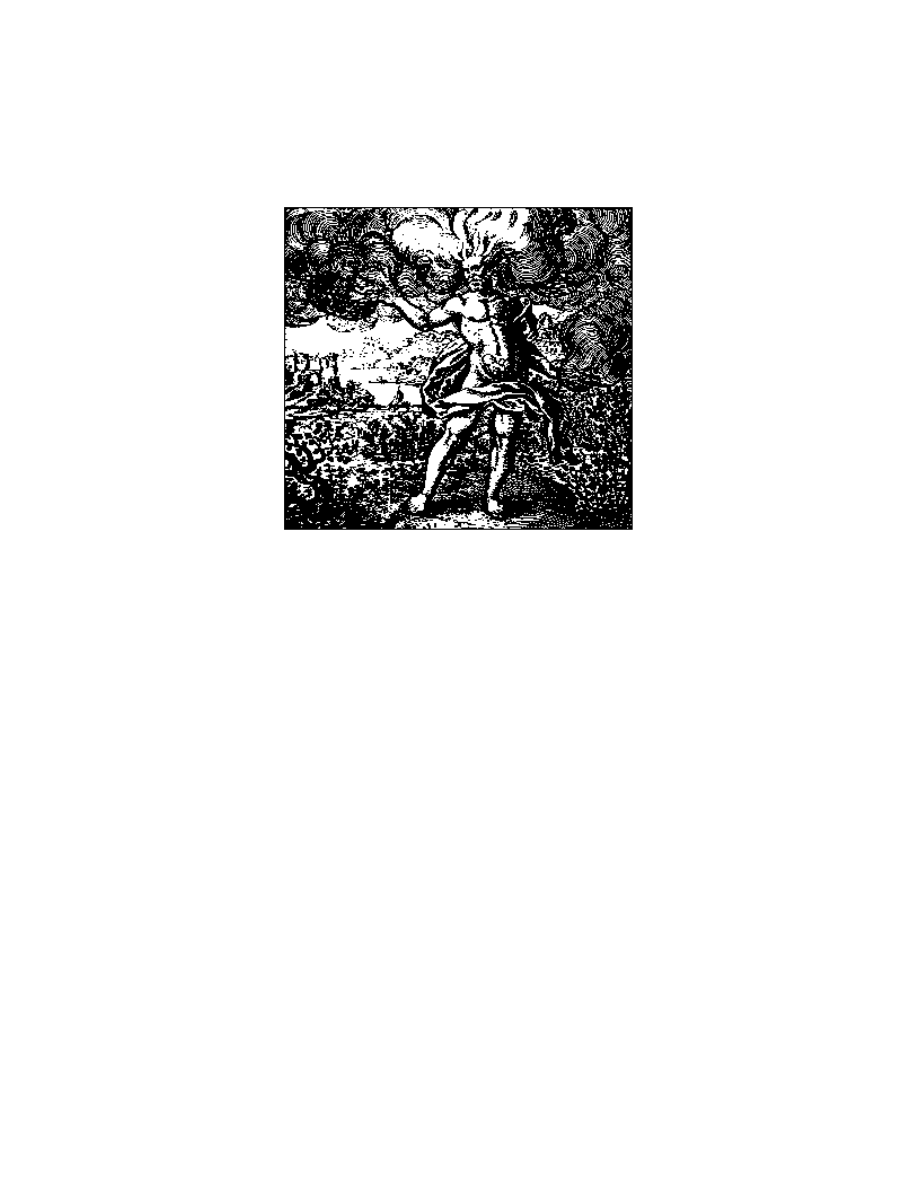
Emblem 1
Portavit eum ventus in ventre suo.
(The Wind carried him in his belly)
Epigramma 1
Embryo ventosâ BOREAE qui clauditur alvo
Vivus in hanc lucem si semel ortus erit;
Unus is Heroum cunctos superare labores
Arte, manu, forti corpore, mente, potest.
Ne tibi sit Coeso, nec abortus inutilis ille,
Non Agrippa, bono sydere sed genitus.
English'd thus:
If BOREAS can in his own Wind conceive
An offspring that can bear this light & live;
In art, Strength, Body, Mind He shall excell
All wonders men of Ancient Heroes tell.
Think him no Caeso nor Abortive brood,
Nor yet Agrippa, for his Star is good.
Discourse 1
Hermes, the most industrious searcher into all the secrets of Nature, doth in his Smaragdine Table
exquisitely thus succinctly describe the Natural Work when he says: 'Wind carried Him in his
belly,' as if he should have said that He whose father is Sol & mother is Luna must, before he can
be brought forth into the light, be carried by windy fumes, even as a Bird is carried in the Air
when it flies.

Now from fumes or winds (which are nothing else but Air in Motion) being coagulated, Water is
produced, & from Water mixed with earth all minerals & metals do proceed. And even these last
are said to consist of & be immediately coagulated from fumes, so that whether He be placed in
Water or fume the thing is the same; for one as well as the other is the master of Wind. The same
the more remotely may be said of Minerals & Metals, but the Question is: Who is He that ought
to be carried by Winds? I answer: Chymically it is Sulphur which is carried in Argent Vive
(contained in quicksilver), as Lully in his Codicill cap. 32 & all other Authors attest. [Marginal
note: "Lully ibid: 'The wind carries him in his belly;' That is, sulphur is carried by Argent Vive; &
Ch. 47: 'The Stone is Fire carried in the Belly of Air.'"] Physically it is the Embryo, which in a
little time ought to be borne into the light. I say also that Arithmetically it is the Root of a Cube;
Musically it is the Disdiapason; Geometrically it is a point, the beginning of a continued running
line; Astronomically it is the Center of the Planets Saturn, Jupiter & Mars.
Now although these are different Subjects, Yet if they be well compared together they will easily
demonstrate what the offspring of Wind must be. But this enquiry must be left to every man's
own Industry, be it remembered. But I shall point out the matter more plainly thus: All Mercury is
composed of fumes, that is of Water elevating Earth together with itself into an aerial rarity or
thinness, & of Earth forcing Air to return into Watery Earth or Earthy Water; for when the
Elements are in it altogether & mixed throughout & mutually blended, subdued & reduced to a
certain Viscous Nature, they do not easily recede from one another, but either follow the Volatile
flying upwards, or remain below with those that are fixed.
Nor is it indeed without reason that Mercury is called the Messenger or Interpreter & as it were
the running intermediate Minister of the other Gods & has Wings fitted to his head & feet; for He
is Windy & flies through the air as wind itself, which many Persons are really & experimentally
convinced of, to their great damage. But because he carries a Rod or Caduceus about which two
serpents are twined across one the other, by which he can draw souls out of bodies & bring them
back again & effect many such contrarities, He is a most Excellent figure or representation of the
Philosophical Mercury. Mercury, therefore, is Wind, which takes Sulphur, or Dionysius, or (if
You please so to call it) Asculepius, being yet an imperfect Embryo out of the Mother's belly or
out of the Ashes of the Mother's body burned, & carries it thither where it may be brought to
maturity.
And the Embryo is Sulphur, which by the celestial Sun is infused into the Wind of Boreas, that he
may bring it forth in maturity. Who, after the complete time of his Teeming, does bring forth
twins, one with white Hair, Called Calais, the other with Red, named Zethes. These Sons of
Boreas (as Orpheus the Chymick Poet writes) were Companions to Jason amongst the set of the
Argonauts when he went to fetch the Golden Fleece from Colchis, for Phineas the blind Prophet,
being infested by the Harpies, could not be freed from them but by these Sons of Boreas, & for so
great a benefit obtained by their means, He out of gratitude showed the whole course of their way
to the Argonauts. These Harpies are nothing else but corrupting Sulphur which is driven away by
the Sons of Boreas when they come to full age, & from a thing imperfect and molested with
noxious and hurtful Volatiles becomes perfect & not subject to that Evil, & afterwards shows
Jason its Physician the way how to obtain the Golden Fleece.
Basil [Valentine] as well as other Authors takes Notice of these Winds & in his sixth Key says
thus: "For there ought to come a double Wind named Vulturnus & a single Wind called Notus
which will blow impetuously from the East & the South, upon the cessation of whose motion so
that Water is made of their Air. You may confidently believe that a Corporeal thing will be made
of a Spiritual." & Ripley, Gate 8th, says that our infant ought to be born again in Air, that is, in

the Belly of the Wind. In the same sense may that be taken which we find in Scala
Philosophorum Degree the 6th: "You must know that the Son of the Wise is born in the Air," &
Degree 8th: "Airy Spirits ascending together into the Air do love one another; as Hermes said,
'the Wind carried him in his Belly,' because the generation of our Son is made in the Air, & being
born in the Air is born Wisely, for he ascends from Earth to Heaven, & again descends to Earth
acquiring both the superiour & inferiour Virtue."
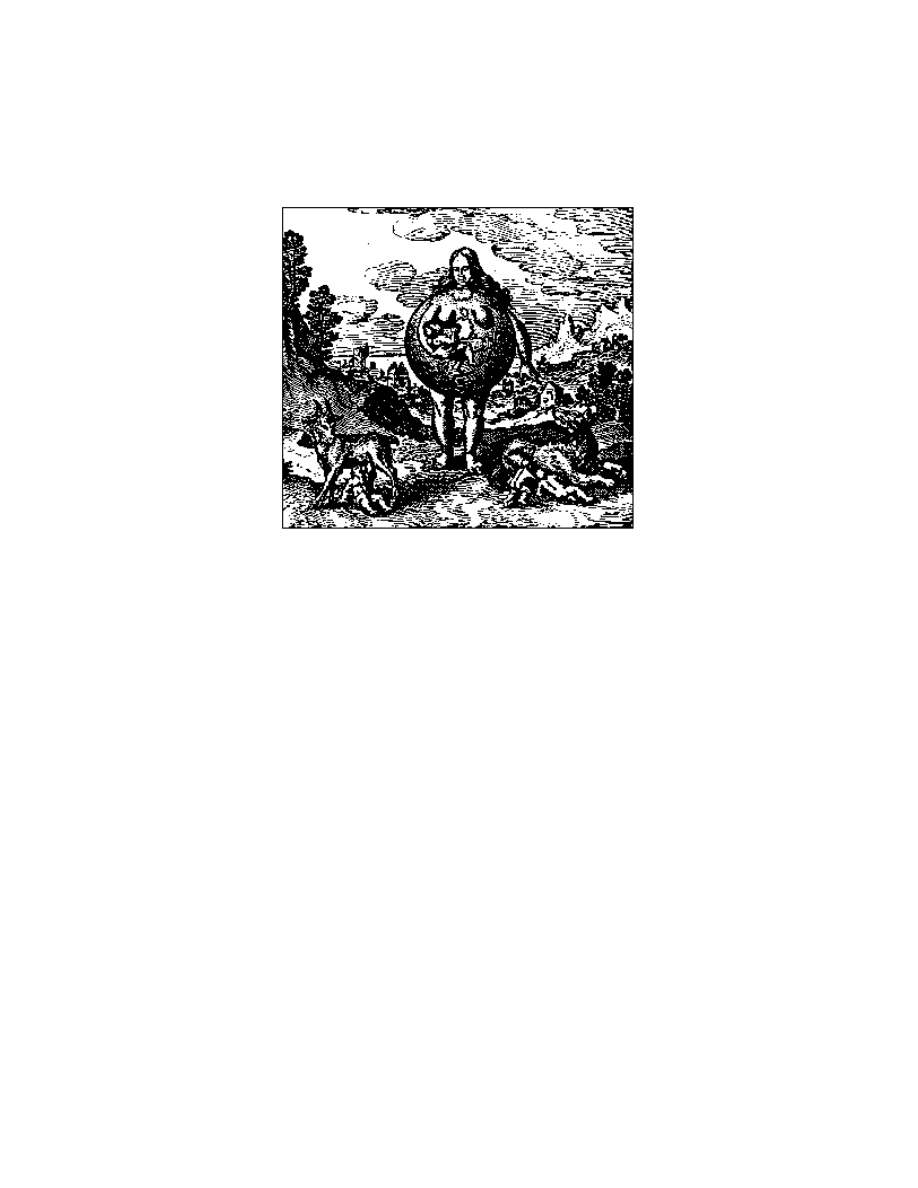
Emblem 2d
Nutrix ejus terra est.
(The Earth is his Nurse)
Epigram 2d
Romulus hirt a lupae pressisse, sed ubera caprae
Jupiter, & factis, fartur adesse fides:
Quid mirum, tener" SAPIENTIUM viscera PROLIS
Si ferimus TERRAM lacte nutrise suo?
Parvula si tantas Heroas bestia pavit,
QUANTUS, cui NUTRIX TERREUS ORBIS, erit?
Discourse 2d
It is determined by the Peripatetic & other Philosophers of sound Judgment that the thing
nourishing must be converted into the substance of the nourished & made like to it, not before but
after it has received an alteration, & this is admitted as an undoubted axiom. For how should the
thing nourishing, supposing it beforehand to be like to, or the same with the thing nourished, have
need of any change in its essence, which if it should happen would hinder it from remaining the
same or alike. For how should those things be received for nourishment which cannot be
converted into a like substance with the thing nourished, as wood, stones, &c. As therefore the
first is vain so the second is contrary to Nature.
But for an infant newborn to be nourished with the Milk of Animals is a thing not repugnant to
Nature, for milk will become of the like substance with it, but more easily if it be sucked from the
Mother than any other Creature. Wherefore Physicians conclude that it conduces to the health &
strength of an infant as likewise to the conformity of temper & manners if it is always fed &
nourished by the milk of its own Mother, & that the contrary happens if it is done by that of a
Stranger. This is the Universal Harmony of Nature: That Like delights in its Like & as far as it
can possibly follows its footsteps in everything by a certain tacit consent & agreement. The same

thing happens of course in the Natural work of the Philosophers, which is equally governed by
Nature in its Formation as an Infant in its Mother's womb. And although as Father, Mother &
even a Nurse be ascribed to it by way of similitude, Yet it is not more Artificial than the
generation of every Animal.
Two seeds are by a pleasurable Artifice joined together by Animals & both the Human sexes
which being united by successive Alteration produce an Embryo which grows & is increased,
acquires life & motion, & then is nourished by Milk. But it is necessary for a Woman in the time
of Conception & impregnation to be very temperate in heat, Food, drink, Motion, Rest & all
things else; otherwise Abortion will follow & destruction of the conceived Embryo, which
Observation in the six non-naturals because it is prescribed by the Physicians according to their
Art is also Artificial. After the same manner, if the seeds be not joined together in the
Philosophical Work, they ought to be joined, but if they could anywhere be found joined together
as the seed of a Cock & Hen do subsist together & are contained in one Egg, then would the
Philosophers' work be more natural that the generation of Animals.
But let us grant (as the Philosophers do assert) that one comes from the East & the other from the
West & are made one: what more is as ministered to 'em than mixture in their own Vessel,
Temperate Heat, and Nutriment. The Vessel is indeed Artificial, but in this there is no more
difference than if the nest were made by the Hen herself or made for her by the Country Dame in
some convenient place as commonly it is. The Generation of Eggs & Hatching of Chickens from
them will be the same. Heat is a Natural thing, whether it proceed from the Temperate Heat of
furnaces, putrefaction of Dung, from the Sun & Air, from the Bowels of the Mother, or otherwise.
Thus the AEgyptian from his Furnaces does by Art Administer a Natural Heat for the Hatching of
Eggs. The seeds of Silk worms & even Hens' Eggs are said to have been Hatched by the Warmth
of a Virgin's breasts. Art, therefore, & Nature, do mutually join hands & officiate one for the
other. Nevertheless, Nature is always the Mistress & art the Handmaid.
But a doubt may [be] raised how the Earth may be said to be the NURSE of the Philosophical
Infant, seeing it is the Element which is most dry & void of Juice, insomuch that Dryness
appertains to it as its proper quality. It may be answered that Earth Elemented is to be understood,
& not the Element of Earth, whose Nature we have fully explained in the first day of our
Philosophical Week. This Earth is the Nurse of Caelum or Heaven, not by opening, washing, or
moistening the Infant, but by coagulating, fixing, coloring and converting it into more Juice &
Blood. For Nutrition implies an Augmentation in length, breadth & Depth which extends itself
through all the Dimensions of a Body, & seeing this can be afforded & administered to the
Philosophical Infant by Earth only, it can in no wise be improper to call the Earth by the name of
his NURSE. But this admirable Juice of Earth has a quality different from other kinds of Milk
which are converted & do not convert for this by reason of its most efficacious Virtue does
mightily alter the Nature of the thing Nourished, as the Milk of the Wolf is believed to have
disposed the Body of Romulus to a Nature that was Magnanimous & prepense to War.
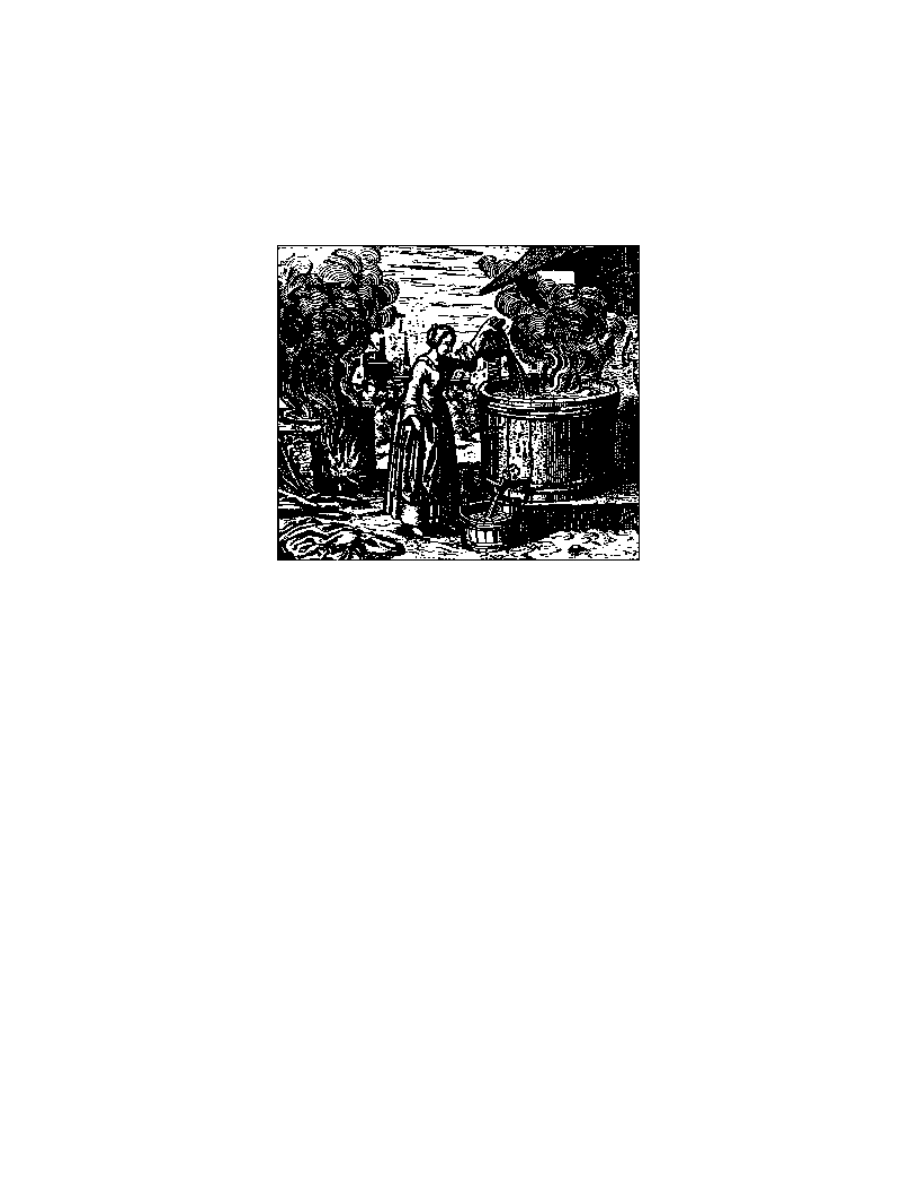
Emblem 3d
Vade ad mulierem lavantem pannos,
tu fac similiter.
(Go to the Woman Washing Clothes
& do after the same Manner.)
Epigram 3d
Abdita quisquis amas serutari dogmata, ne sis
Deses, in exemplum, quod juvet, omni trahas:
Anne vides, mulier, maculis abstergere pannos
Ut soleat calidis, quas superaddit, aquis?
Hanc imitare, tuâ nec sic frustraberis arte,
Namque nigri faecem corporis lavat.
Discourse 3d
When Linen Clothes are soiled & made dirty by earthy Filth, they are cleaned by the next
Element to it: Namely Water; & then clothes being exposed to the Air, the moisture together with
the Faeces is drawn out by the heat of the Sun as by fire, which is the fourth Element, & if this be
often repeated, they become clean & free from stains. This is the work of women which is taught
them by Nature. For we see (as Isaac remarks) that the Bones of Beasts if they are often wet with
Rain & as often dried by the heat of the Sun will be reduced to a perfect whiteness. The same is to
be observed in the Philosophick Subject, for whatever faeces or Crudities are in it will be purged
& taken away by the infusion of its proper Waters, & the whole body will be brought to a great
perfection & cleanness. For all Chemical preparations, as Calcination, Sublimation, Solution,
Distillation, Descension, Coagulation, Fixation, & the rest are performed by washing only. For
whoever washes a thing unclean with waters does the same thing as He that runs through all these
Operations. For, as the Rosary of the Philosophers [Rosarium Philosophorum] saith; "The Inner
Clothes Prince Divinick, being soiled by sweat, are to be washed by Fire & burned in Waters, so
that Fire & Water seem to have interchanged their mutual Qualities, or else the Philosophic Fire

is not to be supposed of the same kind with the common Fire;" & the same thing is to be said of
the Philosophic Water.
As for the Calc Vive or Quicklime & Ignis Graecus, we know that they are kindled by Water &
cannot be extinguished by it contrary to the Nature of other things that will take Fire; so it is
affirmed that Camphor over-kindled will burn in Water. And Ansel. de Bood says that the Stone
Gagates being set on Fire is more easily quenched by Oil than Water, for Oil will mingle with it
and choke the fiery body. Whereas Water not being able to mix with the fatness yields the the fire
unless it totally covers & overwhelms it, which it cannot easily do, because although it be a
Stone, it swims upon the top of the Water like Oil; so Naptha, Petroleum & the like are not easily
quenched by Water. Some write that there are Subterranean Coals in the Country of Liege which,
taking Fire under the earth, cannot be extinguished by water, by by Earth thrown in upon them.
Cornelius Tacitus mentions such a sort of Fire which cannot be quenched but by Clubs & Clothes
taken from the Body & thrown upon it.
There is, therefore, great diversity in Fires, both in their being kindled & extinguished, & there is
no less in Liquors, for Milk, Vinegar, Spirits of Wine, aqua fortis, aqua Regia and Common
Water differ very much when they are thrown upon Fire; sometimes the matter itself will endure
Fire, as those fine Linen Clothes which were of great Esteem among the Ancients & were cleaned
by Fire, their dirt being burned away. What is said of the Hairs of a Salamander, that they will
make the wick of a Lamp that shall be incombustible is not to be Credited. But there are persons
who really affirm that there was a contexture prepared from Talc, Plumous Alumine & other
materials by a Cunning Woman of Antwerp which she said to cleanse by Fire, but that she of
envy suffered that Art to die with Her, & the Temperament could never be found out afterwards.
We do not speak here of combustible matters.
The Philosophical Subject, whenever it is prepared, must be considered under all these
differences, for their Fire, Water & Matter itself is not Common. But their Fire is Water & their
Water is Fire. Their Water at the same time washes & calcines, & so does their Fire.; & the
Clothes which must be washed have the same nature with the Fine linen before mentioned or Talk
prepared; but the Tempering of it & the Art in its preparation is not known to everyone. For the
washing of this Linen, a Lye must be made, not of Oak ashes or their Salt, but from Metals,
which is more durable than any other; and it must not be Common Water, but Water Congealed
into Ice & snow under the sign Aquarius, for this has finer Particles than the standing Waters of
Fens and Marshes, & consequently can better penetrate into the Recesses of the Philosophic Body
to wash and purge it from filth & Blackness.
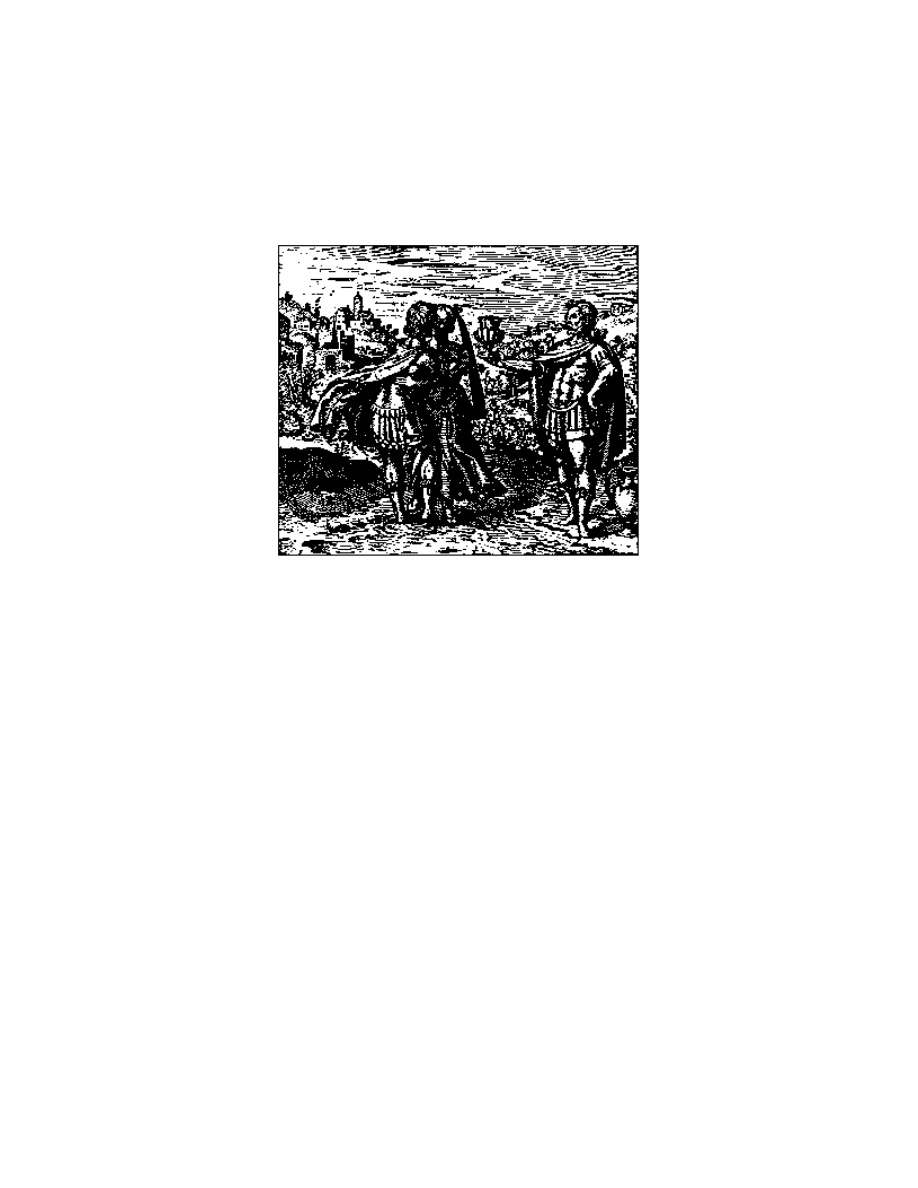
Emblem 4th
Conjunge fratrem cum sorore
& propina illis poculum amoris:
(Join the Brother & the Sister
& drink to 'em in the Bowl of Love.)
Epigram 4th
Non hominum foret in mundo nunc tanta propago,
Si fratri conjunx non data prima soror.
Ergo lubens conjunge duos ab utroque parente
Progenitos, ut sint faemina masque toro.
Praebibe nectareo Philothesia pôcla liquore
Utrisque, & faetus spem generabit amor.
Discourse 4th
Divine & Human Laws prohibit those Persons to intermarry who are joined by Nature in too near
degrees of Blood, whether in a Line ascending, descending, or collateral, & that for very just
reasons. But when Philosophers speak of the Marriage of a Mother with her Son, a Father with
his Daughter, or a Brother with his Sister, these neither speak nor act against the Laws before
mentioned, Because the Subjects distinguish the Attributes, & the Cause the Effects. For the
Persons of whom the Philosophers speak are as much at liberty as the Sons & Daughters of
Adam, who intermarried without the Imputation of any Crime. The chiefest reason seems to be
that the Human Race might be more strictly United & associated by affinity & friendship, & not
be divided by enmities & Hereditary Factions of families. So nothing hindered the Sons &
Daughters of Adam, though Brothers & Sisters, to be joined in marriage, for mankind did exist in
them alone & their Parents, & therefore, although they were allied in blood, yet were they to be
joined in affinity.
But the number of men increasing & being distributed into innumerable families, the true & just
Cause was found, why Brothers & Sisters should not marry. The Philosophers have a different

reason why the Brother should marry the Sister, which is the similitude of their Substance, that
Like may be joined to its Like. Of this kind, there are two which are alike in Specie but different
in Sex. One of which is called the Brother, the other the Sister. These therefore being in the same
liberty & Condition as the first kindred of men, are Lawfully indeed, & by an inevitable necessity
to be joined together in Matrimony.
The Brother is hot & dry, & therefore very Cholerick. The Sister is cold & moist, having much
Phlegmatick matter in her. Which two Natures, so different in their Temper, agree best in
fruitfulness, Love, & Propagation of Children. For as Fire will not easily be struck out of the
hardest Bodies, Steel & Steel, nor out of those brittle Bodies, Flint & Flint, but from the hard &
brittle, that is, Steel & Flint, so neither from a burning Male & Fiery Female, nor from both of
'em being cold (for cold is the unfruitfulness of the Male) can a living offspring be produced. But
he must be hot & she more cold than he, for in Human Temperament, the hottest Woman is
colder that the coldest Man, supposing him to be in Health, as Levinus Semnius, in his book of
the Hidden Miracles of Nature affirms. The Sister, therefore, & Brother are rightly joined by the
Philosophers.
If a man desire offspring from a Hen, Bitch, or Ewe, or other animal, He joins it to a Cock, Dog,
or Ram, every animal to that species to which it is most like, & so he obtains his End. For he does
not regard the Consanguinity of these Brutes, but the generosity of each & agreement of their
Natures. The same may be said of the body of a Tree & the Hip that is to be ingrafted into it. So
the Metallic Nature, which above all things has a likeness or Homogeneity of Substance, desires
its like when any thing is to be joined to it. But the Brother & Sister being married will not be
fruitful or long persist in their Love, unless a Philothesium or Cup of Love be drunk to 'em as a
Philtre. For by this, their minds being composed & united, they become drunk, & (like Lot) all
shame being banished, they are joined & produce an offspring that is Spurious but Legitimate.
Who can be ignorant that Mankind is very much obliged to Medicine, & that there are thousands
of persons in the World who had not existed unless their Parents had been freed from Barrenness,
either by removing the Cause, or taking away the impediment, either near or remote, and
preserving the Mother from Abortion. Therefore the Cup of Love is given to the new-married Pair
for these reasons which are three: the Constancy of Love, the Removal of Barrenness, & the
Hindrance of Abortion.
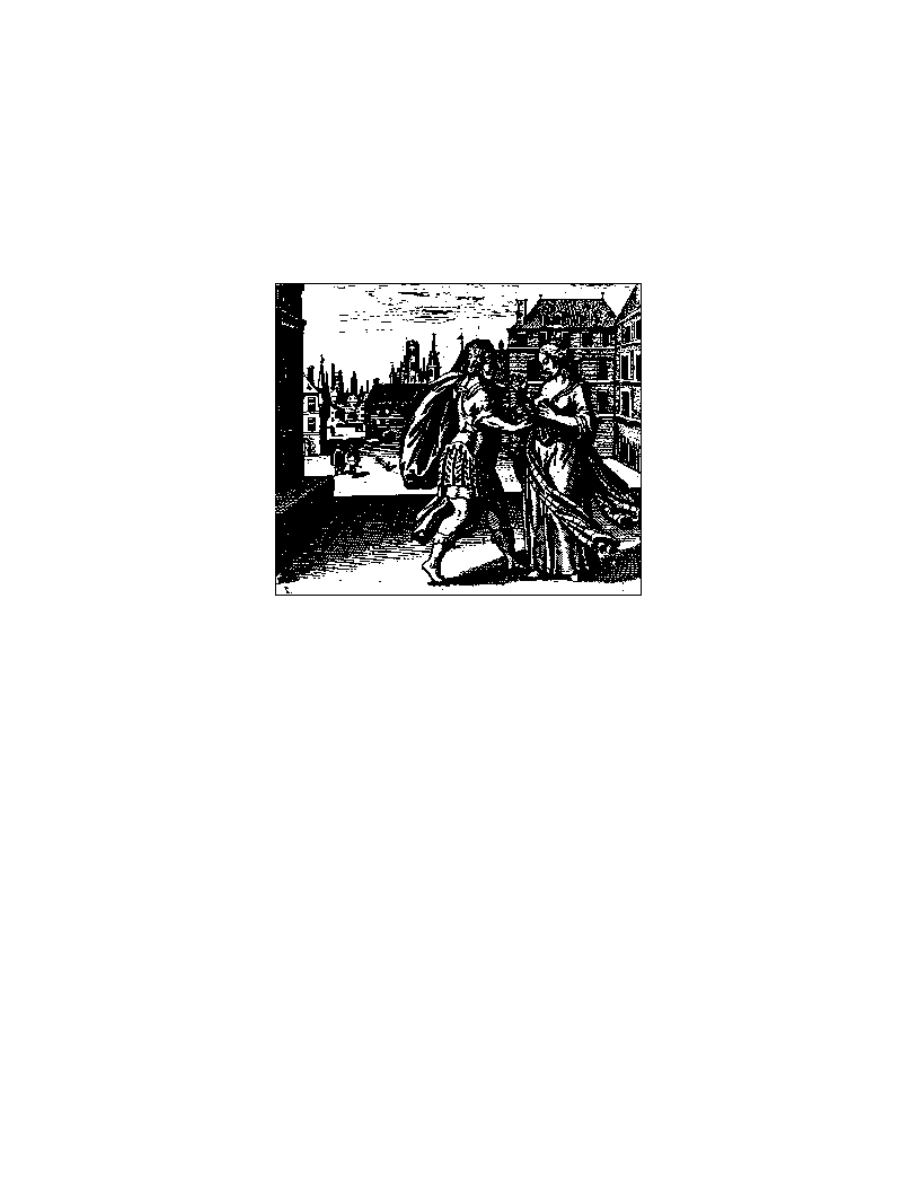
Emblem 5th
Appone mulieri super mammas bufonem,
ut ablactet eum, & moriatur mulier,
sitque bufo grossus de lacte.
(Put a Toad to the Woman's breast,
that she may suckle him 'till she die,
& he become gross with her milk.)
Epigram 5th
Foemineo gelidus ponatur pectore Bufo,
Instar ut infantis lactea pocla bibat.
Crescat & in magnum vacuata per ubera tuber,
Et mulier vitam liquerit aegra suam.
Inde tibi facies medicamen nobile, virus
Quod fuget humano corde, levétque luem.
Discourse 5th
The whole body of Philosophers agree in this, that their work is nothing else but male & female;
the man's part is to generate, & govern the wife, & Her part is to conceive, impregnate, bring
forth, suckle & educate the offspring, & be subject to the Commands of her Husband. For, as she
nourishes the conceived Embryo before it is brought forth with her blood, so she does afterwards
with her milk. Hence, Nature has prepared for the tender Infant a Digestible & well proportioned
Nutrient in the mother's Breasts, which waits for his coming as his first provision & sustenance in
his Course of Life. By milk therefore He is nourished, grows, & is increased 'till he be furnished
with teeth, his fit instruments to eat bread withal. Then He is properly weaned, because Nature
has provided him more solid food.
But here the Philosophers say that a Toad must be put to the Woman's breasts, that she may
Nourish him as an infant with her Milk. This is a miserable & horrid spectacle, & indeed, an

impious thing, that milk designed for an infant should be given to a Toad, being a Venomous
beast & contrary to the Nature of Man. We have heard & read of serpents and Dragons sucking
the Teats of Cows, & Toads perhaps might do the like if they could gain an opportunity.
There is a noted story of a Toad that fixed himself upon the mouth & outside of the lips of a
Country man that was asleep, & could not be removed by any contrivance unless by Violence,
which could not be attempted without the hazard of the man's life, for he would then have spit his
poison, which he uses as his offensive & defensive weapon. A Remedy was found for this
miserable man, from that Antipathy which the Spider bears for the Toad, for they hate one the
other mortally. He was carried to the place where an overgrown Spider had made his web, who,
as soon as he saw the Toad, he let himself down upon his back & pinched him with his sting; but
this doing no hurt, the Spider came down the second time, & struck him more violently, upon
which the Toad immediately swelled & fell dead from the man's mouth without any harm to him.
But here the contrary happens, because the Toad does not seize the mouth, but the Breast of the
Woman, by whose milk he increases so much that he becomes of an extraordinary strength &
bigness; but the woman, having her spirits exhausted, consumes & dies, for poison is easily
communicated to the Heart by the pectoral Veins, & infects & destroys it, as it is evident in
Cleopatra, who applied vipers to her breasts, that by a Voluntary death she might prevent her
coming into the hands of her enemies & being led in Triumph by them. [In margin: 'Theophilus in
Turba makes mention of a Dragon joined to a woman.']
But, lest any man should think the Philosophers so cruel as to fasten a Venomous reptile to a
woman's breast, it must be known that this Toad is the offspring or Son of this woman, brought
forth by a monstrous birth, & therefore by Natural Right must be fed with his Mother's Milk, &
that it is not the Son's desire that his mother should die; for he could not infect his mother, seeing
he was formed in her Bowels & nourished with her blood 'till the time of his birth. It is indeed a
thing ominous for a Toad to be born of Woman, which in our knowledge hath happened
otherwise: William of Newberry, an English writer, saith (how truly let others judge) that in a
certain Quarry in the Diocese of Vintonia, a great stone being split, there was a living Toad found
in it, with a golden Chain, & it was by the Bishop's command, hidden in the same place & buried
in perpetual darkness, lest it might bear an ill omen with it. Such also is this Toad, for it is
embellished, although not outwardly, with an artificial chain, but inwardly with natural Gold, to
wit: that of the Stone which some call Borax, Chelonitus, Batrachites, Crapaudina, &
Garatronium, for this far excels Gold in Virtue against the poison of all animals, & is commonly
set in Gold as a case or Cover, that it may not be hurt or lost. Regularly it ought to be had out of
an Animal.
But if the Stone be taken out of subterranean Caverns, as it is commonly, it may be neatly
contrived in that shape & used instead of it, being chosen from the best minerals & most relevant
to the Heart. For in these the Philosophical Toad is really found, not in the Quarry (as that
fabulous author asserts), & has Gold in itself, though its pomp does not outwardly appear. For to
what end should a Toad adorn himself, seeing he lurks in darkness & secret places? Perhaps that
he might be very magnificently accosted by the Beetle, if by chance he should meet him in the
Twilight. What Subterranean Goldsmith should make him that Golden Chain? Perhaps that Father
of the Green children, that came out of the Land of St. Martin, or rather from the Earth itself, as
the two Dogs came out of a Quarry, according to the same Author.
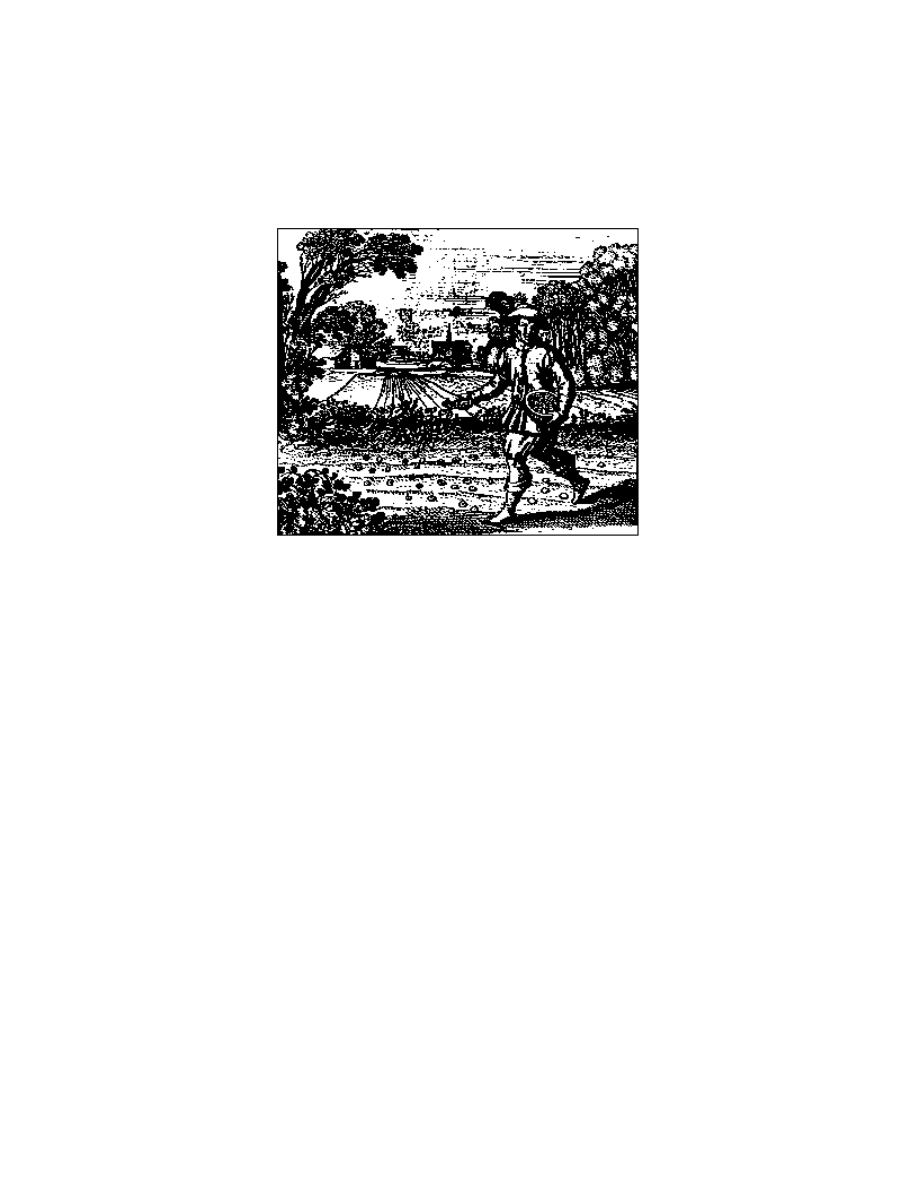
Emblem 6th:
Seminate aurum vestrum in terram albam foliatam
[Sow Your Gold in the white foliate Earth.]
Epigram 6th:
Ruricolae pingui mandant sua femina terrae,
Cum fuerit rastris haec foliata suis.
Philosophi niveos aurum docuere per agros
Spargere, wui folii se levis instar habent:
Hoc ut agas, illus bene respice, namque quod aurum
Germinet, ex tritico videris, ut speculo.
Discourse 6th:
Plato says that a City does not consist of a Physician & a Physician, but of a Physician & a
Husbandman; that is, of men of diverse Crafts & Professions, & he mentions then two more,
especially because their Labors are more visible in the Imitation, Improvement, & Perfection of
Nature. For they both take a Natural Subject to which, according to their Art, they either add
something that is necessarily wanting or remove those things which are superfluous. So that both
their Arts may (as medicine is by Hippocrates) be defined to be the addition of what is wanting or
Subtraction of superfluity. For the Husbandman does no more than add ploughing, furrowing,
Harrowing, dunging or manuring, & lastly sowing to the Land that is left in its Original State.
But as for the increase & produce of it he leaves that to Nature which administers Rain to the
Heat of the Sun, & by these two Multiplies the seeds & improves them into standing Corn fit for
reaping. While the blade is growing he weeds out the thistles & throws out all other impediments.
He reaps the Corn when it is ripe & cleans it when reaped from its straw & Chaff. So the
Physician (likewise the Chemist in a different respect) administers preventing Physick to the
Patient as well as Restorative, removes the Cause, Cures the malady, assuages symptoms, takes
away superfluous blood by opening a vein & if low restores it by a Regulation of Diet, evacuates

ill humors by purging, & so by a thousand methods imitates, supplies & corrects Nature with the
operations of Art & Understanding. Our present Considerations are not concerning these things
which are commonly known, but of matters merely Chemical.
For Chemistry shows its Affinity to Husbandry even in its secret Terms & courses of Operation.
The Husbandmen have their Earth into which they sow their seed & so have the Chemists. They
have their Dung with which they enrich their ground, so have these without which nothing can be
accomplished nor any fruit expected. They have seed from which they hope for an increase, &
unless the Chemists had so too, they would be like a Painter (as Lully says) endeavoring to draw
the face of a Man of whom he had never seen so much as the least resemblance. The Country man
expects Rain & Sunshine & so indeed the Chemists must supply their work with such & Heat &
Rain as is proper & convenient. What need of many words?
Chemistry runs entirely Parallel with Agriculture as its Deputy, & represents it in all things, but
under a most compleat Allegory. From hence the Ancients produced their Cerereus, Triptolemus,
Osirideus, Dionysius, Golden Gods, or such as had Relation to Chemistry, but at the same time
represented them as teaching mortals to cast their seed into the Earth & showing them Husbandry
& the planting & Cultivation of Vines & the use of Wine. All which things the Ignorant falsely
applied to their Countries' Employment. For these abstruse Mysteries of Nature under these Veils
are at the same time explained to the Wise, whilst they are concealed from the Vulgar.
Hence the Philosophers affirm it to be sowed in White foliated Earth, as if they would have said
that the sowing of Wheat must be looked upon as an example & consequently imitated. Which
the Author of Tractatus de tritico & Jodoc Greverus have most excellently performed in their
Descriptions for they have very elegantly adapted each Operation of Husbandry in the production
of Corn to the Semination of Gold & the generation of the Tincture. White Earth as being Sandy
yields little fruit to the Countrymen who esteem that which is black as being fattest. But the other
is of most Value to the Philosophers if it be foliated, that is, well prepared. For they know how to
improve it with their Dung, which the others do not. For semination is the propagation of the
world by which Care is taken that what cannot last in the individual may be continued in the
species. This is in Men, Animals & Plants; in the first, Hermaphroditically, in the two last under
different sexes, but in Metals it is far otherwise, for in them a Line is made from the flux of a
Point, a Superficies from the flux of a Line, a body from the flux of a Superficies.
But the Stars produce that point before either the line, the superficies, or the Body, because it is
the Principle of them all. Nature added the flux a long time afterwards; that is, the Caelestial
Phoebus generated a Son underneath the Earth, which Mercury committed to Vulcan to be
Educated, & to Chiron, that is, to Manual operation, to be instructed, as it is reported of Achilles
that he was detained & Hardened in Fires by his Mother Thetis. Among other things He learned
Music & the Art of playing on the Harp from his Master Chiron. Achilles is nothing else but the
Philosophic subject, whose Son is Pyrrhus, with red Hair, without which two, Troy could not be
subdued, as we have demonstrated in the sixth Book of our Hieroglyphics.
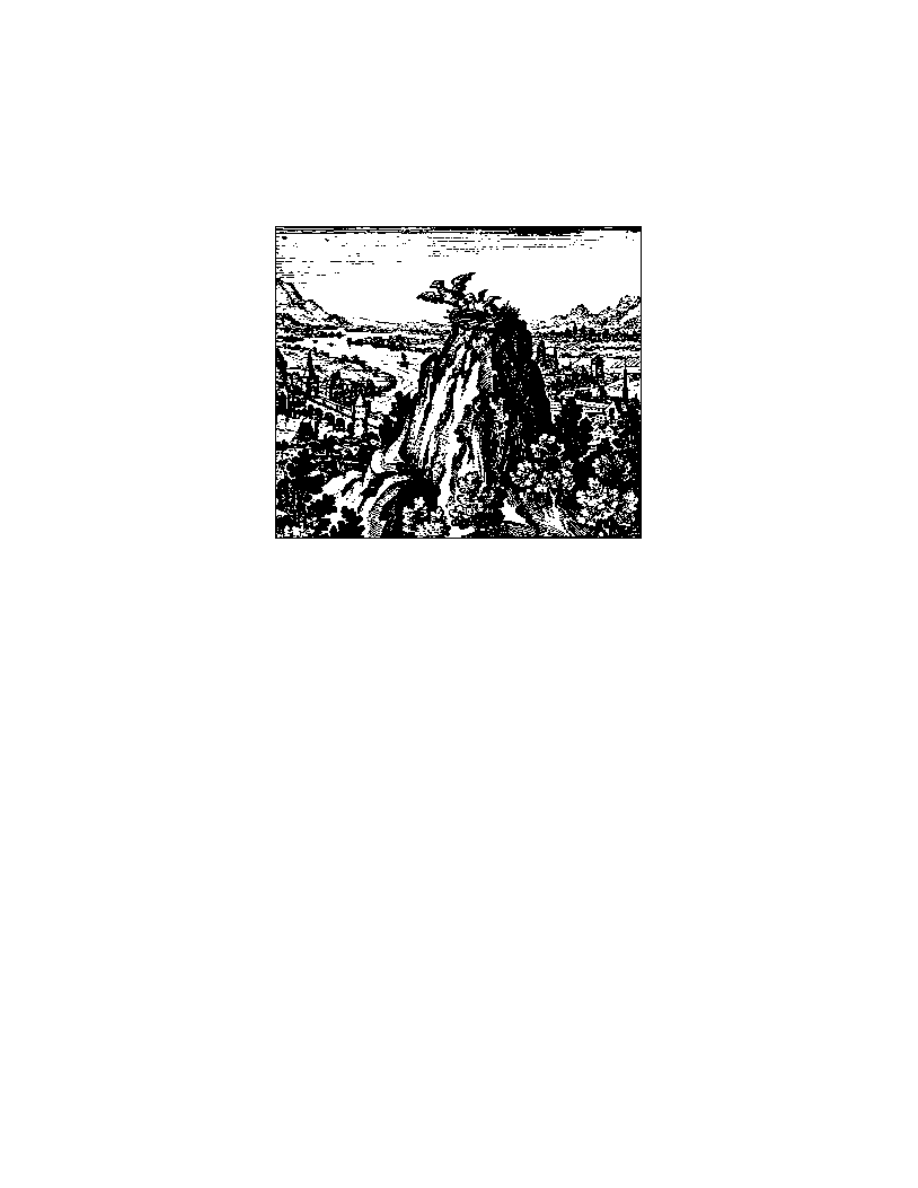
Emblem 7th
Fit pullus à nido volans, qui iterùm cadit in nidum.
(A young eaglet attempts to fly out of its own nest
& falls into it again.)
Epigram 7th
Rupe cavâ nidum Jovis ALES struxerat, in quo
Delituit, pullos enutriítque suos:
Horum unus levibus voluit se tollere pennis,
At fuit implumi fratre retentus ave.
Inde volans redit in nidum, quem liquerat, illis
Junge caput caudae, tum nec inanis eris.
Discourse 7th
That which Hippocrates, the standard of all Physick, affirms concerning Humors, that they are
different & many in the Body of Man, & not one only, otherwise various diseases would not
arise, is found by us to be true likewise in the Elements of the World. For if there was but one
Element, there could be nom change of that into another, no generation nor corruption would
happen, but all would be one immutable thing, and no meteors, minerals, plants or animals could
be naturally produced from it. Therefore the supreme creator composed the whole system of this
whole world of diverse & contrary natures, namely of light & heavy, hot & cold, moist & dry,
that one might by affinity pass into the other, & so a composition be made of bodies which should
be very different one from another in Essence, Qualities, Virtues & Effects. For in things
perfectly mixed are the light Elements, as Fire & Air, & likewise the Heavy, as Earth & Water,
which are to be poised and tempered together, that one flies not from the other.
But the neighboring Elements easily suffer themselves to be taken & detained by their Neighbors.
Earth & Air are contrary one to the other, & so are Fire & Water, & Yet Fire maintains friendship
with Air by heat common to both, & does so with Earth by reason of dryness, & so Air with

Water & Water with the Earth. By which means they are joined in bonds of Affinity, or rather
consanguinity, & remain together in one composition, which, if it abound with the light Elements,
elevates the Heavy with it; if with the heavy it presses down the light. This is illustrated by two
Eagles, one with Wings, the other without; the first of which, endeavoring to fly, is restrained by
the second. There is a plain Example of this Matter in the fight between the Falcon & Heron, for
the Falcon, soaring higher in the Air by his speedy Flying & swift wings, takes & tears the Heron
with his Talons, by whose weight, both fall to the ground. The contrary appeared in the Artificial
Dove which was an Automata or self-moving piece of Workmanship made by Architas, whose
heavy things were carried upwards by light, that is, its wooden body was lifted into the Air by the
Spirit that was enclosed within it.
In the Philosophical Subject, the light things are first predominant over the Heavy as to their
quantity, but they are overcome by virtue of the heavy, 7 in process of time, the eagle's wings are
cut off, & one very great Bird (namely an Ostrich) is made of two, which Bird can consume Iron,
& being hindered by its own weight, seems rather to run upon the Earth that to fly in the Air,
although it has goodly wings. Concerning this or one like it, Hermes (as the Author of Aurora, ch.
5th affirms) writes thus: 'I have considered a Bird Venerable to the Wise, which flies when it is in
Aries, Cancer, Libra or Capricorn,' & 'You will acquire it Perpetually to yourself out of mere
minerals & Rocks of Mountainous places.' Senior in Tabula relates to the same thing, where two
birds are seen, one flying, the other without wings, whereof the one holds the other's Tail by its
beak, that they cannot easily be separated. For this is the machination or device of Universal
Nature, always to raise heavy things by light, & to depress light ones by heavy, as the Author of
Perfectum Magisterius declares: 'Who constitutes seven Mineral Spirits, as it were erratic or
Wandering Stars, & so many Metallic Bodies & Fixed Stars, and enjoins these to be married to
the others.' And thence Aristotle the Chemist says: 'The Spirit having dissolved the Body & Soul
so that they may exist in their form, does not remain unless You Occupy it.'
Now this Occupation is that You join it with the Body from whence you prepared it in the
beginning. Because in that the Spirit at the superexistences of the Body is Occupied from flight.
In Camphora, as Bonus observes, the light Elements, that is, Air & Fire, prevail over the Heavy,
& therefore it is said wholly to exhale & evaporate into Air. In Argent Vive, the Flowers of
Sulphur, Antimony, the salt of Heart's blood, Sal Armoniac & such other things, the Earth flies
with the Alembic, & is not separated from it. In Gold, Glass, Diamonds, the Stone Smiris,
Granite, & the like, the Elements remain joined a long time notwithstanding the fire, without any
detriment. For the Earth retains the other Elements with itself. In other Combustibles, a separation
or division of one from another is effected, so that the Ashes are left in the Bottom, & the Water,
Air & Fire fly upwards.
We must not therefore have respect to the unequal Composition of these last, being not so
strongly mixed, nor to the Commixture of the first, which is more desirable, though composed of
Volatiles. But to the solidity, Constancy & Fixity of the middle ones. For so the Bird without
wings will detain that which hath, and the Fixed Substances will Fix the Volatiles, which is the
thing that of necessity must be Effected.
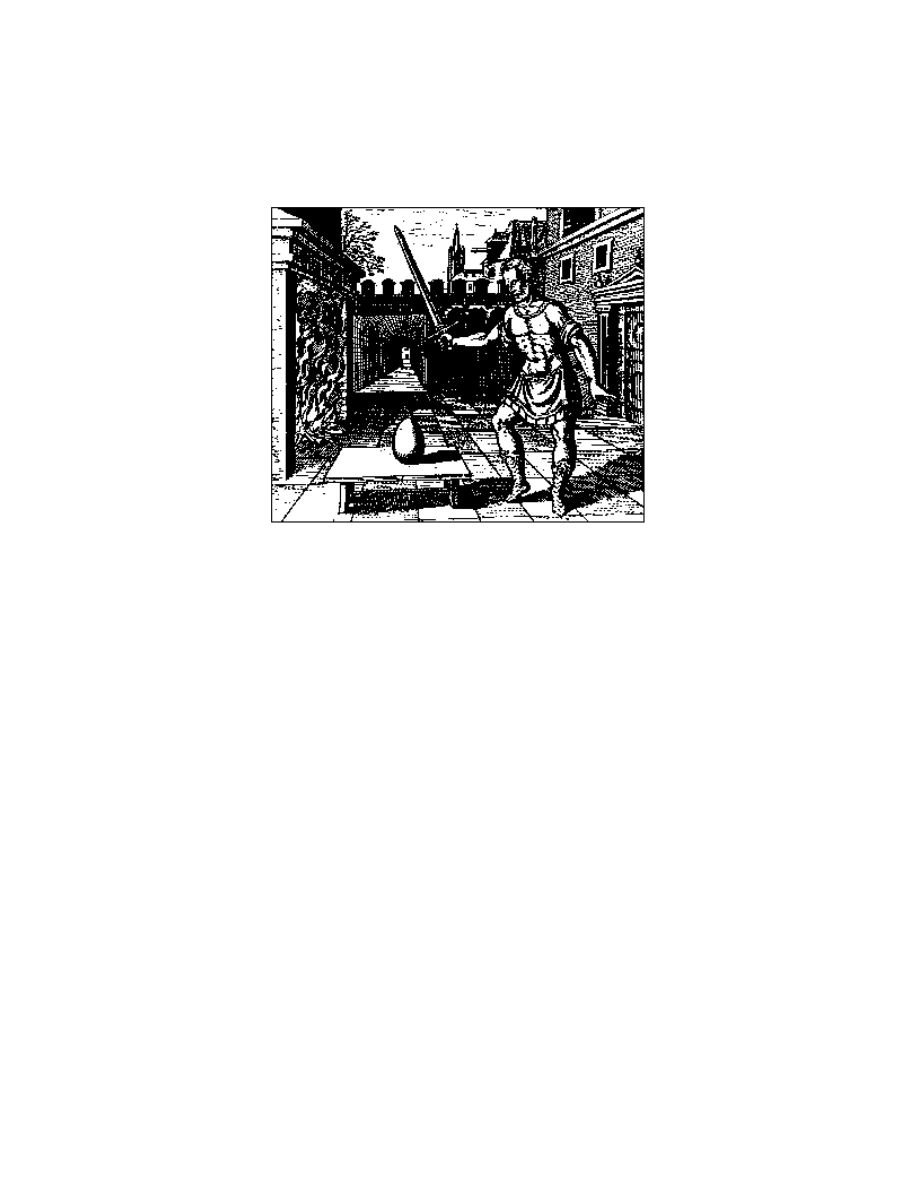
Emblem 8th
Accipe ovum & igneo percute gladio.
(Take an Egg & smite it with a fiery sword.)
Epigram 8th
Est avis in mundo sublimior omnibus, Ovum
Cujus ut inquiras, cura sit una tibi.
Albumen luteum circumdat molle vitellum,
Ignito (ceu mos) cautus id ense petas:
Vulcano Mars addat opem: pullaster & inde
Exortus, ferri victor & ignis erit.
Discourse 8th
There are many & diverse kinds of Birds whose number is uncertain & their Names unknown to
Us. Story tells us of a very great Bird named Ruc [Roc?], that appears at certain seasons of the
Year in a small Island of the Ocean, which can bear an Elephant up with it into the Air. India &
America send us Crows & Parrots of diverse Colors. But it is not the Philosophical intention to
enquire after the Eggs of these birds. The AEgyptians yearly persecute the Crocodiles' Eggs with
weapons of Iron & destroy them. The Philosophers do indeed smite their Eggs with fire, but it is
not with an intent to mortify it, but that it may live & grow up. For, seeing that an animate &
living chicken is thence produced, it cannot be said to be Corruption, but generation. It ceases to
be an Egg by the privation of the Oval form, & begins to be a two-footed & volatile Animal by
the introduction of a more noble Form, for in the Egg are the seeds of both male & female joined
together under one Shell or Cover.
The Yolk constitutes the Chicken with its radical parts & Bowels, the seed of the male forming it
& becoming the internal Efficient, whereas the White... [**"Albumen materiam seu subtegmen &
incrementum dat rudimento seu stamini pulli."] The external heat is the first mover which by a
certain Circulation of the Elements & change of one into the other, introduces a new form by the

instinct & guidance of Nature. For Water passes into Air, Air into Fire, Fire into Earth, which
being joined together, & a specific being transmitted by the stars, an individual Bird is made of
that kind whose Egg it was & whose seed was infused into it. This is said to be smitten with a
fiery sword when Vulcan performing the office of a Midwife as he did to Pallas coming from the
brain of Jupiter, does by his ax make a passage for the newborn Chicken. This is what Basil
Valentine affirms, that Mercury was imprisoned by Vulcan at the command of Mars, & could not
be released before he was wholly purified & dead. But this death is to him the beginning of a
New life, as the Corruption or death of the Egg brings new generation & life to the Chicken.
So an Embryo being freed from that human vegetable life which alone it enjoyed in the Mother's
womb, obtains another, more perfect one, by his birth & coming into the light of the world. So
when we shall pass from this present life, there remains for us another that is most perfect &
Eternal. Lully in many places calls this fiery sword a sharp Lance, because fire as a Lance or
sharp sword perforates bodies & makes them porous & pervious [?], so that they may be
penetrated by waters & be dissolved & being reduced from hardness become soft & Tractable. In
the Stomach of a Cormorant, which is the most voracious of all Birds, there are found long &
round worms which serve it as the instruments of Heat, & as we have sometimes observed, seize
upon those Eels & other fish which she has swallowed & Pierce them like sharp needles, & so
consume them in a short time by a wonderful operation of Nature. As, therefore, Heat pierces, so
that which pierces will sometimes supply the absence of Heat. Upon which Consideration, that
wherewith the Philosophical Egg ought to be smitten may not undeservedly be called a fiery
sword.
But the Philosophers had rather have it understood of Temperate Heat, whereby the Egg is
cherished, as Morfoleus in Turba declares: 'It is necessary [that a] wise man's moisture be burned
up with a slow fire, as is shown us in the Example of the generation of a Chicken, & where the
fire is increased, the Vessel must be stopped on all sides, that the body of the Air (or brass)['aeris'
in original] & the fugitive spirit of it may not be extracted.' But what Bird's Egg must it be?
Moscus tells us in the same place: 'Now I say that no instruments are made except of our white
starry splendid powder, & of the white Stone, of which powder are made fit instruments for the
Egg. But they have not named the Egg, nor what Bird's Egg it must be.'
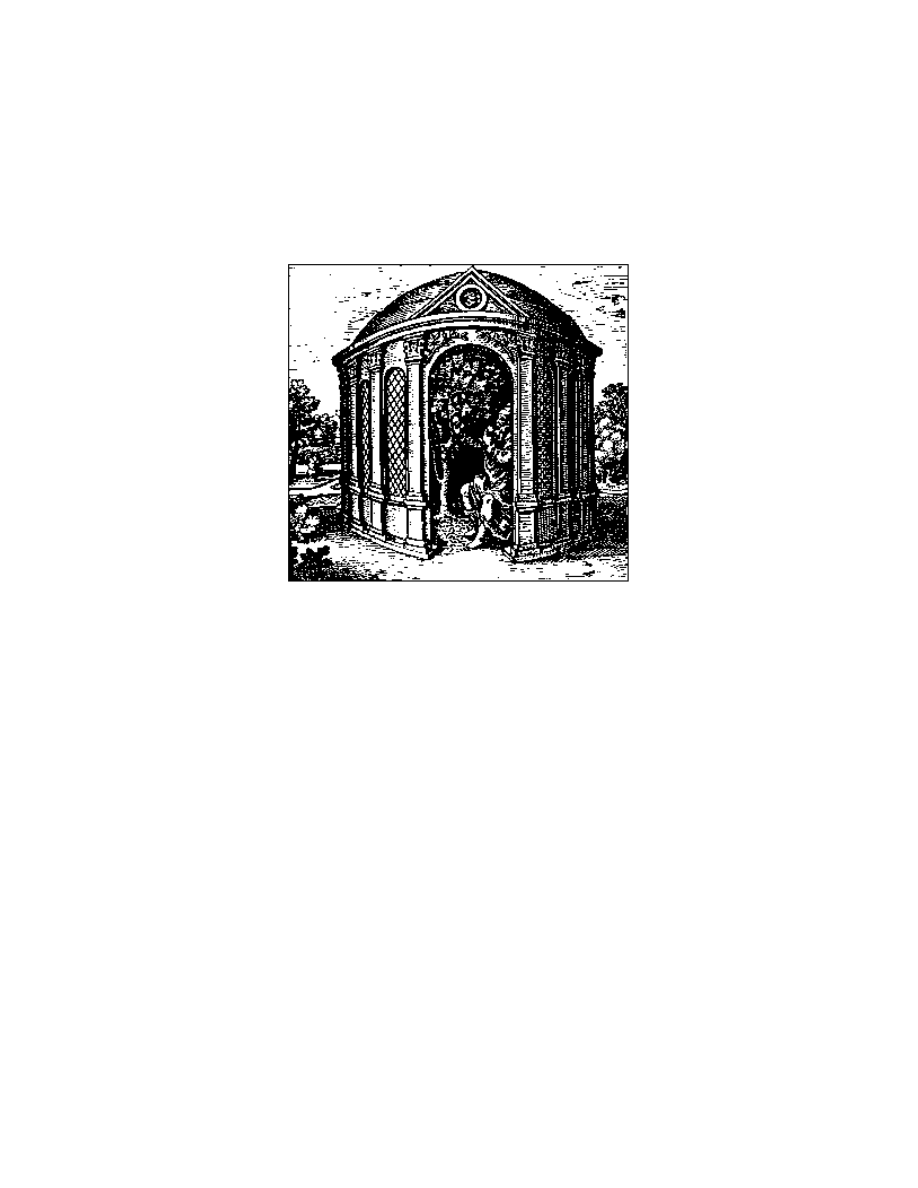
Emblem 9th
Arborem cum fene concludein rorida domo,
& comedens de fructu ejus fiet juvenis.
(Shut up the Tree with the Old Man in a
House of Dew, & eating the fruit thereat
He will become Young.)
Epigram 9th
Arbor inest hortis Sophiae dans aurea mala,
Haec tibi cum nostro sit capienda sene;
Inque domo vitrea claudantur, roréque plenâ,
Et sine per multos haec duo juncta dies:
Tum fructu (mirum!) satiabitur arboris ille
Ut fiat juvenis qui fuit ante senex.
Discourse 9th
All things that grow in length, breadth & Depth, that is, are Born, nourished, augmented, brought
to maturity, & propagated, the same things likewise decrease, that is, have their strength
diminished, dice, fall away, as we see in all Vegetables & Animals. Wherefore man also, when he
arrives at full growth, admits of decay, which is the same thing as old age, whereby his strength is
sensibly diminished 'till he die. For the cause of old Age is the same with that of a Lamp that
burns dim for want of Oil, for as there are three things in a Lamp: the wick, fatness & flame, so in
a man the wick is the Vital members, the Bowels & Limbs. The fatness is the radical moisture, &
the flame is the Natural Hat. The only difference is, the flame of a Lamp shines bright, but the
Natural Heat does not, it not being fire but only Heat, & whereas that fatness is oily, the Radical
moisture is viscous, being of a seminal principle. As, therefore, a Lamp is extinguished for want
of oil, so man by old age, without any other disease, falls into atrophy ["marasmus," lit. 'dying
away,' from the Greek] & aged consumption, & lastly into his grave. It is reported of the Eagle,
that when he grows old, his beak becomes so crooked that he would die with Hunger, unless he

could cast it. So Deer seem to grow young again by throwing off their horns, Serpents their skins,
& Crabs their shells; not that they really do so, for their radical moisture is not restored to them,
but only in appearance.
There is nothing that can restore Youth to man but death itself, which is the beginning of Eternal
life that follows it. However, there are some that say as to his external Form & the restoring of his
strength in some measure, together with the taking away of wrinkles, & changing of grey Hair, a
proper remedy may be found out, as Lully affirms of his Quintessence, & Arnold of prepared
Gold. But here the Philosophers say that if the Old Man would become Young, he must be shut
up in a House of Dew, & then he will eat of the fruit of the Tree, & so recover Youth. It is scarce
believed by the Vulgar that such Trees can be in Nature. The Physicians write wonders of
Myrobalanis [literally: 'miracle fruit'], the Fruit of a certain Tree, that they restore grey Hair to
blackness, purify the blood & prolong life. But this is scarce credited.
Marsilio Ficino, in his book of preserving the health of students, recommends sucking the milk of
a beautiful young woman, others recommend the eating of Vipers' flesh, but these remedies are
more troublesome than Old Age itself, & could not be obtained by one in a thousand, although
their effect should be certain. Paracelsus, in his book of Long life, says a sick man may attract to
himself the Health of another by imagination only, & so an Old Man may gather Youth. But in
this he seems rather to be guided by his fancy than experience. It is certain that the people called
Psyllis, with their double pupils, & witches by their very aspect bewitch Cattle & Children,
according to Virgil: "Nescio quis teneros oculus mihi fascinet agnos." These things are done
without contact. But as for the Tree which is to restore the Old Man, the fruit of it is sweet, red &
full ripe, turning into the best blood, as being easy of digestion, & affording the best Nutriment,
leaving nothing in the body that is faecal or superfluous. But the Old Man abound with white
Phlegm, has white Hair & Complection, which Humours, Color, & Hair are changed into that
Red which appears in Youth & Vigor.
Therefore the Philosophers say their Stone is first an Old Man that is white, & then a Young man,
which is Red. And they say further that the Old Man must be placed together with the Tree, not in
the open air, but in a House, & that not dry, but moist, with Dew. It may seem strange that Trees
should spring & grow in a close place, but if it be moist, there is no doubt of their continuance.
For the Nutriment of a Tree is moisture & Airy Earth that is fat, which can ascend into the body
& Bough, & these produce leaves, blossoms & fruit. In which Natural work then is the
concurrence of all the Elements.
Fire gives the First Motion as the efficient, Air gives Tenuity & Penetrability, Water Lubricity, &
Earth Coagulation. For when any of their superfluities ascend, Air turns into Water, & Water into
Earth. By Fire, I understand the Native Heat, which being propagated with the seed, does by the
Power of the Stars as if it were a Smith, forge out & form such fruits as are like to those things
from whence the seed ariseth. But a Dewy Evaporation is not only Expedient, to moisten the Tree
so as to make it yield fruit, but likewise the Old Man, that he may the more easily be made Young
again by that fruit. For the Dewy Vapors will mollify, fill up, & restore his dry & wrinkled skin
with temperate heat & moisture. Wherefore Physicians very rationally & with good success
prescribe Warm Baths for the atrophy ["marasmo"] or Consumption of Old Age.
But if the thing be well considered, that Tree is the Daughter of the Old Man, which as Daphne is
changed into a Vegetable of the like sort, & therefore the Old Man may not unjustly expect Youth
from it, seeing He himself was the cause of their being.
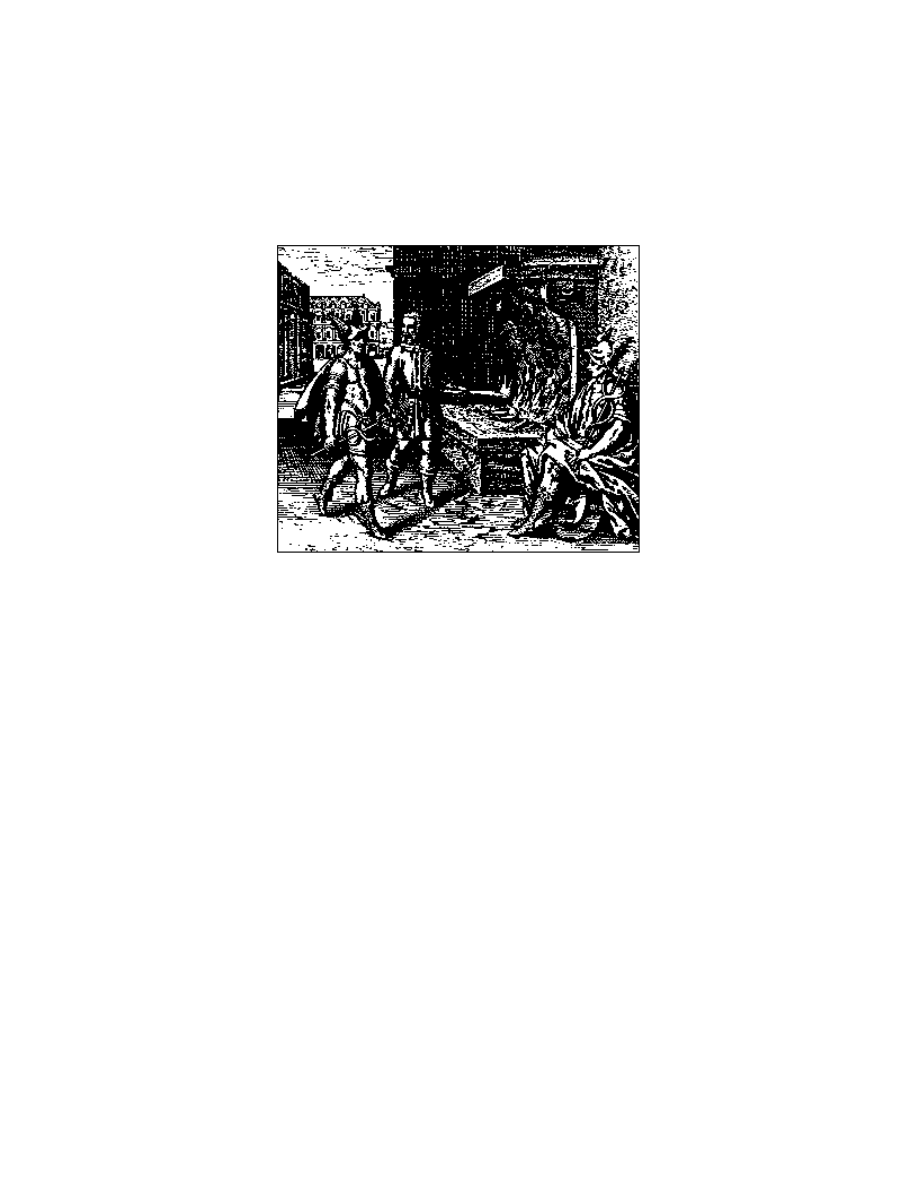
Emblem 10th
Da ignem igni, Mercurium Mercurio,
et sufficit tibi.
[Give Fire to fire, Mercury to Mercury,
and you have enough.]
Epigram 10th
Machina pendet ab hac mundi connexa catena
Tota, SUO QUOD PAR GAUDEAT OMNE PARI:
Mercurius sic Mercurio, sic jungitur igni
Ignis & haec arti sit data meta tuae.
Hermetem Vulcanus agit, sed penniger Hermes,
Cynthia, te solvit, te sed, Apollo, soror.
Discourse 10th
If this saying be taken literally, it only increaseth the quantity of Fire & Mercury, but introduceth
no new quality into the subject. For every like added to its like, makes it become more like.
Hence Physicians affirm that contraries are healed & removed by contraries. So we see Fire is
extinguished by Water, but fomented by the addition of Fire. As the Poet says: "Venus in wine, as
fire in Fire, does rage." ["Et Venus in vinis, ignis in igne furit."] But it may be answered that Fire
differs very much from Fire, & Mercury from Mercury, for there are several sorts of Fire &
Mercury amongst the Philosophers. Moreover, the same heat & cold, being distant only in place
& situation, differs from another of its own kind, so as to attract to it that which is like to itself.
So we see that Heat fixed in any part is drawn forth by the same Heat. Limbs benumbed & almost
dead with Frost & cold water will be restored by putting them into cold Water rather than by the
application of external heat. For as the greater light obscures the lesser, so also greater heat or
cold has power over the lesser, so it is necessary that the Cold or Heat that is outwardly applied
should be less than that which was before imprinted or fixed in the joints, otherwise the same

impression would be made as before, & the like would rather be much more increased than drawn
forth by the like.
This drawing out of cold by cold water, & of fiery heat by heat, is agreeable to Nature, for all
sudden changes in contraries are dangerous & less acceptable to it, but that which comes by
degrees can more easily be endured. So we say there is one internal Fire which is essentially
infixed in the Philosophical subject, & another external. The same may likewise be said of
Mercury. The internal Fire is Equivocally so cold because of its fiery qualities, virtue, &
operation, but the External Fire is Univocally so. Therefore, External Fire & Mercury must be
given to the internal Fire & Mercury, that so the intention of the Work may be completed. For in
boiling we use Fire & Water to Mollify & mature any thing that has crudities & hardness. For
Water penetrates into & dissolves the parts contracted, whilst the heat adds strength & motion to
it. Thus we see in the common coction of Pulse ["pulté"], which, being hard in themselves, yet
well are broken and reduced to a pulp in Water, the heat of the Fire rarifying the Water by
ebullition & reducing to almost an aerial substance, so the heat of Fire resolves the crude parts of
Fruit or Flesh into water, & makes them Vanish into Air together with it.
After the same manner, Fire & Mercury here are Fire & Water, & the same Fire & Mercury are
the Mature & Crude parts, of which the crude are to be matured by Coction, or the mature to be
purged from superfluities by the assistance of Water. But we shall in short demonstrate that these
two Fires & these two Mercuries are principally & solely necessary to the completion of the Art.
Empedocles was of opinion that the Principles of all things were Friendship & Discord. That
corruptions were made by Variance, and generations by Love. This Discord is manifestly
apparent in Fire & Water, Fire making Water evaporate & Water extinguishing Fire when applied
to it.
But it is likewise plain that generations will proceed from these same things by a certain
Friendship. For by heat is made new generation of Air, & by the same Heat that induration of
Water into the Stone is performed, & so from these two as the first Elements are made the other
two, & consequently from thence the production of all things. Water was the Matter of Heaven &
all Corporeal things. Fire as the Form moves & informs this matter, so this Water or Mercury
yields the Matter & Fire or Sulphur the Form. That these two may operate & mutually move
themselves by Solution, Coagulation, Alteration, Tinction & Perfection, there will be a Necessity
of external Helps, as instruments without which, no effect can follow. For as a Smith cannot
Work without Hammers & Fire, so neither can the Philosopher without his instruments, which are
Water & Fire.
This Water is by some called the Water of Clouds, as this Fire is called Occasioned Fire. It is
without doubt called the Water of Clouds because it is distilled as May Dew, & consists of most
thin parts. For as it is affirmed that May Dew being enclosed in the Shell of a Egg will raise it up
by the Heat of the Sun, so this Water of the Clouds, or Dew, makes the Philosopher's Egg ascend,
that is, Sublimes, Exalts & Perfects it. The same Water is also most sharp Vinegar, which makes
the body a mere Spirit. For as Vinegar has different qualities & can penetrate to the bottom &
bind, so this Water dissolves & coagulates, but is not coagulated, because it is not of a proper
Subject. The Water is had from the Fountain of Parnassus, which, contrary to the Nature of other
fountains, is upon the Top of the Hill made the Hoof of the flying Horse Pegasus.
There must also be actual Fire, which, notwithstanding, must be governed & qualified by its
degrees as with Bridles. For as the Sun proceeding from Aries into Leo, & so approaching nearer,
gradually increaseth heat to things growing, so it is here necessary to be done, for the

Philosophical Infant must be nourished by Fire as with Milk, & the more plentiful that is, the
more he grows.
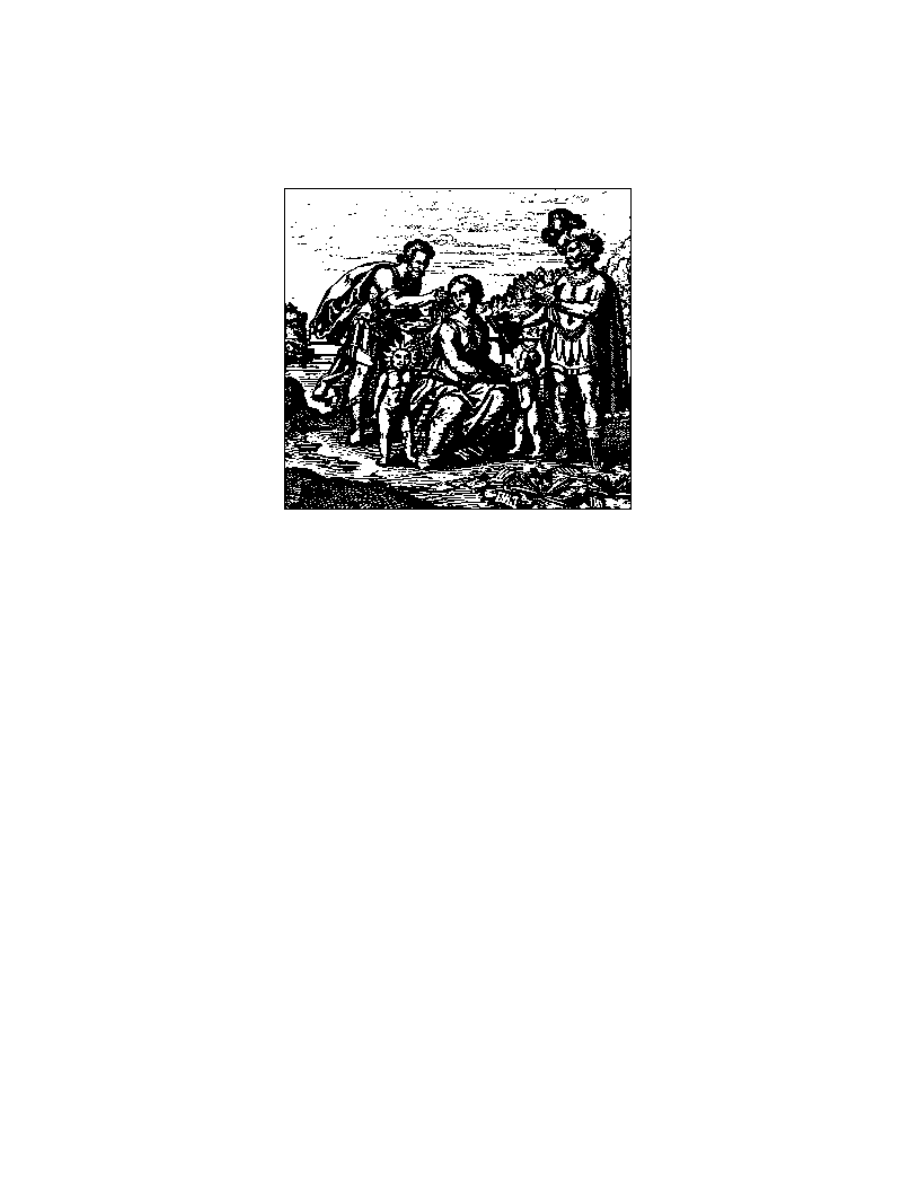
Emblem XI.
Whiten Latona and tear your books.
The Discourse:
There are such great differences amongst authors that such persons as search after Truth despair
of finding any end of this Art. For Allegorical discourses being in themselves hard to understand
are the Cause of many Errors, especially as the same words are applied to different thinges and
different words to the same thinges. Whoever would free himself from these difficultyes must
either have a divine Genius to perceive Truth through much darknesse, or he must have
inexhaustible wealth and patience to find through experiment what is True and what is not.
But according to the Philosophers one will not do without the other; ingenuity will do nothing
without labour, and vice versa. For no man can have understanding enough to avoid a hundred
thousand errors, obscurityes, digressions, ambiguityes, and yet still persist in the true part of
Nature. Wherefore the Philosophers say, he that hath not yet Erred hath not yet begun, and that
Errors teach us what to do and what not. And they likewise affirm that a man may spend his
whole life (though if it were possible he should live a thousand years) in distilling and redistilling
before he could attain to truth by experiments only. The Corrector of Fools intimates that no
progress can be made without study and reading of Authors, for he says study removes ignorance
and brings human understanding to the true Knowledge of everything. It is therefore necessary in
this work to quicken the ingenuity by naturall Philosophye, the knowledge of Truth being
contained in it. Let not therefore operators despise study. But as for those who are averse to it yet
willing to operate, let them take care that their Art be the Imitation of Nature itself, which Art
desires to amend because it is impossible for Her to prepare the Philosophickal secrets to a perfect
End. The wise say of these men that they run to practice as an Ass to Hay, not knowing what he
puts his nose to, led to his food by his sight and taste, to wit his exterior senses, without any
understanding. And so far goes this Author.
But least a man should vex himself with overmuch study, which is an immense and profound Sea,
and would bring every word (which perhaps may relate to quite another thinge) into practice
thereby wasting and consuming his strength, time, reputation, and riches, the Philosophers use

this Emblematicall speech, That Latona must be whitened and their books must be torn least their
Hearts be broken. For most books are so obscurely written that they can only be understood by
their Authors; indeed, severall of them are left out of Envy to seduce others, or rather to retard
them in their Course, that they may not attain to their end without difficulty, or to obscure those
thinges which they themselves had written before.
But the chief work and labour is how to whiten Latona. The book called Clangor Buccinæ defines
Latona as an Imperfect Body of Sol and Luna. The most Ancient Poets and writers affirm Latona
to be the Mother of Apollo and Diana; others call her their Nurse, and state that Diana was
brought forth first (for Luna and whitenesse do first appear), who afterwards but the same day
performed the office of a Midwife in bringing forth Apollo her brother. For Latona was one of the
twelve Hieroglyphicall Gods of the Ægyptians by whom these and other Allegoryes were
propagated among other Nations. Very few even of their Ægyptian Priests knew the true sense
and meaning of them, the remainder of the People applying them to other Subjects that were not
in the Nature of thinges, namely Gods, Goddesses and the like. Wherefore Latona had the most
sumptuous Temple next to Vulcan adorned with gold because she was the mother of the
Philosophickal Apollo and Diana.
But this Latona is brown and blackish, and hath many moles in her Face, which must be taken
away by Dealbation or blanching. Some make their dealbations of Ceruse, Sublimate Mercury,
Talc reduced to Oyle and the like, by which they encrust, cover and so would whiten the outside
of her skin. But the whitening encrustations fall off by every wind or liquor, because they do not
penetrate the inward parts, and so deceiving only their eyes by their false Colours are not
regarded well by the Philosophers. For the Philosophers would have Latona's face made white by
penetration and by altering the skin itself, that is truly and not superficially or by colouring alone.
You may ask how this can be done? I answer, Latona must first be sought out and known, which
though she be drawn from a Vile place, yet she must be sublimed to one more worthy. But if she
be taken from a more worthy place, she is to be submersed in a place more vile- that is, into
Dung. For there indeed she grows white and becomes white lead, which being obtained there is
no doubt of success; for from White Lead proceeds the Red Lead, which is the beginning and End
of the Work.
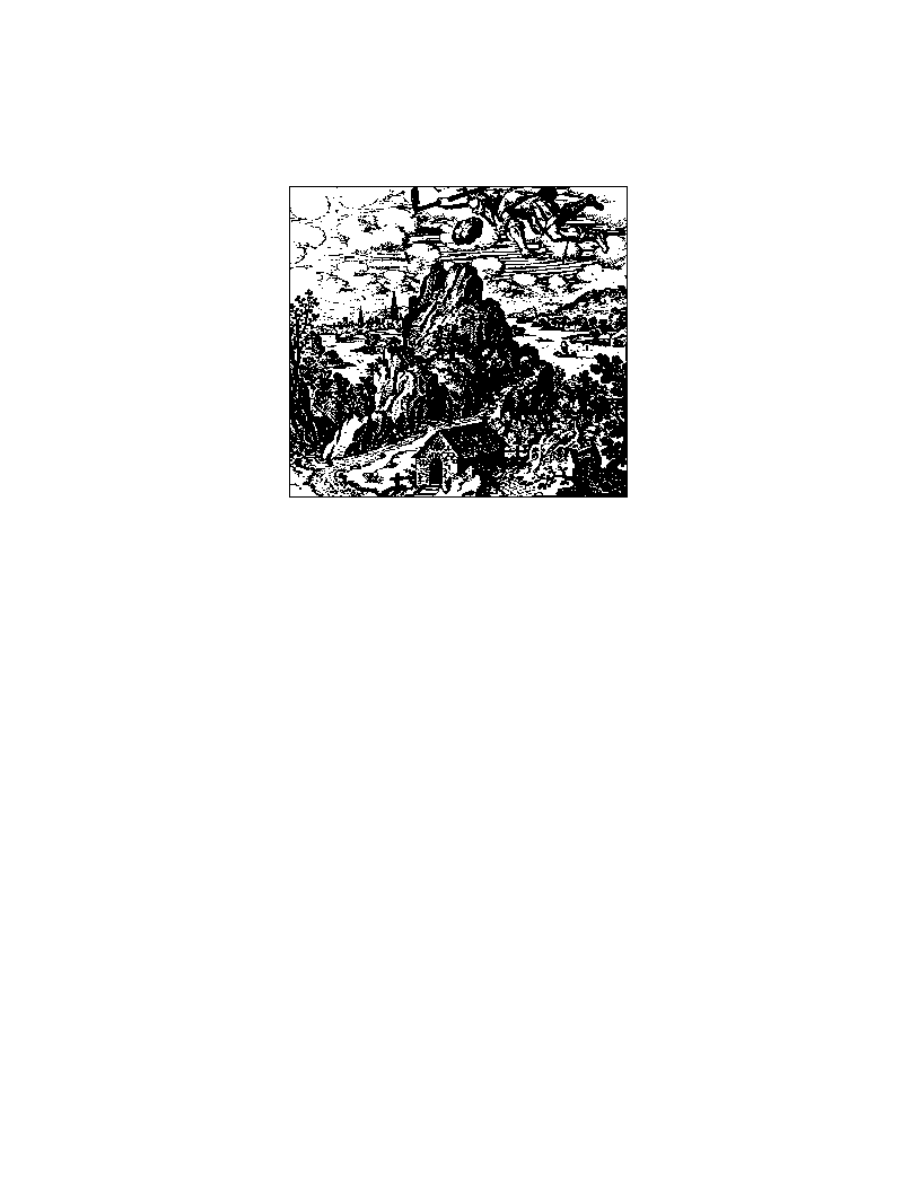
Emblem XII.
The Stone which Saturn vomited up, being devoured instead of his Son Jupiter, is placed on the
Helicon as a Monument to Men.
The Discourse:
We find the Allegorye of Saturn to be taken diverse ways, for the Astronomers reputed him the
Highest of the Planets, and the students of chemistry the basest of metalls, namely lead. The
Heathen Poets say he was the Father of Jupiter, the Son of Heaven. The Mythologists explain him
by the notion of Time. But though all these may seem to have a probable opinion according to
their own sense, yet they will never be able to explain certain thinges which are elsewhere spoken
of Saturn; such as why he should devour his Sons and Vomit up a Stone instead of Jupiter. Or
why he should be the Finder Out or Discoverer of Truth; why he should be remarkable for his
Scythe and Serpent, or his Blacknesse, moroseness and distorted feet. The Mythologists think
they give the best interpretation when they say Time reveals and manifests Truth out of
Darknesse, that it rolls itself around and glides away like a Serpent, and that it cuts all thinges
down with Death as with a Scythe. That he devours his Sons, to wit all beings that he ever begot,
but that he cannot consume or digest hard Stones, and therefore may be said to Vomit them up
again.

These may in part have some resemblance to the Truth, but they do not agree in the Truth of the
thinges in all its Circumstances. But the experienced Philosophers say that Saturn is first in their
work, and that if he be really present they cannot Err, for Truth is discovered in darknesse, and
nothing comes into existence without blacknesse. Wherefore they say in the Turba
Philosophorum, whatever Colour comes after blacknesse is praiseworthy, because it is the
beginning of the Work. And the Rosary out of Arnoldus says, when it first glows black we say it
is the Key of the Work, because that cannot be made without blacknesse. And out of the
Speculum when you are working see that in the beginning you obtain a black colour, for then you
will be certain that you cause putrefaction and proceed in the right method. And again, that
blacknesse is cold Earth which is made by a light decoction and is often reiterated till blacknesse
be most eminent. Hence they say that Saturn possessed the Earth, Mercury the Water, Jupiter the
Air, Sol the Fire- Blacknesse therefore is Saturn, the Discoverer of Truth who devours a Stone
instead of Jupiter. For Blacknesse is a dark cloud covering the Stone at first so that it cannot be
seen.
Thence Morienus says each body that wants a Soul is dark and obscure. And Hermes prescribes
thus, Take his brain and wear or rub it with Sharpest Vinegar or Urine of Boys till it becomes
dark. This being performed he lives in putrefaction, and the dark clouds that were upon him and
in his Body before he died are returned. This Stone is again cast up by Saturn when he becomes
White, and then it is placed upon the Top of Helicon as a Monument to Mortals, as Hesiod writes.
For Whitenesse is really hid in blacknesse, which is extracted out of his belly, that is, out of the
Stomach of Saturn. Therefore saith Democritus, Cleanse Tin with a speciall absolution, extract
from it its blacknesse and obscurity, and the whitenesse of it will appear. And in the Turba it is
said join the Dry with the moist, that is the black earth with its water, and decoct it till it becomes
white. Arnold in his work called Novum Lumen, chapter 4, very well expresses the same thinge
when he says, That moisture therefore which cured the blacknesse in the decoction shows itself to
be dried up when the white Colour begins to appear. And a little after: And my Master said to me
that Brownesse ascended because the whitenesse was drawn out of the Belly of the Blacknesse, as
is said in the Turba. For when you see it black, know that whitenesse is hid in the belly of the
blacknesse first appearing.
As this blacknesse is called Saturn, so it is likewise called Lead. Thence Agadimon in the Turba
says decoct the æs or brasse till the blacknesse which they call money comes forth, and mix well
the materials of our Art, and then you will presently find blacknesse, which is the Lead of the
Philosophers so much spoken of in their books. Emigamus has relation to this when he says that
the Splendour of Saturn when he ascends into the Air appears no otherwise then Darkened. And
so Plato in the Rosary: The first Regimen of Saturn is to putrefye and put it upon Sol. From all of
which it is evident that the sense of the Philosophers when they speak of Saturn is quite different
from the Vulgar acceptation. This Saturn generates Jupiter which is an obscure Whitnesse, and
Jupiter begets upon Latona first Diana which is perfect Whitenesse, and then Apollo which is
Rednesse. And this is the successive permutation of perfect Colours. This Stone cast up by Saturn
is said to be placed upon the Top of a mountein as a monument for men, which is a thinge most
True.
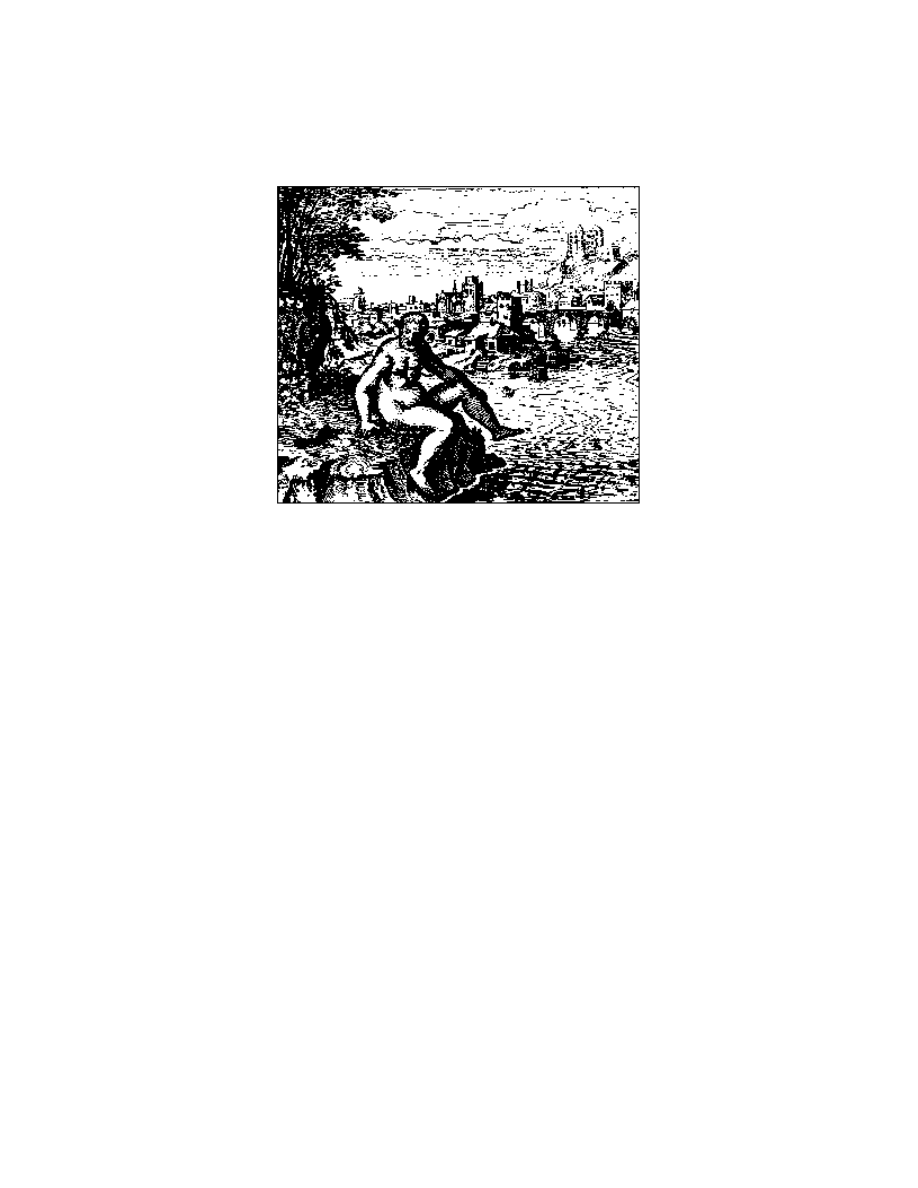
Emblem XIII.
The Philosophers' Brasse is Dropsicall and desires to be washed seven times in a River, as
Naaman the Leper was in Jordan.
The Discourse:
That Namaan the Syrian should at the Prophet's command take a journey into Judea to wash
himself seven times in the River of Jordan is to be ascribed to the confidence he placed in the
Prophet's words. But that he was freed from Leprosy by that washing is a miracle of the Divine
Omnipotence. For the Leprosy, being seated in the blood and radical parts of a man's body, is as it
were an universall Canker, which cannot be taken away or cured by any externall washing, much
lesse by cold water such as that of the Jordan.
So likewise that the Philosophers' Brasse, labouring under the disease of a Dropsie, should be
freed from it by washings of water, and that even an imperfect thinge should be made perfect and
a sick thinge healthy, and that to so great a degree as to be able to impart its health to sick bodyes,
must be next to a Miracle. For such an example is not elsewhere extant in Nature; nor is it indeed
the ordinary course of Nature to produce the Philosophers' most absolute Tincture unlesse it be
governed by Art, and fit subjects be administered to it with the externall efficient. So the
restitution of luxations, that is, thinges dislocated or out of Joint, is not peculiar to Nature but to
Art. Neverthelesse, the Os Sacrum opens itself miraculously at the birth of a Child, that the Infant
may come forth thereby as through a door, and in this the most great and mercifull God operates
by Nature above Nature.
So that the Stone should be perfected seems a thinge supernaturall though it really be Naturall.
From whence the Rosary: You must know, says he, that our Airy and Volatile Stone, according to
that which is manifest and apparent, is cold and moist, but according to that which is occult and
hidden, is hot and dry. And that coldnesse and moisture which is manifest and is a Watery Fume,
corrupting, blackening, and destroying itself, flees from it by the Fire. But the Heat and drynesse
which is occult is Hot and dry Gold and a most pure Oile able to penetrate bodyes, and is in no
way Fugitive, because the Heat and drynesse of Alchemy tingeth, and no other thinge whatever.
See therefore that the coldnesse and moisture which is manifest be equall to the heat and drynesse
which is in the Occult, so that they may both agree and be joined together, being at once made

one penetrating, Tingeing and Fixing Body.
But these moistures must be destroyed by Fire and degrees of Fire with a soft Temperament and
an agreeable and moderate Digestion. If this be True, how shall it be from waters? It may be
answered, there are certain Waters of Hot and dry qualityes, such as are many Baths, in which it
must be Philosophically washed. For this is the meaning of what they say, wash with fire and
burn with water, for that Fire which washes and that water which burns differ in Name only, but
agree in effect and operation. Therefore with this water or this Fire the Philosophickal Æs or
Brasse must be washed from its superfluous Humors: that is, it must be dried.
We have known Experiments of Dropsicall Bodyes cured by six months abstention from all
manner of Drink; or by burying them in Hot sand and Cow dung, or by putting them into a Hot
Furnace and letting them sweat, and innumerable other helps as likewise by drying Baths such as
those of Carlsbad or Wiesbaden. By the same methods must this patient be cured; sometimes by
waters, sometimes by the Hot Air of Furnaces; now with Cow dung, then with Sand and
Abstinence from Drinking. For these are the most effectuall Remedyes in both Cases, some at one
time are to be used and some at another. But in all these thinges Heat is the Operator which, by
the Emunctoria or pores of the Body, draws out the superfluous waters. For the outward heat
quickens the inward, that is the Vitall spirits, that they may expell that moisture which is hurtfull
to them as an unprofitable excrement, by which the Naturall Heat was before suppressed as by an
Enemy.
In this Cure there is need of great diligence and precaution, least whilst one bowell is relieved
another may be hurt. In a Quartan (which according to the Platonists will try the skill of a
Physitian) we have experienced that thick Viscous humor, like the Gum or Glue of Trees, being
gathered together from all the veins or Masse of blood, and descending through the Vena Cava or
great Vein even to the bottom of the back, where it obstructs the emulgent Veins which draw the
serous matter out of the blood or the passages of them. Thus they are lesse able to operate, and
more of the serous matter remains in the Body, and so in a short time if care be not taken a
Dropsie may happen, the other Bowell being in no way hurt at the first. Here Diuretica do little or
no good, Purgatives yet lesse unlesse Diminution or eduction be made in some certain series of
time. Sudorificks manifestly do harm because they draw out the more subtile parts and leave the
thicker, and if they are continued will weaken the body, for Nature's custom is to find that way of
evacuating the serous matter through the Pores only when she is obstructed about the Bladder.
One therefore is Scylla, the other is Charybdis, both of which he that shall hath a mind to preserve
himself ought to avoid.
That Dropsie which proceeds from an impaired Liver or spleen is the most difficult to be cured;
but in the Philosophickal Brasse the Cure is not impossible, the distemper being rather by
Accident and secondary than Essentiall and primary. This is provided it be undertaken cautiously,
as we have said concerning the plenty of Serum in a Quartan, to wit that it may not by too much
excitation fall into a Consumption or by too much moisture fall into such a Dropsie as may be
difficult to be Cured.
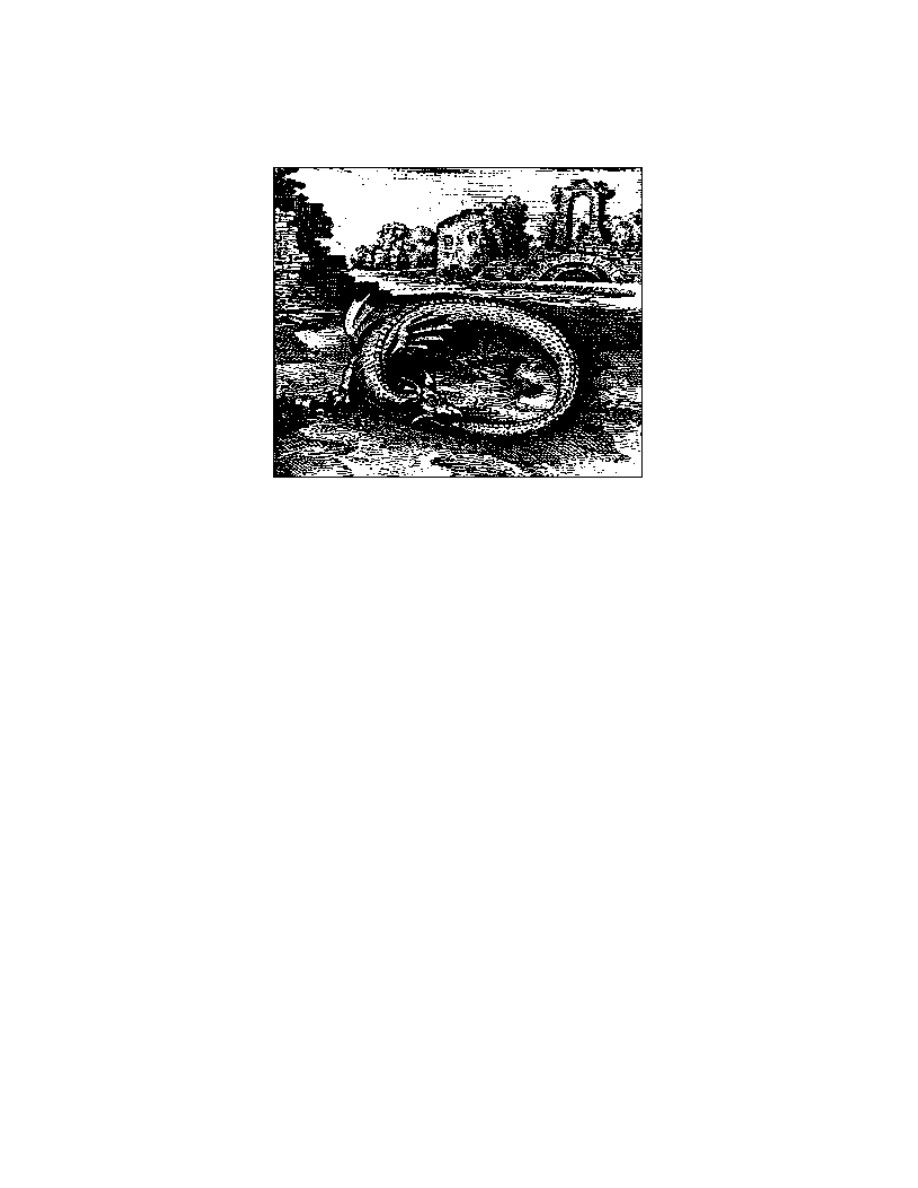
Emblem XIV.
This is the Dragon that devours his Tayle.
The Discourse:
It is the saying of the Ancients that a Serpent that has devoured a Serpent becomes a Dragon, for
like a Thief or a Murderer it preys upon its own kind. There were such Serpents in Africa, of a
vast bignesse and in great numbers, which devoured part of Alexander's Army- the larger are bred
among the Aschæans, a people of Ethiopia, which being placed together after the manner of herds
do with their heads erected make their way to better Pastures. It is reported that the Kings of India
nourished two Dragons, one of eighty the other of ninety Cubits in bignesse. It is remarked by the
observations of later writers of these times that there are serpents found near Angola which equall
the main mast of ships. So there is a report that in some mounteins of India and Africa there is
greatnesse of gold, but that it is kept by Dragons least any person should come and take it away.
For at the founteins or Rivulets which fall from the mounteins the Dragons meet, and so by
Accident are said to keep watch over the gold enclosed in them.
For this reason do the Philosophers assign so many Dragons to their Treasury, as to the Golden
Fleece, the Garden of the Hesperides, and the others persons or chymicall subjects such as
Cadmus, Saturn, Æsculapius and Mercury, whose Caduceum is bound with two serpents, a male
and female. For they mean nothing else by Dragons but Chymicall subjects. Hence they say, Dant
Rebis montes dracones terraque fontes: Dragons to Rebis do give mounteins, And the earth does
give him Founteins. And they denote his extreme hunger by his devouring his Tayle, which
though some may interpret this as the year returning into itself and resembling a Circle, yet it was
first applied to their work by the Philosophers, who by this Dragon would have such a Serpent
understood as devours another of its own kind, and which is properly called Sulphur, as all of
them Attest in innumerable places.
Thus Lully says in his Codicillus, chapter 31: This my son (saith he) is Sulphur, and this the
Serpent and Dragon devouring his Tayle, the rearing Lyon and sharp sword cutting, mortifying
and tearing all thinges. And the Rosary says the Dragon does not dye unlesse he be killed with his
Brother and Sister. And a little after: the Dragon is Argent Vive, extracted out of Bodyes, having
in itself a Body, Soul and Spirit. This in the same place by another Name is called Stinking

Water, which is to be had after the separation of the Elements. Now the Dragon is said to devour
his Tayle when he consumes the Voluble, Venomous and moist part, so that afterwards being
without a Tayle he may seem more corpulent and slower, as if his Motion and Volubility had in a
great measure consisted in his Tayle.
Other animalls move upon their Feet, but Serpents, Dragons and such like Vermine use the
constriction and explication of their bodyes instead of feet, and like flowing water incline
themselves sometimes this way, sometimes that, as may be seen in most Rivers which run
obliquely in Circuits and turn their courses like Serpents. The Philosophers therefore did not
without reason call Argent Vive by the Name of a Serpent and give Serpents to Mercury, seeing
that also does as it were draw its Tayle and run sometimes this way and sometimes another with a
Voluble Weight. For as a Serpent moves so also does Mercury, who therefore has Wings upon his
feet and Head. It is reported that in Africa there are flying Serpents which would depopulate all
places if they were not destroyed by the Bird called Ibis. Wherefore Ibis is placed among the
sacred Images of the Ægyptians, as much for the manifest good that it does to the whole Country
as for a secret reason which very few of them understand.
This Dragon having devoured his Tayle and cast his Old Skin is said to acquire both a new skin
and new youthfulnesse; thus Nature has granted longer life not only to Crows, Ravens, Eagles
and Larks but likewise to the Race of Serpents. The Ant when it grows old has wings; so have
many other Worms. Man growing old is put into the Earth, but brought upward from the Earth is
consecrated to Eternall Life.
There is a powder made of Every Serpent when it is burnt which is safely taken against all
poisons, and that with very good Effect. Such an Alexipharmacum ought also to be made of this
Dragon when he hath devoured his Tayle (which is likewise usually cut off in Vipers) and it will
prove a most effectuall and present Remedy against the adversityes of Body and Fortune.
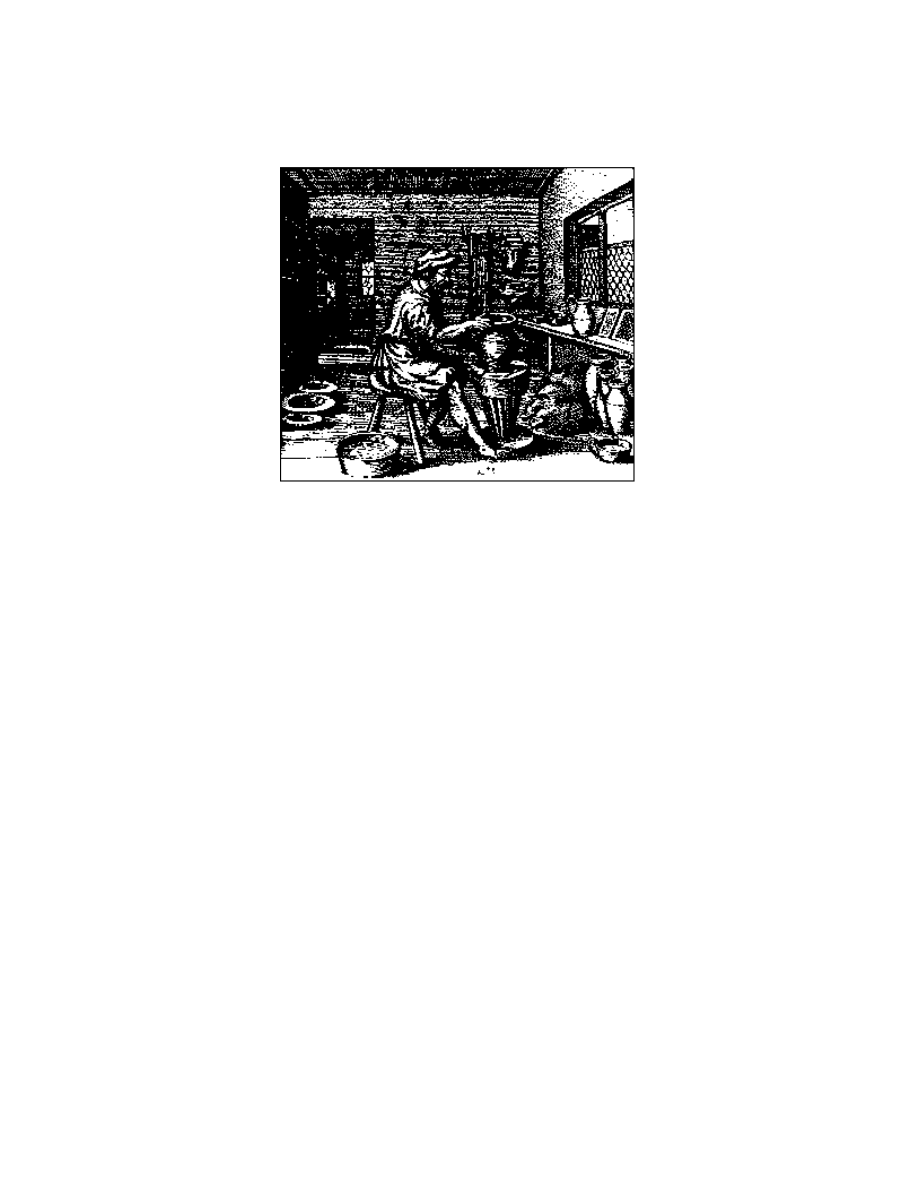
Emblem XV.
Let the work of the Potter, consisting of drynesse and moisture, instruct you.
The Discourse:
As this terrestrial Orb is made into one Round Body by a complication of Earth and Water, so
likewise the Potter's work seems to be compounded of the same particular Elements; that is, the
Dry and the Moist, so that one may temper the other. For if the Earth should be without Water
and no Ocean, Sea, Lake, River or Fountein should be near it, the earth could bring forth nothing
of itself but must perpetually remain unfruitfull. So if water should not be received into the
cavities of the Earth but stand round about it, it would easily cover the whole face of it and so it
would remain uninhabitable. But one entering amicably into the other, and water moderating the
drynesse of the Earth and Earth the moisture of the Water, by a mutual commixture the
Fruitfulnesse and advantages of both Elements do very speedily appear.
In like manner the Potter mixes Clay with Water, and that so he may make the masse tractable
which he shapes upon his wheel, and he sets it in warm Air so it may drye leisurely. Then he adds
the Violence of Fire, that his vessells may be well hardened and condensed into a durable Stone
which can resist both Water and Fire. So the Philosophers say we must proceed in the naturall
work, and they therefore set the Potter before us as an example; for it is certain as to the dry and
moist, that is the Earth and Water, that they have a very great Affinity. But there is also no doubt
they have many differences in their way of Coction and in the matter and form of the Elements
that are to be compounded. For the Potter's Vessells have a Form that's artificiall, but the
Philosophick Tincture has one that is altogether Naturall and so much Nobler than Theirs, as also
the matter of it is more excellent than theirs. Each of them is indeed the Work of Earth, but there
is nothing said to be in the Philosophickal which hath not ascended and attained to the Heaven of
Air, whereas in the other a thick and foeculent Earth is predominant. The effect of both is a
Stone- this a Common, that a Philosophickal one.
By which similarities a certain Person being seduced put a great Number of Artificiall Stones or
Tiles into one chest and the whiter sort of flints into another, using diabolicall conjurations over
them that one might be turned into Silver, the other into pure Gold. But when these were
imagined to be the Stones of the Philosophers, and after a great sum of money has been expended

in purchasing severall thinges, the new gold and silver which were expected at a certain time did
not appear, and none of the Stones as it was hoped received conversion. Death came very
opportunely to put an end to his shame and Folly; for Gold and Silver is not to be sought for in
the thinge wherein they are not implanted by Nature, and Diabolicall magick is so far from
having any place in these works that it is as distant from them as the Author of such acts is from a
devout and pious man, or as Hell from Heaven.
So although a man should have the True Philosophickal Stone, yet let not any one imagine that
impossibilities can be performed by it, as Isaac admonishes us: no man by Law of Nature or
Policy can be bound to thinges impossible. As for the Transmutation of Gems and making Glasse
able to endure the Hammer, any man may know whether they are possible by investigating if they
are agreeable to Nature. Geber affirms concerning the Philosophers that they speak many thinges
by allegoryes; and he says of himself, that when he has spoken clearly he has said nothing, but
when under a figure, there he has hid the Truth as Wheat under Chaff.
Those thinges which a man sows, the same he shall reap, which saying takes place in vegetables
and Animalls, though different species may sometimes proceed from the thinges sowed. But
whether these thinges ought to be applied to Mettalls, which are not propagated by seed, is
worthy of consideration. In these the parts are only Homogenous, as Sulphur and Argent Vive; in
those they are Heterogeneous or organicall. In these are no receptacles of seed; in those there are.
In these is found no Nutrition, Augmentation or Extension into all Dimensions; but those have
them all to the greatest degree. Lastly, these are Elemented Weights admitting nothing else but
mixture: whereas they besides Mixture have also a Vegetative or sensitive Soul. Neverthelesse it
is True without doubt that there is something in places under the Earth which as yet is not Gold,
but by nature will become gold after a thousand years. And who will deny this to be the
Analogicall Seed of Gold? Both Gold and the Aurifick Nature are of one originall, though the
latter be of the more Noble form; and therefore the seed of Gold being known, the seed of the
other will likewise be known. The Philosophers affirm that it is the Dry and Moist that is Sulphur
and Argent Vive, and that it is to be extracted out of two Mounteins in the greatest Purity.
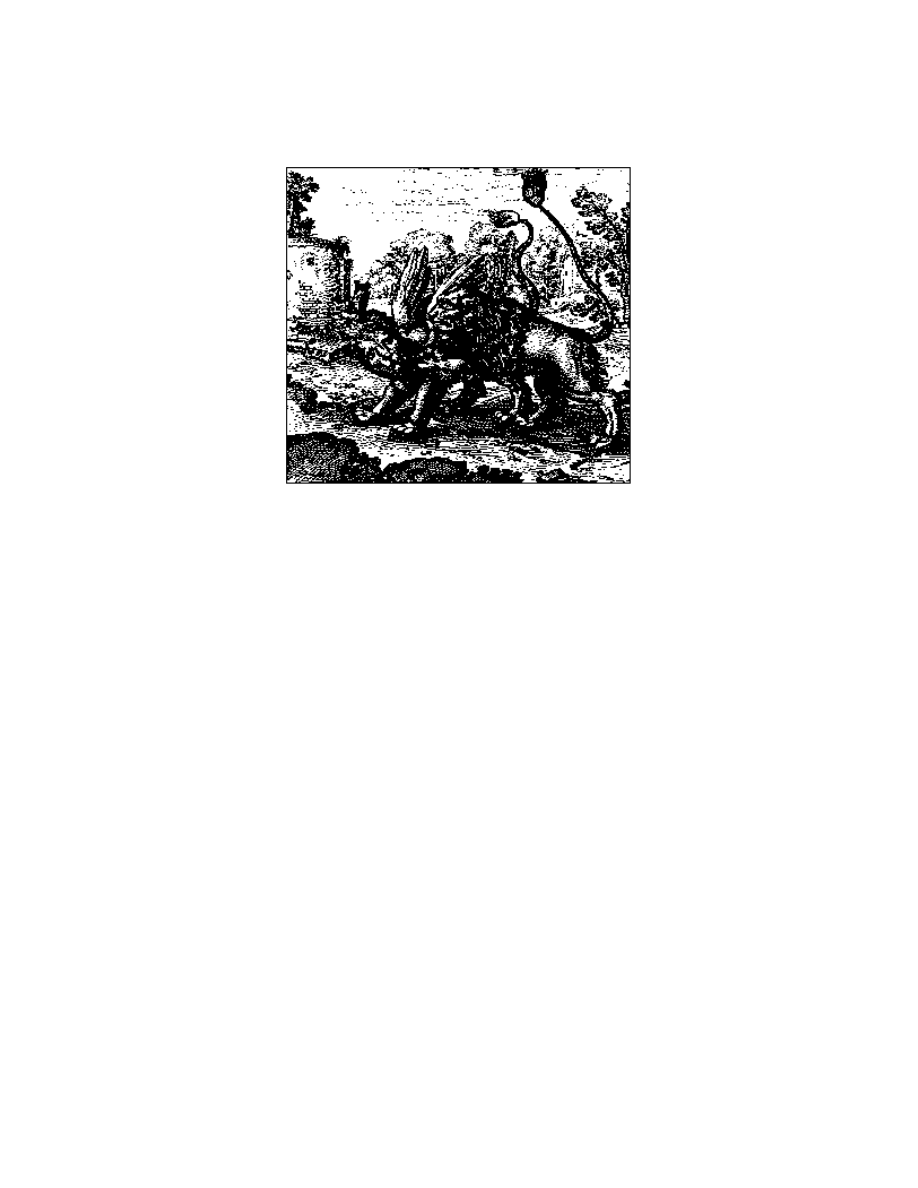
Emblem XVI.
One Lyon hath wings and the other hath none.
The Discourse:
It is a thinge known by experience that a Lyon does not so much excell other animalls either in
bignesse and strength of body as in the generousnesse of his Nature. When he is hunted, being
ashamed to run away, he makes his retreat leisurely if he finds himself oppressed by multitudes;
when he is out of the view of his Pursuers he makes haste away, thinking the basenesse of his
flight is atoned for by his endeavour to conceal it. He leaps upon the Prey that He follows, but He
never uses that motion in his retreat. His bones are solid, without any vacuity, and are said to be
so hard that Fire will be struck out of two of them as from a Steel and Flint. He fears Fire above
all thinges. He seems to derive his Substance from the Nature of the Sun, for in force and heat he
excells other animalls as the Sun doth the Starrs. He always appears with fiery and open Eyes, as
the Sun beholds the Earth with an open fiery Eye.
A Lyonesse fighting for her whelps fixes her Eyes upon the Ground, least she should be afrighted
at the Hunter's spear. When the Lyon perceives the coition of the Panther he takes revenge upon
the Lyonesse for Adultery and inflicts severe punishment. She therefore washes away the scent in
a River, or being conscious of her offence doth follow the Adulterer flying for fear of the Mate.
The Philosophers therefore observing the wonderfull Nature of this Beast have made diverse
Allegories from Him, which they use as so many Hieroglyphicall writings relating to their secret
work. And finding the Lyon to be a firm and constant animall void of deceit himself- and
consequently of suspicion of others- they resemble the best part of their Philosophickal work to
so noble a Character. For as he flyes not, so neither does that; as his bones are solid, so that is
fixed and knows no Conqueror. But as the Lyonesse is not always innocent and free from
Adultery, so neither is Luna or Mercury without some spot or blemish, but by the Ignorant is
joined sometimes to one sometimes to another sort of Matter, from whence an adulterous
conjunction of thinges different in Nature may be said to proceed, rather than a true Matrimony to
be contracted. For the products of the Lyonesse and the Leopard have no comely Manes about
their Neck and shoulders, which is the signall Ornament of the Lyon's legitimate offspring.
Therefore let the Philosophickal Lyonesse be joined to her proper Male, and there will be born a
whelp that is genuine and generous, which may easily be known by his paw. But this should not

be any sort of Lyonesse, but one that has wings, which may be able to fight and contest with the
Lyon as relying upon the swiftnesse of her plumes that she may not be suppressed by the violence
of his wrath, but may be prepared for flight if at any time he become furious without just reason.
For when she is about to flye away and He retards her, He is incited with a greater Love towards
her, and a firmer friendship is contracted after such a Variance.
But you will ask, whoever saw a Lyonesse with wings? Or what use can be made of her plumes?
There is a deep Valley near the Mountein Cythæronem in which are seen none but flying
Lyonesses. But to the Top of that Mountein there resorts a Red Lyon, of the same kind as that
which was slain by Hercules. The Lyon therefore must be taken and brought into the valley, and
then immediately He will be coupled with the winged Lyonesse. She also will easily suffer
herself to be overcome, because like will be seduced by like. Afterwards they must both be
advanced out the said Valley to the Top of the Mountein, and henceforth they will never desert
one another but will always remain together in inviolable wedlock. The taking of these Lyons I
confesse is not easy, but Lyable to many dangers. But neverthelesse it must be attempted. A Lyon
feeds not with the Lyonesse, but wanders apart as Tradition relates; therefore they are to be
sought and hunted for in different places. But if these two Lyons can be taken when they are
Whelps, when their Claws first appear and they begin to walke which is two months after their
Birth, then afterwards they may be joined upon their coming to riper Age, and the whole matter
will be effected without any danger. But they are born in the Spring time, which requires the
closest observation; seeing the Lyons after whelping use crosse and winding wayes least their
Den should be found out, great Care and diligence must be used to seek them and deprive them of
their whelps.
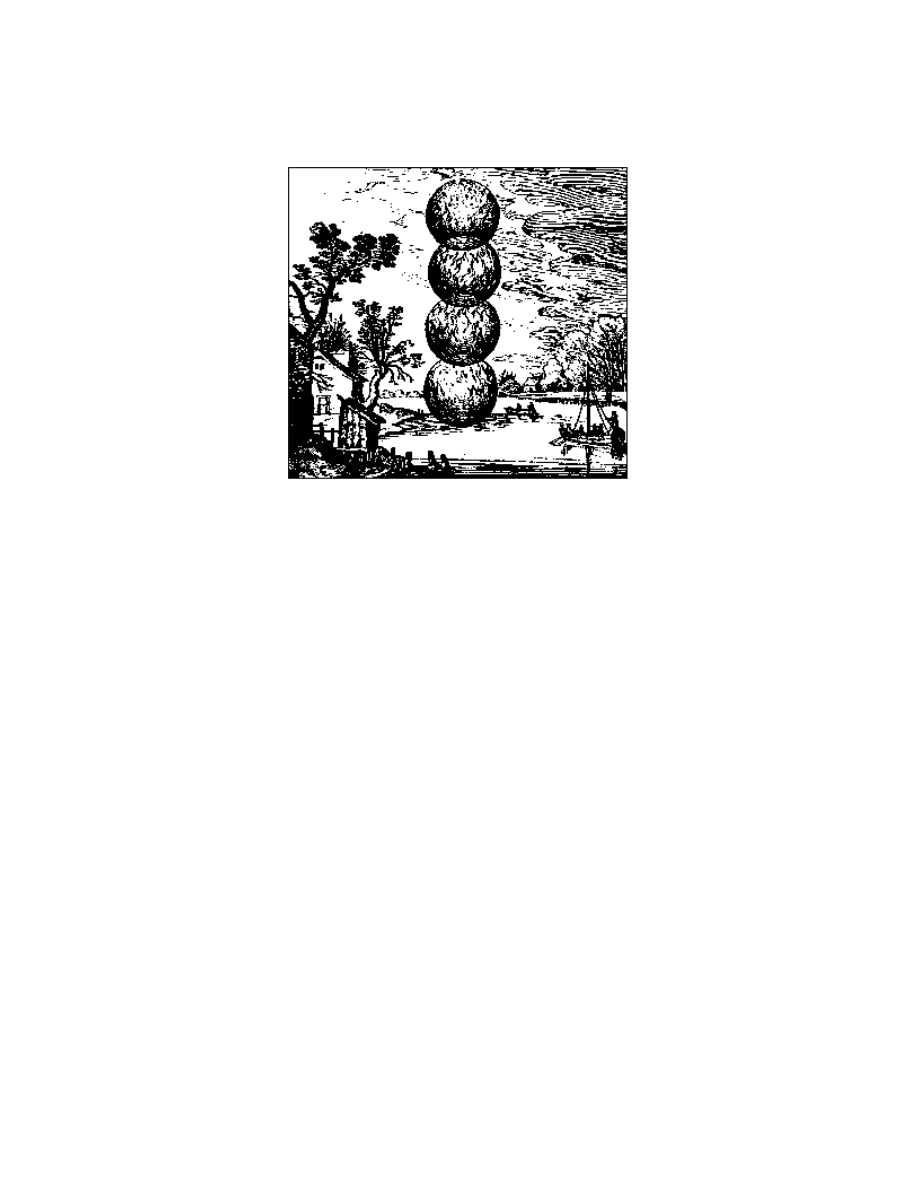
Emblem XVII.
Four Orbs govern this work of fire.
The Discourse:
The Philosophers in many places make mention of four sorts of fire necessary to the Naturall
work, namely Lully, the Author of the Scala, Ripley, and many others. The Scala says that
Raymund speaks thus of fires: It is to be remarked that here lye contrary operations, because as
the fire contrary to Nature doth dissolve the spirit of a fixed body into the water of a Cloud, and
binds the body of a volatile Spirit into a congealed Earth, so contrarywise the fire of Nature
congeals the dissolved spirit of a fixed body into a Globular Earth, and resolves the body of the
volatile Spirit fixed by the fire contrary to Nature, not into the water of a Cloud, but into
Philosophickal water.
Ripley speaks more clearly of these fires.
Gate 3, Stanza 15:
Foure Fyers there be whych you must understond,
Naturall, Innaturall, against Nature, alsoe
Elementall whych doth bren the brond.
These foure Fyers use we and no mo:
Fyre against Nature must doe thy bodyes wo;
That ys our Dragon as I thee tell,
Fersely brennyng as Fyre of Hell.
16. Fyre of Nature ys the thyrd Menstruall,
That Fyre ys naturally in every thyng;
But Fyre occasionat we call Innaturall,
And hete of Askys and balnys for putrefying:
Wythout these Fyres thou may not bryng
To Putrefaccyon for to be seperat,
Thy matters togeather proportyonat.

17. Therefore make Fyre thy Glasse wythin,
Whych brennyth the Bodyes more then Fyre
Elementall; yf thou wylt wyn
Our Secret accordyng to thy desyre
Then shall thy seeds both roote and spyre,
By help of Fyre Occasionat,
That kyndly after they may separat.
They are called Fires because they have a Fiery Virtue; the Naturall in coagulating, the Unnatural
in Dissolving, The Fire against Nature in corrupting and the Elementary in administering heat and
the first motion. And there is an order observed in them like that of a Chain, that the second may
be incited to action by the first, the third by the second, and the fourth by the third and first, so
that one be both Agent and Patient in a different respect. That which is observed of Iron rings
held together by a Magnet and joined by mutuall contact may be seen likewise in these Fires. For
the Elementary like a magnet doth send forth its virtue through the second and third even into the
fourth, and joins one to the other by mutuall operations, and causes them to cohere together till
internall action be effected amongst the uppermost. The first is Elementary Fire both in Name and
substance, the second is æriall or volatile, the third is watery or of the Nature of Luna, the fourth
is Earthy. There is no need of speaking of the first because it is present to every man's sight and
feeling. The other three are the Dragons, Menstruums, Waters, Sulphurs or Mercuryes. Dragons
because partaking of venom they devour Serpents of their own race and alter whatever bodyes are
mixed with them, that is, dissolve and coagulate them. They are called Menstruums because the
Philosophers' Infant is produced and nourished from them till the time of his Birth. Lully in his
book of Quinta Essentia, verse 3, has a double menstruum, a Vegetable and a Minerall. Ripley in
the preface to his Gates has three which agree and are but one in reality. For the generation of the
Infant is made from them all, and white water precedes its birth which is not of the substance but
of the superfluity of the Infant, and therefore is to be separated.
They are waters because in Fire they show a watery Nature, that is they flow and are liquid which
are propertyes of water. It is certain that the propertyes of Water are diverse and wonderfull, some
whereof do petrifye, being coagulated into hard stones suitable for building. Not unlike these are
the minerall waters of the Philosophers, which grow harder and turn into a stony resistance.
They are likewise called Sulphur from the Sulphurous virtue which they have in them. For the
Sulphur of Nature is mixed and made one with the other Sulphur, and the two Sulphurs are
dissolved by one, and one is separated by two and the Sulphurs are contained by the Sulphurs, as
Yximidius says in the Turba. Now what Sulphurs are Dardaris in the same place declares in these
words: Sulphurs are souls hidden in the four Elements, which being extracted by Art do naturally
contain one another and are joined together. But if you can by water govern and well purifye that
which is hidden in the Belly of the Sulphur, that hidden thinge meeting with its own Nature
rejoineth it, even as water with its like. Mosius also sayeth: I will now tell you what it is. One
indeed is Argent Vive and that Fiery, the second is a Body compounded in it, the third is the
water of Sulphur by which it is first washed, corroded and governed till the whole work is
perfected. What has been said of Sulphurs, the same must be understood of so many Mercuryes,
for so says the same Mosius: Argent Vive, Cambar, is Magnesia, but Argent Vive or Orpiment is
Sulphur, which ascends from a mixed compound. But I shall produce no more Testimonyes
because they are infinite. These four Fires are included in four Orbs or Spheres; that is, each has
its particular Centre from which and to which their motions tend. But neverthelesse they are kept
so bound together, partly by Nature and partly by Art, that the one can operate little or nothing
without the other, so that the Action of the one is the Passion of the other, and so the contrary.
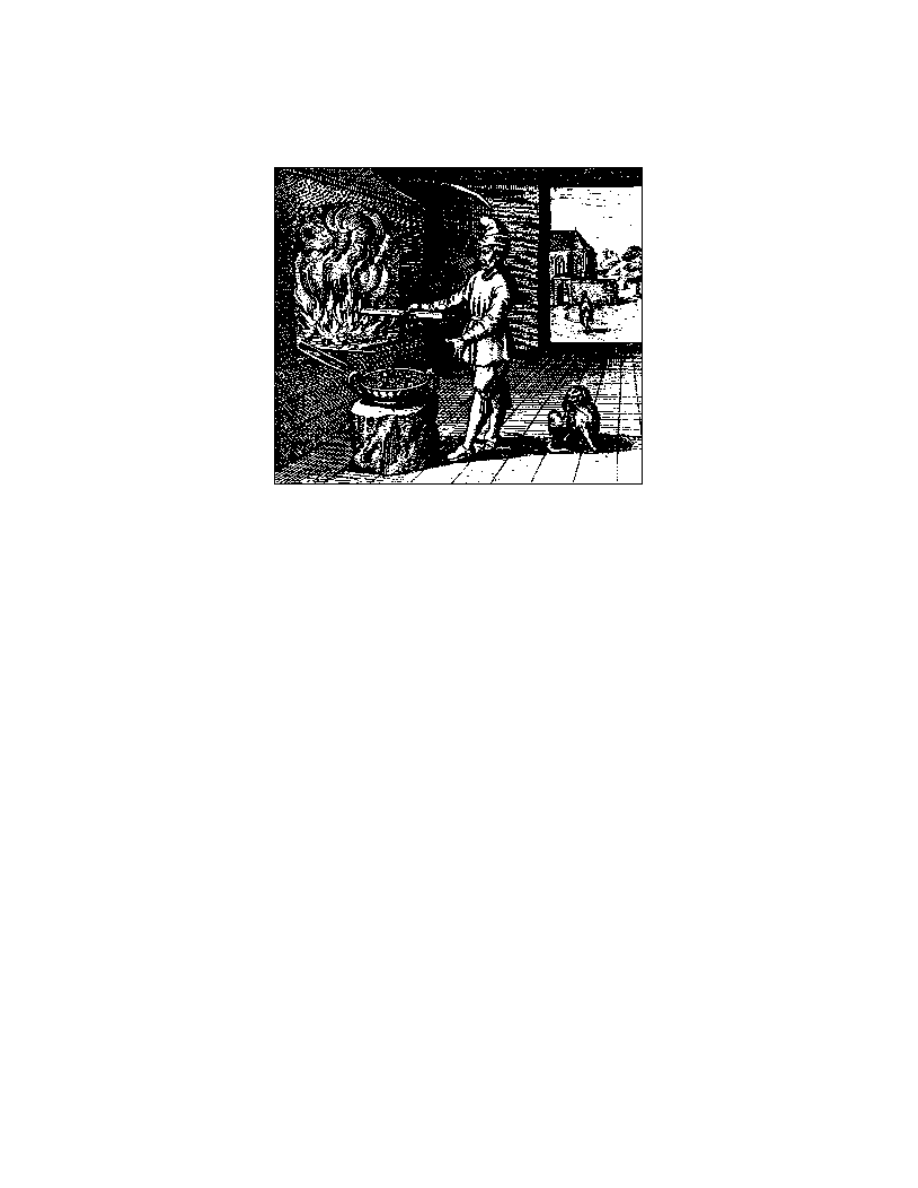
Emblem XVIII.
Fire loves making thinges fiery, but unlike gold, it does not make gold.
The Discourse:
Nature's way of working in all individualls of the universe is to use one single processe to
complete and perfect one single motion. As appears in the Anatomy of man's body, in which one
Muscle only serves for one motion, that is the Attractive, but another opposite to the first for the
Expansive, so that if any member is to be brought into a bending motion it must be effected by
various muscles put into a Circle. So the operation of fire is one and single, that is, to make hot or
be fiery and to Assimilate to itself and burn all thinges to which it is applied if they be
combustible.
Hence Avicenna says in his book of Congelation of Stones, What falls into salt pits becomes salt,
and what falls into fire becomes fire, but some thinges sooner, some more slowly according to the
Power of the Actives and resistance of the Passives. And there is a place in Arabia which
coloureth all bodyes which exist in it of its own colour. So each Naturall thinge possesses a virtue
infused into it by Nature by which it acts upon those thinges which are mixed or applied to it by
assimilating or altering their Nature and form. That which in Vegetables and Animalls is
generation by the propagation of seeds, the same processe in simple and simply mixed bodyes is
the infusion of Virtue and Assimilation.
Thus the Sun, the light of heaven, casts its rayes upon the Earth which, when collected into
concaves or burning glasses, demonstrate themselves to be produced from such a cause and to
seem as if they were the projectible forms of the Sun. From whence it is evident that the Rayes of
the Sun are nothing else but a fiery flame extended and dispersed into an ample latitude, which
being collected and condensed again into itself by concavous, Diaphanous, circular and
repercussive instruments such as Concavous and Steel mirrors, do shine forth as a flame and burn
all that approaches it.
In the same manner there is a certain Virtue dispersed as a Vapor throughout every Elemented
body which, if it be gathered together and attracted into one, turns into water, and from that water
into earth. Hence Avicenna in the place quoted before says that water becomes Earth when the

Qualities of Earth overcome it, and so on the contrary. But there is a certain matter which some
ingenious men use when they would coagulate to form a thinge that is Dry; this matter is
compounded of two waters and is call Lac Virginis. So far that Author. There are some who think
themselves able to double or further multiply the Virtues of the Loadstone, one of which kind we
have seen set in Silver of scarce a pound weight which attracted and held up an Iron Anchor of
eight and twenty pound; which it was impossible for it to have done if its force had not been
increased and strengthened, which undoubtedly was effected by the revocation of the dispersed
virtues into one point, or by the attraction of them from a greater body into a lesse.
There are others who affirm that a Leadmaking Stone may be made of the Sulphurous breath of
Saturn, infused and retained by common Mercury, till it be coagulated; which immediately turns
Common Mercury into Lead. Some boast that they can from Antimony or its Stellated Regulus
make Copper from the Fume of Copper in as short a space as a man can eat an Egge; and further,
that they have made all metalls in such a way. I will not detract from their reputations, though to
me it does not seem probable. I know not whether they are more confident or successfull who
endeavour to deduce gold from gold, according to the saying of the Porta Aureus: He that desires
Barley sowes only Barley, In Gold are the seeds of Gold. Every naturall thinge hath indeed a
virtue of multiplying itself, but this is brought into action in vegetables and Animalls only, not in
Metalls, Mineralls, Earthy Fossils or meteors. Some plants sprung from a small grain of seed do
often times yield a thousand seeds or more, and so multiply and propagate themselves; and so
yearly Animalls also have their product in greater or lesser Number, according to each of their
Natures. But Gold, Silver, Lead, Tin, Iron, Copper or Argent Vive are never known to multiply
themselves or their kind after that manner, although it is often found that one may be commuted
into another and made more noble. Nevertheless the Philosophers affirm that the principle of
ignifying is in fire, and so that of Aurifying is in Gold. But the tincture must be sought for by
whose Intermediation Gold is to be made. You must search for this in its own proper principles
and generations and not in thinges of another Nature; for if Fire produceth Fire, a Pear a Pear, a
Horse a Horse, then Lead will generate Lead and not Silver, Gold will Generate Gold and not the
Tincture. But besides all this the Philosophers have a peculiar Gold which they do not deny must
be added to the Aurifick Stone as a Ferment at the End of the Work, seeing it leads the thinge
fermented into its own Nature, without which the whole composition would never return to
Perfection.
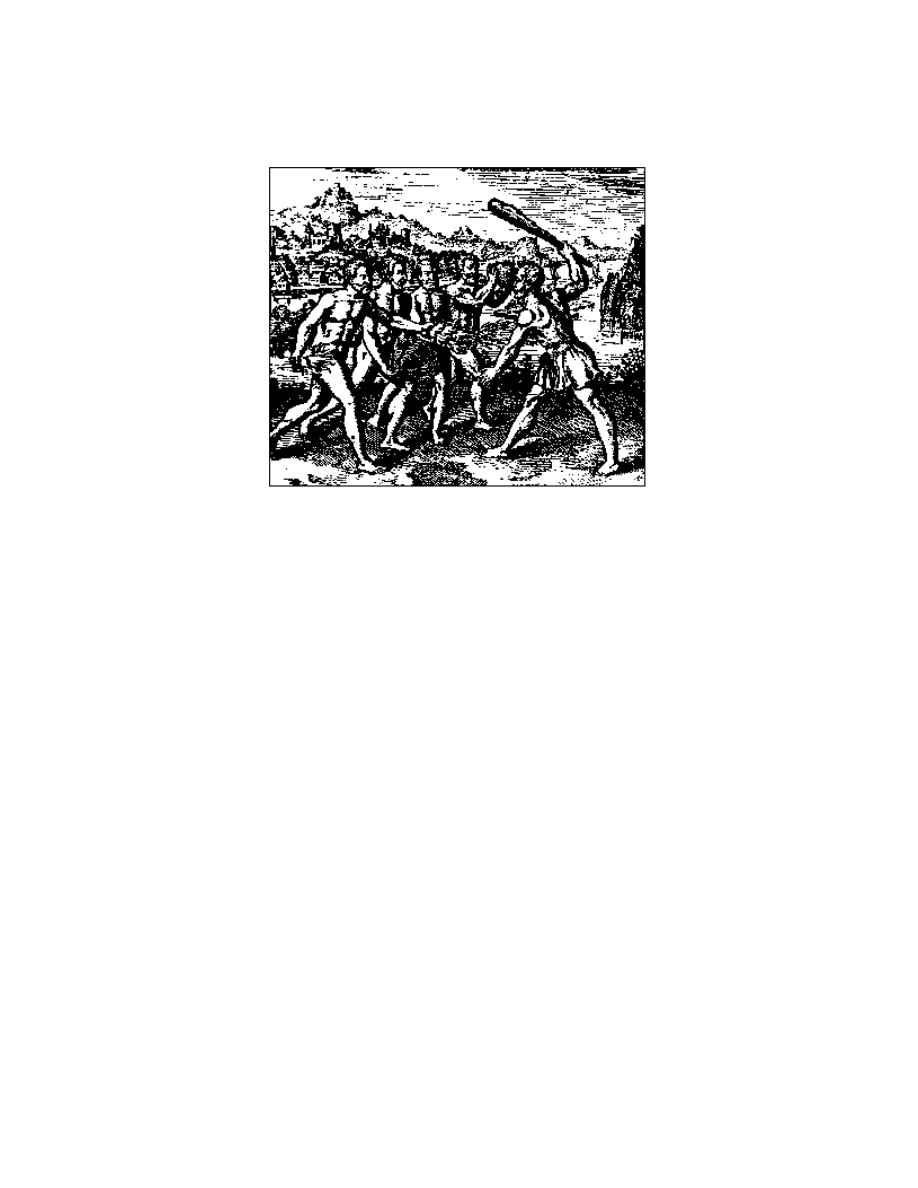
Emblem XIX.
If you kill one of the four, they will all suddenly dye.
The Discourse:
The Poets feign that Geryon, King of Spain, consisted of three bodyes, and that he had Oxen of a
Purple Colour and that a Dogg with two heads and a Dragon with seven were set over them to
watch them. The same Geryon is reported to be the Son of Chrysaor, sprung from the blood of
Medusa as the Dragon was from that of Typhon and Echidna. But since all these agree neither
with History nor the Truth, and yet fall in exactly with the Chymicall Allegories, we think we
have reduced them to that proper head by applying them to that Subject. For by the threefold
body of Geryon we understand three Faces beheld in one Father according to the sense of
Hermes, or as others would have it four Faces, they having regard to the four Elements, for a
Triangle must be made of a Quadrangle as that was made of a Circle, and so this must return into
a Circle. Now there is so great a consanguinity and naturall conjunction of the Bodyes of Geryon
or the Elements that one being overcome and slain, the rest also dye of themselves and putrefye
without the application of any Manuall Force.
As to thinges with two bodyes, it is well known that one being dead the other Wastes and
consumes, as we saw in Italy of a boy of four years old who had two bodyes: the head of one
Brother was hid within the body of the other, and was fixed to him just at the Navel, and so hung
down from thence, and being much lesse than him was carryed about by him. If you pressed the
hands or feet of the lesser more hard than ordinary, the bigger felt the pain; nay, and hunger too,
when the belly of the latter was Empty for want of Sustenance. And this is the Combination and
Sympathy of Nature, whereby the members and parts of one and the same body, or of a body
joined and born with another, are mutually moved and affected together, whereof if one be sound
and unhurt it is not necessary that the others should so remain. But if one be grievously hurt, the
rest do also sympathise and perish by the same malady. So if one Neighbour gains much money,
yet no profit accrues thereby to another of his Neighbours, but if he suffers losse by Fire his
neighbour receives much damage- for your affairs are in danger when the next house has taken
fire. Therefore it is in no way repugnant to Truth that from the death of one of these brothers, the
destruction of the rest should happen. This may come to passe by diverse means, either because

they were born at the same birth from one father and mother, and therefore as they had the same
beginning, so likewise they have the same period of their dayes- which thinge (as we have read)
has happened to some persons. Or perhaps by the inclination of the Starrs, or by being joined
together not only in their Souls but also in the Ligaments of their bodyes, or by a consternation of
mind such as strong imagination in time of pestilence, or by the Vow of a League.
In the Indies, under the Dominions of the great Mogul (he that now reigns being the ninth
successor from Tamerlane), there are certain Gentiles who go by the Name of Pythagoreans,
among whom this Ancient custom is observed: that if the Husband dye, the wife is burnt with
fire, or lives in perpetuall infamy deserted by all and esteemed as a Dead woman. Which was
therefore ordained that wives might be afraid of poisoning their Husbands unlesse they also are
resolved to dye with them.
So in the Philosophickal Work when one brother is dead, the others perish by Fires, not
compelled but Voluntarily, that they may not survive in infamy and sorrow. Or if one be assaulted
with a Club, Sword or Stone he will raise a Civil war with his brethren, as in those Gyants sprung
out of the Earth who were born from Dragons' Teeth to oppose Jason, and who at another time
and place rose up to resist Cadmus. In this manner will all of them fall by a mutuall destruction of
one another. For touch or hurt him that carryes Air, and he will rise up against two together that
are nearest him, namely against him which carries Water and him that carries Fire. And these will
on both sides oppose themselves against him that carries Earth and him that first promoted the
quarrell, till they have received mutuall wounds of which they will dye. For it is thus resolved
among the brothers that the more earnestly and vehemently they love one another, so if once they
begin to hate their anger shall be more implacable and not be appeased but by death. This can be
compared to the sweetest honey which, in a Stomach too hot or Liver corrupted, is turned into the
most bitter Gall.
Kill him therefore that is alive, but so that you may bring him to life again when he is dead,
otherwise his death will not avail you. For his death will be an advantage to him after his
resurrection, and Death and darknesse and the Sea will fly from him as Hermes testifies in
Capitulum 3 of the Tractatus Aureus, verse IX: And the Dragon which observed the Holes will
fly from the rayes of the Sun, and our dead son liveth and the King cometh from the Fire. Belinus
in his Metaphor in the Rosary mentions the same thinge: And let this be done when you have
drawn me partly from my Nature, and my wife partly from her Nature- you must then also kill the
Natures, and we are raised up with a new incorporeall resurrection so that afterwards we cannot
dye.
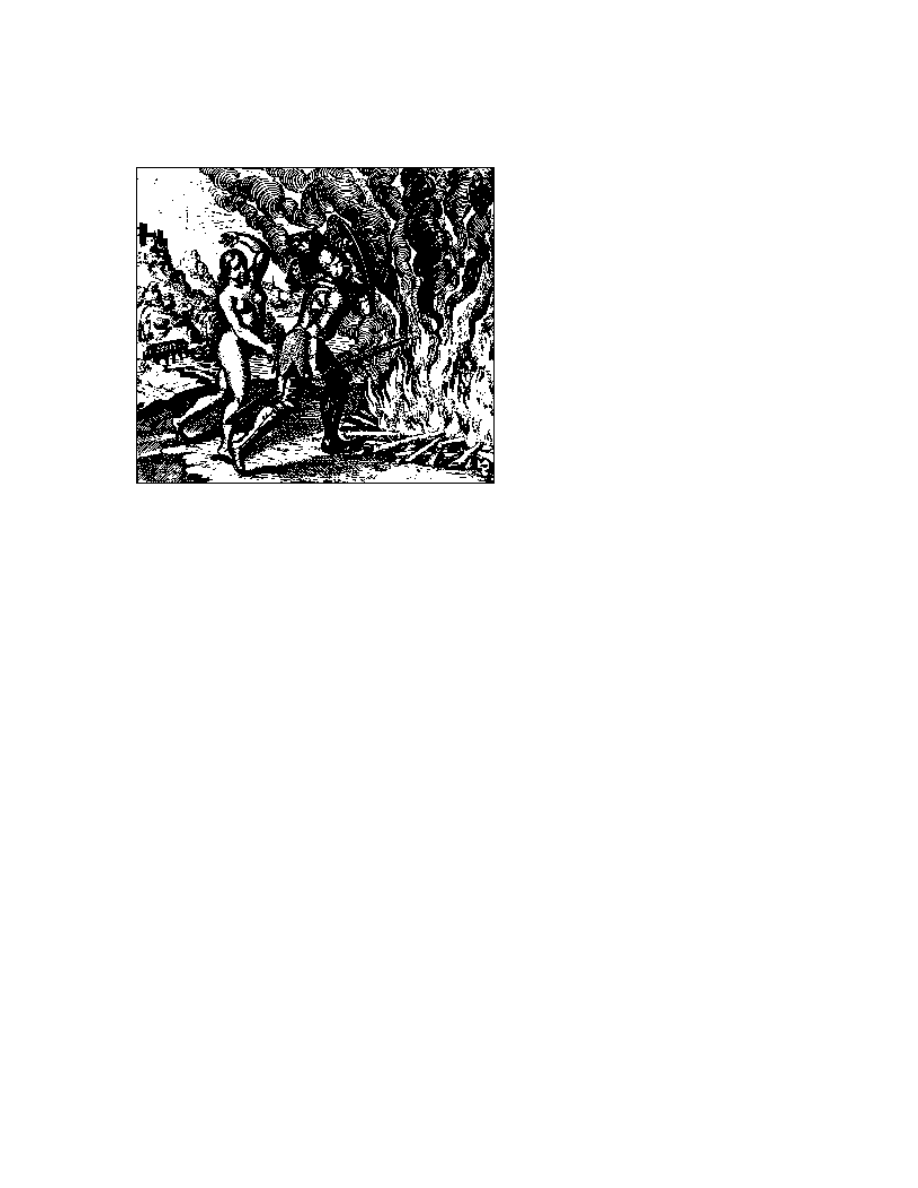
Emblem XX.
Nature teaches Nature how to subdue Fire.
The Discourse:
The common token and symbol by which the Philosophers may know one another is: That Nature
is guided, taught, governed and subdued by Nature, as a Schollar by a Mistresse, a Waiting Maid
by her Lady, a Subject by a Queen, a Daughter by a Mother or a Kinswoman by a Kinswoman.
The truth of this appears by daily experience in the Education of Youth amongst men, the
Institutions of Learning, Government and the like. Pliny writes of Nightingales that one teaches,
attends, observes, imitates and overcomes another in singing, or being overcome laments, and
that sometimes being Vanquished in the conflict and her throat torn with her notes she perishes
and falls down dead in the midst of her singing. We see also how all sorts of birds begin to
instruct and accustom their young ones, being yet tender and not quite fledged, how to flye. So it
is not only Nature but Art and Use that brings them to the habit of flying, though Nature alone
gave power and organs for the exercising of that Action, without which no Art or Institution can
find place or Foundation. So Colts are taught to run by the Mare, Whelps to bark by the Bitch,
and young Foxes to be cunning by their Den. Nor is there any animated or sensitive Nature or
species of Nature which does not guide, instruct and govern another Nature, which is its
offspring, or else suffer itself to be overcome by another Nature as a Parent.
We do not find such discipline in Vegetables, but the use and handywork of Man is observed to
prevail much upon them. For whilst the Corn is in the blade it may be cleansed from Tares and
unprofitable Thistles; whilst a tree is yet a Twig it may be bent and made to grow as you please;
and so in Metalls and Philosophickal subjects, one nature keeps, preserves and defends another
Nature in Fire, as is known to Founders and Refiners but especially to Masters of Naturall
thinges. Iron added to silver or gold, being yet very tender and spirituall, mixed in its mines with
Cadmia, Arsenick or depredating, devouring Antimony, becomes very helpfull and performs the
part of a midwife if it be cast upon the minerals to be burnt in the Fire of Furnaces. After the same
manner, when Iron itself is to be changed into Steel, it is saved from burning by some white
Stones that are found upon the Seashore. Some do cast the powders of Chrystall glasse or the gall
of glasse upon metallick powder to be dissolved, that they may not perish by overmuch Fire. For
this purpose the Philosophers use Eudica, which Morienus Romanus says is the gall of glasse and

to be had in glasse vessels. For the heat of Fire consumes the body with hasty burning, but when
Eudica is applied it will cure bodyes changed into Earth from any burning. For when bodyes do
no longer retein their souls they are soon burnt. Eudica (the Faex of Glasse) is indeed agreeable to
all bodyes, for it revives and prepares them and defends them from all burning. This therefore is
the nature which teaches another Nature to fight against Fire and to be inured to Fire; this is the
Mistresse that instructs the Schollar, and if you consider well, the Queen governing the Subject
and the Daughter giving Honour to her Mother. This is the Red servant which is joined in
Matrimony with his Odoriferous Mother, and of her begets a progeny far more noble than its
Parents. This is Pyrrhus son of Achilles, the young man with Red Hair, golden vestments, Black
Eyes and white feet. This is the Knight that has the Torque or Collar about him, armed with a
sword and shield against the dragon that he may rescue from his jaws the pure and unviolated
Virgin named Albifica, Beya or Blanca. This is the monster-killing Hercules who freed Hesione
the Daughter of Laomedon from that monstrous whale which she was exposed to. This is that
Perseus who, by showing the Head of Medusa, defended Andromedes the Daughter of Cassiope
and Cepheus King of the Ethiopians from a sea monster, and having freed her from her chains
afterwards married her. This is He that may be compared with those Ancient Romans, the
Restorers and Deliverers of their Country: M. Curtio, L. Scævola, Horatio Coclite, Manlio
Capitolino and the rest, who can free a city as well as his mother from Dangers. For this is the
way and method of Nature, tending to the perfection of any work. She deduces one thinge from
another and a more perfect thinge from an imperfect, making an Act out of a Power; but she does
not finish all in a moment, but by doing one thinge after another at last arrives at her End. Nor
does she do this alone, but she likewise in the first place constitutes herself a Deputy to whom she
leaves the Power of life and death, that is the power of Forming other thinges. For example, in the
generation of a man she uses a long processe of ten months. But according to Aristotle she first
frames the Heart as her Deputy and the Principall organ, and then the Heart delineates forms and
perfects the other members which are necessary to nutrition, life, sense and the generating power,
and imparts to them life and vivifying spirits by its Systole and Diastole; that is, by the dilating
and compressing of Arteries, so long as it is not hindered by diseases and violence. And so one
nature teaches another, which you must remark and follow as the most clear example of the
Philosophickal Work.
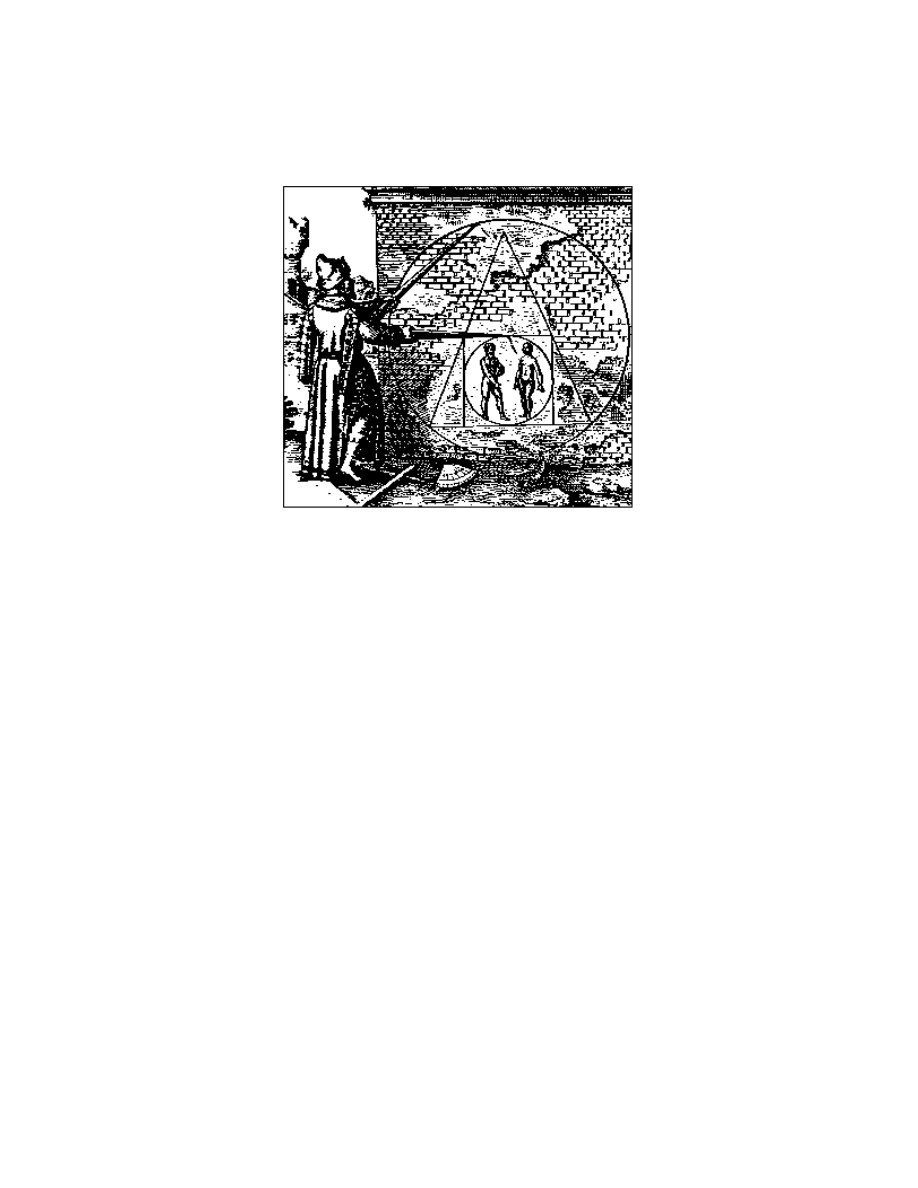
Emblem XXI.
Make of the man and woman a Circle, of that a Quadrangle, of this a Triangle, of the same a
Circle and you will have the Stone of the Philosophers.
The Discourse:
Plato that most Excellent Philosopher was of the Opinion that those notions or Ideas which are
the Foundations of Arts and Sciences are as it were actually engraved and imprinted upon the
mind of Man, and that by the Repetition and remembrance of them he can apprehend and know
all manner of learning. To prove this he introduced a young Lad, rude and uninstructed, and
asked him such Geometricall Questions that the Youth might be perceived to answer right
whether he will or no, and although before he understood nothing of the matter, yet by these
answers seemed to have penetrated into the Depths of so abstruse a Science. From whence he
concluded that in children all Discipline and Doctrine is not at first taken in and learnt, but called
to mind and brought by the memory, alluding by this to his Annus Magnus or Great Year, of
which he says that forty eight thousand solar Years agoe, before the Revolution of the Heaven,
the same persons, thinges and actions were then in being which are at the present time,
whensoever that is. But every person may perceive that these thinges have no more foundations
of truth in them than mere dreams. We do not deny that there are some sparks of notions and
mere powers imprinted in us, which must be reduced into act by institution, but we utterly deny
that they are such or so great as to be the Summaries of Arts and Sciences without any precedent
instruction.
It will then be asked from whence Arts and Sciences have proceeded if men have not invented
them, or whether they were not at first delivered from Heaven by the God of the Nations. I
answer by saying that burning Coals may lye hid under Ashes in so great a quantity that if the
Ashes were but removed they would be sufficient for the dressing of meat or warming oneself;
but this is a different thinge from affirming that only some small spark lyes there, which before it
can be of use and administer a sufficient heat must be cherished and nourished with fresh fewell
by human Act, Care and Industry, or otherwise it would be easily extinguished. The Aristotelicks
assert the latter as the Platonicks do the former. Reason and Experience seem to agree with this

latter, whereas the first depends only upon Imagination and Phansy. Here it may be asked why
Plato wrote over the Door of his school that no one ignorant of Geometry was there to be
admitted, seeing he affirmed that little boys did actually know it. Are men more unlearned than
boys? Or when they grow up, do they forget what they knew when children? That cannot be
supposed, for we see that Brutes do by the instinct of Nature as soon as they are brought forth
abhor and avoid the danger of Fire, Water, Precipices and the like. Yet an infant neither knows
nor shuns such thinges. Why do not the Bee, Fly and Gnatt precipitate themselves into the Fire,
seeing that they cannot know by experience that danger will arise from it? Because nature has
taught them, but she has not done so by man when he is newly born. If Geometry is so easy and
naturall to children, how comes it to passe that Plato did not know the Quadrature of a Circle, so
that Aristotle who was his schollar affirms that it might be known but was not yet known?
But that this was not unknown to the Philosophers of Nature is apparent from this: That they
command a Circle to be turned into a Quadrangle, and this by a Triangle to be reduced again to a
Circle. By a circle they understand the most simple body without angles, as by the Quadrangle
they do the four Elements. It is as if they should say: The most simple corporeal Figure that can
be found is to be taken and divided into four Elementall Colours, becoming an Equilaterall
Quadrangle. Now every man understands that this Quadration is Physicall and agreeable to
Nature, by which far more benefit accrues to the Publick, and more light appears to the mind of
Man, than by any meere Theory of Mathematicks when abstracted from Matter. To learn this
perfectly a Geometrician acting upon solid bodyes must enquire what is the depth of solid
Figures, as for example the Profundity of Sphere and Cube must be knowne and transferred to
manuall use and practice. If the Capacity or Circumference of the sphere be 32 foot, how much
will one of the sides of the Cube be to Equalize the Capacity of this Sphere? On the contrary, one
might look back from the Measures which the Cube contains to the feet of each Circumference.
In like manner the Philosophers would have the Quadrangle reduced into a Triangle, that is, into a
Body, Spirit and Soul, which three appear in the three previous colours before Rednesse: that is,
the Body or earth in the Blacknesse of Saturn, the Spirit in the Lunar whitenesse as water, and the
Soul or air in the Solar Citrinity. Then the Triangle will be perfect, but this again must be changed
into a Circle; that is, into an invariable rednesse, by which operation the woman is converted into
the man and made one with him, and six the first of the perfect numbers is absolved by one, two
having returned again to an unity in which there is Rest and eternall peace.
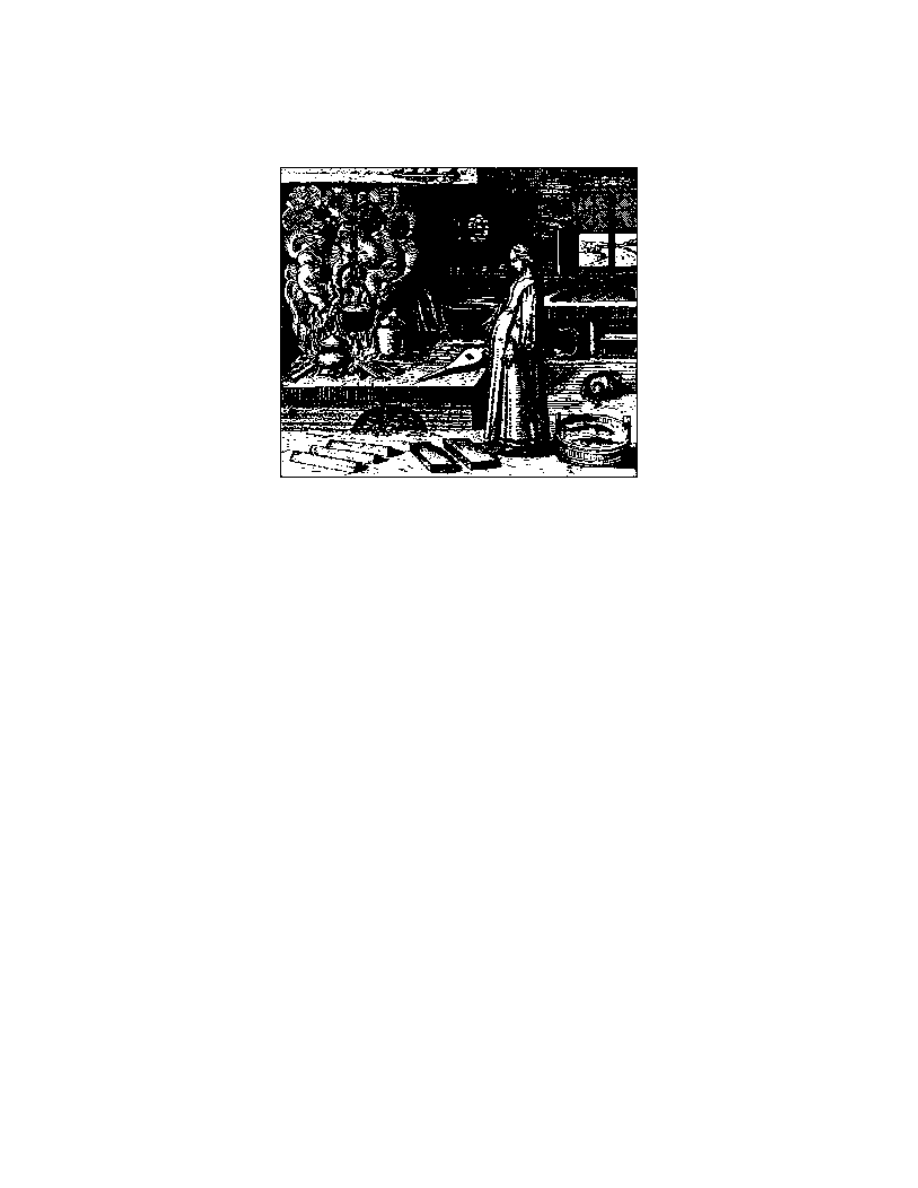
Emblem XXII.
Having acquired White Lead, do the work of women, that is: Cook.
The Discourse:
As the statues of Mercury used to be erected where three ways met, with inscriptions upon them
to guide dubious Travellers into the true way, so there are severall remarkable sentences delivered
by the Philosophers (although they be scattered up and down in their obscure books and
allegorical writings) which will direct the Inquirers after Truth and lead them as it were by the
hand into the right path. The present Emblematicall inscription is one of these. The meaning
whereof is that Lead must be made of the Philosophickal Brasse, and Tin of that Lead which by
Geber is called White Lead, who likewise teaches us how, by washing, Saturn together with
Mercury may passe into Jupiter.
Wherefore credit is to be given to this Index or direction, although it is spoken by Battus: if at any
time thou wouldst discover the Philosophickal Oxen and what place they frequent, they are in the
mounteins and under the mounteins. For many men affirm this, as Arnold in his Novum Lumen,
Capitulum 1: That Persons wandering in the mounteins know not these Animalls, but they are
openly sold at a very small price. In the Highest mounteins Snow and Clouds are most commonly
found even in Summer, by which as it were by vapour and water, black lead is washed and turned
into whitenesse. But in the lowest Valleys and their mines their Chrystalls are found congealed
and hardened out of ice, i.e. the Lapis Specularis, which with Talc is commended for making the
Face white and beautifull if an Oyle be made thereof.
But chiefly there is to be found clear and running Mercury, which being well prepared mends the
Blemishes of Saturn and advanceth Him into the Throne of Jupiter. However, this is not to be
understood of Saturn and Jupiter as they are commonly found (for common Mettalls do not enter
into the Physicall work). But it is said of them, when purged by a long preparation and made
Physicall, that Saturn is the Father of all the Gentiles or rather of all searchers after the Golden
Work and the first Gate of Secrets. By him (says Rhasis in his Epistle) the Gates of Sciences are
opened, to him succeeds his son Jupiter who expelled his Father out of his Kingdom and
dismembered him least he should begett more Sons, and from that member cut off and thrown
into the Sea Venus the most Beautifull of females is born. From Jupiter, who is White Lead

prepared, the rest of the planets are produced; as Mars from Juno, Mercury from Maia the
daughter of Atlas (a mountein in Mauritania), Luna and Sol from Latona. Which four are brought
into the Light by Coction only, which is the work of women.
By Coction is understood the Maturation and Dispersion of the more Crude parts, which is
performed by Vulcan in the Vessells of Philosophye. For it is not to be supposed that it is
common boyling which is the method of operation; it agrees with that only as to its end or intent.
For as a woman Matures Fish in waters- that is, by resolving all superfluous moisture from them
into Waters and Air, softens, boyles and seethes them- so the philosopher handles his subject in
proper water which is stronger than the Sharpest Vinegar by Macerating, Liquifying, Solving,
Coagulating and Mixing it in the Vessell of Hermes, the joints of which as it is requisite are most
strictly closed, least the water exhale and that which is in the Vessell be burnt. This is that Vessell
above the Vessell, and the Philosophers' Pott- the Balneum Laconicum or Vaporous Bath- in
which the old man sweats.
Some there are who Boyle Fish, Lobsters, Crabs and Green Peas in a double Pott, so that the
thinges before mentioned are placed in the upper Pott, Water being only in the Lower, and the
Potts placed one above the other with orbs least the vapour should come forth. By which means
the Vapour of the Water ascending only penetrates and matures the thinges contained, and makes
them much more perfectly soft and tender than if they had been boyled in water. This is the most
Laudable way of the Philosophers, whereby they soften that which is hard, dissolve that which is
compact and rarifye that which is Thick. For it is Air or an insensible Vapour which matures,
decocts and perfects the fruit of Trees, and not water Crude and Cold as it is. It is Air also which
Tinges and Colours the Golden Apples in the Garden of the Hesperides. For if it is well
considered, the Ebullition of Water whereby raw flesh is boyled till it be fit to eat is nothing else
but rarefaction of waters; which bubbles easily vanish away, the Air betaking itself from the
Waters to its own Sphere, and the Water subsiding into its own Centre.
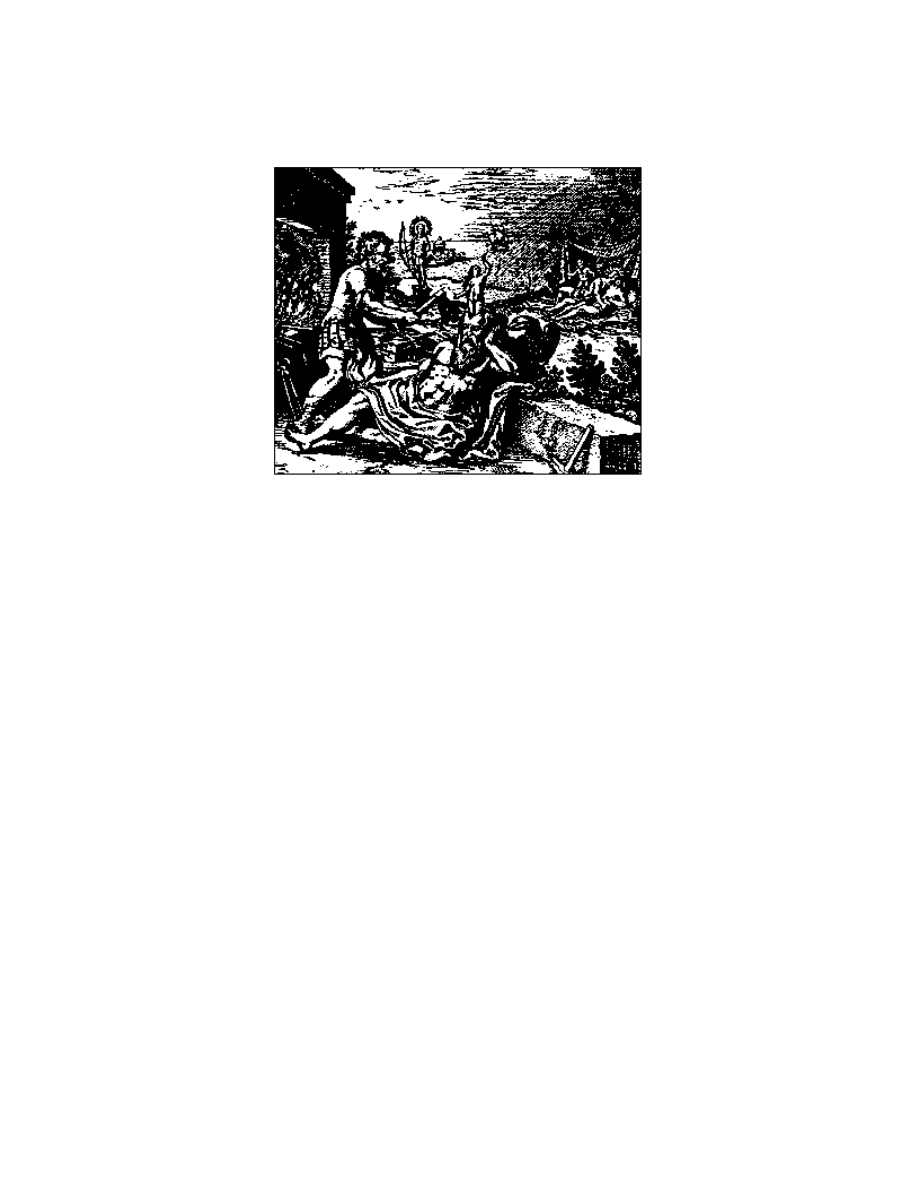
Emblem XXIII.
When Pallas was born and Sol was in Conjunction with Venus it rained gold at Rhodes.
The Discourse:
Unlesse it were to be understood Allegorically it would be madnesse to affirm that Gold ever
rained upon the Earth. For there are no Gold-bearing Rivers, nor Mines in the Clouds that it may
possibly be said to be produced there; nor is gold of so little a weight that it may be thought to be
attracted thither by Vapours. But a Trope admitts and excuses all these thinges. For so truly as
Pallas actually sprang from the brain of Jupiter and Sol was joined in Adultery with Venus, so
truly also fell Golden Showers- not as if we any ways doubt that both these have happened, but
that we may remove the literal and vulgar sense from thinges that are spoken Allegorically. For if
we follow the plain words of this Emblem there is nothing more absurd, but if we attend to the
meaning there can be nothing more true. Now Rhodes is an island, at first called Ophiusa from
the Multitude of Serpents, then Rhodes from the Gardens of Roses which flourished there, and
lastly Colossicola from the Colossus of the Sun, which being there was esteemed one of the seven
wonders of the world. Hence the Ancient Philosophers, seeing that their Mercuriall matter when it
is Crude has the resemblance of a serpent, but after it is prepared and decocted assumes to itself
the purple colour of a Rose, have taken severall of their Similitudes from this Island of Rhodes,
and for the same reason ascribed to it that Golden shower which fell upon Apollo's conjunction
with Venus.
This being at first spoken figuratively gave the Rhodeians a pretence to grow Naughty upon their
imagination that such great Deityes should desire to have an offspring conceived upon their
Island, and therefore they erected an Idol to the Sun of a most Stupendous Value and Magnitude.
For that Colossus as History relates was seventy Cubits high, and so placed that ships under full
sail might passe between the legs. Its fingers were as big as ordinary Statues, and few men could
embrace its thumb. The Artist was Chares Lyndius the Disciple of Lysippus who was twelve
years in the finishing of it. After it had stood fifty and six years it was overthrown by an
Earthquake, and yet as it lay prostrate was still thought wonderous. When the Soldan of Ægypt
conquered Rhodes he is reported to have laden nine hundred Camells with the Brasse of this
Statue.

What Sol is among the Planets, say the Philosophers, that is gold among the Metalls; and this is
chiefly appropriated to the Sun in the respect of its Heat, Colour, Virtue and Essence. Hence a
golden rain is ascribed to the generation of the Sun, and little Suns are conceived by Venus. For
Venus has a Rosy colour in her Face, which if it be infused into the seed of Sol the offspring
which is hence produced must really be born at Rhodes. For the Son of the Philosophers is
beautifull, and like Roses He draws and allures the Eyes and minds of all men. He deserves love,
therefore it is not strange that at his birth Miracles should happen, for he is afterwards to be
miraculous in all his works and to raise up a shower of Gold. He is brother of Augias the Son of
Sol who had oxen for his patrimony, the Dung of whom in one dayes time was purged away by
Hercules. He is also the Brother of Æetes who possessed the Golden Fleece later obtained by
Jason.
It is reported of Pallas that she was born from the Brain of Jupiter without a Mother, and that she
was called Tritonia because she was brought forth near the River Triton. She is feigned to be the
Goddess of Wisdom and is not undeservedly so esteemed, seeing she springs from the Brain
which is the Seat of it. Golden showers did likewise signifye her birth day at Rhodes, that so the
time of her coming into this Light might remain in the memory of mankind. For as at the time of
a publick rejoycing, whether it be the Coronation of a King or the Birth of a Prince, there are gold
medalls thrown among the people, so the same was done at the birth of Pallas. For Pallas is
Sophia or Wisdom, who carries health in her right hand and riches in her left, providing at the
same time both for man's ease and plenty. To Her Perseus brought the head of Medusa which
turned all thinges into Stone, and was horrid in its appearance with serpents and vipers instead of
Hairs; which she afterwards placed in her shield to use it against her Enemyes, that is to say Rude
and Barbarous people who are therefore to be turned into Stones. And in truth Wisdom or
Naturall Philosophye renders its incredulous and envious condemners quite stupid and void of
sense and understanding by the means of that same thinge, from whence Chrysaor was borne who
was the father of Geryon who had three bodyes. That is by the means of the Lapiditick Gorgonian
blood, which is nothing else but the Tincture of the Philosophick Stone.
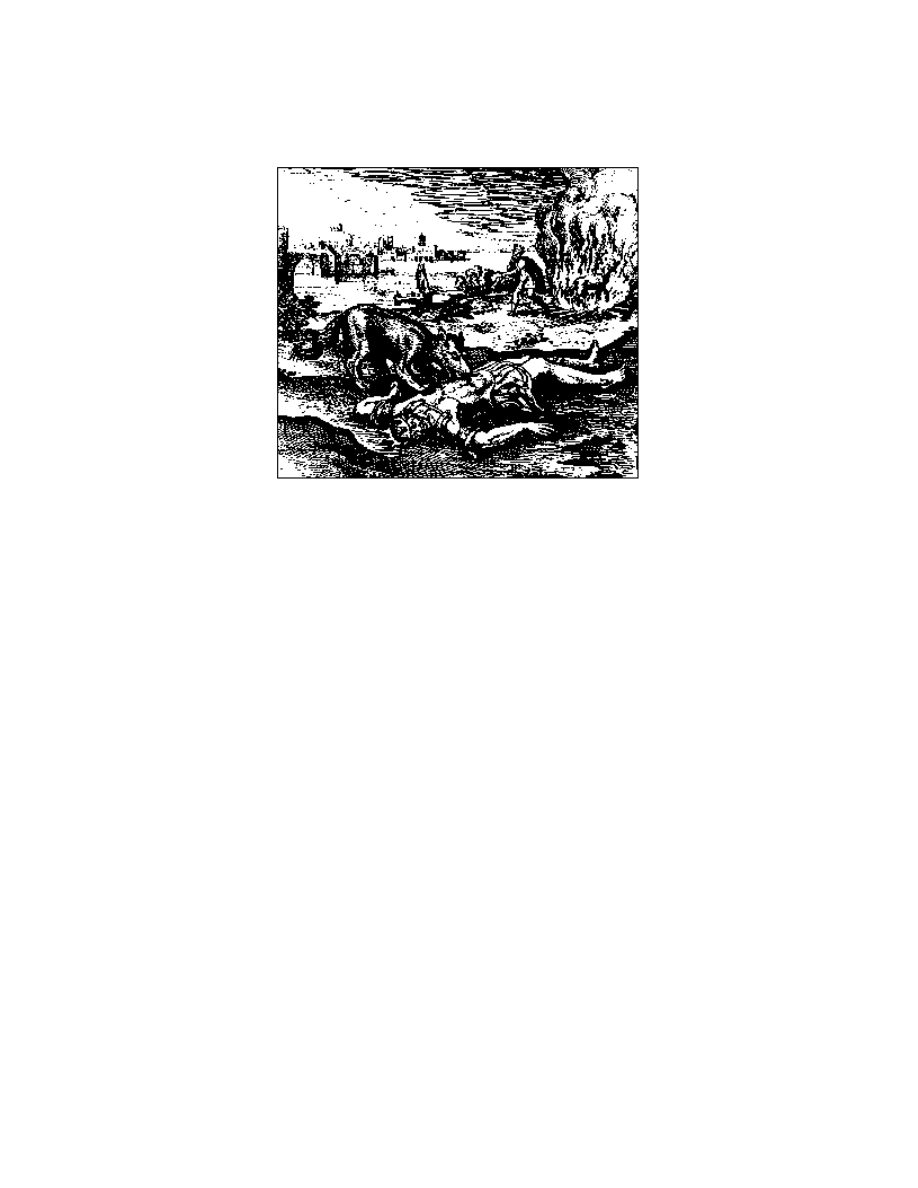
Emblem XXIV.
A wolf devoured the King, and being burnt it restored him to life again.
The Discourse:
The Hunger and Voracity of a wolf is remarkably knowne to be very great, insomuch that when
his prey is wanting he will feed even upon the Earth; with which he is likewise said to fill his
belly when he is about to set upon large herds of Cattle, that so being made heavier by that burden
he may resist more strongly and not easily be shaken off from his hold. When he enters a fold he
doth not only kill enough to satisfye his hunger but through greedinesse destroys the whole flock.
He is Sacred to Apollo and Latona because he stood by her when she was in Labour, for Latona
could not have delivered young unlesse he had been present. Hence likewise the wolf is thought
acceptable to Apollo because he celebrated his birthday, as also because his Eyes shine and cast
forth light in the midst of the night. Therefore the breathlesse body of the King is thrown to the
wolf when he is ravenously hungry, not to the end that the wolf should wholly consume and
annihilate the King, but that by his own death the wolf should restore strength and life to him. For
there is a certain amatorious Virtue in the Tayle of the Wolf which is infused into the half dead
King which makes him very desirable to all men upon the recovery of His former Health and
Beauty.
The Hyrcanians nourished Doggs for no other Use but that they might cast their Dead Bodyes to
be devoured by them, as Cicero tells us. And so the Massagetes give men that dye of diseases as a
prey to doggs. But the Philosophers give their King to a Wolf, nor indeed are they pleased with
the Custom of the Sabeans, who carryed out their dead in the same manner as dung and threw
their King upon the Dunghills; nor that of the Troglodytes of the Red Sea, who tyed the Necks of
their dead men to their feet and hurried them along with Jests and Laughter, and so put them into
the ground without any Consideration of the place of Buriall. But the Philosophers chose to
follow the Custom of the Magi, who did not bury their dead bodyes till they had first been torn to
pieces by wild beasts; or of the Indians, who being Crowned and singing the praises of the Gods
commanded themselves to be burnt alive, least old age should come upon them.
But these customs were imposed upon them all without any hopes of Resurrection or Renewall of
Life. Thinges are far otherwise disposed among the Philosophers. For they certainly know that
from their King devoured by a wolf there will appear one that is Alive, Strong and Young, and

that the wolf must be burnt in his stead. For when the belly of the wolf is so gorged he will easily
be slain, but although the King be dead he hath a Martiall or Cygnean Virtue that he can neither
be wounded nor consumed.
But where is this Wolf to be hunted, or whence this King to be taken? The Philosophers answer
that the wolf wanders up and down in the Mounteins and Valleys that he may seize his prey,
which must be drawn out of their dens and preserved for Use. But the King being fatigued with
the long journey he has taken from the East at length falls down, and his death is then hastened by
his grief seeing himself among Strangers, deprived of all his Honours and so little esteemed as for
a small price to be sold into slavery. But it is necessary that the Wolf must be taken out of a Cold
Region, for those that are bred in Cold Countryes are more fierce than in Libya or Egypt by
reason of their greater hunger occasioned by the externall cold. Hence the devoured King revives
with the heart of a Lyon and is able afterwards to conquer all beasts. And although he is the
meanest in Aspect among his six brothers, being the Youngest of them all, yet after many
miseries and tribulations he shall at last come to the most powerfull Kingdom. Hereupon
Gratianus in the Rosary saith: In Alchymy there is a certain noble body which moved from
Master to Master, in whose beginning there shall be Misery with Vinegar, but in the End Joy with
Gladnesse. And Alanus in the same place says: There is one thing to be chosen out of all, which
is of a Livid Colour, having a clear liquid metallick Species, and is a thinge Hot and Moist,
Watery and Combustible, and is a Living Oyle and Living Tincture, a Minerall Stone and Water
of Life of wonderfull efficacy.
It is not always safe for Kings to travell out of the Confines of their Kingdoms, for if they
endeavour to conceal themselves and yet happen to be known by their Adversaries, they are taken
for Spyes and imprisoned; if being known they would proceed without an Army they are in the
same manner of danger. And so it has happened to this Indian King, or if he had not been
prevented by death it would so have happened. This capture is the first Sublimation, Lotion and
Nobilitation which the Philosophers use, that the second and third may be performed with more
happy success. For the second and third without the first are of no moment, the King being as yet
Pusillanimous, Drowsy and Sick. For He must first require Subsidies and Tributes of his Subjects
by which he may purchase himself garments and other necessaryes, and afterwards he will be rich
enough and able to new clothe all his Subjects as often as He pleases. For great thinges being
generally sprung from small beginnings can afterwards raise up small thinges, or even suppresse
great ones if such their pleasure be. As appears by some Cities, which at first were small but were
governed by mighty Kings, and so from Villages became populous and Magnificent Towns.
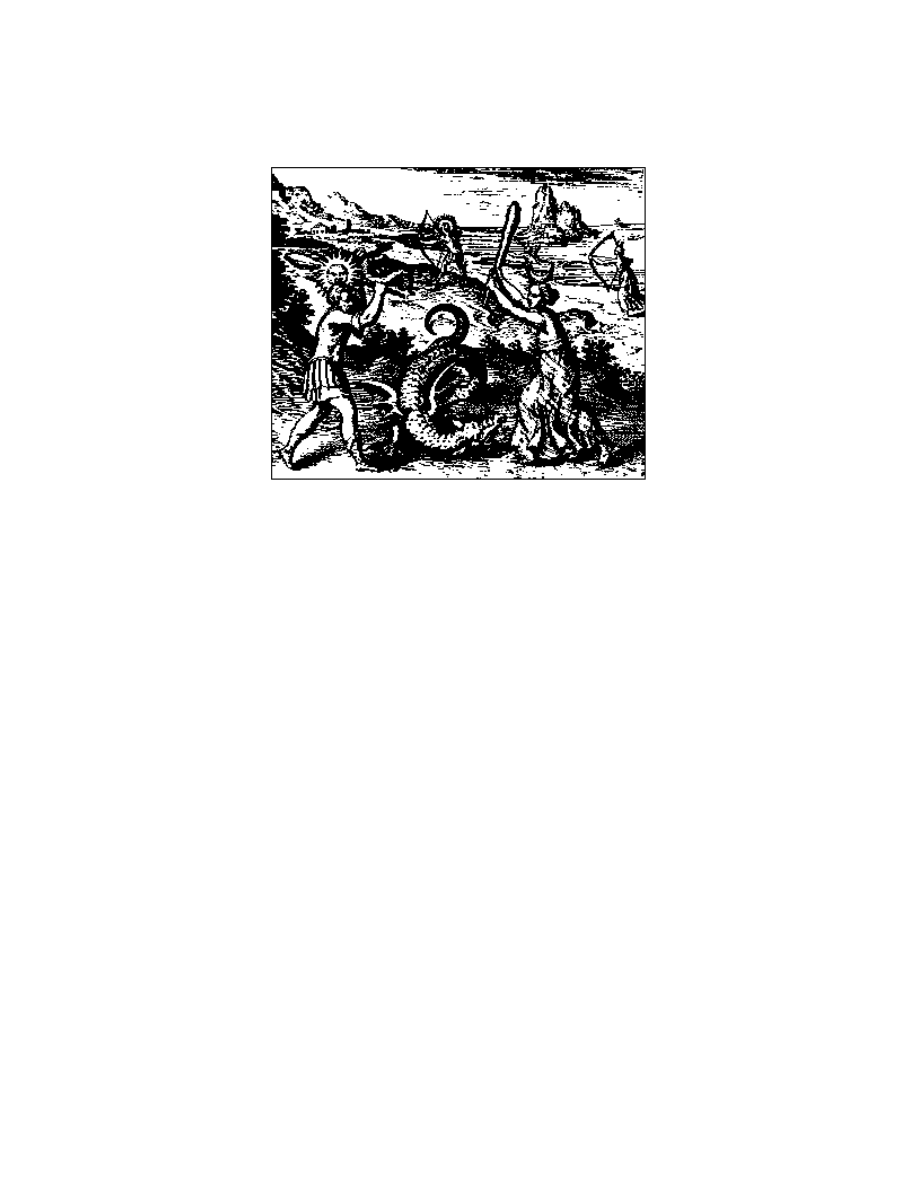
Emblem XXV.
The Dragon does not dye unlesse he be slain by a Brother and a Sister, which are Sol and Luna.
The Discourse:
In the acquisition of the Golden Fleece the Dragon was first to be killed, which Labour having
been in vain attempted by many men, they were overcome by the Dragon and destroyed with his
deadly poison. The reason was because they were not sufficiently armed against his Venom, nor
instructed by what device he might be slain. But Jason the Physitian neglected no manner of
Remedies, severall of which he received from Medea (the counsel of his mind) and among them
the Images of Sol and Luna, by the true use of which he obtained the victory which was the
Golden Fleece. Therefore the Dragon was slain by Sol and Luna, or by their Images, as the
Philosophers often observe.
So the Author of the Rosary out of other Writers as Hermes says: The Dragon dyes not unlesse he
be killed by the Brother and Sister; not by one alone but by two together, to wit by the Sun and
Moon. The Philosophickal Mercury never dyes unlesse it be killed with his sister; that is, it is
necessary to congeal him with the Moon or Sun. Note the Dragon is Argent Vive extracted from
bodyes, having in it Body Soul and Spirit; whereupon he saith the Dragon dyes not unlesse with
his Brother and Sister, that is Sol and Luna, that is Sulphur extracted, having in itself the Nature
of Moisture and Coldnesse by reason of the Moon. With these the Dragon dyes, that is Argent
Vive extracted from the same bodyes at first, which is the Aqua Permanens of the Philosophers,
which is made after putrefaction and after separation of the Elements, and that water by another
Name is called Aqua Foetida. So far he goes, with whom all the rest do agree, and therefore I
think it unnecessary to quote them.
The People of Epyrus worshipped a Dragon in the Temple of Apollo in memory of Python that
was slain by him. There is by Nature a continuall war between the Dragon and the Elephant, at
whose eyes and throat he always strikes, till the Elephant falling upon the ground kills the Dragon
with his Weight, from whence by many is said to come that Dragon's Blood which is imported
into these parts. The Dragon's Eyes are of equall Value with Jewells. His sight is very sharp and
clear, and therefore he is placed as a guard over Treasures, as to the Garden of the Hesperides and
the Golden Fleece at Colchis. The Ancients also joined him to Æsculapius as a Hieroglyphick.

But the chemists appropriate Dragons to their Work not in reality but as an Allegorye. For a
Dragon always denotes Mercury, whether he be fixed or volatile. Hence Mercury has two
serpents about his Caduceus (for a dragon is a great serpent), and Saturn has but one which
devours his Tayle, as also has Janus. A Serpent is dedicated to Æsculapius, the son of Apollo and
the Inventor of Medicine (the Philosophick Medicine), and it is believed that he was carryed in
that shape from Epidauros to Rome, and there always worshipped for the cessation of the
pestilence which (as they thought) was effected by him.
Now the Philosophick Dragon is always most Vigilant and Lively, not easily to be wounded both
by reason of the thicknesse of his skin and sharpnesse of his teeth and Venom with which he is
armed: for although the common Dragons are said to be without poison, yet this is not without it,
venting it upon any one that comes near unlesse he be managed warily. He therefore can rarely be
overcome by Force, unlesse the Craft of those who are related to him by consanguinity be added
to it. For it is truly observed by an Author that it is a safe and usuall way to deceive under the
name of a Friend; but how safe or usuall soever it may be, it carries a Crime along with it. It may
be so in other affairs, but it is not so in this. Jugglers and mountebanks are said to kill worms and
drive them out of children by a powder made of such worms, that is to kill brothers with their
brothers and sisters: so here the Dragon is to be killed with the Brother and Sister, which is Sol
and Luna. Whence it appears that the Dragon is also one of the Planets, to wit (as before showed
out of the Rosary) Mercury extracted out of Bodyes.
Some of the Grecians have told us that in the Reign of Herod King of Judea a Dragon fell in love
with a beautifull maid who was marriageable, and lay with her in bed; and that Tiberius the
Emperor delighted in another which he commonly fed with his own hand. So also the
Philosophickal Dragon if he be rightly handled leaves his fiercenesse and becomes a friend to
man, but he is dangerous if used otherwise. Xanthus the historian as Pliny relates it, tells us that a
Dragon's young one being killed was by his parent brought to life again with the Herb called
Balin, which notwithstanding I ascribe to a Philosophickal Allegorye rather then a true History.
For only in Chymicall processe Death happens to the live Dragon and life returns to the dead one,
and that by turns alternately.
But it may be enquired where and how the Dragon may be taken. The Philosophers answer: The
Mounteins give Dragons to Rebis and the Earth Founteins. But in Tacitus may be seen the way of
taking him, and with what Care and Industry many men watched to seize a very great Dragon
which had been observed in Africa, that so he might be carryed to Tiberius. For they found his
accustomed path among Stones; this they enclosed, and having seduced it to a narrow compasse
they then included him in bands and netts, and tamed him by Clubs and Stripes till at last by the
help of many Land Carriages He was brought to the ship which conveyed him to Rome.
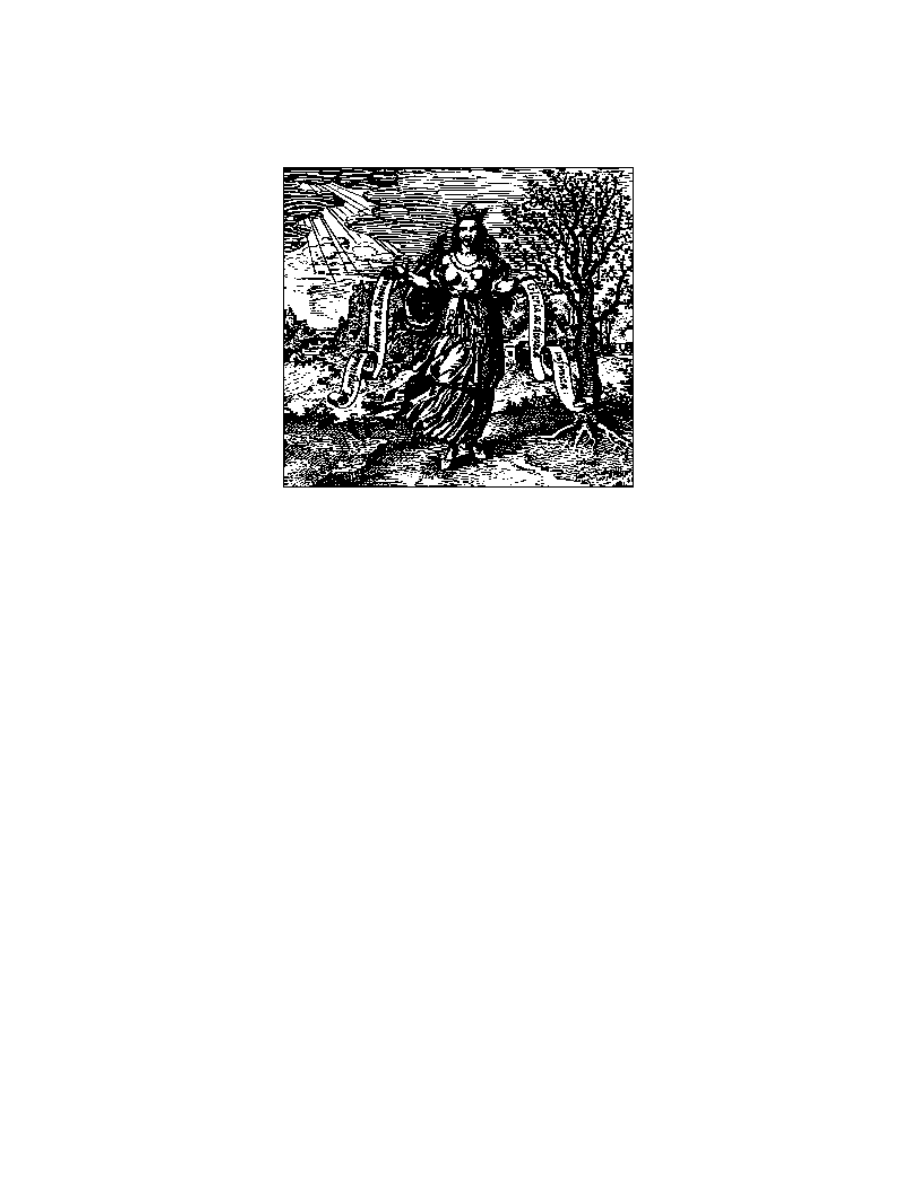
Emblem XXVI.
The Tree of Life is the fruit of Human Wisdom.
The Discourse:
Tullius has excellently described the Essentiall difference of Man whereby he is distinguished
from all other animalls after this manner: As a Bird for flying, a Horse for running, so a Man is
born for Reasoning. For as Lyons, Bears and Tigers do exercise and delight themselves in
fiercenesse, Elephants and Bulls in strength of body, Eagles, Falcons and other Hawks in preying
upon birds and swiftnesse of wings, so Man excells them and all other Creatures in Reason,
Inferences and Understanding. So there is no fiercenesse, no strength of body, no swiftnesse in
Brutes so great, as not to be tamed, subdued and outdone by Man's Reason only. For reason is not
a thinge humane or proceeding from the Earth, but as the Poet saith a particle of divine breath
sent from heaven into Man. It is sometimes called memory, sometimes the intellectuall virtue to
which, if use or experience be added, Wisdom springs from thence; which is the most precious
thinge that a man can obtain. For use is said to be as the Father and Memory as the Mother of so
generous an offspring. But the Question is, what is true wisdom? and most worthy of man's
enquiry, since the opinions concerning it are infinite, every man transferring it to their own
imaginations? It may be answered that Wisdom (exception being always made of that which in
divine thinges relates to the Welfare of the Soul) in human thinges does not consist in Sophisticall
Arguments, Rhetoricall Speeches, Poeticall Sound of Verses, Criticall Subtility of the
Grammarians. Nor in the craft of heaping up Riches by violence, lyes, deceit, perjuryes,
oppression without any regard to the cryes and labour of the Poor. For wisdom is nothing else but
the true knowledge of Alchymie joined with practice, which is of the greatest benefit to mankind.
This is the Wisdom surpassing all thinges, which with her right hand penetrates the East, with her
left hand the West, and Embraceth the whole Earth.
'Tis of this Wisdom that Solomon discourses so excellently in his Book of Wisdom and shows us
how They that are acquainted have Eternall perseverance, and Her friends partake of sincere
pleasures. And he that diligently enquireth after Her shall receive much Joy, for there is no
tediousnesse in her conversation, but to be present with Her is mirth and gladnesse. And though
wine and musick cheer the heart of Man, yet Wisdom is pleasanter than both, for she is the Tree

of Life to all that lay hold upon Her, and happy is every one that reteineth her. Lactantius
therefore calleth her the food of the Soul. The wise shall inherit Glory, and He that esteems
wisdom shall be exalted and honoured by Her. She is more powerfull then all thinges and
comforts a wise man more then ten mighty Princes that are in the city. And to this worldly
wisdom may be applied what is said by the Prophet Baruch: Where is Wisdom, Where is strength
and Where is understanding that thou maist know also Where is length of dayes and Life, where
is the light of the Eyes and peace. And as Solomon affirms in the Book of Wisdom, Great
Pleasure it is to have Her Friendship, and in the works of Her hands are infinite Riches, and in the
exercise of conference with Her is prudence, and in talking with her a good report.
Morienus the Philosopher speaking of it says: This is knowledge which draws him that possesses
it from the misery of this world and brings him to the knowledge of those good thinges that are to
come. And he Affirms it to be the Gift of God: For this is nothing but the Gift of God most High
who committs and reveals it to such of his servants and faithfull as He pleases. They therefore
ought to be Humble and subject in all thinges to the Omnipotent God. And in another place: For it
is convenient for you to know, O King, that this Magistery is nothing else but the Arcanum and
secret of secrets of the most High and Great God, for he hath recommended this secret to his
Prophets whose Souls he hath placed in his Paradise. It is also called the Tree of Life; not that it
hath Eternall Life in it, but because it doth as it were show the way to it, and bears fruit profitable
for this Life which it cannot be without, such as Health and the Goods of Fortune and Mind. For
without these a Man living is as if he were dead, and not unlike to a Brute, although outwardly he
represents him that he ought to be, but is not in his better part.
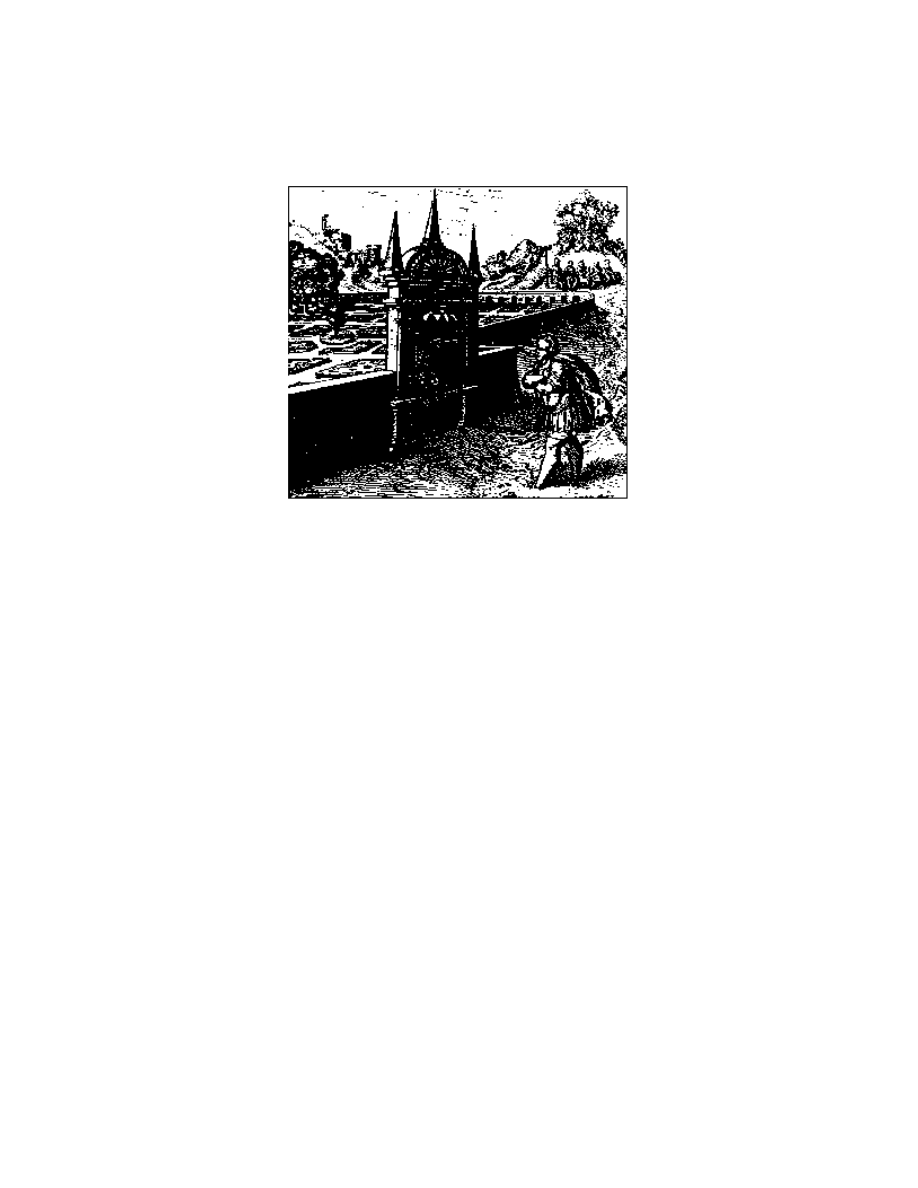
Emblem XXVII.
He that endeavours to enter into the Philosophers' Rosarye without a key, is like him who would
walk without feet.
The Discourse:
They write of Erichthonius that He sprang out of the Earth whilst Vulcan wrestled with Pallas the
Goddesse of Wisdom, and was born not with the feet of a man but formed like a serpent. Such are
those Persons who by the means of Vulcan alone, without the Wisdom of Pallas, do beget
Offspring that are monstrous, without feet and abortive, which can neither profit others nor
benefit themselves. It is a miserable thinge for men to go upon all four, that is upon his hands and
feet; but worse altogether are those destitute of feet who use Arms instead of them, for they seem
to have degenerated into the Nature of Worms who go after the manner of reptiles.
But the two legs are the two organick members of man, without which there can be no true
walking, no more then seeing without eyes or grasping thinges tangible without hands. So
likewise medicine and every operative Art are supposed to have two legs, namely Experience and
Reason, upon which they are to stand and without either of which their Art is lame and imperfect
in its Traditions and Precepts, nor can it arrive at the End it proposes. But Chemistry chiefly has
two subjects as its two legs, one of which is the key, the other is the bolt. With these the
Philosophick Rosary although locked on every side may be opened, and free admittance given to
such as have a Right to enter. But if one of these be wanting to him that is about to enter therein,
it will be the same thinge as if a Cripple should endeavour to outrun a Hare. He that without a key
enters into the Garden which is every way enclosed is like a Thief who coming in the dark night
can discern nothing that grows in the Garden, nor enjoy what he steals thence.
But the Key is a thinge of the meanest Value which properly is called a Stone, known in the
Chapter X as the Root of Rhodes, without which no Twig is put forth, nor doth a Budd swell, nor
a Rose spring and send forth leaves in a thousand fold. But it may be asked where this Key is to
be sought for? I answer with the Oracle: it is there to be looked for where the Bones of Orestes
are said to be found, to wit Where THE WINDS, THE STRIKER, THE REPERCUTIENT AND
THE DESTRUCTION OF MEN may be found together. That is, as Lychas interpreted it, in a
Brasier's Workhouse. For by the Winds is meant his Bellows, by the Striker the Hammer, by the

Striker Back the Anvill, and by the Destruction of Men, Iron seems to have been meant by the
Oracle. If a man knows how to number well and distinguish the signs he will certainly find this
Key in the Northern Hemisphere of the Zodiack, and the bolt in the Southern; and being Master
of these it will be easy to open the Door and enter.
And in the very entrance he will see Venus and her beloved Adonis, for she hath tinged the White
Rose of a Purple Colour with her Blood. In the same place a Dragon also is observable- as in the
Hesperian Gardens- who watches over these Roses. And the scent of the Roses is said to be
increased by Garlick planted near them, and that by reason of the exceeding degree of Heat which
is in Garlick whereby it resists cold poisons, for the Roses want the Heat of the Sun and Earth
before they can acquire a colour and smell that is most Gratefull to the Eyes and Nostrills.
Moreover the Fume of Common Sulphur makes Red Roses White if it touch them, and so on the
contrary the Spirit of Vitriol and Aqua Fortis refreshes them with a deep or full Red Colour which
endureth. For common Sulphur is an Enemy to the Philosophickal Sulphur though it cannot
destroy it, but the solutive water is friendly to it and preserves its Colour.
The Rose is sacred to Venus in regard of that Beauty in which it surpasseth all Flowers; for it is a
Virgin which Nature hath Armed that it might not be violated without revenge and punishment.
Violets are unarmed and trod under feet, but Roses lye among Prickles and have Yellow Hairs
hidden within and a Garment of Green without. No man can pluck them and separate them from
the Prickles but he that is Wise; if otherwise, he shall feel a Sting in his fingers. So none but the
most Wary Philosophers will crop their Flowers, least in the Hives He should find Stings as well
as Bees and Gall instead of Honey. Many have secretly and like Thieves entered the Rosary but
have reaped nothing from thence but Misery and Losse of Time and Labour. Whereupon
Bacusser saith in the Turba: Our Books seem very injurious to those who read them only once or
twice or perhaps thrice, for they will be frustrated in their Understanding and whole Study. What
is worse they will also lose all their money, pains and time which they have spent in this Art, and
a little afterwards, when a man thinks he has perfected and has the World, he will find nothing in
his hands.
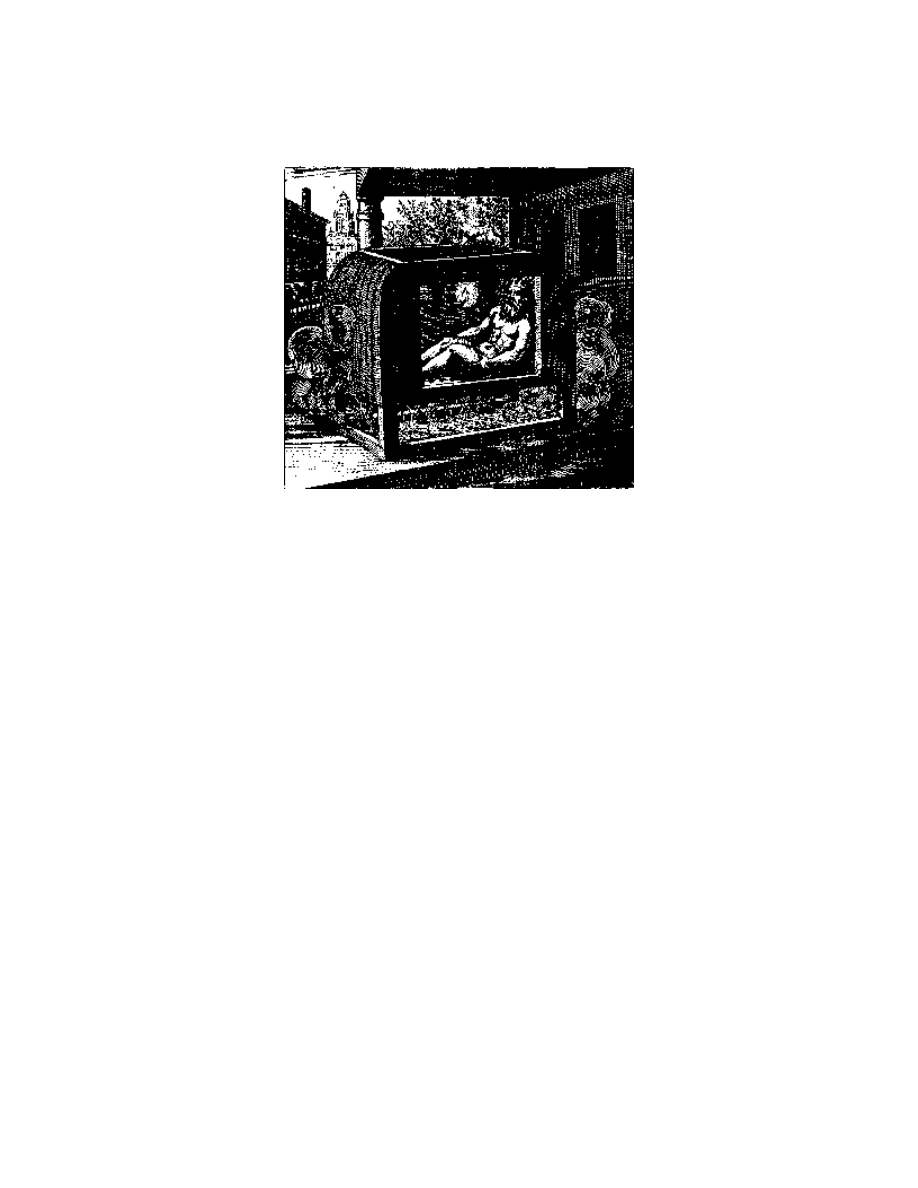
Emblem XXVIII.
The King is sitting in a Vaporous Bath, and is freed from the Black Gall by the Physitian Pharut.
The Discourse:
As there are three concoctions in man, the first in the Stomach, the second in the Liver, the third
in the Veins, there are likewise as many universall Evacuations of Excrements which are
correspondent to them and daily carry of their superfluityes; namely, the first by stool which is
proper to the first concoction, the second by Urine which belongs to the second, the third by
Expiration through the pores of the Whole Body or by sweat which is peculiar to the third. In the
first the Chylus, in the next Chymus, in the third a Dew or dewy substance is Elaborated and
applied to every part of the Body. The Excrements or Faeces of the first are Thick, Bilious and
Fat, which are carryed through the Bowells backward, and if they be at any time obstructed they
are gently, moderately or strongly expelled by purgations. The Excrements of the second are
liquid, more thin, bilious and saltish, which are brought out of the Veins by the Kidneys and
Bladders as Aqueducts.
The superfluityes of the third are yet more thin and therefore do for the most part expire of
themselves through the smallest pores, or are carryed out together with the Serum of the Humors
as sweat. These are helped by Sudorificks, as the former are by Diureticks. The Ancient Greeks
and Romans took a great deal of pains for the evacuating of this latter sort of Faeces, and to this
End did so many sports and exercises, such as the Chafing of all parts in the morning, Anointing
with oyle and Wrestling, Fencing, Running, Hand-ball, Tennis, daily Washing and Bathing in
Rivers or Artificiall Baths. And for the convenience of these thinges so many Magnificent
structures were built at Rome, which we may rather admire than imitate; such as were the Baths
of Dioclesian, which are for the most part still remaining (and unlesse I am mistaken dedicated to
the Arch Angels), an Aspiring, Superb and Splendid Work.
The same kinds of concoction as we have before mentioned are likewise in the Elaboration of
Metalls. For the first is made after its manner in the Magnus Annus or great year, that is in the
Revolution of the Highest Sphere, the second in the Revolution of the lowest sphere, the third in
that of the middle one. But that the Philosophers may by the help of Art more Easily draw forth
this masse of Excrements and Superfluityes, they invent severall methods such as Washings,

Purgations, Bathings and Laconica or Vaporous Baths, by which they perform that in the
Philosophickal Work which Physicians do in human Bodyes. Duenech therefore is by Pharut
introduced into his Laconicum that there He may sweat and evacuate through his Pores the
Faeces of the third concoction; for this King's distemper is melancholick or atrabilious by which
he is in lesse Authority and Esteem than all the other Princes, as being charged with the
morossnesse of Saturn and the Choler and Fury of Mars. He therefore has a desire to dye or be
cured if it be possible. Amongst many Physicians one is found who undertakes this charge, being
induced to it by rewards and entreatyes. This Allegorye is very frequent in the writings of the
Philosophers, as of Bernhardus, Alanus in the Treatise of Duenech, and innumerable others.
Therefore we don't add severall other Circumstances which may be found in them, but would
here observe only what Excrement and of which Concoction it is that ought to be evacuated by
Bathing, for hereupon the whole matter will turn. In Stoves or Hot Baths that Heat which is
included in the Body is usually, together with the Blood, brought to the superficies of the skin
whereby a Beautyfull complexion is made in the Face and whole Body; and if this appears it will
be a sign that the Melanchollye Blacknesse which infects the skin may insensibly be evacuated,
and all the humors corrected so that a pure and Rosy blood may afterwards be generated. For it is
necessary that the whole temperament of his body be amended, because being Cold and Dry it is
repugnant to the bittering of his blood, whereas He on the contrary is Hot and Moist; and whether
this can be done or no it is necessary for the Philosopher to foreknow and foretell by
Prognosticks.
There have been some men who have taken a Cobbler for a great Prince or King's Son, but they
have at length from certain signs perceived what he was in his Descent and Education. Least this
should happen the Artist in the first place must be carefull to choose the true offspring of the
King, who although he does not appear splendid with golden Attire, but is despicable and mean in
his clothing as likewise of a Livid and Melanchollye complexion, yet let him not reject him or
take another in his stead. For if he be very well washed his Royall Genius will soon appear, as in
Cyrus, Paris and Romulus who were educated among Rusticks. But it is further to be observed
that the Bath must be a Laconicum, that is Vaporous and Sudorifick, least the water should parch
his Tender flesh or obstruct the Pores, from whence would proceed more Harm than Advantage,
nor could the Effect of it be remedied. Let no person be sollicitory what clothes the King should
put on after his bathing; for as the Daughter of King Alcinoi presented Garments to Ulysses who
was shipwrecked and naked, so there shall be one who will send him those which are most
precious, whereby he may be acknowlegded deservedly to be the offspring of the Sun.
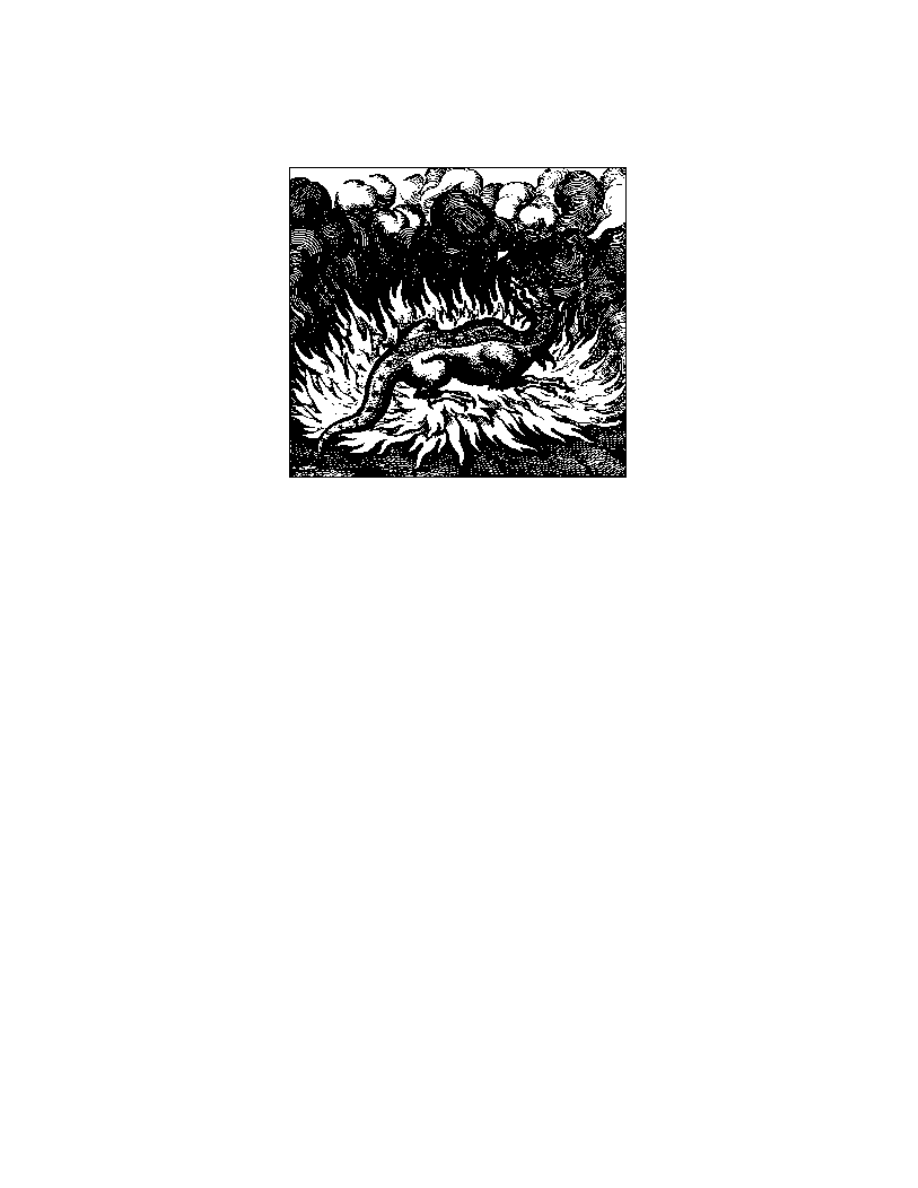
Emblem XXIX.
As the Salamander lives in fire, so also the Stone.
The Discourse:
There are two Elements in which Animalls live, Air and Water, and as many in which nothing
that is Animated can remain, to wit, Earth and Fire; for as the former are of a temperate and
middle Complexion in the first and second qualitiyes, so these latter are of an extreme one, or are
bodyes either too thick or too subtile, so that the thicknesse does not admitt some bodyes, and the
subtilety does indeed admitt some but then it penetrates and burns them. But that men can live in
Subterraneous Caves is occasioned by the Air descending thither and filling those places least
there should be any Vacuum. But here we speak of every Element apart. In the Water Fishes live
in incredible numbers, variety and fruitfulnesse, and even the biggest of all Animalls. In the Air
live Men, fourfooted Beasts, Birds, Worms and Insects. Whatsoever is said of Spirits wandering
in the secret parts of the Earth is another thinge, for they are not Animalls.
But as for the Fire, there are no Animalls said to live in it except the Salamander. Now the
Salamander is a creeping worm not much unlike a Lizard, but of a slower pace, bigger head and
different Colour, such as I remember seeing in the Alps under the mountein Spulga coming out of
the Rocks after Thunder and Rain and lying in the way. And a Country man of the place told me
it was called Ein Molch; it had round about it a clammy and viscous moistnesse, by the Virtue of
which it freely passes though the Fire without Harm.
But the Salamander of the Philosophers is very different from this, although it be likened to it.
For that of the Philosophers is born in Fire. This is not so with the common Salamander, but if it
falls into the Fire by reason of its extreme coldnesse and moisture it is not presently burnt, but can
freely passe through the Flame that is Hot and Dry. This common Salamander is Cold and Moist,
for every thinge participates of the Nature of the Mother's womb and resembles the place and
country of its production. Fire produces nothing but what is Hot and Dry as being like to itself; on
the contrary, the Moist and Cold Caverns of Rocks being full of water send forth this moist and
cold Vermin. The Philosophickal Salamander by the Similitude of its Nature rejoyces in Fire; the
common Salamander by the Contrariety of Nature extinguishes it or for some time repells its
force.

They say that the Fly Pyraustes is generated in Fire and flyes out of the Brass Furnaces in Cyprus.
But no man has believed this to be true but in an Allegorye. For Fire if it be continued destroys
and corrupts the bodyes of any Animalls whatsoever, seeing it can burn Earth into Glasse and the
most solid Timber and all other compounded thinges into Ashes, some few excepted to wit such
as are Mercuriall, which either wholly remain or wholly fly away out of the fire without any
separation being made of their parts. For Vulcan is a most cruell Executioner who calls all thinges
that are mixed and compounded of Elements to his Tryall and Judgement. Some few only are
excepted from his Tribunall by the speciall Privilege and Indulgence of Nature, who is Empresse
of all thinges. Over these he has no right by himself alone, unlesse he joins to him the
Areopagites as other assistant Judges. And Salamanders are such as are above his Violence,
which they do not fear.
Avicenna in his Porta reckons up the various Temperaments of bodyes which are all unequall and
therefore corruptible by Fire and other injuries. But He affirms that there is one exactly equall
which has as much Heat as Cold and as much Drynesse as Moisture, not according to Weight but
Justice as the Physitians term it; and this is that which is more Patient then Agent, in which if Fire
endeavours to resolve Water its adversary into Air which is its Familiar, the Earth does not admitt
this Resolution because it is incorporated with Water. And the Internall Fire of the Compound
doth by its suffrage approve this pretence of the Earth, because he is the intimate Friend of the
Earth. Therefore Vulcan's Judgement ceases, and he uses yet another Intrigue by endeavouring to
burn the Earth into cinders as he is accustomed to do. But Water adhering to Earth brings
exceptions against him and shows that she is united to the Earth and the Air, as the Fire by one
side is to the Earth. Therefore he that would reduce the Earth to Ashes would likewise reduce the
other Elements, and so Vulcan being disappointed suspends his Judgement least He should
become ridiculous.
This Body is like the Truest Salamander, in which the Elements are Equalled by the Balance of
their Powers. Concerning this Rosarius out of Geber saith: Likewise the Philosopher would have
the Substances of Mercury mortified, but naturally his Mercury is in that Venerable Stone as is
plain to all men. And a little further on: Also the Philosopher would have the Substances of
Mercury Fixed, as is evident because he teacheth the ways of Fixing with many Cautions and
Devices. But who can doubt the Substance of that Precious Stone to be most Fixed? Certainly no
man that knows it. By which it appears that the Stone is by Fixation to be reduced to the Nature
of the Salamander, that is to the greatest Fixednesse which neither declines nor refuses Fire. For it
is no Salamander till it has learnt to endure Fire with the utmost patience, which must of
necessitye be effected in long processe of time.
Hereafter in the 35th Emblematicall discourse it will be showne how Achilles and Triptolemus
were by night placed under embers of Fire till they could endure the most Vehement Heat, thus
by use and custom attaining to the propertyes of a Salamander. For Custom is a second Nature.
But unlesse Nature communicates the Power and as a Mistresse begins the Alteration, Custom
will be able to do little or nothing. And thence it is impossible to fix Ice at the Fire, but to fix
Christall is possible because Nature has begun it. The same must be thought of Watery and
Volatile Mercury, which in its own Nature cannot be Fixed but by the Marriage and Coition of
Sulphur, which is the Philosophickal Tincture and Fixes all flying Spirits.
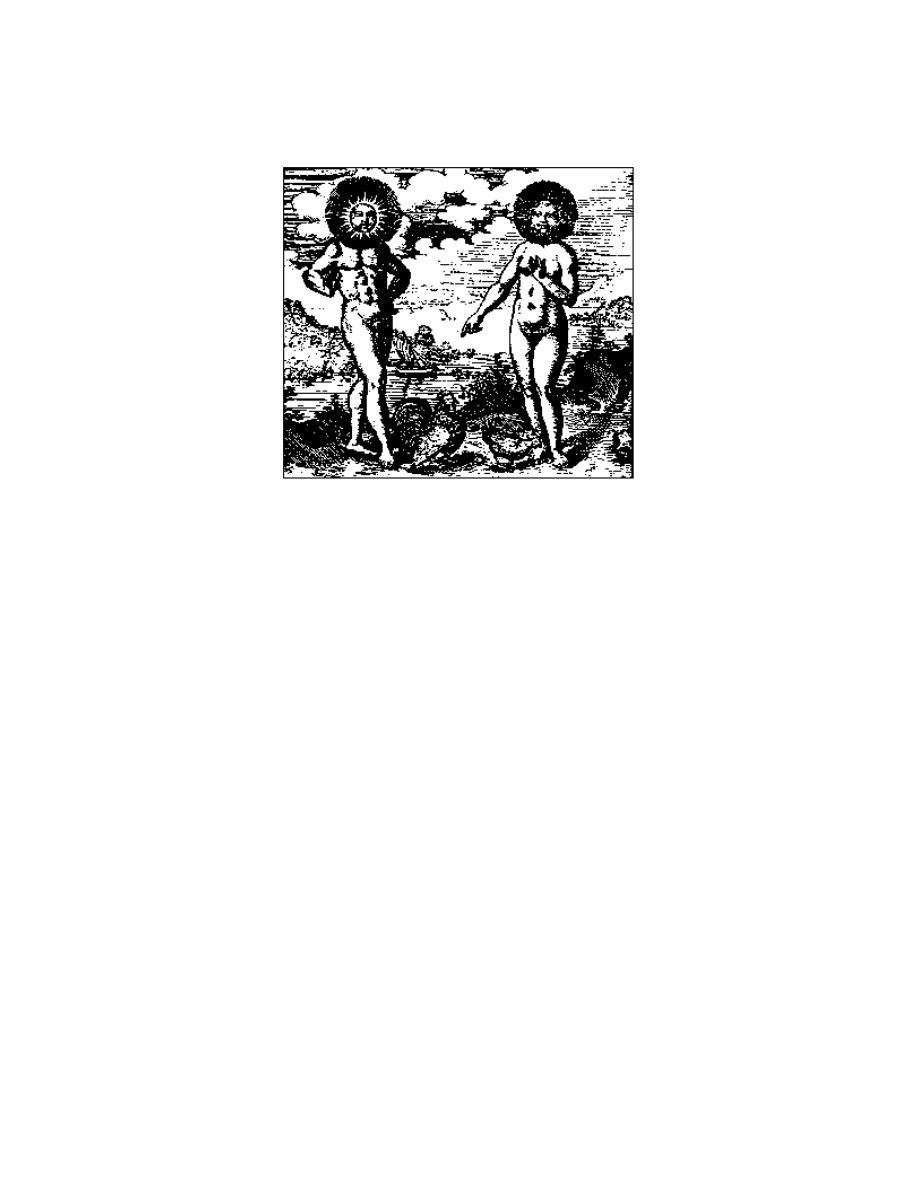
Emblem XXX.
Luna is as requisite to Sol as a Hen is to a Cock.
The Discourse:
Avicenna in his Book de Anima does severall times offer us this admonition: That no Eggs
should be taken by the Artist unlesse they were of such Hens as had been trod by a Cock. That is
that the Female subject is of no Value without the virtue of the Male, and so on the contrary that
the Cock is of no use without the Hen. For these two sexes are to be joined in the Philosophickal
Coop, and that so multiplication may from thence proceed. But the Philosophers do more
especially use this similitude of a Cock because he has a nearer correspondence with the Power of
the Sulphur than the Male of any other kind of Bird, seeing one Cock can preside over many
Hens and does not easily endure any Rivall upon the Territoryes of his own Dunghill, for He
knows and esteems himself to be sufficient for all his mates. He is the Bird of Mars, made as the
Poets feign by the transformation of the boy Gallus, whose businesse it was to watch the Sun least
he should espye the Adultery which Mars committed with Venus; and He is very Martiall in war,
for He will fight with his Enemy even till death. In the Philosophickal work he represents the
Sun, as the Hen does the Moon For there is the same necessitye of joining Sol with Luna as the
Cock with the Hen. The Cock is likewise raised to the Sun, with whom He both rises and goes to
sleep. He often looks up to Heaven and erects his Tayle on high, which falls in the shape of a
sickle. He fights for his Hens against Serpents, He is the forerunner of Light and is Loved by
Latona because he was present at her delivery. For Latona brought forth Sol and Luna, from
whence the Cock is appropriated both to the Mother and the Son.
But Sol, Luna and Latona agree with Chymicall subjects and so do the Cock and Hen, for these
two came out of Eggs and do likewise produce eggs, from whence their Chickens may be
Hatched. So likewise the Philosophers have their Eggs, which will passe into birds of the same
kind if they are nourished with a temperate heat such as the heat of a Hen that setts, remaining
upon them continually. For whereas among other Birds the male setts upon the Eggs, the Cock
only shows himself to be free from that Office and Burden, and all the care and labour of
hatching the Chickens and breeding them up must lye upon the Hen. Wherein her Diligence and
Industry is very remarkable; with what haste she eats and drinks and performs all the necessaryes
of Nature, that she may run back to her Eggs least they should grow cold. Then with Force and

Eagernesse she defends her Chickens; with how loud a voice like that of a Bell she calls and
clucks them together; with what Endeavour she Bruises and Cutts with her Bill as with a Knife
the harder crumbs or grains which she administers to them. All of which is the work of Nature,
and worthy of our admiration. And all this is done least Eggs should be wanting for the food of
mankind or the production of Chickens.
After the same manner the Philosopher or Artist makes like provision for all his operations. For
he gathers his Eggs from such places where a Cock has been treading and diligently searches least
there be joined eggs; after that he cleanses, separates and disposes them in his Vessels, as in
Nests; he administers proper heat to them by which from day to day the subjects commixed
among themselves do mutually Act and Suffer, till after a long time passing through various
colours they at last arrive at one Colour and Essence. In which work Solution, Coagulation,
Sublimation, Ascension, Descension, Distillation, Calcination and Fixion must be performed as
intermediate operations. For what is hard and compact cannot be altered, therefore Solution must
precede and that so it may grow soft and liquid. But when a thinge is dissolved then it must be
Coagulated not to its former Hardnesse but to a Tractablenesse proportionate to that of Honey.
Then Sublimation separates the Pure from the Impure and makes what was Vile become
Honourable, advancing inferiour to a superiour. Whence this cannot be wanting, but is like the
mistresse and governesse of all the rest. While this Sublimation is performed some parts mount
upwards, which is Ascension, and others fall downwards which is Descension: afterwards,
Distillation being often repeated clarifies the whole, and that which remains at the bottom is
Calcined. Then both are fixed and the work is perfected. But a man may in truth reduce all these
speciall operations to one generall, which is Coction. For as severall Chickens which run about
are clucked together under one Hen who is their Mother and Nurse, so these various courses and
methods of operation run all into one, which is the work of the woman: that is, Coction.
It is the Moon that must be exalted to the Sublimenesse of the Sun, and all these thinges are
transacted for her sake. That is the finall intent: a durable Marriage between the Sun and Moon,
and when that is accomplished all embassies, contracts, congresses, mistrusts shall have an End.
There will be one bed and one flesh, the love mutuall and constant, the league indissolvable, the
peace eternall. The Sun without the Moon is of no great Esteem, and the Moon without the Sun is
of an abject condition and Vile Originall. But it is from her Husband the Sun that she receives
Splendour, Dignity and Strength or Firmenesse both of Mind and Body. And the Sun obtains
from the Moon the Multiplication of his Offspring and the Propagation of his Kind. Hence
Rosarius says, if there were only one of them in our Stone the Medicine would never flow easily
nor give the Tincture; nor if it did give it, it would not Tinge but for as much as was in it, and the
remainder and Mercury would Fly away in Smoak, because a Receptacle of the Tincture would
not be in it. And Geber in Libro Examinum proves that if Sol and Luna are incorporated together
with Art they are not easily to be separated.
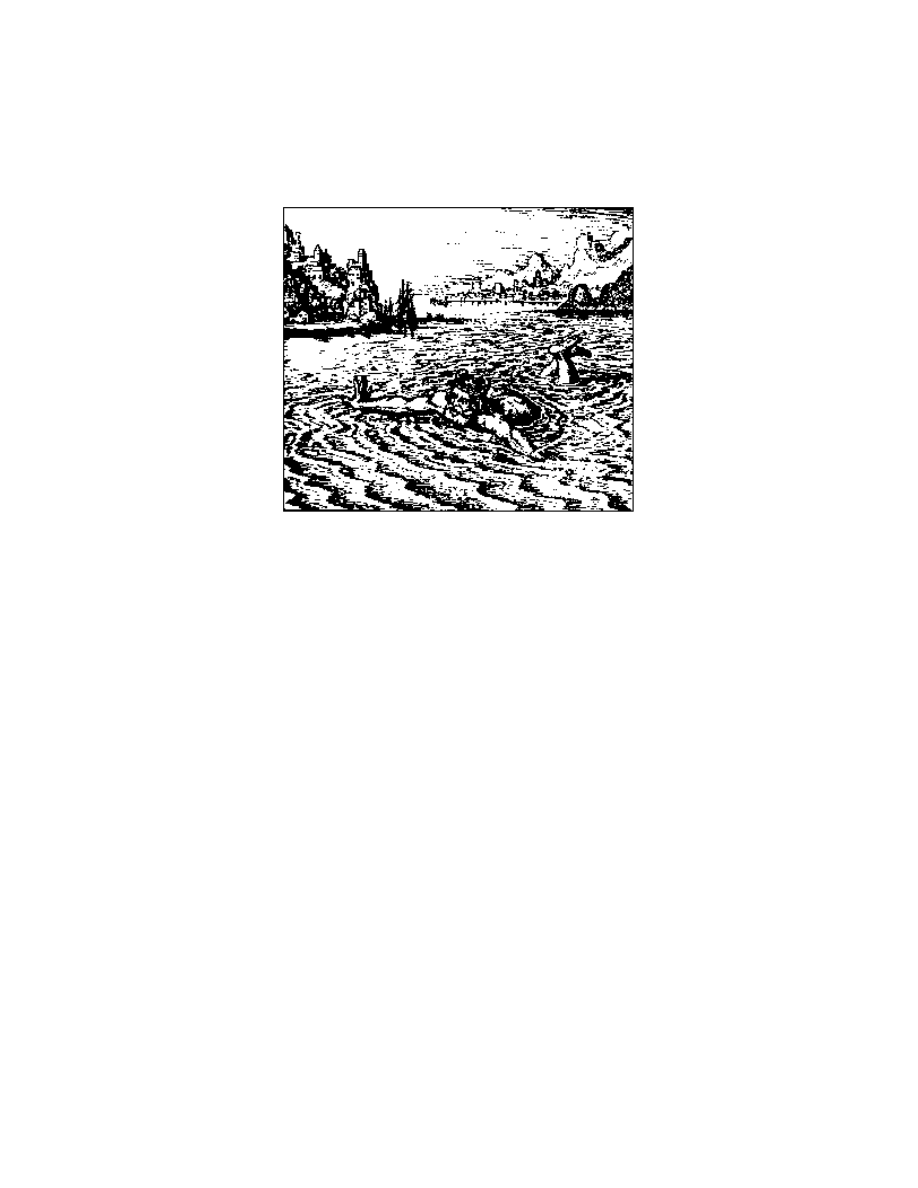
Emblem XXXI.
The King swimming in the Sea cryes out with a Loud Voice: He that delivers me shall have a
great reward.
The Discourse:
The first Rudiments of all Discipline were anciently the knowledge of swimming and the
institution of letters; and from thence it used to be said of a rude unpolished man that he could
neither swim nor read. For the Ancients considered that swimming would of ten times prove a
means to save and deliver the Body from the dangers of the Water, as the knowledge of letters
would the mind amidst all the waves of Fortune. Swimming is as necessary in War as Learning is
at home in times of peace. And as we observe that Brutes have their Weapons in readinesse and
provided by Nature, but that Man instead thereof has his wit and hands given him against all
externall Force, that as one contrives his Arms so the others may use them, so the same beasts
have the faculty of swimming naturally implanted in them, which man has not. For the very
Young often will escape from those waters in which the strongest and most skillfull man will be
drowned. It was therefore needfull to enjoin the exercise of swimming to children, it being usefull
towards the preservation of their lives, so that what was wanting by Nature might be supplyed by
the Use of Art.
The same Exercise has been used by Noblemen, Princes and Kings for the safeguard of their
Persons, for they who are descended from Noble blood are not wholly Exempted from the
chances of fortune, but exposed to them as well as other Men. If Dionysius had neither
understood swimming nor letters when he was driven out of his Kingdom of Sicily as a Tyrant, he
would have perished in the waves of the Sea when he was shipwrecked in the Corinthian gulf.
Neither could he have come to Corinthus, there to set up a School to teach boyes and profess
humane learning. From a King being made a Schoolmaster and wielding a rod instead of a
Scepter, the proverb originated: 'Dionysius of Corinth'. In like manner, if the Royall Son of the
Philosophers had not been able to swim, no man would have heard his Voice nor retrieved him,
he being long since drowned in the Waters. Swimming therefore is necessary and usefull to all

degrees of men, for altho' it cannot presently deliver a man from the surges of the Vast Ocean, yet
it gives him time of Life whereby he may be saved by others.
But this King of whom we speak sustains himself the longest time of all and cryes out even to this
day, tho' he be seen or heard by a very Few, by reason of the Vastnesse of the Sea and his
remotenesse. For by chance in swimming he hath touched upon a Rock or a Very great Stone
where he may remain if the Waves prevail. But it may be asked what kind of Sea this is? I answer
it is the Erythræan or the Red Sea, subject to the Tropick of Cancer, in whose Bottom there lies
the most abundant Quantity of Magnets. It is not safe for ships compacted of or laden with Iron to
sail in it, for they may easily be drawn to the bottom by the Force of the Magnets. Which the
King before mentioned being ignorant of, and the rest perishing when their ship sank, he alone
escaped by swimming. A Crown still remained upon him, shining like Glorious Rubies, by which
he might easily be known and restored to his Kingdom.
But what are these good things which this Royall Son is able and willing to bestow on him by
whom he should be restored to his own Kingdom? Certainly not such rewards as Ptolemy the last
King of Egypt bestowed on Pompey, by whom his Father was restored to that Kingdom; to wit,
Perfidiousness and Death. Rather, he bestows Health, the removall of diseases, the preservation
of life free from the burden of things necessary, and the Horn of Plenty with Love and Honour-
which being things not mean and ordinary, but the chief Vitalicks and ornaments of this Life.
Who, except he be stupid would not desire them? Who would not swim to Him? Who would not
stretch forth his hand and draw him into the Boat? But care must be taken least in rescuing this
Prince his Diadem should fall into the Sea. For then He would scarce be acknowledged for the
King or received by his Subjects, because then would perish the Pyropus Venerabili, and the
Bezoar Stone assuring Health to all men would Vanish quite away. Hence the Rosary quotes
Aristotle in these Words: Choose Thyself a Stone, that by which Kings are revered in their
Diadems, and by which Physicians can cure their Patients, because it is near to the Fire. For
without a Medicinall Virtue a Crown would be of no Value.
But what is to be done to the King when he is so delivered? First from those Waters he had
received in He must be relieved by Sudorificks, from Cold by the Heat of Fire, from the
Numbnesse of his Limbs by Baths moderately Hot, from Hunger and want of food by the
Administration of a convenient Diet and from other externall maladies by their contraries and
Health-restoring Remedies. Then must a Royall match be provided, from which in due time there
shall arise from him an offspring most desirable, most beloved by all men, most beautifull and
most fruitfull, who shall excell all his Ancestors in Strength, Kingdom, Dominions, People,
Riches and Wealth, and shall subdue his Enemyes not by War but Gentlenesse, not by Tyranny
but Clemency, which is genuine and peculiar to Him.
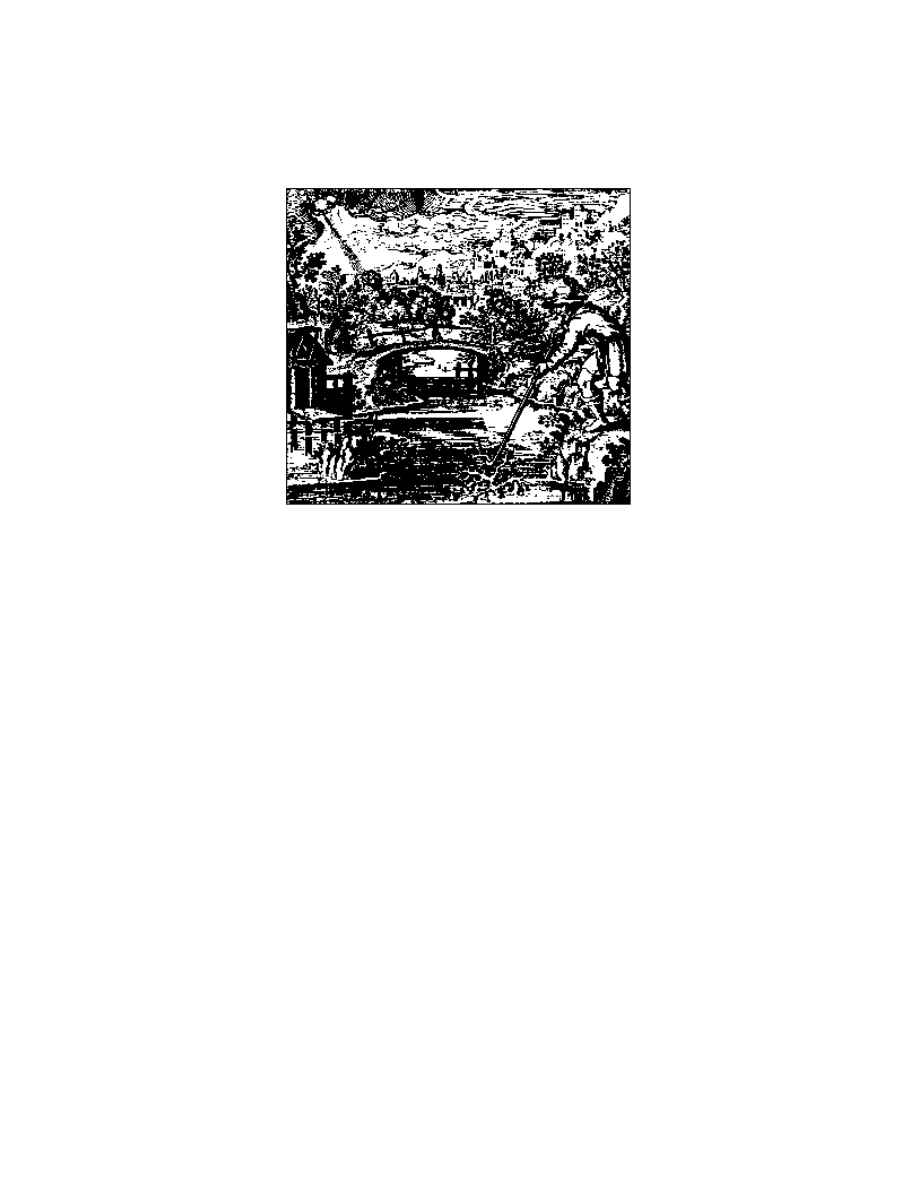
Emblem XXXII.
As Corall grows under Water and is hardened by the Air, so also is the Stone.
The Discourse:
The Philosophers call their Stone a Vegetable because it Vegetates, grows and is increased and
multiplies like a plant. This indeed to the ignorant seems strange and contrary to the Truth, it
being as they think manifest that Stones do neither Vegetate nor grow after this manner, nor that
this can any ways appertain to such Metalls as may be liquefied or melted. But they are deceived
in their Judgements; for whatever is unknown to them, that they believe not to be in Nature,
measuring the immensity of the Universe by their own Capacities. For who would ever have
believed that a Stone should grow under waters or a plant there generated should become a Stone,
unlesse Experience and the credible testimony of Writers had confirmed it? Where does that
petrifying, where does that tingeing Virtue which hardeneth and tingeth Corall, Exist? Whether in
that Water or in the Air? We may reasonably believe it to be as they affirme a soft and flexible
plant whilst it is under the Waters, yet of a Very earthy Nature, which when it is cut and exposed
to the cold winds becomes hard and may be broken like a Stone. For the watery parts which
abound are dryed up by a cold and dry Air (for Northern Winds bring drynesse along with them),
and the Earthy body which remains, having cold and drynesse as its qualities, is congealed. For
constriction or the binding faculty is the Earth's alone; it does not exist in the Water or Air, as
each element has its genuine or proper qualities.
The Sea likewise in other places produces three Medicinall Stones, taken partly from the
Vegetable kind, partly from the Animal, or rather from the hidden Secrets of Nature, as Pearl,
Amber and Amber Gryse. The Production of Pearls and the way of taking them is known to Us,
but not of the rest. Amber is gathered upon the Sea Coasts of Scandinavia after a most Vehement
north-westerly wind has blown, which without doubt drives it through the Waters to the Shore
after it has boyled out of the Earth into the Veins of the Sea. For we have seen some Veins of Iron
and Silver growing in the Amber, which thing could not be done but in the Earth. But that Flies,
Gnatts, Spiders, Butterflies, Froggs and Serpents should be seen in some pieces of it (we
ourselves having had 120 beads turned out of Amber, which did every one contain some Flies,
Gnatts, Spiders and Butterflies; and one of them, not without a singular miracle of Nature, had
nine of them together) happens by the influence and imagination of the Heavens, as we have

elsewhere demonstrated. That Amber Gryse is found after the same manner upon the Shores of
the East and West Indies cannot be denyed, and tho' some declare it to be the Juice or Gum of
Trees (as they do the Amber before mentioned) yet they who conceive it to be produced out of the
Veins of the Earth do judge more probably. For Trees that bear Amber or Amber Gryse have not
been seen in any place, although if such Trees be they must certainly grow in open Air, and not
under water. We therefore ascribe both sorts of Amber to Subterraneous Veins or Stones, as we
do Pearls to Zoophyra or Plant-animals, and Corall to the Vegetables.
The Stone of the Philosophers is likened to these, and especially to Corall. For as Corall grows in
the Waters and draws Nutriment from the Earth, so also the Philosophick Stone is concreted out
of Mercuriall water and has taken thence whatever is worthy in it towards its own Augmentation,
the Superfluous Moisture having expired. The Red Colour likewise is raised upon the Corall by
the coagulation which the Ancients call the Tincture of Coralls, and so it is in the Physicall Stone,
which becomes red in the last Congelation and appears like the red Corall which is the Tincture.
But the Corall grows hard by the Cold and drye, the Stone by the Hot and drye, which being
augmented it likewise dissolves: contrary to the Nature of other Stones, which do indeed dissolve,
but run into glasse, which thinge is in no wise agreeable to this.
And as Corall is prepared into severall Medicines of great Virtue, so also hath the Philosophickal
Corall transferred into itself the virtues of all Herbs, and can alone performe as much as the
medicines of all Vegetables. For the Celestiall Sun who infuses a medicinall Virtue of Efficacy to
Vegetables has given more to this Son of his than to all others. This is the Philosophickal Corall,
vegetable, animall, and minerall, which lyes hid in the Vast Ocean and is not known, unlesse it be
put into the hands and exposed to the Eyes of the Ignorant. But it must be cut off whilst it is under
the Waters, and that with Very Great Caution least it lose its juice and blood and nothing remain
but a Terrestriall Chaos without its True Forme. For herein consists all the difficulty of gathering
Corall. By these Waters I understand the Superfluous humidity which kills the Stone, which does
not suffer the Coralline Rednesse to appear and which admitts of no Coagulation, unlesse it be
separated.
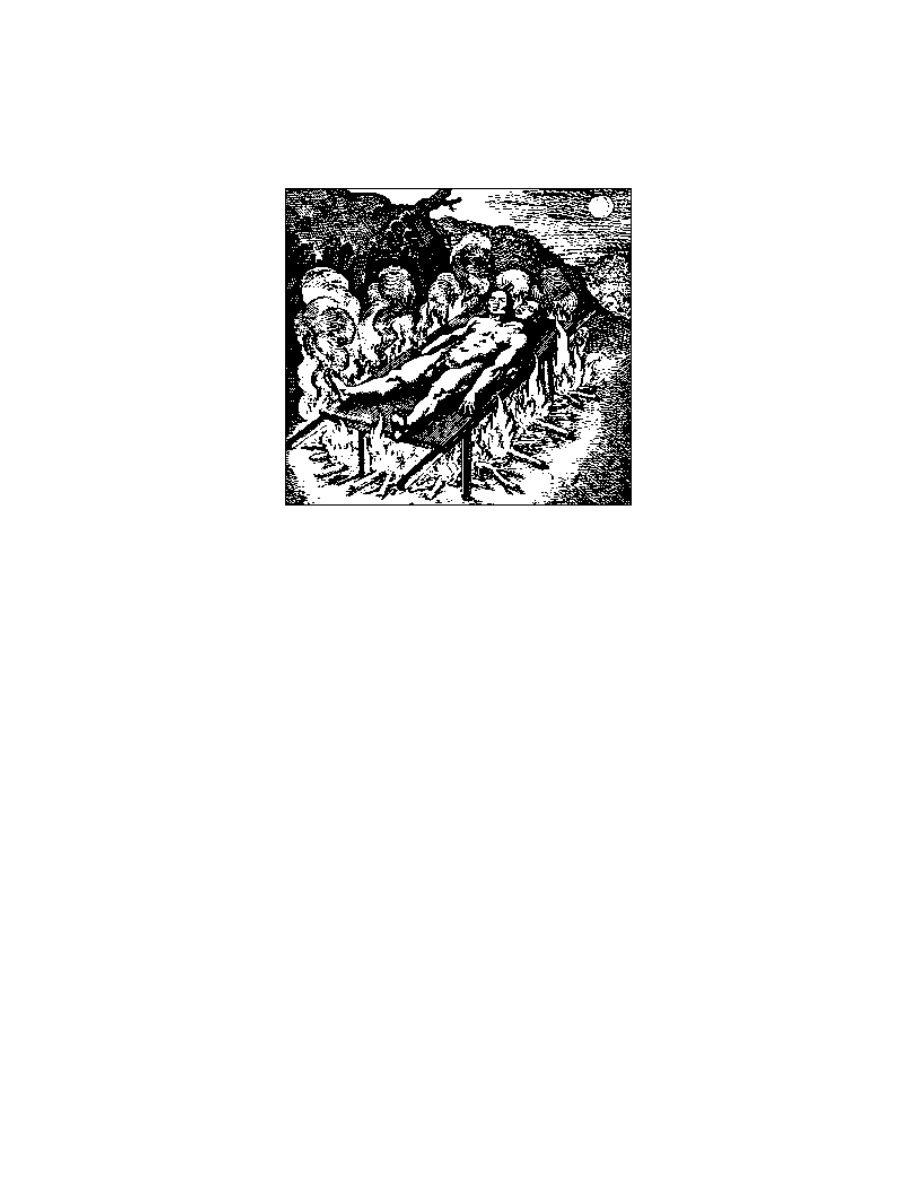
Emblem XXXIII.
The Hermaphrodite, lying like a dead man in darknesse, wants Fire.
The Discourse:
It is remarkable in Nature that at the coming on of Winter Froggs and Leaches lye under Water as
if they were dead, and in the Spring by the Operation of the Sun's heat recover sense and motion
so as to be able to perform the Actions of a sensible life. But if in the Winter time they be found
in the Waters and brought into Warm Air or a Stove, immediately they begin to move as in
Summer. From whence it appears that nothing is wanting to them but Externall Heat to excite the
Naturall Internall heat and bring it to Action.
After the same manner do the Philosophers speak of their Hermaphrodite. For if he appears dead
as he lyes in darknesse he then requires the Heat of Fire. But he is said to lye in darknesse as
being left in a dark and most cold Winter's night, that is he remains in Blacknesse, which is a sign
of Cold, from which he ought by a greater intensity of Fire to be brought to Whitenesse and by a
greater still to Rednesse. For without Heat, as Bodillus in the Turba says, nothing is generated.
And a Bath of intense heat causeth a Body to perish, but if it be cold it drives it away. But if it be
temperate it becomes agreeable and pleasant to the Body. Bonellus likewise says: "All things that
live do also die according to God's pleasure. Therefore that Nature from whom moisture is taken,
when it is exposed by night, seems like a dead man; and then that Nature wants fire till the Body
and Spirit of it be turned into Earth, and then it becomes dust like a dead man in his Tomb. These
things being accomplished God restores the Spirit and Soul to it, and all infirmity being taken
away our Nature is comforted and amended. It is requisite therefore to burn that Matter without
fear." Fire therefore, which destroys all other things, repairs this and is its life as it is their Death.
One only Phoenix there is, which is restored by Fire, renewed by Flames and revived out of
Ashes; and this, being known only to the Philosophers, is burnt and restored to life, whatever
others fabulously may report of a certain Bird that never yet was seen or had any Being.
Likewise, the Hermaphrodite of which the Philosophers speak is of a mixed Nature, Male and
Female, one of which passes into the other by the Operation of Heat. For from a female it
becomes a male, which ought not to seem strange in the Work of the Philosophers, since if

History may be Credited severall examples of it may be found. The Poets mention the sex
changes of Cenea, Iphin and Tiresiam, as described by Pontanus and Ausonius. Likewise, when
Licinius Crassus and C. Cassius Longinus were Consuls a boy was made of a Virgin, and
Licinius Mutianus as he is quoted by Pliny relates that he had seen one Aristontem whose name
had been Aristusae and that she had been marryed, but that she soon after had a beard, and
manhood appearing the same person became a Husband. Pliny himself says that in Africa he saw
Lucius Cossicius, a Citizen of Tisdritanum, changed into a man upon the day of his marriage.
These things are true and might be proved by many other Examples if there were occasion, for it
is certain that by the increase of heat the genitall parts are thrust out of the Body: for seeing a
Woman is much colder than a male, and has those parts hidden within which a man has
outwardly, hereupon Nature being dubious whether she should generate a man or a woman
expresses a woman outwardly, tho' inwardly she intended a man. For which reason as heat and
motion increase with Age the hidden parts break forth and become apparent. After the same
manner it is with the Philosophers, for by the increase of heat their woman becomes a man; that
is, their Hermaphrodite loses the female sex and becomes a man stout and grave, having nothing
in him of Effeminate Softnesse and Levity. So we sometime since saw a noble youth that was an
Hermaphrodite changed, or rather promoted into a perfect man not uncapable (as it was hoped) of
getting Children, for a New Passage was made through the Yard which wanted one, and the other
appertaining to the Woman was stopped. And this piece of Surgery was performed by Caspar
Tagliacotio, that famous Surgeon of Bologna.
The Philosophers are not without these manuall operations, for when the coldnesse and the
moistnesse of the Moon appears, that they call the Woman; and when the heat and drynesse of the
Sun appears, that is the Man. When all these four qualities are present together that is their Rebis
or Hermaphrodite, and thus conversion of the Woman- that is, of coldnesse and moisture- may
Easily be made into the Man, which is done by the Sole Heat of Fire, as hath been said. For Heat
sequesters and separates the superfluityes of Moisture and will Establish the Idea of the
Philosophickal Subject, which is the Tincture.
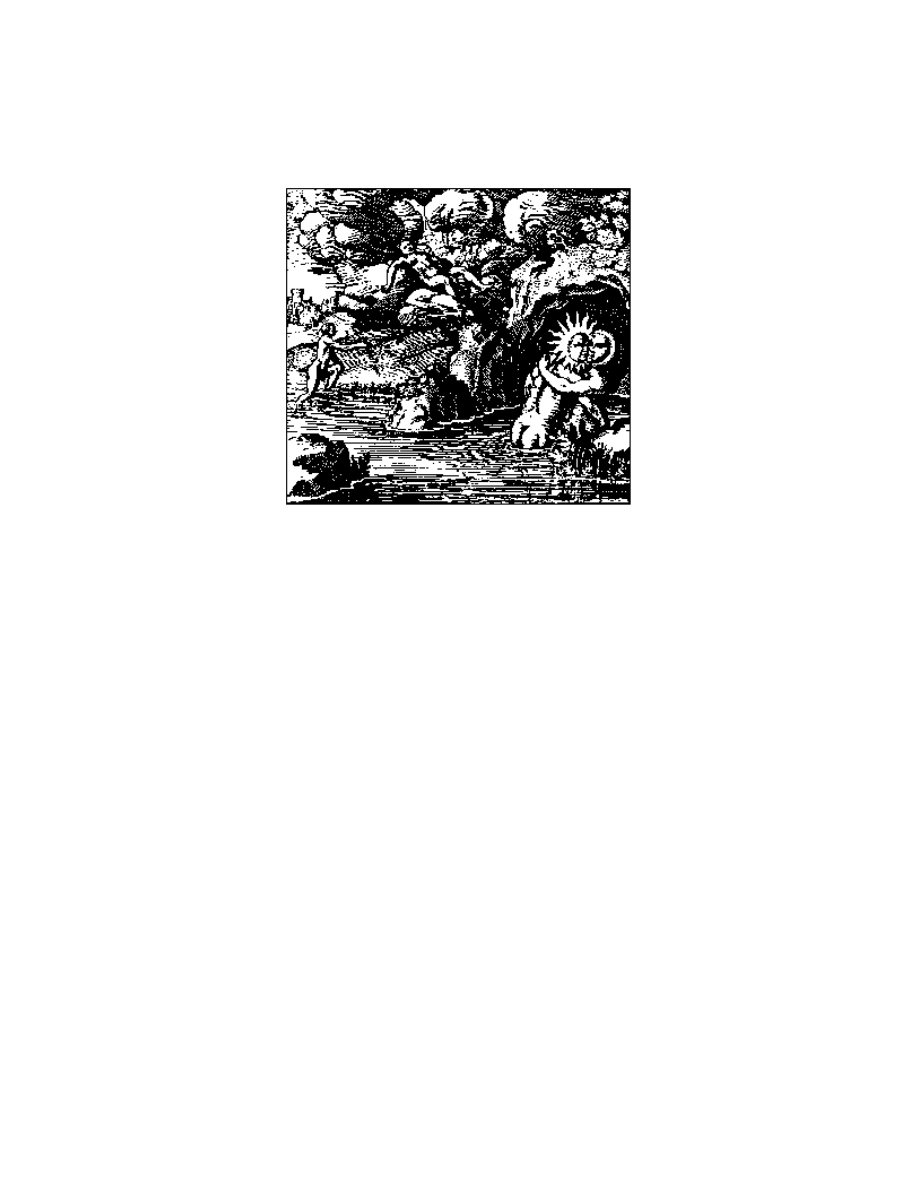
Emblem XXXIV.
He is conceived in Baths, born in the Air, and being made Red he walks upon the Waters.
The Discourse:
The Opinion or Flattery of men has attributed severall wonderfull Births or Originalls to some
persons above others, but they are certainly fabulous. So it is said that Alexander the Great was
not begot by Philip King of Macedonia but by Jupiter Hammon, Romulus and Remus were begot
by Mars, and Plato sprang from the Virgin Perictio, who conceived by a Phantasme of Apollo. So
the Heathens would demonstrate themselves to be born from the Gods, as also Thessalus the Son
of Hippocrates the Physician would among other things persuade the Athenians that he was born
from Apollo. But we give no credit to these things, for we know that they from whom they would
deduce their Originall were neither men nor Gods, and if there were any Heroes among Mortalls
who might have been reputed Divine we think it to have proceeded from the flattery of their
subjects or disciples, speaking and writing great things of them however false to gain a reputation
of them in the world.
But it is a different thing that the Philosophers ascribe an unusuall Conception and Nativity to
their Son, for he hath something above all other things born in the World; for he is conceived in
Baths, and born in the Air. We know that Women being barren by reason of too much coldnesse
and drynesse are much helped by hot baths, so as to be made able and fit for conception, but that
such conception ought to be or can be in such Baths is a thing unheard of that seems to be
peculiar to him alone from the wonderfull power of Nature, which is far different from all others.
In other places they say that his conception ought to be in the bottom of the Vessell and his birth
in the Alembeck: which opinion is still more clear. For the waters of the Baths, if there be any,
will neither be in the top nor in the middle but in the bottom of the vessell, and in the Alembeck
will be vapours that are aeriall.
Therefore when conception is made he ascends into the Alembeck and his Birth appears in a
White Colour. Blacknesse rules in the bottom, of this saith the Rosary: "It is conception when the
Earth is dissolved into a black powder and begins to retain somewhat of the Mercury, for then the
male acts upon the female, that is, Azoth upon the Earth." And a little after: "Conception and

Dispensation is made in Putrefaction in the bottom of the Vessell, and the generation of things is
made in the Air, to wit, in the Head of the Vessell that is the Alembeck." And conception in Baths
is nothing but putrefaction in Dung, for the same Rosary proceeds, "The Body does nothing
unlesse it be putrefied, and it cannot be putrefied but with Mercury"; and again, "Let putrefaction
be made with the most gentle heat of warm and moist dung, and by no other thing so that no thing
ascend, for if any thing doth ascend there would be a separation of the parts, which ought not to
be till the male and female be perfectly joined together and one receives the other, whose sign of
perfect solution is blacknesse in the superficies." His birth is white, which is made on the Top of
mountains, that is, in the Air or the Alembeck. This is explained by Rosinus ad Euthiciam: "After
this manner the wise man said, take things out of their mines and exalt them to higher places, and
send them from the Top of their Mountains and reduce them to their roots. By Mountains he
signifies Cucurbites, and by the Tops of Mountains Alembecks, and to send after that way of
speaking is to receive the Waters of them through an Alembeck in a Receiver, and to reduce to
their roots is to carry back to that from which they proceed. And he calls Cucurbites mountains
because Sol and Luna are found in mountains; so also in their Mountains, which are Cucurbites,
their Sol and Luna is generated." And so far this Author. Afterwards: "The Son of the
Philosophers becomes red and begins to go upon the Waters, that is upon Metalls melted by Fire
which stand in the form of a Mercuriall Water. For he is the Lord of Waters, upon which he
exercises Authority as Neptune is King of the Sea and possessor of Mountains."
Stories tell us of Xerxes King of Persia, who being upon an expedition into Greece sent an
Embassy to the Sea and to the Mountain Athos, so that they would do him no wrong, either that
by its waves or this by the force of Fire, otherwise he would be revenged upon them both. But the
Tale was told to them that were deaf, for the sea drowned some of his Ships, and Athos destroyed
not a few of them by Fire. Hereupon the King being angry did as Lord of the Sea and Mountains
command a certain number of Stripes to be inflicted upon the first, and a great part of the
mountain to be cast into the Sea. But these things demonstrate rather the rashnesse than prudence
of so great a King.
But he concerning whom we speak purgeth all Waters from Obstacles and Impurities, not only by
his Command but by his Actions, and freely passes through them; and what is still more
wondrous congeals them, that the same Waters in which Ships sailed before may by their
hardnesse endure his charriot wheels. He levels Mountains with Valleys and fears not the flames
of Fire, and therefore marches without opposition from the Columns of Hercules to the utmost
coasts of India, where are seated the Columns of Dionysus.
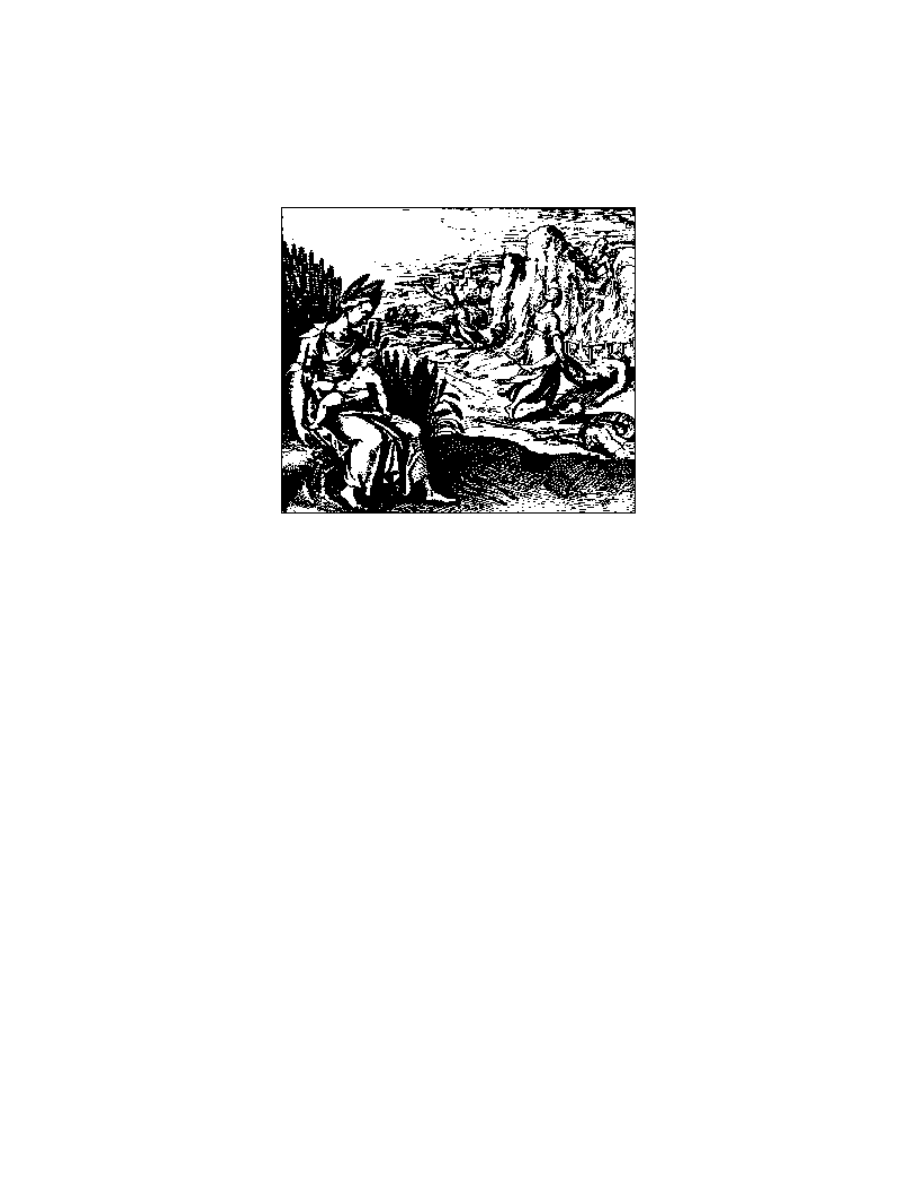
Emblem XXXV.
As Ceres accustomed Triptolemus and Thetis accustomed Achilles to abide Fire, so also doth the
Artist the Stone.
The Discourse:
Lycurgus that Famous Lawgiver of Sparta explained to the people in the Theater by a familiar
instance how prevalent Custom will be, whether it is good or bad. He brought two whelps, both
from one litter, and between them placed a pot full of pulse and a Hare. One immediately left his
Food to follow the Hare because that had been his Custom as well as Nature, the other fell on and
dispatched his porridge because that was what he had been bred to do. Behold, said he, what
Education and early Custom from youth upwards can effect in those whom Nature hath produced
both Equall and alike.
After this manner, therefore, it is convenient to amend and direct Nature to the best things, for she
is pliable as Wax either to Vice or Virtue. What they demonstrated to be true in Politicks, the
Philosophers do agree to be true also in Physicks. The Examples of the whole world show how
custom prevails over Man and Beast, and severall occur likewise in Vegetables, but in Mineralls
and Metallick bodyes we have not so much experience. Neverthelesse it is by much Use and
Custom that the Philosophers fix their Stone in Fire proper for it, and this they declare in
abundance of their Writings. For it must be nourished by fire as a child by milk upon its mother's
breasts. Hence Emiganus says, "Behold the Infant sucking and hinder him not". And Bodillus
says, "The babe being born is nourished by Milk and Fire alone, and by little and little whilst he is
Very Young, and the more he is burnt his bones are strengthened untill he is brought to Youth,
and having attained to that he is able to provide for himselfe." Arnold in the Rosary, Book 2
Chapter 7 says, "Yet the Medicine must be long time roasted by Fire and nourished as a child by
the breast."
The Ancient Philosophers would demonstrate these very things by the Allegories of Triptolemus
and Achilles, and their lyeing under Fires to be hardened by them, since each of them denote
nothing Else but the Chemicall Subject, for otherwise it would be an insipid fable unfit to be
applied to morality and not worthy of the consideration of the learned. Ceres as a Nurse nourished
Triptolemus all day with her milk and at night placed him in the Fires, by which means the boy

being very well grown his Father Eleusius at a certain season took notice of it. Hence Ceres killed
Eleusius and gave the boy Triptolemus a charriot drawn by Serpents, in which he passed through
the Air into all parts of the world and taught Mankind how to sow Corn. Now this Triptolemus is
the Philosophick Tincture nourished by Fire after the same manner, which being carried by
serpents, that is Mercury, taught men how the Philosophers should cast their seeds into the Earth.
These same things are ascribed to Osiris, who went round the Earth for the same reason as we
have demonstrated in another place, and to Dionysus who travelled through the world to teach
men the Use of Wine. For these three, Triptolemus, Dionysus, and Osiris have one design and
office and indeed are one thing, as is likewise Achilles, who was the strongest man that was sent
to the Trojan War. His Father was Peleus, that is the Earth or the Mountain Peleus. His mother
was Thetis or the Goddesse of the Sea or Waters, and from these Achilles was born. But at their
Nuptialls the Apple of Eris or discord was produced which was the first cause of the Trojan War.
Achilles therefore being sprung from such a marriage, no wonder if he be the chief Instrument of
that war. Achilles is likewise said to be hardened by his Mother after the same manner as
Triptolemus was before, and of this we have treated at large in the sixth book of our
Hieroglyphicks.
Therefore the Nutriment of the Stone is Fire, but it is not from thence as some Vainly think that it
is extended into length, breadth, and depth, nor receives increase in weight, for it acquires only
Virtue, Maturity and Colour from the Fire. All other things are Vitalicks and Provision that it
brings along with itself. For when from diverse places its parts are gathered, purged and
conjoined, it has all things requisite for it in itself. Whence this verse of the Philosopher in the
Rosary: "This stinking water contains everything it needs". For from the Beginning to the Very
End nothing that is foreign is added to it, unlesse it be Homogeneous, and nothing is separated
but what is Heterogeneous. But every man ought to take care that he be very well acquainted with
those Dragons that are to be joined to the Charriot of Triptolemus before he undertake any thing,
for they are Winged and Volatile, and if you desire to know them you will find them in the
Philosophickal Dung. For they are Dung and generated from Dung, and are that Vessel which
Maria affirms not to be Necromantick but that Regiment of your Fire without which You will
effect nothing. I have disclosed the Truth to You which I have gathered out of the monuments of
the Ancients by incredible labour and the expense of many years.
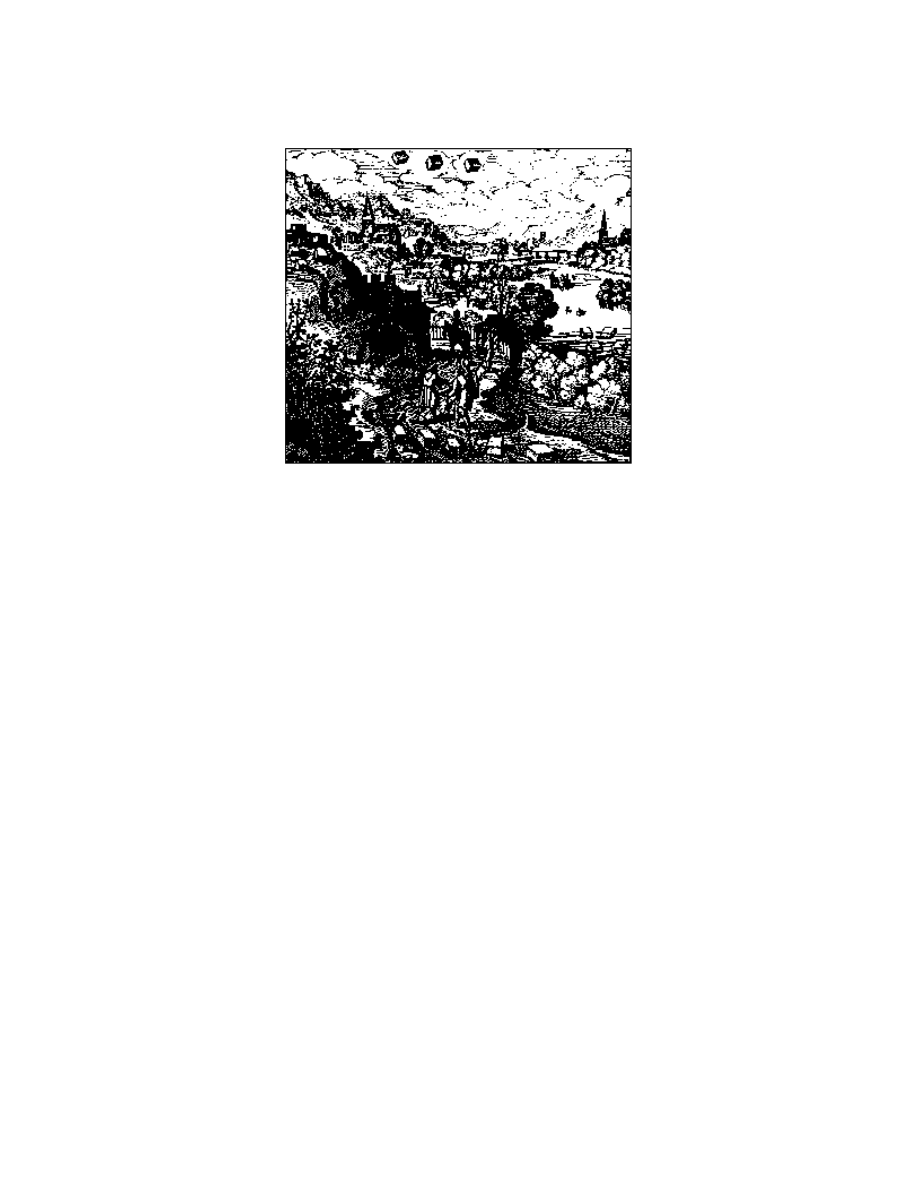
Emblem XXXVI.
Epigram 36:
The Stone that is Mercury, is cast upon the
Earth, exalted on Mountains, resides in the
Air, and is nourished in the Waters.
Discourse 36:
All persons that have once heard of the name or power of the Stone, unless they are altogether
incredulous, ask presently where it may be found, that so they may run directly to it. The
Philosphers answer is twofold: First Adam brought it with him out of Paradise, that is, in you and
in me, and in every man that, birds flying, bring it with them out of far countries. Secondly, it
may be found in the Earth, Mountain, Air and Rivers. Which path therefore must be taken? I say,
both, but in a different respect, although the last pleases us best, and seems most safe.
It is said to be thrown upon the Earth, because the Element of Earth does first appear in an
obscure and black body. Then, because it is vile and of small price, is trod upon in the path of the
Traveller, and in the very dung itself. Hence Rosarius says, " Although I should name it by its
Name, the fools would not believe it to be the Thing. " And Morienus, in his answer to Calis,
" Whither is much of it to be found? " " If this: It is not there unless, as the wise man says, it be
both to the Poor and Rich, to the Liberal and the Covetous, to him that goeth as well as sitteth.
For this is thrown in the way and is trampled on in it's dunghills, that they might extract it to
themselves, but they have been deceived. "
Mundus likewise in the Turba says, " If they who sell it but did know it, they would not sell it so
cheaply. " And Arnoldus affirms that the Stone may be had gratis, in as great plenty as any man
can desire, neither will he be forced to ask for it. All which things are true; for who but a Churl
will deny Earth and Water to him that asks for it? The ancient Cimbri, as history tells us, when
they were denied the benefit of these two things by the Romans, entered Italy with large Armies,
and slew several thousands of the Romans, together with the Consuls. For the Earth as the Mother

of all things, is most precious as it is. The last Matter of things putrefied, is most vile; for nothing
can be viler than mud or dirt, which yet is nothing else but Earth mixed with Water. What is more
common than a Clod of Earth?
But Euripylus, the son of Neptune, offered it to the Argonautical Heroes as a Present, and they
not refusing it, but accepting it gratefully, and Medea having dissolved it in water, divined many
good things by it; for it is necessary that Earth be dissolved in water, otherwise neither one nor
the other will be of any value.
After this manner, the Stone is said to be cast upon the Earth, in which notwithstanding, it does
not remain as a thing abject, but is exalted into the Mountains, such as Athos, Vesuvius, Aetna
and others, that send forth Flames, many whereof are to be seen in diverse parts of the World; for
in these burns a perpetual Fire, which sublimes the Stone and exalts it to the highest dignity. As it
grows in mountains in a rude form, from Sulphur and Argent Vive, so it is perfected and brought
to maturity upon the tops of mountains, where also grows that Herb without which the Fire
cannot be tempered, because this, being cold and moist, and so thrown into the Fire, repels the
vehemence of it by its contrary nature. From the mountains it passes into the Air, where it finds a
habitation. For the Air is its house that encloses it, which is nothing else then that it is carried in
the belly of the wind, and is born in the Air, which ways of speaking we have explained before.
At last he is fed in Rivers, that is: Mercury is fed in waters; and then, as the Athenians celebrated
certain Feasts in his honour, which they called Hydrophoria. For the matter of the Philosophical
Stone is water, as the Rosary saith, and is understood by the waters of those three; for which
reason Mercury is said to have three heads, as being Marine, Celestial, and Terrestrial , because
he is present in the Water, Earth and Air.
He is said to be educated by Vulcan, and given to thievery because Mercury is taught to be
accustomed to Fire, which is volatile and carry away whatever is mixed with it. He gave Laws
and Discipline to the Egyptians, and anciently instituted the religion of the Theban priests, and
the great part of the world besides. For the Egyptians had this policy and sacred rites from
Chemical Institutions, from them the Grecians received them, and lastly the Romans, as we have
in other places abundantly demonstrated.
He slew Argus with a piece of a rock or Stone, and turned Battus into a Touchstone . What need
of many words? All the volumes of the Chemists are nothing else but repetitions concerning
Mercury, and they sufficiently confirm his power by this one verse: IN MERCURIO EST
QUICQUID QUAERUNT SAPIENTES: What wisemen seek in Mercury is found.
Here therefore he must be sought, for ill he may be found, whether he remain in the Air, the Fire,
the Water, or the Earth. For he is wandering, now running hither, now thither, to perform the
Services of the Chemick Gods:
He is their Footman, which is declared to be his proper Office, hence some men ascribe to him a
Daughter called Anglia.
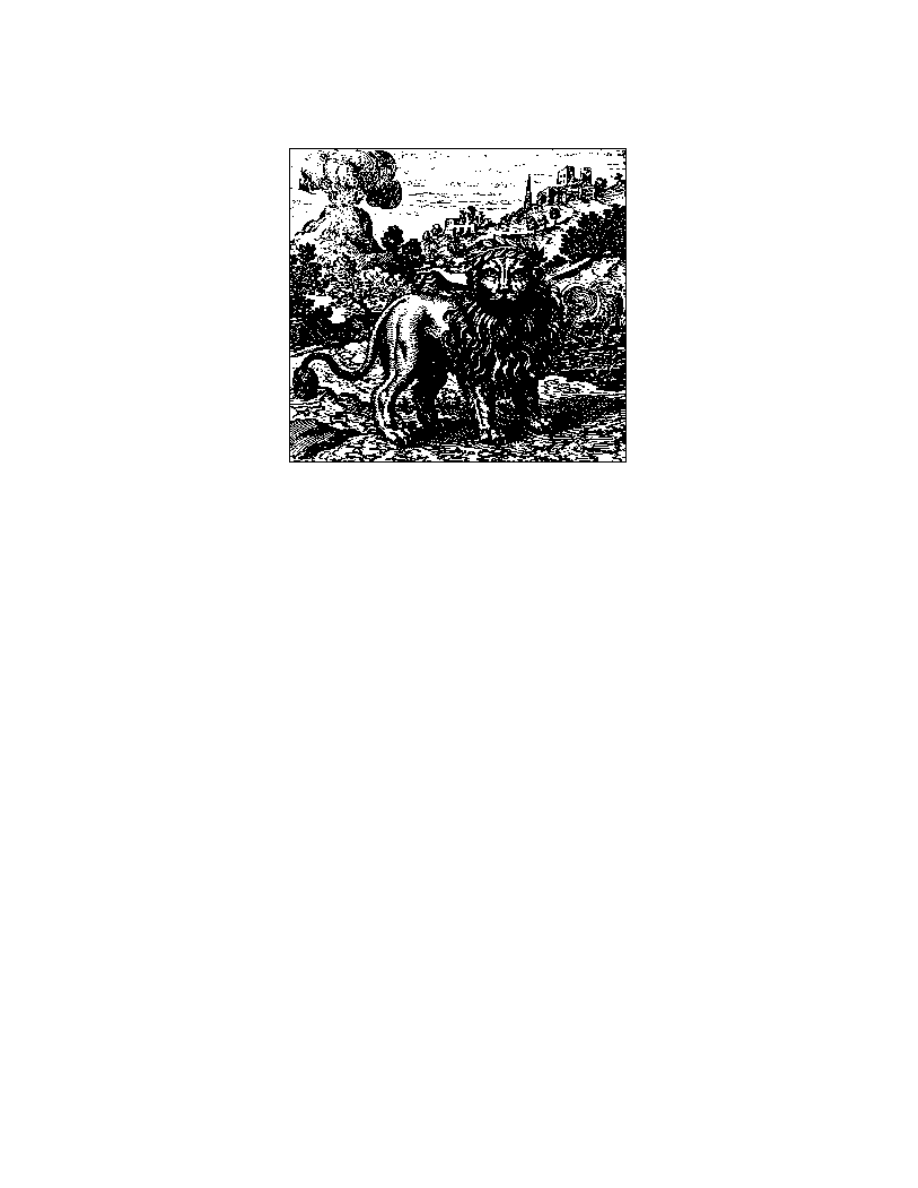
Emblem XXXVII.
Epigram 37:
Three things are sufficient for the Magistery: The White Fume that is Water;
The Green Lion that is the Brass of Hermes; and Aqua Faetida.
Discourse 37:
As there are three things essentially necessary to the building of a Fabric, so that either of them be
absent, there can be no perfection in it, and these are the Foundation, the Walls, and the Roof, so
the same number is requisite for the compounding of the Philosophic compound, which are here
named by their proper names. The author of Aurora, speaking of the separation of the Elements in
his 20
th
Chapter says, " The Earth is left there that the other three Elements may be rooted in it.
For if that were not there, they would have no foundation whereupon they might build a new
repository for their Treasures."
This Foundation is here called Aqua Faetida, which is the mother of all Elements, as Rosarius
declares, from which, by which, and with which the Philosophers prepare It, that is their Elixir,
both in the beginning and in the End.
Their water is called Faetida, because it sends forth a Sulphurous Stink, like that of Sepulchres.
This is the water which Pegasus struck out of Parnassus with his hoof ( which Nonacris, a
mountain of Arcadia, produces gushing out of a Rock at the Top of it ) and can be perceived as
nothing but by the hoof of a Horse, by reason of its most excessive Strength.
This is the water of the Dragon ( as Rosarius calls it ) which ought to be made by an Alembic,
without adding any other thing, in the making wherof there is an extraordinary stink. Some
persons, misunderstanding these words, have betook themselves to the distillation of the Dung of
Man, or other animals, in which operation they perceived a very vehement Stink, but found
nothing else but dung in their dung.

But do not suppose the Philosophers to be Beetles that work in Dunghills, for you must know that
the stink, if it be any, is presently changed into a great Fragrancy, as Lully asserts of his
Quintessence, to which, if it be rightly made, he ascribes so sweet a savour that, being placed on
the top of a house, it allures to it Birds that are upon the wing, and causes them to stay there.
But he places his Quintessence in Dung, by whose temperate Heat the Fragrancy follows. Some
men have tried this with wine, but in Vain, and therefore have accused Lully of vanity, whereas
they were rather to be reproved for their Folly, that never talked of this wine of Lully. But the
Aureus Poeta understood Lully much better when, in the eleventh book of his Chrysopae, he
sings thus, " Give after the Aqua Faetida comes, the Green Lion. " Concerning which, Rosarius
says, " You have sought after Greenness supposing that Brass was a Leprous body, because of
that greenness which it hath, and therefore I declare to you, that whatsoever is perfect in Brass, is
that greenness alone which is in it, because that Greenness is, by our Magistery, suddenly turned
into our most true Gold, and this we have experienced. "
But you can no way prepare the Stone without Duenech, green and liquid, which is seen to spring
in our mines. O Blessed Green that dost generate all Things! For as you know that no Vegetable
or Fruit appears in its Bud without a green Colour, so in like manner the generation of this thing
is Green, wherefore the Philosophers call it the Bud, and so far Rosarius, " This the Philosopher's
Gold and Brass and Stone. " noted in Chapters, " A Fume Vapour and Water "; the Spittle of
Luna, which, joined to the Light of Sol, this Green Lion fights with the Dragon, but is overcome,
and in process of time devoured by him; and the Lion being putrefied, Sweetness is expected to
proceed out of his mouth ( as if had been slain by Samson ), the Dragon getting the upper hand, to
fill himself with the Lion's flesh, and a while afterwards to burst of himself and Die. From which,
seeing the Lion's Fat can daily, by itself, cure Fevers, and make Grace and Favour mutually
spring up between King and People that are anointed therewith, there may be made of it a most
excellent Medicine, which will be most healing in many Maladies.
In the third place follows the White Fume, which if it be coagulated, becomes Water, and
performs the Office of Water, in washing, dissolving, and taking away spots, like Soap. This, the
Fire Against Nature, which take care that you find out, is so called because it is contrary to
Nature, undoing and destroying that which She, with her diligent Care, hath compounded.
This is a Fire not kindled from a spirit of wine, or oil, but from an incombustible matter of Equal
duration and Heat, and is a Fire without Light and combustion, of great Virtue and Efficacy,
which seeing it does not shine, cannot without difficulty be found in the Dark, but it is still more
hard to apply it rightly to the work, whose circumstances and properties we have sufficiently
described in divers places.
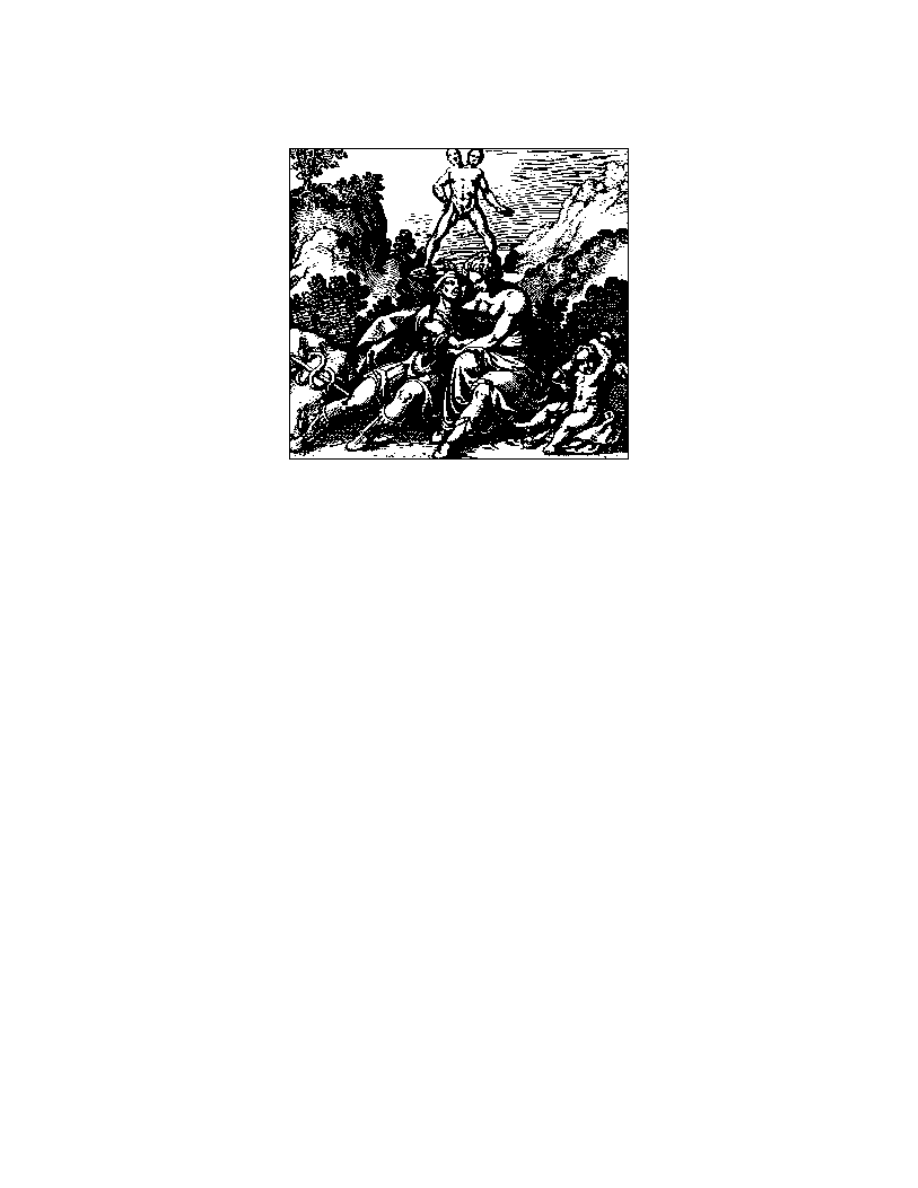
Emblem XXXVIII.
Epigram 38:
Rebis is a Hermaphrodite produced from the two mountains of Mercury and Venus.
Discourse 38:
Socrates being asked what Countryman he was, answered that he was Cosmopolite, or a Citizen
of the World, by which his intention was to signify that, though he was born at Athens as to
person, yet in his mind he could freely run through the whole world, all things contained in it, and
look upon that as his Country. For the wise man that lives well is at home everywhere.
So if any man ask the Philosophers what Countryman their Hermaphrodite is, they answer that he
belongs to the World, or is in all the Corners of the World where the Elements can be found as
being the Sons of the Wise, and consequently has a Country common with them.
But in as one man is not born twice or oftener, nor enters into this light in diverse places, but in
one only, as Socrates the Athenian is acknowledged to have done, so Rebis is thought to be the
Inhabitant of Two mountains, to wit, of Mercury and Venus, from whence the Name of
Hermaphrodite is derived to him, from both his Parents.
His house is Mountainous, and his Country is high, and therefore he exists by things got in a High
place. A Noble and large Country are no small helps towards the performance of great Actions,
for these men are promoted to public offices and need not lie in obscurity, as it happens to
Persons born in mean places, where it is difficult by their proper merit and Virtue, to arise from a
small fortune to be a glory to their Country.
In this manner these mountains, unknown to many men, acquire fame from the Hermaphrodite,
by reason of his Illustrious actions and Name, famous throughout all the world. For who, though
never so little versed in the Books of the Philosophers, hath not heard of the name of Rebis? Who
hath not seen and considered Angrogynus with two heads? His fame has been known even
amongst the Indians, and is dispersed farther than that of Alexander. Many go from far Countries

to see and discourse with a learned man, or one particularly famous for War, or any other Art or
Science. But many more would travel to the Mountains of Rebis if they could know where they
may be found.
Morienus testifies in his book, with what Care and Study he departed from Rome, to make
diligent search after Adfesus Alexandrinus, and at last found him, and is therefore to be
accounted more happy and acceptable to God, in that he had a Living Teacher, and not Dumb
Masters, whereby he might learn and behold this thing which is the Native place of Rebis.
Nor must they use less diligence and assiduity who by themselves, through Reason, and out of
books, would seek for this Country. For though there seem to be some clearness in them
sometimes, yet are they so Veiled and clouded with intricacy and Obscurity, that it is very
difficult to distinguish one thing from another. Wherefore we must cautiously proceed with them,
lest they which are prepared for remedies, may be used for poisons.
They are an immense Ocean, in which expert mariners, sailing by Astronomical Instruments, may
know the Latitude or the Elevation of the Equator above the Horizon, the Magnet showing the
North Pole. But as for the Longitude, or how many degrees they are distant from the first
meridian which is next to the Fortunate Islands, they cannot discover. From whence they are
uncertain in what place they are between East and West. What is therefore to be done?
That which the same Mariners used to do: consult Experience with Reason, and thereby learn
how to determine a long Voyage by particular Signs, Promontorious Islands, and other things that
they may not, for want of consideration, fall upon Sands and Rocks.
But here is less danger if the thing do not prosper, but if it does, these are hopes of greater gain,
than those whose goods and life are all lost in an hour.
Now this mountain of the Philosophical Mercury is not Nonacris, nor Atlas, where sometimes it
is reported to be brought forth, but Parnassus with two Tops, in one of which Hermes, and in the
other Venus. Here also is Apollo and the Muses, and Hippocrene the Fountain of Pegasus, and
Laurels that are always green. It is one mountain in Name, but in reality it is two, as
Hermaphroditus is beheld with two heads and two members in one Body. But what Man of a
Thousand persists in the ascending to the Top of this Mountain? Who does not stop at the bottom
being hindered by variety of Obstacles? Who is there almost that attains to the Middle of it?
Wherefore it is no strange thing if one in Ten thousand undertake these Herculean Labours, so as
to set their Foot on the Top of the Mountain, and enjoy the immortal reward of a Laurel garland.
Which all those that are upright, ducible, and addicted to Learning and Virtue, may receive with
Joy; but that those that are [not] may be deprived thereof, is also much to be hoped for and
desired.
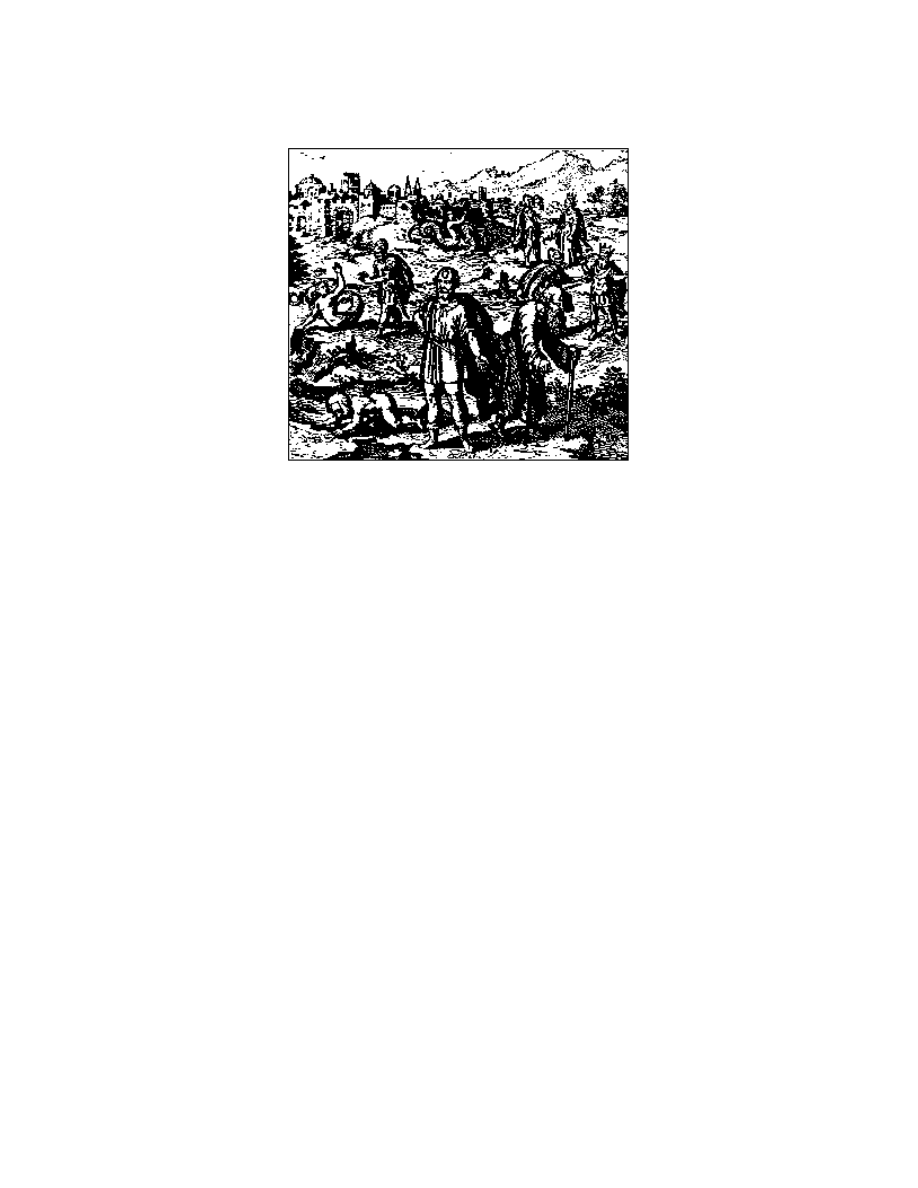
Emblem XXXIX.
Epigram 39:
Oedipus having overcome Sphinx and killed his father Laius, marriedhis mother.
Discourse 39:
Bacasser the Philosopher in the Turba, " That which you seek for, " says he, " is of no small
value, for you seek the greatest Treasure and most excellent gift of God. And learn ye, Students,
that which the Philosophers have longtimes intimated, saying that Truth is not discerned but by
Error, and that nothing begets more grief to the Heart than Error in this work, for when a man
thinks he has done and hath the World, he shall find nothing in his hands. "
The Ancient Philosophers would intimate the same things, under the Emblem of Sphinx, and her
propositions whereby the might set forth the Obscurity amd intricacy of this Art. Hence the
Egyptians, in their Sacra Isiaca, which were celebrated in Honour of Osiris, by mitred Priests with
their heads and all parts of their body shaved, and clothes with a white and linen garment down to
their heels, that these solemnities night not be known or discovered to the common people, they
erected a Statue of Silence, which was called Sigalion, in the front of the Altar, the assistants
being enjoined to keep silence and turn their eyes to that Image. And for the same reason they
added the Effigies of Sphinx at the Corner, which did represent the physical knowledge of sacred
things, as Boissardus does from Ancient writers demonstrate.
For Sphinx is a kind of monster, proposing the most obscure Riddles to the Thebans, and not only
to them, but as she had done before to the Egyptians.
So afterwards to others that aspire to Art, she lies watching in the Philosophical books, as she did
before the gates of Thebes: If anyone pass by the monster, he suffers no harm by it, but if through
the presumption of his Wit and Courage he endeavour to resolve its riddles, and cannot perform
it, he acquires his own destruction which is grief to his heart, and damage to his affairs by his
error in this work.

He that refers the Allegories to true History is utterly mistaken, for they will seem to be childish
and Foolish tales if they be taken literally, but otherwise they are signs and Tokens of profound
learning. ( There are said to be in Africa certain wild beasts that have the name of Sphinx, but our
discourse is not concerning them, though the enigmatical denomination of this fiction seems to be
derived from them. )
The Sphinx of the Philosophers both used and understood human speech, namely the Greek, and
otherwise proposed subtle sentences and enigmatical questions, in which appears a singular
sharpness of understanding and learning, and such as are uncommon to men, from which
consequently, Brutes must be very far distant.
All that are conversant in the assertions of the Philosophers, will easily discover them to be of this
nature. For where one thing is spoken and another thing is meant, there Equivocation will beget
Error, and this not only familiar to the Philosophers, but likewise the City of Thebes, having been
long perplexed with the Riddles of Sphinx, at last one Oedipus appeared, who gave such answers
that Sphinx could not restrain from throwing herself down from a Rock.
But who is this Oedipus? The son of the King of Thebes, who was foretold by an Oracle that he
should be slain by his son, and therefore when Oedipus was born he commanded him to be killed,
who having a Cord run through his feet and hung upon a tree and there left, was freed from
thence and educated by a Countryman. He therefore growing to man's estate, had swollen feet,
but sufficiently declared the quickness of his wit before other men by resolving this riddle which
Sphinx had proposed. Sphinx is indeed reported to have had many Riddles, but this offered to
Oedipus was the chief,
"What is that which in the morning goeth upon four feet; upon two feet in the afternoon; and in
the Evening upon three? "
What was answered by Oedipus is not known. But they who interpret concerning the Ages of
Man are deceived. For a Quadrangle of Four Elements are of all things first to be considered,
from thence we come to the Hemisphere having two lines, a Right and a Curve, that is, to the
White Luna; from thence to the Triangle which consists of Body, Soul and Spirit, or Sol, Luna
and Mercury. Hence Rhasis in his Epistles, " The Stone " says he, " is a Triangle in its essence, a
Quadrangle in its quality. " ( And our 21
st
Emblem and its Exposition relate to the same matter. )
But Oedipus moreover, notorious for Parricide and Incest, which are two of the most detestable
Vices that can ever be thought of, nevertheless they promoted him to a Kingdom otherwise due to
him, he having unawares killed his Father refusing to give way to him, and married the Queen,
the wife of Laius, his own Mother.
But this is not written for History or Example, it being only feigned and Allegorically introduced
by the Philosophers, to discover the secrets of their doctrine. For in this work both these things
happen: For the first Efficient the Father is killed, and thrown out by his effect that is his son, and
afterwards the same Effect couples second Efficient to himself, so long till it becomes one with
him. Thus the Son is joined to his Mother by Matrimony, and enjoys his Father's Kingdom, as it
were by a Triple Right of Arms, Wedlock and Succession.
He has swollen because he cannot run, and is like a Bear as having the Greatest Secret, or a Toad
going with a Slow Pace because it is Fixed, fixing Another, and not flying or dreading the Fire,

which though it be a medium of a Mean repute, yet the Philosophers can by no means be without
it.
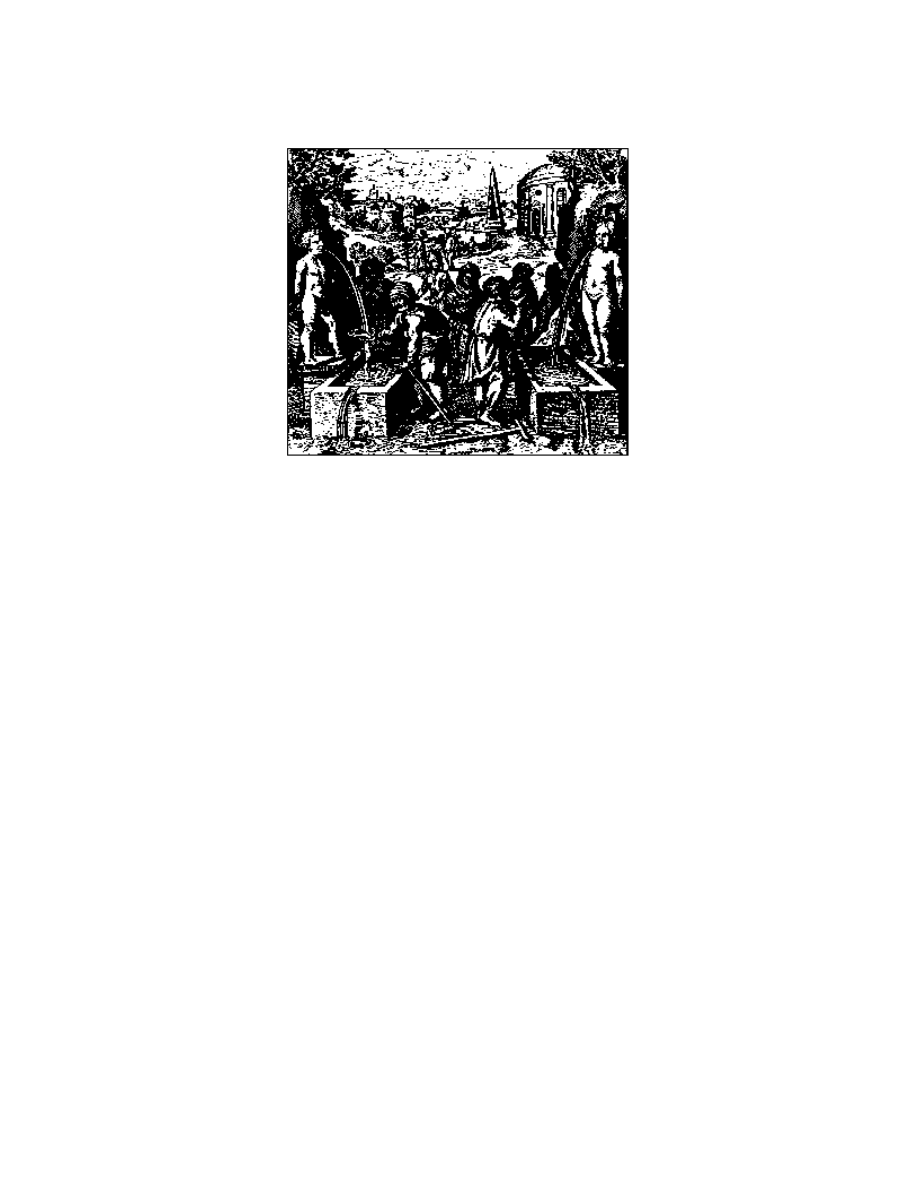
Emblem XL.
Epigram 40:
Out of two Waters make One, and that will be the Water of Sanctity
Discourse 40:
The miracles of water are so great and so many that they can scarce be comprehended in a large
volume, concerning which several Authors have treated up and down in their writings. But above
all there are Two Philosophical waters, which are celebrated with that name, because they do not
only Rival, but also exceed the Virtues and properties of all the rest.
The Rivers Sybaris, Axus of Macedonia, and Melas of Boetia make cattle Black if they drink of
them. But the Rivers Crathis Clitumnus of Mevaenia, and Cephissus, make black cattle White.
The waters of Sinuessa in Campania take away barrenness from both Sexes. The River
Aphrodisius makes women barren. Cabiera, a Fountain of Mesopotamia, hath a Sweet smell. The
water of Anyger, in the Peloponnesus, Stinks very much. The Fountain of Jupiter Ammon is cold
in the Day time, hot in the Night, in the evening and morning lukewarm by Turns; not to mention
many more.
All things although they be contrary one to the other, are performed by the waters of the
Philosophers. Lully speaks of them in his book, " De Quinta Essentia distin: 3 de Inarratione . "
And so there is, saith he, a double consideration in Art, that is, from one Nature of one metal, to
make two contrary liquors in composition: One that has a fixing, congealing and hardening
quality, the other that is Volatile, unfixed and soft. But the second liquor is hardened, fixed and
congealed by the first. From both which liquors there results one Stone, congealed, fixed and
hardened, which hath the Virtue of congealing that which is not congealed, of hardening what is
mollified, of mollifying what is hard. From whence it appears what these two waters are, and why
they are to be reduced to One water. For the Stone is said to be Water because it is fusible, and on
the contrary the water is called a Stone because it is frangible. But these waters are drawn out of
different places, sometimes by a long tract, as may be seen in Rome, by the Aqua Virginis, and
other Artificial Fountains, and then they are to be mixed by the confluence of their water, that
from two may be made one. For if one be of a hot, and the other be of a cold Virtue, when these

are mixed together they will acquire mixed Virtues, and will temper themselves after a wonderful
manner. From hence will arise the most excellent Baths and medicinal Water, which will dispell
all sorts of Maladies and diseases, and restore sound health to mankind.
Nature does indeed by her hidden Artifice of Composition, confound and mingle many waters
with the Virtues of diverse minerals in the bowels of the Earth, which are beneficial to many sick
and infirm persons. But if Art be added to with due Rules, so that not only the Evacuations of
Nature that have been before, but those of Art which are to come before, are totally effected so
that those things which should be mixed are mixed among themselves, the composition will
become far more efficacious. Which although it may seem Artificial, yet is merely Natural
because one simple Homogenous thing is made out of divers, which can never be effected by Art.
Art may cause a mixed use and confusion, but without the help of Nature there can be no true and
natural Union, for that is made by Nature only. In Treacle there is an Artificial mixture of Various
simples, which is made by contrition and fermentation, but no man will affirm it to be a Natural
composition, much less to be an Homogenous Medicine.
As to the Artificial mixture of Substances, it is manifest that the least particles do not enter one
into the other, which cannot be divided and separated again by the Industry of any man
whatsoever.
But as to the mixture of all Qualities, we must enquire whether the first Treacles of all simples
may pass into one Quintessence, or whether they remain still in their first substances or powders,
as they did before as Accidents in their Subjects, or Colours upon a wall. And then what must be
said of the second, third, and fourth Qualities?
It is probable that all Qualities do still adhere to their proper Subjects, and that they are not
compounded among themselves with a true and natural mixture; otherwise if the qualities should
leave their bodies, there would be four Quintessences in every Artificial compound, according to
the number of the Order of the Qualities first, second and etc., that must be without their bodies,
and separable, which thing is not so.
They write of the Coagulation of the Hare's Blood, that in a flux occasioned by thinness of blood
it do stop, and as it were, coagulate, but in coagulation and commixtion it cuts and dissolves the
same, so there are contrary operations of Vinegar, and Lead, and many other things, according as
their Use is diverse, because Nature has mixed them so wonderfully. And thus the Philosophical
water has diverse and contrary Virtues, because Nature by the help of Art, has out of contraries
mixed it into one indivisible Substance, which is nothing else but a Quintessence, in respect of
other things that are to be mingled with it.
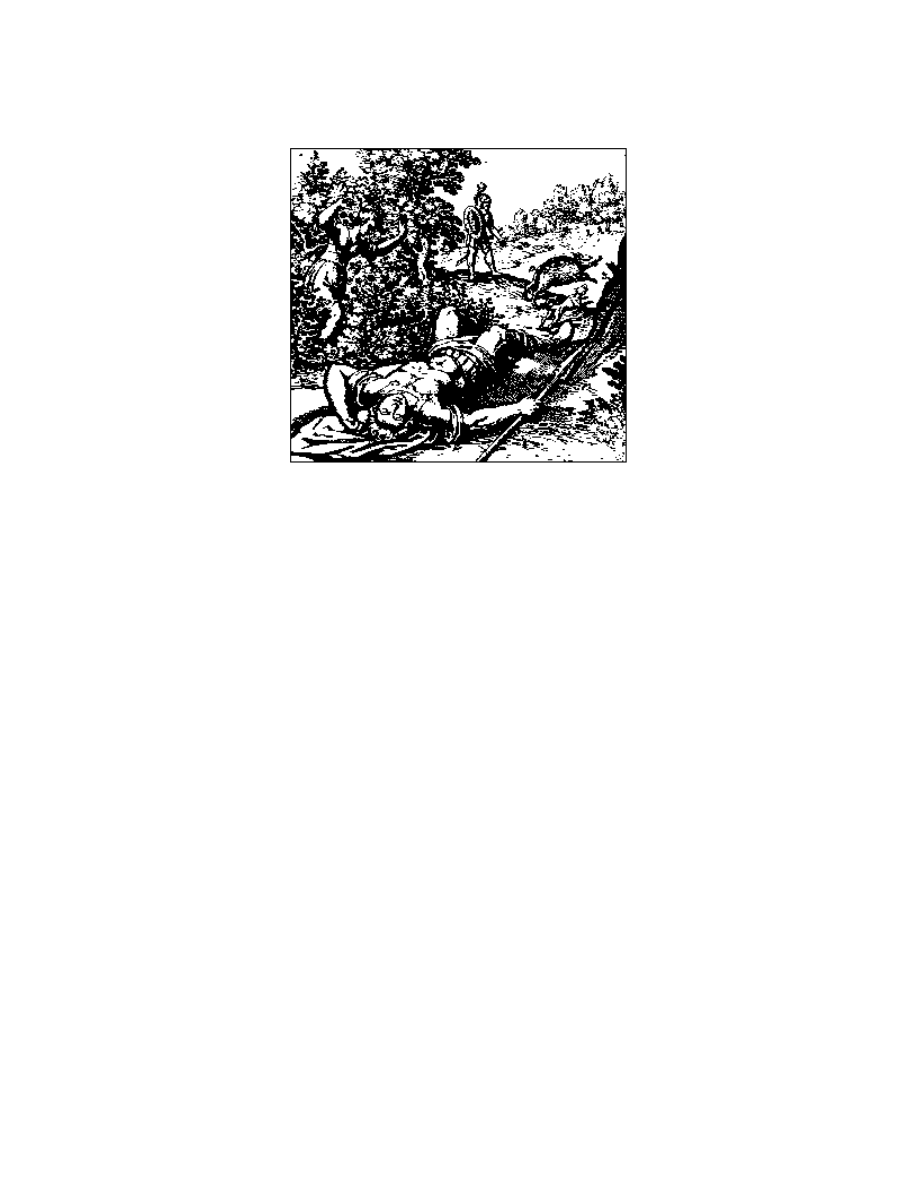
Emblem XLI.
Epigraph 41:
Adonis is killed by a Boar, to whom Venus hasting, tinges the Roses with her Blood.
Discourse 41:
Some of the Mythologists, when they would explain the Allegory of Adonis, say that He is the
Sun, and that the Boar by whom he is slain is the Winter season, Hairy with Frost. Others say that
He is the seed of the Corn, which is six months under the Earth with Proserpine, and six months
above the ground with Venus. But how improperly this is done has been sufficiently shown by us
in other places. For we affirm, and that by universal consent, that by Adonis is to be understood
the Sol of the Philosophers, according to this verse:
OMNIA SUNT IDEM DIONYSUS SOL DYONYSE ADONIS
Dionysus, Sol and Adonis are the same.
And Orpheus:
QUI VARIE CATARIS NOMINE ADONI
Adonis Honoured by a Various name,
GERMINUM ET IDEM AUTHOR PARITER PUER A--- PUELLA
Author of Buds thou art both Maid and Boy.
Now all these things cannot be understood of the Celestial Sun, but may be understood of the
Philosophical one: For this expresses both Sexes, whereas that does not, and so these
Mythologists attribute the same thing to Dionysus and Sol, as they do to Adonis; and on the
contrary and so likewise, to Osiris.

But Adonis is slain by the Boar, ( that is, by the sharpness of Vinegar, or dissolving water, which
hath terrible teeth like a Boar ) and has his members loosened and cut off. But Venus endeavours
to help her Lover; and when He was dead, laid out and preserved him among Lettuces. In the
same manner Osiris is slain by Typhon and cut into several pieces, which Isis the wife of Osiris
gathered up, and having joined them together, buried them. The same Mourning which Yearly
followed the Death of Osiris in Egypt, was also celebrated after the Death of Adonis, in Syria and
neighbouring Kingdoms when, after Weeping and Lamenting for several days together, there
were great expressions of Joy, with Dancing and other Ceremonies, as if he had been Conveyed
into Heaven. From hence arose the Vanity of the Heathen Religion, or Superstition, which was
vastly increased by the Devils who thence took occasion to promote it and to procure false
Miracles.
Adonis was born of Cinyras ( according to the Fable of the King of Cyprus and his Daughter
Myrrhas. ) He is said to be sprung from a detestable Incest, if we look upon the History; but if we
regard the Allegories, it was so far from being unlawful that in fact it was absolutely Necessary.
For in this Art nothing can be perfected unless it be born from a conjunction between the Mother
and the Son, and the Father and his Daughter. For here, by how much nearer in blood, whether in
the First or Second degree of Consanguinity, the married couple may be so much more fruitful
they will prove; and on the Contrary, the farther remote, so much the more barren, which if taken
literally is not to be suffered.
Hence Oedipus married his mother; Jupiter his sister; and so did Osiris, Saturn, Sol, Servus
Rubeus or the Red Servant, and Gabritius.
Sol speaks thus of Adonis, that is concerning himself, in the Metaphor of Belinus, in the Rosary:
" Know ye " says he, " that my Father Sol hath given me Power above all Powers, and Clothed
me with new garments of Glory, for I am his Only Son, and more like my Father, and I divest my
servants from their power and Nature, and clothe them with my Beautiful splendour and Light
which my Father gave me. For I am excellent and do Exalt and Depress all, and none of my
servants is above me, but One, who is permitted to be repugnant and Contrary to me, and to
Destroy me, yet he does not destroy my Nature: He is Saturn, who separates all my parts;
afterwards I go to my Mother who gathers together all my divided and separated members. I
Illuminate all those things that appertain to One, and cause Light to appear openly in the way
from my Father Saturn, and also from my mother who is an Enemy to me. "
These words are so clear that they may dispel any Darkness that is before the mind of a person,
never so little versed in Reading, who may behold the agreement that there is between Things and
Persons. For truths, although hid under the Veils of Allegories have a wonderful consent among
themselves, whereas those things which are false are repugnant and inconsistent, both in
themselves and in others.
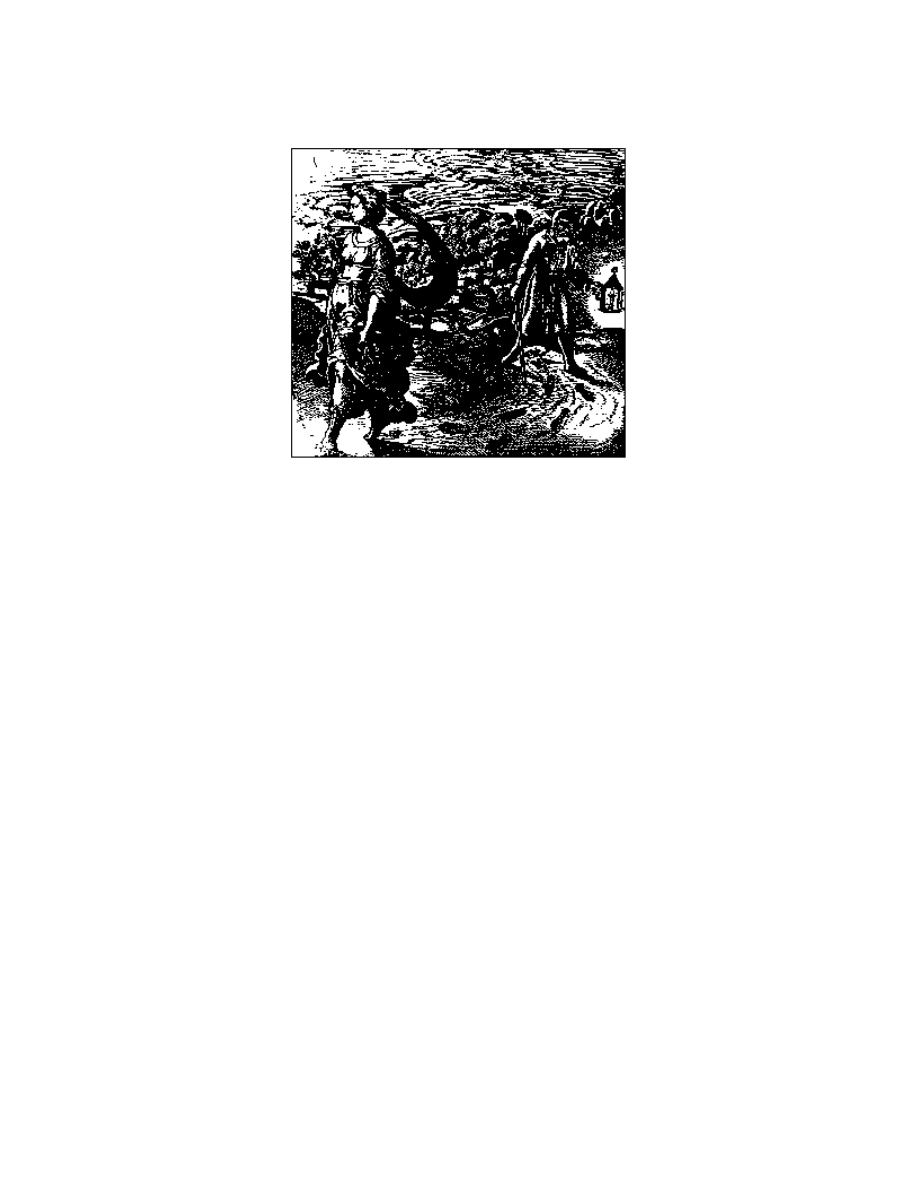
Emblem XLII.
Epigraph 42:
Nature, Reason, Experience and Reading must be the Guide, Staff, Spectacles and Lamp to him
that is employed in Chemical Affairs.
Discourse 42:
There are innumerable accidents which may happen to Travellers, especially if they are to walk in
the night time through dangerous and slippery places. But besides Provisions and Strength of
Body, there are four things that are extremely necessary: In the first place a Skilful Guide or
Companion, for if the ignorant lead the ignorant it may happen either as to the Blind that they
may both fall into the Ditch, or at least they both may run into difficulties and Errors. In the next
place, a Staff, by which a Remedy may be provided against the slipperiness of the way. Thirdly,
good eyes, for else the way is almost as dangerous to those that are dim-sighted as to the blind.
Fourthly, a Lamp or lighted Torch, by which several obstacles may be avoided, so that if any
Person applies himself to the search of the Philosophical Medicine, besides strength of Body, and
Money sufficient for his expenses, there are four other things requisite, to wit: Nature, Reason,
Experience and Reading; for if any of these are wanting the others will be of little prevalence. For
these are the four Wheels of the Philosophical Chariot, for which one of them cannot be wanting,
and if it be left out it avails nothing.
Nature presupposes Natural Bodies; and Spirits as the Subjects; first ministered by Nature, upon
which Art may afterwards exert itself by Preparing, Purifying, and rendering them Capable of
having that produced from them, which Art proposes for its end. So the Potter takes Earth and
Water; the Glassmaker ashes and Sand; a Smith Iron, Brass, Lead, Tin, Copper, Silver and Gold;
a Tanner raw Hides; and so other Artists take other things.
The Chemist has regard to his Materials; theirs are known to them the very first day, but when he
Begins, his are utterly unknown to him for many years, and perhaps for his whole life. Nature
does indeed lay its finger upon the matters; but there are many things which obscure the
impression of Nature, that it cannot be known.

Therefore the first intention must be to intimately contemplate Nature and to see how she
proceeds in her operations, to this end that the natural Subjects of Chemistry, without defect or
superfluity may be attained to. From whence let Nature be thy Guide and Companion of so great
a journey, and follow her Footsteps. In the next place, let Reason be like a Staff which may keep
the feet steady and Firm, that they may not slip nor Waver; for without reasoning, any person will
be apt to fall into Error. Whence the Philosophers say, " Whatever you hear, reason upon it,
whether it can be so or no. "
For no man is forced to believe or Act Impossibilities, unless he be of a Weak memory, Dull
genius, and foolish Imagination to impose upon himself by taking false thing for True, and
rejecting true things as False. They say likewise that they take no care of the Words that are said,
but rather of the Things as they may be Understood; and that words are for Things, and not things
for Words. As for example, if any man should ask if Glass may be made malleable by the
Philosophical Tincture? Well, why should I not believe it, provided reason vitiates it?
Thirdly, Experience will be as spectacles by which things may be seen at a distance. These are
Optic instruments invented and made by Art, to help and amend the weakness of men’s eyes. Not
unlike these are all Experiments of every kind, that have been tried about the Mineral matter,
whether seen or truly related, and the more these remain in the Memory the more will be drawn
from thence by a man of Reason, who will compare them with themselves, and other things, that
he may see what is truth, and what is not.
Fourthly, Reading does as it were, kindle a clear Lamp in the Understanding, without which there
will everywhere be darkness and Thick Clouds. But the reading of Good Authors ought to be
often repeated, otherwise it will not be profitable.
Kenar Bacassar in the Turba saith, " He therefore that is of an even Temper and exercises
Patience without regret, will go in the right path of this Art. But he that thinks himself able sooner
to reap benefit from our Books, is deceived, and it had been better for him not to have looked into
or touched them.
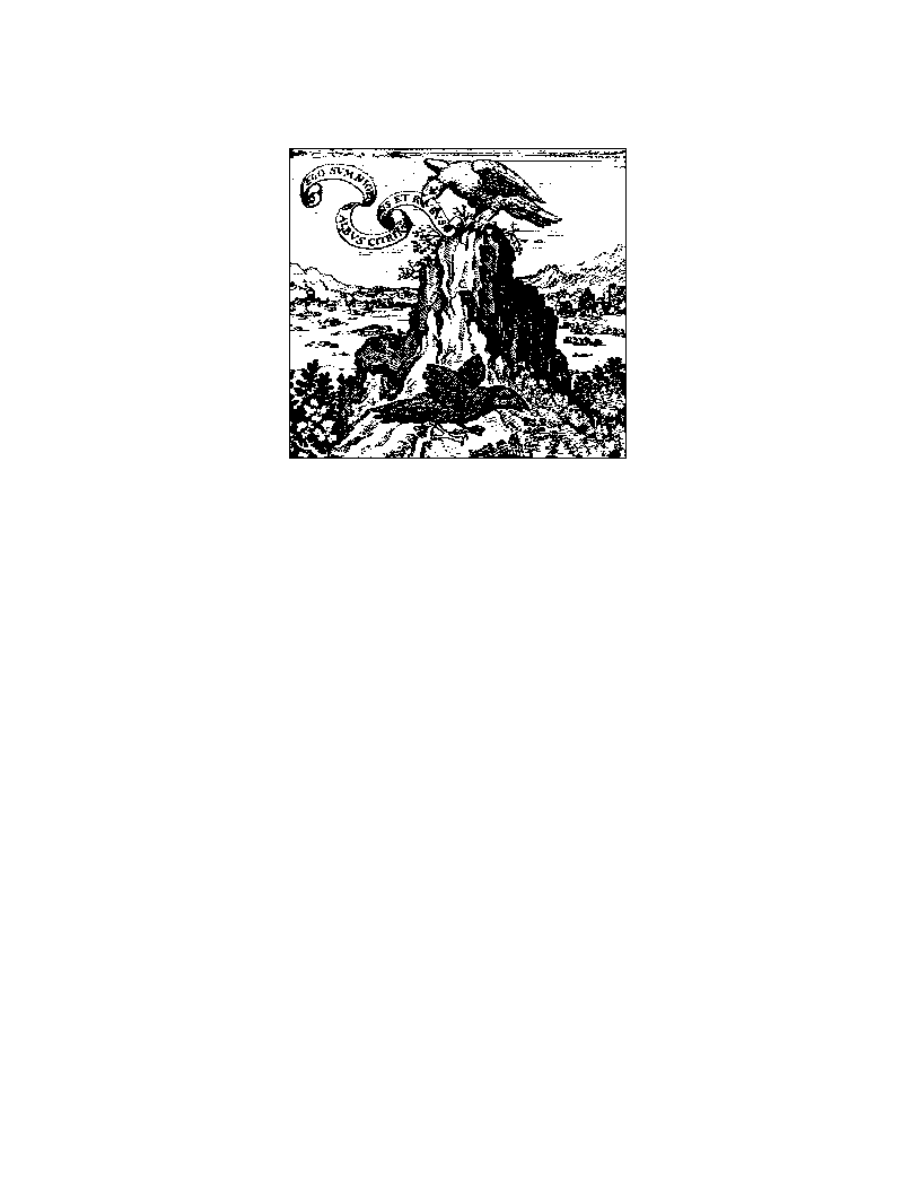
Emblem XLIII.
Epigraph 43:
Give ear to the Vulture’s words, which are in no wise false.
Discourse 43:
We daily in many places hear Birds such as Parrots, Ravens, Daws and Pyes that prattle and
imitate a Human Voice. Pliny writes that at the same time that he published his History,
Agrippina the wife of Claudius Caesar had a Thrush that could speak, and that the young Caesars
had a Starling and Nightingales that were accustomed to the Greek and Latin tongues, and daily
spoke new things in a long thread of words or sentences. But in as at this time such Birds are
more frequently to be met with, they are now less wondered at, for use and Custom will make any
Birds capable of speaking, if their Tongues are more broad than ordinary.
But that Vulture which the Philosophers mention, has not learnt his words if he utters any by use:
His own Nature expresses them tacitly. But the Philosophers say that he continually cries out with
a loud voice, who and What he is, in which he imitates great Princes, who in the beginning of
their public pronouncements will always make known what are their inheritances and Titles; not
out of Pride, but that others, ( as well as themselves ) may know what Principalities they govern (
or what rights of Inheritance they pretend to. ) So it is very necessary to know what colours as
Ensigns of Arms and Titles the Philosophic Bird enjoys, and wherein he excels all others.
" I " saith he ( as the Rosary hath it from Hermes ), " am the Black of white and the Citrine of
Red. " And such he really is: For though he doth not as yet actually possess these last Colours, yet
he expects the Inheritance of them. Hereupon saith Rosinus in his book Divinarum
Interpretationum, " Take " saith he, " the Stone which is Black, white, Red Citrine: That
admirable Bird which flies without wings in the Darkness of the night, and in the Clearness of the
day. " For Colouration is taken from bitterness existing in his Throat; but more water is taken
from his Blood, as Alexander saith, " Take O my Son the Stone of four Colours. " The books of
the Philosophers do abundantly declare that the Stone has all these colours, which are
Principations in a successive order.

But it may not be improper to declare why the Philosophical Subject is called a Vulture: Those
vultures which are Black, have most Force and are rapacious, but they fly slowly because of the
bulk of their bodies. They say this bird conceives without the help of the Male, and generates
without coition, and their offspring arrive to a great age; even an hundred years. They build in
high Rocks, and no man has touched their nests. Seldom more than two of their Young ones are
seen. They are an assistance against Serpents. They conceive by the East Wind. When they begin
to lay Eggs, they bring a thing out of the Indies, which as a Nut has something within it that may
be moved, and forthwith yields a Sound, which when they have applied it to themselves they
produce many young ones, but one only remains, which is called IMMUSULUS. We have the
testimony of Hermodorus Ponticus in Calius, that Vultures are the most innocent of all Animals
because they touch nothing that Mankind sows, plants or feeds; besides, they kill no living
creature. They abstain from birds, though dead, by a certain instinct of Affinity. For this reason
they were accounted the Signs in Divination, as the Foundation of the City of Rome may declare.
The Philosophical Bird, expressing almost all these Qualities of the Vulture, is therefore not
undeservedly called a Vulture by Hermes and others. He is slow in flight and of Colour Black. He
conceives from himself ( for so Rosarius towards the End . ) And he is the Dragon who marries
himself and impregnates himself and brings forth in his own Season. And Rosarius to Sarratanta,
" And that is the Serpent, Luxuriant in itself, impregnating itself, and bringing forth in one day. "
It lives and endures a very long time, and multiplies itself. For what Virgil writes concerning the
Phoenix agrees likewise to this, for it is the same Bird.
It is very difficult to climb the nest of this Bird. It fights with the Mercurial Serpent, and
overcomes it, that is Sol. With Luna it is conceived by the wind and carried in its belly, and born
in the Air. The Stone Aetites, containing within it the little stone sounding, is by many men called
Totium. One only IMMUSULUS is found in the nest of the Philosophers. The Philosophic Bird is
also most Innocent because it hurts no body; it is beneficial to all that know it, and most excellent
in Divinations.
But does he make a Nest on the mountains and sitting there cry out? Rosinus according to Rhasis,
gives this answer, " Contemplate the Highest mountains, both those on the Right hand and those
on the Left, and climb up thither. There our Stone is found, and in another mountain which
produces all sorts of Printer's colours, and Spirits or species, there it is likewise. " Likewise
Morienus says, " Ascend the High mountains covered with Trees, because there our Stone is
found and hidden. " And Hermes says, " Take you the Blessed Stone and break it to small pieces,
and wash the Red Stone from which is extracted that which is found in Mountains, and Especially
in old Sinks or Shores. "
Emblem XLIV.
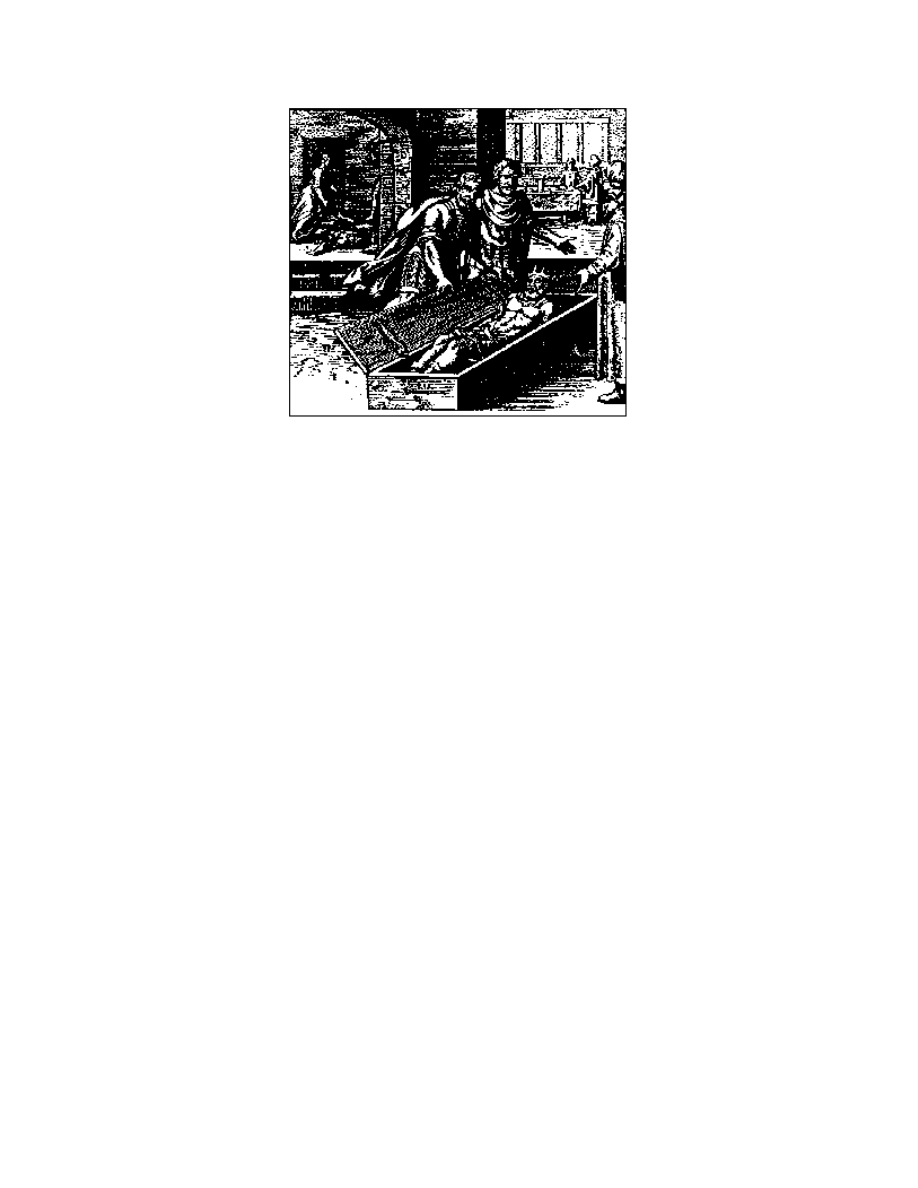
Epigraph 44:
Typhon kills Osiris by deceit, and disperses his limbs. But the famous Isis gathered them
together.
Discourse 44:
In the first book of our Hieroglyphics we have fully explained and reduced the Allegory of Osiris
to its true Original, which is Chemical. And though we shall not repeat that, yet we shall make a
discourse parallel to it, whereby we may retain Osiris within the bounds of Ancient Chemistry, all
which has been so often sung of and figured out by the Ancient Poets. For you can never possibly
persuade me that Osiris was a God, or a King of Egypt. For to me the contrary to both seems
apparent from several circumstances. He is indeed the Sun, but it is the Philosophical one. Now
that name being often attributed to him, the Vulgar who read it, and knew of no other Sun but that
which gives light to the World, interpreted it in that sense.
The Sun of the Philosophers has its denomination from the sun of the World, because it contains
those properties of Nature which descend from the celestial Sun, or are agreeable to it. Therefore
Sol is Osiris, Dionysus, Bacchus, Jupiter, Mars, Adonis, Oedipus, Perseus, Achilles, Triptolemus,
Pelops, Hippomanes, Pollux. And Luna is Isis, Juno, Venus the Mother of Oedipus, Danae,
Deidaneira, Atalanta, Helena; as also Latona, Semele, Leda, Antiope, Thalia. These are the parts
of that compound which before the Operation is called the Stone; and by the Name of every
metal, Magnesia.
After operation it is called Orcus, Pyrrhus, Apollo, Aesculapius. The Adjuncts are Typhon,
Python, the Boar. The Artists are Hercules, Ulysses, Jason, Perithous. And the labours and
dangers which those Artists underwent were innumerable. We may see the Labours of Hercules,
the Errors of Ulysses, the Dangers of Jason, the Endeavours of Theseus, the Remorse of
Perithous. This is the great volume of Matter and Doctrine, through which in every page, Saturn,
Mercury and Vulcan do often occur: The first as Father of all, the Cause without which nothing
can be effected; the second as the matter or form; the third as the Efficient. Sol takes Luna his
Sister to be his wife, Jupiter takes Juno, as Saturn Rhea, and Osiris does Isis. Dionysus is
snatched out of his mother Semele, who was burnt by the thunder of Jupiter, that so he may come
to maturity in the thigh of his Father Jupiter. Aesculapius from his Mother Coronis; Dionysus

being grown up shows men the Use of Wine, making an Expedition as far as the Indies; Osiris
and Triptolemus that of Corn, and how to sow it; and Aesculapius that of Medicine. The Greeks
call him Dionysus, the Latins Bacchus, the Egyptians Osiris, and the Syrians Adonis. Oedipus
killed his Father and married his Mother. Perseus slew his Grandfather; Typhon his brother
Osiris; and the Boar, Adonis; Ceres the Nurse of Triptolemus, his Father Eleusiris. Hippomanes
overcame Atalanta by a Golden Apple; Tantalus the father of Pelops, obtained Hippodamia by
overcoming her in a race of Chariots. Osiris being cut in pieces, was joined together again by Isis,
his mother, sister and wife. The child Pelops was boiled and dressed, his shoulder eaten by Ceres
and again returned to life, an Ivory shoulder being added to him. Achilles and Triptolemus were
put under coals of fire by Night, and in the Day time nourished by milk; one by Ceres his nurse,
the other by his mother Thetis. Achilles and Helena were the Causes of the Trojan War: She as
the Impulsive, he as the Efficient cause. Helena was hatched from an Egg, and at the Nuptials of
Peleus and Thetis from whom Achilles descended, that apple of Eris [Discord] which was the the
first cause of the Rape of Helena, was thrown about. Pollux was assisting to the Argonauts, who
are supposed ( if ever they lived at all ) to have lived at least fifty Years before the Trojan War
began, and both he and Helena were produced out of one Egg, therefore Helena was an old
woman when she was ravished by Paris. Medea when an old woman, and without a tooth in her
Head, was married to Achilles in the Elysian Fields ( unless she restored youth to herself, as she
did to Aeson the father of Jason, and as Ceres did to Pelops, for which reason he is said to have
been twice Young. ) Perseus received a flying Horse from Pallas, and in recompense brought the
head of Medusa to Her to whom Mercury gave a Scymiter, and the rest of the gods other
Weapons. Ceres gave Triptolemus a Chariot with flying Dragons. When Pallas was born of the
Brain of Jupiter, and Sol was in conjunction with Venus, it rained gold at Rhodes. And Jupiter in
the form of a golden Shower lay with Danae, as a Swan with Leda; as a Cuckoo with his Sister
Juno; as a Bull with Europa; as a Satyr with Antiope.
And so there is a concord in them all.
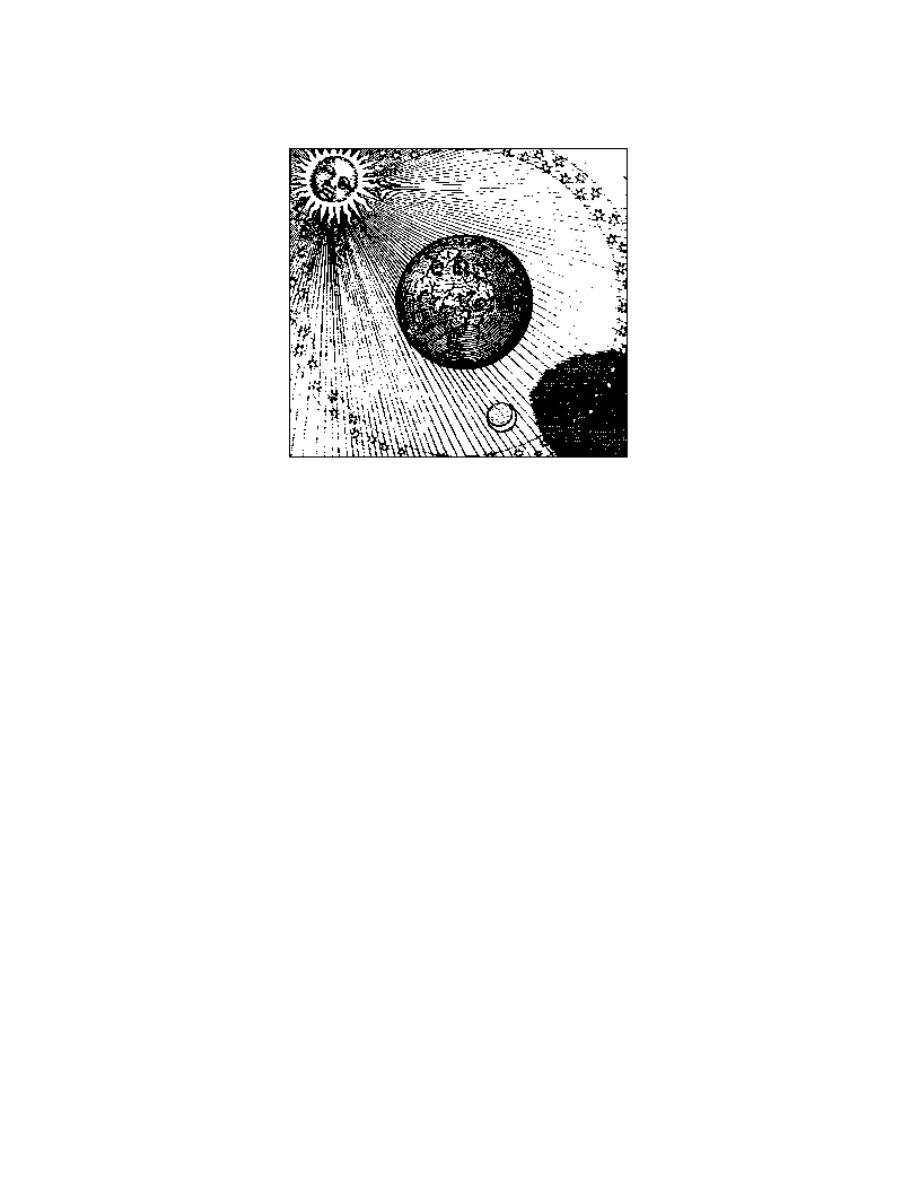
Emblem XLV.
Epigraph 45:
The Work is perfected by Sol and his Shade
Discourse 45:
As a light kindled in a Round or Spherical Palace enlightens all the wall above or below, except
where some Table or utensil in the middle obstructs its influences, so likewise the Sun being
placed in the vast Arch of Heaven illuminates with its Rays all the concavity of Heaven, and
those Bodies which are contained in it that are Diaphanous and capable of receiving light; that is
all the Stars, both the Wandering and the fixed, except where the Thickness of the intermediate
Earth prohibits it. For there a black shade or Darkness, which is called Night, remains so long till
it is driven away by the Sun, and light is poured out and beheld in its stead. Shade therefore, or
Night, is the Privation or absence of Solar Light, and Day on the contrary is the irradiation and
Circumfusion of it. Shade is that which cannot endure the aspect of the Sun, and therefore
absconds itself, and avoids it, sometimes in this, sometimes in another part of the Earth,
according as the Sun is in opposition to it. The Sun and Shade never yet saw one another,
although if Nature would admit it they might do it every moment. But the Sun considering her as
an Enemy to himself, always pursues her whilst she flys so that he can never weary her so as to
overtake her, as Buchannan says in his Book of the Sphere. After the Image and example of that
great Sun and his shade, the Philosophers have observed that their Sun likewise has a black
cloudy flying shadow. Hence Hermes saith, " My son, extract its shadow from the Ray. " That is,
see that you bring your Sun round about by the Primum Mobile over which Vulcan presides, that
that part of the earth which is now covered with a shady night may enjoy the clear light of the
Sun. For if the whole Firmament of Heaven, with all that is contained in it, were not carried round
in each Natural day, that is in the space of four and twenty hours by its first motion, but the Sun
should move by its proper motion, which is called the second or annual one, those Antipodes who
are below us would have night for almost the space of six months, and we in the meantime should
have daylight, and so on the contrary so that the whole Year would consist of One day and One
night, as it is now under both the poles as Reason and experience shows us. But it hath pleased
Divine Providence to order it otherwise, which therefore ordered Two motions of the Planets: The
first and second, and so distributed the Year into many days.

Now the Shade and the Sun do together make a day and night, which the Sun by itself alone could
not do. It is its property to Illuminate all Bodies and places that are opposite to it, but it is by
accident only that its absence makes a Shade. So also the Philosophical Sun with its shade make a
day that is Light, and Darkness or night. To wit, Latona or Magnesia, whose shade ( as
Democritus says in the beginning of the 3 books of his Mensa Aurea ) must be semeted and burnt
up by a Fiery Medicine.
The use of Shadows in Astronomy is so great that without them that Science can scarce be
accomplished. It is to shade likewise that the Chemist ascribes the perfection of his Art. For what
is this Sun without a Shadow? The same as a Clapper without a Bell, that indeed makes the first
motion to a sound; that is the Quill, this the Instrument of Music; that the Tongue, this the great
Mouth . A Shade is the most contemptible thing, and next to having no Being. So also the
Philosophers shadow is a thing Black; blacker than Black as they call it, or viler than a Weed, (
not in respect of itself, but in the opinion of men and the plenty of it. ) What more useful than
Fire? More precious than Water? More amiable than Earth? Which yields flowers and all things
that are lovely? What more delightful than Air? Which if it once be obstructed will make all
things cease to be pleasant, but because in their Vast spheres they are exposed to the common use
of mankind by a preposterous imagination, they are thought to be of no value. In like manner both
the common and Philosophical shade are disesteemed. They who have lived long in subterranean
shades, lose their eyesight if they are brought suddenly to the clear light of the Sun; so they who
remain and work only in the Philosophical shade, and do not join the Sun to it are deprived of
their judgement, which is the guide of their mind, and so can bring nothing to effect.
When the Celestial Sun is elevated to the Height of Noon, the Heat is greater and the Shadows
less, so here when the heat is mirrored the shade is less, and likewise on the contrary. We must
therefore begin when the Sun from the Meridian call side bends itself again to the Top of our
Head in Capricorn, and the first operation even to Aries will be finished. There begins the work
of Women even to Leo, and afterwards Labour proceeds from Labour, till the Year as a Serpent
takes hold of the Tail with the Head; that is to say, is completed.
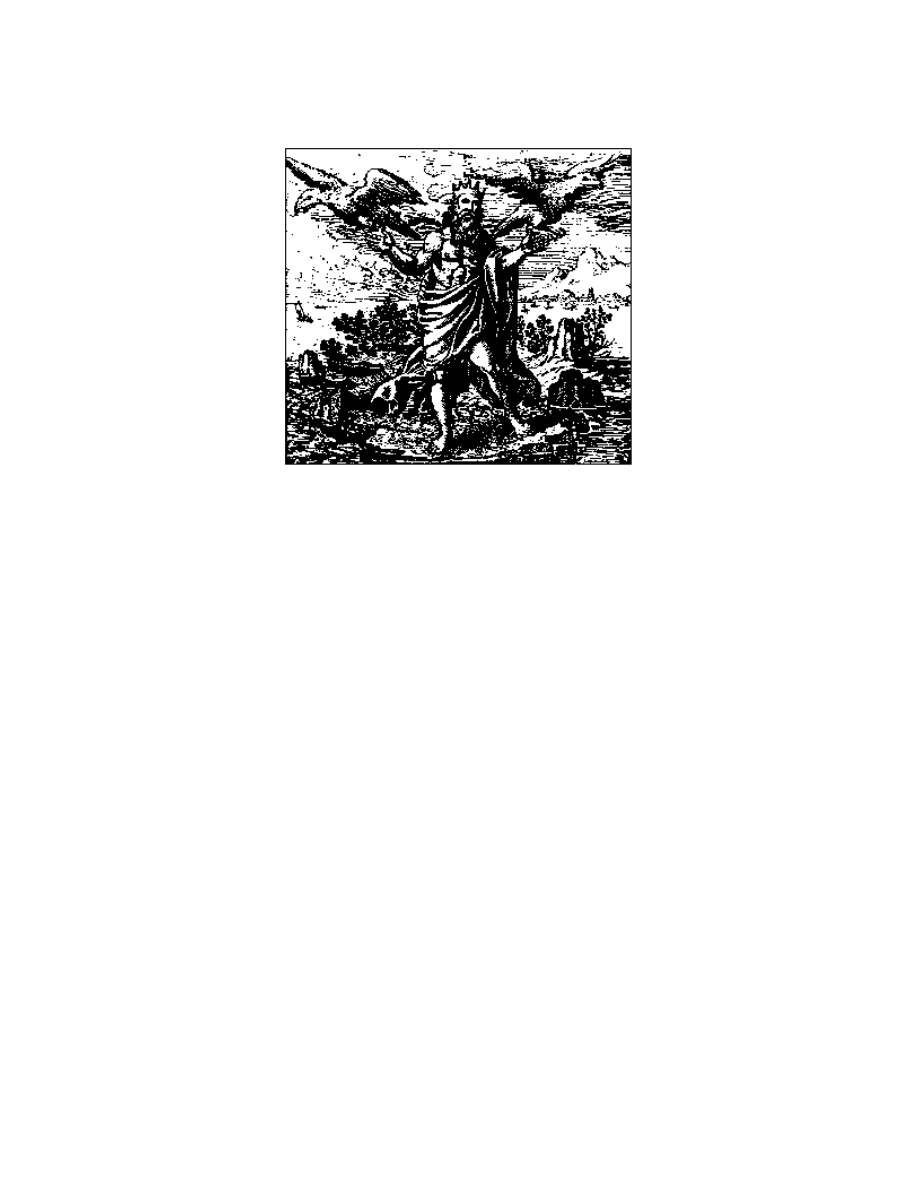
Emblem XLVI.
Epigraph 46:
Two Eagles come together: One from the East, and the other from the West
Discourse 46:
Ciaro, in his book of the Nature of the Gods, declares the most Ancient Apollo to be the Son of
Vulcan, the Defender of Athens; which opinion is very true, when as it ought to be, it is
transferred to an Allegory. For Vulcan produces the Philosophical Sun which is Apollo. But the
opinion of his being the son of Jupiter has prevailed. For when Latona has twins in her womb,
that is Apollo and Diana, which she had conceived by Jupiter, Juno being jealous, sent Python, a
Serpent of a Vast magnitude, to persecute and Vex her whilst she was with child. The miserable
woman, after many and tedious wanderings, was at length carried by a ship into the Island of
Ortygia, to her sister Asteria, who governed these and that Island, being almost wholly overflown
with the Sea; yet afforded place for Latona whilst she was in Travail; from whence it was called
Delos or, " Manifest ", which before was, [here a word in Greek] or " Not manifest. "
There she brought forth her children: The first that came forth was Diana, and she did the office
of a Midwife to her Mother, who laboured in the birth of her brother Apollo. From whence it
came to pass women in Travail call upon her Deity by the names of Diana, or Ilithyia, because
she shows Light to Infants newly born, their Eyes being opened. Apollo therefore being born and
grown up, slew Python the Tormentor of his Mother, with his Arrows. He likewise slew the
Cyclops, because they made Thunder for Jupiter to destroy his Son, Aesculapius: For it was with
Thunder that Jupiter struck him down to Hell because he had restored Hippolitas to life, that had
been torn in pieces by Horses.
That these things are merely Chemical we have demonstrated in many places. For Latona,
Cynthia, Apollo and Python are requisites of this Art, which have such relations one to another,
as have been declared before. For these same things, being divulged in the Writings of the most
Ancient Poets, as Orpheus, Linus, Museus and Homer, they gave occasion to the Ignorant to
ascribe religious worship and Veneration to Apollo, and to erect Innumerable Temples to him,

both in Europe and Asia. But that which was most celebrated was at Delos, where there was a
Vast number of Statues made of Solid gold and silver, of great weight and Artifice, being there
espoiled by many Kings and Princes, with other most precious gifts [which had been] presented
by all sorts of persons out of their peculiar devotion.
Pausanius relates that there was a Bronze Skeleton of admirable workmanship hung up at the Top
of the Temple by Hippocrates. There was likewise that famous Tripos, which Mulciber made and
gave to Pelops, that was afterwards consecrated to Apollo by Pelops, when he married
Hippodamia, the Daughter of Onomeus, King of Elis. This was erected in the middle of the
Temple where Pythia, sitting upon it, received the Inspiration of the Devil breaking forth from a
profound Hollow, and being filled with it, prophesied and gave answers to those who enquired
after the events of things to come. Delphos was seated near the foot of Parnassus in Boetia; not
far from the Temple was the Divining Fountain named Cassietis, which extinguished such
burning Torches as were brought near it, but if they were removed afar of, they suddenly took fire
and were rekindled. The water of the same fountain gave a power of prophesying to such as drank
of it, but then their lives were shortened by it. There being a concourse therefore from all parts of
Europe and Asia to the Delphic Oracles, the Poets feigned that Parnassus was in the middle of the
Earth, and that they proved by an example of Jupiter, who had made experiment of it by sending
forth two Eagles. But this thing not being supported by the Credit of any History it may not be
repugnant to the Truth to ascribe it to Chemical matters, especially in as Apollo, in all his
Circumstances and his Original, has before been declared to be Chemical; although afterwards the
Devil confirmed the superstition of men, and under that Name gave forth Prophesies.
The two Eagles are two Stones, one of which comes from the East, the other from the West, as
the Philosophers have many ways demonstrated. Jupiter has sent them forth as his Ensign-
bearers. The Eagle seems indeed to be the Friend of Apollo, or Sol, because she proves her young
ones by the Sunbeams, and disowns those as illegitimate who cannot endure them. Its feathers are
reputed not to putrefy, although mixed with other things, and that they devour the feathers of
other birds, and that they easily admire of being gilded. It does not die of old Age or sickness, but
of Hunger. For the upper part of his Beak grows so crooked that he cannot feed himself, which
having cast off, he plunges himself three times in a fountain, and is said by these means to be
restored to Youth again. Hence the Psalmist says, " Thy Youth shall be renewed like that of an
Eagle. "
This of all birds is never affected with Thunder. It has war with the Dragon who therefore hunts
after its Eggs. All these endorsements of its Nature have given occasion to the Philosophers in
their Art, to extol the Eagle and liken their Stone to it. There are innumerable Examples of this
Kind in their Books, which at present we Shall not Mention.
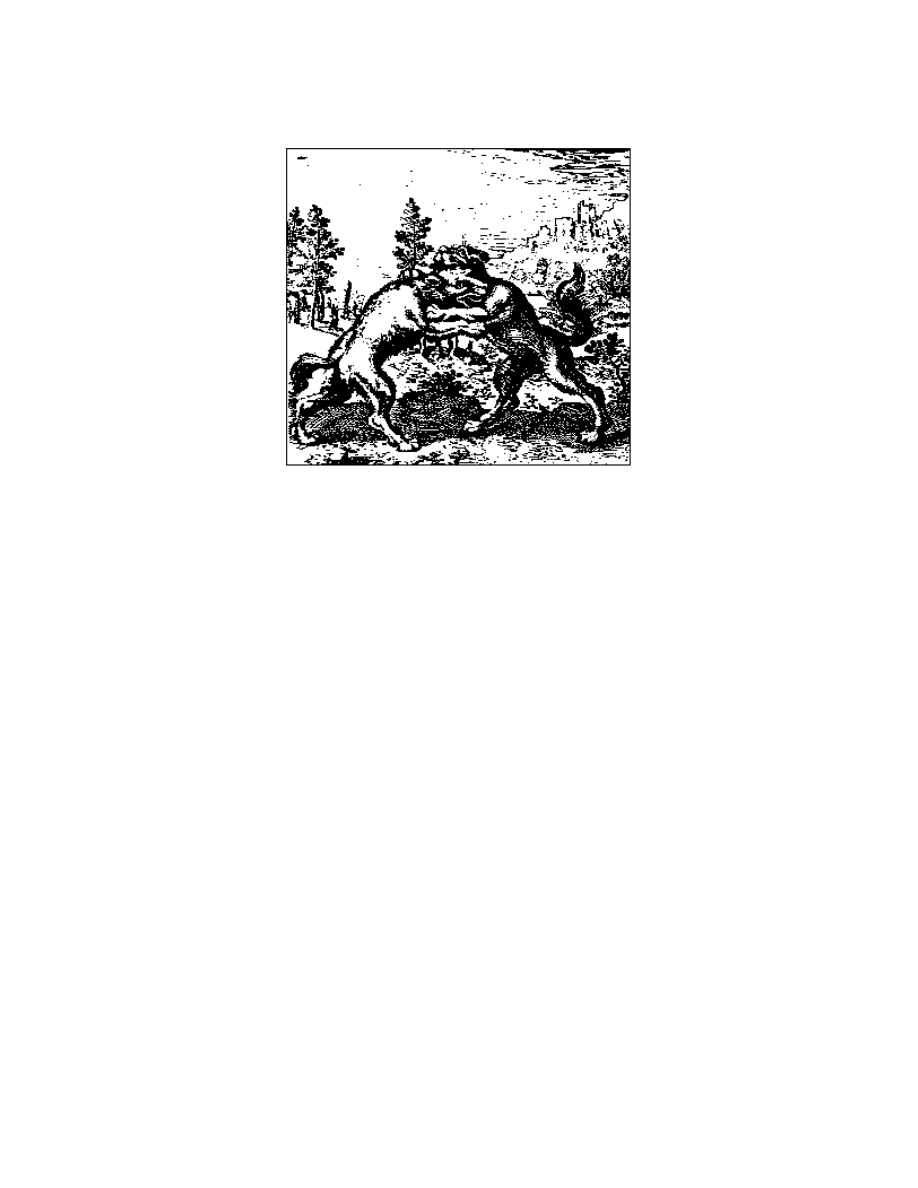
Emblem XLVII.
[From 47 - 50 no epigraphs given]
Discourse 47:
The Philosophers in many places make mention of two Stones that are freely given to us, as
Arnoldus, Isaick, and others. Avicenna amongst the rest affirms that they are thrown out in the
Dung, neglected by the Vulgar, but if they be joined together, they perfect the magistery. Some
extol the Occidental Mercury, which hath proffered itself before Gold, and overcome it. But the
author of the Consilium Conjugi Solis and Luna, out of the Epistle of Aristotle, does best of all
describe the two Stones, when he saith there are Two Stones, principals of this Art, white and red,
of wonderful nature. At the Setting of the Sun the white begins to appear upon the surface of the
Waters, hiding itself till Midnight, and afterwards descends to the Bottom. But the red Operates
otherwise, for it begins to arise upon the Waters at the rising of the Sun till noon, and afterwards
descends to the bottom. These Stones therefore are the two, Sent by Jupiter out of Delphos, as we
said before. Those also are the Wolf and Dog coming from different parts of the Earth, which
Bite and worry one another, and both become Mad. As Rhasis declares in his Epistles, " Those
Stones are the most true Bezoar, which comes from the East Indies, taken out of the Bellies of
wild Bests. The West Indies yield another, but of less Efficacy, and is called That of Peru, and
taken out of Tame animals. " So, the East affords a most fierce Wolf, the West a Dog Familiar to
man. That is: Sulphur comes from the Eastern as Mercury does from the Western Regions; of
which the one is soft and tractable, the Other is Choleric and fierce. As soon they meet they fall
upon one another. But the Dog, being of a remarkable Size, obtains the first Victory by
Prostrating the wolf, and almost killing him. Then the wolf recovering his strength, Overthrows
the Dog and never Suffers him to rise again, but kills him in the main. The Wolf receives such
wounds from the Dog, that are not less mortal than those he gave him, and so they are wounded
to death by one another.
Rosinus to Euthicia says, concerning the Wolf, that, " He is a Stout Soldier, Conqueror of Two,
and of much Esteem and most intense Strength, that can perforate Bodies when he meets with
them, and is white in Appearance, red by Experiment, and is the male that took Luna to wife (
which some men suppose to be Gold of a most precious Connection, whose Congelation is never

dissolved, nor footsteps or Imperfections ever defaced ) which God has bestowed upon the holy
and Elect Philosophers. You must know that Nature has taken an Equal as an Enemy. "
And a little after he says, that, " Sulphur is most Strong, and fights against fire that it contains and
is contained; for a most precious Colour proceeds from the two conjoined together, and that
Sulphur, which is Naturally Volatile, can never afterwards fly away, because the Soul hath
Perforated it. And in like manner, the Tincture of the soul hath perforated and Mixed with the
Body, and the Body hath contained the Soul and refrains the Natural flying of it. "
And then to one demanding which of the two Stones was Strongest, he answers, " That stone
which is No stone, is stronger than the Other Enemy. But if Red is Stronger than that which hath
Strengthened his Companions by his Fortitude, the Oriental Wolf is therefore Stronger than the
Occidental Dog, although he does not obtain the Effect of his Victory but by falling Together
with his Enemy. "
For the tingeing poison is produced from both. The Differences therefore between the Wolf and
the Dog is but small, for a Mastiff or dog may appear with the form or kind of a Wolf, so as to
seem to have been a wolf Originally, but to have become tame running through many
Generations. After the same manner, Sulphur and Mercury differ but little from one another,
because That proceeds from This, and This from That: Mercury indeed begat Sulphur, but
Sulphur Purged Mercury, and rendered it to itself.
The same Rosinus asks these questions,
" Whence comes its Colour? "
And answers, " From its Most intense bitterness. "
" Whence comes its bitterness and Intention?"
Answer, " From the impurity of the Metal. "
" Is its red Colour never Suporeminent? "
He answers, " Yes. "
And again he asks, " Is it never hotter than fire? "
Answer, " Fire in respect of it is as water in respect of fire. "
Again, Question, " Is it not stronger then fire? "
He answers, " Not, when then do you assert it to be stronger than fire.
He answers, " Because Fires meeting together do destroy one another. "
It is therefore manifest that one is the food and aliment of the other. And so much as the one
Increases, the other Decreases, till that which increases, Prevails, and the Dragon devours the
Serpent.
In great Battles it Often happens that they who undergo the greatest Slaughter, win the field and
Victory. So also, though the Dog lie Prostrate, yet he was not so Overcome at his death but that
he could [not] hold his Enemy so fast, that as the other could not live without Him, so neither
could he without the Other.
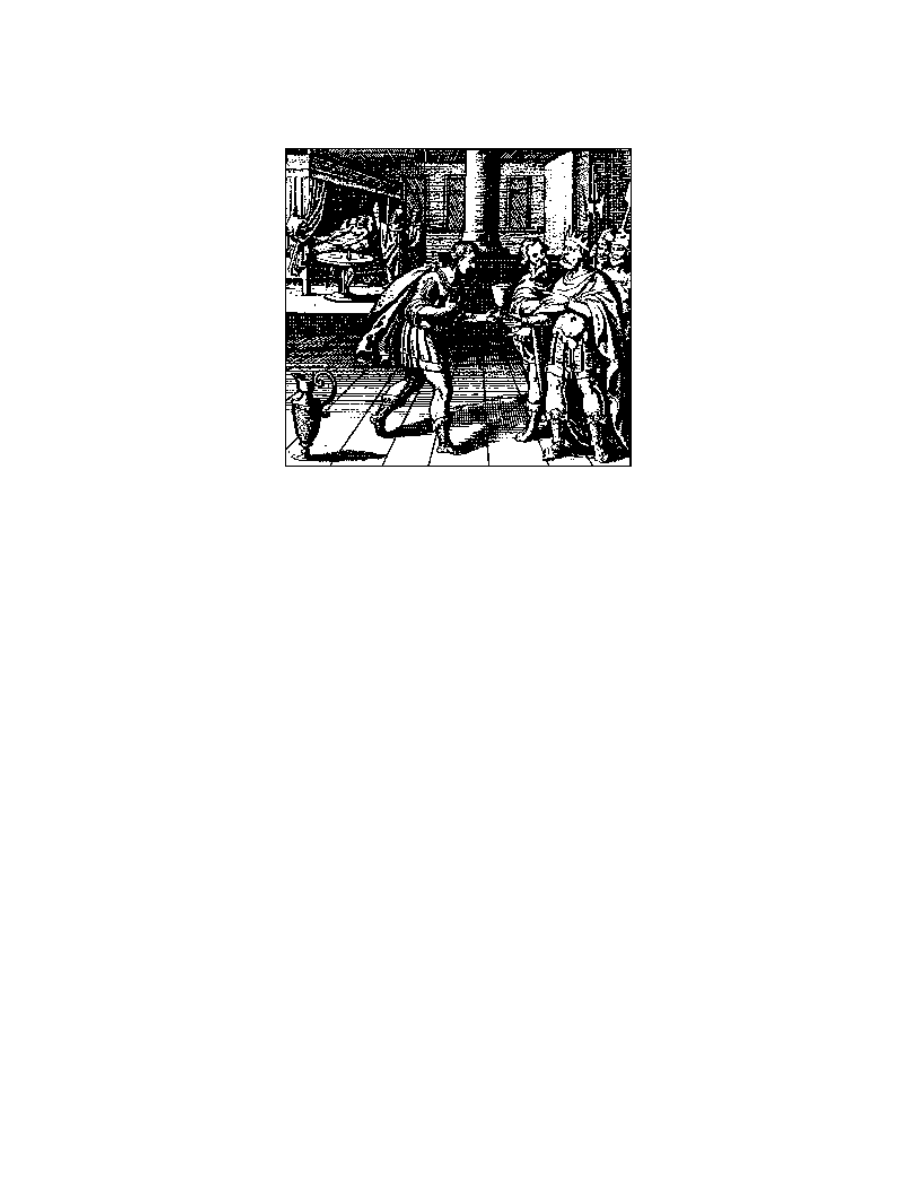
Emblem XLVIII.
Discourse 48:
Xerxes, that most powerful King of Persia, Leading his Army through dry and uninhabited
Countries, in the midst of Extreme heat, being very thirsty did not refuse a draught of Muddy
water Offered him by a Soldier, but drank most plentifully and gave a Very large reward to him
that brought it. And indeed if a man at this time ( as some of our Latest Historians affirm ) should
travel through the Domains of Persia, he would seldom meet with fountains of Fresh Water, for
their Standing Waters are Brackish, and the Soil itself upon the surface has a very great Saltiness.
After the same manner, the King of the Philosophers, being tormented with thirst, Commands his
servants to bring him plenty of fresh Water, which being brought him, he drinks till he is Satiated,
as appears by the Allegory of Merlin: Divers Physicians undertook the cure of the King that was
Sick and discoloured. The Egyptians administering their Medicine, stirred the Humours whilst
they were yet crude; whereas Hippocrates says they must be concocted before they be purged,
unless [they] be stirring and fluxible, for then they must Immediately be Expelled, lest they make
an Effort and fall upon the more Noble parts: Hereupon [are] dangerous Symptoms as Happen to
the King.
But the Physicians of Alexandria coming afterwards, and being Esteemed more Successful in
Chronic diseases, restored the King to his former health.
( It is very well worthwhile to cure so great a King, who being made healthy, Extends a Liberal
hand, and a Serene aspect to his physician. We have read how many men's cures have been Nobly
rewarded by several Kings, as that of Demonides by Policrates; Tyrant of Samos with two talents
Erasistrati, who as Pliny writes, was the disciple of Chrysippus and the son of Aristotle's
Daughter; as likewise Jacop Coeterius, physician to Louis the 2
nd,
King of France, from whence
he received a Salary of four Thousand crowns a Month; not to mention more Modern instances. )
But the cure of this King is accompanied with a reward that is still far greater. For as Hermes and
Geber in the Rosary, " He that can once complete this Art, if he should live a thousand Thousand
Years, and Every day should feed four Thousand men, he could not want. " And Senior confirms

this by saying, " He that has this Stone from which the Elixir is made, is so rich that he can, like
the man that has fire, give to whom he will, and when he will, and as much as he will, without his
own Danger, or the want of it. "
The Father of Democritus was so Rich that he gave a Feast to the Army of Xerxes; and Pitheus, a
man Exceedingly wealthy, offered the same prince that he would pay his whole Army and find
them provision for five Months, provided that the Youngest of his five Sons, who was the
Comfort of his Old age, might Stay at home with him and not be forced to go into the King's
Army. But the Barbarous, Basely rejecting his petition, commanded the Youth to be cut in two
pieces and impaled on Either side of the Highway through which the whole army was to pass, as
Sabellicus relates in the Second Book of his Enneads-
But the wealth of these Men are Nothing to the Riches of this King, which are without Number or
Dimension. Being cured and freed from the waters all the Kings and potentates of Other Regions
have Honoured and feared him, and when they would see any of his wonderful works, they put
one ounce of Mercury, well washed, in a Crucible, and cast thereupon as it were, one grain of
Millet seed of his Nails or his Hair or his Blood, and blowing gently with coals, they let it cool
with them, and found such a Stone as I know.
This is he of whom Count Bernard makes mention, that he can give to his six courtiers as much of
his Kingdom as he himself possesses, provided they wait till he recovers his Youth, in the Bath,
and be adorned with various Garments, to wit: a Black breastplate, a White Shirt, and Purple
Blood. For then he promises to give some of his blood to Every One of them, and make them
partakers of his riches.
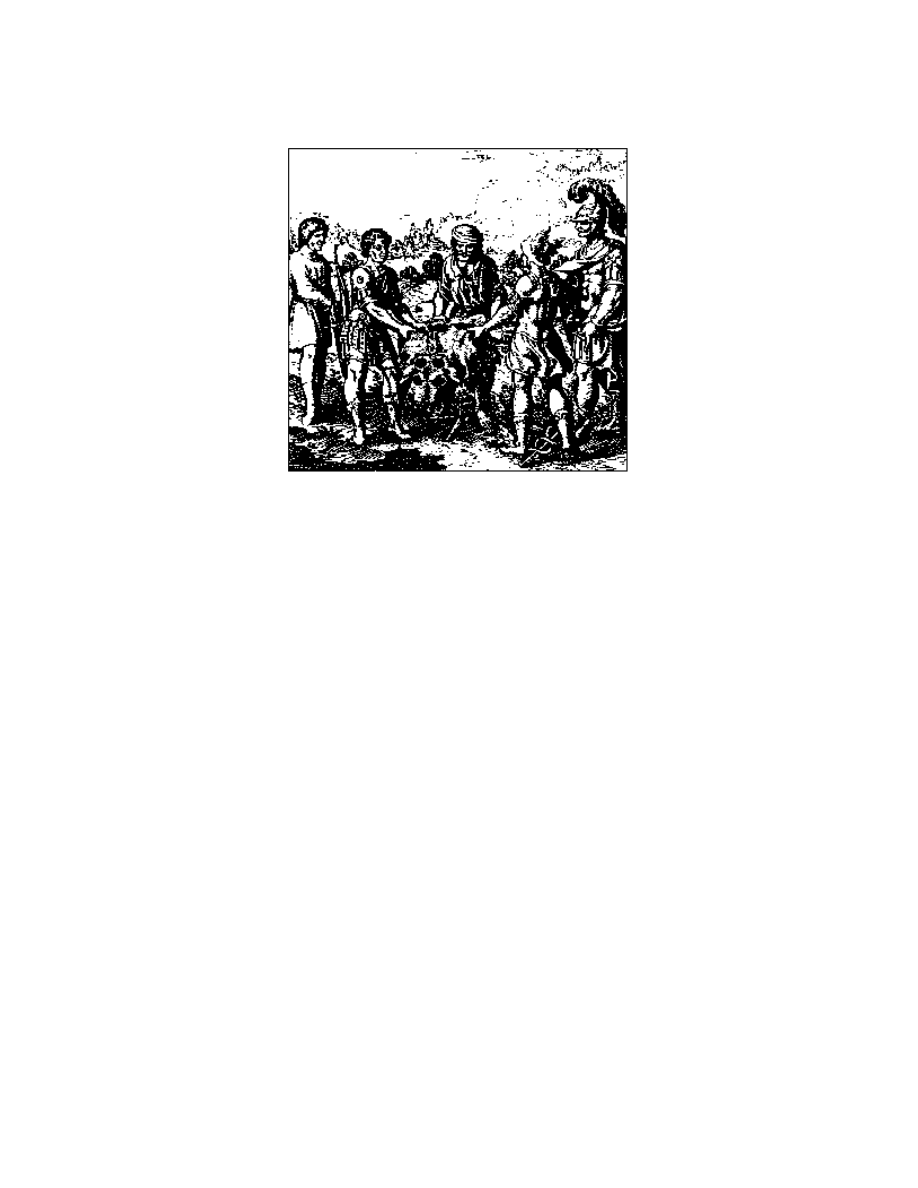
Emblem XLIX.
Discourse 49:
Women that keep Company with many Men, Seldom conceive Living Children, for Nature Very
seldom admits of a Superfaetation; Hence whatever Offspring is born, whether it be one or More
individuals, they proceed from one Father and Mother.
There is a Remarkable instance in History, of Margaret the wife of Herman, Earl of Henneberg,
who in the Year 1276, bore 365 children, which were all Christened; the males by the name of
John, the females yet of Elizabeth. All died and were buried in the Church of Lausden in Holland,
about a mile from the Hague, towards the sea. And in the same place may still be seen the Brazen
basin in which they were baptised, with an inscription of the whole story. The reason given for it
is that the Countess, seeing a poor woman with twins in her arms, called her an Adultress, as if it
were impossible for more than one [child] to be conceived at one birth from one man. But yet
they Necessarily spring from Divers; whereupon the poor woman, knowing herself clear from any
guilt, made this imprecation: that the Countess herself might at one time by one man conceive as
many Children as there were Days in the Year. This is a Miracle; but [yet] a Natural work, which
happened by the Divine Vengeance.
But in the Philosophical work, that which is Otherwise contrary to Nature, is Easily admitted
under the Veil of an Allegory. For here One offspring is said to have Three Fathers, and likewise
so many Mothers. Hence Raymond, as cited by the Rosary, says, " Our infant has two Fathers and
two Mothers, and because he with his whole Substance is tenderly Nourished in fire, therefore he
never dies: So Dionysus or Bacchus is called " Bimatur ": as having two Mothers; who when his
Mother was burnt, before the time of his Maturity was taken out of her belly and sowed into his
Father's thigh, who thereupon became Father and Mother, too.
But these things are better declared in the Conception of Orion, who is said to have been
produced by the seeds of Apollo, Vulcan and Mercury mixed together, and preserved in the hide
of an Ox for ten Months. Now all this would not Only be fabulous, but Monstrous, unless the
Secret of Nature, that is not Obvious to all men, lay hid under it.

Lully in his Theoretica Testamenti, attributes as many and almost the same Fathers to his
Philosophic birth, to wit: Sol who is Apollo or the Celestial Sun, the first Author of this
Generation, who by his unspeakable Occult and Astral power, works upon a Contained Matter
known to the Philosophers, as upon the Matrix of a Woman, and in that produces a Son or
Offspring like himself, to whom afterwards he will lease and resign his Arms and Ensigns of
Virtue as belonging to him of by right of Inheritance, that is: the Faculty of Maturating things
immature, and the Energy of Tingeing and purging things Not tinged or purged. For whatsoever
Sol perfects in a Thousand Year, his Son can perform in half an Hour.
Therefore that his Virtue may be 1000 times Stronger then that of Sol, his father delivers him to
Vulcan, and the Artist for Education, that his generous disposition may be improved and
multiplied in Strength by their Means and Assistance. For it is Manifest to be very Advantageous
to be accustomed to a thing from [the time of] a child. So Achilles, Jason, and Hercules were for
the same intent committed to Chiron to be instructed. For Milo the Crotonian, who carried a Calf
when he was a boy, by custom came to be able to carry an Ox when he grew to be a Man.
Therefore, tis not without reason that Vulcan and the Artist are said to be the Fathers of this
Child, as well as Sol. For as he was the cause of his Being at first, so these Make him such as he
is and so great as he appears to be. No Equivalent Reward can be made to Masters for Institution,
no more than to parents for Generation. These dispose the Body; they the Mind. And so no less
recompense is due to one than to the Other of them.
In the production of Orion, Mercury contributes matter; Apollo the form; and Vulcan the Heat or
Efficient cause. And so it is likewise necessary in the Philosophic work that these Three Fathers
should seem to Conspire together for the Birth of one offspring, that is to be the Darling of the
Philosophers.
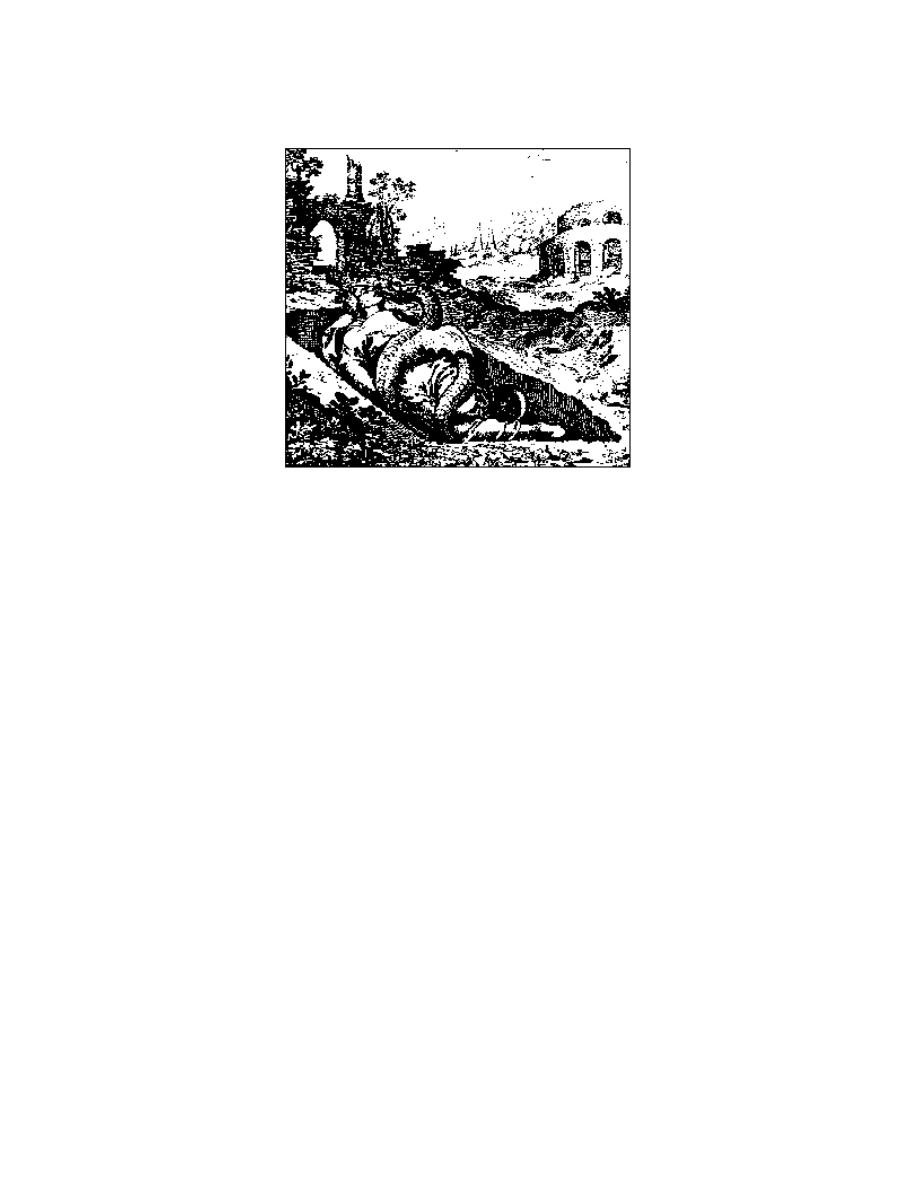
Emblem L.
Discourse 50:
The Mansion of Dragons is in Caverns of the Earth; but of Men upon the Earth, in the Immediate
Air; which two Elements are contrary and yet are appointed by the Philosopher to be joined
together, that one may act upon the Other. But by the Woman, Others understand the Eagle, as
Basil in his Second Key, for tis not convenient ( says he ) for an Eagle to place her nest upon the
Alps, because her Young ones would die by the coldness of the Snow upon the top of the
Mountains, but if you add to the Eagle a cold Dragon, that hath a long time had his Habitation in
the rocks, and is crept out of the caverns of the Earth, and put them both into an infernal Cell,
then will Pluto blow, and by his last, draw a Fiery Volatile Spirit from the cold Dragon, which
with its great Heat will burn the Eagle's Feathers and Excite a Sudorifick Bath, as will melt the
Snow upon the top of the Mountains, and turn it into Water, from whence a Mineral Bath may be
well prepared, to contribute health and Fortune to the King.
This reward is wonderful, that a cold Dragon should Yield a fiery Spirit, yet Experience declares
it to be true: in Burnt Serpents that send forth a venomous flame, poisoning those that stand by it.
Nor is it without reason that preservers of the Chemical treasures should be called " Flaming
Dragons "; and " Keepers of the Golden Fleece "; [of] " The Garden of the Hesperides "; and that
of Cadmus and others.
For this Dragon lives in Strait places of Subterranean Rocks, which you must take [of or from]
there, and join it to the Eagle, or Woman to her in her grave, or to the Other ( if you would rather
have it so ) in her nest. For tis the Nature of the Dragon sometimes to lie in wait for the Eagle's
Eggs, and wage Mortal war with the Eagle. There are Some Greek writers that Report that in
times past, a Dragon fell in love with a Maid, and lay with her. What wonder then if the
Philosophers would have their Dragon Shut up in the same cavern with the woman? Greverus
joins Red and Black Dragons together in the Deep gulf of the mountains, and burns them with
fire, and the black ones perishing he saith, " The Keeper of the mountain Searcheth for them
everywhere, and he brings them to the Mountain. " Merlin, in his Vision, if it be not Suppositious,
makes Mention of a White and Red Dragon. These Dragons, whatsoever they be, whether one be

a Woman, or female Dragon, do act Mutually until they both die, and Emit blood from their
wounds wherewith they are both Embued.
But hereby the Dragon is understood [to be] the Element of Earth and Fire; and by the Woman
those of Air and Water. Whence the Clangor Buccine saith, " The Dragon is the Matter remaining
in the Bottom, after the water is distilled from it. " And according to Hermes, " The water of the
Air, being between Heaven and Earth, is the Life of Every thing, for that water dissolves a body
into a Spirit, and makes a live thing of a dead thing, and constitutes Marriage between Man and
Woman, for it makes the whole Benefit of the Art. " And of the Earth he says thus, " And
moreover, understand that the particular earth which we tread upon is not the true Element: Yea,
it is Elemented from its true fifth Element. Nor doth the fifth Elemental Substance recede from its
Elemented Body from which the Earth is formed. " And a little after, " But the Virgin and true
Element, which Fire cannot burn, is in the Center of the earth. This is the Dragon whereof we
speak, insinuating itself, even into the Center of the earth, where the heat being great, it conceives
within itself a Flaming heat, wherewith it burns the woman or Eagle. "
But the woman or Eagle is an airy water, which some call the white or Celestial Eagle, and
Endeavour to make it the Common Mercury or Sublimed Salt, for there Men that feign
themselves as Quick Sighted as Lineus, [are] but indeed blind in this Art. But Count Bernard says
in his Epistle, " Verily I say unto You, that No water will dissolve a Metallic Species by Natural
reduction, but that which continues with it in matter and form, and which the Metals themselves
can recongeal, and a little after. Nor doth that water pertain to bodies in Solutions which doth not
remain with them in congelation. " And not far after, " Verily I say unto you, that the Oil which
Naturally incerates and joins Natures together, and Naturally introduces the Medicine into Other
bodies that are to be tinged, is not compounded of any Other Extraneous thing, but only of the
Bowels of the Body that is to be dissolved. "
The Eagle therefore and the Woman, as likewise the Dragon with almost all the Severals of the
whole Art, are Understood by these precepts; which by opening the Bosom of Nature We have
perhaps so far Explained and declared to the Sons of Learning, that so Glory might be given to
God.
Amen.
Wyszukiwarka
Podobne podstrony:
SHAMANISM AS THE ORIGINAL NEUROTHEOLOGY by Michael Winkelman
My Childhood, My Sabbath, My Freedom by Michael Jackson
Dracula From Historical Voievod to Fictional Vampire Prince The MA Thesis by Michael Vorsino (2008
Jack Kerouac A Biography by Michael J Dittman (2004)
James Wood reviews Portrait of a Novel by Michael Gorra LRB 11 October 2012
Of Corpses and Gold Materials for the Study of the Vetala and the Ro langs by Michael Walter Tibet
Intuitive Thinking as a Spiritual Path A Philosophy of Freedom by Rudolf Steiner tr by Michael Lips
Atalanta Fugiens
Human vs IELTS by Michael R
Crop Circle Etiquette Guidelines for Visiting Formation Devised & Written in Devizes by Michael Gl
Lesser Kan and Li Inner Sexual Alchemy by Michael Winn Introductory Talks (2001)
El Dominio de La Fase La guia practica para conocer y realizar viajes extra corporeos by Michael Ra
Keeping your food cold By Michael Hackleman
Amma Wisdom from the Sagas by Michael J Smith (2005)
Leigh Michaels ?by, You're Mine! [HR 3463, ME 75,?by Boom] (v0 9) (docx)
Harvard Business Review How competitive forces shape strategy By Porter Michael E
Healing Pyramid Energy A Public Disclosure Booklet by Russ Michael (2013)
Sean Michael Between Friends Trial By Fire
więcej podobnych podstron