
RFID Security Issues in Military Supply Chains
Qinghan Xiao
1
, Senior Member, IEEE, Cam Boulet
1
, and Thomas Gibbons
2
1
Defence Research and Development Canada Ottawa
Qinghan.Xiao@drdc-rddc.gc.ca
Boulet.Cam@drdc-rddc.gc.ca
2
Operational Support Transformation - CANOSCOM
Gibbons.TA@forces.gc.ca
Abstract
Radio frequency identification (RFID) technologies
have been used by the military to gain in-transit
visibility and improve inventory management. The
advantages of using RFID to track assets over using
barcode have been broadly recognized. However,
recent research has proven that RFID is vulnerable to
attacks. This brings a challenge at a time when RFID
systems are being employed in various applications,
including military supply chain systems. In this paper,
underlying vulnerabilities of RFID system are
analyzed, different attacks that can be made against
RFID system are illustrated, and countermeasures
against the attacks are recommended. The objective of
this article is to secure military logistics by identifying
the common threats to RFID systems.
1. Introduction
Radio frequency identification (RFID) is a term
applied to a number of technologies that utilize radio
waves to automatically identify an object. The object is
labeled with an RFID tag that comprises a chip and an
antenna that can transmit stored data, usually
identification information, to a reader. The first
application of RFID was developed by Britain to
identify friend and foe aircraft in World War II. In
recent years, RFID technology has been used to replace
bar code and successfully exploited by commercial
supply systems to enable inventory tracking,
warehouse management, and asset location. Compared
with the bar code that must be optically scanned in a
direct line of sight, RFID provides transparency across
the product handling lifecycle and offers increased
efficiencies in supply chain management. The most
widely known RFID applications are supply chain
RFID systems deployed by Wal-Mart and the US
Department of Defense (DOD).
However, a military supply chain differs from a
civilian supply chain in a number of respects, such as
readiness for war at any time, great flexibility during
times of war, large diversity of items, and long span
with unstable demand. The major goal of the civilian
supply chain is for profit, while the major goal of the
military supply chain is for troop readiness.
The US
DOD began using RFID technologies as a response to
lessons learned from Operations Desert Shield in the
early 1990s. It has been reported: “In the Gulf War, the
United States wasted $2 billion. They shipped five
containers if someone needed one in hopes of finding
something.”[1] Since “logistics accounts for more than
50 percent of the war costs [2]”, DOD officials came
up with a plan directing the use of RFID technology as
a standard business process across the department to
address massive supply chain inefficiencies. RFID is
seen by the US DOD as a key technology that “allows
military logisticians to synthesize and integrate end-to-
end information about assets”. In 2004, the Acting
Undersecretary of Defense for Acquisition,
Technology and Logistics issued a policy that required
the implementation of RFID technology across DOD.
The desired end state for the DOD supply
chain is a fully integrated, adaptive entity that
uses state-of-the art enabling technologies
and advanced management information
systems to automate routine functions and
achieve accurate and timely in-transit, in
storage and in repair asset visibility with the
least amount of human intervention.
Not only has the RFID solution developed by the
US Army provided instant access to information about
equipment and supplies, but also it ensures warfighter
readiness and safety. According to its implementation
plan, the DOD expects all of its 43,000 suppliers to be
RFID-enabled so that the military could take the
Second International Conference on Availability, Reliability and Security (ARES'07)
0-7695-2775-2/07 $20.00 © 2007
advantage of cost savings and effective operations by
2007 [3].
The recent Canadian Forces experience in
Afghanistan indicates that a similar vision for the use
of RFID technology is also required to provide
effective and efficient operational support [4].
In August 2006, Canadian Department of
National Defense (DND) representatives met
with PM J-AIT to request programmatic and
technical assistance in fielding the US Radio
Frequency In-Transit Visibility (RF-ITV)
solution to multiple nodes in Canada, Turkey,
and Afghanistan in support of Operation
Enduring Freedom (OEF). This request was
initiated by Canada to track over 500
Canadian assets using active RFID tags, write
stations, fixed and handheld readers, and
Early Entry Deployment Support Kits.
As with the Internet or mobile telephony, RFID is a
wireless networking technology. System and data
security are critical issues for RFID applications in
military logistics. The non-contact and non-line-of-
sight property of RFID increased convenience and
efficiency. On the other hand it also increased the
system vulnerability. Although RFID is just becoming
popular for the mainstream (still an emerging
technology), the security of some RFID systems has
already been broken. Like other wireless
communication and automation technologies, RFID
technology is vulnerable to attack and security
breaches can occur at the RFID tag, in the network, or
in the backend systems. This paper will reveal possible
attacks to RFID systems. The purpose of this paper is
to provide information and defenses against these
attacks. The rest of the paper is organized in the
following manner. Section 2 presents a brief overview
of RFID technology. Section 3 illustrates different
attacks and countermeasures. Section 4 concludes the
paper with the field where future research is needed.
2. RFID system
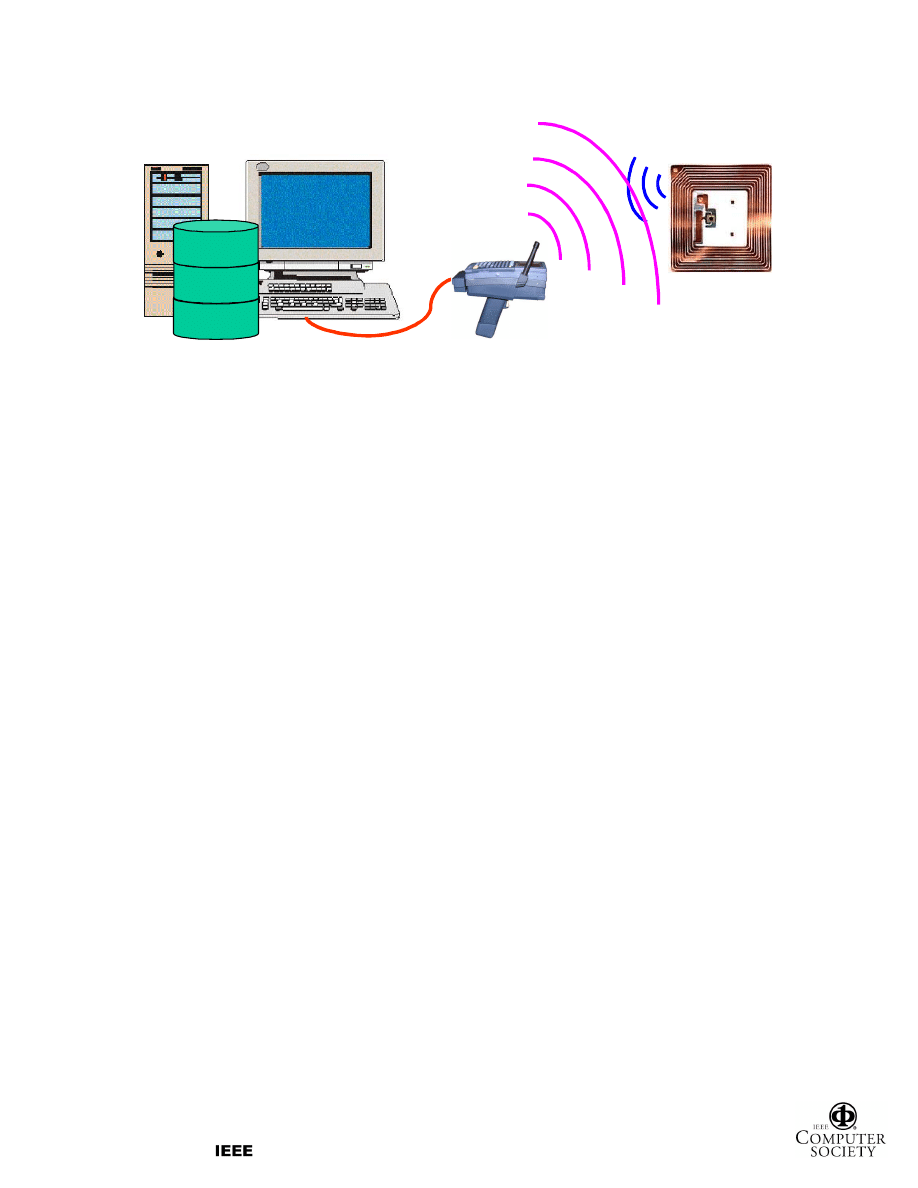
RFID is an emerging technology that uses radio
waves as means to identify items or objects. Figure 1
shows a typical RFID system that contains one or more
RFID tags, a reader, and a back-end sever.
2.1. System components
RFID tags, also known as transponders, are the
identification devices attached to objects. Each tag
typically consists of an antenna that is constructed of a
small coil of wires, a microchip to store information
electronically about the object, for example a military
vehicle or a container being shipped overseas, and an
encapsulating material. In addition, next generation
tags are also linked to sensors that can track and report
the shipment’s environmental parameters, including
temperature, shock and humidity. Like there are
various types of barcode, RFID tags are available with
different memory sizes and encoding options.
However, different from the bar code, the information
on the chip could include a unique serial number and
product information, which benefits for retailers,
manufactures and supply chain operators. Although
their capabilities are impressive, RFID tags need to
work with the readers.
An RFID reader, sometimes called an interrogator
or scanner, is a device to communicate with the RFID
tag. It emits RF signals to, and receives radio waves
from, the tag via antennas. The reader then converts the
radio waves into digital information that is usually
passed to the back-end server. Readers can either be
Figure 1. A generic RFID system
Second International Conference on Availability, Reliability and Security (ARES'07)
0-7695-2775-2/07 $20.00 © 2007

handheld terminals or stationary devices, which consist
of transmitter, receiver, antenna, microprocessor,
memory, controller, and power.
The real power of RFID in supply chain
management comes in integrating RF technology with
a back-end server. The back-end sever can filter the
digital information received from the reader and route
it to the correct application. A back-end database stores
records of product information, tracking logs or key
management information associated with an RFID tag.
2.2. RFID tag categories
RFID tag is at the heart of an RFID system, and can
be categorized as passive, semi-passive and active in
relation to power, as well as read/write and read only in
terms of its memory [5], [6].
Passive tags do not have an internal power source
and need to draw power from an RFID interrogator.
The interrogator emits electromagnetic waves that
induce a current in the tag's antenna and powers the
chip on the tag. When the power to the tag’s chip
passes the minimum voltage threshold, the circuit turns
on and the tag sends the information back to the reader.
Because of the lack of a battery, passive tags have a
reading range of several meters.
Semi-passive tags have a power source that keeps
the chip on the tag constantly powered. Semi-passive
tags use the power to monitor environmental
conditions, but communicate by drawing power from
the RFID reader in a manner similar to that of passive
tags. Due to the use of batteries, semi-passive tags have
faster response times and greater memory capacity
compared to passive tags.
Active tags contain their own battery that supplies
energy for both to power the chip on the tag and boost
the return signal. This makes the tags able to
continuously monitor high-value goods or record
container seal status. Compared to passive and semi-
passive tags, active tags have wider read ranges (tens
of meters and even hundreds of meters), larger memory
capacities and faster processing times. However,
battery life limits the life of the tag up to 5 years.
Depending on the memory type, the tags can further
classified as read-only, write once read many (WORM)
or read/write.
Read-only tags are typically passive and most like
bar codes because only a serial number is carried.
Although the data stored on the tag cannot be modified
or appended unless the microchip is reprogrammed
electronically, read-only tags are available in many
versions, varying in range, data bits, and operating
temperature.
WORM allows users to encode tags one time during
production or distribution. After that the code becomes
locked and cannot be changed.
Read/write tags function like computer disks
because the data stored can be edited, added to, or
completely rewritten an unlimited number of times.
These tags are often implemented on reusable
containers and other assets in logistic applications.
When the contents of the container are changed, new
information can be updated on the tag.
Within this paper, RFID is used as generic term to
describe any automated tagging and reading
technology. It can include passive, semi-passive and
active RFID technologies and various formats and
applications.
2.3. Frequency bands
RFID systems are also distinguished by their
wavelength frequency. Four primary frequency bands
are low frequency (LF), high frequency (HF), ultra-
high frequency (UHF), and microwave frequency
(MW) [7]. Current RFID technology uses frequency
ranges between 30 kHz to 5.8GHz. The choice of
frequency is dependent on application, the size of the
tag and the read range required. In general, the higher
the frequency, the faster the data transfer or throughput
rates, but the more expensive the system.
Frequencies from 30 KHz to 300 KHz are
considered low, and RFID systems commonly operate
between 125 KHz and 134 KHz. LF systems are
generally use passive tags with short read ranges (up to
20 inches) and lower system costs, which are most
commonly used in security access control, animal
identification and asset tracking.
HF ranges from 3 MHz to 30 MHz, while HF RFID
tags typically operate at 13.56 MHz. Like LF tags, a
typical HF RFID system uses passive tags that have a
maximum read range of up to 3 feet with faster data
rates than LF tags. Not only have HF systems been
widely used in library, mass transit and product
authentication applications, but also adopted to make
smart ID such as e-Passport.
The next frequency range is UHF that lies from 300
MHz to 3 GHz. Typically, passive UHF RFID systems
operate at 915 MHz in the United States and at 868
MHz in Europe, while active UHF RFID systems
operate at 315 MHz and 433 MHz, respectively. UHF
systems can send information faster than LF and HF
tags and offer the longest read range of all tags, from
3-6 meters for passive tags and more than 30 meters
for active tags.
Second International Conference on Availability, Reliability and Security (ARES'07)
0-7695-2775-2/07 $20.00 © 2007

A typical microwave RFID system operates either
at 2.45 GHz or 5.8 GHz. The former is traditionally
used in long-range access control applications, which
has a read range of up to 1 meter as a passive tag or
longer range as an active tag. In Europe, the 5.8 GHz
frequency band has been allocated for road traffic and
road-tolling systems.
Table 1 highlights the different types of RFID
frequency bands with their characteristics, such as read
ranges, data transfer rates, application areas and
corresponding ISO standards. Among the ISO
standards, the ISO 18000 serious covers the air
interface protocol – the way RFID tags and readers
communicate – for major frequencies used in RFID
systems.
3. Attacks and countermeasures
Like other information systems, RFID systems are
vulnerable to attack and can be compromised at
various stages. Generally the attacks against a RFID
system can be categorized into four major groups:
attacks on authenticity, attacks on integrity, attacks on
confidentiality, and attacks on availability. Besides
being vulnerable to common attacks such as
eavesdropping, man-in-the-middle and denial of
service, RFID technology is, in particular, susceptible
to spoof and power attacks. This section illustrates
different kinds of attacks and provides countermeasure
against these attacks.
Table 1. RFID frequency bands and standards
LF
HF UHF
MW
Frequency
30 – 300 KHz
3 – 30 MHz
300 MHz – 3 GHz
2 – 30 GHz
Typical RFID
Frequencies
125-134 KHz
13.56 MHz
433 MHz (Active)
865 – 956 MHz
2.45 GHz
2.45 GHz
5.8 GHz
Read Range
up to 1m with long-
range fixed reader
up to 1.5m
433 MHz → up to100m
865-956 MHz
→ 0.5m to ≈5m
Passive ≈ 3 m
Active up to 15m
Data Transfer
Rate
Less than 1 kilobit
per second (kbit/s)
≈ 25 kbit/s 433-956
→30 kbit/s
2.45 GHz →100 kbit/s
Up to →100 kbit/s
Common
Applications
Access control,
Animal identification,
Inventory control,
Vehicle immobilizers
Smart cards,
Contact-less access
and security,
Item level tracking,
Library books,
Airline baggage
Logistics case/pallet
tracking,
Baggage handling
Railroad car
monitoring,
Automated toll
collection
Pros and Cons LF signal penetrates
water. It is the only
technology that can
work around metal.
LF tags have a short
read range and low
data transfer rate, and
are more expensive
than HF and UHF
because a longer
more expensive
copper antenna is
required.
Antennas can be
printed on substrate
or labels. HF signal
penetrates water but
not metal. HF tags
are less expensive
and offer higher
read rate than LF.
Active RFID has a very
long read range with
high price of tags. Since
using a battery, tags
have a finite lifespan
(typically 5 years).
UHF tags have the
highest read range for
passive tags and capable
of reading multiple tags
quickly. However, they
are highly affected by
water or metals.
Microwave
transmission is
highly directional,
and enables
precise targeting.
MW tags provide
the fastest data
transfer rate.
However, they
cannot penetrate
water or metal.
ISO Standards 11784/85, 14223
14443, 15693,
18000
15693, 18000
18000
Second International Conference on Availability, Reliability and Security (ARES'07)
0-7695-2775-2/07 $20.00 © 2007

3.1. Eavesdropping
Since an
RFID tag is a
wireless device that emits a
unique identifier upon interrogation by an RFID
reader, there exists a risk that the communication
between tag and reader can be eavesdropped.
Eavesdropping occurs when an attacker intercepts data
with any compliant reader for the correct tag family
and frequency while a tag is being read by an
authorized RFID reader. Since most RFID systems use
clear text communication due to tag memory capacity
or cost, eavesdropping is a simple but efficient means
for the attacker to obtain information on the collected
tag data. The information picked up during the attack
can have serious implications – used later in other
attacks against the RFID system. Countermeasures
against eavesdropping include establishing a secure
channel and/or encrypting the communication between
the tag and reader. Another approach is to only write
the tag with sufficient information to identify the
shipment to another automated database that then
provides the relevant information about the shipment,
thus requiring the attacker to have access to both the
tag and the database.
3.2. Man-in-the-middle (MIM) attack
Depending on the system configuration, a man-in-
the-middle attack is possible while the data is in transit
from one component to another. An attacker can
interrupt the communication path and manipulate the
information back and forth between RFID components.
This is a real-time threat. The attack will reveal the
information before the intended device receives it and
can change the information en route [8]. Even if it
received some invalid data, the system being attacked
might assume the problem was caused by network
errors, but would not recognize that an attack occurred.
An RFID system is particularly vulnerable to MIM
attacks because the tags are small in size and low in
price. Several technologies can be implemented to
reduce the MIM threats, such as encrypting the
communication, sending the information through a
secure channel, and providing an authentication
protocol.
3.3. Denial of service (DoS)
DoS attacks can take different forms to attack the
RFID tag, the network, or the back-end to defeat the
system. The purpose is not to steal or modify
information, but to disable the RFID system so that it
cannot be used. When talking about DoS attacks on
wireless networks, the first concern is on physical layer
attacks, such as jamming and interference. Jamming
with noise signals can reduce the throughput of the
network and ruin network connectivity to result in
overall supply chain failure. A device that actively
broadcasts radio signals can block and disrupt the
operation of any nearby RFID readers. Interference
with other radio transmitters is another possibility to
prevent a reader from discovering and polling tags.
Fortunately, the risk of physical layer attacks to
threaten a military supply chain’s RFID system is low
because the power of a signal drops 6dB when
doubling the distance between sender and receiver [9].
In general, an attacker cannot get very close to the
target or use an extremely strong transmitter within an
effective distance. Another form of DoS is to destroy
or disable RFID tags by removing them from the items,
washing out their contents completely or wrapping
them with metal foil. Fortunately, this kind of DoS
attack has a low risk to threaten military supply chains
for the same reason mentioned above. However, the
threats must be re-evaluated when outsourcing military
logistics to private companies.
3.4. Spoofing
In the context of RFID technology, spoofing is an
activity whereby a forged tag masquerades as a valid
tag and thereby gains an illegitimate advantage. Tag
cloning is a kind of spoofing attack that captures the
data from a valid tag, and then creates a copy of the
captured sample with a blank tag. Another example is
that an attacker can read a tag’s data from a cheap item
and then upload the data onto another tag to replace the
serial number for a similar but more expensive item.
Mr. Lukas Grunwald, a German security expert, said "I
was at a hotel that used smartcards, so I copied one and
put the data into my computer, … Then I used RF
Dump to upload the room key card data to the price
chip on a box of cream cheese from the Future Store.
And I opened my hotel room with the cream
cheese!"[10] A common way to defeat a spoofing
attack is to implement RFID authentication protocol
and data encryption, which will increase the cost and
technology complexity.
3.5. Replay
In replay attack, an attacker intercepts
communication between a reader and a tag to capture a
valid RFID signal. At a later time, this recorded signal
is re-entered into the system when the attacker receives
a query from the reader. Since the data appears valid, it
will be accepted by the system. The most popular
solution is using a challenge and response mechanism
Second International Conference on Availability, Reliability and Security (ARES'07)
0-7695-2775-2/07 $20.00 © 2007

to prevent replay attacks. The time-based or counter-
based scheme can also be used as countermeasures
against replay attacks.
3.6. Virus
Since most of the passive RFID tags only have a
small storage capacity of 128 bits, virus is probably not
a big threat to RFID systems. However, the situation
has been changed when three computer researchers
released a paper in March 2006, which reported RFID
tags could be used as a medium to transmit a computer
virus. It also explained how the RFID virus works in a
supply chain. If a container arrived in a distribution
center and the container's RFID tag had been infected
with a computer virus, this particular RFID virus could
use SQL injection to attack the backend servers and
eventually bring an entire RFID system down [11]. A
well-developed middleware can be used to avoid virus
attack by blocking strange bits from the tag.
3.7. Power analysis
Power analysis is a form of side-channel attack,
which intends to crack passwords through analyzing
the changes of power consumption of a device. It has
been proven that the power consumption patterns are
different when the tag received correct and incorrect
password bits. Professor Adi Shamir demonstrated the
ability to use a password to kill a tag during the RSA
Conference 2006. He also predicted that a power
analysis attack on an RFID tag could be performed
using a very common device such as a cell phone [12].
Either masking the spikes in power consumption or
improving the hash algorithm will protect the tags
being attacked by power analysis.
3.8. Tracking
Different from any of the previously discussed
RFID attacks, tracking is a threat directed to an
individual. Within the next few years, manufacturers
may put item-level RFID tags into many household
products. There is a privacy concern because instead of
tracking books and consumer products such as
clothing, RFID systems will be used to track people’s
movements and even create a precise profile of their
purchases.
4. Conclusion
Integrating RFID technology into military supply
chains makes it possible to reduce the time of finding
materiel pallets and reduce the risk of losing supplies
in transit to an operational mission area. A
major
difference between a military supply chain and a
civilian supply chain is the potential security threat
posed by adversaries or their sympathizers who may
wish to disrupt the distribution of materiel. Even
though RFID tags are small, there are many potential
exploitation points in RFID systems. In this paper, we
analyzed the vulnerabilities of RFID technology,
illustrated the threats of possible attacks, and provided
countermeasure techniques. Although most of the
attacking methods discussed in this paper have existed
for several years, there is a chance that they are being
applied to a new area – attacking RFID technology.
With the increasing use of RFID in passports, personal
IDs and consumer products, the attacks on RFID may
pose security and privacy risks to both system
infrastructures and individuals. Further work is needed
in the following areas, such as the conduct of risk
assessments, definition of security policy and
development of more sophisticated approaches to
defeat the attacks.
5. Acknowledgement
The authors would like to thank Colonel Frederick
Michael Boomer for his support and valuable
comments in the preparation of this article.
6. References
[1] R. B. Ferguson, “RFID: Locked and Loaded for NATO”,
eWeek, February 20, 2006, [Online].
http://www.eweek.com/article2/0,1895,1926586,00.asp
[2] F. Tiboni, “GAO Finds Iraq Logistics Problems”, Federal
Computer Week, December 18, 2003, [Online].
http://www.rfidnews.org/weblog/2003/12/30/gao-finds-12-
billion-supply-discrepancy-in-iraq/
[3] C. Gardner, “DoD: Radio Frequency Identification”,
AIAG's third annual RFID Summit, November 2, 2006,
[Online].
https://mows.aiag.org/scriptcontent/event_presentations/files/
E6RFID01SP/DOD_final.pdf
Second International Conference on Availability, Reliability and Security (ARES'07)
0-7695-2775-2/07 $20.00 © 2007

[4] S. Philip, “Canadian Tracking Solutions”, jWave Journal,
November 2006, [Online].
http://www.eis.army.mil/ait/Resources/jWave_Journal/jWave
_journal_Nov06.pdf
[5] M. Ward, “RFID: Frequency, Standards, Adoption and
Innovation”, JISC Technology and Standards Watch, March
2006, [Online].
http://www.rfidconsultation.eu/docs/ficheiros/TSW0602.pdf
[6] “RFID Primer”, RFID Gazette, November 21, 2005,
[Online].
http://www.rfidgazette.org/2005/11/rfid_primer.html
[7] D. P. Mullen, “AIM Global Response to DHS Data
Privacy and Integrity Advisory Committee”, AIM Global,
June 13, 2006, [Online].
http://www.aimglobal.org/members/news/templates/aiminsig
hts.asp?articleid=1342&zoneid=26
[8] D. Welch and S. Lathrop, "Wireless security threat
taxonomy," Proc. of the 2003 Workshop on Information
Assurance, IEEE Systems, Man and Cybernetics Society 18-
20 June 2003 pp. 76 – 83.
[9] P. Egli, “Susceptibility of wireless devices to denial of
service attacks”, White Paper Embedded World 2006,
[Online].http://www.netmodule.com/store/publications/susce
ptibility_of_wireless_devices_to_DoS.pdf
[10] A. Newitz, “The RFID Hacking Underground”,
Indymedia News Alerts, May 14, 2006, [Online].
http://sf.indymedia.org/news/2006/05/1727888.php
[11] M. Rieback, B. Crispo, and A. S. Tanenbaum, “Is Your
Cat Infected with a Computer Virus?” Proc. of 4
th
Annual
IEEE International Conference on Pervasive Computing and
Communications (PERCOM’06), March 2006, [Online].
http://vx.netlux.org/lib/aat02.html
[12] R. Merritt, “Cellphone could crack RFID tags, says
cryptographer”, EE Times, February 14, 2006, [Online].
http://www.eetimes.com/news/latest/showArticle.jhtml?articl
eID=180201688
Second International Conference on Availability, Reliability and Security (ARES'07)
0-7695-2775-2/07 $20.00 © 2007
Wyszukiwarka
Podobne podstrony:
choi t m chiu c h risk analysis in stochastic supply chains
2012 2 MAR Common Toxicologic Issues in Small Animals
Political Interference in Military Matters
Human Rights Issues in Brazil
2004 5 SEP Current Issues in Cardiology
Issues in international relations 2nd ed
Prevelant Issues in Surrogate Parenting
Issues in Publishing an Online, Open Access CALL Journal
Legal Issues in Nursing for BSN
Mental Health Issues in Lesbian, Gay, Bisexual, and Transgender Communities Review of Psychiatry
2012 2 MAR Common Toxicologic Issues in Small Animals
BA L1 Basic issues in Accounting v2
Mental Health Issues in Lesbian, Gay, Bisexual, and Transgender Communities Review of Psychiatry
David Isenberg Shadow Force, Private Security Contractors in Iraq (2008)
Hamao And Hasbrouck Securities Trading In The Absence Of Dealers Trades, And Quotes On The Tokyo St
Michel Denis Imagery, Language and Visuo Spatial Thinking (Current Issues in Thinking
więcej podobnych podstron