
Worm Analysis through Computer Simulation
(WAtCoS)
Madihah Mohd Saudi, Kamaruzzaman Seman, Emran Mohd Tamil and Mohd Yamani Idna Idris.
Abstract— Computer viruses have received a lot of attention.
In fact, the best-known viruses have not been viruses at all, but
worms, programs that spread through networks instead of
modifying programs. Both viruses and worms reproduce
themselves and defensive measures have focused on stopping or
slowing their spread. Ultimately, though, there is no defense
better than a comprehensive security strategy that embraces
user education, crisis-response teams, and technologically
sound security measures including, but not limited to, those that
relate specifically to the threats posed by viruses and worms.
Defense against harm can consist of preventing the harm from
occurring, limiting the extent of the harm, or recovering from
the harm after it has occurred. This research aims to resolve the
confusion in identifying visualization, simulation and games in
teaching malware analysis. Computer simulation has greater
impact and based on research that had been carried out it is
identified as one of the best approach in teaching worm
analysis.
Index Terms— Worm analysis, visualization, simulation,
game.
I. DEFINITION
A. Visualization
Visualization is any technique for creating images,
diagrams, or animations to communicate a message [Herbert
and James, 1998]. Visualization through visual imagery has
been an effective way to communicate both abstract and
concrete ideas since the dawn of man. Examples from history
include cave paintings, Egyptian hieroglyphs, Greek
geometry, and Leonardo da Vinci's revolutionary methods of
technical drawing for engineering and scientific purposes.
Visualization today has ever-expanding applications in
science, engineering product visualization, all forms of
education, interactive multimedia, medicine etc. Typical of a
visualization application is the field of computer graphics.
The invention of computer graphics may be the most
important development in visualization since the invention of
central perspective in the Renaissance period. The
development of animation also helped advance visualization.
Madihah Mohd Saudi is with the Faculty Science and Technology,
Islamic Science University of Malaysia (USIM), Bandar Baru Nilai, 71800
Nilai, Negeri Sembilan, Malaysia (email: madihah@usim.edu.my).
Professor Dr. Kamaruzzaman Seman is with the Faculty Science and
Technology, Islamic Science University of Malaysia (USIM), Bandar Baru
Nilai, 71800 Nilai, Negeri Sembilan, Malaysia (email:
drkzaman@usim.edu.my).
Emran Mohd Tamil is with the Faculty of Computer Science and
Information Technology, University of Malaya (UM), Kuala Lumpur,
Malaysia (email: emran@um.edu.my).
Mohd Yamani Idna Idris is with the Faculty of Computer Science and
Information Technology, University of Malaya (UM), Kuala Lumpur,
Malaysia (email: yamani@um.edu.my).
B. Simulation
A simulation is an imitation of some real thing, state of
affairs, or process. The act of simulating something generally
entails representing certain key characteristics or behaviors
of a selected physical or abstract system [Narayanasamy et al.
2005]. A computer simulation is an attempt to model a
real-life or hypothetical situation on a computer so that it can
be studied to see how the system works.
C. Computer Game
The history of the computer game is, in parts, a history of
technology. The computer game requires technology capable
of handling large amounts of data and of representing this
data. The first computer game is generally assumed to be the
game Spacewar!, developed in 1962 at MIT (Stephen
Russell). The players can shoot each other, turn their ships,
and accelerate. Naturally, the goal is to hit the other player
before being hit yourself.
Formally, a game is best defined as a goal-directed and
competitive activity that involves some form of conflict
[Sauvé et al. 2005], conducted within a framework of agreed
rules [Lindley 2003]. The operator and/or user of a game is
referred to as the player or gamer. A game is a structured or
semi-structured activity, usually undertaken for enjoyment
and sometimes also used as an educational tool. The term
"game" is also used to describe simulation of various
activities e.g., for the purposes of training, analysis or
prediction.
Simulation Games are just one genre of computer games.
Simulation games are mixtures of games of skill, chance, and
strategy that result in the simulation of a complex structure.
Most of the simulation games are general games for
educational purposes, but more and more company specific
games, tailored for specific organizational aims can be seen.
II. PREVIOUS
WORKS
A. Visualization
[Donna Gresh et al. 2001] describe a visualization system
designed for interactive study of proteins in the field of
computational biology. Their system incorporates multiple,
custom, three-dimensional and two-dimensional linked
views of the proteins. The visualization environment that
they have developed is intended to facilitate the study of
proteins for researchers in the field of computational biology,
where the motion and behavior of proteins and other
molecules are studied in the computer rather than in the test
tube.
Proceedings of the World Congress on Engineering 2008 Vol I
WCE 2008, July 2 - 4, 2008, London, U.K.
ISBN:978-988-98671-9-5
WCE 2008

Another previous work on visualization is by [Thomas
Baxley et al. 2006]. They develop an animated visualization
tool to teach the concepts of various attacks on Local Area
Networks. Understanding how LAN attacks work and
knowing the vulnerabilities in the protocol design of LANs
are an important part of education in computer networks and
network security. Understanding how attacks on LAN work
requires knowledge in both network hardware and protocol
software. Students must know how hubs, switches, network
interface cards (NICs) and Address Resolution Protocol
(ARP) work in great details. They are also required to know
the data structures like ARP cache table, switch port mapping
table and Ethernet frames and ARP packets. In addition, the
actual attack includes multiple phases including scanning,
table poisoning and traffic interception. Because of these
complexities, many network security class students in the
previous semesters experienced difficulties understanding
these concepts even after hours of lectures. This tool is
targeted to assist instructors who teach college level network
security and computer networks. The tool accurately and
realistically shows attacks such as ARP Poisoning, Port
Stealing and MAC Flooding. They integrated features such
as high degree user interaction, play and pause, tooltips and
quizzes. This software is intended to be used in
undergraduate computer networks and network security
courses. However, anyone with interest learning LAN
security can benefit from the software.
While [Dino Schweitzer and Wayne Brown, 2007]
propose the use of interactive visualizations as an effective
means to actively engage students in the classroom.
Engaging students in the learning process has been shown to
be an effective means for education. Several methods have
been proposed to achieve this engagement for computer
science and other disciplines. Active learning is one such
technique that incorporates interactive classroom activities to
reinforce concepts and involve the students. Visualizations of
computer science concepts such as algorithm animations can
be used for these activities. They have developed and used
ICV's (Interactive Classroom Visualizations) in several of
computer science courses including algorithms, data
structures, computer graphics, security, cryptography, and
introductory computer science.
B. Simulation
Previous scanning worms have been significant sources of
network congestion and have had catastrophic effects on
switches, routers and end systems. [Ihab Hamadeh et al.
2005] focus on the simulation of the secondary
resource-exhaustion effects that scanning worms cause on
network protocols operating in Internet routers. The SQL
Slammer/Sapphire worm and the Ramen worm generated
large volumes of scans destined to multicast addresses
creating a storm of Source Active (SA) messages that
propagated across Multicast Source Discovery Protocol
(MSDP) enabled networks. Specifically, they describe a
preliminary simulation study on the effect of the spread of the
Ramen and SQL Slammer/Sapphire worms on the multicast
infrastructure and their ultimate goal is to create a realistic
simulation platform to evaluate and tune techniques to
mitigate the effects of scanning worms on network protocols.
Another previous work is about on how fast and how far a
worm could spread by making use of mobile computers and
wireless networks. [Everett Anderson et al. 2005] use
existing data of real users working in a campus-wide wireless
environment over the course of several months to provide
realistic data on mobility and connectivity patterns. They
perform simulations based on this data to observe how a
worm might propagate using only local wireless connections
and human user mobility.
Next previous work is from [Jin Feng 2002]. He shares the
experience of using computer simulation technology in an
interior lighting design class to improve the teaching and
learning environment. The use of simulation technology has
revolutionized the teaching and learning environment of
lighting design. Through the virtual experience of the
complete cycle of design, build and evaluation, the students
obtained better understanding of the relationship between
lighting plans, specifications, selection of interior materials,
and actual lighting effects and technical measurement. The
use of simulation technology also opens up new possibilities
to support our effort in the paradigm change from
illuminance-based design to luminance-based design, and
eventually realize the integration of interior design and
lighting design.
C. Computer Game
The Security Protocol Game [Dr Leonard G C Hamey,
2002] is a highly visual and interactive game for teaching
secure data communication protocols. This game provides a
simple representation of public key and secret key
cryptographic systems and related algorithms. Students use
the game to simulate protocols and explore possible attacks
against them. Specifically, the game provides representations
for plain text and encrypted messages, message digests,
digital signatures and cryptographic keys. Using these
representations, students can construct public key certificates
and perform multiple encryption, tunneling and encrypted
key transmission. They can simulate a wide range of
protocols including authentication, key exchange and blind
signature protocols. Application protocols such as Transport
Layer Security and Pretty Good Privacy can be simulated in
detail. The game clearly reveals the key issues of
confidentiality, integrity, authentication and non-repudiation
in secure data communications. Used as a small group
learning activity, students gain a deep understanding of
protocol design and operation issues. The game is suitable for
use in tertiary and professional education courses for
managers and information technology students at all levels.
Second previous work is on simulation game for the course
“Simulation Game in Electric Economics”. Their paper [A.
Turtiainen et al. 2002] presented the course and how a
WWW-application has been used in teaching economics as a
game. The basic idea of the simulation game was to teach the
students how to operate on the liberalized electricity markets.
This was done by simulating management of a fictitious
electricity company. In order to run their companies, students
needed to handle the determination of electricity sales tariffs,
operate on the liberated (e.g. spot market and the financial
instruments’ market) and also take care of the company’s
image. The simulation game was designed for a web-use
only. This electric economics game appeared to be a good
way of understanding the basics of electric economics. It
does, however, require some basic knowledge but its power
lies in the way of doing things. Usually students learn better
Proceedings of the World Congress on Engineering 2008 Vol I
WCE 2008, July 2 - 4, 2008, London, U.K.
ISBN:978-988-98671-9-5
WCE 2008
if they have to use their abilities instead of only reading or
writing.
Learning scientists are increasingly turning to computer
and video games as tools for learning. [Kurt Squire et al.
2003] examines what learning occurs when an
electromagnetism simulation game is used in a school for
students. Game mechanics enabled students to confront
weaknesses in understandings, and physics representations
became tools for understanding problems. The goal of
Supercharged! Game is to help learners build stronger
intuitions for electromagnetic concepts. With this game, they
suggest that simulation computer games can be effective
tools in helping students understand complex physics
phenomena.
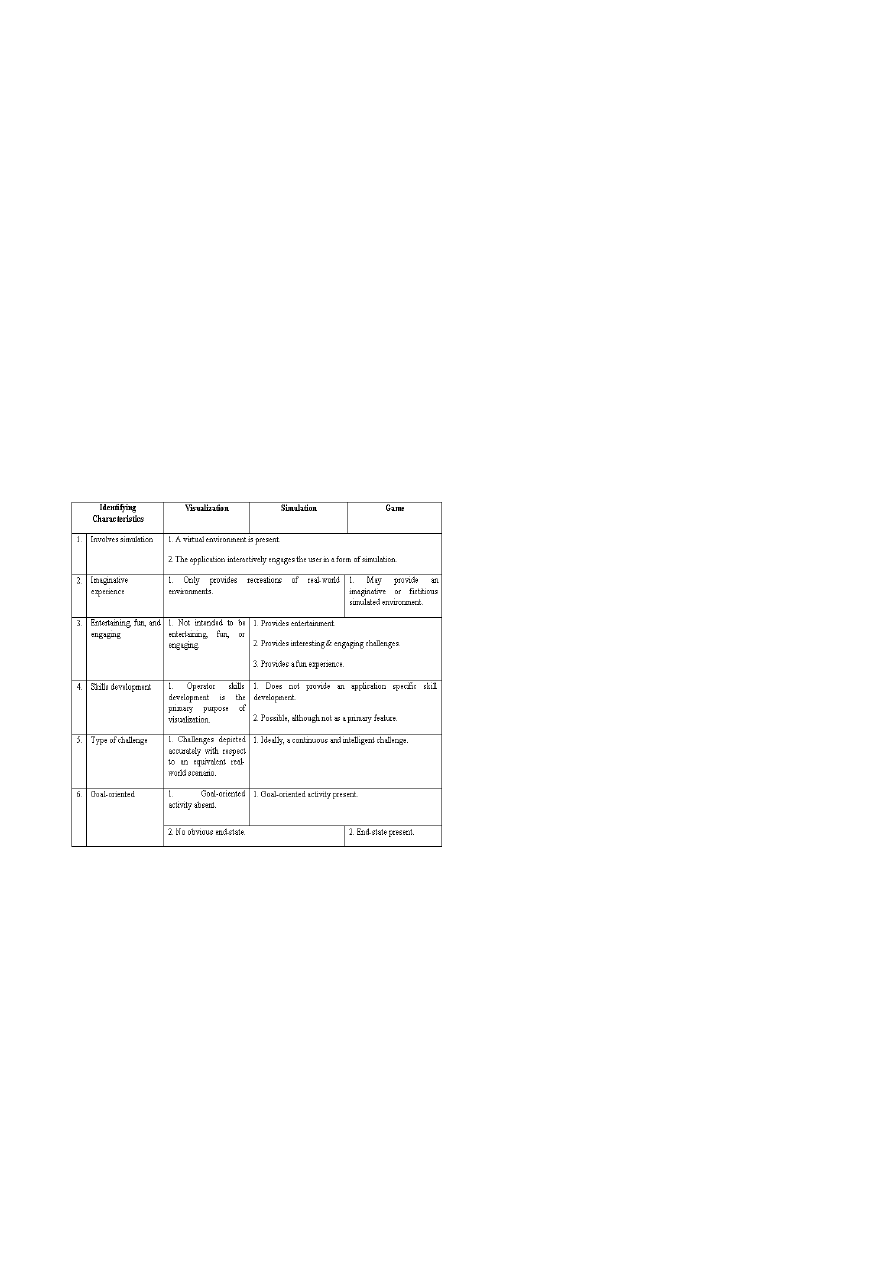
III. COMPARISON
Based on the research and observation that had been
carried out, it is need for carried out an abstract distinction
among visualization, simulation and games by building and
assessing a common taxonomy based on the characteristics
(The results are presented in Figure 1).
Figure 1. Comparison between Visualization, Simulation and Game
1. Involves simulation. While using visualization, simulation
and game, the applications in question have to be identified
as containing some simulation elements. In particular, a
virtual environment that tries to recreate some form of
fictitious or real-world environment is necessary.
2. Imaginative experience. An imaginative virtual experience
may include experiences that have elements of fiction or
fantasy, or an experience that simply deviates from reality. In
the quest to provide interesting and exciting worlds, most
games involve “unreal” fictional elements that contribute to
an imaginative experience. Unlike visualization and
simulation, there are games that simulate the presence of
fantasy worlds (e.g., Master of Orion III, MechWarrior 4).
But visualization and simulation cannot use imaginative
elements as an accurate representation of the real world. It is
necessary to train operators to develop their skills in virtual
environments in real-world situations. Thus the absence of
imaginary experiences can be used to distinguish
visualization and simulation from games.
3. Entertaining, fun and engaging. An entertaining
experience may be defined as an interesting or amusing one.
An interesting experience engages the attention of the player
and provides excitement, and might also arouse curiosity or
emotion. The intent of games and simulation is to engage
players in a fun and entertaining experience, while the intent
of visualization is to train and develop the skills of its
operators.
4. Skills development. The motivation for developing the
visualization is to maximize the rate at which operators
develop their skills, while the operators’ objective is to
maximize their performance in the task being simulated. For
games and simulation, however, the entertainment features of
an application are the highest priority. For these reasons,
visualization support high-fidelity simulations with a greater
degree of verisimilitude, while games and simulation games
only make a best effort at creating a representation that is
consistent and accessible.
5. Type of challenge. Ideally, games and simulation attempt
to provide a continuous flow of intelligent challenges to
engage the players. Lately, much research was done to
introduce emergent challenges in games (i.e., the notion of a
“good surprise”) to eliminate lackluster challenges due to
repetitive predefined content. However, introducing random,
varying, unpredictable, or sometimes nondeterministic,
content in visualization to create interesting and engaging
challenges is undesirable and, in many cases, inappropriate.
This is because the challenges in visualization have to be
well-designed reproductions of real-world scenarios, so that
an operator can develop useful skills, reproducible in
real-life, without visualization. The presence of random,
unpredictable, varying, and non-deterministic challenges can
then be used to identify games and simulation.
6. Goal-oriented. Goal-oriented activities include any
activity or set of activities that are conducive to achieving a
desirable end-state in a game by a player. Simulation and
game are goal-oriented activity but visualization not a
goal-oriented activity. The end-state of a game is that
associated with the notion “end of the game.” It is achieved
when an adequate number of victory conditions, as
determined by the game, are met. There are a number of
possible victory conditions. Visualization and simulation not
involved end-state. However, in game, the end-state present.
IV. ADVANTAGES
AND
DISADVANTAGES
Nowadays the visualization is the most important
approach to extract relevant information from the huge of
data produced by today's computational and experimental
works. Visualizations are now recognized as a powerful
approach to get insight on large datasheets produced by
scientific experimentation’s and simulations and the
introduction of these 3D models are a way for a better
understanding of this information, and to a better
performance of all visualization process. However,
Proceedings of the World Congress on Engineering 2008 Vol I
WCE 2008, July 2 - 4, 2008, London, U.K.
ISBN:978-988-98671-9-5
WCE 2008
visualization design stresses on achieving a higher accuracy
in the situation/environment being visualized. Elements to
make it interesting or exciting are either not considered or
avoided.
As for simulation, traditionally, simulations were used to
study the behavior of a system as it evolves over time. This is
done by first modeling the system and then developing a
simulation model. The model usually takes the form of a set
of assumptions concerning the operation of the system. The
assumptions can be mathematical, logical, or symbolic
relationships between the entities/objects of interest. The
disadvantage for simulation is the model has to be validated
before it can be used to predict or reproduce the behavior of
the system being modeled under varying sets of
circumstances. More recently, simulation models are used in
a real-time interactive mode to derive pleasure and
enjoyment to provide entertainment. Simulations can be
applied for the teaching of facts, concepts and principles and
to train specific skills. In fact, the participants in a simulation
should be able, after a training program, to apply learned
principles to new situations such as: make decisions, solve
problems and work in small groups.
Compared to game, it is a powerful medium for learning
and self expression. Essentially, games are developed for
different purposes, but two of them are seen to be more
relevant: education and demonstration. Also the purpose can
be detailed: to describe which is illustrate or demonstrate an
issue, a situation or a process; to demonstrate which is a
method or a technique; to practice which is to train and
educate; to reflect which is an experiment and obtain
response; to prepare which is to increase or direct the
attention towards a certain situation. While the advantage, it
is important to not formulate the purpose of the game too
wide and it must be developed according to exact/clear focus.
This is because it will be use by different groups in different
situations.
V. INTEGRATION
OF
TEACHING
MALWARE
ANALYSIS
Malicious code (or malware) is defined as software that
fulfills the deliberately harmful intent of an attacker.
Malware analysis is the process of determining the behavior
and purpose of a given malware sample (such as a virus,
worm, or Trojan horse). This process is a necessary step to be
able to develop effective detection techniques and removal
tools. Currently, malware analysis is mostly a manual process
that is tedious and time-intensive. To mitigate this problem, a
number of analysis tools have been proposed that
automatically extract the behavior of an unknown program
by executing it in a restricted environment and recording the
operating system calls that are invoked [Andreas et al. 2006].
The problem of dynamic analysis tools is that only a single
program execution is observed. Unfortunately, however, it is
possible that certain malicious actions are only triggered
under specific circumstances (e.g., on a particular day, when
a certain file is present, or when a certain command is
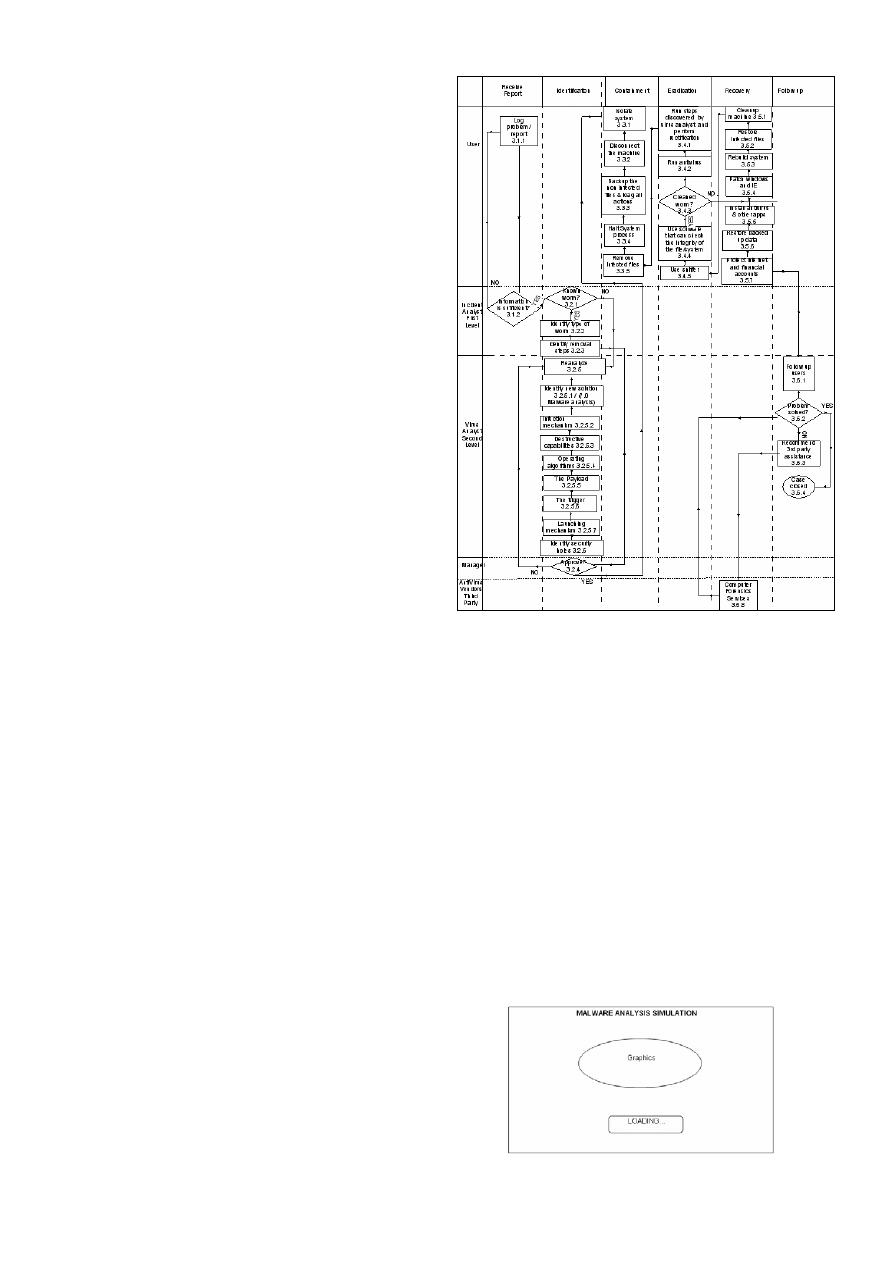
received). Figure 2 shows the flow for handling worm attack
which is produced based on our research. This procedure had
been tested in our lab and it works effectively and efficiently.
Fig. 2. Flow for Handling Worm Attack
For this paper, we would like to investigate method of
teaching in malware analysis. Helping students to understand
complex ideas on malware analysis will always be
problematic for teaching professionals. Often, the students
can be limited by not only their imagination, but by their
experiences. When trying to explain something that is outside
of the students’ imagination, it is often helpful to have either
simple animations or even interactive simulations that the
students can explore. The creation of interactive simulations
can greatly help educators get their point across and, as a
result, help students comprehend the ideas.
Based on research that has been done, simulation
technique can be applied to malware analysis, with
educational objectives. It is hoped that the learning benefits
of the simulation will transfer to the real world - which
learners will be able to apply knowledge that they have
gained to problems outside of the simulation. Fig. 3, 4, 5 and
6 shows the storyboard on malware analysis simulation.
Fig.. 3. Loading Page
Proceedings of the World Congress on Engineering 2008 Vol I
WCE 2008, July 2 - 4, 2008, London, U.K.
ISBN:978-988-98671-9-5
WCE 2008
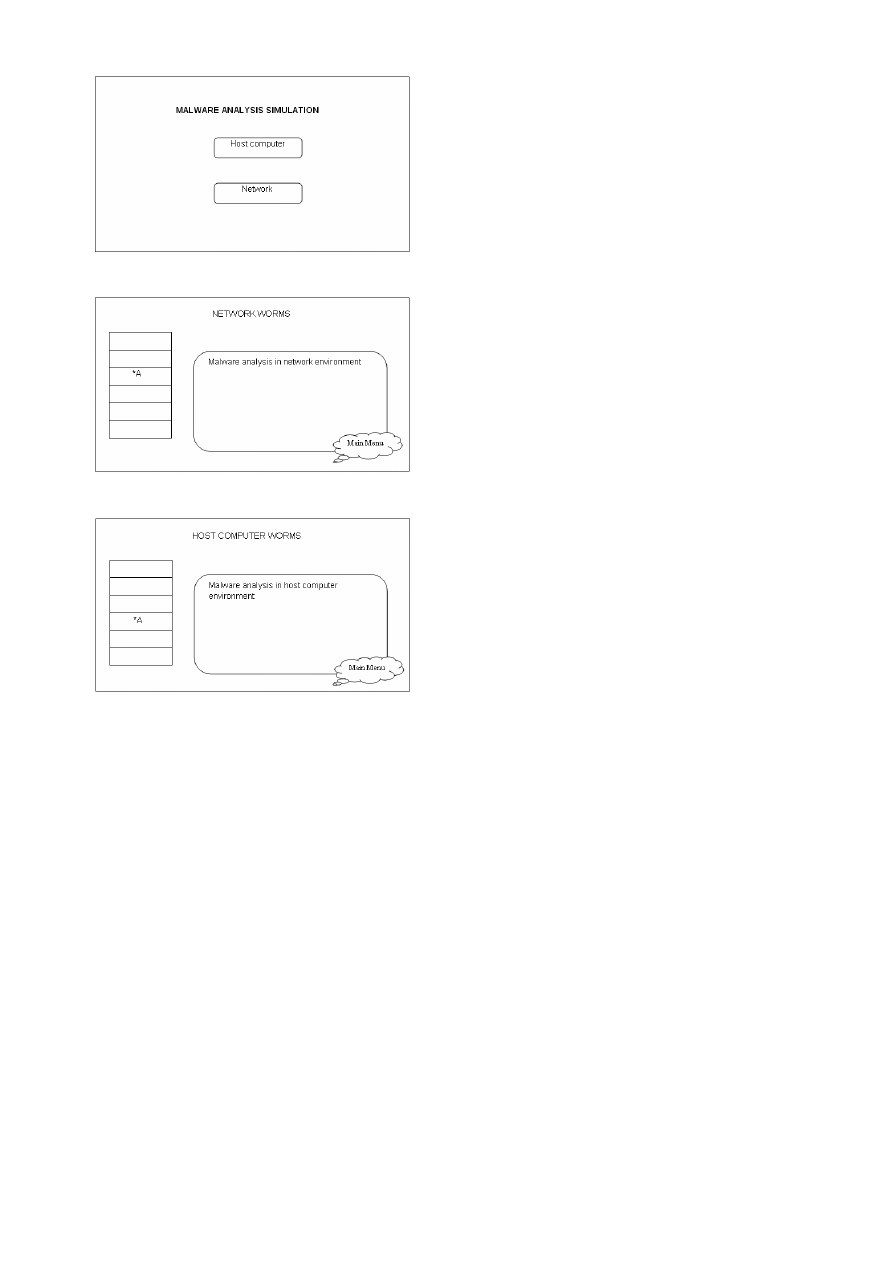
Fig.. 4. Menus
Fig.. 5. Type 1 – Network Worms
Fig. 6. Type 2 - Host Computer Worms
VI. CONCLUSION
Simulation is a useful tool in many areas of computer
science education. A review of examples of simulation
indicates that great potential can be realized much more
rapidly. The simulation is at least as effective as other
methods for teaching knowledge about facts, concepts and
application of knowledge. It is believe that simulation in
worm analysis have greater impact on participant’s attitudes
than other instructional techniques.
R
EFERENCES
[1] Joao Rafael Galvao, Paulo Garcia Martins, Mario Rui Gomes. 2000.
“Modeling Reality with Simulation Games for a Cooperative
Learning”. Proceedings of the 2000 Winter Simulation Conference.
[2] Donna Gresh, Frank Suits, and Yuk Yin Sham. 2001. “Case Study: An
Environment for Understanding Protein Simulations Using Game
Graphics”. IEEE.
[3] Dino Schweitzer and Wayne Brown. 2007. “Interactive Visualization
for the Active Learning Classroom”. ACM 1-59593-361-1/07/0003.
[4] Thomas Baxley, Jinsheng Xu, Huiming Yu, Jinghua Zhang, Xiaohong
Yuanand Joseph Brickhouse. 2006. “LAN Attacker: A Visual
Education Tool “. ACM 1-59593-437-5/00/0006.
[5] Ihab Hamadeh, Jason Hart, George Kesidis and Venkat Pothamsetty.
2005. “A Preliminary Simulation of the Effect of Scanning Worm
Activity on Multicast”. Proceedings of the Workshop on Principles of
Advanced and Distributed Simulation (PADS’05), IEEE.
[6] Jin Feng. 2002. “Computer Simulation Technology and Teaching and
Learning Interior Lighting Design”. ACM.
[7] Everett Anderson, Kevin Eustice, Shane Markstrum, Mark Hansen and
Peter Reiher. 2005. “Mobile Contagion: Simulation of Infection &
Defense”. Proceedings of the Workshop on Principles of Advanced and
Distributed Simulation (PADS’05), IEEE.
[8] A. Turtiainen, T. Mannila, S. Kuusiluoma and L. Korpinen. 2002.
“Simulation Game in Teaching Electric Economics”. IEEE.
[9] Dr Leonard G C Hamey. 2002. “Teaching Secure Communication
Protocols Using a Game Representation”. Australian Computer
Society, Inc.
[10] Kurt Squire, Mike Barnett, Jamillah M. Grant and Thomas
Higginbotham. 2003. “Electromagnetism Supercharged! Learning
Physics with Digital Simulation Games”. ACM.
[11] Herbert L. Dershem and James Vanderhyde. 1998. “Java Class
Visualization for Teaching Object-Oriented Concepts”. ACM.
[12] Viknashvaran Narayanasamy, Kok Wai Wong, Chun Che Fung and
Shri Rai. 2005. “Distinguishing Games and Simulation Games form
Simulators”. ACM.
[13] Ero Carrera and Gergely Erdélyi. 2004. “Digital Genome Mapping –
Advanced Binary Malware Analysis”. Virus Bulletin Conference
September 2004.
Proceedings of the World Congress on Engineering 2008 Vol I
WCE 2008, July 2 - 4, 2008, London, U.K.
ISBN:978-988-98671-9-5
WCE 2008
Document Outline
Wyszukiwarka
Podobne podstrony:
Computer Security Analysis through Decompilation and High Level Debugging
Rindel Computer Simulation Techniques For Acoustical Design Of Rooms How To Treat Reflections
Michael Vorlander Internationa Round Robin on Room Acoustical Computer Simulations
Ruth Bernstein Population Ecology, An Introduction to Computer Simulations (2009)
Bostrom, Nick Do We Live in a Computer Simulation
Impeding worm epidemics through destination address filtering
A Survey of Irreducible Complexity in Computer Simulations
Detecting Early Worm Propagation through Packet Matching
Bostrom, Nick Are You Living in a Computer Simulation
N gram analysis for computer virus detection
Pancharatnam A Study on the Computer Aided Acoustic Analysis of an Auditorium (CATT)
Fluid Dynamics Theory Computation and Numerical Simulation
„SAMB” Computer system of static analysis of shear wall structures in tall buildings
Computer Crime An Analysis
Computerized gait analysis in Legg Calve´ Perthes disease—Analysis of the frontal plane
Pancharatnam A Study on the Computer Aided Acoustic Analysis of an Auditorium (CATT)
Computer viruses a quantitative analysis
Simulating and optimising worm propagation algorithms
Analysis and detection of metamorphic computer viruses
więcej podobnych podstron