
Ciênc. Tecnol. Aliment., Campinas, 32(1): 126-133, jan.-mar. 2012
126
Original
ISSN 0101-2061
Ciência e Tecnologia de Alimentos
Received 3/8/2010
Accepted 12/7/2011 (004953)
1
Consejo Nacional de Investigaciones Científicas y Técnicas, Departamento de Industrias, Facultad de Ciencias Exactas y Naturales, Universidad de Buenos Aires – UBA,
Ciudad Autónoma de Buenos Aires, Pabellón Industrias, 1428, Buenos Aires, Argentina, e-mail: vanesshart@ yahoo.com.ar
2
Facultad de Ciencias Exactas Químicas y Naturales, Universidad Nacional de Misiones – UNaM, Roque Perez, 1847, Piso 4, Departamento F, 3300, Posadas, Misiones,
Argentina
*Corresponding author
A novel procedure to measure the antioxidant capacity of yerba maté extracts
Procedimento padronizado para avaliar a capacidade antioxidante dos extratos de erva-mate
Vanessa Graciela HARTWIG
1
*, Luis Alberto BRUMOVSKY
2
, Raquel María FRETES
2
, Lucila SÁNCHEZ BOADO
2
1 Introduction
Mate or yerba maté (Ilex paraguariensis Saint Hil.) is a tree
that grows in the central region of South America. A nutrient
tea-like infusion commonly consumed in several South
American countries is prepared from its leaf fraction. Due to
its antioxidant capacity, the final product is used mainly in
beverage industries, mostly energy drink industries, in Arabic
countries, and more recently in the United States and Europe
(HECK; SCHMALKO; GONZALEZ DE MEJIA, 2008)
Several studies on yerba maté have reported the presence
of xanthines such as caffeine and theobromine, saponines,
and several phenolic compounds, mainly chlorogenic acids
and dicaffeoylquinic acid derivatives (FILIP et al., 2000;
SCHINELLA et al., 2000; RAMIREZ-MARES; CHANDRA;
GONZALEZ DE MEJIA, 2004; BORTOLUZZI et al., 2006;
GUGLIUCCI et al., 1996); Dudonne et al. (2009) reported
200 mg gallic acid equivalents per g of powder extract and
Bravo et al. (2007) reported 45 mg caffeoyquinic acids per
g of dry samples. It has also been reported that yerba maté
extracts have an in vitro antioxidant capacity (AOC), which is
due to the presence of polyphenolic compounds that have an
antioxidant capacity equal to or higher than that of ascorbic
acid and vitamin E (FILIP et al., 2000; SCHINELLA et al., 2000;
RAMIREZ-MARES; CHANDRA; GONZALEZ DE MEJIA, 2004;
GUGLIUCCI et al., 1996; CHANDRA; GONZALEZ DE MEJIA,
2004; GONZALEZ DE MEJIA et al., 2005). Dudonné et al.
(2009) placed yerba maté aqueous extracts between the fifth
plant extracts with higher antioxidant activity among 30 selected
plants analyzed. Several methods have been proposed to measure
Resumo
Extratos de erva-mate têm a sua capacidade antioxidante in vitro atribuída à presença de compostos polifenólicos, principalmente ácidos
clorogênicos e derivados do ácido dicafeoilquínico. Embora DPPH seja um dos ensaios mais utilizados para avaliar a capacidade antioxidante
dos compostos puros e extratos de plantas, o fato de que há uma padronização pobre na sua aplicação torna as comparações entre os diferentes
extratos muito difíceis. Visando conseguir uma técnica padronizada para medir a capacidade antioxidante de extratos de erva-mate, propomos
o seguinte procedimento: 100 μL de uma diluição do extrato aquoso são misturados em duplicata, com 3,0 mL de uma solução de trabalho de
DPPH em metanol absoluto (100 µM.L
–1
), com um tempo de incubação de 120 minutos no escuro a 37 ± 1 °C e, em seguida, a absorbância é
lida a 517 nm contra o metanol absoluto. Os resultados devem ser expressos em equivalentes de ácido ascórbico ou de equivalentes de Trolox
em percentagem de massa (g% de matéria seca), a fim de facilitar as comparações.
Palavras-chave: DPPH; erva-mate; capacidade antioxidante; Ilex paraguariensis.
Abstract
Yerba maté extracts have in vitro antioxidant capacity attributed to the presence of polyphenolic compounds, mainly chlorogenic acids
and dicaffeoylquinic acid derivatives. DPPH is one of the most used assays to measure the antioxidant capacity of pure compounds
and plant extracts. It is difficult to compare the results between studies because this assay is applied in too many different conditions
by the different research groups. Thus, in order to assess the antioxidant capacity of yerba maté extracts, the following procedure
is proposed: 100 µL of an aqueous dilution of the extracts is mixed in duplicate with 3.0 mL of a DPPH ‘work solution in absolute
methanol (100 µM.L
–1
), with an incubation time of 120 minutes in darkness at 37 ± 1 °C, and then absorbance is read at 517 nm against
absolute methanol. The results should be expressed as ascorbic acid equivalents or Trolox equivalents in mass percentage (g% dm, dry
matter) in order to facilitate comparisons. The AOC of the ethanolic extracts ranged between 12.8 and 23.1 g TE % dm and from 9.1
to 16.4 g AAE % dm. The AOC determined by the DPPH assay proposed in the present study can be related to the total polyphenolic
content determined by the Folin-Ciocalteu assay.
Keywords: DPPH; yerba maté; antioxidant capacity; Ilex paraguariensis.
OI:
D
http://dx.doi.org/10.1590/S0101-20612012005000022

Ciênc. Tecnol. Aliment., Campinas, 32(1): 126-133, jan.-mar. 2012
127
Hartwig et al.
To evaluate the correlation between TPC and AOC against
DPPH radical, yerba maté extracts were prepared in a sealed
Erlenmeyer flask mixing 30 g dm (dry matter) and an ethanol/
water solution (concentration (E) ranged between 25 and
75% w/w) using different Liquid to Solid Ratios (LSR) (ranged
between 5.2 and 10.8 g liquid.g
–1
of dry solid) (Table 2). Next,
the mixture was heated to 60 ± 1 °C in a thermostatic bath for
30 minutes with intermediate shaking Subsequently, the extracts
were filtered (pore diameter = 1 mm).
To study the effect of incubation temperature on the free
radical scavenging capacity of the extracts, the yerba maté
the antioxidant capacity of pure compounds and plant extracts,
among them DPPH is one of the most used assays because it is a
low-cost and simple technique and does not require sophisticated
equipment; but its results depend highly on the conditions of the
test used, e.g. the final concentration of the extracts, the initial
concentration of the DPPH solution, the incubation time, and the
solvent used for the DPPH solution (DUDONNE et al., 2009). The
assay conditions vary a lot between the different research groups
(Table 1); therefore the comparisons between the AOC of different
extracts even from the same plant material are very difficult, and
it is thus necessary to standarize the assay conditions to assess the
AOC of yerba maté extracts. The aim of the present research was
to propose a procedure to standardize the determination of the
antioxidant capacity of yerba maté extracts. To achieve this, the
Total Polyphenol Content (TPC) and the antioxidant capacity of
the yerba maté extracts were determined; the no-interference of
caffeine was verified; and the AOC of two pure substances well-
recognized for their action against the free radical DPPH and the
repeatability and reproducibility of the method was evaluated.
2 Material and methods
2.1 Reagents
For the determination of the total polyphenol content, Folin-
Ciocalteu’s phenol reagent (Fluka, Argentina), chlorogenic acid
(MP Biomedicals, Argentina) and anhydrous sodium carbonate
(99% purity, Anedra, Argentina), methanol (Merck, HPLC
grade), and ethanol 96°, were used. For the determination of
the antioxidant activity, DPPH (1,1-diphenyl-2-picrylhydrazyl,
Sigma, Argentina), ascorbic acid (Sigma Ultra, Argentina), and
Trolox (6-hydroxy-2.5.7.8-tetramethylchroman-2-carboxilic
acid; Aldrich, Argentina) were employed. For the determination
of the caffeine content, caffeine (Sigma Ultra, Argentina) and
methanol (Merck, HPLC grade, Argentina) were used.
2.2 Material
Several yerba maté samples were purchased from a local
industry in Apostoles, Misiones, Argentina. The leaf fraction of
each sample was ground to pass a 4 mm screen and then sifted
through a 40-mesh sieve.
2.3 Equipment
Absorbance measurements were recorded with a UV/Vis
spectrophotometer (Spectrum SP-2102, photometric accuracy
0.3% T, spectrum bandwidth: 2 nm). All samples were analyzed
in 10 mm quartz cells at room temperature.
2.4 Sample extraction
Yerba maté extracts were prepared using 30 g dm (dry
matter) and an ethanol/water solution (75% w/w) with a ratio
of 6 g liquid.g
–1
of dry solid in a sealed Erlenmeyer flask and
then kept in a thermostatic bath at 60 ± 1 °C for 30 minutes
with intermediate shaking. Next, the extracts were filtered (pore
diameter = 1 mm, and the recovered volume was recorded.
Table 1. Summary of some representative publications DPPH using
antioxidant assay.
Initial concentration of
DPPH (µM)
References
4
Pineda Rivelli et al. (2007)
25
Göktürk Baydar,
Özkan and Yaşar (2007)
60
Brand-Williams,
Cuvelier and Berset (1995)
190
Kevers et al. (2007)
500
Elzaawely, Xuan and Tawata (2007),
Chen et al. (2005)
Reaction medium
Methanol
Pineda Rivelli et al. (2007),
Kevers et al. (2007)
Ethanol
Lo Scalzo
(2000), Karioti et al. (2004)
Toluene
Wettasinghe and Shahid (2000)
Methanol buffered (pH 5.5)
Chen et al. (2005)
Incubation time (minutes)
5
Kevers et al. (2007)
15
Meda et al. (2005)
30
Chen et al.
(2005)
60
Paixão et al. (2007)
120
Pineda et al. (2007)
1440
Thaipong et al. (2006)
Wavelength (nm)
515
Paixão et al. (2007), Brand-Williams,
Cuvelier and Berset (1995),
Thaipong et al. (2006), Saito et al. (2007)
517
Pineda et al. (2007), Chen et al. (2005),
Meda et al. (2005)
Table 2. Total polyphenol content and antioxidant capacity for
extraction with several liquid to solid ratio and ethanol concentration.
RLS
E
CPT
CAO-ET
CAO-EAA
6
25
11.0 ± 0.00
a
18.6 ± 0.07
a,d
13.2 ± 0.05
a,b
6
75
8.2 ± 0.15
d
14.1 ± 0.35
e
10 ± 0.26
e
10
25
13.4 ± 0.40
b
21.8 ± 1.49
b,c
15.5 ± 1.04
c,d
10
75
9.7 ± 0.60
c
14.3 ± 1.12
e
10.1 ± 0.79
e
10.8
50
12.8 ± 0.20
b
23.1 ± 0.46
b
16.4 ± 0.35
d
5.2
50
9.6 ± 0.00
c
17.2 ± 1.01
d
12.2 ± 0.7
a
8
85.25
7.0 ± 0.15
d
12.8 ± 0.01
e
9.1 ± 0.01
e
8
50
12.7 ± 0.27
b
22.2 ± 0.45
b
15.7 ± 0.32
d
Data are expressed as means ± SE. Values bearing different letters are significantly different
at p ≤ 0.012. LSR (liquid to solid ratio, g liquid/g dry solid); E (ethanol concentration,
%w/w); TPC: Total polyphenol content (g CAE.100 g
–1
dm); AOC-TE: antioxidant activity
(g TE.100 g
–1
dm); AOC-AAE: antioxidant activity (g AAE.100 g
–1
dm).

Ciênc. Tecnol. Aliment., Campinas, 32(1): 126-133, jan.-mar. 2012
128
Antioxidant capacity of yerba maté extracts
DV = volume of the extract dilution (mL), %H = percentage of
moisture in wet basis (g), and x = amount of standard used in
the reaction (µg of standard) derived from the standard curves.
DPPHss * 100
R
DPPHo
=
(1)
0.1*x*DV*10*OV
AOC
m *(100 %H)
YM
=
−
(2)
The amount of total polyphenols in yerba maté extracts
used in the reaction (PU) was calculated with (Equation 3),
and the amount of DPPH radical used in the reaction (DU) was
calculated with (Equation 4), both expressed in µg, where CoPT
was the concentration of total polyphenols in the original extract
–1
of original extract), DV was the dilution volume
of the extracts (mL), MW was the molecular weight of the DPPH
radical (394.32 g.mol
), and DPPHo was the concentration of
the DPPH radical in the working solution (μmol.L
–1
) (initial
concentration), calculated from the absorbance profile of the
radical.
TPCo
PU
10*DV
=
(3)
3*MW*DPPHo
DU
1000
=
(4)
2.7 Effect of temperature on the free radical scavenging capacity
To study the effect of incubation temperature on the free
radical scavenging capacity of the yerba maté extracts, the
reaction mixture was incubated for 120 minutes in the dark at
four temperatures (20, 25, 30, and 40 °C).
2.8 Repeatability and reproducibility
To evaluate the repeatability and reproducibility of the
method, the extraction procedure was in accordance with the
method described by the ISO 14502-1 (INTERNATIONAL…,
2004). The conditions to determine the repeatability were
obtained using the same method in an identical test material
in the same laboratory by the same operator using the same
equipment within a short interval of time, and the conditions
to determine the reproducibility were obtained using the same
method in an identical test material in different laboratories
with different operators using different equipment.
The values of repeatability, each of which is the average of
five replicate test determinations, were calculated for test results.
Three laboratories participated for each sample, and four test
results per material were obtained; two samples were analyzed.
2.9 Statistical analysis
In order to evaluate the data, a linear regression, analysis of
variance (pv ≤ 0.05) and Pearson`s Correlation techniques were
used. Data are expressed as the means ± standard error of two
independent experiments carried out in duplicate.
3 Results and discussion
It is known that DPPH is one of the few stable and
commercially available radicals capable of accepting an electron
extracts were prepared using 0.200 ± 0.001 g of each sample
in an extraction tube and 5 mL of methanol (70% v/v) at
70 °C. The extract was heated at 70 °C and mixed by vortex
for 10 minutes. After cooling at room temperature, the extract
was centrifuged for 10 minutes. The supernatant was decanted
in a graduated tube. The extraction step was repeated twice.
Both extracts were pooled and the final volume was adjusted
to 10 mL with cold methanol (70% v/v) (ISO/FDIS 14502-1)
(INTERNATIONAL…, 2004). One milliliter of the extract was
diluted with water to 30 mL.
All the extractions were carried out in duplicate.
2.5 Determination of total polyphenol content
The Total Polyphenol Content (TPC) was determined
using the Folin-Ciocalteu method (ISO 14502-1)
(INTERNATIONAL…, 2004). The content was expressed as
chlorogenic acid equivalents (CAE; g % dm) using a chlorogenic
acid (0-50 µg.mL
–1
, R
2
= 0.9995) standard curve. Each extract
sample was diluted with water at 1:5 ratio and then 1:100.
One mililiter of the diluted sample extract was transferred
in duplicate to separate tubes containing 5.0 mL of water-diluted
Folin-Ciocalteu’s reagent (10% v/v). Next, 4.0 mL of a sodium
carbonate solution (7.5% w/v) was added. The tubes were then
allowed to stand at room temperature for 60 minutes before
absorbance was measured at 765 nm against distilled water.
The concentration of polyphenols in the samples was derived
from a standard curve of chlorogenic acid ranging from 0 to
50 µg.mL
(R
2
= 0.9995). The total polyphenol concentration
in the original extracts (TPCo) was expressed as µg CAE.mL
of the original extract.
2.6 Determination of the antioxidant activity by
the DPPH assay
The antioxidant activities of the extracts were determined
as a measurement of radical scavenging using the DPPH
radical. Briefly, 100 µL of an aqueous dilution of the extracts
was mixed in duplicate with 3.0 mL of a DPPH work solution in
absolute methanol. The mixture was incubated for 120 minutes
in the dark at room temperature, and the absorbance was then
measured at 517 nm against absolute methanol. For the blank
probe, the 100 µL of diluted yerba maté extracts were replaced
with 100 µL of absolute methanol.
For the DPPH radical absorbance profile, 100 µL of
absolute methanol was mixed with 3.0 mL of a DPPH solution
(DUDONNE et al., 2009) in absolute methanol, and the
absorbance was measured immediately in a dark room; the range
of the investigated DPPH concentrations was 10-200 µmol.L
–1
.
The results of the assay were expressed as ascorbic acid
equivalents and Trolox equivalents (AAE; TE; g % dm) and
calculated as percentage of residual DPPH radical remaining at
steady state, calculated with (Equation 1), where DPPHss was the
concentration of radical DPPH at the steady state and DPPHo
was the concentration at time zero (initial concentration),
both expressed as µmol.L
–1
. The AOC was calculated using
(Equation 2), where OV = volume of the original extract (mL),
Ciênc. Tecnol. Aliment., Campinas, 32(1): 126-133, jan.-mar. 2012
129
Hartwig et al.
absorbance decrease until the steady state was reached once
the DPPH work solution was added to the sample solution.
The dilutions of the yerba maté extracts tested were 1:75, 1:100,
1:150, 1:200, 1:250, 1:300, 1:400, and 1:500.
The reaction was developed in the dark at room
temperature. The steady state was reached at 3, 20, and
120 minutes for ascorbic acid, Trolox, and yerba maté extracts,
respectively. The incubation time observed in yerba maté
extracts was in agreement with the incubation time reported
by Pineda Rivelli et al.
(2007) for the AOC assessment in
hydroalcoholic and aqueous yerba maté extracts by the DPPH
assay.
The concentration of the standards ascorbic acid and Trolox
(dissolved in methanol and diluted in water) were derived from
the following standard curves ranging from 0 to 1.2 mmol.L
–1
,
y = –3.9808x + 99.996, (R
2
= 0.9984) and y = –2.7675x + 99.054
(R
2
= 0.9991), respectively, where y = %R at the steady state and
x = amount of standard used in the reaction (µg of standard).
According to Dae-Ok et al. (2002) the AOC of ascorbic acid is
higher than that of Trolox.
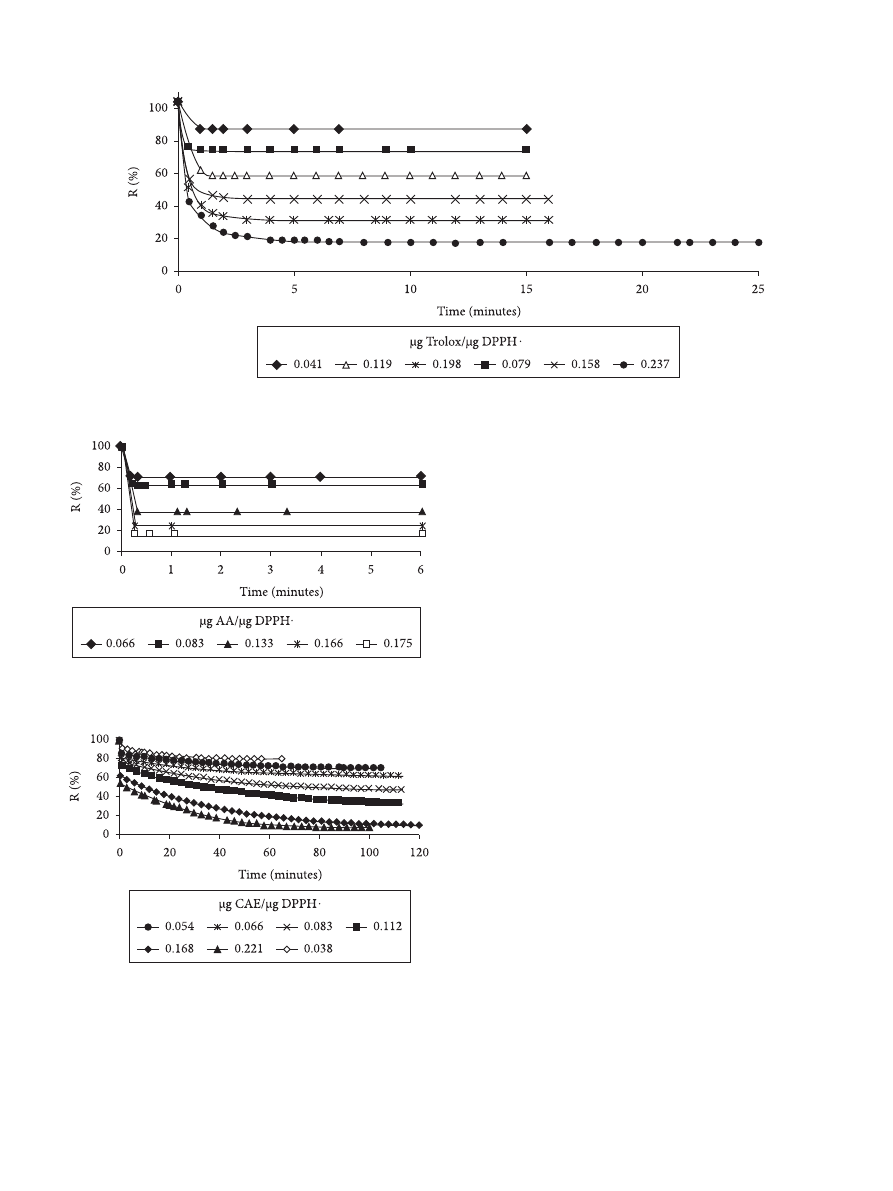
The kinetic curves for the reaction between the DPPH
radical and the standards or the polyphenols from the extracts
for several mass ratios (µg EAC.µg
–1
of DPPH) tested are
presented in Figures 3, 4, and 5, respectively. An example of the
significant reduction of the concentration of the radical DPPH in
or a hydrogen radical to become a stable molecule. This radical
has a maximum UV-vis absorption in the range between 515
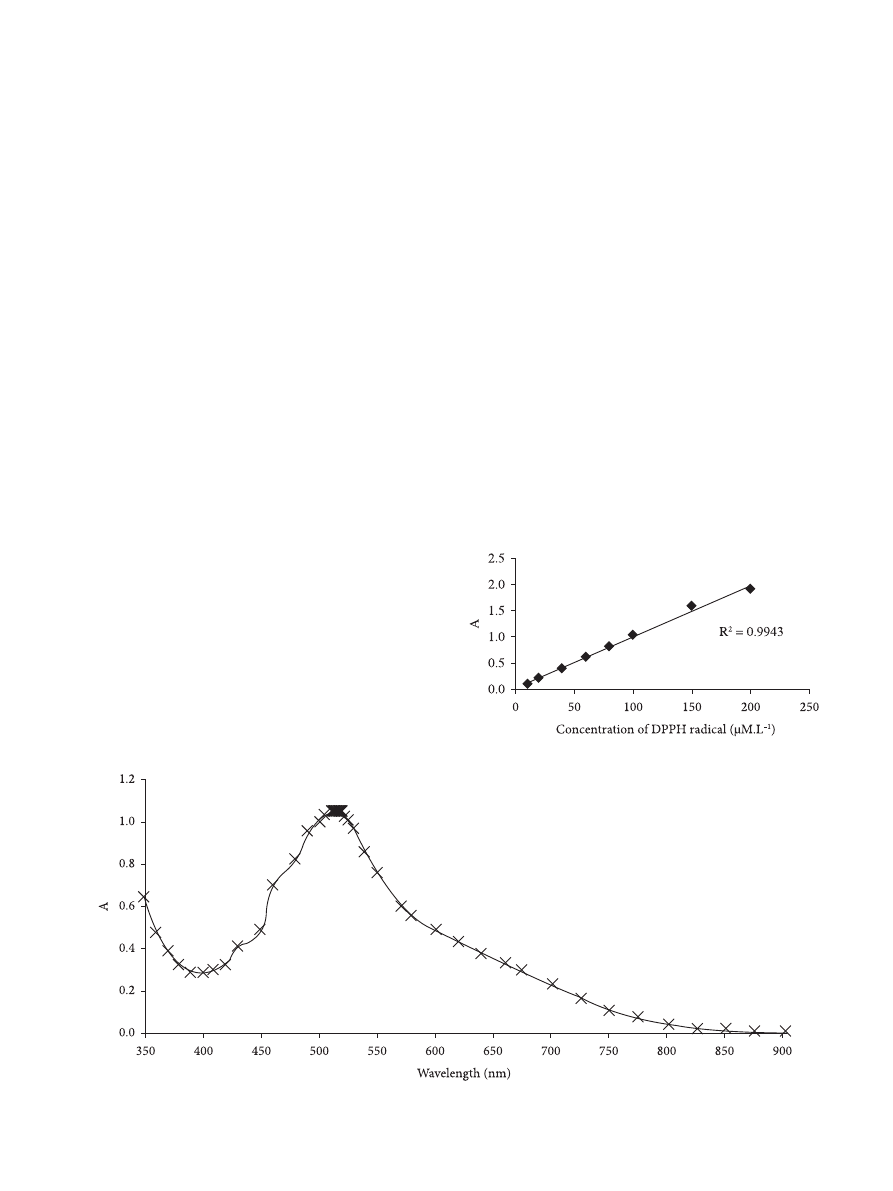
and 519 nm (Figure 1), and it is used to evaluate the antioxidant
capacity of specific compounds or extracts. The reaction is
based on the color fading that takes place when its radical
form is reduced by an antioxidant (AH), or by a radical specie
(Re). The reaction progress is conveniently monitored by the
decrease in the absorbance until the reaction reaches a plateu
(BRAND-WILLIAMS; CUVELIER; BERSET, 1995). The basic
reaction model is described in (Equation 5 and 6).(HUANG;
OU; PRIOR, 2005)
.
DPPH
AH
DPPH-H A
+
→
+
(5)
. .
üü§üüüü+
→
(6)
Both ascorbic acid, which is a natural antioxidant, and
Trolox, which is a synthetic water soluble compound equivalent
to vitamin E, are common antioxidants used as standards
to compare the antioxidant potential. (CHAN et al., 2010;
SHARMA; BHAT,2009).
According to Sharma and Bhat (2009), a good linear
absorbance profile of DPPH radical diluted in methanol was
observed in the range of DPPH concentrations between 10
and 200 µmol.L
–1
(Figure 2). It is desirable that the radical
concentration during the assay varies in the range of accurancy
of most spectrophotometers (0.4 < A < 0.9). Since above 0.9,
the measurement is probably not accurate, and below 0.4,
the differentiation between the sample and its reference may
be difficult, 100 µmol.L
–1
was chosen as the work solution
concentration.
The DPPH radical concentration in the reaction mixture
at any time was estimated from the absorbance profile of the
DPPH radical, y = 0.0103 c – 0.0013, where c = concentration
of the DPPH radical (µmol.L
–1
) (R
2
= 1) in the range between
10 and 100 µmol.L
–1
.
The length of the assay for the two standards and the
yerba maté diluted extracts was estimated monitoring the
Figure 1. Absorbance of DPPH radical solution at tested wavelengths.
Figure 2. Absorbance of DPPH radical solutions prepared in methanol.
Ciênc. Tecnol. Aliment., Campinas, 32(1): 126-133, jan.-mar. 2012
130
Antioxidant capacity of yerba maté extracts
The TPC of the yerba maté extracts obtained was
8.25 ± 0.15 g CAE % dm, the total polyphenol concentration
CoPT was 20.772 ± 1.019 mg CAE.mL
, and the AOC was
10 ± 0.26 g AAE % dm and 14.1 ± 0.35 g TE % dm.
A linear relationship between AOC and TPC (R
2
= 0.9874)
can be observed in the range between 0 and 0.168 μg CAE.μg
–1
DPPH radical. Therefore, the ethanolic extracts of yerba maté
should be diluted to ensure a polyphenol concentration of
the diluted extract (TPCo) in the range between 90 and
105 µg CAE.mL
–1
, so that the mass ratio between total
polyphenol of the extract/radical DPPH is in the range
between 0.075 and 0.088. On the other hand, when extracts are
obtained according to the procedure described in the standard
ISO 14502-1 (INTERNATIONAL…, 2004), the TPCo should
be in the range between 130 and 150 µg CAE.mL
–1
.
As observed in a previous study (BENZIE; STRAIN, 1996),
caffeine had no radical scavenging activity.
Numerous examples of the application of the Folin-
Ciocalteu assay to assess the AOC of natural products may
be found in the literature (HUANG; OU; PRIOR, 2005;
TURKMEN; SARI, 2006). In most cases, total phenols
determined by the Folin-Ciocalteu method are correlated
with the antioxidant capacities confirming the value of the
Folin-Ciocalteu test. In the present study, in order to evaluate
the correlation between TPC and AOC against DPPH radical,
eight different extracts from yerba mate using several solvent
mixtures were assessed (Table 2); although the results showed
that TPC varied considerably as a function of solvent nature, a
high positive and significant correlation was found between the
TPC and AOC using the DPPH method (Pearson’s correlation
coefficient, r
2
: 0.96). This result indicates a relationship between
phenolic compound concentration in yerba maté extracts and
their free radical scavenging capacity. Therefore, the AOC
determined by the DPPH assay proposed in the present study
can be related to the total polyphenolic content determined by
the Folin-Ciocalteu assay.
the reaction mixture due to the free radical scavenging activity
of the yerba maté extracts can be seen in Figure 5. It can also
be observed that the most diluted extracts reached the steady
state at shorter reaction times.
Figure 3. Time course of scavenging of the DPPH radical by Trolox.
Figure 4. Time course of scavenging of the DPPH radical by Ascorbic
Acid (AA).
Figure 5. Time course of scavenging of the DPPH radical by yerba maté
extracts.

Ciênc. Tecnol. Aliment., Campinas, 32(1): 126-133, jan.-mar. 2012
131
Hartwig et al.
suggested procedure should be as follows: 100 µL of an aqueous
dilution of the extracts must be mixed in duplicate with 3.0 mL
of a DPPH work solution in absolute methanol (100 µmol.L
–1
),
with an incubation time of 120 minutes in darkness at 37 ± 1 °C;
and the absorbance must be read at 517 nm against absolute
methanol.
For the blank probe, the 100 µL of the diluted extracts must
be replaced for 100 µL of absolute methanol and the absorbance
read at 517 nm must be 1.05 ± 0.05.
The results of the assay should be expressed as ascorbic
acid equivalents or Trolox equivalents in mass percentage (dry
matter) in order to facilitate comparisons.
The ethanolic extracts of yerba maté should be diluted to
ensure a polyphenol concentration of the diluted extract in the
range between 90 and 105 µg CAE.mL
–1
, so that the mass ratio
between total polyphenol of the extract/radical DPPH is in the
range between 0.075 and 0.088. In contrast, when extracts are
obtained according to the procedure described in the standard
ISO 14502-1(INTERNATIONAL…,2004), the TPCo should be
in the range between 130 and 150 µg CAE.mL
.
Caffeine presented no radical scavenging activity against
DPPH radical.
The AOC determined by the DPPH assay proposed in the
present study can be related to the total polyphenolic content
determined by the Folin-Ciocalteu assay.
The present proposed procedure has shown to be
appropriate for the assessment of the in vitro antioxidant
capacity of Ilex paraguariensis extracts and may contribute to
they quality control. It can also be applied for the assessment
of the antioxidant capacity of other plant extracts such as black
and green tea or coffee.
Acknowledgements
The authors are grateful to the National Council of Scientific
and Technical Research (CONICET) and National Institute of
Yerba Mate (INYM) for the financial support and to DINCYT
Foundation for the use of its laboratory equipment.
References
BENZIE I.; STRAIN J. The ferric reducing ability of plasma (FRAP)
as a measure of “antioxidant power”: the FRAP assay. Analytical
Biochemistry, v. 239, p. 70-76, 1996.
BORTOLUZZI, A. et al. Cuantificacao de metilxantinas e compostos
fenólicos en amostras comerciais de erva-meta (Illex paraguariensis
Saint. Hilaire). In: SOUTH AMERICAN CONGRESS OF YERBA
MATÉ, 4., 2006. Proceedings… Posadas, Misiones, 2006.
p. 143-147.
BRAND-WILLIAMS, W.; CUVELIER, M. E.; BERSET, C. Use of a free
radical method to evaluate antioxidant activity. Food Science and
Technology, v. 28, p. 25-30, 1995.
BRAVO, L.; GOYA L.; LECUMBERRI, L. LC/MS characterization of
phenolic constituents of mate (Ilex paraguariensis, St. Hil.) and its
antioxidant activity compared to commonly consumed beverages.
Food Research International, v. 40, p. 393-405, 2007.
The higher the incubation temperature, the lower
the concentration of the DPPH radical at the steady state
(pv ≤ 0.0008). This fact means higher AOC of the yerba maté
extracts with the incubation temperature; therefore, we
recommend 37 ± 1 °C as the incubation temperature. This
incubation temperature has also been used by other researchers
for the assessment of AOC of several plant extracts and plasma
(DUDONNE et al., 2009; BENZIE; STRAIN, 1996; PULIDO;
BRAVO; SAURA-CALIXTO, 2000; SERAFINI et al., 2000).
The estimated precision from available data is presented
in Tables 3 and 4.
4 Conclusions
The results of the application of the DPPH radical assay
to assess antioxidant capacity on either plant extracts or pure
compounds highly depends on: the final concentration of the
extracts, the initial concentration of the DPPH solution, the
aliquots of the extracts and the DPPH solutions, the incubation
time, and the solvent used for the DPPH solution.
In order to ensure the uniformity of the antioxidant capacity
of yerba maté extracts by the DPPH free radical assay, the
Table 3. Repeatability from replicate measurements within a single
laboratory.
AOC
(g AAE % dm)
(g TE % dm)
Sample 1 Sample 2 Sample 1 Sample 2
Nº of accepted ressults
5
5
5
5
Average (x
a
)
18.12
16.32
25.46
22.89
Standard deviation (DS)
0.255
0.370
0.367
0.497
Std. dev. of the results of
the test (Sr = DS*m
–0.5
)
0.180
0.261
0.259
0.352
Repeatability (r = 2.77*Sr)
0.499
0.724
0.719
0.974
Repeatability in percentage
%r = (100*r/x
a
)
2.8
4.4
2.8
4.3
Repeatability average (%)
3.6
3.5
m: number of samples; AAE: ascorbic acid equivalents; TE: Trolox equivalent; dm:
dry matter.
Table 4. Test results from several laboratories.
AOC
(g AAE % dm)
(g TE % dm)
Laboratory
Average Std. Dev Average Std. Dev
1
16.90
0.29
23.68
0.42
2
16.75
0.25
23.48
0.36
3
17.11
0.31
24.00
0.45
Average
16.92
0.29
23.72
0.41
Between Laboratory Std
Dev., Sn
0.181
0.260
Corrected between-Lab. Std.
Dev., SR
0.231
0.332
Reproducibility
(Between labs), R = 2.77*SR
0.639
0.919
Reproducibility
(Between labs) (%)
3.8
3.9
AAE: ascorbic acid equivalents; TE: Trolox equivalent; dm: dry matter.

Ciênc. Tecnol. Aliment., Campinas, 32(1): 126-133, jan.-mar. 2012
132
Antioxidant capacity of yerba maté extracts
KEVERS, C. et al. Evolution of antioxidant capacity during storage of
selected fruits and vegetables. Journal of Agricultural and Food
Chemistry, v. 55, p. 8596-8603, 2007.
LO SCALZO, R. Organic acids influence on DPPH scavenging by
ascorbic acid. Food Chemistry, v. 107, p. 40-43, 2000.
MEDA, A. E. et al. Determination of the total phenolic, flavonoid and
proline contents in Burkina Fasan honey, as well as their radical
scavenging activity. Food Chemistry, v. 91, p. 571-577, 2005.
PAIXÃO, N. et al. Relationship between antioxidant capacity and total
phenolic content of red, rosé and white wines. Food Chemistry,
v. 105, p. 204-214, 2007.
PINEDA RIVELLI, D. et al. Simultaneous determination of chlorogenic
acid, caffeic acid and caffeine in hydroalcoholic and aqueous extracts
of Ilex paraguariensis by HPLC and correlation with antioxidant
capacity of the extracts by DPPH• reduction. Brazilian Journal of
Pharmaceutical Sciences, v. 43, n. 2, p. 215-222, 2007.
PULIDO, R.; BRAVO, L.; SAURA-CALIXTO, F. Antioxidant activity of
dietary polyphenols as determined by a modified ferric reducing/
antioxidant power assay. Journal of Agricultural and Food
Chemistry, v. 48, p. 3396-3402, 2000.
RAMIREZ-MARES, M.; CHANDRA, S.; GONZALEZ DE MEJIA,
E. In vitro chemopreventive activity of Camellia sinensis, Ilex
paraguariensis and Ardisia compressa tea extracts and selected
polyphenols. Mutation Research, v. 554, p. 53-65, 2004.
SAITO, S. T. et al. Characterization of the constituents and antioxidant
activity of Brazilian green tea (Camellia sinensis var. assamica
IAC-259 cultivar) extracts. Journal of Agricultural and Food
Chemistry, v. 55, p. 9409-9414, 2007.
SCHINELLA, G. R. et al. Antioxidant effects of an aqueous extract
of Ilex paraguariensis. Biochemical and Biophysical Research
Communications, v. 269, p. 357-360, 2000.
SERAFINI, M. et al. Inhibition of human LDL lipid peroxidation by
phenol-rich beverages and their impact on plasma total antioxidant
capacity in humans. Journal of Nutritional Biochemistry, v.11
p. 585-590, 2000.
SHARMA, O. P.; BHAT, T. K. DPPH antioxidant assay revisited. Food
Chemistry, v. 113, p. 1202-1205, 2009.
THAIPONG, K. et al. Comparison of ABTS, DPPH, FRAP, and ORAC
assays for estimating antioxidant capacity from guava fruits extracts.
Journal of Food Composition and Analysis, v. 19, p. 669-675, 2006.
TURKMEN, N.; SARI, F. Effects of extraction solvents on concentration
and antioxidant activity of black and black mate tea polyphenols
determined by ferrous tartrate and Folin–Ciocalteu methods. Food
Chemistry, v. 99, p. 835-841, 2006.
WETTASINGHE, M.; SHAHIDI, F. Evening primrose meal: a source
of natural antioxidants and scavenger of hydrogen peroxide and
oxygen-derived free radicals. Journal of Agricultural and Food
Chemistry, v. 47, p. 1801-1812, 1999.
CHAN, E. W. C. et al. Antioxidant properties of tropical and temperate
herbal teas. Journal of Food Composition and Analysis, v. 23, n. 2,
p. 185-189, 2010.
CHANDRA, S.; GONZALEZ DE MEJIA, E. Polyphenolic compounds,
antioxidant capacity, and quinone reductase activity of an
aqueous extract of Ardisia compressa in comparison to mate (Ilex
paraguariensis) and green (Camellia sinensis) teas. Journal of
Agricultural and Food Chemistry, v. 52, p. 3583-3589, 2004.
CHEN, Y. C. et al. DPPH radical-scavenging compounds from Dou-
Chi, a soybean fermented food. Bioscience, Biotechnology and
Biochemistry, v. 69, n. 5, p. 999-1006, 2005.
DAE-OK, K. et al. Vitamnin C equivalente antioxidant capacity
(VCEAC) of phenolic phytichemicals. Journal of Agricultural and
Food Chemistry, v. 50, p. 3713-3717, 2002.
DUDONNÉ, S. et al. Comparative study of antioxidant properties
and total phenolic content of 30 plant extracts of industrial interest
using DPPH, ABTS, FRAP, SOD and ORAC assays. Journal of
Agricultural and Food Chemistry, v. 57, p. 1768-1774, 2009.
ELZAAWELY, A. A.; XUAN, T. D.; TAWATA, S. Essential oils, kava
pyrones and phenolic compounds from leaves and rhizomes
of Alpinia zerumbet (Pers.) B.L. Burtt. & R.M. Sm. and their
antioxidant activity. Food Chemistry, v. 103, p. 486-494, 2007.
FILIP, R. et al. Antioxidant activity of Ilex paraguariensis and related
species. Nutrition Research, v. 20, n.10, p. 1437-1446, 2000.
GÖKTÜRK BAYDAR, N.; ÖZKAN G.; YAŞAR, S. Evaluation of
the antiradical and antioxidant potential of grape extracts. Food
Control, v. 18, p. 1131-1136, 2007.
GONZÁLEZ DE MEJIA, E. et al. Effect of yerba mate (Ilex paraguariensis)
tea on topoisomerase inhibition and oral carcinoma cell
proliferation. Journal of Agricultural and Food Chemistry, v. 53,
p. 1966-1973, 2005.
GUGLIUCCI, A. Antioxidant effects of Ilex paraguariensis: induction
of decreased oxidability of human LDL in vivo. Biochemical and
Biophysical Research Communications, v. 224, p. 338-344, 1996.
HECK, C.; SCHMALKO, M. E.; GONZALEZ DE MEJIA, E. Effect
of growing and drying conditions on the phenolic composition of
mate teas (Ilex paraguariensis). Journal of Agricultural and Food
Chemistry, v. 56, p. 8394-8403, 2008.
HUANG, D.; OU, B.; PRIOR, R. The chemistry behind antioxidant
capacity assays. Journal of Agricultural and Food Chemistry,
v. 53, p. 1841-1856, 2005.
INTERNATIONAL ORGANIZATION FOR STANDARDIZATION -
ISO 14502-1 Determination of total polyphenols in tea-Colorimetric
method using Folin-Ciocalteau reagent. Part 1. International
Organization for Standartzation, 2004.
KARIOTI, A. et al. Composition and antioxidant activity of the
essential oils of Xylopia aethiopica (Dun) A. Rich. (Annonaceae)
leaves, stem bark, root bark, and fresh and dried fruits, growing
in Ghana. Journal of Agricultural and Food Chemistry, v. 52,
p. 8094-8098, 2004.

Ciênc. Tecnol. Aliment., Campinas, 32(1): 126-133, jan.-mar. 2012
133
Hartwig et al.
Nomenclature
A
absorbance
AA
Ascorbic Acid
AAE
Ascorbic Acid Equivalents
AOC
antioxidant capacity
CAE
Chlorogenic Acid Equivalents
dm
dry matter
DPPHo
concentration of radical DPPH at zero time (initial concentration)
DPPHss
concentration of radical DPPH at steady-state
DU
mass of DPPH radical used in the reaction
DV
Dilution Volume
g% dm
g equivalents per 100 g of dry matter
OV
recovered volume
PU
mass of total polyphenols in yerba maté extracts used in the reaction
TE
Trolox Equivalents
TP
Total Polyphenols
TPCo
Total Polyphenol Concentration in the original extract.
TPC
polyphenol total content
R
2
correlation coefficient
r
2
Pearson´s coefficient
%R
percentage of residual DPPH radical remaining at steady state
v/v
volume / volume
w/w
weight/weight
w/v
weight/volume
Wyszukiwarka
Podobne podstrony:
[Folia Horticulturae] Phenolic compounds bioactive content and antioxidant capacity of the fruits of
How to Get the Most Out of Conversation Escalation
Brown Derren How to Get the Truth out of Anyone
Baudrillard ON THE MURDEROUS CAPACITY OF IMAGES 1993
11 How to prepare the launch date of a new project successfully
Use of exponential, Page’s and diffusional models to simulate the drying kinetics of kiwi fruit
Richtie From Morality to Metaphysics The Theistic Implications of our Ethical Commitments
9 Ways To Get The Most Out Of Any Book
How to Get the Most Out of Your Coaching
How to Replace the DVD Laser of an RNS e
Top 10 Ways to Get the Most Out of Your Coaching
To Kill A Mockingbird Good Analysis of the Novel
The Parents Capacity to Treat the Child as a Psychological Agent Constructs Measures and Implication
National Legal Measures to Combat Racism and Intolerance in the Member States of the Council of Euro
E Holveck The Blood of Others A Novel Approach to The Ethics of Ambiguity
Bo Strath A European Identity to the historical limits of the concept
Introduction to the Magnetic Treatment of Fuel
więcej podobnych podstron