
Harvard Business Review Online | Strategy as Ecology
Click here to visit:
Strategy as Ecology
Stand-alone strategies don’t work when your company’s
success depends on the collective health of the organizations
that influence the creation and delivery of your product.
Knowing what to do requires understanding the ecosystem
and your organization’s role in it.
by Marco Iansiti and Roy Levien
Marco Iansiti is the David Sarnoff Professor of Business Administration at Harvard Business School in Boston. Roy Levien is the
manager and a principal at Keystone Advantage, a technology consultancy in Lexington, Massachusetts. They are the authors of The
Keystone Advantage: What the New Dynamics of Business Ecosystems Mean for Strategy, Innovation, and Sustainability (Harvard
Business School Press, 2004). The authors have had consulting relationships with several companies mentioned in this article. Iansiti
can be reached at
Wal-Mart’s and Microsoft’s dominance in modern business has been attributed to any number of factors, ranging
from the vision and drive of their founders to the companies’ aggressive competitive practices. But the
performance of these two very different firms derives from something that is much larger than the companies
themselves: the success of their respective business ecosystems. These loose networks—of suppliers,
distributors, outsourcing firms, makers of related products or services, technology providers, and a host of other
organizations—affect, and are affected by, the creation and delivery of a company’s own offerings.
Like an individual species in a biological ecosystem, each member of a business ecosystem ultimately shares the
fate of the network as a whole, regardless of that member’s apparent strength. From their earliest days, Wal-
Mart and Microsoft—unlike companies that focus primarily on their internal capabilities—have realized this and
pursued strategies that not only aggressively further their own interests but also promote their ecosystems’
overall health.
They have done this by creating “platforms”—services, tools, or technologies—that other members of the
ecosystem can use to enhance their own performance. Wal-Mart’s procurement system offers its suppliers
invaluable real-time information on customer demand and preferences, while providing the retailer with a
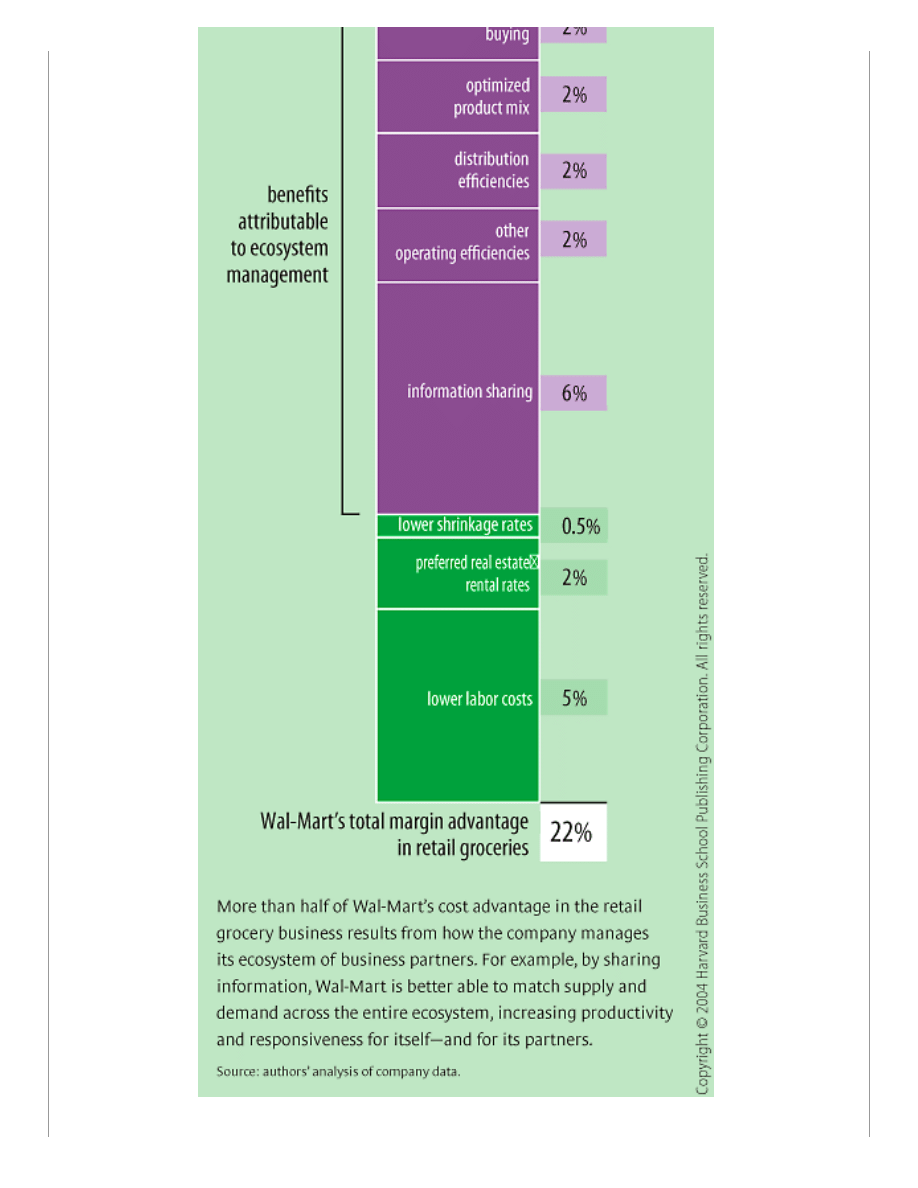
significant cost advantage over its competitors. (For a breakdown of how Wal-Mart’s network strategy
contributes to this advantage, see the exhibit “The Ecosystem Edge.”) Microsoft’s tools and technologies allow
software companies to easily create programs for the widespread Windows operating system—programs that, in
turn, provide Microsoft with a steady stream of new Windows applications. In both cases, these symbiotic
relationships ultimately have benefited consumers—Wal-Mart’s got quality goods at lower prices, and Microsoft’s
got a wide array of new computing features—and gave the firms’ ecosystems a collective advantage over
competing networks.
http://harvardbusinessonline.hbsp.harvard.edu...l;jsessionid=ANFDWDIGDO1TECTEQENR5VQKMSARUIPS (1 of 13) [02-Mar-04 11:25:24]
Harvard Business Review Online | Strategy as Ecology
http://harvardbusinessonline.hbsp.harvard.edu...l;jsessionid=ANFDWDIGDO1TECTEQENR5VQKMSARUIPS (2 of 13) [02-Mar-04 11:25:24]
Harvard Business Review Online | Strategy as Ecology
Over time, the companies in the ecosystems made investments to leverage their relationships and began to
depend on Wal-Mart and Microsoft for their own success. For example, Procter & Gamble integrated its ERP
system with Wal-Mart’s, and AutoCad integrated Microsoft’s programming components into its applications.
Although Wal-Mart and Microsoft have been criticized for being tough on their business partners, the complex
interdependencies among companies that these industry giants encouraged have made their business networks
unusually productive and innovative—and allowed the two companies to enjoy sustained superior performance.
Each of these ecosystems today numbers thousands of firms and millions of people, giving them a scale many
orders of magnitude larger than the companies themselves and an advantage over smaller, competing
ecosystems.
Although Wal-Mart and Microsoft have been astonishingly successful in organizing and orchestrating their vast
business networks, their two ecosystems aren’t anomalies. Most companies today inhabit ecosystems that
extend beyond the boundaries of their own industries. The moves that a company makes will, to varying
degrees, affect its business network’s health, which in turn will ultimately affect the company’s performance—for
ill as well as for good. But despite being increasingly central to modern business, ecosystems are still poorly
understood and even more poorly managed. We offer a framework here for assessing the health of your
company’s ecosystem, determining your place in it, and developing a strategy to match your role.
What Is a Business Ecosystem?
Consider the world around us. Dozens of organizations collaborate across industries to bring electricity into our
homes. Hundreds of organizations join forces to manufacture and distribute a single personal computer.
Thousands of companies coordinate to provide the rich foundation of applications necessary to make a software
operating system successful.
Many of these organizations fall outside the traditional value chain of suppliers and distributors that directly
contribute to the creation and delivery of a product or service. Your own business ecosystem includes, for
example, companies to which you outsource business functions, institutions that provide you with financing,
firms that provide the technology needed to carry on your business, and makers of complementary products
that are used in conjunction with your own. It even includes competitors and customers, when their actions and
feedback affect the development of your own products or processes. The ecosystem also comprises entities like
regulatory agencies and media outlets that can have a less immediate, but just as powerful, effect on your
business.
Drawing the precise boundaries of an ecosystem is an impossible and, in any case, academic exercise. Rather,
you should try to systematically identify the organizations with which your future is most closely intertwined and
determine the dependencies that are most critical to your business. If you look carefully, you will most likely find
that you depend on hundreds, if not thousands, of other businesses. It is helpful to subdivide a complex
ecosystem into a number of related groups of organizations, or business domains. These may in some cases
represent something as well defined as a conventional industry segment. Each ecosystem typically encompasses
several domains, which it may share with other ecosystems.
For an ecosystem to function effectively, each domain in it that is critical to the delivery of a product or service
should be healthy; weakness in any domain can undermine the performance of the whole. In the case of
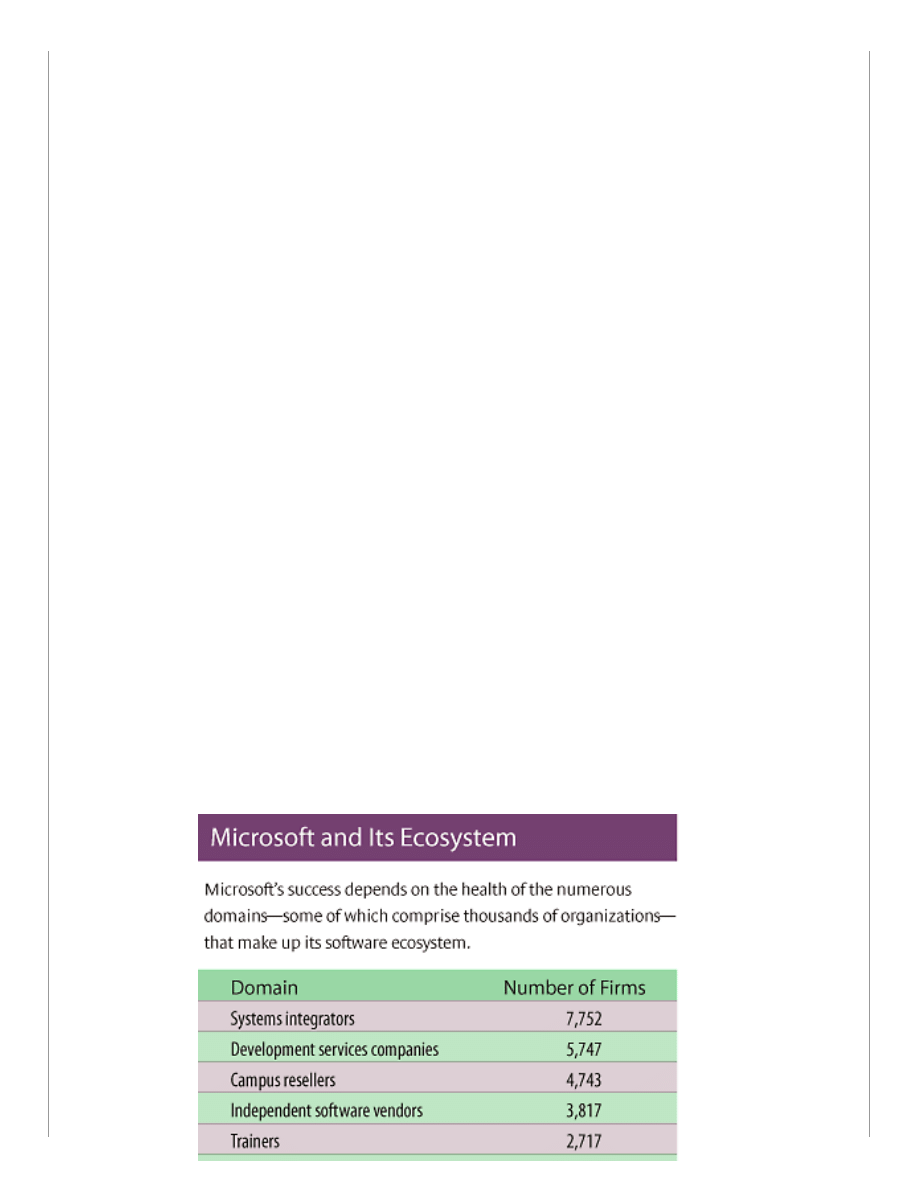
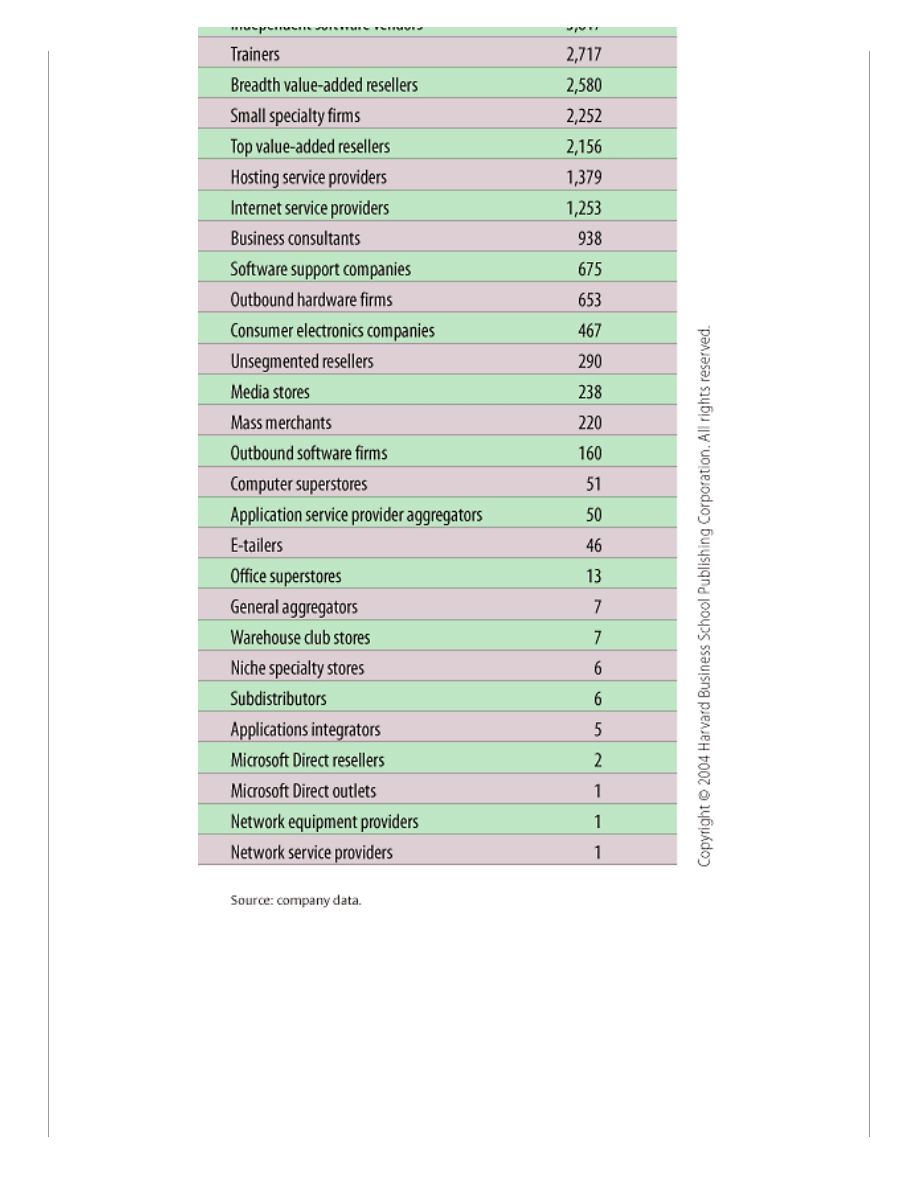
Microsoft, the company’s performance depends on the health of independent software vendors and systems
integrators, among many others. (For a depiction of some of the crucial domains in Microsoft’s software
ecosystem, see the exhibit “Microsoft and Its Ecosystem.”)
http://harvardbusinessonline.hbsp.harvard.edu...l;jsessionid=ANFDWDIGDO1TECTEQENR5VQKMSARUIPS (3 of 13) [02-Mar-04 11:25:24]
Harvard Business Review Online | Strategy as Ecology
In the boom years of the Internet, there was an almost universal euphoria about the potential of business
networks. Vast, connected communities of companies would enjoy unheard of efficiencies in operations and
innovation. New technologies would disrupt traditional companies and create unprecedented opportunities for
innovation, as well as for the growth of new companies. Network effects—the increasing value of a product or
service as the number of people using it grows—would create enormous value and remove barriers to entry in
businesses as different as B2B exchanges and grocery delivery. But things were not so simple, as the disastrous
failures of companies like PetroCosm and Webvan made clear.
The implosion of the Internet bubble made it obvious that members of a network share a common fate, meaning
that they could rise and fall together. Many had predicted the bubble could not last, of course, but the
http://harvardbusinessonline.hbsp.harvard.edu...l;jsessionid=ANFDWDIGDO1TECTEQENR5VQKMSARUIPS (4 of 13) [02-Mar-04 11:25:24]
Harvard Business Review Online | Strategy as Ecology
sharpness, suddenness, and violence of the fall surprised most people. The stunning reversal of the virtuous
cycle, which had seemed to automatically drive endless exponential growth, left many questioning their faith in
the power of business networks. Instead of abandoning their faith, business leaders should work to understand
the phenomenon more deeply. The analogy between business networks and biological ecosystems can aid this
understanding by vividly highlighting certain pivotal concepts. (For a discussion of similarities and differences
between the two types of ecosystems, see the sidebar “How Useful an Analogy?”)
How Useful an Analogy?
Sidebar R0403E_A (Located at the end of this
article)
Assessing Your Ecosystem’s Health
So what is a healthy business ecosystem? What are the indications that it will continue to create opportunities
for each of its domains and for those who depend on it? There are three critical measures of health—for business
as well as biological ecosystems.
Productivity.
The most important measure of a biological ecosystem’s health is its ability to effectively convert
nonbiological inputs, such as sunlight and mineral nutrients, into living outputs—populations of organisms, or
biomass. The business equivalent is a network’s ability to consistently transform technology and other raw
materials of innovation into lower costs and new products. There are a number of ways to measure this. A
relatively simple one is return on invested capital.
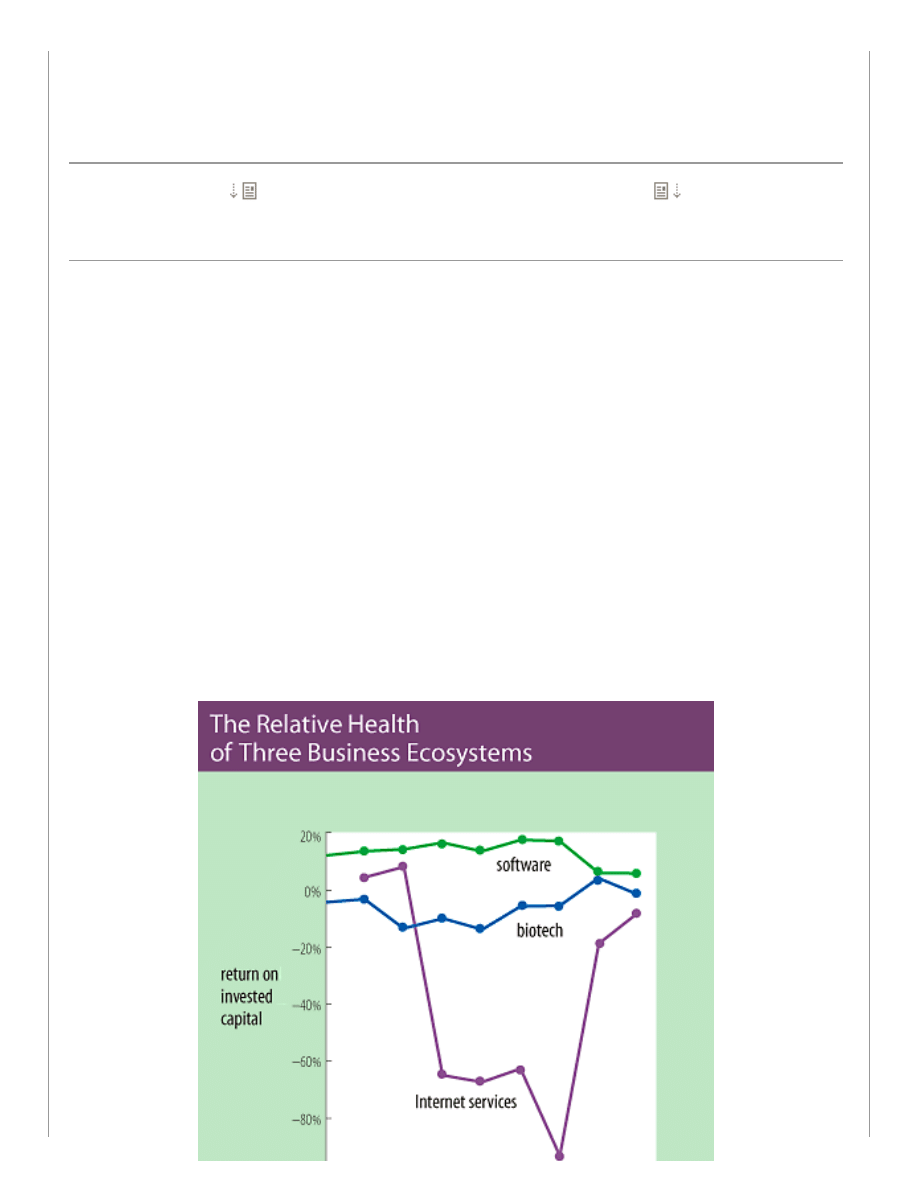
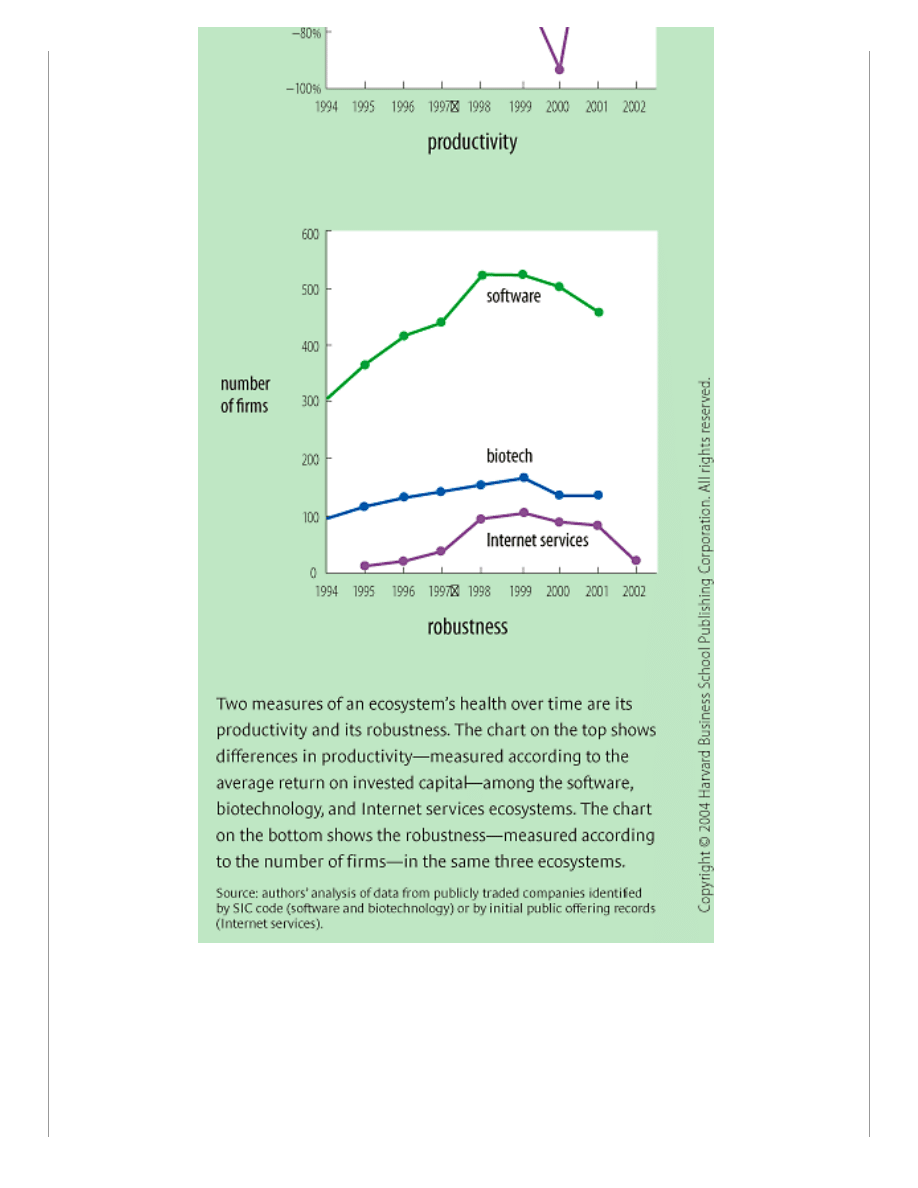
When we analyzed companies’ aggregate return on invested capital in three broadly defined
industries—software, biotechnology, and Internet services—over the past decade, we discovered striking
productivity differences among these three ecosystems. Software firms averaged better than a 10% return on
invested capital, while biotechnology businesses had a negative return of roughly 5%, and, predictably, Internet
companies had a negative return of nearly 40%.
Most interesting was the change in productivity over time. (See the exhibit “The Relative Health of Three
Business Ecosystems.”) While the return on invested capital in the software and biotechnology ecosystems didn’t
vary much from year to year, it plummeted between 1996 and 1997 in the Internet services ecosystem, as
companies like Yahoo and AOL began charging exorbitant fees to companies seeking traffic from their portals.
The plunging figures precede by more than three years the actual collapse of the Internet sector in 2002.
Clearly, an assessment of this ecosystem’s health before the collapse might have helped companies—Cisco, for
example, which supplied Internet services companies with essential technology—reduce their dependence on a
precarious network in which they had such big stakes.
http://harvardbusinessonline.hbsp.harvard.edu...l;jsessionid=ANFDWDIGDO1TECTEQENR5VQKMSARUIPS (5 of 13) [02-Mar-04 11:25:24]
Harvard Business Review Online | Strategy as Ecology
Robustness.
To provide durable benefits to the species that depend on it, a biological ecosystem must persist
in the face of environmental changes. Similarly, a business ecosystem should be capable of surviving disruptions
such as unforeseen technological change. The benefits are obvious: A company that is part of a robust
ecosystem enjoys relative predictability, and the relationships among members of the ecosystem are buffered
against external shocks. Think, for example, of the relationship between Microsoft and its community of
independent software vendors, which collectively survived the adoption of the World Wide Web.
Perhaps the simplest, if crude, measure of robustness is the survival rates of ecosystem members, either over
time or relative to comparable ecosystems. Again, it is instructive to apply this measure to the software,
http://harvardbusinessonline.hbsp.harvard.edu...l;jsessionid=ANFDWDIGDO1TECTEQENR5VQKMSARUIPS (6 of 13) [02-Mar-04 11:25:24]

Harvard Business Review Online | Strategy as Ecology
biotechnology, and Internet services communities. In software, we see strong growth over the decade, with
some contraction around the technology recession of 2001, as the exhibit shows. The biotech community’s
population line is relatively flat, which masks a lot of industry churn—new start-ups replacing companies that
went out of business. The Internet ecosystem’s dramatic collapse in 2002 needs no elaboration, though, as we
have noted, it seems to have been foreshadowed by the fall of one measure of ecosystem productivity, return on
investment.
A company that is part of a robust ecosystem
enjoys relative predictability, and the
relationships among members of the
ecosystem are buffered against external
shocks.
Niche Creation.
Robustness and productivity do not completely capture the character of a healthy biological
ecosystem. The ecological literature indicates that it is also important these systems exhibit variety, the ability
to support a diversity of species. There is something about the idea of diversity, in business as well as in biology,
that suggests an ability to absorb external shocks and the potential for productive innovation.
The best measure of this in a business context is the ecosystem’s capacity to increase meaningful diversity
through the creation of valuable new functions, or niches. One way to assess niche creation is to look at the
extent to which emerging technologies are actually being applied in the form of a variety of new businesses and
products. The computing and automobile industries exhibit very different profiles in this vein. While the
computing industry’s enthusiastic embrace of innovative technologies has led to the sustained creation of
opportunities for entirely new classes of companies, the automobile industry has historically sought to prevent
additional niches from emerging.
It is critically important to appreciate that although healthy ecosystems should create new niches, it does not
follow that old niches must persist. In fact, decreased diversity in some areas of an ecosystem enable the
creation of niches in others. The collapse of mainframe-related business niches gave rise to a plethora of new
domains related to personal computing and client-server networks. In biological evolution, reduced diversity at
one level can lead to the creation of a stable foundation that enables greater and more meaningful diversity at
other, sometimes higher, levels. For example, the standardization of a simple DNA alphabet, as well as a few
basic mechanisms of metabolism and several basic models for organisms, serves as the building blocks for the
enormous variety of life on earth.
So how can you promote the health and stability of your own ecosystem, thereby helping to ensure your
company’s well-being? It depends on your role—current and potential—within the network. Are you one of the
niche players that make up the bulk of most ecosystems? If you occupy one of the few hubs or nodes
characteristic of networks, are you using that position to act as an indispensable keystone? Do you dominate
your ecosystem? If not, do you harbor ambitions to dominate it—and are you aware of the risks that come with
that role? The answers to these questions may be different for different parts of your business. They may also
change as your ecosystem changes. (See the sidebar “Match Your Strategy to Your Environment.”)
Match Your Strategy to Your Environment
Sidebar R0403E_B (Located at the end of this
article)
The Keystone Advantage
Keystone organizations play a crucial role in business ecosystems. Fundamentally, they aim to improve the
overall health of their ecosystems by providing a stable and predictable set of common assets—think of Wal-
Mart’s procurement system and Microsoft’s Windows operating system and tools—that other organizations use to
build their own offerings.
Keystones can increase ecosystem productivity by simplifying the complex task of connecting network
participants to one another or by making the creation of new products by third parties more efficient. They can
enhance ecosystem robustness by consistently incorporating technological innovations and by providing a
reliable point of reference that helps participants respond to new and uncertain conditions. And they can
encourage ecosystem niche creation by offering innovative technologies to a variety of third-party organizations.
The keystone’s importance to ecosystem health is such that, in many cases, its removal will lead to the
catastrophic collapse of the entire system. For example, WorldCom’s failure had negative repercussions for the
http://harvardbusinessonline.hbsp.harvard.edu...l;jsessionid=ANFDWDIGDO1TECTEQENR5VQKMSARUIPS (7 of 13) [02-Mar-04 11:25:24]

Harvard Business Review Online | Strategy as Ecology
entire ecosystem of suppliers of telecommunications equipment.
By continually trying to improve the ecosystem as a whole, keystones ensure their own survival and prosperity.
They don’t promote the health of others for altruistic reasons; they do it because it’s a great strategy.
Keystones, in many ways, are in an advantageous position. As in biological ecosystems, keystones exercise a
systemwide role despite being only a small part of their ecosystems’ mass. Despite Microsoft’s pervasive impact,
for example, it remains only a small part of the computing ecosystem. Both its revenue and number of
employees represent about 0.05% of the total figures for the ecosystem. Its market capitalization represents a
larger portion of the ecosystem—typical for a keystone because of its powerful position—but it has never been
higher than 0.4%. Even in the much smaller software ecosystem, in which the company plays an even more
crucial role, Microsoft’s market cap has typically ranged between 20% and 40% of the combined market cap of
software providers. This is a fraction of the more than 80% of total market capitalization of the much larger
ecosystem of computer software, components, systems, and services that IBM held during the 1960s.
Broadly speaking, an effective keystone strategy has two parts. The first is to create value within the ecosystem.
Unless a keystone finds a way of doing this efficiently, it will fail to attract or retain members. The second part,
as we have noted, is to share the value with other participants in the ecosystem. The keystone that fails to do
this will find itself perhaps temporarily enriched but ultimately abandoned.
Keystones can create value for their ecosystems in numerous ways, but the first requirement usually involves
the creation of a platform, an asset in the form of services, tools, or technologies that offers solutions to others
in the ecosystem. The platform can be a physical asset, like the efficient manufacturing capabilities that Taiwan
Semiconductor Manufacturing offers to those computer-chip design companies that don’t have their own silicon-
wafer foundries, or an intellectual asset, like the Windows software platform. Keystones leave the vast majority
of value creation to others in the ecosystem, but what they do create is crucial to the community’s survival.
The second requirement for keystones’ success is that they share throughout the ecosystem much of the value
they have created, balancing their generosity with the need to keep some of that value for themselves.
Achieving this balance may not be as easy as it seems. Keystone organizations must make sure that the value of
their platforms, divided by the cost of creating, maintaining, and sharing them, increases rapidly with the
number of ecosystem members that use them. This allows keystone players to share the surplus with their
communities. During the Internet boom, many businesses failed because, although the theoretical value of a
keystone platform was increasing with the number of customers, the operating cost was rising, as well. Many
B2B marketplaces, for example, continued to increase revenue despite decreasing and ultimately disappearing
margins, which led to the collapse of their business models.
A good example of a keystone company that effectively creates and shares value with its ecosystem is eBay. It
creates value in a number of ways. It has developed state-of-the-art tools that increase the productivity of
network members and encourage potential members to join the ecosystem. These tools include eBay’s Seller’s
Assistant, which helps new sellers prepare professional-looking online listings, and its Turbo Lister service, which
tracks and manages thousands of bulk listings on home computers. The company has also established and
maintained performance standards that enhance the stability of the system. Buyers and sellers rate one another,
providing rankings that bolster users’ confidence in the system. Sellers with consistently good evaluations attain
PowerSeller status; those with bad evaluations are excluded from future transactions.
A firm that takes an action without
understanding the impact on the ecosystem as
a whole is ignoring the reality of the
networked environment in which it operates.
Additionally, eBay shares the value that it creates with members of its ecosystem. It charges users only a
moderate fee to coordinate their trading activities. Incentives such as the PowerSeller label reinforce standards
for sellers that benefit the entire ecosystem. These performance standards also delegate much of the control of
the network to users, diminishing the need for eBay to maintain expensive centralized monitoring and feedback
systems. The company can charge commissions that are no higher than 7% of a given transaction—well below
the typical 30% to 70% margins most retailers would charge. It is important to stress that eBay does this
because it is good business. By sharing the value, it continues to expand its own healthy ecosystem—buyers and
sellers now total more than 70 million—and thrive in a sustainable way.
The Dangers of Domination
Keystones exercise the power of their position within an ecosystem in a somewhat indirect manner. But
ecosystem dominators wield their clout in a more traditional way, exploiting a critical position to either take over
the network or, more insidiously, drain value from it.
http://harvardbusinessonline.hbsp.harvard.edu...l;jsessionid=ANFDWDIGDO1TECTEQENR5VQKMSARUIPS (8 of 13) [02-Mar-04 11:25:24]

Harvard Business Review Online | Strategy as Ecology
The physical dominator aims to integrate vertically or horizontally to own and manage a large proportion of a
network directly. Once the dominator becomes solely responsible for most of the value creation and capture,
there is little opportunity for a meaningful ecosystem to emerge. Physical dominators, the ultimate aggressors,
eventually control much of an ecosystem. But at least they are responsible for creating the value that they
capture. During the heyday of mainframes, IBM dominated the computing ecosystem, providing most of the
products and services its customers needed. The strategy was effective, allowing IBM to create and extract
enormous value for long periods of time. But it failed when IBM encountered the PC ecosystem, which was much
more open and distributed, supported by effective keystone strategies put forth by the likes of Microsoft and
Apple (and, yes, even IBM itself), and which reached much higher levels of innovation and flexibility.
By contrast, a value dominator has little direct control over its ecosystem, occupying in some cases just a single
hub. It creates little, if any, value for the ecosystem; a value dominator extracts as much as it can. By sucking
from the network most of the value created by other members, it leaves too little to sustain the ecosystem,
which ultimately collapses and brings the value dominator down with it.
One need only look to Enron for a sobering example. It is useful to contrast Enron’s approach to its ecosystem
with eBay’s. The two companies faced similarly daunting challenges in the late 1990s: how to use the Internet to
form numerous individual markets, in the process generating massive business networks of trading partners of
which they would be the hub. Enron started by leveraging its established and unique position in the energy
sector, and its aggressive, blue-chip managerial talent, to improve the efficiency of high-value but traditionally
fragmented markets. EBay’s beginnings were much more humble. It had few assets and focused initially on the
narrow collectors’ market.
In the years that followed, Enron and eBay moved to create and nourish hundreds of new markets. And this is
where their paths drastically diverged. EBay took the keystone route, sharing the wealth it generated and, along
the way, creating an enormous and healthy ecosystem of trading partners. Enron became a value dominator,
extracting as much value as it could from the new markets it entered by using its strategic position to exploit
asymmetries in information across the market. The aggressive behavior of Enron’s traders impeded the type of
trust that eBay was building in its communities.
The results are starkly instructive. The implosion of Enron’s ecosystem ultimately led it to conceal in illegal
partnerships its resulting market losses. Meanwhile, eBay boasted positive cash flow from the start and ended
up generating huge profits. The company that shared the wealth ended up making the money.
Leveraging a Niche
In business ecosystems, most firms follow niche strategies. A niche player aims to develop specialized
capabilities that differentiate it from other companies in the network. By leveraging complementary resources
from other niche players or from an ecosystem keystone, the niche player can focus all its energies on
enhancing its narrow domain of expertise.
When they are allowed to thrive, niche players represent the bulk of the ecosystem and are responsible for most
of the value creation and innovation. They typically operate in the shadow of a keystone, which offers its
resources to niche players, or a dominator, which works to exploit or displace them.
Because a niche player is naturally dependent on other businesses, it needs to analyze its ecosystem and
identify the characteristics of its keystones and dominators, current or potential. Do strong keystones exist? Are
there multiple keystones competing to play the same role? How far removed are the dominators?
An example of a niche player is Nvidia, a designer of integrated circuits known as graphics accelerators, which
are the foundation for video games and a host of other multimedia applications. Because it has no plants of its
own, Nvidia leverages the manufacturing platforms of two keystone companies, Taiwan Semiconductor
Manufacturing and IBM. It also leverages their intellectual assets (their component libraries and design tools),
not to mention the assets of several other firms, including assembly and testing companies. This complex web of
relationships enables Nvidia to avoid the significant costs and risks associated with owning and operating
manufacturing, assembly, and test operations. The company can focus its resources on product design, quality
assurance, marketing, and customer support. At the same time, its interdependencies mean the company must
share the fate of the other participants in the ecosystem. Thus, Nvidia’s performance is tied not only to that of
Taiwan Semiconductor Manufacturing and IBM but also to that of library providers like Artisan Components and
design tool providers like Synopsis.
Despite the best, highly specialized strategies, niche players usually find that they come into conflict with other
niche players, keystones, and especially dominators. Innovation—at the core of their strategy of specialization
and differentiation—is critical to their success in these battles. Niche players that do not or cannot actively
advance and evolve their products toward the edges of the ecosystem may find that the frontier of a keystone’s
expanding platform will approach the niche they occupy—often forcing the niche player to let its product be
incorporated into the platform. Indeed, a keystone’s moves to improve an ecosystem’s overall health sometimes
http://harvardbusinessonline.hbsp.harvard.edu...l;jsessionid=ANFDWDIGDO1TECTEQENR5VQKMSARUIPS (9 of 13) [02-Mar-04 11:25:24]

Harvard Business Review Online | Strategy as Ecology
come at the expense of a niche member, which gets swallowed up by the keystone. Still, differentiation provides
a powerful defense, as Intuit has demonstrated by consistently protecting its position in financial management
software against competitive offerings by Microsoft.
In fact, niche players can sometimes wield surprising power in the face of keystones. For example, the computer
industry has witnessed the emergence of loosely coupled technology interfaces through which different computer
systems, components, or applications interact with one another without following strict design rules. A good
example is extensible markup language (XML). Such interfaces have loosened the bonds that typically tied a
niche player to its keystone’s platform. This has made it easier for niche players to end a relationship with a
keystone that is extracting too much value from a system or whose platform doesn’t offer sufficient value. Niche
players can use this kind of leverage to keep keystones honest and prevent them from becoming dominators.
Intuit, while it continues to leverage Microsoft tools and programming components, has worked consistently to
reduce the cost of switching to other platforms, thus obtaining greater control over its own future.
It is also important to remember that even though a niche player may have relatively little leverage in
comparison to a keystone, there are typically hundreds if not thousands of niche players that will move away
from a keystone if its behavior begins to stray into domination.
Roles in an ecosystem aren’t static. A company may be a keystone in one domain and a dominator or a niche
player in others. And niche players may eventually become the keystones for their own new ecosystems. For
instance, Nvidia created a powerful graphics programming platform, which has spawned additional communities
of graphics application developers.
Business Ecology
The ecosystem-based perspective we have described has a number of broad implications for managers. One is
the central importance of interdependency in business: A company’s performance is increasingly dependent on
the firm influencing assets outside its direct control. This has wide-ranging implications for strategy, operations,
and even policy and product design.
Related to this is the importance of integration. Because a company operating in today’s networked setting can
use resources that exist outside of its own organization, integration now represents a critical form of innovation.
This fundamentally changes the capabilities needed and the structure of corporate functions in areas including
business operations, R&D, strategy, and product architecture. (See the sidebar “More Than Strategy.”)
More Than Strategy
Sidebar R0403E_C (Located at the end of this
article)
The broad scattering of innovation across a healthy ecosystem and the diversity of organizations in it also
change the nature of technological evolution. Rather than involving individual companies that are engaged in
technology races, battles in the future will be waged between ecosystems or between ecosystem domains.
Increasingly, the issue won’t be simply “Microsoft versus IBM,” but rather the overall health of the ecosystems
that each fosters and depends on.
Finally, a firm that takes an action without understanding the impact on its many neighboring business domains,
or on the ecosystem as a whole, is ignoring the reality of the networked environment in which it operates. Think
again of the Internet boom. When AOL and Yahoo struck aggressive deals with their dot-com partners in those
optimistic years, they financially weakened those companies. Their actions may have temporarily bolstered their
individual performance and masked the inherent troubles of weaker Internet firms, but the collective effect on
the system was destabilizing and ultimately catastrophic. Contrast this with Wal-Mart’s partners, which, despite
the retailer’s tough demands, continue for the most part to thrive financially.
No one would argue that AOL or Yahoo was unaware of the fact that they were embedded in a network of
interdependent firms. Both explicitly viewed themselves as hubs in these networks. But without a framework for
assessing network health, they proceeded with strategies that optimized short-term financial gains while
undermining critical domains in their ecosystems—strategies from which they still are struggling to recover.
Reprint Number R0403E
How Useful an Analogy?
Sidebar R0403E_A
http://harvardbusinessonline.hbsp.harvard.ed...;jsessionid=ANFDWDIGDO1TECTEQENR5VQKMSARUIPS (10 of 13) [02-Mar-04 11:25:24]

Harvard Business Review Online | Strategy as Ecology
Haven’t there been enough biological analogies in business literature? It’s a fair question, but we feel strongly
that the analogy between evolved biological systems and networks of business entities is too often
misunderstood. A sophisticated examination of this analogy is essential to improving our understanding about
how such networks operate.
There are certainly strong parallels between business networks and biological ecosystems. Both are
characterized by a large number of loosely interconnected participants that depend on one another for their
effectiveness and survival. If the ecosystem is healthy, individual participants will thrive; if the ecosystem is
unhealthy, individual participants will suffer. In business, that’s because the companies, products, and
technologies of a business network are, like the species in a biological ecosystem, increasingly intertwined in
mutually dependent relationships outside of which they have little meaning. Moreover, the consequences of
these relationships often are beyond the control of any of the network participants. Rather, they result from the
overall state of the system, which is subject to continuous change, including constant upheavals in membership.
Modern business networks and biological ecosystems also are characterized by the presence of crucial hubs that
assume the keystone function of regulating ecosystem health. An example of a biological keystone is the sea
otter, which helps regulate the coastal ecosystem of the Pacific Northwest by consuming large numbers of sea
urchins. Left unchecked, sea urchins overgraze a variety of invertebrates and plants, including kelp, which in
turn support a food web that is the engine of near-shore productivity. The decline of the sea otter population in
the nineteenth and twentieth centuries, when they were trapped for their fur, had a profoundly negative impact
on a wide variety of coastal fish and other organisms.
Like keystones in business networks, sea otters represent only a small part of the biomass of their community
but exert tremendous influence. Note, too, that, as in business ecosystems, some individual members of the
community—the sea urchins that get eaten by the otters—suffer as a result of the keystone’s behavior, but the
community as a whole benefits.
The biological counterparts of the two other primary roles we have identified in business ecosystems—the
dominator and the niche player—are more obvious. Many weeds, which supplant other species in their
ecosystems, are classic dominators. And most species in nature, like most companies in the business world, are
niche players, with a specialized function that contributes to the functioning of their ecosystems.
The analogy isn’t perfect, of course. For example, inputs like sunlight and nutrients in biological systems can be
fairly constant or at least follow predictable cycles. Inputs like technology in business ecosystems are constantly
changing. But to be perfect, an analogy would have to be so simplistic that it would offer little real insight.
Note, too, that our use of the term “ecosystem” is probably closer to the biological term “community.” We follow
others in choosing ecosystem, rather than the generic-sounding community, because it clearly signals that we
are discussing a complex system and that we are working with a biological analogy. Indeed, the familiar concept
and vivid terminology of the biological ecosystem can help focus managerial attention on features of modern
business networks that are often ignored by conventional theories about markets and industry structure but that
underlie many drivers of business success and failure.
Match Your Strategy to Your Environment
Sidebar R0403E_B
A company’s choice of ecosystem strategy—keystone, physical dominator, or niche—is governed primarily by the
kind of company it is or aims to be. But the choice also can be affected by the business context in which it
operates: the general level of turbulence and the complexity of its relationships with others in the ecosystem.
http://harvardbusinessonline.hbsp.harvard.ed...;jsessionid=ANFDWDIGDO1TECTEQENR5VQKMSARUIPS (11 of 13) [02-Mar-04 11:25:24]

Harvard Business Review Online | Strategy as Ecology
If your business faces rapid and constant change and, by leveraging the assets of other firms, can focus on a
narrowly and clearly defined business segment, a niche strategy may be most appropriate. You can develop your
own specialized expertise, which will differentiate you from competitors and, because of its simple focus, foster
the unique capabilities and expertise you need to weather the turbulence of your environment.
If your business is at the center of a complex network of asset-sharing relationships and operates in a turbulent
environment, a keystone strategy may be the most effective. By carefully managing the widely distributed
assets your company relies on—in part by sharing with your business partners the wealth generated by those
assets—you can capitalize on the entire ecosystem’s ability to generate, because of its diversity, innovative
responses to disruptions in the environment.
If your business relies on a complex network of external assets but operates in a mature industry, you may
choose a physical dominator strategy. Because the environment is relatively stable and the innovation that
comes with diversity isn’t a high priority, you can move to directly control the assets your company needs, by
acquiring your partners or otherwise taking over their functions. A physical dominator ultimately becomes its
own ecosystem, absorbing the complex network of interdependencies that existed between distinct
organizations, and is able to extract maximum short-term value from the assets it controls. When it reaches this
end point, an ecosystem strategy is no longer relevant.
If, however, your business chooses to extract maximum value from a network of assets that you don’t
control—the value dominator strategy—you may end up starving and ultimately destroying the ecosystem of
which you are a part. This makes the approach a fundamentally flawed strategy.
If you have a commodity business in a mature and stable environment and operate relatively independently of
other organizations, an ecosystem strategy is irrelevant—although that may change sooner than you think.
More Than Strategy
Sidebar R0403E_C
The implications of operating in an interdependent business ecosystem are not felt only in the corner office and
at corporate strategy-setting sessions. They ripple through an entire organization and have some of their most
immediate and concrete impact at the level of individual products and their design. It is no longer possible to
design, or even conceive of, a product in isolation. Products exist in the context of other products. Think of how
music players and snowboarding jackets, GPS devices and calendars, cameras and computers have begun to
merge functions.
This creates opportunities for innovation and product development. Because (at least in healthy product
ecosystems) new products can leverage the capabilities provided by existing products, designers can exploit
these capabilities as raw materials for the creation of new functionality.
But the connections that enable such opportunities also pose difficult design challenges. First of all, innovators
need to learn to leverage the broad range of external capabilities available in the ecosystem. Additionally, it
becomes increasingly important for developers to think of a product not just in terms of something that
someone will use but as a platform that other products and services might be able to exploit. Moreover, the
designers of almost all products can no longer assume that users care much about the identity or features of
their products, only about how they fit in with and enhance the systems of which they are a part.
http://harvardbusinessonline.hbsp.harvard.ed...;jsessionid=ANFDWDIGDO1TECTEQENR5VQKMSARUIPS (12 of 13) [02-Mar-04 11:25:24]

Harvard Business Review Online | Strategy as Ecology
Copyright © 2004 Harvard Business School Publishing.
This content may not be reproduced or transmitted in any form or by any means, electronic or
mechanical, including photocopy, recording, or any information storage or retrieval system, without
written permission. Requests for permission should be directed to permissions@hbsp.harvard.edu, 1-
888-500-1020, or mailed to Permissions, Harvard Business School Publishing, 60 Harvard Way,
Boston, MA 02163.
http://harvardbusinessonline.hbsp.harvard.ed...;jsessionid=ANFDWDIGDO1TECTEQENR5VQKMSARUIPS (13 of 13) [02-Mar-04 11:25:24]
Document Outline
Wyszukiwarka
Podobne podstrony:
2004 03 Adobe Photoshop i Linux [Grafika]
2004 03 a6av c5 25tdi
Inżynier Budownictwa 2004 03
2004 03 GIMP 2 0 [Grafika]
2004 03 Reflektometry, część 2
2004 03 24 0546
Ustawa z dnia 2004.03.31 (1), Dz.U.04.97.962 - Przewóz koleją towarów niebezpiecznych
03 strategie i zasady eksploata Nieznany
2004 03 Analiza logów systemowych [Administracja]
2004 03 Wykonanie płytek drukowanych w warunkach domowych, część 1
2004 03 Adobe Photoshop i Linux [Grafika]
2004 03 a6av c5 25tdi
ei 2004 03 s079
ei 2004 03 s024
2004 03 18 Ewolucja procesow zarzadzani
więcej podobnych podstron