
Report on Progress
toward Security and
Stability in Afghanistan
June 2008
Report to Congress in accordance with the
2008 National Defense Authorization Act
(Section 1230, Public Law 110-181)

UNCLASSIFIED
Report on Progress toward Security and
Stability in Afghanistan
This report to Congress is submitted consistent with Section 1230 of the National Defense
Authorization Act for Fiscal Year 2008 (Public Law 110-181). It includes a description of
the comprehensive strategy of the United States for security and stability in Afghanistan.
This report is the first in a series of reports required every 180 days through fiscal year
2010 and has been prepared in coordination with the Secretary of State, the Director of
National Intelligence, the Attorney General, the Administrator of the Drug Enforcement
Administration, the Administrator of the United States Agency for International
Development, and the Secretary of Agriculture. This assessment complements other reports
and information about Afghanistan provided to the Congress; however, it is not intended as a
single source of all information about the combined efforts or the future strategy of the
United States, its Coalition Partners, or Afghanistan. The information contained in this
report is current as of April 10, 2008.

UNCLASSIFIED
Executive Summary ........................................................................................................................ 5
Looking Ahead................................................................................................................................ 7
Section 1: Security ........................................................................................................................ 10
1.1 Counterinsurgency Strategy ................................................................................................ 10
1.2 Nature of the Threat ............................................................................................................ 10
1.3 North Atlantic Treaty Organization International Security Assistance Force .................... 12
1.3.1 Efforts to Encourage NATO ISAF Countries to Fulfill Commitments ....................... 12
1.3.2 National Caveats on NATO/ISAF Forces .................................................................... 13
1.5.1 ANSF Desired End-Strength ........................................................................................ 15
1.5.2 ANSF Recruiting and Retention .................................................................................. 15
1.5.3 Afghan National Army (ANA) .................................................................................... 16
1.5.3.1 ANA Desired End-Strength .................................................................................. 17
1.5.3.2 ANA Training and Mentoring Efforts .................................................................. 17
1.5.3.3 ANA Recruiting and Retention ............................................................................. 18
1.5.3.4 ANA Salary and Pay ............................................................................................. 20
1.5.3.5 ANA Equipment ................................................................................................... 20
1.5.3.6 ANA Assessment .................................................................................................. 21
1.5.4.1 ANP Desired End State ......................................................................................... 23
1.5.4.2 ANP Training and Mentoring ............................................................................... 24
1.5.4.3 Focused District Development (FDD) Program ................................................... 25
1.5.4.4 ANP Recruiting and Retention ............................................................................. 26
1.5.4.5 ANP Salary and Pay.............................................................................................. 28
1.5.4.6 ANP Equipment .................................................................................................... 29
1.5.4.7 ANP Assessment ................................................................................................... 29
2.2 Legislative Branch .............................................................................................................. 30
2.3 Executive Branch ................................................................................................................ 31
2.4.1 Civil Legal System ....................................................................................................... 32
2.4.2 Criminal Justice System ............................................................................................... 33
2.4.3 Efforts to build Judicial Capacity ................................................................................ 34
2.6 Human Rights ..................................................................................................................... 40
2.7 Subnational Government .................................................................................................... 41
2.8 Key Measures of Political Stability .................................................................................... 42
2

UNCLASSIFIED
3.2.1 Communications .......................................................................................................... 45
3.2.2 Power ........................................................................................................................... 45
3.2.3 Agriculture ................................................................................................................... 46
3.2.4 United States Department of Agriculture Efforts ........................................................ 48
3.2.4.1 USDA Agricultural Advisors on Provincial Reconstruction Teams .................... 48
3.2.4.2 USDA Technical Assistance ................................................................................. 49
3.2.4.3 Food Assistance .................................................................................................... 50
3.2.5 Natural Resources ........................................................................................................ 50
3.2.6 Transportation .............................................................................................................. 52
3.3.1 Unemployment ............................................................................................................. 53
3.3.2 Poverty Levels ............................................................................................................. 54
3.3.4 Health ........................................................................................................................... 54
3.3.5 Education ..................................................................................................................... 56
3.4 Economic Development Outlook ........................................................................................ 57
3.5 Provincial Reconstruction Teams ....................................................................................... 59
3.5.1 Strategy and Objectives ............................................................................................... 59
3.5.2 Composition and Laydown .......................................................................................... 60
3.5.3 Coordination and Chain of Command ......................................................................... 61
3.5.4 Provincial Reconstruction Team Funding ................................................................... 62
4.1 Strategy, Resources, and Priorities ..................................................................................... 64
4.2 Roles and Missions ............................................................................................................. 65
4.3 Efforts to Improve Coordination ......................................................................................... 65
4.3.1 Interagency ................................................................................................................... 65
4.3.2 International ................................................................................................................. 66
4.3.3 Use of Intelligence ....................................................................................................... 66
4.4 Efforts to Improve Afghan Capacity ................................................................................... 67
4.5 Assessment .......................................................................................................................... 68
4.5.1 Progress to Date ........................................................................................................... 68
4.5.2 Impact of Counternarcotics on the Counterinsurgency Mission .................................. 69
4.5.3 Potential Improvements ............................................................................................... 69
5.1 Afghanistan-Pakistan Border Areas and the Federally Administered Tribal Areas ........... 70
5.2 Iran ...................................................................................................................................... 72
3

UNCLASSIFIED
(intentionally blank)
4

UNCLASSIFIED
Executive Summary
After the attacks of September 11, 2001, the United States and our international partners
toppled the Taliban regime in Afghanistan, ending years of brutal misrule and denying al Qaeda
a safe haven from which to launch its attacks. The United States is committed to helping
Afghanistan recover from decades of strife, and preventing it from ever again becoming a safe
haven for terrorists. Our strategic goals remain that Afghanistan is: 1) a reliable, stable ally in
the War on Terror; 2) moderate and democratic, with a thriving private sector economy; 3)
capable of governing its territory and borders; and 4) respectful of the rights of all its citizens.
Achieving these goals requires the application of a whole-of-government approach, along
multiple lines of operation, including security, governance, and development. This report
describes both the progress we are making in achieving our national objectives, and the
challenges we continue to face.
Security
Although security remains fragile in many parts of Afghanistan, our counterinsurgency
approach demonstrates how a combination of military and non-military resources can be
integrated to create a stable and secure environment, and to connect the Afghan people with their
government. Khowst Province is an example. Khowst was once considered ungovernable and
one of the most dangerous provinces in Afghanistan. Today, tangible improvements in security,
governance, reconstruction, and development are being made. These improvements are achieved
through the closely coordinated efforts of the local government, the Afghanistan National
Security Forces (ANSF), international organizations, as well as U.S. military, diplomatic, and
development experts. Importantly, lessons learned from the successes in Khowst are being
shared with our partners and applied elsewhere in the country.
The increase in U.S. forces in the spring of 2008 reinforced Afghan and international
forces’ momentum and is enabling accelerated growth of the ANSF. On February 5, 2008 the
Joint Coordination and Monitoring Board (JCMB) approved a proposal to expand the authorized
end strength of the Afghan National Army (ANA) from 70,000 to 80,000 personnel. The
Combined Security Transition Command–Afghanistan (CSTC-A) is scheduled to complete the
fielding of 80,000 ANA personnel by the end of 2010. Meanwhile, a U.S. Marine Corps Marine
Air Ground Task Force is deploying to bolster NATO International Security Assistance Force
(ISAF) maneuver forces in Regional Command–South.
The ANA has taken the lead in more than 30 significant operations to date and has
demonstrated increasing competence, effectiveness and professionalism. Operation
MAIWAND, executed in the summer of 2007 in the Andar District of Ghazni Province, is just
one example of the ANA’s progress. Planned, rehearsed, and executed under the direction of the
Afghan 203rd Corps Commander, a combined ANA and ISAF task force cleared the entire
district and removed a Taliban shadow governor. This well-integrated security operation was
quickly exploited with the synchronized application of governance and development efforts
consisting of medical treatment for 2,300 citizens, 10 new schools, the delivery of 260 tons of
humanitarian aid, and one million dollars committed toward additional development. This
operation resulted in the significant disruption to enemy forces in Ghazni Province and is a
manifestation of the growth and maturation of ANSF as well as the spread of governance and
development.
The Afghanistan National Police (ANP) are improving, although at a slower pace than
the ANA. Generally, police development has been hindered by a lack of reform, corruption,
5

UNCLASSIFIED
insufficient U.S. military trainers and advisors, and a lack of unity of effort within the
international community. A new CSTC-A-led Focused District Development (FDD) plan,
implemented in late 2007, shows promise. This initiative withdraws the locally-based Afghan
Uniform Police (AUP) from selected districts, replacing them temporarily with highly trained
and effective Afghan National Civil Order Police (ANCOP). The AUP then receive two months
of immersion training and equipping in a concentrated program of instruction by carefully
selected civilian police mentors, with the goal of increasing their professional capability and their
confidence to conduct law enforcement activities. Following their collective training, the AUP
return to their districts with enhanced capabilities and better able to serve their communities.
Despite many positive developments, Afghanistan continues to face challenges. The
Taliban regrouped after its fall from power and have coalesced into a resilient insurgency. It
now poses a challenge to the Afghan Government’s authority in some rural areas. Insurgent
violence increased in 2007, most visibly in the form of asymmetric attacks as Afghan and
international forces’ relentless pressure forced the insurgents to shift the majority of its effort to
targeting police and civilians. More than 6,500 people died as a result of suicide attacks,
roadside bombs, and combat-related violence. The 2007 ISAF and ANSF military campaign
caused setbacks to the Afghan insurgency, including leadership losses and the loss of some key
safe-havens in Afghanistan. Despite these setbacks, the Taliban is likely to maintain or even
increase the scope and pace of its terrorist attacks and bombings in 2008. The Taliban will
challenge the control of the Afghan government in rural areas, especially in the south and east.
The Taliban will also probably attempt to increase its presence in the west and north. Up to the
first quarter of 2008, the most significant threat to stability in the north and west of the country
has come from warlords, criminals, and drug traffickers. The power of these entities is
increasingly challenged by the growing competence of local and national government.
Narcotics remain a significant challenge for Afghanistan and the international
community. While progress has been made in some areas, overall counternarcotics efforts in
Afghanistan have not been successful. As Secretary of Defense Robert Gates stated in his
testimony to the House Armed Service Committee on December 11, 2007, “[T]he drug trade
continues to threaten the foundations of Afghan society and [the] young government [of
Afghanistan].” Opium production in Afghanistan increased substantially in 2007. The narcotics
trade dissuades work and investment in legitimate activities, provides the insurgents with a
lucrative source of funding, and contributes heavily to heroin addiction in Central Asia, Europe
and increasingly East Africa. Although counternarcotics (CN) efforts have resulted in gains over
the past six years, the battle against drug traffickers is ongoing, and will be for some time. In
conjunction with the Afghan Ministry of Defense (MOD), CSTC-A is assisting with the
development and fielding of a new CN infantry kandak (battalion) for the purpose of providing
force protection to poppy eradicators. This unit will shortly be put into action and will provide
protection for eradication teams to complete their mandates.
Governance and Human Rights
Afghanistan was the prime example of a failed state in 2001. Aside from the Taliban’s
enforcement of its version of sharia law, most functions of government were non-existent. There
were few social services and little investment in health, education, roads, power, or water.
Afghans were denied participation in their government, enjoyed no civil or political liberties, and
were afforded no avenue of dissent.
Since 2001, Afghanistan has made significant progress rebuilding its national political
institutions. Afghans wrote and passed a new Constitution in 2004; 8.1 million people voted in
6

UNCLASSIFIED
the nation’s first presidential election; and 6.4 million voters helped reestablish their National
Assembly after 32 years without a legislature. Ministries are increasingly capable of executing
their responsibilities, particularly the ministries of Defense, Foreign Affairs, and Finance. Since
2006, the Supreme Court has been headed by an internationally respected and highly capable
jurist with a formal legal education.
The international community continues to help develop Afghanistan’s justice sector and
provincial governments. Progress is slow, in part because of Afghanistan’s human capital
shortage. Only three in ten Afghans can read, leaving a very shallow pool of literate citizens to
staff the courts, government offices, police, armed forces, or private enterprises.
Despite important progress made since 2001, Afghanistan’s human rights record remains
poor. Though most human rights violations are perpetrated by the Taliban-led insurgency, weak
governmental and traditional institutions, corruption, narcotics trafficking, and the country’s
two-and-a-half decades of violent conflict exacerbate the problem. Abuses by security forces
continue. However, the government has worked to professionalize its army and police force.
Increased oversight of police by internal and external monitors has helped to prevent some
abuses, and human rights training has become a regular element for police and army personnel.
Reconstruction and Development
Setting the conditions necessary for economic growth is essential to long-term security
and stability. Afghanistan has come a long way in seven years. Since 2001, Gross Domestic
Product, per capita income, and Foreign Direct Investment are all up. There has been
considerable growth in Afghanistan’s domestic revenues as well as international reserves, which
have nearly doubled since 2004. However, Afghanistan still faces formidable economic
challenges. The Afghan government remains overly dependent on foreign aid, with official
revenues covering only 20 percent of recurrent costs. Costs, particularly for food and fuel, are
rising, as is inflation. Access to credit is limited, and few Afghans are able to borrow.
Four strategic economic priorities support the counterinsurgency effort. These include:
1) embracing free market economic policy at senior levels of government, 2) enhancing
government resources, 3) addressing inflation and 4) implementing structural reforms.
Commitment to free markets means resisting costly subsidies and price controls that serve to
reduce resources for other more constructive expenditures in areas like infrastructure, education,
and healthcare. U.S. and international community efforts are assisting the Afghan government in
moving towards a sustainable fiscal policy capable of generating revenue, managing resources,
and operating without foreign financial support. The international community is also trying to
boost economic growth by modernizing the country’s infrastructure, particularly in the areas of
electrical power, road construction, water management and agricultural development. Provincial
Reconstruction Teams (PRTs) are key elements in these endeavors, ensuring that reconstruction
and development efforts are coordinated at all levels and responsive to local needs. Finally,
trade is benefiting, albeit slowly, from growing regional integration. Afghanistan is scheduled to
join the South Asian Free Trade Area, bringing greater access to and integration with six other
countries in the region including Bangladesh, Bhutan, India, Maldives, Nepal, Pakistan and Sri
Lanka.
Looking Ahead
The U.S. commitment to Afghanistan is unwavering. Success in Afghanistan is both
crucial to global security and is a moral responsibility. Achieving that success will take time,
effort, resources, and the sustained interest and commitment of the international community.
7

UNCLASSIFIED
Moreover, success will never be achieved through military means alone, but through a
comprehensive approach that involves all elements of power: military, diplomatic, and
economic. Above all, it will require a sustained effort to continue to develop the capacity of the
Afghans themselves. Where we have begun to apply such an approach, real progress is being
made. It is critical that we continue to build on the momentum that has been achieved.
8

UNCLASSIFIED
(intentionally blank)
9

UNCLASSIFIED
Section 1: Security
1.1 Counterinsurgency Strategy
The U.S. operational approach to the security component of counterinsurgency in
Afghanistan is to build Afghan security capacity while degrading the capacity of the Taliban.
U.S. forces work to root out insurgents while increasing the ability of the Afghans to do so on
their own. Throughout Afghanistan, this is achieved through kinetic and non-kinetic efforts to
separate the enemy from the local population by partnering with the ANSF and engaging Afghan
leaders. Shuras, key leader engagements, medical engagements, humanitarian aid missions, and
combined presence patrols provide a venue for ANSF forces to interact with the general
population and discuss needs for local improvements. These missions work to create trust
between the local populace, Afghan leadership, ANSF, and ISAF forces. As trust increases,
support for the Government of the Islamic Republic of Afghanistan, (GIRoA), the ANP, and the
ANA evolves proportionately. Afghan civilians are beginning to report enemy activity including
improvised explosive device (IED) emplacements, suspicious activity, and potential future
attacks. In an effort to gain the support of the populace and demonstrate the superior governance
capabilities of the GIRoA as opposed to the Taliban, ANSF and international forces have
increased governance outreach and development activities.
1.2 Nature of the Threat
In 2008, there is the potential for two distinct insurgencies in Afghanistan; a Kandahari-
based insurgency dominated by the Taliban in the south and a more complex, adaptive
insurgency in the east. The eastern insurgency is a loose confederation of affiliates such as the
Haqqani Network and like-minded groups that are prepared to cooperate with the Taliban’s
Kandahari-based insurgency. These groups include al-Qaeda, Hizb-e Islami Gulbuddin, and
Pakistani militant groups Jaish-e Mohammed, Lashkar-e-Tayyiba, Tehrik Nefaz-i-Shariat
Muhammad. Their shared goals include the expulsion of all foreign military forces from
Afghanistan, the elimination of external government influence in their respective areas, and the
imposition of a religiously conservative, Pashtun-led government.
A principal strength of the Taliban-led Kandahari insurgency is its ability to regenerate
combat power by leveraging tribal networks, exploiting lack of governance and the Afghan
peoples’ inherent resistance to change and outside influence. The Taliban’s strategy hinges on
their ability to prevent the Afghan government and ISAF from achieving victory, and the
international community eventually losing the will to tactically intervene in the
counterinsurgency effort. The insurgency’s critical capabilities are its ability to project strength
and a mystique of the inevitability of Taliban rule that is constantly sustained through a focused
information effort; in other words, not losing is winning.
A principal vulnerability of both the Taliban-led Kandarhari and Eastern Insurgencies is
that, beyond forcibly imposing Sharia-modeled law and order, they are unable to deliver to the
Afghan people sustainable governance or development of commercial infrastructure. Both
insurgencies are anticipatory in nature and maximize every opportunity to separate the Afghan
population from the GIRoA. The insurgencies are powerless to provide development and they
lack the capacity to meet the basic needs of the citizens of Afghanistan; however, it is worth
noting that this limitation did not prevent the original Taliban from controlling, through force of
10
UNCLASSIFIED
arms, the majority of the country in the late 1990s. The preponderance of both insurgencies’
influence stems from the use of fear and intimidation tactics. As a result of these efforts, in the
minds of the Afghan people, insurgent forces are cognitively becoming separated from the
respected mujahidin fighters that defeated the Soviets and sustained Afghans for decades.
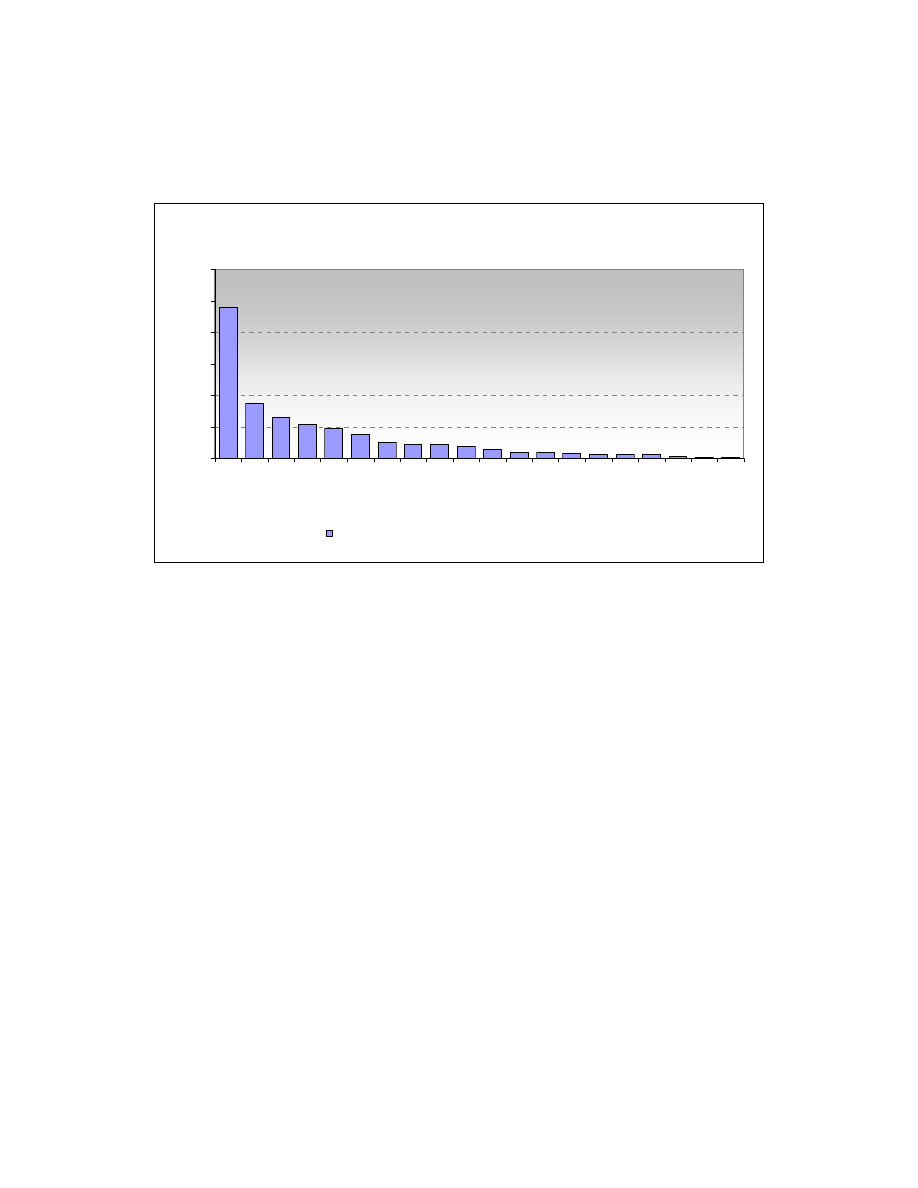
Kinetic Activity in Afghanistan by Province
1 Jan 07 - 8 Mar 08
0
500
1000
1500
2000
2500
3000
He
lm
an
d
Ku
na
r
Ka
nd
ah
ar
Pa
kt
ik
a
Ur
uz
ga
n
Za
bu
l
G
ha
zn
i
Pa
kt
ya
K
ho
st
Nu
ri
st
an
Ka
pis
a
W
ar
dak
La
gh
m
an
Lo
ga
r
Na
ng
ar
har
Fa
ra
h
K
ab
ul
Pa
rw
an
B
adgh
is
Hi
ra
t
C
ou
nt
of
K
ine
ti
c
E
v
e
nt
s
Direct Fire, Indirect Fire, and IED Explosion Events
(14 of the 34 provinces in Afghanistan are not included as they experienced less than 20 attacks during this time period)
Figure 1 - Distribution of Attacks in Afghanistan by Province
Violence increased in Afghanistan in 2007. A significant factor in the increase in
violence was aggressive Afghan and international force tactics combined with insurgent
recognition that, while they cannot defeat Afghan and international forces on the battlefield, they
can harm political will by increasing casualties. Violence may also have increased because
Afghan and international forces are asserting control over a greater area in increased numbers,
thus increasing their exposure to insurgent attacks.
Attack levels alone are not always a good indicator of the security situation. Even in
areas where insurgent activity is high, Afghan and international forces often have the full support
of the local population. Khowst Province again provides a success story. In this eastern
province the level enemy activity and attacks remains relatively high, but most of the population
lives without fear, trusting the government to keep them safe.
The success of Afghan and international forces in military engagements has led
insurgents to increase asymmetric attacks. As such, IED attacks are on the rise. IED incidents
reached a high of 2,615 incidents in 2007, up from 1,931 in 2006. Counter-IED training is an
important part of U.S. and ISAF efforts to improve security in the country. It includes
curriculum that the NATO Operational Mentoring and Liaison Teams (OMLTs) and Embedded
Training Teams (ETTs) deliver when training members of the ANA. Although the number of
IED attacks increased in 2007 over 2006, so did the number of IEDs that were discovered and
pre-detonated, as well as those that were reported by local citizens.
The success of the GIRoA in meeting the needs of the population and winning their
allegiance has been uneven and sometimes temporary. In many provinces and districts, the
government’s failure to connect effectively with the people of the country and provide security
and prosperity has provided an opening for the Taliban to successfully install shadow
11

UNCLASSIFIED
governments that provide basic security against lawlessness. The Taliban is likely to continue
efforts to emplace shadow governments in order to enhance local control by insurgent forces,
undermine the authority of district and provincial level officials appointed by Kabul, and present
a locally acceptable alternative to the Karzai government. Due to the nature of insurgencies,
estimates of their numbers are inherently unreliable and there is no agreed-upon figure from the
Intelligence Community. Therefore, no estimate is included in this report.
1.3 North Atlantic Treaty Organization International Security Assistance Force
The North Atlantic Treaty Organization (NATO) International Security Assistance Force
(ISAF) has overall command of the battlespace in Afghanistan. Commanded by a 4-star U.S.
Army officer, all military guidance for ISAF forces is communicated from Supreme
Headquarters Allied Powers Europe (SHAPE) and the Joint Forces Command (JFC) Brunssum.
The international strategic direction has been approved by the North Atlantic Council (NAC).
U.S. forces assigned to ISAF operate in support of ISAF plans and operations, and are under the
operational control of Commander, International Security Assistance Force (COMISAF). The
bulk of U.S. forces assigned to ISAF operate in Regional Command (RC) East. The United
States contributes approximately 19,000 of the 47,000 personnel in ISAF. An assessment of
United States Military requirements, including planned force rotation for the three-month period
following the date of the report can be found in the monthly “Boots-on-the-Ground” Reports
submitted to Congress in accordance with Public Law 110-116. Force rotations beyond the
three-month period following April 2008 will be conditions-based and hence cannot be provided
with reasonable accuracy.
1.3.1 Efforts to Encourage NATO ISAF Countries to Fulfill Commitments
A top U.S. government priority is to ensure that ISAF countries provide all required
forces as determined by NATO military authorities in the agreed Combined Joint Statement of
Requirements (CJSOR). The ISAF commander must have the forces and flexibility necessary to
accomplish the mission of assisting the GIRoA in the establishment and maintenance of a safe
and secure environment and the extension of its authority in order to facilitate reconstruction and
development. Although CJSOR shortfalls remain, especially for maneuver battalions,
helicopters, and OMLTs, all 26 Allies and 14 non-NATO partners are contributing in important
ways to the ISAF mission. ISAF has increased from approximately 31,000 personnel in
November 2006, to approximately 47,000 personnel today. This number is expected to increase
in 2008.
In order to help Allies shore up domestic political support for increased resources in
Afghanistan, the U.S. focused efforts on the development of a Comprehensive Political Military
Strategic Plan for ISAF to explain how Allied security is directly linked to stability in
Afghanistan and to lay out a vision to guide ISAF’s role in Afghanistan over the next five years.
This Comprehensive Political Military Strategic Plan was agreed to by the Heads of State and
Government from Allied and other troop-contributing nations at Bucharest in March 2008. In
the Comprehensive Political Military Strategic Plan, Allies agreed that Afghanistan is the
Alliance’s key priority. The Comprehensive Political Military Strategic Plan incorporates four
guiding principles:
1
An assessment of the elements of the insurgency are available in a classified format (see National Intelligence
Council report #ICB 2008 19).
12

UNCLASSIFIED
• a firm and shared long-term commitment;
• support for enhanced Afghan leadership and responsibility;
• a comprehensive approach by the international community, bringing together civilian
and military efforts; and
• increased cooperation and engagement with Afghanistan’s neighbors, especially
Pakistan.
Among the pledges of support at the Bucharest Summit, France announced that it will
send approximately 700 additional troops to eastern Afghanistan. This will permit the U.S. to
assign more troops to the south where Canadian forces have been engaged in combat operations
against Taliban forces. Also at Bucharest, Russia agreed to permit ISAF nations to transit
through Russia to resupply ISAF forces in Afghanistan. Since the Bucharest Summit, a number
of other countries have pledged additional resources to ISAF. For example, Poland has agreed to
send 400 additional troops and eight helicopters. Several nations, such as Romania, Italy, and
Greece, have agreed to provide additional OMLTs.
A key component of ISAF operations is assisting in the training and equipping the ANA.
The ANA has approximately 52,000 troops engaged in or leading major operations alongside
ISAF forces. ISAF partners have fielded or pledged 36 OMLTs to help build a more effective
ANA. However, this still falls short of the total OMLTs required. Thirteen ISAF nations have
donated equipment to the ANA through NATO, and a trust fund has been established to cover
transportation and installation costs for the donated equipment. An indication of the increasing
professionalism and capabilities of the ANA, President Karzai announced at Bucharest that the
ANA plans to assume security responsibility for Kabul in August 2008.
1.3.2 National Caveats on NATO/ISAF Forces
The U.S. government has consistently emphasized the importance of giving commanders
in the field the maximum possible flexibility to ensure that they can accomplish their mission in
the fastest possible timeframe, while minimizing risk and loss of life. Just over half of the Allies
in ISAF have some form of caveats on the geographical and/or functional deployment of their
forces. Some Allies have no written caveats on their forces, but operate with de facto restrictions
that can be even more severe than caveats. Therefore, rather than focus exclusively on caveats,
the U.S. has pressed all Allies and partners to provide commanders on the ground with the
maximum possible flexibility in terms of when, where, and how they utilize forces under their
command. The most significant and commonly cited caveats are restrictions that keep some
troops currently in the north, west, and in Kabul from moving to Regional Command-South
without prior approval from their respective nations’ capitals. The United States takes advantage
of every opportunity to urge Allies to lift these restrictions.
1.4 Operations
Within the primary operational area for U.S. forces – Regional Command East – operational
tempo and the ability to extend the reach of ISAF forces increased two-fold with the addition of
a second Brigade Combat Team in early 2007. U.S. forces took part in full-spectrum operations,
often with ANSF in the lead. Keeping in line with the overall strategy of clear, hold, and build,
the increased security paved the way for improved local government and economic growth.
13

UNCLASSIFIED
Additionally, CJTF-82
established Border Security Posts, Combat Out-Posts, and Forward
Operating Bases along known insurgent routes and support areas. This expanded ISAF and
ANSF presence probably contributed to the increase in enemy attacks from 2006 to 2007.
1.4.1 Civilian Casualties
The increase in civilian casualties is largely due to a shift in insurgent focus to operations
in populated areas, and the use of indiscriminant asymmetric attacks. A series of well-publicized
events during the spring and summer of 2007 highlighted the negative consequences of civilian
casualties caused by combat operations in Afghanistan. The willingness of the Afghan populace
to support international forces and the GIRoA is directly proportional to their trust and
confidence in those forces. The support of the Afghan people is essential to the security,
reconstruction, and governance of the country.
In response to increasing civilian casualties in the country Admiral Fallon, former
Commander of U.S. Central Command; General McNeill, COMISAF; and General Ramms
(Commander, Joint Forces Command–Brunssum) published a series of complementary guidance
outlining the problems, challenges, and unintended consequences of civilian casualties, and
provided explicit direction to all commanders and the Marines, Soldiers, Sailors, and Airmen
under their command on how to limit those casualties. The published guidance directed that,
while not limiting the right of self defense, responses to enemy actions must clearly demonstrate
proportionality, requisite restraint, and the utmost discrimination in the application of firepower.
1.5 Afghanistan National Security Forces (ANSF)
The long-term goal for the Afghan National Security Forces (ANSF) is to build and develop
a force that is nationally respected; professional; ethnically balanced; democratically
accountable; organized, trained, and equipped to meet the security needs of the country; and
funded from the GIRoA budget. Security is a fundamental prerequisite for achieving economic
and social development in Afghanistan. The ANA and the ANP represent two critical elements
for establishing that security.
The mission of the Combined Security Transition Command–Afghanistan (CSTC-A) is
to plan, program and implement structural, organizational, institutional, and management
reforms of the ANSF in order to develop a stable Afghanistan, strengthen the rule of law, and
deter and defeat terrorism within its borders. CSTC-A receives funding through the Afghan
Security Forces Fund (ASFF) to equip, train, and sustain the ANSF. The Fiscal Year (FY) 2008
budget request delineates the program objectives aimed at enabling ANSF independent
operations. These objectives include improved enablers, logistics operations, infrastructure,
training, pay programs, medical facilities, and equipment.
The FY 2008 ASFF request totaled $2.7 billion, including $1,711 billion for the ANA,
$980 million for the ANP, and $9.6 million for detainee operations. For the ANA, these funds
will equip and sustain the 70,000-person 14 brigade force in 2008; upgrade garrisons and support
facilities; enhance ANA intelligence capabilities; and expand education and training, including
the National Military Academy, counter-improvised explosive device (CIED) training, mobile
training teams, branch qualification courses, and literacy and English language programs. For
the ANP, these funds will increase CIED, communications, intelligence training; purchase
additional equipment, weapons, and ammunition to respond to insurgent threats; enhance ANP
2
On April 10, 2008 the 101
st
Airborne Division assumed command of Regional Command East from the 82
nd
Airborne Division. CJTF-101 also serves as the U.S. national command element in Afghanistan.
14

UNCLASSIFIED
intelligence capabilities; set conditions for interoperability with ANA to respond to events;
enhance border surveillance; add basic health clinics in select provinces to improve casualty
treatment; and expand field medic and combat life support training. Because the operational and
security realities in Afghanistan are constantly changing, it is not possible to make a reliable
estimate of the long-term costs and budget requirements for developing the ANSF.
1.5.1 ANSF Desired End-Strength
Despite achievements in Afghanistan, security threats and corruption remain a major
impediment to overall development. The security environment continues to be fluid, demanding
continual reexamination and assessment of requirements for the end-strength of the ANSF. The
2001 Bonn Agreement established the goal of a 70,000-person ANA and 62,000-person ANP.
The Afghanistan Compact in January 2006 confirmed those target end-strengths. Security
conditions necessitated a reexamination of ANSF end-strength. Consequently, in May 2007, the
international community’s Joint Coordination and Monitoring Board (JCMB) endorsed an
increase to 82,000 authorized ANP. Similarly, with the endorsement of the JCMB on February
5, 2008, the authorized ANA force structure increased to 80,000 personnel, with an additional
6,000 allotted for the trainee, transient, hospitalized, and student account.
We are currently examining whether this new end-state is adequate for Afghanistan’s
needs. The long-term ANSF posture may also include a more robust Afghan National Army Air
Corps (ANAAC) capability and a larger army. However, additional analysis, study, and
consideration must be given to the sustainability and available financial support for such efforts.
1.5.2 ANSF Recruiting and Retention
Actions to improve ANSF’s national recruiting system and the Afghan vetting process
continue. The current procedures for processing applications and conducting cursory
background checks for the ANSF are explained for the ANA and ANP in their respective
sections. However, additional measures and more sophisticated processes are currently being
pursued.
The ANSF is working to implement identification (ID) cards and biometrics. A national
ID program will incorporate equipment issue, pay, promotion and tracking and accountability
from accession to attrition using an accurate record management system for the ANP force
structure. Current efforts include integration of the ID card’s barcode system into the pay system
of the ANP. The ANA implemented an ID card system and an automated database in April
2006. Similarly, the ANSF are embarking on a long-term, state-of-the-art biometric collection
and database program that will provide both the Ministry of Defense (MoD) and Ministry of
Interior (MoI) a capability to positively identify all Afghan soldiers and police. The integrated
database of fingerprints, iris scan, and facial photos will be jointly maintained by ANA and ANP
biometric analysts that are currently being identified and trained over the next three years.
Another group of ANA and ANP officers are being trained as collectors who will be positioned
at ANSF initial entry sites across Afghanistan. The biometric technology is scalable and will
allow the GIRoA to expand the program to other segments of the government should Afghan
leaders choose to do so.
CSTC-A’s leadership is involved in efforts towards developing overall awareness of
current retention rates and programs to offer re-contracting options. CSTC-A has enlisted the
help of key MoI staff members to promote re-contracting of separating personnel. Measures
taken with the MoD include staff assistance visits to the Corps and training by the MoD Re-
contracting Officer. In January 2008, the Assistant Minister of Defense for Personnel and
15
UNCLASSIFIED
Education revised the re-contracting regulation to require Company to Corps-level Commanders
to project separation dates at least 12 months out and perform regular career counseling with all
soldiers and NCOs.
The ANSF has pursued monetary bonuses to incentivize enlistment and re-enlistment,
specifically directed at the Commandos in the ANA and Afghan Border Police (ABP) in the
ANP. Commandos currently receive an additional $30/month incentive pay. Additional
proposed initiatives are under financial review for the ABP including a sign-on bonus, retention
bonus, and hostile fire or imminent danger pay. More detailed efforts regarding recruiting and
retention in the ANA and ANP are described in the relevant sections that follow.
1.5.3 Afghan National Army (ANA)
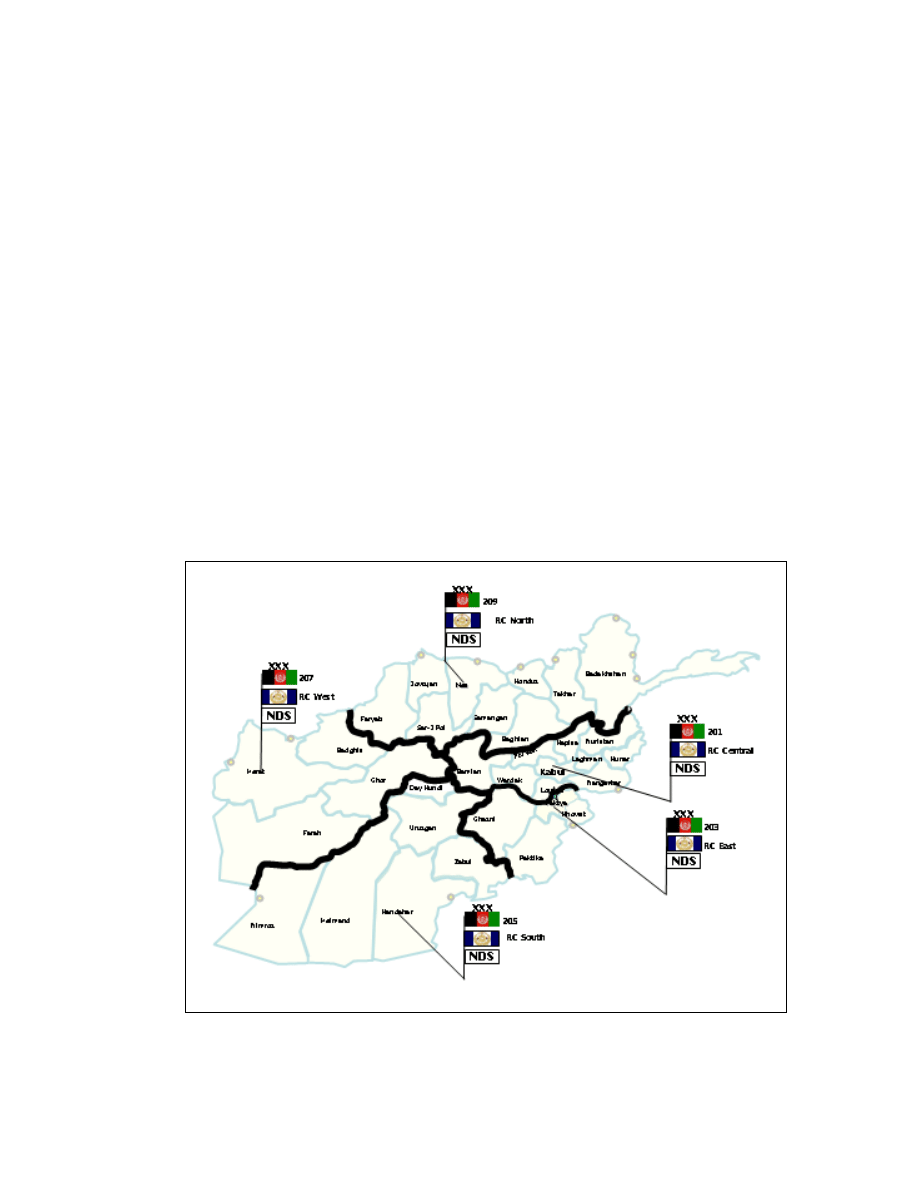
The ANA is subordinate to the Ministry of Defense (MoD), and is divided into five
regional corps and an emerging air corps. The 201
st
Corps operates in RC Central. The 203
rd
Corps operates in RC-East. The 205
th
Corps operates in RC-South. The 207
th
Corps operates in
RC-West. The 209
th
Corps operates in RC-North. Currently, the army serves as an infantry
force operating alongside international forces under the command of the Chief of the General
Staff, General Bismullah Khan.
Each corps is divided into brigades comprising three infantry kandaks (battalions), one
combat support kandak, and one combat service support kandak. Additionally, commando
kandaks are in the process of being formed. These elite units are currently attached to regional
corps, pending establishment of a commando brigade headquarters.
Figure 2 - Alignment of ANSF Regional Commands
16

UNCLASSIFIED
1.5.3.1 ANA Desired End-Strength
By the end of 2008, the GIRoA plans to field a total of 70,000 ANA personnel. An
additional 10,000 personnel are expected to be fielded by the end of 2009. Continued training,
mentoring, and development will be required beyond this timeframe. As stated above, the long-
term ANA posture potentially may include a more robust ANAAC capability and a larger force;
however, additional analysis, study, and consideration must be given to the security environment,
sustainability, and available financial support. The current program calls for a light infantry
force of 15 brigades, including artillery, armor, commando, combat support, combat service
support, an air corps, and the requisite intermediate commands and sustaining institutions.
1.5.3.2 ANA Training and Mentoring Efforts
Training the ANA begins with individual training. The soldier training process begins
with careful, needs-based recruiting followed by initial entry training (IET) at the Basic Warrior
Training Course (BWT), supervised by international trainers. ANA basics are taught to an
objective standard uniformly applied throughout the force. The BWT provides the foundation,
but the individual soldier’s capabilities are strengthened through branch-specific Advanced
Combat Training. Although the priority of fielding a viable force has necessitated training
initially focused on infantry and other combat-specific branches, training for support specialties
has also developed.
Immediately following a new unit’s fielding and arrival at its Corps and brigade area, it
undergoes a 60-day period of individual and collective training before being put into the rotation
for combat operations. Combat and security operations continue to round out ANA
development. Each ANA combat unit is accompanied by either a U.S. Embedded Training
Team (ETT) or a NATO ISAF OMLT. These teams provide comprehensive mentoring across
the full spectrum of operations. Specifically, the teams provide the ANA unit leadership with
advisory support on all unit functions and direct access to U.S. and ISAF resources and enablers
to enhance the ability of the ANA to operate effectively and independently. They also serve as
role models and key liaisons between ANA and international forces. The OMLTs and ETTs
coach unit staffs and commanders and assist them in the development of their training programs,
logistics and administrative systems, planning, and employment in operations. ETTs and
OMLTs also facilitate the assessment of ANA units, helping the ANA identify strengths,
shortfalls, and opportunities for improvement.
As of March 2008, U.S. ETTs require a total of 2,391 personnel; however, only 1,062 are
currently assigned (44 percent fill). The low fill-rate is due to the additional requirement to
provide support to the ANP though Police Mentor Teams (PMTs). Full PMT manning requires
2,358 total military personnel. Currently, 921 personnel are assigned (39 percent fill). Sourcing
solutions are being worked to address the shortfall of personnel across the ETT and PMT
requirements. Afghanistan deployment requirements are being weighed against other global
manning priorities. When additional forces become available to fill these critical personnel
requirements, they will be resourced against the ETT/PMT requirements. For now, the Focused
District Development (FDD) program, described below, aims to help mitigate the shortages of
the mentors for the ANP. In addition, more than 3,400 Marines are deploying to Afghanistan.
Of these, approximately 1,200 Marines will conduct ANP training missions in nine Afghanistan
districts. These Marines are deploying as a temporary risk mitigation measure due to the global
shortage of military trainers. Since the need for continued ANP mentorship in those districts will
17

UNCLASSIFIED
remain following the Marine redeployment in the fall, the enduring requirement for 1,400
additional ANP mentors remains.
In addition to the ETTs and PMTs, NATO OMLTs are also providing critical guidance
and mentorship to the ANA. As of March 2008, there are a total of 31 validated OMLTs out of a
NATO commitment to provide 71. In many instances, ANA combat units are assigned an ISAF
partner unit during combat operations. In general, those ANA units with international partner
units have shown a marked increase in their capability to provide security in their areas.
However, it should be noted that some Afghan commanders have shown great initiative and
improvement without the benefit of an international partner.
1.5.3.3 ANA Recruiting and Retention
The ANA continues to make significant progress in recruiting and retention and all
indicators point to decreasing rates of absence without leave (AWOL) and an increased ability to
curb absenteeism. The past year has surpassed the previous four years in ANA recruitment. The
ANA recruited 32,135 soldiers in the year leading up to March 2008. Annual recruitment
numbers for the previous four years, beginning with the most recent, are: 21,287; 11,845;
15,790; and 9,671.
The year-to-date re-enlistment average in the fielded ANA is 50 percent for soldiers and
56 percent for NCOs. Factors that challenge re-enlistment include the desire for larger salaries,
better leadership, and to be stationed closer to family.
In February 2008, the ANA had an 8.4 percent absentee rate. This is down from 12
percent at the height of summer. The three corps most consistently in contact with insurgents
and anti-government elements had the highest AWOL rates, but on average they experienced less
than 10 percent AWOL over the past year. This decrease in AWOL rates has contributed
directly to an increase of 20,000 in ANA end-strength since January 2007. This increase in end
strength coupled with a deliberate effort to staff combat units fully and overfill entry-level
soldier authorizations should further mitigate problems of absenteeism. During the past year,
overall AWOL rates in ANA combat forces have decreased three percent as compared to the
previous year. With increasing emphasis on pay and incentives, better facilities and training,
better leadership, and more robustly manned units, AWOL trends can be expected to continue to
decrease in the coming year.
The personnel accession and vetting process is the same for both ANA and ANP and
follows the 3-step process described below. All vetting of candidates to serve in the ANSF
meets the requirements of the law prohibiting military assistance to units or individuals known to
have committed human rights abuses. The ANA commissar at the National Army Volunteer
Center (NAVC) is the approval authority for both the ANA and ANP.
Step 1: The applicant provides 12 passport photos and secures a national identification
card from the district. This is verified by the Governor or another designated individual.
Recruits must be between 18 and 35 years-old. Age waivers are considered based on the
applicant’s qualification.
Step 2: The applicant sees a recruiter at Provincial HQ and completes a contract. An
escort guides them through the screening process which examines health and criminal
records, as well as other relevant background information. The applicant must get two
village elders to sign the form vouching for the recruit’s character. The form must also
be signed by an official at the district center. All documents are then taken by the escort
to the ANA Commissar HQ for verification and signature.
18

UNCLASSIFIED
Step 3: Medical screening is conducted at the commissar’s office. All documents go
back to the sub-governor for signature. Ultimately, the Ministry of the Interior or the
Ministry of Defense reviews all the documentation and then notifies the Provincial
authorities of acceptance by issuing the directive to commence training.
The ANA has also implemented an additional level of review for potential ANA recruits.
An Afghan who requests to join the Army is given a form to complete at the recruiting center.
The recruit’s name is then added to a list that is circulated among various MoD offices, including
the ANA General Staff G2, for a rudimentary background check.
19

UNCLASSIFIED
1.5.3.4 ANA Salary and Pay
Recruiting and retention initiatives have been boosted by steps taken to standardize and
institute a competitive pay scale. The following chart depicts the current monthly, 25-year base
salary plan for members of the ANA.
RANK GRADE
<1 to
3
>3
>6
>9
>12 >15 >18
>21
>24
GEN
O-10
$880 $925 $940 $955 $970 $985 $1,000 $1,015 $1,030
LTG
O-9
$780 $825 $840 $855 $870 $885 $900 $915 $930
MG
O-8
$680 $735 $750 $765 $780 $795 $810 $825 $840
BG
O-7
$580 $635 $650 $665 $680 $695 $710 $725 $740
COL
O-6
$430 $465 $480 $495 $510 $525 $540 $555 $570
LTC
O-5
$380 $415 $430 $445 $460 $475 $490 $505 $520
MAJ
O-4
$330 $365 $380 $395 $410 $425 $440 $455 $470
CPT
O-3
$250 $285 $300 $315 $330 $345 $360
1LT
O-2
$210 $245 $260 $275 $290 $305
2LT
O-1
$190 $225 $240 $255 $270
SGM
E-9
$210 $245 $260 $275 $290 $305 $320 $335 $350
MSG
E-8
$170 $205 $220 $235 $250 $265 $280 $295 $310
SFC
E-7
$145 $180 $195 $210 $225 $240 $255 $270 $285
SSG
E-6
$130 $165 $180 $195 $210 $225 $240
SGT
E-5
$115 $150 $165 $180 $195 $210
SDR
E-4
$100 $135 $150 $165 $180
Table 1 - 25-Year Base Pay Plan (ANA)
1.5.3.5 ANA Equipment
The three infantry companies in each kandak are equipped with former Warsaw Pact
rifles, light and heavy machine guns, and rocket propelled grenade launchers. The weapons
company in each kandak provides anti-armor capability with SPG-9 recoilless rifles and indirect
fire with 82mm mortars. Plans are in place to effect a transition to NATO standard weapons.
CSTC-A is currently converting the ANA from the AK-47 to the M16 (or the Canadian version,
the C7). Later in 2008, the ANA will begin converting to U.S. model light and medium machine
guns and 81mm mortars.
Each brigade has an artillery battery consisting of eight former Warsaw Pact D-30
howitzers. Currently, 82 of the 132 required are functional. CSTC-A has contracted to have the
howitzers assessed for complete refurbishment and conversion to facilitate NATO standard
interoperability.
One ANA brigade is designed to include a mechanized kandak and an armor kandak.
These units are currently equipped with BMPs (amphibious infantry fighting vehicles) and T-62
main battle tanks in various states of functionality. Procurement and donation options are
currently being studied to upgrade this capability.
20

UNCLASSIFIED
The ANA’s primary vehicle is the light tactical vehicle (LTV), a Ford Ranger truck.
CSTC-A has procured more than 4,100 up-armored high mobility multipurpose wheeled vehicles
(HMMWVs) (M1151/M1152) to be fielded beginning this summer. These HMMWVs will
displace many of the LTVs, particularly in the combat battalions, to provide a protected mobility
capability.
The ANAAC currently consists of the following aircraft: seven medium cargo airplanes
(five AN-32s and two AN-26s) and thirteen helicopters (nine MI-17s and four MI-35s). The
ANAAC will eventually include reconnaissance and light attack air-to-ground fixed wing
aircraft. By December 2008, the inventory will include an additional fifteen MI-17s, six MI-35s,
and two AN-32s. Four out of a total of twenty C-27s are being procured for delivery.
1.5.3.6 ANA Assessment
ANA unit readiness is gradually improving. The numbers and readiness status provided
below are based on an 80,000 ANA structure comprised of 85 battalions/squadrons organized
into 14 combat brigades, 5 Corps headquarters (HQ) and 1 Air Corp HQ.
As of March 2008, the ANA reported one battalion and 1 Corps HQ as rated at Capability
Milestone (CM) 1: capable of operating independently. Twenty-six battalions/squadrons, five
brigade HQs, and two Corps HQs were reported at the CM2 level: capable of planning,
executing, and sustaining counterinsurgency operations at the battalion level with international
support. Twenty-six battalions/squadrons, five brigade HQs, two Corps HQs, and one Air Corps
HQ were reported at the CM3: partially capable of conducting counterinsurgency operations at
the company level with support from international forces. Ten battalions/squadrons and one
brigade HQ are reported at CM4: formed but not yet capable of conducting primary operational
missions. Finally, there are twenty-two battalions/squadrons and three brigade HQ that are still
not formed or reporting.
An overall assessment of the ANA officer corps effectiveness from the kandak- to Corps-
level is positive and ANA officers continue to work to improve their professionalism. National
illiteracy rates remain high, but the members of the officer corps are required to have basic
reading and writing abilities and plans are being made to improve the education level of the
officer corps. Overall, officers are proficient at the tactical level though not yet fully mature in
operational and strategic concepts. The majority of the officers, and most importantly the very
senior officers, believe in the concept of a national military. They are starting to use the military
decision-making process and to provide information and decision briefs to their superiors. The
chain of command works well when exercised, and there is strict adherence to direction from
higher ranks.
Although there is no credible reporting on estimated numbers or percentages of
insurgents infiltrating the ANA, there are multiple reports of insurgent intent to do so, as well as
occasional reports of ANA personnel collaborating with and/or assisting insurgents. These
reports usually mention ANA personnel providing insurgents with information and supplies or
collaborating with insurgent operations. However, we assess that these isolated reports of
collaboration are often the result of insurgent threats and intimidation against ANA members in
high-threat regions or criminal economic ventures on the part of ANA members as opposed to
actual insurgent penetration of the organization. There have been two incidents of ANA soldiers
shooting U.S. soldiers; both ANA soldiers involved in these incidents had reportedly been
influenced by insurgents while home on leave, but we assess that these cases were probably more
opportunistic in nature than contrived attempts at infiltration. We are also aware of several ANA
members who are reportedly under investigation by Afghan authorities for being hostile agents.
21

UNCLASSIFIED
However, we have no indications that these authorities have established proof of guilt. Although
we are certain that there are cases of successful insurgent infiltration of ANA units, we assess
that the current level of ANA infiltration is not operationally significant.
The current assigned strength of the ANA as of February 2008 stood at just over 49,000
personnel across 63 kandaks and three commando kandaks, with a planned expansion of one
kandak (roughly 600 personnel) every month. This population allows two of the five Corps to
field nearly all of their subordinate units and join their international partners in some of the most
contentious areas of RC East and South. After gaining experience in partnered U.S. operations,
the 201
st
and 203
rd
Corps have taken the lead and are now capable of independent operations at
the company level. Fifty percent of the kandaks in these Corps maintain steady state operations
independently and plan future operations. Last fall, the 203
rd
Corps staff increased capacity
sufficiently to plan and execute a brigade level operation with U.S. and other international forces
in a supporting role. The 201
st
and 203
rd
Corps engineers conducted bridging operations with
international engineer units repairing and replacing bridges through the summer and fall allowing
greater development in those areas. The ANA have started basic explosive ordnance disposal
and counter IED training, expanding their capability to counteract one of the enemy’s most
important weapons against the ANSF.
The Afghanistan National Military Command Center is able to host weekly video
teleconferences (VTCs) with its Corps across the country with newly installed communications
equipment. This is improving national headquarters command and control and allowing for
better adjacent unit coordination between the Corps. Additionally, both ANA Corps in RC East
are leading their own Regional Security Committee Meetings—actively coordinating ANA, ANP
and National Directorate for Security (NDS) operations with the international forces. These
meetings allow for a common intelligence and operational picture among the ANP, ANA and
NDS, which facilitates shared goals and objectives in developing a stable security environment.
The 201
st
Corps Commander has effectively organized provincial governor meetings within his
three brigade zones, complementing security efforts with local governance and development
efforts.
The ANA commando program continues to advance. The first kandaks demonstrate
great resolve under fire, a capacity for tactical patience, and the capability for precision
operations well above their conventional counterparts. The 201
st
Corps commando kandak
continues to make progress toward autonomous company-level operations. They have conducted
six different missions as part of larger ANA and ISAF operations, a no-notice operation with
other U.S. and ISAF Special Forces, and an independent company level operation. The 203
rd
commando kandak conducted its first combat operation in December 2007.
ANA Air Corps (ANAAC) capacity and capabilities also grew in 2007. They are now
executing re-supply missions, troop movements and humanitarian assistance operations. The
ANA Air Corps increased flight time from 100 hours per month to 140 hours per month; a 40
percent capacity increase. The Air Corps earned recognition and is credited with saving more
than 1,200 lives by performing flood relief missions. The relief missions built the ANAAC’s
confidence in its own abilities as well as the confidence of the populace in the Air Corps. In
December 2007, the ANAAC flew missions for the first time as an integrated part of a CJTF-82
Aviation Task Force aerial formation. These missions were the result of a year-long mentorship
between Task Force (TF) Pegasus and the ANAAC. In January 2008, the ANAAC conducted a
medical evacuation test of concept that will further build capacity to conduct independent
operations. This operation allowed the ANAAC to move patients from Craig Military Hospital
22

UNCLASSIFIED
at Bagram Airfield to the ANA National Military Hospital in Kabul and proved the ANAAC to
be an independent and strong partner for international forces during medical evacuations.
1.5.4 Afghan National Police (ANP)
ANP capabilities still lag behind those of the ANA. The current ANP force has not been
sufficiently reformed or developed to a level at which it can adequately perform its security and
policing mission. Generally, police development has been hindered by lack of institutional
reform, corruption, insufficient trainers and advisors, and a lack of unity of effort within the
international community. Recently, CSTC-A, in coordination with the GIRoA, the Department
of State, and other international partners, implemented the Focused District Development (FDD)
initiative enabling a concentrated effort to reform the Afghan Uniform Police. Full
implementation of the FDD program under the current force structure is expected to take several
years. Section 1.5.4.3 of this report provides a more detailed description of the FDD program.
1.5.4.1 ANP Desired End State
The target for the ANP is to build a reformed force of 82,000 personnel that is capable of
operating countrywide. The ANP consists of the Afghan Uniform Police (AUP), the Afghan
Civil Order Police (ANCOP), the Afghan Border Police (ABP), Counternarcotics Police of
Afghanistan (CNPA), and additional specialized police including criminal investigation, counter-
terrorism, and customs. The roles of the various police services span a wide spectrum of
policing, law enforcement, and security functions:
• The AUP serve at the regional, provincial, and district levels. The AUP’s activities are
focused on patrols, crime prevention, traffic, and general policing. They are intended to
spread the rule of law throughout the country and provide a response capability for local
security incidents.
• The ANCOP is a highly skilled, specialized police force. It is split into rural and urban
units, and trained and equipped to counter civil unrest and lawlessness. ANCOP units
provide law enforcement and civil control, conduct operations in areas where government
control may be weak, and support counterinsurgency operations. Eight of the 19 ANCOP
battalions are currently fielded and are performing exceptionally well, both in their
support of FDD, and in their primary role as the national quick reaction force in troubled
areas. ANCOP are formed as units, receive sixteen weeks of institutional training
followed by another eight weeks of PMT-supervised collective training. All reports on
this new national police force have indicated a solid performance in operations to
dismantle illegal checkpoints, seize illegal weapons, and retake lost districts. In the
locations where ANCOP has deployed, it has successfully conducted counterinsurgency
operations and secured the trust and confidence of the people.
• The ABP provides broad law enforcement capabilities at borders and entry points to deter
the illegal entry of people and material as well as other criminal activity. The ABP has
been challenged by the fact that they have received the least attention, funding, and
training. This has caused them to lag behind their AUP counterparts. They are currently
manned at levels below 50 percent in many areas, are poorly equipped, and under-
resourced. However, efforts to build the force and to fill available training slots during
FDD will continue to build the ABP, albeit at a slower rate than the AUP. The majority
of the ABP facilities along the border is run down and lacks basic necessities. As of
December 2007, CSTC-A approved new company and kandak locations for the 2008-
23

UNCLASSIFIED
2009 build plan and will begin construction of these locations in the summer of 2008
with an expected completion date later in 2009.
• The CNPA is the lead agency charged with reducing narcotics production and
distribution in Afghanistan.
The Afghan National Auxiliary Police (ANAP) supplements the AUP at the district level.
This bridging force receives two weeks of initial training and will attend follow-on three week
sustainment training or may attend the same eight weeks of training that uniform police receive
in their basic training. The ANAP will cease to exist by the end of 2008. Those members that
have served for at least one year, have undergone five weeks of training, and have received a
recommendation from their district chief will transition to the AUP.
Once comprehensive assessments can be made on the effects of recently begun reform
efforts, ANP strength will be reassessed to determine if additional police forces are required.
Currently, a lack of trainers and mentors precludes the acceleration or expansion of reform and
mentoring efforts. Through the FDD, current reform and mentoring efforts are principally
focused on the AUP. The AUP are closest to the population and are therefore the most
immediate face of the Afghan government.
1.5.4.2 ANP Training and Mentoring
The AUP at the district level require significantly more coaching and mentoring than the
ANA to ensure that all police units are operating according to national standards and procedures
as established by the Ministry of the Interior. Unlike the ANA, police forces are not fielded as
units. All policemen must be trained as individuals. The objective for ANP training is a
minimum of initial entry training (IET) for all new recruits. When training capacity meets
demand, it may be possible to tie police pay to training, thereby adding incentive for immediate
training attendance.
Current training capacity cannot meet demand and many untrained policemen remain in
the force. Efforts to expand the training capacity to meet demand should make it feasible to
require IET for all police recruits in approximately three years. Currently, individual training is
conducted at seven Regional Training Centers (RTCs), a Central Training Center, and the Kabul
Police Academy. The State Department’s Bureau for International Narcotics and Law
Enforcement Affairs (INL) uses a private contactor to provide civilian police training and
program design at the training centers and to provide field-based mentors. Courses provided at
the training centers include the basic 8-week course for all new and entry-level police; the
intermediate-level 5-week Transition Integration Program; the 16-week ANCOP program
(inclusive of basic and specialized training); and specialized courses in firearms, criminal
investigative division, instructor development, field training, tactical training, medic training,
and train-the-trainer instruction. From 2003 to 2008, more than 149,000 trainees have gone
through basic, intermediate, advanced and specialized training at the training centers. Building
Afghan police training capacity has been a priority. Civilian police mentors build train-the-
trainer capacity for Afghan instructors, who in turn provide instruction to Afghan trainees.
To further increase training capacity, CSTC-A and INL have established an ANCOP
Training Center with a capacity of 800 students per class, and are also planning for a National
Police Training Center, which is expected to achieve initial operating capability later in 2008.
This center will have an eventual capacity of 2,000 policemen. When operational, the National
Police Training Center will make it possible for all new police to attend IET prior to assumption
of duties.
24

UNCLASSIFIED
The CSTC-A training program, while recognizing that policemen do not operate in
“units,” as does the ANA, seeks to build cohesive, effective police organizations. CSTC-A, in
conjunction with TF Phoenix and the Department of State, mentors police at all levels, although
the program does not currently reach all police locations. The objective is to provide a U.S.
military Police Mentor Teams (PMTs) mentor team staffed with civilian police advisors to each
AUP police district, each provincial and regional headquarters, each ABP company and
battalion, and each ANCOP company and battalion. However, the shortage of PMTs affects
CSTC-A’s ability to increase and improve ANP training and mentoring. Each PMT is composed
primarily of military members that provide training support, maintenance, logistics, and
administrative coaching; encourage professionalism; and serve as liaisons with international
forces as required. Each team includes two civilian police mentors. Mentor teams focus on a
particular function and their efforts are tailored to develop skills, capacity and professionalism in
these areas.
The final element of every PMT is a security force. The majority of formal training
should be provided under the guidance of qualified civilian police advisors at one of the eight
training centers. However, due to the security situation, police training is most often provided by
military personnel with civilian or military police experience. There is no area of Afghanistan
that permits independent mentorship by civilian police or very small PMTs. Mentoring of the
ANP must occur locally in 364 districts spread throughout Afghanistan. The broad geographic
scope of the ANP necessitates additional mentoring forces and equipment to adequately provide
coaching, training and mentoring oversight. With 365 districts, 46 city police precincts, 34
provinces, five regions, 19 ANCOP battalions, 33 ABP battalions, and 135 ABP companies,
CSTC-A is currently able to provide PMTs to no more than one-fourth of all ANP organizations
and units.
More than 500 civilian police trainers and mentors are deployed – in some cases with
PMTs – to regional, provincial and district locations in nearly every province. Currently in RC
East, a dedicated mentor team is located at every provincial headquarters and at select district
level headquarters. Partnership for the police forces is facilitated through multiple avenues. For
instance, in RC East, CSTC-A maintains the mentorship role and CJTF-82 conducts partnership
activities with the ANP.
1.5.4.3 Focused District Development (FDD) Program
The Focused District Development (FDD) program is a pilot initiative that addresses the
critical development requirements of the ANP in each district, while also allowing for a strong
reform program. The training and mentoring provided through FDD will build the AUP as a
reformed service loyal to the Afghan people and Afghan national interests. As the primary
government interface with the Afghan people, an effective AUP is critical to the extension of the
rule of law and to building trust in the institution of the police among the general populace.
Accordingly, FDD concentrates resources on the district-level AUP. A reformed, more effective
police force that can improve security in an area can facilitate the realization of other desired
outcomes.
The first part of the FDD process is an assessment of the district by a District Assessment
and Reform Team, composed of a PMT, several representatives of the MoI and other Afghan
government ministries, and, in some cases, other international partners (especially Canada and
the United Kingdom). This assessment leads to selection and vetting of new leaders as required,
recruiting to authorized levels, and building of equipment inventories, as well as assessments of
facilities, status of the rule of law, the district police’s relationship with the local leaders, and
25

UNCLASSIFIED
overall professional effectiveness. Once the assessment is complete, an ANCOP unit is deployed
to the district to relieve the local AUP forces. The AUP forces then report to the RTCs to begin
eight weeks of reconstitution. This reconstitution period includes three different levels of
training (i.e., new entrants, advanced, and officer leader and management training), biometric
processing and identification card issue, pay records establishment, full equipping, leader
reinforcement training, and continual ethics reinforcement. The AUP participating in the RTC
training programs receive daily mentorship from PMTs. The PMT remains with the reformed
police after the eight week reconstitution phase to continue collective training and mentoring in
the district, ensuring the police put into practice the key individual and collective competencies
as well as the ethical standards learned during training at the RTC. At the conclusion of this
phase, which is proficiency-driven, rather than time-driven, the district is validated as a reformed
police force, using the same objective assessment checklist that was used in the preliminary
assessment phase.
Six cycles of FDD are planned for completion in 2008. The first cycle, which began in
seven districts in late 2007, is nearing completion with district ANP reinserted in their districts
and undergoing intensive mentoring. The second cycle of FDD is mid-course in five districts,
with district ANP undergoing reconstitution at the regional training centers. The third cycle,
being implemented in nine districts, is in the initial assessment phase.
Current challenges facing the FDD program are a shortage of PMTs, a shortage of trained
ANCOP units (currently a growing program), limited capacity at the RTCs, in some cases a lack
of provincial governor support (due to the perceived loss of power as the AUP become loyal to
the nation and the potential loss of a source of revenue for the governor), and integration of other
aspects of rule of law and governance reform. We anticipate that over the course of 2008, these
challenges will lessen with the training of additional ANCOP units, the construction of the
National Police Training Center, and the ability of FDD-reformed districts to strengthen ties with
district governance and populations.
The FDD initiative is linked and complementary to ongoing ISAF operations and will
center on the Eastern and Southern regions that have experienced increased instability due to
anti-government elements. It is aimed at focusing limited resources to maximize the overall
development of the AUP, ultimately creating communities able to sustain stability in the long
term. Popular perception of the FDD program – particularly in those districts where it is being
implemented – is favorable, and the national government views the FDD initiative as a catalyst
for similar programs which might benefit other governmental branches.
CSTC-A, in conjunction with TF Phoenix, has placed increased emphasis on the training
and mentoring of the ABP by increasing the number of U.S. ETTs within the unit organization.
ETTs are currently in place from the ABP brigade HQ down to the company level. They are
working to improve the standards of training in combat operations, communications and
logistics. All training efforts for the Afghan Border Police will be coordinated with the Border
Management Task Force, a group that provides oversight and management of U.S. border
initiatives and assists the GIRoA with border issues.
1.5.4.4 ANP Recruiting and Retention
The accession process for the ANP mirrors the process described above in the ANA
section minus the additional step of name circulation implemented by the ANA. ANP forces
have been difficult to man and sustain. Currently, USG is examining options for pay incentives
to boost ANP recruitment and retention.
26

UNCLASSIFIED
From March 24, 2007, through March 2, 2008, the nationwide recruiting numbers for all
police programs was 17,474 (4,795 ABP; 1,414 ANCOP; and 11,265 AUP and specialty police).
Recruiting efforts are the critical lynchpin to the efforts to build and sustain a viable and
resourced national police force. The Ministry of Interior has been generally successful in
obtaining the required number of personnel to keep the growth in police on an upward trend.
However, some critical actions must be taken to preserve the forces on hand and to prepare for
replacing expected losses.
The first area for improvement is recruiting staff within the MoI. The GIRoA should
ensure that appropriate recruiting personnel are authorized and trained. Due to a shortage of
recruiters, the efforts to recruit personnel to date have been successful, though not as expedient
as desired. Additionally, dispersing recruiters to regional and provincial locations enables the
police to fill upcoming losses quicker by reducing recruiter travel time and utilizing their
familiarity with the area. Many international force commanders have requested recruiting
officers at the provincial level who can travel with them to areas where the village elders have
committed to provide men for the police forces. Due to the shortage of recruiters these offers
usually go unmet by the MoI Recruiting Department because the vetting and recruiting team
cannot focus on multiple areas simultaneously. One successful program utilized in the central
zone has been the utilization of assigned police personnel officers at the unit level to assist in the
recruitment process. These officers both know the area and the elders and village leaders who
bring forward their best personnel to serve their country in the ANP.
Similarly, the MoI must capitalize on the efforts that international forces have made
towards building relationships with the local elders and tribal leaders. A successful recruiting
effort in a nation led by patriarchs will work only if tribal leaders are included in the process. If
these leaders submit their own candidates for the police forces they are staking their reputation
alongside that of the future officer. In Afghanistan, tribal affiliations still play a more important
role than loyalty to the nation. The tribal elder’s certification of a prospective police officer
almost guarantees their viability as an asset.
While recruiting the right personnel for the national police force is crucial to its success,
retention is equally critical. One of the first steps towards retaining the police officers that have
been recruited is completion of a functional personnel management system that can track
personnel assignments and completion of service commitments. Additionally, police officers are
given no incentives to stay on the force when their commitment is complete. Possible solutions
could include re-enlistment bonuses and combat incentive pay for those serving in high threat
areas. The Ministry of Defense has employed incentives for the ANA and has seen tremendous
increases in the retention of their soldiers upon termination of enlistment contracts. Some of the
incentives include relocation of family, increased salary, or promotion and professional
schooling. It is hoped that programs such as these, when implemented, will lead to an overall
increase in the professionalism of those who serve in the police forces.
Another issue that continues to plague the ANP and challenge recruiting and retention is
pay corruption. Cash payment of salaries leaves ample opportunity for corruption. The
implementation of Electronic Funds Transfer to the ANP will limit the amount of hand-to-hand
money transfers that must occur. In order to implement this program, some districts near major
population centers are bringing in Automated Teller Machines (ATMs) that are linked into the
Afghan Banking systems. Payment of salaries in full and on time significantly reduces pay
corruption and improves the morale of ANP officers. As the spread of ATMs and banks
continues across the country, the lack of adequate commercial or generator power maintenance
27

UNCLASSIFIED
will hinder continued progress (highlighting the critical need for additional police to prevent
attacks on the power system).
Recruiting for the ANCOP is done through institutional-level recruiting by the MOI. In
the context of initial MoI reform, senior level MoI officials undergoing rank reform have been
vetted by UNAMA and the State Department. The MoI’s recent success in recruiting and vetting
well-qualified candidates for ANCOP presents a sound model for the recruitment and vetting of
all ANP individuals. Vetting for regular ANP recruits is still done on an ad-hoc, group basis. In
the case of ANCOP, recruits are solicited through self-initiative rather than local nomination en
masse. As such, the individuals applying for ANCOP training classes are those with the personal
drive and initiative to qualify for entry into the institution. ANCOP recruits are vetted
individually through the National Directorate of Security and the MoI’s counter-terrorism
division, and their citizenship and health records are verified. Finally, two local community
representatives are required to attest to their suitability for the ANP.
Several similar checks will be applied to AUP officers in districts undergoing the new
FDD program, including candidate approval by a local elder, the district police chief, and a
senior representative from the MOI. Upon arrival at an RTC for FDD training, all AUP officers
are then vetted once again by a regional police recruiter. During the course of the eight-week
FDD training, U.S. civilian police mentors monitor all trainees and identify those that need to be
removed from the class. Police officers that fail to graduate from the FDD course are removed
from the police force. Although vetting of officer-level recruits is systematic, vetting at the basic
recruit level would benefit from a more thorough process. This deficiency is the result of a
number of factors, including the need to recruit new trainees in a relatively short time-span.
Because Afghanistan National Police officers can leave at any time, unlike their
counterparts in the Afghan National Army, there are no numbers for absentee or AWOL rates for
the ANP. Furthermore, the lack of PMTs in the field preclude effective monitoring of force
levels in the field.
1.5.4.5 ANP Salary and Pay
Implementing pay equity between the ANA and ANP will contribute to the growth of the
latter organization. Before the pay equity initiative was approved in 2007, an individual in the
army would receive a higher monthly base pay than an individual of equivalent rank in the
police.
The following table illustrates the reform process for ANP pay rates. The current
monthly salaries for rank reformed personnel as of February 2008 can be found in the “Pay
Reform” column. Rank Reform is continuing in the grades O-4 to O-6 and when complete in
summer of 2008, all ranks will be paid the salaries indicated under the ANP/ANA Pay Parity
column. These significant changes should yield additional improvements in recruiting and
retention for the ANP.
28

UNCLASSIFIED
RANK
GRADE
Pre-Pay Reform Pay Reform
ANP/ANA Pay
Parity
LTG
O-9 $107
$750
$780
MG
O-8 $103
$650
$680
BG
O-7 $95 $550
$580
COL
O-6 $92 $400
$430
LTC
O-5 $88 $350
$380
MAJ
O-4 $83 $300
$330
CPT
O-3 $78 $250
$280
1LT
O-2 $69 $200
$230
2LT
O-1 $66 $180
$210
1st SGT
$62
$160
$190
2nd SGT
$62
$140
$170
3rd SGT
$62
$115
$145
1st PTRLMN
$70
$80
$110
2nd PTRLMN
$70
$70
$100
Table 2 – ANP Pay Reform
1.5.4.6 ANP Equipment
The ANP is equipped with light weapons, including AK-47s and 9mm pistols. Most
police elements also have light machine guns. The ABP will be provided heavy machine guns
later in 2008, in recognition of the higher level of operations they have on the borders. ANCOP
units will also be provided heavy machine guns. Former Warsaw Pact weapons are provided
through donations or through U.S.-funded purchases. Specialty organizations, such as CNPA
and counter-terrorism police receive unique equipment consistent with their mission.
The ANP is provided Ford Rangers as light tactical vehicles (LTVs) and International
Harvesters as Medium Tactical Vehicles (MTVs). The ANCOP is currently fielded with LTVs
and MTVs, but these will be replaced with a high mobility multipurpose wheeled vehicles or a
similar vehicle in 2008.
Police are equipped with a variety of communications equipment. Interoperability issues
exist due to the wide variety of communications equipment provided by the previous lead nation
for the ANP. The remedy the issue, the U.S. has procured a common set of NATO interoperable
communication equipment to completely supply the entire ANP and will complete fielding in
2008.
1.5.4.7 ANP Assessment
The MoI Readiness Reporting System (RRS) is being re-worked to produce timely and
accurate readiness system reports, provide actionable readiness data, and provide an executive
level brief. The revised RRS should enable the MoI and ANP to conduct analysis of readiness
data that will recognize shortfalls and allow MoI and ANP leadership to make corrective actions.
Without the full complement of PMTs, however, a comprehensive assessment of the ANP will
not be possible.
29

UNCLASSIFIED
Section 2: Governance, Rule of Law, and Human Rights
2.1 Governance Strategy.
The US seeks to build an Afghan Government that is stable, at peace, capable of
governing its territory, democratic, and that protects human rights. The Afghans and the United
States have committed to these goals in the Bonn Agreement of 2001, the US-Afghan Strategic
Partnership of 2005, the Afghanistan Compact of 2006, and the Afghanistan National
Development Strategy (ANDS) of 2008. Building an effective Afghan Government is an
integral part of counterinsurgency strategy because it will become the international community’s
most effective partner in protecting the population, retaining their loyalty by enabling growth and
development, and delivering services. The US’s governance assistance strategy focuses on
building capacity in the executive, legislative, and judicial branches; supporting subnational
governance; fighting corruption; and promoting human rights.
2.1.1 Progress since the Taliban
Between 1996 and 2001, Afghanistan did not have a functioning, legitimate government.
After the Bonn Agreement established the Afghan Interim Administration in 2001, the nation
successfully held an Emergency Loya Jirga to ratify the Agreement; wrote and ratified a new
Constitution in 2003 and 2004; and held presidential and parliamentary elections in 2004 and
2005, respectively. The next presidential election is scheduled for fall 2009; legislative elections
will follow in summer 2010.
Much still needs to be done. Most Afghan officials are not trained or experienced in
what westerners would consider to be traditional managerial functions or leadership. This results
in inconsistent leadership quality across regions and levels of government. There is a cause and
effect relationship between good governance and security. In areas in which capable GIRoA
officials exercise the full scope of the duties and powers of their appointed office, the population
turns to the government for answers to their problems. The inverse is true for weak or ineffective
leaders, or in areas where lack of security does not allow for effective exercise of GIRoA
authority.
2.2 Legislative Branch
The rule of law begins with the creation of the law by a competent, honest, and
representative legislature. Afghanistan’s National Assembly recently celebrated its second
anniversary after a 32 year hiatus. In creating the laws of Afghanistan, the National Assembly
has become the primary national forum for the discussion of the major challenges facing the
nation, from long-standing inter-ethnic disputes to plotting Afghanistan’s course into a stable
future. Groups who at one time were in violent conflict with one another now debate the issues
confronting the country peacefully. Parliamentarians include former warlords, ex-Taliban,
former communists, Tajiks, Pashtun, and Hazaras.
Much progress has been made, though there are some hurdles that remain to be
overcome. As do other parts of the government, the National Assembly suffers from corruption
and a lack of trained human capital. As the contest between President Karzai and the Tajik-
dominated United Front has become more acute, the National Assembly’s lower house has
become more politicized and distracted from its primary task of legalizing pre-2005 presidential
directives.
30

UNCLASSIFIED
USG assistance to the National Assembly includes direct assistance to five parliamentary
commissions, establishing a Parliamentary Institute which will be the focal point for long-term
technical training of members of parliament and parliamentary staff, and strengthening
parliamentary budget oversight and analysis.
2.3 Executive Branch
The rule of law depends on its execution by capable and fair executives. The Afghan
population’s perception of the impartiality, probity and effectiveness of the presidency and line
ministries contributes significantly to its willingness to support the government and resist
insurgent inducements or coercion.
Great strides have been made in the executive branch of the GIRoA. The President
understands the importance of moving away from the traditional Afghan practice of distributing
senior ministerial positions, including governorships, on the basis of political connections. The
establishment of the Independent Directorate of Local Governance (IDLG), described in section
2.7 of this report, in August 2007 has led to significant improvement in gubernatorial
appointments.
USAID is supporting capacity development at the Office of the President and several
ministries. Offices at the Presidency that benefit directly from USAID programming include the
Office of Administrative Affairs Department of Monitoring and Evaluation, the Office of the
Minister of State for Parliamentary Affairs, the IDLG, the Chief of Staff’s Office, the National
Security Council, and the Office of the Presidential Spokesman.
2.3.1 Ministerial Capacity
Ministerial capacity is improving, but challenges remain. The Ministries of Health and
Education continue to demonstrate to remote rural populations the central government’s ability
and willingness to improve their lives. Additionally, the establishment of the IDLG is catalyzing
improvements in the ministries’ delivery of services in the provinces.
The biggest threats to the rule of law in the Ministries include corruption and a lack of
human capital. Afghan ministries and institutions are currently challenged with minimal
organization and a lack of fundamental management and leadership skills. The majority of
national and provincial leaders have some education, but the government faces a shortage of
adequately qualified civil servants. District-level leadership largely lacks sufficient education
and training. Approximately 60 percent of Afghan civil servants are over the age of 50. The
government of Afghanistan continues to suffer from a shortage in experienced staff at all levels
due to a low national literacy rate, low wages in government service, and existing salary
imbalances. With the high demand for manual labor as a result of reconstruction efforts along
with demand from international organizations and non-governmental organizations (NGOs),
laborers can earn more than teachers and civil servants. USAID funds two major public
management initiatives, the Capacity Development Program and the Local Governance and
Community Development Program to provide advisory support and technical assistance to 14
national ministries at the national and provincial levels to improve basic governance and public
service delivery. In addition, the Afghan Civil Service Commission, also supported by USAID,
is improving the process of training and testing civil servants for their ability to meet certain
qualifications. Concurrently, training programs at the national and provincial level are being
strengthened with support from USAID to develop basic skills among government workers and
managers to grow the necessary human capital to form the basis for a future civil service system.
31

UNCLASSIFIED
2.4 Judicial Branch
An effective Judicial Branch is essential to establishing the rule of law and good
governance in Afghanistan. This sector is a major focus of Afghan, U.S., and international
efforts in the country. Currently, the central justice institutions have competent leaders willing to
work with the international community. Several key laws have been passed or are being revised
that will lay the foundation for an effective justice sector, and the institutions are generally
supportive of organizational restructuring and civil service reform. In addition, the GIRoA is
advancing narcotics prosecutions under the Central Narcotics Tribunal (CNT) and Criminal
Justice Task Force (CJTF) in Kabul. Since March 2005, when the CJTF was set up, it has
investigated and prosecuted more than 1,200 cases involving 1,600 defendants from 33 provinces
for narcotics-related crimes. Of these, 1,450 defendants were convicted.
2.4.1 Civil Legal System
Land disputes represent the largest single source of cases before Afghan courts, involving
both private individuals and the government. These cases include land seizures by powerful
interest groups and persons, the return of refugees and internally displaced persons to homes
occupied by others, and landlord and tenant disputes. Resolving these land disputes is one of the
most pressing civil law issues in Afghanistan, as the efficient and equitable restoration and re-
distribution of land is essential to the resettlement of returning refugees and internally displaced
persons to their homes and provinces of origin, and the future stability of the country.
The current civil legal system faces many challenges: a lack of clarity as to who is
responsible for land rights; an overall lack of financial support, administrative personnel,
educated government (and private) attorneys, and judges in the area of land dispute resolution;
and facilities for the Afghan court system. The Ministry of Justice (MoJ) lacks the skills,
training, and support staff to evaluate and review land disputes.
The ANP are currently increasing their capacity and capability to bring peaceful
resolution to disputes and respect the due process of suspects’ and plaintiff’s rights. The ANP
possess the same responsibility and authority in both civil and criminal legal systems. Given a
civil matter such as a land dispute, the ANP may effectively resolve the dispute between the
concerned parties. If the parties cannot agree to the resolution then the case must be presented
for adjudication in the given system of law in that area. The Afghan Justice system struggles to
balance three types of law −constitutional, sharia, and tribal− while protecting the rights of all
Afghans. Hence, although it is a national police force, the ANP must work within the system of
justice that takes precedence in their jurisdiction.
Afghanistan’s legal system has inadequate commercial dispute resolution mechanisms.
A lack of education and procedures inhibit the enforcement of consistent commercial law on
such issues as banking, intellectual property, technology, energy, corporate law, corporate
finance, leasing, and bankruptcy. Currently, commercial courts operate in two regions, Kabul
and Mazar-e-Sharif. The lack of efficient procedures and resolution for commercial disputes is
discouraging to international investors, who fear the risk of doing business in Afghanistan
without a court system to enforce commercial rights.
The ANDS proposes several solutions to the challenges facing the justice sector. With
regard to land disputes, the Supreme Court will develop judicial capacity in property dispute
issues, increasing the number of judges trained in this area in all provinces. The courts and the
MoJ will also encourage jirgas and shuras to certify and record the decisions they reach in
disputes. Finally, the MoJ will improve the government’s ability to defend its interests in land
32

UNCLASSIFIED
dispute cases and will encourage the adoption of improved laws, regulations and procedures for
land ownership and land dispute resolution.
More broadly, the ANDS will not only set the roadmap and strategy for establishing the
rule of law in Afghanistan, but also provide a sense of security for international donors and
international investors. The “Law of Organization of Courts” created by the MoJ, establishes
eight commercial courts throughout the country. The timeline for the initiation of these courts
will be set in the final ANDS. Once the courts are established, the MoJ plans to increase the
capacity of these courts to hear cases and increase the number of qualified commercial court
judges with specialized skills in the areas of both national and international market economies.
Furthermore, the Independent Bar Association and Afghan Investment Support Agency both plan
to develop private commercial law and train attorneys in these areas. A viable commercial bar of
attorneys, with regional commercial courts and qualified judges, will enhance the appeal and
reduce the risks of doing business in Afghanistan.
The international community has not yet done a great deal to assist Afghanistan in the
areas of land dispute resolution and commercial law. Although UNAMA, USAID, and private
initiatives by NGOs around the world have offered support, available donor funds are waiting for
completion of the plan for the way ahead.
2.4.2 Criminal Justice System
While the Criminal Justice system is in the early developmental stage and requires
substantial assistance from the international community, some progress has been made.
Currently, the most visible progress has taken place in areas with large populations. With USAID
assistance, judges are being trained, forty judicial facilities in 16 provinces were built, the laws
of the country have been published and distributed in a Judicial Reference Set, the Kabul
University Law School is updating its curriculum, and a new court administration system is
being implemented. Significant progress has been made in strengthening counternarcotics
judicial and enforcement capacity at the national level.
However, work remains to be done. In many provinces, most Afghans are not aware of
their rights under the constitution nor do they have a basic understanding of the justice system.
Nationwide, fully functioning courts, police, and prisons are rare. Municipal and provincial
authorities as well as judges have minimal training and little or no access to published law, often
basing their judgments on their personal understanding of sharia law, tribal codes of honor, or
local custom. Judges and prosecutors with jurisdiction over the districts often reside in the
provincial capital. The lack of trained and qualified judicial personnel hinders the courts and
results in very few cases being processed. Renovation of existing judicial infrastructure is needed
and utilities, communication equipment, and basic office supplies are lacking. Prison conditions
remain poor. Most Afghan prisons are decrepit, severely overcrowded, unsanitary, and fall well
short of international standards. Many prisons hold more than twice their planned capacity.
At the local and municipal levels, there are still no functional standardized criminal
justice procedures in place in Afghanistan because the focus of establishing the rule of law has
been primarily on the provincial and national levels. Once a suspected criminal has been
arrested the subsequent process is inconsistent and ill-defined. The arrest of a suspect for any
offense requires a viable form of detention but jails and prisons are overcrowded and under-
equipped. A viable and complete investigation is dependent on having trained, capable, and
honest investigators as well as forensic specialists. Although the police manning document
authorizes specialists in each province, the training and availability of these personnel vary.
Pending the outcome of the investigation the individual is either released or the case is referred
33

UNCLASSIFIED
to the system of justice that takes precedence in that area, usually sharia or tribal law. In the
absence of a viable criminal justice system these non-constitutional legal mechanisms fill a gap
and are somewhat effective in deterring criminality and dispensing justice, though they often
violate the rights of women and minorities. As the rule of law in Afghanistan matures,
standardized procedures for the prosecution of all serious crimes must be established throughout
the country at the provincial, regional and national levels.
At present there is no reliable data to estimate the cost of the long-term reconstruction
and development of a comprehensive justice system in Afghanistan. Efforts are currently
underway to assess the shortfalls of judicial infrastructure, training, and equipment throughout
the country. In February 2008, ISAF directed the Regional Commands and Provincial
Reconstruction Teams (PRTs) to conduct a survey of judicial infrastructure, equipment, and
other capacity to identify deficiencies and areas in need of improvement. The survey
questionnaire was closely coordinated with the interagency, the international rule of law
community, and, most importantly, the World Bank. The World Bank will utilize the
information gathered from the survey to determine how best to commit resources from the
Afghan Reconstruction Trust Fund. The surveys will be completed by May 2008 and should
provide an adequate assessment of progress made thus far in establishing the rule of law in
Afghanistan.
2.4.3 Efforts to build Judicial Capacity
The GIRoA has made strides in drafting and consolidating a National Justice Sector
Strategy (NJSS). However, disproportionately low salaries, widespread corruption, poor
infrastructure, inefficient organizational structures, untrained professionals, and a lack of
equipment and supplies plague the system. The NJSS is an element of the ANDS and sets
development goals to be met by 2013. To implement these goals, the GIRoA and international
community are finalizing the National Justice Program (NJP) which will use a combination of
Afghan and donor programs (both bilateral and multilateral) to develop and reform the justice
system. The World Bank is establishing a justice program that will support the NJP, using
pooled donor funding to reduce the number of small-scale implementers.
With the NJP providing a new strategic framework for the justice sector, the U.S.
Government (USG) is developing its own strategy to support the NJP that is coordinated through
the U.S. Embassy and incorporates U.S. military efforts. Priority areas of the U.S. strategy
include: accelerating institutional reform; building provincial infrastructure and capacities;
bolstering counternarcotics and anti-corruption prosecutions; investing in the corrections system;
improving linkages between police and prosecutors; and focusing on public awareness and legal
aid to improve public confidence in and access to the justice system. These efforts support the
overall USG push to project governance to the provincial and district levels, which in turn will
build nationwide confidence in the central Government’s ability to provide security and services.
To effectively move the justice sector forward, the GIRoA and the international
community must coordinate the development of the central, provincial, and district justice
systems to ensure standardized training and application of laws. At the central level, our
programs and Embassy are working closely with the Afghan Government and international
community, and are making progress. At the provincial level, our programs are leading the way,
but the needs far exceed available donor resources and programs at present. The GIRoA and its
partners must build 34 provincial justice systems. At the district level there is little established
judicial capacity, but a plan to train district-level personnel at the provincial level will be
launched starting in the summer of 2008. In summary, notable progress has been made and U.S.
34

UNCLASSIFIED
Government assistance programs have been carefully prioritized, although the overall needs of
the justice sector and demands placed on it outpace available international resources.
U.S. Government assistance to the justice sector has gradually grown over the years, with
an FY07 budget of $67.35 million ($55 million in International Narcotics Control and Law
Enforcement (INCLE) funding and $12.35 million in USAID funding). For FY08, the projected
INCLE funding level for justice is $68 million, while USAID is projected to provide $4 million.
This level of funding makes the USG the largest donor to the Afghan justice sector, not including
the substantial contributions made by DoD in establishing the rule of law.
There are four U.S. agencies primarily involved in building Afghanistan’s justice system:
INL, USAID, the Department of Justice (DoJ), and DoD. These agencies and their programs are
coordinated through the U.S. Embassy Special Committee on the Rule of Law, chaired by the
U.S. Rule of Law Coordinator.
The INL Afghanistan Administration of Justice program is primary concerned with
building and reforming the criminal justice and corrections systems. Two major assistance
platforms support this program: the Justice Sector Support Program (JSSP) and the Corrections
System Support Program (CSSP), described in greater detail below. Both programs are
implemented by Pacific Architects and Engineers (PAE) Government Services and have been in
place since mid-2005 and early 2006, respectively.
In addition to these two primary programs, INL also supports several smaller initiatives,
including: (1) a grant to the University of Washington – Seattle which brings Afghan law
professors to the United States to earn certificates and Master’s of Law (LLM) degrees; (2) a
grant with the International Association of Women Judges (IAWJ) to support women in the legal
profession; (3) an agreement with the United States Institute of Peace (USIP) to focus on specific
policy and reform issues; (4) contributions to two multilateral trust funds to address
disproportionately low salaries for judges, prosecutors, and corrections personnel; and (5)
funding to support three field offices of the Provincial Justice Coordination Mechanism
mentioned above. INL also funds the DoJ Senior Federal Prosecutors Program in Afghanistan.
The JSSP supports 30 U.S. justice advisors (prosecutors, judges, defense attorneys, and
criminal justice systems experts) and 30 Afghan legal advisors, and has permanent teams based
in Kabul, Herat, Balkh, Konduz, and Nangarhar provinces to build Afghanistan’s criminal justice
system. JSSP provincial teams as well as DoJ prosecutors are conducting police-prosecutor
training and mentoring, and will soon establish a new training program to improve justice
capacities at the district level, working closely with the police program’s Focused District
Development initiative. To date, DoJ and the JSSP have trained more than 1,000 Afghan
lawyers. The Kabul JSSP team is split into three sections. The first section consists of 16 U.S.
and Afghan advisors who are reorganizing the Attorney General’s Office, providing training and
mentoring, and advising the Afghan Attorney General on key issues. The second section
supports the Ministry of Justice and its key directorates with three U.S. and 11 Afghan advisors,
including the recently established and entirely Afghan staffed Policy and Strategy Unit. The
Policy and Strategy Unit provides policy and organizational reform advice to the Minister. The
third JSSP section focuses on improving access to justice, which includes mentoring and
capacity building for private legal defense organizations, legal education and training, and
organizing provincial justice conferences. The JSSP also has a gender justice advisor who is
developing linkages between police Family Response Units and the prosecution services, as well
as a military liaison to coordinate joint police-justice efforts.
35

UNCLASSIFIED
The CSSP supports more than 30 U.S. corrections advisors in Kabul, Herat, Balkh,
Nangarhar and Paktia provinces. This support is focused on four areas: training, capacity-
building, infrastructure support, and operations and maintenance for a new facility in Kabul. The
provincial teams have trained more than 1,300 corrections officers to date in a basic 8-week
course and a “train the trainers” course. The training program is based on international and
United Nations human rights standards and was developed specifically for (and with) the Afghan
Government. The program launching numerous advanced and specialized courses in 2008. The
CSSP also supports a capacity-building program which is advising the Ministry of Justice’s
Central Prison Directorate (CPD) on prison policies, prison management, establishing a prisoner
tracking system, and organizational reforms. The third CSSP component is the infrastructure
team, which has refurbished the national corrections training center, completed numerous small-
scale renovations of prisons, provided a new annex for the CPD headquarters for staff, and
established an Afghan Engineering Office within the CPD. Together with Afghan architects and
engineers, the CSSP has developed a “hybrid” prison design that incorporates international
human rights standards with Afghan realities and cost-effectiveness to create a sustainable,
humane, and secure prison design. In addition to constructing two prisons over the coming year,
the CSSP is also advising other donors to ensure that their designs and construction of prisons
implement this Afghan-approved sustainable model. Lastly, the CSSP will support the
operations and maintenance of the Counternarcotics Justice Center (CNJC) in Kabul, a secure
facility built by the Army Corps of Engineers that will house the Counternarcotics Criminal
Justice Task Force (CJTF) and Central Narcotics Tribunal (CNT) as well as a detention center.
Finally, INL entered into an agreement with the United States Institute of Peace in mid-
2007 to work with Afghan and international actors to develop policies and possible linkages with
the non-state system of dispute resolution. Although the focus of U.S. assistance must be on
building the central government’s reach through the formal justice institutions, there may be
linkages with the informal system for certain civil (but not criminal) disputes that could
maximize efficiency and utilize the legitimacy that many customary systems enjoy, so long as
human rights and gender rights are respected and enforced.
The USAID-funded Afghanistan Rule of Law Project assists in the development of a
democratic Afghan government, which has broad citizen participation and a vigorous economic
sector, by improving the country’s legal infrastructure. Working with the Ministry of Justice
and the Supreme Court, as well as with faculties of law and Sharia in five provincial
universities, the project works to improve the formal court system, strengthen institutional
capacity for lawmaking, and increase citizens’ awareness of their legal rights and how the
judicial system operates.
The project is divided into seven components:
• Court administration, which simplifies and standardizes court administration procedures
to improve access to court information;
• Judicial Training and Professional Development, which creates opportunities for
improving judicial professionalism, knowledge and skills;
• Commercial Dispute Resolution, which lays a foundation for the effective resolution of
commercial disputes;
• Legal Education, which strengthens the formal legal education system;
• Legislative Process Reform, which improves the legislative process and access to legal
information;
36

UNCLASSIFIED
• Women’s Rights Under Islam, which increases knowledge of women’s rights under
Islam; and
• Access to Justice and Building Links to the Informal Justice Sector, which ensures that
the appropriate sector for resolving disputes is recognized.
Starting in 2007, the Supreme Court began sending its justices on inspection tours of provincial
courts to ensure that they are in compliance with judicial regulations. The inspections are followed by 3-
day conferences, where the visiting Supreme Court justice will discuss the inspection results and recent or
upcoming changes in court policy and operations. Judges participating in these conferences, which are
supported by the Afghanistan Rule of Law Project, also receive training in the Regulation of Judicial
Conduct and the recently adopted Afghan Court Administration System for streamlining the courts’ case-
management processes.
Since 2005, DoJ has assigned up to four senior Assistant United States Attorneys as
Senior Legal Advisors and three senior experienced criminal investigators to Kabul to assist in
law reform and training and mentoring of the Criminal Justice Task Force (CJTF) and the
Central Narcotics Tribunal (CNT), a special task force of Afghan judges, prosecutors, and police
investigators responsible for cases against mid- and high-level drug traffickers. DoJ’s Senior
Federal Prosecutor Program also provides criminal law advice to the Embassy and Afghan
leadership and U.S. law enforcement, upon request. The prosecutors have succeeded in 1)
drafting and enacting a comprehensive counternarcotics law that also provides for the use of
modern investigative techniques (e.g., electronic surveillance, and the use of informants and
undercover officers); 2) establishing a specialized narcotics court with nationwide exclusive
jurisdiction for cases against mid- and high-level traffickers; 3) achieving the first-ever
extraditions of major drug traffickers from Afghanistan to the United States and 4) working
with U.S. and international partners to establish, train, and mentor the CJTF and CNT.
Department of Justice prosecutors have:
• Drafted (in consultation with Afghan legal advisors, DoJ's Criminal Division, and the
international community) and had signed into law a Comprehensive Counternarcotics
Law that builds upon former Afghan law to criminalize all narcotics and narcotics-related
offenses, sets controls on processing chemicals, authorizes the use of modern
investigative techniques, and confirms the use of the 1988 U.N. Convention against
Narcotics and Psychotropic Substances in extradition;
• Drafted and had signed into law the Presidential Decree establishing the Central
Narcotics Tribunal with exclusive nationwide authority for the trial of all mid- and high-
level narcotics trafficking cases;
• Refined and had signed into law the Military Courts Legislation and Military Courts
Penal and Procedural Law that established a separate court and its law and attendant
procedures for the Afghan National Army that meet international standards;
• Drafted counter-terrorism and extradition laws now under review by the Afghan
legislative unit at the Ministry of Justice;
• Prepared a legal analysis of Afghanistan’s former, interim, and proposed criminal
procedure codes, highlighting areas for reform;
• Deployed a DoJ expert team to Kabul to assess current capacities and make
recommendations for assisting the Afghan Attorney General and the CJTF with an anti-
corruption initiative. As a result, DoJ has now assigned one of the federal prosecutors
full-time to the Attorney General’s Office and will be establishing a sub-unit within the
37

UNCLASSIFIED
CJTF dedicated to investigating and prosecuting narcotics-related corruption cases upon
country clearance approval from the Department of State for additional DoJ attorneys;
• Provided and continues to provide prosecutorial advice to the Embassy leadership,
Afghan officials, and U.S. law enforcement (DEA and FBI) and prosecutors in the
development of criminal investigations for prosecution in Afghanistan, the United States,
or elsewhere;
• Prepared an in-depth training regime and conducted training for the CJTF and CNT
focused on the new Afghan Counternarcotics Law and proactive investigations. In
addition, the DoJ attorneys provide in-depth special topics seminars for the CJTF, CNT,
and provincial prosecutors on regular basis to improve understanding of fundamental
concepts and the implementation of investigative modern techniques;
• Advised on the design of Afghanistan's Counternarcotics Justice Center in Kabul that is
under construction and will soon house the CJTF and CNT; and
• Assisted in the development of an adjunct project by the U.S. Marshals Service that has
been deployed to train a protective corps drawn from the Afghan National Police to
provide court security at the CNT and protection to CNT judges and CJTF prosecutors.
The Department of Defense has increased its activities in providing rule of law assistance
over the past year in two main areas: improving linkages between the justice and police sectors,
and expanding rule of law programming by the Judge Advocate General Corps in eastern
Afghanistan.
On police-justice integration, CSTC-A has played an important role in furthering joint
initiatives to support the justice sector, building the ANP and the Ministry of Interior (MoI). In
this capacity, CSTC-A has advised the MoI Legal Advisor’s Office on key legislation and
procedures that govern law enforcement, and is working closely with other U.S. agency efforts
and the international community on advancing overall justice sector development and reform.
In addition, Combined Joint Task Force (CJTF)-101 is implementing rule of law
initiatives in its area of operations in Eastern Afghanistan. CJTF-101 has worked with the U.S.
Embassy and programs listed above on legal training, distribution of legal texts, and
infrastructure support to improve provincial and district level justice systems.
2.5 Corruption
Corruption is a significant problem in Afghanistan and erodes the legitimacy of the
GIRoA. Insufficient analytical work has been completed to give the exact scope and extent of
corruption in Afghanistan. Some analysis conducted by the members of the donor community
and the Afghan government, as well as anecdotal evidence, suggest that Afghanistan’s sources of
corruption are composed of both typical sources of corruption as well as corruption that is unique
to Afghanistan. The sources and forms of corruption include
:
• Low public sector salaries and unqualified public officials;
• Discretionary power of public administration;
• Weak legal, legislative and regulatory frameworks;
• Weak or non-existing mechanisms and systems for public scrutiny;
• Dysfunctional justice sector and insufficient law enforcement;
• The narco-economy;
• Fraudulent NGOs that are actually for-profit businesses;
• Limited oversight of the central government over the sub-national administration;
38

UNCLASSIFIED
• An unprecedented amount of international assistance;
• Corruption in the management of natural resources;
• Political, social, and economic uncertainty; and
• Tribal and regional leaders outside the central government’s control.
Advancement to higher positions in some government agencies is often tied to bribes and
influence. This limits the advancement of those who can not afford to pay for it, and creates a
perception of unfairness and inequality by those who see corrupt officials advance while their
position remains unchanged for years at a time.
Anti-corruption efforts in Afghanistan have been the focus of much discussion at recent
meetings of the U.S. Embassy’s Special Committee for the Rule of Law (SCROL). Examples
abound of corrupt public officials who are immune from prosecution, judges and prosecutors
whose discretion is subject to influence, and police who not only refuse to take action to stem
corruption, but also engage in corrupt activities themselves. It should be noted that what is
perceived as corruption in need of correction by Western standards may simply be indicative of
the way Afghan society operates. The real issue is not whether corruption exists, but whether the
amount of corruption that does exist has reached the point where it undermines the legitimacy of
the Afghan government.
2.5.1 Anti-Corruption Efforts
The primary focus of anti-corruption efforts has been the removal of corrupt government
officials from public service. This process, however, has been significantly hampered by Afghan
law. The Afghan Civil Service System does not contain a mechanism for the administrative
removal of civil servants. There are only two ways that a civil servant can be removed from
office. The first method involves direct removal by the President of Afghanistan. The second
method is via a criminal conviction. The employee must be found guilty of misconduct by an
Afghan court, the authorized punishment for the offense must include dismissal, and the court
must determine that dismissal is, in fact, warranted. CSTC-A is currently working with the MoI
on redrafting the personnel regulation that governs MoI employees, specifically, the ANP. These
efforts are aimed at empowering lower-level officials to make removal decisions while providing
sufficient administrative due process to the employee subject to termination. The creation of an
administrative separation mechanism will dramatically speed the process of removing corrupt
government officials. Unfortunately, implementing this new process is likely to take at least two
years. Once adopted, these laws will serve as a model for reforming the remainder of
Afghanistan’s personnel laws. Anti-corruption efforts for agencies that do not fall under the MoI
are the responsibility of the Civil Service Commission, the Ministry of Justice, and the
Independent Directorate for Local Governance (IDLG) at the provincial level.
Judicial corruption remains endemic in Afghanistan. Since his appointment to the
Supreme Court in August 2006, Chief Justice Abdul Salam Azimi has made cleaning up the
courts his top priority. Working with USAID, he has instituted an aggressive, two-pronged
approach to reduce the level of corruption in the courts and to raise the level of public trust and
confidence in the judiciary. The strategy includes instituting a new code of conduct for judges
and raising judges’ salaries so the judges are less inclined to accept bribery.
39

UNCLASSIFIED
The two-pronged approach to fighting judicial corruption:
• New Regulation of Judicial Conduct: The first part of the Supreme Court strategy
focused on developing a modern code of judicial conduct that establishes ethical
standards for how all of Afghanistan’s judges are to conduct their affairs. On June 19,
2007, that code, entitled the Regulation of Judicial Conduct for the Judges of the Islamic
Republic of Afghanistan, was adopted. Each of Afghanistan’s 1,280 judges will receive
training on the Regulation’s meaning and importance by the end of September 2008.
• Improving Judicial Salaries and Working Conditions: The second part of the strategy
focuses on securing funds from the international community to increase judges’ wages
and improve their working conditions so that they are less inclined to accept bribes.
Donor money for judges’ salaries was incorporated as one of the court’s highest funding
priorities in July 2007 when the Supreme Court presented its Afghanistan National
Development Strategy (ANDS) to international donors at the Rome Conference on the
Rule of Law in Afghanistan, July 2-3, 2007.
Building GIRoA capacity to manage its own justice system is an integral part of a secure
and sustainable Afghan state. However, without high-level political will on the part of the
GIRoA to tackle corruption from the top down building justice sector capacities and strong
public demand for a functional justice system will have very little effect. To that end, the U.S.
strategy emphasizes using diplomatic, political, and law enforcement tools to strengthen Afghan
political will to institute true reforms and tackle corruption within their government. We have
seen several positive signs, including the recent passage of the Advocates Law (establishing a
national bar and legal defense service). The GIRoA recently became a signatory to the United
Nations Convention Against Corruption (UNCAC), an important step in the right direction.
2.6 Human Rights
Since the fall of the Taliban some important progress has been made in protecting human
rights in Afghanistan. Under the Taliban regime women were removed from all forms of public
life. Today while women’s active participation in Afghan society has gained a degree of
acceptance, women who are active in public life continue to face disproportionate levels of
threats and violence. Currently women work as teachers, health care providers, hold 91 seats in
the Afghan Parliament, and a woman serves as chairperson of the Afghan Independent Human
Rights Commission (AIHRC). As described in section three of this report, access to education
for girls and women has increased dramatically. Police and other security forces receive training
in how to respect the rights of individual citizens. In the country as a whole there is increased
space and scope for a functioning civil society. Media freedom, despite recent setbacks, is still
much more vibrant than it was under the Taliban.
Although progress has been made, Afghanistan's human rights record remains poor and
serious abuses continue. The GIRoA and its partners are fighting an insurgency that respects no
boundaries in perpetrating violence upon civilian populations. Human rights abuses include
extrajudicial killings, arbitrary arrest and detention, poor prison conditions, official impunity,
prolonged pretrial detention, torture, and abuse of authority. Restrictions on freedoms of
movement and association continue as does violence and societal discrimination against women,
minorities, and religious converts; trafficking in persons; abuse of worker rights; and child labor.
Women and girls face severe discrimination. Violence against women including domestic
violence, sexual violence, forced marriages, kidnappings, trafficking, and honor killings remains
40

UNCLASSIFIED
rampant. Although women's political participation has gained a degree of acceptance, women
who are active in public life continue to face disproportionate threats and violence. The media
faced increased restrictions in 2007, including heightened detention of journalists and
government interference in media coverage. Government repression and armed groups prevent
the media from operating freely. A draft media law sent back to Parliament by Karzai in
December 2007 could place greater restrictions on media content and create a climate of
government intimidation and media self-censorship.
The Ambassador and other senior U.S. officials consistently emphasize the importance of
human rights to their Afghan counterparts. During Secretary Rice's visit in January 2008 she
delivered both public and private messages underscoring governance and human rights themes.
The U.S. continues to support the AIHRC, as well as the Ministry of Women's Affairs and the
Ministry of Refugees. The U.S. integrates women’s issues into virtually all of its programs,
aiming to increase female political participation, education, economic opportunities, and their
role in civil society. U.S.-funded NGOs hold workshops to educate women on their legal rights
and the justice system, the new Constitution, and the National Assembly and Provincial Council
Elections. U.S. programs promote independent press and electronic media by facilitating the
development of a network of independent community-based radio stations and investing in
training and business plan development to ensure the sustainability of independent media
organizations.
2.7 Subnational Government
One of the central programs intended to improve governance at the provincial, district,
and municipal levels is the Independent Directorate for Local Governance (IDLG). President
Karzai issued a decree on August 30, 2007, establishing the IDLG as a focal point for
governance policy under his presidency and a new home for the MoI’s dysfunctional Civil
Administration Division. The IDLG oversees provincial governors, district governors,
provincial councils, and municipalities (except Kabul). The IDLG has established specific
assessment criteria for selecting and evaluating district and provincial governors. Those criteria
include loyalty to the president and the constitution, freedom from corruption, good management
and leadership skills, success in working with the international community and good public
outreach. This codification of core values required for the selection and evaluation of provincial
governors and sub-governors represents a step towards establishing standards to which current
and future governors will have to adhere. Using the established criteria, the IDLG has removed
and replaced many provincial governors in the past six months. With few exceptions, these
changes have resulted in more effective governors and, by extension, improvements in overall
governance. The long-term effect of these changes cannot yet be precisely determined but the
outlook is very positive. The impetus behind this approach is in keeping with the IDLG’s
mandate of providing good governance by establishing and strengthening government
institutions at the subnational levels to achieve open, transparent, participative, accountable and
effective governance structures that are based on consensus and rule of law.
Recently, the IDLG targeted six governors for replacement or reassignment. The IDLG
recently played a pivotal role in the replacement of the governor of Ghazni province due to
consistently poor performance. Conversely, the IDLG capitalizes on the strengths of top-
performing governors by reassigning them to provinces that are in need of sound leadership and
management. A case in point was the recent relocation of the Laghman governor to Helmand
province.
41

UNCLASSIFIED
The IDLG staff frequently travel to each of the 34 provinces to monitor the performance of
provincial governors and district governors. The IDLG uses this visibility and awareness to
appoint capable and respected members of the community to village and district shuras that serve
to link the village community to the government. To this end, the IDLG has effectively
spearheaded several district-level shuras, aimed at promoting the capacity of local governance.
The IDLG also participates in frequent working group meetings that bring together various
stakeholders—ministries, agencies, international organizations, and embassy officials to discuss
governance challenges and solutions. In collaboration with IDLG, USAID, through the Local
Governance and Community Development (LGCD) program is strengthening the capacity of
provincial and district level officials to govern effectively, more transparently, and to provide
better services to constituent communities.
Last year, no province in Afghanistan had a viable plan for development. The central
government, supported by the United Nations Assistance Mission to Afghanistan (UNAMA) and
United States Agency for International Development (USAID), organized an effort to facilitate,
mentor, and oversee the completion of Provincial Development Plans (PDPs). After less than
three months’ effort, through aggressive interaction with the Provincial Development
Committees and elected Provincial Councils, every province now possesses an initial PDP.
Much work remains to expand the PDPs into comprehensive, actionable documents, but progress
has been remarkable.
On the anti-corruption front, the IDLG recently signaled its intent to foster public sector
accountability when it filed suit with the Attorney General’s office against six non-performing
firms that were contracted under the Afghan Stabilization Program to construct government
facilities. Eight additional companies are expected to face prosecution in the short term. With
technical assistance and support from a growing consortium of donors, including USAID, key
IDLG leaders are implementing measures aimed at advancing the mandate of the GIRoA as it
relates to the promotion of good governance, rule of law and anti-corruption initiatives.
As part of its mandate, the IDLG has established other short and long-term goals aimed at
achieving the following:
• Ensuring that Afghan women enjoy greater equity in education, political participation and
justice;
• Elimination of discrimination against women and promotion of their involvement in
leadership activities;
• Ensuring participation of the people at all levels of government;
• Promotion and advancement of security;
• Improving the performance of service delivery institutions at the provincial, district and
village levels; and
• Fighting public and private sector corruption to improve the effectiveness, transparency
and accountability of government, thus creating the conditions for investment.
2.8 Key Measures of Political Stability
Progress in government effectiveness is one of the most difficult areas to measure. Most
indicators are subjective in nature primarily because they require a measurement of human
capacity, leadership and effectiveness. Although public perception surveys provide quantifiable
insight into government effectiveness as it relates to the population, other quantifiable indicators
can cause an inaccurate assessment of overall government effectiveness as they fail to consider
the inherent qualitative nature of leadership.
42

UNCLASSIFIED
Any subjective measurement of governance should include the population acceptance of
government authority, government capability to provide for and/or protect the population,
effectiveness and use of the judicial system to resolve disputes, and the level and effect of
corruption. Though down from a high of 83 percent in 2005, 63 percent of Afghans polled
approved of President Karzai’s leadership in 2007. A point of concern is Afghans’ perception of
corruption as a major problem for the country. 25 percent of Afghans believed that corruption
was the biggest problem facing their country, down slightly from 27 percent in 2006, but a large
increase over previous years.
Objective measures of the government’s institutional effectiveness vary across ministries
and organizations according to the outcome they are charged with accomplishing. For example,
the Ministry of Finance’s effectiveness could be measured by the population’s tax compliance
rate; the government’s tax revenue as a percentage of GDP; or the government’s budget
execution and disbursement rates. The Ministry of Refugees’ effectiveness could be measured
by the number of refugees successfully resettled. The Ministry of Education’s effectiveness
could be measured by the number of schools built, teachers hired, students enrolled, or students
graduated.
Unfortunately, Afghanistan is a data-poor environment and it is difficult to create a
comprehensive or systematic picture of the quality of institutional performance in the Afghan
Government. Most ministries do not track their own performance, make data widely available,
or keep accurate statistics. The lack of a solid baseline of data continues to hamper
reconstruction efforts. Better information, statistical analysis, and intelligence will help create a
clearer picture of Afghan governance in the future. We aim to make improvements in data
collection a key part of continuing capacity development programs.
Difficulties persist in implementing reform at both central and provincial levels.
Improving sub-national capabilities remains an essential component of continued progress.
Success in the fight against corruption is central to maintaining popular support for both the
existing political system and the GIRoA. Success in developing the government’s capacity is
essential to sustaining the progress that has been made to date.
43

UNCLASSIFIED
Section 3: Economic and Social Development
3.1 Overview
The long-term comprehensive plan for economic and social development in Afghanistan
is the Afghanistan National Development Strategy. This strategic document is the central
framework for Afghanistan’s development, aiming to promote growth, support the development
of democratic processes and institutions, and reduce poverty and vulnerability. The ANDS lays
out the strategic priorities and mechanisms for achieving the government’s overall development
vision and serves as the key document used by the World Bank and the International Monetary
Fund in assessing the country’s poverty reduction strategy.
In addition, broad-based and sustainable economic growth is driven by private-sector,
market-oriented initiatives. Key economic “enablers” such as roads, power, education, health
care, rule of law, sound macroeconomic policy, and security are critical to creating conditions
that allow such initiatives to occur.
3.1.1 Afghanistan National Development Strategy (ANDS)
The ANDS seeks to strengthen Afghanistan’s emerging private sector through improved
economic governance, but it also heavily emphasizes key economic enablers such as security,
governance, rule of law, and human rights. Within its sectoral strategies and cross-cutting issues,
the ANDS addresses several key economic sectors, including infrastructure, natural resources,
agricultural and rural development, and counter-narcotics. The Afghan government submitted
the ANDS to the World Bank on 15 April 2008, as required for setting the conditions for debt
relief under the IMF Poverty and Growth Facility.
Given the staggering challenges of developing Afghanistan from an extremely low level
of economic and social development, effectively implementing the ANDS will require
significant long-term donor financing and political support to ensure its benchmarks, indicators,
and overall objectives are realized.
3.1.2 Interagency and International Cooperation
Development of the ANDS is being coordinated by the ANDS Secretariat and supervised
by the ANDS Oversight Committee, comprised of seven cabinet ministers. The Joint
Coordination and Monitoring Board (JCMB) is the high-level international body responsible for
overseeing the implementation of the Afghanistan Compact and the ANDS.
The final ANDS comprises strategies for 18 sectors, divided into 8 pillars: 1) security, 2)
governance, 3) infrastructure and natural resources, 4) education and culture, 5) health and
nutrition, 6) agriculture and rural development, 7) social protection, and 8) economic governance
and private sector development. It will also include strategies for 6 crosscutting themes: 1)
capacity development, 2) gender equity, 3) counter-narcotics, 4) regional cooperation, 5) anti-
corruption, and 6) environment.
The ANDS articulates both a policy framework and a road map for implementation,
translating strategic priorities into effective programs that deliver both immediate and lasting
results for the Afghan people. Through identifying a clear set of cost estimates and sequenced
priorities, the full ANDS, together with the Afghanistan Compact, is expected to provide a
coherent path to achieving Afghanistan’s Millennium Development Goals.
44

UNCLASSIFIED
3.2 Reconstruction and Development
3.2.1 Communications
Afghanistan has experienced nearly 30 years of conflict and under-investment that has
impeded the development of a national telecommunications network. Only 15,000 people had
access to telecommunications services in 2001. Today, Afghanistan has approximately 4.5
million people that have access to telephones, and cell phone coverage is available in 150 towns
and cities. Afghan Telecom has installed 86,000 fixed digital lines and 233,000 wireless lines
using the most modern technology in all 34 provinces. It has also connected provincial capitals
and district centers via a satellite network that provides voice, internet, and video conferencing
services - the District Communication Network (DCN).
The Ministry of Communication and Information Technology (MOCIT) has issued 15
internet service provider licenses. These licensees are providing internet services in major cities
in Afghanistan. The MOCIT is also in the process of constructing a 3,200-kilometer optical-
fiber network connecting major provincial capitals with one another and also with neighboring
countries. So far, 600 kilometers have been installed and the project is expected to be completed
in mid-2009. The MOCIT has also extended basic communications services to government units
at the ministry and provincial capital levels, and has improved international connectivity through
a microwave link to Pakistan and an optical fiber link to Iran. Almost 220 of the 398 districts
across the country are connected via voice, data and fax facilities.
3.2.2 Power
Commercial access to electricity is vital for economic development. In 2001,
Afghanistan produced 430 Megawatts of electricity; today the country produces 754 megawatts.
International statistics maintained by the World Bank indicate the ratio of Gross Domestic
Product (GDP) growth to electrical production is approximately $1,000 to 300 kwh. The
GIRoA’s current Power Plan sets a goal to deliver sufficient electricity to meet the needs of an
economic growth rate of 9 percent per annum. Additionally, the GIRoA anticipates
approximately 90 percent of urban businesses will have access to electrical power by the end of
2010. Finally, the plan’s objective is to provide access to electricity to 65 percent of urban and
25 percent of rural households by the end of 2010.
To achieve these goals, initiatives are underway to improve both electrical power
production and transmission. These efforts include:
• Improvements underway on the North East Power System (NEPS), a GIRoA initiative
with multi-donor funding designed to bring power to the northern and eastern regions of
the country. NEPS will enable transmission of domestically produced power as well as
imported power from Uzbekistan, Tajikistan, and Turkmenistan.
• Work to restore natural gas production at Sheberghan so that domestic resources can be
used to produce electricity in northern Afghanistan and Kabul, reducing reliance on
imported energy.
• Roll out of a rural renewable-energy project extending access to rural populations not
covered by the regional grid.
• Purchase and installment of diesel-powered generators, intended to provide Kabul with
100MW of reliable power by March 2009.
• Improvements in the Southern Electrical Power System to increase generation capacity,
enhance transmission efficiency, and utilize Kajaki dam hydropower.
45

UNCLASSIFIED
• Installation of transmission lines from Kajaki to Lashkar Gah and Kandahar.
• Improvements to the Western Transmission System by strengthening transmission lines
from Herat to Turkmenistan and Herat to Iran.
The Da Afghanistan Breshna Moassesa (DABM) Corporation is responsible for both the
operation and maintenance of national assets for the generation, transmission and distribution of
electricity, as well as the sale of electricity, metering, loss control, and revenue collection.
Presently, annual government subsidies estimated at $56 million are required to maintain power
production and transmission. The IMF is pressing the GIRoA to restructure the DABM and
reduce its level of subsidies. Reforms are proposed that include tariffs, installation of tamper-
proof meters, and reduction of technical losses (presently as high as 44 percent) to boost cost
recovery to 75 percent by 2010. However, it is anticipated that the proposed 730,000 new
connections by 2010 will not be realized as a result of shortages in funding outlined in the
National Energy Sector Plan of the ANDS.
Electricity distribution, rehabilitation, and infrastructure projects in all major urban
centers are underway. Access of rural households to electricity has been increased by seven
percent and a Renewable Energy Master Plan has been approved. However, the lack of electrical
power significantly affects the pace of development in Afghanistan. There is some potential for
private funding of power-generation initiatives and business ventures. An example is the Aynak
Copper Mine, where the Chinese developers are expected to build a power plant to provide
energy for mining and processing needs.
Afghanistan is envisioned as the corridor for the Central Asian-South Asian (CASA)
Regional Energy Market, intended to bring electric power from Kyrgyzstan and Tajikistan
through Afghanistan into Pakistan. Under CASA-1000, the first phase of the project, 1000MW
will reach Peshawar in Pakistan and 300MW will reach Kabul. The North East Power System
(NEPS) is used to import power to Kabul from three Central Asian neighbors. Other energy
projects include: efforts to rehabilitate hydropower plants at Kajaki, Naghlu, and Darunta; the
transmission line from Pul-e Khumri to Kabul to be built by India; the transmission lines from
Naghlu to Jalalabad/Methar Lam; and the transmission lines from Kabul to Gardez (including a
substation for Gardez) to be funded by the Asian Development Bank. The required 33 percent
increase per year in electrical connections to meet 2010 goals will likely not be realized due to a
$1.2 billion gap in funding the National Energy Sector Plan.
The electrical power system in Afghanistan remains rudimentary at best. It severely
constrains the economic development of the country, primarily hindering the pace of industrial
and manufacturing growth. Power shortages are forecasted to be heavy in 2008 which will likely
have a destabilizing effect. Massive, resource-intensive reconstruction programs of the nation’s
generation and transmission infrastructure are required. However, such large power projects take
time, especially where there is limited physical infrastructure. An absence of a sufficient legal
framework and protections for private investment in the sector and a lack of bilateral power
purchase or sharing agreements hinder connection of power supplies to existing grids across
borders. In the long term, Afghanistan’s dependence on imported power may be reduced if the
Afghan government actively pursues increases in generation capacity, mainly through
hydropower.
3.2.3 Agriculture
Afghanistan’s agricultural sector accounts for about 45 percent of the nation’s GDP and
employs more than 70 percent of the work force. Accordingly, growth in this sector is
46

UNCLASSIFIED
particularly important. Unfortunately, most farmers producing licit crops have failed to advance
beyond subsistence farming. Afghanistan urgently needs to improve the productivity of its
agricultural sector, currently impeded by inadequate infrastructure, a lack of knowledge of
modern practices, water scarcity, and soil degradation.
Under semi-arid conditions, community-based watershed management and infrastructure
are critical starting points for improving agricultural productivity. Irrigated crop land is in short
supply due to an irrigation infrastructure that has been destroyed or degraded. Afghanistan has
few dams for harnessing rainwater and spring snowmelt for agricultural use or preventing the
damaging seasonal floods which destroy cropland. Additionally, due to the lack of electrical
power, transportation, and low-cost/low-technology storage facilities (both cold and silo) at the
village and district level, there is little capacity to store, process, or market agricultural products.
Lack of modern agricultural practices also contributes to severely limited crop yields.
A current drive for new, integrated initiatives is underway to increase productivity in this
sector. USAID is supporting commercial agriculture though agricultural extension services and
U.S. land-grant university programs, partnerships with the private sector, and access to capital
for agribusiness using a loan-guarantee program. Promoting commercial agricultural growth at
each step in the value chain is key to increasing employment opportunities, raising incomes of
rural households and farmers, and contributing to the overall security of Afghanistan.
Progress in agriculture requires reforms of land tenure and improved access to finance.
Currently, both land tenure and finance are dominated by poppy cultivation. Alternative
development programs have expanded, but are not yet effective enough. A current drive for new
integrated initiatives is underway to increase productivity in this sector. The first Agribusiness
Development Team (ADT) from the Missouri Army National Guard deployed in Nangarhar in
February 2008. The ADT provides a complete array of expertise in agriculture, horticulture, pest
management, hydrology, soil science, agricultural processing, marketing, and veterinary science.
The ADT also has an organic security force and is capable of sustained independent operations. In
June 2008, the Texas Army National Guard will provide an ADT to Ghazni Province and the
Nebraska Army National Guard will deploy an ADT to Parwan Province in November 2008.
USAID’s Alternative Development and Agriculture (ADAG) programs are creating licit
alternatives to poppy production by promoting and accelerating rural economic development. ADAG
programs are partnering with a variety of entities including GIRoA institutions, civil society
organizations, the private sector, other donors, Provincial Reconstruction Teams (PRTs), and the
U.S. Military to coordinate actions. The goals are to increase commercial agriculture opportunities,
improve agricultural productivity, create rural employment, improve family incomes and well being,
and help to ensure the sustainability and management of the natural resource base. Improved job
opportunities and incomes provide significant alternatives to opium poppy production.
Counternarcotics activities are active where poppy production is most prevalent. Moreover, a robust
agriculture economy will play a major role in helping to eliminate poppy production and move the
country to both economic and political stability.
To accelerate sustainable economic development in regions most affected by poppy
production, USAID provides access to materials, technology, and expertise necessary to produce
and market high-value licit crops such as fruits, vegetables, and tree crops. Various programs
dedicate significant resources to providing sources of credit, identifying and supporting value
chains, developing new markets, improving productive infrastructure, and removing the
administrative constraints that hinder business growth. The goal is to create a vibrant and
diversified commercial agriculture sector that provides employment opportunities for rural
47

UNCLASSIFIED
Afghans. One example is the Mazar Foods Initiative, which will develop a commercial
agriculture farm and processing center to create employment, increase sales of agricultural
products, and demonstrate agricultural production and retail best practice techniques on a large
scale (approximately 6,250 hectares, close to13,000 acres). Other programs facilitate trade
opportunities by providing linkages between buyers and farmers.
Activities also seek to improve natural resource management by involving local
communities and agricultural universities in problem identification and resolution, and by
crafting and employing resource management policies in a manner that contributes to the
sustainability of licit livelihoods. USAID also provides Air Services facilitating the ability of
USG program managers and key implementing partner staff to move between field locations for
program monitoring and management purposes.
To increase commercial agriculture opportunities, improve agricultural productivity, create
rural employment, and improve family incomes and well being, USAID will build upon the
successes of 2007. These successes included: 1) over 1,500 metric tons (MT) of fruit and
vegetable exports shipped, valued at over $6 million in sales; 2) over 30,000 farmers under
contract with local food processing firms and/or wholesalers to produce and sell licit agricultural
products; 3) seven national and regional AgFairs hosted; 4) over 150 rural farm stores or
AgDepots established; 5) national and regional market information systems launched; 6) over
3,200,000 forestry cuttings, saplings, and fruit trees planted; 7) 630 Animal Health Care
providers attended the first-ever Afghan Veterinary Association Convention held in Kabul; 8)
over 9,000,000 vaccines for livestock administered; 9) over 8,500 Afghans trained in business
skills and over 75,000 farmers trained in agricultural practices; 10) 58 Kabul University staff
members involved in masters degree programs via land-grant universities; and 11) cross-cutting
activities that saw women and persons with disabilities incorporated into these programs.
There has been significant progress. Cereals production has nearly doubled since 2001,
but this progress is dependent on favorable conditions during the growing season. Although
Afghans have the ability to produce nearly enough agricultural products to sustain themselves,
they lack the ability to store those products for extended periods. Instead, they sell excess
produce to Pakistan at the end of the harvest season. Merchants in Pakistan, who have the ability
to store these grains and other foods, will sell these products back to Afghans during off-harvest
season at an increased cost.
To address these problems USAID’s Local Governance and Community Development
(LGCD) program is providing small-scale community support for agriculture infrastructure
improvement and village-level training and commodity support in coordination with the
ACDI/VOCA program.
3.2.4 United States Department of Agriculture Efforts
The United States Department of Agriculture (USDA) continues to provide substantial
contribution to the revitalization of Afghanistan’s agricultural sector. USDA activities are
described in the following sections.
3.2.4.1 USDA Agricultural Advisors on Provincial Reconstruction Teams
USDA deploys, supports, and provides guidance to agricultural advisors on PRTs. Since
2003, USDA has deployed 38 advisors from nine different USDA agencies to work in
Afghanistan. These advisors work with both U.S. military and civilian personnel, as well as with
their Afghan counterparts. Agricultural advisors develop and implement projects to rehabilitate
48

UNCLASSIFIED
provincial-level agricultural systems and provide capacity-building assistance. For fiscal year
2008, USDA expects to deploy a total of 13 PRT advisors.
3.2.4.2 USDA Technical Assistance
USDA’s technical assistance programs in Afghanistan include livestock health,
agricultural extension and the Afghan Conservation Corps. USDA administers several exchange
programs including the Cochran Fellowship Program (Cochran), Norman E. Borlaug
International Science and Technology Fellows Program (Borlaug) and the Faculty Exchange
Program (FEP), all of which provide participants training to develop their technical skills on
various agricultural topics and further the achievement of technical assistance goals.
To help build Afghanistan’s national capacity to detect and control animal diseases,
USDA, with USAID funding, provides technical guidance and training to the Afghanistan
Ministry of Agriculture, Irrigation, and Livestock (MAIL) and other partners, including
veterinary and animal health faculty at Kabul University. USDA also provides technical experts,
including a resident animal health advisor, to provide expertise and training to MAIL in animal
disease surveillance, data analysis, field response, lab diagnostics, and national planning for
disease control. Under an agreement with Fort Valley State University in Georgia, USDA will
produce a technical guide of animal diseases in Afghanistan that will assist animal health
officials and livestock producers in the detection and control of animal diseases.
To enable Afghanistan to achieve its goals in the livestock sector, USDA provides
training for Afghan participants under the Cochran and Borlaug Programs. In 2008, USDA will
host two participants from Afghanistan under the Cochran Program for training in livestock dairy
production. In 2007, two Afghans participated in training on animal disease detection and
control methods. Meanwhile, in 2007, four Afghans participated in the Borlaug Program and
were trained in animal science and epidemiology.
USDA provides technical guidance to the Afghanistan Ministry of Higher Education on
the use of USDA monetized food aid proceeds to build university teaching capacity in
agricultural and veterinary sciences, including extension services. Similar assistance was given
to MAIL in programming monetized food aid proceeds to develop and deliver extension services
throughout Afghanistan. Efforts in agricultural extension led to the development of a prototype
district-level agricultural extension facility and staffing model. Monetized food aid proceeds
have also supported the construction of 17 provincial agricultural centers for extension and
cultural activities. With the University of California-Davis, USDA is working to build MAIL’s
capacity to produce agricultural extension materials for use by agricultural producers.
Forthcoming activities will focus on agricultural extension services for horticultural products.
Training courses are provided to develop the technical skills for the participants to
achieve the objectives of the agricultural extension program. In 2008, the Cochran Program will
host eight participants from Afghanistan for agricultural extension-related training. Since
initiating Cochran Program training activities for Afghanistan in 2004, 12 women have
participated in a program on the role of women in small agricultural enterprise development. In
2007, three Afghans participated in the Borlaug Program in agricultural extension, economics,
and rangeland management.
USDA, with USAID funding, has provided technical guidance to assist MAIL in
developing a pistachio forest management plan for rehabilitating degraded pistachio woodlands.
In 2006, target villages realized a 65 percent increase in income from pistachio nuts, with 2007
also showing an increase above 2006. This project is being expanded to include other villages.
USDA technical specialists have provided training and consultation on improving the
49

UNCLASSIFIED
management of tree nurseries and on improving seed collection and storage. In 2008, to support
Afghanistan’s goals in forest management, USDA expects to host at least three FEP participants.
The FEP brings Afghan participants from institutions of higher learning to the United States for
training in a U.S. university. Since 2006, USDA has hosted four FEP participants, all from
Kabul University. In 2007, five Afghans participated in the Borlaug Program in horticulture,
agronomy and plant pathology.
3.2.4.3 Food Assistance
USDA has provided food assistance through Food for Progress (FFP) and the McGovern-
Dole International Food for Education and Child Nutrition (FFE) Programs. In March 2008,
USDA approved a government-to-government agreement with the Government of Afghanistan
that will provide $10 million in vegetable oil and also will support agricultural development in
Afghanistan.
In 2007, USDA signed an FFP agreement with the Government of Afghanistan to provide
more than 8,000 metric tons of soybean oil valued at $9.5 million. The sale of the soybean oil in
Afghanistan generated support for agricultural education, agricultural research and extension,
plant and animal disease diagnostics and control, food safety, and natural resource management.
Since 2005, USDA implemented a total of six food assistance programs in Afghanistan,
including two FFP agreements with the government and four FFP programs with U.S. private
voluntary organizations.
3.2.5 Natural Resources
Afghanistan possesses hydrocarbon, mineral, and other natural resources estimated at
amounts that represent significant commercial value. These resources include an unknown
quantity of oil; an estimated 16 trillion cubic feet of natural gas; as much as two billion tons of
copper; significant quantities of precious gemstones; substantial deposits of gold; large reserves
of coal; and millions of tons of several other valuable minerals such as chromite, iron and
uranium. Although many of these resources are currently unexploited, several (particularly
gemstones and timber) are being illegally depleted at an alarming rate, robbing the country and
its people of hopes for economic growth.
50
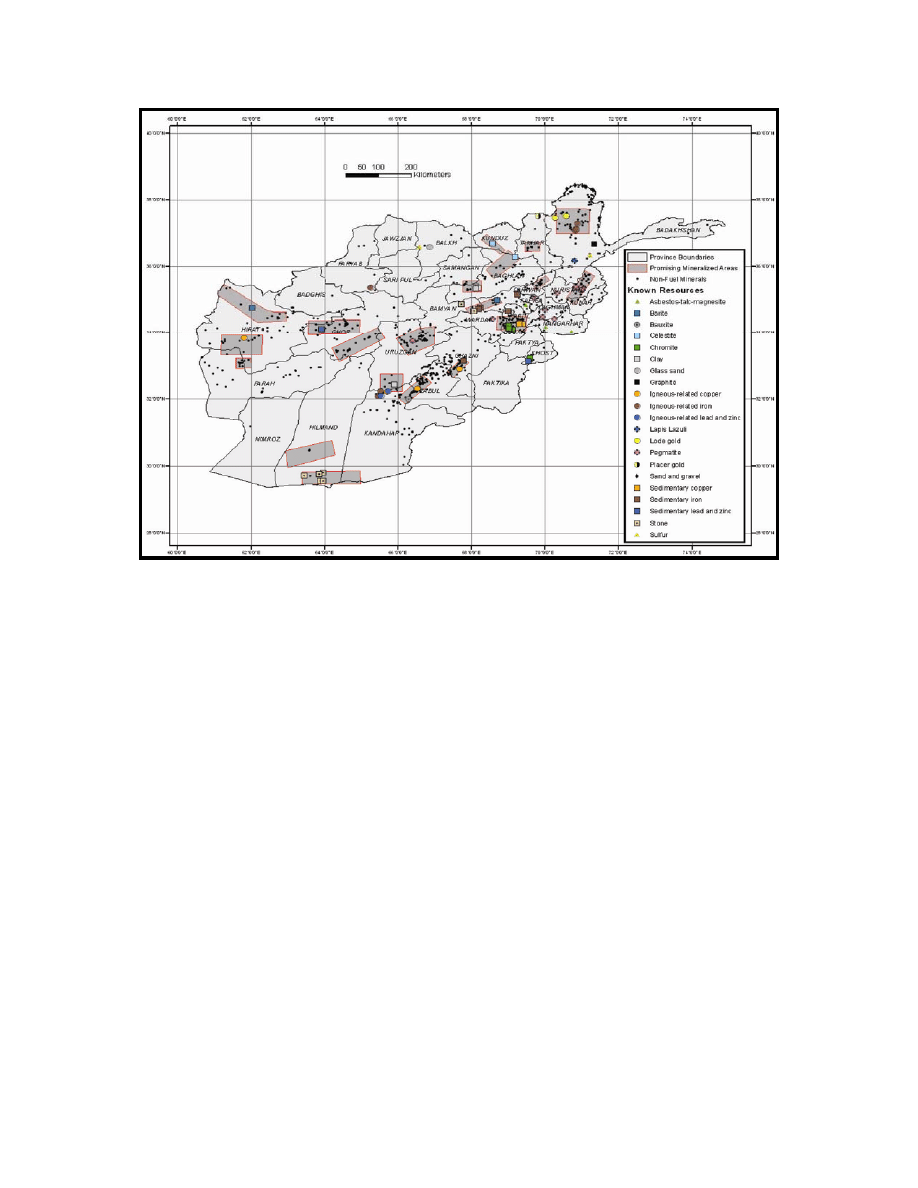
UNCLASSIFIED
Figure 3 – Known Natural Resources in Afghanistan
Since 1978, Afghan provinces have experienced 30 to 70 percent deforestation from
uncontrolled logging following the disruption of traditional, sustainable, and locally managed
logging practices. If current trends continue, Afghanistan could be virtually deforested in 25
years, destroying potential tourism and forestry industries. In addition to the long-term
consequences, deforestation causes accelerating soil erosion, flooding, and mudslides which
hinder Afghanistan’s immediate development.
Illicit gemstone and timber production primarily take raw materials from Afghanistan,
effectively outsourcing to Pakistan most of the badly needed employment and income derived
from processing and final sales. Funds derived from illicit gemstone and timber sales have
become a source of revenue for insurgent operations, including the financing of IED cells and
funding for attacks against Afghan and international forces. Therefore, it is crucial to integrate
actions to counter the illegal trade in gemstones and timber along with other efforts to counter
illicit activities and prosecute the counterinsurgency.
Developing Afghanistan’s natural resources will require significant working capital and
infrastructure investment. Unfortunately, the security situation and lack of established civil law
make the country an unattractive place to do business. Ill-defined and poorly enforced licensing
and concession procedures in some sectors, combined with a weak regulatory environment,
continue to dissuade potential investors. USAID is providing funding to the Afghan National
Environmental Protection Agency to strengthen the country’s ability to enforce the regulatory
framework. USAID also provides significant funding for reforestation and biodiversity
protection. Yet, there remains great need in this area. Donor institutions and U.S. Government
programs provide inadequate assistance in the natural resources sector. Moreover, such
51

UNCLASSIFIED
programs are long-term in nature, with progress often measured in years. Although significant
potential exists for development of Afghanistan’s natural resources, critical building blocks
related to the investment climate—commercial laws and the legal and regulatory environment—
are only gradually beginning to take hold, thus the full economic potential in these natural
resource deposits will remain untapped in the near to medium-term. Military solutions are not
sufficient to address these large-scale problems, which will require civilian expertise and a long-
term perspective.
3.2.6 Transportation
The primary activity of the international community in regards to transportation has been
road improvement. Several in-depth studies have been completed, resulting in an overall ‘master’
plan for the road network of the country. Additional modes of transportation, such as rail or air,
have received limited attention and should be the subject of further in-depth studies and
research.
The primary goal of road construction is to increase transport of goods, national and
regional trade, and economic growth. The major ancillary benefit of the roads is freedom of
movement for Afghan and international forces due to their anti-IED effect. The Afghan saying
is, “Where the road ends, the Taliban begins.” The Road Development Master Plan provides the
primary strategy to build a network of roads in the country. The basic design calls for roads to
connect district centers to provincial centers, and then provincial centers to a central Ring Road
connecting the major cities around the country. Thus, the population will be physically linked
from the local to the national level, and from their district centers all the way to the capital in
Kabul. The Road Development Master Plan will be a permanent legacy of a strong Afghan
government providing jobs, linking the nation, and expanding commerce that no alternate
organization can provide. Currently, Afghanistan’s road network includes 35,566 kilometers of
roads (8,231 kilometers of which have been completed by the United States. and its allies since
the inception of Operation Enduring Freedom). An additional 2,200 kilometers of roads are
planned for completion over the course of 2008. Road construction projects have injected $71
million into the local economy since January 2007. One kilometer of road construction
generates and average of 3,500 labor days.
The Ring Road will be approximately 2,200 kilometers long upon completion in
December 2009. An estimated 73 percent (1,755 kilometers) of the planned length has been
constructed to date. Over 60 percent of Afghans live within 50 kilometers of the Ring Road,
making it critical to trade and transport. Afghans composed 75 percent of the workforce for the
largest section of road, the Kabul-Kandahar-Herat Highway USAID, through the Louis Berger
Group, will begin the reconstruction of the Khowst to Gardez Road. This road will connect two
major provinces and increase economic stability in the region.
Afghanistan’s Ministry of Public Works intends to initiate a fiscally sustainable road
maintenance system to effectively maintain 7,000 kilometers of roads. Roads, like any other
structure or facility, require continuous maintenance. If these gravel or paved roads are
maintained by Afghans, this activity will demonstrate the Afghan government’s ability to
provide the sustained basic necessities for continued economic growth. It will also sustain the
large monetary investment that the United States has made on behalf of the Afghan government.
At the current rate of funding, U.S. agencies will increase the current number of improved roads
by approximately 20 percent. Between 2002 and the end of 2008, a total of more than 21,000
kilometers of roads will have been completed by the United States and its allies.
52

UNCLASSIFIED
3.3 Economic and Social Indicators of Progress
A key indicator of progress made in security, governance, and development in the context
of a counterinsurgency campaign are the actions and perceptions of the general population.
Popular perceptions are measured both quantitatively and qualitatively. Several organizations
have sponsored public opinion surveys in Afghanistan since 2005. Combined Forces
Command-Afghanistan commissioned a quarterly nationwide survey, the Afghanistan National
Development Poll (ANDP), until August 2006. A follow-up ANDP was initiated by the CSTC-
A in July 2007. ISAF is currently working to resume nationwide polling on a recurring basis.
On a regional level, CJTF-82 has conducted monthly surveys of RC East since April 2007.
Additionally, a number of U.S. and international organizations have commissioned nationwide
perception surveys, including the Asia Foundation, the British Broadcasting Corporation, the
U.S. State Department, and Charney Research.
According to polls conducted in 2007, perceptions among Afghans of their country’s
economy are improving. In 2004, when asked what they thought was the biggest problem facing
Afghanistan, 51 percent of individuals polled chose the economy. When asked the same
question in 2007 only 32 percent answered that they believed the economy to be the biggest
problem facing the country. Perceptions of the Taliban and security have also shown slight
improvements. However, the same polls indicated that public perception of corruption as a
major problem is increasing.
Organizations such as the World Bank, the Asian Development Bank, the United Nations
Children’s Fund, and the Afghanistan Central Statistics Office research and publish annual
indicators of economic growth and development. These fairly standardized indicators of social
and economic development include GDP, GDP per capita, life expectancy, infant mortality,
unemployment, the poverty rate, and rates of access to power, water, health, and education. The
difficulty in gathering data in Afghanistan is evident in the diverging results; however, almost all
development indicators show that progress is occurring.
Many development indicators are dependent on data from a relatively accurate census of
the population, including size, geographic disparity, ethnicity, age and sex. Afghanistan has not
conducted a full census since 1979; this was a sampling census that results in statistical estimates
of the population size and demographics. Extrapolations of those census results have been
conducted by many organizations since 1979, with each publishing their own estimates of the
population size. The divergence of these estimates has been significant: the Central Intelligence
Agency’s (CIA) World Fact Book states that Afghanistan has a population of 31,889,923; in
2007, the UN estimated the population at 27,145,000; while the Afghanistan Central Statistics
Office—the lead GIRoA agency for population data—published a population estimate of
22,575,900, highlighting the difficulty that assistance and aid providers face in estimating and
reporting development indicators in Afghanistan.
3.3.1 Unemployment
Although most analysts estimate that unemployment is high in Afghanistan, accurate
statistical data is virtually non-existent. The CIA World Fact Book indicates that as of 2005, the
official unemployment rate in Afghanistan was 40 percent. The Afghan Central Statistical
Office also maintains an official unemployment rate of 40 percent for 2007. However, other
estimates of the unemployment rate are as high as 60 percent, and unemployment could be even
higher in some rural provinces and districts.
53

UNCLASSIFIED
Defining unemployment is difficult in Afghanistan as many Afghans are employed on a
temporary basis in the informal economy or on seasonal basis during the agricultural harvest.
Regardless of the actual unemployment rate, the increase in international support activity since
2001, combined with the exponential growth of Afghan-owned businesses, has created more
jobs. This growth has been consistent, even though the number of unemployed is still high.
Though an accurate prediction of unemployment numbers may not be possible until the
completion of the next Afghan census unemployment indicators remain a cause for concern.
3.3.2 Poverty Levels
Poverty remains a significant problem for Afghanistan. According to broad estimates of
Afghanistan’s national income and population, per capita income is about $300. This makes
Afghanistan one of the poorest nations in the world, despite recent economic growth.
Given the overall low level of national income, it is difficult to establish poverty
measures in Afghanistan. However, the latest surveys of the National Risk and Vulnerability
Assessment (NRVA) conducted in spring 2007 showed that approximately 50 percent of the
Afghan population lives below the poverty line. An additional 20 percent of the population is
concentrated close to the poverty line and is at risk of falling into poverty. The impact of rising
diesel fuel prices and the doubling of wheat prices may be driving some of these families below
the poverty line. Poverty may be even higher among rural and nomadic populations.
The latest poverty analyses identify the existence of a large number of working poor in
Afghanistan. Low salaries place many who are employed at risk of falling below the poverty
line, including government employees. The analysis also showed that poverty was unevenly
spread throughout Afghanistan: the poverty rates of provinces vary from around 10 percent in
some provinces to more than 70 percent in others. Poverty is more severe in the northeast,
central highland, and parts of the southeast. Despite a significant increase in public spending in
key sectors to support poverty reduction, scarce domestic resources and limited international
assistance resulted in only limited assistance to the poorest of the poor.
The Afghan government and its international partners are committed to address the
problem of widespread poverty. Poverty research was a vital part of the overall development of
the ANDS. To improve poverty data, the Central Statistics Office and the Ministry of Rural
Rehabilitation and Development (MRRD) launched two National Risk and Vulnerability
Assessments in 2003 and 2005. Approximately 45,000 households from across the country were
interviewed. This research led to the preparation of a comprehensive poverty analysis in 2007
which has been used as a basis for drafting the ANDS Poverty Profile and formulating the ANDS
poverty reduction policies. The ANDS will also serve as Afghanistan’s Poverty Reduction
Strategy Paper (PRSP); the PRSP will guide the efforts of the government, international donors,
and the major international financial institutions (the IMF and World Bank) in their efforts to
reduce poverty in Afghanistan.
3.3.4 Health
Since the fall of the Taliban in 2001, the health sector has seen significant progress in
development, with reductions in morbidity (disease), and mortality (death). In 2001, 8 percent of
the Afghan population had access to basic health care; today, 79 percent have access to basic
health services. In 2001, Afghanistan was ranked the world's worst in infant mortality; in 2007
Afghanistan’s infant mortality rates are falling due to the efforts of the Ministry of Public Health
(MoPH) and its international partners. Since 2006, Afghanistan has reduced child mortality (five
years and under) by 25 percent, saving 89,000 children in 2007. In 2006, 23,000 Afghans died
54

UNCLASSIFIED
from tuberculosis. In 2007, due to improved access to basic health care, only 12,000 Afghans
died from this disease. Immunization coverage has reached 83 percent of children under one
year of age and additional progress has been made in updating routine immunizations for older
children, adolescents, and adults. Finally, recent data showed that 70 percent of health facilities
have at least one female provider on staff, compared to 45 percent during the Taliban era.
The MoPH developed the Basic Package of Health Services (BPHS), a program which
includes maternal and newborn health, child health and immunization, public nutrition,
communicable diseases, mental health, disability, and supply of essential drugs. The program
has recently increased its coverage of the population from 77 to 82 percent.
There has been a marked increase in health infrastructure; the number of health facilities
providing the BPHS has increased to 897 (from 746), the number of health facilities providing
comprehensive emergency obstetric care has also increased to 89 (from 79), and the number of
health facilities within the government’s program of Integrated Management of Childhood
Illnesses reached the stands at 309 facilities located in eight provinces and 39 districts. Thirteen
therapeutic feeding units have been established, and two additional midwifery schools were
opened. Twelve mobile health facilities were established to provide basic health services to the
nomadic Kuchi population. The number of health facilities providing direct observed treatment
short courses (in the treatment of tuberculosis) increased to 55 percent (from 45 percent).
Approximately 40,000 insecticide bed nets were distributed to control the spread of malaria.
Provincial teams in eight provinces were established to track the prevalence of avian flu. In
total, 670 health facilities have been renovated or constructed.
The GIRoA has clearly articulated its health sector objectives in the ANDS. The ANDS
states the following strategic goal for health: "...to reduce the morbidity and mortality of the
Afghan population by implementing a package of health and hospital services, special programs
and human resource development” (see figure below).
Afghan National Development Strategy
Health Sector Strategy
Source: Afghanistan National Development Strategy, Volume I
R
ed
u
ci
n
g
M
o
rb
id
it
y
an
d
M
o
rt
al
it
y
Im
p
le
m
en
tin
g
H
ea
lth
S
er
vic
es
Institutional Development
EXTEND
THE BASIC
PACKAGE OF
HEALTH SERVICES
EXTEND THE
ESSENTIAL
PACKAGE OF
HOSPITAL SERVICES
NATIONAL
COMMUNICABLE AND
NONCOMMUNICABLE
DISEASE
CONTROL
PROGRAM
3 Strategic Areas
HEALTH
SECTOR
HUMAN
RESOURCE
MANAGEMENT
4 Supporting Programs
Figure 5 - ANDS Health Sector Strategic Area and Programs
55

UNCLASSIFIED
The GIRoA ministry responsible for Afghan health programs is the Ministry of Public
Health (MoPH) which published a series of progressive health sector strategies beginning in
2005. It also created two documents that lay out operating procedures for health facilities: first,
the BPHS is the key document that describes the services provided for primary out-patient health
care and outlines staffing, equipment, and medications required to operate a facility; second, the
Essential Package of Hospital Services (EPHS) is the key document that describes in-patient
facilities and identifies a standardized package of hospital services, provides a guide for private
and public sector hospitalization, and promotes a referral system that integrates the BPHS with
hospitals.
Key improvements are focusing less on the number of new health facilities and more on
improving the standardization of care, coordination among all levels of care, refining referral
services, increasing the available range of services, increasing hours of clinic operations, and
fielding appropriate numbers and types of staff. In general, the focus is on increasing intellectual
and human capacity as opposed to building facilities and developing infrastructure.
Additional improvements include an increased deployment of the Basic Package of
Health Services through a nationwide network of linked primary care facilities. This has resulted
in increased access to care, raising the numbers of people within a two-hour walk of a medical
facility to 66 percent in 2007. Continued improvements are focused towards the long-term goal
of achieving standardized, sustainable, and independent health services.
3.3.5 Education
Only 28.1 percent of adult Afghans are literate, according to the CIA World Factbook.
Many of the literate people are only able to read and write at the second or third grade level.
Most of the literate population is only able to read and write at the second or third-grade level.
The majority of teachers in Afghanistan have education equivalent to the ninth- to twelfth- grade
levels in the United States. They are able to teach basic reading and writing, plus reading
(reciting) of Arabic text in the Quran. The Ministry of Education’s (MoE) National Education
Strategy Plan in concert with the ANDS is making strides in the educational system. These
strides will guarantee access to education to all Afghans.
Currently, there are more than five million children that are enrolled in schools today,
nearly 38 percent female, compared to five years ago when a little more than one million
students were enrolled with almost no females. The number of teachers has grown more than
seven-fold, but only 22 percent meet the minimum MoE qualification of Grade 14. Only 28
percent of teachers are female, located primarily in urban areas. The emphasis on improving the
curriculum over the last five years has been concentrated on the first six years of schooling.
However, a secondary school curriculum is currently being developed. Although more than
3,500 schools have been established, only 40 percent of students have actual buildings in which
to meet. Thousands of communities have no easy access to schools, causing parents to send their
children to madrassas in Pakistan where Islamic fundamentalism is a focus. There are security
concerns for Afghan schools: nearly six percent of schools have been burnt or closed down due
to terrorism in the last 18 months. Finally, approximately 30,000 to 40,000 students graduate
from high school every year, but only one third are admitted to universities due to a lack of
university capacity.
In accordance with the ANDS, the Afghan government intends to guarantee access to
primary education for all children by the year 2020 and provide for most to attend secondary
school. Access to higher education will be readily available and the government will ensure that
56

UNCLASSIFIED
university graduates have a realistic hope of obtaining jobs. To achieve these goals, the United
States and the international community must continue to support the ongoing development of the
comprehensive national educational system. This effort requires constructing or rehabilitating
schools, upgrading primary-school teacher skills through national teacher training programs,
increasing the MoE’s capacity to provide in-service and pre-service support for teachers, and
coordinating the printing of five to ten million books per year in 2008 through 2010. In the area
of higher education, all 16 university faculty training and education programs must be
prioritized. The Ministry of Education must coordinate and resource the printing of five to 10
million books per year in 2008 through 2010.
The literacy and productive skills of Afghans, especially woment, must be enhanced to
meet the needs for skilled workers in a growing economy. The educational system must expand
to provide more choices and more competition, such as private schools and American-style
education opportunities for university students. This comprehensive plan for a national
education system in turn will directly contribute to the long-term sustainable growth of the
Afghan economy and hence an improved way of life for the Afghan people.
3.4 Economic Development Outlook
The GIRoA continues to make slow but measurable progress in the area of economic
development. Afghanistan has met most of the targets on monetary and fiscal policy under its
International Monetary Fund (IMF) economic program, but it has fallen short on benchmarks
related to structural reforms. The national budget process has improved significantly, as noted
by the IMF in its latest assessment, and the government adheres to a strict fiscal policy of no
borrowing and no overdrafts with the banking system. Incremental improvements have been
made in raising government revenue from customs duties and other sources, and budget deficit
targets were met in the current fiscal year (March 21, 2007 though March 20, 2008).
The GIRoA’s challenges include increasing revenue, controlling the afghani exchange
value, and increasing ministry capacity to plan and implement development programs.
Afghanistan continues to have one of the world's lowest domestic revenue to GDP ratios, at
about 8 percent. The afghani appreciated in real terms against the U.S. dollar in 2004-06, owing
in part to large aid inflows and drug-related financial flows. In the first seven months of this
fiscal year, however, the afghani remained steady despite rising inflation. The concern is that an
overly strong afghani could inhibit the growth of a domestic industrial base (and the employment
it would bring) by encouraging imports and discouraging exports.
57

UNCLASSIFIED
$4.037
$4.585
$5.952
$7.306
$8.399
$0.0
$1.0
$2.0
$3.0
$4.0
$5.0
$6.0
$7.0
$8.0
$9.0
$10.0
2002
2003
2004
2005
2006
$
US Billions
Afghanistan Gross Domestic Product
(Licit only)
Smallest GDP for a U.S. state
is $21.507 billion (Vermont)
Smallest GDP for a U.S. state
is $21.507 billion (Vermont)
Figure 4 - Afghanistan Gross Domestic Product (Licit), 2002-2006 (Source: World Bank)
Afghanistan's overall economic performance under the IMF Poverty Reduction and
Growth Facility program has been strong. Since the beginning of the program, fiscal revenue
has increased steadily and the monetary policy framework has been enhanced. The drought-
induced decline in agricultural production held the real economic growth to an estimated seven
percent in 2006 and 2007. Real GDP growth is expected to exceed 13 percent in the 2007-2008
fiscal year, which ended on March 20, 2008. GDP per capita has increased by around 53 percent
in the last five years and grew from around US$200 to around US$306.
Inflation declined to five percent in 2007 but rose to double digits in 2008, owing mainly
to sharp increases in the prices of imported fuel and foodstuffs. Some of this inflation is tied to
instability in Pakistan as well as Pakistan’s increased dependency on imports in 2007 and early
2008. Pakistan is usually a large exporter of basics (food and fuel) to Afghanistan, but
Pakistan’s difficulties in meeting internal demands due to drought significantly affected the
Afghan economy. The underlying trends, however, signal that domestic inflationary pressures
are being contained. Confidence in the domestic currency, which has remained broadly stable
against the U.S. dollar, has been instrumental due largely to a sound monetary policy.
According to the IMF, the Afghan economy has grown by an average of 11.4 percent per
year in real terms since 2002, albeit from a small base. This strong growth can be attributed
largely to reconstruction efforts fuelled by development assistance, as well as to a recovering
agriculture sector. In 2006-2007, real economic growth was at an estimated 7.5 percent, weaker
than recent averages. The slowdown was the result of a return to drought conditions, which
caused agricultural production to drop considerably that year. There has been better weather to
date through 2007-2008, and agriculture is expected to rebound. Due to increased agricultural
output, the IMF projects that economic growth in Afghanistan will rise to 13 percent in 2007-
2008, but it expects GDP to begin to normalize and fall to around 9 percent in 2008-2009
A major challenge for the GIRoA is progress toward fiscal sustainability. While the
GIRoA has increased it revenue collection, it cannot keep pace with increased expenditures,
largely driven by the security sector. Increasing the number of ANSF and sufficient pay is
58

UNCLASSIFIED
clearly important for security, but it has fiscal implications for the GIRoA which will eventually
have to pick up those substantial costs. It is estimated that the GIRoA will roughly cover less
than 20 percent of its total recurrent expenditures, including the core and external budgets, in
2008-2009. Furthermore, the GIRoA has now begun to experience difficulty meeting its annual
revenue target due in part to political interference and lack of capacity.
3.5 Provincial Reconstruction Teams
3.5.1 Strategy and Objectives
Provincial Reconstruction Teams (PRTs) consist of a combination of military and civilian
personnel whose mission is to aid in the reconstruction and development of Afghanistan. PRTs
are under military command. Military personnel provide a security envelope in which civilian
experts can work on governance and development projects. U.S. PRTs operate under general
guidance provided by ISAF. The stated mission of the PRTs is as follows:
“Provincial Reconstruction Teams will assist the Islamic Republic of Afghanistan to
extend its authority, in order to facilitate the development of a stable and secure
environment in the identified area of operations, and enable security sector reform and
reconstruction efforts.”
While the specific activities of each PRT are determined by the needs in its respective
area of operation, PRTs achieve their objectives by following four key lines of operation:
• increase effectiveness of legitimate authorities;
• decrease effectiveness of illegitimate authorities;
• increase legitimacy of legitimate authorities; and
• decrease legitimacy of illegitimate authorities.
The U.S.-led PRTs in RC-East play an integral role in the ground commanders’ counter-
insurgency approach. They coach, train, and mentor sub-national government officials in order
to implement good governance practices that are transparent, guarantee human rights, are free of
abuse and corruption, and provide due regard to the rule of law.
Additionally, through the DoD-funded Commander’s Emergency Response Program
(CERP) and USAID funding, U.S.-led PRTs fund construction projects that assist the local
government in meeting the basic needs of the populace and provide the basic infrastructure to
support economic growth and development. Although CERP funds are dispersed at the
discretion of the U.S. military commanding officer, the program achieves the best results when
planned and carried out in coordination other agencies (i.e., USAID) working in the same sectors
and in many cases the same districts or villages. This is particularly true for USAID’s Local
Governance and Community Development program, which provides technical assistance and
training to provincial and district officials combined with community-level small infrastructure
activities, as well as USAID’s Alternative Development programs that support the agriculture
sector in many of the RC East provinces.
Conducting these disparate activities independently of one another would achieve only
minor effects; however, by integrating the right combination of governance and development
activities with complementing security capabilities, PRTs have the potential to make significant
contributions to the reconstruction and development progress in non-permissive environments.
The PRTs are in essence synthesizing agents that apply the right combination of governance
capacity building and development assistance in concert with the commanders’ security
59

UNCLASSIFIED
component in order to achieve the greater overall desired outcomes. PRT command teams meet
with provincial governors, district officials, and ministry officials in their areas of responsibility
several times during each week. The PRTs work closely with Provincial Councils, Provincial
Development Committees and the local representatives of other organizations and aid agencies.
In their role as coaches, mentors and trainers, the PRTs work closely with all these provincial-
level officials and agencies to assist them in providing for the populace.
3.5.2 Composition and Laydown
The table below indicates U.S.-led PRT staffing levels. Current shortages in U.S. civilian
agency personnel (primarily USAID advisors and USDA representatives) are currently being
addressed by Embassy Kabul and the relevant agencies in Washington.
PRT
Military Civilian
Auth O/H
DoS USAID
USDA
Auth
O/H
Auth
O/H
Auth O/H
Asadabad 89 89
1 1 1 1 1 0
Bagram 63 63
0 0 2 1 0 0
Farah
99 99
1 1 1 1 1 0
Gardez 88 88
1 1 1 1 1 1
Ghazni 88 88
1 1 1 1 1 1
Jalalabad 88 88
1 1 1 1 1 0
Khowst 88 88
1 1 1 1 1 0
Mehtar
Lam
88 88
1 1 1 1 1 1
Nuristan 88 88
1 1 1 1 1 0
Panjshir 55 55
1 1 1 1 1 1
Qalat
99 99
1 1 1 1 1 0
Sharana 88 88
1 1 1 1 1 0
Total
1021
1021
11 11 13 12 11 4
The U.S.-led PRTs are positioned in the following locations:
City
Province
ISAF Regional Command
Bagram Parwan
and
Kapisa
East
Panjshir Panjshir
East
Kalagush Nuristan East
Asadabad Konar East
Mehtar Lam
Laghman
East
Jalalabad Nangarhar
East
Khowst Khowst
East
Gardez Paktia East
Sharana Paktika East
Ghazni Ghazni
East
Qalat Zabul
South
Farah Farah
West
60

UNCLASSIFIED
3.5.3 Coordination and Chain of Command
Each U.S.-led PRT in RC East is under military command, subordinate to a U.S. brigade
task force. The PRTs receive instructions and guidance from their brigade headquarters. They
coordinate their actions through the brigade headquarters and laterally with the battalions and
civil affairs teams occupying the same area. PRT actions are synchronized by their commands
with U.S. and ISAF campaign objectives.
The U.S.-led PRTs have an integrated command group structure combining the military
and civilian elements (e.g., USAID, DoS, and USDA) to ensure effective execution of security,
development and governance programs and policies. Coordination among the PRTs is
conducted laterally as well, through USAID and USDA representatives in their respective
organizations. CJTF-82 provides liaison officers to ISAF, USAID, UNAMA and CSTC-A to
coordinate efforts. USAID and DoS provide advisors at the CJTF-82 HQ, each brigade task
force headquarters and each U.S.-led PRT. USAID and DoS also provide advisors to many of
the PRTs led by other international partners active in Afghanistan. CJTF-82 hosts quarterly
development conferences with USAID and UNAMA which include representatives from the
brigades and PRTs. CJTF-82 also sponsors quarterly interagency conferences that include wide
representation from CSTC-A, the U.S. Embassy and USAID. These conferences address the
salient issues that pertain to all U.S. Government agencies executing governance and
development support in Afghanistan and are supported by day-to-day coordination between
CJTF-82 development related staff and USAID technical officers on development and
governance issues. CJTF-82 also sponsors quarterly stakeholder conferences that include
UNAMA, most UN agencies, and multiple non-governmental organizations operating in
Afghanistan. These conferences are conducted for the same reasons as the interagency
conferences mentioned above.
Recurring meetings and conferences at ISAF serve as the unifying agent across Afghan
and international forces as with the CJTF-82 interagency and stakeholder’s conferences. These
meetings and conferences help to establish and maintain good working relationships among the
respective functional staff sections of the various agencies. It is through these meetings and
conferences, as well as the day-to-day coordination and cooperation between the agencies, that
U.S. and international organizations drive toward unity of effort
61

UNCLASSIFIED
3.5.4 Provincial Reconstruction Team Funding
The U.S.-led PRT efforts are funded through CERP under the Department of Defense,
complemented by USAID-funded development programs. CERP funds are not used to cover
PRT operating costs. The CERP funds available in FY2007 were $206 million. The amount
earmarked for FY2008 is $208 million. The following table indicates the amount distributed to
each of the PRTs for FY2007.
PRT
FY07 OBLIGATED
Bagram
$6,736,139.14
Farah
$4,300,167.81
Gardez
$4,746,008.00
Ghazni
$10,568,059.00
Khowst
$17,968,464.43
Kunar
$10,559,073.23
Laghman $3,435,263.00
Nangarhar $12,839,907.00
Nuristan
$20,546,045.73
Panjshir
$5,450,159.22
Qalat
$927,174.02
Sharana
$23,816,477.07
PRT TOTAL
$121,892,937.65
Although the CERP funding is shared with the maneuver units, the PRTs execute a
majority of the CERP-funded projects. Each month, the PRTs receive a monthly CERP
allocation which provides them funding for quick-impact projects, calculated on a per capita
basis. Additionally, this monthly amount is not a spending limit. PRTs nominate projects
identified as being needed within their areas of responsibility that are above and beyond their
monthly allocation. A CERP Review Board meets weekly to evaluate the project nominations
and funds projects that are deemed technically and legally sufficient and meet the commander’s
intent as stated in the current development guidance and operations order. The following table
indicates the amount distributed monthly to each of the PRTs.
PRT Monthly
Allocation
Bagram $158,900.00
Panjshir $22,200.00
Nuristan $5,400.00
Asadabad $21,600.00
Mehtar Lam
$32,100.00
Jalalabad $107,300.00
Khowst $41,400.00
Gardez $26,500.00
Sharana $20,900.00
Ghazni $88,900.00
Qalat $43,900.00
Farah $72,900.00
62

UNCLASSIFIED
Across the command, CJTF-82, USAID, and DoS work to partner with GIRoA officials
at all levels. The primary objective is to help connect the Afghan populace to the government,
help build trust and confidence in government institutions and to solidify popular support for the
government. The CJTF-82 Commanding General and Deputy Commanding Generals meet
regularly with ministers and deputy ministers to ensure that CJTF-82 objectives are in line with
GIRoA ministerial strategies. CJTF-82 staff officers meet with and correspond regularly with
ministerial officials to work common solutions to issues.
3.6 Reconstruction and Development Oversight
Through capacity building programs with Afghan ministries and provincial governments,
the United States is working to eliminate inefficiencies and corruption in the delivery of
assistance to the Afghan people. U.S. foreign assistance programs work with ministries –
focusing on the most important service providers, like the ministries of health, education,
finance, and agriculture – to put more responsibility for service delivery at the local levels and
ensure funds reach the provinces. This will also allow ministry representatives working at the
provincial levels to do planning, decision-making, delivery, and monitoring activities, ensuring
assistance reaches the Afghan people. Advisors will mentor and support capacity building for
Afghan government employees in areas such as financial management, budgeting, procurement,
human resources management, strategic planning, project planning, and project implementation,
and information and communications systems.
In addition, the U.S. Government has made progress over the past seven years
streamlining our disbursement of funds to program implementers. The U.S. Government has
disbursed 69 percent of the $26.3 billion in U.S. Assistance to Afghanistan from Fiscal Year
2001 to Fiscal Year 2008 (this is not including the Fiscal Year 2008 Supplemental), which is
higher than the Ministry of Finance’s reported international average of 62 percent, and almost 20
percent higher than where the U.S. Government was two years ago. Efforts to put more control
of funding decisions into the hands of Provincial Reconstruction Teams have improved the
PRTs’ ability to quickly follow security gains with development efforts that address locally-
identified priorities.
The Office of the Inspector General in Afghanistan has spent $2.7 million on oversight
activities. As of December 2007, they had completed 18 performance and 23 financial audits.
Not a single one of these audits revealed significant findings of waste, fraud, or abuse.
63

UNCLASSIFIED
Section 4: Counternarcotics (CN)
The cultivation, production and trafficking of narcotics in Afghanistan is a major
concern. Narcotics-related activities are fueling the insurgency in Afghanistan and, if left
unchecked, threaten the long-term stability of the country and the surrounding region. Over 90
percent of the world’s opium originates in Afghanistan, and the emerging nexus between
narcotics traffickers and the insurgency is clear. Due to the threat to economic development,
security, and governance posed by the trafficking of drugs in Afghanistan, the Office of the
Deputy Assistant Secretary of Defense for Counternarcotics (OSD CN), the Drug Enforcement
Administration (DEA), the U.S. Marshals Service, the Department of Justice (DoJ), and the
Department of State (DoS) are committed to strengthening the counternarcotics (CN) capabilities
of the GIRoA and bordering nations.
4.1 Strategy, Resources, and Priorities
The U.S. Government has developed both short and long-term objectives to meet CN
goals in Afghanistan and the region. These objectives are framed within the Five Pillar strategic
plan for Afghanistan. The five pillars include: 1) Public Information, 2) Interdiction and Law
Enforcement, 3) Eradication, 4) Rule of Law and Justice Reform 5) Alternative Development. In
the short-term (one to three years), the primary focus will be on the interdiction pillar. To this
end, DoD will continue to focus on capacity building programs; sustaining CN police forces;
training the ABP to identify, track and interdict outgoing narcotics and incoming precursor
chemicals; increasing the capacity of the CNPA to detect, gather evidence, develop cases and
incarcerate drug traffickers; integrate CN capacity building in the provinces within the CSTC-A
FDD Plan; and better utilize the National Guard State Partnership Program for regional CN
support activities.
The long-term (three to five years) strategy is to continue providing support to
interdiction-capacity building. This support will primarily be targeted towards Afghan law
enforcement, but legitimate law enforcement organizations of neighboring countries will also be
beneficiaries. U.S. efforts aim to contain narcotics trafficking within Afghanistan, break the tie
between insurgents and the drug trade, continue to engage Central Asian countries in order to
gain access, ensure regional efforts remain Afghan centric, and eventually transfer CN program
support to partner nations. To achieve these goals, the United States will continue to fund
programs that enhance the logistical and technical abilities of partner countries to conduct CN
interdiction operations. Descriptions of other agencies responsibilities can be found in section 4.2
below.
In August 2007, the U.S. Counternarcotics Strategy for Afghanistan was revised by the
interagency community to improve implementation of CN activities in Afghanistan. Strategy
elements were based on input from an interagency group of experts representing the DoS, DoD,
Department of Justice, USDA, Department of the Treasury, Drug Enforcement Administration,
the Office of National Drug Control Policy, and USAID. The improved strategy evaluated the
previous CN strategy for Afghanistan, examined pertinent issues, obstacles and lessons learned,
and presented a way forward on the five pillars of the strategy.
The way forward involves three main elements: (1) dramatically increasing development
assistance to provide incentives for licit development while simultaneously amplifying the scope
and intensity of both interdiction and eradication operations; (2) coordinating CN and
counterinsurgency planning and operations in a manner not previously accomplished, with a
64

UNCLASSIFIED
particular emphasis on integrating CN into the counterinsurgency mission; and (3) encouraging
consistent, sustained political will for the CN effort among the Afghan government, our allies,
and international civilian and military organizations. To ensure the goals of this strategy are met,
several weekly and bi-weekly interagency counternarcotics coordination meetings are held. All
principal policy makers take part in the Afghan Interagency Operations Group (AIOG), the
Afghan Working Group (AWG), the Afghan Steering Group (ASG), and the Deputies and
Principals Committee meetings.
4.2 Roles and Missions
At the national level, the Counternarcotics Police of Afghanistan (CNPA) are the policing
agency responsible for countering illicit narcotics traffickers in Afghanistan. The CNPA mission
is to enforce the narcotics laws and regulations, the policy of the President of the Islamic
Republic of Afghanistan, and orders from the Ministry of the Interior. In order to foster stability
and security, the CNPA targets narcotics trafficking suspects and those who protect them.
Provincial governors are responsible for discouraging poppy cultivation and conducting
Governor-led eradication (GLE), if necessary. Should governors need assistance in conducting
eradication, they can ask for national assistance. In provinces where governors are either
unwilling or unable to conduct GLE, the central government’s Poppy Eradication Force (PEF)
may be deployed, even if the governor does not request support. Those provinces that
demonstrate notable progress in counternarcotics by greatly reducing poppy cultivation or
eliminating it altogether, may qualify for high-impact development assistance through the Good
Performers Initiative.
The international forces present in the country provide operational support to the GIRoA.
ISAF does not have a direct mission in CN; however, ISAF assistance to CN activities is a key
supporting task. The DoS works within the five pillar plan to coordinate public information
campaigns and poppy eradication. DoS and DoJ work in conjunction to enhance the Afghan
judicial system, train prosecutors, and build the infrastructure necessary to indict, arrest, try,
convict, and incarcerate drug traffickers. The DEA, DoJ, DoS and DoD have been successful in
building the interdiction capacity of the CNPA. With the assistance of DoD, the DEA recently
opened a new training facility for the CNPA. The DEA is also in the process of developing a
three-to-five-year expansion plan for DEA operations in Afghanistan. USAID provides
devolvement opportunities for the Afghan people, and is building roads, installing irrigation,
constructing cold storage facilities, and introducing improved farming techniques to the Afghan
people with the goal of providing viable alternatives to opium cultivation.
4.3 Efforts to Improve Coordination
4.3.1 Interagency
As mentioned previously, the U.S. Coordinator for Counternarcotics and Justice Reform
in Afghanistan worked with an interagency group of experts to revise the U.S. Counternarcotics
Strategy for Afghanistan with the goal of improving the implementation of CN activities in
Afghanistan. Experts from DoD, DoS, Department of Justice, USDA, Department of the
Treasury, Drug Enforcement Administration, the Office of National Drug Control Policy, and
USAID worked together to create the revised strategy, which was publicly released in August
2007.
65

UNCLASSIFIED
4.3.2 International
The opium problem in Afghanistan can not be viewed as Afghanistan’s problem alone.
For this reason, the USG will continue to build the interdiction capacity of neighboring countries
in the South and Central Asia region. Regionally, DoD will continue to provide non-intrusive
detection equipment, training and infrastructure support for better border security to the
Government of Pakistan; improve border facilities and provide new communications equipment
in Tajikistan; provide scanning equipment and construct border crossings in Turkmenistan; and
improve command and control and provide mobile interdiction training in Kyrgyzstan. In
addition, DoD will continue to provide the Pakistan Frontier Corps (FC) with funds to improve
its ability to identify and interdict narcotics traffickers; in FY08 alone DoD will provide more
than $50 million to continue to build the capacity of the FC. Building regional counternarcotics
capacity ensures that the Afghan opium problem will not simply migrate to another country in
the region and continue to threaten U.S. goals of peace and security in this important corner of
the world.
4.3.3 Use of Intelligence
The U.S. Government coordinates the development of CN programs and the sharing of
CN intelligence and information with partner nations and lead federal law enforcement agencies.
Sharing intelligence, while building the capacity of the GIRoA and neighboring countries to
collect CN intelligence, will allow the United States to shift the burden of counternarcotics
activities in Afghanistan to the Government of Afghanistan more quickly. The Joint Narcotics
Analysis Center (UK-led, based in London) enables analysts from different U.S. and U.K.
intelligence and law enforcement agencies to conduct strategic analysis to provide CN policy
makers with an accurate assessment of the Afghan opium problem. The Interagency Operations
Coordination Center (IOCC) (U.S.-U.K. joint leadership, based in Kabul) provides law
enforcement targeting support and operational coordination for U.S., U.K., GIRoA and other CN
law enforcement operations. These operations target the illicit Afghan narcotics industry, and
the IOCC works to support, strengthen and expand the rule of law and good governance in
Afghanistan. The DoD-funded CNPA Intelligence Fusion Center (CNPA – IFC), located in the
CNPA headquarters, liaises closely with the CNPA Intelligence and Analysis Department. On a
daily basis, the CNPA-IFC handles information requests from the CNPA and IOCC and provides
targeting coordination based on information gathered from intelligence sources and seized
documents. By coordinating efforts between the CNPA and the international partners, and by
facilitating the flow of information, the CNPA-IFC acts as a critical enabler for the intelligence
and analysis department while playing a vital role in creating synergy between the GIRoA and
partner law enforcement agencies.
The Criminal Investigations Management System is a database system for recording data
and performing link analysis on criminal activity in support of the CNPA. In addition to a
database function, the system provides capabilities for collecting biometric data on criminals.
The project involves developing the database system and deploying equipment to Afghanistan in
conjunction with system management training. This development enables the CNPA to archive
information and share it with international law enforcement agencies. The mission of the
Centers for Drug Information is to help disrupt illegal drug trafficking through operational and
tactical law enforcement information sharing. Sharing of drug-related information between and
among the participating nations and agencies enhances the effectiveness and efficiency of CN
law enforcement. These systems will ultimately provide the CNPA with the capability to
66

UNCLASSIFIED
develop a comprehensive information sharing process; and will facilitate sharing of timely and
secure investigations information. DoD is also working to improve its human intelligence
capability. In FY 2008, DoD will provide more than $57 million towards CN intelligence
programs in Afghanistan, and has requested funding to continue these programs.
4.4 Efforts to Improve Afghan Capacity
CN operations are severely constrained by the capacity of the Afghan law enforcement
and judicial systems. In Afghanistan the judicial system is negatively affected by varying
degrees of corruption and a lack of transparency. As a result, DoD, DoS, DoJ, DEA and the
Department of Homeland Security (DHS) are working to build the infrastructure necessary for
the GIRoA to conduct legitimate law enforcement operations against narcotics traffickers.
Over the next several years, the U.S. and its international allies will assist the CNPA in
building the capacity to arrest high value drug traffickers, intercept narcotics during transit, and
destroy clandestine laboratories. Current joint DoD programs with DEA have resulted in the
construction of the National Interdiction Unit (NIU) training compound, the installation of
equipment for the Sensitive Investigative Unit and the Technical Investigations Unit, and
provided advanced training for the CNPA, with DoS funding all the operations and maintenance
costs for these facilities. Additional funding for these programs was supplied by DoD and DEA
to conduct background checks on applicants and train those who were found to be suitable for
duty in these elite units. With DoS, DoD provided funding for the Afghan Joint Aviation
Facility and the CN Justice Center, while providing helicopter flight training to MoI personnel
for the creation of an organic airlift capability for Afghan CN organizations. DoD is developing
an Unmanned Aerial System program to provide dedicated intelligence, surveillance, and
reconnaissance support to interagency CN forces. This program will provide situational
awareness and force protection for CN forces when they are conducting operations, specifically
DEA Foreign Advisory Support Teams (FASTs) and the NIU. The FASTs provide guidance,
mentoring, and bilateral assistance to the GIRoA and CNPA in identifying and disrupting
clandestine drug operations. The DEA FAST teams have consistently requested and received
helicopter support from DoS, including mission support, insertion, extraction, medevac, search
and rescue, and reconnaissance. Although U.S. military personnel do not directly participate in
law enforcement operations, USCENTCOM forces do provide medical evacuation, in-extremis
support, pilot training, helicopter lift support for administrative purposes, and intelligence for
law enforcement CN missions.
In FY 2008, DoD is providing more than $95 million to foster CNPA development.
Some major DoD funded initiatives are Afghan helicopter crew member training ($4 million),
Mi-17 helicopter operations and maintenance ($13.2 million), aviation facilities ($4.3 million),
NIU sustainment training ($5.6 million), DEA mentoring and training program ($9 million),
expansion of the CNPA headquarters compound ($20 million) and construction of two regional
law enforcement centers ($9.7 million). DoD has long-term plans to further support the capacity
building of GIRoA CN forces. Some of the potential programs could include acquisition of
additional MI-17 helicopters, Afghan helicopter crew member training, additional regional
operations and training centers, NIU sustainment training, and mentoring for all levels of the
counternarcotics police.
DoD also plays an integral role in building the operational capacity of the Afghan Border
Police (ABP) and Afghan Customs Department (ACD). The ABP and ACD require extensive
support if they are to be effective in controlling Afghanistan’s 5,000 plus kilometer border.
67

UNCLASSIFIED
Border crossings with Pakistan, Iran, Uzbekistan, Tajikistan, Turkmenistan, and China present a
challenge to these Afghan departments. To meet this challenge, DoD funded a DoS program, the
Border Management Initiative (BMI). The purpose of BMI is to improve security and promote
stability in the border regions, and to increase interdiction capacity. In FY08, DoD will provide
more than $14 million to build the capacity of the ABP and ACD. At the request of DoS, DoD
funded the development of the U.S. Embassy Border Management Task Force (BMTF). The
BMTF provides oversight and management of U.S. border initiatives and assists the GIRoA with
border issues. The United Nations Office on Drugs and Crime looks to the BMTF as the focal
point for border management issues on behalf of the international community. Under the BMTF,
U.S. mentors are provided to the ABP and ACD for border crossing points at Islam Qalah and
Towrkham. DoD funded construction of several border crossing points in Afghanistan and the
region including Sher Khan Bander, Towragundhi, and Islam Qalah. A communications system
was also purchased for the ABP to support key command and control functions. Non-intrusive
detection capability (x-ray and gamma scanners) has been provided to support inspections at
major border crossing points and airports
.
The Counternarcotics Infantry Kandak (CNIK), security element for the CN forces, is the
Ministry of Defense’s contribution to GIRoA CN efforts. The unit is intended to provide cordon
security in direct support of Poppy Eradication Force deployments. The CNIK will enable the
CN forces to focus on their core competencies and reduce the security burden on international
forces. OSD (CN) is coordinating with CSTC-A and the Afghan MoD to develop the
requirements to field a fully air-mobile unit with appropriate combat enablers to deter security
threats posed to CN forces by the insurgents and the drug traffickers. The creation of the unit is
part of the USG CN strategy for Afghanistan.
4.5 Assessment
4.5.1 Progress to Date
Although there has been some limited progress in the fight against narcotics, Afghanistan
remains the leading producer of opium in the world. While many provinces have seen success in
reducing poppy cultivation (12 of 34 provinces had more than a 50 percent decrease from 2006
to 2007 and the number of provinces that did not cultivate poppy rose from 6 in 2006 to 13 in
2007), four provinces experienced a significant increase in cultivation. Helmand in the south,
Farah and Nimroz in the west, and Nangarhar in the east each saw an increase of more than
4,000 hectares from 2006 to 2007. Helmand alone now accounts for 53 percent of the total
poppy growth in Afghanistan. One of the foremost problems is the lack of a comprehensive CN
strategy among Afghanistan and its regional and international neighbors, especially Pakistan.
With growing evidence of a link between the insurgency and the narcotics trade, it is becoming
increasingly apparent that security in Afghanistan is directly tied to counternarcotics efforts.
Another major issue that requires resolution is the lack of coordination between the MoD
and MoI. The current framework leads to a compartmentalization of responsibility between
these ministries. The CNIK is an example of improvement. The MoD initially opposed the
augmentation of the CNPA with ANA forces, mainly due to the potential risks posed by
association with counternarcotics operations. In early 2008, the MoD changed its position, and
the CNIK went into development. However, the issues that still need to be worked out are
officer training for the CNIK, a memorandum of understanding with MoI on equipment loans
and shared logistics during operations, and joint coordination and mission planning between the
ministries.
68

UNCLASSIFIED
4.5.2 Impact of Counternarcotics on the Counterinsurgency Mission
U.S. forces provide support to CN law enforcement operations within the scope of
current rules of engagement, applicable law and regulation, and within the limits of their means
and capabilities. Use of limited forces in Afghanistan is a zero-sum endeavor. A shift in force
application from one mission set to another comes with a cost of a reduction of available forces
for the former mission set. A shift of limited assets may result in a degradation of the counter-
terrorism mission. Intelligence sharing, limited logistical support, and in-extremis rescue and
medical evacuation are currently being provided by U.S. and international forces towards the CN
mission. Additional resources, targeted to the CN mission would be needed to expand direct
DoD support to counternarcotics operations. Similarly changes in rules of engagement and
national law would also be required.
The CN mission affects the counterinsurgency and counterterrorism missions in another
way. It is likely that counternarcotics operations have in some areas enabled insurgents to make
common cause with farmers against the Afghan Government and ISAF. Insurgents can set up a
protection racket, exchanging protection against eradication forces for support, supplies, and
equipment from locals.
4.5.3 Potential Improvements
The impact of building GIRoA CN operational capacity complements the DoD’s primary
mission of CT and counterinsurgency in Afghanistan. There is a clear nexus between narcotics
and the insurgency in Afghanistan that threatens U.S. gains in Afghanistan and the region. The
narcotics trade has strong links with the anti-government insurgency, most commonly associated
with the Taliban. Narcotics traffickers provide revenue and arms to the Taliban, while the
Taliban provides protection to growers and traffickers and keeps the government from interfering
with their activities. By enabling the GIRoA to confront drug trafficking organizations we
positively impact the effort to defeat the insurgency. The U.S. military is committed to
continued work with other U.S. agencies, within the legal constraints imposed by Congress on
military assistance to law enforcement operations, to support U.S. efforts in Afghanistan and
Central and South Asia to defeat the Afghan opium problem.
69

UNCLASSIFIED
Section 5: Regional Engagement
Regional cooperation is essential for the Afghan government. Following the first
Regional Economic Cooperation Conference in December 2005, limited regional cooperation
sections have been established within the administrative structures of some Afghan ministries.
Additionally, in 2006, a Directorate for Regional Cooperation was established at the Ministry of
Foreign Affairs. Unfortunately, despite an ongoing successful Asian Development Bank
Technical Assistance program towards mainstreaming regional cooperation, human capacity of
this Directorate continues to need serious attention. The establishment of a cross-cutting
consultative group and a working group for regional cooperation, within the framework of the
ANDS, has helped create platforms of dialogue and interaction between different stakeholders on
regional cooperation. However, there is very little discussion or lively debate on regional
cooperation in the Afghan media and hence little public awareness of the subject. For the most
part, progress has been limited in achieving visible and practical results on the ground in regional
economic cooperation.
5.1 Afghanistan-Pakistan Border Areas and the Federally Administered Tribal Areas
The greatest challenge to long-term security within Afghanistan is the insurgent
sanctuary within the Federally Administered Tribal Areas (FATA) of Pakistan. The ANSF must
be able to coordinate actions with a Pakistani force that is trained and resourced to eliminate
threats emanating from within Pakistan. The Pakistan Military (PAKMIL)’s clashes with
Taliban members and terrorist organizations in Pakistan’s northwestern tribal areas have, in the
past, contributed to a decrease in cross-border insurgent activity in Afghanistan’s eastern
provinces. The U.S. is concerned about ceasefire negotiations and other agreements between the
Government of Pakistan (GoP) and possible militant groups in South Waziristan and other
locations in the FATA and North West Frontier Province. After similar agreements were signed
in 2005 and 2006, cross-border operations by extremist groups against U.S. and NATO forces
increased substantially. The United States recognizes that there is no purely military solution to
militancy, but we have made it clear to the GoP that any agreement should be enforceable and
backed up by the credible threat of force.
The potential repatriation of Afghan refugees is a major regional issue. Although there
have been no refugees in the FATA itself since 2005, there are many in the greater border region.
Of current concern are three camps, Jalozai, Girdi Jungle, and Jungle Pir Alizai, which the GoP
has placed on the closure list every year since 2006 but not closed. The estimated combined
population of these camps ranges from 130,000 to 145,000. Last year, Pakistan identified four
refugee camps −including the three above− for closure. However, only the fourth camp, Kacha
Gari, was closed. A worst-case scenario based on the GoP unexpectedly and precipitously
closing and clearing multiple camps and expelling Afghans could result in up to 400,000
refugees trying to return to Afghanistan. Pakistan has committed to voluntary, not forced,
repatriation and has stated that it will allow refugees from closed camps to relocate to other
camps. This option could be attractive for many families who have lived in Pakistan for decades.
Some refugees in Pakistan have returned voluntarily to Afghanistan because of sectarian
violence, pressure from GoP authorities, and, for some former Kacha Gari residents, the cost of
living in Pakistan outside of a camp environment. Mass repatriations, something that neither the
3
For further detail on the Afghan-Pakistani border see Enhancing Security and Stability in the Region Along the
Border of Afghanistan and Pakistan, submitted April 24, 2008 in response to section 1232(a) of the 2008 NDAA.
70

UNCLASSIFIED
United Nation High Commissioner for Refugees (UNHCR) in Pakistan or the Government of
Pakistan believes will materialize, would severely tax the existing Afghan infrastructure,
particularly in urban areas. Therefore, the Afghan government will attempt to negotiate with
Pakistan to delay additional camp closures. Afghans who registered as refugees with the
Pakistan authorities received a Proof of Registration card that allows them to stay in Pakistan
until the end of 2009. A large number of the refugees have no intention of returning for a variety
of social and economic reasons. UNHCR Pakistan is working with the GoP to identify mutually
acceptable alternatives for extended temporary solutions for some Afghans.
The Tripartite Commission (TPC) is comprised of senior military and diplomatic
representatives from Afghanistan, Pakistan, and NATO-ISAF and was established as a forum in
which to discuss issues related to the border. The Commission has not met as regularly as
originally intended and the last three meetings have been cancelled. However, recent efforts
have aimed to reinvigorate the activities of the TPC. In addition to the Tripartite Commission,
there is an ongoing series of meetings of representatives of the ANA, PAKMIL, and ISAF that
convene on a quarterly basis. One of these initiatives is the Border Security Subcommittee
Meeting (BSSM), a subordinate entity to the TPC, which serves as a forum for border issues to
be discussed between U.S., ANSF, and PAKMIL leadership. The location for the BSSMs
alternates between the Afghanistan and Pakistan sides of the border in order to foster trust and
cooperation between the two countries. At the tactical commander level, Border Flag Meetings
between ISAF, ANSF and PAKMIL brigade and battalion commanders ensure that the
agreements made at the BSSMs are reinforced with the ground commanders.
Pakistan, the United States, and NATO have embarked on a multi-year Security
Development Plan for Pakistan’s western border region. One element of the SDP concerns the
effort to develop Border Coordination Centers (BCC) along the Pakistan-Afghanistan border.
Designed to be manned by liaison officers from ISAF, ANSF, and PAKMIL, these BCCs will be
optimized with intelligence feeds – including a network of Forward-Looking Infra-Red Radar
(FLIR) nodes with the objective of presenting the liaison officers with a common view of the
border area. The BCCs will also be supported with sophisticated communications that will link
the liaison officers with their respective force providers – ANSF, the PAKMIL and paramilitary
Frontier Corps (PAKMIL/FC) and RC-East – with the objective of speeding the delivery of
target intelligence so force providers can execute interdiction missions against Taliban, Al-
Qaeda, other extremists, and narco-smugglers. The first BCC was opened on March 29, 2008 at
Torkham Gate on the Afghan side of the border. Five additional BCCs are planned for 2008-
2010, with the next center expected to be completed before the end of 2008.
In terms of communications capabilities, the United States continues to provide high-
frequency radios to PAKMIL and FC to increase communication interoperability between U.S.
forces and PAKMIL. Additionally, the United States began to field the Combined Enterprise
Regional Information Exchange System (CENTRIXS) to PAKMIL, providing a secure, rapid,
computer-based interface between American and Pakistan forces. Designed as an information
system for interactions with all partners active in Afghanistan, CENTRIXS will further increase
the international and Afghan forces’ communications capability with Pakistan.
The ongoing relations between the U.S., NATO ISAF, Pakistan, and Afghanistan have
been fostered principally along military channels. If the border areas between the two countries
are ever to be fully secured, the strong U.S.-Pakistan partnership should be utilized to ensure that
the Afghan-Pakistan military partnership extends to the political arena – specifically including
the development programs that are active on both sides of the border. Afghanistan and Pakistan
71

UNCLASSIFIED
72
took initial steps to establish this political extension when they agreed, with U.S. backing, to
establish a tribal jirga comprised of tribal elders and government officials from both sides of the
border in September 2006. The first meeting of the jirga was held in August 2007. A subset of
the jirga has met since then, and we expect the next meeting to be set soon.
5.2 Iran
Iran is a significant donor for reconstruction, infrastructure, and development assistance
to Afghanistan. Iran is responsible for much of the development in Herat Province, particularly
the electric power and transportation infrastructure. Iranian influence is expected to continue to
increase at a steady rate over the rest of 2008 and the beginning of 2009. Iran will continue to
try to achieve multiple objectives by providing overt monetary and reconstruction aid to the
GIRoA, while at the same time providing training, weapons and other support to the insurgency
to undermine ISAF influence.
Iran is also a major trading partner with Afghanistan due to the countries’ extensive
mutual border. This prominence gives Iran large amounts of political and economic influence.
Numerous Iranian companies continue to expand their presence in Afghanistan, employing large
numbers of Afghans.
There is evidence that the insurgency in Afghanistan has been provided with lethal aid
originating in Iran since at least 2006. It is unclear what role, and at what level, the Iranian
government plays in providing this assistance. At present, the lethal support that has been
provided to the insurgency in Afghanistan has not proven militarily significant. Analysis of
interdicted weaponry, ordnance, and explosively formed penetrators (EFPs) in Afghanistan
indicate that the Taliban has access to Iranian weaponry produced as recently as 2006 and 2007.
We monitor and take seriously any such assistance to the insurgency.
Iran will continue to protect its stated national interests and there remains potential for
disagreement between Afghanistan and Iran. An example of a potential source of conflict is
water-sharing rights, which could be affected by current Afghan dam projects. Forced
expulsions of Afghan refugees and undocumented economic migrants within its borders
challenge the Afghan government’s ability to ensure the well-being of its citizens. Further
deportations of Afghan refugees living in camps in Iran would severely strain the existing
Afghan infrastructure and could create a humanitarian crisis similar to that of 2007, when Iran
deported hundreds of thousands of Afghans over the course of a few months. The Afghan
government will attempt to negotiate with the Iranian government to cease deportations and find
a way to facilitate legal employment for the many Afghan workers who contribute to Iran’s
economy, particularly in the construction and agricultural sectors.
Document Outline
- 1230 Cover (3).pdf
- 1230 final report.pdf
- Executive Summary
- Looking Ahead
- Section 1: Security
- 1.1 Counterinsurgency Strategy
- 1.2 Nature of the Threat
- 1.3 North Atlantic Treaty Organization International Security Assistance Force
- 1.4 Operations
- 1.5 Afghanistan National Security Forces (ANSF)
- 1.5.1 ANSF Desired End-Strength
- 1.5.2 ANSF Recruiting and Retention
- 1.5.3 Afghan National Army (ANA)
- 1.5.4 Afghan National Police (ANP)
- Section 2: Governance, Rule of Law, and Human Rights
- Section 3: Economic and Social Development
- Section 4: Counternarcotics (CN)
- Section 5: Regional Engagement
Wyszukiwarka
Podobne podstrony:
5 Diversity and Stability in Language
Morassi A , Rosset E Uniqueness and stability in determining a rigid inclusion in an elastic body (M
Seminar Report on Study of Viruses and Worms
Report on Mutual Assured Stability Essential Components and Near Term Actions
Microstructures and stability of retained austenite in TRIP steels
Effect of caffeine on fecundity egg laying capacity development time and longevity in Drosophila
friedrich nietzsche on truth and lies in a nonmoral sense O4L2XHO46UN3HYEMBC633AO4K5TBXGB53WT7XYI
Contrastic Rhetoric and Converging Security Interests of the EU and China in Africa
Intraindividual stability in the organization and patterning of behavior Incorporating psychological
Microstructures and stability of retained austenite in TRIP steels
Report on mechanical?formation and recrystalization of metals
Isabelle Rousset A Behind the Scenes Report on the Making of the Show Visuals and Delivery Systems
Glińska, Sława i inni The effect of EDTA and EDDS on lead uptake and localization in hydroponically
Stability and Change in Temperament During Adolescence
State Department Accountability Review Board Report on Attack on U S Facilities in Benghazi, Libya
Stefan Donecker Roland Steinacher Rex Vandalorum The Debates on Wends and Vandals in Swedish Humani
Friedrich Nietzsche On Truth and Lies in a Nonmoral Sense
Dialectic Beahvioral Therapy Has an Impact on Self Concept Clarity and Facets of Self Esteem in Wome
Knowns and Unknowns in the War on Terror Uncertainty and the Political Construction of Danger Chri
więcej podobnych podstron