CIGAM|

A TREATISE ON THE SUCKER EFFECTS OF
THREE CARD
MONTE
CONTENTS
Definition of Gambling Terms. . . . . . . . . . . . . . . . . .8
Foreword .........................……………………………........9
Introduction . . . . . . . . . . . . . . . . . . . . . . . . . . . . . .10
Grifter's Signals. . . . . . . . . . . . . . . . . . . . . . . . . . . .12
Familiar Phrases in Gambling . . . . . . . . . . . . . . . . .13
Three Card Monte . . . . . . . . . . . . . . . . . . . . . . . . . .15
Series of Deceptive Moves . . . . . . . . . . . . . . . . . . . .19
Bent or Crimped Corner, Grifter Method . . . . . . . . .21
The Flip ............................……………………………......24
The Flip Change . . . . . . . . . . . . . . . . . . . . . . . . . . .26
Grifter's Marked Corner . . . . . . . . . . . . . . . . . . . . .27
Scarne's Monte Slide . . . . . . . . . . . . . . . . . . . . . . . .28
Scarne's Triple Climax. . . . . . . . . . . . . . . . . . . . . . .30
Scarne's Method of the Crimped Corner . . . . . . . . .33
Scarne's Marked Corner. . . . . . . . . . . . . . . . . . . . . .35
The Stamped Ace . . . . . . . . . . . . . . . . . . . . . . . . . .37
Scarne's Method of Torn Corner . . . . . . . . . . . . . . .40
Scarne's Push Over Change . . . . . . . . . . . . . . . . . . .41
Mexican Turn Over . . . . . . . . . . . . . . . . . . . . . . . . .42
The Daub ............................……………………………....45

DEFINITION OF GAMBLING TERMS
ACE-A dollar. A good-humored individual, a sport.
BERRIES-Money-one of the terms a gambler uses when speaking of the balls to play.
BLANKET-Used sometimes in place of a table. Also means overcoat.
BLOWOFF-Climax.
BREEZE-Scram or screw; in other words, make an exit.
BUCK- Another term for dollar.
BULL- A policeman.
BUM STEER- Bad information.
CASE NOTE- Another way of saying the last dollar.
CHICKEN FEED-Silver coins, contemptuous term for small amount of money.
COME-ON-The guy who leads the suckers on. The shill working a crowd with the grifter.
DICK-Another way of saying detective.
DO-RE ME-A fancy way of saying money or funds.
FIN-Meanings are two-a hand or a five dollar bill.
FLY-COP-Another nice way of saying detective.
FROG-Still another way of saying dollar.
GRAND-Everyone knows this means a thousand "bucks."
HAMDONNY-Burned out pugilist.
HEP-Wise to.
JACK-Money.
JOHN-Another way of saying sucker.
JOHN LAW-An officer of the law.
KALE-Once again we say "money."
KICK-A pocket.
LAY-OUT-The gambling equipment.
MARK-Did you ever hear of an easy-mark?
MUG-Sap-a gent not looked upon with respect-a palooka.
NICK-To make an impression on a bank roll.
OAKUS-Wallet.
PALOOKA-Hanger-on-One who does not know what it is all about.
PIG-Also a wallet-made of leather.
POKE- Pocket-book.
QUEER-Counterfeit money.
QUEER SHOVER-The fellow who passes counterfeit money.
SAW BUCK-Ten dollars.
SIMOLEON-Once again we say dollar differently.
SUGAR-Money, of course.
VEAL CUTLET-Overcoat spread over knees as playing table.
YAP-Stupid victim.

FOREWORD
John Scarne is known and praised by the world's best magicians for his clever manipulation of cards. It is
doubtful if there is another card man in the country who can entertain and mystify as John Scarne. His
effects are of a lightning nature and done with the ease and control of a master. His "Card in the Pocketbook"
is a masterpiece and imitated by many. There is no doubt that he is the greatest table worker we have in the
world today. Gamblers have offered him enormous sums for some of his table workings.
John Scarne started his career as a boy and is still a young man. He has appeared before and entertained
the Presidents of these United States and celebrities all over the world. Being of a creative mind, he has
originated and perfected many beautiful card sleights, and after many requests he has at last consented to
give to his admiring friends this series of original moves and sleights under the heading of "Why You Can't
Win, a Treatise on the Art of Three Card Monte and its Sucker Effects."
And in compiling this book, we feel that the lay man will at last have obtained a thorough knowledge of
the reasons why he can't win, and the magic fraternity will be getting a series of manipulative moves that
have been closely guarded by gamblers and three card monte men (better known as grifters). Furthermore
we can honestly state that after careful research there is no book that deals with the subject as thoroughly,
as you will discover after reading these pages. Hoping that John will favor us in the near future with
another series, I remain, Sincerely,
A. V. Walsh
INTRODUCTION
Three Card Monte and its sucker effects--a marvellous topic for thorough discussion. I don't know how far
back in history this game goes, or who invented it, but I do know that it is one of the best means of exhibiting
your proficiency in the art of dexterity. No doubt it is closely related to the three shell game, which developed
from cups and balls, and they go way back in history. I read in some history book that Nero did some clever
moves with cups and balls, when he was not playing his fiddle.
Now, before we go any further into this discussion, let's get acquainted with the types of people we will
meet during said discussion. First, there is the Grifter --better known as three-card man or monte worker.
Three-card man we call him, but to the mob he is known as a broad tosser. He is the gentleman whom you
see standing behind a small table or packing case, in fact behind anything that he can use, providing he can
attract a crowd with his cry of “Step this way, gentlemen."
During the recent N.R.A'. celebration and parade in New York, the "grifters" were very much in evidence.
Mingling with the crowd, they managed to attract the attention of on-lookers with their come-on tactics, and
many of the lambs were shorn of their wool so smoothly that they were hardly aware of it. Many are the ways
that games start. A familiar method is to ask a spectator to hold out the newspaper he is reading. Cards are
spread on it and with the efforts of the "shills,'' a crowd collects, interest runs high when the apparent
simplicity of the card moves going on in front of them impresses them, the spectators put their money up and
get cleaned, as it were.
[I This refers to National Recovery Act, an effort of F. D. Roosevelt to improve the economy. The year was
1933.]
Almost anything will serve as a table top for the grifter. Sometimes, the back of one of the boosters will
serve, while his arm-pits serve as convenient nooks or wells for certain necessary card changes. Win? Try to
do it, brother! You haven't a chance.
The "grifter" is ably assisted by a group of followers knows as "cappers," "boosters," "shills," the latter name
being the correct one. These gentlemen travel around with him at all times. The clever "grifter" has clever
"shills." This group you will find in any place where there is an opportunity to make money--at race tracks, on
trains, carnivals, ocean steamers, even among society and better known clubs. "Shills" working at these
places dress accordingly. One of these "shills" is usually known as a "ham-donny"--a third rate pugilist who
goes along as strong arm man for the mob. He is the gentlemen who tells you to "scram or screw" if you
should put up a holler after you have been gypped or cheated. No doubt you have read or been told that the
"grifter" will let the spectator win to encourage betting. This is wrong. It has never been known that the "broad
tosser" gave the sucker an even break. The winning spectator is always a "shill." Nobody has ever beat a

"grifter" at his own game. It is impossible. (Incidentally there is one exception that is hardly an exception to
the rule-up to a short time ago, a mob was working on ferry boats around New York. They let suckers win,
but after close examination, it was discovered that the winnings paid by the mob was counterfeit money, or
"queer" money, as it is called by them. It was a clever way to get rid of the "queer. ")
The reason why you can't win--the "shill" himself never knows where the winning ace is until the signal is
given to him by the "grifter." After that if you are lucky enough to place your hand on the winning ace the
"shill" will place his hand on any other card. The "grifter" grabs the "shill's" money, thereby killing your
chances of winning, because only one person can play at a time. The "grifter" will say, "Money in hand or no
play." If you give him your money first, then place your hand on the right card, he will say, "Double the bet?"
The "shill" will then say, "I double the bet." You get your money back and the "shill" wins, thereby keeping the
money in the mob. The "grifter" will say, "Double the bet," if you have your hand on the wrong card. If you do,
it is O. K.; if you don't it's O.K.--you lose anyway.
GRIFTER'S SIGNALS
After dealing the cards in Three Card Monte the shill never knows where the winning card is, until
signalled to him by the Grifter. Each mob of monte workers use a code of signals of their own and the most
prominent used codes are as follows:
THE CALL METHOD
When winning card is in center the Grifter calls:
"I pay 20 to 10 on the Ace."
When the winning card is on the right he calls:
"I pay 10 to 5 on the Ace."
When the winning card is on the left he calls:
“I pay 2 to 1 on the Ace."
THE HAND METHOD
The Grifter after dealing will leave his hand or hands on the board in the following manner:
When the winning card is on the left his right hand rests on table.
When the winning card is on the right his left hand rests on the table.
When the winning card is in center both hands rest on table.
THE HEAD METHOD
When winning card is in the center he looks up or straight ahead.
When the winning card is on the left he looks toward the right.
When the winning card is on the right he looks toward the left.
FAMILIAR PHRASES IN GAMBLING
Hipe
The word "Hipe" means to cheat. Using the word in this discussion of cards will mean to over-throw. For
instance, if you hold two cards in your hand, the winning ace on the bottom, in the act of throwing the ace to
the table you hipe. In other words, you do not throw the ace but throw the upper card. That is hiping.
Shills or Cappers
Arouses enthusiasm in the game. He is the encourager, the plugger, one who encourages you to enter into
a game of chance. Also known as a booster.
Money Bag
Money bag used by the grifter, made of a piece of chamois approximately 8 to 12 inches in diameter. It is
interlaced around the edge with a cord made so that in case of emergency all he has to do is grab the string
and pull. The bag then automatically closes up. The grifter will also have a duplicate money bag filled with

paper which he keeps closed in his pocket, to be used in case of emergency or attack by a gang of town
rowdies who may be hanging around the carnival or fair grounds where he may be. No doubt he has taken
many of them over and they are waiting for the opportunity to take him. As a rule they have somebody watch
him and if they are satisfied that he has enough money in the bag, they will "gang" him. He will grab up his
original bag and change it for the dummy which he will throw away. The gang will naturally go for the dummy
bag, giving him and his shills the opportunity to make their get-away.
Under-throw
When two cards are held for dealing monte in the right hand, by throwing lower card you are underthrowing.
Over-throw
When two cards are held for dealing monte in the right hand, over-throwing or hiping means to throw or
deal the upper card. The action during overthrow is same as under-throw, thereby cheating the spectator or
sucker. (See hipe.)
THREE CARD MONTE
In taking up the art of Three Card Monte, it will be necessary to really start at the very beginning. Evidently
a lot of my readers know the manipulative moves of the art of dealing cards for Three Card Monte, but to
everyone who knows, there are thousands who don't know. So it will be my sole purpose in this chapter to
illustrate and instruct the first preliminary moves of Three Card Monte.
This effect is easy to do and requires very little preparation, but lots of practice. The three cards, namely,
two red cards and one black card. are preferably two aces of diamonds and one ace of clubs. The ace of clubs
is used because of the small pip. When using the ace of spades you will notice that somebody usually gets a
glimpse of the ace due to its extra large pip. The reason we use the ace of clubs, therefore, is to do away with
this possibility. We recommend the three cards named as the most efficient. To those who know the moves
and sleights, we recommend that you read through casually. To those who don't know the moves, take heed,
because through these moves the rest will come easy, because finesse is essential.
It will be well at this time to get out your three aces, lay same upon a table and follow each move closely,.
As I have the cards in front of me face up, there are the ace of diamonds, the ace of clubs, and the ace of
diamonds, reading from left to right. I find it helps to turn cards over and mark them as follows:
Ace of clubs in center, No. 1; ace of diamonds on left, No. 2; ace of diamonds on right, No. 3. Now crimp the
cards as follows: pick 3, lay it on 1, pick up 3 and 1, lay them on 2. Right thumb at center inner edge, second
right finger at center outer edge. Pick up cards off table, crimp cards by putting left thumb at left edge, center,
left second finger on right center edge of card, draw up with right hand holding left hand stationary, thereby
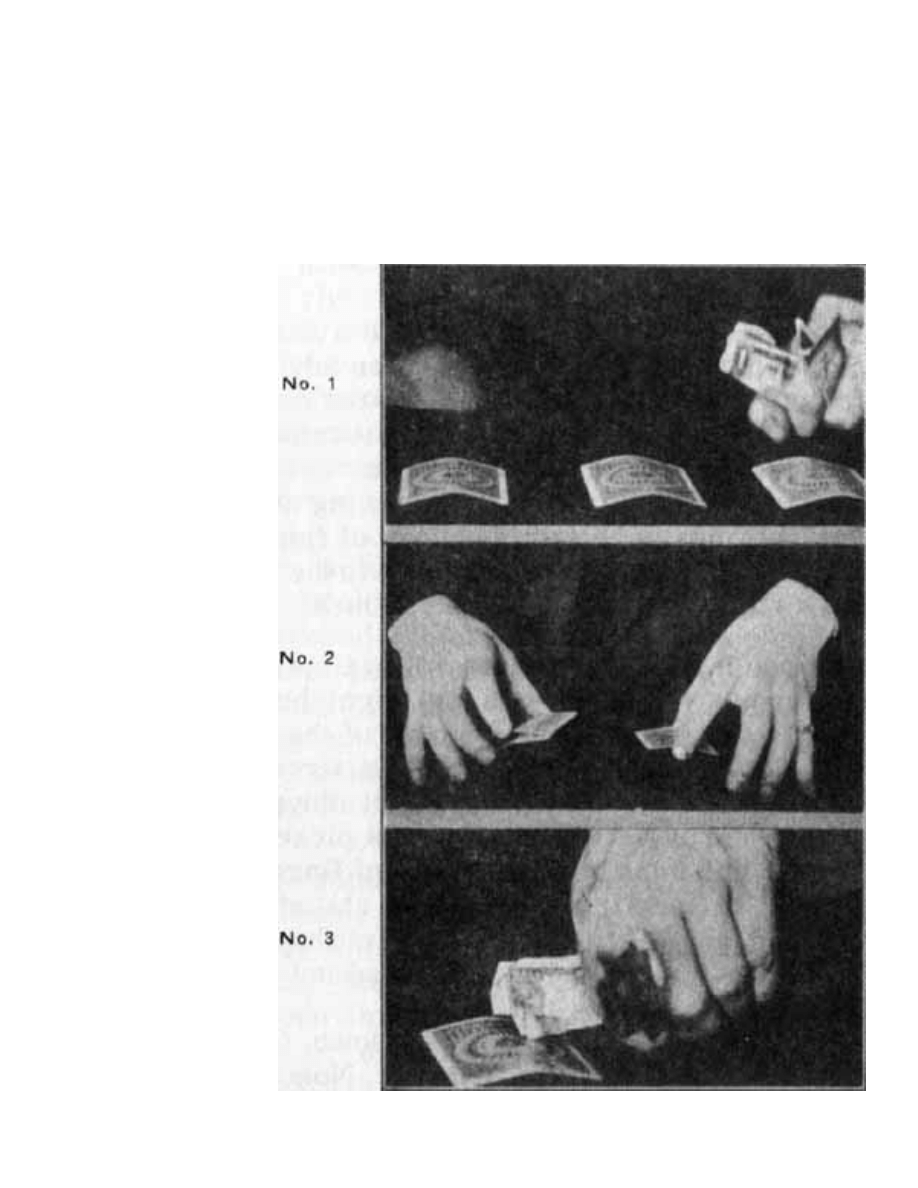
crimping cards. Lay cards back on the table, and there should be a crimp approximately 1/4 inch. (Photo 1.)
Replace cards on table 2, 1, 3. Before we go any further into this lesson, it will be necessary for us to learn to
overthrow or hipe and underthrow cards properly. Pick up 3 at the raised, crimped corners, thumb at inner
end, first finger at outer end. Lay 3 over 1, left edge of cards touch, right edge of card 3. is elevated
approximately 1/4 to 3/8 inch. Pick up both cards from the table, 1 is between thumb and second finger of
right hand. (Photo 2.) This is the correct position for holding cards for overthrow and underthrow. Practice
throwing the lower card, pick it up properly, and throw it properly--throw is made with a down motion--and
draw to the right. Notice position of fingers holding 3, after throwing 1. Bear that in mind. Looking at it closely
and you will discover that second finger is away from the cards, thumb and first finger are holding 3. This may
not sound much, but is very essential in these sleights. Now picking up 3 and 1 as explained, with a
downward throw, sweep right hand to the right and release or hipe 3 from between first finger and thumb.
The important part of this sleight is to bring first finger to No. 1 or lower card, after throwing 3 card, which
is released by number two finger, creating the idea or effect that the lower card has been thrown. If you will
look back in this first lesson or explanation you will note after reading first part that I suggested watching
position of hand after releasing lower card. Fingers at this time should be in exact same position as that. You
may find it easier to grasp 3 with thumb and third finger. It's a matter of preference. I use first and second
finger for these moves because when coming to the part in the series of crimped corners, I find my method
easier.
Now, let's try again. Lay cards out 2, 1, 3. Pick up 3 between first finger and thumb and show (right hand).
Lay over 1, then pick 1, remaining 3 and show. Turn cards face down towards table, approximately three to
four inches over table. Now hipe or throw 3 card. It would be well to spend some time on this sleight before
reading further.
This is the most essential sleight in the book and everything depends upon it. It would be advisable to go
back and review this lesson and get the correct angle. Don't forget, it is a downward movement to the right
with the right hand. Remember to extend the first finger to No. 1 card, withdrawing second finger. On the
movement, this change of finger is done after hiping and during movement to the right. Movement to the right
is not over 3/4 inch.
No doubt you have spent
considerable time on the
underthrow and overthrow
with the right hand. It will be
well to take up the
movement of the three cards
now. Lay cards as suggested
in first part of lesson, No. 2,
1, 3. Now the correct
movement for the three cards
is as follows: 3 is picked and
shown. I will not bear on the
subject of fingers at this time
due to the first lesson. As
stated, pick up 3 card and
show. Pick up 2 with left
hand and show. Retaining 3,
pick up 1 as explained and
show.
After cards are shown,
turn faces down. (Photo 2.)
Hipe 3 to center 2 to right, 1
to left. Now cards are in
position 1, 3, 2. It is the first
preliminary move in the art
of Three Card Monte. You
have now made movement as
if to throw ace to center, red
card to right, remaining red
card on left.
NOTE:--No doubt you have
noticed and wondered why
the money was being held in
the left hand while dealing
the cards as in photo No. 1.
Well, there are two good
reasons. The first for
atmosphere and to have
cash ready to pay bets (?).
The other and main reason,
to hide a marked or crimped
corner. See Scarne's
"marked and crimped
corners"--where this can be
used to good advantage.
(Photo 3.)

A SERIES OF DECEPTIVE MOVES
Start with Cards No. 3, No. 1, and No. 2
NUMBER ONE
a Pick up 2 and show--(Right hand)
b Pick up 3 and show--(Left hand)
c Lay 2 on 1, pick up and show--(Right hand)
d Hipe 2 to left.
e Throw 3 to center.
f Throw 1 to right.
NUMBER TWO
All Red
a Pick up 1, lay on 2--(Right hand)
b Pick up and show--(Say red)
c Throw 2 to center
d Lay 1 over 3--(Right hand)
e Pick up and show--(Say red)
f Hipe 1 to left
g Show 3--(Say red)
h Throw to right
NUMBER THREE
All Black
a Pick up 3, lay on 1--(Left hand)
b Pick up and show--(Say black)
c Hipe to center
d Show black card--(Left hand) (Say black)
e Throw to left
f Pick up 2--(Right hand)
g Lay on 1
h Pick up and show--(Say black)
i Hipe to right
j Show black--(Say black)
k Throw to left
NUMBER FOUR
a Pick up 2, lay on 1--(Right hand)
b Pick up and show
c Pick up 3 and show--(Left hand)
d Hipe 2 to center
e Throw 3 to right--(Left hand)
f Lay 1 on 3 and show--(Right hand)
g Hipe 1 to left
h Show 3, throw to right--(Right hand)
NUMBER FIVE
All Right Hand
a Show winning Ace in center
b Pick up 2, lay on 1
c Pick up both--(Right hand)
d Hipe 2 to center
e Retaining 1, pick up 2
f Hipe 1 to center
g Lay 2 on 3, pick up--(Right hand)
h Hipe 2 to left
i Lay 3 on 1
j Pick up

k Hipe 3 to center
l Drop 1 to right
NUMBER SIX
a Pick up 3 (Left hand), and 2 (Right hand) and show
b Lay 2 on 1
c Pick up and show--(Right hand)
d Throw 1 to center
e Lay 3 on 1, pick up, show--(Left hand)
f Hipe 3 to center
g Drop 1 to left
h Lay 2 over 3
i Hipe 2 to center
j Drop 3 to right
NUMBER SEVEN
One Hand Deal
a Pick up and show 3 (Right hand), between thumb and 1st finger
b Lay on 1, pick up card, show between thumb and 2nd finger
c Lay both on 2, pick up, between thumb and 3rd finger, show
d Hipe 1 to left
e 3 to center
f 2 to right
g You can show cards each time if you prefer, but not advisable
NOTE: When working before an audience or before friends after they have picked out the winning (?) card,
which turns out to be another, don't at any time show them where the winning ace is, just gather up the
cards and start again. Follow this hint and keep them in suspense at all times.
BENT OR CRIMPED CORNER
Grifter Method
EFFECT: The Bent Corner is a sucker gag used by the grifter and shill to take over the wise ones, or suckers
that are looking for a sure thing. The method is as follows: After the grifter has won a few times and his
audience are laying low, the grifter will glance away from the table as if looking for the approach of a
policeman or constable . His shill or confederate will reach over and pick up the ace, show it and turn up the
left corner, thereby making it a sure thing. The grifter turns back to the table and does not notice bent card
and deals cards. Naturally the suckers bet on a sure thing and lose.
EXPLANATION
I will now explain the grifter's method. Look at photos No. 4 and 5, showing method of bending corner with
third finger. I find this last method more practical with bridge cards. The card can be crimped, taken out and
put in another card at the will of the performer as follows: To crimp card, pick up card between thumb and
second finger. Third finger rests next to second finger on top at edge of card, little finger reaches out and
grasps corner and with an upward press bends corner as third finger presses down. If you soften corner of
card you will find it much easier during practice. Don't break card. (See Photo No. 4)
To take crimp out, hold card between thumb and second finger, third finger grasps card over edge and
draws up while little finger presses down, taking crimp out. (Photo No. 5.)
Photo No. 6, hold card between thumb and first finger. Second finger grasps card over edge and presses
up.
Photo No. 7, hold card between thumb and first finger. Second finger grasps card over edge and pulls up.
Third finger presses down.
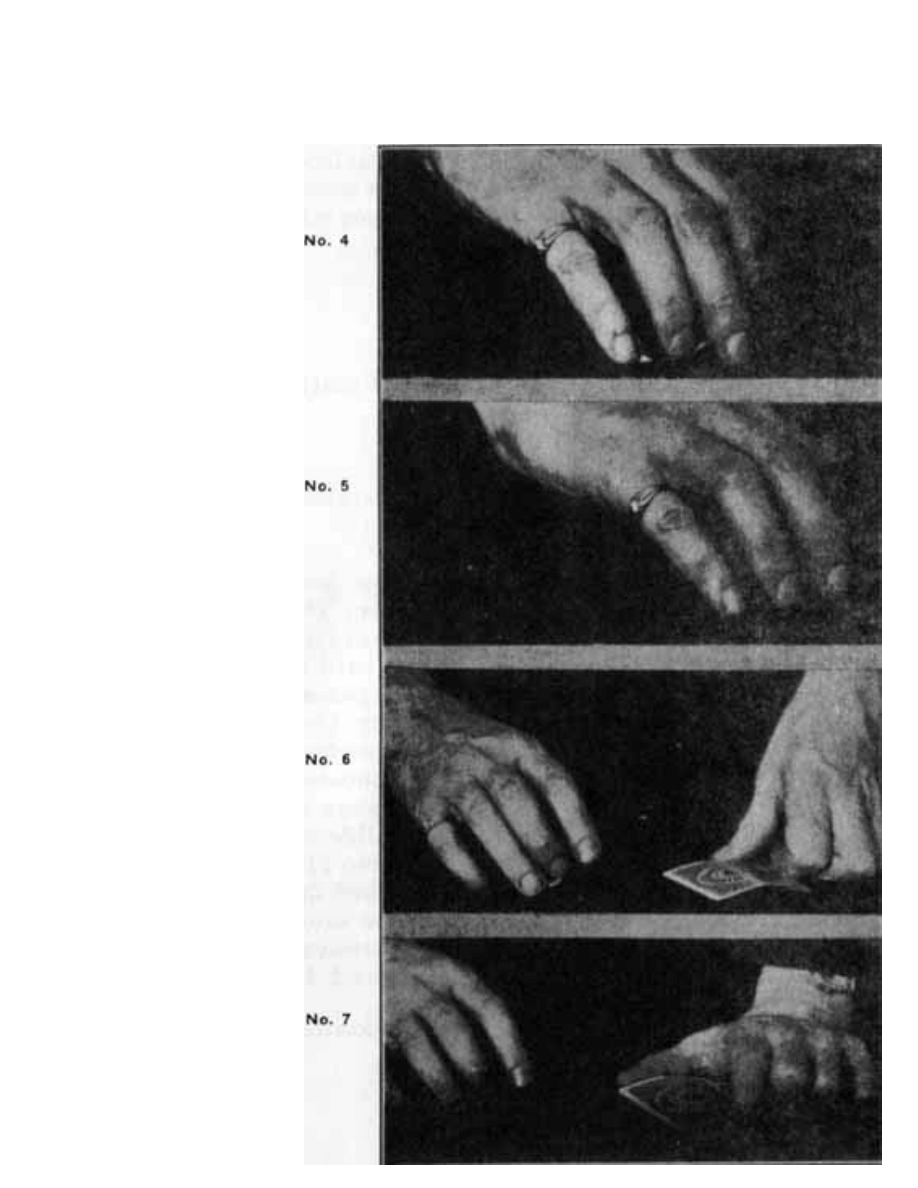
To take crimp out and put it in another card, lay cards out as in Photo 1. That is, 3, 1, 2, in front of you,
upper right corner of ace or 1 has been crimped. Two is picked up by right hand and shown as the hand is
turned over to pick up the ace or 1. Two is crimped as shown in Photo 4 and is put over the ace which is
picked up and shown. The crimp in upper card cannot be seen due to the ace in front of it, which is also
crimped.
The left hand picks up No. 3
and shows it. Hipe top card or 2
to left, and during the action of
throwing 3 take crimp out of ace.
See photo 5. The crimping and
uncrimping of cards is a very
difficult piece of business, but
after it has been practiced before
a mirror or before a pal who will
be honest with you and criticize
you when necessary, you will be
well paid for your trouble.
THE FLIP(?)
The Flip (?)--Three reasons for
the question mark:
1. I don't know what to call it.
2. I don't know who gets the
credit for it.
3. The look of query on the faces
of spectators after its
execution.
The Flip is sort of Mexican
Turn Over, but done with two
fingers, thumb and second
finger. The cards are crimped as
for Three Card Monte, face down
on the table. To execute this flip,
card is gripped between the
thumb at inner end and second
finger at outer end at right side
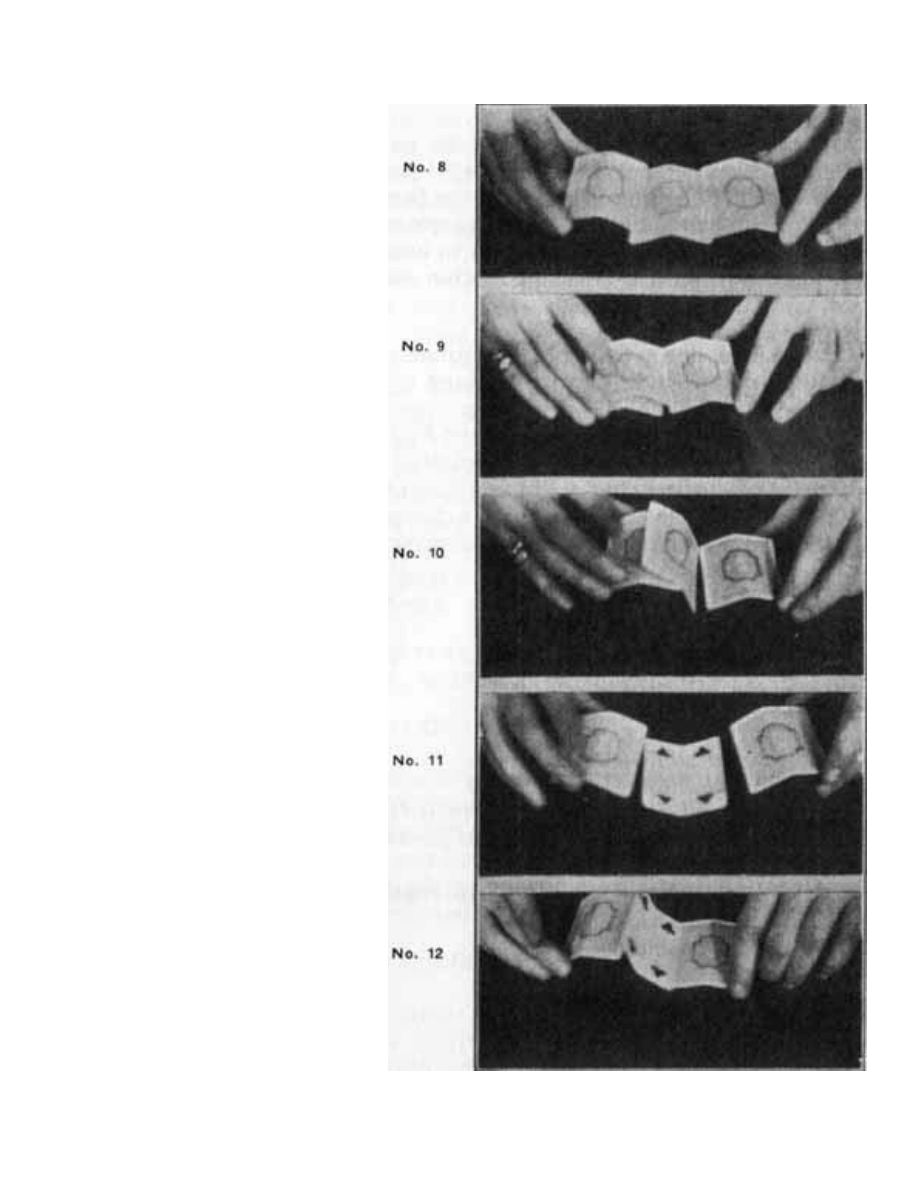
of crimp. (See Photo 8.) Card is
raised and laid over the other
card. (Photo 9.) Lower card is
gripped between thumb and
third finger, upper card is
released as lower card is jerked
up, causing it to slide off lower
card (Photo 10), and turn over
(Photo 11). If done fast, the
effect is that you have pushed
the card under and flipped it
over. It is used the same as the
Mexican Turn Over. Many clever
moves can be accomplished after
you have mastered it.
NOTE--Be sure and change
fingers as you do after hiping in
Three Card Monte.
The Flip is followed by the Flip Change.
THE FLIP CHANGE
After you have made the flip and have the
card face up on the table (Photo 11), and
you still want to further bewilder the
spectator, retain the facedown card in right
hand, between the thumb and second
finger, push it about one-half inch in under
the face-up card and with a jerk-up motion
turn face-up card over (Photo 12.)
As card falls face down (Photo 8),
continue towards left with card in hand. As
you get about twothirds over lower card
(Photo 9), drop upper card, grasp lower card
between thumb and third finger and draw to
right. This complete manipulation is done
very fast. The faster, the more bewildering.
After you have become proficient, you will
acknowledge the move as the sleekest in
your repertoire.
MOVES WITH FLIP AND FLIP-CHANGE
Cards No. 3, No. 1, and No. 2
For quick deceptions:
a Pick up No. 3 and show--(Left hand)
b Pick up No. 2 and show--(Night hand)
c Insert 2 under 1 at right side and turn it
face up, using right edge of 3 as a stop to
prevent 1 from slipping.
d As you turn I face down, execute the flip-
change getting 1 in right hand.
e Lay 3 over 2 (Left hand), pick up.
f Hipe 3 to center.
g Drop 1 to right.
h Drop 2 to left.
NOTE:--When working on the slippery type
of table, use card in left hand as a stop, that
will
prevent card from slipping. For instance, in
the Flip, have card in left hand rest against
edge of card to be turned over. In Flip-
Change, lay left hand card on the edge of
face-up card and by pressing down you will
elevate the right edge of card to be turned
over. (See Photo No. 12.)
After you get proficient in the Flip and
Flip-Change, try this: Have No. 1 in center
face up, No. 3 in left hand face down, No. 2 in right hand face down. Lay 3 on edge of 1, elevating right edge,
turn 1 over with 2 and as 1 falls over let 3 drop so that it falls under 1, then grasp 1 with left hand and draw
to left, at same time grasp 3 with thumb and third finger of right hand and draw to right. Throw 1 to center, 2
hipe to left and drop 3 to right. This is a very deceptive move and throws off the "knowit-all." Try it. Practice
the series of moves shown on pages 19, 20 and 21, using the Flip and FlipChange.
DRIFTER'S MARKED CORNER
Using the Flip and Flip-Change
EFFECT
Card in center has been marked by shill at his left corner on back. Drifter turns this marked card over and
it proves to be the winning ace. Ace is then turned over and cards are dealt around, after which the players
naturally pick the marked card and---JUST and.
WORKINGS
Cards are dealt and ace shown once or twice. The grifter
turns his back, shill reaches in and marks card in center,
apparently the ace, but the ace happens to be on the grifter's
right at this time. The grifter picks up the ace in right hand
and executes the FLIP, showing the ace face up in center.
Marked card is now in his right hand face down, fingers
covering the marked corner. After letting the players see ace in
center, grifter executes the flip change, bringing ace back into
the right hand and marked card in center, back up, showing
marked corner. Drifter then deals cards and collects.
SCARNE'S MONTE SLIDE
EFFECT:
Three cards are held in left hand, face up, ace in middle.
Each is snapped with first finger of right hand and laid on
table. Try as they may, they cannot locate the ace. This is an
effect you can work all day but still fool them.
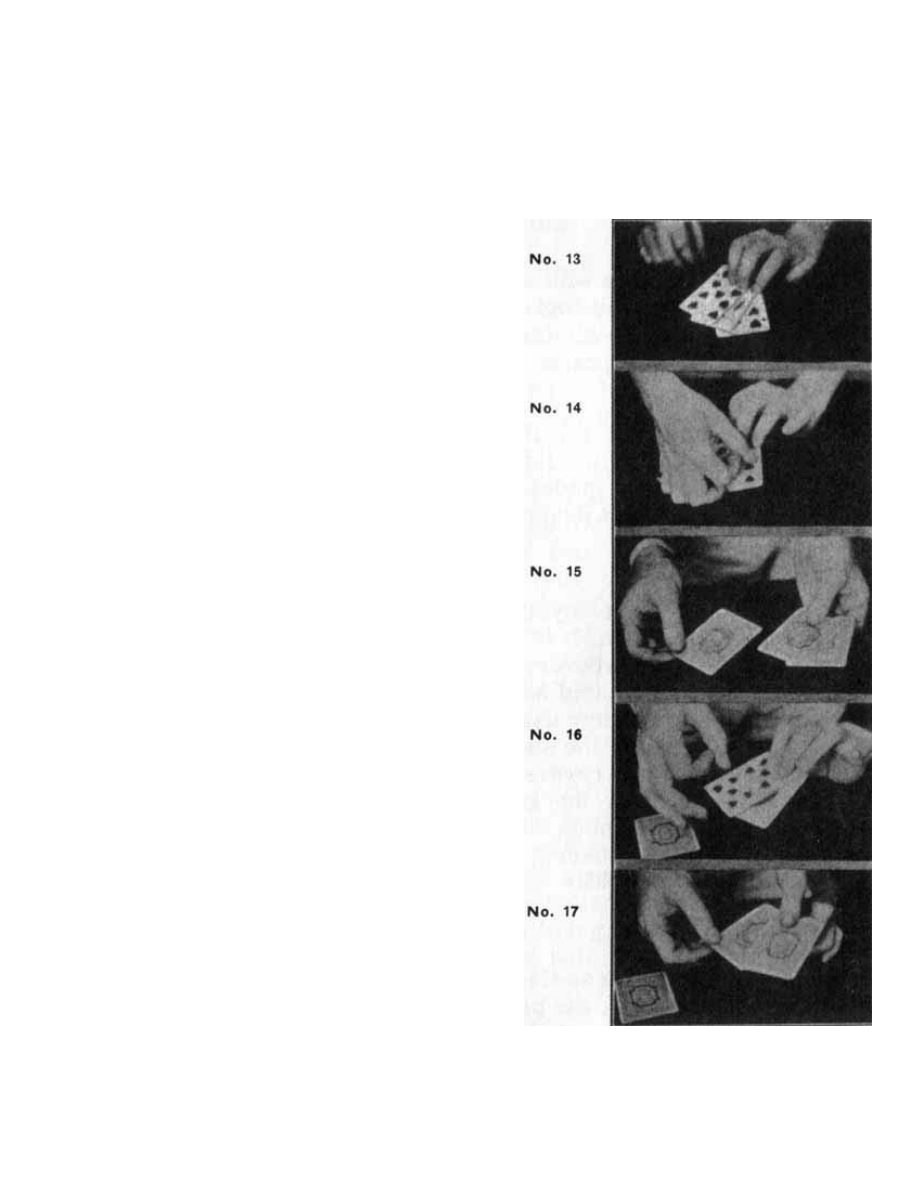
EXPLANATION:
First Method--have three cards in left hand, face up, not
crimped, as in Photo 13. Take notice of the way the hand
holds cards, fingers on top and thumb underneath. As you can
see, the cards are arranged--9 of hearts on bottom, ace of
spades center, and 10 of diamonds on top. Follow very close
with cards in hand. Reach over with right hand and with first
finger snap the 9 of hearts at outer left, Photo 14, calling name
of card; turn the hand over, showing back of cards and snap
again, repeating, 9 of hearts. Take it out (don't show face) and
lay on table, face down, Photo 15. Turn cards in hand over
again (they now see that you really took the 9 of hearts. If you
had shown it they would have become suspicious). Now snap
ace the same way, calling ace of spades, Photo 16. (Now the
important move.) As you turn over, push with thumb and
draw back with fingers, causing cards to change places. Snap
apparent ace of spades as you did the 9 of hearts, calling ace
of spades. Take out, Photo 17, and lay on table, face down.
Keep last card face down. Snap it and say 10 of diamonds and
lay on table.
This effect will have to be done with speed and confidence.
Try it again and you will fool yourself. To further bewilder the
know-it-all fellow, use the Mexican Turn Over, to turn cards face up, throwing his theory all off.
NOTE:--This effect can be used for the TORN CORNER. Lay all three cards on table after snapping, pick up
apparent ace of spades, tear off corner, etc.--(See TORN-CORNER description.)
SCARNE'S TRIPLE CLIMAX
This is the sleekest and most mystifying of monte effects in Scarne's collection. It is an effect that is left to
the spectator to discover, and then to fool
him. Apparently it is a stupid mistake on
the performer's part. The performer uses a
deck of one-way back cards, preferably the
showy back bridge card. When the card is
reversed it is noticeable at once. When
used by the grifter he uses a back that is
not too conspicuous but noticeable
enough when brought to the sucker's
attention by the sly nudge and whisper of a
shill.
EFFECT
Three cards are dealt as per Three Card
Monte (design on backs are all one way),
the performer after a few throws picks up
the ace and shows, and in laying it back
reverses the ace. Due to the showy back of
the card, the wise spectator will at once
notice the change, after cards are dealt
again, he picks the reversed card and!--
that's all, and...? We leave the rest to your
imagination.
NOTE: While performing at one of the better
clubs Scarne was offered $250.00 for the
secret, by a gambler who was in the
audience.
EXPLANATION:
(Use cards with showy one-way backs.)
The three cards are laid on table face up,
after turning them over and dealing a few
times, showing a few of the other effects in
this series, pick up the ace and show, and
lay it back on the table, reversed. Pay no
attention to your stupid move, let the wise
ones see it, then pick up the cards and
deal. Leave reversed card as it is, let them
pick it the first time, by this time the wise
ones will tell the others all about the
reversed card. Now you have two cards one
way and one reversed. Pick up one of the
other cards, lay on top of reversed card.
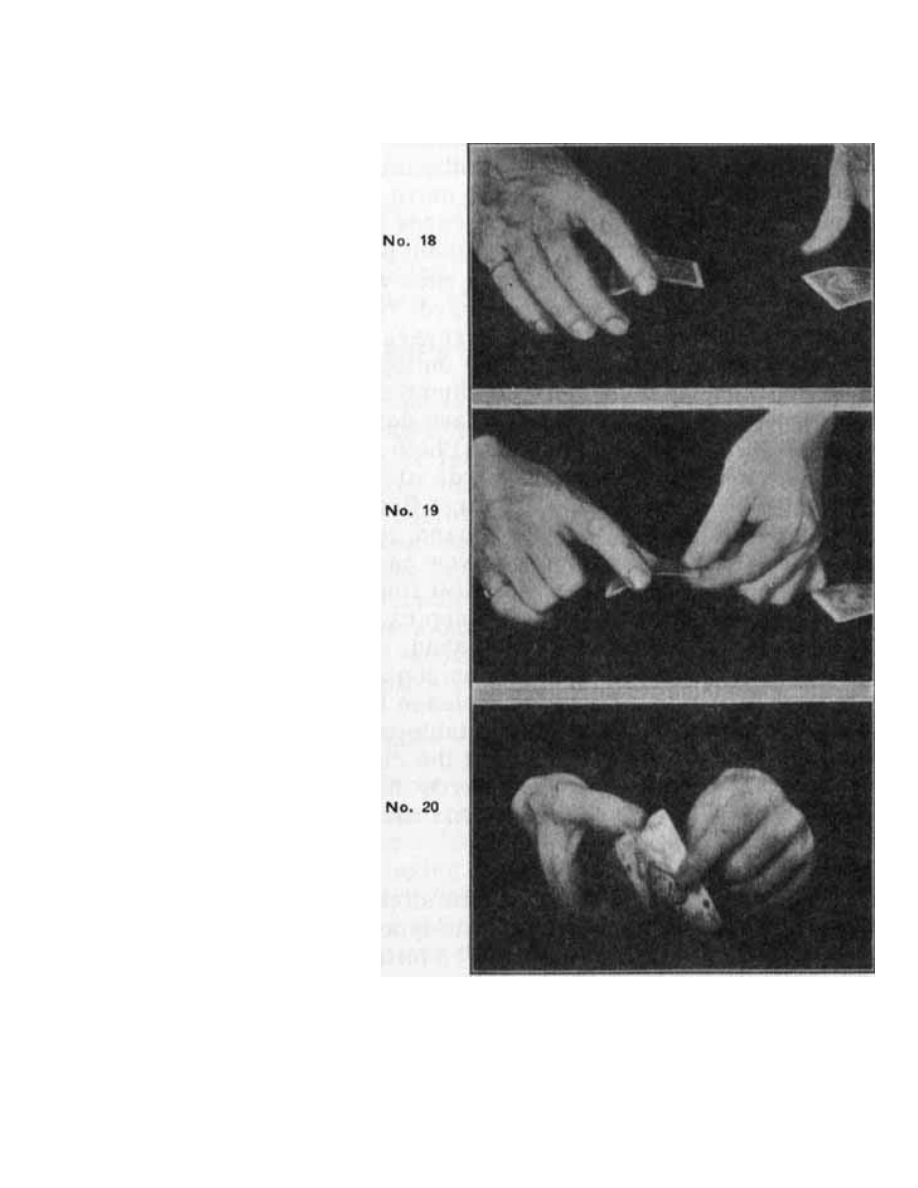
Pick up both between thumb and first
finger of right hand at ends. Keep face
down, hold card about two inches from
table, Photo 18. Reach over with left hand and take cards at left edge center between thumb on top and first
finger underneath. Photo 19. Let go with right hand, turn left hand over, showing ace on bottom. Now cards
are held in left hand, ace showing, first left finger will be in front, left thumb in rear. Keep cards in that
position, reach over with right hand, and take cards again between right thumb on top and finger on bottom
of cards, Photo 20. Release left hand and bring cards face down toward table, and deal. You will notice after
practice that the right hand has made a revolution, but cards have apparently not been reversed. Practice this
move. I know it will be your best bet.
When working the effect before men of the slicker type use angel or bicycle back cards. This type of fellow
is always looking for some defect on the backs, and he will recognize the one way backs and they can't help
seeing this "gross error" on your part. If you have a confederate, let him point out your dumb error, on the
quiet.
NOTE:--This revolution has to be perfected by you before you can do Scarne's Marked and Crimped Corner.
SCARNE'S METHOD OF THE CRIMPED CORNER
EFFECT:
Same as grifter's crimped corner.
This effect is a very clever piece of card `work
for the club worker or card man, for an
impromptu effect it cannot be beaten.
EXPLANATION:
Have corners of cards soft, but not broken. Lay
three cards No. 3, 1, 2. You reach over and crimp
the ace or 1, pick up 2 and show with right hand;
now bring right hand with 2 card over 1 and pick
up. See Photo 18. Bring left hand over, thumb on
top and first finger under at center of card as
Photo 19. Release right hand and turn cards face
up with left hand. Now turn right hand over
bringing thumb on top and second finger on
bottom. (See Photo 20.) Crimp 2 or upper card
with third finger of right hand, hipe 2 to center.
One is retained in right hand which reaches over
and picks up 3 card. Both cards are then grasped
by left hand underneath between thumb and
second finger. First finger of left hand is in center
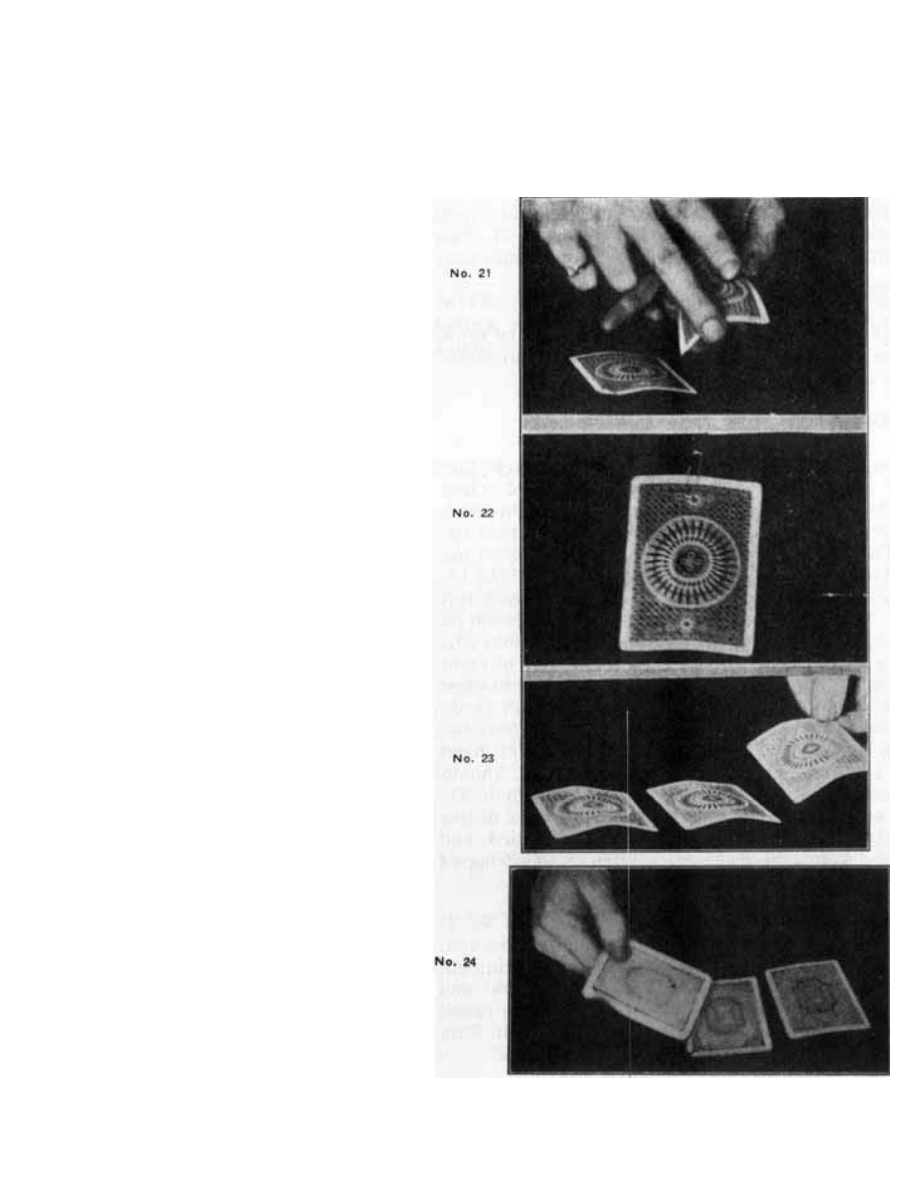
of cards curled up underneath. Thumb and
second finger slide to rear of cards as Photo 21.
This action takes out crimp in ACE, which is
drawn off with thumb and first finger of left hand,
and dropped to left, Photo 23. Remaining card is
dropped from right hand at right of table.
NOTE:--If you find it difficult to put crimp in No.
2, use this method. While telling player to crimp
ace, point with left hand to corner of card to be
crimped, with right hand pick up 2 and drop to
your side, and crimp corner. After they have
crimped ace, reach up with 2, lay on ace and
proceed as explained. This action can be done
very slow and deliberate.
SCARNE'S MARKED CORNER
This effective card manipulation is used by
John Scarne with great success. The action is
impossible to follow (if performed right). Scarne
has mystified the best magicians with this effect.
Follow the movement and practice each move
before a mirror until you get it correct. When you
have it perfected there is nothing better as an
impromptu card effect to fool the wise ones. The action is similar to Scarne's crimped corner, and if you have
mastered that effect this will come easy.
EFFECT:
Three cards are laid on the table as in Three Card Monte; after you do the moves of same you ask someone
to mark the corner of the ace with a pencil, giving them an opportunity to see the ace. After you have dealt the
cards they pick up the marked one--but?
EXPLANATION:
First of all, let's take up the marking of No. 3 card
which will be used as the other card to take the place
of the marked ace. Method No. 1--a duplicate marked
card is held under coat with a pin (see Photo 22) and
paper clip at position where it can be released and
palmed, in left hand. Card is placed in clip so that it
can be palmed, back to palm and marked corner at
root of left little finger. After you have laid the cards out
3, 1, 2, take 2 with right hand and turn cards face up
(as in Mexican Turn Over), when turning 3 allow it to
fall to floor (while flipping cards, get duplicate card
palmed in left hand). Retaining 2 in right hand, reach
down with left hand and get 3. Place left hand over 3,
pick up and as you are coming up reach over with right
hand containing 2 card and get palmed card. Throw
both on table face up, and at same time put left hand in
coat pocket, leave card, bring out pencil and hand to
player. Pick up ace and let him inspect it. Now have
him put it face down on table and have him mark it on
the back at his lower left corner. While attention is on
him, turn over 2 and 3, getting 2 over 3, hiding your
mark. After ace is marked, pick up 2, then 3; hipe 2 to
right, retain 3 in right hand, then lay 3 over ace or
marked card and proceed with revolution. After which
both cards are taken at inner left corner, between left
thumb on top and fingers underneath, right hand
reaches over and removes upper card which is dropped
to center. The card in left hand is dropped to left. NOW
THE IMPORTANT MOVE--AS YOU LAY LEFT HAND
CARD DOWN, THUMB IS DRAWN OFF CARD IN A
SLIDING MANNER, REMOVING MARK PUT ON BY
PLAYER. (See Photo 23.)
Method No. 2 for marking corner; have piece of
carbon paper in left hand coat pocket and when you
reach in to get pencil, get a small quantity of black on
left thumb nail, hand pencil to player with right hand.
Pick up one of the other cards by left inner corner
between thumb on top, with fingers underneath. Using
this card as a pointer (Photo 24), show player where to
mark the ace and at the same time your thumb is
leaving a duplicate mark for the change.
THE STAMPED ACE-SCARNE'S METHOD
EFFECT:
Three cards are laid out as per Three Card Monte.
Ace is picked up and shown, then a postage stamp is
wet and applied to left side center. After cards are dealt, the spectator picks stamped card as ace. But`? what
a climax! This is Scarne's pet effect.
EXPLANATION:
Lay cards out No. 2, 1, 3. Take postage stamp or use piece of paper about one inch by one-half inch. Wet
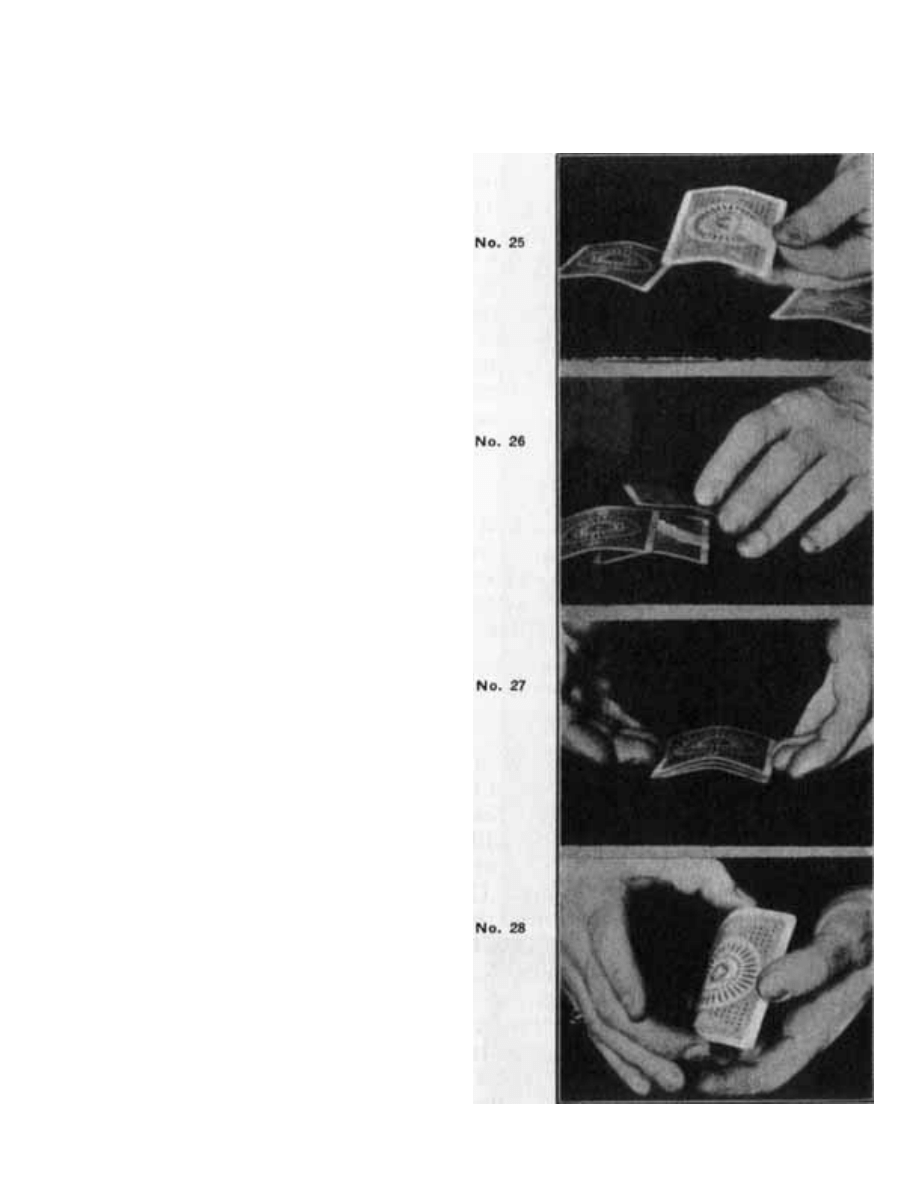
about a half inch of one end and apply to left center edge of ace or 1 (Photo No. 25), (be careful not to wet both
sides). Show ace before and after you apply stamp. The best way is to pick up ace between thumb and second
finger of right hand at long ends. Lay stamps on left edge and press on with left thumb and first finger. Have
cards crimped. Let stamped card fall to table, pick up and show 3 card and lay on ace so that left edge rests
over crimp and above stamp. (Photo 26.) Next pick up and show 2 card. Lay it on top of 1 and 3. Now as you
lay 2, draw back 3 so left edge falls below stamp. Even up cards as in Photo 27. Then pick up all cards
between right thumb and the second finger, at ends; bringing left hand under cards at sides and pressing
same between thumb and second finger, thus giving the appearance that you are crimping them a little more
(Photo 28). The cards are held in right hand. Make motion of overthrow, but drop lower card to left, then drop
next card to right and top card in center. The move fools the wise ones as they see an overthrow and still see
a plain card next. This gives the appearance that the stamped card is still the bottom card. You can use the
glide with this effect, in this manner. Hold the cards in left hand, show ace on bottom, then turn face down,
push back bottom card or ace and draw out stamped card, then draw out ace and drop upper card. This is a
very easy, but mystifying, card effect. Practice before a mirror before trying it in front of an audience.
In first demonstration, don't draw back No. 3 card under cover of 2,
leaving the stamp on ace and go through move as above. Then you
ask them to pick the ace and they will naturally pick some other card,
thinking there is some trickery, then you turn the stamped card and
show that it is the ace, laugh and make some smart remarks. Do it
over and change the stamp as explained.
Another method of laying cards on stamped card. have cards No. 2,
1, 3. Stamped card or 1 card is in center of table. Lay 2, left hand, on
1, let about 3/4 of an inch of 1 card project out on right side. Pick up
3 card, right hand, bring toward 1 and 2, allow it to slip under 2,
push 2 and 3 together over ace. Pick up as explained.
NOTE:--Put a little more moisture on stamp than necessary for
ordinary purposes of sticking. This will keep it from sticking too fast.
SCARNE'S METHOD OF TORN CORNER
EFFECT:
After doing one or two of the past effects, Scarne makes a few
throws and shows ace in center each time. lie throws again and picks
up center card. Tears off corner and throws same on table, face up.
Said piece is the corner of the ace of spades. He then throws cards
and has spectator pick ace. Upon examination, spectator discovers
that he has red card without corner.
EXPLANATION:
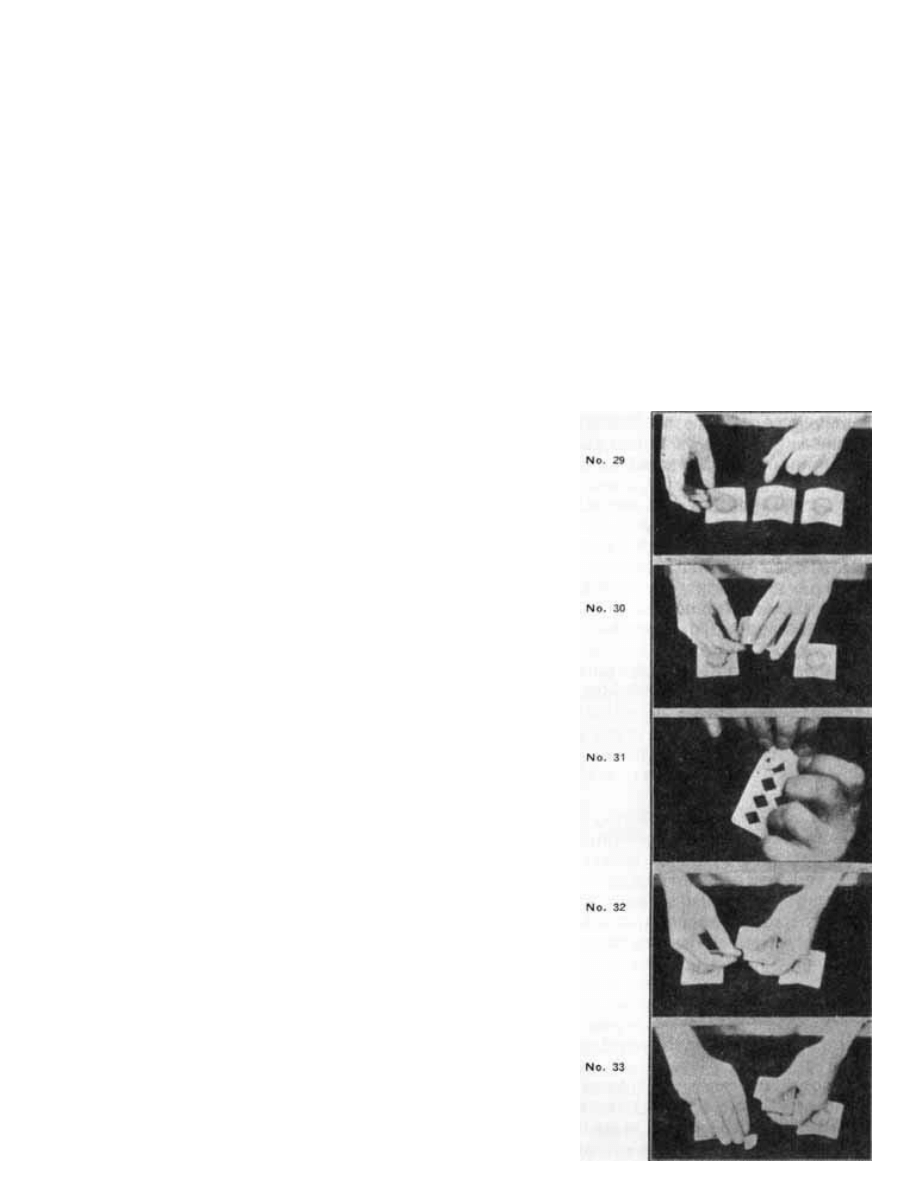
First, have one corner of another ace of spades.
Second, have it some place near right hand where you can get it,
between thumb and first and second fingers (Photo 29). Note: Best
bet is to have it under- vest held by pin and paper clips as in Photo
23. Reach up with the two fingers and thumb of right hand, and get it
while you pick up the red card which is now in the center, with left
hand. See Photo 30. Reach for upper right corner of card with fingers
of right hand, get piece under corner of card as Photo 31. This photo
illustrates appearance from bottom angle. Retain card at this corner
with right hand. Release left hand and bring left thumb to upper edge
of card or top, a little to right of center, fingers curled up underneath,
first finger tip at left edge of piece underneath. Now with an upward motion of the right thumb and two
fingers tear off corner of card. (See Photo 32.) Draw back lower piece with right thumb and throw upper piece
on table face up (which is the corner of the ace of spades), dropping torn card on the table, Photo 33.
Remarking that this ought to be easy, nonchalantly put right hand in right trouser pocket, getting rid of piece,
and throw cards with left hand. A wow of an effect! Try it and see how easy you take them over.
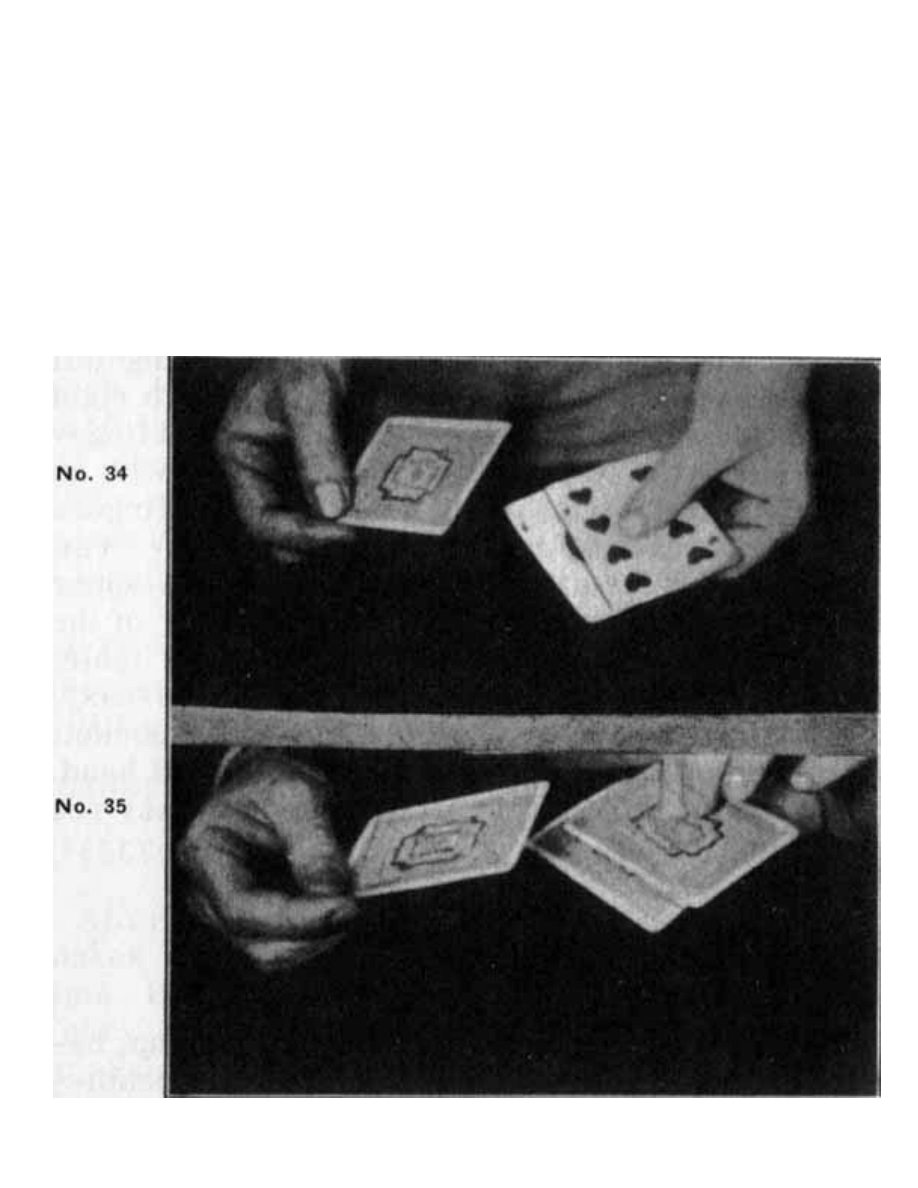
SCARNE'S PUSH OVER CHANGE
Three cards are held in left hand, face up, between thumb on top and fingers underneath-RED CARD,
BLACK CARD, RED CARD. Each card projects towards the right about one-half inch, keeping cards face up,
take out the red card towards the right (calling name as it is drawn out) between the thumb and first finger of
right hand at inner right corner, thumb on top. Now tap black card in left hand with card in right hand and
call the name of card, Photo 34. Turn cards in left hand over. When turning cards over, push with thumb and
draw back with fingers, changing the position of both cards. Again tap projecting right card, Photo 35, and
drop card in right hand to table at right. Reach up with right hand and take projecting card, drop in center.
Drop remaining card (the ace) in left hand to left of table.
NOTE:--This sleight is done very fast, and can be used in many card effects.
THE MEXICAN TURN OVER
This sleight is referred to in every book on cards, but I
have yet to see it fully illustrated, and considering it to be
one of the prettiest dodges, I present it as an added feature.
EFFECT
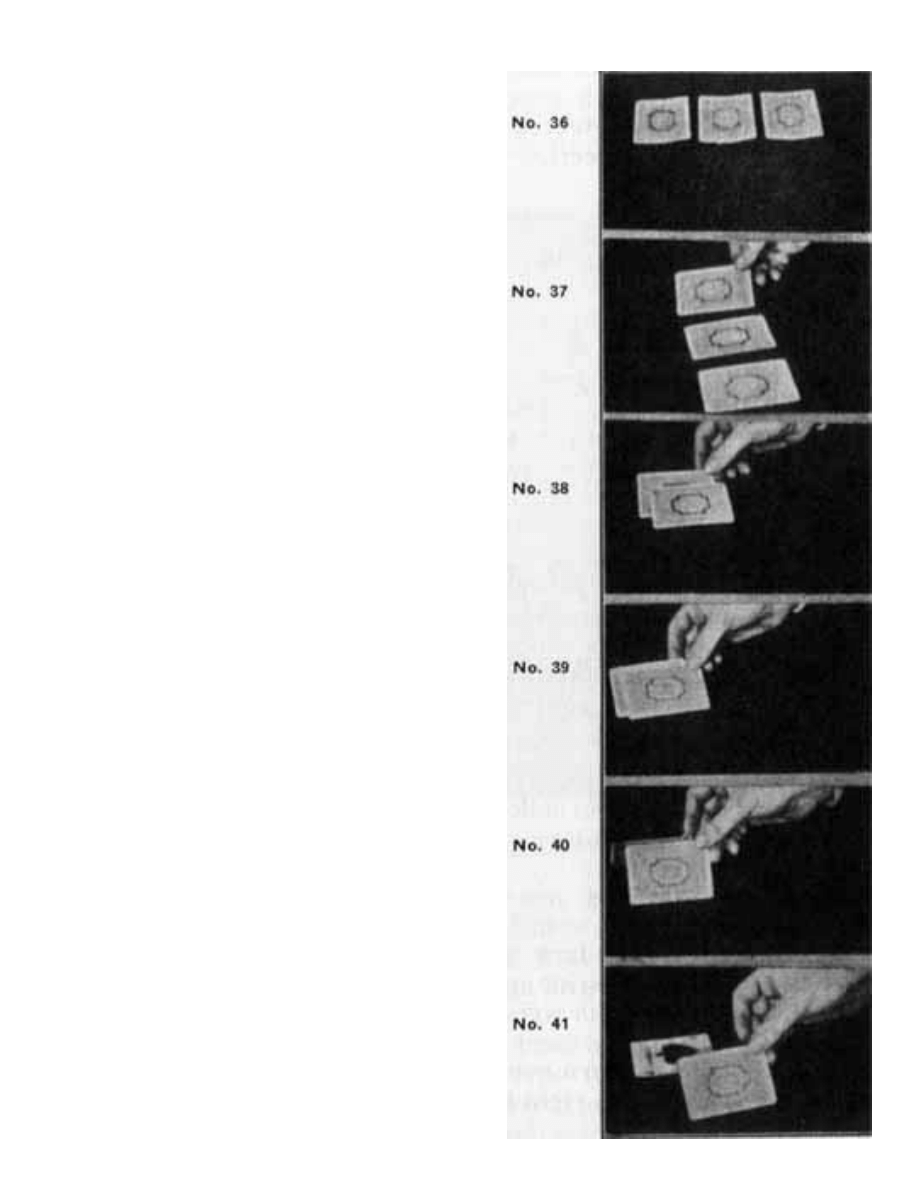
Cards are laid out as Three Card Monte, cards are
crimped just the opposite way (see Photo 36), after grifter
moves cards around, you touch the card that you think is
the winner. Grifter, to show you that everything is above
board, does not touch that card with his hand, but picks up
another card, which he inserts under your selected card and
turns it over, and proves your selection wrong.
EXPLANATION:
Lay cards out on table as (Photo 36), card to be turned
over is in center, card on right is picked up at inner right
corner between thumb and first finger (Photo 37). It is
inserted under center card at right side about one-half inch
in from inner edge, see Photo 38. Second finger is kept right
next to first finger, when under card has been pushed up to
about one-quarter inch from edge of upper card the second
finger will come in contact with upper card.
IMPORTANT--At this contact draw the thumb to the
position above second finger on upper card, keeping first
finger under lower card (see Photo 39). Continue the
movement towards the left, thumb and second finger
carries away upper card (the selected one), first finger
turning over the lower card. See Photos 40 and 41.
NOTE:--Crimp in cards are hardly noticeable, just enough so
card to be inserted can get under, without pushing upper
card all over the table.
NOW TRY THIS MOVE ON YOUR FRIENDS
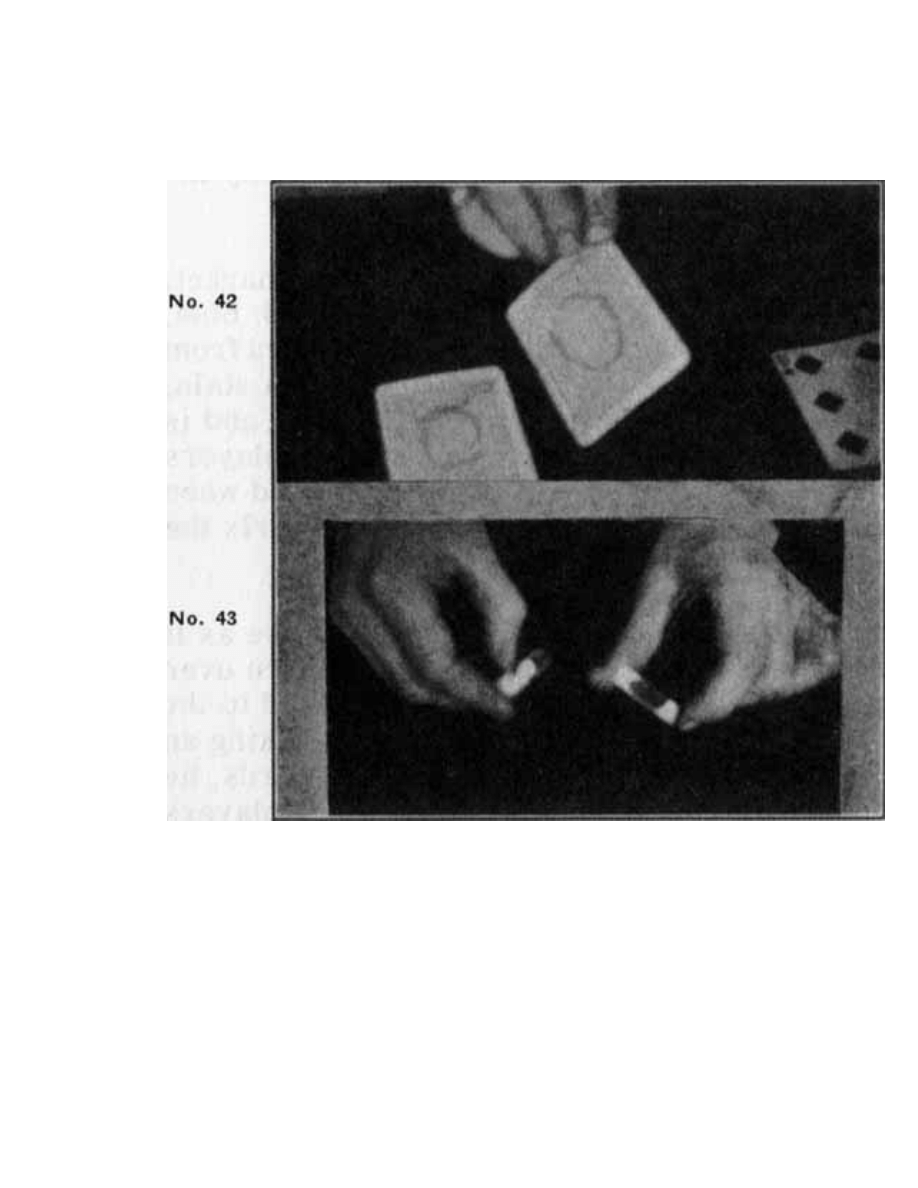
Have cards 3, 1 and 2 on table face up, pick up No. 3
with right hand as explained, slide under No. 2 turning it
over (follow through with wrist, turning 3 over). (See Photo
42.) Keep in right hand, turn face up again, then slide 3
under 1. Turn over, making change. Follow through, keep 1
in right hand, face down, and drop to left.
THE DAUB
The daub box is a small tin box about one inch wide and
one-quarter inch deep. Some times there is a pin attached
to it, so that it can be pinned to the body at a place of
advantage, where the finger tip can be applied to it in an
unsuspicious manner. The daub material is a composition of
powdered paste made in two colors--red and blue. The daub
will not show on the fingers, and will not flash on the cards
as it is not greasy. (But it is permanent, which makes it bad
for monte workers.) The daub can be toned down to where
it is practically invisible to the layman.
A one-color daub has been put on the market, called the Golden Glow. It can be used on red, blue, green,
or brown cards. This daub is different from all others, inasmuch as it leaves a golden stain, which has the
appearance of a nicotine stain, and is impossible to detect. (One of the slicker players puts this Golden Glow
on his moustache and when he wants a supply he reaches up and twirls the ends--not bad.)
For Monte, black is the best color to use as it has to be seen by the players about to be taken over (or
gypped as it
were). It is
usually
applied to the
cards by a
shill, who is
supposed to
be taking an
unfair
advantage of
the grifter. In
other words,
he is
supposed to
be in league
with the other
players and is
going to put
one over on
the grifter,
thereby giving
his fellow
players an
opportunity to
win big money
(which they
don't do). See
Grifter
Marked
Corner page.
There are two
very good
daubs for this
purpose, a
soft lead
pencil and a
good grade of
black carbon paper. The latter is folded up and kept in the vest pocket. It leaves a daub that is very noticeable
and it can be wiped off as in Scarne's Marked Corner (page 35). When the fingernail is applied to it, it will
leave a line such as a pencil would do if applied to a card. For the pencil daubs see Photo 43.
For heavy daub cut pencil as on right.
For nail mark cut pencil as on left.
Rouge and pastels make a good daub. Wax crayons should not be used as they leave a high gloss and can
not be removed with ease.

Now that you have the dope
Don't get energetic,
'Cause fools and wise guys
Seldom win.
It's really quite pathetic
For gamblers lose
Tho' babies need shoes.
But here's to fun and good tricks.
...How poetic!
Document Outline
Wyszukiwarka
Podobne podstrony:
Dick Jacob s Three Card Monte
Kenton Knepper Three Bill Monte
3 Card Monte Cards Template
Stars Of Magic John Scarne Triple Coincidence
Jeff Ezell Three Card Miracle Revelation
Stars Of Magic John Scarne Triple Coincidence
Mike Resnick John Justin Mallory Card Shark # SS
Stars Of Magic John Scarne Classic Ball Routine
The Metamorphosis of the Planets by John de Monte Snyders produced by RAMS (1982)
John Kennedy Card Thru Window
John Dalmas The Regiment 04 The Three Cornered War
Berkeley, Three Dialogues between Hylas and Philonous
Metody Monte Carlo
heart lacing card
magnetic card standards
więcej podobnych podstron