
Personality traits and language anxiety:
intrinsic motivation revisited
Cechy osobowości i „uczucie niepokoju językowego”:
analizując ponownie motywację wewnętrzną
Larysa Sanotska
Ivan Franko National University of Lviv
Abstract
This paper reports on the outcomes of the comparative study on motivation
of learners of English in further-education English Philology programme
in Ukraine and Poland. The research aims to determine principle characte-
ristics of intrinsic motivation, which is among the most effective personal
management strategies and as such helps build appropriate L2 study skills.
Alongside with inborn personality features, such as extraversion/introver-
sion, such traits as conscientiousness, openness, risk-taking and self-effi-
cacy are formed by sociocultural, and in some cases, historical factors. The
students from Ukraine and Poland were chosen for the reason of simila-
rities in historical development of the two countries, as well as relatively
different ‘paths’ of development in the more recent period. Similarity and
diversity factors retrieved from observation, interviews with students and
answers to an open-ended questionnaire provided data which allows to de-
termine the scale of influence of social and historical aspects on decision
making and performance of the students alongside with their personal be-
liefs and expectations. The study also aimed to establish the connection
between the systems of individual beliefs of the learners of both countries
in the sphere of L2 learning.

24
Larysa Sanotska
Key words:
intrinsic motivation, conscientiousness, openness, risk-taking,
self-efficacy, individual beliefs.
Abstrakt
Niniejszy artykuł został poświęcony wynikom badania porównawczego
motywacji osób uczących się języka angielskiego w toku dalszego kształ-
cenia na Wydziale Filologii Angielskiej w Polsce i na Ukrainie. Celem ba-
dania jest określenie zasadniczych cech motywacji wewnętrznej, która
z pewnością należy do najbardziej skutecznych osobistych strategii a do-
datkowo pomaga ona rozwijać umiejętności potrzebne do opanowania ję-
zyka obcego. Razem z wrodzonymi cechami osobowościowymi, takimi jak
ekstrawersja lub introwersja, zdolnością do podejmowania ryzyka, samo-
efektywnością i innymi, takie cechy osobowości jak uczciwość, otwartość,
zdolność do podejmowania ryzyka i inne, są kształtowane przez czynniki
społeczno-kulturowe lub historyczne. Studenci z Polski i Ukrainy zostali
wybrani ze względu na fakt, że podzielają pewne cechy historycznego roz-
woju obu państw, a w pewnym momencie w historii najnowszej te drogi
rozeszły się. Czynniki podobieństwa i odmienności sformułowane na pod-
stawie danych uzyskanych z obserwacji, wywiadów, badań otwartego typu
pozwoliły określić skalę wpływu aspektów społecznych i historycznych
na zdolność do podejmowania decyzji oraz na inne cechy osobowościowe,
a także na osobiste przekonania i oczekiwania. Moim celem jest ustalenie
związku między systemami osobistych przekonań studentów obu krajów
w dziedzinie nauki języka angielskiego jako języka obcego.
Słowa kluczowe:
wewnętrzna motywacja, sumienność, otwartość, zdolność
do podejmowania ryzyka, samoefektywność, osobiste przekonania.
Introduction
Personality factors are important for intrinsic motivation because they
refer to emotions and feelings, thus form an important sphere of affec-
tive domain of human behavior (Brown, 2000: 142-143). It is evident
that extrinsic motivation is generally formed by sociocultural variables

25
Personality traits and language anxiety: intrinsic motivation revisited
(Woodrow, 2010: 302; Gardner, 1985). However, according to theories
of social and collective behaviour, individuals are influenced by social
factors (Smelser, 1962, 1972; Sullivan & Thompson, 1986). It is ob-
served that certain personal traits of L2 learners are shaped by social
and historical aspects, e.g. conscientiousness, openness, risk-taking,
self-efficacy, etc. Ushioda also states that motivation in foreign lan-
guage learning has “distinctive social-psychological nature” (2012: 59).
Research shows that two kinds of motivational orientation, integrative
and instrumental, play an important role in learning foreign languag-
es. The first reflects interest in the ‘new language’ people and culture,
while the second reveals the practical value and advantages of learning
a new language (Gardner & Lambert, 1972: 132; Ushioda, 2012: 59). Ac-
cording to Ushioda, students are motivated and engaged in learning by
cognitions such as their goals, beliefs, expectancies, self-perceptions,
evaluation of success and failure.
Various scholars identify three or two-level motivational frame-
works, which have much in common. For example, traditional intrin-
sic and extrinsic motivation are echoed in Williams & Burden’s (1997)
two-level model of internal factors (intrinsic interest, sense of agency,
perception of success and failure) and external factors (interactions
with significant others, features of the immediate learning environ-
ment, broader social and cultural context) (Ushioda, 2012: 62). At the
same time, Dörnyei
(1994) suggests three levels of motivation, which
are language level (integrative & instrumental subsystems), learner le-
vel (individual motivational characteristics, e.g. self-confidence, need
for achievement), and learning situation level (situation-specific mo-
tives relating to the course and social learning environment) (Dörnyei
& Ushioda, 2011: 49-60). But in spite of the fact that scholars look at
motivation from different perspectives, analysis of motivation is inse-
parable from “other areas of research inquiry on learner cognitions, as
well as associated affective processes or emotions… and social influen-
ces and dynamics” (Ushioda, 2012: 63).
In the process of learning foreign languages it is important for stu-
dents to identify their concept of ‘self’, which represents their better

26
Larysa Sanotska
understanding of themselves, their abilities and skills. Researchers
firmly established the connection between the students’ understanding
of their skills and their willingness to develop new ones. Higgins sug-
gests that concepts of ‘self’ in future-oriented dimension can function
as self-guides which give direction to current motivational behaviour
(Higgins, 1987). Learners become aware of ‘what they might become’,
‘what they would like to become’ and ‘what they are afraid of becoming’
(Markus & Nurius, 1986).
Motivation research into L2 acquisition also suggests that motiva-
tional subsystems include certain cognitive, behavioural and affective
processes, which are closely associated with it. And language anxiety, as
a complex of subjective feelings and fear in language learning and use,
is one of the essential components. Dewaele (2007), Gardner & MacIn-
tyre (1993) demonstrate that higher levels of language anxiety lead to
lower levels of language achievements. Ushioda (2012) connects langu-
age anxiety with lower levels of perceived competence and lower self-ef-
ficacy. Anxiety interferes with cognitive processing at the input stage,
processing stage and the output stage (MacIntyre & Gardner, 1994; Ma-
cIntyre & Gregersen, 2012.). Anxiety also affects the ‘error correction’
aspect of learning, because anxious students respond less effectively to
their own errors (Gregersen, 2003). Despite the fact that the majority
of studies refer to anxiety while speaking (Horwitz & Young, 1991; Sa-
ito, Garza & Horwitz, 1999), recently the role of anxiety has also been
examined in all four major skill areas: speaking, writing, reading and
listening (Gregersen, 2007, 2009; MacIntyre & Gregersen, 2012; Cheng,
Horwitz, & Schallert, 1999). The connection between language anxiety
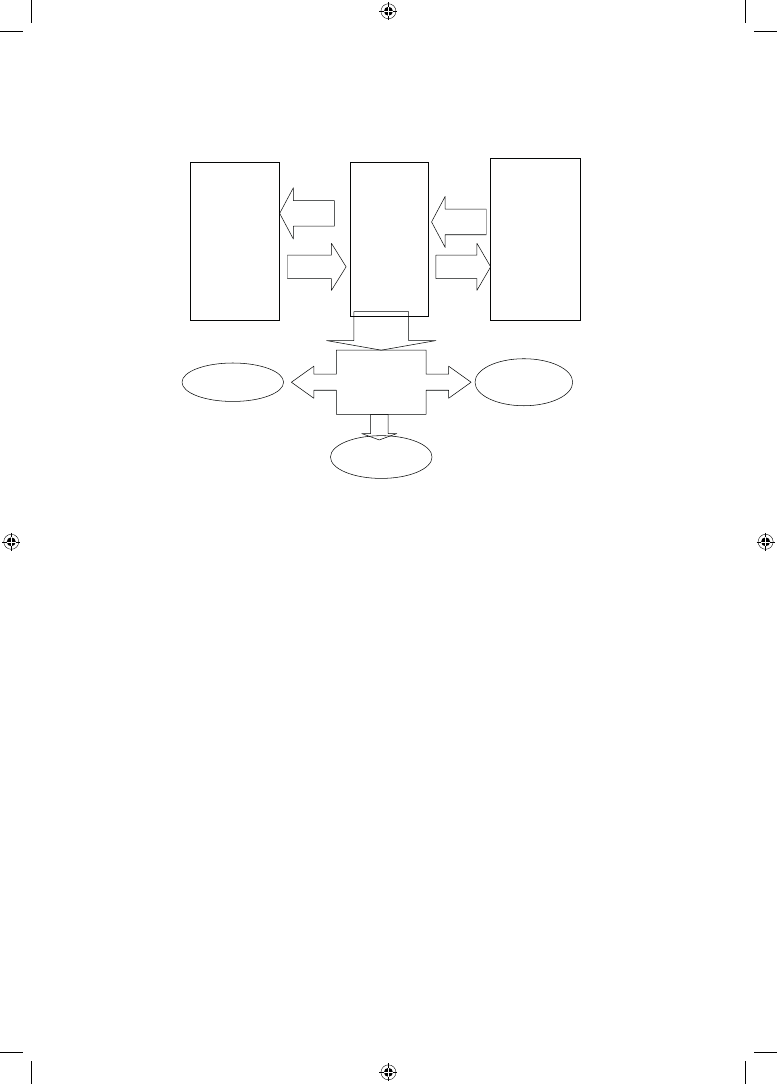
and cognitive processes is demonstrated in Figure 1.
27
Personality traits and language anxiety: intrinsic motivation revisited
higher
anxiety
lower levels
of perceived
competence
lower
language
achievements
lower
self-efficacy
less
motivation
input stage
processing
stage
output stage
interferes
with
cognitive
processes
Figure 1.
Language anxiety and cognitive processes
As
far as causality of language anxiety is concerned, there is eviden-
ce that anxiety is related to broad dimensions of the learner, such as le-
arning styles (Bailey & Daley, 1999; Castro & Peck, 2005) or emotional
intelligence (Dewaele, Petrides & Furnham, 2008). However, anxiety is
still a matter of dispute in terms of its correlation with language abili-
ties. Sparks & Ganschow (1995, 2007) provided evidence that anxiety
be seen as a cause, which is argued by MacIntyre & Gardner (1994),
who made a strong case of anxiety being an effect of the language abi-
lity. The latter research demonstrates that anxiety leads to decrease in
performance at input, processing and output stages and can affect the
process of acquiring L2 vocabulary.

28
Larysa Sanotska
research methods and tasks
Woodrow claims that the most common design in motivational research
is cross-sectional study, which often involves questionnaires (Woodrow,
2010: 304). The questionnaires which were administered for this study
were in most cases open-ended. Also other qualitative methods of data col-
lection were applied, such as observation or interviews with students. The
following tasks were set:
•
to determine correlation between social and historical aspects, de-
cision making and performance of the students;
•
to explore students’ personal beliefs, expectations and expectan-
cies;
•
to establish the connection between the systems of individual
beliefs related to L2 learning in two groups of students in similar
educational context but from different social environment.
Preliminary observations showed that both groups demonstrate cer-
tain common and certain different features of language confidence and
anxiety in all four skills at all three stages. Unlike Polish students, Ukra-
inian students tend to be more reserved and passive, with relatively low
self-esteem and self-efficacy; they sometimes show traits that could be
provoked by social dimensions. Ukraine and Poland share similarities in
historical development but in the more recent period their ‘paths’ of so-
cial development have been relatively different. While Ukrainian society is
still outgrowing conventional restrictions on expressing one’s own opinion
different from the mainstream, Poland is far ahead in the formation of
democratic society. Those trends affect students’ personalities, and ‘older’
generation of Ukrainian students still possess individual features shaped
by the ‘society of closed doors’.
The population is formed by adult students of Further Education En-
glish Philology Departments. They already have educational experience of
different kind (secondary schools, colleges), alongside with working expe-
rience. They decided to change their professions or get promoted in their
current work and need more profound knowledge of English (and English-
-related disciplines) as well as a diploma. Some details of their collective
profiles are demonstrated in Table 1.

29
Personality traits and language anxiety: intrinsic motivation revisited
Polish group
Ukrainian group
Gender
Female
90%
70%
Male
10%
30%
Place of
residence
City/town
60%
50%
Village
40%
50%
Age
35 — 37 years
20 — 48 years
Period of time
they studied
English before
the course
1 — 5 years
20%
20%
6 — 15 years
30%
70%
16 — 20
years
50%
10%
If their parents
know foreign
languages
40%
English,
Russian,
Hungarian,
German
70%
Russian,
Hungarian,
German,
Polish,
Slovak,
Armenian
If their parents
influenced
their decision
to study
English
20%
70%
Table 1.
Collective profiles of the two groups of population
As far as the students’ expectations and expectancies are concerned, all
Ukrainian students are convinced that knowing English as well as having
a university diploma of English Philology will improve their social status.
However, less than half (40%) are not sure that the diploma itself will sub-
stantially increase their income. At the same time half of the Polish stu-
dents have the opposite opinion about the social status, but 90% hold with
their Ukrainian counterparts as far as the financial status is concerned.
More than a half of the Polish group (60%) is certain that not just ‘English’
but possessing the diploma of English Philology will put them higher on

30
Larysa Sanotska
the social ladder, and even more Polish students (70%) believe that they
will benefit financially from it.
Students’ learning styles and preferences
Collaborative learning has long been very popular in the international fo-
reign language classroom and has been a central attribute of TEFL. As lear-
ners share their knowledge bringing their previous experiences to the gro-
up and learning from the group existing practices, it seems obvious that
such a style of instruction encourages students’ creativity, motivation, en-
hances their language and study skills, at the same time developing their
collaborative skills. That is the reason why lately collaborative learning has
been implemented in some higher-educational contexts in Ukraine. And
the majority of Ukrainian learners (60%) admitted that they enjoy collabo-
rative activities on the whole. They provided the following reasons: effecti-
veness of learning L2 through speaking and listening, the role of collabora-
tion in raising self-esteem and self-confidence, the fact that collaborative
activities are more engaging than non-collaborative, and others. About
a third part of the respondents feel that interacting during the lesson and
cooperating in groups help overcome shyness and develop analytical skills.
However, only 30% of the Polish learners like studying in groups, while
the rest (70%) of Polish and 40% of Ukrainian students prefer to work in
the lesson alone. They believe that it is better when the teacher focuses on
one person
, especially when the teacher corrects one’s mistakes more fre-
quently and gives them the possibility of working at one’s own pace. Some
students, especially the shy ones and with low self-esteem, claim that gro-
up work makes them feel awkward and discourages them.
Types of personality and students’ skills
Many researchers assert that learners with extravert features are success-
ful L2 students (Dewaele, 2012; Dewaele & Pavlenko, 2002; Allwright &
Bailey, 1991). Talkative, optimistic and sociable learners prefer social stra-
tegies, for example, cooperation. They also tend to take risk in language
studies more frequently than introverts. They eagerly use new vocabulary
and “engage in risky emotional interactions” (Dewaele, 2012: 46). Accor-

31
Personality traits and language anxiety: intrinsic motivation revisited
ding to Allwright & Bailey, openness means receptivity or defensiveness
on the part of the learners (1991: 158). As openness is a language attitude,
and the question of language attitudes is a background issue of L2 teaching
and “has major implications for language teaching policy” (Allwright &
Bailey, 1991: 159), openness to the new language as well as openness-to-
-experience and risk taking are paramount factors that provide success in
L2 acquisition. Various studies (Arnold, 1999; Oxford, 1992) discuss the
positive role of risk-taking in learning languages. Ely and Dewaele claim
“that learners’ willingness to take risks in using their L2 was linked signi-
ficantly to their class participation which in turn predicted their proficien-
cy” (Ely, 1986; Dewaele, 2012: 48). Samimy & Tabuse state that risk-takers
also tend to obtain higher grades in the L2 (Samimy & Tabuse, 1992). Risk
taking interacts with other factors, such as self-esteem or learning styles
to produce certain effects in language learning (Oxford, 1992: 30).
The vast majority of Polish students and a half of the Ukrainians believe
that they are extraverts and open people. The learners from Poland genuine-
ly understand that openness is a positive feature for several reasons. First,
it means to be open to new ideas, suggestions, proposals; second, an open
person can follow other people’s ideas and advice; and third an open person
lives in everyone’s world, not in his own only. The Ukrainian respondents
also believe that if a person is open other people feel comfortable with them.
They learn from other people, they are interested to hear their opinions, do
not have problems communicating. But there are also learners in both gro-
ups who feel awkward being with other people, who do not feel comfortable
in group activities, and certainly will not benefit from them.
We have been observing the population throughout the course and
have found that the Polish students’ level of language proficiency is gene-
rally higher than in the case of Ukrainian students, they are also much
better at listening and speaking than their Ukrainian counterparts. Ho-
wever, Ukrainian students try to be more accurate while demonstrating
productive skills. They also show more profound knowledge of language
systems, for example, pronunciation or grammar.
Another important personality trait is tolerance or intolerance of
ambiguity. SLA research links it to success in language acquisition

32
Larysa Sanotska
(Dewaele, 2012: 49). This lower-order personality feature is related to
perfectionism in language education. We observed that Polish students
feel less anxious in ambiguous situations and demonstrate highly ef-
fective receptive skills. They are not bothered with a certain amount of
unknown words, which is why they are better listeners and readers. On
the other hand, Ukrainian students
are more likely to be discouraged
in similar situations. They should be constantly stimulated to try out
a guess and persistently guided throughout a number of optional gues-
ses. The source of this problem may be a relative sociopolitical isolation
of Ukrainian students, who do not visit other countries so often as the-
ir Polish counterparts. Dewaele & Li Wei state that “the knowledge of
more languages and the experience of having lived abroad have been
found to be positively correlated with tolerance for ambiguity” (Dewa-
ele, 2012: 49). 70% of Polish students have been abroad: 50% worked
in Ireland, the USA, the UK; 10% often visit relatives in the USA; 10%
constantly travel to other countries on business. But only 50% of the
students from the Ukrainian group have been abroad for short recre-
ation trips to Turkey, Slovakia and Poland.
Polish
Ukrainian
Ready to take risk?
60%
80%
Ambitious?
90%
70%
Open person?
90%
70%
Express what you think freely?
30%
10%
Conscientious person?
80%
20%
Do you believe in yourself?
80%
50%
Do you do what you plan?
90%
60%
Table 2.
Students’ types of personality
Table 2 shows the data of students’ self-evaluation of their personali-
ty features. We can see that Ukrainian students claim that they are more
ready to take risk, but their Polish counterparts are more ambitious and
open. The Polish learners are more conscientious; the vast majority belie-

33
Personality traits and language anxiety: intrinsic motivation revisited
ves in their skills and do what they plan more often than the students in
the Ukrainian group. They also more often express what they think freely.
However, the percentage of ‘free speakers’ is relatively small in each group
(30% and 10%). There are several reasons for concealing their thoughts. In
both groups a number of the learners are afraid of the consequences. But
there is another category of students who do not always speak their mind
for empathetic reasons. In an interview one student from the Polish group
said: I wouldn’t like to say anything that could offend or make somebody suffer…
.
There are also students who do not consider their own extreme openness
a positive feature: I can never hide my real thought although sometimes I know
I should…’
A possible implication of don’t know answers can include a hesitating
type of general behaviour or failure to identify one’s concept of self. It can
lead to several underdeveloped features, such as lower self-efficacy, self-de-
termination, self-worth, self-regulation, self-belief and self-esteem. Con-
sequently it will result in language anxiety as a feature of language beha-
viour. Generally, half of the Polish group answered ‘don’t know’ to certain
questions. 10% of Polish students do not know if they are ready to take risk,
and about a third of Polish respondents are not sure if they are decisive. In
the Ukrainian group the percentage is much higher (90%). Over a third of
the Ukrainian respondents do not know if they believe in their skills, about
the same number of people are not sure if they do what planned, or if they
are decisive, which implies low self-efficacy according to self-evaluation.
However, in the process of data analysis certain ambiguity in deco-
ding the ‘don’t know’ answers to some questions could not be avoided. For
example, “’Will possessing the diploma of English Philology improve your
social / financial status?’ Those students could imply that the diploma is
important, while the social/financial status is not. At the same time it may
mean that each of those students embraces a future-oriented concept of
‘self’ just as a lucky diploma holder. The same data could be the evidence
of the students’ low self-evaluation of success after graduation, as well as
insufficient self-confidence, self-esteem and self-efficacy.
A separate and significant role in personality study plays decoding
students’ ‘no answer’ data. About half of the respondents in each group

34
Larysa Sanotska
provided ‘no answer’ to certain questions (40% — Polish, 60% — Ukra-
inian). This may be evidence of lack of openness, or low self-confidence,
self-esteem, self-efficacy as personality traits too. The students who did
not answer the questions related to their own understanding of themse-
lves will probably not be ready to construct future-oriented concepts of
‘self’, which would affect their motivation in L2 acquisition.
Learner cognitions and motivated engagement in learning
The majority of students in both groups want to become teachers of En-
glish; there are also those who will apply English in their current or ‘dream’
job. However, most Polish students want to get a university diploma, while
most Ukrainian students prefer university education because they want to
learn other English-related disciplines. In both groups there are students
that do not trust the level of instruction in language schools, but there are
more such students in the Ukrainian group.
The survey, the interviews, and the observation lead to the conclusion
that in both groups the students are conscientious and hard-working. They
are ready to dedicate time and efforts to overcome difficulties in learning
English because they have their own reasons to do it. Although social and
financial status is important for them, they have their personal challenges,
desire to grow, improve, further self-educate.
Conclusions
Despite the fact that there are certain limitations of the study, such as a rela-
tively small research sample derived from the societies with more similari-
ties than differences, possible subjectivity of the observation, or occasional
inaccuracies in the answers in the interviews and the survey, the analysis
of personal characteristics and motivational guides of the group of Polish
and the group of Ukrainian students of English Philology in Further Edu-
cation Programmes allows to draw the following conclusions. Firstly, the
Polish students are more open than Ukrainian, more of them claim to be
extraverts, while Ukrainian students are less ambitious and less tolerant of
ambiguity. Polish students are more conscientious, they believe in them-
selves, and do what they plan, which may explain lower level of anxiety in

35
Personality traits and language anxiety: intrinsic motivation revisited
the Polish group. However, the Ukrainian respondents are more ready to
take risk, which means they are decisive in their desire to experiment and
to shape their future-oriented concept of ‘self’ with different personality
traits, which may help reduce their language anxiety.
Secondly, the data
obtained by this contrastive analysis shows that formation of certain per-
sonal features is likely to be referred to diverse sociocultural environments,
such as difficulties with travelling abroad and living there for Ukrainians,
financial problems, political instability, stronger ties with older generation,
and their participation in shaping their children’s views and opinions, as
well as guiding their decision-making strategies. And lastly, the outcomes
of exploring a range of ‘hesitating’ answers (‘don’t know’) or no answers
to certain questions suggest that the first group are still at the stage of
exploring their concept of ‘self’, while the concept of ‘self’ of the second
group is still unclear. However, the observed risk-taking and decision-ma-
king tendencies will eventually allow the students to guide their formed or
transformed individual characteristics into a more motivationally effecti-
ve stage, which will help them eliminate their language anxiety.
references
Allwright, D. & Bailey, K. M. 1991. Focus on the Language Classroom. Cambridge:
Cambridge University Press.
Arnold, J. 1999. Affect in language learning. Cambridge: Cambridge University Press.
Bailey, P. & Daley, C.E. 1999.Foreign language anxiety and learning style. Foreign
Language Annals. 32: 63 — 76.
Brown, H. Douglas. 2000. Principles of Language Learning and Teaching. New York:
Pearson.
Castro, O. & Peck V. 2005. Learning styles and foreign language learning difficulties.
Foreign Language Annals. 38: 401 — 409.
Cheng, Y. Horwitz, E. K. & Schallert, D. L.1999. Language anxiety: Differentiating
writing and speaking components. Language Learning. 49: 417 — 446.

36
Larysa Sanotska
Dewaele, J.M. 2007. Predicting language learners’ grades in L1, L2, L3 and L4: The
effect of some psychological and sociocognitive variables. International Journal
of Multilingualism. 4(3): 169 — 197.
Dewaele, J.M., Petrides, K. V. & Furnham, A. 2008. Effects of trait emotional intel-
ligence and sociobiographical variables on communicative anxiety and foreign
language anxiety among adult multilinguals: A review and empirical investiga-
tion. Language Learning. 58: 911 — 960.
Dewaele, J.M. 2012. Personality: Personality Traits as Independent and Dependent
Variables.
In Mercer, S., Ryan, S. & Williams M. (eds). 2012. Psychology for Language Learning.
Basingstoke: Palgrave Macmillan, 42-57.
Dewaele, J.M. & Pavlenko, A. 2002. Emotion vocabulary in interlanguage. Language
Learning. 52: 265 — 324.
Dörnyei, Z. 1994. Motivation and motivating in the foreign language classroom.
The Modern Language Journal, 78, 273 — 284.
Dörnyei, Z. & Ushioda, E. 2011. Teaching and researching motivation. Harlow:
Pearson Education Limited.
Ely, C. M. 1986. An analysis of discomfort, risktaking, sociability, and motivation in
the L2 classroom. Language Learning. 36: 1 — 25.
Gardner, R.C. 1985. Social psychology and in second language learning: The role of
attitudes and motivation. London: Edward Arnold.
Gardner, R.C. & Lambert, W.E. 1972. Attitudes and motivation in second language
learning.
Rowley, MA: Newbury House.
Gardner, R.C. & MacIntyre, P.D. 1993. On the measurement of affective variables in
second language learning. Language Learning. 43: 157 — 194.
Gregersen, T. 2003. To err is human: A reminder to teachers of language-anxious
students. Foreign Language Annals. 36: 25 — 32.
Gregersen, T. 2007. Breaking the code of silence: An exploratory study of teachers’
nonverbal decoding accuracy of foreign language anxiety. Language Teaching
Research. 11(2): 51-64.
Gregersen, T. 2009. Recognizing visual and auditory cues in the detection of foreign
language anxiety. TESL Canada Journal. 26: 46 — 64.

Higgins, E. T. 1987. Self-discrepancy: A theory relating self and affect. Psychological
Review. 94: 319 — 340.
Horwitz, E. K. & Young, D. 1991. Language anxiety: From theory and research to
classroom implications. Englewood Cliffs: Prentice-Hall.
MacIntyre P. D. & Gardner R.C. 1994. The effects of induced anxiety on cognitive
processing in second language learning. Studies in Second Language Acquisi-
tion. 16: 1 — 17.
MacIntyre, P. D. & Gregersen, T. 2012. The Role of Language Anxiety and other Emo-
tions in Language Learning. In Mercer, S., Ryan, S. & Williams M. (eds). 2012.
Psychology for Language Learning. Basingstoke: Palgrave Macmillan, 103-118.
Markus H.R. & Nurius P. 1986. Possible selves. American Psychologist. 41: 954 — 969.
Oxford, R. L. 1992. Who are our students?: A synthesis of foreign and second lan-
guage research on individual differences with implications for instructional
practice. TESL Canada Journal. 9: 30 — 49.
Orr, F. 1992. Study Skills for Successful students. St Leonards: Allen & Unwin.
Saito, Y., Garza, T. J. & Horwitz, E. K. 1999. Foreign language reading anxiety. The
Modern Language Journal. 83: 202 — 218.
Samimy, K.K. & Tabuse, M. 1992. Affective variables and a less commonly taught lan-
guage: A study in beginning Japanese classes. Language Learning. 42: 377 — 398.
Smelser, N. J. 1962. Theory of Collective Behavior. New York: The Free Press
Sparks R. & Ganschow, L. 1995. A strong inference approach to causal factors in foreign lan-
guage learning: A response to MacIntyre. The Modern Language Journal. 79: 235 — 244.
Sparks R. & Ganschow, L. 2007. Is the Foreign Language Classroom Anxiety Scale
measuring anxiety or language skills? Foreign Language Annals. 40: 260 — 287.
Sullivan, T.J. & Thompson, K.S. 1986. Sociology: Concepts, Issues and Applications.
Collective Behaviour and Social Change New York: Macmillan.
Ushioda, E. 2012. Motivation: L2 Learning as a Special Case? In Mercer, S., Ryan,
S. & Williams M. (eds). 2012. Psychology for Language Learning. Basingstoke:
Palgrave Macmillan, 58-73.
Williams M., & Burden, R. L. 1997. Psychology for language teachers. Cambridge:
Cambridge University Press.
Woodrow, L. 2010. Researching Motivation. In Paltridge, B. & Phakiti A. (eds). 2010.
Continuum Companion to Research Methods in Applied Linguistics. London —
New York: Continuum, 318 — 336.
Wyszukiwarka
Podobne podstrony:
BORDERLINE PERSONALITY TRAITS AND INTIMATE PARTNER AGGRESSION AN INTERNATIONAL MULTISITE, CROSS GEND
The Relation Between Learning Styles, The Big Five Personality Traits And Achievement Motivation
Kalmus, Realo, Siibak (2011) Motives for internet use and their relationships with personality trait
BORDERLINE PERSONALITY TRAITS AND INTIMATE PARTNER AGGRESSION AN INTERNATIONAL MULTISITE, CROSS GEND
The Relations of Gender and Personality Traits on Different Creativities
Akin, Iskender (2011) Internet addiction and depression, anxiety and stress
adorno music and language, a fragment KAPJQ6UBG43YWYTWSMOPOFAWMAPGB526E4D4NCI
Greenhill Fighting Vehicles Armoured Personnel Carriers and Infantry Fighting Vehicles
Learning Purpose and Language Use, learning c1
Learning Purpose and Language Use, learning c2
(psychology, self help) Shyness and Social Anxiety A Self Help Guide
3third person theory and pract
original carcare c68 car and language list
Learning Purpose and Language Use, learning c4
Learning Purpose and Language Use, learning c3
HANDOUT Populations and languages
part3 25 Pragmatics and Language Acquisition
personal pronouns and possessive adjectives
więcej podobnych podstron