
Think
A compelling introduction to philosophy
by Simon Blackburn
Back Cover:
"Blackburn has produced the one book every smart person should read to understand, and
even enjoy, the key questions of philosophy, ranging from those about free will and
morality to what we can really know about the world around us." -- Walter Isaacson,
Time Magazine
"This is a wonderfully stimulating, incisive and -- the word is not too strong -- thrilling
introduction to the pleasures and problems of philosophy." -- John Banville, Irish Times
OXFORD
UNIVERSITY PRESS
Great Clarendon Street, Oxford OX2 6DP
Oxford University Press is a department of the University of Oxford.
It furthers the University's objective of excellence in research, scholarship,
and education by publishing worldwide in
Oxford New York
Athens Auckland Bangkok Bogoti Buenos Aires Calcutta Capetown Chennai Dares Salaam Delhi Florence Hong Kong Istanbul
Karachi Kuala Lumpur Madrid Melbourne Mexico City Mumbai
Nairobi Paris Sao Paulo Singapore Taipei Tokyo Toronto Warsaw
with associated companies in Berlin Ibadan
Oxford is a registered trade mark of Oxford University Press in the UK and in certain other countries
© Simon Blackburn 1999
The moral rights of the author have been asserted
Database right Oxford University Press (maker)
First published 1999
All rights reserved. No part of this publication may be reproduced,
stored in a retrieval system, or transmitted, in any form or by any means,
without the prior permission in writing of Oxford University Press,
or as expressly permitted by law, or under terms agreed with the appropriate
reprographics rights organization. Enquiries concerning reproduction
outside the scope of the above should be sent to the Rights Department,
Oxford University Press, at the address above
You must not circulate this book in any other binding or cover
and you must impose this same condition on any acquirer
British Library Cataloguing in Publication Data
Data available Library of Congress Cataloging in Publication Data
Data available
ISBN 0-19-210024-6 (hbk.)
ISBN 0-19-969087-1 (pbk.)
3 5 7 9 10 8 6 4

Typeset by Invisible Ink
Preface
T
HIS BOOK GREW FROM
years of wrestling with the problems of trying to interest
people in ideas. I have done this as a teacher, but also as someone who has tried to
explain the value of the humanities in general, and philosophy in particular, to a wider
audience. Indeed my first debt is to the climate of the times, whose scepticism about the
value of higher education made it evident to me just how urgent this task is. A second,
more serious debt is to all the students of many years, whose nods and frowns eventually
shaped the book. I also owe a debt to teaching assistants here at the University of North
Carolina, who had first-hand experience of engaging students in earlier versions of the
work. I would never have taken the plunge, however, had it not been for the generous
encouragement of Catherine Clarke and Angus Phillips, at Oxford University Press.
Angus has closely monitored the progress of the work, and I owe much to his support and
advice.
Earlier versions of the material have been read by Huw Price and Ralph Walker,
who each provided invaluable suggestions. Yuri Balashov and Dan Ryder gave me help
with specific topics. For the sake of brevity I have not included a glossary of
philosophical terms, which would in any case have echoed definitions found in my
Oxford Dictionary of Philosophy.
The superb editing of Maura High and Angela Blackburn gave me an
uncomfortable sense of my shortcomings as a writer, while happily disguising them from
the wider public. Angela, of course, had also to suffer the usual burdens of having a
writing husband, and without her support nothing would have been possible.
Simon Blackburn
Contents
Introduction
1. Knowledge
2. Mind
3. Free Will
4. The Self
5. God
6. Reasoning
7. The World

8. What to Do
Introduction
This book is for people who want to think about the big themes: knowledge, reason,
truth, mind, freedom, destiny, identity, God, goodness, justice. These are not the hidden
preserve of specialists. They are things that men and women wonder about naturally, for
they structure the ways we think about the world and our place in it. They are also
themes about which thinkers have had things to say. In this book I try to introduce ways
of thinking about the big themes. I also introduce some of the things thinkers have had to
say about them. If readers have absorbed this book, then they should be on better terms
with the big themes. And they should be able to read many otherwise baffling major
thinkers with pleasure and reasonable understanding.
The word "philosophy" carries unfortunate connotations: impractical, unworldly, weird. I
suspect that all philosophers and philosophy students share that moment of silent
embarrassment when someone innocently asks us what we do. I would prefer to
introduce myself as doing conceptual engineering. For just as the engineer studies the
structure of material things, so the philosopher studies the structure of thought.
Understanding the structure involves seeing how parts function and how they
interconnect. It means knowing what would happen for better or worse if changes were
made. This is what we aim at when we investigate the structures that shape our view of
the world. Our concepts or ideas form the mental housing in which we live. We may end
up proud of the structures we have built. Or we may believe that they need dismantling
and starting afresh. But first, we have to know what they are. The book is self-standing
and does not presuppose that the reader has any other resources. But it could be
augmented. For example, it could be read alongside some of the primary source materials
from which I frequently quote. These are readily available classics, such as Descartes's
Meditations, or Berkeley's Three Dialogues, or Hume's Enquiry Concerning Human
Understanding, or his Dialogues Concerning Natural Religion. But it can equally well be
read on its own without the texts to hand. And after finishing it, the reader should pick up
the classics, and other things like logic texts or writings on ethics, with a mind prepared.
WHAT ARE WE TO THINK ABOUT?
Here are some questions any of us might ask about ourselves: What am I? What is
consciousness? Could I survive my bodily death? Can I be sure that other people's
experiences and sensations are like mine? If I can't share the experience of others, can I
communicate with them? Do we always act out of self-interest? Might I be a kind of
puppet, programmed to do the things that I believe I do out of my own free will?
Here are some questions about the world: Why is there something and not nothing? What
is the difference between past and future? Why does causation run always from past to
future, or does it make sense to think that the future might influence the past? Why does

nature keep on in a regular way? Does the world presuppose a Creator? And if so, can we
understand why he (or she or they) created it?
Finally, here are some questions about ourselves and the world: How can we be sure that
the world is really like we take it to be? What is knowledge, and how much do we have?
What makes a field of inquiry a science? (Is psychoanalysis a science? Is economics?)
How do we know about abstract objects, like numbers? How do we know about values
and duties? How are we to tell whether our opinions are objective, or just subjective?
The queer thing about these questions is that not only are they baffling at first sight, but
they also defy simple processes of solution. If someone asks me when it is high tide, I
know how to set about getting an answer. There are authoritative tide tables I can
consult. I may know roughly how they are produced. And if all else fails, I could go and
measure the rise and fall of the sea myself. A question like this is a matter of experience:
an empirical question. It can be settled by means of agreed procedures, involving looking
and seeing, making measurements, or applying rules that have been tested against
experience and found to work. The questions of the last paragraphs are not like this.
They seem to require more reflection. We don't immediately know where to look.
Perhaps we feel we don't quite know what we mean when we ask them, or what would
count as getting a solution. What would show me, for instance, whether I am not after all
a puppet, programmed to do the things I believe I do freely? Should we ask scientists
who specialize in the brain? But how would they know what to look for? How would
they know when they had found it? Imagine the headline: "Neuroscientists discover
human beings not puppets." How?
So what gives rise to such baffling questions?
In a word, self-reflection. Human beings are relentlessly capable of reflecting on
themselves. We might do something out of habit, but then we can begin to reflect on the
habit. We can habitually think things, and then reflect on what we are thinking. We can
ask ourselves (or sometimes we get asked by other people) whether we know what we
are talking about. To answer that we need to reflect on our own positions, our own
understanding of what we are saying, our own sources of authority. We might start to
wonder whether we know what we mean. We might wonder whether what we say is
"objectively" true, or merely the outcome of our own perspective, or our own "take" on a
situation. Thinking about this we confront categories like knowledge, objectivity, truth,
and we may want to think about them. At that point we are reflecting on concepts and
procedures and beliefs that we normally just use. We are looking at the scaffolding of our
thought, and doing conceptual engineering.
This point of reflection might arise in the course of quite normal discussion. A historian,
for example, is more or less bound at some point to ask what is meant by "objectivity" or
"evidence", or even "truth", in history. A cosmologist has to pause from solving
equations with the letter t in them, and ask what is meant, for instance, by the flow of
time or the direction of time or the beginning of time. But at that point, whether they
recognize it or not, they become philosophers. And they are beginning to do something
that can be done well or badly. The point is to do it well.
How is philosophy learned? A better question is: how can thinking skills be acquired?
The thinking in question involves attending to basic structures of thought. This can be
done well or badly, intelligently or ineptly. But doing it well is not primarily a matter of
acquiring a body of knowledge. It is more like playing the piano well. It is a "knowing

how" as much as a "knowing that". The most famous philosophical character of the
classical world, the Socrates of Plato's dialogues, did not pride himself on how much he
knew. On the contrary, he prided himself on being the only one who knew how little he
knew (reflection, again). What he was good at -- supposedly, for estimates of his success
differ -- was exposing the weaknesses of other peoples' claims to know. To process
thoughts well is a matter of being able to avoid confusion, detect ambiguities, keep
things in mind one at a time, make reliable arguments, become aware of alternatives, and
so on.
To sum up: our ideas and concepts can be compared with the lenses through which we
see the world. In philosophy the lens is itself the topic of study. Success will be a matter
not of how much you know at the end, but of what you can do when the going gets
tough: when the seas of argument rise, and confusion breaks out. Success will mean
taking seriously the implications of ideas.
WHAT IS THE POINT?
It is all very well saying that, but why bother? What's the point? Reflection doesn't get
the world's business done. It doesn't bake bread or fly aeroplanes. Why not just toss the
reflective questions aside, and get on with other things? I shall sketch three kinds of
answer: high ground, middle ground, and low ground.
The high ground questions the question -- a typical philosophical strategy, because it
involves going up one level of reflection. What do we mean when we ask what the point
is? Reflection bakes no bread, but then neither does architecture, music, art, history, or
literature. It is just that we want to understand ourselves. We want this for its own sake,
just as a pure scientist or pure mathematician may want to understand the beginning of
the universe, or the theory of sets, for its own sake, or just as a musician might want to
solve some problem in harmony or counterpoint just for its own sake. There is no eye on
any practical applications. A lot of life is indeed a matter of raising more hogs, to buy
more land, so we can raise more hogs, so that we can buy more land. . . The time we take
out, whether it is to do mathematics or music, or to read Plato or Jane Austen, is time to
be cherished. It is the time in which we cosset our mental health. And our mental health
is just good in itself, like our physical health. Furthermore there is after all a payoff in
terms of pleasure. When our physical health is good, we take pleasure in physical
exercise, and when our mental health is good, we take pleasure in mental exercise.
This is a very pure-minded reply. The problem with it is not that it is wrong. It is just that
it is only likely to appeal to people who are half-convinced already -- people who didn't
ask the original question in a very aggressive tone of voice.
So here is a middle-ground reply. Reflection matters because it is continuous with
practice. How you think about what you are doing affects how you do it, or whether you
do it at all. It may direct your research, or your attitude to people who do things
differently, or indeed your whole life. To take a simple example, if your reflections lead
you to believe in a life after death, you may be prepared to face persecutions that you
would not face if you became convinced -- as many philosophers are -- that the notion
makes no sense. Fatalism, or the belief that the future is fixed whatever we do, is a purely
philosophical belief, but it is one that can paralyse action. Putting it more politically, it

can also express an acquiescence with the low status accorded to some segments of
society, and this may be a pay-off for people of higher status who encourage it.
Let us consider some examples more prevalent in the West. Many people reflecting on
human nature think that we are at bottom entirely selfish. We only look out for our own
advantage, never really caring about anyone else. Apparent concern disguises hope of
future benefit. The leading paradigm in the social sciences is homo economicus --
economic man. Economic man looks after himself, in competitive struggle with others.
Now, if people come to think that we are all, always, like this, their relations with each
other become different. They become less trusting, less cooperative, more suspicious.
This changes the way they interact, and they will incur various costs. They will find it
harder, and in some circumstances impossible, to get cooperative ventures going: they
may get stuck in what the philosopher Thomas Hobbes (1588-1679) memorably called
"the war of all against all". In the marketplace, because they are always looking out to be
cheated, they will incur heavy transaction costs. If my attitude is that "a verbal contract is
not worth the paper it is written on", I will have to pay lawyers to design contracts with
penalties, and if I will not trust the lawyers to do anything except just enough to pocket
their fees, I will have to get the contracts checked by other lawyers, and so on. But all
this may be based on a philosophical mistake -- looking at human motivation through the
wrong set of categories, and hence misunderstanding its nature. Maybe people can care
for each other, or at least care for doing their bit or keeping their promises. Maybe if a
more optimistic self-image is on the table, people can come to live up to it. Their lives
then become better. So this bit of thinking, getting clear about the right categories with
which to understand human motivation, is an important practical task. It is not confined
to the study, but bursts out of it.
Here is a very different example. The Polish astronomer Nicholas Copernicus (1473-
1543) reflected on how we know about motion. He realized that how we perceive motion
is perspectival: that is, whether we see things as moving is the result of how we our-
selves are placed and in particular whether we ourselves are moving. (We have mostly
been subject to the illusion in trains or airports, where the next-door train or aeroplane
seems to move off, and then we realize with a jolt that it is we who are moving. But there
were fewer everyday examples in the time of Copernicus.) So the apparent motions of
the stars and planets might arise because they are not moving as they appear to do, but
we observers move.
And this is how it turned out to be. Here reflection on the nature of knowledge -- what
philosophers call an epistemological inquiry, from the Greek episteme, meaning
knowledge -- generated the first spectacular leap of modern science. Einstein's reflections
on how we know whether two events are simultaneous had the same structure. He
realized that the results of our measurements would depend upon the way we are
travelling compared to the events we are clocking. This led to the Special Theory of
Relativity (and Einstein himself acknowledged the importance of preceding philosophers
in sensitizing him to the epistemological complexities of such a measurement).
For a final example, we can consider a philosophical problem many people get into when
they think about mind and body. Many people envisage a strict separation between mind,
as one thing, and body, as a different thing. When this seems to be just good common
sense, it can begin to infect practice in quite insidious ways. For instance, it begins to be
difficult to see how these two different things interact. Doctors might then find it almost

inevitable that treatments of physical conditions that address mental or psychological
causes will fail. They might find it next to impossible to see how messing with
someone's mind could possibly cause changes in the complex physical system that is
their body. After all, good science tells us that it takes physical and chemical causes to
have physical and chemical effects. So we might get an a priori, armchair certainty that
one kind of treatment (say, drugs and electric shocks) has to be "right" and others (such
as treating patients humanely, counselling, analysis) are "wrong": unscientific, unsound,
bound to fail. But this certainly is premised not on science but on a false philosophy. A
better philosophical conception of the relation between mind and body changes it. A
better conception should enable us to see how there is nothing surprising in the fact of
mind-body interaction. It is the most commonplace fact, for instance, that thinking of
some things (mental) can cause people to blush (physical). Thinking of a future danger
can cause all kinds of bodily changes: hearts pound, fists clench, guts constrict. By
extrapolation there should be nothing difficult to comprehend about a mental state such
as cheerful optimism affecting a physical state like the disappearance of spots or even the
remission of a cancer. It becomes a purely empirical fact whether such things happen.
The armchair certainty that they could not happen is itself revealed as dependent on bad
understanding of the structures of thought, or in other words bad philosophy, and is in
that sense unscientific. And this realization can change medical attitudes and practice for
the better.
So the middle-ground answer reminds us that reflection is continuous with practice, and
our practice can go worse or better according to the value of our reflections. A system of
thought is something we live in, just as much as a house, and if our intellectual house is
cramped and confined, we need to know what better structures are possible.
The low-ground answer merely polishes this point up a bit, not in connection with nice
clean subjects like economics or physics, but down in the basement where human life is a
little less polite. One of the series of satires etched by the Spanish painter Goya is
entitled "The Sleep of Reason Produces Monsters". Goya believed that many of the
follies of mankind resulted from the "sleep of reason". There are always people telling us
what we want, how they will provide it, and what we should believe. Convictions are
infectious, and people can make others convinced of almost anything. We are typically
ready to believe that our ways, our beliefs, our religion, our politics are better than
theirs, or that our God-given rights trump theirs or that our interests require defensive or
pre-emptive strikes against them. In the end, it is ideas for which people kill each other.
It is because of ideas about what the others are like, or who we are, or what our interests
or rights require, that we go to war, or oppress others with a good conscience, or even
sometimes acquiesce in our own oppression by others. When these beliefs involve the
sleep of reason, critical awakening is the antidote. Reflection enables us to step back, to
see our perspective on a situation as perhaps distorted or blind, at the very least to see if
there is argument for preferring our ways, or whether it is just subjective. Doing this
properly is doing one more piece of conceptual engineering.
Since there is no telling in advance where it may lead, reflection can be seen as
dangerous. There are always thoughts that stand opposed to it. Many people are
discomfited, or even outraged, by philosophical questions. Some are fearful that their
ideas may not stand up as well as they would like if they start to think about them. Others
may want to stand upon the "politics of identity", or in other words the kind of

identification with a particular tradition, or group, or national or ethnic identity that
invites them to turn their back on outsiders who question the ways of the group. They
will shrug off criticism: their values are "incommensurable" with the values of outsiders.
They are to be understood only by brothers and sisters within the circle. People like to
retreat to within a thick, comfortable, traditional set of folkways, and not to worry too
much about their structure, or their origins, or even the criticisms that they may deserve.
Reflection opens the avenue to criticism, and the folkways may not like criticism. In this
way, ideologies become closed circles, primed to feel outraged by the questioning mind.
For the last two thousand years the philosophical tradition has been the enemy of this
kind of cosy complacency. It has insisted that the unexamined life is not worth living. It
has insisted on the power of rational reflection to winnow out bad elements in our
practices, and to replace them with better ones. It has identified critical self-reflection
with freedom, the idea being that only when we can see ourselves properly can we obtain
control over the direction in which we would wish to move. It is only when we can see
our situation steadily and see it whole that we can start to think what to do about it. Marx
said that previous philosophers had sought to understand the world, whereas the point
was to change it -- one of the silliest famous remarks of all time (and absolutely belied
by his own intellectual practice). He would have done better to add that without
understanding the world, you will know little about how to change it, at least for the
better. Rosencrantz and Guildenstern admit that they cannot play on a pipe but they seek
to manipulate Hamlet. When we act without understanding, the world is well prepared to
echo Hamlet's response: " 'Sblood, do you think I am easier to be played on than a pipe?"
There are academic currents in our own age that run against these ideas. There are people
who question the very notion of truth, or reason, or the possibility of disinterested
reflection. Mostly, they do bad philosophy, often without even knowing that this is what
they are doing: conceptual engineers who cannot draw a plan, let alone design a
structure. We return to see this at various points in the book, but meanwhile I can
promise that this book stands unashamedly with the tradition and against any modern, or
postmodern, scepticism about the value of reflection.
Goya's full motto for his etching is, "Imagination abandoned by reason produces
impossible monsters: united with her, she is the mother of the arts and the source of her
wonders." That is how we should take it to be.
Chapter One
Knowledge
P
ERHAPS THE MOST
unsettling thought many of us have, often quite early on in
childhood, is that the whole world might be a dream; that the ordinary scenes and objects
of everyday life might be fantasies. The reality we live in maybe a virtual reality, spun
out of our own minds, or perhaps injected into our minds by some sinister Other. Of
course, such thoughts come, and then go. Most of us shake them off. But why are we
right to do so? How can we know that the world as we take it to be, is the world as it is?

How do we begin to think about the relation between appearance and reality: things as
we take them to be, as opposed to things as they are?
LOSING THE WORLD
We might say: it all began on 10 November 1619.
On that date, in the southern German town of Ulm, the French mathematician and
philosopher René Descartes (1596-1650) shut himself away in a room heated by a stove,
and had a vision followed by dreams, which he took to show him his life's work: the
unfolding of the one true way to find knowledge. The true path required sweeping away
all that he had previously taken for granted, and starting from the foundations upwards.
Of course, it didn't, really, begin in 1619, for Descartes was not the first. The problems
Descartes raised for himself are as old as human thought. These are problems of the self,
and its mortality, its knowledge, and the nature of the world it inhabits; problems of
reality and illusion. They are all raised in the oldest philosophical texts we have, the
Indian Vedas, stemming from about 1500 B.C.
The generation immediately before
Descartes had included the great French essayist Montaigne, whose motto was the title of
one of his great essays: "Que sais-je?" -- what do I know?
Nor did Descartes come to his enterprise with a totally innocent mind: he himself had an
intense education in the prevailing philosophies of the time, at the hands of Jesuit
teachers. But by Descartes's time things were changing. The Polish astronomer
Copernicus had discovered the heliocentric (sun-centred) model of the solar system.
Galileo and others were laying the foundations of a "mechanical" science of nature. In
this picture the only substances in space would be material, made up of "atoms", and
caused to move only by mechanical forces which science would eventually discover.
Both Copernicus and Galileo fell foul of the guardians of Catholic orthodoxy, the
Inquisition, for this scientific picture seemed to many people to threaten the place of
human beings in the cosmos. If science tells us all that there is, what becomes of the
human soul, human freedom, and our relationship with God?
Descartes was smart. He invented standard algebraic notation; and Cartesian coordinates,
which enable us to give algebraic equations for geometrical figures, are named after him.
He himself was one of the leaders of the scientific revolution, making fundamental
advances not only in mathematics but also in physics, particularly optics. But Descartes
was also a pious Catholic. So for him it was a task of great importance to show how the
unfolding scientific world -- vast, cold, inhuman, and mechanical -- nevertheless had
room in it for God and freedom, and for the human spirit.
Hence his life's work, culminating in the Meditations, published in 1641, "in which are
demonstrated the existence of God and the distinction between the human soul and the
body", according to the subtitle. But the subtext is that Descartes also intends to rescue
the modern world view from the charge of atheism and materialism. The scientific world
is to be less threatening than was feared. It is to be made safe for human beings. And the
way to make it safe is to reflect on the foundations of knowledge. So we start with
Descartes because he was the first great philosopher to wrestle with the implications of
the modern scientific world view. Starting with the medievals or Greeks is often starting
so far away from where we are now that the imaginative effort to think in their shoes is

probably too great. Descartes is, comparatively, one of us, or so we may hope.
There is a danger in paraphrasing a philosopher, particularly one as terse as Descartes. I
am going to present some of the central themes of the Meditations. This is in the spirit of
a sportscast showing only the "edited highlights" of a game. Closer acquaintance with the
text would uncover other highlights; closer acquaintance with its historical context would
uncover yet others. But the highlights will be enough to illuminate most of the central
issues of subsequent philosophy.
THE EVIL DEMON
There are six Meditations. In the first, Descartes introduces the "method of doubt". He
resolves that if he is to establish anything in the sciences that is "stable and likely to last"
he must demolish all his ordinary opinions, and start right from the foundations.
For he has found that even his senses deceive him, and it is "prudent never to trust
completely those who have deceived us even once". He puts to himself the objection that
only madmen ("who say that they are dressed in purple when they are naked, or that their
heads are made of earthenware, or that they are pumpkins or made of glass" -- madmen
were evidently pretty colourful in the seventeenth century) deny the very obvious
evidence of their senses.
In answer to that, he reminds us of dreams, in which we can represent things to ourselves
just as convincingly as our senses now do, but which bear no relation to reality.
Still, he objects to himself, dreams are like paintings. A painter can rearrange scenes, but
ultimately depicts things derived from "real" things, if only real colours. By similar
reasoning, says Descartes, even if familiar things (our eyes, head, hands, and so on) are
imaginary, they must depend on some simpler and more universal things that are real.
But what things? Descartes thinks that "there is not one of my former beliefs about which
a doubt may not properly be raised". And at this stage,
I will suppose therefore that not God, who is supremely good and the source of truth, but rather
some malicious demon of the utmost power and cunning has employed all his energies in order
to deceive me. I shall think that the sky, the air, the earth, colours, shapes, sounds and all
external things are merely the delusions of dreams which he has devised to ensnare my
judgment.
This is the Evil Demon. Once this frightening possibility is raised, his only defence is
resolutely to guard himself against believing any falsehoods. He recognizes that this is
hard to do, and "a kind of laziness" brings him back to normal life, but intellectually, his
only course is to labour in the "inextricable darkness" of the problems he has raised. This
ends the first Meditation.
COGITO, ERGO SUM
The second Meditation begins with Descartes overwhelmed by these doubts. For the sake
of the inquiry he is supposing that "I have no senses and no body". But:

Does it now follow that I too do not exist? No: if I convinced myself of something then I certainly
existed. But there is a deceiver of supreme power and cunning who is deliberately and constantly
deceiving me. In that case I too undoubtedly exist, if he is deceiving me; and let him deceive me
as much as he can, he will never bring it about that I am nothing so long as I think that I am
something. So after considering everything very thoroughly, I must finally conclude that this
proposition, I am, I exist, is necessarily true whenever it is put forward by me or conceived in my
mind.
This is the famous "Cogito, ergo sum": "I think, therefore I am."
Having saved his "self" out of the general seas of scepticism, Descartes now asks what
this self is. Whereas formerly, he thought he knew what his body was, and thought of
himself by way of his body, now he is forced to recognize that his knowledge of his self
is not based on knowledge of his embodied existence. In particular, he is going to meet
problems when he tries to imagine it. Imagination is a matter of contemplating the shape
or image of a corporeal thing (a body, or thing extended in space). But at this stage, we
know nothing of corporeal things. So "imagining" the self by imagining a thin or tubby,
tall or short, weighty bodily being, such as I see in a mirror, is inadequate.
So what is the basis of this knowledge of the self?
Thinking? At last I have discovered it -- thought; this alone is inseparable from me. I am, I exist --
that is certain. But for how long? For as long as I am thinking. For it could be, that were I totally to
cease from thinking, I should totally cease to exist. . . I am, then, in the strict sense only a thing
that thinks.
The inquiry now takes a slightly different course. Descartes recognizes that a conception
of oneself as an embodied thing, living in an extended spatial world of physical objects,
will come back almost irresistibly. And he realizes that the "I" he is left with is pretty
thin: "this puzzling I that cannot be pictured in the imagination". So "let us consider the
things which people commonly think they understand most distinctly of all; that is the
bodies we touch and see". He considers a ball of wax. It has taste and scent, and a colour,
shape, and size "that are plain to see". If you rap it, it makes a sound. But now he puts the
wax by the fire, and look:
["I"]he residual taste is eliminated, the smell goes away, the colour changes, the shape is lost,
the size increases; it becomes liquid and hot; you can hardly touch it, and if you strike it, it no
longer makes a sound. But does the same wax remain? It must be admitted that it does; no one
denies it, no one thinks otherwise. So what was it in the wax that I understood with such
distinctness? Evidently none of the features which I arrived at by means of the senses; for
whatever came under taste, smell, sight, touch or hearing has now altered -- yet the wax
remains.
Descartes glosses the result of this example as showing that there is a perception of the
wax that is "pure mental scrutiny", which can become "clear and distinct" depending on
how careful he is to concentrate on what the wax consists in. So, by the end of the second
Meditation, he concludes:
I now know that even bodies are not strictly perceived by the senses or the faculty of imagination
but by the intellect alone, and that this perception derives not from their being touched or seen
but from their being understood; and in view of this I know plainly that I can achieve an easier
and more evident perception of my own mind than of any thing else.

MOTIVATIONS, QUESTIONS
How are we to read a piece of philosophy like this? We start by seeing Descartes trying
to motivate his method of extreme doubt (also known as Cartesian doubt, or as he
himself calls it, "hyperbolic", that is, excessive or exaggerated doubt). But is the motiva-
tion satisfactory? What exactly is he thinking? Perhaps this:
The senses sometimes deceive us. So for all we know, they always deceive us.
But that is a bad argument -- a fallacy. Compare:
Newspapers sometimes make mistakes. So for all we know, they always make mistakes.
The starting point or premise is true, but the conclusion seems very unlikely indeed. And
there are even examples of the argument form where the premise is true, but the
conclusion cannot be true:
Some banknotes are forgeries. So for all we know, they all are forgeries.
Here, the conclusion is impossible, since the very notion of a forgery presupposes valid
notes or coins. Forgeries are parasitic upon the real. Forgers need genuine notes and
coins to copy.
An argument is valid when there is no way -- meaning no possible way -- that the
premises, or starting points, could be true without the conclusion being true (we explore
this further in Chapter 6). It is sound if it is valid and it has true premises, in which case
its conclusion is true as well. The argument just identified is clearly invalid, since it is no
better than other examples that lead us from truth to falsity. But this in turn suggests that
it is uncharitable to interpret Descartes as giving us such a sad offering. We might in-
terpret him as having in mind something else, that he regrettably does not make explicit.
This is called looking for a suppressed premise -- something needed to buttress an
argument, and that its author might have presupposed, but does not state. Alternatively
we might reinterpret Descartes to be aiming at a weaker conclusion. Or perhaps we can
do both. The argument might be:
The senses sometimes deceive us. We cannot distinguish occasions when they do from ones
when they do not. So for all we know, any particular sense experience may be deceiving us.
This seems to be a better candidate for validity. If we try it with banknotes and forgeries,
we will find that the conclusion seems to follow. But the conclusion is a conclusion
about any particular experience. It is no longer the conclusion that all our experience (en
bloc, as it were) may be deceiving us. It is the difference between "for all we know any
particular note may be a forgery" and "for all we know all notes are forgeries". The first
may be true when the second is not true.
Still, perhaps at this stage of the Meditations the weaker conclusion is all Descartes
wants. But we might also turn attention to the second premise of this refined argument. Is

this premise true? Is it true that we cannot distinguish occasions of error -- things like il-
lusions, delusions, misinterpretations of what we are seeing -- from others? To think
about this we would want to introduce a distinction. It may be true that we cannot detect
occasions of illusion and error at a glance. That is what makes them illusions. But is it
true that we cannot do so given time? On the contrary, it seems to be true that we can do
so: we can learn, for instance, to mistrust images of shimmering water in the desert as
typically misleading illusions or mirages -- tricks of the light. But worse, the fact that we
can detect occasions of deception is surely presupposed by Descartes's own argument.
Why so? Because Descartes is presenting the first premise as a place to start from -- a
known truth. But we only know that the senses sometimes deceive us because further
investigations -- using the very same senses -- show that they have done so. We find out,
for instance, that a quick glimpse of shimmering water misled us into thinking there was
water there. But we discover the mistake by going closer, looking harder, and if neces-
sary touching and feeling, or listening. Similarly, we only know, for instance, that a
quick, off-the-cuff opinion about the size of the Sun would be wrong because further
laborious observations show us that the Sun is in fact many times the size of the Earth.
So the second premise only seems true in the sense of "we cannot distinguish at a glance
whether our senses are deceiving us". Whereas to open the way to Descartes's major
doubts, it would seem that he needs "we cannot distinguish even over time and with care
whether our senses are deceiving us". And this last does not seem to be true. We might
try saying that the senses are "self-corrective": further sense experience itself tells us
when a particular sense experience has induced us to make a mistake.
Perhaps anticipating this kind of criticism, Descartes introduces the topic of dreams.
"Inside" a dream we have experiences which bear some resemblance to those of ordinary
living, yet nothing real corresponds to the dream. Is Descartes's idea here that the whole
of experience may be a dream? If so, once again we might use a distinction like the one
we just made: perhaps we cannot distinguish immediately or "at a glance" whether we
are dreaming, but using our memory, we seem to have no trouble distinguishing past
dreams from past encounters with reality.
Still, there is something troubling about the idea that all experience might be a dream.
For how could we set about determining whether that is true? Sometimes people "pinch
themselves" to ensure that they are not dreaming. But is this really a good test? Might we
not just dream that the pinch hurts? We might try from within a dream to discover
whether it is a dream. Yet even if we think up some cunning experiment to determine
whether it is, might we not just dream that we conduct it, or dream that it tells us the
answer that we are awake?
We might try saying that events in everyday life exhibit a scale and a sheer coherence
that dreams do not exhibit. Dreams are jerky and spasmodic. They have little or no
rhyme or reason. Experience, on the other hand, is large and spacious and majestic. It
goes on in regular ways -- or at least we think it does. However, it is then open for
Descartes to worry whether the scale and coherence is itself deceptive. That takes him to
the Evil Demon, one of the most famous thought-experiments in the history of
philosophy. It is a thought-experiment designed to alert us to the idea that, so far as truth
goes, all our experience might be just like a dream: totally disconnected from the world.
It is important to seize on two things at the outset. First, Descartes is perfectly well aware
that as active, living, human agents we do not bother ourselves about such an outlandish

possibility. In fact, we cannot: as many philosophers have pointed out, it is
psychologically impossible to keep doubt about the external world alive outside the
study. But that does not matter. The doubt is worth bothering about because of the task
he is engaged upon. This is the task of finding foundations of knowledge, of ensuring
that his beliefs are built on a sound footing. Descartes's inquiry is made for purely
intellectual reasons. Second, Descartes is not asking you to believe in the possibility of
the Evil Demon. He is only asking you to consider it -- en route to getting clear how to
dismiss it. That is, he thinks (not unreasonably, surely?) that unless this possibility can be
dismissed, there remains a challenge of scepticism: the possibility that we have no
knowledge, but that all our beliefs are entirely delusive.
We can appreciate the thought-experiment by reminding ourselves how very "realistic" a
virtual reality can become. Here is an updated variant of the thought-experiment.
Imagine an advance in science that enables a mad scientist to extract your brain, and then
to maintain it in a vat of chemicals that sustain its normal functioning. Imagine that the
scientist can deliver inputs to the normal information channels (the optic nerve, the
nerves that transmit sensations of hearing and touch and taste). Being good-natured, the
scientist gives information as if the brain were lodged in a normal body and living a
reasonable life: eating, playing golf, or watching TV. There would be feedback, so that
for instance if you deliver an "output" equivalent to raising your hand, you get
"feedback" as if your hand had risen. The scientist has put you into a virtual reality, so
your virtual hand rises. And, it seems, you would have no way of knowing that this had
happened, since to you it would seem just as if a normal life was continuing.
Descartes's own version of the thought-experiment does not cite brains and vats. In fact,
if you think about it, you will see that he does not need to do so. Our beliefs about the
brain and its role in generating conscious experience are beliefs about the way the world
works. So perhaps they too are the result of the Evil Demon's inputtings! Perhaps the
Demon did not need to get his hands (?) dirty messing around in vats. He just inputs
experiences in whatever way is made appropriate by the real reality. Brains and nerves
themselves belong to the virtual reality.
This thought-experiment does not cite actual illusions of sense, or actual dreams. It
simply sets experience as a whole against a very different and potentially disturbing
reality. Notice as well that it is not obviously useful to argue against the Evil Demon
hypothesis by citing the coherence and scale of everyday experience. For we do not
know of any reason why the Demon could not input experience as coherent as he wishes,
and of whatever scale or extent he wishes.
So how could we possibly rule out the Evil Demon hypothesis? Once it is raised, we
seem to be powerless against it.
Yet, in this sea of doubt, just when things are at their darkest, Descartes finds one certain
rock upon which he can perch. "Cogito, ergo sum": I think, therefore I am. (A better
translation is "I am thinking, therefore I am". Descartes's premise is not "I think" in the
sense of "I ski", which can be true even if you are not at the moment skiing. It is
supposed to be parallel to "I am skiing".)
Even if it is a virtual reality that I experience, still, it is I who experience it! And,
apparently I know that it is I who have these experiences or thoughts (for Descartes,
"thinking" includes "experiencing").
Why does this certainty remain? Look at it from the Demon's point of view. His project

was to deceive me about everything. But it is not logically possible for him to deceive me
into thinking that I exist when I do not. The Demon cannot simultaneously make both
these things true:
I think that I exist.
I am wrong about whether I do.
Because if the first is true, then I exist to do the thinking. Therefore, I must be right about
whether I exist. So long as I think that (or even think that I think it), then I exist.
I can think that I am skiing when I am not, for I may be dreaming, or deluded by the
Demon. However, I cannot think that I am thinking when I am not. For in this case (and
only this case) the mere fact that I think that I am thinking guarantees that I am thinking.
It is itself an example of thinking.
THE ELUSIVE "I"
Outside the context of the doubt, the "I" that thinks is a person that can be described in
various ways. In my case, I am a middle-aged professor of philosophy, with a certain
personality, a history, a network of social relations, a family, and so on. But in the
context of the doubt, all this is swept away: part of the virtual reality. So what is the "I"
that is left? It seems very shadowy -- a pure subject of thought. It might not even have a
body! This takes us to the next twist.
You might try peering into your own mind, as it were, to catch the essential "you". But,
remembering that the "you" (or the "I", from your point of view) is here separated from
normal marks of identity (your position in space, your body, your social relations, your
history), it seems there is nothing to catch. You can become aware of your own
experiences, but never, it seems, aware of the "I" that is the subject of those experiences.
Or you can try to imagine the self, to frame a picture of it, as it were. But as Descartes
remarks, imagination seems good at framing pictures of things that have shape and size,
and are found in space ("extended things"). The self that remains as the rock in the seas
of doubt may not be an extended thing. For we can be certain of it when we are still
uncertain about extended things, since we are taking seriously the possibility of the Evil
Demon.
One reconstruction of this point of the argument presents Descartes thinking like this:
I cannot doubt that I exist. I can doubt whether things extended in space ("bodies") exist.
Therefore, I am not a body.
In a nutshell, souls are certain, bodies are doubtful, so the soul is distinct from the body.
If this is Descartes's argument, then it is superficially plausible, but can be seen to be
invalid. For consider the parallel:
I cannot doubt that I am here in the room. I can doubt whether a person who will get bad news
tomorrow is in the room. Therefore, I am not a person who will get bad news tomorrow.
A nice proof with a welcome result! The fallacy is often called the "masked man
fallacy": I know who my father is; I do not know who the masked man is; so, my father

is not the masked man.
I myself doubt if Descartes committed this fallacy, at least in this Meditation. At this
point he is more concerned with the way in which we know anything about souls and
bodies. He is not concerned to prove that they are distinct, but more concerned to show
that knowledge of the self is not dependent upon knowledge of bodies. Because the one
can be certain, even when the other is not. Nevertheless, what are we left really knowing
about the self?
In the following century the German philosopher Georg Christoph Lichtenberg (1742-
99) remarked: "We should say, 'it thinks' just as we say, 'it thunders'. Even to say 'cogito'
is too much, if we translate it with 'I think'." (Lichtenberg liked pithy aphorisms, and was
an important influence on a yet later figure, Friedrich Nietzsche [1844-1900].)
The idea is that the apparent reference to an "I" as a "thing" or subject of thought is itself
an illusion. There is no "it" that thunders: we could say instead just that thunder is going
on. Similarly Lichtenberg is suggesting, at least in the context of the doubt, that
Descartes is not entitled to an "I" that is thinking. All he can properly claim is that "there
is a thought going on".
This seems a very bizarre claim. For surely there cannot be a thought without someone
thinking it? You cannot have thoughts floating round a room waiting, as it were, for
someone to catch them, any more than you can have dents floating around waiting to
latch onto a surface to be dented. We return to this in Chapter 4. But then why isn't
Lichtenberg right? If Descartes cannot confront a self that is doing the thinking, cannot
experience it, cannot imagine it, then why is he entitled to any kind of certainty that it
exists? Indeed, what can it mean to say that it exists?
Descartes adroitly puts this problem to one side, by raising a parallel difficulty about
"things which people commonly think they understand most distinctly of all" -- ordinary
bodies, or things met with in space. This is what was aimed at by the ball of wax ex-
ample. Here is a possible reconstruction of the argument:
At a particular time, my senses inform me of a shape, colour, hardness, taste that belong to the
wax. But at another time my senses inform me of a different shape etc. belonging to the wax. My
senses show me nothing but these diverse qualities (which we can call "sensory qualities", since
our senses take them in). I nevertheless make a judgement of identity: it is the same piece of
wax on the earlier and the later occasion. So, it is the nature of the ball of wax that it can possess
different sensory qualities at different times. So, to understand what the wax is I must use my
understanding, not my senses.
If this is a good reconstruction, we should notice that Descartes is not denying that it is
by means of the senses that I know that the wax is there in the first place (assuming we
have got rid of the Evil Demon, and are back to trusting our senses). In fact, he goes on
to say as much. Rather, he is suggesting that the senses are like messengers that deliver
information that needs interpreting. And this interpretation, which is here a question of
identifying the one object amongst the many successive appearances, is the work of the
understanding. It is a matter of employing principles of classification, or categories,
whose credentials we can also investigate.
So, all we can understand by the wax is that it is some elusive "thing" that can take on
different bodily properties, such as shape, size, colour, taste. And we understand by the
self, the "I", just some equally elusive "thing" that at different times thinks different
thoughts. So maybe the self should not be regarded as especially mysterious, compared

with everyday things like the ball of wax. Perhaps selves are no harder to understand
than bodies, and we only think otherwise because of some kind of prejudice. We return
to the wax in Chapter 7.
CLEAR AND DISTINCT IDEAS
The first two Meditations deserve their place as classics of philosophy. They combine
depth, imagination, and rigour, to an extent that has very seldom been paralleled. So one
is left with bated breath, waiting for the story to unfold. Here is Descartes left perching
on his one minute rock, surrounded by a sea of doubt. But it seems he has denied himself
any way of getting off it. Life may still be a dream. To use the metaphor of foundations:
he is down to bedrock, but has no building materials. For the very standards he set
himself, of "demon-proof" knowledge, seem to forbid him even from using "self-
evident" or natural means of reasoning, in order to argue that he knows more than the
Cogito. There is nothing difficult about the Demon deceiving us into listening to delusive
pieces of reasoning. Our reasonings are apt to be even more fallible than our senses.
Curiously, he does not see it quite like that. What he does is to reflect on the Cogito, and
ask what makes it so especially certain. He convinces himself that it is because he has an
especially transparent "clear and distinct" perception of its truth. It is generally agreed
that Descartes, the mathematician, had a mathematical model of clarity in mind.
Suppose, for instance, you think about a circle. Imagine a diameter, and draw chords
from the opposite ends to a point on the circumference. They meet at a right angle. Draw
others, and they always seem to do so. At this point, you might have a not very clear
sense that perhaps there is a reason for this. But now, suppose you go through a proof
(drawing the line from the centre of the circle to the apex of the triangle, and solving the
two triangles you create). After that you can just see that the theorem has to hold. This
may come as a "flash": a blinding certainty, or insight into this particular piece of
geometrical truth. This is just a random geometrical example of a procedure that can
make you "see" something that you might only dimly have grasped. But if only we could
see the rest of reality, mind, body, God, freedom, human life, with the same rush of
clarity and understanding! Well, one philosophical ideal is that we can. This is the ideal
of rationalism: the power of pure unaided reason. For the rationalist can see from her
armchair that things must be one way and cannot be other ways, like the angle in the
semicircle. Knowledge achieved by this kind of rational insight is known as "a priori": it
can be seen to be true immediately, without any experience of the way of the world.
THE TRADEMARK ARGUMENT
Trusting clarity and distinctness, Descartes indulges a piece of reasoning. Looking into
his own "self", which is all that he has at this point, Descartes discovers that he has an
idea of perfection. He then argues that such an idea implies a cause. However, the thing
that caused it must have as much "reality", and that includes perfection, as the idea itself.
This implies that only a perfect cause, that is, God, will do. Hence God exists, and has
left the idea of perfection as an innate sign of his workmanship in our minds, like a

craftsman leaving a trademark stamped in his work.
Once Descartes has discovered God, the seas of doubt subside in a rush. For since God is
perfect, he is no deceiver: deceiving is clearly falling short of goodness, let alone
perfection. Hence, if we do our stuff properly, we can be sure that we will not be the
victims of illusion. The world will be as we understand it to be. Doing our stuff properly
mainly means trusting only clear and distinct ideas. What are we to make of the
"trademark" argument? Here is a reconstruction:
I have the idea of a perfect being. This idea must have a cause. A cause must be at least as
perfect as its effect. So something at least as perfect as my idea caused it. Therefore such a
thing exists. But that thing must be perfect, that is, God.
Suppose we grant Descartes the idea mentioned in the first premise. (There are
theological traditions that would not even do that. They would say that God's perfection
defies understanding, so that we have no idea of it, or him.) Still, why is he entitled to the
premise that his idea must have a cause? Might not there be events that have simply no
cause? Events that, as we might say, "just happen"? After all, sitting on his rock,
Descartes cannot appeal to any normal, scientific, experience. In his bare metaphysical
solitude, how can he deny that events might just happen? And if he thinks the contrary,
shouldn't he then worry whether the Demon might be working on him, making him think
this although it is not true?
However, it gets worse when we arrive at the next step. Consider my idea of someone
who is perfectly punctual. Does this need a perfectly punctual cause? Surely a better
thing to think would be this. I can simply define what it is for someone to be perfectly
punctual. It means that they are never late (or perhaps, never early and never late). To
understand what it would be for someone to be like that, I do not have to have come
across such a person. I can describe them in advance. I understand what condition they
have to satisfy without any such acquaintance, and indeed even if nobody is ever like
that.
Probably Descartes would reject the analogy. Perhaps he thinks of it more like this. Do I
have an idea of a perfect mathematician? Well, I can start by thinking of a mathematician
as one who never makes mistakes. But that is hardly adequate. A perfect mathematician
would be imaginative and inventive as well. Now, with my very limited knowledge of
mathematics, I only have a very confused understanding of what that would be like. In
general, I cannot clearly comprehend or understand inventions before they come along --
otherwise, I would be making the inventions myself! So perhaps it would take a perfect
mathematician to give me a good idea (a "clear and distinct" idea) of what a perfect
mathematician would be like.
Well, perhaps; but now it becomes doubtful whether I do have a clear and distinct idea of
a perfect mathematician, and analogously, of a perfect being. Generally, what happens if
I frame this idea is that I think more as I did when thinking of someone perfectly
punctual. I think of an agent who never makes mistakes, never behaves unkindly, never
finds things he cannot do, and so on. I might add in imagination something like a kind of
glow, but it is clear that this will not help. It surely seems presumptuous, or even
blasphemous, to allow myself a complete, clear, comprehension of God's attributes.
In fact, elsewhere in his writings Descartes gives a rather lovely analogy, but one which
threatens to undermine the trademark argument:

[W]e can touch a mountain with our hands but we cannot put our arms around it as we could put
them around a tree or something else not too large for them. To grasp something is to embrace it
in one's thought; to know something it is sufficient to touch it with one's thought.
Perhaps we can only touch God's supposed qualities by way of definition, but cannot
comprehend them. In that case we cannot argue back to an ideal or archetype that
enabled us to comprehend them.
So, the trademark argument is one that strikes most of us as far from demon-proof -- so
far, in fact, that it seems pretty easy to resist even if we are not at all in the grip of
extreme doubt. At this point some suppressed premises suggested by the history of ideas
may be used to excuse Descartes. He was undoubtedly more optimistic about the
trademark argument than we can be because he inherited a number of ideas from
previous philosophical traditions. One very important one is that genuine causation is a
matter of the cause passing on something to an effect. Causation is like passing the baton
in a relay race. So, for example, it takes heat to make something hot, or movement to
induce motion. This is a principle that surfaces again and again in the history of philoso-
phy, and we shall encounter it more than once. Here it disposed Descartes to think that
the "perfection" in his idea needed to be secreted into it, as it were, by a perfect cause.
But this principle about causation is scarcely demon-proof. In fact, it is not even true. We
have become familiar with causes that bear no resemblance to their effects. The
movement of a piece of iron in a magnetic field bears no resemblance to an electric cur-
rent, but that is what it causes. In fact, it seems as though Descartes (once more
influenced by ideas from previous philosophical traditions) may have slipped into
thinking that an idea of X actually shares X. So an idea of infinity, for instance, would be
an infinite idea. (Would an idea of something solid be a solid idea?) Similarly an idea of
perfection would be a perfect idea, and would require a perfect cause. But again, it might
be the Demon that makes you think any such thing, and again there is no good reason to
follow him.
THE CARTESIAN CIRCLE
Descartes convinced himself that the argument was good: every step in it was "clear and
distinct". So now he has God, and God is no deceiver. Still, remember that to do this he
had to trust his clear and distinct ideas as sources of truth. Nevertheless, isn't there an
awful hole in his procedure? What happened to the Demon? Might not even our clear
and distinct ideas lead us astray? To close off this possibility, it seems, Descartes turns
round and uses God -- the God whose existence he has just proved -- as the guarantor
that what we perceive clearly and distinctly must be true.
It was one of his contemporaries, Antoine Arnauld (1612-94), who cried "foul" most
loudly at this point, accusing Descartes of arguing in a circle, the infamous "Cartesian
circle". Descartes seems committed to two different priorities. Consider the view that if
we clearly and distinctly perceive some proposition p, then it is true that p. Let us
abbreviate this to (CDp -» Tp), reading that if p is clear and distinct ("CD"), then it is
true ("T"). And suppose we symbolize "God exists and does not deceive us" by "G".
Then the circle is that at some points it seems that Descartes holds: I can know that (CDp

-» Tp) only if I first know G. But at other points he holds: I can know that G only if I
first know (CDp -» Tp). It is like the familiar impasse in the morning, when you need to
have some coffee to get out of bed, and you need to get out of bed to fix the coffee.
One or the other has to come first. There is a whole literature trying to understand
whether Descartes actually falls into this trap. Some commentators cite passages in
which it seems that he does not really hold the first. The major suggestion is that G is
necessary only to validate memory of proofs. So while you actually clearly and distinctly
perceive something, you do not need to trust anything at all, even G, to be entitled to
assert its truth. But later, when you have forgotten the proof, only G underwrites your
title to say that you once proved it, so it must be true.
Other commentators suggest that Descartes does not need the second. He sees that God
exists, clearly and distinctly, but does not need a general rule, of the kind (CDp -» Tp), to
underwrite this perception. He can be certain of this instance of the rule, without being
sure about the rule itself. This is itself an interesting form of suggestion, and introduces a
very important truth, which is that very often we are more certain of particular verdicts
than we are of the principles that we might cite when we try to defend them. For
example, I might know that a particular sentence is grammatical, without being sure of
any general rule of grammar that allows it. Philosophers have often been rather hard on
this possibility. The admired character Socrates, in Plato's Dialogues, is infuriatingly
fond of getting his stooges to say something, showing that they cannot defend it by
articulate general principles, and concluding that they didn't really have any right to
claim what they did. However, the case of grammatical knowledge suggests that this is a
bad inference. Consider as well how in perception, I may recognize something as a
Pomeranian, or a member of the Rolling Stones, or my wife, without knowing any
general principles that "justify" the verdict. My perceptual system may operate according
to some general principles or "algorithms" for translating visual input into verdicts, but I
have no idea what they are. So I couldn't answer a Socrates who asked for general
principles underlying my recognition. I could only flounder and splutter. But I recognize
the Pomeranian, or Rolling Stone, or my wife, for all that. Socrates' procedure is only apt
to give philosophers a bad name.
Still, we are bound to ask why Descartes thinks he can be certain of this instance of the
rule. Why is his "seeing" that God exists clearly and distinctly also a clear and distinct
case of seeing the truth? Some of us may have the dark suspicion that it is because
mention of God clouds the mind rather than clarifying it.
For our purposes, we can leave this issue. What remains clear is that there is a distinct
whiff of double standards here. The kind of sceptical problem embodied in the Evil
Demon is somehow quietly forgotten, while Descartes tries to engineer his way off the
lonely rock of the Cogito. And this might suggest that he has put himself on a desert
island from which there is no escape.
FOUNDATIONS AND WEBS
The great Scottish thinker David Hume (1711-76) criticized Descartes like this:
There is a species of scepticism, antecedent to all study and philosophy, which is much
inculcated by Descartes and others, as a sovereign preservative against error and precipitate

judgment. It recommends an universal doubt, not only of all our former opinions and principles,
but also of our very faculties; of whose veracity, say they, we must assure ourselves, by a chain
of reasoning, deduced from some original principle, which cannot possibly be fallacious or
deceitful. But neither is there any such original principle, which has a prerogative above others,
that are self-evident and convincing. Or if there were, could we advance a step beyond it, but by
the use of those very faculties, of which we are supposed to be already diffident. The Cartesian
doubt, therefore, were it ever possible to be attained by any human creature (as it plainly is not)
would be entirely incurable; and no reasoning could ever bring us to a state of assurance and
conviction upon any subject.
If Descartes's project is to use reason to fend off universal doubt about the truthfulness of
reason, then it has to fail.
Hume's challenge seems convincing. It looks as though Descartes was doomed to failure.
So what should be the outcome? General scepticism, meaning pessimism about whether
there is any harmony at all between the way we believe things to be and the way they
are? Or something else? Other possibilities need introduction.
One way of thinking -- Hume's own -- accepts the view that our system of belief needs
some kind of foundation. However, it denies that that foundation could have the kind of
rational status that Descartes wanted. The veracity (truthfulness) of our senses and
reasonings is itself part of the foundation. It cannot itself be demonstrated by standing on
some other "original principle". For all of us, outside the philosophical study, it comes
naturally to trust our common experience. We grow up doing so, and as we grow up we
become good at recognizing danger areas (illusions, mirages) against the background of
natural beliefs we all form. The self-corrective nature of our systems of belief, mentioned
above, is all we need. We could call this approach non-rational or natural
foundationalism. (Not of course implying that there is anything irrational about it. It is
just that the things in the foundation do not have the demon-proof way of "standing to
reason" that Descartes had hoped for.) Hume himself gave a number of arguments for
side-lining any appeal to rationality, and we visit some of them in due course.
The emphasis on natural ways of forming belief chimes in with another strand in Hume
and other British philosophers of the seventeenth and eighteenth centuries, which is their
distrust of the power of unaided reason. For these philosophers, the best contact between
mind and the world is not the point at which a mathematical proof crystallizes, but the
point at which you see and touch a familiar object. Their paradigm was knowledge by
sense experience rather than by reason. Because of this, they are labelled empiricists,
whereas Descartes is a card-carrying rationalist. The labels, however, conceal a lot of
important detail. For example, at some points when he gets under pressure, Descartes
himself appears to say that the really good thing about clear and distinct ideas is that you
can't doubt them when you have them. This is not really a certification by reason, so
much as the very same kind of natural potency that Hume himself attaches to basic
empirical beliefs. And soon we visit an area where the champion of British empiricism,
John Locke (1632-1704), is as rationalist as the best of them. Great philosophers have a
disturbing habit of resisting labelling.
On this view, Descartes's problem was that he relied too much on the powers of reason.
Instead, we can appeal to nature, here meaning our natural propensities to form beliefs
and to correct them. And what of the Evil Demon? On this story, the true moral of
Descartes's struggles is that if we raise the question whether our experience and
reasoning (en bloc) accords with the way the world is (en bloc), it will take an act of faith

to settle it. "God" simply labels whatever it is that ensures this harmony between belief
and the world. But, as Hume says in the passage just quoted, we do not find a need to
raise this question in normal life. The hyperbolic doubt, and the answer to it, is in this
sense unreal.
This may sound sensible, or it may just sound complacent. But to blunt the charge of
complacency, we can at least notice this. Regarding the doubt as unreal does not have to
mean that we simply turn our backs on the problem of harmony between appearance and
reality: how we think and how things are. We can approach it from within our normal
framework of beliefs. In fact, when Hume himself approached it in this way, he became
overwhelmed by difficulties in our ordinary ways of thinking about things: difficulties
strong enough to reintroduce scepticism about our ability to know anything about the
world. This is the topic of Chapter 7.
However, one piece of optimism is available to us, two centuries later. We might thus
suppose that evolution, which is presumably responsible for the fact that we have our
senses and our reasoning capacities, would not have selected for them (in the shape in
which we have them) had they not worked. If our eyesight, for example, did not inform
us of predators, food, or mates just when predators, food, and mates are about, it would
be of no use to us. So it is built to get these things right. The harmony between our minds
and the world is due to the fact that the world is responsible for our minds. Their function
is to represent it so that we can meet our needs; if they were built to represent it in any
way other than the true way, we could not survive. This is not an argument designed to
do away with the Evil Demon. It is an argument that appeals to things we take ourselves
to know about the world. Unfortunately, we have to visit in time the area of Hume's
doubts, where things we take ourselves to know about the world also serve to make that
knowledge seem doubtful.
A rather different response shrugs off the need for any kind of "foundations", whether
certified by reason, as Descartes hoped, or merely natural, as in Hume. This approach
goes back to emphasizing instead the coherent structure of
OUR
everyday system of
beliefs: the way they hang together, whereas the sporadic experiences or beliefs we get in
dreams are fragmentary and incoherent. It then points out an interesting feature of
coherent structures, namely that they do not need foundations. A ship or a web may be
made up of a tissue of interconnecting parts, and it derives its strength from just those
interconnections. It does not need a "base" or a "starting point" or "foundation". A
structure of this kind can have each bit supported by other bits without there being any
bit that supports all the others without support itself. Similarly, if any one belief is
challenged, others can support it, unless, of course, it turns out that nothing else supports
it, in which case it should be dropped. The Austrian philosopher Otto Neurath (1882-
1945) used this lovely metaphor for our body of knowledge:
We are like sailors who on the open sea must reconstruct their ship but are never able to start
afresh from the bottom.
Any part can be replaced, provided there is enough of the rest on which to stand. But the
whole structure cannot be challenged en bloc, and if we try to do so, we find ourselves
on Descartes's lonely rock.
This approach is usually called "coherentism". Its motto is that while every argument
needs premises, there is nothing that is the premise of every argument. There is no

foundation on which everything rests. Coherentism is nice in one way, but dissatisfying
in another. It is nice in what it does away with, namely the elusive foundations. It is,
however, not clear that it offers us enough to replace them. This is because we seemed
able to understand the possibility represented by the Evil Demon -- that our system of
belief should be extensive and coherent and interlocking, but all completely wrong. As I
said in the introduction to this chapter, even as children we fall naturally into wondering
whether all experience might be a dream. We might sympathize with Descartes's thought
that if the options are coherentism or scepticism, the more honest option would be
scepticism.
It is good, then, to remember four options in epistemology (the theory of knowledge).
There is rational foundationalism, as attempted by Descartes. There is natural
foundationalism, as attempted in Hume. There is coherentism. And brooding over all of
them, there is scepticism, or the view that there is no knowledge. Each of these has had
distinguished defenders. Whichever the reader prefers, he or she will find good
philosophical company. One might think that Descartes got almost everything right, or
that he got almost everything wrong. The baffling thing is to defend whichever answer
commends itself.
LOCAL SCEPTICISMS
Scepticism can be raised in particular areas, as well as in the global fashion of Descartes.
Someone might be convinced that we have, say, scientific knowledge, but be very
doubtful about knowledge in ethics or politics or literary criticism. We find particular
areas shortly where it does not take hyperbolic doubt, only a bit of caution, for us to
become insecure. However, there are other nice examples of highly general areas where
scepticism is baffling. The philosopher Bertrand Russell (1872-1970) considered the
example of time. How do I know that the world did not come into existence a very few
moments ago, but complete with delusive traces of a much greater age? Those traces
would include, of course, the modifications of the brain that give us what we take to be
memories. They would also include all the other things that we interpret as signs of great
age. In fact, Victorian thinkers struggling to reconcile the biblical account of the history
of the world with the fossil record had already suggested much the same thing about
geology. On this account, around 4,000 years ago God laid down all the misleading
evidence that the earth is about 4,000 million years old (and, we can now add, misleading
signs that the universe is about 13,000 million years old). This was never a popular
move, probably because if you are sceptical about time, you quickly become sceptical
about everything, or maybe because it presents God as something like a large-scale
practical joker. Russell's possibility sounds almost as far-fetched as Descartes's Evil
Demon.
However, there is one highly intriguing thing about Russell's scenario. This is that it can
actually be argued to be scientifically more probable than the alternative we all believe
in! This is because science tells us that "low-entropy" or, in other words, highly ordered
systems are more improbable. In addition, as physical systems like the cosmos evolve,
entropy or disorder increases. The smoke never returns into the cigarette; the toothpaste
never goes back into the tube. The extraordinary thing is that there was ever enough

order in things for the smoke to be in the cigarette or the toothpaste to be in the tube in
the first place. So, one might argue, it is "easier" for a moderately disordered world, such
as the world is now, to come into existence, than it is for any lower-entropy, more
orderly ancestor. Intuitively, it is as if there are more ways this can happen, just as there
are more ways you can get four-letter or five-letter words in an initial hand of seven
letters in Scrabble, than there are in which you can get a seven-letter word. It is much
more probable that you get a four-letter word than a seven-letter word. Similarly, the
argument goes, it is as if God or Nature had less to do, to make the world as it is today
out of nothing, than to make the lower-entropy world as it is supposed to have been some
thirteen billion years ago out of nothing. Therefore, it is more probable that it happened
like that. In a straight competition for probability between Russell's outlandish
hypothesis and common sense, Russell wins. I leave this for the reader to ponder.
THE MORAL
How then should we regard knowledge? Knowledge implies authority: the people who
know are the people to whom we should listen. It implies reliability: the people who
know are those who are reliable at registering the truth, like good instruments. To claim
knowledge implies claiming a sense of our own reliability. And to accord authority to
someone or some method involves seeing it as reliable. The unsettling scenarios of a
Descartes or a Russell unseat our sense of our own reliability. Once we have raised the
outlandish possibilities, our sense of a reliable connection between the way things are
and the ways we take them to be goes dim. We could regain it, if we could argue that the
scenarios are either impossible, or at least have no real chance of being the way things
are. The difficulty is that it is hard to show them to be impossible, and in these abstract
realms we have no very good sense of probabilities or chances. So it is difficult to argue
that they have no chance of being true without relying on the very opinions that they
query. Hence, scepticism permanently beckons, or threatens, us. We may be tracking the
world reliably, but we may not. To revert to the engineering analogy I used in the
Introduction, the structure of our thought seems to span large gaps: here, the gap between
how things appear and how they might be. We hand ourselves the right to cross those
gaps. But if we do this trailing no very good sense of our own reliability or harmony with
the truth, then that right seems ill-founded. And this is what the sceptic insists upon. Any
confidence in a harmony between the way we take things to be, and the way they are,
will seem to be a pure act of faith.
Descartes left us with a problem of knowledge. He also left us with severe problems in
understanding the place of our minds in nature. And finally the entire scientific
revolution of which he was such a distinguished parent left us with profound problems of
understanding the world in which we are placed. We have seen something of the problem
of knowledge. The next chapter turns to problems of mind.

Chapter Two
Mind
S
UPPOSE WE PUT ON ONE SIDE
the general problem of harmony between the way we take
the world to be and the way the world is. We shall keep our fingers crossed, supposing
that we do really know what we naturally take ourselves to know. But how well do our
views hang together? Descartes left us with our own selves and our own minds as
special, intimate, objects of immediate knowledge. Or rather, each of us is left with his or
her own mind as a special, intimate, object of immediate knowledge. For even if I can
climb out of the seas of doubt onto the Cogito, I cannot climb out onto the nature of your
mind. So how then do I know anything about your mental life? How do I know, for
instance, that you see the colour blue the way that I do? Might it be that some of us feel
pain more, but make less fuss about it, or that others feel pain less, but make more fuss?
How do we begin to think about mind and body, brains and behaviour?
THE GHOST IN THE MACHINE
We have seen how Descartes's strategy led him to regard knowledge of our own minds as
more secure and certain than knowledge of the rest of the world. But Descartes was also
a scientist. He made foundational discoveries in optics. He practised dissections, and
knew a fair amount about the transmission of impulses through the nerves to the brain.
He knew this took place by means of a physical transmission, a "pull" or "violent
motion" of the nerves, or as we would now think, an electrochemical impulse transmitted
through the nervous system. The ordinary senses of sight, touch, taste, smell, and hearing
activate the nervous system, which transmits messages to the brain. The brain is not, of
course, an undifferentiated lump. Bits of the brain transmit signals to other parts of the
brain and back to the body: whole patterns of activation get set up. All this is part of
neurophysiology. These events can in principle be seen in public: with the right
instruments, the patterns of activation can be shown to a classroom.
And then what?
Well, then there is the magic moment. The "mind" (the thinking thing, or "res cogitans")
gets affected as well, and the whole world of experience opens up. The subject sees
colours, hears sounds, feels textures and temperatures, and has sensations of taste and
smell. This world of experience is composed of mental events or events within subjective
consciousness. These events in the subject's consciousness cannot be seen in public.
They are private. The whole classroom may see some neurones firing, but only the one
person feels the pain. Descartes actually located the place where the magical event takes
place. For quite sensible neurophysiological reasons he thought that the pineal gland, a
structure lying centrally within the brain, must be the place where messages were
conducted from the realm of physics to the realm of the mental.
For Descartes it is not only that mental events are distinct from physical events. They
also belong to a distinct kind of substance -- immaterial substance -- a kind of ghost-stuff
or ectoplasm. Strictly speaking if I say, "I thought of the Queen and I saluted," there is a
kind of ambiguity: the "I" that is the subject of the thought is not the "I", the body, that

salutes. Thoughts and experiences are modifications in one kind of stuff; movement and
position belongs to the other. This part of Descartes's doctrine marks him as a "substance
dualist". It is not just that there are two kinds of properties (mental properties and
physical properties) and that persons can have both. It is that there are two kinds of
bearers of properties as well. Of course this is theologically convenient: it opens the way
to the immortality of the soul, since there is no reason for soul-stuff to have the same life
span as anything like a physical body. But substance dualism is not compulsory. One
could hold that mental and physical properties are very different but that the one
organized body has them both -- after all, mass and velocity are two very different kinds
of property, but projectiles have them both. People who hold that there are two kinds of
property (mental and physical) but that they can belong to the one kind of stuff (whatever
large animals are made of) are called property dualists.
Descartes leads us to the view neatly summed up by Gilbert Ryle (1900-76) as holding
that the human being is a "ghost in a machine". Events in the machine, the physical body,
are like other events in the physical world. They consist in the interactions of familiar
kinds of stuff: molecules and atoms, electrical fields and forces. Events in the ghostly
part, the mind, are altogether different. Perhaps they are events in some kind of ghost-
stuff -- ectoplasm, or the non-physical stuff that spirits and angels are made of. Spirits
and angels do without the physical embodiment altogether, in the popular mind. But in
the normal human being there is a close correlation between events of the one kind and
those of the other: sticking a pin in someone makes physical changes, but it also causes a
mental event of feeling pain. And vice versa: the mental event of remembering a blunder
may cause physical events such as groaning and blushing. So events in the one realm
may affect those in the other. But in principle the two realms are entirely distinct.
ZOMBIES AND MUTANTS
Of course, this view is not peculiar to Descartes. It is the view presupposed by many of
the world's great religions: it is part of any doctrine holding that we can survive bodily
death, or that our soul can go one way while our body goes another. Yet it is a view that
faces enormous, and arguably insurmountable, problems.
The first family of problems is epistemological. I just said that in the normal human
being there is a close correlation between events of the one kind and those of the other.
But how are we entitled to believe that? Here is one way things might be:
The Zombie Possibility. Zombies look like you and me, and behave like you and me. Their
physical natures are indistinguishable. If you opened a Zombie brain, you would find that it
functions exactly the same way as your brain or mine. If you prick a Zombie, he or she will go
"ouch", just like you or me. But Zombies are not conscious. There is no ghost within.
Because Zombies look and behave just like you and me, there is no way of telling which of us
are Zombies and which are conscious in the way that you and I are. Or at any rate, in the way
that I am. For now I have raised the Zombie possibility, I see that I can't really be sure about you
or anyone else. Perhaps consciousness is an extremely rare correlate of a complex system of
brain and body. Perhaps I am the only example of it: perhaps the rest of you are all Zombies.
Here is another way things might be:

The Mutant Possibility. Mutants look like you and me, and behave like you and me. Their
physical natures are indistinguishable. If you opened a Mutant brain, you would find that it
functions exactly the same way as your brain or mine. If you prick a Mutant, he or she will go
"ouch", just like you or me.
Unlike Zombies, Mutants are conscious. There is a ghost within. But the events in the Mutant
ghost are not like those we expect. A Mutant who is pricked, for instance, may experience a
mental event like hearing middle C on a clarinet. She still goes "ouch", for, since her brain
functions like ours and she behaves like us, being pricked with a pin starts processes that cause
changes that eventually end up with her saying "ouch", just like the rest of us. Perhaps when she
does instead hear middle C on a clarinet, she feels awful pain, but it only makes her smile
beatifically. A Mutant who sees British post-boxes may see them as yellow; one who sees
daffodils may see them as blue. Events in the Mutant's consciousness bear no relation to the
events in your mind or mine. Or at any rate, no relation to the events in my mind. For now I have
raised the Mutant possibility, I see that I can't really be sure about you or anyone else. Perhaps
the rest of you are all Mutants, compared with me.
The point about these possibilities is that they seem to be wide open, on the Cartesian
dualist account of mind and body. They are unnerving possibilities, and ones we do not
normally consider (although I suspect that they cross our minds more often than the
outlandish possibilities of the first chapter).
One way to react to them is to bite the bullet. You might say: all right, let us suppose
these are wide-open possibilities. Perhaps I can never really know what the mind of
another person is like, what mental events occur within it, or even whether there is any
mental life going on at all. But can't I still suppose that other people's mental lives are
much like mine? Can't I reasonably use myself as a model for all the rest? It would be
not so much a case of knowledge as of a hypothesis or conjecture, but it perhaps it is a
reasonable conjecture to make. This is called the argument from analogy to the existence
of other minds.
The problem with this argument is that it seems incredibly weak. As the great Austrian
philosopher Ludwig Wittgenstein (1889-1951) dismissively asked: "And how can I
generalize the one case so irresponsibly?" The mere fact that in one case -- my own --
perhaps as luck has it, there is a mental life of a particular, definite kind, associated with
a brain and a body, seems to be very flimsy ground for supposing that there is just the
same association in all the other cases. If I have a box and it has a beetle in it, that gives
me only very poor grounds for supposing that everyone else with a box has a beetle in it
as well.
Perhaps worse, it gives me very poor grounds for denying that there are beetles anywhere
else than in boxes. Maybe then things that are very different from you and me physically
are conscious in just the way that I am: rocks or flowers, for example.
You might be inclined just to "shrug off" the Zombie and Mutant possibilities. You
might reflect that they are pieces of philosophical fantasy, unreal or at any rate
unverifiable. But that is not an intelligent reaction. The possibilities are indeed
unverifiable. Neurophysiologists, for instance, cannot find conscious experience in the
way they can find neurones and synapses and patterns of brain activity -- as we put it,
they cannot display it on the screen to their students in the lecture theatre. But then, on
Cartesian dualism, the possibilities we all naturally believe in, namely that other people
are not Zombies, and not Mutants, are themselves unverifiable! They amount to blind
articles of faith. Someone holding the Zombie possibility is no worse off than the rest of
us in that respect.

In fact, if our conception of mind allows the Zombie and Mutant possibilities, we might
even suppose them quite probable, or at least as probable as anything else. For if it is not
a priori false that other people are Zombies, why should it be a priori less probable than
that they are conscious like me?
Why do philosophers talk so much about bizarre possibilities that other people happily
ignore (one of the things that gives the subject a forbidding look and a bad name)? The
reason is that the possibilities are used to test a conception of how things are. Here they
are being used to test the conception of mind and matter that gives rise to them. The
argument is that if mind and matter are thought of in the Cartesian way, then there would
be wide-open possibilities of a bizarre kind, about which we could know nothing. So,
since this is intolerable, we should rethink the conception of how things are (this is called
the metaphysics). A better conception of mind and its place in nature should foreclose
these possibilities. The aim is not to wallow in scepticism, but to draw back from any
philosophy that opens up the sceptical possibilities. We would say: according to
Cartesian dualism the Zombie possibility and the Mutant possibility are both wide open.
But that just shows there is something wrong about Cartesian dualism. The mental and
the physical just aren't as distinct as it is claiming. Because it really is not possible that
(say) someone who has just stubbed their toe and is howling with pain is doing so
because they are in a mental state like that which I get into by hearing middle C on a
clarinet. That mental state just cannot be expressed by howling or groaning. The tie
between the intrinsic nature of the mental state -- what it feels like -- and its expression is
closer than that. We know that someone who has just stubbed their toe is not howling
because they have an experience just like the one I have when I hear middle C on a
clarinet. We know that they are experiencing something very like what I experience
when I stub my toe.
The argument from analogy to other minds was the particular target of Wittgenstein.
Wittgenstein's main objection to the "argument from analogy" is not simply that it is so
weak. He tries to show that if you learned about mental events entirely from your own
case, it would not be possible for you even to think in terms of other peoples'
consciousness at all. It would be as if, were I to drop a brick on your toe, there is simply
no pain about -- I feel none -- and that is the end of it. But since we do think in terms of
other minds and their experiences, we have to conceptualize them some other way.
On this account, the way forward is to reject the picture of mind and body given to us by
Cartesian dualism. And we should be encouraged to reject Cartesian dualism by
metaphysical as well as epistemological pressures. Can we really get a possible picture of
how the world is from Cartesian dualism, never mind about whether we know it is like
that? Consider the Zombie again. His physical functioning is identical with ours. He
responds to the world in the same way. His projects succeed or fail in the same way: his
health depends on the same variables as ours. He may laugh at the right places, and weep
at appropriate tragedies. He may be good fun to be with. So what is the lack of
consciousness doing? Or, putting it the other way round, what is consciousness
supposedly doing for us? Are we to conclude that in us, non-Zombies, mental events
exist but do not do anything? Is consciousness like the whistle on the engine: no part of
the machinery that makes things happen? (This is the doctrine known as
epiphenomenalism.) But if minds do not do anything, why did they evolve? Why did
nature go in for them? And if mental states really don't do anything, how do they enter

memory, for example?
This is the problem of brain-mind interaction, as it presents itself to Cartesian dualism.
LOCKE AND LEIBNIZ AND GOD'S
GOOD PLEASURE
The issue here is beautifully summed up in a debate between John Locke and his
contemporary, the great mathematician and philosopher Gottfried Wilhelm Leibniz
(1646-1716). Locke was another seventeenth-century thinker who worried about the im-
plications of the modern scientific view of the world. In particular, he worried about the
point of causation, at which the motions of particles in the brain give rise to ideas, such
as those of colour, in the mind. In the following passage he is talking of the way in which
bombardments of small atomic particles give rise to things like smells, tastes, sounds,
and colours:
Let us suppose at present, that the different motions and figures, bulk, and number of such
particles, affecting the several organs of our senses, produce in us those different sensations,
which we have from the colours and smells of bodies, v.g. that a violet, by the impulse of such
insensible particles of matter of peculiar figures, and bulks, and in different degrees and mod-
ifications of their motions, causes the ideas of the blue colour, and sweet scent of that flower to
be produced in our minds. It being no more impossible, to conceive, that God should annex such
ideas to such motions, with which they have no similitude; than that he should annex the idea of
pain to the motion of a piece of steel dividing our flesh, with which that idea hath no
resemblance.
Locke shared the view we have already met in Newton and Descartes, that some causal
processes were relatively intelligible, notably those in which one quality, like motion, is
passed on from one particle to another by impact. But the moment of body-to-mind
causation, in which motions in the brain produce something entirely different, the
sensations of smell or colour, or pain, was entirely obscure. It is just an amazing fact that
the mental events occur when they do. It is due to what Locke elsewhere calls the "ar-
bitrary will and good pleasure" of God, "the wise architect" who "annexes" particular
modifications of consciousness to particular physical events. In Descartes's terms, Locke
thinks we have no "clear and distinct" idea of just what kinds of system God might
choose as suitable places for him to superadd consciousness. It would just be a brute fact
that the universe is organized so that some kinds of system do, and others do not, possess
consciousness. And it is just a brute fact that their conciousnesses change and acquire
definite properties at the time that their physical selves change and acquire particular
properties. The contrast is between a rational and intelligible connection, such as we find
in the priori discipline of mathematics, and the fact that certain "motions" just do
produce the sensations in us that they do. This is the brute fact, the consequence of God's
good pleasure
Actually Locke is not so far here from the doctrine known as occasionalism, which was
embraced by another contemporary, Nicolas Malebranche (1638-1715). According to
this, physical events do not strictly cause or bring about mental events at all. Rather, they
provide the occasions upon which God himself inserts mental events of appropriate kinds
into our biographies. Strictly speaking, our bodies do not affect our minds, but only pro-

vide occasions on which God does. Locke himself does not say this, but we might reflect
that there is precious little difference between, on the one hand, God intervening at his
good pleasure to make it that the dividing of the flesh by the steel brings about a
sensation of pain, and, on the other hand, God directly injecting a sensation of pain into
the soul whenever there is a dividing of flesh by the steel.
Locke's doctrine deeply upset Leibniz. In the following passage from his New Essays,
which are a blow-by-blow commentary on Locke, Philalethes is Locke's spokesman, and
Theophilus is Leibniz's. Note the direct quotation from the passage from Locke above:
PHILALETHES.
Now, when certain particles strike our organs in various ways they cause in us
certain sensations of colours or of tastes, or of other secondary qualities which have the power to
produce those sensations. "It being no more impossible, to conceive, that God should annex
such ideas [as that of heat] to such motions, with which they have no similitude; than that he
should annex the idea of pain to the motion of a piece of steel dividing our flesh, with which that
idea hath no resemblance."
THEOPHILUS.
It must not be thought that ideas such as those of colour and pain are arbitrary
and that between them and their causes there is no relation or natural connection: it is not God's
way to act in such an unruly and unreasoned fashion. I would say, rather, that there is a
resemblance of a kind -- not a perfect one which holds all the way through, but a resemblance in
which one thing expresses another through some orderly relationship between them. Thus an
ellipse, and even a parabola or hyperbola, has some resemblance to the circle of which it is a
projection on a plane, since then there is a certain precise and natural relationship between what
is projected and the projection which is made from it, with each point on the one corresponding
through a certain relation with a point on the other. This is something which the Cartesians have
overlooked; and on this occasion, sir, you have deferred to them more than is your wont and
more than you had grounds for doing. . . It is true that pain does not resemble the movement of a
pin; but it might thoroughly resemble the motions which the pin causes in our body, and might
represent them in the soul; and I have not the least doubt that it does.
Where Locke sees only "God's good pleasure", Leibniz seems to be insisting there must
be a rational connection. The events in the soul must bear some quasi-mathematical
relationship to the "motions" in the brain and body that bring them about.
We can put the issue like this. Imagine God creating the universe. How much does he
have to do? One attractive doctrine would be this: he has to create the physical stuff and
the laws of physics, and then everything else follows. On this view, by fixing the
physical state of the universe at all times, a creating God fixes everything at all times. If
he had wanted to make a world in which something was different -- say, one in which
pinpricks were not painful -- then he would have to have tinkered with the physical facts
so that this did not come about. He would have had to fix up different nerves and
pathways in the body and brain. There is no independent variation whereby the physical
could stay the same, but the mental be different. This is Leibniz's position, at least as it
appears in this passage. (A different interpretation of Leibniz has him thinking that there
is independent variation but God has, of course, chosen the best way of associating
mental and physical events.)
Locke, on the other hand, thinks that God has two different things to do. First, fix all the
physics and laws of physics. But second, decide how to "annex" mental events to
physical events, fixing up psycho-physical relations. It is as if the world has two different
biographies, one of its physical happenings and one of its mental happenings, and God
had to decide how to relate them. On this account, there could be independent variation.
God could have kept the physics just the same, but decided not to annex pain to pin-

pricks.
Consider now a person (yourself) and a physical duplicate of that person (a twin). If
Locke is right, then it is in principle possible that the twin is a Zombie or a Mutant.
Although his or her physical self is just like yours, it would be an arbitrary exercise of
God's bounty to make their mental life similar as well. This is especially obvious on the
"occasionalist" version of the view: perhaps for his own inscrutable reasons God treats
my stubbing my toe as an occasion on which to insert pain into my mental biography, but
not so for you. On the other hand, if Leibniz is right, there is no such possibility. If you
and your twin both stub your toes with the same force, and react physically in the same
ways, then the "expression" of the physical events in your minds must also be the same,
just as the figures projected by two identical shapes on a plane at an angle must be the
same.
It is interesting that Leibniz uses a mathematical analogy. It is not just that he was an
even better mathematician than Descartes, and amongst other things invented the
calculus. It is rather that for Leibniz the whole order of nature must eventually be
transparent to reason. When things fall out one way or another it is not just that they
happen to do so. There must be, if we could only see far enough, a reason why they do.
Things have to make sense. When Leibniz says God does nothing in an arbitrary or
unprincipled way he is not really expressing a piece of theological optimism, so much as
insisting that we ought to be able to see why things are one way or another. This is his
"principle of sufficient reason". In Descartes's terms, we ought to be able to achieve a
clear and distinct idea of why things fall out as they do. We should be able to gain insight
into why the way things are is the way they must be. It is this confidence in what ought
to be possible to reason that makes Leibniz, like Descartes, a "rationalist".
In the philosophy of mind the Leibnizian must deny the possibility of Zombies and
Mutants. If the physical biography is fixed, then the mental biography is fixed thereby.
There is no independent variation, actual or possible. The philosophical problem is that
of understanding why this is so. It is a question of how to understand the way in which
the entire physical story makes true the mental story.
Locke thought he could leave it open whether it is an immaterial "thing" (a ghost) within
us that does the thinking, or whether it is the physical system itself, since God can
superadd thought to anything he likes. But he is abundantly clear that it takes a mind to
make a mind. It takes a special dispensation: thought cannot arise naturally (or, as
Leibniz has it, in a rationally explicable way) from matter.
For unthinking particles of matter, however put together, can have nothing thereby added to
them, but a new relation of position, which it is impossible should give thought and knowledge to
them.
It is this kind of a priori certainty about what can and cannot cause other things that
marks Locke, like everyone else of his time, as fundamentally a rationalist, albeit one
who is more nervous about our powers of reason than Descartes and Leibniz.
Thinkers about mind and matter have not got much beyond Locke and Leibniz. Today as
well there are thinkers (sometimes called "new mysterians") who think we shall never
understand the relationship between mind and matter. It remains as Locke left it, a
rationally inexplicable matter -- God's good pleasure. There are even philosophers who
think that some kind of Cartesian dualism is true, and that the mind really is

epiphenomenal -- never causes any physical events at all. They say this because they
recognize that the physical is a closed system. If there is a process that begins with a pin
being stuck in you and ends with a wince, then there is an entire physical chain from pin
to wince that explains the wince. So, they think, it has to be false that you wince because
you are in pain. This bit of common sense has to be given up. You wince because of the
physical pathways, not because of a mental add-on. These thinkers are in fact stuck with
the same problem of interaction that faces Locke. We discuss it more in the next chapter.
But there are other thinkers who think that a rational relationship can be made out. I shall
introduce two broad approaches. The first tries to give an "analysis" of the mental, in
terms that enable us to see it as a Leibnizian expression of the physical. The second tries
for a scientific kind of reduction or identity of the mental to the physical.
ANALYSIS
Analysis, as philosophers aim at it, attempts to say what makes true some mysterious
kinds of statement, using terms from some less mysterious class. Analysis is easily
illustrated by a homely example. Suppose someone becomes perplexed by that icon of
modern Western life, the average man, with his 2.4 children and 1.8 automobiles. How
can this joke figure be of any real interest? The answer is given by showing what makes
true statements couched in terms of him: here that, across families, the total number of
children divided by number of progenitors is 2.4, and automobiles divided by number of
owners is 1.8. This information is succinctly presented in terms of the average man. He is
what Russell called a "logical construction" out of aggregates of facts. (This does not
mean that all statements about the average are sensible or useful: as has been said, the
average person has one testicle and one breast.) Philosophers also talk of a reduction of
statements of one kind to those of another. Analyses provide the reductions.
Analysis tells us what is meant by statements made in one form of words, in terms of
statements made in other words. Its credentials as an intellectual tool have themselves
been the topic of a great deal of philosophical controversy, and its status has varied over
the last hundred years. Some, such as Russell and G. E. Moore (1873-1958), thought of it
as the essential goal of philosophy. Later, its prospects were queried by the leading
American thinker of the mid-twentieth century, W. V. Quine (1908- ), and by others, and
their pessimism was given some credibility by the depressing fact that very few
philosophical analyses seemed successful. Currently analysis is enjoying something of a
cautious revival. But for our purposes these methodological questions can be set aside.
The point is that if we can analyse mental ascriptions in physical terms, then the
Leibnizian dream of a rational or a priori way of seeing how the physical gives rise to the
mental is vindicated.
Let us take pain as an example of a mental state. Suppose now we try to analyse what it
is for someone to be in pain. We identify pain primarily in terms of what pain makes us
do (which is also what it is for, in evolutionary terms). Pain makes us do a variety of
things. It demands attention, it causes us to immobilize parts of the body, distracts us
from other things, and of course it is unpleasant. Suppose we can sum these
consequences in terms of tendencies or dispositions to behaviour. Then the suggestion is
that to be in pain just is to be disposed in these ways. This is the analysis of what it

means, or what makes it true, that a person is in pain. This result would be an a priori
exercise of reason, brought about by thinking through what is really intended by
statements about this kind of mental event. Then the mystery of consciousness
disappears. You and your twin, since you share dispositions (you verifiably tend to
behave the same way), share your sensations, because this is what sensations are.
This doctrine is called logical behaviourism. I believe there is something right about it,
but there are certainly difficulties. We might object that we are familiar with the idea that
people can share the same sensation although they react somewhat differently. One can
stub one's
toe one day, and make a fearful fuss about it, but do the same thing, and feel
the same pain, another day and bravely smile and carry on. Behaviour is not a transparent
guide to sensations, thoughts, or feelings. (That is the point of the joke about two
behaviourists in bed: "That was great for you, how was it for me?") So, at the very least,
complications must be added. Perhaps we could salvage the analysis in terms of
dispositions to behaviour by pointing out that even if you bravely smile and carry on, you
are still in some sense disposed to more expressive demonstrations of pain that you are
suppressing for one reason or another. It is almost impossible to suppress tendencies to
pain behaviour entirely, and other parties are very good at noticing the difference
between, for instance, a child who has not hurt itself, and one who has but who is being
brave. It seems essential to pain that it disposes in this way. But even this much is
sometimes challenged by cases of people with certain kinds of brain damage, who
apparently sincerely say that some pain is still present, but that they don't mind it any
more. We should notice, however, that it is quite hard to make sense of that. If you give
yourself a nice sturdy example of pain -- touch a hotplate, or swing your toe into the wall
-- it is very hard to imagine that very mental state without imagining it as incredibly
unpleasant. And it is hard to imagine it without its tendency to cause typical
manifestations in behaviour.
Contemporary thinkers tend not to pin too much faith on behaviourism of this kind. They
prefer a slightly more elaborate doctrine known as functionalism. This too pays prime
attention to the function of the mental state. But it identifies that function in a slightly
more relaxed way. It allows for a network of physical relationships: not only dispositions
to behaviour, but typical causes, and even effects on other mental states -- providing
those in turn become suitably expressed in physical dispositions. But the idea is
essentially similar.
Pain is a mental event or state that lends itself fairly readily to the project of analysis, for
at least it has a fairly distinctive, natural, expression in behaviour. Other states with the
same kind of natural expression might include emotions (sadness, fear, anger, and joy all
have typical manifestations in behaviour). But other mental states only relate to
behaviour very indirectly: consider the taste of coffee, for example. To taste coffee gives
us a distinctive experience. There is something that it is like for us to taste coffee (not for
Zombies). But it doesn't typically make us do anything much. Contemporary thinkers
like to put this by saying that there are qualia or raw feels or sensations associated with
tasting coffee. And friends of qualia are often fairly glum about the prospects of reducing
qualia to dispositions in behaviour. As far as that goes, they are back with Locke. As it
happens, these qualia are superadded to various physical events -- in my case, if not in
yours -- but it could have been otherwise. But then scepticism whether you are Zombies
or Mutants again threatens.

A SCIENTIFIC MODEL
One distinction the contemporary debate is fond of making is important to notice. So far,
we have presented Leibniz as opposing the element of brute happenstance in Locke, in
the name of a rational quasi-mathematical relation between mind and body. It is possible
to suggest that there is a middle route: one that opposes the happenstance, but does not
go so far as a mathematical or rationally transparent relationship. This is usually put by
saying that perhaps there is a metaphysical identity between mental and physical facts or
events, but that it is not necessarily one that can be known a priori.
A common analogy is this. Classical physics identifies the temperature of a gas with the
mean kinetic energies of the molecules that compose it. So in making hot gases God has
only one thing to fix: fix the gas and the mean kinetic energy of its molecules, and this
thereby fixes the temperature. There is no independent variation. There can't be Zombie
or Mutant gases, in which the kinetic energy of the molecules either issues in no
temperature at all, or issues in different temperatures from those associated with the same
energy in other gases.
On the other hand it is not simply reason or thought or mathematics that enabled
scientists to equate temperature with mean kinetic energy. The breakthrough was not a
priori, armchair analysis of what is meant by temperature, but took experiment and
observation, and general theoretical considerations. The result was not purely a priori,
but at least mostly a posteriori. The relation is not one that could be worked out in
advance just by mathematics or by "clear and distinct ideas", like the fact that a circle on
a tilted plane casts an ellipse.
In general, in science, when one theoretical term or property, like temperature, becomes
identified with another (here mean kinetic energy of constituent molecules), the link is
given by bridge principles that are part of the theories of the sciences in question. So, for
example, the current identification of genes with bits of DNA happens because in
classical biology genes are defined in terms of their function in making characteristics
heritable, and now in molecular biology it turns out that bits of DNA are the things that
have that function. Notice that analysis is not entirely absent. We have to know what
genes are meant to do before the equation can be made. But the big discovery is the
contingent, scientific discovery of what it is that does what they are defined as doing.
If we modelled our approach to the mind-brain problem on scientific reductions of the
kind just described, we would find some physical state characteristic of people sharing
some mental state. So, for instance, we might find that all and only people in pain share
some brain state (often indicated vaguely by saying that their "C-fibres are firing"). And
then it would be proposed that this then is the state of being in pain, just as some bits of
DNA are genes. Once again, there would be a complete reduction of the mental to the
physical.
This would be what is called a psycho-physical identity theory.
Opponents sometimes say that you can only believe this theory at the cost of feigning
permanent anaesthesia. The complaint is that everything distinctively mental has been
left out. The correct rebuttal to this is to ask the challenger just what he thinks has been
left out, and watch him squirm on the difficulties of dualism. But there are other

difficulties in front of this kind of psycho-physical identity theory. One is that in the case
of mental events, one's own consciousness rules, in the following sense. From the
subject's perspective, anything that feels like pain is pain. It doesn't matter if it is C-
fibres, or something quite different. If someone had a mini-transplant, in which organic
C-fibres were replaced by something silicon, for example, then if the silicon brings about
the same results, it is still pain. Our knowledge of our pain is not hostage to the question
of whether we have C-fibres inside us, or any other particular kind of biological
engineering. There is a first-person authority. Equally, although we might know whether
marginal candidates for feeling pain, such as perhaps shrimp, do or do not have C-fibres,
we might be uncomfortable in declaring them to suffer pain or not purely on that
account. So the identity does not seem quite so straightforward as in other scientific
cases (this could be challenged).
We would be pleased enough if we could come to see the relation between mental events
and events in the brain or body as clearly as we can see the relation between temperature
and mean kinetic energy in gases. Perhaps it would not matter much to us whether the
result was achieved more by "pure thought", or more by experiment. So we can
appreciate Leibniz's objection to Locke without entirely sharing his rationalism. Still,
when we try to think hard about the relationship between brain and body on the one hand
and mind on the other, it usually seems to be our thinking rather than mere scientific
ignorance that is letting us down. Recently many scientists have turned their attention to
consciousness, and a variety of brain states have been identified as implicated in normal
conscious functioning. For example, electromagnetic waves in the brain of a particular
low frequency have been thought to be vital. But it is not clear that this kind of truth is
adapted to solving the problem -- to enabling us to side with Leibniz against Locke.
From the Lockean point of view, all the scientist may have discovered is that when the
brain is in some specific state, we get symptoms of consciousness. But that might just
tell us what consciousness is annexed to, by happenstance. It does not make the
combination intelligible. And it also presupposes a right to shove the Zombie and Mutant
possibilities out of sight, for otherwise the scientist could never establish the correlation,
except at best in his or her own case. But according to new mysterians, neither science
nor philosophy will ever get us to a point where things are better. We will never be able
to side wholeheartedly with Leibniz against Locke.
INVERTED
SPECTRA:
PRIVATE
LANGUAGES
The case of colour often seems especially to open wide the possibility at least of Mutants
-- people physically identical who nevertheless perceive colours quite differently. There
might even be Mutants whose colour spectra are completely inverted with respect to each
other, so that the experience one gets from light at the red end of the spectrum is the very
experience that the other get from light at the blue end. And there would be nothing to
tell them that this is so.
Cartesian dualism opens the possibility of Zombies and Mutants. But perhaps it also
opens an even more frightening possibility. If we think in the dualist way, we are apt to
feel secure that at least we know what our own experience is like. The minds of others

may be a bit conjectural, but our own minds are well known to us. But is even this true?
Consider now not the minds of others, but your own past experience. Are you sure that
the world looks to you today the same colour as it looked yesterday? Are you in fact sure
that it looked any colour yesterday -- in other words, that you actually received the
conscious experience that you remember yourself as having had?
By asking these questions you are applying the Zombie and Mutant possibilities to your
own past. Now of course, at first sight the possibilities are even more outlandish and
absurd than applied to other minds. And we are inclined to retort that of course we know
perfectly well that colours looked much the same yesterday as they do today. We would
surely notice it if we woke up and the sky now looked like grass did yesterday, and vice
versa.
I agree of course that we would notice the change. But is this security guaranteed, given
Cartesian dualism? It depends on what we think about memory and mental events. Why
should we be sure that mental events -- thought of as entirely distinct, remember, from
anything physical -- leave reliable traces in memory? I can check that my memory of the
physical world is reliable enough. I remember putting the car in the garage, and lo and
behold, when I go down, there it is. I remember the way to the kitchen, and lo and
behold, get there without any effort or any mistake. But what would check that my
memory of the mental world is accurate? In Locke's terms, why should it not be "God's
good pleasure" to annex certain mental modifications to me today, together with the
delusive memory that similar ones were annexed to me yesterday? Wittgenstein said:
Always get rid of the idea of the private object in this way: assume that it constantly changes, but
that you do not notice the change because your memory constantly deceives you.
This is the heart of the 'anti-private-language' argument in his Philosophical
Investigations (published posthumously in 1953), one of the most celebrated arguments
of twentieth-century philosophy. Wittgenstein tried to show that there could be no
significant thought about the nature of one's past (or future) mental life if that mental life
is divorced from the physical world in the way that Cartesian dualism proposes. It
becomes, as it were, too slippery or ghostly even to be an object of our own memories or
intentions.
The Mutant and Zombie possibilities, applied to our own pasts, are certainly unnerving.
But really they ought only to unnerve us about the dualist picture. Once more, can we
recoil from Locke to some version of Leibniz? Leibniz, remember, wants there to be a
"rational" relationship between the physical and the mental, so that the mental event of
seeing a colour is some kind of rational expression of what is going on physically, not an
accidental annexation to it. How could this work in the case of colours? The Leibnizian
idea is that if I and my twin (which now might be myself as I was yesterday) are
functioning physically in the same way, then there is no possibility that our mental lives
are different. How can we flesh out this suggestion? Here is a sketch of an answer.
Many of the physical changes underlying colour perception are fairly well understood.
Colour perception is the result of the stimulation of the cones that pack the central part of
the retina. The current best theory suggests that there are three different kinds of cone, L,
M, and S (long, medium, and short). L cones "spike" or send messages down the optic
nerve more readily when light of longer wavelength hits them, M cones get excited more
when light of medium wavelength does, and S cones when light of shorter wavelength

does. The colour we perceive then depends in the first place on a comparison between
the levels of excitation of these three kinds of cone. So, for instance, if S is much more
excited than L this codes for blue, the colour at the short wavelength end of the spectrum.
If L is much more excited than S, this codes for yellow. If L is more excited than M we
get red, and if M is more excited than L, we get green. It is as if the channels are
"opponents" and the result depends on which of the opponents overcomes the other.
Now consider the fact that colours have a lot of interesting properties. Here are some:
you cannot have a surface that is yellowy blue. You can't have one that is reddish green.
You can on the other hand have surfaces that are bluish green, or yellowish red (orange).
You can't have a bright brown. You cannot have a bright grey (it is difficult to imagine a
grey flame or a brown flame). Yellow is a lighter colour than violet. You can have a
transparent red or blue or green gem, but you cannot have a transparent white gem -- the
nearest would be a milky white, like an opal. You can have white light, but not black
light.
All these might seem to be brute facts about the Cartesian realm of the mind, where
colours are supposed to hold their residence. But we can begin to see them as expressions
of various physical facts. We can't see a surface as yellowy blue, because yellow and
blue are produced by mathematical opposites: we get yellow when L > S, and blue when
S > L. Similarly for red and green. We cannot have bright brown, because brown is
darkened yellow. A surface is seen as brown when it would be coded for yellow, except
that there is only a low overall energy level compared with that of other sources of light
in the context. Similarly for grey, which is darkened white. Yellow is lighter than violet
because yellow light (L > S) is also nearer the frequency at which our visual systems are
maximally responsive. By comparison both red at one end and blue at the other end of
the visual spectrum are taking us towards the dark, where we cannot respond at all. You
cannot have transparent white because something is only seen as white when it scatters
light.
All this of course only scratches the surface of colour science. But it gives us a
glimmering at least of the way in which things "make sense". With enough facts of this
kind in front of us we might be less enchanted by the inverted spectrum possibility. Let
us take first the simpler case of monochromatic (black-and-white) vision. Suppose it is
suggested that someone might be a physical duplicate of me, but see as dark what I see as
light, and vice versa. Is that possible? Our snap judgement might be that it is. Perhaps we
imagine the world appearing to him as it appears in a photographic negative. But this
does not really work. If I make a piece of grey glass lighter, I see better through it; if I
make it darker, I see less well through it. Since he is a physical duplicate, this has to be
true of my twin. But for him, when we clear the glass it "seems" as though we added
soot, since it becomes subjectively darker. And when we add soot it "seems" as though it
is becoming clearer. But then we have to imagine that for him, as a plate of glass
becomes darker he sees through it better and better, and as it becomes lighter he sees
through it worse and worse. And that just doesn't seem to make sense. It doesn't mark a
coherent possibility.
Now consider someone who is physically identical with me, but supposedly sees yellow
as I see blue, and vice versa. It is now not quite so easy to imagine him. He has to
respond in the same way as I do, so he cannot go round saying that yellow is a dark
colour, for example. That difference in response and behaviour would be a physical

difference. So we have to ask how he sees blue as bright, and yellow as dark. If he really
sees yellow as dark, as I see blue, how does he see brown? How does he see orange?
Brown is darkened yellow, but for him yellow is already dark. So it is difficult to imag-
ine how his physical discriminations could match mine, given this complete disparity in
mental experience.
In short, the possibility becomes a good deal less clear, and we may feel our way to
denying that it is a possibility at all. We would be engineering a conception of the mind
that closes the gap between the physical and the mental, that is, between the fully func-
tioning and responsive visual system in the brain and the apparently superadded
"subjective" qualia of colour experience. Such a piece of engineering would be a
vindication of Leibniz's position. Subjective colour experience becomes not just a queer
addon, but the inevitable, rationally explicable, expression of the kinds of physical
functioning of the creatures that we are. If the same can be done for all the elements of
our consciousness, the problem is solved.
THOUGHT
We now turn to a slightly different aspect of consciousness. This chapter has
concentrated upon sensations and qualia. But our consciousness is also largely made up
of thoughts. Thoughts are strange things. They have "representational" powers: a thought
typically represents the world as being one way or another. A sensation, by contrast,
seems to just sit there. It doesn't, on the face of it, point towards anything beyond itself,
such as a fact or putative fact. (Some thinkers deny this. They think, for instance, that a
sensation of pain is a perception of bodily injury, and that this perception represents the
body as injured, just as the thought that tomorrow is Friday represents tomorrow as being
Friday. I leave the reader to ponder how plausible this is.) The representative nature of
thoughts, sometimes called their intentionality or directedness, is itself highly puzzling.
If we imagine thoughts as kinds of "thing" present in consciousness, the question
becomes how a "thing" can in and of itself point towards another thing (a fact or state of
affairs). Certainly a signpost, for instance, can point towards a village. But that seems to
be a matter of the way it is taken. A signpost doesn't in and of itself represent the way to
the village. We have to learn how to take it. We could imagine a culture in which the
same physical object, which is to us a signpost, had a quite different function: a display
board, or a totem, or a piece of abstract art. We see this with animals: when you point at
something, dogs typically pay attention only to the pointing finger, to their owners'
irritation. Whereas it seems incoherent to imagine a creature with the same thoughts as
us, but who hasn't learned to take those thoughts in the way that we do. It is the "take"
that makes the thought.
Probably the right reaction to this is to deny that thoughts are things at all. The mistake
of supposing that to every noun there corresponds a "thing" is sometimes called the
mistake of reification. Thinkers frequently charge one another with mistaken reifications.
It is people who think, and their doing so is not the matter of some kind of blob being
present either in the brain or the mind. This is true even if the blob is thought of as a
small sentence written in the brain. Thinking is a matter of taking the world to be one
way or another, and so taking it is a matter of our dispositions rather than a matter of

what things are hanging out inside us.
Perhaps it ought to be no more puzzling that we can think about absent states of affairs --
distant states, and past and future states -- than that we can pay attention to the world at
all. Yet it is a feat that sets us apart from other animals. Animals can presumably
perceive the world, but we are nervous about supposing that they can represent to
themselves distant and past and future states of affairs. Yet we can certainly do so.
The most popular current approach to this is to concentrate upon the way in which we
can attribute thoughts to the well-functioning person. It should be something about a
person's behaviour that enables us to interpret him or her as thinking about yesterday, or
concentrating upon the weather predicted for the weekend. Thoughts are expressed in
both linguistic and non-linguistic behaviour, and perhaps we can hope for some kind of
reduction: "X thinks that p" if and only if X's plans or desires or behaviour are somehow
in line with the world being such that p. The trick would be to fill out the "somehow in
line". It is fair to say that nobody has successfully done that. But there are suggestions
about how to go. We say that an intelligent system, such as a guided missile, thinks that
there is a plane a mile away and two hundred feet up if its systems point it in a direction
that is appropriate to there being a plane in that place -- given its aim (or function) of
bringing down planes. Similarly we might say of a person that she thinks the weather
will be fine at the weekend if her behaviour is appropriate, given her aims (or functions),
to that being the weather at the weekend. The difficulty would be to fill out this thought
without relying in other ways on other mental states of the subject, and this is what
nobody knows how to do.
I leave thinking aside for the moment. Instead, in the next two chapters I consider two
more elements in our view of the world that also nourish Cartesian dualism. The first is a
range of thoughts about our own freedom. The second is a range of thoughts about our
own identity.
Chapter Three
Free Will
Again, if movement always is connected,
New Motions coming in from old in order fixed,
If atoms never swerve and make beginning
Of motions that can break the bonds of fate
And foil the infinite chain of cause and effect
What is the origin of this free will
Possessed by living creatures throughout the earth?
Lucretius,
De Rerum Natura
O
R
,
IN A SLIGHTLY LESS
elevated tone:
There was a young man who said, "Damn,

It is borne upon me that I am
A creature that moves
In predestinate grooves --
Not even a bus, but a tram.'
The last chapter had us thinking about what the brain produces: elements of
consciousness such as thoughts, or sensations, or qualia. But when we think about
ourselves, we are conscious of other things as well. We don't only register the world, as
we take it to be. We act in it. We concentrate on alternatives. We deliberate and do
things. We take control. How should we think about that?
THE BONDS OF FATE
We usually regard ourselves as free agents. We live our lives within an open space of
possibilities. We deliberate which ones to pursue, and having deliberated, we choose. I
went to the mountains this year for a holiday, but I could have gone the seaside. It was
my choice. I could not have gone to the Moon, because it was not feasible.
We seem to be conscious of our freedom. Consciousness of freedom seems closely allied
to any kind of consciousness at all. When we thought of Zombies in the last chapter, we
probably imagined jerky, robotic, Frankenstein creations, slaves to particular programs,
acting inflexibly and unintelligently. But we are not like that, are we?
Sometimes we are proud of our freedom: we are not mere creatures of instinct and desire.
We can pull ourselves together and fight to control our obsessions or addictions. We
deserve praise when we succeed. If we fail, we may deserve and sometimes receive
punishment. Freedom brings responsibility, and people who abuse it deserve blame and
punishment. But nobody deserves punishment for failing to do something if they could
not do it. It would be most unjust to punish me for not having gone to the Moon, or to
punish a man in prison for not keeping an appointment outside the prison, for example.
Here the obstacles are beyond the agent's control. That means, he or she is not to blame.
So our moral reactions as well as our ordinary thinking seem to presuppose that
sometimes, even if we acted badly, we could have done otherwise.
But might this consciousness of freedom be an illusion? Could we ever really have acted
otherwise than we did?
Lucretius and the young man at the beginning of the chapter can be given an argument:
The past controls the present and future.
You can't control the past.
Also, you can't control the way the past controls the present and future.
So, you can't control the present and future.
In fact, you can't control anything at all, past, present, or future.
The first premise of this argument is a thumbnail version of the doctrine known as
determinism, which can be put by saying that every event is the upshot of antecedent
causes. The state of the world at any moment is the result of its state immediately before,
and evolves from that preceding state in accordance with unchanging laws of nature. The
second premise looks certain. The third reminds us that we cannot control the laws of

nature -- the ways in which events give rise to one another. And the conclusion certainly
looks to follow.
People who accept this argument are called hard determinists, or incompatibilists, since
they think that freedom and determinism are incompatible.
Perhaps to restore human freedom we should deny determinism? We might be optimistic
about doing this, because the best current science of nature, quantum physics, is
standardly interpreted as postulating uncaused events. In the quantum world, there are
microphysical events that "just happen". On these interpretations one system can be in
exactly the same state as another -- there are no "hidden variables" -- and yet in one
system a quantum event occurs, and in the other it does not. Such events have no cause:
they just happen, or do not happen. Quantum physics gives them a probability, but
cannot determine, from the state of play at one moment, whether such an event will
happen or not in the immediate future.
But this is not quite what we wanted: it is introducing an element of randomness into
things, but not an element of control or responsibility. To see this, think of the full
neurophysiological state of your brain and body. Events follow their causes. If
sometimes little fits and starts occur at a micro level you can hardly be held responsible
for any differences that do arise from the fits and starts. You can't control electron jumps.
If they are genuinely indeterministic, nothing can control them. It is just as much bad
luck if one jumps the wrong way, as if your good intentions were frustrated by outside
accidents beyond your control. Putting the accident into your brain does not restore your
responsibility.
If anything, physical indeterminism makes responsibility and the justice of blame even
more elusive. This is sometimes called the dilemma of determinism. If determinism
holds, we lose freedom and responsibility. If determinism does not hold, but some events
"just happen", and then, equally, we lose freedom and responsibility. Chance is as
relentless as necessity.
FIG TREES AND WATERFALLS
In the Gospel according to Mark, 11:12-14, 20-1, there is a strange story:
And on the morrow, when they were coming from Bethany, he was hungry.
And seeing a fig tree far off, having leaves, he came, if haply he might find any thing thereon;
and when he came to it he found nothing but leaves; for the time of figs was not yet.
And Jesus answered and said unto it, No man eat fruit of thee hereafter for ever. And his
disciples heard it. . .
And in the morning, as they passed by, they saw the fig tree dried up from the roots.
And Peter calling to remembrance, saith unto him, Master, behold, the fig tree that thou cursedst
is withered away.
Let us ignore the disturbing social, economic, and ecological problems with this story,
and concentrate on the apparent injustice to the fig tree. It is true that Jesus did not curse
the fig tree for not bearing, say, apples, or plums. It was figs he was after. And fig trees
do sometimes bear figs. But it still seems unfair on the fig tree. It is as if Jesus is arguing
"You sometimes bear figs, so you could be bearing figs now". To which is seems a
completely adequate defence for the fig tree to point out that it bears figs in the summer,

but it is now winter, or at any rate "the time of figs was not yet". It takes a certain set of
circumstances for a fig tree to bear figs: even the best tree does not do so out of season,
any more than it bears plums.
The fig tree might not be aware of this. Perhaps if it was a thoughtful fig tree it would
have felt bad because it was itself unaware of the precise causes necessary for it to bear
figs: perhaps it only remembers that it sometimes does so, and then feels bad about not
doing so on this occasion. But that is just ignorance. If the fig tree feels bad about not
bearing figs in winter, then that is irrational: the time was not right, that is all.
You might think like our imagined fig tree: I just know that I am free. I stand here, able
to raise my arm or not, just as I please. Suppose I do it -- thus -- then I have felt myself
controlling the way events unfolded. My consciousness reveals my freedom to me.
But here is the German philosopher Schopenhauer (1788-1860):
Let us imagine a man who, while standing on the street, would say to himself: "It is six o'clock in
the evening, the working day is over. Now I can go for a walk, or I can go to the club; I can also
climb up the tower to see the sun set; I can go to the theater; I can visit this friend or that one;
indeed, I also can run out of the gate, into the wide world, and never return. All of this is strictly
up to me, in this I have complete freedom. But still I shall do none of these things now, but with
just as free a will I shall go home to my wife." This is exactly as if water spoke to itself: "I can
make high waves (yes! in the sea during a storm), I can rush down hill (yes! in the river bed), I
can plunge down foaming and gushing (yes! in the waterfall), I can rise freely as a stream of
water into the air (yes! in the fountain), I can, finally, boil away and disappear (yes! at certain
temperature); but I am doing none of these things now, and am voluntarily remaining quiet and
clear water in the reflecting pond."
In this parable, the water is not conscious of the causal setups necessary for it to boil,
make waves, and so on. It only remembers that it sometimes does these things. Hence, it
thinks, it can do them. So it attributes its calm to its own voluntary decision. But in this it
is mistaken: if it "tries" to boil when the temperature is wrong, or "tries" to make waves
when there is no wind, it will soon discover that these things do not depend on its own
decision. To make the same point, Wittgenstein imagines the leaf falling in the autumn
winds, and saying to itself, "Now I'll go this way, now I'll go that."
Schopenhauer denies that our own self-understanding, our self-consciousness, displays
our real freedom. We can interpret him as criticizing this argument:
I am not conscious of the causal background needed for me to do Y.
I know I sometimes do Y.
So, I am conscious that there is no causal background needed for me to do Y.
His point is that this argument is invalid. Being unconscious of something cannot be
parlayed into being conscious of its absence. When I speak I am not conscious of the
incredible causal structures that make it possible for me to speak: the musculature, the
coordination of muscle and breath control, the movement of the tongue and palate, the
configuring of my jaw. But all these things are necessary, as I would quickly discover if
just one of them went wrong.
At this point one might start thinking something like this:
Perhaps if we confine our thoughts to the physical world, we seem to have no option but
determinism or random indeterminacies, and we lose sight of real freedom. But suppose there is

another level. Behind or above the evolutions of brain and body, there is the Real Me, receiving
information, and occasionally directing operations. There will be times when left to themselves
the brain and body would move one way. But with direction from the Real Me, they will go the
other way. I can take over, and interfere with the way things would otherwise have gone. This is
where my freedom lies.
This conceptualizes the relationship between me on the one hand and my brain and body
on the other in terms of a two-way interaction. The brain and body bring the Real Me
messages, and this Real Me then issues them instructions. The Real Me sits in the control
room, and the whole person behaves freely when it is in command. If it is not in
command, the brain and body get on with their ("mindless") physical evolutions.
This is mind-body dualism again. The Real You dictates events. Messages come in,
perhaps through the pineal gland. A breath of soul then fans neurones and synapses into
action, and initiate new causal chains. There is a ghost in the machine, and the machine
behaves freely when the ghost is in charge. Now, we have already seen something of the
mystery of mind-brain interaction on this picture. But here we can raise a different
objection. Dualism tries to understand human freedom by introducing an extra
ingredient, the controlling soul. But how do we understand the freedom of the soul?
Look again at the dilemma of determinism. How does a ghost or soul inside the machine
escape the same problem? Are there laws governing how ghost-stuff behaves, so that if a
ghost is in one state at a particular time, there is a law determining what its next state will
be? If not, then is ghost-stuff subject to random fits and starts? How does that help me
to.be free and responsible? Remember as well that there is no God-given correlation
between an event being "mental" and the event being under my free control: I cannot
wish away pains, desires, obsessions, unwelcome thoughts, and confusions, just like that.
The dualist approach to free will makes a fundamental philosophical mistake. It sees a
problem and tries to solve it by throwing another kind of "thing" into the arena. But it
forgets to ask how the new "thing" escapes the problems that beset ordinary things. We
meet this kind of mistake again in Chapter 5, on the philosophy of religion. In fact, if you
think about it, you will find that you surreptitiously think of the freedom of any non-
physical soul, any ghost in the machine, on the model of human freedom. That is, far
from helping to understand human freedom, the idea depends upon it. For the ghost is
really a kind of ethereal little human being, a "homunculus" that takes in information,
deliberates, wants various things, is swayed or influenced or guided by different pieces
of information, and that in the light of all that does something. If we cannot understand
how human beings are free, we cannot understand how such a homunculus can be free
either.
And of course there is the whole problem of mind-brain interaction, which is so
intractable given Cartesian dualism. The physical system is a closed system. It takes a
physical cause to produce a physical effect.
To try to reconcile freedom with a deterministic universe composed of small, hard,
indivisible atoms in motion, the Greek philosopher Epicurus (341-270 BC)
had already
suggested that the spirit of a person could step in and make the atoms "swerve" in di-
rection. In fact, Lucretius, who is interpreting Epicurus in the passage at the beginning of
the chapter, goes on to talk of a minute swerving of the atoms, and the way in which
"that [which] the minute swerving of the atoms causes is neither place nor time de-
terminate". Unfortunately, the laws of motion are not very hospitable to this "swerve".

The laws that we actually find tell us that linear momentum, a joint function of motion
and direction, is physically conserved. It would shatter the laws of motion just as badly if
the Real Me could make the Moon change direction by just thinking, as if the Real Me
could make it speed up or slow down.
As an aside, it is worth noticing, however, that the Greek and Roman atomists, including
Epicurus and Lucretius, were better off in one respect than Descartes. For they thought,
as he did not, that the spirit itself must be understood in mechanical terms. The mind or
spirit, they held, was composed of particularly fine, small, and exceedingly mobile
mechanical particles, so there is no reason in principle why these should not influence
the directions and velocities of the larger particles of the body. Lucretius explains the
way in which this subtle stuff is "of seeds extremely small, through veins, flesh, sinews,
woven". The soul has to be made of thin stuff, for "dreams of smoke and mist can move
it". Such dreams are presumably made of much smaller particles than even smoke and
mist themselves. But Lucretius unfortunately fails to revisit the question of how the
motions of even tiny particles can break the bonds of fate and foil the infinite chain of
cause and effect. Ancient atomists liked to compare the action of the soul on the body
with the action of the wind on a ship, but of course the wind is part of the infinite chain
of cause and effect. It is not something standing outside it, and neither, on this model, is
the soul.
PULLING YOURSELF TOGETHER
Is there any better way of breaking the argument for incompatibilism?
The argument for hard determinism does not talk of the kinds of causal influences in play
as an agent performs a given action. Now sometimes the causal routes are totally
independent of what we think. The causal route that leads from my being irreversibly
under water to my drowning is one of them. The same outcome is inevitable for Einstein
and for a donkey. But sometimes the causal routes only go via high-level neural
processes. This is no more than to say that we often move as we do because our brains
are functioning properly.
So let us try a primitive model. Think of the brain in "software" terms, as having various
"modules". One (a "scanner") takes in information about a situation. Another (a "tree
producer") delivers options for behaviour in the light of what the scanner says. A third
(an "evaluator") ranks the options in the light of concerns that it has programmed into it.
It may work by attaching emotional indicators such as fear or joy to the different paths.
Finally a fourth (a "producer") fixes on the option ranked best by the preceding
processes, and outputs neural signals that move muscles and limbs. Here is a schematic
diagram:
» scanner » tree producer » evaluator » producer »
Remember that all this is supposed to be just a "software" description of parts of the
brain. Now suppose a decision is the upshot of these modules functioning. Suppose it is
one of your decisions, and these parts function to produce it in the way that they
normally do. If we call these modules, "decision" modules, and if these modules are
engaged in producing the output, then we can say that you chose the output. It was not

forced on you, in the way that drowning is forced on the trapped swimmer.
Suppose the decision was to do something really bad. You come into my room, and
chuck my peaceable old dog out of the window. I am outraged, and minded to blame
you. Suppose you try to defend yourself by invoking the incompatibilist argument.
Look, this action was the result of the way my scanner/producer system had been "set". Perhaps
events in my childhood, quite outside my control, "set it" so that making the environment dog-free
has for me the highest priority. My tree producer told me it was an option, after my scanner had
told me that there was a dog present and a window nearby. My evaluator immediately selected
that option, and my producer smoothly initiated the action of chucking the dog out of the window.
Why blame me?
Surely I am not likely to be very impressed. I might reply something like this:
I am not all that interested in how you came to be "set" like you are. What bothers me is that this
is your set. I don't care how it came to be your set, or what deterministic forces brought you to
have these systems set that way. All I am concerned about is that now, at the end of the day, you
are a nasty piece of work, and I am going to thump you. Maybe it was indeed bad luck your
getting to be like you are. And now it is doubly bad luck, because you are going to get thumped
for it.
At least I have the consolation that, following your own argument, you cannot blame me
for thumping you! It's just the way I am set: I react badly to people who do this to my
peaceable old dog.
Thumping you may have a point -- in fact, several points. It might readjust your
evaluator. Next time round, this module may rank throwing the dog out of the window
below putting up with its presence. In a more complex picture, we could imagine this
happening by means of a number of other mechanisms: perhaps it attaches a risk-of-
being-thumped flag to the dog-throwing option. Or perhaps my anger shocks you into a
more general re-evaluation of strategies of behaviour. And even if thumping you does
not succeed in changing you, it sends a signal to other would-be dog-chuckers. It also
relieves my feelings.
This is different from blaming someone for drowning, while not blaming him or her for
being trapped in the water. The causal route there lies through basic animal physiology
that cannot be altered by education or the attitudes of others. Praise and blame cannot
"reset" it. The causal route does not lie through modules that are elastic, or flexible,
capable of being reset by anger or blame. But dog-throwers can be deterred and changed
and warned away.
Schoolteachers sometimes say things like this: "I don't mind a stupid pupil, but I do
dislike a lazy one." In the grip of the hard determinist argument, you might think that this
is just prejudice: some people are born stupid and pitied for it; why should those born
lazy not be similarly pitied for that? It is just tough luck, either way. But the
schoolteacher's attitude will have a point if laziness responds to incentives in a way that
stupidity does not. If respect for the teacher's opinion can make you work harder,
whereas it cannot make you smarter, then there is one justification for the asymmetry.
The teacher is in the business of resetting your evaluating module. It is an empirical fact,
a fact to be learned from human experience, how far modules do get reset by interactions
with others, including the unpleasant ones in which the others display their anger or

contempt for us.
We have here the beginning -- but only the beginning -- of the programme of
compatibilism, or the attempt to show that, properly understood, there is no inconsistency
between acknowledging determinism and our practices of holding people responsible for
their actions. Compatibilism is sometimes called "soft" determinism, in opposition to
"hard" determinism. This is not a very good label for two reasons. First, it is not really a
different kind of determinism. It accepts determinism in just the same sense as anybody
else. There is no ghostly power stepping in to interfere with the natural causal order of
events. Second, in moral or political terms, the "soft" determinist may actually be pretty
hard, in the sense of harsh. If you come to her with the heartrending excuse that your
biology or your environment made you the way you are, she turns deaf, and vents her
anger on you just the same. Not for her the facile equation between crime and illness:
people can pull their socks up, and if it seems appropriate, she will use punishment or
any other appropriate reaction to make you do so too.
Of course, a compatibilist can accept some kinds of excuse. If you were constrained in
some situation so that no matter how well-functioning your "modules", no good upshot
was possible, then you are not to blame for events. This is the case of the drowning
swimmer: no matter how good their character, there is nothing they can do about it.
Equally, if an action is quite "out of character", for instance, because you have had to
take some medications whose result is to disorientate you or depress you, then perhaps
you can be forgiven, when you are yourself again.
We might think at this point: well, the reaction to the villainous dog-thrower was natural
enough. Perhaps it is even justifiable in terms of its consequences. Perhaps blame and
associated reactions have a function, and we just need things with that function. But all
the same, isn't there a hint of injustice? Because we have done nothing to show that the
dog-chucker could have done otherwise. For on any occasion, the modules will be set
one way or another, so the outcome is determined. Compatibilists, so far, seem to blame
someone for events, when the person could not have done otherwise. To this they may
reply by distinguishing different senses of "could have done otherwise". If the causal
route to the agent's action lay through the decision modules, then she "could have done
otherwise" in some sense, and maybe regarded as being free. To get at the right sense of
"could have done otherwise", we might offer what I shall call the first compatibilist
definition:
A subject acted freely if she could have done otherwise in the right sense. The subject could
have done otherwise in this sense provided she would have done otherwise if she had chosen
differently.
And, says the compatibilist, that is all that is needed to justify our reactions of holding
people responsible, and perhaps reacting to them with blame and anger.
The ghostly response to determinism posited a kind of intervention from outside the
realm of nature: a "contra-causal" freedom, in which the ghost is distinct from the causal
order of nature, yet mysteriously able to alter that order. We could call that conception,
interventionist control. It is sometimes known in the literature as a libertarian conception
of freedom, although this is confusing, since it has nothing to do with political or
economic libertarianism, which is the ideology of free markets and minimal government.
I shall stick with calling it interventionist control. Compatibilism on the other hand

substitutes a view of you as entirely situated inside the causal order of nature. Your
freedom lies in the way action flows out of your cognitive processes. So how does the
compatibilist respond to the original argument about control? He might suggest that the
argument is no better than this:
The past controls the present and future.
`
A thermostat cannot control the past.
A thermostat cannot control the way in which the past controls the present and future.
So, a thermostat cannot control the future.
There has to be something wrong with this, because a thermostat can control the future,
in respect of temperature. That is what thermostats do. A thermostat controls the
temperature by being part of the way in which the past controls the present and future.
And according to compatibilism, that is how we control things. We are involved in the
causal order. We are part of the way in which the past controls the future. And therein
lies our responsibility. We can call this conception of control, inside control, control
from inside nature. When we exercise inside control, the compatibilist holds, we are
responsible for various events. And if we exercise that control badly, we may justly be
held responsible for the upshot, and held to blame if blame is an appropriate reaction.
But is this compatibilist freedom what we really wanted? We do not attribute any
freedom to the thermostat. And compatibilism can seem more like a dismissal of the
problem of freedom, rather than a solution of it. This is how it seemed to the great
Immanuel Kant (1724-1804), who dismissed it as giving us only the "freedom of
clockwork" and called it nothing better than a "wretched subterfuge".
PUPPETS AND MARTIANS
Here is another way of sharing Kant's worries. The modules and complexities of
information processing complicated the causal picture. But do they alter it
fundamentally? Imagine counsel for the fig tree, pointing out that it was winter rather
than summer. This is a complete defence of the tree. Well, if I acted badly, then does not
that show that it was winter too? The modules had been badly set, presumably by events
belonging to causal chains that stretch back before my birth. It may be that if you are
angry with me that will alter my decision-making system for the future, but it does not
show that I could have acted differently in the past.
As we come to learn about causal regularities lying behind actions and other mental
states, we are apt to switch into less moralistic modes. We might blame someone for
being depressed all the time, until we learn a chemical story explaining it. We might be
angry with someone for being unable to stir himself, until we learn that he has
mononucleosis. But according to the determinist, there are always things like this to
learn. Quite apart from increasing neurophysiological evidence, we may think of cases
where we learn of "brainwashing" or "conditioning". Parents may be inclined to blame
their teenage daughter for spending time, energy, and income on valueless cosmetics, but
a better reaction would be to understand the social and commercial pressures that
paralyse her better judgement and bring this state of affairs about.
Things get worse for compatibilism if we indulge in a little science fiction. Imagine the

invasion of the mini-Martians. These are incredibly small, organized, and mischievous
beings: small enough to invade our brains and walk around in them. If they do so, they
can set our modules pretty well at will. We become puppets in their hands. (If this kind
of example sounds too far-fetched, reflect that there actually exists a parasite that lives
by colonizing the brains of ants. Under its influence, the ant climbs blades of grass. This
makes it more likely to be ingested by passing sheep, which the parasite then infects [the
particular individual in the ant's brain itself perishes, but others hitch-hike]. For all one
knows, the ant feels free as air as it climbs its blade of grass.) Of course, the mini-
Martians might set us to do what we would have done anyhow. But they might throw the
chemical switches so that we do quite terrible things. Then let us suppose that,
fortunately, science invents a scan to detect whether the Martians have invaded us. Won't
we be sympathetic to anyone who suffered this misfortune? Wouldn't we immediately
recognize that he was not responsible for his wrongdoings?
But, says the incompatibilist, why does it make a difference if it was mini-Martians, or
causal agencies of a more natural kind?
This kind of reply takes issue with the compatibilist version of "could not have done
otherwise". It is all very well, it points out, to say that someone would have done
otherwise if he or she had chosen differently. But suppose they were set so that they
could not have chosen differently. Suppose at the time of acting, their choosing modules
were locked into place by mini-Martians, or chemicals, or whatever. What then? The
compatibilist we have so far shrugs the question off -- he is not interested in how the
subjects got to be as they are, only whether the outcome is good or bad. The objector
finds it important, and at least some of our reactions, when we find more about causal
routes, show that we agree with the objector.
OBSESSIONS AND TWINKIES
I think the best line for compatibilism, faced with this counterattack, is to query the word
"set", when there is talk of the modules being set to produce some outcome. This in
effect repeats a similar move to the one he made to distinguish decision-making from
drowning. There, he introduced a degree of flexibility into the causal process, by
highlighting modules that are capable of being tuned or set differently. When the
objector claims that in that case the subject is a mere victim if the modules are "set"
wrong, the reply ought to be to introduce another level of flexibility. True, we can say, in
the case of the brainwashed teenager, or the mini-Martians, the modules may really be
set. We are imagining the modules badly fixed by chemical or other processes. But these
cases are special, precisely because once they are in them subjects become inflexible:
immune to argument, or to additions or changes in the decision-making scenario. But
normally agents are not so set in their ways. Their freedom consists in the fact that they
are responsive to new information, and new differences in the situation. They are not
driven or bound to chuck dogs out of windows or to stand all day at the cosmetics
counter.
We might pursue the idea with something like this, that I shall call the revised
compatibilist definition:
The subject acted freely if she could have done otherwise in the right sense. This means that she

would have done otherwise if she had chosen differently and, under the impact of other thoughts
or considerations, she would have chosen differently.
Of course, on an occasion, it may have been bad luck that the right thoughts did not arise.
Well, says the compatibilist once more, that is indeed bad luck. But perhaps my anger
and the fact that I am going to thump you will prevent it recurring.
Some philosophers (Baruch Spinoza [1632-77] is the most famous example) like to
associate freedom with increased knowledge and understanding. We are free, they say, in
so far as we understand things. This is in many ways an attractive idea: it ties freedom of
the will to things like political freedoms: freedom of information and freedom of speech.
We are only free in so far as we have opportunities open to us, and lack of information
denies us opportunities. We could add this thought to the revised compatibilist definition,
by specifying that the "other thoughts or considerations", first, are accurate
representations of the agent's situation and options, and second, are available to the
agent. That is, it is not much use saying that under the impact of other thoughts or con-
siderations she would have chosen differently, if those other thoughts and considerations
were simply not in the landscape. Thus, suppose I set about to poison you and cunningly
put arsenic in your coffee. You drink it. It is not much use saying that you were free not
to do so. For although it is true that you would have avoided the coffee if you had chosen
differently, and true that the thought or consideration that perhaps the coffee was laced
with arsenic would have made you choose differently, nevertheless, since there was no
reason for that thought to enter your mind, you were a victim rather than a free agent. We
might incorporate that into a revised revised compatibilist definition:
The subject acted freely if she could have done otherwise in the right sense. This means that she
would have done otherwise if she had chosen differently and, under the impact of other true and
available thoughts or considerations, she would have chosen differently. True and available
thoughts and considerations are those that represent her situation accurately, and are ones that
she could reasonably be expected to have taken into account.
What of the person to whom the thoughts or considerations just didn't occur? Is she a
victim rather than a responsible agent? This introduces a new twist to things.
So far we have talked as if "free choice", either of some mysterious interventionist kind
or of some substitute "inside" or compatibilist kind, is necessary for responsibility. But is
this right? I said above that it might be just bad luck that some crucial consideration does
not occur to someone at a moment of decision. But sometimes we do not treat it as
"mere" bad luck. We say that the thought should have arisen. The agent is liable to
censure if it didn't. Someone setting fire to buildings for fun cannot seriously plead that
"it never occurred to him" that someone might get hurt -- not unless he is a child or
mentally deficient. Even if it is true that it never occurred to him, so there was no free
choice to put people at risk, he is still responsible. Recklessness and negligence are
faults, and we can be held responsible for them, just as much as we are for more con-
trolled decisions. Some philosophers have found it hard to accept that. Aristotle rather
desperately held that negligent people have actually chosen to make themselves
negligent, perhaps in early childhood, and that this is the only reason they can be held
responsible.
There is actually a whole range of interesting thoughts that open up here. Some kinds of
bad luck are really incidental: things that do not affect our relationship to the agent. But

others in some way cast a reflection on the agent. Imagine a golfer. Suppose on day one
he hits a fine ball, but, amazingly, a passing seagull gets in its way and spoils the shot.
Then on day two he hits an equally fine ball, but a little breeze blows it off course and
again spoils the shot. We might say each of these is bad luck. The first is pure bad luck.
But the second is not quite so simple. It is bad luck, yes, but the kind of bad luck that a
really good golfer is expected to foresee and play around. It should be within the player's
purview. Whereas the seagull represents a pure act of God. Enough bad luck of the
second kind, and we start to think less well of the golfer, and it is the same with agency.
Hence the reply made by a pianist whose admirer gushed about how lucky he was to
have so much talent: "Yes, and the more I practice the luckier I get."
The conceptual engineering we are doing at this point is supposed to tease out or make
explicit real elements in our thinking. We want to highlight and try to encapsulate things
like this: we do make a distinction between changing the past (cannot do) and acting
differently than we do (sometimes can do); we do have discriminating practices of
blame; we do make a distinction between being ill and being bad; we do allow some
excuses and disallow others. The philosophical analysis is supposed to give us intel-
lectual control of all this. It is supposed to exhibit it all, not just as an irrational jumble of
disconnected habits, but as the application of a reasonable and defensible set of concepts
and principles. It is because it is hard to do this that the philosophy is hard. The
compatibilist account is a piece of engineering, either plotting our extant concepts, or
designing improved ones. It has to answer to the ways we often think, or think when we
are best in control of the problems that face us. Myself, I believe that the revised revised
compatibilist definition does that pretty well. But others take Kant's objection more
seriously. They think that our "interpersonal reactions", which include the ways we hold
each other and ourselves responsible for things, do depend upon some lingering affection
for interventionist freedom. So if that is metaphysically bankrupt, our attitudes ought to
change. The philosophical problem would be that interventionist control is untenable,
and inside control inadequate.
Sometimes an analysis will settle hard cases. But sometimes it leaves grey areas, and this
may not be a bad thing. Return to the teenage girl spending an incredible amount of time
and money on cosmetics. Can she do otherwise? If we run the revised revised definition,
we may find that the issue hinges now on what other thoughts and considerations are
"available" to her. In one sense, we might want to say, it is possible that she should start
realizing that her popularity or attractiveness is not greatly improved by cosmetics (it
would increase more if she got a decent mind, perhaps by reading a book like this). This
may be a true and potentially available thought. But in another sense, perhaps it is not.
Perhaps people subjected to the influences she is subjected to just cannot get themselves
to believe this. The culture is awfully good at blinding teenagers to this truth. So it would
not be reasonable to expect her to believe it. Myself, I would incline to this diagnosis,
seeing her as a victim rather than an agent. But the point is that even if the revised
revised analysis does not settle this issue, it certainly pinpoints it. And this is itself a step
towards getting the issue of responsibility and freedom under control. But it must in
fairness be added that there is still a road to travel. An incompatibilist, for instance,
might insist that thoughts are only available if they are themselves the objects of free
(interventionist) selection, and this would put us back to square one.
Contemporary culture is not very good on responsibility. Consider the notorious

'Twinkie defence". One day in 1978, an ex-employee of the city of San Francisco, Dan
White, entered the City Hall with a gun, evading metal detectors by going through a
basement window. He went upstairs, and shot and killed Mayor George Moscone and a
supervisor, Harvey Milk. In court a defence psychiatrist, Martin Blinder, testified that
White had been depressed, which led to his eating too much, and in particular the high-
sugar junk food known as Twinkies. According to Blinder, this further deepened his
depression, since White was an ex-athlete and knew that Twinkies were not good for
him. Blinder claimed that the emotional state White would have got into would have
meant it was impossible to have acted with premeditation or real intent, both of which
were necessary conditions for first-degree murder. The jury were impressed by the
argument, and acquitted White of murder, finding him guilty instead of the lesser crime
of "voluntary manslaughter".
California later revised its law to close the space for this kind of defence, and on the face
of it the state was right to do so. White obviously acted with intention and premeditation,
since that is why he procured a gun and went in through the basement. And we can see
that the revised revised analysis is not at all hospitable to the Twinkie defence. A
defendant would have to work awfully hard to show that enough sugar literally takes our
behaviour out of the range of our decision-making modules and our thoughts. It does not
seem to be true that with enough Twinkies inside us we become literally incapable of
certain thoughts, so that we could not reasonably be expected to realize that murdering
people is a bad idea, for example. Even a lot of sugar does not tend to do that. (But then,
contemporary juries are not very good on causation either. In Michigan recently a man
won a lawsuit for substantial damages because, he claimed, a rear-end collision in his car
had made him a homosexual.)
Before leaving compatibilism, it is worth noticing a difficulty in front of all the
definitions. Compatibilism tries to generate the right notion of control out of the
reflection that under different circumstances the agent would have done otherwise. There
are nasty cases that suggest that these notions do not fit together quite so tightly. These
are called "causal overdetermination" cases. In such a case something does control some
outcome, although the outcome would have been the same anyway because of a "fail-
safe" mechanism. Thus, a thermostat might control the temperature even if, because of a
fail-safe mechanism, the temperature would have been the same even if the thermostat
had malfunctioned. If the thermostat had malfunctioned, something else would have
clicked in to keep the temperature at its proper level. Similarly an agent might do
something bad, be in control, be acting with intent and responsibility, even if were he to
choose to do otherwise unknown mechanisms would click in to ensure that he does the
bad thing anyhow. Imagine the mini-Martians sitting there not actually interfering with
things, but ready to do so whenever the outcome looks set to be one that they don't want.
These cases are surprisingly tricky to handle. But the compatibilist can reflect that they
make it no harder to define the right sense of control for human beings than they do for
thermostats. Since the problem must have a solution in the case of mechanical control, it
must have one for people as well.
OBJECTIFYING PEOPLE

Is there anything else to worry about? One might think like this:
The compatibilist vision describes the operation of organic beings with brains in terms of
decision-making modules. But all this is just describing things in terms of what happens. It is not
describing things in terms of agency, or of my doing things. It is therefore leaving out something
essential to my humanity, and essential to my human regard for others, which is that we are not
just passive patients and victims, but active agents.
This is how we regard ourselves, and regard other normal people, and normally it is how
we want to be regarded.
The fear is that something essential to human living is being lost. It is essential to us that
we think of ourselves as agents, not just as patients. And it is essential to us that other
people so regard us. In a famous paper the philosopher Peter Strawson (1919- ) contrasts
an "objective" or impersonal attitude to other people with a "personal" or human attitude.
On the objectifying track, other people are just there like blocks to our progress, needing
to be "managed or handled or cured or trained". They are not the objects of personal
attitudes. People are looked at as if they were mad, rather than intelligent agents who can
be understood.
There is an interesting "gestalt switch" in Strawson's picture. At first, it might seem that
the moral attitudes associated with blame are hard and harsh, and we might think that it
is an improvement if we can get past them to more liberal and understanding attitudes to
such things as crime or "deviant behaviour". Treating people as patients rather than as
criminals looks to be a step in a humane, decent direction. Strawson asks us to confront
what is lost in this change. He suggests that a lot of what makes human relationships
distinctively human is lost. Suppose, for instance, that I have behaved in a way that I
want to explain. But I find other people listening to my story with a look in their eyes
that suggests that this talk is just another symptom. It is just another sign that I need to be
managed or handled or cured or trained. Then I have been dehumanized. I want my
decision to be understood, not patronized. I want other people to "hear my voice", which
means appreciating my point of view, seeing how things appear to me, rather than won-
dering what causes a human organism to behave like this. This kind of objectification
concerns us again in Chapter 8, when among other things we confront the therapy
industry with it.
The right response to the highlighted complaint, taking account of Strawson's point, is
this. The compatibilist is not intending to deny agency, but to give a particular account of
it. The account is in terms of modular brain functions, in which data are taken in, and
alternatives generated and ranked, until eventually an output comes "on line" and
initiates action. True, these events are all things that "just happen" (passively, as it were)
but, according to the compatibilist, they are the things that happen, and all that happens,
when you, the person, do something. Describing you as doing something, and for a
reason, is a description at the personal level of the upshot of these multiple micro-level
happenings.
Some thinkers like to say that there are two perspectives on all of this. There is the
deliberative, first-person stance you adopt when you yourself are making a choice. And
there is an "objective" or third-person stance, one that a scientist might take, seeing you
as a complex, determined, neurophysiological system. The problem lies in reconciling
the two stances.

If the problem is put this way, then the right solution is surely this. There would only be
a difficulty about reconciliation if what is disclosed in the deliberative stance is
incompatible with what is disclosed in the third-person stance. But the deliberative
stance discloses nothing about causation. Thinking otherwise is making the mistake that
Schopenhauer's water made: mistaking absence of awareness of the functioning of brain
and body for awareness of the absence of such functioning. The first is universal, but the
second is impossible, for without the functioning there could be no awareness.
So, since nothing is seen from within the deliberative stance that conflicts with the
scientific world-view, perhaps there is no need to find the problem of reconciliation at all
difficult. What we may be left with is just a moral problem: one of making sure that we
approach one another not with the objectifying stance, but with full human
understanding, enriched, rather than undermined, by knowledge of the conditions that
bring about the decisions of other people.
FATE, ORACLES, AND DEATH
I knew an old man who had been an officer in the First World War. He told me that one
of his problems had been to get men to wear their helmets when they were at risk from
enemy fire. Their argument was in terms of a bullet "having your number on it". If a
bullet had your number on it, then there was no point in taking precautions, for it was
going to kill you. On the other hand, if no bullet had your number on it, then you were
safe for another day, and did not need to wear the cumbersome and uncomfortable
helmet.
The argument is sometimes called the "lazy sophism". If I am going to get cancer, I am
going to get it, says the smoker. You cannot avoid your fate. And if determinism is true,
isn't the future fixed already, by the indefinite chain of states of the world already
passed? These give birth to the future: it unfolds inevitably from the womb of the past.
And if the future is fixed shouldn't we just resign ourselves to our fates? Doesn't action
become pointless? Is it not better to withdraw, and perhaps sit in an orange shawl saying
"Om" all day?
There are many stories reminding us that we cannot avoid our fates. Here is a version of
the famous Islamic parable of Death in Samarkand:
The disciple of a Sufi of Baghdad was sitting in an inn one day when he heard two figures talking.
He realized that one of them was the Angel of Death.
"I have several calls to make in this city," said the Angel to his companion.
The terrified disciple concealed himself until the two had left. To escape Death, he hired the
fastest horse he could, and rode day and night to the far distant desert city of Samarkand.
Meanwhile, Death met the disciple's teacher, and they talked of this and that. "And where is your
disciple, so-and-so?" asked Death.
"I suppose he is at home, where he should be, studying," said the Sufi.
"That is surprising," said Death, "for here he is on my list. And I have to collect him tomorrow, in
Samarkand, of all places."
The disciple seeks to evade his fate, but it overtakes him all the same. The story of the
futile flight resonates worldwide. In Sophocles' tragedy Oedipus Rex, King Laius of
Thebes was told that his son would murder his father and marry his mother. When he fa-

thers a son, Oedipus, Laius seeks to avoid his prophesied doom by crippling the baby,
and leaving it to die on a hillside. Oedipus is saved by a shepherd and grows up in
Corinth, believing himself to be the son of the king of that city. He learns rumours of his
destiny, and consults the oracle at Delphi, who confirms it. So he flees in the opposite
direction from Corinth, where he takes his father to be. And thus, at a place in the
wilderness where three roads meet, he encounters Laius. . . The twofold attempts at
thwarting destiny are exactly what make the doom unfold.
My friend's soldiers thought that taking precautions was as pointless as Oedipus's flight
from his doom. But there is a crucial difference. Oedipus is supposed to know his fate,
but seeks to avoid it in any case. On the other hand, the soldiers did not know whether
they would die that day or not. This leaves them open to the proper reply, which is that
whether a bullet has your number on it or not may very well depend on whether you
choose to wear a helmet. A bullet that would otherwise have had your number on it may
be kept unwritten-on by this simple precaution. And since you do not know whether any
bullet has your number on it, and you would like none to have it, you had better take the
precaution. Doing nothing -- failing to put on a helmet, putting on an orange shawl and
saying "Om" -- represents a choice. To have your choosing modules set by the lazy
sophism is to be disposed towards that kind of choice. The lazy sophism can be
represented as this argument for a course of action:
The future will be what it will be. Its events are already in time's womb.
So, do nothing.
But why is it better to be impressed by this argument than by this one?
The future will be what it will be. Its events are already in time's womb.
So, get cracking.
The first might be a better argument if we knew that, as events unfold from time's womb,
human actions make no difference. It would be as if we were watching a game, behind
one-way glass walls, spectating events in which we can never participate, and whose
players are deaf and blind to us. But it is not normally like that. Events do unfold from
time's womb, but in quite predictable sequences. The event of someone eating an
omelette is always preceded by the event of someone breaking an egg. The event of
reaching the top of the mountain is always preceded by the event of starting out. Doing
nothing is invariably followed by no omelette, or no summit. Which events unfold from
time's womb depends on what we decide to do -- this is what the inside control of a
person or a thermostat means. Our choosing modules are implicated in the process,
unlike those of mere spectators.
Is this response to the "lazy sophism" final and conclusive?
I think it is, if the lazy sophism is taken as an argument for acting one way or another.
There is no conceivable reason for preferring the "do nothing" conclusion to the "get
cracking" conclusion. Putting it another way, in this practical sphere, accepting one argu-
ment is equivalent to admiring or desiring to be someone whose modules have a certain
shape. The shape would be achieved by accepting this advice: on thinking about the
future and the womb of time, do nothing. But why should one admire anyone who gen-
uinely follows that advice? They are simply good-for-nothings: people who do not make

omelettes and do not reach summits, nor even set out for them.
But perhaps the line of thought bears a different interpretation. Fatalism is usually
thought of as dissolving choice rather than recommending one kind of choice over
another. It is supposed to show that choice is an illusion.
But what, in turn, is that supposed to mean? We have already argued that one conception
of choice is an illusion. This was interventionist choice, or the full-scale uncaused
intervention of the Real Me into the physical and neurophysiological order of events. We
have retreated into thinking of the flexible choosing modules that are implicated in our
doings. How could thoughts about the passage of time show that their operations are
unreal or illusory? It seems no more plausible than suggesting that because of the
passage of time, the operations of computers, or thermostats or chainsaws are illusory.
When you don't know what will happen, and you think events will respond to your
doings, you deliberate about what to do. We have seen that fatalism affords no argument
for conducting that deliberation one way or another. And it affords no argument that the
process itself is unreal, unless the process is construed in the outside way we have
considered and rejected.
But suppose you don't know what is going to happen, but it is known, perhaps to God. Or
just: it is knowable. We think, as we deliberate, that the future is open, but the past fixed.
But suppose the future is as fixed as the past is. Thus we think like this:
*114
-- where the arrows represent open possibilities, spreading out from now. But perhaps
this way of thinking is illusory. Perhaps the truth is only seen from a "God's eye view",
or what has been called the "view from nowhen". From this perspective, time is laid out
like a celluloid movie film; a frame of the film corresponds to the events at any one time.
Given the way the world works, we can be aware only of past frames (sometimes people
think that prophets can 'see' future frames). But there is no metaphysical asymmetry be-
tween past and future:
*115
If that's the truth, we might think, surely it is as useless trying to influence the future as it
would be to try to influence the past. If God has this view, he must be looking at our
efforts, and laughing. This is the implication of the Sufi story. Death has already written
his list. And this is why my friend's soldiers used the metaphor of a bullet "having a
number on it", which implies "already having a number on it" -- regardless, that is, of
what we do.
But why is God or Death laughing? Suppose God has the timeless view. He still does not
see omelettes at one date, without people breaking eggs at a slightly earlier date. He
knows whether we will have an omelette in one frame of the film. But then he also
knows whether we will set about preparing the omelette in a slightly earlier frame. There
is no reason for him to know that the future will be what it is whatever we do, any more
than he knows that the tree will blow down whatever the wind does. From the timeless
vantage-point, all that is seen is the wind, and the destruction. God is not, as far as this
goes, like a medical practitioner who knows that a cancer will kill us whatever we do.

That would mean that there would be frames in which people behave in a whole variety
of ways, but die from the cancer anyhow. The "view from nowhen", from outside time,
sees our doings, and their upshots, but it doesn't see upshots without doings. God sees us
eating omelettes, because our choosing modules set us to break eggs. And he only sees
us eating omelettes when he sees, in the previous time frame, us breaking eggs.
The implication of the Sufi story is that Death had the disciple on the list before the
disciple decided to flee. So, it seems, it would have come for him wherever he had been -
- in Baghdad, or in Samarkand. This is why his flight was futile. But perhaps Death only
had him on his list because of his flight -- if he ran under a bus, having arrived in
Samarkand, for example. Running then brought him to his fate, but this does not tell us
whether the disciple behaved reasonably. If Death was having a field day in Baghdad, for
instance because there was a plague there, then the flight might have been quite rational,
although unlucky in the event. It could have been that Death did not have him on his list,
just because of his flight.
What about the asymmetry between past and future? If they are symmetrical in God's
eyes, why is it rational to try to change the future? How can it be any more rational than
trying to change the past? Well, as I have said, even God does not see us setting about
making omelettes, with a slightly previous event of eating one (unless he sees us greedily
preparing and devouring second omelettes). So in fact, it is useless to try to influence the
past. That however leaves open a huge and intractable philosophical problem. For is it
just a matter of fact, a contingency that might have been otherwise, or might be
otherwise in different regions of space and time, that we cannot influence the past? If it is
only a matter of the patterns seen from the timeless point of view, it seems that it should
be. Might the patterns be different elsewhere?
For the moment I leave this is an exercise (an extremely difficult one). But returning to
fatalism, the truth, then, is that there is no general philosophical or rational justification
for it. It corresponds to a mood, a state of mind in which we feel out of control, and feel
that we are indeed just spectators of our own lives. This is not always unjustified. People
are sometimes largely powerless, politically, or even psychologically (because we are not
flexible, but are indeed brainwashed, or in the grip of strange obsessions that we cannot
shake). When we are powerless, fatalism may be a natural frame of mind into which to
relapse. If our best efforts come to nothing often enough, we need consolation, and
thoughts of unfolding, infinite destiny, or karma, are sometimes consoling.
But not appropriate when we are acting. We cannot safely think, while driving a car, that
it makes no difference whether we turn the wheel, or hit the brake. Our best efforts do
not come to nothing.
FLEXIBILITY AND DIGNITY
The ideology of mind-body dualism runs very deep. By an ideology, I mean not a
specific argument or set of arguments, but rather a framework of thought: a reference
point or a guiding idea. Dualism is often supposed to make possible freedom, dignity,
human experience itself. It underwrites the big words: the kinds of words that get on
banners. In the last two chapters I have tried to disconnect these things from dualism. But
people fear the alternative. Are we reducing people, in all their living colourful

complexity, to drab monochrome machines, conditioned into being this way or that, or
worse, passive vehicles for our selfish genes? Absolutely not.
The problem here is that the alternatives are posed as if they exhaust the field: either a
free spirit, blissfully floating apart from the natural order, or a determined machine like a
bus, or even a tram. We shall meet this fallacy of misrepresenting the alternatives again
in subsequent chapters. It is not the philosophy of compatibilism that denigrates human
nature, but this way of putting the alternatives. This way of putting the matter supposes
that nature is so awful that it takes a magical moment, a divine spark struck from the
ghost in the machine, to make it sing. It is either clockwork (Zombies) or Ghosts. But
that is the view that denigrates nature, including human nature. We must learn to think
with Wittgenstein when he wrote:
It is humiliating to have to appear like an empty tube, which is simply inflated by a mind.
The key word to catch hold of is "flexibility" (remember those inflexible, programmed,
Zombies again). And you cannot tell a priori how flexible human behaviour is. Our
biology, let us say, gives us the modules. But then, how the modules turn out -- how they
are programmed if we like, differently in different environments -- is another thing. By
comparison, biology gives us the structures, whatever they may be, we need to learn
language. We have them; no other animal has them to any remotely similar degree. But
which language we then learn is not determined by biology, but by environment, as
infants imitate the language of their mothers and their kin.
Similarly our awarenesses, our capacities to think of alternatives, our evaluations of
them, and our eventual behavioural routines might have been highly inflexible. But the
evidence suggests that they are the reverse. People can quite naturally grow up caring
about a whole variety of things. It is quite difficult to detect any universal pattern at all:
flexibility rules. Human beings can grow to make killing fields, and they can grow to
make gardens.
Theorists and gurus like to make a pattern: people are all selfish; people are only
influenced by class interests; people hate their parents; people can be conditioned; men
are aggressive; women are gentle; people cannot help themselves, and so on. But this is
not so much a matter of following the evidence, as of imposing an interpretation on it.
Like all stereotypes, such interpretations can be dangerous, for people can be caused to
conform to them, and often become worse as a result than they might have been
otherwise. The job of conceptual engineering, here, is to supply a clearer outline of
alternative structures of thought, and there are many.
Chapter Four
The Self
W
E HAVE LOOKED AT
consciousness of the contents of our own minds. And we have

looked at agency and freedom -- our activities in the world. But what about the self itself:
the "I" that I am? We saw that Descartes salvaged this alone out of the wreckage of
universal doubt. Lichtenberg, we also saw, queried his right even to do that. Who was
right and how are we to think about the self?
AN IMMORTAL SOUL?
Here are some actual things we think about ourselves:
- L
IST
1
I was once very small.
Barring accident or bad luck, I will become old.
When I get old, I will probably lose quite a lot of my memories. I will also change, for
instance in wanting to do different things. My body will change too.
The organic material of my body (except my brain) changes roughly every seven years.
If my body suffered as a result of an accident, for example by losing some parts, I would
have to cope with the result.
Now here are some possible things to think about ourselves. When I say that they are
possible, I only mean that we seem to understand them, not necessarily that we believe
them. The possibilities may strike us as quite outlandish, but that is not at present to the
point:
- L
IST
2
I might have been born at another time and place.
I might survive my bodily death, and live another kind of life as a spirit.
I might have been blessed or cursed with a different body.
I might have been blessed or cursed with different mental capacities -- a different mind.
I might have been blessed or cursed with both a different body and a different mind.
I might be the reincarnation of some historical personage.
I might have to live life again, e.g. as a dog, unless I behave well.
In fact, there are people who believe, or say that they believe, such things, and indeed
whole religions may hold some. Christianity holds the second on this list to be actually
true, and Hinduism holds the last. And even if we don't accept any, still, we seem to
know what is meant.
The difference between these two lists is this. The first list is compatible with a
straightforward view of what I am. I am a large, human animal. My biography is like that
of other animals, beginning with a natural birth, including natural changes, and ending
with a natural death. I am firmly located and bounded in space and time. I survive
various natural changes, such as ageing. But that is all.
The second list suggests that I am something much more mysterious, something that is
only contingently "fastened to a dying animal". According to the possibilities on the
second list, I am something that can change shape and form, body and mind, and that
could exist even without a body at all. The biography of the "I" could span centuries, and
it could span endless changes of character, rather like an actor.
As we saw in the first two chapters, Descartes thought we had a "clear and distinct"
perception that the self was distinct from the body. And the possibilities we contemplate,

from the second list, may seem to support him. It is as if there is something -- my soul, or
self, or essence -- that does endure through quite a lot of changes (List 1) and couId
endure through even more remarkable events (List 2). But what then is this self? Here is
David Hume again:
For my part, when I enter most intimately into what I call myself, I always stumble on some
particular perception or other, of heat or cold, light or shade, love or hatred, pain or pleasure. I
never can catch myself at any time without a perception, and never can observe any thing but
the perception. When my perceptions are removed for any time, as by sound sleep, so long am I
insensible of myself, and may truly be said not to exist. And were all my perceptions removed by
death, and could I neither think, nor feel, nor see, nor love, nor hate, after the dissolution of my
body, I should be entirely annihilated, nor do I conceive what is further requisite to make me a
perfect nonentity.
Hume is pointing out that the self is elusive. It is unobservable. If you "look inside your
own mind" to try to catch it, you miss because all you stumble upon are what he calls
particular perceptions, or experiences and emotions. You don't also get a glimpse of the
"I" that is the subject of these experiences. Yet we all think we know ourselves with a
quite peculiar intimacy. As we saw, Descartes thought that this self-knowledge survived
even "hyperbolic" doubt. This nugget of the self has seemed to many philosophers to
have another remarkable property. It is simple. The self is not composite. Here is one of
Hume's contemporaries, the "common-sense" Scottish philosopher, Thomas Reid (1710-
96):
A part of a person is a manifest absurdity. When a man loses his estate, his health, his strength,
he is still the same person, and has lost nothing of his personality. If he has a leg or an arm cut
off, he is the same person he was before. The amputated member is no part of his person,
otherwise it would have a right to part of his estate, and be liable for a part of his engagements. It
would be entitled to a share of his merit and demerit, which is manifestly absurd. A person is
something indivisible. . . My thoughts, and actions, and feelings change every moment; they
have no continued, but a successive existence; but that self or I, to which they belong, is
permanent, and has the same relation to all the succeeding thoughts, actions and feelings which
I call mine.
This simple, enduring "I" is the thing which Hume complained he could never stumble
upon. Reid bangs the table, and announces its existence.
The simplicity of the soul conveniently opens the door to a traditional argument for its
immortality.
All change and decay is the coming together or falling apart of composite things.
So, anything that is not composite cannot change and decay.
The soul is not composite.
So, the soul cannot change or decay.
As it stands, the first premise might not look all that compelling. It would require some
kind of defence. The idea would be that in any natural (physical) change, we can detect
something that is conserved. If you break a biscuit, the matter of the biscuit is conserved.
It used to be thought that atoms are conserved, so that chemical change would be simply
the rearrangement of atoms in a substance. Now we might think we have to dig deeper:
perhaps it is energy that is conserved, or sub-atomic particles whose rearrangements are

responsible for changes in composite stuff. In either event, it is only the compositions
that change. The real "stuff" (fundamental particles, energy) just keeps on.
If you could really defend the first premise as an a priori truth, and if you think Reid has
given good grounds for the second premise (the soul is not composite), then the
argument looks pretty good. Of course, it is equally an argument for the existence of my
Self before my natural birth, which might be a bit deflating.
Might all these thoughts be illusions? Should we really accept that List 2 gives us even
bare possibilities? Never mind, for the moment, whether these possibilities actually
obtain, as various believers hold. Let us ask instead whether they are even coherent.
OAK TREES AND SHIPS
It is good to reflect how strange some of the beliefs on the second list are. They prise the
self away from everything that seems to give it an identity, whether body, history,
memory, or even mind. Does this make any sense? To approach this, let us turn our
attention away from ourselves and think about the identity of other things. We can turn
again to John Locke, who made an interesting observation about vegetables or plants:
That being then one plant which has such an organization of parts in one coherent body
partaking of one common life, it continues to be the same plant as long as it partakes of the
same life, though that life be communicated to new particles of matter vitally united to the living
plant, in a like continued organization conformable to that sort of plants.
Locke points out that we can have the same oak tree, for instance, through a period of
time, although the constituent "atoms", or cells or molecules, change. What is required is
"partaking of the same life", or in other words what we might think of as an
organizational or functional unity. It does not matter whether the bits remain the same, so
long as this unity of function is maintained. And so long as it is, we talk properly of the
same oak tree. So we have the same oak tree as a sapling, and as a mature tree, after
some branches have dropped off, and so on.
Locke can use this insight to explain why we identify the same human being through the
normal changes of life. "Same man or woman" is like "same tree" or "same monkey". It
accommodates growth and change, so long as there is continuity of function, or of
organized life. So far then, so good. Locke has got a good hold on what enables us to
reidentify the same human being (thought of as a large mammal: what you see when you
look in a mirror) or same plant through time. Why should anything change when we
come to the self?
If we look at the second list of things with which I began this chapter, we will see that if
we confine attention to plants and animals, none of the thoughts there gets a foothold.
They make no sense at all. We do not think of a particular oak tree, "Hey, that tree might
have been a maple," unless this means that we could have planted a different tree, a
maple, where we actually planted the oak. But then it would have been a different tree. It
wouldn't have been that very oak dressed up, as it were, as a maple. Similarly, we do not
imagine trees surviving organic death, so that the very same tree might come back, for
instance, as a daffodil. So if there is nothing different to being the "same self" than being
the "same human being", and if we settle the identity of human beings through time

rather as we settle the identity of animals, then it looks as if none of the thoughts on List
2 should make any sense.
The same oak tree, at two different times, need not be the same aggregate of identical
molecules, at the two different times. The same is true even of inorganic things. Consider
the cloud that streams off the summit of Everest. To the mountaineer the same cloud may
drift off the summit for hours or days. But it is changing its composition every second, as
the wind tears water molecules through it at a hundred miles an hour. It is the same cloud
for all that. We tolerate differences of constitution, at least up to a point. We think like
this when we think of human groups, such as clubs or teams. We think of ourselves as
supporting the "same team" year in, year out, although the membership of the team (and
possibly its management, and its ground) changes. The glorious history of the regiment
would not be nearly so glorious if we could only identify the same regiment as far back
as its present membership. We also think like this when it comes to inanimate things with
a function. It is still the same computer, although I add to its memory, change the screen,
update the system, and so on.
We are often quite careless about how much change to tolerate while still regarding it as
the same "thing": witness the joke about the Irish axe which has been in the family for
several generations, although it has had three new heads and five new handles. Some-
times we get confused: an illustration is the case of the "ship of Theseus". Theseus goes
on a long voyage, and in the course of it bits of his ship need replacing. In fact, by the
end, he has tossed overboard used sails, spars, rigging, planks, and replaced them all.
Does he come back in the same ship? We would probably say so. But suppose some
entrepreneur goes round behind him, picking up the discarded bits, and reassembles
them. Can't the entrepreneur claim to have the original ship? But surely we cannot have
two different ships each of which is identical with the original?
SOULS AND ELASTIC BALLS
So perhaps to make sense of the thoughts in List 2 we would invoke an "immaterial
substance" -- the mysterious, simple, soul of Me. It might even seem that these thoughts
are sound enough to give some kind of argument for Cartesian dualism, it only being
within that framework that they make any sense. But then Locke makes an extremely
interesting move. We have seen that plants and animals survive change of material
substance. So why shouldn't persons (me, you) survive change of soul substance?
But the question is, whether if the same substance, which thinks, be changed, it can be the same
person, or remaining the same, it can be different persons?
And to this I answer first, this can be no question at all to those who place thought in a purely
material, animal, constitution, void of an immaterial substance. For, whether their supposition be
true or no, 'tis plain they conceive personal identity preserved in something else than identity of
substance; as animal identity is preserved in identity of life, and not of substance. And therefore
those, who place thinking in an immaterial substance only, before they can come to deal with
these men, must shew why personal identity cannot be preserved in the change of immaterial
substances, or variety of particular immaterial substances, as well as animal identity is preserved
in the change of material substances, or variety of particular bodies.
Locke's wonderful move is to point out that even if we are very worried by personal

survival through time and change, invoking "immaterial soul substances" won't help.
Why not? Because just as we count plants through time regardless of change of material
elements, so we count persons over time without any reference to "immaterial
substances". There is a nice illustration of his point given by Kant. In this quotation from
his masterpiece, the Critique of Pure Reason, "representations" are things like
experiences or thoughts -- what Descartes would have lumped under "cogitationes" --
contents of the mind:
An elastic ball which impinges on another similar ball in a straight line communicates to the latter
its whole motion and therefore its whole state (that is, if we take account only of the positions in
space). If, then, in analogy with such bodies, we postulate substances such that the one
communicates to the other representations together with the consciousness of them, we can
conceive a whole series of substances of which the first transmits its state together with its
consciousness to the second, the second its own state with that of the preceding substance to
the third, and this in turn the states of all the preceding substances together with its own
consciousness and with their consciousness to another. The last substance would then be
conscious of all the states of the previously changed substances, as being its own states,
because they would have been transferred to it together with the consciousness of them.
The point is that we don't know anything about "immaterial substances". Perhaps our
immaterial substance gets replaced every evening, like the change of disk drive in a
computer that preserves all the software and files.
All this is quite enough to put grave doubts in front of the argument for immortality that
we considered. As Kant continues:
For we are unable from our own consciousness to determine whether, as souls, we are
permanent or not. Since we reckon as belonging to our identical self only that of which we are
conscious, we must necessarily judge that we are one and the same throughout the whole time
of which we are conscious. We cannot, however, claim that this judgment would be valid from the
standpoint of an outside observer. For since the only permanent appearance which we encounter
in the soul is the representation "I" that accompanies and connects them all, we are unable to
prove that this "I", a mere thought, may not be in the same state of flux as the other thoughts
which, by means of it, are linked up with one another.
We can summarize the negative point by saying that nothing in our inner musings about
"myself" licenses thinking in terms of a permanent inner substance, capable of surviving
even the most remarkable changes and possibilities. But each of Locke and Kant has a
more positive point to make.
THE BRAVE OFFICER
Locke says that it is "the same consciousness that makes a man be himself to himself" --
and neither the subject nor third parties looking on care whether that consciousness is
"carried" by enduring substances, or by a succession of different ones. He himself goes
on to expand the emphasis on consciousness by claiming that a person A at a time is the
same person as person B at an earlier time only in so far as A is conscious of B's
experiences. In other words, A must remember thinking what B thought and remember
sensing and feeling and acting as B sensed and felt and acted.

The suggestion has some consequences that we might quite like. It rules out, for instance,
the possibility that I am Cleopatra, reincarnated, since I am not conscious of having done
or felt anything that Cleopatra may have done or felt. The memory wipeout destroys
personal identity. Similarly, I can be sure that I will not live another life as a dog. For no
dog could remember doing things I did; if it did remember them (but think of the neural
complexity required!) it would not be a dog, but at best a doggiform human being. But
dogs are not doggiform human beings.
On the other hand, the suggestion has some consequences we might not like so much. It
means that I cannot survive complete amnesia, for instance, since whatever person
remains after such an event cannot be me. But it also has problems with partial amnesia.
Suppose I commit a crime, but then, perhaps because of the untoward rush of blood or
adrenalin, retain no memory of the time in question. Then it seems to follow from
Locke's theory that I am not the person who committed the crime. I am the same human
being, but not the same person. It seems that the one human being is inhabited by
multiple successive personalities, as memories come and go.
Thomas Reid presented a version of this problem, as the 'brave officer objection':
Suppose a brave officer to have been flogged when a boy at school for robbing an orchard, to
have taken a standard from the enemy in his first campaign, and to have been made a general in
advanced life; suppose, also, which must be admitted to be possible, that, when he took the
standard he was conscious of his having been flogged at school, and that, when made a general,
he was conscious of his taking the standard, but had absolutely lost the consciousness of his
flogging. These things being supposed, it follows, from Mr. Locke's doctrine, that he who was
flogged at school is the same person who took the standard, and that he who took the standard
is the same person who was made a general. Whence it follows, if there be any truth in logic, that
the general is the same person with him who was flogged at school. But the general's
consciousness does not reach so far back as his flogging; therefore, according to Mr. Locke's
doctrine, he is not the person who was flogged. Therefore the general is, and at the same time is
not, the same person with him who was flogged at school.
In fact, Locke himself was perfectly aware of this problem. His reply is simple:
But yet possibly it will still be objected, suppose I wholly lose the memory of some parts of my
life, beyond a possibility of retrieving them, so that perhaps I shall never be conscious of them
again; yet am I not the same person, that did those actions, had those thoughts, that I once was
conscious of, though I have now forgot them? To which I answer, that we must here take notice
what the word I is applied to, which in this case is the man only. And the same man being
presumed to be the same person, I is easily here supposed to stand also for the same person.
But if it be possible for the same man to have distinct incommunicable consciousness at different
times, it is past doubt the same man would at different times make different persons.
A way of reconstructing his point is this. Either "same person" just goes along with
"same human being" or it does not. If it does, we all agree that we have the one human
being from infancy to death, regardless of mental capacities. And none of the thoughts on
List 2 make any sense. The reason for saying that "same person" does not go with "same
human being", for Locke, is that we allow that if one man has "distinct incommunicable
consciousness" then we have different persons, successively inhabiting the one body (we
might also think of multiple personality disorders). But in that case, it is surprising, but
correct, to say that the senile general is not the schoolboy.
Locke's reason for his view is, in a way, the very thing Reid disliked. He thought that we

primarily need a notion of the "same person" through time in order to justify claims of
responsibility. He thought that personal identity was a "forensic" notion, meaning one
whose home is in courts of law. We can see the point of his idea by considering cases
where a doddering eighty-year-old is suddenly charged with crimes, say, from the war
some sixty-five years ago when he was a naive conscripted teenager. Is this fair?
Suppose he genuinely retains no memory of his crimes. Then to him, it is as if he is being
condemned for deeds done by a completely different person. And this seems unjust: if
the person has no consciousness, then he cannot "repent" of his deeds just because they
are not part of his own self-consciousness. They cannot weigh on his conscience.
Locke was aware, of course, that we do not conduct our own courts like that. Amnesia is
not a valid excuse, after all. But he thought this just reflected our suspicions, since it is
too easy to claim amnesia. In God's eyes, real amnesia really excuses. He would treat the
genuinely amnesiac eighty-year-old as a different person from the one-time war criminal.
This might sound attractive, but not quite so good in the case of the crime committed
because of the rush of blood to the head, where we might say that it is neither here nor
there that the agent has forgotten it. We might want to distinguish degrees of memory
loss.
What of Reid's charge that Locke's theory contravenes logic itself, involving a
contradiction? The contradiction is called "failure of transitivity" of identity. Transitivity
is the logical law that if A = B and B = C, then A = C. Here the schoolboy = the officer,
and the officer = the general, but for Locke it is not the case that the schoolboy = the
general. This is what Reid calls a contradiction.
This certainly seems odd, but perhaps the oddity comes from abstracting out "identity"
when what we are really talking about is "is the same person as". Consider again any
composite, such as a bicycle or a ship. Suppose age of ships matters, for instance to
whichever tax bracket they get into. Perhaps antique ships over fifty years old are taxed
less. When is the later ship, then, a genuine antique? (Here we can imagine Theseus and
the entrepreneur who picked up the original pieces each trying to claim the tax break.) If
these tiresome entrepreneurs became common, we might have to pass a law sorting out
which is the original ship. A law might say something like:
A ship must be registered every year, and to count as the same ship as on any particular
previous year, a vessel must contain at least 55 per cent of the material making up the ship on
the first day she was registered that previous year.
Then we can reproduce Reid's structure: you can easily verify that under this code Argos
1
might be the same ship as Argos
2
, and Argos
2
the same ship as Argos
3
, but Argos
1
, not
the same ship as Argos
3
. But the law itself seems quite sensible, rather like laws which
specify what something has to contain to count as butter or to count as corn-fed. And
surely a sensible law cannot give rise to a contradiction?
Well, ships are composite things, made up of parts, and that seems to be what gives rise
to the problem. So perhaps Reid's argument that you cannot have A = B, B = C, but not
A = C, only goes through if each of A, B, C is simple, not composite. Now, as we saw,
Reid himself held that the soul was simple, but Locke did not, so perhaps the argument
does not count against him.

THE SELF AS BUNDLE
We saw Hume pointing out that when you reflect on the contents of your own mind, you
find individual memories, thoughts, passions, experiences, but no you. Hume himself
thought that if you did not (and could not) encounter something in experience, then you
had no right to talk of it. Your mind could not embrace it, or even "touch" it. Hence,
consistently, he held that the self was nothing but an aggregate of its "perceptions" or
experiences, together with whatever connections there are between them. There was
content, but no container. This is sometimes called a "no ownership" theory of the self,
or the "bundle" theory of the self. For Hume, like Lichtenberg in the first chapter, we
have "it thinks", or rather, "thoughts go on". But we do not have an owner or possessor
or "I" doing the thinking.
The standard problem with this is that it requires that we can make good sense of the idea
of an unowned experience. But it is objected that this is incoherent. It treats experiences
as "objects" or things in their own right: the kind of thing that might float around,
unowned, waiting to be scooped into a bundle with some others, like sticks lying in a
forest. But, the objection continues, this is a mistake, for experiences are parasitic, or
adjectival on persons who have them. What does this mean?
Consider a dent in a car. We can talk about dents: this dent is worse than that one, or will
be more costly to repair than the dent we suffered last year. But it is logically impossible
that there could exist an "unowned" dent, a dent without a surface that is dented. Dents
are, as it were, the shadows of adjectives. In the beginning there is a surface, the surface
is changed by becoming dented, and then we abstract out a noun, and talk about the dent.
The noun "dent" is logically downwind of the adjective, "dented". Similarly a grin is
downwind of a face that is grinning, which is the joke behind Lewis Carroll's Cheshire
cat, which disappeared leaving only its grin behind.
So the objection to Hume is that "experiences" are in the same way parasitic on persons.
You cannot imagine a pain, for instance, as a "thing" floating around waiting to be
caught up in a bundle of other experiences, so that it might be accidental whether it, that
very same pain, attaches itself to one bundle or another. In the beginning there is the
person, and the onset of a pain is just the event of a bit of the person beginning to hurt,
just as the onset of a dent is a bit of a surface becoming dented.
Kant puts this point by talking of the "I think" that accompanies all my representations.
In other words, my experiences come billed as "mine". I do not first become acquainted
with the experience, then look round for the owner, and then (provided, against Hume,
that this last search is successful) announce that the experience is one of mine. Rather,
for me to feel a pain is in and of itself to be aware that I am in pain.
But how is this possible, if Hume is right that we are never aware of a "self"? It is all
very well comparing pains to dents, and it is certainly true that when I am aware of a
dent this is only because I am aware of a dented surface. But at least we are aware of
surfaces, dented or not. Whereas if Hume is right we do not seem to be aware of our soul
or self.
Perhaps the way forward has to be to deny that the "self" is the kind of thing of which
awareness is possible. Wittgenstein talks of cases where we describe ourselves as
subjects of experience: "I hear the rain" or "I have a toothache". He points out that in this
kind of case "there is no question of recognizing a person". "It is as impossible that in

making the statement 'I have a toothache' I should have mistaken another person for
myself, as it is to moan with pain by mistake, having mistaken someone else for me."
You cannot misidentify the subject as yourself. Wittgenstein thinks this gives rise to an
illusion:
We feel then that in the cases in which "I" is used as subject, we don't use it because we
recognize a particular person by his bodily characteristics; and this creates the illusion that we
use this word to refer to something bodiless, which, however, has its seat in our body. In fact this
seems to be the real ego, the one of which it was said, "Cogito ergo sum". "Is there then no mind,
but only a body?" Answer: the word "mind" has meaning, i.e., it has a use in our language; but
saying this doesn't yet say what kind of use we make of it.
We should try thinking of self-consciousness some other way. What way?
THE SELF AS AN ORGANIZING
PRINCIPLE
Imagine the problem in terms of artificial intelligence. Imagine a robot, equipped with a
video camera, and able to motor around a room in which various objects are arranged.
Suppose our plan is to get the robot to deliver an output describing the arrangement of
the objects in the room. What kind of thing would we need to do? If the robot simply
directs its camera at an object, pixels fire up. It has the kind of "inner glow" that people
sometimes link to consciousness. But if that is all it has, there is only what Kant called a
"rhapsody of perceptions", or what the pioneering American psychologist William James
(1842-1910) later called a "blooming buzzing confusion". In other words, the robot still
has to organize its data, in order to interpret the scene. Suppose the screen shows a round
shape. Is it near to a small round object, or far away from a large round object? Is it
looking slantways at an elliptical object? To solve these problems the robot might move,
and obtain a new picture. But it then has to "synthesize" the various pictures together, to
build up a three-dimensional representation of the room. What abilities would be
involved in this synthesis? How is it to unify the different pictures obtained at different
times?
The minimal ingredients would seem to be these. It needs some way of telling whether it
is itself moving. In particular it needs some ability to distinguish whether it is moving,
and getting new views of stationary objects, or whether it is still, and the objects around
it are moving. To do this, it needs a memory of what the scene was like, to compare to
what it is now like. It needs to be able to represent the order of different appearances,
and then it needs some way of integrating the past scenes and the present scene. In other
words, to solve for the position of objects in space, it has to solve for its own point of
view and for elapsed time during which it can log its own movements.
What this suggests is that a minimal self-consciousness is a structural requirement on
any kind of interpretation of experience. If the programmer can solve this problem for
the robot, it cannot be by giving it just another ingredient on the screen (as if the camera
always caught a glimpse of one of its wheels, down at the bottom of the screen). That
would just be more "input". It wouldn't be part of the programming needed to turn input
into a description of the room and of the robot's place in it.

In fact the robot need never catch any glimpse of itself. The camera can be rigidly
pointed at the scene in front of it. This is why Hume would have been no nearer catching
himself even if whenever he turned his eye inward he caught a continuing element of
experience, like a background drone. What the robot does need instead is a way of
tracking its own route through the space, and the time order of the appearances it gets. It
is a requirement of the solution that it has an "egocentric" point of view, or in other
words presents the space as centred upon "itself". Given that it can now interpret a scene
as containing a table three feet away, it can also say "the table is three feet from me" --
yet it need have no acquaintance with its bodily shape, or long-term history. And it most
certainly needs no acquaintance with an internal ego or immortal soul.
If the room is chaotic enough, the problem might become insoluble. For example, if we
unkindly put the robot into a kind of Keystone Cops environment, in which objects come
and go at random or with amazing rapidity, then it will be stuck with an insoluble
problem: just random pixels firing, but too little continuity from one moment to the next
for any program to get a grip.
So thinking in terms of an "I" now looks like a formal or structural requirement on
interpreting experience in the way we do -- as experience of a three-dimensional world of
continuing objects, amongst which we move. The "I" is the point of view from which in-
terpretation starts. It is not something else given in experience, because nothing given in
experience could solve the formal problem for which an "I" is needed. But a point of
view is always needed: to represent a scene to yourself is to represent yourself as experi-
encing it one way or another.
DELUSIONS OF IMAGINATION
The line of thought I have just introduced is due to Immanuel Kant. It is one of the great
moves in philosophy, exploding in all kinds of directions, some of which we return to
later. But for our purposes its present interest is that it suggests a diagnosis of the
thoughts in List 2, at the beginning of this chapter.
These thoughts arise because I seem able to imagine myself in different shoes, including
the shoes of historical characters, dogs, or angels. And I then think, I must have
transported the mysterious self, my very soul, into the imagined scene. And the soul
becomes something very strange, because part of my imagining may be to imagine
myself at a different time, with a different body, or different mental properties, with
different experiences, and so on. In other words, I abstract out from everything that gives
me my identity as a human being, but still suppose that there is something, the essence of
Me, left. Hence, Descartes's "real distinction".
But suppose instead I am not transporting anything in my imagination. All I am doing is
representing to myself what it would be like to see the world from a different point of
view, at a different time, or whatever. If there is no essence of Me transported to the
different scenes, then the fact that I can imagine them gives no evidence that "I" might
have experienced them, or might survive to experience them. By way of illustration,
consider the first on the list: I might survive bodily death. What imaginings lie behind
this? Well, perhaps I can imagine looking at the funeral, with my coffin, and the family
mourning. Perhaps I am skulking at the back of the church. Perhaps I am miffed that the

congregation does not seem all that upset. Perhaps I would like to tell them that it is not
so bad after all. Perhaps being dead I have X-ray vision, so I give myself a glimpse of my
body lying inside. All very sad. How old I look. But wait! Here are the pearly gates and
there is grandmother waiting to greet me. . .
In imagining all this, I rehearse for myself the experience of looking at my coffin and so
on. And this I can surely do: I can understand what it would be like to see it, after all (not
unlike seeing other coffins). I can understand what it would be like to glimpse inside it --
a gruesome sight. But, and this is the crucial point, these exercises of understanding do
not transport a "me" who is doing the seeing, whilst the human being Simon Blackburn is
dead. It is I here and now who am doing the imagining, but there is no I who is being
imagined doing the viewing. The only relic of me in the scenario is the dead body.
The point can be put like this. Kant's line of thought suggests that there is an equivalence
between "I can imagine seeing X" and "I can imagine myself seeing X". But because this
is a purely formal equivalence there is no substantive self, no soul of Me, involved in
either imagining. Hence, it is wrong to take such imaginings as supporting any "real
distinction" between you as subject, as self or soul, and the animal that in fact you are.
So the imaginings of X do not support the possibility that your biography might outrun
the biography of that animal, just because X is something that the animal will not see.
Similarly, suppose I do what I might call "imagining me being Genghis Khan". I picture
riders and battlefields. I am short, and crafty, and a wonderful horseman. God, the
steppes are cold. All this politics sometimes gets me down. "Another helping of fer-
mented mare's milk," I call. Whoops, I am supposed to speak Mongolian, and not
English.
Here it should be more obvious that there is no soul of Me transported into the Genghis
figure. In fact, in so far as there is anything of me left in the imagining, such as the lapse
into English, the imagining is a failure. It is exactly as if an actor takes on a historical
character, but brings to it anachronisms -- Henry VIII looks at his watch or talks about
what is on at the cinema.
What I really do is to visualize battlefields, the cold steppes, and so on, as if I were
seeing them, and doing warrior-like things, like commanding events and jumping on
horses. I might be more or less successful at doing this: some people are better at
imagining the world from different points of view, just as some people are better actors
than others. If my Genghis Khan is still speaking English, I haven't got very far.
Does this prove that all the thoughts on List 2 are illusions? It undermines the support
that simple imaginings provide for them. If they have some other support, well and good.
But it is healthy to reflect how much the list depends on first-person imaginings. If I try
to suppose that you were once Genghis Khan, not much seems to happen. You,
slaughtering people from a horse? Unaware of supermarkets, motor cars, and aeroplanes?
You with a different gender, age, mind (for it is very unlikely that you think as Genghis
did)? All I succeed in doing if I try to think through this possibility is to substitute
thinking of Genghis Khan for thinking of you. It is like replacing thinking of the oak tree
with thinking of a daffodil, which is certainly not thinking that the oak tree might have
been a daffodil. I do not manage to think any kind of identity.
In short, I have to think of you just as a large human animal with a personality. Other
human animals with other personalities are not you, and you could not have been one of
them. How much of your personality could you lose and still be you? Well, that may be a

bit like the problem of the ships. Perhaps we allow quite a lot, but eventually we say
things like "Well, he's not the person he used to be". On the view suggested by Locke
and Kant, this may literally be true.
SCRAMBLING THE SOUL
There is a curious difference between the past and the future, when we think of our own
selves.
Suppose we lived in a world in which human bodies and brains were easier to aggregate
and disaggregate than they are. We could take them apart and reassemble them as we can
with computers or automobiles. Suppose that these operations are called scrambling
operations. We can crank up the psychologies of people again after these operations,
rather like copying the software and files on a computer. Or, we can change the
dispositions, by changing the software or files, retaining some old and adding some new.
Scrambling operations are regarded as beneficial and healthy.
Suppose in such a world you were told that tomorrow you would go into a scrambling
operation. And you are given a glimpse of who will emerge. Person A has a lot of your
stuff in him, and a lot of your qualities: he or she remembers things as you now do, looks
much as you do, and so on. Anyhow, person A is going to be sent to the Arctic (perhaps
you are army personnel). Person B is also a good match with you, again incorporating
lots of your actual physical stuff -- brain and cells -- in him, and having a lot of your
qualities (software and files). Person B is going to the tropics.
From our standpoint this is a bit like the ship of Theseus. We need not make a big issue
of whether you become person A or you become person B. We might find ourselves
regarding one of the new people, or even both of them, as you -- or we might find our-
selves regarding them as newborns. An analogy used by the contemporary philosopher
David Lewis is with a road that splits. We do not think it is a big metaphysical issue
whether we say that just one branch is the old Turnpike Way, or whether both are, or
whether neither is.
But from your standpoint, it might seem the truth is crucial. Either you will spend next
year in the cold, or in the heat, or you will not survive at all. There are just three crisp
options. You can't wrap your mind around vagueness and indeterminacy: "It will be a bit
as if you are in the tropics and a bit as if you are in the Arctic" makes no sense. There is
nobody at the later time for whom there is some kind of mixture of tropic and Arctic,
heat and cold. A is cold, and B is hot. There is nobody for whom it is half-and-half.
Equally, "It will be a bit as if you don't exist and a bit as if you do" is just as bad. Either
you will be in the one place sweating it out, or in the other place freezing, or you will
have joined your ancestors. "You will be there as both of them" just sounds like cant, as
if someone consoled me for never having seen Venice by saying "You will be there as
your son goes". Blow that. (As Woody Alien said of a similar consolation: "I don't want
to achieve immortality through my work. I want to achieve immortality through not
dying.")
The queer thing is that we lose this sense of crispness when we think of the past. Suppose
in this world you learn that you now are the result of a scrambling operation that
involved two persons, C and D, who each contributed this and that to the person who you

are. That is interesting, but it does not give you the same wrenching, urgent need to
know. If you learn that C spent Christmas 1990 on a ship and D spent it up a mountain,
but you can't remember either, you need not obsess over the question "Where was I on
Christmas Day 1990?" If the scrambling gave you vague awareness of both experiences
that is fine too: you are someone for whom it is a bit as if you climbed a mountain that
day, and a bit as if you went sailing. It is chilling to realize that at the later time there
need be nobody who is upset about identity. Person A in the Arctic has a partial
continuity with you now, and so does person B in the tropics. Each of them can look
back with nostalgia on some of your doings. And if they like they can wish for more or
less of your parts or your psychological traits and memories, just as we can look back
with nostalgia on our earlier selves, and wish to be more or less like them. We can grieve
over lost powers and memories, or rejoice over gained knowledge and maturity,
according to taste.
Some people think there are definite solutions when we look to the future. They might
pin their faith on their identity surviving so long as the actual brain that they currently
have survives, in working order. Locke, of course, denied this, since continuity of a func-
tioning brain by no means guarantees continuity of consciousness: the brain might be
"reprogrammed", or reconfigured so that memory and personality all change entirely.
And in any event, we might imagine that some scrambling operations pick and choose
where bits of the brain go. Other people might pin their faith on a Lockean continuity of
"software" rather than hardware. But they face the difficulty that in a scrambling world
we might be able to copy the software at will, creating many future people with identical
"memories" and personality traits.
In short, there seems to be no metaphysical match between the simplicity we imagine
when we look to the future, and the complexities and vagueness that scrambling can
bring about.
Some thinkers get impatient with this kind of scenario. They say that our notions of
identity are tailored to the real world, where, perhaps fortunately, "scrambling"
operations are impossible. They say we should let identity look after itself in these
bizarre, invented cases. My own opinion is that this is wrong. I agree with these thinkers
that we should lose interest in questions of identity when bizarre possibilities are
introduced. But I do not think we should lose interest in this feature of our thinking about
ourselves: that the options in front of us seem to have a crisp determinate nature
whatever the vaguenesses that beset our animal features and parts. I suspect it is a feature
that fuels many peoples' thoughts about problems of life and death. It motivates hopes,
and faiths. It motivates some people to get their brains put into frozen suspension, in the
hope that one day they will unfreeze and begin a new life, when technology permits. It
motivates Reid's belief that the soul is simple. A simple soul, that could not be divided, is
just what is needed to preserve the three crisp options. It goes one place or another.
Perhaps however our attachment to the crisp options rests on illusion: the same kind of
illusion as the imaginings we considered in the last section. There we insisted that no "I"
was transferred into the imagined scenarios. Here we would have to insist that no definite
"I" is to be introduced into these future scenarios. Once the facts about which current
living human animal is going to be present go vague and indeterminate, then facts about
who now is going to be present then go vague and indeterminate as well. Our propensity
to think otherwise is an illusion. It might help to dispel the illusion to remember the

reason why Hume could not find his "self", and why the Kantian explanation of the need
to think in terms of a self at all gives us a purely structural motivation. A nugget or atom
of me, however simple, cannot do what we need the self for.
But I think I can promise the reader that the idea of those three crisp options is very hard
to suppress. Thinking can help, but it is hard for it to destroy the illusions of the self.
So the "real distinction" Descartes thought he had proved -- Cartesian dualism -- does not
die easily. The reader is free to try to protect it against the line of thought of this chapter
and the preceding two. For what it is worth, Kant himself tried to leave room for the
immortality of the soul. His rather feeble reason is that we need to suppose that goodness
brings happiness, and since it does not do so always or even reliably in this life, there had
better be another life in which it does. Then people get their just deserts. Most
philosophers think that this is not Kant at his best. But the religious dimension certainly
affects the thinking of many people on this matter. So we shall turn to look more directly
at that.
Chapter Five
God
F
OR SOME PEOPLE
,
thinking about the soul is next door to thinking about religion. And
thinking about religion is for them one of the most important of life's occupations. For
others it is almost a complete waste of time. In this chapter I introduce some of the ar-
guments that surround this area. The arguments, at least, are not a waste of time, for they
introduce important principles of thought.
BELIEFS AND OTHER THINGS
Beliefs are supposed to be true. "I believe that p" and "I believe that it is true that p"
come to the same thing. You cannot say, "I believe that fairies exist, but I don't think it is
true that fairies exist." And religious people apparently believe various things, which
other people do not believe.
But it is not actually obvious that religion is a matter of truth, or that religious states of
mind are to be assessed in terms of truth and falsity. For perhaps religion is not a matter
of beliefs, and these states of mind are not beliefs. Accepting a religion may be more like
enjoying a poem, or following the football. It might be a matter of immersion in a set of
practices. Perhaps the practices have only an emotional point, or a social point. Perhaps
religious rituals only serve necessary psychological and social ends. The rituals of birth,
coming of age, or funerals do this. It is silly to ask whether a marriage ceremony is true
or false. People do not go to a funeral service to hear something true, but to mourn, or to
begin to stop mourning, or to meditate on departed life. It can be as inappropriate to ask

whether what is said is true as to ask whether Keats's ode to a Grecian urn is true. The
poem is successful or not in quite a different dimension, and so is Chartres cathedral, or a
statue of the Buddha. They may be magnificent, and moving, and awe-inspiring, but not
because they make statements that are true or false.
Some think that this is all there is to it. So if someone says "God exists", it is not like
saying "Abominable snowmen exist" (where it is an empirical question whether they do)
or "Prime numbers between 20 and 30 exist" (a mathematical question). It is more like
expressing joy, or expressing fear (or, more sinister, expressing hatred against outsiders
or infidels). Because of this, what is said is immune from criticism as true or false. At
best, we might scrutinize the states of mind involved, and try to see whether they are ad-
mirable or not.
But this way of understanding religion has not been common. While admitting the
emotional and social side, people have taken themselves to be making definite claims
about the world -- literally true claims, for which there is argument, and evidence. On
this view, religious belief is like other belief: an attempt to depict what the world is like,
what things it contains, and what explains the events in it. On this view, a funeral service
is not true or false, but some of the things said in it are, such as that we will rise again
from the dead. On this view, people sincerely saying that they will be resurrected are not
choosing a metaphorical, or poetical, or emotionally resonant way of saying something
else, or of putting a certain colour on the ordinary world. They are announcing something
they expect, as literally as they might expect to take a journey, or expect the appearance
of a friend.
In this chapter, I shall discuss religious beliefs in terms of argument, reason, and
evidence. We suppose them to be intended as true, and therefore to answer to our best
ways of getting at the truth. It is only when they are taken in this sense that they have in-
terested most philosophers, although some moral philosophers, notably Friedrich
Nietzsche, have railed against the moral attitudes and emotions (humility, self-
abasement, and compassion) that they think certain religions encourage.
To jump the gun a little, I am going to present a fair number of reasons against supposing
that anything recognizable as religious belief is true. Some readers may feel threatened
by this. They can take some comfort from the tradition in theology that the more unlikely
a belief is to be true, the more meritorious is the act of faith required to believe it. But at
the end of the chapter, the restless spirit of reflection will cause us to look at that view as
well. I start, however, by considering the classical philosophical arguments for the
existence of God: the ontological argument, the cosmological argument, the design
argument, and arguments from revelation and miracles. We end by thinking more about
the nature of faith, belief, and commitment.
ANSELM'S ARGUMENT: DREAMBOATS
AND TURKEYS
There is a story of a guru who attracted a large audience to a stadium with the promise of
a definitive proof of the existence of God. When all were assembled, he dramatically
revealed the Oxford English Dictionary, and showed that it contained the word "God".
Since the word was there, with a definition, there had to be something answering to it. I

do not know how the audience felt, or whether any of them managed to reflect that the
dictionary also mentions Santa Claus and fairies, although admittedly qualifying them as
mythical or imaginary. But it is interesting to think how there can be meaningful words
with nothing answering to them.
The reason is that you can define a concept, but it is quite another question whether
anything answers to the concept you define. You can define what you want from a
partner, if you are minded to advertise in the dating columns:
Thoughtful person in search of fun-loving, vegetarian, banjo-playing soccer fan, must be non-
smoker.
This defines your dream partner -- let us call him or her Dreamboat. But there may
unfortunately not be any fun-loving, vegetarian, non-smoking, banjo-playing soccer fans.
You can decide what you want to put into the description, but the world decides whether
anybody meets it. Dreamboat may not exist.
The description is perfectly intelligible. It defines a condition that in principle someone
could meet. It is just that as it happens, nobody does meet it. One way of putting this is to
say that the terms have a sense, but no reference. You know what you mean, but you
don't know whether there is anything that answers to it. You cannot argue from the sense
to the reference, because whether there is a reference is a question of how the world is,
not to be settled in the study, or by consulting a dictionary.
It might irk you to realize that there might be nobody to answer to your description. But
you might hit on a plan to get round the problem. Why not add a postscript, specifying
that the dream person should exist? So now you advertise:
Thoughtful person in search of fun-loving, vegetarian, etc. who exists.
And now, you might think to yourself, I have solved my problem by definition.
Well, it is certainly true that nobody is going to call you to explain that they meet all the
conditions except the last one. But then, anybody who called you after the original
advertisement also existed: "I call, therefore I am" is just as good an inference as "I think,
therefore I am". And your adding the clause cannot have altered one jot the chance of
someone meeting the other conditions -- the ones you started with. So you have wasted
your money on the last two words. Putting "who exists" is not further specifying the
dream partner, and nor is it improving your chances that he or she in fact exists.
Philosophers sometimes express this by saying that "existence is not a predicate",
meaning that adding "and exists" is not like adding "and likes Guinness". You are in
charge of sense: you can add what you like to the job description. But the world is in
charge of reference: it says if anything exists meeting your conditions.
With this properly understood, we can now turn to the arguments. We have already met
one argument for the existence of God, in Chapter 1: Descartes's "trademark" argument.
It did not seem all that strong, and in fact at a later point in his book, Meditation V,
Descartes supplemented it with another. The second was a version of a much older
argument, the ontological argument of St Anselm (1033-1109). Anselm defines God as a
being "than which nothing greater can be conceived". And he addresses himself to "the
fool" (from Psalm 14) who has said in his heart that there is no God:

But when this same fool hears me say "something than which nothing greater can be thought",
he surely understands what he hears, and what he understands exists in his understanding; even
if he does not understand that it exists (in reality). . . So even the fool must admit that something
than which nothing greater can be thought exists at least in his understanding, since he
understands this when he hears it, and whatever is understood, exists in the understanding. And
surely that than which a greater cannot be thought cannot exist only in the understanding. For if it
exists only in the understanding, it can be thought to exist in reality as well, which is greater. . .
[T]herefore, there is no doubt that something than which a greater cannot be thought exists both
in the understanding and in reality.
The notable thing about this argument is that it is purely a priori. It purports to prove
God's existence simply from considering the concept or definition of God. It is like the
specimen proof in mathematics, that deduces from the concept of a circle that chords
dropped from a point to opposite ends of a diameter meet at right angles. The argument
requires no empirical premises -- no measuring, or results from experience. Anselm's
argument could be presented in two stages:
The concept of God is understood. Whatever is understood, exists in the understanding. So God
exists in the understanding.
And then:
Suppose God only exists in the understanding, and not in reality. Then a greater being than God
can be conceived: one that exists in reality. But God is defined as that than which nothing greater
can be conceived. So no greater being can be conceived, by definition. But now we have a
contradiction. So our original supposition was false.
This is an argument form I describe more fully in the next chapter, called reductio ad
absurdum. Anselm has us make the original atheistic assumption, but only en route to
showing that it is false, for it implies a contradiction.
Descartes's version of the argument trades on "perfection" rather than greatness, but the
structure is similar. God is defined as perfect, but it would be an imperfection in
something with God's other qualities not to exist: "existence is a perfection". So
existence belongs to God's essence, and God cannot be conceived as not existing.
A monk named Gaunilo attacked the argument in Anselm's own time. Gaunilo pointed
out that if the argument were good, it could be used to prove all sorts of conclusions that
are too good to be true: for instance, that there exists a perfect island than which none
greater can be conceived. Staying with Dreamboat, we can work it through like this.
Suppose you carefully added to Dreamboat's specifications that he or she must be not
only a great lover, but also as great a lover as can be imagined. Then you can argue in a
parallel fashion:
The concept of Dreamboat is understood. Whatever is understood, exists in the understanding.
So Dreamboat exists in the understanding.
And then:
Suppose Dreamboat only exists in the understanding, and not in reality. Then a greater lover
than Dreamboat can be conceived: one that exists in reality. But Dreamboat is defined as that
lover than which no greater can be conceived. So no greater lover than Dreamboat can be

conceived, by definition. But now we have a contradiction. So our original supposition was false.
Dreamboat exists in reality. Wonderful! But do not rejoice too quickly. You might also
unfortunately prove by the same means that you have as dangerous a rival as can be
imagined, for Dreamboat's affections. The crucial premise will be that real rivals are
more dangerous than merely imagined ones -- which they surely are. And the ontological
argument looks set to prove the existence of the Devil -- defined as that than which
nothing worse can be conceived. For if something is to be that than which nothing worse
can be conceived, it had better not exist only in the imagination, for then something
worse can be conceived, namely a being that is that bad but also really exists (notice that
existence in a devil is an imperfection: it makes him worse).
Most philosophers have recognized there is something fishy about the ontological
argument -- as fishy as trying to make sure that Dreamboat exists by writing the right job
description. But they have not always agreed on just what the mistake must be. Part of
the problem is the move of treating "existence as a predicate". That problem is resolved
by the theory we meet in the next chapter, called quantification theory. But it is hard to
be sure that this move introduces the fatal flaw.
In my own view, the crucial problem lies in an ambiguity lurking in the comparison of
"reality" and "conception". In the argument, things "in reality" are compared with things
"in conception" (i.e. according to a definition, or in imagination or dreams), for such
properties as greatness, or perfection. This sounds simple, as if we are comparing things
in two different geographical regions, and we know that those in one region are greater
or lesser than those in the other. It would be like asking whether chickens in Germany
are heavier than chickens in France. But in fact it is not at all like that. Consider this
sentence:
Real turkeys are heavier than imagined turkeys.
There seems to be a sense in which it is true. In that sense, imagined turkeys weigh
nothing (after all, you cannot make even a small meal from one). But there is also a sense
in which it is false, because you can imagine a turkey heavier than any real one -- a five-
hundred-pound turkey the size of a small barn, for example. In the ontological argument,
"God" in imagination is compared with God in reality, like the imagined turkey
compared to the real turkey, and found to weigh less. In the argument above, Dreamboat
in reality is compared to imagined Dreamboat, and thought to be better: for surely even
quite mediocre real lovers are greater lovers than imaginary ones! And this is supposed
to contradict the definition. But that kind of comparison does not in fact show anything
contradicting the definition.
It is as if a schoolteacher required you to imagine a turkey heavier than any actual turkey.
You do so: you imagine a five-hundred-pound turkey. But the teacher then complains
that since imagined turkeys always weigh less than real turkeys, you have failed to imag-
ine what she asked for. Your imagined turkey weighs nothing (you can't eat it) and so
you have "contradicted the definition" and you get no marks. Here you would be right to
feel aggrieved. It is not you who went wrong, but the teacher.
This suggests that we must not think of "imagined turkeys" or "turkeys in the
understanding" as kinds of turkey that can, in principle, be weighed against real ones but
are always found to weigh less. Yet the ontological argument requires just this kind of

comparison. It is here that it fails. For even if God only exists in imagination, like
Dreamboat or the five-hundred-pound turkey, it does not follow that a greater being can
be described or imagined. After all, the description had the superlatives put into it. But
unhappily for Anselm's proof, that does not settle the question whether anything answers
to it.
ELEPHANTS AND TORTOISES
The ontological argument has always seemed fishy. St Thomas Aquinas (c. 1225-74), the
greatest medieval theologian and philosopher, did not accept it. He preferred to argue
that God is needed in order to explain the world or cosmos as we apprehend it. This
argument, the cosmological argument, has a much stronger appeal to the imagination.
There are various versions of it. They all require identifying a way in which things in the
physical universe, things as we know them by touch and sight and the other senses, are
dependent beings. And it is then argued that dependent beings eventually presuppose a
being that is not itself dependent upon anything, as their explanation. One version of this,
and perhaps the easiest to understand, is the first cause argument. Here is the character
Demea, from Hume's Dialogues Concerning Natural Religion (these Dialogues, first
published a year after Hume's death in 1776, are the classic philosophical analysis of
traditional theological arguments, and I shall quote from them extensively in what
follows):
Whatever exists must have a cause or reason of its existence, it being absolutely impossible for
any thing to produce itself or be the cause of its own existence. In mounting up, therefore, from
effects to causes, we must either go on in tracing an infinite succession, without any ultimate
cause at all, or must at last have recourse to some ultimate cause, that is necessarily existent:
Now, that the first supposition is absurd, may be thus proved. In the infinite chain or succession
of causes and effects, each single effect is determined to exist by the power and efficacy of that
cause which immediately preceded; but the whole eternal chain or succession, taken together, is
not determined or caused by any thing: And yet it is evident that it requires a cause or reason, as
much as any particular object which begins to exist in time. The question is still reasonable why
this particular succession of causes existed from eternity, and not any other succession, or no
succession at all. If there be no necessarily existent being, any supposition which can be formed
is equally possible; nor is there any more absurdity in nothing's having existed from eternity, than
there is in that succession of causes which constitutes the universe. What was it, then, which
determined something to exist rather than nothing, and bestowed being on a particular
possibility, exclusive of the rest? External causes, there are supposed to be none. Chance is a
word without a meaning. Was it nothing? But that can never produce any thing. We must,
therefore, have recourse to a necessarily existent Being, who carries the reason of his existence
in himself; and who cannot be supposed not to exist, without an express contradiction. There is,
consequently, such a Being -- that is, there is a Deity.
The argument is powerfully presented, but is it valid?
Russell is supposed to have remarked that the first cause argument was bad, but
uniquely, awfully bad, in that the conclusion not only failed to follow from the premises,
but also actually contradicted them. His idea was that the argument starts off from the
premise "everything has a [distinct, previous] cause", but ends with the conclusion that
there must be something that has no distinct, previous cause, but carries the reason of his
existence in himself. Then the conclusion denies what the premise asserts.

Russell's dismissal is a little glib. For the point of the argument, from the theological
perspective, is that although everything material or physical has a distinct previous cause,
this very fact drives us to postulate something else, that has none. In the theological jar-
gon, this would be a thing that is "necessary" or "causa sui": a thing that is its own cause.
And since this is not true of the ordinary things that surround us, we need to postulate
something extraordinary, a Deity, as the bearer of this extraordinary self-sufficiency. In
Hume's Dialogues the problem with this is quickly exposed.
It is pretended that the Deity is a necessarily existent being; and this necessity of his existence is
attempted to be explained by asserting, that if we knew his whole essence or nature, we should
perceive it to be as impossible for him not to exist, as for twice two not to be four. But it is evident
that this can never happen, while our faculties remain the same as at present. It will still be
possible for us, at any time, to conceive the non-existence of what we formerly conceived to
exist; nor can the mind ever lie under a necessity of supposing any object to remain always in
being; in the same manner as we lie under a necessity of always conceiving twice two to be four.
The words, therefore, "necessary existence", have no meaning; or, which is the same thing, none
that is consistent.
Hume's spokesman at this point, the character called Cleanthes, goes on to say that for all
we know, the material world or universe as a whole itself might be the necessarily
existent being, in spite of the way in which parts of it depend upon other parts. For it
must be "unknown, inconceivable qualities" that make anything a "necessary existent".
And for all we know, such unknown inconceivable qualities may attach to the ordinary
physical universe, rather to any immaterial thing or person or deity lying behind it.
It is important to remember here that as far as everyday experience goes, minds are just
as much in need of explanation, just as much dependent beings, as physical objects.
Postulating a mind that is somehow immune from dependency on anything else what-
soever is jumping away from experience just as violently as postulating a physical thing
that is so.
The first cause argument speaks to worries that are natural, and indeed according to some
philosophers, notably Kant, inevitable. When we think back to the "big bang" our next
question is why that event, then? We are not happy with the answer "no reason", because
we are not happy with events "just happening": the drive to explanation grips us. So we
postulate something else, another cause lying behind this one. But the drive now
threatens to go on forever. If we have cited God at this point, we either have to ask what
caused God, or cut off the regress by arbitrary fiat. But if we exercise an arbitrary right to
stop the regress at that point, we might as well have stopped it with the physical cosmos.
In other words, we are in the position of the Indian philosopher, who asked what the
world rested on replied "an elephant", and asked what the elephant rested on, replied "a
tortoise", and asked what the tortoise rested on, begged to change the subject.
There are versions of the cosmological argument that are not concerned with the first
cause, in time. Rather, they consider the ongoing order of the universe: the uniformity of
nature. It can seem an amazing fact that laws of nature keep on holding, that the frame of
nature does not fall apart. One can think that these facts must be "dependent" and require
a necessary sustaining cause (like Atlas propping up the world). But once more, there is
either a regress, or a simple fiat that something has "unknown inconceivable properties"
that make it self-sufficient. This would be something whose ongoing uniformity requires
no explanation outside itself. And that might as well be the world as a whole as anything

else. But we return to the uniformity of nature in the next two chapters.
THE WISE ARCHITECT
The same Cleanthes who is given the job of refuting the cosmological argument is the
spokesman for a different attempt to prove the existence of a deity: the argument to
design -- the view that heaven and earth declare the glory of the creator. This argument
was the showpiece of eighteenth-century theology, and still exerts a powerful influence. I
shall follow the classic discussion given in Hume's Dialogues. Cleanthes presents the
argument:
Look round the world: Contemplate the whole and every part of it: You will find it to be nothing
but one great machine, subdivided into an infinite number of lesser machines, which again admit
of subdivisions to a degree beyond what human senses and faculties can trace and explain. All
these various machines, and even their most minute parts, are adjusted to each other with an
accuracy which ravishes into admiration all men who have ever contemplated them. The curious
adapting of means to ends, throughout all nature, resembles exactly, though it much exceeds,
the productions of human contrivance; of human design, thought, wisdom, and intelligence.
Since, therefore, the effects resemble each other, we are led to infer, by all the rules of analogy,
that the causes also resemble; and that the Author of Nature is somewhat similar to the mind of
man, though possessed of much larger faculties, proportioned to the grandeur of the work which
he has executed. By this argument a posteriori, and by this argument alone, do we prove at once
the existence of a Deity, and his similarity to human mind and intelligence.
There are two important points about this argument. First, it is an argument by analogy.
The world resembles the objects of human design. Therefore, just as it would be
reasonable, coming across a watch, to postulate a human designer, so it is reasonable,
coming across the entire frame of nature, to postulate a godly designer. Second, the
argument is "a posteriori". That is, it argues from experience, or from what we know of
the world as we find it. It is here that the evidence for design shines out.
After Darwinism had begun to offer a natural explanation of the way in which complex
biological systems become adjusted to one another, the argument began to lose some of
its lustre. But in fact Hume (and Kant) makes the right points without relying on any
alternative explanation of such things as biological adaptation. And that is just as well,
for the argument is not essentially about biology, which give us just one kind of instance
of the adjustments of nature. Cosmology affords others. (For instance, on one current
authoritative estimate, the chances of the various cosmological constants being adjusted
so that organized life became possible anywhere in the universe, are 1 in 10 to the 10
125
-
- an unimaginable number -- against. So perhaps it took a wise architect to adjust them.)
So how does Hume, in the persona of Philo, his spokesman in the Dialogues, attempt to
rebut the argument to a designer? Philo points out that the argument takes one of the
operations we encounter in nature, the operation of thought, as a "rule for the whole".
But, allowing that we were to take the operations of one part of nature upon another for the
foundation of our judgment concerning the origin of the whole (which never can be admitted), yet
why select so minute, so weak, so bounded a principle as the reason and design of animals is
found to be upon this planet? What peculiar privilege has this little agitation of the brain which we
call "thought", that we must thus make it the model of the whole universe? Our partiality in our

own favour does indeed present it on all occasions; but sound philosophy ought carefully to
guard against so natural an illusion.
Argument by analogy requires certain conditions in order to be reliable. First, the bases
for the analogy should be extremely similar. Second, we should have experience
covering the likely explanations. That is, we should know as much as possible about the
kind of cause that produces this kind of effect. For example, a hole in a tree is quite
similar to a hole in a human body. But to suppose "by analogy" that since the human is
apt to die from the one, the tree is apt to die from the other, is to stretch our reasonings
too far. We need more observation, more refined understanding of the way things fall out
before we would be wise to make any such inference. It is this second kind of experience
that is sadly lacking in theology, for we have no inkling of the kinds of "thing" that cause
entire physical universes to come into existence.
Furthermore, resemblances are quite easy to come by, and Philo has a great deal of fun
inventing them. First, even if the universe resembles a clock, still more it resembles a
vegetable:
The world plainly resembles more an animal or a vegetable, than it does a watch or a knitting-
loom. Its cause, therefore, it is more probable, resembles the cause of the former. The cause of
the former is generation or vegetation. The cause, therefore, of the world, we may infer to be
something similar or analogous to generation or vegetation.
Of course, a theist is going to urge that this gets us nowhere, for it would only take us
back to another vegetable-like cause, whose origin we would then ask about. But the
same is true if we are taken back to something resembling a mind. If Cleanthes,
defending the argument, stops the regress there, he cannot blame Philo, opposing the
argument, for stopping the regress with a vegetable. As Philo says:
If I rest my system of cosmogony on the former, preferably to the latter, it is at my choice. The
matter seems entirely arbitrary. And when Cleanthes asks me what is the cause of my great
vegetative or generative faculty, I am equally entitled to ask him the cause of his great reasoning
principle. These questions we have agreed to forbear on both sides; and it is chiefly his interest
on the present occasion to stick to this agreement. Judging by our limited and imperfect
experience, generation has some privileges above reason: for we see every day the latter arise
from the former, never the former from the latter.
This final point is quite devastating. Cleanthes prides himself on the "scientific" nature of
his reasoning: an argument by analogy, from experience. But then experience shows us
how fragile, and dependent upon other things, the existence of intelligence is. In our
experience minds require brains which are fragile, dependent, late, and unusual arrivals
in nature. "Generation", that is, animal or vegetable growth from previous animal or
vegetable life, is by contrast common, and as far as we ever observe, necessary for the
existence of intelligence. So, arguing from experience, it is much less likely that there is
a self-sustaining mind than some other physical cause responsible for the whole show.
Since Philo's point here seems unanswerable, it is good to speculate a little about the
allure of the argument to design. Why do not people appreciate Philo's counter? I suspect
the root cause is the same as that responsible for some of the problems of free will. We
think that it is more satisfactory to halt the regress with "intelligence" rather than
"generation", because we think that in our own experience we have an example of an

uncaused mental event, say, my deciding to initiate an action, giving rise to a physical
event. So we take that as a model for the arbitrary creation of a universe by an intelligent
deity. While we think like this we forget Schopenhauer's point (see Chapter 3):
sometimes when we act we are not conscious of causation, but it does not follow, and is
not true, that we are conscious of the absence of causation. This interaction between the
design argument and the interventionist conception of free will has an interesting moral
aspect. Arguably, the two images of God as supernatural, and of our "selves" as equally
outside nature, feed off each other. And each leads people to deny the sovereignty of
nature. It leads people to see the world as something that "we" have dominion over, just
as God does. Whereas the truth is that the world is something of which we are a very,
very small part.
I said that resemblances are cheap, and Philo has a field day with another kind. Suppose
we waived all these objections, and allowed Cleanthes a "designer". What then? Designs
are sometimes the product of one mind. But more often, and in the case of very great
designs, like ships, they are the product of many minds acting together. Some are the
product of better designers than others:
In a word, Cleanthes, a man who follows your hypothesis is able, perhaps, to assert or
conjecture that the universe sometime arose from something like design: But beyond that posi-
tion he cannot ascertain one single circumstance, and is left afterwards to fix every point of his
theology by the utmost license of fancy and hypothesis. This world, for aught he knows, is very
faulty and imperfect, compared to a superior standard; and was only the first rude essay of some
infant deity, who afterwards abandoned it, ashamed of his lame performance: It is the work only
of some dependent, inferior deity; and is the object of derision to his superiors: It is the
production of old age and dotage in some superannuated deity; and ever since his death, has
run on at adventures, from the first impulse and active force which it received from him. . . And I
cannot, for my part, think that so wild and unsettled a system of theology is, in any respect,
preferable to none at all.
And this takes us inevitably to:
THE PROBLEM OF EVIL
Most systems of religion want more from their gods than the very abstract qualities of
"necessary existence". They want love and concern. A god that created the world and
then walked off the site leaving it to its own devices is not a fit object of worship, nor a
source of moral authority. So the traditional attributes of God include moral perfection.
God is to be all-powerful, of course, all-knowing, but also all-caring. But then there
arises the classic argument against the existence of God: the problem that, in the world
that he (or she, or they) created, this care seems sadly lacking. As Philo says:
His power, we allow, is infinite; whatever he wills is executed: But neither man nor any other
animal is happy; therefore, he does not will their happiness. His wisdom is infinite; he is never
mistaken in choosing the means to any end; But the course of Nature tends not to human or
animal felicity: Therefore, it is not established for that purpose. Through the whole compass of
human knowledge there are no inferences more certain and infallible than these. In what respect,
then, do his benevolence and mercy resemble the benevolence and mercy of men?
Epicurus' old questions are yet unanswered.
Is he willing to prevent evil, but not able? then is he impotent. Is he able, but not willing? then is

he malevolent. Is he both able and willing? whence then is evil?
Cleanthes' problem is that the world as we have it is at best mixed, in terms of the
happiness of its creatures. Life is tough, and for many it is short, brutal, filled with want
and pain. The well-being of many creatures depends on the disease and death of others.
But it is absurd to argue from a mixed creation to a perfect creator. Even a moderately
good parent does not wilfully choose to put his or her children into a brutal environment
if at no cost they could choose a better one. The very analogies that Cleanthes prizes
speak against him here.
Suppose you found yourself at school or university in a dormitory. Things are not too
good. The roof leaks, there are rats about, the food is almost inedible, some students in
fact starve to death. There is a closed door, behind which is the management, but the
management never comes out. You get to speculate what the management must be like.
Can you infer from the dormitory as you find it that the management, first, knows
exactly what conditions are like, second, cares intensely for your welfare, and third, pos-
sesses unlimited resources for fixing things? The inference is crazy. You would be
almost certain to infer that either the management doesn't know, doesn't care, or cannot
do anything about it. Nor does it make things any better if occasionally you come across
a student who declaims that he has become privy to the mind of the management, and is
assured that the management indeed knows, cares, and has resources and ability to do
what it wants. The overwhelming inference is not that the management is like that, but
that this student is deluded. Perhaps his very deprivations have deluded him. Nobody
ever inferred from the multiple infirmities of Windows that Bill Gates was infinitely
benevolent, omniscient, and able to fix everything.
Similar remarks apply to the belief that this world is a "vale of tears", which is a kind of
proving ground for that which is to come. The inhabitants of my dormitory might believe
this: the management is looking to see how they behave in order to sort them into better
or worse -- indeed, perfect or hellish -- dormitories next year. This might at a stretch be
true. But they have no shadow of a reason to believe that it is true, based on what they
have got. All they have to go on is what they see of the management. And if he, she,
they, or it does not establish good conditions here, why suppose that they do so anywhere
else? It would be like supposing that since it is warm here, there must be a dormitory
somewhere else where it is perfectly hot, and another where it is perfectly cold. The
inference is crazy.
Cleanthes is especially vulnerable to this, because he attempted a reasonable inference,
based on analogy, from the way of the world to the nature of the creator. But even
putting aside the other difficulties with the design argument, from a mixed and spotty
world he is bound to be left with at best a mixed and spotty creator. Or:
The true conclusion is that the original source of all things. . . has no more regard to good above
ill than to heat above cold, or to drought above moisture, or to light above heavy.
Demea -- the character who sympathized with the ontological and cosmological
argument -- has a different problem. He is not attempting to reason from the way of the
world to his deity, so he is not vulnerable in the same way at this point. The difference is
that since Cleanthes is arguing from the world as we have it, to the nature of God, he
needs to show that the world is what you would expect from the assumption of an all-

knowing, all-powerful, all-caring God. He needs that the world fits the idea of such a
being. Demea can admit it is not quite what you would have expected, but claims only
that it is compatible with his deity. It does not refute the idea of such a being.
Still, he has to face "Epicurus' old questions". The strategy he follows has become ever
more popular in the succeeding centuries. It is to take refuge in the mysterious and
incomprehensible nature of the divine mind. Demea is opposed to impious attempts to
understand God's goodness on the model of human goodness, or God's intentions or
perceptions or understanding on the model of human intentions or perceptions or
understanding.
The problem then becomes one of explaining how it should have any consequences
whether we believe in an incomprehensible God. As Wittgenstein was to say later, in a
different connection:
a nothing will serve just as well as a something about which nothing could be said.
Even Hume, the "great infidel", is quite happy with leaving mysteries. At the end of the
Dialogues, Philo, the sceptic, is perfectly prepared to allow one:
If the whole of Natural Theology, as some people seem to maintain, resolves itself into one
simple, though somewhat ambiguous, at least undefined, proposition, That the cause or causes
of order in the universe probably bear some remote analogy to human intelligence: If this
proposition be not capable of extension, variation, or more particular explication: If it affords no
inference that affects human life, or can be the source of any action or forbearance: And if the
analogy, imperfect as it is, can be carried no further than to the human intelligence, and cannot
be transferred, with any appearance of probability, to the other qualities of the mind: If this really
be the case, what can the most inquisitive, contemplative, and religious man do more than give a
plain, philosophical assent to the proposition, as often as it occurs, and believe that the
arguments on which it is established exceed the objections which lie against it? Some
astonishment, indeed, will naturally arise from the greatness of the object: Some melancholy
from its obscurity: Some contempt of human reason that it can give no solution more satisfactory
with regard to so extraordinary and magnificent a question.
Demea's problem is going to be that having got himself to an utterly mysterious deity, he
cannot reap any consequences. You can check into the Mysterious Mist, if you so wish,
but you cannot check out carrying any more than you took in with you. Religious belief,
reduced to its respectable core, turns out to be completely inert. It has no consequences.
This is surprising to people -- so surprising that many commentators have puzzled at
length over whether Hume was really a theist or an atheist. Many people think that the
difference between being a theist, believing, and an atheist, unbelieving, is incredibly
important. But if nothing does as well as something about which nothing can be said, it
vanishes. If all we can reasonably believe is that the cause of the universe probably bears
some remote inconceivable analogy to the other operations of nature, then we are given
no usable comprehension, no real understanding, that we can bring back from these
misty regions. We might say, following Wittgenstein's remark, that Hume here
"deconstructs" the apparent difference between theism and atheism.
In particular, if "God's goodness" is not to be understood in the same terms as what we
think of as good (so that, for instance, it might be "good" of God in this different sense to
unleash bubonic plague on defenceless infants) then it has no implications for how I am
to live my life. It gives me no way of deciding whether to prefer pleasure to pain, or

turning the other cheek to taking an eye for an eye, any more than it tells me to prefer
heat to cold. But religion is supposed to do these things. It is important, because people
take it to make a difference to how we act. Yet now we find that if we follow the
traditional range of arguments, it makes no difference whatsoever.
Theodicy is the branch of theology that attempts to cope with the problem of evil. One
move is to point out that some values seem to presuppose pains. We can cheer up people
in the mixed and spotty dormitory, by extolling the virtues of patience or fortitude --
goods that require deprivation and difficulty to flourish. The difficulty with this is that
we ourselves think that things are going better when the situations requiring those virtues
lose some of their edge. The imperfections of Windows have no doubt led to virtues of
patience or fortitude, but even Microsoft have never used that to defend the perfection of
the product, and indeed that is why they continue to try to improve it.
Again, people sometimes defend belief in a genuinely good deity, good in a sense we can
understand, against the problem by what is known as the "free will defence". The idea is
that God created a good universe, and out of his goodness created us with free will. But
by misusing the freedom thus granted, we ourselves brought evil into an otherwise
perfect world. The myth of the Fall and the expulsion from the Garden of Eden embody
the idea.
There are many objections to this defence. First, it seems to depend upon a conception of
free will that seems to be incoherent: the interventionist conception according to which
something that is not part of the natural order (the Real Me) occasionally interferes in the
natural order. For without this, if free will is understood in a compatibilist way, my
decision-making is done with a natural endowment which is ultimately, for the theist,
due to God. If God had not wanted Stalin to slaughter millions, he should not have
created the nature that eventually gave rise to the decision-making modules of such a
person.
Second, it is just not true that all, or even many, of the ills that afflict human beings are
due to human decisions at all. They are due to disease, pain, want, and accident. They
afflict the animal creation as well as human beings, and did so long before there were
human beings.
Third, even if the metaphysics of free will were accepted, a good God might be expected
to protect some of the weaker from the misuses of free will of the stronger. A parent
might recognize the value of letting children make their own choices, and give them
some liberty. But if some of the older children show alarming tendencies to murder and
mutilate the younger, the parent would be wise to put them under supervision, or to
protect the younger by diverting the older from their plans. Unhappily, God does not do
this in the world as we have it. There are no natural playpens, in which the weak are
segregated from the strong. We have to try to create our own safe areas.
My own view about this is that religious traditions are at their best when they back away
from the classical virtues of God. God is elevated in some traditions to being above good
and virtue, or in Hume's down-to-earth phrase, has no more regard to good above ill than
heat above cold. In other traditions, he is by no means omnipotent, but subject to forces
not of his own making. Each of these at least affords some kind of theodicy. But if we
really were concerned to puzzle out the nature of God's mind from the nature of his
creation, we might look seriously at the idea that he (she, they, it) is a God with a twisted
sense of humour. After all, as the Jewish joke goes, he led the chosen people round the

desert for forty years just to drop them on the only part of the Middle East that has no oil.
MIRACLES AND TESTIMONY
Perhaps the core arguments we have looked at fail. But many people suppose that
religious faith is well supported by the occurrence of miraculous events. A prophet may
establish divine credentials by foreseeing the future, or by miraculous healing, or
appearance after death, or other such signs.
Most of us are not directly privileged to see such events. Rather, we take our belief from
other reports of them: testimony. We read of them in the Bible, or the Koran, or the Lives
of the Saints, or even the National Enquirer. We don't personally watch, for instance, an
amputated limb growing back to normal, but we may have heard that somewhere over
the hills there is an absolutely unshakeable confirmed sighting of such a thing. People
may not personally have been abducted by aliens, but they may believe wholeheartedly
other people who tell them that they have, or that their brothers or cousins have. Even if
we have not recently sighted the long-buried Elvis, we may read and believe that some
people have.
Hume asked the telling question: when is it reasonable to believe such testimony?
Suppose we leave on one side the "miraculous" element -- the question of whether any
such event is due to invisible powers, or divine intervention. Still, any candidate for a
miracle has to be not only surprising, but totally surprising, the kind of thing that, in the
normal course of events, just never happens (we are not talking here about the sense in
which the whole creation is miraculous, since that would take us back to the
cosmological argument). To establish divine credentials, it is not enough for someone to
be the hero of unusual events. He needs really incredible events: people elevating
themselves in the air, lead floating, water turning into wine, the dead coming back to life.
The challenge to the putative miracle-worker is: go on, amaze me. So when is it
reasonable to believe testimony for such outlandish, totally out-of-the-ordinary events?
Hume begins by making a straightforward enough claim about human sayings. It is, we
believe, a fact that they are mostly true. Hume claims that if we infer from a premise of
the kind "This person is telling me that p" to a conclusion "So, p is probably true", we are
doing the same kind of thing as if we infer from one event, say "The baseball is flying
into the window", to another, "The window will break." These inferences are empirical
(a posteriori) and are founded on the way we experience the world to behave. The truth-
fulness of human testimony is a matter of fact, and founded on experience. And when
things go wrong, we do not in fact rely on it. There can be a "contrariety of evidence", or
in other words, some things pointing one way, and others a different way:
This contrariety of evidence, in the present case, may be derived from several different causes;
from the opposition of contrary testimony; from the character or number of the witnesses; from
the manner of their delivering their testimony; or from the union of all these circumstances. We
entertain a suspicion concerning any matter of fact, when the witnesses contradict each other;
when they are but few, or of a doubtful character; when they have an interest in what they affirm;
when they deliver their testimony with hesitation, or on the contrary, with too violent
asseverations. There are many other particulars of the same kind, which may diminish or destroy
the force of any argument, derived from human testimony.

In other words, experience itself shows us when not to be too gullible. But now suppose
that what is testified to is absolutely amazing, approaching the miraculous. Then:
The very same principle of experience, which gives us a certain degree of assurance in the
testimony of witnesses, gives us also, in this case, another degree of assurance against the fact,
which they endeavour to establish; from which contradiction there necessarily arises a
counterpoise, and mutual destruction of belief and authority.
Before pausing to analyse the line of thought, we should see where it leads. Hume draws
a famous conclusion:
The plain consequence is (and it is a general maxim worthy of our attention), "That no testimony
is sufficient to establish a miracle, unless the testimony be of such a kind, that its falsehood
would be more miraculous, than the fact, which it endeavours to establish; and even in that case
there is a mutual destruction of arguments, and the superior only gives us an assurance suitable
to that degree of force, which remains, after deducting the inferior." When any one tells me, that
he saw a dead man restored to life, I immediately consider with myself, whether it be more
probable, that this person should either deceive or be deceived, or that the fact, which he relates,
should really have happened. I weigh the one miracle against the other; and according to the
superiority, which I discover, I pronounce my decision, and always reject the greater miracle. If
the falsehood of his testimony would be more miraculous, than the event which he relates; then,
and not till then, can he pretend to command my belief or opinion.
The argument can be analysed in a number of ways. It can usefully be thought of like
this:
Suppose somebody tells me of a highly surprising or improbable event, m. In fact, let m
be an event about as improbable as you can imagine. So my evidence for m is that "this
person is saying that m happened". I now have a choice between two views of the matter:
(a) This person is saying that m happened. But m did not.
(b) This person is saying that m happened. And m did.
Now each of (a) and (b) contains one surprising element. View (a) contains the surprise:
this person spoke falsely. View (b) contains the surprise of m occurring. So I have to
balance which is more surprising or improbable, and then reject "the greater miracle".
The problem, as Hume gleefully points out, is that it is quite common for testimony to be
false. There are the obvious cases of deliberate lies. There are cases of delusions. There
are notorious lapses of memory. Where there is a transmission of information, errors get
introduced: mistranslations, misunderstandings, people taking things intended
metaphorically for literal truth, and so on. So (a) does not involve the same kind of
improbability as (b).View (b) involves the miracle: an event about as improbable as can
be imagined. View (a) only involves the kind of thing that we know happens anyhow:
people get things wrong. Therefore the hurdle that "no testimony is sufficient to establish
a miracle, unless the testimony be of such a kind, that its falsehood would be more
miraculous, than the fact, which it endeavours to establish" is an incredibly difficult
hurdle for any piece of testimony to cross. And even then, all we are left with is a kind of
confusion: not knowing what to believe, so that the wise course is to suspend judgement.
In fact, Hume goes on to argue that no evidence being used to establish a system of
religion ever comes at all close to crossing the hurdle. He makes a number of points:

reports of miracles tend to come from remote and barbarous times and places; from
persons whose passions are inflamed; from persons who have an interest in selling a
story:
The wise lend a very academic faith to every report which favours the passion of the reporter;
whether it magnifies his country, his family, or himself, or in any other way strikes in with his
natural inclinations and propensities. But what greater temptation than to appear a missionary, a
prophet, an ambassador from heaven? Who would not encounter many dangers and difficulties,
in order to attain so sublime a character? Or if, by the help of vanity and a heated imagination, a
man has first made a convert of himself, and entered seriously into the delusion; who ever
scruples to make use of pious frauds, in support of so holy and meritorious a cause?
He points out the way people love such reports:
The passion of surprise and wonder, arising from miracles, being an agreeable emotion, gives a
sensible tendency towards the belief of those events, from which it is derived. And this goes so
far, that even those who cannot enjoy this pleasure immediately, nor can believe those
miraculous events, of which they are informed, yet love to partake of the satisfaction at second-
hand or by rebound, and place a pride and delight in exciting the admiration of others.
With what greediness are the miraculous accounts of travellers received, their descriptions of sea
and land monsters, their relations of wonderful adventures, strange men, and uncouth manners?
But if the spirit of religion join itself to the love of wonder, there is an end of common sense; and
human testimony, in these circumstances, loses all pretensions to authority.
And he makes a more subtle point, concerning the relation between different religions,
each of which has its budget of miracles:
[L]et us consider, that, in matters of religion, whatever is different is contrary; and that it is
impossible the religions of ancient Rome, of Turkey, of Siam, and of China should, all of them, be
established on any solid foundation. Every miracle, therefore, pretended to have been wrought in
any of these religions (and all of them abound in miracles), as its direct scope is to establish the
particular system to which it is attributed; so has it the same force, though more indirectly, to
overthrow every other system. In destroying a rival system, it likewise destroys the credit of those
miracles, on which that system was established; so that all the prodigies of different religions are
to be regarded as contrary facts, and the evidences of these prodigies, whether weak or strong,
as opposite to each other.
This would also be Hume's answer to the protest that so many people cannot be wrong.
Whichever way the cake is cut, a huge number of people have to be wrong.
Hume's argument here is wonderfully economical. A less subtle philosopher might have
tried to show a metaphysical conclusion, such as the absolute impossibility of miracles.
Hume neither needs such a conclusion, nor tries to argue for it. He allows the meta-
physical possibility of an intervening deity. There might be a deity who might on
occasion let someone walk on water, or feed five thousand people on a few loaves and
fishes. Still, experience is our only guide as to whether such events occur. If we are to
believe that they do because of testimony, then the testimony has to be good: very good,
and, in fact, miraculously good. But we never find testimony of the right kind.
People new to Hume's argument sometimes suspect that it is unduly cynical, expressing
some kind of mistrustful, suspicious attitude to the reports of other people. I do not think
this is true, or at least, that the suspicion is worse than is warranted by people's
tendencies. After all, you have to be extremely innocent to deny, for instance, that it is

wise to be suspicious of reports that flatter the passions of the reporter. Here is a
quotation from the British newspaper the Independent, commenting on a report by the
Royal College of Psychiatrists:
According to the Royal College of Psychiatrists, one in six of us are neurotic. They must think
that 100 per cent of us are gullible as well. Bring out a report -- the politically correct way to
advertise your service. What next? The Institute of Builders says seven in ten houses need to be
rebuilt, or the Association of Garage Mechanics that thirteen out of twenty cars need servicing?
In fact, the discussion in the second part of Hume's great essay is an ancestor of a whole
academic study. Psychologists now investigate common cognitive malfunctions: failures
of perception, of memory, the influences of other people, the infectious qualities of con-
fidence, and the love of the marvellous, as influences that interfere with people's
capacities to tell truth from falsehood. We are mostly quite good instruments for
registering truth and dismissing falsehood. But we are not as good as we like to believe,
and we are often not very good at all.
Hume's argument can elegantly be put in terms of Bayes's theorem, which I explain in
the next chapter. The reader may want to return to this way of putting it after absorbing
the explanation there. In Bayes's terms, we let h be the hypothesis that a miracle oc-
curred, and e be the fact that some person or persons say that it occurred. Then the prior
probability that the miracle occurred is very, very small. The "base rate" is near zero.
That is because miracles are the kind of thing that either never happen, or almost never
happen. When I leave for the office in the morning, my wife might warn me against the
cold, or the traffic, or my colleagues. But she doesn't warn me against flying elephants,
being taken into sexual slavery by Martians, or conversations with the living Elvis. But
now consider the fact that someone or some text is saying that the miracle occurred.
Well, this is unhappily very much the kind of thing that happens. The antecedent
probability of such evidence coming into being is never so very small, because there are
lots of other, natural, hypotheses that explain it. These are the common human frailties:
deception, delusion, inflamed passions, mistakes, and so on. Even the defenders of one
favoured set of miracles have to believe in these frailties, in order to rule out the
impostors. The Roman church has a whole department devoted to unmasking fake
miracles. Christians had better not believe that Muhammad took his night flight from
Mecca to Jerusalem since his credentials as a miracle-worker contradict those of Jesus.
But this means that the prior probability of e is relatively high. There are many ways in
which "false positives" are generated. Bayes, as we shall see, requires us to compare
these prior probabilities in order to assess how probable the hypothesis is, given the
evidence. The ideal would be a hypothesis that is not all that improbable, and evidence
that cannot easily arise except if the hypothesis is true. But in this kind of case the prior
probabilities are exactly the wrong way round. The hypothesis is immensely improbable,
and the evidence can easily arise for other reasons. So the Bayesian calculation always
comes down against the truth of the testimony, and in favour of the uniformity of nature.
This is not to say that reports of things hitherto quite outside our experience have to be
false. Science proceeds by finding such things. But we reason rightly when we maintain
a sceptical attitude, until such time as the new phenomena are repeated and established,
becoming part of the uniformities of nature.
Once we think of the theology of miracles, things become even worse. For a deity that

sets the laws of nature into motion and never relents at least has a certain dignity. One
that occasionally allows hiccups and intermissions, glorified conjuring tricks, is less
impressive. Why just those miracles, just then? It is not what you would have expected.
A little miracle or two snuffing out the Hitlers and Stalins would seem far more useful
than one that changes water to wine at one particular wedding feast. It is no doubt very
good of God to let St Giuseppe levitate in front of pictures of him, but other things being
equal, one would have preferred, say, the miraculous quarantine or destruction of the
Aids virus. It is what one might have expected antecedently, knowing that the world was
under the regime of a good God. But the world as we know it does not confirm it. We
soon see how this piece of reasoning too can be analysed in a Bayesian way. Here the
weak card is the degree of fit between the evidence and the hypothesis, the second of the
three crucial figures in Bayes's theorem.
INFINI -- RIEN
None of the metaphysical arguments we have considered do much to confirm the
hypothesis that the universe is the creation of a traditional God. And Hume's analysis of
testimony from miracles destroys their value as evidence. Faced with these blanks,
religious faith may try to find other arguments.
An interesting and ingenious one is due to the French mathematician and theologian,
Blaise Pascal (1632-62), and is known as Pascal's wager. Unlike the arguments we have
been considering, it is not presented as an argument for the truth of religious belief, but
for the utility of believing in some version of a monotheistic, Judaic, Christian, or
Islamic, God.
The argument is this. First, Pascal confesses to metaphysical ignorance:
Let us now speak according to natural lights.
If there is a God, he is infinitely incomprehensible, since, having neither parts, nor limits, He has
no affinity to us. We are therefore incapable of knowing either what He is, or if He is. . . Who then
will blame the Christians for not being able to give a reason for their belief, since they profess a
religion for which they cannot give a reason?
It is not too clear why this excuse is offered for the Christians, as opposed to those of
other faiths, as well as believers in fairies, ghosts, the living Elvis, and L. Ron Hubbard.
Still, suppose the choice is between religious belief and a life of religious doubt or
denial:
You must wager. It is not optional. Which will you choose then?. . . Let us weigh the gain and the
loss in wagering that God is. Let us estimate these two chances. If you gain, you gain all; if you
lose, you lose nothing. Wager, then, without hesitation that He is.
With great clarity Pascal realizes that this is rather an odd reason for choosing a belief.
But he also says, perceptively, that
your inability to believe is the result of your passions, since reason brings you to this, and yet you
cannot believe. . . Learn of those who have been bound like you, and who now stake all their
possessions. . . Follow the way by which they began; by acting as if they believe, taking the holy

water, having masses said, etc. Even this will naturally make you believe, and deaden your
acuteness.
After you have "stupefied" yourself, you have become a believer. And then you will reap
the rewards of belief: infinite rewards, if the kind of God you believe in exists. And if it
does not? Well, you have lost very little, in comparison with infinity: only what Pascal
calls the "poisonous pleasures" of things like playing golf on Sundays instead of going to
mass.
The standard way to present this argument is in terms of a two-by-two box of the
options:
God exists
God does not
I believe in him
+ infinity!
0
I do not believe in him
- infinity!
0
The zeros on the right correspond to the thought that not much goes better or worse in
this life, whether or not we believe. This life is of vanishingly little account compared to
what is promised to believers. The plus-infinity figure corresponds to infinite bliss. The
minus-infinity figure in the bottom left corresponds to the traditional jealous God, who
sends to Hell those who do not believe in him, and of course encourages his followers to
give them a hard time here, as well. But the minus-infinity figure can be soft-pedalled.
Even if we put 0 in the bottom left-hand box, the wager looks good. It would be good
even if God does not punish disbelief, because there is still that terrific payoff of
"+infinity" cranking up the choice. In decision-theory terms, the option of belief "domi-
nates", because it can win, and cannot lose. So -- go for it!
Unfortunately the lethal problem with this argument is simple, once it is pointed out.
Pascal starts from a position of metaphysical ignorance. We just know nothing about the
realm beyond experience. But the set-up of the wager presumes that we do know
something. We are supposed to know the rewards and penalties attached to belief in a
Christian God. This is a God who will be pleasured and reward us for our attendance at
mass, and will either be indifferent or, in the minus-infiinity option, seriously
discombobulated by our non-attendance. But this is a case of false options. For consider
that if we are really ignorant metaphysically, then it is at least as likely that the options
pan out like this:
There is indeed a very powerful, very benevolent deity. He (or she or they or it) has determined
as follows. The good human beings are those who follow the natural light of reason, which is
given to them to control their beliefs. These good humans follow the arguments, and hence avoid
religious convictions. These ones with the strength of mind not to believe in such things go to
Heaven. The rest go to Hell.
This is not such a familiar deity as the traditional jealous God, who cares above all that
people believe in him. (Why is God so jealous? Alas, might his jealousy be a projection
of human sectarian ambitions and emotions? Either you are with us or against us! The
French sceptic Voltaire said that God created mankind in his image, and mankind
returned the compliment.) But the problem for Pascal is that if we really know nothing,
then we do not know whether the scenario just described is any less likely than the
Christian one he presented. In fact, for my money, a God that punishes belief is just as

likely, and a lot more reasonable, than one that punishes disbelief.
And of course, we could add the Humean point that whilst for Pascal it was a simple
two-way question of mass versus disbelief, in the wider world it is also a question of the
Koran versus mass, or L. Ron Hubbard versus the Swami Maharishi, or the Aquarian
Concepts Community Divine New Order Government versus the First Internet Church of
All. The wager has to be silent about those choices.
EMOTION AND THE WILL TO
BELIEVE
We can now briefly consider the "fideistic" line, that although the arguments are
negligible, nevertheless people at least have a right to believe what they wish, and there
may be some merit in blind faith, like the merit attaching to the mother who refuses to
acknowledge her son's guilt in spite of damning evidence.
Philosophers professionally wedded to truth and reason are not apt to commend this
attitude. The faith that defies reason might be called a blessing by others who share it,
but credulity and superstition by those who don't, and distressingly apt to bring in its
wake fanaticism and zealotry. Chapter 2 of the famous essay On Liberty by John Stuart
Mill (1806-73) talks memorably of the atmosphere of "mental slavery" that sets in with
the absence of the questing critical intellect. Even the truth, Mill says, when held as a
prejudice independent of and proof against argument, "is but one superstition the more,
accidentally clinging to the words which enunciate a truth". One classic discussion (by
the late-nineteenth-century English writer W. K. Clifford) compares beliefs held on
insufficient evidence to stolen pleasures. An apt quotation is from Samuel Taylor
Coleridge:
He who begins by loving Christianity better than truth, will proceed by loving his own sect or
Church better than Christianity, and end in loving himself better than all.
But although these views are attractive, it is actually quite hard to show that the habit of
blind faith is necessarily so very bad. If, having got to Hume's inert proposition, we then
invest it with hopes, fears, resolutions, and the embellishments of our own particular
creeds, where is the harm in that? Is not simple piety a Good Thing?
Some people certainly think random belief is a good thing. I have in front of me the
advertisement for a company calling itself "your metaphysical superstore". It specializes
in New Age books and music, flower essence, essential oils and aromatherapy, magnetic
therapy, light balance therapy, astrology and numerology, tarot and rune cards readings,
crystals and gemstones, and at the end, like a rueful note of something approaching
sanity, healing herbs. Why should thinkers mock the simple pieties of the people?
Of course, there are simple pieties that do not get this general protection. If I check into
the Mysterious Mist and come back convinced that God's message to me is to kill young
women, or people with the wrong-coloured skins, or people who go to the wrong church,
or people who have sex the wrong way, that is not so good. So we have to use our human
values, our own sense of good or bad, or right or wrong, to distinguish an admirable
return from the mountain from a lunatic one.
We seem to be irretrievably in the domain of ethics here. And it would be impossible in a

brief compass to assess the harms and benefits of religious belief, just as it is hard
(although not impossible) to estimate the benefit or damage done by belief in magnetic
therapy or Feng Shui or whatever. It clearly fills some function, answering to some
human desires and needs. Some of the needs may be a common part of the human lot: I
have already mentioned the need for ceremonies at crucial parts of life, or the need for
poetry, symbol, myth, and music to express emotions and social relationships that we
need to express. This is good. Unfortunately some of the desires may be a little less
admirable: the desire to separatism, to schism, to imposing our way of life on others, to
finding moral justifications for colonialism, or tribal or cultural imperialism, and all
made guilt-free because done in the name of the Lord. For every peaceful benevolent
mystic, there is an army chaplain, convincing the troops that God is on their side. Myself,
I have never seen a bumper sticker saying "Hate if you Love Jesus", but I sometimes
wonder why not. It would be a good slogan for the religious Right.
It is, perhaps, surprising to find the issue here turning into a kind of practical or moral
issue. It might seem to be a purely intellectual case of Reason (good) versus Faith (bad,
or at least suspect). But Hume himself is responsible for clouding the picture. For reasons
we are about to meet, there seems to be quite a lot of brute trust or faith in many
everyday elements of common sense. We already met in Chapter 1 our "fingers-crossed"
faith in the external world or past time. And in the next two chapters we come across
other places where Hume was the first to see that everyday confidence seems more a
matter of faith than reason.
Obviously the attitude one takes to the "fideism" that simply lets particular religious
beliefs walk free from reason may depend heavily on what has recently been happening
when they do so. Hume was born less than twenty years after the last legal religious
executions in Britain, and himself suffered from the enthusiastic hostility of believers. If
in our time and place all we see are church picnics and charities, we will not be so
worried. But enough people come down the mountain carrying their own practical
certainties to suggest that we ought to be.
Maybe some day something will be found that answers to the needs without pandering to
the bad desires, but human history suggests that it would be unwise to bank on it.
Chapter Six
Reasoning
T
HIS CHAPTER GIVES
us an acquaintance with some basic categories to use when we think
about reasoning. We want our reasonings to be good. We want to follow reliable
methods for sifting truth from falsehood, and forming beliefs about our world. But which
are these reliable methods, and what are their credentials? In this chapter we take a very
brief glance at formal logic, and then we come upon the problems of inductive reasoning,
and some of the elements of scientific reasoning.

A LITTLE LOGIC
The working parts of an argument are, first, its premises. These are the starting point, or
what is accepted or assumed, so far as the argument is concerned. An argument can have
one premise, or several. From the premises an argument derives a conclusion. If we are
reflecting on the argument, perhaps because we are reluctant to accept the conclusion, we
have two options. First, we might reject one or more of the premises. But second, we
might reject the way the conclusion is drawn from the premises. The first reaction is that
one of the premises is untrue. The second is that the reasoning is invalid. Of course, an
argument may be subject to both criticisms: its premises are untrue, and the reasoning
from them is invalid. But the two criticisms are distinct (and the two words, untrue and
invalid, are well kept for the distinction).
In everyday life, arguments are criticized on other grounds again. The premises may not
be very sensible. It is silly to make an intricate argument from the premise that I will win
next week's lottery, if it hasn't a dog's chance of happening. It is often inappropriate to
help ourselves to premises that are themselves controversial. It is tactless and tasteless in
some circumstances to argue some things. But "logical" is not a synonym for "sensible".
Logic is interested in whether arguments are valid, not in whether it is sensible to put
them forward. Conversely, many people called "illogical" may actually be propounding
valid arguments, but be dotty in other ways.
Logic has only one concern. It is concerned whether there is no way that the premises
could be true without the conclusion being true.
It was Aristotle (384-322 BC)
who first tried to give a systematic taxonomy of valid and
invalid arguments. Aristotle realized that any kind of theory would need to classify
arguments by the patterns of reasoning they exhibit, or what is called their form. One of
the most famous forms of argument, for instance, rejoicing in the title "modus ponendo
ponens", or modus ponens for short, just goes:
p;
If p then q;
So, q.
Here p and q stand for any piece of information, or proposition, that you like. The form
of the argument would remain the same whether you were talking of cows or
philosophers. Logic then studies forms of information, not particular examples of it.
Particular arguments are instances of the forms, but the logician is interested in the form
or structure, just as a mathematician is interested in numerical forms and structure, but
not interested in whether you are counting bananas or profits.
We want our reasonings to be valid. We said what this means: we want there to be no
way that our conclusion could be false, if our premises are true. So we need to study
whether there is "any way" that one set of things, the premises, can be true without
another thing, the conclusion, also being true. To investigate this we need to produce a
science of the ways things can be true. For some very simple ways of building up
information, we can do this.

TRUTH-TABLES
The classical assumptions are first that every proposition (p, q. . .) has just one of two
truth-values. It must be either true or false, and it cannot be both. ("But suppose I don't
grant that?" Patience.) The second assumption is that the terms the logic is dealing with -
- centrally, "and", "not", "or", and "If. . . then. . ." -- can be characterized in terms of
what they do to truth-values. ("But suppose I don't grant that?" Patience, again.)
Thus, consider "not-p". Not-p, which is often written ¬p, is the denial or negation of p: it
is what you say when you disagree with p. Whatever it is talking about, p, according to
our first assumption, is either true (T), or false (F). It is not both. What does "not" do? It
simply reverses truth-value. If p is true, then ¬p is false. If p is false, then ¬p is true.
That is what "not" does. We can summarize the result as a truth-table:
p
¬p
-------------
T
F
F
T
The table gives the result, in terms of truth or falsity, for each assignment of truth-value
to the components (such an assignment is called an interpretation). A similar table can
be written for "and", only here there are more combinations to consider. We suppose that
"and" conjoins two propositions, each of which can be true or false. So there are four
situations or interpretations to consider:
p q
p & q
-----------------------
T
T
T
T
F
F
F
T
F
F
F
F
We are here given the truth-value for the overall combination, the conjunction, as a
function of the combination of truth-values of the components: the four different
interpretations of the formula.
The fact that we can give these tables is summed up by saying that conjunction, and
negation, are truth-functional, or that they are truth-functional operators. Elementary
prepositional logic studies the truth-functions. Besides "not" and "and", they include "or"
(p or q, regarded as true except when both p and q are false); and a version of "If p then
q", regarded as true except in the case where p is true yet q false. If we write this latter as
"p -» q", its truth-table is:
p q p -» q
---------------------
T
T
T
T
F
F

F
T
T
F
F
T
These are also called Boolean operators. People familiar with databases and
spreadsheets will know about Boolean searches, which implement exactly the same idea.
A search for widgets over five years old held in the warehouse in York returns a hit when
it finds a widget meeting both conditions. A search for customers not paid up on 1
December returns just the reverse hits from a search for customers paid up on 1
December. A search for customers who either bought a washing machine or a
lawnmower turns up those who bought one and those who bought the other.
We can now see a rationale for some rules of inference. Consider the rule that from "p &
q" we can derive p (or equally q). You cannot thereby get from truth to falsity, because
the only interpretation (the top line) that has "p & q" true also has each ingredient true.
So this is a good rule. We can also see why modus ponendo ponens, introduced above, is
a good rule. It has two premises, "p", and "If p then q". Can we find an interpretation (a
"way") in which both these are true without q being true? No. Because given that p is
true, the only interpretation of p -» q that allows it to be true also displays q as true.
There are some interesting animals in this jungle. One is that of a contradiction. Consider
this formula:
p & ¬p.
This expresses a contradiction -- the ultimate no-no. And we now have a precise sense in
which it is a no-no. For it is easy to show from the two tables we have, that whatever the
truth-value of p, the truth-value of this formula comes out as F. There is no way it could
be true. Because when one of the conjuncts is true the other is false: there is always a
false element. And the truth-table for conjunction shows that in that case the overall
formula is false. Now suppose we complicate things by negating it:
¬(p & ¬p).
The brackets here show that the outside ¬ negates the whole thing. They act like the
brackets in 3 x (4 + 2), which show that the result is to be 18, rather than what we would
get if we had (3 x 4) + 2, which is 14. This bracketing is extremely important in logic, as
it is in arithmetic: many fallacies in formal and informal reasoning can be avoided by
knowing where the brackets fall. This is called knowing the scope of operation of the
negations and conjunctions and the rest. In this example the outside negation has the
whole of the rest of the formula to operate upon. A quite different reading would be
given by ¬p & ¬p, which simply conjoins ¬p to itself, and, incidentally, is false in the
case in which p is true (saying something false twice does not make it any better). One of
the terrific virtues of formal logic is that it sensitizes people to scope ambiguities, which
arise when it is not clear where the brackets lie, or in other words what is governing
what. Without knowing this, you do not know in what ways your premises and your
conclusions might be true, and hence whether there is any way your premises might be
true without your conclusion being so.

This new formula, ¬(p & ¬p), reverses the truth-value of the old contradiction. So it is
true, whatever the truth-values of its components. It is called a tautology. This is an
important notion. In prepositional logic if we have premises blah-blah-blah and con-
clusion yadda-yadda, we want it to be true that "If blah-blah-blah then yadda-yadda" is a
tautology. There is no interpretation (no way of assigning truth-values) that is to make
the premises true, while the conclusion is false. When this is so, the argument is valid in
exactly the sense we have been talking about.
One way of discovering whether an argument is valid is common enough to deserve a
name. You can find whether "If blah-blah-blah then yadda-yadda" is valid by adding "not
yadda-yadda" to "blah-blah-blah" and seeing if you can get out a contradiction. If you
can, the argument was valid. This corresponds directly to there being no way that the
premises could be true and the conclusion false. There is no interpretation or no model
for that state of affairs. Contradiction bars the way. This is called "assuming towards a
contradiction" or "assuming towards a reductio", from the Latin name for this kind of
procedure: the reductio ad absurdum, or reduction to absurdity. Anselm's ontological
argument in Chapter 5 had that form.
In mathematics we can have not only 2 + 2, but also 3 x (2 + 2) and ((2 + 3) x (2 + 2)) -
5, and so on forever, and so it is with information. In so far as complex bits of
information are produced by applying and reapplying truth-functional combinations, we
can keep perfect control of the interpretations under which we have truth and falsity.
NOTHING TO BE AFRAID OF
So logic studies the structure of information. Its aim is to exhibit that structure, and
thereby also exhibit what follows from what: what is sufficient to prove p and what
follows from p, for p of any complexity. The connection between structure and proof is
just this: the structure shows us if there is no way that the premises can be true without
the conclusion being true. Because to understand the structure of information is to
understand the ways it can be true.
So far, we have looked at complexity of information arising because propositions are
negated or conjoined, or connected by implication. But we have not broken inside
propositions. As far as the analysis so far goes, "Some persons are philosophers" and
"All persons are philosophers" will come out looking alike. Each is just an example of a
proposition, p. But we cannot get inside the proposition, and understand how these mean
different things.
The breakthrough that cracked this problem created modern logic. It was made by the
German mathematician and logician Gottlob Frege (1848-1925), in his seminal
Begriffschrift ("concept writing") of 1879. Consider this argument: every inquiry stops
somewhere, so there is somewhere every inquiry stops (it is sometimes supposed that the
foundationalists we met in Chapter 1 advanced something like this). Something must be
wrong, for a parallel would be: everyone has a mother, so there is someone who is
everyone's mother. Or, everyone ties his own laces, so someone ties everyone's laces.
Until Frege, people could see that there was something wrong, but, lacking any
understanding of how this kind of information is built, they could not say what it was.
The key to understanding Frege's achievement is to think in terms of two quite different
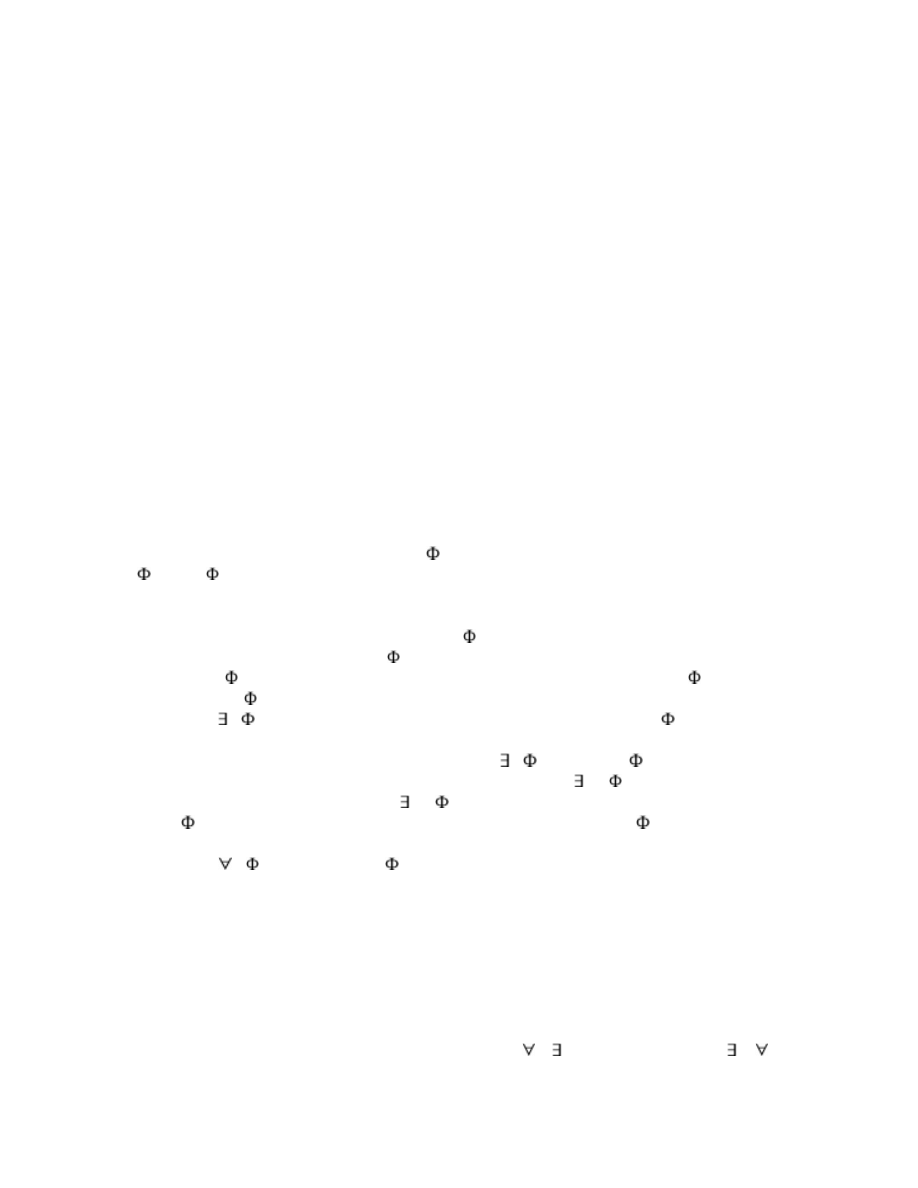
kinds of information. The first is very familiar. It corresponds to attaching a term to a
name or other expression that refers to a particular person or thing: Bill is rich, Tony
grins, this is an orange. Here we have a subject term (the names "Bill" and "Tony", and
the demonstrative "this"), and things are said of what they pick out: "is rich", "grins", or
"is an orange". These terms stand for conditions that things might meet. They are called
"predicates": the rich things satisfy the predicate "is rich", and other things do not. This is
the basic subject-predicate form of information.
Now we can do something surprising. Suppose we delete the term that stands for the
subject. We are left with only a gappy sentence, or predicate: "is rich", and so on. We can
better signal the gap by the expression called a variable, usually written x, y, z. . ., as in
algebra. So we have "x is rich". This is no longer a sentence carrying a piece of
information, because nobody is being said to be rich. It is a sentence with a hole in it: a
predicate, or an open sentence, in logicians' jargon.
Now, here comes the magic. Suppose I ask you to take an open sentence into a particular
domain, such as a classroom, or New York City, and come back giving me some
information. You could just reconstruct a piece of information like the one we started
with, naming some particular individual, and saying that he or she is rich. But you don't
have to do this. You can do a fundamentally different kind of thing. You can come back
and tell me about the quantity of times the predicate is satisfied. And you can tell me this
without telling me who satisfies it. It is as if you use the open sentence by pointing the
"x" in it at all the different people in the domain in turn, and note how often you get a hit.
Suppose we symbolize the predicate by (the Greek letter "phi"). Then you ask: "Is this
, is this " of each of the members of the domain in succession. Then you can tell me
what happened.
Perhaps the simplest kind of thing you could tell me is that at least once, somewhere, you
got a hit. This is equivalent to "Something is ". Or you might tell me that somewhere
you got a miss: "Something is not- ". Contrast this last with getting a hit nowhere:
"Nothing is ". Or it might be that everywhere you got a hit: "Everything is ".
"Something is " is given by a new piece of symbolism: the existential quantifier. It is
written as ( x) x (the fact that the variable comes after the predicate in " x" whereas in
English predicates usually finish sentences and things like names start them is
irrelevant). If you never get a hit, you can enter ¬( x) x: nothing is . If, somewhere,
you get a result that is not a hit, you have the very different ( x)¬ x. If you nowhere get
a result other than a hit, you have ¬( x)¬ x This says that nowhere is there anything that
is not . Or, in other words, as far as this domain goes, everything is . This last kind of
information is sufficiently important to have its own symbol, the universal quantifier,
written as ( x) x: "Everything is
".
Leibniz thought that if we had a sufficiently logical notation, dispute and confusion
would cease, and men would sit together and resolve their disputes by calculation. The
invention of the quantifier did not bring about this Utopia, but it does an astonishing
amount towards it. Its full power is exhibited when we get multiple quantifications. This
is information built with more than one quantifier in play. When we have more than one
quantifier, we use different variables (x, y, z. . .) to indicate the different gaps to which
they correspond. To illustrate the idea, we can see how easily it dissects the invalid
argument: everybody has a mother, so someone is everyone's mother. If we write "x is
the mother of y" as "xMy" we symbolize the first by (
y)( x)
xMy. The second is
( x)
(
y)
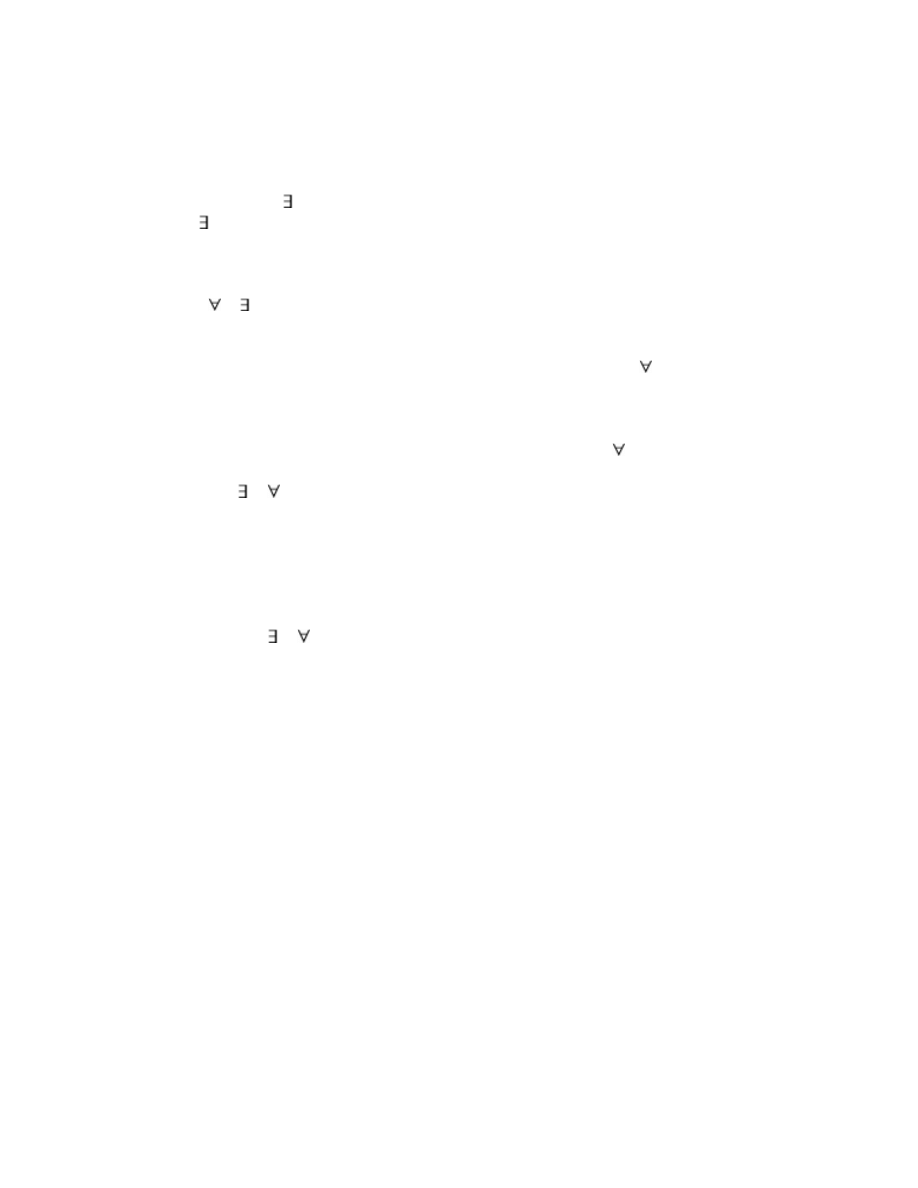
xMy. How are these different?
Start with a sentence claiming motherhood between two different people: Beth is the
mother of Albert. Knock out reference to Beth, and we have the open sentence xMa
(where 'a' abbreviates Albert) We know that this predicate is satisfied (it is satisfied by
Beth), so we know ( x) xMa. Somebody is Albert's mother. Now knock out reference to
Albert: ( x) xMy. We have a gappy, or open, sentence again, with y marking the gap. It
corresponds to the predicate "having someone as a mother". We can take this into the do-
main and point the variable y at each in turn: does this person have a mother, does this. .
.? If we get the answer "yes" on each occasion (which we do), we can universally
quantify ( y)( x) xMy. Everyone has a mother.
Now look at the second formula. To get this, we similarly start with Beth (b) being the
mother of Albert. But now we knock out reference to Albert first: bMy. We take this
round the domain. If we could (as in the real world we cannot) write ( y) bMy, this
would be because Beth is the mother of everyone (whoever you point the variable y at, it
turns out that Beth is their mother!). What has just been supposed of Beth, might be
supposed true of someone (if not Beth): in that case you can knock out reference to Beth,
take the predicate "being mother of everyone", or in other words ( y) xMy, round the
domain, and find eventually someone giving the answer yes. In that case you would be
able to write ( x)( y) xMy. But the point to notice is that this is an entirely different
procedure. It gives an entirely different kind of information (false of the domain of
human beings). And the quantificational structure shows the difference on its face,
because the stringing out of the quantifiers shows how the information is built.
In the real world, nobody is the mother of everybody. Before we understood
quantification, that might have sounded weird, as if the human race sprung out of
Nothing. This might have seemed a creepy metaphysical thesis. But now it is tamed. It
just means that ¬( x)( y) xMy. And this is a simple truth. At least, unless you use the
relation "mother" to include more remote kinds of ancestry, in which case you might
want to claim that there is someone, biological Eve, the first female homo sapiens, who
is the mother of everyone. But I would regard that as an illegitimate or metaphorical
usage. My grandmother is not literally my mother.
We can give more precise information about the quantity of times some condition is met
in a domain. We might say that there is exactly one thing satisfying the condition. This
means that any time you get a hit, if you go on pointing the variable at the rest of the
things in the domain, whenever you get a hit it turns out to be the same one. There are no
two distinct hits. This is the core of Russell's famous theory of definite descriptions. For
it to be true that the unique king of France has a beard, there would need to be someone
who rules France and no other person who rules France, and it should be true of whoever
does rule France that he has a beard. Otherwise, the claim is false.
Quantificational structure is just one thing, but a very important thing to be aware of.
Ordinary language is good at generating ambiguities that it easily resolves. "All the nice
girls love a sailor" said the song. There is some lucky sailor they all love? They all have
one, but perhaps a different sailor that they love? Take any sailor, then all the nice girls
love him (or her)? Very different things, true in very different circumstances. A related
ambiguity is responsible for some thirty thousand deaths a year in the United States. "A
well-regulated militia being necessary to the security of a free state, the right of the
people to keep and bear arms shall not be infringed." Each person? Or the people as a

collective, as in "The team can have a bus"? If the founding fathers had been able to
think in terms of quantificational structure, a lot of blood might not have been spilt.
LANGUAGE AND LOGIC
The logician studies the forms of information that we have just described, and of course
such other complex forms as come to light. But there is another side to the work of the
philosopher, which is to decide when information couched in the idioms of ordinary
speech indeed displays one or another of these forms. This proves a surprisingly fraught
business.
Consider, for instance, the difference between "She was poor and she was honest", and
"She was poor but she was honest". The first clearly illustrates the form "p & q". But
what about the second? It certainly suggests something else, along the lines that it is
surprising or noteworthy that someone poor should be honest. But does it actually say
that? A simpler suggestion might be that it strictly says only what the first says, but says
it in a way to insinuate or suggest that the combination is surprising or noteworthy.
Perhaps only the simpler information is strictly given, but it is given in a way that carries
its own suggestions (which may, as in this example, be seriously unpleasant). So
philosophers of language are led to distinguish what is strictly said or asserted -- the
information carried by the utterance, called its truth-condition -- from what is suggested
or implied, not as a strict logical consequence, but by the way things are put, called the
implicature.
Language is such a flexible and subtle instrument, that there is almost no limit to the way
nuances in the presentation of information affect the implicatures. A famous example is
the way in which simply not saying something can have weighty overtones:
"What do you think of the new professor of logic?"
"They tell me he is famous for his tomatoes."
Here what is strictly said has little or no bearing on whether the new professor is
competent. But the fact that this response is all that is given shows unmistakably that the
respondent thinks the professor is no good. Choice of terminology can have its own im-
plicatures: consider the difference between
John is Fred's brother.
Fred has a male sibling, John.
Here, the second way of putting what is in fact the same information suggests some kind
of significance -- sinister psychoanalytic overtones, perhaps. Order of telling also carries
implicatures about the order of events. It would be misleading, although what is said is
strictly true, to report the life of a child who learned to read and then wrote poetry, by
saying that she wrote poetry and learned to read.
The way in which implicatures are generated is part of the study of language called
pragmatics, whereas the structure of information is the business of semantics.
Consider the dreaded lawyer's question, used to discompose married male witnesses:
"Have you stopped beating your wife -- yes or no?" The witness cannot answer "Yes",

without admitting that he once did; he cannot answer "No", without giving the strongest
impression that he still does. So he is embarrassed, and the trick works. How can we do
better? Well, suppose we analyse "X stopped doing Y" as a conjunction: "X once did Y
& X does not now do Y." This explains why saying "Yes" to the lawyer is bad: it follows
that you once did beat your wife. Saying "No", on the other hand, is interesting. If we
look at the truth-table for conjunction we see that a conjunction can be false in three
different ways: p true, q false; p false, q true; and both false. And each of these three
ways are ways in which the negation of a conjunction can be true (negation reverses
truth-value). Now in the lawyer case it is vital to the innocent husband to establish that
his is the middle case: false that he once did it, and true that he does not now do it. The
trouble is that the one word "no" is insufficient to establish which way it is, and the risk
is that the jury thinks he hasn't stopped because he continues (true that he once did, true
that he does it now, so false that he stopped).
The innocent witness needs enough words to specify which combination describes him.
So he cannot stick with the one-word answer "No" (true thought it is). The right thing for
the witness to say is (in one breath) "No I haven't stopped because I never started", or
words to that effect. If we handle the lawyer's question this way, we can say that it
"presupposes" that the witness once beat his wife, but only in the pragmatic sense, that
anyone asking that question would normally be taking this for granted. Uncovering the
hidden presuppositions behind questions and opinions is an important part of thinking.
Some presuppositions even raise questions about the assumption we made when
interpreting "and","not","or", and especially "If. . . then" as truth-functions, adequately
described by the tables. They sometimes seem to do more complex things. For instance,
consider a party to which Fred is invited, but to which he in fact does not go. Suppose
two assassins are trying to establish Fred's whereabouts. One says, "If Fred goes to the
party, he will go by taxi." The other says, "If Fred goes to the party, he will go by
elephant." Intuitively, at most one of these is true -- in the West, probably the first. But if
we look at "Fred goes to the party -». . ." we will see that both of them are true. Because
it is false that Fred goes to the party, and the table for -» gives the outcome true,
whatever the truth-value of the other proposition. Philosophers used to argue a great deal
about whether this shows that the English conditional "If. . . then" means the same as the
truth-function -». Nowadays there is often a slightly more relaxed attitude, it being
conceded that at any rate -» gives the core of the notion, and the rest can be handled
either semantically or pragmatically.
Before we leave this brief sketch of formal logic, we might pause to consider one kind of
reaction it sometimes provokes. People sometimes think that logic is coercive
("masculine") or that it implies favouring some kind of "linear thinking" as opposed to
"lateral thinking". Both these charges are totally mistaken. Formal logic is too modest to
deserve them.
First, what could be meant by the charge of coercion? Formal logic enables you to
determine whether a set of propositions implies a contradiction. It also interprets
contradictions as false. Most of us will want to avoid holding sets of propositions that
imply things that are false, because we care that our beliefs are true. If someone is not
like that, then we may indeed be minded to moralize against them. But we are not
wearing the hats of formal logicians as we do so. The work of the formal logician was
finished with the result.

Perhaps someone might feel coerced by the assumption mentioned right at the outset --
that every proposition is true or false, and no proposition is both. Perhaps we ought to try
more complex assumptions: for instance, we might welcome vague propositions that are
true to a degree, or propositions that are neither true nor false but have some third status.
That is fine too: these are respectable ideas, and there are alternative logics that develop
them. But it is fair to warn that, for various reasons, they become awkward and
uncomfortable. It is usually wise to be grateful for the simple "two-valued" assumption.
A third source of the feeling of coercion introduces wider issues. If someone voices a
number of views, or comes up with a piece of reasoning, it can be crass and coercive to
insist on seeing them as of such-and-such a form and therefore contradictory, or therefore
invalid. This may well be insensitive to the other factors we have mentioned already:
presuppositions, suppressed premises, and so on. But this was not the fault of the logic,
but of the uncharitable way of taking what was said. By itself logic is indifferent, even to
sayings that look as if they embody direct contradictions. In the short story "The Lady
with the Pet Dog" by Chekhov, Anna Sergeyevna tells her husband that she is going to
Moscow every so often to visit a doctor, "and her husband believed her and did not
believe her". Formal logic does not tell us to jump up and down on Chekhov for this
blatant contradiction. We know that Chekhov is suggesting something else, which is that
her husband half-believes her, or alternates between confidence and mistrust. It is the flat
contradiction that prompts us to look for other interpretations.
What of the charge that formal logic privileges "linear" thinking? This too is nonsense.
Formal logic does not direct the course of anyone's thoughts, any more than mathematics
tells you what to count or measure. It is gloriously indifferent between propositions that
arrive through speculation, imagination, sheer fancy, sober science, or anything else. All
it tells you is whether there is a way in which all the propositions in a set, however
arrived at, can be true together. But that can be a pearl beyond price.
PLAUSIBLE REASONINGS
Formal logic is great at enabling us to avoid contradiction. Similarly, it is great for telling
us what we can derive from sets of premises. But you have to have the premises. Yet we
reason not only to deduce things from given information, but to expand our beliefs, or
what we take to be information. So many of our most interesting reasonings, in everyday
life, are not supposed to be valid by the standards we have been describing. They are
supposed to be plausible or reasonable, rather than watertight. There are ways in which
such an argument could have true premises but a false conclusion, but they are not likely
to occur.
Nevertheless, we can go a little further in applying some of the ideas we have met, even
to plausible reasonings. Why is it silly, for instance, to be confident that my bet at
roulette will be a winner? Because my only information is that I have placed my bet on x,
and most ways that the wheel might end up do not present x as the winner. What we are
dealing with is a space of possibilities, and if we could show that most possibilities left
open by our evidence are ones in which the conclusion is also true, then we have
something corresponding to plausible reasoning. In the roulette case, most possibilities
left open by our evidence are ones in which the conclusion that x is the winner is false.

Roulette and other games of chance are precisely little fields designed so that we know
the possibilities and can measure probabilities. There are fifty-two outcomes possible
when we turn up a card, and if we do it from a freshly and fairly shuffled pack, each
possibility has an equal chance. Probabilistic reasoning can then go forward: we can
solve, for instance, for whether most draws of seven cards involve two court cards, or
whatever. Such probabilistic reasoning is precisely a matter of measuring the range of
possibilities left open by the specification, and seeing in what proportion of them some
outcome is found.
What underlies our assignments of probabilities in the real world? Suppose we think of
our position like this. As we go through life, we experience the way things fall out.
Within our experience, various generalizations seem to hold: grass is green, the sky blue.
Water refreshes; chocolate nourishes. So we take this experience as a guide to how
things are across wider expanses of space and time. I have no direct experience of
chocolate nourishing in the eighteenth century, but I suppose it did so; I have no direct
experience of it nourishing people tomorrow, but I suppose it will continue to do so. Our
beliefs and our confidence extend beyond the limited circle of events that fall within our
immediate field of view.
Hume puts the problem this way:
As to past Experience, it can be allowed to give direct and certain information of those precise
objects only, and that precise period of time, which fell under its cognizance: but why this
experience should be extended to future times, and to other objects, which for aught we know,
may be only in appearance similar; this is the main question on which I would insist. . . At least, it
must be acknowledged, that there is here a consequence drawn by the mind; that there is a
certain step taken; a process of thought, and an inference, which wants to be explained. These
two propositions are far from being the same, I have found that such an object has always been
attended with such an effect, and I foresee, that other objects, which are, in appearance, similar,
will be attended with similar effects. I shall allow, if you please, that the one proposition may
justly be inferred from the other: I know in fact, that it always is inferred. But if you insist, that the
inference is made by a chain of reasoning, I desire you to produce that reasoning.
Experience stretches no further than limited portions of space and time. In particular, all
our experience belongs to the past and present. If we make inferences to the future, then
these are inferences, and Hume wants to know the "chain of reasoning" that they employ.
The inference from what is true of one limited region of space and time to a conclusion
true of different parts of space and time is called inductive inference. What Hume is
bothered about has become known as the problem of induction.
THE LOTTERY FOR THE
GOLDEN HARP
Here is a science fiction. You are disembodied spirits, inhabiting a kind of Heaven. I am
God. I tell you that I am about to embody you, to give you lives to lead in a physical
universe that I have prepared for you: Earth. At the end of your period in this universe,
you will return to Heaven. Unlike normal human life, you will all live the same period:
nine acts, let us say.
To make things interesting, I am going to offer you a kind of lottery. Each of you will get

a ticket. The tickets correspond to the colour of the clear midday sky for each of the nine
acts. I covenant with you, as gods do, that I won't change the colour at any time other
than the beginning of an act. Just one of you is going to have a ticket that corresponds to
the actual colour of the sky in every act. I also tell you that this person, the winner, will
get the Golden Harp when you come back to Heaven. This is a very valuable prize.
Heaven is good, but Heaven with the Golden Harp is even better. So a ticket might look
like this:
red
orange
x
yellow
x x
green
x
x
x
blue
x
x
violet
x
Time
1 2 3 4 5 6 7 8 9
This ticket corresponds to the sky starting blue, going green, then yellow and orange,
before darkening back to blue and even violet. Call the person with this ticket, Wavy.
Some of you (six of you) get straight tickets:
red
orange
yellow
green
blue
x x x x x x x x x
violet
Time
1 2 3 4 5 6 7 8 9
Call this ticket, Straightie.
If there is going to be just one ticket for each of you, there need to be 6
9
of you,
which is a very large number indeed, to have a ticket corresponding to each possible
distribution of the colours. And correspondingly, your chance of being the winner is only
1/6
9
, which is a very small number.
Hume insists that we cannot know anything right from the beginning in this
situation. We cannot have a priori knowledge which ticket will win. Antecedently, while
we are still excitedly discussing tickets, there is no reason to prefer one to another. For all
we know God may favour waves, or straight lines. Or he may favour Kinkie:
red

orange
yellow
x x x x
green
blue
x x x x x
violet
Time
1 2 3 4 5 6 7 8 9
The clear midday sky starts off blue for the first five acts, and then turns yellow, and
stays like that for the rest. So in heaven, before we get any experience of the world God is
about to put us into, no ticket has any better chance than any other. Well, now we go to
Earth.
Immediately, 5/6 of us can throw our tickets away. Any ticket not showing blue in
the first square is a loser. And similarly, on the first day of each subsequent act, 5/6 of the
survivors can throw their tickets away, until at the beginning of the ninth act, only six re-
main. And a day after that, there is a single winner.
Now let us draw the curtain back towards the end of the fifth act. Each of
Straightie and Kinkie has been doing well. They have seen their competitors fall away, on
five previous occasions. In fact, the number of survivors in the lottery has dropped from
6
9
down to 6
4
, and their chances of being the winner have risen accordingly.
But suppose they get into an argument with each other. Suppose Straightie urges
Kinkie that his ticket is far the more likely winner, so that he will swap it with Kinkie but
only for a terrific price. We would probably side with Straightie. But suppose that Kinkie
resists, urging that there is no reason in what has happened so far to bet on Straightie
rather than on him. What can they say to each other?
Each can point to their track record of success. But it is the same track record for
each of them. They each have their five hits. And there is nothing else to go on. After all,
neither of them can peer into the future. Like us, they are stuck in time, and cannot peek
out of it.
What Straightie would like is an argument in favour of the uniformity of nature.
In other words, an argument saying that since God has started off with a blue sky, and
stuck with it so far, probably he is going to go on sticking with it. But Kinkie can point
out that God has started off with an as-per-Kinkie sky, and by equal reasoning urge that
he is probably going to stick with that.
Straightie wants the argument that Hume says he cannot find. But, as I said, in our
bones we all side with Straightie. What's wrong with arguing that since nature has been
uniform so far, it will probably go on being uniform?
It is impossible, therefore, that any arguments from experience can prove this
resemblance of the past to the future; since all these arguments are founded on the supposition
of that resemblance.
Of course, Hume knows that we all learn from experience, and that we all rely
upon the uniformity of nature. He thinks we share this natural propensity with animals. It

is just that this is all it is: an exercise of nature. It is a custom or habit, but it has no
special claim in reason. When we reason inductively there is a way in which our premises
can be true and our conclusion false. Nature can change. In fact, there are many ways,
since nature can change in many ways. There is no contradiction in imagining this. And
now, it seems, we cannot even argue that such changes are improbable. We only think
that because they have not occurred within our experience. But taking our experience to
be representative, in this regard as in any other, presupposes the uniformity of nature. It
seems that we engineer a bridge between past and future, but cannot argue that the bridge
is reliable.
CHANCY STUFF
Here is a problem quite a long way from the problem of induction, but that
introduces an incredibly useful tool for thinking about many things. It is a problem most
people get wrong.
Suppose you decide to check yourself out for some disease. Suppose that this
disease is quite rare in the population: only about one in a thousand people suffer from it.
But you go to your doctor, who says he has a good test for it. The test is in fact over 99
per cent reliable! Faced with this, you take the test. Then -- horrors! -- you test positive.
You have tested positive, and the test is better than 99 per cent reliable. How bad is your
situation, or in other words, what is the chance you have the disease?
Most people say, it's terrible: you are virtually certain to have the disease.
But suppose, being a thinker, you ask the doctor a bit more about this 99 per cent
reliability. Suppose you get this information:
(1) If you have the disease, the test will say you have it.
(2) The test sometimes, but very rarely, gives "false positives". In only a very few cases --
around 1 per cent -- does it say that someone has the disease when they do not.
These two together make up the better than 99 per cent reliability. You might
think that you are still virtually certain to have the disease. But in fact this is entirely
wrong. Given the facts, your chance of having the disease is a little less than 10 per cent.
Why? Well, suppose 1,000 people take the test. Given the general incidence of the
disease (the "base rate"), one of them might be expected to have it. The test will say he
has it. It will also say that 1 per cent of the rest of those tested, i.e. roughly ten people,
have it. So eleven people might be expected to test positive, of whom only one will have
the disease. It is true the news was bad -- you have gone from a 1 in 1,000 chance of
disease to a 1 in 11 chance -- but it is still far more probable that you are healthy than not.
Getting this answer wrong is called the fallacy of ignoring the base rate.
How should we think accurately about chances in a circumstance like this?
We should start with a formula for the probability of one thing given another.
Suppose we ask what the probability is of (a) some random person in a class wearing
Levi jeans. Perhaps 20 per cent. And what is the probability of (b) some random person
wearing a Levi jacket? Perhaps 20 per cent also. So what is the probability of a random
person both wearing the jeans, and the jacket? You might think 20/100 x 20/100 = 4 per
cent. But that would be wrong. For the two events are not necessarily independent. That

means, the chance of someone wearing the jacket is very likely different if they are
wearing the jeans. Perhaps nearly everyone who wears those jeans wears those jackets
and vice versa. In that case the probability of (a) and (b) both being true of a random
person would itself be 20 per cent. Or perhaps the fashion gurus say that you must never
wear both. In that case the chance of (a) and (b) both being true might be zero.
To get this right we need an expression for the probability of someone wearing
the jacket given that he is wearing the jeans. The probability of (a) given (b) is written
Prob (a/b). The probability of (b) given (a) is Prob (b/a). Then the right figure is this:
Prob
(a & b) = Prob (a) x Prob (b/a),
or equally:
Prob
(a & b) = Prob (b) x Prob (a/b).
The first equation says that the probability of wearing jeans and jacket = the
probability of wearing the jeans x the probability of wearing the jacket given that you are
wearing the jeans. This last is called a "conditional probability". The second says it is
also equal to the probability of wearing the jacket x the probability of wearing the jeans
given that you are wearing the jacket. These have to be identical, by symmetry (since a &
b is the same proposition as b & a).
An English clergyman called Thomas Bayes (1702-61) looked hard at this result.
Since each of them is equal to Prob (a & b), each of these is equal to each other:
Prob
(a) x Prob (b/a) = Prob (b) x Prob (a/b)
So we can write down an expression for the probability of b given a:
Prob
(b/a) = Prob (b) x Prob (a/b)
Prob (a)
This rather frightening-looking equation is a simple version of what is known as Bayes's
theorem.
The application of the result comes like this. Suppose now that we have some
hypothesis, and a piece of evidence for it. We are interested in the probability of the
hypothesis h, given the evidence e. We can write this as Prob (h/e). This is called the
posterior probability of the hypothesis -- its probability after the evidence comes in. Then
the theorem tells us that:
Prob
(h/e) = Prob (h) x Prob (e/h)
Prob (e)
This directs us to three different things on which the posterior probability
depends.
Prob
(h). This is known as the prior or antecedent probability of h.
Prob
(e/h). This is the probability of evidence e, given h. It is a measure of the fit between

the hypothesis and the evidence.
Prob
(e). This is the prior or antecedent probability of the evidence itself.
Intuitively it can be thought of like this. There are three factors. First, how likely
is the hypothesis from the word go? Second, how well does the evidence accord with the
hypothesis? Third, how likely is the evidence from the word go?
It is often useful to treat this last figure in terms of the different ways the evidence
might have come about. It is a figure that gets larger the greater the number of quite
probable alternative explanations of the evidence. And when it gets larger, the probability
of the given hypothesis on the evidence gets smaller. It has too many competitors. So in
practice the figure on the bottom measures how many other ways there are in which that
evidence could be explained, and how likely they are. We recognize the importance of
this intuitively. When the call-girl Mandy Rice-Davies was told that some member of the
aristocracy denied having had an affair with her, she replied, "Well, he would, wouldn't
he?" She was in effect reminding people that the antecedent probability of this particular
piece of testimony was high regardless of which hypothesis is true, and this undermined
its value as evidence. You could guess in advance that whatever their relations, the
aristocrat would have said what he did. So his saying what he did was worthless as evi-
dence.
The ideal would be: the hypothesis is antecedently quite likely. The evidence is
just what you would expect, given the hypothesis. And there are not many or any other
probable ways the evidence could have come about.
In the case of the disease, Bayes's theorem puts the base rate up front: it is the
antecedent probability that you have the disease, of 1 in 1,000. The next figure, the fit
between the test result and the hypothesis that you have the disease, is excellent: 1, in
fact, since the test always says you have it if you do. But on the bottom line we have the
number of ways that evidence could have come about. Informally, there is the 1 in 1,000
chance of a true result plus the 10 in 1,000 chance of a false positive. It is this that results
in your overall chance, given the evidence, being (approximately) 1 in 11.
There is a nice way now of representing the impasse between Straightie and
Kinkie in the lottery for the Golden Harp. Suppose S in the entire ninefold pattern -- blue
each time -- on Straightie's ticket. And suppose E is the part of it that is within our
experience: the five results of blue each time so far. Then
Prob (S/E) = Prob (S) x Prob (E/S)
Prob (E)
The antecedent or prior probability of S was 1/6
9
. The second figure is good,
however. If S indeed describes the way events fall out, then the evidence E, i.e. the first
five readings, is just what would be expected. Their probability is in fact 1, given S. And
the prior probability of E? That is just five readings of blue, which, given that blue is one
of six competing possibilities, is 1/6
5
. Calculating out, we get that Prob (S/E) is 1/6
4
,
which is just what we got intuitively before.
The trouble is that exactly the same formula gives exactly the same result for
Kinkie's ticket, K. You can easily see that the evidence has probability 1, given K, and
the prior probability of the evidence is the same in either event.
Notice that the problem is not one of "proving" that S will win, or that K will not

win. It is just one of finding some good reason to expect S rather than K. It is a question
of comparing probabilities. Hume's position is that even this cannot be done in S's favour.
Reason remains entirely silent between them. And following Bayes's analysis, he looks to
be right. The debate between Straightie and Kinkie is as stalemated as ever. In fact, if
there was no reason for preferring the ticket S to the ticket K in Heaven, a priori, then
there is no reason for preferring it after the evidence has come in. Or so it seems.
We could now revisit a number of areas: the Zombie possibility, the design
argument, the likelihood of a good God creating or allowing evil, and especially the
discussion of miracles, using Bayes's theorem. It is a tool of immense importance. The
fallacies it guards against -- ignoring the base rate, ignoring the chance of false positives -
- are dangerous, and crop up everywhere that people try to think.
Of course, very often it is difficult or impossible to quantify the "prior"
probabilities with any accuracy. It is important to realize that this need not matter as
much as it might seem. Two factors alleviate the problem. First, even if we assign a range
to each figure, it may be that all ways of calculating the upshot give a sufficiently similar
result. And second, it maybe that in the face of enough evidence, difference of prior
opinion gets swamped. Investigators starting with very different antecedent attitudes to
Prob (h) might end up assigning similarly high values to Prob (h/e), when (e) becomes
impressive enough.
For interest, it is worth mentioning that there are quite orthodox methods of
statistical inference that try to bypass Bayesian ideas. Much scientific research contents
itself with ascertaining that some result would only occur by chance some small percent-
age of the time (less that 5 per cent, or less than 1 per cent, for example). But it then
infers that probably the result is not due to chance -- that is, there is a significant causal
factor or correlation of some kind involved. This prevalent reasoning is actually highly
doubtful, and Bayes shows why. If the antecedent probability that a result is due to
anything else than chance is very, very low, then even enormously improbable results
will not overturn it. If I put my hand in a shaken bag, throw seven Scrabble letters face
down on a table, shuffle them into a line, and turn them up, the actual result (PQAERTU,
say) will be very improbable indeed. I might do the same thing for a hundred years and
not repeat it. But it was chance, for all that. In this setup any result is going to be very im-
probable, and we should not be able to infer back to say that anything other than chance
is responsible for it. That is the very kind of reasoning that fuels lunatic attempts to prove
that the pattern of occurrence of vowels in Shakespeare's plays is best explained by the
hypothesis that he was writing the Name of the Beast 666 times, or whatever. In short, it
is not just the fact that a result is improbable that should prompt us to look for some
special explanation. We need some additional reason to think that the improbable result is
not just due to chance anyway. Chance is just as good at throwing up improbabilities as
design.
EXPLANATIONS AND PARADIGMS
Induction is the process of taking things within our experience to be
representative of the world outside our experience. It is a process of projection or
extrapolation. But it is only part of a wider process of trying to increase our

understanding of things. In the final section of this chapter, I want to introduce some of
the reasonings that this involves.
Suppose we have a complex system. We have various features, which seem to
interact. We can find the ways in which they seem to interact, by noticing changes and
variations. We might be able to plot these against each other, and find reliable
relationships. Boyle's law, that the pressure of a given mass of gas is inversely pro-
portional to its volume, at a given temperature, is an example. This is a purely empirical
law. It is found to hold within experience, and we take it to hold across the wider world.
Some disciplines would be mightily pleased if they could get that far. Economics, for in-
stance, wants to find the right features of an economic system, and to be able to plot the
relationships between them reliably. And this proves very hard. It takes art and craft, and
most attempts crash in flames. We are apt to forget that the same was true of physical sci-
ence. For example, it took a century of effort for scientists to learn to identify the energy
of a mechanical system as its salient feature, whose conservation enabled them to predict
its behaviour. This is a historical fact that science teachers should be made to write out a
hundred times, when they upbraid children as "dumb" because they do not cotton onto
the idea immediately.
If an economist has a story about the right variables and the relationships between
them, it can be called a model of the economy. But even if we had such a thing, we might
still feel we did not understand what was going on. Isaac Newton (1642-1727) had a law
plotting the gravitational attraction between bodies as a function of their masses and the
distance between them: the famous inverse square law. But both he and his
contemporaries felt that this gave them no real understanding of why gravity operated as
it does. As with Boyle's law, we can say that while it is all we have got, we know
something about the system. But we do not really understand why it is behaving as it
does. Why should pressure vary inversely with volume? If it always does, why does it
always do so? And why should constancy of temperature be important?
These questions were answered by providing a model in a more robust sense. The
kinetic theory of gases sees gases as volumes of molecules in motion. Pressure is the
result of the impact of these molecules on the walls of the container. The molecules speed
up with increased temperature. Once a gas is seen like this, we have a mechanism, and
given suitable assumptions, the empirical laws such as Boyle's law can be derived from
the nature of the mechanism.
Finding a mechanism does not bypass the problem of induction. The continued
uniform behaviour of items in a mechanism is a projection or extrapolation from what we
have found so far, just as much as anything else. But it reduces the number of indepen-
dent assumptions we need to make. A few stable features of things, and reliable
interactions between them, might explain others. If we take the stable features for
granted, we can explain the others in terms of them. These represent the explanatory and
simplifying ideals of science.
But what kinds of thing count as satisfactory "mechanisms"? Things whose
behaviour we understand "clearly and distinctly"? Or something else? The answer to this
question opens one of the most exciting chapters of modern thought. Nearly everyone is
inclined to think that there are some kinds of systems that we understand better than we
understand others. To most people, some kinds of causation, like shunting, seem
especially intelligible, whereas others, like action at a distance, or the effects of body on

mind, seem very mysterious. In fact until Hume, almost everyone -- both philosophers
and natural scientists like Newton -- thought this. They thought we had a priori
knowledge of what does cause what, and still more, of what could not cause what. We
have already seen this. Even Newton thought that it was clear that gravitational attraction
could not be a case of action at a distance. He thought that any idiot could see that if the
Sun exerts an attraction on the Earth this must be because of a chain of some kind
between them. Causation had to be a matter of pushes and pulls:
That gravity should be innate, inherent and essential to matter, so that one body may act
upon another at a distance through a vacuum, without the mediation of anything else, by and
through which their action and force may be conveyed from one to another, is to me so great an
absurdity that I believe no man who has in philosophical matters a competent faculty of thinking,
can ever fall into it.
Surely it "stands to reason" or is "clear and distinct" or "a priori" that a body
cannot act somewhere where it is not! We still reason like this when, for instance, we
attempt to show by pure reason that the Universe must be the creation of a god. We are
supposing that we know what kind of thing must cause some effect, and what could not
cause it. Hume blows this rationalism right out of the water:
I shall venture to affirm, as a general proposition, which admits of no exception, that the
knowledge of this relation is not, in any instance, attained by reasonings a priori; but arises en-
tirely from experience, when we find, that any particular objects are constantly conjoined with
each other. Let an object be presented to a man of ever so strong natural reason and abilities; if
that object be entirely new to him, he will not be able, by the most accurate examination of its
sensible qualities, to discover any of its causes or effects. Adam, though his rational faculties be
supposed, at the very first, entirely perfect, could not have inferred from the fluidity, and
transparency of water, that it would suffocate him, or from the light and warmth of fire, that it
would consume him.
As a good psychologist should, he gives an explanation of the prejudice that we
can argue a priori about cause and effect:
We fancy, that were we brought, on a sudden into this world, we could at first have
inferred, that one Billiard-ball would communicate motion to another upon impulse; and that we
needed not to have waited for the event, in order to pronounce with certainty concerning it. Such
is the influence of custom, that, where it is strongest, it not only covers our natural ignorance, but
even conceals itself, and seems not to take place, merely because it is found in the highest
degree.
Hume knew that philosophers and scientists hankered after an ideal of "insight"
into the laws of nature: something like a geometry or algebra enabling them to see why
events fall out in patterns that are necessary, mathematically certain. They wanted a
Cartesian "clear and distinct" perception of why things have to be the way they are. But
Hume believes that this goal is an illusion. Nothing the scientist does would accomplish
it.
It is good to remember here that when Newton published Principia Mathematica
in 1687, revealing the laws of motion, there were scientists of his time who were
disappointed. They wanted an insight into what gravitational attraction is, but Newton
only told them what it does. Newton tells you how bodies accelerate towards each other,

and that is all. Hume argues that the kind of thing Newton did was the only kind of thing
science can ever do. He holds that anything else represents an incoherent ideal. In the
following quotation "philosophers" are scientists, and "philosophy of the natural kind"
means what would now be called natural science, and especially physics and chemistry:
Hence we may discover the reason why no philosopher, who is rational and
modest, has ever pretended to assign the ultimate cause of any natural operation, or to
show distinctly the action of that power, which produces any single effect in the universe.
It is confessed, that the utmost effort of human reason is to reduce the principles,
productive of natural phenomena, to a greater simplicity, and to resolve the many par-
ticular effects into a few general causes, by means of reasonings from analogy,
experience, and observation. But as to the causes of these general causes, we should in
vain attempt their discovery; nor shall we ever be able to satisfy ourselves, by any
particular explication of them. These ultimate springs and principles are totally shut up
from human curiosity and enquiry. Elasticity, gravity, cohesion of parts, communication
of motion by impulse; these are probably the ultimate causes and principles which we
shall ever discover in nature; and we may esteem ourselves sufficiently happy, if, by
accurate enquiry and reasoning, we can trace up the particular phenomena to, or near
to, these general principles. The most perfect philosophy of the natural kind only staves
off our ignorance a little longer.
What we have here is a splendid rejection of the rationalist ideal. In its place we
seem to be left only with more or less familiar systems. At any time those with which we
are comfortable provide "paradigms", or systems against which we compare others. They
give us our sense of what would count as a satisfactory explanation. But without the
rationalist ideal, we become aware that this sense is perhaps itself changeable. If we
replace "reason" by "habit and custom", then cannot our customs and habits change? The
famous philosopher of science Thomas Kuhn (1922-96) argued that indeed they can.
"Normal" science proceeds in the light of a set of paradigms, or implied views about what
kind of explanations we should hope for. Periods of revolutionary science occur when the
paradigms are themselves challenged. Science is to be seen as "a series of peaceful
interludes punctuated by intellectually violent revolutions". After the revolutions, our
sense of what makes for a comfortable explanation of why things hang together changes.
Some people get quite excited quite quickly by this kind of thought. They take it
to suggest a kind of "relativism", whereby some people have their "paradigms" and other
people have others, and there is no judging which is better. But that is unwarranted. There
may be better or worse paradigms. Looking at the sky as an opaque veil with holes in it
through which we see specks of the heavens beyond was once a paradigm or model of the
way the heavens are. We believe that we know better, and I hold that belief too.
Paradigms can be asked to show their worth, and some of them do not stand up.
Thus, suppose it is true it is that we inevitably approach the world with a
particular set of preferred categories, partly set by our culture and history. It still does not
follow that all such sets are equally "good". Some sets have been discarded for good and
sufficient reason. A scientific environment is (ideally) an environment in which the
constant process of experimenting, predicting, and testing, weeds out the bad ideas. Only
the ones that survive go on into the next generation. This is not to say that actual

scientific environments are as ideal as all that: at any time science can no doubt boast its
fair share of blinkers, prejudices, and distortions. But the process contains within itself
the mechanisms of correction. We might remember here the discussion in Chapter 1,
when we criticized Descartes for not taking account of the "self-corrective" nature of the
senses, whereby illusions are detected as such. Science similarly contains within itself the
devices for correcting the illusions of science. That is its crowning glory. When we come
upon intellectual endeavours that contain no such devices -- one might cite
psychoanalysis, grand political theories, "new age" science, creationist science -- we need
not be interested.
In this chapter we have discovered some of the elements to notice in our
reasonings. We have seen the some of the ideas that underlie formal logic. We have
distinguished processes of inductive reasoning, and seen how dependent we are on brute
faith in the uniformity of nature. We have a sense of how to reason about the probability
of things. And we have looked a little at processes of model building and explanation,
and been led to mistrust a priori reasonings about cause and effect. All these give us tools
to be used as we go on to think about the world and our place in it.
Chapter Seven
The World
I
N THE
six
CHAPTERS
so far, we have visited six problem areas. These were:
thoughts about our own global reliability, thoughts about mind and body, thoughts about
freedom and fate, thoughts about the self, thoughts about God, and thoughts about the
order of nature. These are each notorious areas of difficulty, where the structure of our
thoughts, or the way to think properly, are hard to discern. We might hope, by
comparison, that thinking about the world around us is relatively problem-free. In this
chapter, we visit areas in which a little thought generates trouble about that, as well.
COLOURS, SMELLS, SOUNDS,
FEELS, AND TASTES
Here is Descartes's great contemporary, the physicist Galileo Galilei (1564-1642):
Now I say that whenever I conceive any material or corporeal substance, I immediately
feel the need to think of it as bounded, and as having this or that shape; as being large or small in
relation to other things, and in some specific place at any given time; as being in motion or at rest;
as touching or not touching some other body; and as being one in number, or few, or many. From
these conditions I cannot separate such a substance by any stretch of my imagination. But that it
must be white or red, bitter or sweet, noisy or silent, and of sweet or foul odor, my mind does not
feel compelled to bring in as necessary accompaniments. Without the senses as our guides,
reason or imagination unaided would probably never arrive at qualities like these. Hence I think
that tastes, odors, colors, and so on are no more than mere names so far as the object in which

we place them is concerned, and that they reside only in the consciousness. Hence if the living
creature were removed, all these qualities would be wiped away and annihilated.
Galileo is here expressing what has become called the distinction between the
primary and the secondary qualities of material things. The secondary qualities are the
immediate objects of the senses: colours, tastes, sounds, odors, feels. According to
Galileo they "hold their residence" only in the sensitive (i.e. perceiving) animal. More-
over, according to Descartes, there is no reason for supposing them to "resemble"
whatever in nature causes them -- the arrival of photons at the eye, in the case of colour,
for example.
Descartes similarly had a poor view of the senses as vehicles of truth (remember
the ball of wax in Chapter 1):
For the proper purpose of the sensory perceptions given me by nature is simply to inform
the mind of what is beneficial or harmful for the composite of which the mind is a pan. . . but I
misuse them by treating them as reliable touchstones for immediate judgments abut the essential
nature of the bodies located outside us.
An example he liked was the perception of a pain as being in the foot, after the
"animal spirits" had conducted their energy, their "jet of flame", up the nerves and into
the brain. God devised it that the mind receives the best sensation that it could (God's
good pleasure, again). The particular motion of the brain could have conveyed something
else to the mind. However, there is "nothing else which would have been so conducive to
the continued well-being of the body". In other words, if God had brought it about that I
interpreted the motions in the brain as, for instance, just signalling a perturbation of my
brain, then I would be slow to move my foot, which is being injured, out of harm's way.
We might notice that Descartes's position here contains a denial of epiphenomenalism. It
is because the mental events are one thing or another that we move our foot quickly. If
the mental were inert, God could let it fall out however he wants without affecting our
well-being.
Descartes's quaint language conceals a surprisingly modern point. If we substitute
evolution for God, we can put it like this. For a creature to flourish, it must get
information from the environment that tallies with its actual needs. All that is necessary
for this is that the information stimulates it to action in the right way. For instance, if a
predator is coming, it needs some information that stimulates flight. However, for this
function, it does not matter what experience it gets. If the predator treads on a twig, then
the "motions" this induces in the ear could result in the creature hearing a loud sound, or
a discordant sound, or a harmony, or a high pitch, or a low pitch, or they could result in
just a bad smell, but so long as it senses something that frightens it, its senses are doing
their job. The senses provide us only "confused" (as opposed to clear and distinct) data.
This also lets God off the hook. If we ask why the senses sometimes deceive us,
making us think that colours lie outside us when they do not, then the answer comes in
two parts. First, he created the "best system that could be devised" for producing a
sensation especially conducive to the preservation of the healthy person. The senses, as
we have seen, can deceive us. But Descartes insists that it is we, not nature or God's
design, who are at fault if we misinterpret the data of the senses, uncorrected by use of
intelligence. We should not treat the data of the senses as straightforwardly conveying

information about the real properties of things. This would be to treat confused data as if
they were clear and distinct.
When we do use our intellects, abstracting away from the data of the senses, what
kind of world are we left with? Descartes, the mathematician, believed that the real
property of "res extensa" was, as the name suggests, spatial extension. Everything else
was the possibly illusory, sensory "filling" of spatial volume by things like colours and
feels -- things that, like Galileo, he believed to have their real residence only in the mind.
So as well as opening up dualism of mind and body Descartes and his contemporaries
open up a dualism between the world as it is for us (sometimes called the "manifest
image") -- the coloured, warm, smelly, noisy, comfortable, familiar world -- and the
world as it is objectively or absolutely (the "scientific image") -- the world that contains
nothing but physical particles and forces spread out across the boundless spaces of the
cosmos.
Why is science thought to drive colours and the rest into the mind? The most
compelling argument seems to be one from perceptual relativity. People are apt to think
of "relativism" as a particular threat, or temptation, in moral philosophy, where we are
uncomfortably familiar with the way situations strike different people differently. But a
more general relativism is here raising its head. We can present an argument from
relativity concerning tastes, odours, colours, sounds, and "feels" like this:
Suppose a part of the world or an object in the world displays a certain smell, etc. to one
observer O. How it smells, etc. will be a function of O's particular sensory structures. So, there
will be or could be another creature O* with different sensory structures, to whom the same part
of the world or the same object would smell, etc. quite differently. O and O* may each live equally
efficient, adapted lives. So, there is no reason for saying that just one of O or O* has got the
smells, etc. right. So, there is no one correct distribution of smells, etc. in the world. So, smells,
etc. are better thought of as entirely mind-dependent.
This argument was familiar in the ancient world, before returning to prominence
in the seventeenth century. There are a number of points to notice about it.
First, it does not depend on the actual existence of the different creature O*. It is
enough that we can see how there could be such a creature: one whose colour receptivity
is quite different, or whose auditory apparatus sensitizes it to different frequencies of
sound, or to different kinds of energy altogether. Of course the argument becomes more
graphic when we come across striking instances. Nobody who keeps a dog can believe
that the world of smells that dogs inhabit bears much resemblance to our own. And some
of us can remember, for instance, how differently beer or dry wine first tasted before we
got used to it. Different sensitivities clearly exist: for a start, all mammals except some
primates are colour-blind. There are substances (phenol thio-urea is an example) that
have a pronounced bitter taste to a high proportion of human beings, but no taste at all to
others. And so on.
But quite apart from such actual cases, we can easily see how there could be
forms of life that get by perfectly well with quite different sensory "fillings". Some
people tune their TV sets so that the colours seem garish and glaring to others, but they
see the same scenes as a result.
The second premise too seems incontestable. It represents a piece of knowledge
we have about the world. We know that certain kinds of condition, for instance, can lead
us to taste things very differently. With colds, we lose much of our sense of smell. We

know a good deal about how colour vision depends upon the particular sensitivities of
three different kinds of receptors in the eye, as described in Chapter 2. We know that bats
navigate by acoustic means that are closed to us.
So the initial conclusion seems inevitable. Compare this: two different television
sets may receive the same signal. However, what picture appears depends on the
particular structure of the television. Hence, there could be televisions that deliver
different outputs from the same signal (and of course there are).
The next premise is crucial, and one that is often forgotten in discussions of
relativism in other areas, such as ethics. Any argument aiming at something like the final
conclusion needs to go via this. It is no good just pointing out that different creatures
perceive the world differently, if that allows the interpretation that just one set of them
has got the world right. The analogy with the televisions makes the point. Sure, someone
might say, the way in which a television set shows a picture in response to a signal may
vary. If the television is the wrong kind for that signal, then it just shows snowstorms, for
instance. But that just means that the television misses information that exists, that is
objectively there, carried by the signal. It is no kind of argument that the information is
not really there, independently of the receiver, in the first place. If the transmitter is
beaming the inaugural speech, a television showing a snowstorm is doing worse than one
showing the speech. It is not doing just as well, but in a different way. But that is what
this argument from relativity is aiming to show. So, there is a hole in it.
There would be if it were not for premise that the different creatures might live
equally well-functioning, adapted lives. This plugs this gap, by asking us to see the
different observers as potentially equally well adapted to their worlds. For Descartes, that
would have been a belief with theological backing. For us, it may have an evolutionary
explanation. Creatures that cannot receive the kind of information they need to live their
lives die out. So, unlike the televisions, O and O* may be doing as well as each other, but
living lives with different sensory experiences: seeing, smelling, hearing, tasting, and
feeling differently. It is this equality that suggests, as Russell later put it, that it would be
"favouritism" to say that the world is better represented in one of these ways than in any
other.
The premise about equal adaptation may not be enough however. We may want to
think like this. Certainly, dogs, for instance, are adapted creatures, with sensory systems
that meet their natural needs. But let us distinguish the different dimensions of sensory
experience. Dogs have marvellous noses. So, let us admit that they can smell smells that
we cannot. They are the "authorities" on the distribution of smells. On the other hand,
dogs are colour-blind. Therefore, they are not "authorities" on the distribution of colours.
We can make finer visual discriminations amongst objects in a whole variety of different
lights than dogs can. That is what our colour vision is for. So why not say that the real
colours are the ones that the creatures best adapted for colour see? And the real smells the
ones that creatures best adapted for smell sense? And if we can say this, then the
subsequent conclusions will not follow.
This certainly points to a hole in the argument as it is stated. To repair the hole we
would need some stronger premise. A repair that would do the job might be to aim for
each sensory dimension D (vision, touch, smell, sound, taste), one at a time. There would
be five different arguments, and in each,of them the crucial premise would read:
O and O* may each live equally efficient, adapted lives in respect of sensory dimension

D.
If this is accepted, the rest of the argument looks like plain sailing. The rationale
for the final move is obvious enough. Consider phenol thio-urea. It cannot in itself be
both tasty and tasteless. Similarly, the world cannot be thought of as containing as many
smells as there are possible sensory apparatuses, adapted for registering just some
molecules (or their absence) in some combinations and concentrations. Such a world
would contain an infinite number of coexisting smells, since there is no limit to the
possible varieties of detector.
The upshot of the argument is called "secondary quality idealism". It gives us
Galileo's result that the qualities that are the immediate objects of sensory experience are
driven "back into the mind".
GOOD SOLID SENSE
This did not strike Descartes and many of his successors as too bad. Descartes
himself, as we have seen, still had "reason" to inform him about the properties objects
really had. He did not mind the illusory aspects of the world of appearance -- the fact that
colours are, as it were, due to us, and not to the things we see. His position in this was
canonized in English-speaking philosophy by John Locke.
Locke is very explicit. There are
original
or primary qualities of body, which I think we may observe to produce simple
ideas in us, viz. solidity, extension, figure, motion or rest, and number.
There are also
such qualities, which in truth are nothing in the objects themselves, but powers to
produce various sensations in us by their primary qualities, i.e. by the bulk, figure, texture, and
motion of their insensible parts, as colours, sounds, tastes, etc. These I call secondary qualities.
In this picture there is the scientific world, of objects as they really are in Locke's
time, a world of little particles clinging together to form bigger bodies, each having the
primary, scientific, properties. This is the scientific picture. There is also the manifest
image: the coloured, smelly, tasty, noisy, warm, or cold world we think of ourselves as
inhabiting. But the manifest image is either in or at least largely due to the mind. The
scientific world is not.
Are objects then not really coloured or smelly in Locke's view? There is a sense in
which they are: objects have the powers to produce colours and smells in us.
Nevertheless, these powers are not the colours and smells themselves.
What I have said concerning colours and smells may be understood also of tastes and
sounds, and other the like sensible qualities; which, whatever reality we, by mistake, attribute to
them, are in truth nothing in the objects themselves, but powers to produce various sensations in
us, and depend on those primary qualities, viz. bulk, figure, texture, and motion of parts; as I have
said.

The various sensations in us do not in any way resemble the powers that give rise
to them.
Locke's view is often thought of as a natural, common-sense, scientific realism.
We may substitute energies, forces and fields, or sub-atomic particles for his little
particles of matter of peculiar figures and bulks. However, the essential opposition
between the world of science and the manifest image remains in many people's minds
substantially as he presented it.
Well, is there any problem with that?
BERKELEY'S PROBLEMS
A number of writers in France had difficulties with Descartes's world-view. In
particular, if God was, after all, a kind of deceiver (although, of course, for our own
good) with respect to secondary qualities, might he also be one with respect to primary
qualities? If it is good of him to make us see in terms of colours, although seen colours
bear no resemblance to anything in physical reality, might it not be good for him to make
us see in terms of objects extended in space, although physical reality is not actually
spatial? Colours are here a kind of Trojan horse working to reintroduce the general Evil
Demon scepticism that Descartes thought he had beaten down.
This is an epistemological problem. However, we can become even uneasier if we
think about the metaphysics of the scientific world. Try to think about what actually fills
space. Descartes had banished all qualities from physical reality except one, extension.
But everyone thought that this was untenable. "Extension" is entirely abstract. A cubic
foot of space is one thing; a cubic foot of space with a body in it quite a different thing.
We must conceive of physical reality in terms of things occupying space, not just space
itself.
Well, we may think, that is fine. Locke has things with properties like "solidity"
and "motion". Motion however will not help unless we have things moving. So let us
concentrate upon things. Now a volume of space with a thing in it is known by the
solidity or resistance the thing offers. That is the difference between a cubic foot of space
filled with granite, and a cubic foot of vacuum. So, what is solidity? Locke is very keen
on it:
The idea of solidity we receive by our touch: And it arises from the resistance which we
find in body, to the entrance of any other body into the place it possesses, till it has left it. There is
no idea, which we receive more constantly from sensation, than solidity. Whether we move, or
rest, in what posture soever we are, we always feel some thing under us that supports us, and
hinders our farther sinking downwards; and the bodies which we daily handle make us perceive,
that, whilst they remain between them, they do by an insurmountable force, hinder the approach
of the parts of our hands that press them. That which thus hinders the approach of two bodies,
when they are moved one towards another, I call solidity. . . [I]f any one think it better to call it
impenetrability, he has my consent. Only I have thought the term solidity the more proper to
express this idea, not only because of its vulgar use in that sense; but also because it carries
some thing more of positive in it than impenetrability, which is negative, and is, perhaps, more a
consequence of solidity, than solidity itself. This, of all other, seems the idea most intimately
connected with and essential to body, so as no-where else to be found or imagined, but only in
matter.

The solidity of objects seems to come down to their "powers" to exclude other
objects from the bit of space they occupy. But can we rest content with a conception of
the world in which there are only different regions of space with different powers? Do we
not also need something, some substance, to possess the powers?
At least Locke allows that we know about solidity, so perhaps its epistemology is
in order. It seems clear that we know about solidity by what we feel. Locke actually
emphasizes this:
If any one asks me, what this solidity is, I send him to his senses to inform him: Let him
put a flint or a football between his hands, and then endeavour to join them, and he will know. If
he thinks this not a sufficient explication of solidity, what it is, and wherein it consists; I promise to
tell him what it is, and wherein it consists, when he tells me what thinking is, or wherein it
consists; or explains to me what extension or motion is, which perhaps seems much easier.
Although Locke was not particularly sensitive to it, the problem with this was
grumbling in his time, and it erupted at the beginning of the eighteenth century in the
writings of Pierre Bayle (1647-1706) in France and the Irish philosopher George
Berkeley (1685-1753). Berkeley makes a number of devastating objections to the
Cartesian/Lockean world-view. His position is that it does not hold together either
metaphysically, or epistemologically. His case is complex and many-layered, but we can
appreciate its general strengths under two headings.
(1) Look again at Locke's view of how we know about solidity. If this is all we
can say, in that case how is solidity not on all fours with colour, or felt heat, or smell? If
those sensations give us no real idea of the qualities of real things, being just excited in us
by the "powers" of real things, how is it any better with solidity? How can you get from
the sensations of solidity in the mind, to any resembling property in the world? Whatever
solidity is "in the mind" it is not the same as solidity in the world. Our ideas are not solid,
so what is the sense in saying that they "resemble" solid things?
And if solidity disappears from the real world, what is left? Berkeley's own
answer to this is notorious: nothing. His world retreats entirely into the mind -- the
doctrine known as subjective idealism.
(2) The Lockean view seems to require at least that we conceive of a world in
purely primary-quality terms, bleaching out everything that according to him resides in
the mind. But can we? Berkeley says, "I deny that I can abstract one from another, or
conceive separately, those qualities which it is impossible should exist so separated."
Think of an ordinary physical object, say, a tomato. "Abstract out" its colour, feel, smell,
taste, and the sensations you get as you play your hands round it. What is left? An
invisible, intangible, undetectable tomato -- surely no better than no tomato at all! Hume
puts this objection superbly (in the following quotation, "the modern philosophy" is
Locke's position):
The idea of solidity is that of two objects, which, being impelled by the utmost force,
cannot penetrate each other, but still maintain a separate and distinct existence. Solidity therefore
is perfectly incomprehensible alone, and without the conception of some bodies which are solid,
and maintain this separate and distinct existence. Now, what idea have we of these bodies? The
ideas of colours, sounds, and other secondary qualities, are excluded. The idea of motion
depends on that of extension, and the idea of extension on that of solidity. It is impossible,
therefore, that the idea of solidity can depend on either of them. For that would be to run in a
circle, and make one idea depend on another, while, at the same time, the latter depends on the

former. Our modern philosophy, therefore, leaves us no just nor satisfactory idea of solidity, nor
consequently of matter.
Or in other words: "[A]fter the exclusion of colour, sounds, heat, and cold, from
the rank of external existences, there remains nothing which can afford us a just and
consistent idea of body." Berkeley and Hume deny that we can really understand the
alleged properties of the alleged independent world, except in terms drawn from our own
experience -- our own minds. The "modern philosophy" or scientific world view requires
us to make sense of a "scientific" or "absolute" conception of reality, thought of in terms
of space-occupying things, independent of us, whose arrangements explain all that can be
explained about the entire universe, including us and our experiences. But if this
conception is flawed at its heart, we have to look elsewhere.
FORCES, FIELDS, AND THINGS
In the quoted passage Hume asked what conception we had left of the "bodies"
that are impenetrable to each other, and argued that without the "stuffing" afforded by the
secondary qualities, there was no answer. But this raises a more general problem: what
conception do we ever have of bodies, apart from their powers of interaction with each
other, and with us?
This is not the place to enter into details of physical thinking, but we can take up
the story in the words of one of the greatest of physicists, Michael Faraday (1791-1867).
Suppose we try to distinguish a physical particle a from the powers or forces m whereby
it makes its influence known, then, Faraday writes:
[T]o my mind. . . the
A
or nucleus vanishes, and the substance consists of the powers, or
m, and indeed what notion can we form of the nucleus independent of its powers: what thought
remains on which to hang the imagination of an a independent of the acknowledged forces? Why
then assume the existence of that of which we are ignorant, which we cannot conceive, and for
which there is no philosophical necessity?
Hume's protest about bodies apart from solidity is here taken on the chin, as it
were. We just do not have to think in terms of things apart from their powers.
In that case the world of physics, the "scientific image", resolves itself into a vast
flux of forces: presumably such things as gravitational forces, electromagnetic attractions
and repulsions, or if we turn up the magnification, strong and weak interactions amongst
elementary particles. But then there is something very uncomfortable going on. For
remember that the argument is entirely general, so that these "particles" themselves
resolve into other "forces". This is a problem because normally, when we think of forces,
or of things like gravitational or magnetic fields, we take some notion like that of a
particle for granted. We understand the existence of a field or force at some point in
space in terms of the acceleration that would occur if some test particle were placed there.
If there is a magnet on the table, the existence of the magnetic field around it is a matter
of the way in which other "things" (particles) would tend to move if they were put at
various distances from it. In the familiar school experiments, iron filings take the role of
test particles.
But if, following Faraday, we resolve particles themselves into yet further powers,

dispositions, or forces, we cannot be satisfied with this kind of image. We have to try to
understand what the cosmos contains without the mental crutch afforded by "things" of
any kind whatsoever. Hume's complaint about impenetrability -- that we need to know
what it is that cannot penetrate what -- then returns to haunt us. It is as if the common-
sense conception of the difference between space occupied by a body, and space not so
occupied, has been displaced in favour of space of which some ifs are true, as opposed to
space of which other kinds of ifs are true. But we hanker after something to really occupy
space, whose presence explains the differences in ifs, the differences in potentials and
powers.
We can put the problem in the terms of Chapter 2. If God creates the physical
universe, how much does he have to do? Can he get by creating only forces? In that case
the universe seems to resolve itself into a giant set of ifs. Or does he also have to create
objects, both for the forces to act upon, and perhaps to explain how the forces arise? If we
plump for the latter, then what conception of those objects can we have? The first
conception seems to leave the universe as some kind of huge potential, like a gigantic
shimmer. Perhaps Descartes, the mathematician, was happy with this (it is a fascinating
question whether he anticipated Faraday's kind of vision). But common-sense thinking
seems to demand something (something solid) to fill the bits of space that have matter in
them.
This is a problem that greatly exercised Kant, himself one of the pioneers of the
resolution of matter itself into "forces". Kant thought that this conception of things was
the best we could ever achieve. He thought this partly because we know of the world by
means of the senses, and the senses are essentially receptive. That is, all they ever give us
are the results of powers and forces. The senses are not adapted to tell us what in the
world underlies the distribution of powers and forces in space. They simply bring to us
the result of that distribution. Anything underlying it would have to be entirely
"noumenal" -- lying behind the range of scientific investigation, and for that matter
beyond the range of human experience and thought.
Hume thought that his problem with impenetrability cast doubt on the whole
metaphysics of "the modern philosophy", although he also thinks Berkeley's own retreat
into subjective idealism is entirely unbelievable. Kant too believed that the problem
required an entire rethink of the modern philosophy.
STRAIGHTJACKETS AND LAWS
There is another way of coming to appreciate the problems raised in the last
section, which is to think about a different staple of scientific understanding, the concept
of a law of nature. It requires revisiting something we met in the last chapter: the lottery
for the Golden Harp.
After
considering
that
thought-experiment, we might think something along these
lines. The thought-experiment is impressive, but perhaps it is also misleading. For it
represents the situation as if the state of the world at each interval is independent of its
state at any other interval. It is just as if God tosses a six-sided die at the end of each
period, so it is a 1 in 6 chance whether one colour or another comes up. Now if that were
the situation, it would indeed be a fallacy to argue that since one number (blue) has come

up five times, it is more likely to come up next time. Arguing like that is falling for what
is called the gambler's fallacy. However, in the world as we have it we do not know that
there is this kind of lottery taking place all the time. We do not find the chaos that this
would lead us to expect. We find only the uniformities. So it is much more probable that
there is something that guarantees order through time. There is no independent dice-
tossing from time to time: rather it is as if God made the one decision, and stuck to it.
There must be a metaphysical solution to the problem of induction, even if there is no
purely probabilistic or mathematical solution.
This may seem to help, but does it?
Part of the problem of course is that even if the universe realizes just one law, like
one decision of God, it may have been "Let's have pattern K" rather than "Let's have
pattern S". The unchanging law may have the kinked character. After all, we are confined
to knowing about the segments that have happened so far. And arguing that because
nature has so far been uniform in some particular way, then it is likely that it will
continue to be uniform in that particular way, is making just another inductive inference,
as Hume pointed out.
But again, there is a metaphysical side to the problem. Let us call whatever
guarantees order a Straightjacket. A Straightjacket is something like a law of nature
operating over time: a directive or guarantee that fixes the order of things. The idea then
is that it is because of this directive or guarantee that things keep on keeping on, as we
might say, in the old familiar ways. Now the problem becomes: can we have any
conception of what such a Straightjacket would be like?
The problem here is extremely similar to the problem with the cosmological
argument, discussed in Chapter 5, and indeed can be seen to be a version of it. The things
we meet in space and time, including such things as human resolutions, are inherently
changeable. They may last for a long time, but in practice they come and go. A
Straightjacket is not to be like that. For if it is in principle changeable then its own
survival through time requires explanation, and we are launched on a regress.
The situation is that we are hoping to underpin the ordinary continuation of
regularities by citing "something else", something that makes true the fact that events
must fall out as they do. But then we turn to consider the regular continuation of that
something else. If this is just a "brute fact" then it is no more likely than what we started
with -- the empirical order. If it needs a different kind of underpinning, then we are
launched on a regress again. If we say that it is "necessary" or contains its own
explanation within itself, then we face the same scepticism that was directed at the cos-
mological argument. We do not understand what we mean by this, and have no principles
for saying to what kind of things such a description might apply.
In other words, if a Straightjacket is the kind of thing that comes and goes, we
will be left with no reason for expecting its continuation. But have we any conception of
something whose existence is not subject to time and change? Can we even touch it, let
alone embrace it, with our understandings? Aren't we once more left with Wittgenstein's
dire saying, "[A] nothing would serve just as well as a something about which nothing
could be said"? Or in Hume's words,
The scenes of the universe are continually shifting, and one object follows another in an
uninterrupted succession; but the power or force, which actuates the whole machine, is entirely
concealed from us, and never discovers itself in any of the sensible qualities of body.

It seems that our understandings are baffled in this too. We can have no
conception of what it is for a law of nature to hold. We can understand the ways in which
events do fall out, but never obtain any glimmer of a conception of why they must fall out
as they do. In the last section, following Faraday and Hume, we found that the "absolute"
scientific conception of an independent reality ran into problems of things versus their
powers. We now find that our conception of those powers themselves, underwritten by
laws of nature, is as frail as it could possibly be.
KANT'S REVOLUTION
Problems with the "modern philosophy" led Berkeley to retreat inside his own
mind. He decided that the universe of our understanding was confined to our own ideas,
and our own nature as "spirits" or souls. Fortunately we are not quite alone in this sub-
jective universe, for we can be sure (he thought) that our experiences must be injected
into us by another greater spirit: God (one can by now anticipate Hume's snort of derision
at this a priori piece of causal reasoning). But nobody has ever held that Berkeley's
solution was satisfactory: it sounds too much as if Berkeley's God just plays the role of
Descartes's Evil Demon, putting us into an entirely delusive virtual reality.
One philosopher who agreed with Berkeley's diagnosis of the situation was Kant.
Kant thought that Locke's "modern philosophy" had attempted what he called a
"transcendental realism", which is untenable. "Realism", because it insists on a real world
of independent objects situated in space and time. "Transcendental", because this world is
outside our own experience, and only an object of inference. But Kant agrees with
Berkeley that the inference is too precarious. On the Lockean position:
I am not, therefore, in a position to perceive external things, but can only infer their
existence from my inner perception, taking the inner perception as the effect of which something
external is the proximate cause. Now the inference from a given effect to a determinate cause is
always uncertain, since the effect may be due to more than one cause. Accordingly, as regards
the relation of the perception to its cause, it always remains doubtful whether the cause be
internal or external; whether, that is to say, all the so-called outer perceptions are not a mere play
of our inner sense, or whether they stand in relation to actual external objects as their cause. At
all events, the existence of the latter is only inferred, and is open to all dangers of inference,
whereas the object of inner sense (I myself with all my representations) is immediately perceived,
and its existence does not allow of being doubted.
For Kant the priority is to get away from this "inner theatre" model. We already
met some of his approach in Chapter 4, on the self. There, we saw that various quite
complex feats of organization are needed for self-consciousness. We have to organize our
experience not as what Kant calls a mere "rhapsody" or kaleidoscope of perceptions, but
in terms of a temporal and spatial order. Only so can we get a concept of ourselves as
moving amongst an independent world of objects situated in a space. How does Kant use
this insight to surmount the impasse left by the tradition from Descartes onwards?
Part of Kant's achievement was seeing that Locke is involved in an untenable
conception of understanding. For Locke the paradigm of understanding would be to have
something in the mind that "resembles" the features of things that cause it, like a picture.

Berkeley shared this ideal. True, he thought that the resemblance could not really obtain
("An idea can resemble nothing but another idea"). But he drew the consequence that we
only understand the world of our own ideas. Kant sees that when it comes to space and
time, size, shape, and the objective order, to have a concept is not to have a mental
picture. It is to have an organizing principle or rule; a way of handling the flux of data.
Having the same organizing principles or rules could give us the same understanding of
the world in spite of differences of subjective experience.
The implication then is that we got into the problems of the last two sections
because we were looking for "things" to play certain roles: the role of objects standing
behind and apart from powers and forces, or the role of something responsible for causal
and physical laws. But if we can wean our understandings from this dependency on
things, perhaps we can do better. Suppose instead we see thoughts of causation and law,
things in space and time, and space and time themselves as necessary categories of
thought. They provide us with a framework of principles with which to organize or
systematize our experience. They do not provide a set of things we "infer" from our
experience. The idea here is very similar to the ideas about the "self" that we took from
Kant, and indeed form the other side of the same coin. If we try to understand the self in
sensory terms, as an object of experience, we meet Hume's problem, that it is no such
object. But if instead we think of the way a personal or egocentric standpoint organizes
experience, the role of the self as an element in our thinking becomes clearer -- and so do
illusions engendered by that role.
Kant's revolution is introduced in a famous passage at the beginning of the
Critique of Pure Reason:
Hitherto it has been assumed that all our knowledge must conform to objects. But all
attempts to extend our knowledge of objects by establishing something in regard to them apriori,
by means of concepts, have, on this assumption, ended in failure. We must therefore make trial
whether we may not have more success in the tasks of metaphysics, if we suppose that objects
must conform to our knowledge. This would agree better with what is desired, namely, that it
should be possible to have knowledge of objects a priori, determining something in regard to
them prior to their being given. We should then be proceeding precisely on the lines of
Copernicus' primary hypothesis. Failing of satisfactory progress in explaining the movements of
the heavenly bodies on the supposition that they all revolved round the spectator, he tried
whether he might not have better success if he made the spectator to revolve and the stars to
remain at rest. A similar experiment can be tried in metaphysics, as regards the intuition of
objects. If intuition must conform to the constitution of the objects, I do not see how we could
know anything of the latter a priori; but if the object (as object of the senses) must conform to the
constitution of our faculty of intuition, I have no difficulty in conceiving such a possibility.
This is the element that Kant calls "transcendental idealism". He is very keen that
it is not the "subjective idealism" of Berkeley. And obviously, it cannot be the
"transcendental realism" of Locke. So what is it?
It sounds as though in having experience we thereby "create" a world that must
conform to it. That is a very odd idea. It is the universe that created us after some thirteen
billion years, not we that create it. Kant is not intending to deny that. What he wants is an
understanding of the way in which concepts like those of things, forces, space, time,
causation determine the way we think (and have to think) about the world. The intention
is not to deny some element of scientific understanding, or indeed common sense, but to
explain how those elements hang together in our thought. It is those thoughts that

structure what he calls the "phenomenal world": the world that is both described by
science, and is manifested to us in sense experience.
Kant certainly did not think that all sensory experience somehow "creates" such a
world. He did not think this about secondary qualities, for example:
Colours are not properties of the bodies to the intuition of which they are attached, but
only modifications of the sense of sight, which is affected in a certain manner by light. Space, on
the other hand, as condition of outer objects, necessarily belongs to their appearance or intuition.
Taste and colours are not necessary conditions under which alone objects can be for us objects
of the senses.
The idea being that space, unlike colour, is a "condition" under which alone
objects can be objects of the senses. Space has more objectivity going for it than colour.
The central difficulty in interpreting Kant here is whether he actually advances as
far as he seems to think beyond Berkeley. Suppose Berkeley thanks Kant for three
insights:
(1) We must depart entirely from Locke's sensory view of the understanding, and see the
concepts with which we describe the world in terms of rules, principles, and organizing structures
rather than as mental images.
(2) Our experience has to be orderly (in the phrase of the contemporary philosopher
Jonathan Bennett, there has to be a "speed limit") for us to be self-conscious at all.
(3) For it to be orderly we have to think of ourselves as occupying a standpoint in space,
from which we perceive enduring objects in space and time, whose behaviour falls into patterns
determined by laws of nature.
This might all seem grist to Berkeley's mill. Berkeley himself knew that we
interpret our experience in spatio-temporal, objective terms. But he thought we had to
"speak with the vulgar but think with the learned": in other words, learn to regard that
interpretation as a kind of façon de parler, rather than the description of a real,
independent, objective world.
A factor confusing the picture is that Kant says things showing considerable
sympathy with a position not unlike Berkeley's subjective idealism. The "Copernican
revolution" leaves him saying things like this:
In our system, on the other hand, these external things, namely matter, are in all their
configurations and alterations nothing but mere appearances, that is, representations in us, of the
reality of which we are immediately conscious.
The ingredient that sets Kant apart from subjective idealism is that he thought that
Descartes and his successors got hold of the wrong end of the stick. They thought that
"inner experience" remained rock-solid, while the outside world became problematic. To
do better,
[T]he required proof must, therefore, show that we have experience, and not merely
imagination of outer things; and this, it would seem, cannot be achieved save by proof that even
our inner experience, which for Descartes is indubitable, is possible only on the assumption of
outer experience.
"Outer experience" is here experience in which we are immediately conscious of a

reality that extends beyond us. The question of whether, and how, Kant is successful is
one of the great issues of modern thought.
THE EYE OF THE BEHOLDER
A
true
realist or opponent of idealism wants to contend for facts and states of
affairs that are entirely independent of the mind. The idealist constantly reminds us of the
work of the mind in selecting and moulding our conception of the world we inhabit. The
mind, for the idealist, creates the world we live in, the "Lebenswelt" of our thoughts,
imaginings, and perceptions. Kant, of course, is in this up to the elbows, since the entire
framework within which we think, our "conceptual scheme" of space, time, objects,
causes, and selves, is due to organizing principles of the mind.
Now, without being Cartesian dualists, we might still sympathize with this
awareness of the work of the mind in generating the only world we understand. In fact,
most twentieth-century thinkers (following a nineteenth-century trend) have picked up
Kant's ball and run with it even more enthusiastically than he did. In particularly, they
have celebrated what we have already met under the heading of "paradigms": the idea of
cultural and historically mutable lenses through which we see things, or conceptual
palaces or prisons of our own engineering.
Once more, though, I shall introduce the moderns via a classic, and once more we
can start with Berkeley. In the first of the Three Dialogues there is this celebrated
passage, with Philonous representing Berkeley himself:
PHILONOUS.
. . .But (to pass by all that hath been hitherto said, and reckon it for
nothing, if you will have it so) I am content to put the whole upon this issue. If you can conceive it
possible for any mixture or combination of qualities, or any sensible object whatever, to exist
without the mind, then I will grant it actually to be so.
HYLAS.
If it comes to that, the point will soon be decided. What more easy than to
conceive a tree or house existing by itself, independent of, and unperceived by any mind whatso-
ever? I do at this present time conceive them existing after that manner.
PHIL.
How say you, Hylas, can you see a thing which is at the same time unseen?
HYL.
No, that were a contradiction.
PHIL. Is it not as great a contradiction to talk of conceiving a thing which is unconceived?
HYL.
It is.
PHIL.
The tree or house therefore which you think of, is conceived by you.
HYL.
How should it be otherwise?
PHIL.
And what is conceived is surely in the mind.
HYL.
Without question, that which is conceived is in the mind.
PHIL.
How then came you to say, you conceived a house or tree existing independent
and out of all minds whatsoever?
HYL.
That was, I own, an oversight; but stay, let me consider what led me into it. It is a
pleasant mistake enough. As I was thinking of a tree in a solitary place, where no one was
present to see it, methought that was to conceive a tree as existing unperceived or unthought of,
not considering that I myself conceived it all the while. But now I plainly see, that all I can do is to
frame ideas in my own mind. I may indeed conceive in my own thoughts the idea of a tree, or a
house, or a mountain, but that is all. And this is far from proving, that I can conceive them existing
out of the minds of all spirits.
PHIL.
You acknowledge then that you cannot possibly conceive how any one corporeal
sensible thing should exist otherwise than in a mind.
HYL.
I do.

PHIL.
And yet you will earnestly contend for the truth of that which you cannot so much
as conceive.
HYL.
I profess I know not what to think, but still there are some scruples remain with me.
Hylas is probably right to retain some scruples, for Philonous's argument has
attracted a great deal of criticism, and even contempt. We might try applying to it some
of the weaponry deployed against the ontological argument, wondering if Philonous is
surreptitiously misunderstanding phrases like "in the mind". We might also raise the
question of the strength of Philonous's conclusion. For although he thinks Hylas cannot
conceive how a house or tree should exist otherwise than "in" a mind, the argument looks
equally set to prove the appallingly strong conclusion that Hylas cannot conceive how a
house or tree should exist otherwise than in Hylas's own mind. And this is too radical
even for Berkeley.
Nevertheless, as usual with the great thinkers, we might worry that there is some
grain of truth in Philonous's position. Here is one way of sympathizing with it. Suppose
we think of Hylas as seeking to show that he can understand the realist notion of an ob-
ject "independent" of his actual modes of comprehension. He undertakes to "abstract"
away from contingencies of his own perceptual experience or contingencies of his own
modes of thought, or his own conceptual choices. Then we can see Berkeley, in the
person of Philonous, reminding him that this feat of abstraction is impossible. Whatever
he succeeds in imagining or conceiving, he is doomed to bring his own perspective to it.
For example, perhaps Hylas imagines his tree to have a brown trunk and green
leaves. Then it is open to Berkeley to insist that this is not meeting the challenge of
imagining an object from outside the human perspective, since the colours of things are
artefacts of that perspective. The point is clearest with secondary qualities, but by this
point in the first Dialogue Berkeley has softened the reader up for applying it more
generally. A nice thought-experiment that illustrates his position is this. Suppose I ask
you to imagine a room, with a mirror on one wall, and a table some way in front of it on
which there is a bowl of flowers. I warn you not to imagine yourself in this room. You
believe you can do it. Now I ask you whether the bowl of flowers is in the mirror. If you
say "yes", then you are surreptitiously occupying one perspective, and if you say "no"
you are occupying another (for the flowers will be in the mirror from some angles and not
from others). You can hardly say "neither", and neither can you escape by saying that
they come and go, since that corresponds to moving your point of view around the room.
You seem to be trapped -- the point of view comes in all unbidden, as soon as you
exercise your imagination.
Berkeley is reminding us of the universal influence of our own perspective on
what we imagine or comprehend. We can see the strength, and the importance, of his
position if we consider for a moment a philosopher who ignored it, namely G. E. Moore.
Moore undertook to refute the idea that beauty lies in the eye of the beholder -- in other
words he undertook to defend realism about beauty. He argued for it by an "isolation"
thought-experiment. Moore asks us to imagine two worlds. One is full of fluffy clouds,
green trees, running streams, and other pastoral delights. The other is a heap of cinders
and garbage. Now we specify that there is nobody in either of these worlds. They are
unobserved. But surely one is more beautiful than the other? And doesn't that show that
beauty is independent of the eye of the beholder?
Philonous inoculates us against this specious argument of Moore's. It is we who

accept the invitation to think of these worlds. And we bring to them our own aesthetic
responses, which no doubt include a love of the countryside and a dislike of cinders and
garbage. But we haven't got behind those responses or put them into abeyance as we
respond to the imagined worlds. On the contrary, it is these very responses that we voice
in our verdicts. All that Moore really succeeds in showing is that we can deem things to
be beautiful regardless of whether we think they are actually seen, and this does not
refute the idealist or subjective view that beauty nevertheless lies in the eye of the
beholder.
I suspect most people find Moore's argument fishy, and thus far they sympathize
with Philonous. But then most people find Philonous fishy as well. If we want to reject
Moore and Philonous together, we will need to work hard to find a stable place to stand.
We might think Kant points the way. Concede things like beauty and secondary qualities
to Philonous, but hold that the "eye of the beholder" is not quite so involved with more
important categories of thought, such as the notions of space, time, physical objects, the
self, causation. But in the next section we glance briefly at ways even this promise of a
synthesis runs into choppy water.
RULES, UNIVERSALS
The idealist tradition in philosophy stresses the inescapable and vital place that
the shape of our own minds plays in "constructing" the world as we understand it. It can
select different features shaping our minds. Berkeley and the empiricist tradition start
with the subjective nature of sense experience, particularly experience of secondary
qualities. It is the fact that they "lie in the eye of the beholder" that proves so bothersome.
At the present time, cultural and especially linguistic factors are more prominent.
We worry not so much about the subjectivity of experience as the variations of culture.
So, many contemporary philosophers applaud a line of thought found in Wittgenstein: the
so-called rule-following considerations. Wittgenstein considers the moment of
understanding, when some concept is explained to us, and we realize "Now I can go on"
or "Now I know what is meant". We seem to have grasped a rule or principle that
separates correct application of a term from incorrect applications. This is a real feat.
Some people and animals are too dumb or different to catch on (we have already met the
example of the way in which dogs cannot follow the activity of pointing, and incline to
look at your finger instead). The way we perform that feat, and the fact that sufficiently
often we do so in just the same way is, as it were, a fact of natural history. It makes
communication and shared understanding possible. But it is not just a given, or to be
taken for granted, that we all do it in the same way, or in any one particular way. It
requires that our minds are shaped the same way. But what shapes our minds one way or
another?
This is in fact the ancient topic, much pondered by Greek philosophers, of
universals. To understand things and describe them requires using concepts that are rule-
governed in the minimal way just described. But what is the "reality" behind these rules?
Three main positions are traditionally distinguished:
• REALISM (sometimes Pl
ATONISM
).
These rules have a real, objective existence. They
determine the proper application of concepts over past, present, future, and possible instances.

We grasp them by some mysterious act of apprehension, which cannot easily be understood in
natural terms.
•
CONCEPTUALISM.
These rules are the creatures of the mind. They are conjured into
existence by our shared responses arising from our shared human natures, or perhaps our
educated and culturally shaped natures. In this way all concepts are "response dependent":
artefacts of our own dispositions to respond to things.
•
NOMINALISM.
There aren't really any rules at all. There are just human beings with
their dispositions to apply words or withhold them. There is no real "correctness" or
"incorrectness" in this, although as so often people whose applications diverge from those of the
herd will find themselves being called incorrect.
It may help to think of an example, where each position might have its attractions.
Consider a rather doubtful concept, such as that of "hysteria" or "neurasthenia". A realist,
using the concept, will suppose that there is here a real phenomenon, with real boundaries
(some people who carry on are hysterics, and others not). In using the term we "carve
nature at the joints", to use a rather unpleasant metaphor. A conceptualist will reject the
metaphor. He may, however, embrace the concept of hysteria itself, supposing that it
marks a useful principle or category with which to draw the boundaries around a
particular kind of medical or psychological condition. It classes together cases that strike
us as similar, and that, at the end of the day, is all that any concept does. Finally a
nominalist says that the word is as good as any other. People are disposed to use it; well
and good, for that is all there is to the use of any term at all.
Naturally these positions come in slightly different flavours, and each has its
apparent strengths and weaknesses. To the realist or Platonist, the others open the door to
the pit of idealism: the mind constructing or making up its own reality (if hysteria is not a
real unified phenomenon, we have no business describing the world in terms of it. We
cannot get at objective truth that way). To both the Platonist and the conceptualist,
nominalism is completely untenable: a denial that meaning and concept-application, and
in fact thought at all, are real. It is a kind of "eliminativism" or denial of the very act of
thinking. No mind is just as good as a mind that simply blurts out verbal responses to
stimuli, with nothing governing truth or correctness. But to the nominalist, Platonism is
incredible, and conceptualism simply embraces the rhetoric of rule-following without
delivering on the substance. For what is the difference between rules that are
"constituted" by our dispositions or responses, and rules that we make up as we go along?
And what is the difference between those and no rules at all? A conceptualist, on this
view, is just a nominalist who is too cowardly to admit it.
It is said that the students of medieval Paris came to blows in the streets over the
question of universals. The stakes are high, for at issue is our whole conception of our
ability to describe the world truly or falsely, and the objectivity of any opinions we frame
to ourselves. It is arguable that this is always the deepest, most profound, problem of
philosophy. It structures Plato's (realist) reaction to the sophists (nominalists). What is
often called "postmodernism" is really just nominalism, colourfully presented as the
doctrine that there is nothing except texts. It is the variety of nominalism represented in
many modern humanities, paralysing appeals to reason and truth. "Analytical" philosophy
plays Plato to its sophistry, trying to silence its siren appeals.
In recent years a kind of "naturalized" realism, avoiding the mysteries of
Platonism, has seemed plausible to some philosophers. According to this there really are
properties that things have, quite independently of whether we regard them one way or

another. And our minds are built in response to these properties. Evolution and success
shape us to be responsive to the real causal kinds that things fall into. While
conceptualists are right to stress the contingent shape of our minds, they are wrong to
forget that those minds do not exist in a vacuum. Our minds are naturally shaped by the
causal structures of the world we inhabit. In favourable circumstances, we all "go on in
the same way" because, in the context of the world, that is the right way to go on. Such a
naturalism might, for instance, make contact with the sketch we gave of colour science in
Chapter 2. It would try to show that the way in which even secondary-quality
classifications take place is far from arbitrary. And if they regain some "realistic" status,
others ought to follow suit.
This is a comfortable view, and it ties in nicely with the "natural foundationalism"
or evolutionarily inspired defence of harmony between our minds and the world that we
met at the end of Chapter 1. We may indeed hope that it survives in the seas of thought I
have tried to stir up in this chapter. But it does require confidence that our troubles are
over, that the scientific or absolute image of the world is comfortably in place alongside
the manifest image. We would need to believe, in effect, that Kant or a sucessor has suc-
cessfully steered us between Philonous and Moore, or solved Hume's problem with "the
modern philosophy" without giving too much to idealism. Not everyone is convinced of
that.
Chapter Eight
What to Do
So
FAR WE HAVE BEEN
concerned with our understanding of the world. We have
been concerned with the nature of things, and our knowledge of them, and ways of
reasoning about them. But much of our reasoning is not so much theoretical, or
concerned with how the world is, as practical, or concerned with how to act in it. We
think about what to do, and muster considerations and arguments in favour of one course
or another. How are we to think about that? Whole treatises and encyclopaedias are
devoted to this subject -- ethics and moral philosophy form its core, although they do not
exhaust it, since practical reasonings are by no means exclusively moral in nature. We
have technical and aesthetic questions to address as well as moral problems. In this final
chapter, I have no intention of covering the ground such treatises occupy. That cannot be
done in such a short space. But I think there exist some building blocks of adequate
thought in these areas, and I shall try to suggest what these are.
REAL CONCERNS
Much practical thinking is technological in nature. We have a goal, and our
problem is how to meet it. We try to adapt means to ends, with the ends given in advance.

The end is set: we want to fix the refrigerator or grow flowers or build a bridge.
Obviously we can be more or less good at these things. There is no single "way of think-
ing" that enables us to achieve our goals across the board, any more than the person who
knows how to fix the refrigerator necessarily knows how to grow the flowers or build the
bridge. Acquiring the necessary skills requires understanding the system in question, and
knowing which changes to effect, and how to effect them, in order to deliver the desired
end.
It is commonly said that our goals are fixed by our desires, so that means-ends
reasoning is a matter of efficiently satisfying our desires. This is often true, at least as an
approximation. But it can be misleading. If desires are thought of as states of enthusiasm
for an end -- things that put a gleam in our eye -- then we often act because we have
particular concerns, when desire is not the right word. Here I am cutting the grass when I
would like to be out sailing. Why? Not really because I desired to cut the grass. Perhaps I
hate it. But it was time to do it, or it had to be done. I am concerned to get the grass cut. I
set about adopting efficient means to that end. Having a concern here means being moved
by the thought that the grass needs to be cut. I may think that it is my role to cut the
grass. Or, I may just think "It is time to do it", without self-consciously thinking about
my role as householder or whatever. Nevertheless, I typically recognize that someone
else's grass needs cutting without being moved to do it myself. So it is my role as
householder that has made me especially sensitive to the thought that my grass needs
cutting, even if I don't self-consciously think about that role.
The difference between acting from some concern and acting because you want to
do it is important. It is sometimes deliberately ignored when people argue with one
another. Imagine a relationship that is in difficulty. Annie feels bound to leave Bertie
because of some cause: perhaps a duty to others or a life plan that requires moving. Bertie
can ratchet up the emotional temperature by insisting that Annie would not be leaving if
Annie didn't want to. "You must want to otherwise you wouldn't be doing it." These are
hurtful words, since the accusation is that leaving Bertie puts a gleam into Annie's eye or
counts as a positive feature of her course of action. And this may be entirely unwarranted.
Annie may be completely dejected at the thought of leaving Bertie. But, like cutting the
grass, it has to be done.
It might be suggested that when we have a concern there must be something in the
offing that we desire. If I am concerned to cut the grass, but do not want to do it, then if I
do it, this must be because I do want something else: perhaps just peace of mind, for
instance. This introduces another very dangerous mistake, which is that of thinking that
whenever a person has a concern, what she "really" desires is some state of herself, such
as her own peace of mind. Psychologists, especially, have been apt to think of desire in
terms of a kind of build-up of tension, and what the agent is driven to do is to release the
tension. It is then easy to think that the release of tension was the real object of desire all
along. This too can introduce hurtful words: "You weren't really concerned about the
starving children, you were just wanting to feel good." And all behaviour is diagnosed as
fundamentally selfish, as though it is always your own state that concerns you, with other
goals and aims a kind of mask.
This set of thoughts (sometimes called psychological egoism) is entirely wrong.
Suppose you want food. Following the train of thought of the last paragraph, I interpret
you as wanting relief from the tension of wanting food. So I punch you in the stomach,

making you sick enough to stop wanting food. Did I get you what you wanted? Not at all
(even forgetting that the punch may have been painful). You didn't want any old relief
from the tension. You wanted food. Similarly a normal person aroused by sexual passion
does not want any old relief from the passion. A bromide might give him that, but he
doesn't want a bromide. He wants sex.
Consider more wide-ranging concerns. Suppose I am a Mafia godfather and
believe myself to have been insulted by Luigi. I order you, my henchmen, to rub out
Luigi. You go away a little daunted by this dangerous task. But, you reflect, what I really
want is relief from the tension that Luigi's existence brings to me. You can relieve me of
that in another way: give me a completely successful delusion that you have killed Luigi.
So this is what you do, by arranging convincing appearances. Did you do what I wanted?
Clearly not. I didn't want to live in a fool's paradise in which I falsely believed that Luigi
was dead (and just imagine the upshot if I learned that this was what you had brought
about!). I wanted you to kill Luigi.
We might say: one of our concerns is not to be deceived about whether our
concerns are met.
Again, we here uncover a central cause of strife and misunderstanding. For
communication is often a matter of addressing one another's concerns. This is not done if
one side has a concern, and the other regards that concern just as a kind of problem or
obstacle in itself -- something to be managed or cured. Suppose Annie is concerned about
her career and self-development, and Bertie responds not by thinking about ways to
nurture her career and self-development, but by thinking about ways to damp that
concern. "Don't get upset, darling, you won't worry about that if we go out to dinner/hold
my hand/have a baby. . ." The response is inappropriate in just the way that the punch in
the stomach removing hunger was inappropriate. But it is probably not quite so obvious
that it is inappropriate, at least not to Bertie, and probably not even if Annie walks out on
him. In terms I introduced in Chapter 3, we can put this by saying that Bertie has
"objectified" Annie's concern, treating it itself as the problem, rather than seeing what it
was that concerned Annie. But from Annie's perspective it is Annie's career that is the
problem, not Annie's concern with her career. In so far as Bertie does not share that
perspective, they are not on all fours.
This point has vast repercussions in connection with the whole culture and
industry of "therapy". I return to this after putting one or two more pieces on the board.
I said that one of our concerns is not to be deceived about whether our concerns
are met. A parallel point is that often, but not always, one of our concerns is not just to
lose our concerns. Suppose the godfather who really wants Luigi dead is told that if he
waits ten years this desire will pass over ("So it will all be all right in the end", someone
might say). This is like telling the partner concerned about her career that if she waits
until she has had a baby that concern will diminish. The person doesn't want the concern
to diminish. We can express this by saying that the godfather identifies with his desire for
revenge, and the woman identifies with her concern for her career.
Now there are indeed cases in which we do not identify with our desires and
concerns. We might wish ourselves to be rid of them by any means. A person craving a
cigarette might not only want the cigarette, but want also to be rid of the craving any way
he could. Therapy or a kind of surgical removal of the state of mind would do fine. If you
find yourself "obsessing" about someone or something, you might also come to regard

your obsession as something you need to be without, and perhaps set about getting rid of
it. Categorizing a desire or concern with which you have been identified as a craving or
an obsession is a way of distancing yourself from it, and beginning the process of
objectifying it, en route to seeking some strategy for escape. The wife with the concern
for her career, in the example above, might come to share her husband's perception that it
is that ambition that is to be regarded as the problem, and seek with more enthusiasm to
rid herself of it by other distractions. But then again she might not do this, and she might
make a mistake if she does, for the concern may be more central to her identity than she
has been led to think.
This shows that the difference between concerns with which we identify, and
concerns that we can objectify, is not always evident. We may not know until we try
whether it is possible (or appropriate) to shake ourselves out of some concern, or whether
it is only possible, or appropriate, to go ahead and to try to meet it.
What then are concerns? I said that to have a concern is to be moved by a thought.
Some aspect of things engages our motivations and becomes an aspect that weighs with
us or that matters to us (it is interesting that the natural metaphors are ones of weight, or
pressure). Aspects of things weigh with us when we are deciding what to do, obviously.
They can also weigh with us by influencing attitudes, such as admiration or contempt, or
emotions, such as fear or hope. Reading a work of fiction, for example, I can find myself
repelled by some character, meaning that the character is described in ways that weigh
with me. I am moved to admiration by the virtues of the hero or to loathing by the vices
of the villain.
When we have concerns, the aspects of things to which we are sensitive can be
described as our reasons for choosing one thing or another, or feeling some attitude or
emotion. My reason for cutting the grass is that it needed it. Annie's reason for leaving
Bertie is that her career requires that she moves. Our reasons in this sense are those
aspects of a situation that weigh with us as we deliberate about what to do, or how to feel
about something. In a slightly wider sense our reasons may outrun what we call to mind
as we deliberate. They can include aspects of situations that in fact affect us, even when
we are unaware or only half-aware of what is happening. In this wider sense, Annie's
reason for leaving Bertie might be that he bores her, even when she does not admit this to
herself.
When we talk of the reasons that move other people, there is an important
distinction to notice. We can speak descriptively, or normatively. That is, we can describe
what it is about a situation that is moving them. Or we can say that what concerns them is
or is not really a reason, expressing our own endorsement or rejection of the concern. It is
important to keep this distinction in mind. If we say Annie had no reason for leaving
Bertie, we may be making a (probably false) remark about Annie's psychology: that she
acted entirely on impulse, without thought and without any desires or concerns that she
was trying to meet. Or, more likely, we maybe rejecting the concerns that actually
motivated Annie: she went because she was concerned to pursue her career in the ballet,
but in the circumstances that was a silly ambition or something that should not have
weighed with her. When we speak normatively we should signal what we are doing by
words like "ought" and "good". But sometimes, instead of saying "She had no good
reason" we say things like "She had no reason at all", and that can be misinterpreted.
On the face of it, our concerns can be a very mixed bunch. The death of an

enemy, the pursuit of a career, the state of the grass, the well-being of family and friends,
are common kinds of concern, as are many others: the fact that you gave a promise, the
fact that someone once did something for you, the fact that you are a spouse or a doctor
or a lawyer. People have different concerns, as many as there are different people and
different kinds of people. And we have already rejected one attempt to reduce this
diversity to some kind of unity. That attempt tried to see us as always and only concerned
with our own states of mind (our own relief from the tension induced by having a
concern). But that was a mistake, and it rides roughshod over the distinction between
concerns with which we identify, and ones that we can indeed distance ourselves from
and wish away.
THE VOICE WITHIN
Many concerns are private and optional. Suppose I am interested in steam
engines. Then the feature of a place, that steam trains run there, weighs with me. It is a
reason, in my eyes, for going there. It need not weigh with you. And it need not bother
me that it does not weigh with you. I might even be glad that it does not, since I get a
better view when the crowds are smaller.
But there are other concerns that we expect people to have. That is, it is one of our
concerns that these things should bother them in a certain way. There are features of
things that we expect to influence their decisions and attitudes: the fact that doing
something would be deceiving someone, or breaking a promise, or behaving dishonestly
or manipulatively, and so on. Similarly we expect the fact that some course of action
would cause distress to weigh with people. We would be surprised or even shocked if it
did not. This brings us to the traditional domain of ethics. What are the concerns that we
can expect from each other?
We can separate two different ways of taking this question. One asks what are the
concerns that make up an ideal life. What is the way to live? Different ethical traditions
answer this in different ways. The ideal life of a Homeric hero is full of concern for his
honour, status, and success in battle. The ideal life of a Christian saint is full of concerns
that include the love of God, the suppression of pride, and various ideals of brotherly
love. According to Confucianism, the ideal life contains a large dose of respect for tradi-
tional ways. All these ideals can be fleshed out and painted in more or less attractive
colours. Yet there is something uncomfortable about them, if only because there is little
reason to suppose that there is any such thing as the ideal life. Since different people have
different tastes and interests, and different cultures encourage different concerns, it seems
likely that any "ideal life" will be heavily contextualized: ideal for this person in these
circumstances, perhaps, but not much more. Even the components of a good life, rather
than an "ideal" life, are not obvious. Some core components are pretty uncontroversial.
Most people will put down health (and the means to secure it), happiness (but of the right
sort: not as a result of living in a fool's paradise), achievements (but again, only of the
right sort: not the fulfilment of vain or foolish ambitions), dignity, friendships, love,
family. Beyond that, things like wealth or leisure would be controversial, and some
varieties even of the core elements may count as a curse rather than a blessing. A person
might have had a better life if, for instance, he had not been blessed with such rude health

that he was unable to sympathize with the frailties of others.
But something more rigid comes into view if we take the question of what we can
expect from each other a different way. On this interpretation, it is asking for the right
boundaries on conduct. This is the sense in which if we fail to live up to expectations, we
have done something wrong. We have fallen short, and become targets for various kinds
of possible reproach. People expect of each other that they should be honest, cooperative,
sensitive to people's needs, fair, well-meaning, and so on, and if we fail in one of these
then we have fallen short and may receive censure. Other people have a complaint
against us; they are concerned that we should not be like that.
Someone might chafe against that. One might try to shrug off the ill opinion of
others. Why should it concern one? Why not be a free spirit, blithely unconcerned with
what the world may think? In some cases there is something admirable about this: the
visionary or the saint or hero might have to unconcerned with the world's opinion while
they seek to change it, perhaps for the better. But the question will be why we are
attracting the world's bad opinion. If we attract it because, for instance, we don't care a jot
about keeping our promises, or don't care about keeping our hands off other people's
money, then it may be harder to shrug off the censure of others. Doing so -- being able to
look them in the eye and say that you don't see what they have to complain about --
requires not only no concern for promises or honesty, but also no recognition of the
concerns of others about these things. And in normal people that degree of insensitivity is
rarely found. It is one thing to be the common-or-garden villain who says, "I don't care if
I have wronged you by breaking my word or stealing your goods." But it is another to
achieve the rather extraordinary pitch of villainy which says, "I don't even recognize that
you have a complaint." It is usually easier to take that up as a defiant posture than to be
comfortable in it, although sexual morality provides areas where people who have be-
haved badly sometimes cannot see what the other has to complain about -- thereby
making things worse. A society in which people were all incapable of recognizing the
others as having a complaint, whatever they do, would be one without an ethic -- but for
that very reason it would be hard to recognize it as a society at all.
There are various ways in which thinkers have tried to articulate these ideas.
"Internalizing" a set of values is very close to internalizing the gaze or voice of others.
Recognizing that they have a complaint against you is regarding yourself as having fallen
short in their eyes, and to have internalized their voice means finding that itself weighing
with you. The discomfort comes out in self-reproach, or emotions such as shame and
guilt. Most systems of ethics have some version of the Golden Rule near their core: "Do
unto others as you would have them do unto you." Some thinkers stress the emergence of
a "common point of view"; others stress the sympathy or empathy whereby our view of
ourselves resonates with what we can take the view of others to be. To show how easily
and naturally we incorporate the views of others into our concerns, Hume gives the
splendid example: "A man will be mortified if you tell him he has a stinking breath;
though it is evidently no annoyance to himself." We see ourselves from the point of view
of others, and maybe comfortable or uncomfortable as a result.
We can describe this aspect of our psychologies in terms of taking up one
another's reasons. If there is a piano on your foot, one of your concerns is to move it
quickly. If I am aware of this then I will naturally share that concern -- and I would be
falling short if I did not. I do not have the same place in this situation, for after all the

piano is hurting you, not me. But I am expected to sympathize, to take up your concern,
to help, and to treat your problem as mine also. What is a reason for you to act, becomes
a reason for me to help. Some moral philosophers like to think that there is a kind of
imperative of reason itself here. They think that there would be something defective
about my rationality, or my understanding, if I did not take up your concern and make it
my own. I do not counsel this way of looking at it. The person who is indifferent in this
situation is bad, certainly. And there may be things wrong with his reasonings, or his
ways of understanding the world. He may be a psychopath, unable to comprehend the
reality of others. Or he may make some deficient calculation, about whether it is good for
you in the long run to suffer. But in the more common case where he averts his gaze, or
passes by on the other side, there need be nothing wrong with his understanding of the
world, nor his reasonings about it. He is cold-hearted, not wrong-headed. That is just as
bad, or worse. But placing the defect in the right place shows that what is needed to
improve him is a kind of education of the sentiments, rather than some kind of extra
insight into the structure of reasons.
TRUTH AND GOODNESS
However, there is an issue here that divides thinkers into two camps.
Consider this equation:
One of X's concerns is to aim for/promote/endorse = X thinks is good/thinks is a
reason for action.
The division lies between thinkers who read this equation "left to right", and those
who read it "right to left". That is, there are thinkers who suppose that the right direction
of explanation is from concerns, taken as understood, to "seeing something as a reason",
which is thereby explained. And there are those who think the right direction of
explanation is from thinking that something is a reason, considered as a pure belief about
the case, to concerns, which are thereby explained.
The difference is sometimes called that between "non-cognitivism" and
"cognitivism" in the theory of ethics. The idea is that if the equation is read left to right,
then talk of something being good, or something being a reason for action, is a kind of re-
flection of a motivational state of mind: the fact of something weighing with you. This
motivational state of mind is not a simple belief. It is not a representation of some aspect
of the world. It is a reaction to representations of the facts of the matter. It does not itself
pick out some fact of the matter. Hence it is not strictly speaking a state of mind that is
either true or false, any more than a desire for coffee is either true or false. The non-
cognitivist direction is beautifully expressed by St Augustine:
[T]here is the pull of the will and of love, wherein appears the worth of everything to be
sought, or to be avoided, to be esteemed of greater or less value.
If the equation is read the other way, from right to left, then there is at the
foundation a belief: the belief that is a reason for action. It is a special kind of belief,
because it picks out or represents reasons. But it is a belief that carries concern with it. It

is often said that Aristotle believed in this direction of explanation: its slogan is that to
desire something is to see it as good. It is as if desire answers to a perceived truth.
The issue here is important to many thinkers, especially on the cognitivist side.
They fear that without the backbone injected by cognitivism, all we have in practical
reasoning are "mere" concerns, desires, and attitudes. Whereas if we can somehow bring
the whole thing under the control of Truth, we have some kind of basis for the claims of
ethics. Concerns that correspond in the right way to these truths are the right ones; they
deserve authority over the others.
Myself, I believe this is one of these areas where the advantage is definitely on
one side: the non-cognitivist side.
The principal reason for this is that there is bound to be something other than
beliefs or cognitions -- representations of aspects of things -- in the mix. There is also the
"pull of the will and of love". The person with a concern is someone for whom some
feature of a situation matters in practical reasonings. The weight attached to it is
measured in motivational strength: in its disposition to cause her to change her actions
and attitudes. Can "seeing that
is a reason for action" have that weight?
There are various suggestions possible about what it is that is seen or cognized.
One would be that it is some purely natural fact. For instance "seeing that the piano is on
your foot is a reason to take it off" might be construed as "seeing that the piano is on your
foot is causing you pain". But the trouble here is that it is obviously contingent whether
this weighs with the agent. If she is cold-hearted or an enemy or has too robust a sense of
humour it may not weigh at all. So it is not equivalent to having the motivation nor with
having the concern, which weighs by definition. G. E. Moore summed this up by saying
that whatever natural features of things we discern, it is always an "open question" in
what way we think that they form reasons for action. Taking them to do so is taking a
step -- the very step that leads us into the domain of practice in the first place.
Another tack would suggest that what is cognized is a peculiar, non-natural,
"normative" fact. This was Moore's own view, and it might have been that of Plato. It is
as if we get a glimpse of something other than ordinary empirical or scientific features of
things. We get a glimpse of the normative order.
This sounds very mysterious. The equation read right to left, if this is what is on
the right-hand side, is altogether a strange thing. Suppose the normative order talked of is
conceived of on the model of human laws. So it is as if you had come upon a law saying
that pianos are to be taken off people's feet. The trouble is that it is always up to us what
to feel about a law, just as much as anything else. I could, in principle, ignore the law. I
could reject it outright. There is no necessary connection between coming upon a law,
and having it weigh with me. So it is not clear that moving in this direction gives us any
explanatory story at all. The same, incidentally, is true even if the law had "God's law"
written on it. I might not care about that. If I do not, the traditional weapon to beat me
with is the Fear of God's Wrath. But the cognitivist does not want to appeal to a
contingent emotional state like this, for that is taking the issue outside the domain of
reason. She wants what is discerned to be necessarily motivating, necessarily magnetic.
Faced with this a cognitivist might panic. She might respond by denying the
equation with which we started. She would say: "All right, I concede that there is a gap
between truly perceiving the normative order, and being motivated. But that is fine: it
takes a good will or a good heart to be motivated to do what you see you have reason to

do." The reason I call this a panic is that it allows the cognitivist to protect her cherished
involvement with the idea of Truth -- but only at the cost of taking its motivational force
outside the domain of truth. For on this line, whatever it is that is wrong with people
without good will or good hearts, it is not that they see the wrong truths. But the whole
point of cognitivism was to bring practical reasoning within the purview of truth,
enabling us to say that the person with the wrong concerns or bad concerns is flying in
the face of reason, getting the world wrong. If the cognitivist cannot say this at the end of
the day, there is no point in winning individual battles by conceding it.
My own view is that all these problems disappear if we read the equation the
other way. When people have concerns, they express themselves by talking of reasons,
and seeing the features that weigh with them as desirable or good. They do this in the
"pull of the will and of love". I believe we invent the normative propositions ("This is
good"; "That is a reason for action"; "You ought to do this") in order to think about the
concerns to demand of ourselves and others. We talk in these terms in order to clarify our
motivational states, to lay them out for admiration or criticism and improvement. There is
no mysterious normative order into which we are plugged.
So is no set of concerns better than any other? Certainly they are. But their
superiority does not lie in conformity to an independent normative order. Their
superiority lies in the ways of life embodying them. A set of concerns that leads to lives
that are loyal, friendly, grateful, prudent, sympathetic, fair is indeed superior to one that
leads to lives that are treacherous, suspicious, malicious, careless, hard-hearted, unjust.
Our lives go better when we can be described the first way, than when we are described
the second way. And we should be concerned that lives go better.
GOOD BAD FEELINGS
Many writings on ethics introduce the subject rather differently. They introduce a
dualism. On the one hand there is the seething mass of desire. On the other hand, above it
and separate, there are the lordly principles of ethics, which exist to control it. I believe
nothing but confusion comes from this picture. It makes the lordly principles of ethics
seem utterly mysterious: things that perhaps require a divine origin or some kind of
Platonic ability to resonate in harmony with the Nature of Things. I substitute for this a
model in which there is just a plurality of concerns. But among these concerns are ones
that have the kind of status that leads us to talk of virtue and vice, duty and obligation.
These are the concerns we expect of each other, so that if we do not share them, or weigh
them properly, we are regarded as having fallen short. We can usually say that these are
the concerns that we regard people as owing to each other. If someone does me a great
kindness, then I owe him a sentiment of gratitude: it is his due and it is my duty to feel it
or express it. If I am callous or careless, I have fallen short. I will forfeit admiration in the
eyes of others, and in so far as I have a voice within myself echoing the voice of others, I
will feel bad about myself. If I do not, that itself can become a cause of censure, and
sometimes a more important one than the original failing. If someone overlooks a debt of
gratitude, that can be bad. But if when it is pointed out, he shrugs it off or doesn't see
what the fuss is about, that can be more shocking than the original fault. Hence the im-
portance we attach to contrition and, in serious cases, repentance. These bad feelings are

good.
Here we might return to the complaint above against the contemporary obsession
with "therapy". In our example, Annie's concern was her career, and that concern was not
met nor shared by Bertie, who took the concern itself as the problem. Moral cases are
similar. Feeling bad about ourselves or our conduct is indeed unpleasant. We might wish
such feelings away. But in cases in which they are justified, wishing the feelings away
involves a self-alienation, and is not the right response. Suppose Annie knows she has
hurt or insulted Bertie. She might be grateful to a therapist, who tells her that some neat
process can dissolve away her self-reproach. But it is not clear that she ought to be
grateful. In the first place, her concern is to put things right with Bertie; to apologize or
make amends, or assure him how much it matters, and so on. Or her concern might be
with the depravity of her own character or conduct, which she wishes were better. But her
concern is not with those concerns themselves. And if a therapist could give her a pill that
took them away, she is not necessarily helping Annie. She is not putting things right with
Bertie, nor for that matter improving Annie's character. In fact, she is making Annie the
kind of person who attracted the extra degree of censure, not only for behaving badly, but
also for failing to have within herself the awareness that she has. She is alienating Annie
from her awareness of what she has done, and her wish not to have done it.
Of course, in time or with bad luck there can indeed come cases in which the self-
reproach is festering. It is doing no good, it is an obsession, and Annie could well wish
herself to be without it. But the point is that this is not the typical or straightforward case.
It is a case when things have got out of hand. When things are in hand, it is not guilt or
shame that is the problem, but the actions that invited them.
Our concerns weigh with us (that is a tautology; that is what makes them
concerns). But their weights are susceptible to change, and one of the things that can
sometimes change them are discussions, arguments, and an awareness of the direction of
pull of other concerns. Hence we have practical argument, taking the form of wondering
what is to be done, or what principles to endorse, or what features of character to admire
or reject. How are we to think about that?
PRACTICAL REASONING
At the beginning of the chapter we mentioned technological reasonings, in which
an aim is given and the problem is one of finding means to it. But of course much
practical reasoning is concerned to alter people's aims. We seek to put the situation in a
different light, so that they come to share aims we approve of, or abandon aims of which
we disapprove.
A great deal of such reasoning is, of course, sheer persuasion. Its arts are those of
the salesman and the advertising agency. We deploy rhetoric to excite people's emotions
and direct them in the desired channels. The preacher painting the horrors of hell or the
politician painting the virtues of his party and the vices of the other are not really seeking
to improve anyone's understanding of anything. We might say that the concern here is to
manipulate rather than to instruct. Their aim to attach emotional weights to various
courses of action, so leading people in a desired direction. At its lowest level this might
be a matter of attaching penalties and threats to courses of conduct, rather than other less

overt kinds of persuasive pressures.
When we take up this kind of stance to each other, we are in effect treating others
as means to our own ends. For some reason, we want them to have an aim. We want them
to buy our product or vote for our party or come to our church. If we are prepared to pur-
sue any course we can think of to get them to do this, we are treating them as what Kant
called "mere means" to our own ends. By manipulating them -- which might include
deception as well as other persuasive arts -- we hope to divert their course, just as we
might hope to divert any other obstacle to our own goals.
A lot of life may be like that, but not its best parts. For we can take up a more
cooperative and respectful stance towards each other. If I am convinced that your life is
setting out down the wrong path, I may not want to manipulate you into a different course
just by any old means. If I had a magic injection that would change you in the direction I
desire, then unlike the salesman or the preacher, I would not give it you. Doing so would
be failing to respect your point of view, or failing to respect you as a person. I want you
to come to share my understanding of your situation in the right way, not by means of
manipulation or subterfuge or threats or brute force. So what is this right way?
Roughly, it is going to be one which addresses and takes account of your point of
view. There are clearly things this rules out: deception and manipulation. And there are
clearly things it rules in: improved understanding of the situation, for example. If I know
how things stand and you do not, I cooperate with you while seeking to change you if I
share that understanding with you.
We might think that this is all, so that reason as opposed to rhetoric must be
entirely confined to pointing out the facts of the situation. An argument to that conclusion
would be something like this. Suppose we each understand the situation as it is, and in the
same way. Then suppose I have a set of concerns that eventually resolve themselves in
my having one aim. How can you seek to change me except by some process of
persuasion or manipulation? However much you profess a cooperative stance, aren't we
really in conflict, since my concerns define my take on the situation, and you are wishing
one of them away. You can't get me to change by addressing those concerns, since the
assumption was that they issue in the direction you dislike.
Fortunately, there are two gaps in this argument. The first arises because our
concerns are not always evident to ourselves. So your take on the situation may not
adequately reflect everything that in fact matters to you. When we "turn things over" in
our own minds, we are as it were prowling round to see if there are aspects of things that
we haven't brought to mind, which engage our motivations. And we are the same time
exploring whether there are unrecognized forces at work: whether we care more or less
about one thing or another than we admit to ourselves. We can be blind to our own
natures, as well as to aspects of the world around us. A conversation seeking to uncover
motivations that we may have suppressed or discounted is cooperative, not manipulative.
Second, even when you understand your situation properly, and your concerns are
sufficiently transparent to yourself, I need not be manipulating you or merely trying to
persuade you of something if I lay out my own take on things for you to consider.
Consider the case in which there is a moral dimension. You are bent on a course of
action, say, which in my view does not adequately reflect the duty of gratitude or loyalty
that you have to some third party. I tell you this. I am putting my cards on the table: there
is no manipulation or deception going on. I may change you, for if you respect me

sufficiently my good opinion matters, and if you are likely to forfeit that opinion by
maintaining your course, this becomes a factor for you to know.
This second mechanism is in a sense a way of presenting to you another factor in
your situation: that your course of action attracts my disapproval. But of course it is not
intended to stop there. If it did, then my disapproval would be functioning as an "object":
a mere obstacle to your preferred course, to be factored into a cost-benefit analysis. But
this is not what is intended. In cooperative moral discussion, it is intended that we come
to common ground, where that includes common approval and disapproval. My disap-
proval is put on the table as something for you to share or undermine, but in either event
as something that you are to engage on its own terms. Otherwise it is being objectified,
like Annie's concern for her career, in the example above.
So discussion turns to whether my insistence on the duty of gratitude or loyalty
should be respected, or whether it represents something else: perhaps a fetish to be
ignored or brushed aside. To answer this question we turn over yet other things that
weigh with us. We might try to bring to bear, for example, considerations of how well or
badly the world would go without people having that concern. Or we might try to relate it
to other things that matter to us, such as friendship or honesty.
Underlying the method here will be another fundamental concern: that our
practical stances should be coherent. And perhaps they should be other things as well,
such as imaginative and objective.
COHERENCE, OBJECTIVITY, IMAGINATION
A lot of practical reasoning proceeds by looking for the general features that
matter to us. When we advance a reason or justification to one another, we are trying to
show the favourable light in which the action or attitude appeared. Some writers are
suspicious of any requirement that this process should be systematic or ordered. They
want to deny that practical life is a matter of "rules" or "principles". It may be more like
aesthetics. We can look at a painting and pronounce upon it without any articulated,
general principles that we could cite to defend our verdicts. We might also remember the
example, from Chapter 1, of our ability to recognize things and our ability to certify a
sentence as grammatical, both of which seem to go on with our using any general
principles or rules, at least consciously.
But practical reasoning is not in general like that. This is because we need to know
where we stand. The constraint is here the same as with a system of law. It would be no
good having a system of law that refused to articulate general principles and rules, but
insisted on "treating each case on its merits". If it were not predictable in advance what
would actually count as the merits then we could not regulate our lives by such a
"system". It would be no law at all. Similarly in ethics. We need to know where we stand,
which means being able to discern features of a choice situation or a scenario that count
in favour or against practical decisions and attitudes. This means that while our desires
and wishes can presumably be as fickle as we please, the concerns we exact from each
other cannot be. They need to fall into some kind of defensible system.
We saw in Chapter 6 how logic prizes consistency above all else. There has to be
a way in which our beliefs can be true. In practical life, the equivalent virtue is that there

has to be a way in which our values could all be implemented. A system of law is
inconsistent if it is impossible to obey its constraints (suppose, for example, that it forbids
the consumption of alcohol on Sunday but also mandates attendance at mass, which has
to include wine). Now life throws up plenty of cases where there is an apparent
inconsistency between simple values. Always tell the truth; never hurt anyone. But on
this occasion the truth is hurtful. Always respect property; never put the State in danger.
But on this occasion protecting the State requires requisitioning someone's property. So a
great deal of practical thinking consists in adjusting the simple obligations and
boundaries that we are apt to require of each other, to accommodate clashes and
complexities, and to get some sense of which adjustments best work towards a
comprehensive and consistent system of living. This is not an easy process, and the
results tend to be tentative and provisional and hostage to new cases and problems.
Fortunately we have devices to help us. One is history, thought of in terms of the
survival of the fittest. The adjustments and solutions embodied in our inherited form of
life have this much going for them, that they have survived some test of time. We have to
be careful of the kind of conservative worship of inherited forms that is associated with
thinkers like Edmund Burke (1729-97). But it is much less intelligent to lurch to the other
extreme, and believe that the test of time shows nothing. At the very least it gives us a
datum point from which to think about change. Another device to help us is imagination.
We do not have to wait for crises to come along, when fiction and imagination and the
sheer resolution to think through our values and their relative importance can be had
more or less for free. And this thinking can occur when we have a relatively objective
view of our situation -- we can see ourselves as others see us -- when in the heat of
passion or action this is much harder to achieve. With this kind of reflection, we can learn
some understanding of our ideologies and our disguises.
RELATIVISM
So at the end of the day is it "just us"? Do all our vaunted moral imperatives and
values come down to a contingent, situated, perhaps variable set of concerns, that we
happen to exact from one another?
Well, it is indeed us, but it may not be "just" us. The "just" insinuates that other
solutions are equally good, or equally "valid" or valuable. In particular cases we may well
come to think this. The British drive on the left and Americans on the right. Each has hit
upon an equally good solution to the essential problem of coordinating traffic. Driving on
the one side is "just us". But it is not just us that we do drive exclusively on the one or the
other. Driving at random or in the middle is not an equally good solution -- it is no
solution at all -- to the problem of coordination.
Once we see a solution as one of many equally good solutions to some problem,
we can appreciate that it is "just ours". And we are no longer minded to moralize against
the others. Different languages have different words for different things, and different
grammars and word orders, but so far as that goes they may all serve the purposes of
communication equally well. Different customs, rites, observances, social arrangements
of all kinds can be seen as different solutions to problems of public expression,
coordination, and communication. We do not have to rank them. When in Rome, do as

the Romans do.
But suppose a society solves its problems in ways that do grate upon our
concerns. Suppose, like the Taliban in contemporary Afghanistan, they deny education to
women. Or suppose the ages have bequeathed them a caste system that denies equal
opportunities of health, education, or even sustenance to whole classes of people,
according to their birth. Or even that the ages have bequeathed them a system in which
some people are owned body and soul by others. These systems are some kind of solution
to problems of how to live. But we do not have to see them as equally good ("just
different") or even as tolerable at all. We can properly see them as trespassing against
boundaries that matter to us. They offend against boundaries of concern and respect that
we believe ought to be protected. Here it is natural to look to the language of "rights",
meaning not only that it is good or nice of people to show concern and respect, but that if
they do not, the injured parties may rightly feel resentment and call upon the world to
rectify their state.
In saying these things, we voice our own sympathies and concerns and values.
But that is what practical reasoning is bound to be. There is no reason to feel guilty about
it, as if it would only be with a certificate from God, or from the Normative Truth (what
Plato called the Forms) that we have any right to hold our opinions. Our ethical concerns
are well seen on the model of Neurath's boat (Chapter 1). We must inspect each part, and
we have to do so while relying on other parts. But the result of that inspection may, if we
are coherent and imaginative, be perfectly seaworthy. And if, relying upon it, we find
ourselves in conflict with other boats sailing in different directions, there is no reason to
lament that we are not seated in some kind of dry dock, certified by Reason or God. They
are not in any such place, either.
FAREWELL
This book has tried to introduce some of the great themes, and the things to think
about them, and the things other people have thought about them. I have not tried to
coerce people into one set of doctrines or views. In fact, the sensitive reader may have
noticed that the upshot of the arguments is often a kind of pessimism. The harmony
between our thoughts and the world, the bridge we build between past and future, the
sense of what the physical world contains and how our minds fit into it, are all topics on
which the finest thinkers have hurled themselves, only to be frustrated. There always
seem to be better words, if only we could find them, just over the horizon.
It would be possible to be cynical about this -- professional philosophers have
been known to be so -- as if the defence of critical reflection I tried to give in the
Introduction had been shown to be hollow. I do not think that would be justified. I believe
the process of understanding the problems is itself a good. If the upshot is what Hume
called a "mitigated scepticism" or sense of how much a decent modesty becomes us in
our intellectual speculations, that is surely no bad thing. The world is full of ideas, and a
becoming sense of their power, their difficulty, their frailties, and their fallibility cannot
be the least of the things it needs.

Notes
1. KNOWLEDGE
18 "prudent never to trust". Descartes, Meditations on First Philosophy, p. 12.
19 "I will suppose therefore". Ibid. p. 15.
19 "Does it now follow that I". Ibid. p. 16.
20 "Thinking? At last I have discovered it". Ibid. p. 18.
21 "[T]he residual taste is eliminated". Ibid. p. 20
21 "I now know that even bodies". Ibid. p. 22.
26 Brains in vats. This thought-experiment is due to Hilary Putnam, Reason, Truth and History, ch. 1.
30 Lichtenberg is quoted in J. P. Stern, Lichtenberg: A Doctrine of Scattered Occasions, p. 270.
34 The trademark argument occurs in Descartes, Meditation 3, pp. 31-3.
36 "[W]e can touch". This is from a letter to Marin Mersenne, referenced at Meditations, p. 32, footnote.
38 Arnauld's objection is in the Fourth Set of Objections and Replies, in Descartes: Selected Philosophical
Writings, p. 142.
40 "There is a species". Hume, Enquiry Concerning Human Understanding, Section XII, p. 149.
44 "We are like sailors". Neurath's image is presented in his Anti-Spengler.
46 Russell's example of scepticism about time occurs in An Outline of Philosophy, pp. 171-2.
46 The issue of probability and entropy is discussed in Huw Price, Time's Arrow and Archimedes' Point,
ch. 2.
2. MIND
50 For Descartes on the nervous system, see especially the sixth Meditation, pp. 59-60.
51 "ghost in a machine". Ryle used this phrase in his Concept of Mind. It ought to be said that Descartes
himself denied that on his account the soul was lodged in the body "like a pilot in a ship", so there is a
scholarly issue of whether he was reaching for a more sophisticated view.
54 "And how can I generalize". Wittgenstein, Philosophical Investigations, 293, p. 100.
58 "Let us suppose at present". Locke, Essay Concerning Human Understanding, II. viii. 13, p. 136. Here
and elsewhere when quoting Locke I have modernized capitalization.
60 "Now, when certain particles". Leibniz, New Essays on Human Understanding, 131.
64 "For unthinking particles of matter". Locke, Essay, IV. x. 16, p. 627.
65 A good source for the current cautious revival of techniques of analysis is Jackson, From Metaphysics to
Ethics.
74 "Always get rid of the idea". Wittgenstein, Investigations, Pt II. xi, p. 207.
75 The best source for recent colour science is C. L. Hardin, Color for Philosophers.
3. FREEWILL
81 "Again, if movement". Lucretius, De Rerum Natura (Of the Nature of Things), Bk. II, Il.251-7, p. 43.
86 "Let us imagine". Schopenhauer, On the Freedom of the Will, p. 43.
97 "freedom of clockwork". Kant, Critique of Practical Reason, pp. 99-101.
101 For Spinoza, see Ethics, Pt. IV, p. 187; Pt. V, pp. 199-224.
102 For Aristotle, see Nicomachean Ethics, III. 5 (111434).
107 Strawson's point was made in his celebrated essay, "Freedom and Resentment".
110 The Sufi story is adapted from Shah, Tales of the Dervishes.
118 "It is humiliating". Wittgenstein, Culture and Value, p. 11.
4. THE SELF
122 "For my part, when". Hume, Treatise, I. iv. 6, p. 252.
123 "A part of a person". Reid, Essays on the Intellectual Powers of Man, p. 202.

125 "That being then one plant". Locke, Essay, II. xxvii. 4, p. 331.
128 "But the question is". Locke, Essay, II. xxvii. 12, p. 337.
129 "An elastic ball". Kant, Critique of Pure Reason, A 364, p. 342.
131 "Suppose a brave officer". Reid, Essays on the Intellectual Powers of Man, p. 213.
132 "But yet possibly". Locke, Essay, II. xxvii. 20, p. 342.
137 "We feel then that in the cases". Wittgenstein, The Blue Book, p. 69.
140 Kant's great move. The central passages in the Critique of Pure Reason are in the section entitled
"Transcendental Deduction of the Pure Concepts of the Understanding", B130-B170.
148 Kant. See preceding note.
5. GOD
154 "But when this same fool". Anselm, Proslogion, pp. 99-100.
159 "Whatever exists must have". Hume, Dialogues, Pt. 9, p. 54.
161 "It is pretended that". Ibid. Pt. 9, p. 55.
163 "Look round the world". Ibid. Pt 2, p. 15.
165 "But, allowing that we were". Ibid. Pt. 2, p. 19.
166 "The world plainly resembles". Ibid. Pt. 7, p. 44.
166 "If I rest my system". Ibid. Pt. 7, p. 47.
168 "In a word, Cleanthes". Ibid. Pt. 7, p. 37.
169 "His power, we allow, is infinite". Ibid. Pt. 10, p. 63.
171 "The true conclusion is that". Ibid. Pt. 11, p. 75.
172 "a nothing will serve". Wittgenstein, Investigations, 304, p. 102.
172 "If the whole of Natural Theology". Hume, Dialogues, Pt. 12, p. 88.
178 "This contrariety of evidence". Hume, Enquiry Concerning Human Understanding, X, Pt. 1, p. 112.
178 "The very same principle". Ibid. X, Pt. 1, p. 113.
178 "The plain consequence is". Ibid. X, Pt. 1, pp. 115-16.
180 "The wise lend a very academic faith". Ibid. X, Pt. 2, p. 125.
181 "The passion of surprise and wonder". Ibid. X, Pt. 2, p. 117.
181 "[L] et us consider, that". Ibid. X, Pt. 2, p. 121.
186 Pascal's wager is found in his Pensees, pp. 149-55.
190 "is but one superstition". Mill, On Liberty, p. 41.
190 Clifford makes the comparison in "The Ethics of Belief", collected in his Lectures and Essays. See p.
346.
190 "He who begins". Coleridge, Aids to Reflection, Aphorism XV, p. 107.
6. REASONING
207 The notions introduced here were extensively studied by Paul Grice. His papers are collected in Studies
in the Way of Words.
212 "As to past Experience". Hume, Enquiry Concerning Human Understanding, IV, Pt. 2, pp. 33-4.
217 "It is impossible". Ibid. IV, Pt. 2, p. 38.
228 "That gravity should be innate". This is from a letter from Newton to Bentley. It is quoted in Kemp
Smith, The Philosophy of David Hume, p. 61.
228 "I shall venture to affirm". Hume, Enquiry Concerning Human Understanding, IV, Pt. 1, p. 27.
229 "We fancy, that were we". Ibid. IV, Pt. 1, p. 28.
229 "Hence we may discover the reason". Ibid. IV, Pt. 1, p. 30.
230 Kuhn's masterwork was The Structure of Scientific Revolutions, published in 1962.
7. THE WORLD
234 "Now I say that whenever". Galileo, The Assayer, in Discoveries and Opinions of Galileo, p. 274.
234 "For the proper purpose". Descartes, Meditation 6, p. 57.
240 Russell raises the charge of "favouritism" briefly in The Problems of Philosophy, ch. 1, p. 10.
241 "original or primary qualities". Locke, Essay, II. viii. 9 and 10, p. 135.
242 "What I have said concerning colours". Ibid. II. vii. 14, p. 137.
244 "The idea of solidity we receive". Ibid. II. iv. 1, p. 122.
245 "If anyone asks me". Ibid. II. iv. 6, p. 126.
246 "The idea of solidity is that". Hume, Treatise, I. iv. 4, p. 228.

247 "[A]fter the exclusion of colour". Ibid. I. iv. 4, p. 229.
248 "[T]o my mind". Faraday, "A Speculation touching Electrical Conduction and the Nature of Matter". I
owe the quotation to Langton, Kantian Humility, p. 101.
253 "The scenes of the universe". Hume, Enquiry Concerning Human Understanding,VII, Pt. 1, p. 63.
254 "I am not, therefore, in a position". Kant, Critique of Pure Reason, A 368, p. 345.
255 "rhapsody" of perceptions. Ibid. A137/B196, p. 193.
256 "Hitherto it has been assumed". Ibid. Preface to the 2nd edn., p. 22.
258 "Colours are not properties". Ibid. A 29, p. 73.
259 "In our system". Ibid. A 372, p. 347.
259 "[t]he required proof must". Ibid. B 275, p. 244.
260 "But (to pass by all. . .)". Berkeley, Three Dialogues, Dialogue 1, para. 398, p. 35.
263 Moore's isolation argument occurs throughout Principia Ethica, ch.6.
265 The rule-following considerations are presented in Wittgenstein's Philosophical Investigations, from
(roughly: the discussion blends into other material) § 137 to § 203.
8. WHAT TO DO
273 Psychological egoism. It is difficult to find a pure psychological egoist, but Thomas Hobbes is
sometimes claimed to have been one. The classic discussion is given by Joseph Butler in his Fifteen
Sermons Preached at the Rolls Chapel in 1726, especially Sermon XI. I discuss the whole issue further in
my Ruling Passions, chs. 5 and 6.
281 "A man will be mortified". Hume, Treatise, III. iii. I, p. 589.
283 "[T]here is the pull of the will and of love". St Augustine, The Literal Meaning of Genesis, Bk. 4, ch. 4,
para. 8. I have slightly altered the translation.
284 Moore's "open question" argument is from his Principia Ethica, pp. 10-20.
285 Plato extols glimpses of the normative and ideal order in terms of insight into the "Forms". But there is
intense scholarly debate over what he meant by this, and to what extent his opinions remained the same
from one dialogue to another.
290 Kant's polemic against treating others as "mere means" is most easily accessed in the Groundwork of
the Metaphysics of Morals.
295 Burke's conservatism is expressed in his Reflections on the Revolution in France.
298 Hume talks approvingly of mitigated scepticism in the Enquiry Concerning Human Understanding,
XII, p. 161.
Bibliography
Anselm. Monologion and Proslogion, trans. Thomas Williams. Indianapolis: Hackett, 1995.
Aristotle. Nicomachean Ethics, in The Works of Aristotle Translated into English, vol. ix, trans. W. D.
Ross. Oxford: Oxford University Press, 1925.
Augustine, St. The Literal Meaning of Genesis, trans. John H. Taylor. Ancient Christian Writers, vols. 41
and 42. New York: Newman Press.
Berkeley, George. Three Dialogues, ed. Robert Merrihew Adams. Indianapolis: Hackett, 1979.
Blackburn, Simon. Ruling Passions. Oxford: Oxford University Press, 1998.
Burke, Edmund. Reflections on the Revolution in France. Oxford: Oxford University Press, 1993.
Clifford, W. K. Lectures and Essays. London: Macmillan, 1886.
Coleridge, Samuel Taylor. Aids to Reflection, ed. John Beer. Princeton: Princeton University Press, 1993.
Descartes, René. Meditations on First Philosophy, trans. John Cottingham. Cambridge: Cambridge
University Press, 1986.
Descartes, René. Selected Philosophical Writings, trans. John Cottingham, Robert Stoothoff, and Dugald
Murdoch. Cambridge: Cambridge University Press, 1988.
Faraday, Michael. "A Speculation Touching Electrical Conduction and the Nature of Matter", in

Experimental Researches in Electricity, vol. 2. London: Richard and John Edward Taylor, 1844.
Frege, Gottlob. "Begriffschrift, A Formula Language, Modeled upon that of Arithmetic, for Pure Thought",
in J. van Heijenoort (ed.), From Frege to Gödel: A Sourcebook in Mathematical Logic, 1879-1931.
Cambridge, Mass.: Harvard University Press, 1967.
Galileo Galilei. Discoveries and Opinions of Galileo, trans. Stillman Drake. New York: Doubleday, 1957.
Grice, Paul. Studies in the Way of Words. Cambridge, Mass.: Harvard University Press, 1989.
Hardin, C. L. Color for Philosophers. Indianapolis: Hackett, 1988.
Hume, David. Dialogues Concerning Natural Religion, ed. Richard H. Popkin. Indianapolis: Hackett,
1980.
Hume, David. Enquiries Concerning Human Understanding and Concerning the Principles of Morals, ed.
L. A. Selby-Bigge, 3rd edn. revised by P. H. Nidditch. Oxford: Oxford University Press, 1975.
Hume, David. Treatise of Human Nature, ed. L. A. Selby-Bigge. Oxford: Oxford University Press, 1888.
Jackson, Frank. From Metaphysics to Ethics. Oxford: Oxford University Press, 1998.
Kant, Immanuel. Critique of Practical Reason, trans. Lewis White Beck. New York: Macmillan, 1956.
Kant, Immanuel. Critique of Pure Reason, trans. Norman Kemp Smith. London: Macmillan, 1929.
Kant, Immanuel. Groundwork of the Metaphysic of Morals, trans. H. J. Paton. New York: Harper
Torchbooks, 1964.
Kemp Smith, Norman. The Philosophy of David Hume. London: Macmillan, 1941.
Kuhn, Thomas. The Structure of Scientific Revolutions (first published as the International Encyclopedia of
Unified Science, vol. 2, no. 2), 2nd edn. Chicago: University of Chicago Press, 1970.
Langton, Rae. Kantian Humility. Oxford: Oxford University Press, 1998.
Leibniz, Gottfried Wilhelm. New Essays on Human Understanding, ed. Peter Remnant and Jonathan
Bennett. Cambridge: Cambridge University Press, 1996. Locke, John. An Essay Concerning Human
Understanding, ed. Peter H. Nidditch. Oxford: Oxford University Press, 1975.
Lucretius. De Rerum Natura (Of the Nature of Things), trans. Sir Ronald Melville. Oxford: Oxford
University Press, 1997.
Mill, John Stuart. "On Liberty", in On Liberty and Other Essays, ed. John Gray. Oxford: Oxford University
Press, 1991.
Moore, G. E. Principia Ethica. Cambridge: Cambridge University Press, 1903.
Neurath, Otto. Anti-Spengler. Munich: G. D. W. Callwey, 1921.
Pascal, Blaise. Pensees, trans A. J. Krailsheimer. Harmondsworth: Penguin Books, 1966.
Price, Huw. Time's Arrow and Archimedes' Point. New York: Oxford University Press, 1996.
Putnam, Hilary. Reason, Truth and History. Cambridge: Cambridge University Press, 1981.
Reid, Thomas. Essays on the Intellectual Powers of Man, ed. A. D. Woozley. London: Macmillan, 1941.
Russell, Bertrand. An Outline of Philosophy. London: George Allen & Unwin, 1927; also published in the
United States as Philosophy. New York W. W. Norton, 1927.
Russell, Bertrand. The Problems of Philosophy. Buffalo, N.Y.: Prometheus Books, 1988.
Ryle, Gilbert. The Concept of Mind. London: Hutchinson, 1949.
Schopenhauer, Arthur. On the Freedom of the Will. Oxford: Blackwell, 1985.
Shah, Idries. Tales of the Dervishes. London: Jonathan Cape, 1967.
Spinoza, Benedict. Ethics, trans. Andrew Boyle. London: J. M. Dent, 1979.
Stern, J. P. Lichtenberg: A Doctrine of Scattered Occasions. Bloomington: Indiana University Press, 1959.
Strawson, Peter. "Freedom and Resentment", in Gary Watson (ed.), Free Will. Oxford: Oxford University
Press, 1982.
Wittgenstein, Ludwig. The Blue and Brown Books. Oxford: Blackwell, 1964.
Wittgenstein, Ludwig. Culture and Value, trans. Peter Winch. Oxford: Blackwell, 1978.
Wittgenstein, Ludwig. Philosophical Investigations, trans. G. E. M. Anscombe. Oxford: Blackwell, 1953.
Document Outline
- Preface
- Contents
- Introduction
- Chapter One Knowledge
- Chapter Two Mind
- Chapter Three Free Will
- Chapter Four The Self
- Chapter Five God
- Chapter Six Reasoning
- Chapter Seven The World
- Chapter Eight What to Do
- Notes
Wyszukiwarka
Podobne podstrony:
Blackburn; Think A Compelling Introduction to Philosophy
Blackburn; Think A Compelling Introduction To Philosophy
Blackburn, Simon Think, A Compelling Intro To Philosophy v3 0
Thomas Nagel What does it all mean a very short introduction to philosophy 1987
Zinda; Introduction to the philosophy of science
TTC Introduction to Greek Philosophy
Bertrand; Introduction to Mathematical Philosophy (1924)
Truth and Knowledge Introduction to The Philosophy of Freedom by Rudolf Steiner
0198752091 Oxford University Press USA The Character of Mind An Introduction to the Philosophy of Mi
An Introduction to Conformal Field Theory [jnl article] M Gaberdiel (1999) WW
Taylor; Introduction To The Philosophy And Writings Of Plato
Introduction to Greek Philosophy
SCHAFER, Christian The Philosophy of Dionysius the Areopagite an introduction to the structure and
Machamer; A Brief Historical Introduction to the Philosophy of Science
więcej podobnych podstron