1
K
A
840 mm
330 mm
360 mm
500 mm
100 mm
15 mm
17 mm
10.5 mm
FOR LEFT OR LEFT-REAR PIPING
•
Pipe arrangement
Put the refrigerant piping and the drain hose together, then apply felt tape 7 to
them.
FOR REAR, RIGHT OR DOWNWARD PIPING
•
Pipe arrangement
Put the refrigerant piping and the drain hose together, then apply piping tape G to
them.
•
Insert the piping and the drain hose into the wall hole sleeve C, and hook the upper
part of the indoor unit on the installation plate 1.
•
Check if the indoor unit is hooked securely on the installation plate 1 by moving the
unit to left and right.
•
Thrust the lower part of the indoor unit into the installation plate 1.
E.O.
SW
4-10 mm × 21 mm slot
SG79Y676H01
This product is designed and intended for use in the residential, commercial and
light-industrial environment.
The product at hand is based on
the following EU regulations:
• Low Voltage Directive 73/23/ EEC
• Electromagnetic
Compatibility
Directive
89/336/ EEC
HEAD OFFICE: TOKYO BLDG., 2-7-3, MARUNOUCHI, CHIYODAKU, TOKYO
100-8310, JAPAN
English
PURGING PROCEDURES
Connect the refrigerant pipes (both liquid pipe and the gas pipe) between the indoor
and the outdoor unit.
Remove the service port cap of the stop valve on the side of the outdoor unit gas
pipe. (The stop valve will not work in its initial state fresh out of the factory (totally
closed with cap on).)
Connect the gauge manifold valve and the vacuum pump to the service port of the
stop valve on the gas pipe side of the outdoor unit.
Run the vacuum pump. (Vacuumize for more than 15 minutes.)
Check the vacuum with the gauge manifold valve, then close the gauge manifold
valve, and stop the vacuum pump.
Leave as it is for one or two minutes. Make sure the pointer gauge manifold valve
remains in the same position. Confi rm that the pressure gauge shows–0.101 Mpa
[Gauge] (–760 mmHg).
Pipe length up to 7 m
No gas charge is needed.
Pipe length exceeding 7 m
Charge the prescribed amount
of gas. (refer to 3)
Remove the gauge manifold valve quickly from the service port of the stop valve.
After refrigerant pipes are connected and evacuated, fully open all stop valves on
both sides of gas pipe and liquid pipe.
Operating without fully opening lowers the performance and this causes trouble.
Tighten the cap to the service port to obtain the initial status.
Retighten the cap.
Leak test
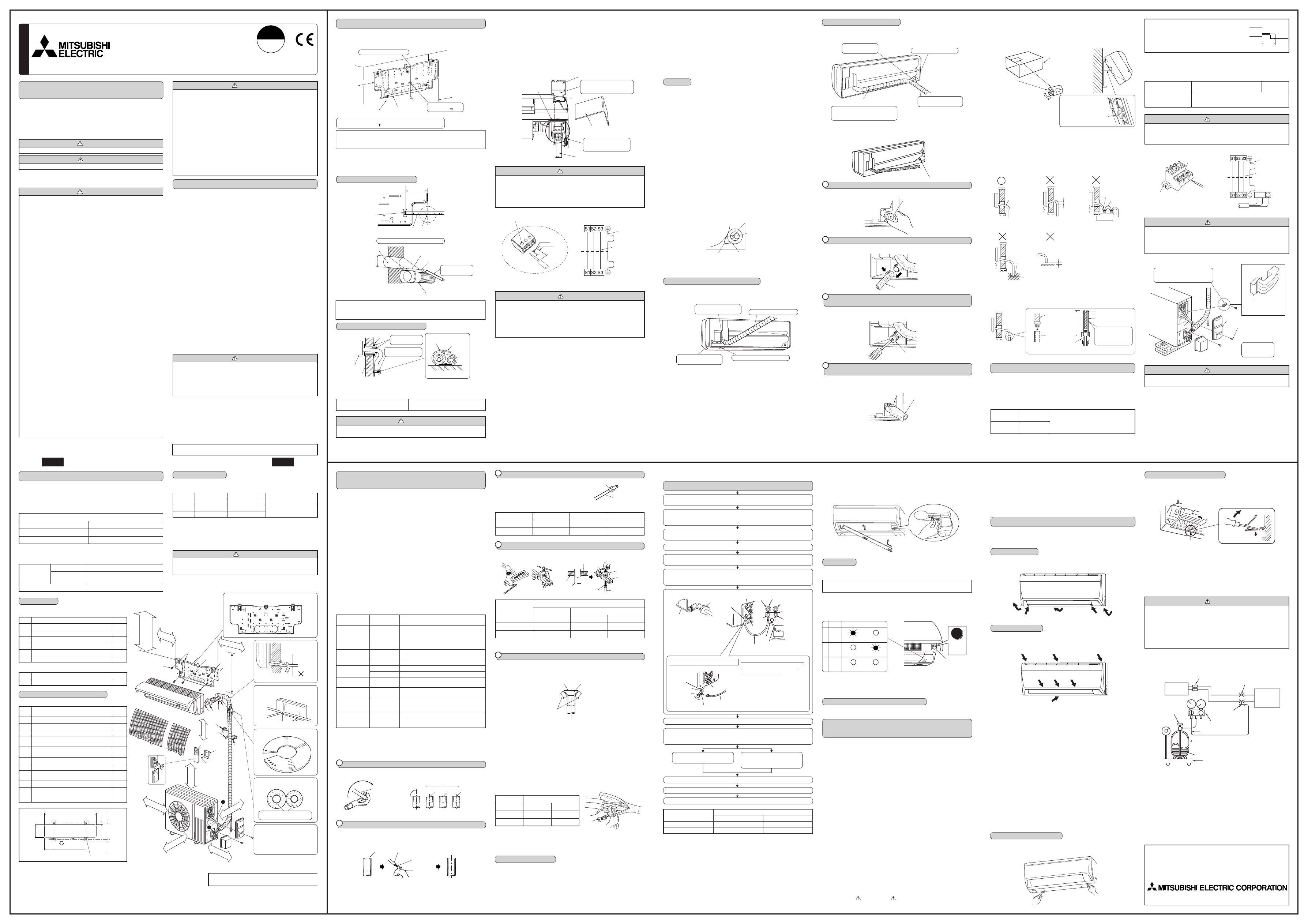
INSTALLATION MANUAL
6-3 PIPE CONNECTION
Note:
Fasten a fl are nut with a torque wrench as specifi ed in the table below.
When fastened too tight, a fl are nut may broken after a long period and cause a leakage
of refrigerant.
1 Indoor unit connection
Connect both liquid and gas pipings to indoor unit.
•
Apply a thin coat of refrigeration oil J on the seat surface of pipe.
•
For connection fi rst align the center, then tighten the fi rst 3 to 4 turns of fl are nut.
•
Use tightening torque table below as a guideline for indoor unit side union joint
section, and tighten using two wrenches. Excessive tightening damages the fl are
section.
HFC
utilized
R410A
*Close
*Open
Hexagonal wrench
Stop valve
*4 to 5 turns
Stop valve
(or the vacuum
pump with
the function
to prevent the
back fl ow)
Gauge manifold
valve (for R410A)
Pressure gauge
(for R410A)
Compound pressure
gauge (for R410A)
-0.101MPa
(-760 mmHg)
Handle
Low
Handle High
Window
Charge hose
(for R410A)
Vacuum
pump
Adapter for
preventing the
back fl ow
Charge hose
(for R410A)
Service port
Stop
valve
6. INDOOR/OUTDOOR UNIT CONNECTION
FINISHING AND TEST RUN
INSTALLATION INFORMATION FOR THE AIR
CONDITIONER WITH R410A REFRIGERANT
•
This room air conditioner adopts an HFC refrigerant (R410A) which will never destroy
the ozone layer.
•
Pay particular attention to the following points, though the basic installation
procedure is same as that for R22 air conditioners.
1 As R410A has a working pressure approx. 1.6 times as high as that of R22, some
special tools and piping parts / materials are required. (Refer to the table below.)
2 Take suffi cient care not to allow water and other contaminations to enter the
R410A refrigerant during storage and installation, since it is more susceptible to
contaminations than R22.
3 For refrigerant piping, use clean, pressure-proof parts / materials specifi cally
designed for R410A.
4 Composition change may occur in R410A since it is a mixed refrigerant. When
charging, charge liquid refrigerant to prevent composition change.
6-1 Tools dedicated for the air conditioner with R410A
refrigerant
The following tools are required for R410A refrigerant. Some R22 tools can be
substituted for R410A tools.
The diameter of the service port on the stop valve in outdoor unit has been changed to
prevent any other refrigerant being charged into the unit. (Cap size has been changed
from 7/16 UNF with 20 threads to 1/2 UNF with 20 threads.)
R410A tools
Can R22 tools
be used?
Description
Gauge manifold
No
R410A has high pressures beyond the
measurement range of existing gauges. Port
diameters have been changed to prevent any
other refrigerant from being charged into the
unit.
Charge hose
No
Hose material and cap size have been changed
to improve the pressure resistance.
Gas leak detector
No
Dedicated for HFC refrigerant.
Torque wrench
Yes
1/4
No
1/2
Flare tool
Yes
Clamp bar hole has been enlarged to reinforce
the spring strength in the tool.
Flare gauge
New
Provided for fl aring work (to be used with R22
fl are tool).
Vacuum pump
adaptor
New
Provided to prevent the back fl ow of oil. This
adapter enables you to use existing vacuum
pumps.
Electronic scale
for refrigerant
charging
New
It is diffi cult to measure R410A with a charging
cylinder because the refrigerant bubbles due to
high pressure and high-speed vaporization.
No: Not substitutable for R410A Yes: Substitutable for R410A
6-2 FLARING WORK
•
Main cause of gas leakage is defect in fl aring work.
Carry out correct fl aring work in the following procedure.
Copper pipe
Good
No good
Tilted
Uneven
Burred
Burr
Copper pipe
Spare
reamer
Pipe
cutter
Flare nut
Copper pipe
Smooth all around
Even length
all around
Inside is shining without any scratches.
90
°
When installing an MXZ series outdoor
unit, refer to the MXZ type manual for
outdoor unit set up.
Be careful the
drain hose is not
raised.
Separate the 2 connecting pipes and
apply insulation individually.
Decide the installation position using mark on the installation
plate indicating the indoor unit size as reference.
When the piping is to be attached to
a wall containing metals (tin plated)
or metal netting, use a chemically
treated wooden piece 20 mm or
thicker between the wall and the piping
or wrap 7 to 8 turns of insulation vinyl
tape around the piping.
Lock the catch.
Front
Piping can be directed towards rear,
right, downward, left or left-rear
directions.
Rear side
Right
Rear
Downward
Left-rear
Left
Units should be installed by licensed contractor according
to local code requirement.
Wall hole
sleeve C
Indoor unit
Wall hole cover D
Seal the wall hole
gap with putty H.
Fix the pipe to wall with
pipe fi xing band E.
Cut off the
extra length.
Pipe fi xing
band E
Fixing screw F
You can connect indoor/outdoor lead wire without removing the front panel.
1 Remove the corner box.
2 Remove the VA clamp.
3 Process the end of the earth wire and connect the wire to the earth terminal of the
electrical parts box.
4 Process the end of the indoor/outdoor unit connecting wire and fi x the wire to the
terminal block.
5 Secure the indoor/outdoor unit connecting wire and the earth wire with the VA
clamp.
6 Reinstall the corner box.
Indoor
terminal block
Fixing
screw
Securely push the wire into
the terminal block until no
part of its core is appeared.
Indoor/outdoor unit connecting wire A
VA clamp
Never fail to hook the right claw
on the VA clamp to secure indoor/
outdoor unit connecting wire A.
15 mm
25 mm
Indoor terminal block
Indoor/outdoor unit
connecting wire A
4-core 1.0 mm
2
Outdoor terminal block
<Connection details>
Loosen terminal screw.
Lead wire
Terminal
block
4-4 AUTO RESTART FUNCTION
•
These models are equipped with an auto restart function. If you do not want to use
this function, please consult the service representative because the setting of the unit
needs to be changed.
•
When the indoor unit is controlled with the remote controller, the operation mode, the
set temperature, and the fan speed are memorized by the indoor electronic control
P.C. board. The auto restart function sets to work the moment the power has restored
after power failure, then, the unit will restart automatically. If the unit is operated in
“AUTO” mode before power failure, the operation mode (COOL, DRY or HEAT) is
not stored in the memory. When the main power is turned on, the unit decides the
operation mode by the initial room temperature at restart and starts operation again.
Operation
1 If the main power has been cut, the operation settings remain.
2 When three minutes have passed after power was restored, the unit will restart
automatically according to the memory.
Notes:
• The operation settings are memorized when 10 seconds have passed after the
remote controller was operated.
• If the main power is turned off or a power failure occurs while AUTO START/STOP
timer is active, the timer setting is cancelled. As these models are equipped with an
auto restart function, the air conditioner starts operating with timer cancelled at the
same time that power is restored.
• If the unit has been off with the remote controller before power failure, the auto
restart function does not work as the power button of the remote controller is off.
• To prevent breaker off due to the rush of starting current, systematize other home
appliances not to turn on at the same time.
4-5 PIPE FORMING
•
Place the drain hose below the refrigerant piping.
•
Make sure that the drain hose is not heaved or snaked.
•
Do not pull the hose to apply the tape.
•
When the drain hose passes the room, be sure to wrap insulation material
(obtainable at a store) around it.
•
Wrap the felt tape 7 around the pipe and the drain hose, then put the pipe in the
back space of the indoor unit.
Drain hose
Drain cap
Cut off in case of left piping.
Felt tape 7
Firmly apply felt tape 7 from the end.
(Felt tape 7 overlap width should be 1/3
the tape width.)
Be careful drain
hose is not heaved.
Use a bandage stopper at
the end of felt tape 7.
Drain cap
Drain cap
EMERGENCY
OPERATION switch
(E.O. SW)
Mode Operation Indicator lamp
1 COOL
(Light)
(Off)
2 HEAT
(Off)
(Light)
3 STOP
(Off)
(Off)
6-4 PURGING PROCEDURES·LEAK TEST
5. OUTDOOR UNIT INSTALLATION
INDOOR/OUTDOOR UNIT CONNECTING WIRE
CONNECTION AND OUTDOOR POWER SUPPLY CORD
CONNECTION
•
Connect the indoor/outdoor unit connecting wire A from the indoor unit correctly
on the terminal block.
•
For future servicing, give extra length to connecting wire.
Rated Voltage Breaker capacity
Connect to the supply terminals and leave a
contact separation of at least 3 mm at each pole
to disconnect the source power pole. (When the
power switch is shut off, it must disconnect all
poles.)
230 V
20 A
INDOOR UNIT INSTALLATION
•
Insert the drain hose into the wall hole sleeve C, and hook the upper part of
indoor unit on the installation plate 1. Then, move the unit to the very edge of the
left side for putting the piping easily in the back space of the indoor unit. After that,
cut a part of packing material, then roll it as shown below and use it as a spacer to
hook on the back rib and lift the indoor unit.
Securely attach the
spacer assembly
in the concave part
of the rib, taking
care its direction is
correct as shown in
the fi gure right.
Spacer
Loosen terminal screw.
Terminal block
Lead wire
<Connection details>
Earth wire
(green/yellow)
Power supply cord K 3-core 2.5 mm
2
Indoor terminal block
Outdoor terminal block
Indoor/outdoor unit
connecting wire A
4-core 1.0 mm
2
L N
Earth wire
(green/yellow)
Note:
When operating the air conditioner in low outside temperature,
be sure to follow the instructions described below.
•
Never install the outdoor unit in a place where its air inlet/outlet
side may be exposed directly to wind.
•
To prevent exposure to wind, install the outdoor unit with its
air inlet side facing the wall.
•
To prevent exposure to wind, it is recommended to install a
baffl e board on the air outlet side of the outdoor unit.
Union
Indoor unit
Liquid pipe
Gas pipe
Stop valve
Service port
Gauge manifold valve
(for R410A)
Charge hose (for R410A)
Outdoor unit
Refrigerant gas
cylinder operating
valve
Refrigerant gas cylinder for
R410A with siphon
Refrigerant (liquid)
Electronic scale for refriger-
ant charging
A
Die
Copper pipe
Flare nut
Die
Copper pipe
York
Flaring tool
Wing nut type
Clutch type
WARNING
■ Do not install the unit by yourself (customer).
Incomplete installation could cause injury due to fi re, electric shock, the unit
falling or leakage of water. Consult the dealer from whom you purchased the
unit or special installer.
■ Install the unit securely in a place which can bear the weight of the
unit.
When installed in an insuffi cient strong place, the unit could fall causing
injury.
■ Use the specifi ed wires to connect the indoor and outdoor units securely
and attach the wires fi rmly to the terminal block connecting sections so
the stress of the wires is not applied to the sections.
Incomplete connecting and fi xing could cause fi re.
■ Do not use intermediate connection of the power cord or the extension
cord and do not connect many devices to one AC outlet.
It could cause a fi re or an electric shock due to defective contact, defective
insulation, exceeding the permissible current, etc.
■ Check that the refrigerant gas do not leak after installation has
completed.
If refrigerant gas leaks indoors, and comes into contact with the fi re of a fan
heater, space heater, stove, etc., harmful substances will be generated.
■ Perform the installation securely referring to the installation manual.
Incomplete installation could cause a personal injury due to fi re, electric shock,
the unit falling or leakage of water.
■ Perform electrical work according to the installation manual and be sure
to use an exclusive circuit.
If the capacity of the power circuit is insuffi cient or there is incomplete electrical
work, it could result in a fi re or an electric shock.
■ Attach the electrical cover to the indoor unit and the service panel to the
outdoor unit securely.
If the electrical cover in the indoor unit and/or the service panel in the outdoor
unit are not attached securely, it could result in a fi re or an electric shock due
to dust, water, etc.
■ Be sure to use the part provided or specifi ed parts for the installation
work.
The use of defective parts could cause an injury or leakage of water due to a
fi re, an electric shock, the unit falling, etc.
■ Be sure to cut off the main power in case of setting up the indoor electronic
control P.C. board or wiring works.
It could cause an electric shock.
■ The appliance shall be installed in accordance with national wiring
regulations.
■ When installing or relocating the unit, make sure that no substance other
than the specifi ed refrigerant (R410A) enters the refrigerant circuit.
Any presence of foreign substance such as air can cause abnormal pressure
rise or an explosion.
1. THE FOLLOWING SHOULD ALWAYS BE
OBSERVED FOR SAFETY
•
Please provide an exclusive circuit for the air conditioner and do not connect other
electrical appliances to it.
•
Be sure to read “THE FOLLOWING SHOULD ALWAYS BE OBSERVED FOR
SAFETY” before installing the air conditioner.
•
Be sure to observe the cautions specifi ed here as they include important items
related to safety.
•
The indications and meanings are as follows.
WARNING
Could lead to death, serious injury, etc.
CAUTION
Could lead to serious injury in particular environments when operated incorrectly.
•
After reading this manual, be sure to keep it together with the OPERATING
INSTRUCTIONS in a handy place on the customer’s site.
CAUTION
■ Earth the unit.
Do not connect the earth to a gas pipe, water pipe, lightning rod or telephone
earth. Defective earthing could cause an electric shock.
■ Do not install the unit in a place where an infl ammable gas leaks.
If gas leak and accumulate in the area surrounding the unit, it could cause an
explosion.
■ Install an earth leakage breaker depending on the installation place (Where
it is humid).
If an earth leakage breaker is not installed, it could cause an electric shock.
■ Perform the drainage/piping work securely according to the installation
manual.
If there is a defect in the drainage/piping work, water could drop from the unit
and household goods could be wet and damaged.
■ Fasten a fl are nut with a torque wrench as specifi ed in this manual.
When fastened too tight, a fl are nut may broken after a long period and cause
a leakage of refrigerant.
CAUTION
Avoid the following places for installation where air conditioner trouble is liable to
occur.
•
Where fl ammable gas could leak.
•
Where there is much machine oil.
•
Salty places such as the seaside.
•
Where sulfi de gas is generated such as a hot spring.
•
Where there is high-frequency or wireless equipment.
In rooms where inverter type fl uorescent lamps are used, the signal from the wireless
remote controller may not be received.
2-3 WIRELESS REMOTE CONTROLLER MOUNTING
•
Place of mounting
• Where it is easy to operate and easily visible.
• Where children can not touch.
•
Mounting
Select a position about 1.2 m above the fl oor, check that signals from the remote
controller are surely received by the indoor unit from that position (‘beep’ or ‘beep-
beep’ receiving tone sounds). After that, attach remote controller holder 3 to a
pillar or wall and set the wireless remote controller 6.
2. SELECTING THE INSTALLATION LOCATION
2-1 INDOOR UNIT
•
Where airfl ow is not blocked.
•
Where cool air spreads over the entire room.
•
Maximum refrigerant piping length between indoor unit and outdoor unit is 30 m and
the difference of height of both units is 15 m.
•
Rigid wall without vibration.
•
Where it is not exposed to direct sunshine.
•
Where easily drained.
•
At a distance 1 m or more away from your TV and radio. Operation of the air conditioner
may interfere with radio or TV reception in areas where reception is weak. An amplifi er
may be required for the affected device.
•
In a place as far away as possible from fl uorescent and incandescent lights (so the
infrared remote control can operate the air conditioner normally).
•
Where the air fi lter can be removed and replaced easily.
2-2 OUTDOOR UNIT
•
Where it is not exposed to strong wind.
•
Where airfl ow is good and dustless.
•
Where it is not exposed to rain and direct sunshine.
•
Where neighbours are not annoyed by operation sound or hot air.
•
Where rigid wall or support is available to prevent the increase of operation sound
or vibration.
•
Where there is no risk of combustible gas leakage.
•
When installing the unit at a high level, be sure to fi x the unit legs.
•
Where it is at least 3 m away from the antenna of TV set or radio. Operation of the
air conditioner may interfere with radio or TV reception in areas where reception is
weak. An amplifi er may be required for the affected device.
•
Install the unit horizontally.
•
Please install it in an area not affected by snowfall or blowing snow. In areas with
heavy snow, please install a canopy, a pedestal and/or some baffl e boards.
Note:
It is advisable to make a piping loop near outdoor unit so as to reduce vibration
transmitted from there.
4. INDOOR UNIT INSTALLATION
4-1 FIXING OF INSTALLATION PLATE
•
Find a structural material (such as a stud) in the wall and fi x installation plate
horizontally.
75 mm or more
(off the wall)
Plumb
75 mm or more
(off the wall
)
Installation
plate 1
Align the plumb line
with the mark
.
Bind the line to the center hole.
66 mm or more
115 mm or more for left
and left back piping (using
spacer)
To prevent the installation plate from vibrating, be sure to fi x the holes
as indicated by the arrows .
Installation plate fi xing
screw 2 4 × 25 mm
Insert the scale.
Installation plate 1
Hole of dia.
65 mm
Repeat the same procedure for the left hole.
100 mm
Wall hole
65 mm dia.
(Indoor side)
(Wall hole cross section)
Wall thickness
One scale
Wall hole sleeve C
Cut with 1 extra
scale length.
Be sure to use wall hole sleeve C to prevent the outdoor connecting wires from
contacting with metal part in the wall and to prevent damage by rat in case the wall
is hollow.
Wall hole sealing and fi xing pipe to wall
Positioning of the holes on the wall
4-2 WALL HOLE DRILLING
1 Determine the wall hole position.
2 Drill a 65 mm hole so that outside can be lower than inside.
3 Insert the wall hole sleeve C.
When bolts recessed in the concrete wall are to be utilized, secure the installation plate
1 using 11 × 20 · 11 × 26 oval hole (450 mm pitch).
If the recessed bolt is too long, change it for a shorter one available in the market.
4-3 INDOOR/OUTDOOR UNIT CONNECTING WIRE CONNECTION
•
Use special room air conditioning circuit.
Indoor/outdoor unit connecting wire
Specifi cation
Cable 4-core 1.0 mm
2
, in conformity
with Design 245 IEC 57.
WARNING
Never cut the indoor and outdoor unit connecting wire and connect it to other
wires. It may cause a fi re.
WARNING
●
Use the indoor/outdoor unit connecting wire that meets the Standards to connect
the indoor and outdoor units and fi x the wire to the terminal block securely so
that no external force is conveyed to the connecting section of the terminal block.
Incomplete connection or fi xing of the wire could result in a fi re.
●
Attach the VA clamp securely. If it is attached incorrectly, it could result in a fi re
or an electric shock due to dust, water, etc.
CAUTION
●
Be careful not to make mis-wiring.
●
Firmly tighten the terminal screws to prevent them from loosening.
●
After tightening, pull the wires lightly to confi rm that they do not move.
●
If the connecting wire is incorrectly connected to the terminal block, the unit does
not operate normally.
●
If an earth is incorrect, it may cause an electric shock.
●
Make earth wire a little longer than the others. (more than 55 mm)
Corner box
Liquid pipe
Gas pipe
Felt tape 7
Indoor/outdoor unit
connecting wire A
Be careful drain hose is not
heaved.
Cut off in case of right piping.
Cut off in case of downward piping.
Firmly apply piping tape G
from the end.
Indoor unit packing
cardboard
Cut the cardboard using
scissors or cutters.
Roll the cutting
piece as shown
in the right.
Fix the end with
masking tape or
tape affi xed on
the lower side
of indoor unit.
Downward
slope
Water
leakage
Do not raise.
Water
leakage
Accumulated
drain water
Waving
Water
leakage
Tip of drain
hose dipped
in water.
Ditch
Air
Soft hose
I.D. 15 mm
Drain hose
Less than
50 mm gap
3 Put the drain cap into the section to which the drain hose is to be
attached at the rear of the indoor unit.
Insert the screwdriver, etc. (not sharp-edged tool) into the hole at the end of the cap
and insert the cap fully into the drain pan.
2 Pull out the drain hose at the rear left of the indoor unit.
Hold the claw marked by the arrow and pull out the drain hose forward.
1 Pull out the drain cap at the rear right of the indoor unit.
Hold the convex section at the end and pull the drain cap.
REATTACHING DRAIN HOSE
Be sure to reattach the drain hose and the drain cap in case of left or left-rear piping.
Otherwise, it could cause drops of water to drip down from the drain hose.
4 Insert the drain hose into the section to which the drain hose is to
be attached at the rear right of the indoor unit.
Insert the drain hose fully into the drain pan. Check if the hose is hooked securely to
the projection of its inserting part at the drain pan.
Drain hose
•
If the drain hose provided with the indoor unit is too short, connect it with drain
hose I that should be provided at your site. (Fig. 6)
•
When connecting the drain hose to the hard vinyl chloride pipe, be sure to insert it
securely into the pipe. (Fig. 7)
(Fig. 4)
(Fig. 5)
(Fig. 1)
(Fig. 2)
(Fig. 3)
•
Connect the refrigerant piping with the extension pipe B.
•
Thrust the lower part of the indoor unit into the installation plate 1.
4-6 DRAIN PIPING
•
If the extension drain hose has to pass through a room, be sure to wrap it with
commercially sold insulation.
•
The drain hose should point downward for easy drain fl ow. (Fig. 1)
Do not make drain piping as shown in Fig. 2 to 5.
WARNING
Be sure to attach the service panel of the outdoor unit securely. If it is not attached
correctly, it could result in a fi re or an electric shock due to dust, water, etc.
CAUTION
●
Use care not to make mis-wiring.
●
Firmly tighten the terminal screws to prevent them from loosening.
●
After tightening, pull the wires lightly to confi rm that they do not move.
●
If the connecting wire is incorrectly connected to the terminal block, the unit
does not operate normally.
WARNING
●
A means for disconnection of the supply with an isolation switch, or similar
device, in all active conductors shall be incorporated in the fi xed wiring.
●
Never cut the power cord and connect it to other wires.
It may cause a fi re.
3. INSTALLATION DIAGRAM & ACCESSORIES
FLARED CONNECTIONS
•
This unit has fl ared connections on both indoor and outdoor sides.
•
Remove the outdoor units valve cover, then connect the pipe.
•
Refrigerant pipes are used to connect the indoor and outdoor units.
•
Be careful not to crush or bend the pipe in pipe bending.
Limits
Pipe length
30 m max.
Height difference
15 m max.
No. of bends
10 max.
•
Refrigerant adjustment ... If pipe length exceeds 7 m, additional refrigerant
(R410A) charge is required.
(The outdoor unit is charged with refrigerant for pipe length up to 7 m.)
Pipe length
Up to 7 m
No additional charge is required.
Exceeding 7 m
Additional charge is required.
(Refer to the table below.)
Refrigerant to be added
20 g/m × (refrigerant piping length (m) -7)
ACCESSORIES
Check the following parts before installation.
<Indoor unit>
1
Installation plate
1
2
Installation plate fi xing screw 4 × 25 mm
5
3
Remote controller holder
1
4
Fixing screw for 3 3.5 × 16 mm (Black)
2
5
Battery (AAA) for remote controller
2
6
Wireless remote controller
1
7
Felt tape (Used for left or left-rear piping)
1
<Outdoor unit>
8
Drain socket
1
9
Drain cap ø33
2
PART TO BE PROVIDED AT YOUR SITE
Optional extension pipe
A
Indoor/outdoor unit connecting wire
(4-core 1.0 mm
2
)
1
B
Extension pipe
1
C
Wall hole sleeve
1
D
Wall hole cover
1
E
Pipe fi xing band (The quantity depends
on the pipe length.)
2 to 5
F
Fixing screw for E 4 × 20 mm (The
quantity depends on the pipe length.)
2 to 5
G
Piping tape
1
H
Putty
1
I
Drain hose (or soft PVC. hose, 15 mm inner
dia.)
1 or 2
J
Refrigeration oil
1
K
Power supply cord (See the table in 5-1
INDOOR/OUTDOOR UNIT CONECTING
WIRE CONNECTION for the cord size.)
1
Air outlet
350
mm or more
5
4
3
6
E
F
G
D
H
C
7
1
2
75 mm
or more
66 mm or more
11
5 mm or more for left and left
back piping (using spacer)
75 mm or more
PIPING PREPARATION
1 Specifi cations
Use the refrigerant pipes that meet the following specifi cations.
Pipe
Outside diameter
Insulation thickness
Insulation material
mm
mm
For liquid
6.35
8
Heat resisting foam plastic
0.045 specifi c gravity
For gas
12.7
8
• Use a copper pipe or a copper-alloy seamless pipe with a thickness of 0.8 mm.
Never use any pipe with a thickness less than 0.8 mm, as the pressure resistance
is insuffi cient.
2 Ensure that the 2 refrigerant pipes are insulated to prevent condensation.
3 Refrigerant pipe bending radius must be 100 mm or more.
CAUTION
Be sure to use the insulation of specifi ed thickness. Excessive thickness may
cause incorrect installation of the indoor unit and lack of thickness may cause dew
drippage.
5 Check
• Compare
the
fl ared work with fi gure below.
• If
fl are is noted to be defective, cut off the fl ared section and do fl aring work again.
• Firmly hold copper pipe in a die in the dimension shown in the table above.
4 Flaring work
• Carry
out
fl aring work using fl aring tool as shown below.
3 Putting nut on
• Remove
fl are nuts attached to indoor and outdoor
units, then put them on pipe having completed
burr removal.
(not possible to put them on after fl aring work)
• Flare nut for R410A pipe differs from R22 pipe.
Refer to the following table for detail.
2 Burrs removal
• Completely remove all burrs from the cut cross section of pipe.
• Put the end of the copper pipe to downward direction as you remove burrs in order to
avoid to let burrs drop in the piping.
1 Pipe cutting
• Cut the copper pipe correctly with pipe cutter.
mm
Inch
R410A
R22
ø6.35
1/4
17
17
ø12.7
1/2
26
24
Outside diameter
A (mm)
Flare tool for R410A
clutch type
Conventional fl are tool
Clutch type
Wing nut type
ø6.35 mm
0 to 0.5
1.0 to 1.5
1.5 to 2.0
ø12.7 mm
0 to 0.5
1.0 to 1.5
2.0 to 2.5
INSULATION AND TAPING
1 Cover piping joints with pipe cover.
2 For outdoor unit side, surely insulate every piping including valves.
3 Using piping tape G, apply taping starting from the entry of outdoor unit.
•
Stop the end of piping tape G with tape (with adhesive agent attached).
•
When piping have to be arranged through above ceiling, closet or where the
temperature and humidity are high, wind additional commercially sold insulation for
prevention of condensation.
2 Outdoor unit connection
Connect pipes to stop valve pipe joint of the outdoor unit in the same manner applied for
indoor unit.
•
For tightening, use a torque wrench or spanner and use the same tightening torque
applied for indoor unit.
Pipe diameter
Tightening torque
mm
N·m
kgf·cm
ø6.35
13.7 to 17.7
140 to 180
ø12.7
49.0 to 56.4
500 to 575
Tightening torque
N·m
kgf·cm
Cap for service port
13.7 to 17.7
140 to 180
Cap for stop valve
19.6 to 29.4
200 to 300
6-5 TEST RUN
•
Before performing the test run, recheck for any wrong wiring.
Wrong wiring prevents normal operation or results in blown fuse disabling operation.
•
The test run can be started by pressing EMERGENCY OPERATION switch. When
the EMERGENCY OPERATION switch is once pressed, the unit will start the test run
(continuous operation) for 30 minutes.
A thermostat does not work during this time. After 30 minutes the unit will start the
EMERGENCY OPERATION at a fi xed temperature setting of 24 °C in COOL MODE.
•
Perform test run in the following procedure.
Click
Horizontal vane
7-4 GAS CHARGE
1 Connect gas cylinder to the service port of stop valve (3-way).
2 Execute air purge of the pipe (or hose) coming from refrigerant gas cylinder.
3 Replenish specifi ed amount of the refrigerant, while operating the air conditioner
for cooling.
Note:
In case of adding refrigerant, comply with the quantity specifi ed for the refrigerating
cycle.
CAUTION
●
Do not discharge the refrigerant into the atmosphere.
Take care not to discharge refrigerant into the atmosphere during installation,
reinstallation, or repairs to the refrigerant circuit.
●
When charging the refrigerant system with additional refrigerant, be sure
to use liquid refrigerant.
Adding gas refrigerant may change the composition of the refrigerant in the
system and affect normal operation of the air conditioner. Also, charge the
system slowly, otherwise the compressor will be locked.
To maintain the high pressure of the gas cylinder, warm the gas cylinder with warm
water (under 40°C) during cold season. But never use naked fi re or steam.
Square hole
If the above method cannot be used
Remove the panel and insert hexagonal wrenches into the square holes on the left
and right as shown in the fi gure below, then push them up; the bottom of the indoor
unit is lowered and the hooks are released.
7-2 PUMPING DOWN
When relocating or disposing of the air conditioner, pump down the system following
the procedure below so that no refrigerant is released into the atmosphere.
1 Connect the gauge manifold valve to the service port of the stop valve on the gas
pipe side of the outdoor unit.
2 Fully close the stop valve on the liquid pipe side of the outdoor unit.
3 Close the stop valve on the gas pipe side of the outdoor unit almost completely
so that it can be easily closed fully when the pressure gauge shows –0.101 MPa
[Gauge] (0 kgf/cm
2
).
4 Start the EMERGENCY COOLING OPERATION.
To start the EMERGENCY OPERATION in COOL MODE, disconnect the power
supply plug and/or turn off the breaker. After 15 seconds, connect the power
supply plug and/or turn on the breaker, and then press the EMERGENCY
OPERATION switch once. (The EMERGENCY COOLING OPERATION can be
performed continuously for up to 30 minutes.)
5 Fully close the stop valve on the gas pipe side of the outdoor unit when the
pressure gauge shows 0.05 to 0 MPa [Gauge] (approx. 0.5 to 0 kgf/cm
2
).
6 Stop the EMERGENCY COOLING OPERATION.
Press the EMERGENCY OPERATION switch twice to stop the operation.
7-3 REMOVING THE INDOOR UNIT
Remove the bottom of the indoor unit from the installation plate.
When releasing the corner part
Release both left and right bottom corner part of indoor unit and pull it downward and
forward as below to release the hooks.
7. FOR MOVEMENT AND MAINTENANCE
7-1 HOW TO REMOVE AND INSTALL THE PANEL
ASSEMBLY
Removal procedure
1 Remove the 2 screws which fi x the panel assembly.
2 Remove the panel assembly. Be sure to remove its bottom end fi rst.
Installation procedure
Install the panel assembly following the removal procedure 1 and 2 (described
above) in reverse. After having attached the panel assembly, be sure to press the
positions as indicated by the arrows in order to attach the assembly completely to the
unit.
2
2
2
1
1
Checking the remote (infrared) signal reception
Press the ON/OFF button on the remote controller and check that an electronic sound is
heard from the indoor unit. Press the ON/OFF button again to turn the air conditioner off.
If the indoor unit is operated with the remote controller, both the test
run and the emergency operation are released by commands from
the remote controller.
•
Once the compressor stops, the restart preventive device operates so the compressor
will not operate for three minutes to protect the air conditioner.
6-6 CHECKING AFTER INSTALLATION
After fi nishing the installation, check the following items and mark the o next to each
item.
o Is the specifi ed power supply voltage used?
o
Is the power line equipped with the circuit breaker?
o
Have the ends of the indoor/outdoor connecting wire been properly inserted into the
terminal
blocks?
o
Has the indoor/outdoor connecting wire been secured fi rmly?
o
Are the power supply cord and indoor/outdoor connecting wire connected directly to
the units (no intermediate connections)?
o
Is the earth wire longer than the other wires so that it will not become disconnected
when tension is applied?
o
Is the earth wire connected properly?
o
Are the pipes designed for use with R410A or do they have the specifi ed thickness?
o
Has the leak test been carried out for the pipe connections?
o
Has air purging been carried out?
o
Are the stop valves open fully?
o
Is the drain hose properly installed?
o
Has water been poured through the drain hose to confi rm proper drainage?
o
Are the pipes at the rear of the unit bundled with felt tape (for left and left-rear piping
only)?
o
Can the installation location bear the weight of the unit and not amplify its vibration or
noise?
o
Is the area under the unit free of objects that block the air outlet?
o
Are the vertical and horizontal vanes closed securely?
o
Is the front panel installed securely?
o
Has the test run been carried out?
o
Has the drain work been performed properly and are there no bubbling sounds?
o
Have all of the
WARNING and
CAUTION items in “1. THE FOLLOWING
SHOULD ALWAYS BE OBSERVED FOR SAFETY” been checked?
PROCEDURE
•
Press the EMERGENCY OPERATION switch.
1 Press it once, and after test run for 30 minutes the EMERGENCY COOL MODE starts.
If the left side lamp of the operation indicator blinks every 0.5 seconds, inspect
the indoor/outdoor unit connecting wire A for mis-wiring.
2 Press it once more, and the EMERGENCY HEAT MODE starts.
3 Press it once more, and the operation stops.
(The operation mode changes in order of 1 ~ 3 every time the EMERGENCY
OPERATION switch is pressed.)
Align the scale with the line.
8 mm thickness thermal insulation
plastic
7 mm or more
•
In starting the heating operation, indoor unit fan may not operate to prevent blowing
cool air. Please wait for a few minutes until the temperature of heat exchanger rises
and warm air blows out.
Push
Lower
Power supply cord
Specifi cation
3-core 2.5 mm
2
or more, in conformity
with Design 245 IEC 57.
10 m or less
Indoor and Outdoor
connecting wire
Specifi cation
Cable 4-core 1.0 mm
2
, in conformity
with Design 245 IEC 57.
Drain hose
70 cm
or more
Hard vinyl
chloride pipe
I.D. 30 mm
Be sure to insert the
drian hose securely
into the pipe.
Different
diameter joint
(Fig. 6)
(Fig. 7)
SPLIT-TYPE AIR CONDITIONERS
Models
MSZ-GB50VA
MUZ-GB50VA Series
[FLARE CONNECTION TYPE]
100
mm or more
500 mm
or more
100
mm or m
ore
500 mm or more
Service port
Close
Open
Charge hose
Control Valve
A
Body
Precautions when using the control valve
When attaching the control valve to the
service port, valve core may deform or
loosen if excess pressure is applied.
This may cause gas leak.
When attaching the control valve to the
service port, make sure that the valve core
is in closed position, and then tighten part A.
Do not tighten part A or turn the body when
valve core is in open position.
6-7 EXPLANATION TO THE CUSTOMER
•
Using the OPERATING INSTRUCTIONS, explain the following to the customer, how to
control temperature, how to remove the air fi lters, how to remove or put the remote
controller in the remote controller holder, how to clean, precautions for operation,
etc.
•
Recommend the customer to read the OPERATING INSTRUCTIONS carefully.
Note:
Insert the power supply plug into the power outlet and/or turn on the breaker.
Check that all LED lamps are not lit.
If they are blinking, the horizontal vane is not installed correctly.
In this case, disconnect the power supply plug and/or turn off the breaker, and then
reinstall the horizontal vane. (See the OPERATING INSTRUCTIONS.)
●
Peel off both ends of connecting wire (extension wire).
When too long, or connected by cutting off the middle,
peel off power supply wire to the size as shown in the
right.
●
Be careful not to contact connecting wire with piping.
●
Make earth wire a little longer than the others.
(more than 35 mm)
35 mm
15 mm
•
For the indoor/outdoor unit connecting wires, be sure to use the ones in compliance
with the standards.
•
Be sure to push the core until it is hidden and pull each cable to make sure that
it is not pulled up incomplete insertion may cause a risk of burning the terminal
blocks.
Be sure to fi x the indoor/outdoor unit
connecting wire A and power supply
cord K using this cord clamp.
Be sure to put the left
portion into the square
hole of the service panel.
Service panel
Fixing screws
Remove two fi xing
screws to open the
service panel.
Valve cover
Wyszukiwarka
Podobne podstrony:
IM PKFY P63 100VFM E BG79U776H01 GB 2006
IM PUMY P100 125 140YHM BG79U713H03 2006
IM MS GA MCT SG79Y368H01 En
IM MSZ GA22 35 MUZ 25 35VA SG79Y421H01 GB Nov 2006
IM MSZ MUZ GE22 50VA JG79A103H07 GB 01 2010
IM MSZ MUZ HC25 35VA SG79Y763H07 GB 01 2010
PN EN 1991 1 2 2006 Ap1 2010
PN EN 12697 7 2006 06 30
PN EN 1993 1 1 2006
ELK p 2006 14pkt (EN)
PN EN 1993 1 8 2006 AP2 2011
PN EN 1991 1 2 2006
Hydronic 5SC 12Volt TD 07 2006 EN JE
pn en iso 14688 2 2006 www przeklej pl
Powiedz im, Fan Fiction, Dir en Gray
PN EN 1993 1 1 2006 AC 2009
PN EN 1993 1 8 2006
więcej podobnych podstron