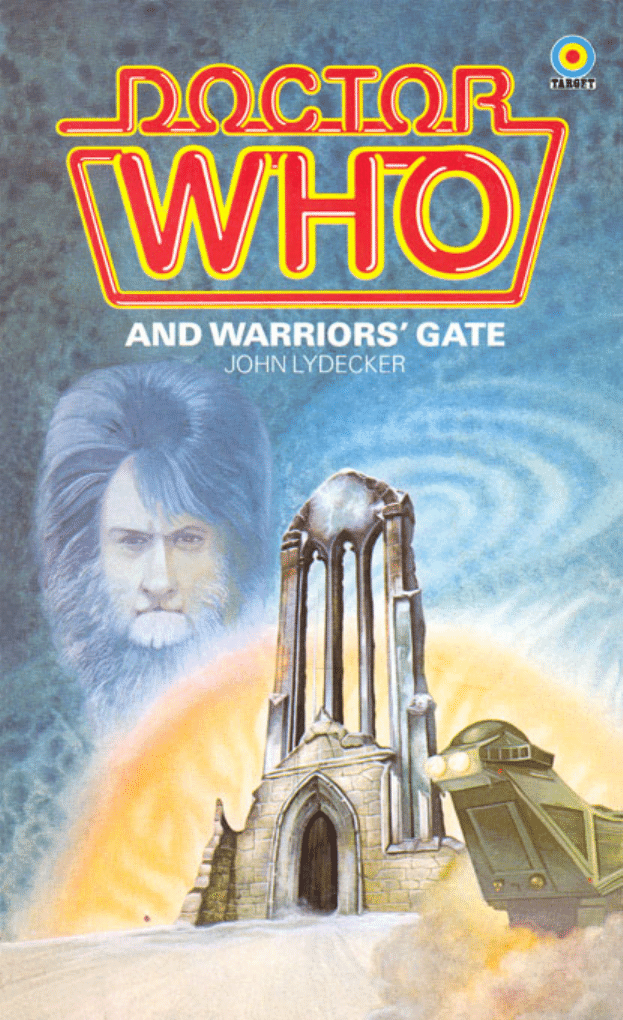

The Doctor and his companions are trapped in an E-Space
universe, struggling to find the co-ordinates which will break
the deadlock and take them back into Normal Space.
When all else fails, the Doctor suggests programming the
TARDIS on the toss of a coin. Before he realises what is
happening, this is just what Adric has done...
When the TARDIS arrives at its destination, according to the
console read-outs the craft is nowhere—and nowhere is
exactly what it looks like...
ISBN 0 426 20146 9

DOCTOR WHO
AND
WARRIOR’S GATE
Based on the BBC television serial by Steve Gallagher by
arrangement with the British Broadcasting Corporation
JOHN LYDECKER
A TARGET BOOK
published by
The Paperback Division of
W. H. Allen & Co. Ltd

A Target Book
Published in 1982
by the Paperback Division of W.H. Allen & Co. Ltd
A Howard & WyndhamCompany
44 Hill Street, London W1X 8LB
Copyright © John Lydecker 1982
‘Doctor Who’ series copyright © British Broadcasting
Corporation 1982
Printed and bound in Great Britain by
The Anchor Press Ltd, Tiptree, Essex
ISBN 0 426 20146 9
This book is sold subject to the condition that it shall not, by way
of trade or otherwise, be lent, re-sold, hired out or otherwise
circulated without the publisher’s prior consent in any form of
binding or cover other than that in which it is published and
without a similar condition including this condition being
imposed on the subsequent purchaser.

It was a mess of a planet, too big and too far out from its sun. If
it had ever had an atmosphere, it had lost it long ago. Much of
the surface showed long ridges and layers suggesting that water
may once have run in the lowlands; sharp-edged wadis cut by
storms in desert country, and wide alluvial fans where the storm
rivers had hit level ground and dumped their collected silt. Now
the water was gone, boiled away millenia before along with the
air, and there was only the endless landscape of pale yellow rock.
There was also life. The Antonine Killer was sure of it.
He handled the controls himself, freeing all of the craft’s
sensors for the groundscan. Command base was over the
horizon and temporarily out of contact, otherwise they’d be
opening up a cell for him right now as his reward for risking a
scout ship so close to a planetary surface without the protection
of electronic over-rides. He stayed low, so low that he seemed to
be racing his own shadow as he eased up and over the ridges,
and he kept the scan at full power and at its widest angle.
That would have earned more anger from command base,
but the Killer knew what he was doing. A wide angle meant a
wider energy spread, and he was covering so much ground that
a returning signal would be too weak to show. Even a raw cub
with his paws on the controls for the first time wouldn’t make
such a mistake – but then, a cub flew to please his trainers, and a
Killer, regardless of what command base might say, flew only to
please himself.
He could loop the planet until his motors failed and still
only cover an insignificant strip of its surface. Killer intuition
told him that the privateer was down there somewhere, hiding
in a deeper valley or the long shadow of a mountain, but the
chances of fixing it with a scan were small. So he spread the
beams as wide as they could go, and ignored the feedback on the
screens.

When the beam touched, the privateer would know it. The
crew would assume they’d been spotted and would try to break
away, and their panic would be a flag to the Killer; he’d slide
around under them as their engines burned to escape the
planet’s pull and he’d give them the belly shot, his favourite – a
light, carefully placed charge into the vulnerable underside of
the privateer, enough to shake the hull with the sounds of a
glancing blow or a near miss. The crew would thank their
various gods for his bad aim and put the privateer into
lightspeed before he could circle around for another try, and
those grateful prayers would be their last.
That was the beauty of the belly shot, the Killer’s specialty. It
took out the power of the lightspeed motors and made that final
jump spasmodic and self-destructive, a one-way trip to nowhere.
It had earned him the secret respect of the Antonine clan and it
kept his record clean with command base – after all, the
mandate was for search and capture, not search and destroy...
but one way or another, a Killer has to be true to his nature.
The sudden breakthrough of radio transmissions warned
him that he was no longer screened from command base by the
planet’s edge.
‘Three of their ships gone, we took them out down by the sun. Any
sign of the privateer?
’
That was the voice of the control desk. Three gone, that
meant three clean kills by the Brothers all successfully disguised
as accidents or self-destructs. He narrowed his scan to within
acceptable limits and restored the safety over-rides. He heard
the voice of the Brother who’d been quartering the massive
southern continental plain.
‘I had them, and I lost them. They could have gone lightspeed.’
‘We’d have seen them go...’

It happened so quickly, he almost missed it; a red-white
burn on the line of the horizon, a star that glowed brighter than
all the others and which moved against the pattern of the drift.
The Killer was nearest. He rolled the scout ship to follow.
‘That’s them,’ he told control. ‘They’re making a run.’
He’d have to be careful, out here within sight of command
base; he’d have to seem eager and earnest, maybe so eager that
the accuracy of his disabling charges suffered. And then when
the privateer blew a hole in the fabric of space and sucked itself
through, he’d have to slap his brow, curse himself for his poor
shooting – blast it, another one vapourised and it’s all my fault –
and allow control to placate him with a few forgiving words.
The acting could be fun, but the killing was best.
Except that he was too far off; his trademark shot needed at
least visual identification distance and the privateer would be at
lightspeed before he could get close enough. He increased the
power so that he was pushed back hard into the scout ship’s
narrow couch and the stars outside the cockpit became blurred
streaks, but he knew he still wouldn’t make it. So it would have
to be an instrument shot or nothing.
The targeting screen’s electronics compensated for the scout
ship’s movement and presented a steady view of the horizon and
the starfield beyond. The privateer was represented as a moving
cross with the changing co-ordinates shown beside it. The
Killer’s paw moved to the input panel and he typed in his
estimate of the privateer’s course. After a moment a second cross
appeared, just off-centre from the first. Good, but not good
enough; he entered a correction and the crosses lined up
exactly, staying aligned as the privateer climbed.
The scout ship’s cabin flared white as the charge was fired;
all of the transparent outer panels were supposed to turn
opaque for the split-second flash of a launch, but there was
always a lag and the Killer knew to keep his head down and his

eyes averted from any reflecting surfaces. When he looked up a
moment later, the charge was almost home.
And the crosses were starting to separate.
There was nothing he could do about it now; the energy
torpedo was running on its memory towards a spot where it had
been told it could expect the privateer to be. An uneven burn
from the privateer’s motors or an unexpected course change
could ruin an instrument shot... they had no finesse.
Before the two crosses could split completely, the torpedo
hit. Both targets faded, and an overlay on the screen gave the
computer’s estimate of his success; the privateer had shifted off-
centre, but it was an 85 per cent certainty that he’d put one into
the engines. Not bad... almost a belly shot after all.
‘Did I bring them down?’ he asked control, thinking Do I get
to claim the kill?
‘Main computer says not,’ the controller told him.
‘But I got the engines.’
‘Too late. They went lightspeed.’
It was what he’d wanted to hear. A ship going lightspeed
with its engines damaged at the critical moment was taking a
long drop with no parachute. Wherever they were heading,
they’d never arrive.
Four privateers had tried to run the blockade, all four of
them wiped out by the Antonine Killers, the Brotherhood, the
clan. The anti-slavery alliance could be fun, as long as you didn’t
take it too seriously.
WARP SYSTEMS HOLDING POWER AT 65 PER CENT
OVERLOAD SYSTEMS PRIMED AND HOLDING
MECHANICAL ESTIMATES - UNAVAILABLE
TARGET ESTIMATES - UNAVAILABLE
SUBLIGHT ORIENTATION - FIGURES UNAVAILABLE
DESTINATION CO-ORDINATES - UNAVAILABLE
FAIL-SAFE CUT-OUTS DISENGAGED IN ACCORDANCE WITH
SPECIAL EMERGENCY PROCEDURE NUMBER 2461189913

LOG REFERENCE 56/95/54; AUTHORITY RORVIK, CAPTAIN
SUPPORTING AUTHORITY PACKARD, FIRST OFFICER
SPECIAL CIRCUMSTANCES QUOTE, EXTRACTED MINADOS
WARP DRIVE GUARANTEE/SERVICE DOCUMENTS:
‘CONGRATULATIONS, BOOBS. YOU’VE SUCCEEDED IN
INVALIDATING YOUR WARP DRIVE WARRANTY.’
The last couple of lines worried Packard more than
anything. The privateer’s systems failed so often that it was
unusual to look at one of the bridge screens and see a full
report; but then, most of the time they didn’t much need to
know where they were or where they were going. Biroc would
handle it all, and the rest was just book-keeping.
He glanced across at Rorvik. He was across the bridge by the
helm, his face showing a mild pain at the sound of the
emergency klaxons that wouldn’t stop roaring until the fail-safes
were re-engaged. There was no knowing how long that would
take; the mild bump of an apparently inconsequential hit hadn’t
prepared them for the chaos that began when they moved to
lightspeed. Every navigation aid had suddenly registered zero,
and the inboard computer had panicked and closed itself down –
going off-line to sort and dump information, it was called, but it
had the same effect as running into a cupboard and pulling the
door closed.
Rorvik started to move. He’d said little in the past few
minutes, and Packard couldn’t tell whether he was being strong
and silent or if his mind had gone blank – sorry, gone off-line to
sort and dump information. Whilst the crew shouted and argued
around him, Rorvik watched Biroc.
And that, of course, was the answer; take away every
navigational aid they had, and Biroc would still get them home.
Packard wondered what kind of damage it was that could
take out the stellar compass, the mass comparison probes, the
sublight orientation; take them out in such a way that they didn’t

simply give wild readings as such units usually did when they
failed, but all pumped out a recurring row of zeroes. It was
almost as if they were nowhere, nowhere at all. Rorvik moved
around the upper gallery of the bridge and leaned across the rail
to shout at Packard.
‘How bad are the motors?’ he yelled, and still his voice
barely carried over the klaxons’ roar.
‘We’ve got damage,’ Packard shouted back, knowing that it
wasn’t much of an answer but having nothing else to offer.
‘I know we’ve got damage, but how bad?’
Packard wanted to shrug, but didn’t. Rorvik’s temper wasn’t
unpredictable – quite the opposite. It exploded at the least
provocation.
It was Sagan, the communications clerk, who came to the
rescue. He called across from his own desk. ‘Lane’s taking a
look,’ he said.
Lane wasn’t the fastest or the brightest, but he was the biggest
and that counted for a lot. If it was dangerous or dirty, send
Lane in; a little flattery kept him happy, and that was cheap
enough.
The motor section was isolated from the main body of the
privateer by a pressurised double skin, and Lane had to put on a
pressure suit and go through a small access airlock in the outer
wall of the cargo deck. As the vacuum door slid open he felt the
outward rush of air tugging at him, but after a few seconds it
stopped. The sudden silence was a welcome contrast to the
sirens that were whining all the way through the rest of the ship.
He moved out to the edge of the gangway and looked down.
The deep banks of cabling and conduit that were the outer
layers of the warp motor assemblies were lit for remote camera
inspection, but the cameras had long been out of use and about
half of the lights had failed, putting the motors in shadow. It

didn’t really matter; the inward-curling rent in the privateer’s
hull was easy enough to see and probably big enough for a man
to walk through. Somewhere inside the machinery opposite
there was an irregular flashing that could easily become a fire if
there was atmosphere around.
Look and report, that’s what Lane had been told, and that’s
all he intended to do. There would be no extra praise if he
climbed down to the lower catwalks for a closer view, and none
at all if he managed to get himself sucked out of the hole in the
privateer’s side. He went over to the communication point by
the hatch and plugged in a lead from his suit.
‘Lane to the bridge.’
Sagan heard him and patched his voice through the bridge
loudspeakers for Rorvik’s benefit. It was Packard who answered.
‘What’s the news?’ he said, aware that Rorvik was moving in
behind him.
‘Not good. The skin’s holed, and there’s damage in the
warp.’
Rorvik leaned over, practically elbowing Packard aside to get
to the microphone. ‘How long will she run?’
The question was rather steep for Lane, but he did his best.
‘She’s burning out. If we don’t get back into normal space-time
right away, forget it.’
Rorvik turned and shouted across to the helm, ‘Hit the
brakes! Normal space NOW!’
The helmsman was Nestor, and he started to shake his head.
He couldn’t attempt to jump back into normal space without
some kind of target, but the instruments were useless and Biroc
wasn’t giving him anything. ‘We’re drifting,’ he said. ‘It would
be a blind shot.’
Rorvik quickly moved away from Packard and down to the
navigator’s position. The alien lay half-reclined on a seat of

riveted bare metal, strapped down and gagged by a breathing
mask; even his head was locked into place by a clamp. Only his
right hand had a degree of movement, and this was severely
limited by a manacle linked to a heavy chain. He could reach his
input panel, and that was all. Rorvik crouched and leaned in
close so that only Biroc would hear.
‘Hear me, Biroc,’ he hissed, ‘and ride those time winds right.
Because if you don’t, I’ll have you flayed.’
There was no way for Biroc to respond, but his eyes were
fixed on Rorvik and their expression was murderous. As Rorvik
moved away Biroc tried to watch him, but the clamp held the
leonine head rigid.
Biroc was a Tharil, a time-sensitive, one of the most valued
navigators on the spaceways. That value was shown not in the
wealth or the respect that he could command, but in the price
that his abilities would bring on the open market. Biroc was
easily worth two or three times the cost of a raw young Tharil
snatched from his village and smuggled out past the Antonine
blockade, experienced as he was and with a proven record of
accuracy. Time-sensitivity was the Tharils’ curse; from an infinite
range of possible futures they could select one and visualise it in
detail as if it had already happened. Sometimes in moments of
extreme trance their bodies would shimmer and glow, dancing
between those possible futures and only loosely anchored in the
present. It took intense concentration to bring a Tharil back into
phase with the moment.
Or chains. The heaviest chains would do the job just as
efficiently.
Rorvik had moved to another part of the bridge, and now
wasn’t even looking at Biroc. The implication was obvious – the
Tharil would obey and didn’t need to be watched. Biroc had
resisted once, expecting to be hurt or even killed; either would
be better than the chains, but Rorvik had a better idea. He called

for the youngest of the Tharils to be brought up from the slave
hold (being the youngest it would also be the least valuable, as
time-sensitivity only became controllable with adulthood), and
then killed the child in front of him. And then called for
another.
The memory made Biroc want to roar and to fight, as
always. But there was no fighting, there were only the chains. He
closed his eyes and started to visualise.
The more probable futures always came most easily; a
limited range of destinations, the ship arriving safely – all that
was needed would be to read off the co-ordinates and feed them
into the input panel by his manacled right hand, and the vision
would become reality. More remote probabilities were harder to
see and impossible to realise, but these were Biroc’s only
recreation during the long hours in chains. Dreams of freedom
and escape were within the abilities of men, whose time-
sensitivity could go no further – a petty achievement for a
Tharil, and a limited comfort.
Biroc frowned. The picture wasn’t shaping up as it usually
did. There was a green swirling fog that pushed its way before
him, a view of space that was unfamiliar and almost emptied of
stars; deep within it an object was turning, tumbling top over
tail. He concentrated, tried to bring it closer. It was an artefact of
some kind, blue and with the proportions of a double cube.
Across the bridge, Rorvik was arguing with Nestor. He
glanced across and saw Biroc staring ahead, doing nothing to
help them. He was about to call over with a threat when the
alien suddenly seemed to snap back into focus. He reached out,
pulling the chain taut. He made a fist, flexed his clawed fingers,
and started to set co-ordinates.
‘I think I’m ready,’ Romana said, checking the last of the settings
on the TARDIS console. She was tired and frustrated, and barely

concealing it. The Doctor, meanwhile, was standing with his
hands thrust deep into his pockets, gazing at the screen which
showed the TARDIS’s outside environment. The view of E-space
showed little more than a green-yellow fog.
‘Try it with the couplers back in this time,’ he suggested,
without looking over.
‘Same co-ordinates?’
‘Yes, why not?’ He sounded agreeable enough, but hardly
interested; happy to let Romana handle the haphazard, stabbing
jumps that were getting them no closer to escaping from this
pocket of a substratum universe that they’d somehow wandered
into. It was as if he knew that any course of action was likely to
be as effective or ineffective as any other – luck alone would have
to bale them out, and no amount of close attention could
influence luck. Romana plugged in a couple of U-links that had
been removed from the console, and then reached for the switch
to activate the settings.
Adric knew enough to stay out of the way. He sat over by the
wall with K9, knees drawn up under his chin. He leaned slightly
towards the mobile computer and whispered, ‘Don’t they know
where they want to be?’
‘Knowledge is a resource, achievement an end,’ K9 piped
without any regard for secretiveness, and Adric was left to think
about this for a moment as the TARDIS’s lighting dimmed in
response to the new energy routings.
Romana gave the screen a doubtful glance. ‘This isn’t going
to work,’ she said as the image faded, a sure sign that the
TARDIS was in transit.
‘How can you say that,’ the Doctor argued, ‘when you don’t
even...’ The screen image re-formed, the familiar green swirl.
‘No, it isn’t going to work.’
The Doctor walked around to watch Romana as she re-
patched the U-links.

‘Admit it,’ Romana said, ‘you don’t know what you’re doing.’
‘I don’t know what I’m doing.’
‘You’re being random.’
‘I’m following intuition. That’s something else.’
‘Intuition won’t guide us to the CVE. A signal from Gallifrey
might.’
‘Oh, no,’ the Doctor said, moving around the console as if to
escape the old familiar argument, ‘not that again.’
Their need to find the CVE wasn’t in question; it was the
invisible and undetectable two-way door that had first dropped
them into E-space. But a signal from Gallifrey, like a call to an
errant child who couldn’t even find his way home... the Doctor
was surprised that Romana had suggested it. She’d been
avoiding the subject of Gallifrey and their summons to return for
some time, and the Doctor suspected that he knew why.
‘At least admit the possibility. They may know we’re here
and they may be trying to help.’
‘Know we’re here? Half of those crusty old stuffed shirts
don’t even know which millenium they’re watching. I don’t need
any help from Gallifrey.’
‘It’s better than tossing a coin.’
The Doctor was about to answer, when an idea seemed to
occur to him. ‘Why is it?’ he said.
‘What?’
‘What’s so improbable about tossing a coin?’
Romana had seen the mood before. It came about when the
Doctor’s own argumentative reserves were running low, so he’d
turn the tables and take over his opponent’s ideas leaving
nothing for anyone else to go on. Watching it being done to
someone else could be fun; having it done to you, and not for
the first time, was only tiresome. Romana gathered the spare U-
links and moved off towards the door connecting to the rest of
the TARDIS. The Doctor followed, getting well into his theme.

‘Didn’t you ever hear of the I Ching?’ he said. ‘Random
samplings to reflect the broad flow of the material universe?’
‘I’m not impressed,’ Romana’s voice came back faintly.
The Doctor glanced across at Adric and K9, and flashed
them the smile that meant mischief whatever the circumstances.
‘Don’t go away,’ he said, and vanished through the door.
The privateer was getting a thorough shaking. Rorvik had to
hang onto the rail by the helm to prevent himself from being
pitched over to the lower gangway levels. He shouted at Nestor,
‘It doesn’t matter where, just get us down!’
‘Don’t yell at me,’ Nestor protested, and lifted his hands to
show that the controls were moving without any help. ‘Ask Biroc
what he’s playing at!’
The shaking ended as suddenly as it had begun, and the
sirens began to wind down. Crewmen started to blink as lighting
levels were restored from red-wash to normality. Only a couple
of low-level beeps and hoots continued, signals of minor damage
resulting from the rough handling. That was normal for any
flight. Rorvik said, ‘Is that it? Are we stable?’
Somebody sighed, somebody giggled, one or two crewmen
started to flick switches on the desks before them.
Rorvik tried again. This time there was a hint of menace in
his voice. ‘Maybe it was a rhetorical question. I had the mistaken
idea there was a crew somewhere around here to give me
answers.’
Packard quickly cut in from the technical systems point.
‘The motors are shut down, we’re not travelling. Other than
that, I can’t tell.’
‘Can’t tell?’
‘The instruments.’ He gestured at the panels in front of him.
‘Shot.’

Biroc lay in his restraints, exhausted and drained. His eyes
were rolled upwards and half-closed. Rorvik said as he moved
over towards him, ‘I hope you played this right, Biroc. Because
if you didn’t...’
He was wasting his time. Biroc was deaf to all threats. Rorvik
gestured across the bridge to Sagan. ‘Take him below and patch
him up.’
Sagan hurried forward, touching another crewman on the
shoulder as he came around the walkway. The other crewman,
whose name was Jos, got up and joined him without arguing;
nobody wanted to risk Rorvik’s annoyance, not right now. They
went either side of the navigator’s chair and started to unchain
the Tharil. Rorvik, meanwhile, made his way across to the
technical systems point.
‘Well?’ he asked Packard, who looked down at his display
screen.
‘According to this, we never made it back into normal space-
time.’
‘Meaning?’
‘We’re stuck somewhere that isn’t even supposed to exist.’
‘If you don’t understand the read-outs, say so.’
‘I don’t understand the read-outs,’ Packard admitted
readily, and Rorvik turned in annoyance towards Nestor. Sagan
and Jos had by now freed Biroc, and they were taking an arm
each to drag his inert form towards the bridge stairway and the
lower decks. The alien was giving them no help.
‘Report from the helm,’ Rorvik demanded crisply.
Nestor looked around, uneasy. Rorvik added, ‘That’s you,
remember?’
‘What do you want me to say?’
Rorvik closed his eyes, wearily.

The corridors that ran deep into the storage and service areas of
the privateer were as run-down and disreputable as the rest of
the ship. One of her crews, many years and several changes of
owner before, had decorated the passages with spray-paint so
that the walls now showed a continuous rolling landscape of
crudely drawn flowers and plants, hovered over by huge bees
and butterflies. Maybe the scenes had been intended to be
cheerful, but down here, with the noise and the permanently
stale air and the darkness, it was like a long-haul bad dream.
Sagan and Jos were starting to tire under Biroc’s weight,
and now that they were away from Rorvik they had nobody to
impress, so they slowed down. There was a sign that said
Cargo/Main Locks Access
, but it had been painted over with a
dripping brush and a crude arrow drawn in underneath it –
another relic, this time of some old remodelling. They paused
here for a moment to get their breath, but started to move again
as they felt Biroc stir; neither wanted to see him awake before he
could be secured.
They slowed again after a few yards. Biroc was as limp as
before, and seemed even heavier; he was sliding away from
them, and they could barely support him.
‘Hold on,’ Sagan said, and they stopped to get a better grip,
pulling Biroc’s arms across their shoulders and around their
necks for maximum lift.
Biroc came upright suddenly, using them to get his balance.
They were still staggering in surprise as his powerful arms no
longer hung limply but clamped tight around their necks,
making them squawk and choke at the same time.
There was no chance of their being heard, and as long as
Biroc kept his grip there wasn’t much chance of their reaching
the weapons on their belts, either. Jos threshed the most and
Biroc gave a squeeze to discourage him, and as the alien’s

attention was diverted for a moment Sagan managed to get
enough room to reach for his sidearm.
It never cleared its holster. Biroc took three paces towards
the nearest door, shuffled a little to get square, and threw them
both foward. Two heads made the door ring like a dinner gong,
and the crewmen slid to the floor with an extremely limited
interest in what was going on around them. Biroc didn’t see
them land; he was already running.
Already he could feel himself starting to shimmer out of
phase, but he got a grip. Right now he needed total
concentration on the present, but it was a good sign – it meant
that the possibilities of his future were expanding and
multiplying as a consequence of his action. He’d never been
alone in the below-decks area of the privateer before and he
didn’t really know which way to go, but he knew that it shouldn’t
be a problem for a Tharil, a time-sensitive who could direct ships
across galaxies and who could surely steer himself from the
inside of one rusty old crate to the outside. He paused at an
intersection, looked around, and chose a direction.
The slave holds were below him, he could feel it. Hundreds,
maybe even thousands, of his own people, stacked tight like
cards in a deck and drugged into a placid sleep by the life-
support systems, feed tubes and pumps that barely sustained life,
in conditions that otherwise would kill more than half their
number. The call to go down to them was strong, but he had to
resist. The tenuous outline of a future that he’d seen under the
chains wouldn’t allow it; the vision would tell him when to act
and when to hold back, but it didn’t offer him any special
protection.
No alarms were ringing yet, but it could only be a matter of
minutes. He rounded a corner and then, at a sound, pulled
back; he dodged into a doorway to conceal himself as a panel slid

back somewhere ahead. There was light beyond the panel, and
the long shadow of someone moving in the light.
Lane stepped from the access lock into the small complex of
storerooms off the main corridor. He cracked the seal on his
helmet and removed it with relief; his nose had been itching for
more than five minutes and he’d nearly dislocated his neck
trying to rub it against the inside of the visor. He treated it to a
good scrub from the rough fabric of his glove.
Biroc elbowed him aside as he ran to beat the sliding door of
the lock.
Lane stared ahead for a moment. If he didn’t know better,
he’d have said that Tharil had just pushed past him on its way to
the unpressurised warp chamber. He turned to take a second
look, and saw Biroc vanishing behind the panel.
It was crazy. Tharils didn’t run loose around the ship, and if
one did, why would he want to get into a sealed engine
compartment with no door or hatch to the outside?
Except that the engine compartment had something just as
good – a man-sized opening cut by an Antonine torpedo.
He ran to the door, but the warning lights had already
changed; the outer lock was open and so this inner door was
sealed. He reached instead for the intercom point by the frame.
‘Lane to the bridge,’ he shouted, ‘emergency!’
Biroc was shimmering as he looked down from the catwalk to
the damage below. The cabling continued to spark and now
there was a crackling sound, and a brief show of flames before
the automatic extinguisher jets damped it down; atmosphere.
There was a white fog blowing in through the hole in the
privateer’s side, and beyond it a light so bright that it was almost
painful. Biroc started to descend, allowing his obsession with the
moment to loosen as he moved; the shimmering increased and

he became almost transparent, letting himself stretch out to test
a range of possible futures before he commited himself to any.
As he came nearer he could sense it, the sweet air of his
people just beyond the jagged hole – the time winds.
Like it or not, Romana was being drawn into the Doctor’s
argument. Adric stood in the doorway of the TARDIS control
room and watched; Romana was on her knees sorting through a
small box filled with odds and ends of junk, apparently
searching for a match to the U-link that she had in her hand.
The Doctor wasn’t interfering, almost as if he really did think
that the solution to their problem might be something other
than technical.
‘How about astrology?’ he was saying, and Romana was
shaking her head.
‘Better things to do with my time.’
Try another angle. ‘What do you think is the biggest
common factor in the belief system of every developed culture?’
‘Basic ignorance.’
‘No, faith.’
‘Same thing.’
‘The belief that the universe is actually going somewhere.
Every race watches the stars and sees them moving in patterns.
Every universe moves in an even mathematical progression.’
‘Planets might. People don’t.’ Romana turned her back
towards Adric for a moment, and when she turned again she
had another box to look through. Anybody who wanted to
observe an intuitive arrangement in contrast with a logical index
would only have to look at the Doctor’s storage system. Most of
the stuff in this box didn’t even belong anywhere in the
TARDIS.
The Doctor went on, ‘That’s because the number of factors
affecting people is too vast to calculate. But if you could

construct a formula which relates those factors to the greater
flow of cause and effect...’
‘You’d have a formula as big as the universe, and as difficult
to handle.’
In spite of Romana’s dismissal, Adric was beginning to think
that he could understand what the Doctor was saying. Put a
thousand grains of salt in a jar and shake them up, and no
matter how random the order in which they fell the final
position of each grain would be determined by the courses and
actions of all the other grains – and not by any magic, but
because of the simple fact that they were all in the same jar
together. The number of possible futures open to each grain
would be so immense that, as Romana had said, any attempt to
handle the patterns mathematically would be impractical. But if
you just took one, and assumed its behaviour to be
representative of all the others... Adric wasn’t sure whether the
idea was a piece of unscientific fancy, or whether it wasn’t a
glimpse into a system that was on an altogether higher level than
any conventional scientific approach.
‘But think of E-space,’ the Doctor was saying. ‘Very little
matter, and all spread thin. Simplified relationships, a simplified
formula – the toss of a coin could decide it all.’
The toss of a coin? Could that be it: a question asked in the
mind, a coin tossed into the air, the answer implied in its fall –
the coin being the one grain of salt in all of the universe whose
behaviour would give a subtle clue to the patterns moving
elsewhere? Adric dug around in his pocket and came up with the
gold piece that he’d carried around ever since a Decider had
given it to him when he was seven years old. It wasn’t really
gold, just a molecule-thin coating applied by a technology that
had been lost long before the Decider was born, but as a
substitute for a coin it would do pretty nicely.

One flip didn’t seem like much to hang a choice on. A series
of flips would be better, he thought, giving randomness a chance
to average out and the true pattern to show through; but a
pattern would then imply a more complex interpretation than a
simple yes or no, and there wasn’t the time for test flips to
establish an idea of what those interpretations ought to be.
Romana, meanwhile, was plainly irritated. It showed in the
way that she stirred the boxed components about, as if she’d lost
track of what she was looking for. She said, ‘It’s mumbo-jumbo
and superstition. It won’t get us anywhere.’
‘It’s an idea,’ the Doctor said.
‘Hardly.’
He knelt by her, and gently placed his hand over the box to
stop the search. ‘Anyone would think you didn’t want to go back
to Gallifrey.’
She looked at him suddenly, as if he’d whipped the cover off
a secret that she’d been concealing even from herself. Whatever
she was going to say, admission or denial, had to be put aside as
the TARDIS started to move.
The Doctor reached the console room first, Romana only
just behind him. The control column on the TARDIS’s
operational desk was rising and falling. Adric stood beside it and
looked pleased with himself, but this satisfaction was
undermined when he saw the Doctor’s expression.
‘What did you do?’ the Doctor demanded. He looked
around for K9 and saw the mobile computer unmoved from its
place by the wall; unqualified interference with the TARDIS
controls should at least have brought some kind of warning, he
thought in annoyance.
Adric backed off a little. ‘Random numbers in a reduced
universe, Doctor,’ he said.
‘Never mind that, what did you do?’

Romana was looking over the settings. She seemed almost
amused; certainly there couldn’t be much danger, as the
TARDIS could be trusted to keep them safe in transit whatever
the co-ordinate settings were. The Doctor’s pique more probably
came from his being faced with a hard test of one of his less
substantial fantasies. She said, ‘Are you saying you didn’t want to
be taken seriously?’
Ignoring her, the Doctor advanced on K9. ‘You saw all this?’
he said.
‘Yes, master,’ K9 replied promptly.
‘Well, why didn’t you warn me?’
‘It was in accordance with the theory you were offering,
master.’
Romana added, ‘If you’re not prepared to back up one of
your theories with a simple experiment...’
She was interrupted as the TARDIS lurched violently; and
the thought in her mind as she grabbed the console edge was,
This isn’t possible
. But loose objects were falling and there was an
ominous rumbling like the first signs of an earthquake; Adric
was out of sight and the Doctor was down, and K9 was sliding...
she realised that the floor was tilting, that the timeless, no-space
inaccessible zone of the TARDIS interior had suddenly become
accessible to an attack.
The Doctor was yelling at her; even so, she could barely
hear him over the noise. ‘I don’t know where we’ve landed,’ he
was shouting, ‘but get us out!’ And then she realised – he was too
far from the console to see the read-outs as she could, and he
thought they’d materialised in some unsafe environment.
‘We haven’t landed anywhere,’ she called back. He couldn’t
make it out, so she added, ‘We’re still moving.’
‘That’s impossible,’ he said, and Romana thought I know that.
The wooden coat-stand hit the wall with a crash, and then
started to bounce around downslope. Lights were flashing that

had never been needed before, and alarms that had sounded
only in tests were now sounding for real. The Doctor rolled
over; K9 was between him and the entranceway, the robot’s
underside traction wheels squealing as it tried to stay in place on
the canted floor. Beyond K9 there was a slit of light, the
significance of which didn’t reach the Doctor for a moment; he
wasn’t slow to understand, but it took an effort to believe.
The even, regular forces that normally held the TARDIS in
shape were starting to bend. The outer door was opening onto...
nowhere.
The slit widened, and a white fog started to blow in under
pressure. It was backlit brightly, and moved by forces the Doctor
had never believed he’d see: the time winds. Adric was emerging
from below the console, barely balanced on hands and knees, his
head shaking groggily as if he’d banged it as he’d fallen. The
widening beam lay on the floor like a slice, and Adric was
crawling towards it.
The Doctor shouted a warning, but it was unheard. He
reached Adric and pulled him back just as the full brilliance of
the light hit the console; Romana crouched in its shadow as glass
covers popped and exploded and the panelling started to burn.
The bright edge continued to travel. K9 was still struggling,
and it had almost reached him. The Doctor stretched out in an
attempt to pull the robot to safety, but it was too far; the mobile
computer started to take the full force of the time winds. The
Doctor gasped and fell back, quickly thrusting his hand into his
jacket.
The doors were wide open, and the time winds ran through
K9 like desert sands. They poured through his joints and seams,
ageing and altering as they went; the robot’s outer casing
became dull and scarred, and there was no way of telling what
changes were taking place inside – not that the Doctor could

watch for long, because his attention had become fixed on the
maelstrom to which the TARDIS had been opened.
It was a void, and they were being tipped towards it –
emptied out as a curious giant might shake strange objects from
a bag. The Doctor made sure of his grip on Adric’s collar with
his free hand, and glanced towards the console and Romana; she
was protected for the moment as long as she didn’t try to move
out, and as long as the console wasn’t stripped away by the
energies lashing at it. K9 had weakened and was sliding back
faster, but he was now out of line with the doors and didn’t seem
to be in danger of tumbling out. Their safety was relative – if
they were to fall into the void then the time winds would quickly
take them apart – but the protection of the violated TARDIS
couldn’t last for long.
Adric was trying to shout something, but the shaking and
the roaring were now so loud that the Doctor couldn’t hear him
even at a distance of only a couple of feet. But he could see the
disbelieving expression on the boy’s face, and when he followed
his eyes the Doctor saw why; out in the void, somebody was
running.
Too far away to make out yet, it was definitely a figure in
roughly human shape. It moved slowly and with great effort, but
still it moved through the hostile zone that was outside of time
and space, ploughing on against the time winds and with the
opened TARDIS as its obvious destination. It fought its way
nearer, showing itself to be taller and stronger than a man, and
finally crossed the edge of the void and entered the control
room. Through the inner doors the stranger turned and took a
hold on them; his face towards the battering now, he started to
put his strength into closing the TARDIS. The strain was
tremendous, as if he were single-handedly closing the gates of
Troy, and the shimmering aura that could now be seen to
surround him began to flicker and seem unstable.

The stranger was tall and broad-shouldered, basically
human in form although his features were like those of a lion;
his hands were broad paws held in a curve, and what showed of
his face, head and chest was covered with a tawny-gold fur that
was swept back in a mane. His ears were high and pointed, his
mouth wide with the tiny points of fangs showing. He wore a
baggy white swashbuckler’s shirt that was torn and stained in a
couple of places – he might have been on the run from a fairy-
tale.
The doors were closed, the time winds excluded; the alien’s
aura pulsed as he climbed the slope towards the console. Even
though the more immediate danger had been suppressed, still
the TARDIS shook with the hammering of the void. Romana
scrambled aside as the alien surveyed the controls, flexing his
claw ready to operate. Adric felt the grip on his collar release,
and saw the Doctor moving over towards the desk. He was about
to follow, but he stopped when he saw K9; the robot had lodged,
dust-caked and still, against the wall by the door. He half-
walked, half-slid down the floor towards the robot, and tried to
roll him to somewhere less exposed. K9 tried to speak, but it
came out as an unintelligible slur.
At the console, Romana and the Doctor watched as the alien
set in co-ordinates. Even slowed and distorted by the
shimmering, its hand moved with an assurance that suggested it
had performed such operations before.
‘We’ve got to stop him,’ Romana said, but the Doctor put a
restraining hand on her arm.
‘Don’t touch him,’ he warned.
‘But...’
‘Watch his hand.’
They watched; it drifted across the console. The co-ordinate
keys sank and lighted only moments after it had moved on.

‘He isn’t fully on our time line,’ the Doctor said, sounding
pretty certain even though he was only guessing. Romana found
it less easy to accept.
‘He should be torn apart!’ she protested.
The alien rotated the lever that would make the co-ordinates
effective, and almost immediately the rumblings that shook the
TARDIS were underpinned by a more even vibration. The
stranger sank exhausted to his knees, and rested his forehead on
the console. One by one, the alarms were dying down.
‘What is he?’ Romana breathed, as if she was afraid the alien
might hear. ‘What did he do?’
The Doctor had no ready answer, other than to state the
obvious. ‘I think we’ve just been hijacked,’ he said.
‘But he came from outside the TARDIS.’
The stranger raised his tawny head. He looked at them for
the first time.
‘Can he see us?’ Romana whispered. The aura blurred his
image considerably.
‘Probably the same way that we see him,’ the Doctor said
and then, as the alien blinked a couple of times, went on, ‘Nice
of you to drop in, but if you’d given us more warning we could
have tidied the place up a bit.’
‘What are you?’ Romana added, and the Doctor gave her a
sharp look.
‘What are you? Is that the kind of contact etiquette they’re
teaching on Gallifrey these days?’ He stopped abruptly, because
the alien was trying to speak.
The sound was slurred, and seemed to come from a long
distance away. The first attempt was a meaningless roar, but he
tried again.
‘Biroc regrets the use of your craft... but others follow.’

‘Others?’ said the Doctor. ‘What others?’ But Biroc carried
on, as if he had an urgent message and only a little time to
deliver it.
‘Believe nothing they say. Not Biroc’s kind.’
‘Look, you can’t simply...’
The TARDIS lurched again, and the floor dropped almost
level. The Doctor and Romana fell back at the shaking, and as
they came up again Biroc was moving and the door was opening
under its own power. Adric watched the awesome figure pass as
it loped sluggishly out into the void. The last of the alarms cut
out, and left them with silence.
The silence was complete. No time winds blew, no forces
worked to warp the TARDIS and hold it open; it was like any
normal landfall.
The Doctor moved towards the door. Romana was about to
call a warning, but she checked herself as she realised that the
dangers, however they had originated, were no longer with
them.
Whilst his back was to the control room, the Doctor carefully
withdrew his hand from his jacket and wrapped the end of his
scarf around it. There was almost no feeling, but he didn’t look;
it was as if he knew what he would see – or was afraid of it.
Instead, he saved his gaze for the landscape outside.
There was nothing in any direction, nothing at all. Just an
even, burned-in white, a complete blankness that was hard to
look at. He took a step back into the TARDIS.
‘That was Biroc,’ he said, somewhat unnecessarily.
‘I know,’ Romana said as she came around the control desk
to look at the alien’s settings.
‘Any idea where he brought us?’
‘I don’t know. The co-ordinates are all locked off at zero.’
Zero co-ordinates, a line of nothings. ‘That’s exactly what it
looks like,’ the Doctor said.

WARP SYSTEMS TO 40 PER CENT AND FALLING CHECK HULL FOR
POSSIBLE BREACHES AT 01/00/5768 - 5775 SELECTIVE
ELECTRICAL SYSTEMS FAILURES - REFER PROGRAMME 01/00/2375
FOR SPECIFICS LEAKING SPIGOT IN REC ROOM COFFEE
DISPENSER
WARNING: INFORMATION ON PRESENT LOCATION CO-ORDINATES
REMAINS UNAVAILABLE
‘WHAT ARE YOU PLAYING AT, GUYS?’
Packard cleared the screen of its standard information read-
out – nobody ever paid it much attention anyway – and keyed in
the code for a display of new sensor information. A single bright
dot appeared and rapidly sketched in the double cube that was
the privateer’s perception of the TARDIS. Then, with a little
flourish, it rotated the skeletal image through three dimensions.
‘What do you call that?’ Rorvik demanded. ‘Could be a ship.’
‘For what? Midgets?’
‘It’s what Biroc headed for as soon as he was out.’ Packard
was tempted to add, And there’s nothing else out there, but he didn’t.
Rorvik turned away from the screen and moved to the
gallery rail. The bridge structure was set around a central well, a
pit that was open all the way down to the lower decks and the
maintenance areas. He sighed heavily. Maybe the privateer’s
control areas had once been gleaming and efficient, but that had
been a long time ago. Now it was badly lit and filthy, the theme
colour being that of rust; any paint was streaked and aged,
fixtures were held in place with tape, glass covers to screens were
split and cracked. Beyond the helmsman’s position a line had
been rigged, and a greasy old set of one-piece underwear was
hanging to dry. The garment looked unsalvageable, holed and
patched.
The crew were lounging and sprawling around, doing
nothing in particular; they were content to let Rorvik do all their
worrying for them. Sagan and Lane were playing cards, Jos was

flipping screwed-up pieces of paper at a wastebin and usually
missing, and Nestor had taped a torch to the gooseneck stalk of
his talk-back microphone. Under its light, he was giving himself
a manicure with an ornate dagger.
Rorvik said to Packard, ‘You got us into this. Start thinking
of a way to get us out.’
‘It wasn’t me who decided to run the Antonine blockade.’
‘I didn’t hear you argue. Now we’ve got a busted warp
motor and no navigator – nowhere to go and no way of getting
there.’
Packard indicated the video. ‘I say we should try to contact
that ship.’
‘For what?’
‘Because it’s where Biroc went. And they might have
somebody who could fix a warp motor.’
‘So why are they stuck here, just like us?’
‘We won’t know until we find out.’
‘And we’ll still need Biroc back. Or we’ll have to wake up
one of the slaves in storage.’ Rorvik raised his voice to make it
carry to everybody on the bridge. ‘And even if the slave survives
– which is doubtful – it cuts into the profit on the run. That’s a
chunk out of everybody’s bonus. You want to complain, bring it
to Mister Sagan here...’, Sagan looked up at the sound of his
name, ‘... because he’s the one who managed to lose your
navigator for you.’
Somebody booed, somebody else blew a raspberry. Rorvik
turned to Lane. ‘We’re going out to that ship,’ he said, pointing
to the screen where the outlined shape still revolved. ‘You’ll be
leading the way.’
‘Why?’
‘In case they’re hostile. I don’t want them shooting anybody
important, like me.’

Lane had seen the readings for the outside, along with
everybody else, and he couldn’t see himself leading anybody to
anywhere in a featureless mist. He said, ‘How will I find this
ship?’
‘Portable mass detector,’ Packard cut in. ‘Get it from stores.’
‘Meet in the cargo dock,’ Rorvik added, and then, for
Packard’s benefit, ‘We’d better go dig out the saucepans and
beads.’
The Doctor continued to stare out into the void for a while, but
he couldn’t make out any further sign of Biroc. It seemed that
the mist had swallowed him completely. After a few moments the
Doctor had to look away; the infinite blankness seemed to draw
him out and destroy his concentration.
‘Look,’ he said, ‘you two hold the fort here. I’m going to see
where Biroc went. Come on, K9.’
There was no response from the robot. The Doctor looked
across to where K9 had last rolled, and a look of concern drew
his brows together in a frown. He crossed the control room, with
Romana close behind. Adric kept his distance.
Romana touched the robot’s side gingerly; it was pitted like
a relic. She said, ‘Is this because of the time winds?’
The Doctor nodded. ‘Poor thing wasn’t built to take this
kind of treatment. He’s charging, but...’
Adric said, ‘You can repair him, can’t you?’ He sounded
anxious, and he was.
The Doctor considered a kindly lie, but decided against it.
‘No, Adric, I can’t.’ The Doctor looked at Romana. ‘I think it’s
the memory wafers,’ he said.
‘Memory wafers are replaceable,’ Romana objected.
‘If you’ve got replacements,’ the Doctor said. He stood up,
wiping his good hand on his scarf. ‘We’re wasting time,’ he said.
‘Wait here, and don’t make a move until I get back.’

‘Now, just a minute,’ Romana began, but the Doctor stopped
her with a raised finger of warning.
‘Zero co-ordinates,’ he said. ‘Ponder on that.’ And a moment
later, he was striding towards the TARDIS exit door and away
from all argument.
Romana watched him go, knowing better than to do
otherwise. Something she’d learned about the Doctor was that
he never took orders, and that he very rarely even took advice.
When the logic of a situation seemed to be making loud
demands for caution, it was by no means unusual for the Doctor
to take a leap into the dark if his intuition suggested that he
should. Intuition, as he had often said, was to be valued far
above logic; for logic could be designed into a machine by
anybody with a basic knowledge of computer science, whilst
intuition was solely the product of evolution. And, as he had also
been known to assert, the Doctor had much greater respect for
the architect of evolution than he had for the designers of what
he called ‘tinker-toy electronic brains’.
So when he passed through the doorway, Romana
transferred her attention to the exterior viewing screen. The
Doctor was visible for a few moments only, a greyed shape that
was already being claimed by the mist. He grew shadowy and
indistinct, and then disappeared altogether. Romana had seen
nothing like it before; it was unlike the characteristic greenish
swirl of E-space, but it also bore no resemblance to the universe
with which she was familiar.
Adric said, ‘What did he mean... zero co-ordinates?’
Romana turned away from the empty screen, shaking her
head. It seemed to make no sense at all. But as she came around
to take a closer look at K9, pitted and aged by the time winds,
the meaning of the Doctor’s parting remark clicked into place,
‘Of course!’ she said. ‘Don’t you see? Our normal space is
positive, and your E-space is negative.’

Adric was quick to grasp the idea. ‘This must be the
intersection,’ he said excitedly.
Romana nodded. The intersection, the way out... if this area
was not simply a bizarre phenomenon of blankness but was
actually the point of translation between positive and negative
universes, then it seemed more than likely that the narrow
corridor through which they had entered E-space must pass
through the void at some point. Perhaps even at a point
somewhere near...
‘And let’s hope the Doctor can find it,’ she breathed, so
quietly that Adric didn’t hear.
Over the next hour, K9 made several weak attempts at life
and conversation. None of them succeeded, and with each effort
the robot seemed to get a little worse. Romana wasn’t eager to
interfere – he was the Doctor’s machine, after all – but in the end
it seemed that she would have no choice. She brought the service
kit from one of the storage cells deep inside the TARDIS and
crouched by K9’s side to undo one of his access panels.
Adric stayed back, close enough to watch but not so close
that he risked interfering. He said, anxiously, ‘You can repair
him, can’t you?’
Romana lifted the panel out of the way and peered inside.
Although she’d seemed ready to give Adric an encouraging
answer, what she saw didn’t really support the idea.
Adric wondered for a moment whether she’d heard him,
and then decided not to press the question. Instead he said,
‘What’s N-space like?’
This, at least, was something on which Romana could speak
with some knowledge. ‘Like E-space,’ she said, ‘only larger.’
Adric nodded, although he wasn’t sure he understood.
Space was space, after all, defined as such because it had no
physical limits. The idea of another universe in which he would
have to get to grips with a complete new set of concepts gave

him a little thrill of fear, but along with apprehension came a
feeling of anticipation. He was young, he was resilient, and it
would be a great adventure. ‘Yes,’ he said, ‘I’m looking forward
to going there with you and the Doctor.’
Romana paused in her work. Something in Adric’s voice
seemed to be troubling her. She said, ‘What if... what if the
Doctor and I went different ways?’
‘But you wouldn’t, would you?’ Space breaking through its
imaginary limitations was something that Adric could handle;
the breakup of his new-found ‘family’ was something that he
could not – at least, not with any sense of assurance.
Romana wasn’t getting very far with K9. The main problem
seemed to be that he couldn’t hold much of a charge; he’d soak
up as much power as could be pumped into him, but as soon as
the connections were broken his energy levels would begin to
dwindle. It was like emptying water down a deep hole, and
about as effective.
‘What’s the capability estimate now?’ she asked as she
reconnected the charging cable to a wall socket. K9 hesitated for
a moment as he made the internal survey. Before the time
winds, the response would have instantaneous. ‘65 per cent.’
‘It can’t be that low. Not already.’
‘This unit guarantees accuracy within the limits of the data
available. No refunds are offered on the grounds of displeasure.’
All of the lights on the robot’s display suddenly cut out, and
Romana took a long probe and delicately reached into his
circuitry. She withdrew a small square of metal foil, no bigger or
thicker than a slip of paper. Adric could see that there was a
complete bank of them inside K9’s casing, sitting in a stack
within a wired framework.
‘These are parts of his memory,’ she said, and put out a
hand to remove the wafer from the end of the probe. The

pressure that she gave it wouldn’t have hurt a butterfly; but at
her touch, the wafer crumbled and disintegrated.
K9 suddenly returned to activity, his eyes illuminating
briefly. Romana said, ‘How are you feeling, K9?’
‘Misconception of the functional nature of this unit,’ he said
promptly. ‘I neither feel nor find it necessary to express states of
efficiency or dysfunction.’
‘Does that mean he feels all right?’ Adric said hopefully.
‘All systems functioning,’ K9 went on, although there was
something subtly wrong in the earnest stridency of his delivery.
‘Recommend priority transferred to the three humanoid life-
forms approaching the TARDIS.’
Adric took a step back. ‘He’s having delusions,’ he said, but
Romana was looking up at the TARDIS’s exterior viewer. It had
been blank ever since the retreating figure of the Doctor had
dissolved into the mist, but it wasn’t blank now.
Where the screen had previously shown a white expanse of
nothing, there were now three silhouettes. Their outlines were
firming up as they approached through the mists, and they
seemed to be wearing some kind of uniform; the figure in the
lead carried a bulky apparatus that sat on his shoulder and
extended a probe ahead. He seemed to be concentrating on a
small read-out before him. As they watched he paused, and
made a small correction in the angle that brought the party
square on to the TARDIS.
‘That’s impossible,’ Romana said, but the strength of her
belief did nothing to alter the scene on the viewer. The men
were getting closer. K9, meanwhile, was rattling away and
making less and less sense.
‘Probability computes at 0.0057, mistress,’ ,he assured her.
‘Please apply 6.7 error correction to this estimate. Error in error
correction estimate estimated at 0.3705. Error correction
estimate error estimated at..

We’ve got to stop this or he’ll go on forever
, Romana thought,
and she briefly interrupted the power flow to K9’s memory
block. Like a slap on the back to end a bout of hiccups, the
action seemed to bring him back to normal.
Adric had moved over and was studying the screen. He
turned to Romana and said, ‘They’ve got guns.’ He looked at the
crippled K9, and then again at the party on the screen. ‘I wish
the Doctor was here,’ he added.
‘So do I,’ Romana said. ‘But don’t worry, we’ll work
something out.’ She stood up and then added, almost as an
afterthought, ‘I am completely qualified.’ And she smiled, mostly
for Adric’s benefit. Privately, she was wishing that she could
really have the confidence that she hoped she was showing.
Lane was having trouble with the figures that the mass detector
was giving him. He shook his head and tried making another
minor correction, but then Packard’s hand was on his shoulder.
Lane frowned and looked up, and Packard pointed. The blue
double cube, or ship, or whatever it was, stood only a few yards
ahead. Behind them, Rorvik was trying to smooth some of the
creases out of his uniform and look like a captain.
‘Well?’ he said to Packard, ‘what’s the report?’
‘It’s a solid object,’ Packard said, and Rorvik turned to Lane
for confirmation.
But Lane was shaking his head. ‘These readings don’t make
sense,’ he said.
‘Give me a print-out,’ Rorvik said impatiently, and he put
out his hand. Lane pressed a button which generated an
information slip from the detector. He tore off the paper and
handed it over.
‘It’s a ship,’ Lane suggested as his captain studied the
figures, but Packard was disbelieving.
‘What for,’ he snorted, ‘midgets?’

But Lane was looking sombre. ‘Or else it’s a coffin for a very
large man,’ he said, which had the desired effect of making
Packard look more than slightly worried.
Rorvik ended his perusal of the mass detector read-out,
screwing up the paper and flipping it away. ‘All right,’ he said,
‘enough of that. Let’s bust it open.’
He folded his arms and stood back. Packard and Lane
glanced at one another uncertainly; the captain was expecting
results, and, typically, he didn’t care how they were obtained.
Equally typically, he gave the order without any practical
suggestion of how it might be carried out.
So they started to move in and to unholster their weapons.
Maybe they could find a seal to crack or a lock to break open or,
if it really was a ship as Lane had suggested, maybe they could
just hammer on the sides with their gun butts and make a few
threats.
None of this proved to be necessary. The door to the strange
artefact opened, and a girl emerged. She was smiling sweetly.
Rorvik hadn’t expected to be met – at least, not by
somebody more than a couple of feet tall. Even if this girl stood
alone in her box, she’d barely have room to turn around.
‘Hello,’ she said.
‘Hello,’ Rorvik said blankly, feeling something of the
absurdity of the situation. He glanced sideways at his men. Let
either one of them laugh or even show the hint of a smile... He
said, ‘Who... who are you?’
‘Romanadvoratrelundar,’ Romana said, rattling off her full
and formal title. Rorvik managed to hear about one-third of it
and to hold onto none.
Packard said, ‘Are you alone?’
‘Not now you’re here. Can I help you?’

‘Or,’ Rorvik suggested with heavy politeness, ‘can we help
you
?’ and he smiled, and tried to see around her and into the
TARDIS. But it did him no good; the door was firmly closed.
Romana said, ‘It depends,’ and she moved around by Lane
to take a closer look at the mass detector that was weighing him
down. ‘Rather handy for finding your way round in all this
nothingness,’ she commented, looking over Lane’s shoulder at
the read-out. ‘Where are you from?’
Me, she’s talking to me,
Lane thought nervously, and he said,
‘Our ship. The warp drive packed up.’
‘She doesn’t mean that,’ Rorvik said abruptly. He didn’t
want talk of warp drives, not in front of strangers; and especially
not in front of one that he might want to trick or use or betray.
He said to Romana, ‘We’re traders. Do you know what a Tharil
looks like?’
‘Would that be a sort of leonine ectomorph, with a lot of
hair?’
‘That’s him... our navigator,’ Packard said, and Rorvik
added, ‘Have you seen him?’
‘Vision is subjective,’ Romana said, ‘particularly if the object
is loosely connected to the time lines.’
Rorvik gave her a narrow look, unable to keep his interest
too well concealed. ‘What do you know about the time lines?’ he
said.
‘My ship travels through them. So does yours.’
‘How do you know that?’
‘It must do. That’s how we’ve all got stuck here. We’re in the
theoretical medium between the striations of the continuum.’
‘Stuck?’ Packard said. ‘Who says we’re stuck?’ But Rorvik
motioned for him to be quiet.
‘Never mind that,’ he said. ‘Biroc... where did he go?’

Romana looked around into the uniform blankness, and
shrugged. ‘That’s an interesting philosophical question,’ she
said.
Realisation brought the whole conversation to a halt for a
moment. The void around them had no landmarks, no
horizon... and therefore no orientation. Directions were useless
concepts without solid objects for reference. The mass detector
could provide some kind of substitute, homing in on any dense
object beyond visual range and giving them something to head
for, but without it they’d be more than lost.
Romana glanced towards the TARDIS, certain for a moment
that attention was off her. She’d impressed upon Adric the need
to stay concealed; Biroc had been running, and that was a strong
argument not to take these men at face value, however polite
and helpful they might seem. ‘I’m going out,’ she told him,
‘because they may have compatible memory wafers for K9; stay
here and don’t even think about stepping out into the void
alone.’
They were hiding something. Lane was the least obviously
deceitful of the three – maybe he hadn’t had as much practice,
but there was a chance that he could be surprised into
revelations before one of the others could stop him. Romana
said to him, ‘What’s the matter with your warp drive?’
But it didn’t work. Packard got in first, saying, ‘Nothing we
can’t fix.’
And instead of gaining an advantage, she’d unwittingly
given one away. Rorvik said, ‘No, wait a minute.’ If anything, he
was now more interested than before. ‘What do you know about
warp drive?’
Well,
Romana thought, might just as well jump in with both feet.
‘What are you using?’ she said. ‘Continuum warp or implicate
theory?’
‘Supra lightspeed with dampers,’ Lane volunteered.

Romana nodded, as if she’d seen many such systems blown
and useless. Which, as a matter of fact, she had; it was one of the
more primitive time-jump systems, almost as bad as the creaky
old hyperspace drive. She said, ‘It’s probably your toroidal time
dilators. They’re usually the first to go.’ She glanced towards the
TARDIS. Adric would be watching them, following the entire
exchange on the exterior viewer.
Romana stretched out her arms, as if her back was stiff after
a long journey in cramped conditions. It was a signal they’d
agreed; it meant that Romana was going to go with the
strangers, and that Adric shouldn’t worry and should stay where
he was. She said, ‘Which way’s your ship?’
Lane was the only one who could give a sensible answer;
Rorvik and Packard were both beginning to point in opposite
directions. ‘This way,’ he said, and he swung the detector’s
probe around to home in on the ship.
‘All right,’ Romana said, ‘Let’s go.’
Rorvik and Packard stayed back a little, watching as she and
Lane set out into the void.
‘We don’t want her snooping,’ Packard warned.
Rorvik was smiling. He seemed pleased with himself, not at
all worried about the idea of an intruder poking around in a
ship carrying a cargo that was something other than legitimate.
‘You don’t think so?’ he said, and Packard shook his head.
‘Well,’ Rorvik went on, ‘it’s a good job you’re not running this
outfit. I think she’s a time-sensitive. And if she is... we’ll either
squeeze her out or burn her up.’
Grinning, he clapped Packard on the back and they set out
to follow Lane. A time-sensitive. Whatever Biroc had been
running from, Romana was now walking towards it.
The significance of the overheard remarks was not lost on
Adric.

Biroc stood in the gloom of the hall, and looked on the lost glory
of the Tharils. He knew that he was in the middle of a legend,
but it was a legend of defeat – no more than an echo of the
greatness that had preceded the enslavement of the race, the fall
which had scattered them throughout a thousand systems to live
as land-grubbing beggars while they waited for the hunters to
drop from the sky.
By his feet, there was yet another piece of evidence of the
final struggles; a long-dead Tharil, no more than fur dried onto
a skeleton, pinned under the decapitated shell of a robot
warrior. The head lay where it had rolled some distance away, a
skull-mask grinning through the protective mesh of the battle
helmet. Wires, relays and a snapped central strut showed in the
open neck. The robot was coated with dust but otherwise
seemed barely touched by the ages; the Tharil’s decay was
almost complete.
That had never been the way in the days of the greatness,
the days when the Tharils ruled all of time. By what tragedy had
they failed to forsee their own defeat?
Biroc stepped over the two bodies and moved through an
archway. The door was beyond. It was a perfect mirror; no dust
had ever touched its surface or ever would. Biroc regarded his
reflection – a pitiful state for one of a race of kings... but no
matter.
The warriors’ gate would belong to the Tharils again.
The Doctor wasn’t far behind. Conquering the rising panic that
he’d felt as he’d pressed forward into the mist had been the most
difficult part for him; it was natural, after all, to want to be able
to perceive the limits of the world all around you, and the void
gave none of the usual reassurances. The urge to turn back to
the TARDIS had been strong, but he’d fought it down. After
what had probably been only a minute but which had seemed

like much, much longer, he’d caught a glimpse of Biroc, as
elusive as smoke; and although the Doctor’s view had never
become any clearer or any closer, it had been enough to lead
him here.
To the gateway.
There were two massive wooden doors set in an arch of
mason-cut rock. Two decayed pillars supported a partly
collapsed lintel; a ruined statue lay to one side, an empty plinth
with a heap of rubble around it on the other. One of the doors
was slightly ajar. The stone was white and grey, and it blended
off into the mists imperceptibly.
It was a complete impossibility, a fixture in the void. But, in
a way, he should have been expecting it; he hadn’t for one
moment believed that Biroc had been heading into the void on a
suicide run. No, he’d had a destination in mind, and this was it.
Maybe more than just a ruin... perhaps even the key to escape
from the void.
A gateway, after all, has to lead somewhere.
The Doctor moved to the open door and stepped through.
It took a moment for his eyes to adjust to the vaulted stone
tunnel that was so much gloomier than the void outside; the first
things that he saw were the remains of elaborate mounts for
burning torches along the walls, but these were now empty and
broken and skinned over with cobwebs. The paved floor was
dusty and marked by a single line of tracks – Biroc’s. The Doctor
followed them down the tunnel and into the banqueting hall, to
a scene frozen in time and aged a thousand years.
There was an open fireplace filled with dead ashes, and over
the mantel a square of torn canvas sagged, black and mildewed,
from a gilded picture frame. Windows to either side were so
stained and filthy that no light could get in, and the heavy velvet
drapes to them were almost eaten away; the Doctor wondered, if

the glass could be cleared, what landscape those windows would
look onto.
As the immediate impression of decay began to settle out
into individual details, evidence that he was standing in the
middle of a scene of battle became apparent. Those fallen,
twisted shapes on the floor that so resembled stacks of old burlap
were in fact the bodies of the slain, and the traditional-looking
sets of armour that were ranged around the hall were not empty
suits but something far more sinister, aged into immobility.
Their pattern was not random; there was one to each archway,
and beyond each warrior was a perfect mirror.
As nothing moved and no obvious threat was offered, the
Doctor began to move down the hall. Biroc’s tracks were still
distinct, dark spoor on the pale dust. The main feature of the
banqueting hall was a large table down its centre; it appeared to
have been set for a meal which had then stood to rot. There
were piles of mould where the fruit bowls stood, skeletons of rat-
bitten carcases with shreds of black meat still clinging. The
candelabra were cobwebbed, and most of the chairs had been
thrown back or overturned.
His arm, the arm that had been caught up in the slipstream
of the time winds, was starting to ache. He pulled his injured
hand from his pocket and loosened the folds of scarf around it.
He winced at the glimpse he got – it was the hand of an old man,
wrinkled and scarred. And he couldn’t be sure, but he thought
that the damage had spread a little. Another worry, to add to a
growing list.
Biroc’s tracks ran on, across the hall and into the spiral of a
descending stairway. There was no sign of hesitation, no
faltering; seeing the shadows that lay ahead, the Doctor looked
around for something to light his way.
Whereas the banqueting hall was gloomy, the cellars
beneath it were dark as pitch. The Doctor carried one of the

candelabra from the main table, and it threw long shadows down
the spiral steps as he descended.
The stairway brought him to a paved vault, apparently some
kind of weapons store; it was difficult to make out any details as
the candle flames danced, but there were some simple pikes and
spears in racks the full length of one wall, and what looked like
body armour on wooden stands. The attack on the gateway,
whenever it had happened, must have been a complete surprise;
none of the weapons had been moved. The armoury, like every
other room in the place that he’d seen, had a mirror-arch and an
immobile warrior planted before it. Another warrior, badly
damaged, was slumped against the wall near to the stairs; it had
probably staggered down, sparking and twitching, and run
headlong into the nearest hard surface.
In the candelight, the mechanical warrior looked even more
sinister. Its design was plain and unfussy, a hard outer shell with
overlapping plates to protect joints and a double-mesh before
the sensor rig in the head; it was this arrangement which gave
the effect of a caged skull. The warriors up above had carried
different weapons; this one carried an axe.
The Doctor felt something by his foot. He glanced down and
saw a metal ring with a couple of links of chain. It was a manacle,
a restraint that had been unhooked from something. When he
tried to lift it, he found that it was much heavier than he’d
expected.
It was the manacle that Biroc had worn as he hijacked the
TARDIS.
The dust on the floor had been scuffed and kicked about,
but it was still possible to make out something of Biroc’s trail. It
led straight to the mirror, with no turning aside and no back-
tracking. The manacle had been lying to one side of the trail;
when the Doctor turned it over to inspect it, he found that the
ring was welded shut, unopened.

So the mirrors were selective – even to the extent of allowing
Biroc to pass through whilst his chains were left outside. It was
interesting, but it was also an enigma that offered no immediate
opportunity for investigation, the Doctor mused as he raised his
eyes from the manacle to the mirror in front of him.
In the reflection of the mirror, the axe began to fall. There
was no time to attempt to ward off the blow.
Unable to make use of the manacle to defend himself, the
Doctor slipped the chain into his outer pocket, surprising
himself again at the weight of it as it dropped into the lining and
pulled at his coat. He ducked, almost too late. He felt the passing
wind of the blade tug at his sleeve as it sliced through the air.
Time didn’t seem to have blunted it much, although the jarring
ring of the metal on stone as the axe tried to bury itself in the
floor sounded like bad news for the cutting edge.
The warrior seemed to be locked for a moment, and the
Doctor scrambled back, taking advantage of the fact that its
responses were lagging by a second or so; but it came about and
started to follow.
Come on,
the Doctor told himself, this is the armoury. And the
sagging figure over by the stairs shows that the warriors can be damaged
and even destroyed
– something around him had to be useful.
The Doctor took a step to one side, and the warrior began to
circle. The Doctor was weaponless, one-handed and, by
comparison, frail. But at least one of those conditions could be
remedied; circle a little more, and the Doctor would be within
reach of the rack of pikes.
‘You know,’ he said quietly, ‘It’s obvious you’re only a
machine. Anything with half a brain would know it could just
wade in and finish me off.’
Perhaps that was a mistake; something in the way the
warrior turned its head slightly seemed to indicate that it had
understood. But the invitation wasn’t to be taken at face value –

anything so openly and admittedly defenceless, its dark and
simple mind probably reasoned, would have to be a trap.
It bought the Doctor a little more time. He reached the
pikes and grabbed one, swinging it around in front of him.
The axe flashed up and down, and there was a jarring that
nearly popped his shoulder out of its socket. He staggered back
a couple of paces; the pike had been reduced to a four-foot
length of wood with a splintered end.
The warrior began moving in for the kill.
‘I don’t suppose you happen to know the way out into N-
space,’ the Doctor said hopefully, as he edged around trying to
work his way towards the staircase. ‘I’ve an idea it’s around here
somewhere.’
Now!
he thought, and he turned to run – only to find himself
confronted by a second warrior advancing towards him, also
wielding a very vicious-looking axe in a far from friendly
manner.
The Doctor was trapped. The warriors came closer and
closer, until they were a mere axe’s-length away from him. At the
very last minute, as the warriors prepared to deliver the coup de
grâce
the Doctor pushed himself away from the wall and skipped
between them.
Caught off balance, the warriors tried to bring their axes
down on their escaping victim as he slipped through; but the
weight of their weapons came inexorably down on each other,
and they succeeded, more effectively than the Doctor could have
hoped, in completely neutralising one another.
Travelling in the void was an unnerving experience. Without the
mass detector it would have been impossible. The detector had
originally been designed for freighter crews to check on cargoes
without having to open the holds; they simply ran the probe
along the walls and got a reading of the mass concentrations

beyond it. Now it served equally well as a navigation aid,
although Lane was wondering if it was safe to trust it – how
reliable could you consider an instrument to be when it
indicated that an object was larger on the inside than on the
outside?
Lane stayed ahead with his eyes on the instrumentation, and
the others lagged behind with their eyes on him. Everybody
needed something in sight to give them horizon, or else the
featureless white around them would start to spin. And yet, the
void wasn’t total; there was a sense of up and down, and they
were breathing. Even if zero co-ordinates truly meant nowhere,
at least there seemed to be a faint leaking through of reality from
somebody’s
universe. Find the source, and perhaps you’d find the
exit.
The mists swirled and parted, and the dim bulky outline of
the ship could be seen for the first time. Although the details
were indistinct and hazy through the fog, they could see the
nose towering high above them at an angle over a wide base; it
was like looking up at a giant frog about to spring.
‘This is it? Romana said. Considering the circumstances, it
was a pointless question. But Rorvik didn’t seem to mind.
‘That’s her,’ he said proudly.
‘Does she have a name?’
‘Used to have. The paint came off.’
‘What is she? Passenger transport?’
Rorvik was about to answer, but then he seemed to change
his mind. He finally said, ‘Freighter. Low-bulk and high-value
cargoes.’
It seemed to Romana that they went a longer way around
than was necessary to reach the entrance to the loading bay, but
she said nothing. The bay was a fair-sized, greasy utilitarian
chamber with exposed struts that supported the curved outer
wall and an open-mesh floor under which cabling could be seen.

They climbed a shallow ramp to enter; Packard was the last in,
and he stopped by an intercom.
‘Party aboard,’ he said. ‘Make safe the hatchway.’
‘What?’ came a voice from the other end of the line, totally
uncomprehending.
‘Close the door on the hold,’ Packard said wearily.
The ramp withdrew into the ship, and the outer door
lowered – a huge and ominous shutter. Romana watched it; she
wasn’t exactly apprehensive, but when a door like that closed on
you there was no mistaking that you were being shut in.
Somewhere behind, Lane was struggling out of the mass
detector rig. The shadow of the door fell as a hard edge across
them all.
On the bridge some distance above the entering party, Nestor
was still at his post and still working on his nails. Over by the
entrance doors Sagan, robbed of his partner and tired of playing
solitaire, was trying to build a house of cards and had reached
the third level. Jos and another member of the crew were by the
navigator’s position with its chains and restraints. They were
holding up an undersized tarpaulin between them and
inspecting it critically.
‘It’ll never go,’ Jos said. No matter which way they tried to
arrange it, some part of the restraints always showed.
Up on the helmsman’s board, an indicator lit up with a shrill
beep
. ‘Watch out,’ Nestor said. ‘They’re here.’
The two crewmen hurriedly threw the tarpaulin over the
chains as the door slid open and Rorvik strode in. Romana came
next, and then Packard.
‘And this is the bridge,’ Rorvik said, obviously continuing a
long-running tour. ‘Nerve centre of the whole operation.’ With a
casual side-flip of his hand, he demolished Sagan’s house of
cards and continued the motion into a sweeping gesture that

included the whole area. Romana walked on past, looking
around, trying to seem impressed.
Observing her apparent interest, Rorvik went on, ‘My team.
Best drilled you can get, efficient as anything on the spaceways.
Isn’t that right, lads?’
There was a general grunt from around the bridge. It could
have meant anything and certainly wasn’t the rousing cheer that
Rorvik had summoned, but he didn’t seem to notice. ‘Nothing
these boys can’t do when they put their minds to it.’
Nothing, that was, except spring the privateer from the
void. But in his own mind Rorvik was already convinced that he
had that problem licked, and that its solution lay with the long-
haired young stranger, the girl who was even now looking
closely and curiously at the tarpaulin-covered recliner that had
been Biroc’s position on the bridge. He went across to her,
gesturing to the crew as if she was a particularly valuable prize of
which he had reason to be proud.
‘Look what Captain Rorvik’s brought you, lads,’ he said,
beaming. ‘A new navigator.’
At first, Romana wasn’t sure what she’d heard. But then she
looked around and saw that the crew were all watching her, and
their smiles of appreciation were in no way reassuring. Packard
and Lane and one of the crew that she hadn’t met were all
coming towards her.
‘Me?’ she said, wondering if it hadn’t been some simple
mistake and she’d merely misunderstood. ‘I can’t navigate this.’
‘You’ll surprise yourself,’ Rorvik said, and he gestured to the
others. ‘Fix her up.’
Six hands fastened on Romana, one of them clamping across
her mouth to cut off any further objection. It also cut off most of
her air, with the result that her struggles grew weaker and she
was unable to resist being lifted across to the navigator’s chair
and fastened down into place. It was all going horribly wrong.

She was supposed to be getting them out of a mess, not working
to lower herself deeper into one.
‘Better start her off at 70,’ Rorvik was saying, and then
something moved just on the edge of her vision and she was
hurled into a pit of pain. It was deeper and more intense than
anything she’d ever known before; it was like being dipped in
fire. Every nerve in her body seemed to stand out like wire, and
it felt as if her head was boiling up ready to explode.
Rorvik watched the slim figure as it bucked around within
the restraints. She was showing a lot of resistance, even more
than Biroc had in those early days when they’d been breaking
him in. The screen overhead that could be linked in to show a
reflection of the navigator’s visualisations was beginning to
flicker, but no firm images were appearing.
Packard came to stand beside him. There was a faint
burning smell in the air, as of singed feathers. He said, ‘Are you
sure she’s a time-sensitive?’
‘No,’ Rorvik said, without taking his eyes from Romana.
‘If she isn’t, she’ll be burned to a crisp.’
Rorvik nodded. ‘That’s how you you tell.’
Overhead, the patterns on the screen were beginning to
dance. It could mean the Romana was starting to visualise or
that she was starting to burn out; either way the early signs
would be the same.
‘We’re getting something,’ Packard said doubtfully. At best it
was no more than a shadowy detail of the privateer itself, as
much as you might get from a camera mounted on the outside
of the hull. It broke and re-formed, dissolved and swirled.
Rorvik might have expected the same results if he’d strapped
one of the crew down in Romana’s place, before the stimulating
current liquified the neural paths through which it ran.
Well... perhaps not quite the same. The detail of the ship
was coming clearer, so much so that he could tell that it was a

true visualisation and not just his own attempt to read something
into the random electronic snowstorm. The girl might not be a
true time-sensitive, but she might be a latent – one step up from
human, but a long way from Tharil.
‘Step it up,’ he said to Sagan. ‘95.’
Sagan did as he was ordered, increasing the current. They’d
only ever run the machinery as hard as this once before, when
the navigator that they’d had before Biroc had tried to dive the
ship and its load of slaves into a sun. Rorvik had ordered it left
on for more than an hour, as a kind of lesson. As a result of the
lesson, they’d had to get themselves a new navigator.
Romana was starting to rise against the restraints, her back
arching like a bow. The image on the screen began to sharpen,
to improve until it was in pinpoint detail... and then it had gone
completely. The screen shone white and blank.
Rorvik shook his head, and beckoned for the crew to gather
around. He turned his back on the screen, resigned to the fact
that he wasn’t going to get anything from it. Sagan left the
power running and came around to join the others.
‘All right,’ Rorvik was saying, ‘so the girl was a long shot. She
isn’t working out, so we’ll have to revive some of our precious
cargo. That’s going to lose us a lot of bonus if it goes wrong, and
I expect that it will. So we’ll just have to keep going until we get
something we can use... this is a democratic ship, right?’
Everybody nodded. They knew better than to disagree. ‘So I
want to hear now from anyone who thinks he’s got a better idea.’
‘The girl’s visualising,’ Packard said.
‘Forget the girl, she’s...’ Rorvik suddenly realised and
turned, looking up at the screen that was now no longer empty.
The picture was strong and clear, but only for a moment. It
showed a massive stone arch containing a gateway, hardly more
than a ruin.

‘Boost that voltage,’ Rorvik ordered, and Sagan scrambled
to comply. Nestor was already on his way to the helm to get a
look at his own read-outs; after a moment he called excitedly,
‘It’s not a time picture, it’s geographical!’
So there was something more to the void after all! With the
details that Nestor was now recording from the visualisation
they’d be able to programme the mass detector, and with the
mass detector they could head straight for the ruin. It was the
first positive sign they’d had that the void was more than a
formless nothing; and under the circumstances, they’d have
welcomed any discovery no matter how unpromising or derelict
it might be.
‘Expedition gear,’ Rorvik snapped. ‘We’re going out to it.
Move.’
The screen image suddenly evaporated. Romana collapsed
in her harness, and Sagan cut the power supply to conserve the
privateer’s resources. Rorvik went over and prodded her, but
she didn’t respond.
Well, she was no time-sensitive. They’d found it out the only
reliable way there was. But at least she’d been of some use.
Adric stood alone in the void, eyes screwed tight shut,
wondering if it hadn’t after all been a great mistake to leave the
TARDIS.
Standing with his eyes shut helped fight down the nausea
that he’d begun to feel, a sensation similar to that of looking
down from a tall building. It had all seemed so reasonable when
he’d set out; even though Romana had specifically forbidden it.
The need for action could hardly be denied, not in view of
what he’d overheard from the strangers, who thought that
nobody was listening. They meant Romana harm, so much was
obvious, and Adric felt that he had no choice other than to get
after and either help or warn her.

Adric opened his eyes and realised he didn’t know which
direction he’d come from – or where he was heading. ‘It doesn’t
matter,’ he said to himself, in an attempt to regain his
confidence. ‘I checked out the probabilities and got 60 per cent
accuracy. If I expand the sample enough, I can cancel that out.’
He frowned, forming a question in his mind. It was the first of
two that would narrow down the four possible broad directions
open to him to a single course. He flipped the coin twice, and
then relaxed. He started to move off. In a while he could go
through the same process again, repeating the sequence until he
narrowed down on his target. It had worked to bring the
TARDIS here, it might work on anything.
Rorvik took an exploration group of about half a dozen men and
set out towards the gateway, Lane taking the lead with the mass
detector as before. He knew better than to complain; and as
Rorvik probably valued the mass detector more than any
individual member of the party, Lane decided that the weighty
harness would be his best guarantee of safety.
Romana was left in the dubious care of the privateer’s two
technical maintenance engineers, Aldo and Royce. Their
territory was the lower decks and the long snaking corridors of
the inner ship, and they rarely ventured onto the bridge –
indeed, when they did put in an appearance, Rorvik usually
threw them off. They’d come with the privateer’s lease, and in
some mysterious way the ship couldn’t function without them;
the truth of it was that only they knew where the main fuses
were kept, and they weren’t telling.
Rorvik had already decided that the gateway was going to be
their way out. The purpose of the expedition was simply to dig
up a few facts to confirm his confidence. Aldo and Royce,
meanwhile, had been left with instructions to go down into the
slave holds and to break out one of the Tharils ready for revival.

The procedure for bringing a Tharil out of cold sleep was
complicated and specialised; it took a skilled team at the slave
market medical centre to manage the job with any kind of
efficiency, and even they reckoned on a 10 per cent loss rate.
Time-sensitives were notoriously delicate – so delicate that
onboard attempts at revival rarely succeeded. But in this
casethere was no choice; and, as Rorvik had said, they were
going to have to keep trying if they hoped ever to see the
universe outside of the void again.
So Aldo and Royce dragged their trolley down to the slave
decks and picked out a Tharil. They went for size and strength,
selecting a creature that would have the best chances of
surviving the rough operation. Lazlo was the name shown on the
transit card that had been clipped to the Tharil’s support rig, but
as far as they were concerned he was their ticket for home.
They wheeled him to a storeroom on the privateer’s middle
deck. This was where they kept the emergency revival rig, a
mess of cables and contacts that had been assembled several
voyages back and then left to gather dust. Nobody could even be
sure if it would still work. Aldo started to make some of the
connections whilst Royce watched, made suggestions, and slowed
down the job in various other ways.
‘It’s the other way round,’ Aldo insisted for the second time.
‘Doesn’t matter,’ Royce told him. ‘It works either way.’
‘Ah.’ Aldo nodded sagely, and rammed home the connector.
It didn’t seem to want to go, but a couple of whacks with the
back of a spanner persuaded it. He looked up. ‘What happens
next?’
‘Close down that solenoid, and you’re away. It’s not as
complicated as it looks.’
Nothing, Aldo was thinking, could be as complicated as this
mess was looking. He gestured to Royce and said, ‘Go on, then.’

But Royce shook his head. ‘Well,’ he said, ‘maybe it’s best if
we leave it to the boss.’
‘You don’t know what you’re doing.’
‘I most certainly do.’
‘Switch it on, then.’
Defiantly, Royce threw the switch that would run power
through into the rig.
The response was instantaneous. The trolley crashed about
as the Tharil began to spasm and buck, convulsing with
terrifying strength. For a moment neither of the engineers could
move, but then Royce reached out and tore the connecting flex
from its wall socket. The Thrail immediately went limp; both
men were reflecting how it might, after all, have been best to
leave the link-up and revival to the boss. They were also
reflecting on how great and how loudly expressed his anger was
certainly going to be, and how the maze of the lower decks
would be a far safer haven than anywhere remotely near to the
evidence.
Royce noticed the smouldering flex in his hand. He blew it
out delicately, and looped it over the end of the trolley. Aldo
removed the disabled plug from its wall socket and stowed it in
his overalls; and then, discreetly, they began to back out of the
room.
Romana had heard the noise of the failed revival filtering up
through the open mesh of the interdeck flooring. She’d been
lying in a state that was neither sleep nor wakefulness, exhausted
by the terrible abuse that she’d received from the attempt to
force her to visualise, but too keyed up by anxiety to let herself
be pulled under. The sounds of agony in the silence of the
deserted privateer had dragged her back up to the surface of
consciousness, and now she was waiting to see what might
happen next.

She didn’t have a lot of choice; she’d strained at her bonds a
couple of times and it had got her nowhere, and the effort had
cost her so much that she’d been left feeling slack and wrung
out. She was promising herself: Just a couple of minutes, even only
one minute more, and I’ll try again. But not right away.
Everything was quiet again down below. She could hear at
least two sets of footsteps receding to the lower decks, heavy
boots on metal grating and both owners in an obvious hurry.
They faded, and she was left alone with just the muted sounds of
the ship for company, the low drone of the air-supply fans and
the steady tick of the life-systems monitors.
Romana’s own life-system monitoring was not at its best. It
wasn’t only the physical battering she’d taken that kept her low,
it was the sense of her own folly, of having walked out against
the Doctor’s direct instructions and straight into trouble. But
what else could she have done under the circumstances? There
had been some alternative course of action, no doubt, but she
couldn’t think what. She’d failed, miserably and spectacularly.
Was that another sound from down below?
And just before she’d left the TARDIS and walked straight
into this unholy mess, she’d been assuring Adric of the worth of
her training and qualifications. Now it seemed she was qualified
for one thing only – she could be relied upon to blow all her
chances.
There was something moving, down there on the middle
deck.
She turned in her harness as far as she could. It wasn’t
much,, and it didn’t really help her to hear any better. She
thought that she’d heard... well, it sounded like something
heavy, and slithering, something that was dragging itself as
quietly as it could manage across the metal surface of the deck.
Romana told herself not to be foolish. Being tied down was
working on her imagination, making her think herself

vulnerable to any shape and shadow that might lie on the edge
of her vision. She was in enough difficulty without having to
cook up monsters from her nightmares to add to her fears.
There was nothing below.
She heard it again.
A creak, a grinding of metal under sudden pressure that
she’d heard before; it was the sound of the bridge access
stairway. A pause, and then it came again; someone or
something was climbing with painful slowness. For a moment
she imagined that she could hear the rasp of its breathing, and
then she realised that it was no imagination, that she actually
could hear a deep, unhealthy sound that was like bones rattling
in a pit. The creaking continued, getting closer, and as she tried
to twist herself around to see what might be coming Romana
found that her field of vision stopped just short of the part of the
bridge that she most needed to see.
But then, she wasn’t completely deprived of information.
There was a shadow rising onto the bridge; the shadow of
something that was turning to look at her.
The Doctor had found a robot warrior that was still more or less
intact, and he’d dragged it over to sit, head slumped forward, by
the fireplace in the banqueting hall. He’d removed the
armoured panel of its chest to expose the inner workings, and
then he’d spent a few minutes making tests and noises,
alternately of satisfaction and disappointment.
But it was disappointment which characterised his tracking
down of the robot’s memory circuits, for they were decayed
almost as badly as K9’s. All the same, the warrior was a superbly
crafted piece of machinery, apparently designed to run without
deterioration for millenia – or to survive the enforced ageing
that seemed to be the inevitable consequence of exposure to the

time winds, taking their fury and yet still retaining a killing
potential.
Even so, there was a trace of activity still. Not as much as in
the warrior that had attacked him down in the armoury – the
Doctor had taken care to disconnect this warrior’s motor abilities
before he’d started the real work of investigation – but as he’d
poked and probed he’d unwittingly touched upon and activated
a speech circuit that had started the warrior yelling in an
unearthly rasping voice.
He’d been so surprised that he hadn’t heard for sure what
the robot had said; something about the Day of the Feast, and it
had sounded ominous. Now he was trying to remake the
connection that he’d first made by accident and – of course – it
was eluding him; and when he finally managed to find the
solution, it took him as much by surprise as it had at first.
‘We are Gundan!’ the machine roared, so loudly that it
made the Doctor rock back on his heels. ‘We exist to kill! Slaves
made the Gundan, to kill the brutes who rule!’
‘Which,’ ventured the Doctor, ‘which particular brutes are
those?’
‘The Gundan were sent where no slaves could go. We faced
the time winds and we lived. They had only the gateway to flee
for safety.’
‘Gateway?’ said the Doctor, seizing eagerly onto the bait.
‘Gateway to where?’
But it seemed that so much was all he could expect; the
spark of residual power that had been left in the Gundan had
been burned out by this last effort. The Doctor looked around;
there were plenty more specimens to choose from, but there
were no guarantees of success. Still, he had no better options...
At least, not until one rolled up and presented itself in the
shape of K9.

The small robot had made for the gateway in a more or less
straight line after Adric had left the TARDIS in pursuit of
Romana. K9’s capacity had been sufficiently reduced to allow
him to lose grip on his memory of Adric; his weakened mind
could hang onto only one concept with any firmness, and that
was master. And as soon as he’d summoned up enough strength
to follow his master, he’d been off.
Although the Doctor was pleased to see him, he wasn’t too
happy about the function that K9 would now have to serve. The
small robot’s energy levels were already critical and on the point
of failure, and to drain them further in order to divert power
into a Gundan speech centre might only serve to finish him off;
but as the Doctor explained, knowledge about the gateway could
be essential if they were to hold any hopes of escaping from the
void, and right now the Gundan seemed to be the only source of
information available.
So K9 assented, the Doctor made the connection, and the
Gundan slowly flickered into its twilight mechanical life and
began responding to the Doctor’s questions.
‘There were always slaves from the beginning of time. The
masters descended from the air, riding the winds, and took men
as their prize. They grew powerful on stolen labours and looted
skill.’
‘Very interesting,’ the Doctor urged, ‘but perhaps you could
talk a bit more about the gateway.’
‘The masters created an empire, draining the life of the
worlds of men...’ It seemed that the Gundan was not to be
diverted easily. ‘They came from the gateway.’ The Doctor
leaned closer, recognising the theme that he most wanted to
pursue, but the Gundan fell silent.
The Doctor made a couple of adjustments, and tried again.
‘We seem to be rather losing the thread,’ he suggested. ‘You
were saying about the gateway?’

‘There are three physical gateways. The whole of this space.
The ancient arch. The mirrors.’
‘It’s not actually a physical gateway I’m looking for,’ the
Doctor said.
‘All the gateways are one.’
The Doctor began to nod slowly. ‘So it is here,’ he said to
himself. ‘The way out!’
‘Something we’re all interested in, I think,’ Rorvik said
smoothly from just a couple of yards away.
The Doctor turned slowly. He’d been so absorbed that he
hadn’t heard the entrance of the privateer’s crew. Their
appearance as if from nowhere was a surprise to him, but in a
long and varied career he’d learned not to let surprise be
overwhelming.
He turned back to the Gundan. ‘You seem to have attracted
quite an audience,’ he told it.
They were all spread out around him, hands resting on their
weapons and ready to draw. The Doctor carried no weapon; he
found it a source of false confidence in others, a betrayer more
often than a help.
Rorvik said, ‘Let’s have the rest of the recital.’
‘Unfortunately, he doesn’t seem very sure of his lines.’
Rorvik drew his gun and levelled it, taking his time so that
the Doctor’s appreciation of his intentions might be increased.
There you go, thought the Doctor, proving the theory again...
meet a potential ally and try to make him into a prisoner. Keep a
weapon too handy, and you’ll betray yourself every time.
‘Prompt him,’ Rorvik instructed. ‘Go on, more.’
‘Sorry to disappoint you, but he’s completely run down. Eh,
K9?’
K9 tried a wag of his tail. The slight energy surge that the
action involved started the Gundan talking again.

‘There are three physical gateways, and the three are one.
This is the place from which the masters came. Here a great
empire once stood, ruling all known space. For all their skills,
the slaves could not approach the gateway in their own persons.
But once they had learned its secret the Gundan were built,
created to wage war on the masters.’
Rorvik said, ‘And the secret of the gateway?’ just as the
metal-tipped pike came whistling through the air beside him.
The Doctor saw it coming as a blur, dodged back just in time to
avoid being impaled; but there was nothing he could do to
prevent it slamming into the exposed workings of the Gundan
that was even then beginning its reply to Rorvik’s question.
Everybody swung around with weapons drawn, but it was
the Doctor who looked down the line of the pike’s shaft and saw
the Gundan that had hurled it, already turned into the shadows
and striding stiff-legged for the nearest mirror.
‘Stop it,’ the Doctor yelled, and Rorvik was shouting too.
Packard got there first with Nestor and Jos close behind; they
grabbed the robot’s arms and tried to slow it, and Sagan jumped
as he arrived and landed on top of all the others with a grip on
the Gundan’s neck.
It slowed, but it didn’t stop.
They tried to wrestle it down, but with no success. Rorvik
hesitated only a little while longer; and when he saw that the
press of bodies already hanging onto the warrior wasn’t enough
he ran forward and added his weight.
Unfortunately, he didn’t time it too well; a metal-shod arm
broke free of the tangle and met him square on, throwing him
back so hard that he bounced off the mirror in the archway and
rolled to the floor, winded.
A moment later and his crew was on top of him. The
Gundan had simply walked straight on and into the mirror,
passing through without any sign of resistance. Not so its human

burden; they’d been shed, peeled back by the impenetrable force
and dumped.
The Doctor, meanwhile, had taken the opportunity to
remove himself.
Rorvik didn’t realise immediately. He got to his feet,
forgetting his indignity in his eagerness to get a closer look at
this strangely selective barrier. It felt hard and cold, although
the warrior had passed through it as if it had been water.
‘There’s a way out through there,’ Packard said, nursing his
bruises.
‘If you know the trick,’ Rorvik said.
‘We’ll have to work it out, then.’ God help us, Packard was
thinking, remembering Sagan hunched and two-finger typing
on the privateer’s computer.
But Rorvik was smiling and shaking his head. ‘That stranger
knows,’ he said, but the smile died when he turned and saw that
the stranger was no longer around.
He strode out to the middle of the room, and then turned
on his crew. ‘I want him found!’ he roared.
Nestor stayed with Jos in the search for the Doctor, in the hope
that, if there was any shooting or hard talking to be done, Jos
would handle the worst of it. Jos stayed with Nestor for most of
the same reasons.
Both were encouraged by the fact that they were armed and
the Doctor wasn’t. They were even more encouraged by the fact
the Rorvik was behind them, in spirit if not in immediate
physical presence, and fear of his annoyance made most risks
seem preferable.
So when they saw the Doctor at the far end of the
passageway they were searching, they didn’t hesitate too long in
their surprise. Only long enough for him to dodge sideways
through an arch, and then they were following.

They crammed into the doorway at the same time; it wasn’t
quite wide enough and they stuck there, struggling shoulder to
shoulder. After a couple of seconds they popped through like
champagne corks.
They’d been led into a darkened chamber where the only
illumination was the shaft of light from the passageway behind
them. The Doctor was framed squarely in the beam, looking
frantically around with nowhere to run; he was almost making it
easy for them. They piled forward to grab him...
... and bounced off the mirrored force field in which they’d
seen him reflected. As they tumbled in a disorganised heap, the
Doctor stepped over and past them to get back to the corridor.
Rorvik was waiting, gun held high. At the first sight of the
Doctor he let rip a couple of shots into the ceiling; the noise
thundered through the passageways, and dust and plaster
showered down. It wasn’t subtle, but it was effective; the Doctor
skidded to a stop. Rorvik, his point made, levelled the gun.
‘Steady on, old chap,’ the Doctor said, ‘those things can be
dangerous.’
‘Too right they can, Doctor. So let’s see a little co-operation.’
The Doctor started backing off into the side-chamber.
Nestor and Jos were on their feet, looking embarrassed. The
Doctor said, ‘What did you have in mind?’
‘A little sympathy and understanding for a bunch of helpless
travellers in distress.’ Rorvik was following, keeping the Doctor
well within range for accurate shooting. ‘And some straight
answers, like, what do you know about those mirrors?’
‘Oh,’ said the Doctor, almost backed up to the mirror, ‘not a
lot...’
Rorvik cut across the diffident denial with another blast into
the ceiling, another snowfall of plaster.

‘This could be a listed building for all you know,’ the Doctor
warned, but Rorvik’s sense of humour seemed to have been
suspended.
‘You’ll be listed as a former human being if you don’t play
straight.’
‘Human being? Are we descending to cheap insults now?’
Rorvik let off another blast, and this one was close; so close
that the Doctor had to crouch back and cover his head with his
good hand. He tried to tell Rorvik that threats and damage
weren’t going to get him anywhere, but had to duck from
another blast that was even closer – how many charges could
these pistols hold? Flying stone chips picked at his skin, and he
stumbled; he had to put out his scarf-wrapped hand to steady
himself against the mirror.
It all happened in an instant. The Doctor pitched backward,
into his own reflection and through. Rorvik started to reach out,
but it was too late to do anything. The Doctor’s scarf dropped to
the floor, but no Doctor.
Rorvik touched the mirror. It was still hard. Rorvik seemed
momentarily numb with amazement, too taken aback at the
stupendous mess he’d made of the operation to show any anger.
He crouched down and picked up the scarf; weighing it in his
hand, he again looked into the mirror.
Only his own reflection looked back.
Meanwhile, back on the bridge of the privateer, Romana
strained against the bindings that were holding her down. The
shadow of the advancing nightmare was still; whatever it was, it
stood at the entrance to the bridge and watched her. This, she
thought, was worse than anything – the spectre behind the
closed door is always more terrifying than the one that is in the
room with you. Down below, she could hear movement; human-

kind movement, the sounds that she’d been hearing before. And
she could hear voices, raised in consternation.
Someone below was running. She heard the sound echoing
through the ship, and then a door banged somewhere. They
were having problems on the middle deck.
The shadow stirred, and the body that cast it moved around
before her.
It was a Tharil; like Biroc, only taller... and this one was
brutally scarred. The fur by the side of his face had been burned
away, and the exposed tissue was seared and unhealthy. He had
an expression that, as far as Romana could tell, seemed to be
amazement; amazement, perhaps at finding one of the race of
his oppressors strapped into the torture seat that was usually
reserved for his own kind.
He took a stop nearer. If he meant Romana harm, there
would be no way for her to defend herself. His hand, broad and
flat and clawed, stretched out towards her; and it came down
over her wrist, enfolding the bones in a grip that could easily
close and crush them.
But the Tharil was holding her still as he undid the straps
that restrained her.
The voices on the middle deck came together somewhere
below. They conferred for a moment and then, unmistakably,
there came the metallic creak of the bridge stairway.
‘They’re coming for you,’ Romana whispered. Her voice
sounded strange, as if it belonged to somebody else; it was the
first time she’d spoken since her ordeal. Still, everything seemed
to be working, and if when she was free she checked for numb
spots on her skin and dead spots in her memory she’d be able to
tell if the current had caused any damage to her mind. The
Tharil looked around slowly, and she urged him, ‘Quick, hide.’

He nodded, and took a step back. Now she could no longer
see him, and she hoped that he’d be able to find a place on the
bridge to conceal himself effectively.
Closing her eyes and feigning unconsciousness, she waited
for the arrival of Aldo and Royce.
Back in the small chamber above the banqueting hall, Rorvik
was dealing with his annoyance the best way he knew how. He
was taking it out on those around him, starting with Nestor, who
had the misfortune of being nearest.
‘Do you know what you’ve done?’ he roared. ‘He wasn’t
supposed to get past you, and you let him!’ Rorvik seemed to
have forgotten that it was he himself who had driven the Doctor
back towards the mirror. He turned to Jos. ‘Are you happy? Are
you satisfied now – now that we’ve lost the only chance we had of
getting the warp motors fixed? Do you really feel that your life’s
been a success?’
A couple of the other crewmen had arrived by now,
attracted by the noise. They watched uncomfortably from the
open doorway. Finding Nestor and Jos unsatisfactory targets,
Rorvik turned to the mirrored arch and raised his voice.
‘Can you hear me, Doctor? I’ve got a message for you. I hate
you. Did you get that? Of everybody I’ve ever met, you’re my
least favourite!’ And he hammered his fists on the mirror’s
surface in frustration.
The Doctor was not, in fact, hearing Rorvik, although he could
see the slaver’s captain perfectly well. No sound passed through
the mirror, and from this side it wasn’t a mirror at all; it was
clear air, and Rorvik appeared to be drumming his fists on
nothing.
The floor looked like stone, but it was warm and not too
rough. The Doctor pushed himself up to sit with his back against

the wall; he’d landed heavily, not knowing what was ahead, and
he’d bruised his hand although it didn’t feel as if anything was
broken. He’d been rubbing it for a few seconds before he
realised that anything was wrong.
Or rather, it wasn’t. The hand that had been blasted and
aged by the time winds was now whole. He turned it around but
there was no sign of temporal scarring, and when he pulled back
his sleeve and rolled back the cuff of his shirt there was no
evidence of the spread of damage that he was certain he’d felt.
He’d touched the mirror before but never with this hand,
the hand that had passed through the time winds to be reshaped
and to survive. The touch of this hand had been the key; and
once through, it was restored.
The Doctor hurriedly dug in his pocket, looking around as
he did. This part of the gateway was hardly different to the other
areas that he’d seen, except that it was cleaner, somehow
brighter, and when he looked down the passage he saw another
difference; its end couldn’t be seen, lost in the void fog.
He brought out the memory wafers that he’d taken from
K9. He’d so far been unable to find anything that could match
them, although to see the wafers now it was difficult to see why it
had been necessary; he rubbed them, flexed them, tapped them
together, and they didn’t crumble. Passage through the mirror
had restored them as it had restored him. Now, if K9 could
somehow be brought across...
Rorvik’s temper hadn’t improved, but he’d stopped taking it
out on the mirror. Now he was giving instructions to his men,
but his back was turned so that there was no point even trying to
lip-read. Whatever he was saying, the Doctor could infer the
obvious message; forget any immediate attempt to pass back
through the mirror.
‘Passage occurs only when the time is right,’ Biroc said from
just behind his shoulder, and the Doctor spun around to face

him. The corridor had been empty, and there had been no
sound of anybody approaching; the gateway, however, seemed
to lay down its own rules.
‘Biroc,’ he said, ‘is there any way that I can get K9 to this
side of the mirror?’
‘No, Doctor,’ Biroc said. ‘He must find his own way. When
he does, he will be restored in the same way as your hand, and
as the component that you were just inspecting.’
The Doctor looked out into the banqueting hall again; the
crew were dodging and scattering as the discharge from a heat-
weapon was reflecting and ricocheting around them. There was
going to be no easy way of breaking through the mirror, and the
frustration was showing in Rorvik’s face.
‘One thing more,’ Biroc said. ‘When machinery is restored
by the mirror, it cannot return. Living tissue can absorb the
change and stay whole, machinery cannot.’
‘That means I can bring him through, but he’ll have to stay
here?’
‘There is a whole universe on this side of the gateway.’
‘Yes,’ the Doctor said gloomily. ‘E-space. It’s just that it’s not
the universe he’s used to.’
Biroc didn’t comment. When the Doctor looked around,
Biroc was no longer there.
Romana kept her eyes tight shut as either Aldo or Royce – she
couldn’t tell which – came over and peered at her.
‘Maybe she moved around,’ Aldo suggested, ‘dreaming.
Maybe that’s what we could hear.’
‘Maybe,’ Royce said. ‘Give her another dose to put her out.’
‘You give it her. You’re nearest.’
Royce moved to the point from which Sagan had routed the
power when they’d tried to force Romana to visualise, and she

decided that she’d been still for long enough. Let them go
ahead, and her stillness might become permanent.
She said, ‘What are you doing to these people?’
Royce was stopped in his tracks. ‘She’s talking,’ he said
wonderingly.
‘That’s right, I’m talking to you, and I want some answers. I
saw a real time-sensitive, one of the Tharils. How many more of
them are there?’
Aldo and Royce exchanged a guilty look, but before either
could speak there was the high-pitched warble of a
communications channel demanding an answer.
‘Well?’ Romana said, and Aldo went to the communications
point.
He was back less than a minute later. ‘That was Rorvik,’ he
said. He seemed a little dazed. ‘He wants the MZ.’
Royce’s jaw dropped. It seemed that the MZ, whatever it
was, was Big News. And maybe also Bad News.
Aldo said, ‘He wants us to take over some lunch, as well.’
They paid no more attention to Romana; after all she was
fully restrained, and they had to consider the cover-up of one
wasted Tharil that had taken a walk by itself, as well as carrying
out Rorvik’s latest orders.
Which suited Romana fine. As soon as they were out of the
way, she lifted a hand; Lazio had freed it, and in so doing had
given her the mobility she needed to work on some of the
fastenings.
If she took it slowly and didn’t panic, she could get herself
free in time.
When Adric saw through the mist the party of three that was
returning from the gateway to the privateer and which was
being followed by a mournful-sounding K9 beeping for orders,
he couldn’t be sure whether it was the guidance of the coin or
sheer fluke that had brought them together. Either way, he

remembered his suspicions of the privateer crew and stayed back
until they were well past; and only then did he follow, and then
only at a distance.
They were talking about something called an MZ. The
planet-cracker, the man carrying the mass detector called it; the
damp squib, according to one of the others. It seemed that the
MZ was a heavy-duty weapon of awesome power but unreliable
operation. The man in the lead didn’t seem to want an
argument; instead he puzzled over the read-outs of the mass
detector and wondered how come the distance back to the ship
measured less than the distance out. Nobody seemed too
interested – after all, look at the ridiculous figures the machine
had given on that blue box.
And all the time, K9 beeped along behind, calling for his
master and for orders. He seemed to stay closest to the one who
had been second-in-command with the initial TARDIS party;
and when they reached the privateer and K9 tried to follow
them inside, this was the man who picked up the robot carried
him out into the void, and threw K9 as far as he would go.
Which gave Adric a perfect opportunity to slip into the
airlock unseen, and to get himself concealed before the man
returned.
Packard shook his head as he closed the outer airlock door. The
MZ was there, moved into place ready for use by Aldo and
Royce; it was an energy mortar mounted on a wheeled chassis
and covered by a baggy canvas sheet. The sheet might have
moved as he passed it, but he didn’t notice.
Lane met him in the corridor. He’d shucked out of the mass
detector rig and gone straight to the bridge, but now, only
seconds later, he was back.
‘The girl’s gone,’ he said. ‘She got out of the harness
somehow.’

Packard rolled his eyes heavenward. On top of everything
else, this was all they needed. He called Aldo and Royce down
and told them to get the MZ outside ready to drag it over to the
gateway; they shuffled guiltily and Packard began to suspect that
their interference might have had something to do with the
escape, but he didn’t have time to press the matter.
He would have to search the ship alone, whilst Lane went to
check on the damage to the warp motors. Rorvik’s secondary
plan in case the MZ should fail was to hit the gateway with the
full force of the privateer’s engines – a back-blast, highly
dangerous but, if brute force could be relied upon to achieve
anything, incontestably effective.
So Packard went searching and Lane went to get his
checklist, and under the MZ tarpaulin Adric and Romana stared
at each other and waited to be left alone so that each could ask
the most obvious question: what are you doing here?
‘We’re outside,’ Adric breathed at last when the MZ had
been roughly bumped down out of the airlock and Aldo and
Royce had gone back into the ship.
‘A pity,’ said Romana, ‘because I wanted to be inside.’
‘But I’ve just rescued you!’
‘Thanks.’ Romana didn’t sound grateful enough, in Adric’s
opinion. She went on, ‘I’ve got to find out what they’re planning
in there. Do you know what a Tharil is?’
‘No.’
‘Well, there’s one loose in the ship, and they’re all scared of
it. He’s like Biroc, but horribly burned.’
In response to a sudden thought, Adric said, ‘Where’s the
Doctor?’
‘I don’t know. Or rather, I’m not sure... I may have seen
him when they put me into some machine. I remember an
image, a gateway. I think the Doctor must be there.’

They had to cut short their conversation as the airlock re-
opened and Lane emerged. He was carrying the warp drive
checklist and clipboard, and he set off around the hull towards
the back end of the privateer. Without explanation, Romana slid
out from under the canvas to follow him; and Adric, not
knowing anything better that he might do, set out after.
They watched from the shadow of the privateer’s short
atmosphere-wing as Lane climbed through the breach in the
outer skin. If Romana had been having any doubts about the
truth of Rorvik’s story about his warp motors, these were now
dispelled; she could see nothing that would prevent the ship
from attaining sublight velocity, but anything higher was out of
the question... and a craft without such capability would really be
no kind of craft at all.
Lane was now deep into the darkness of the motor maze. He
was flicking on inspection lights somewhere inside, which was as
good a way of keeping him pin-pointed as any. Romana
ventured out from cover and, keeping close to the privateer’s
skin so that she wouldn’t be seen, soft-footed her way along to
the rim of the breach.
It was a real mess, a missile hit; the edges of the hole curved
inwards and the surface of the metal showed evidence of high-
temperature searing. Its structure seemed to be breaking up; she
wanted to reach out and touch, but first she listened hard for
Lane. His lights were still far away, but that didn’t necessarily
mean that he wasn’t crawling around and facing in her
direction.
Lane was talking to somebody. Romana glanced back; Adric
had stayed under concealment, for once doing as he’d been told.
She could make out a vague shadow of his head as he watched
her, no more. Romana made a gesture telling him to stay where
he was, and then she reapplied her attention to the inside of the
privateer.

‘I’m worried about these main cables,’ Lane was saying. ‘Any closer
and we’ll lose what’s left of our drive power...
’ He was talking into an
intercom or a radio of some kind, so he was still alone. Peering
inside, Romana was struck by the sheer size of the motors; three
times the size, at least, of the kind of drive that ought to be
needed to move a ship like the privateer. She laid a hand on the
metal, and it shifted – it was the corner of a plate that had been
jarred loose, the bulk of the plate itself having been shattered or
evaporated in the missile impact. The piece came away in her
hand, and immediately the mystery of the engines’ size was
solved; she almost dropped it because it was so unexpectedly
heavy, four or five times the density of most structurally usable
metals. It had to be dwarf star alloy.
A dwarf star was formed when a sun burned itself out and
collapsed. The material compressed under its own weight,
reaching a density that couldn’t be achieved by any industrial
process. Techniques had, however, been developed to make use
of some of the material’s properties in an alloy, resulting in the
over-heavy metal that Romana now held. But as to why anybody
would want to construct a complete ship out of the stuff...
‘Alert!’ K9 shrilled, startling her as he appeared seemingly
from nowhere; he came trundling around the hull of the
privateer and headed straight for her. His electronic voice was
wound up to its maximum volume, and he was going to bring
her attention that she didn’t really need or want right now. She
stepped back from the blast-hole, towards the wing.
‘Present mass anomaly increasing,’ K9 was blaring,
‘Dimensional contraction of microcosmic system. Zero space-time
conditions threaten. Orders, mistress?’
Inside the ship, Lane was moving. K9, meanwhile, was
following Romana to the wing and to Adric, and so she switched
her direction fast to get attention away from the boy. K9 spun

around to stay with her, and almost chased her straight into
Lane’s arms.
Fortunately Lane was more surprised than she, and Romana
was able to dodge under as he grabbed and to slip past him. She
had no more definite plan at this moment other than to get out
of reach and also to direct Lane away from Adric; the finesse and
the long-term strategy could come later, when she could get
somewhere out of danger and give some thought to what she’d
learned.
But Packard was waiting for her.
Packard had been on his way around to check on Lane, as
the bridge intercom had been giving him more static than
information. He neatly tripped Romana and grabbed her by the
arms, spinning her around and then making her helpless. Now
he was hustling her through the airlock, past Aldo and Royce
(who, standing with the mass detector and the crew’s lunch
canister, exchanged a guilty glance), down the privateer’s grimy
maintenance access corridor and into a sealed room that had a
depressingly solid-looking door.
‘Walk out of this one, if you can,’ he said, and then slammed
the door on her. The sound made a dull kind of pressure in her
eardrums; the room must be almost airtight, she thought. Bolts,
four or five of them, slid on the outside. The room had been
designed or adapted as a holding cell of some kind, so much was
clear. There was a dish with a great puddle of spilled water
around it and a stagnant inch or so in the bottom, and an oily
blanket that was fit for nothing other than being burned.
She sat on the floor as far away from the water and the filth
as she could get, and tried to think. Dwarf star metal, time-
sensitivity, K9’s incomprehensible raving; all of the revelations
and discoveries of the last few hours spun together in a cosmos
where there was no beauty or sense. She was more than ever
aware of the need to find the Doctor, but now, for the second

time, she found herself under restraint, and for the second time
she really had only herself to blame. Now the job of contacting
the Doctor – wherever he might be – was left to Adric. Even
though he was able, this was a burden that was neither fair nor
particularly well starred. It was all looking very bleak.
Slowly, without any sound of bolts being withdrawn or force
being applied, the cell door swung open.
The Tharil was standing outside in the corridor. He was
scarred as before, but his outline seemed blurred and unstable,
much as Biroc’s had when he’d taken the TARDIS; he held out a
hand to Romana, the meaning of the gesture being clear.
She got to her feet. The Tharil’s hand was there, waiting to
be taken, but she held back; she knew nothing of the forces that
made him shimmer so, but there was a chance that she might
not be able to survive them.
He gestured for her to hurry. He didn’t seem impatient, he
was just doing what was necessary to overcome her reluctance.
But give a little thought to the alternatives, she told herself... but
then, on reflection, there weren’t really any alternatives, and so
she steeled herself and placed her hand on the Tharil’s massive
paw.
The change of viewpoint was sudden and complete. By the
time she’d felt herself shifting she was already there, and her
new state was really no different from the old; it was her
surroundings that had changed, and the apparent instability had
transferred itself to them. The walls around her had a near-
transparency, behind which it seemed that other possibilities,
other environments and versions of reality were hiding no more
than one layer deep. If she could only reach out with her mind
and peel back the surface of the moment, Romana felt that she
would be able to look at the second plane down in an endlessly
receding stack of possibilities, all the destinations of this moment
to which her life might have led her if her own decisions had

been different and if circumstances had not affected her as they
had.
But she couldn’t reach out, because her visions were only
borrowed. She was not, as Rorvik had found out, a time-sensitive
– but the Tharil undoubtedly was, and as he turned her around
and led her down the maintenance corridor towards the outer
airlock she felt that she had no choice but to follow.
The privateer appeared to be empty. Lazlo touched the
airlock door and it seemed to melt before them, and suddenly
they were outside.
Now Romana could see the void for what it was; not a true
emptiness, but the neutral ground where all the alternate
possibilities that made up her future were in a state of rest.
Ahead was the gateway, far off but invisible no longer; and it
seemed to her that behind the tumbledown ruin, so close that it
would need only a firm belief to make it real, stood a structure
that shone gold and magnificent. They seemed to be floating
towards it; they were probably running, but Romana had no
sensation of making any effort or fighting any resistance. She
was aware in a remote kind of way of the party from the
privateer slipping past them and being left behind; she glimpsed
their astonished faces, Aldo and Royce with the lunch canister
slung between them, Packard with the mass detector, Lane bent
and straining as he hauled the MZ along behind the others. She
even saw, as if solid material need have no less transparency
than a veil, Adric crouching under the canvas with a tight hold
on K9, the two of them riding the MZ like stowaways. But Adric
couldn’t share Romana’s new-found perceptiveness, and if he
was to find out about her passing he’d have to overhear
comments about it from the others.
Onward they went, effortless as a light breeze, and the
gateway opened itself before them. The passage, the torches, the
great banqueting hall – it all went past like a flicker-show, with

the astonished faces of Rorvik and his men briefly printing
themselves on her memory and then fading away behind.
Romana felt a mild consternation as she saw some kind of solid
barrier ahead, a mirror in which they rushed to meet
themselves, but at the last moment the barrier dissolved before
them and they were through.
And the sensation was gone. On this side of the mirror, she
found that both she and the Tharil were back to normal. He
released her hand and they stepped apart, and she felt the
weight of her true existence settling onto her again. She’d had a
glimpse of a kind of paradise, and nothing could ever be quite
the same.
She looked around. She saw more or less what the Doctor
had first seen: a tidy-looking corridor with its end lost in white
mist, and a silent view onto the interior of the banqueting hall.
And then when she looked back at the Tharil, she found that he
was watching her, his face completely healed.
He might have been amused, but it wasn’t possible to tell;
his leonine features were too alien, too difficult to read. He said,
‘Here in the gateway nothing is stable, nothing is unstable. My
name is Lazlo.’
‘A gateway?’ Romana said. ‘But what kind of gateway?’
‘An interchange of realities. It belongs to the great days of
the Tharils, before the hunting and the enslavement. Days that
are no more.’
‘Where does it all lead?’
‘Anywhere,’ Lazlo told her, ‘everywhere, if you have the art
to use it.’
‘And have you?’
Lazlo took a few steps towards the mist, and then turned
back to the hesitant Romana. He held out his hand, high and
imperious; no longer a slave, he was now in his own country.
‘Come,’ he said, ‘trust Lazlo.’

Considering the circumstances, she had little choice.
If there was any internal consistency to the layout of the gateway
beyond the mirrors, the Doctor couldn’t perceive it. He didn’t
know how long he’d been wandering, and suspected that
subjective time was of no real value in this territory anyway.
He’d emerged from the interior maze of the castle to find
himself in the grounds; long-abandoned and overgrown, they’d
once been formal gardens but now rotted under a water-pink
sky. The house behind him, once palatial, was now in ruins, and
all of the greenery and stonework appeared to have been dusted
with a light frost. The mists streamed around and through
everything, sometimes making revelations but more often
concealing.
Any attempt to get familiar with the gardens seemed
inevitably to fail. There were broken-down fountains, resting
areas with carved stone benches, groves of statuary; at first it
seemed that these were all duplicated several times over, each
time remodelled in slightly different form, but closer
examination showed him that this was not so. What he saw each
time was the same place, the same objects, caught at a different
stage of their deterioration. Any effort at making sense of the
geographical relationships between these slices of time got him
nowhere; he would retrace his steps and find that they led him
to some area or some phase of the gardens that he hadn’t seen
before.
At one time he heard laughter, drifting across to him over
untrimmed hedges; he followed the sound hopefully to a flat
area like a croquet lawn, except that there were low stone pillars
instead of hoops and the grass had given way to moss. Although
the laughter and the low murmur of conversation carried on
around him, the lawn was deserted. One voice, amused at

something, almost became a roar; but it was politely checked in
time, and turned into a muffled cough and the click of servos.
The Doctor turned sharply. Servo motors had no place,
even in this strange picture.
The Gundan stepped into view from the bushes on the far
side. It stopped, and turned square on. One of the unseen party-
goers from long past started to make polite applause, and others
followed. The Gundan raised its axe slightly as if to show it, and
began to march across the lawn towards the Doctor.
This time there was no hesitation, no turning aside. The
applause started to echo and become bizarre as the mists raised
themselves across the lawn, and still the Gundan ploughed on.
The Doctor knew that he ought at least to back off if not to run...
but to where?
The Gundan was already losing substance, dissolving into
the tendrils of mist that curled around its body; with a little less
than half the distance to go, it faded out altogether.
The Doctor was left with a single voice, solitary laughter. It
was mocking and unpleasant.
Lazlo and Romana, elsewhere and elsewhen, were having no
better fortune. It was Romana who heard the music playing, and
Romana who led the way; Lazlo followed a few paces behind,
wary and mistrustful.
They emerged into what looked like a copy of the
banqueting hall; except that it was the banqueting hall, clean and
fresh and untouched by time. On the table at its centre there
were fresh fruit, meat, and tureens of soup that were so hot they
steamed faintly. There was music from the gallery, and around
the table there was chatter and conversation – but apart from
Romana and Lazlo, the room was empty of people.
‘Nothing,’ Romana said. ‘Again.’
‘He is here somewhere. Lazlo knows it.’

‘It’s hopeless. Even if we find Biroc, there’s nothing he could
do.’
‘Your kind give in easily to despair,’ Lazlo observed, without
apparent malice.
Romana’s pride was stung. ‘I don’t give in. I simply can’t see
the point in wasting time and wandering.’
‘Your alternative?’
‘First, analyse the problem, decide your objectives. Next,
check through your resources. Then look for the pattern that
will give you a solution, matching one against the other.’ It was
all solid theory; why did it sound so hollow as she said it?
‘Technical solutions,’ Lazlo said dismissively. ‘Easy to
predict, easy to forestall.’
‘What’s your alternative?’
‘A trust in intuition.’
Now it was Romana’s turn to be lofty. ‘Guessing games and
blind man’s buff.’
But Lazlo turned a hard stare onto her. ‘Look around you,
and see the greatness that once was. Tharil greatness, brought
down and ruined by your logical thinkers.’
‘Apparently intuition was no defence.’
‘The day of the Tharils is come,’ Lazlo said, moving towards
an exit. ‘Matters will be different when it is over. We find Biroc.’
Romana looked after him, stumped and frustrated; if he
wouldn’t stick to logic, she couldn’t argue with him. As she left
the hall, the music from the gallery ended. There was polite
applause from the table.
The Doctor was hearing the applause, too, and he could also see
moving shadows and lights at the end of a passageway. This
wasn’t new; several times now he’d followed what he’d thought
to be movement and found nothing, and he was beginning to
lose hope that his searches might bring him anything different.

This time, he was surprised. He’d expected to find the
banqueting hall – he’d approached it often enough in its
different versions to recognise all the signs – but he’d expected
to find it empty as usual.
When he stepped out into the light and the music, the heads
of twenty or thirty Tharils turned to look at him from the table.
Most of them turned away again after a moment,
uninterested. Only one of them stood, and the Doctor
recognised him immediately; it was Biroc. The navigator
gestured to an empty seat beside him, a place at the banquet that
had, it seemed, been reserved for someone who had long been
expected.
Biroc sat as the Doctor came around the table and took his
own seat. None of the other Tharils looked up or acknowledged
him in any way. The chair felt strange, designed for a body of
proportions that differed from his own; and as he tried to get
settled he looked around at the spread before him and realised
that the spread was grander and more varied than any other
he’d seen.
‘Well,’ he said, for want of a better opening, ‘you live like
kings.’
‘We are kings,’ Biroc said, and he turned to the shadows at
the back of the hall and gestured for the Doctor’s wine goblet to
be filled. A servant came forward, a human girl; but then it
seemed to the Doctor that servant wasn’t the right word, it
wouldn’t account for her downcast eyes and the way in which
she quivered with nervousness as she came anywhere within
arm’s reach of a Tharil. The soft flesh of her arms was smudged
with old bruises. Slave would have described her better.
As the girl filled the Doctor’s goblet, she was careful not to
meet his eyes. One of the Tharils down the table made a signal
to her, and she tried to rush the job; a few drops spilled onto the
polished surface of the table, and she hurriedly brought a rag

from the waistband of her dress and mopped them up. As she
was doing this, there was a low growling sound; the Doctor
looked down the table and saw that the Tharil was staring at the
girl impatiently, his eyes blazing yellow with hate and his empty
goblet clutched tight in his fist.
She moved away. The Doctor looked again at the layout of
the feast in progress before him; those items that he could
recognise came from worlds of immense diversity and great
distances apart. To assemble this one table-load must have taken
fabulous – and, in view of the perishable nature of the goods,
excessive – wealth.
Almost as if he was reading the Doctor’s thoughts, Biroc
said, ‘The universe is our garden. This is what it was like at the
height of our empire, before the Tharils became the slaves of
men. To those who travel on the time winds the vastness of space
is no obstacle. Everything is ours.’
And no Tharil will outlive the Day of the Feast
, the Doctor
thought; the first words that the Gundan had roared as power
had surged again through his eons’ old circuitry. The Doctor
said, ‘And does that possessiveness include other races?’
‘The weak enslave themselves, Doctor. You and I know
that.’
There was a faint squeak, a few yards away. The girl-slave
stood with her arm gripped tight by the impatient Tharil; he was
squeezing hard and watching for her reaction, and she was
doing her best to show none. It wasn’t helping her; the more she
tried to keep her suffering concealed, the more the Tharil laid
on the pressure.
‘I’ve seen enough, Biroc,’ the Doctor said, loudly enough to
be heard over the music and by everybody. ‘This is no way to
run an empire.’
The Tharils were all staring at him, as if they were
astonished to find that they had an idiot in their midst; a

humanoid, a slave, allowed in on sufferance and who then
proceeded to speak up and invite his own suicide.
The Doctor was starting to think that his comment might
have been unwise; not unjustified in any way, but mistimed. The
girl tottered back, released and forgotten now that there was
more interesting sport to be had; the flesh of her forearm was as
white as bone. The Tharil that had been holding her started to
grin; Tharil teeth, when they showed, were as formidable as
Tharil strength.
But then the massive wooden doorway that stood between
the banqueting hall and the void burst inward with a crash that
reverberated down the entrance tunnel and took out half of the
burning torches as it went. Behind the wall of sound came the
Gundan – first in spearhead formation, then they spread out
into the hall to encircle the table and close off every exit.
A couple of the Tharils tried to make a break for it; one
escaped before he could be reached, the other was cut down as
he ran. The rest of the Tharils were only now starting to stir,
and it was already too late; they were weaponless and
undefended, and their route to the armoury in the cellerage was
now blocked.
The lead Gundan came forward, a two-edged axe hefted
high; the robot whipped it up and around and down, slamming
hard into the wooden surface of the table and cleaving it from
end to end.
The room around the Doctor began a sickening shift, a slide
out of alignment set in motion by the heavy impact; it was as if
everything around him was a show no more than one molecule
deep, and the bubble was bursting; Biroc at his side faded away
completely to leave an empty chair, and decay shimmered in the
food before his eyes. For one brief moment he seemed to see all
the ages of the feast in co-existence, the banquet fading into the
battle fading into the desolate ruin of the battlefield. Across them

all he thought he saw Romana, leaving the company of a tall
Tharil and running towards him; as she crossed the room she
melted through some of the other figures as if she or they were
made of smoke, but as the strange illusion died it was only
Romana that remained solid and real.
The open archways had been filled up by the one-way
mirrors, seamless and perfect. The Tharils lay almost as
skeletons, the Gundan stood as dusty relics. And Rorvik and his
men stared at the Doctor and Romana in astonishment.
Before the arrival of the MZ, Rorvik had been trying to dig out
some of the blocks to the side of one of the archways in an
attempt to get around the mirror that blocked it. Or rather, he’d
watched as a couple of his men did the work; they’d managed to
lever out some of the masonry only to discover that the mirror
simply carried on behind.
The stone and the mortar and the crowbars had now been
abandoned. Rorvik had drawn his weapon, and most of his men
had done the same.
‘Well, Doctor,’ he said, ‘This is a surprise.’
‘For me too,’ the Doctor agreed.
‘You seem to come and go around here with a great deal of
freedom.’
‘It’s a bit alarming, isn’t it? And the culinary arrangements
are rather variable, too.’
Rorvik smiled; on the surface he showed politeness, but
underneath was something much darker. ‘What’s the secret?’ he
said. ‘Something you’d care to share with us?’
Romana said, ‘You won’t get the Doctor’s help by pointing
guns at him.’
Rorvik raised his weapon. ‘I negotiate from strength.’
‘Much the best way,’ the Doctor said, ‘when you can do it.’

Perhaps Romana was remembering her rough treatment at
Rorvik’s hands. She said cuttingly, ‘You’ve mended the warp
motors, then? You’ve found a new navigator?’
‘No need to be aggressive,’ the Doctor advised her. ‘We’re
all in the same boat and he knows it.’
‘Except,’ Rorvik said, walking around the table to get closer,
‘that you know the way out.’
This seemed to be news to the Doctor, even more than it was
to anyone else. ‘Do I?’ he said, and then when Rorvik looked
pointedly towards the nearest mirror the Doctor shook his head.
‘Sorry,’ he said. ‘That’s a dead end.’
Rorvik was still smiling, but now more of the darkness was
showing through. ‘I don’t believe you,’ he said. ‘And neither do
my men.’ He looked around at them, perhaps hoping that
they’d be showing themselves at their most trigger-happy and
restless. They still had their weapons pointed vaguely in the
Doctor’s direction, but with the exception of Packard they were
one-handedly resuming what remained of their lunch.
‘A hungry crew,’ the Doctor commented. ‘As a matter of fact,
it’s all a dead end. And unless we work together we could be
stuck here until the time winds finally break in and take
everything apart. Not that we’ll see it – we’ll be no better than
some of these old remains, once the food’s run out.’
‘Enough of the gossip,’ Rorvik cut in, his expression now
completely bleak. ‘The secret, Doctor?’
There was a new urgency in his tone, and the crew could
hear it. They abandoned their preoccupation with the food and
raised their weapons; it seemed that the Doctor was now
expected to make some kind of revelation, but even though he
tried, he was unable to come up with as much as a half-way
convincing bluff.
And because nobody was willing or able to break the silence,
K9’s arrival was particularly well timed. The robot came rolling

down the entrance tunnel from the outside, shrilly declaiming
his danger warning. ‘I don’t believe it,’ Packard said; the last
time that he’d seen the unwelcome beast was when he’d thrown
it out into the void after being followed all the way back from the
gateway to the privateer with demands for orders ringing in his
ears.
‘Present mass anomaly increasing,’ K9 proclaimed. ‘Mass
conversion anomaly alert.’
Rorvik swung his gun around to stop the noise the fastest
way he knew, but the Doctor prevented him with a sharp word.
‘I wouldn’t do that,’ he said. ‘K9 may have a point.’
Rorvik stepped back as the Doctor passed him, watching
with deep suspicion. The Doctor crouched by K9 and said,
‘What are you trying to tell us?’
‘Dimensional contraction of microcosmic system,’ the robot
said. ‘Requesting orders.’
Romana knelt to join him. ‘It’s the memory wafers, Doctor,’
she said. ‘It’s been hard to get any sense out of him.’
‘I think he may be making better sense than we realise,’ the
Doctor said. ‘Give me your assessment, K9.’
But Rorvik butted in without patience. ‘Time to play with
your toys later, Doctor.’
The robot took no notice; ordered to proceed, he ran off a
stream of data that appeared to make sense only to the Doctor
and Romana.
‘Contraction curve exponential,’ he concluded. ‘Estimate on
present data beyond the capability of this unit.’
Romana looked up at the Doctor. ‘So it’s starting slowly, but
it could collapse any minute.’
The Doctor nodded, but he didn’t seem fully convinced. ‘It
would take some huge mass to distort space-time to that extent.
The TARDIS doesn’t weigh that much, and neither does their
ship.’

‘It might,’ Romana said. ‘It’s made of dwarf star alloy.’
‘The whole ship?’ the Doctor said, incredulous, and then he
turned to Rorvik. ‘Why dwarf star alloy? Is it something to do
with this?’ And he dug into his pocket and produced the
overweighted manacle that Biroc had left behind as he’d passed
through the mirror.
‘They’re slavers,’ Romana said quietly, and the Doctor
nodded. ‘They’re trading in time-sensitives, and dwarf star alloy
is the only material that’s guaranteed to hold them.’
‘And it’s very expensive,’ Rorvik said, holding out his hand,
but the Doctor returned the manacle to his pocket. The only
substance dense enough to pin down a dream.
He said, ‘How many of the poor creatures have you got in
that hulk of yours?’
‘Poor creatures? Each one is worth a fortune, Doctor. You
seem to understand business even less than you understand
science. This wild theory about contraction, it won’t wash.’
Rorvik turned to Packard. ‘Get them over to a mirror. It’s time
we dropped the kindness and tried a little pressure.’
Nestor and Jos took Romana, Packard and Lane took the
Doctor. As they moved, Packard said, ‘So what you really
mean...’ he caught Rorvik’s eye, but he continued anyway. ‘What
you really mean is, the distances are getting shorter.’
Lane added, ‘Like between the ship and here?’ ‘That’s
right,’ the Doctor said. ‘As the domain contracts.’
Lane looked around, raising his voice to reach everyone.
‘He’s right about one thing. The trip from here to the ship...
each time we’ve done it, the distance has been less.’
‘If I can get back to the TARDIS,’ the Doctor added, making
the most out of the moment, ‘I can prove it. And I can also give
us some idea of how much time we have left.’
‘Back to the TARDIS?’ Rorvik said. ‘Yes, I’ll bet that’s what
you’d like. Well, tough luck, Doctor, you’re going to show us

how to get through one of those mirrors, instead. And if you
don’t, I’m going to help you by clearing your head a little. In
fact, I’ll clear it completely.’ And to demonstrate his meaning, he
raised the barrel of the gun to the Doctor’s ear and used it to
push his face roughly against the cold surface.
The bump was hard enough to daze him slightly. For a
moment it gave him the illusion that the mirror was clear, that
he could see through to where a dimmed image was formed on
the other side; it looked like Biroc, and the Tharil was watching.
Doctor,
he seemed to be saying, you have seen our past and you have
seen our present. Judge whether we have not suffertd punishment enough
for the abuse of our gift
.
Yes, the Doctor thought, the weak did indeed enslave
themselves; by setting themselves up as unjust masters they
handed out invitations to rebellion and revenge. Which was a
truth all would do well to remember, although it didn’t seem to
be of much use to him in this predicament... what he really
needed to know was, what do I have to do to get us out of here?
Do nothing,
Biroc seemed to say, it is done. And then the
shadowy image faded, and Rorvik breathed close to his ear,
‘Time’s run out for you, Doctor.’
But then Packard was tapping on Rorvik’s shoulder, and
Rorvik had to turn around to find out why.
The MZ had rolled through the outer doors and down the
entrance tunnel much as K9 had done. Without the canvas cover
it proved to be a wheeled energy cannon on a trolley mount,
with an operator’s saddle alongside the focusing dish from which
the orientational controls could be reached. Adric was in the
saddle, and it seemed that he’d worked out enough of the
controls to bring the dish around to bear on them.
‘Please let the Doctor go,’ he said, and Rorvik’s men
scattered as they realised that the weapon was coming to bear on

their chief alone. ‘Because,’ Adric went on, ‘I’m not sure what
these levers do.’
‘Don’t touch anything, you poisonous child!’ Rorvik backed
away from the Doctor, and the MZ motored to follow him. He
looked about with ill-concealed panic, and shouted, ‘Who is this
boy?’
‘Friend of mine, I’m afraid,’ the Doctor said, showing none
of the regret that he was professing. And then, to Romana: ‘Shall
we slip away?’
K9 had wandered into an alcove and was squared up to his
own reflection in one of the mirrors. When he didn’t respond
immediately, the Doctor lifted him by his casing and carried him
towards the tunnel. They collected Adric from the MZ and then
made for the gates; their advantage was being left behind, and
now the best plan was to put as much distance between
themselves and the crew as possible.
And distance was going to be the key to everything; for as
they emerged from the gateway, they were able to see both the
privateer and the TARDIS now much closer together. Proof, if
any proof should be needed, that K9’s contention that the mass
of the dwarf star alloy was causing their mini-cosmos to collapse
in on itself was correct.
They didn’t wait to discuss it. They made for the TARDIS at
top speed. When they’d covered about half the distance, they
risked a glance back at the sound of a ripping explosion; they
saw smoke rising from the open gateway and then, a few
moments later, Rorvik and his men staggering out. Apparently
the MZ had got them nowhere, and so they struck out for the
privateer.
The Doctor reached the TARDIS first, opening the door
and then hustling the others inside. Once in the control room,
he went to the console and started trying to figure out a co-

ordinate set that might allow them to avoid the approaching
collapse.
‘But we can’t just dematerialise and leave them,’ Romana
objected. ‘There are slaves on that ship.’
The Doctor was about to reply, but the onset of something
like a growing earthquake distracted him. He reached for the
control which would uncover the exterior viewer.
The screen showed the privateer to be off the ground and
turning slowly. ‘What’s he doing?’ Romana said. ‘He can’t take
off with his motors in that state.’
The Doctor was watching the privateer as it drifted about its
own centre, bringing its massive discharge tubes around to face
the gateway. ‘A back-blast!’ he said suddenly. ‘He’s going to use
the jets to try to smash in the mirrors.’
‘He’s mad. The backlash will bounce back and destroy
everything. It’s bound to accelerate the collapse. They’ll kill the
slaves, themselves...’
‘Don’t forget us,’ the Doctor said.
Adric said, ‘What about that damaged area?’
‘Of course!’ Romana said, and then she turned to the
Doctor. ‘You didn’t see it. There’s a big hole blown in the side of
their ship where the motors can be reached. I overheard one of
them saying something about the main cables being threatened.
That means we might be able to get in there and cut their
power.’
The Doctor spent no more than a few moments thinking it
through. ‘Right,’ he said, ‘you stay here. If I’m not back – for
whatever reason – in fifteen minutes, I want you to
dematerialise.’
‘You need me,’ Romana said quickly. ‘I know where the
access is and I’ve an idea where the main cables are.’ She looked
at Adric. ‘Stay here,’ she instructed. ‘Fifteen minutes, and then
dematerialise no matter what. Got it?’

Adric nodded. The Doctor, watching, had an expression of
something that might have been appreciation. As they made for
the door, he said to Adric, ‘Don’t worry. We’ll be back in time.’
‘Of course you will,’ Adric said. He almost managed to
sound as if he was sure of it.
WARP SYSTEMS RUNNING AT 80 PER CENT
OVERLOAD SYSTEMS DISENGAGED
LIFE-SUPPORT HOLDING AT PLANET-FALL LEVELS
REC ROOM COFFEE DISPENSER NOW INOPERABLE
ELECTRICAL SYSTEMS FAILURES IN REC ROOM UNDER-FLOOR
CABLING
WARNING: NO NEW INFORMATION ON PRESENT LOCATION CO-
ORDINATES
SEE 01/00/2222 FOR SYSTEMS CHECK
WARNING: POSSIBLE UNDETECTED FAULT IN EXTERIOR SENSORY
APPARATUS
‘AM I IN NEED OF A SERVICE, OR IS THIS SHIP GETTING
SMALLER?’
‘Go steady now,’ Rorvik barked. It felt good to be in command
of a ship again instead of a mobile picnic. ‘I want a landing that
wouldn’t ripple the skin on a custard.’
The angle on the gateway had been checked and confirmed,
and the privateer began to settle in her new position. Packard
counted them down. There was a resounding boom through the
ship and the bridge heaved violently; papers slid off desks and
the loose head of a talk-back microphone bounced across the
floor.
Rorvik seemed quite pleased; as his crew’s landings went, it
wasn’t bad. He clasped his hands behind his back and began to
stride along the bridge, just as he’d seen the captain do in a 3V
about pirates.
‘Status report from the helm,’ he said grandly.
‘What?’ said Nestor, caught unawares.

‘Status report.’ Rorvik waited, but Nestor still obviously
didn’t understand. ‘How is everything?’
‘Fine, thanks,’ said Nestor, still mystified.
Rorvik was starting to get impatient. ‘Got any figures for
me?’
Nestor hesitated. He looked at the mass of read-outs that
blinked all around the helm. He knew the meanings of no more
than half of them. He said, ‘Which ones would you like?’
Rorvik dismissed him with a gesture, and moved on.
‘Who’s got control of the overload power?’ he demanded.
‘Anybody?’
‘I think it’s me,’ came a small voice from the other side of
the bridge. It was Jos.
‘I thought it was me,’ said Dulles, who had returned to his
post on the sounding of the condition red.
Rorvik sighed loudly, so everyone could hear. ‘Anyone else
want to put in a bid? Anyone got half an idea of what’s supposed
to be happening here?’ One or two hands went up, but he
ignored them. ‘Just as a point of information, we’re going to be
handling an overload that could blow us into scrambled Thark’s
eggs, and I’d appreciate it if the odd one or two of you could
make a small effort and pay some attention to what’s going on.’
Most of Dulles’s attention was on the monitor screen in front
of him. ‘Hey,’ he whispered to the man at the next position, ‘you
know that little blue box thing’s in the way?’
‘Yeah,’ the other said happily. ‘Let’s see how far we can blow
it.’
Down in the slave hold, Sagan was supervising Aldo and Royce
as they rolled out the fittest-looking of the sleeping Tharils for
the next revival attempt. They’d just have to burn them out one
by one until they got a survivor; their own survival depended on

it, and thoughts of cargo bonus being wasted would have to
come a long way behind.
Neat as sardines, Royce called them, and then made some
excuse to get out of the way. Aldo followed on a pretext of
concern, leaving Sagan to conduct the grisly work alone. Within
moments, the screams of the first failure were echoing through
the privateer.
It wasn’t long after that Rorvik, impatient as ever, came
down to see what progress was being made. Packard was back on
the bridge supervising the slow build-up of power necessary for
the back-blast, but the process couldn’t actually be started
without a time-sensitive in the navigator’s place. Before they
could move they needed to target, and before they could target
they needed to visualise.
‘Sorry, sir,’ Sagan said. ‘It’s no good.’
‘No good?’ Rorvik demanded, and Lane, who had come
along with the captain, took a pace back – just in case. ‘No good?
What kind of report is that?’
Sagan shrugged. ‘Three tries, three rejects.’
‘It could be the power fluctuations,’ Lane volunteered, ‘back
where we had the damage. I’ll go down and check the cable.’
‘Since when’, Rorvik said heavily, turning on Lane, ‘do you
give yourself orders on my ship? I’ll check the cable. You get
back to the bridge.’
Romana and the Doctor hauled themselves in through the gap
left by the Antonine missile hit, and found themselves in a multi-
layered maze of wiring and cable. Service lights glowed dimly
within the machinery and showed them the silhouettes of
ladders and catwalks. There was so much of it, and so little time
to search.
‘I can think of one possibility,’ Romana said as they peered
up into the gloom and wondered where to start. ‘I saw their

engineer walk in with a clipboard. But he came out without it.
He could have left it at the spot where the damage was.’
‘Good idea,’ the Doctor said. He reached out and took hold
of the sides of the first ladder, and then he boosted himself up to
the next level where Rorvik waited in the shadows.
‘Is this what you’re looking for, Doctor?’ he said, smooth as
new paint, and he pushed the clipboard into the Doctor’s hands
as a useless kind of gift. The Doctor, balanced halfway up the
steel ladder with Romana below him, was helpless.
‘Rorvik,’ he said, ‘you’ve got to stop the back-blast. If you go
ahead, you’ll only succeed in wiping us all out.’
‘My decision, Doctor,’ Rorvik said.
‘You can’t blast through those mirrors. They just throw the
energy straight back.’
‘They’ve got to break. Everything breaks eventually.’
It was then that he saw Romana, trying to reach up for the
damaged conduit through a cable-trap in the catwalk behind
him. He stamped out and Romana pulled her hand back and
just managed to avoid having her fingers crushed; the Doctor
did his best to take advantage of the distraction by surging
forward and grabbing Rorvik’s legs.
They came down onto the catwalk in a heavy tangle, and for
several seconds they thrashed around trying to regain some
sense of up and down. From the midst of the scramble the
Doctor managed to throw out the manacle of dwarf star metal,
and it banged down onto the metal platform just a few inches
short of the cable-trap.
Romana was up the ladder in an instant, skirting around the
two men and reaching for the length of chain. This brief glimpse
of her was all that the Doctor could register before Rorvik
managed to get some leverage under him and to toss him
completely off the catwalk.

For a few moments, he was too dazed to know what was
happening. He’d landed heavily, and his spinning world was
slow to settle. The next thing he knew was that Romana was
bending over him with concern in her eyes, and all he could do
was to gasp, ‘Forget me... short the cable...’
Romana moved aside for him to see. The catwalk above was
an open mesh which permitted a partial view of the rigging
above. Romana had linked the dwarf star manacle to the
damaged part of the cable and then earthed the end of the chain
to the catwalk itself; the insulation on the main line was burning
through like a fuse as the metal inside overheated.
But no, nothing could be so simple; Rorvik was inching
over, shielding his face from the heat as he reached out to break
the connection.
The Doctor staggered painfully to his feet and went again
for the ladder. He wasn’t sure that he was ready to make the
effort that he’d need to raise himself up, but then he also knew
that he had no choice. Take a breath, count to three; Rorvik
almost had the manacle dislodged.
The Doctor gripped the sides of the ladder, a massive Tharil
paw clamped over his hand. Biroc came out of the shadows
behind.
‘What are you doing here?’ the Doctor said. Biroc seemed
calm, unworried; which could only mean that he didn’t fully
appreciate the situation.
‘I’m waiting,’ he said. ‘Remember, do nothing.’ He relaxed
his grip, but he didn’t let go. He held out his other paw to
Romana and, after a moment’s hesitation, she took it.
To do nothing meant that events must already be on a
course that would lead to the desired end. But a back-blast
would destroy everything with its reflected energy – everything,
perhaps, with the exception of a TARDIS in transit, or a Tharil

in a similarly de-stabilised state. Either would be able to ride out
the holocaust with no problem...
The Doctor wanted to laugh at the simple elegance of the
plan, but what sobered him was the thought that he’d come so
close to destroying it. As the three of them slid out of phase
together, he could hear Rorvik crowing over the background of
the warp motors’ surging power.
Run, Doctor, run like the rest of the lizards. This is the end for all of
you. I’m finally getting something done...
Lazlo, meanwhile, was about half-way through his work. Sagan
lay outside in the corridor, stunned comatose by a jolt from his
own high-voltage revival gear. Lazlo had made his way through
the slave hold, briefly touching each of the forms that he passed,
and pushing them gently out of phase. Some of the younger and
tougher Tharils were awake and alert already; they needed
nothing explained to them but immediately started to disconnect
themselves from the now-useless life-supports. They moved
through to the other levels of the hold, each touching more
Tharils; the glow,rippled through the darkened chambers like
wildfire.
Each Tharil that came around was immediately presented
with overlapping visions of only two possible futures: holocaust
or survival. It was rare to be given such a clear-cut choice; the
range of possible tomorrows was usually endless, with the least
probable versions being the most difficult to perceive – which
made Biroc’s achievement as he’d lain in the shackles on the
privateer’s bridge even more remarkable... As the Doctor had
only just realised, Biroc had managed to glimpse as a unity the
events that would follow if the privateer and the TARDIS were
to be brought together at the gateway. There had been no
randomness in his actions, and no indecision in his failures to
act. When Biroc watched and did nothing, it was because he

already knew what was ahead. As a piece of complex
visualisation, it was bound to become a Tharil legend; it wasn’t
for nothing they called Biroc their leader.
Now even the older Tharils were shaking off the effects of
the drugs and coming round. All were fit and clear-headed – the
slavers had picked only the best as they’d walked in their armour
and respirators across the alien plain as the nerve gases drifted
around them. The last Tharil slipped into safety as the build-up
in the warp motors reached overload; they exploded.
Adric watched the instruments on the TARDIS console,
searching in them for clues on what might be happening
outside. He saw masses move and change, energies flow, bursts
of radiation; he observed the consequences of Rorvik’s
bullheaded and uninformed decision. It was much more than a
simple back-blast; it was the total collapse of the small universe
that had been formed in the void.
They’d known that it was unstable, that the masses of the
privateer and the gateway and the TARDIS had been drawing
themselves together towards an eventual collapse. Even the
privateer’s computer had sensed the compression of mass that
had made the ship measurably smaller, but Rorvik wasn’t in the
habit of paying much attention to his computer. Nor had he
paid any attention to the even clearer signals that he should have
picked up when the distance from the gateway to the privateer
appeared to diminish each time it was crossed; Rorvik’s habit
was to go for what he wanted, and let others clean themselves off
as he passed.
Matter is only energy locked down tight; energy is matter set
free. As the privateer’s warp motors released vast amounts of
energy to be bounced back into the void, the collapse began to
accelerate.

So far the TARDIS was holding, but only just. Adric was
hanging on as long as he dared, but now he had to force himself
to admit it: the Doctor and Romana were somewhere out there,
unprotected in the middle of the destruction. They didn’t have a
chance, and he would have to dematerialise before it was too
late.
K9 couldn’t help him. The robot’s charging line had been
linked to a wall socket, but, apart from a weak glow of his
operational lights to indicate that power was making its way
through, there had been no response from him.
Adric looked again at the console read-outs. The matter of
the void was being squeezed down a whirlpool. From the
impromptu temporal mechanics lectures that the Doctor often
gave – usually at the least appropriate times – Adric knew that
reality, though infinitely flexible, was ultimately indestructible.
The privateer would be spewed out somewhere, mangled and
vapourised and beyond recognition.
He just didn’t have the choice. With a hand that somehow
wasn’t as steady as he might wish, he activated the
dematerialisation control and felt the TARDIS beginning to slide
away from danger.
He felt like a coward, running from the battle where his best
friends had died. Perhaps one day he’d understand the
pointlessness of dying alongside them; but that day was far away.
The control room was suddenly flooded with a blinding
light, so bright that he had to cover his eyes before he’d had a
chance to see why. But he knew why; the doors were opening
again.
Adric managed to peep out between his fingers. Everything
outside was moving with dragging slowness, a sign that the
TARDIS was still in transit; it seemed that the void itself was on
fire, and pieces of the slaver ship were aflame as they were
blasted around. Even the huge stones of the gateway castle were

burning, and one of the great wooden doors went spinning by
and narrowly missed slamming its way through into the control
room.
And then Adric forgot the pain of the light and emerged
from behind the console. He’d seen that the Doctor and Romana
were running for the TARDIS.
Their hands were linked with Biroc’s, and he was holding
them out of phase as they rode out the worst of the explosion. It
was no easy run; the whirlpool forces dragged at them and for
some of the way they were actually losing more ground than
they made. It was Biroc’s strength that decided the matter, for
when the Doctor was momentarily lifted off his feet and drawn
back, it was Biroc who stood his ground and anchored him.
The second gateway door passed overhead, an airborne raft
of fire. The three of them ducked before making the effort to
sprint the final distance to the waiting TARDIS.
Biroc didn’t cross the threshold; he handed the Doctor and
Romana in, and then they parted. They quickly began to
stabilise as the doors closed behind them.
‘Screen!’ the Doctor called to a delighted Adric as they lost
their view of the disintegrating world outside. He held his
shouder as he and Romana moved across to the console; for
some of the distance he’d bobbed like a puppet with only Biroc’s
iron grip on his wrist to keep him down. His arm would ache for
days, but he wouldn’t mind. It would remind him that he was
alive.
The screen opened to give them an exterior view. The
privateer had been stripped down to a skeletal wreck like the
rotted corpse of a beached whale. But there was movement
within it; Lazlo was leading out a line of Tharils. He was taking
his people home.
Biroc came into the frame from the side. He was heading
away from the TARDIS, but he turned for long enough to wave

before running on to find his place in the line. They were free,
but after all the destruction where could they go?
The ribs of the privateer began to crumble. The reaction was
on the way to burning itself out. The privateer gave a shake and
almost collapsed in on itself, only holding up a little longer
because the falling sides had wedged against each other. As the
scene began to clear a little more, Romana pointed: the Tharils’
destination.
The stonework of the gateway had been completely stripped
away. There was no more banqueting hall with its thousand-
year-old mouldering feast, and no ensemble of ghosts would
play from the minstrels’ gallery again. But the mirrors were still
there, untouched and unharmed, a black and glittering
Stonehenge of wafers.
Lazlo was the first to a mirror. His hand stretched out, and
his aura melted into the surface. He stepped through, and the
line followed.
Biroc was the last to the gateway. He lagged some distance
behind, and as a figure re-emerged from the mirror it looked as
though one of the Tharils might have been sent back to check
for him.
But it was no Tharil that stepped through. It was the
Gundan, armed and ready.
Biroc hesitated, his escape route blocked. The mass murder
that had begun on that spot an age before seemed about to be
continued. And what of Lazlo, and the others that had passed
through before him? Had the Gundan simply waited on the
other side of the mirror, his victims obediently walking under
the axe one at a time?
It’s difficult to imagine the workings of the Gundan’s dark
soul. For an age it had waited, obedient to its prime command:
to kill the brutes who rule. In some ways it was an
uncomplicated soul, bent to a single purpose, but in order to

operate independently in territory where its masters could never
go it needed a measure of analytical judgement. Not much;
never enough to allow it to reflect on its orders, just enough to
let it carry them out. To seek out and punish the brutes who
rule.
And who were the rulers now? Who wore the chains, and
who held the whips? Who ran, and who chased?
The Gundan had pondered these issues as it walked alone
through the abandoned gateway. Now it walked on past Biroc,
ignoring him.
Considering how close they’d come to being wiped out, any
ending could be considered a happy one as long as they were
there to enjoy it. But there was one reservation, a shadow in the
brightness of their relief.
K9 had, it seemed, deteriorated beyond rescue.
In a way, it was ridiculous. A machine, a mobile computer;
the thing had been built and could, if necessary, be built again.
But there was no way of reproducing its personality with any
exactness; too many small and unpredictable factors were at
work, and a copy would never be any more than just that. And
like anything with a personality, K9 had become something
other than a mere piece of the TARDIS’s mechanical furniture.
He was still whole, but he was a relic. Everything was there,
nothing worked. Even the comparative alertness that he’d shown
in the gateway and in the void had only lasted as long as he
could hold a charge; and when the power ran out, so did life.
‘He’d be restored on the other side of the mirrors,’ Romana
said.
The Doctor shook his head. Restoration via the mirrors was
a one-way trip or it didn’t last, unless you were a biological
system that could follow the new pattern of the change. When
the Doctor had returned through the mirror his hand had

stayed whole, whilst the memory wafers would have crumbled.
And if K9 were to be put through and they had to abandon
him...
‘He’d be trapped and alone,’ the Doctor said. ‘It’s no
answer.’
‘Give him to me, instead.’
‘To you?’
Romana nodded. ‘I’m not coming back, Doctor. It’s time to
choose, and this is the choice I’m making.’
So it seemed that her apprenticeship was, indeed, finally
over. The Doctor smiled; she would be better than good, she
would be superb. He said, ‘What will you do?’
‘What we’ve always done.’
‘With no TARDIS?’
‘I don’t need a TARDIS. I’ll have the gateway. I’ll learn to
use it the way Biroc’s people used to.’
‘When they were the most vicious slavers in the known
universe?’
She’d obviously thought it all out. ‘There’s my first job.
Making sure history doesn’t repeat itself.’
‘Well...’ That was it, then. The Doctor had known it would
be goodbye, but as far as the Time Lords were concerned, they
were expecting the return of an apprentice for final training. He
started to smile, and it turned into a broad grin. Time Lords.
They thought they knew how the whole universe ticked, and
they considered themselves perfectly suited to supervise it. Such
arrogance had always made him uncomfortable – that was why,
many adventures before, he’d stolen the TARDIS and run,
determined not to stay among their ranks. And now the message
was starting to spread.
He said, ‘I can only wish you good luck. It’s not likely we’ll
meet again.’
‘I know,’ Romana said.

Leaving the void was now a simple matter; as with most
problems, the main barrier had been ignorance – or, as the
Doctor put it more politely, lack of useful information. Once it
was known that the gateway was actually formed from the fabric
of the CVE – the charged vacuum emboitment, a hole in space
similar to that through which they’d originally fallen – then they
had a target, the one essential they’d lacked in their earlier
attempts to leave E-space. The Doctor set the TARDIS a
problem in theory; to forget for a while the existence of a larger
universe, and to consider that the TARDIS and the circle of
mirrors were everything. It took only minutes for the TARDIS
to produce a mathematical summary of that mini-universe, and
even less time for the Doctor to invert it. The co-ordinates
derived from that inversion and fed into the control desk would
put the TARDIS on the other side of the mirrors, back into N-
space. From there he could pick his destination.
Romana sat on the mossy stone of the fountain in the hidden
garden. Now a little water was spattering from the vents – real
water, not just sounds. It showered into the bowl but didn’t
collect; the bowl was cracked, and the water bled away into the
ground beneath. But somewhere else in the garden the fountain
was whole, and the water ran fresh; and somewhere even further
away there was bare rich ground that was as yet untouched by
the ancient builders.
She’d chosen the spot well; no flip of the coin, but a good
guess instead. Before her was a terrace, and then a shallow flight
of steps led to a formal lawn. The maze was beyond this,
hopelessly overgrown. She didn’t have to wait for long.
The sound was faint at first, but it quickly grew. It was an
unmusical sound, a warning hoot; and as it grew a blue, double-
cube shape, the form of an old Earth police box, slowly

materialised in the middle of the lawn. It never reached full
solidity but began instead to fade again, the gardens only a
stepping stone to new sights, new adventures.
Romana stayed for a while longer, watching the place where
it had been. The grass, only briefly pressed down by its
appearance, soon lost the marks of the materialisation. She
became aware that somebody had moved in close, but she knew
who it was and she was unworried.
‘Regrets?’ Lazlo said.
She took a breath, and then a last look. It was her farewell to
the old life. She said, ‘Of course. But nothing would hold me
back.’
Lazlo inclined his head to show his understanding, and the
two of them walked across the terrace and away from the
fountain. K9 stayed a little longer; his sensors were more acute,
and the traces of the TARDIS took longer to fade. But after a
while he wheeled around, and started down the path behind the
Tharil and his mistress.
Document Outline
Wyszukiwarka
Podobne podstrony:
Doctor Who and the Time Warrior Terrance Dicks
057 Doctor Who and the Space War
034 Doctor Who and the Image of the Fendahl
030 Doctor Who and the Hand of Fear
Doctor Who and the Android Inva Terrance Dicks
035 Doctor Who and the Invasion of Time
025 Doctor Who and the Face of Evil
004 Doctor Who and the Ark in Space
021 Doctor Who and the Destiny of the Daleks
068 Doctor Who and An Unearthly Child
058 Doctor Who and the State of Decay
Doctor Who and the Enemy of The Ian Marter
055 Doctor Who and the Seeds of Doom
069 Doctor Who and the Visitation
032 Doctor Who and the Horror of Fang Rock
053 Doctor Who and the Robots of Death
064 Doctor Who and the Three Doctors
050 Doctor Who and the Pyramids of Mars
049 Doctor Who and the Power of Kroll
więcej podobnych podstron