Dassault Systèmes
(Head Office)
10, rue Marcel Dassault
CS 40501
78946 Vélizy-Villacoublay Cedex
FRANCE
Tel: +33 1 61 62 61 62
Dassault Systèmes
of America Corp.
6320 Canoga Avenue
Trillium East Tower
Woodland Hills, CA91367-2526
USA
Tel: +1 818 999 2500
Dassault Systèmes
Kabushiki Kaisha
Pier City Shibaura Bldg 10F
3-18-1 Kaigan, Minato-Ku
Tokyo 108-0022
JAPAN
Tel: +81 3 5442 4011
Dedicated zone for your graphic band images.
About Dassault Systèmes
As a world leader in 3D and Product Lifecycle Management (PLM) solutions, Dassault Systèmes brings value to more than 100,000 customers in 80 countries. A pioneer in the 3D software
market since 1981, Dassault Systèmes develops and markets PLM application software and services that support industrial processes and provide a 3D vision of the entire lifecycle of
products from conception to maintenance to recycling. The Dassault Systèmes portfolio consists of CATIA for designing the virtual product - SolidWorks for 3D mechanical design - DELMIA
for virtual production - SIMULIA for virtual testing - ENOVIA for global collaborative lifecycle management, and 3DVIA for online 3D lifelike experiences. Dassault Systèmes’ shares are listed
on Euronext Paris (#13065, DSY.PA) and Dassault Systèmes’ ADRs may be traded on the US Over-The-Counter (OTC) market (DASTY). For more information, visit http://www.3ds.com.
© Dassault Systèmes 2008. CATIA, DELMIA, ENOVIA, SIMULIA, SolidWorks and 3D VIA are registered trademarks of Dassault Systèmes or its subsidiaries in the US and/or other countries.
Image courtesy of: Dassault Systèmes, Wook Il Machinery CO. Ltd, JOKAN System, Modular Automation
CATIA Machining
Dassault Systèmes continues
to invest massively in research
and development for its product
offering. Manufacturing is a
major strategic sector on the
company’s agenda.
CATIA Machining
2
CATIA Machining
3
CATIA Machining provides the NC programmer with an efficient, easy-to-use and innovative NC programming
and machining simulation solution that significantly reduces overall manufacturing process time.
Users can learn about machining solutions intuitively. The interface uses contextual menus and selection
boxes with sensitive zones and the work environment adapts to each context and work phase. As a result,
training time is short and effective, whatever the programmer’s experience.
Dassault Systèmes’ innovative PPR model (Product, Process, Resources) enables all manufacturing data to be
implemented and managed together, including:
• The part to be machined, rough stock and management of intermediate stock
• Machining programs
• Production resources (machines, tools and end-tooling)
Rapid tool-path computing time enables any
choice of machining strategy to be factored in
immediately. This helps optimize the fine-tuning
and modification stages. Moreover, the OS
64bit support enables ultra large NC program
management and faster computation time (up
to 50% faster).
With CATIA, you can leverage your
programmer’s expertise by creating or re-using
generic machining processes, and benefit from
powerful machining automation capabilities to
significantly reduce NC programming time.
CATIA Machining offers a unique and
completely integrated environment for
machining simulation ranging from the
simulation of material removal, analysis
of remaining material to realistic machine
simulation based on ISO-code. This realistic
virtual simulation enables NC programmers to
validate, early on in the process, that the part
will be correctly machined the first time and
without any collisions.
Manufacturing documentation is generated
automatically and includes the machining
Innovative Technologies
The tool-path programming interface was specially
designed to optimize program operations.
phases, tools, machine and the cutting
parameters to support increased collaboration
throughout the company.
With these key features, CATIA can be
implemented immediately, delivering significant
productivity gains and a rapid return on
investment.
How to integrate machining
into your industrial process
Dassault Systèmes is a highly experienced provider of
machining solutions. For more than 20 years, we have been developing
industrial, process-focused machining solutions.
As leader on the NC programming Market (ranked #1 via end user payments by CIMdata over several years),
these machining solutions enjoy a strong reputation for reliability and robustness, from prismatic to complex
parts machining in different manufacturing segments (prototype manufacturing, tooling manufacturing, Part
manufacturing…) and in all industries (automotive, mold and dies, aerospace …).
Today they are widely used in large and small companies handling 2.5-axis milling, 3-axis dedicated to molding
and tooling, 4- and 5-axis complex machining as well as for lathing.
• User-friendly and productive solutions
benefiting from extensive automation and
standardization using Knowledgeware
• Best in class surface machining quality,
faster machining time, and ensured
collision-free tool paths
• Accurate tool path verification and realistic
machine simulation fully integrated in
the NC programming environment
• Full coverage of manufacturing processes
in a single environment fully integrated
in the design
CATIA Machining solutions -
users benefit from:
• Machining products which consistently
address emerging functional needs in
the manufacturing industry
• State of the art and proven machining
techniques already supported by CATIA
to reduce machining time: Optimized
roughing strategies, HSM (High Speed
Manufacturing) capability, strategy for hard
materials, 5-axis flank milling, and more
• Immediate machining solutions via
the native retrieval of external files
(STL, IGES, STEP, point files)
KEY FEATURES :
• Use of predefined and customized
machining macros
• Large number of axial strategies
• Use of intermediate rough parts
• Optimizes the use and productivity
of lathe center machines with
several turrets and spindles (option)
• Delivers smart steering synopsis for
synchronizing turning and/or
milling operations (option)
• Helps manage program quality
via Time Based Replay review
capabilities (option)
CATIA Machining
4
CATIA Machining
5
Lathe Programming
CATIA Machining allows 2-axis and multi-axis lathe programming
2.5-axis Milling Programming
CATIA Machining enables the milling of positioned
multi-axis prismatic parts.
The lathe solution enables programming using:
• Roughing cycles with different cycles:
- Slide-lathing
- Part casing
- Parallel outline shaping
- Internal, external, frontal and rear machining
- Recess
• Grooving, rough-cutting, and finishing
cycles
• Finishing cycles with specific options
• Threading and drilling cycles
• Latest pocketing strategies such as
plunge milling
• Outline shaping
• Numerous axial cycles, including helicoidal
and thread milling cycles
• 2.5-axis cycles dedicated to HSM
• Point-to-point cycles
• Engraving
Although dedicated to prismatic parts,
CATIA Machining’s 2.5-axis solution also
provides the ability to run 3-axis paths in
outline shaping and engraving. This makes
it possible for a part with 3D forms to be
completed without requiring the use of the
3-axis milling module.
Our lathe programming solution enables
the machining of 3D cylindrical parts by
combining, in a single program, lathing and
milling cycles to drive a lathe equipped with
a C-axis. As an option, the NC programmer
can manage multi-slide lathe machining
centers with multiple turrets and spindles.
CATIA Machining architecture enables
users to define all characteristics of the
part to be machined, while factoring in
their specific work environment (e.g. table,
assemblies and clamps). Immediate access
to geometry and machining options helps
simplify the modification phases.
CATIA provides complete functionality
for the machining
of prismatic parts:
• Roughing
• Surfacing
KEY FEATURES :
• Recognition and use of technological
functions built into the geometry
• Automatic creation of all prismatic
geometrical machining features
of a design part for milling and drilling
machining (useful for
geometries coming from external files)
• Use of predefined machining processes.
• Automatic sequencing of machining
cycles in line with programmer criteria
• Powerful machining macros that boost
automation of machining tasks
KEY FEATURES:
• Optimized computing times
for tool path eneration
• Rich range of strategies
and machining options
• Factors in hole repetition with
change of axis
• Dedicated aerospace and machine
tooling configurations
• NURBS output for five axis machining
• Multi-axis machining of multiple
surfaces with full collision avoidance
3-axis Milling Programming
CATIA Machining facilitates the milling
of shaped parts.
- Trochoidal motion
- Automatic minimum corner radius
• Plunge milling
• Sweepings with various strategies (parallel
plans, parallel to a curve, with constant Z
and a large number of strategies to
manage the step over
• Machining area definition (slope area :
horizontal/vertical or intermediate)
• Full automatic or manual finishing rework
Although dedicated to shaped parts, the
3-axis milling solution includes 2.5-axis
outline shaping and axial cycle functionality
as a standard feature, making it particularly
suitable for machine tools.
The programming can implement:
• Several 5-axis contouring and sweeping
strategies (copying, following
iso-parametrical curves, etc.)
• Advanced multi-axis processes
• 5-axis flank contouring
• 5-axis helix machining
• 5-axis Tube machining
• Global and automatic machining strategy
for multi-cavity parts
Our 3-axis milling solution provides the
programmer with all the functions needed to
machine molds and dies.
A single program can include both 2.5-axis
and 3-axis machining cycles.
Main cycles of 3-axis machining:
• Automatic detection and reworking of
un-machined areas in roughing and finishing
• Roughing and finishing with HSM capability
- Concentric machining
- Constant chip-removal machining
A solution for milling in 4-and 5-axis is fully
integrated with other milling solutions.
This meets the needs of all industrial
processes, and as the de facto standard,
it makes it possible to machine the most
complex parts for aerospace, automotive
and turbines.
5-axis Milling Programming
CATIA Machining enables machining in 4- and
5-continuous axis via sweeping and
outline shaping of surfaces.
KEY FEATURES:
• Optimized computing time for tool
path generation
• Flawless quality of generated paths
• Optimized multi-pocket draft cycles
and customization option
• Automatic recognition of geometric
specificities (plane zones)
• Tooling fixture and tool holder
collision checking
• Management of a broad range of tools
(conical tools with positive or negative
cutting angles, groove cutter, etc.)
CATIA Machining
6
CATIA Machining
7
KEY FEATURES:
• Native 3D simulation.
• Integrated simulation of the ISO code
• Emulation of numerical control controller
• Easy and accurate collision detection
• Synchronized display of ISO code during machine-tool simulation
• Simultaneous machine kinematics and material removal simulation
• Possibility to compare theoretical parts and machined parts using the ISO code
• Use of NC code created outside of CATIA
• This simulation allows:
- Integration of the 3D machine environment.
- Integration of end-tooling and cutting tools.
- Implementation of the kinematics
Simulating NC machine and tool paths on the
ISO code in an integrated CAM environment at
each step of the process definition
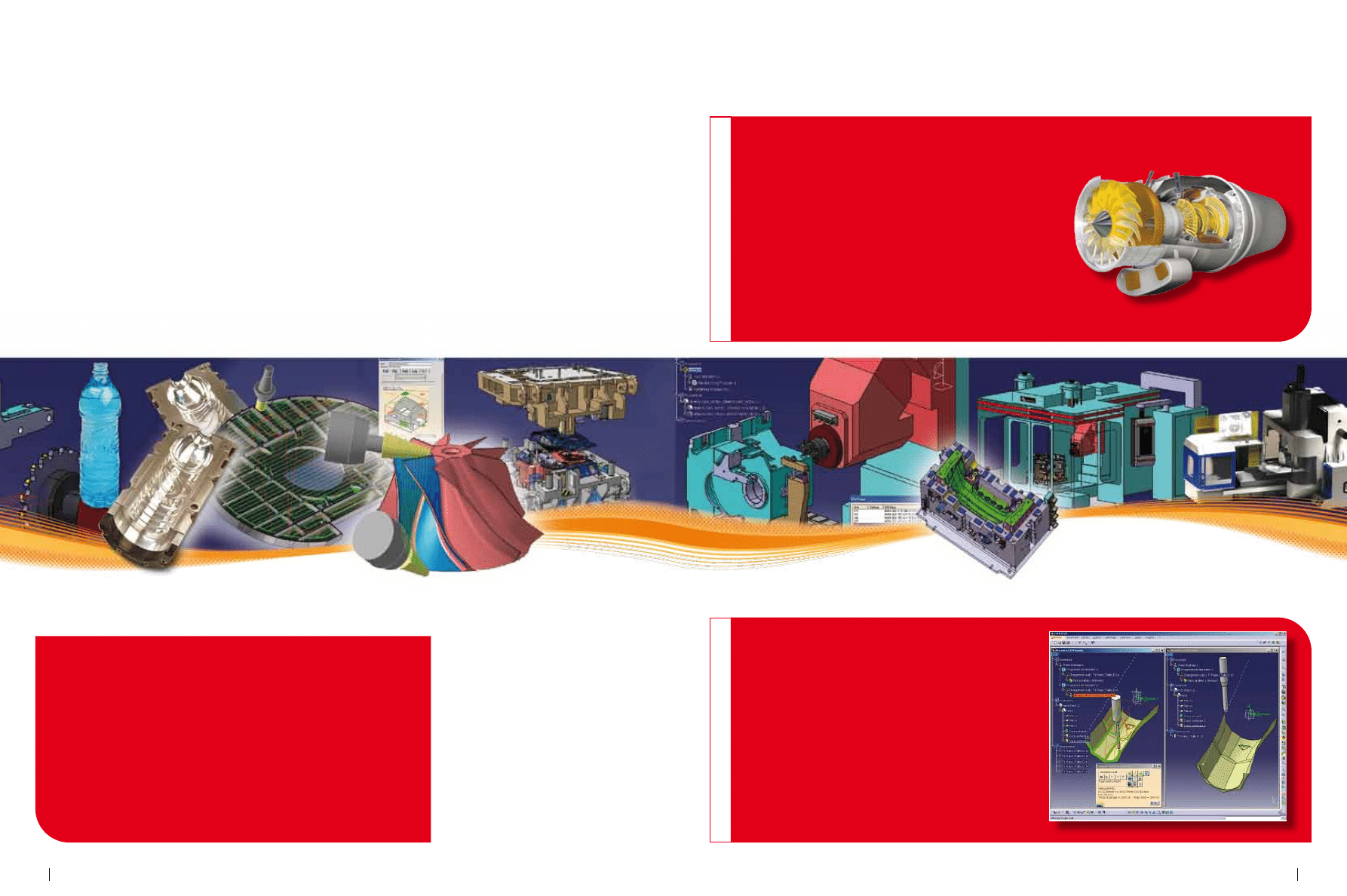
Dassault Systèmes’ solutions enable the complete, real-time, spatial simulation of machining paths generated
by the post-processor, including the machine’s complete kinematics. Fully integrated in the PLM architecture,
this seamless end-to-end solution enables NC programmers to easily switch between tool path definition and
tool path validation without losing time due to data transfer or preparation. This eliminates interface issues and
drastically increases cost effectiveness.
The simulation of tool paths or the ISO code has become a major factor in controlling the machining process
before production starts. It helps reduce machine set-up and idle times, while ensuring the implementation of
chosen machining strategies.
PRA
TT
& Whi
TNE
y C
ANADA
ARC
iNTERNA
Tio
NA
l, F
RANCE
• Designer and manufacturer of turbofans, turboprop
and turbo shaft engines for regional, business, utility
and military aircraft as well as helicopters
• NC programming from 2.5 axis to 5 axis milling and
Lathe machining
Benefits
• NC Programming up to 10 times faster
• Machining time up to 35% faster
• Global leading glass and tableware manufacturer
• 16.000 employees
• NC Programming of prototype parts and molds
Benefits
• - 25-40% in NC programming time
(123k€ savings per year)
• - 10% in machining time required for tool molds
(40k€ savings per year)
• Improved quality of finished molds
Wyszukiwarka
Podobne podstrony:
CATIA V5 Training Basics
CATIA V5 kurs podstawowy
CATIA V5 Modelowanie PL
Catia v5 Structural Analysis For The Designer
catia v5 modelowanie kurs podstawowy LZIVC3JESPF2KJV3WU7KPG7Z742RKIM3LA77XXA
CATIA V5 Training Basics
CATIA V5 tutorial advanced
CATIA V5 Workbook
Bewegungssimulation mit Catia V5
Advanced Catia v5 Workbook
Airbus Catia V5 Training Wireframe and Surface
Release Notes RobotWare Machining FC GUI v5 13
CATIA Lathe & Prismatic Machining
gp340 brochure
BrochureWeldability PL spawanie inox
Building A Wind Machine
Rodzaje pracy silników elektrycznych, 04. 01. ELECTRICAL, 07. Elektryka publikacje, 07. Electrical M
więcej podobnych podstron