
Australian English

• Australian English is a relatively new dialect of
English being just over 200 years old. It began
diverging from British English shortly after the
foundation of the Australian penal colony of
New South Wales in 1788.
• Irish 25%

• The first of the Australian gold rushes, in the
1850s, began a much larger wave of
immigration which would significantly
influence the language. During the 1850s,
when the UK was under economic hardship,
about two per cent of its population
emigrated to the Colony of New South Wales
and the Colony of Victoria.

• Since the 1950s the American influence on language in
Australia has mostly come from pop culture, the mass
media (books, magazines and television programs),
computer software and the internet. Some words, such
as freeway and truck, have even been naturalised so
completely that few Australians recognise their origin.
Some American, British and Australian variants exist
side-by-side; in many cases –
freeway and motorway (used in New South Wales) for
instance – regional, social and ethnic variation within
Australia typically defines word usage.

• Words of Irish origin are used, some of which
are also common elsewhere in the Irish
diaspora, such as tucker for "food",
"provisions" (Irish tacar), as well as one or two
native English words whose meaning have
changed under Irish influence, such
as paddock for "field", cf. Irish páirc, which has
exactly the same meaning as the
Australian paddock.

Types of accent: Broad
• Broad Australian English is recognisable and
familiar to English speakers around the world
because it is used to identify Australian
characters in non-Australian films and television
programmes (often in the somewhat artificial
"stage" Australian English version). Examples are
film/television personalities Steve Irwin and Paul
Hogan. Slang terms ocker, for a speaker,
and Strine, a shortening of the
word Australian for the dialect, are used in
Australia.


General Australian
• The majority of Australians speak with the
general Australian accent. This predominates
among modern Australian films and television
programmes and is used by, for example, Eric
Bana, Dannii Minogue, Hugh Jackman and Mel
Gibson.

Cultivated Australian
• Cultivated Australian English has some
similarities to British Received Pronunciation,
and is often mistaken for it. Cultivated
Australian English is spoken by some within
Australian society, for example Kevin
Rudd, Cyril Ritchard, Errol Flynn, Geoffrey
Rush and Judy Davis.
• Parody:

Phonology (1)
• Centring diphthongs
• Centring diphthongs, which are the vowels that occur in
words like ear, beard and air, sheer.
• In Western Australia there is a trend for centring
diphthongs like the vowels in the words "ear" and "air" to
be pronounced as full diphthongs (i.e. vowels that require
the tongue, jaw and lips to move during their production).
• Those in the eastern states will tend to pronounce "fear"
and "sheer" like "fee" and "she" respectively, without any
jaw movement, while the westerners would pronounce
them like "fia" and "shia", respectively.

Phonology (2)
• e > a
For many young speakers from Victoria, the first
vowel in "celery" and "salary" are the same,
so that both words sound like "salary". The
speaker from Victoria will also tend to say
"halicopter" instead of "helicopter". This
feature is present in New Zealand English as
well.

U > I U
• The vowel in words like "pool", "school" and
"fool" varies regionally. People who live in the
Eastern States tend to say "pool" and "school"
like "pewl" and "skewl", respectively, while the
rest of the Australian population pronounces
them as they are spelt.

Palatalisation
• Palatalisation also typically occurs now in
young speakers
where /tj/, /dj/, /sj/ and /zj/ become
single affricate or fricative sounds
Example:

T > R
• In colloquial speech intervocalic /t/ undergoes voicing
and flapping to the alveolar tap [ɾ] after the stressed syllable and
before unstressed vowels (as in butter, party) and syllabic /l/,
though not before syllabic /n/ (bottle vs button [batn]), as well as at
the end of a word or morpheme before any vowel (what
else, whatever). In formal speech /t/ is retained.
• However, the alveolar flap is normally distinguishable by Australians
from the intervocalic alveolar stop /d/, which is not flapped,
thus ladder and latter, metal and medal, and coating and coding re
main distinct; further, when coating becomes coatin' , the t remains
voiceless, thus [kʌutn]. This is a quality that Australian English
shares with some other varieties of English.

NT > N
• Intervocalic /nt/ in fast speech can be realised
as [n], another trait shared other varieties of
English at the colloquial or dialect level,
though in formal speech the full form /nt/ is
retained.
• winter / winner
• 1999

Linking R
• Non-rhotic: CAR, CARD
• However, the /r/ sound can occur when a word
that has a final “r” in the spelling comes before
another word that starts with a vowel. For
example, in “car alarm” the sound /r/ can occur in
“car” because here it comes before another word
beginning with a vowel.
• The words “far”, “far more” and “farm” do not
contain an /r/ but “far out” will contain the
linking /r/ sound because the next word starts
with a vowel sound.

Intrusive R
• Australian English speakers may also use
intrusive or epenthetic /r/. This is when
an /r/ may be inserted before a vowel in
words that do not have “r” in the spelling. For
example, "drawing" will sound like "draw-ring"
and "saw it" like sound like "sore it".

Bad – lad split
• A long /æ/ sound is found in the adjectives
“bad, mad, glad and sad”, before the
sound /g/ (for example, “hag, rag, bag”) and
also in vowels before /m/ and /n/ in the same
syllable (for example, “ham, tan, plant”).

Nasality
• Nasal consonants can affect the articulation of
the preceding vowel. For some speakers
words like "land", "man", "band", "stand",
"can" and "hand" will contain a vowel that
sounds similar to a long /e/ vowel, which is
the vowel in "head"

•
a good lurk
•
ace
•
aggro
•
Alf
•
amber (fluid)
•
arvo
•
Aussie, Strine
•
chalkie
•
chokkie
•
chook
•
Chrissie
•
comfort station
•
counter meal
•
cut lunch
•
game
•
to gander
•
G'day mate.
•
Good on ya!
•
to grizzle
•
grog
•
gum tree
•
gummy
•
a way of getting something for nothing
•
excellent
•
aggressive
•
stupid person
•
beer
•
afternoon
•
Australian
•
teacher
•
chocolate
•
chicken
•
Christmas
•
toilet
•
pub meal
•
sandwiches
•
brave
•
to have a look
•
Hi.
•
Well done!
•
to whine
•
alcohol
•
Eucalyptus tree
•
a sheep which has lost all its teeth

• Aboriginal English
•
camp
•
mob
•
big mob
•
lingo
•
sorry business
•
grow [a child] up
•
growl
•
gammon
•
cheeky
•
solid
•
to tongue for
• standard Australian
English
•
home
•
Group
•
a lot of
•
Aboriginal language
•
ceremony associated with
death
•
raise [a child]
•
scold
•
pretending, kidding,
joking
•
mischievous, aggressive,
dangerous
•
Fantastic
•
to long for
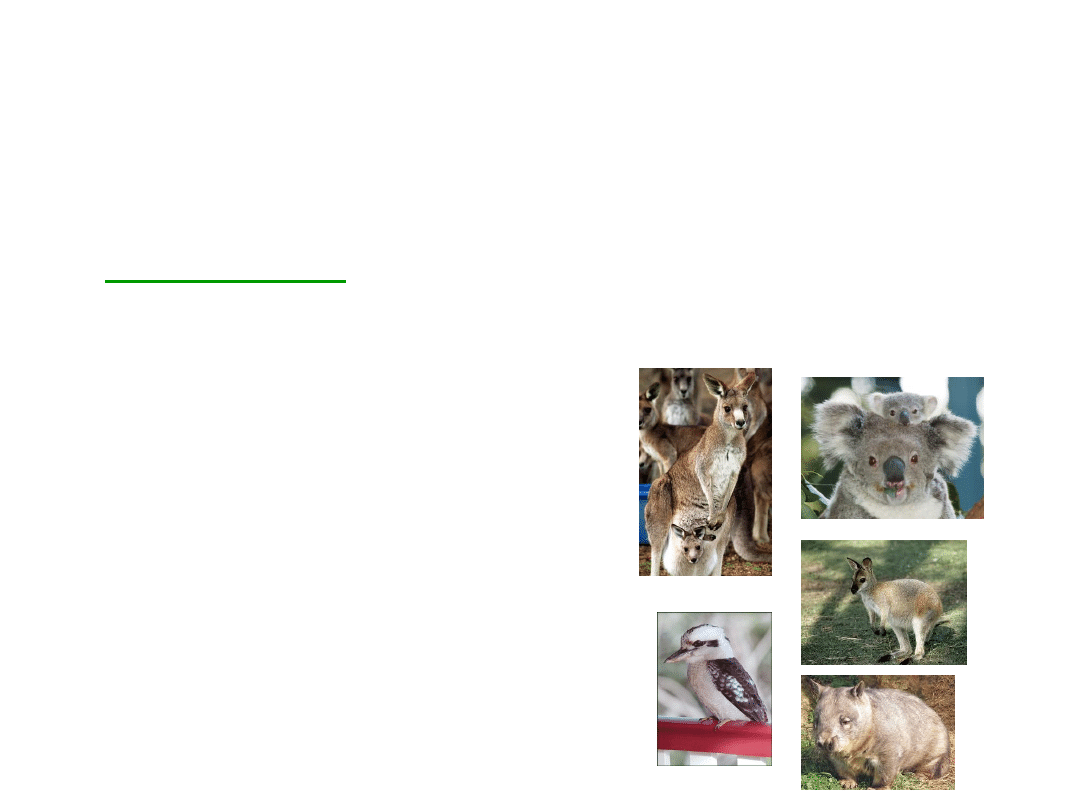
• Billabong
Boomerang
Corroboree
Kangaroo
Koala
Kookaburra
Wallaby
Wombat
Yabber
• Small lake
• Throwing stick
• Ceremonial meeting

HRT
• The high rising terminal (HRT), also known
as uptalk, upspeak, rising inflection or high rising
intonation (HRI), is a feature of some accents
of English where statements have a rising intonation
pattern in the final syllable or syllables of the
utterance. Ladd (1996: 123) proposes that HRT
in American English and Australian English is marked by
a high tone (high pitch or high fundamental frequency)
beginning on the final accented syllable near the end of
the statement (the terminal), and continuing to
increase in frequency (up to 40%) to the end of the
intonational phrase.

• A 1986 report stated that in Sydney, it is used more than
twice as often by young generations as by older ones, and
particularly by women (Guy et al., 1986).
• It has been suggested that the HRT has a facilitative
function in conversation (i.e., it encourages the addressee
to participate in the conversation), and such functions are
more often used by women.
• It also subtly indicates that the speaker is "not finished
yet", thus perhaps discouraging interruption (Allen, 1990;
Guy et al., 1986; Warren, 2005).
• Its use is also suggestive of seeking assurance from the
listener that she is aware of what the speaker is referring
to.

Wyszukiwarka
Podobne podstrony:
nexus nowe czasy 2009 (02) 64 żywe dinozaury w australii english
080 Living English Video Series (Australian Network) Dialogues (scripts)
IntroductoryWords 2 Objects English
Australia i Nowa Zelandia
Ekonomiczna analiza prawa własności w ujęciu szkoły austrackiej
NOWE AUSTRALIJSKIE OGNIWA SŁONECZNE
Australia
English for CE materials id 161873
120222160803 english at work episode 2
Australia i Oceania
English, Intermediate Grammar Questions answers
Lesley Jeffries Discovering language The structure of modern English
Lady Australia belaus
Hyd prd cat 2009 english webb
Chirurgia wyk. 8, In Search of Sunrise 1 - 9, In Search of Sunrise 10 Australia, Od Aśki, [rat 2 pos
Nadczynno i niezynno kory nadnerczy, In Search of Sunrise 1 - 9, In Search of Sunrise 10 Austral
121024104303 bbc english at work episode 37
więcej podobnych podstron