
Phonetics and
phonology
Introduction
Szczecin University
March 1, 2014

Issues to be discussed
Language – definition
Features of language
Duality of patterning
Phonemes and allophones
Distinctive features
Complementary distribution and free variation

Language
Language - an organised system of
speech used by human beings as a
means of communication among
themselves.
Language – a tool for communication.

Grammar
Grammar - a subconscious linguistic system
that makes possible the production and
comprehension of potentially unlimited number
of utterances.
Grammar – the way smaller elements (e.g.
speech sounds or words) are combined into
larger elements (e.g. words).
Phonetics
Phonology
Morphology
Syntax
Semantics

Features of language
1. The vocal auditory channel
2. Rapid fading
3. Broadcast transmission and directional
reception
4. Interchangeability
5. Total feedback
6. Specialisation
7. Semanticity
8. Arbitrariness
9. Discretness
10. Displacement
11. Productivity
12. Traditional transmission
13. Duality of patterning

Duality of patterning
[k], [t], [æ]
[kæt], [ækt], [tæk]
*[ktæ], *[tkæ], *[ætk]
*[tæt], *[kæk]

Phonetics
Phonetics deals with the physical aspects of
speech sounds.
A branch of linguistics that deals with the
production, transmission and perception of
speech sounds.
Articulatory phonetics – production of speech
sounds
Acoustic phonetics – physical properties of
speech sounds
Auditory phonetics – perception of speech
sounds

Phonology
Phonology deals with the contrastive units of
speech (phonemes) and the patterns in which
they are arranged and distributed in different
languages.
/m, n, ŋ/ - some – sun – sung.
/ŋ/ - is never found in word-initial position
[m, n, ŋ] - masz – nasz – bank.
[ŋ] is a positional variant of /n/, found before
velar obstruents [k, g, x]
Phonologists are concerned with providing
models of speakers’ representations of the
sound system of their language.

Reasons for studying phonetics
and phonology
Studying the sounds of the world’s
languages
Studying pathological speech
Studying different accents of a language
Speech synthesis
Speech recognition
In order to properly describe these
phenomena, one has to find out what
people are doing when they are talking.

Phonetics vs. phonology
A phonetic study tells us how speech sounds are
made and what their physical properties are.
A phonological study study tells us how these sounds
(and their physical properties) are used to convey
meaning.
Speakers have mental representations of sounds
which are not identical with their physical
properties.
Speakers also have mental representation of words
that differ from their physical realisation(s).
Speech sounds have a physical as well as
psychological aspect.
Jan Baudouin de Courtenay

Phonemes and allophones
Speech sounds that distinguish words of
different meaning, e.g. /teɪk/ and /keɪk/.
The phoneme is defined in terms of
oppositions in a phonological system (The
Prague School of Linguistics).
Minimal pairs

Examples of phonemes and allophones
/k/ → [kʰ] as in keep
/l/ → [l] as in late
→ [kʷ] as in quick
→ [ll̥] as in plate
→ [kˡ] as in climb
→ [ɫ] as in cool
→ [k̚ ] as in take
→ [lʷ] as in loo
→ [ʔ] as in pick
→ [k] as in computer

Two allophones of /s/
Miss has two realisations: [mɪs] and [mɪʃ] as in miss
you.
Because speakers of English produce either [s] or
[ʃ], depending on the context, the language is said to
have an alternation between the two sounds.
There is a need for two distinct levels of analysis:
phonological and phonetic.
The example shows that the phonological /s/ is
sometimes realised phonetically as [s] and
sometimes as [ʃ].

Phonemes as bundles of features
Phonological features – the smallest units
of phonological analysis that can be
thought of as individual articulatory
characteristics of a segment, e.g. [+Nasal]
or [- Voice].
Phonological features are binary.
Each phoneme can be analysed into a
number of features that distinguish it from
the other phonemes of a language.

The need for distinctive features
Phonological rules apply to classes of
phonetically related segments, i.e. natural
classes.
The change of [s, z, t, d] to [ʃ, ʒ, tʃ, dʒ]
Alveolar → Alveopalatal / _ j
Alveolar → Alveopalatal / _ Palatal
The rule is phonetically motivated (conditioned).

Redundant and distinctive features
pin [pʰɪn] vs. spin [spɪn]
Aspiration is predictable from the place a
plosive occupies within a word and the feature
is said to be redundant in English
In Thai, aspiration is used to mark differences
between words because aspiration is not
predictable.
The words [pʰàa] ‘to split’ vs. [pàa] ‘forest’
constitute a minimal pair.
The difference in aspiration is sufficient to
signal the difference in meaning.
Aspiration is a distinctive property in Thai.
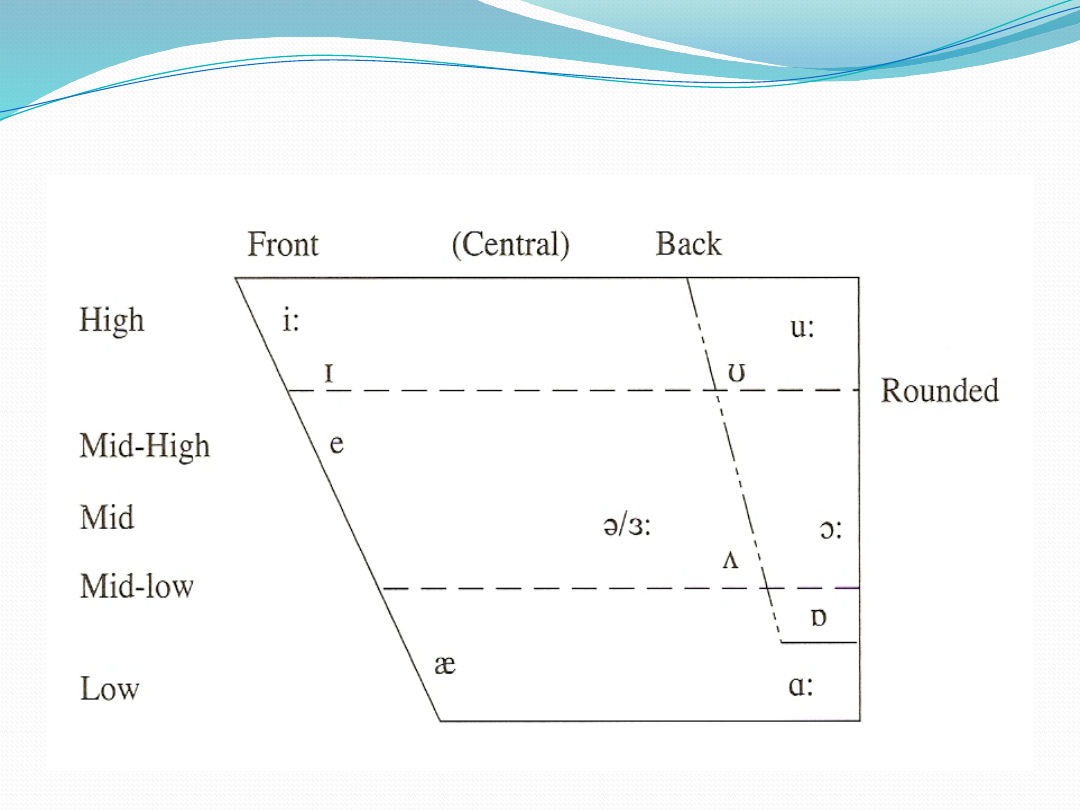
Pure vowels of English
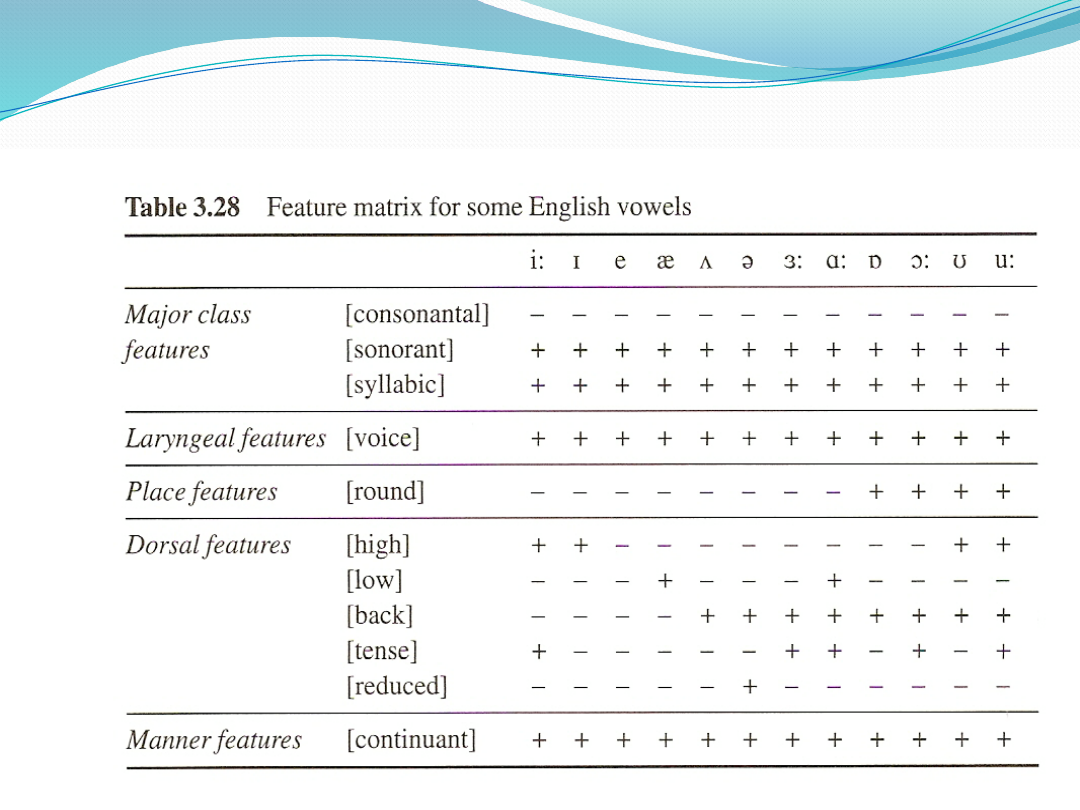
Feature matrix for English vowels
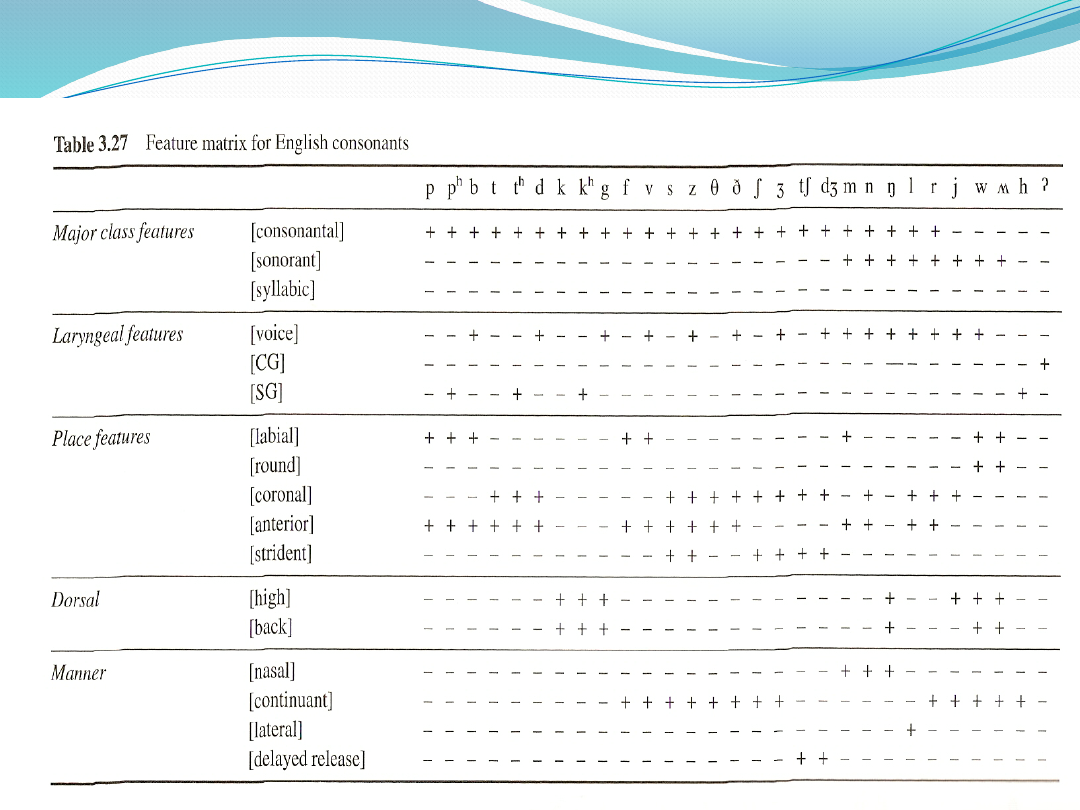
Feature matrix of English consonants

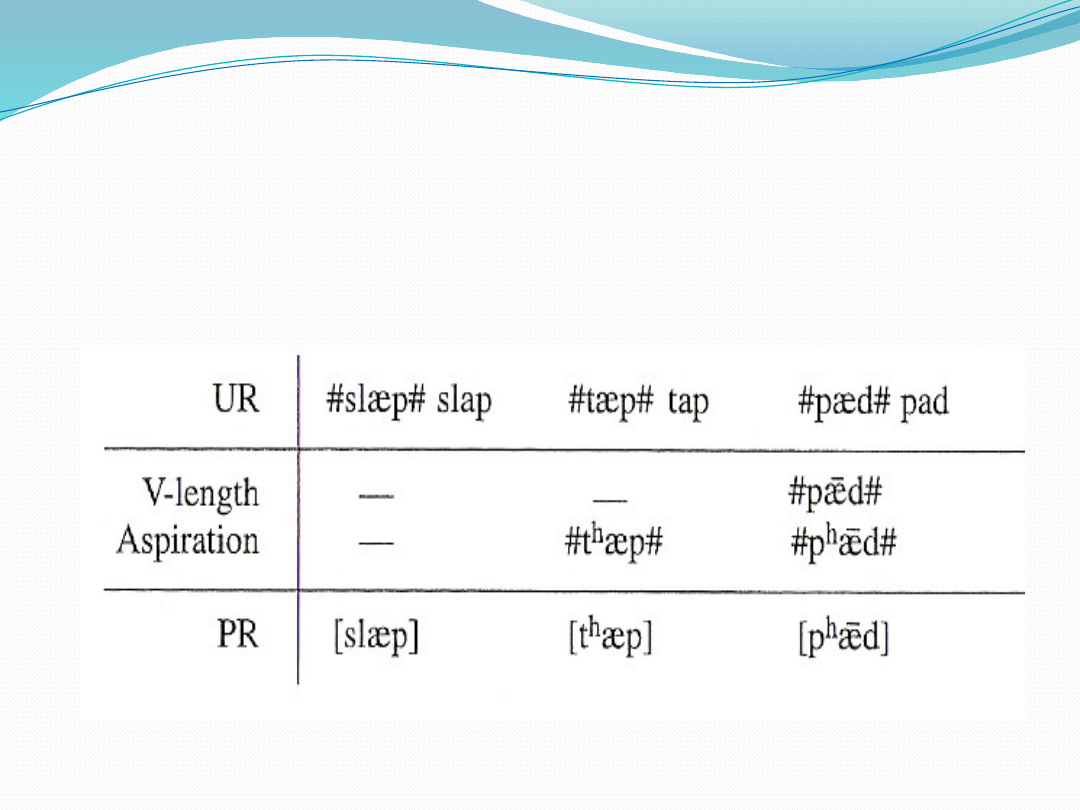
Derivation of surface forms
A phonological rule applies if the appropriate input is present.
More than one rule may be involved in a derivation.
The output may serve as the input to the following rule.
Where a rule fails to apply, the form remains unchanged.
When all rules relevant to the derivation in question have applied,
a phonetic form is provided.
Phonological rules fail to apply when an impermissible form would
result.
Allophonic variation is the result of processes that apply in the
course of language use.
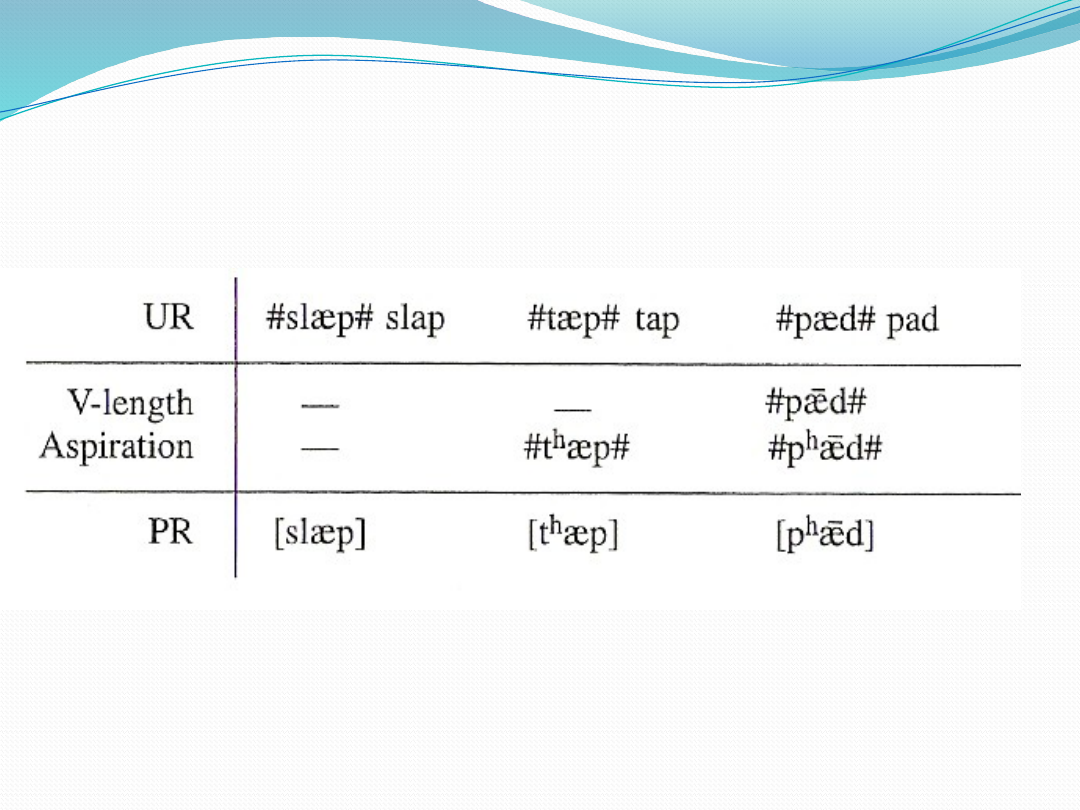
Example

Formal notation of rules
General statements about allophonic
distribution are formalised as rules.
A → B / X ̲ Y
A becomes B between X and Y.
A – the underlying representation
B – the phonetic representation
X, Y – the conditioning environment
̲ (focus bar) shows the position of the
segment undergoing the rule.

Liquid-glide devoicing in English
Rule and feature notation represents the
origin of allophones in phonetic processes
that arise in speech.
- syllabic - voice /
ϭ
- syllabic
_____
+ sonorant
+ consonantal
+ voice
- continuant
- nasal
- voice
- delayed release

Feeding order and
unordered rule application
Two (or more) phonological rules are said to
be unordered with respect to each other
when the order in which they are applied
does not change the final outcome.
Rules are said to be in feeding order when
the application of one rule creates an
environment that makes possible the
application of another rule that could
otherwise not apply.
Examples
[stændpɒɪnt] > [stænpɒɪnt] >
[stæmpɒɪnt]

Underlying forms and surface
structures
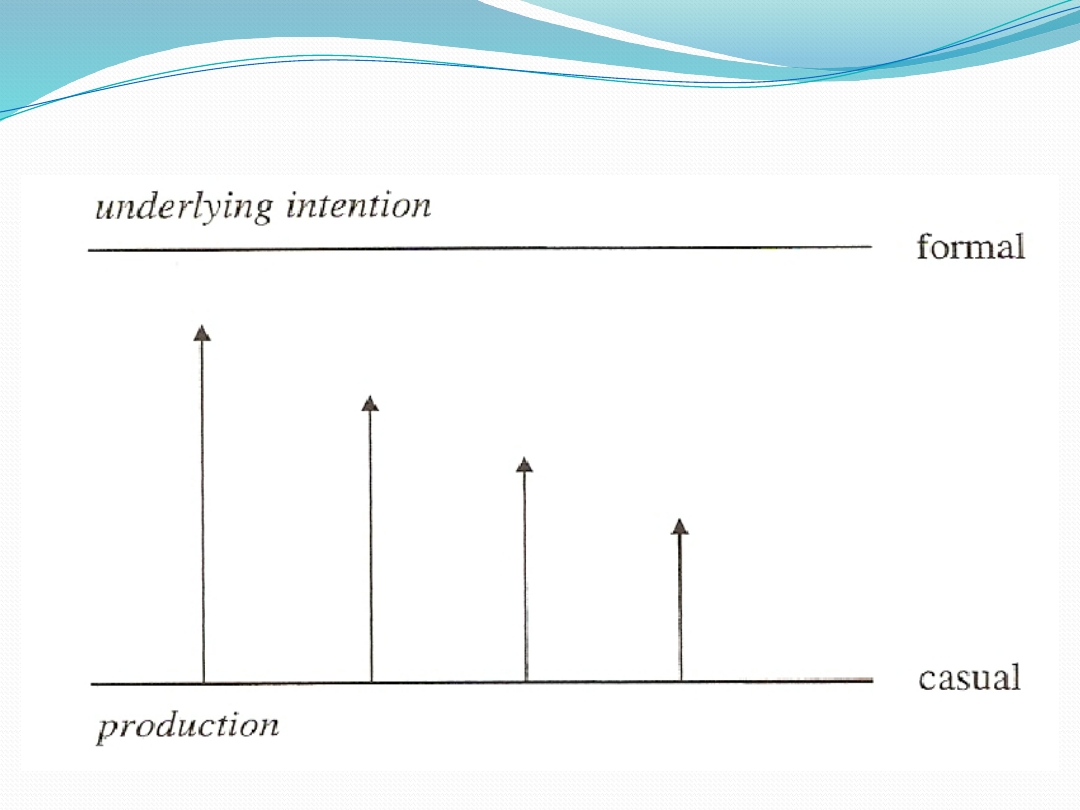
Underlying form (intention) is a mental
representation of a word or phrase (style-
independent).
Surface form (phonetic representation) – the
actual, physical realisation of a given word
(style-dependent).
Surface forms are derived from underlying
forms by means of phonological rules.
Phonostylistics

Thank you
Document Outline
- Slide 1
- Issues to be discussed
- Language
- Grammar
- Features of language
- Duality of patterning
- Phonetics
- Phonology
- Reasons for studying phonetics and phonology
- Phonetics vs. phonology
- Phonemes and allophones
- Examples of phonemes and allophones
- Two allophones of /s/
- Phonemes as bundles of features
- The need for distinctive features
- Redundant and distinctive features
- Pure vowels of English
- Feature matrix for English vowels
- Feature matrix of English consonants
- Derivation of surface forms
- Example
- Formal notation of rules
- Liquid-glide devoicing in English
- Feeding order and unordered rule application
- Examples
- Underlying forms and surface structures
- Phonostylistics
- Slide 28
Wyszukiwarka
Podobne podstrony:
Phonetics and Phonology 30 10 13 Gimson Chapter 4 Decri
Phonetics and Phonology 16 10 13 Gimson Chapter 2 Produ
Phonetics and Phonology 09 10 13, Gimson Chapter 1 Communication
Phonetics and Phonology 09 10 13, Phonetic syllabus and phonetic symbols 2013
Phonetics and Phonology 11 12 13, Gimson Chapter 5 Sounds in Language
Phonetics and phonology V
Phonetics and phonology II
english phonetics and phonology4 glossary
Phonetics and phonology
Phonetics and phonology IV
Phonetics and phonology III
22 Phonetics and Historical Phonology
phonetics vs phonol2modified(1)
I Phonetik und Phonologie
Phonology And Phonetics
2012 On the Relationship between Phonology and Phonetics
Phonetics in language and linguistics
Introduction To Phonetics Phonology
Little Words Their History, Phonology, Syntax, Semantics, Pragmatics, and Acquisition
więcej podobnych podstron