
Metamorphic Rocks
The term metamorphic is derived from the Latin term
meaning, "change of form". These rocks have been
altered while in their solid state as a response to the
environment.
Extreme circumstances of pressure and
temperature, or an introduction of certain chemicals, can
cause the existing rocks minerals to recrystallize, and
they may even become different minerals all together.
It
is important that you realize that the rock remains in its
solid state. Once a rocks minerals are melted, and then
recrystallize, the new material will be igneous.
All rocks can be metamorphosed
(even an existing
metamorphic rock), however, sedimentary rocks are
more easily changed. Because of this, most of the
discussion will deal with changes in sedimentary types.
METAMORPHIC TEXTURES
AND COMPOSITIONS
Texture
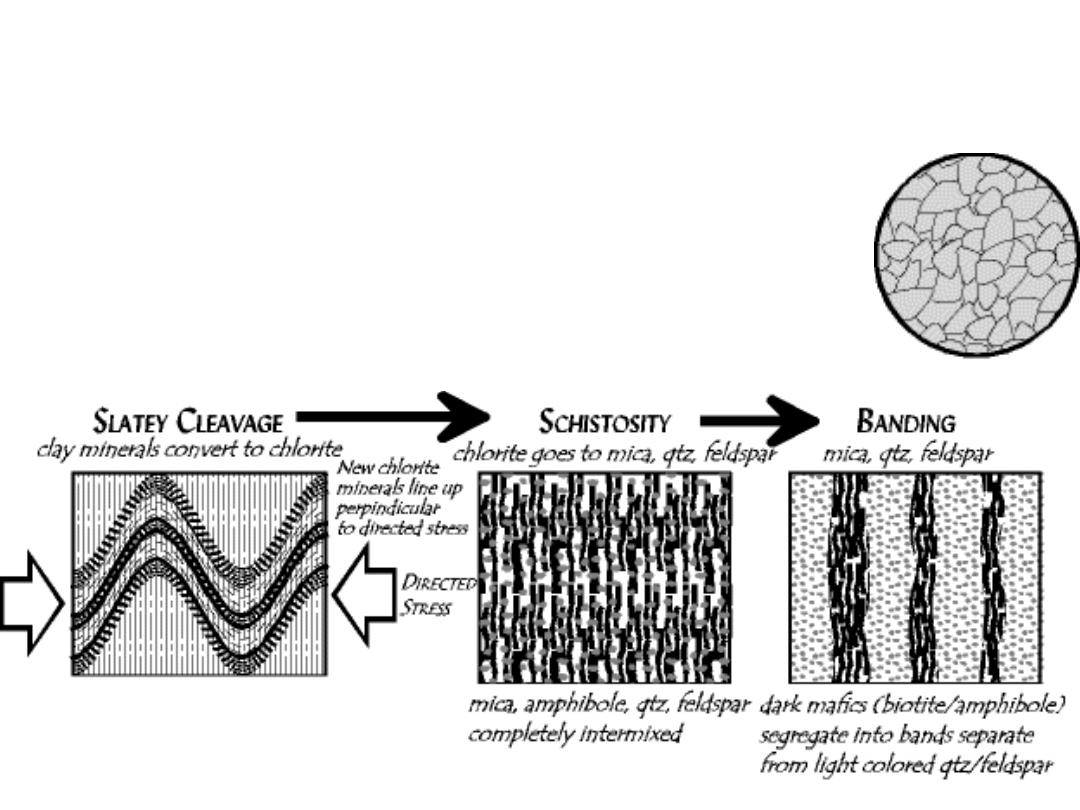
The new metamorphic textures are of two types,
granular
(also non-foliated) where the grains are
equidimensional, and foliated where the minerals
are layered .
KINDS OF METAMORPHISM
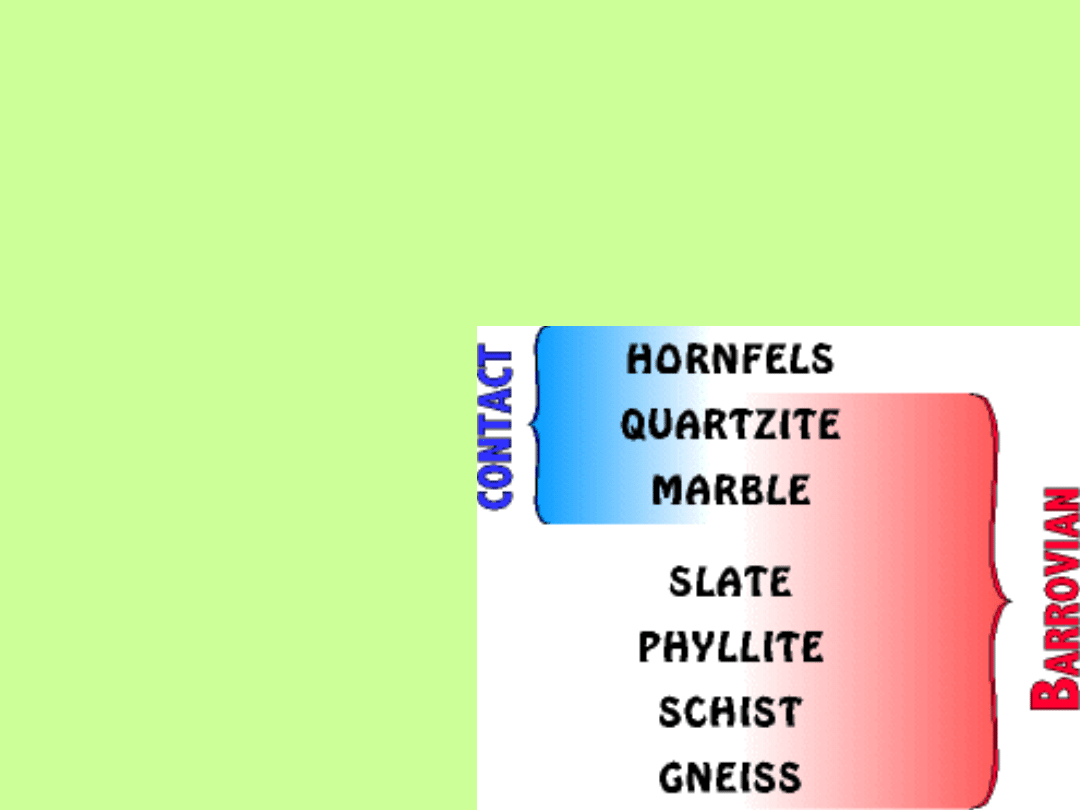
Barrovian (" regional" ) and Contact („thermal”).
The Relationships
Between
Rock and Process
REGIONAL
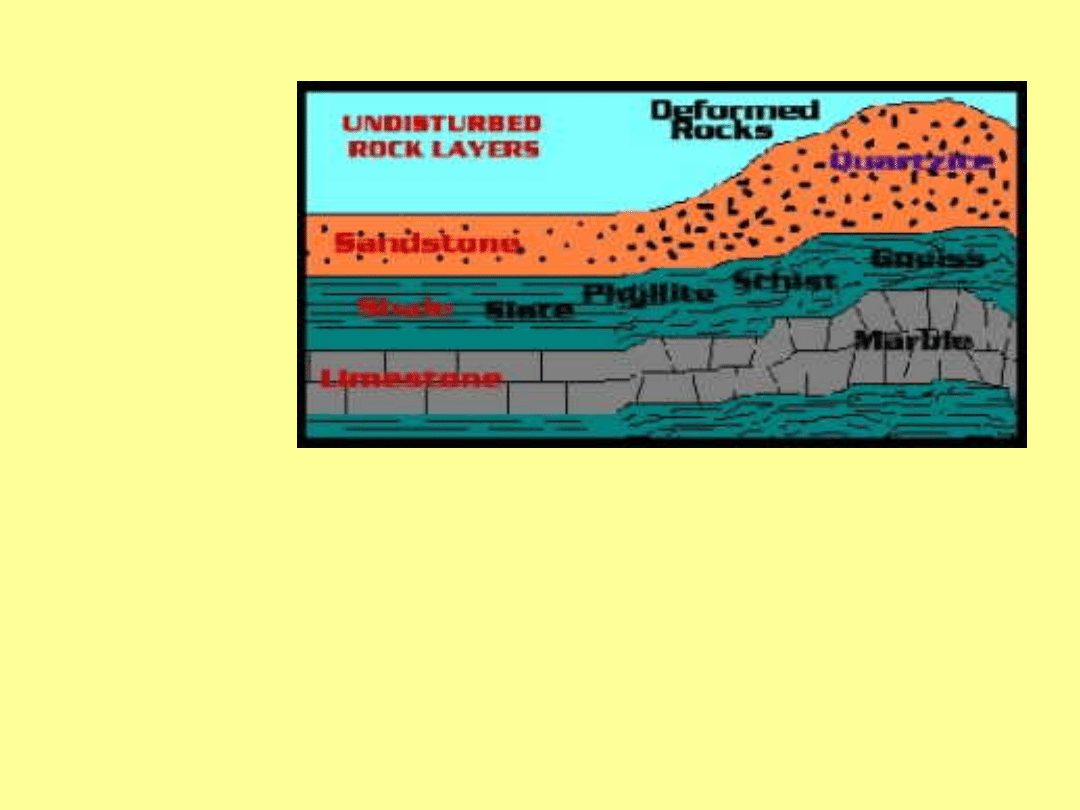
The second type of metamorphic rock is usually the
result of extreme pressure rather than that of
temperature. These are known as regional metamorphic
rocks.
These are commonly associated with mountain
building events and are often associated with plate
boundaries at continental margins.
THERMAL metamorphism
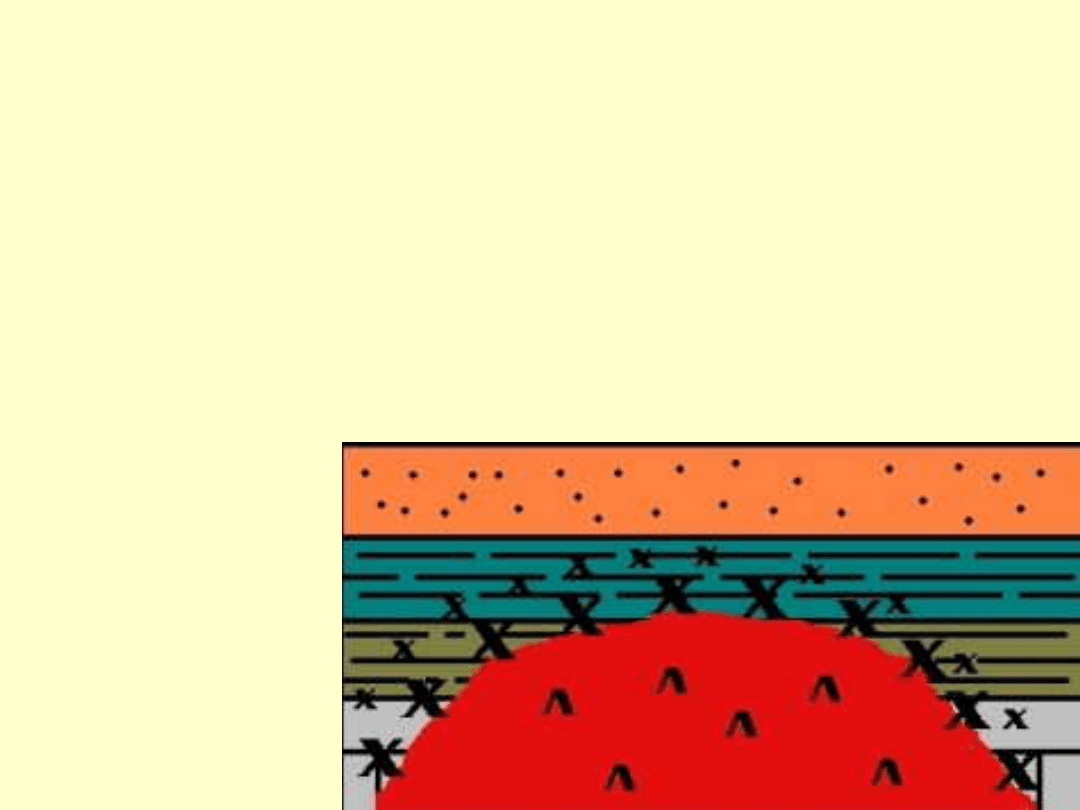
X =Slight Metamorphism
X
=Intense Metamorphism
^
=Igneous rock
Heat is the primary cause of alteration in formation of metamorphic
rocks .
These are called thermal metamorphic rocks, or contact
metamorphic rocks.
This type is often associated with lava flows and shallow plutons
(igneous intrusions).
Because of the high heat, the rock surrounding the intrusion is often
altered.
The pressure involved with these situations is in many instances,
negligible.
Alteration of the rock is generally localized in what is known as a
metamorphic
aureole or halo.
Thermal
meta-
morphis
m
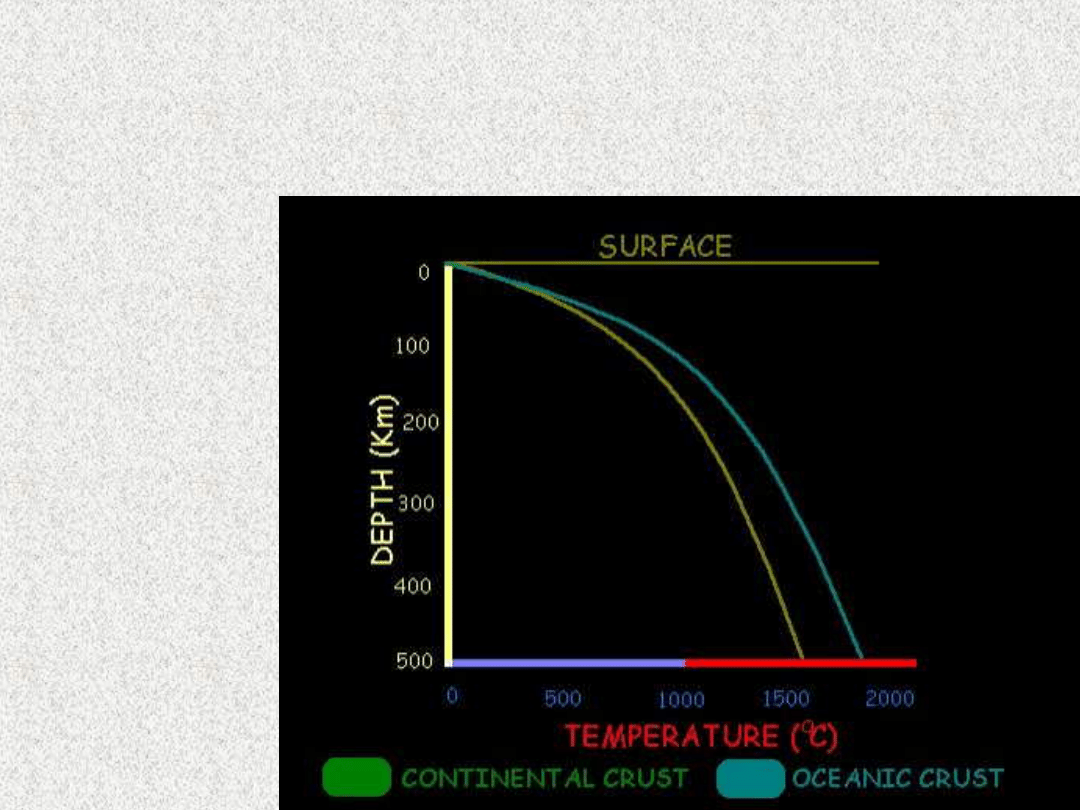
Another principle source of heat is the natural
increase in temperature as the depth increases.
This is known as the geothermal gradient.
The typical geothermal gradient is about 30
degrees per kilometer (85 degrees per mile).
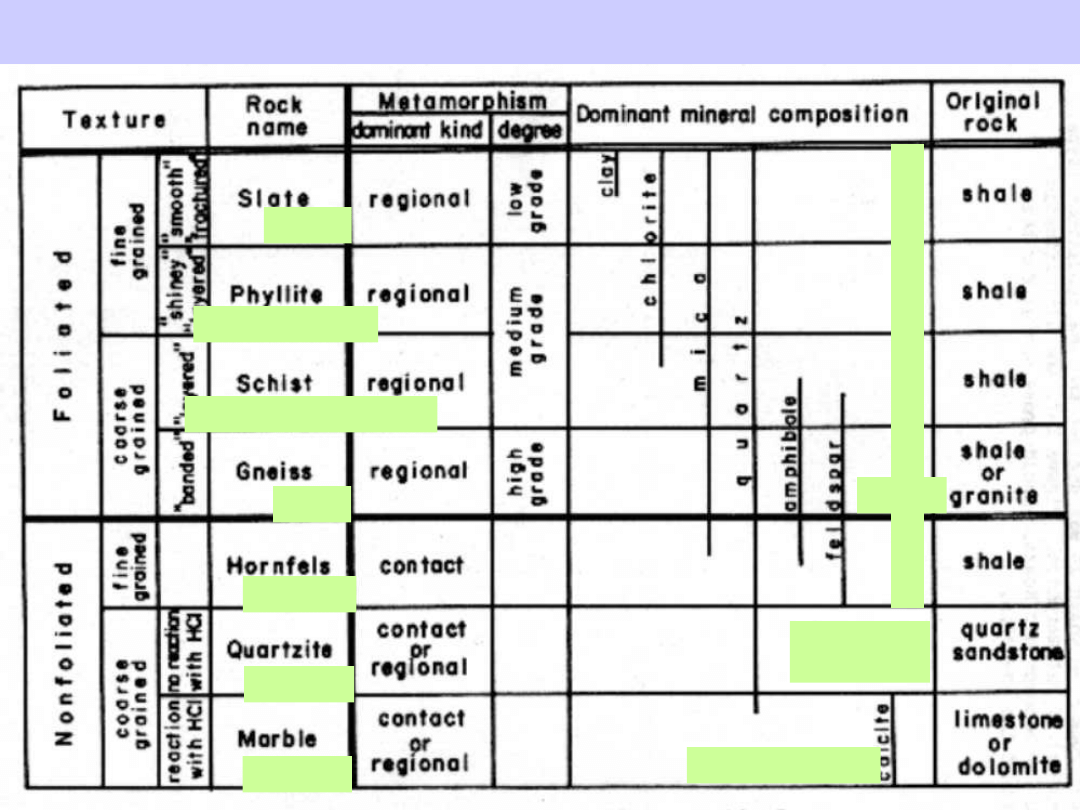
Main types of metamorphic rocks
Łupek
Łupek fyllitowy
Łupek metamorficzny
gnejs
Hornfels
Kwarcyt
Marmur
Ł
u
P
e
k
i
l
a
s
t
y
Granit
Piaskowiec
kwarcowy
Wapień/ dolomit
Metamorphic Rock
Composition
Minerały skał metamorfocznych:
Epidot, chloryty, zeolity, granaty, kordieryt, sylimanit, andaluzyt, mikroklin

Skarns
Au, Cu, Fe, Mo, Sn, W, and Zn-Pb skarn deposits
As subordinate layers in the feldspar-poor felsic volcanic
rocks, there appear peculiar dark rocks which also are
the ore's host rock. These rocks are in the Persberg area
denoted 'skarn', a word which likely can be used as a
collective term for all such odd rocks occurring alongside
the ores." Tornebohm goes on to describe garnet-rich
"brunskarn" (brown skarn) and pyroxene-rich
"gronskarn" (green skarn).
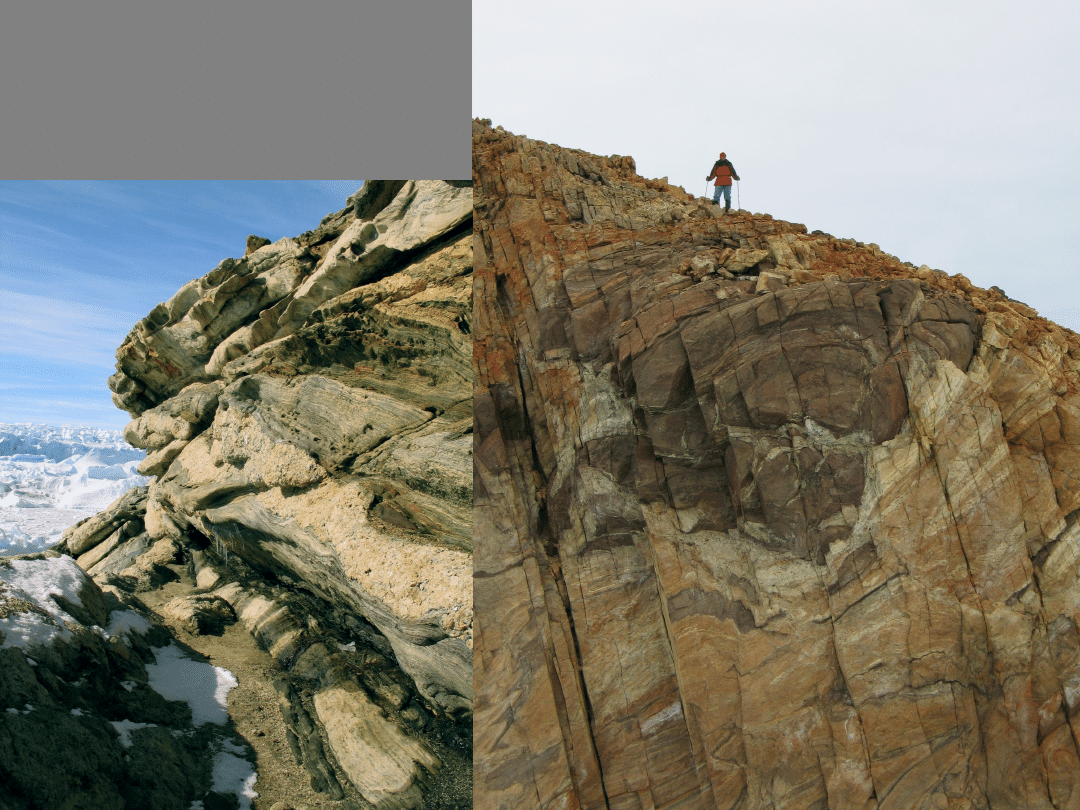
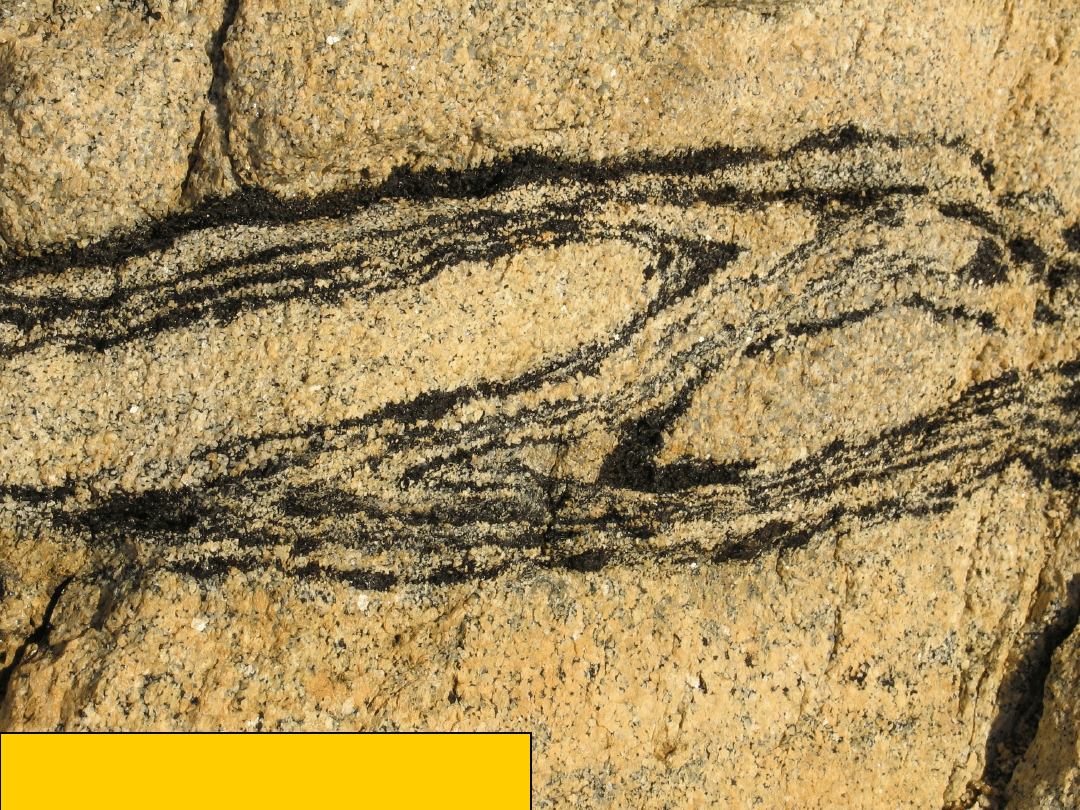
E Antarctica
Ksenolit
Gnejs z reliktami
warstwowania skały
osadowej
E
Antarctica
Smużyste odmieszania minerałów
ciemnych
w gnejsie o teksturze granulanej
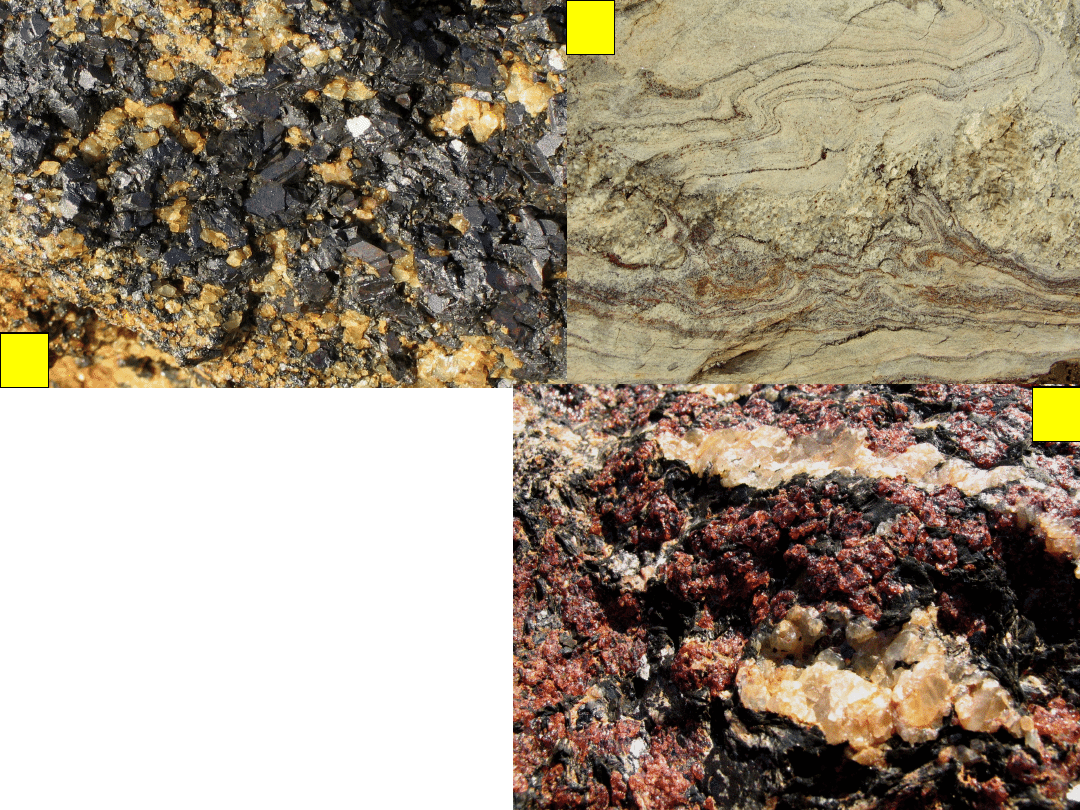
E Antarctica
A – magnetyt, smugi w
gnejsie
B – smużyste odmieszania
minerałów ciemnych
C – granat w smugach
B
C
A
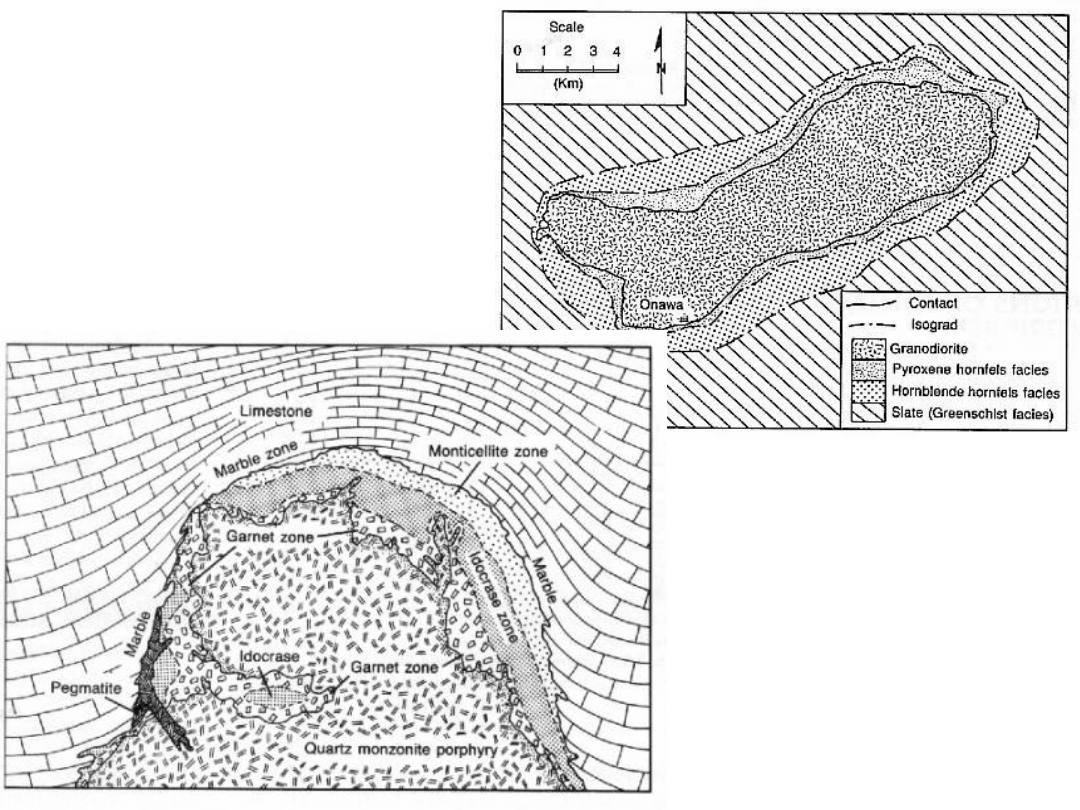
Thermal
Metamorphis
m
calcite
CaCO
3
calcite
+brucite
CaCO
3
+ Mg(OH)
2
monticellite
CaMgSiO
4
idocrase
Ca
10
Mg
2
Al
4
Si
9
O
34
(OH)
4
grossularite - wollastonite - diopside
Ca
3
Al
2
Si
3
O
12
- CaSiO
3
-
CaMgSi
2
O
6
Examination of the progressive
sequence
of key minerals indicates
that metasomatism has occurred.
increasing stress
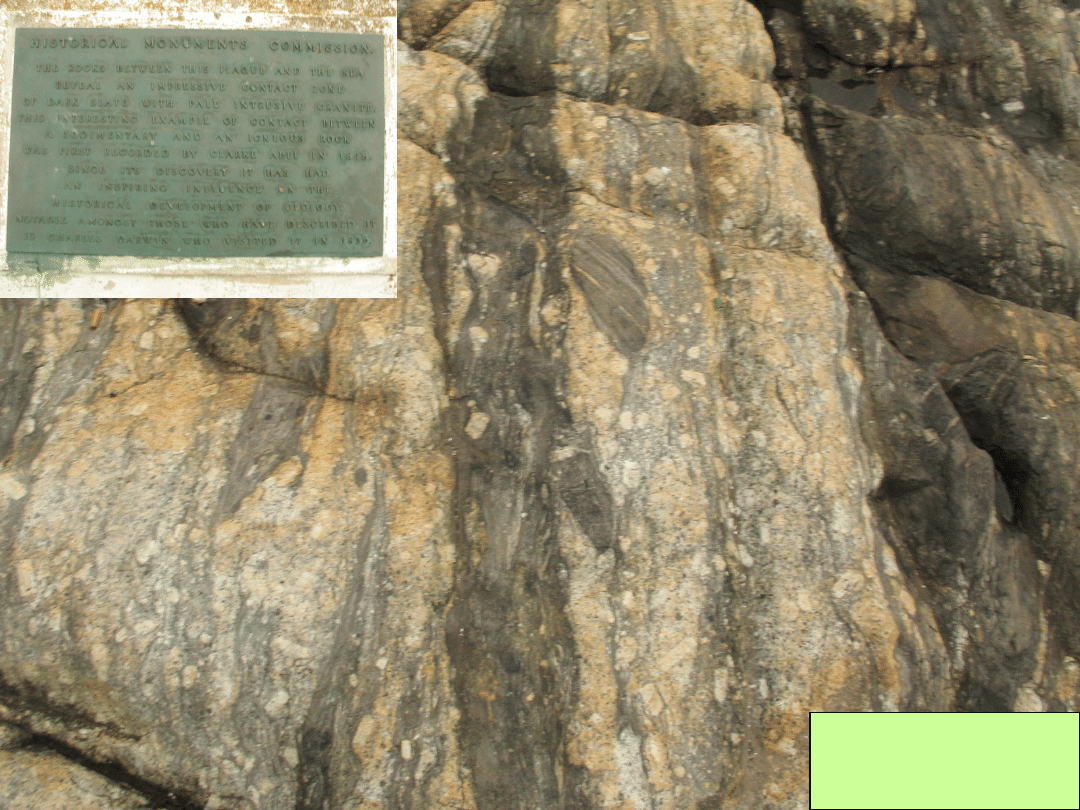
S Africa
Batolit granitowy
metamorfizuje
ciemne łupki ilaste

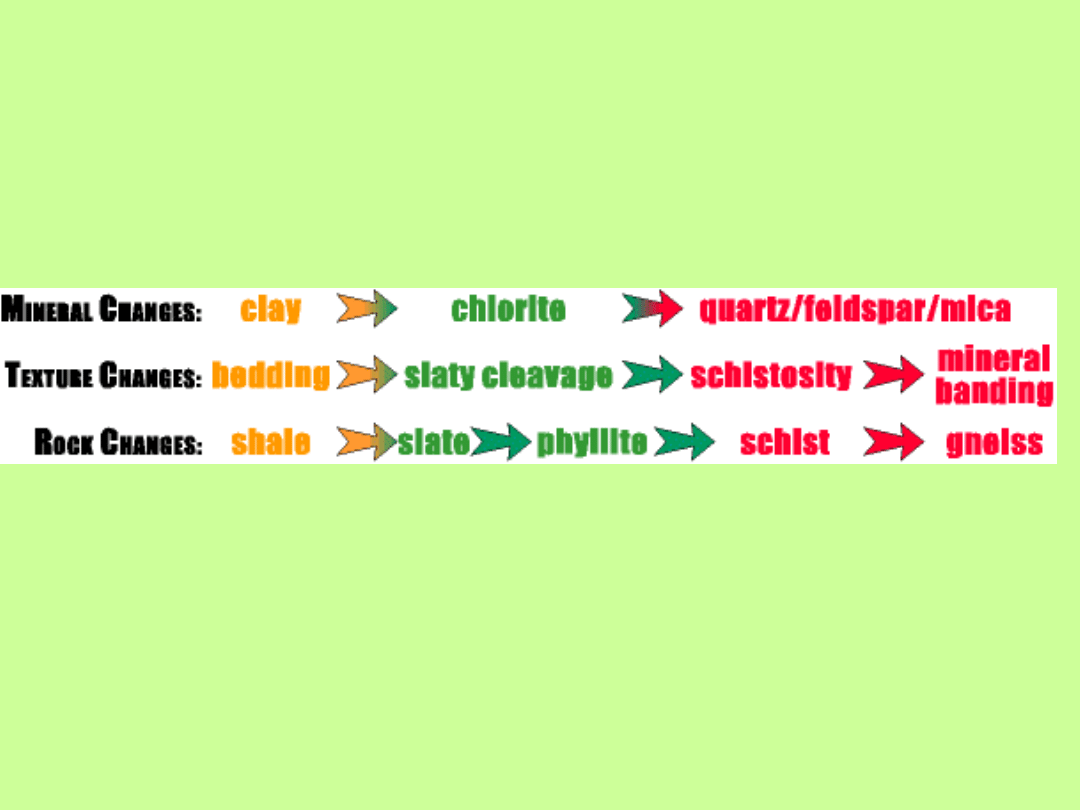
SEDIMENTARY TO METAMORPHIC
The following is a very general progression from
sedimentary rock to metamorphic rock based primarily
on pressure.
SURFACE
MUD
5 km DEEP
SHALE (sedimentary)
10 km DEEP
SLATE (low grade
metamorphic)
15 km DEEP
SCHIST (Garnet appears)
20 km DEEP
GNEISS (high grade
metamorphic)
25 km DEEP
HORNFELS (Cordierite
appears)

Regional
Metamorphism
The zones of metamorphism in the Scottish
Highlands
Chlorite
Zone (slates, phyllites, and schists)
quartz-albite-white mica-chlorite-microcline ± calcite
Biotite Zone (phyllites and schists)
quartz-albite-white mica-chlorite-biotite ± microcline ±calcite ±
epidote
Almandine (
Garnet)
Zone (phyllites and schists)
quartz-albite-white mica-biotite-
garnet ± chlorite
Staurolite
Zone (schists)
quartz-oligoclase-white mica-biotite-
garnet-staurolite
Kyanite
Zone (schists)
quartz-oligoclase-white mica-biotite-
garnet-kyanite ±staurolite
Sillimanite
Zone (schists and gneisses)
quartz-oligoclase-biotite-
sillimanite ± kyanite
± K-feldspar ± white mica
At the lowest grade, in the
Zeolite
Facies, assemblages are characterized by clay minerals.
kaolinite-illite-smectite-chlorite-quartz-analcite
At slightly higher-grade conditions, Zeolite Facies are replaced by Prehnite-Pumpellyite Facies.
As the P-T conditions increase, Greenschist Facies assemblages form.
white mica-chlorite-chloritoid-quartz-albite-magnetite-biotite-
epidote-garnet-pyrophyllite
Amphibolite Facies
white mica-chlorite-biotite-quartz-plagioclase-
garnet-magnetite-staurolite-ilmenite-kyanite-
sillimanite
Granulite Facies
biotite-
garnet-
sillimanite-K feldspar-andesine-quartz-cordierite-orthopyroxene-
sillimanite
-zircon
Additional minerals that may occur include
stilbite, calcite, stilpnomelane, actinolite and
hornblende
.
Epidot
Granaty
Silimani
t
Stauroli
t
Kordier
yt
aktynoli
t

Zagadnienia do
zapamiętania
• Scharakteryzuj rodzaje metamorfizmu
• Jakie zmiany mineralne zachodzą podczas
metamorfizmu ?
• Jakie nowe skały powstają w wyniku metamorfizmu ?
• Wymień kilka, a opisz dokładnie jeden minerał skał
metamorficznych

Adresy internetowe
http://www.cobweb.net/~bug2/rock5.htm
http://csmres.jmu.edu/geollab/Fichter/MetaRx/metasimp
le.html
http://geology.csupomona.edu/alert/metamorphic/metar
xs.htm
Document Outline
- Slide 1
- Slide 2
- Slide 3
- Slide 4
- Slide 5
- Slide 6
- Slide 7
- Slide 8
- Slide 9
- Slide 10
- Slide 11
- Slide 12
- Slide 13
- Slide 14
- Slide 15
- Slide 16
- Slide 17
- Slide 18
Wyszukiwarka
Podobne podstrony:
SKAŁY METAMORF
SKAŁY METAMORFICZNE
Skały metamorficzne, ^ Wydział Nauk o Ziemi UŚ Geografia ZGS, Geologia
02 skały metamorficzne zajęcia 2007
[5] Konspekt - skały metamorficzne, ZiIP - AGH WGIG, 5 semestr, GEOLOGIA
Skały metamorficzne-opis, Geologia
SKAŁY METAMORFICZNE sciaga
SKAŁY METAMORFICZNE FISZKI
04 Skaly metamorficzne
Ćwiczenia IVa (Skały metamorficzne), Geologia i geomorfologia, Geologia(1)
Skaly metamorficzne, Geologia
MINRAŁY SKAŁOTWÓRCZE I SKAŁY METAMORFICZNE
główne skały metamorficzne, Geografia, Geologia dynamiczna
3 skały metamorficzne
Skały metamorficzne, Studia Geografia, Geologia i geomorfologia
Konspekt Tytuł (skały metamorficzne)
Skały metamorficzne
3 Skaly metamorficzne id 33227 Nieznany
SKAŁY METAMORFICZNE
więcej podobnych podstron